Cambridge IGCSE Sciences - Co-ordinated (Double) 0654 — 2007 Oct/Nov Paper 2 · Variant 1
0654/21/O/N/07 · 100 marks · ≈113 min
The question paper and its mark scheme, free to read here and free to download. This is Cambridge’s own paper, exactly as it was sat.
Question paper24 pages



Mark scheme7 pages
Answers below. Sit the paper first if you are practising.
Paper as text
Question paper, page 1
This document consists of 21 printed pages and 3 blank pages. IB07 11_0654_02/2RP © UCLES 2007 [Turn over *5910681856* For Examiner's Use 1 2 3 4 5 6 7 8 9 10 11 Total UNIVERSITY OF CAMBRIDGE INTERNATIONAL EXAMINATIONS International General Certificate of Secondary Education CO-ORDINATED SCIENCES 0654/02 Paper 2 (Core) October/November 2007 2 hours Candidates answer on the Question Paper. No Additional Materials are required. READ THESE INSTRUCTIONS FIRST Write your Centre number, candidate number and name on all the work you hand in. Write in dark blue or black pen. You may use a soft pencil for any diagrams, graphs, tables or rough working. Do not use staples, paper clips, highlighters, glue or correction fluid. DO NOT WRITE IN ANY BARCODES. Answer all questions. A copy of the Periodic Table is printed on page 24. At the end of the examination, fasten all your work securely together. The number of marks is given in brackets [ ] at the end of each question or part question. www.XtremePapers.com
Question paper, page 2
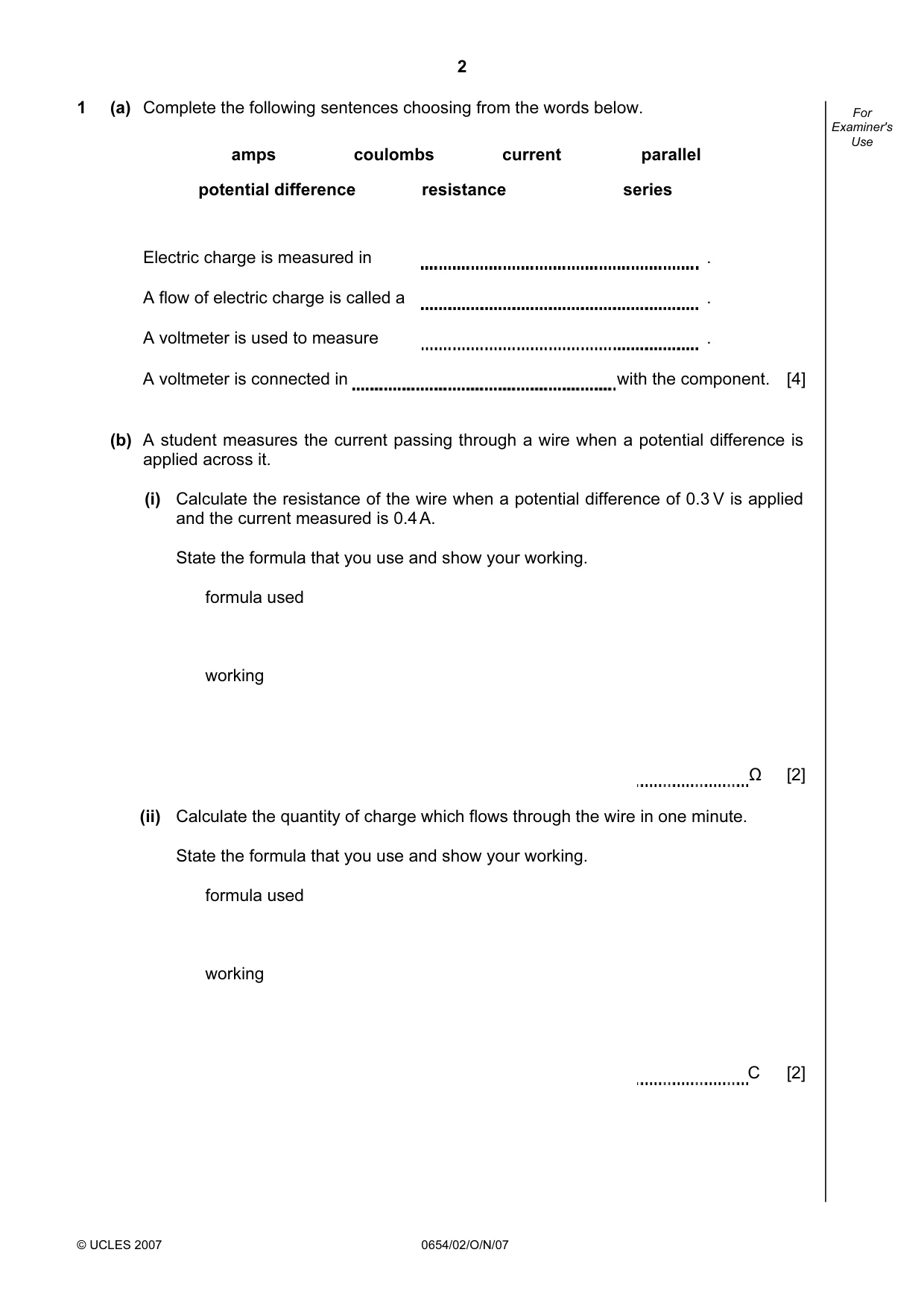
2 © UCLES 2007 0654/02/O/N/07 For Examiner's Use 1 (a) Complete the following sentences choosing from the words below. amps coulombs current parallel potential difference resistance series Electric charge is measured in . A flow of electric charge is called a . A voltmeter is used to measure . A voltmeter is connected in with the component. [4] (b) A student measures the current passing through a wire when a potential difference is applied across it. (i) Calculate the resistance of the wire when a potential difference of 0.3 V is applied and the current measured is 0.4 A. State the formula that you use and show your working. formula used working Ω [2] (ii) Calculate the quantity of charge which flows through the wire in one minute. State the formula that you use and show your working. formula used working C [2]
Question paper, page 3
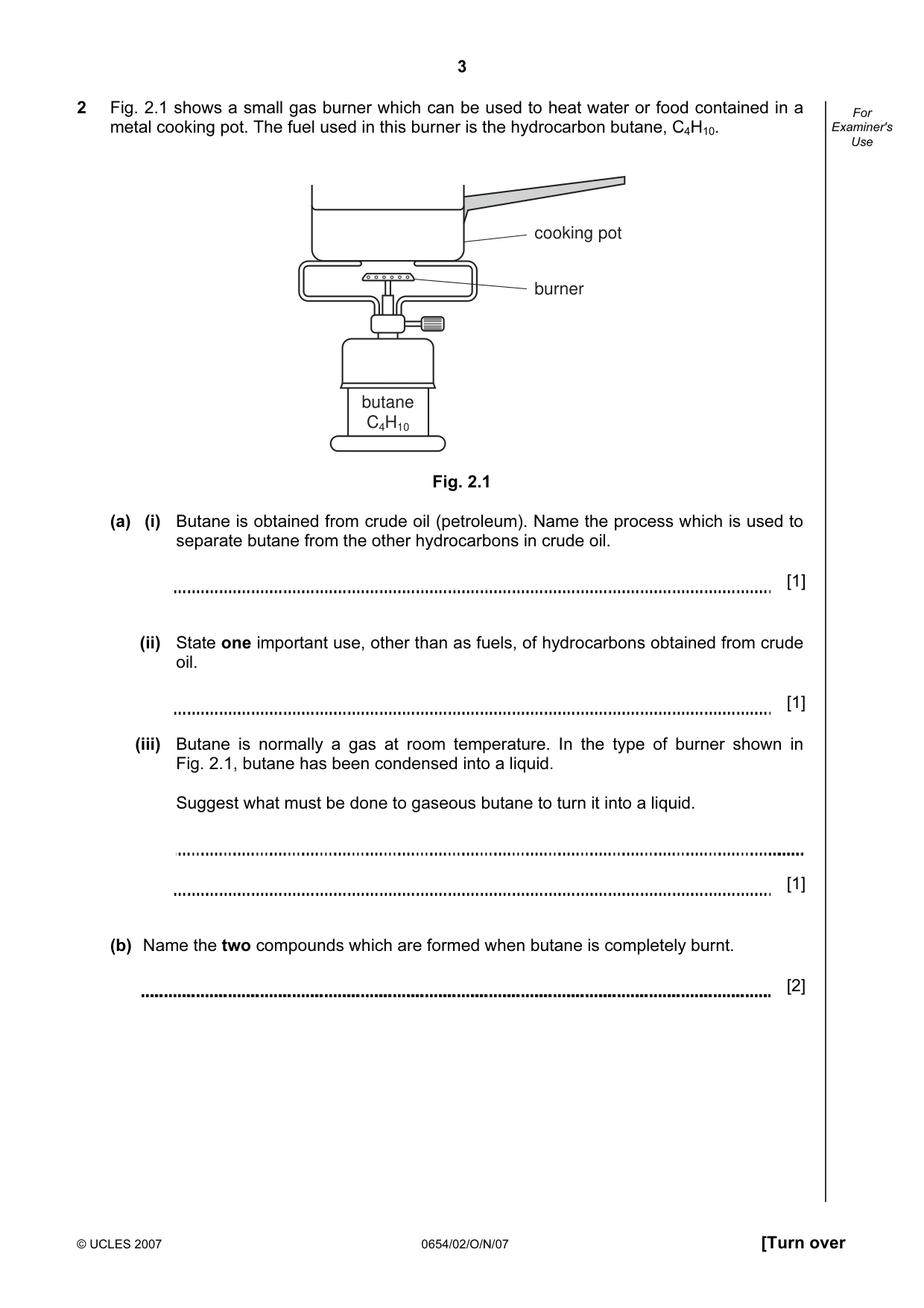
3 © UCLES 2007 0654/02/O/N/07 [Turn over For Examiner's Use 2 Fig. 2.1 shows a small gas burner which can be used to heat water or food contained in a metal cooking pot. The fuel used in this burner is the hydrocarbon butane, C4H10. butane C4H10 cooking pot burner Fig. 2.1 (a) (i) Butane is obtained from crude oil (petroleum). Name the process which is used to separate butane from the other hydrocarbons in crude oil. [1] (ii) State one important use, other than as fuels, of hydrocarbons obtained from crude oil. [1] (iii) Butane is normally a gas at room temperature. In the type of burner shown in Fig. 2.1, butane has been condensed into a liquid. Suggest what must be done to gaseous butane to turn it into a liquid. [1] (b) Name the two compounds which are formed when butane is completely burnt. [2]
Question paper, page 4
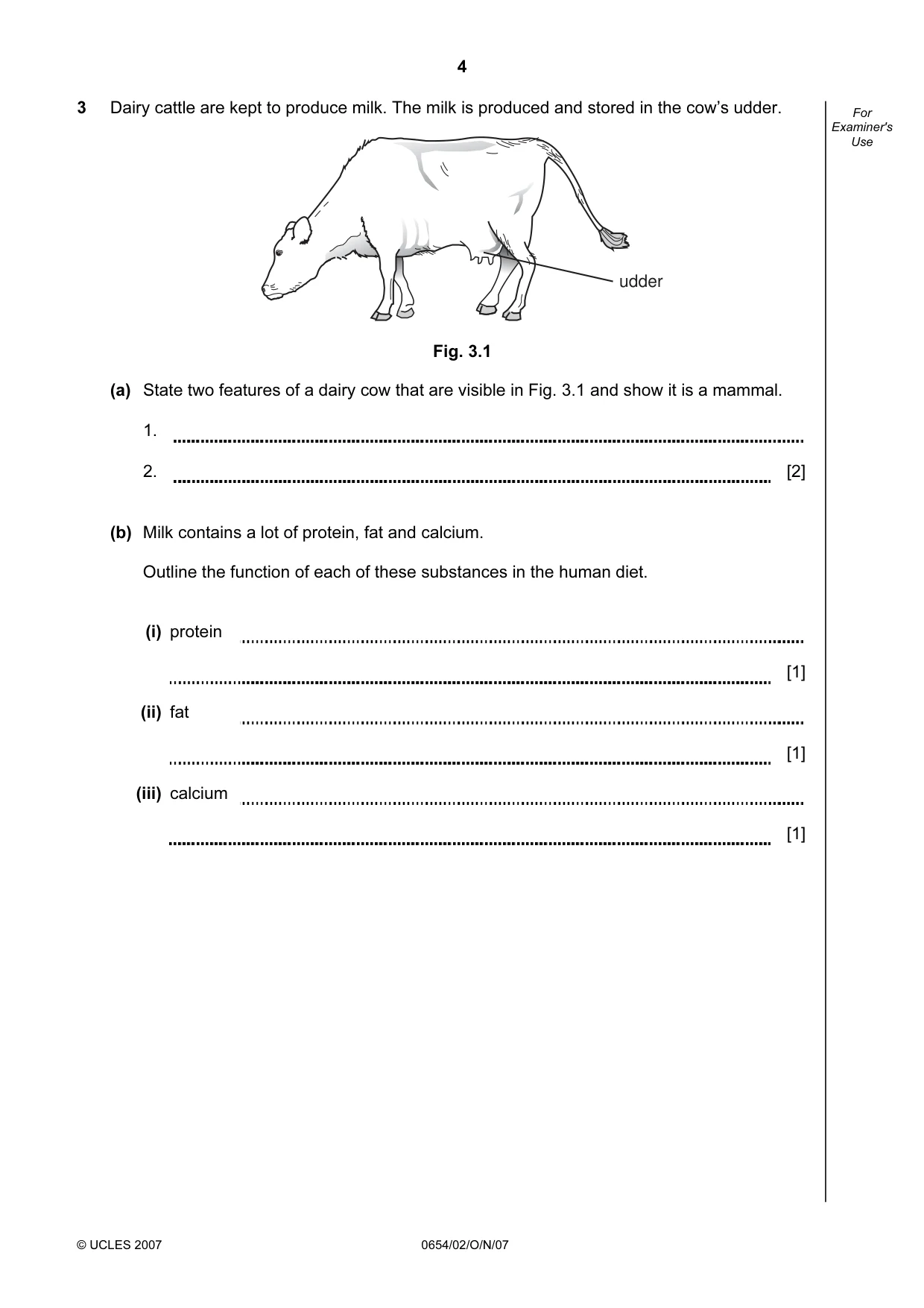
4 © UCLES 2007 0654/02/O/N/07 For Examiner's Use 3 Dairy cattle are kept to produce milk. The milk is produced and stored in the cow’s udder. udder Fig. 3.1 (a) State two features of a dairy cow that are visible in Fig. 3.1 and show it is a mammal. 1. 2. [2] (b) Milk contains a lot of protein, fat and calcium. Outline the function of each of these substances in the human diet. (i) protein [1] (ii) fat [1] (iii) calcium [1]
Question paper, page 5
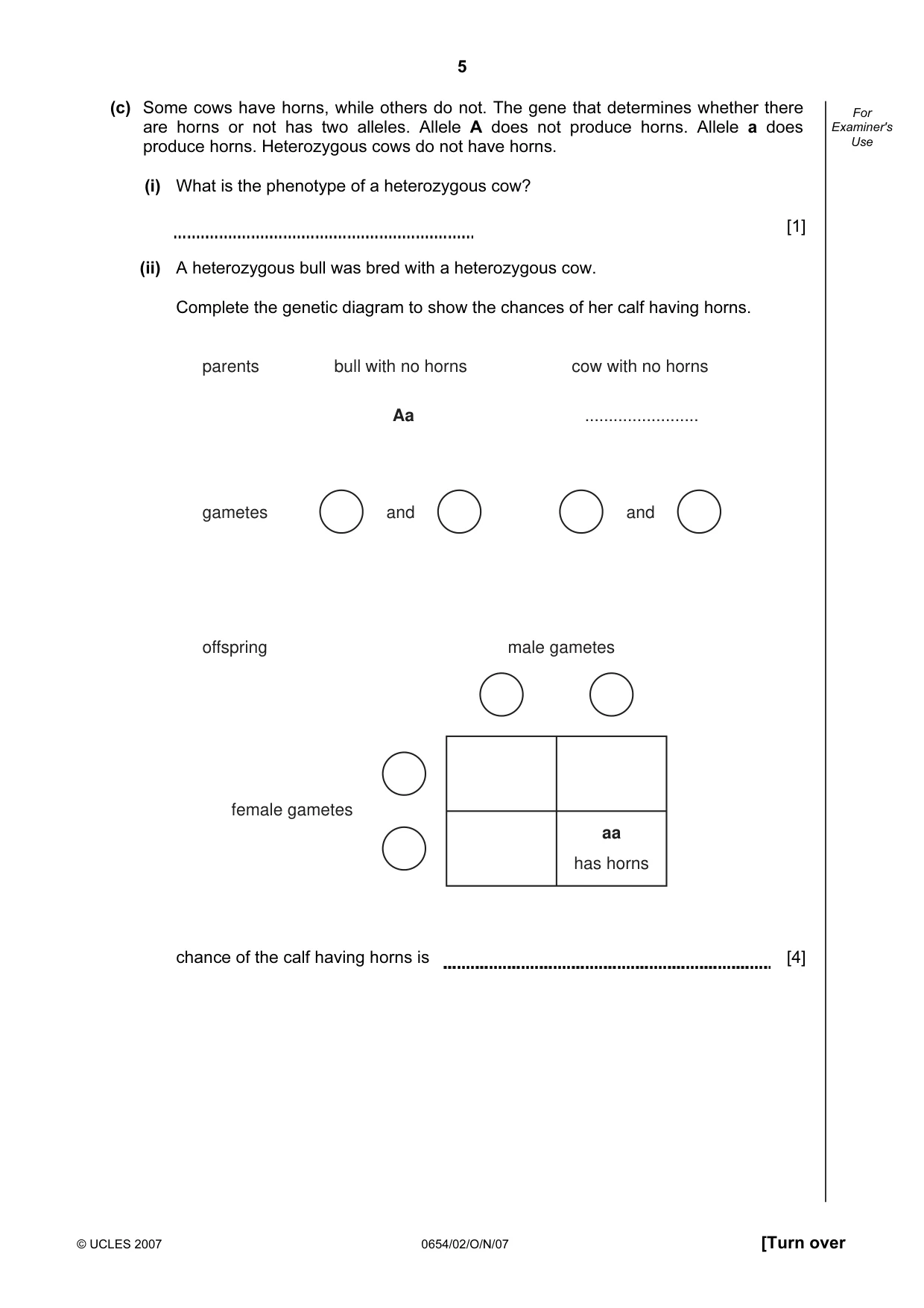
5 © UCLES 2007 0654/02/O/N/07 [Turn over For Examiner's Use (c) Some cows have horns, while others do not. The gene that determines whether there are horns or not has two alleles. Allele A does not produce horns. Allele a does produce horns. Heterozygous cows do not have horns. (i) What is the phenotype of a heterozygous cow? [1] (ii) A heterozygous bull was bred with a heterozygous cow. Complete the genetic diagram to show the chances of her calf having horns. parents bull with no horns cow with no horns gametes and offspring male gametes female gametes and aa has horns … Aa chance of the calf having horns is [4]
Question paper, page 6
6 © UCLES 2007 0654/02/O/N/07 For Examiner's Use 4 (a) Iodine-123 and iodine-131 are radioactive isotopes of iodine that are used to treat patients in medicine. Iodine-123 emits gamma radiation and has a half-life of 13.6 hours. Iodine-131 emits both beta and gamma radiation and has a half-life of 8 days. (i) What is the meaning of the term half-life? [1] (ii) State and explain two reasons why it would be safer for a patient to use iodine-123 rather than iodine-131. 1. 2. [3] (b) There are people working near the radioactive source. (i) How might these workers be harmed by radiation from this radioactive source? [1] (ii) Give one way in which these workers could be protected from the radiation emitted. [1]
Question paper, page 7
7 0654/02/O/N/07 [Turn over BLANK PAGE Please turn over for question 5
Question paper, page 8
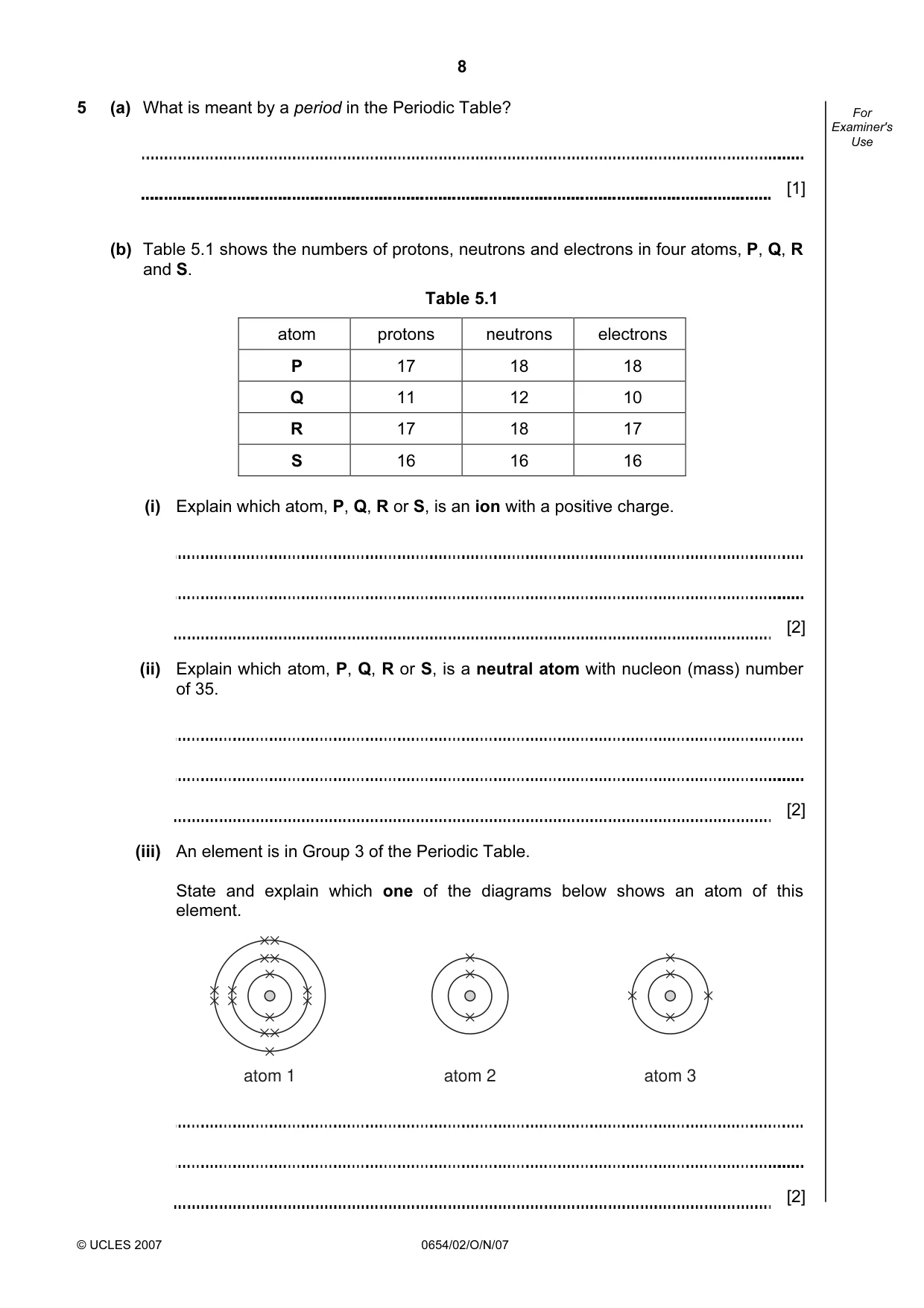
8 © UCLES 2007 0654/02/O/N/07 For Examiner's Use 5 (a) What is meant by a period in the Periodic Table? [1] (b) Table 5.1 shows the numbers of protons, neutrons and electrons in four atoms, P, Q, R and S. Table 5.1 atom protons neutrons electrons P 17 18 18 Q 11 12 10 R 17 18 17 S 16 16 16 (i) Explain which atom, P, Q, R or S, is an ion with a positive charge. [2] (ii) Explain which atom, P, Q, R or S, is a neutral atom with nucleon (mass) number of 35. [2] (iii) An element is in Group 3 of the Periodic Table. State and explain which one of the diagrams below shows an atom of this element. × × ×× ×× ×× × ×× ×× × × atom 1 × × × atom 2 × × × × × atom 3 [2]
Question paper, page 9
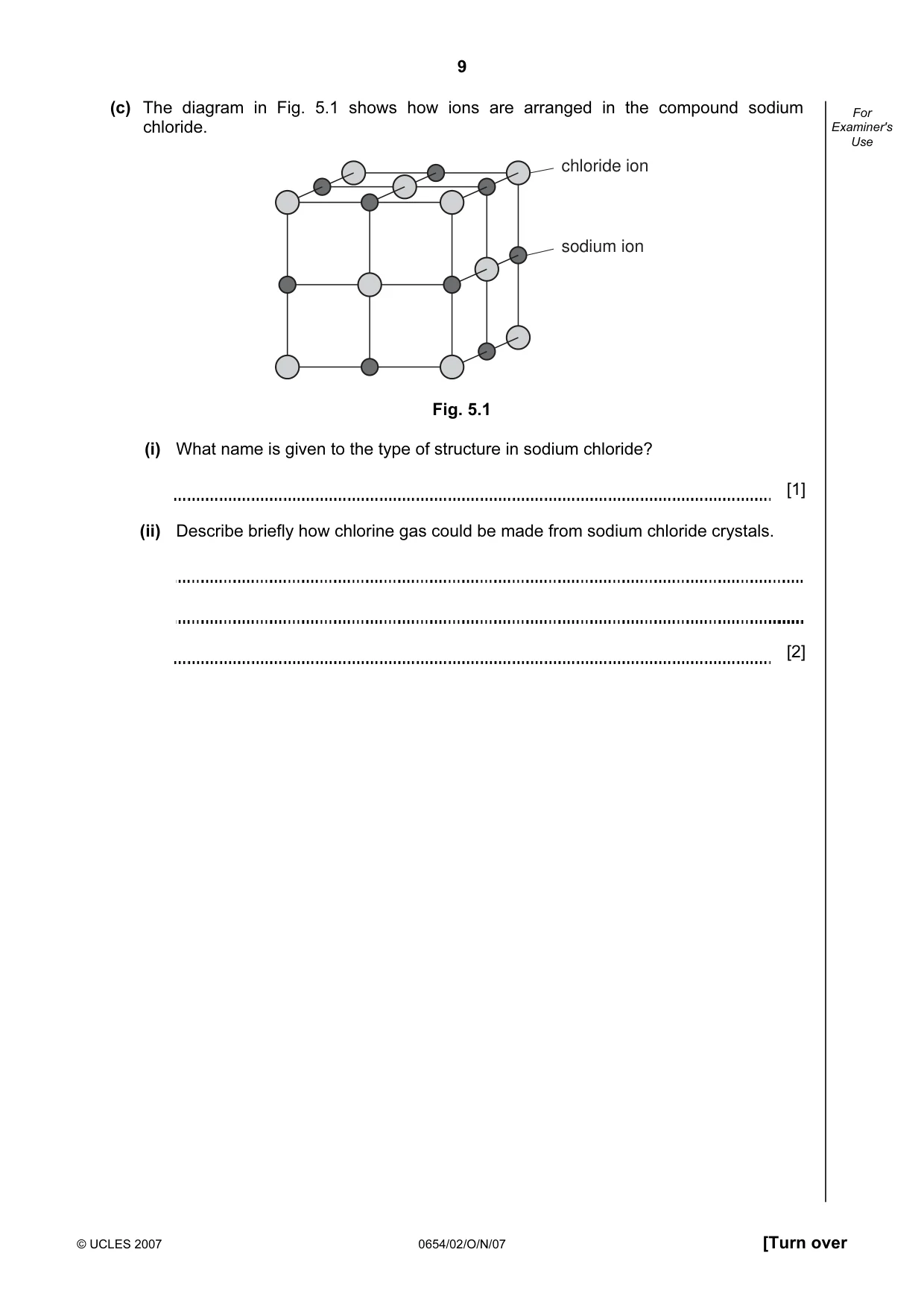
9 © UCLES 2007 0654/02/O/N/07 [Turn over For Examiner's Use (c) The diagram in Fig. 5.1 shows how ions are arranged in the compound sodium chloride. chloride ion sodium ion Fig. 5.1 (i) What name is given to the type of structure in sodium chloride? [1] (ii) Describe briefly how chlorine gas could be made from sodium chloride crystals. [2]
Question paper, page 10
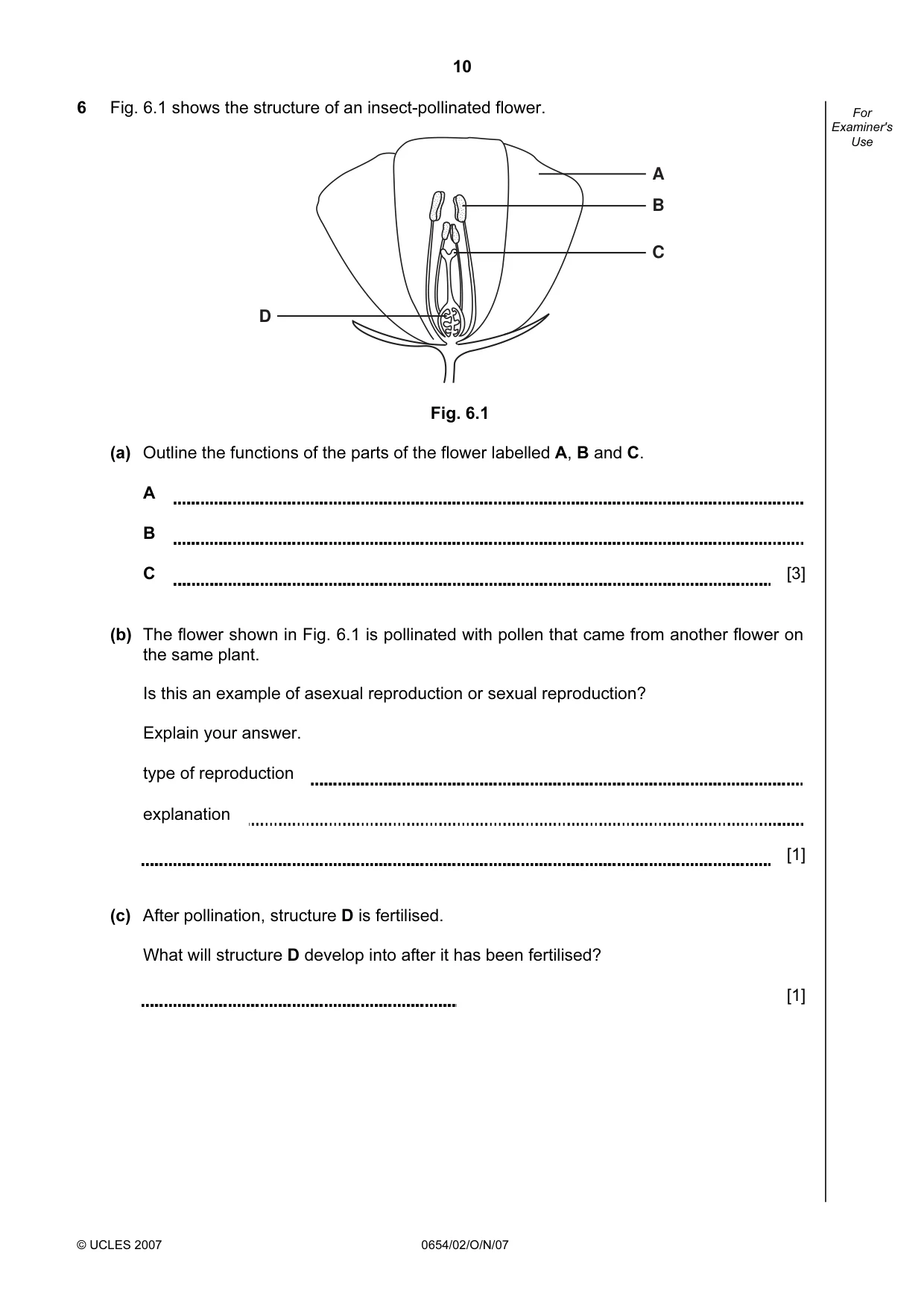
10 © UCLES 2007 0654/02/O/N/07 For Examiner's Use 6 Fig. 6.1 shows the structure of an insect-pollinated flower. A B C D Fig. 6.1 (a) Outline the functions of the parts of the flower labelled A, B and C. A B C [3] (b) The flower shown in Fig. 6.1 is pollinated with pollen that came from another flower on the same plant. Is this an example of asexual reproduction or sexual reproduction? Explain your answer. type of reproduction explanation [1] (c) After pollination, structure D is fertilised. What will structure D develop into after it has been fertilised? [1]
Question paper, page 11
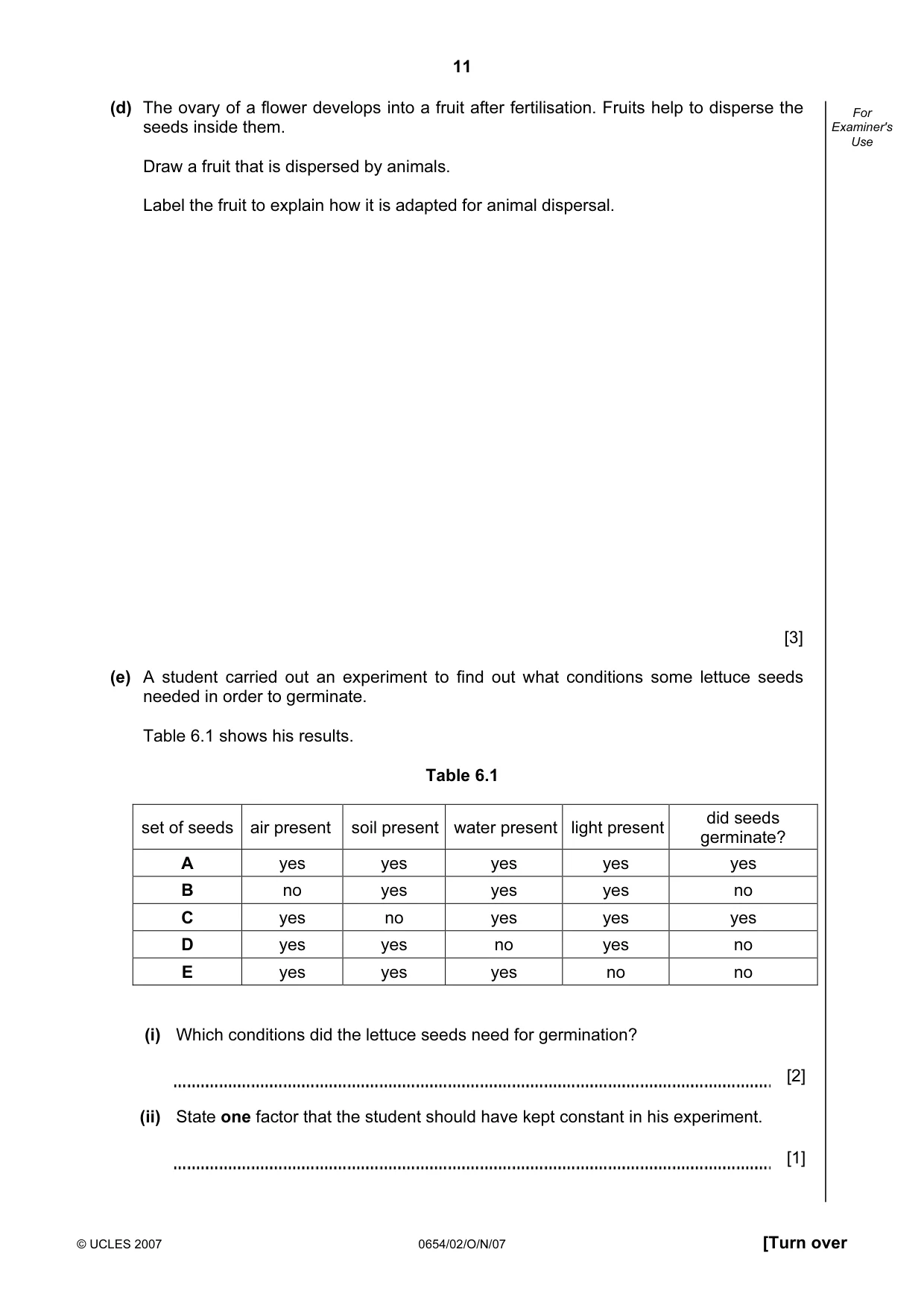
11 © UCLES 2007 0654/02/O/N/07 [Turn over For Examiner's Use (d) The ovary of a flower develops into a fruit after fertilisation. Fruits help to disperse the seeds inside them. Draw a fruit that is dispersed by animals. Label the fruit to explain how it is adapted for animal dispersal. [3] (e) A student carried out an experiment to find out what conditions some lettuce seeds needed in order to germinate. Table 6.1 shows his results. Table 6.1 set of seeds air present soil present water present light present did seeds germinate? A yes yes yes yes yes B no yes yes yes no C yes no yes yes yes D yes yes no yes no E yes yes yes no no (i) Which conditions did the lettuce seeds need for germination? [2] (ii) State one factor that the student should have kept constant in his experiment. [1]
Question paper, page 12
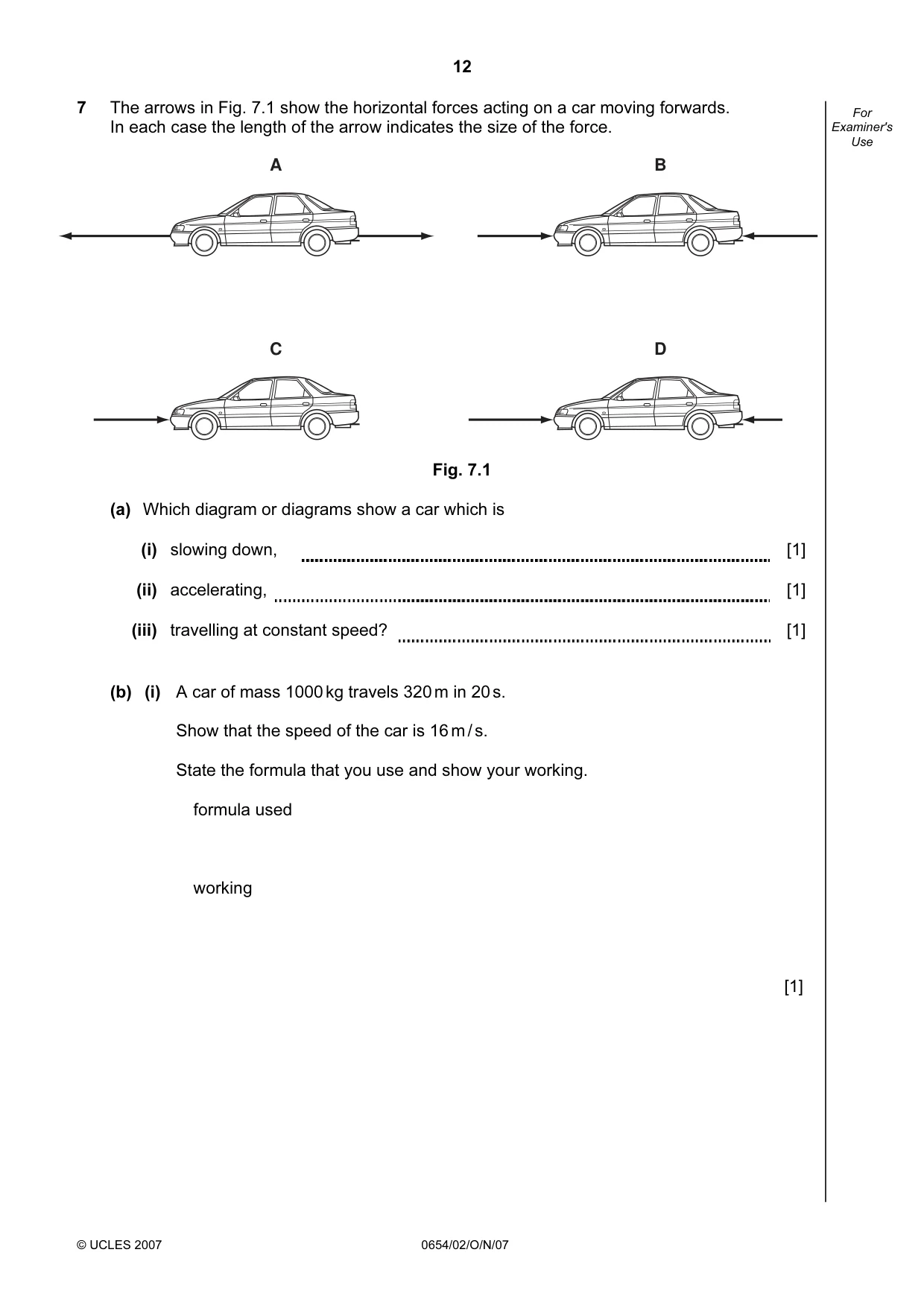
12 © UCLES 2007 0654/02/O/N/07 For Examiner's Use 7 The arrows in Fig. 7.1 show the horizontal forces acting on a car moving forwards. In each case the length of the arrow indicates the size of the force. A B C D Fig. 7.1 (a) Which diagram or diagrams show a car which is (i) slowing down, [1] (ii) accelerating, [1] (iii) travelling at constant speed? [1] (b) (i) A car of mass 1000 kg travels 320 m in 20 s. Show that the speed of the car is 16 m / s. State the formula that you use and show your working. formula used working [1]
Question paper, page 13
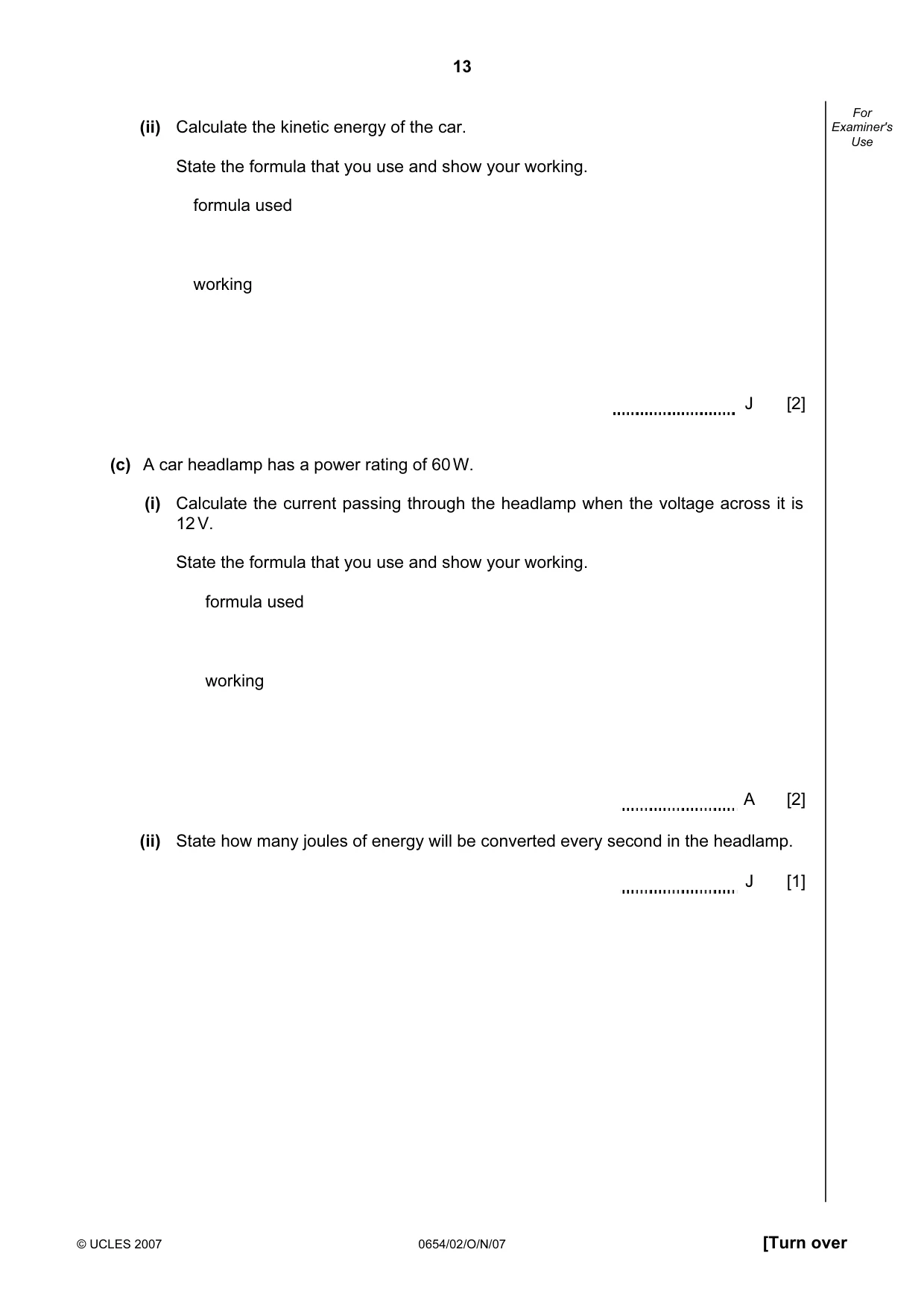
13 © UCLES 2007 0654/02/O/N/07 [Turn over For Examiner's Use (ii) Calculate the kinetic energy of the car. State the formula that you use and show your working. formula used working J [2] (c) A car headlamp has a power rating of 60 W. (i) Calculate the current passing through the headlamp when the voltage across it is 12 V. State the formula that you use and show your working. formula used working A [2] (ii) State how many joules of energy will be converted every second in the headlamp. J [1]
Question paper, page 14
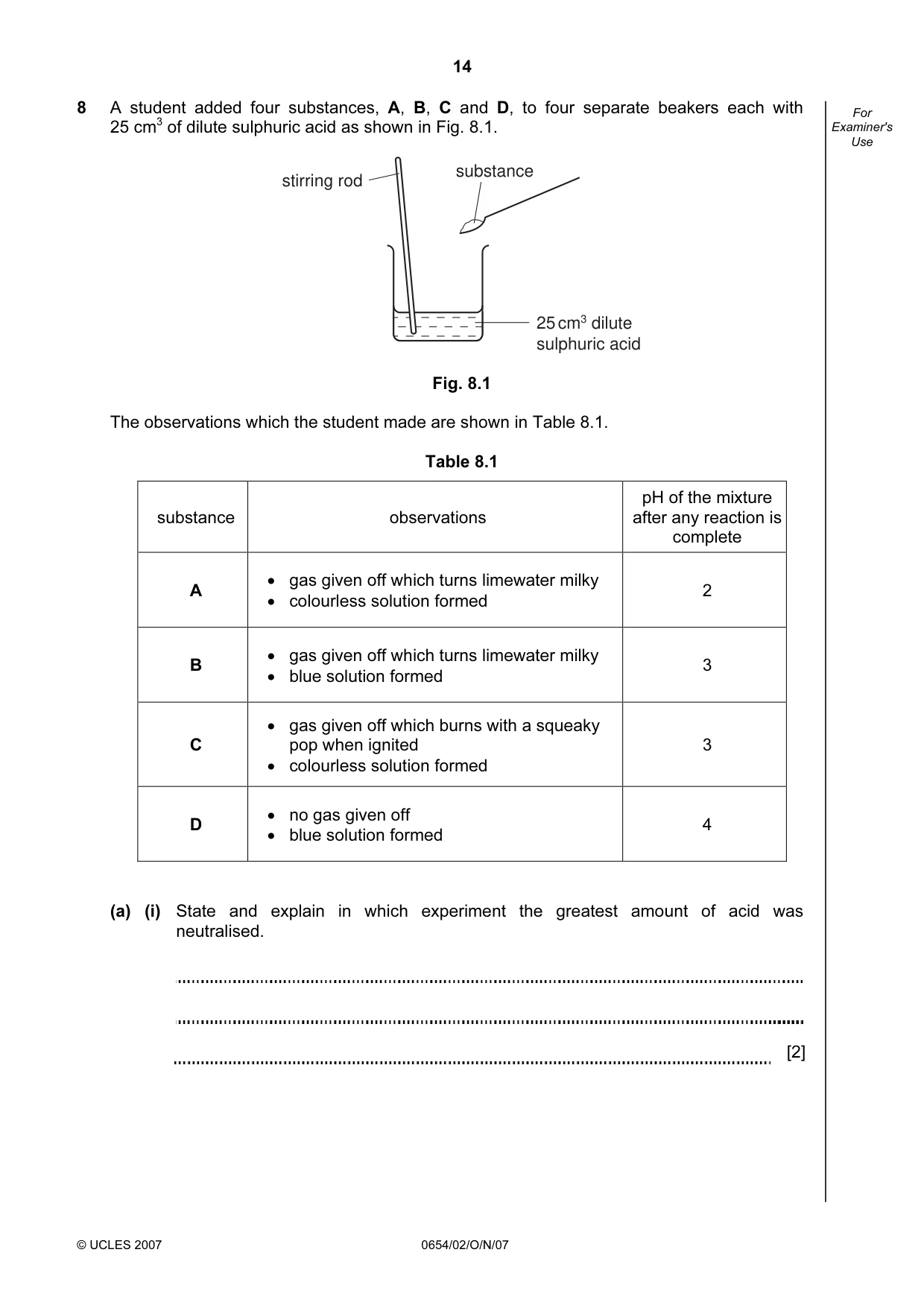
14 © UCLES 2007 0654/02/O/N/07 For Examiner's Use 8 A student added four substances, A, B, C and D, to four separate beakers each with 25 cm3 of dilute sulphuric acid as shown in Fig. 8.1. 25 cm3 dilute sulphuric acid stirring rod substance Fig. 8.1 The observations which the student made are shown in Table 8.1. Table 8.1 substance observations pH of the mixture after any reaction is complete A • gas given off which turns limewater milky • colourless solution formed 2 B • gas given off which turns limewater milky • blue solution formed 3 C • gas given off which burns with a squeaky pop when ignited • colourless solution formed 3 D • no gas given off • blue solution formed 4 (a) (i) State and explain in which experiment the greatest amount of acid was neutralised. [2]
Question paper, page 15
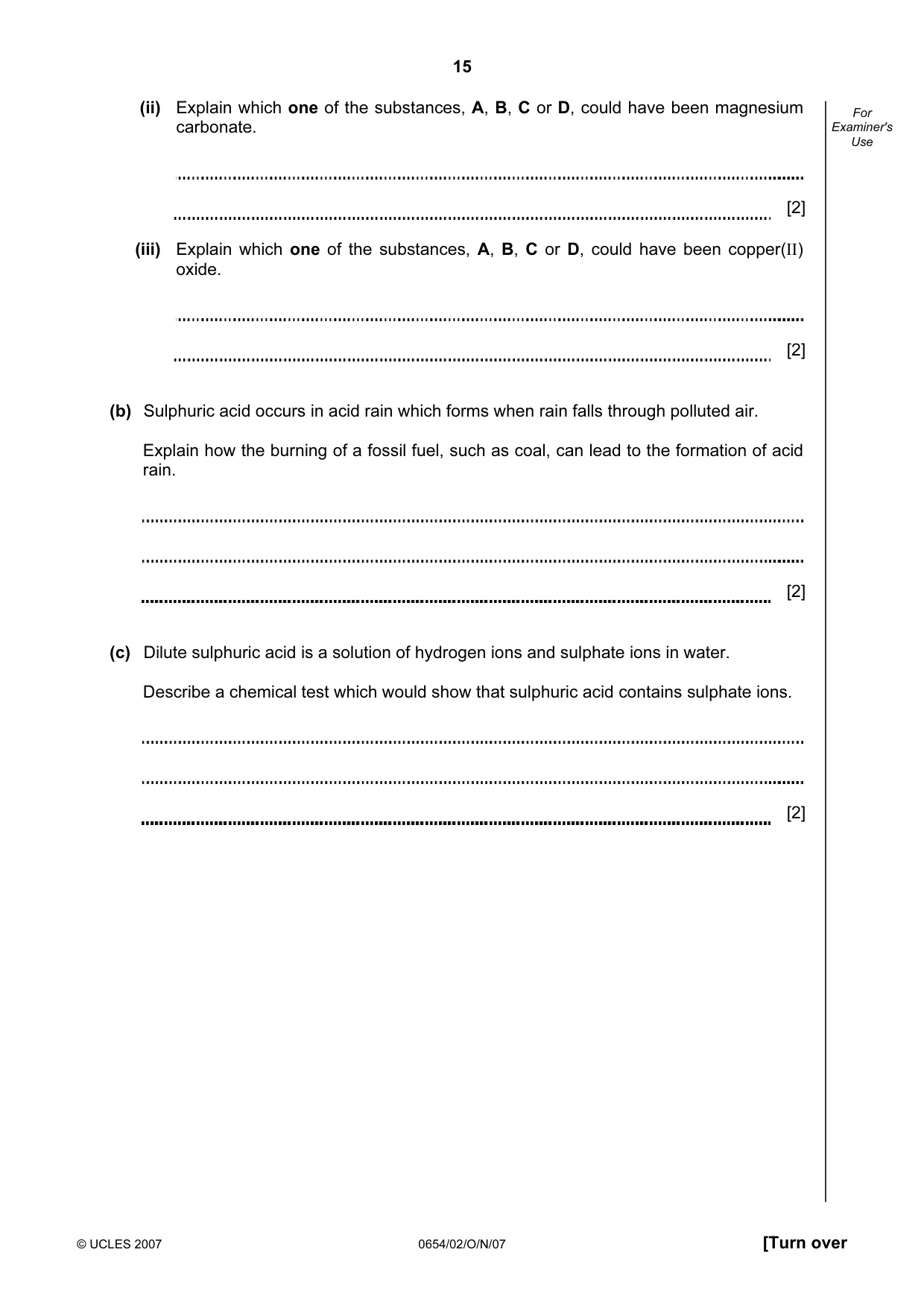
15 © UCLES 2007 0654/02/O/N/07 [Turn over For Examiner's Use (ii) Explain which one of the substances, A, B, C or D, could have been magnesium carbonate. [2] (iii) Explain which one of the substances, A, B, C or D, could have been copper(II) oxide. [2] (b) Sulphuric acid occurs in acid rain which forms when rain falls through polluted air. Explain how the burning of a fossil fuel, such as coal, can lead to the formation of acid rain. [2] (c) Dilute sulphuric acid is a solution of hydrogen ions and sulphate ions in water. Describe a chemical test which would show that sulphuric acid contains sulphate ions. [2]
Question paper, page 16
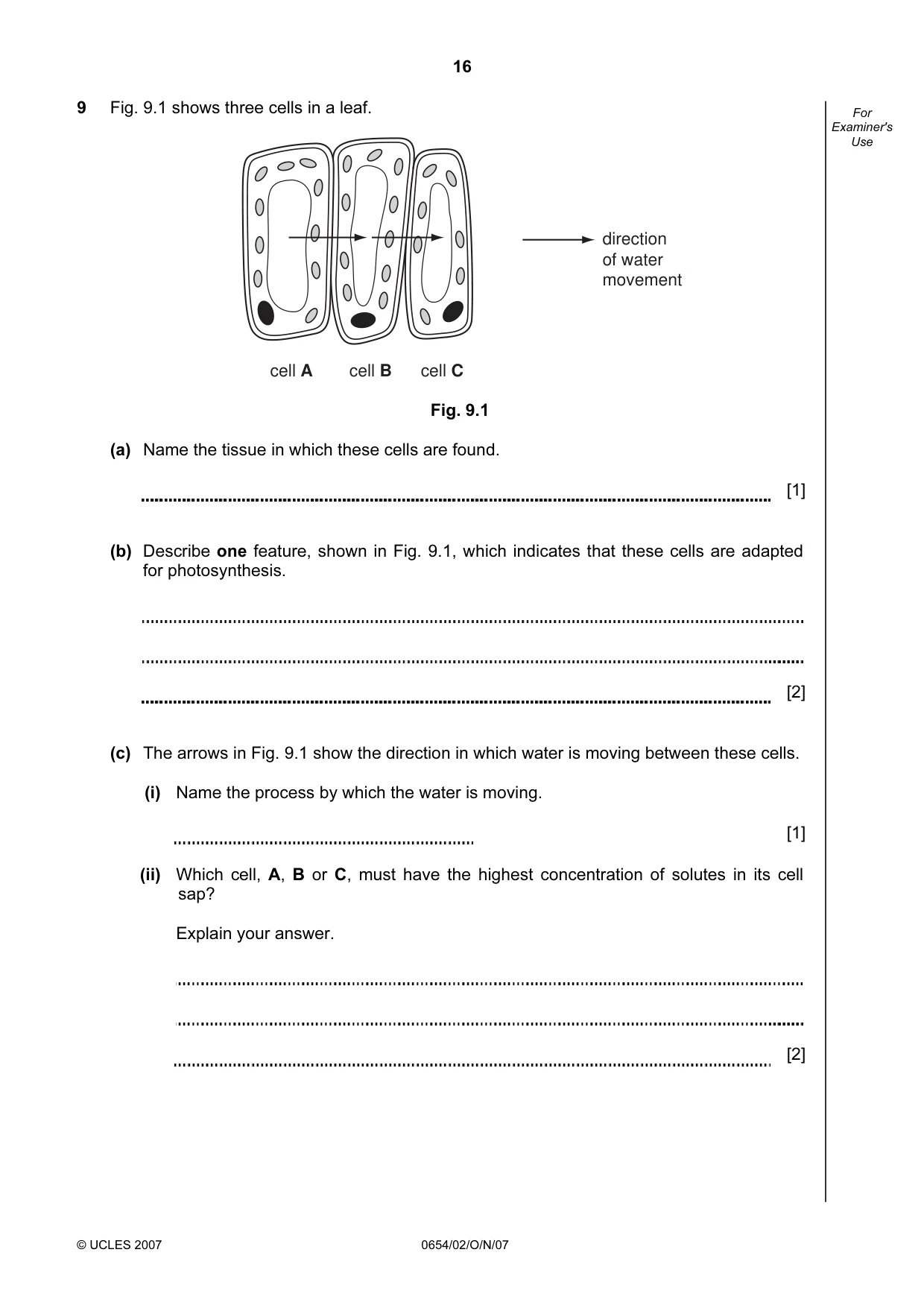
16 © UCLES 2007 0654/02/O/N/07 For Examiner's Use 9 Fig. 9.1 shows three cells in a leaf. cell A cell B cell C direction of water movement Fig. 9.1 (a) Name the tissue in which these cells are found. [1] (b) Describe one feature, shown in Fig. 9.1, which indicates that these cells are adapted for photosynthesis. [2] (c) The arrows in Fig. 9.1 show the direction in which water is moving between these cells. (i) Name the process by which the water is moving. [1] (ii) Which cell, A, B or C, must have the highest concentration of solutes in its cell sap? Explain your answer. [2]
Question paper, page 17
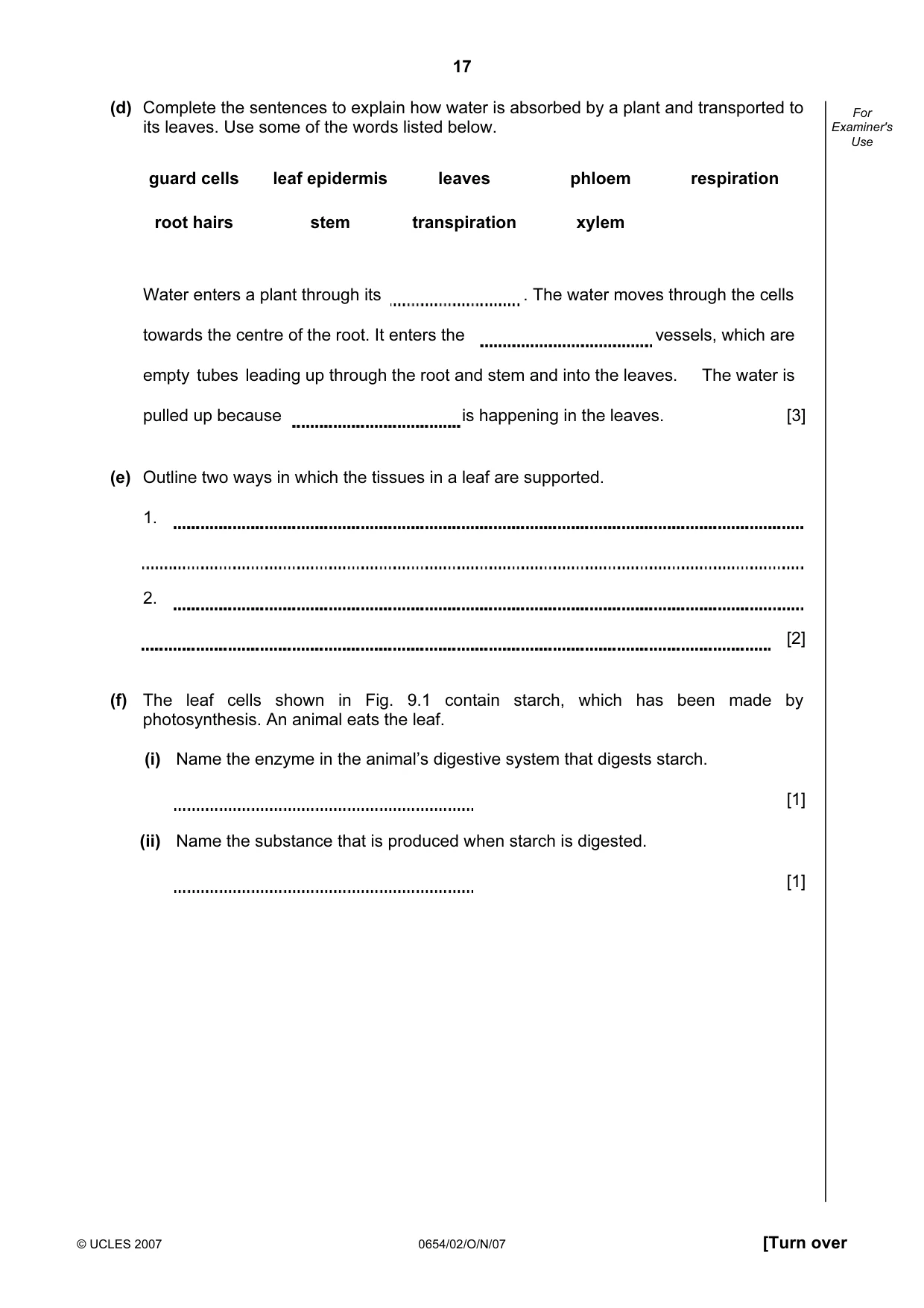
17 © UCLES 2007 0654/02/O/N/07 [Turn over For Examiner's Use (d) Complete the sentences to explain how water is absorbed by a plant and transported to its leaves. Use some of the words listed below. guard cells leaf epidermis leaves phloem respiration root hairs stem transpiration xylem Water enters a plant through its . The water moves through the cells towards the centre of the root. It enters the vessels, which are empty tubes leading up through the root and stem and into the leaves. The water is pulled up because is happening in the leaves. [3] (e) Outline two ways in which the tissues in a leaf are supported. 1. 2. [2] (f) The leaf cells shown in Fig. 9.1 contain starch, which has been made by photosynthesis. An animal eats the leaf. (i) Name the enzyme in the animal’s digestive system that digests starch. [1] (ii) Name the substance that is produced when starch is digested. [1]
Question paper, page 18
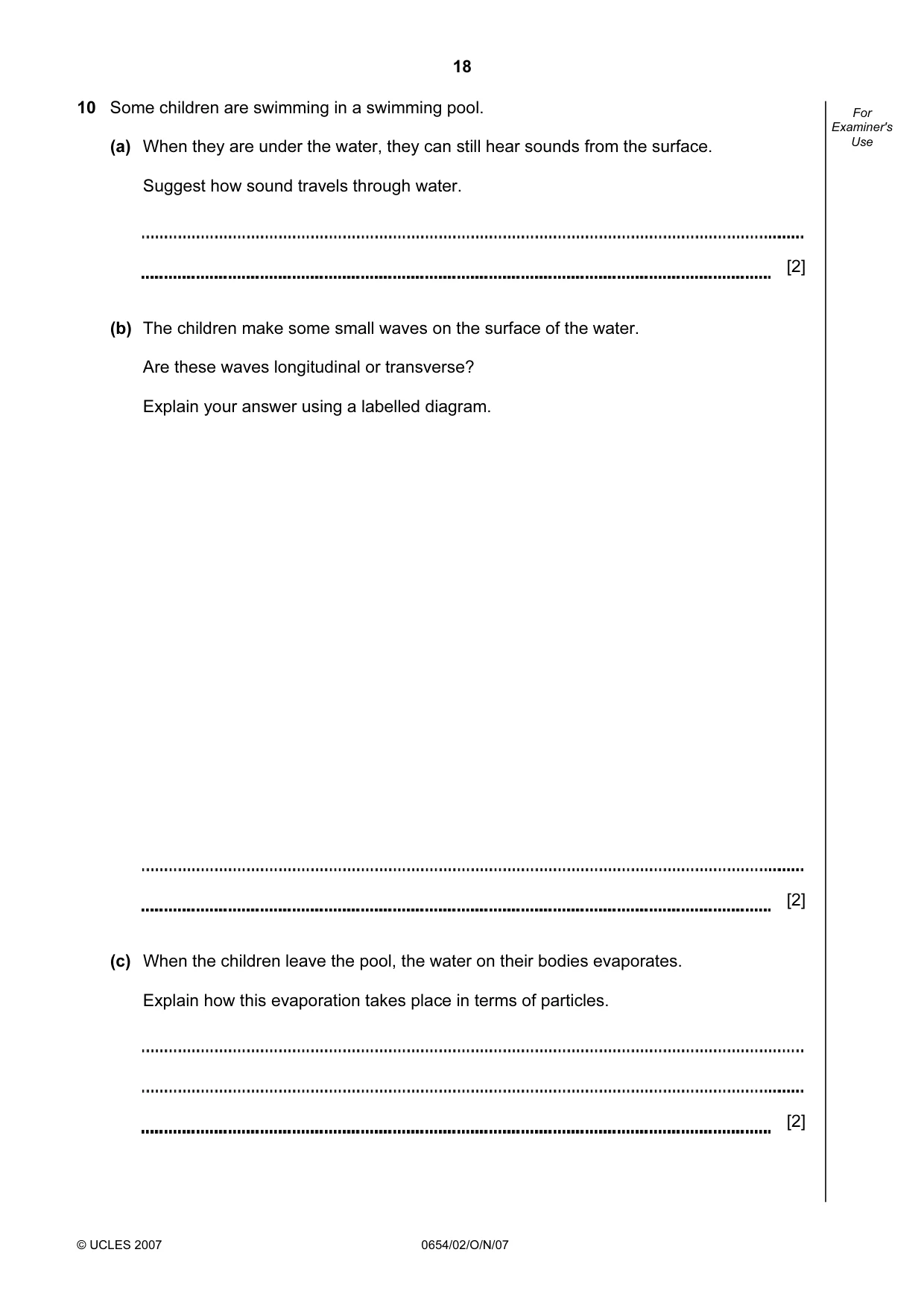
18 © UCLES 2007 0654/02/O/N/07 For Examiner's Use 10 Some children are swimming in a swimming pool. (a) When they are under the water, they can still hear sounds from the surface. Suggest how sound travels through water. [2] (b) The children make some small waves on the surface of the water. Are these waves longitudinal or transverse? Explain your answer using a labelled diagram. [2] (c) When the children leave the pool, the water on their bodies evaporates. Explain how this evaporation takes place in terms of particles. [2]
Question paper, page 19
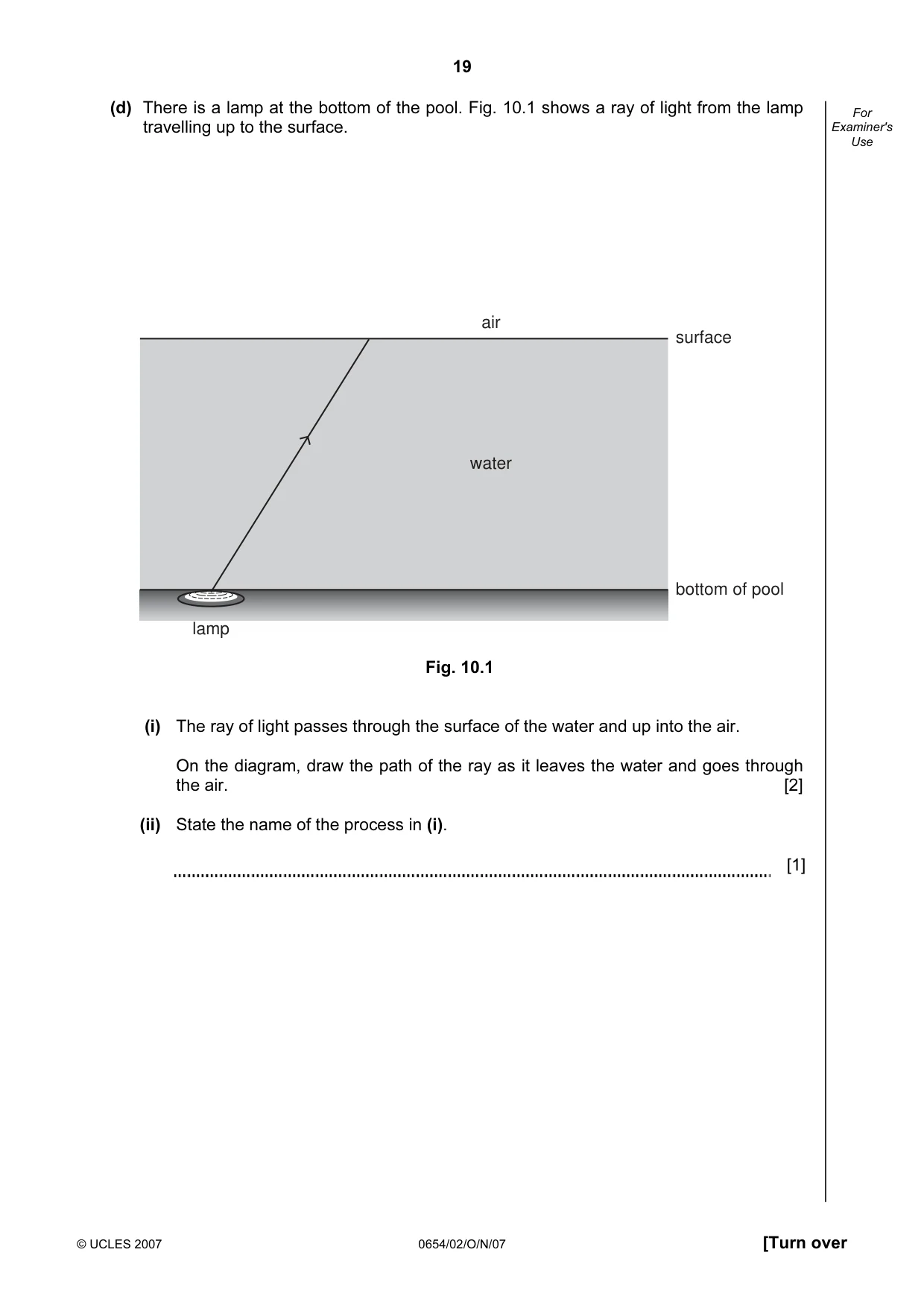
19 © UCLES 2007 0654/02/O/N/07 [Turn over For Examiner's Use (d) There is a lamp at the bottom of the pool. Fig. 10.1 shows a ray of light from the lamp travelling up to the surface. surface bottom of pool air water lamp Fig. 10.1 (i) The ray of light passes through the surface of the water and up into the air. On the diagram, draw the path of the ray as it leaves the water and goes through the air. [2] (ii) State the name of the process in (i). [1]
Question paper, page 20
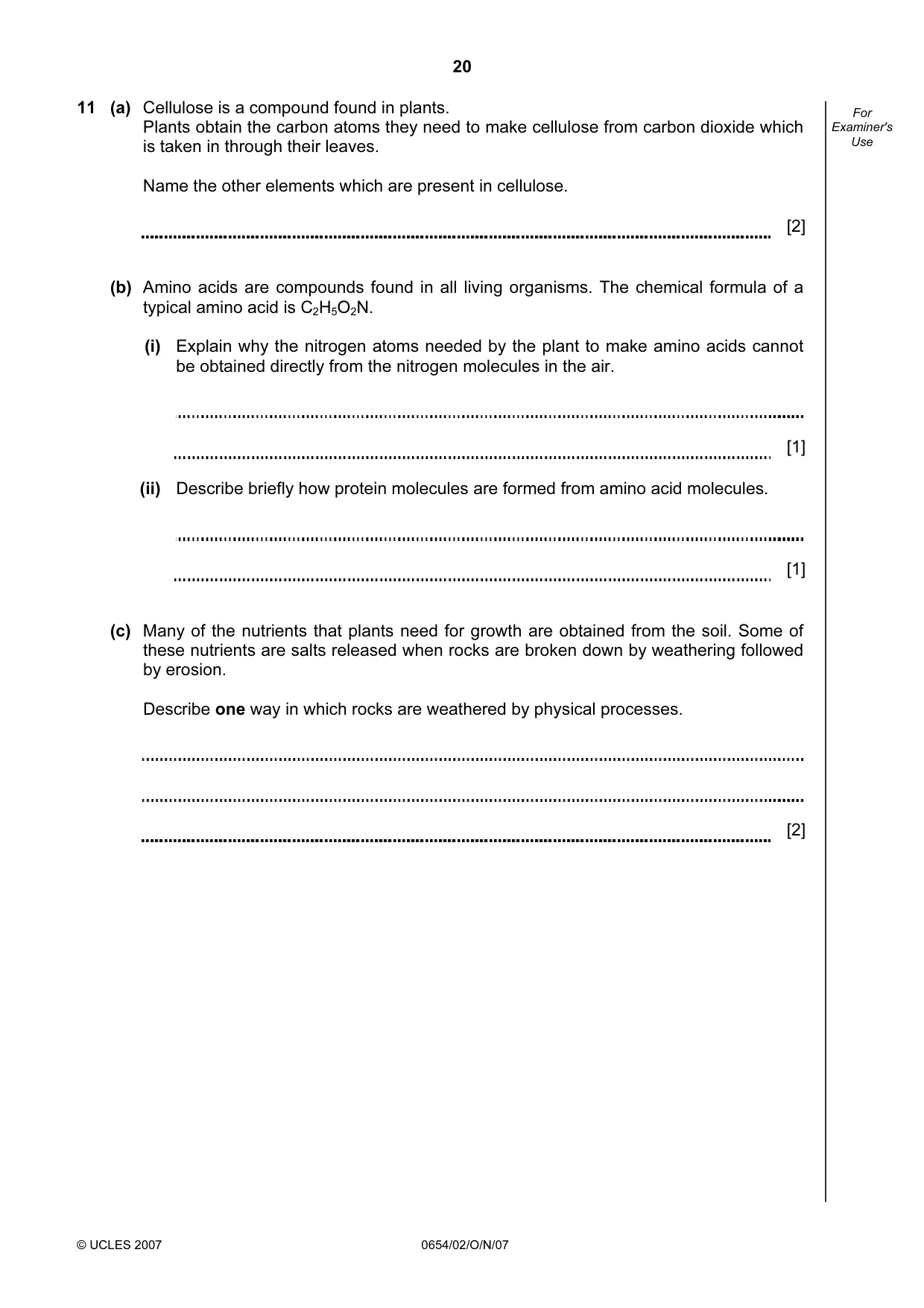
20 © UCLES 2007 0654/02/O/N/07 For Examiner's Use 11 (a) Cellulose is a compound found in plants. Plants obtain the carbon atoms they need to make cellulose from carbon dioxide which is taken in through their leaves. Name the other elements which are present in cellulose. [2] (b) Amino acids are compounds found in all living organisms. The chemical formula of a typical amino acid is C2H5O2N. (i) Explain why the nitrogen atoms needed by the plant to make amino acids cannot be obtained directly from the nitrogen molecules in the air. [1] (ii) Describe briefly how protein molecules are formed from amino acid molecules. [1] (c) Many of the nutrients that plants need for growth are obtained from the soil. Some of these nutrients are salts released when rocks are broken down by weathering followed by erosion. Describe one way in which rocks are weathered by physical processes. [2]
Question paper, page 21
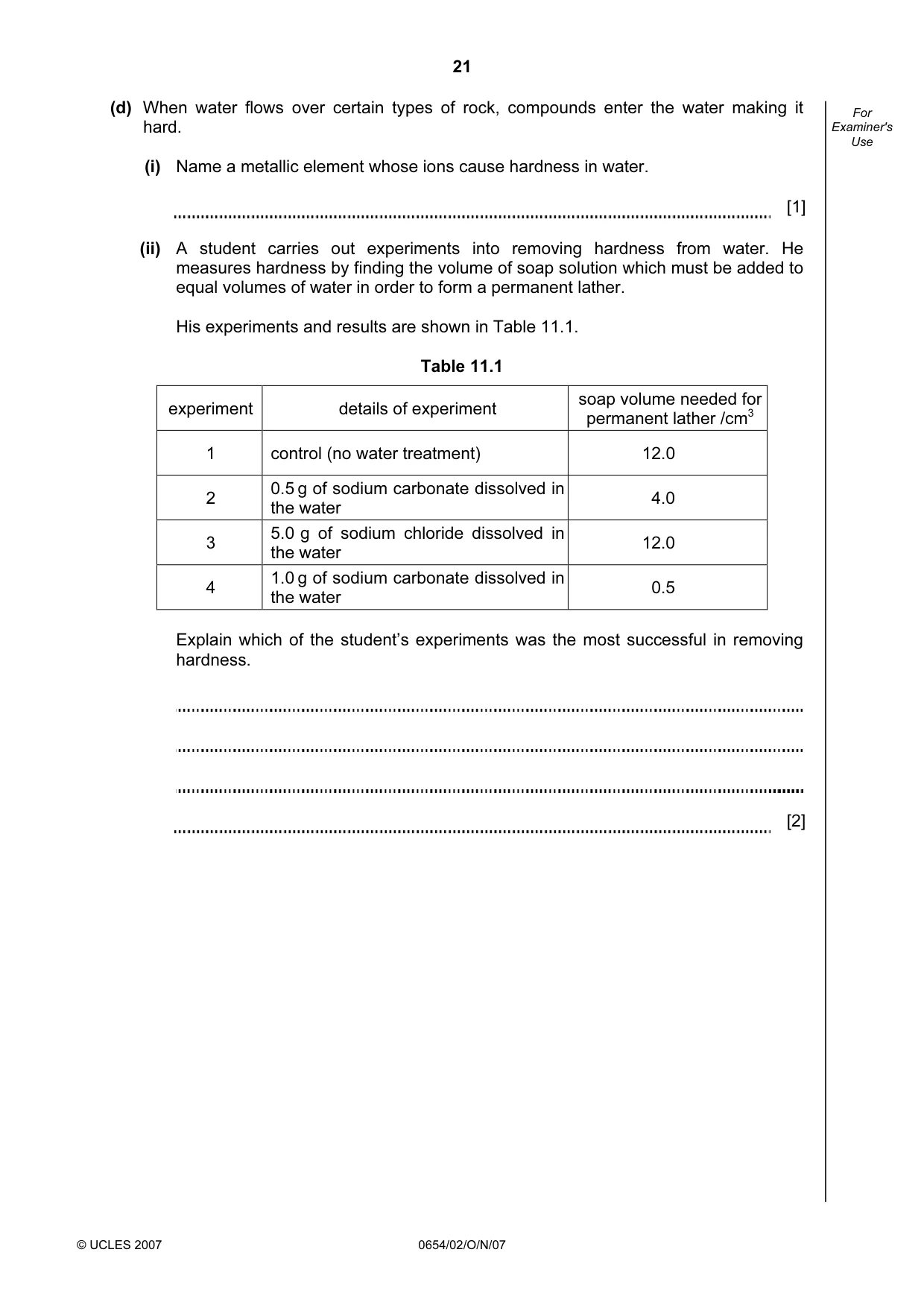
21 © UCLES 2007 0654/02/O/N/07 For Examiner's Use (d) When water flows over certain types of rock, compounds enter the water making it hard. (i) Name a metallic element whose ions cause hardness in water. [1] (ii) A student carries out experiments into removing hardness from water. He measures hardness by finding the volume of soap solution which must be added to equal volumes of water in order to form a permanent lather. His experiments and results are shown in Table 11.1. Table 11.1 experiment details of experiment soap volume needed for permanent lather /cm3 1 control (no water treatment) 12.0 2 0.5 g of sodium carbonate dissolved in the water 4.0 3 5.0 g of sodium chloride dissolved in the water 12.0 4 1.0 g of sodium carbonate dissolved in the water 0.5 Explain which of the student’s experiments was the most successful in removing hardness. [2]
Question paper, page 24
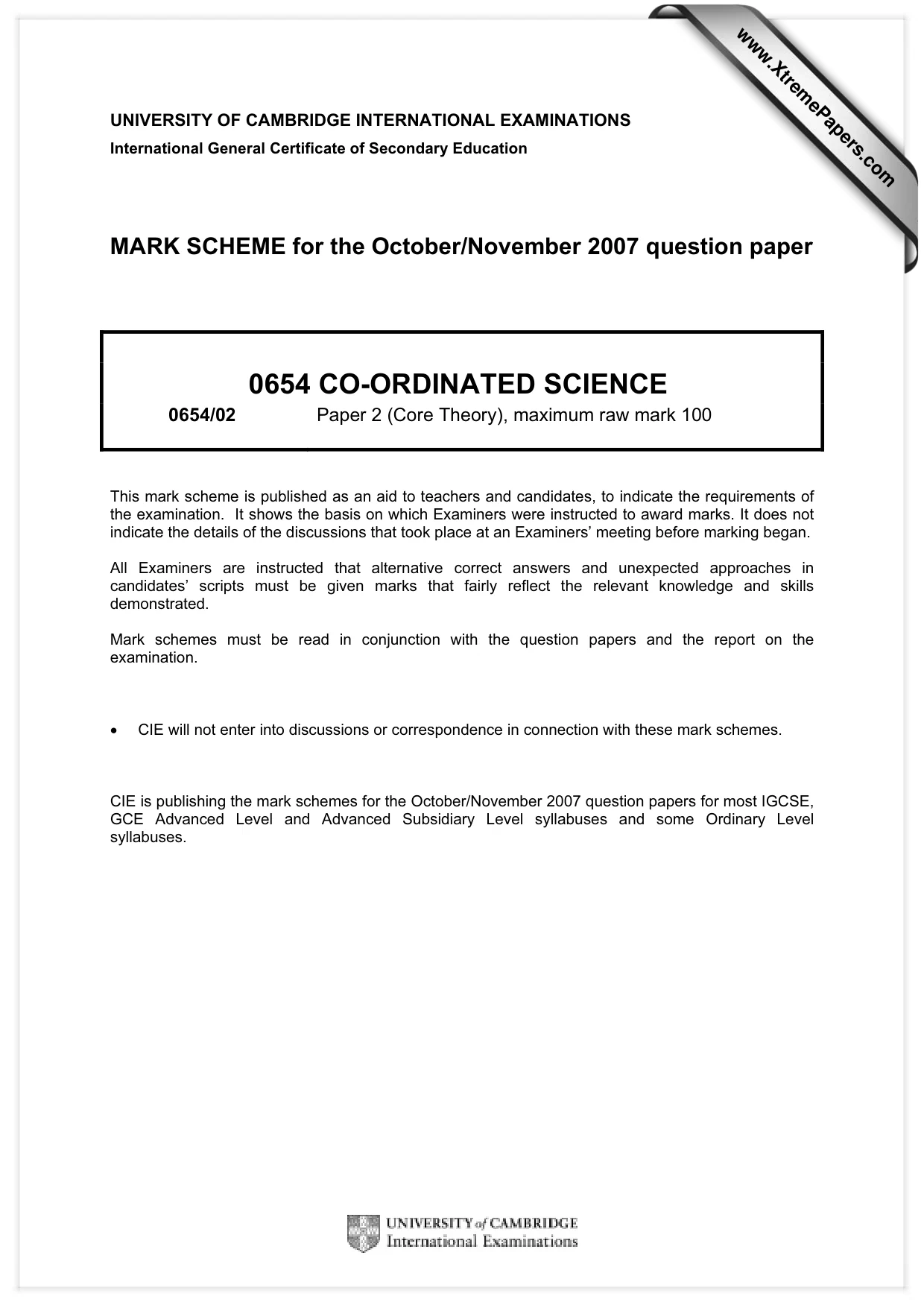
24 Permission to reproduce items where third-party owned material protected by copyright is included has been sought and cleared where possible. Every reasonable effort has been made by the publisher (UCLES) to trace copyright holders, but if any items requiring clearance have unwittingly been included, the publisher will be pleased to make amends at the earliest possible opportunity. University of Cambridge International Examinations is part of the Cambridge Assessment Group. Cambridge Assessment is the brand name of University of Cambridge Local Examinations Syndicate (UCLES), which is itself a department of the University of Cambridge. © UCLES 2007 0654/02/O/N/07 Group 140 Ce Cerium 58 141 Pr Praseodymium 59 144 Nd Neodymium 60 Pm Promethium 61 150 Sm Samarium 62 152 Eu Europium 63 157 Gd Gadolinium 64 159 Tb Terbium 65 162 Dy Dysprosium 66 165 Ho Holmium 67 167 Er Erbium 68 169 Tm Thulium 69 173 Yb Ytterbium 70 175 Lu Lutetium 71 232 Th Thorium 90 Pa Protactinium 91 238 U Uranium 92 Np Neptunium 93 Pu Plutonium 94 Am Americium 95 Cm Curium 96 Bk Berkelium 97 Cf Californium 98 Es Einsteinium 99 Fm Fermium 100 Md Mendelevium 101 No Nobelium 102 Lr Lawrencium 103 1 H Hydrogen 1 7 Li Lithium 3 23 Na Sodium 11 24 Mg Magnesium 12 40 Ca Calcium 20 45 Sc Scandium 21 48 Ti Titanium 22 51 V Vanadium 23 52 Cr Chromium 24 55 Mn Manganese 25 56 Fe Iron 26 59 Co Cobalt 27 59 Ni Nickel 28 64 Cu Copper 29 65 Zn Zinc 30 70 Ga Gallium 31 27 Al Aluminium 13 11 B Boron 5 12 C Carbon 6 14 N Nitrogen 7 16 O Oxygen 8 19 F Fluorine 9 28 Si Silicon 14 31 P Phosphorus 15 32 S Sulphur 16 35.5 Cl Chlorine 17 40 Ar Argon 18 20 Ne Neon 10 4 He Helium 2 73 Ge Germanium 32 75 As Arsenic 33 79 Se Selenium 34 80 Br Bromine 35 84 Kr Krypton 36 39 K Potassium 19 88 Sr Strontium 38 89 Y Yttrium 39 91 Zr Zirconium 40 93 Nb Niobium 41 96 Mo Molybdenum 42 Tc Technetium 43 101 Ru Ruthenium 44 103 Rh Rhodium 45 106 Pd Palladium 46 108 Ag Silver 47 112 Cd Cadmium 48 115 In Indium 49 119 Sn Tin 50 122 Sb Antimony 51 128 Te Tellurium 52 127 I Iodine 53 131 Xe Xenon 54 137 Ba Barium 56 139 La Lanthanum 57 * 178 Hf Hafnium 72 181 Ta Tantalum 73 184 W Tungsten 74 186 Re Rhenium 75 190 Os Osmium 76 192 Ir Iridium 77 195 Pt Platinum 78 197 Au Gold 79 201 Hg Mercury 80 204 Tl Thallium 81 207 Pb Lead 82 209 Bi Bismuth 83 Po Polonium 84 At Astatine 85 Rn Radon 86 Fr Francium 87 227 Ac Actinium 89 9 Be Beryllium 4 I II III IV V VI VII 0 85 Rb Rubidium 37 133 Cs Caesium 55 226 Ra Radium 88 The volume of one mole of any gas is 24 dm3 at room temperature and pressure (r.t.p.). a X b a = relative atomic mass X = atomic symbol b = proton (atomic) number Key *58-71 Lanthanoid series 90-103 Actinoid series DATA SHEET The Periodic Table of the Elements
Mark scheme, page 1
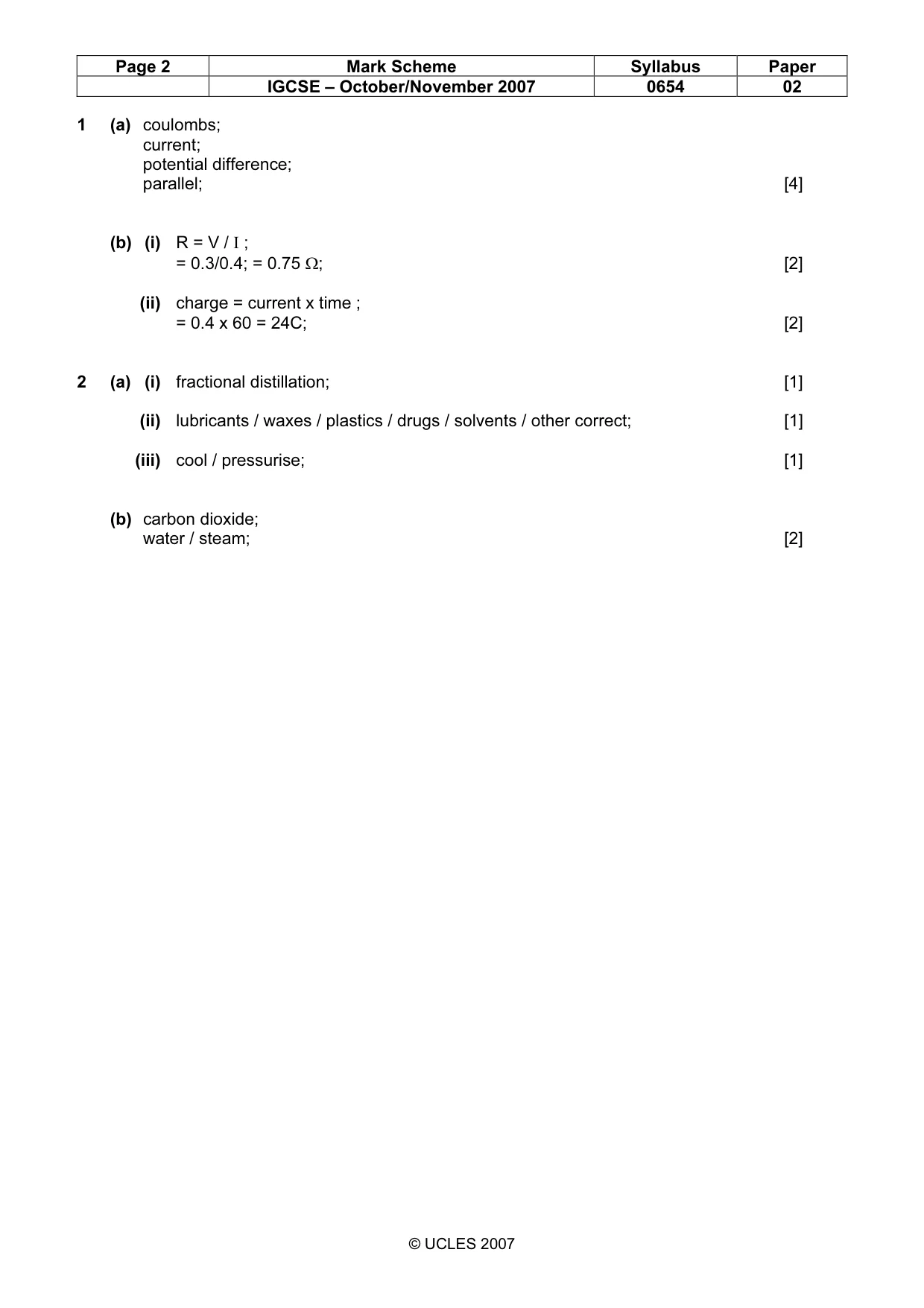
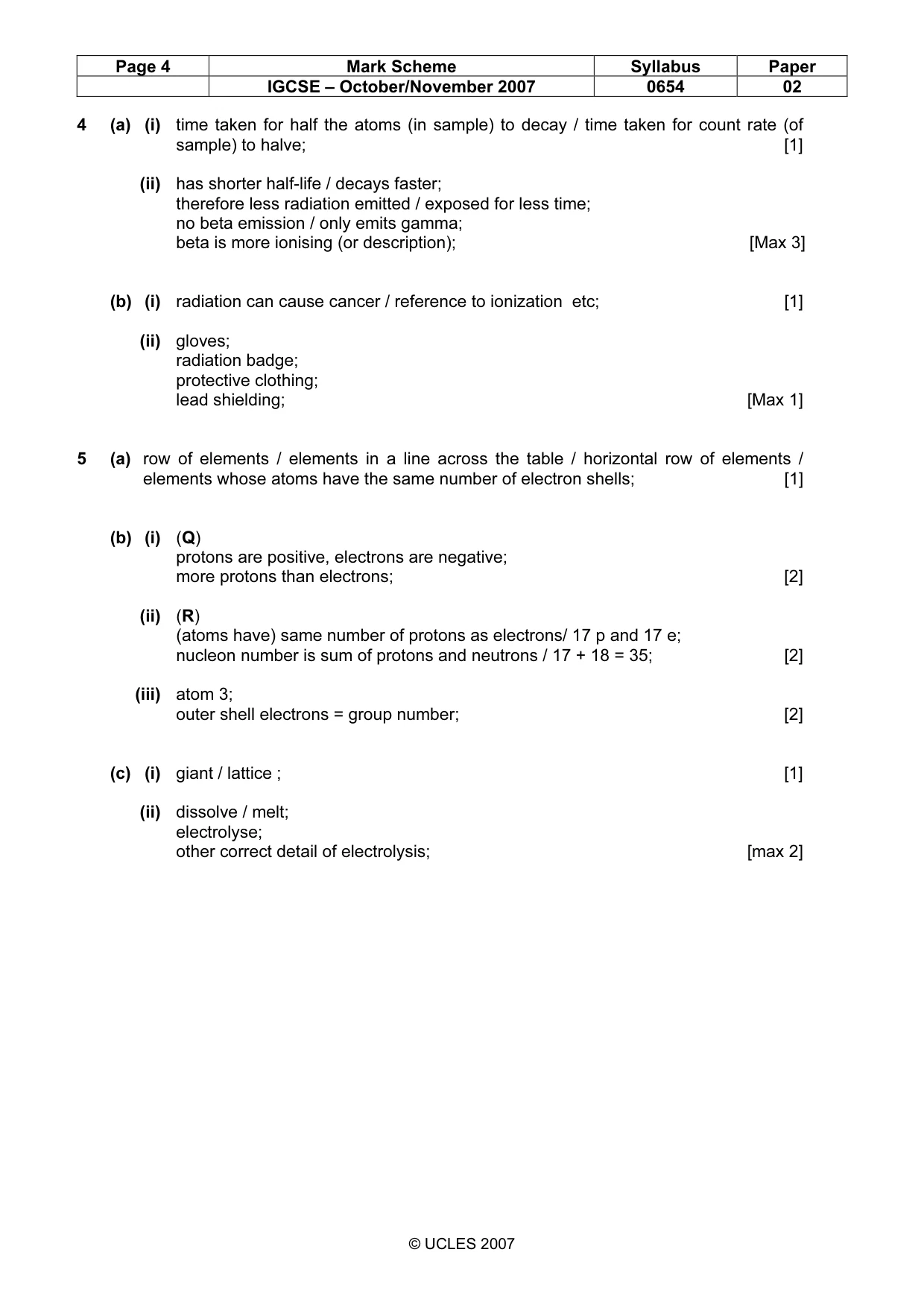
UNIVERSITY OF CAMBRIDGE INTERNATIONAL EXAMINATIONS International General Certificate of Secondary Education MARK SCHEME for the October/November 2007 question paper 0654 CO-ORDINATED SCIENCE 0654/02 Paper 2 (Core Theory), maximum raw mark 100 This mark scheme is published as an aid to teachers and candidates, to indicate the requirements of the examination. It shows the basis on which Examiners were instructed to award marks. It does not indicate the details of the discussions that took place at an Examiners’ meeting before marking began. All Examiners are instructed that alternative correct answers and unexpected approaches in candidates’ scripts must be given marks that fairly reflect the relevant knowledge and skills demonstrated. Mark schemes must be read in conjunction with the question papers and the report on the examination. • CIE will not enter into discussions or correspondence in connection with these mark schemes. CIE is publishing the mark schemes for the October/November 2007 question papers for most IGCSE, GCE Advanced Level and Advanced Subsidiary Level syllabuses and some Ordinary Level syllabuses. www.XtremePapers.com
Mark scheme, page 2
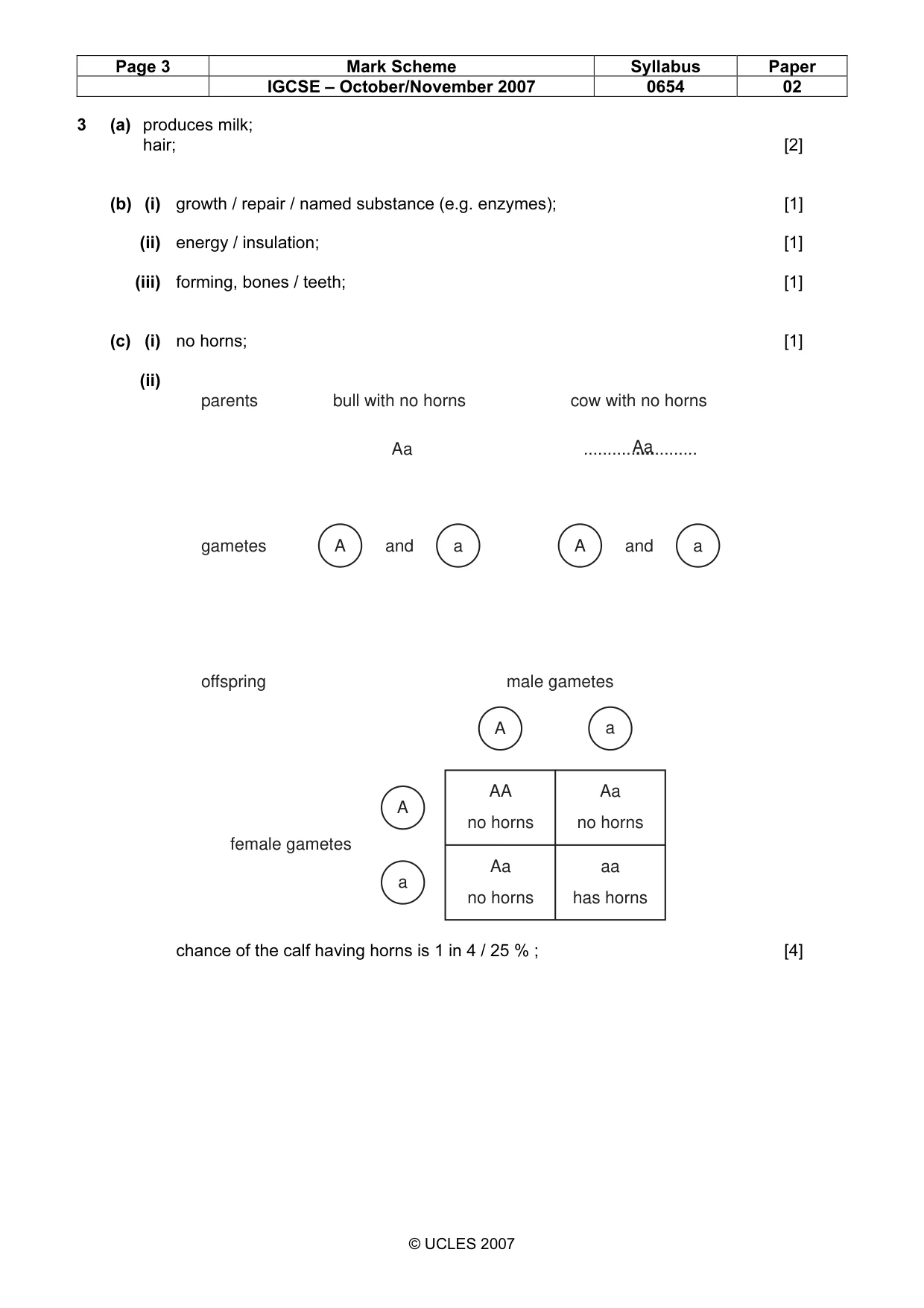
Page 2 Mark Scheme Syllabus Paper IGCSE – October/November 2007 0654 02 © UCLES 2007 1 (a) coulombs; current; potential difference; parallel; [4] (b) (i) R = V / I ; = 0.3/0.4; = 0.75 Ω; [2] (ii) charge = current x time ; = 0.4 x 60 = 24C; [2] 2 (a) (i) fractional distillation; [1] (ii) lubricants / waxes / plastics / drugs / solvents / other correct; [1] (iii) cool / pressurise; [1] (b) carbon dioxide; water / steam; [2]
Mark scheme, page 3
Page 3 Mark Scheme Syllabus Paper IGCSE – October/November 2007 0654 02 © UCLES 2007 3 (a) produces milk; hair; [2] (b) (i) growth / repair / named substance (e.g. enzymes); [1] (ii) energy / insulation; [1] (iii) forming, bones / teeth; [1] (c) (i) no horns; [1] (ii) parents bull with no horns cow with no horns gametes and offspring male gametes female gametes and aa has horns Aa no horns Aa no horns AA no horns … Aa Aa A A A a a a A a chance of the calf having horns is 1 in 4 / 25 % ; [4]
Mark scheme, page 4
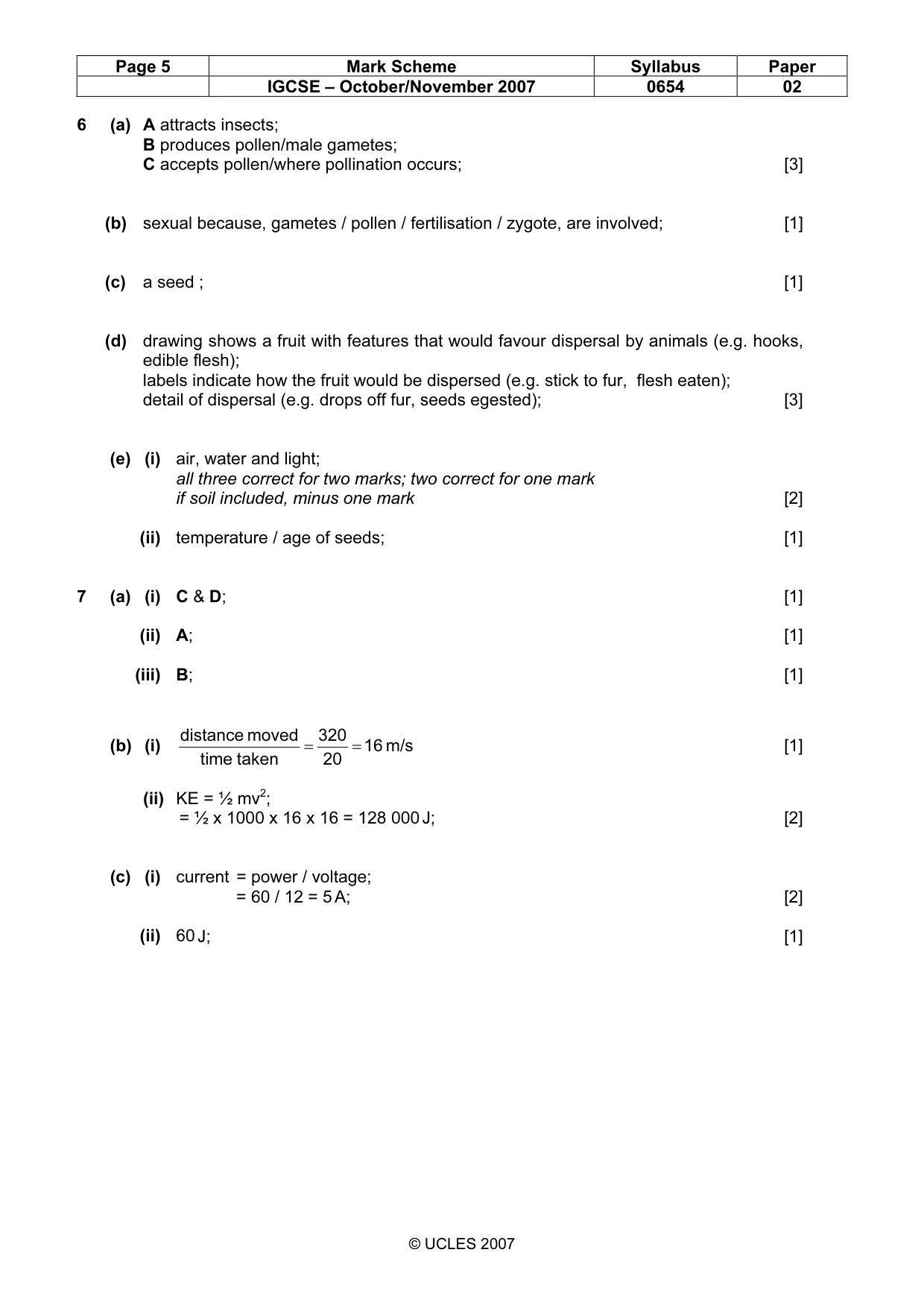
Page 4 Mark Scheme Syllabus Paper IGCSE – October/November 2007 0654 02 © UCLES 2007 4 (a) (i) time taken for half the atoms (in sample) to decay / time taken for count rate (of sample) to halve; [1] (ii) has shorter half-life / decays faster; therefore less radiation emitted / exposed for less time; no beta emission / only emits gamma; beta is more ionising (or description); [Max 3] (b) (i) radiation can cause cancer / reference to ionization etc; [1] (ii) gloves; radiation badge; protective clothing; lead shielding; [Max 1] 5 (a) row of elements / elements in a line across the table / horizontal row of elements / elements whose atoms have the same number of electron shells; [1] (b) (i) (Q) protons are positive, electrons are negative; more protons than electrons; [2] (ii) (R) (atoms have) same number of protons as electrons/ 17 p and 17 e; nucleon number is sum of protons and neutrons / 17 + 18 = 35; [2] (iii) atom 3; outer shell electrons = group number; [2] (c) (i) giant / lattice ; [1] (ii) dissolve / melt; electrolyse; other correct detail of electrolysis; [max 2]
Mark scheme, page 5
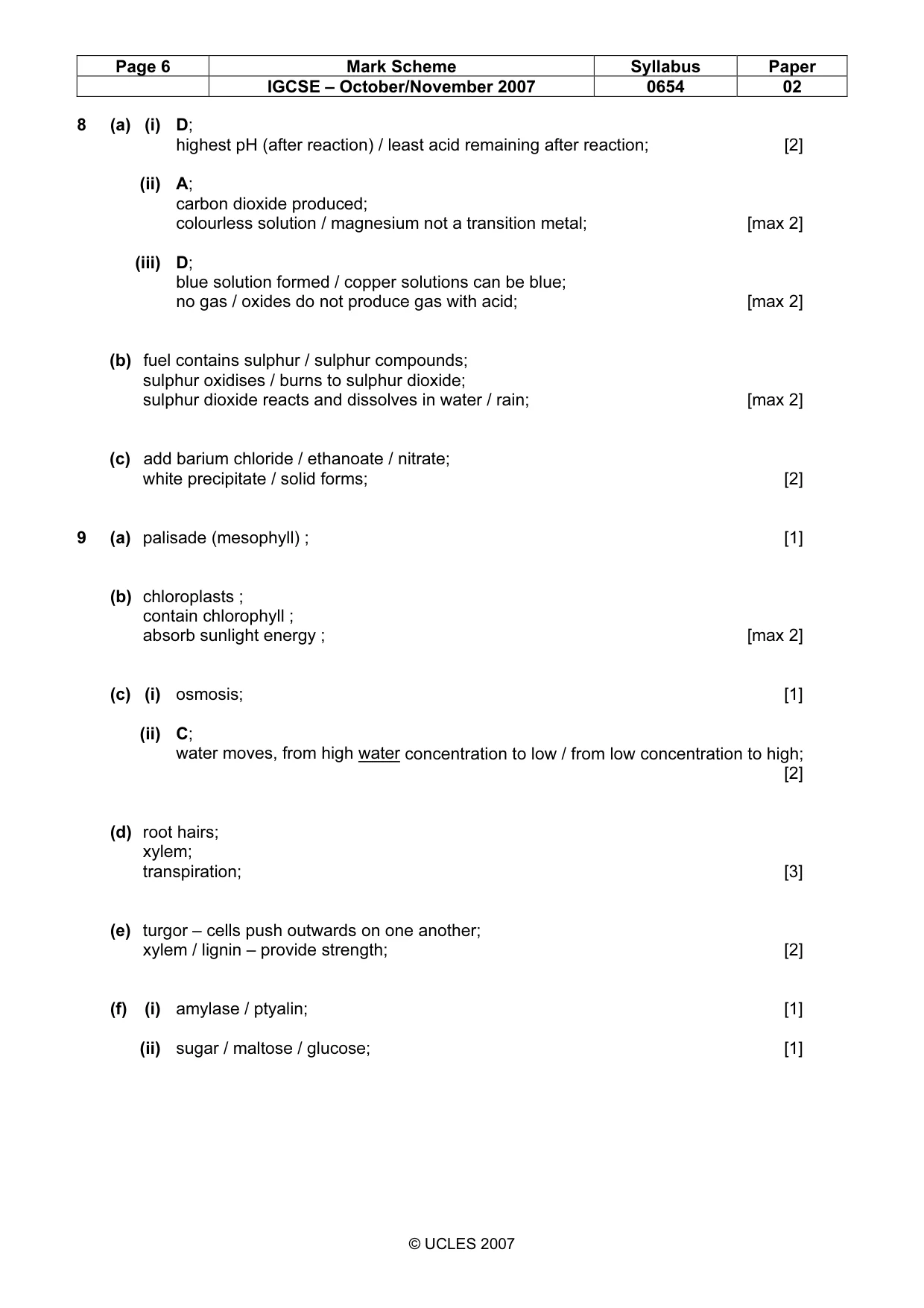
Page 5 Mark Scheme Syllabus Paper IGCSE – October/November 2007 0654 02 © UCLES 2007 6 (a) A attracts insects; B produces pollen/male gametes; C accepts pollen/where pollination occurs; [3] (b) sexual because, gametes / pollen / fertilisation / zygote, are involved; [1] (c) a seed ; [1] (d) drawing shows a fruit with features that would favour dispersal by animals (e.g. hooks, edible flesh); labels indicate how the fruit would be dispersed (e.g. stick to fur, flesh eaten); detail of dispersal (e.g. drops off fur, seeds egested); [3] (e) (i) air, water and light; all three correct for two marks; two correct for one mark if soil included, minus one mark [2] (ii) temperature / age of seeds; [1] 7 (a) (i) C & D; [1] (ii) A; [1] (iii) B; [1] (b) (i) m/s 16 20 320 taken time moved distance = = [1] (ii) KE = ½ mv2; = ½ x 1000 x 16 x 16 = 128 000 J; [2] (c) (i) current = power / voltage; = 60 / 12 = 5 A; [2] (ii) 60 J; [1]
Mark scheme, page 6
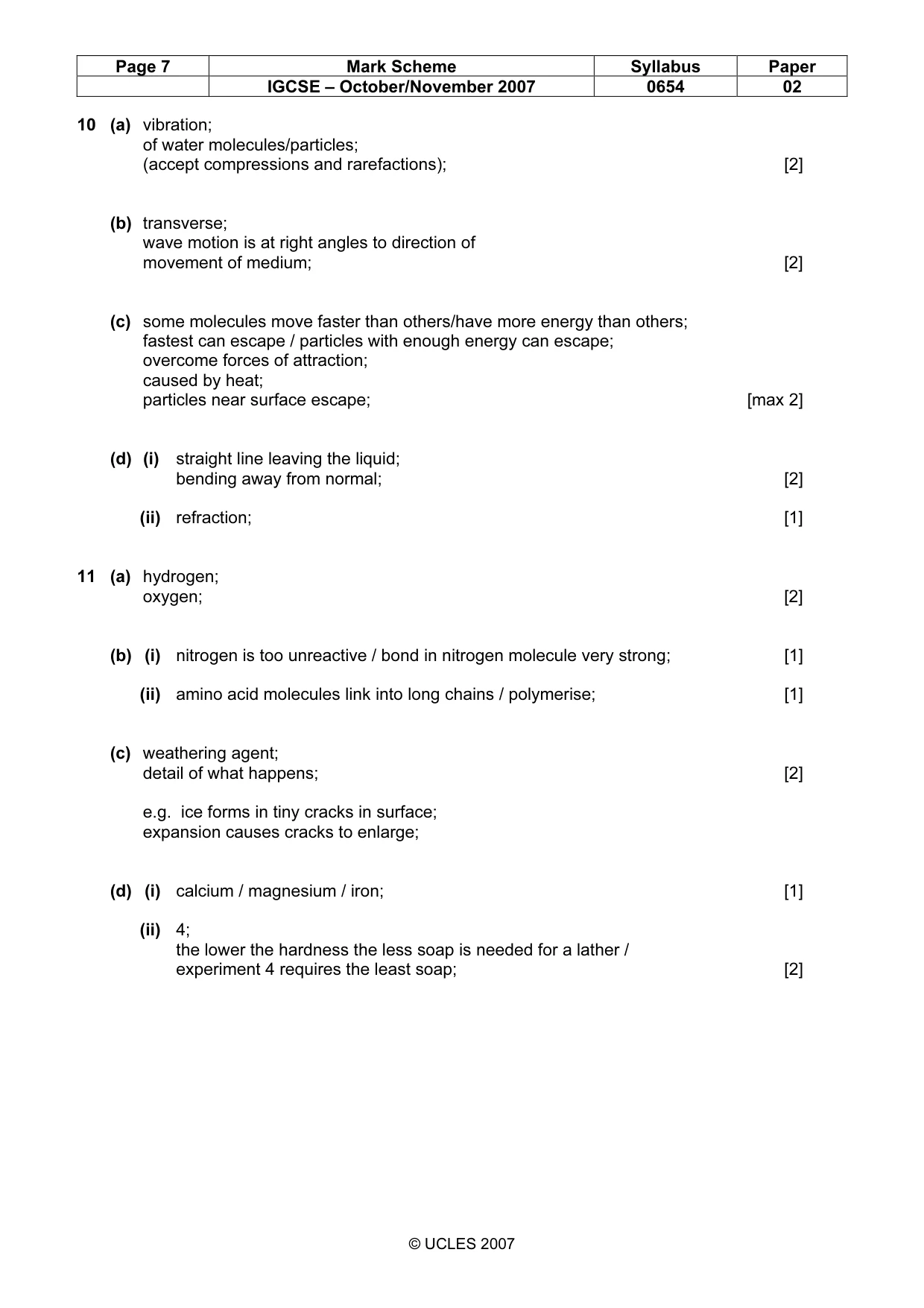
Page 6 Mark Scheme Syllabus Paper IGCSE – October/November 2007 0654 02 © UCLES 2007 8 (a) (i) D; highest pH (after reaction) / least acid remaining after reaction; [2] (ii) A; carbon dioxide produced; colourless solution / magnesium not a transition metal; [max 2] (iii) D; blue solution formed / copper solutions can be blue; no gas / oxides do not produce gas with acid; [max 2] (b) fuel contains sulphur / sulphur compounds; sulphur oxidises / burns to sulphur dioxide; sulphur dioxide reacts and dissolves in water / rain; [max 2] (c) add barium chloride / ethanoate / nitrate; white precipitate / solid forms; [2] 9 (a) palisade (mesophyll) ; [1] (b) chloroplasts ; contain chlorophyll ; absorb sunlight energy ; [max 2] (c) (i) osmosis; [1] (ii) C; water moves, from high water concentration to low / from low concentration to high; [2] (d) root hairs; xylem; transpiration; [3] (e) turgor – cells push outwards on one another; xylem / lignin – provide strength; [2] (f) (i) amylase / ptyalin; [1] (ii) sugar / maltose / glucose; [1]
Mark scheme, page 7
Page 7 Mark Scheme Syllabus Paper IGCSE – October/November 2007 0654 02 © UCLES 2007 10 (a) vibration; of water molecules/particles; (accept compressions and rarefactions); [2] (b) transverse; wave motion is at right angles to direction of movement of medium; [2] (c) some molecules move faster than others/have more energy than others; fastest can escape / particles with enough energy can escape; overcome forces of attraction; caused by heat; particles near surface escape; [max 2] (d) (i) straight line leaving the liquid; bending away from normal; [2] (ii) refraction; [1] 11 (a) hydrogen; oxygen; [2] (b) (i) nitrogen is too unreactive / bond in nitrogen molecule very strong; [1] (ii) amino acid molecules link into long chains / polymerise; [1] (c) weathering agent; detail of what happens; [2] e.g. ice forms in tiny cracks in surface; expansion causes cracks to enlarge; (d) (i) calcium / magnesium / iron; [1] (ii) 4; the lower the hardness the less soap is needed for a lather / experiment 4 requires the least soap; [2]
What you needed in this session
Cambridge’s own grade thresholds for 2007 Oct/Nov, Paper 2 · Variant 1. A higher threshold means an easier paper — the bar moves with how the cohort did.