Cambridge IGCSE Sciences - Co-ordinated (Double) 0654 — 2006 Oct/Nov Paper 2 · Variant 1
0654/21/O/N/06 · 100 marks · ≈113 min
The question paper and its mark scheme, free to read here and free to download. This is Cambridge’s own paper, exactly as it was sat.
Question paper28 pages



Mark scheme5 pages
Answers below. Sit the paper first if you are practising.
Paper as text
Question paper, page 1
Centre Number Candidate Number Name UNIVERSITY OF CAMBRIDGE INTERNATIONAL EXAMINATIONS International General Certificate of Secondary Education CO-ORDINATED SCIENCES 0654/02 Paper 2 (Core) October/November 2006 2 hours Candidates answer on the Question Paper. No Additional Materials are required. READ THESE INSTRUCTIONS FIRST Write your Centre number, candidate number and name on all the work you hand in. Write in dark blue or black pen. You may use a soft pencil for any diagrams, graphs, tables or rough working. Do not use staples, paper clips, highlighters, glue or correction fluid. Answer all questions. A copy of the Periodic Table is printed on page 28. At the end of the examination, fasten all your work securely together. The number of marks is given in brackets [ ] at the end of each question or part question. For Examiner’s Use 1 2 3 4 5 6 7 8 9 10 11 Total This document consists of 25 printed pages and 3 blank pages. IB06 11_0654_02/4RP © UCLES 2006 [Turn over www.XtremePapers.com
Question paper, page 2
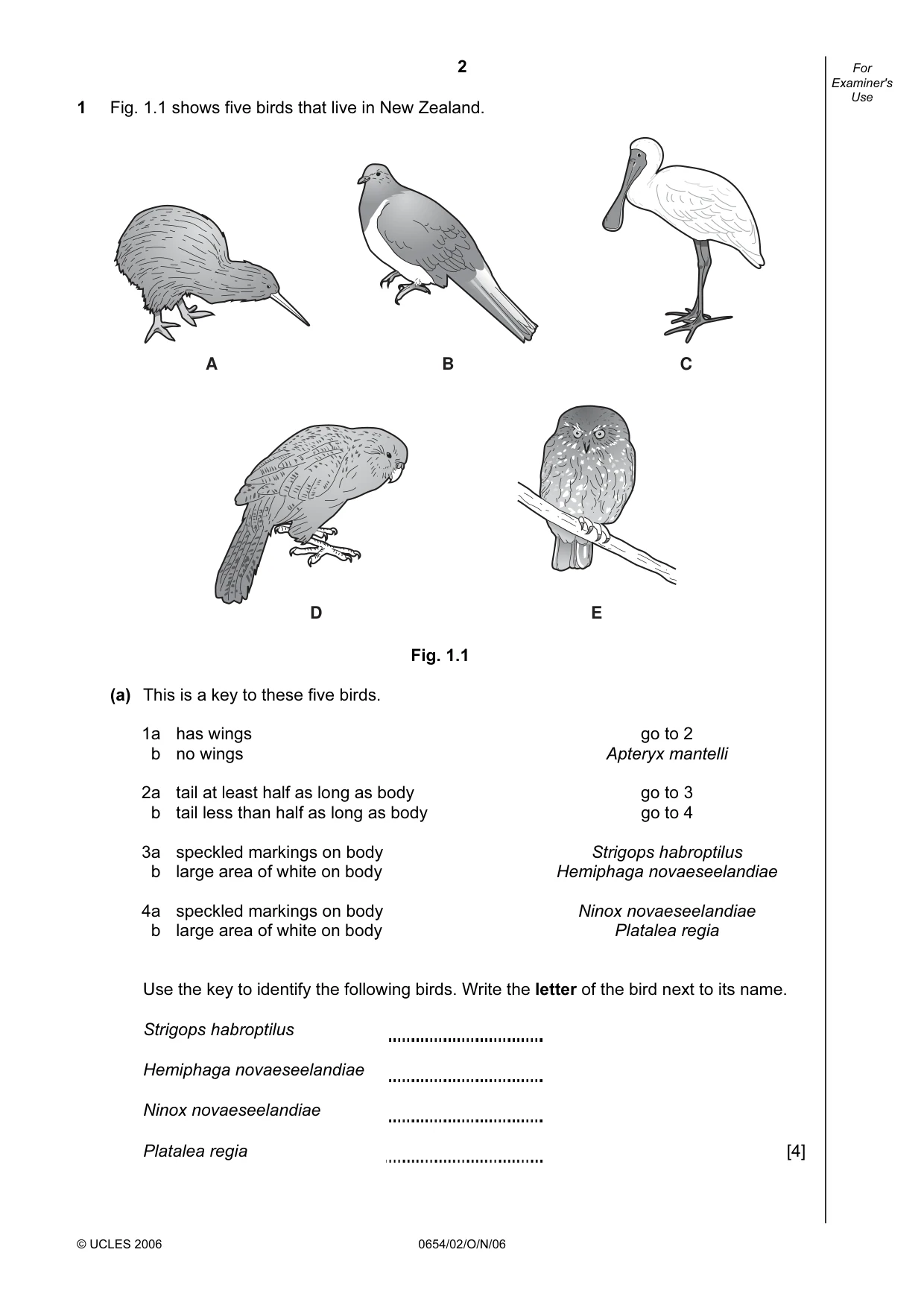
2 © UCLES 2006 0654/02/O/N/06 For Examiner's Use 1 Fig. 1.1 shows five birds that live in New Zealand. A B C D E Fig. 1.1 (a) This is a key to these five birds. 1a has wings go to 2 b no wings Apteryx mantelli 2a tail at least half as long as body go to 3 b tail less than half as long as body go to 4 3a speckled markings on body Strigops habroptilus b large area of white on body Hemiphaga novaeseelandiae 4a speckled markings on body Ninox novaeseelandiae b large area of white on body Platalea regia Use the key to identify the following birds. Write the letter of the bird next to its name. Strigops habroptilus Hemiphaga novaeseelandiae Ninox novaeseelandiae Platalea regia [4]
Question paper, page 3
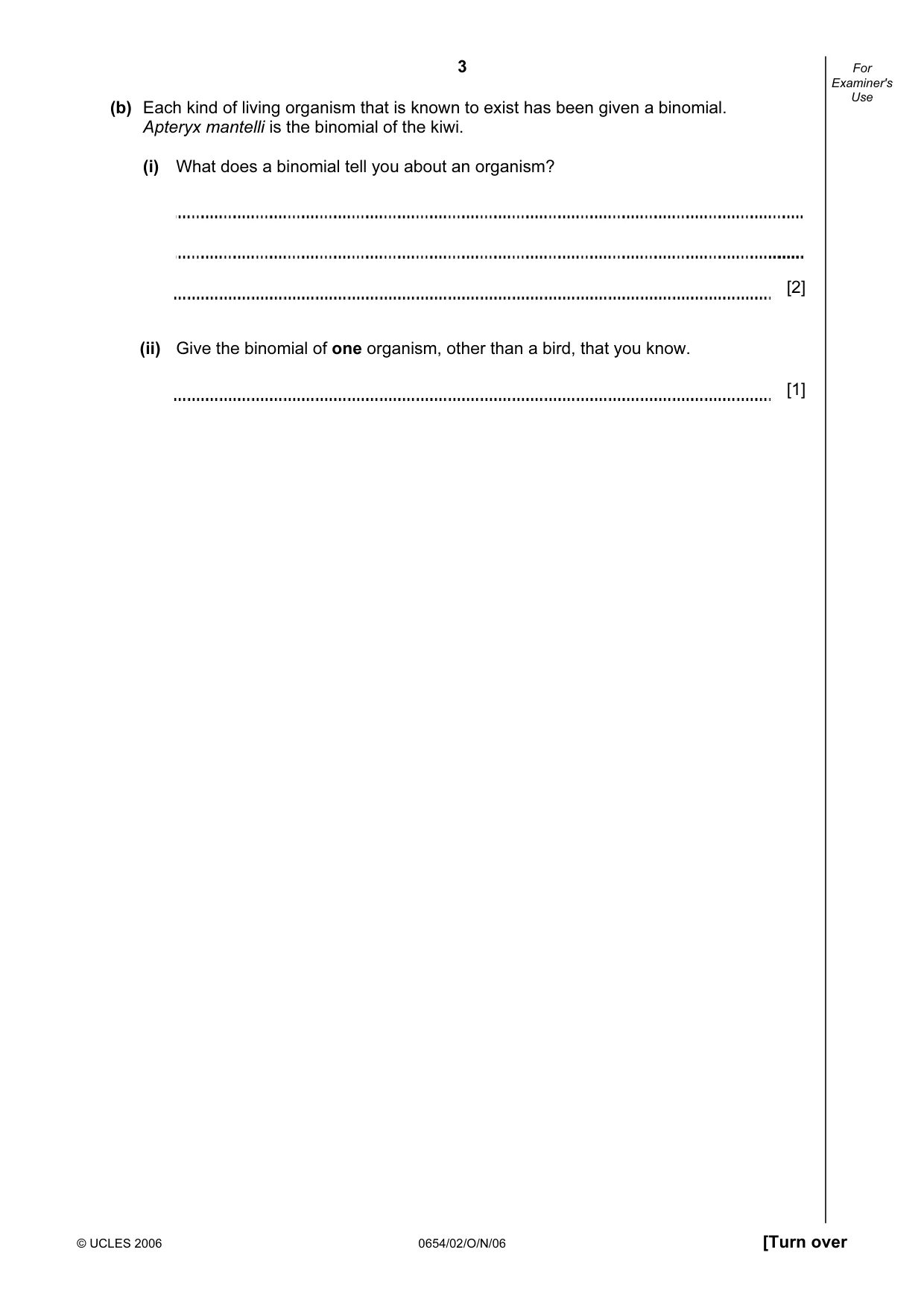
3 © UCLES 2006 0654/02/O/N/06 [Turn over For Examiner's Use (b) Each kind of living organism that is known to exist has been given a binomial. Apteryx mantelli is the binomial of the kiwi. (i) What does a binomial tell you about an organism? [2] (ii) Give the binomial of one organism, other than a bird, that you know. [1]
Question paper, page 4
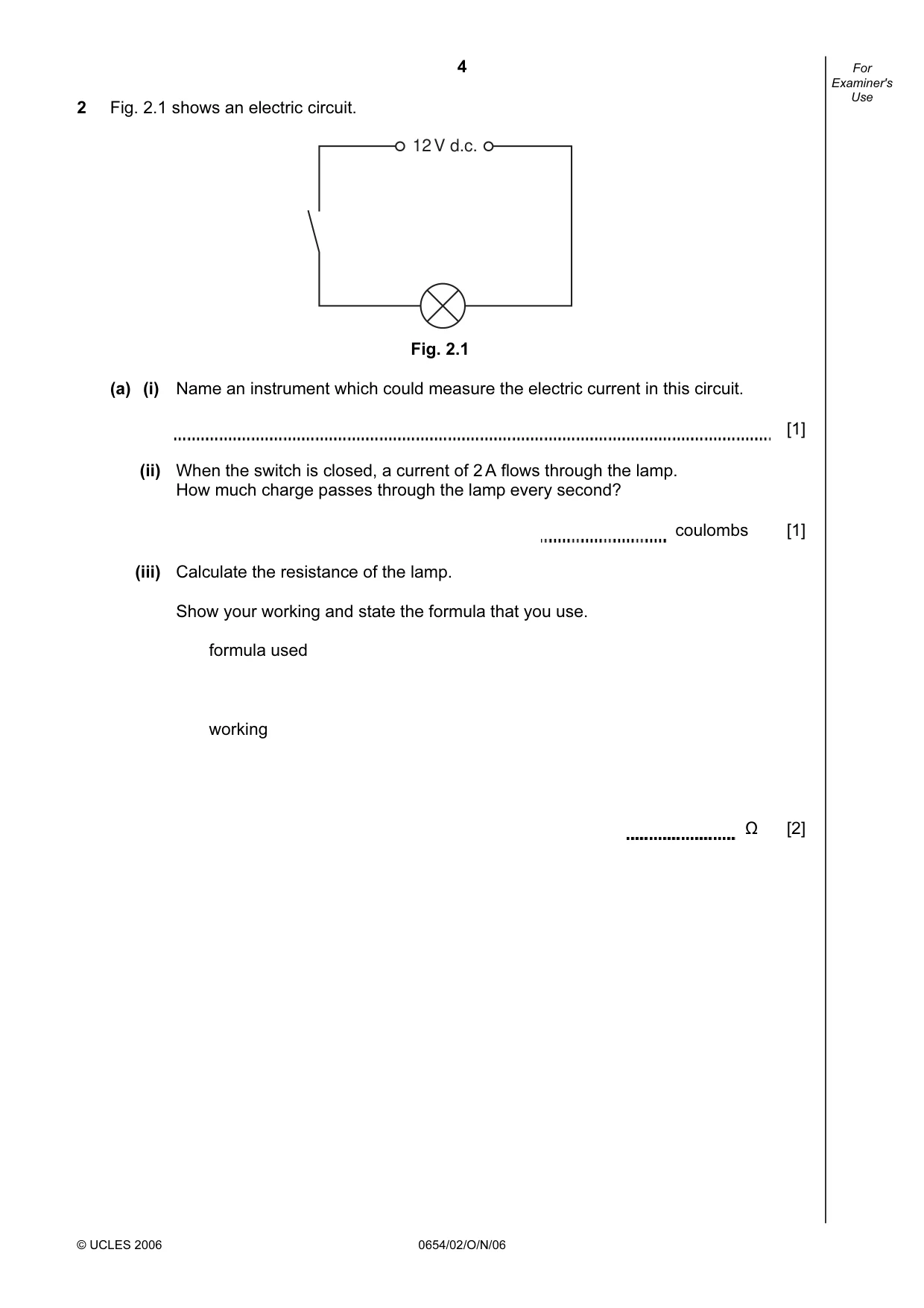
4 © UCLES 2006 0654/02/O/N/06 For Examiner's Use 2 Fig. 2.1 shows an electric circuit. 12 V d.c. Fig. 2.1 (a) (i) Name an instrument which could measure the electric current in this circuit. [1] (ii) When the switch is closed, a current of 2 A flows through the lamp. How much charge passes through the lamp every second? coulombs [1] (iii) Calculate the resistance of the lamp. Show your working and state the formula that you use. formula used working Ω [2]
Question paper, page 5
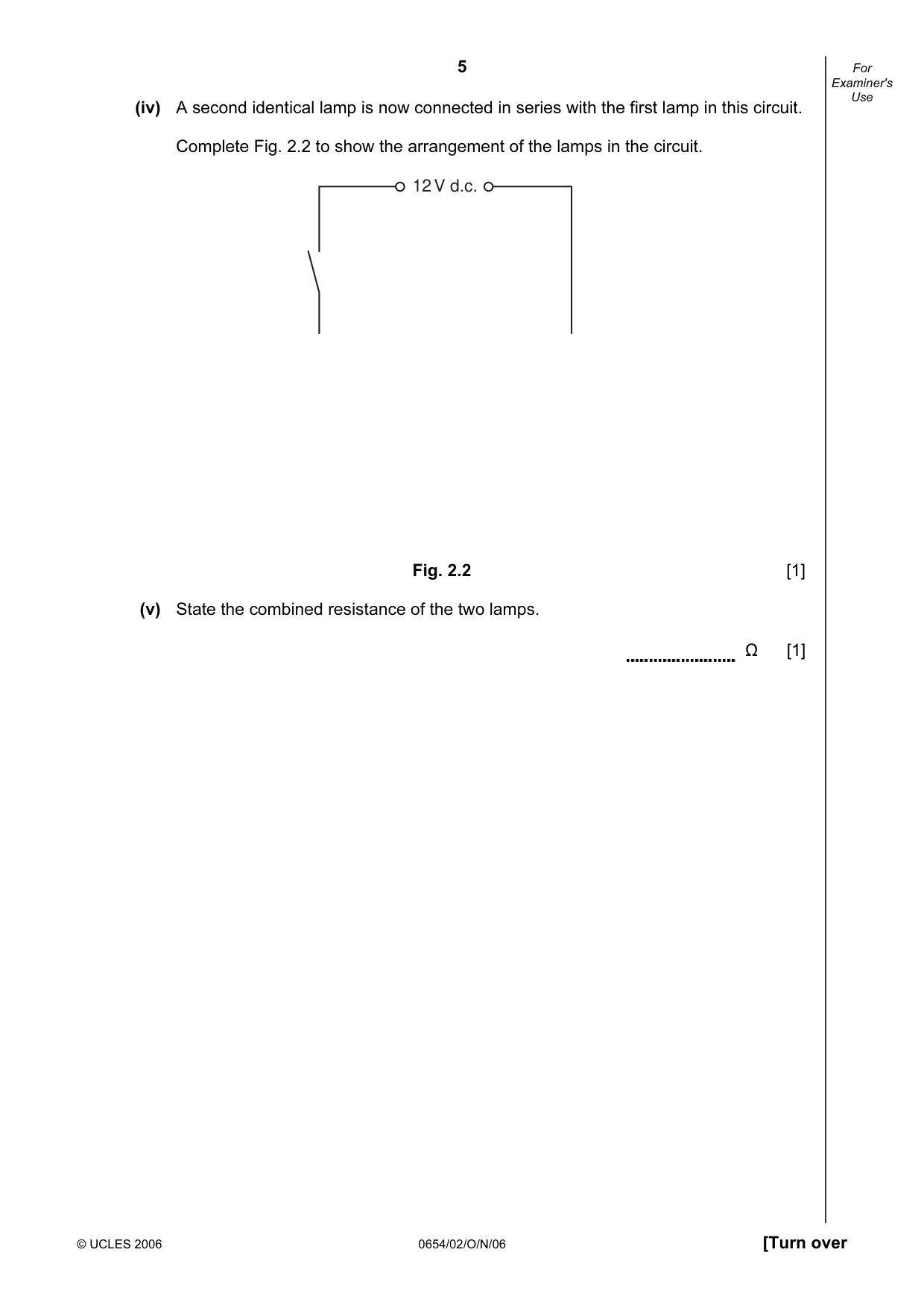
5 © UCLES 2006 0654/02/O/N/06 [Turn over For Examiner's Use (iv) A second identical lamp is now connected in series with the first lamp in this circuit. Complete Fig. 2.2 to show the arrangement of the lamps in the circuit. 12 V d.c. Fig. 2.2 [1] (v) State the combined resistance of the two lamps. Ω [1]
Question paper, page 6
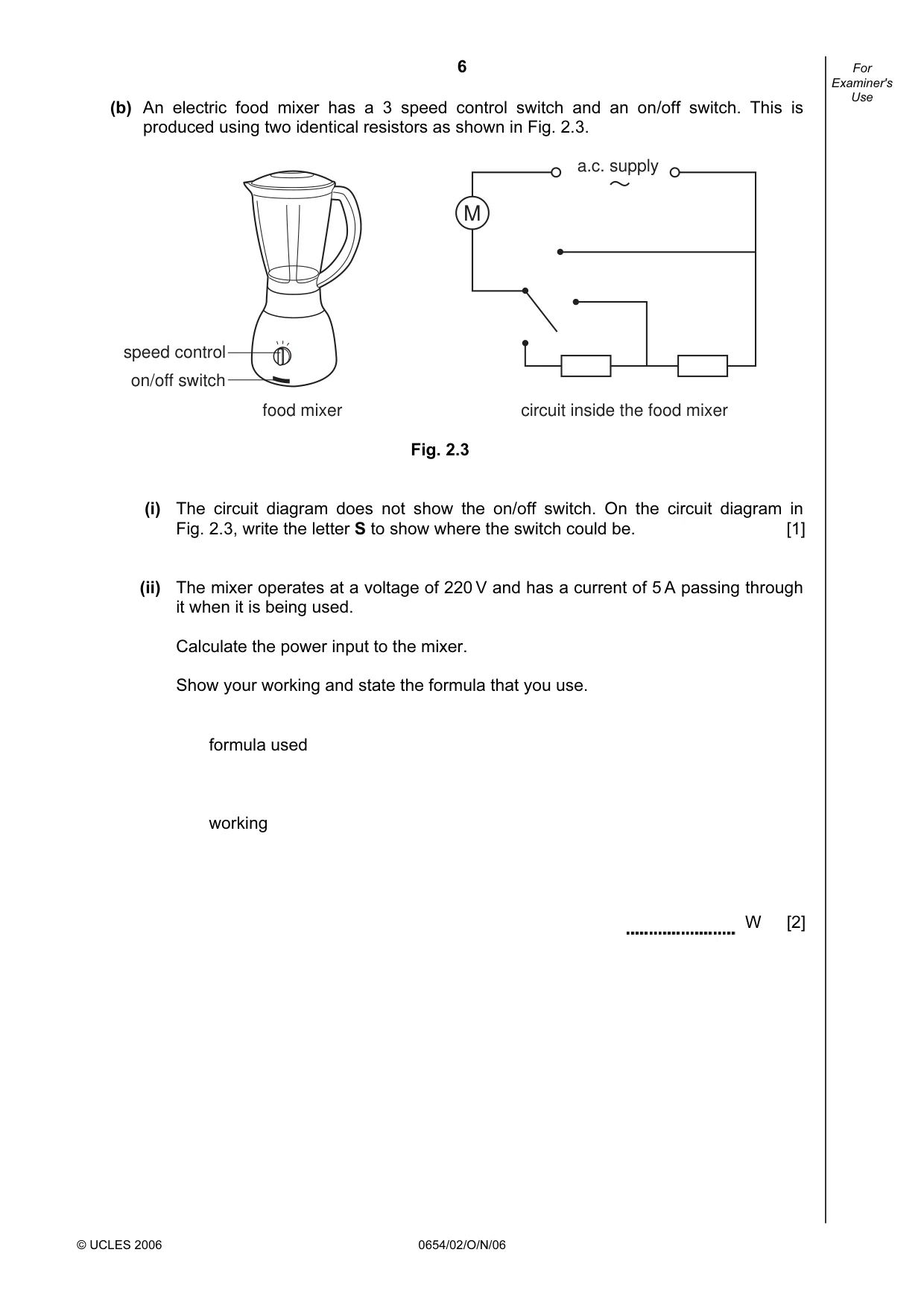
6 © UCLES 2006 0654/02/O/N/06 For Examiner's Use (b) An electric food mixer has a 3 speed control switch and an on/off switch. This is produced using two identical resistors as shown in Fig. 2.3. food mixer circuit inside the food mixer a.c. supply speed control on/off switch M Fig. 2.3 (i) The circuit diagram does not show the on/off switch. On the circuit diagram in Fig. 2.3, write the letter S to show where the switch could be. [1] (ii) The mixer operates at a voltage of 220 V and has a current of 5 A passing through it when it is being used. Calculate the power input to the mixer. Show your working and state the formula that you use. formula used working W [2]
Question paper, page 8
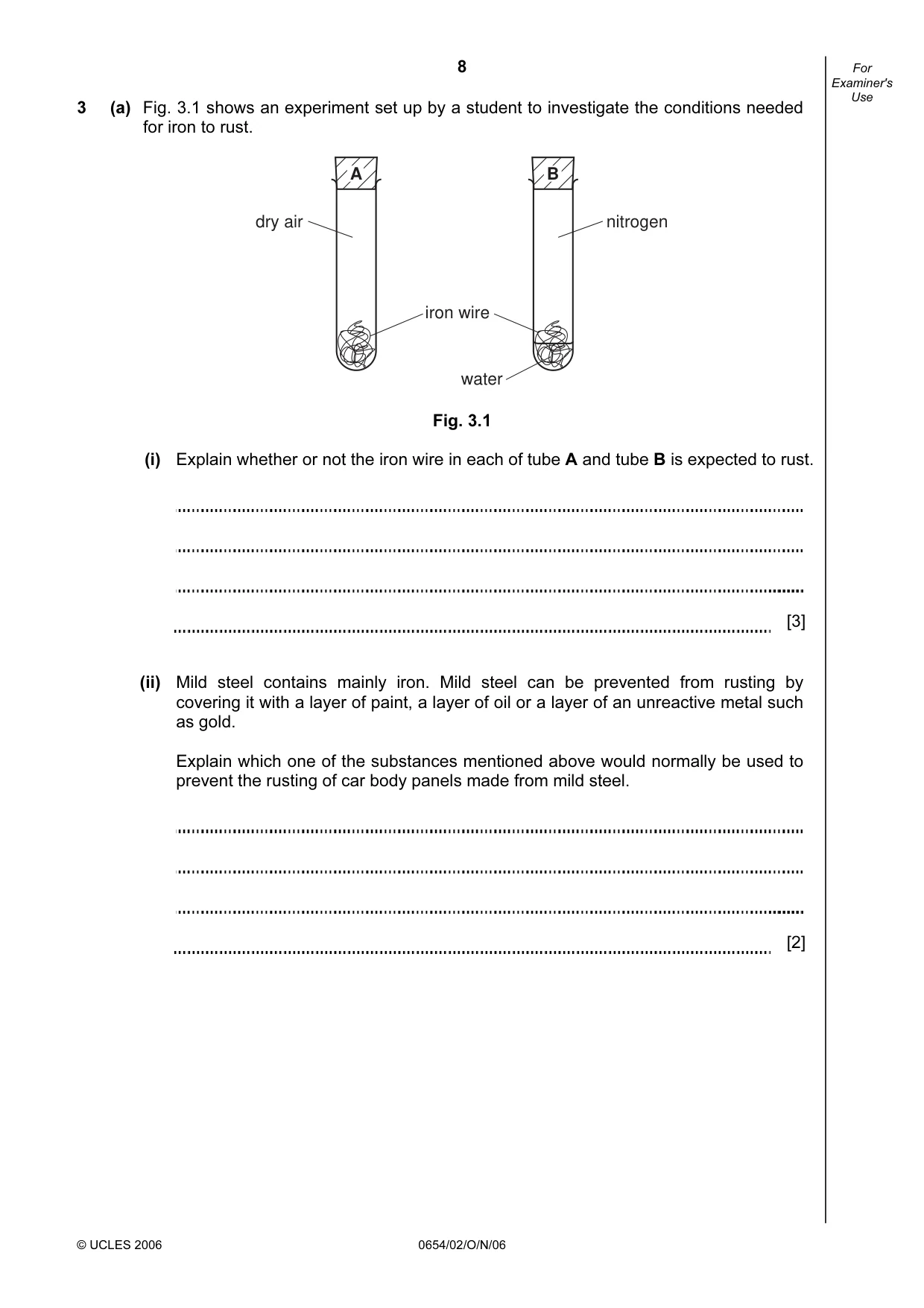
8 © UCLES 2006 0654/02/O/N/06 For Examiner's Use 3 (a) Fig. 3.1 shows an experiment set up by a student to investigate the conditions needed for iron to rust. iron wire water nitrogen dry air A B Fig. 3.1 (i) Explain whether or not the iron wire in each of tube A and tube B is expected to rust. [3] (ii) Mild steel contains mainly iron. Mild steel can be prevented from rusting by covering it with a layer of paint, a layer of oil or a layer of an unreactive metal such as gold. Explain which one of the substances mentioned above would normally be used to prevent the rusting of car body panels made from mild steel. [2]
Question paper, page 9
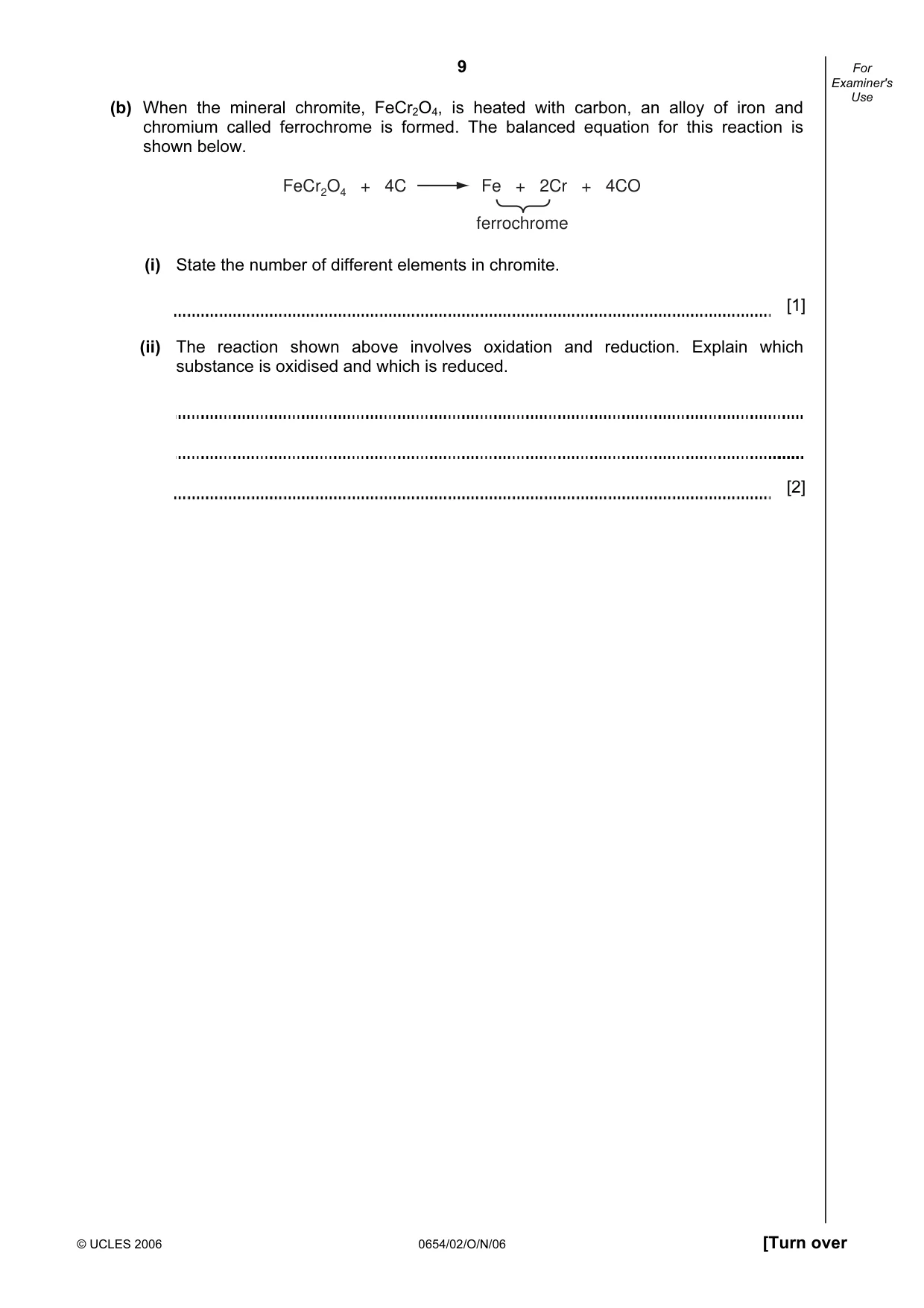
9 © UCLES 2006 0654/02/O/N/06 [Turn over For Examiner's Use (b) When the mineral chromite, FeCr2O4, is heated with carbon, an alloy of iron and chromium called ferrochrome is formed. The balanced equation for this reaction is shown below. FeCr2O4 + 4C Fe + 2Cr + 4CO ferrochrome (i) State the number of different elements in chromite. [1] (ii) The reaction shown above involves oxidation and reduction. Explain which substance is oxidised and which is reduced. [2]
Question paper, page 10
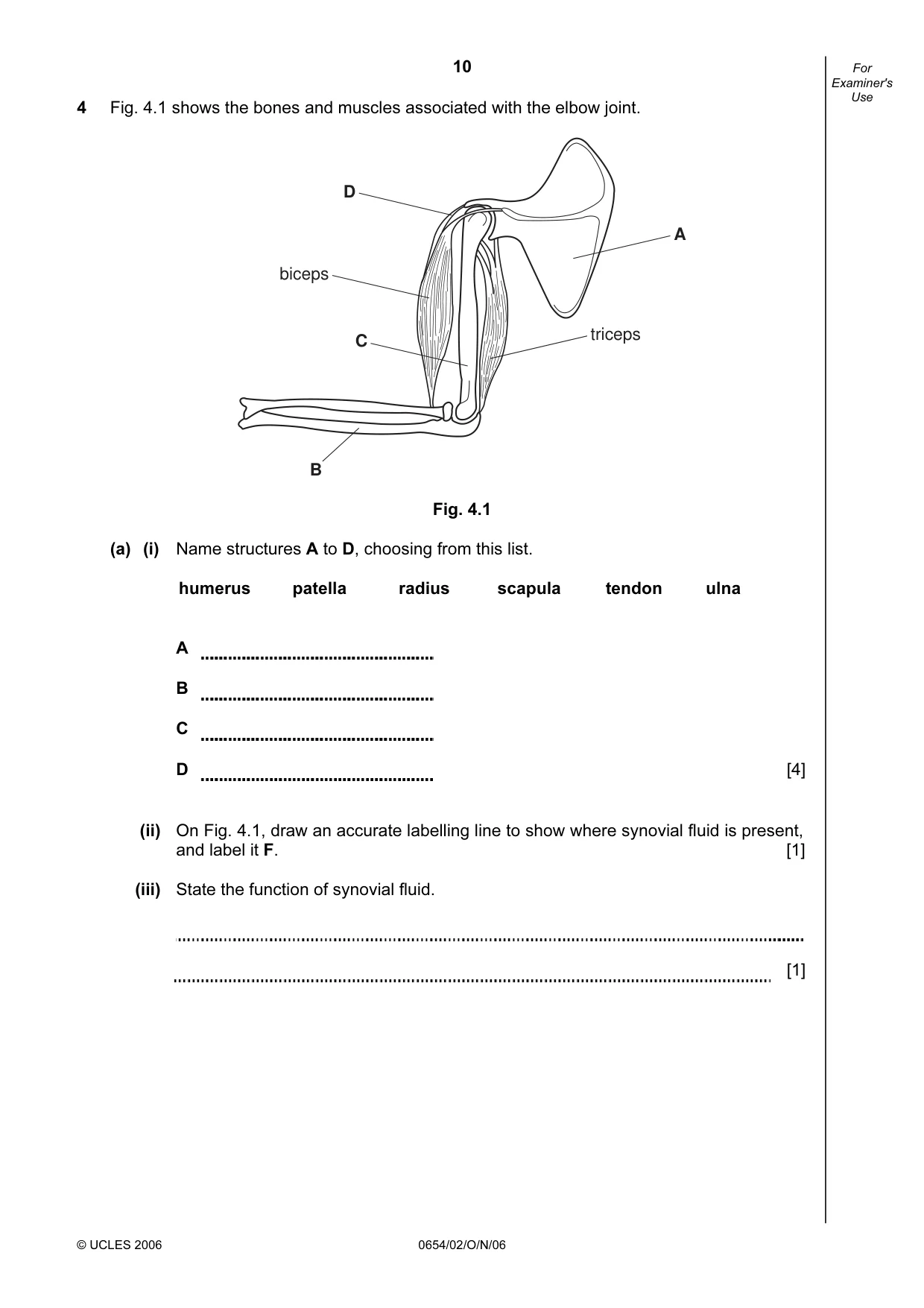
10 © UCLES 2006 0654/02/O/N/06 For Examiner's Use 4 Fig. 4.1 shows the bones and muscles associated with the elbow joint. A B C D biceps triceps Fig. 4.1 (a) (i) Name structures A to D, choosing from this list. humerus patella radius scapula tendon ulna A B C D [4] (ii) On Fig. 4.1, draw an accurate labelling line to show where synovial fluid is present, and label it F. [1] (iii) State the function of synovial fluid. [1]
Question paper, page 11
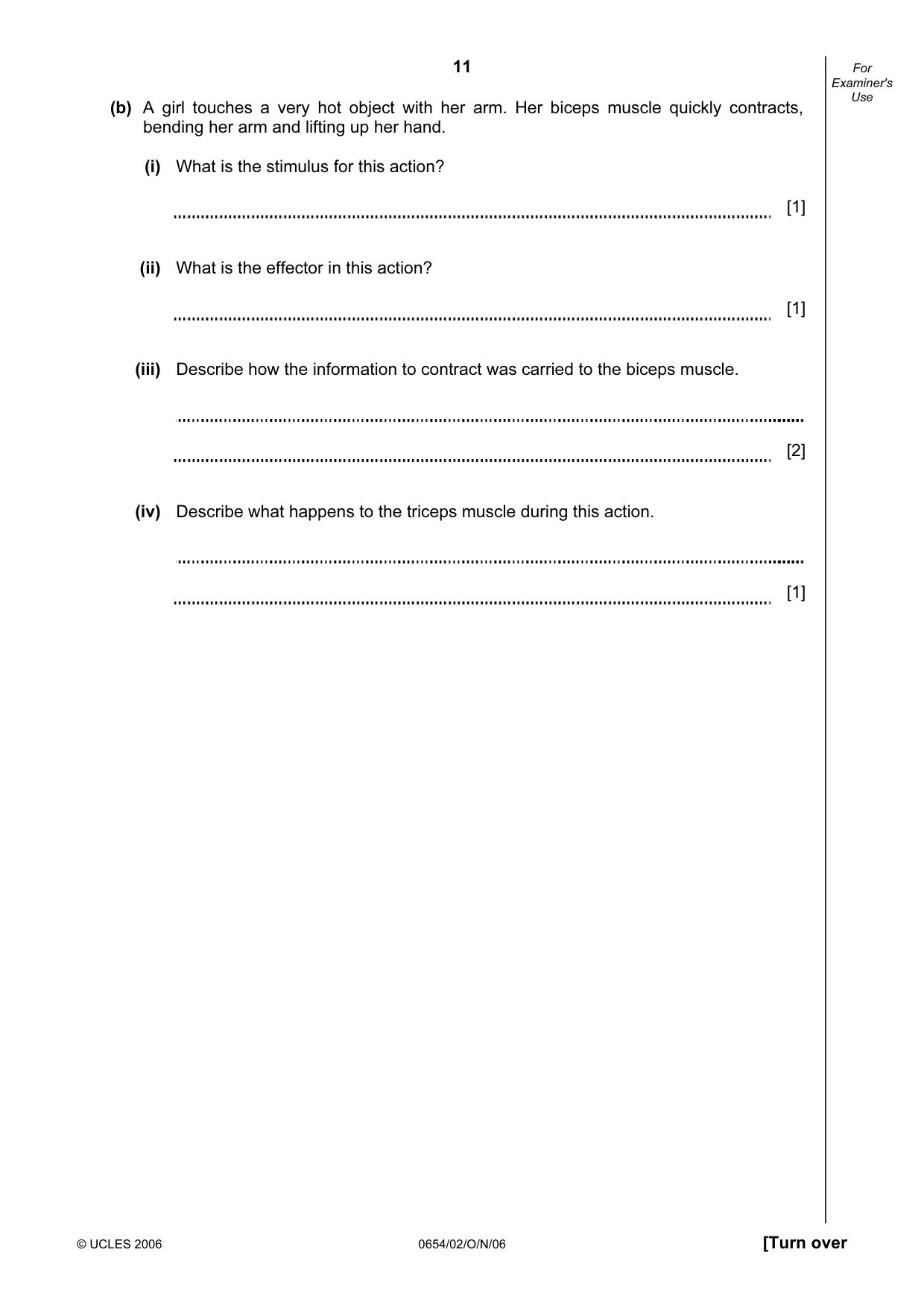
11 © UCLES 2006 0654/02/O/N/06 [Turn over For Examiner's Use (b) A girl touches a very hot object with her arm. Her biceps muscle quickly contracts, bending her arm and lifting up her hand. (i) What is the stimulus for this action? [1] (ii) What is the effector in this action? [1] (iii) Describe how the information to contract was carried to the biceps muscle. [2] (iv) Describe what happens to the triceps muscle during this action. [1]
Question paper, page 12
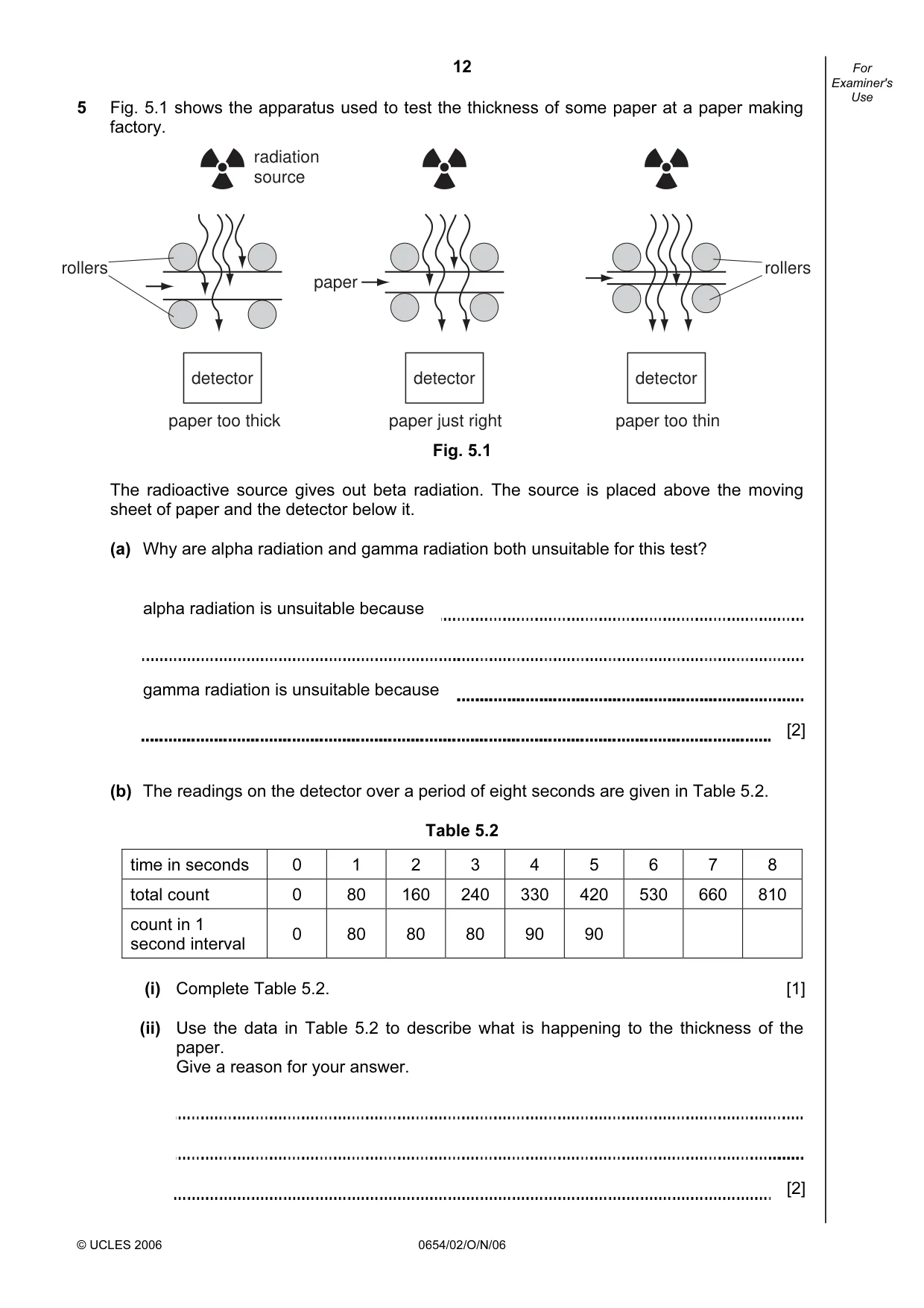
12 © UCLES 2006 0654/02/O/N/06 For Examiner's Use 5 Fig. 5.1 shows the apparatus used to test the thickness of some paper at a paper making factory. radiation source detector paper too thick detector paper just right detector paper too thin rollers rollers paper Fig. 5.1 The radioactive source gives out beta radiation. The source is placed above the moving sheet of paper and the detector below it. (a) Why are alpha radiation and gamma radiation both unsuitable for this test? alpha radiation is unsuitable because gamma radiation is unsuitable because [2] (b) The readings on the detector over a period of eight seconds are given in Table 5.2. Table 5.2 time in seconds 0 1 2 3 4 5 6 7 8 total count 0 80 160 240 330 420 530 660 810 count in 1 second interval 0 80 80 80 90 90 (i) Complete Table 5.2. [1] (ii) Use the data in Table 5.2 to describe what is happening to the thickness of the paper. Give a reason for your answer. [2]
Question paper, page 13
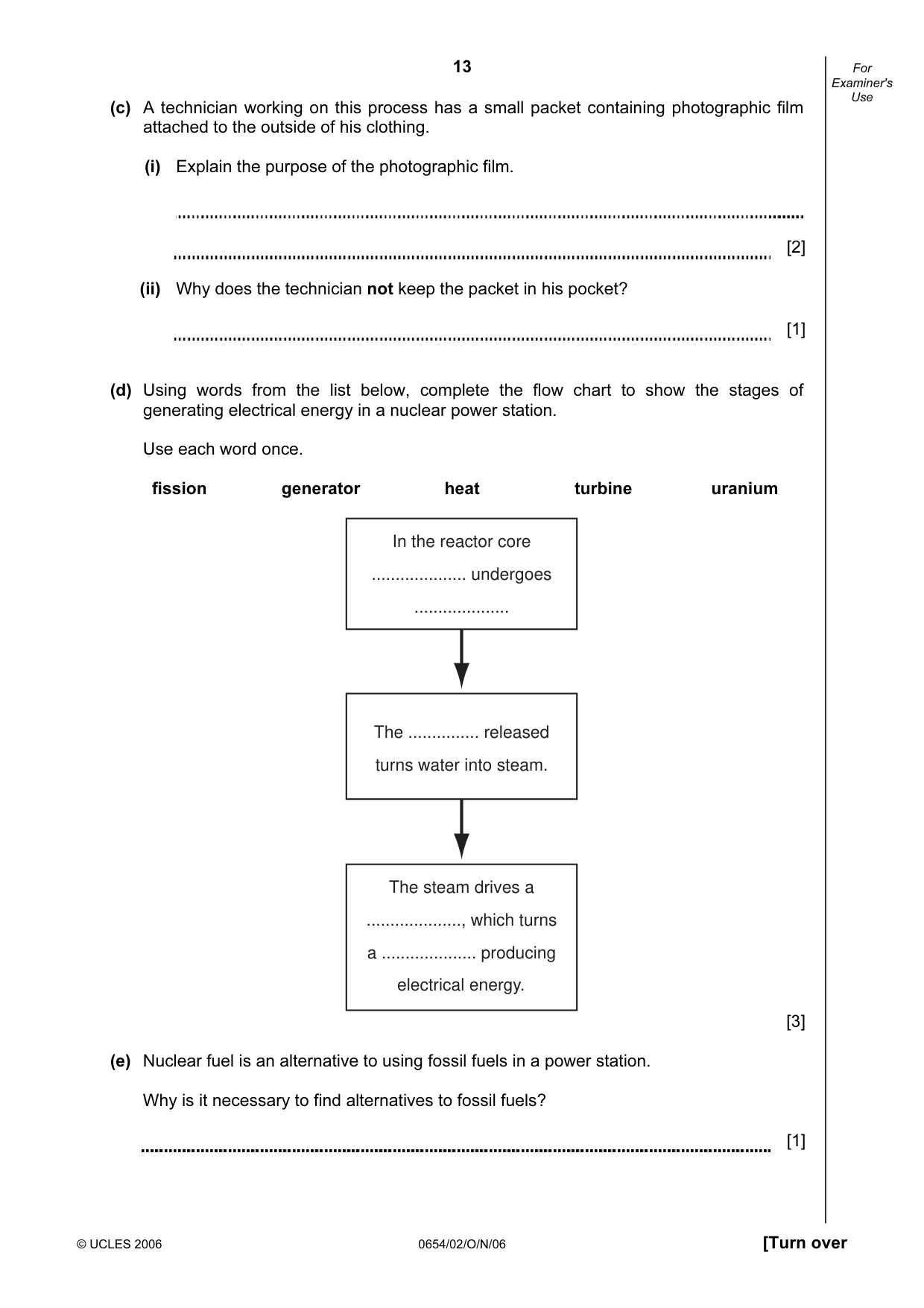
13 © UCLES 2006 0654/02/O/N/06 [Turn over For Examiner's Use (c) A technician working on this process has a small packet containing photographic film attached to the outside of his clothing. (i) Explain the purpose of the photographic film. [2] (ii) Why does the technician not keep the packet in his pocket? [1] (d) Using words from the list below, complete the flow chart to show the stages of generating electrical energy in a nuclear power station. Use each word once. fission generator heat turbine uranium The steam drives a …, which turns a … producing electrical energy. The … released turns water into steam. In the reactor core … undergoes … [3] (e) Nuclear fuel is an alternative to using fossil fuels in a power station. Why is it necessary to find alternatives to fossil fuels? [1]
Question paper, page 14
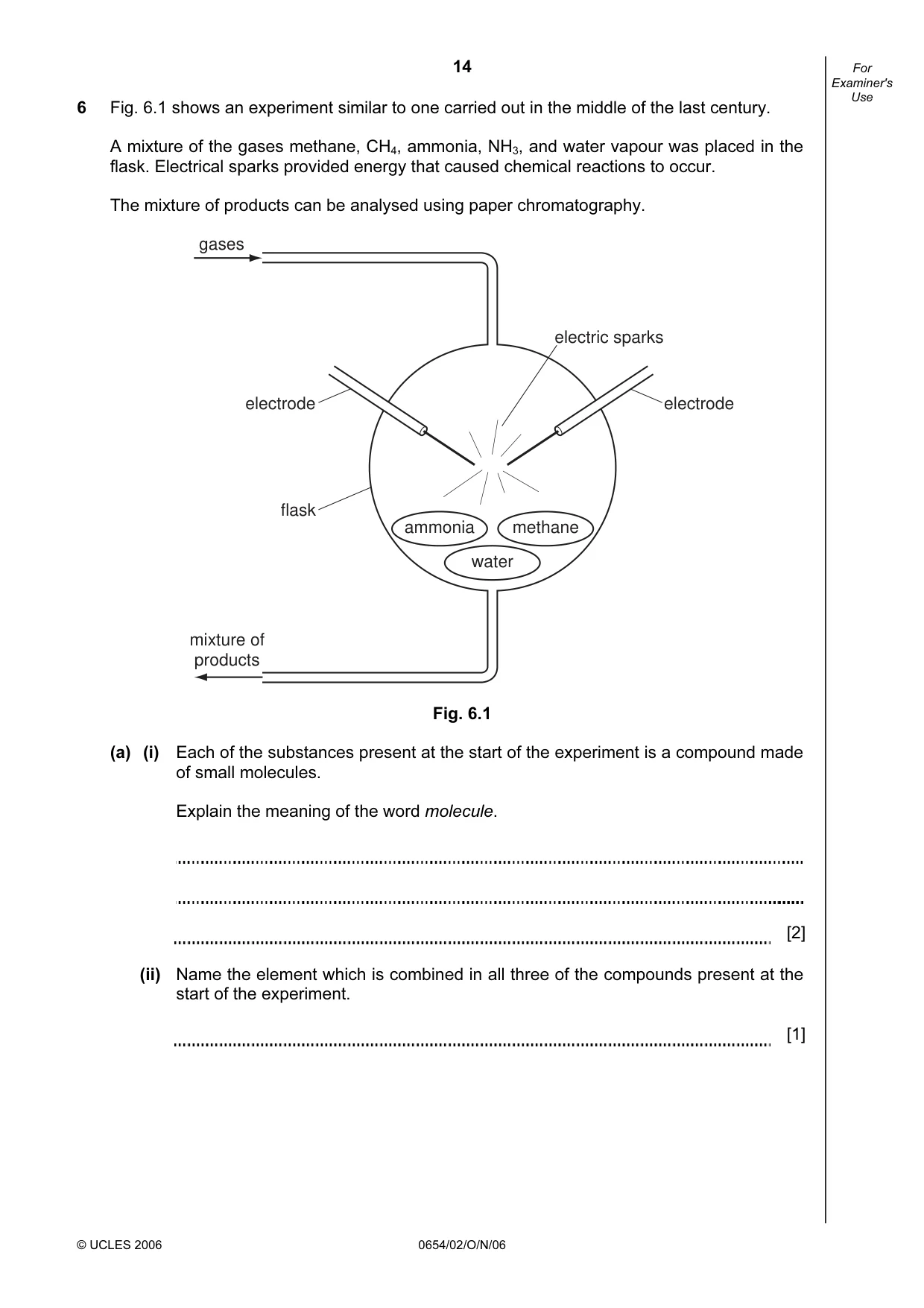
14 © UCLES 2006 0654/02/O/N/06 For Examiner's Use 6 Fig. 6.1 shows an experiment similar to one carried out in the middle of the last century. A mixture of the gases methane, CH4, ammonia, NH3, and water vapour was placed in the flask. Electrical sparks provided energy that caused chemical reactions to occur. The mixture of products can be analysed using paper chromatography. ammonia methane water gases mixture of products electrode electrode flask electric sparks Fig. 6.1 (a) (i) Each of the substances present at the start of the experiment is a compound made of small molecules. Explain the meaning of the word molecule. [2] (ii) Name the element which is combined in all three of the compounds present at the start of the experiment. [1]
Question paper, page 15
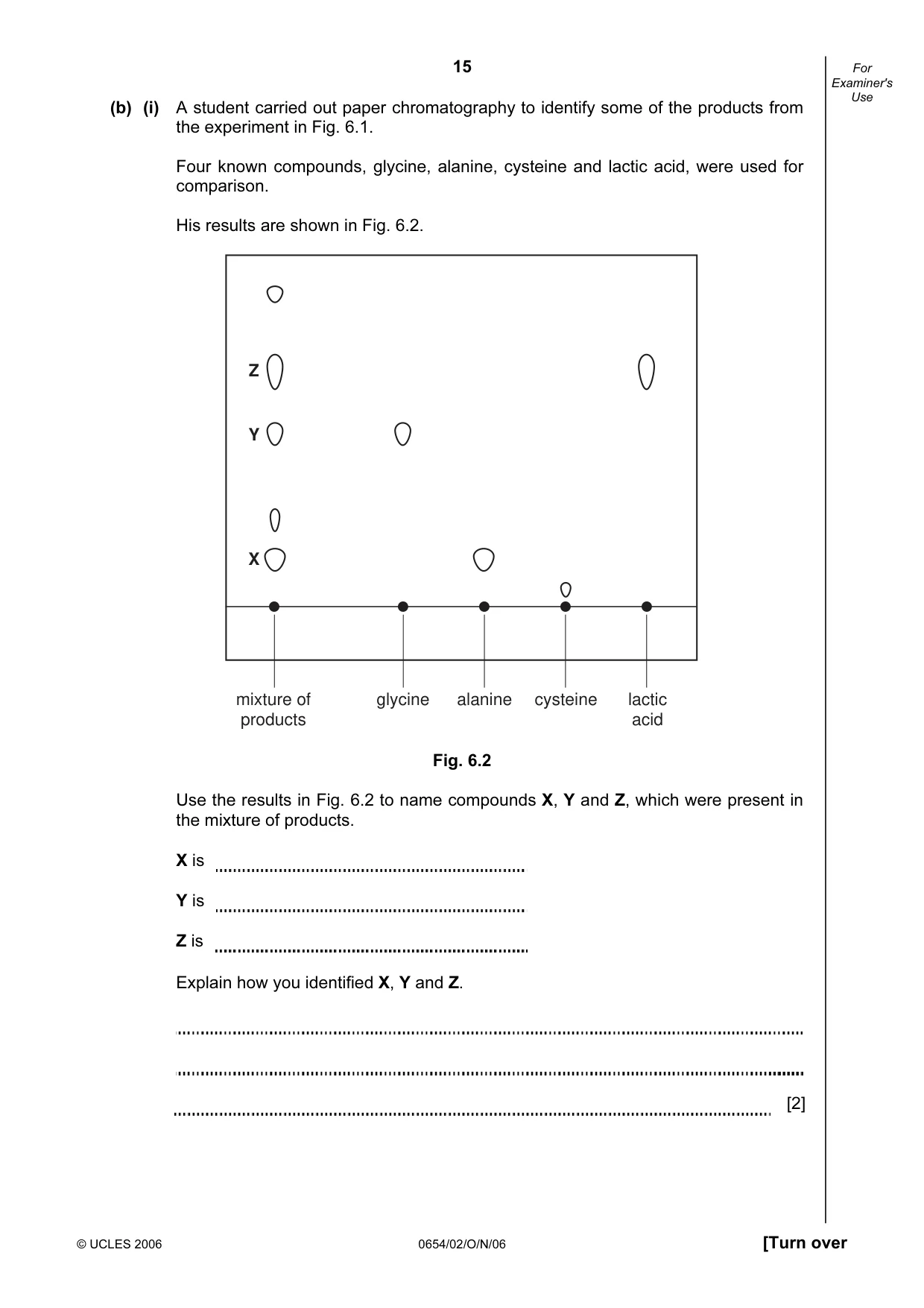
15 © UCLES 2006 0654/02/O/N/06 [Turn over For Examiner's Use (b) (i) A student carried out paper chromatography to identify some of the products from the experiment in Fig. 6.1. Four known compounds, glycine, alanine, cysteine and lactic acid, were used for comparison. His results are shown in Fig. 6.2. mixture of products glycine alanine cysteine lactic acid Z Y X Fig. 6.2 Use the results in Fig. 6.2 to name compounds X, Y and Z, which were present in the mixture of products. X is Y is Z is Explain how you identified X, Y and Z. [2]
Question paper, page 16
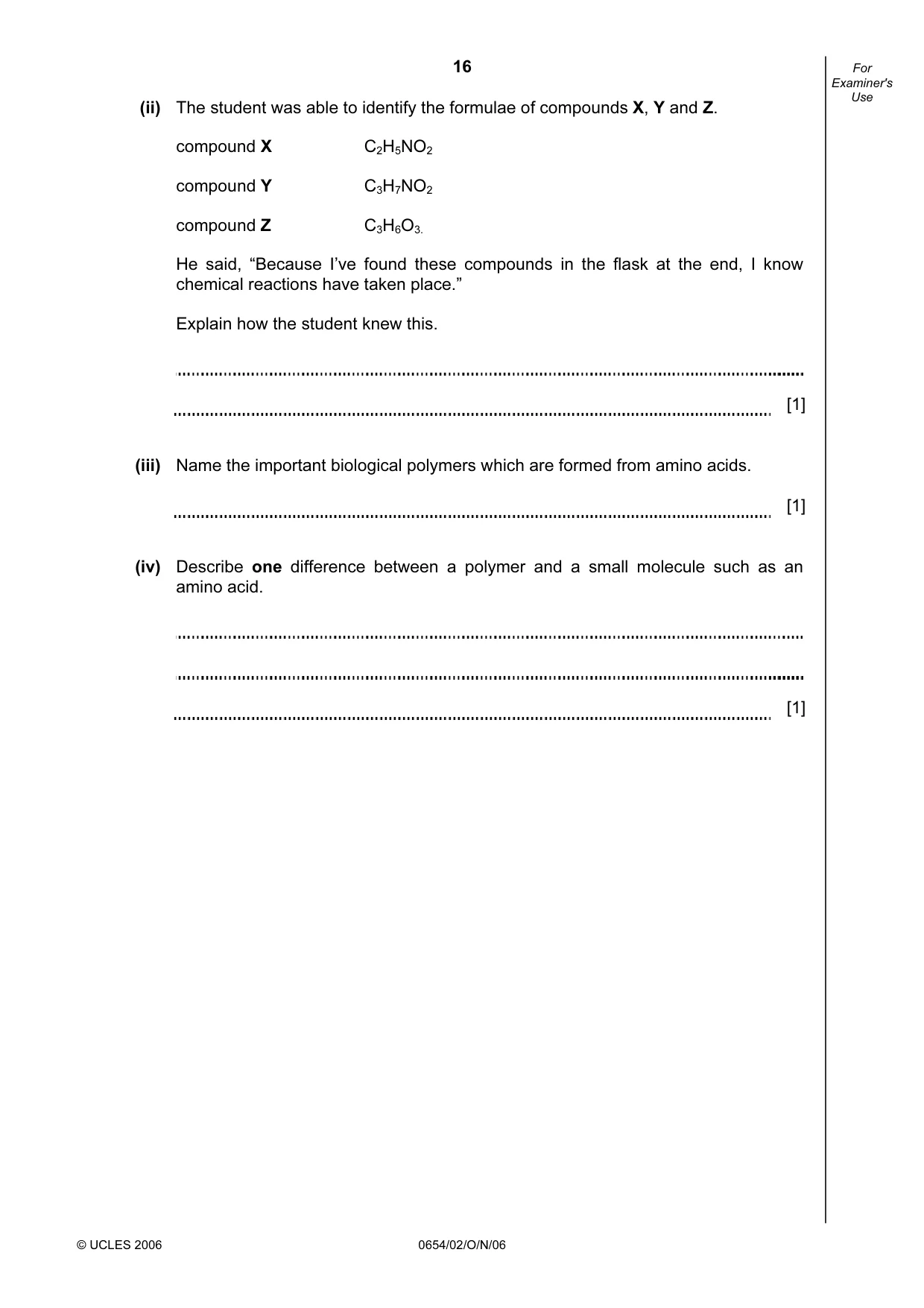
16 © UCLES 2006 0654/02/O/N/06 For Examiner's Use (ii) The student was able to identify the formulae of compounds X, Y and Z. compound X C2H5NO2 compound Y C3H7NO2 compound Z C3H6O3. He said, “Because I’ve found these compounds in the flask at the end, I know chemical reactions have taken place.” Explain how the student knew this. [1] (iii) Name the important biological polymers which are formed from amino acids. [1] (iv) Describe one difference between a polymer and a small molecule such as an amino acid. [1]
Question paper, page 17
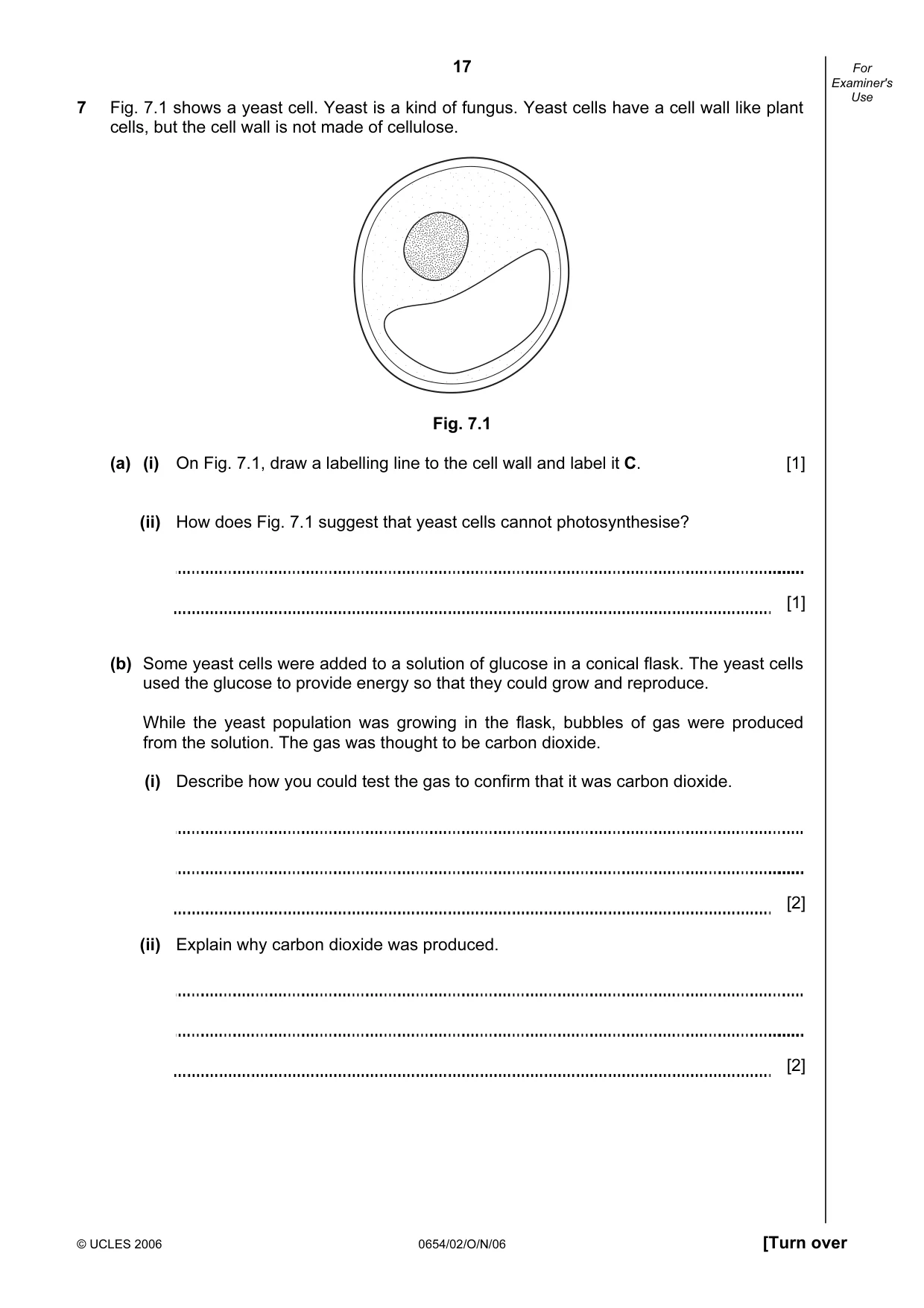
17 © UCLES 2006 0654/02/O/N/06 [Turn over For Examiner's Use 7 Fig. 7.1 shows a yeast cell. Yeast is a kind of fungus. Yeast cells have a cell wall like plant cells, but the cell wall is not made of cellulose. Fig. 7.1 (a) (i) On Fig. 7.1, draw a labelling line to the cell wall and label it C. [1] (ii) How does Fig. 7.1 suggest that yeast cells cannot photosynthesise? [1] (b) Some yeast cells were added to a solution of glucose in a conical flask. The yeast cells used the glucose to provide energy so that they could grow and reproduce. While the yeast population was growing in the flask, bubbles of gas were produced from the solution. The gas was thought to be carbon dioxide. (i) Describe how you could test the gas to confirm that it was carbon dioxide. [2] (ii) Explain why carbon dioxide was produced. [2]
Question paper, page 18
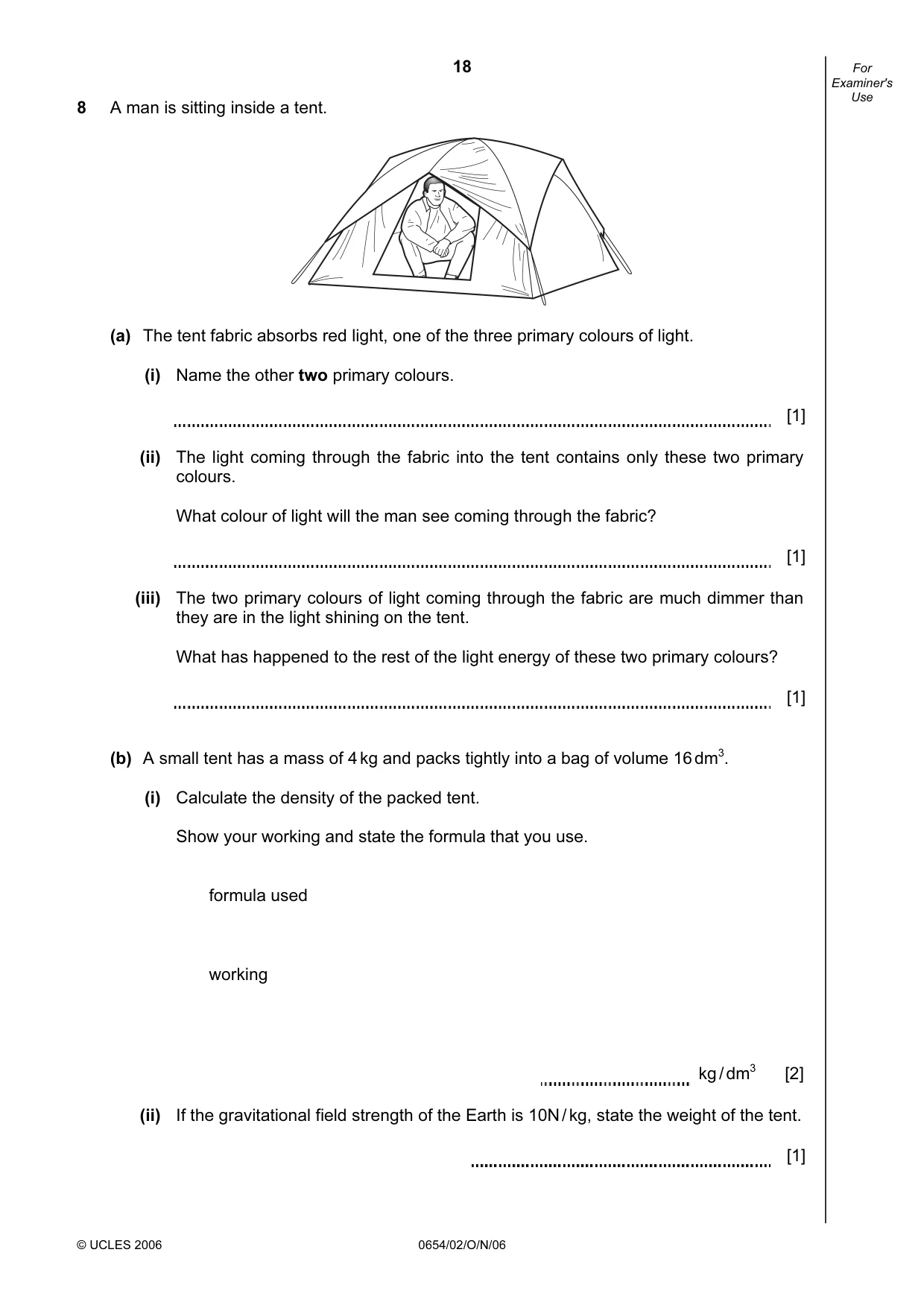
18 © UCLES 2006 0654/02/O/N/06 For Examiner's Use 8 A man is sitting inside a tent. (a) The tent fabric absorbs red light, one of the three primary colours of light. (i) Name the other two primary colours. [1] (ii) The light coming through the fabric into the tent contains only these two primary colours. What colour of light will the man see coming through the fabric? [1] (iii) The two primary colours of light coming through the fabric are much dimmer than they are in the light shining on the tent. What has happened to the rest of the light energy of these two primary colours? [1] (b) A small tent has a mass of 4 kg and packs tightly into a bag of volume 16 dm3. (i) Calculate the density of the packed tent. Show your working and state the formula that you use. formula used working kg / dm3 [2] (ii) If the gravitational field strength of the Earth is 10N / kg, state the weight of the tent. [1]
Question paper, page 19
19 © UCLES 2006 0654/02/O/N/06 [Turn over For Examiner's Use (c) The tent of mass 4 kg is carried a vertical distance of 1000 m up a mountain. Calculate the work done on the tent. Show your working and state the formula that you use. formula used working J [2] (d) After it rained, the outside of the tent became wet. Describe in terms of particles how this water can evaporate. [3] (e) The tent is made from nylon. Suggest two properties of nylon that make it suitable for a tent fabric. 1. 2. [2]
Question paper, page 20
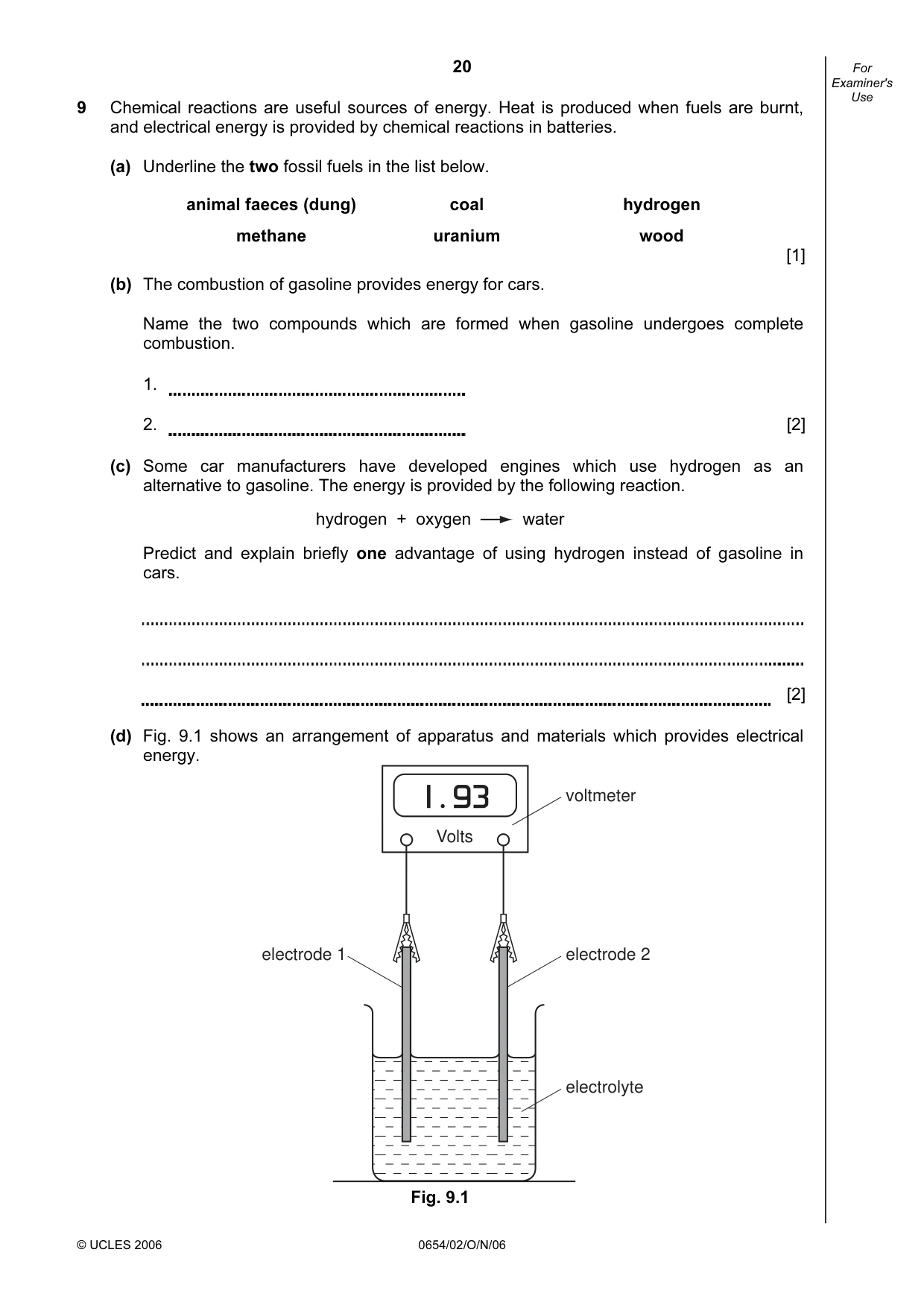
20 © UCLES 2006 0654/02/O/N/06 For Examiner's Use 9 Chemical reactions are useful sources of energy. Heat is produced when fuels are burnt, and electrical energy is provided by chemical reactions in batteries. (a) Underline the two fossil fuels in the list below. animal faeces (dung) coal hydrogen methane uranium wood [1] (b) The combustion of gasoline provides energy for cars. Name the two compounds which are formed when gasoline undergoes complete combustion. 1. 2. [2] (c) Some car manufacturers have developed engines which use hydrogen as an alternative to gasoline. The energy is provided by the following reaction. hydrogen + oxygen water Predict and explain briefly one advantage of using hydrogen instead of gasoline in cars. [2] (d) Fig. 9.1 shows an arrangement of apparatus and materials which provides electrical energy. Volts electrode 2 electrolyte voltmeter electrode 1 Fig. 9.1
Question paper, page 21
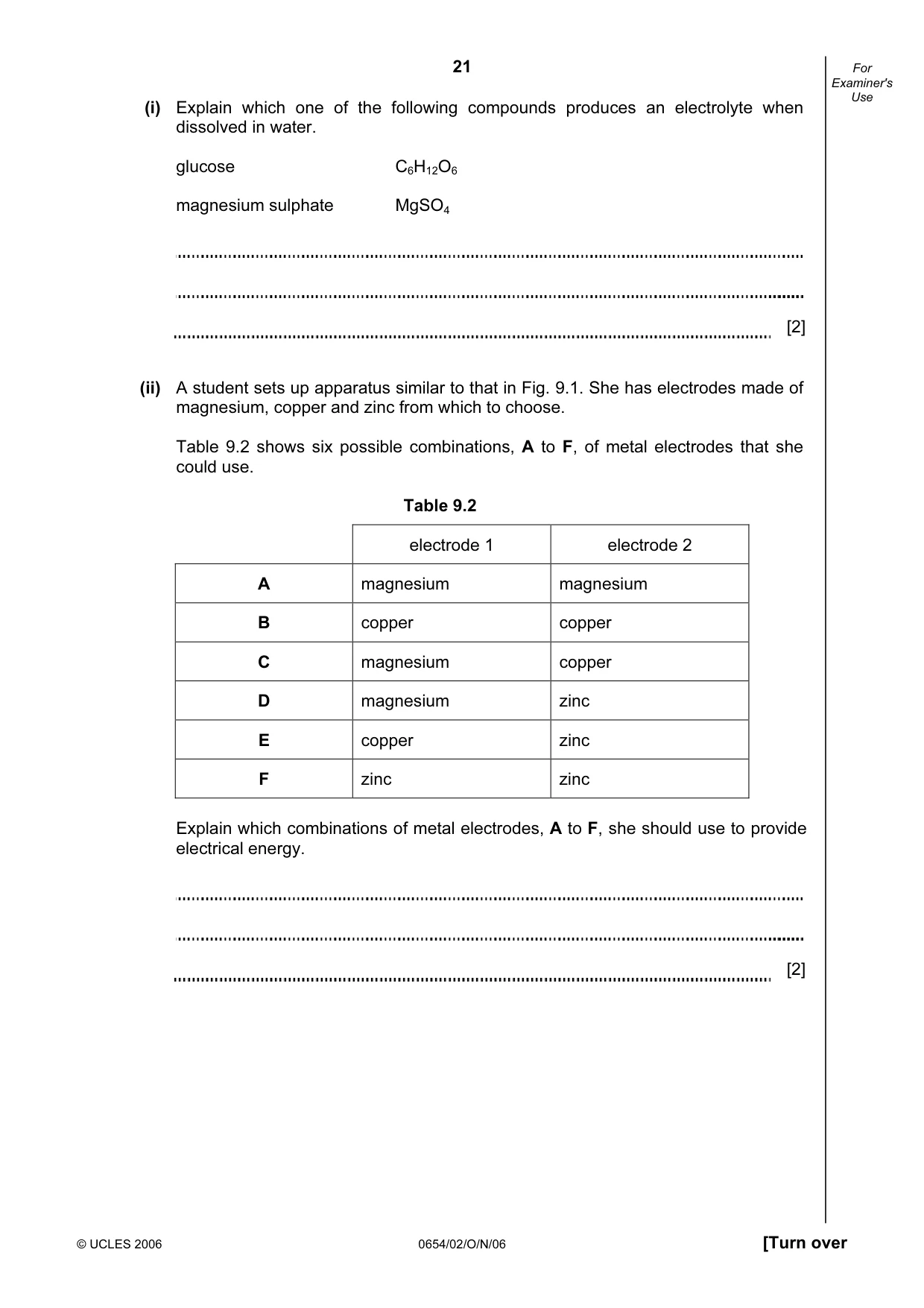
21 © UCLES 2006 0654/02/O/N/06 [Turn over For Examiner's Use (i) Explain which one of the following compounds produces an electrolyte when dissolved in water. glucose C6H12O6 magnesium sulphate MgSO4 [2] (ii) A student sets up apparatus similar to that in Fig. 9.1. She has electrodes made of magnesium, copper and zinc from which to choose. Table 9.2 shows six possible combinations, A to F, of metal electrodes that she could use. Table 9.2 electrode 1 electrode 2 A magnesium magnesium B copper copper C magnesium copper D magnesium zinc E copper zinc F zinc zinc Explain which combinations of metal electrodes, A to F, she should use to provide electrical energy. [2]
Question paper, page 22
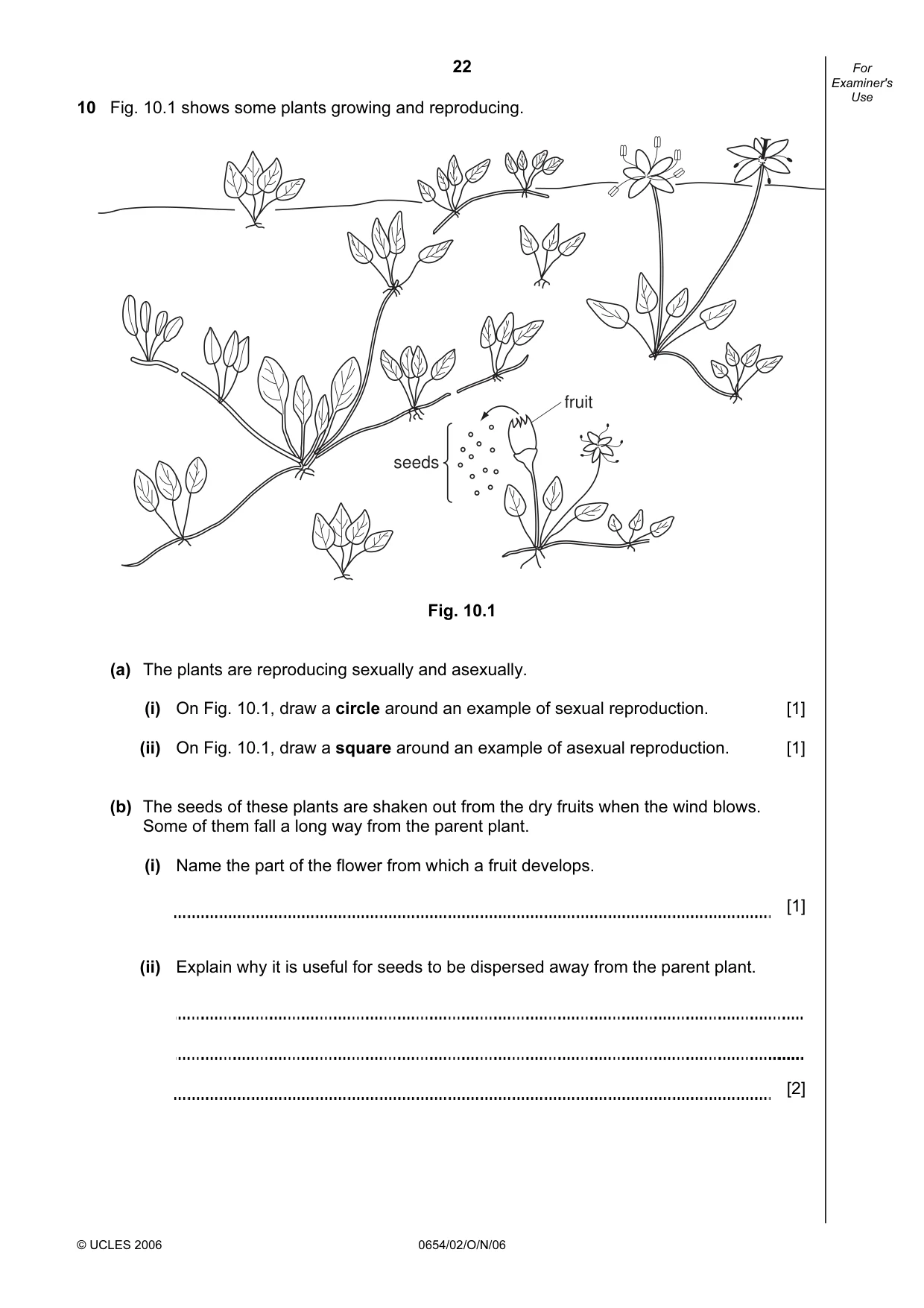
22 © UCLES 2006 0654/02/O/N/06 For Examiner's Use 10 Fig. 10.1 shows some plants growing and reproducing. seeds fruit Fig. 10.1 (a) The plants are reproducing sexually and asexually. (i) On Fig. 10.1, draw a circle around an example of sexual reproduction. [1] (ii) On Fig. 10.1, draw a square around an example of asexual reproduction. [1] (b) The seeds of these plants are shaken out from the dry fruits when the wind blows. Some of them fall a long way from the parent plant. (i) Name the part of the flower from which a fruit develops. [1] (ii) Explain why it is useful for seeds to be dispersed away from the parent plant. [2]
Question paper, page 23
23 © UCLES 2006 0654/02/O/N/06 [Turn over For Examiner's Use (iii) List three conditions that most seeds need before they will germinate. 1. 2. 3. [3]
Question paper, page 24
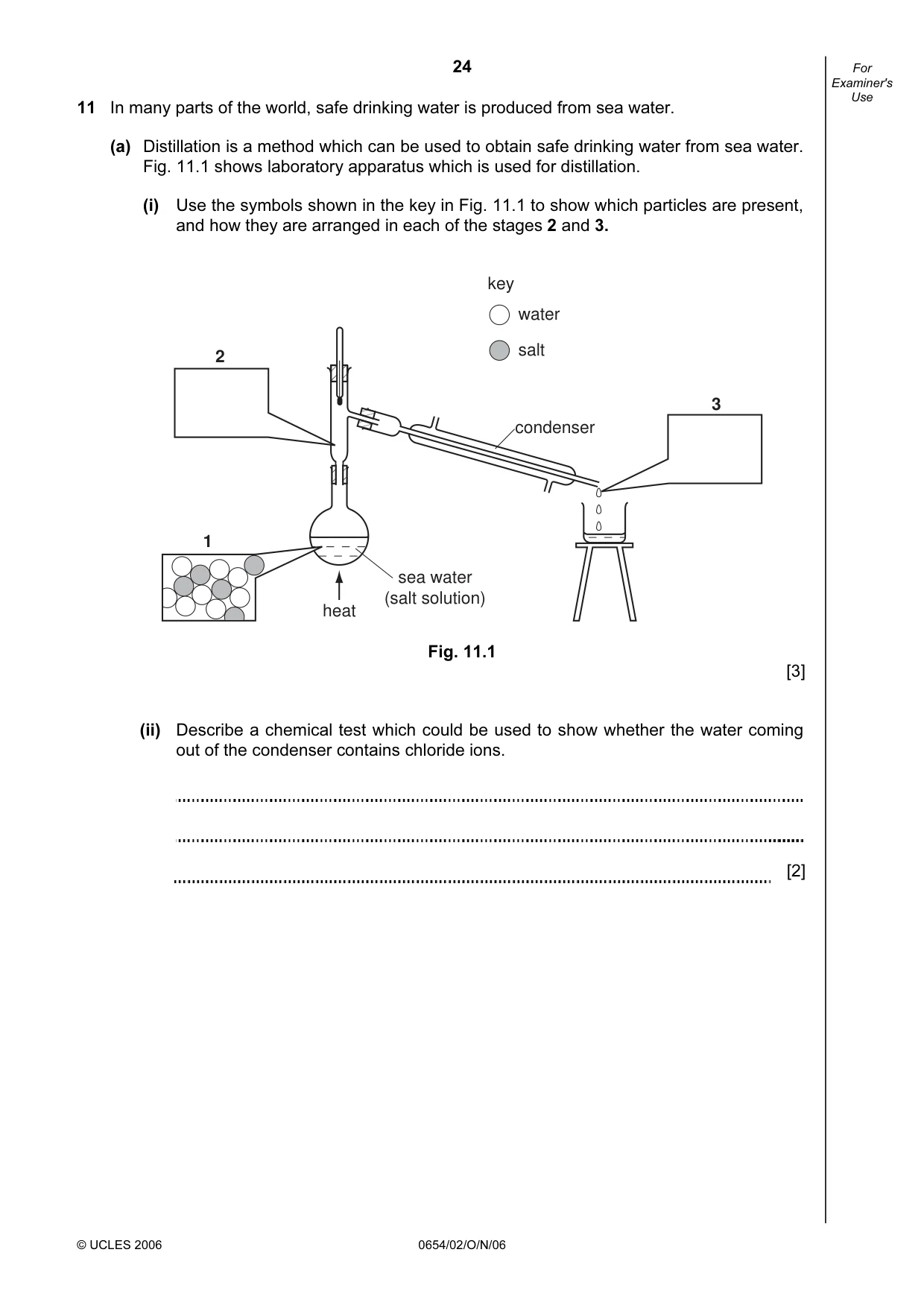
24 © UCLES 2006 0654/02/O/N/06 For Examiner's Use 11 In many parts of the world, safe drinking water is produced from sea water. (a) Distillation is a method which can be used to obtain safe drinking water from sea water. Fig. 11.1 shows laboratory apparatus which is used for distillation. (i) Use the symbols shown in the key in Fig. 11.1 to show which particles are present, and how they are arranged in each of the stages 2 and 3. heat sea water (salt solution) condenser 1 3 2 key water salt Fig. 11.1 [3] (ii) Describe a chemical test which could be used to show whether the water coming out of the condenser contains chloride ions. [2]
Question paper, page 25
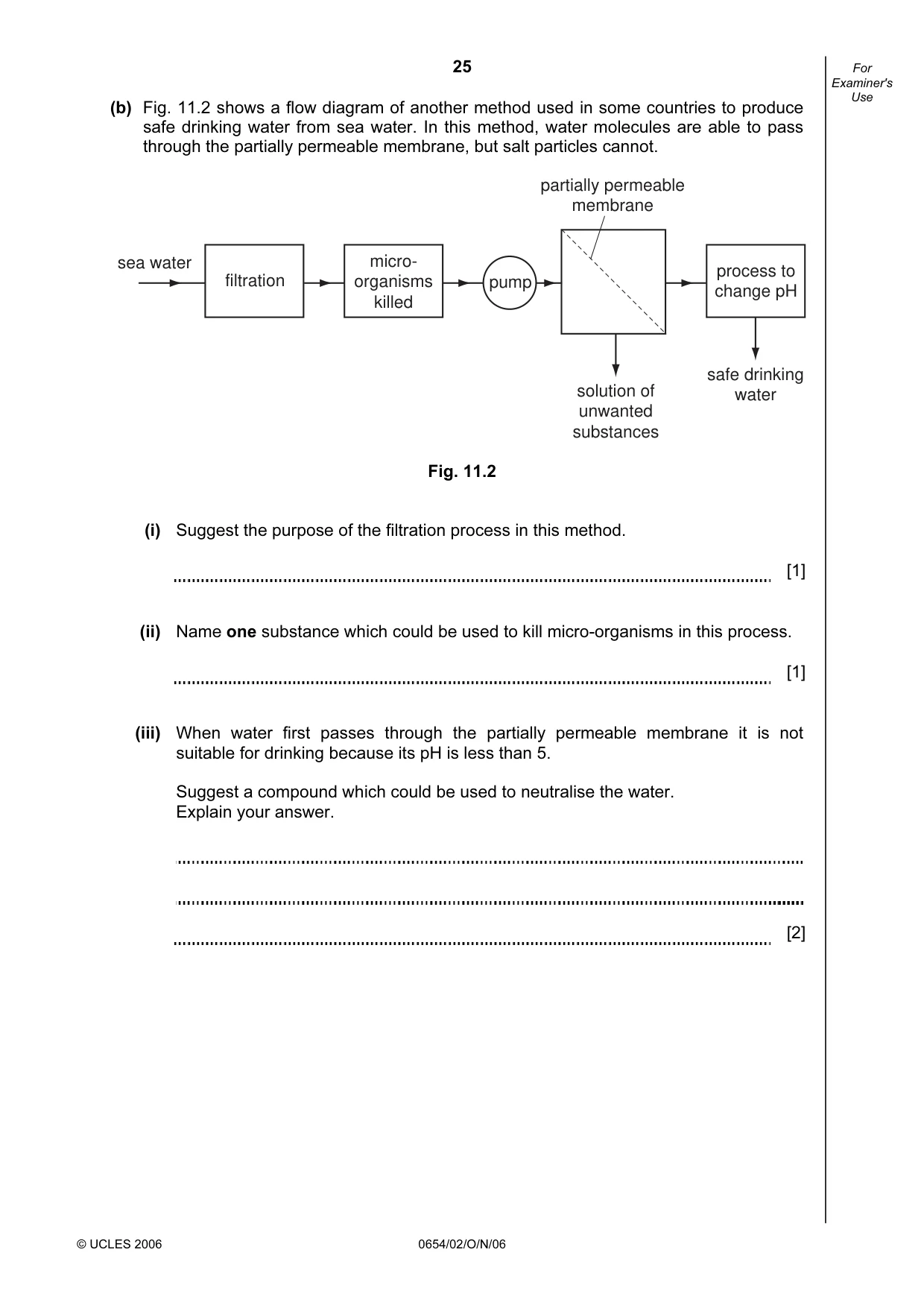
25 © UCLES 2006 0654/02/O/N/06 [Turn over For Examiner's Use (b) Fig. 11.2 shows a flow diagram of another method used in some countries to produce safe drinking water from sea water. In this method, water molecules are able to pass through the partially permeable membrane, but salt particles cannot. filtration micro- organisms killed pump solution of unwanted substances process to change pH safe drinking water partially permeable membrane sea water Fig. 11.2 (i) Suggest the purpose of the filtration process in this method. [1] (ii) Name one substance which could be used to kill micro-organisms in this process. [1] (iii) When water first passes through the partially permeable membrane it is not suitable for drinking because its pH is less than 5. Suggest a compound which could be used to neutralise the water. Explain your answer. [2]
Question paper, page 27
27 Permission to reproduce items where third-party owned material protected by copyright is included has been sought and cleared where possible. Every reasonable effort has been made by the publisher (UCLES) to trace copyright holders, but if any items requiring clearance have unwittingly been included, the publisher will be pleased to make amends at the earliest possible opportunity. University of Cambridge International Examinations is part of the University of Cambridge Local Examinations Syndicate (UCLES), which is itself a department of the University of Cambridge. 0654/02/O/N/06 [Turn over BLANK PAGE
Question paper, page 28
28 © UCLES 2006 0654/02/O/N/06 Group 140 Ce Cerium 58 141 Pr Praseodymium 59 144 Nd Neodymium 60 Pm Promethium 61 150 Sm Samarium 62 152 Eu Europium 63 157 Gd Gadolinium 64 159 Tb Terbium 65 162 Dy Dysprosium 66 165 Ho Holmium 67 167 Er Erbium 68 169 Tm Thulium 69 173 Yb Ytterbium 70 175 Lu Lutetium 71 232 Th Thorium 90 Pa Protactinium 91 238 U Uranium 92 Np Neptunium 93 Pu Plutonium 94 Am Americium 95 Cm Curium 96 Bk Berkelium 97 Cf Californium 98 Es Einsteinium 99 Fm Fermium 100 Md Mendelevium 101 No Nobelium 102 Lr Lawrencium 103 1 H Hydrogen 1 7 Li Lithium 3 23 Na Sodium 11 24 Mg Magnesium 12 40 Ca Calcium 20 45 Sc Scandium 21 48 Ti Titanium 22 51 V Vanadium 23 52 Cr Chromium 24 55 Mn Manganese 25 56 Fe Iron 26 59 Co Cobalt 27 59 Ni Nickel 28 64 Cu Copper 29 65 Zn Zinc 30 70 Ga Gallium 31 27 AAluminium 13 11 B Boron 5 12 C Carbon 6 14 N Nitrogen 7 16 O Oxygen 8 19 F Fluorine 9 28 Si Silicon 14 31 P Phosphorus 15 32 S Sulphur 16 35.5 CChlorine 17 40 Ar Argon 18 20 Ne Neon 10 4 He Helium 2 73 Ge Germanium 32 75 As Arsenic 33 79 Se Selenium 34 80 Br Bromine 35 84 Kr Krypton 36 39 K Potassium 19 88 Sr Strontium 38 89 Y Yttrium 39 91 Zr Zirconium 40 93 Nb Niobium 41 96 Mo Molybdenum 42 Tc Technetium 43 101 Ru Ruthenium 44 103 Rh Rhodium 45 106 Pd Palladium 46 108 Ag Silver 47 112 Cd Cadmium 48 115 In Indium 49 119 Sn Tin 50 122 Sb Antimony 51 128 Te Tellurium 52 127 I Iodine 53 131 Xe Xenon 54 137 Ba Barium 56 139 La Lanthanum 57 * 178 Hf Hafnium 72 181 Ta Tantalum 73 184 W Tungsten 74 186 Re Rhenium 75 190 Os Osmium 76 192 Ir Iridium 77 195 Pt Platinum 78 197 Au Gold 79 201 Hg Mercury 80 204 TThallium 81 207 Pb Lead 82 209 Bi Bismuth 83 Po Polonium 84 At Astatine 85 Rn Radon 86 Fr Francium 87 227 Ac Actinium 89 9 Be Beryllium 4 I II III IV V VI VII 0 85 Rb Rubidium 37 133 Cs Caesium 55 226 Ra Radium 88 The volume of one mole of any gas is 24 dm3 at room temperature and pressure (r.t.p.). a X b a = relative atomic mass X = atomic symbol b = proton (atomic) number Key *58-71 Lanthanoid series 90-103 Actinoid series DATA SHEET The Periodic Table of the Elements
Mark scheme, page 1
UNIVERSITY OF CAMBRIDGE INTERNATIONAL EXAMINATIONS International General Certificate of Secondary Education MARK SCHEME for the October/November 2006 question paper 0654 CO-ORDINATED SCIENCES 0654/02 Paper 2 (Core Theory), maximum raw mark 100 This mark scheme is published as an aid to teachers and students, to indicate the requirements of the examination. It shows the basis on which Examiners were instructed to award marks. It does not indicate the details of the discussions that took place at an Examiners’ meeting before marking began. All Examiners are instructed that alternative correct answers and unexpected approaches in candidates’ scripts must be given marks that fairly reflect the relevant knowledge and skills demonstrated. Mark schemes must be read in conjunction with the question papers and the report on the examination. The grade thresholds for various grades are published in the report on the examination for most IGCSE, GCE Advanced Level and Advanced Subsidiary Level syllabuses. • CIE will not enter into discussions or correspondence in connection with these mark schemes. CIE is publishing the mark schemes for the October/November 2006 question papers for most IGCSE, GCE Advanced Level and Advanced Subsidiary Level syllabuses and some Ordinary Level syllabuses. www.XtremePapers.com
Mark scheme, page 2
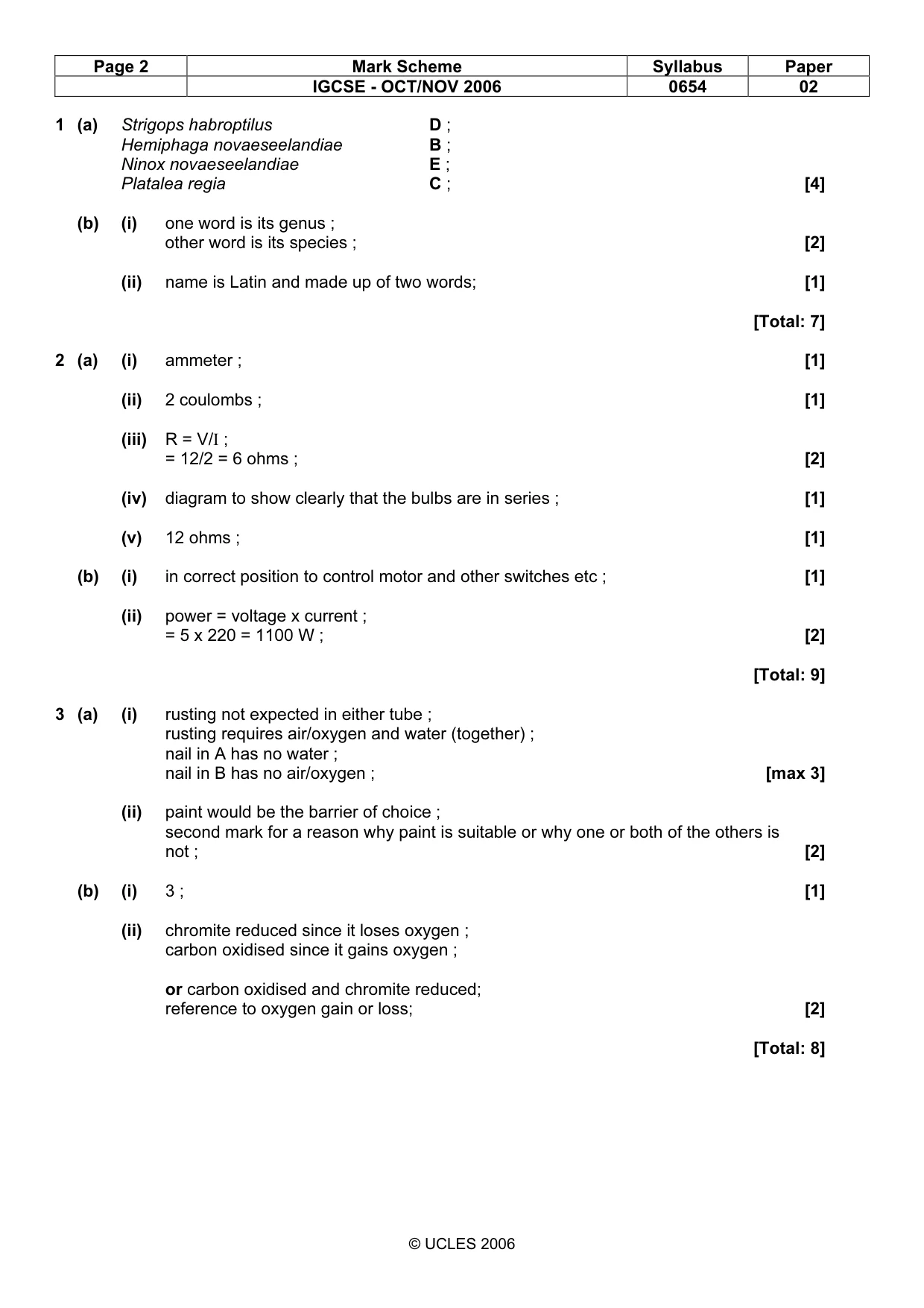
Page 2 Mark Scheme Syllabus Paper IGCSE - OCT/NOV 2006 0654 02 © UCLES 2006 1 (a) Strigops habroptilus D ; Hemiphaga novaeseelandiae B ; Ninox novaeseelandiae E ; Platalea regia C ; [4] (b) (i) one word is its genus ; other word is its species ; [2] (ii) name is Latin and made up of two words; [1] [Total: 7] 2 (a) (i) ammeter ; [1] (ii) 2 coulombs ; [1] (iii) R = V/I ; = 12/2 = 6 ohms ; [2] (iv) diagram to show clearly that the bulbs are in series ; [1] (v) 12 ohms ; [1] (b) (i) in correct position to control motor and other switches etc ; [1] (ii) power = voltage x current ; = 5 x 220 = 1100 W ; [2] [Total: 9] 3 (a) (i) rusting not expected in either tube ; rusting requires air/oxygen and water (together) ; nail in A has no water ; nail in B has no air/oxygen ; [max 3] (ii) paint would be the barrier of choice ; second mark for a reason why paint is suitable or why one or both of the others is not ; [2] (b) (i) 3 ; [1] (ii) chromite reduced since it loses oxygen ; carbon oxidised since it gains oxygen ; or carbon oxidised and chromite reduced; reference to oxygen gain or loss; [2] [Total: 8]
Mark scheme, page 3
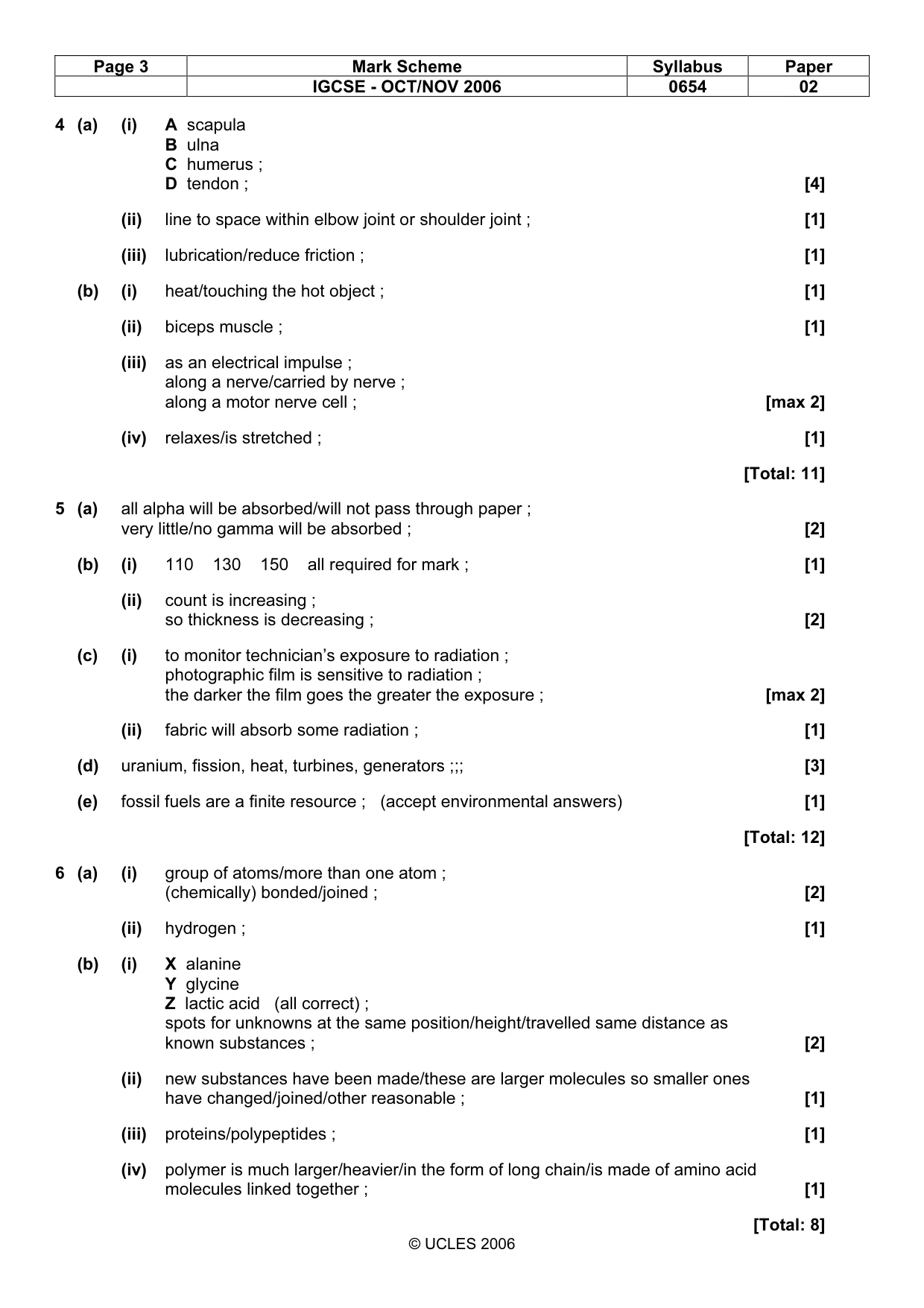
Page 3 Mark Scheme Syllabus Paper IGCSE - OCT/NOV 2006 0654 02 © UCLES 2006 4 (a) (i) A scapula B ulna C humerus ; D tendon ; [4] (ii) line to space within elbow joint or shoulder joint ; [1] (iii) lubrication/reduce friction ; [1] (b) (i) heat/touching the hot object ; [1] (ii) biceps muscle ; [1] (iii) as an electrical impulse ; along a nerve/carried by nerve ; along a motor nerve cell ; [max 2] (iv) relaxes/is stretched ; [1] [Total: 11] 5 (a) all alpha will be absorbed/will not pass through paper ; very little/no gamma will be absorbed ; [2] (b) (i) 110 130 150 all required for mark ; [1] (ii) count is increasing ; so thickness is decreasing ; [2] (c) (i) to monitor technician’s exposure to radiation ; photographic film is sensitive to radiation ; the darker the film goes the greater the exposure ; [max 2] (ii) fabric will absorb some radiation ; [1] (d) uranium, fission, heat, turbines, generators ;;; [3] (e) fossil fuels are a finite resource ; (accept environmental answers) [1] [Total: 12] 6 (a) (i) group of atoms/more than one atom ; (chemically) bonded/joined ; [2] (ii) hydrogen ; [1] (b) (i) X alanine Y glycine Z lactic acid (all correct) ; spots for unknowns at the same position/height/travelled same distance as known substances ; [2] (ii) new substances have been made/these are larger molecules so smaller ones have changed/joined/other reasonable ; [1] (iii) proteins/polypeptides ; [1] (iv) polymer is much larger/heavier/in the form of long chain/is made of amino acid molecules linked together ; [1] [Total: 8]
Mark scheme, page 4
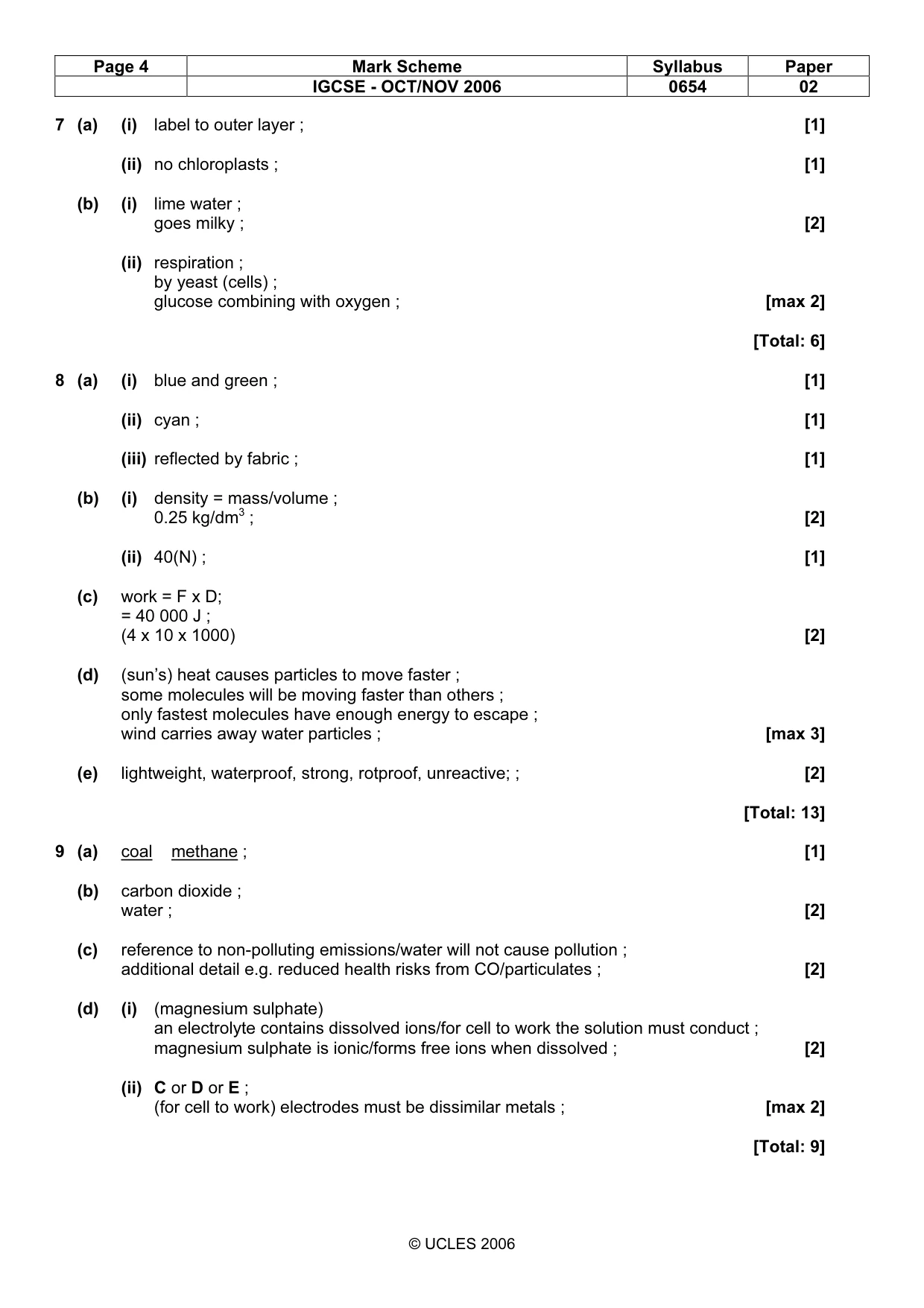
Page 4 Mark Scheme Syllabus Paper IGCSE - OCT/NOV 2006 0654 02 © UCLES 2006 7 (a) (i) label to outer layer ; [1] (ii) no chloroplasts ; [1] (b) (i) lime water ; goes milky ; [2] (ii) respiration ; by yeast (cells) ; glucose combining with oxygen ; [max 2] [Total: 6] 8 (a) (i) blue and green ; [1] (ii) cyan ; [1] (iii) reflected by fabric ; [1] (b) (i) density = mass/volume ; 0.25 kg/dm3 ; [2] (ii) 40(N) ; [1] (c) work = F x D; = 40 000 J ; (4 x 10 x 1000) [2] (d) (sun’s) heat causes particles to move faster ; some molecules will be moving faster than others ; only fastest molecules have enough energy to escape ; wind carries away water particles ; [max 3] (e) lightweight, waterproof, strong, rotproof, unreactive; ; [2] [Total: 13] 9 (a) coal methane ; [1] (b) carbon dioxide ; water ; [2] (c) reference to non-polluting emissions/water will not cause pollution ; additional detail e.g. reduced health risks from CO/particulates ; [2] (d) (i) (magnesium sulphate) an electrolyte contains dissolved ions/for cell to work the solution must conduct ; magnesium sulphate is ionic/forms free ions when dissolved ; [2] (ii) C or D or E ; (for cell to work) electrodes must be dissimilar metals ; [max 2] [Total: 9]
Mark scheme, page 5
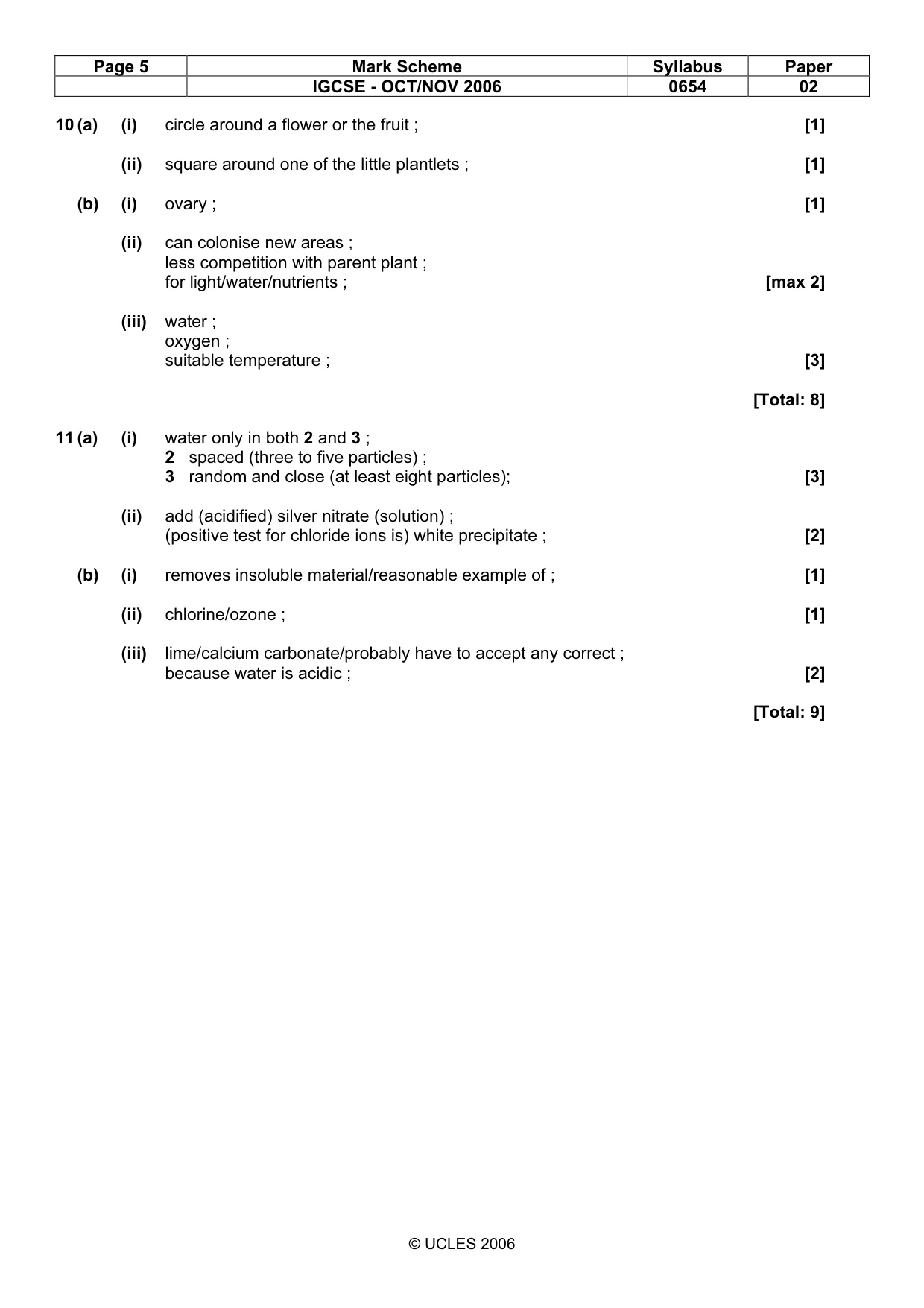
Page 5 Mark Scheme Syllabus Paper IGCSE - OCT/NOV 2006 0654 02 © UCLES 2006 10 (a) (i) circle around a flower or the fruit ; [1] (ii) square around one of the little plantlets ; [1] (b) (i) ovary ; [1] (ii) can colonise new areas ; less competition with parent plant ; for light/water/nutrients ; [max 2] (iii) water ; oxygen ; suitable temperature ; [3] [Total: 8] 11 (a) (i) water only in both 2 and 3 ; 2 spaced (three to five particles) ; 3 random and close (at least eight particles); [3] (ii) add (acidified) silver nitrate (solution) ; (positive test for chloride ions is) white precipitate ; [2] (b) (i) removes insoluble material/reasonable example of ; [1] (ii) chlorine/ozone ; [1] (iii) lime/calcium carbonate/probably have to accept any correct ; because water is acidic ; [2] [Total: 9]
What you needed in this session
Cambridge’s own grade thresholds for 2006 Oct/Nov, Paper 2 · Variant 1. A higher threshold means an easier paper — the bar moves with how the cohort did.