Cambridge IGCSE Sciences - Co-ordinated (Double) 0654 — 2005 May/June Paper 2 · Variant 1
0654/21/M/J/05
The question paper and its mark scheme, free to read here and free to download. This is Cambridge’s own paper, exactly as it was sat.
Question paper24 pages
Mark scheme7 pages
Answers below. Sit the paper first if you are practising.
Paper as text
Question paper, page 1
Centre Number Candidate Number Name UNIVERSITY OF CAMBRIDGE INTERNATIONAL EXAMINATIONS International General Certificate of Secondary Education CO-ORDINATED SCIENCES 0654/02 Paper 2 May/June 2005 2 hours Candidates answer on the Question Paper. No Additional Materials are required. READ THESE INSTRUCTIONS FIRST Write your Centre number, candidate number and name on all the work you hand in. Write in dark blue or black pen in the spaces provided on the Question Paper. You may use a soft pencil for any diagrams, graphs, tables or rough working. Do not use staples, paper clips, highlighters, glue or correction fluid. Answer all questions. The number of marks is given in brackets [ ] at the end of each question or part question. A copy of the Periodic Table is printed on page 24 For Examiner’s Use 1 2 3 4 5 6 7 8 9 10 11 12 Total This document consists of 24 printed pages. IB05 06_0654_02/3RP UCLES 2005 [Turn over If you have been given a label, look at the details. If any details are incorrect or missing, please fill in your correct details in the space given at the top of this page. Stick your personal label here, if provided. www.XtremePapers.com
Question paper, page 2
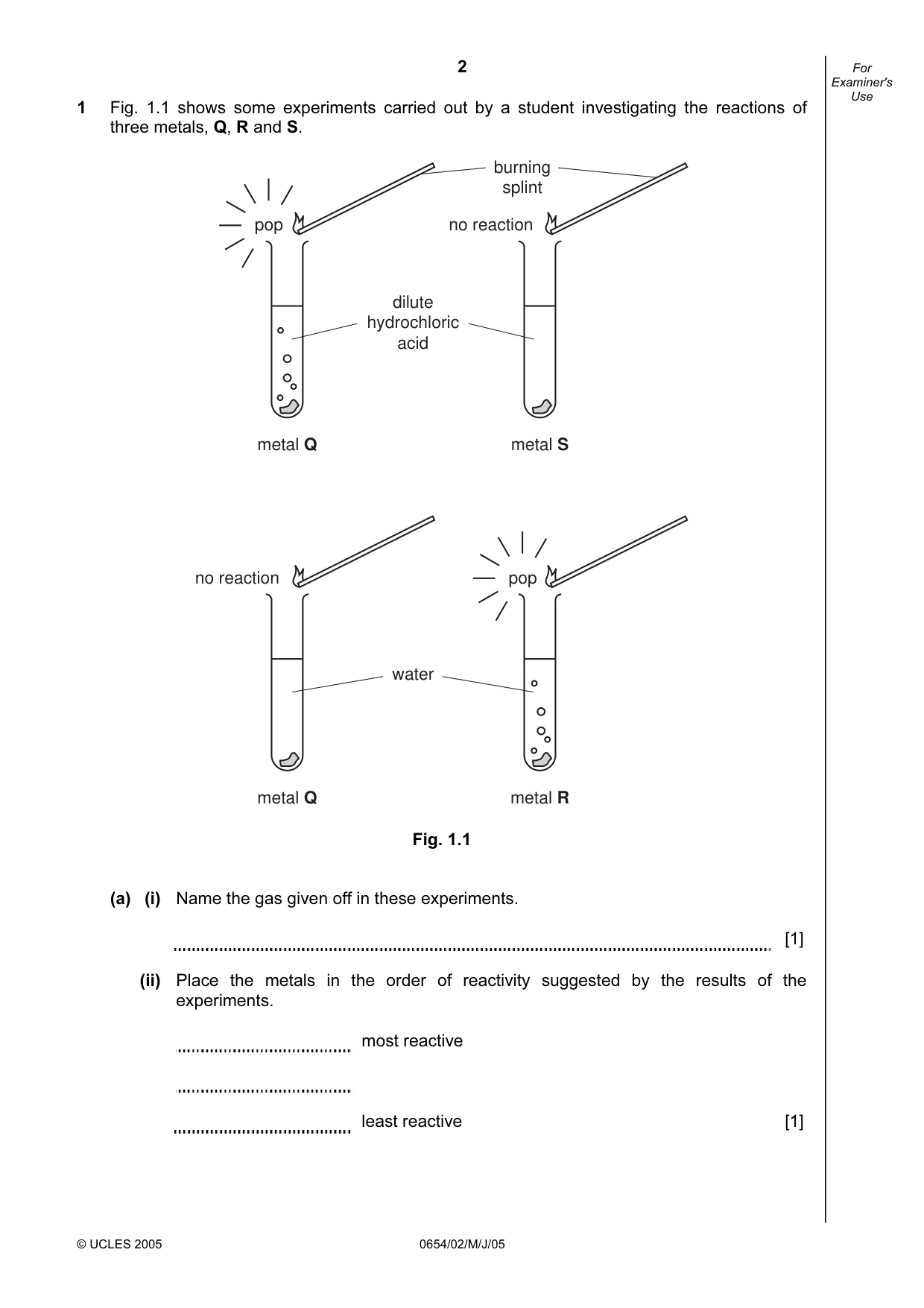
2 © UCLES 2005 0654/02/M/J/05 For Examiner's Use 1 Fig. 1.1 shows some experiments carried out by a student investigating the reactions of three metals, Q, R and S. metal Q metal S dilute hydrochloric acid burning splint no reaction pop metal Q metal R water no reaction pop Fig. 1.1 (a) (i) Name the gas given off in these experiments. [1] (ii) Place the metals in the order of reactivity suggested by the results of the experiments. most reactive least reactive [1]
Question paper, page 3
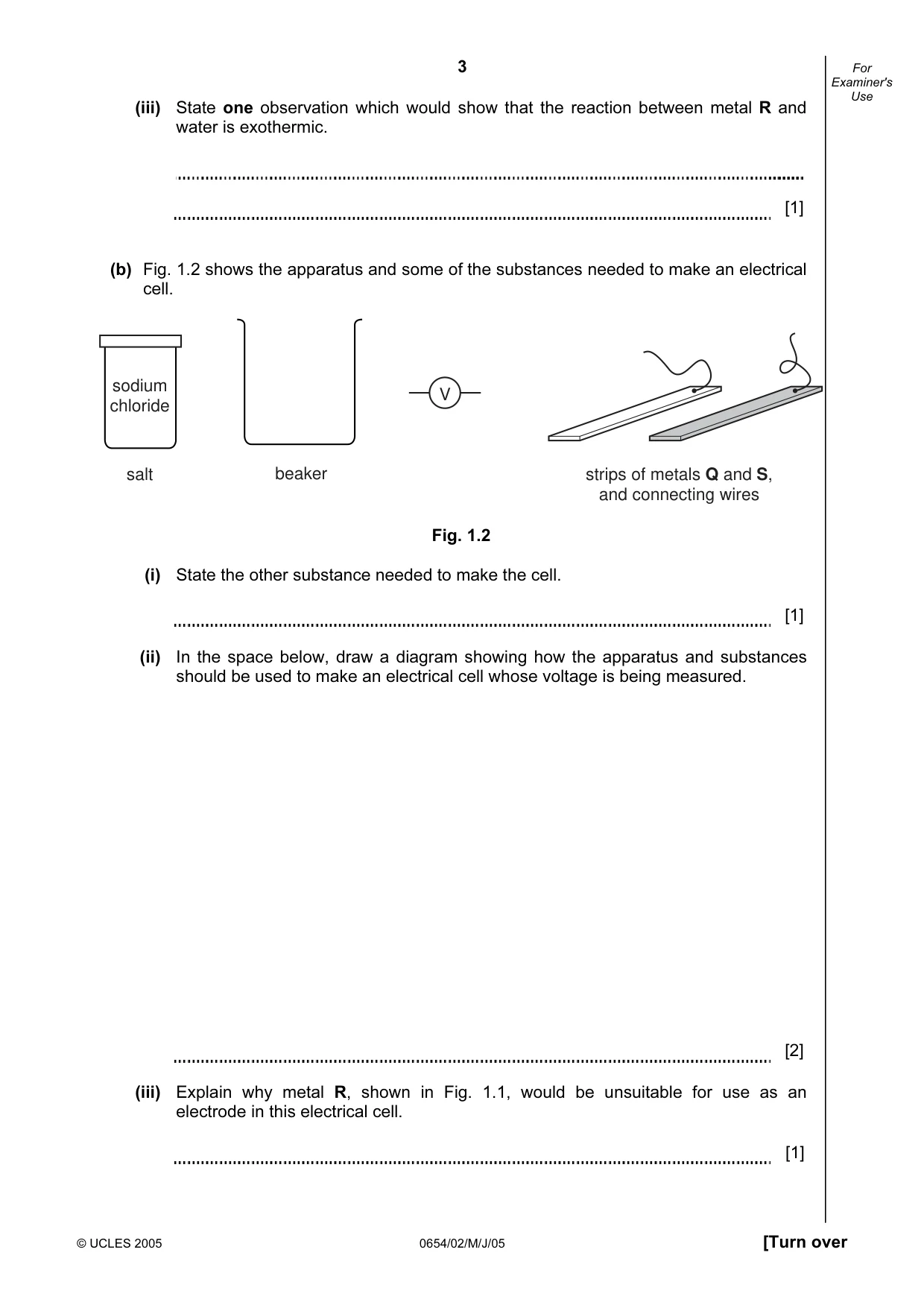
3 © UCLES 2005 0654/02/M/J/05 [Turn over For Examiner's Use (iii) State one observation which would show that the reaction between metal R and water is exothermic. [1] (b) Fig. 1.2 shows the apparatus and some of the substances needed to make an electrical cell. beaker strips of metals Q and S, and connecting wires sodium chloride salt V Fig. 1.2 (i) State the other substance needed to make the cell. [1] (ii) In the space below, draw a diagram showing how the apparatus and substances should be used to make an electrical cell whose voltage is being measured. [2] (iii) Explain why metal R, shown in Fig. 1.1, would be unsuitable for use as an electrode in this electrical cell. [1]
Question paper, page 4
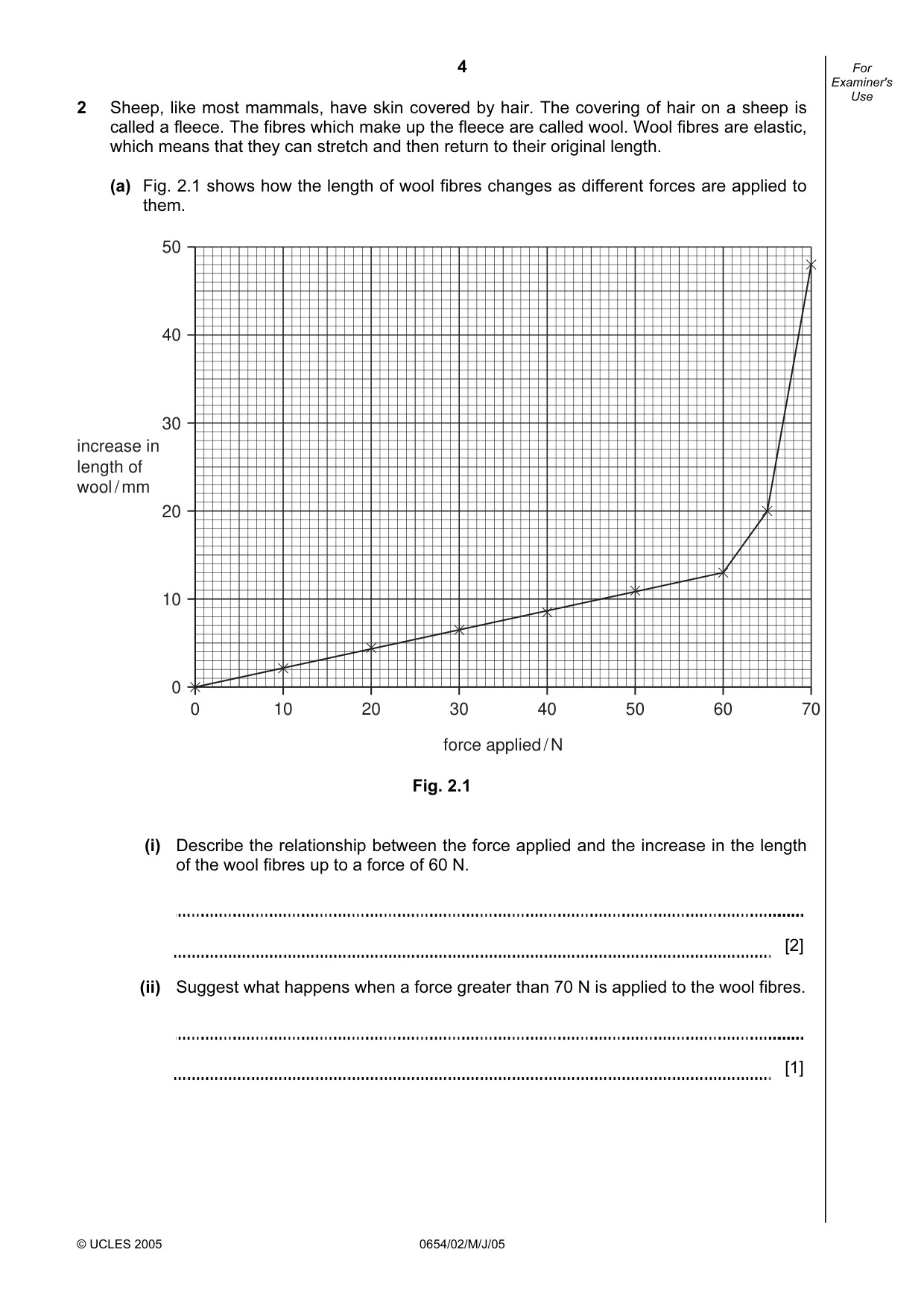
4 © UCLES 2005 0654/02/M/J/05 For Examiner's Use 2 Sheep, like most mammals, have skin covered by hair. The covering of hair on a sheep is called a fleece. The fibres which make up the fleece are called wool. Wool fibres are elastic, which means that they can stretch and then return to their original length. (a) Fig. 2.1 shows how the length of wool fibres changes as different forces are applied to them. 50 40 30 20 10 0 0 10 20 30 40 50 60 70 increase in length of wool / mm force applied / N Fig. 2.1 (i) Describe the relationship between the force applied and the increase in the length of the wool fibres up to a force of 60 N. [2] (ii) Suggest what happens when a force greater than 70 N is applied to the wool fibres. [1]
Question paper, page 5
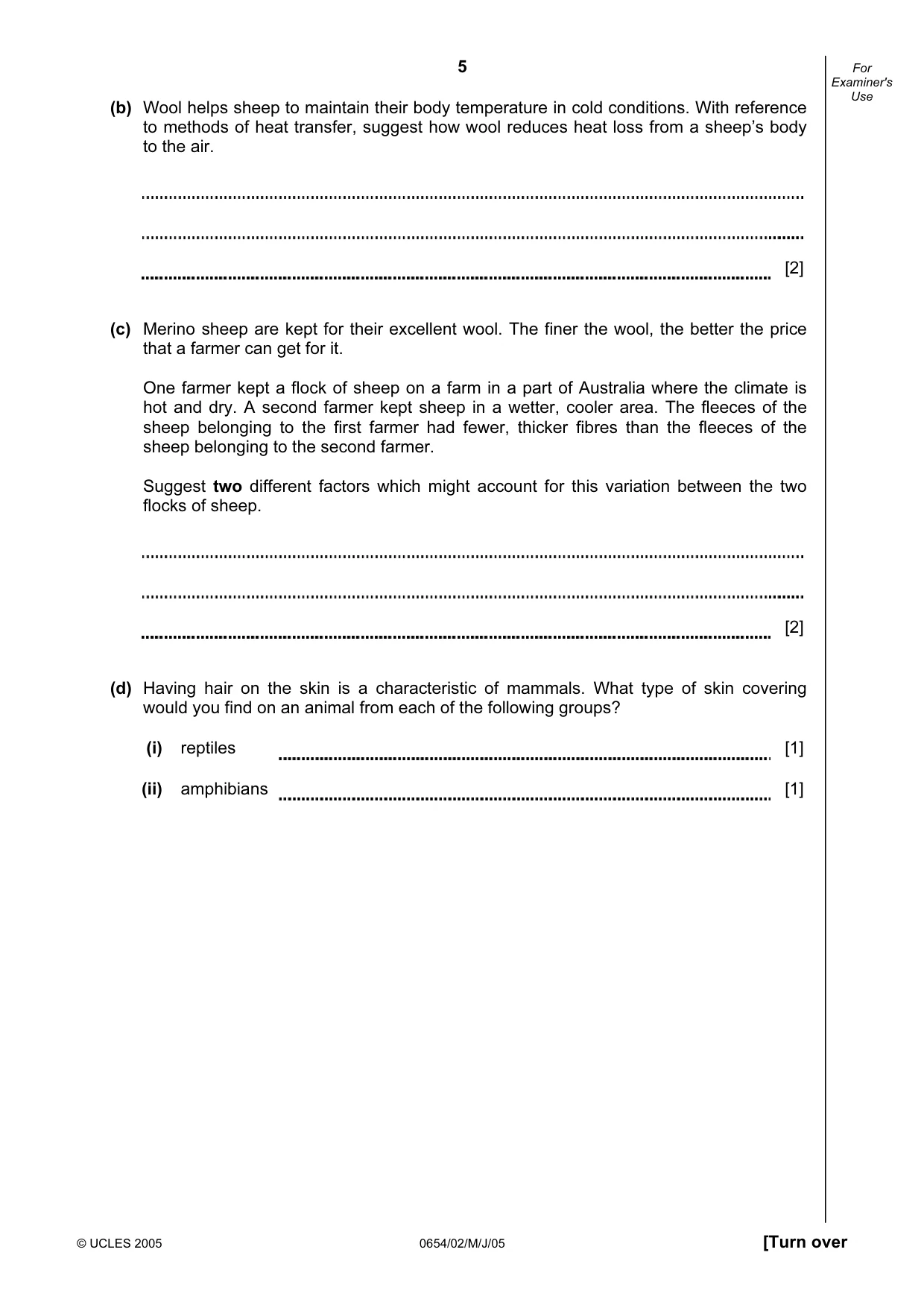
5 © UCLES 2005 0654/02/M/J/05 [Turn over For Examiner's Use (b) Wool helps sheep to maintain their body temperature in cold conditions. With reference to methods of heat transfer, suggest how wool reduces heat loss from a sheep’s body to the air. [2] (c) Merino sheep are kept for their excellent wool. The finer the wool, the better the price that a farmer can get for it. One farmer kept a flock of sheep on a farm in a part of Australia where the climate is hot and dry. A second farmer kept sheep in a wetter, cooler area. The fleeces of the sheep belonging to the first farmer had fewer, thicker fibres than the fleeces of the sheep belonging to the second farmer. Suggest two different factors which might account for this variation between the two flocks of sheep. [2] (d) Having hair on the skin is a characteristic of mammals. What type of skin covering would you find on an animal from each of the following groups? (i) reptiles [1] (ii) amphibians [1]
Question paper, page 6
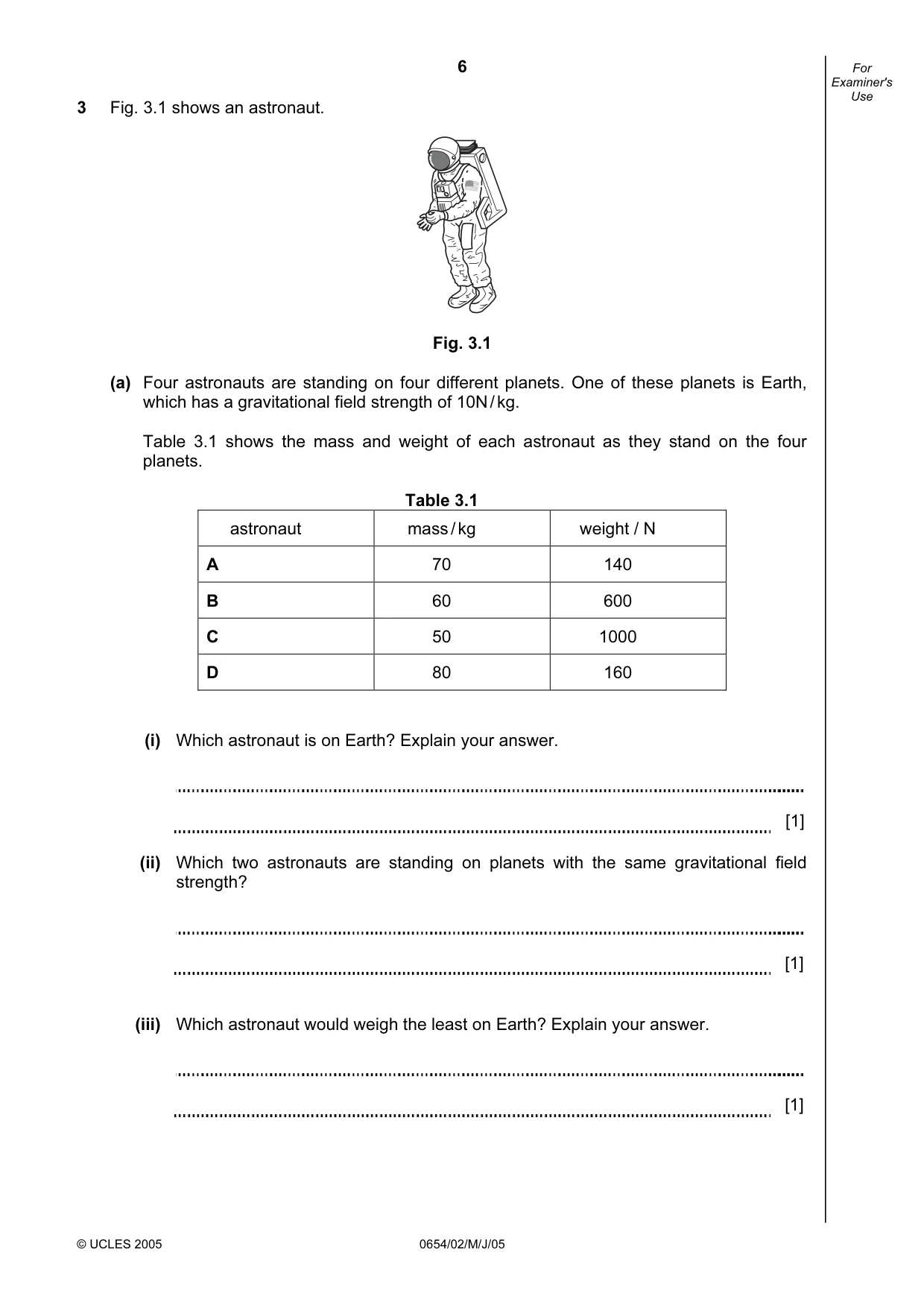
6 © UCLES 2005 0654/02/M/J/05 For Examiner's Use 3 Fig. 3.1 shows an astronaut. Fig. 3.1 (a) Four astronauts are standing on four different planets. One of these planets is Earth, which has a gravitational field strength of 10N / kg. Table 3.1 shows the mass and weight of each astronaut as they stand on the four planets. Table 3.1 astronaut mass / kg weight / N A 70 140 B 60 600 C 50 1000 D 80 160 (i) Which astronaut is on Earth? Explain your answer. [1] (ii) Which two astronauts are standing on planets with the same gravitational field strength? [1] (iii) Which astronaut would weigh the least on Earth? Explain your answer. [1]
Question paper, page 7
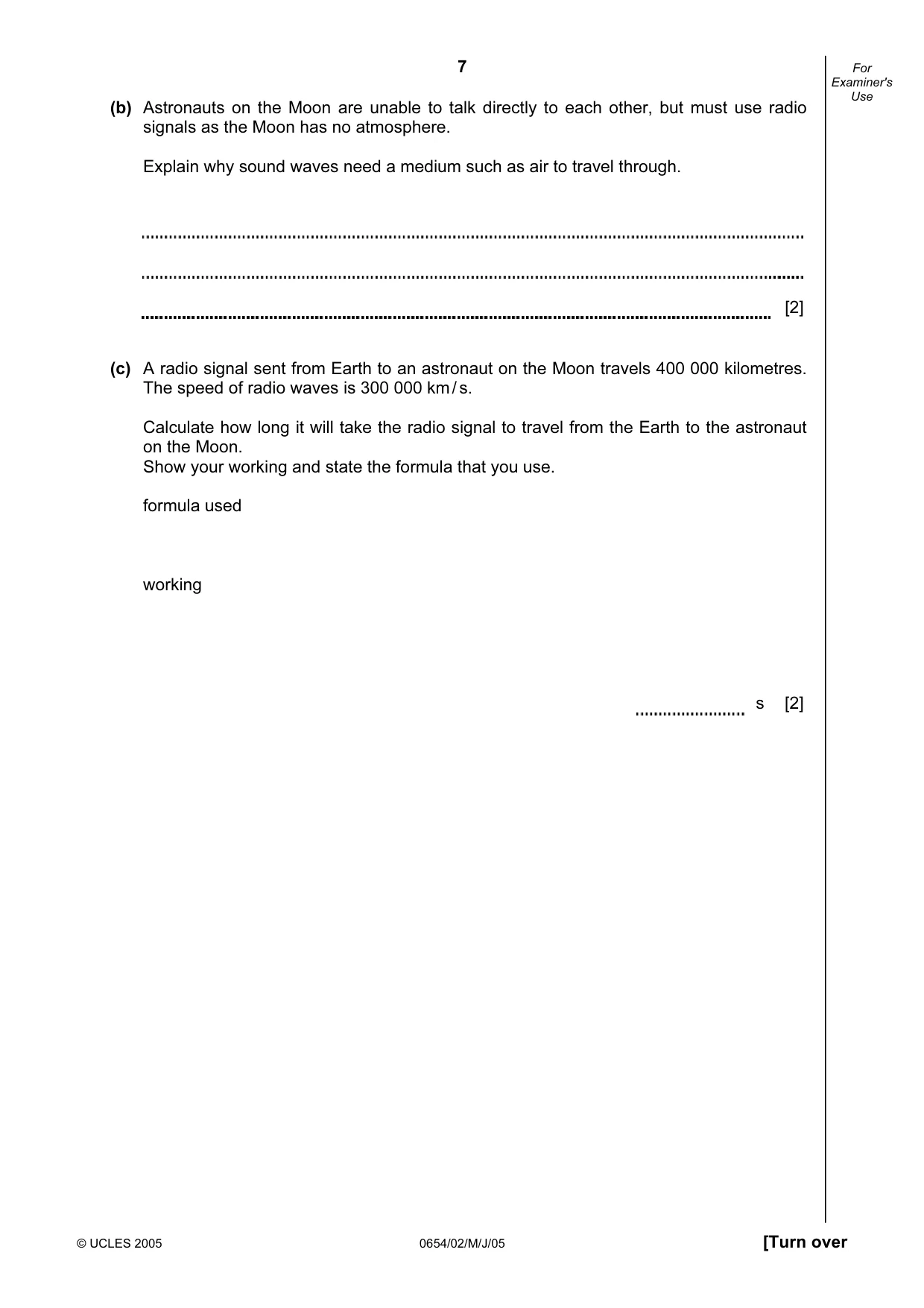
7 © UCLES 2005 0654/02/M/J/05 [Turn over For Examiner's Use (b) Astronauts on the Moon are unable to talk directly to each other, but must use radio signals as the Moon has no atmosphere. Explain why sound waves need a medium such as air to travel through. [2] (c) A radio signal sent from Earth to an astronaut on the Moon travels 400 000 kilometres. The speed of radio waves is 300 000 km / s. Calculate how long it will take the radio signal to travel from the Earth to the astronaut on the Moon. Show your working and state the formula that you use. formula used working s [2]
Question paper, page 8
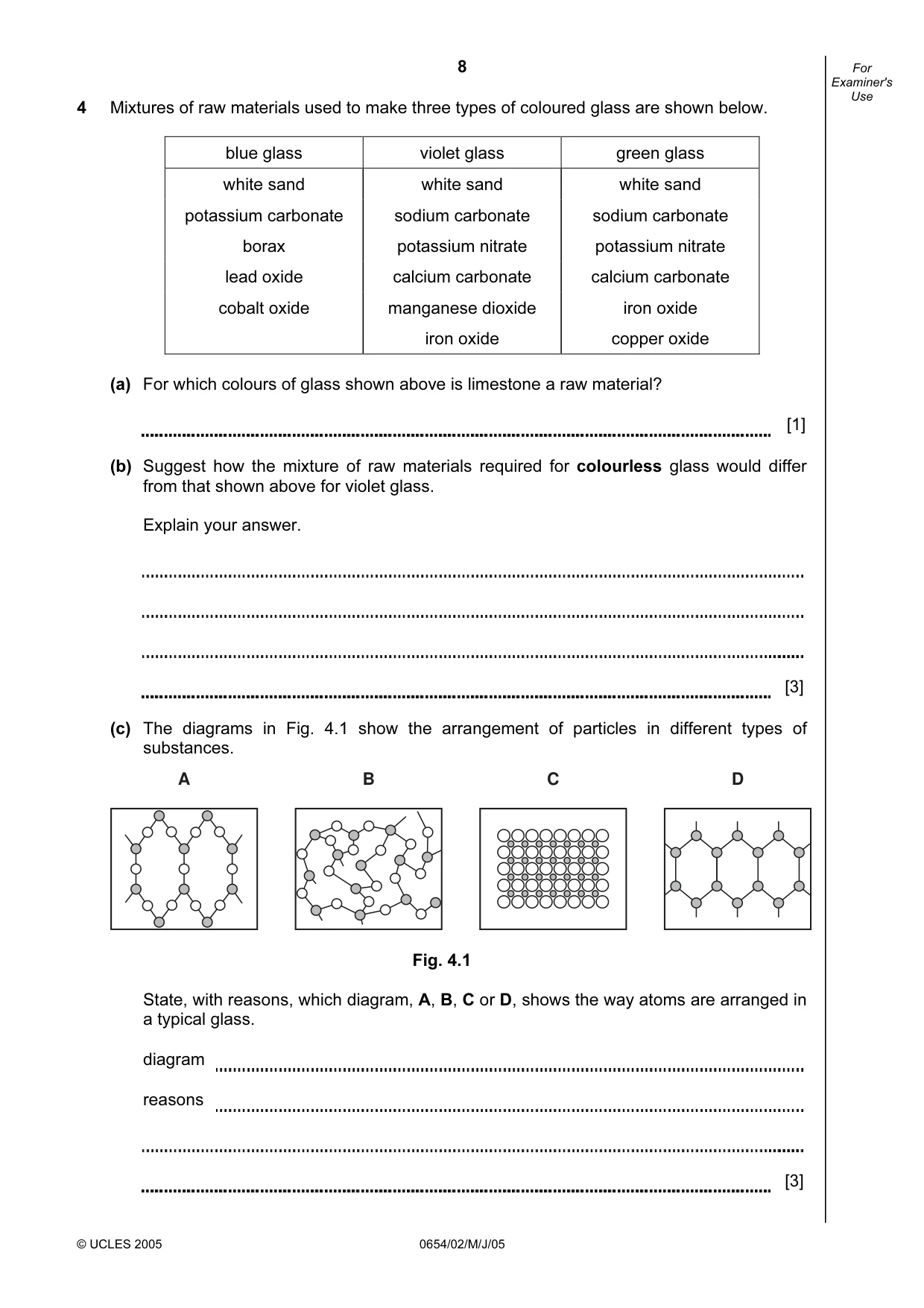
8 © UCLES 2005 0654/02/M/J/05 For Examiner's Use 4 Mixtures of raw materials used to make three types of coloured glass are shown below. blue glass violet glass green glass white sand white sand white sand potassium carbonate sodium carbonate sodium carbonate borax potassium nitrate potassium nitrate lead oxide calcium carbonate calcium carbonate cobalt oxide manganese dioxide iron oxide iron oxide copper oxide (a) For which colours of glass shown above is limestone a raw material? [1] (b) Suggest how the mixture of raw materials required for colourless glass would differ from that shown above for violet glass. Explain your answer. [3] (c) The diagrams in Fig. 4.1 show the arrangement of particles in different types of substances. A B C D Fig. 4.1 State, with reasons, which diagram, A, B, C or D, shows the way atoms are arranged in a typical glass. diagram reasons [3]
Question paper, page 9
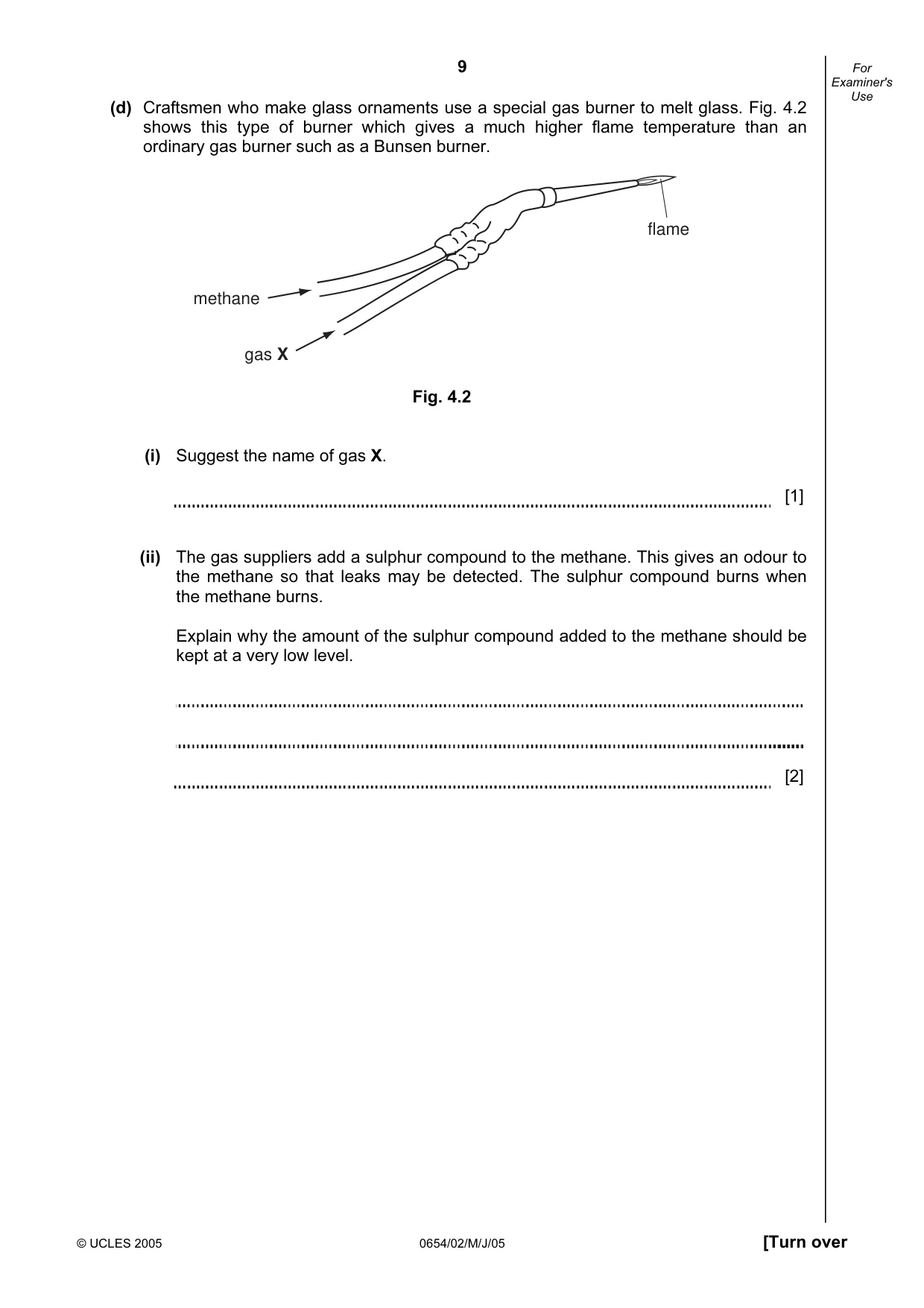
9 © UCLES 2005 0654/02/M/J/05 [Turn over For Examiner's Use (d) Craftsmen who make glass ornaments use a special gas burner to melt glass. Fig. 4.2 shows this type of burner which gives a much higher flame temperature than an ordinary gas burner such as a Bunsen burner. flame methane gas X Fig. 4.2 (i) Suggest the name of gas X. [1] (ii) The gas suppliers add a sulphur compound to the methane. This gives an odour to the methane so that leaks may be detected. The sulphur compound burns when the methane burns. Explain why the amount of the sulphur compound added to the methane should be kept at a very low level. [2]
Question paper, page 10
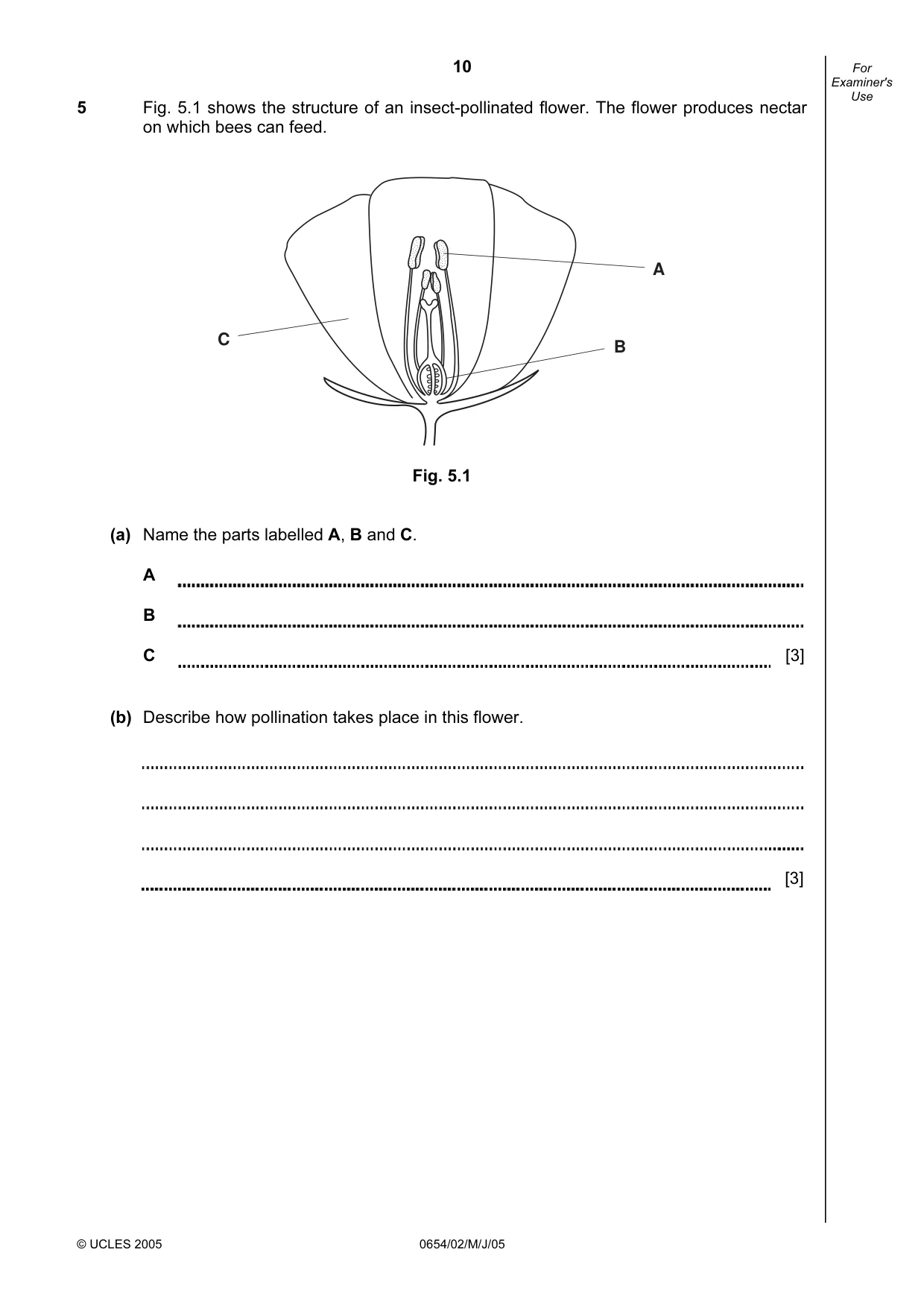
10 © UCLES 2005 0654/02/M/J/05 For Examiner's Use 5 Fig. 5.1 shows the structure of an insect-pollinated flower. The flower produces nectar on which bees can feed. A B C Fig. 5.1 (a) Name the parts labelled A, B and C. A B C [3] (b) Describe how pollination takes place in this flower. [3]
Question paper, page 11
11 © UCLES 2005 0654/02/M/J/05 [Turn over For Examiner's Use (c) Nectar contains sugar, which provides the bees with energy. (i) Name the process by which a plant produces sugar, such as glucose. [1] (ii) Describe the role of chlorophyll in this process. [2] (d) Bees may be eaten by birds called bee-eaters. (i) Use the information in this question to construct a food chain including bee-eaters. [2] (ii) Which organisms in your food chain are consumers? [1]
Question paper, page 12
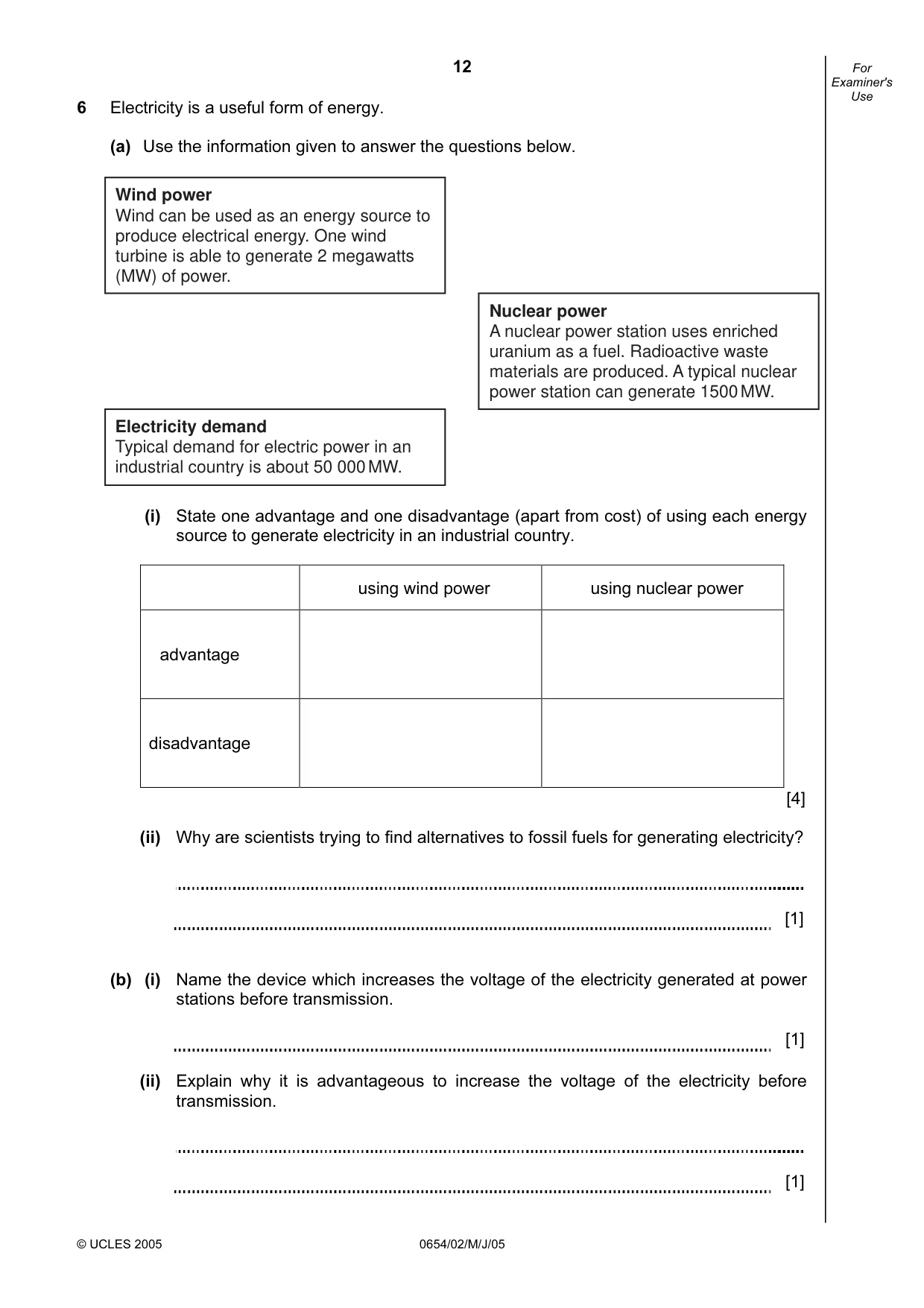
12 © UCLES 2005 0654/02/M/J/05 For Examiner's Use 6 Electricity is a useful form of energy. (a) Use the information given to answer the questions below. Wind power Wind can be used as an energy source to produce electrical energy. One wind turbine is able to generate 2 megawatts (MW) of power. Electricity demand Typical demand for electric power in an industrial country is about 50 000 MW. Nuclear power A nuclear power station uses enriched uranium as a fuel. Radioactive waste materials are produced. A typical nuclear power station can generate 1500 MW. (i) State one advantage and one disadvantage (apart from cost) of using each energy source to generate electricity in an industrial country. using wind power using nuclear power advantage disadvantage [4] (ii) Why are scientists trying to find alternatives to fossil fuels for generating electricity? [1] (b) (i) Name the device which increases the voltage of the electricity generated at power stations before transmission. [1] (ii) Explain why it is advantageous to increase the voltage of the electricity before transmission. [1]
Question paper, page 13
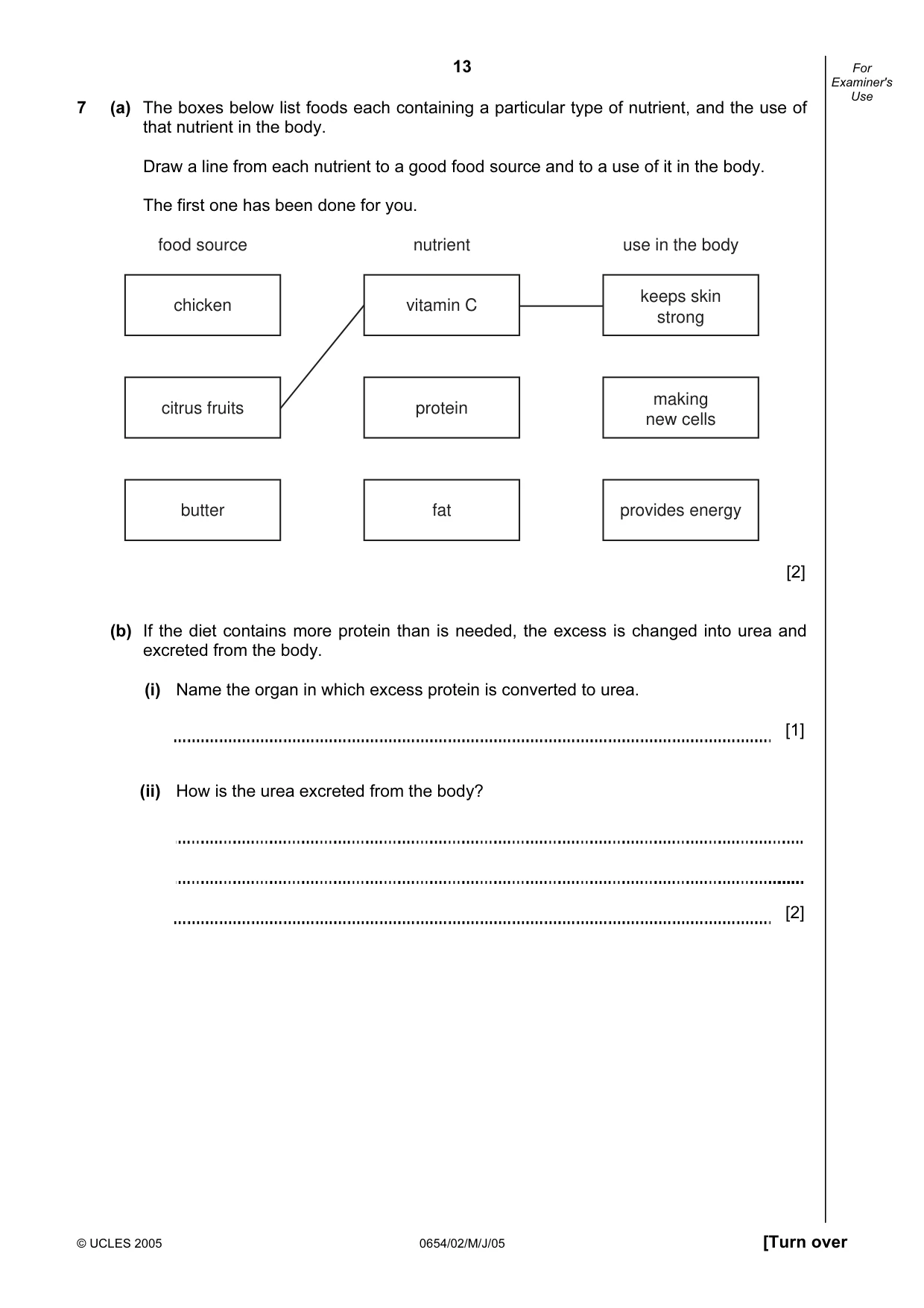
13 © UCLES 2005 0654/02/M/J/05 [Turn over For Examiner's Use 7 (a) The boxes below list foods each containing a particular type of nutrient, and the use of that nutrient in the body. Draw a line from each nutrient to a good food source and to a use of it in the body. The first one has been done for you. chicken food source citrus fruits butter vitamin C nutrient protein fat keeps skin strong use in the body making new cells provides energy [2] (b) If the diet contains more protein than is needed, the excess is changed into urea and excreted from the body. (i) Name the organ in which excess protein is converted to urea. [1] (ii) How is the urea excreted from the body? [2]
Question paper, page 14
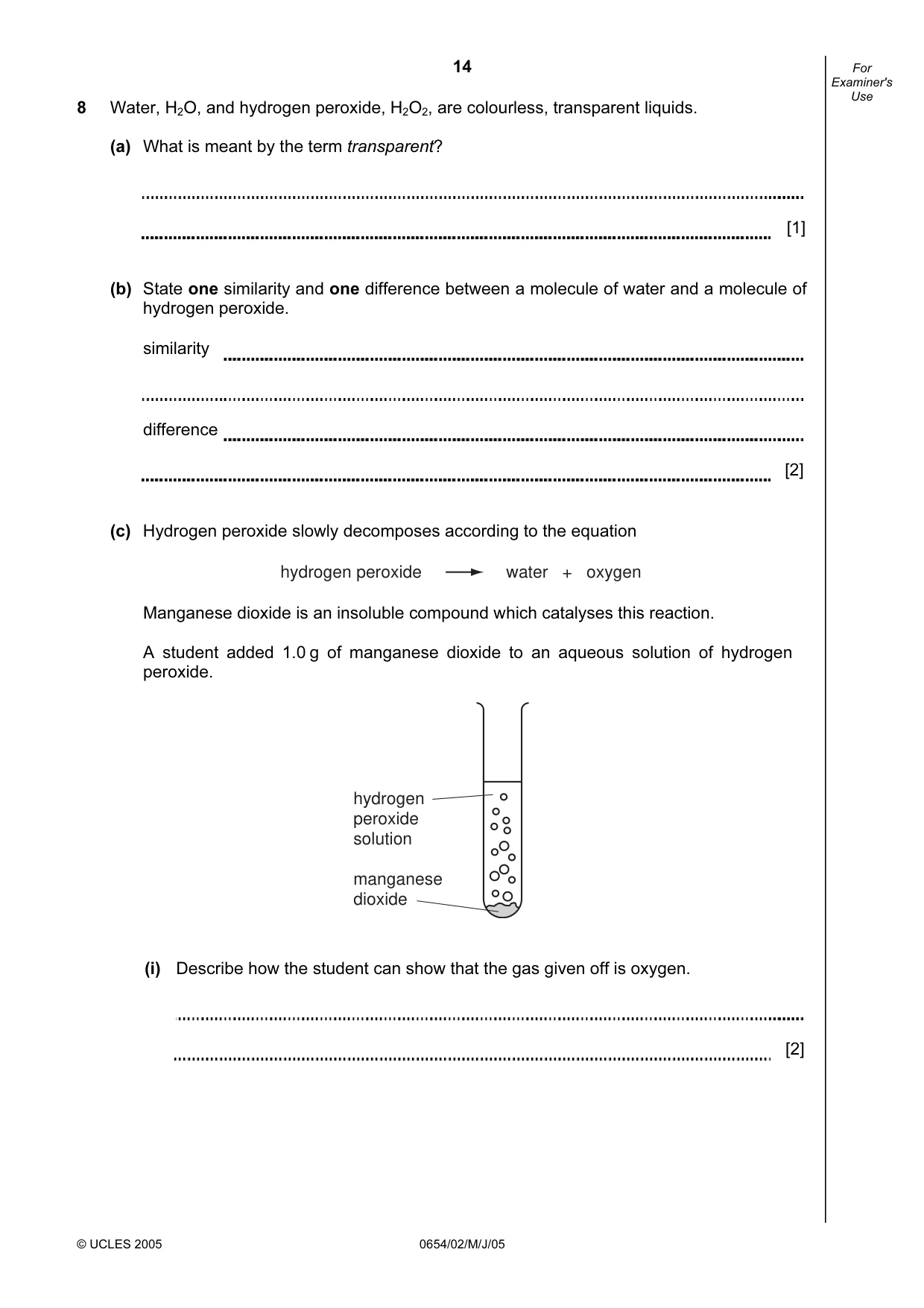
14 © UCLES 2005 0654/02/M/J/05 For Examiner's Use 8 Water, H2O, and hydrogen peroxide, H2O2, are colourless, transparent liquids. (a) What is meant by the term transparent? [1] (b) State one similarity and one difference between a molecule of water and a molecule of hydrogen peroxide. similarity difference [2] (c) Hydrogen peroxide slowly decomposes according to the equation hydrogen peroxide water + oxygen Manganese dioxide is an insoluble compound which catalyses this reaction. A student added 1.0 g of manganese dioxide to an aqueous solution of hydrogen peroxide. hydrogen peroxide solution manganese dioxide (i) Describe how the student can show that the gas given off is oxygen. [2]
Question paper, page 15
15 © UCLES 2005 0654/02/M/J/05 [Turn over For Examiner's Use (ii) Predict the mass of manganese dioxide that is left in the test-tube when all the hydrogen peroxide has decomposed. Explain your answer. [2] (d) Pure water is not suitable for removing oil from cloth, because oil does not dissolve in water. Suggest two ways of cleaning the cloth, other than using pure water, that would be more successful in removing oil. 1. 2. [2]
Question paper, page 16
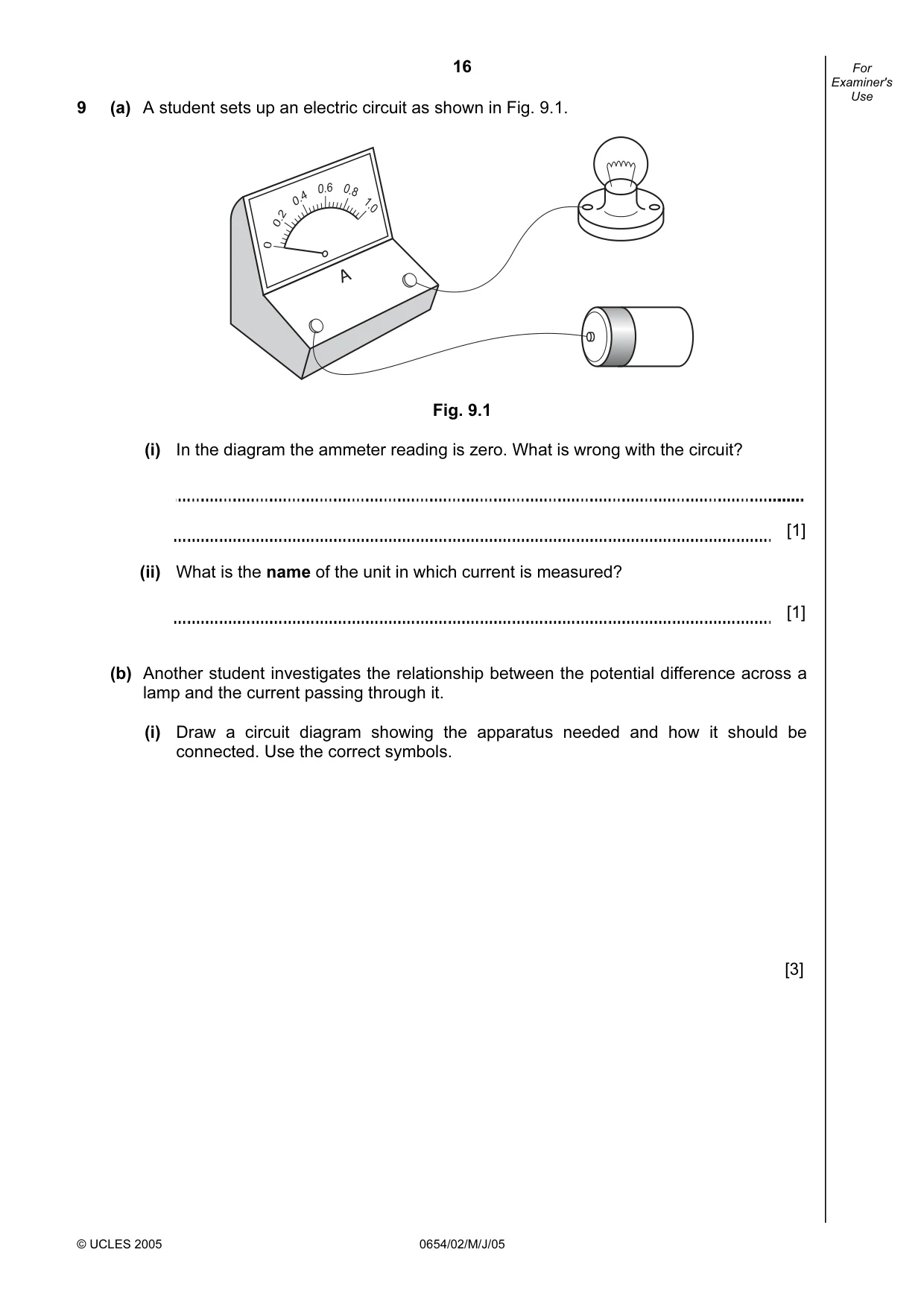
16 © UCLES 2005 0654/02/M/J/05 For Examiner's Use 9 (a) A student sets up an electric circuit as shown in Fig. 9.1. A Fig. 9.1 (i) In the diagram the ammeter reading is zero. What is wrong with the circuit? [1] (ii) What is the name of the unit in which current is measured? [1] (b) Another student investigates the relationship between the potential difference across a lamp and the current passing through it. (i) Draw a circuit diagram showing the apparatus needed and how it should be connected. Use the correct symbols. [3]
Question paper, page 17
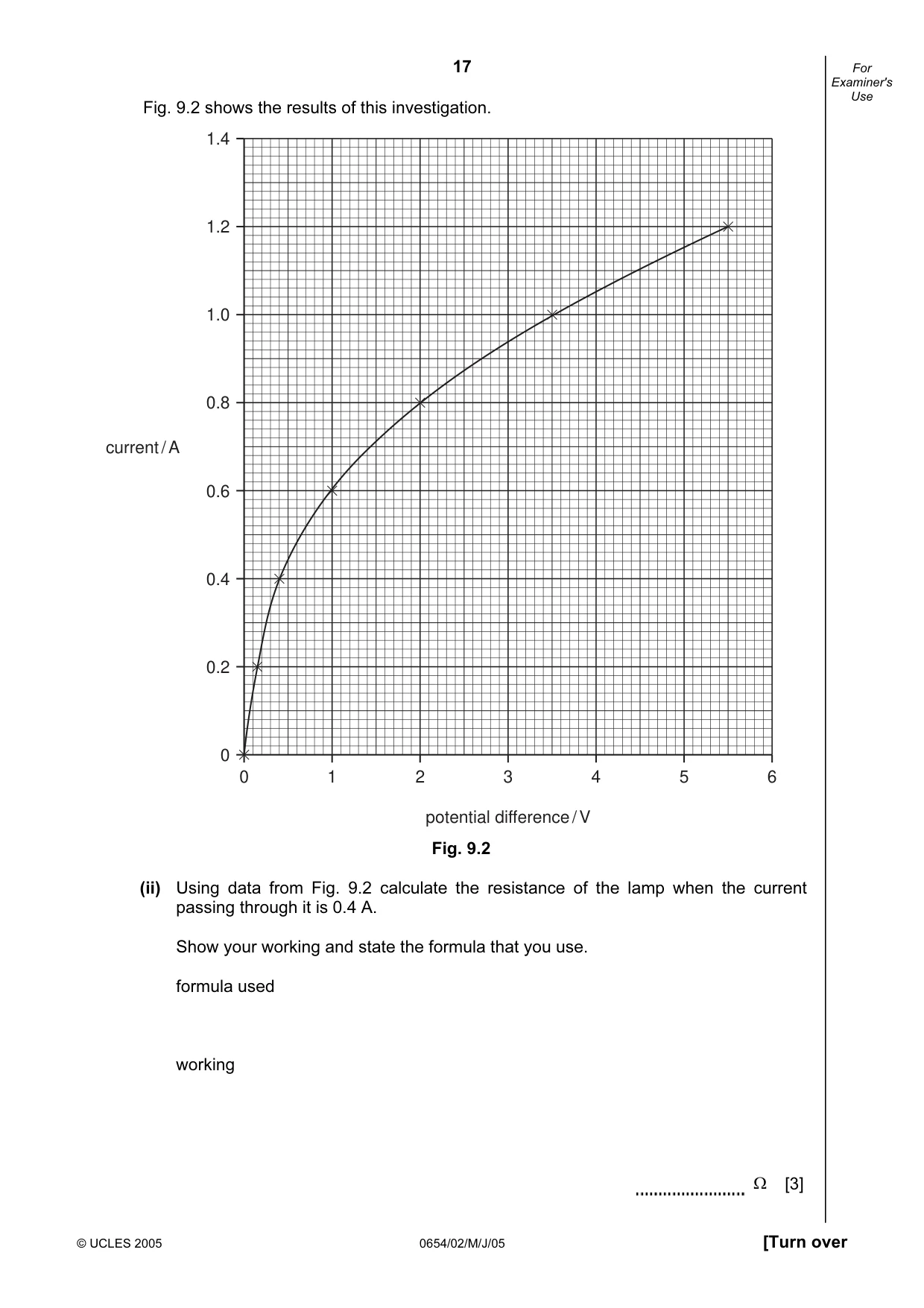
17 © UCLES 2005 0654/02/M/J/05 [Turn over For Examiner's Use Fig. 9.2 shows the results of this investigation. 1.4 1.2 1.0 0.8 0.6 0.4 0.2 0 0 1 2 3 potential difference / V 4 5 6 current / A Fig. 9.2 (ii) Using data from Fig. 9.2 calculate the resistance of the lamp when the current passing through it is 0.4 A. Show your working and state the formula that you use. formula used working Ω [3]
Question paper, page 18
18 © UCLES 2005 0654/02/M/J/05 For Examiner's Use (iii) Using the formula power = voltage x current calculate the power used by the lamp when the current is 0.4 A. W [1] (iv) State the number of joules of energy being transferred per second, when the current flowing through the lamp is 0.4 A. J / s [1]
Question paper, page 19
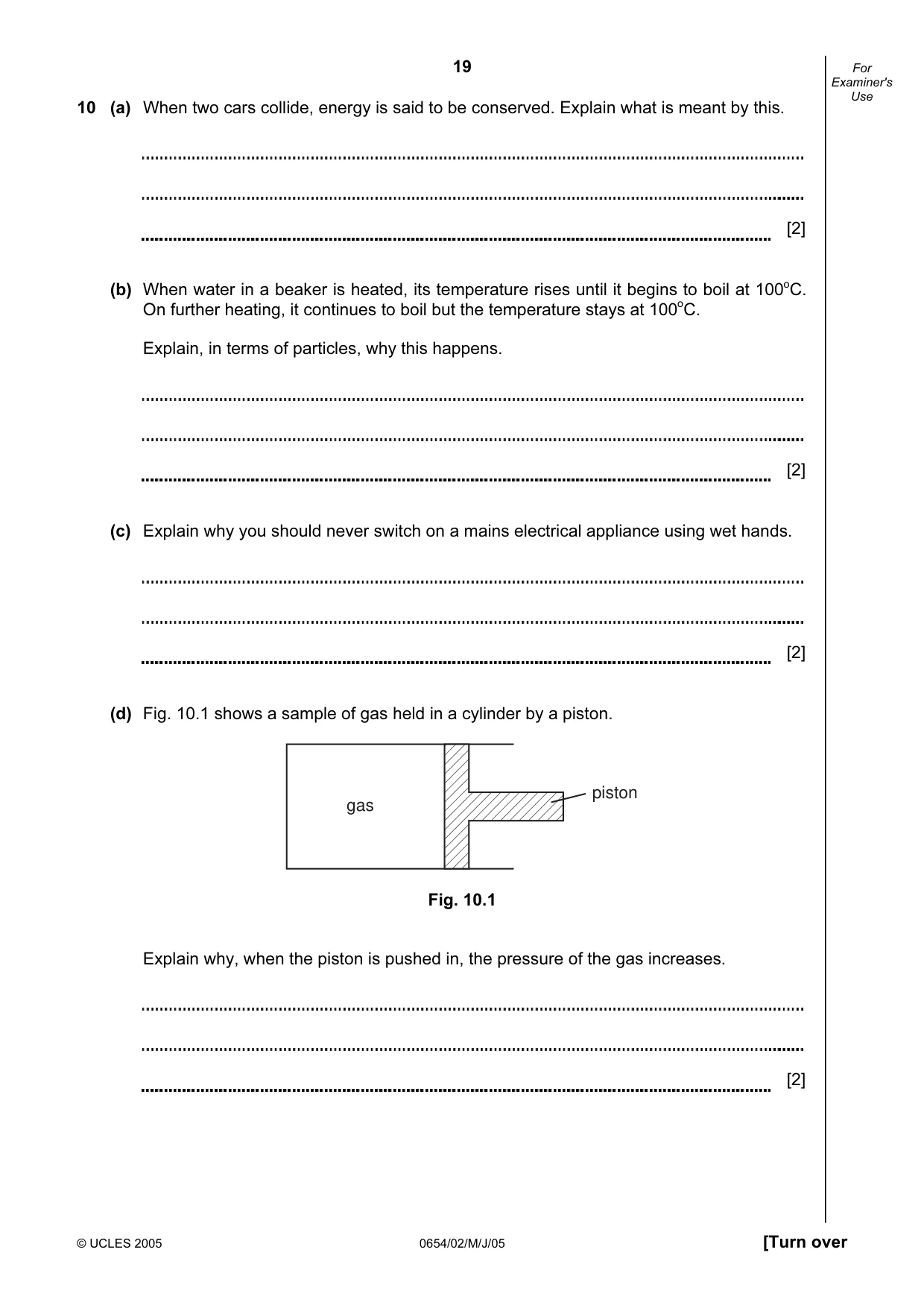
19 © UCLES 2005 0654/02/M/J/05 [Turn over For Examiner's Use 10 (a) When two cars collide, energy is said to be conserved. Explain what is meant by this. [2] (b) When water in a beaker is heated, its temperature rises until it begins to boil at 100oC. On further heating, it continues to boil but the temperature stays at 100oC. Explain, in terms of particles, why this happens. [2] (c) Explain why you should never switch on a mains electrical appliance using wet hands. [2] (d) Fig. 10.1 shows a sample of gas held in a cylinder by a piston. piston gas Fig. 10.1 Explain why, when the piston is pushed in, the pressure of the gas increases. [2]
Question paper, page 20
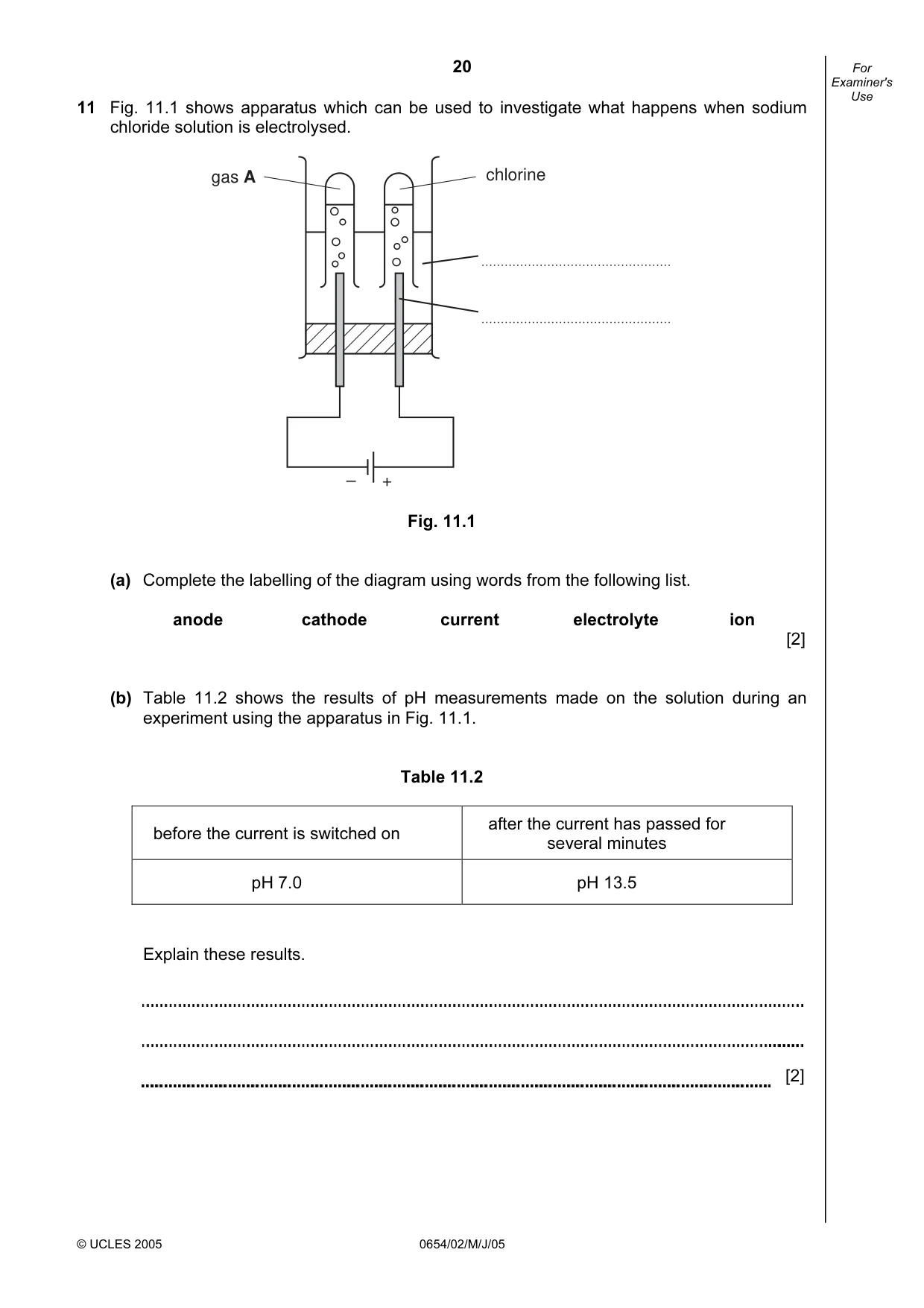
20 © UCLES 2005 0654/02/M/J/05 For Examiner's Use 11 Fig. 11.1 shows apparatus which can be used to investigate what happens when sodium chloride solution is electrolysed. + – gas A chlorine Fig. 11.1 (a) Complete the labelling of the diagram using words from the following list. anode cathode current electrolyte ion [2] (b) Table 11.2 shows the results of pH measurements made on the solution during an experiment using the apparatus in Fig. 11.1. Table 11.2 before the current is switched on after the current has passed for several minutes pH 7.0 pH 13.5 Explain these results. [2]
Question paper, page 21
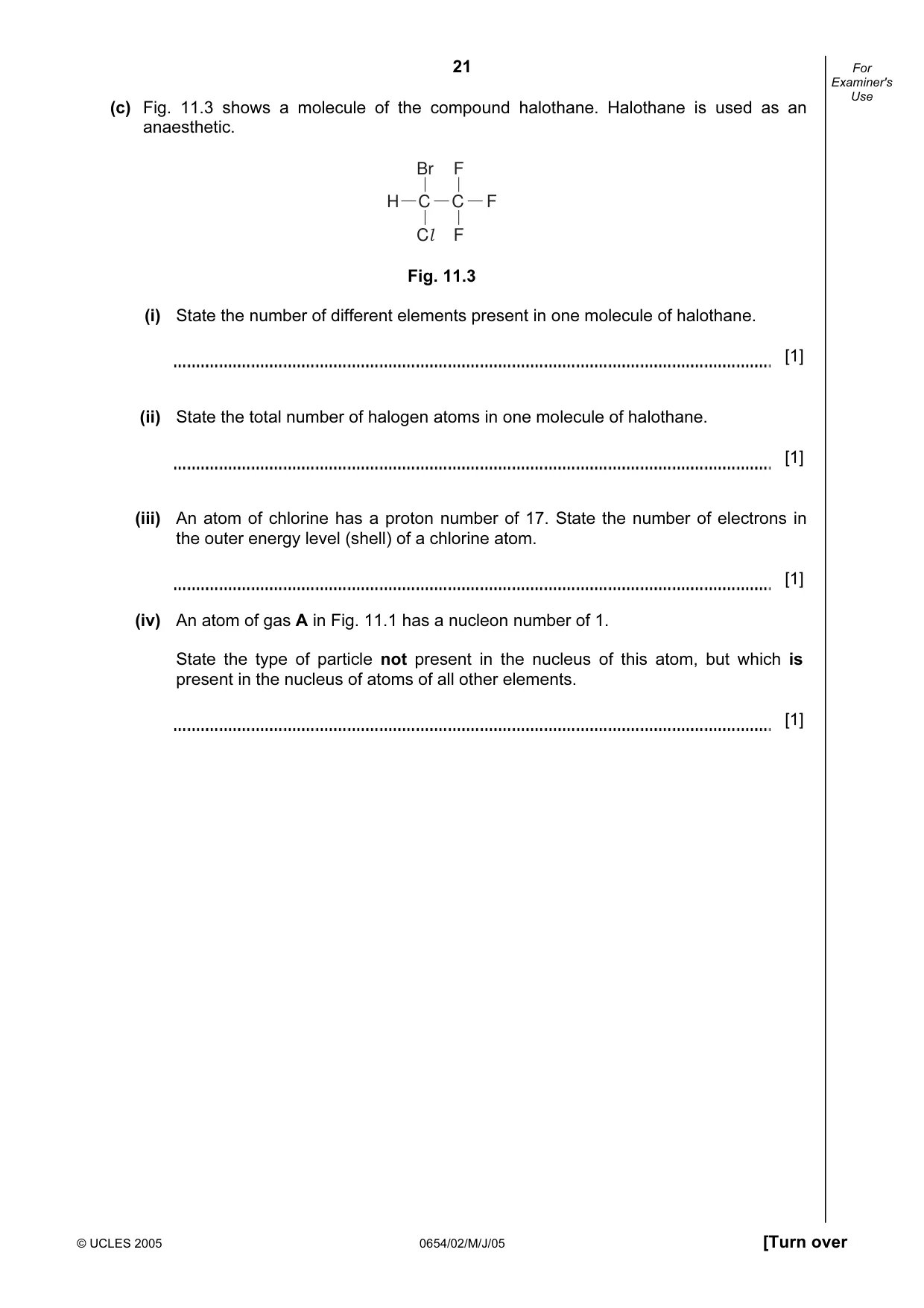
21 © UCLES 2005 0654/02/M/J/05 [Turn over For Examiner's Use (c) Fig. 11.3 shows a molecule of the compound halothane. Halothane is used as an anaesthetic. C Br Cl C F F F H Fig. 11.3 (i) State the number of different elements present in one molecule of halothane. [1] (ii) State the total number of halogen atoms in one molecule of halothane. [1] (iii) An atom of chlorine has a proton number of 17. State the number of electrons in the outer energy level (shell) of a chlorine atom. [1] (iv) An atom of gas A in Fig. 11.1 has a nucleon number of 1. State the type of particle not present in the nucleus of this atom, but which is present in the nucleus of atoms of all other elements. [1]
Question paper, page 22
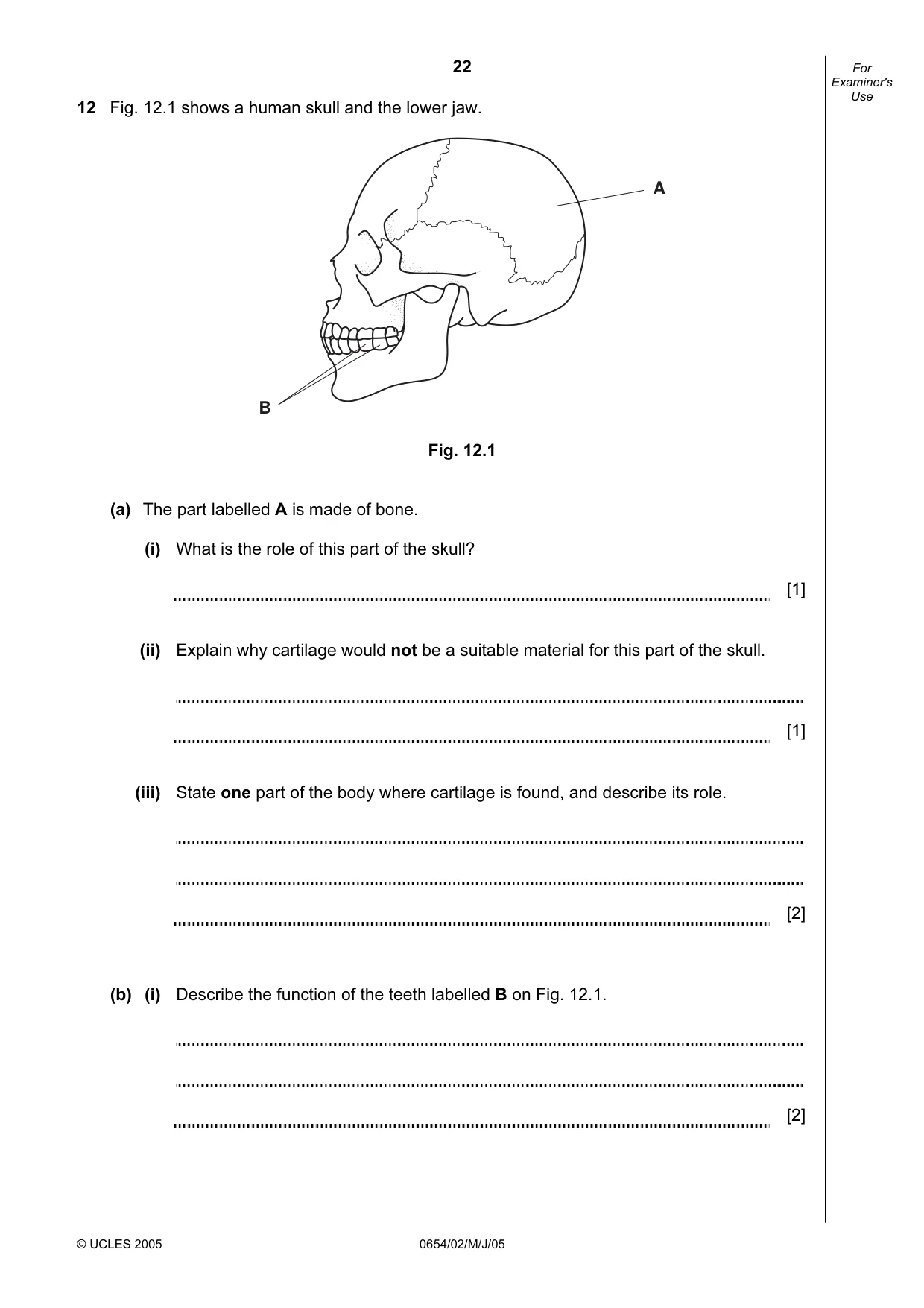
22 © UCLES 2005 0654/02/M/J/05 For Examiner's Use 12 Fig. 12.1 shows a human skull and the lower jaw. A B Fig. 12.1 (a) The part labelled A is made of bone. (i) What is the role of this part of the skull? [1] (ii) Explain why cartilage would not be a suitable material for this part of the skull. [1] (iii) State one part of the body where cartilage is found, and describe its role. [2] (b) (i) Describe the function of the teeth labelled B on Fig. 12.1. [2]
Question paper, page 23
23 Permission to reproduce items where third-party owned material protected by copyright is included has been sought and cleared where possible. Every reasonable effort has been made by the publisher (UCLES) to trace copyright holders, but if any items requiring clearance have unwittingly been included, the publisher will be pleased to make amends at the earliest possible opportunity. University of Cambridge International Examinations is part of the University of Cambridge Local Examinations Syndicate (UCLES), which is itself a department of the University of Cambridge. © UCLES 2005 0654/02/M/J/05 For Examiner's Use (ii) On average, the teeth labelled B are more likely to decay than the teeth at the front of the mouth. Suggest an explanation for this. [2]
Question paper, page 24
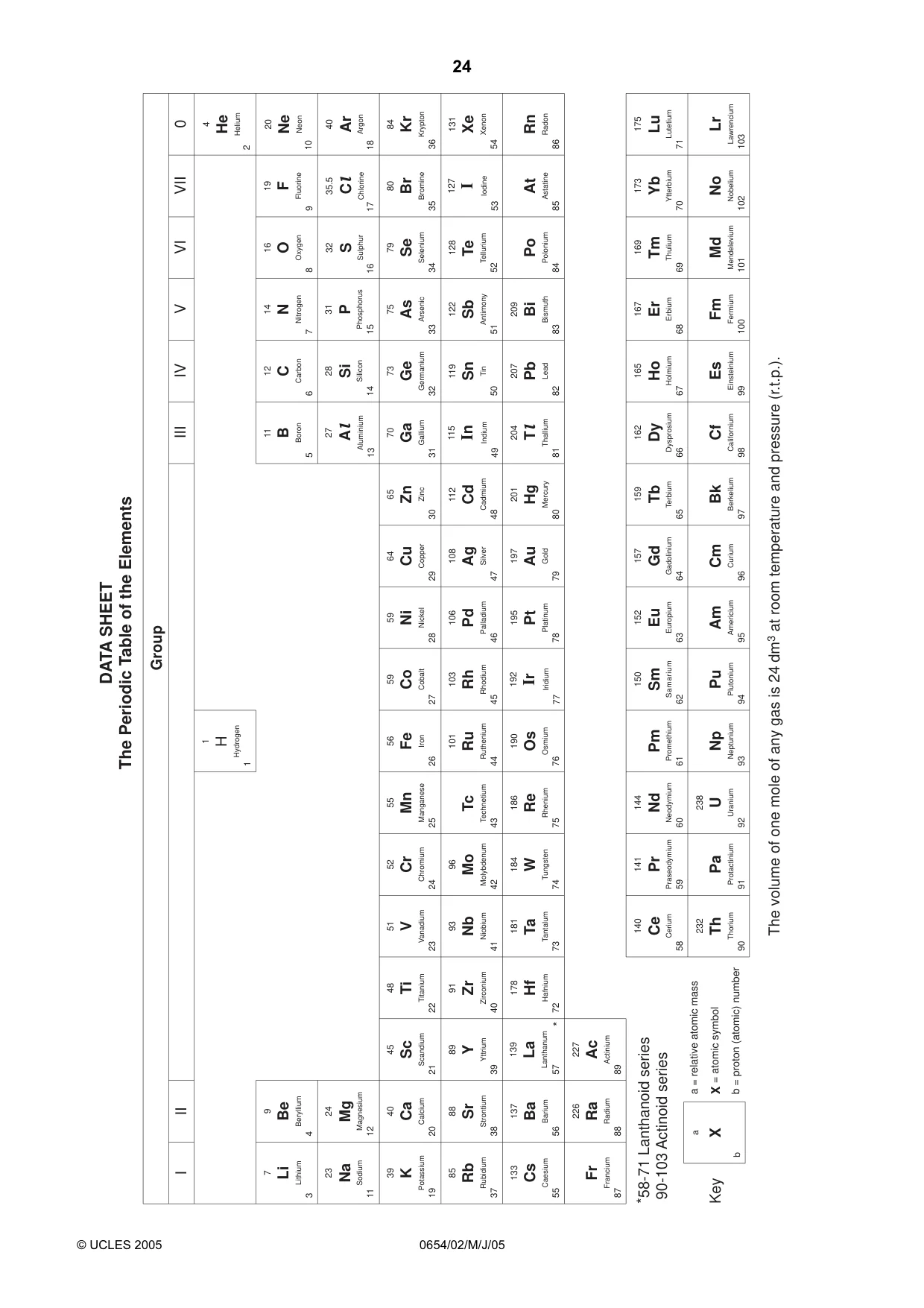
24 © UCLES 2005 0654/02/M/J/05 Group 140 Ce Cerium 58 141 Pr Praseodymium 59 144 Nd Neodymium 60 Pm Promethium 61 150 Sm Samarium 62 152 Eu Europium 63 157 Gd Gadolinium 64 159 Tb Terbium 65 162 Dy Dysprosium 66 165 Ho Holmium 67 167 Er Erbium 68 169 Tm Thulium 69 173 Yb Ytterbium 70 175 Lu Lutetium 71 232 Th Thorium 90 Pa Protactinium 91 238 U Uranium 92 Np Neptunium 93 Pu Plutonium 94 Am Americium 95 Cm Curium 96 Bk Berkelium 97 Cf Californium 98 Es Einsteinium 99 Fm Fermium 100 Md Mendelevium 101 No Nobelium 102 Lr Lawrencium 103 1 H Hydrogen 1 7 Li Lithium 3 23 Na Sodium 11 24 Mg Magnesium 12 40 Ca Calcium 20 45 Sc Scandium 21 48 Ti Titanium 22 51 V Vanadium 23 52 Cr Chromium 24 55 Mn Manganese 25 56 Fe Iron 26 59 Co Cobalt 27 59 Ni Nickel 28 64 Cu Copper 29 65 Zn Zinc 30 70 Ga Gallium 31 27 Al Aluminium 13 11 B Boron 5 12 C Carbon 6 14 N Nitrogen 7 16 O Oxygen 8 19 F Fluorine 9 28 Si Silicon 14 31 P Phosphorus 15 32 S Sulphur 16 35.5 Cl Chlorine 17 40 Ar Argon 18 20 Ne Neon 10 4 He Helium 2 73 Ge Germanium 32 75 As Arsenic 33 79 Se Selenium 34 80 Br Bromine 35 84 Kr Krypton 36 39 K Potassium 19 88 Sr Strontium 38 89 Y Yttrium 39 91 Zr Zirconium 40 93 Nb Niobium 41 96 Mo Molybdenum 42 Tc Technetium 43 101 Ru Ruthenium 44 103 Rh Rhodium 45 106 Pd Palladium 46 108 Ag Silver 47 112 Cd Cadmium 48 115 In Indium 49 119 Sn Tin 50 122 Sb Antimony 51 128 Te Tellurium 52 127 I Iodine 53 131 Xe Xenon 54 137 Ba Barium 56 139 La Lanthanum 57 * 178 Hf Hafnium 72 181 Ta Tantalum 73 184 W Tungsten 74 186 Re Rhenium 75 190 Os Osmium 76 192 Ir Iridium 77 195 Pt Platinum 78 197 Au Gold 79 201 Hg Mercury 80 204 Tl Thallium 81 207 Pb Lead 82 209 Bi Bismuth 83 Po Polonium 84 At Astatine 85 Rn Radon 86 Fr Francium 87 227 Ac Actinium 89 9 Be Beryllium 4 I II III IV V VI VII 0 85 Rb Rubidium 37 133 Cs Caesium 55 226 Ra Radium 88 The volume of one mole of any gas is 24 dm3 at room temperature and pressure (r.t.p.). a X b a = relative atomic mass X = atomic symbol b = proton (atomic) number Key *58-71 Lanthanoid series 90-103 Actinoid series DATA SHEET The Periodic Table of the Elements
Mark scheme, page 1
UNIVERSITY OF CAMBRIDGE INTERNATIONAL EXAMINATIONS International General Certificate of Secondary Education MARK SCHEME for the June 2005 question paper 0654 CO-ORDINATED SCIENCES 0654/02 Paper 2 Core (Theory), maximum raw mark 100 Mark schemes must be read in conjunction with the question papers and the Report on the Examination. • CIE will not enter into discussion or correspondence in connection with these mark schemes. CIE is publishing the mark schemes for the June 2005 question papers for most IGCSE and GCE Advanced Level and Advanced Subsidiary Level syllabuses and some Ordinary Level syllabuses. www.XtremePapers.com
Mark scheme, page 2
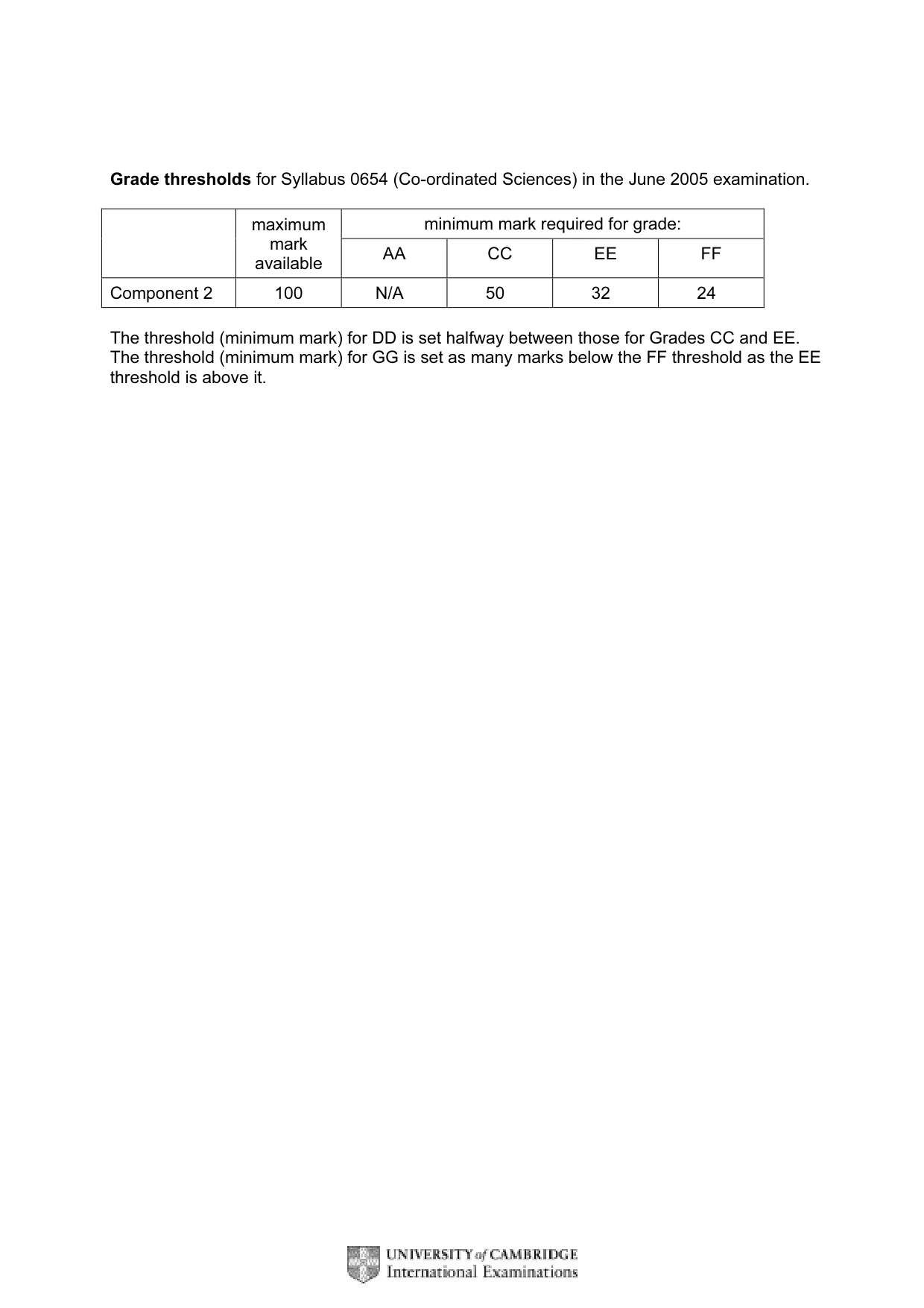
Grade thresholds for Syllabus 0654 (Co-ordinated Sciences) in the June 2005 examination. minimum mark required for grade: maximum mark available AA CC EE FF Component 2 100 N/A 50 32 24 The threshold (minimum mark) for DD is set halfway between those for Grades CC and EE. The threshold (minimum mark) for GG is set as many marks below the FF threshold as the EE threshold is above it.
Mark scheme, page 3
June 2005 IGCSE MARK SCHEME MAXIMUM MARK: 100 SYLLABUS/COMPONENT: 0654/02 CO-ORDINATED SCIENCES Paper 1 Core (Theory)
Mark scheme, page 4
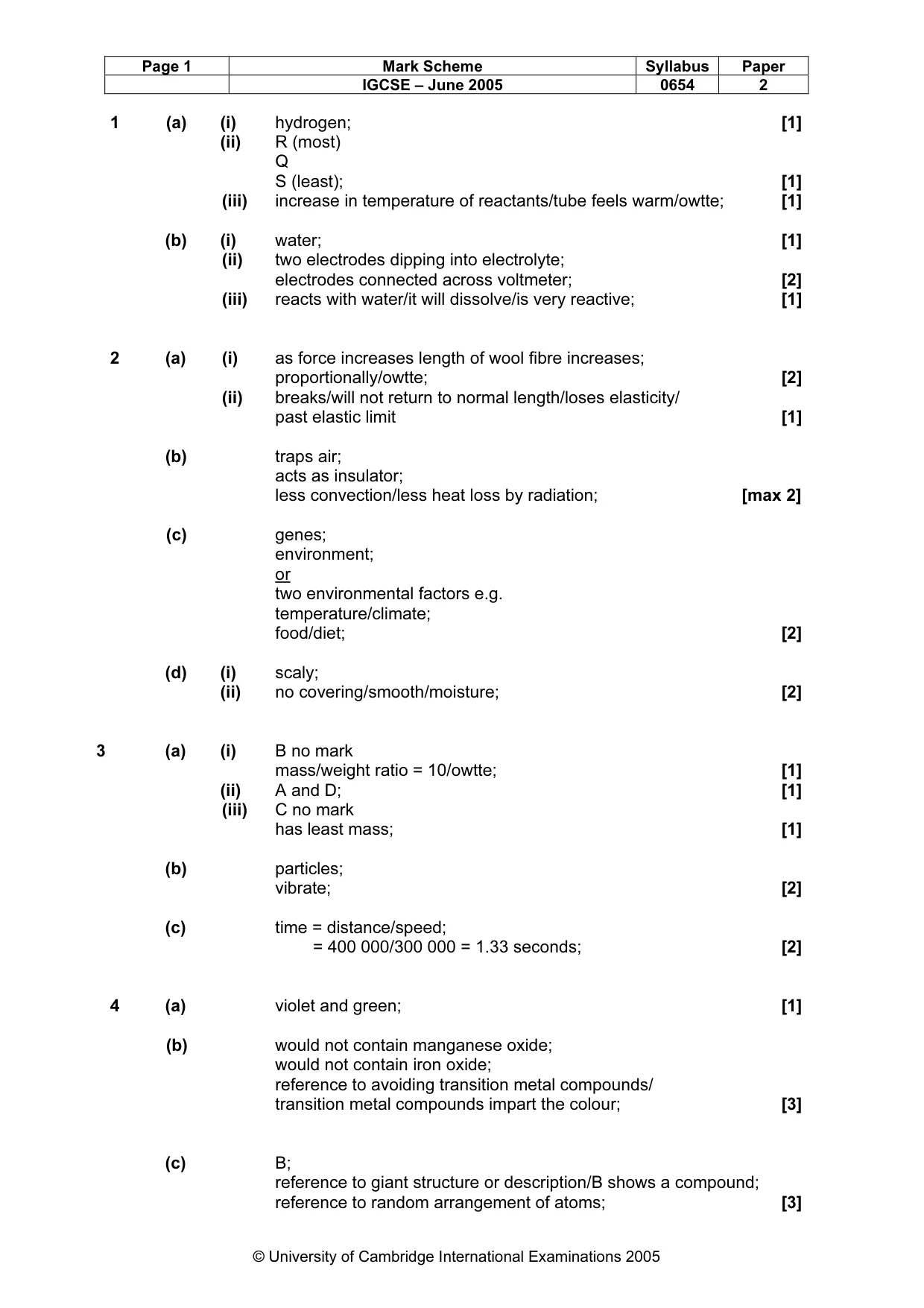
Page 1 Mark Scheme Syllabus Paper IGCSE – June 2005 0654 2 © University of Cambridge International Examinations 2005 1 (a) (i) hydrogen; [1] (ii) R (most) Q S (least); [1] (iii) increase in temperature of reactants/tube feels warm/owtte; [1] (b) (i) water; [1] (ii) two electrodes dipping into electrolyte; electrodes connected across voltmeter; [2] (iii) reacts with water/it will dissolve/is very reactive; [1] 2 (a) (i) as force increases length of wool fibre increases; proportionally/owtte; [2] (ii) breaks/will not return to normal length/loses elasticity/ past elastic limit [1] (b) traps air; acts as insulator; less convection/less heat loss by radiation; [max 2] (c) genes; environment; or two environmental factors e.g. temperature/climate; food/diet; [2] (d) (i) scaly; (ii) no covering/smooth/moisture; [2] 3 (a) (i) B no mark mass/weight ratio = 10/owtte; [1] (ii) A and D; [1] (iii) C no mark has least mass; [1] (b) particles; vibrate; [2] (c) time = distance/speed; = 400 000/300 000 = 1.33 seconds; [2] 4 (a) violet and green; [1] (b) would not contain manganese oxide; would not contain iron oxide; reference to avoiding transition metal compounds/ transition metal compounds impart the colour; [3] (c) B; reference to giant structure or description/B shows a compound; reference to random arrangement of atoms; [3]
Mark scheme, page 5
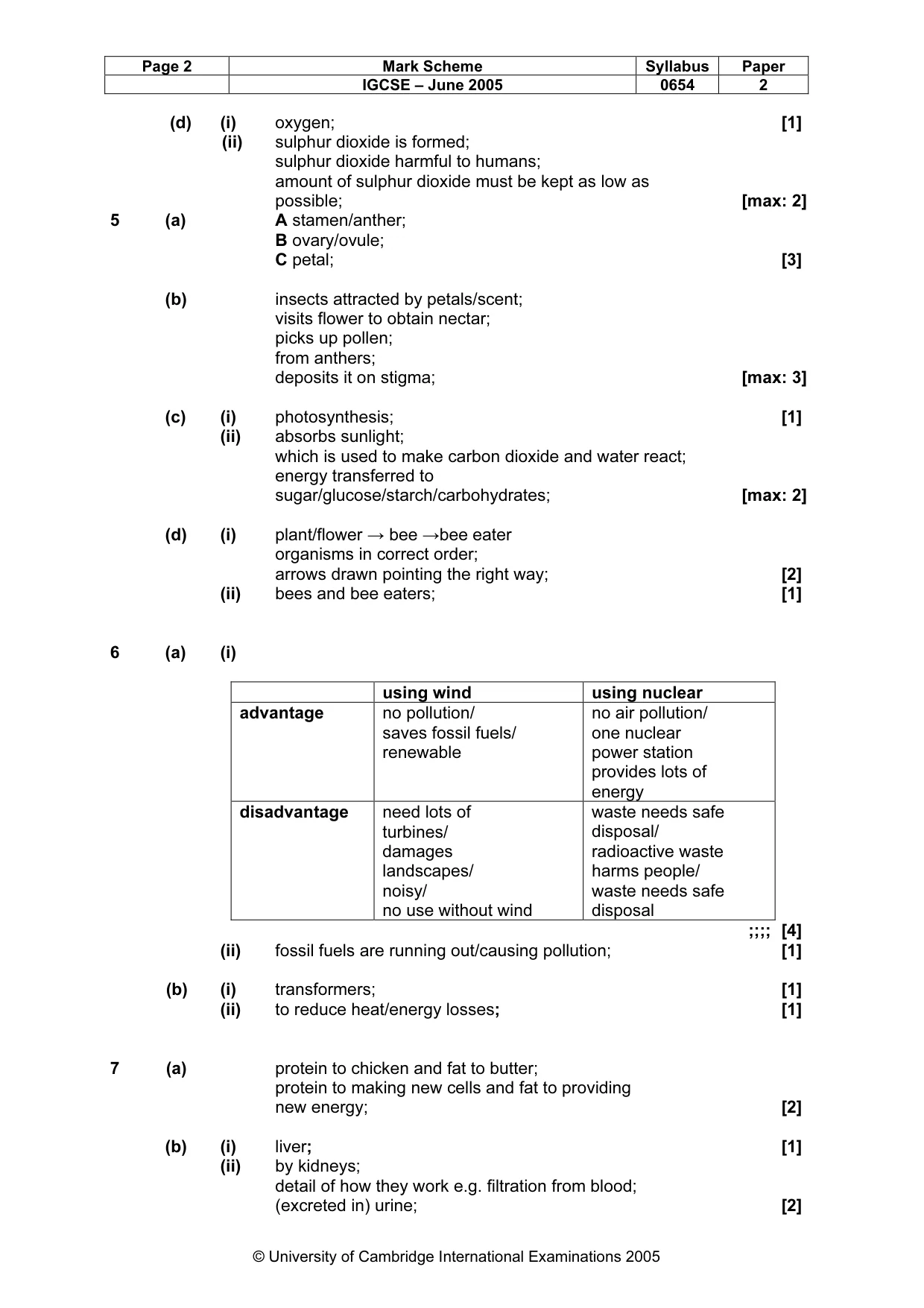
Page 2 Mark Scheme Syllabus Paper IGCSE – June 2005 0654 2 © University of Cambridge International Examinations 2005 (d) (i) oxygen; [1] (ii) sulphur dioxide is formed; sulphur dioxide harmful to humans; amount of sulphur dioxide must be kept as low as possible; [max: 2] 5 (a) A stamen/anther; B ovary/ovule; C petal; [3] (b) insects attracted by petals/scent; visits flower to obtain nectar; picks up pollen; from anthers; deposits it on stigma; [max: 3] (c) (i) photosynthesis; [1] (ii) absorbs sunlight; which is used to make carbon dioxide and water react; energy transferred to sugar/glucose/starch/carbohydrates; [max: 2] (d) (i) plant/flower → bee →bee eater organisms in correct order; arrows drawn pointing the right way; [2] (ii) bees and bee eaters; [1] 6 (a) (i) using wind using nuclear advantage no pollution/ saves fossil fuels/ renewable no air pollution/ one nuclear power station provides lots of energy disadvantage need lots of turbines/ damages landscapes/ noisy/ no use without wind waste needs safe disposal/ radioactive waste harms people/ waste needs safe disposal ;;;; [4] (ii) fossil fuels are running out/causing pollution; [1] (b) (i) transformers; [1] (ii) to reduce heat/energy losses; [1] 7 (a) protein to chicken and fat to butter; protein to making new cells and fat to providing new energy; [2] (b) (i) liver; [1] (ii) by kidneys; detail of how they work e.g. filtration from blood; (excreted in) urine; [2]
Mark scheme, page 6
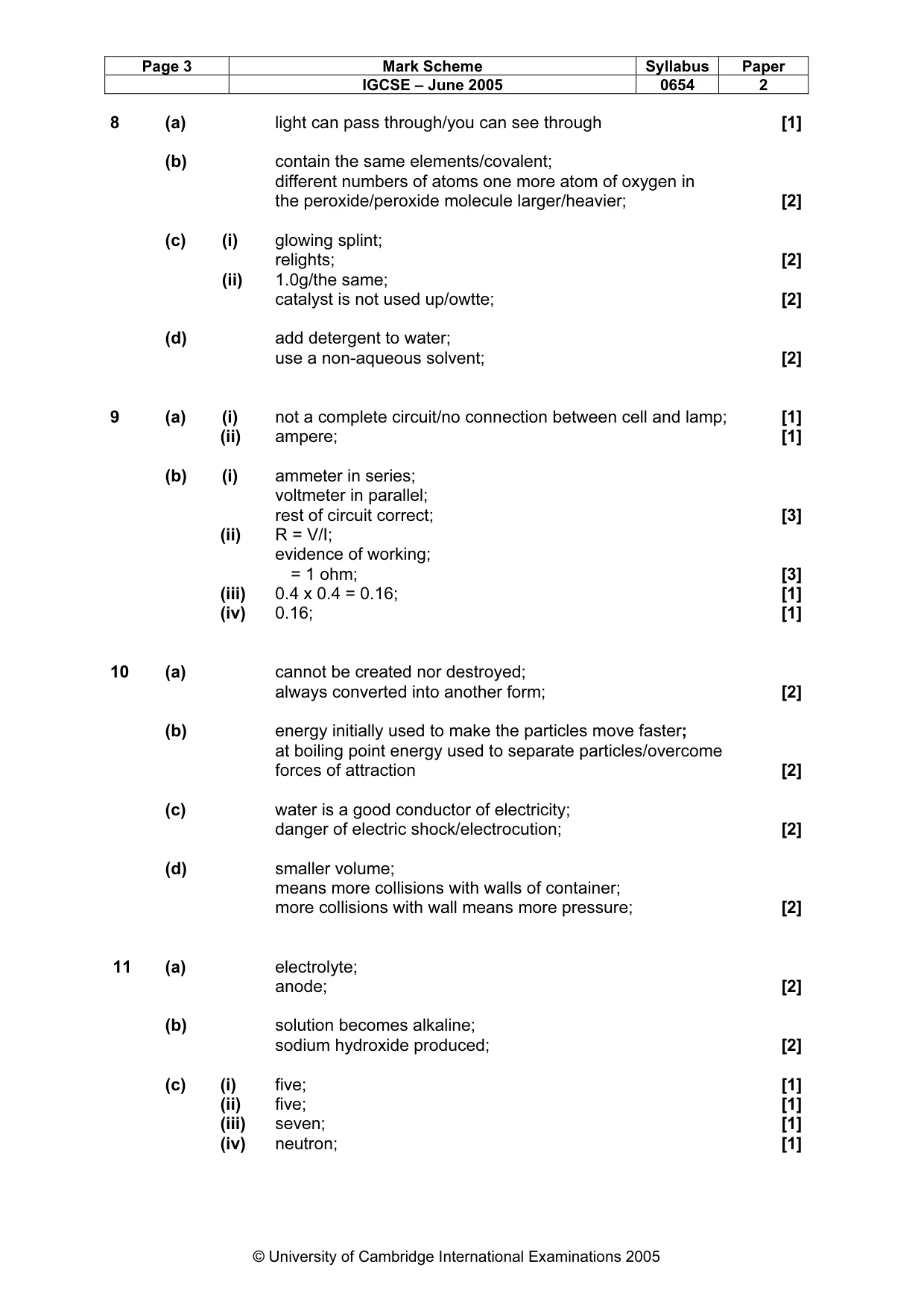
Page 3 Mark Scheme Syllabus Paper IGCSE – June 2005 0654 2 © University of Cambridge International Examinations 2005 8 (a) light can pass through/you can see through [1] (b) contain the same elements/covalent; different numbers of atoms one more atom of oxygen in the peroxide/peroxide molecule larger/heavier; [2] (c) (i) glowing splint; relights; [2] (ii) 1.0g/the same; catalyst is not used up/owtte; [2] (d) add detergent to water; use a non-aqueous solvent; [2] 9 (a) (i) not a complete circuit/no connection between cell and lamp; [1] (ii) ampere; [1] (b) (i) ammeter in series; voltmeter in parallel; rest of circuit correct; [3] (ii) R = V/I; evidence of working; = 1 ohm; [3] (iii) 0.4 x 0.4 = 0.16; [1] (iv) 0.16; [1] 10 (a) cannot be created nor destroyed; always converted into another form; [2] (b) energy initially used to make the particles move faster; at boiling point energy used to separate particles/overcome forces of attraction [2] (c) water is a good conductor of electricity; danger of electric shock/electrocution; [2] (d) smaller volume; means more collisions with walls of container; more collisions with wall means more pressure; [2] 11 (a) electrolyte; anode; [2] (b) solution becomes alkaline; sodium hydroxide produced; [2] (c) (i) five; [1] (ii) five; [1] (iii) seven; [1] (iv) neutron; [1]
Mark scheme, page 7
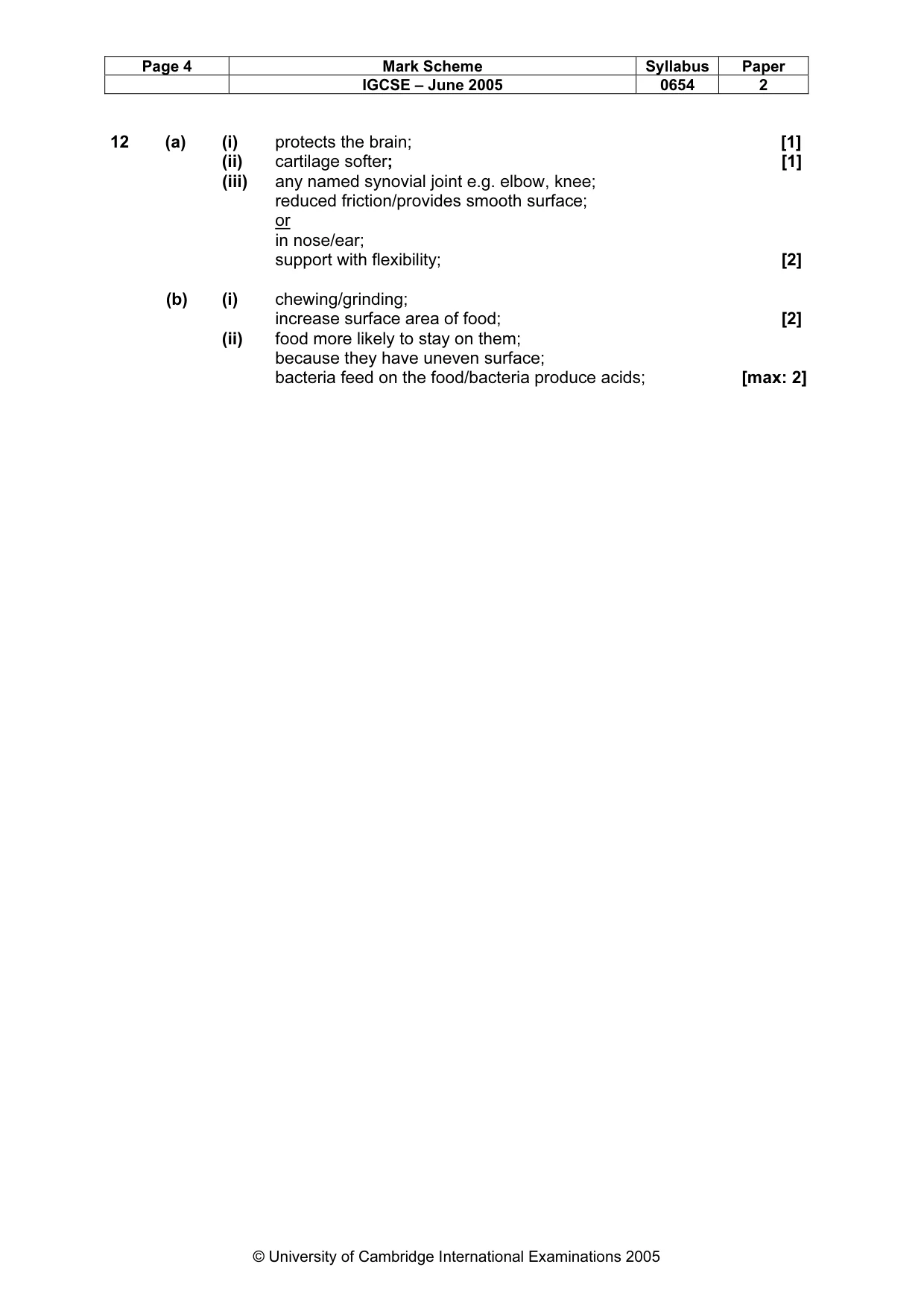
Page 4 Mark Scheme Syllabus Paper IGCSE – June 2005 0654 2 © University of Cambridge International Examinations 2005 12 (a) (i) protects the brain; [1] (ii) cartilage softer; [1] (iii) any named synovial joint e.g. elbow, knee; reduced friction/provides smooth surface; or in nose/ear; support with flexibility; [2] (b) (i) chewing/grinding; increase surface area of food; [2] (ii) food more likely to stay on them; because they have uneven surface; bacteria feed on the food/bacteria produce acids; [max: 2]