Cambridge IGCSE Sciences - Co-ordinated (Double) 0654 — 2004 May/June Paper 2 · Variant 1
0654/21/M/J/04
The question paper and its mark scheme, free to read here and free to download. This is Cambridge’s own paper, exactly as it was sat.
Question paper24 pages

Mark scheme
No mark scheme is in the library for this paper.
Paper as text
Question paper, page 1
This document consists of 23 printed pages and 1 blank page. SPA (SJF3097/D&G) S63773/3 © UCLES 2004 [Turn over UNIVERSITY OF CAMBRIDGE INTERNATIONAL EXAMINATIONS International General Certificate of Secondary Education CO-ORDINATED SCIENCES 0654/02 Paper 2 May/June 2004 2 hours Candidates answer on the Question Paper. No Additional Materials are required. READ THESE INSTRUCTIONS FIRST Write your Centre number, candidate number and name on all the work you hand in. Write in dark blue or black pen in the spaces provided on the Question Paper. You may use a soft pencil for any diagrams, graphs, tables or rough working. Do not use staples, paper clips, highlighters, glue or correction fluid. Answer all questions. The number of marks is given in brackets [ ] at the end of each question or part question. A copy of the Periodic Table is printed on page 24. Centre Number Candidate Number Name For Examiner’s Use If you have been given a label, look at the details. If any details are incorrect or missing, please fill in your correct details in the space given at the top of this page. Stick your personal label here, if provided. 1 2 3 4 5 6 7 8 9 10 11 Total www.XtremePapers.com
Question paper, page 2
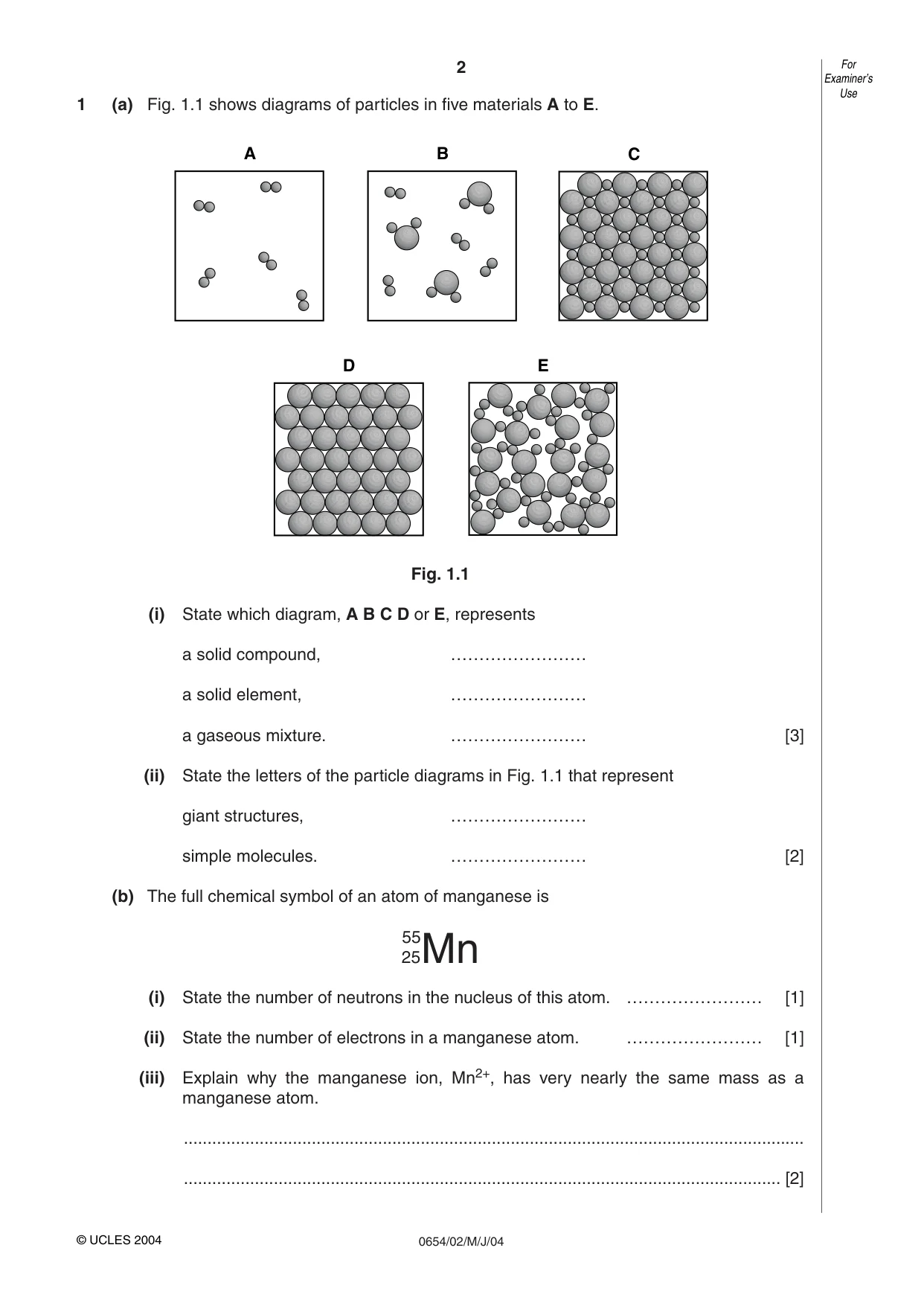
2 0654/02/M/J/04 1 (a) Fig. 1.1 shows diagrams of particles in five materials A to E. Fig. 1.1 (i) State which diagram, A B C D or E, represents a solid compound, …………………… a solid element, …………………… a gaseous mixture. …………………… [3] (ii) State the letters of the particle diagrams in Fig. 1.1 that represent giant structures, …………………… simple molecules. …………………… [2] (b) The full chemical symbol of an atom of manganese is 55Mn 25 (i) State the number of neutrons in the nucleus of this atom. …………………… [1] (ii) State the number of electrons in a manganese atom. …………………… [1] (iii) Explain why the manganese ion, Mn2+, has very nearly the same mass as a manganese atom. … … [2] B A D E C For Examiner’s Use © UCLES 2004
Question paper, page 3
3 0654/02/M/J/04 [Turn over 2 (a) (i) Explain how friction is reduced between the bones of the arm when the elbow is bent. … … … … [3] (ii) Describe how friction is reduced between the lungs and the rib cage as the lungs inflate and deflate. … … [1] (b) In the alimentary canal, friction between the food and the walls of the canal is reduced by slippery mucus. Describe one other function of mucus in the human body. … … … [2] (c) The inner lining of blood vessels is normally very smooth, so that blood can flow through them easily. However, sometimes deposits of cholesterol can build up on the inner surface of the blood vessels supplying the heart wall. This makes the surface much rougher. When blood platelets come into contact with a rough surface, they tend to form blood clots. Use this information, and your own knowledge, to explain why a person whose diet contains a lot of animal fat has an increased risk of having a heart attack. … … … … [3] For Examiner’s Use © UCLES 2004
Question paper, page 4
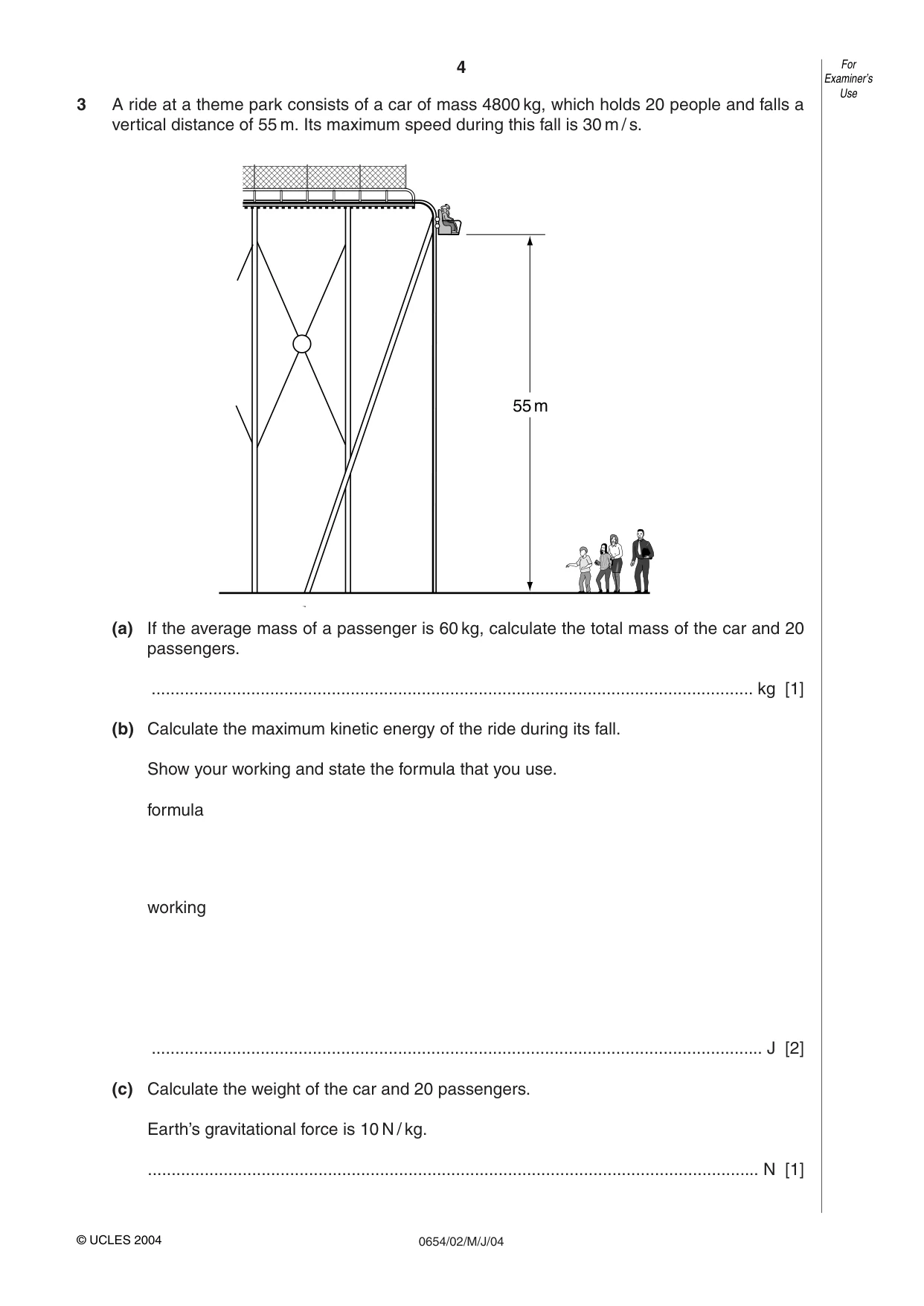
4 0654/02/M/J/04 3 A ride at a theme park consists of a car of mass 4800 kg, which holds 20 people and falls a vertical distance of 55 m. Its maximum speed during this fall is 30 m / s. (a) If the average mass of a passenger is 60 kg, calculate the total mass of the car and 20 passengers. … kg [1] (b) Calculate the maximum kinetic energy of the ride during its fall. Show your working and state the formula that you use. formula working … J [2] (c) Calculate the weight of the car and 20 passengers. Earth’s gravitational force is 10 N / kg. … N [1] 55m For Examiner’s Use © UCLES 2004
Question paper, page 5
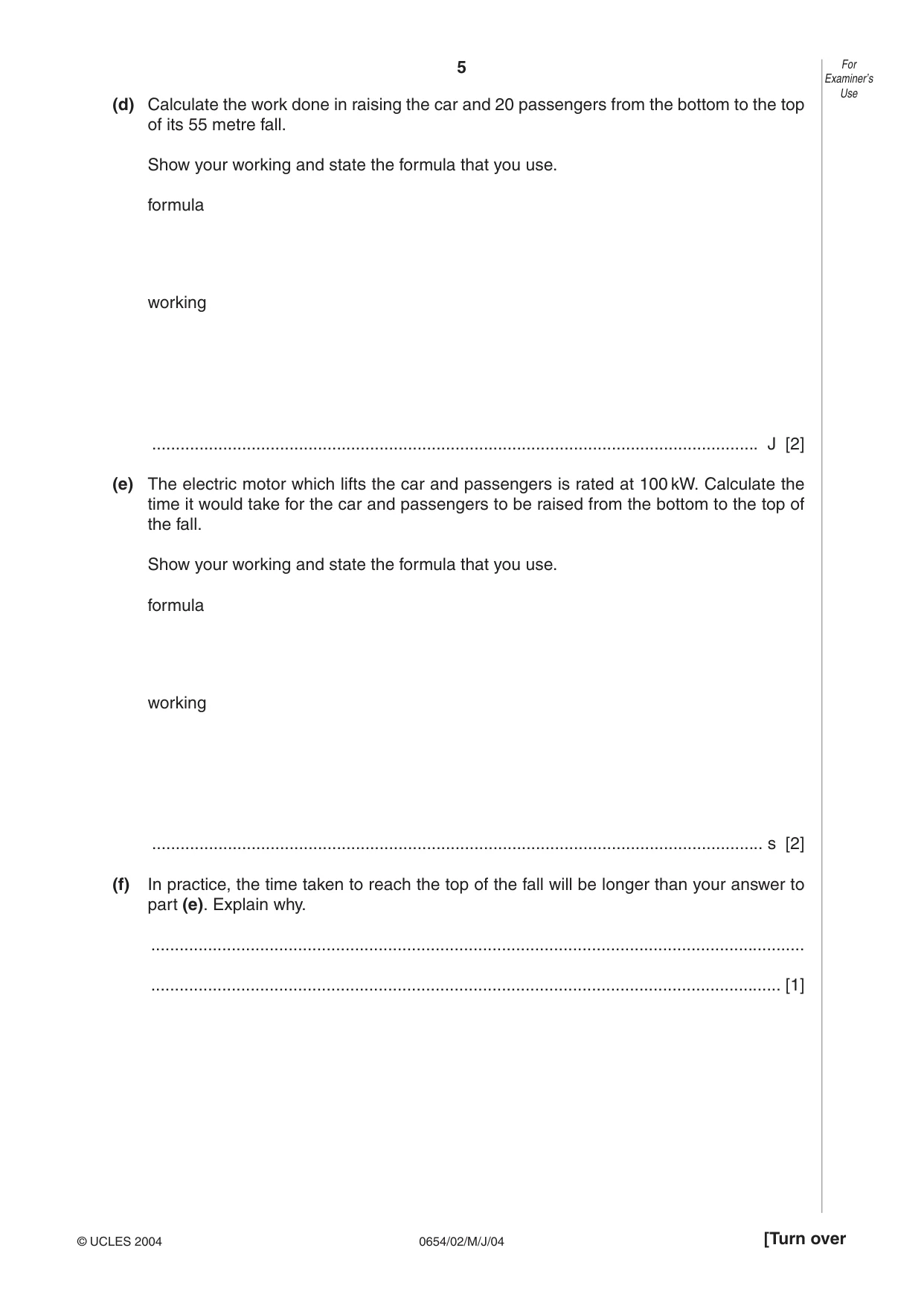
5 0654/02/M/J/04 [Turn over (d) Calculate the work done in raising the car and 20 passengers from the bottom to the top of its 55 metre fall. Show your working and state the formula that you use. formula working … J [2] (e) The electric motor which lifts the car and passengers is rated at 100 kW. Calculate the time it would take for the car and passengers to be raised from the bottom to the top of the fall. Show your working and state the formula that you use. formula working … s [2] (f) In practice, the time taken to reach the top of the fall will be longer than your answer to part (e). Explain why. … … [1] For Examiner’s Use © UCLES 2004
Question paper, page 6
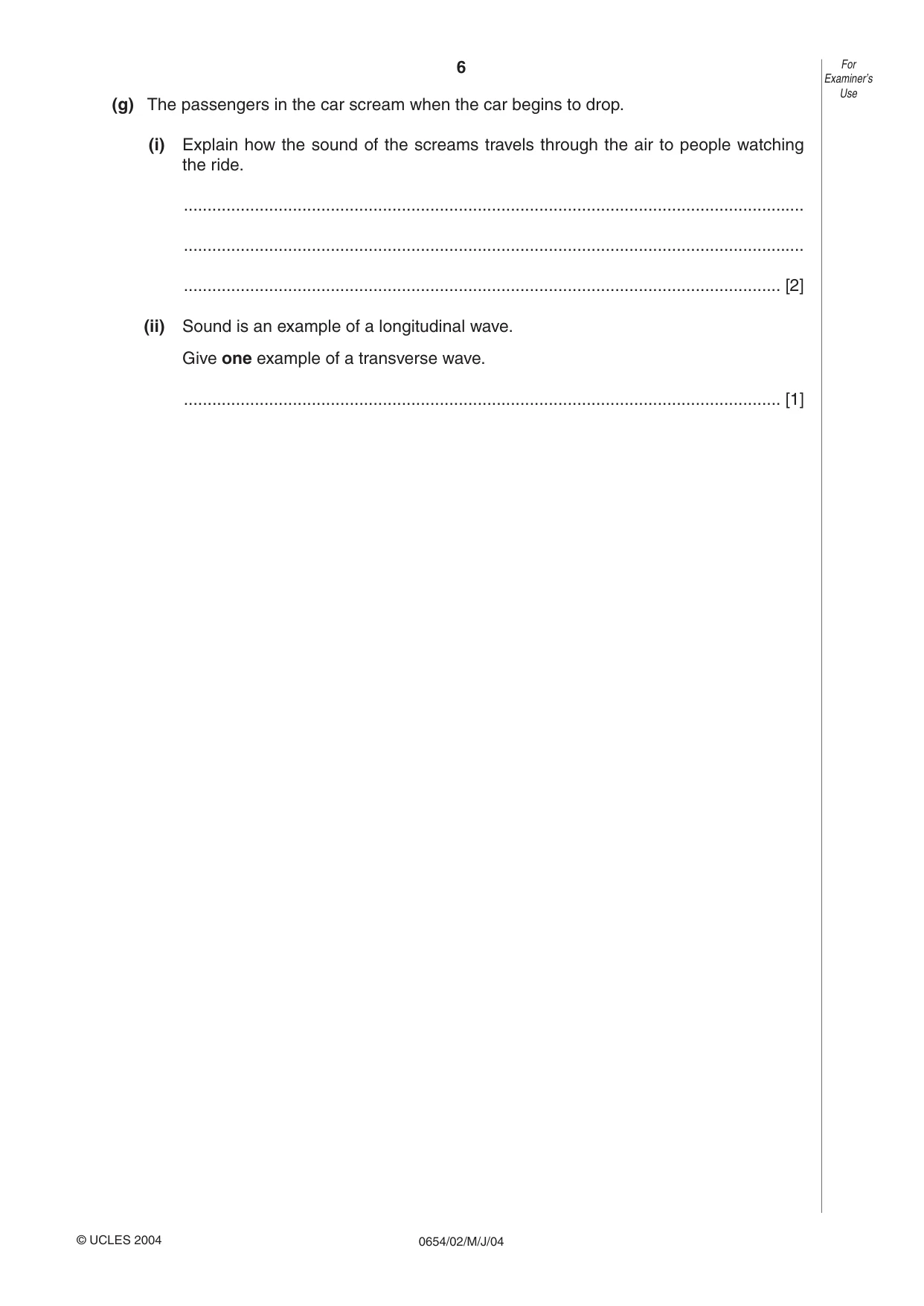
6 0654/02/M/J/04 (g) The passengers in the car scream when the car begins to drop. (i) Explain how the sound of the screams travels through the air to people watching the ride. … … … [2] (ii) Sound is an example of a longitudinal wave. Give one example of a transverse wave. … [1] For Examiner’s Use © UCLES 2004
Question paper, page 8
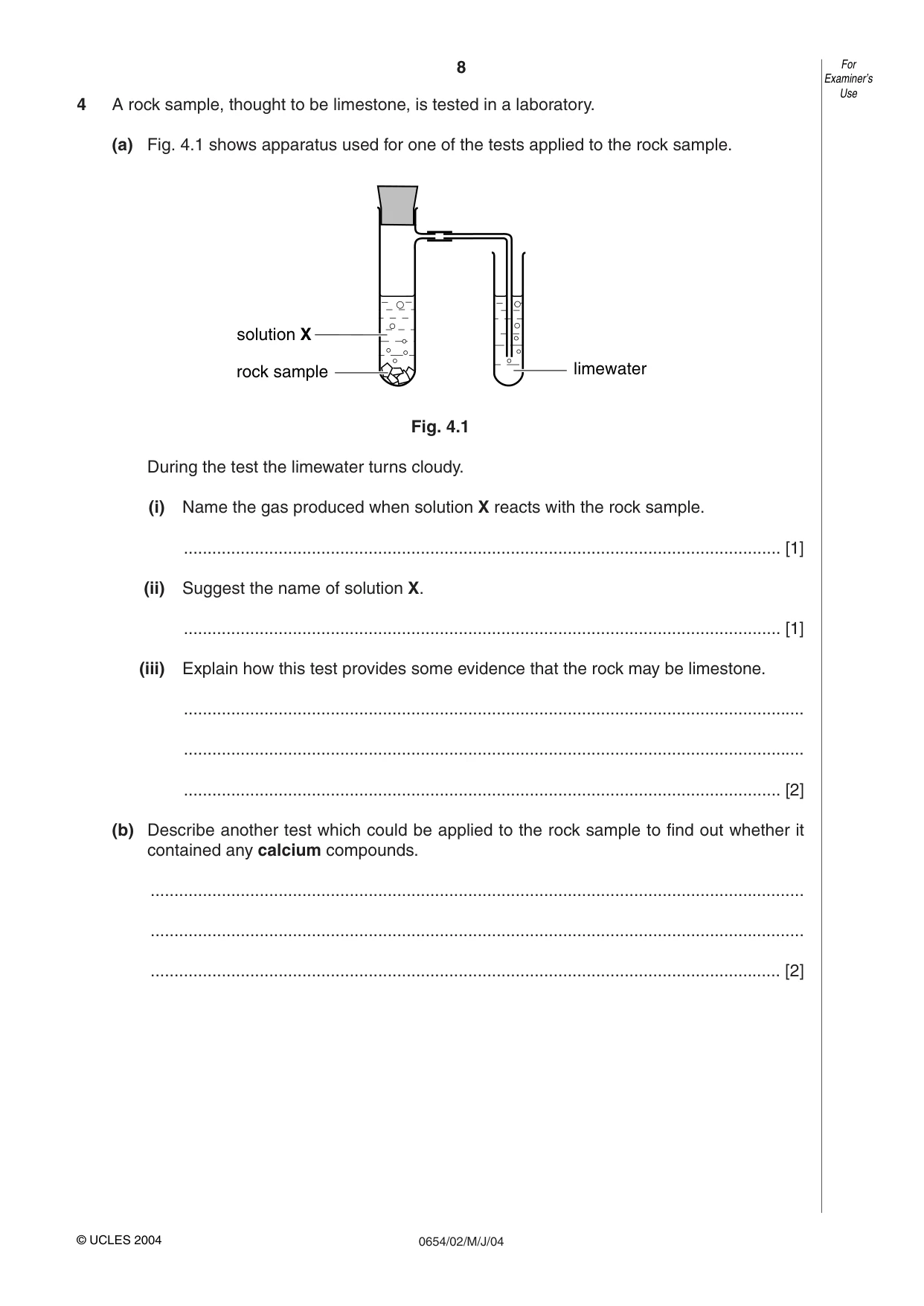
8 0654/02/M/J/04 4 A rock sample, thought to be limestone, is tested in a laboratory. (a) Fig. 4.1 shows apparatus used for one of the tests applied to the rock sample. Fig. 4.1 During the test the limewater turns cloudy. (i) Name the gas produced when solution X reacts with the rock sample. … [1] (ii) Suggest the name of solution X. … [1] (iii) Explain how this test provides some evidence that the rock may be limestone. … … … [2] (b) Describe another test which could be applied to the rock sample to find out whether it contained any calcium compounds. … … … [2] solution X limewater rock sample For Examiner’s Use © UCLES 2004
Question paper, page 9
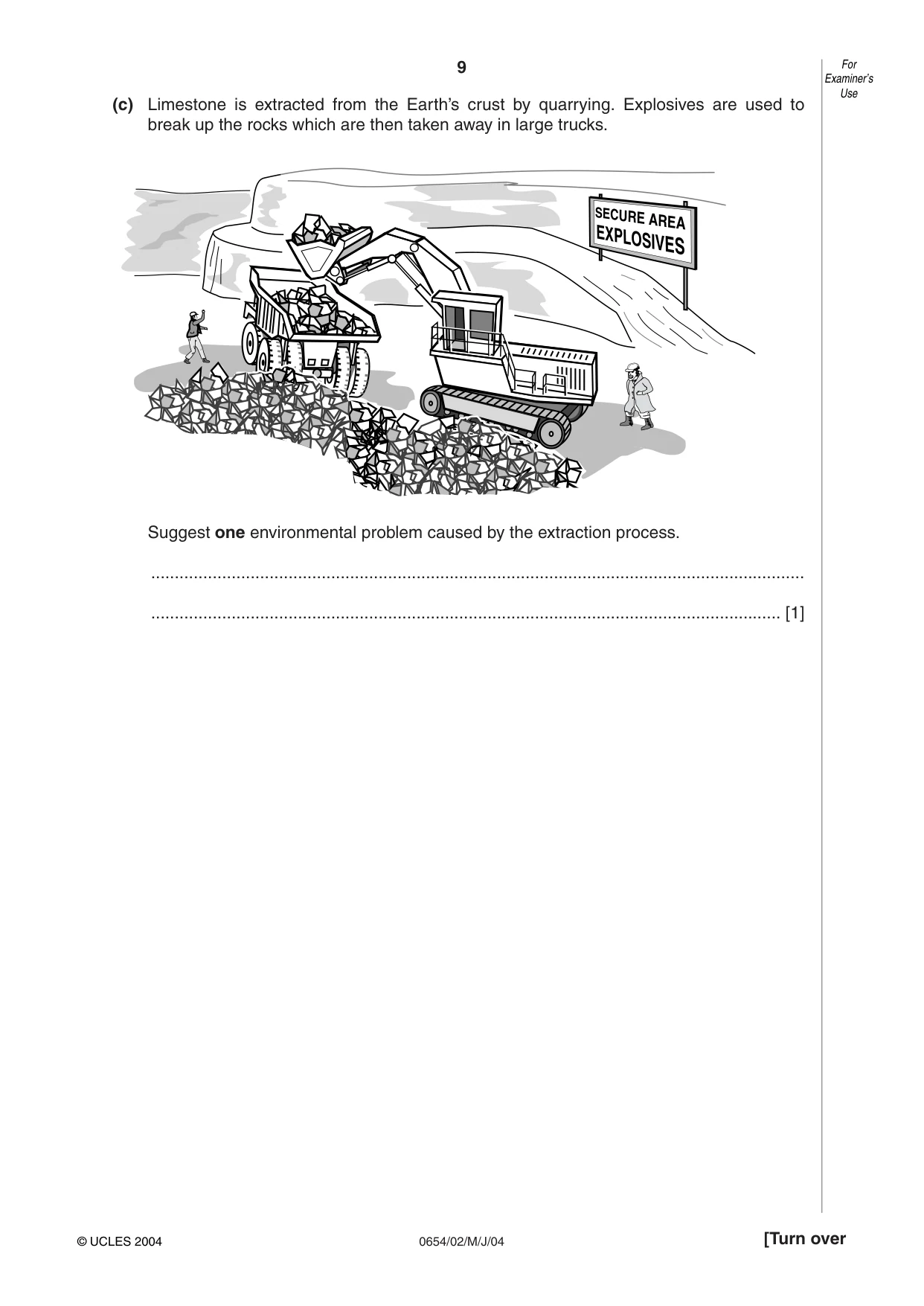
9 0654/02/M/J/04 [Turn over (c) Limestone is extracted from the Earth’s crust by quarrying. Explosives are used to break up the rocks which are then taken away in large trucks. Suggest one environmental problem caused by the extraction process. … … [1] EXPLOSIVES SECURE AREA For Examiner’s Use © UCLES 2004
Question paper, page 10
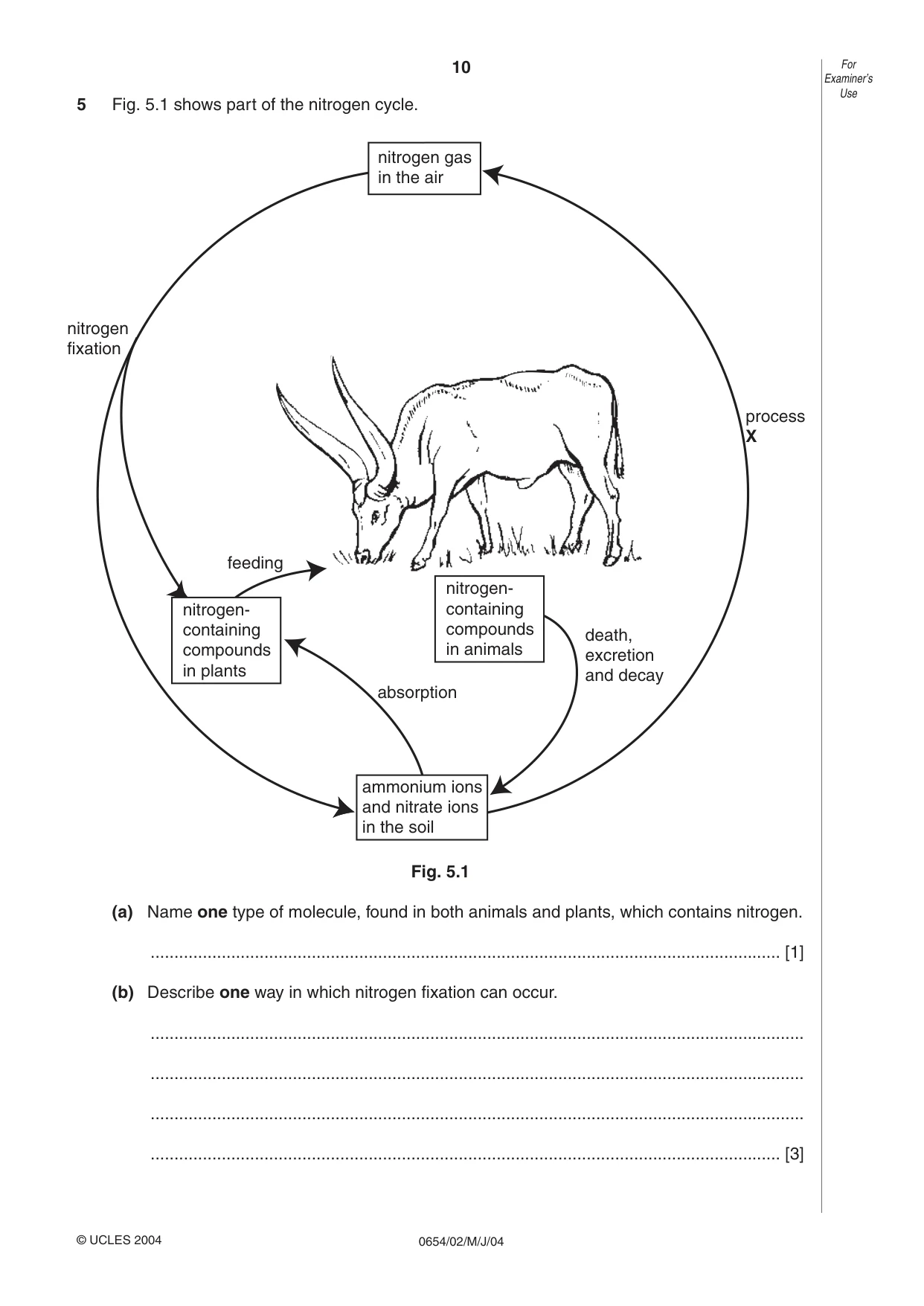
10 0654/02/M/J/04 5 Fig. 5.1 shows part of the nitrogen cycle. Fig. 5.1 (a) Name one type of molecule, found in both animals and plants, which contains nitrogen. … [1] (b) Describe one way in which nitrogen fixation can occur. … … … … [3] For Examiner’s Use © UCLES 2004 nitrogen gas in the air nitrogen fixation nitrogen- containing compounds in animals ammonium ions and nitrate ions in the soil nitrogen- containing compounds in plants feeding absorption death, excretion and decay process X
Question paper, page 11
11 0654/02/M/J/04 [Turn over (c) Name process X. … [1] (d) (i) Describe how plants take up nitrate ions from the soil. … … … [2] (ii) Name the tissue in which these ions are transported within the plant. … [1] For Examiner’s Use © UCLES 2004
Question paper, page 12
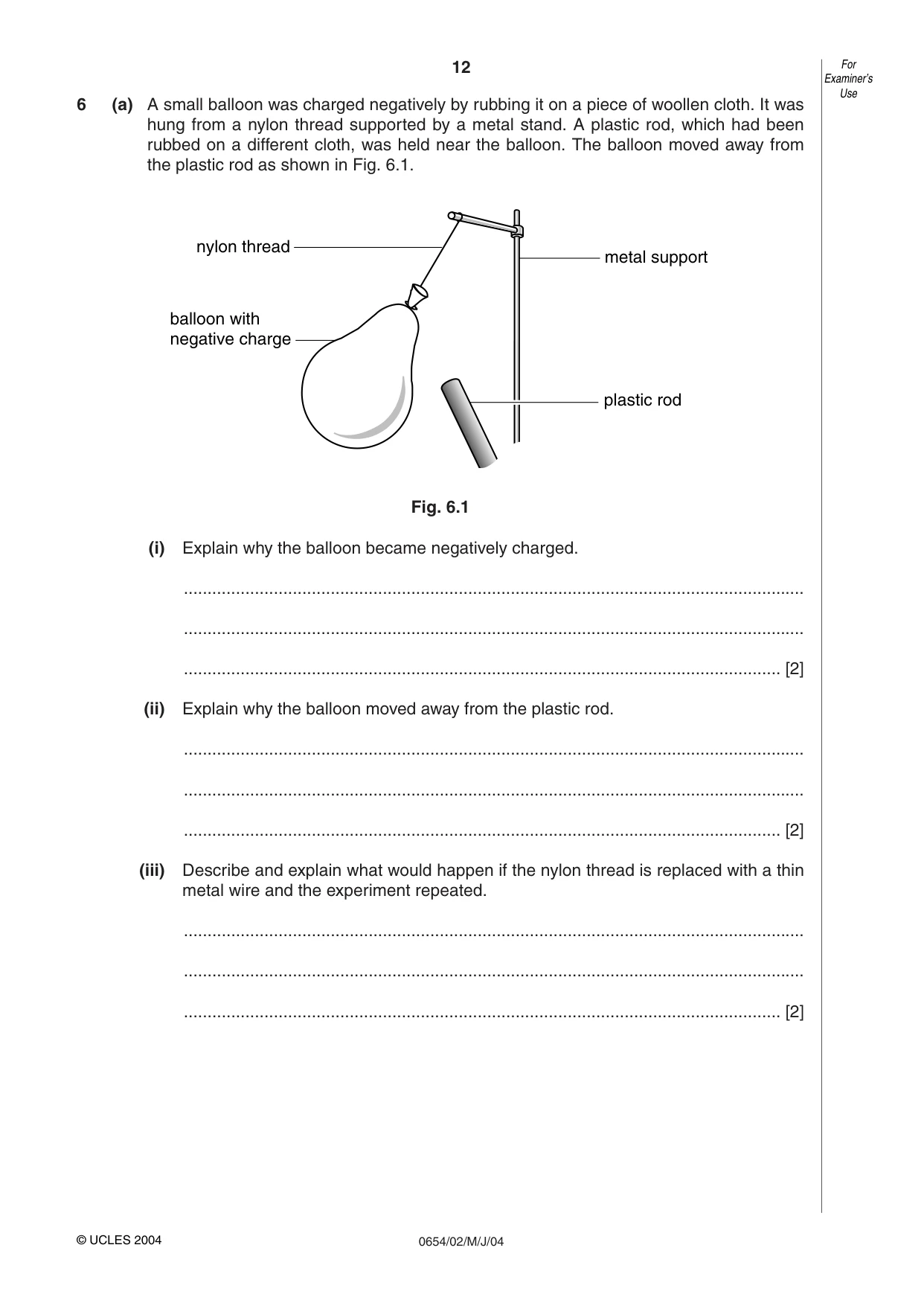
12 0654/02/M/J/04 6 (a) A small balloon was charged negatively by rubbing it on a piece of woollen cloth. It was hung from a nylon thread supported by a metal stand. A plastic rod, which had been rubbed on a different cloth, was held near the balloon. The balloon moved away from the plastic rod as shown in Fig. 6.1. Fig. 6.1 (i) Explain why the balloon became negatively charged. … … … [2] (ii) Explain why the balloon moved away from the plastic rod. … … … [2] (iii) Describe and explain what would happen if the nylon thread is replaced with a thin metal wire and the experiment repeated. … … … [2] balloon with negative charge metal support nylon thread plastic rod For Examiner’s Use © UCLES 2004
Question paper, page 13
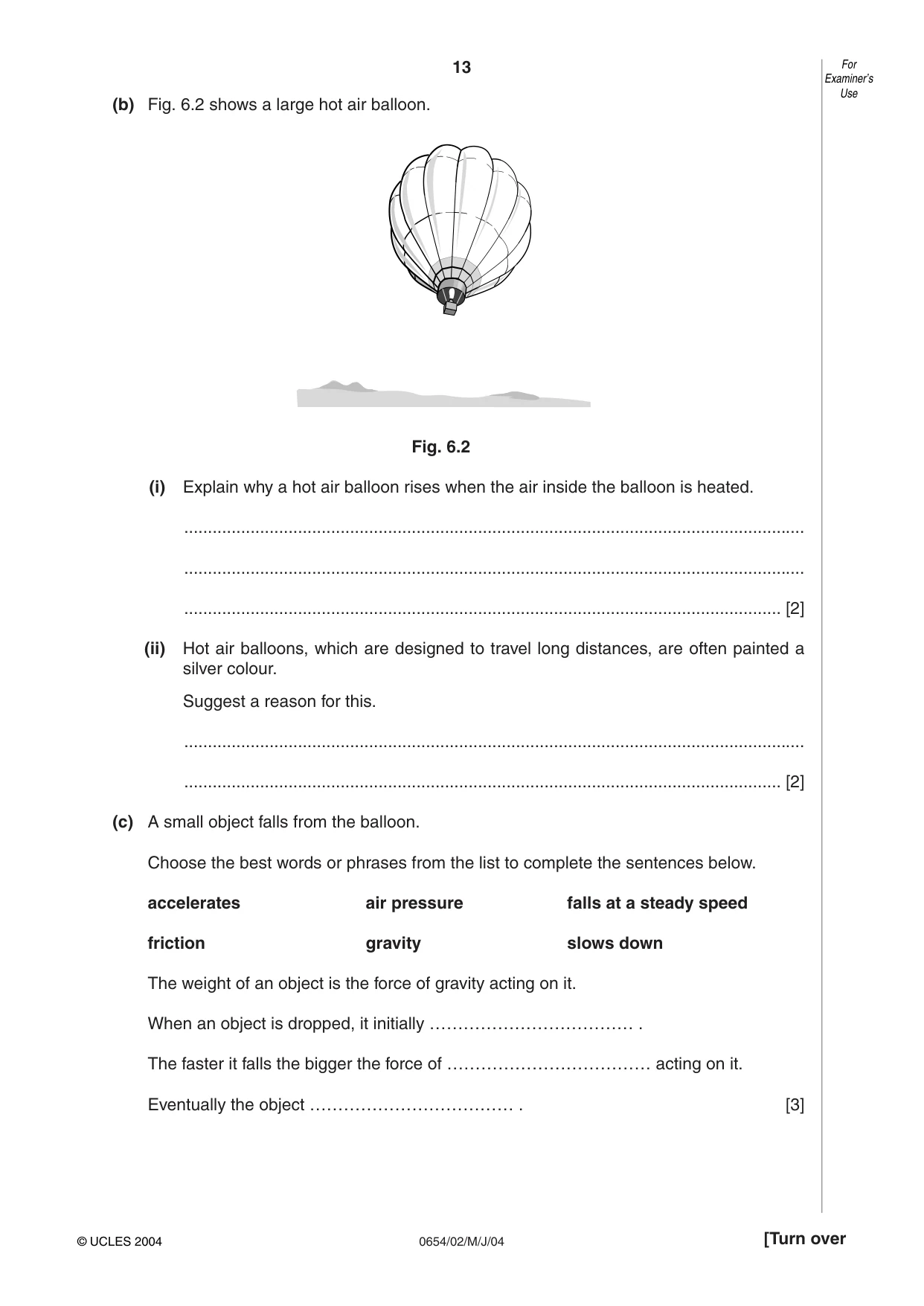
13 0654/02/M/J/04 [Turn over (b) Fig. 6.2 shows a large hot air balloon. Fig. 6.2 (i) Explain why a hot air balloon rises when the air inside the balloon is heated. … … … [2] (ii) Hot air balloons, which are designed to travel long distances, are often painted a silver colour. Suggest a reason for this. … … [2] (c) A small object falls from the balloon. Choose the best words or phrases from the list to complete the sentences below. accelerates air pressure falls at a steady speed friction gravity slows down The weight of an object is the force of gravity acting on it. When an object is dropped, it initially ……………………………… . The faster it falls the bigger the force of ……………………………… acting on it. Eventually the object ……………………………… . [3] For Examiner’s Use © UCLES 2004
Question paper, page 14
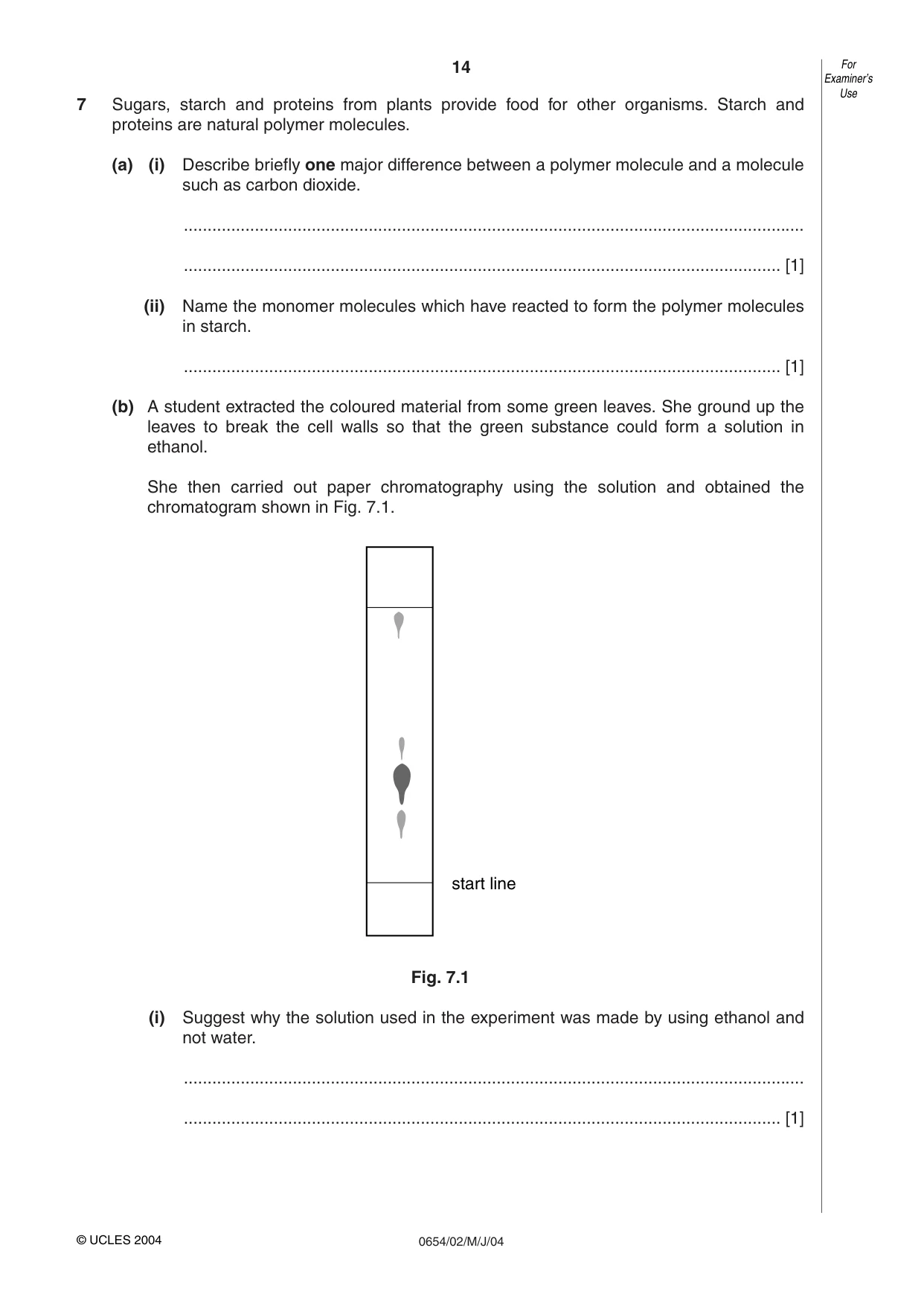
14 0654/02/M/J/04 7 Sugars, starch and proteins from plants provide food for other organisms. Starch and proteins are natural polymer molecules. (a) (i) Describe briefly one major difference between a polymer molecule and a molecule such as carbon dioxide. … … [1] (ii) Name the monomer molecules which have reacted to form the polymer molecules in starch. … [1] (b) A student extracted the coloured material from some green leaves. She ground up the leaves to break the cell walls so that the green substance could form a solution in ethanol. She then carried out paper chromatography using the solution and obtained the chromatogram shown in Fig. 7.1. Fig. 7.1 (i) Suggest why the solution used in the experiment was made by using ethanol and not water. … … [1] start line For Examiner’s Use © UCLES 2004
Question paper, page 15
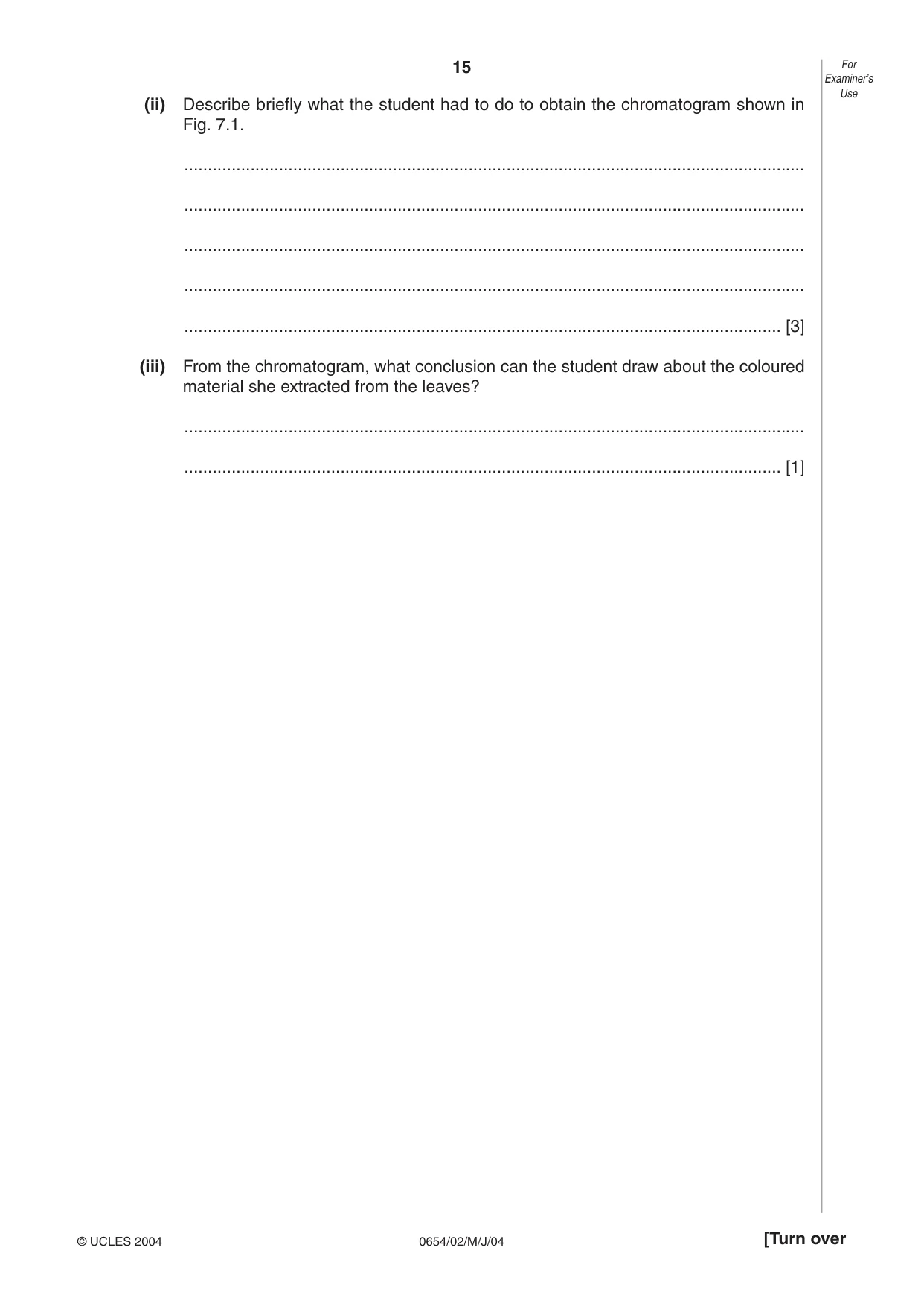
15 0654/02/M/J/04 [Turn over (ii) Describe briefly what the student had to do to obtain the chromatogram shown in Fig. 7.1. … … … … … [3] (iii) From the chromatogram, what conclusion can the student draw about the coloured material she extracted from the leaves? … … [1] For Examiner’s Use © UCLES 2004
Question paper, page 16
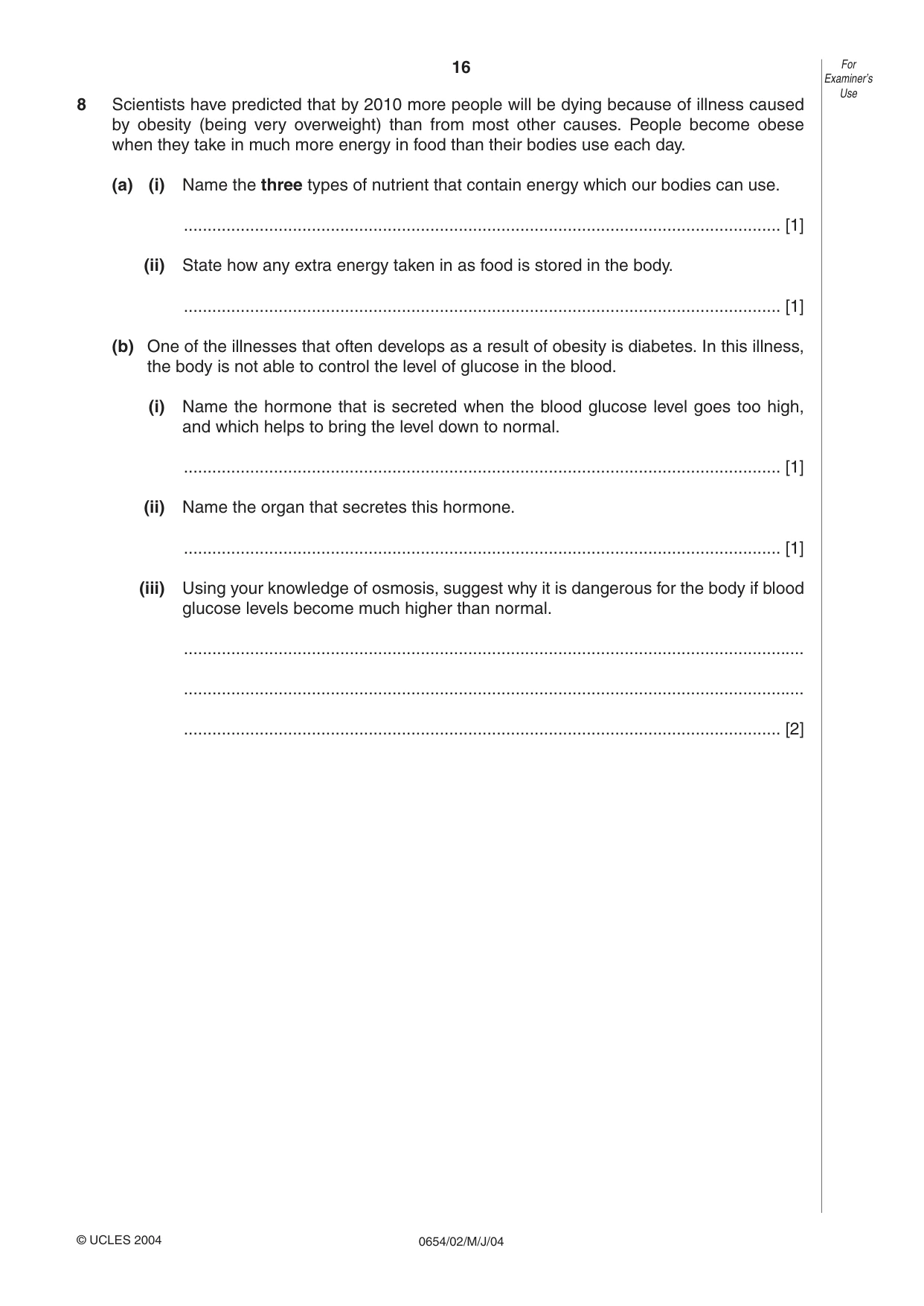
16 0654/02/M/J/04 8 Scientists have predicted that by 2010 more people will be dying because of illness caused by obesity (being very overweight) than from most other causes. People become obese when they take in much more energy in food than their bodies use each day. (a) (i) Name the three types of nutrient that contain energy which our bodies can use. … [1] (ii) State how any extra energy taken in as food is stored in the body. … [1] (b) One of the illnesses that often develops as a result of obesity is diabetes. In this illness, the body is not able to control the level of glucose in the blood. (i) Name the hormone that is secreted when the blood glucose level goes too high, and which helps to bring the level down to normal. … [1] (ii) Name the organ that secretes this hormone. … [1] (iii) Using your knowledge of osmosis, suggest why it is dangerous for the body if blood glucose levels become much higher than normal. … … … [2] For Examiner’s Use © UCLES 2004
Question paper, page 17
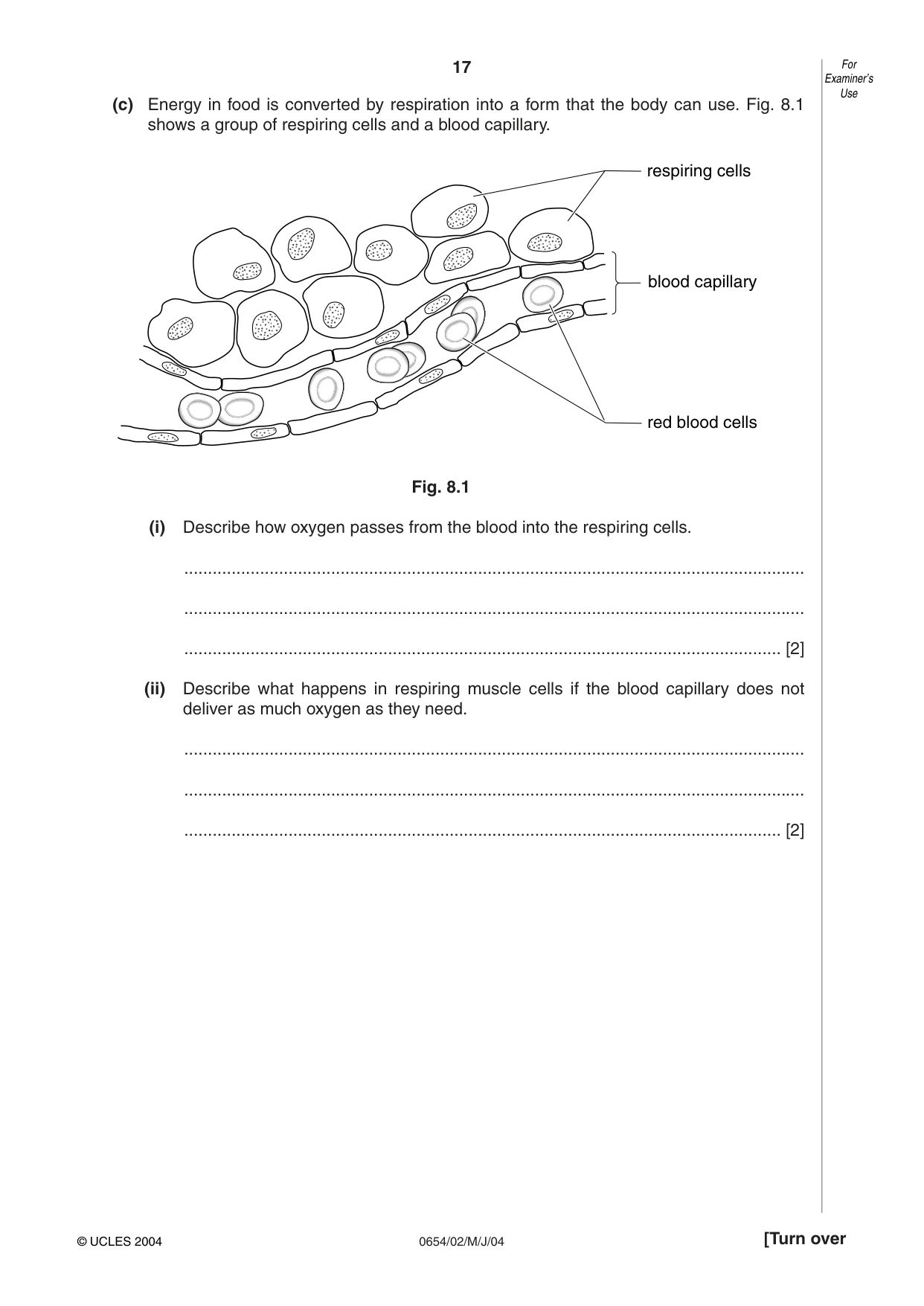
17 0654/02/M/J/04 [Turn over (c) Energy in food is converted by respiration into a form that the body can use. Fig. 8.1 shows a group of respiring cells and a blood capillary. Fig. 8.1 (i) Describe how oxygen passes from the blood into the respiring cells. … … … [2] (ii) Describe what happens in respiring muscle cells if the blood capillary does not deliver as much oxygen as they need. … … … [2] respiring cells red blood cells blood capillary For Examiner’s Use © UCLES 2004
Question paper, page 18
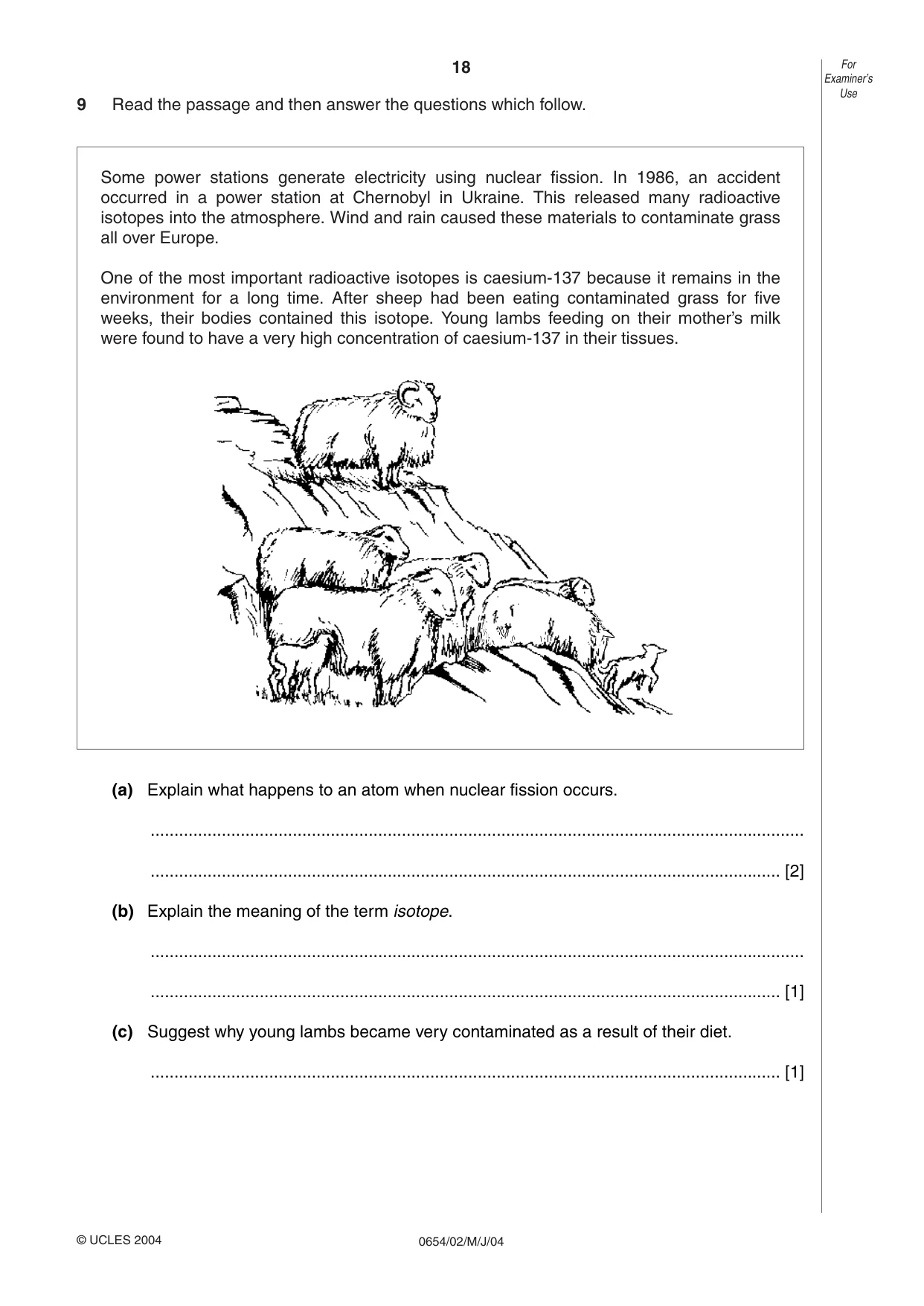
18 0654/02/M/J/04 For Examiner’s Use © UCLES 2004 9 Read the passage and then answer the questions which follow. Some power stations generate electricity using nuclear fission. In 1986, an accident occurred in a power station at Chernobyl in Ukraine. This released many radioactive isotopes into the atmosphere. Wind and rain caused these materials to contaminate grass all over Europe. One of the most important radioactive isotopes is caesium-137 because it remains in the environment for a long time. After sheep had been eating contaminated grass for five weeks, their bodies contained this isotope. Young lambs feeding on their mother’s milk were found to have a very high concentration of caesium-137 in their tissues. (a) Explain what happens to an atom when nuclear fission occurs. … … [2] (b) Explain the meaning of the term isotope. … … [1] (c) Suggest why young lambs became very contaminated as a result of their diet. … [1]
Question paper, page 19
19 0654/02/M/J/04 [Turn over (d) A scientist suggested that it was safer to walk on the radioactive grass than to eat meat from a sheep a few weeks after the accident. Explain why this was correct. … … … [2] (e) The accident increased the background radiation present in the environment. Give one natural cause of background radiation. … [1] (f) State one advantage of nuclear power as a method of generating electricity compared to the burning of fossil fuels. … … [1] For Examiner’s Use © UCLES 2004
Question paper, page 20
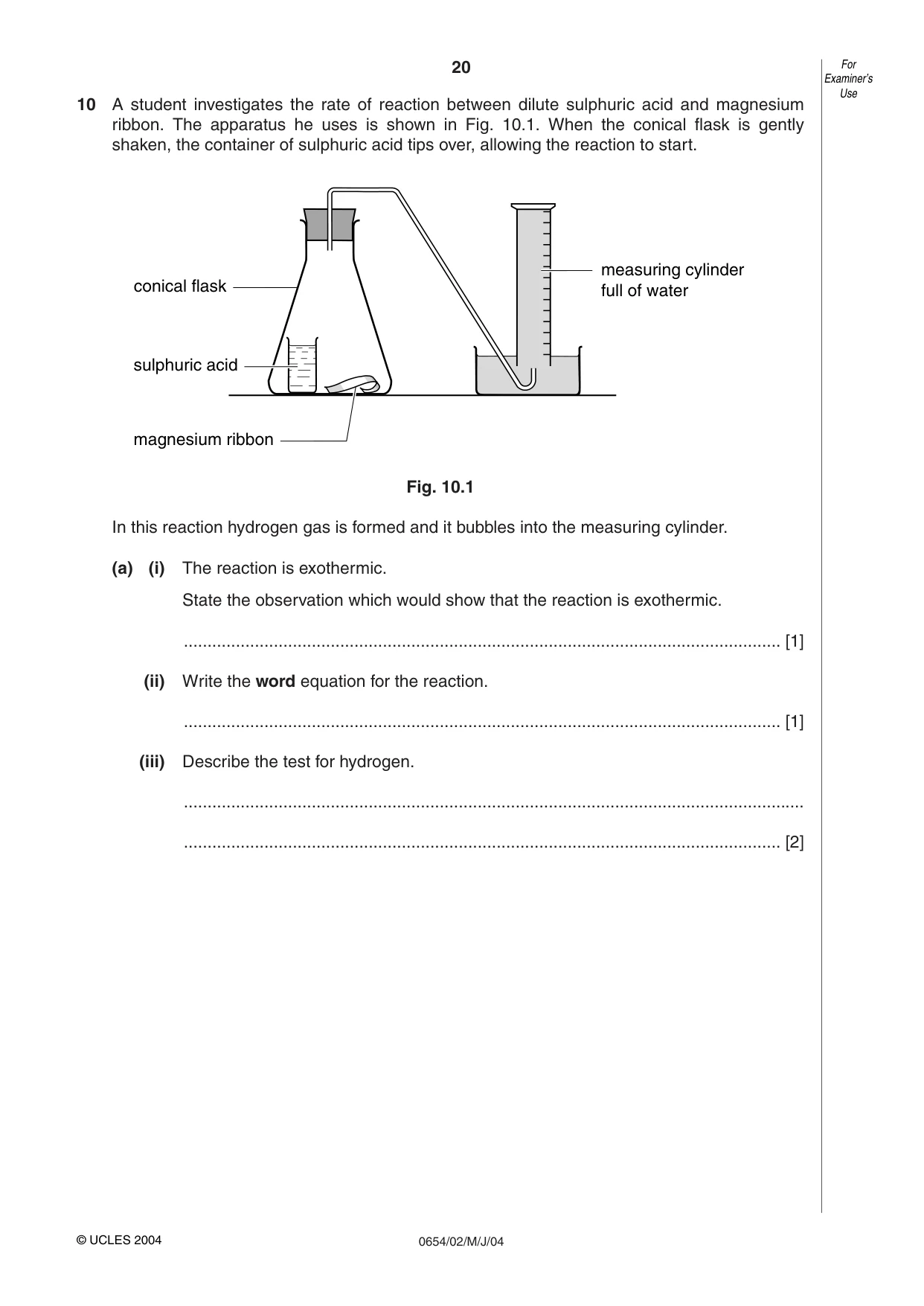
20 0654/02/M/J/04 10 A student investigates the rate of reaction between dilute sulphuric acid and magnesium ribbon. The apparatus he uses is shown in Fig. 10.1. When the conical flask is gently shaken, the container of sulphuric acid tips over, allowing the reaction to start. Fig. 10.1 In this reaction hydrogen gas is formed and it bubbles into the measuring cylinder. (a) (i) The reaction is exothermic. State the observation which would show that the reaction is exothermic. … [1] (ii) Write the word equation for the reaction. … [1] (iii) Describe the test for hydrogen. … … [2] sulphuric acid conical flask magnesium ribbon measuring cylinder full of water For Examiner’s Use © UCLES 2004
Question paper, page 21
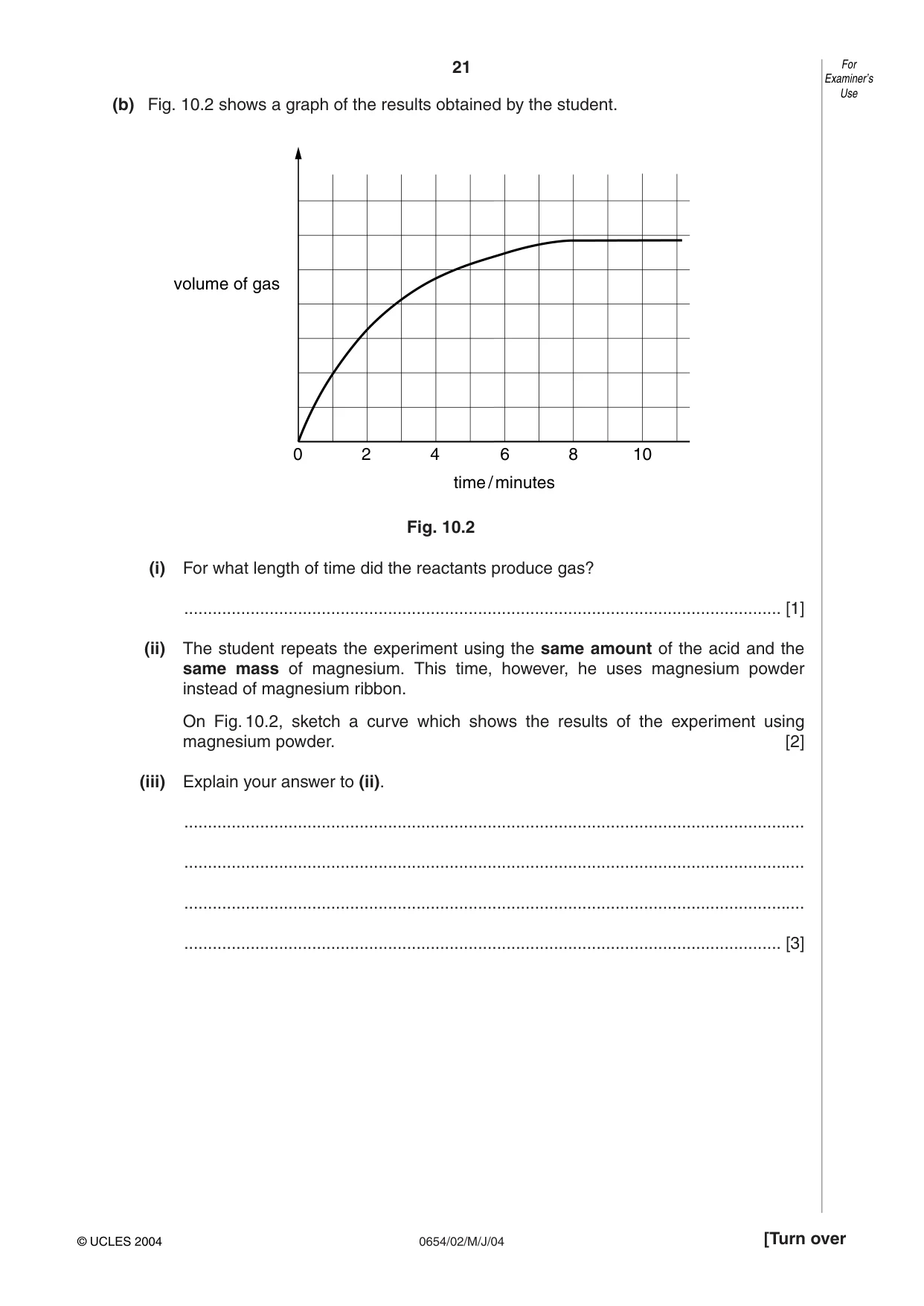
21 0654/02/M/J/04 [Turn over (b) Fig. 10.2 shows a graph of the results obtained by the student. Fig. 10.2 (i) For what length of time did the reactants produce gas? … [1] (ii) The student repeats the experiment using the same amount of the acid and the same mass of magnesium. This time, however, he uses magnesium powder instead of magnesium ribbon. On Fig. 10.2, sketch a curve which shows the results of the experiment using magnesium powder. [2] (iii) Explain your answer to (ii). … … … … [3] volume of gas 0 2 4 6 8 10 time/minutes For Examiner’s Use © UCLES 2004
Question paper, page 22
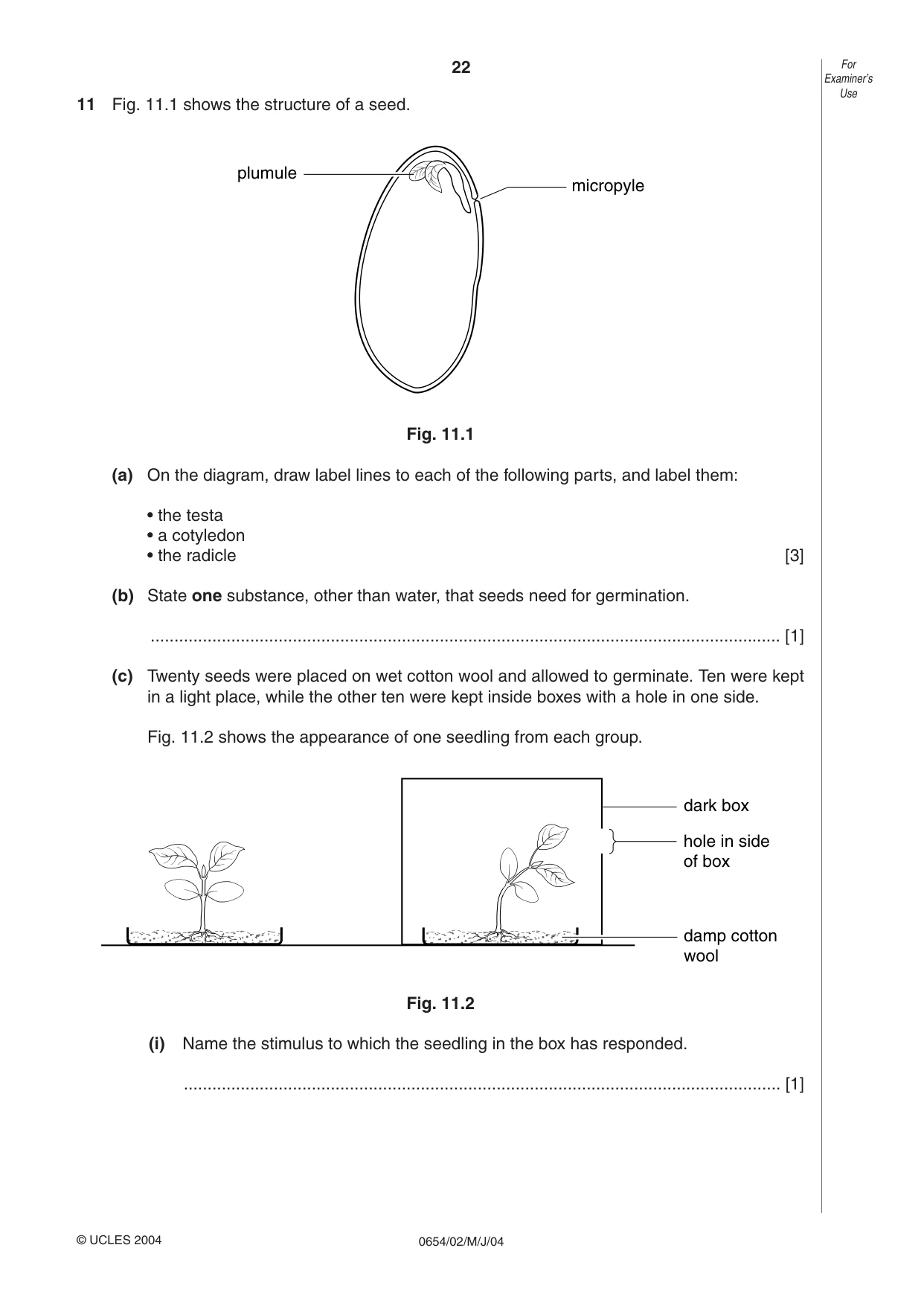
22 0654/02/M/J/04 For Examiner’s Use © UCLES 2004 11 Fig. 11.1 shows the structure of a seed. Fig. 11.1 (a) On the diagram, draw label lines to each of the following parts, and label them: • the testa • a cotyledon • the radicle [3] (b) State one substance, other than water, that seeds need for germination. … [1] (c) Twenty seeds were placed on wet cotton wool and allowed to germinate. Ten were kept in a light place, while the other ten were kept inside boxes with a hole in one side. Fig. 11.2 shows the appearance of one seedling from each group. Fig. 11.2 (i) Name the stimulus to which the seedling in the box has responded. … [1] dark box hole in side of box damp cotton wool plumule micropyle
Question paper, page 23
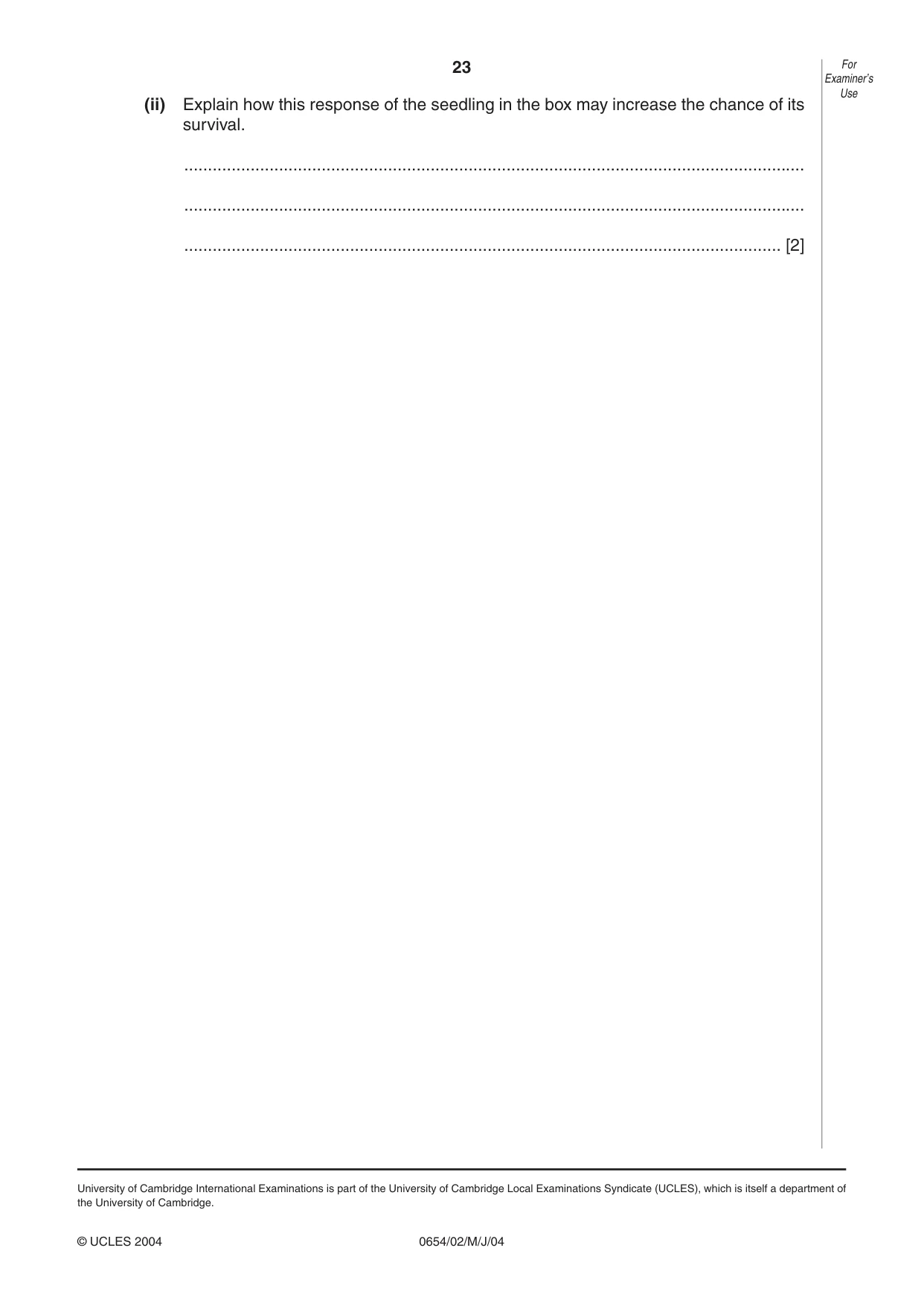
23 0654/02/M/J/04 (ii) Explain how this response of the seedling in the box may increase the chance of its survival. … … … [2] For Examiner’s Use © UCLES 2004 University of Cambridge International Examinations is part of the University of Cambridge Local Examinations Syndicate (UCLES), which is itself a department of the University of Cambridge.
Question paper, page 24
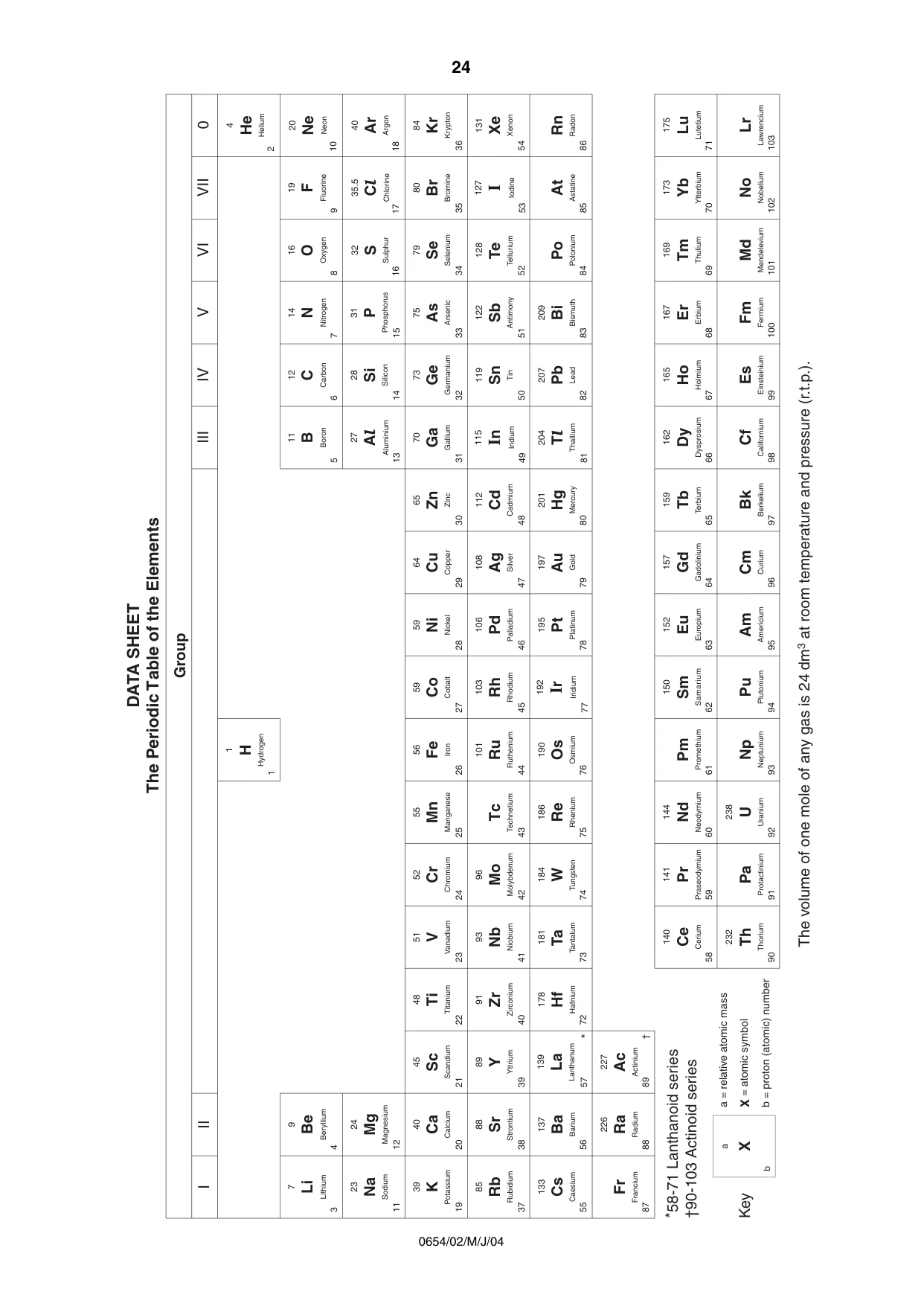
24 0654/02/M/J/04 Group DATA SHEET The Periodic Table of the Elements 140 Ce Cerium 58 141 Pr Praseodymium 59 144 Nd Neodymium 60 Pm Promethium 61 150 Sm Samarium 62 152 Eu Europium 63 157 Gd Gadolinium 64 159 Tb Terbium 65 162 Dy Dysprosium 66 165 Ho Holmium 67 167 Er Erbium 68 169 Tm Thulium 69 173 Yb Ytterbium 70 175 Lu Lutetium 71 232 Th Thorium 90 Pa Protactinium 91 238 U Uranium 92 Np Neptunium 93 Pu Plutonium 94 Am Americium 95 Cm Curium 96 Bk Berkelium 97 Cf Californium 98 Es Einsteinium 99 Fm Fermium 100 Md Mendelevium 101 No Nobelium 102 Lr Lawrencium 103 1 H Hydrogen 1 7 Li Lithium 3 23 Na Sodium 11 24 Mg Magnesium 12 40 Ca Calcium 20 45 Sc Scandium 21 48 Ti Titanium 22 51 V Vanadium 23 52 Cr Chromium 24 55 Mn Manganese 25 56 Fe Iron 26 59 Co Cobalt 27 59 Ni Nickel 28 64 Cu Copper 29 65 Zn Zinc 30 70 Ga Gallium 31 27 Al Aluminium 13 11 B Boron 5 12 C Carbon 6 14 N Nitrogen 7 16 O Oxygen 8 19 F Fluorine 9 28 Si Silicon 14 31 P Phosphorus 15 32 S Sulphur 16 35.5 Cl Chlorine 17 40 Ar Argon 18 20 Ne Neon 10 4 He Helium 2 73 Ge Germanium 32 75 As Arsenic 33 79 Se Selenium 34 80 Br Bromine 35 84 Kr Krypton 36 39 K Potassium 19 88 Sr Strontium 38 89 Y Yttrium 39 91 Zr Zirconium 40 93 Nb Niobium 41 96 Mo Molybdenum 42 Tc Technetium 43 101 Ru Ruthenium 44 103 Rh Rhodium 45 106 Pd Palladium 46 108 Ag Silver 47 112 Cd Cadmium 48 115 In Indium 49 119 Sn Tin 50 122 Sb Antimony 51 128 Te Tellurium 52 127 I Iodine 53 131 Xe Xenon 54 137 Ba Barium 56 139 La Lanthanum 57 * 178 Hf Hafnium 72 181 Ta Tantalum 73 184 W Tungsten 74 186 Re Rhenium 75 190 Os Osmium 76 192 Ir Iridium 77 195 Pt Platinum 78 197 Au Gold 79 201 Hg Mercury 80 204 Tl Thallium 81 207 Pb Lead 82 209 Bi Bismuth 83 Po Polonium 84 At Astatine 85 Rn Radon 86 Fr Francium 87 227 Ac Actinium 89 † 9 Be Beryllium 4 I II III IV V VI VII 0 85 Rb Rubidium 37 133 Cs Caesium 55 226 Ra Radium 88 The volume of one mole of any gas is 24 dm3 at room temperature and pressure (r.t.p.). a X b a = relative atomic mass X = atomic symbol b = proton (atomic) number Key *58-71 Lanthanoid series †90-103 Actinoid series