Cambridge IGCSE Sciences - Co-ordinated (Double) 0654 — 2002 Oct/Nov Paper 2 · Variant 1
0654/21/O/N/02
The question paper and its mark scheme, free to read here and free to download. This is Cambridge’s own paper, exactly as it was sat.
Question paper20 pages


Mark scheme6 pages
Answers below. Sit the paper first if you are practising.
Paper as text
Question paper, page 1
TIME 2 hours INSTRUCTIONS TO CANDIDATES Write your name, Centre number and candidate number in the spaces at the top of this page. Answer all questions. Write your answers in the spaces provided on the question paper. INFORMATION FOR CANDIDATES The number of marks is given in brackets [ ] at the end of each question or part question. A copy of the Periodic Table is printed on page 20. International General Certificate of Secondary Education CAMBRIDGE INTERNATIONAL EXAMINATIONS CO-ORDINATED SCIENCES 0654/2 PAPER 2 OCTOBER/NOVEMBER SESSION 2002 2 hours Candidates answer on the question paper. No additional materials are required. This question paper consists of 18 printed pages and 2 blank pages. SP (SM/KN) S28600/2 © CIE 2002 [Turn over Candidate Centre Number Number Candidate Name FOR EXAMINER’S USE 3 2 1 4 10 11 12 TOTAL 6 7 8 9 5 www.XtremePapers.com
Question paper, page 2
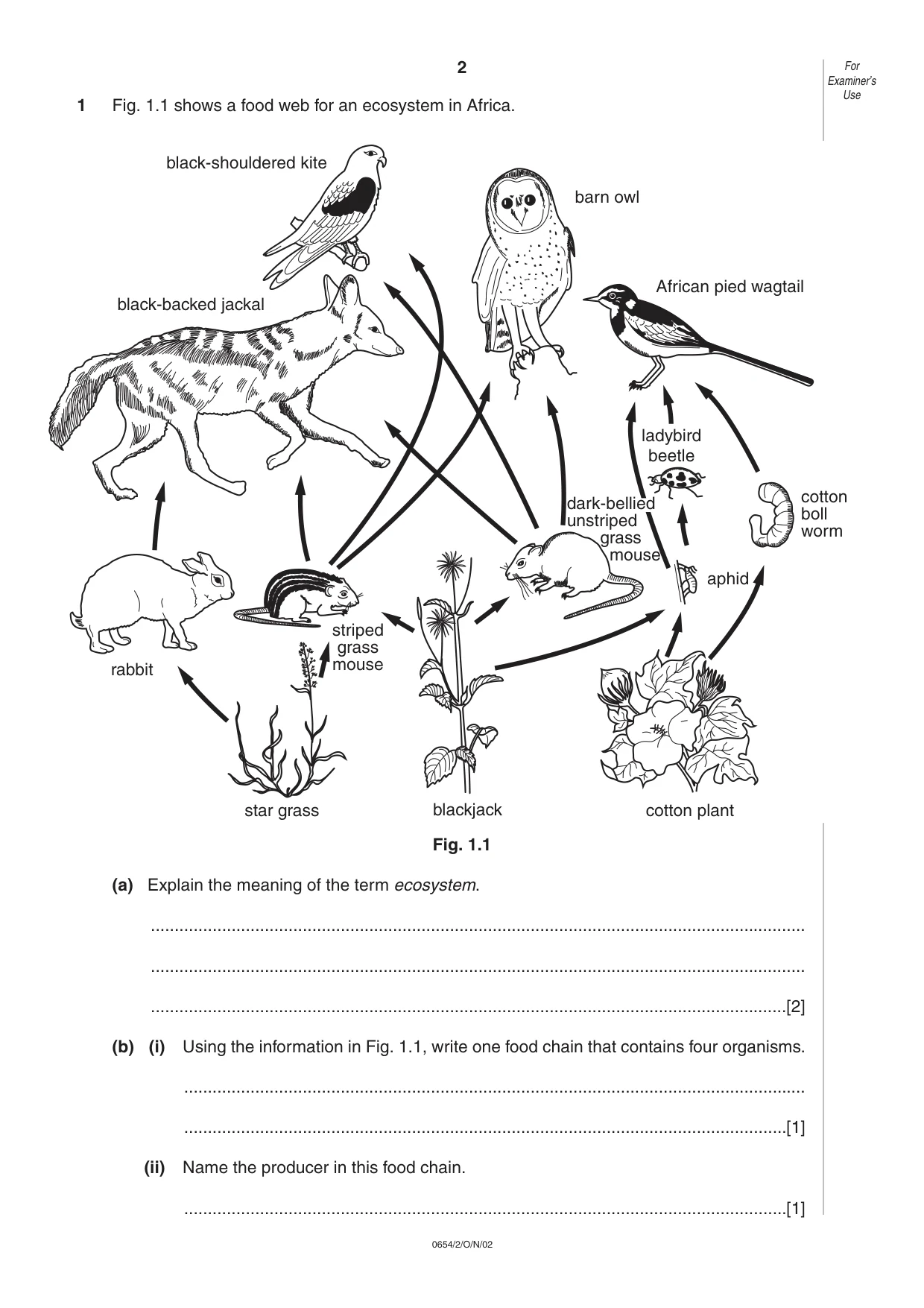
2 0654/2/O/N/02 1 Fig. 1.1 shows a food web for an ecosystem in Africa. Fig. 1.1 (a) Explain the meaning of the term ecosystem. … … …[2] (b) (i) Using the information in Fig. 1.1, write one food chain that contains four organisms. … …[1] (ii) Name the producer in this food chain. …[1] For Examiner’s Use black-shouldered kite black-backed jackal barn owl African pied wagtail ladybird beetle cotton boll worm aphid cotton plant blackjack striped grass mouse rabbit star grass dark-bellied unstriped grass mouse
Question paper, page 3
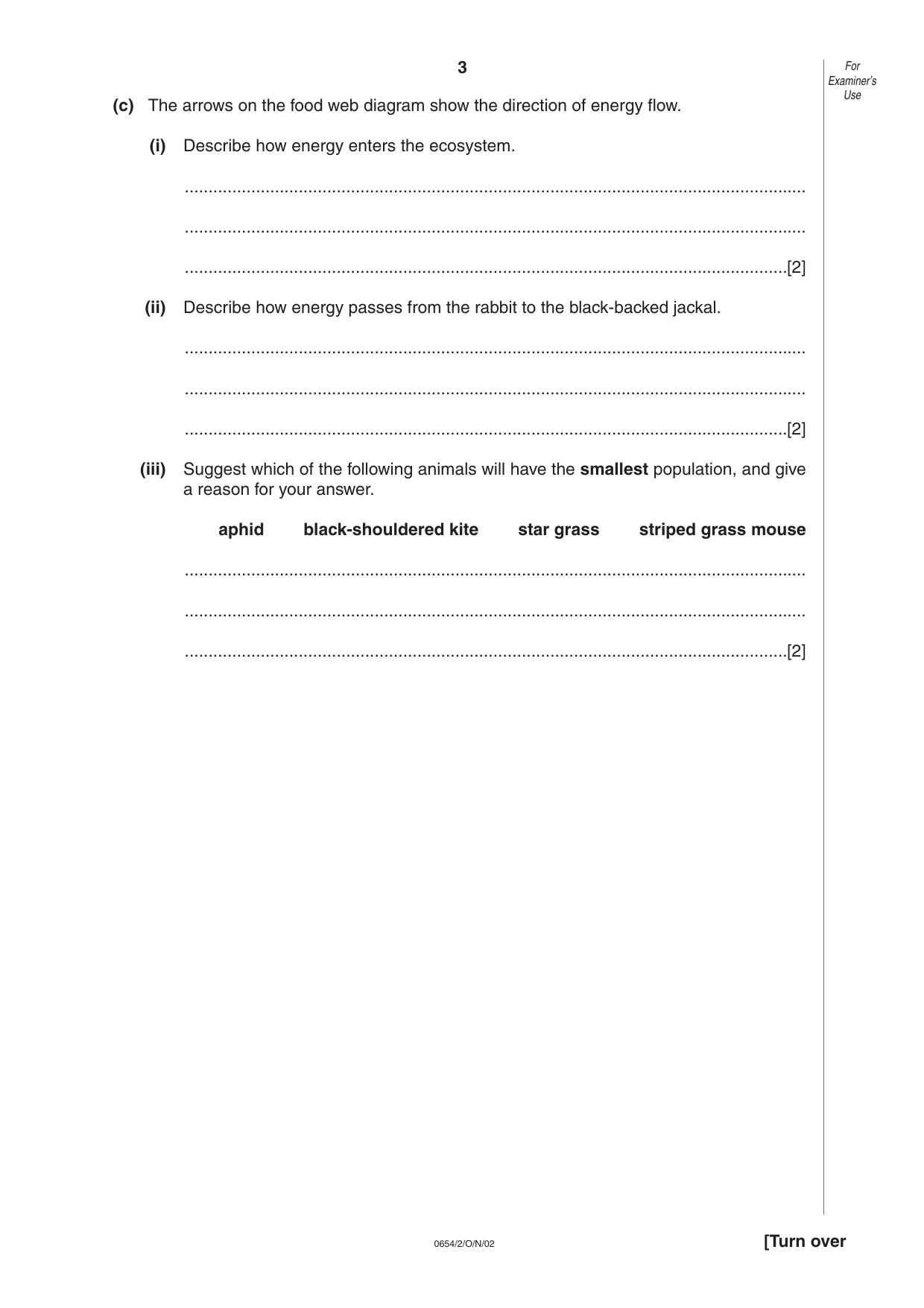
3 0654/2/O/N/02 [Turn over (c) The arrows on the food web diagram show the direction of energy flow. (i) Describe how energy enters the ecosystem. … … …[2] (ii) Describe how energy passes from the rabbit to the black-backed jackal. … … …[2] (iii) Suggest which of the following animals will have the smallest population, and give a reason for your answer. aphid black-shouldered kite star grass striped grass mouse … … …[2] For Examiner’s Use
Question paper, page 4
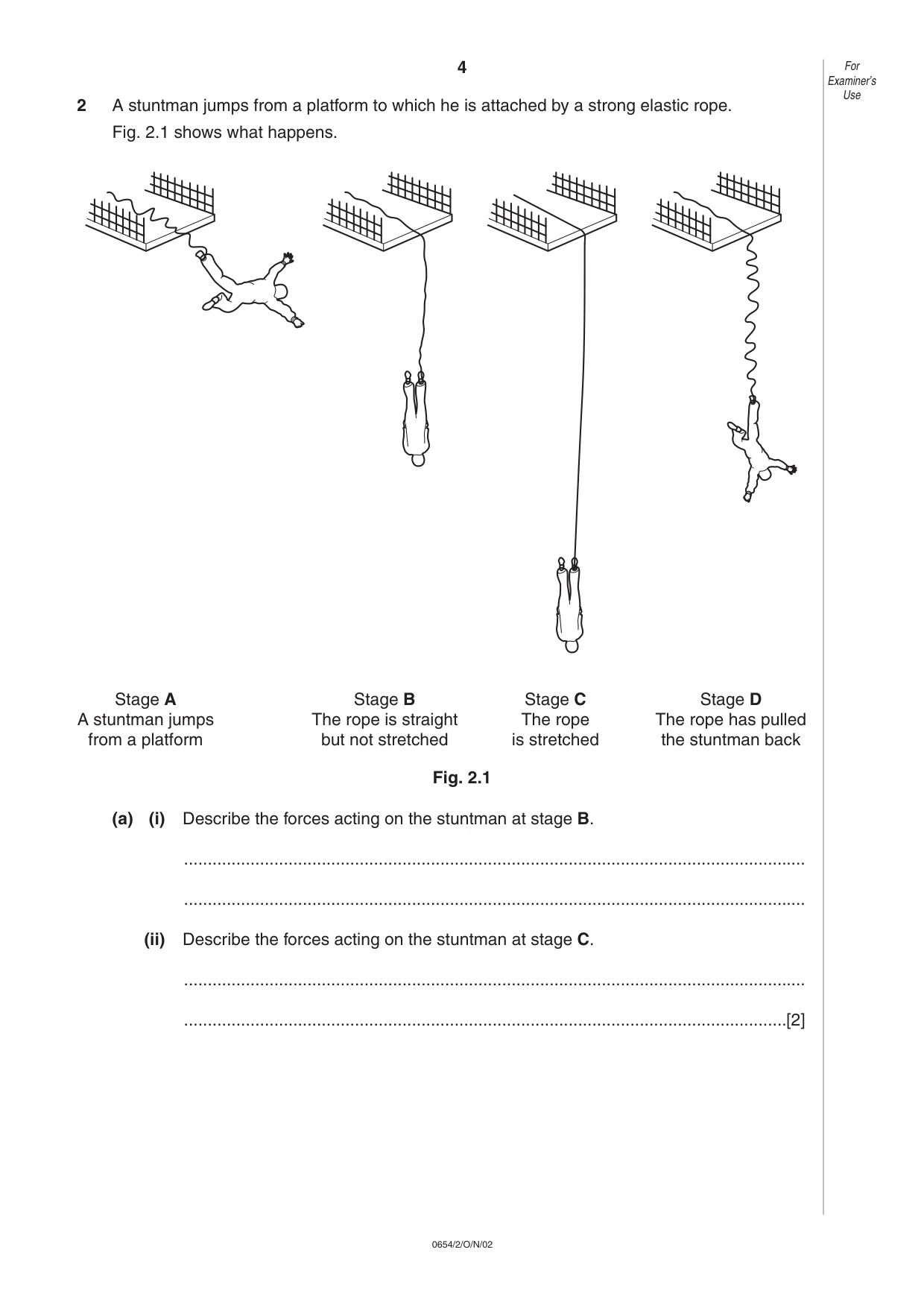
4 0654/2/O/N/02 2 A stuntman jumps from a platform to which he is attached by a strong elastic rope. Fig. 2.1 shows what happens. Fig. 2.1 (a) (i) Describe the forces acting on the stuntman at stage B. … … (ii) Describe the forces acting on the stuntman at stage C. … …[2] For Examiner’s Use Stage A A stuntman jumps from a platform Stage B The rope is straight but not stretched Stage C The rope is stretched Stage D The rope has pulled the stuntman back
Question paper, page 5
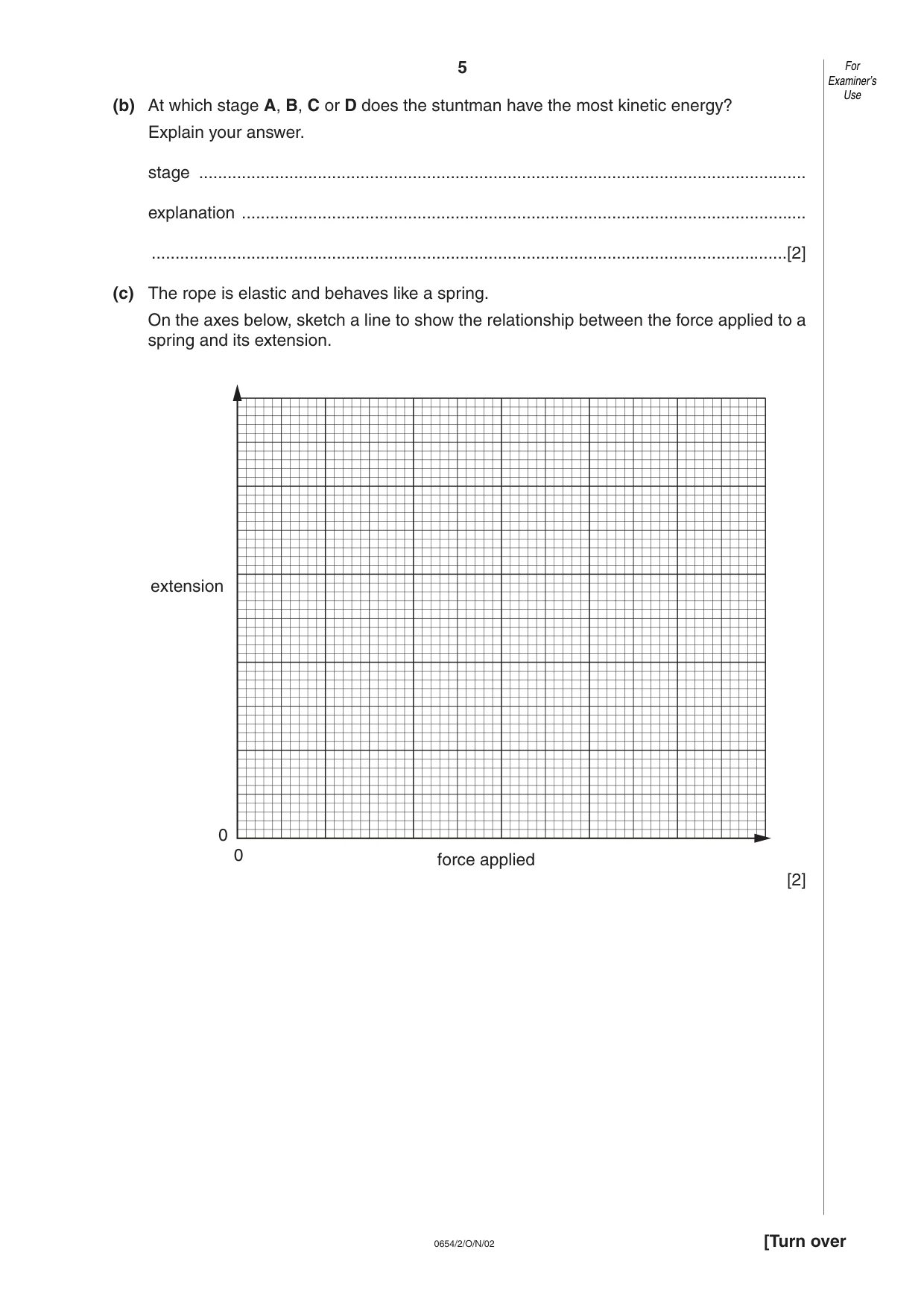
5 0654/2/O/N/02 [Turn over (b) At which stage A, B, C or D does the stuntman have the most kinetic energy? Explain your answer. stage … explanation … …[2] (c) The rope is elastic and behaves like a spring. On the axes below, sketch a line to show the relationship between the force applied to a spring and its extension. [2] extension force applied 0 0 For Examiner’s Use
Question paper, page 6
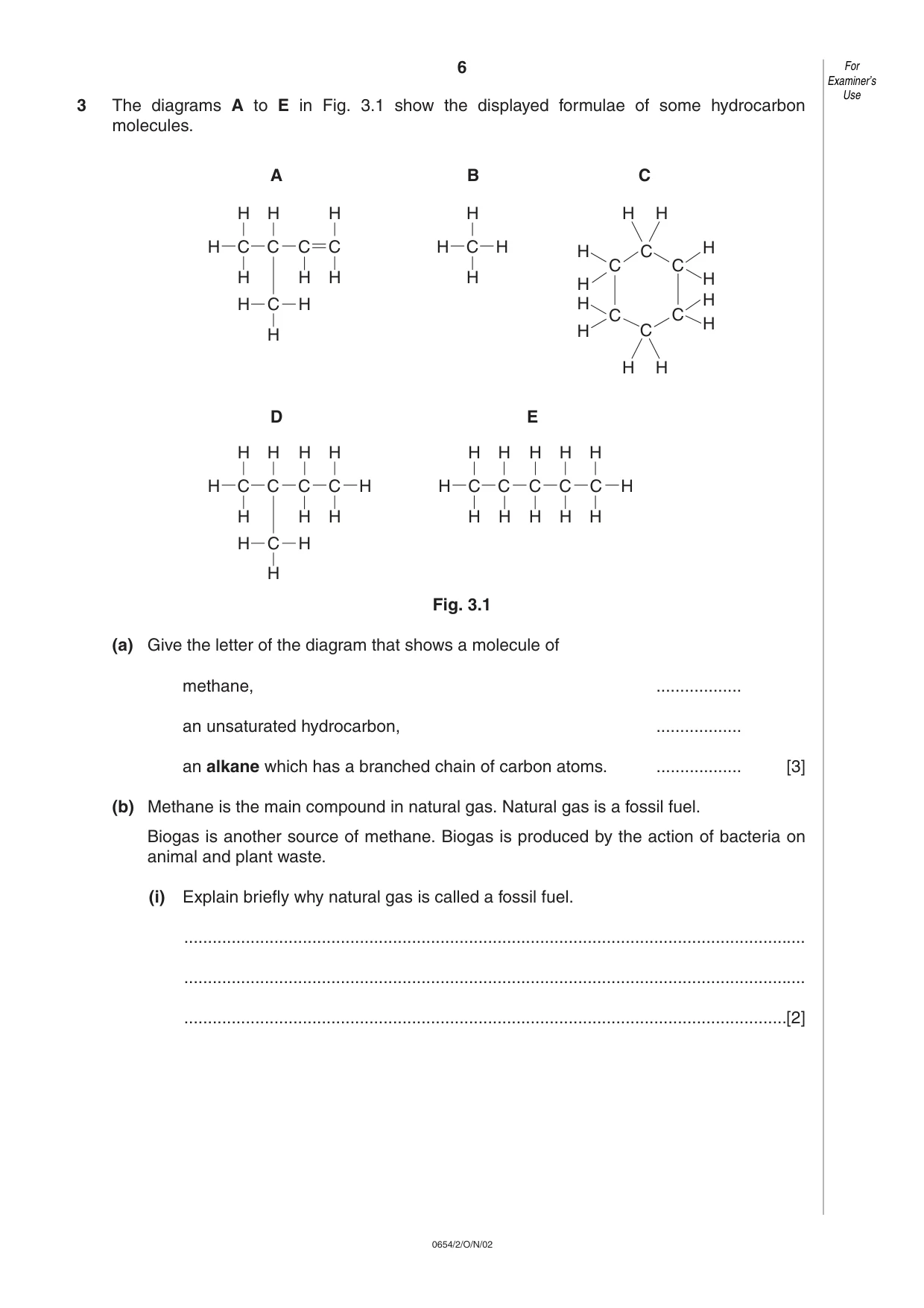
6 0654/2/O/N/02 3 The diagrams A to E in Fig. 3.1 show the displayed formulae of some hydrocarbon molecules. Fig. 3.1 (a) Give the letter of the diagram that shows a molecule of methane, … an unsaturated hydrocarbon, … an alkane which has a branched chain of carbon atoms. … [3] (b) Methane is the main compound in natural gas. Natural gas is a fossil fuel. Biogas is another source of methane. Biogas is produced by the action of bacteria on animal and plant waste. (i) Explain briefly why natural gas is called a fossil fuel. … … …[2] H H H C C C C H C H H H H C H H H H H H H H H C C C C H H H C H H H H H H C C C C H C H H H H H H H H H H H C C H H H H H H H H H H H C C C C H A B D E C For Examiner’s Use
Question paper, page 7
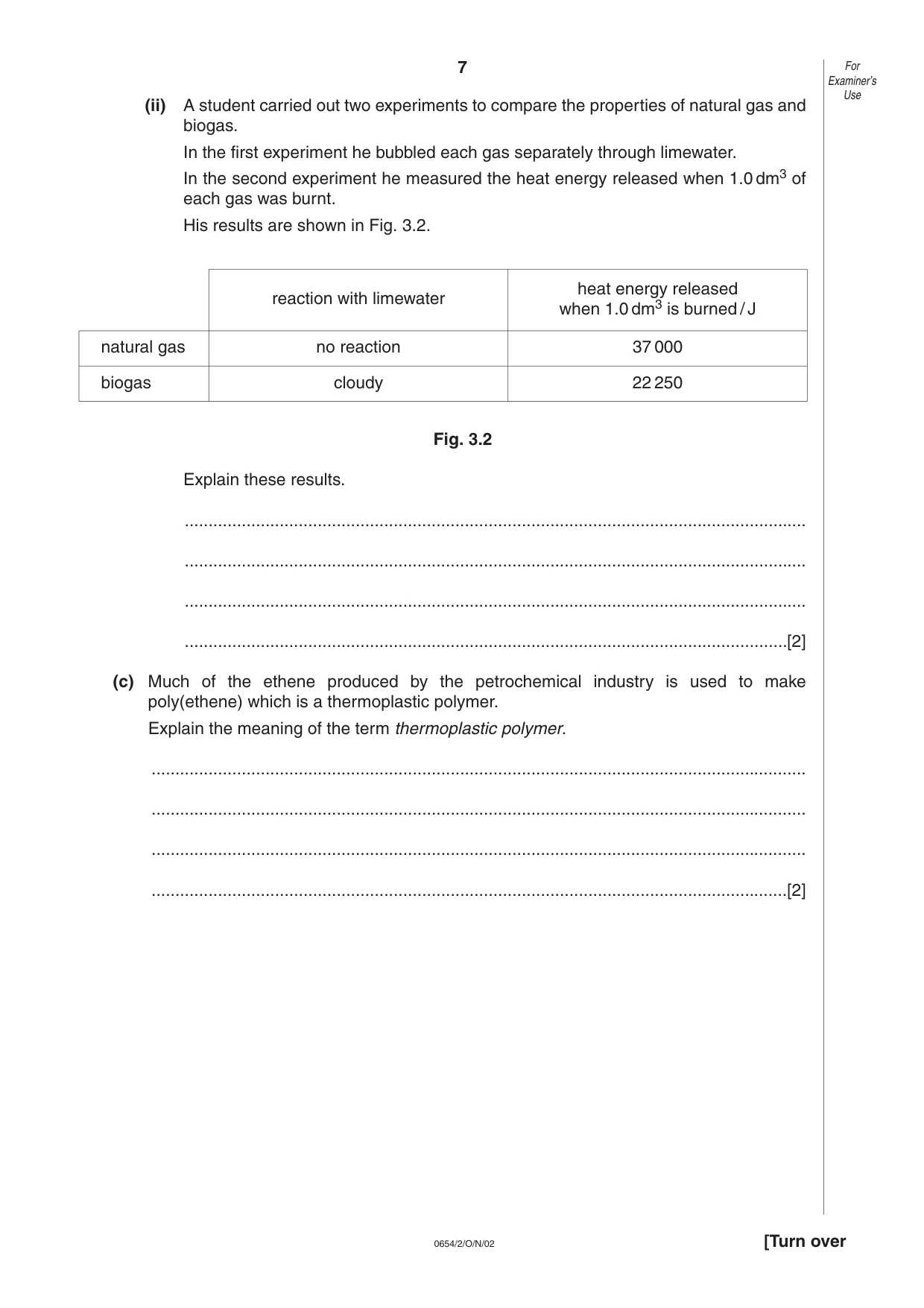
7 0654/2/O/N/02 [Turn over (ii) A student carried out two experiments to compare the properties of natural gas and biogas. In the first experiment he bubbled each gas separately through limewater. In the second experiment he measured the heat energy released when 1.0 dm3 of each gas was burnt. His results are shown in Fig. 3.2. Fig. 3.2 Explain these results. … … … …[2] (c) Much of the ethene produced by the petrochemical industry is used to make poly(ethene) which is a thermoplastic polymer. Explain the meaning of the term thermoplastic polymer. … … … …[2] For Examiner’s Use reaction with limewater no reaction natural gas biogas cloudy 37 000 22 250 heat energy released when 1.0 dm3 is burned / J
Question paper, page 8
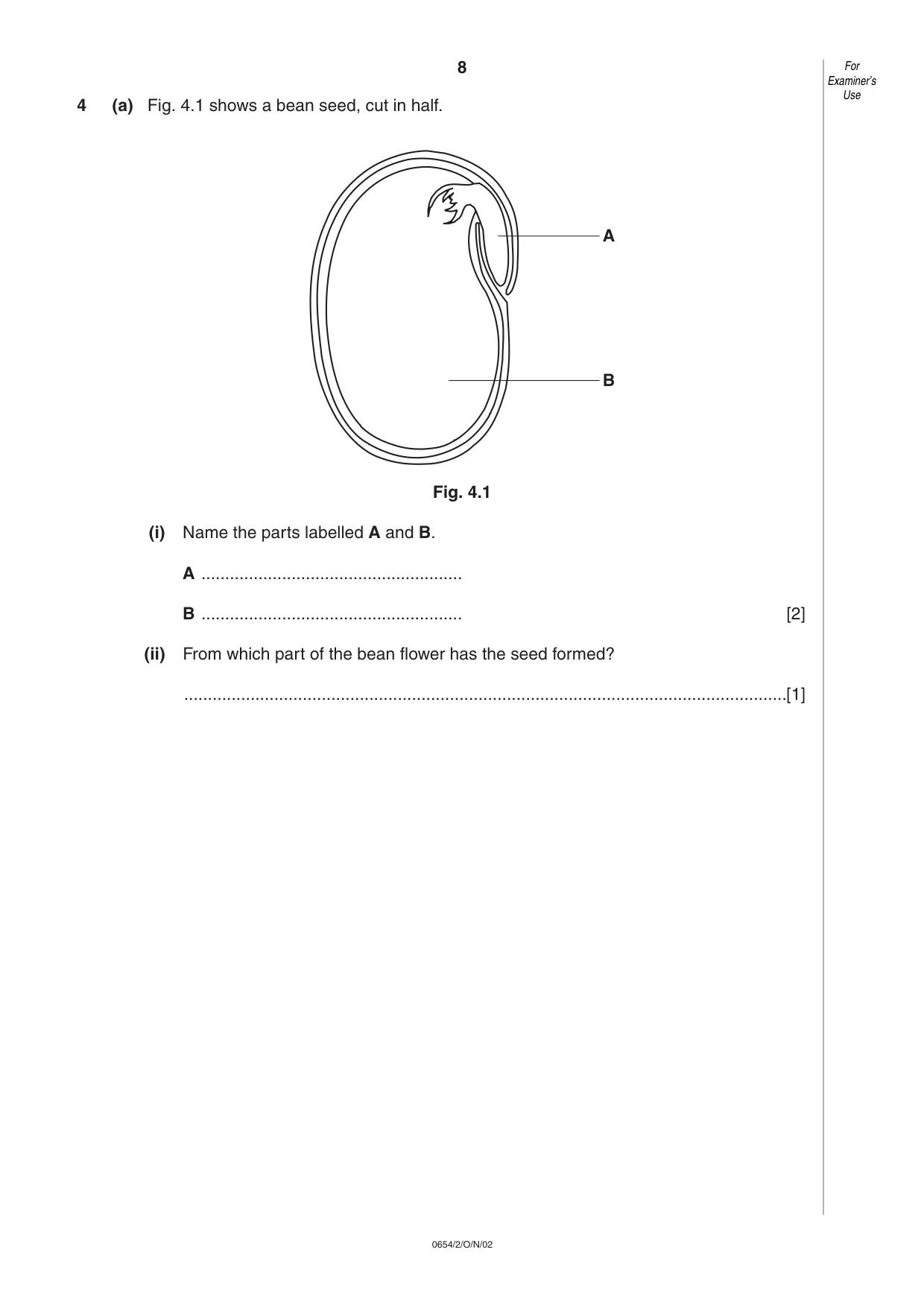
8 0654/2/O/N/02 4 (a) Fig. 4.1 shows a bean seed, cut in half. Fig. 4.1 (i) Name the parts labelled A and B. A … B … [2] (ii) From which part of the bean flower has the seed formed? …[1] A B For Examiner’s Use
Question paper, page 9
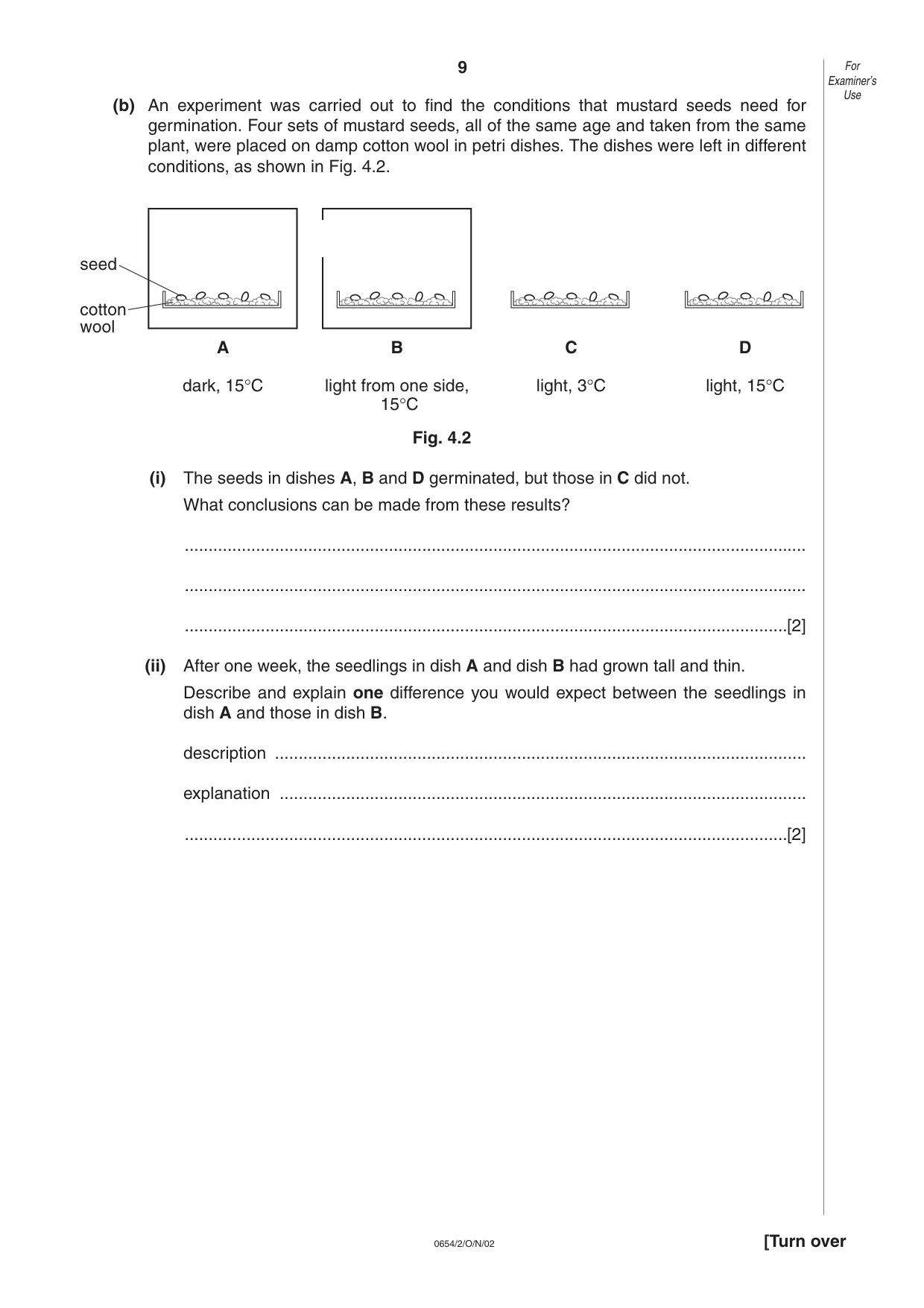
9 0654/2/O/N/02 [Turn over (b) An experiment was carried out to find the conditions that mustard seeds need for germination. Four sets of mustard seeds, all of the same age and taken from the same plant, were placed on damp cotton wool in petri dishes. The dishes were left in different conditions, as shown in Fig. 4.2. Fig. 4.2 (i) The seeds in dishes A, B and D germinated, but those in C did not. What conclusions can be made from these results? … … …[2] (ii) After one week, the seedlings in dish A and dish B had grown tall and thin. Describe and explain one difference you would expect between the seedlings in dish A and those in dish B. description … explanation … …[2] For Examiner’s Use seed cotton wool A dark, 15°C B light from one side, 15°C C light, 3°C D light, 15°C
Question paper, page 10
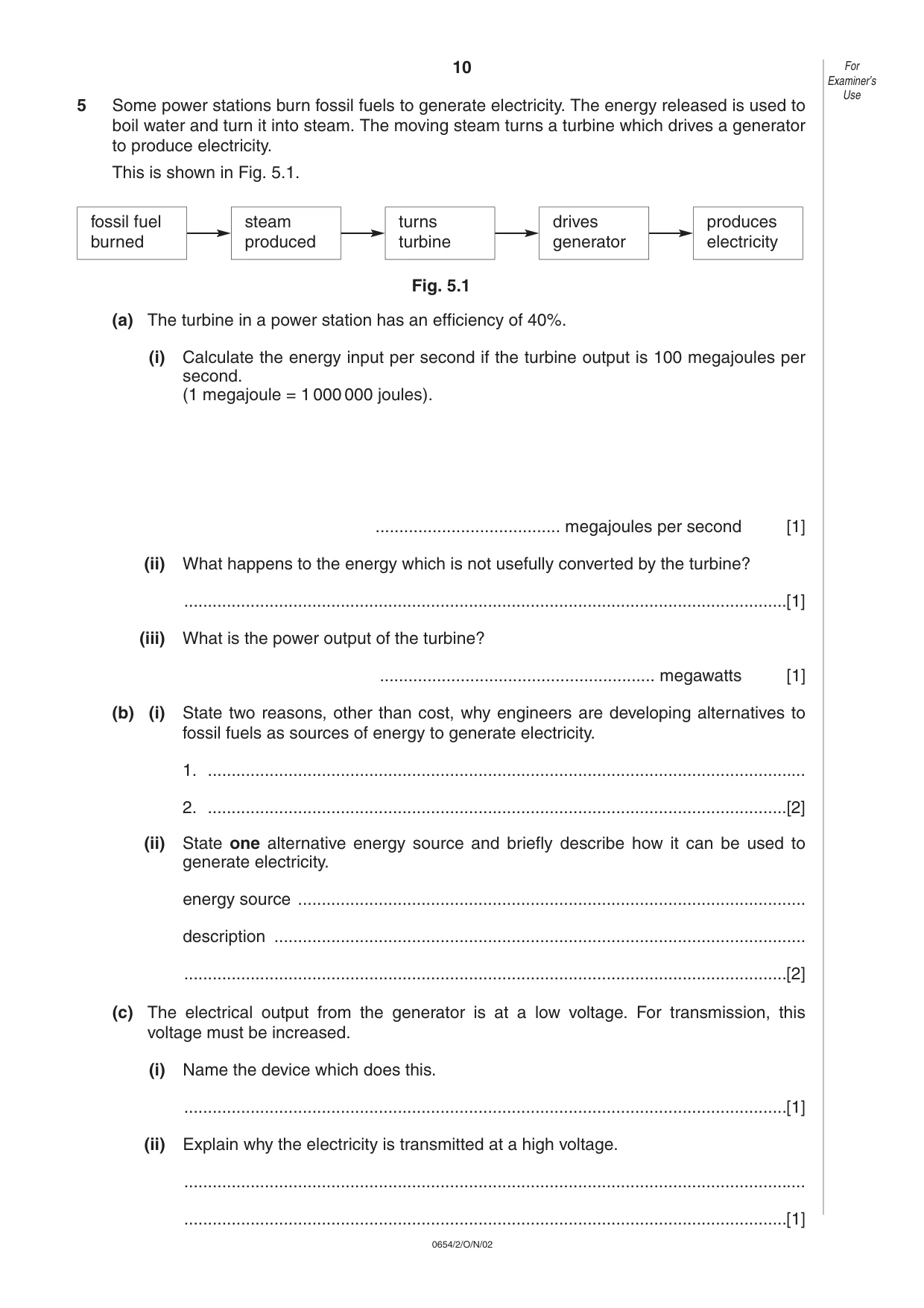
10 0654/2/O/N/02 5 Some power stations burn fossil fuels to generate electricity. The energy released is used to boil water and turn it into steam. The moving steam turns a turbine which drives a generator to produce electricity. This is shown in Fig. 5.1. Fig. 5.1 (a) The turbine in a power station has an efficiency of 40%. (i) Calculate the energy input per second if the turbine output is 100 megajoules per second. (1 megajoule = 1 000 000 joules). … megajoules per second [1] (ii) What happens to the energy which is not usefully converted by the turbine? …[1] (iii) What is the power output of the turbine? … megawatts [1] (b) (i) State two reasons, other than cost, why engineers are developing alternatives to fossil fuels as sources of energy to generate electricity. 1. … 2. …[2] (ii) State one alternative energy source and briefly describe how it can be used to generate electricity. energy source … description … …[2] (c) The electrical output from the generator is at a low voltage. For transmission, this voltage must be increased. (i) Name the device which does this. …[1] (ii) Explain why the electricity is transmitted at a high voltage. … …[1] For Examiner’s Use fossil fuel burned steam produced turns turbine drives generator produces electricity
Question paper, page 11
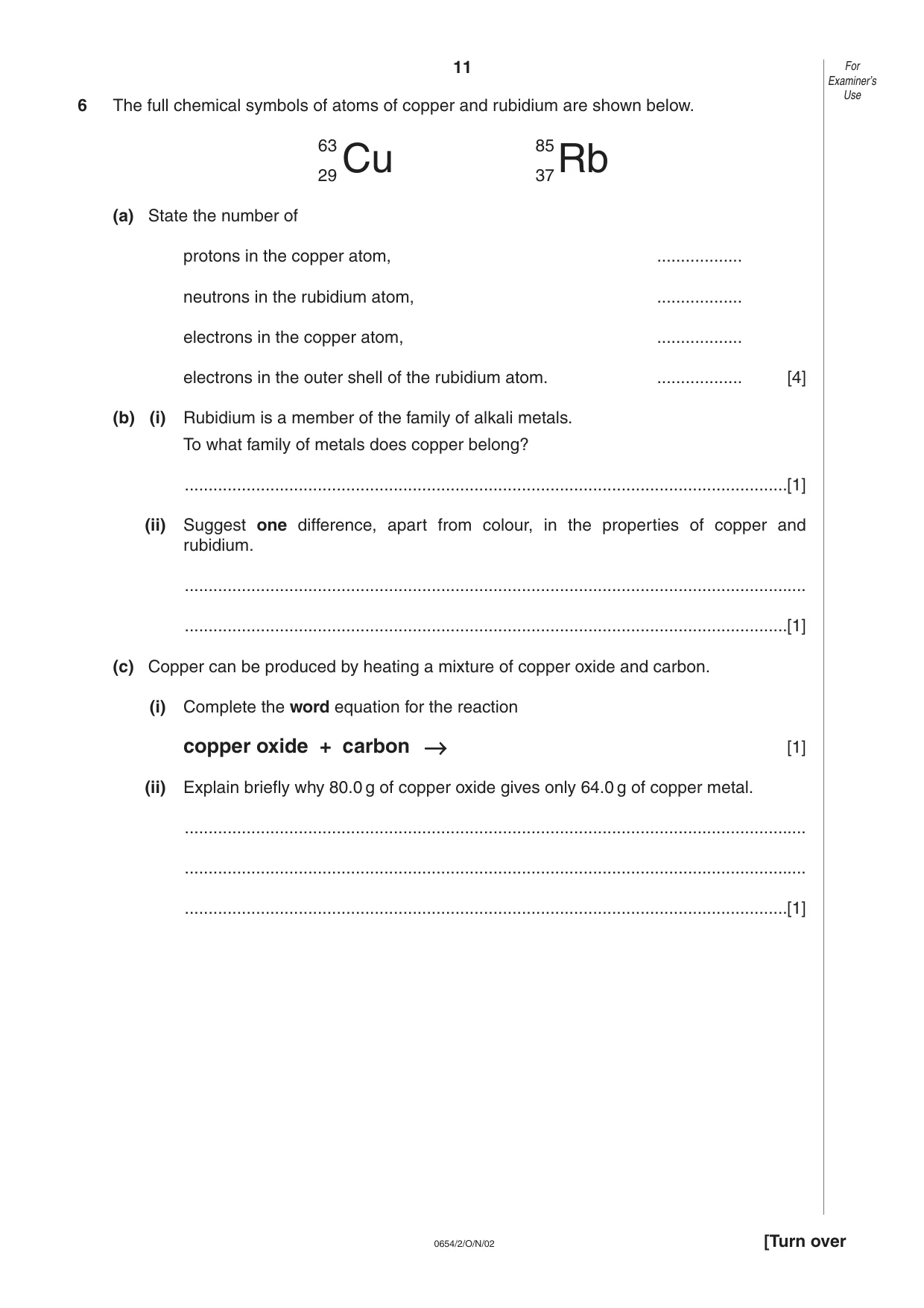
11 0654/2/O/N/02 [Turn over 6 The full chemical symbols of atoms of copper and rubidium are shown below. 63 85 Cu Rb 29 37 (a) State the number of protons in the copper atom, … neutrons in the rubidium atom, … electrons in the copper atom, … electrons in the outer shell of the rubidium atom. … [4] (b) (i) Rubidium is a member of the family of alkali metals. To what family of metals does copper belong? …[1] (ii) Suggest one difference, apart from colour, in the properties of copper and rubidium. … …[1] (c) Copper can be produced by heating a mixture of copper oxide and carbon. (i) Complete the word equation for the reaction copper oxide + carbon → [1] (ii) Explain briefly why 80.0 g of copper oxide gives only 64.0 g of copper metal. … … …[1] For Examiner’s Use
Question paper, page 12
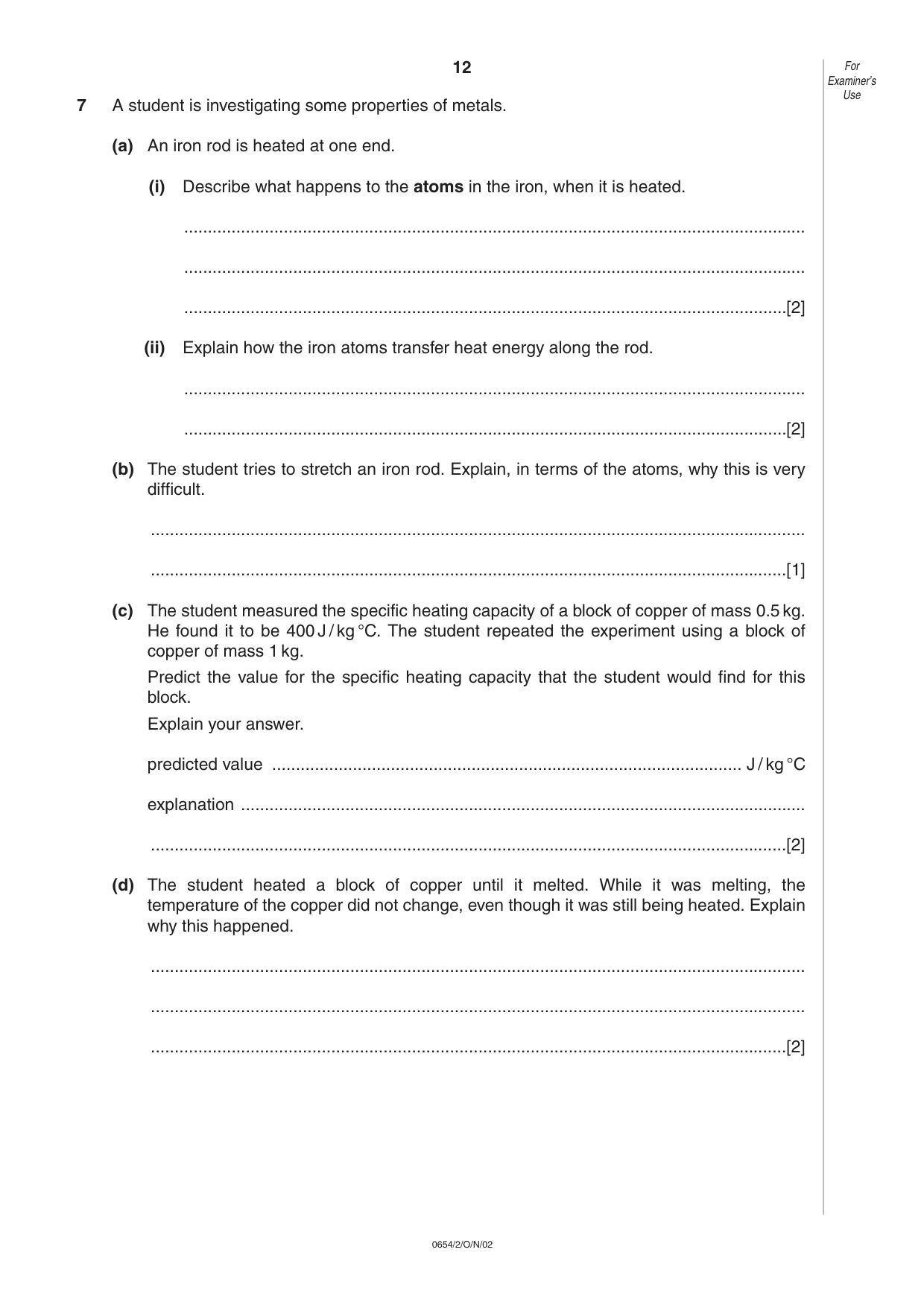
12 0654/2/O/N/02 7 A student is investigating some properties of metals. (a) An iron rod is heated at one end. (i) Describe what happens to the atoms in the iron, when it is heated. … … …[2] (ii) Explain how the iron atoms transfer heat energy along the rod. … …[2] (b) The student tries to stretch an iron rod. Explain, in terms of the atoms, why this is very difficult. … …[1] (c) The student measured the specific heating capacity of a block of copper of mass 0.5 kg. He found it to be 400 J / kg °C. The student repeated the experiment using a block of copper of mass 1 kg. Predict the value for the specific heating capacity that the student would find for this block. Explain your answer. predicted value … J / kg °C explanation … …[2] (d) The student heated a block of copper until it melted. While it was melting, the temperature of the copper did not change, even though it was still being heated. Explain why this happened. … … …[2] For Examiner’s Use
Question paper, page 13
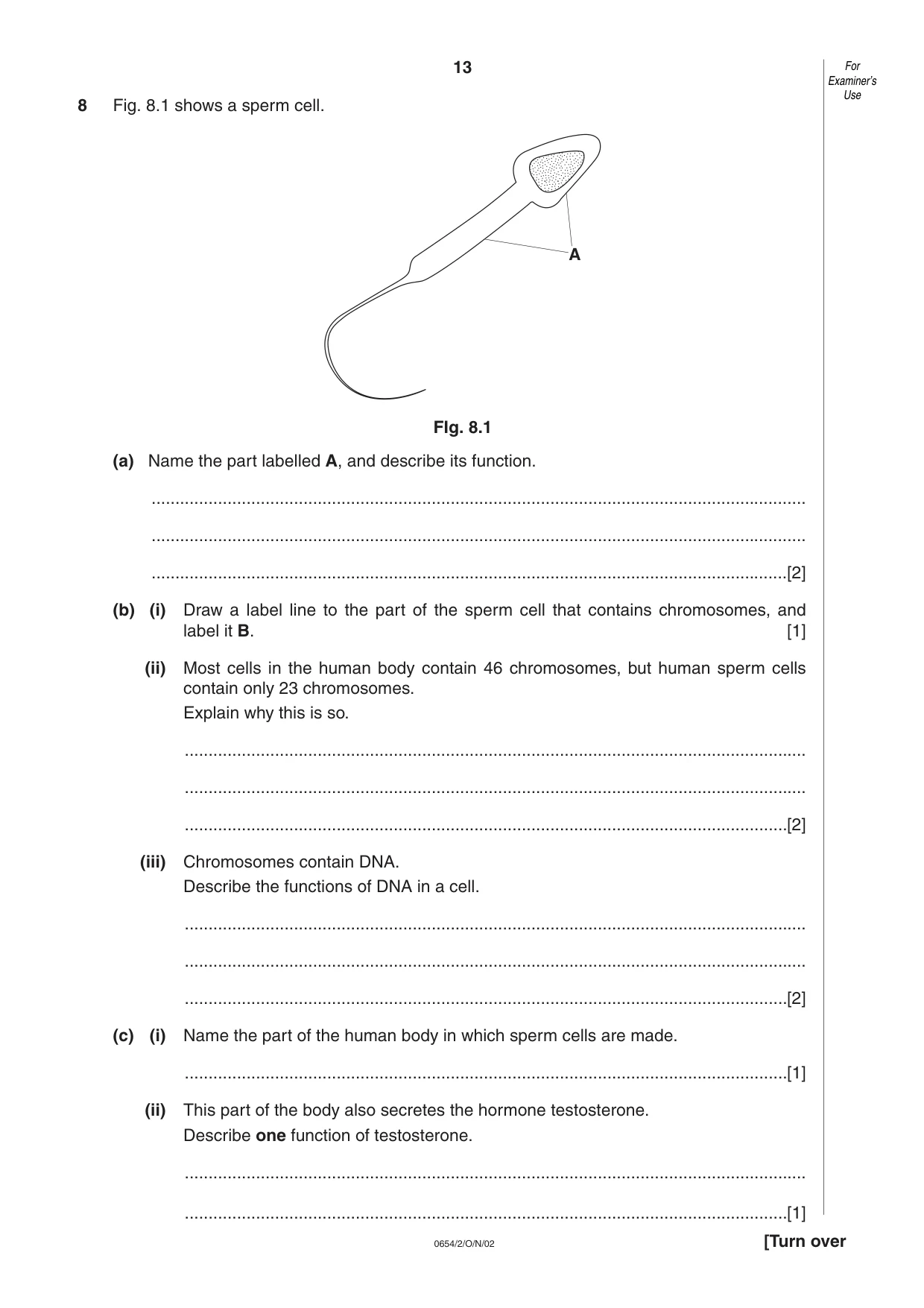
13 0654/2/O/N/02 [Turn over 8 Fig. 8.1 shows a sperm cell. FIg. 8.1 (a) Name the part labelled A, and describe its function. … … …[2] (b) (i) Draw a label line to the part of the sperm cell that contains chromosomes, and label it B. [1] (ii) Most cells in the human body contain 46 chromosomes, but human sperm cells contain only 23 chromosomes. Explain why this is so. … … …[2] (iii) Chromosomes contain DNA. Describe the functions of DNA in a cell. … … …[2] (c) (i) Name the part of the human body in which sperm cells are made. …[1] (ii) This part of the body also secretes the hormone testosterone. Describe one function of testosterone. … …[1] A For Examiner’s Use
Question paper, page 14
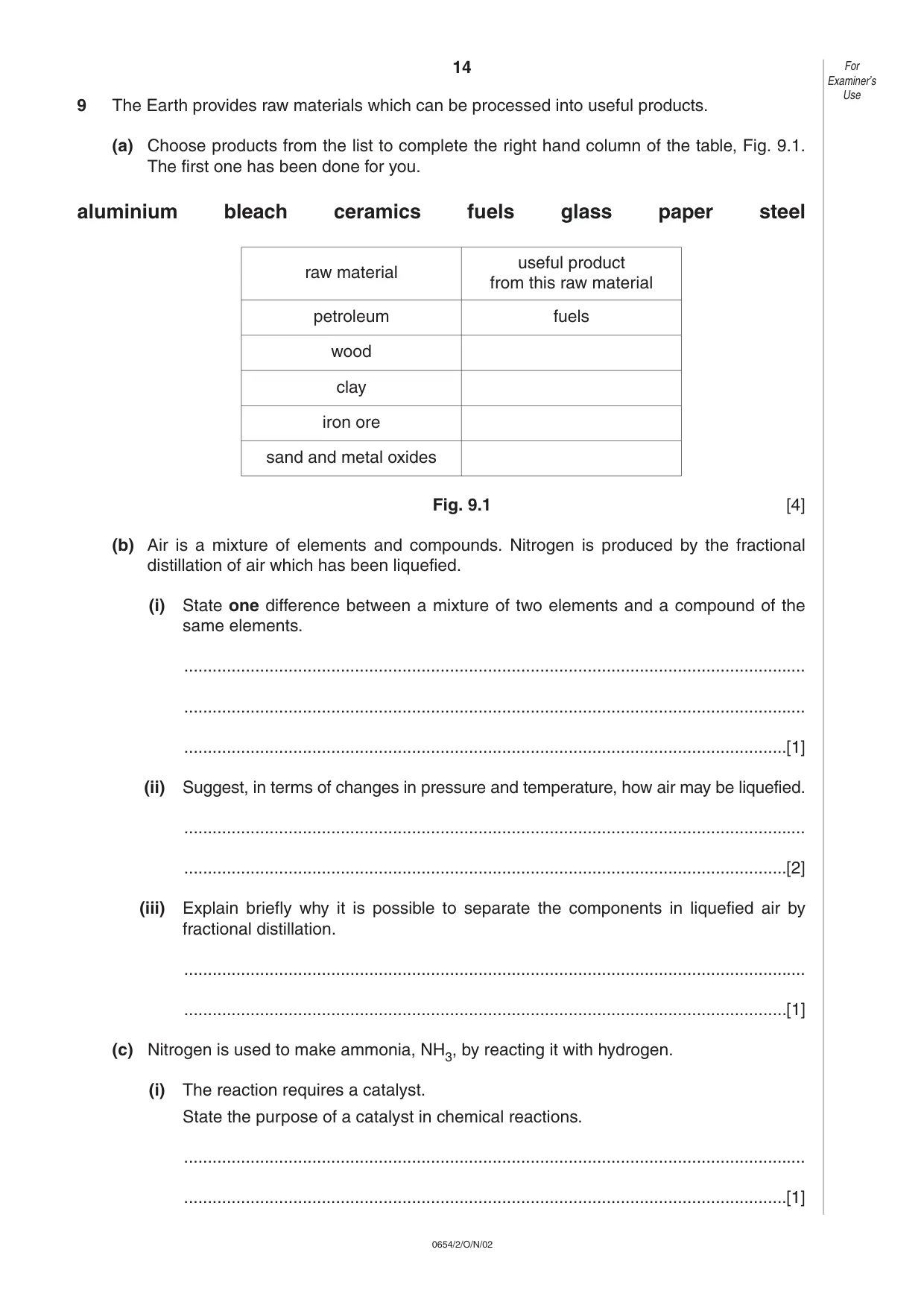
14 0654/2/O/N/02 9 The Earth provides raw materials which can be processed into useful products. (a) Choose products from the list to complete the right hand column of the table, Fig. 9.1. The first one has been done for you. aluminium bleach ceramics fuels glass paper steel Fig. 9.1 [4] (b) Air is a mixture of elements and compounds. Nitrogen is produced by the fractional distillation of air which has been liquefied. (i) State one difference between a mixture of two elements and a compound of the same elements. … … …[1] (ii) Suggest, in terms of changes in pressure and temperature, how air may be liquefied. … …[2] (iii) Explain briefly why it is possible to separate the components in liquefied air by fractional distillation. … …[1] (c) Nitrogen is used to make ammonia, NH3, by reacting it with hydrogen. (i) The reaction requires a catalyst. State the purpose of a catalyst in chemical reactions. … …[1] For Examiner’s Use raw material petroleum wood clay iron ore sand and metal oxides useful product from this raw material fuels
Question paper, page 15
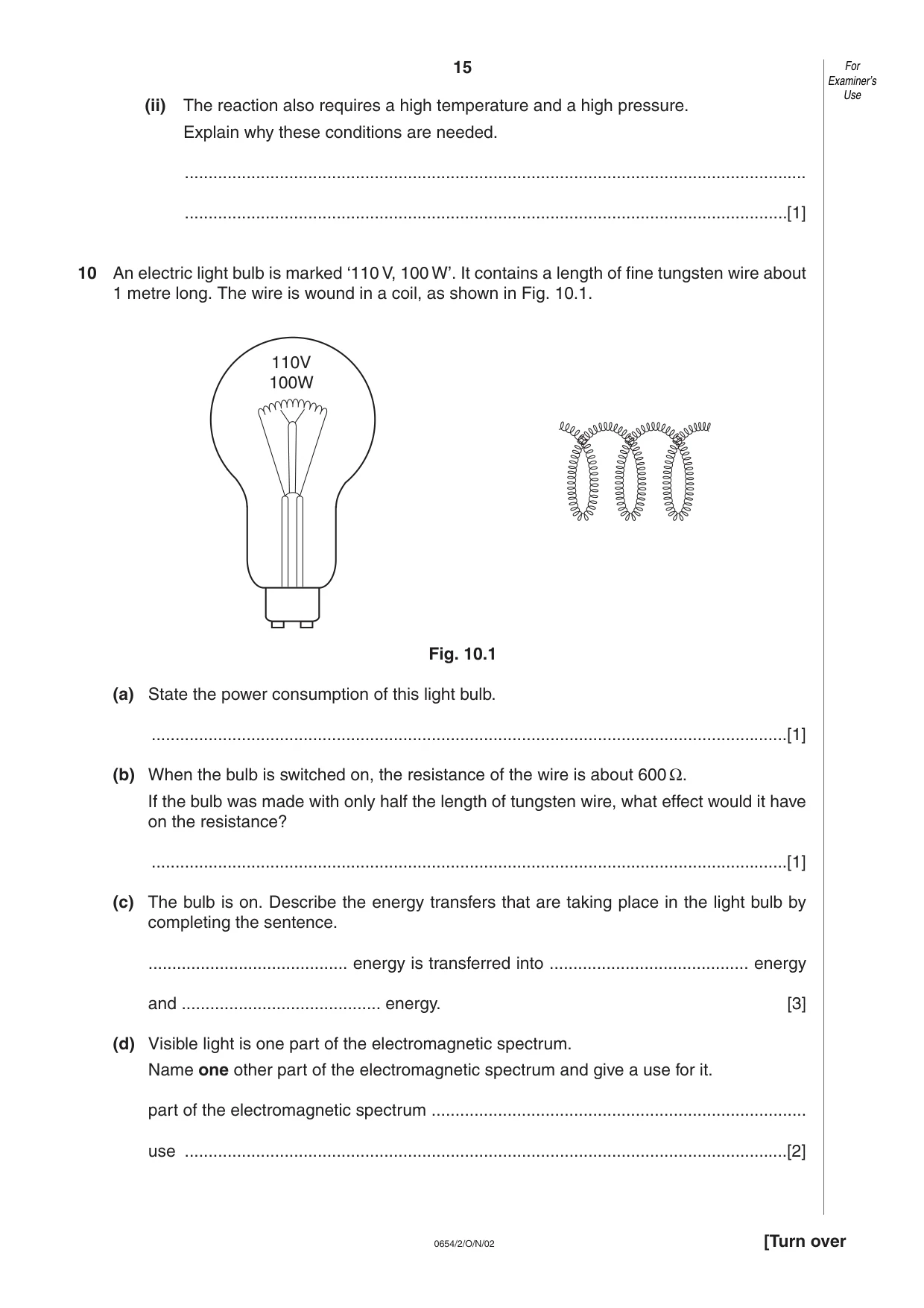
15 0654/2/O/N/02 [Turn over (ii) The reaction also requires a high temperature and a high pressure. Explain why these conditions are needed. … …[1] 10 An electric light bulb is marked ‘110 V, 100 W’. It contains a length of fine tungsten wire about 1 metre long. The wire is wound in a coil, as shown in Fig. 10.1. Fig. 10.1 (a) State the power consumption of this light bulb. …[1] (b) When the bulb is switched on, the resistance of the wire is about 600 Ω. If the bulb was made with only half the length of tungsten wire, what effect would it have on the resistance? …[1] (c) The bulb is on. Describe the energy transfers that are taking place in the light bulb by completing the sentence. … energy is transferred into … energy and … energy. [3] (d) Visible light is one part of the electromagnetic spectrum. Name one other part of the electromagnetic spectrum and give a use for it. part of the electromagnetic spectrum … use …[2] 110V 100W For Examiner’s Use
Question paper, page 16
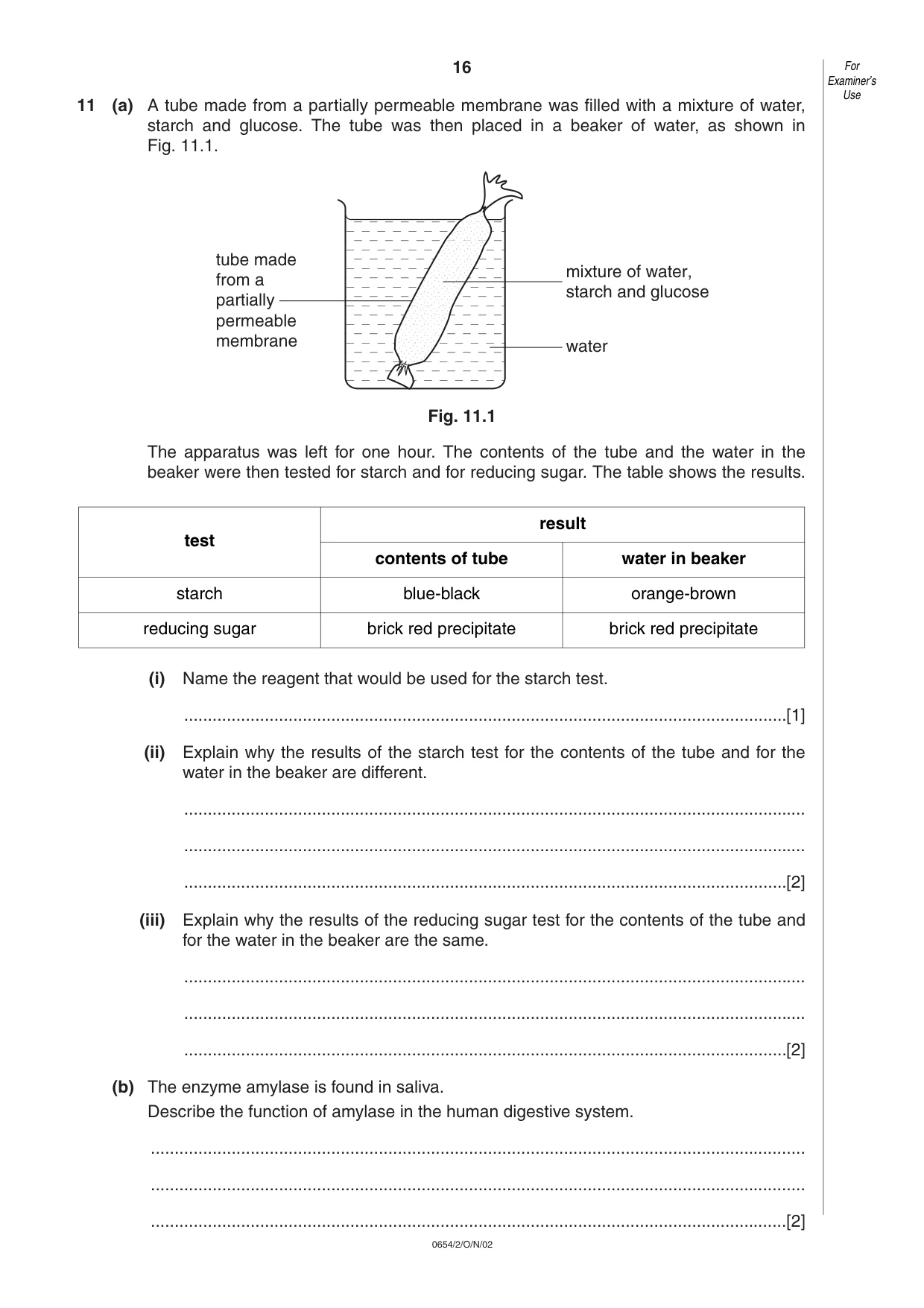
16 0654/2/O/N/02 11 (a) A tube made from a partially permeable membrane was filled with a mixture of water, starch and glucose. The tube was then placed in a beaker of water, as shown in Fig. 11.1. Fig. 11.1 The apparatus was left for one hour. The contents of the tube and the water in the beaker were then tested for starch and for reducing sugar. The table shows the results. (i) Name the reagent that would be used for the starch test. …[1] (ii) Explain why the results of the starch test for the contents of the tube and for the water in the beaker are different. … … …[2] (iii) Explain why the results of the reducing sugar test for the contents of the tube and for the water in the beaker are the same. … … …[2] (b) The enzyme amylase is found in saliva. Describe the function of amylase in the human digestive system. … … …[2] water mixture of water, starch and glucose tube made from a partially permeable membrane For Examiner’s Use test starch blue-black brick red precipitate brick red precipitate orange-brown reducing sugar result contents of tube water in beaker
Question paper, page 17
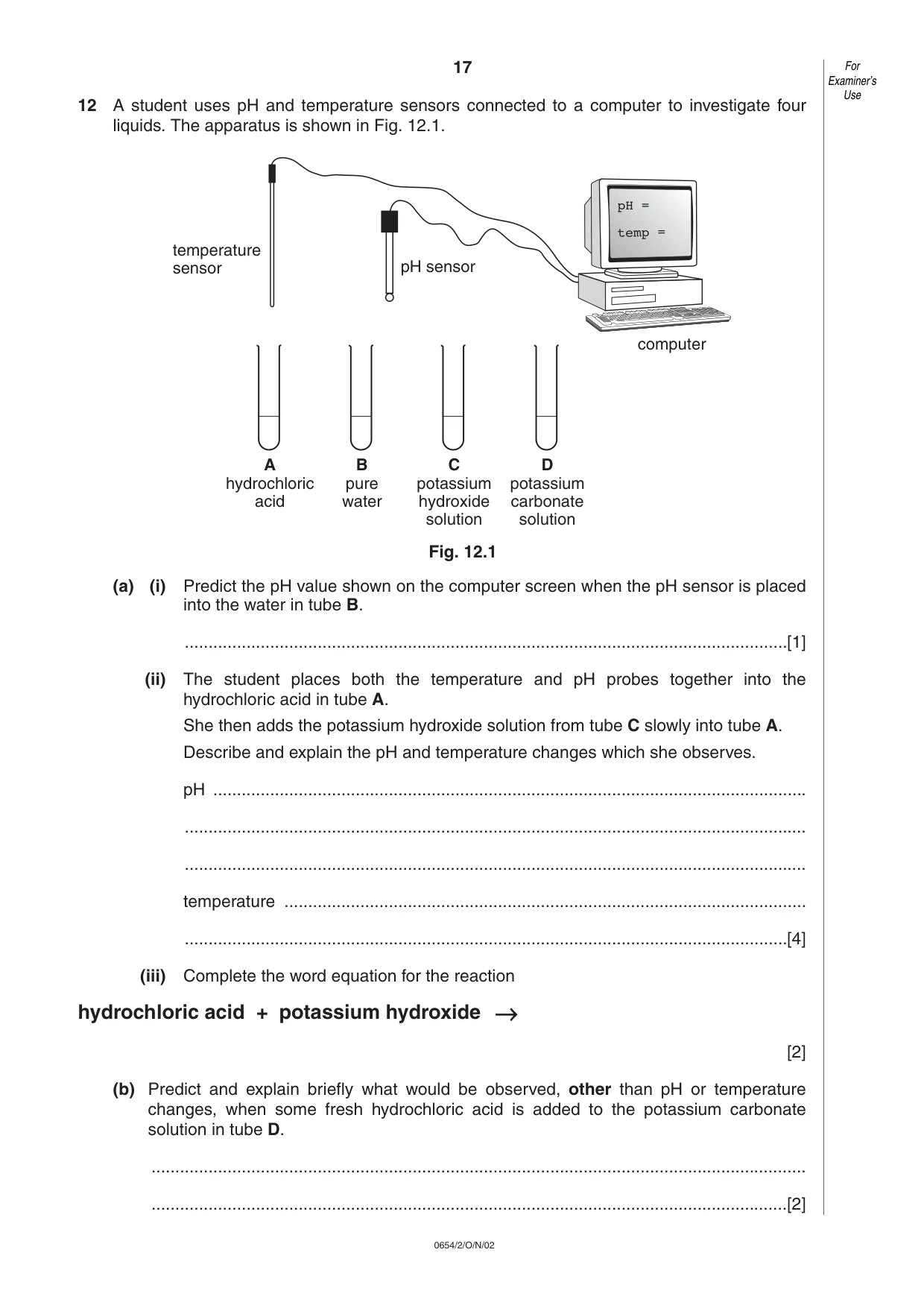
17 0654/2/O/N/02 12 A student uses pH and temperature sensors connected to a computer to investigate four liquids. The apparatus is shown in Fig. 12.1. Fig. 12.1 (a) (i) Predict the pH value shown on the computer screen when the pH sensor is placed into the water in tube B. …[1] (ii) The student places both the temperature and pH probes together into the hydrochloric acid in tube A. She then adds the potassium hydroxide solution from tube C slowly into tube A. Describe and explain the pH and temperature changes which she observes. pH … … … temperature … …[4] (iii) Complete the word equation for the reaction hydrochloric acid + potassium hydroxide → [2] (b) Predict and explain briefly what would be observed, other than pH or temperature changes, when some fresh hydrochloric acid is added to the potassium carbonate solution in tube D. … …[2] pH = temp = A hydrochloric acid B pure water C potassium hydroxide solution D potassium carbonate solution computer temperature sensor pH sensor For Examiner’s Use
Question paper, page 20
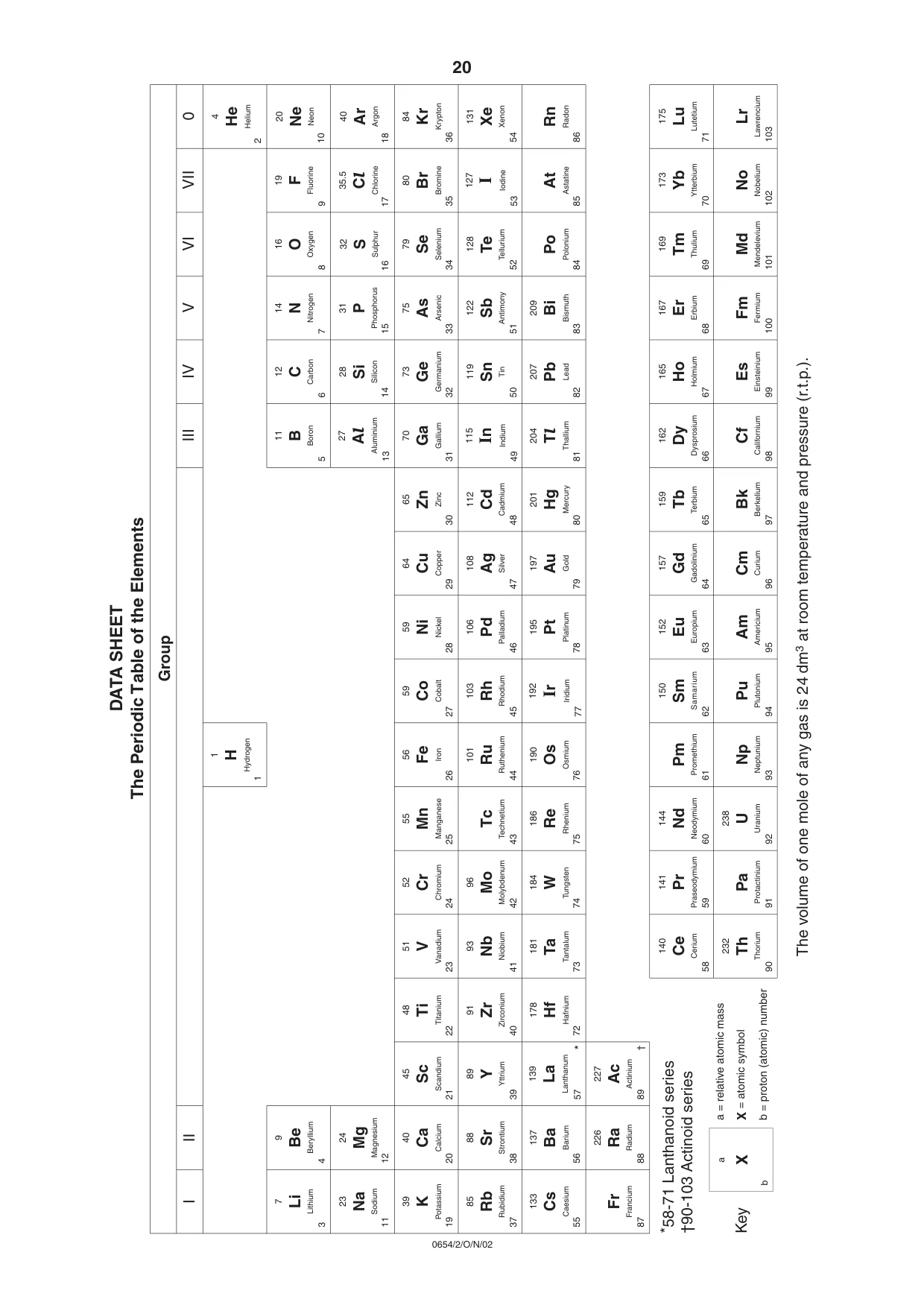
20 0654/2/O/N/02 Group DATA SHEET The Periodic Table of the Elements 140 Ce Cerium 58 141 Pr Praseodymium 59 144 Nd Neodymium 60 Pm Promethium 61 150 Sm Samarium 62 152 Eu Europium 63 157 Gd Gadolinium 64 159 Tb Terbium 65 162 Dy Dysprosium 66 165 Ho Holmium 67 167 Er Erbium 68 169 Tm Thulium 69 173 Yb Ytterbium 70 175 Lu Lutetium 71 232 Th Thorium 90 Pa Protactinium 91 238 U Uranium 92 Np Neptunium 93 Pu Plutonium 94 Am Americium 95 Cm Curium 96 Bk Berkelium 97 Cf Californium 98 Es Einsteinium 99 Fm Fermium 100 Md Mendelevium 101 No Nobelium 102 Lr Lawrencium 103 1 H Hydrogen 1 7 Li Lithium 3 23 Na Sodium 11 24 Mg Magnesium 12 40 Ca Calcium 20 45 Sc Scandium 21 48 Ti Titanium 22 51 V Vanadium 23 52 Cr Chromium 24 55 Mn Manganese 25 56 Fe Iron 26 59 Co Cobalt 27 59 Ni Nickel 28 64 Cu Copper 29 65 Zn Zinc 30 70 Ga Gallium 31 27 Al Aluminium 13 11 B Boron 5 12 C Carbon 6 14 N Nitrogen 7 16 O Oxygen 8 19 F Fluorine 9 28 Si Silicon 14 31 P Phosphorus 15 32 S Sulphur 16 35.5 Cl Chlorine 17 40 Ar Argon 18 20 Ne Neon 10 4 He Helium 2 73 Ge Germanium 32 75 As Arsenic 33 79 Se Selenium 34 80 Br Bromine 35 84 Kr Krypton 36 39 K Potassium 19 88 Sr Strontium 38 89 Y Yttrium 39 91 Zr Zirconium 40 93 Nb Niobium 41 96 Mo Molybdenum 42 Tc Technetium 43 101 Ru Ruthenium 44 103 Rh Rhodium 45 106 Pd Palladium 46 108 Ag Silver 47 112 Cd Cadmium 48 115 In Indium 49 119 Sn Tin 50 122 Sb Antimony 51 128 Te Tellurium 52 127 I Iodine 53 131 Xe Xenon 54 137 Ba Barium 56 139 La Lanthanum 57 * 178 Hf Hafnium 72 181 Ta Tantalum 73 184 W Tungsten 74 186 Re Rhenium 75 190 Os Osmium 76 192 Ir Iridium 77 195 Pt Platinum 78 197 Au Gold 79 201 Hg Mercury 80 204 Tl Thallium 81 207 Pb Lead 82 209 Bi Bismuth 83 Po Polonium 84 At Astatine 85 Rn Radon 86 Fr Francium 87 227 Ac Actinium 89 † 9 Be Beryllium 4 I II III IV V VI VII 0 85 Rb Rubidium 37 133 Cs Caesium 55 226 Ra Radium 88 The volume of one mole of any gas is 24 dm3 at room temperature and pressure (r.t.p.). a X b a = relative atomic mass X = atomic symbol b = proton (atomic) number Key *58-71 Lanthanoid series †90-103 Actinoid series
Mark scheme, page 1
CAMBRIDGE INTERNATIONAL EXAMINATIONS NOVEMBER 2002 INTERNATIONAL GCSE _ UNIVERSITY of CAMBRIDGE Local Examinations Syndicate
Mark scheme, page 2
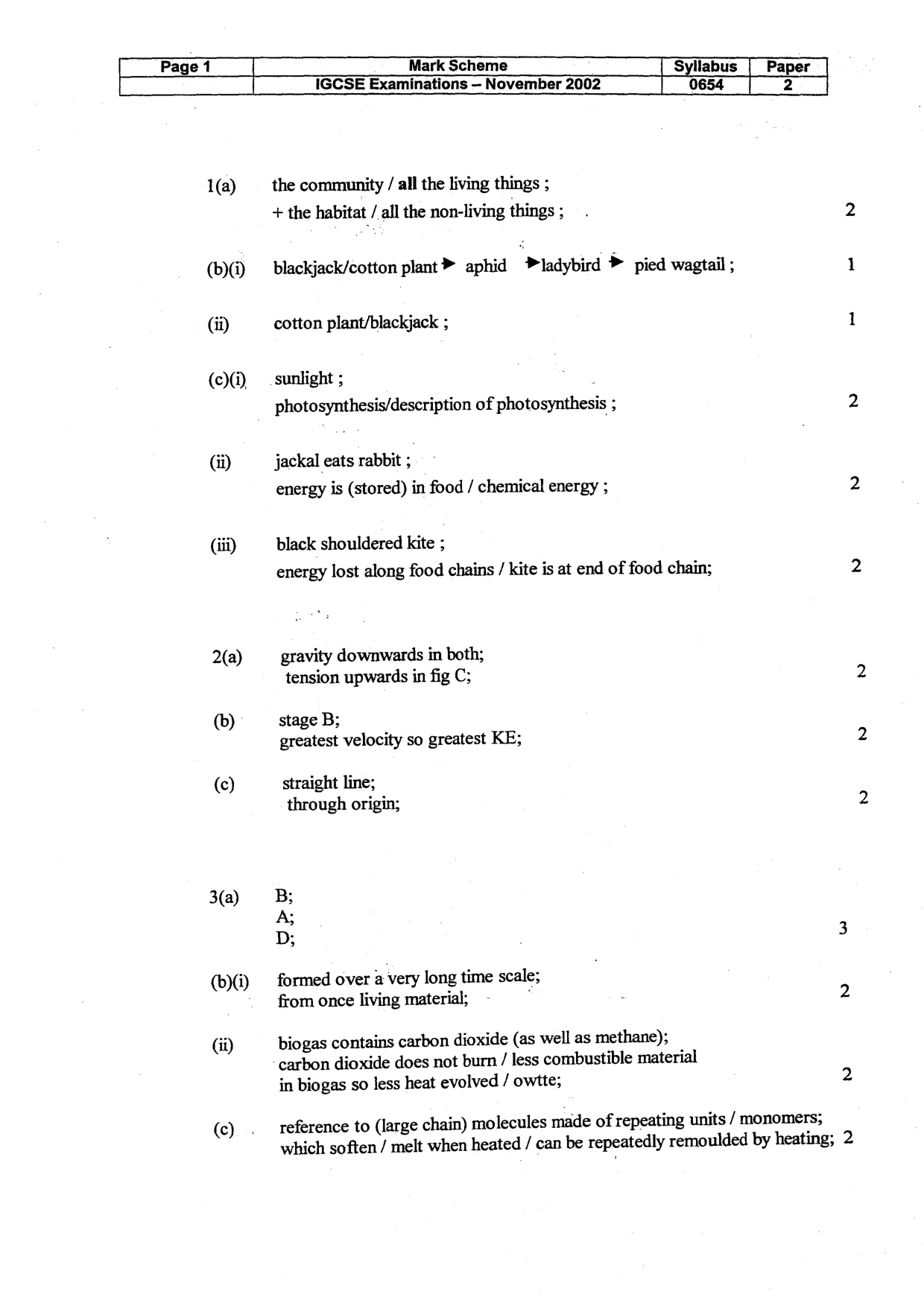
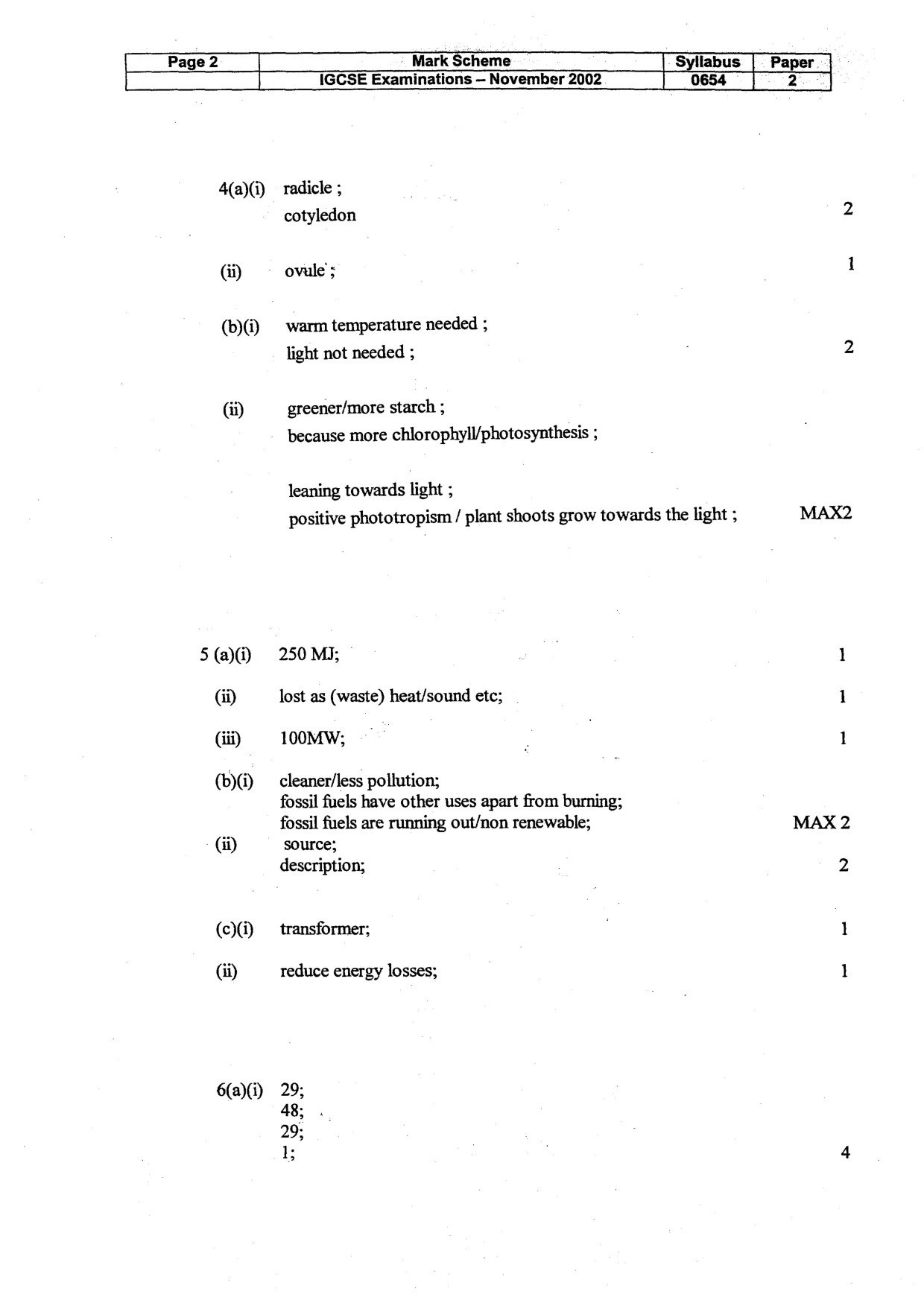
(Paget Mark Scheme Syllabus [ Paper IGCSE Examinations — November 2002 0654 2 1(a) the community / all the living things ; + the habitat / all the non-living things ; (b)(i)__blackjack/cotton plant ® aphid P ladybird > pied wagtail ; (ii) cotton plant/blackjack ; (©@, sunlight ; photosynthesis/description of photosynthesis ; (i) jackal eats rabbit ; energy is (stored) in food / chemical energy ; (iii) black shouldered kite ; energy lost along food chains / kite is at end of food chain; 2(a) gravity downwards in both; tension upwards in fig C; (b) stage B; greatest velocity so greatest KE; (c) straight line; through origin; 3(a) B; D; ; 3 (b)(i) formed over a very long time scale; from once living material; ; . 2 Gi) biogas contains carbon dioxide (as well as methane); carbon dioxide does not burn / less combustible material in biogas so less heat evolved / owtte; 2 (c) . reference to (large chain) molecules made of repeating units / monomers; which soften / melt when heated / can be repeatedly remoulded by heating; 2
Mark scheme, page 3
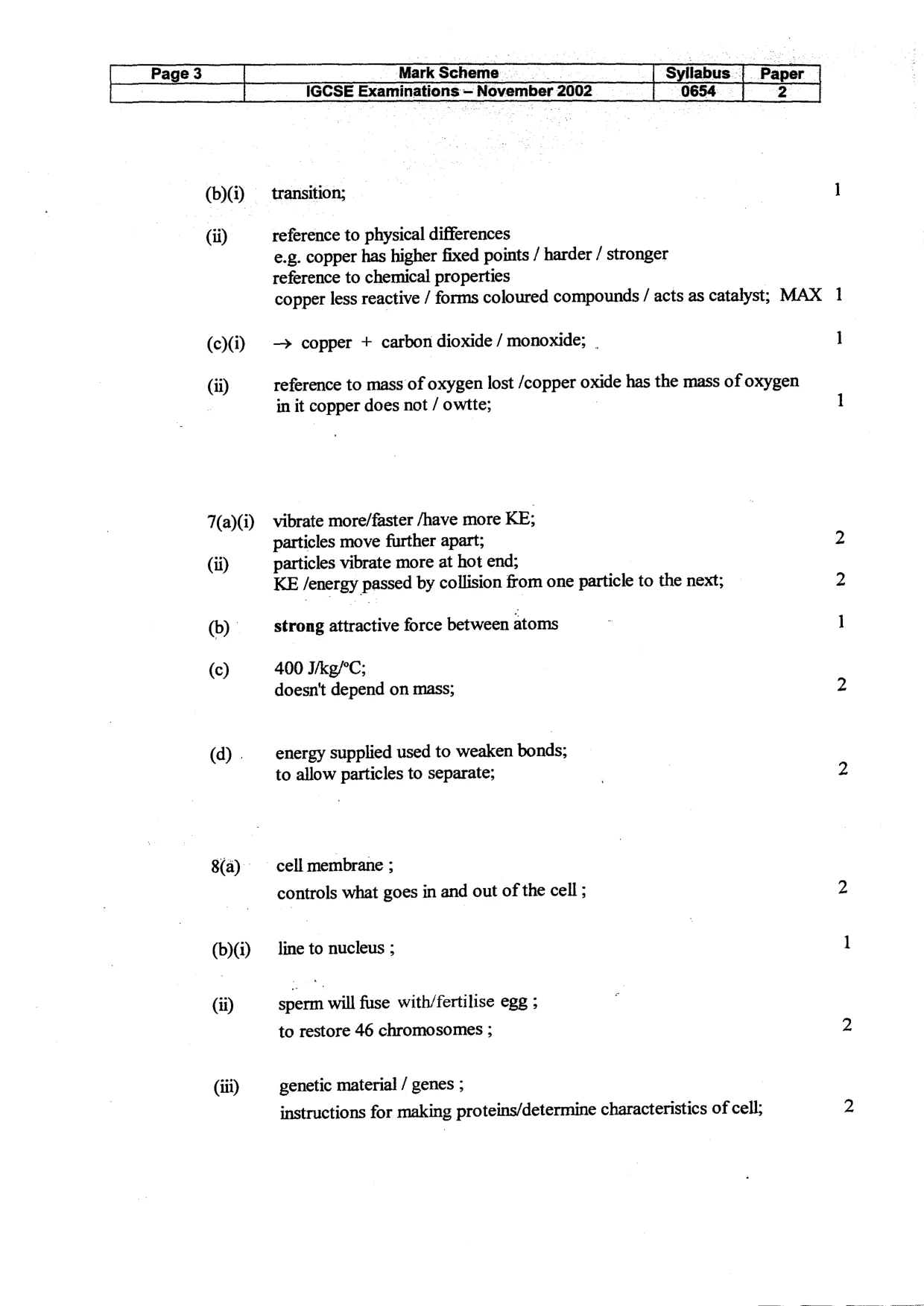
Page 2 | Mark Scheme Syllabus | Paper l IGCSE Examinations — November 2002 0654 + 2 | 4(a)()_radicle ; cotyledon 2 (ii) ovule'; (b)@) warm temperature needed ; light not needed ; 2 Gi) greener/more starch ; because more chlorophyll/photosynthesis ; leaning towards light ; positive phototropism / plant shoots grow towards the light ; MAX2 5(a)(i) 250 MJ; 1 (i) lost as (waste) heat/sound etc; 1 (iii) 100Mw; 1 (b)() _cleaner/less pollution; fossil fuels have other uses apart from burning; fossil fuels are running out/non renewable; MAX 2 (ii) source; description; 2 (c)(@) transformer; 1 (ii) reduce energy losses; 1 6(a)(i) 29; 48; . 29;
Mark scheme, page 4
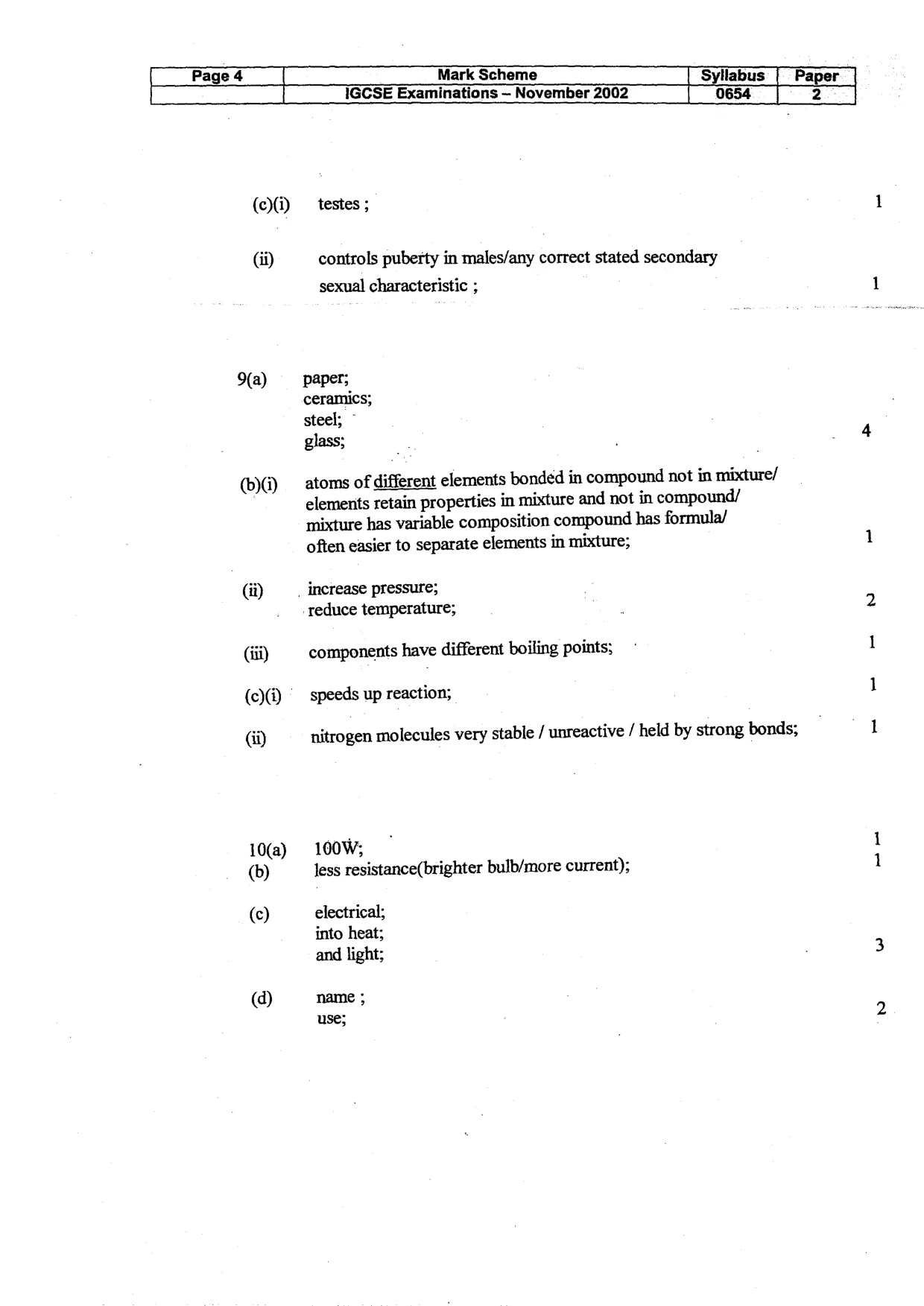
Page 3 | Mark Scheme labus | Pa I IGCSE Examinations — November 2002 tae ~ am (b)G@)__ transition; 1 (ii) reference to physical differences e.g. copper has higher fixed points / harder / stronger reference to chemical properties copper less reactive / forms coloured compounds / acts as catalyst; MAX 1 (c)(i) —> copper + carbon dioxide / monoxide; . 1 (ii) reference to mass of oxygen lost /copper oxide has the mass of oxygen in it copper does not / owtte; 1 7(a)(i) vibrate more/faster /have more KE; particles move further apart; 2 (i) particles vibrate more at hot end; KE /energy passed by collision from one particle to the next; 2 (b) strong attractive force between atoms 1 () 400 J/kg/*C; doesn't depend on mass; 2 (d) energy supplied used to weaken bonds; to allow particles to separate; 2 8(a) cell membrane ; controls what goes in and out of the cell ; 2 (b)(i)__line to nucleus ; 1 (ii) sperm will fuse with/fertilise egg ; to restore 46 chromosomes ; 2 (iii) genetic material / genes ; instructions for making proteins/determine characteristics of cell; 2
Mark scheme, page 5
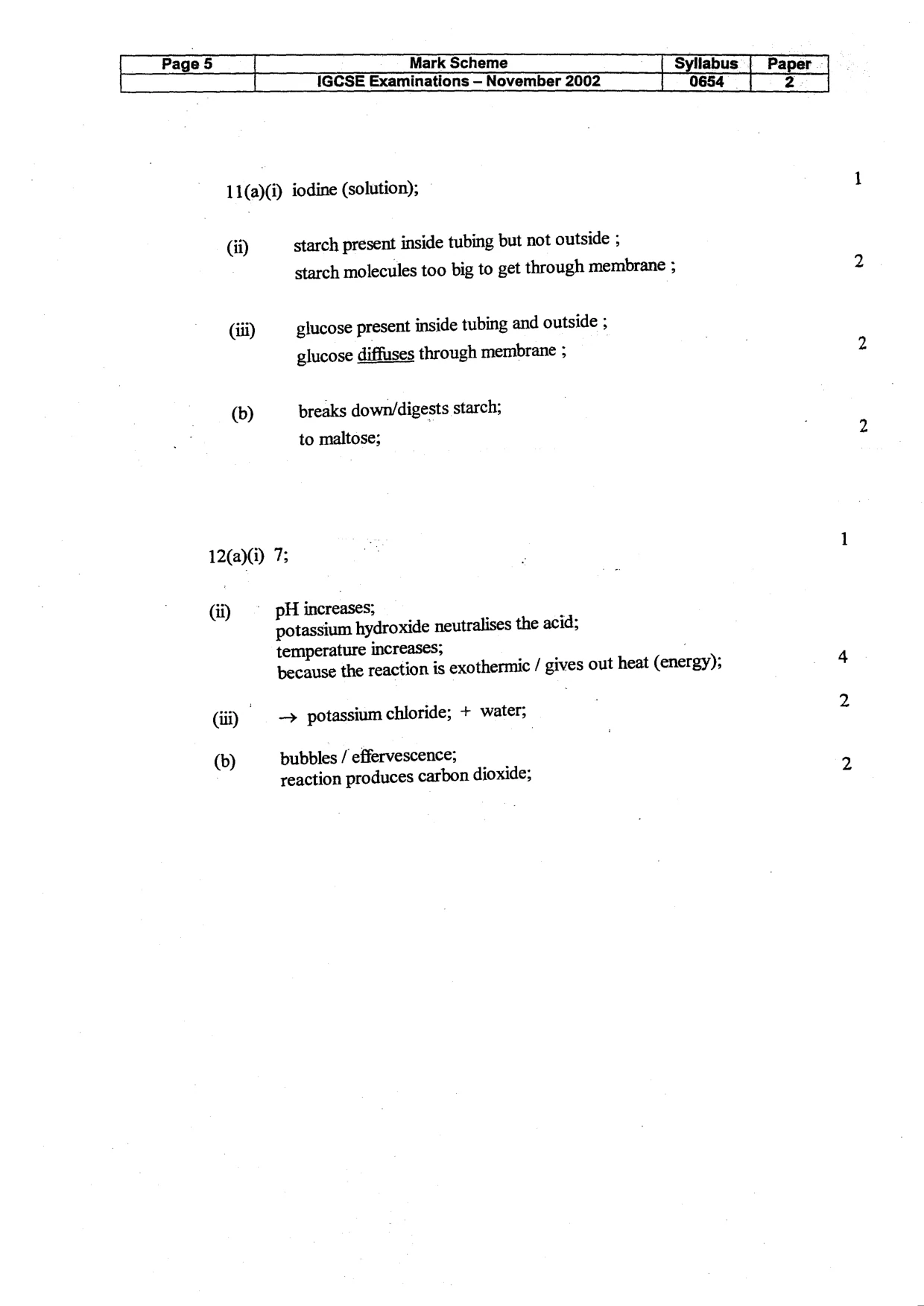
Page 4 Mark Scheme Syllabus IGCSE Examinations ~ November 2002 0654 t = | (c)(i) _ testes ; (ii) controls puberty in males/any correct stated secondary sexual characteristic ; a) paper; ceramics; steel; ~ glass; . _ 4 (b)(i) atoms of different elements bonded in compound not in mixture/ elements retain properties in mixture and not in compound/ mixture has variable composition compound has formula/ often easier to separate elements in mixture; 1 ¢)} increase pressure; reduce temperature; . 2 (iii) components have different boiling points; 1 (c)\@ "speeds up reaction; 1 @) nitrogen molecules very stable / unreactive / held by strong bonds; 1 10a) 100W; — 1 (b) Jess resistance(brighter bulb/more current); 1 (c) electrical; into heat; and light; 3 @ name ; use; 2
Mark scheme, page 6
Mark Scheme labus IGCSE Examinations — November 2002 [0654 Paper 2 11(a)(i) iodine (solution); Gi) ii) () starch present inside tubing but not outside ; starch molecules too big to get through membrane ; glucose present inside tubing and outside ; glucose diffuses through membrane ; breaks down/digests starch; to maltose; 12(a)(i) 7; Gi) ji) 0) pH increases; potassium hydroxide neutralises the acid; temperature increases; : because the reaction is exothermic / gives out heat (energy); — potassium chloride; + water; bubbles / effervescence; reaction produces carbon dioxide;