Cambridge IGCSE Sciences - Co-ordinated (9-1) 0973 — 2021 Oct/Nov Paper 1 · Variant 1
0973/11/O/N/21 · 40 questions · 40 marks · ≈45 min
The question paper and its mark scheme, free to read here and free to download. This is Cambridge’s own paper, exactly as it was sat.
Question paper16 pages
Mark scheme3 pages
Answers below. Sit the paper first if you are practising.
Questions as text
Q1 · All living organisms can break down nutrient molecules to release energy
1 All living organisms can break down nutrient molecules to release energy. What is this process? A excretion B growth C nutrition D respiration
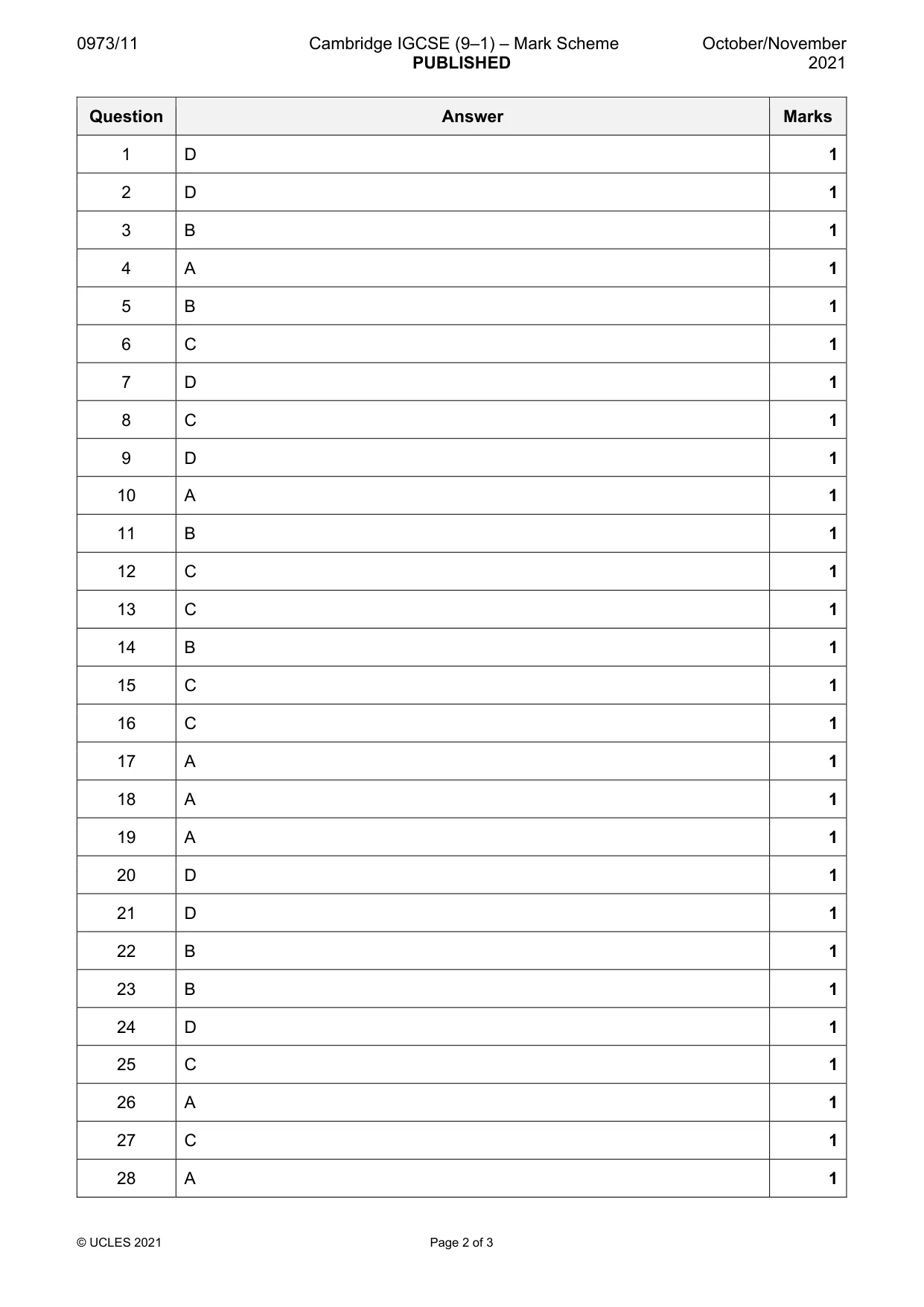
Mark scheme: D
Q2 · Which structure is only found in plant cells?
2 Which structure is only found in plant cells? A cell membrane B cytoplasm C nucleus D vacuole
Mark scheme: D
Q3 · Which row shows a large molecule and a basic unit from which it is made?
3 Which row shows a large molecule and a basic unit from which it is made? large molecule basic unit A glycogen amino acid B glycogen glucose C oil amino acid D oil glucose
Mark scheme: B
Q4 · A student investigated the effect of pH on an enzyme that digests starch
4 A student investigated the effect of pH on an enzyme that digests starch. Which chemical will be needed to determine if any starch has been digested? A Benedict’s solution B biuret solution C iodine solution D ethanol
Mark scheme: A
Q5 · The diagram shows an experiment to investigate photosynthesis
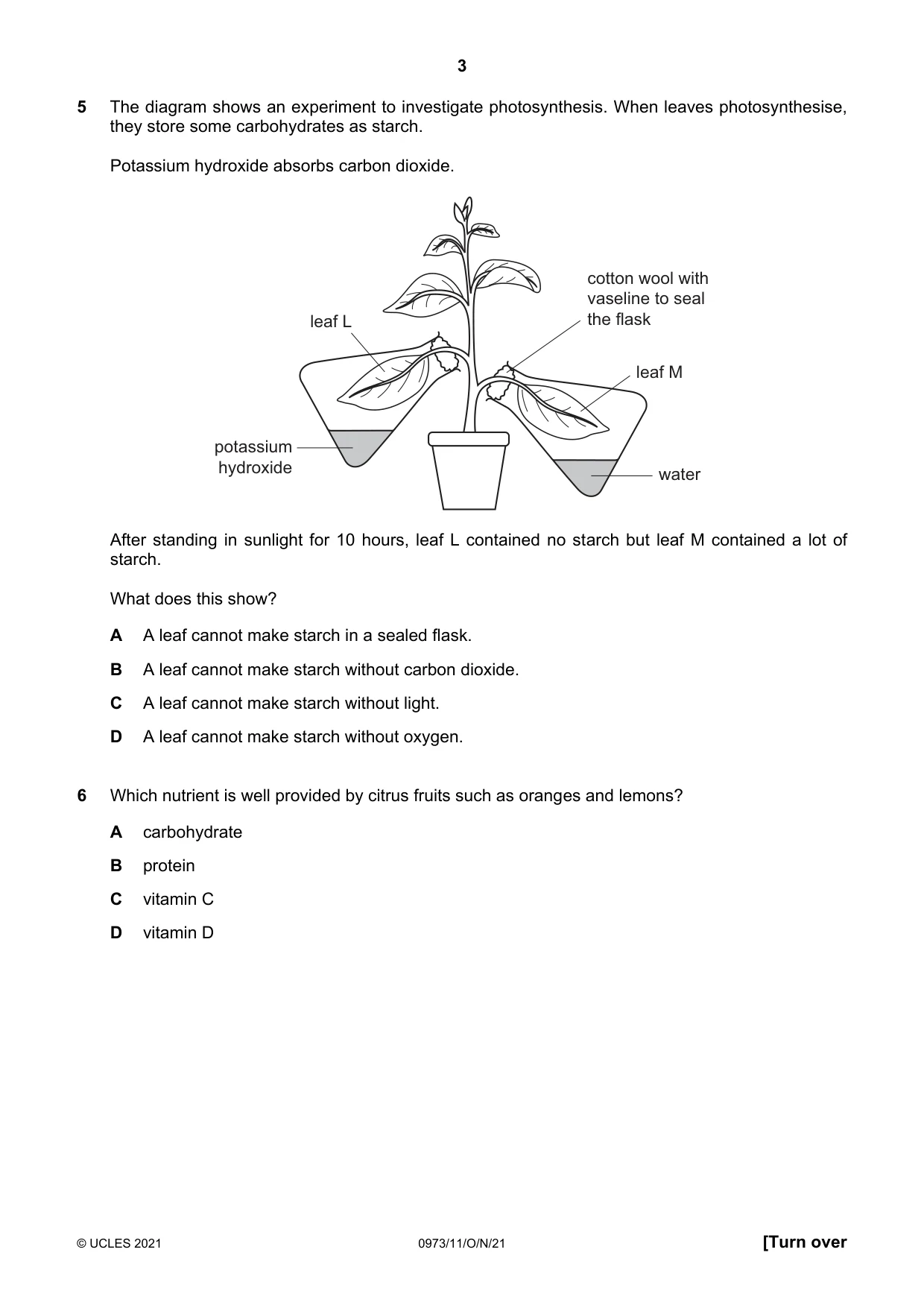
5 The diagram shows an experiment to investigate photosynthesis. When leaves photosynthesise, they store some carbohydrates as starch. Potassium hydroxide absorbs carbon dioxide. cotton wool with vaseline to seal leaf L the flask leaf M potassium hydroxide water After standing in sunlight for 10 hours, leaf L contained no starch but leaf M contained a lot of starch. What does this show? A A leaf cannot make starch in a sealed flask. B A leaf cannot make starch without carbon dioxide. C A leaf cannot make starch without light. D A leaf cannot make starch without oxygen.
Mark scheme: B
Q6 · Which nutrient is well provided by citrus fruits such as oranges and lemons?
6 Which nutrient is well provided by citrus fruits such as oranges and lemons? A carbohydrate B protein C vitamin C D vitamin D
Mark scheme: C
Q7 · The diagram shows some blood viewed under a light microscope
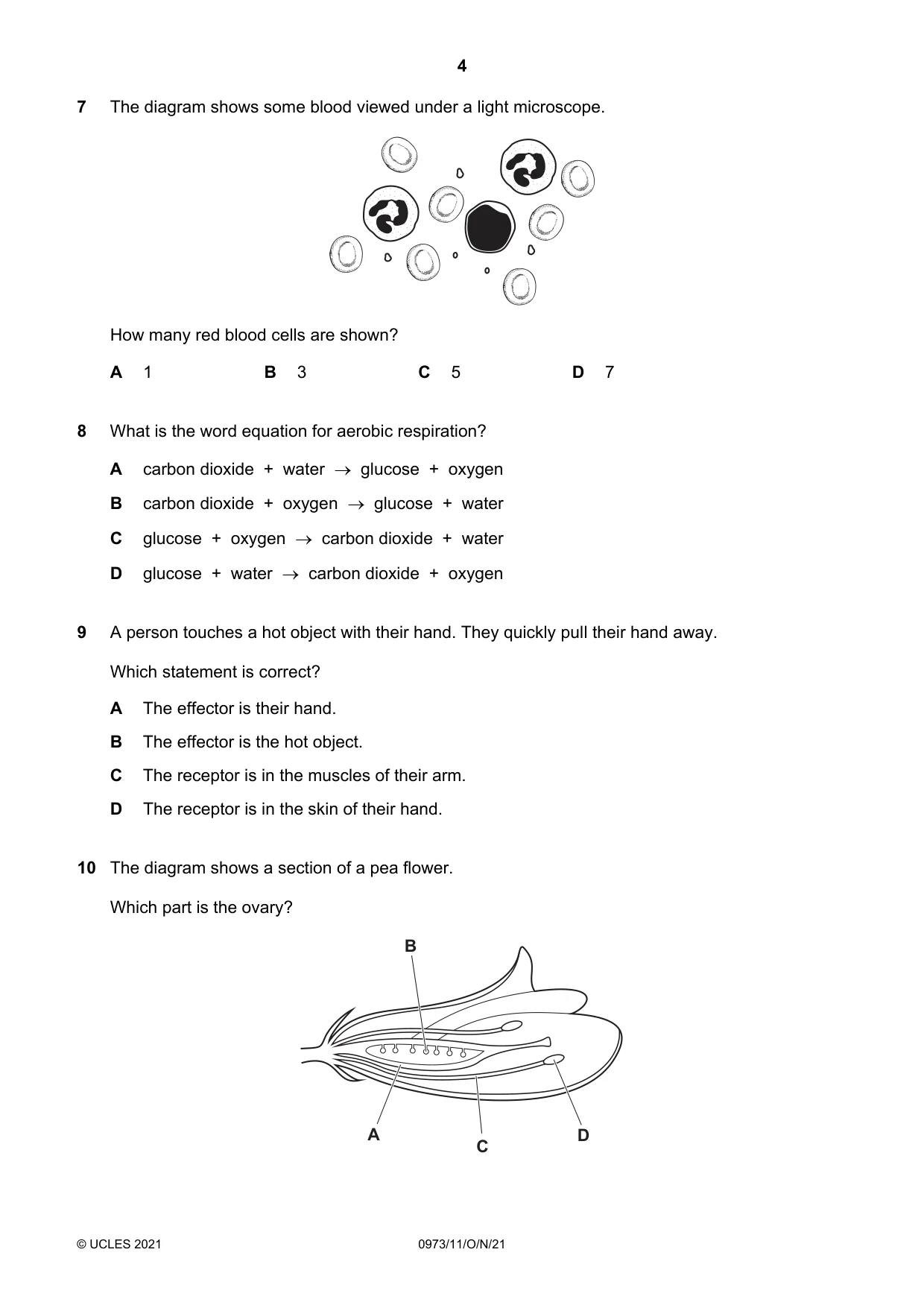
7 The diagram shows some blood viewed under a light microscope. How many red blood cells are shown? A 1 B 3 C 5 D 7
Mark scheme: D
Q8 · What is the word equation for aerobic respiration?
8 What is the word equation for aerobic respiration? A carbon dioxide + water glucose + oxygen B carbon dioxide + oxygen glucose + water C glucose + oxygen carbon dioxide + water D glucose + water carbon dioxide + oxygen
Mark scheme: C
Q9 · A person touches a hot object with their hand
9 A person touches a hot object with their hand. They quickly pull their hand away. Which statement is correct? A The effector is their hand. B The effector is the hot object. C The receptor is in the muscles of their arm. D The receptor is in the skin of their hand.
Mark scheme: D
Q10 · The diagram shows a section of a pea flower
10 The diagram shows a section of a pea flower. Which part is the ovary? B A D C
Mark scheme: A
Q11 · Natural selection involves several stages
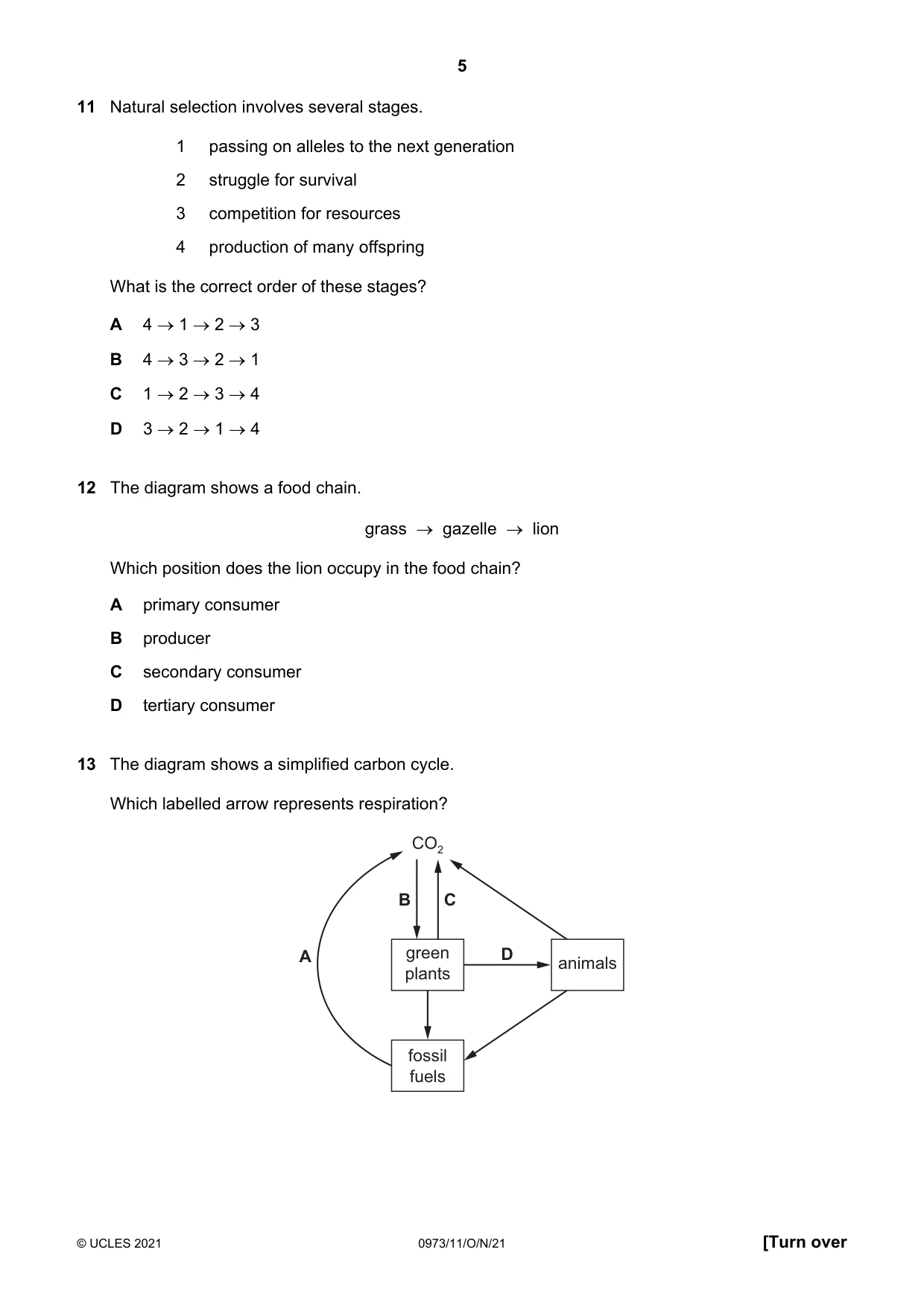
11 Natural selection involves several stages. 1 passing on alleles to the next generation 2 struggle for survival 3 competition for resources 4 production of many offspring What is the correct order of these stages? A 4 1 2 3 B 4 3 2 1 C 1 2 3 4 D 3 2 1 4
Mark scheme: B
Q12 · The diagram shows a food chain
12 The diagram shows a food chain. grass gazelle lion Which position does the lion occupy in the food chain? A primary consumer B producer C secondary consumer D tertiary consumer
Mark scheme: C
Q13 · The diagram shows a simplified carbon cycle
13 The diagram shows a simplified carbon cycle. Which labelled arrow represents respiration? CO2 B C A green D animals plants fossil fuels
Mark scheme: C
Q14 · Which row identifies physical changes and chemical changes?
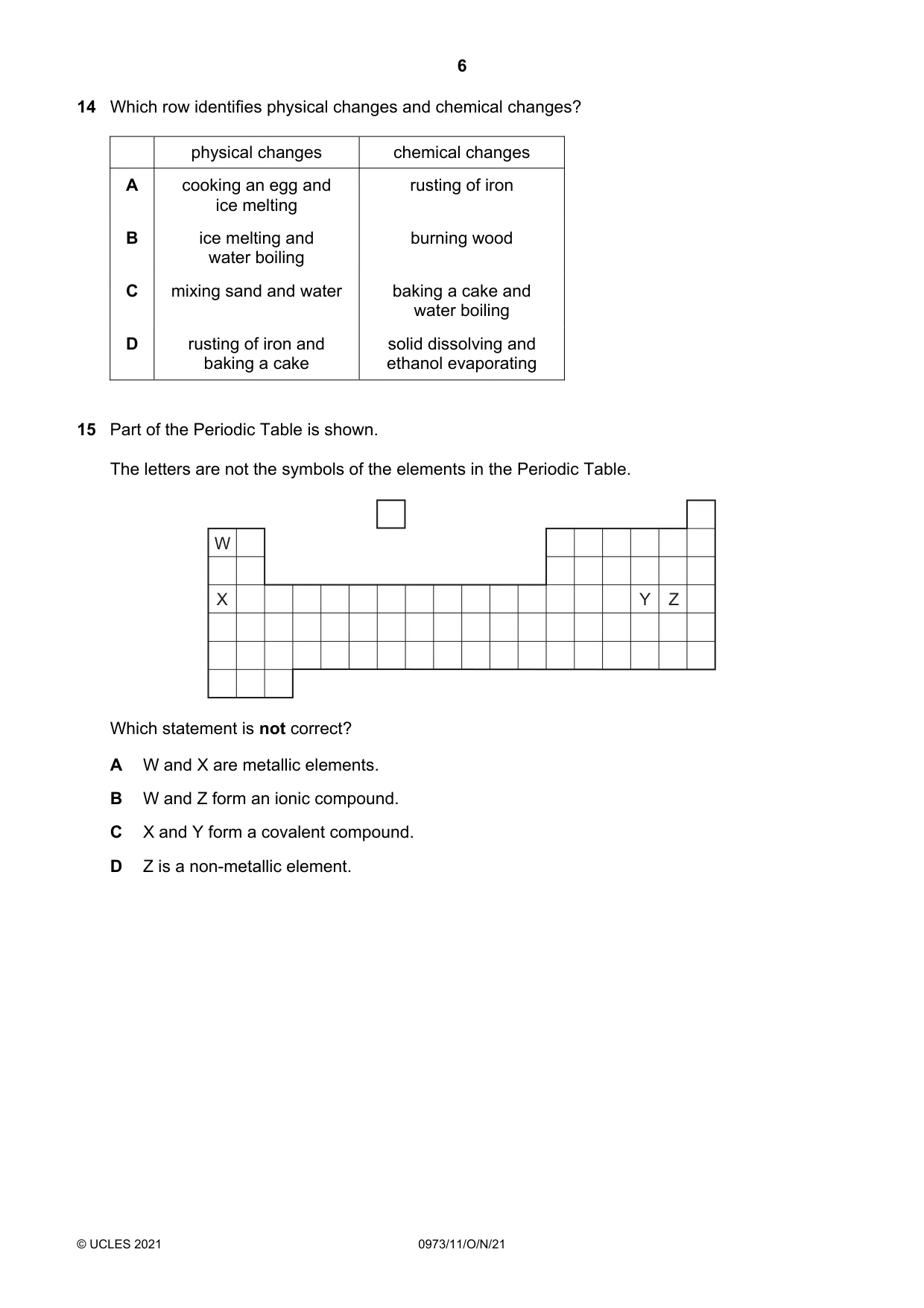
14 Which row identifies physical changes and chemical changes? physical changes chemical changes A cooking an egg and rusting of iron ice melting B ice melting and burning wood water boiling C mixing sand and water baking a cake and water boiling D rusting of iron and solid dissolving and baking a cake ethanol evaporating
Mark scheme: B
Q15 · Part of the Periodic Table is shown
15 Part of the Periodic Table is shown. The letters are not the symbols of the elements in the Periodic Table. W X Y Z Which statement is not correct? A W and X are metallic elements. B W and Z form an ionic compound. C X and Y form a covalent compound. D Z is a non-metallic element.
Mark scheme: C
Q16 · A model of a molecule is shown
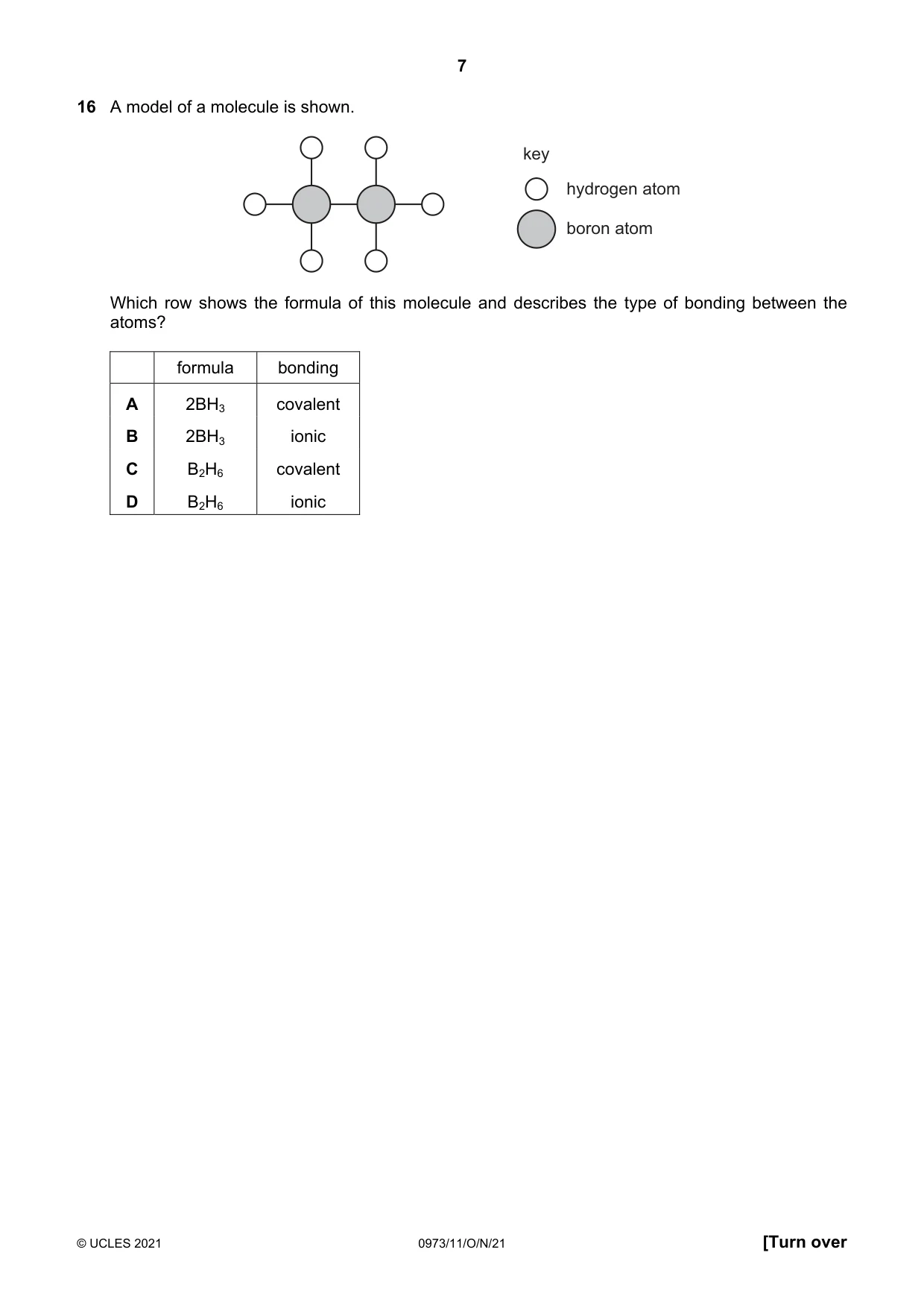
16 A model of a molecule is shown. key hydrogen atom boron atom Which row shows the formula of this molecule and describes the type of bonding between the atoms? formula bonding A 2BH3 covalent B 2BH3 ionic C B2H6 covalent D B2H6 ionic
Mark scheme: C
Q17 · The diagram shows the electrolysis of a compound
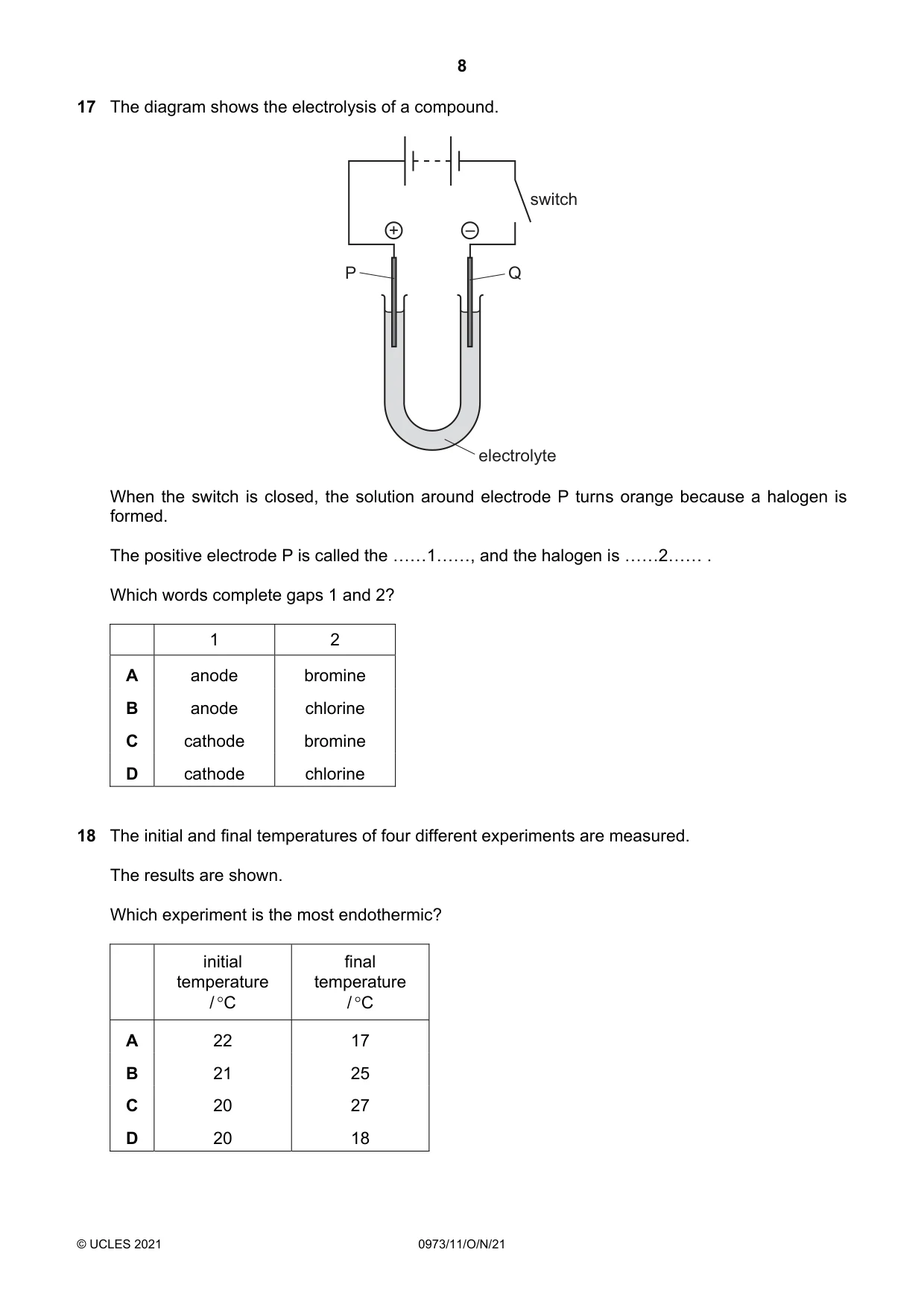
17 The diagram shows the electrolysis of a compound. switch + – P Q electrolyte When the switch is closed, the solution around electrode P turns orange because a halogen is formed. The positive electrode P is called the ……1……, and the halogen is ……2…… . Which words complete gaps 1 and 2? 1 2 A anode bromine B anode chlorine C cathode bromine D cathode chlorine
Mark scheme: A
Q18 · The initial and final temperatures of four different experiments are measured
18 The initial and final temperatures of four different experiments are measured. The results are shown. Which experiment is the most endothermic? initial final temperature temperature / C / C A 22 17 B 21 25 C 20 27 D 20 18
Mark scheme: A
Q19 · Aqueous hydrogen peroxide decomposes slowly and produces water and oxygen gas
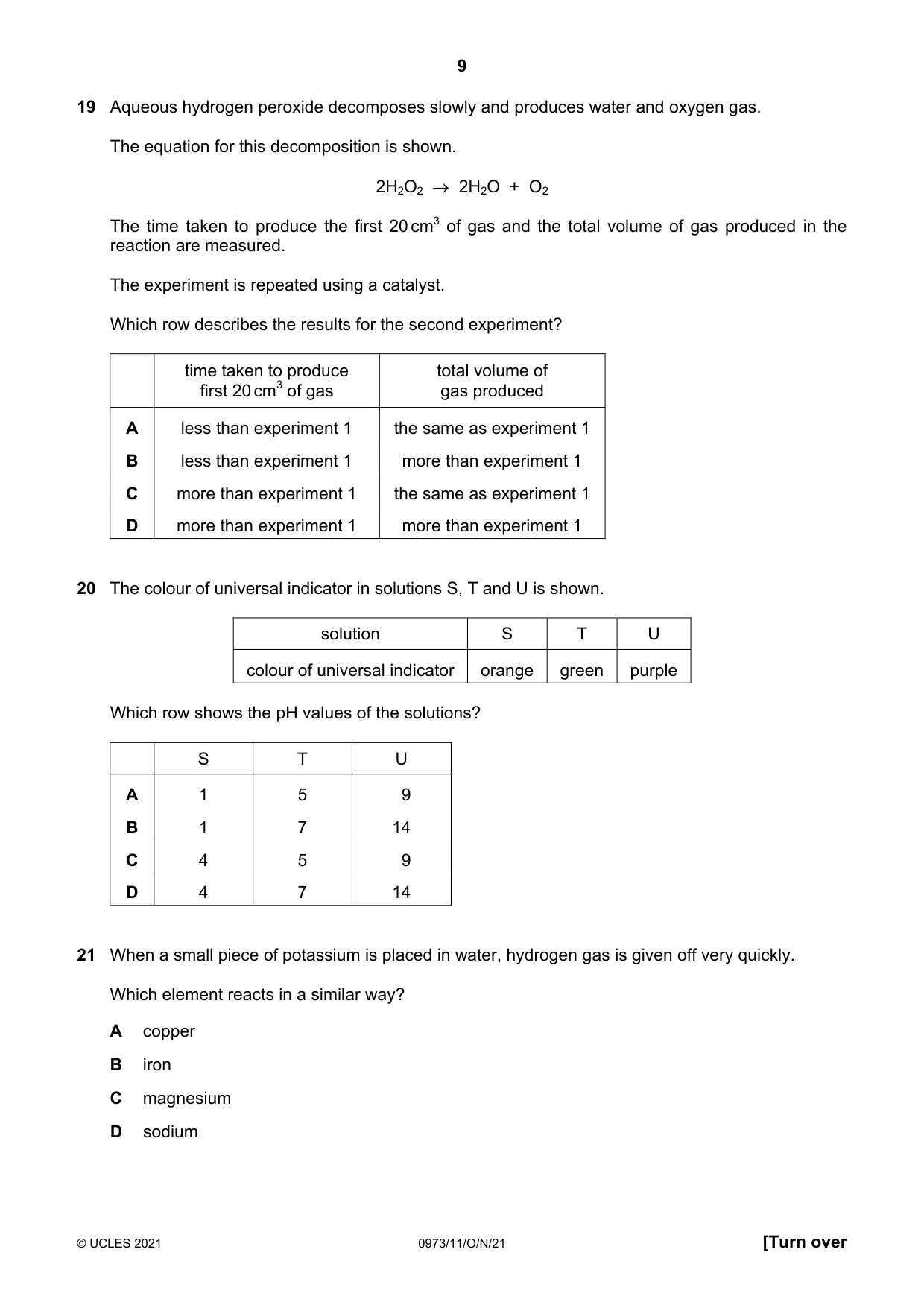
19 Aqueous hydrogen peroxide decomposes slowly and produces water and oxygen gas. The equation for this decomposition is shown. 2H2O2 2H2O + O2 The time taken to produce the first 20 cm3 of gas and the total volume of gas produced in the reaction are measured. The experiment is repeated using a catalyst. Which row describes the results for the second experiment? time taken to produce total volume of first 20 cm3 of gas gas produced A less than experiment 1 the same as experiment 1 B less than experiment 1 more than experiment 1 C more than experiment 1 the same as experiment 1 D more than experiment 1 more than experiment 1
Mark scheme: A
Q20 · The colour of universal indicator in solutions S, T and U is shown
20 The colour of universal indicator in solutions S, T and U is shown. solution S T U colour of universal indicator orange green purple Which row shows the pH values of the solutions? S T U A 1 5 9 B 1 7 14 C 4 5 9 D 4 7 14
Mark scheme: D
More questions on The characteristic properties of acids and bases
Q21 · When a small piece of potassium is placed in water, hydrogen gas is given off very quickly
21 When a small piece of potassium is placed in water, hydrogen gas is given off very quickly. Which element reacts in a similar way? A copper B iron C magnesium D sodium
Mark scheme: D
Q22 · Why does the steel used to make a drill contain manganese?
22 Why does the steel used to make a drill contain manganese? A to increase the density of the steel B to increase the hardness of the steel C to increase the malleability of the steel D to increase the melting point of the steel
Mark scheme: B
Q23 · What is the colour of cobalt(II) chloride after water is added to it?
23 What is the colour of cobalt(II) chloride after water is added to it? A blue B pink C white D green
Mark scheme: B
Q24 · Which process does not produce carbon dioxide?
24 Which process does not produce carbon dioxide? A complete combustion of fossil fuels B reaction of an acid with a carbonate C respiration in plants D rusting iron
Mark scheme: D
Q25 · Calcium carbonate (limestone) is a base
25 Calcium carbonate (limestone) is a base. Which uses of limestone depend on it acting as a base? 1 making lime 2 neutralising acid waste 3 stone buildings 4 treatment of soil A 1 and 2 B 2 and 3 C 2 and 4 D 3 and 4
Mark scheme: C
More questions on The characteristic properties of acids and bases
Q26 · Four molecules are shown
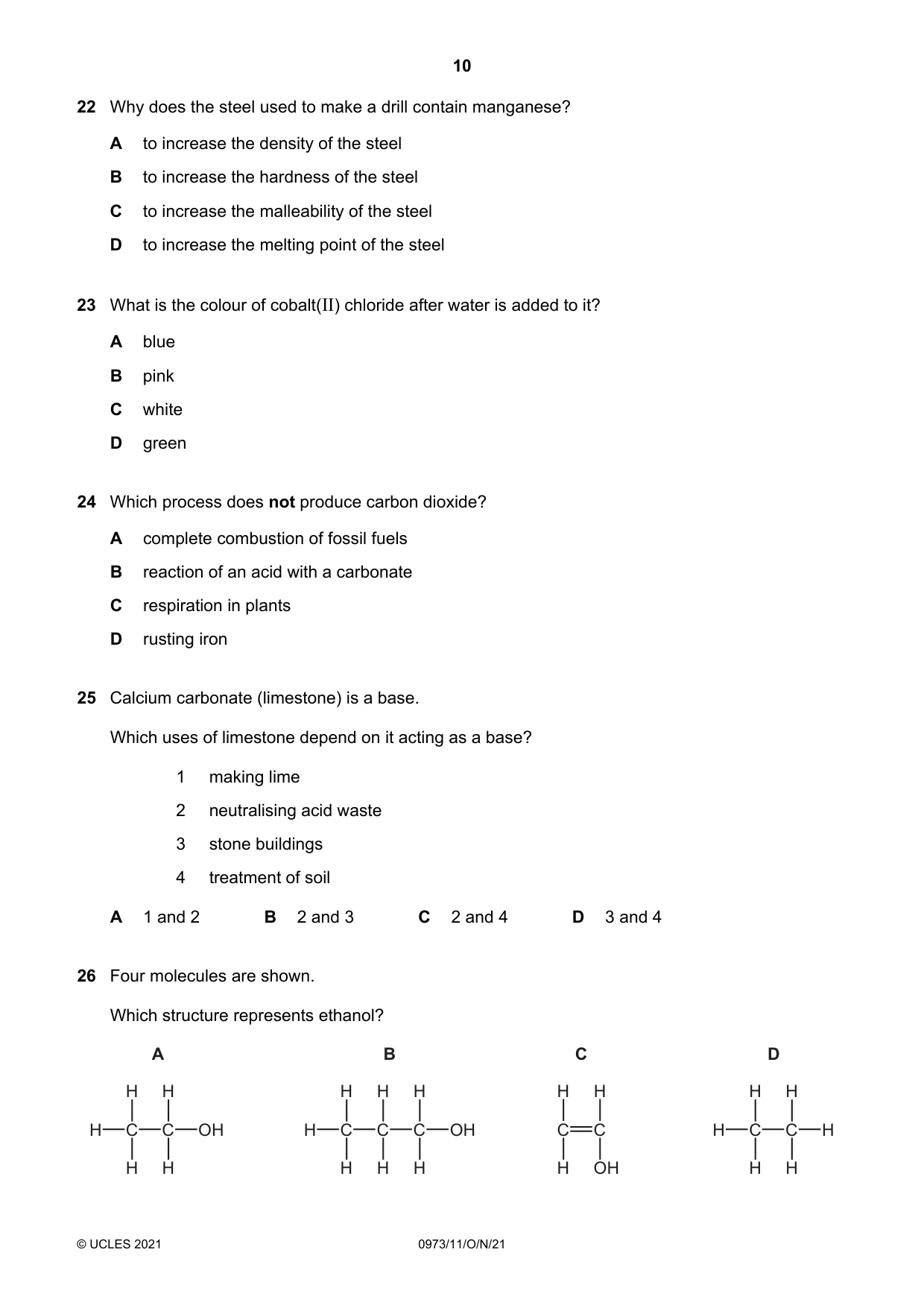
26 Four molecules are shown. Which structure represents ethanol? A B C D H H H H H H H H H H C C OH H C C C OH C C H C C H H H H H H H OH H H
Mark scheme: A
Q27 · Which substance rapidly decolourises aqueous bromine?
27 Which substance rapidly decolourises aqueous bromine? A ethane B ethanol C ethene D poly(ethene)
Mark scheme: C
Q28 · A student uses a piece of string to measure the circumference of a pencil
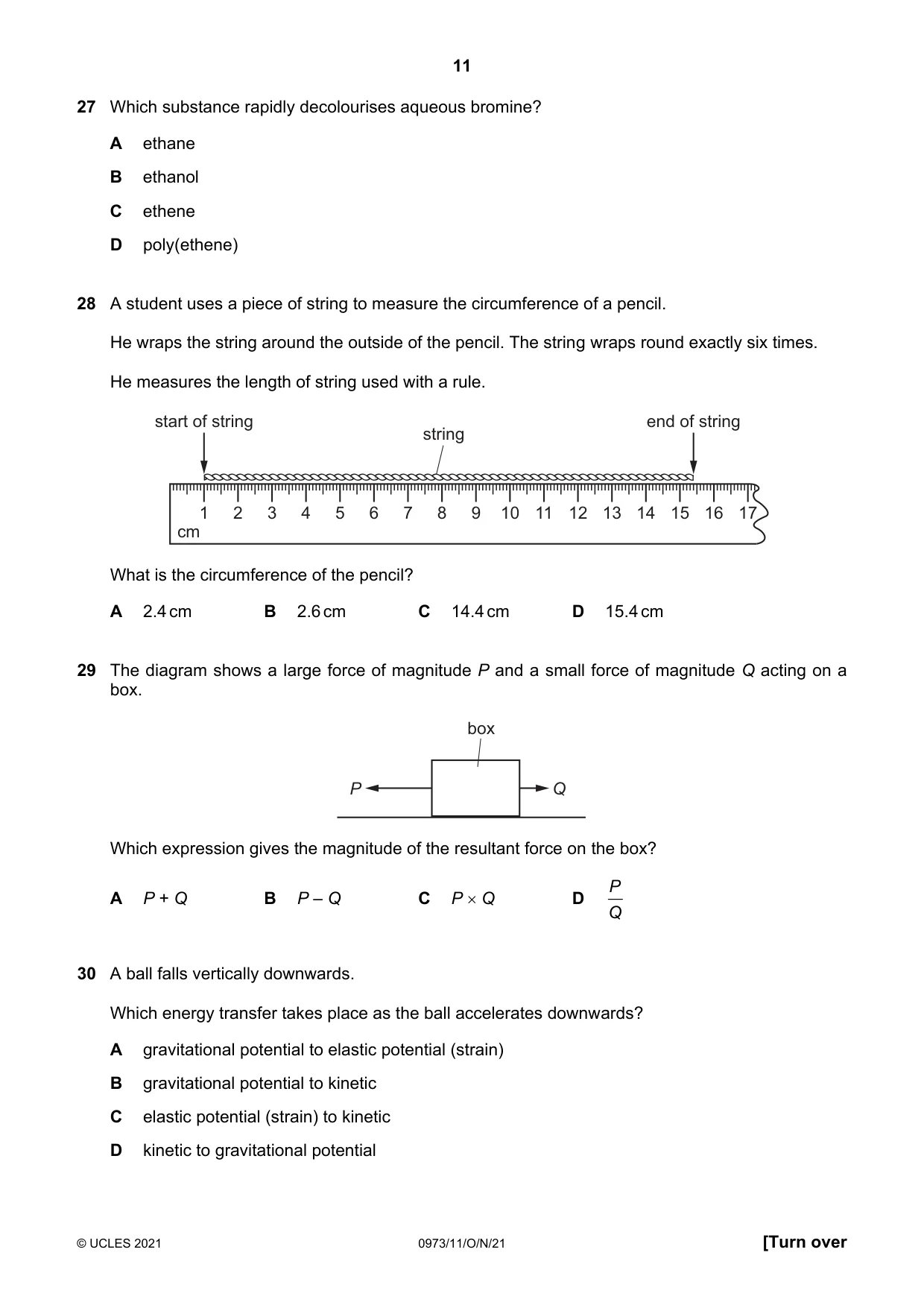
28 A student uses a piece of string to measure the circumference of a pencil. He wraps the string around the outside of the pencil. The string wraps round exactly six times. He measures the length of string used with a rule. start of string end of string string 1 2 3 4 5 6 7 8 9 10 11 12 13 14 15 16 17 cm What is the circumference of the pencil? A 2.4 cm B 2.6 cm C 14.4 cm D 15.4 cm
Mark scheme: A
More questions on Physical quantities and measurement techniques
Q29 · The diagram shows a large force of magnitude P and a small force of magnitude Q acting on…
29 The diagram shows a large force of magnitude P and a small force of magnitude Q acting on a box. box P Q Which expression gives the magnitude of the resultant force on the box? P A P + Q B P – Q C P Q D Q
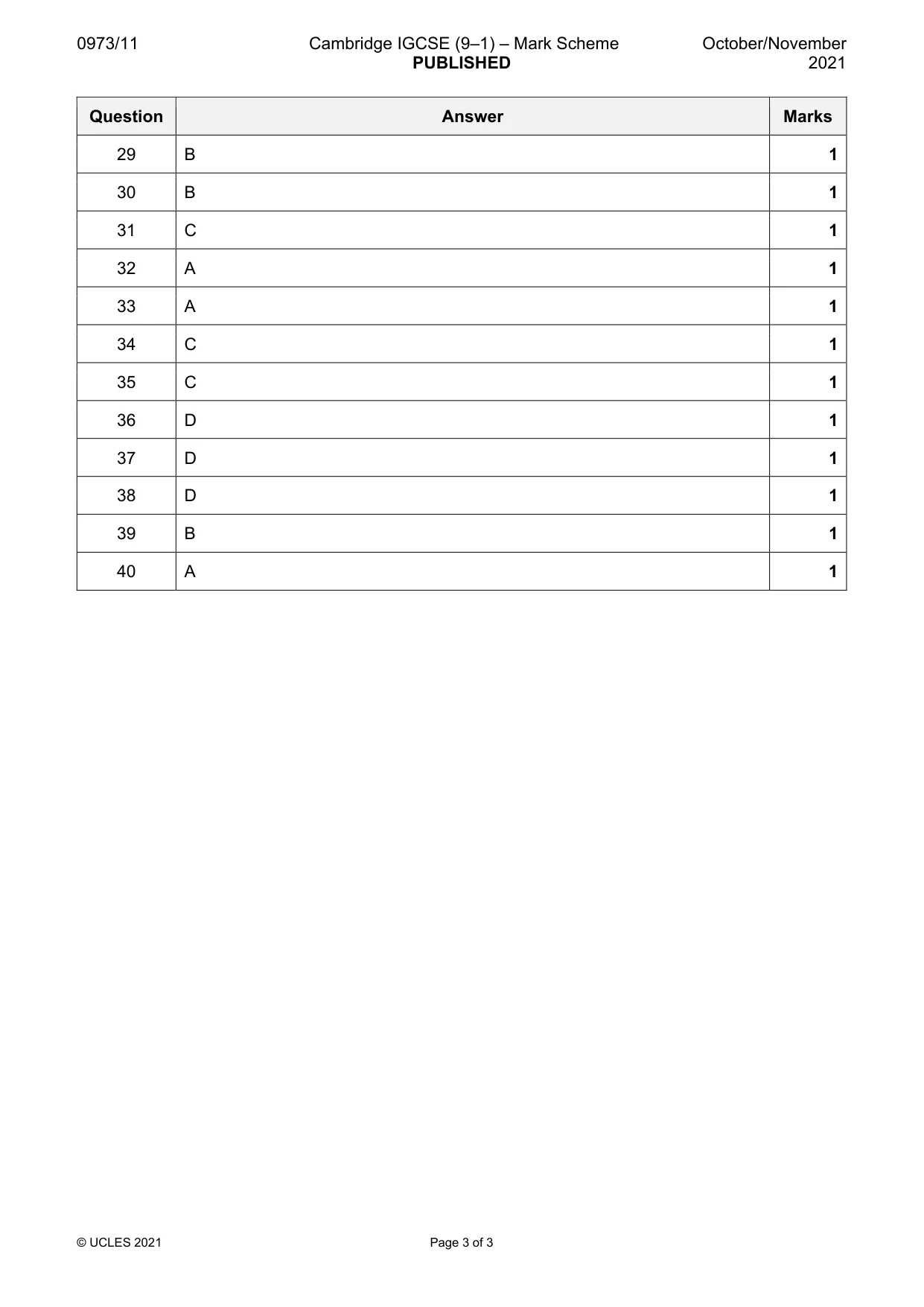
Mark scheme: B
Q30 · A ball falls vertically downwards
30 A ball falls vertically downwards. Which energy transfer takes place as the ball accelerates downwards? A gravitational potential to elastic potential (strain) B gravitational potential to kinetic C elastic potential (strain) to kinetic D kinetic to gravitational potential
Mark scheme: B
Q31 · Four cars travel the same distance directly up the same steep hill
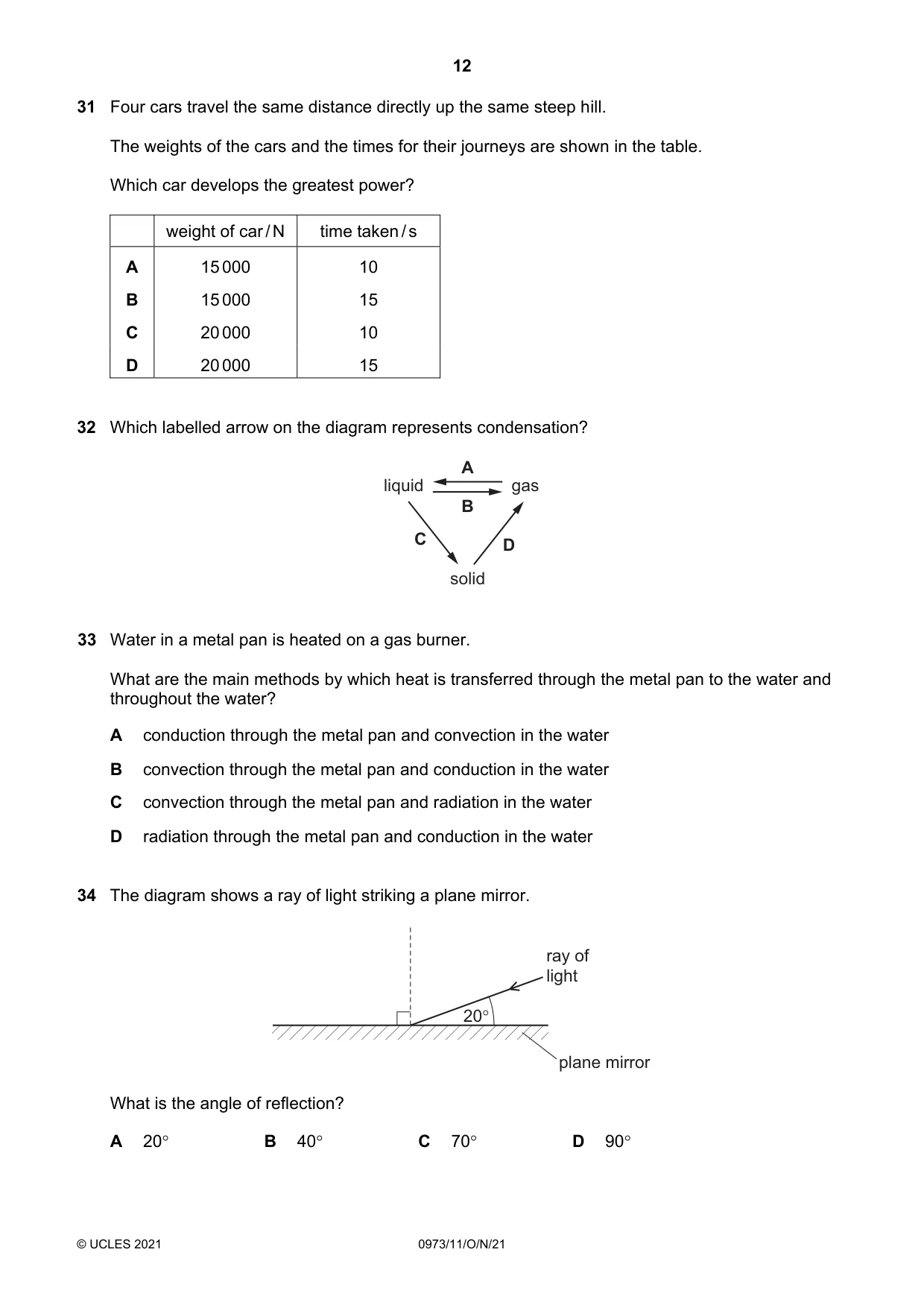
31 Four cars travel the same distance directly up the same steep hill. The weights of the cars and the times for their journeys are shown in the table. Which car develops the greatest power? weight of car / N time taken / s A 15 000 10 B 15 000 15 C 20 000 10 D 20 000 15
Mark scheme: C
Q32 · Which labelled arrow on the diagram represents condensation?
32 Which labelled arrow on the diagram represents condensation? A liquid gas B C D solid
Mark scheme: A
Q33 · Water in a metal pan is heated on a gas burner
33 Water in a metal pan is heated on a gas burner. What are the main methods by which heat is transferred through the metal pan to the water and throughout the water? A conduction through the metal pan and convection in the water B convection through the metal pan and conduction in the water C convection through the metal pan and radiation in the water D radiation through the metal pan and conduction in the water
Mark scheme: A
Q34 · The diagram shows a ray of light striking a plane mirror
34 The diagram shows a ray of light striking a plane mirror. ray of light 20° plane mirror What is the angle of reflection? A 20 B 40 C 70 D 90
Mark scheme: C
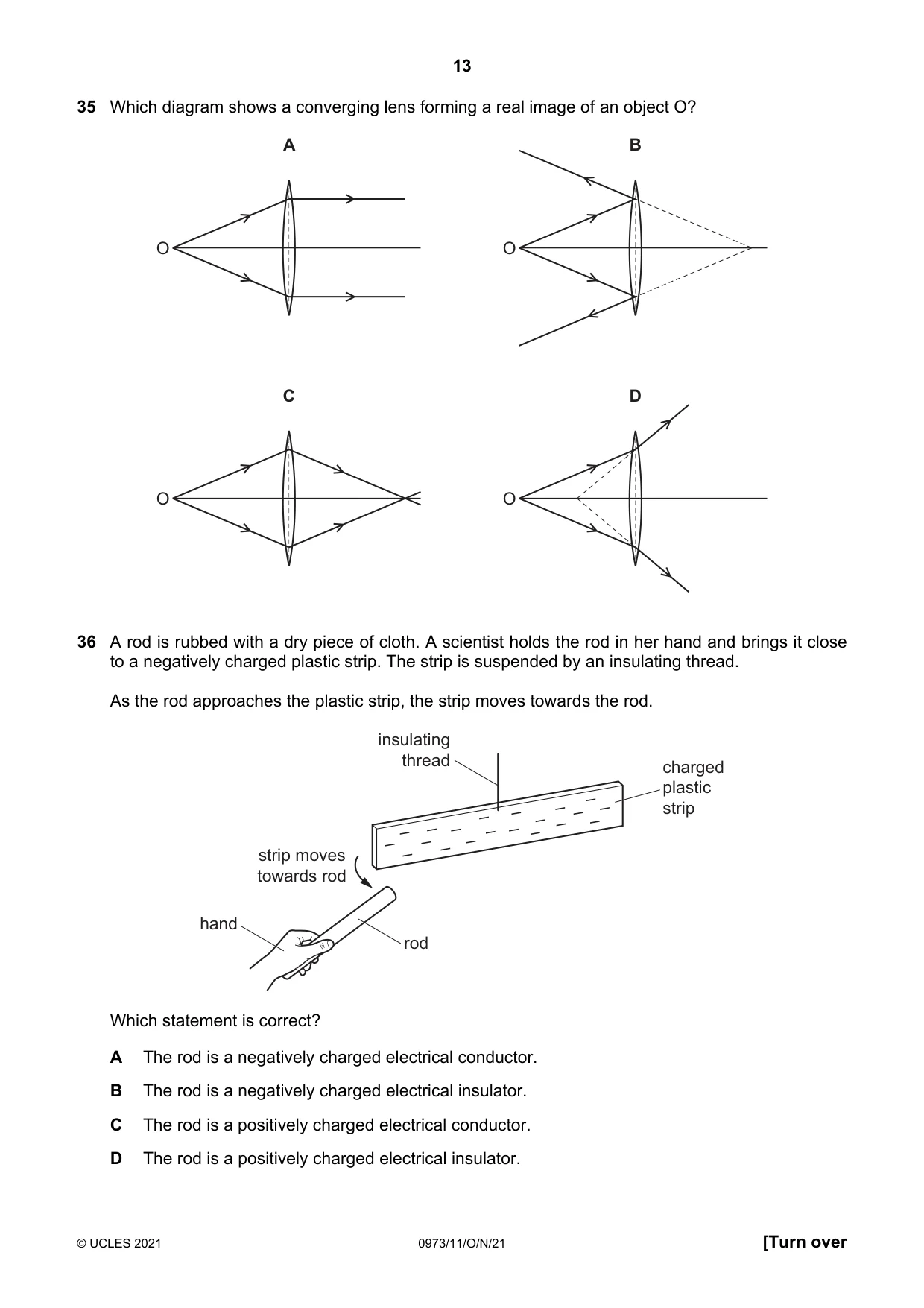
Q35 · Which diagram shows a converging lens forming a real image of an object O?
35 Which diagram shows a converging lens forming a real image of an object O? A B O O C D O O
Mark scheme: C
Q36 · A rod is rubbed with a dry piece of cloth
36 A rod is rubbed with a dry piece of cloth. A scientist holds the rod in her hand and brings it close to a negatively charged plastic strip. The strip is suspended by an insulating thread. As the rod approaches the plastic strip, the strip moves towards the rod. insulating thread charged plastic – – – – – –– strip – – – – – – – – – – – – strip moves – towards rod hand rod Which statement is correct? A The rod is a negatively charged electrical conductor. B The rod is a negatively charged electrical insulator. C The rod is a positively charged electrical conductor. D The rod is a positively charged electrical insulator.
Mark scheme: D
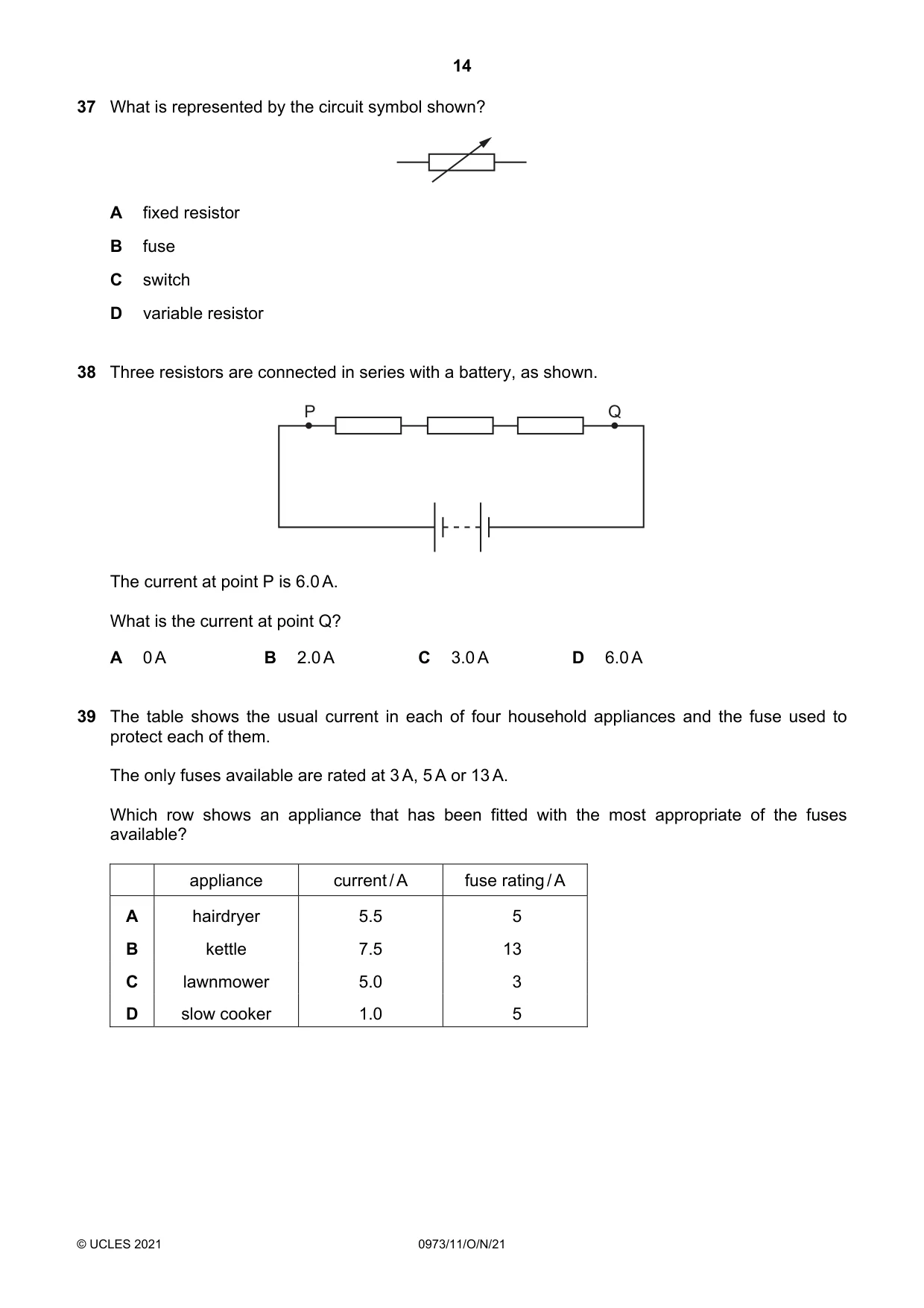
Q37 · What is represented by the circuit symbol shown?
37 What is represented by the circuit symbol shown? A fixed resistor B fuse C switch D variable resistor
Mark scheme: D
Q38 · Three resistors are connected in series with a battery, as shown
38 Three resistors are connected in series with a battery, as shown. P Q The current at point P is 6.0 A. What is the current at point Q? A 0 A B 2.0 A C 3.0 A D 6.0 A
Mark scheme: D
Q39 · The table shows the usual current in each of four household appliances and the fuse used…
39 The table shows the usual current in each of four household appliances and the fuse used to protect each of them. The only fuses available are rated at 3 A, 5 A or 13 A. Which row shows an appliance that has been fitted with the most appropriate of the fuses available? appliance current / A fuse rating / A A hairdryer 5.5 5 B kettle 7.5 13 C lawnmower 5.0 3 D slow cooker 1.0 5
Mark scheme: B
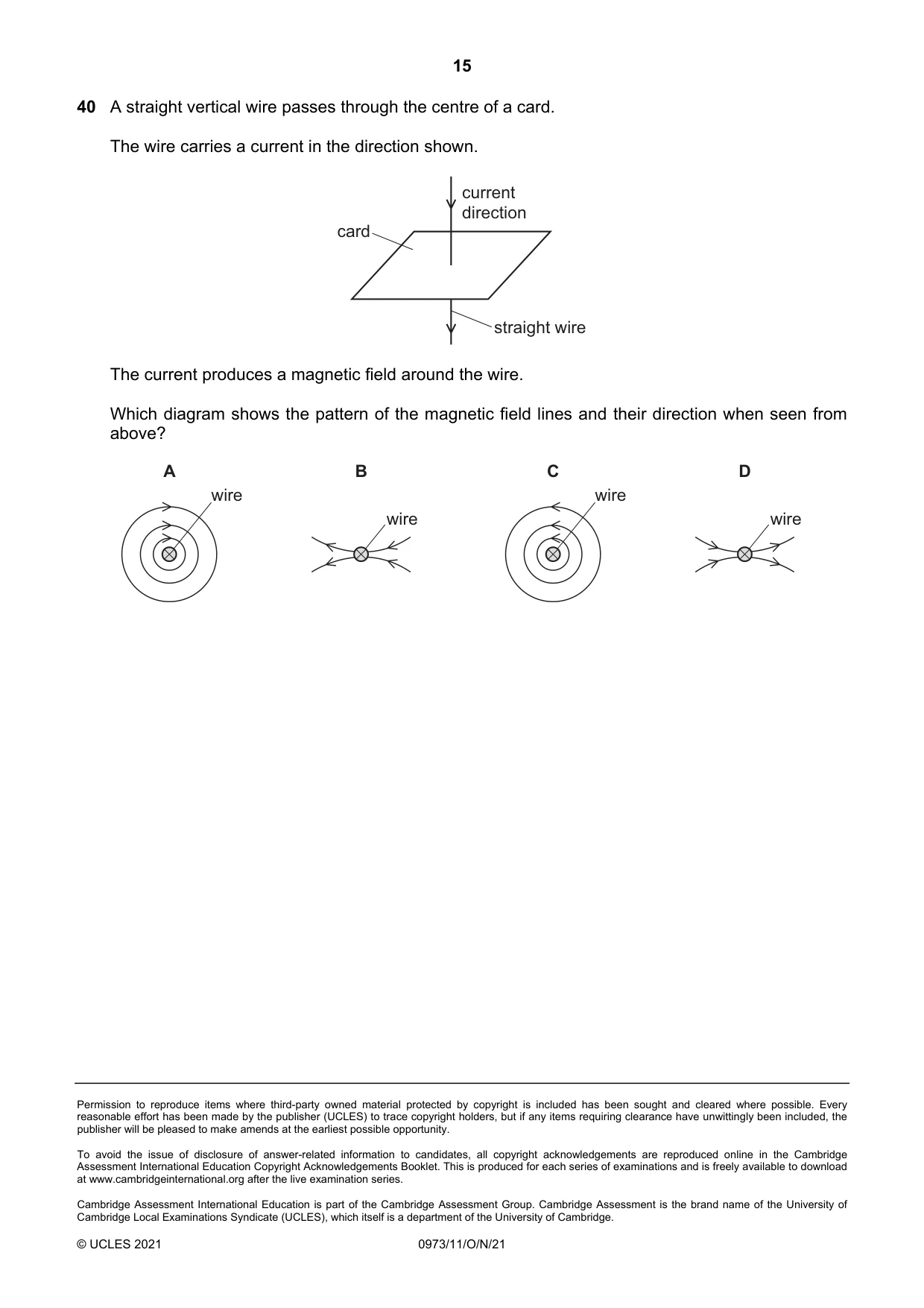
Q40 · A straight vertical wire passes through the centre of a card
40 A straight vertical wire passes through the centre of a card. The wire carries a current in the direction shown. current direction card straight wire The current produces a magnetic field around the wire. Which diagram shows the pattern of the magnetic field lines and their direction when seen from above? A B C D wire wire wire wire
Mark scheme: A
What was in this paper
The subtopics covered by these 40 questions, and how many questions each got. Open one in a new tab to see every Cambridge question on it.
2Energy, work and power2Light2Respiration2The characteristic properties of acids and bases2Air quality and climate1Alcohols1Alkenes1Alloys and their properties1Atomic structure and the Periodic Table1Biological molecules1Blood1Carbon cycle1Cell structure1Coordination and response1Diet1Electrical safety1Electrolysis1Electromagnetic effects1Enzymes1Exothermic and endothermic reactions1Food chains and food webs1Forces1Group I properties1Identification of ions and gases1Kinetic particle model of matter1Photosynthesis1Physical and chemical changes1Physical quantities and measurement techniques1Rate of reaction1Selection1Sexual reproduction in plants1Simple molecules and covalent bonds1Simple phenomena of magnetism1Transfer of thermal energy1What you needed in this session
Cambridge’s own grade thresholds for 2021 Oct/Nov, Paper 1 · Variant 1. A higher threshold means an easier paper — the bar moves with how the cohort did.