Cambridge IGCSE Sciences - Co-ordinated (9-1) 0973 — 2023 May/June Paper 4 · Variant 2
0973/42/M/J/23 · 12 questions · 120 marks · ≈135 min
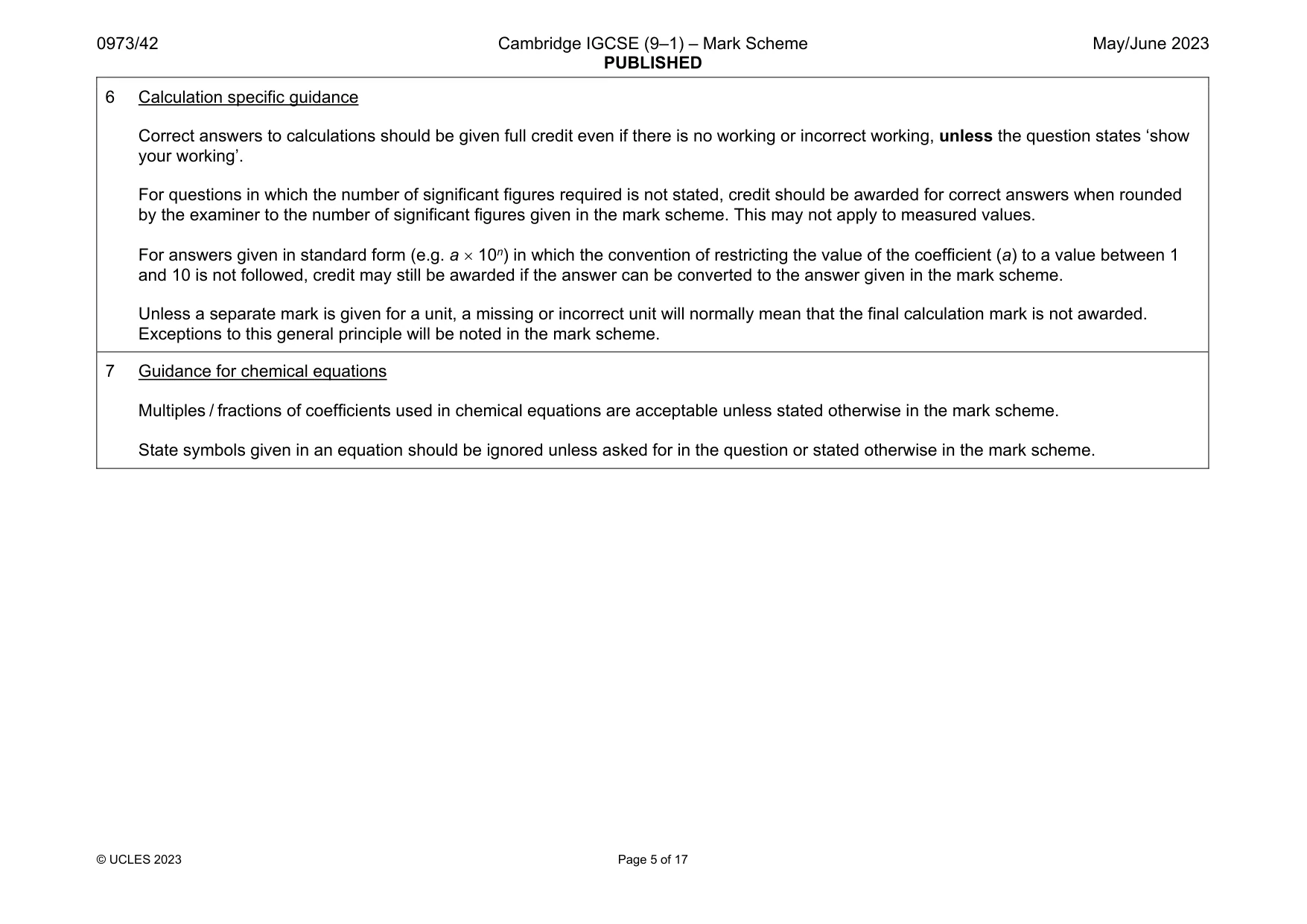
The question paper and its mark scheme, free to read here and free to download. This is Cambridge’s own paper, exactly as it was sat.
Question paper32 pages




Mark scheme17 pages
Answers below. Sit the paper first if you are practising.
Questions as text
Q1 · A diagram of parts of the eye
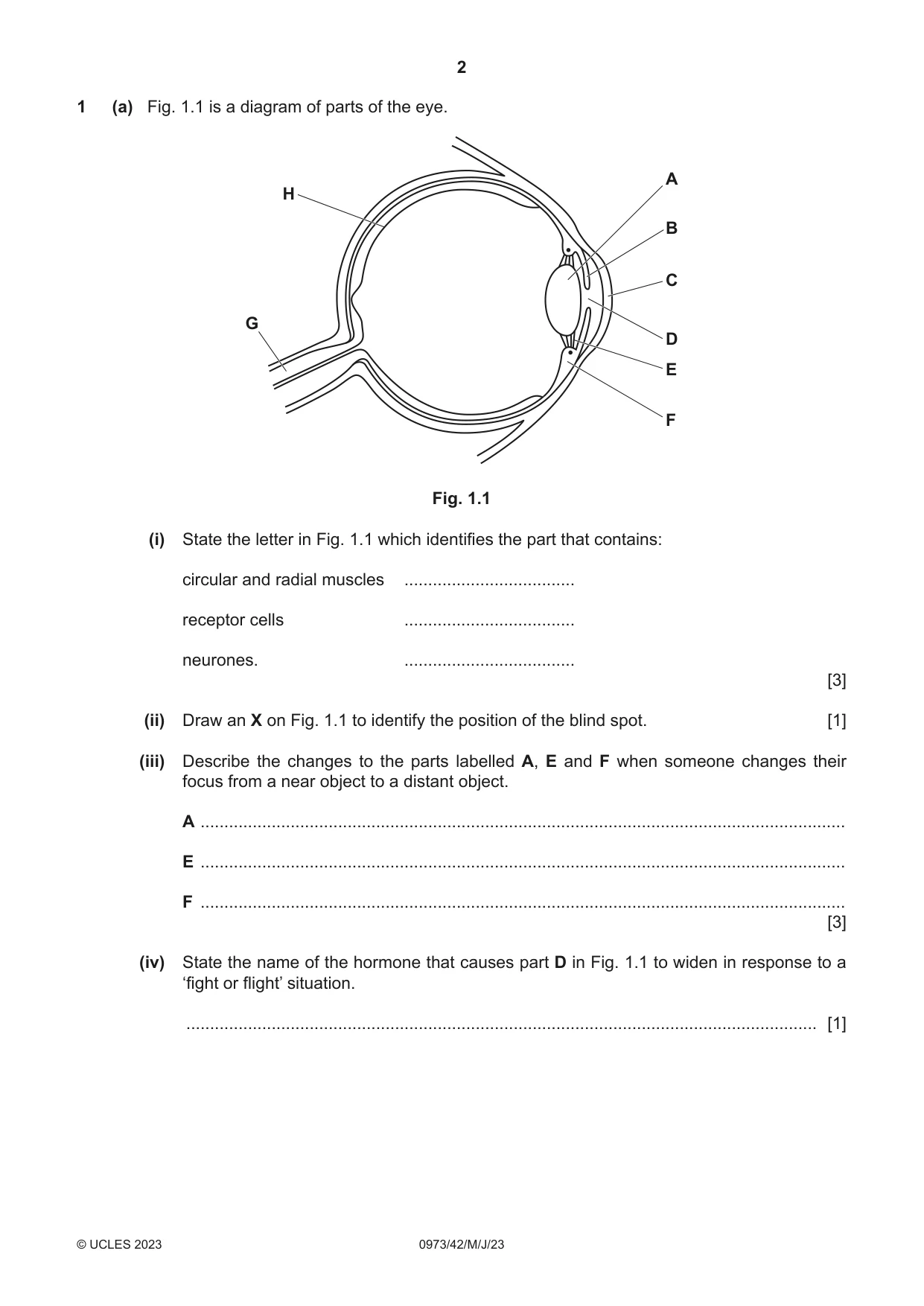
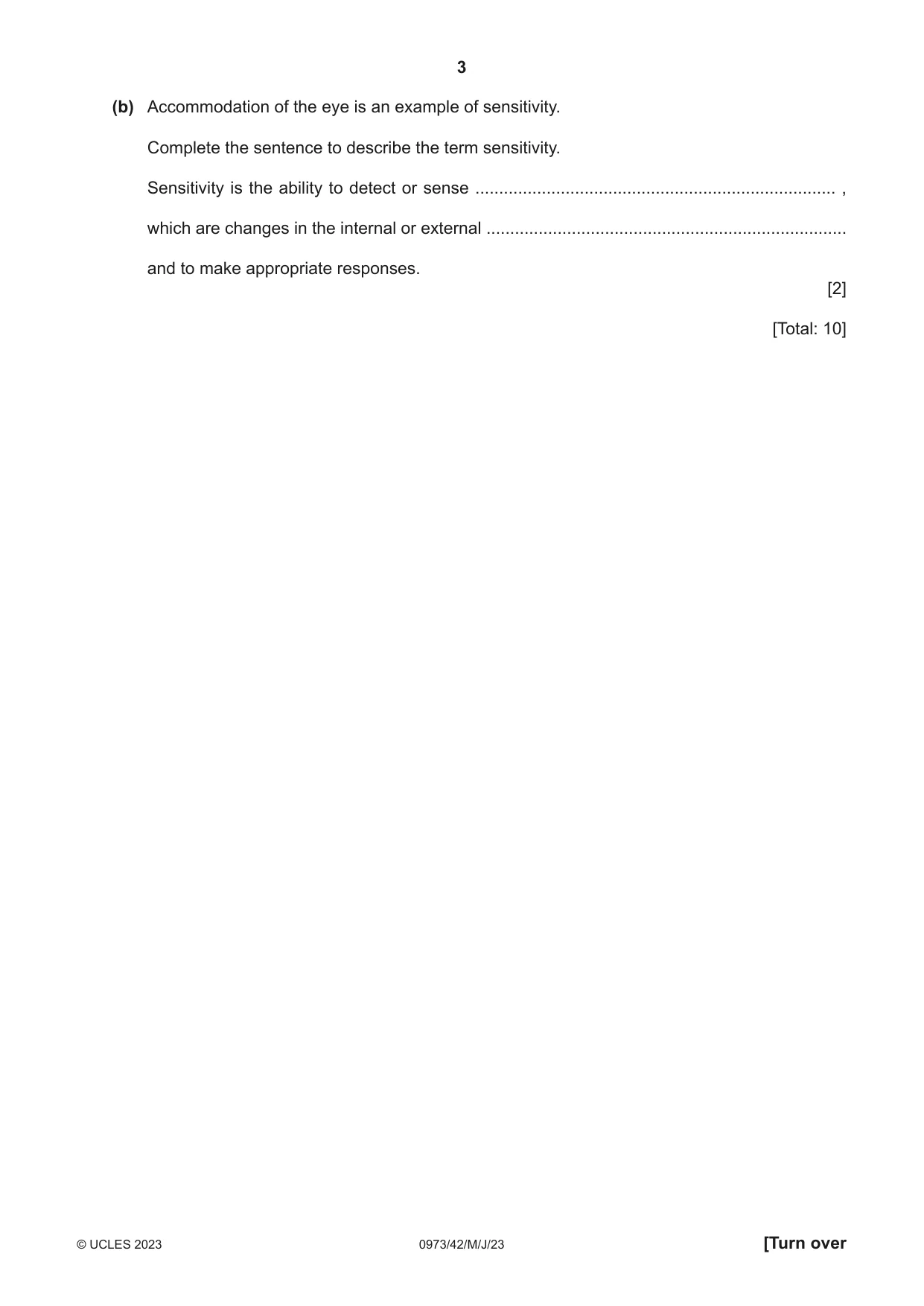
1 (a) Fig. 1.1 is a diagram of parts of the eye. A H B C G D E F Fig. 1.1 (i) State the letter in Fig. 1.1 which identifies the part that contains: circular and radial muscles .................................... receptor cells .................................... neurones. .................................... [3] (ii) Draw an X on Fig. 1.1 to identify the position of the blind spot. [1] (iii) Describe the changes to the parts labelled A, E and F when someone changes their focus from a near object to a distant object. A ........................................................................................................................................ E ........................................................................................................................................ F ........................................................................................................................................ [3] (iv) State the name of the hormone that causes part D in Fig. 1.1 to widen in response to a ‘fight or flight’ situation. ..................................................................................................................................... [1] (b) Accommodation of the eye is an example of sensitivity. Complete the sentence to describe the term sensitivity. Sensitivity is the ability to detect or sense ............................................................................ , which are changes in the internal or external ............................................................................ and to make appropriate responses. [2] [Total: 10]
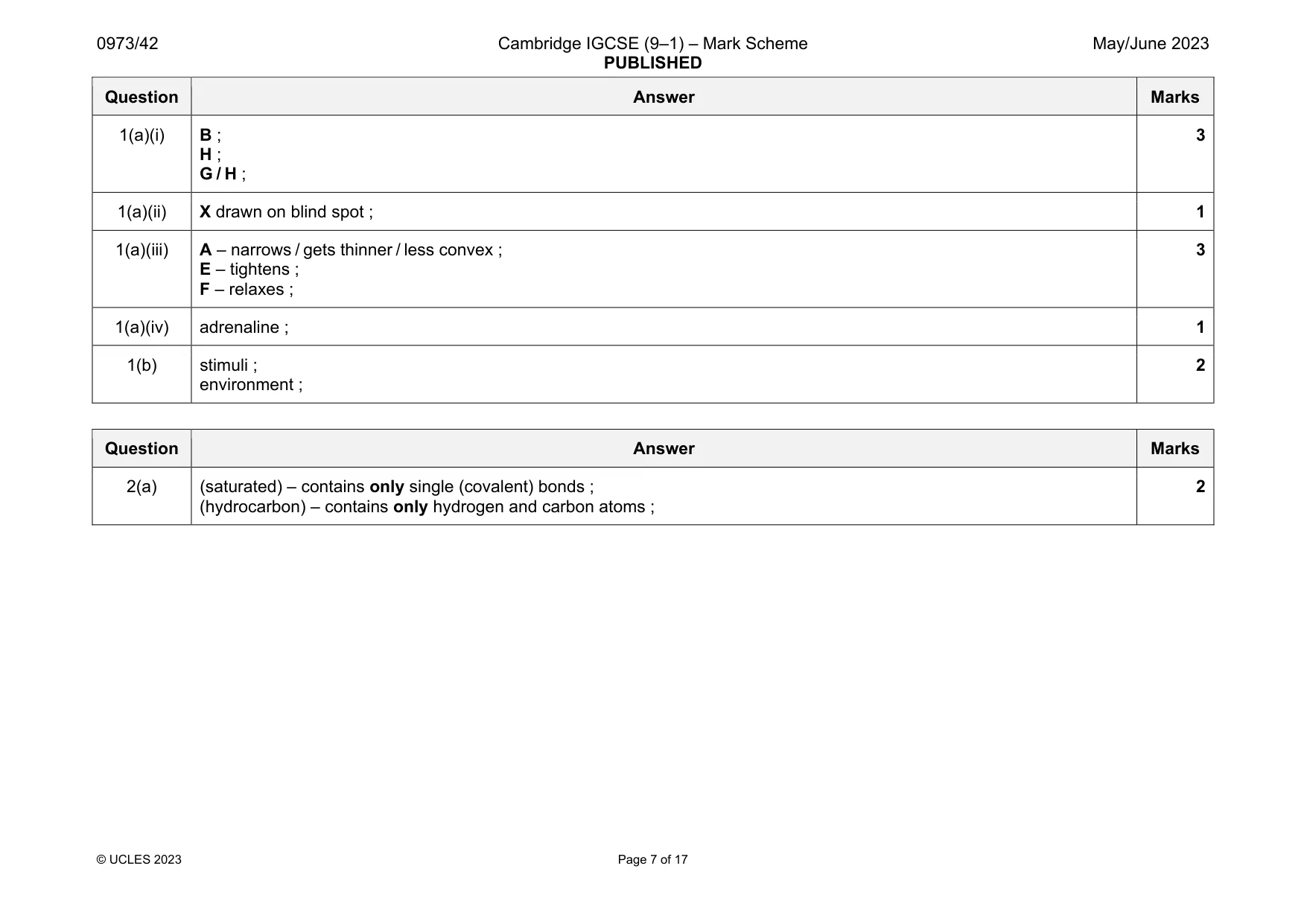
Mark scheme: 1(a)(i) B ; H ; G / H ; 3 1(a)(ii) X drawn on blind spot ; 1 1(a)(iii) A – narrows / gets thinner / less convex ; E – tightens ; F – relaxes ; 3 1(a)(iv) adrenaline ; 1 1(b) stimuli ; environment ; 2
Q2 · Alkanes are saturated hydrocarbons
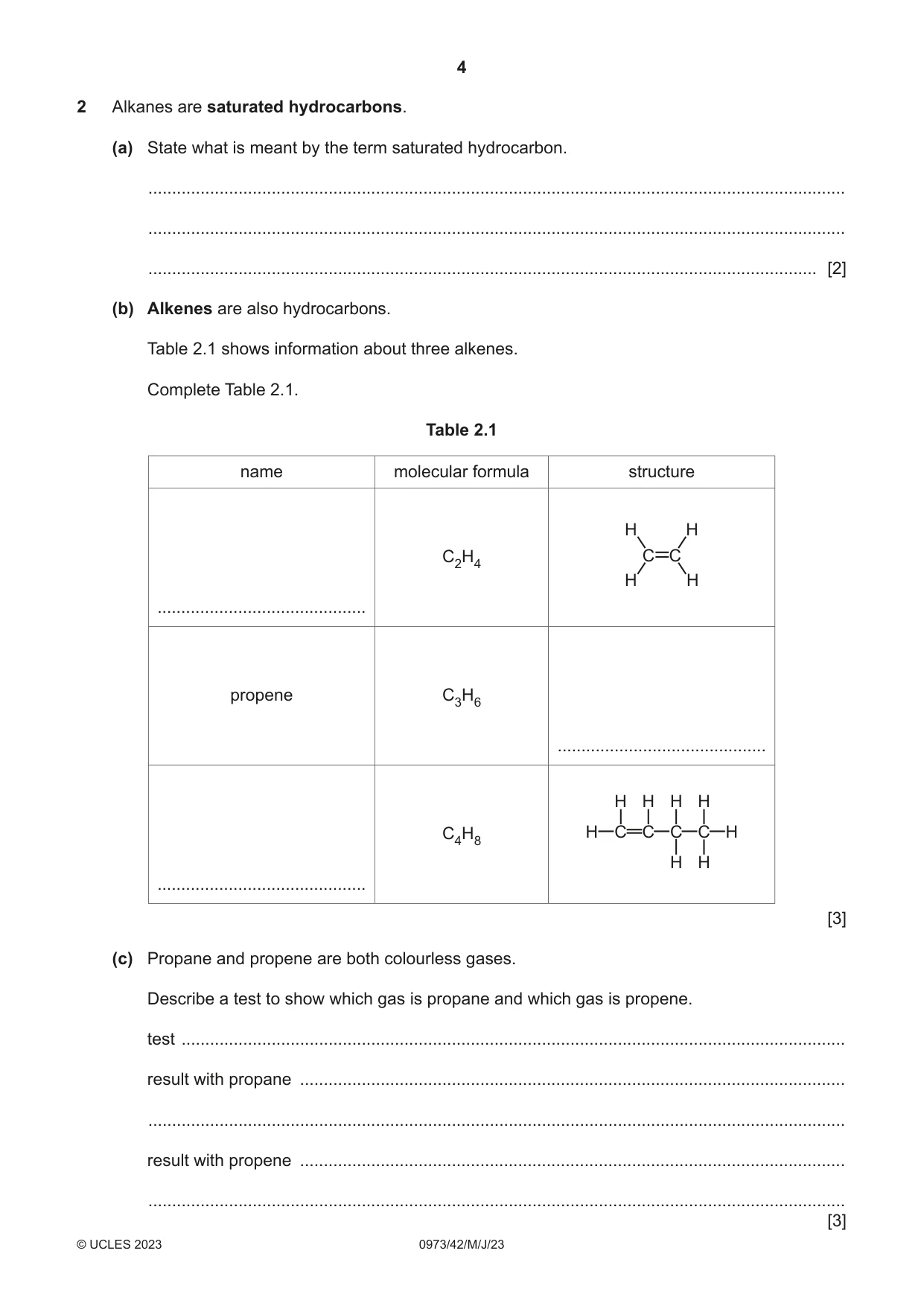
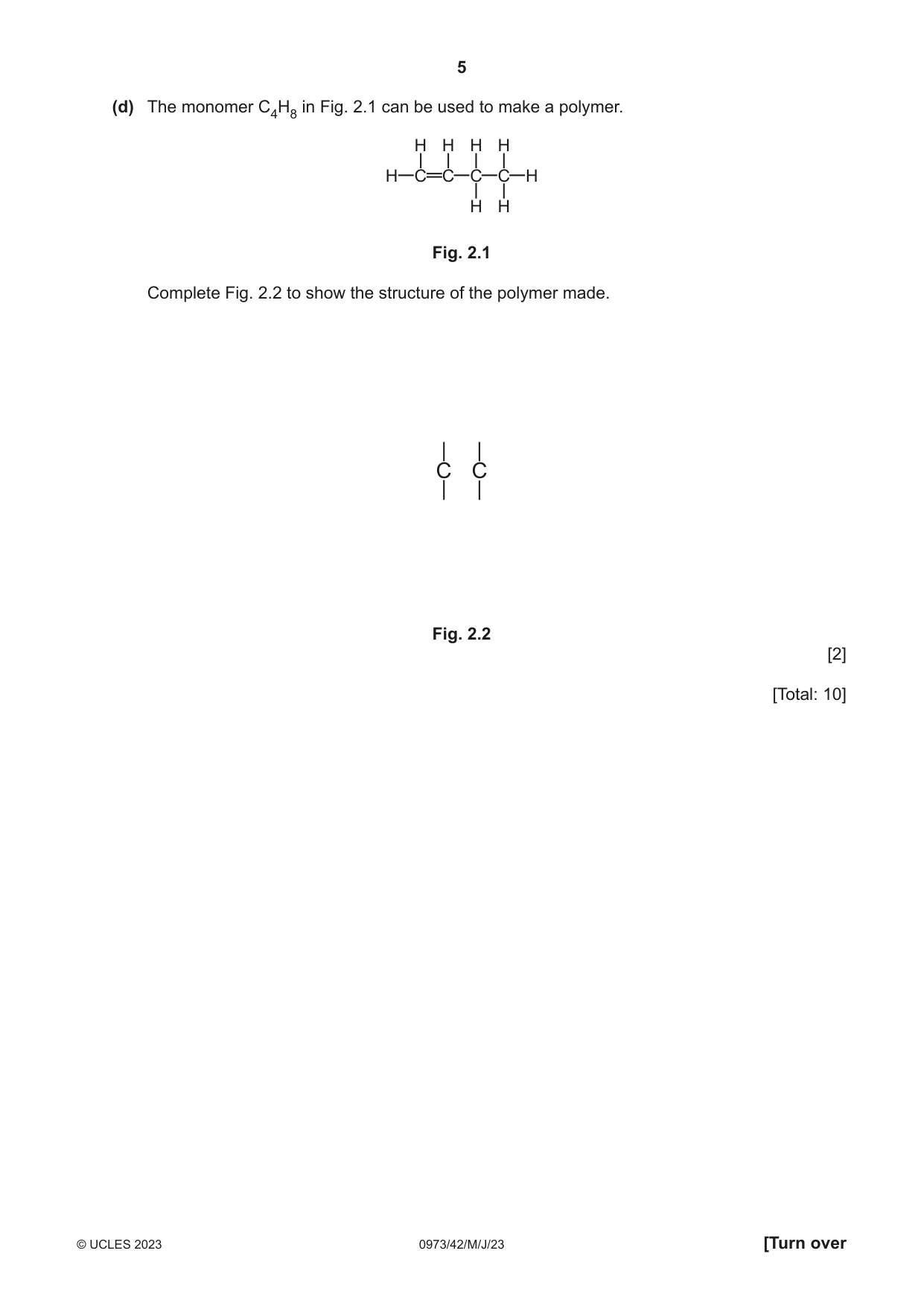
2 Alkanes are saturated hydrocarbons. (a) State what is meant by the term saturated hydrocarbon. ................................................................................................................................................... ................................................................................................................................................... ............................................................................................................................................. [2] (b) Alkenes are also hydrocarbons. Table 2.1 shows information about three alkenes. Complete Table 2.1. Table 2.1 name molecular formula structure H H C2H4 C C H H ............................................ propene C3H6 ............................................ H H H H C4H8 H C C C C H H H ............................................ [3] (c) Propane and propene are both colourless gases. Describe a test to show which gas is propane and which gas is propene. test ............................................................................................................................................ result with propane ................................................................................................................... ................................................................................................................................................... result with propene ................................................................................................................... ................................................................................................................................................... [3] (d) The monomer C4H8 in Fig. 2.1 can be used to make a polymer. H H H H H C C C C H H H Fig. 2.1 Complete Fig. 2.2 to show the structure of the polymer made. C C Fig. 2.2 [2] [Total: 10]
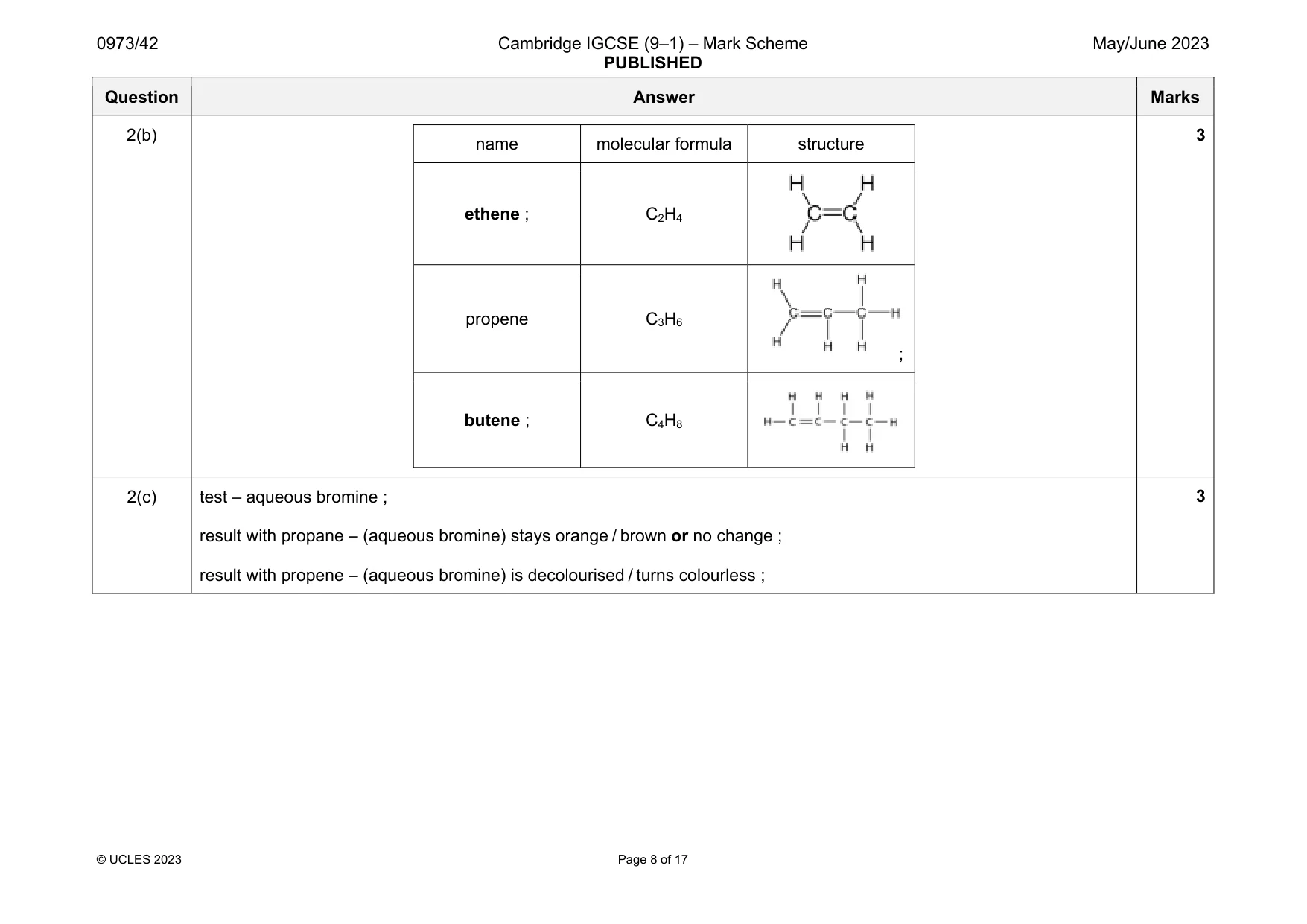
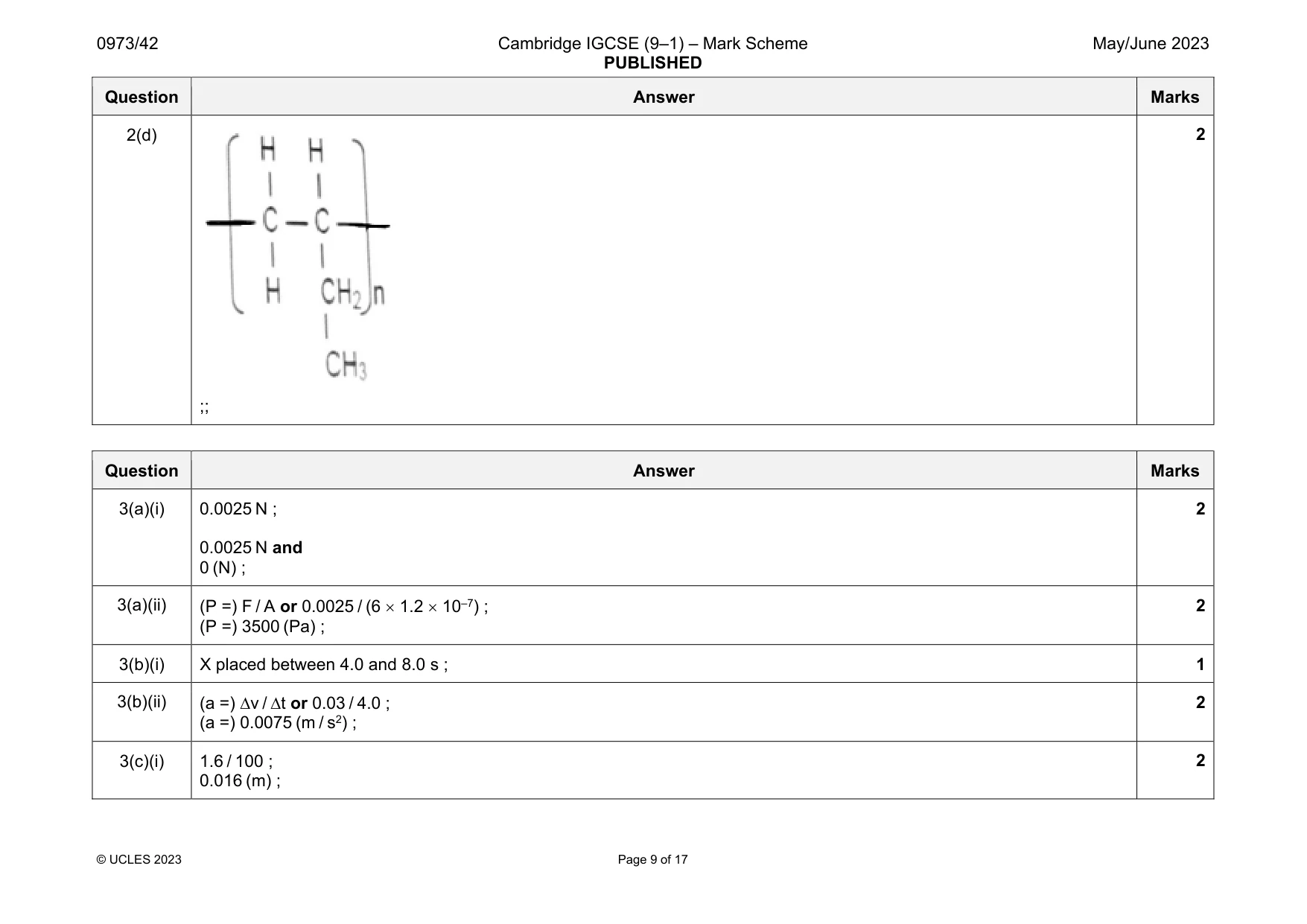
Mark scheme: 2(a) (saturated) – contains only single (covalent) bonds ; (hydrocarbon) – contains only hydrogen and carbon atoms ; 2 Question Answer Marks 2(b) name molecular formula structure ethene ; C2H4 propene C3H6 ; butene ; C4H8 3 2(c) test – aqueous bromine ; result with propane – (aqueous bromine) stays orange / brown or no change ; result with propene – (aqueous bromine) is decolourised / turns colourless ; 3 Question Answer Marks 2(d) ;; 2
Q3 · An insect called a pond skater
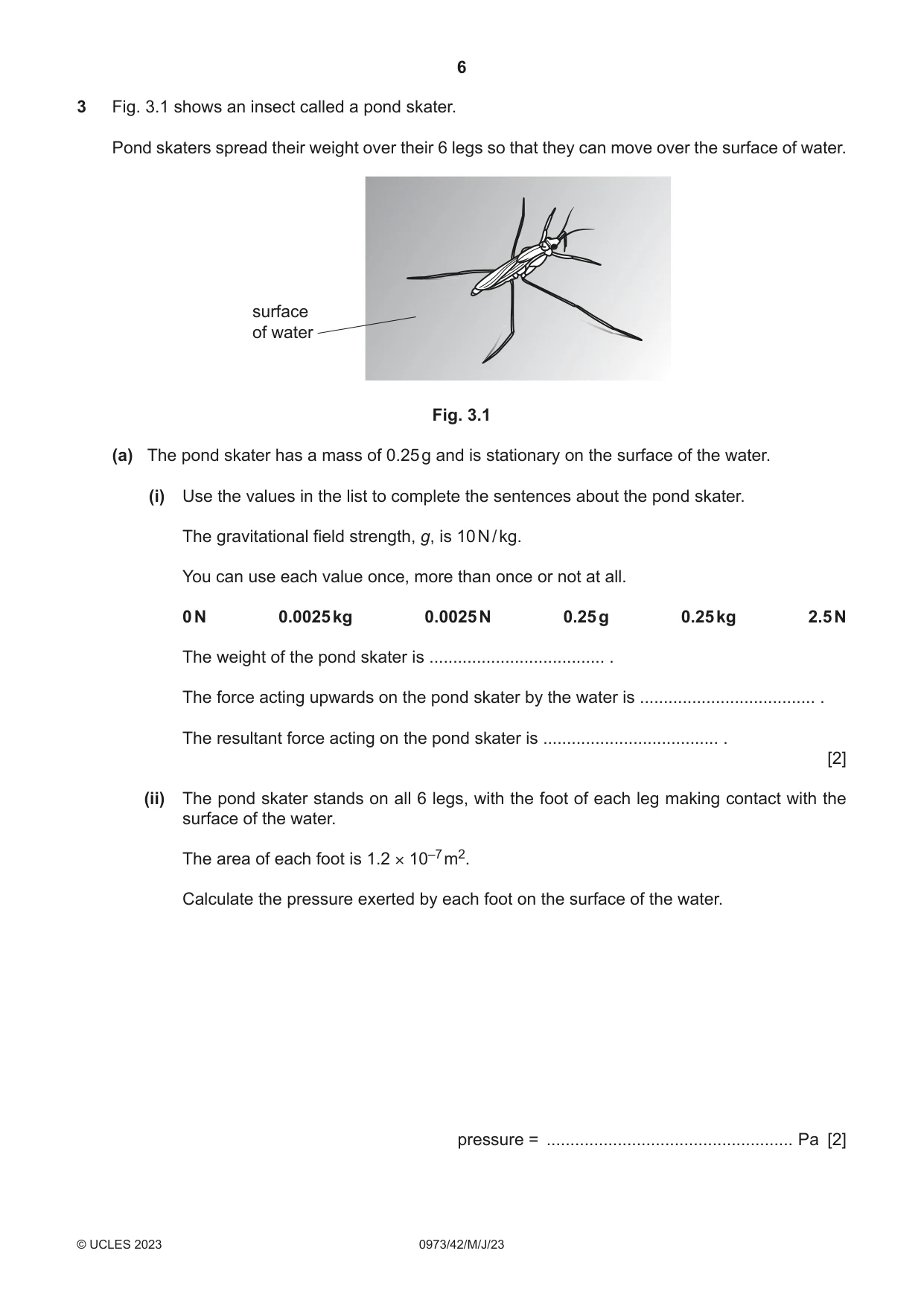
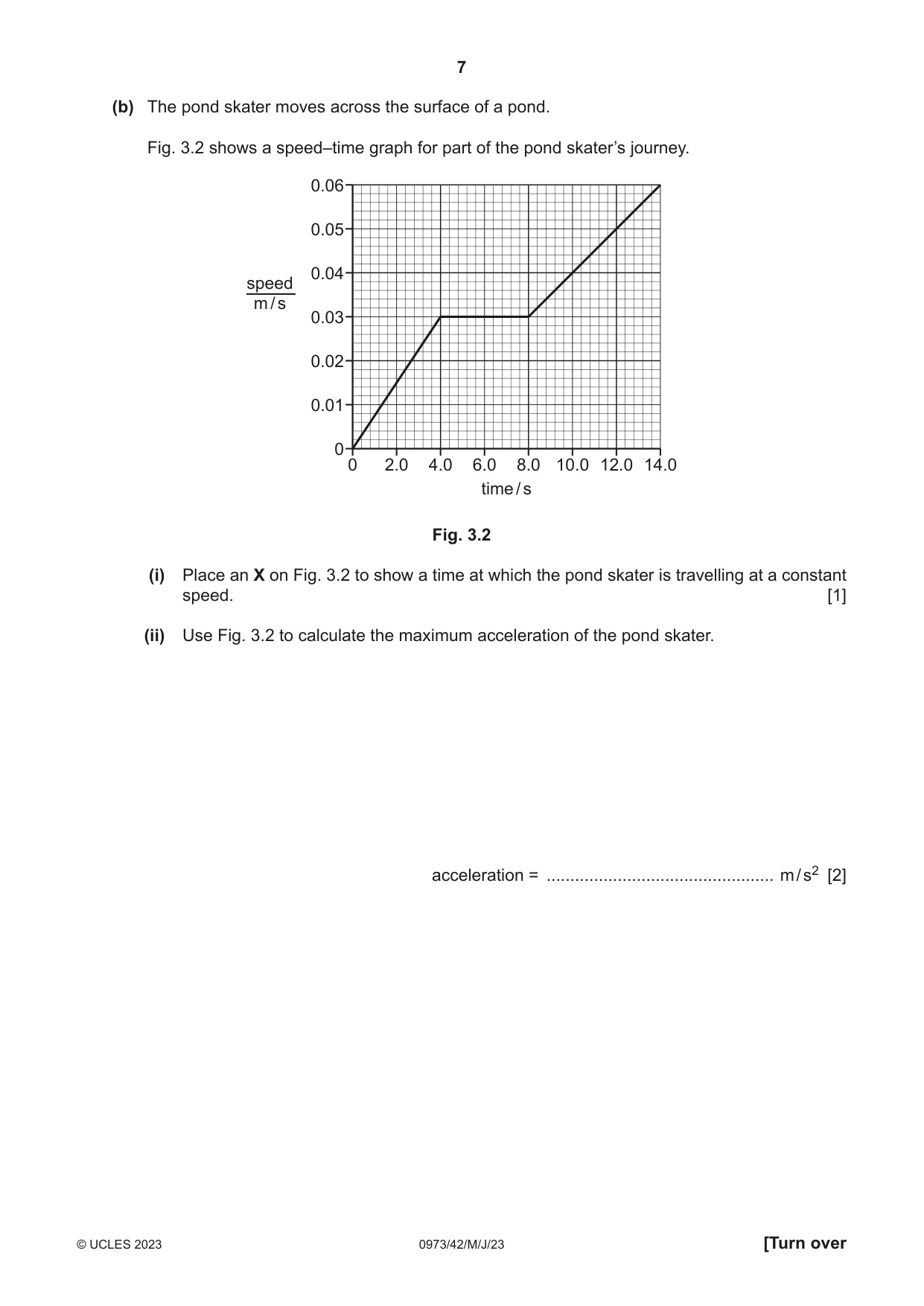
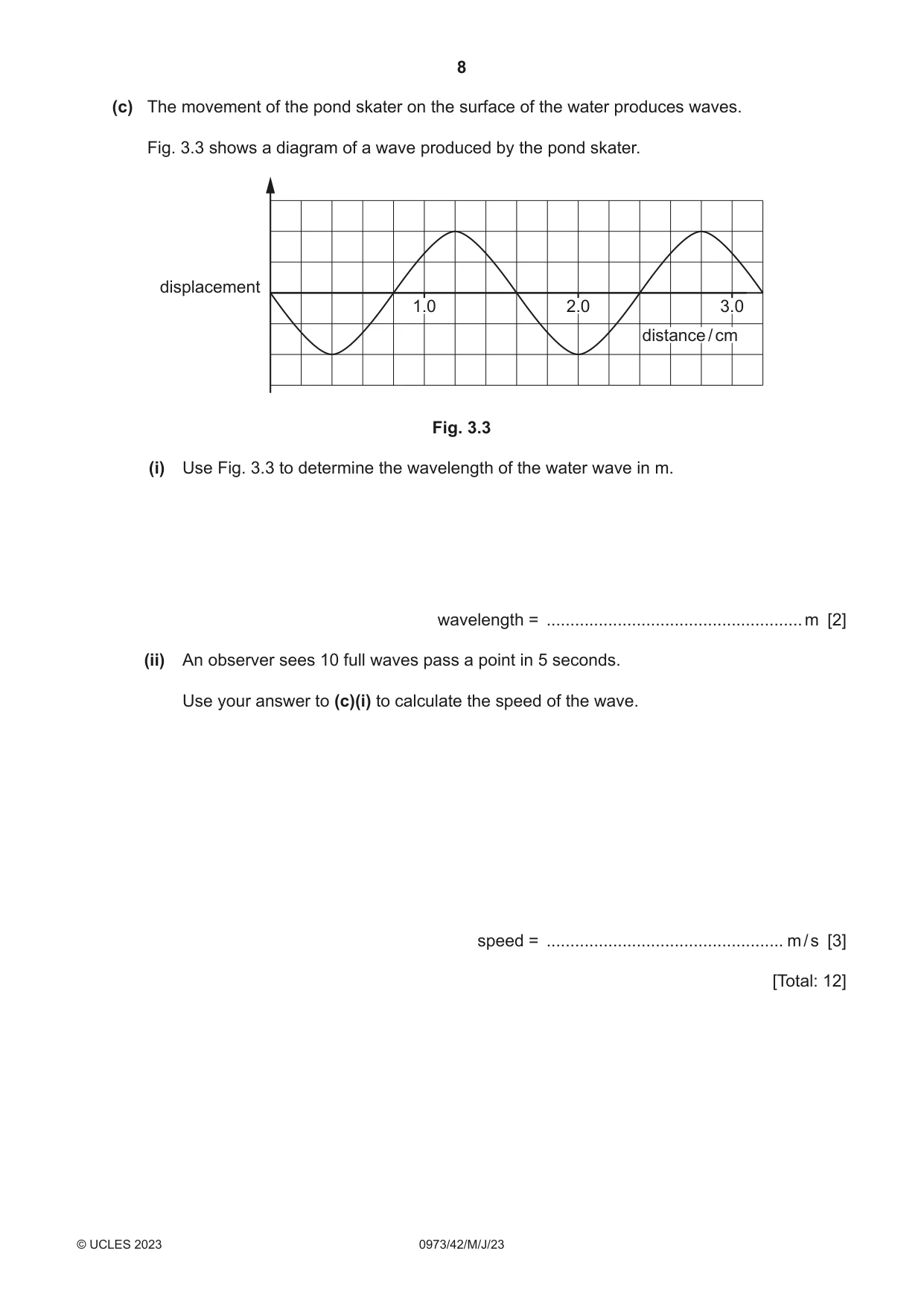
3 Fig. 3.1 shows an insect called a pond skater. Pond skaters spread their weight over their 6 legs so that they can move over the surface of water. surface of water Fig. 3.1 (a) The pond skater has a mass of 0.25 g and is stationary on the surface of the water. (i) Use the values in the list to complete the sentences about the pond skater. The gravitational field strength, g, is 10 N / kg. You can use each value once, more than once or not at all. 0 N 0.0025 kg 0.0025 N 0.25 g 0.25 kg 2.5 N The weight of the pond skater is ..................................... . The force acting upwards on the pond skater by the water is ..................................... . The resultant force acting on the pond skater is ..................................... . [2] (ii) The pond skater stands on all 6 legs, with the foot of each leg making contact with the surface of the water. The area of each foot is 1.2 × 10⁻⁷ m2. Calculate the pressure exerted by each foot on the surface of the water. pressure = .................................................... Pa [2] (b) The pond skater moves across the surface of a pond. Fig. 3.2 shows a speed–time graph for part of the pond skater’s journey. 0.06 0.05 0.04 speed m / s 0.03 0.02 0.01 0 0 2.0 4.0 6.0 8.0 10.0 12.0 14.0 time / s Fig. 3.2 (i) Place an X on Fig. 3.2 to show a time at which the pond skater is travelling at a constant speed. [1] (ii) Use Fig. 3.2 to calculate the maximum acceleration of the pond skater. acceleration = ................................................ m / s2 [2] (c) The movement of the pond skater on the surface of the water produces waves. Fig. 3.3 shows a diagram of a wave produced by the pond skater. displacement 1.0 2.0 3.0 distance / cm Fig. 3.3 (i) Use Fig. 3.3 to determine the wavelength of the water wave in m. wavelength = ...................................................... m [2] (ii) An observer sees 10 full waves pass a point in 5 seconds. Use your answer to (c)(i) to calculate the speed of the wave. speed = .................................................. m / s [3] [Total: 12]
Mark scheme: 3(a)(i) 0.0025 N ; 0.0025 N and 0 (N) ; 2 3(a)(ii) (P =) F / A or 0.0025 / (6 1.2 10–7) ; (P =) 3500 (Pa) ; 2 3(b)(i) X placed between 4.0 and 8.0 s ; 1 3(b)(ii) (a =) v / t or 0.03 / 4.0 ; (a =) 0.0075 (m / s2) ; 2 3(c)(i) 1.6 / 100 ; 0.016 (m) ; 2 Question Answer Marks 3(c)(ii) (f =) 2 (Hz) ; (v =) f or 2 0.016 ; (v =) 0.032 (m / s) ; 3
Q4 · Photosynthesis is an enzyme‑controlled reaction
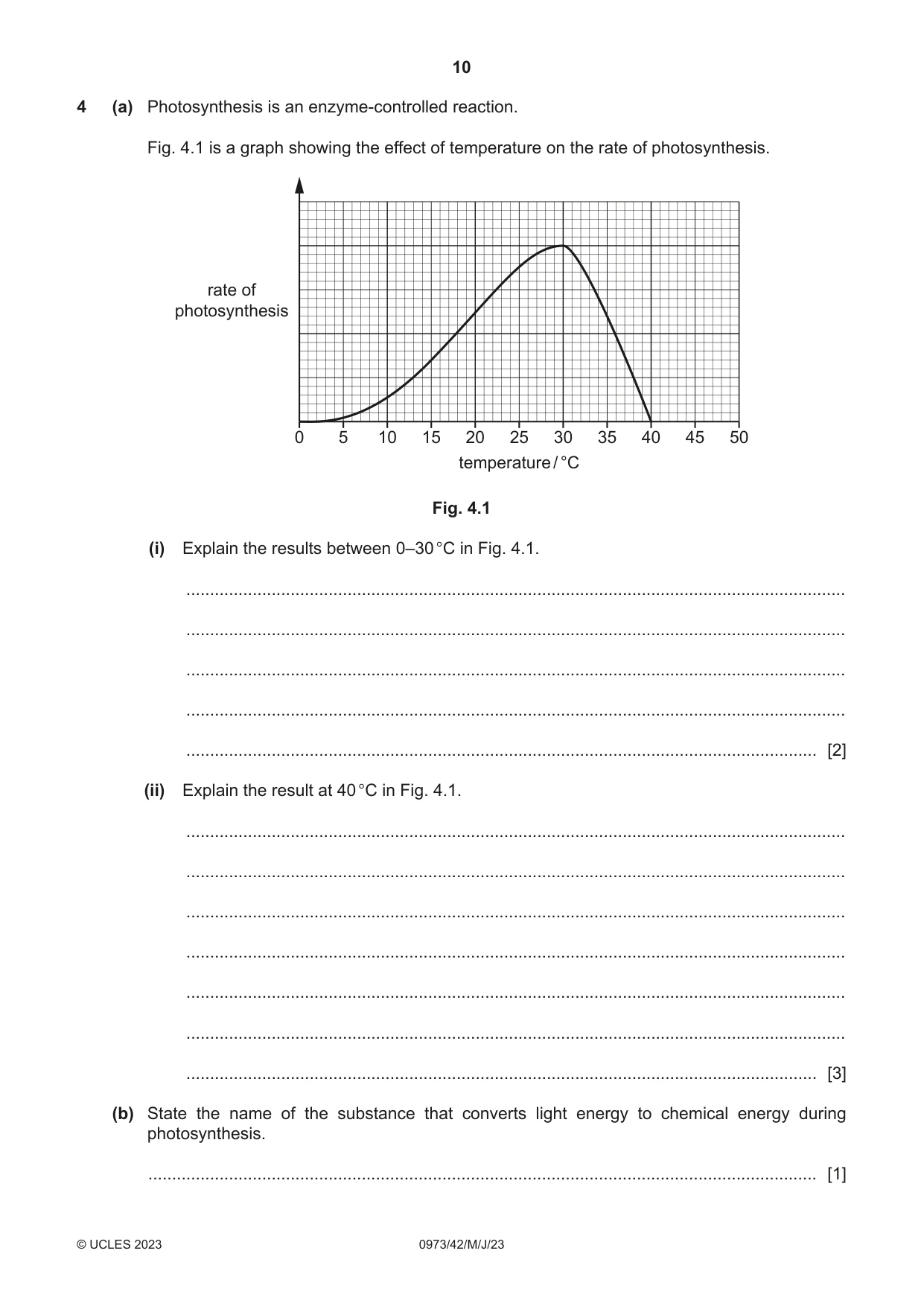
4 (a) Photosynthesis is an enzyme‑controlled reaction. Fig. 4.1 is a graph showing the effect of temperature on the rate of photosynthesis. rate of photosynthesis 0 5 10 15 20 25 30 35 40 45 50 temperature / °C Fig. 4.1 (i) Explain the results between 0–30 °C in Fig. 4.1. ........................................................................................................................................... ........................................................................................................................................... ........................................................................................................................................... ........................................................................................................................................... ..................................................................................................................................... [2] (ii) Explain the result at 40 °C in Fig. 4.1. ........................................................................................................................................... ........................................................................................................................................... ........................................................................................................................................... ........................................................................................................................................... ........................................................................................................................................... ........................................................................................................................................... ..................................................................................................................................... [3] (b) State the name of the substance that converts light energy to chemical energy during photosynthesis. ............................................................................................................................................. [1] (c) State the names of the two raw materials used in photosynthesis. 1 ................................................................................................................................................ 2 ................................................................................................................................................ [2] (d) Describe two ways the cells in the palisade mesophyll layer are adapted for photosynthesis. 1 ................................................................................................................................................ ................................................................................................................................................... 2 ................................................................................................................................................ ................................................................................................................................................... [2] [Total: 10]
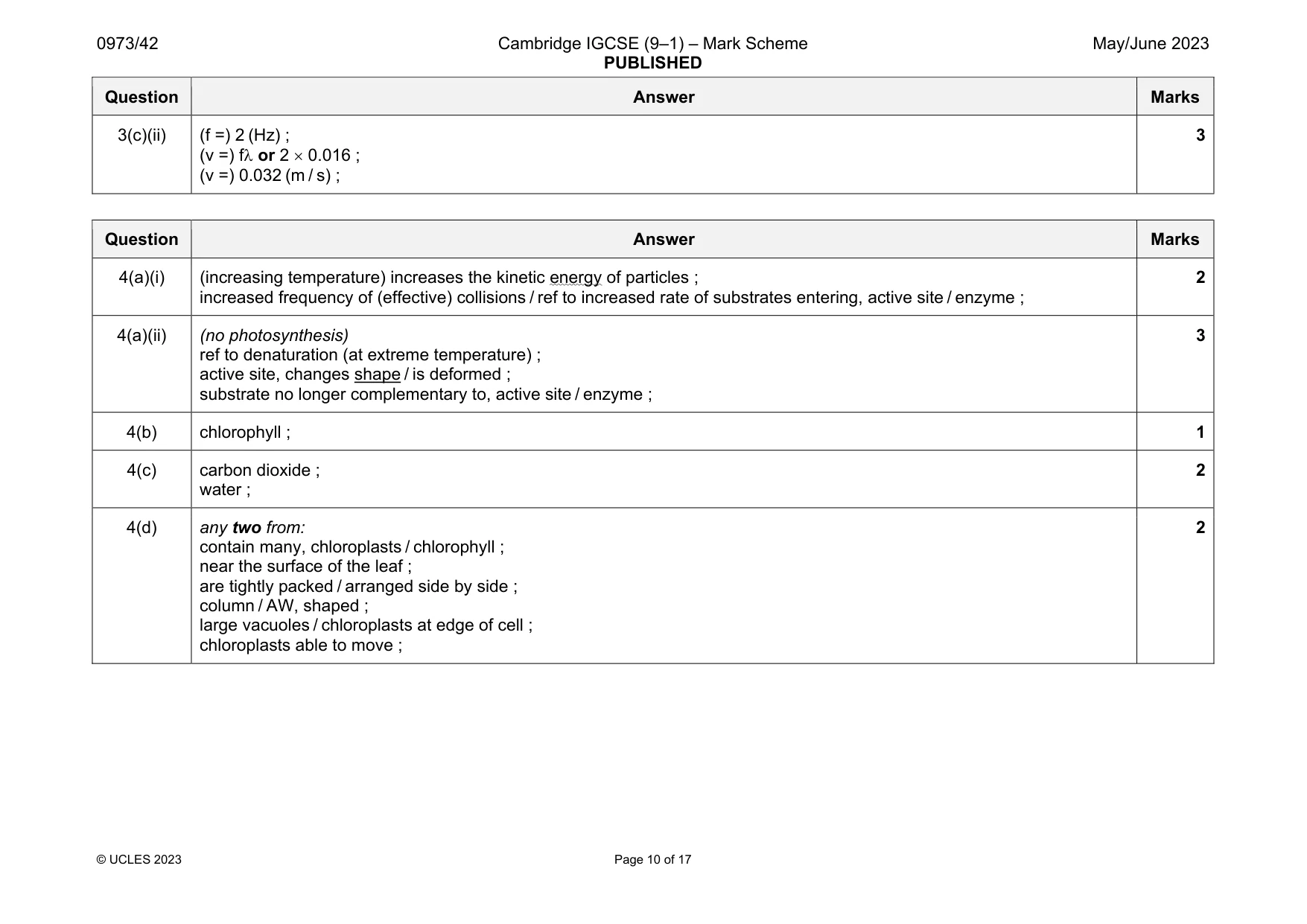
Mark scheme: 4(a)(i) (increasing temperature) increases the kinetic energy of particles ; increased frequency of (effective) collisions / ref to increased rate of substrates entering, active site / enzyme ; 2 4(a)(ii) (no photosynthesis) ref to denaturation (at extreme temperature) ; active site, changes shape / is deformed ; substrate no longer complementary to, active site / enzyme ; 3 4(b) chlorophyll ; 1 4(c) carbon dioxide ; water ; 2 4(d) any two from: contain many, chloroplasts / chlorophyll ; near the surface of the leaf ; are tightly packed / arranged side by side ; column / AW, shaped ; large vacuoles / chloroplasts at edge of cell ; chloroplasts able to move ; 2
Q5 · Ammonia is made from the reaction of nitrogen and hydrogen in the Haber process
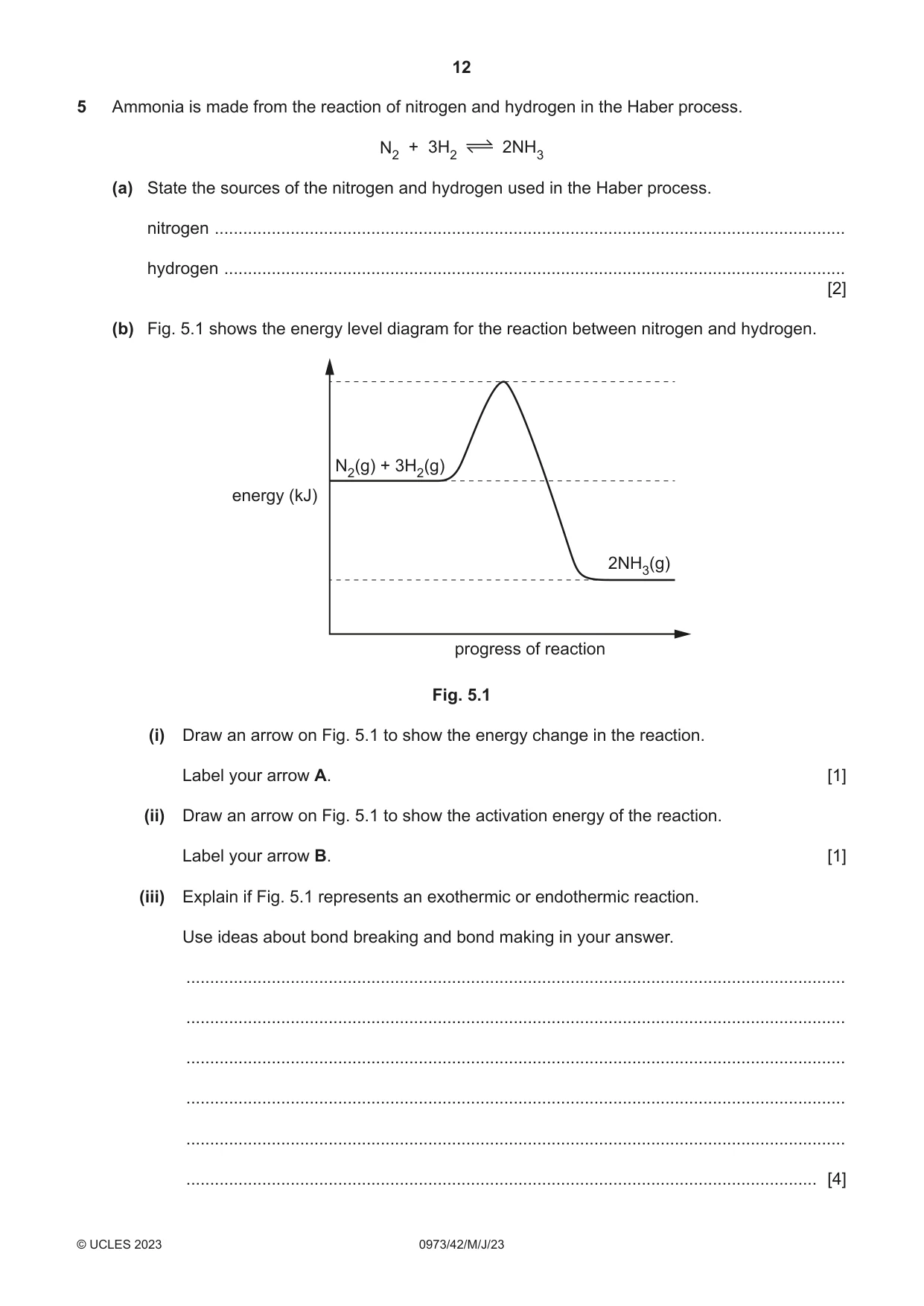
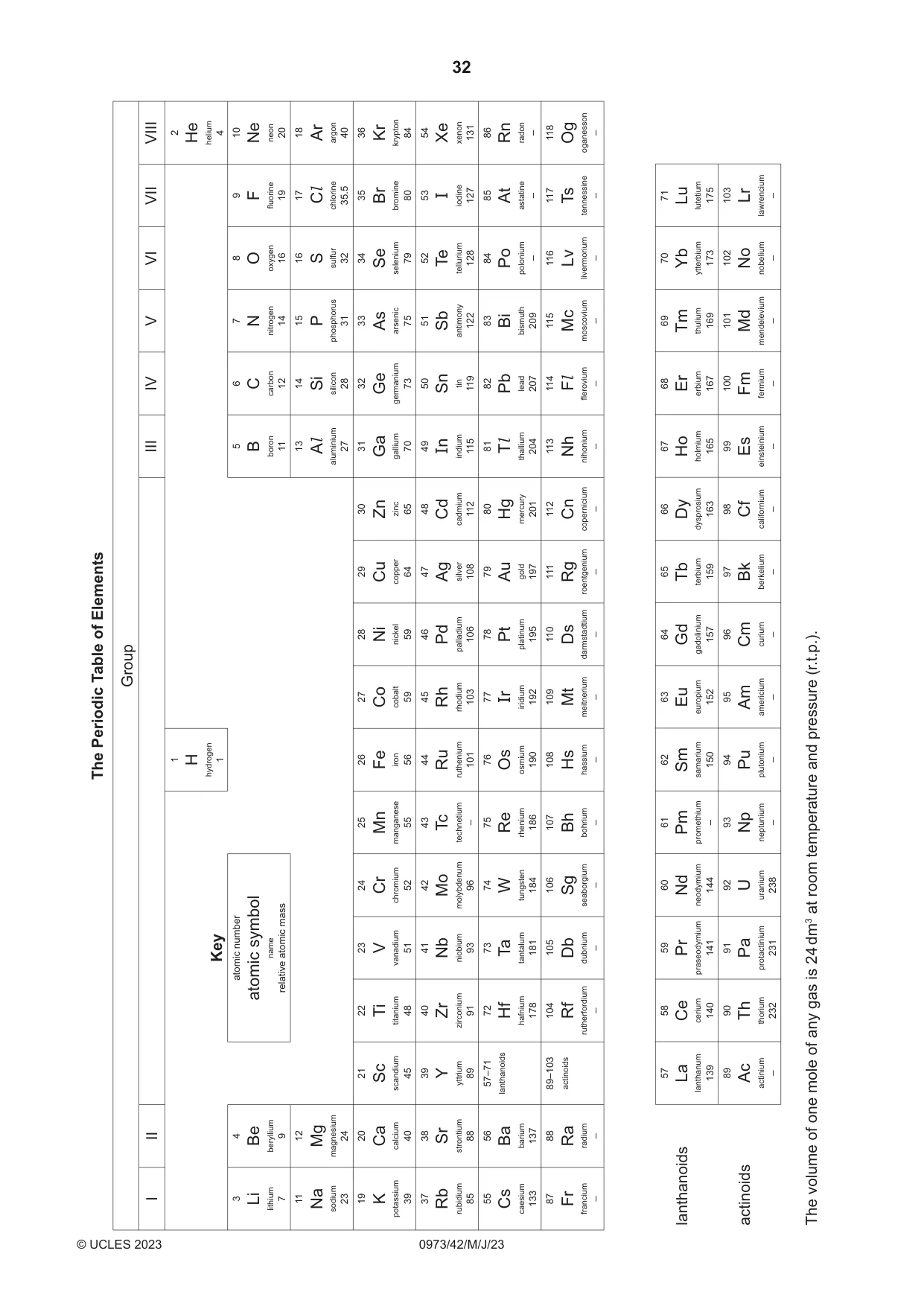
5 Ammonia is made from the reaction of nitrogen and hydrogen in the Haber process. N2 + 3H2 2NH3 (a) State the sources of the nitrogen and hydrogen used in the Haber process. nitrogen ..................................................................................................................................... hydrogen ................................................................................................................................... [2] (b) Fig. 5.1 shows the energy level diagram for the reaction between nitrogen and hydrogen. N2(g) + 3H2(g) energy (kJ) 2NH3(g) progress of reaction Fig. 5.1 (i) Draw an arrow on Fig. 5.1 to show the energy change in the reaction. Label your arrow A. [1] (ii) Draw an arrow on Fig. 5.1 to show the activation energy of the reaction. Label your arrow B. [1] (iii) Explain if Fig. 5.1 represents an exothermic or endothermic reaction. Use ideas about bond breaking and bond making in your answer. ........................................................................................................................................... ........................................................................................................................................... ........................................................................................................................................... ........................................................................................................................................... ........................................................................................................................................... ..................................................................................................................................... [4] (c) 58.8 kg of nitrogen gas reacts with hydrogen gas to make 142.8 kg of ammonia gas. N2 + 3H2 2NH3 Calculate the volume occupied by 142.8 kg of ammonia gas. The volume of one mole of any gas is 24 dm3 at room temperature and pressure (r.t.p.). volume of ammonia gas = .................................................. dm3 [3] [Total: 11]
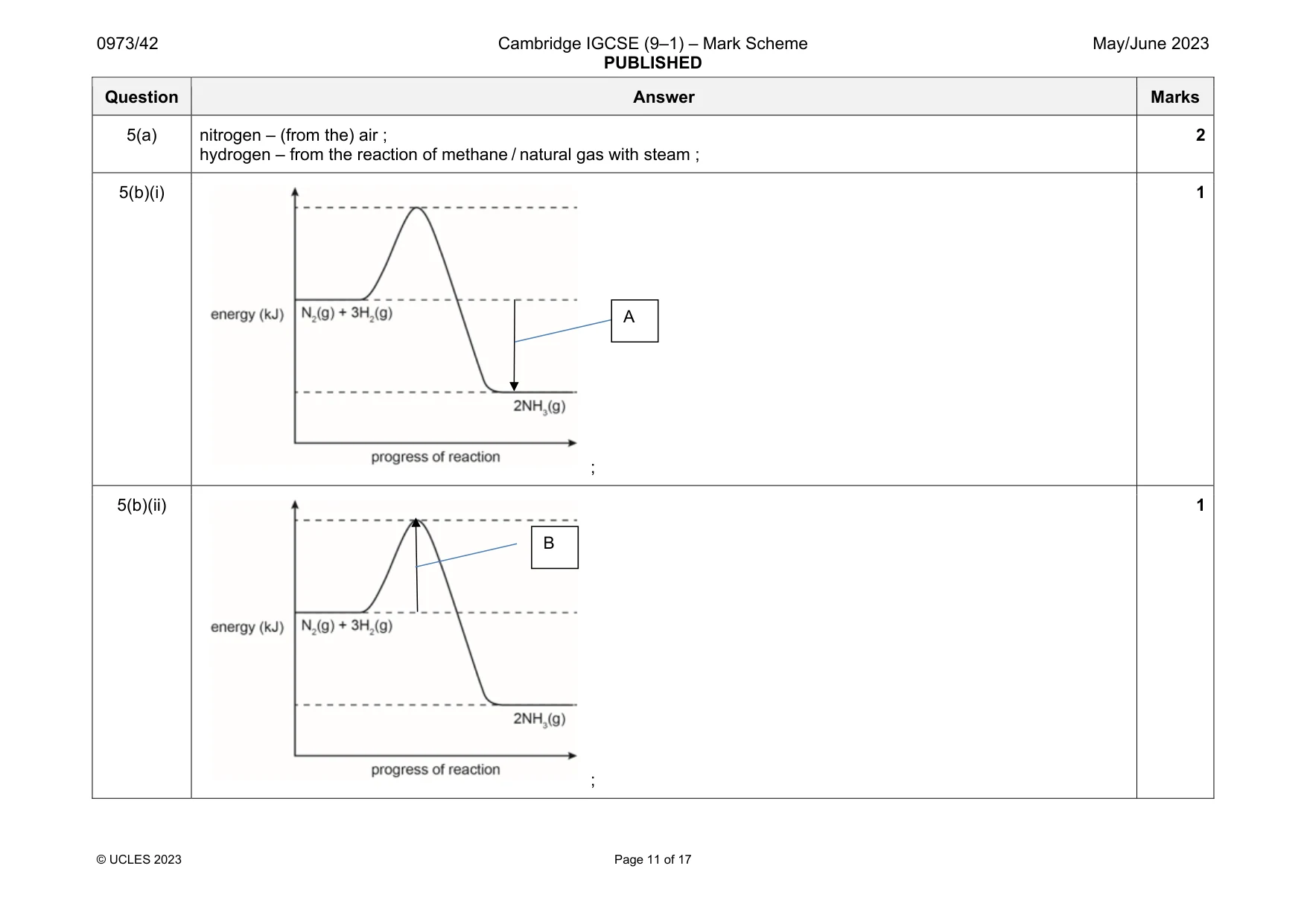
Mark scheme: 5(a) nitrogen – (from the) air ; hydrogen – from the reaction of methane / natural gas with steam ; 2 5(b)(i) ; 1 5(b)(ii) ; 1 A B Question Answer Marks 5(b)(iii) (exothermic because) energy change is negative / energy is given out in the reaction / energy of reactants is higher than energy of products ; bond breaking is endothermic / owtte ; bond making is exothermic / owtte ; more energy is given out (in bond making) than is taken in (in bond breaking) ; 4 5(c) Mr of NH3 = 17 ; moles of NH3 = 142 800 ÷ 17 = 8400 ; volume of NH3 = 8400 24 = 201 600 (dm³) ; 3
Q6 · The average power output over a summer’s day from a solar panel made from solar cells
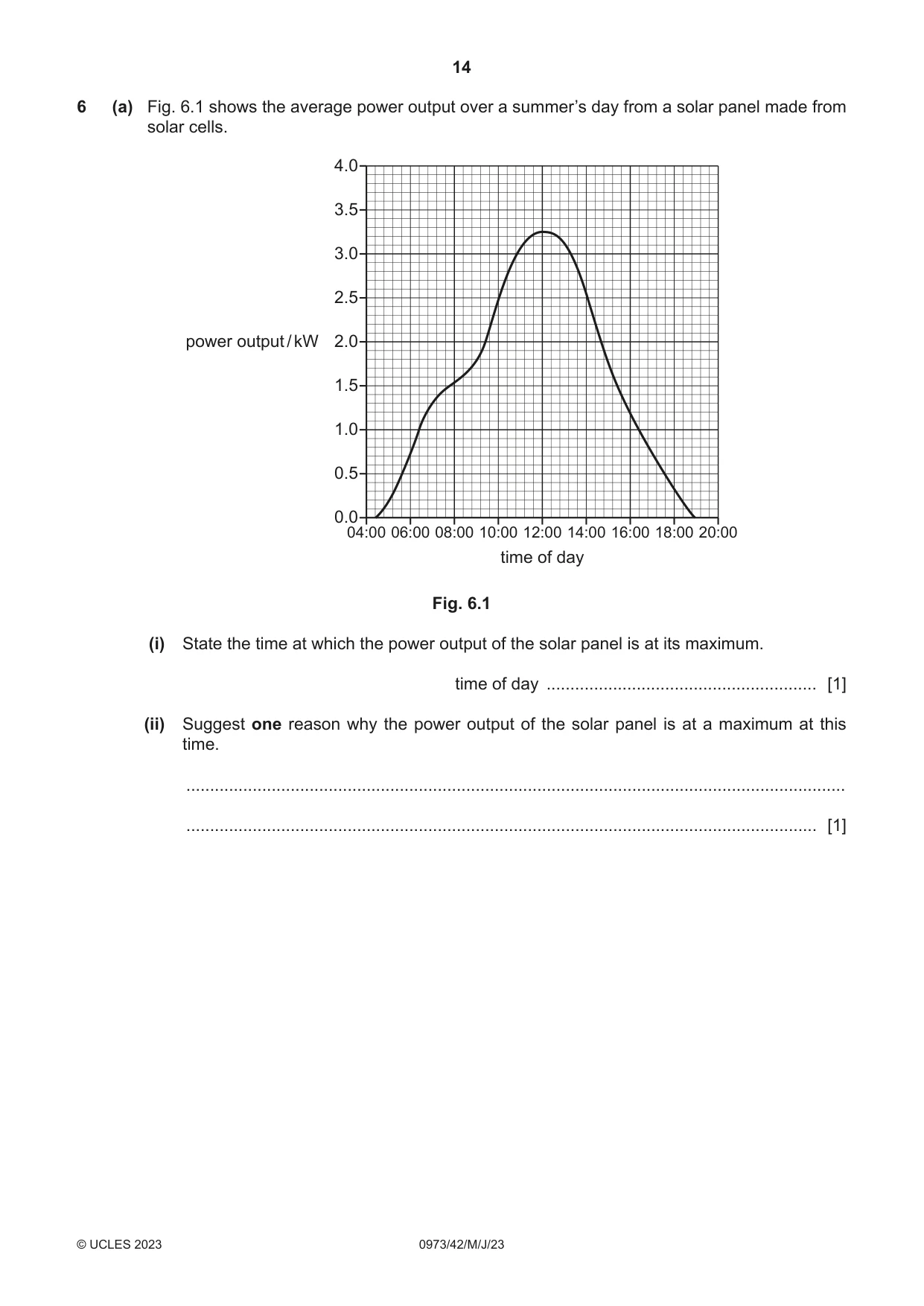
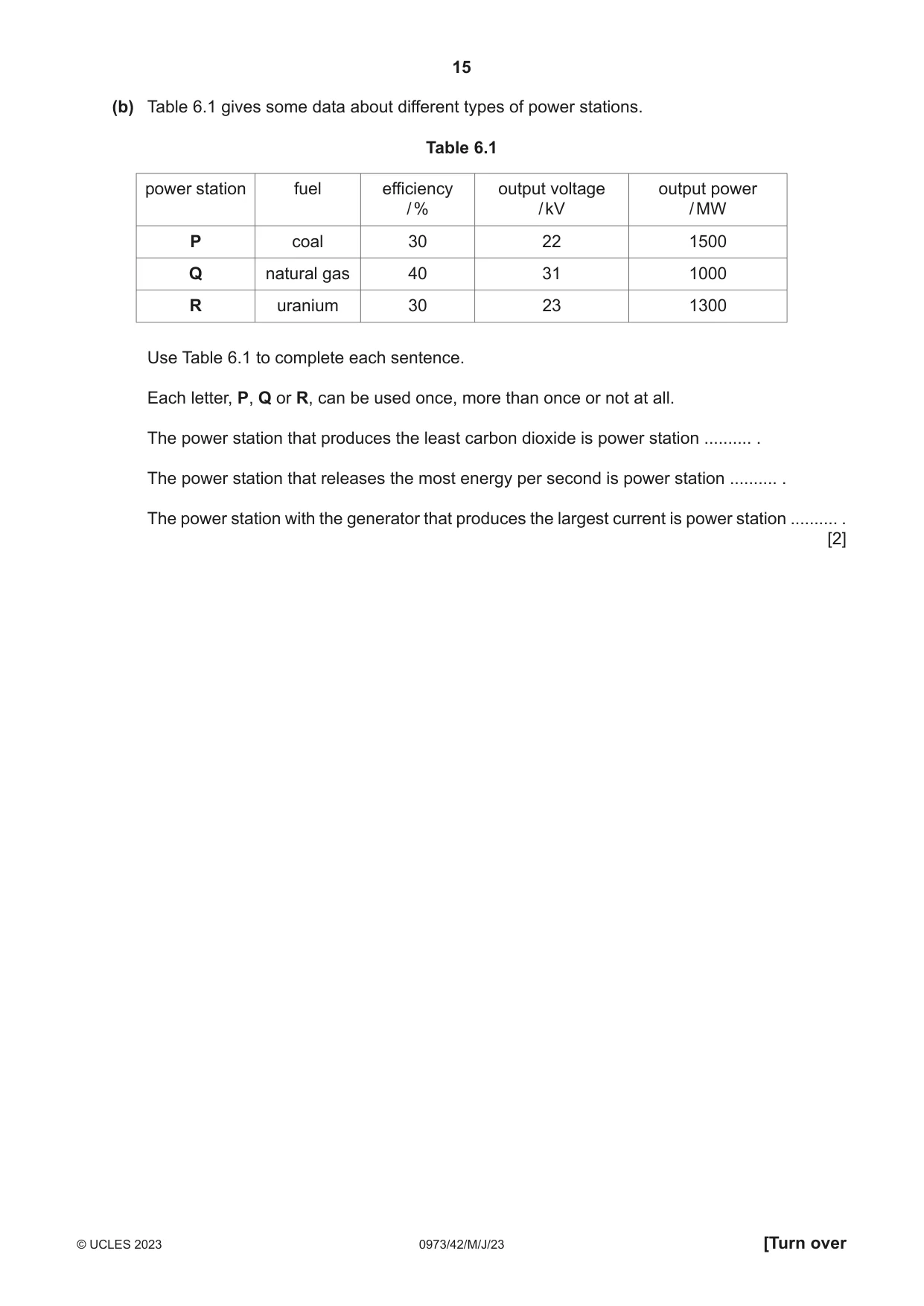
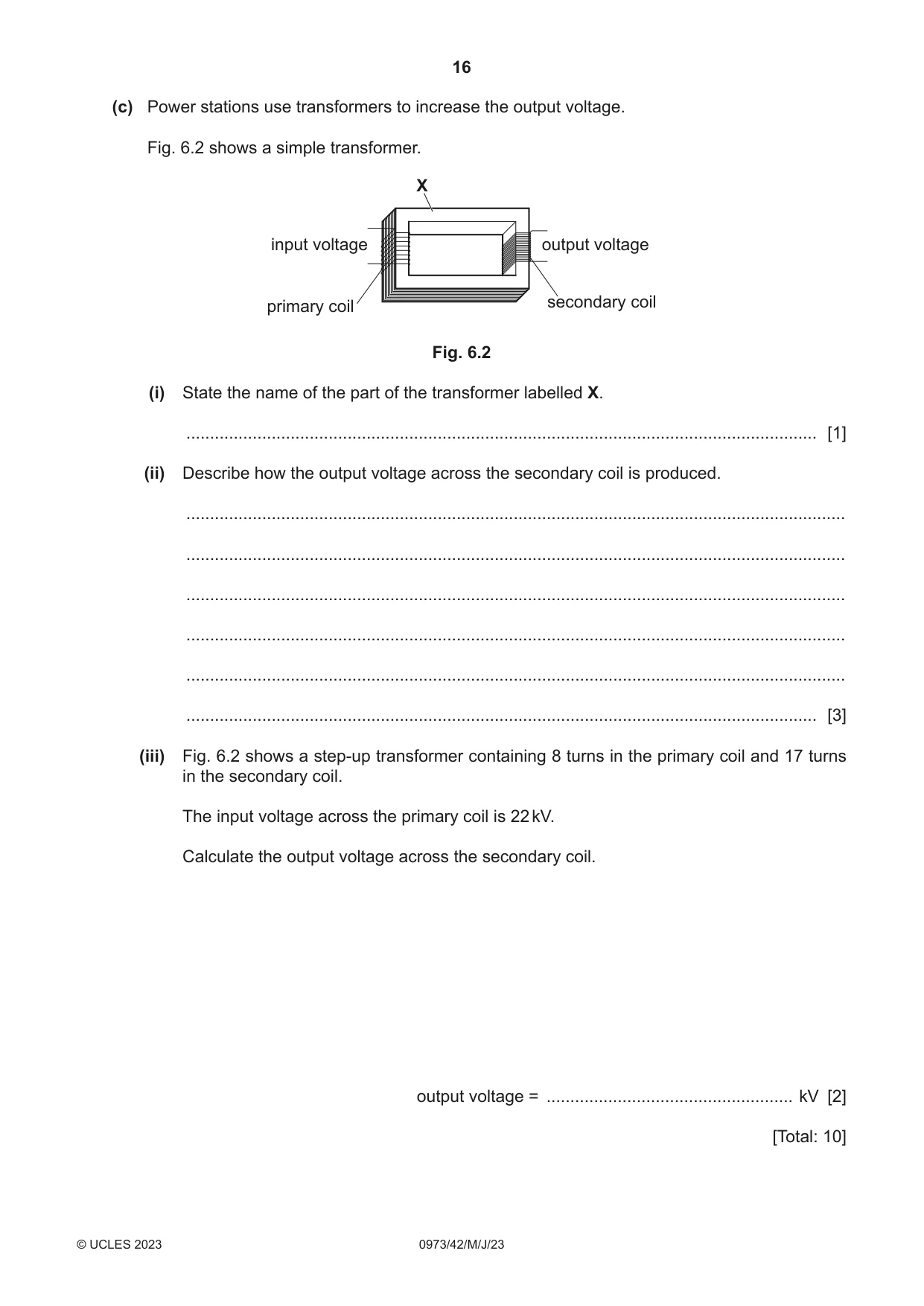
6 (a) Fig. 6.1 shows the average power output over a summer’s day from a solar panel made from solar cells. 4.0 3.5 3.0 2.5 power output / kW 2.0 1.5 1.0 0.5 0.0 04:00 06:00 08:00 10:00 12:00 14:00 16:00 18:00 20:00 time of day Fig. 6.1 (i) State the time at which the power output of the solar panel is at its maximum. time of day ......................................................... [1] (ii) Suggest one reason why the power output of the solar panel is at a maximum at this time. ........................................................................................................................................... ..................................................................................................................................... [1] (b) Table 6.1 gives some data about different types of power stations. Table 6.1 power station fuel efficiency output voltage output power / % / kV / MW P coal 30 22 1500 Q natural gas 40 31 1000 R uranium 30 23 1300 Use Table 6.1 to complete each sentence. Each letter, P, Q or R, can be used once, more than once or not at all. The power station that produces the least carbon dioxide is power station .......... . The power station that releases the most energy per second is power station .......... . The power station with the generator that produces the largest current is power station .......... . [2] (c) Power stations use transformers to increase the output voltage. Fig. 6.2 shows a simple transformer. X input voltage output voltage secondary coil primary coil Fig. 6.2 (i) State the name of the part of the transformer labelled X. ..................................................................................................................................... [1] (ii) Describe how the output voltage across the secondary coil is produced. ........................................................................................................................................... ........................................................................................................................................... ........................................................................................................................................... ........................................................................................................................................... ........................................................................................................................................... ..................................................................................................................................... [3] (iii) Fig. 6.2 shows a step‑up transformer containing 8 turns in the primary coil and 17 turns in the secondary coil. The input voltage across the primary coil is 22 kV. Calculate the output voltage across the secondary coil. output voltage = .................................................... kV [2] [Total: 10]
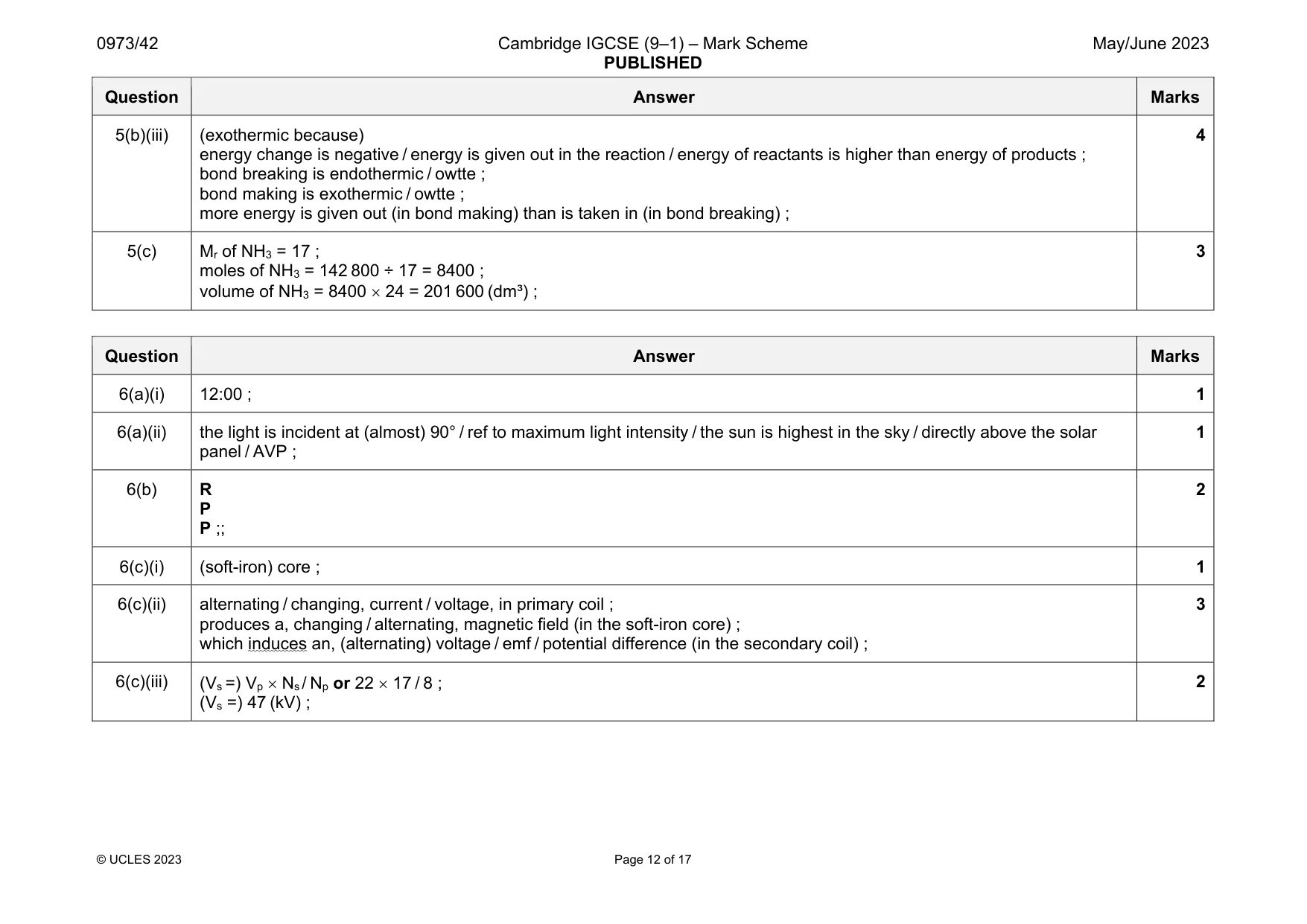
Mark scheme: 6(a)(i) 12:00 ; 1 6(a)(ii) the light is incident at (almost) 90° / ref to maximum light intensity / the sun is highest in the sky / directly above the solar panel / AVP ; 1 6(b) R P P ;; 2 6(c)(i) (soft-iron) core ; 1 6(c)(ii) alternating / changing, current / voltage, in primary coil ; produces a, changing / alternating, magnetic field (in the soft-iron core) ; which induces an, (alternating) voltage / emf / potential difference (in the secondary coil) ; 3 6(c)(iii) (Vs =) Vp Ns / Np or 22 17 / 8 ; (Vs =) 47 (kV) ; 2
Question 7
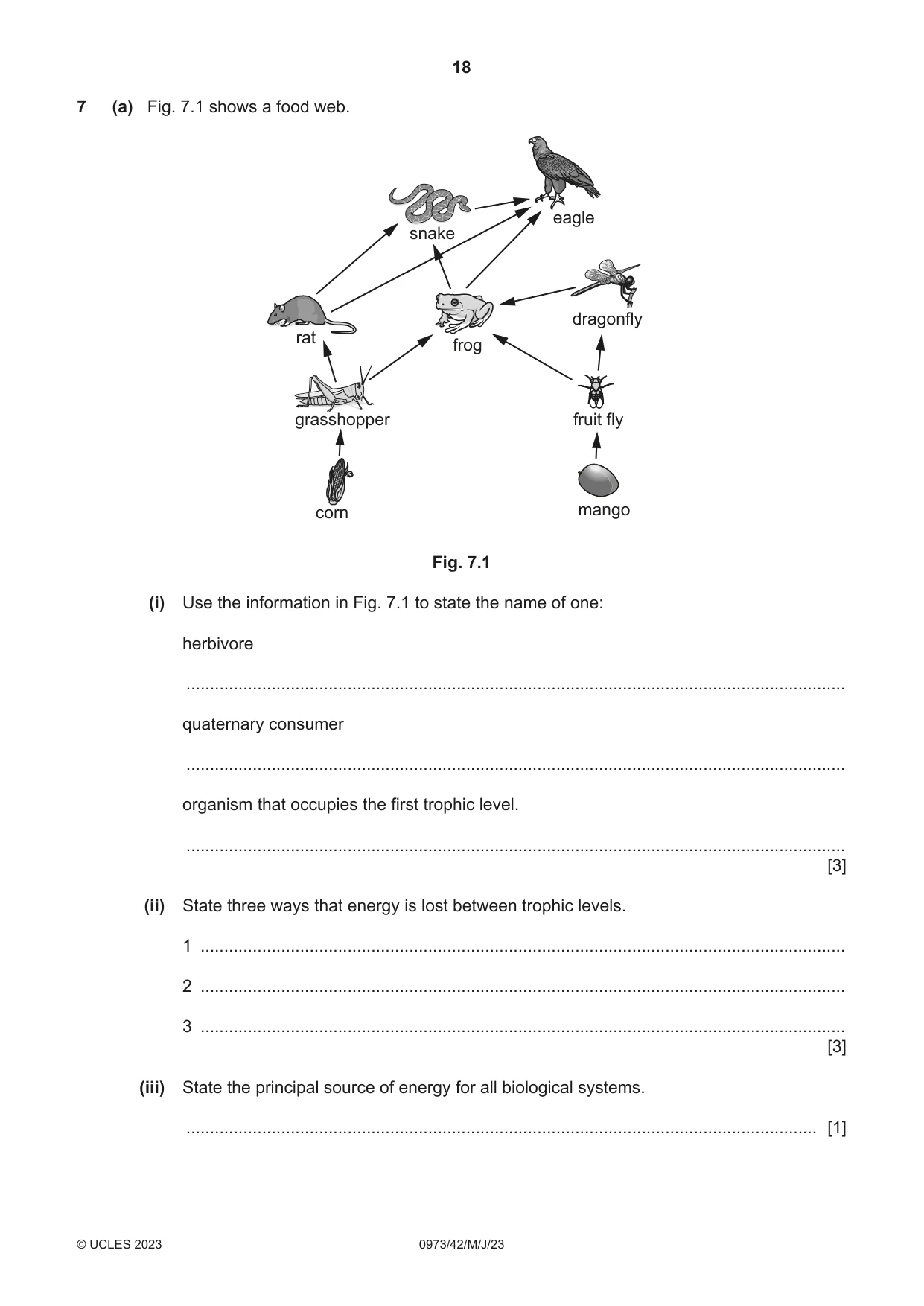
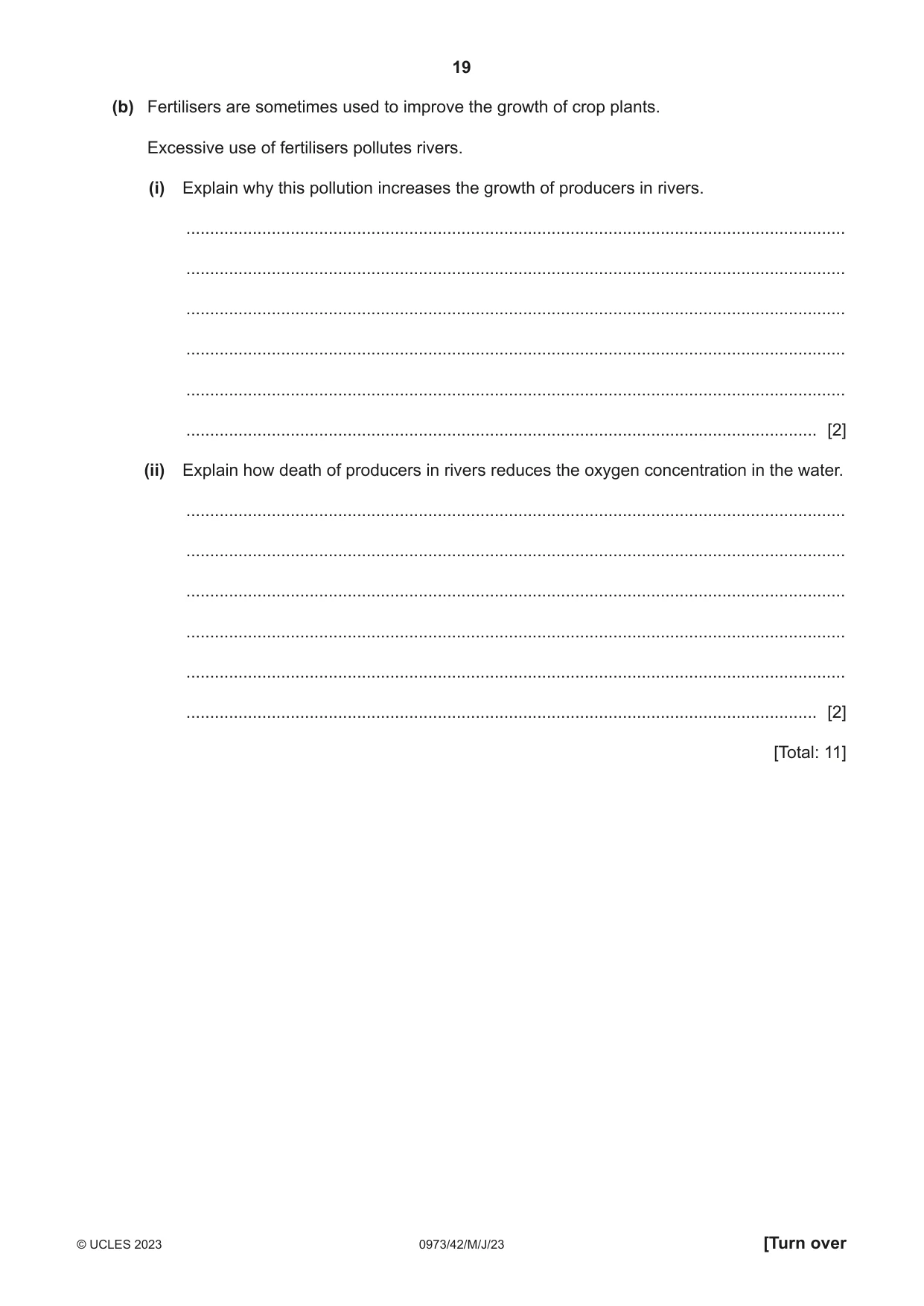
7 (a) Fig. 7.1 shows a food web. eagle snake dragonfly rat frog grasshopper fruit fly corn mango Fig. 7.1 (i) Use the information in Fig. 7.1 to state the name of one: herbivore ........................................................................................................................................... quaternary consumer ........................................................................................................................................... organism that occupies the first trophic level. ........................................................................................................................................... [3] (ii) State three ways that energy is lost between trophic levels. 1 ........................................................................................................................................ 2 ........................................................................................................................................ 3 ........................................................................................................................................ [3] (iii) State the principal source of energy for all biological systems. ..................................................................................................................................... [1] (b) Fertilisers are sometimes used to improve the growth of crop plants. Excessive use of fertilisers pollutes rivers. (i) Explain why this pollution increases the growth of producers in rivers. ........................................................................................................................................... ........................................................................................................................................... ........................................................................................................................................... ........................................................................................................................................... ........................................................................................................................................... ..................................................................................................................................... [2] (ii) Explain how death of producers in rivers reduces the oxygen concentration in the water. ........................................................................................................................................... ........................................................................................................................................... ........................................................................................................................................... ........................................................................................................................................... ........................................................................................................................................... ..................................................................................................................................... [2] [Total: 11]
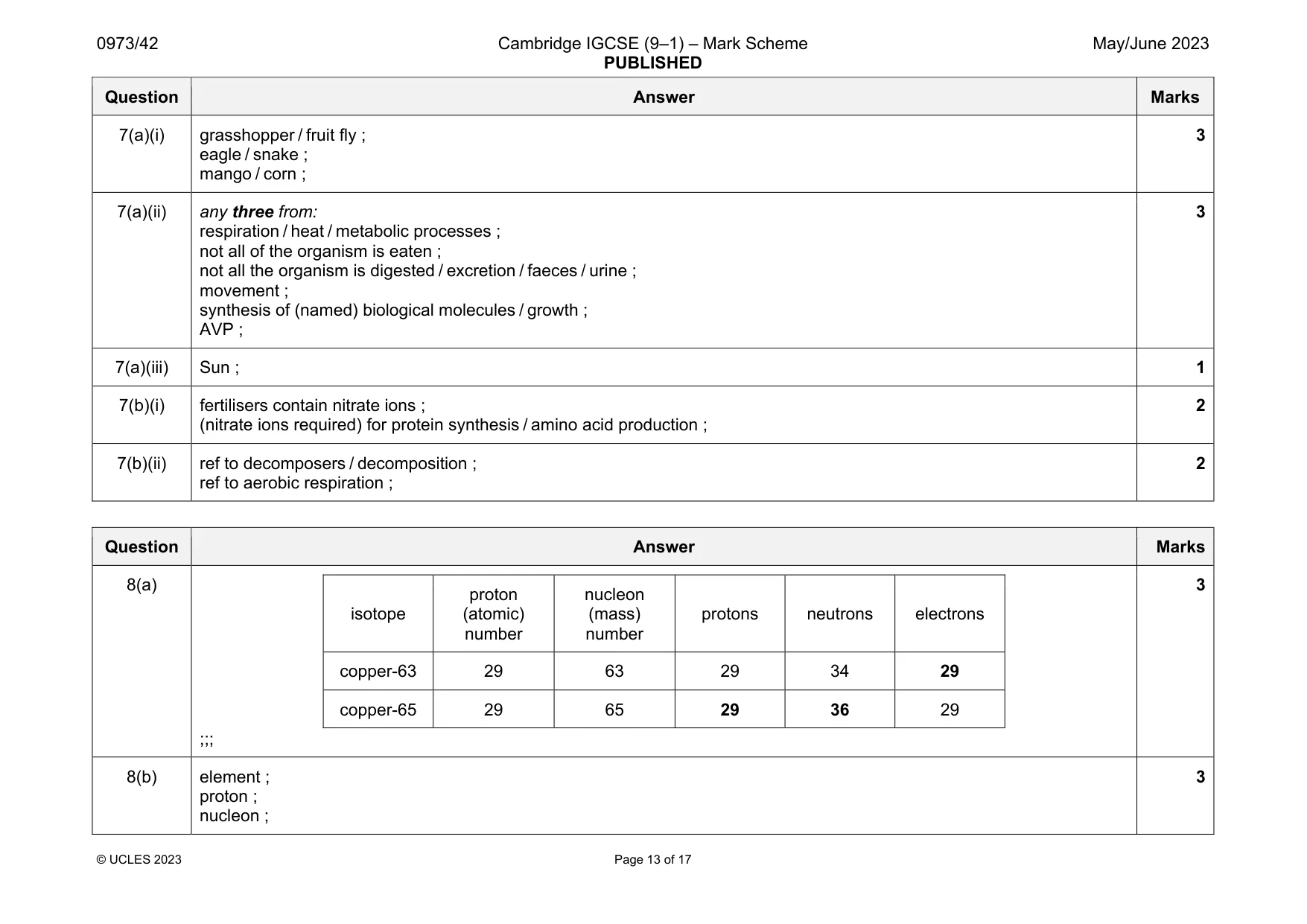
Mark scheme: 7(a)(i) grasshopper / fruit fly ; eagle / snake ; mango / corn ; 3 7(a)(ii) any three from: respiration / heat / metabolic processes ; not all of the organism is eaten ; not all the organism is digested / excretion / faeces / urine ; movement ; synthesis of (named) biological molecules / growth ; AVP ; 3 7(a)(iii) Sun ; 1 7(b)(i) fertilisers contain nitrate ions ; (nitrate ions required) for protein synthesis / amino acid production ; 2 7(b)(ii) ref to decomposers / decomposition ; ref to aerobic respiration ; 2
Q8 · Copper has two isotopes, copper‑63 and copper‑65
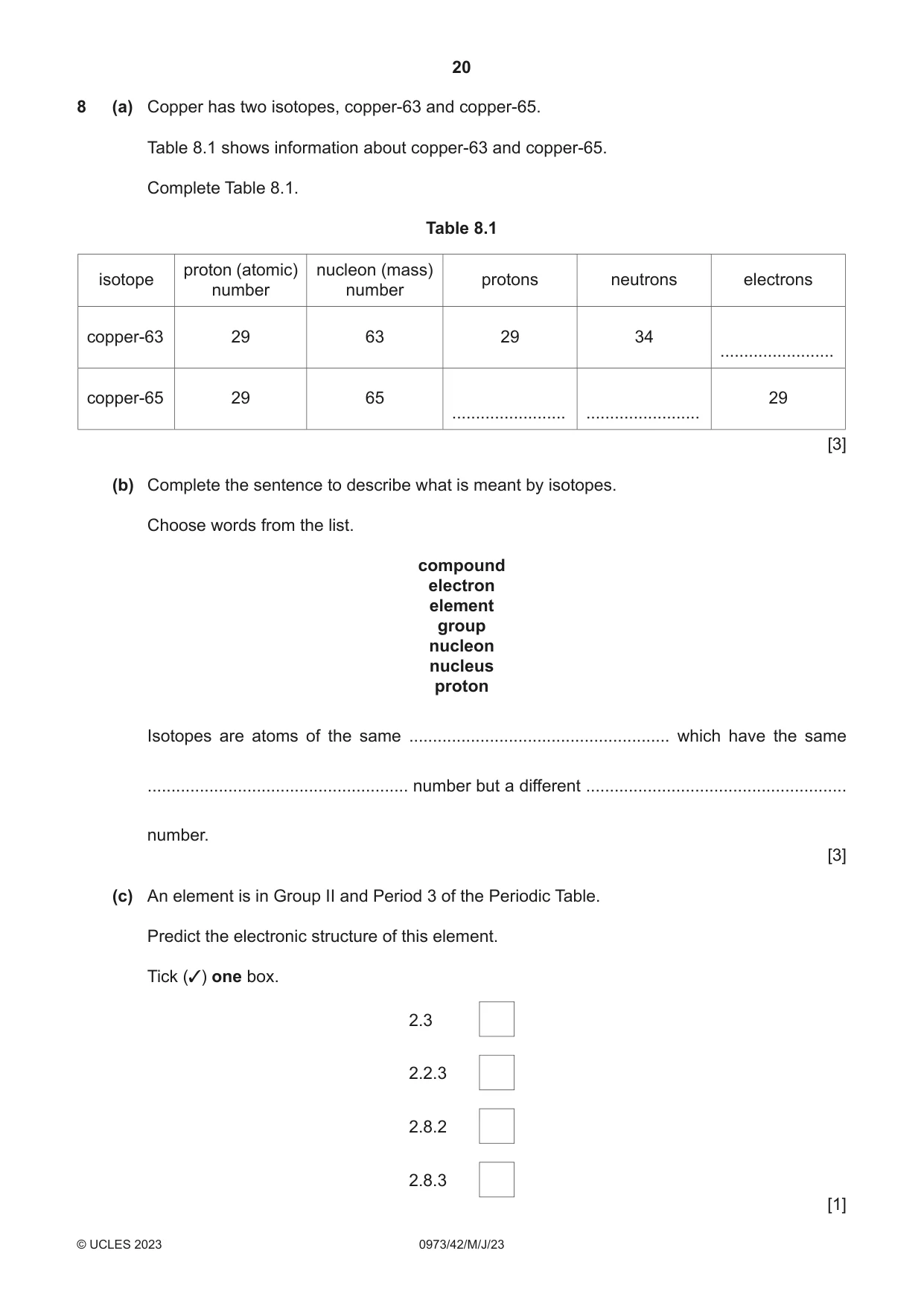
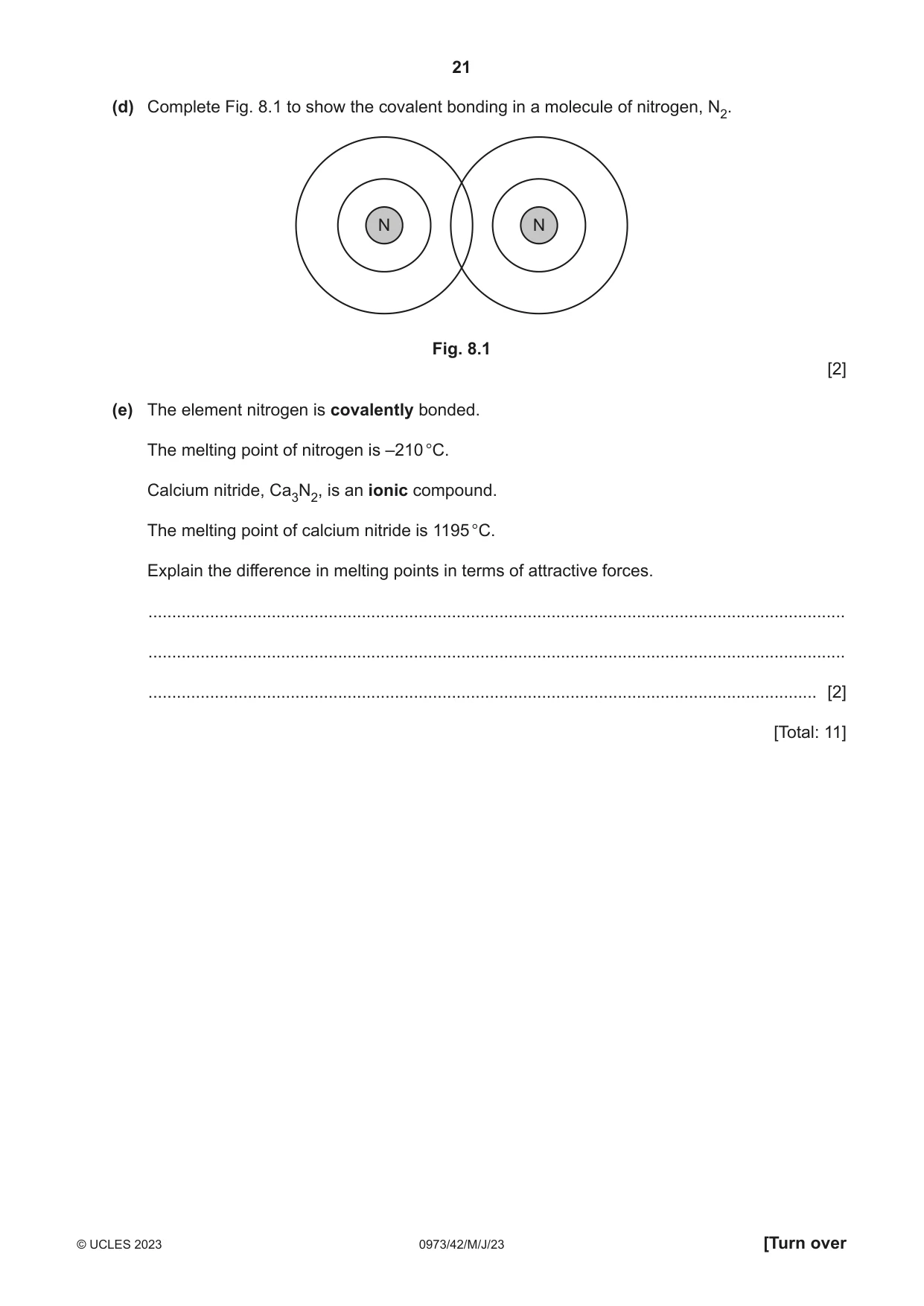
8 (a) Copper has two isotopes, copper‑63 and copper‑65. Table 8.1 shows information about copper‑63 and copper‑65. Complete Table 8.1. Table 8.1 proton (atomic) nucleon (mass) isotope protons neutrons electrons number number copper‑63 29 63 29 34 ........................ copper‑65 29 65 29 ........................ ........................ [3] (b) Complete the sentence to describe what is meant by isotopes. Choose words from the list. compound electron element group nucleon nucleus proton Isotopes are atoms of the same ....................................................... which have the same ....................................................... number but a different ....................................................... number. [3] (c) An element is in Group II and Period 3 of the Periodic Table. Predict the electronic structure of this element. Tick (3) one box. 2.3 2.2.3 2.8.2 2.8.3 [1] (d) Complete Fig. 8.1 to show the covalent bonding in a molecule of nitrogen, N2. N N Fig. 8.1 [2] (e) The element nitrogen is covalently bonded. The melting point of nitrogen is –210 °C. Calcium nitride, Ca3N2, is an ionic compound. The melting point of calcium nitride is 1195 °C. Explain the difference in melting points in terms of attractive forces. ................................................................................................................................................... ................................................................................................................................................... ............................................................................................................................................. [2] [Total: 11]
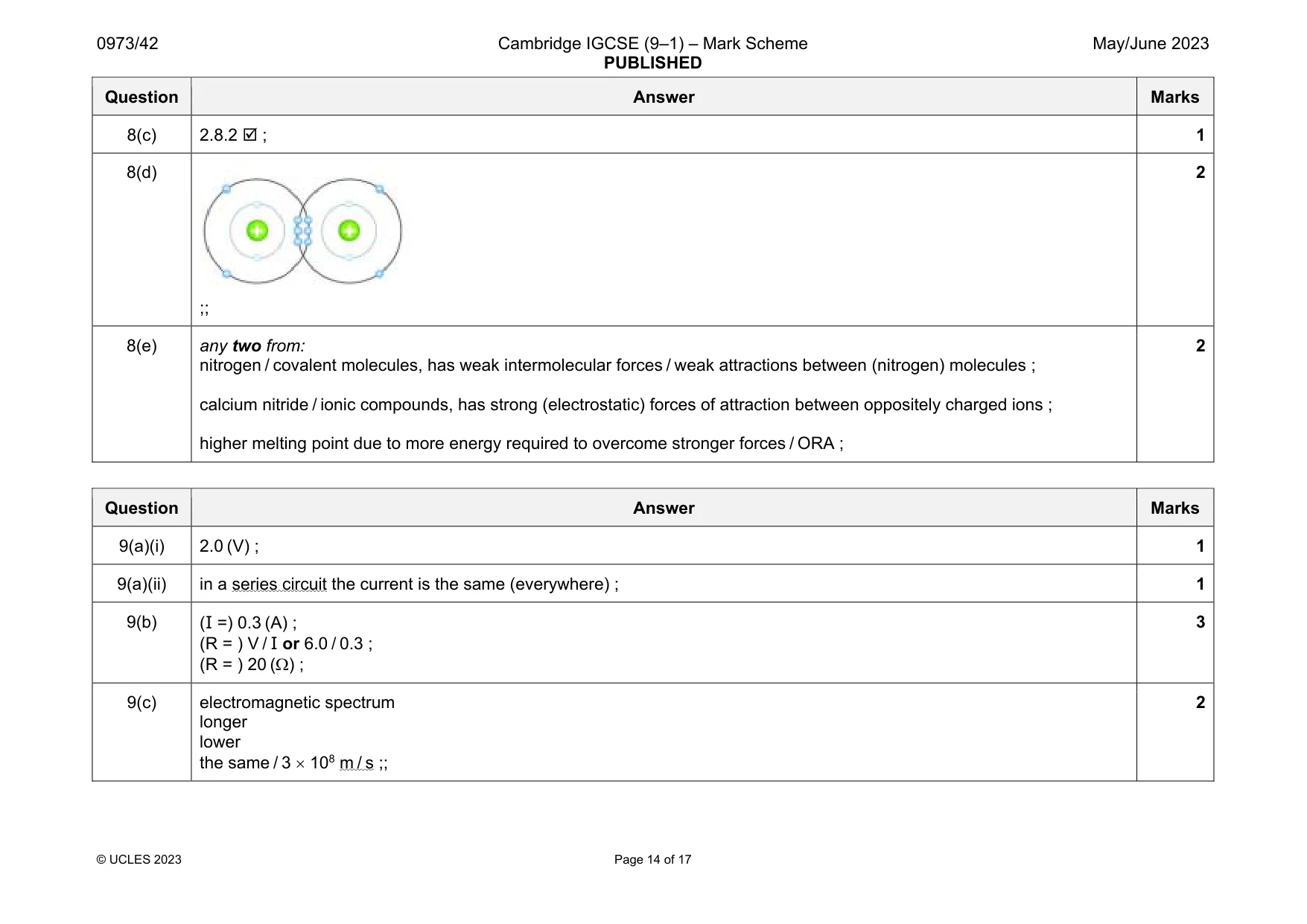
Mark scheme: 8(a) isotope proton (atomic) number nucleon (mass) number protons neutrons electrons copper-63 29 63 29 34 29 copper-65 29 65 29 36 29 ;;; 3 8(b) element ; proton ; nucleon ; 3 Question Answer Marks 8(c) 2.8.2 ; 1 8(d) ;; 2 8(e) any two from: nitrogen / covalent molecules, has weak intermolecular forces / weak attractions between (nitrogen) molecules ; calcium nitride / ionic compounds, has strong (electrostatic) forces of attraction between oppositely charged ions ; higher melting point due to more energy required to overcome stronger forces / ORA ; 2
Q9 · A student investigates series and parallel circuits using filament lamps
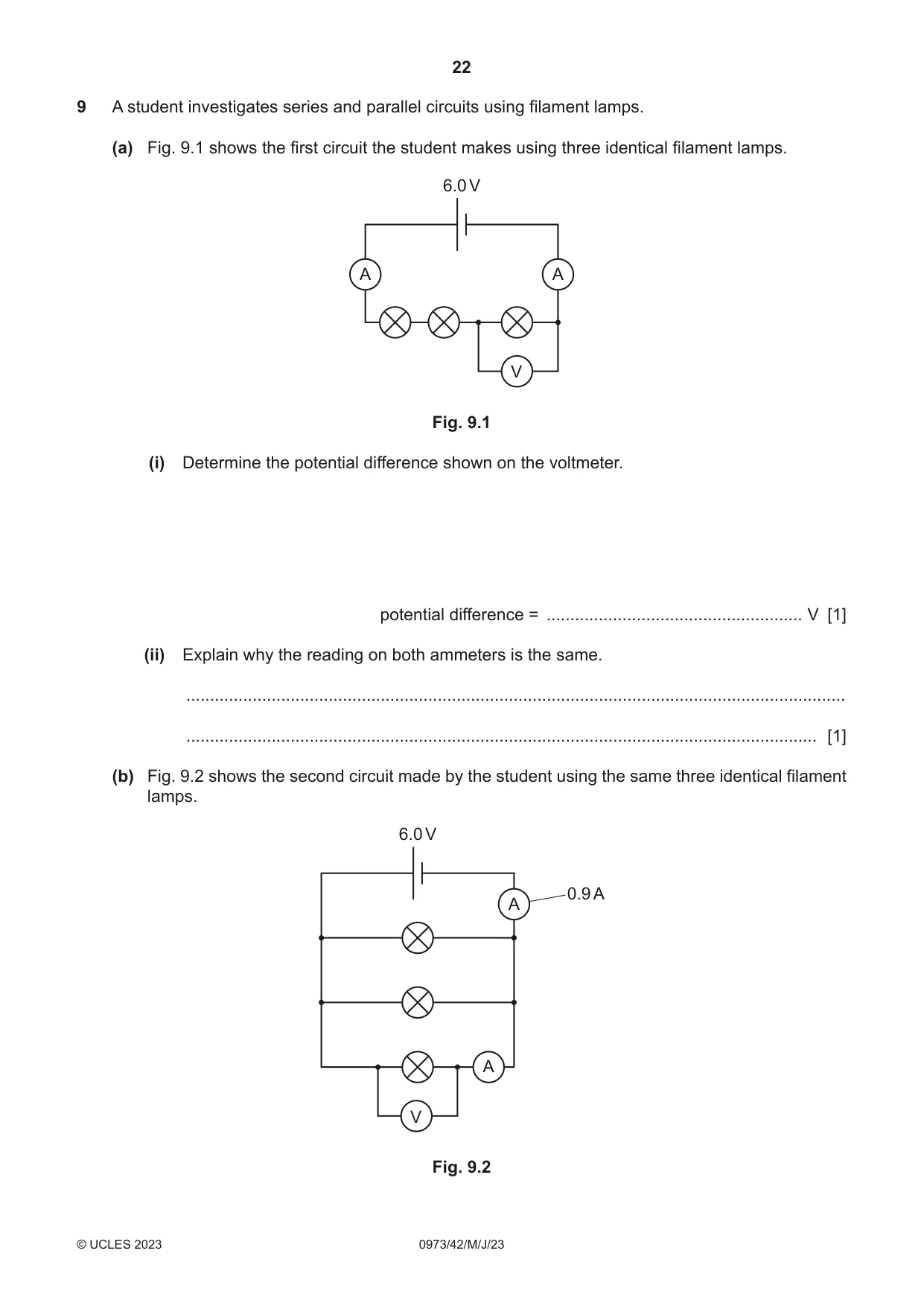
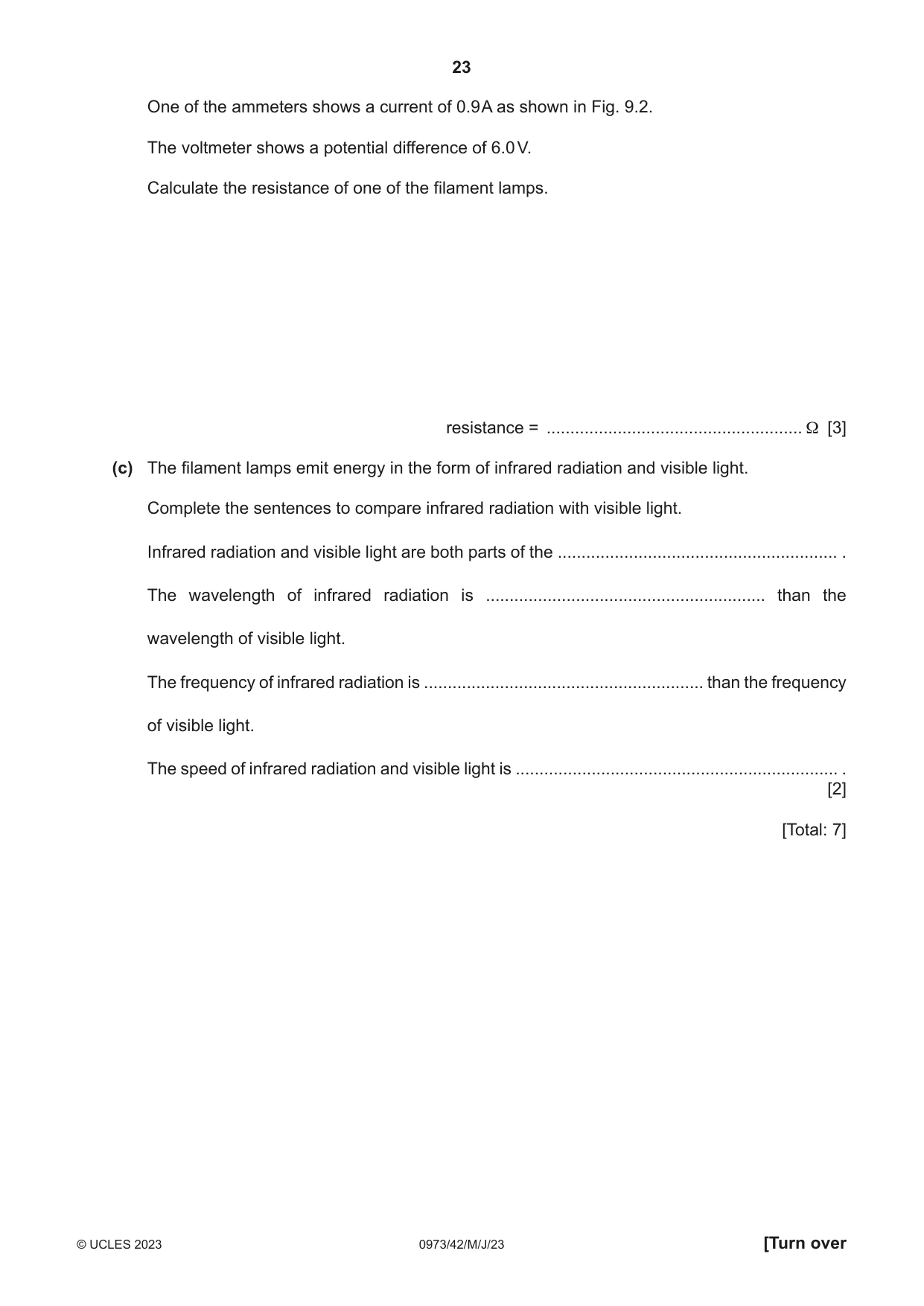
9 A student investigates series and parallel circuits using filament lamps. (a) Fig. 9.1 shows the first circuit the student makes using three identical filament lamps. 6.0 V A A V Fig. 9.1 (i) Determine the potential difference shown on the voltmeter. potential difference = ...................................................... V [1] (ii) Explain why the reading on both ammeters is the same. ........................................................................................................................................... ..................................................................................................................................... [1] (b) Fig. 9.2 shows the second circuit made by the student using the same three identical filament lamps. 6.0 V 0.9 A A A V Fig. 9.2 One of the ammeters shows a current of 0.9 A as shown in Fig. 9.2. The voltmeter shows a potential difference of 6.0 V. Calculate the resistance of one of the filament lamps. resistance = ...................................................... Ω [3] (c) The filament lamps emit energy in the form of infrared radiation and visible light. Complete the sentences to compare infrared radiation with visible light. Infrared radiation and visible light are both parts of the ........................................................... . The wavelength of infrared radiation is ........................................................... than the wavelength of visible light. The frequency of infrared radiation is ........................................................... than the frequency of visible light. The speed of infrared radiation and visible light is .................................................................... . [2] [Total: 7]
Mark scheme: 9(a)(i) 2.0 (V) ; 1 9(a)(ii) in a series circuit the current is the same (everywhere) ; 1 9(b) (I =) 0.3 (A) ; (R = ) V / I or 6.0 / 0.3 ; (R = ) 20 () ; 3 9(c) electromagnetic spectrum longer lower the same / 3 108 m / s ;; 2
Q10 · A diagram of a sperm cell in humans
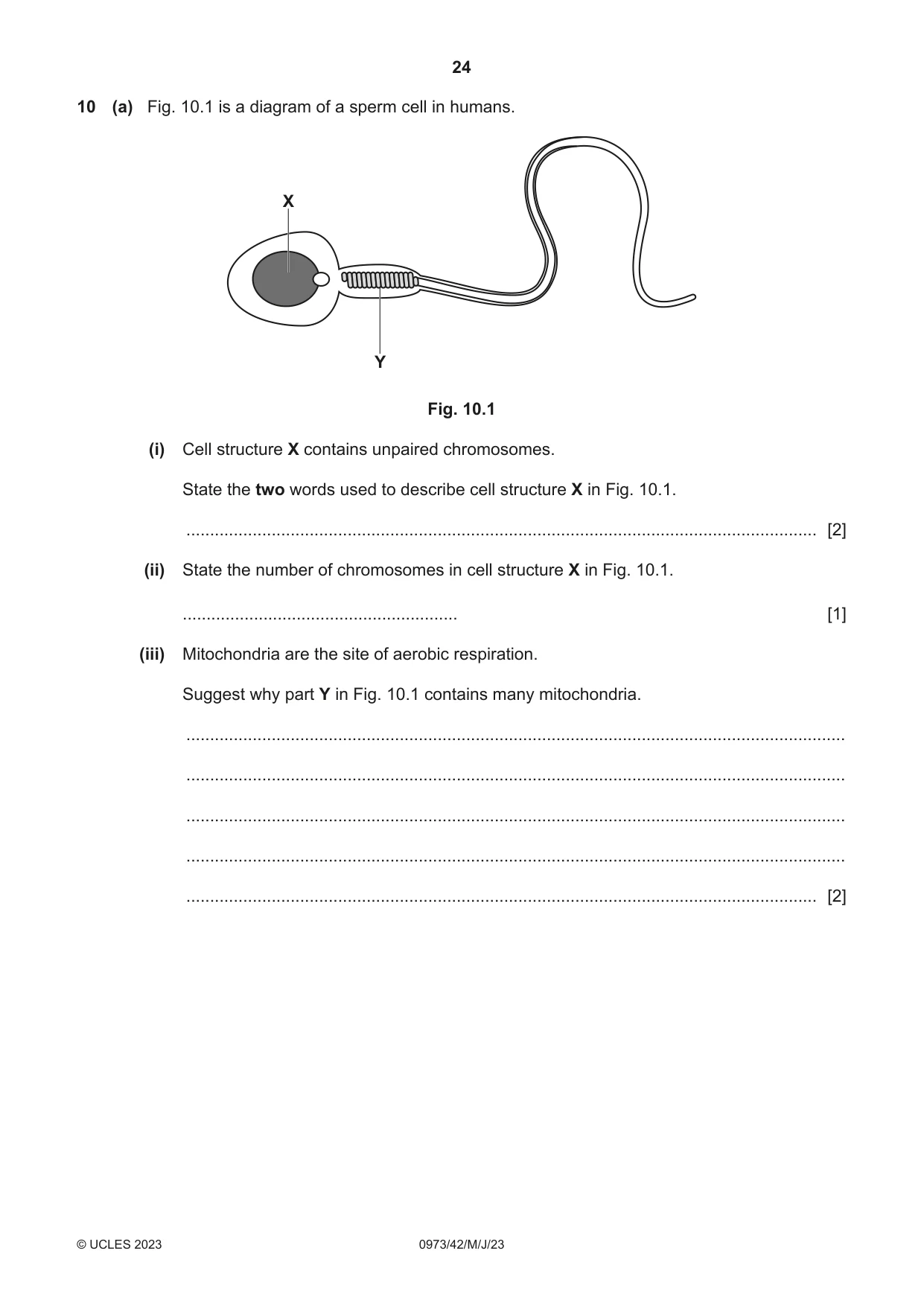
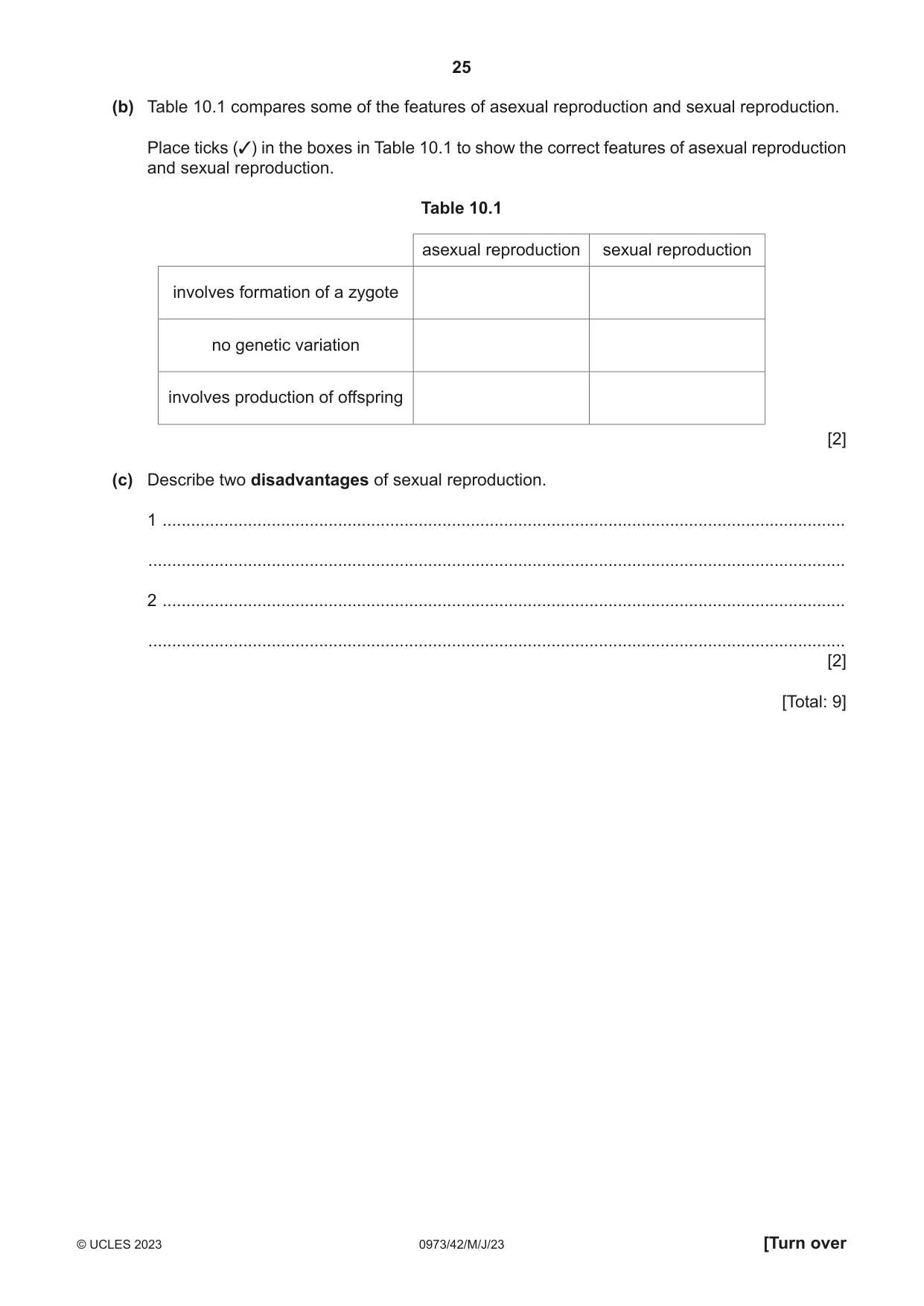
10 (a) Fig. 10.1 is a diagram of a sperm cell in humans. X Y Fig. 10.1 (i) Cell structure X contains unpaired chromosomes. State the two words used to describe cell structure X in Fig. 10.1. ..................................................................................................................................... [2] (ii) State the number of chromosomes in cell structure X in Fig. 10.1. .......................................................... [1] (iii) Mitochondria are the site of aerobic respiration. Suggest why part Y in Fig. 10.1 contains many mitochondria. ........................................................................................................................................... ........................................................................................................................................... ........................................................................................................................................... ........................................................................................................................................... ..................................................................................................................................... [2] (b) Table 10.1 compares some of the features of asexual reproduction and sexual reproduction. Place ticks (3) in the boxes in Table 10.1 to show the correct features of asexual reproduction and sexual reproduction. Table 10.1 asexual reproduction sexual reproduction involves formation of a zygote no genetic variation involves production of offspring [2] (c) Describe two disadvantages of sexual reproduction. 1 ................................................................................................................................................ ................................................................................................................................................... 2 ................................................................................................................................................ ................................................................................................................................................... [2] [Total: 9]
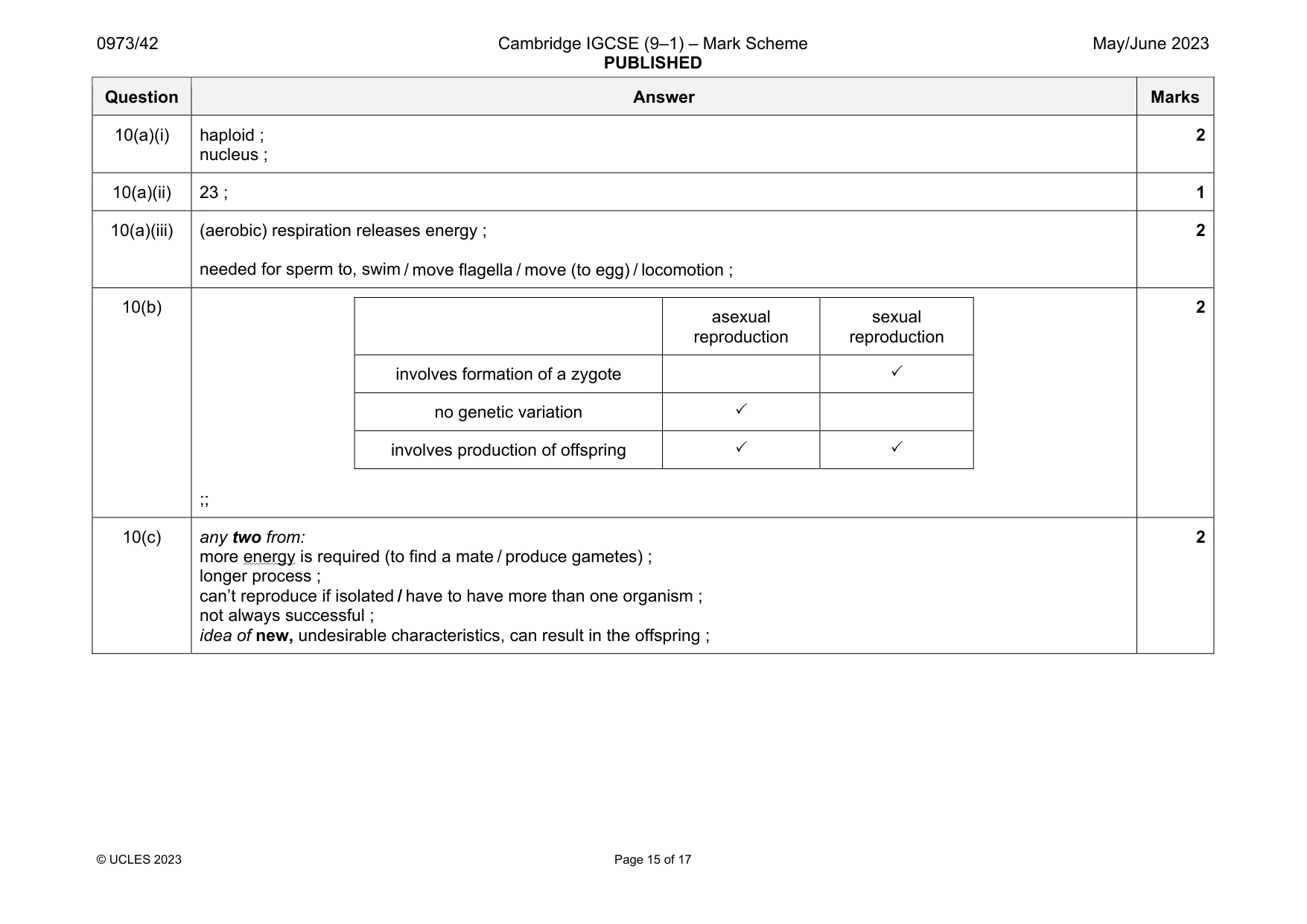
Mark scheme: 10(a)(i) haploid ; nucleus ; 2 10(a)(ii) 23 ; 1 10(a)(iii) (aerobic) respiration releases energy ; needed for sperm to, swim / move flagella / move (to egg) / locomotion ; 2 10(b) asexual reproduction sexual reproduction involves formation of a zygote no genetic variation involves production of offspring ;; 2 10(c) any two from: more energy is required (to find a mate / produce gametes) ; longer process ; can’t reproduce if isolated / have to have more than one organism ; not always successful ; idea of new, undesirable characteristics, can result in the offspring ; 2
Q11 · Electrolysis is the breakdown of an ionic compound, when molten or in aqueous solution…
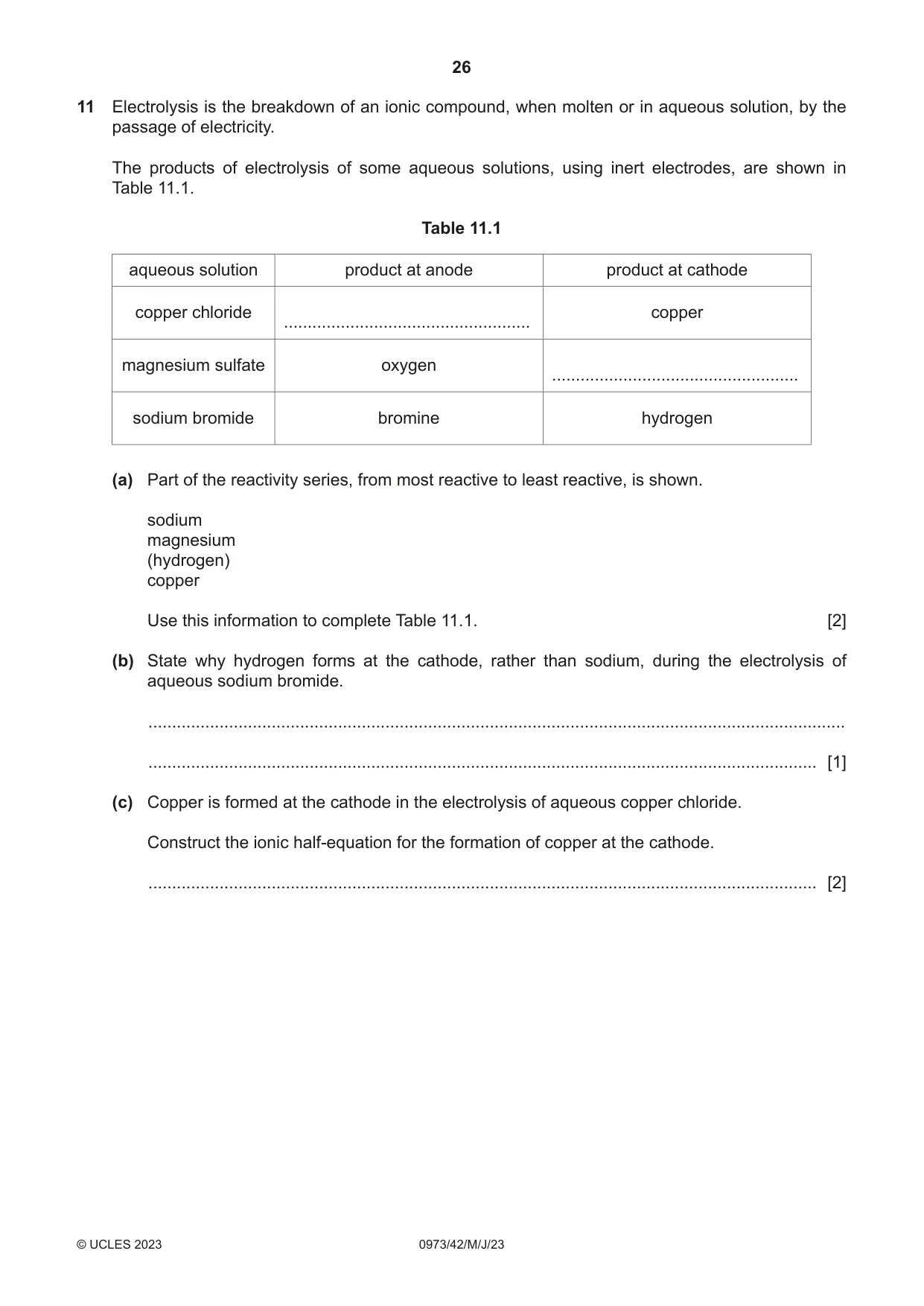
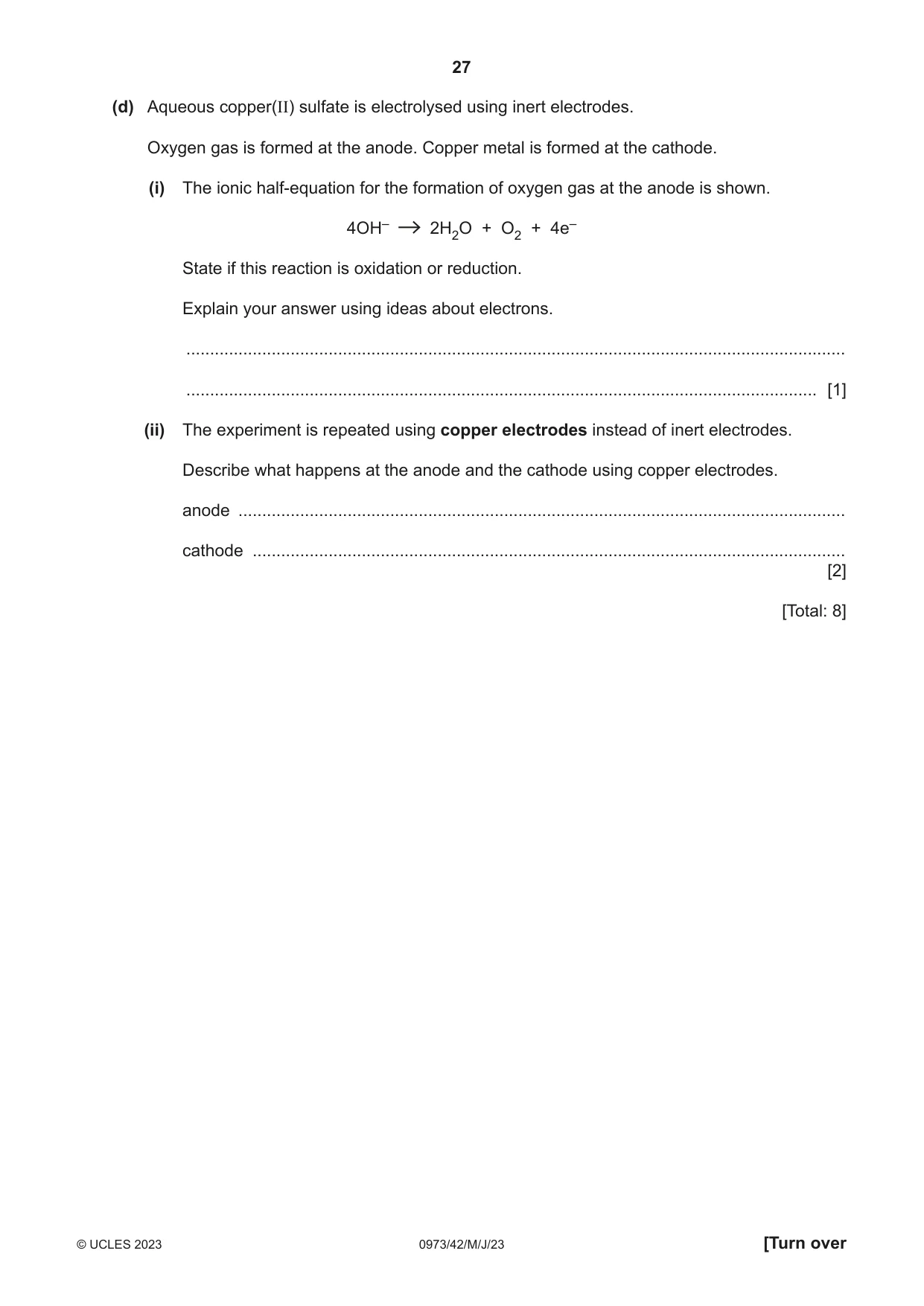
11 Electrolysis is the breakdown of an ionic compound, when molten or in aqueous solution, by the passage of electricity. The products of electrolysis of some aqueous solutions, using inert electrodes, are shown in Table 11.1. Table 11.1 aqueous solution product at anode product at cathode copper chloride copper .................................................... magnesium sulfate oxygen .................................................... sodium bromide bromine hydrogen (a) Part of the reactivity series, from most reactive to least reactive, is shown. sodium magnesium (hydrogen) copper Use this information to complete Table 11.1. [2] (b) State why hydrogen forms at the cathode, rather than sodium, during the electrolysis of aqueous sodium bromide. ................................................................................................................................................... ............................................................................................................................................. [1] (c) Copper is formed at the cathode in the electrolysis of aqueous copper chloride. Construct the ionic half‑equation for the formation of copper at the cathode. ............................................................................................................................................. [2] (d) Aqueous copper(II) sulfate is electrolysed using inert electrodes. Oxygen gas is formed at the anode. Copper metal is formed at the cathode. (i) The ionic half‑equation for the formation of oxygen gas at the anode is shown. 4OH– 2H2O + O2 + 4e– State if this reaction is oxidation or reduction. Explain your answer using ideas about electrons. ........................................................................................................................................... ..................................................................................................................................... [1] (ii) The experiment is repeated using copper electrodes instead of inert electrodes. Describe what happens at the anode and the cathode using copper electrodes. anode ................................................................................................................................ cathode ............................................................................................................................. [2] [Total: 8]
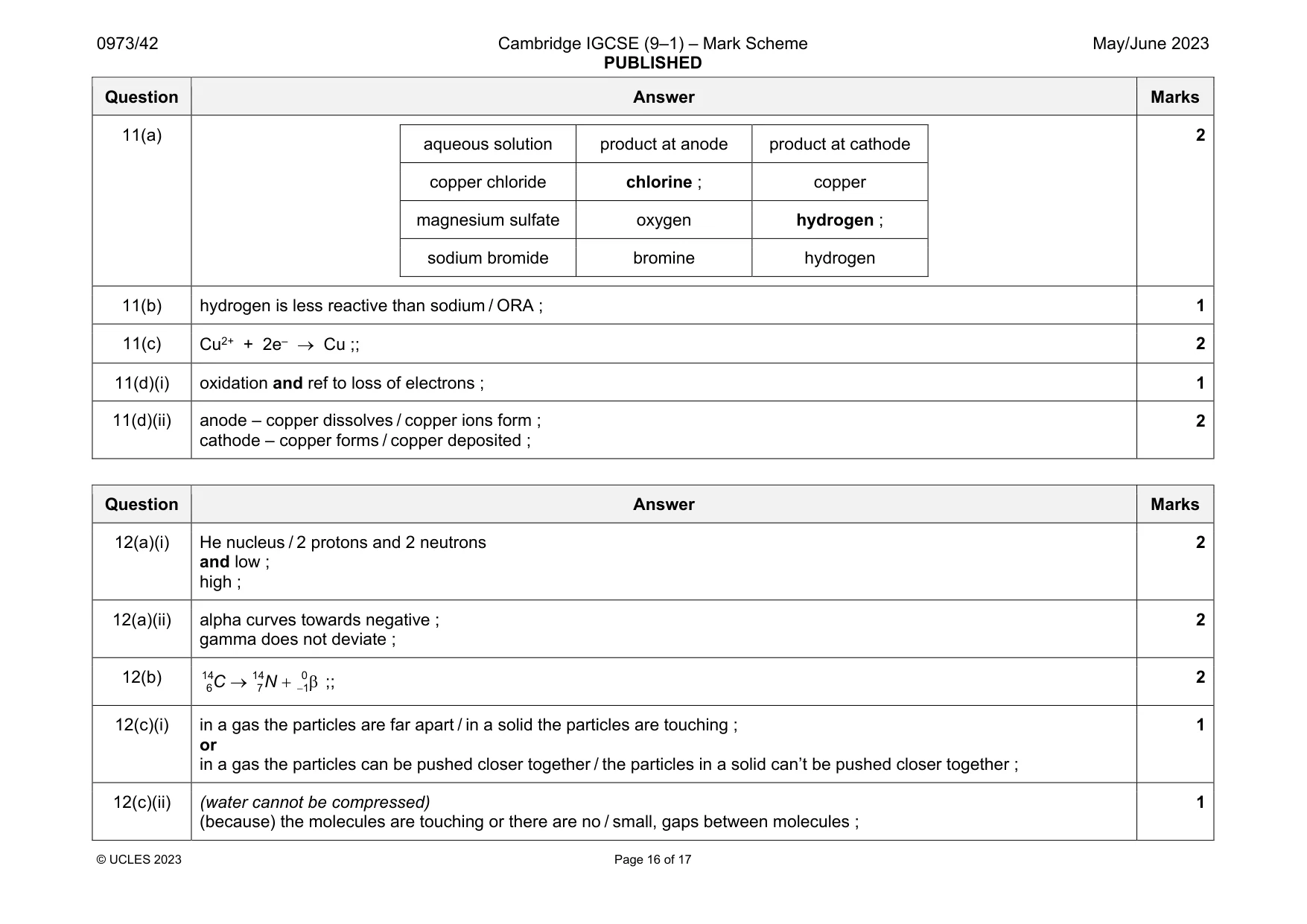
Mark scheme: 11(a) aqueous solution product at anode product at cathode copper chloride chlorine ; copper magnesium sulfate oxygen hydrogen ; sodium bromide bromine hydrogen 2 11(b) hydrogen is less reactive than sodium / ORA ; 1 11(c) Cu2+ + 2e– Cu ;; 2 11(d)(i) oxidation and ref to loss of electrons ; 1 11(d)(ii) anode – copper dissolves / copper ions form ; cathode – copper forms / copper deposited ; 2
Q12 · Information about three types of ionising radiation
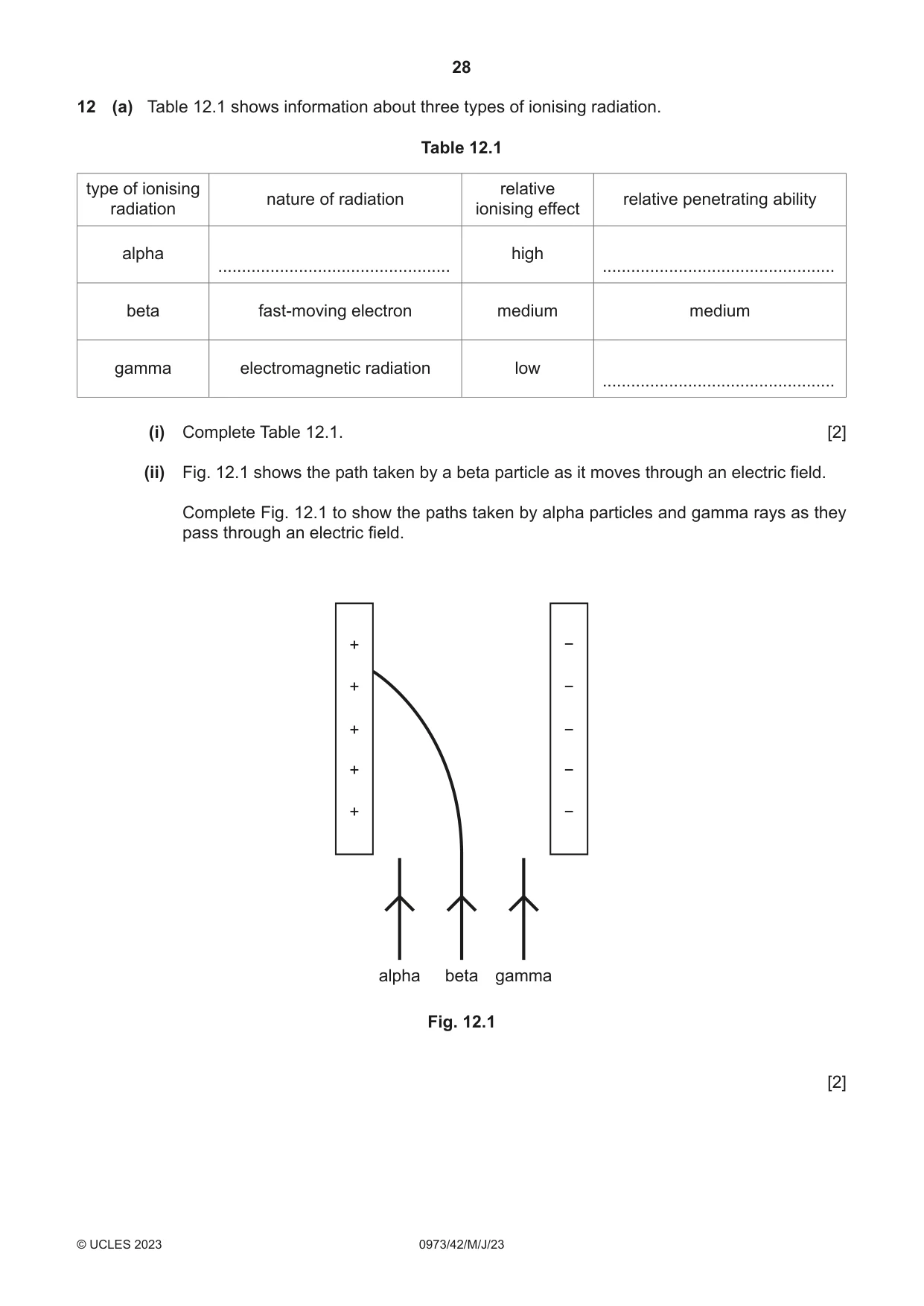
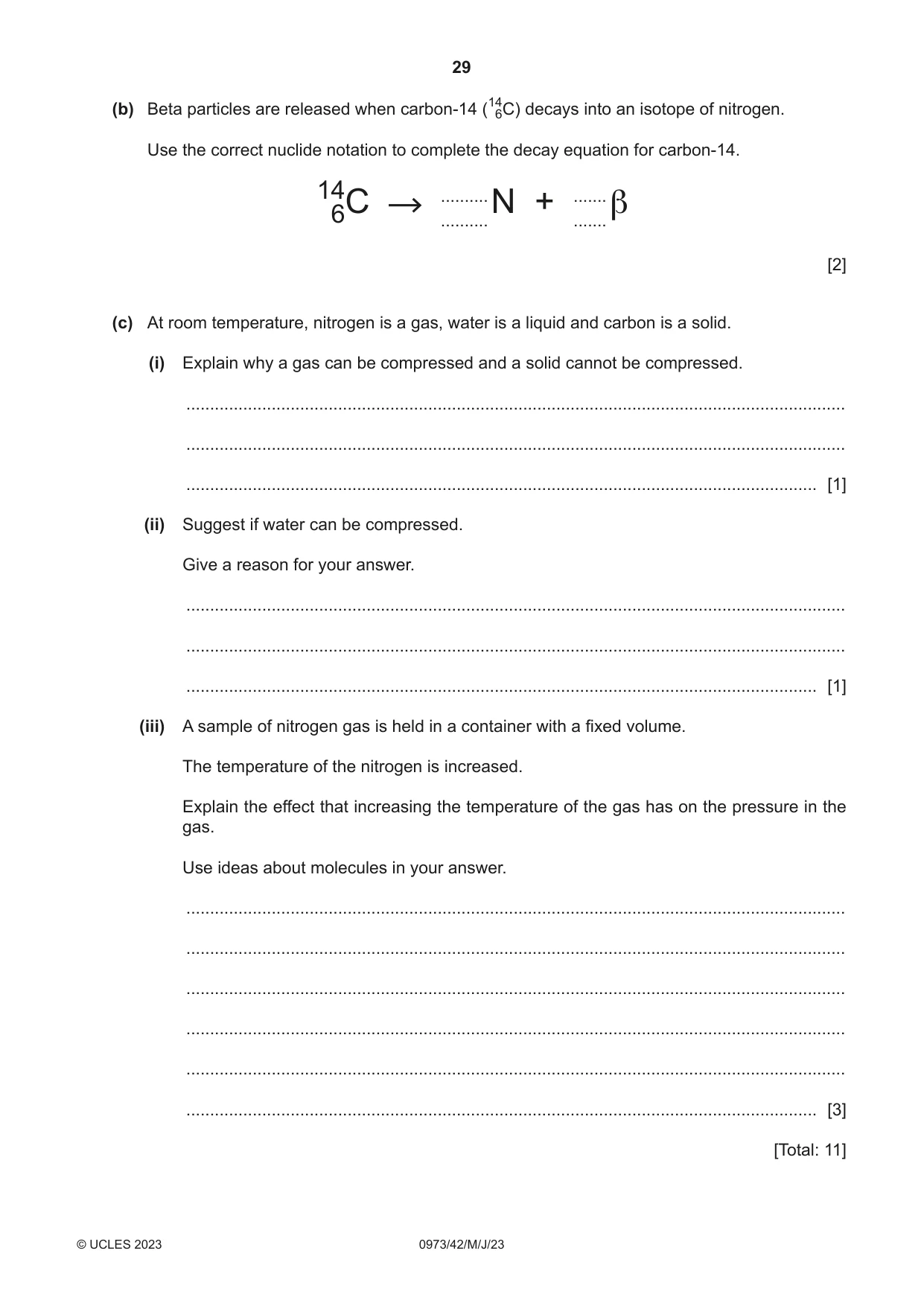
12 (a) Table 12.1 shows information about three types of ionising radiation. Table 12.1 type of ionising relative nature of radiation relative penetrating ability radiation ionising effect alpha high ................................................. ................................................. beta fast‑moving electron medium medium gamma electromagnetic radiation low ................................................. (i) Complete Table 12.1. [2] (ii) Fig. 12.1 shows the path taken by a beta particle as it moves through an electric field. Complete Fig. 12.1 to show the paths taken by alpha particles and gamma rays as they pass through an electric field. + − + − + − + − + − alpha beta gamma Fig. 12.1 [2] (b) Beta particles are released when carbon‑14 (146C) decays into an isotope of nitrogen. Use the correct nuclide notation to complete the decay equation for carbon‑14. 14 .......... ....... 6C ..........N + ....... β [2] (c) At room temperature, nitrogen is a gas, water is a liquid and carbon is a solid. (i) Explain why a gas can be compressed and a solid cannot be compressed. ........................................................................................................................................... ........................................................................................................................................... ..................................................................................................................................... [1] (ii) Suggest if water can be compressed. Give a reason for your answer. ........................................................................................................................................... ........................................................................................................................................... ..................................................................................................................................... [1] (iii) A sample of nitrogen gas is held in a container with a fixed volume. The temperature of the nitrogen is increased. Explain the effect that increasing the temperature of the gas has on the pressure in the gas. Use ideas about molecules in your answer. ........................................................................................................................................... ........................................................................................................................................... ........................................................................................................................................... ........................................................................................................................................... ........................................................................................................................................... ..................................................................................................................................... [3] [Total: 11]
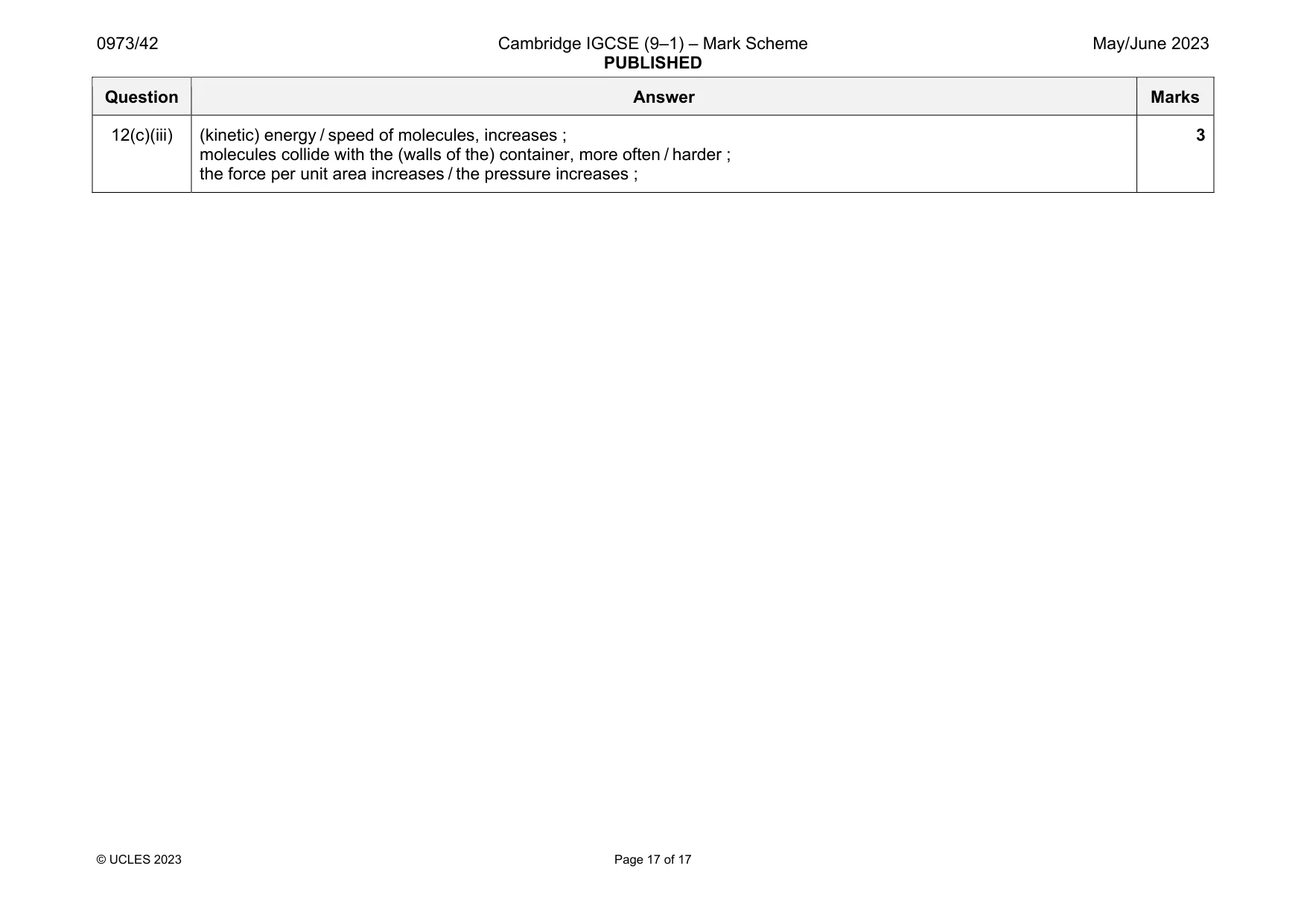
Mark scheme: 12(a)(i) He nucleus / 2 protons and 2 neutrons and low ; high ; 2 12(a)(ii) alpha curves towards negative ; gamma does not deviate ; 2 12(b) 14 14 0 6 7 1 C N ;; 2 12(c)(i) in a gas the particles are far apart / in a solid the particles are touching ; or in a gas the particles can be pushed closer together / the particles in a solid can’t be pushed closer together ; 1 12(c)(ii) (water cannot be compressed) (because) the molecules are touching or there are no / small, gaps between molecules ; 1 Question Answer Marks 12(c)(iii) (kinetic) energy / speed of molecules, increases ; molecules collide with the (walls of the) container, more often / harder ; the force per unit area increases / the pressure increases ; 3
What was in this paper
The subtopics covered by these 12 questions, and how many questions each got. Open one in a new tab to see every Cambridge question on it.
What you needed in this session
Cambridge’s own grade thresholds for 2023 May/June, Paper 4 · Variant 2. A higher threshold means an easier paper — the bar moves with how the cohort did.