Cambridge IGCSE Sciences - Co-ordinated (9-1) 0973 — 2023 May/June Paper 4 · Variant 1
0973/41/M/J/23 · 12 questions · 120 marks · ≈135 min
The question paper and its mark scheme, free to read here and free to download. This is Cambridge’s own paper, exactly as it was sat.
Question paper32 pages


Mark scheme15 pages
Answers below. Sit the paper first if you are practising.
Questions as text
Q1 · A diagram of a cross‑section of skin
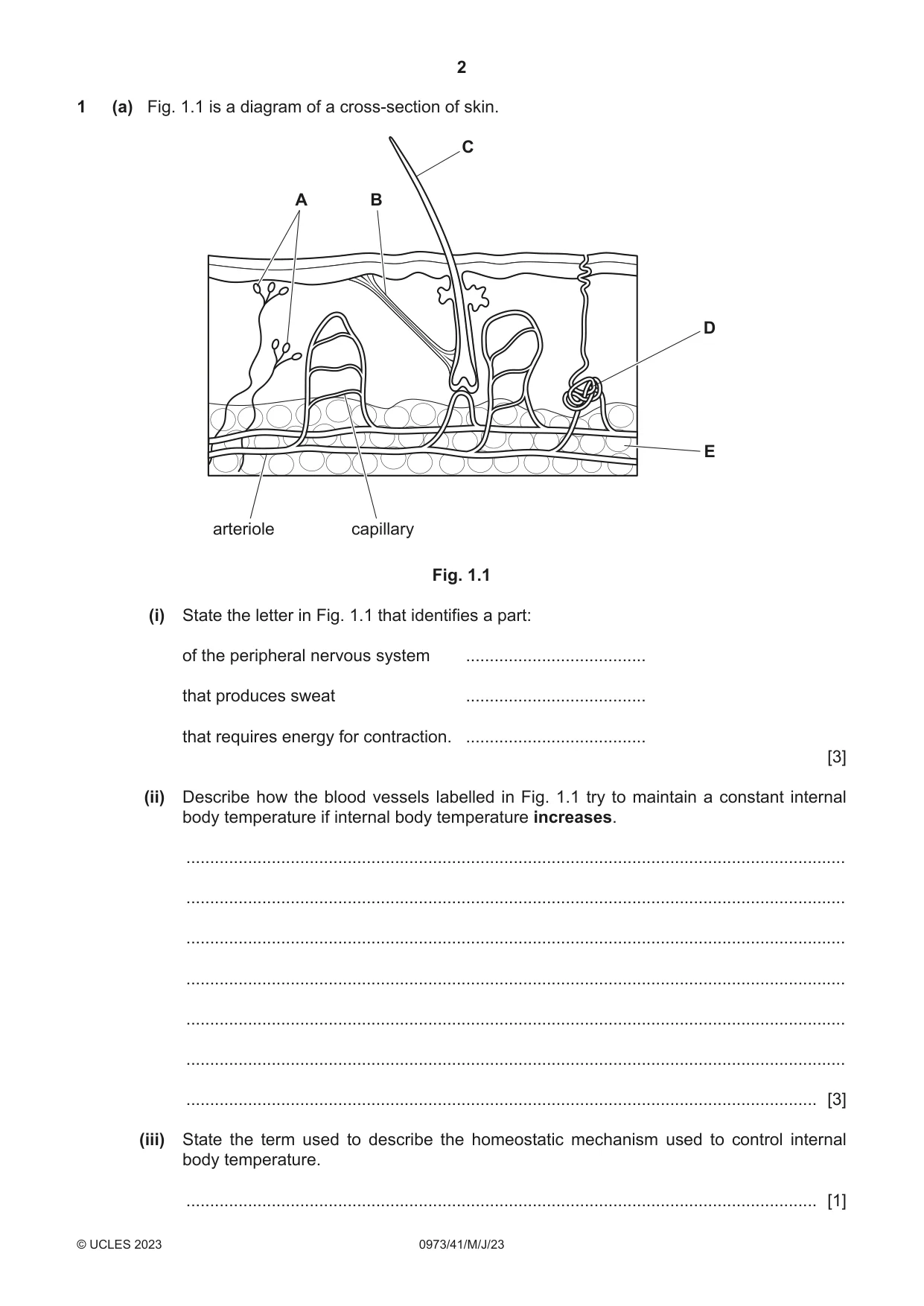
1 (a) Fig. 1.1 is a diagram of a cross‑section of skin. C A B D E arteriole capillary Fig. 1.1 (i) State the letter in Fig. 1.1 that identifies a part: of the peripheral nervous system ...................................... that produces sweat ...................................... that requires energy for contraction. ...................................... [3] (ii) Describe how the blood vessels labelled in Fig. 1.1 try to maintain a constant internal body temperature if internal body temperature increases. ........................................................................................................................................... ........................................................................................................................................... ........................................................................................................................................... ........................................................................................................................................... ........................................................................................................................................... ........................................................................................................................................... ..................................................................................................................................... [3] (iii) State the term used to describe the homeostatic mechanism used to control internal body temperature. ..................................................................................................................................... [1] (b) The control of glucose concentration in the blood is an example of homeostasis. (i) State the name of the hormone that reduces the concentration of glucose in the blood. ..................................................................................................................................... [1] (ii) State the type of organs that produce hormones. ..................................................................................................................................... [1] (c) Stimuli cause the body to make responses. (i) State the name of the organ that detects the change in temperature of the blood. ..................................................................................................................................... [1] (ii) State the name of the characteristic of living organisms that describes the detection and response to stimuli. ..................................................................................................................................... [1] [Total: 11]
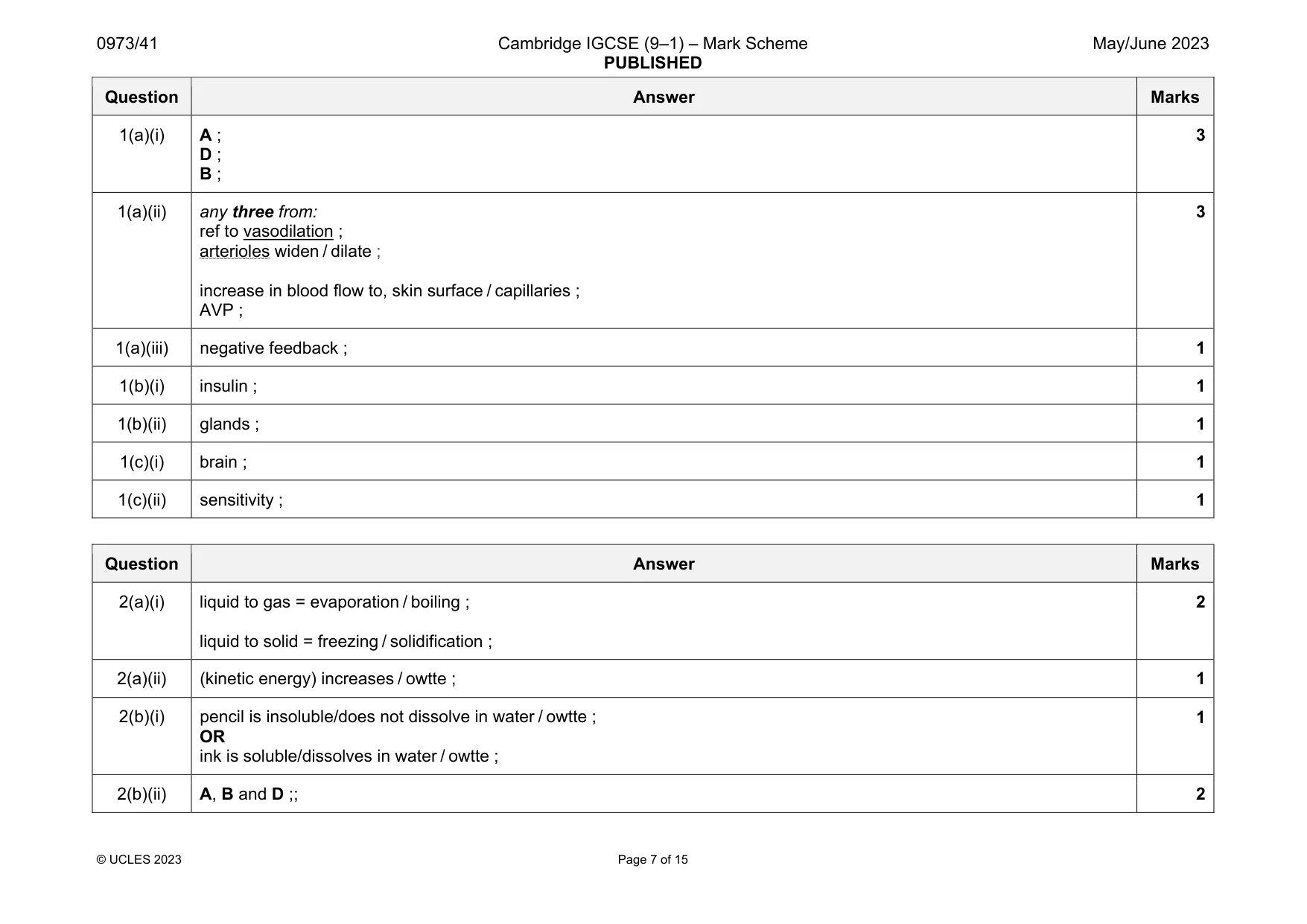
Mark scheme: 1(a)(i) A ; D ; B ; 3 1(a)(ii) any three from: ref to vasodilation ; arterioles widen / dilate ; increase in blood flow to, skin surface / capillaries ; AVP ; 3 1(a)(iii) negative feedback ; 1 1(b)(i) insulin ; 1 1(b)(ii) glands ; 1 1(c)(i) brain ; 1 1(c)(ii) sensitivity ; 1
Q2 · The three states of matter
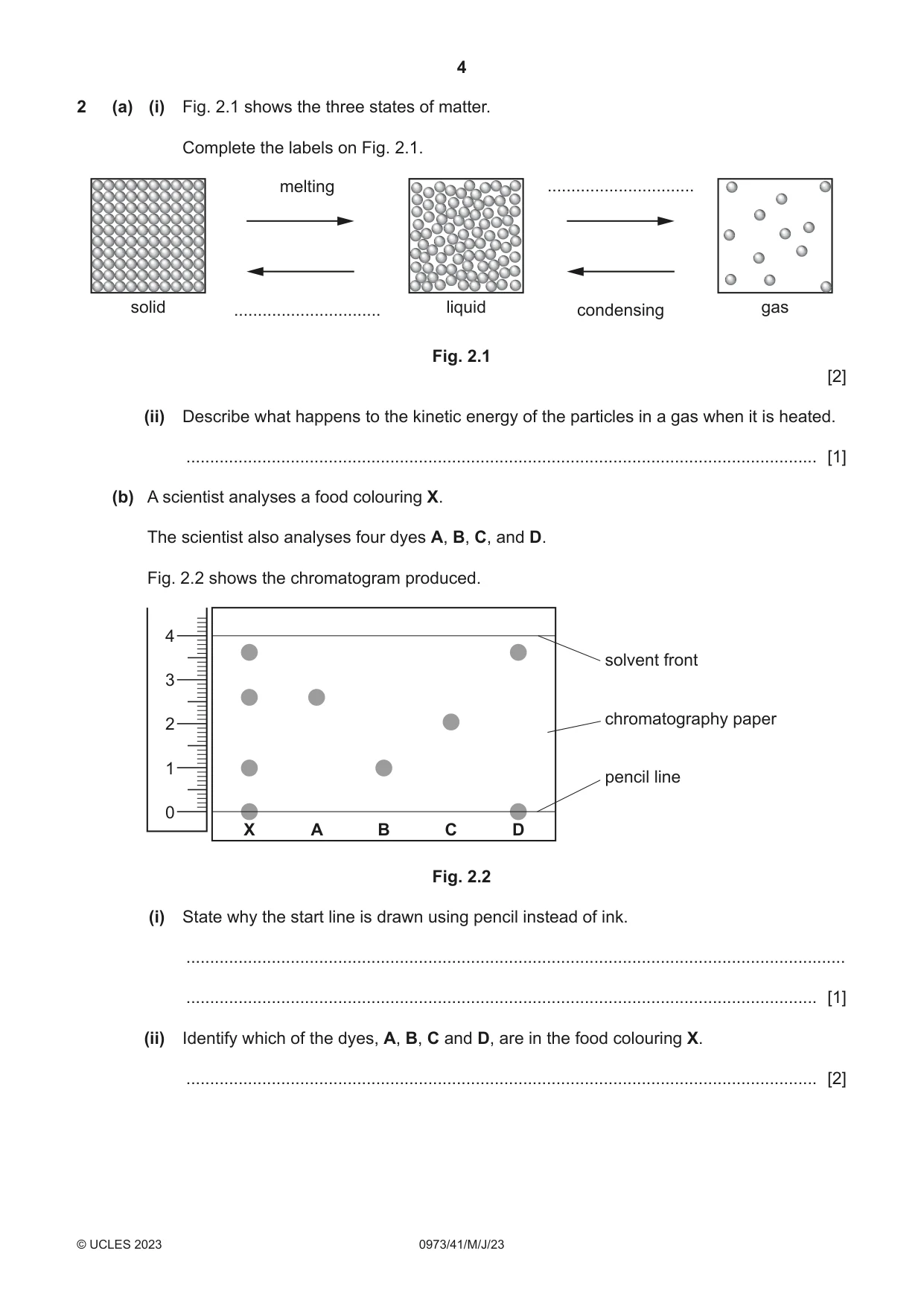
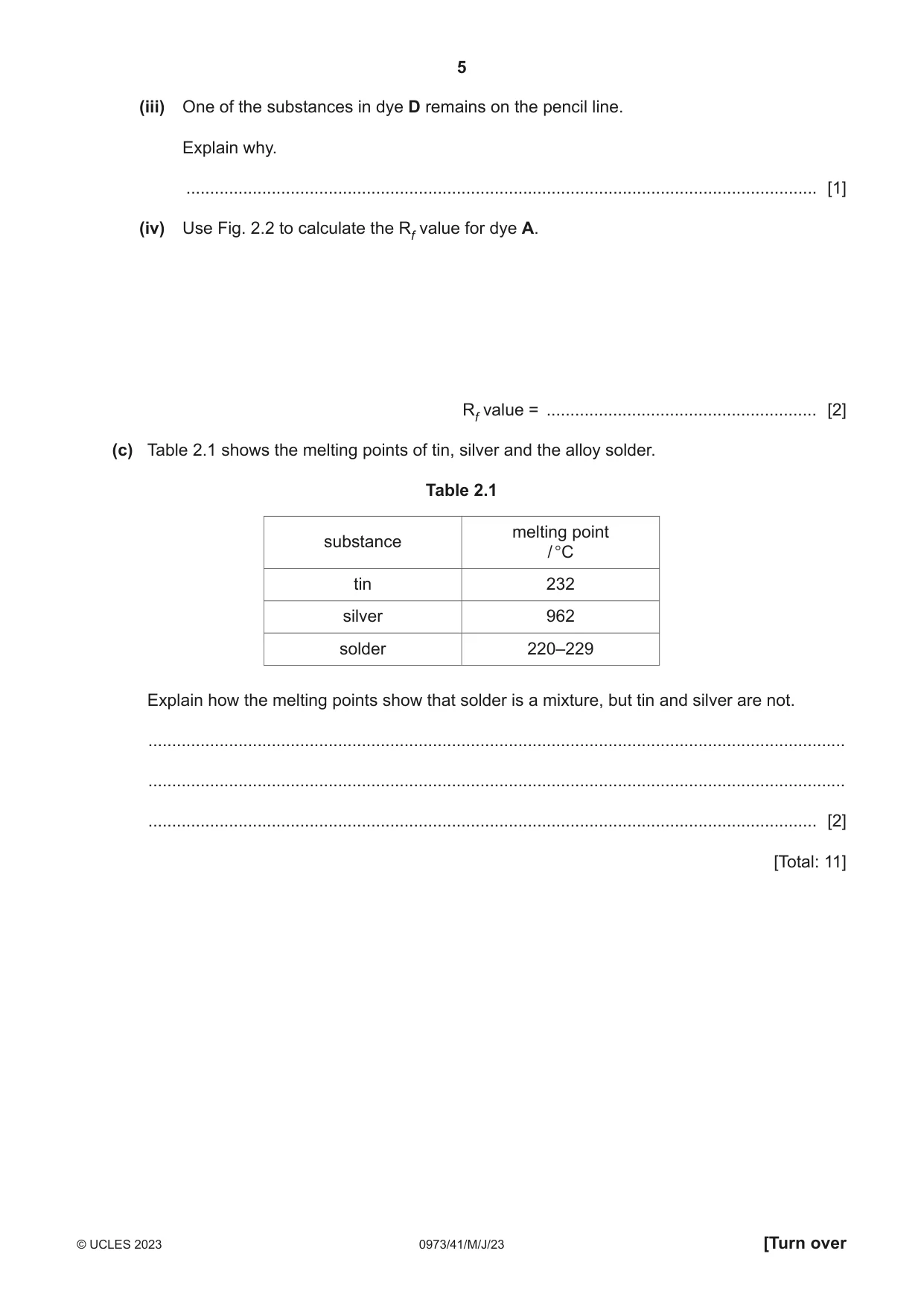
2 (a) (i) Fig. 2.1 shows the three states of matter. Complete the labels on Fig. 2.1. melting ............................... solid ............................... liquid condensing gas Fig. 2.1 [2] (ii) Describe what happens to the kinetic energy of the particles in a gas when it is heated. ..................................................................................................................................... [1] (b) A scientist analyses a food colouring X. The scientist also analyses four dyes A, B, C, and D. Fig. 2.2 shows the chromatogram produced. 4 solvent front 3 chromatography paper 2 1 pencil line 0 X A B C D Fig. 2.2 (i) State why the start line is drawn using pencil instead of ink. ........................................................................................................................................... ..................................................................................................................................... [1] (ii) Identify which of the dyes, A, B, C and D, are in the food colouring X. ..................................................................................................................................... [2] (iii) One of the substances in dye D remains on the pencil line. Explain why. ..................................................................................................................................... [1] (iv) Use Fig. 2.2 to calculate the Rf value for dye A. Rf value = ......................................................... [2] (c) Table 2.1 shows the melting points of tin, silver and the alloy solder. Table 2.1 melting point substance / °C tin 232 silver 962 solder 220–229 Explain how the melting points show that solder is a mixture, but tin and silver are not. ................................................................................................................................................... ................................................................................................................................................... ............................................................................................................................................. [2] [Total: 11]
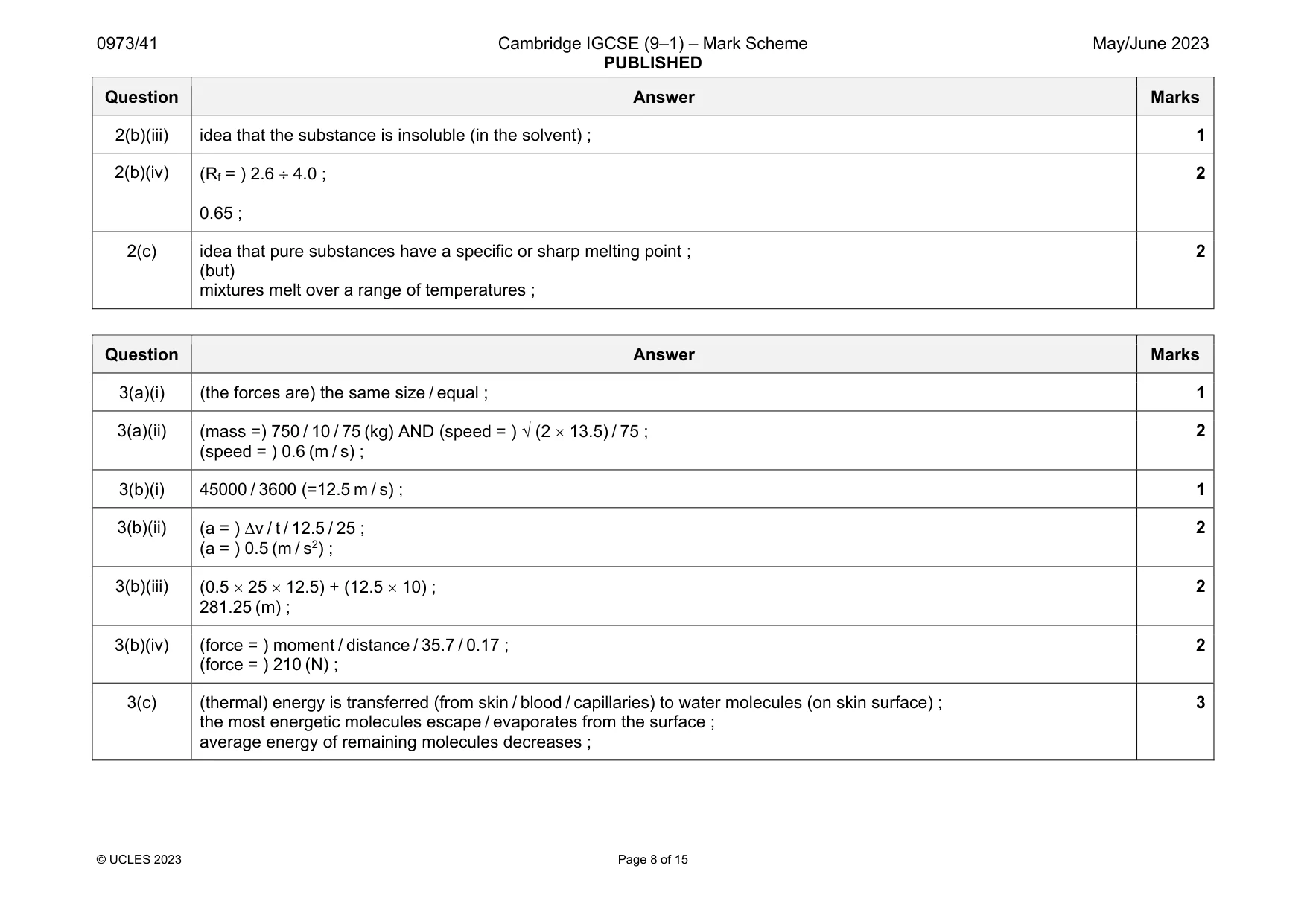
Mark scheme: 2(a)(i) liquid to gas = evaporation / boiling ; liquid to solid = freezing / solidification ; 2 2(a)(ii) (kinetic energy) increases / owtte ; 1 2(b)(i) pencil is insoluble/does not dissolve in water / owtte ; OR ink is soluble/dissolves in water / owtte ; 1 2(b)(ii) A, B and D ;; 2 Question Answer Marks 2(b)(iii) idea that the substance is insoluble (in the solvent) ; 1 2(b)(iv) (Rf = ) 2.6 4.0 ; 0.65 ; 2 2(c) idea that pure substances have a specific or sharp melting point ; (but) mixtures melt over a range of temperatures ; 2
Q3 · An Olympic triathlon event consists of a 1500 m swim, a 40 km cycle ride and a 10 km run
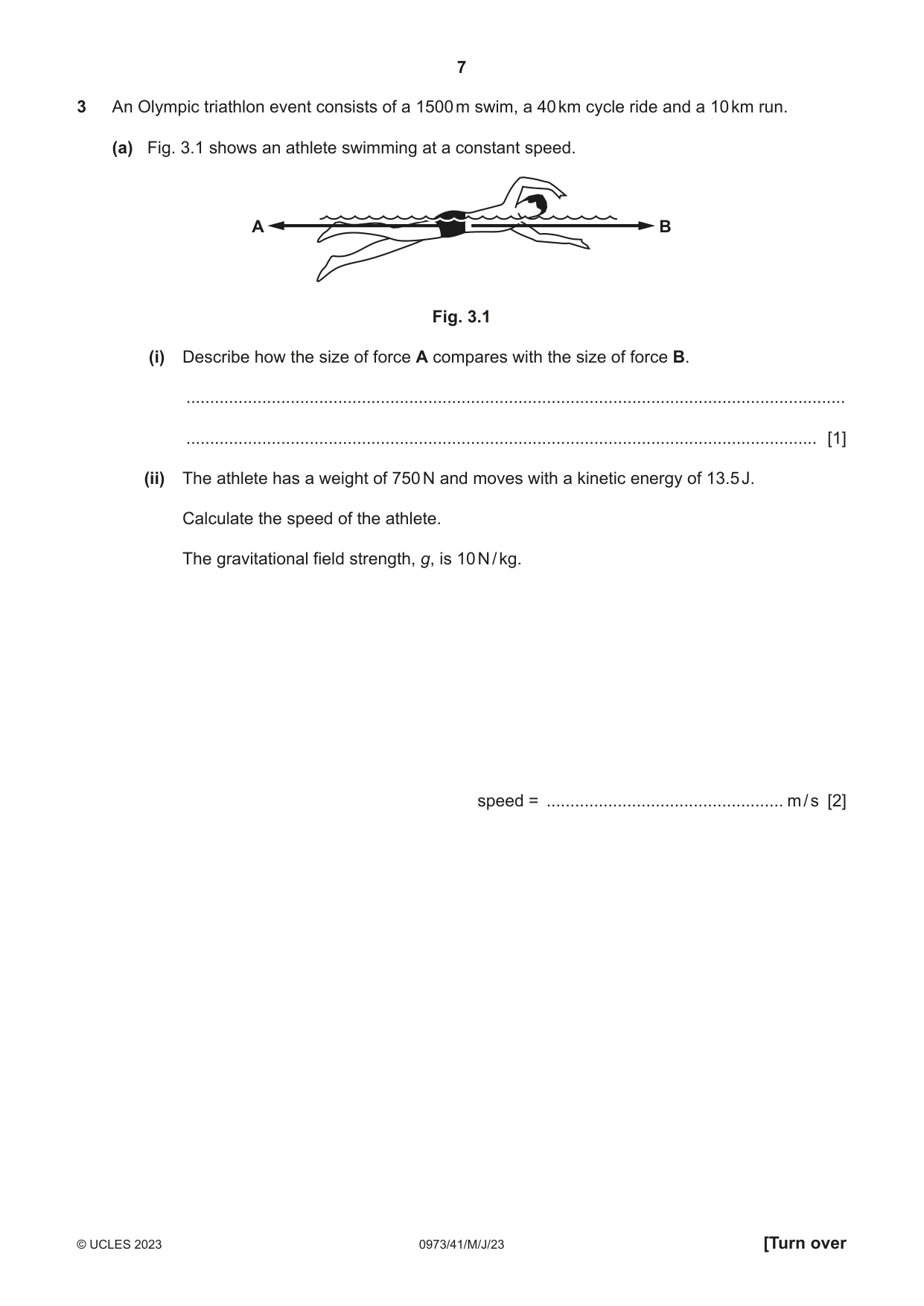
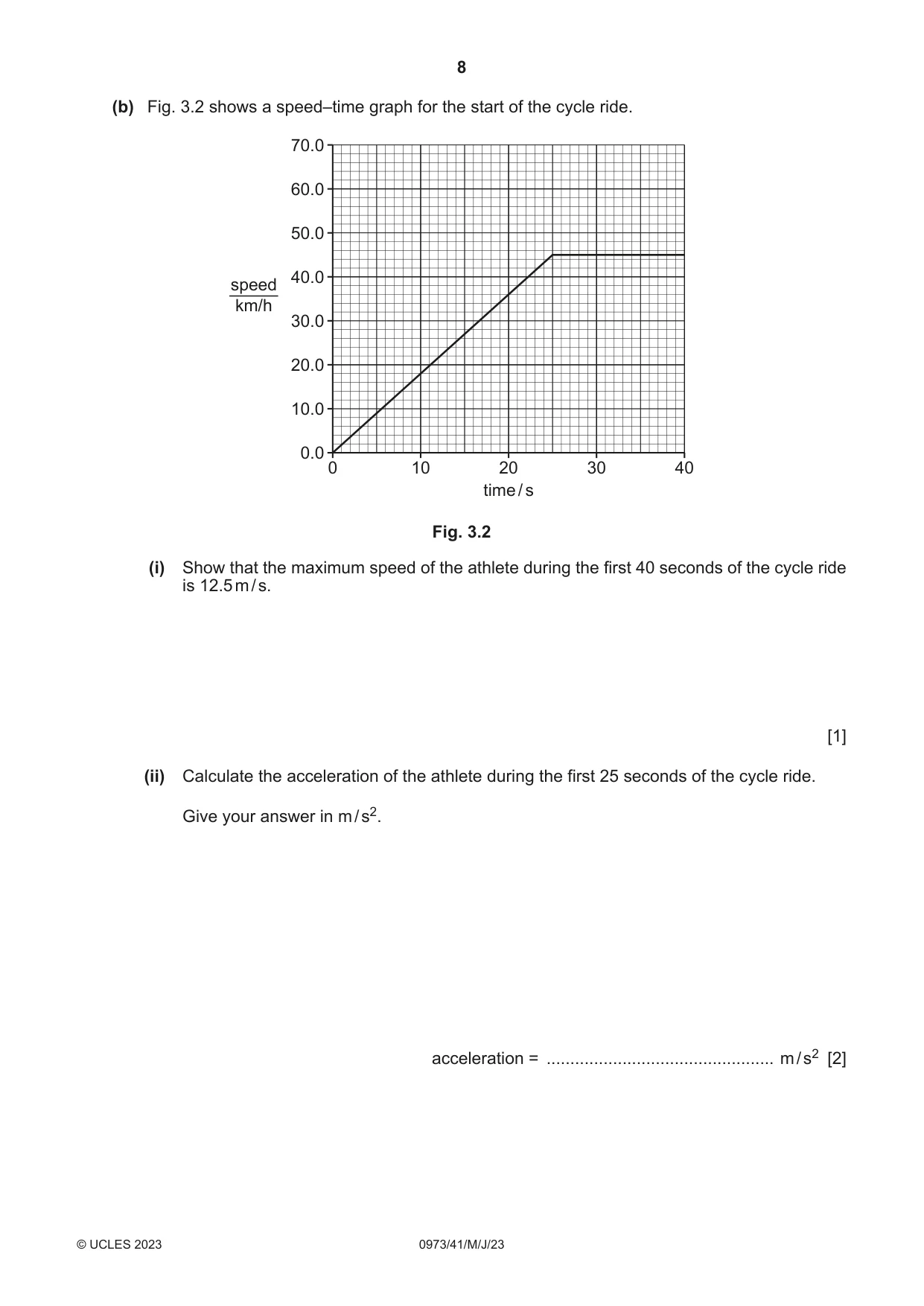
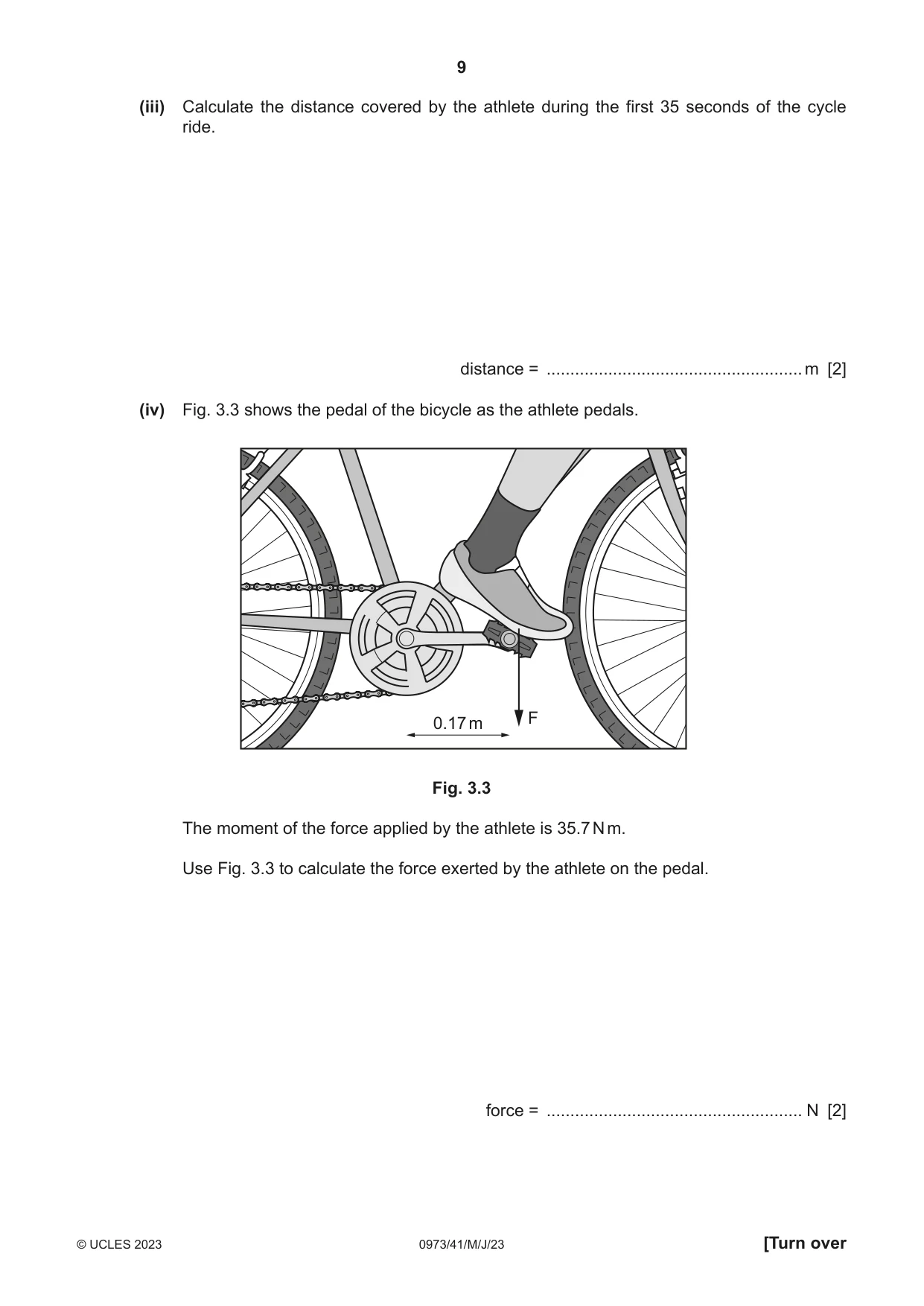
3 An Olympic triathlon event consists of a 1500 m swim, a 40 km cycle ride and a 10 km run. (a) Fig. 3.1 shows an athlete swimming at a constant speed. A B Fig. 3.1 (i) Describe how the size of force A compares with the size of force B. ........................................................................................................................................... ..................................................................................................................................... [1] (ii) The athlete has a weight of 750 N and moves with a kinetic energy of 13.5 J. Calculate the speed of the athlete. The gravitational field strength, g, is 10 N / kg. speed = .................................................. m / s [2] (b) Fig. 3.2 shows a speed–time graph for the start of the cycle ride. 70.0 60.0 50.0 40.0 speed km/h 30.0 20.0 10.0 0.0 0 10 20 30 40 time / s Fig. 3.2 (i) Show that the maximum speed of the athlete during the first 40 seconds of the cycle ride is 12.5 m / s. [1] (ii) Calculate the acceleration of the athlete during the first 25 seconds of the cycle ride. Give your answer in m / s2. acceleration = ................................................ m / s2 [2] (iii) Calculate the distance covered by the athlete during the first 35 seconds of the cycle ride. distance = ...................................................... m [2] (iv) Fig. 3.3 shows the pedal of the bicycle as the athlete pedals. F 0.17 m Fig. 3.3 The moment of the force applied by the athlete is 35.7 N m. Use Fig. 3.3 to calculate the force exerted by the athlete on the pedal. force = ...................................................... N [2] (c) During the run, the athlete starts to sweat. Explain, in terms of the motion and energy of water molecules, how sweating cools the athlete’s skin. ................................................................................................................................................... ................................................................................................................................................... ................................................................................................................................................... ................................................................................................................................................... ................................................................................................................................................... ............................................................................................................................................. [3] [Total: 13]
Mark scheme: 3(a)(i) (the forces are) the same size / equal ; 1 3(a)(ii) (mass =) 750 / 10 / 75 (kg) AND (speed = ) √ (2 13.5) / 75 ; (speed = ) 0.6 (m / s) ; 2 3(b)(i) 45000 / 3600 (=12.5 m / s) ; 1 3(b)(ii) (a = ) v / t / 12.5 / 25 ; (a = ) 0.5 (m / s2) ; 2 3(b)(iii) (0.5 25 12.5) + (12.5 10) ; 281.25 (m) ; 2 3(b)(iv) (force = ) moment / distance / 35.7 / 0.17 ; (force = ) 210 (N) ; 2 3(c) (thermal) energy is transferred (from skin / blood / capillaries) to water molecules (on skin surface) ; the most energetic molecules escape / evaporates from the surface ; average energy of remaining molecules decreases ; 3
Q4 · Oxygen is one of the products of photosynthesis
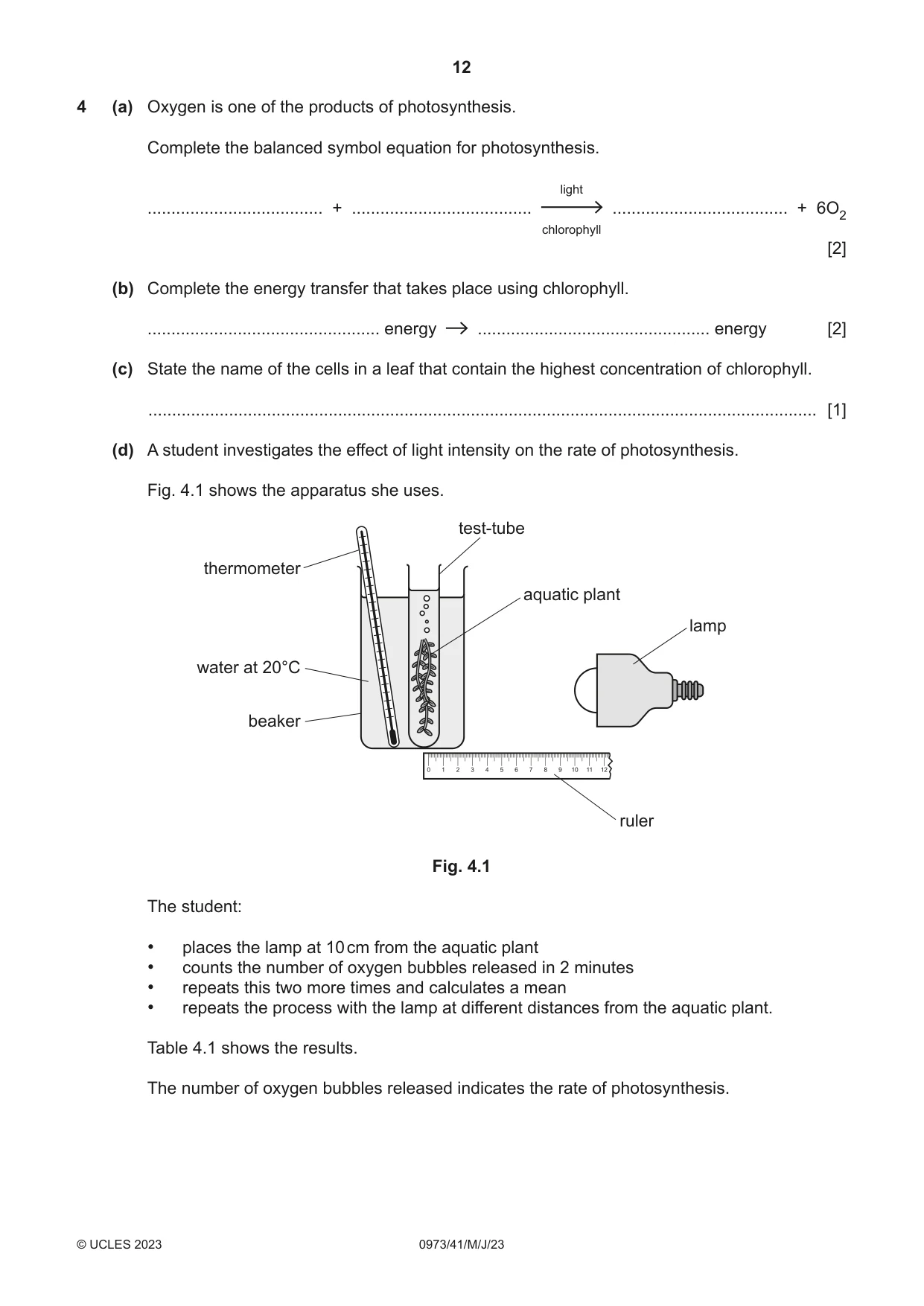
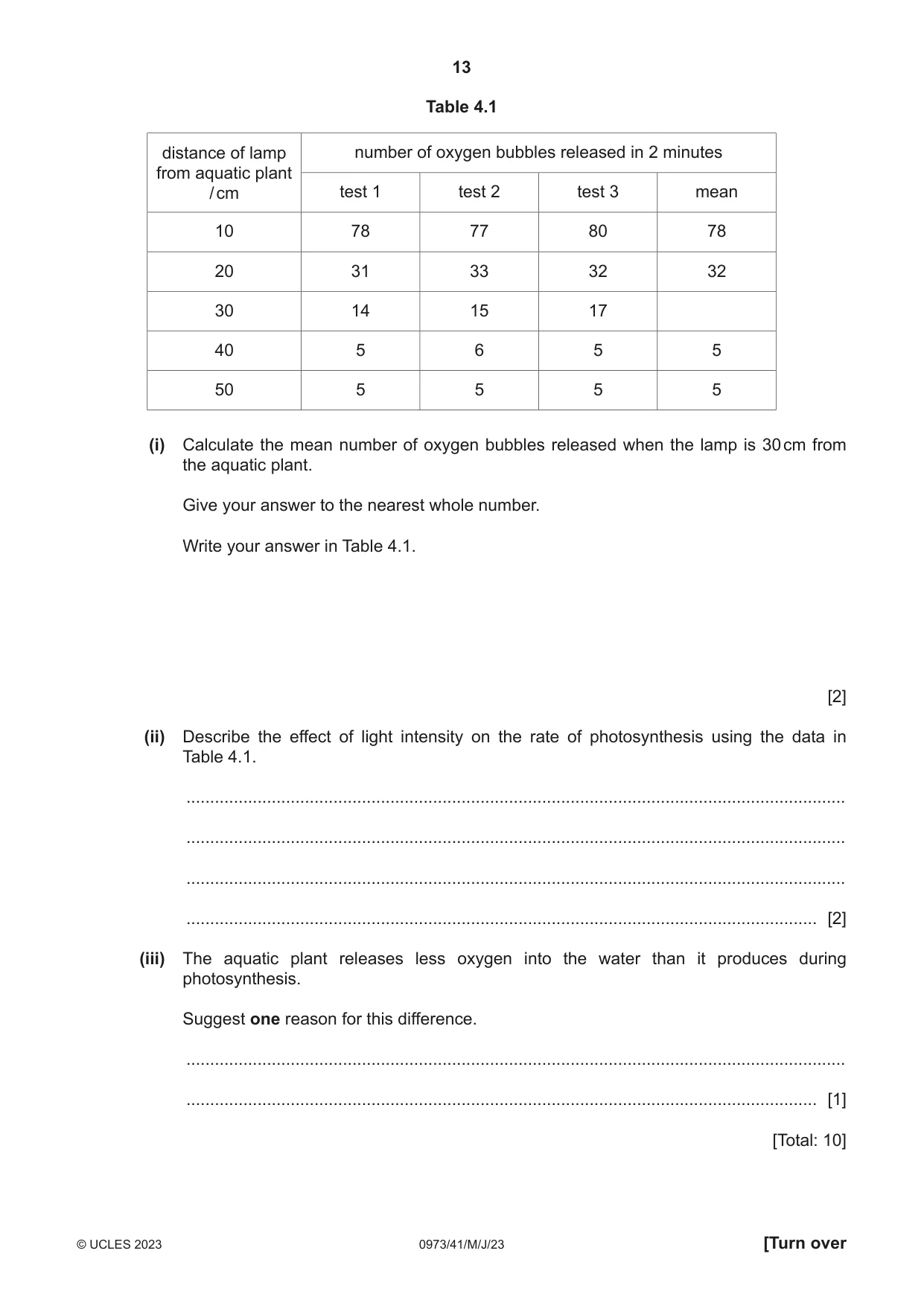
4 (a) Oxygen is one of the products of photosynthesis. Complete the balanced symbol equation for photosynthesis. light ..................................... + ...................................... ..................................... + 6O2 chlorophyll [2] (b) Complete the energy transfer that takes place using chlorophyll. ................................................. energy ................................................. energy [2] (c) State the name of the cells in a leaf that contain the highest concentration of chlorophyll. ............................................................................................................................................. [1] (d) A student investigates the effect of light intensity on the rate of photosynthesis. Fig. 4.1 shows the apparatus she uses. test-tube thermometer aquatic plant lamp water at 20°C beaker ruler Fig. 4.1 The student: • places the lamp at 10 cm from the aquatic plant • counts the number of oxygen bubbles released in 2 minutes • repeats this two more times and calculates a mean • repeats the process with the lamp at different distances from the aquatic plant. Table 4.1 shows the results. The number of oxygen bubbles released indicates the rate of photosynthesis. Table 4.1 distance of lamp number of oxygen bubbles released in 2 minutes from aquatic plant / cm test 1 test 2 test 3 mean 10 78 77 80 78 20 31 33 32 32 30 14 15 17 40 5 6 5 5 50 5 5 5 5 (i) Calculate the mean number of oxygen bubbles released when the lamp is 30 cm from the aquatic plant. Give your answer to the nearest whole number. Write your answer in Table 4.1. [2] (ii) Describe the effect of light intensity on the rate of photosynthesis using the data in Table 4.1. ........................................................................................................................................... ........................................................................................................................................... ........................................................................................................................................... ..................................................................................................................................... [2] (iii) The aquatic plant releases less oxygen into the water than it produces during photosynthesis. Suggest one reason for this difference. ........................................................................................................................................... ..................................................................................................................................... [1] [Total: 10]
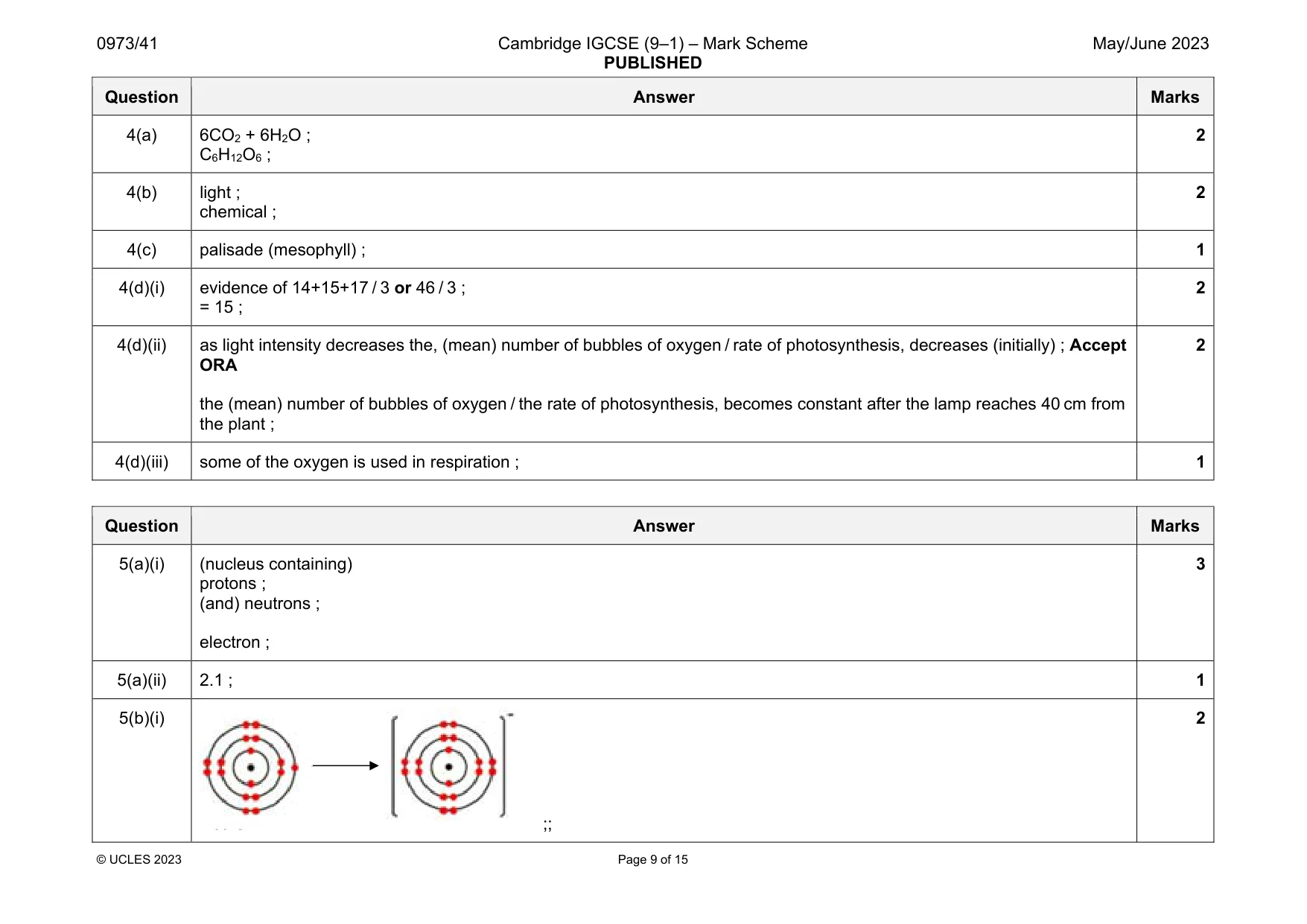
Mark scheme: 4(a) 6CO2 + 6H2O ; C6H12O6 ; 2 4(b) light ; chemical ; 2 4(c) palisade (mesophyll) ; 1 4(d)(i) evidence of 14+15+17 / 3 or 46 / 3 ; = 15 ; 2 4(d)(ii) as light intensity decreases the, (mean) number of bubbles of oxygen / rate of photosynthesis, decreases (initially) ; Accept ORA the (mean) number of bubbles of oxygen / the rate of photosynthesis, becomes constant after the lamp reaches 40 cm from the plant ; 2 4(d)(iii) some of the oxygen is used in respiration ; 1
Q5 · A diagram of a lithium atom
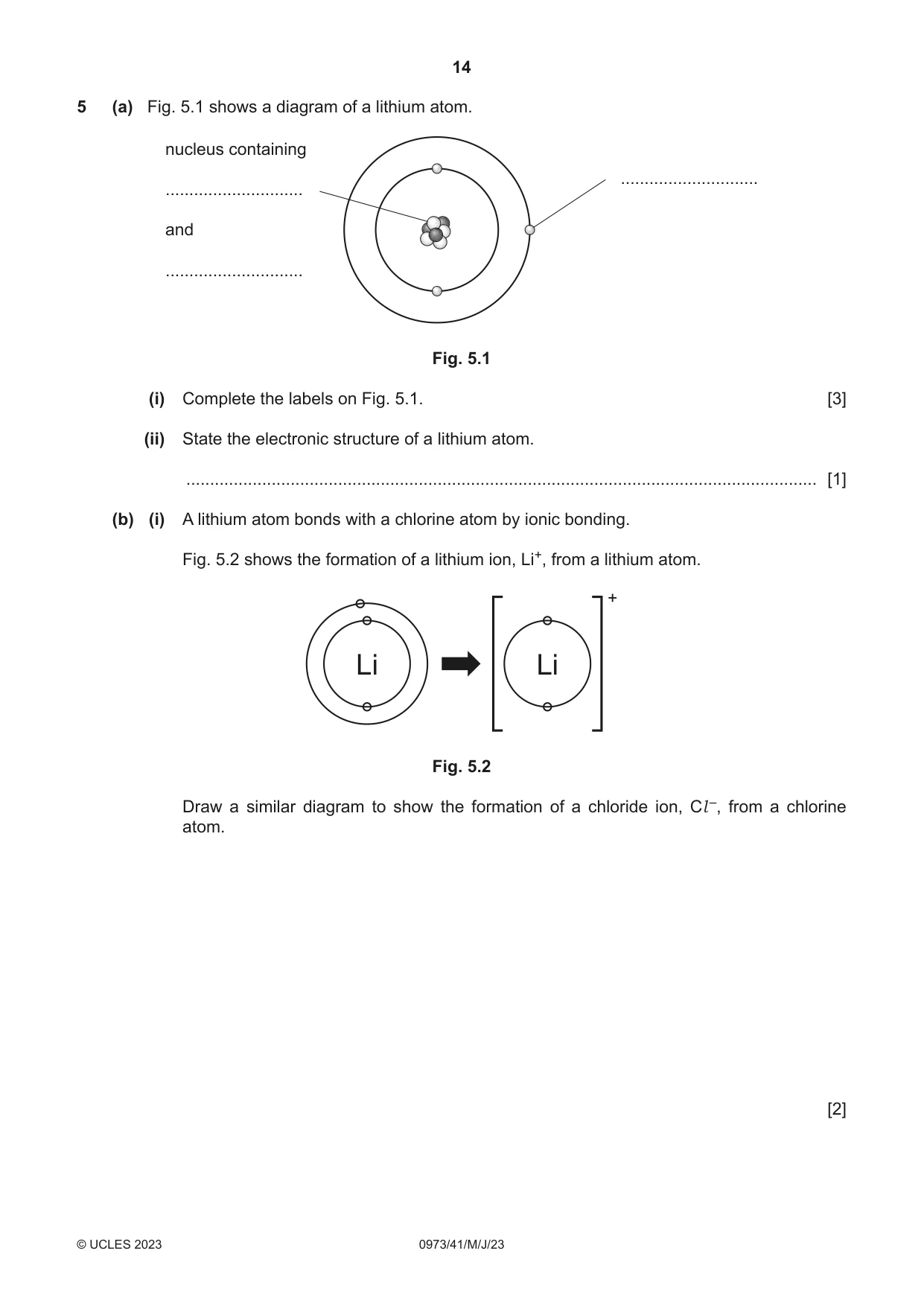
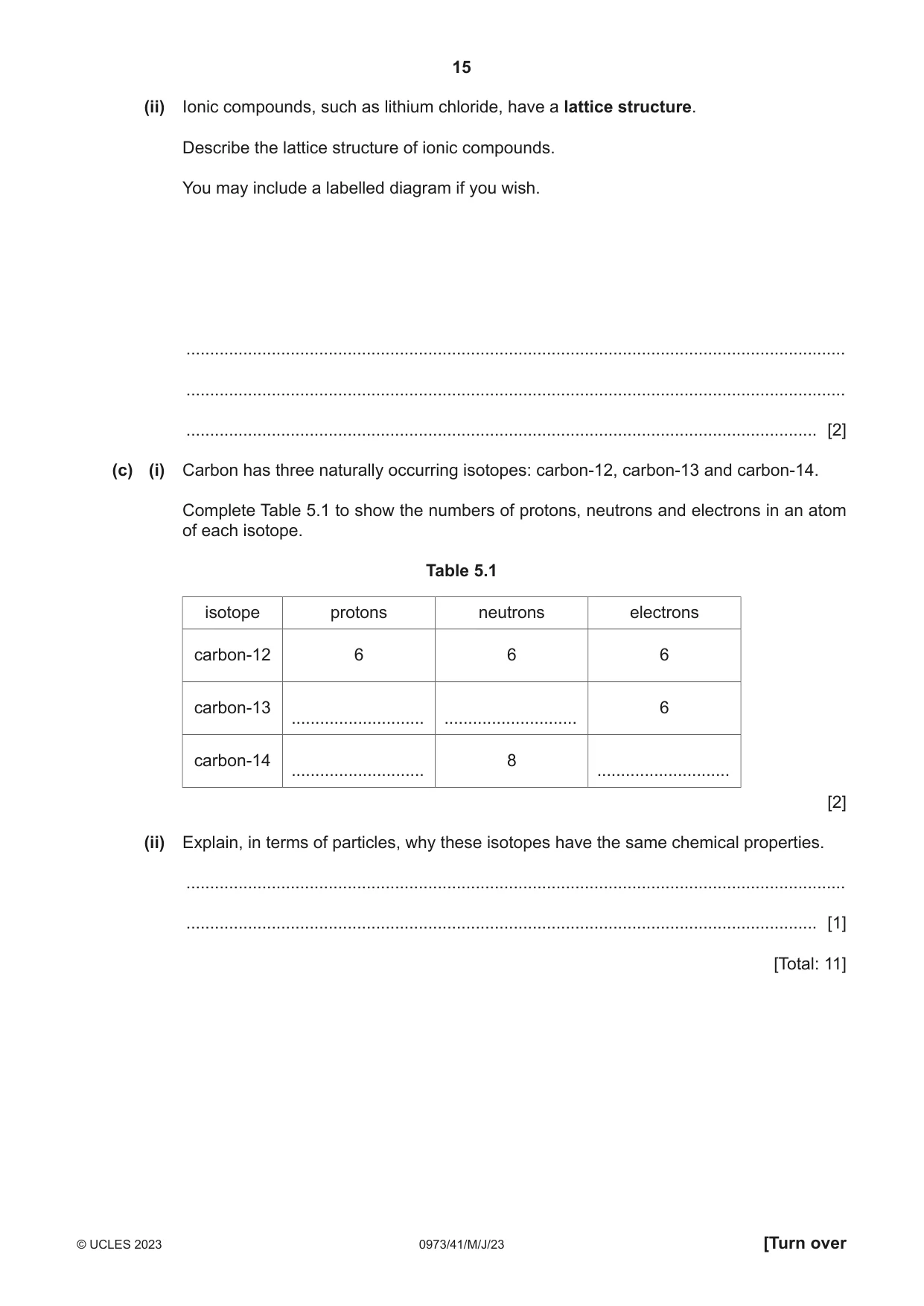
5 (a) Fig. 5.1 shows a diagram of a lithium atom. nucleus containing ............................. ............................. and ............................. Fig. 5.1 (i) Complete the labels on Fig. 5.1. [3] (ii) State the electronic structure of a lithium atom. ..................................................................................................................................... [1] (b) (i) A lithium atom bonds with a chlorine atom by ionic bonding. Fig. 5.2 shows the formation of a lithium ion, Li+, from a lithium atom. + Li Li Fig. 5.2 Draw a similar diagram to show the formation of a chloride ion, Cl –, from a chlorine atom. [2] (ii) Ionic compounds, such as lithium chloride, have a lattice structure. Describe the lattice structure of ionic compounds. You may include a labelled diagram if you wish. ........................................................................................................................................... ........................................................................................................................................... ..................................................................................................................................... [2] (c) (i) Carbon has three naturally occurring isotopes: carbon‑12, carbon‑13 and carbon‑14. Complete Table 5.1 to show the numbers of protons, neutrons and electrons in an atom of each isotope. Table 5.1 isotope protons neutrons electrons carbon‑12 6 6 6 carbon‑13 6 ............................ ............................ carbon‑14 8 ............................ ............................ [2] (ii) Explain, in terms of particles, why these isotopes have the same chemical properties. ........................................................................................................................................... ..................................................................................................................................... [1] [Total: 11]
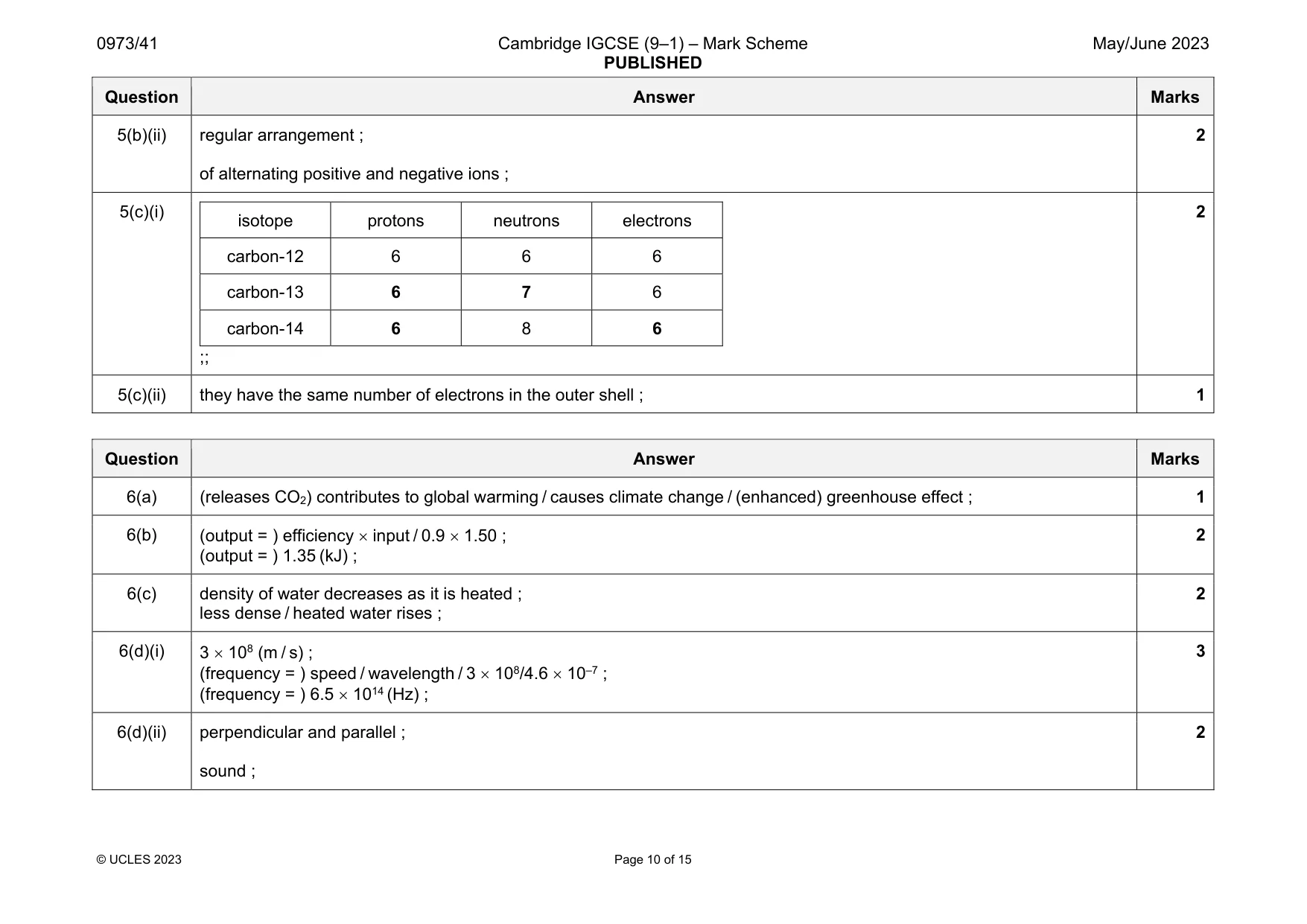
Mark scheme: 5(a)(i) (nucleus containing) protons ; (and) neutrons ; electron ; 5(a)(ii) 2.1 ; 1 5(b)(i) ;; 2 Question Answer Marks 5(b)(ii) regular arrangement ; of alternating positive and negative ions ; 2 5(c)(i) isotope protons neutrons electrons carbon-12 6 6 6 carbon-13 6 7 6 carbon-14 6 8 6 ;; 2 5(c)(ii) they have the same number of electrons in the outer shell ; 1
Q6 · A boiler that uses combustion of natural gas to heat water
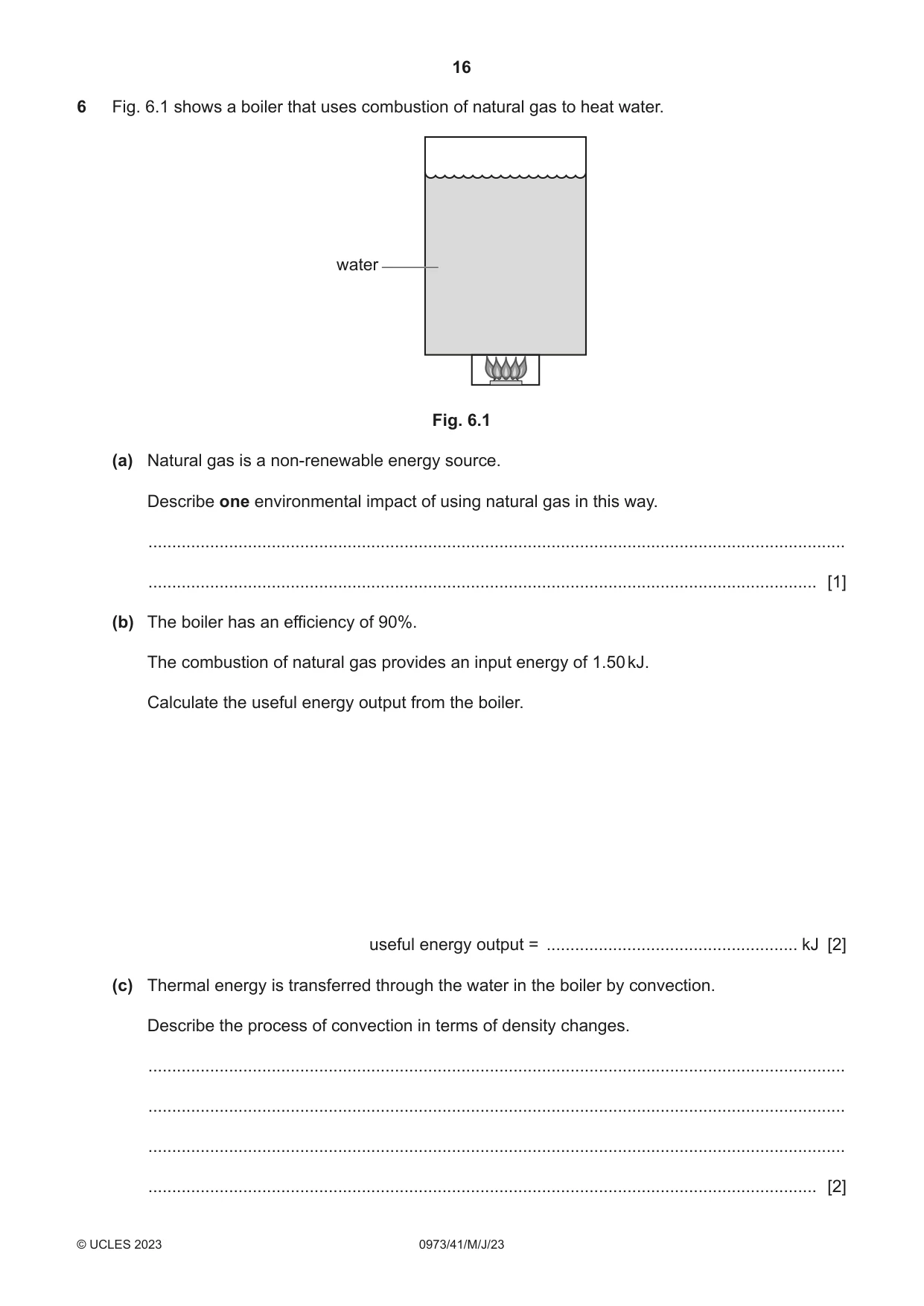
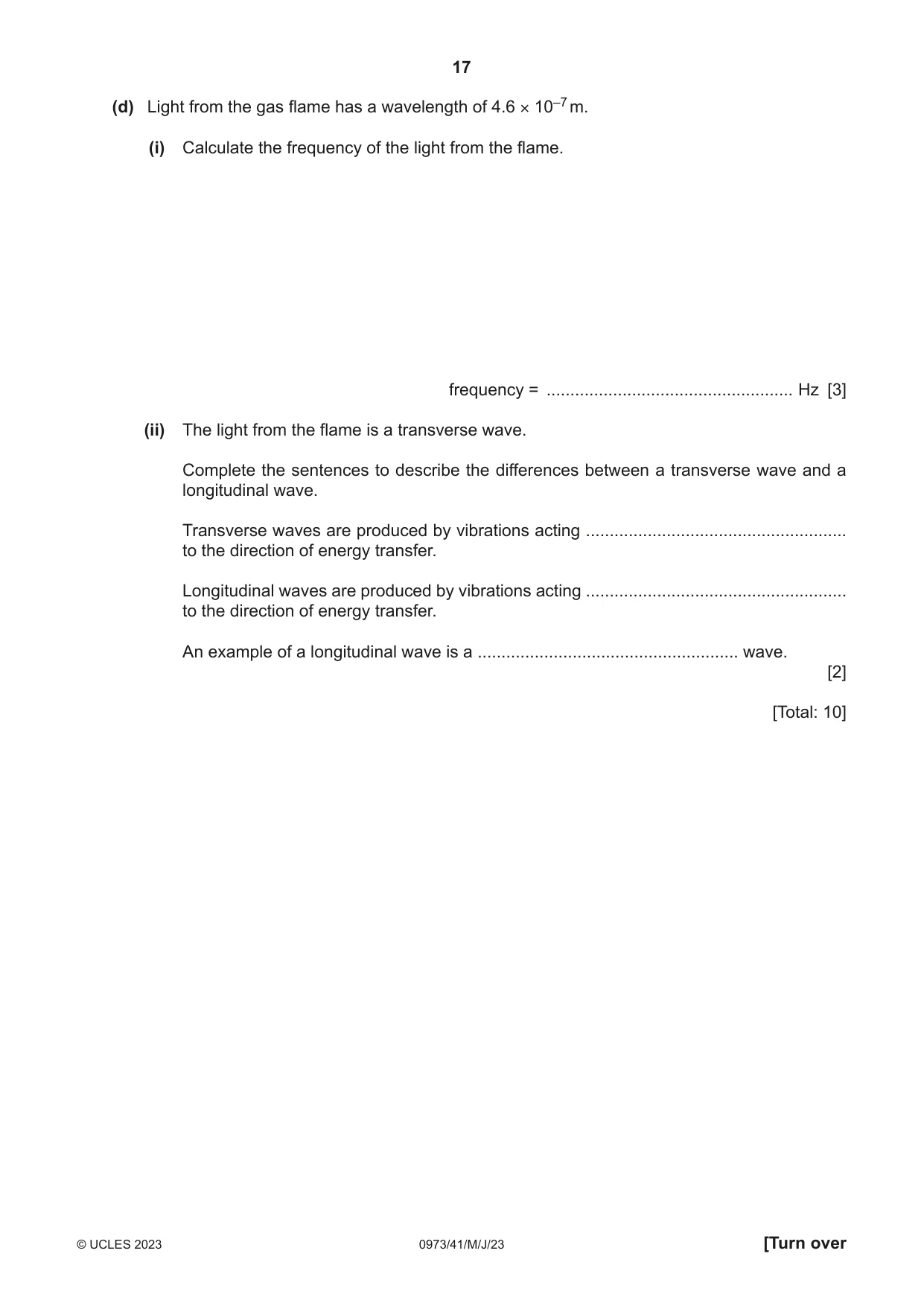
6 Fig. 6.1 shows a boiler that uses combustion of natural gas to heat water. water Fig. 6.1 (a) Natural gas is a non‑renewable energy source. Describe one environmental impact of using natural gas in this way. ................................................................................................................................................... ............................................................................................................................................. [1] (b) The boiler has an efficiency of 90%. The combustion of natural gas provides an input energy of 1.50 kJ. Calculate the useful energy output from the boiler. useful energy output = ..................................................... kJ [2] (c) Thermal energy is transferred through the water in the boiler by convection. Describe the process of convection in terms of density changes. ................................................................................................................................................... ................................................................................................................................................... ................................................................................................................................................... ............................................................................................................................................. [2] (d) Light from the gas flame has a wavelength of 4.6 × 10⁻⁷ m. (i) Calculate the frequency of the light from the flame. frequency = .................................................... Hz [3] (ii) The light from the flame is a transverse wave. Complete the sentences to describe the differences between a transverse wave and a longitudinal wave. Transverse waves are produced by vibrations acting ....................................................... to the direction of energy transfer. Longitudinal waves are produced by vibrations acting ....................................................... to the direction of energy transfer. An example of a longitudinal wave is a ....................................................... wave. [2] [Total: 10]
Mark scheme: 6(a) (releases CO2) contributes to global warming / causes climate change / (enhanced) greenhouse effect ; 1 6(b) (output = ) efficiency input / 0.9 1.50 ; (output = ) 1.35 (kJ) ; 2 6(c) density of water decreases as it is heated ; less dense / heated water rises ; 2 6(d)(i) 3 108 (m / s) ; (frequency = ) speed / wavelength / 3 108/4.6 10–7 ; (frequency = ) 6.5 1014 (Hz) ; 3 6(d)(ii) perpendicular and parallel ; sound ; 2
Q7 · A diagram showing the development of a strain of antibiotic resistant bacteria
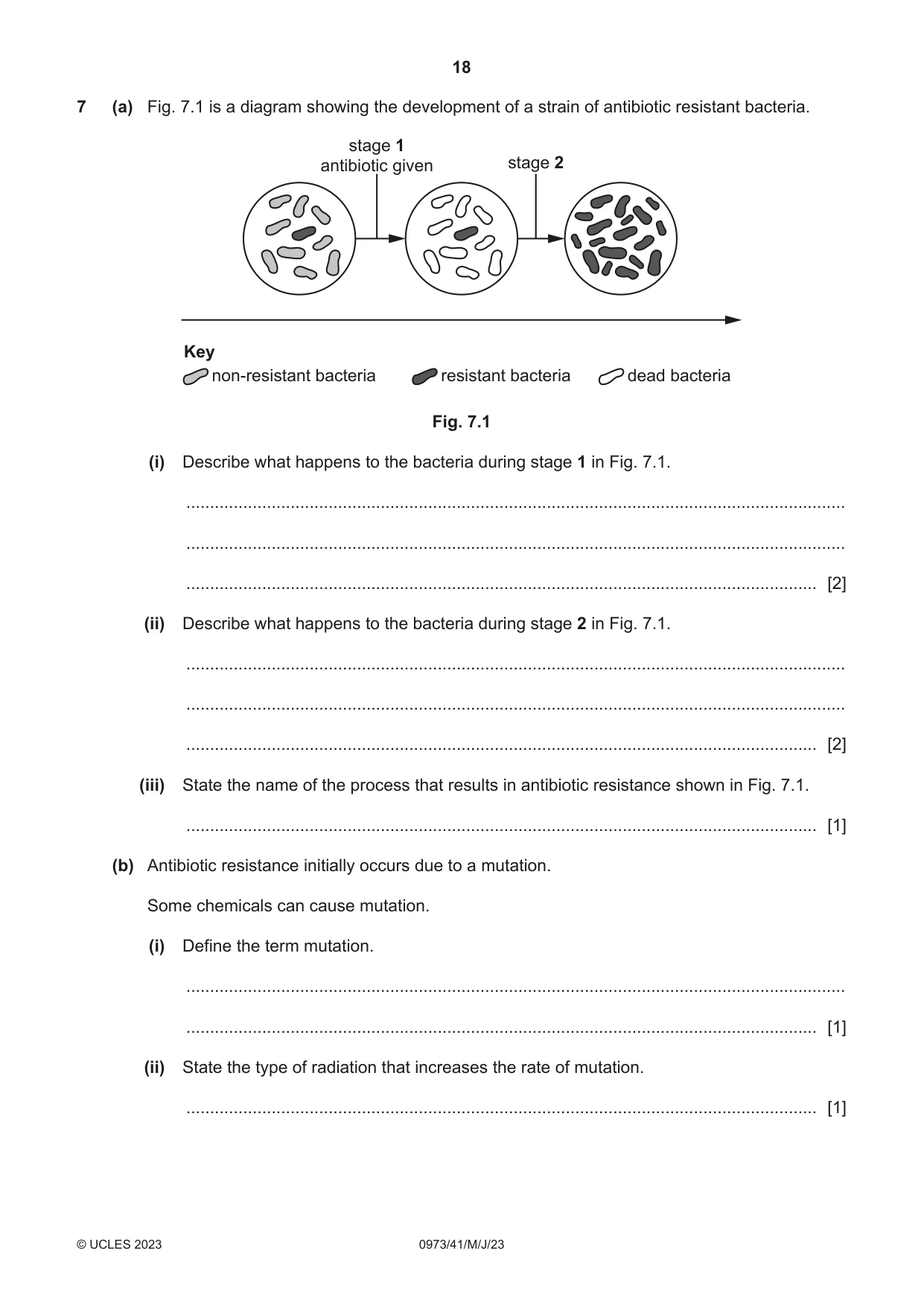
7 (a) Fig. 7.1 is a diagram showing the development of a strain of antibiotic resistant bacteria. stage 1 antibiotic given stage 2 Key non-resistant bacteria resistant bacteria dead bacteria Fig. 7.1 (i) Describe what happens to the bacteria during stage 1 in Fig. 7.1. ........................................................................................................................................... ........................................................................................................................................... ..................................................................................................................................... [2] (ii) Describe what happens to the bacteria during stage 2 in Fig. 7.1. ........................................................................................................................................... ........................................................................................................................................... ..................................................................................................................................... [2] (iii) State the name of the process that results in antibiotic resistance shown in Fig. 7.1. ..................................................................................................................................... [1] (b) Antibiotic resistance initially occurs due to a mutation. Some chemicals can cause mutation. (i) Define the term mutation. ........................................................................................................................................... ..................................................................................................................................... [1] (ii) State the type of radiation that increases the rate of mutation. ..................................................................................................................................... [1] (c) Components of blood are responsible for protecting the body from disease‑causing organisms including some strains of bacteria. State the name of the component of blood responsible for: antibody production .................................................................................................................. blood clotting. ........................................................................................................................... [2] [Total: 9]
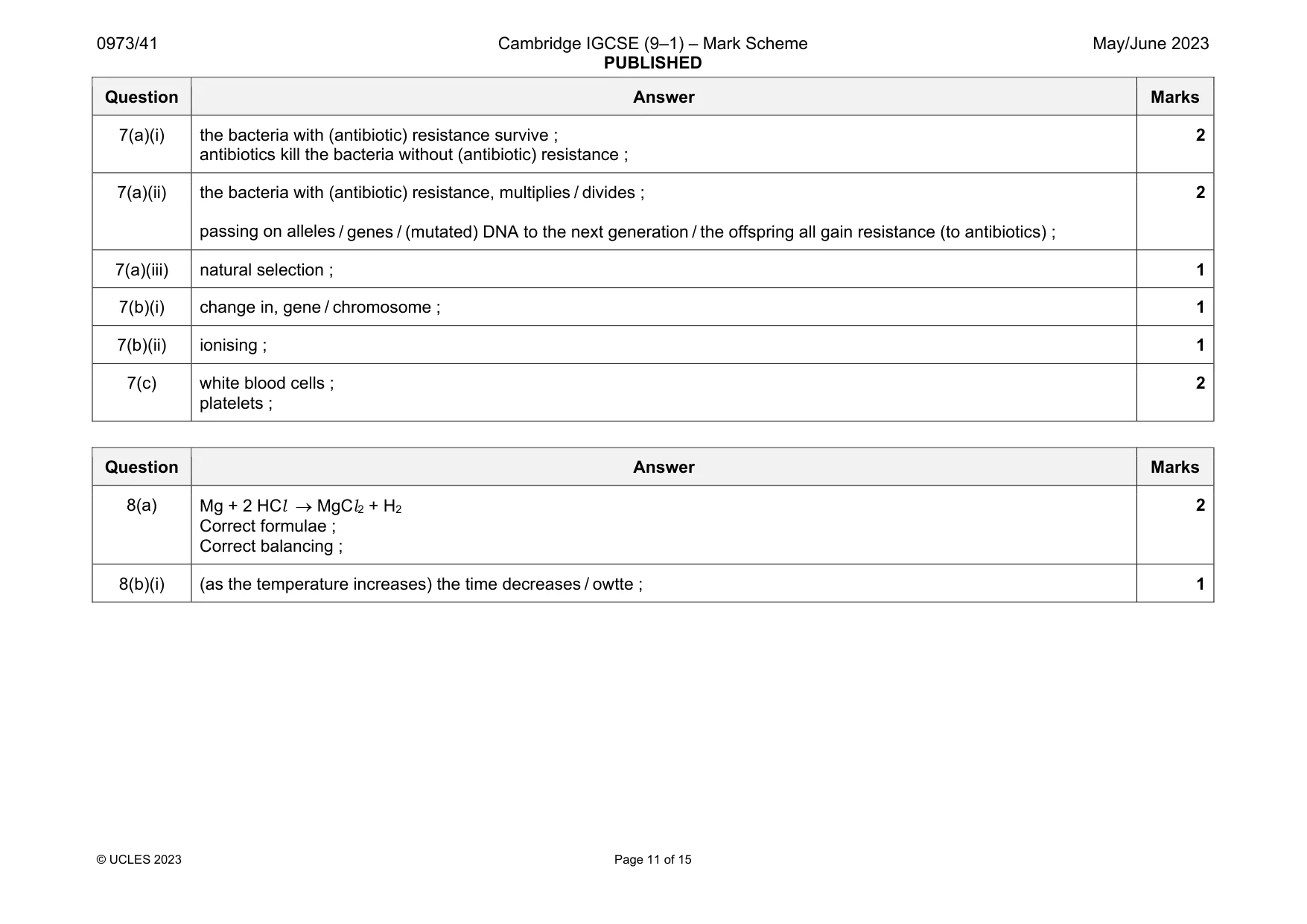
Mark scheme: 7(a)(i) the bacteria with (antibiotic) resistance survive ; antibiotics kill the bacteria without (antibiotic) resistance ; 2 7(a)(ii) the bacteria with (antibiotic) resistance, multiplies / divides ; passing on alleles / genes / (mutated) DNA to the next generation / the offspring all gain resistance (to antibiotics) ; 2 7(a)(iii) natural selection ; 1 7(b)(i) change in, gene / chromosome ; 1 7(b)(ii) ionising ; 1 7(c) white blood cells ; platelets ; 2
Q8 · A student investigates the rate of reaction between dilute hydrochloric acid, HCl, and…
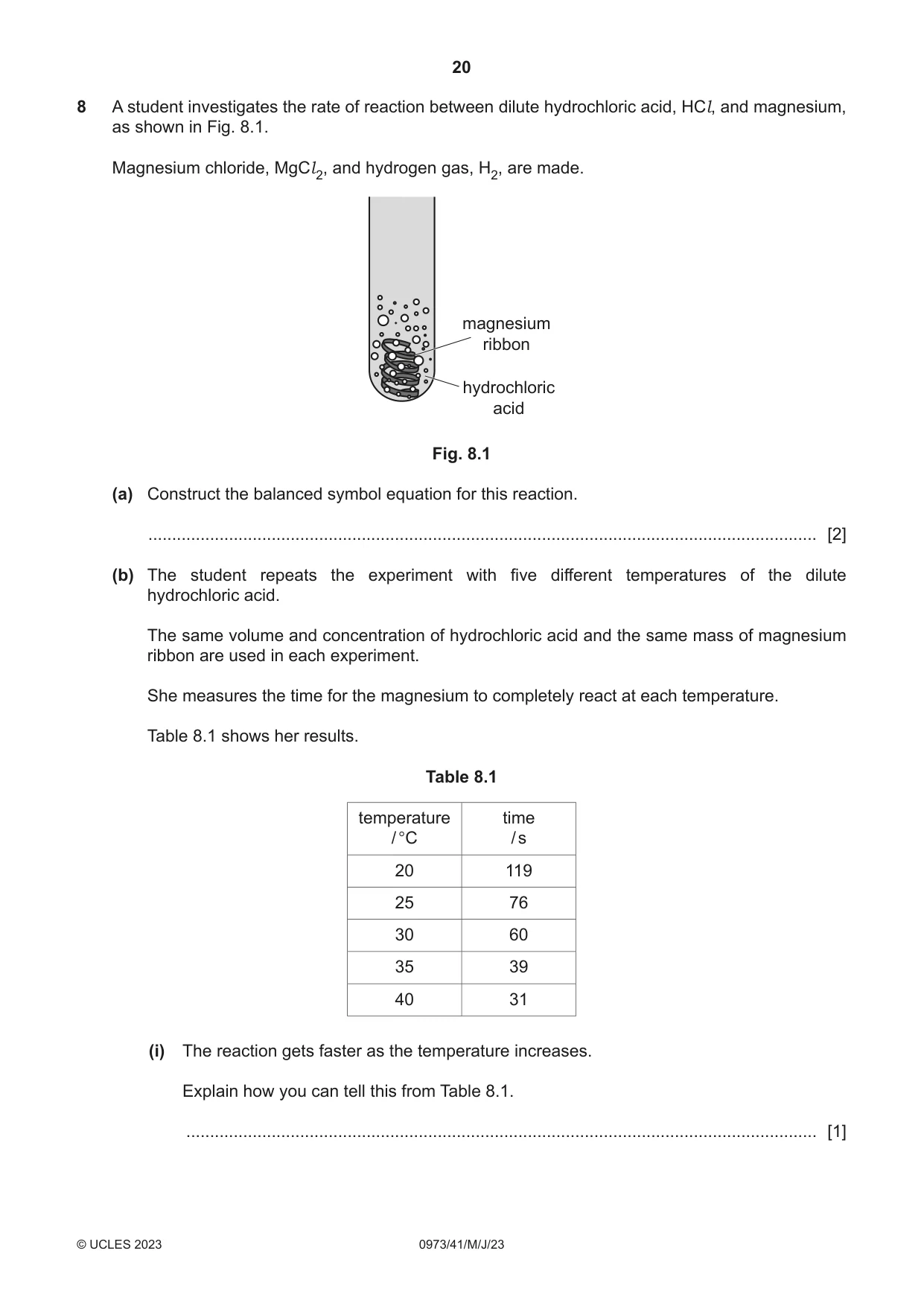
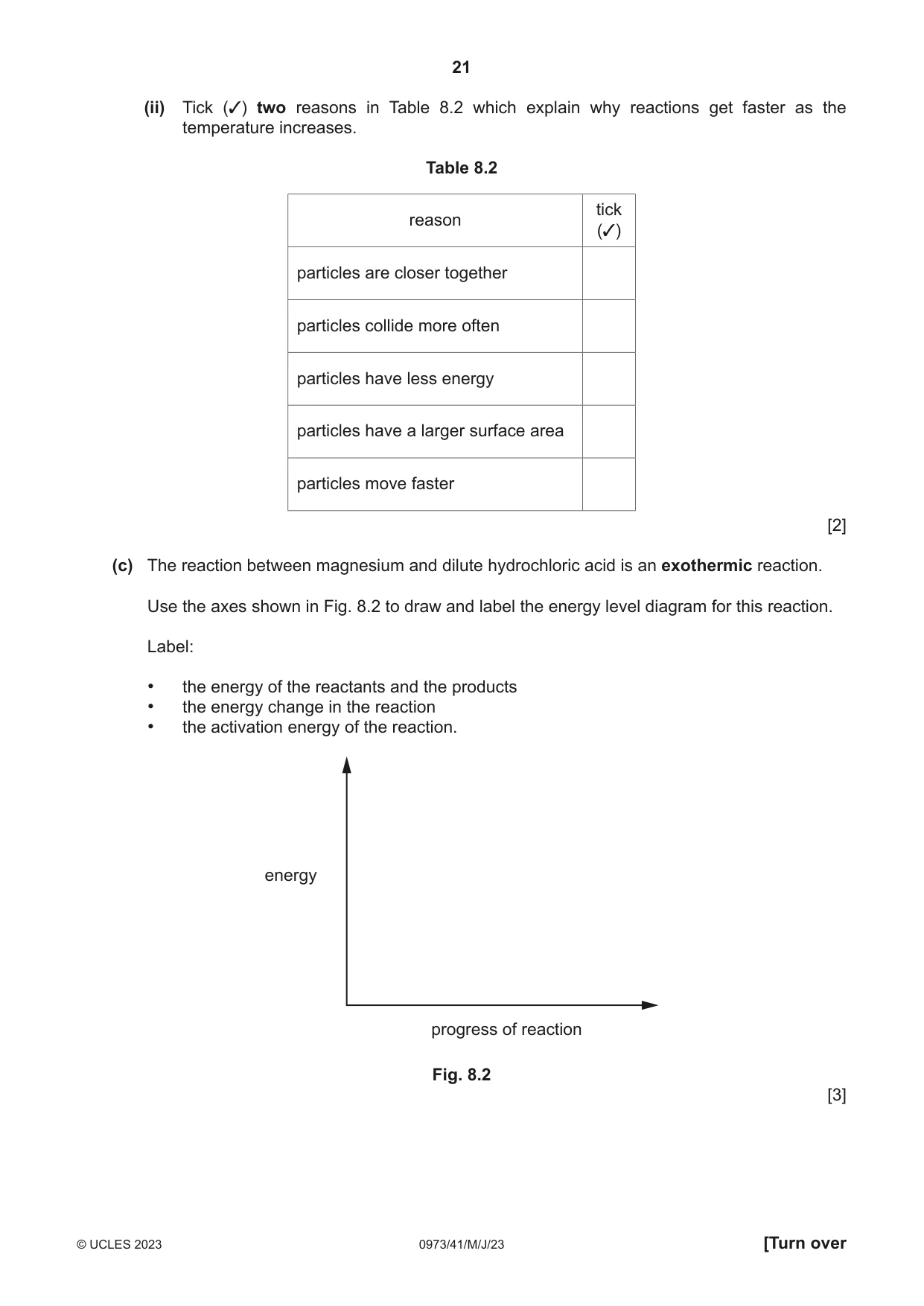
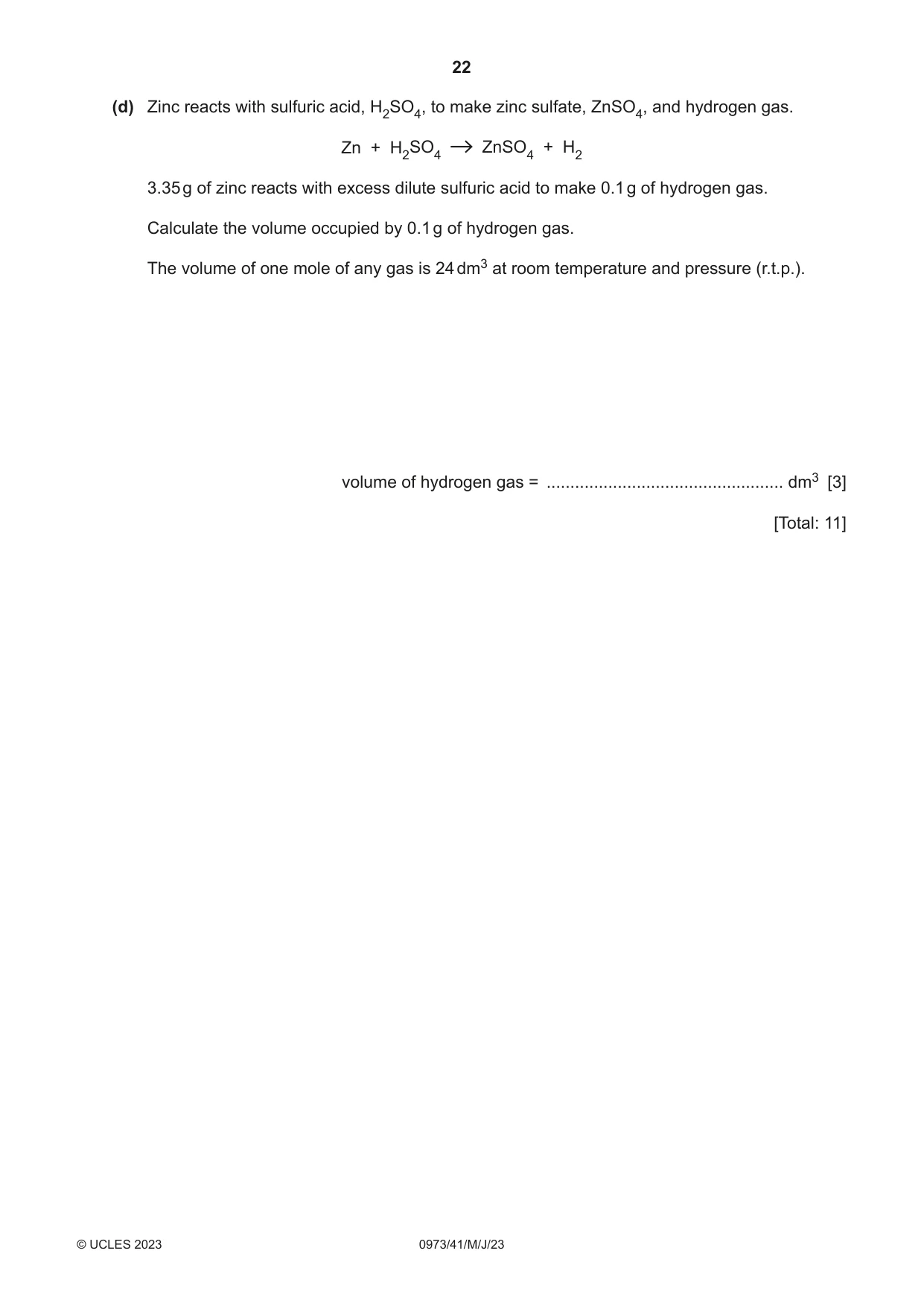
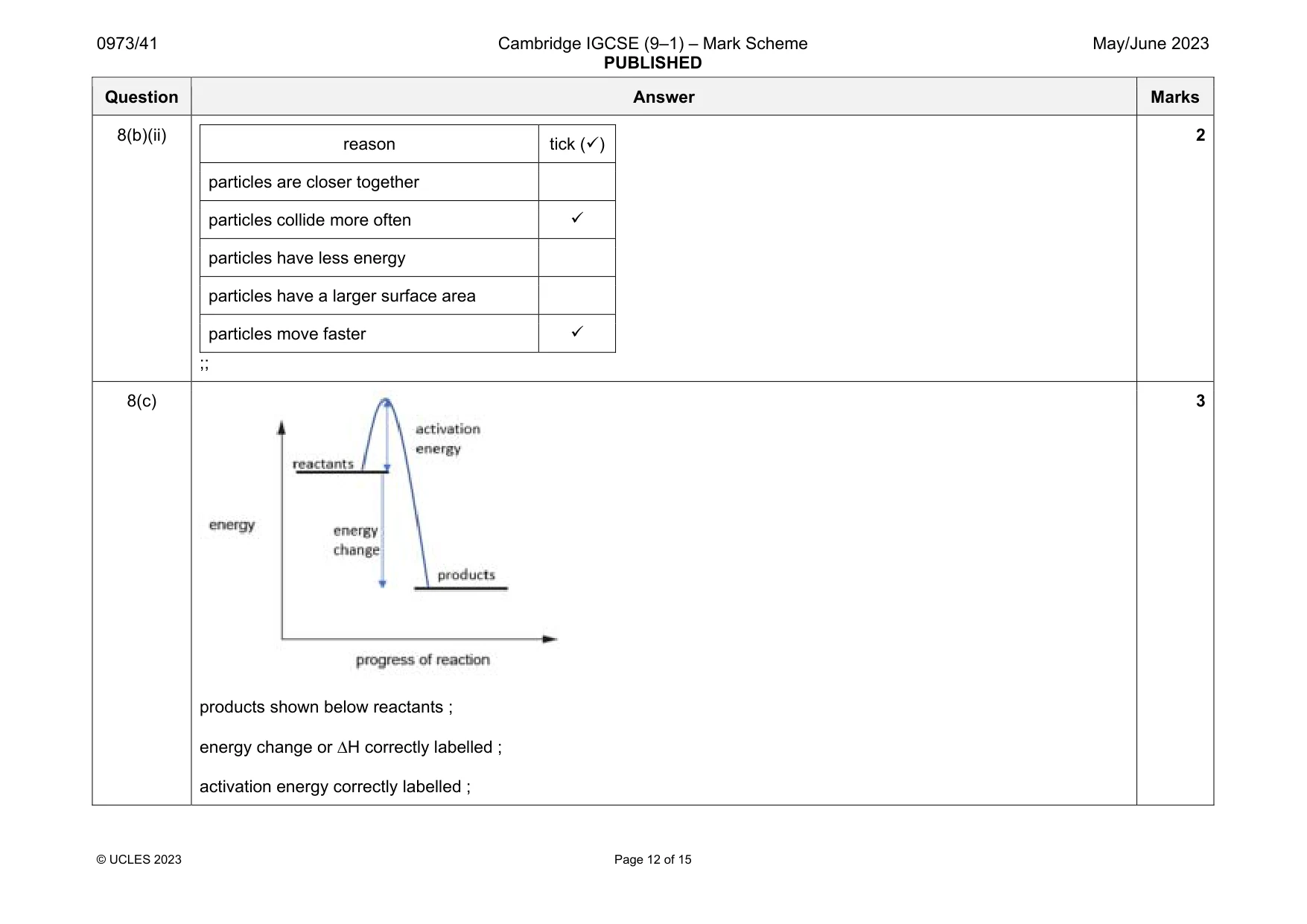
8 A student investigates the rate of reaction between dilute hydrochloric acid, HCl, and magnesium, as shown in Fig. 8.1. Magnesium chloride, MgCl 2, and hydrogen gas, H2, are made. magnesium ribbon hydrochloric acid Fig. 8.1 (a) Construct the balanced symbol equation for this reaction. ............................................................................................................................................. [2] (b) The student repeats the experiment with five different temperatures of the dilute hydrochloric acid. The same volume and concentration of hydrochloric acid and the same mass of magnesium ribbon are used in each experiment. She measures the time for the magnesium to completely react at each temperature. Table 8.1 shows her results. Table 8.1 temperature time / °C / s 20 119 25 76 30 60 35 39 40 31 (i) The reaction gets faster as the temperature increases. Explain how you can tell this from Table 8.1. ..................................................................................................................................... [1] (ii) Tick (3) two reasons in Table 8.2 which explain why reactions get faster as the temperature increases. Table 8.2 tick reason (3) particles are closer together particles collide more often particles have less energy particles have a larger surface area particles move faster [2] (c) The reaction between magnesium and dilute hydrochloric acid is an exothermic reaction. Use the axes shown in Fig. 8.2 to draw and label the energy level diagram for this reaction. Label: • the energy of the reactants and the products • the energy change in the reaction • the activation energy of the reaction. energy progress of reaction Fig. 8.2 [3] (d) Zinc reacts with sulfuric acid, H2SO4, to make zinc sulfate, ZnSO4, and hydrogen gas. Zn + H2SO4 ZnSO4 + H2 3.35 g of zinc reacts with excess dilute sulfuric acid to make 0.1 g of hydrogen gas. Calculate the volume occupied by 0.1 g of hydrogen gas. The volume of one mole of any gas is 24 dm3 at room temperature and pressure (r.t.p.). volume of hydrogen gas = .................................................. dm3 [3] [Total: 11]
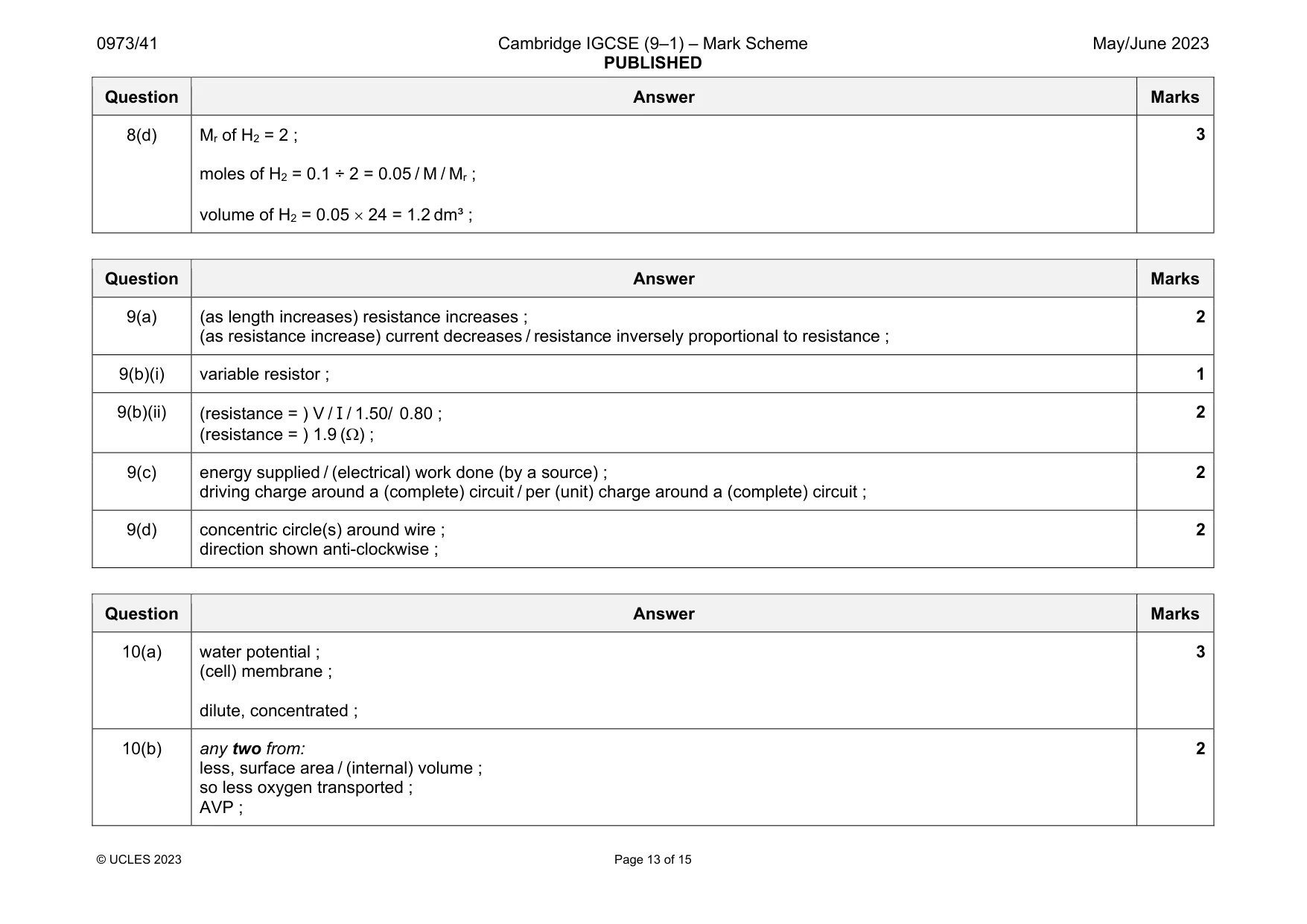
Mark scheme: 8(a) Correct formulae ; Correct balancing ; 2 8(b)(i) (as the temperature increases) the time decreases / owtte ; 1 Question Answer Marks 8(b)(ii) reason tick () particles are closer together particles collide more often particles have less energy particles have a larger surface area particles move faster ;; 2 8(c) products shown below reactants ; energy change or H correctly labelled ; activation energy correctly labelled ; 3 Question Answer Marks 8(d) Mr of H2 = 2 ; moles of H2 = 0.1 ÷ 2 = 0.05 / M / Mr ; volume of H2 = 0.05 24 = 1.2 dm³ ; 3
Q9 · A student investigates how the resistance of a wire changes with length
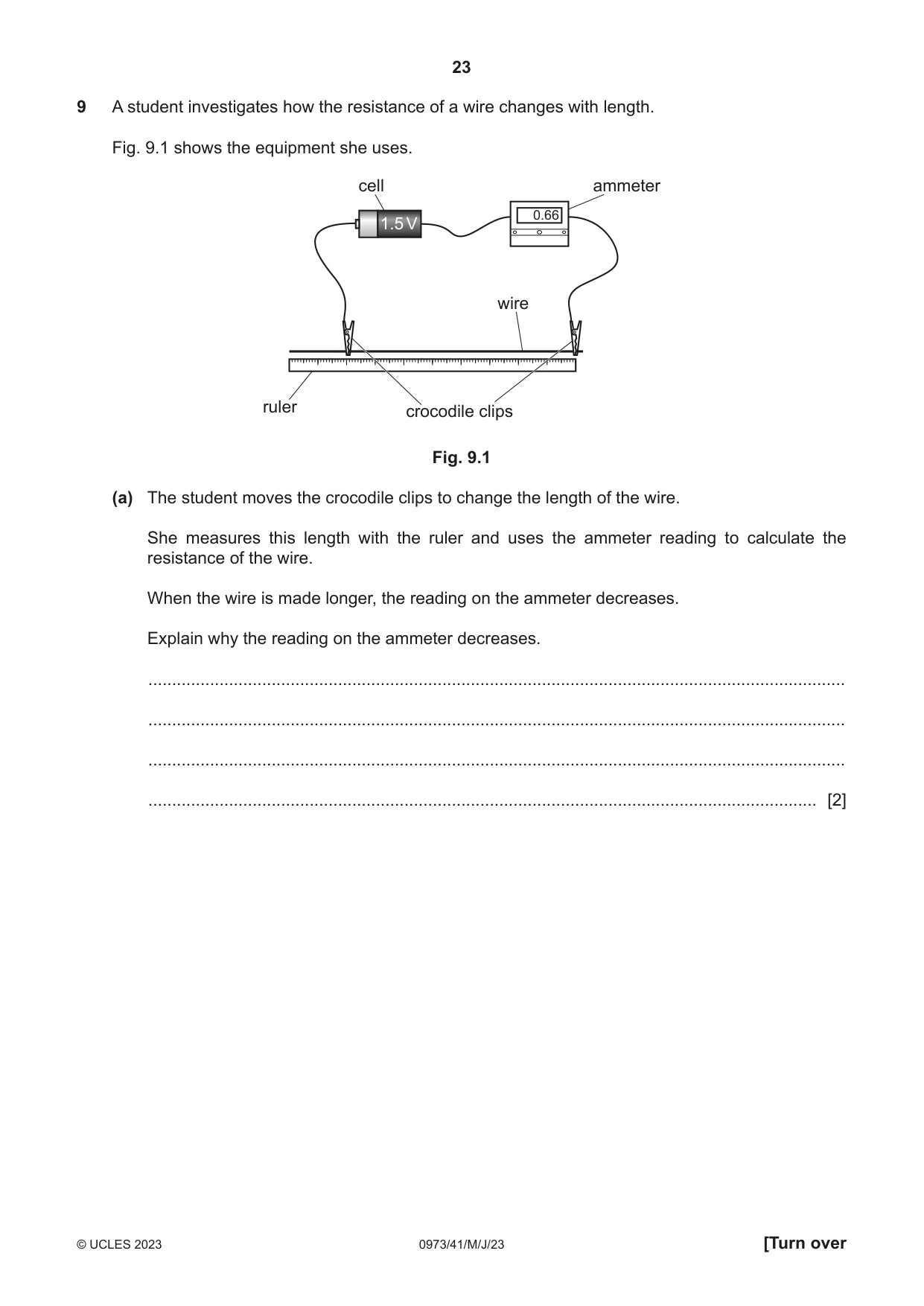
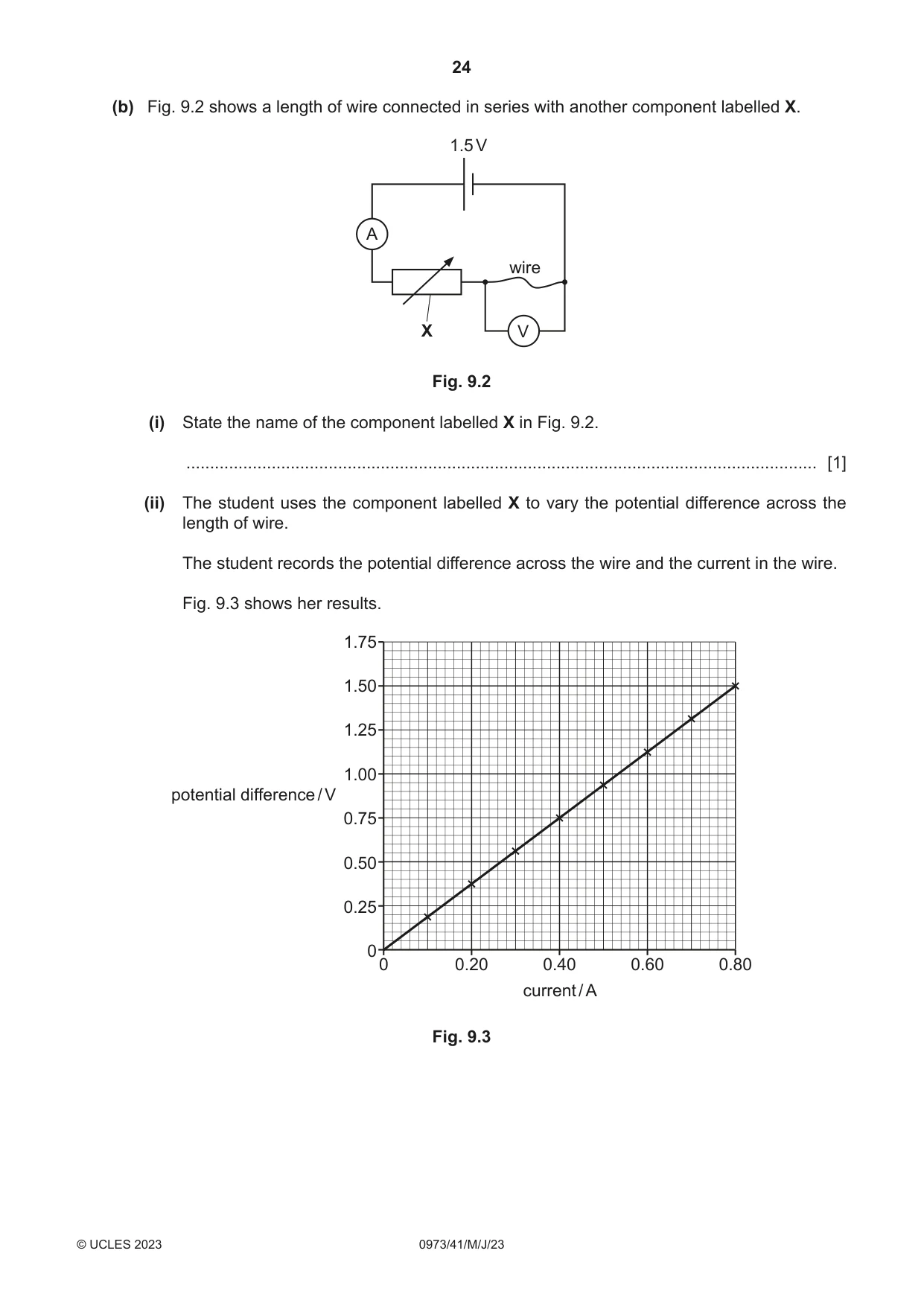
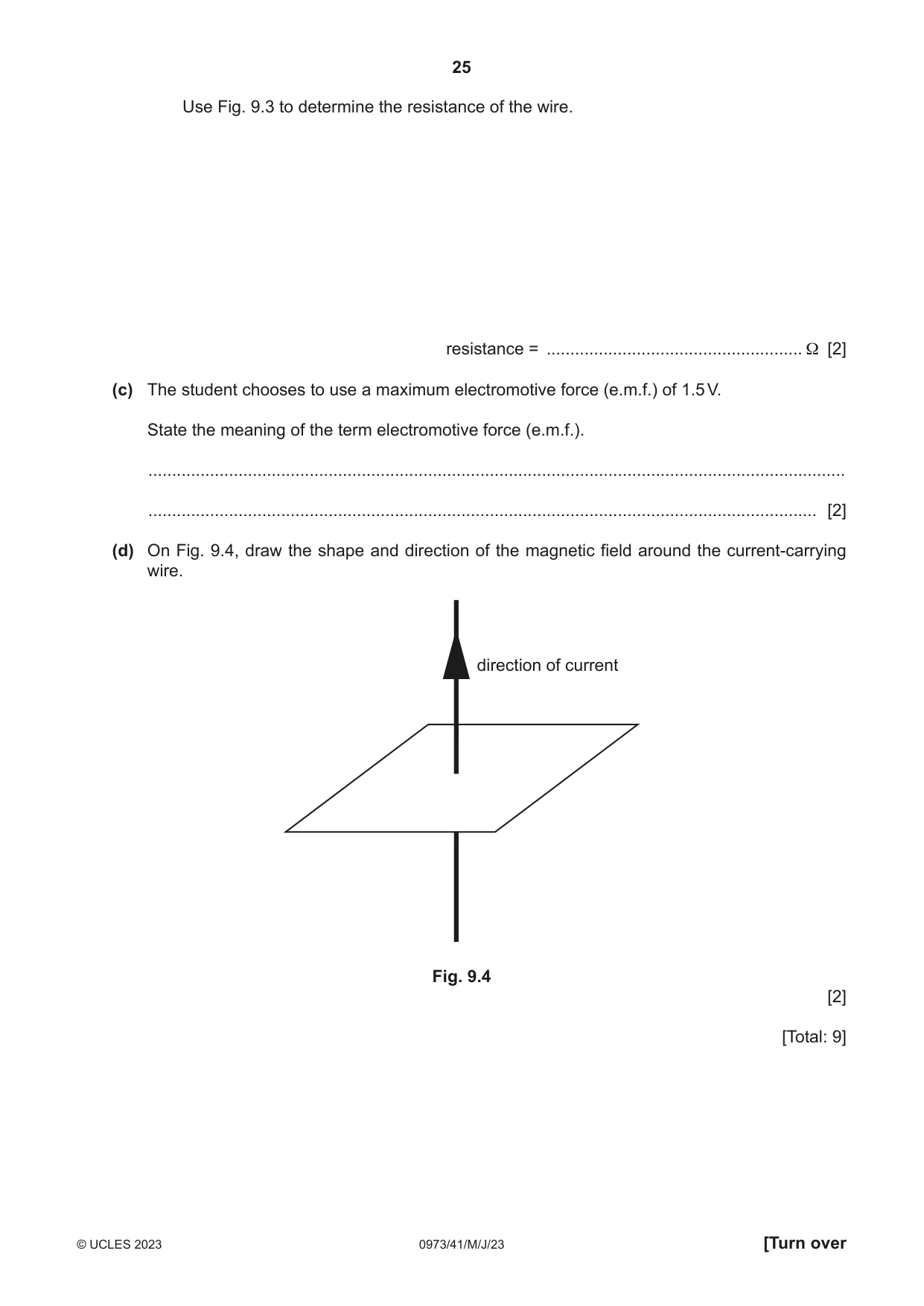
9 A student investigates how the resistance of a wire changes with length. Fig. 9.1 shows the equipment she uses. cell ammeter 0.66 1.5 V wire ruler crocodile clips Fig. 9.1 (a) The student moves the crocodile clips to change the length of the wire. She measures this length with the ruler and uses the ammeter reading to calculate the resistance of the wire. When the wire is made longer, the reading on the ammeter decreases. Explain why the reading on the ammeter decreases. ................................................................................................................................................... ................................................................................................................................................... ................................................................................................................................................... ............................................................................................................................................. [2] (b) Fig. 9.2 shows a length of wire connected in series with another component labelled X. 1.5 V A wire X V Fig. 9.2 (i) State the name of the component labelled X in Fig. 9.2. ..................................................................................................................................... [1] (ii) The student uses the component labelled X to vary the potential difference across the length of wire. The student records the potential difference across the wire and the current in the wire. Fig. 9.3 shows her results. 1.75 1.50 1.25 1.00 potential difference / V 0.75 0.50 0.25 0 0 0.20 0.40 0.60 0.80 current / A Fig. 9.3 Use Fig. 9.3 to determine the resistance of the wire. resistance = ...................................................... Ω [2] (c) The student chooses to use a maximum electromotive force (e.m.f.) of 1.5 V. State the meaning of the term electromotive force (e.m.f.). ................................................................................................................................................... ............................................................................................................................................. [2] (d) On Fig. 9.4, draw the shape and direction of the magnetic field around the current‑carrying wire. direction of current Fig. 9.4 [2] [Total: 9]
Mark scheme: 9(a) (as length increases) resistance increases ; (as resistance increase) current decreases / resistance inversely proportional to resistance ; 2 9(b)(i) variable resistor ; 1 9(b)(ii) (resistance = ) V / I / 1.50/ 0.80 ; (resistance = ) 1.9 () ; 2 9(c) energy supplied / (electrical) work done (by a source) ; driving charge around a (complete) circuit / per (unit) charge around a (complete) circuit ; 2 9(d) concentric circle(s) around wire ; direction shown anti-clockwise ; 2
Q10 · Two red blood cells after they have been immersed in different solutions for an hour
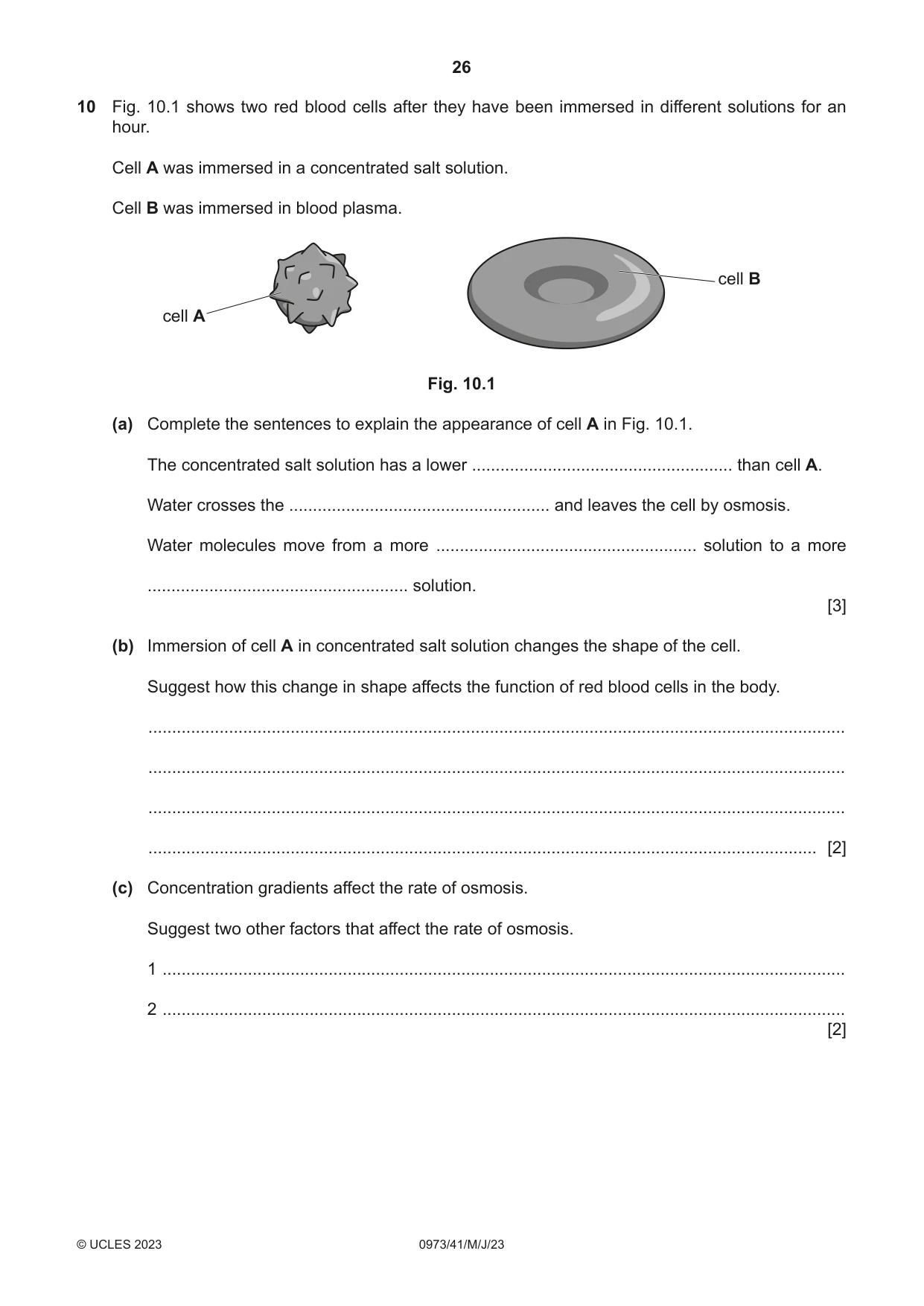
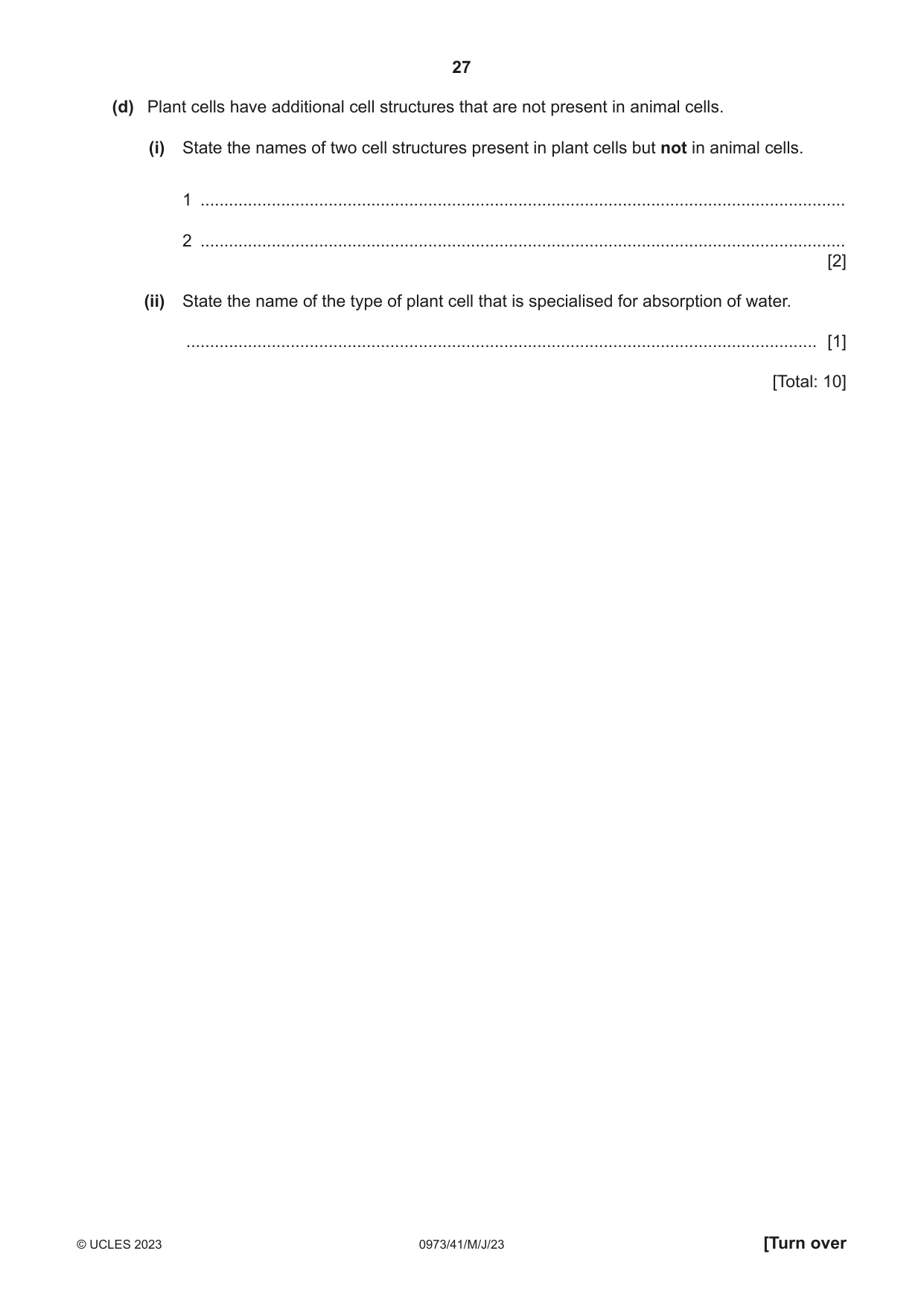
10 Fig. 10.1 shows two red blood cells after they have been immersed in different solutions for an hour. Cell A was immersed in a concentrated salt solution. Cell B was immersed in blood plasma. cell B cell A Fig. 10.1 (a) Complete the sentences to explain the appearance of cell A in Fig. 10.1. The concentrated salt solution has a lower ....................................................... than cell A. Water crosses the ....................................................... and leaves the cell by osmosis. Water molecules move from a more ....................................................... solution to a more ....................................................... solution. [3] (b) Immersion of cell A in concentrated salt solution changes the shape of the cell. Suggest how this change in shape affects the function of red blood cells in the body. ................................................................................................................................................... ................................................................................................................................................... ................................................................................................................................................... ............................................................................................................................................. [2] (c) Concentration gradients affect the rate of osmosis. Suggest two other factors that affect the rate of osmosis. 1 ................................................................................................................................................ 2 ................................................................................................................................................ [2] (d) Plant cells have additional cell structures that are not present in animal cells. (i) State the names of two cell structures present in plant cells but not in animal cells. 1 ........................................................................................................................................ 2 ........................................................................................................................................ [2] (ii) State the name of the type of plant cell that is specialised for absorption of water. ..................................................................................................................................... [1] [Total: 10]
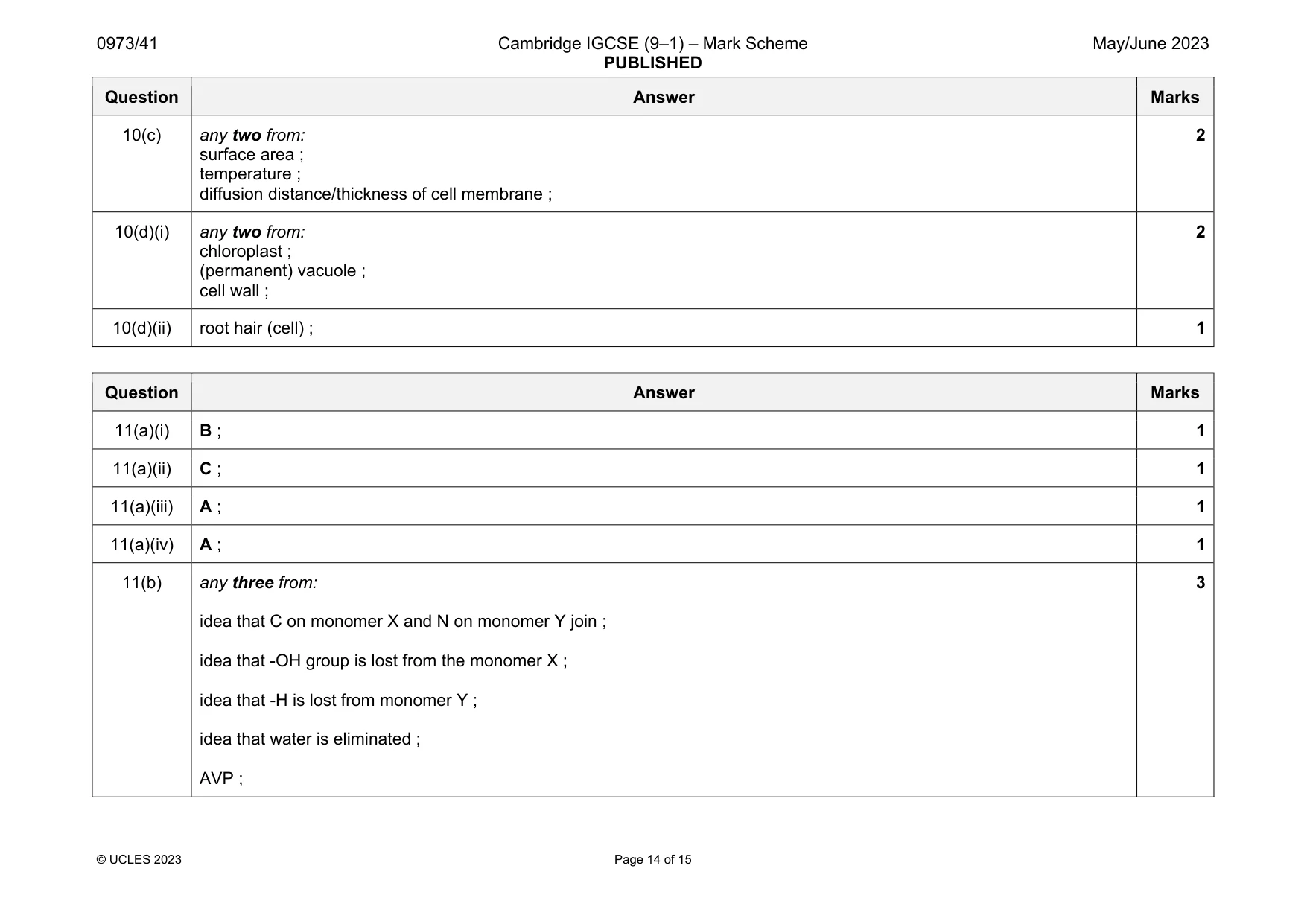
Mark scheme: 10(a) water potential ; (cell) membrane ; dilute, concentrated ; 3 10(b) any two from: less, surface area / (internal) volume ; so less oxygen transported ; AVP ; 2 Question Answer Marks 10(c) any two from: surface area ; temperature ; diffusion distance/thickness of cell membrane ; 2 10(d)(i) any two from: chloroplast ; (permanent) vacuole ; cell wall ; 2 10(d)(ii) root hair (cell) ; 1
Q11 · Look at the structures of the carbon compounds shown in Fig
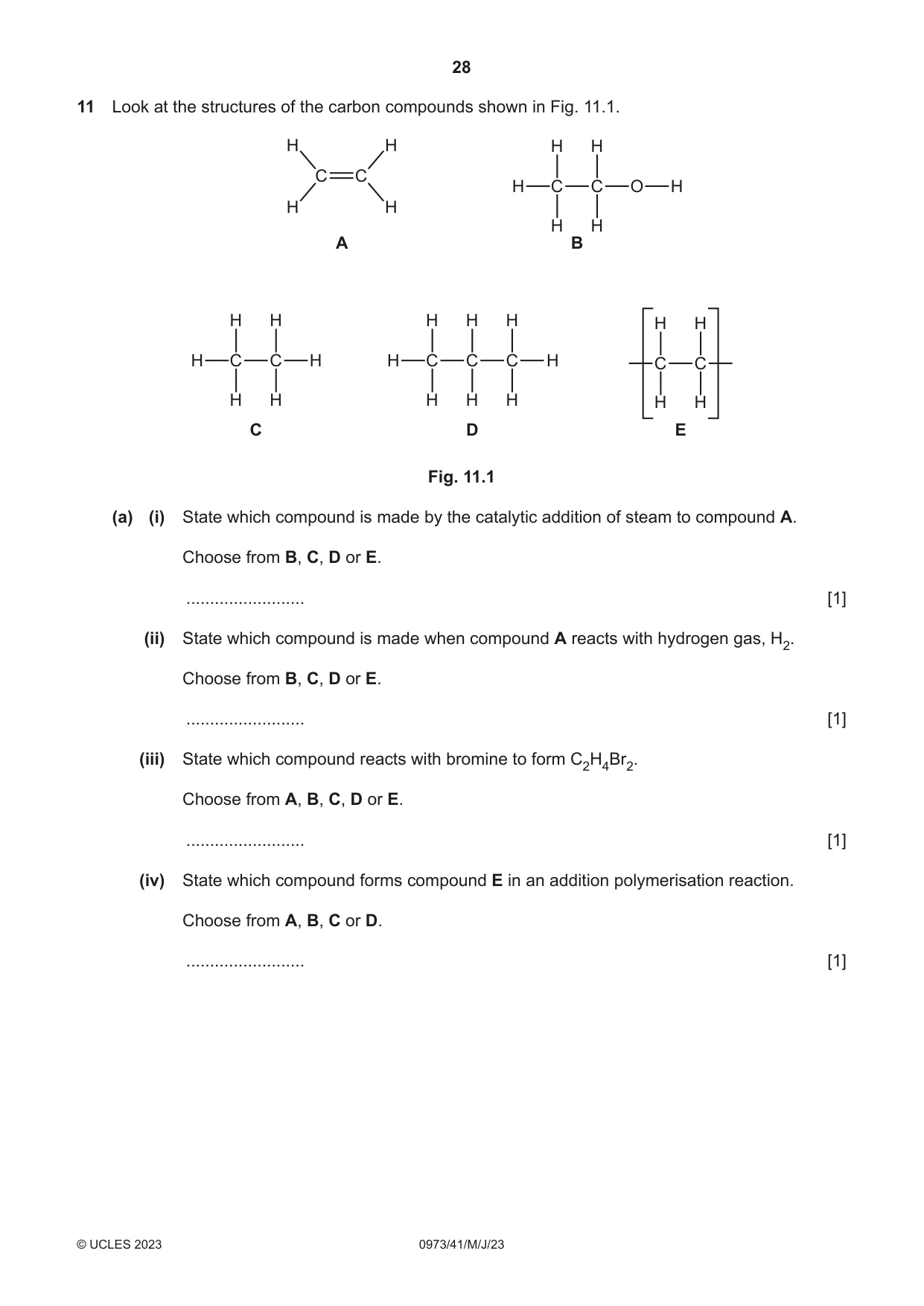
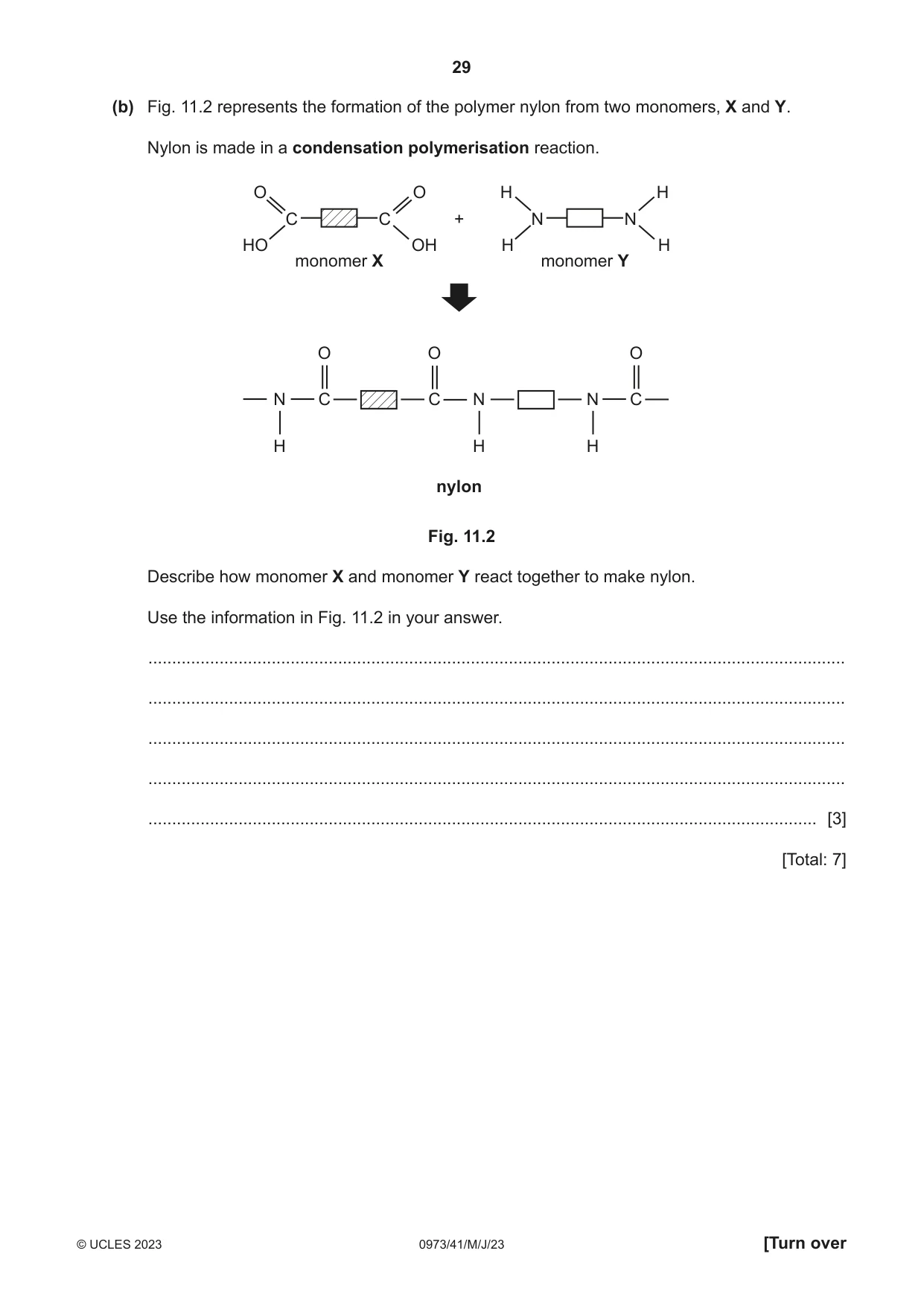
11 Look at the structures of the carbon compounds shown in Fig. 11.1. H H H H C C H C C O H H H H H A B H H H H H H H H C C H H C C C H C C H H H H H H H C D E Fig. 11.1 (a) (i) State which compound is made by the catalytic addition of steam to compound A. Choose from B, C, D or E. ......................... [1] (ii) State which compound is made when compound A reacts with hydrogen gas, H2. Choose from B, C, D or E. ......................... [1] (iii) State which compound reacts with bromine to form C2H4Br2. Choose from A, B, C, D or E. ......................... [1] (iv) State which compound forms compound E in an addition polymerisation reaction. Choose from A, B, C or D. ......................... [1] (b) Fig. 11.2 represents the formation of the polymer nylon from two monomers, X and Y. Nylon is made in a condensation polymerisation reaction. O O H H C C + N N HO OH H H monomer X monomer Y O O O N C C N N C H H H nylon Fig. 11.2 Describe how monomer X and monomer Y react together to make nylon. Use the information in Fig. 11.2 in your answer. ................................................................................................................................................... ................................................................................................................................................... ................................................................................................................................................... ................................................................................................................................................... ............................................................................................................................................. [3] [Total: 7]
Mark scheme: 11(a)(i) B ; 1 11(a)(ii) C ; 1 11(a)(iii) A ; 1 11(a)(iv) A ; 1 11(b) any three from: idea that C on monomer X and N on monomer Y join ; idea that -OH group is lost from the monomer X ; idea that -H is lost from monomer Y ; idea that water is eliminated ; AVP ; 3
Q12 · A student investigates the penetrating abilities of ionising radiation
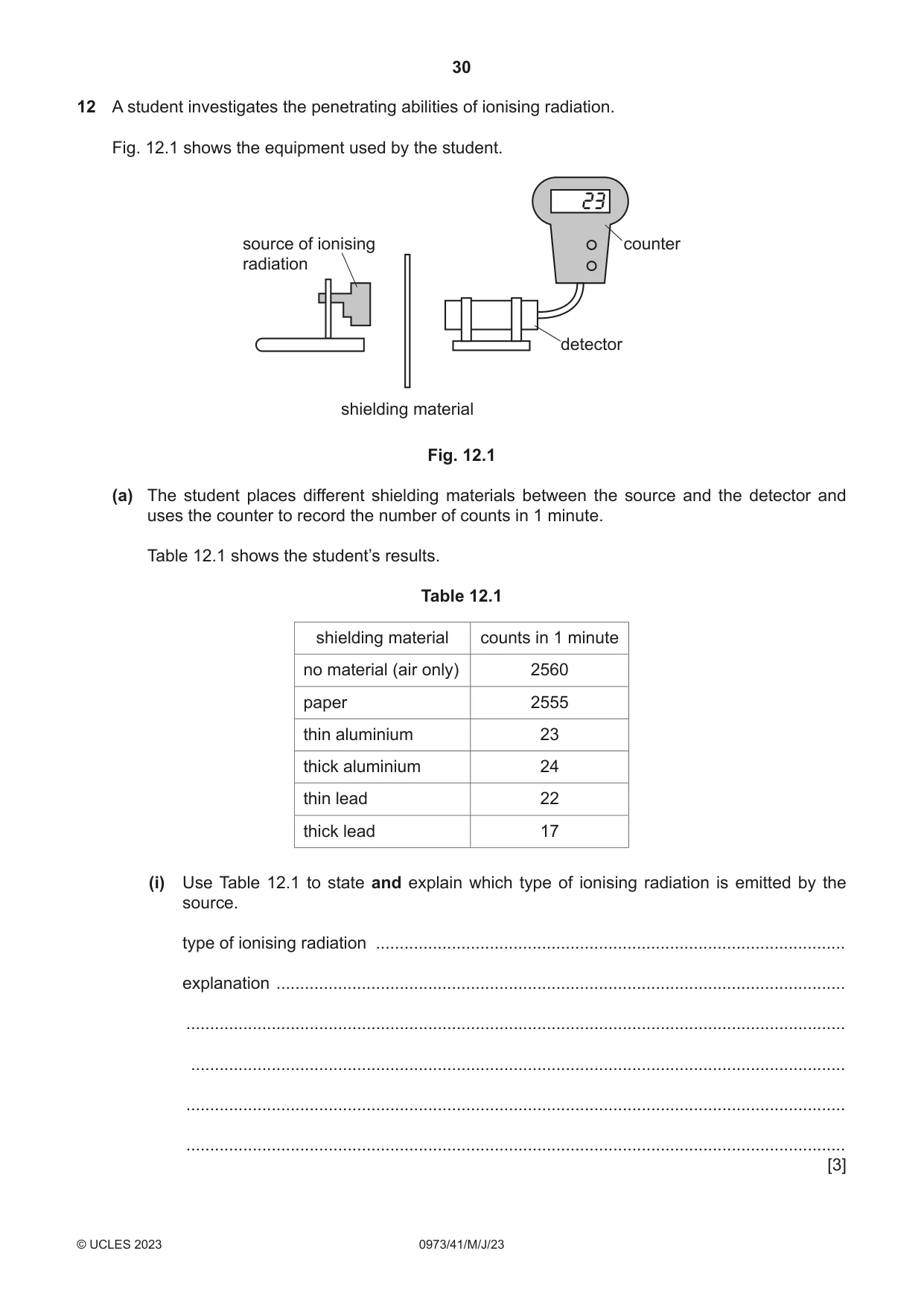
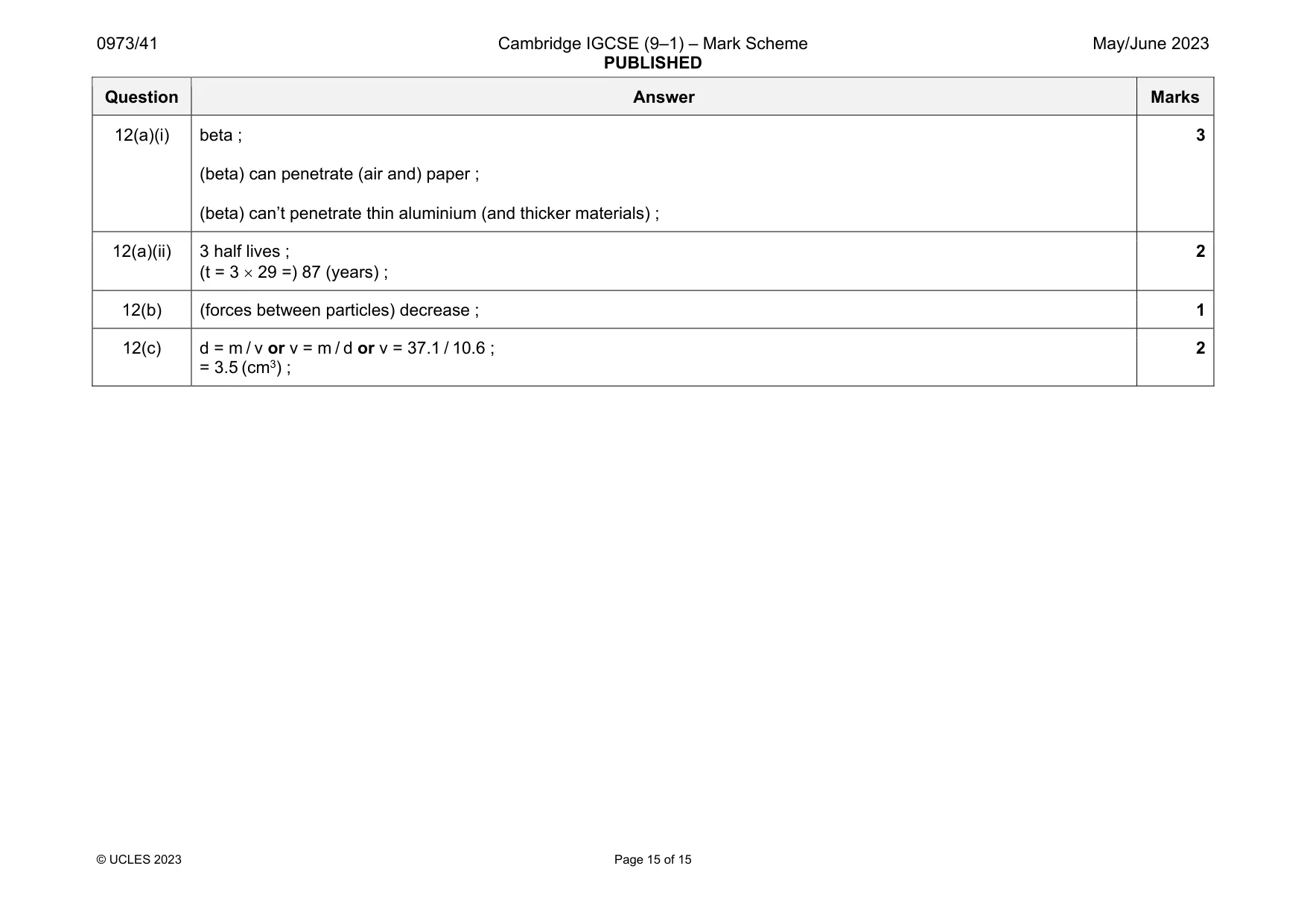
12 A student investigates the penetrating abilities of ionising radiation. Fig. 12.1 shows the equipment used by the student. source of ionising counter radiation detector shielding material Fig. 12.1 (a) The student places different shielding materials between the source and the detector and uses the counter to record the number of counts in 1 minute. Table 12.1 shows the student’s results. Table 12.1 shielding material counts in 1 minute no material (air only) 2560 paper 2555 thin aluminium 23 thick aluminium 24 thin lead 22 thick lead 17 (i) Use Table 12.1 to state and explain which type of ionising radiation is emitted by the source. type of ionising radiation ................................................................................................... explanation ........................................................................................................................ ........................................................................................................................................... .......................................................................................................................................... ........................................................................................................................................... ........................................................................................................................................... [3] (ii) The source used in Fig. 12.1 has a half‑life of 29 years. Calculate the time it will take for the activity of the source to drop to 12.5% of the original value. time = ............................................... years [2] (b) The lead used in the student’s investigation is a solid. The melting point of lead is 327 °C. When lead melts, it turns from a solid into a liquid. Describe the changes in the forces between particles when a solid melts. ................................................................................................................................................... ............................................................................................................................................. [1] (c) The density of liquid lead is 10.6 g / cm3. A sample of liquid lead has a mass of 37.1 g. Calculate the volume of the sample of liquid lead. volume = .................................. cm3 [2] [Total: 8]
Mark scheme: 12(a)(i) beta ; (beta) can penetrate (air and) paper ; (beta) can’t penetrate thin aluminium (and thicker materials) ; 3 12(a)(ii) 3 half lives ; (t = 3 29 =) 87 (years) ; 2 12(b) (forces between particles) decrease ; 1 12(c) d = m / v or v = m / d or v = 37.1 / 10.6 ; = 3.5 (cm3) ; 2
What was in this paper
The subtopics covered by these 12 questions, and how many questions each got. Open one in a new tab to see every Cambridge question on it.
What you needed in this session
Cambridge’s own grade thresholds for 2023 May/June, Paper 4 · Variant 1. A higher threshold means an easier paper — the bar moves with how the cohort did.