Cambridge IGCSE Sciences - Co-ordinated (9-1) 0973 — 2024 May/June Paper 4 · Variant 2
0973/42/M/J/24 · 12 questions · 120 marks · ≈135 min
The question paper and its mark scheme, free to read here and free to download. This is Cambridge’s own paper, exactly as it was sat.
Question paper28 pages


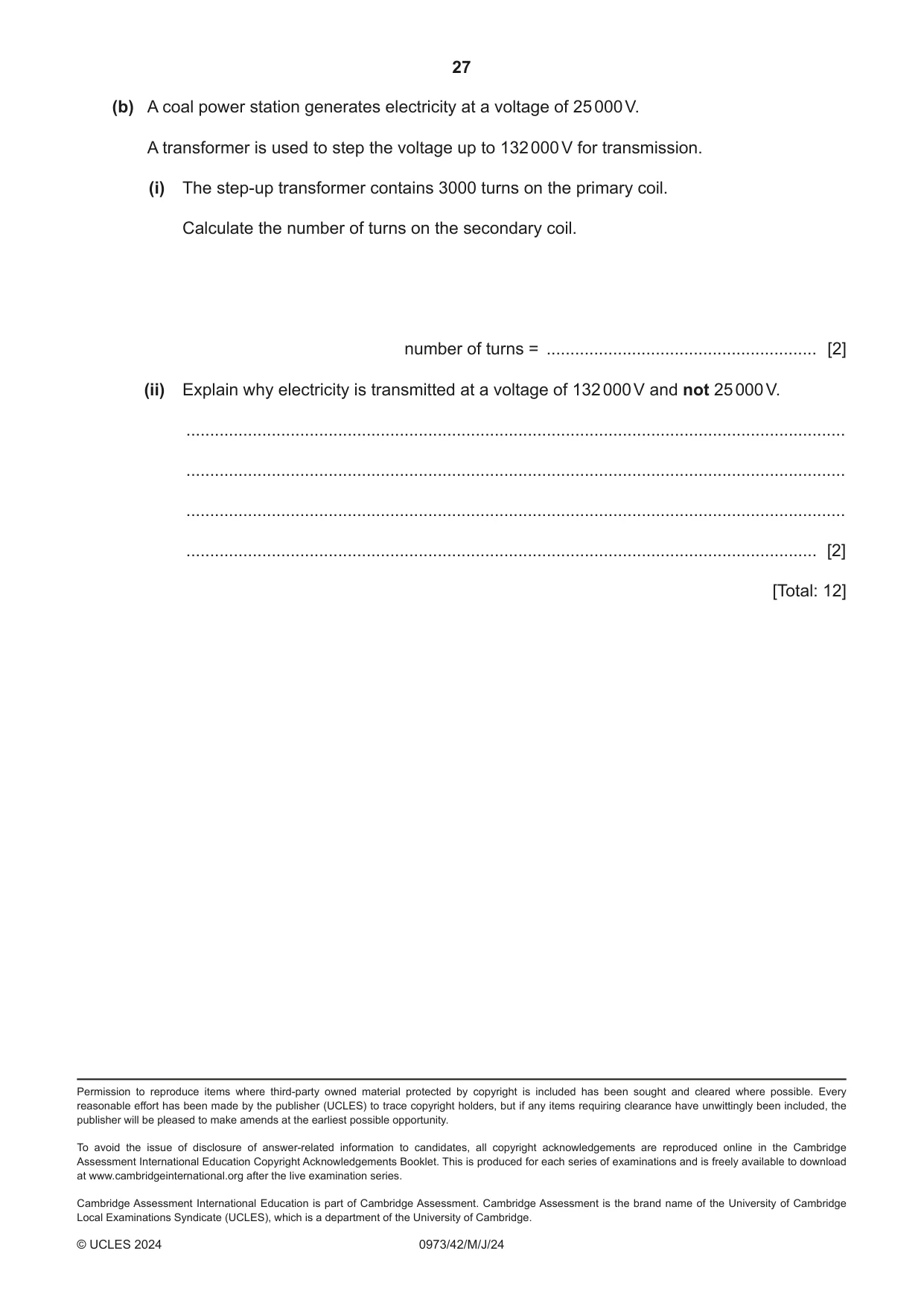
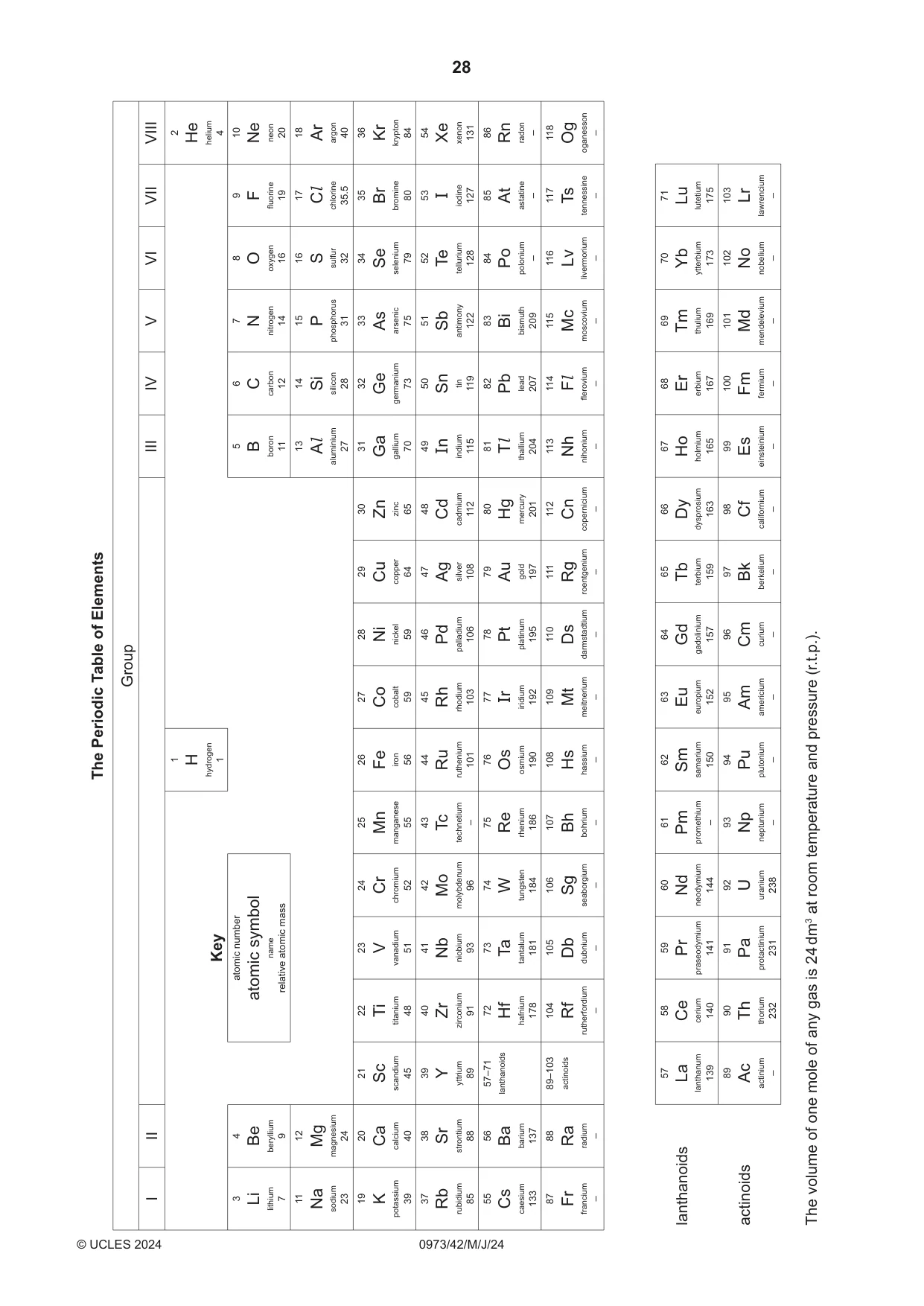
Mark scheme14 pages
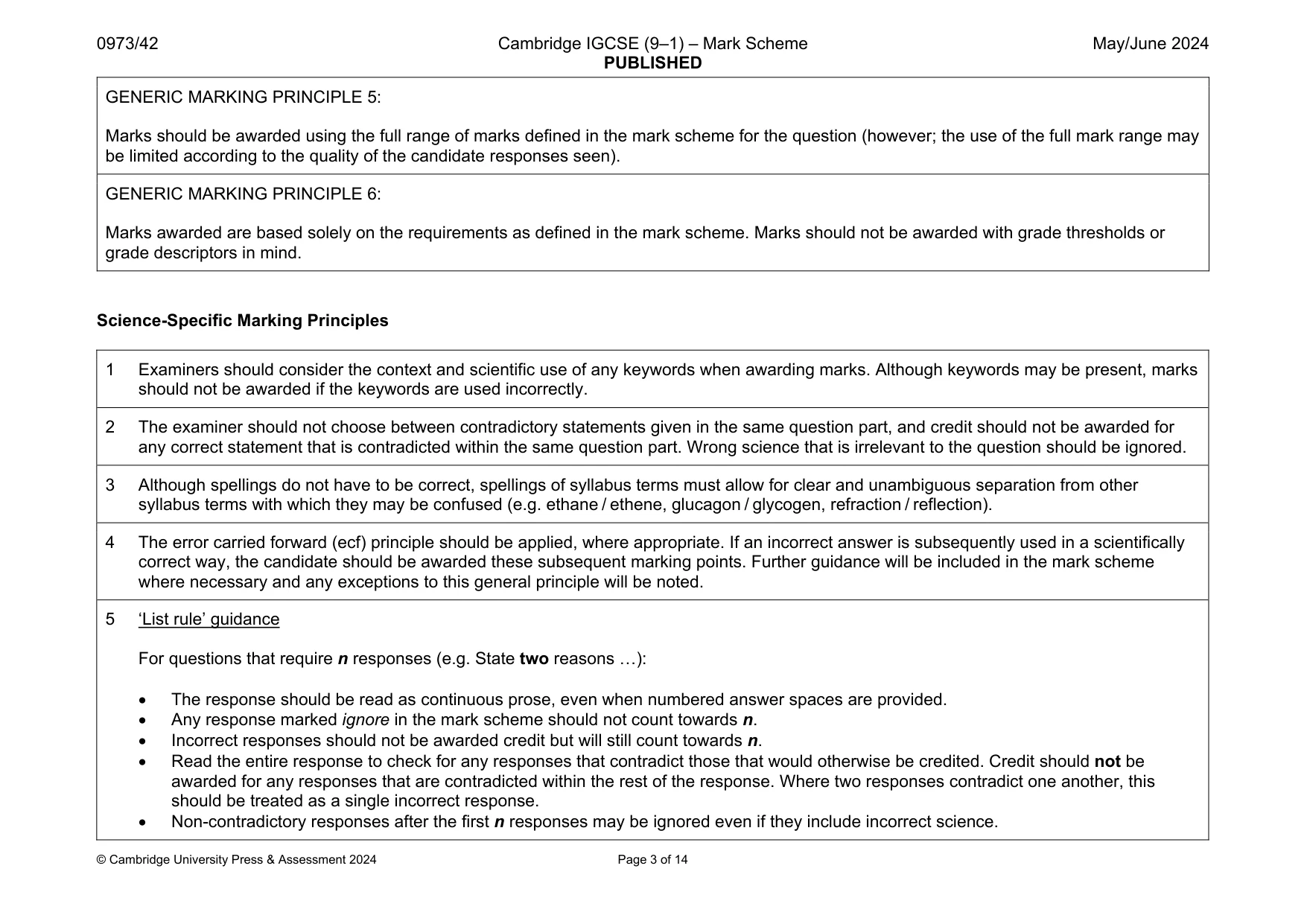
Answers below. Sit the paper first if you are practising.
Questions as text
Q1 · A diagram of a wind‑pollinated flower
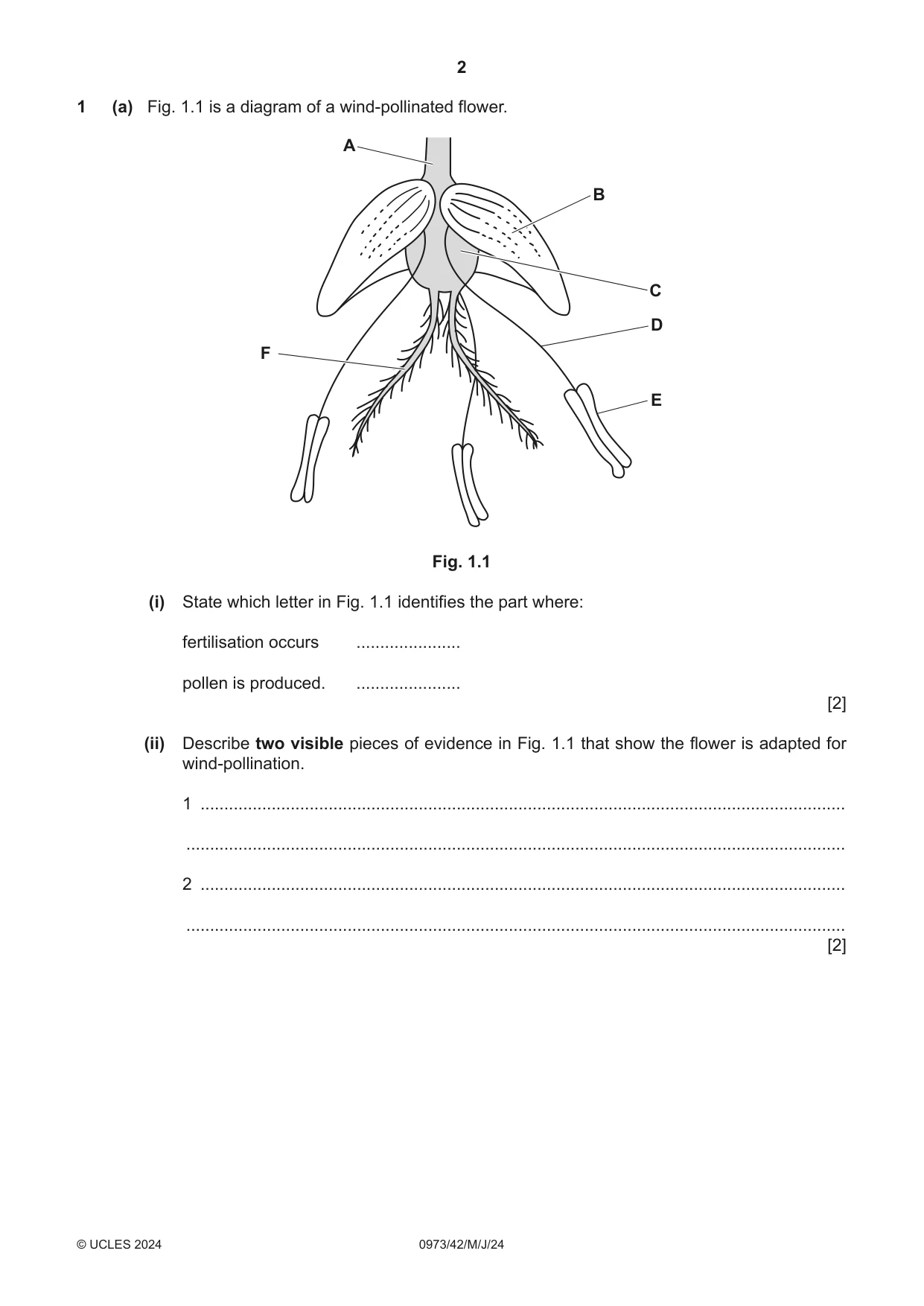
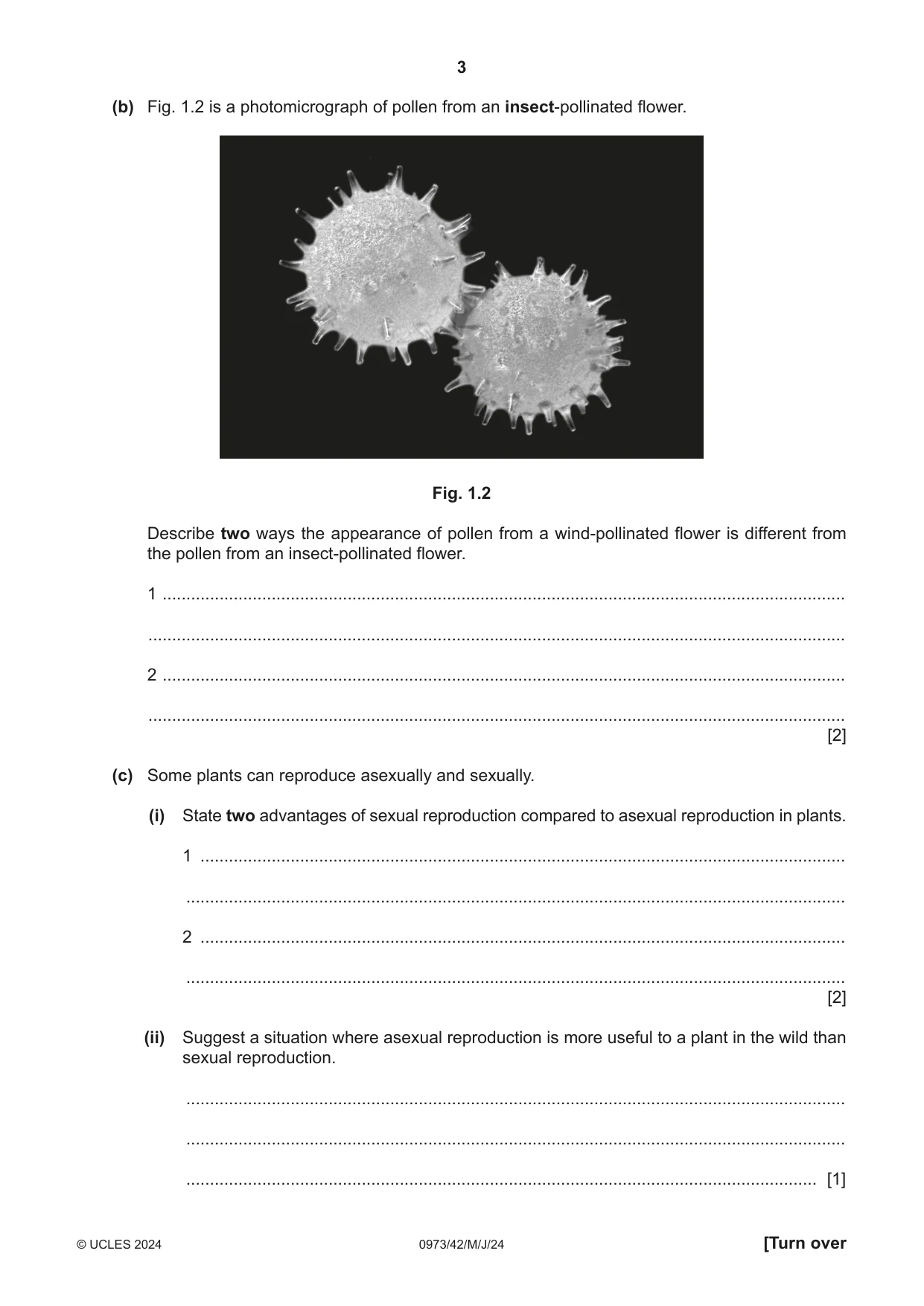
1 (a) Fig. 1.1 is a diagram of a wind‑pollinated flower. A B C D F E Fig. 1.1 (i) State which letter in Fig. 1.1 identifies the part where: fertilisation occurs ...................... pollen is produced. ...................... [2] (ii) Describe two visible pieces of evidence in Fig. 1.1 that show the flower is adapted for wind‑pollination. 1 ........................................................................................................................................ ........................................................................................................................................... 2 ........................................................................................................................................ ........................................................................................................................................... [2] (b) Fig. 1.2 is a photomicrograph of pollen from an insect‑pollinated flower. Fig. 1.2 Describe two ways the appearance of pollen from a wind‑pollinated flower is different from the pollen from an insect‑pollinated flower. 1 ................................................................................................................................................ ................................................................................................................................................... 2 ................................................................................................................................................ ................................................................................................................................................... [2] (c) Some plants can reproduce asexually and sexually. (i) State two advantages of sexual reproduction compared to asexual reproduction in plants. 1 ........................................................................................................................................ ........................................................................................................................................... 2 ........................................................................................................................................ ........................................................................................................................................... [2] (ii) Suggest a situation where asexual reproduction is more useful to a plant in the wild than sexual reproduction. ........................................................................................................................................... ........................................................................................................................................... ..................................................................................................................................... [1] (d) Reproduction is one of the characteristics of living organisms. State two other characteristics of living organisms. 1 ................................................................................................................................................ 2 ................................................................................................................................................ [2] [Total: 11]
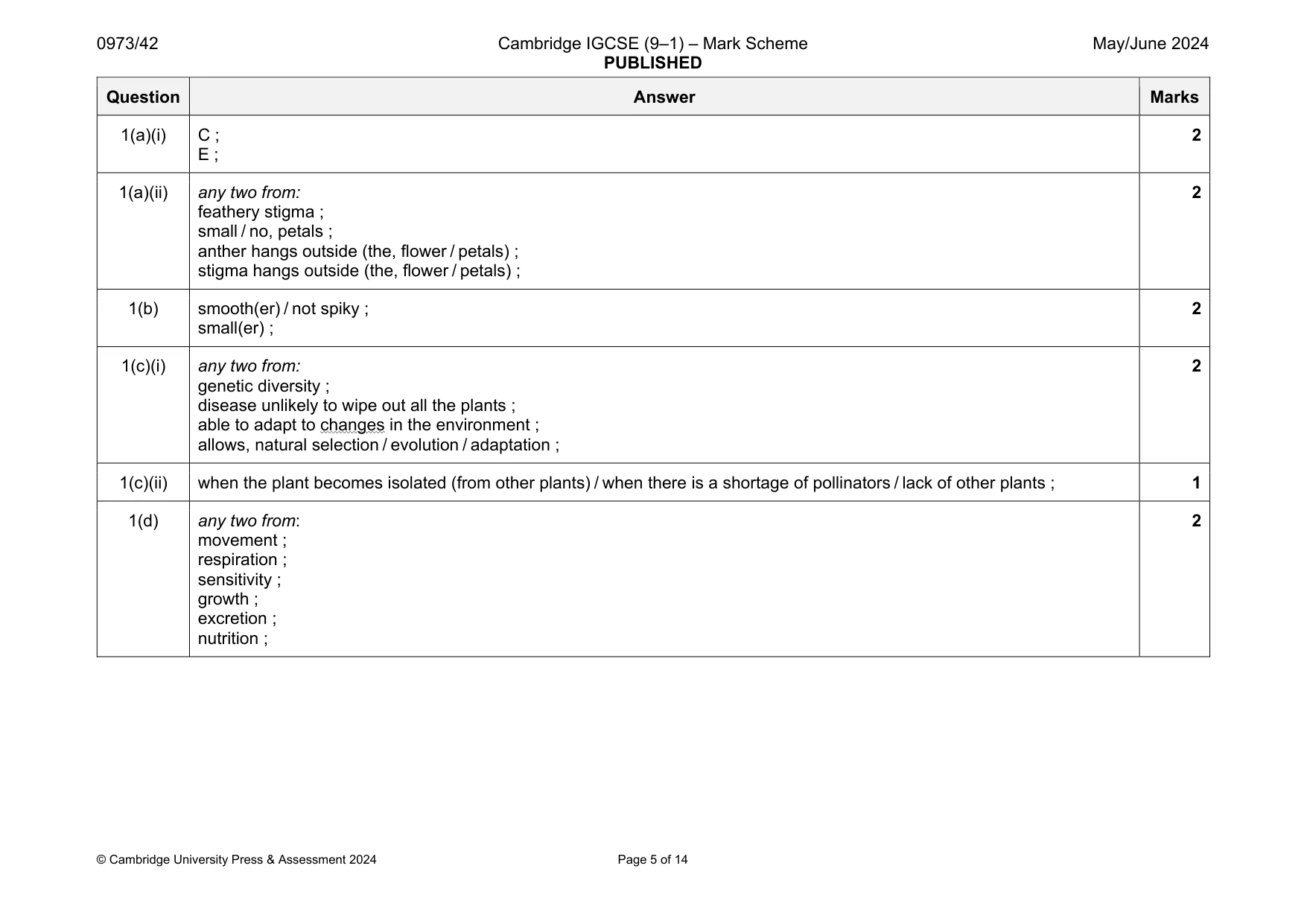
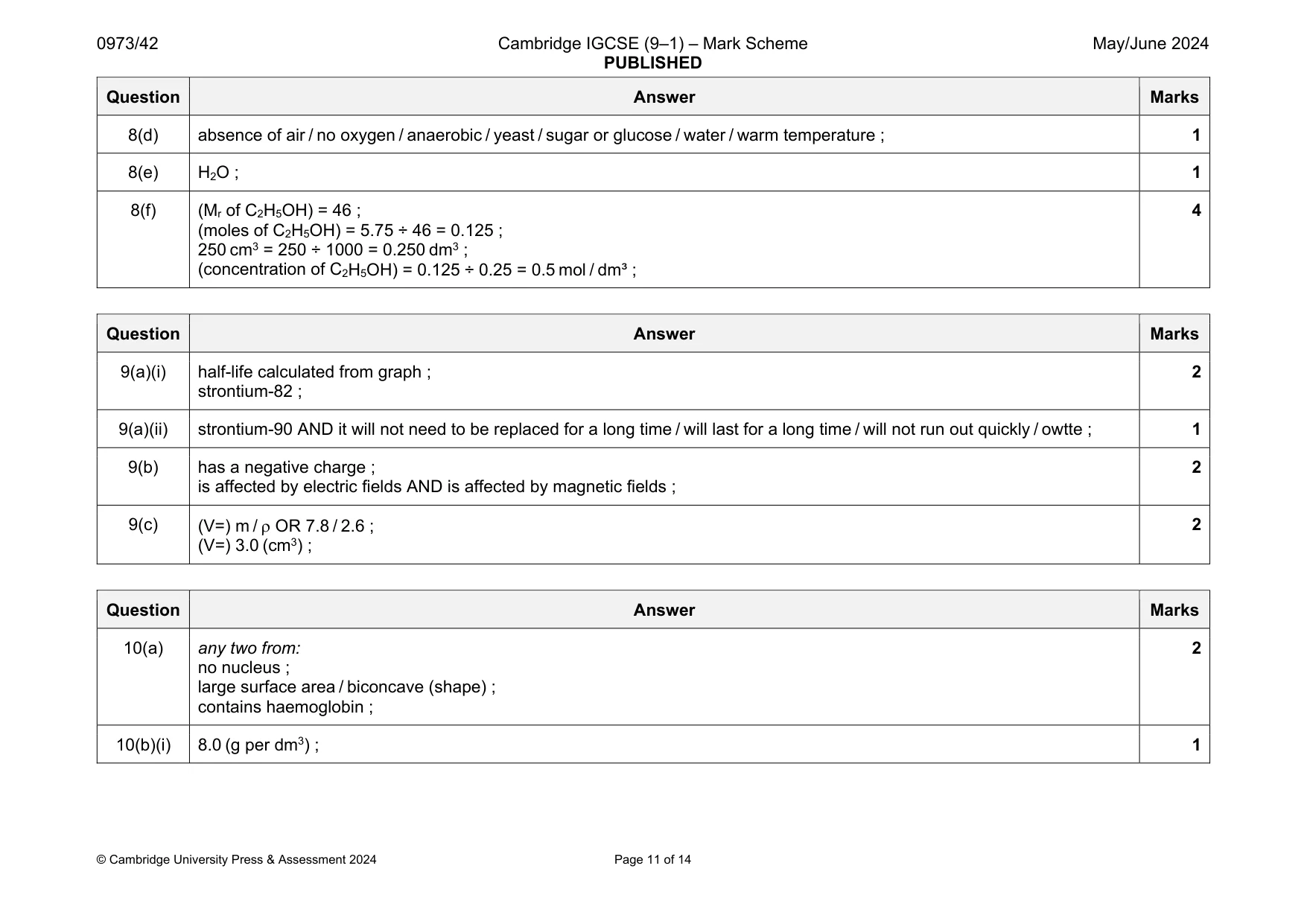
Mark scheme: 1(a)(i) C ; E ; 2 1(a)(ii) any two from: feathery stigma ; small / no, petals ; anther hangs outside (the, flower / petals) ; stigma hangs outside (the, flower / petals) ; 2 1(b) smooth(er) / not spiky ; small(er) ; 2 1(c)(i) any two from: genetic diversity ; disease unlikely to wipe out all the plants ; able to adapt to changes in the environment ; allows, natural selection / evolution / adaptation ; 2 1(c)(ii) when the plant becomes isolated (from other plants) / when there is a shortage of pollinators / lack of other plants ; 1 1(d) any two from: movement ; respiration ; sensitivity ; growth ; excretion ; nutrition ; 2
Q2 · A student heats three substances X, Y and Z in a water‑bath
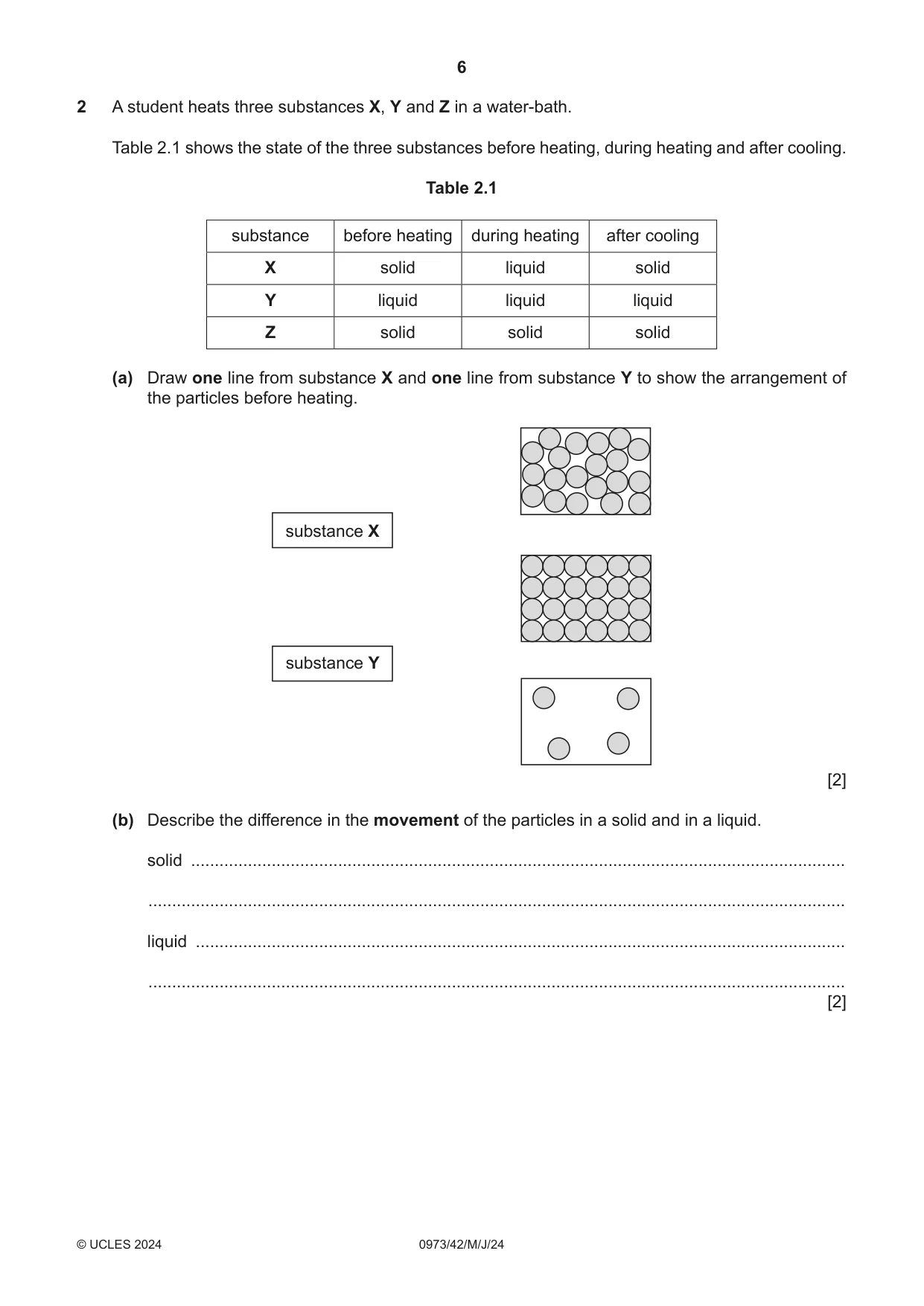
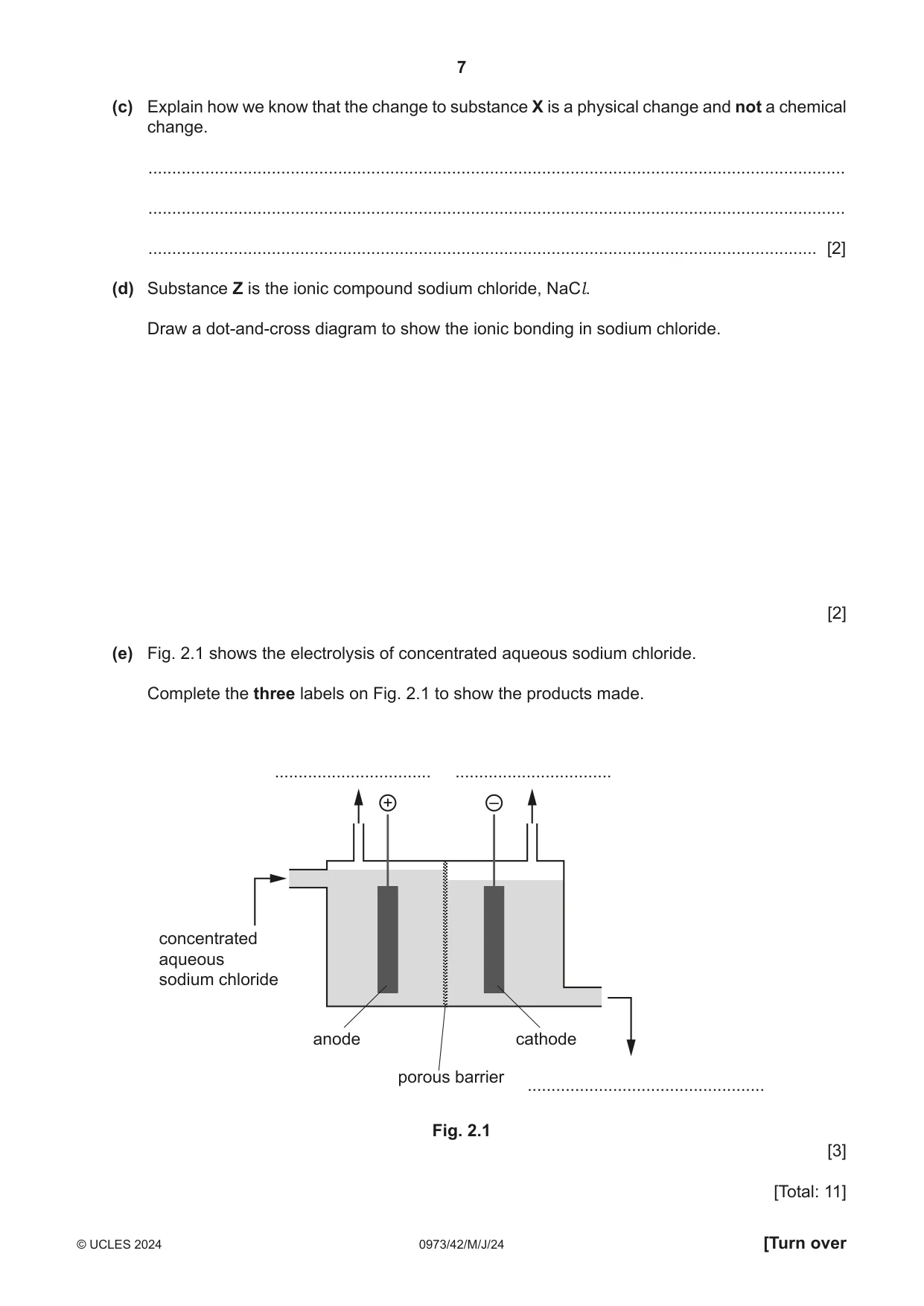
2 A student heats three substances X, Y and Z in a water‑bath. Table 2.1 shows the state of the three substances before heating, during heating and after cooling. Table 2.1 substance before heating during heating after cooling X solid liquid solid Y liquid liquid liquid Z solid solid solid (a) Draw one line from substance X and one line from substance Y to show the arrangement of the particles before heating. substance X substance Y [2] (b) Describe the difference in the movement of the particles in a solid and in a liquid. solid .......................................................................................................................................... ................................................................................................................................................... liquid ......................................................................................................................................... ................................................................................................................................................... [2] (c) Explain how we know that the change to substance X is a physical change and not a chemical change. ................................................................................................................................................... ................................................................................................................................................... ............................................................................................................................................. [2] (d) Substance Z is the ionic compound sodium chloride, NaCl. Draw a dot‑and‑cross diagram to show the ionic bonding in sodium chloride. [2] (e) Fig. 2.1 shows the electrolysis of concentrated aqueous sodium chloride. Complete the three labels on Fig. 2.1 to show the products made. ................................. ................................. + – concentrated aqueous sodium chloride anode cathode porous barrier .................................................. Fig. 2.1 [3] [Total: 11]
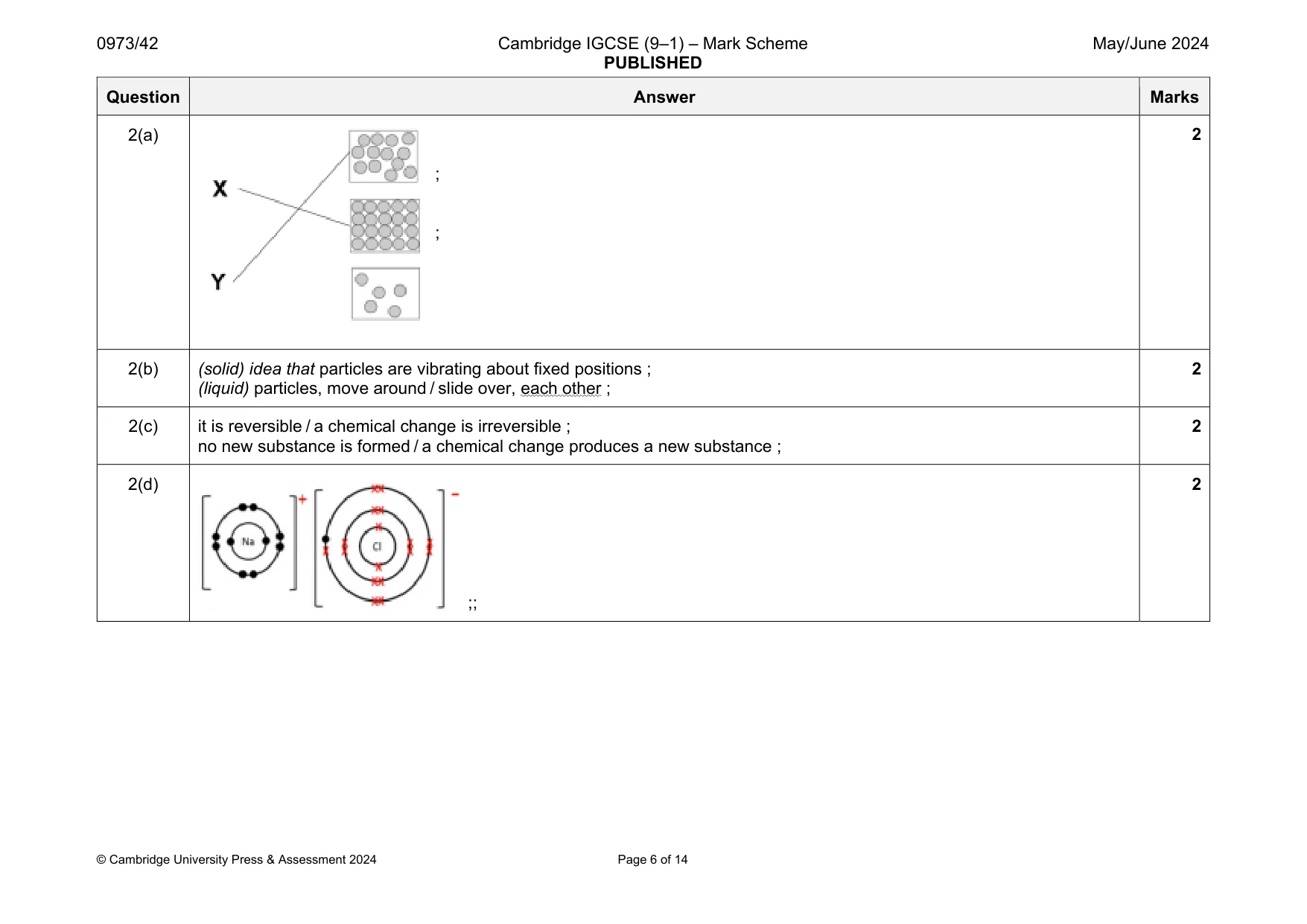
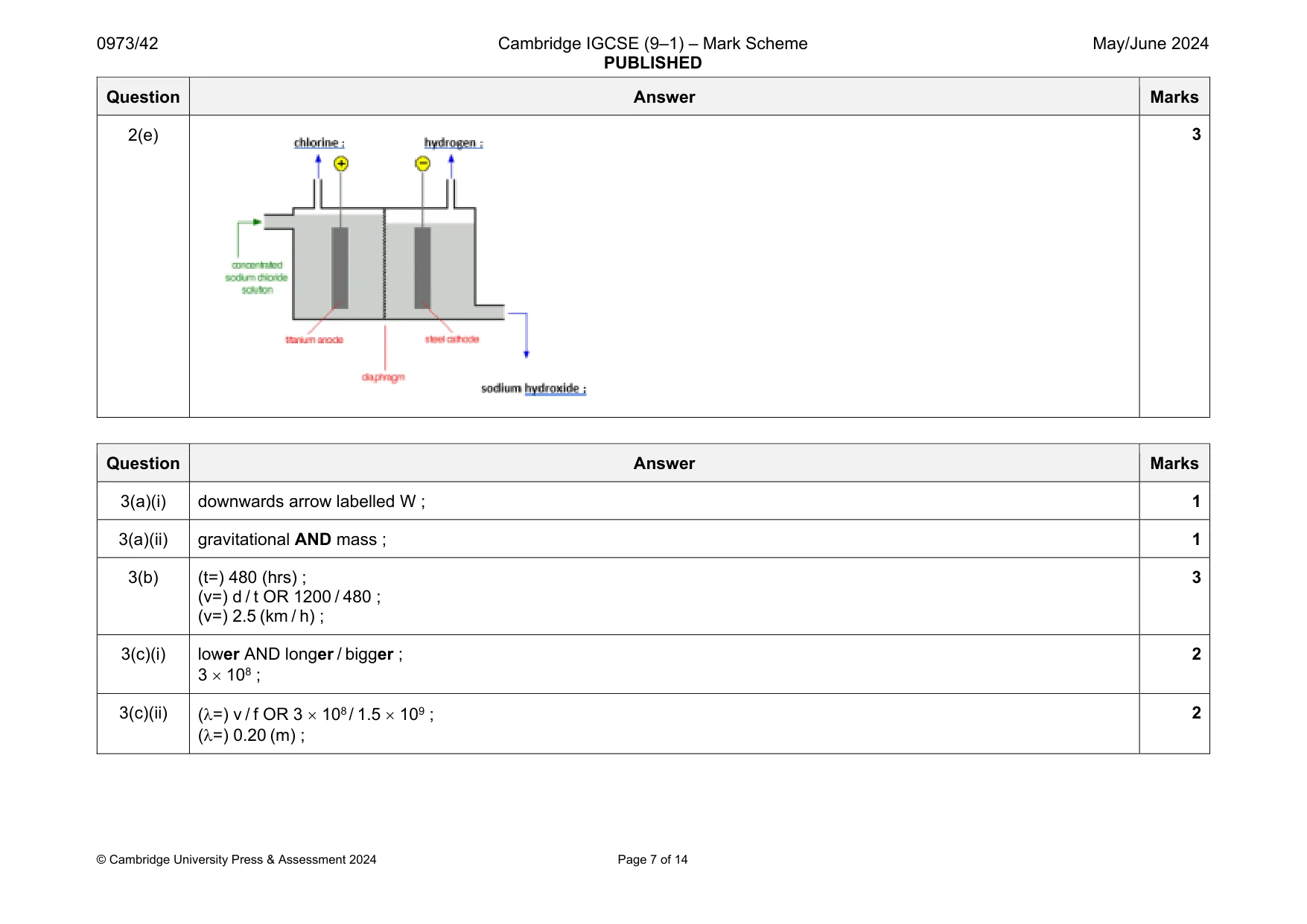
Mark scheme: 2(a) ; ; 2(b) (solid) idea that particles are vibrating about fixed positions ; (liquid) particles, move around / slide over, each other ; 2 2(c) it is reversible / a chemical change is irreversible ; no new substance is formed / a chemical change produces a new substance ; 2 2(d) ;; 2 Question Answer Marks 2(e) 3
Question 3
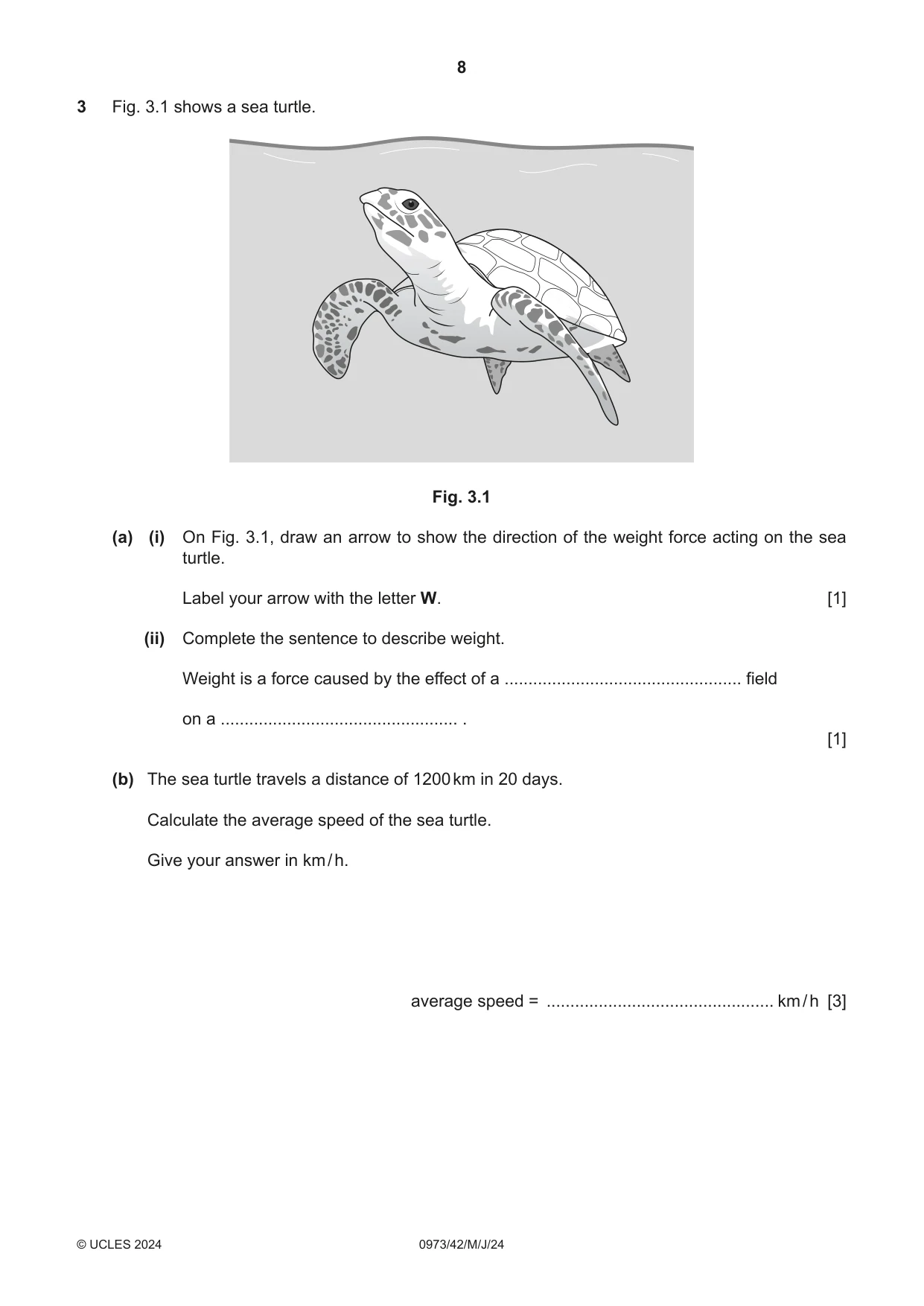
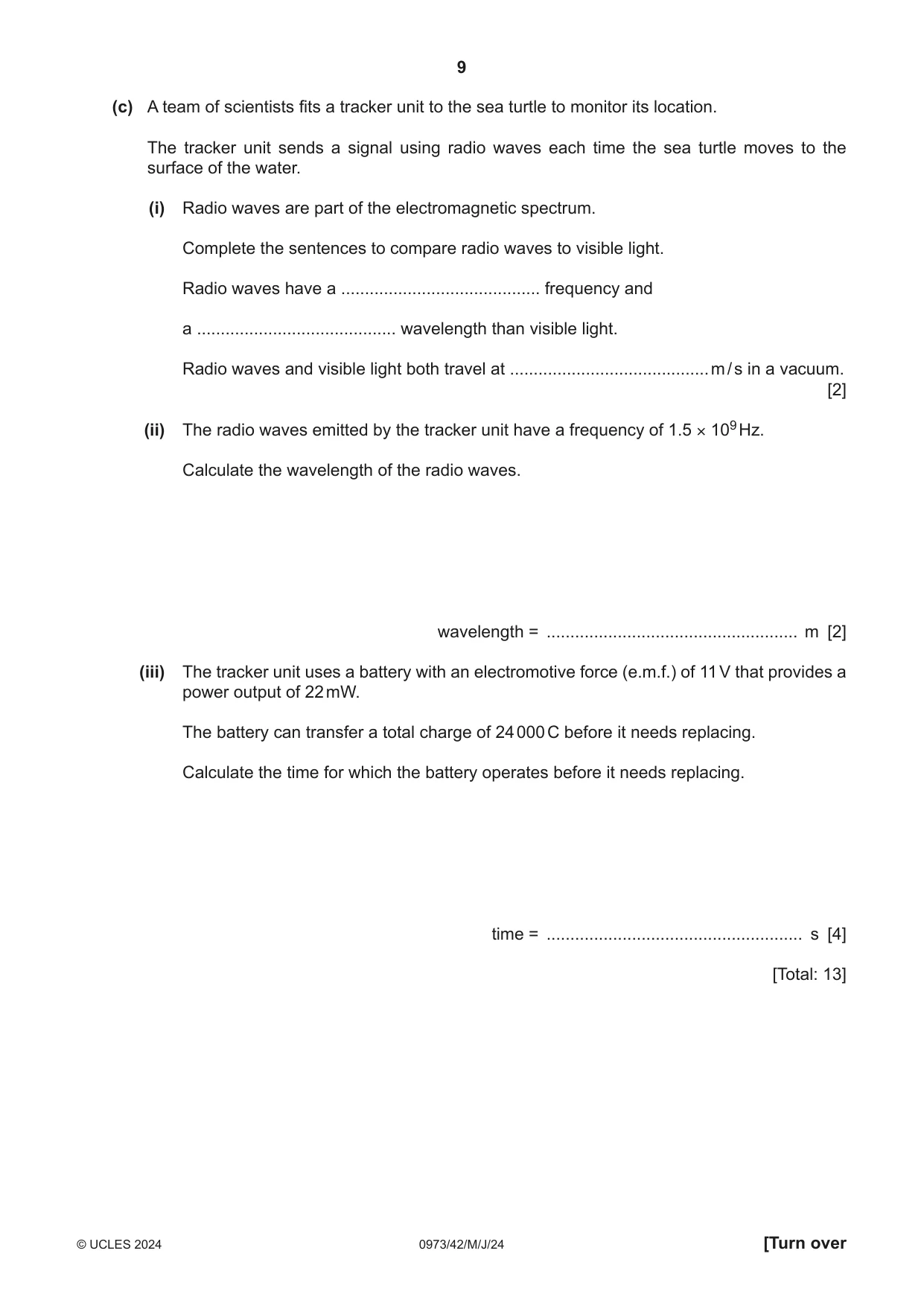
3 Fig. 3.1 shows a sea turtle. Fig. 3.1 (a) (i) On Fig. 3.1, draw an arrow to show the direction of the weight force acting on the sea turtle. Label your arrow with the letter W. [1] (ii) Complete the sentence to describe weight. Weight is a force caused by the effect of a .................................................. field on a .................................................. . [1] (b) The sea turtle travels a distance of 1200 km in 20 days. Calculate the average speed of the sea turtle. Give your answer in km / h. average speed = ................................................ km / h [3] (c) A team of scientists fits a tracker unit to the sea turtle to monitor its location. The tracker unit sends a signal using radio waves each time the sea turtle moves to the surface of the water. (i) Radio waves are part of the electromagnetic spectrum. Complete the sentences to compare radio waves to visible light. Radio waves have a .......................................... frequency and a .......................................... wavelength than visible light. Radio waves and visible light both travel at .......................................... m / s in a vacuum. [2] (ii) The radio waves emitted by the tracker unit have a frequency of 1.5 × 10⁹ Hz. Calculate the wavelength of the radio waves. wavelength = ..................................................... m [2] (iii) The tracker unit uses a battery with an electromotive force (e.m.f.) of 11 V that provides a power output of 22 mW. The battery can transfer a total charge of 24 000 C before it needs replacing. Calculate the time for which the battery operates before it needs replacing. time = ...................................................... s [4] [Total: 13]
Mark scheme: 3(a)(i) downwards arrow labelled W ; 1 3(a)(ii) gravitational AND mass ; 1 3(b) (t=) 480 (hrs) ; (v=) d / t OR 1200 / 480 ; (v=) 2.5 (km / h) ; 3 3(c)(i) lower AND longer / bigger ; 3 108 ; 2 3(c)(ii) (=) v / f OR 3 108 / 1.5 109 ; (=) 0.20 (m) ; 2 Question Answer Marks 3(c)(iii) (P=) 0.022 (W) ; (I=) P / V OR 0.022 / 11 OR 0.002 ; (t=) Q / I OR 24000 / 0.002 ; (t=) 1.2 107 (s) ; 4
Q4 · Blood glucose concentration is controlled so that it remains within set limits
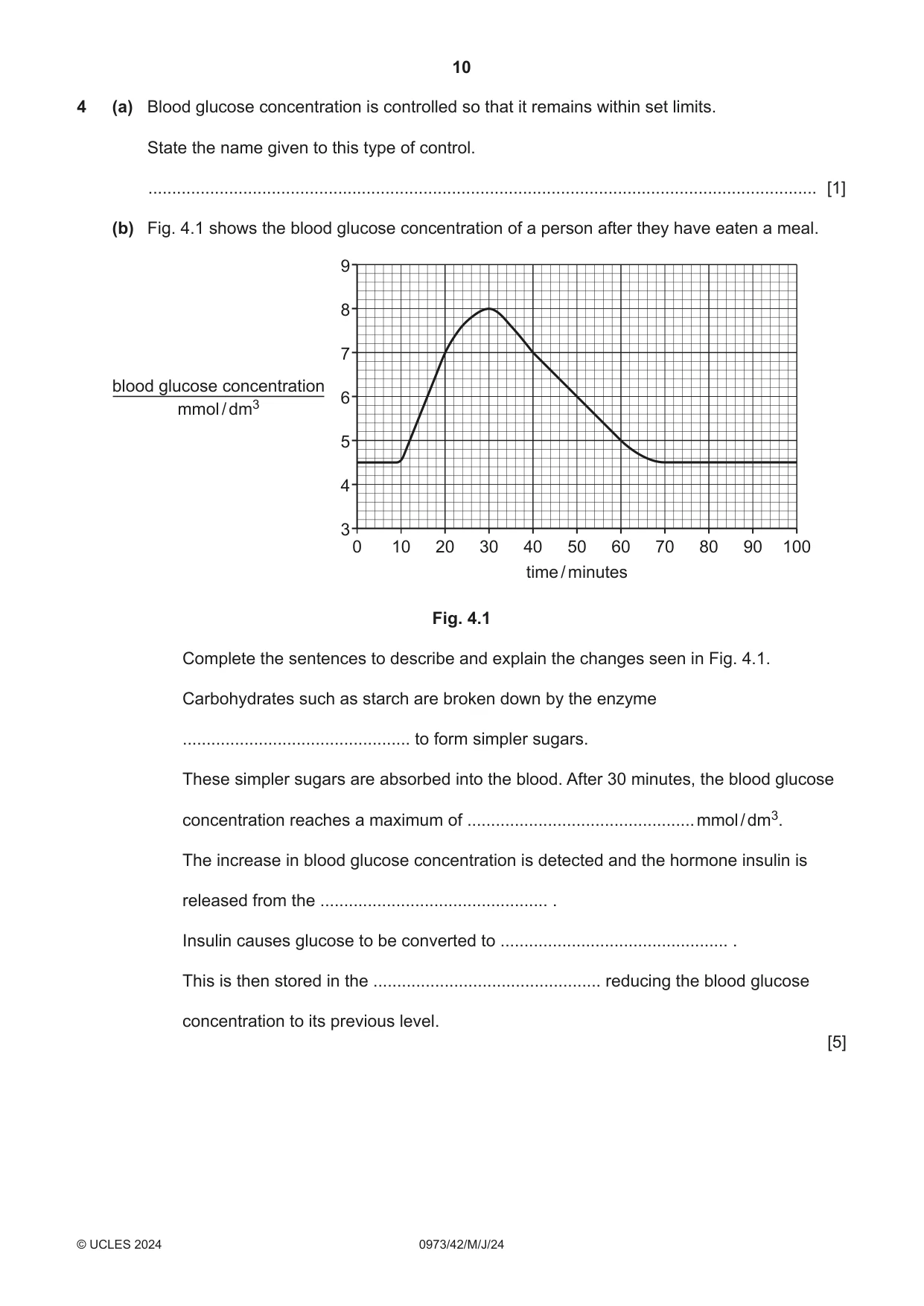
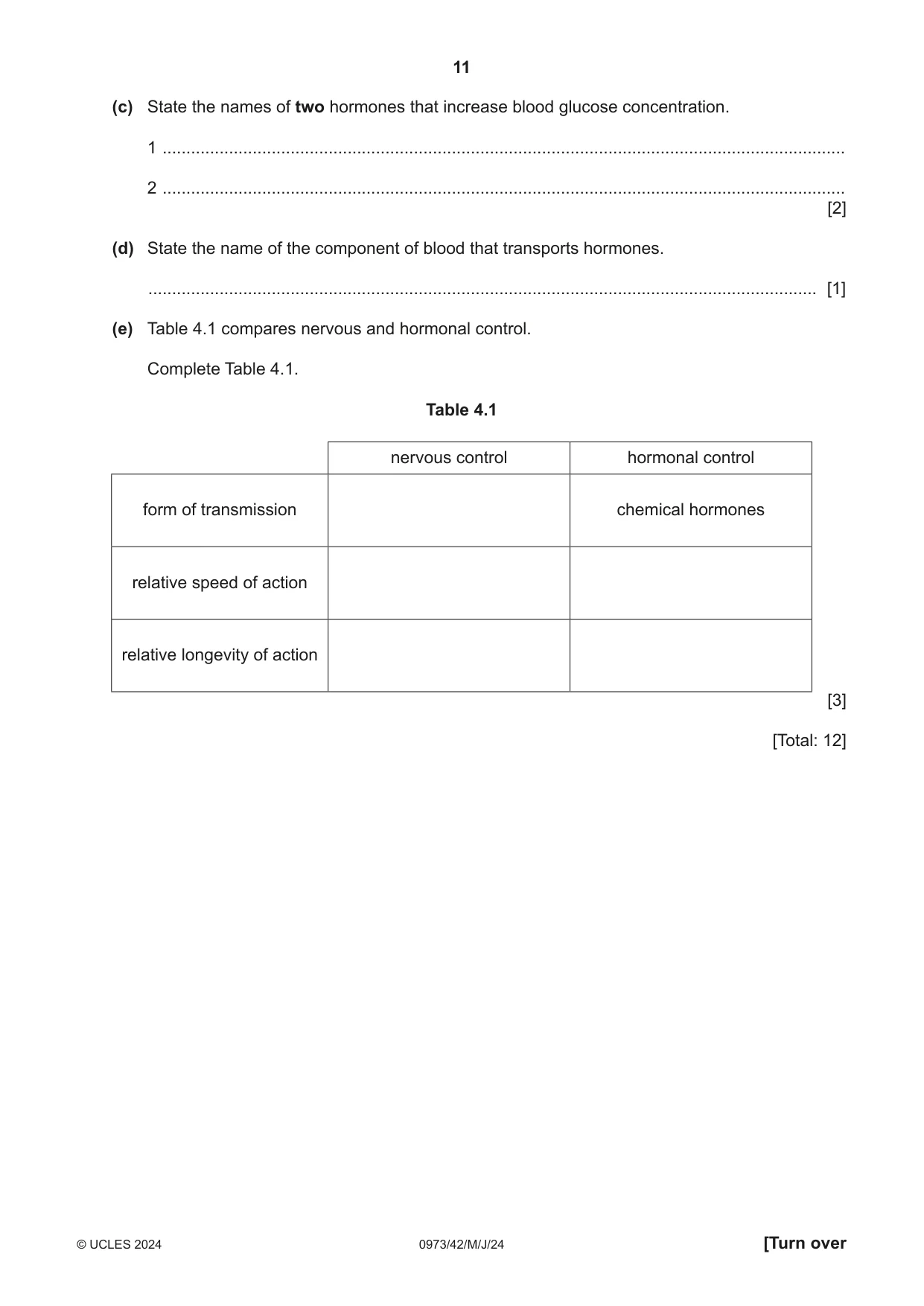
4 (a) Blood glucose concentration is controlled so that it remains within set limits. State the name given to this type of control. ............................................................................................................................................. [1] (b) Fig. 4.1 shows the blood glucose concentration of a person after they have eaten a meal. 9 8 7 blood glucose concentration 6 mmol / dm3 5 4 3 0 10 20 30 40 50 60 70 80 90 100 time / minutes Fig. 4.1 Complete the sentences to describe and explain the changes seen in Fig. 4.1. Carbohydrates such as starch are broken down by the enzyme ................................................ to form simpler sugars. These simpler sugars are absorbed into the blood. After 30 minutes, the blood glucose concentration reaches a maximum of ................................................ mmol / dm3. The increase in blood glucose concentration is detected and the hormone insulin is released from the ................................................ . Insulin causes glucose to be converted to ................................................ . This is then stored in the ................................................ reducing the blood glucose concentration to its previous level. [5] (c) State the names of two hormones that increase blood glucose concentration. 1 ................................................................................................................................................ 2 ................................................................................................................................................ [2] (d) State the name of the component of blood that transports hormones. ............................................................................................................................................. [1] (e) Table 4.1 compares nervous and hormonal control. Complete Table 4.1. Table 4.1 nervous control hormonal control form of transmission chemical hormones relative speed of action relative longevity of action [3] [Total: 12]
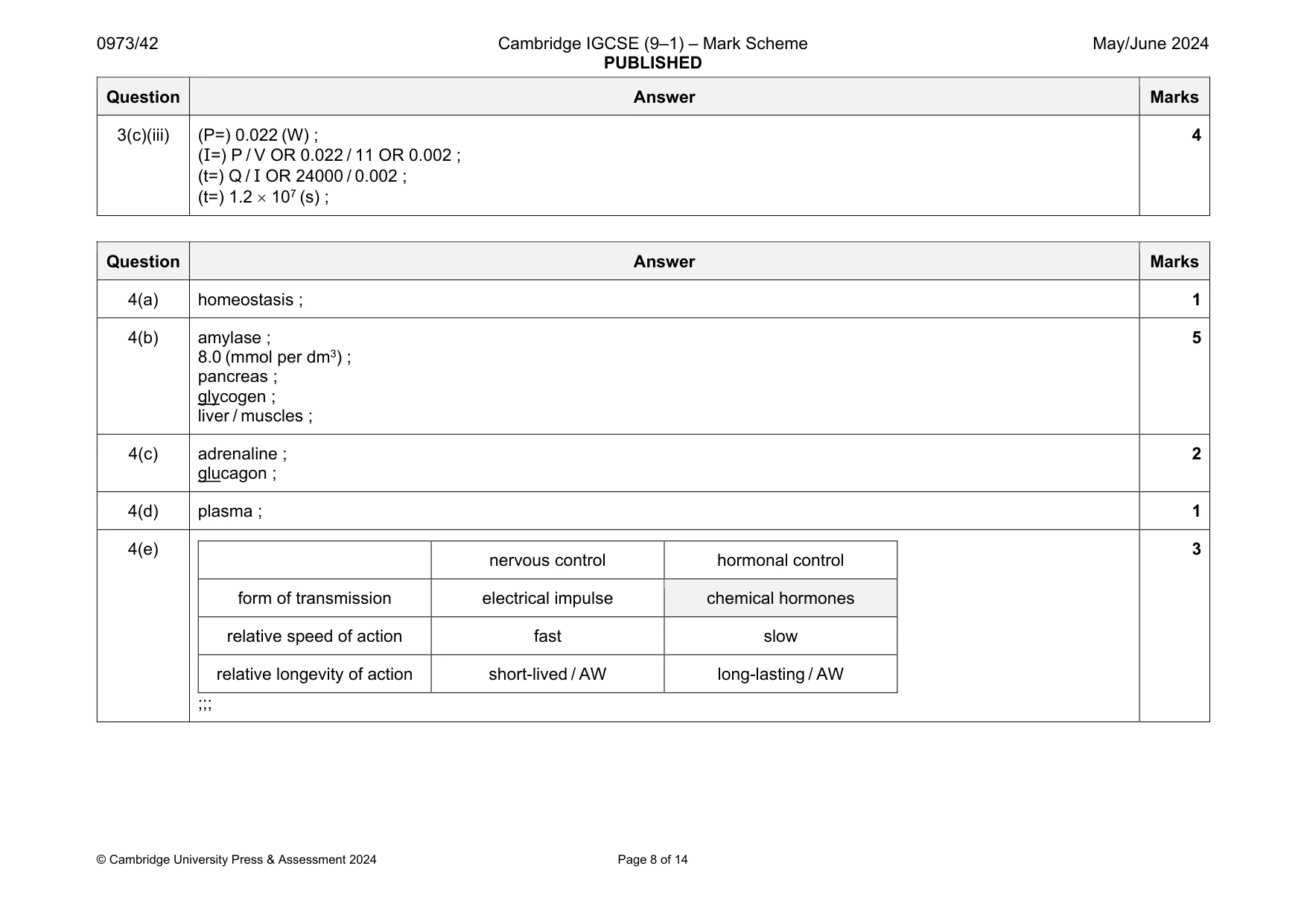
Mark scheme: 4(a) homeostasis ; 1 4(b) amylase ; 8.0 (mmol per dm3) ; pancreas ; glycogen ; liver / muscles ; 5 4(c) adrenaline ; glucagon ; 2 4(d) plasma ; 1 4(e) nervous control hormonal control form of transmission electrical impulse chemical hormones relative speed of action fast slow relative longevity of action short-lived / AW long-lasting / AW ;;; 3
Q5 · Some students investigate the reaction between marble chips and dilute hydrochloric acid
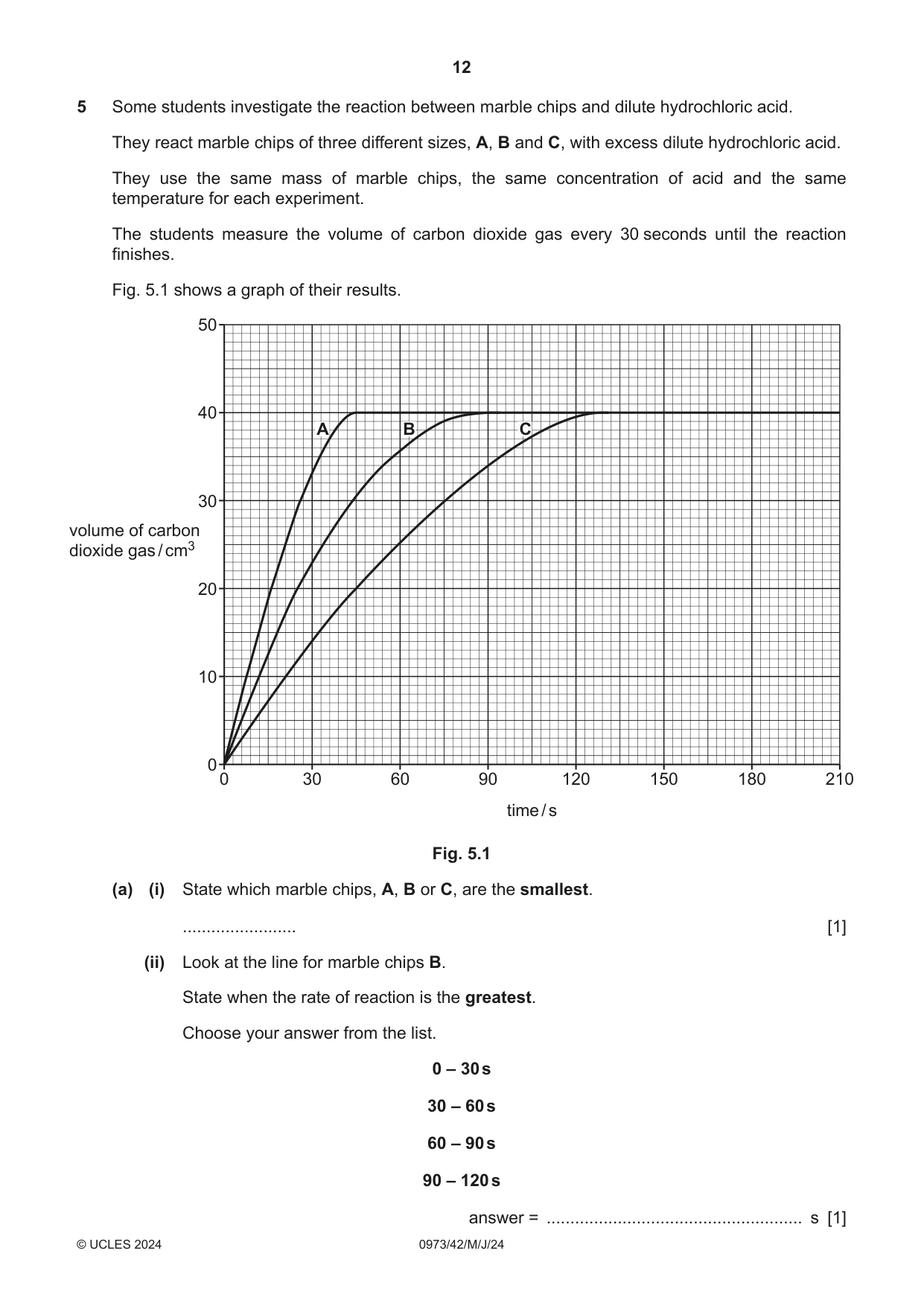
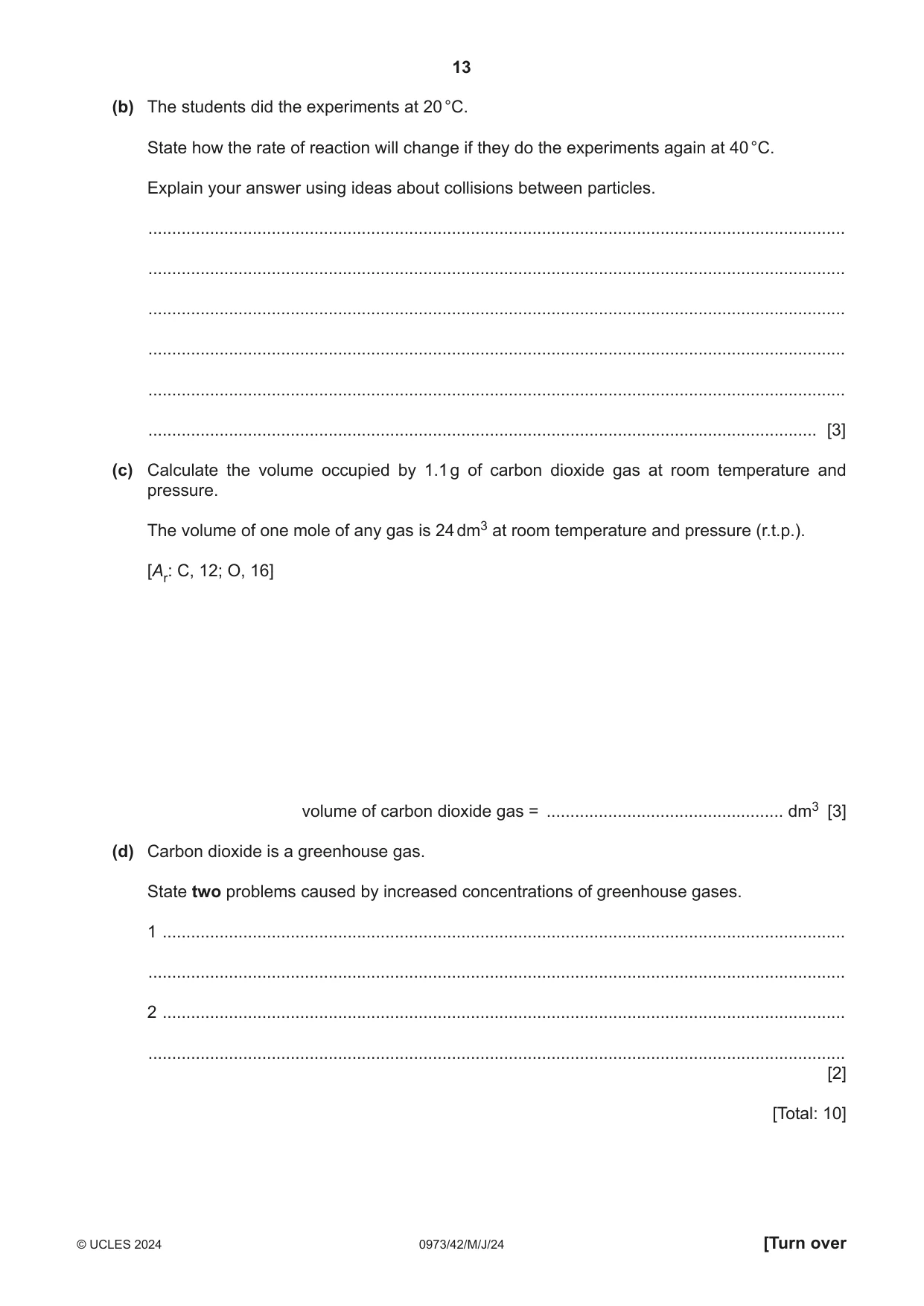
5 Some students investigate the reaction between marble chips and dilute hydrochloric acid. They react marble chips of three different sizes, A, B and C, with excess dilute hydrochloric acid. They use the same mass of marble chips, the same concentration of acid and the same temperature for each experiment. The students measure the volume of carbon dioxide gas every 30 seconds until the reaction finishes. Fig. 5.1 shows a graph of their results. 50 40 A B C 30 volume of carbon dioxide gas / cm3 20 10 0 0 30 60 90 120 150 180 210 time / s Fig. 5.1 (a) (i) State which marble chips, A, B or C, are the smallest. ........................ [1] (ii) Look at the line for marble chips B. State when the rate of reaction is the greatest. Choose your answer from the list. 0 – 30 s 30 – 60 s 60 – 90 s 90 – 120 s answer = ...................................................... s [1] (b) The students did the experiments at 20 °C. State how the rate of reaction will change if they do the experiments again at 40 °C. Explain your answer using ideas about collisions between particles. ................................................................................................................................................... ................................................................................................................................................... ................................................................................................................................................... ................................................................................................................................................... ................................................................................................................................................... ............................................................................................................................................. [3] (c) Calculate the volume occupied by 1.1 g of carbon dioxide gas at room temperature and pressure. The volume of one mole of any gas is 24 dm3 at room temperature and pressure (r.t.p.). [Ar: C, 12; O, 16] volume of carbon dioxide gas = .................................................. dm3 [3] (d) Carbon dioxide is a greenhouse gas. State two problems caused by increased concentrations of greenhouse gases. 1 ................................................................................................................................................ ................................................................................................................................................... 2 ................................................................................................................................................ ................................................................................................................................................... [2] [Total: 10]
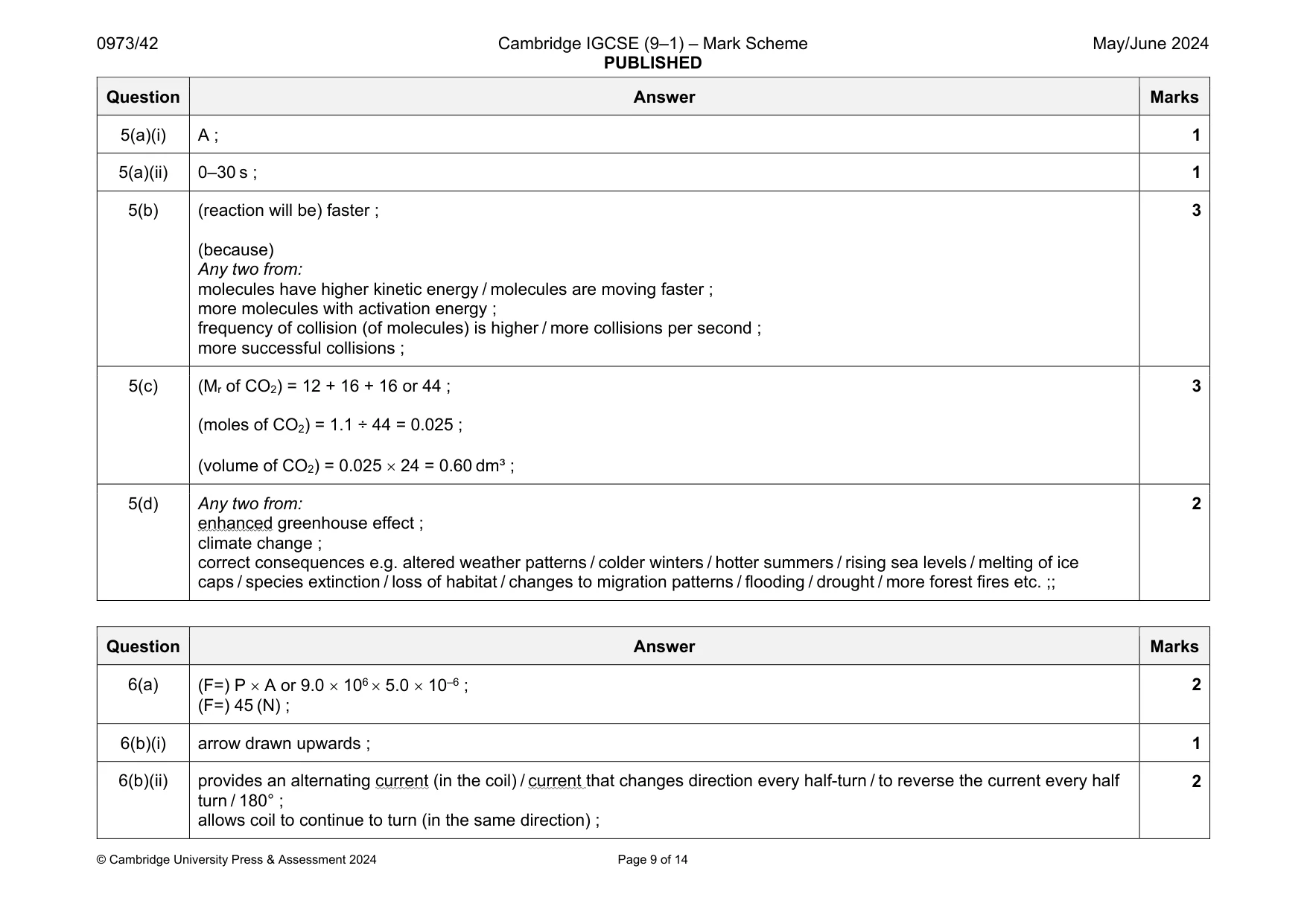
Mark scheme: 5(a)(i) A ; 1 5(a)(ii) 0–30 s ; 1 5(b) (reaction will be) faster ; (because) Any two from: molecules have higher kinetic energy / molecules are moving faster ; more molecules with activation energy ; frequency of collision (of molecules) is higher / more collisions per second ; more successful collisions ; 3 5(c) (Mr of CO2) = 12 + 16 + 16 or 44 ; (moles of CO2) = 1.1 ÷ 44 = 0.025 ; (volume of CO2) = 0.025 24 = 0.60 dm³ ; 3 5(d) Any two from: enhanced greenhouse effect ; climate change ; correct consequences e.g. altered weather patterns / colder winters / hotter summers / rising sea levels / melting of ice caps / species extinction / loss of habitat / changes to migration patterns / flooding / drought / more forest fires etc. ;; 2
Q6 · An electric pressure‑washer being used to wash a car
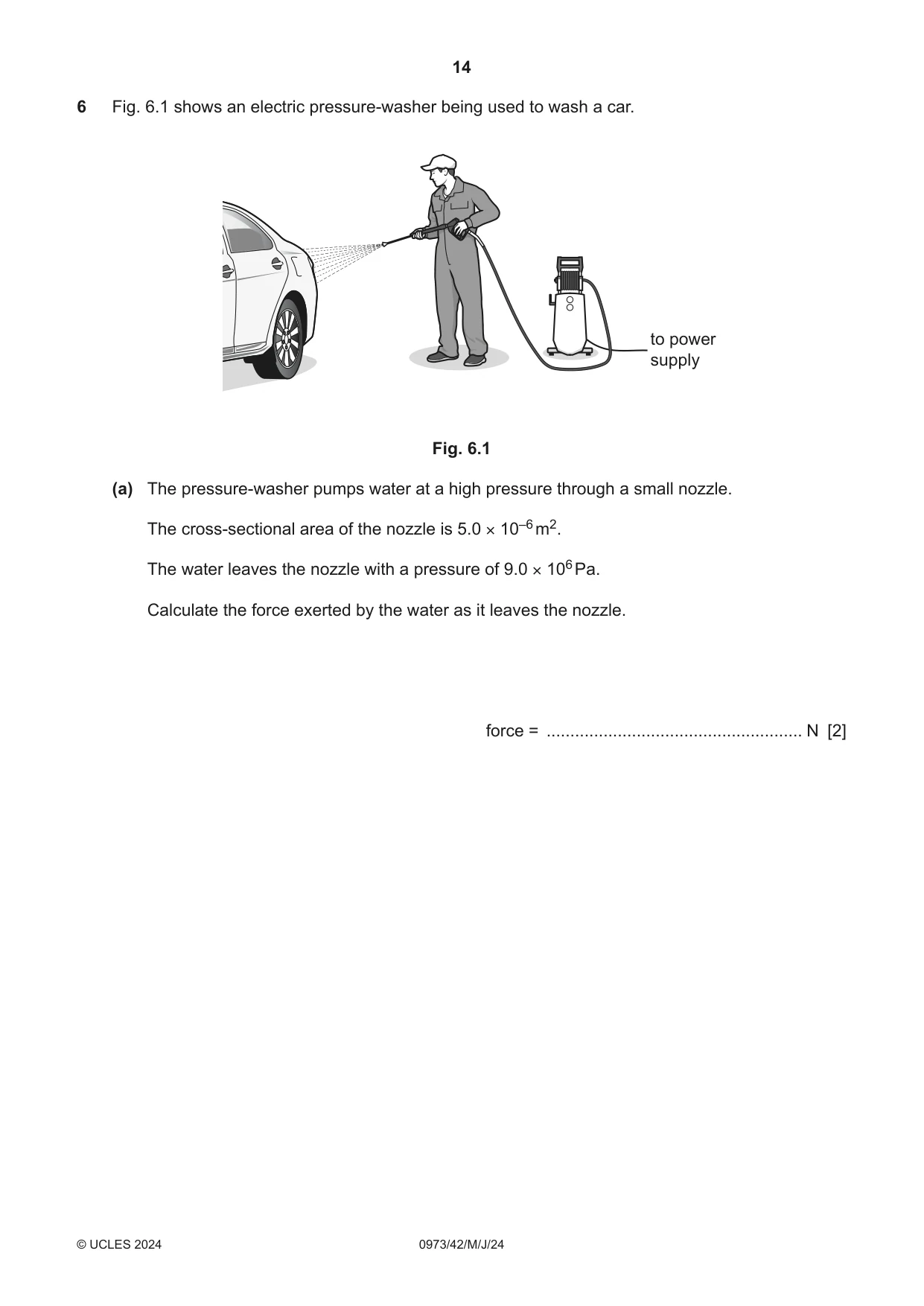
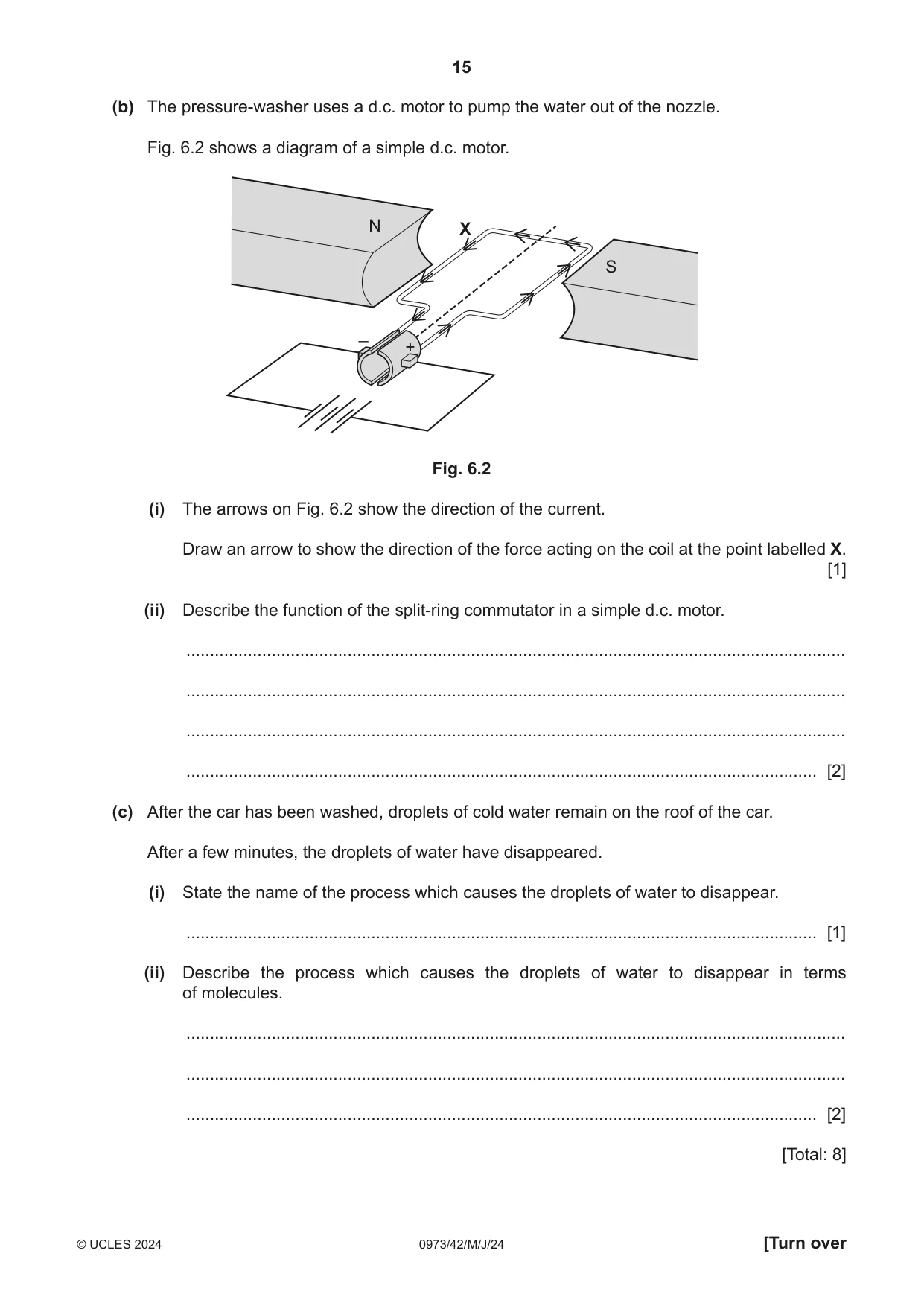
6 Fig. 6.1 shows an electric pressure‑washer being used to wash a car. to power supply Fig. 6.1 (a) The pressure‑washer pumps water at a high pressure through a small nozzle. The cross‑sectional area of the nozzle is 5.0 × 10⁻⁶ m2. The water leaves the nozzle with a pressure of 9.0 × 10⁶ Pa. Calculate the force exerted by the water as it leaves the nozzle. force = ...................................................... N [2] (b) The pressure‑washer uses a d.c. motor to pump the water out of the nozzle. Fig. 6.2 shows a diagram of a simple d.c. motor. N X S _ + Fig. 6.2 (i) The arrows on Fig. 6.2 show the direction of the current. Draw an arrow to show the direction of the force acting on the coil at the point labelled X. [1] (ii) Describe the function of the split‑ring commutator in a simple d.c. motor. ........................................................................................................................................... ........................................................................................................................................... ........................................................................................................................................... ..................................................................................................................................... [2] (c) After the car has been washed, droplets of cold water remain on the roof of the car. After a few minutes, the droplets of water have disappeared. (i) State the name of the process which causes the droplets of water to disappear. ..................................................................................................................................... [1] (ii) Describe the process which causes the droplets of water to disappear in terms of molecules. ........................................................................................................................................... ........................................................................................................................................... ..................................................................................................................................... [2] [Total: 8]
Mark scheme: 6(a) (F=) 45 (N) ; 2 6(b)(i) arrow drawn upwards ; 1 6(b)(ii) provides an alternating current (in the coil) / current that changes direction every half-turn / to reverse the current every half turn / 180° ; allows coil to continue to turn (in the same direction) ; 2 Question Answer Marks 6(c)(i) evaporation ; 1 6(c)(ii) the most energetic molecules ; escape from the surface ; 2
Q7 · A student investigates antibiotic resistance in one strain of bacteria
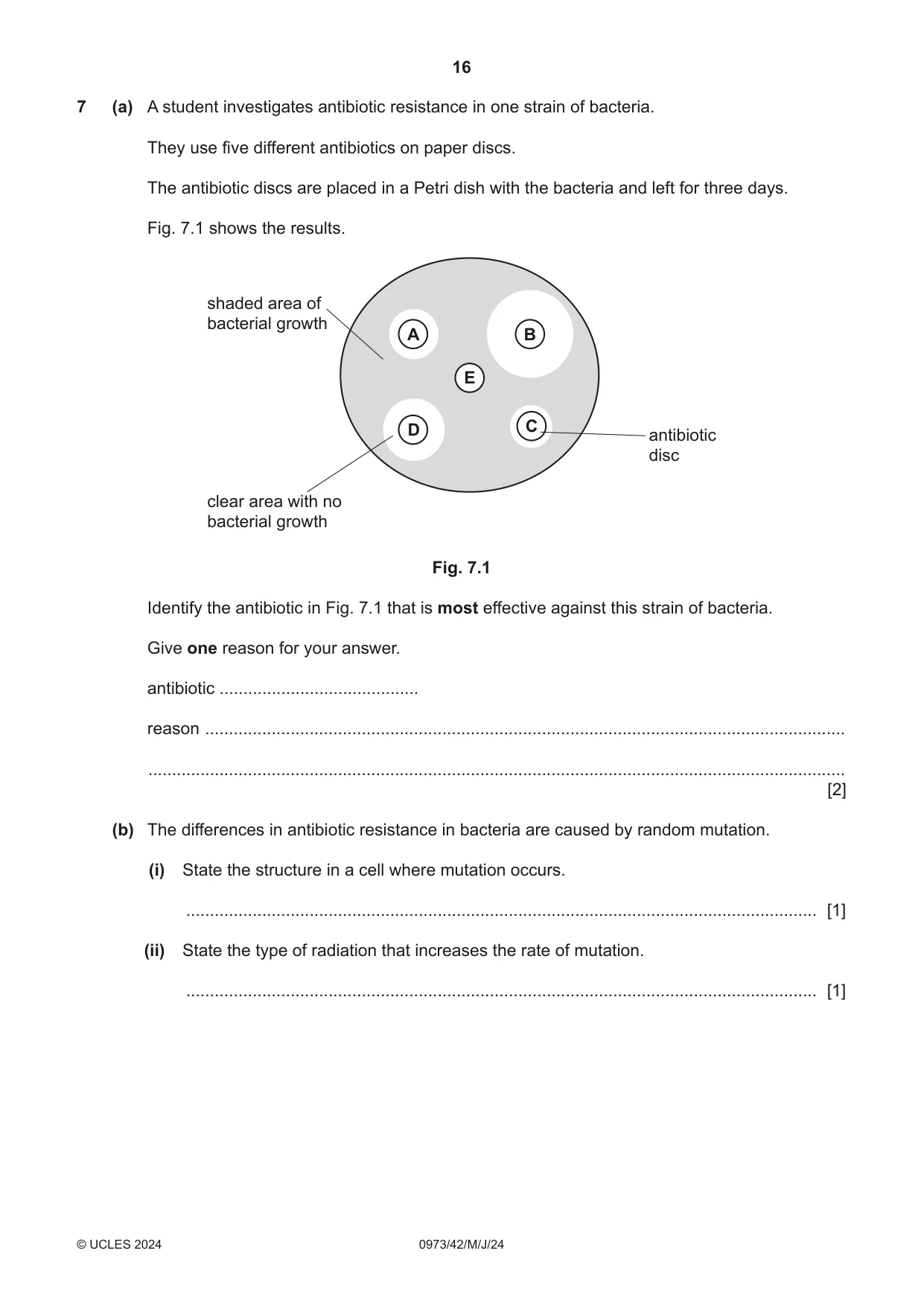
7 (a) A student investigates antibiotic resistance in one strain of bacteria. They use five different antibiotics on paper discs. The antibiotic discs are placed in a Petri dish with the bacteria and left for three days. Fig. 7.1 shows the results. shaded area of bacterial growth A B E D C antibiotic disc clear area with no bacterial growth Fig. 7.1 Identify the antibiotic in Fig. 7.1 that is most effective against this strain of bacteria. Give one reason for your answer. antibiotic .......................................... reason ....................................................................................................................................... ................................................................................................................................................... [2] (b) The differences in antibiotic resistance in bacteria are caused by random mutation. (i) State the structure in a cell where mutation occurs. ..................................................................................................................................... [1] (ii) State the type of radiation that increases the rate of mutation. ..................................................................................................................................... [1] (c) Explain why the development of antibiotic resistance in bacteria is an example of evolution. ................................................................................................................................................... ................................................................................................................................................... ................................................................................................................................................... ................................................................................................................................................... ............................................................................................................................................. [2] [Total: 6]
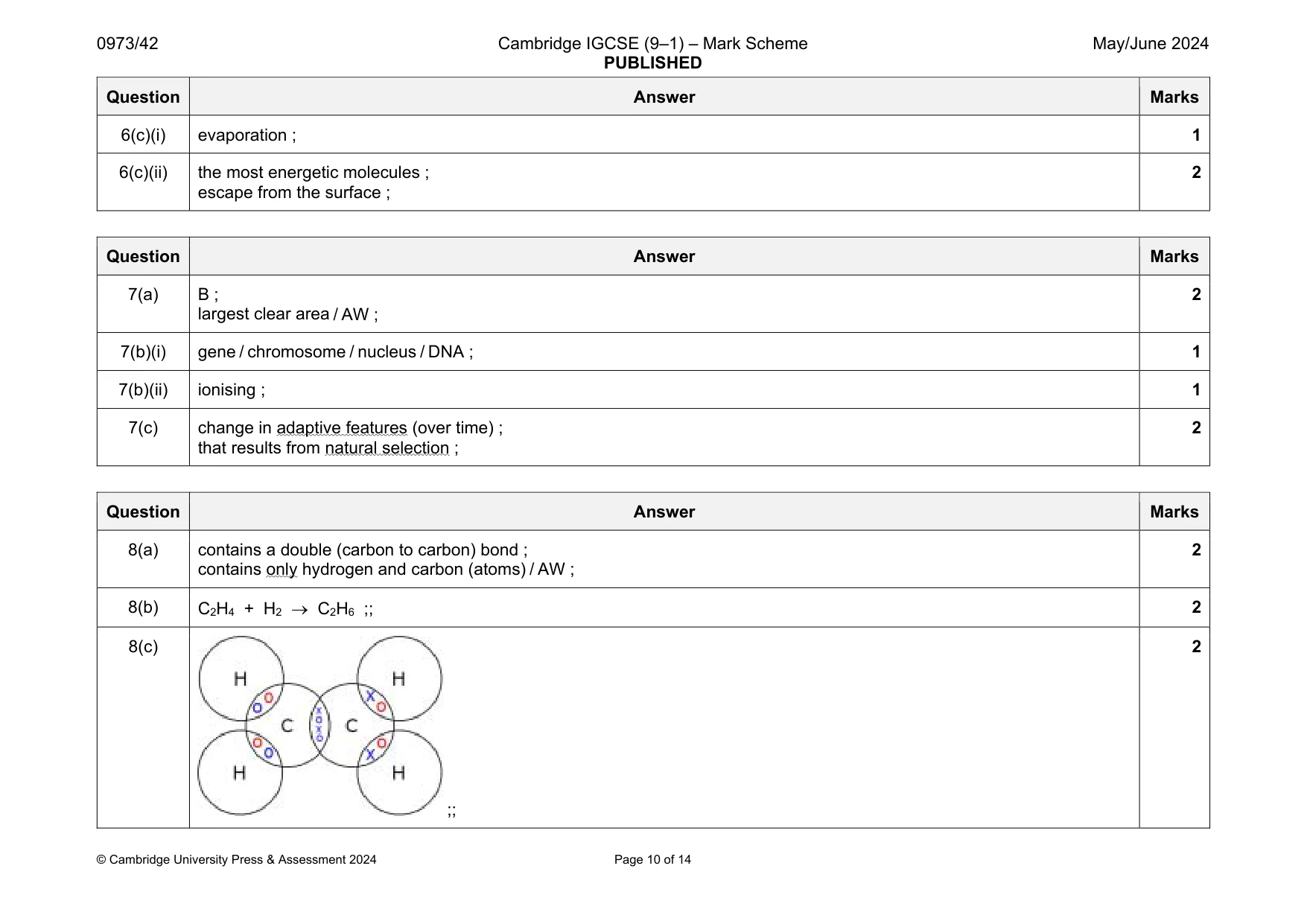
Mark scheme: 7(a) B ; largest clear area / AW ; 2 7(b)(i) gene / chromosome / nucleus / DNA ; 1 7(b)(ii) ionising ; 1 7(c) change in adaptive features (over time) ; that results from natural selection ; 2
Q8 · The structures of three carbon compounds
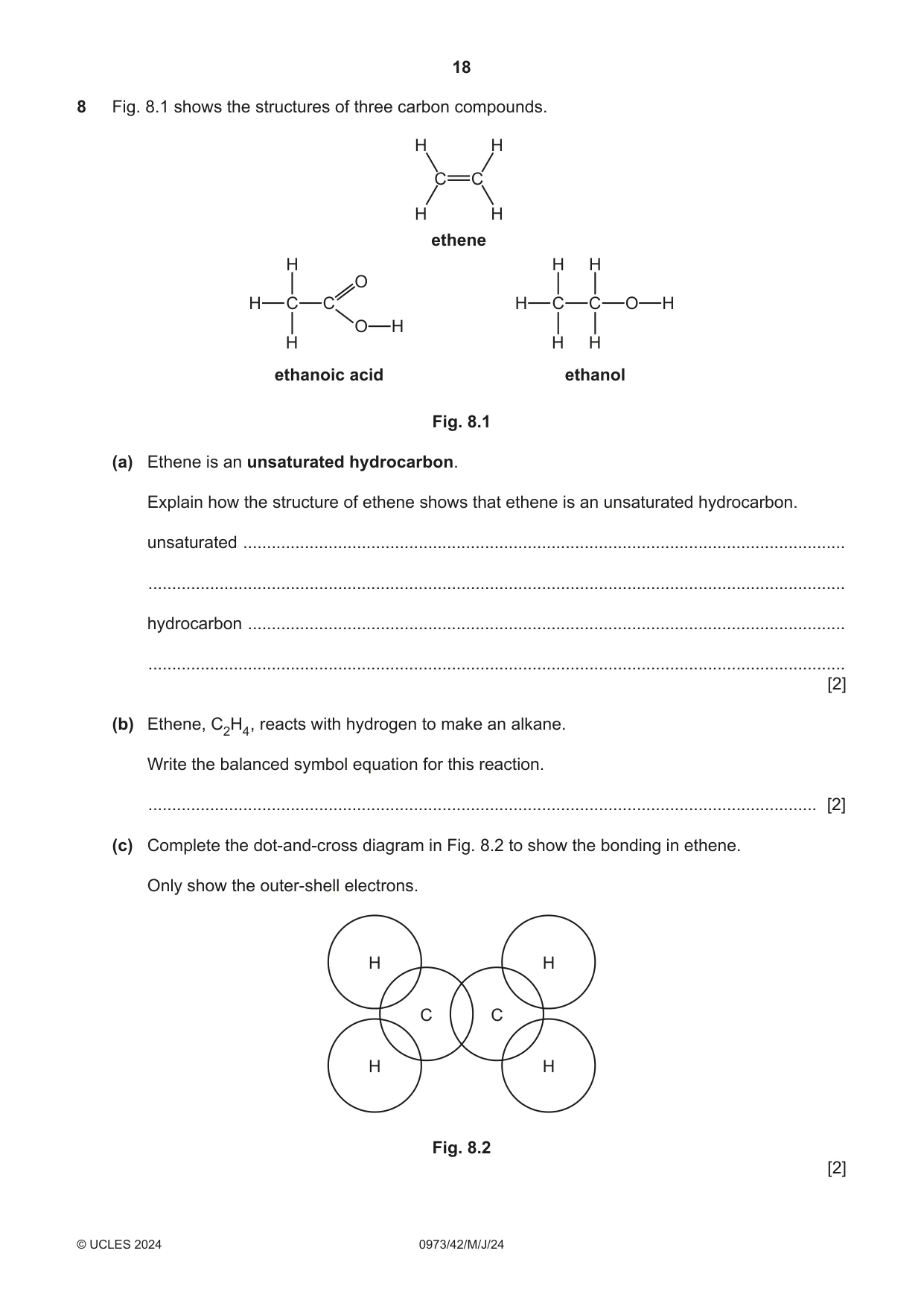
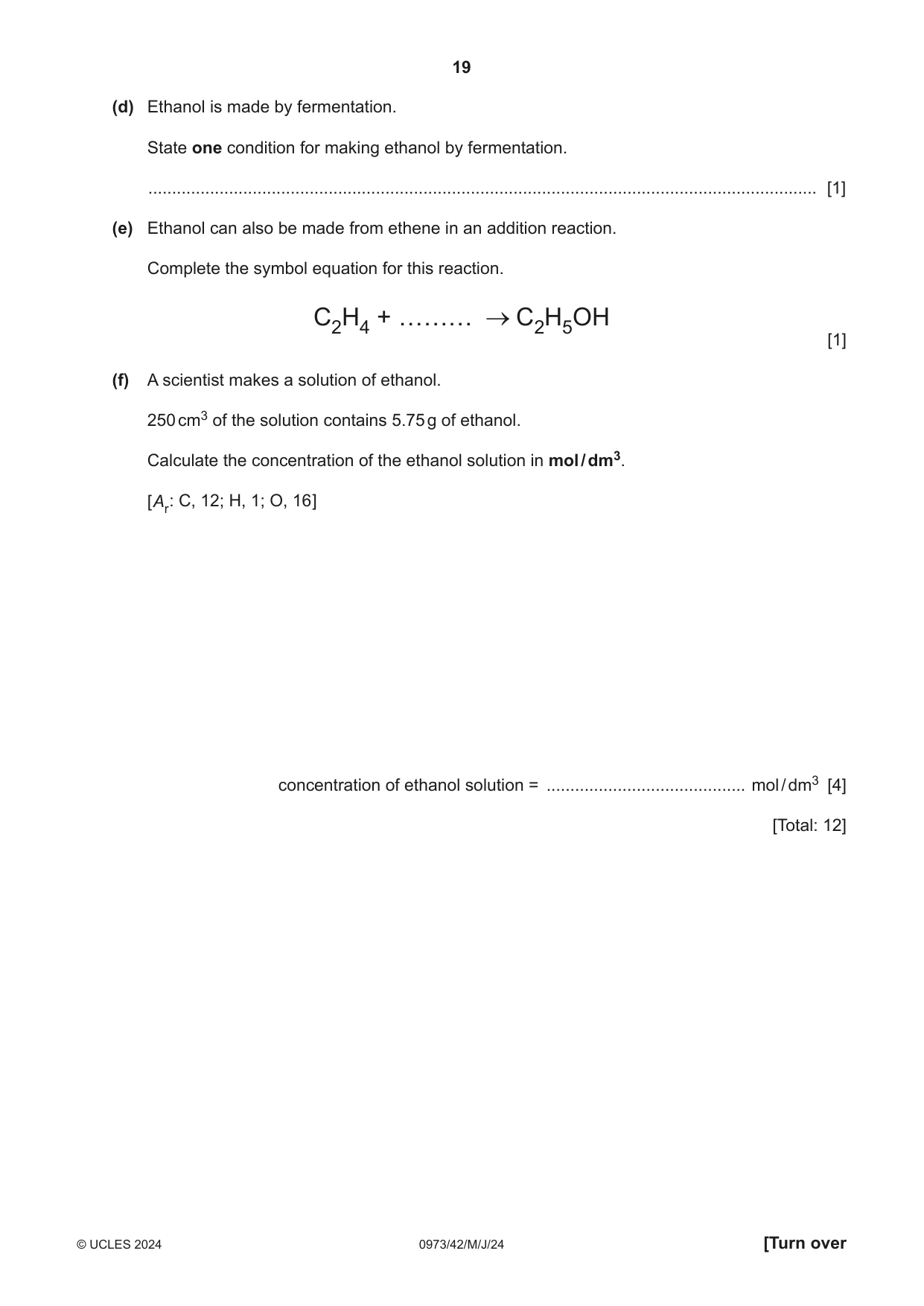
8 Fig. 8.1 shows the structures of three carbon compounds. H H C C H H ethene H H H O H C C H C C O H O H H H H ethanoic acid ethanol Fig. 8.1 (a) Ethene is an unsaturated hydrocarbon. Explain how the structure of ethene shows that ethene is an unsaturated hydrocarbon. unsaturated ............................................................................................................................... ................................................................................................................................................... hydrocarbon .............................................................................................................................. ................................................................................................................................................... [2] (b) Ethene, C2H4, reacts with hydrogen to make an alkane. Write the balanced symbol equation for this reaction. ............................................................................................................................................. [2] (c) Complete the dot‑and‑cross diagram in Fig. 8.2 to show the bonding in ethene. Only show the outer‑shell electrons. H H C C H H Fig. 8.2 [2] (d) Ethanol is made by fermentation. State one condition for making ethanol by fermentation. ............................................................................................................................................. [1] (e) Ethanol can also be made from ethene in an addition reaction. Complete the symbol equation for this reaction. C2H4 + ……… C2H5OH [1] (f) A scientist makes a solution of ethanol. 250 cm3 of the solution contains 5.75 g of ethanol. Calculate the concentration of the ethanol solution in mol / dm3. [Ar: C, 12; H, 1; O, 16] concentration of ethanol solution = .......................................... mol / dm3 [4] [Total: 12]
Mark scheme: 8(a) contains a double (carbon to carbon) bond ; contains only hydrogen and carbon (atoms) / AW ; 2 8(b) C2H4 + H2 C2H6 ;; 2 8(c) ;; 2 Question Answer Marks 8(d) absence of air / no oxygen / anaerobic / yeast / sugar or glucose / water / warm temperature ; 1 8(e) H2O ; 1 8(f) (Mr of C2H5OH) = 46 ; (moles of C2H5OH) = 5.75 ÷ 46 = 0.125 ; 250 cm3 = 250 ÷ 1000 = 0.250 dm3 ; (concentration of C2H5OH) = 0.125 ÷ 0.25 = 0.5 mol / dm³ ; 4
Q9 · The element strontium has many naturally occurring isotopes, some of which are unstable
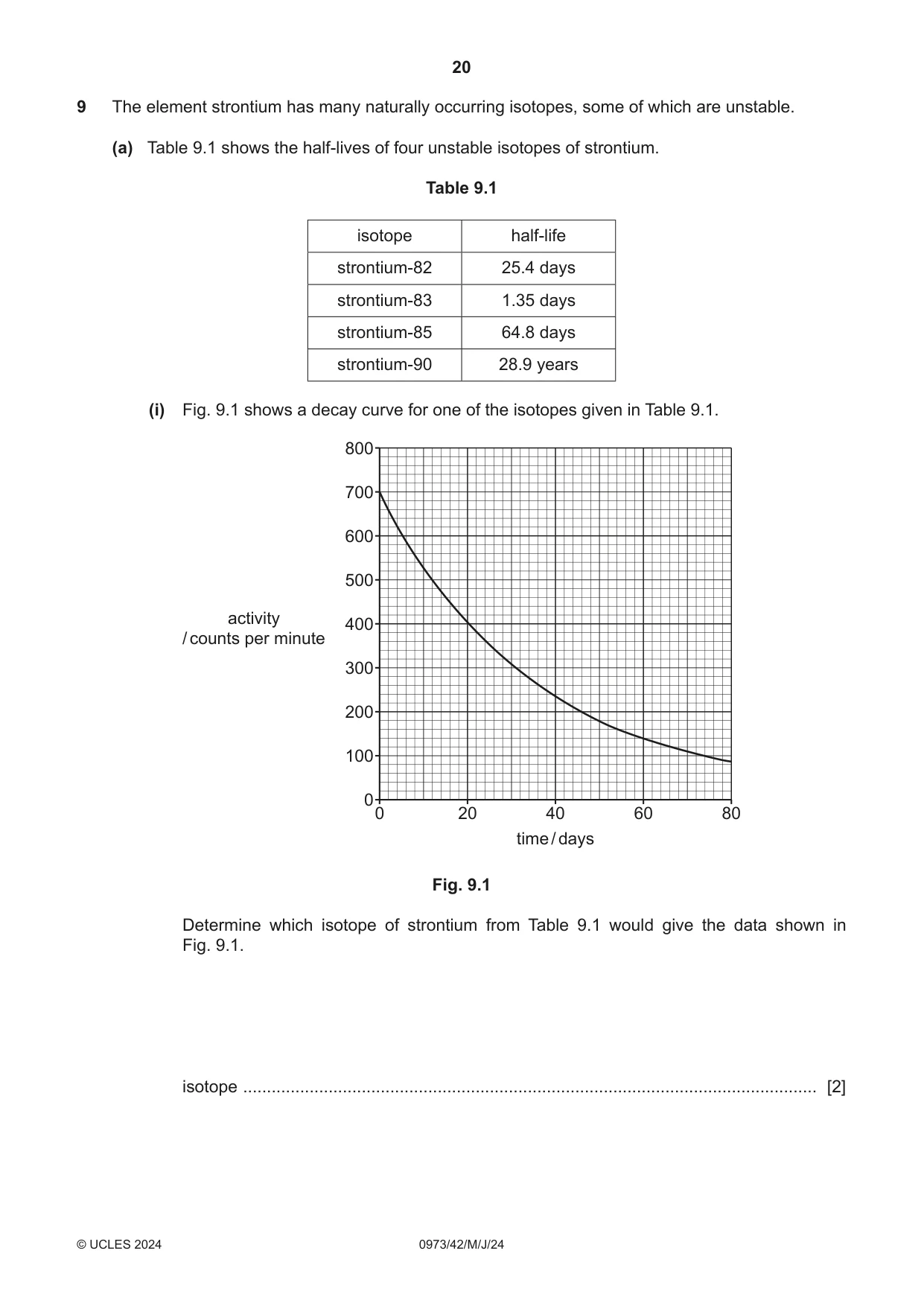
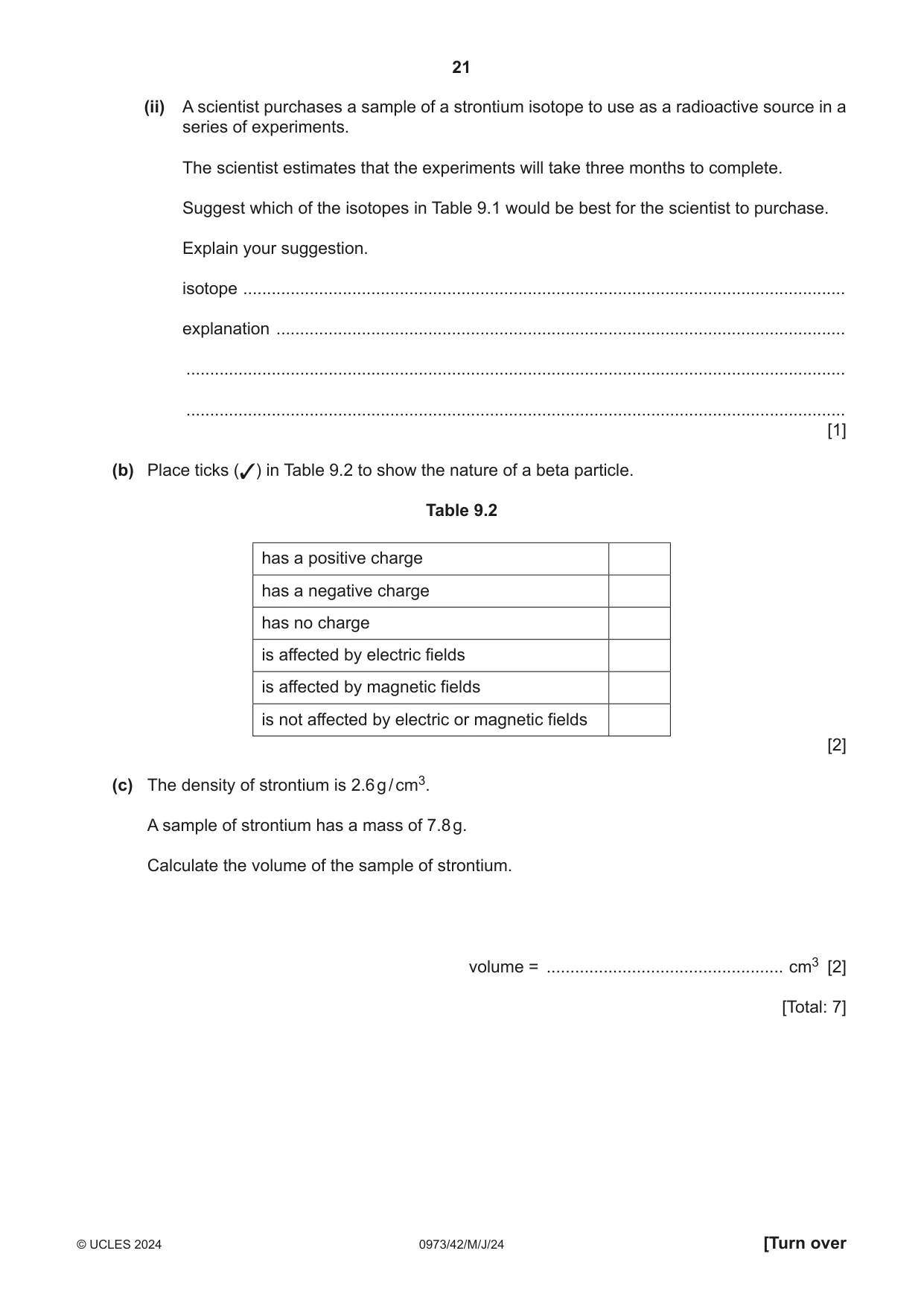
9 The element strontium has many naturally occurring isotopes, some of which are unstable. (a) Table 9.1 shows the half‑lives of four unstable isotopes of strontium. Table 9.1 isotope half‑life strontium‑82 25.4 days strontium‑83 1.35 days strontium‑85 64.8 days strontium‑90 28.9 years (i) Fig. 9.1 shows a decay curve for one of the isotopes given in Table 9.1. 800 700 600 500 activity 400 / counts per minute 300 200 100 0 0 20 40 60 80 time / days Fig. 9.1 Determine which isotope of strontium from Table 9.1 would give the data shown in Fig. 9.1. isotope ......................................................................................................................... [2] (ii) A scientist purchases a sample of a strontium isotope to use as a radioactive source in a series of experiments. The scientist estimates that the experiments will take three months to complete. Suggest which of the isotopes in Table 9.1 would be best for the scientist to purchase. Explain your suggestion. isotope ............................................................................................................................... explanation ........................................................................................................................ ........................................................................................................................................... ........................................................................................................................................... [1] (b) Place ticks (✓) in Table 9.2 to show the nature of a beta particle. Table 9.2 has a positive charge has a negative charge has no charge is affected by electric fields is affected by magnetic fields is not affected by electric or magnetic fields [2] (c) The density of strontium is 2.6 g / cm3. A sample of strontium has a mass of 7.8 g. Calculate the volume of the sample of strontium. volume = .................................................. cm3 [2] [Total: 7]
Mark scheme: 9(a)(i) half-life calculated from graph ; strontium-82 ; 2 9(a)(ii) strontium-90 AND it will not need to be replaced for a long time / will last for a long time / will not run out quickly / owtte ; 1 9(b) has a negative charge ; is affected by electric fields AND is affected by magnetic fields ; 2 9(c) (V=) m / OR 7.8 / 2.6 ; (V=) 3.0 (cm3) ; 2
Q10 · Red blood cells are specialised to transport oxygen
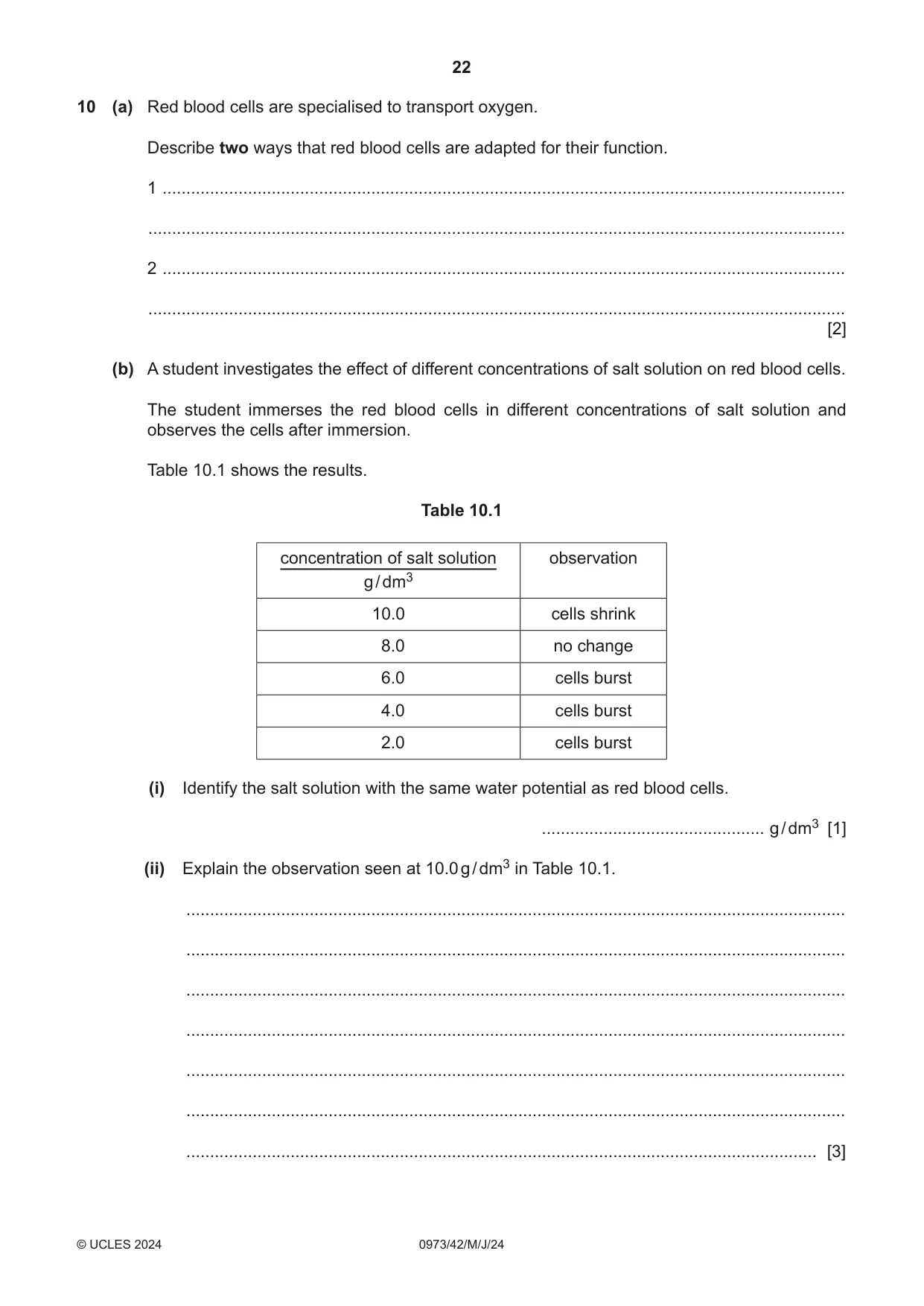
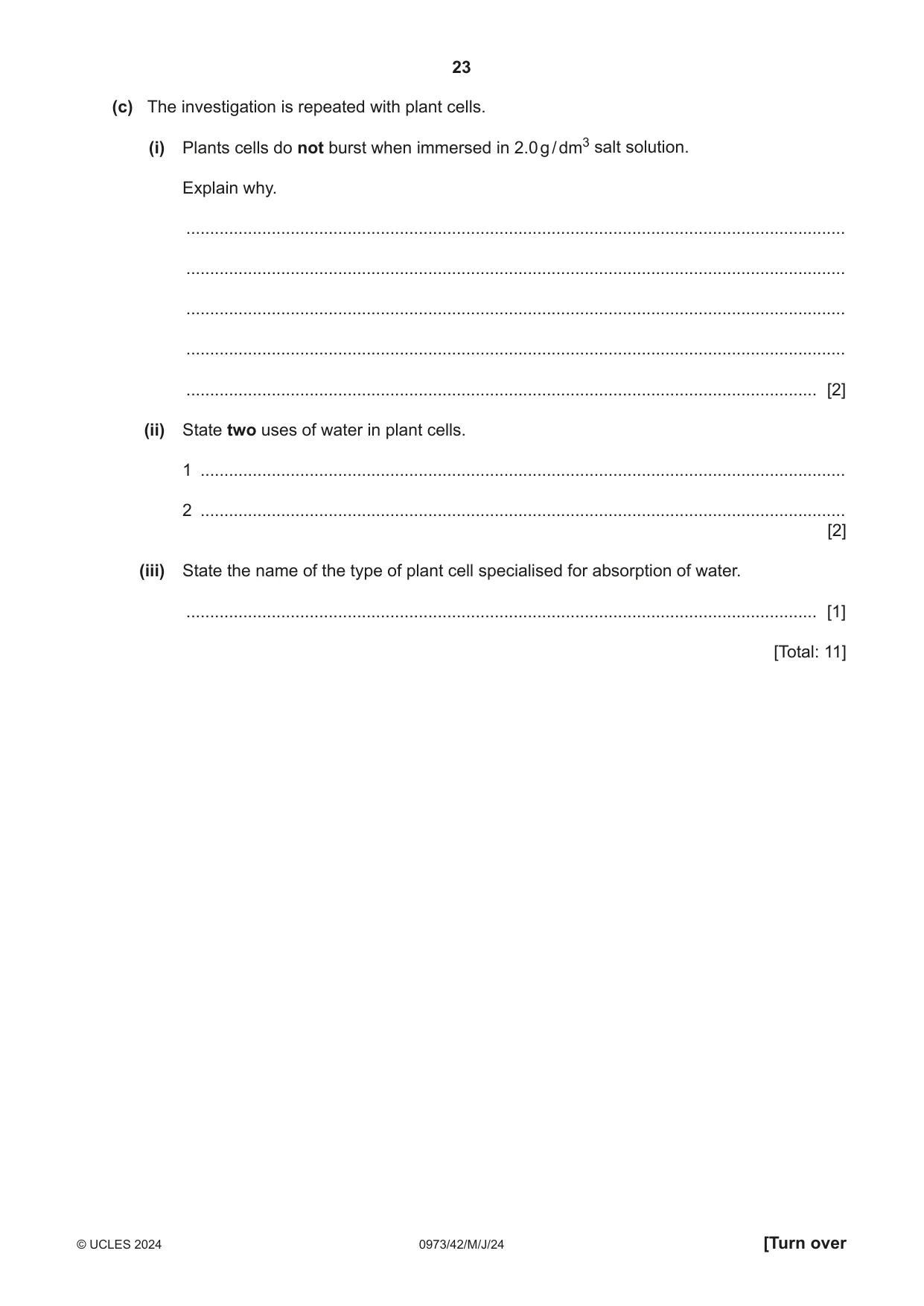
10 (a) Red blood cells are specialised to transport oxygen. Describe two ways that red blood cells are adapted for their function. 1 ................................................................................................................................................ ................................................................................................................................................... 2 ................................................................................................................................................ ................................................................................................................................................... [2] (b) A student investigates the effect of different concentrations of salt solution on red blood cells. The student immerses the red blood cells in different concentrations of salt solution and observes the cells after immersion. Table 10.1 shows the results. Table 10.1 concentration of salt solution observation g / dm3 10.0 cells shrink 8.0 no change 6.0 cells burst 4.0 cells burst 2.0 cells burst (i) Identify the salt solution with the same water potential as red blood cells. ............................................... g / dm3 [1] (ii) Explain the observation seen at 10.0 g / dm3 in Table 10.1. ........................................................................................................................................... ........................................................................................................................................... ........................................................................................................................................... ........................................................................................................................................... ........................................................................................................................................... ........................................................................................................................................... ..................................................................................................................................... [3] (c) The investigation is repeated with plant cells. (i) Plants cells do not burst when immersed in 2.0 g / dm3 salt solution. Explain why. ........................................................................................................................................... ........................................................................................................................................... ........................................................................................................................................... ........................................................................................................................................... ..................................................................................................................................... [2] (ii) State two uses of water in plant cells. 1 ........................................................................................................................................ 2 ........................................................................................................................................ [2] (iii) State the name of the type of plant cell specialised for absorption of water. ..................................................................................................................................... [1] [Total: 11]
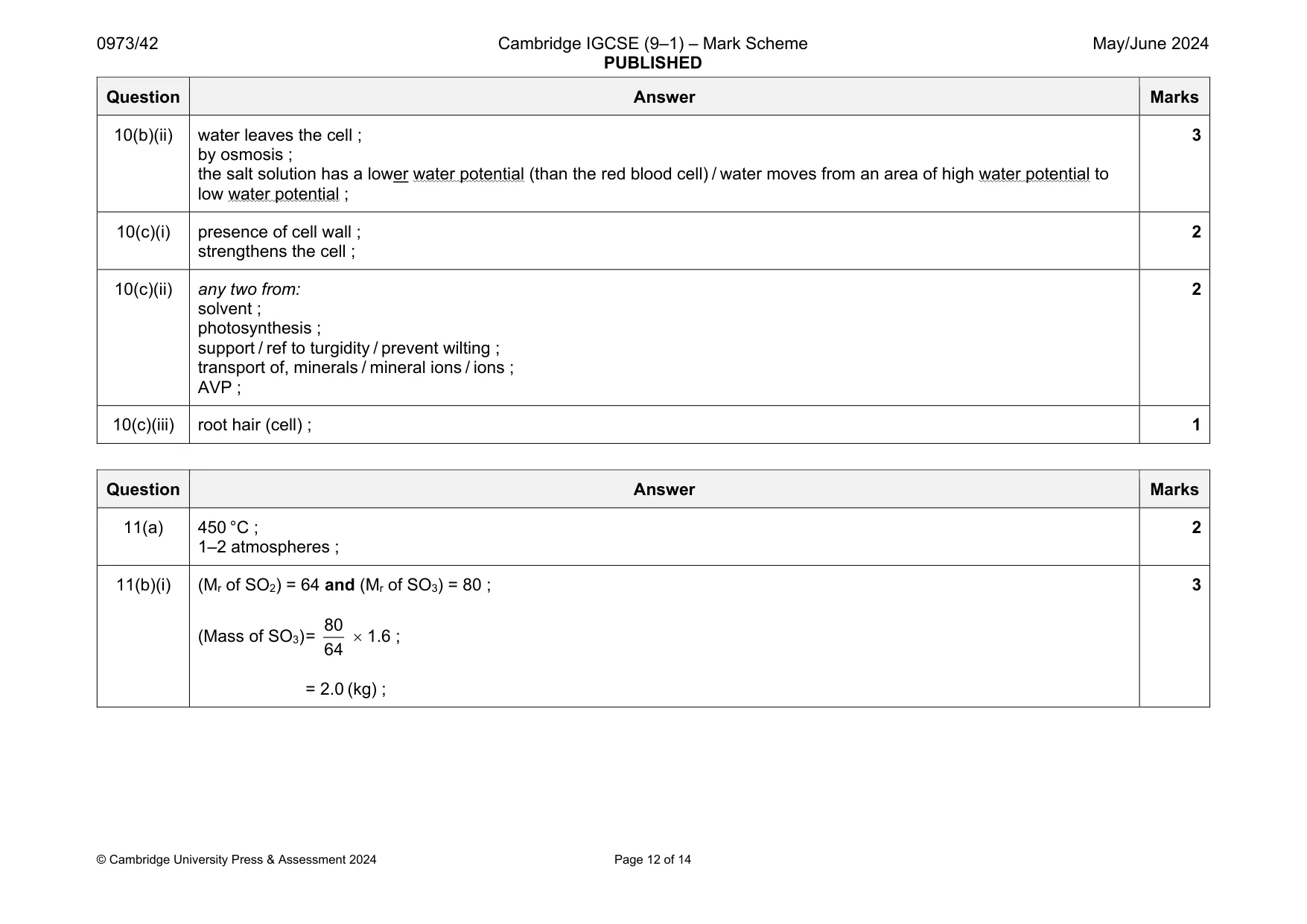
Mark scheme: 10(a) any two from: no nucleus ; large surface area / biconcave (shape) ; contains haemoglobin ; 2 10(b)(i) 8.0 (g per dm3) ; 1 Question Answer Marks 10(b)(ii) water leaves the cell ; by osmosis ; the salt solution has a lower water potential (than the red blood cell) / water moves from an area of high water potential to low water potential ; 3 10(c)(i) presence of cell wall ; strengthens the cell ; 2 10(c)(ii) any two from: solvent ; photosynthesis ; support / ref to turgidity / prevent wilting ; transport of, minerals / mineral ions / ions ; AVP ; 2 10(c)(iii) root hair (cell) ; 1
Q11 · Sulfuric acid is made by the Contact process
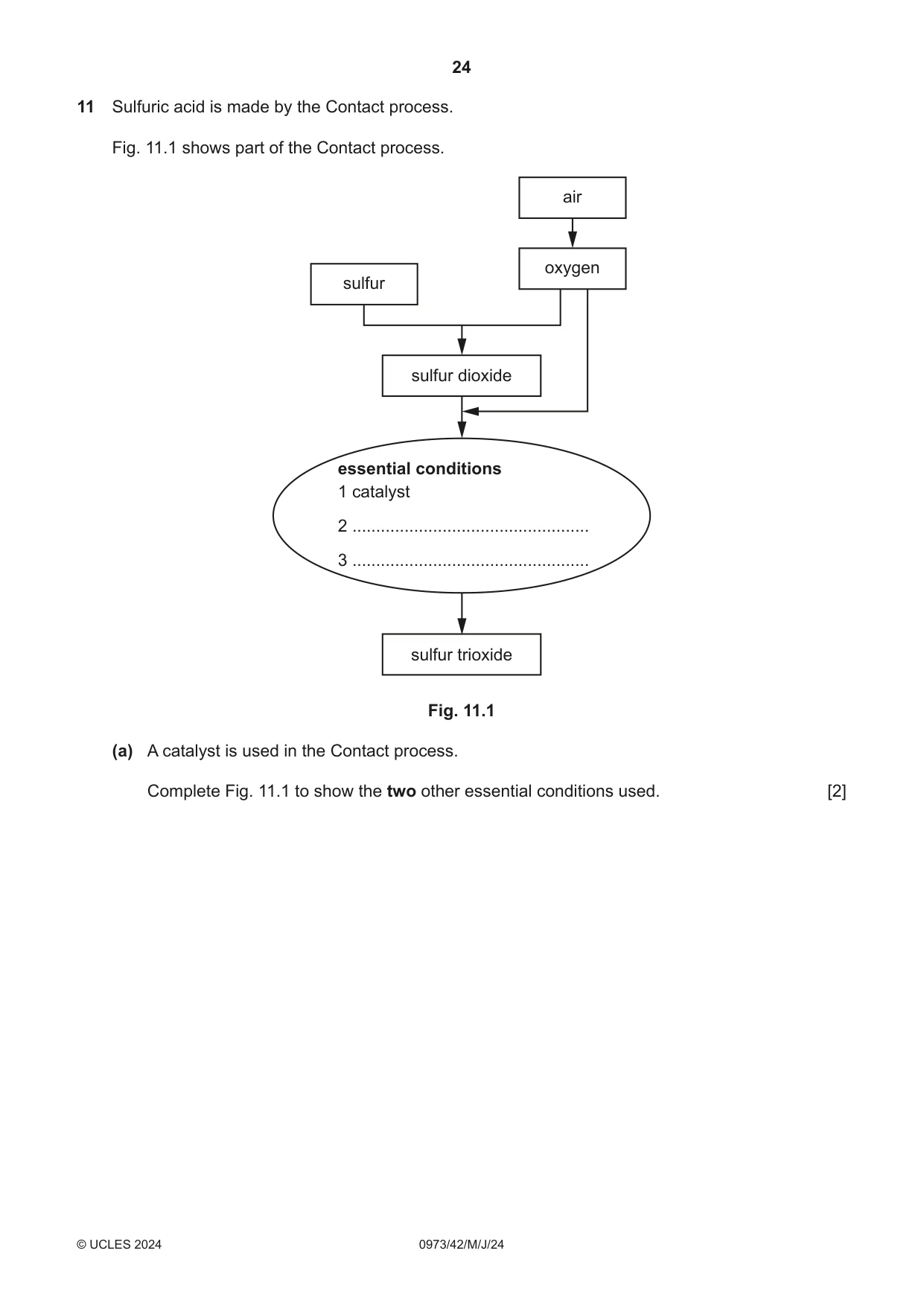
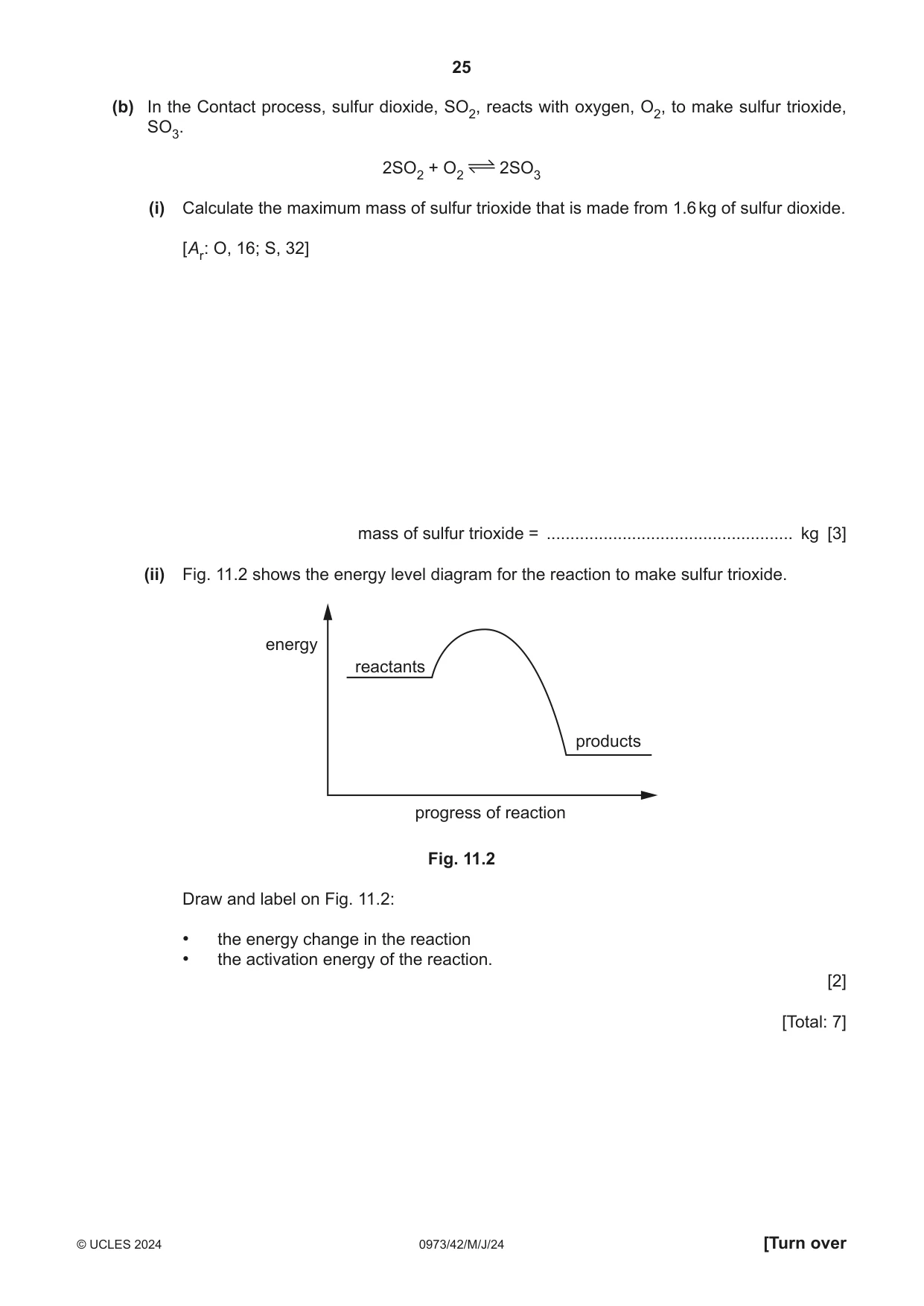
11 Sulfuric acid is made by the Contact process. Fig. 11.1 shows part of the Contact process. air oxygen sulfur sulfur dioxide essential conditions 1 catalyst 2 .................................................. 3 .................................................. sulfur trioxide Fig. 11.1 (a) A catalyst is used in the Contact process. Complete Fig. 11.1 to show the two other essential conditions used. [2] (b) In the Contact process, sulfur dioxide, SO2, reacts with oxygen, O2, to make sulfur trioxide, SO3. 2SO2 + O2 2SO3 (i) Calculate the maximum mass of sulfur trioxide that is made from 1.6 kg of sulfur dioxide. [Ar: O, 16; S, 32] mass of sulfur trioxide = .................................................... kg [3] (ii) Fig. 11.2 shows the energy level diagram for the reaction to make sulfur trioxide. energy reactants products progress of reaction Fig. 11.2 Draw and label on Fig. 11.2: • the energy change in the reaction • the activation energy of the reaction. [2] [Total: 7]
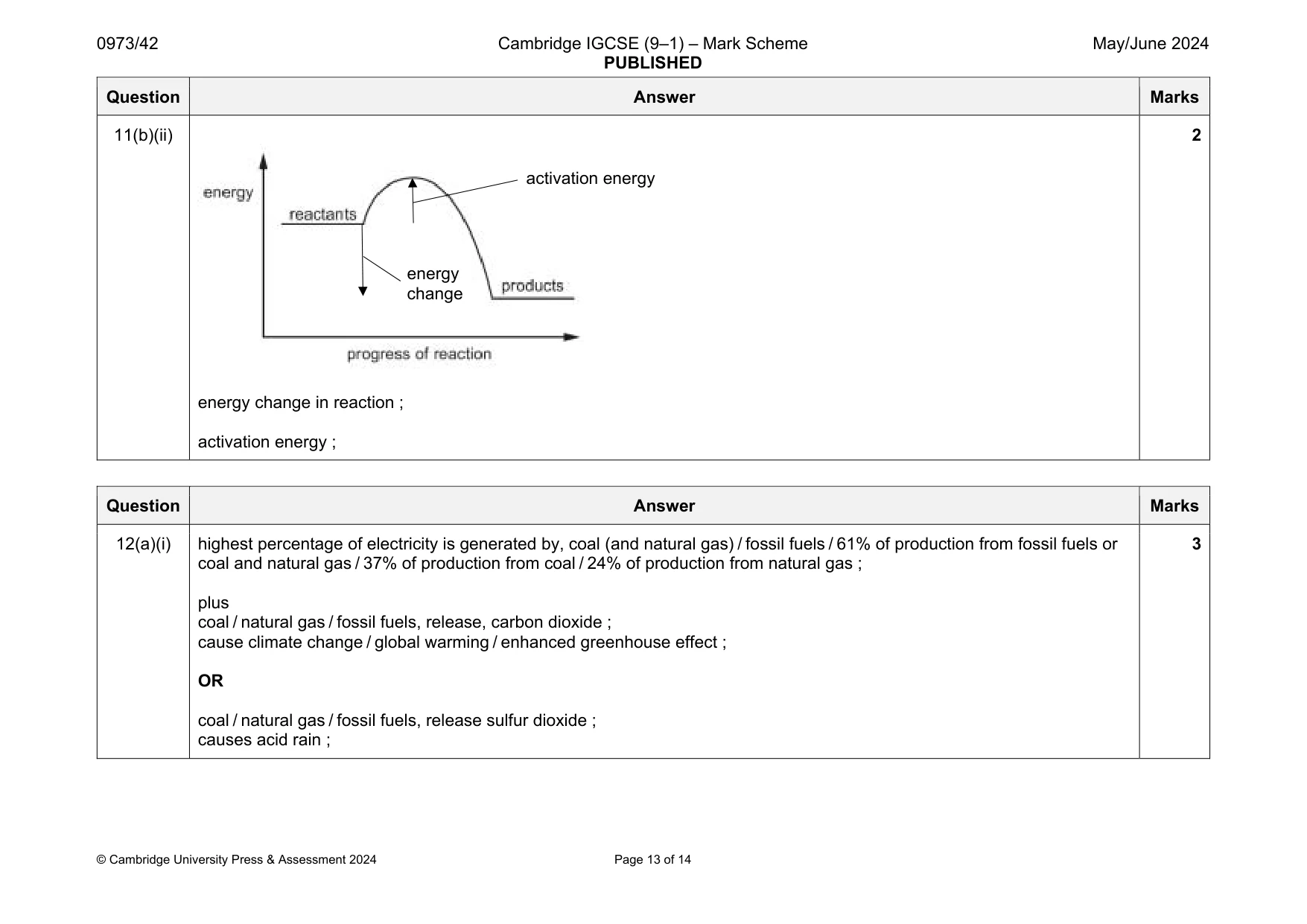
Mark scheme: 11(a) 450 °C ; 1–2 atmospheres ; 2 11(b)(i) (Mr of SO2) = 64 and (Mr of SO3) = 80 ; (Mass of SO3) = 80 64 1.6 ; = 2.0 (kg) ; 3 Question Answer Marks 11(b)(ii) energy change in reaction ; activation energy ; 2 activation energy energy change
Q12 · Electricity can be generated in different types of power stations
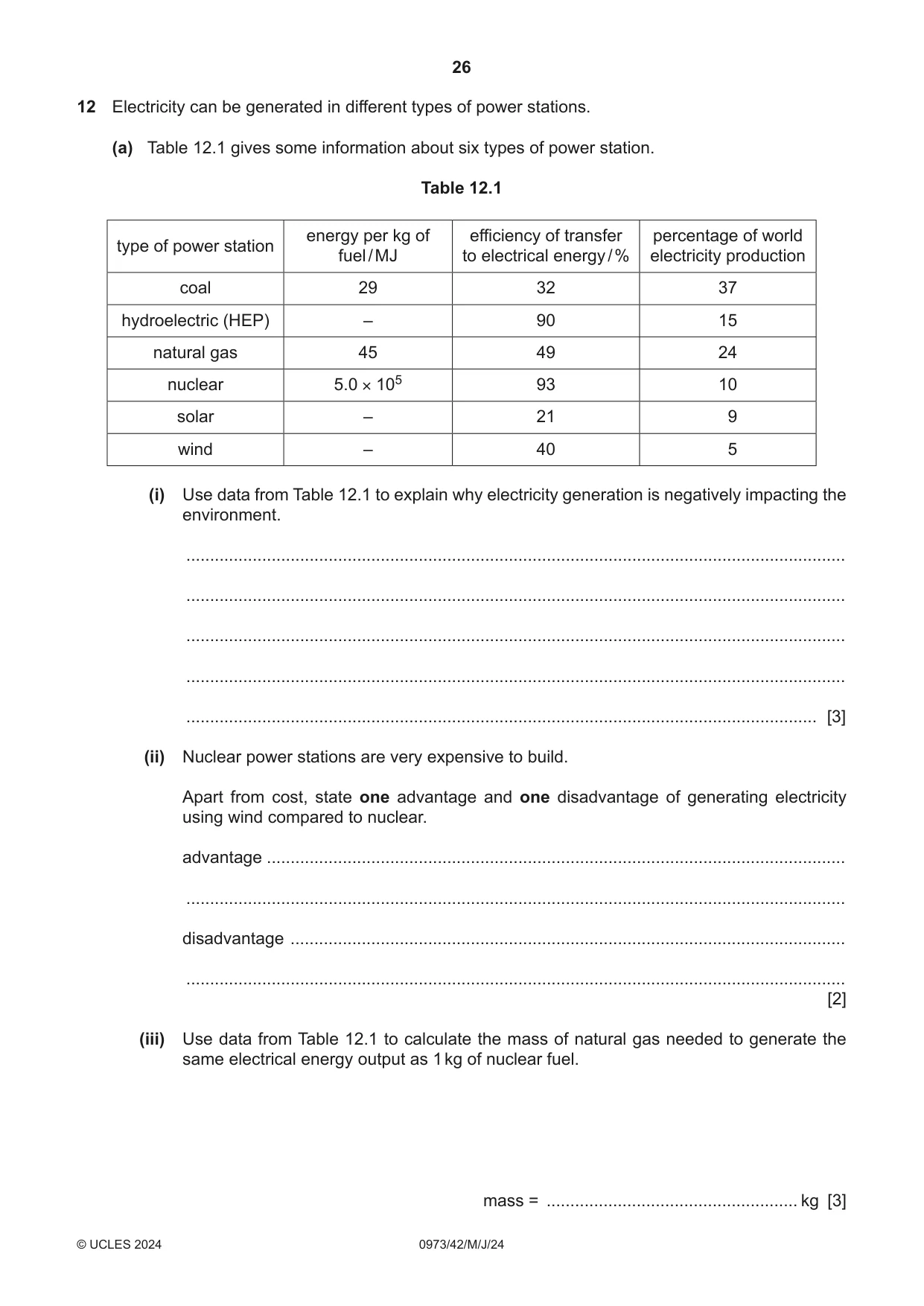
12 Electricity can be generated in different types of power stations. (a) Table 12.1 gives some information about six types of power station. Table 12.1 energy per kg of efficiency of transfer percentage of world type of power station fuel / MJ to electrical energy / % electricity production coal 29 32 37 hydroelectric (HEP) – 90 15 natural gas 45 49 24 nuclear 5.0 × 10⁵ 93 10 solar – 21 9 wind – 40 5 (i) Use data from Table 12.1 to explain why electricity generation is negatively impacting the environment. ........................................................................................................................................... ........................................................................................................................................... ........................................................................................................................................... ........................................................................................................................................... ..................................................................................................................................... [3] (ii) Nuclear power stations are very expensive to build. Apart from cost, state one advantage and one disadvantage of generating electricity using wind compared to nuclear. advantage .......................................................................................................................... ........................................................................................................................................... disadvantage ..................................................................................................................... ........................................................................................................................................... [2] (iii) Use data from Table 12.1 to calculate the mass of natural gas needed to generate the same electrical energy output as 1 kg of nuclear fuel. mass = ..................................................... kg [3] (b) A coal power station generates electricity at a voltage of 25 000 V. A transformer is used to step the voltage up to 132 000 V for transmission. (i) The step‑up transformer contains 3000 turns on the primary coil. Calculate the number of turns on the secondary coil. number of turns = ......................................................... [2] (ii) Explain why electricity is transmitted at a voltage of 132 000 V and not 25 000 V. ........................................................................................................................................... ........................................................................................................................................... ........................................................................................................................................... ..................................................................................................................................... [2] [Total: 12]
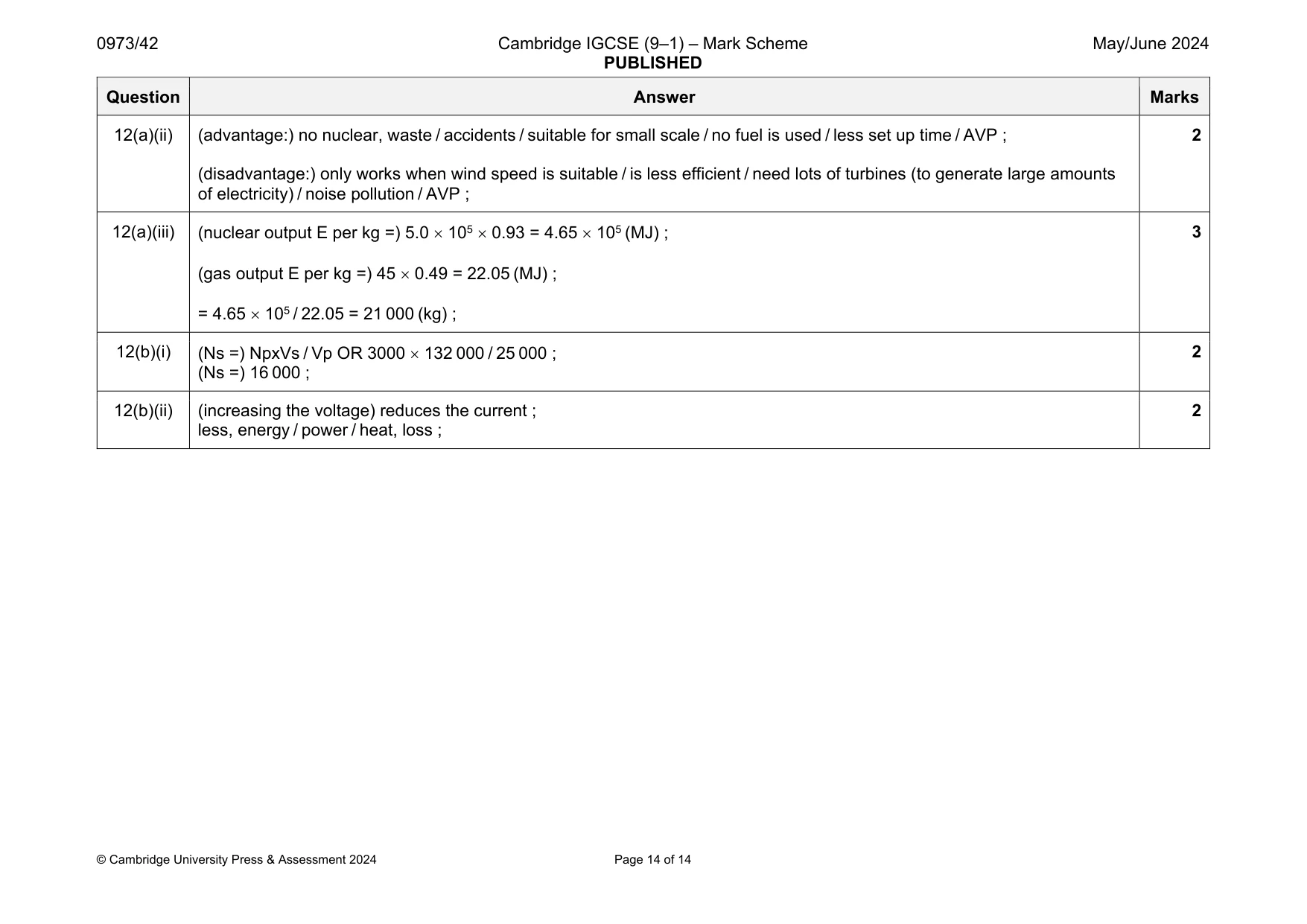
Mark scheme: 12(a)(i) highest percentage of electricity is generated by, coal (and natural gas) / fossil fuels / 61% of production from fossil fuels or coal and natural gas / 37% of production from coal / 24% of production from natural gas ; plus coal / natural gas / fossil fuels, release, carbon dioxide ; cause climate change / global warming / enhanced greenhouse effect ; OR coal / natural gas / fossil fuels, release sulfur dioxide ; causes acid rain ; Question Answer Marks 12(a)(ii) (advantage:) no nuclear, waste / accidents / suitable for small scale / no fuel is used / less set up time / AVP ; (disadvantage:) only works when wind speed is suitable / is less efficient / need lots of turbines (to generate large amounts of electricity) / noise pollution / AVP ; 2 12(a)(iii) (nuclear output E per kg =) 5.0 105 0.93 = 4.65 105 (MJ) ; (gas output E per kg =) 45 0.49 = 22.05 (MJ) ; = 4.65 105 / 22.05 = 21 000 (kg) ; 3 12(b)(i) (Ns =) NpxVs / Vp OR 3000 132 000 / 25 000 ; (Ns =) 16 000 ; 2 12(b)(ii) (increasing the voltage) reduces the current ; less, energy / power / heat, loss ; 2
What was in this paper
The subtopics covered by these 12 questions, and how many questions each got. Open one in a new tab to see every Cambridge question on it.
What you needed in this session
Cambridge’s own grade thresholds for 2024 May/June, Paper 4 · Variant 2. A higher threshold means an easier paper — the bar moves with how the cohort did.