Cambridge IGCSE Sciences - Co-ordinated (9-1) 0973 — 2019 May/June Paper 4 · Variant 2
0973/42/M/J/19 · 13 questions · 120 marks · ≈135 min
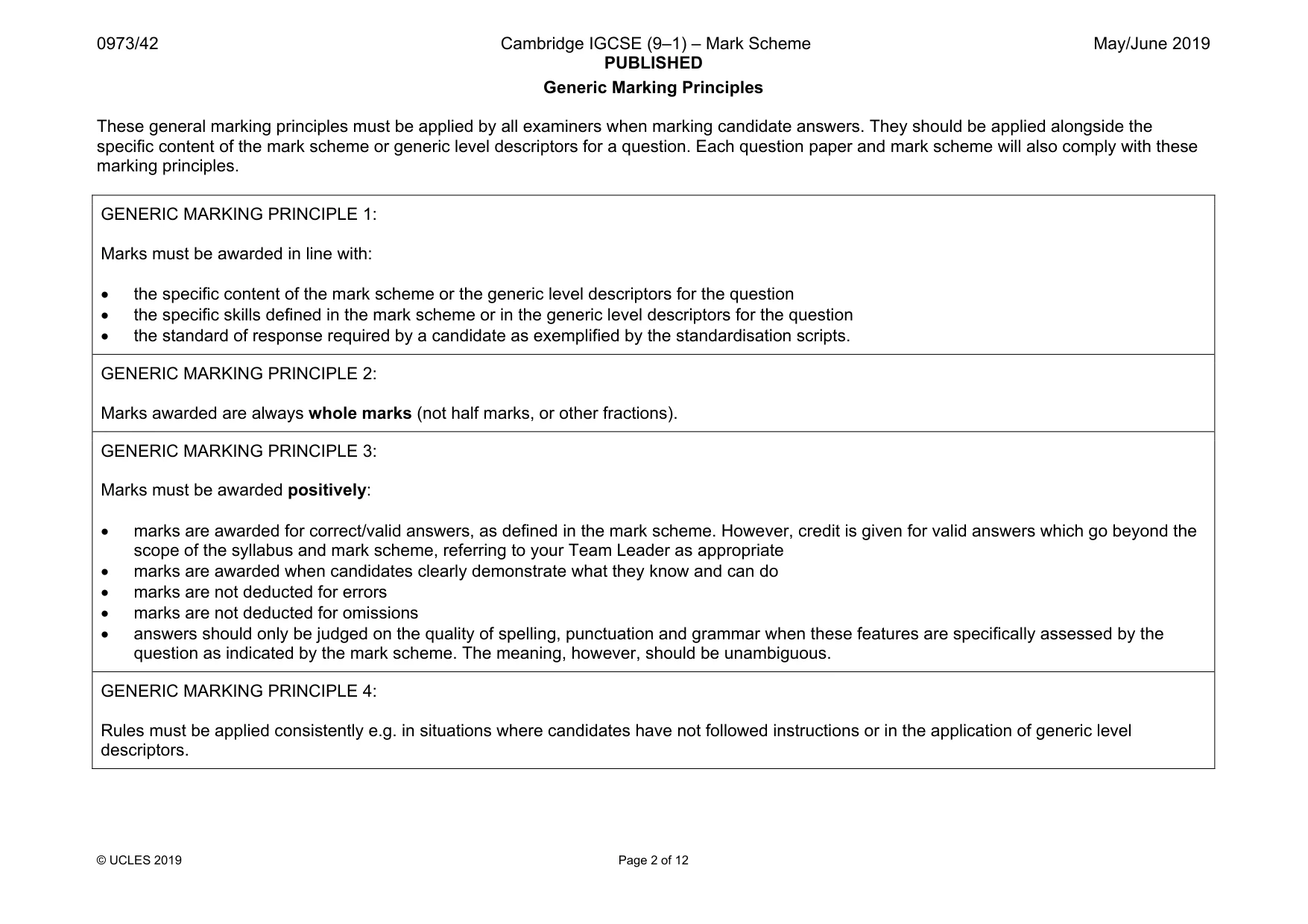
The question paper and its mark scheme, free to read here and free to download. This is Cambridge’s own paper, exactly as it was sat.
Question paper28 pages

Mark scheme12 pages
Answers below. Sit the paper first if you are practising.
Questions as text
Q1 · The graph in Fig
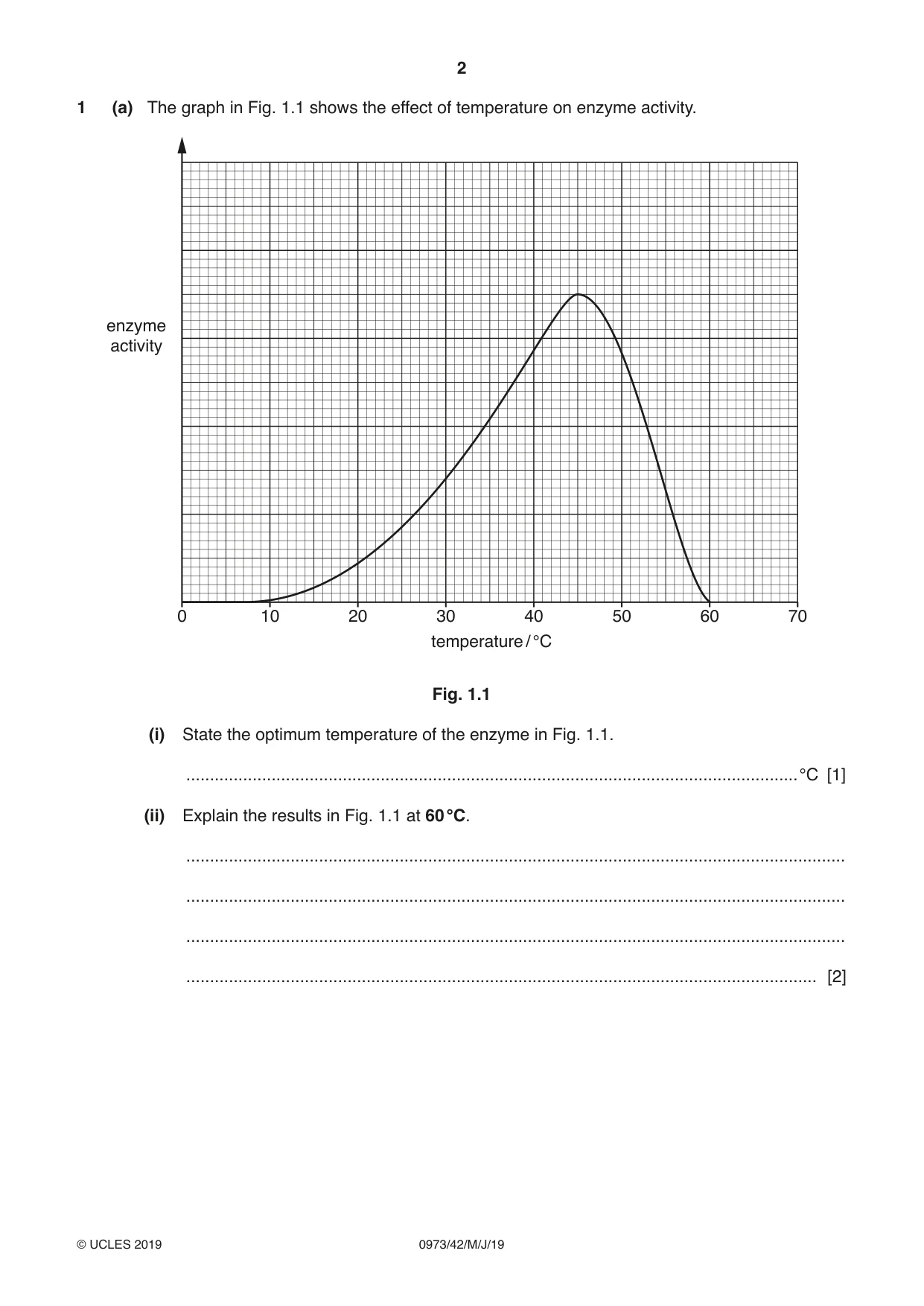
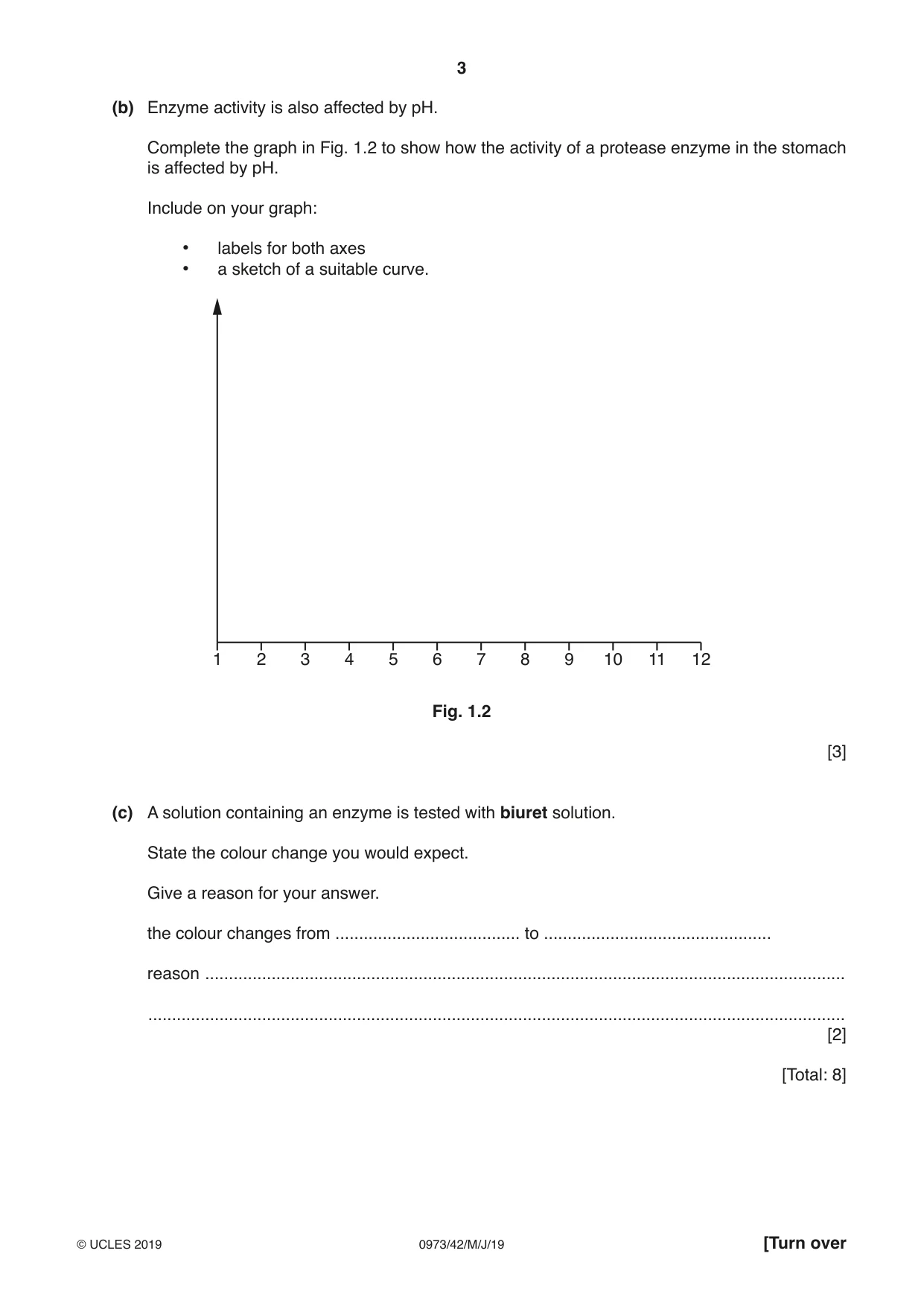
1 (a) The graph in Fig. 1.1 shows the effect of temperature on enzyme activity. enzyme activity 0 10 20 30 40 50 60 70 temperature / °C Fig. 1.1 (i) State the optimum temperature of the enzyme in Fig. 1.1. .................................................................................................................................°C [1] (ii) Explain the results in Fig. 1.1 at 60 °C. ........................................................................................................................................... ........................................................................................................................................... ........................................................................................................................................... ..................................................................................................................................... [2] (b) Enzyme activity is also affected by pH. Complete the graph in Fig. 1.2 to show how the activity of a protease enzyme in the stomach is affected by pH. Include on your graph: • labels for both axes • a sketch of a suitable curve. 1 2 3 4 5 6 7 8 9 10 11 12 Fig. 1.2 [3] (c) A solution containing an enzyme is tested with biuret solution. State the colour change you would expect. Give a reason for your answer. the colour changes from ....................................... to ................................................ reason ....................................................................................................................................... ................................................................................................................................................... [2] [Total: 8]
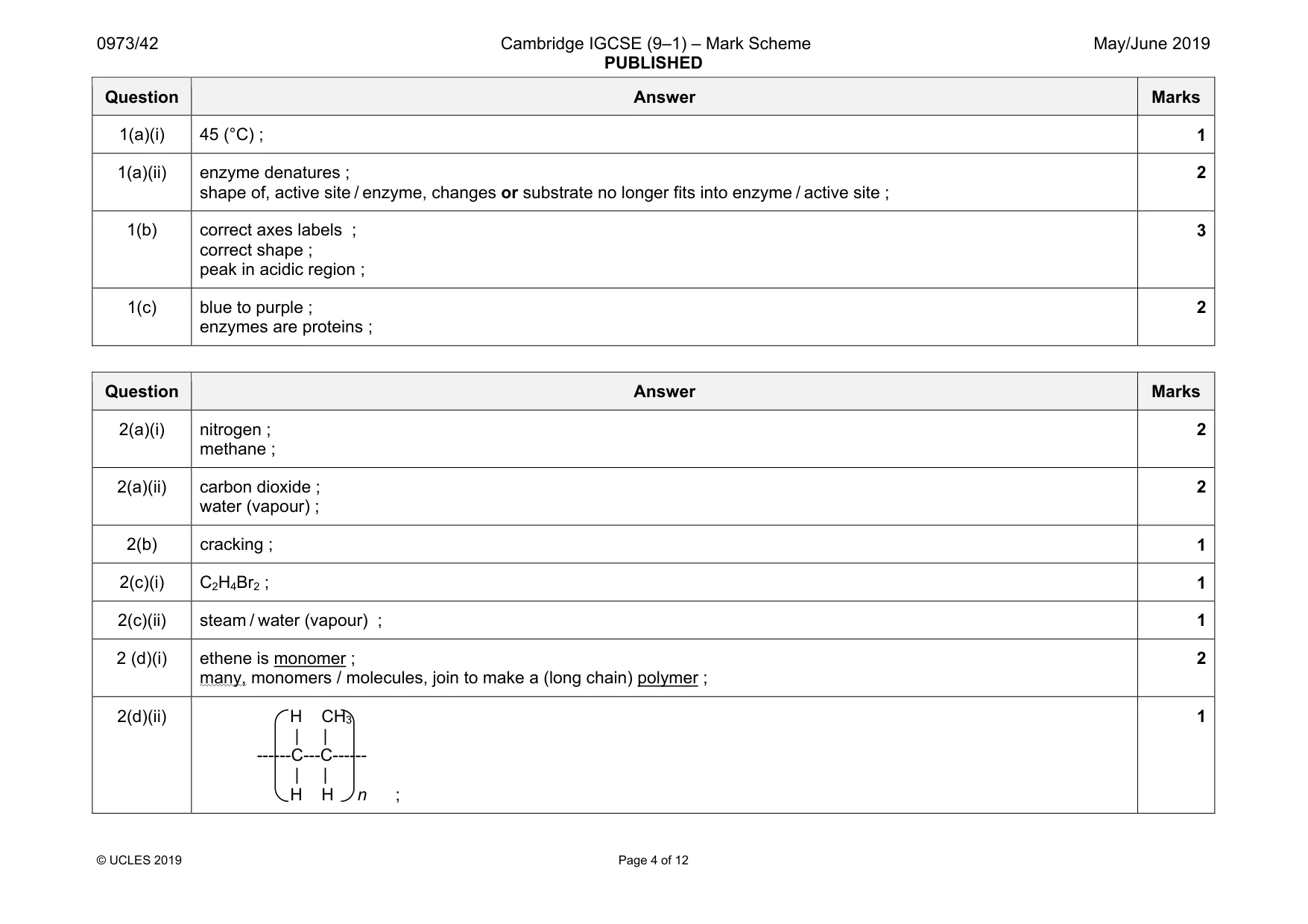
Mark scheme: 1(a)(i) 45 (°C) ; 1 1(a)(ii) enzyme denatures ; shape of, active site / enzyme, changes or substrate no longer fits into enzyme / active site ; 2 1(b) correct axes labels ; correct shape ; peak in acidic region ; 3 1(c) blue to purple ; enzymes are proteins ; 2
Q2 · The composition of clean air and of natural gas
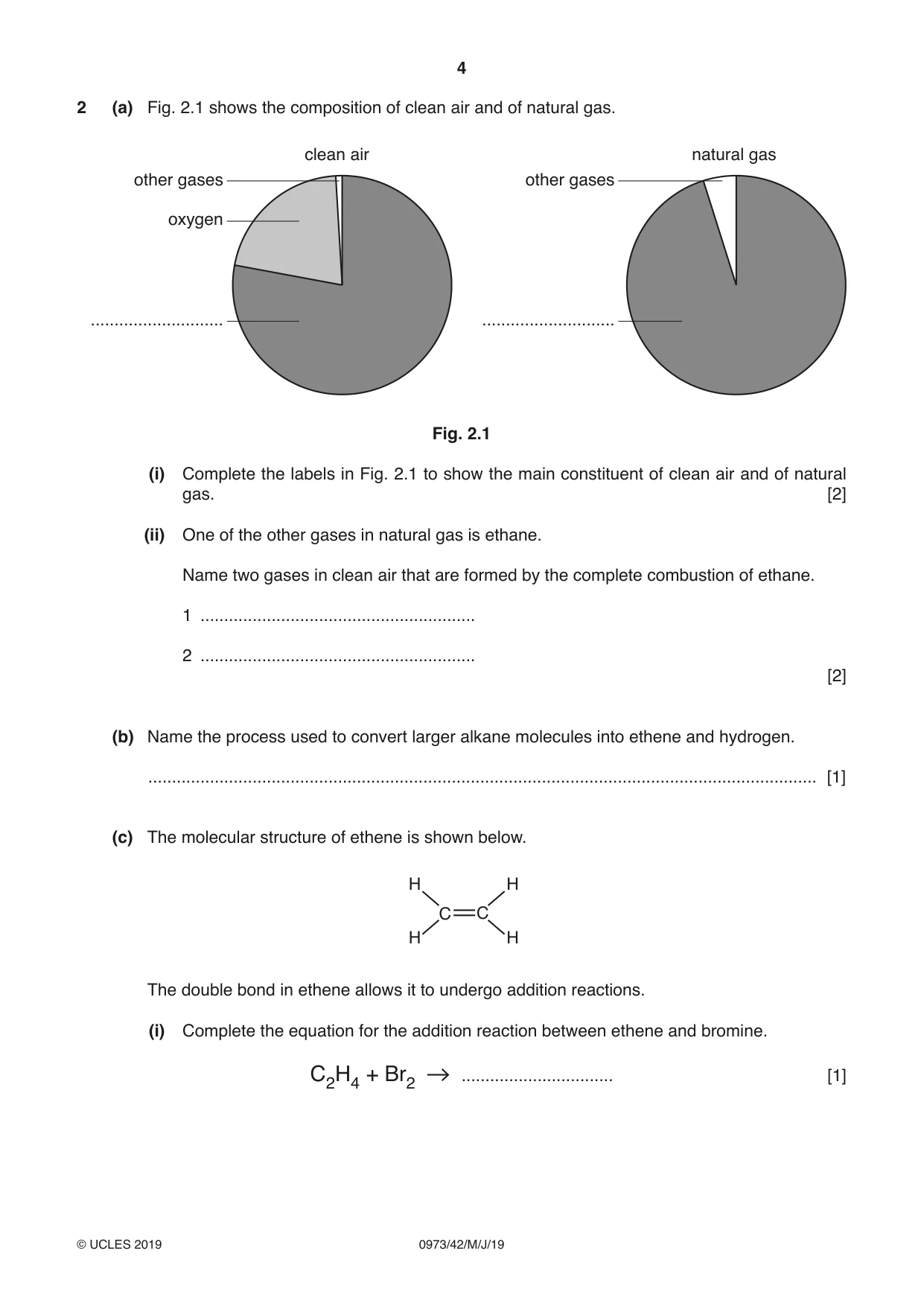
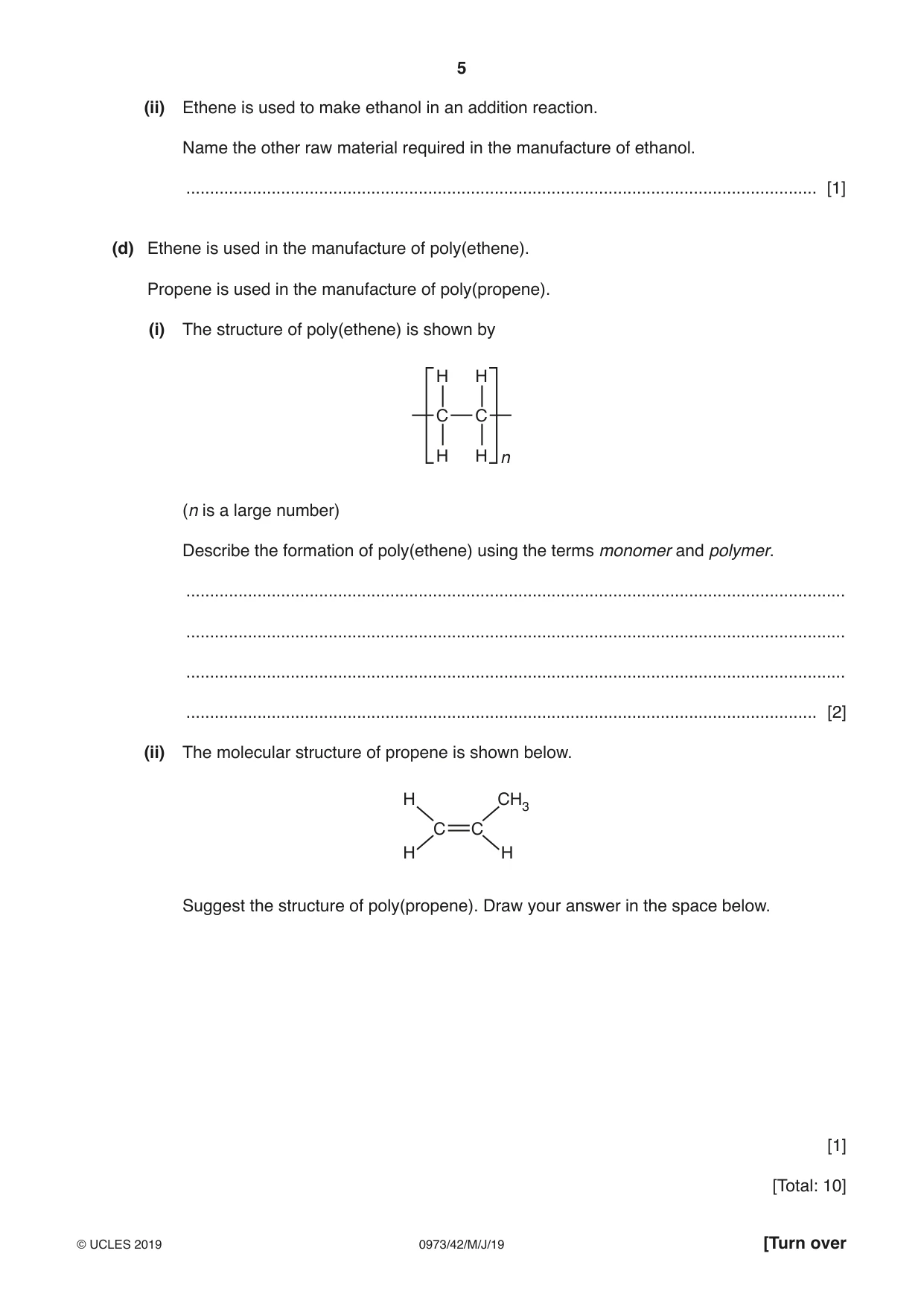
2 (a) Fig. 2.1 shows the composition of clean air and of natural gas. clean air natural gas other gases other gases oxygen ............................ ............................ Fig. 2.1 (i) Complete the labels in Fig. 2.1 to show the main constituent of clean air and of natural gas. [2] (ii) One of the other gases in natural gas is ethane. Name two gases in clean air that are formed by the complete combustion of ethane. 1 .......................................................... 2 .......................................................... [2] (b) Name the process used to convert larger alkane molecules into ethene and hydrogen. ............................................................................................................................................. [1] (c) The molecular structure of ethene is shown below. H H C C H H The double bond in ethene allows it to undergo addition reactions. (i) Complete the equation for the addition reaction between ethene and bromine. ................................ [1] C2H4 + Br2 (ii) Ethene is used to make ethanol in an addition reaction. Name the other raw material required in the manufacture of ethanol. ..................................................................................................................................... [1] (d) Ethene is used in the manufacture of poly(ethene). Propene is used in the manufacture of poly(propene). (i) The structure of poly(ethene) is shown by H H C C H H n (n is a large number) Describe the formation of poly(ethene) using the terms monomer and polymer. ........................................................................................................................................... ........................................................................................................................................... ........................................................................................................................................... ..................................................................................................................................... [2] (ii) The molecular structure of propene is shown below. H CH3 C C H H Suggest the structure of poly(propene). Draw your answer in the space below. [1] [Total: 10]
Mark scheme: 2(a)(i) nitrogen ; methane ; 2 2(a)(ii) carbon dioxide ; water (vapour) ; 2 2(b) cracking ; 1 2(c)(i) C2H4Br2 ; 1 2(c)(ii) steam / water (vapour) ; 1 2 (d)(i) ethene is monomer ; many, monomers / molecules, join to make a (long chain) polymer ; 2 2(d)(ii) H CH3 | | ------C---C------ | | H H n ; 1
Q3 · In 1971, an astronaut hit a golf ball on the surface of the Moon
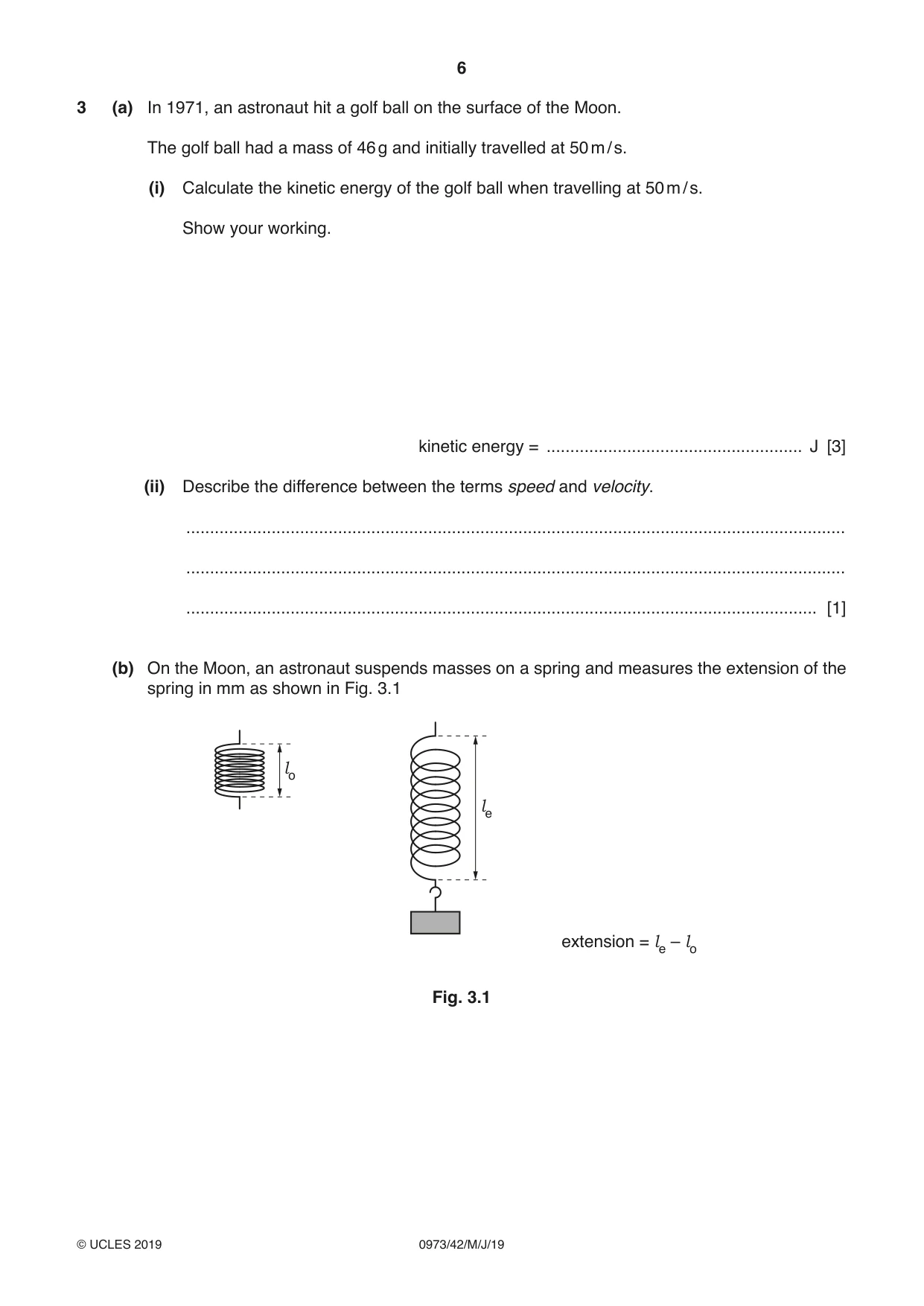
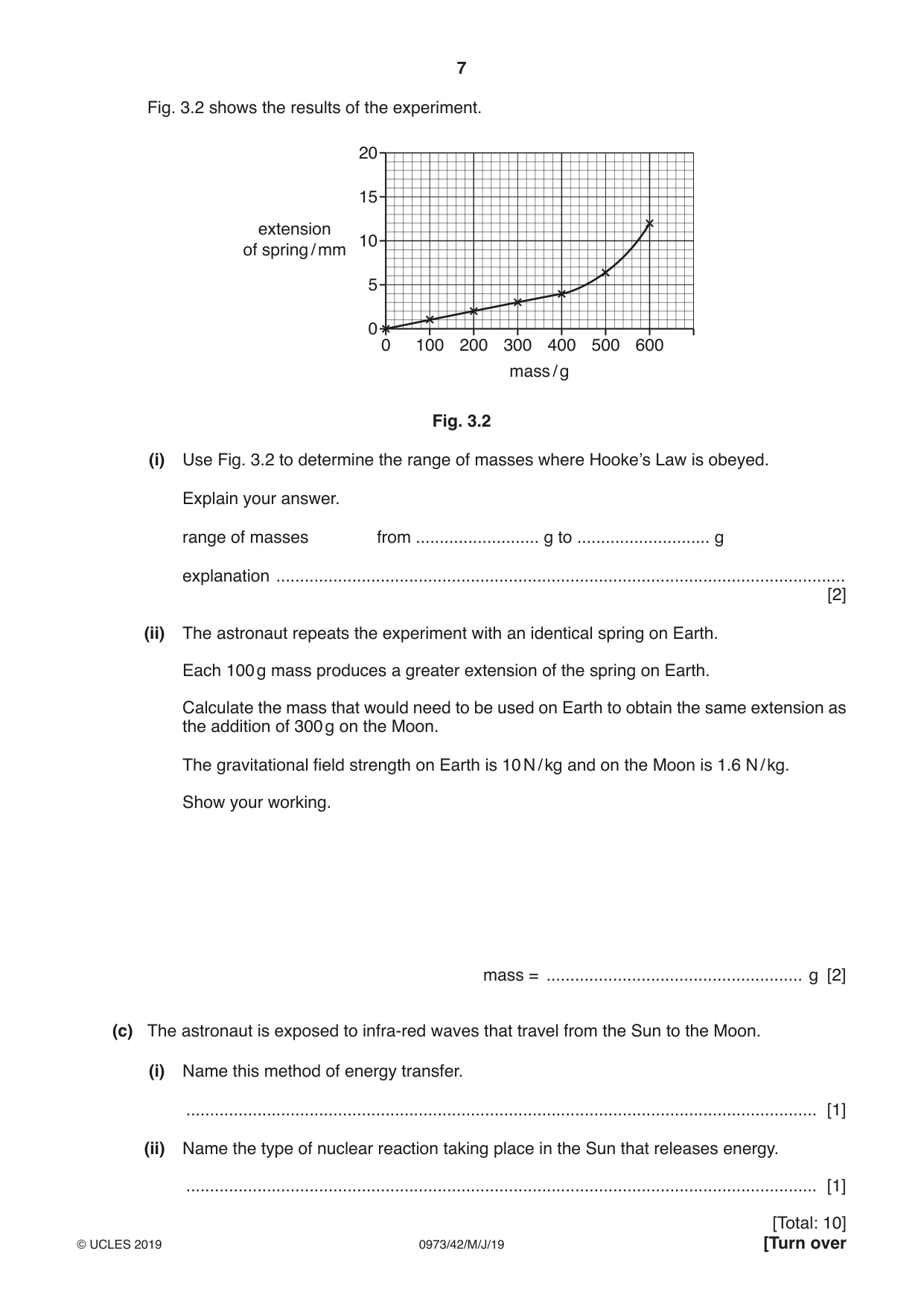
3 (a) In 1971, an astronaut hit a golf ball on the surface of the Moon. The golf ball had a mass of 46 g and initially travelled at 50 m / s. (i) Calculate the kinetic energy of the golf ball when travelling at 50 m / s. Show your working. kinetic energy = ...................................................... J [3] (ii) Describe the difference between the terms speed and velocity. ........................................................................................................................................... ........................................................................................................................................... ..................................................................................................................................... [1] (b) On the Moon, an astronaut suspends masses on a spring and measures the extension of the spring in mm as shown in Fig. 3.1 lo le extension = le – lo Fig. 3.1 Fig. 3.2 shows the results of the experiment. 20 15 extension 10 of spring / mm 5 0 0 100 200 300 400 500 600 mass / g Fig. 3.2 (i) Use Fig. 3.2 to determine the range of masses where Hooke’s Law is obeyed. Explain your answer. range of masses from .......................... g to ............................ g explanation ........................................................................................................................ [2] (ii) The astronaut repeats the experiment with an identical spring on Earth. Each 100 g mass produces a greater extension of the spring on Earth. Calculate the mass that would need to be used on Earth to obtain the same extension as the addition of 300 g on the Moon. The gravitational field strength on Earth is 10 N / kg and on the Moon is 1.6 N / kg. Show your working. mass = ...................................................... g [2] (c) The astronaut is exposed to infra-red waves that travel from the Sun to the Moon. (i) Name this method of energy transfer. ..................................................................................................................................... [1] (ii) Name the type of nuclear reaction taking place in the Sun that releases energy. ..................................................................................................................................... [1]
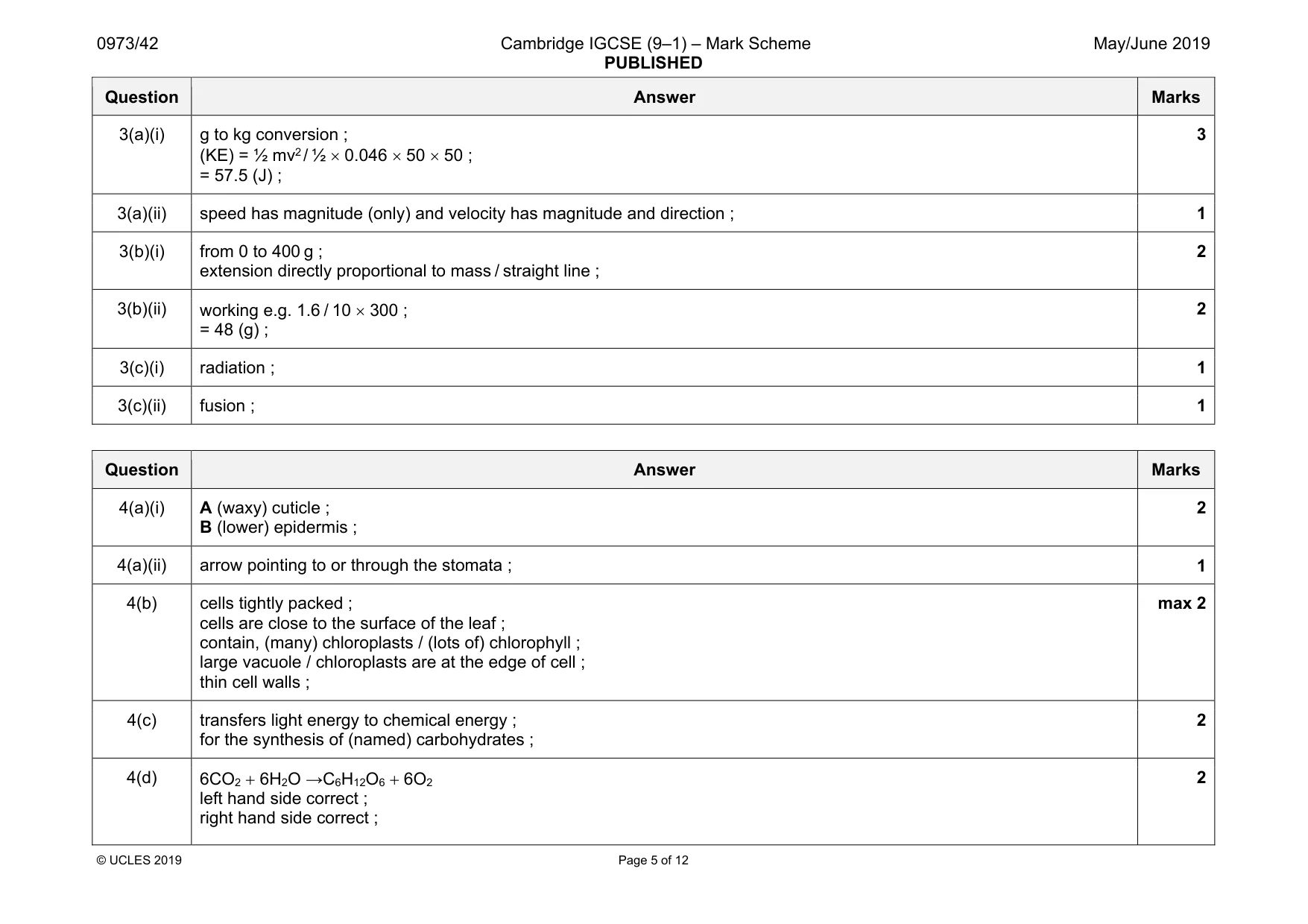
Mark scheme: 3(a)(i) g to kg conversion ; (KE) = ½ mv2 / ½ × 0.046 × 50 × 50 ; = 57.5 (J) ; 3 3(a)(ii) speed has magnitude (only) and velocity has magnitude and direction ; 1 3(b)(i) from 0 to 400 g ; extension directly proportional to mass / straight line ; 2 3(b)(ii) working e.g. 1.6 / 10 × 300 ; = 48 (g) ; 2 3(c)(i) radiation ; 1 3(c)(ii) fusion ; 1
Q4 · A cross-section through a leaf
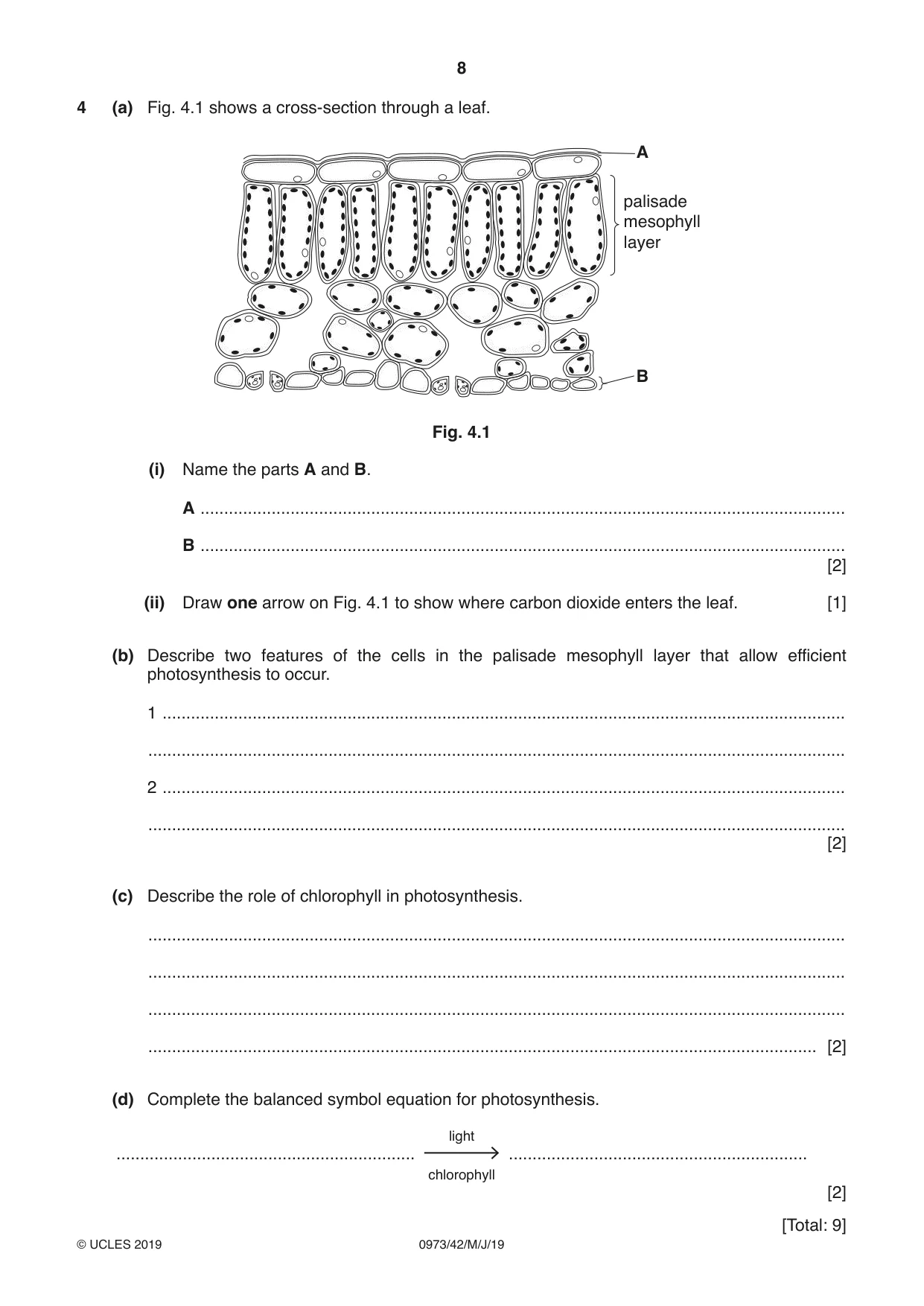
4 (a) Fig. 4.1 shows a cross-section through a leaf. A palisade mesophyll layer B Fig. 4.1 (i) Name the parts A and B. A ........................................................................................................................................ B ........................................................................................................................................ [2] (ii) Draw one arrow on Fig. 4.1 to show where carbon dioxide enters the leaf. [1] (b) Describe two features of the cells in the palisade mesophyll layer that allow efficient photosynthesis to occur. 1 ................................................................................................................................................ ................................................................................................................................................... 2 ................................................................................................................................................ ................................................................................................................................................... [2] (c) Describe the role of chlorophyll in photosynthesis. ................................................................................................................................................... ................................................................................................................................................... ................................................................................................................................................... ............................................................................................................................................. [2] (d) Complete the balanced symbol equation for photosynthesis. light ............................................................... ............................................................... chlorophyll [2]
Mark scheme: 4(a)(i) A (waxy) cuticle ; B (lower) epidermis ; 2 4(a)(ii) arrow pointing to or through the stomata ; 1 4(b) cells tightly packed ; cells are close to the surface of the leaf ; contain, (many) chloroplasts / (lots of) chlorophyll ; large vacuole / chloroplasts are at the edge of cell ; thin cell walls ; max 2 4(c) transfers light energy to chemical energy ; for the synthesis of (named) carbohydrates ; 2 4(d) 6CO2 + 6H2O →C6H12O6 + 6O2 left hand side correct ; right hand side correct ; 2
Q5 · A student investigates the colour in a leaf
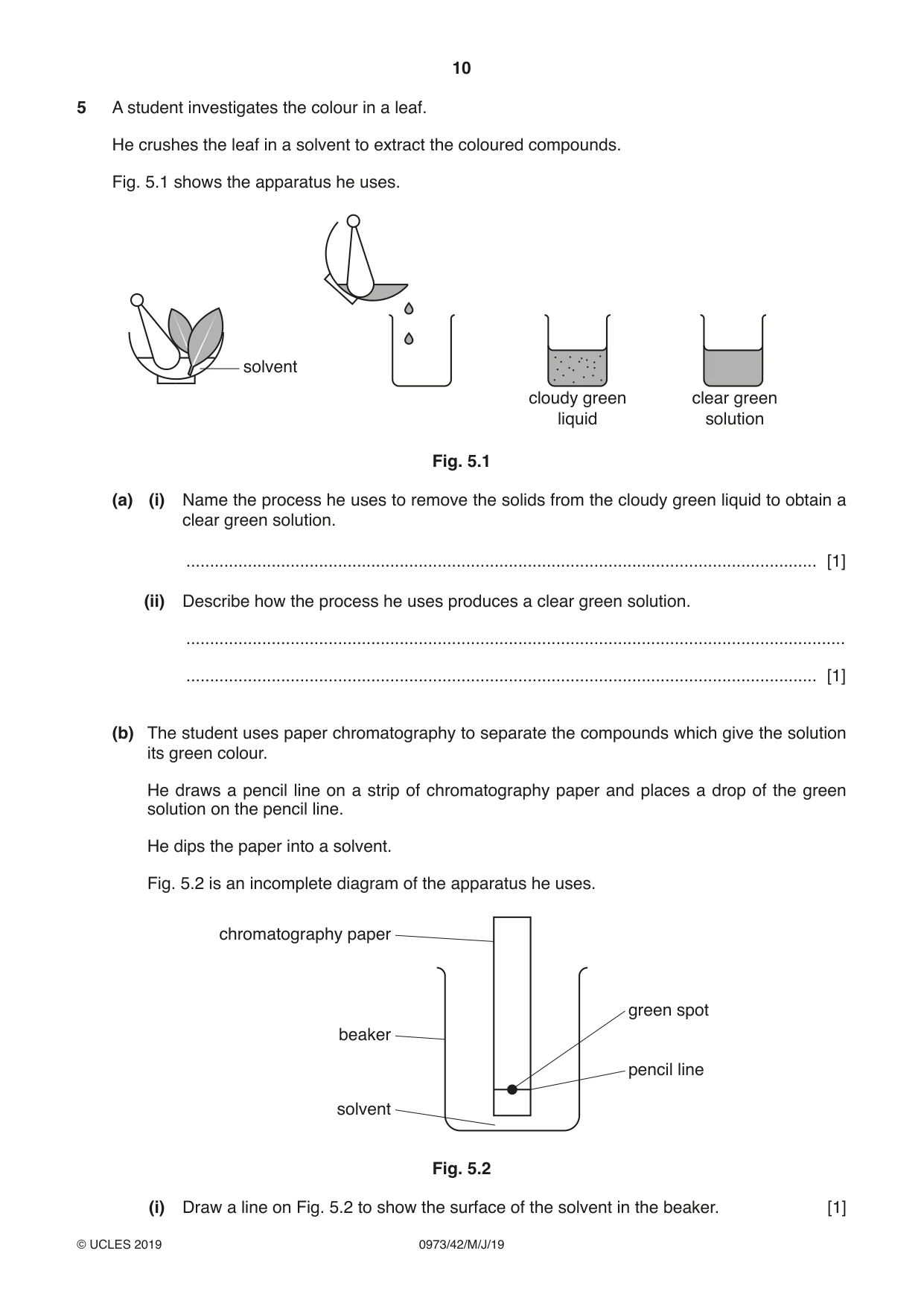
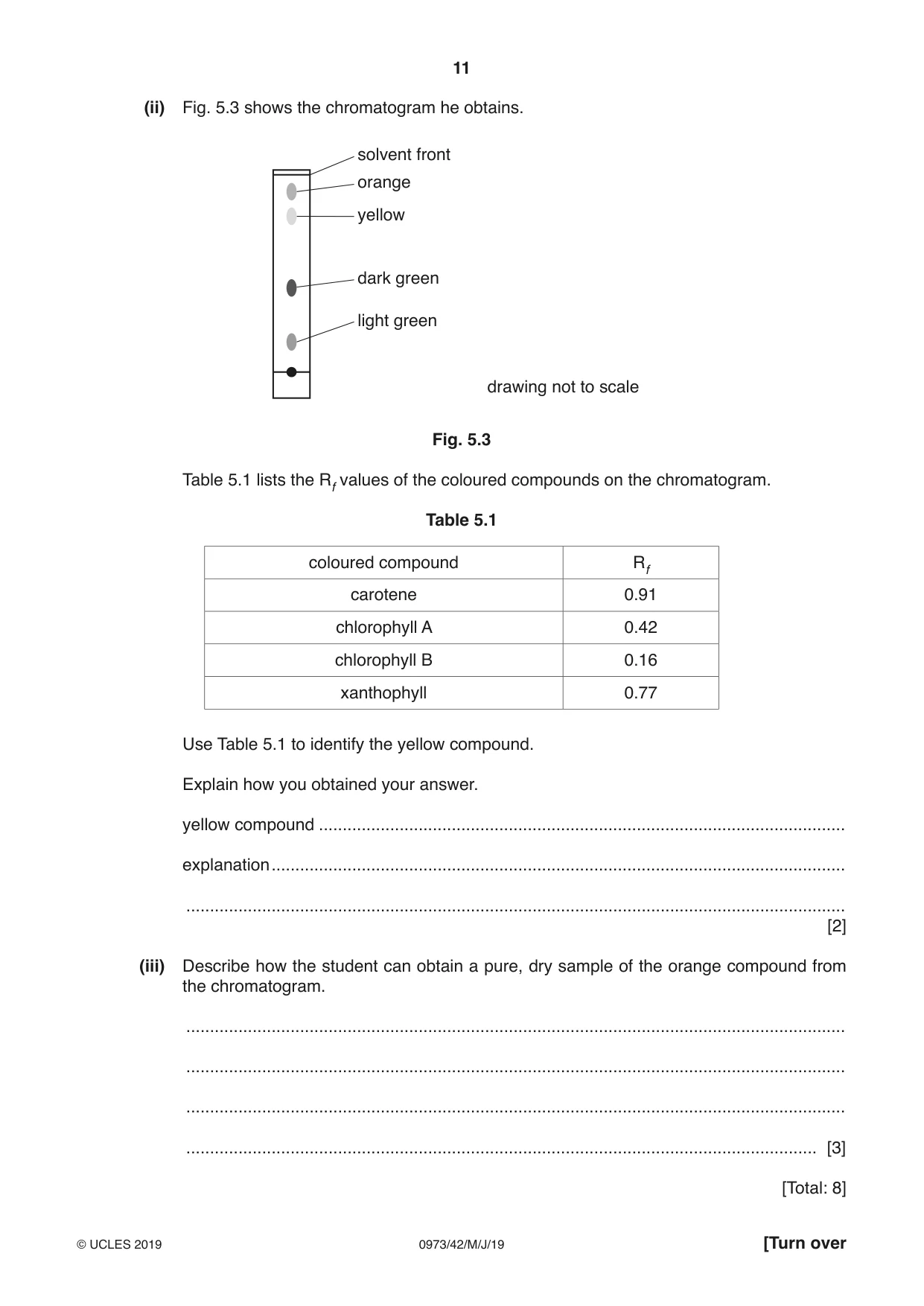
5 A student investigates the colour in a leaf. He crushes the leaf in a solvent to extract the coloured compounds. Fig. 5.1 shows the apparatus he uses. solvent cloudy green clear green liquid solution Fig. 5.1 (a) (i) Name the process he uses to remove the solids from the cloudy green liquid to obtain a clear green solution. ..................................................................................................................................... [1] (ii) Describe how the process he uses produces a clear green solution. ........................................................................................................................................... ..................................................................................................................................... [1] (b) The student uses paper chromatography to separate the compounds which give the solution its green colour. He draws a pencil line on a strip of chromatography paper and places a drop of the green solution on the pencil line. He dips the paper into a solvent. Fig. 5.2 is an incomplete diagram of the apparatus he uses. chromatography paper green spot beaker pencil line solvent Fig. 5.2 (i) Draw a line on Fig. 5.2 to show the surface of the solvent in the beaker. [1] (ii) Fig. 5.3 shows the chromatogram he obtains. solvent front orange yellow dark green light green drawing not to scale Fig. 5.3 Table 5.1 lists the Rf values of the coloured compounds on the chromatogram. Table 5.1 coloured compound Rf carotene 0.91 chlorophyll A 0.42 chlorophyll B 0.16 xanthophyll 0.77 Use Table 5.1 to identify the yellow compound. Explain how you obtained your answer. yellow compound ............................................................................................................... explanation ......................................................................................................................... ........................................................................................................................................... [2] (iii) Describe how the student can obtain a pure, dry sample of the orange compound from the chromatogram. ........................................................................................................................................... ........................................................................................................................................... ........................................................................................................................................... ..................................................................................................................................... [3] [Total: 8]
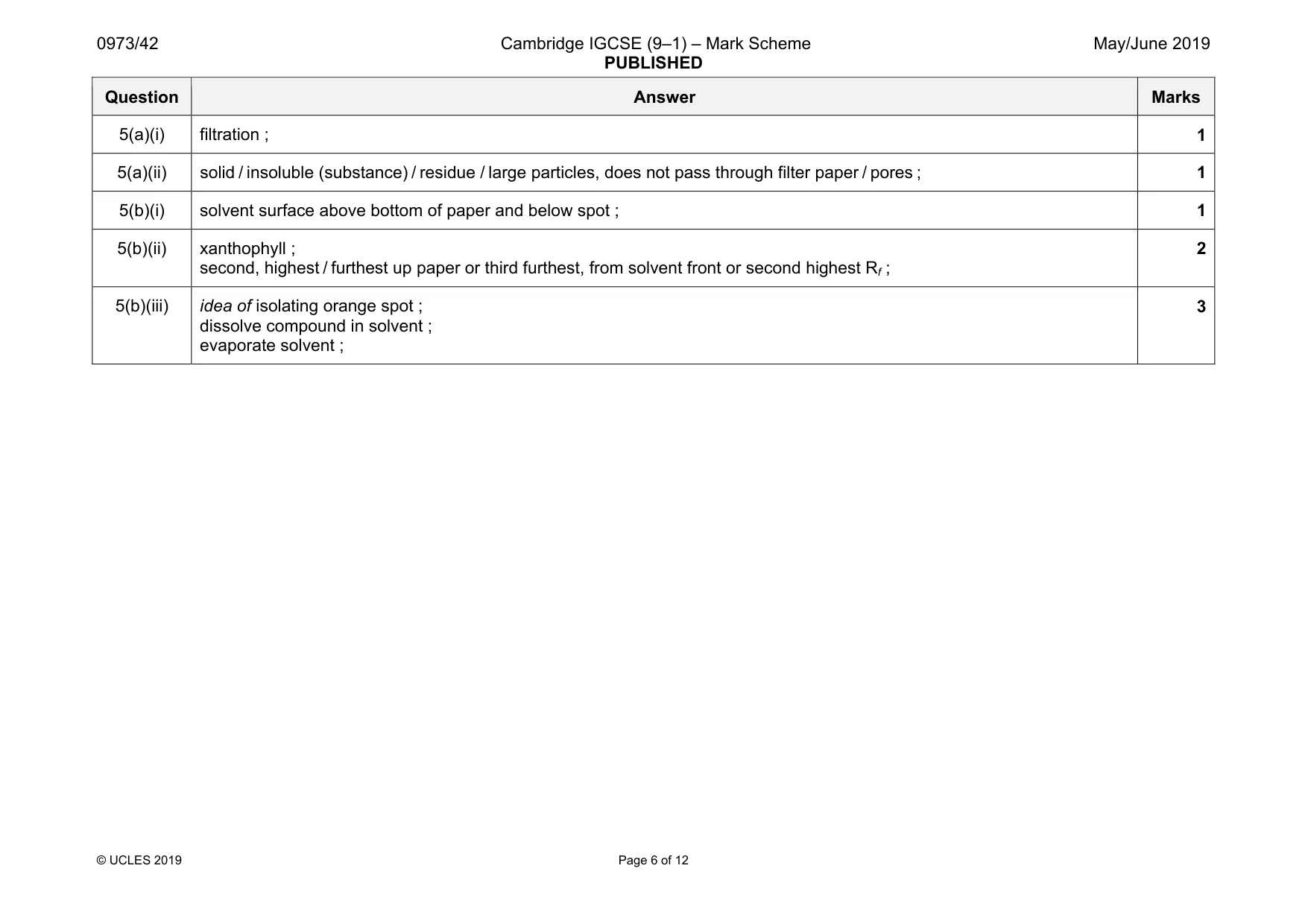
Mark scheme: 5(a)(i) filtration ; 1 5(a)(ii) solid / insoluble (substance) / residue / large particles, does not pass through filter paper / pores ; 1 5(b)(i) solvent surface above bottom of paper and below spot ; 1 5(b)(ii) xanthophyll ; second, highest / furthest up paper or third furthest, from solvent front or second highest Rf ; 2 5(b)(iii) idea of isolating orange spot ; dissolve compound in solvent ; evaporate solvent ; 3
Q6 · A car with two rear lamps, L1 and L2
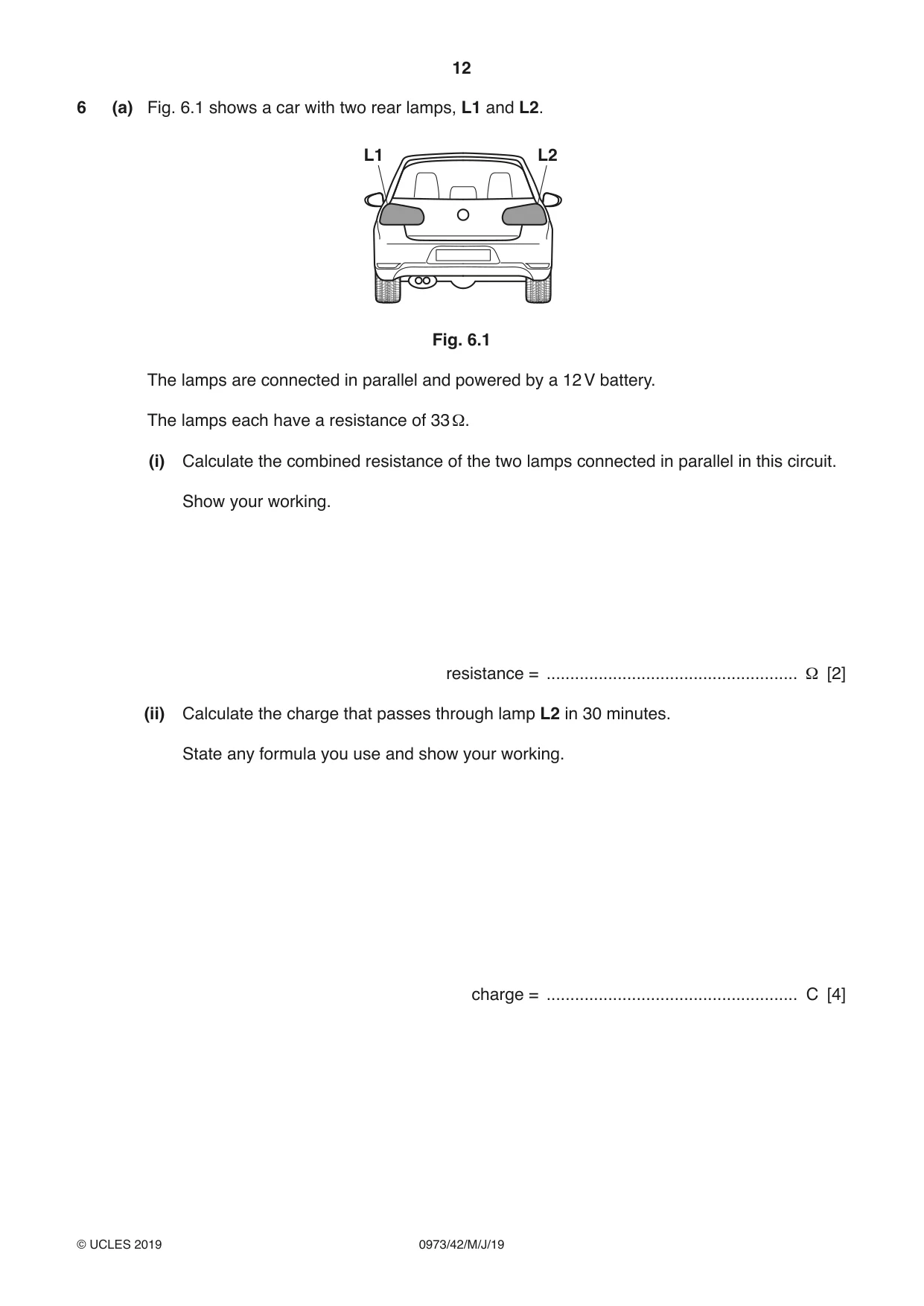
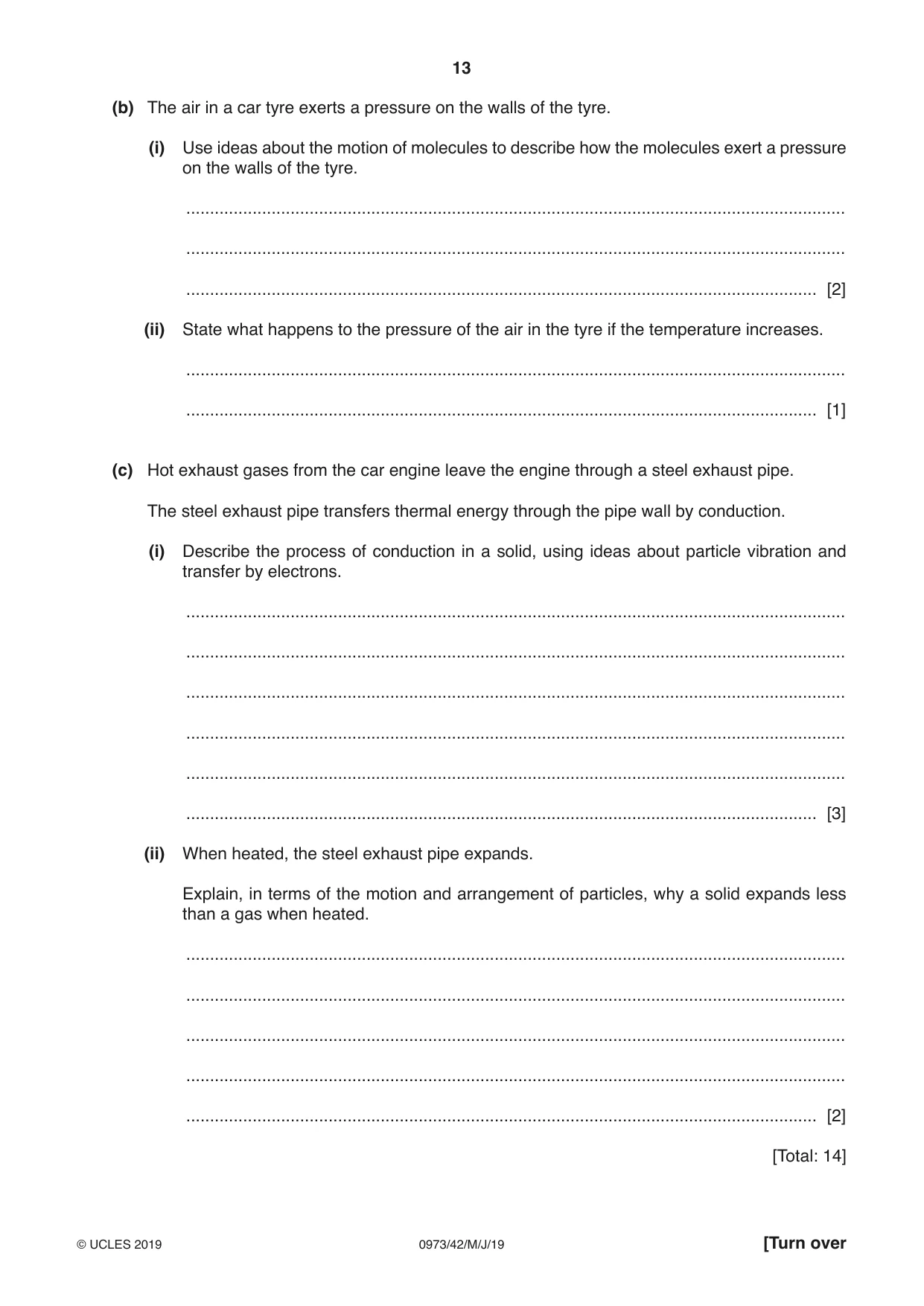
6 (a) Fig. 6.1 shows a car with two rear lamps, L1 and L2. L1 L2 Fig. 6.1 The lamps are connected in parallel and powered by a 12 V battery. The lamps each have a resistance of 33 Ω. (i) Calculate the combined resistance of the two lamps connected in parallel in this circuit. Show your working. resistance = ..................................................... Ω [2] (ii) Calculate the charge that passes through lamp L2 in 30 minutes. State any formula you use and show your working. charge = ..................................................... C [4] (b) The air in a car tyre exerts a pressure on the walls of the tyre. (i) Use ideas about the motion of molecules to describe how the molecules exert a pressure on the walls of the tyre. ........................................................................................................................................... ........................................................................................................................................... ..................................................................................................................................... [2] (ii) State what happens to the pressure of the air in the tyre if the temperature increases. ........................................................................................................................................... ..................................................................................................................................... [1] (c) Hot exhaust gases from the car engine leave the engine through a steel exhaust pipe. The steel exhaust pipe transfers thermal energy through the pipe wall by conduction. (i) Describe the process of conduction in a solid, using ideas about particle vibration and transfer by electrons. ........................................................................................................................................... ........................................................................................................................................... ........................................................................................................................................... ........................................................................................................................................... ........................................................................................................................................... ..................................................................................................................................... [3] (ii) When heated, the steel exhaust pipe expands. Explain, in terms of the motion and arrangement of particles, why a solid expands less than a gas when heated. ........................................................................................................................................... ........................................................................................................................................... ........................................................................................................................................... ........................................................................................................................................... ..................................................................................................................................... [2] [Total: 14]
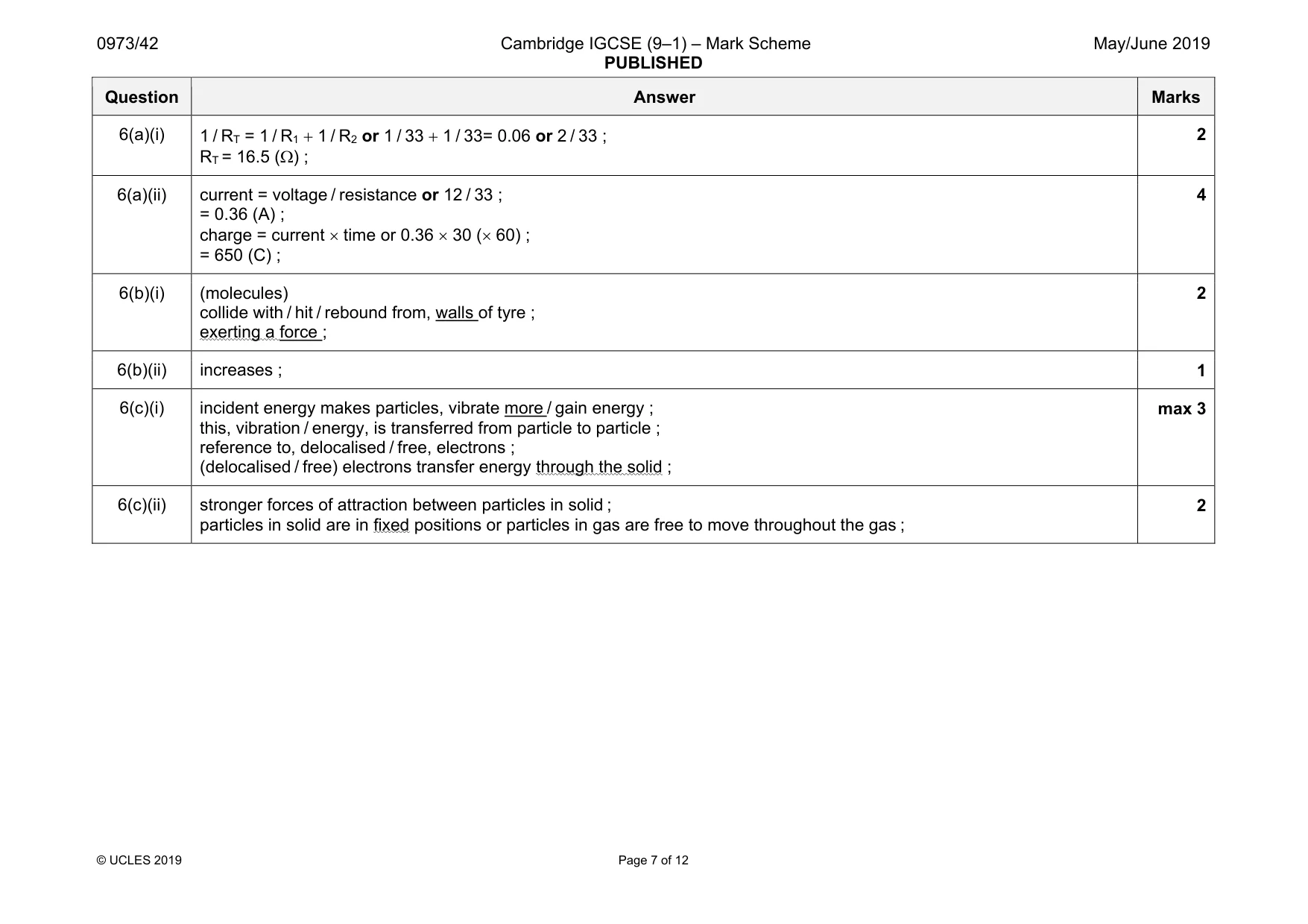
Mark scheme: 6(a)(i) RT = 16.5 (Ω) ; 2 6(a)(ii) current = voltage / resistance or 12 / 33 ; = 0.36 (A) ; charge = current × time or 0.36 × 30 (× 60) ; = 650 (C) ; 4 6(b)(i) (molecules) collide with / hit / rebound from, walls of tyre ; exerting a force ; 2 6(b)(ii) increases ; 1 6(c)(i) incident energy makes particles, vibrate more / gain energy ; this, vibration / energy, is transferred from particle to particle ; reference to, delocalised / free, electrons ; (delocalised / free) electrons transfer energy through the solid ; max 3 6(c)(ii) stronger forces of attraction between particles in solid ; particles in solid are in fixed positions or particles in gas are free to move throughout the gas ; 2
Q7 · A cross-section through a human heart
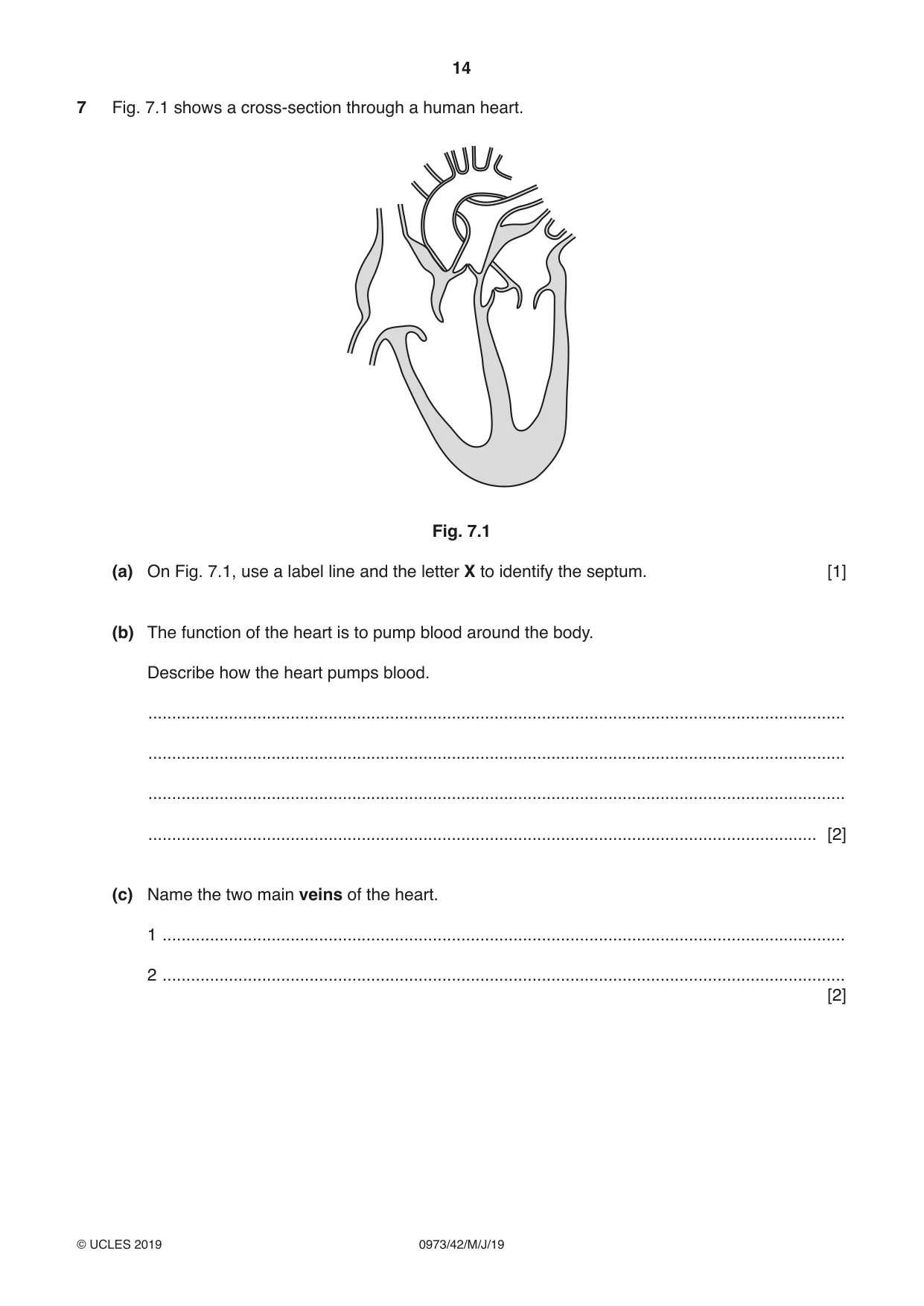
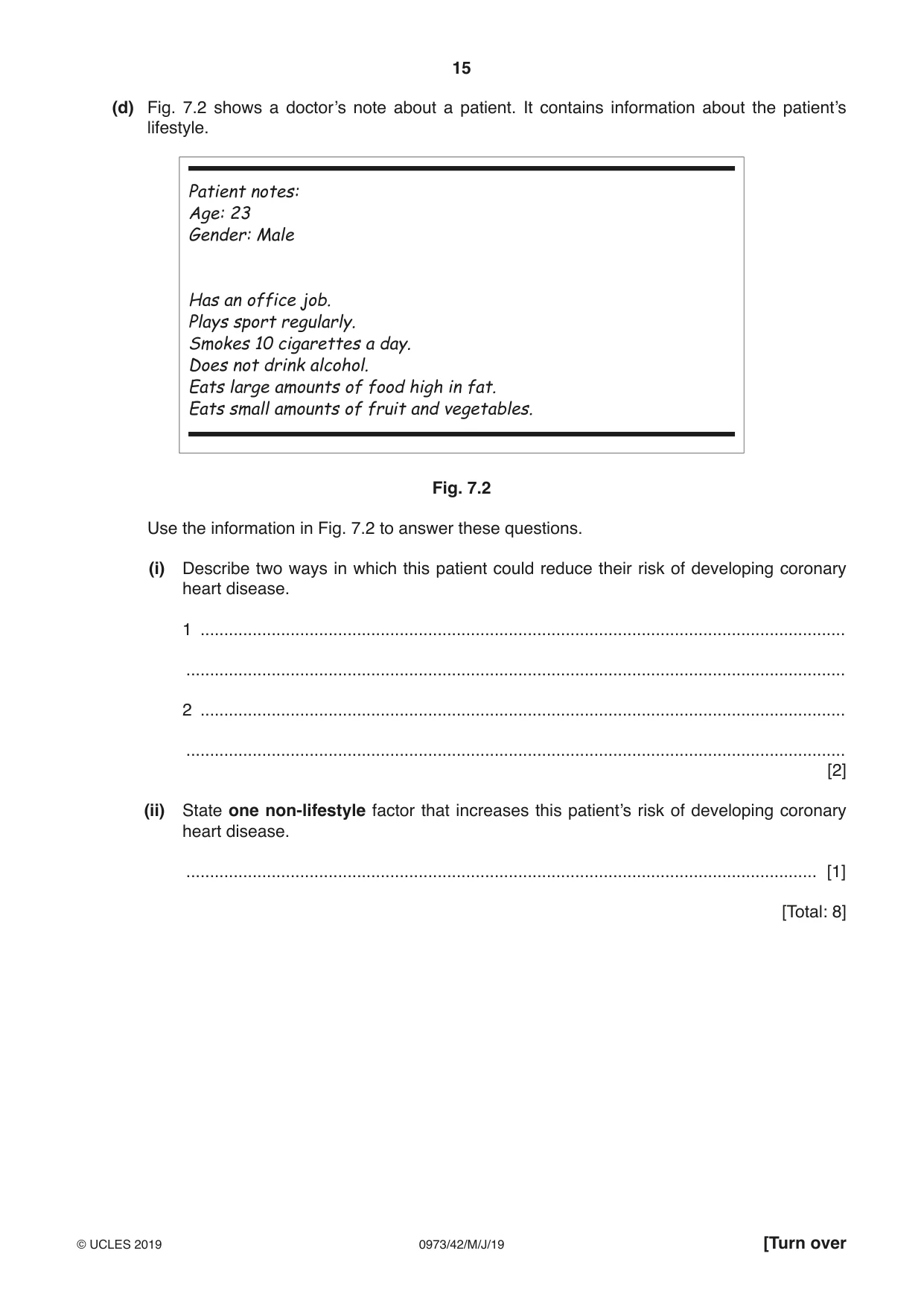
7 Fig. 7.1 shows a cross-section through a human heart. Fig. 7.1 (a) On Fig. 7.1, use a label line and the letter X to identify the septum. [1] (b) The function of the heart is to pump blood around the body. Describe how the heart pumps blood. ................................................................................................................................................... ................................................................................................................................................... ................................................................................................................................................... ............................................................................................................................................. [2] (c) Name the two main veins of the heart. 1 ................................................................................................................................................ 2 ................................................................................................................................................ [2] (d) Fig. 7.2 shows a doctor’s note about a patient. It contains information about the patient’s lifestyle. Patient notes: Age: 23 Gender: Male Has an office job. Plays sport regularly. Smokes 10 cigarettes a day. Does not drink alcohol. Eats large amounts of food high in fat. Eats small amounts of fruit and vegetables. Fig. 7.2 Use the information in Fig. 7.2 to answer these questions. (i) Describe two ways in which this patient could reduce their risk of developing coronary heart disease. 1 ........................................................................................................................................ ........................................................................................................................................... 2 ........................................................................................................................................ ........................................................................................................................................... [2] (ii) State one non-lifestyle factor that increases this patient’s risk of developing coronary heart disease. ..................................................................................................................................... [1] [Total: 8]
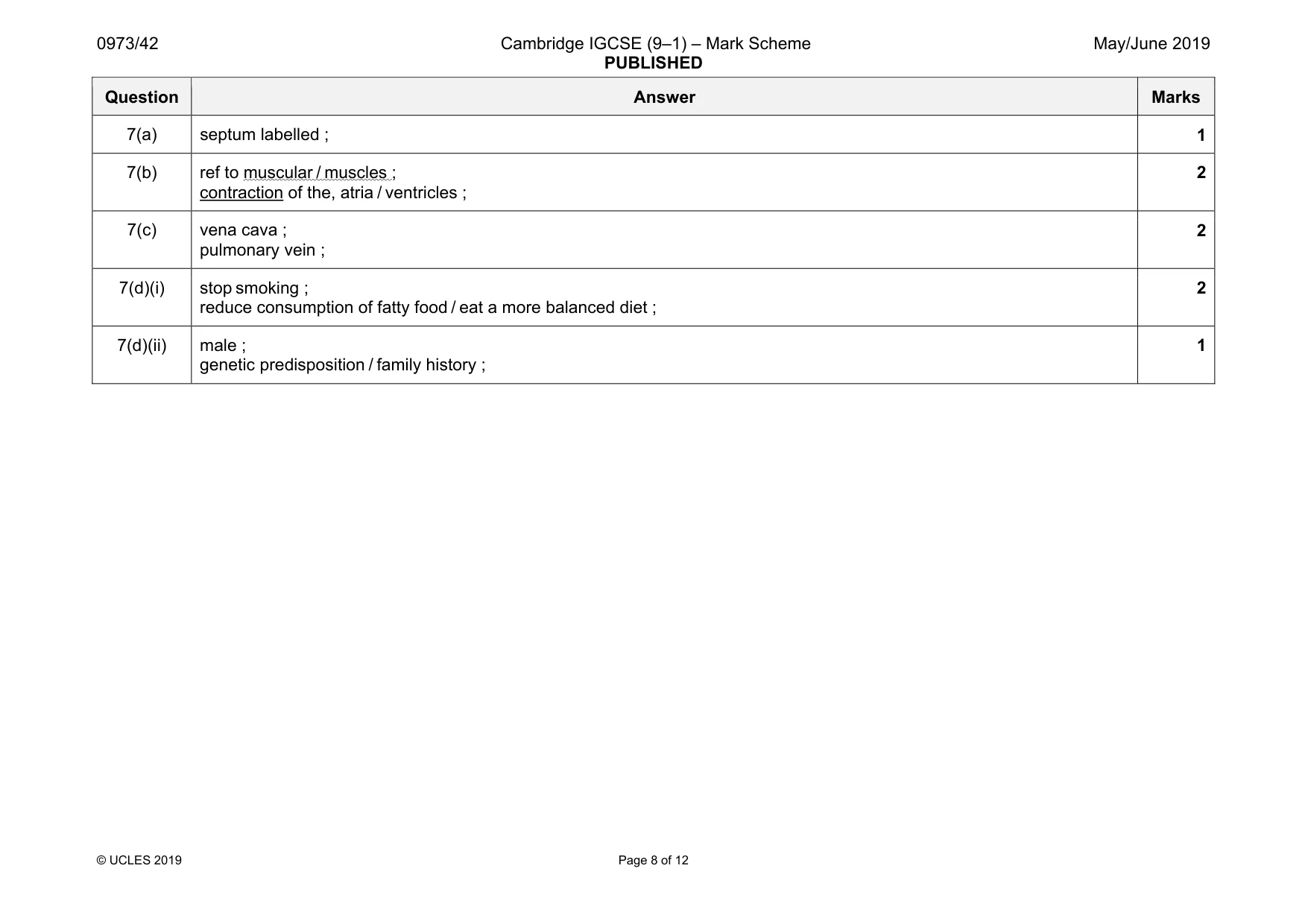
Mark scheme: 7(a) septum labelled ; 1 7(b) ref to muscular / muscles ; contraction of the, atria / ventricles ; 2 7(c) vena cava ; pulmonary vein ; 2 7(d)(i) stop smoking ; reduce consumption of fatty food / eat a more balanced diet ; 2 7(d)(ii) male ; genetic predisposition / family history ; 1
Q8 · The thermite reaction is a redox reaction between aluminium and iron oxide, Fe2O3
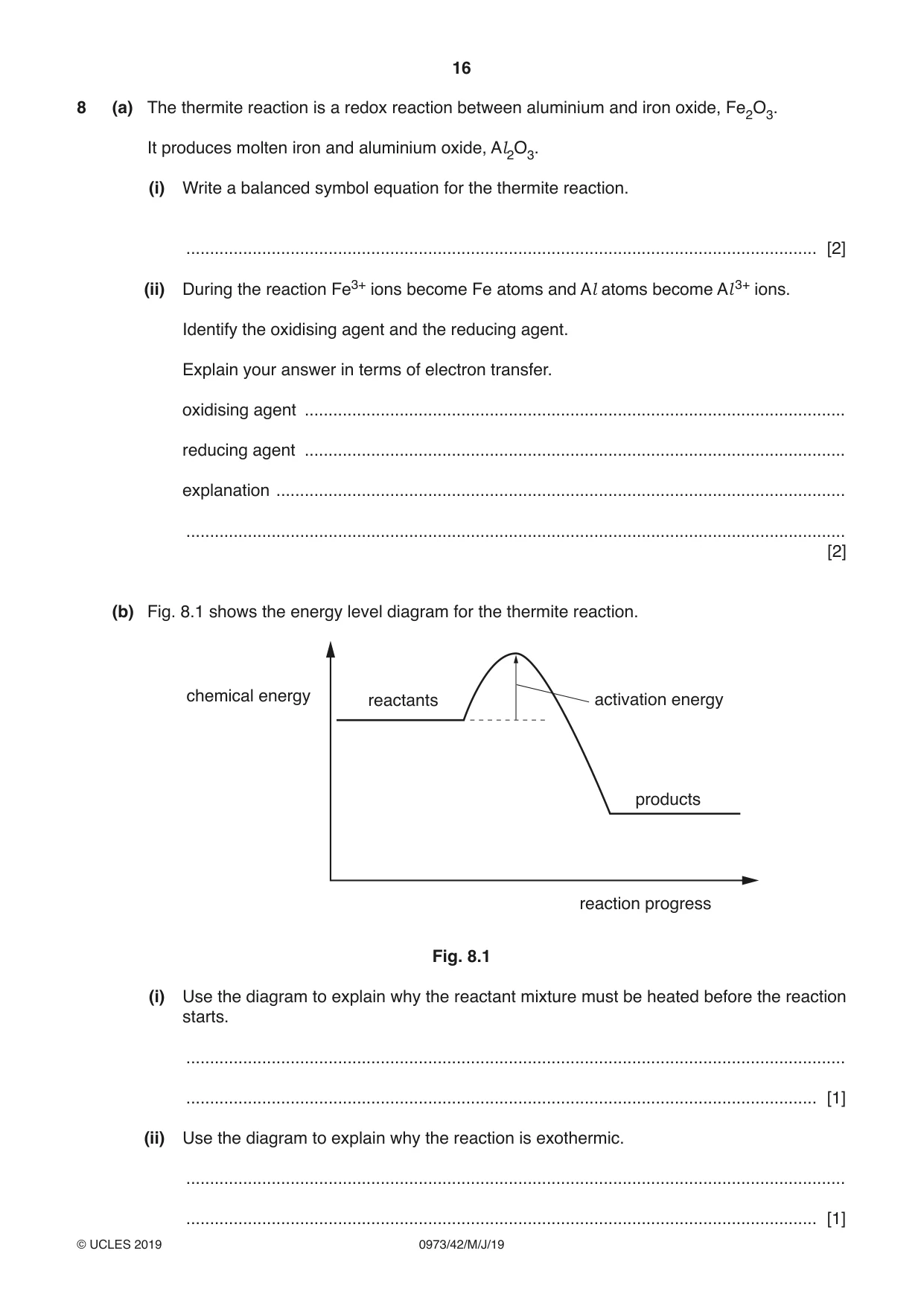
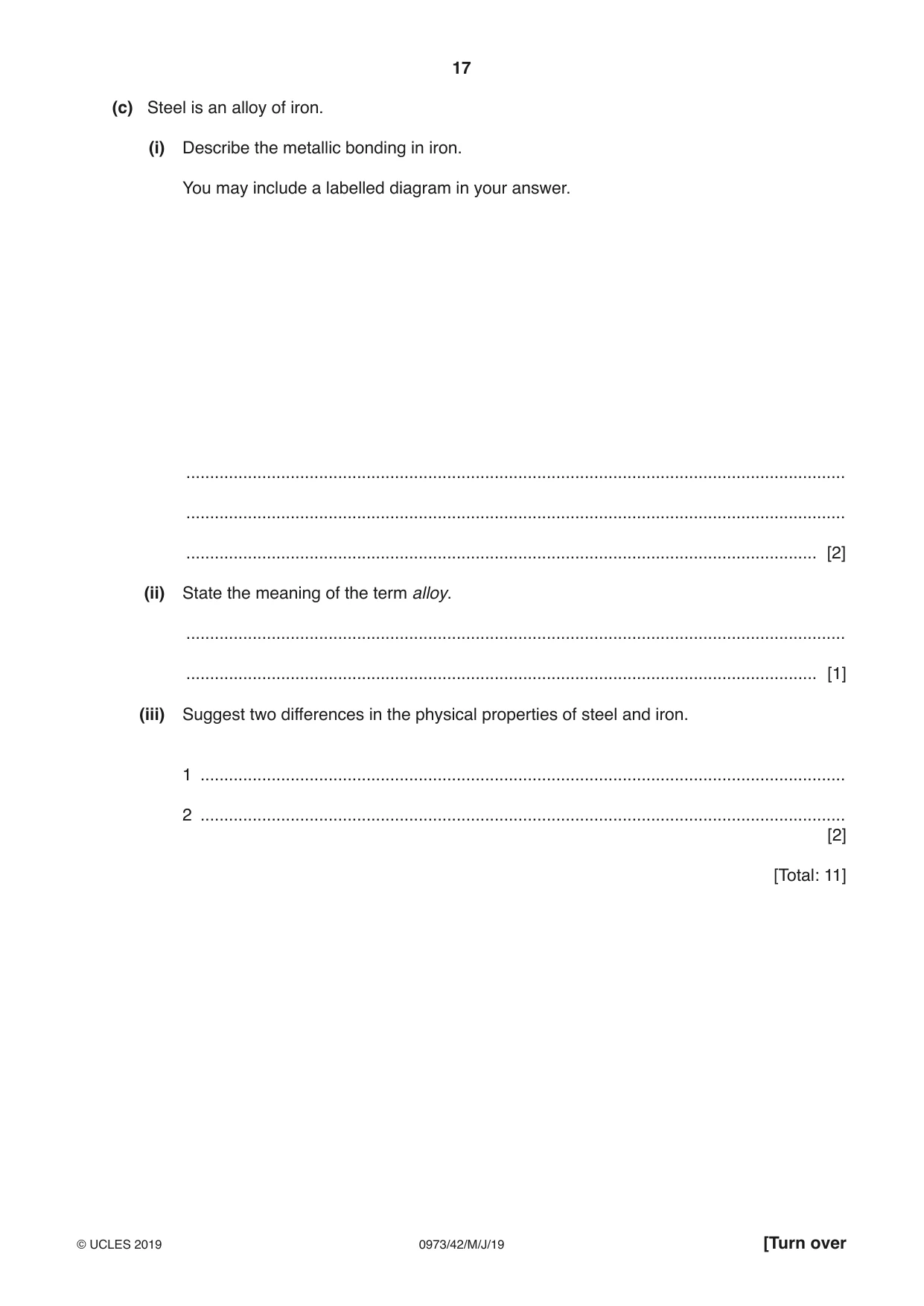
8 (a) The thermite reaction is a redox reaction between aluminium and iron oxide, Fe2O3. It produces molten iron and aluminium oxide, Al2O3. (i) Write a balanced symbol equation for the thermite reaction. ..................................................................................................................................... [2] (ii) During the reaction Fe3+ ions become Fe atoms and Al atoms become Al 3+ ions. Identify the oxidising agent and the reducing agent. Explain your answer in terms of electron transfer. oxidising agent .................................................................................................................. reducing agent .................................................................................................................. explanation ........................................................................................................................ ........................................................................................................................................... [2] (b) Fig. 8.1 shows the energy level diagram for the thermite reaction. chemical energy reactants activation energy products reaction progress Fig. 8.1 (i) Use the diagram to explain why the reactant mixture must be heated before the reaction starts. ........................................................................................................................................... ..................................................................................................................................... [1] (ii) Use the diagram to explain why the reaction is exothermic. ........................................................................................................................................... ..................................................................................................................................... [1] (c) Steel is an alloy of iron. (i) Describe the metallic bonding in iron. You may include a labelled diagram in your answer. ........................................................................................................................................... ........................................................................................................................................... ..................................................................................................................................... [2] (ii) State the meaning of the term alloy. ........................................................................................................................................... ..................................................................................................................................... [1] (iii) Suggest two differences in the physical properties of steel and iron. 1 ........................................................................................................................................ 2 ........................................................................................................................................ [2] [Total: 11]
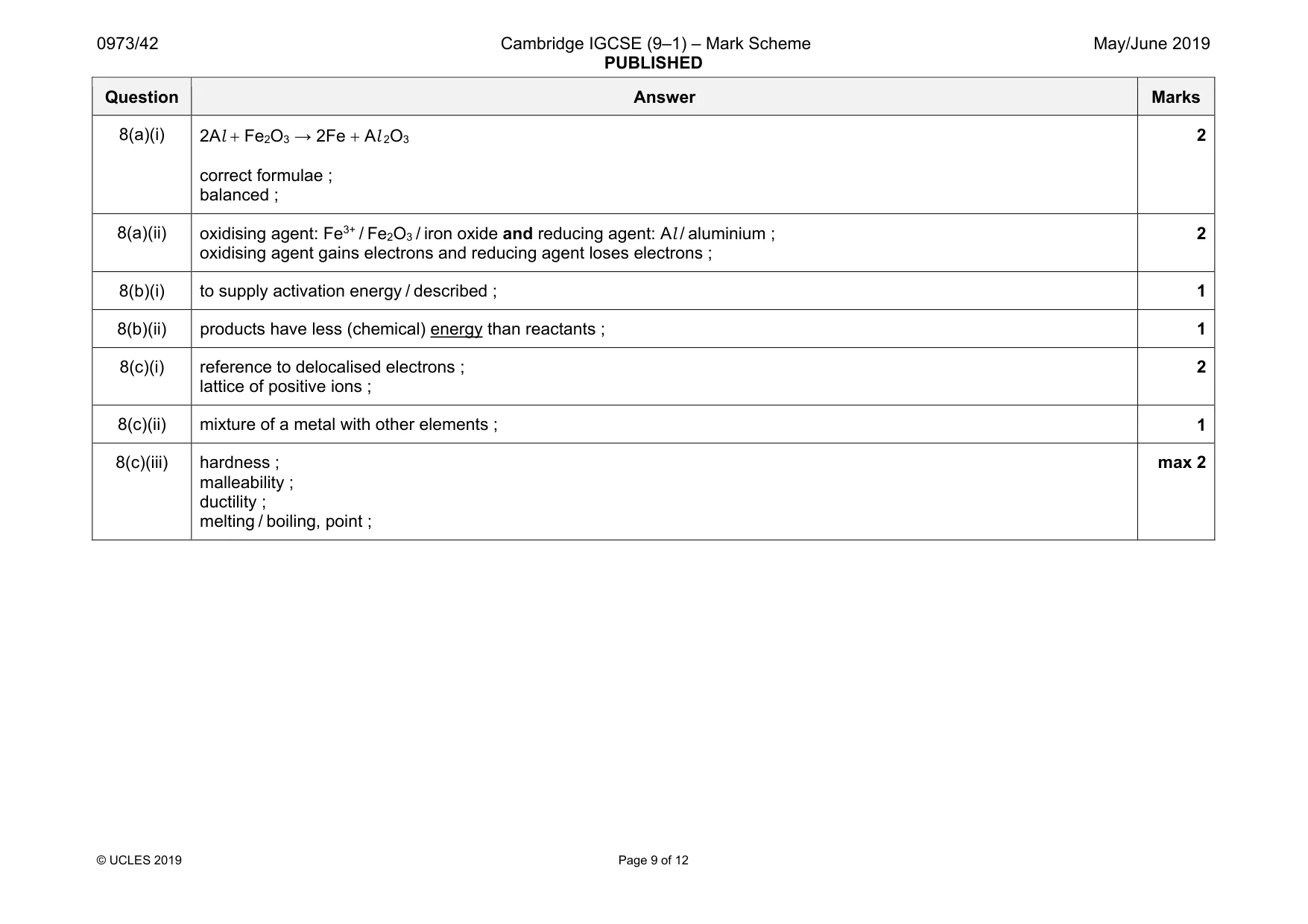
Mark scheme: 8(a)(i) correct formulae ; balanced ; 2 8(a)(ii) oxidising agent: Fe3+ / Fe2O3 / iron oxide and reducing agent: Al / aluminium ; oxidising agent gains electrons and reducing agent loses electrons ; 2 8(b)(i) to supply activation energy / described ; 1 8(b)(ii) products have less (chemical) energy than reactants ; 1 8(c)(i) reference to delocalised electrons ; lattice of positive ions ; 2 8(c)(ii) mixture of a metal with other elements ; 1 8(c)(iii) hardness ; malleability ; ductility ; melting / boiling, point ; max 2
Q9 · Ultrasound waves are used in hospitals to scan unborn babies
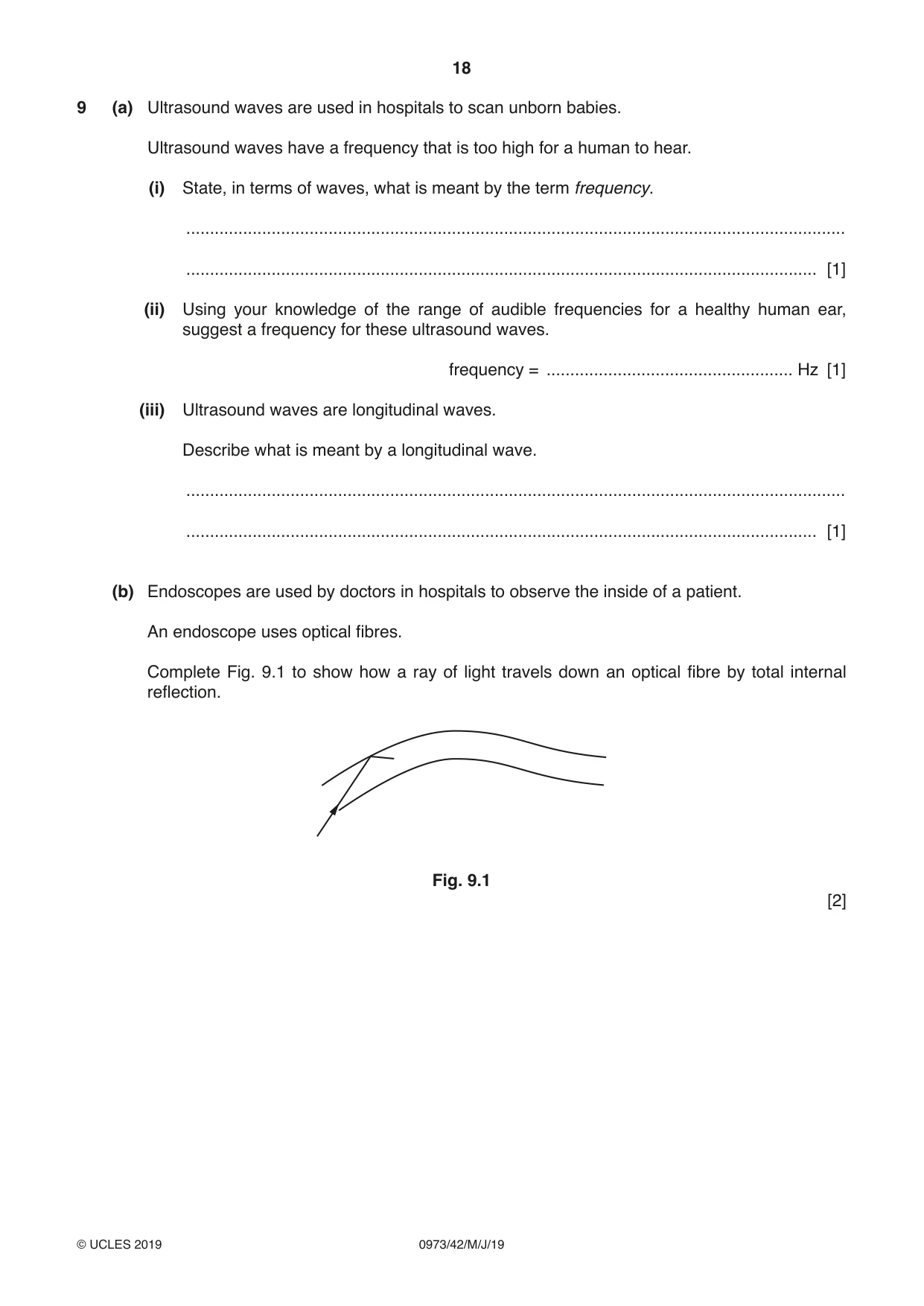
9 (a) Ultrasound waves are used in hospitals to scan unborn babies. Ultrasound waves have a frequency that is too high for a human to hear. (i) State, in terms of waves, what is meant by the term frequency. ........................................................................................................................................... ..................................................................................................................................... [1] (ii) Using your knowledge of the range of audible frequencies for a healthy human ear, suggest a frequency for these ultrasound waves. frequency = .................................................... Hz [1] (iii) Ultrasound waves are longitudinal waves. Describe what is meant by a longitudinal wave. ........................................................................................................................................... ..................................................................................................................................... [1] (b) Endoscopes are used by doctors in hospitals to observe the inside of a patient. An endoscope uses optical fibres. Complete Fig. 9.1 to show how a ray of light travels down an optical fibre by total internal reflection. Fig. 9.1 [2] (c) An isotope of strontium, strontium-89, is used in the treatment of bone cancer in hospitals. Strontium-89 has a half-life of 50 days. A sample of this isotope contains 4 × 10¹⁴ atoms. Some time later 3 × 10¹⁴ atoms have decayed. Calculate the time needed for this number of atoms to decay. Show your working. time = ................................................ days [3] [Total: 8]
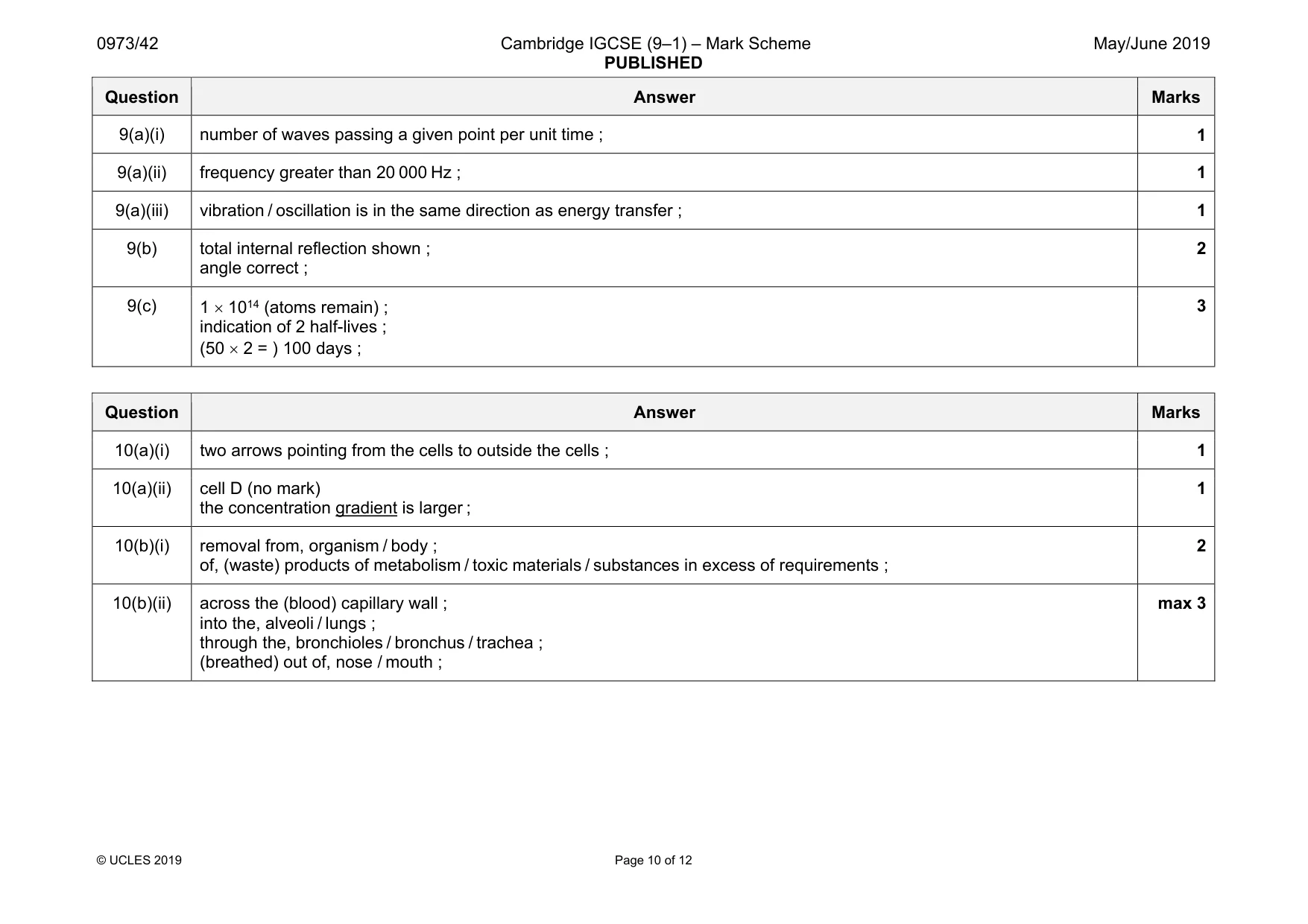
Mark scheme: 9(a)(i) number of waves passing a given point per unit time ; 1 9(a)(ii) frequency greater than 20 000 Hz ; 1 9(a)(iii) vibration / oscillation is in the same direction as energy transfer ; 1 9(b) total internal reflection shown ; angle correct ; 2 9(c) 1 × 10¹⁴ (atoms remain) ; indication of 2 half-lives ; (50 × 2 = ) 100 days ; 3
Q10 · The diagrams in Fig
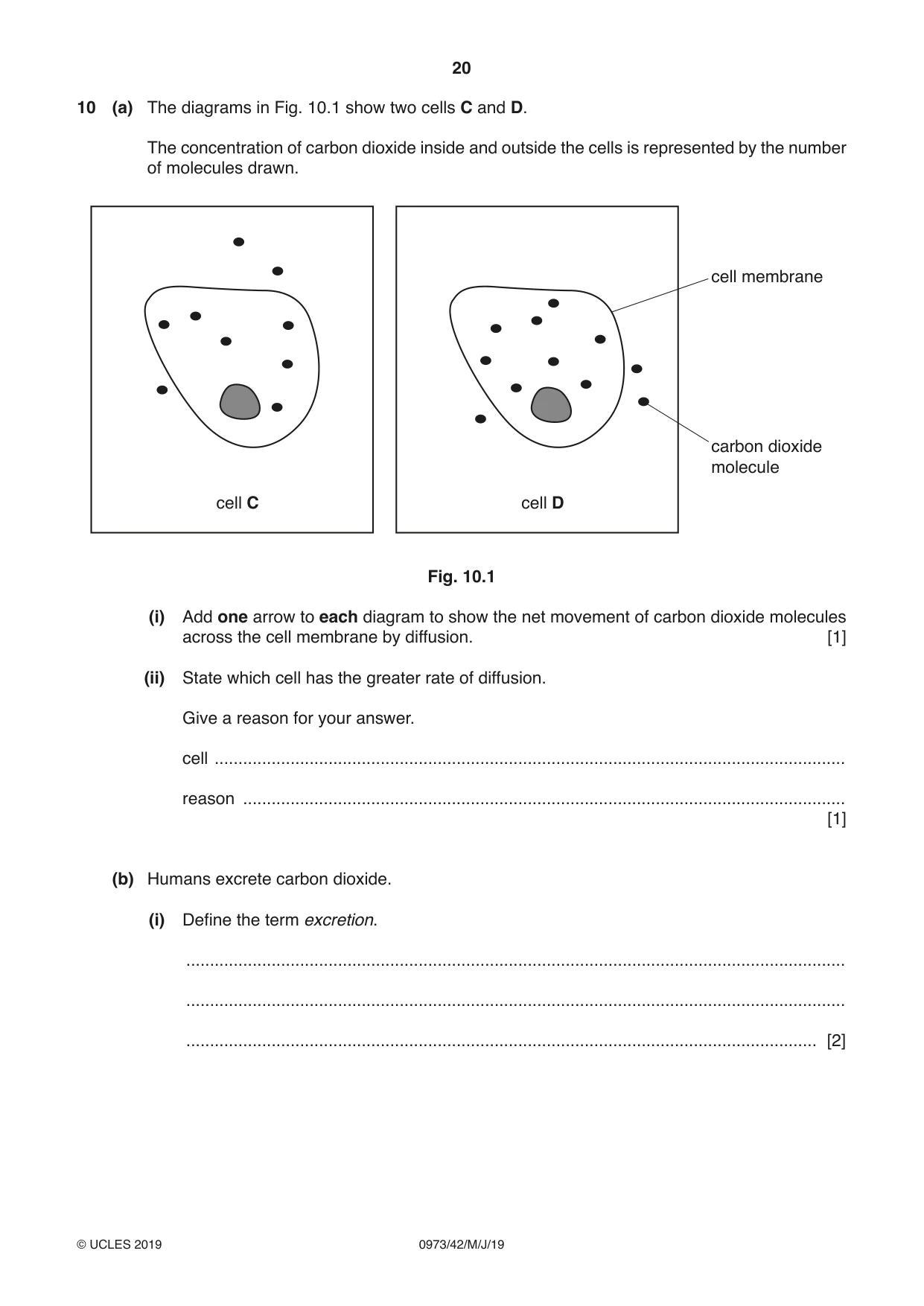
10 (a) The diagrams in Fig. 10.1 show two cells C and D. The concentration of carbon dioxide inside and outside the cells is represented by the number of molecules drawn. cell membrane carbon dioxide molecule cell C cell D Fig. 10.1 (i) Add one arrow to each diagram to show the net movement of carbon dioxide molecules across the cell membrane by diffusion. [1] (ii) State which cell has the greater rate of diffusion. Give a reason for your answer. cell ..................................................................................................................................... reason ............................................................................................................................... [1] (b) Humans excrete carbon dioxide. (i) Define the term excretion. ........................................................................................................................................... ........................................................................................................................................... ..................................................................................................................................... [2] (ii) Describe the pathway of carbon dioxide from the blood to the atmosphere. ........................................................................................................................................... ........................................................................................................................................... ........................................................................................................................................... ........................................................................................................................................... ..................................................................................................................................... [3] [Total: 7]
Mark scheme: 10(a)(i) two arrows pointing from the cells to outside the cells ; 1 10(a)(ii) cell D (no mark) the concentration gradient is larger ; 1 10(b)(i) removal from, organism / body ; of, (waste) products of metabolism / toxic materials / substances in excess of requirements ; 2 10(b)(ii) across the (blood) capillary wall ; into the, alveoli / lungs ; through the, bronchioles / bronchus / trachea ; (breathed) out of, nose / mouth ; max 3
Q11 · The raw materials needed to make sulfuric acid in the Contact process are air, sulfur and…
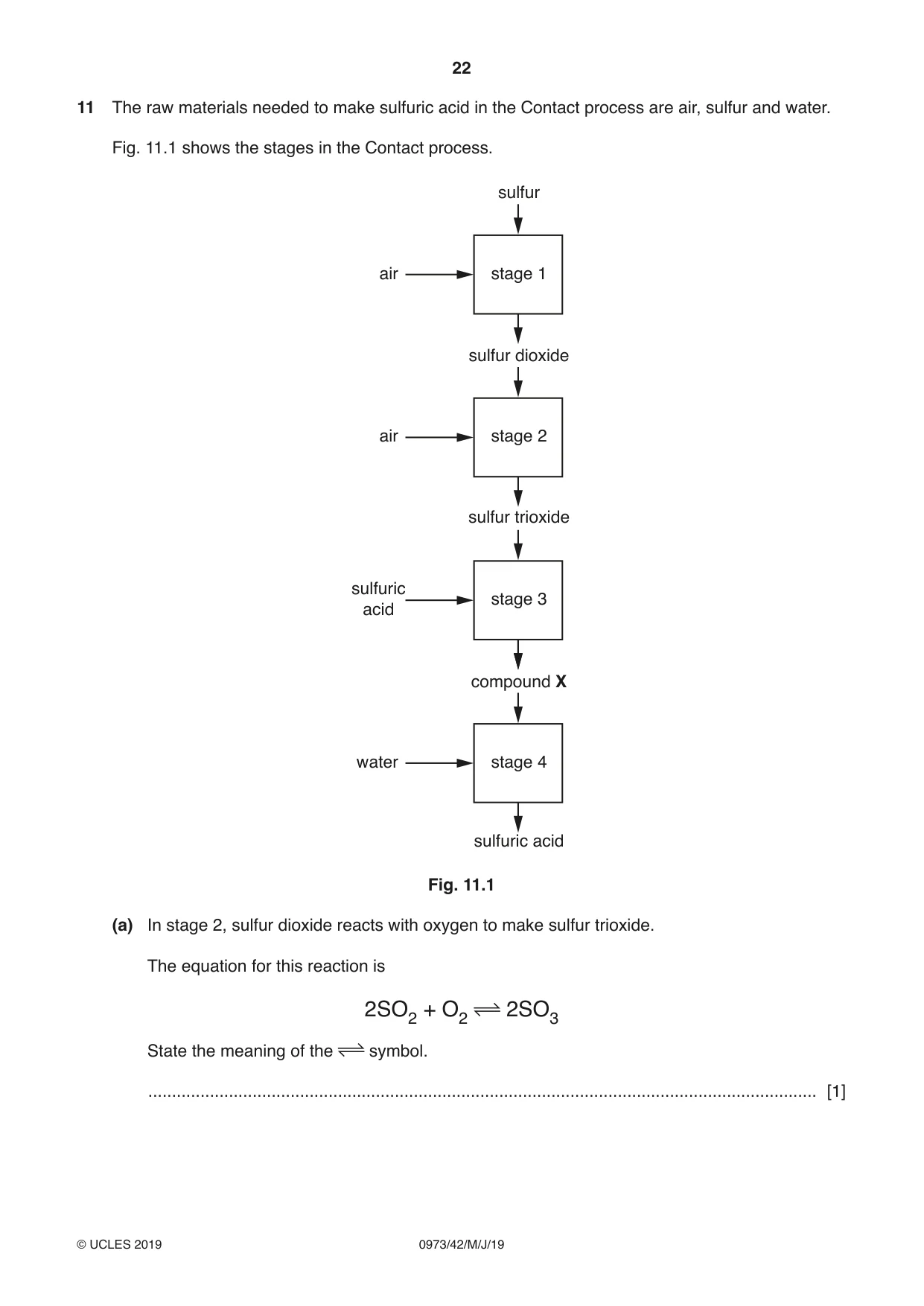
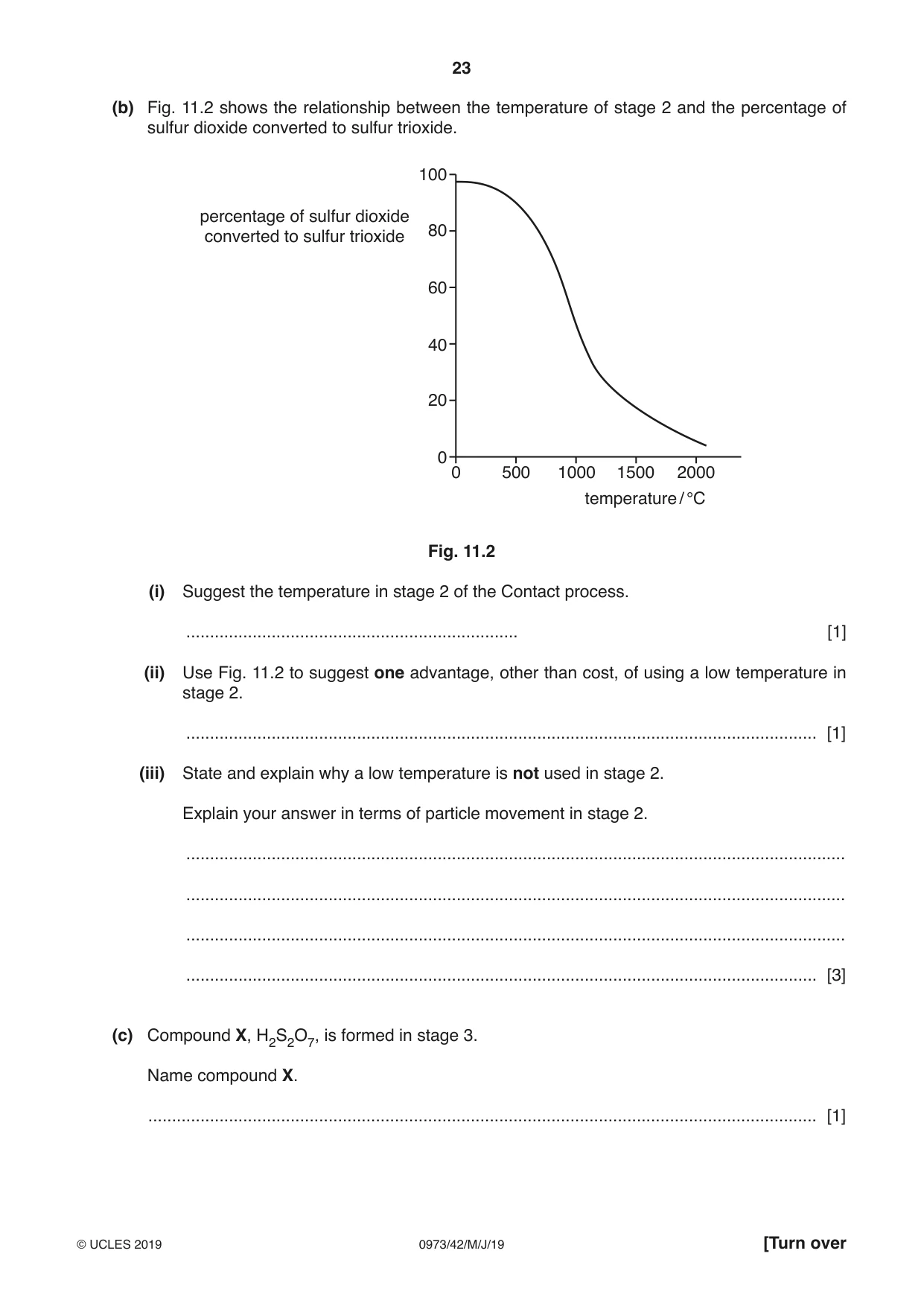
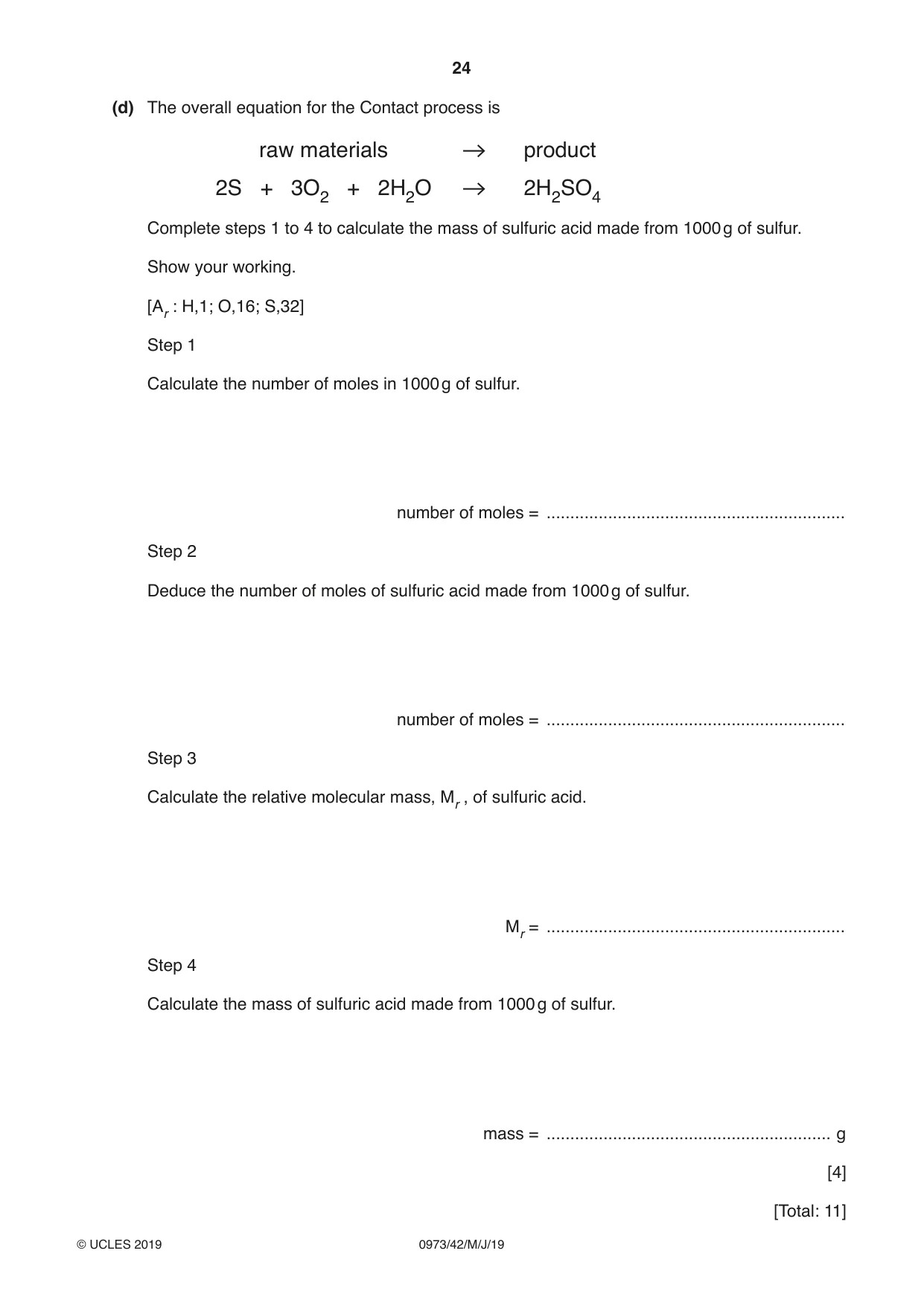
11 The raw materials needed to make sulfuric acid in the Contact process are air, sulfur and water. Fig. 11.1 shows the stages in the Contact process. sulfur air stage 1 sulfur dioxide air stage 2 sulfur trioxide sulfuric stage 3 acid compound X water stage 4 sulfuric acid Fig. 11.1 (a) In stage 2, sulfur dioxide reacts with oxygen to make sulfur trioxide. The equation for this reaction is 2SO2 + O2 2SO3 State the meaning of the symbol. ............................................................................................................................................. [1] (b) Fig. 11.2 shows the relationship between the temperature of stage 2 and the percentage of sulfur dioxide converted to sulfur trioxide. 100 percentage of sulfur dioxide 80 converted to sulfur trioxide 60 40 20 0 0 500 1000 1500 2000 temperature / °C Fig. 11.2 (i) Suggest the temperature in stage 2 of the Contact process. ...................................................................... [1] (ii) Use Fig. 11.2 to suggest one advantage, other than cost, of using a low temperature in stage 2. ..................................................................................................................................... [1] (iii) State and explain why a low temperature is not used in stage 2. Explain your answer in terms of particle movement in stage 2. ........................................................................................................................................... ........................................................................................................................................... ........................................................................................................................................... ..................................................................................................................................... [3] (c) Compound X, H2S2O7, is formed in stage 3. Name compound X. ............................................................................................................................................. [1] (d) The overall equation for the Contact process is raw materials product 2S + 3O2 + 2H2O 2H2SO4 Complete steps 1 to 4 to calculate the mass of sulfuric acid made from 1000 g of sulfur. Show your working. [Ar : H,1; O,16; S,32] Step 1 Calculate the number of moles in 1000 g of sulfur. number of moles = ............................................................... Step 2 Deduce the number of moles of sulfuric acid made from 1000 g of sulfur. number of moles = ............................................................... Step 3 Calculate the relative molecular mass, Mr , of sulfuric acid. Mr = ............................................................... Step 4 Calculate the mass of sulfuric acid made from 1000 g of sulfur. mass = ............................................................ g [4] [Total: 11]
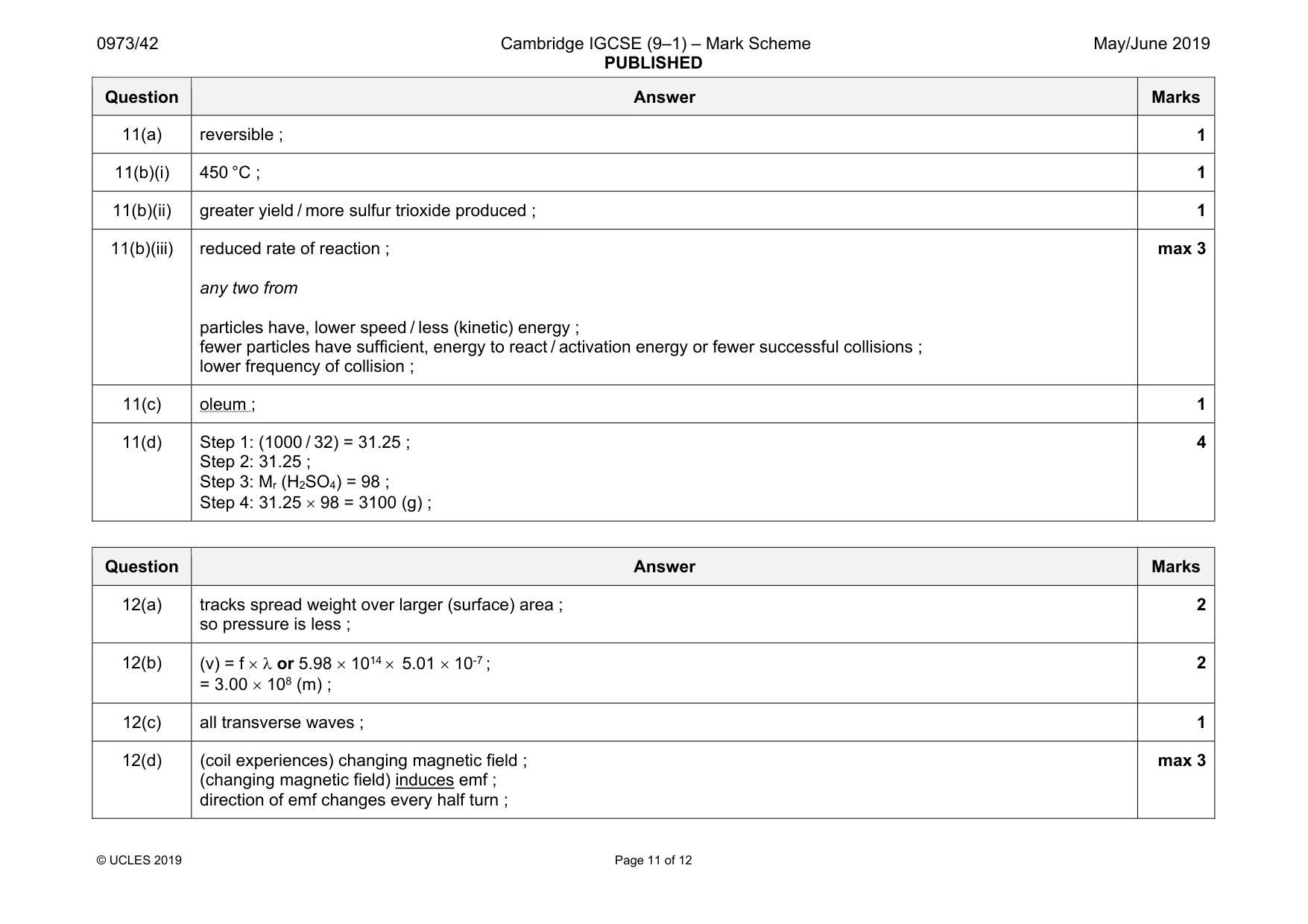
Mark scheme: 11(a) reversible ; 1 11(b)(i) 450 °C ; 1 11(b)(ii) greater yield / more sulfur trioxide produced ; 1 11(b)(iii) reduced rate of reaction ; any two from particles have, lower speed / less (kinetic) energy ; fewer particles have sufficient, energy to react / activation energy or fewer successful collisions ; lower frequency of collision ; max 3 11(c) oleum ; 1 11(d) Step 1: (1000 / 32) = 31.25 ; Step 2: 31.25 ; Step 3: Mr (H2SO4) = 98 ; Step 4: 31.25 × 98 = 3100 (g) ; 4
Q12 · A large snow tractor used by scientists working in the Arctic region
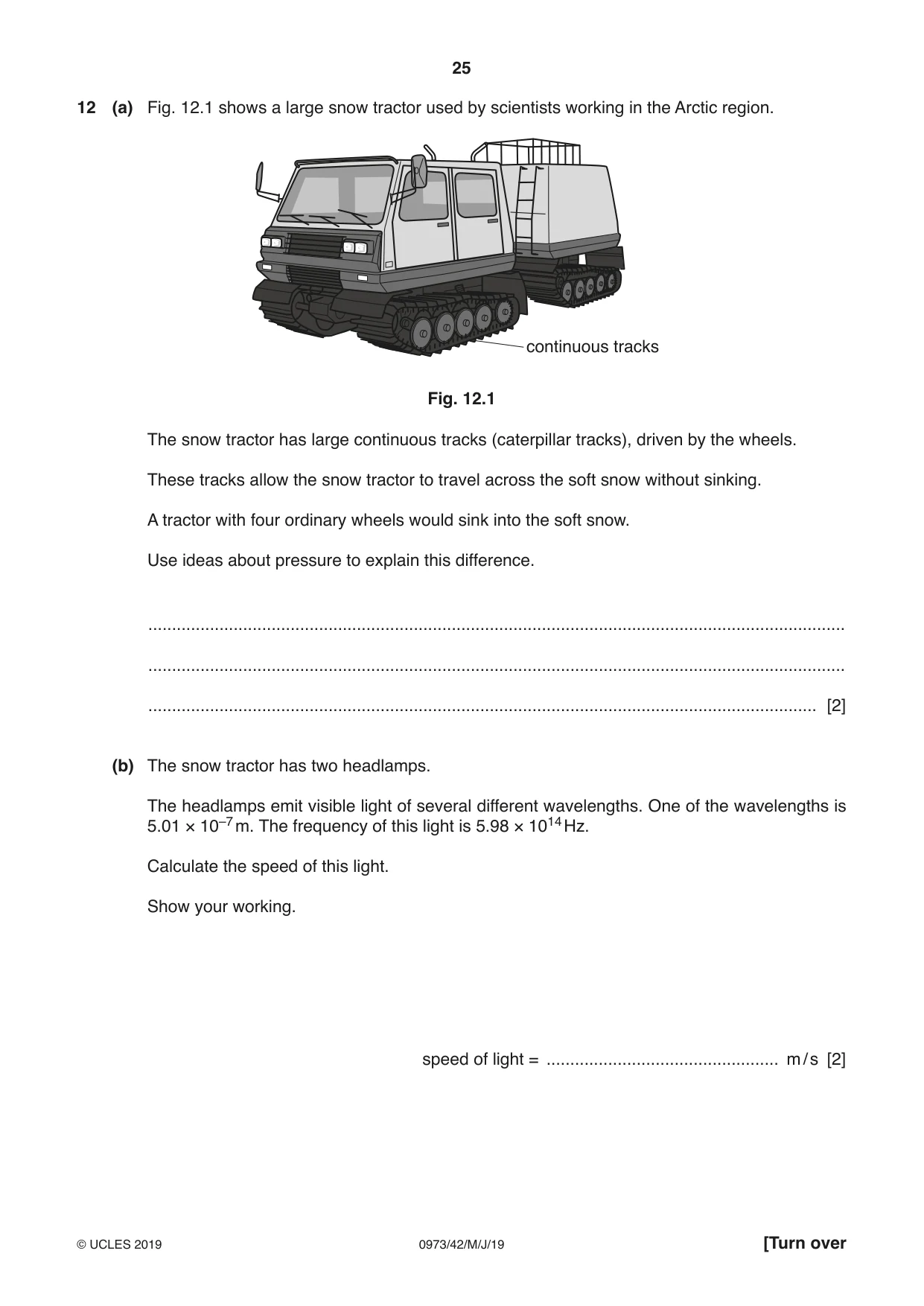
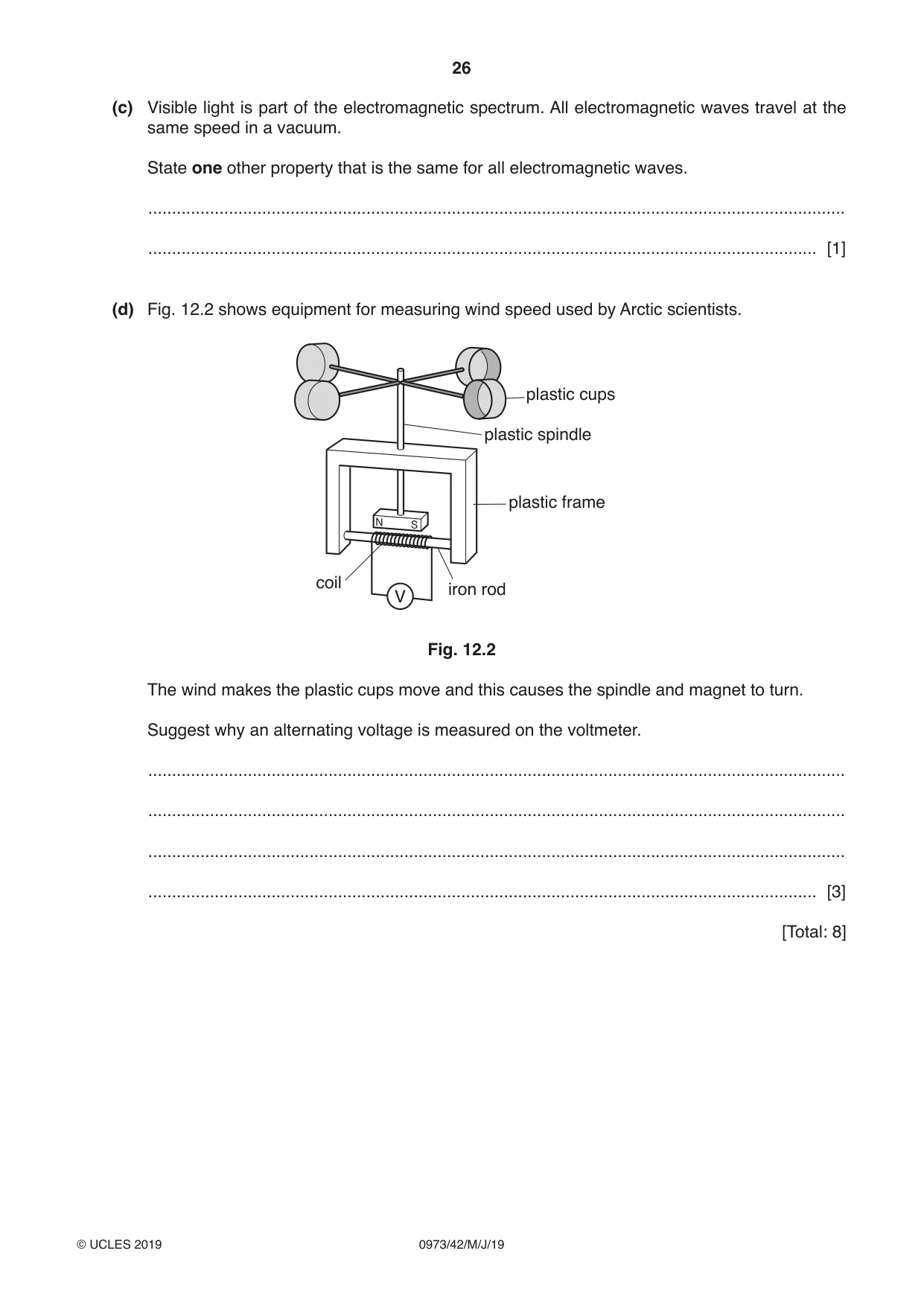
12 (a) Fig. 12.1 shows a large snow tractor used by scientists working in the Arctic region. continuous tracks Fig. 12.1 The snow tractor has large continuous tracks (caterpillar tracks), driven by the wheels. These tracks allow the snow tractor to travel across the soft snow without sinking. A tractor with four ordinary wheels would sink into the soft snow. Use ideas about pressure to explain this difference. ................................................................................................................................................... ................................................................................................................................................... ............................................................................................................................................. [2] (b) The snow tractor has two headlamps. The headlamps emit visible light of several different wavelengths. One of the wavelengths is 5.01 × 10⁻⁷ m. The frequency of this light is 5.98 × 10¹⁴ Hz. Calculate the speed of this light. Show your working. speed of light = ................................................. m / s [2] (c) Visible light is part of the electromagnetic spectrum. All electromagnetic waves travel at the same speed in a vacuum. State one other property that is the same for all electromagnetic waves. ................................................................................................................................................... ............................................................................................................................................. [1] (d) Fig. 12.2 shows equipment for measuring wind speed used by Arctic scientists. plastic cups plastic spindle plastic frame coil iron rod V Fig. 12.2 The wind makes the plastic cups move and this causes the spindle and magnet to turn. Suggest why an alternating voltage is measured on the voltmeter. ................................................................................................................................................... ................................................................................................................................................... ................................................................................................................................................... ............................................................................................................................................. [3] [Total: 8]
Mark scheme: 12(a) tracks spread weight over larger (surface) area ; so pressure is less ; 2 12(b) (v) = f × λ or 5.98 × 1014 × 5.01 × 10-7 ; = 3.00 × 10⁸ (m) ; 2 12(c) all transverse waves ; 1 12(d) (coil experiences) changing magnetic field ; (changing magnetic field) induces emf ; direction of emf changes every half turn ; max 3
Q13 · Excess use of fertilisers can cause eutrophication
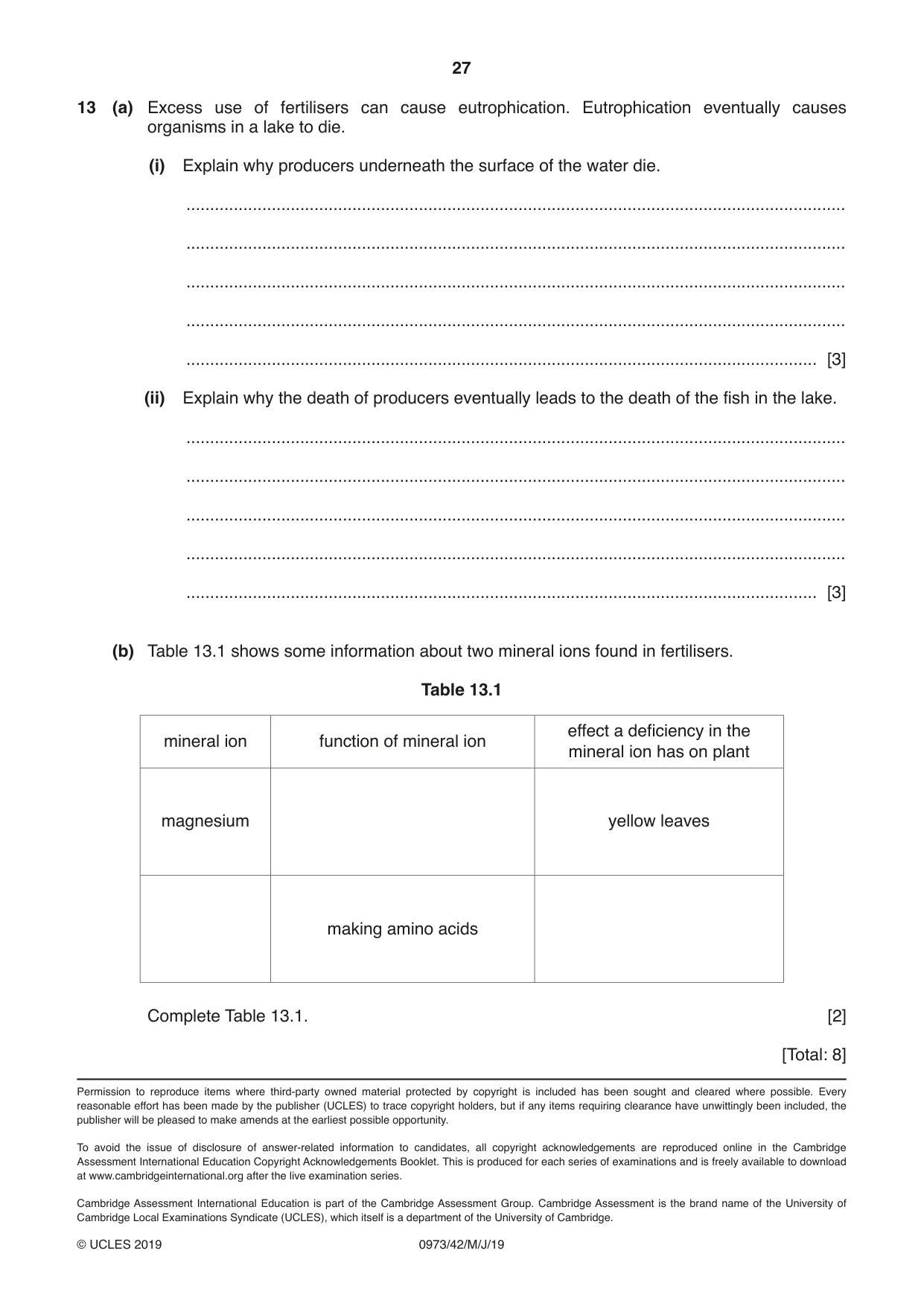
13 (a) Excess use of fertilisers can cause eutrophication. Eutrophication eventually causes organisms in a lake to die. (i) Explain why producers underneath the surface of the water die. ........................................................................................................................................... ........................................................................................................................................... ........................................................................................................................................... ........................................................................................................................................... ..................................................................................................................................... [3] (ii) Explain why the death of producers eventually leads to the death of the fish in the lake. ........................................................................................................................................... ........................................................................................................................................... ........................................................................................................................................... ........................................................................................................................................... ..................................................................................................................................... [3] (b) Table 13.1 shows some information about two mineral ions found in fertilisers. Table 13.1 effect a deficiency in the mineral ion function of mineral ion mineral ion has on plant magnesium yellow leaves making amino acids Complete Table 13.1. [2] [Total: 8]
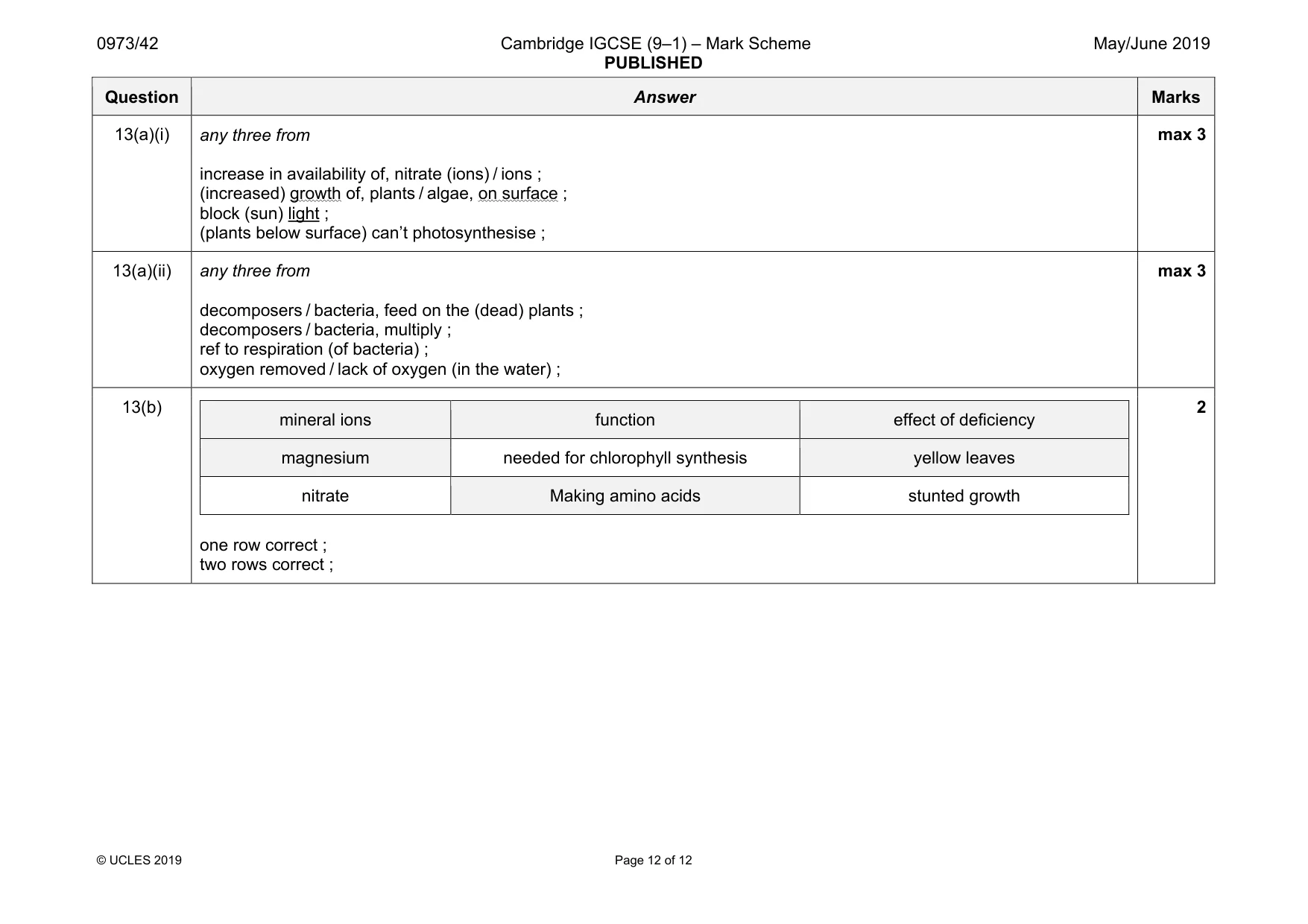
Mark scheme: 13(a)(i) any three from increase in availability of, nitrate (ions) / ions ; (increased) growth of, plants / algae, on surface ; block (sun) light ; (plants below surface) can’t photosynthesise ; max 3 13(a)(ii) any three from decomposers / bacteria, feed on the (dead) plants ; decomposers / bacteria, multiply ; ref to respiration (of bacteria) ; oxygen removed / lack of oxygen (in the water) ; max 3 13(b) one row correct ; two rows correct ; mineral ions function effect of deficiency magnesium needed for chlorophyll synthesis yellow leaves nitrate Making amino acids stunted growth 2
What was in this paper
The subtopics covered by these 13 questions, and how many questions each got. Open one in a new tab to see every Cambridge question on it.
What you needed in this session
Cambridge’s own grade thresholds for 2019 May/June, Paper 4 · Variant 2. A higher threshold means an easier paper — the bar moves with how the cohort did.