Cambridge IGCSE Science - Combined 0653 — 2018 May/June Paper 5 · Variant 3
0653/53/M/J/18 · 3 questions · 30 marks · ≈34 min
The question paper and its mark scheme, free to read here and free to download. This is Cambridge’s own paper, exactly as it was sat.
Question paper8 pages
Mark scheme6 pages
Answers below. Sit the paper first if you are practising.
Questions as text
Q1 · You are provided with a piece of banana, hot and cold water, and Benedict’s solution
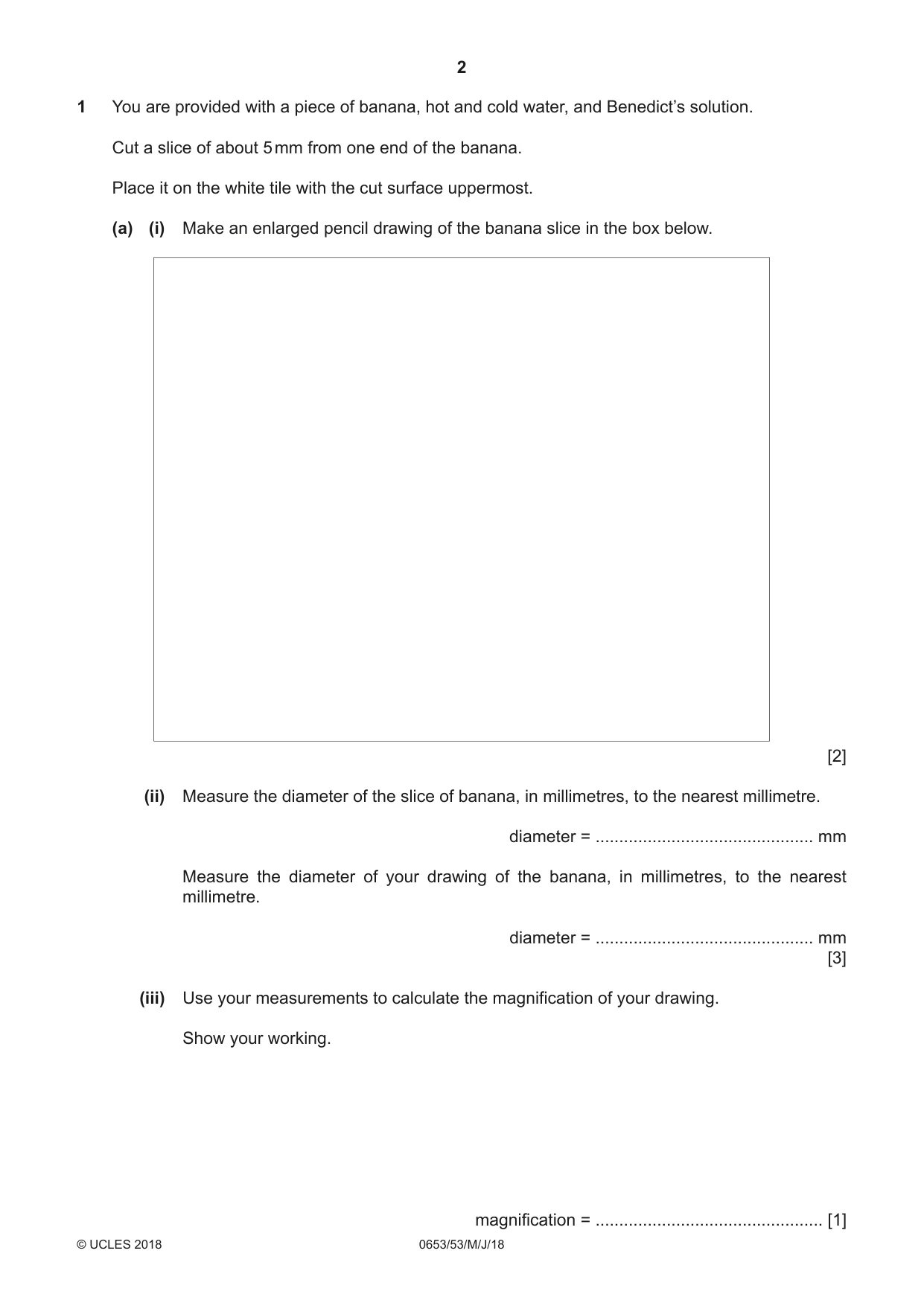
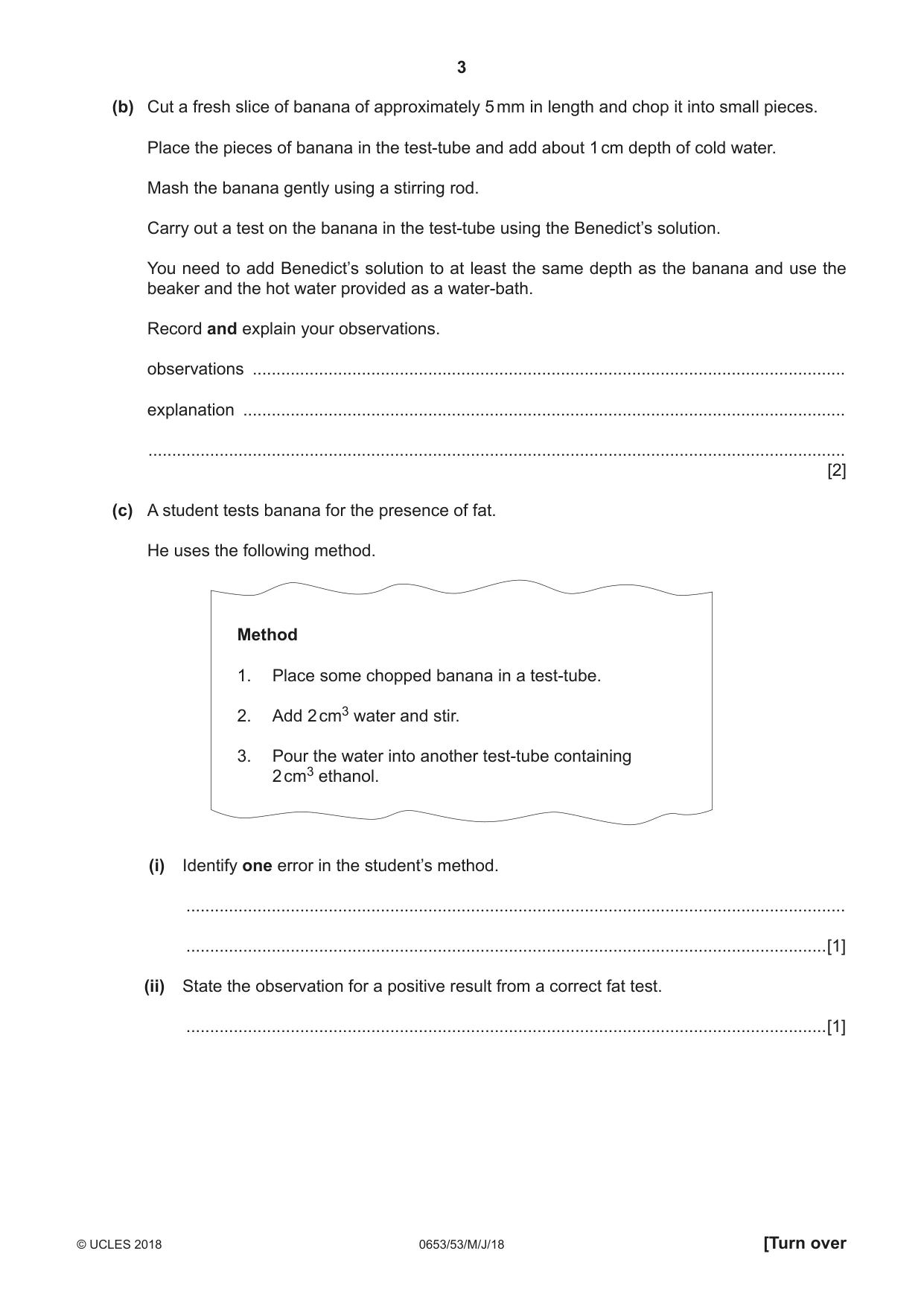
1 You are provided with a piece of banana, hot and cold water, and Benedict’s solution. Cut a slice of about 5 mm from one end of the banana. Place it on the white tile with the cut surface uppermost. (a) (i) Make an enlarged pencil drawing of the banana slice in the box below. [2] (ii) Measure the diameter of the slice of banana, in millimetres, to the nearest millimetre. diameter = .............................................. mm Measure the diameter of your drawing of the banana, in millimetres, to the nearest millimetre. diameter = .............................................. mm [3] (iii) Use your measurements to calculate the magnification of your drawing. Show your working. magnification = ................................................ [1] (b) Cut a fresh slice of banana of approximately 5 mm in length and chop it into small pieces. Place the pieces of banana in the test-tube and add about 1 cm depth of cold water. Mash the banana gently using a stirring rod. Carry out a test on the banana in the test-tube using the Benedict’s solution. You need to add Benedict’s solution to at least the same depth as the banana and use the beaker and the hot water provided as a water-bath. Record and explain your observations. observations ............................................................................................................................. explanation ............................................................................................................................... ................................................................................................................................................... [2] (c) A student tests banana for the presence of fat. He uses the following method. Method 1. Place some chopped banana in a test-tube. 2. Add 2 cm3 water and stir. 3. Pour the water into another test-tube containing 2 cm3 ethanol. (i) Identify one error in the student’s method. ........................................................................................................................................... .......................................................................................................................................[1] (ii) State the observation for a positive result from a correct fat test. .......................................................................................................................................[1]
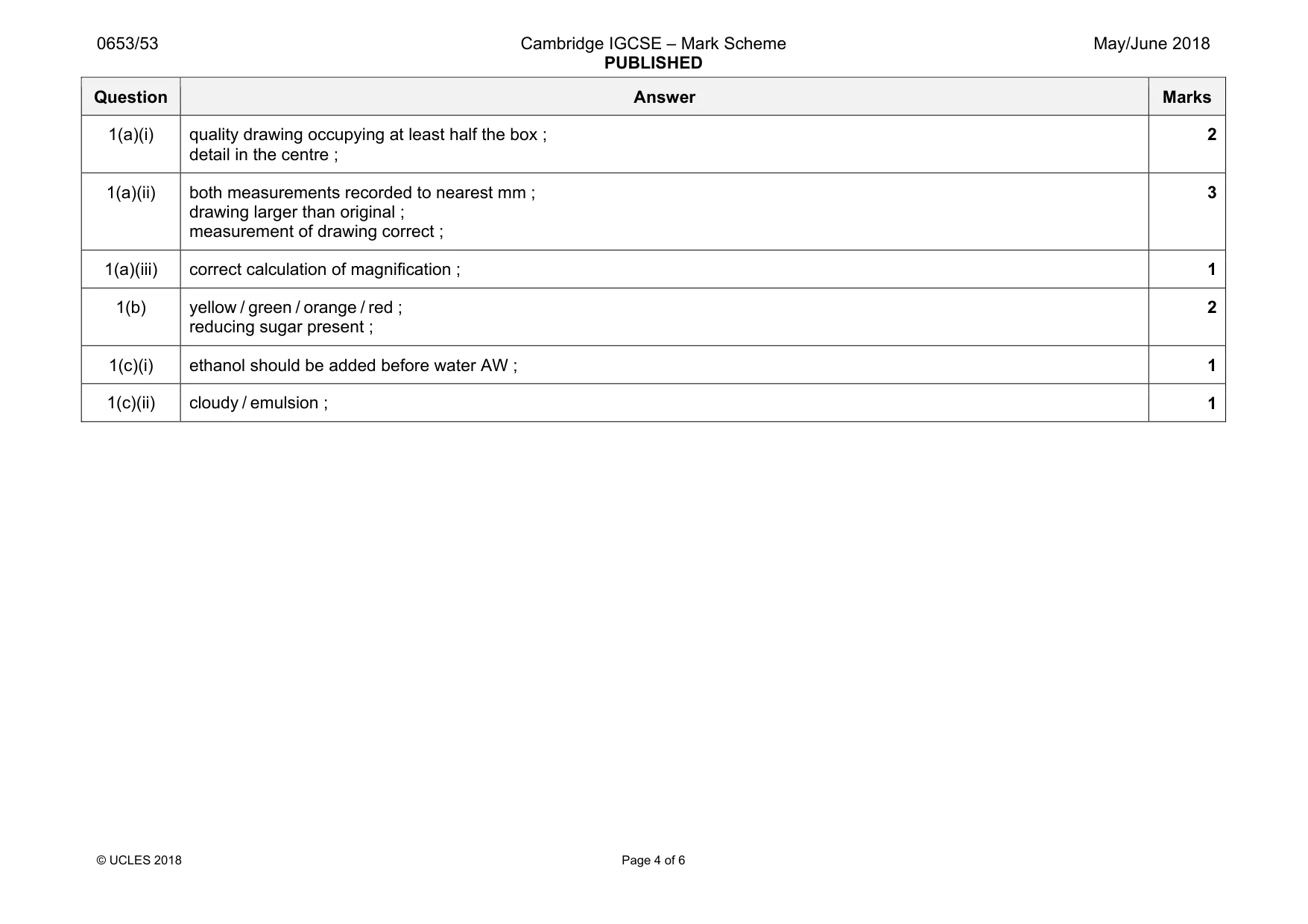
Mark scheme: 1(a)(i) quality drawing occupying at least half the box ; detail in the centre ; 2 1(a)(ii) both measurements recorded to nearest mm ; drawing larger than original ; measurement of drawing correct ; 3 1(a)(iii) correct calculation of magnification ; 1 1(b) yellow / green / orange / red ; reducing sugar present ; 2 1(c)(i) ethanol should be added before water AW ; 1 1(c)(ii) cloudy / emulsion ; 1
Q2 · Notes for use in Qualitative Analysis for this question are printed on page 8
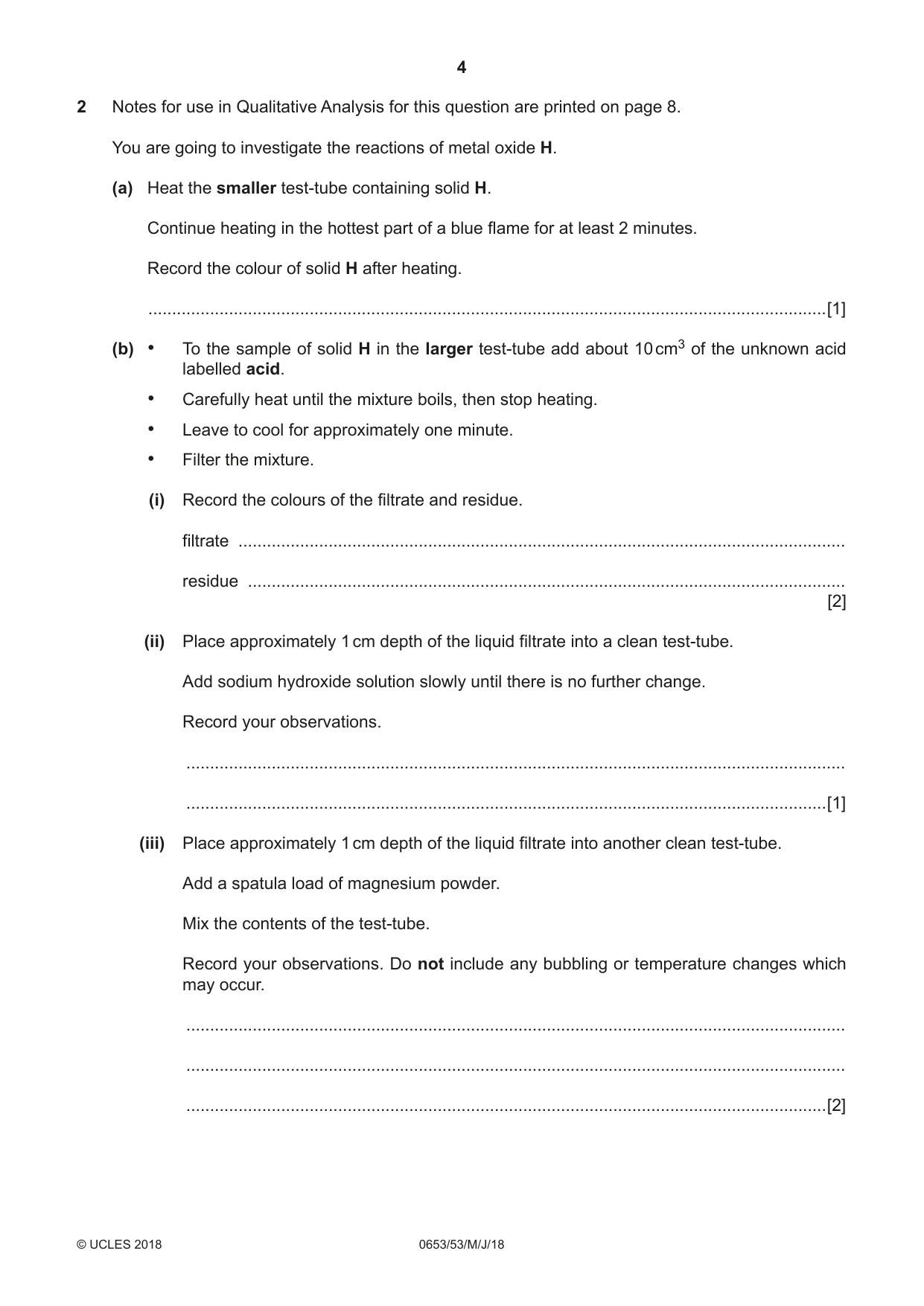
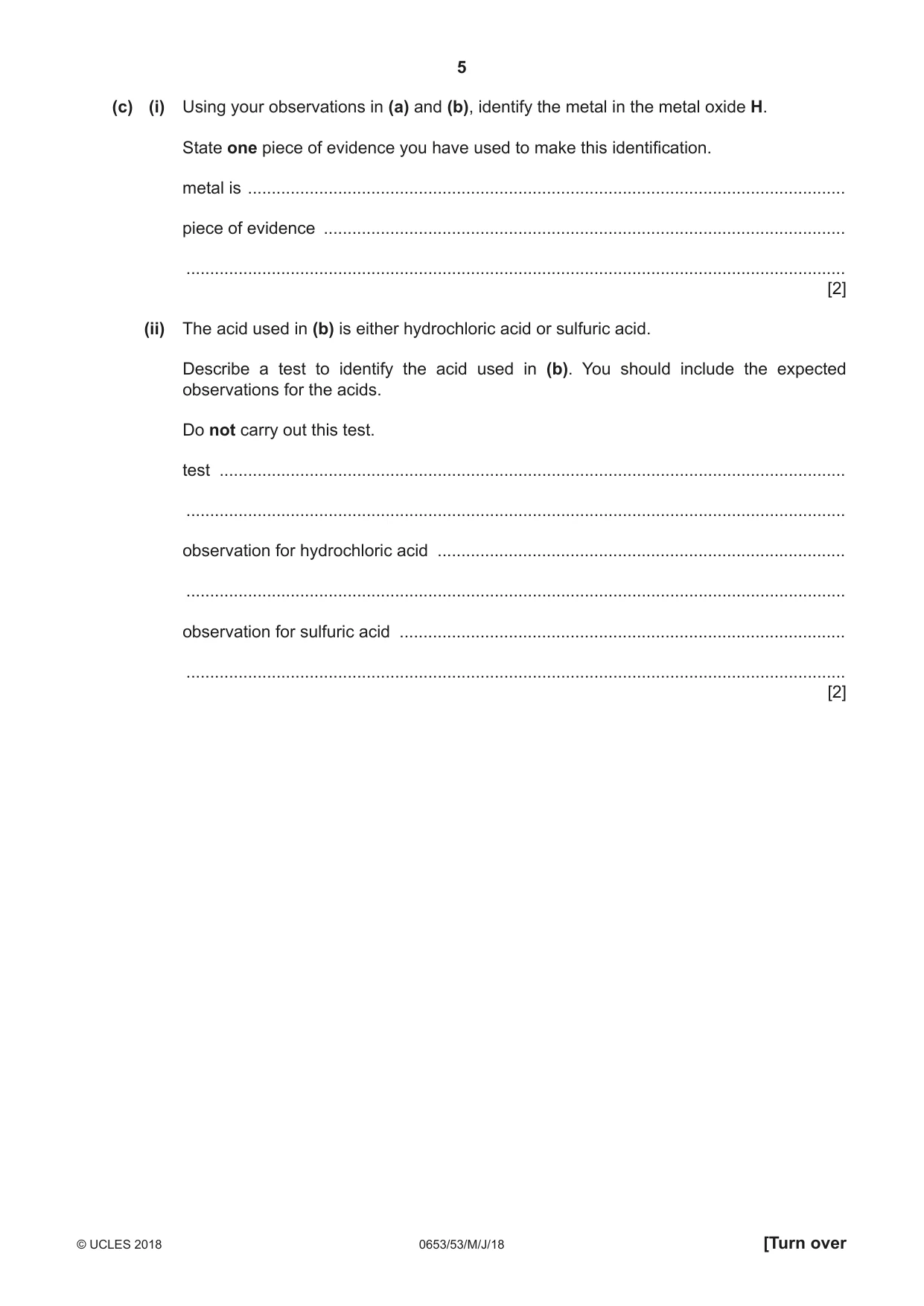
2 Notes for use in Qualitative Analysis for this question are printed on page 8. You are going to investigate the reactions of metal oxide H. (a) Heat the smaller test-tube containing solid H. Continue heating in the hottest part of a blue flame for at least 2 minutes. Record the colour of solid H after heating. ...............................................................................................................................................[1] (b) • To the sample of solid H in the larger test-tube add about 10 cm3 of the unknown acid labelled acid. • Carefully heat until the mixture boils, then stop heating. • Leave to cool for approximately one minute. • Filter the mixture. (i) Record the colours of the filtrate and residue. filtrate ................................................................................................................................ residue .............................................................................................................................. [2] (ii) Place approximately 1 cm depth of the liquid filtrate into a clean test-tube. Add sodium hydroxide solution slowly until there is no further change. Record your observations. ........................................................................................................................................... .......................................................................................................................................[1] (iii) Place approximately 1 cm depth of the liquid filtrate into another clean test-tube. Add a spatula load of magnesium powder. Mix the contents of the test-tube. Record your observations. Do not include any bubbling or temperature changes which may occur. ........................................................................................................................................... ........................................................................................................................................... .......................................................................................................................................[2] (c) (i) Using your observations in (a) and (b), identify the metal in the metal oxide H. State one piece of evidence you have used to make this identification. metal is .............................................................................................................................. piece of evidence .............................................................................................................. ........................................................................................................................................... [2] (ii) The acid used in (b) is either hydrochloric acid or sulfuric acid. Describe a test to identify the acid used in (b). You should include the expected observations for the acids. Do not carry out this test. test .................................................................................................................................... ........................................................................................................................................... observation for hydrochloric acid ...................................................................................... ........................................................................................................................................... observation for sulfuric acid .............................................................................................. ........................................................................................................................................... [2]
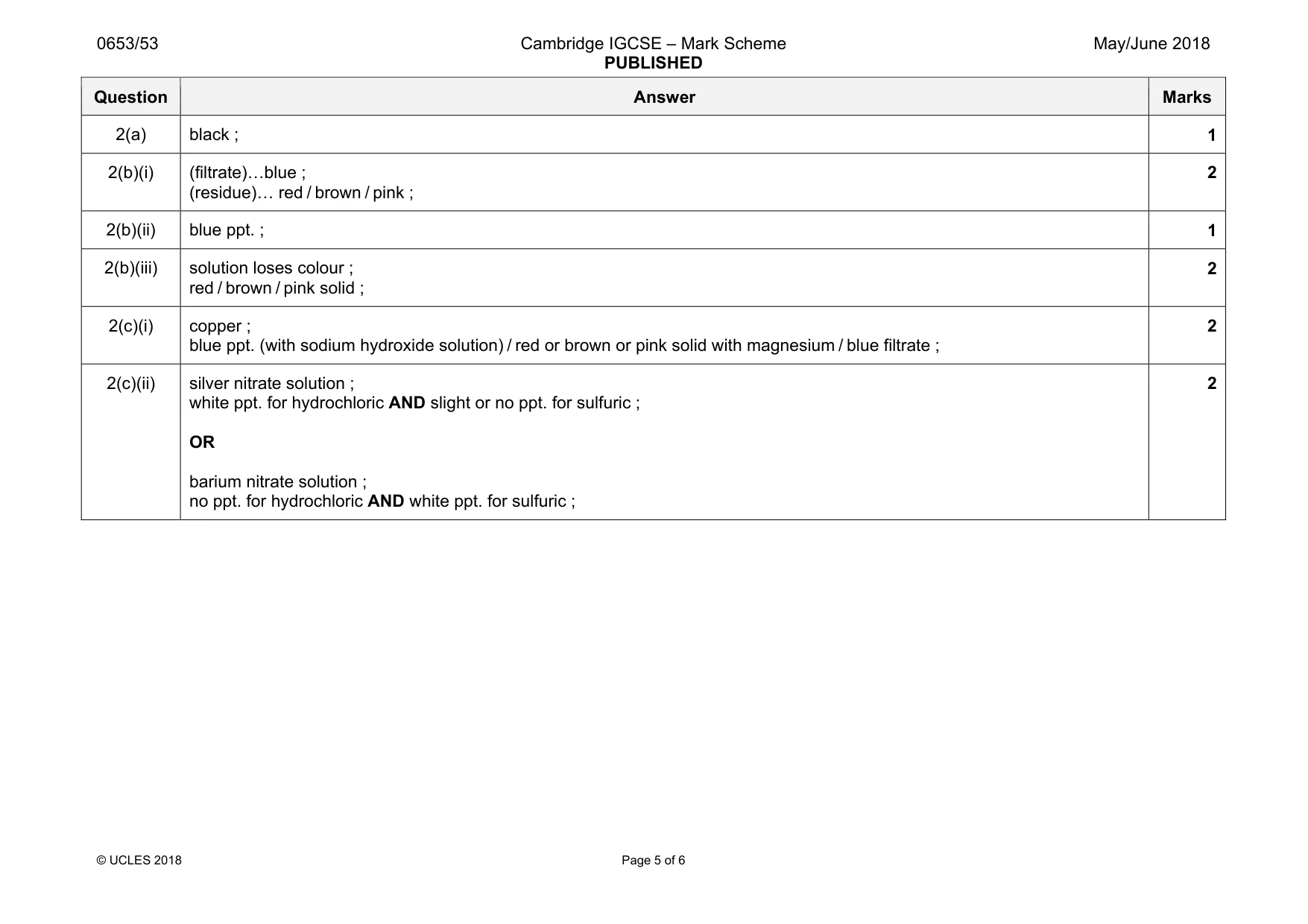
Mark scheme: 2(a) black ; 1 2(b)(i) (filtrate)«blue ; (residue)« red / brown / pink ; 2 2(b)(ii) blue ppt. ; 1 2(b)(iii) solution loses colour ; red / brown / pink solid ; 2 2(c)(i) copper ; blue ppt. (with sodium hydroxide solution) / red or brown or pink solid with magnesium / blue filtrate ; 2 2(c)(ii) silver nitrate solution ; white ppt. for hydrochloric AND slight or no ppt. for sulfuric ; OR barium nitrate solution ; no ppt. for hydrochloric AND white ppt. for sulfuric ; 2
Q3 · You are going to measure the approximate mass of a metre rule using a balancing method
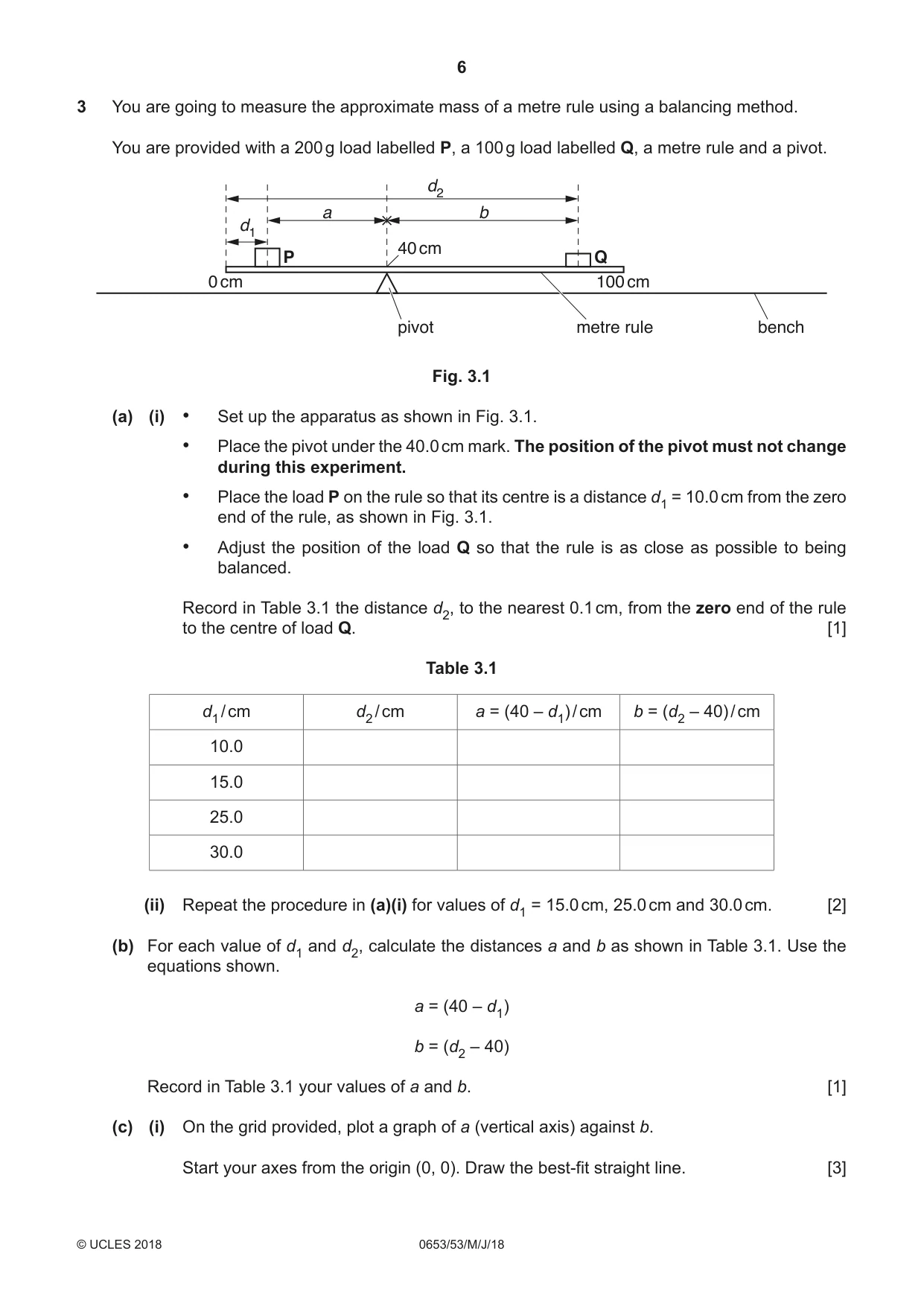
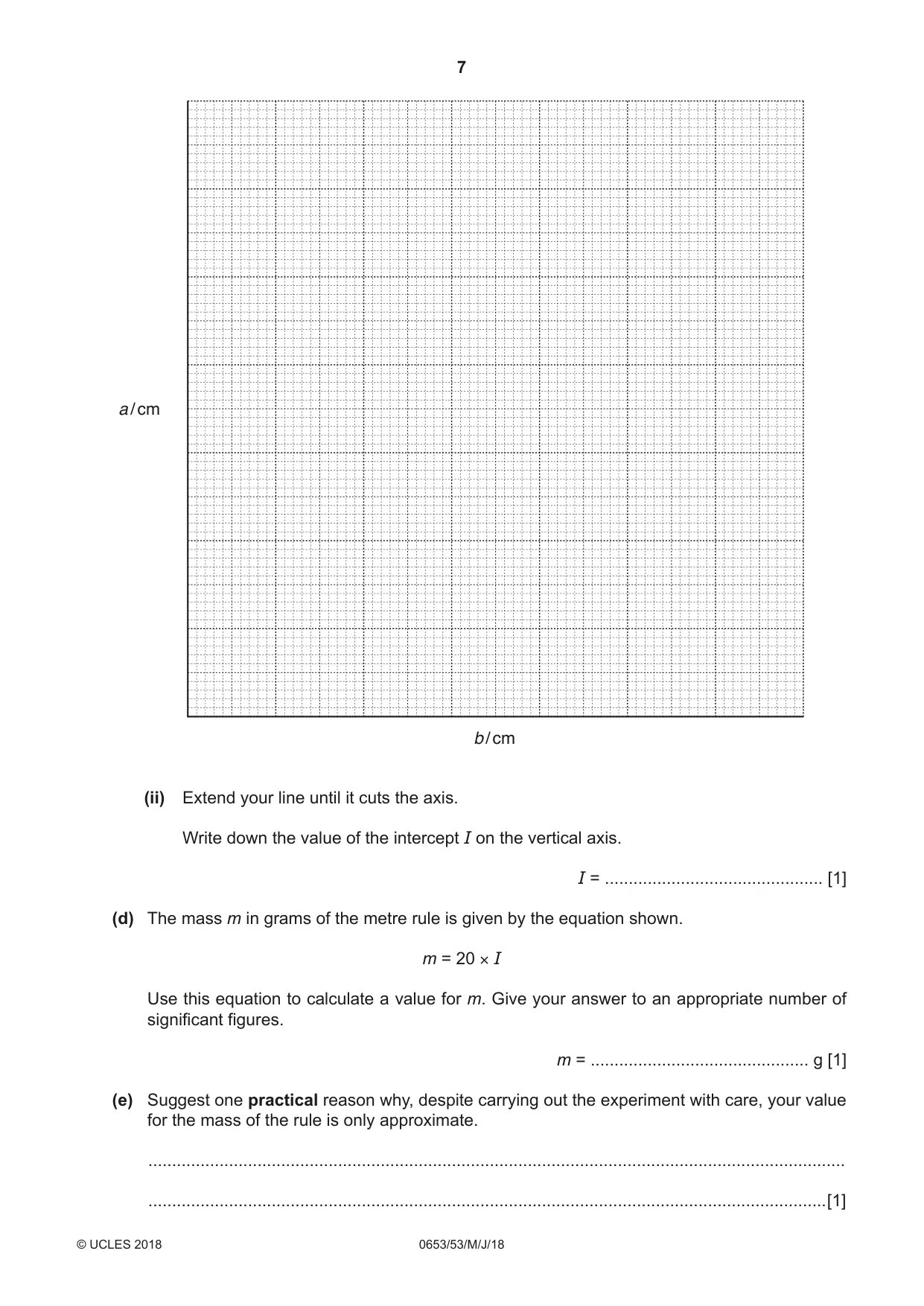
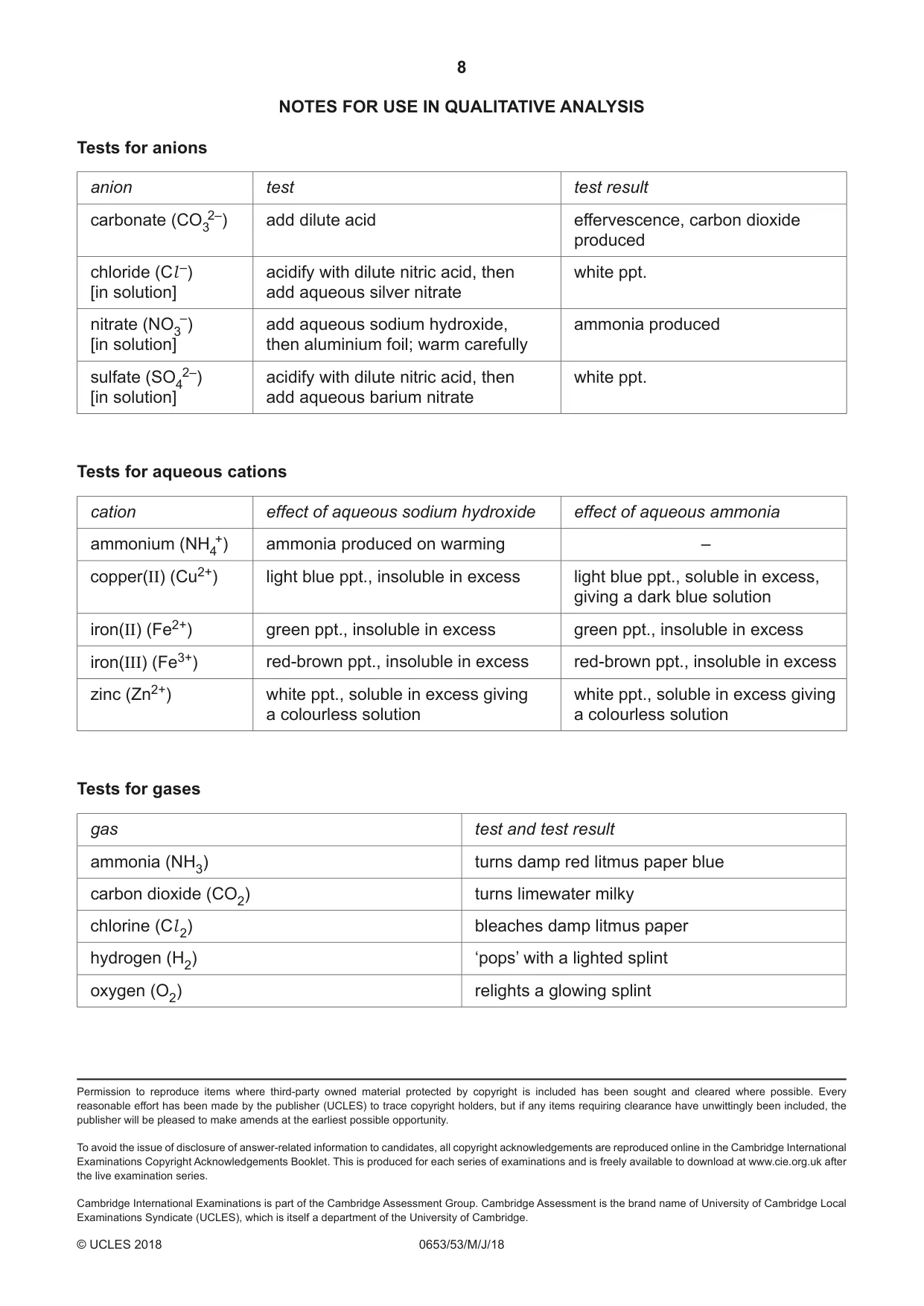
3 You are going to measure the approximate mass of a metre rule using a balancing method. You are provided with a 200 g load labelled P, a 100 g load labelled Q, a metre rule and a pivot. d2 a b d1 40 cm P Q 0 cm 100 cm pivot metre rule bench Fig. 3.1 (a) (i) • Set up the apparatus as shown in Fig. 3.1. • Place the pivot under the 40.0 cm mark. The position of the pivot must not change during this experiment. • Place the load P on the rule so that its centre is a distance d1 = 10.0 cm from the zero end of the rule, as shown in Fig. 3.1. • Adjust the position of the load Q so that the rule is as close as possible to being balanced. Record in Table 3.1 the distance d2, to the nearest 0.1 cm, from the zero end of the rule to the centre of load Q. [1] Table 3.1 d1 / cm d2 / cm a = (40 – d1) / cm b = (d2 – 40) / cm 10.0 15.0 25.0 30.0 (ii) Repeat the procedure in (a)(i) for values of d1 = 15.0 cm, 25.0 cm and 30.0 cm. [2] (b) For each value of d1 and d2, calculate the distances a and b as shown in Table 3.1. Use the equations shown. a = (40 – d1) b = (d2 – 40) Record in Table 3.1 your values of a and b. [1] (c) (i) On the grid provided, plot a graph of a (vertical axis) against b. Start your axes from the origin (0, 0). Draw the best-fit straight line. [3] a / cm b / cm (ii) Extend your line until it cuts the axis. Write down the value of the intercept I on the vertical axis. I = .............................................. [1] (d) The mass m in grams of the metre rule is given by the equation shown. m = 20 × I Use this equation to calculate a value for m. Give your answer to an appropriate number of significant figures. m = .............................................. g [1] (e) Suggest one practical reason why, despite carrying out the experiment with care, your value for the mass of the rule is only approximate. ................................................................................................................................................... ...............................................................................................................................................[1] NOTES FOR USE IN QUALITATIVE ANALYSIS Tests for anions anion test test result carbonate (CO32–) add dilute acid effervescence, carbon dioxide produced chloride (Cl –) acidify with dilute nitric acid, then white ppt. [in solution] add aqueous silver nitrate nitrate (NO3–) add aqueous sodium hydroxide, ammonia produced [in solution] then aluminium foil; warm carefully sulfate (SO42–) acidify with dilute nitric acid, then white ppt. [in solution] add aqueous barium nitrate Tests for aqueous cations cation effect of aqueous sodium hydroxide effect of aqueous ammonia ammonium (NH4+) ammonia produced on warming – copper(II) (Cu2+) light blue ppt., insoluble in excess light blue ppt., soluble in excess, giving a dark blue solution iron(II) (Fe2+) green ppt., insoluble in excess green ppt., insoluble in excess iron(III) (Fe3+) red-brown ppt., insoluble in excess red-brown ppt., insoluble in excess zinc (Zn2+) white ppt., soluble in excess giving white ppt., soluble in excess giving a colourless solution a colourless solution Tests for gases gas test and test result ammonia (NH3) turns damp red litmus paper blue carbon dioxide (CO2) turns limewater milky chlorine (Cl 2) bleaches damp litmus paper hydrogen (H2) ‘pops’ with a lighted splint oxygen (O2) relights a glowing splint
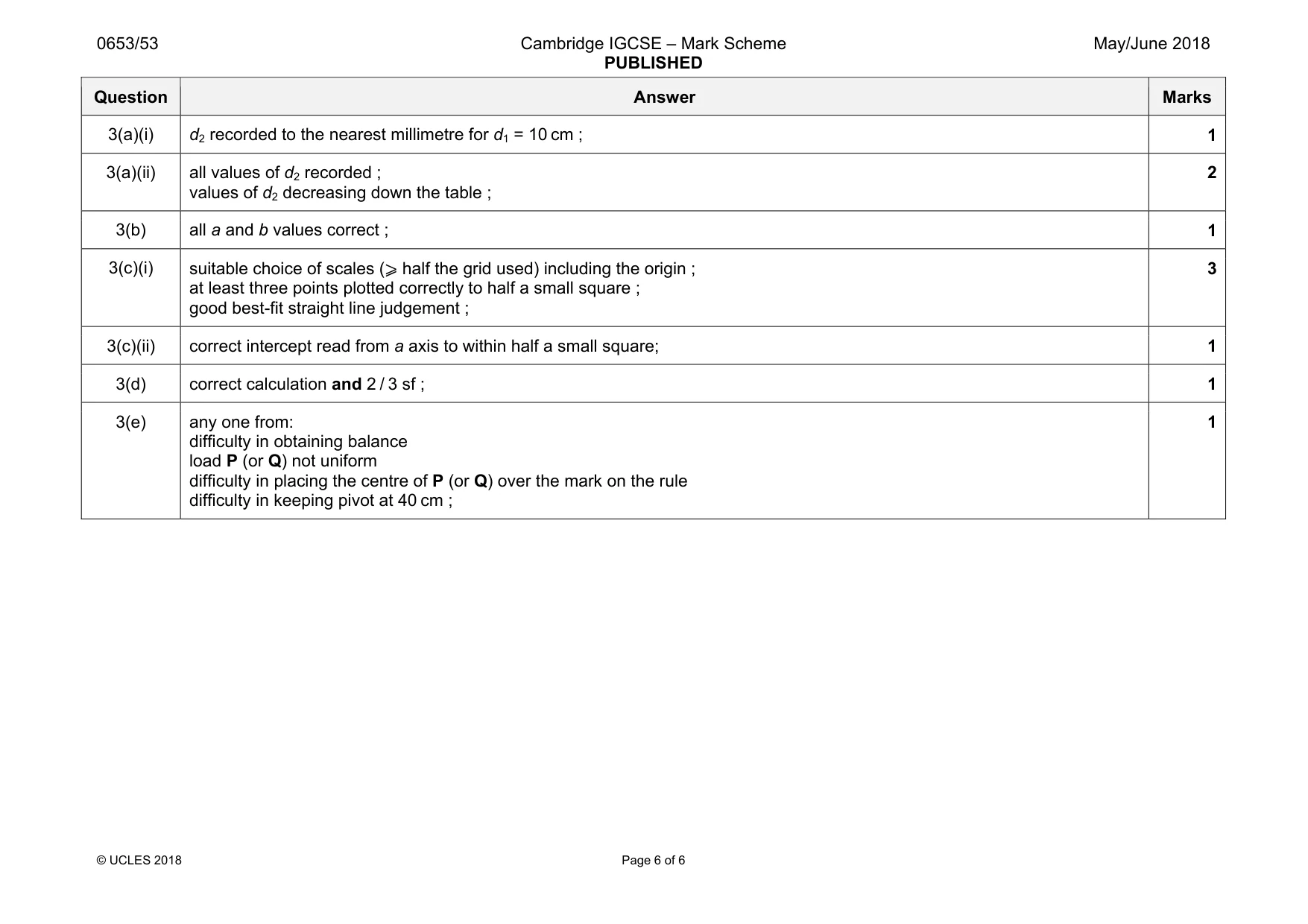
Mark scheme: 3(a)(i) d2 recorded to the nearest millimetre for d1 = 10 cm ; 1 3(a)(ii) all values of d2 recorded ; values of d2 decreasing down the table ; 2 3(b) all a and b values correct ; 1 3(c)(i) suitable choice of scales (⩾ half the grid used) including the origin ; at least three points plotted correctly to half a small square ; good best-fit straight line judgement ; 3 3(c)(ii) correct intercept read from a axis to within half a small square; 1 3(d) correct calculation and 2 / 3 sf ; 1 3(e) any one from: difficulty in obtaining balance load P (or Q) not uniform difficulty in placing the centre of P (or Q) over the mark on the rule difficulty in keeping pivot at 40 cm ; 1
What was in this paper
The subtopics covered by these 3 questions, and how many questions each got. Open one in a new tab to see every Cambridge question on it.
What you needed in this session
Cambridge’s own grade thresholds for 2018 May/June, Paper 5 · Variant 3. A higher threshold means an easier paper — the bar moves with how the cohort did.