Cambridge IGCSE Science - Combined 0653 — 2014 May/June Paper 5 · Variant 2
0653/52/M/J/14 · 30 marks · ≈34 min
The question paper and its mark scheme, free to read here and free to download. This is Cambridge’s own paper, exactly as it was sat.
Question paper8 pages
Mark scheme3 pages
Answers below. Sit the paper first if you are practising.
Paper as text
Question paper, page 1
This document consists of 8 printed pages. IB14 06_0653_52/2RP © UCLES 2014 [Turn over *0467532656* For Examiner's Use 1 2 3 Total Cambridge International Examinations Cambridge International General Certificate of Secondary Education COMBINED SCIENCE 0653/52 Paper 5 Practical Test May/June 2014 1 hour 30 minutes Candidates answer on the Question Paper. Additional Materials: As listed in the Confidential Instructions. READ THESE INSTRUCTIONS FIRST Write your Centre number, candidate number and name on all the work you hand in. Write in dark blue or black pen. You may use an HB pencil for any diagrams or graphs. Do not use staples, paper clips, glue or correction fluid. DO NOT WRITE IN ANY BARCODES. Answer all questions. Electronic calculators may be used. You may lose marks if you do not show your working or if you do not use appropriate units. Notes for Use in Qualitative Analysis for this paper are printed on page 8. At the end of the examination, fasten all your work securely together. The number of marks is given in brackets [ ] at the end of each question or part question.
Question paper, page 2
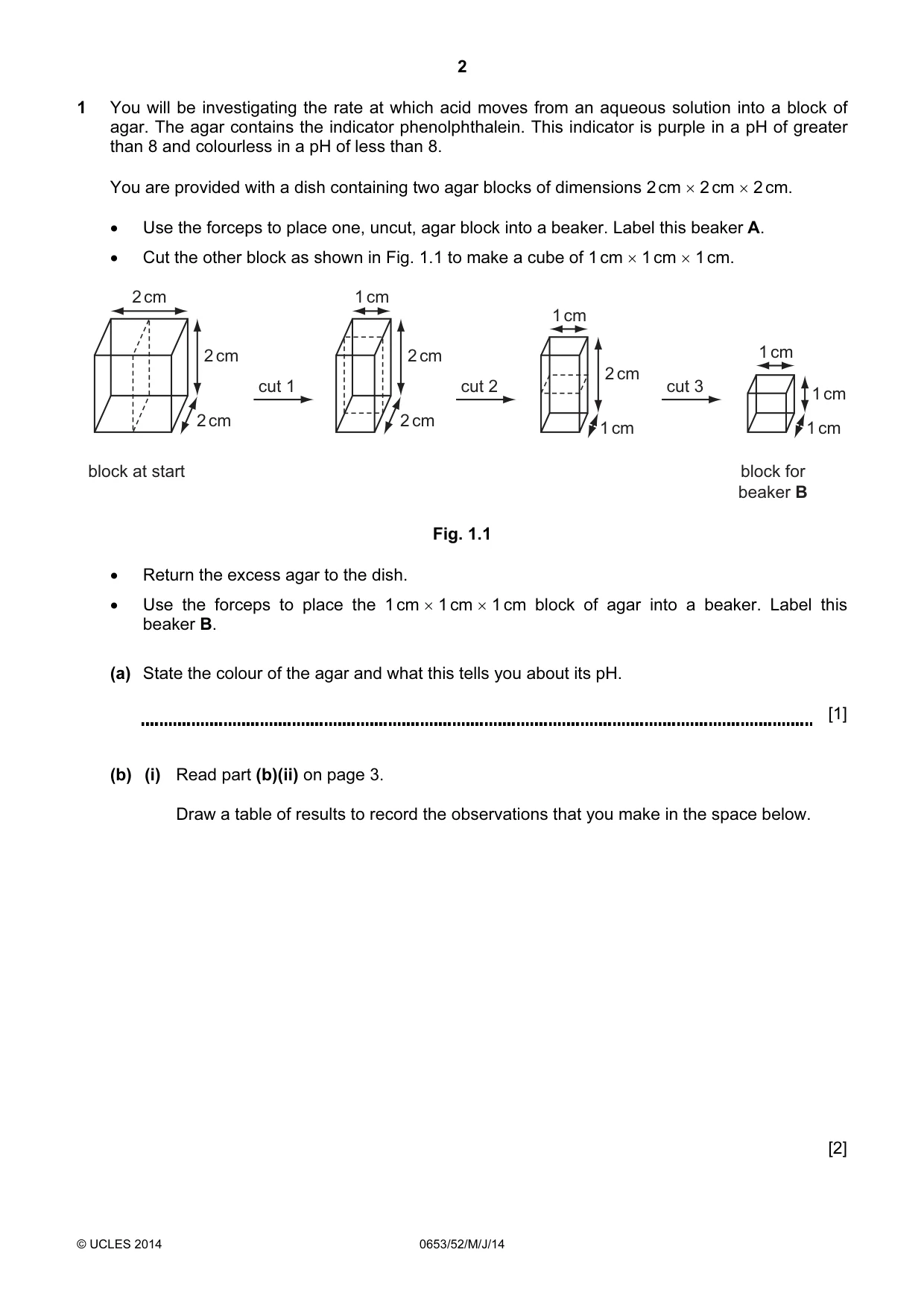
2 © UCLES 2014 0653/52/M/J/14 1 You will be investigating the rate at which acid moves from an aqueous solution into a block of agar. The agar contains the indicator phenolphthalein. This indicator is purple in a pH of greater than 8 and colourless in a pH of less than 8. You are provided with a dish containing two agar blocks of dimensions 2 cm × 2 cm × 2 cm. • Use the forceps to place one, uncut, agar block into a beaker. Label this beaker A. • Cut the other block as shown in Fig. 1.1 to make a cube of 1 cm × 1 cm × 1 cm. 2 cm 2 cm 2 cm block at start block for beaker B 1 cm 2 cm 2 cm 1 cm 2 cm 1 cm 1 cm 1 cm 1 cm cut 1 cut 2 cut 3 Fig. 1.1 • Return the excess agar to the dish. • Use the forceps to place the 1 cm × 1 cm × 1 cm block of agar into a beaker. Label this beaker B. (a) State the colour of the agar and what this tells you about its pH. [1] (b) (i) Read part (b)(ii) on page 3. Draw a table of results to record the observations that you make in the space below. [2]
Question paper, page 3
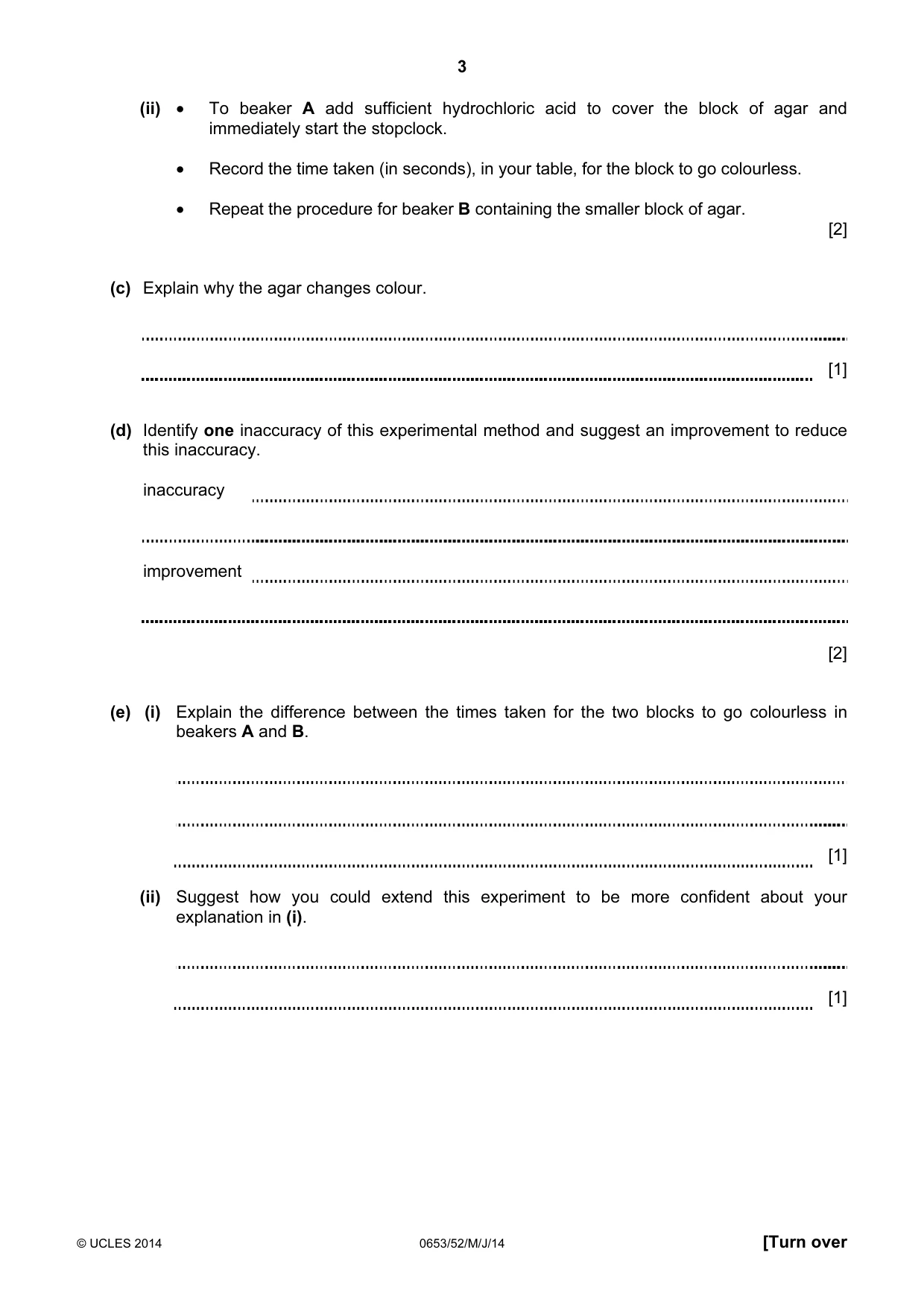
3 © UCLES 2014 0653/52/M/J/14 [Turn over (ii) • To beaker A add sufficient hydrochloric acid to cover the block of agar and immediately start the stopclock. • Record the time taken (in seconds), in your table, for the block to go colourless. • Repeat the procedure for beaker B containing the smaller block of agar. [2] (c) Explain why the agar changes colour. [1] (d) Identify one inaccuracy of this experimental method and suggest an improvement to reduce this inaccuracy. inaccuracy improvement [2] (e) (i) Explain the difference between the times taken for the two blocks to go colourless in beakers A and B. [1] (ii) Suggest how you could extend this experiment to be more confident about your explanation in (i). [1]
Question paper, page 4
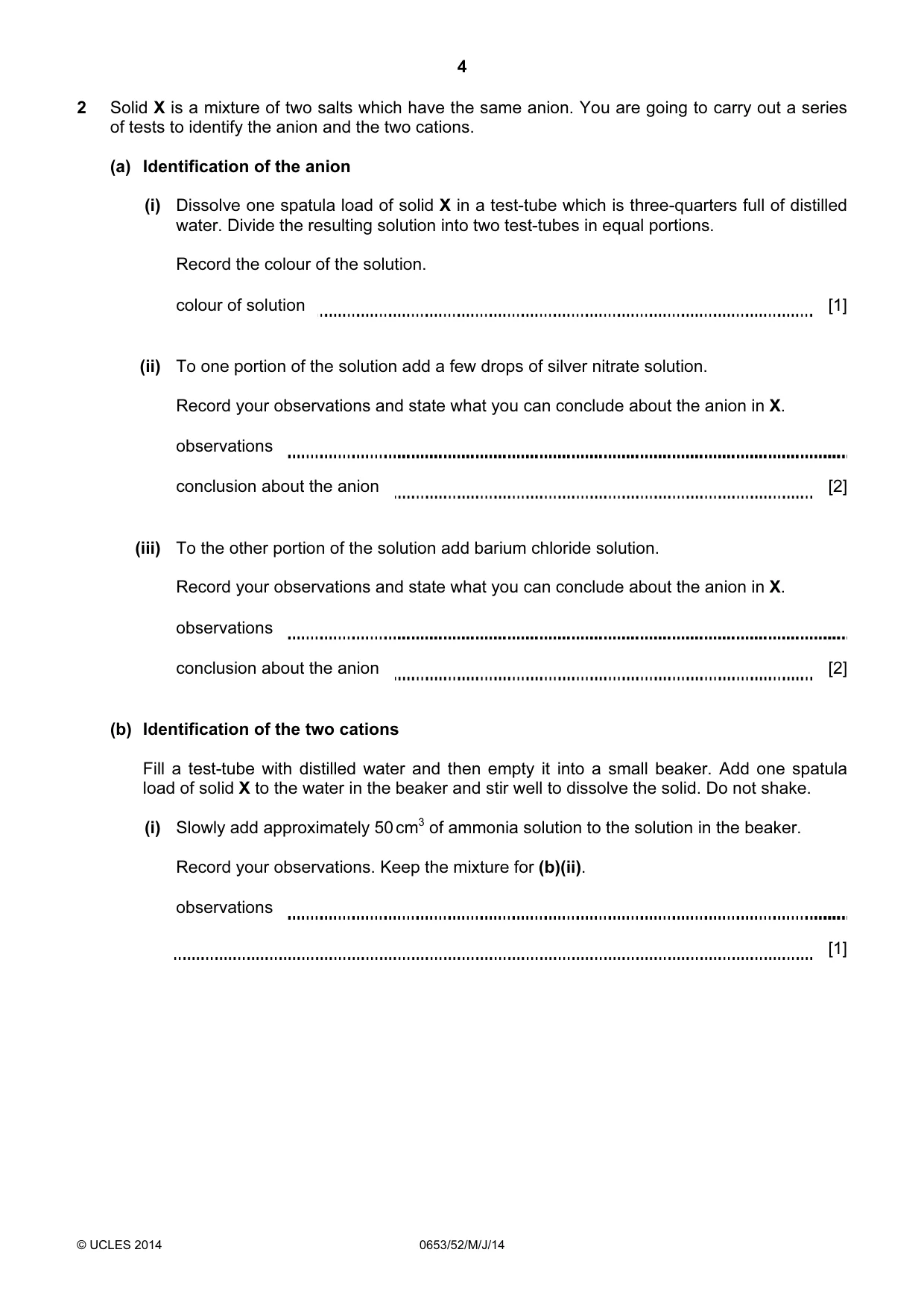
4 © UCLES 2014 0653/52/M/J/14 2 Solid X is a mixture of two salts which have the same anion. You are going to carry out a series of tests to identify the anion and the two cations. (a) Identification of the anion (i) Dissolve one spatula load of solid X in a test-tube which is three-quarters full of distilled water. Divide the resulting solution into two test-tubes in equal portions. Record the colour of the solution. colour of solution [1] (ii) To one portion of the solution add a few drops of silver nitrate solution. Record your observations and state what you can conclude about the anion in X. observations conclusion about the anion [2] (iii) To the other portion of the solution add barium chloride solution. Record your observations and state what you can conclude about the anion in X. observations conclusion about the anion [2] (b) Identification of the two cations Fill a test-tube with distilled water and then empty it into a small beaker. Add one spatula load of solid X to the water in the beaker and stir well to dissolve the solid. Do not shake. (i) Slowly add approximately 50 cm3 of ammonia solution to the solution in the beaker. Record your observations. Keep the mixture for (b)(ii). observations [1]
Question paper, page 5
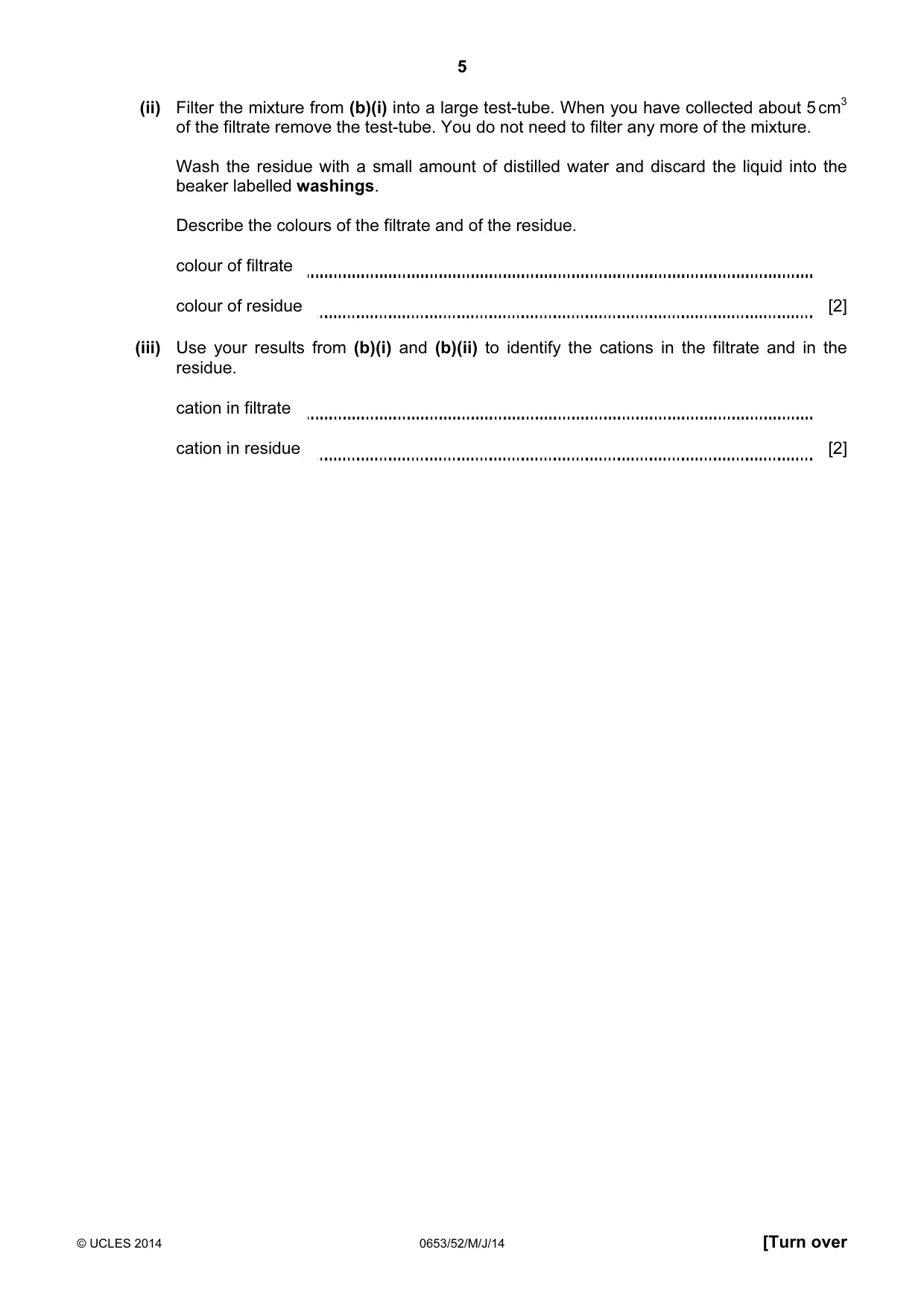
5 © UCLES 2014 0653/52/M/J/14 [Turn over (ii) Filter the mixture from (b)(i) into a large test-tube. When you have collected about 5 cm3 of the filtrate remove the test-tube. You do not need to filter any more of the mixture. Wash the residue with a small amount of distilled water and discard the liquid into the beaker labelled washings. Describe the colours of the filtrate and of the residue. colour of filtrate colour of residue [2] (iii) Use your results from (b)(i) and (b)(ii) to identify the cations in the filtrate and in the residue. cation in filtrate cation in residue [2]
Question paper, page 6
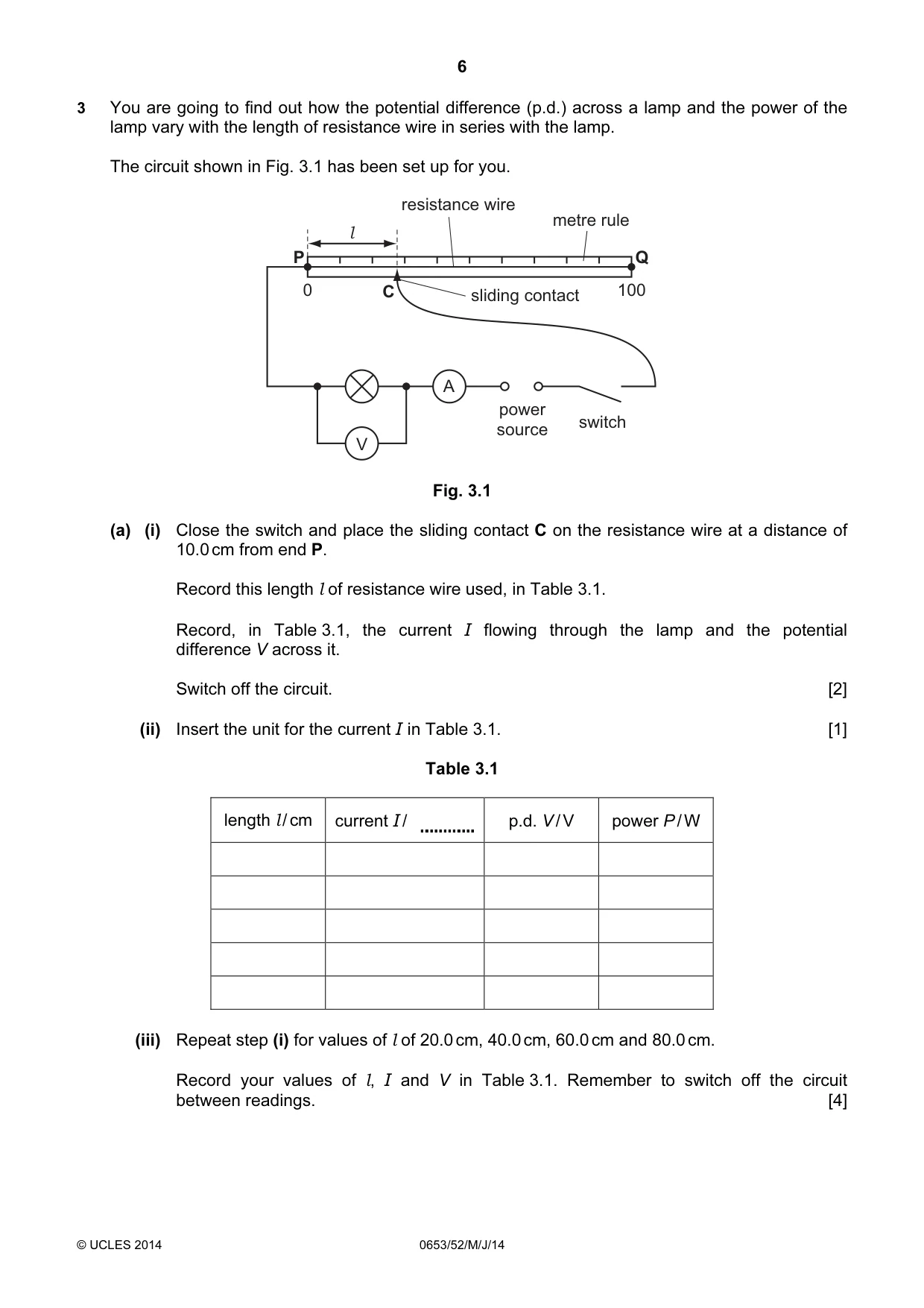
6 © UCLES 2014 0653/52/M/J/14 3 You are going to find out how the potential difference (p.d.) across a lamp and the power of the lamp vary with the length of resistance wire in series with the lamp. The circuit shown in Fig. 3.1 has been set up for you. V A power source switch 0 100 P Q sliding contact metre rule resistance wire l C Fig. 3.1 (a) (i) Close the switch and place the sliding contact C on the resistance wire at a distance of 10.0 cm from end P. Record this length l of resistance wire used, in Table 3.1. Record, in Table 3.1, the current I flowing through the lamp and the potential difference V across it. Switch off the circuit. [2] (ii) Insert the unit for the current I in Table 3.1. [1] Table 3.1 length l / cm current I / p.d. V / V power P / W (iii) Repeat step (i) for values of l of 20.0 cm, 40.0 cm, 60.0 cm and 80.0 cm. Record your values of l, I and V in Table 3.1. Remember to switch off the circuit between readings. [4]
Question paper, page 7
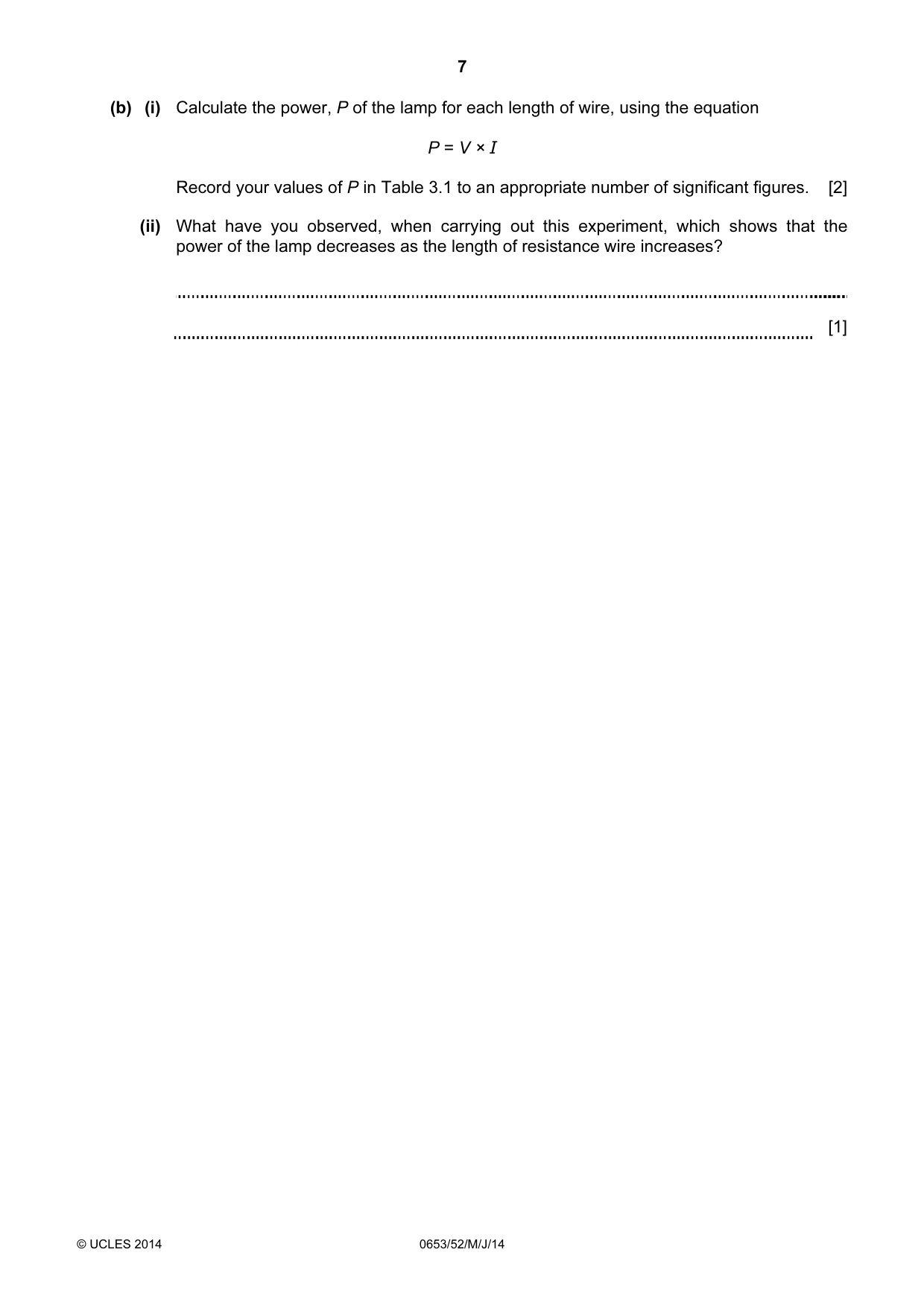
7 © UCLES 2014 0653/52/M/J/14 (b) (i) Calculate the power, P of the lamp for each length of wire, using the equation P = V × I Record your values of P in Table 3.1 to an appropriate number of significant figures. [2] (ii) What have you observed, when carrying out this experiment, which shows that the power of the lamp decreases as the length of resistance wire increases? [1]
Question paper, page 8
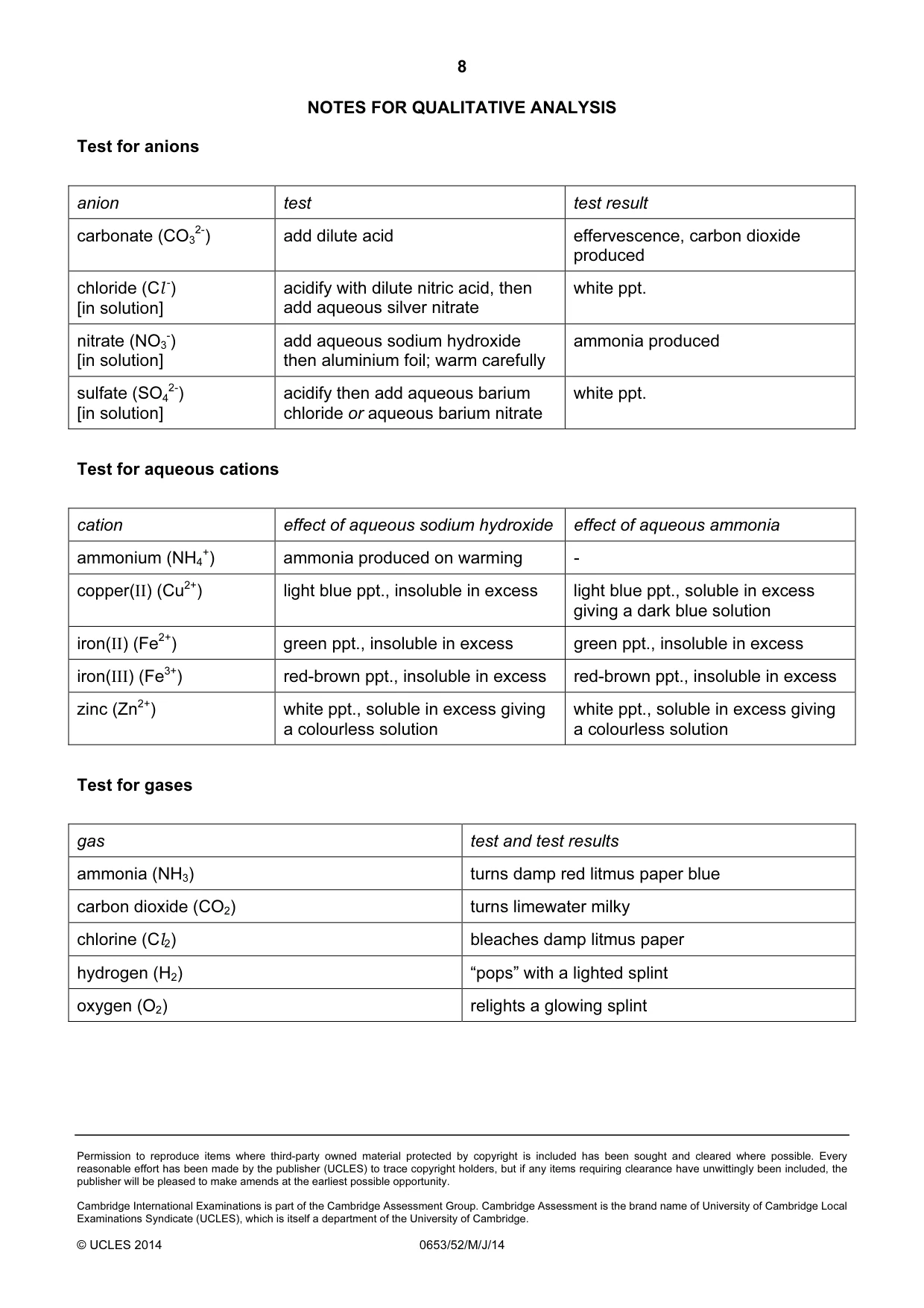
8 Permission to reproduce items where third-party owned material protected by copyright is included has been sought and cleared where possible. Every reasonable effort has been made by the publisher (UCLES) to trace copyright holders, but if any items requiring clearance have unwittingly been included, the publisher will be pleased to make amends at the earliest possible opportunity. Cambridge International Examinations is part of the Cambridge Assessment Group. Cambridge Assessment is the brand name of University of Cambridge Local Examinations Syndicate (UCLES), which is itself a department of the University of Cambridge. © UCLES 2014 0653/52/M/J/14 NOTES FOR QUALITATIVE ANALYSIS Test for anions anion test test result carbonate (CO3 2-) add dilute acid effervescence, carbon dioxide produced chloride (Cl -) [in solution] acidify with dilute nitric acid, then add aqueous silver nitrate white ppt. nitrate (NO3 -) [in solution] add aqueous sodium hydroxide then aluminium foil; warm carefully ammonia produced sulfate (SO4 2-) [in solution] acidify then add aqueous barium chloride or aqueous barium nitrate white ppt. Test for aqueous cations cation effect of aqueous sodium hydroxide effect of aqueous ammonia ammonium (NH4 +) ammonia produced on warming - copper(II) (Cu2+) light blue ppt., insoluble in excess light blue ppt., soluble in excess giving a dark blue solution iron(II) (Fe2+) green ppt., insoluble in excess green ppt., insoluble in excess iron(III) (Fe3+) red-brown ppt., insoluble in excess red-brown ppt., insoluble in excess zinc (Zn2+) white ppt., soluble in excess giving a colourless solution white ppt., soluble in excess giving a colourless solution Test for gases gas test and test results ammonia (NH3) turns damp red litmus paper blue carbon dioxide (CO2) turns limewater milky chlorine (Cl2) bleaches damp litmus paper hydrogen (H2) “pops” with a lighted splint oxygen (O2) relights a glowing splint
Mark scheme, page 1
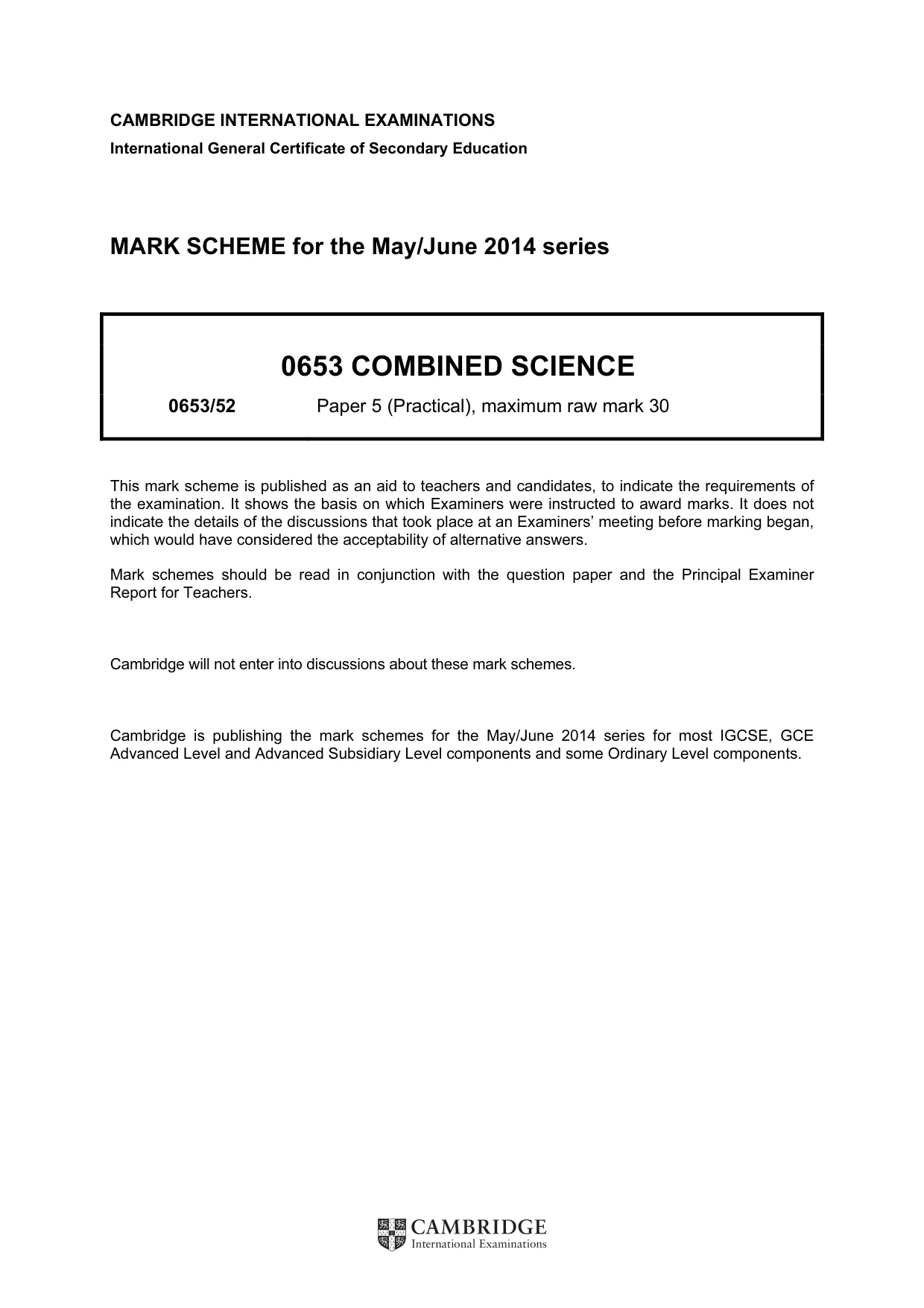
CAMBRIDGE INTERNATIONAL EXAMINATIONS International General Certificate of Secondary Education MARK SCHEME for the May/June 2014 series 0653 COMBINED SCIENCE 0653/52 Paper 5 (Practical), maximum raw mark 30 This mark scheme is published as an aid to teachers and candidates, to indicate the requirements of the examination. It shows the basis on which Examiners were instructed to award marks. It does not indicate the details of the discussions that took place at an Examiners’ meeting before marking began, which would have considered the acceptability of alternative answers. Mark schemes should be read in conjunction with the question paper and the Principal Examiner Report for Teachers. Cambridge will not enter into discussions about these mark schemes. Cambridge is publishing the mark schemes for the May/June 2014 series for most IGCSE, GCE Advanced Level and Advanced Subsidiary Level components and some Ordinary Level components.
Mark scheme, page 2
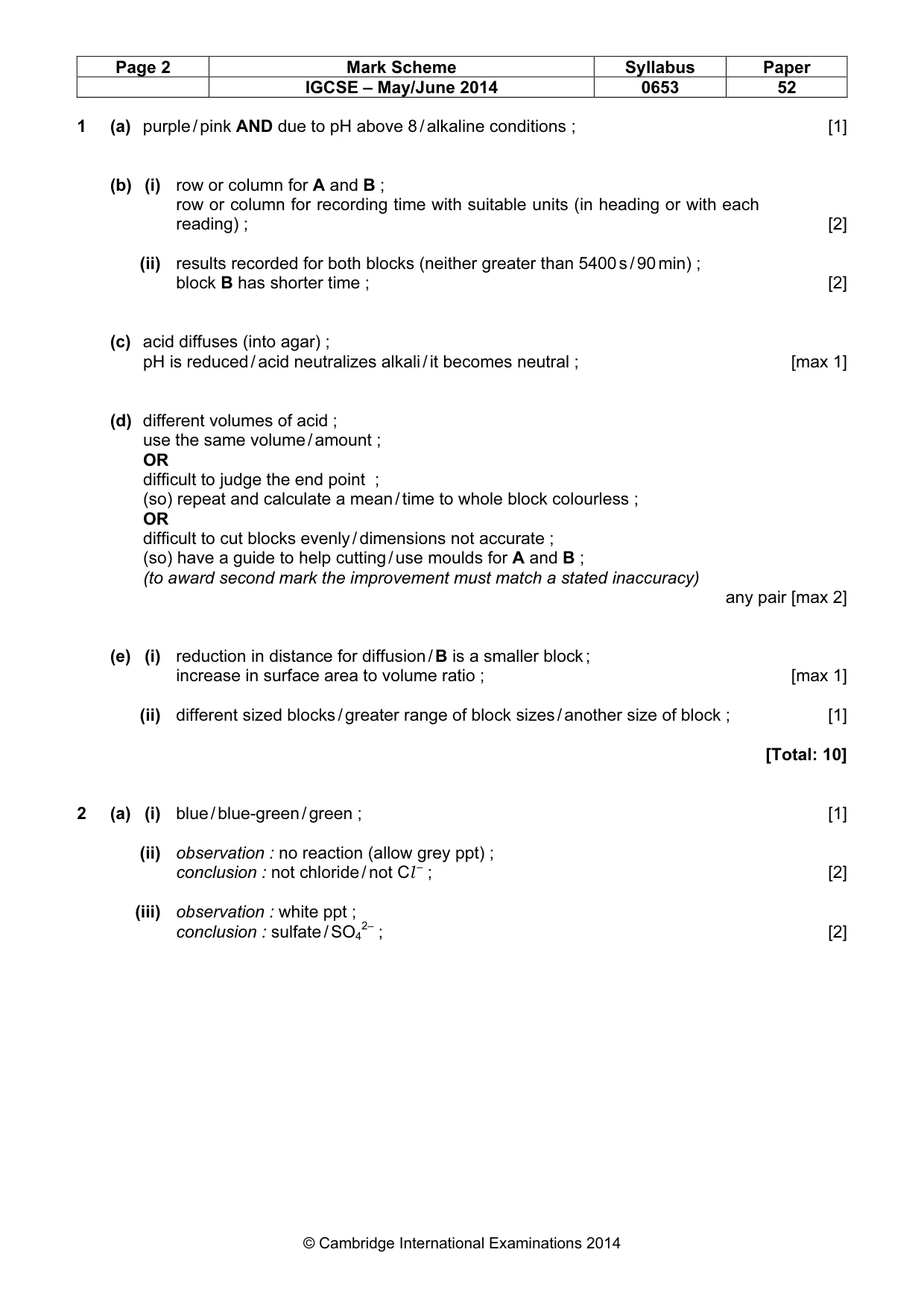
Page 2 Mark Scheme Syllabus Paper IGCSE – May/June 2014 0653 52 © Cambridge International Examinations 2014 1 (a) purple / pink AND due to pH above 8 / alkaline conditions ; [1] (b) (i) row or column for A and B ; row or column for recording time with suitable units (in heading or with each reading) ; [2] (ii) results recorded for both blocks (neither greater than 5400 s / 90 min) ; block B has shorter time ; [2] (c) acid diffuses (into agar) ; pH is reduced / acid neutralizes alkali / it becomes neutral ; [max 1] (d) different volumes of acid ; use the same volume / amount ; OR difficult to judge the end point ; (so) repeat and calculate a mean / time to whole block colourless ; OR difficult to cut blocks evenly / dimensions not accurate ; (so) have a guide to help cutting / use moulds for A and B ; (to award second mark the improvement must match a stated inaccuracy) any pair [max 2] (e) (i) reduction in distance for diffusion / B is a smaller block ; increase in surface area to volume ratio ; [max 1] (ii) different sized blocks / greater range of block sizes / another size of block ; [1] [Total: 10] 2 (a) (i) blue / blue-green / green ; [1] (ii) observation : no reaction (allow grey ppt) ; conclusion : not chloride / not Cl – ; [2] (iii) observation : white ppt ; conclusion : sulfate / SO4 2– ; [2]
Mark scheme, page 3
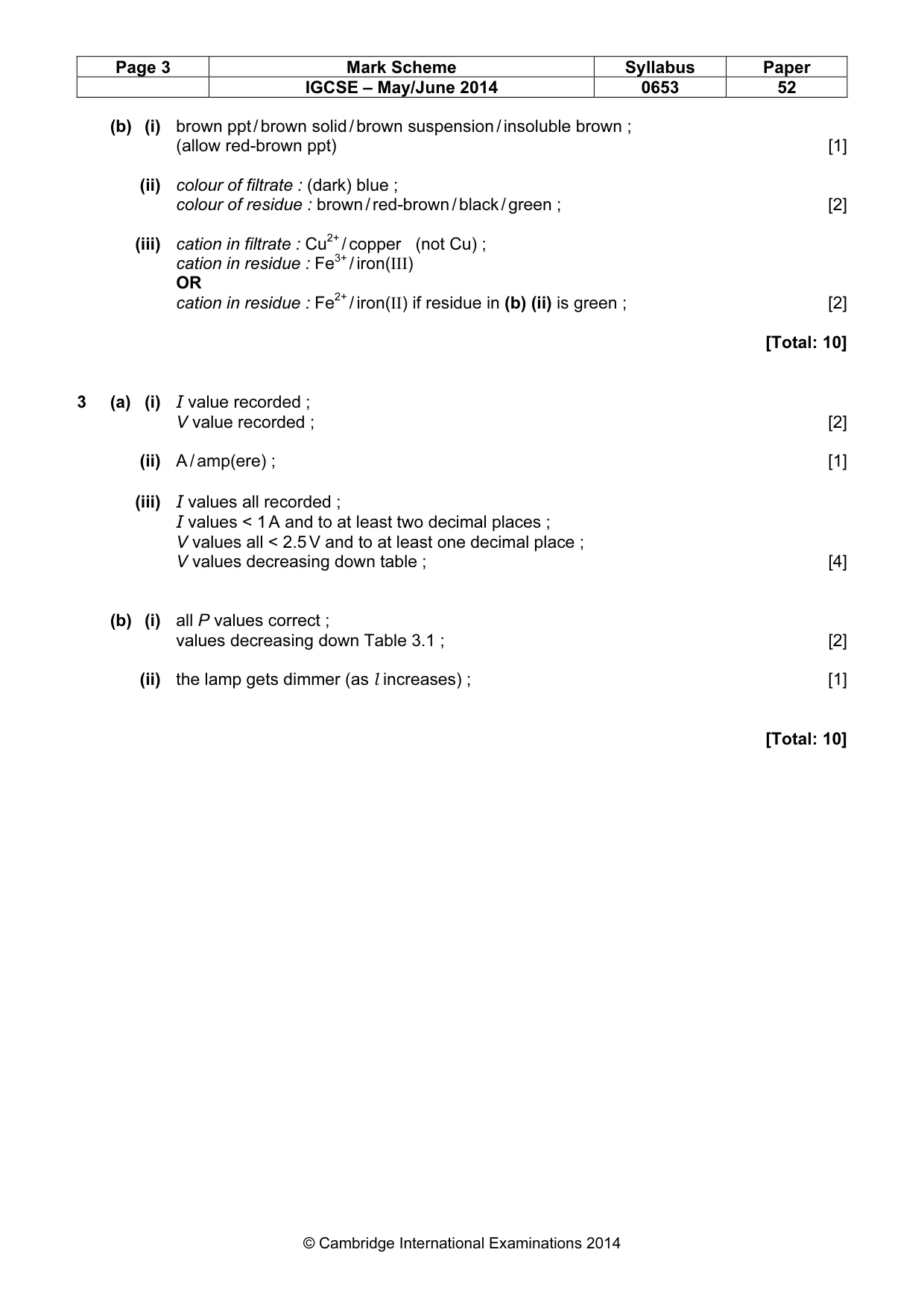
Page 3 Mark Scheme Syllabus Paper IGCSE – May/June 2014 0653 52 © Cambridge International Examinations 2014 (b) (i) brown ppt / brown solid / brown suspension / insoluble brown ; (allow red-brown ppt) [1] (ii) colour of filtrate : (dark) blue ; colour of residue : brown / red-brown / black / green ; [2] (iii) cation in filtrate : Cu2+ / copper (not Cu) ; cation in residue : Fe3+ / iron(III) OR cation in residue : Fe2+ / iron(II) if residue in (b) (ii) is green ; [2] [Total: 10] 3 (a) (i) I value recorded ; V value recorded ; [2] (ii) A / amp(ere) ; [1] (iii) I values all recorded ; I values < 1 A and to at least two decimal places ; V values all < 2.5 V and to at least one decimal place ; V values decreasing down table ; [4] (b) (i) all P values correct ; values decreasing down Table 3.1 ; [2] (ii) the lamp gets dimmer (as l increases) ; [1] [Total: 10]
What you needed in this session
Cambridge’s own grade thresholds for 2014 May/June, Paper 5 · Variant 2. A higher threshold means an easier paper — the bar moves with how the cohort did.