Cambridge IGCSE Religious Studies 0490 — 2010 Oct/Nov Paper 4 · Variant 1
0490/41/O/N/10 · 100 marks · ≈113 min
The question paper and its mark scheme, free to read here and free to download. This is Cambridge’s own paper, exactly as it was sat.
Question paper8 pages


Mark scheme5 pages
Answers below. Sit the paper first if you are practising.
Paper as text
Question paper, page 1
This document consists of 5 printed pages and 3 blank pages. DC (AC/SW) 21566/4 © UCLES 2010 [Turn over UNIVERSITY OF CAMBRIDGE INTERNATIONAL EXAMINATIONS International General Certificate of Secondary Education * 7 6 4 9 7 4 7 1 6 1 * RELIGIOUS STUDIES 0490/04 Paper 4 October/November 2010 2 hours Additional Materials: Answer Booklet/Paper READ THESE INSTRUCTIONS FIRST If you have been given an Answer Booklet, follow the instructions on the front cover of the Booklet. Write your Centre number, candidate number and name on all the work you hand in. Write in dark blue or black pen. Do not use staples, paper clips, highlighters, glue or correction fluid. Answer all questions. At the end of the examination, fasten all your work securely together. The number of marks is given in brackets [ ] at the end of each question or part question.
Question paper, page 2
2 0490/04/O/N/10 © UCLES 2010 The teachings and practice of the religions in relation to the roles of men and women. Study the sources carefully and then answer all the following questions. 1 From Source A, state in your own words the teachings given in each religion about the creation of men and women. [10] 2 Read Sources B, C and D and for each religion describe in your own words what is taught about the roles of men and women. [15] 3 Read Sources E and F. What important points are being made about the roles of men and women in family life? [10] 4 Read Sources G, H and I and look at the pictures for Sources J and K. Explain how the roles of men and women have developed in religious life today. [40] 5 Look at all the Sources. Do you think men and women should be of equal importance in religion? Give reasons for your answer and show you have thought about more than one point of view. [25] Source A Christianity So God created man in his own image, in the image of God he created him; male and female he created them. God blessed them and said to them, “Be fruitful and increase in number…” Genesis 1:27 Islam O mankind! reverence Your Guardian-Lord, Who created you From a single Person, Created, of like nature, His mate, and from them twain Scattered (like seeds) Countless men and women. Surah 4:1 Judaism G-d created the first human being half male, half female. He then separated the two parts to form a man and woman. Midrash
Question paper, page 3
3 0490/04/O/N/10 © UCLES 2010 [Turn over Source B – Christianity. I do not permit a woman to teach or have authority over a man; she must be silent. 1 Timothy 2:12 “Over the last few decades a force has arisen within the Christian Church which questions the male- dominated language and sexist attitudes within the religion. In the past women have had little power in the Church. Now, in some churches the struggle is almost over, women are ordained as priests and even bishops.” Quote from a leaflet campaigning for the ordination of women. Source C – Islam. Men are the protectors And maintainers of women, Because God has given The one more (strength) … Therefore the righteous women Are devoutly obedient… Surah 4:34 Marry women of your choice, Two, or three, or four; But if ye fear that ye shall not Be able to deal justly (with them), Then only one… Surah 4:3 Source D – Judaism. In Orthodox synagogues men and women sit separately, there is either a partition screen which separates them or the women sit in an upstairs gallery. They do not take part in the prayers or read from the Torah. This is based on teaching in the Talmud. A wife of noble character who can find? She is worth far more than rubies. Her husband has full confidence in her and lacks nothing of value. She brings him good, not harm, all the days of her life. Proverbs 31:10-12. Source E Honour your father and your mother. Exodus 20:12. A man asked Prophet Muhammad (pbuh), ‘O Messenger of Allah! Who deserves the best care from me? The Prophet said ‘Your mother.’ The man asked ‘Who then?’ The Prophet said ‘Your mother,’ The man asked yet again ‘Who then?’ Prophet Muhammad said ‘Your Mother.’ The man asked once more, ‘Who then?’ The Prophet then said ‘Your father.’ Sahih al-Bukhari
Question paper, page 4
4 0490/04/O/N/10 © UCLES 2010 Source F In Orthodox Judaism a person is Jewish only if their mother is Jewish. The home is vitally important in Judaism. It is women who bear great responsibility for Jewish home life. They are not expected to do anything which might interfere with this role. They are exempt from positive mitzvah (obligations) which have to be carried out at specific times of day because they have to care for the home and children. The Jewish man has the mitzvah (obligation) to pray three times a day and to provide for his family. Source G In traditional Christian homes, marriage and family life are based on Christian principles. The responsibility of parenthood is often shared, as are responsibilities for maintaining the household and nurturing the children. Both men and women have equal responsibility to worship in public and private and set an example to the children. In the late twentieth century the ordination of women as priests caused debates and divisions amongst Christians. Some devout Anglicans could not accept this change and left the Anglican Church to join the Roman Catholic Church where only men are allowed to be religious leaders and they have to remain celibate (not marry). Also the teachings of the Pope (the head of the Roman Catholic Church) reinforce the woman’s role as wife, mother and home-maker. Source H Men and women have equal spiritual worth. Every instruction given to Muslims in the Qur’an applies equally to male and female believers. They have the same religious duties and will be judged the same on Judgement Day. Also, to acquire knowledge is the duty of every Muslim male and female. Islam accepts that women are equal to men but also takes account of the physical differences between the sexes and women have the right to be comfortable and protected. Both men and women are instructed in the Qur’an to dress and behave modestly. Muslim women have the right to be provided for and should not be forced to work if they do not wish to do so. However, there is no instruction that prevents a woman from seeking work if it does not prevent her fulfilling her duties to her husband and the family. The Prophet’s wife Khadijah was a successful business woman. Source I In Orthodox Judaism the roles of men and women are considered to be different but equal in their importance. The woman, as wife and mother, has responsibility for the observance of the festivals, preparation of food and lighting candles. It is her responsibility to nurture and teach the children the rituals of kashrut. Orthodox women dress modestly. They observe the laws of family purity. They do not see any conflict between their role and modern life today. The man carries out the mitzvot outside the home such as prayers and synagogue attendance and earning the family income. Orthodox Judaism recognizes that new situations and circumstances arise in life today but they should not dictate the terms of Jewish living. In Progressive Judaism the position on these matters is that times have changed and women should share with men the obligations and privileges of Judaism. Progressive Judaism thinks that women should participate in the religion as equals with men and counts women as part of a minyan, allows them to read in the synagogue and become cantors and rabbis as well as carrying out the traditional roles in the home.
Question paper, page 5
5 0490/04/O/N/10 © UCLES 2010 Source J In many Christian churches women are now ordained as priests, deacons and bishops. The three bishops here are preparing to serve communion bread and wine to a large congregation. Source K These Muslim girls are not only getting a traditional education but are also taking an interest in technical education. The college they attend is providing a diploma course in computer application. “Of 80 places, 40 are occupied by girls. Of them, 35 are Muslim girls” says Zahid Ahmed, an official with the college’s computer section. Most of the Muslim girls doing the course are either graduates or undergraduates.
Question paper, page 6
6 0490/04/O/N/10 © UCLES 2010 BLANK PAGE
Question paper, page 7
7 0490/04/O/N/10 © UCLES 2010 BLANK PAGE
Question paper, page 8
8 0490/04/O/N/10 © UCLES 2010 Copyright Acknowledgements: Question 4 Source J © Photograph of three women bishops; http://corpus.smugmug.com/gallery/1730661_hhd3i. Question 4 Source K © Photograph of Muslim girls and computer; http://www.twocircles.net/2008nov23/muslim_girls_azamgarh_getting_higher_education_giving_tough_fight_to_boys. Permission to reproduce items where third-party owned material protected by copyright is included has been sought and cleared where possible. Every reasonable effort has been made by the publisher (UCLES) to trace copyright holders, but if any items requiring clearance have unwittingly been included, the publisher will be pleased to make amends at the earliest possible opportunity. University of Cambridge International Examinations is part of the Cambridge Assessment Group. Cambridge Assessment is the brand name of University of Cambridge Local Examinations Syndicate (UCLES), which is itself a department of the University of Cambridge. BLANK PAGE
Mark scheme, page 1
UNIVERSITY OF CAMBRIDGE INTERNATIONAL EXAMINATIONS International General Certificate of Secondary Education MARK SCHEME for the October/November 2010 question paper for the guidance of teachers 0490 RELIGIOUS STUDIES 0490/04 Paper 4, maximum raw mark 100 This mark scheme is published as an aid to teachers and candidates, to indicate the requirements of the examination. It shows the basis on which Examiners were instructed to award marks. It does not indicate the details of the discussions that took place at an Examiners’ meeting before marking began, which would have considered the acceptability of alternative answers. Mark schemes must be read in conjunction with the question papers and the report on the examination. • CIE will not enter into discussions or correspondence in connection with these mark schemes. CIE is publishing the mark schemes for the October/November 2010 question papers for most IGCSE, GCE Advanced Level and Advanced Subsidiary Level syllabuses and some Ordinary Level syllabuses.
Mark scheme, page 2
Page 2 Mark Scheme: Teachers’ version Syllabus Paper IGCSE – October/November 2010 0490 04 © UCLES 2010 As the nature of this paper is the assessment of candidates’ individual responses to sources/stimuli presented, a detailed mark scheme of expected answers is not appropriate. Markers must assess the responses according to the Marking Criteria and not allow their judgement to be affected by any pre- conceived idea of ‘correct’ responses. Areas which candidates might explore include the suggestions below. Marks should be awarded according to the following criteria for each Assessment Objective. The levels will need to be interpreted as appropriate to the requirements of the question when applied to particular answers. Question 1 Assessment Objective A [10 marks] Question 2 Assessment Objective A [15 marks] Question 3 Assessment Objective A [10 marks] Total marks Level 1 Level 2 Level 3 Level 4 10 1–3 4–6 7–8 9–10 15 1–4 5–8 9–12 13–15 Assessment Objective A: Knowledge Level 1: some attempt to deal with the task. The inclusion of a small amount of relevant information. Limited ability to organise work or present an argument. Level 2: a basic attempt to deal with task. Some of the relevant information will have been selected with evidence of organisation. Level 3: a reasonable attempt to deal with the task. Salient information selected, organised and presented with some skill. Level 4: an excellent attempt to respond to the task in an individual way. The work will be presented in a clear, coherent manner.
Mark scheme, page 3
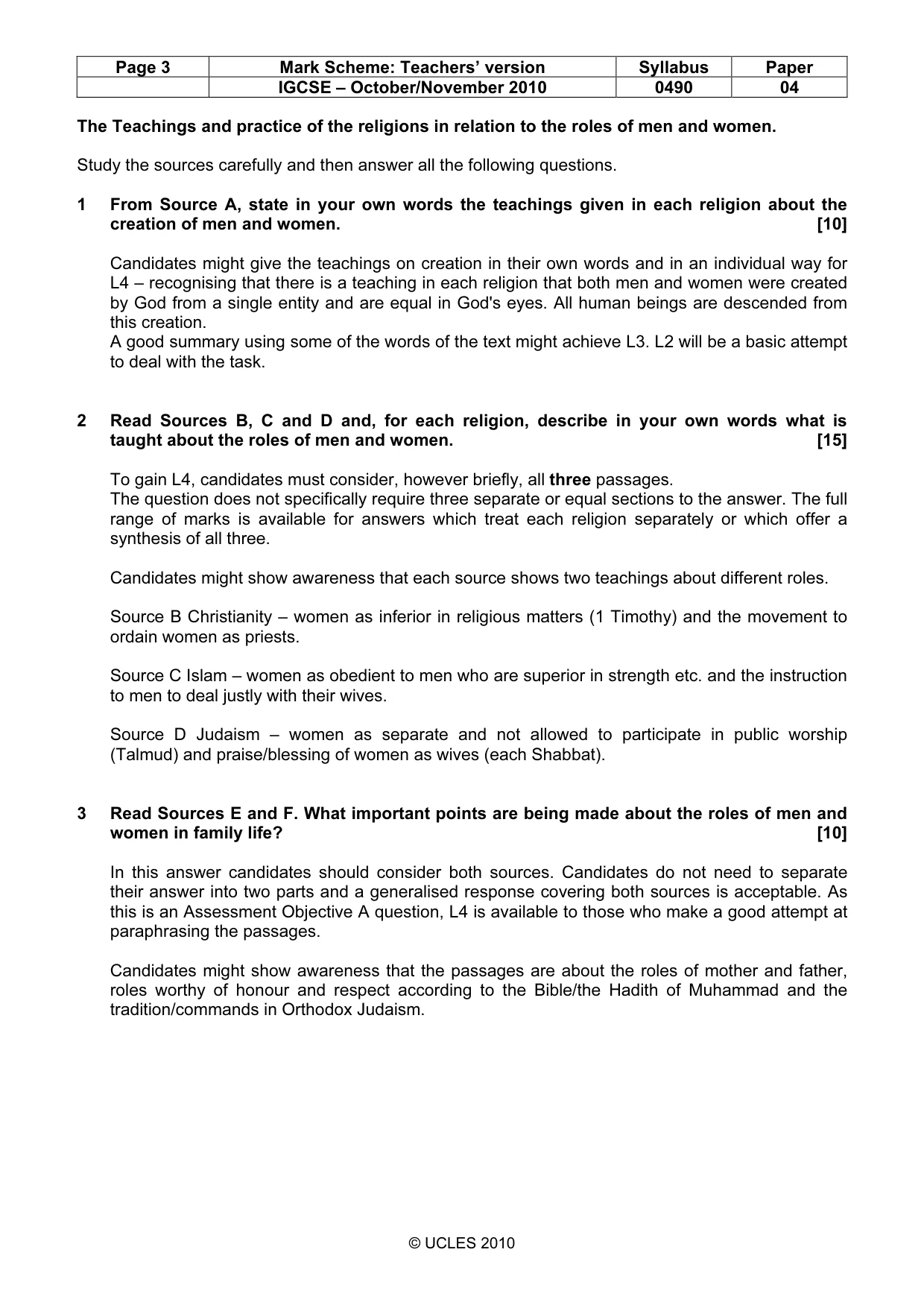
Page 3 Mark Scheme: Teachers’ version Syllabus Paper IGCSE – October/November 2010 0490 04 © UCLES 2010 The Teachings and practice of the religions in relation to the roles of men and women. Study the sources carefully and then answer all the following questions. 1 From Source A, state in your own words the teachings given in each religion about the creation of men and women. [10] Candidates might give the teachings on creation in their own words and in an individual way for L4 – recognising that there is a teaching in each religion that both men and women were created by God from a single entity and are equal in God's eyes. All human beings are descended from this creation. A good summary using some of the words of the text might achieve L3. L2 will be a basic attempt to deal with the task. 2 Read Sources B, C and D and, for each religion, describe in your own words what is taught about the roles of men and women. [15] To gain L4, candidates must consider, however briefly, all three passages. The question does not specifically require three separate or equal sections to the answer. The full range of marks is available for answers which treat each religion separately or which offer a synthesis of all three. Candidates might show awareness that each source shows two teachings about different roles. Source B Christianity – women as inferior in religious matters (1 Timothy) and the movement to ordain women as priests. Source C Islam – women as obedient to men who are superior in strength etc. and the instruction to men to deal justly with their wives. Source D Judaism – women as separate and not allowed to participate in public worship (Talmud) and praise/blessing of women as wives (each Shabbat). 3 Read Sources E and F. What important points are being made about the roles of men and women in family life? [10] In this answer candidates should consider both sources. Candidates do not need to separate their answer into two parts and a generalised response covering both sources is acceptable. As this is an Assessment Objective A question, L4 is available to those who make a good attempt at paraphrasing the passages. Candidates might show awareness that the passages are about the roles of mother and father, roles worthy of honour and respect according to the Bible/the Hadith of Muhammad and the tradition/commands in Orthodox Judaism.
Mark scheme, page 4
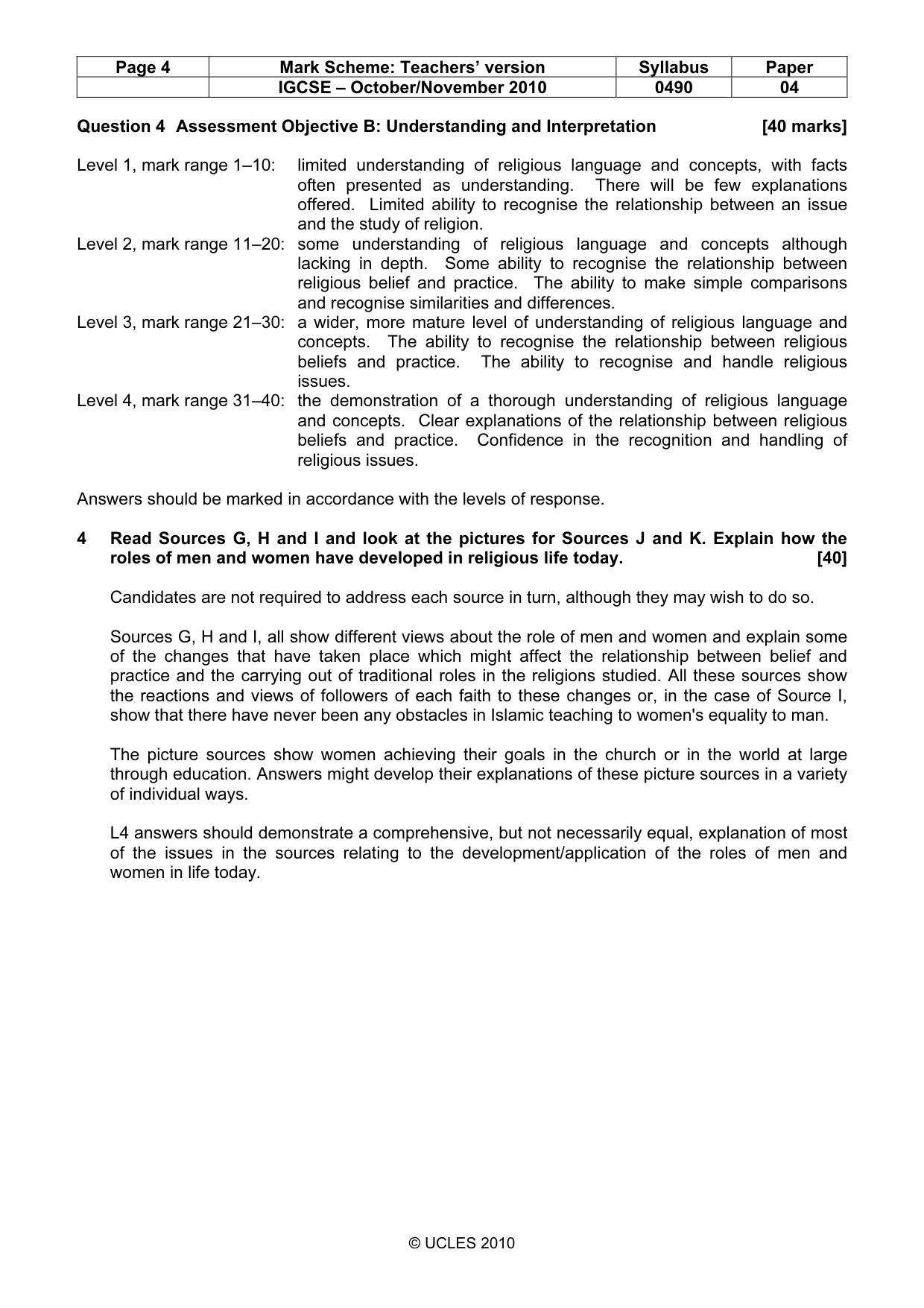
Page 4 Mark Scheme: Teachers’ version Syllabus Paper IGCSE – October/November 2010 0490 04 © UCLES 2010 Question 4 Assessment Objective B: Understanding and Interpretation [40 marks] Level 1, mark range 1–10: limited understanding of religious language and concepts, with facts often presented as understanding. There will be few explanations offered. Limited ability to recognise the relationship between an issue and the study of religion. Level 2, mark range 11–20: some understanding of religious language and concepts although lacking in depth. Some ability to recognise the relationship between religious belief and practice. The ability to make simple comparisons and recognise similarities and differences. Level 3, mark range 21–30: a wider, more mature level of understanding of religious language and concepts. The ability to recognise the relationship between religious beliefs and practice. The ability to recognise and handle religious issues. Level 4, mark range 31–40: the demonstration of a thorough understanding of religious language and concepts. Clear explanations of the relationship between religious beliefs and practice. Confidence in the recognition and handling of religious issues. Answers should be marked in accordance with the levels of response. 4 Read Sources G, H and I and look at the pictures for Sources J and K. Explain how the roles of men and women have developed in religious life today. [40] Candidates are not required to address each source in turn, although they may wish to do so. Sources G, H and I, all show different views about the role of men and women and explain some of the changes that have taken place which might affect the relationship between belief and practice and the carrying out of traditional roles in the religions studied. All these sources show the reactions and views of followers of each faith to these changes or, in the case of Source I, show that there have never been any obstacles in Islamic teaching to women's equality to man. The picture sources show women achieving their goals in the church or in the world at large through education. Answers might develop their explanations of these picture sources in a variety of individual ways. L4 answers should demonstrate a comprehensive, but not necessarily equal, explanation of most of the issues in the sources relating to the development/application of the roles of men and women in life today.
Mark scheme, page 5
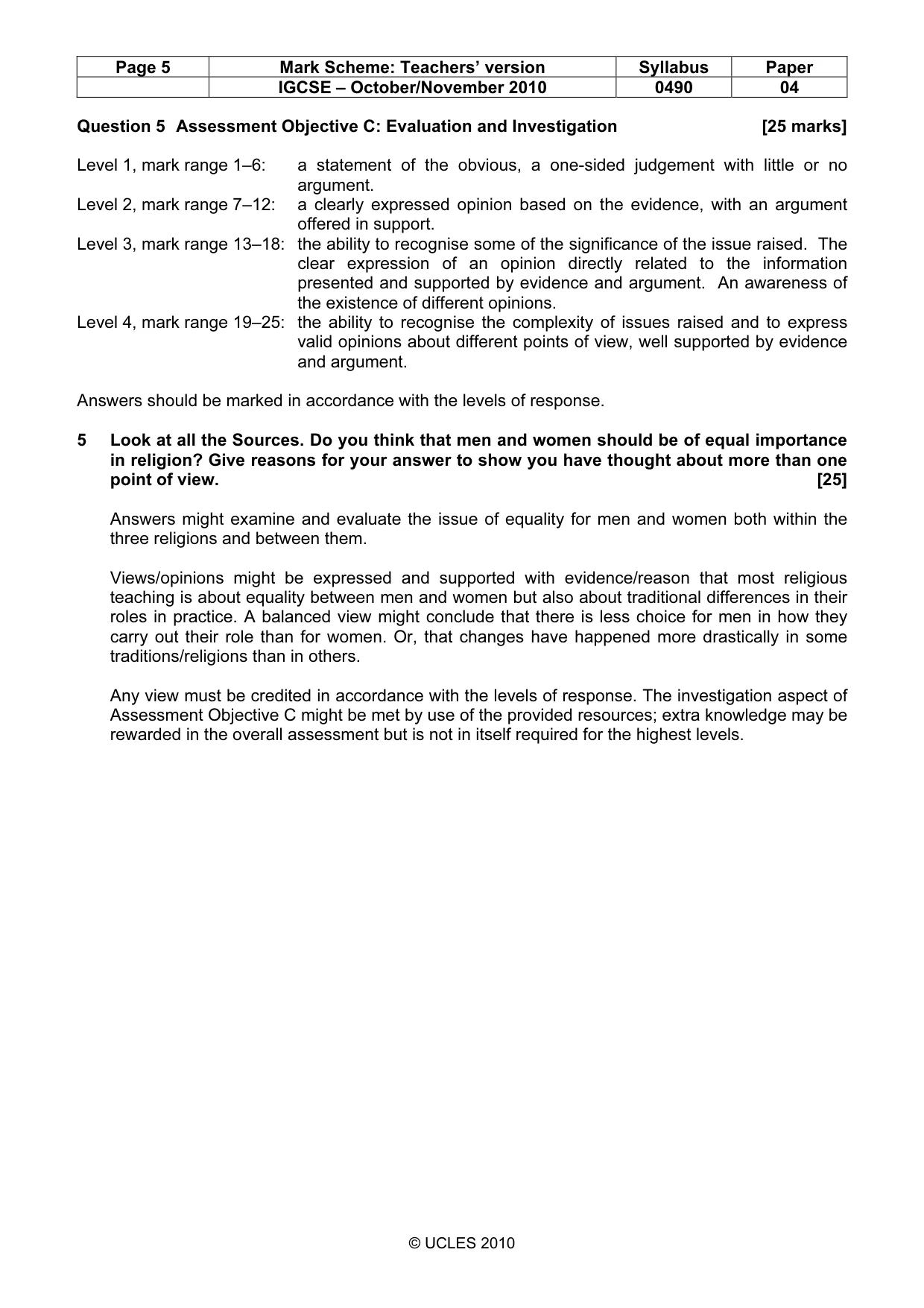
Page 5 Mark Scheme: Teachers’ version Syllabus Paper IGCSE – October/November 2010 0490 04 © UCLES 2010 Question 5 Assessment Objective C: Evaluation and Investigation [25 marks] Level 1, mark range 1–6: a statement of the obvious, a one-sided judgement with little or no argument. Level 2, mark range 7–12: a clearly expressed opinion based on the evidence, with an argument offered in support. Level 3, mark range 13–18: the ability to recognise some of the significance of the issue raised. The clear expression of an opinion directly related to the information presented and supported by evidence and argument. An awareness of the existence of different opinions. Level 4, mark range 19–25: the ability to recognise the complexity of issues raised and to express valid opinions about different points of view, well supported by evidence and argument. Answers should be marked in accordance with the levels of response. 5 Look at all the Sources. Do you think that men and women should be of equal importance in religion? Give reasons for your answer to show you have thought about more than one point of view. [25] Answers might examine and evaluate the issue of equality for men and women both within the three religions and between them. Views/opinions might be expressed and supported with evidence/reason that most religious teaching is about equality between men and women but also about traditional differences in their roles in practice. A balanced view might conclude that there is less choice for men in how they carry out their role than for women. Or, that changes have happened more drastically in some traditions/religions than in others. Any view must be credited in accordance with the levels of response. The investigation aspect of Assessment Objective C might be met by use of the provided resources; extra knowledge may be rewarded in the overall assessment but is not in itself required for the highest levels.
What you needed in this session
Cambridge’s own grade thresholds for 2010 Oct/Nov, Paper 4 · Variant 1. A higher threshold means an easier paper — the bar moves with how the cohort did.