Cambridge IGCSE Religious Studies 0490 — 2007 Oct/Nov Paper 4 · Variant 1
0490/41/O/N/07 · 100 marks · ≈113 min
The question paper and its mark scheme, free to read here and free to download. This is Cambridge’s own paper, exactly as it was sat.
Question paper8 pages


Mark scheme5 pages
Answers below. Sit the paper first if you are practising.
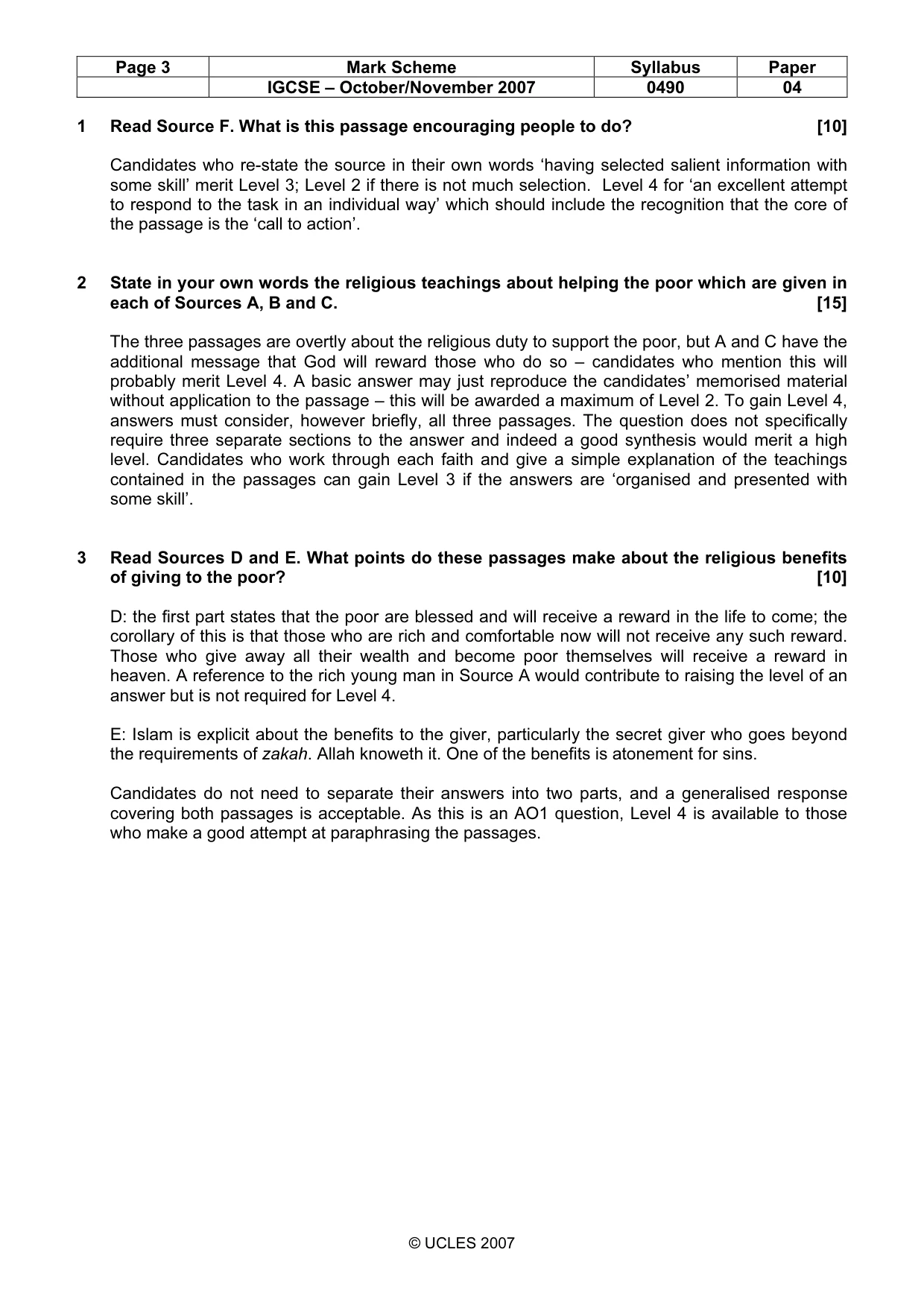
Paper as text
Question paper, page 1
This document consists of 5 printed pages and 3 blank pages. SP (FF) T25945/4 © UCLES 2007 [Turn over UNIVERSITY OF CAMBRIDGE INTERNATIONAL EXAMINATIONS International General Certificate of Secondary Education READ THESE INSTRUCTIONS FIRST If you have been given an Answer Booklet, follow the instructions on the front cover of the Booklet. Write your Centre number, candidate number and name on all the work you hand in. Write in dark blue or black pen. Do not use staples, paper clips, highlighters, glue or correction fluid. Answer all questions. At the end of the examination, fasten all your work securely together. The number of marks is given in brackets [ ] at the end of each question or part question. * 8 9 2 5 9 8 0 5 9 7 * RELIGIOUS STUDIES 0490/04 Paper 4 October/November 2007 2 hours Additional Materials: Answer Booklet/Paper www.XtremePapers.com
Question paper, page 2
2 0490/04/O/N/07 © UCLES 2007 The teaching and practice of the religions studied in relation to charity and poverty. Study the sources carefully, and then answer all the following questions. 1 Read Source F. What is this passage encouraging people to do? [10] 2 State in your own words the religious teachings about helping the poor which are given in each of Sources A, B and C. [15] 3 Read Sources D and E. What points do these passages make about the religious benefits of giving to the poor? [10] 4 Read Sources G, H and I and look at Sources J, K and L. Explain the religious attitudes about giving to charity which they show. [40] 5 Look at all the Sources. Do you think that religious people should make bigger donations to charity than non-believers? Give reasons for your answer. [25] Source A – Christianity Jesus answered, “If you want to be perfect, go, sell your possessions and give to the poor, and you will have treasure in heaven. Then come, follow me.” When the young man heard this, he went away sad, because he had great wealth. Matthew 19:21–22 (NIV) Source B – Judaism If one of your countrymen becomes poor and is unable to support himself among you, help him as you would an alien or a temporary resident, so that he can continue to live among you. Do not take interest of any kind from him, but fear your God, so that your countryman may continue to live among you. You must not lend him money at interest or sell him food at a profit. Leviticus 25:35–37 (NIV) Source C – Islam Lo! those who believe and do good works and establish worship and pay the Zakah, their reward is with their Lord and there shall no fear come upon them neither shall they grieve. Surah 2:277 (Pickthall)
Question paper, page 3
3 0490/04/O/N/07 © UCLES 2007 [Turn over Source D Looking at his disciples, he said: “Blessed are you who are poor, for yours is the kingdom of God. Blessed are you who hunger now, for you will be satisfied. Blessed are you who weep now, for you will laugh. ... But woe to you who are rich, for you have already received your comfort. Woe to you who are well fed now, for you will go hungry.” Luke 6:20–21, 24–25 (NIV) Source E Whatever alms ye spend or vows ye vow, lo! Allah knoweth it. Wrongdoers have no helpers. If ye publish your almsgiving, it is well, but if ye hide it and give it to the poor, it will be better for you, and atone for some of your ill-deeds. Allah is informed of what ye do. Surah 2:270–271 (Pickthall) Source F What is poverty? Poverty is hunger. Poverty is lack of shelter. Poverty is being sick and not being able to see a doctor. Poverty is not having access to school and not knowing how to read. Poverty is not having a job, is fear for the future, living one day at a time. Poverty is losing a child to illness brought about by unclean water. Poverty is powerlessness, lack of representation and freedom. Poverty has many faces, changing from place to place and across time, and has been described in many ways. Most often, poverty is a situation people want to escape. So poverty is a call to action – for the poor and the wealthy alike – a call to change the world so that many more may have enough to eat, adequate shelter, access to education and health, protection from violence, and a voice in what happens in their communities. PovertyNet – World Bank website Source G Now about the collection for God’s people: Do what I told the Galatian churches to do. On the first day of every week, each one of you should set aside a sum of money in keeping with his income, saving it up, so that when I come no collections will have to be made. Then, when I arrive, I will give letters of introduction to the men you approve and send them with your gift to Jerusalem. 1 Corinthians 16:1–3 (NIV) Source H Traditional Jews give at least ten percent of their income to charity. Traditional Jewish homes commonly have a pushke, a box for collecting coins for the poor, and coins are routinely placed in the box. Jewish youths are continually going from door to door collecting for various worthy causes. In many ways, charitable donation has taken the place of animal sacrifice in Jewish life: giving to charity is an almost instinctive Jewish response to express thanks to G-d, to ask forgiveness from G-d, or to request a favour from G-d. According to Jewish tradition, the spiritual benefit of giving to the poor is so great that a beggar actually does the giver a favour by giving a person the opportunity to perform tzedakah. In Judaism, giving to the poor is not viewed as a generous, magnanimous act; it is simply an act of justice and righteousness, the performance of a duty, giving the poor their due. www.jewfaq.org/tzedakah.htm
Question paper, page 4
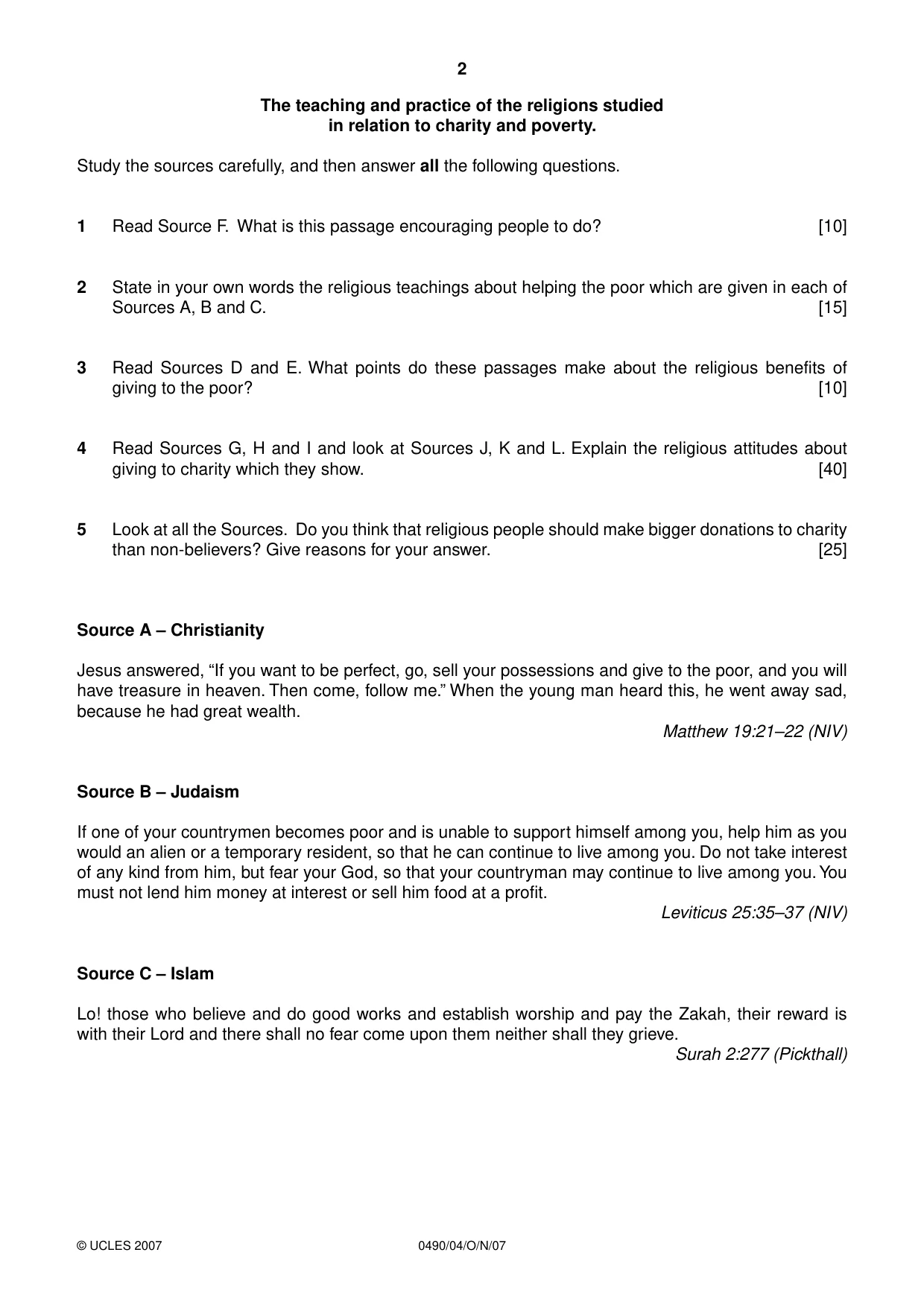
4 0490/04/O/N/07 © UCLES 2007 Source I Any donation other than zakah is considered ‘sadaqah’ or ‘charity.’ Amounts large or small and towards any good cause are considered sadaqah. Sadaqah jariah is ‘continuous charity.’ It includes any charity that continues to bring benefit to people, animals or the environment over time, and for as long as it does so it brings reward to the donor insha’Allah. Education, orphans’ care, safe water and tree plantation are just a few examples of sadaqah jariah projects. www.muslimhands.org Source J Muslim aid workers putting up a tent for preparing hot meals and storing relief items in a refugee camp in Jordan.
Question paper, page 5
5 0490/04/O/N/07 © UCLES 2007 Source K Collection envelope distributed at services in an English cathedral. Source L Jewish children are encouraged to develop the habit of giving tzedakah.
Question paper, page 8
8 0490/04/O/N/07 Copyright Acknowledgements: Scripture quotations marked (NIV) are taken from the HOLY BIBLE, NEW INTERNATIONAL VERSION ®. NIV ®. Copyright © 1973, 1978, 1984 by International Bible Society. Used by permission. All rights reserved. Source C © Pickthall. Source E © Pickthall. Source F © World Bank. Source H © www.jewfaq.org/tzedakah.htm Source I © www.muslimhands.org Source J © Thorkell Thorkelsson. Source L © www.saratogachabad.com Permission to reproduce items where third-party owned material protected by copyright is included has been sought and cleared where possible. Every reasonable effort has been made by the publisher (UCLES) to trace copyright holders, but if any items requiring clearance have unwittingly been included, the publisher will be pleased to make amends at the earliest possible opportunity. University of Cambridge International Examinations is part of the Cambridge Assessment Group. Cambridge Assessment is the brand name of University of Cambridge Local Examinations Syndicate (UCLES), which is itself a department of the University of Cambridge. BLANK PAGE
Mark scheme, page 1
UNIVERSITY OF CAMBRIDGE INTERNATIONAL EXAMINATIONS International General Certificate of Secondary Education MARK SCHEME for the October/November 2007 question paper 0490 RELIGIOUS STUDIES 0490/04 Paper 4 (Alternative to Coursework), maximum raw mark 100 This mark scheme is published as an aid to teachers and candidates, to indicate the requirements of the examination. It shows the basis on which Examiners were instructed to award marks. It does not indicate the details of the discussions that took place at an Examiners’ meeting before marking began. All Examiners are instructed that alternative correct answers and unexpected approaches in candidates’ scripts must be given marks that fairly reflect the relevant knowledge and skills demonstrated. Mark schemes must be read in conjunction with the question papers and the report on the examination. • CIE will not enter into discussions or correspondence in connection with these mark schemes. CIE is publishing the mark schemes for the October/November 2007 question papers for most IGCSE, GCE Advanced Level and Advanced Subsidiary Level syllabuses and some Ordinary Level syllabuses. www.XtremePapers.com
Mark scheme, page 2
Page 2 Mark Scheme Syllabus Paper IGCSE – October/November 2007 0490 04 © UCLES 2007 Marking Criteria As the nature of this paper is the assessment of candidates’ individual responses to sources/stimuli presented without specific guidance as to the expected approaches, a detailed mark scheme is not appropriate and markers must assess the responses on their own merits according to the Marking Criteria and not allow their judgement to be affected by any pre-conceived idea of ‘correct’ responses. Areas which candidates might explore include the suggestions below. Marks should be awarded according to the following criteria for each Assessment Objective. The envisaged levels are very general and will need to be interpreted as appropriate to the requirements of the question when applied to particular answers. Question 1 Assessment Objective A [10 marks] Question 2 Assessment Objective A [15 marks] Question 3 Assessment Objective A [10 marks] Total marks Level 1 Level 2 Level 3 Level 4 10 1–3 4–6 7–8 9–10 15 1–4 5–8 9–12 13–15 Assessment Objective A: Knowledge Level 1: some attempt to deal with the task. The inclusion of a small amount of relevant information. Limited ability to organise work or present an argument. Level 2: a basic attempt to deal with the task. Some of the relevant information will have been selected with evidence of organisation. Level 3: a reasonable attempt to deal with the task. Salient information selected, organised and presented with some skill. Level 4: an excellent attempt to respond to the task in an individual way. The work will be presented in a clear, coherent manner.
Mark scheme, page 3
Page 3 Mark Scheme Syllabus Paper IGCSE – October/November 2007 0490 04 © UCLES 2007 1 Read Source F. What is this passage encouraging people to do? [10] Candidates who re-state the source in their own words ‘having selected salient information with some skill’ merit Level 3; Level 2 if there is not much selection. Level 4 for ‘an excellent attempt to respond to the task in an individual way’ which should include the recognition that the core of the passage is the ‘call to action’. 2 State in your own words the religious teachings about helping the poor which are given in each of Sources A, B and C. [15] The three passages are overtly about the religious duty to support the poor, but A and C have the additional message that God will reward those who do so – candidates who mention this will probably merit Level 4. A basic answer may just reproduce the candidates’ memorised material without application to the passage – this will be awarded a maximum of Level 2. To gain Level 4, answers must consider, however briefly, all three passages. The question does not specifically require three separate sections to the answer and indeed a good synthesis would merit a high level. Candidates who work through each faith and give a simple explanation of the teachings contained in the passages can gain Level 3 if the answers are ‘organised and presented with some skill’. 3 Read Sources D and E. What points do these passages make about the religious benefits of giving to the poor? [10] D: the first part states that the poor are blessed and will receive a reward in the life to come; the corollary of this is that those who are rich and comfortable now will not receive any such reward. Those who give away all their wealth and become poor themselves will receive a reward in heaven. A reference to the rich young man in Source A would contribute to raising the level of an answer but is not required for Level 4. E: Islam is explicit about the benefits to the giver, particularly the secret giver who goes beyond the requirements of zakah. Allah knoweth it. One of the benefits is atonement for sins. Candidates do not need to separate their answers into two parts, and a generalised response covering both passages is acceptable. As this is an AO1 question, Level 4 is available to those who make a good attempt at paraphrasing the passages.
Mark scheme, page 4
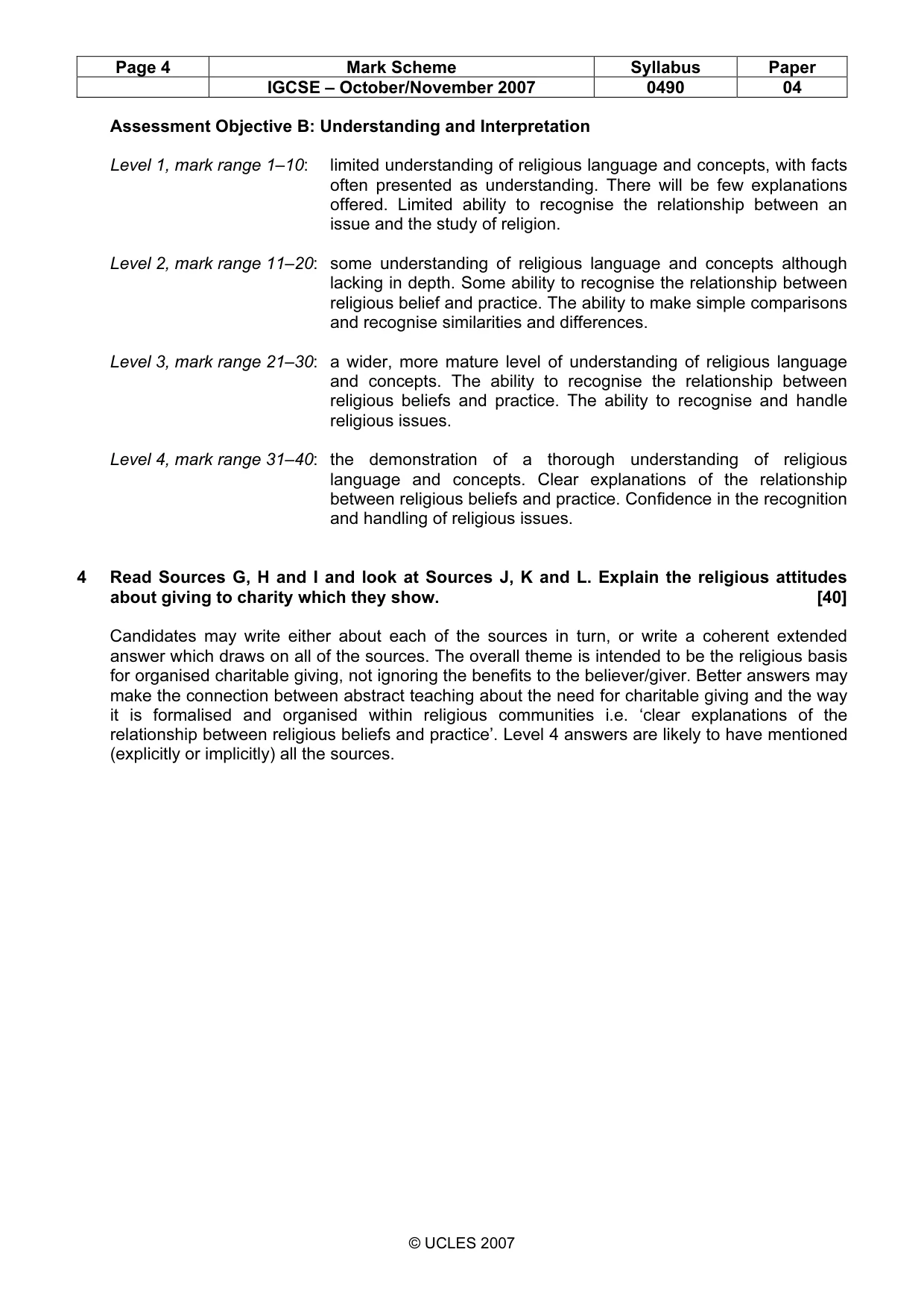
Page 4 Mark Scheme Syllabus Paper IGCSE – October/November 2007 0490 04 © UCLES 2007 Assessment Objective B: Understanding and Interpretation Level 1, mark range 1–10: limited understanding of religious language and concepts, with facts often presented as understanding. There will be few explanations offered. Limited ability to recognise the relationship between an issue and the study of religion. Level 2, mark range 11–20: some understanding of religious language and concepts although lacking in depth. Some ability to recognise the relationship between religious belief and practice. The ability to make simple comparisons and recognise similarities and differences. Level 3, mark range 21–30: a wider, more mature level of understanding of religious language and concepts. The ability to recognise the relationship between religious beliefs and practice. The ability to recognise and handle religious issues. Level 4, mark range 31–40: the demonstration of a thorough understanding of religious language and concepts. Clear explanations of the relationship between religious beliefs and practice. Confidence in the recognition and handling of religious issues. 4 Read Sources G, H and I and look at Sources J, K and L. Explain the religious attitudes about giving to charity which they show. [40] Candidates may write either about each of the sources in turn, or write a coherent extended answer which draws on all of the sources. The overall theme is intended to be the religious basis for organised charitable giving, not ignoring the benefits to the believer/giver. Better answers may make the connection between abstract teaching about the need for charitable giving and the way it is formalised and organised within religious communities i.e. ‘clear explanations of the relationship between religious beliefs and practice’. Level 4 answers are likely to have mentioned (explicitly or implicitly) all the sources.
Mark scheme, page 5
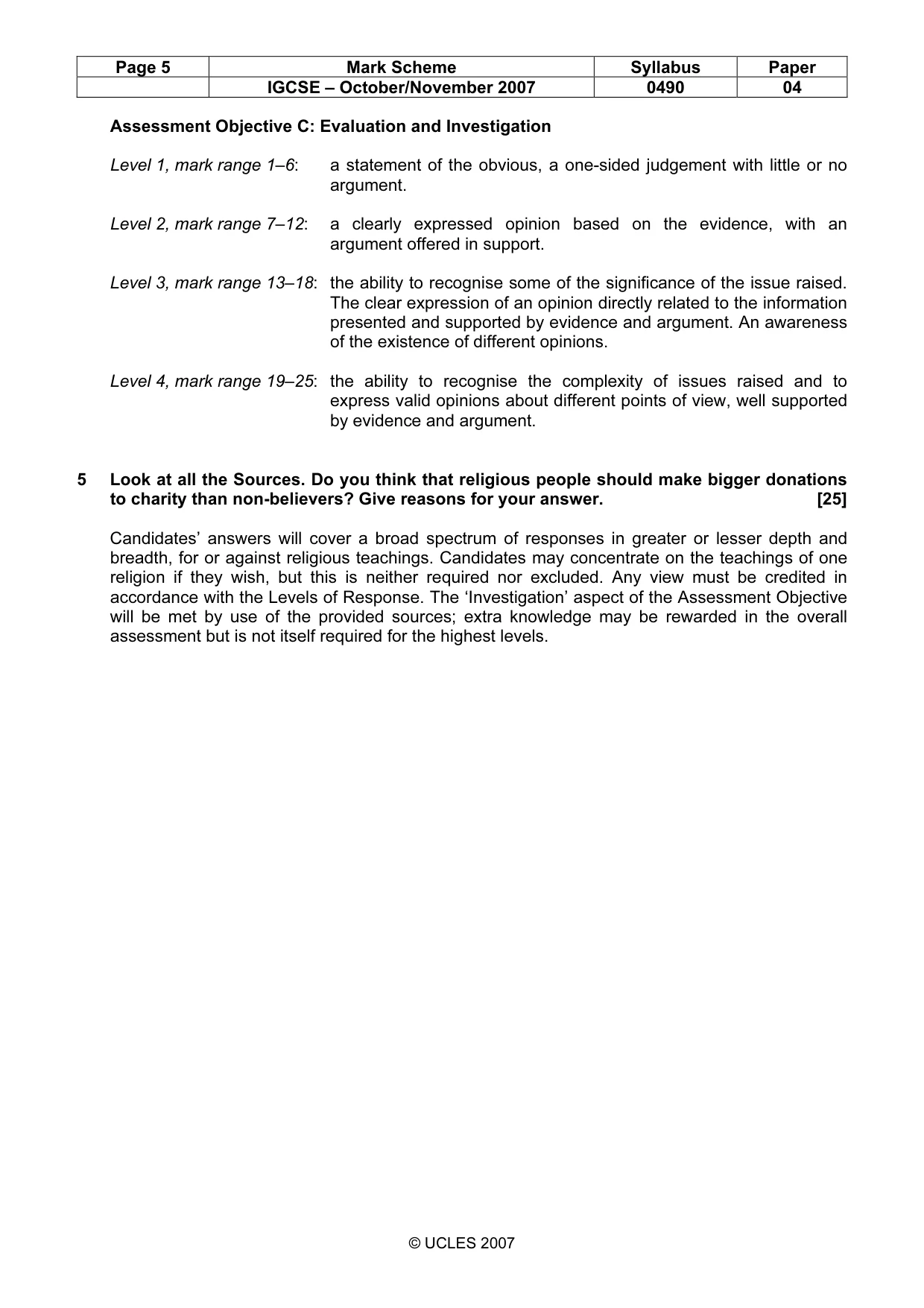
Page 5 Mark Scheme Syllabus Paper IGCSE – October/November 2007 0490 04 © UCLES 2007 Assessment Objective C: Evaluation and Investigation Level 1, mark range 1–6: a statement of the obvious, a one-sided judgement with little or no argument. Level 2, mark range 7–12: a clearly expressed opinion based on the evidence, with an argument offered in support. Level 3, mark range 13–18: the ability to recognise some of the significance of the issue raised. The clear expression of an opinion directly related to the information presented and supported by evidence and argument. An awareness of the existence of different opinions. Level 4, mark range 19–25: the ability to recognise the complexity of issues raised and to express valid opinions about different points of view, well supported by evidence and argument. 5 Look at all the Sources. Do you think that religious people should make bigger donations to charity than non-believers? Give reasons for your answer. [25] Candidates’ answers will cover a broad spectrum of responses in greater or lesser depth and breadth, for or against religious teachings. Candidates may concentrate on the teachings of one religion if they wish, but this is neither required nor excluded. Any view must be credited in accordance with the Levels of Response. The ‘Investigation’ aspect of the Assessment Objective will be met by use of the provided sources; extra knowledge may be rewarded in the overall assessment but is not itself required for the highest levels.
What you needed in this session
Cambridge’s own grade thresholds for 2007 Oct/Nov, Paper 4 · Variant 1. A higher threshold means an easier paper — the bar moves with how the cohort did.