Cambridge IGCSE Religious Studies 0490 — 2009 Oct/Nov Paper 4 · Variant 1
0490/41/O/N/09 · 100 marks · ≈113 min
The question paper and its mark scheme, free to read here and free to download. This is Cambridge’s own paper, exactly as it was sat.
Question paper4 pages
Mark scheme4 pages
Answers below. Sit the paper first if you are practising.
Paper as text
Question paper, page 1
This document consists of 4 printed pages. DC (LEO/CGW) 11031/2 © UCLES 2009 [Turn over UNIVERSITY OF CAMBRIDGE INTERNATIONAL EXAMINATIONS International General Certificate of Secondary Education READ THESE INSTRUCTIONS FIRST If you have been given an Answer Booklet, follow the instructions on the front cover of the Booklet. Write your Centre number, candidate number and name on all the work you hand in. Write in dark blue or black pen. Do not use staples, paper clips, highlighters, glue or correction fluid. Answer all questions. At the end of the examination, fasten all your work securely together. The number of marks is given in brackets [ ] at the end of each question or part question. * 0 1 1 9 4 4 6 4 8 2 * RELIGIOUS STUDIES 0490/04 Paper 4 October/November 2009 2 hours Additional Materials: Answer Booklet/Paper www.XtremePapers.com
Question paper, page 2
2 0490/04/O/N/09 © UCLES 2009 The teaching and practice of the religions in relation to inequalities in society (prejudice and discrimination). Study the sources carefully, and then answer all the following questions. 1 Explain the different points of view which are given in Source G. [10] 2 Explain in your own words the different religious teachings about prejudice that are given in Sources A, B and C. [15] 3 Read Sources D and E. Explain the ideas about prejudice which are given in these Sources. [10] 4 Read Sources F, H, I and J, and look at the pictures. For each of these Sources, explain the ideas which they show. [40] 5 Look at all of the Sources. Do you think religious people have a duty to challenge prejudice and discrimination? Give reasons for your answer. [25] Source A – Christianity Then Peter began to speak: ‘I now realise how true it is that God does not show favouritism but accepts men from every nation who fear him and do what is right.’ Acts 10:34–35 Source B – Judaism When an alien lives with you in your land, do not mistreat him. The alien living with you must be treated as one of your native-born. Love him as yourself, for you were aliens in Egypt. I am the LORD your God. Leviticus 19:33–34 Source C – Islam O mankind! We created you from a single (pair) of a male and a female; and made you into nations and tribes, that ye may know each other (not that ye may despise each other). Surah 49:13
Question paper, page 3
3 0490/04/O/N/09 © UCLES 2009 [Turn over Source D In the Second World War, many people in Germany and in other countries showed prejudice towards the Jews because of their religion. They would not let Jewish people have the same rights as other people. For example, they had to wear yellow stars on their coats, they could not go out of their houses in the evenings, and they were forbidden from working in many kinds of jobs. Jews have been persecuted for their race and for their faith for hundreds of years, so they know what it is like to be the victims of prejudice. They try to remember and consider what it feels like to be treated unfairly, and they aim to set an example to others in the way that they treat foreigners, following the teachings of the Bible. Jews believe that when God created the world, he made all people in his own image, and therefore all people are equally valuable to God no matter where they come from or whether they are male or female. Jews believe that it is wrong to treat other people badly because of their race, age, gender or physical abilities. Source E Muslims believe that the religion a person chooses to follow is much more important than his or her race. No-one can choose where to be born, or what colour skin to have, and therefore no-one should be admired for being one colour or treated badly because of being another colour. People should be judged because of the choices they make in life. We should admire people who care for the poor and who follow the teachings of God. After people die, they will be judged by God according to their deeds, and not according to their race or gender. Source F Desmond Tutu is a black Christian who has worked in Africa to spread the Christian message that there should be no prejudice between people of different races. He helped in the struggle against apartheid in South Africa, telling people that God intends people to live together as equal neighbours and to care for one another. He worked to encourage people to provide better education for black people to give them equality with white people, and campaigned for better health care, especially in the fight against HIV and AIDS. Because of his Christian faith, Desmond Tutu has faced many dangers but believes that he is doing work that God has chosen for him, and this gives him courage. Desmond Tutu was the first black person to become an Anglican Archbishop, and in 1984 he received the Nobel Peace Prize for his work. Source G “I think there should be different Christian churches for black and for white people. They like to worship in different ways, and they often live in different communities, so they should each have their own kinds of church. Sometimes black people and white people don’t feel comfortable sitting next to each other in church, so separate churches help people to feel happier with their own kind.” “I disagree with you. I think Christians should set an example to show how black and white people can work together, pray together, be friends and share activities with each other. People can get to know each other at church. If black and white Christians have different churches, it gives the wrong impression to other people.”
Question paper, page 4
4 0490/04/O/N/09 © UCLES 2009 Source H Martin Luther King Jnr was a Christian minister who led the Civil Rights movement in the USA during the twentieth century, to try and help black people and white people live equally together. Although he was often threatened, Martin Luther King never used violent methods to overcome prejudice, because he believed that it is wrong for a Christian to be violent. He made a famous speech in which he said: ‘Let freedom ring. And when this happens, and when we allow freedom ring – when we let it ring from every village and every hamlet, from every state and every city, we will be able to speed up that day when all of God’s children – black men and white men, Jews and Gentiles, Protestants and Catholics – will be able to join hands and sing in the words of the old Negro spiritual: “Free at last! Free at last! Thank God Almighty, we are free at last!’” Source I In South Africa in the twentieth century, black and white people were not allowed to live together or use the same public places. This was called ‘apartheid’. The government put up signs to show which people were allowed in which areas. Black people were not allowed to use the same parks, swimming pools, beaches, restaurants or schools as white people. Black people were not allowed to marry white people. People were judged because of their colour, not because of their characters or their skills. Source J Inequalities between black people and white people in South Africa led to riots in which many people were killed. Black people felt that it was unfair for white people to have the best jobs, the best homes, and good educations, while black people were left to be poor. They tried to fight against the government to get the laws changed. Judaism, Christianity and Islam teach that people have a duty to encourage everyone to live together peacefully in a world where all kinds of people are equal. They believe that it is wrong to be prejudiced, because everyone was made by God and is of value to God. They pray about problems caused by prejudice, and try to treat everyone fairly to set an example. Copyright Acknowledgements: Source H © Photograph; Intellectual Properties Management. Source I © Photograph; The Sunday Times, South Africa. Source J © Photograph; United Nations Multimedia Resources Unit. Permission to reproduce items where third-party owned material protected by copyright is included has been sought and cleared where possible. Every reasonable effort has been made by the publisher (UCLES) to trace copyright holders, but if any items requiring clearance have unwittingly been included, the publisher will be pleased to make amends at the earliest possible opportunity. University of Cambridge International Examinations is part of the Cambridge Assessment Group. Cambridge Assessment is the brand name of University of Cambridge Local Examinations Syndicate (UCLES), which is itself a department of the University of Cambridge.
Mark scheme, page 1
UNIVERSITY OF CAMBRIDGE INTERNATIONAL EXAMINATIONS International General Certificate of Secondary Education MARK SCHEME for the October/November 2009 question paper for the guidance of teachers 0490 RELIGIOUS STUDIES 0490/04 Paper 4 (Alternative to Coursework), maximum raw mark 100 This mark scheme is published as an aid to teachers and candidates, to indicate the requirements of the examination. It shows the basis on which Examiners were instructed to award marks. It does not indicate the details of the discussions that took place at an Examiners’ meeting before marking began, which would have considered the acceptability of alternative answers. Mark schemes must be read in conjunction with the question papers and the report on the examination. • CIE will not enter into discussions or correspondence in connection with these mark schemes. CIE is publishing the mark schemes for the October/November 2009 question papers for most IGCSE, GCE Advanced Level and Advanced Subsidiary Level syllabuses and some Ordinary Level syllabuses. www.XtremePapers.com
Mark scheme, page 2
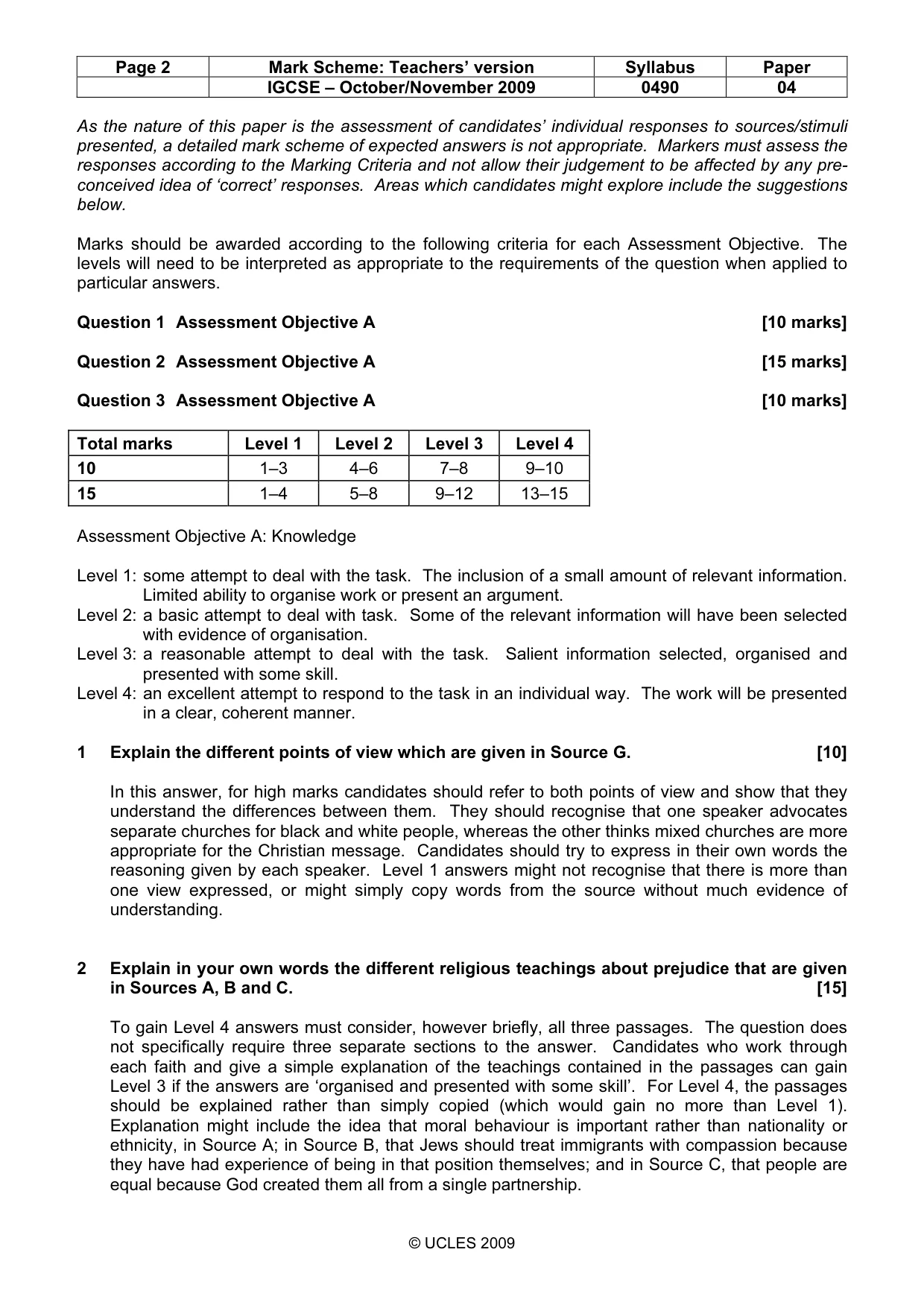
Page 2 Mark Scheme: Teachers’ version Syllabus Paper IGCSE – October/November 2009 0490 04 © UCLES 2009 As the nature of this paper is the assessment of candidates’ individual responses to sources/stimuli presented, a detailed mark scheme of expected answers is not appropriate. Markers must assess the responses according to the Marking Criteria and not allow their judgement to be affected by any pre- conceived idea of ‘correct’ responses. Areas which candidates might explore include the suggestions below. Marks should be awarded according to the following criteria for each Assessment Objective. The levels will need to be interpreted as appropriate to the requirements of the question when applied to particular answers. Question 1 Assessment Objective A [10 marks] Question 2 Assessment Objective A [15 marks] Question 3 Assessment Objective A [10 marks] Total marks Level 1 Level 2 Level 3 Level 4 10 1–3 4–6 7–8 9–10 15 1–4 5–8 9–12 13–15 Assessment Objective A: Knowledge Level 1: some attempt to deal with the task. The inclusion of a small amount of relevant information. Limited ability to organise work or present an argument. Level 2: a basic attempt to deal with task. Some of the relevant information will have been selected with evidence of organisation. Level 3: a reasonable attempt to deal with the task. Salient information selected, organised and presented with some skill. Level 4: an excellent attempt to respond to the task in an individual way. The work will be presented in a clear, coherent manner. 1 Explain the different points of view which are given in Source G. [10] In this answer, for high marks candidates should refer to both points of view and show that they understand the differences between them. They should recognise that one speaker advocates separate churches for black and white people, whereas the other thinks mixed churches are more appropriate for the Christian message. Candidates should try to express in their own words the reasoning given by each speaker. Level 1 answers might not recognise that there is more than one view expressed, or might simply copy words from the source without much evidence of understanding. 2 Explain in your own words the different religious teachings about prejudice that are given in Sources A, B and C. [15] To gain Level 4 answers must consider, however briefly, all three passages. The question does not specifically require three separate sections to the answer. Candidates who work through each faith and give a simple explanation of the teachings contained in the passages can gain Level 3 if the answers are ‘organised and presented with some skill’. For Level 4, the passages should be explained rather than simply copied (which would gain no more than Level 1). Explanation might include the idea that moral behaviour is important rather than nationality or ethnicity, in Source A; in Source B, that Jews should treat immigrants with compassion because they have had experience of being in that position themselves; and in Source C, that people are equal because God created them all from a single partnership.
Mark scheme, page 3
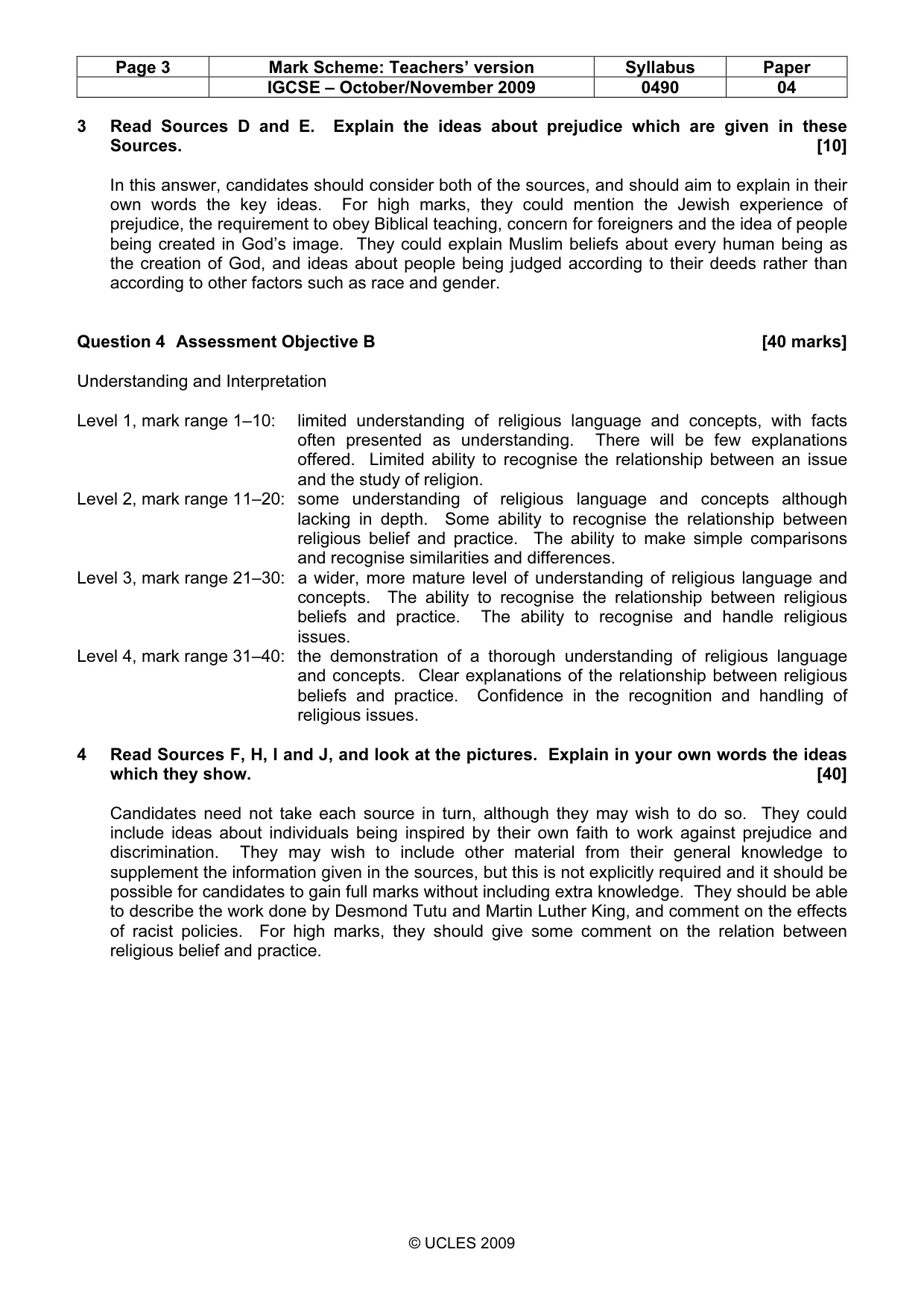
Page 3 Mark Scheme: Teachers’ version Syllabus Paper IGCSE – October/November 2009 0490 04 © UCLES 2009 3 Read Sources D and E. Explain the ideas about prejudice which are given in these Sources. [10] In this answer, candidates should consider both of the sources, and should aim to explain in their own words the key ideas. For high marks, they could mention the Jewish experience of prejudice, the requirement to obey Biblical teaching, concern for foreigners and the idea of people being created in God’s image. They could explain Muslim beliefs about every human being as the creation of God, and ideas about people being judged according to their deeds rather than according to other factors such as race and gender. Question 4 Assessment Objective B [40 marks] Understanding and Interpretation Level 1, mark range 1–10: limited understanding of religious language and concepts, with facts often presented as understanding. There will be few explanations offered. Limited ability to recognise the relationship between an issue and the study of religion. Level 2, mark range 11–20: some understanding of religious language and concepts although lacking in depth. Some ability to recognise the relationship between religious belief and practice. The ability to make simple comparisons and recognise similarities and differences. Level 3, mark range 21–30: a wider, more mature level of understanding of religious language and concepts. The ability to recognise the relationship between religious beliefs and practice. The ability to recognise and handle religious issues. Level 4, mark range 31–40: the demonstration of a thorough understanding of religious language and concepts. Clear explanations of the relationship between religious beliefs and practice. Confidence in the recognition and handling of religious issues. 4 Read Sources F, H, I and J, and look at the pictures. Explain in your own words the ideas which they show. [40] Candidates need not take each source in turn, although they may wish to do so. They could include ideas about individuals being inspired by their own faith to work against prejudice and discrimination. They may wish to include other material from their general knowledge to supplement the information given in the sources, but this is not explicitly required and it should be possible for candidates to gain full marks without including extra knowledge. They should be able to describe the work done by Desmond Tutu and Martin Luther King, and comment on the effects of racist policies. For high marks, they should give some comment on the relation between religious belief and practice.
Mark scheme, page 4
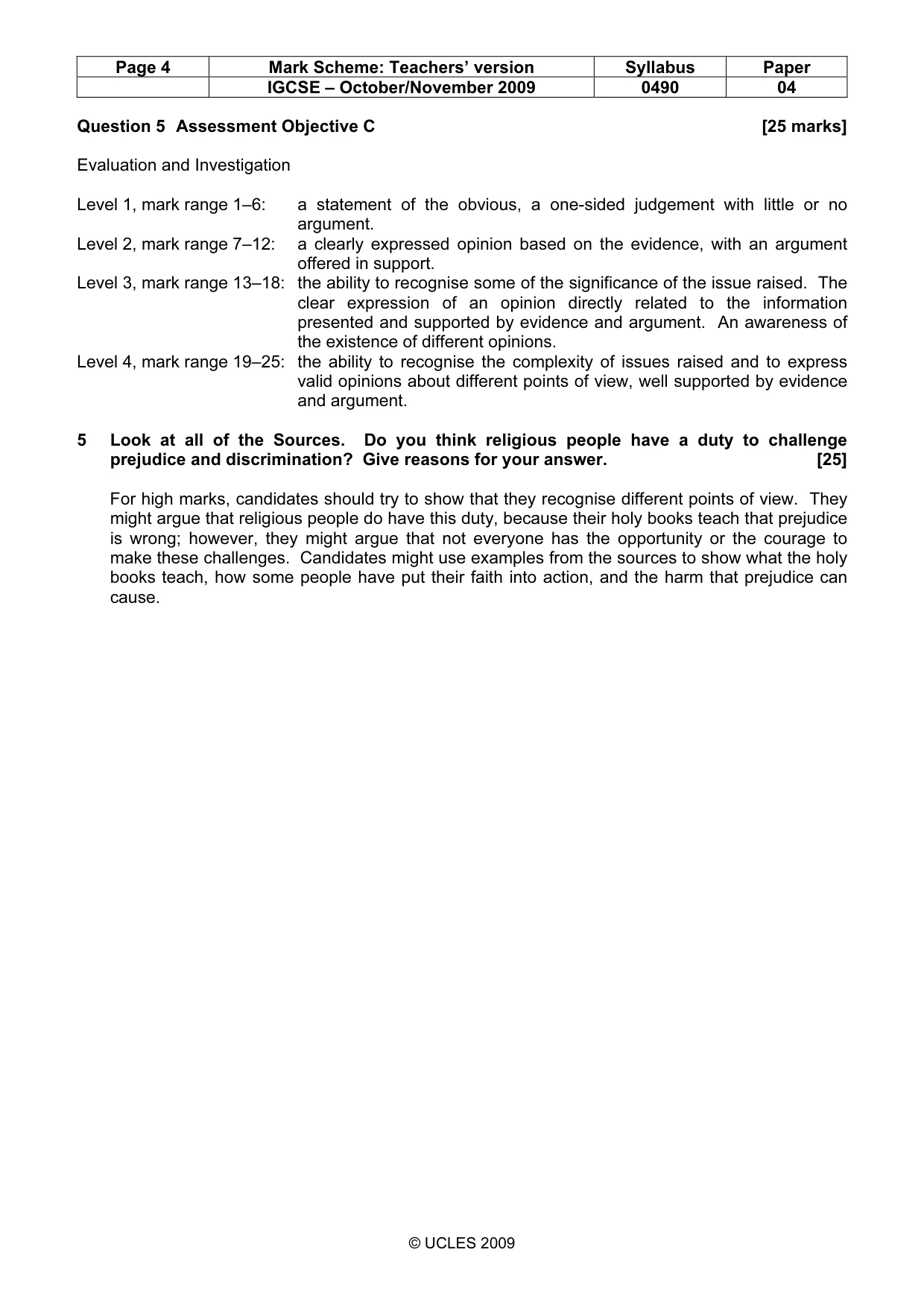
Page 4 Mark Scheme: Teachers’ version Syllabus Paper IGCSE – October/November 2009 0490 04 © UCLES 2009 Question 5 Assessment Objective C [25 marks] Evaluation and Investigation Level 1, mark range 1–6: a statement of the obvious, a one-sided judgement with little or no argument. Level 2, mark range 7–12: a clearly expressed opinion based on the evidence, with an argument offered in support. Level 3, mark range 13–18: the ability to recognise some of the significance of the issue raised. The clear expression of an opinion directly related to the information presented and supported by evidence and argument. An awareness of the existence of different opinions. Level 4, mark range 19–25: the ability to recognise the complexity of issues raised and to express valid opinions about different points of view, well supported by evidence and argument. 5 Look at all of the Sources. Do you think religious people have a duty to challenge prejudice and discrimination? Give reasons for your answer. [25] For high marks, candidates should try to show that they recognise different points of view. They might argue that religious people do have this duty, because their holy books teach that prejudice is wrong; however, they might argue that not everyone has the opportunity or the courage to make these challenges. Candidates might use examples from the sources to show what the holy books teach, how some people have put their faith into action, and the harm that prejudice can cause.
What you needed in this session
Cambridge’s own grade thresholds for 2009 Oct/Nov, Paper 4 · Variant 1. A higher threshold means an easier paper — the bar moves with how the cohort did.