Cambridge IGCSE Religious Studies 0490 — 2005 Oct/Nov Paper 4 · Variant 1
0490/41/O/N/05
The question paper and its mark scheme, free to read here and free to download. This is Cambridge’s own paper, exactly as it was sat.
Question paper8 pages

Mark scheme5 pages
Answers below. Sit the paper first if you are practising.
Paper as text
Question paper, page 1
This document consists of 6 printed pages and 2 blank pages. SP (NF) S88753/2 © UCLES 2005 [Turn over UNIVERSITY OF CAMBRIDGE INTERNATIONAL EXAMINATIONS International General Certificate of Secondary Education RELIGIOUS STUDIES 0490/04 Paper 4 October/November 2005 2 hours Additional Materials: Answer Booklet/Paper READ THESE INSTRUCTIONS FIRST If you have been given an Answer Booklet, follow the instructions on the front cover of the Booklet. Write your Centre number, candidate number and name on all the work you hand in. Write in dark blue or black pen on both sides of the paper. Do not use staples, paper clips, highlighters, glue or correction fluid. Answer all questions. At the end of the examination, fasten all your work securely together. The number of marks is given in brackets [ ] at the end of each question or part question. www.XtremePapers.com
Question paper, page 2
2 0490/04/O/N/05 The teaching and practice of the religions studied in relation to marriage, divorce and population control Study the sources carefully, and then answer all the following questions. 1 Explain the rights which are described in Source F. [10] 2 State in your own words the religious teachings about marriage which are given in each of Sources A, B and C. [15] 3 Look at Sources D and E. Using these texts as examples, describe Jewish and Christian attitudes towards divorce. [10] 4 Read Sources G, H and I and look at Sources J, K and L. Explain the ideas about using contraception (birth control) which they show. [40] 5 Look at all the Sources. Some people think that religious rules about divorce and contraception are out of date and of no use in the modern world. Do you agree? Give reasons for your answer. [25] Source A – Christianity Teach the older women to … teach what is good. Then they can train the younger women to love their husbands and children, to be self-controlled and pure, to be busy at home, to be kind, and to be subject to their husbands, so that no-one will malign the word of God. Titus 2:3-5 (NIV) Source B – Judaism A wife of noble character who can find? She is worth far more than rubies. Her husband has full confidence in her and lacks nothing of value. She brings him good, not harm, all the days of her life. Proverbs 31:10-12 (NIV) Source C – Islam Of His signs it is that He has created mates for you of your own kind that you may find peace of mind through them, and He has put love and tenderness between you. Surah 30:21 © UCLES 2005
Question paper, page 3
3 0490/04/O/N/05 [Turn over Source D – Judaism If a man marries a woman who becomes displeasing to him because he finds something indecent about her… he writes her a certificate of divorce, gives it to her and sends her from his house. Deuteronomy 24:1 (NIV) Source E – Christianity [Jesus said] “But at the beginning of creation God ‘made them male and female’. For this reason a man will leave his father and mother and be united to his wife, and the two will become one flesh. So they are no longer two, but one. Therefore what God has joined together, let man not separate.” Mark 10:6-9 (NIV) Source F Article 16. (1) Men and women of full age, without any limitation due to race, nationality or religion, have the right to marry and to found a family. They are entitled to equal rights as to marriage, during marriage and at its dissolution. (2) Marriage shall be entered into only with the free and full consent of the intending spouses. Universal Declaration of Human Rights Source G In 1968 Pope Paul VI explained the teachings of the Roman Catholic Church about birth control in his encyclical letter Humanae Vitae. He explained that married love takes its origin from God, who ‘is love’. He also said that sexual intercourse ‘while uniting husband and wife in the closest intimacy, also renders them capable of generating new life’. This means that sex between a married couple not only strengthens them in their relationship but must be capable of causing pregnancy: ‘children are really the supreme gift of marriage’. ‘Any action which either before, at the moment of, or after sexual intercourse, is intended to prevent pregnancy, is to be condemned.’ Earlier teaching of the Roman Catholic Church stated that those, even married couples, who use artificial contraception to prevent pregnancy ‘are branded with the guilt of a grave sin’. Dr Janet E Smith, an American professor, has written, ‘Sex is for babies and for bonding … we have lost sight of the fundamental truth that if you are not ready for babies, you are not ready for sexual intercourse.’ This applies just as much in marriage as before it. Article on Roman Catholic teaching on birth control © UCLES 2005
Question paper, page 4
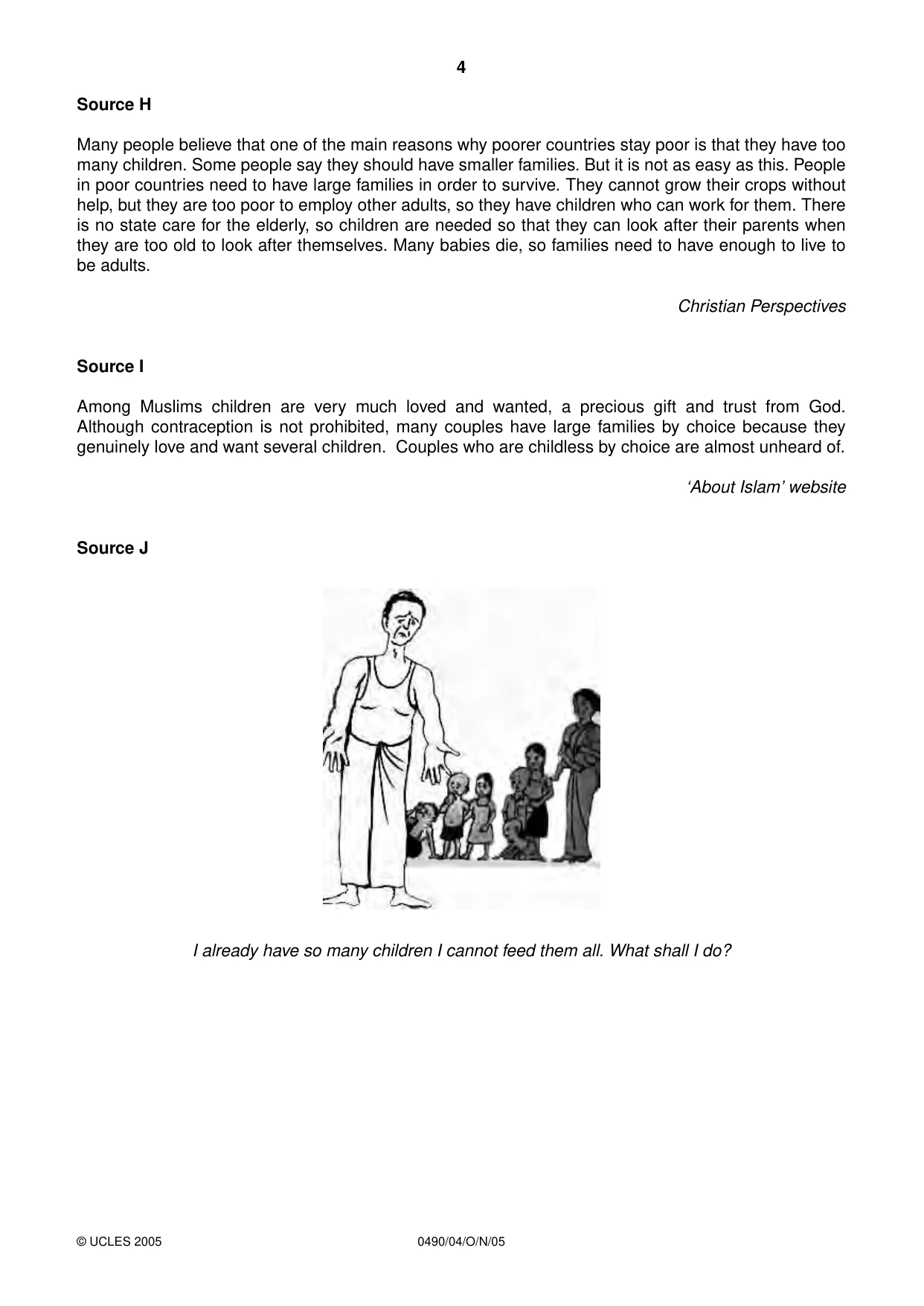
4 0490/04/O/N/05 Source H Many people believe that one of the main reasons why poorer countries stay poor is that they have too many children. Some people say they should have smaller families. But it is not as easy as this. People in poor countries need to have large families in order to survive. They cannot grow their crops without help, but they are too poor to employ other adults, so they have children who can work for them. There is no state care for the elderly, so children are needed so that they can look after their parents when they are too old to look after themselves. Many babies die, so families need to have enough to live to be adults. Christian Perspectives Source I Among Muslims children are very much loved and wanted, a precious gift and trust from God. Although contraception is not prohibited, many couples have large families by choice because they genuinely love and want several children. Couples who are childless by choice are almost unheard of. ‘About Islam’ website Source J I already have so many children I cannot feed them all. What shall I do? © UCLES 2005
Question paper, page 5
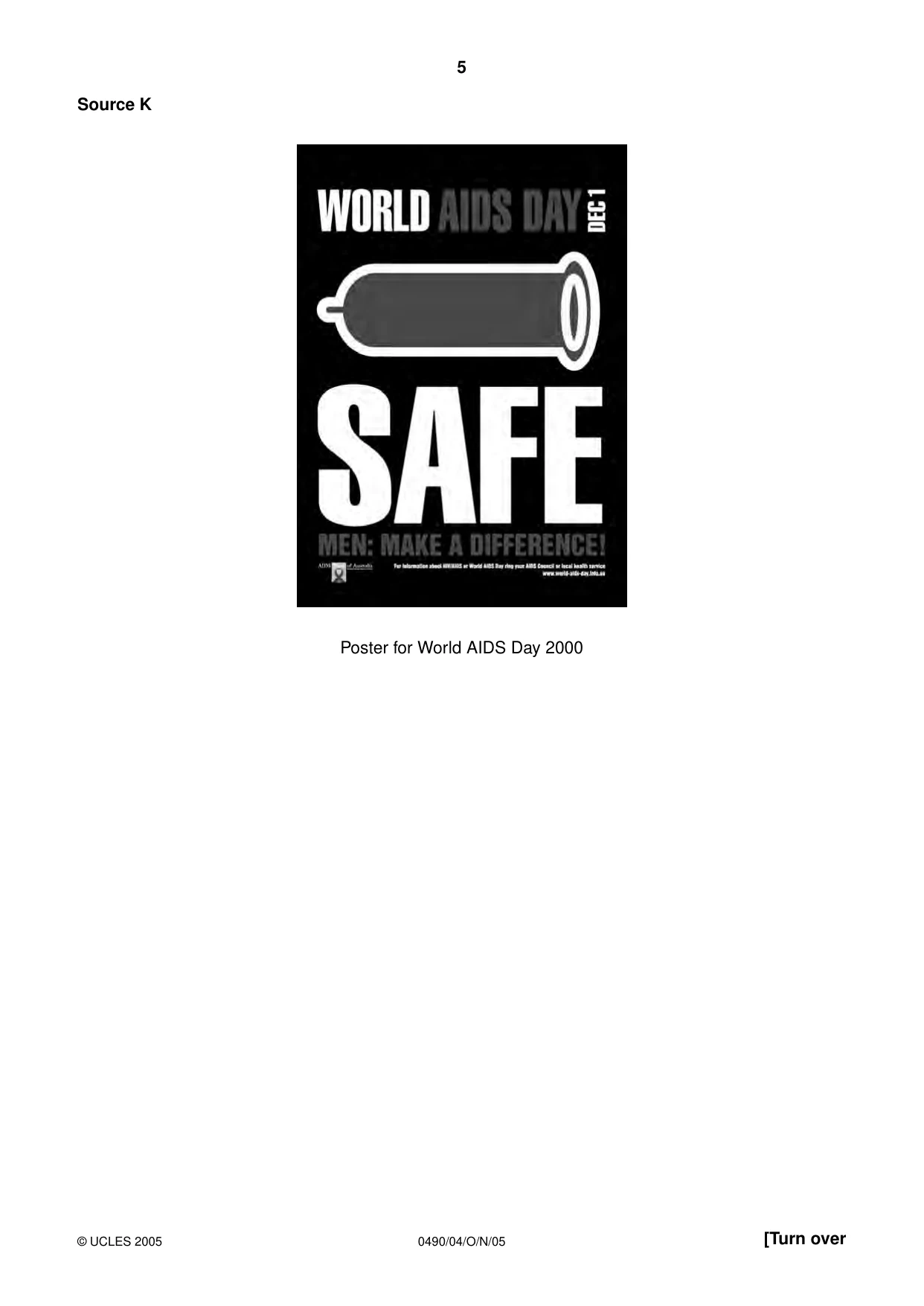
5 0490/04/O/N/05 [Turn over Source K Poster for World AIDS Day 2000 © UCLES 2005
Question paper, page 6
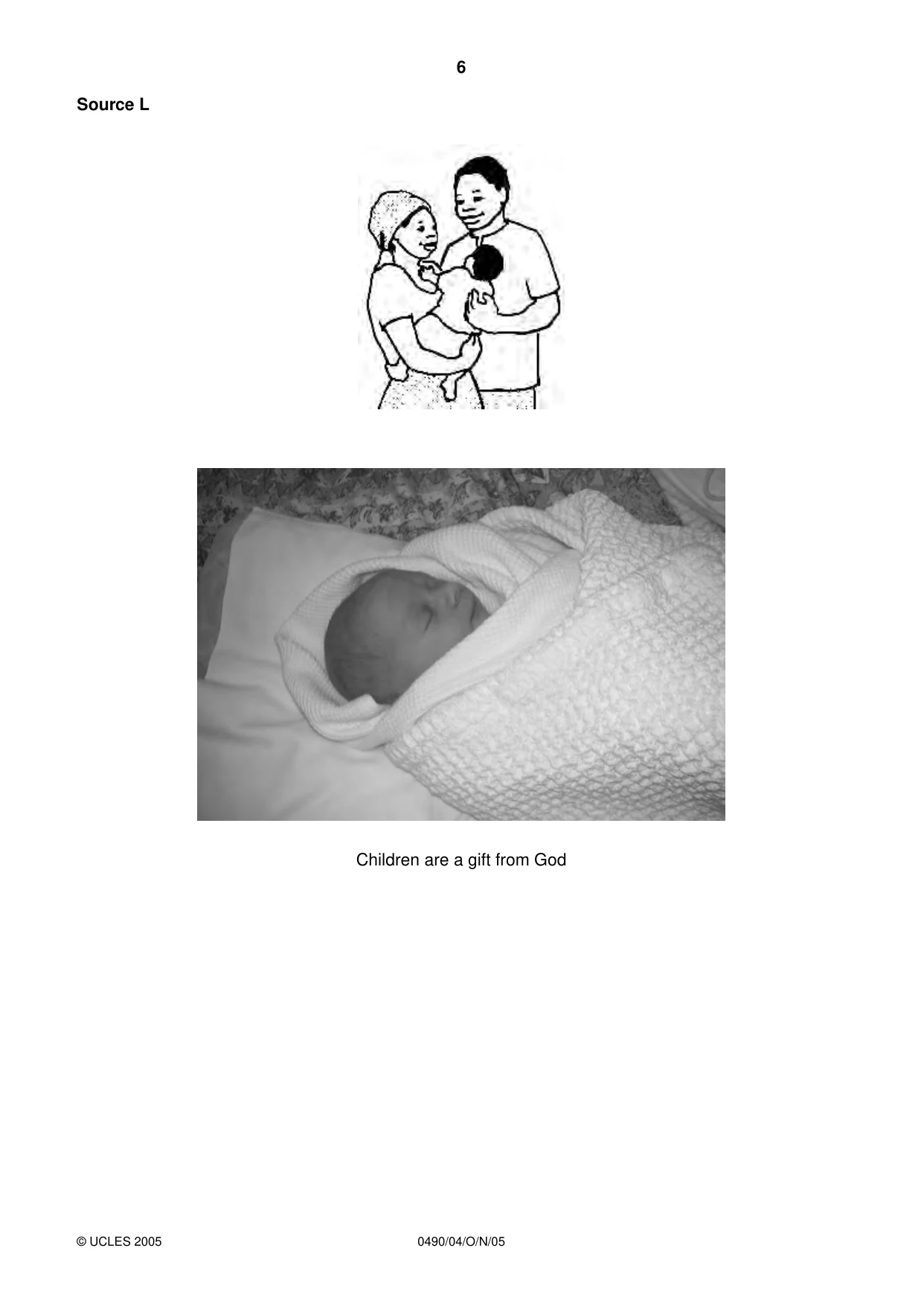
6 0490/04/O/N/05 Source L Children are a gift from God © UCLES 2005
Question paper, page 8
8 0490/04/O/N/05 BLANK PAGE Copyright Acknowledgements: Sources A, B, D, E Scripture quotations marked (NIV) are taken from the HOLY BIBLE, NEW INTERNATIONAL VERSION ®. NIV®. Copyright © 1973, 1978, 1984 by International Bible Society. Used by permission. All rights reserved. Source C © Islamic Foundation. Source F Universal Declaration of Human Rights, Article 16(1),(2); © United Nations. Source H © Elizabeth Ahluwalia; Christian Perspectives; Hodder & Stoughton, 2001. Source I From About Islam website; www.islam.about.com, 2004. Source J http://users.Imi.net/songarap/makemeaman, 2004. Source K Australian Government Department of Health and Ageing. Source L Photograph J Gwinnell © UCLES. Permission to reproduce items where third-party owned material protected by copyright is included has been sought and cleared where possible. Every reasonable effort has been made by the publisher (UCLES) to trace copyright holders, but if any items requiring clearance have unwittingly been included, the publisher will be pleased to make amends at the earliest possible opportunity. University of Cambridge International Examinations is part of the University of Cambridge Local Examinations Syndicate (UCLES), which is itself a department of the University of Cambridge.
Mark scheme, page 1
UNIVERSITY OF CAMBRIDGE INTERNATIONAL EXAMINATIONS International General Certificate of Secondary Education MARK SCHEME for the November 2005 question paper 0490 RELIGIOUS STUDIES 0490/04 Paper 4 maximum raw mark 100 This mark scheme is published as an aid to teachers and students, to indicate the requirements of the examination. It shows the basis on which Examiners were initially instructed to award marks. It does not indicate the details of the discussions that took place at an Examiners’ meeting before marking began. Any substantial changes to the mark scheme that arose from these discussions will be recorded in the published Report on the Examination. All Examiners are instructed that alternative correct answers and unexpected approaches in candidates’ scripts must be given marks that fairly reflect the relevant knowledge and skills demonstrated. Mark schemes must be read in conjunction with the question papers and the Report on the Examination. The minimum marks in these components needed for various grades were previously published with these mark schemes, but are now instead included in the Report on the Examination for this session. • CIE will not enter into discussion or correspondence in connection with these mark schemes. CIE is publishing the mark schemes for the November 2005 question papers for most IGCSE and GCE Advanced Level and Advanced Subsidiary Level syllabuses and some Ordinary Level syllabuses. www.XtremePapers.com
Mark scheme, page 2
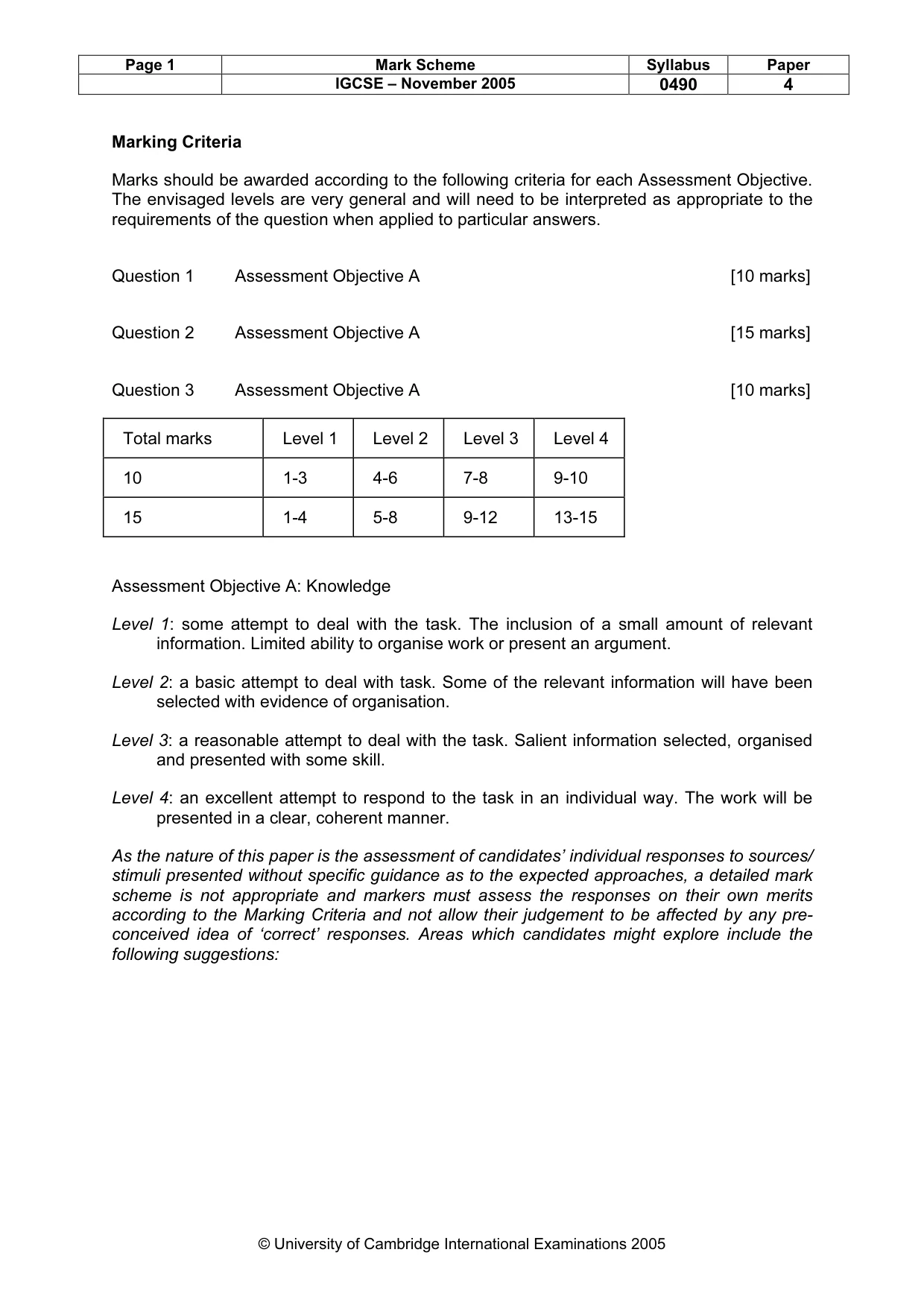
Page 1 Mark Scheme Syllabus Paper IGCSE – November 2005 0490 4 © University of Cambridge International Examinations 2005 Marking Criteria Marks should be awarded according to the following criteria for each Assessment Objective. The envisaged levels are very general and will need to be interpreted as appropriate to the requirements of the question when applied to particular answers. Question 1 Assessment Objective A [10 marks] Question 2 Assessment Objective A [15 marks] Question 3 Assessment Objective A [10 marks] Total marks Level 1 Level 2 Level 3 Level 4 10 1-3 4-6 7-8 9-10 15 1-4 5-8 9-12 13-15 Assessment Objective A: Knowledge Level 1: some attempt to deal with the task. The inclusion of a small amount of relevant information. Limited ability to organise work or present an argument. Level 2: a basic attempt to deal with task. Some of the relevant information will have been selected with evidence of organisation. Level 3: a reasonable attempt to deal with the task. Salient information selected, organised and presented with some skill. Level 4: an excellent attempt to respond to the task in an individual way. The work will be presented in a clear, coherent manner. As the nature of this paper is the assessment of candidates’ individual responses to sources/ stimuli presented without specific guidance as to the expected approaches, a detailed mark scheme is not appropriate and markers must assess the responses on their own merits according to the Marking Criteria and not allow their judgement to be affected by any pre- conceived idea of ‘correct’ responses. Areas which candidates might explore include the following suggestions:
Mark scheme, page 3
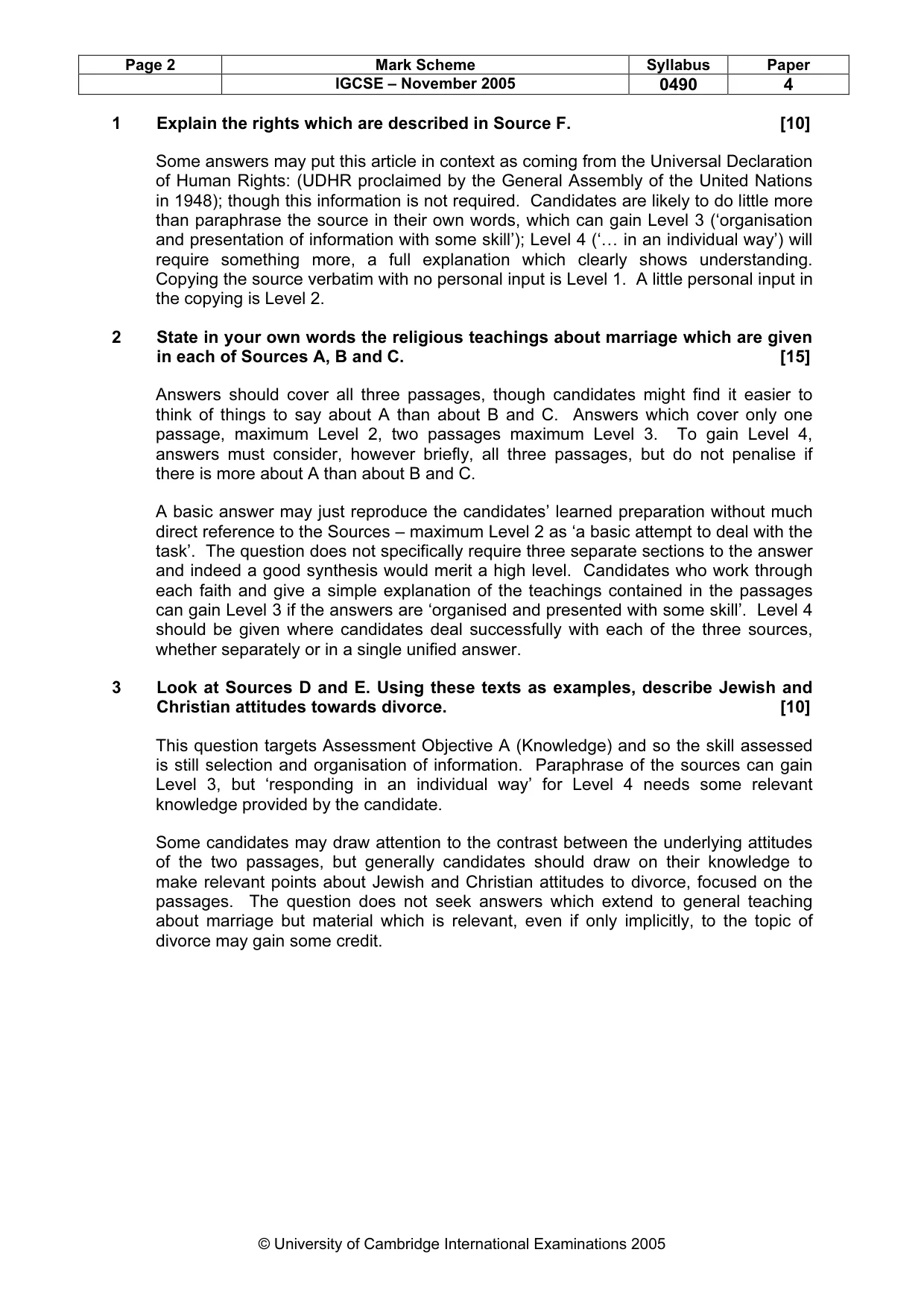
Page 2 Mark Scheme Syllabus Paper IGCSE – November 2005 0490 4 © University of Cambridge International Examinations 2005 1 Explain the rights which are described in Source F. [10] Some answers may put this article in context as coming from the Universal Declaration of Human Rights: (UDHR proclaimed by the General Assembly of the United Nations in 1948); though this information is not required. Candidates are likely to do little more than paraphrase the source in their own words, which can gain Level 3 (‘organisation and presentation of information with some skill’); Level 4 (‘… in an individual way’) will require something more, a full explanation which clearly shows understanding. Copying the source verbatim with no personal input is Level 1. A little personal input in the copying is Level 2. 2 State in your own words the religious teachings about marriage which are given in each of Sources A, B and C. [15] Answers should cover all three passages, though candidates might find it easier to think of things to say about A than about B and C. Answers which cover only one passage, maximum Level 2, two passages maximum Level 3. To gain Level 4, answers must consider, however briefly, all three passages, but do not penalise if there is more about A than about B and C. A basic answer may just reproduce the candidates’ learned preparation without much direct reference to the Sources – maximum Level 2 as ‘a basic attempt to deal with the task’. The question does not specifically require three separate sections to the answer and indeed a good synthesis would merit a high level. Candidates who work through each faith and give a simple explanation of the teachings contained in the passages can gain Level 3 if the answers are ‘organised and presented with some skill’. Level 4 should be given where candidates deal successfully with each of the three sources, whether separately or in a single unified answer. 3 Look at Sources D and E. Using these texts as examples, describe Jewish and Christian attitudes towards divorce. [10] This question targets Assessment Objective A (Knowledge) and so the skill assessed is still selection and organisation of information. Paraphrase of the sources can gain Level 3, but ‘responding in an individual way’ for Level 4 needs some relevant knowledge provided by the candidate. Some candidates may draw attention to the contrast between the underlying attitudes of the two passages, but generally candidates should draw on their knowledge to make relevant points about Jewish and Christian attitudes to divorce, focused on the passages. The question does not seek answers which extend to general teaching about marriage but material which is relevant, even if only implicitly, to the topic of divorce may gain some credit.
Mark scheme, page 4
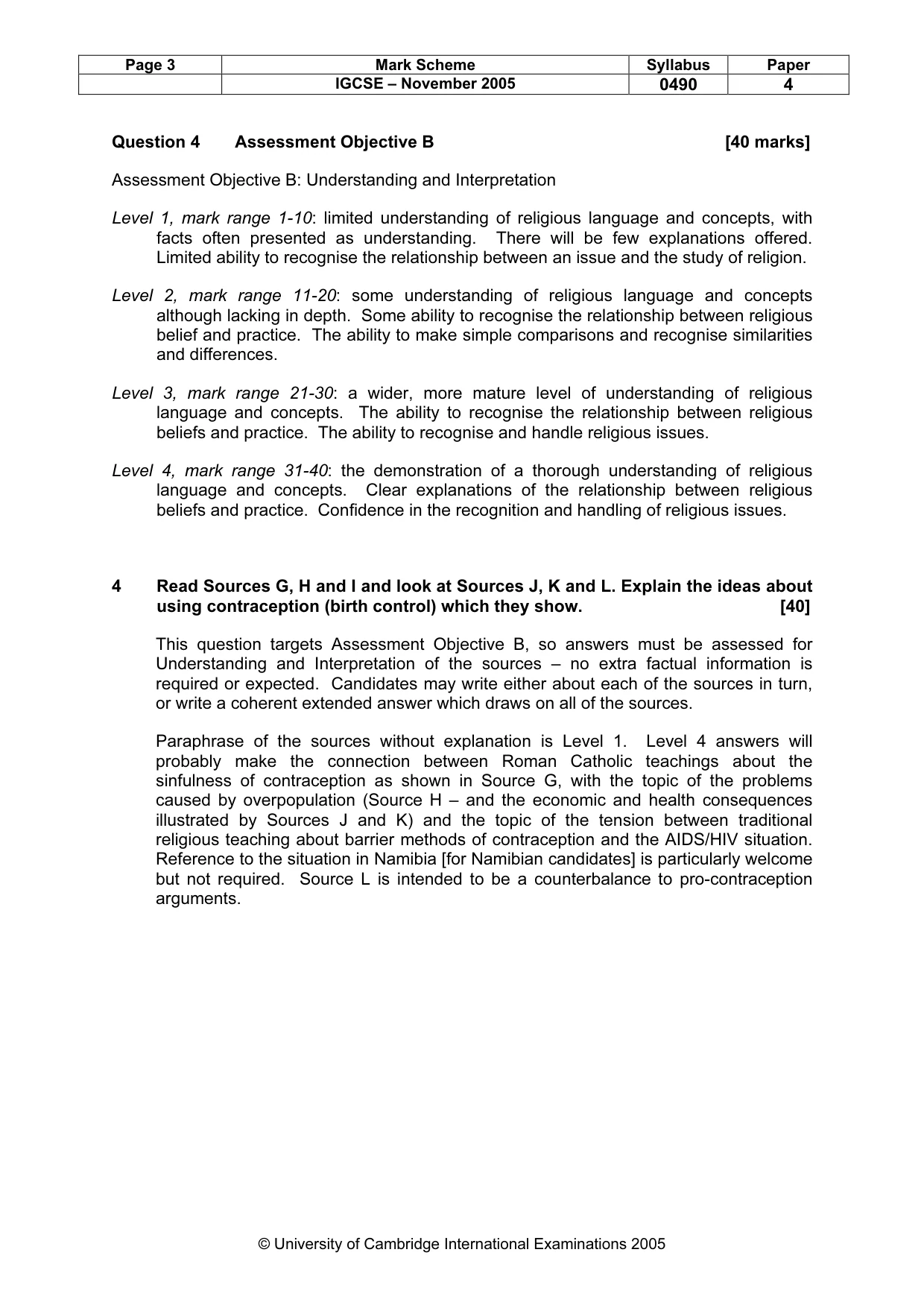
Page 3 Mark Scheme Syllabus Paper IGCSE – November 2005 0490 4 © University of Cambridge International Examinations 2005 Question 4 Assessment Objective B [40 marks] Assessment Objective B: Understanding and Interpretation Level 1, mark range 1-10: limited understanding of religious language and concepts, with facts often presented as understanding. There will be few explanations offered. Limited ability to recognise the relationship between an issue and the study of religion. Level 2, mark range 11-20: some understanding of religious language and concepts although lacking in depth. Some ability to recognise the relationship between religious belief and practice. The ability to make simple comparisons and recognise similarities and differences. Level 3, mark range 21-30: a wider, more mature level of understanding of religious language and concepts. The ability to recognise the relationship between religious beliefs and practice. The ability to recognise and handle religious issues. Level 4, mark range 31-40: the demonstration of a thorough understanding of religious language and concepts. Clear explanations of the relationship between religious beliefs and practice. Confidence in the recognition and handling of religious issues. 4 Read Sources G, H and I and look at Sources J, K and L. Explain the ideas about using contraception (birth control) which they show. [40] This question targets Assessment Objective B, so answers must be assessed for Understanding and Interpretation of the sources – no extra factual information is required or expected. Candidates may write either about each of the sources in turn, or write a coherent extended answer which draws on all of the sources. Paraphrase of the sources without explanation is Level 1. Level 4 answers will probably make the connection between Roman Catholic teachings about the sinfulness of contraception as shown in Source G, with the topic of the problems caused by overpopulation (Source H – and the economic and health consequences illustrated by Sources J and K) and the topic of the tension between traditional religious teaching about barrier methods of contraception and the AIDS/HIV situation. Reference to the situation in Namibia [for Namibian candidates] is particularly welcome but not required. Source L is intended to be a counterbalance to pro-contraception arguments.
Mark scheme, page 5
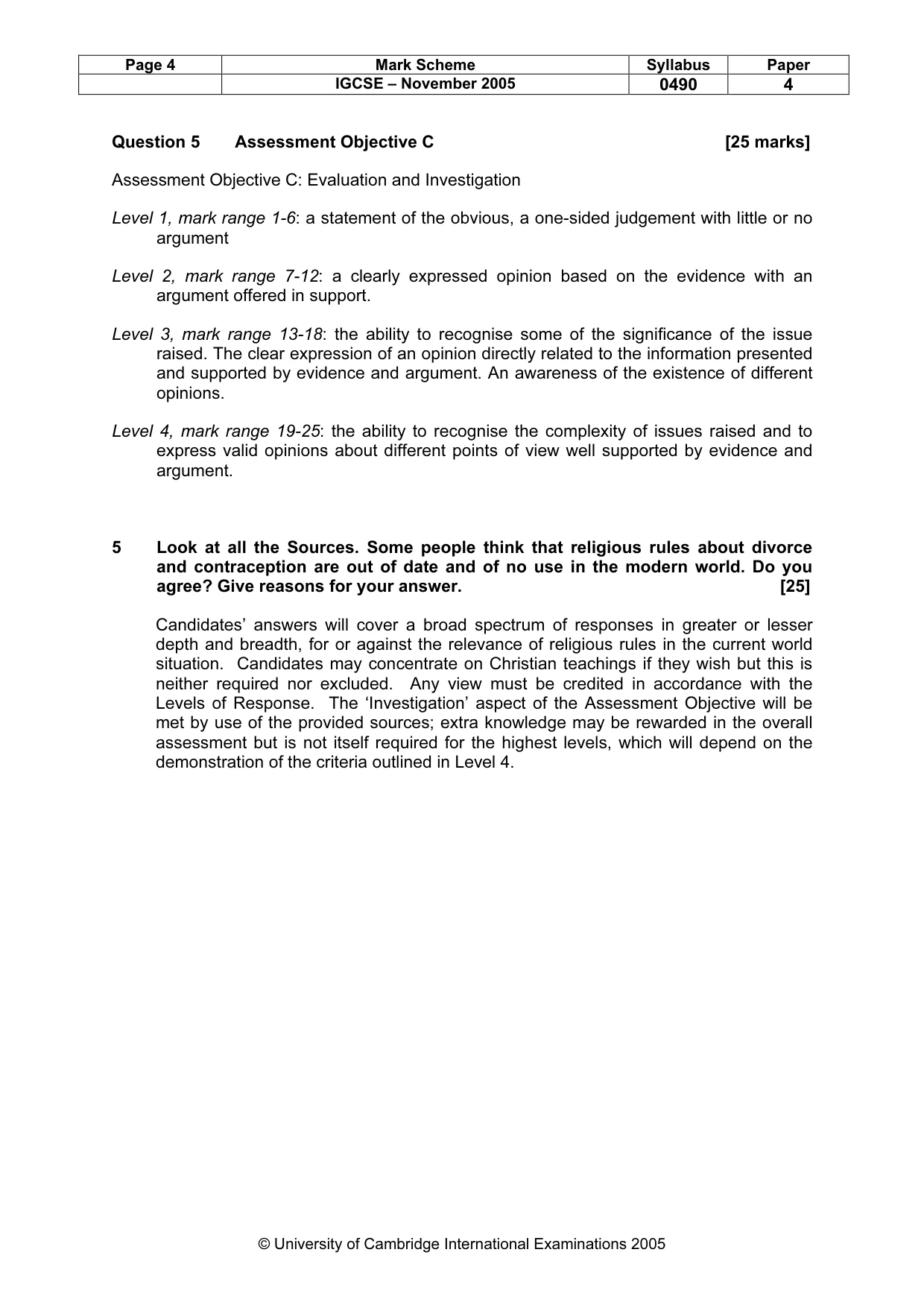
Page 4 Mark Scheme Syllabus Paper IGCSE – November 2005 0490 4 © University of Cambridge International Examinations 2005 Question 5 Assessment Objective C [25 marks] Assessment Objective C: Evaluation and Investigation Level 1, mark range 1-6: a statement of the obvious, a one-sided judgement with little or no argument Level 2, mark range 7-12: a clearly expressed opinion based on the evidence with an argument offered in support. Level 3, mark range 13-18: the ability to recognise some of the significance of the issue raised. The clear expression of an opinion directly related to the information presented and supported by evidence and argument. An awareness of the existence of different opinions. Level 4, mark range 19-25: the ability to recognise the complexity of issues raised and to express valid opinions about different points of view well supported by evidence and argument. 5 Look at all the Sources. Some people think that religious rules about divorce and contraception are out of date and of no use in the modern world. Do you agree? Give reasons for your answer. [25] Candidates’ answers will cover a broad spectrum of responses in greater or lesser depth and breadth, for or against the relevance of religious rules in the current world situation. Candidates may concentrate on Christian teachings if they wish but this is neither required nor excluded. Any view must be credited in accordance with the Levels of Response. The ‘Investigation’ aspect of the Assessment Objective will be met by use of the provided sources; extra knowledge may be rewarded in the overall assessment but is not itself required for the highest levels, which will depend on the demonstration of the criteria outlined in Level 4.