Questions as text
Q1 · Which expression gives the momentum of an object? 0972/21 May/June 2018
9 Which expression gives the momentum of an object? A mass × acceleration B mass × gravitational field strength C mass × velocity D 1 × mass × (velocity)2 2
1 marks
Answer: C
This question in 0972/21 May/June 2018
Q2 · A resultant force of 4.0 N acts on an object of mass 0.50 kg for 3.0 seconds 0972/21 Oct/Nov 2018
6 A resultant force of 4.0 N acts on an object of mass 0.50 kg for 3.0 seconds. What is the change in velocity caused by this force? A 4.0 m / s B 6.0 m / s C 12 m / s D 24 m / s
1 marks
Answer: D
This question in 0972/21 Oct/Nov 2018
Q3 · A moving ball with a momentum of 25 kg m / s collides head-on with a wall 0972/21 Oct/Nov 2018
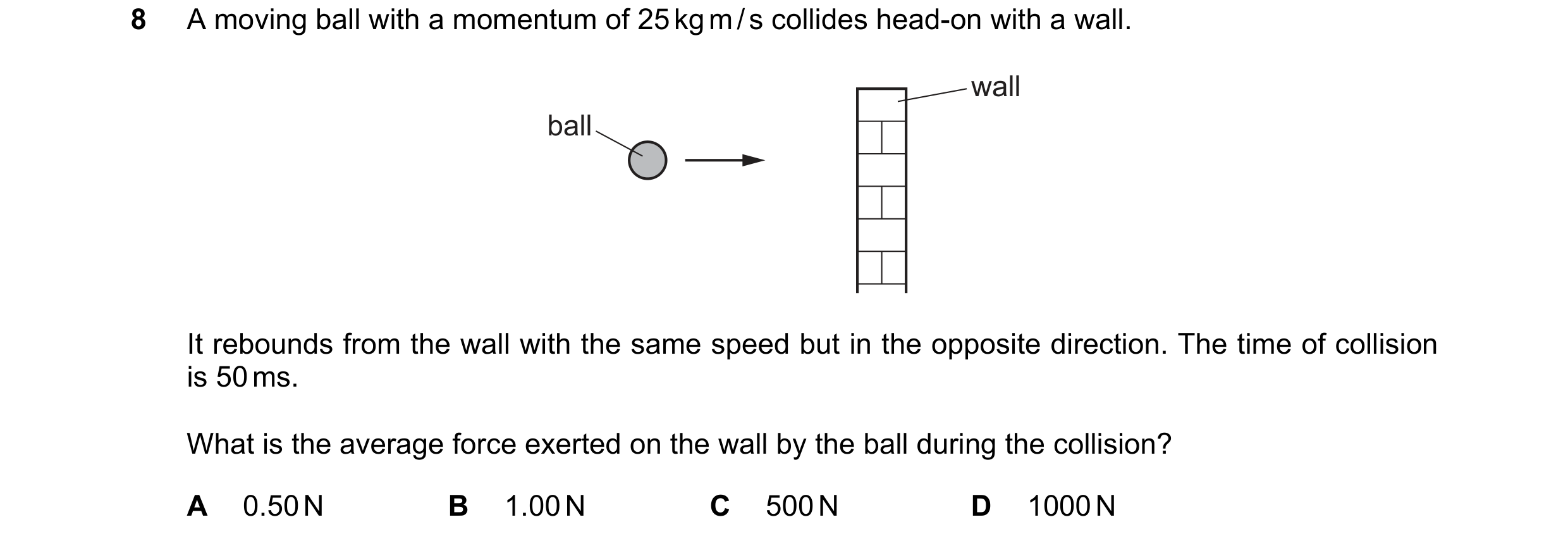
8 A moving ball with a momentum of 25 kg m / s collides head-on with a wall. wall ball It rebounds from the wall with the same speed but in the opposite direction. The time of collision is 50 ms. What is the average force exerted on the wall by the ball during the collision? A 0.50 N B 1.00 N C 500 N D 1000 N
1 marks
Answer: D
This question in 0972/21 Oct/Nov 2018
Q4 · A ball of mass 0.50 kg falls and hits the floor at 10 m / s 0972/21 May/June 2019
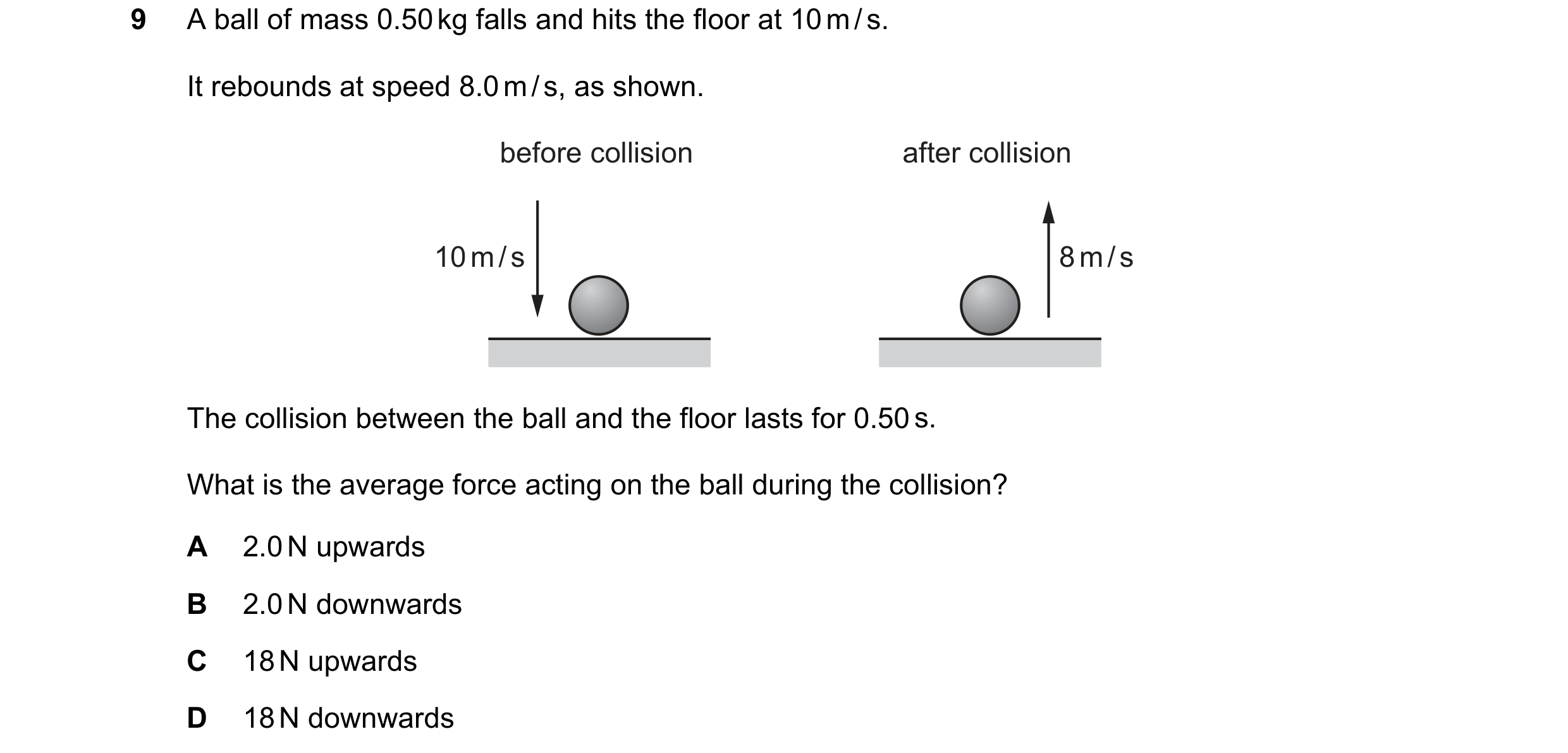
9 A ball of mass 0.50 kg falls and hits the floor at 10 m / s. It rebounds at speed 8.0 m / s, as shown. before collision after collision 10 m / s 8 m / s The collision between the ball and the floor lasts for 0.50 s. What is the average force acting on the ball during the collision? A 2.0 N upwards B 2.0 N downwards C 18 N upwards D 18 N downwards
1 marks
Answer: C
This question in 0972/21 May/June 2019
Q5 · An object of mass 4.0 kg is moving with a velocity of 3.0 m / s in a straight line 0972/22 May/June 2019
9 An object of mass 4.0 kg is moving with a velocity of 3.0 m / s in a straight line. What is the momentum of the object? A 0.75 kg m / s B 1.3 kg m / s C 12 kg m / s D 24 kg m / s
1 marks
Answer: C
This question in 0972/22 May/June 2019
Q6 · Two objects X and Y move directly towards each other 0972/21 Oct/Nov 2019
9 Two objects X and Y move directly towards each other. The objects have the same mass. Object X has a velocity of 5.0 m / s to the right. Object Y has a velocity of 3.0 m / s to the left. 5.0 m / s 3.0 m / s X Y Object X and object Y collide and stick together. What is their velocity after colliding? A 1.0 m / s to the left B 1.0 m / s to the right C 4.0 m / s to the left D 4.0 m / s to the right
1 marks
Answer: B
This question in 0972/21 Oct/Nov 2019
Q7 · An object of mass 1.2 kg is moving with a velocity of 2.0 m / s when it is acted on by a… 0972/21 May/June 2020
9 An object of mass 1.2 kg is moving with a velocity of 2.0 m / s when it is acted on by a force of 4.0 N. The velocity of the object increases to 5.0 m / s. For what period of time does the force act on the object? A 0.90 s B 1.1 s C 1.5 s D 3.6 s
1 marks
Answer: A
This question in 0972/21 May/June 2020
Q8 · An object is moving at +3.0 m / s 0972/22 May/June 2020
9 An object is moving at +3.0 m / s. A force acts on the object. After a time, the object is moving at – 4.0 m / s. The mass of the object is 5.0 kg. What is the change in momentum of the body? A –35 kg m / s B –5.0 kg m / s C +5.0 kg m / s D +35 kg m / s
1 marks
Answer: A
This question in 0972/22 May/June 2020
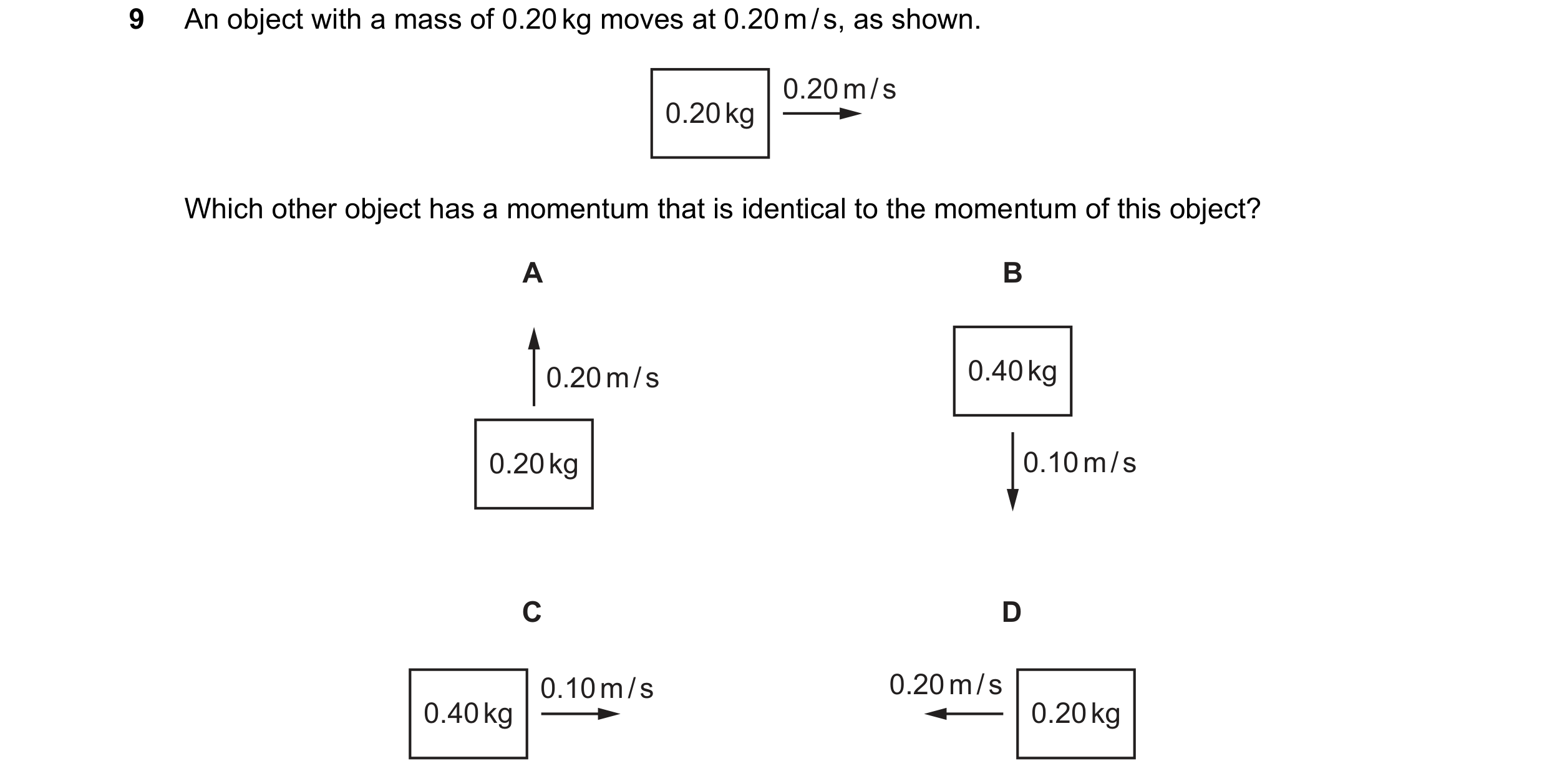
Q9 · An object with a mass of 0.20 kg moves at 0.20 m / s, as shown 0972/21 Oct/Nov 2020
9 An object with a mass of 0.20 kg moves at 0.20 m / s, as shown. 0.20 m / s 0.20 kg Which other object has a momentum that is identical to the momentum of this object? A B 0.20 m / s 0.40 kg 0.20 kg 0.10 m / s C D 0.10 m / s 0.20 m / s 0.40 kg 0.20 kg
1 marks
Answer: C
This question in 0972/21 Oct/Nov 2020
Q10 · What is the relationship between the impulse acting on an object and the change in… 0972/21 Oct/Nov 2021
7 What is the relationship between the impulse acting on an object and the change in momentum of the object? A impulse = change in momentum B impulse = change in momentum time impulse = change in momentum C time impulse = change in momentum D mass
1 marks
Answer: A
This question in 0972/21 Oct/Nov 2021
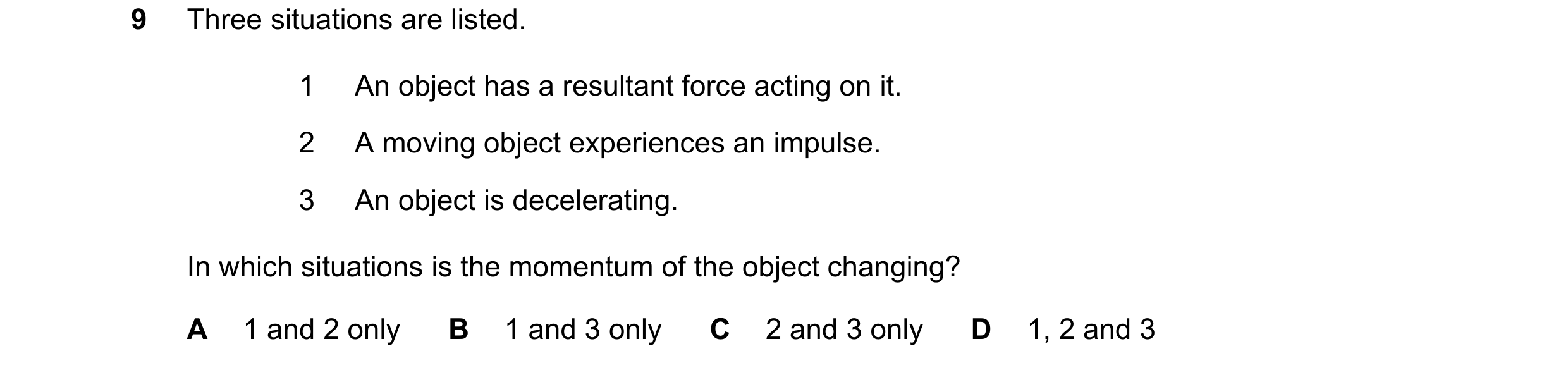
Q11 · Three situations are listed 0972/21 May/June 2022
9 Three situations are listed. 1 An object has a resultant force acting on it. 2 A moving object experiences an impulse. 3 An object is decelerating. In which situations is the momentum of the object changing? A 1 and 2 only B 1 and 3 only C 2 and 3 only D 1, 2 and 3
1 marks
Answer: D
This question in 0972/21 May/June 2022
Q12 · A ball of mass 0.16 kg is moving forwards at a speed of 0.50 m / s 0972/21 May/June 2022
10 A ball of mass 0.16 kg is moving forwards at a speed of 0.50 m / s. A second ball of mass 0.10 kg is stationary. The first ball strikes the second ball. The second ball moves forwards at a speed of 0.50 m / s. What is the speed of the first ball after the collision? A 0.0 m / s B 0.19 m / s C 0.31 m / s D 0.50 m / s
1 marks
Answer: B
This question in 0972/21 May/June 2022
Q13 · Which statement describes the impulse acting on an object? 0972/22 May/June 2022
9 Which statement describes the impulse acting on an object? A Impulse is the change in kinetic energy of the object. B Impulse is the change in momentum of the object. C Impulse is the rate of change of force acting on the object. D Impulse is the rate of change of momentum of the object.
1 marks
Answer: B
This question in 0972/22 May/June 2022
Q14 · A ball of mass 0.16 kg is moving forwards at a speed of 0.50 m / s 0972/22 May/June 2022
10 A ball of mass 0.16 kg is moving forwards at a speed of 0.50 m / s. A second ball of mass 0.10 kg is stationary. The first ball strikes the second ball. The second ball moves forwards at a speed of 0.50 m / s. What is the speed of the first ball after the collision? A 0.0 m / s B 0.19 m / s C 0.31 m / s D 0.50 m / s
1 marks
Answer: B
This question in 0972/22 May/June 2022
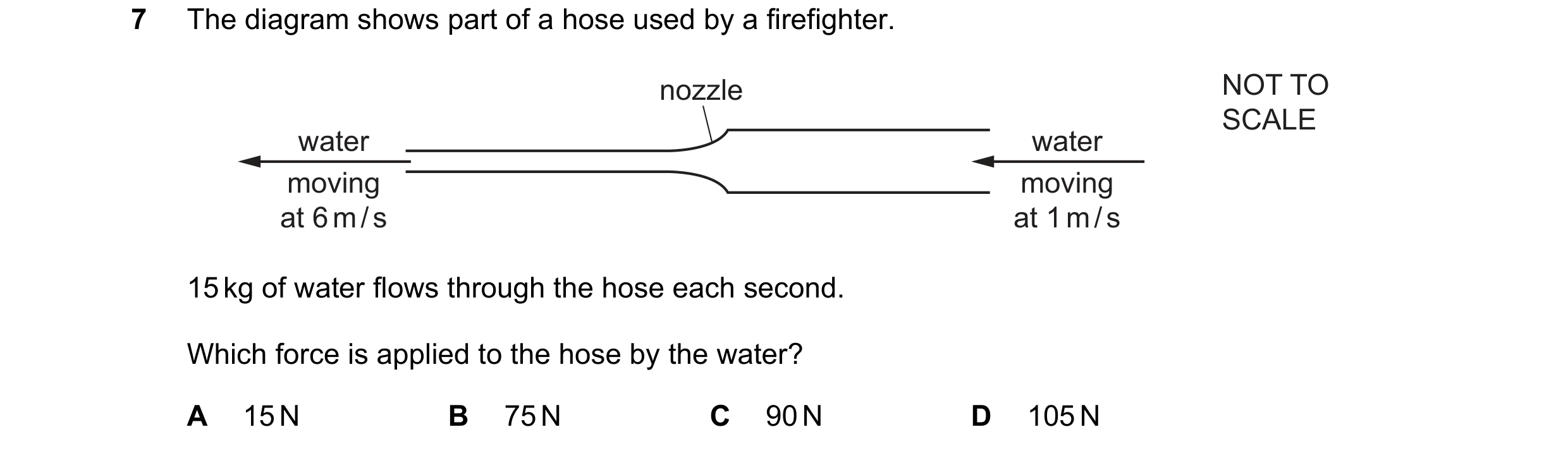
Q15 · The diagram shows part of a hose used by a firefighter 0972/21 Oct/Nov 2022
7 The diagram shows part of a hose used by a firefighter. nozzle NOT TO SCALE water water moving moving at 6 m / s at 1 m / s 15 kg of water flows through the hose each second. Which force is applied to the hose by the water? A 15 N B 75 N C 90 N D 105 N
1 marks
Answer: B
This question in 0972/21 Oct/Nov 2022
Q16 · A resultant force of 2.0 N acts on an object of mass 3.0 kg for 6.0 s 0972/22 May/June 2023
9 A resultant force of 2.0 N acts on an object of mass 3.0 kg for 6.0 s. What is the change in velocity of the object? A 0.25 m / s B 1.0 m / s C 4.0 m / s D 36 m / s
1 marks
Answer: C
This question in 0972/22 May/June 2023
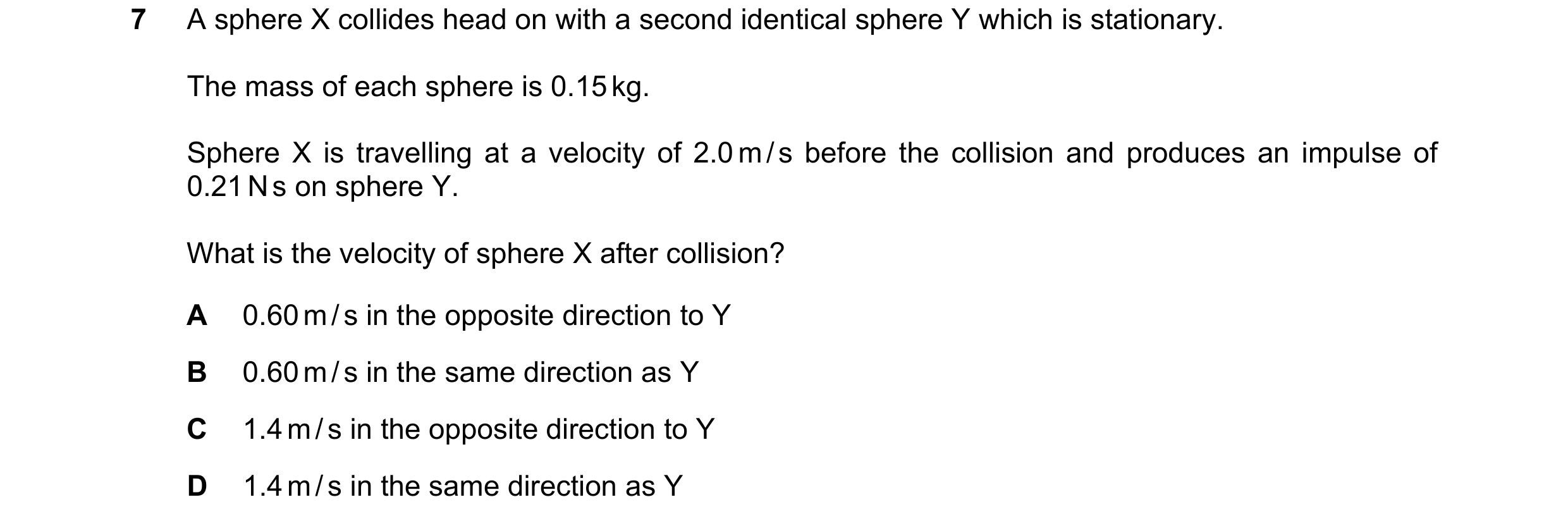
Q17 · A sphere X collides head on with a second identical sphere Y which is stationary 0972/21 Oct/Nov 2023
7 A sphere X collides head on with a second identical sphere Y which is stationary. The mass of each sphere is 0.15 kg. Sphere X is travelling at a velocity of 2.0 m / s before the collision and produces an impulse of 0.21 N s on sphere Y. What is the velocity of sphere X after collision? A 0.60 m / s in the opposite direction to Y B 0.60 m / s in the same direction as Y C 1.4 m / s in the opposite direction to Y D 1.4 m / s in the same direction as Y
1 marks
Answer: B
This question in 0972/21 Oct/Nov 2023
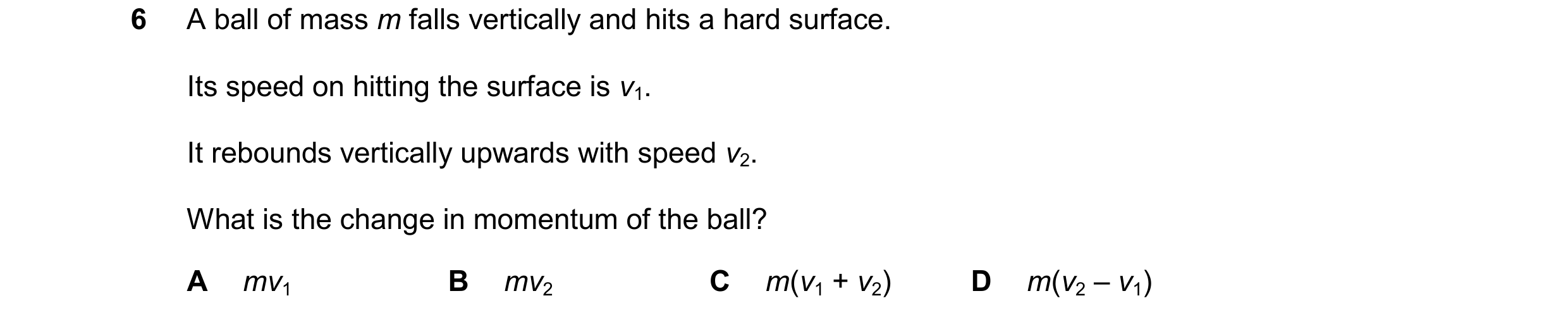
Q18 · A ball of mass m falls vertically and hits a hard surface 0972/21 May/June 2024
6 A ball of mass m falls vertically and hits a hard surface. Its speed on hitting the surface is v1. It rebounds vertically upwards with speed v2. What is the change in momentum of the ball? A mv1 B mv2 C m(v1 + v2) D m(v2 – v1)
1 marks
Answer: C
This question in 0972/21 May/June 2024
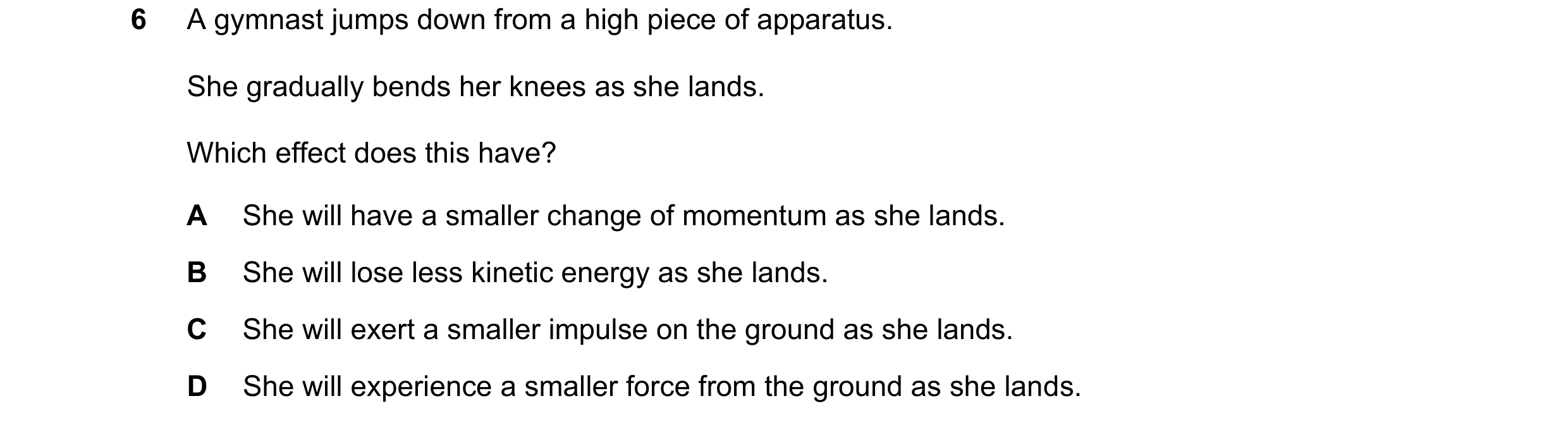
Q19 · A gymnast jumps down from a high piece of apparatus 0972/22 May/June 2024
6 A gymnast jumps down from a high piece of apparatus. She gradually bends her knees as she lands. Which effect does this have? A She will have a smaller change of momentum as she lands. B She will lose less kinetic energy as she lands. C She will exert a smaller impulse on the ground as she lands. D She will experience a smaller force from the ground as she lands.
1 marks
Answer: D
This question in 0972/22 May/June 2024
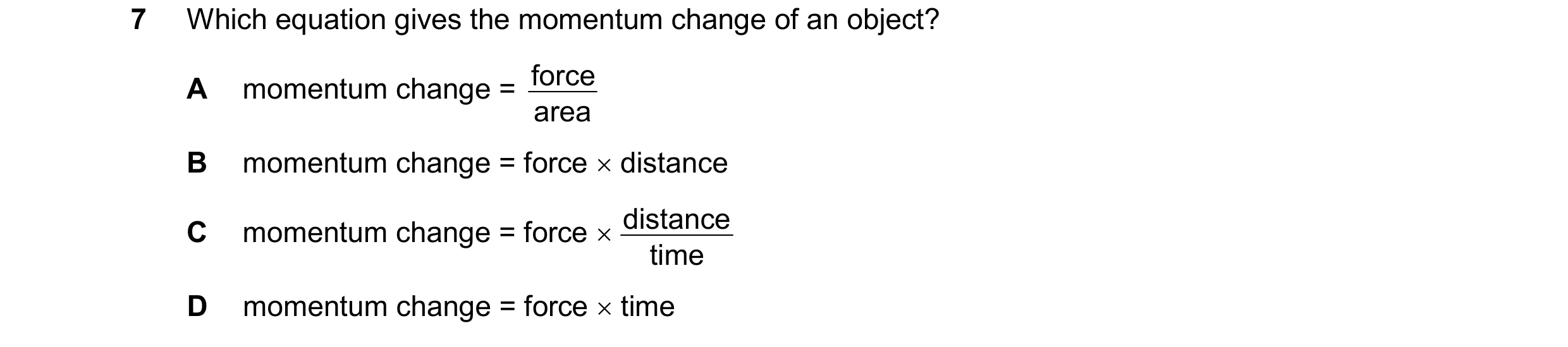
Q20 · Which equation gives the momentum change of an object? 0972/21 Oct/Nov 2024
7 Which equation gives the momentum change of an object? force A momentum change = area B momentum change = force distance momentum change = force distance C time D momentum change = force time
1 marks
Answer: D
This question in 0972/21 Oct/Nov 2024
Q21 · Which statement is not correct? 0972/21 May/June 2025
7 Which statement is not correct? A the momentum of a system is conserved in all interactions B impulse = change of momentum C force acting = change of momentum time D momentum = mass velocity
1 marks
Answer: C
This question in 0972/21 May/June 2025
Q22 · The momentum of a car changes from 10 000 kg m / s to 15 000 kg m / s in a time of 8.0 s 0972/21 Oct/Nov 2025
7 The momentum of a car changes from 10 000 kg m / s to 15 000 kg m / s in a time of 8.0 s. What is the resultant force acting on the car? A 630 N B 3100 N C 40 000 N D 200 000 N
1 marks
Answer: A
This question in 0972/21 Oct/Nov 2025


 1 / 5
1 / 5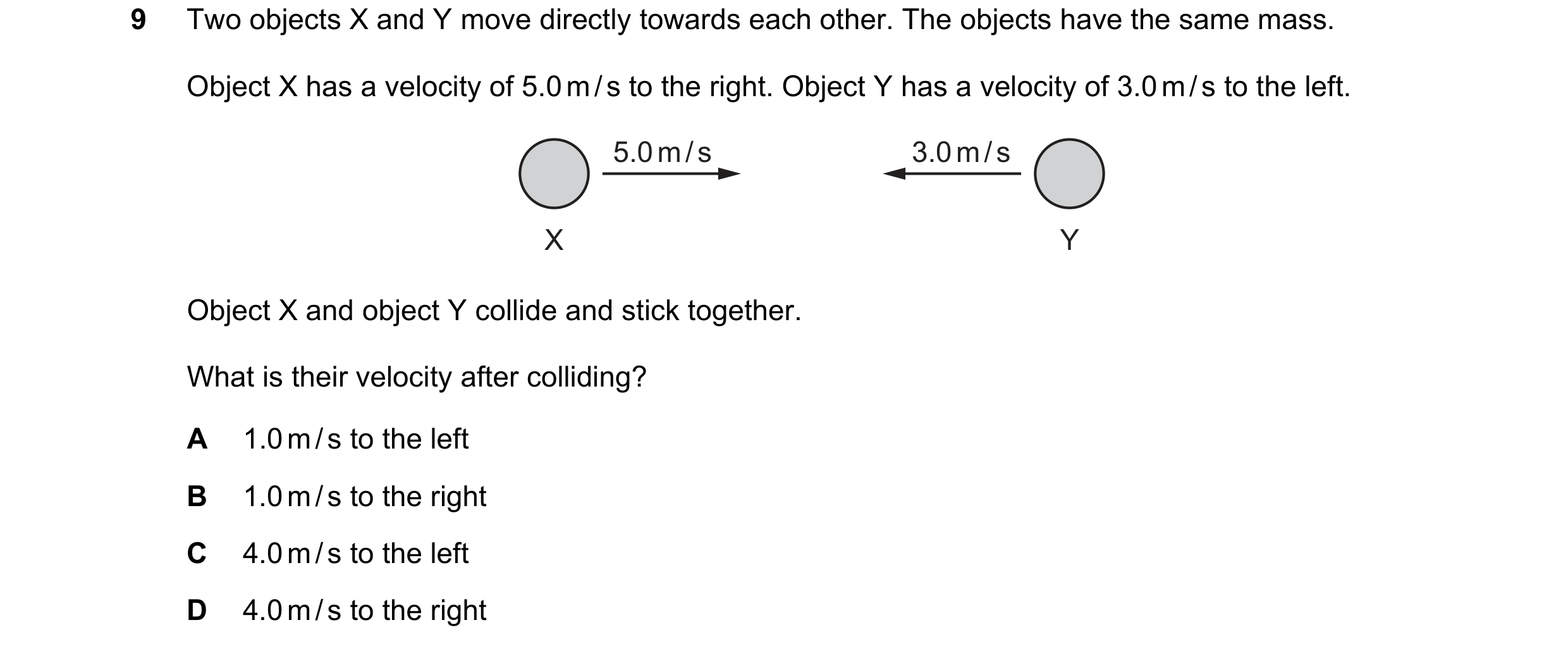

 2 / 5
2 / 5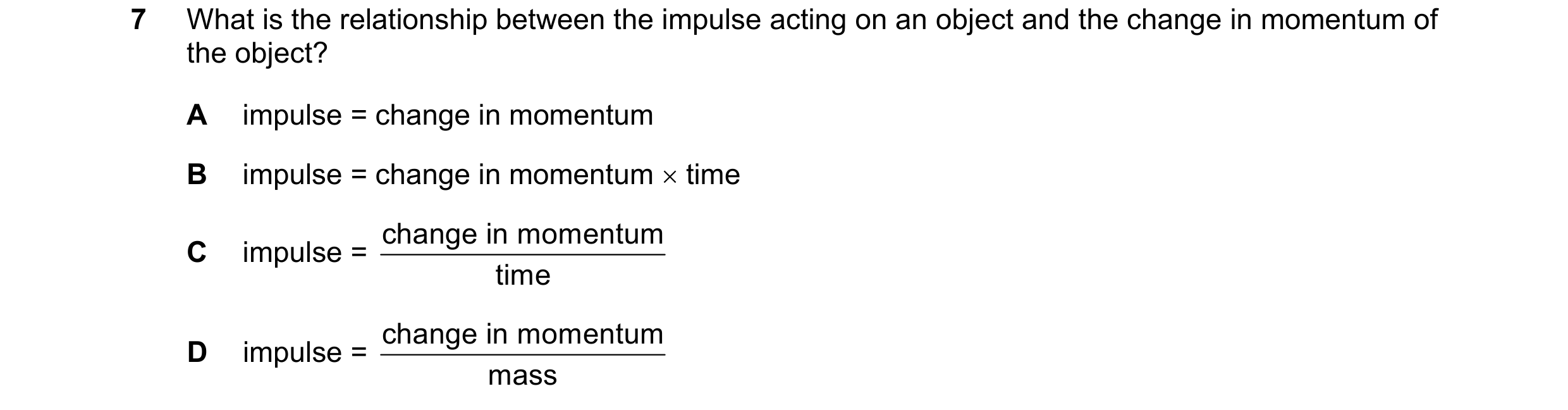



 3 / 5
3 / 5
 4 / 5
4 / 5
 5 / 5
5 / 5