Cambridge IGCSE Physics 0625 — 2025 Oct/Nov Paper 5 · Variant 3
0625/53/O/N/25 · 4 questions · 40 marks · ≈45 min
The question paper and its mark scheme, free to read here and free to download. This is Cambridge’s own paper, exactly as it was sat.
Question paper16 pages



Mark scheme13 pages
Answers below. Sit the paper first if you are practising.
Questions as text
Q1 · In this experiment, you will determine the volume of a block of modelling clay by two…
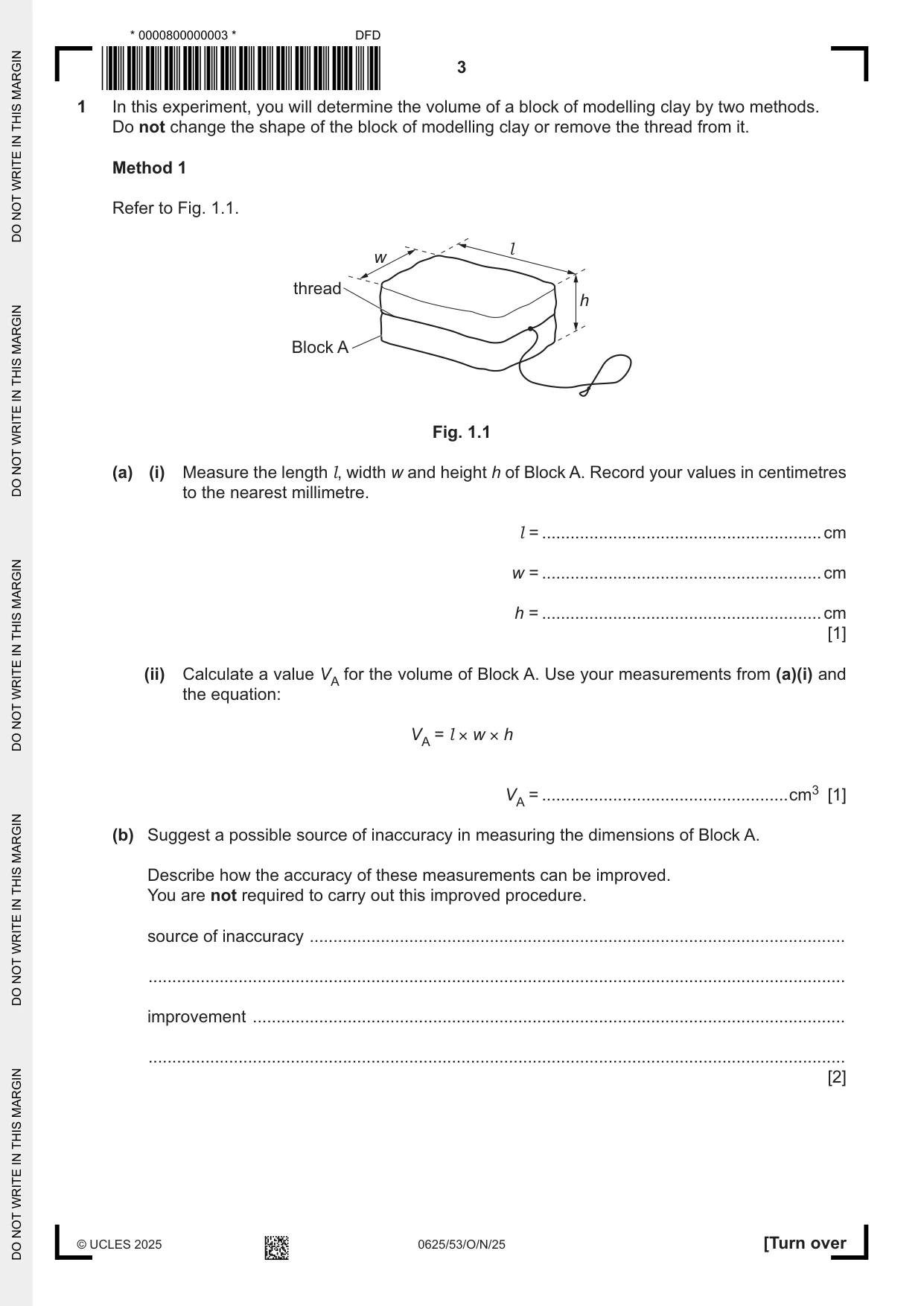
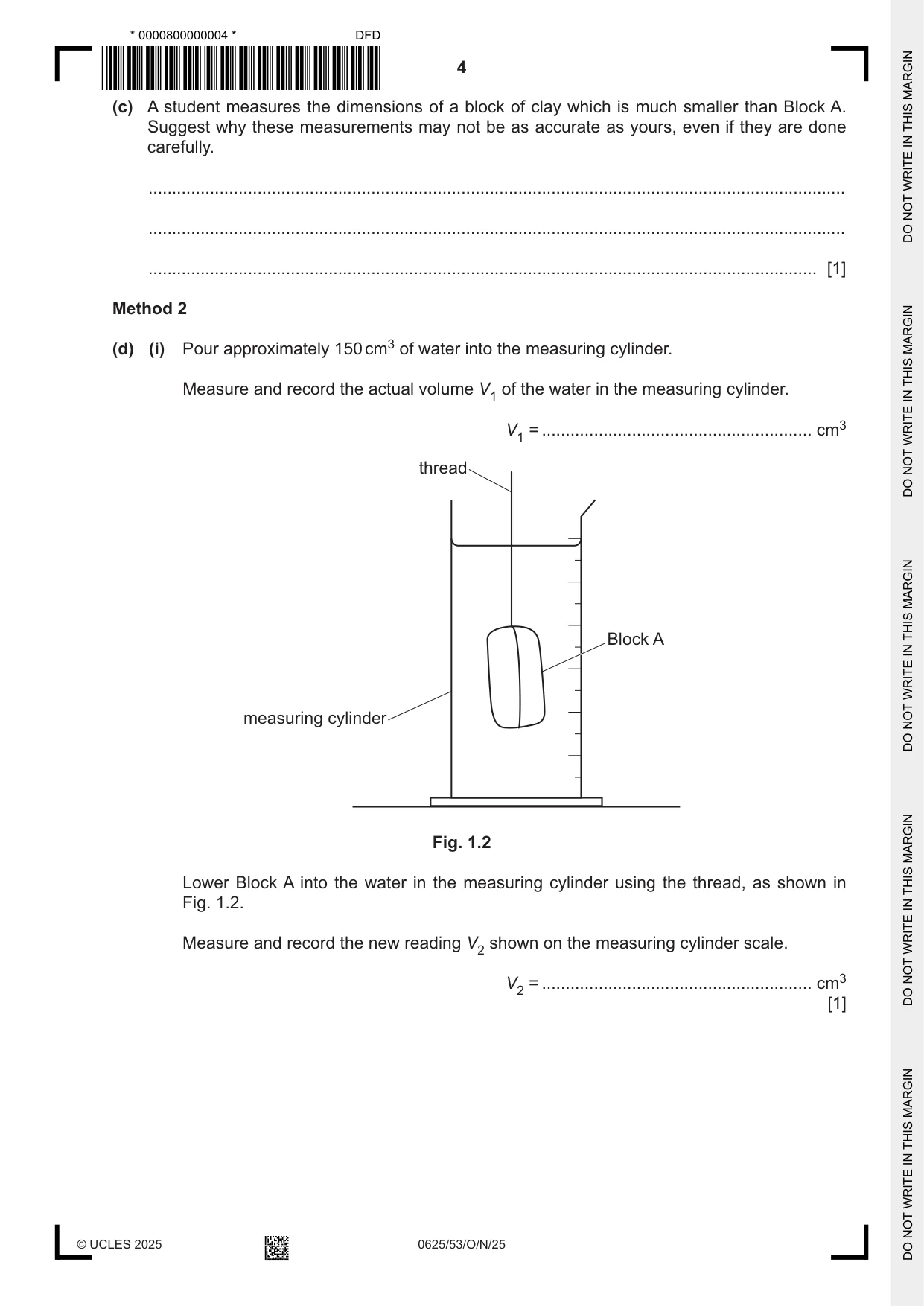
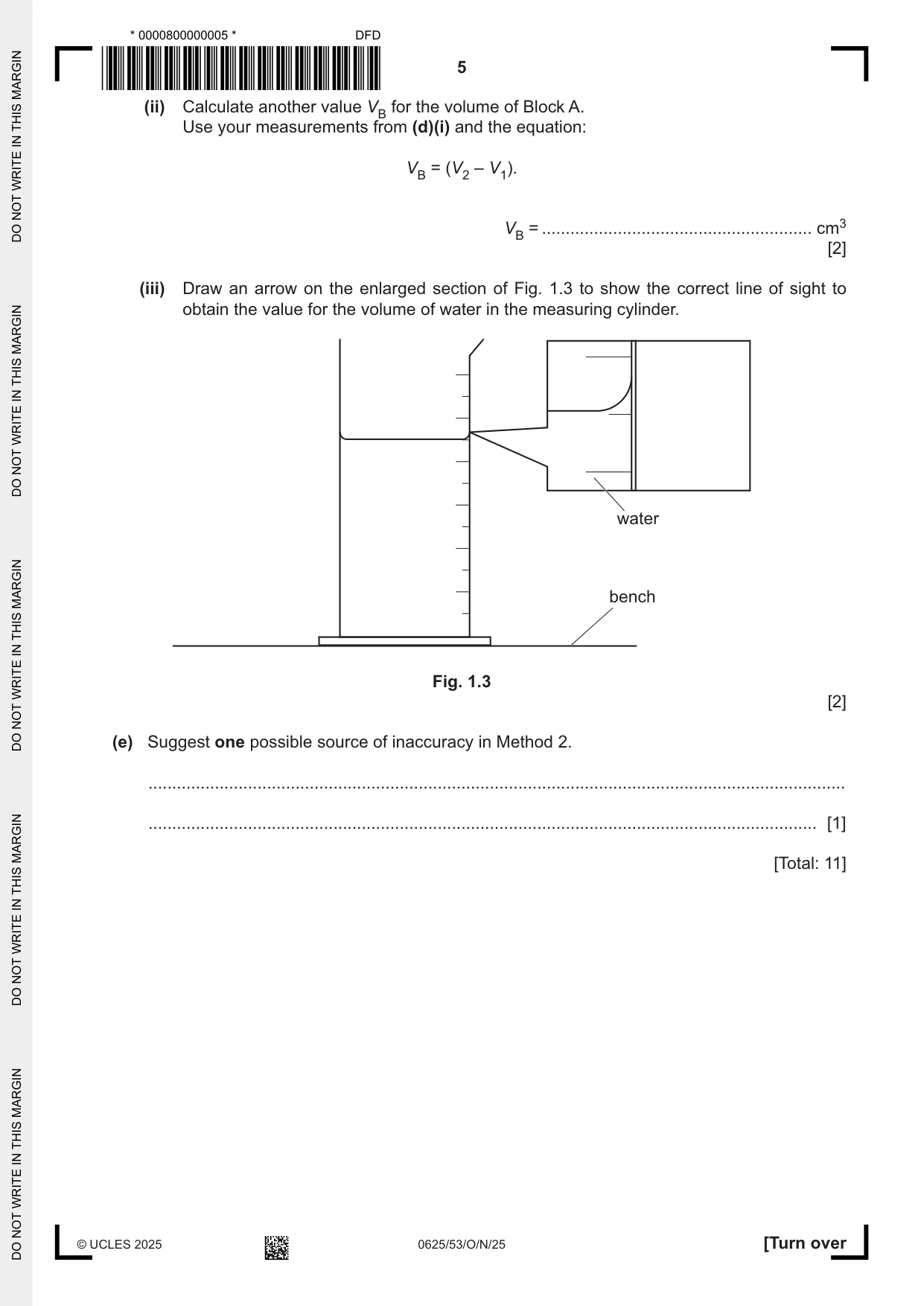
1 In this experiment, you will determine the volume of a block of modelling clay by two methods. Do not change the shape of the block of modelling clay or remove the thread from it. Method 1 Refer to Fig. 1.1. l w thread h Block A Fig. 1.1 (a) (i) Measure the length l, width w and height h of Block A. Record your values in centimetres to the nearest millimetre. l = ........................................................... cm w = ........................................................... cm h = ........................................................... cm [1] (ii) Calculate a value VA for the volume of Block A. Use your measurements from (a)(i) and the equation: VA = l × w × h VA = ....................................................cm3 [1] (b) Suggest a possible source of inaccuracy in measuring the dimensions of Block A. Describe how the accuracy of these measurements can be improved. You are not required to carry out this improved procedure. source of inaccuracy ................................................................................................................. ................................................................................................................................................... improvement ............................................................................................................................. ................................................................................................................................................... [2] (c) A student measures the dimensions of a block of clay which is much smaller than Block A. Suggest why these measurements may not be as accurate as yours, even if they are done carefully. ................................................................................................................................................... ................................................................................................................................................... ............................................................................................................................................. [1] Method 2 (d) (i) Pour approximately 150 cm3 of water into the measuring cylinder. Measure and record the actual volume V1 of the water in the measuring cylinder. V1 = ......................................................... cm3 thread Block A measuring cylinder Fig. 1.2 Lower Block A into the water in the measuring cylinder using the thread, as shown in Fig. 1.2. Measure and record the new reading V2 shown on the measuring cylinder scale. V2 = ......................................................... cm3 [1] (ii) Calculate another value VB for the volume of Block A. Use your measurements from (d)(i) and the equation: VB = (V2 – V1). VB = ......................................................... cm3 [2] (iii) Draw an arrow on the enlarged section of Fig. 1.3 to show the correct line of sight to obtain the value for the volume of water in the measuring cylinder. water bench Fig. 1.3 [2] (e) Suggest one possible source of inaccuracy in Method 2. ................................................................................................................................................... ............................................................................................................................................. [1] [Total: 11]
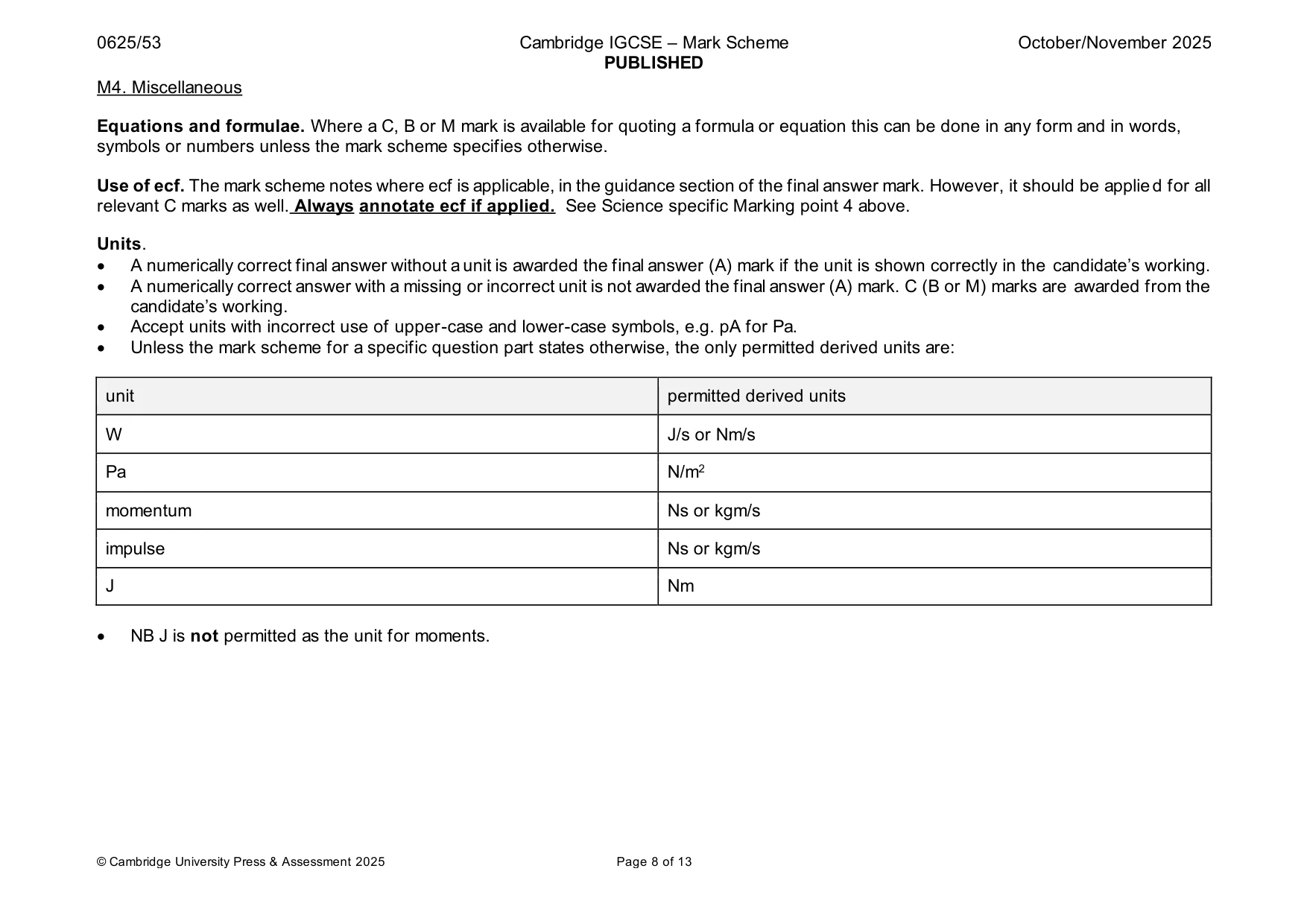
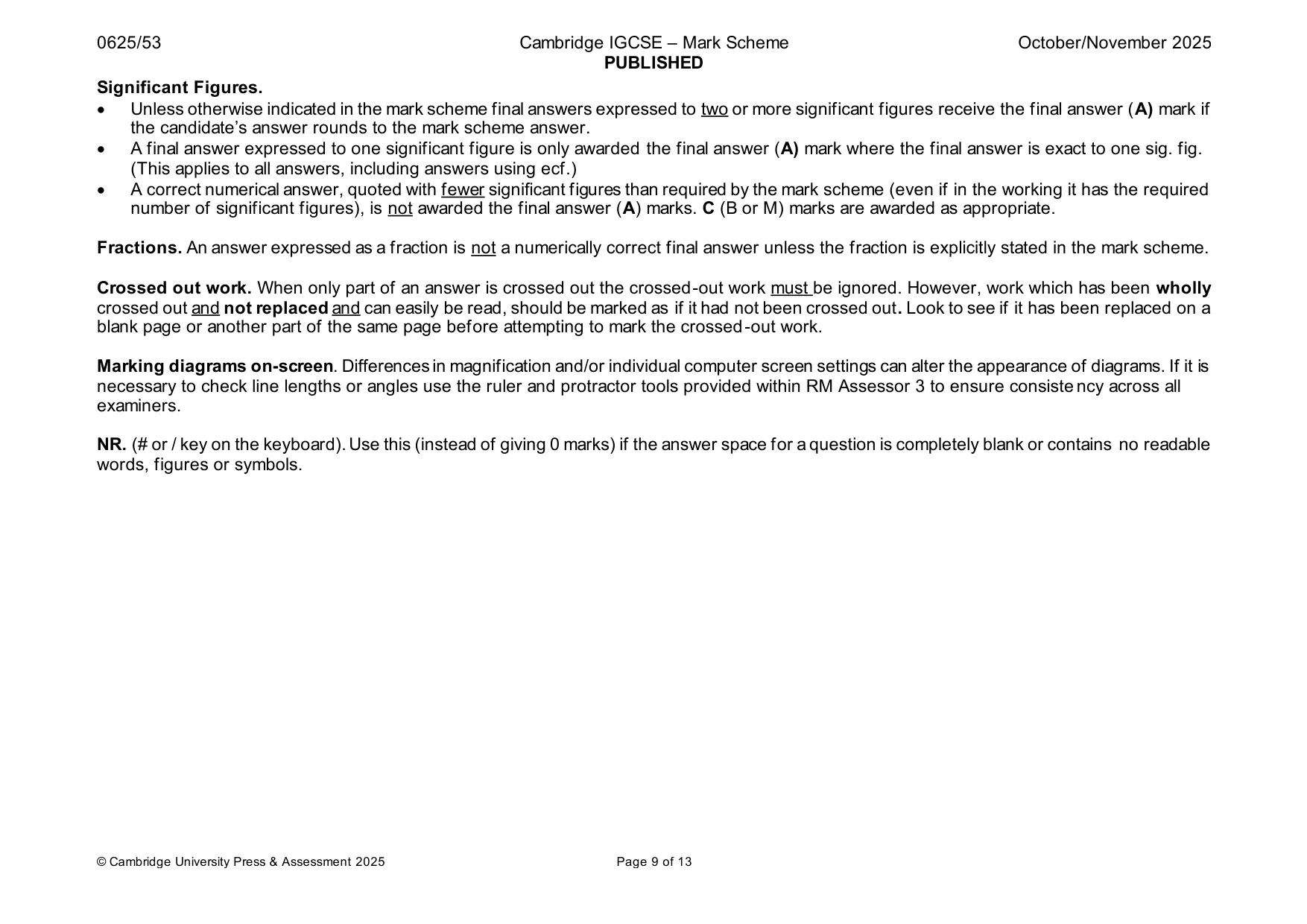
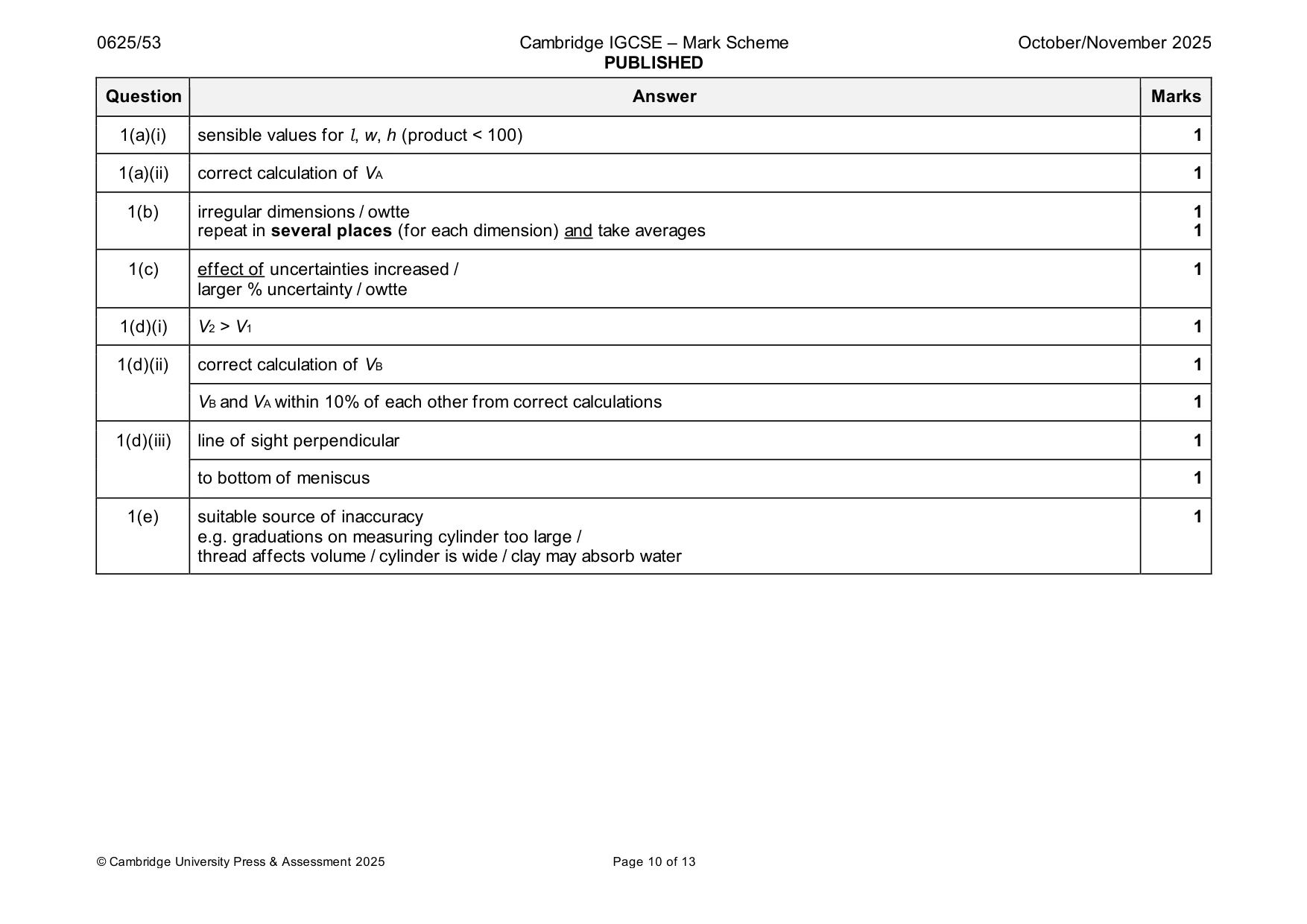
Mark scheme: Question Answer Marks 1(a)(i) sensible values for l, w, h (product < 100) 1 1(a)(ii) correct calculation of VA 1 1(b) irregular dimensions / owtte 1 repeat in several places (for each dimension) and take averages 1 1(c) effect of uncertainties increased / 1 larger % uncertainty / owtte 1(d)(i) V2 > V1 1 1(d)(ii) correct calculation of VB 1 VB and VA within 10% of each other from correct calculations 1 1(d)(iii) line of sight perpendicular 1 to bottom of meniscus 1 1(e) suitable source of inaccuracy 1 e.g. graduations on measuring cylinder too large / thread affects volume / cylinder is wide / clay may absorb water
More questions on Physical quantities and measurement techniques
Q2 · In this experiment, you will investigate the resistances of identical wires connected in…
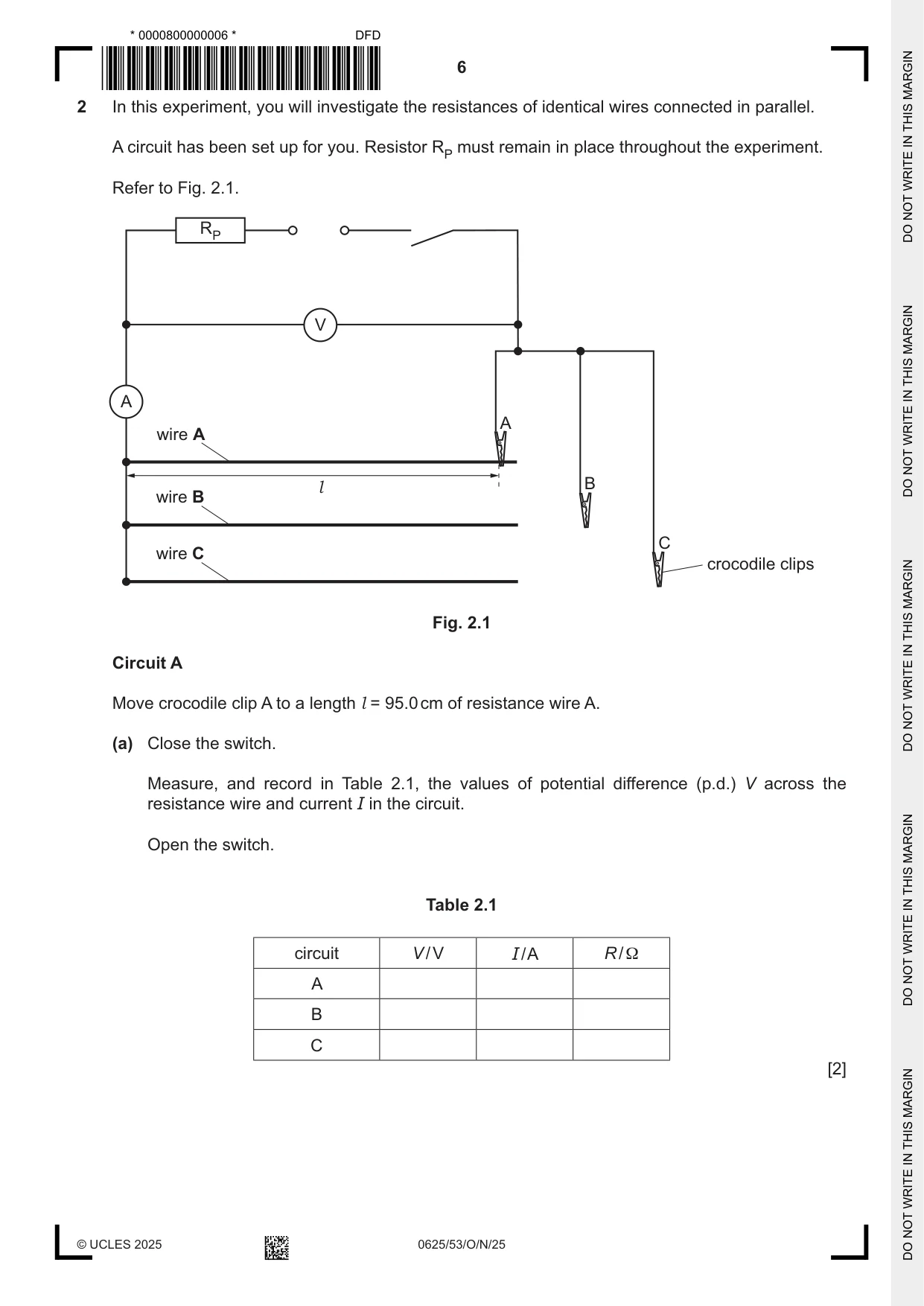
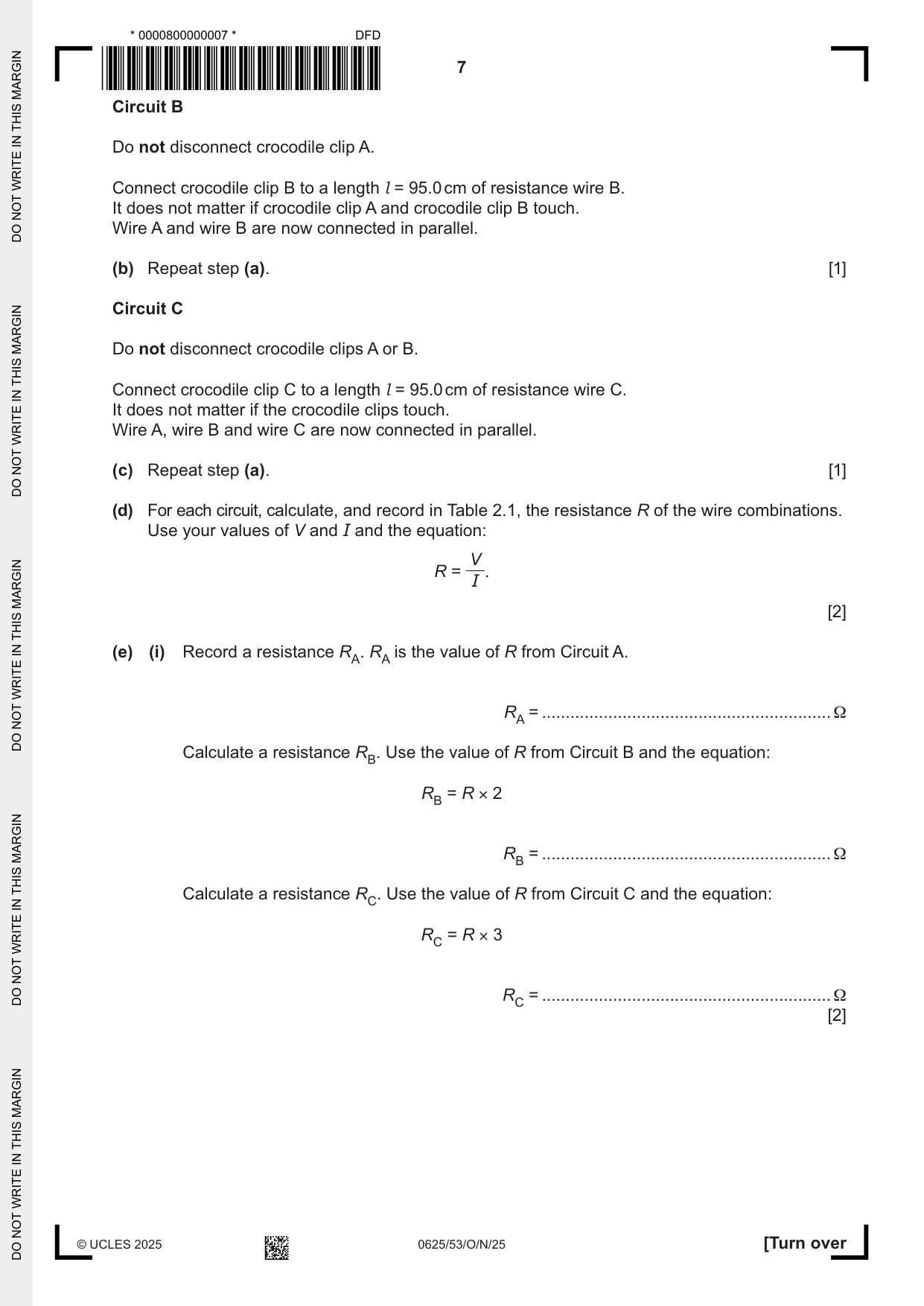
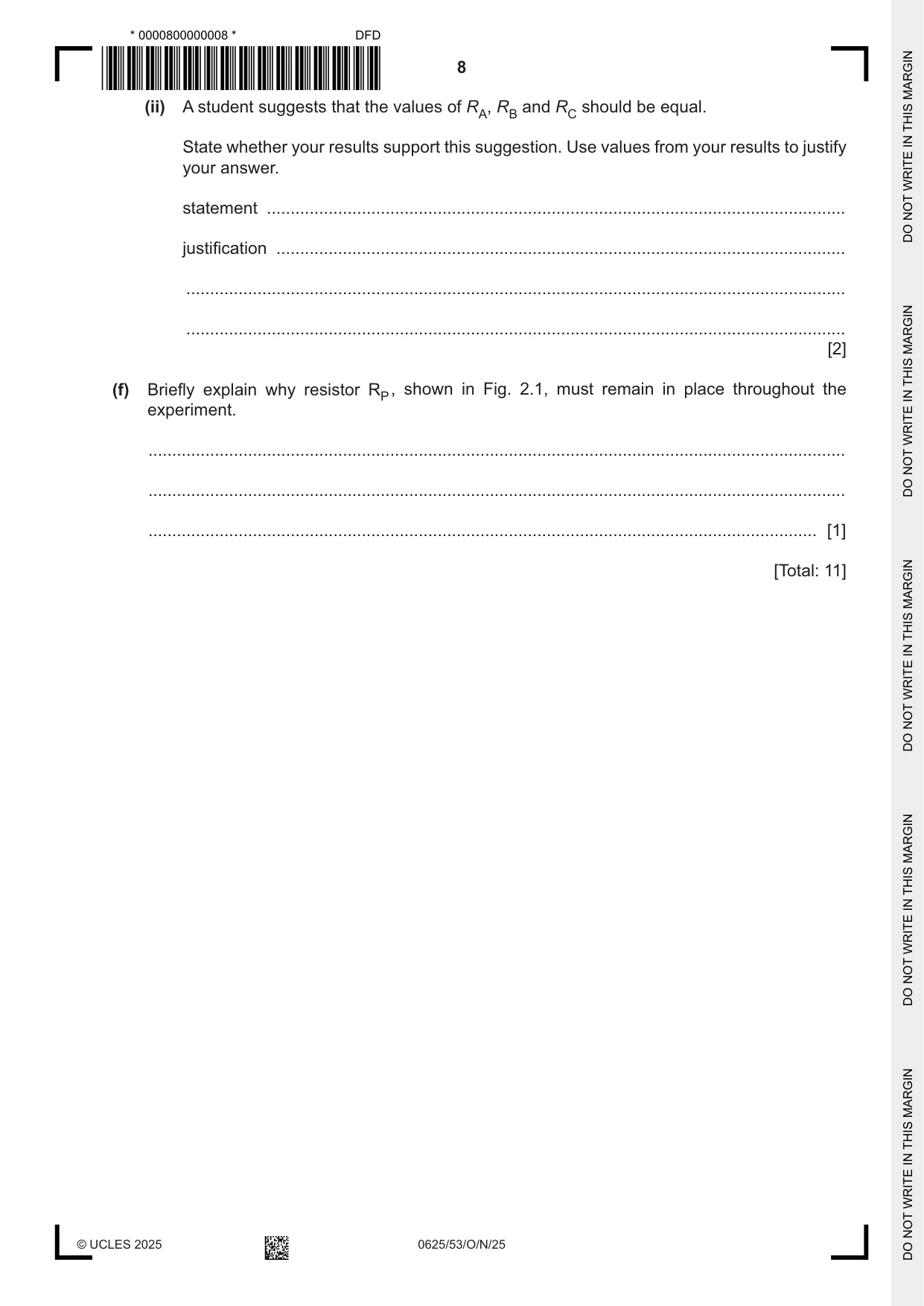
2 In this experiment, you will investigate the resistances of identical wires connected in parallel. A circuit has been set up for you. Resistor RP must remain in place throughout the experiment. Refer to Fig. 2.1. RP V A A wire A l B wire B C wire C crocodile clips Fig. 2.1 Circuit A Move crocodile clip A to a length l = 95.0 cm of resistance wire A. (a) Close the switch. Measure, and record in Table 2.1, the values of potential difference (p.d.) V across the resistance wire and current I in the circuit. Open the switch. Table 2.1 circuit V / V I / A R / Ω A B C [2] Circuit B Do not disconnect crocodile clip A. Connect crocodile clip B to a length l = 95.0 cm of resistance wire B. It does not matter if crocodile clip A and crocodile clip B touch. Wire A and wire B are now connected in parallel. (b) Repeat step (a). [1] Circuit C Do not disconnect crocodile clips A or B. Connect crocodile clip C to a length l = 95.0 cm of resistance wire C. It does not matter if the crocodile clips touch. Wire A, wire B and wire C are now connected in parallel. (c) Repeat step (a). [1] (d) For each circuit, calculate, and record in Table 2.1, the resistance R of the wire combinations. Use your values of V and I and the equation: V R = . I [2] (e) (i) Record a resistance RA. RA is the value of R from Circuit A. RA = ............................................................. Ω Calculate a resistance RB. Use the value of R from Circuit B and the equation: RB = R × 2 RB = ............................................................. Ω Calculate a resistance RC. Use the value of R from Circuit C and the equation: RC = R × 3 RC = ............................................................. Ω [2] (ii) A student suggests that the values of RA, RB and RC should be equal. State whether your results support this suggestion. Use values from your results to justify your answer. statement .......................................................................................................................... justification ........................................................................................................................ ........................................................................................................................................... ........................................................................................................................................... [2] (f) Briefly explain why resistor RP , shown in Fig. 2.1, must remain in place throughout the experiment. ................................................................................................................................................... ................................................................................................................................................... ............................................................................................................................................. [1] [Total: 11]
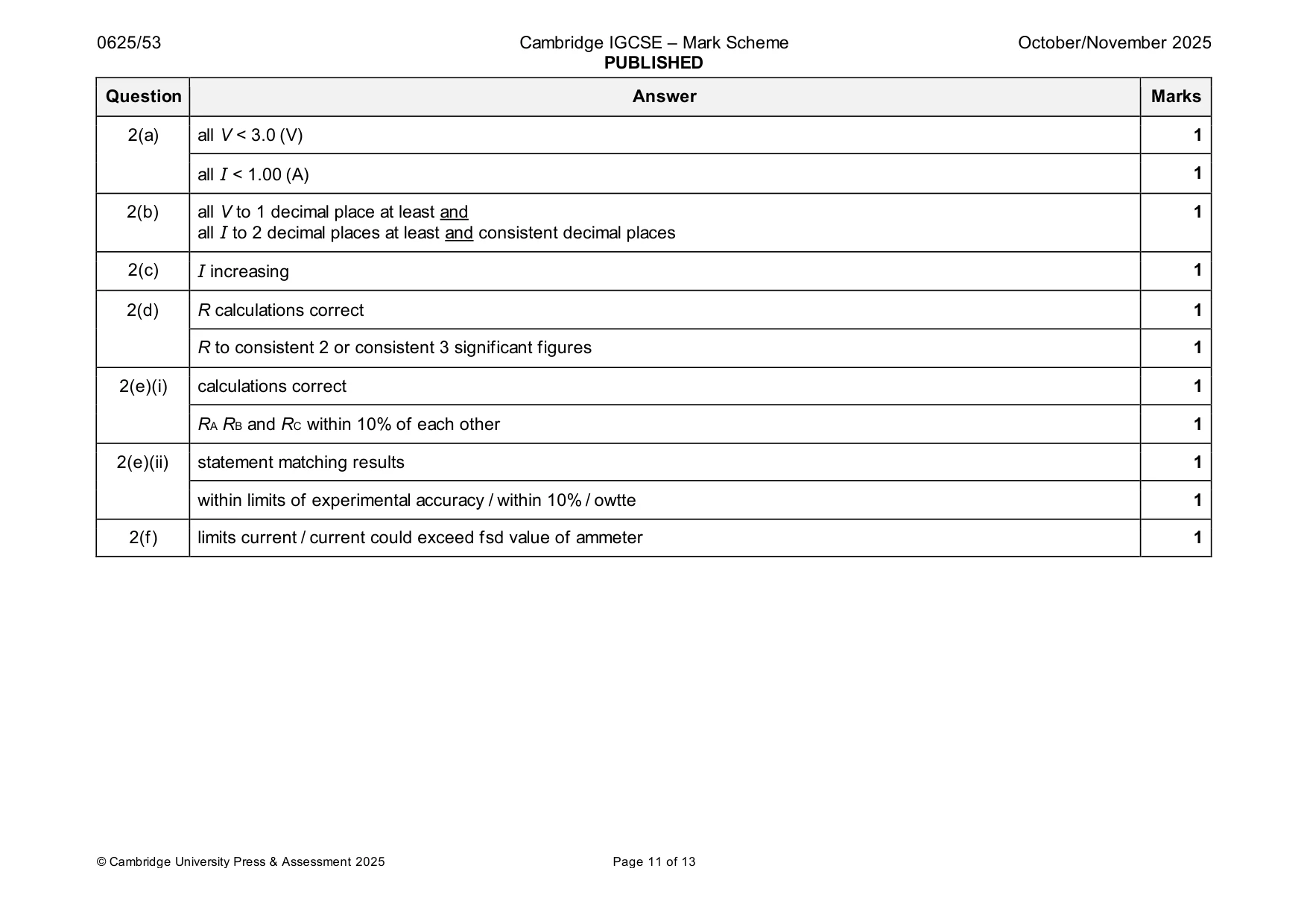
Mark scheme: 2(a) all V < 3.0 (V) 1 all I < 1.00 (A) 1 2(b) all V to 1 decimal place at least and 1 all I to 2 decimal places at least and consistent decimal places 2(c) I increasing 1 2(d) R calculations correct 1 R to consistent 2 or consistent 3 significant figures 1 2(e)(i) calculations correct 1 RA RB and RC within 10% of each other 1 2(e)(ii) statement matching results 1 within limits of experimental accuracy / within 10% / owtte 1 2(f) limits current / current could exceed fsd value of ammeter 1
Q3 · In this experiment, you will investigate the inverted image produced by a converging lens
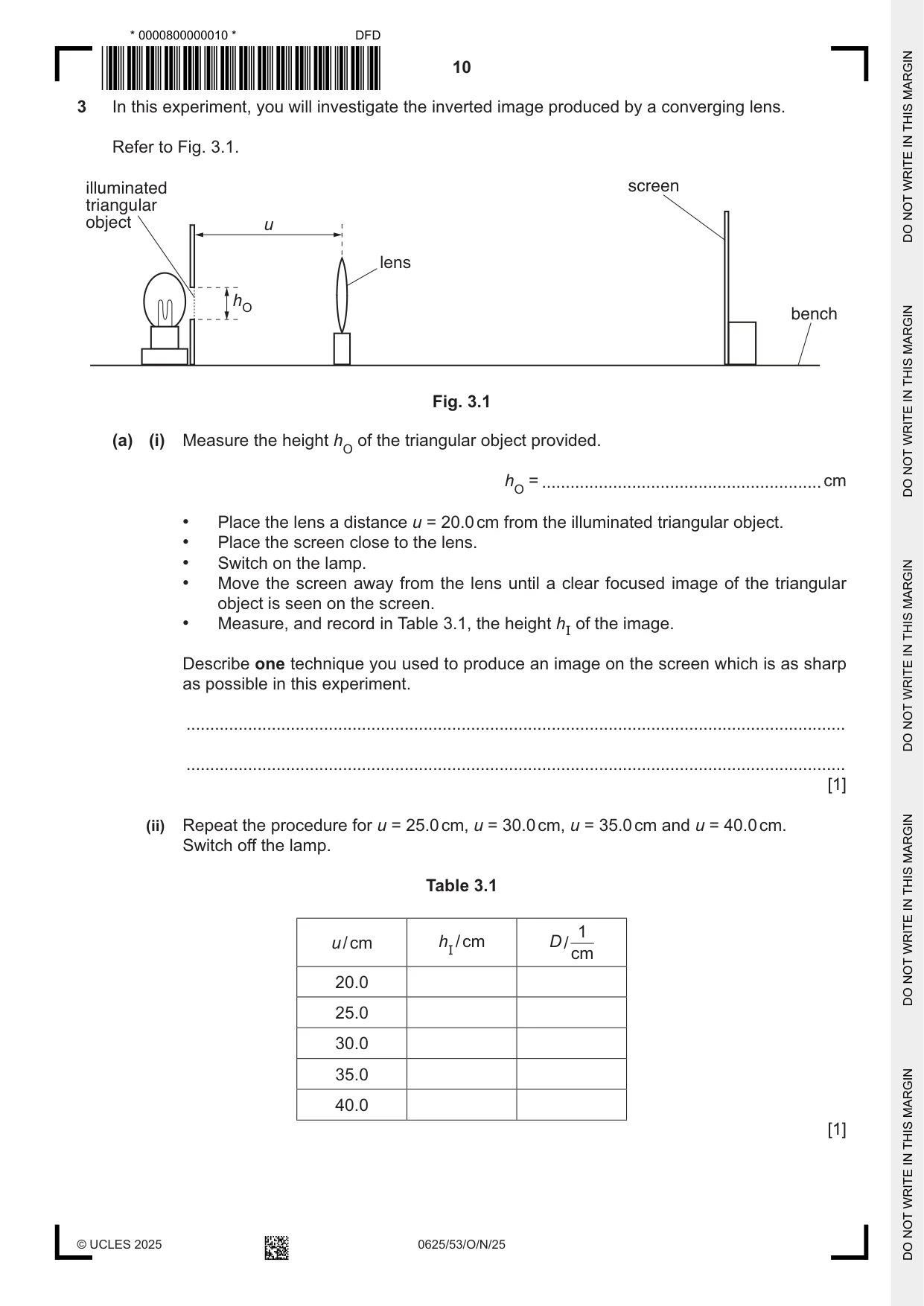
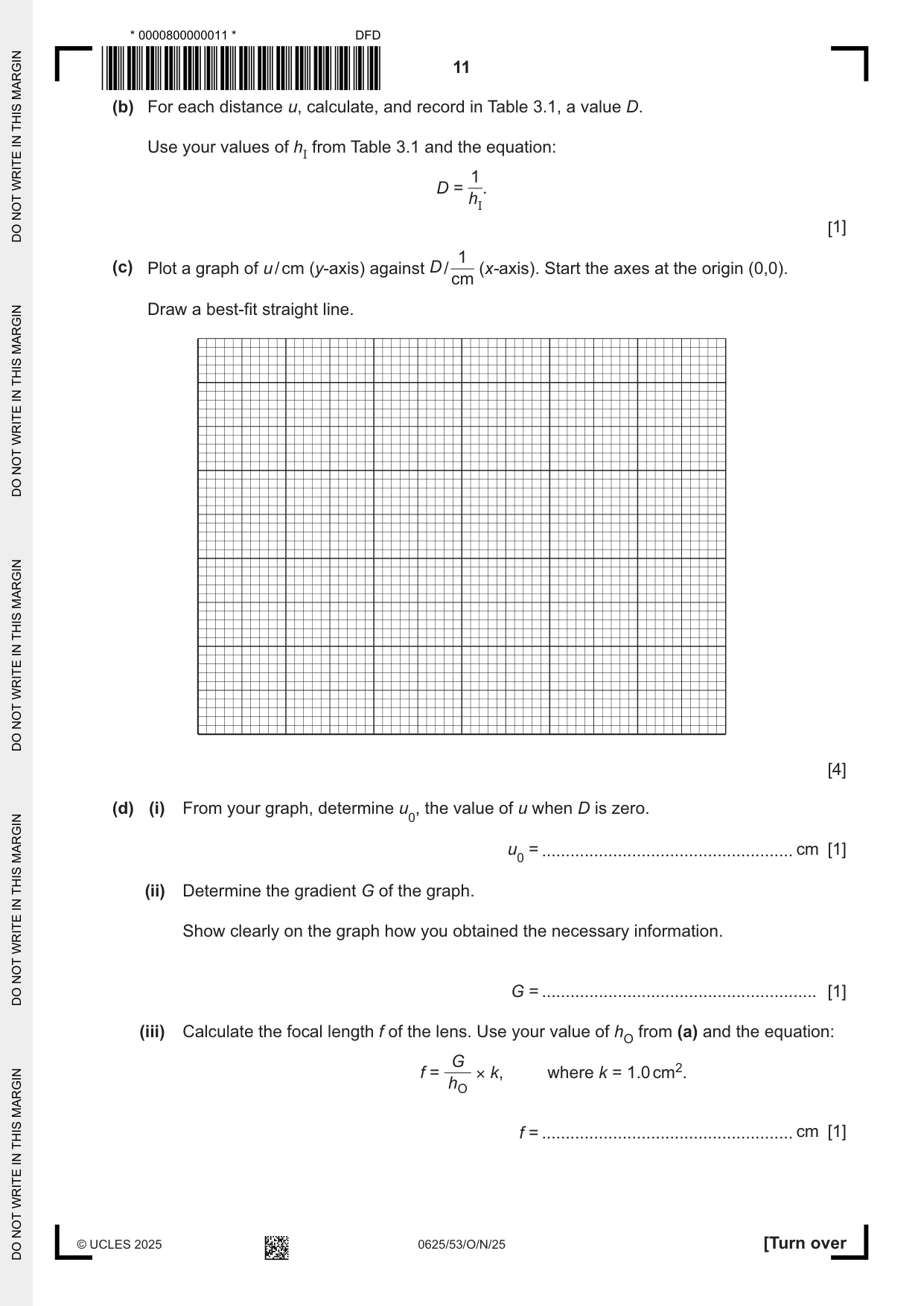
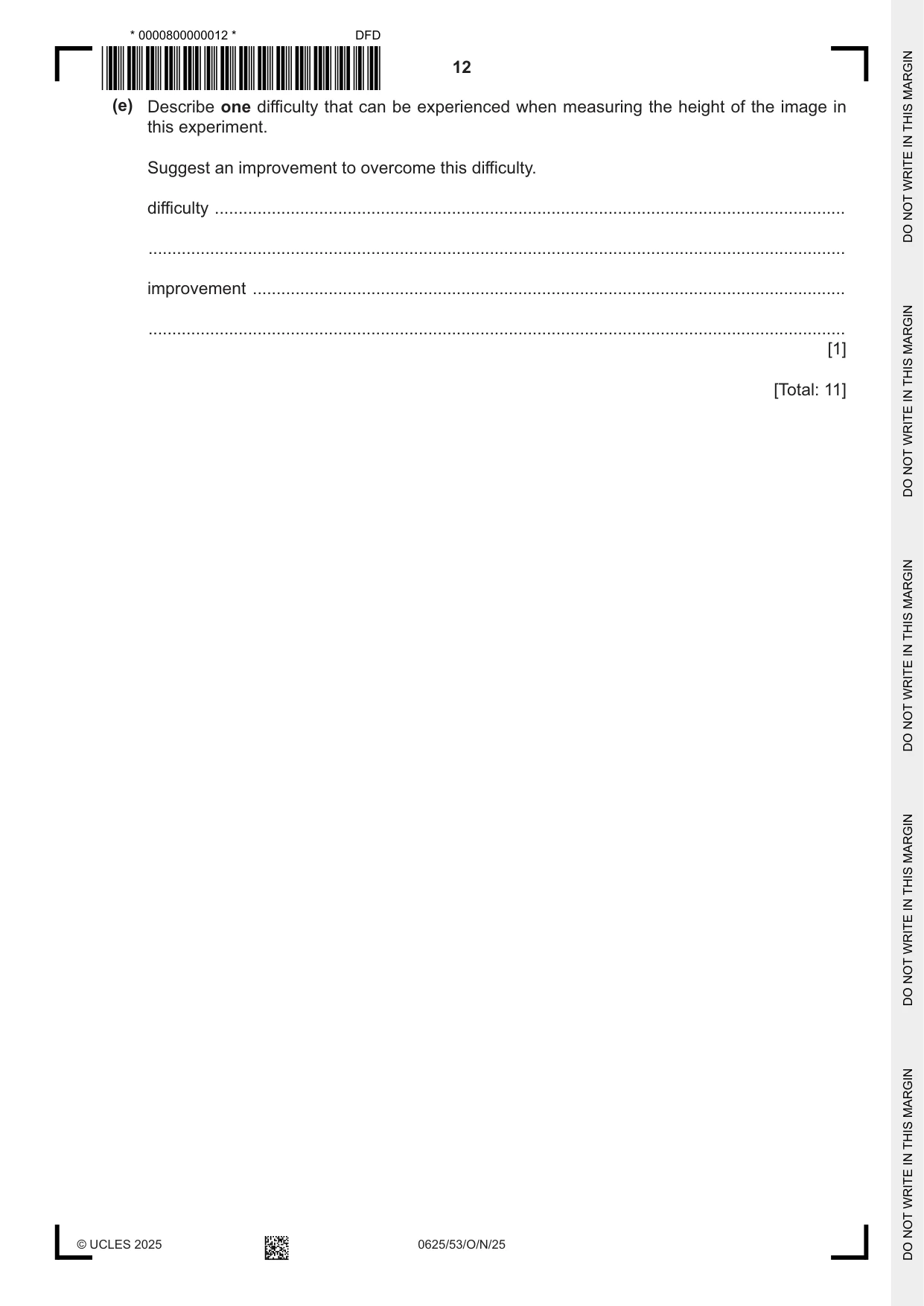
3 In this experiment, you will investigate the inverted image produced by a converging lens. Refer to Fig. 3.1. illuminated screen triangular object u lens hO bench Fig. 3.1 (a) (i) Measure the height hO of the triangular object provided. hO = ........................................................... cm • Place the lens a distance u = 20.0 cm from the illuminated triangular object. • Place the screen close to the lens. • Switch on the lamp. • Move the screen away from the lens until a clear focused image of the triangular object is seen on the screen. • Measure, and record in Table 3.1, the height hI of the image. Describe one technique you used to produce an image on the screen which is as sharp as possible in this experiment. ........................................................................................................................................... ........................................................................................................................................... [1] (ii) Repeat the procedure for u = 25.0 cm, u = 30.0 cm, u = 35.0 cm and u = 40.0 cm. Switch off the lamp. Table 3.1 1 u / cm hI / cm D / cm 20.0 25.0 30.0 35.0 40.0 [1] (b) For each distance u, calculate, and record in Table 3.1, a value D. Use your values of hI from Table 3.1 and the equation: 1 D = . hI [1] 1 (c) Plot a graph of u / cm (y-axis) against D / (x-axis). Start the axes at the origin (0,0). cm Draw a best-fit straight line. [4] (d) (i) From your graph, determine u0, the value of u when D is zero. u0 = ..................................................... cm [1] (ii) Determine the gradient G of the graph. Show clearly on the graph how you obtained the necessary information. G = .......................................................... [1] (iii) Calculate the focal length f of the lens. Use your value of hO from (a) and the equation: G f = × k, where k = 1.0 cm2. hO f = ..................................................... cm [1] (e) Describe one difficulty that can be experienced when measuring the height of the image in this experiment. Suggest an improvement to overcome this difficulty. difficulty ..................................................................................................................................... ................................................................................................................................................... improvement ............................................................................................................................. ................................................................................................................................................... [1] [Total: 11]
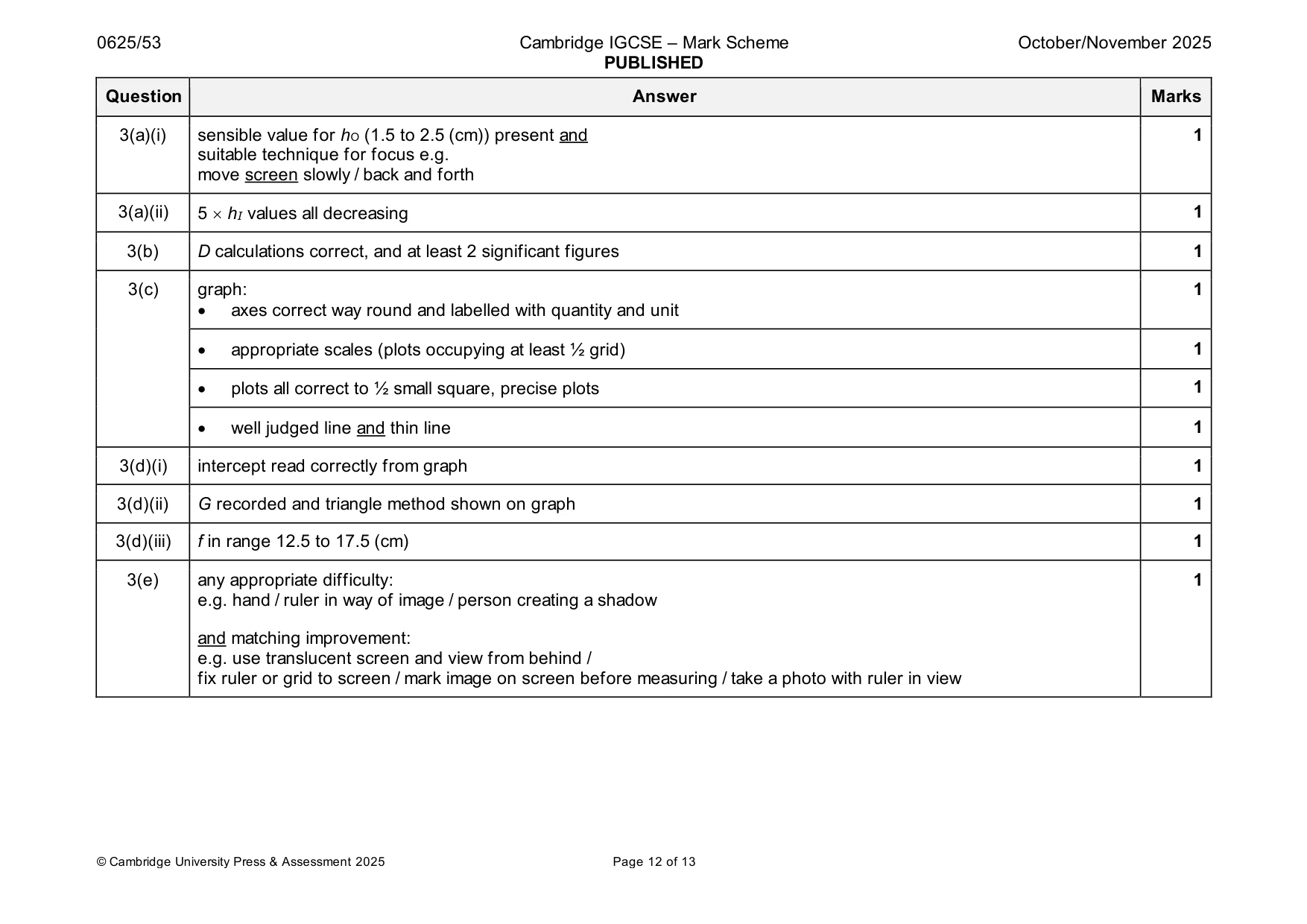
Mark scheme: 3(a)(i) sensible value for hO (1.5 to 2.5 (cm)) present and 1 suitable technique for focus e.g. move screen slowly / back and forth 3(a)(ii) 5 hI values all decreasing 1 3(b) D calculations correct, and at least 2 significant figures 1 3(c) graph: 1 • axes correct way round and labelled with quantity and unit • appropriate scales (plots occupying at least ½ grid) 1 • plots all correct to ½ small square, precise plots 1 • well judged line and thin line 1 3(d)(i) intercept read correctly from graph 1 3(d)(ii) G recorded and triangle method shown on graph 1 3(d)(iii) f in range 12.5 to 17.5 (cm) 1 3(e) any appropriate difficulty: 1 e.g. hand / ruler in way of image / person creating a shadow and matching improvement: e.g. use translucent screen and view from behind / fix ruler or grid to screen / mark image on screen before measuring / take a photo with ruler in view
Q4 · A student investigates the evaporation of water in an open dish
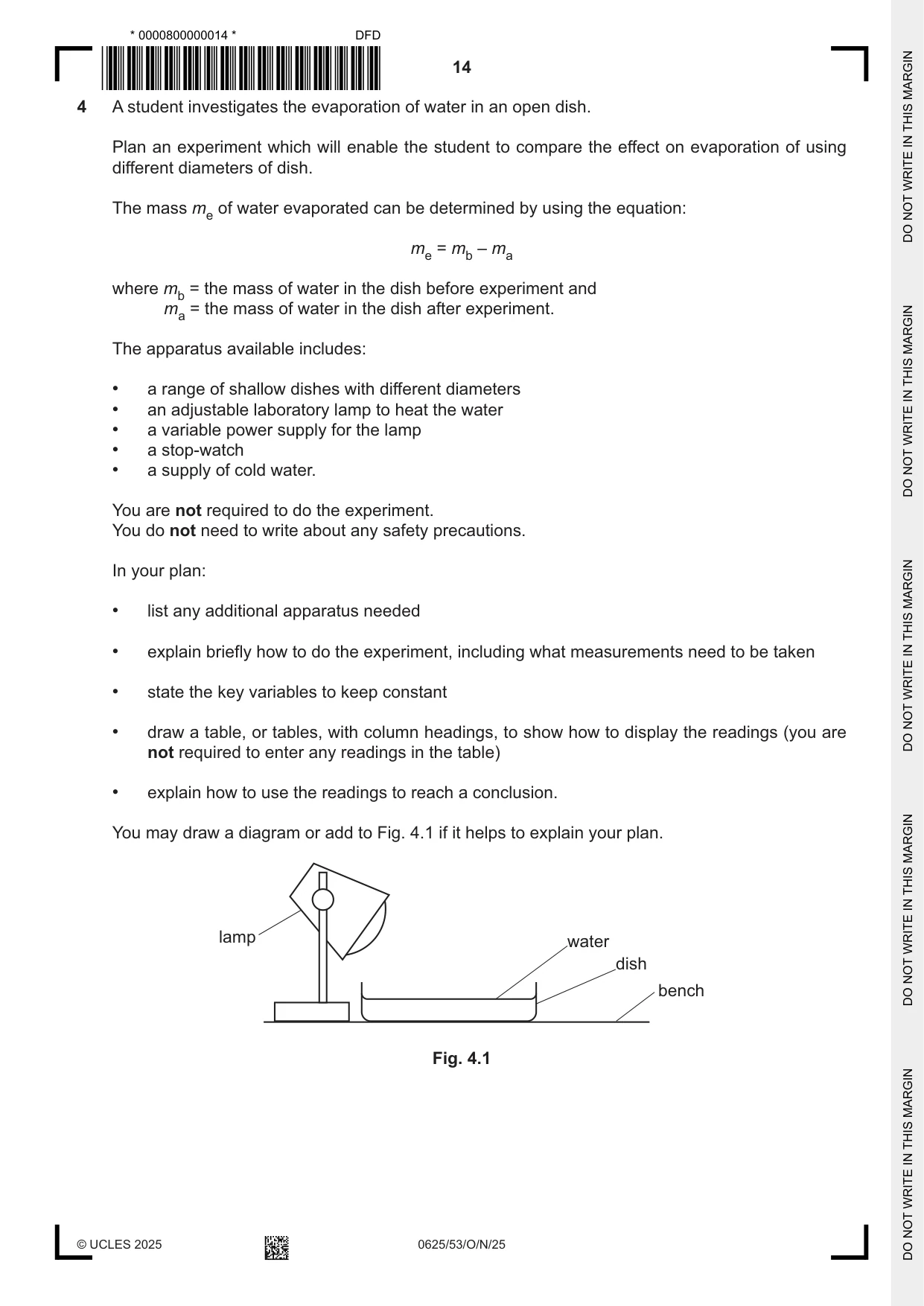
4 A student investigates the evaporation of water in an open dish. Plan an experiment which will enable the student to compare the effect on evaporation of using different diameters of dish. The mass me of water evaporated can be determined by using the equation: me = mb – ma where mb = the mass of water in the dish before experiment and ma = the mass of water in the dish after experiment. The apparatus available includes: • a range of shallow dishes with different diameters • an adjustable laboratory lamp to heat the water • a variable power supply for the lamp • a stop-watch • a supply of cold water. You are not required to do the experiment. You do not need to write about any safety precautions. In your plan: • list any additional apparatus needed • explain briefly how to do the experiment, including what measurements need to be taken • state the key variables to keep constant • draw a table, or tables, with column headings, to show how to display the readings (you are not required to enter any readings in the table) • explain how to use the readings to reach a conclusion. You may draw a diagram or add to Fig. 4.1 if it helps to explain your plan. lamp water dish bench Fig. 4.1 .......................................................................................................................................................... .......................................................................................................................................................... .......................................................................................................................................................... .......................................................................................................................................................... .......................................................................................................................................................... .......................................................................................................................................................... .......................................................................................................................................................... .......................................................................................................................................................... .......................................................................................................................................................... .......................................................................................................................................................... .......................................................................................................................................................... .......................................................................................................................................................... .......................................................................................................................................................... .......................................................................................................................................................... .......................................................................................................................................................... .......................................................................................................................................................... .......................................................................................................................................................... .......................................................................................................................................................... .......................................................................................................................................................... .......................................................................................................................................................... .......................................................................................................................................................... .......................................................................................................................................................... .................................................................................................................................................... [7]
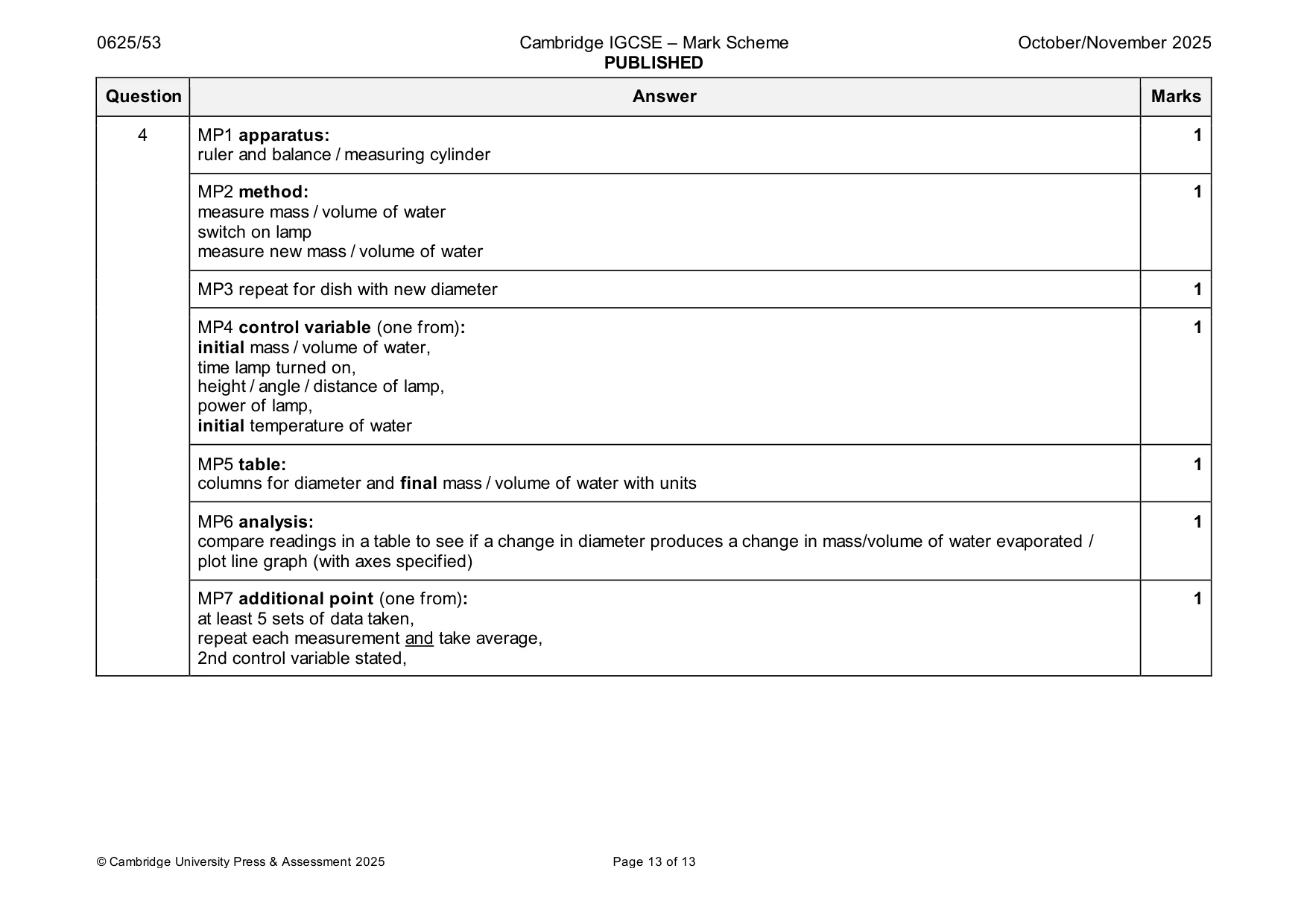
Mark scheme: 4 MP1 apparatus: 1 ruler and balance / measuring cylinder MP2 method: 1 measure mass / volume of water switch on lamp measure new mass / volume of water MP3 repeat for dish with new diameter 1 MP4 control variable (one from): 1 initial mass / volume of water, time lamp turned on, height / angle / distance of lamp, power of lamp, initial temperature of water MP5 table: 1 columns for diameter and final mass / volume of water with units MP6 analysis: 1 compare readings in a table to see if a change in diameter produces a change in mass/volume of water evaporated / plot line graph (with axes specified) MP7 additional point (one from): 1 at least 5 sets of data taken, repeat each measurement and take average, 2nd control variable stated,
What was in this paper
The subtopics covered by these 4 questions, and how many questions each got. Open one in a new tab to see every Cambridge question on it.
What you needed in this session
Cambridge’s own grade thresholds for 2025 Oct/Nov, Paper 5 · Variant 3. A higher threshold means an easier paper — the bar moves with how the cohort did.