Cambridge IGCSE Physics 0625 — 2017 May/June Paper 6 · Variant 3
0625/63/M/J/17 · 4 questions · 40 marks · ≈45 min
The question paper and its mark scheme, free to read here and free to download. This is Cambridge’s own paper, exactly as it was sat.
Question paper16 pages

Mark scheme5 pages
Answers below. Sit the paper first if you are practising.
Questions as text
Q1 · A student is determining the density of water by two methods
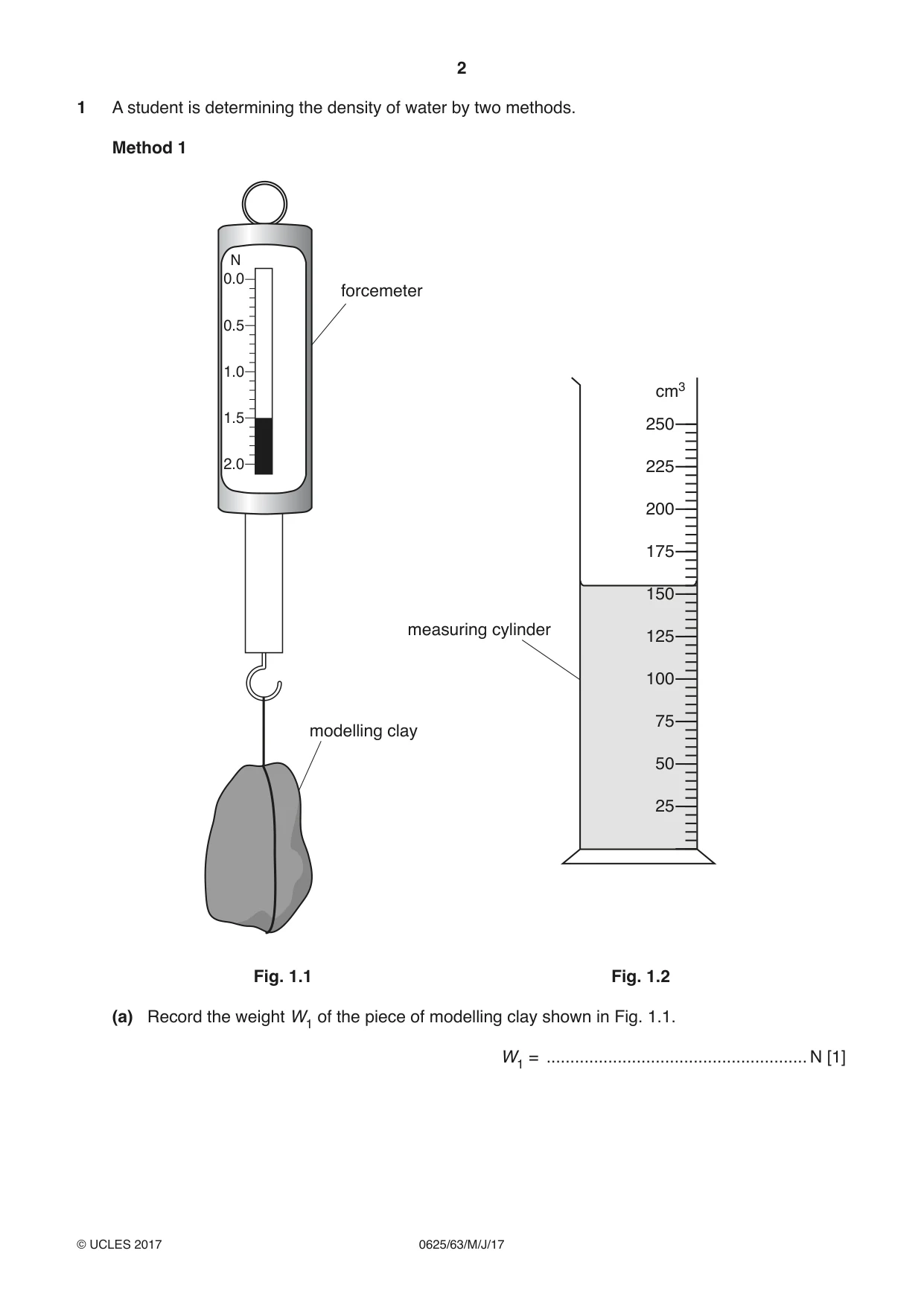
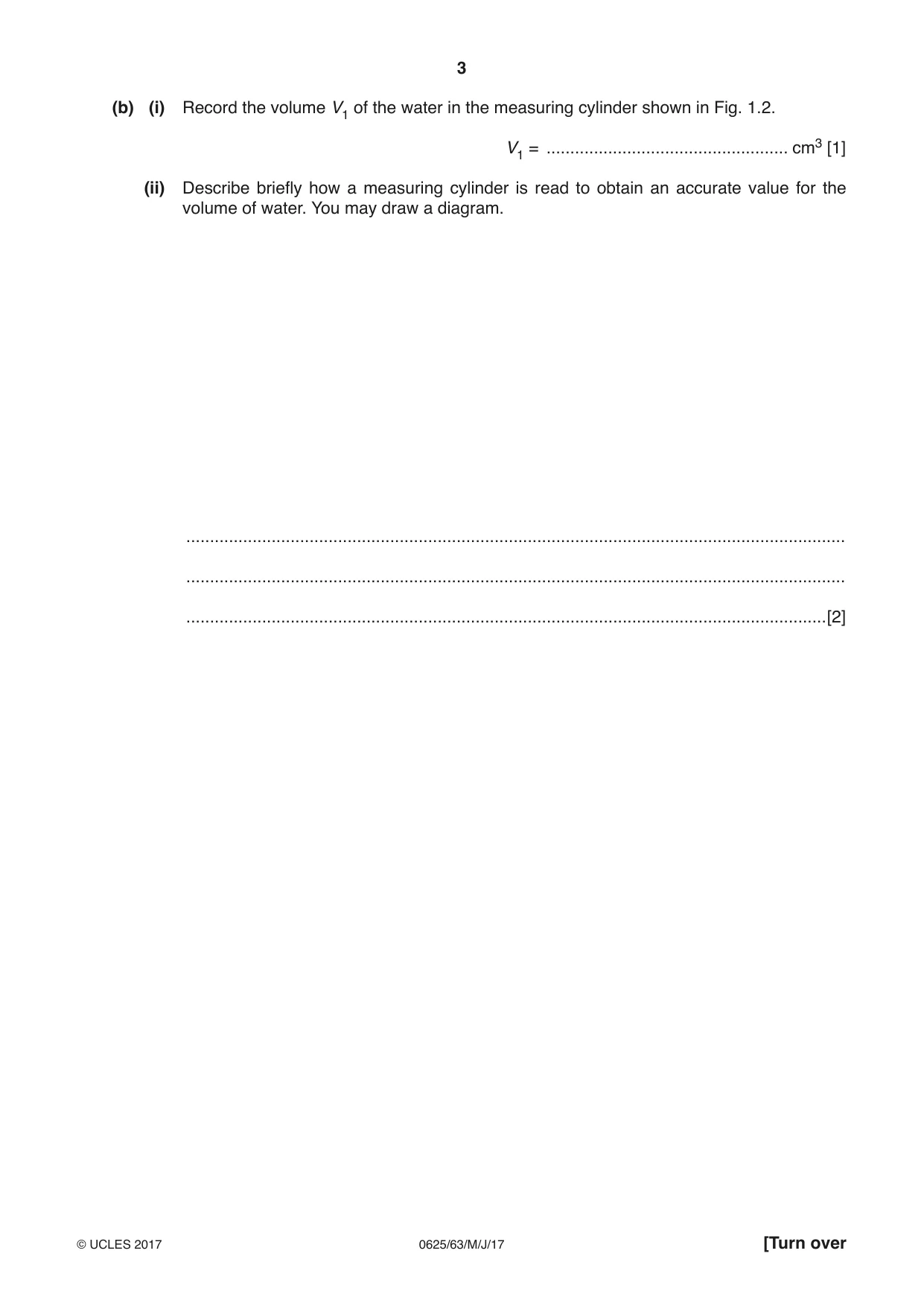
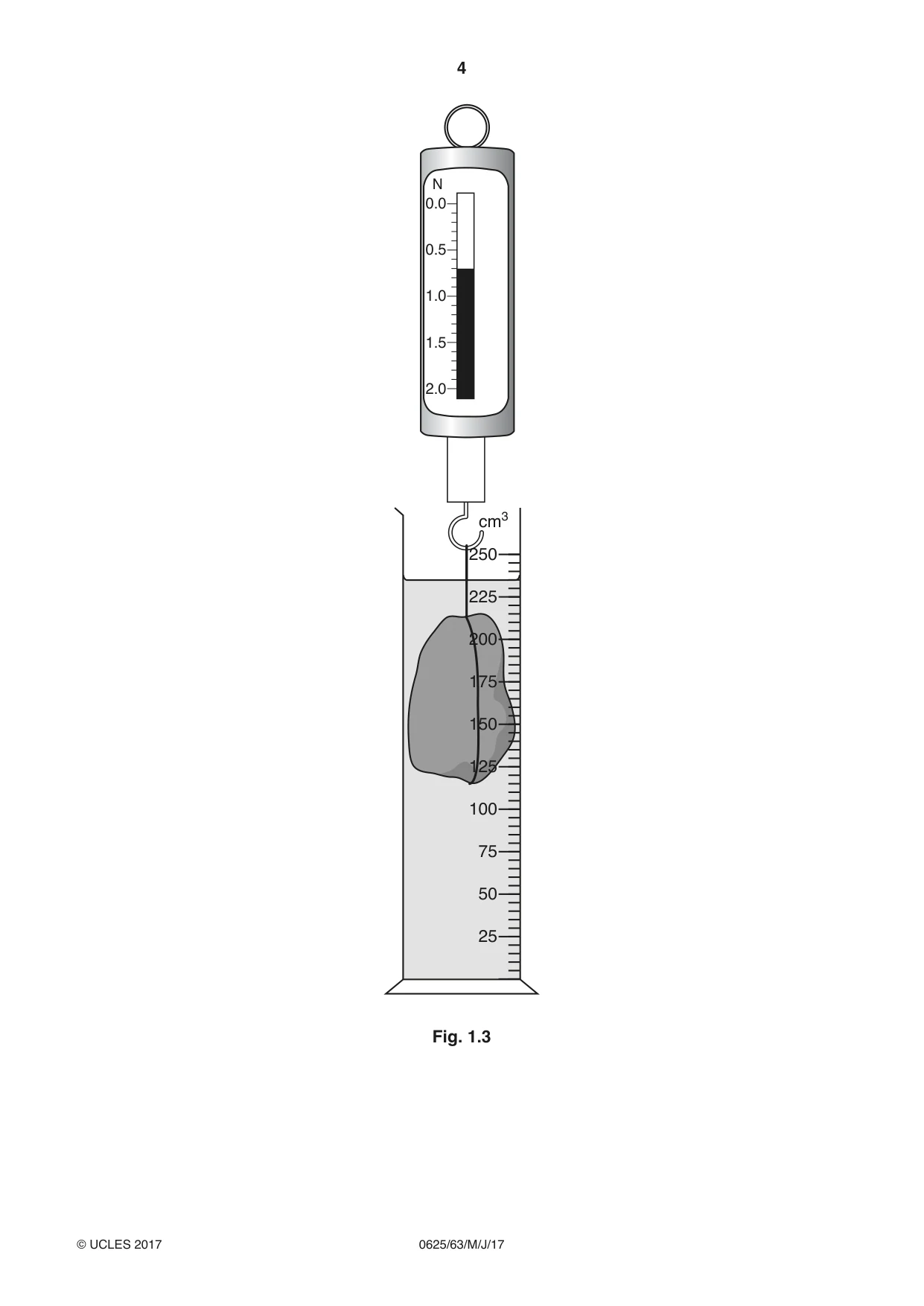
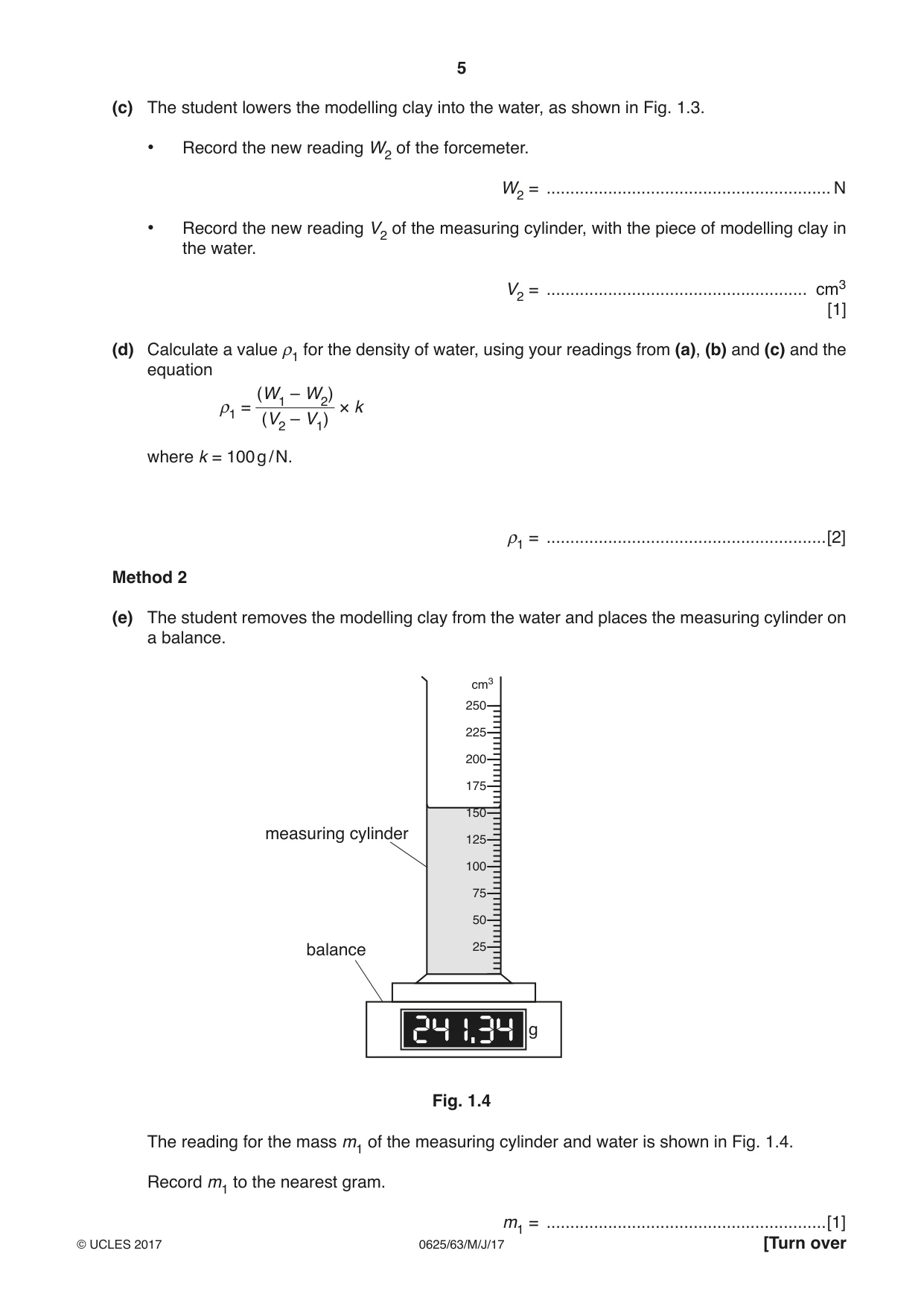
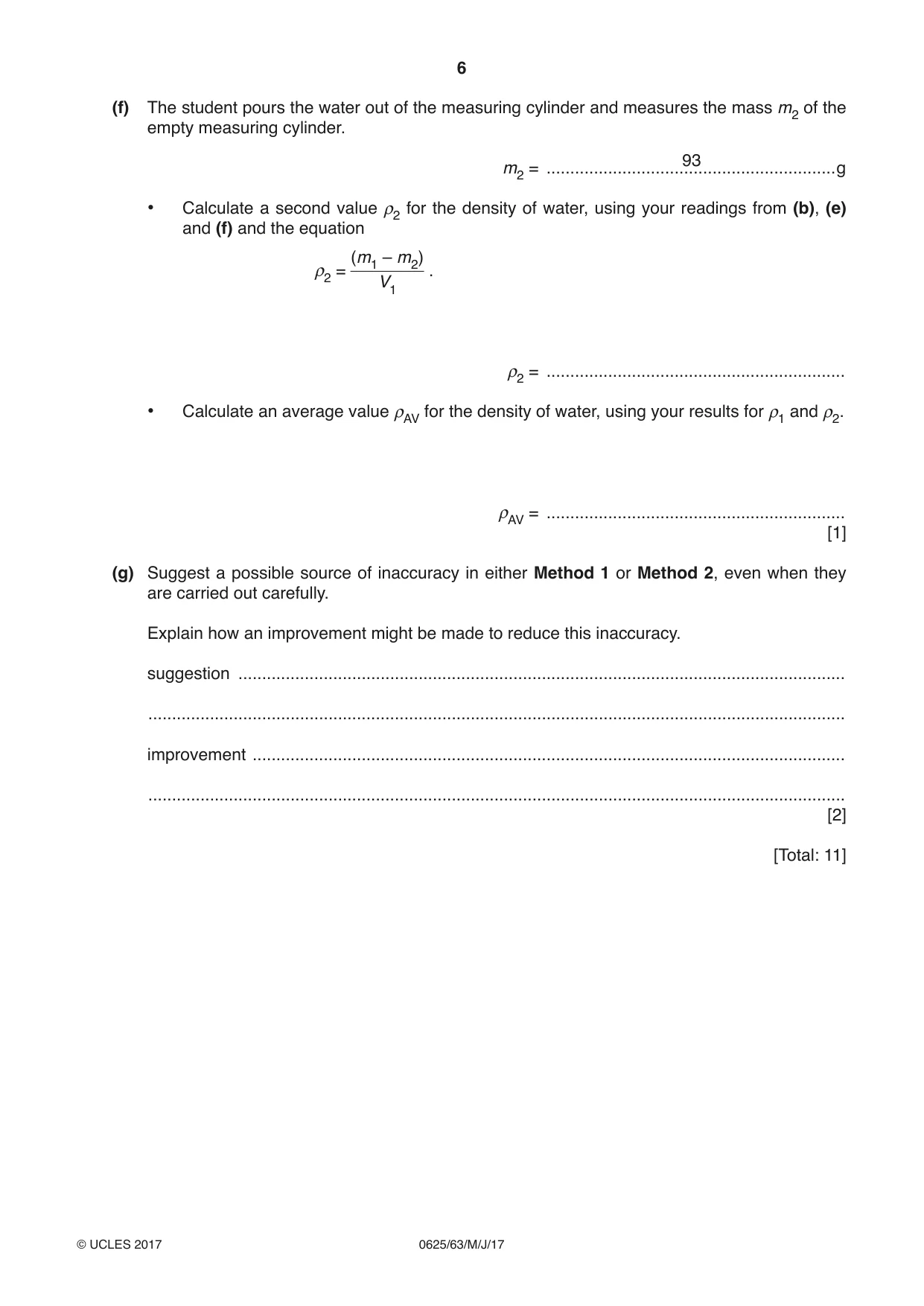
1 A student is determining the density of water by two methods. Method 1 N 0.0 forcemeter 0.5 1.0 cm3 1.5 250 2.0 225 200 175 150 measuring cylinder 125 100 75 modelling clay 50 25 Fig. 1.1 Fig. 1.2 (a) Record the weight W1 of the piece of modelling clay shown in Fig. 1.1. W1 = ....................................................... N [1] (b) (i) Record the volume V1 of the water in the measuring cylinder shown in Fig. 1.2. V1 = ................................................... cm3 [1] (ii) Describe briefly how a measuring cylinder is read to obtain an accurate value for the volume of water. You may draw a diagram. ........................................................................................................................................... ........................................................................................................................................... .......................................................................................................................................[2] N 0.0 0.5 1.0 1.5 2.0 cm3 250 225 200 175 150 125 100 75 50 25 Fig. 1.3 (c) The student lowers the modelling clay into the water, as shown in Fig. 1.3. • Record the new reading W2 of the forcemeter. W2 = ............................................................ N • Record the new reading V2 of the measuring cylinder, with the piece of modelling clay in the water. V2 = ....................................................... cm3 [1] (d) Calculate a value ρ1 for the density of water, using your readings from (a), (b) and (c) and the equation (W1 – W2) ρ1 = × k (V2 – V1) where k = 100 g / N. ρ1 = ...........................................................[2] Method 2 (e) The student removes the modelling clay from the water and places the measuring cylinder on a balance. cm3 250 225 200 175 150 measuring cylinder 125 100 75 50 balance 25 g Fig. 1.4 The reading for the mass m1 of the measuring cylinder and water is shown in Fig. 1.4. Record m1 to the nearest gram. (f) The student pours the water out of the measuring cylinder and measures the mass m2 of the empty measuring cylinder. 93 m2 = .............................................................g • Calculate a second value ρ2 for the density of water, using your readings from (b), (e) and (f) and the equation (m1 – m2) ρ2 = . V1 ρ2 = ............................................................... • Calculate an average value ρAV for the density of water, using your results for ρ1 and ρ2. ρAV = ............................................................... [1] (g) Suggest a possible source of inaccuracy in either Method 1 or Method 2, even when they are carried out carefully. Explain how an improvement might be made to reduce this inaccuracy. suggestion ................................................................................................................................ ................................................................................................................................................... improvement ............................................................................................................................. ................................................................................................................................................... [2] [Total: 11]
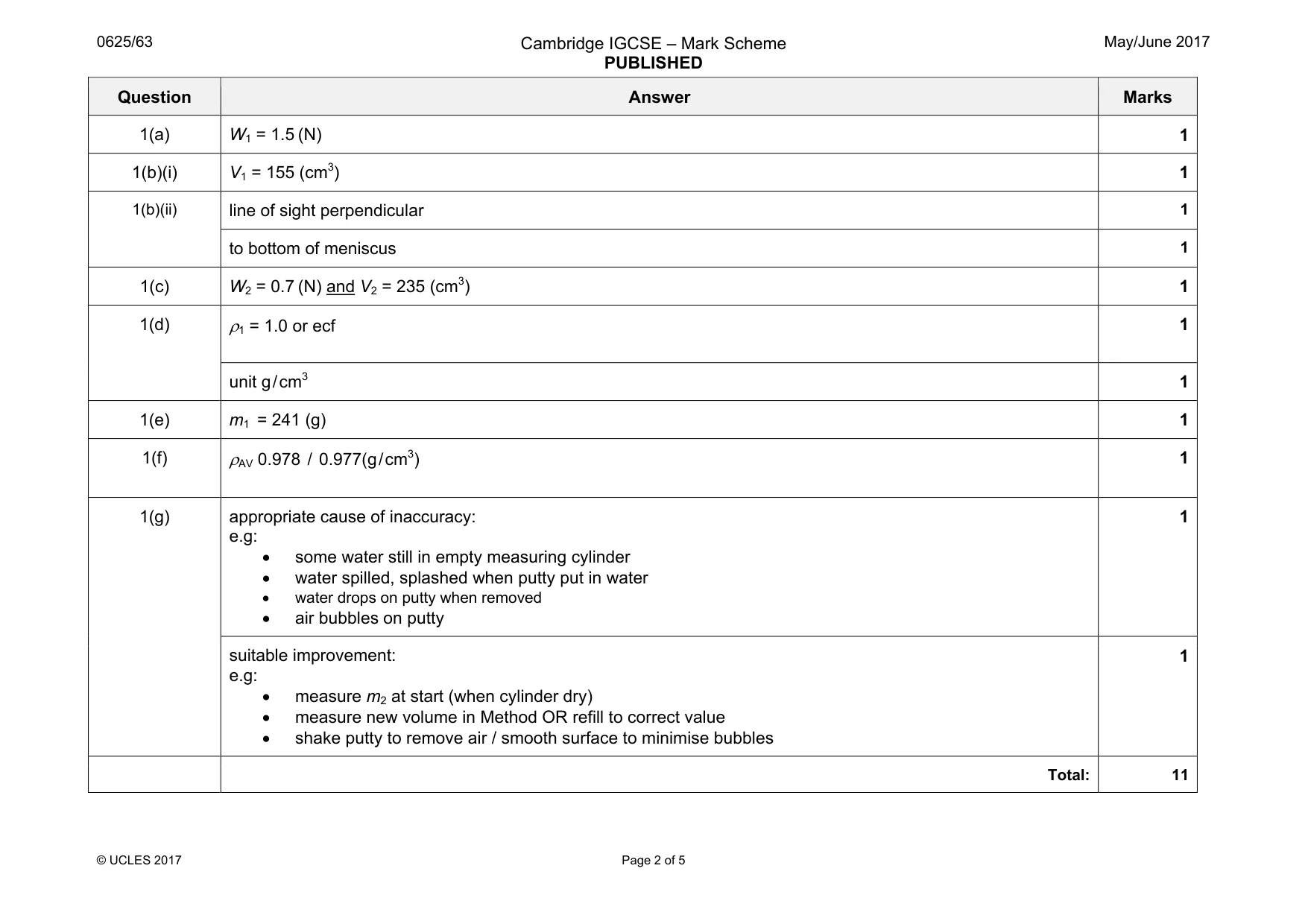
Mark scheme: 1(a) W1 = 1.5 (N) 1 1(b)(i) V1 = 155 (cm3) 1 1(b)(ii) line of sight perpendicular 1 to bottom of meniscus 1 1(c) W2 = 0.7 (N) and V2 = 235 (cm3) 1 1(d) ρ1 = 1.0 or ecf 1 unit g / cm3 1 1(e) m1 = 241 (g) 1 1(f) ρAV 0.978 / 0.977(g / cm3) 1 1(g) appropriate cause of inaccuracy: e.g: • some water still in empty measuring cylinder • water spilled, splashed when putty put in water • water drops on putty when removed • air bubbles on putty 1 suitable improvement: e.g: • measure m2 at start (when cylinder dry) • measure new volume in Method OR refill to correct value • shake putty to remove air / smooth surface to minimise bubbles 1 Total: 11
Q2 · Some students are investigating the resistance of a power supply
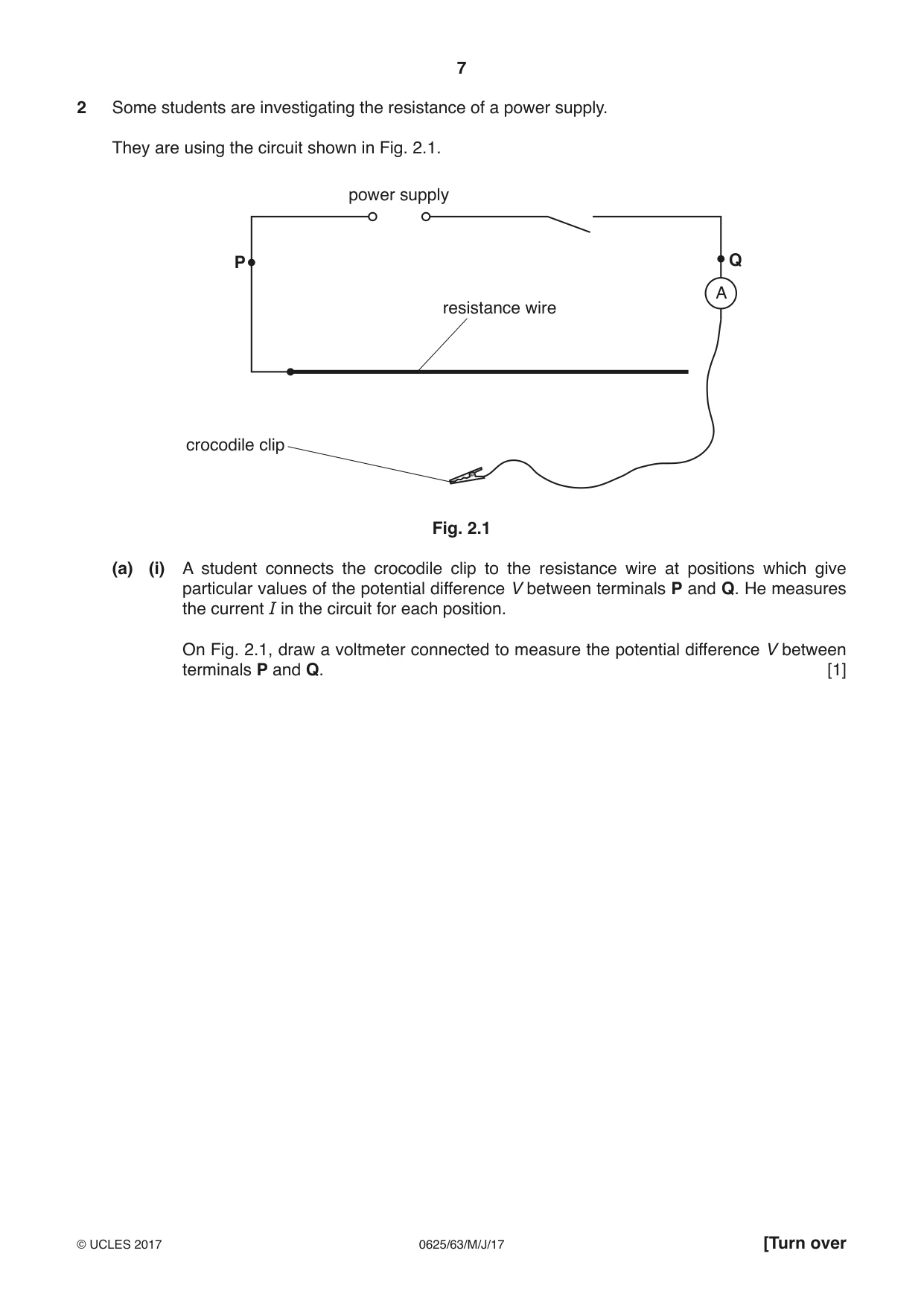
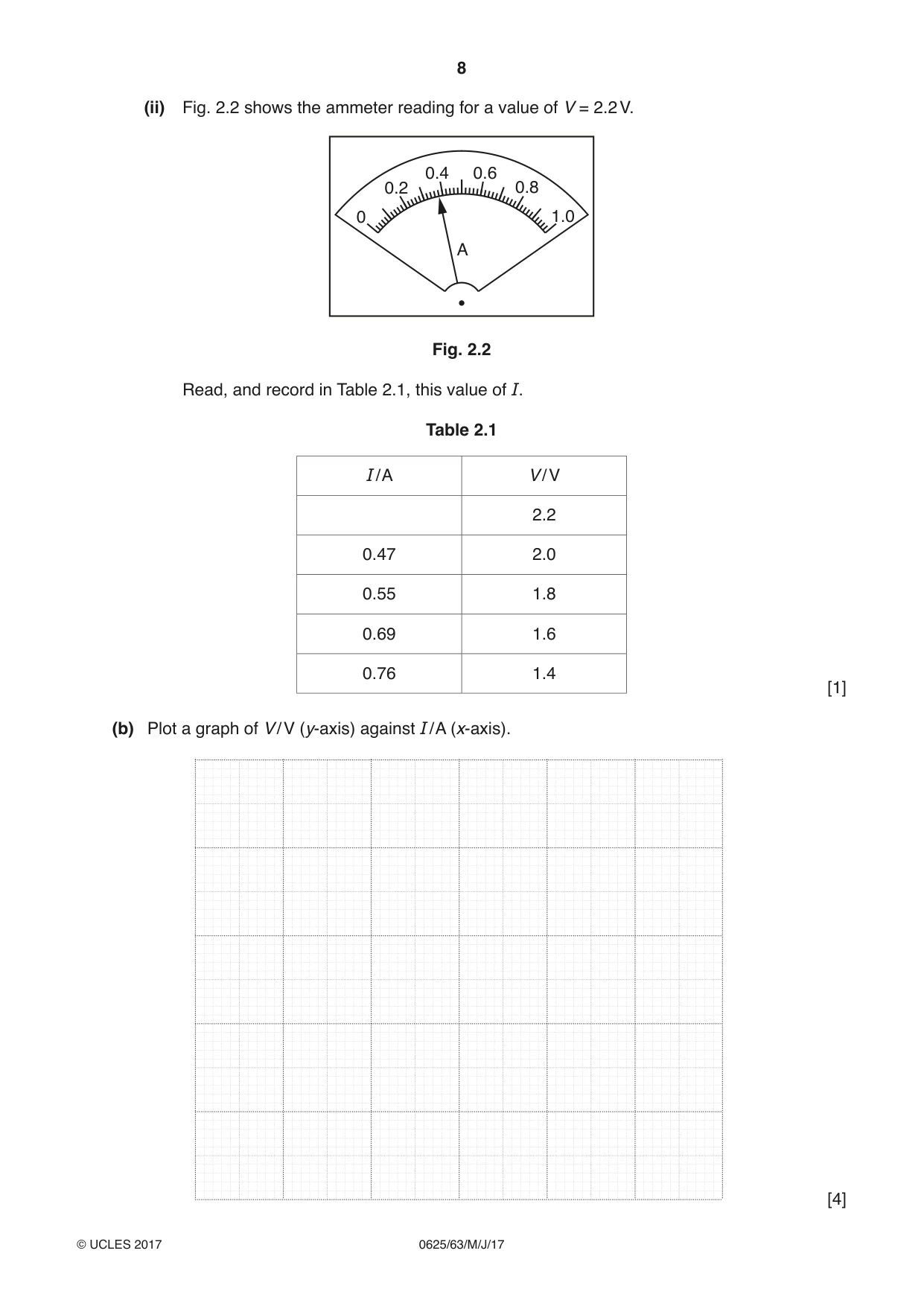
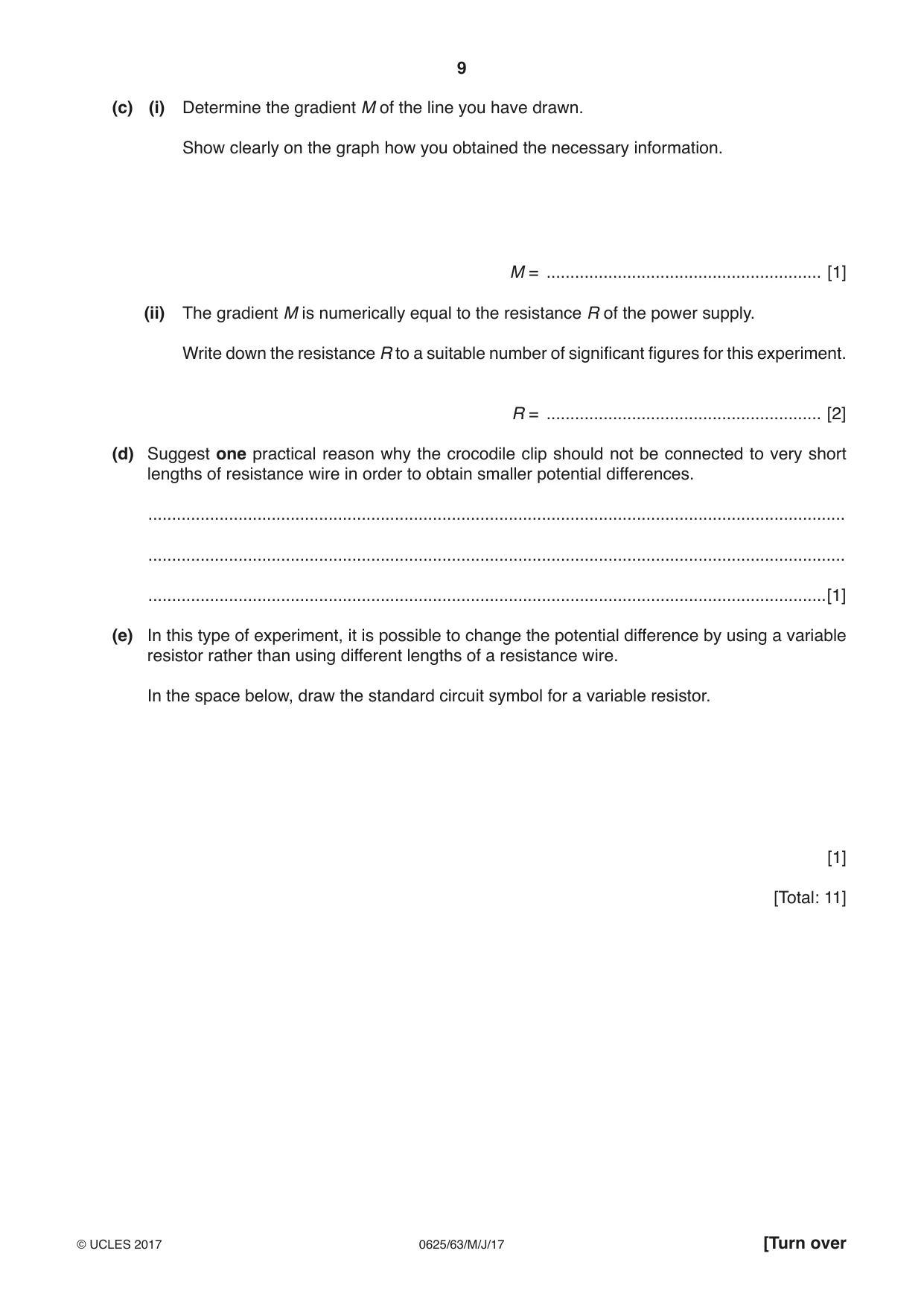
2 Some students are investigating the resistance of a power supply. They are using the circuit shown in Fig. 2.1. power supply P Q A resistance wire crocodile clip Fig. 2.1 (a) (i) A student connects the crocodile clip to the resistance wire at positions which give particular values of the potential difference V between terminals P and Q. He measures the current I in the circuit for each position. On Fig. 2.1, draw a voltmeter connected to measure the potential difference V between terminals P and Q. [1] (ii) Fig. 2.2 shows the ammeter reading for a value of V = 2.2 V. 0.4 0.6 0.2 0.8 0 1.0 A Fig. 2.2 Read, and record in Table 2.1, this value of I. Table 2.1 I / A V / V 2.2 0.47 2.0 0.55 1.8 0.69 1.6 0.76 1.4 [1] (b) Plot a graph of V / V (y-axis) against I / A (x-axis). [4] (c) (i) Determine the gradient M of the line you have drawn. Show clearly on the graph how you obtained the necessary information. M = .......................................................... [1] (ii) The gradient M is numerically equal to the resistance R of the power supply. Write down the resistance R to a suitable number of significant figures for this experiment. R = .......................................................... [2] (d) Suggest one practical reason why the crocodile clip should not be connected to very short lengths of resistance wire in order to obtain smaller potential differences. ................................................................................................................................................... ................................................................................................................................................... ...............................................................................................................................................[1] (e) In this type of experiment, it is possible to change the potential difference by using a variable resistor rather than using different lengths of a resistance wire. In the space below, draw the standard circuit symbol for a variable resistor. [1] [Total: 11]
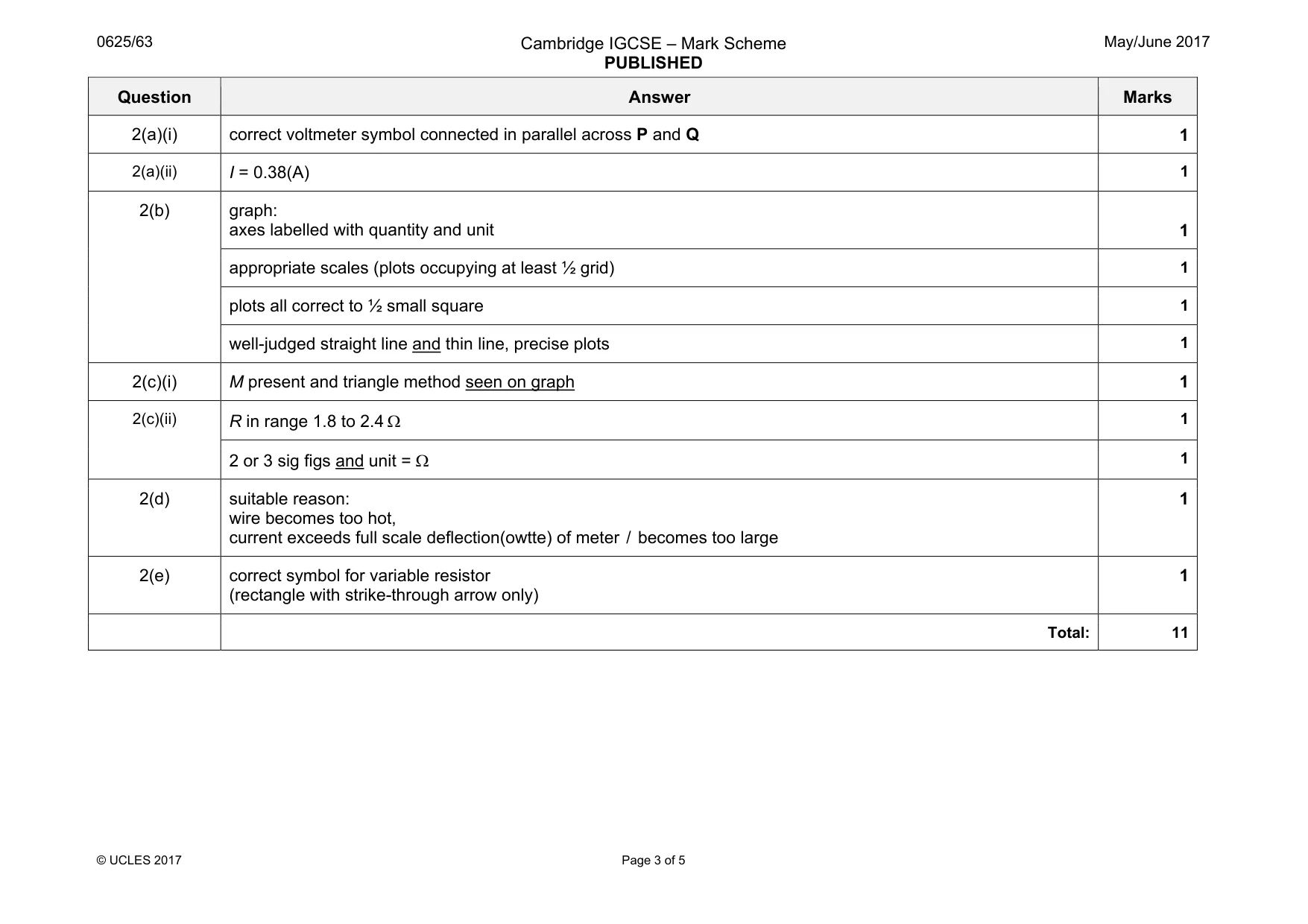
Mark scheme: 2(a)(i) correct voltmeter symbol connected in parallel across P and Q 1 2(a)(ii) I = 0.38(A) 1 2(b) graph: axes labelled with quantity and unit 1 appropriate scales (plots occupying at least ½ grid) 1 plots all correct to ½ small square 1 well-judged straight line and thin line, precise plots 1 2(c)(i) M present and triangle method seen on graph 1 2(c)(ii) R in range 1.8 to 2.4 Ω 1 2 or 3 sig figs and unit = Ω 1 2(d) suitable reason: wire becomes too hot, current exceeds full scale deflection(owtte) of meter / becomes too large 1 2(e) correct symbol for variable resistor (rectangle with strike-through arrow only) 1 Total: 11
Q3 · A student is investigating the refraction of light by a transparent block
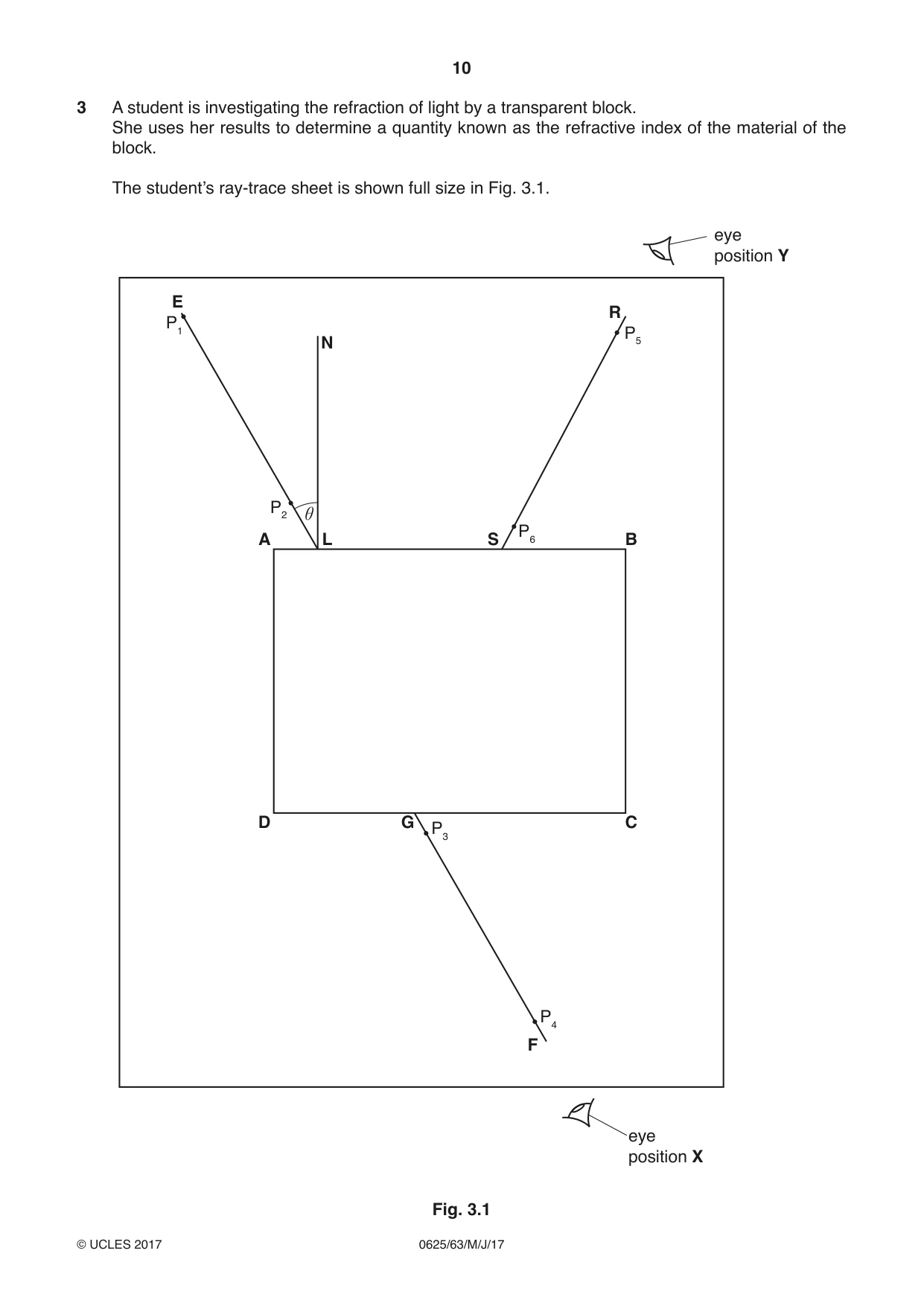
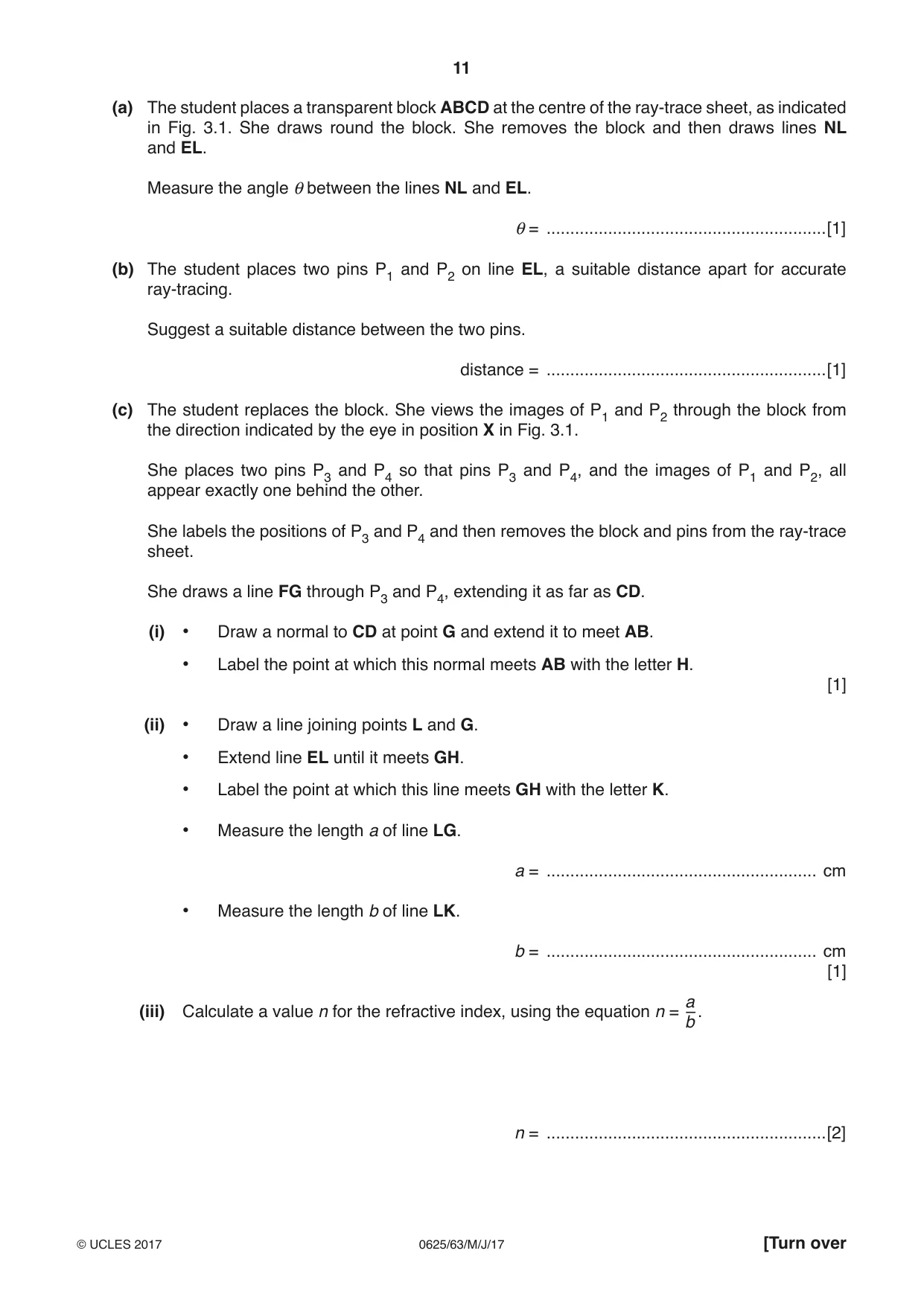
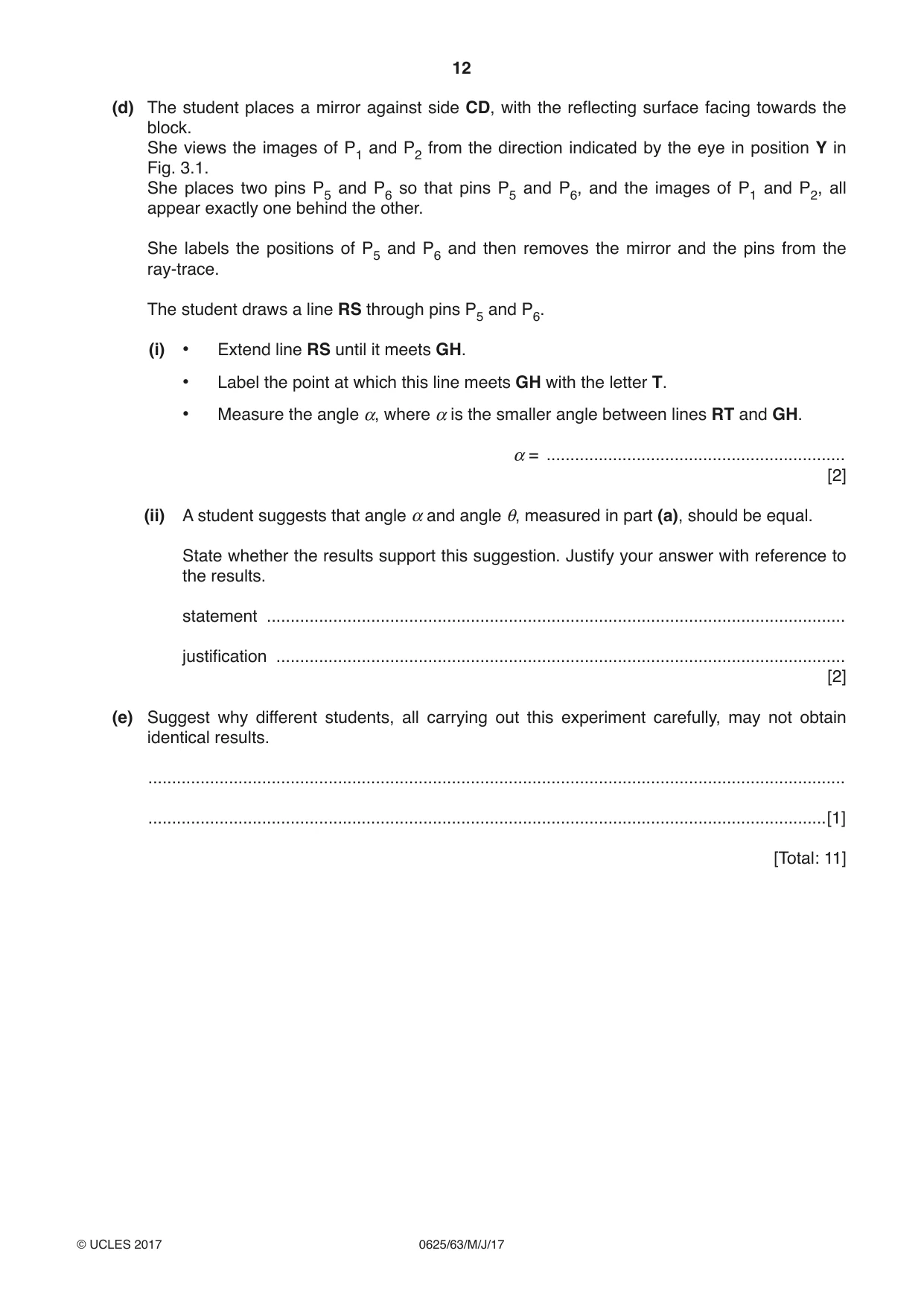
3 A student is investigating the refraction of light by a transparent block. She uses her results to determine a quantity known as the refractive index of the material of the block. The student’s ray-trace sheet is shown full size in Fig. 3.1. eye position Y E R P1 P5 N P2 i P6 A L S B D G C P3 P4 F eye position X Fig. 3.1 (a) The student places a transparent block ABCD at the centre of the ray-trace sheet, as indicated in Fig. 3.1. She draws round the block. She removes the block and then draws lines NL and EL. Measure the angle θ between the lines NL and EL. θ = ...........................................................[1] (b) The student places two pins P1 and P2 on line EL, a suitable distance apart for accurate ray-tracing. Suggest a suitable distance between the two pins. distance = ...........................................................[1] (c) The student replaces the block. She views the images of P1 and P2 through the block from the direction indicated by the eye in position X in Fig. 3.1. She places two pins P3 and P4 so that pins P3 and P4, and the images of P1 and P2, all appear exactly one behind the other. She labels the positions of P3 and P4 and then removes the block and pins from the ray-trace sheet. She draws a line FG through P3 and P4, extending it as far as CD. (i) • Draw a normal to CD at point G and extend it to meet AB. • Label the point at which this normal meets AB with the letter H. [1] (ii) • Draw a line joining points L and G. • Extend line EL until it meets GH. • Label the point at which this line meets GH with the letter K. • Measure the length a of line LG. a = ......................................................... cm • Measure the length b of line LK. b = ......................................................... cm [1] (iii) Calculate a value n for the refractive index, using the equation n = . a–b n = ...........................................................[2] (d) The student places a mirror against side CD, with the reflecting surface facing towards the block. She views the images of P1 and P2 from the direction indicated by the eye in position Y in Fig. 3.1. She places two pins P5 and P6 so that pins P5 and P6, and the images of P1 and P2, all appear exactly one behind the other. She labels the positions of P5 and P6 and then removes the mirror and the pins from the ray-trace. The student draws a line RS through pins P5 and P6. (i) • Extend line RS until it meets GH. • Label the point at which this line meets GH with the letter T. • Measure the angle α, where α is the smaller angle between lines RT and GH. α = ............................................................... [2] (ii) A student suggests that angle α and angle θ, measured in part (a), should be equal. State whether the results support this suggestion. Justify your answer with reference to the results. statement .......................................................................................................................... justification ........................................................................................................................ [2] (e) Suggest why different students, all carrying out this experiment carefully, may not obtain identical results. ................................................................................................................................................... ...............................................................................................................................................[1] [Total: 11]
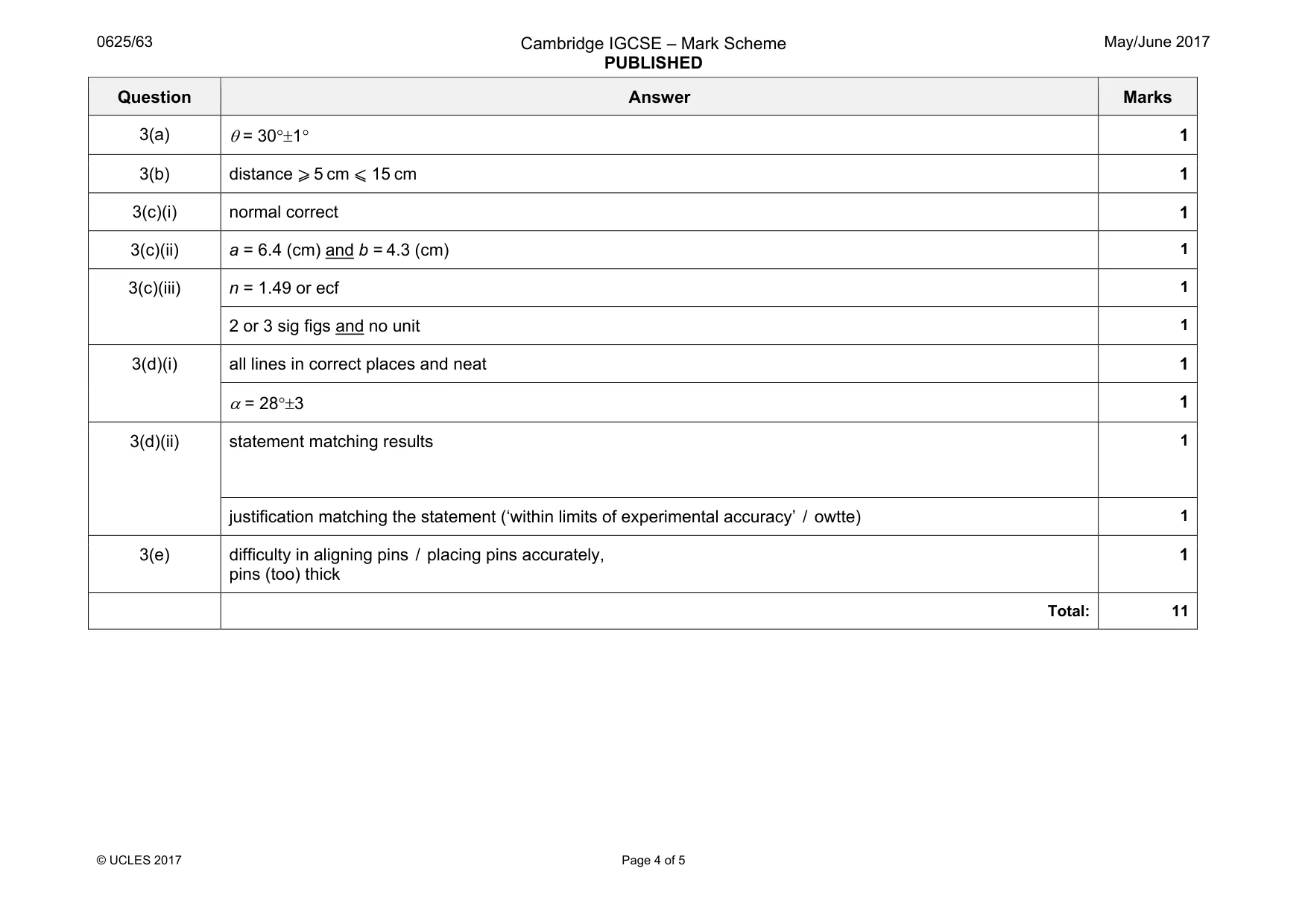
Mark scheme: 3(a) 1 3(b) distance ⩾ 5 cm ⩽ 15 cm 1 3(c)(i) normal correct 1 3(c)(ii) a = 6.4 (cm) and b = 4.3 (cm) 1 3(c)(iii) n = 1.49 or ecf 1 2 or 3 sig figs and no unit 1 3(d)(i) all lines in correct places and neat 1 α = 28°±3 1 3(d)(ii) statement matching results 1 justification matching the statement (‘within limits of experimental accuracy’ / owtte) 1 3(e) difficulty in aligning pins / placing pins accurately, pins (too) thick 1 Total: 11
Q4 · Plan an experiment to investigate how increasing the number of layers of insulation…
4 Plan an experiment to investigate how increasing the number of layers of insulation affects the rate of cooling of hot water in a beaker. Write a plan for the experiment, including: • the apparatus needed • what you would measure • the variables you would keep the same to ensure the comparison is a fair test • instructions for carrying out the experiment • how you would present your results • how you would use your readings to reach a conclusion. You may draw a diagram if it helps to explain your plan. .......................................................................................................................................................... .......................................................................................................................................................... .......................................................................................................................................................... .......................................................................................................................................................... .......................................................................................................................................................... .......................................................................................................................................................... .......................................................................................................................................................... .......................................................................................................................................................... .......................................................................................................................................................... .......................................................................................................................................................... .......................................................................................................................................................... .......................................................................................................................................................... .......................................................................................................................................................... .......................................................................................................................................................... .......................................................................................................................................................... .......................................................................................................................................................... .......................................................................................................................................................... .......................................................................................................................................................... .......................................................................................................................................................... .......................................................................................................................................................... .......................................................................................................................................................... .......................................................................................................................................................... .......................................................................................................................................................... .......................................................................................................................................................... .......................................................................................................................................................... .......................................................................................................................................................... .......................................................................................................................................................... .......................................................................................................................................................... .......................................................................................................................................................... .......................................................................................................................................................... .......................................................................................................................................................... .......................................................................................................................................................... .......................................................................................................................................................... .......................................................................................................................................................... .......................................................................................................................................................... .......................................................................................................................................................... .......................................................................................................................................................... .......................................................................................................................................................... ......................................................................................................................................................[7]
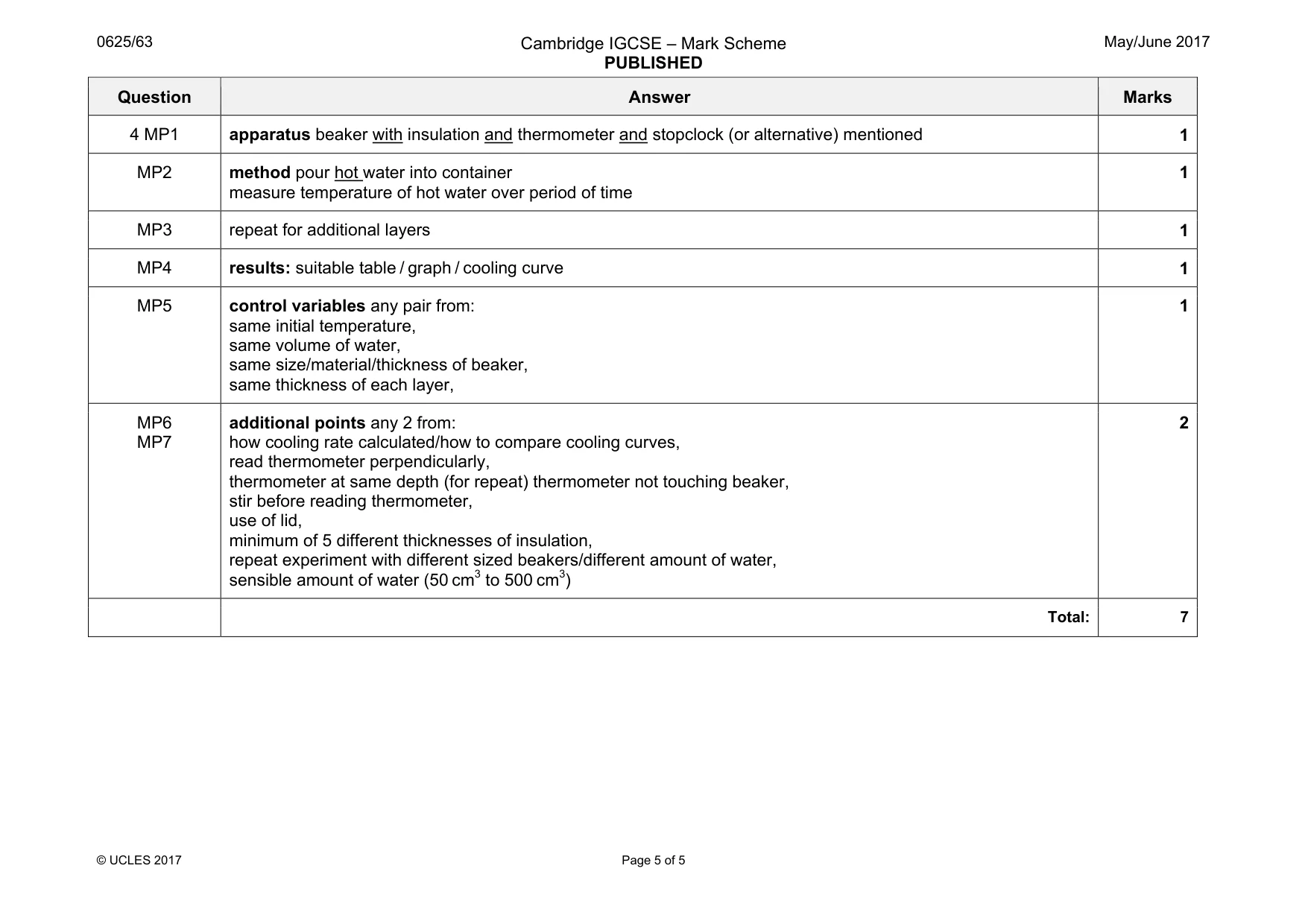
Mark scheme: 4 MP1 apparatus beaker with insulation and thermometer and stopclock (or alternative) mentioned 1 MP2 method pour hot water into container measure temperature of hot water over period of time 1 MP3 repeat for additional layers 1 MP4 results: suitable table / graph / cooling curve 1 MP5 control variables any pair from: same initial temperature, same volume of water, same size/material/thickness of beaker, same thickness of each layer, 1 MP6 MP7 additional points any 2 from: how cooling rate calculated/how to compare cooling curves, read thermometer perpendicularly, thermometer at same depth (for repeat) thermometer not touching beaker, stir before reading thermometer, use of lid, minimum of 5 different thicknesses of insulation, repeat experiment with different sized beakers/different amount of water, sensible amount of water (50 cm3 to 500 cm3) 2 Total: 7
What was in this paper
The subtopics covered by these 4 questions, and how many questions each got. Open one in a new tab to see every Cambridge question on it.
What you needed in this session
Cambridge’s own grade thresholds for 2017 May/June, Paper 6 · Variant 3. A higher threshold means an easier paper — the bar moves with how the cohort did.