Cambridge IGCSE Physics 0625 — 2014 Oct/Nov Paper 2 · Variant 1
0625/21/O/N/14 · 80 marks · ≈90 min
The question paper and its mark scheme, free to read here and free to download. This is Cambridge’s own paper, exactly as it was sat.
Question paper20 pages
Mark scheme8 pages
Answers below. Sit the paper first if you are practising.
Paper as text
Question paper, page 1
This document consists of 19 printed pages and 1 blank page. DC (AC/SW) 81802/5 © UCLES 2014 [Turn over Cambridge International Examinations Cambridge International General Certificate of Secondary Education * 9 6 9 1 1 0 8 5 2 4 * PHYSICS 0625/21 Paper 2 Core October/November 2014 1 hour 15 minutes Candidates answer on the Question Paper. No Additional Materials are required. READ THESE INSTRUCTIONS FIRST Write your Centre number, candidate number and name on all the work you hand in. Write in dark blue or black pen. You may use an HB pencil for any diagrams or graphs. Do not use staples, paper clips, glue or correction fluid. DO NOT WRITE IN ANY BARCODES. Answer all questions. Electronic calculators may be used. You may lose marks if you do not show your working or if you do not use appropriate units. Take the weight of 1 kg to be 10 N (i.e. acceleration of free fall = 10 m / s2). At the end of the examination, fasten all your work securely together. The number of marks is given in brackets [ ] at the end of each question or part question. The syllabus is approved for use in England, Wales and Northern Ireland as a Cambridge International Level 1/Level 2 Certificate.
Question paper, page 2
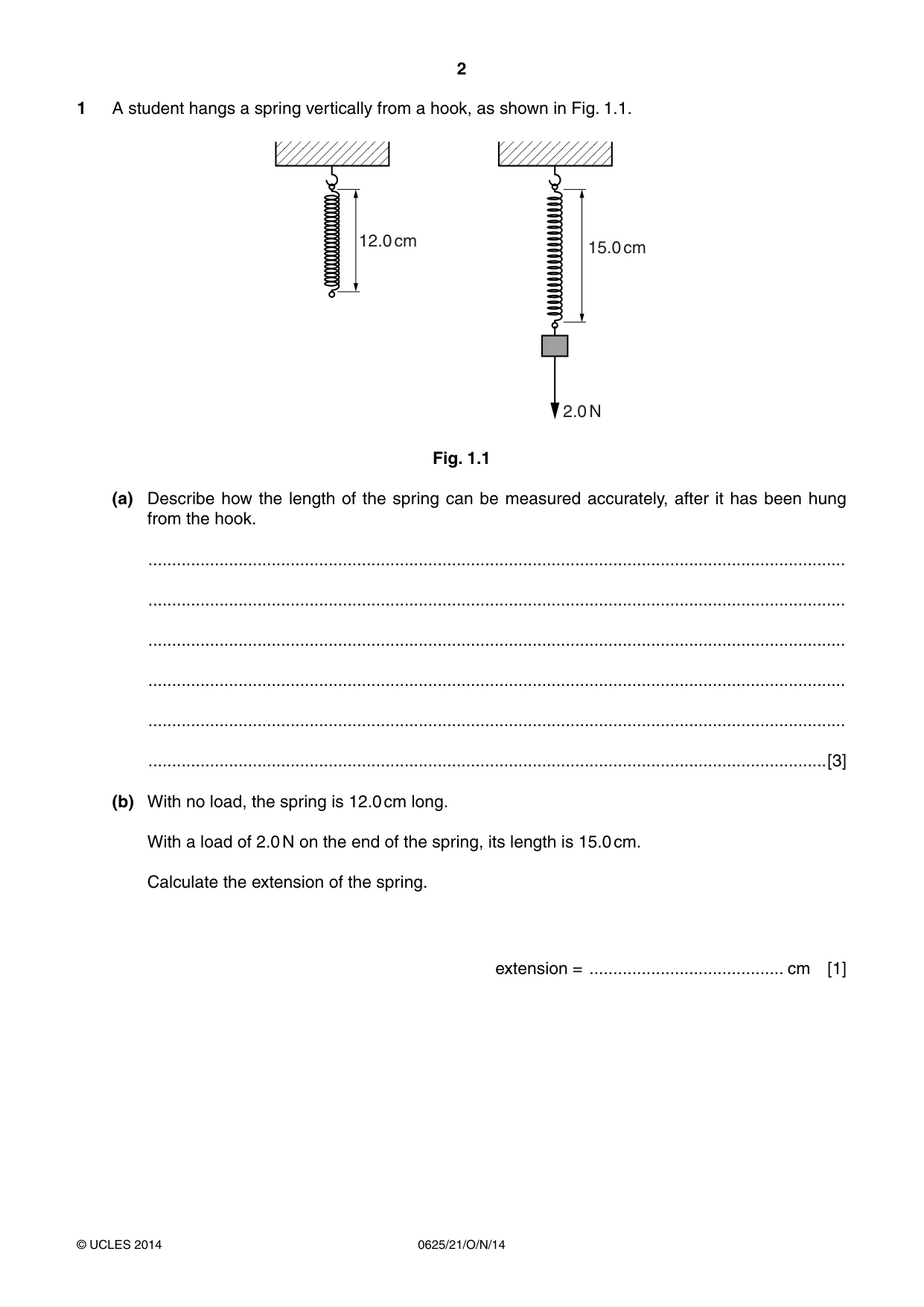
2 0625/21/O/N/14 © UCLES 2014 1 A student hangs a spring vertically from a hook, as shown in Fig. 1.1. 12.0 cm 15.0 cm 2.0 N Fig. 1.1 (a) Describe how the length of the spring can be measured accurately, after it has been hung from the hook. … … … … … …[3] (b) With no load, the spring is 12.0 cm long. With a load of 2.0 N on the end of the spring, its length is 15.0 cm. Calculate the extension of the spring. extension = … cm [1]
Question paper, page 3
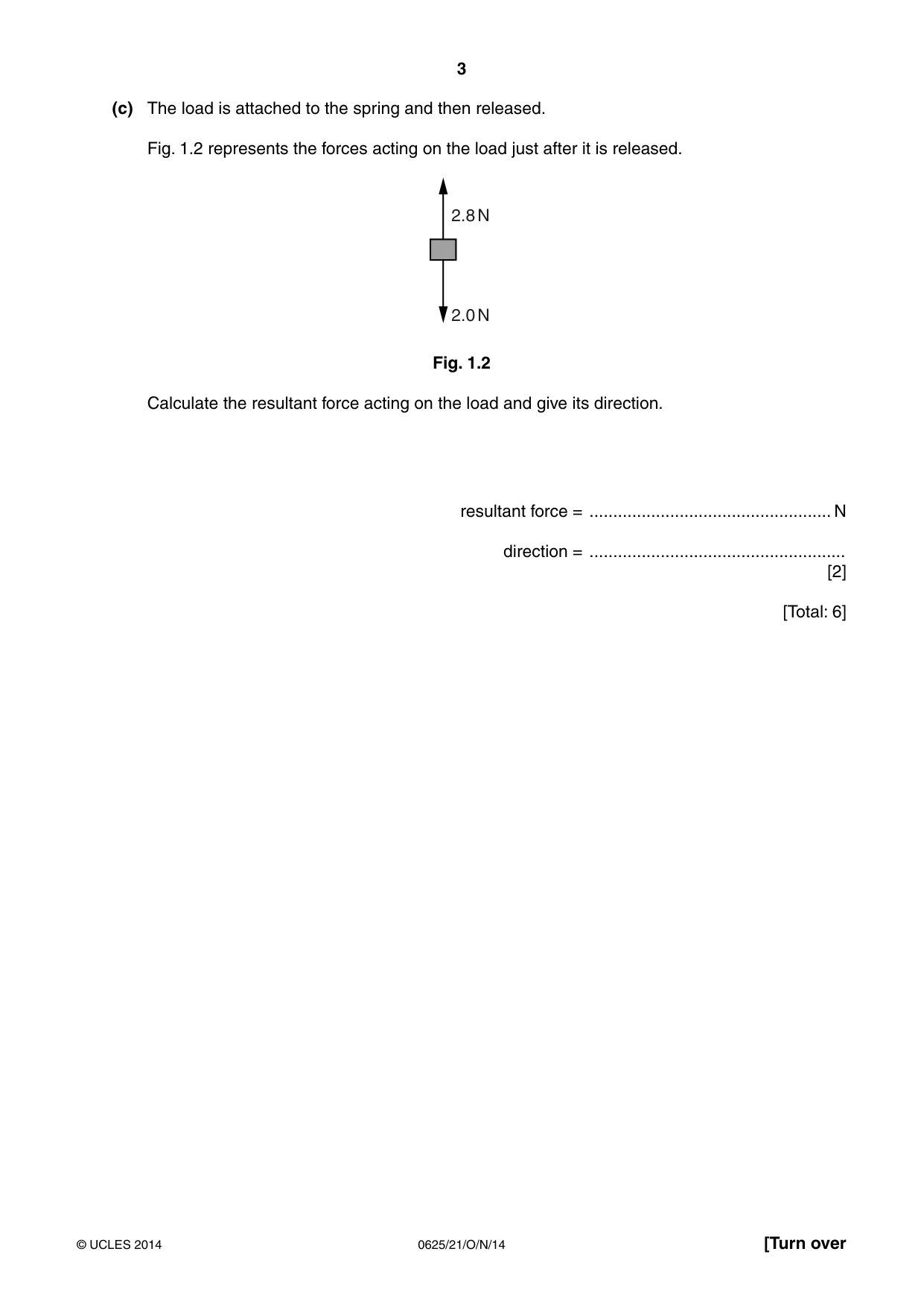
3 0625/21/O/N/14 © UCLES 2014 [Turn over (c) The load is attached to the spring and then released. Fig. 1.2 represents the forces acting on the load just after it is released. 2.0 N 2.8 N Fig. 1.2 Calculate the resultant force acting on the load and give its direction. resultant force = … N direction = … [2] [Total: 6]
Question paper, page 4
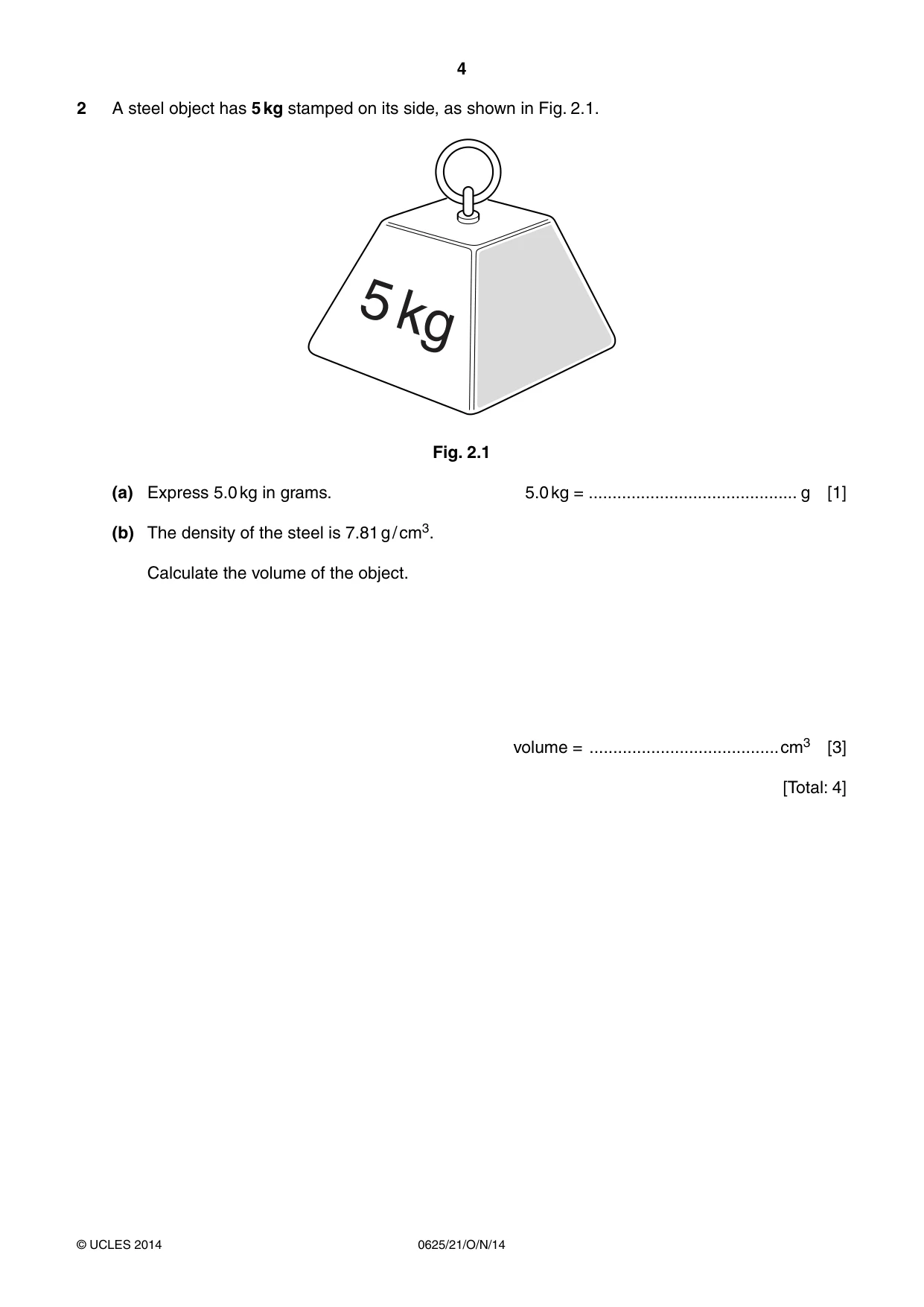
4 0625/21/O/N/14 © UCLES 2014 2 A steel object has 5 kg stamped on its side, as shown in Fig. 2.1. 5 kg Fig. 2.1 (a) Express 5.0 kg in grams. 5.0 kg = … g [1] (b) The density of the steel is 7.81 g / cm3. Calculate the volume of the object. volume = …cm3 [3] [Total: 4]
Question paper, page 5
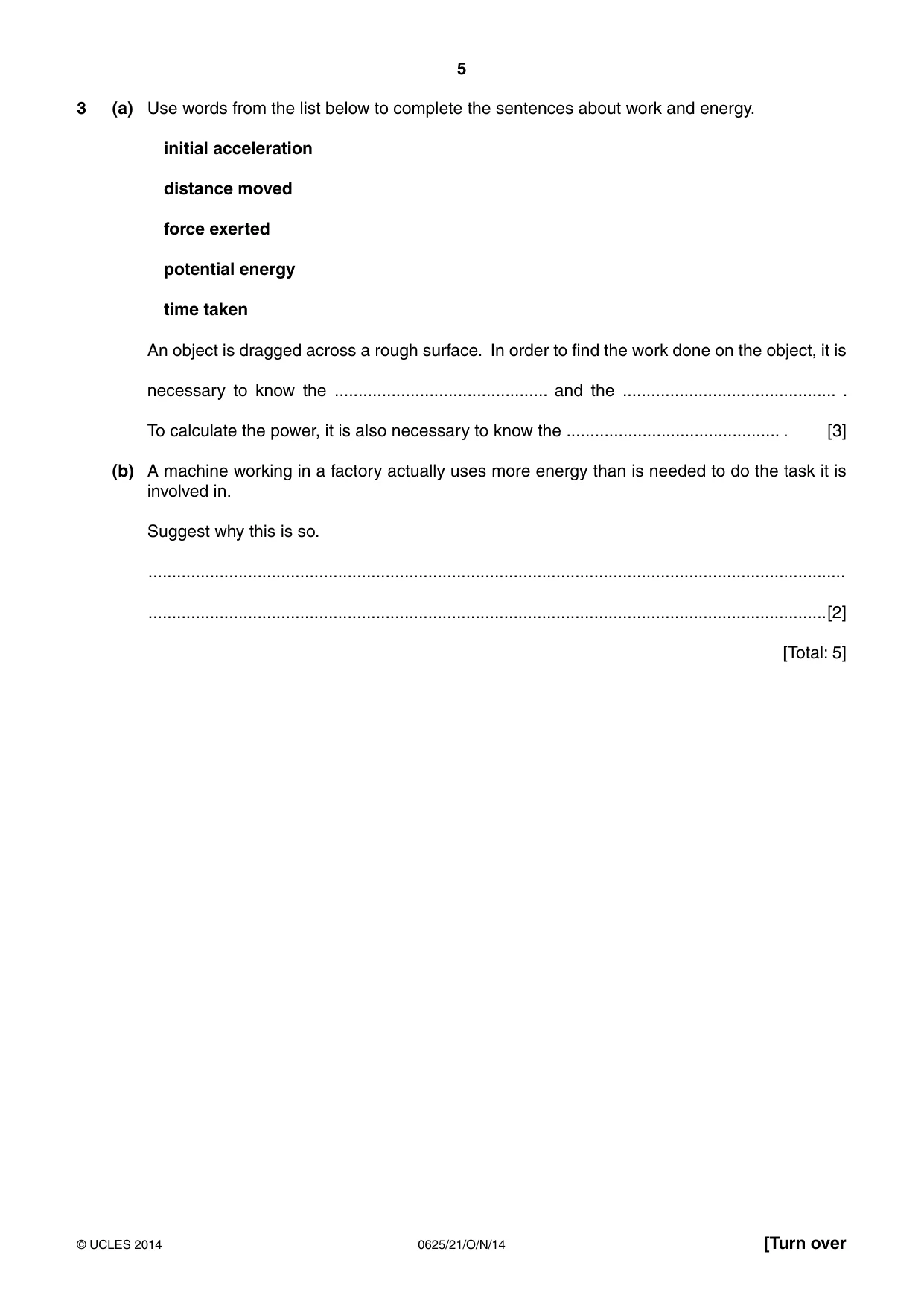
5 0625/21/O/N/14 © UCLES 2014 [Turn over 3 (a) Use words from the list below to complete the sentences about work and energy. initial acceleration distance moved force exerted potential energy time taken An object is dragged across a rough surface. In order to find the work done on the object, it is necessary to know the … and the … . To calculate the power, it is also necessary to know the … . [3] (b) A machine working in a factory actually uses more energy than is needed to do the task it is involved in. Suggest why this is so. … …[2] [Total: 5]
Question paper, page 6
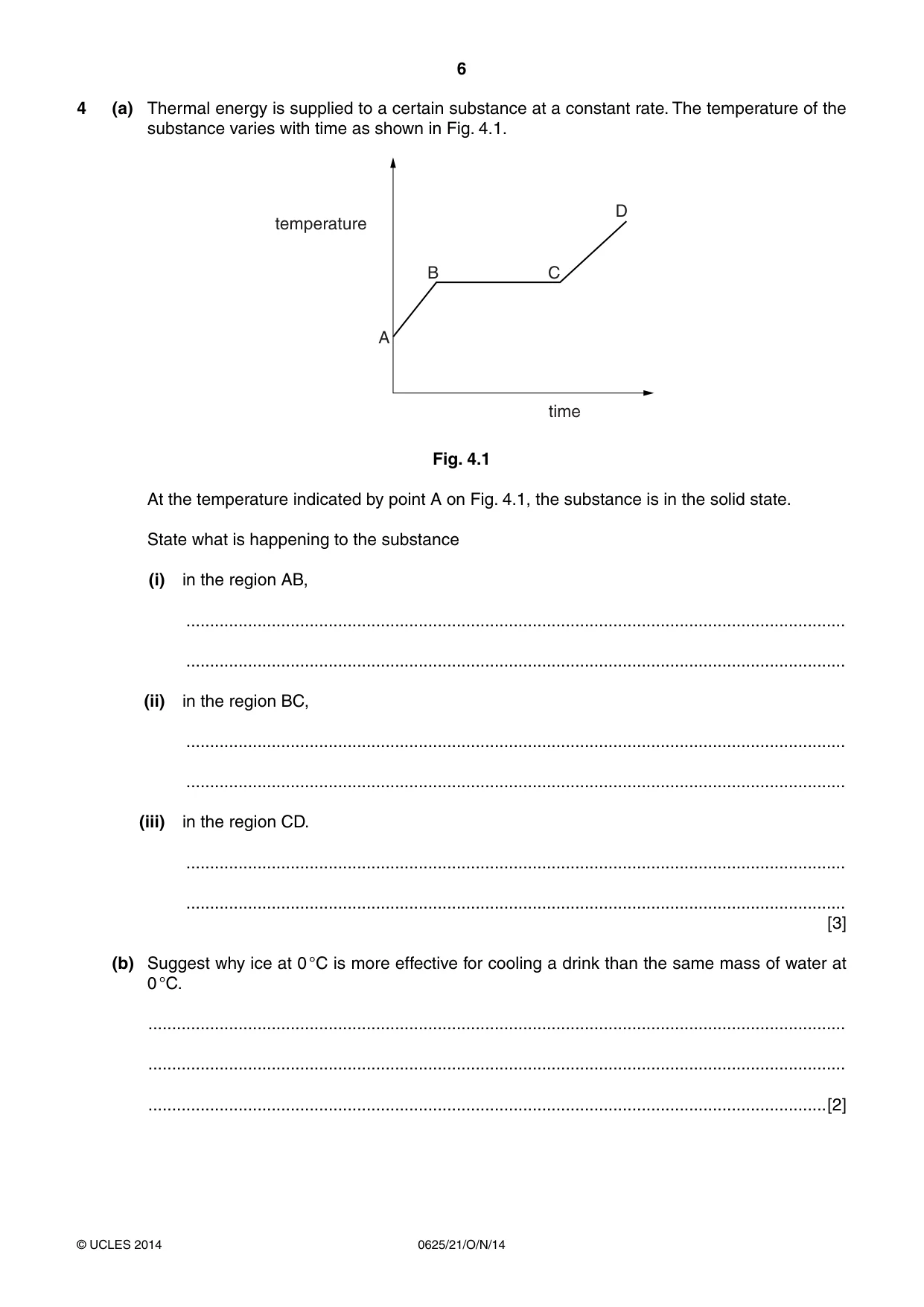
6 0625/21/O/N/14 © UCLES 2014 4 (a) Thermal energy is supplied to a certain substance at a constant rate. The temperature of the substance varies with time as shown in Fig. 4.1. A B C D time temperature Fig. 4.1 At the temperature indicated by point A on Fig. 4.1, the substance is in the solid state. State what is happening to the substance (i) in the region AB, … … (ii) in the region BC, … … (iii) in the region CD. … … [3] (b) Suggest why ice at 0 °C is more effective for cooling a drink than the same mass of water at 0 °C. … … …[2]
Question paper, page 7
7 0625/21/O/N/14 © UCLES 2014 [Turn over (c) Steam is pumped into cold water in a container. (i) State and explain what happens to the temperature of the water in the container. statement … explanation … … … [2] (ii) State and explain what happens to the mass of water in the container. statement … explanation … … [2] [Total: 9]
Question paper, page 8
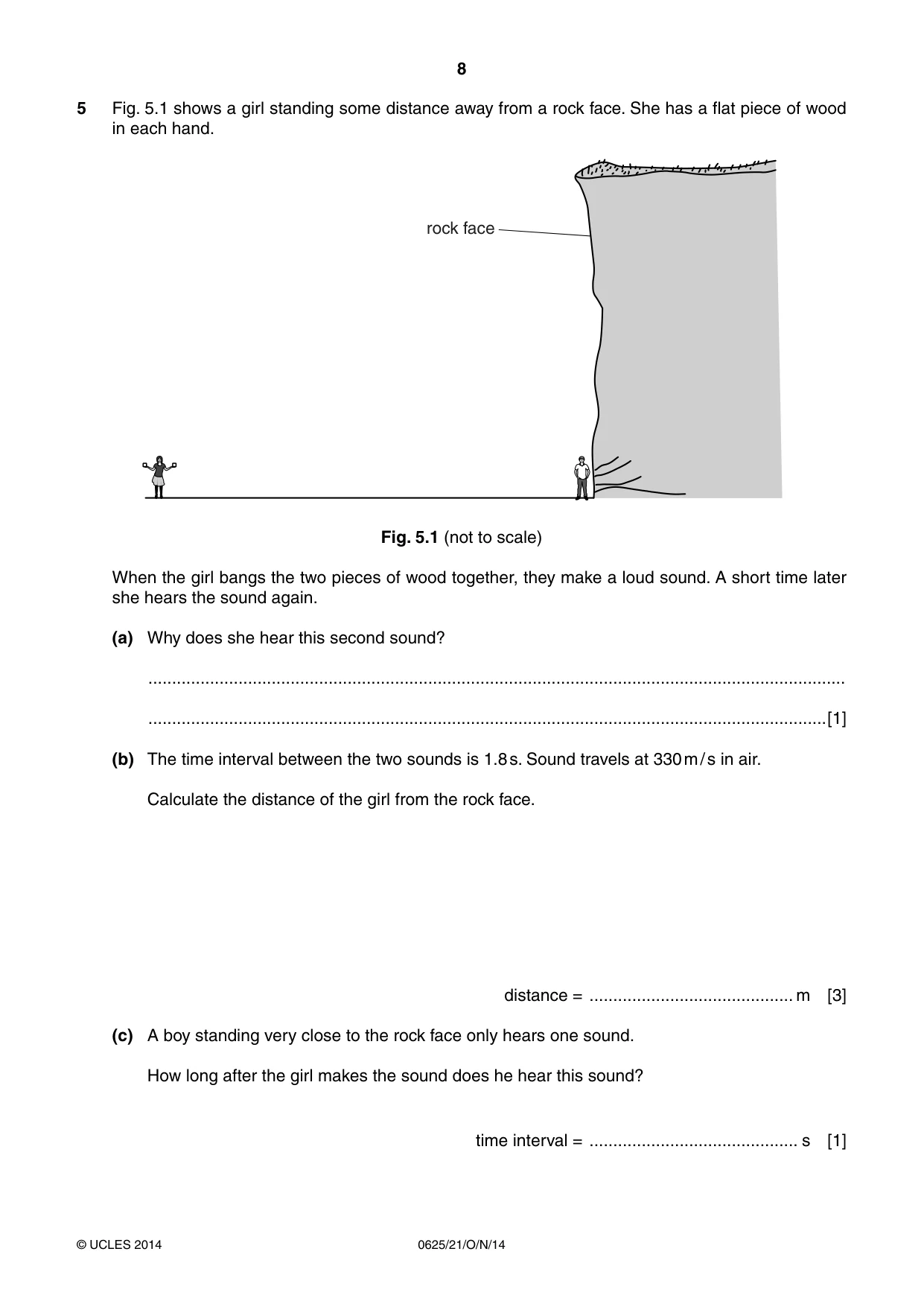
8 0625/21/O/N/14 © UCLES 2014 5 Fig. 5.1 shows a girl standing some distance away from a rock face. She has a flat piece of wood in each hand. rock face Fig. 5.1 (not to scale) When the girl bangs the two pieces of wood together, they make a loud sound. A short time later she hears the sound again. (a) Why does she hear this second sound? … …[1] (b) The time interval between the two sounds is 1.8 s. Sound travels at 330 m / s in air. Calculate the distance of the girl from the rock face. distance = … m [3] (c) A boy standing very close to the rock face only hears one sound. How long after the girl makes the sound does he hear this sound? time interval = … s [1]
Question paper, page 9
9 0625/21/O/N/14 © UCLES 2014 [Turn over (d) State two ways in which a sound wave is different from a light wave. 1. … 2. … [2] [Total: 7]
Question paper, page 10
10 0625/21/O/N/14 © UCLES 2014 6 (a) Describe (i) how a dry cloth can be used to charge a plastic rod, … … (ii) how the rod may be tested to check that it is charged. … … [2] (b) A lady has been riding in a car with plastic-covered seats. She gets out of the car. She touches the door handle when her feet are on the ground. She experiences an electric shock. Suggest why this happens. … … …[2] [Total: 4]
Question paper, page 11
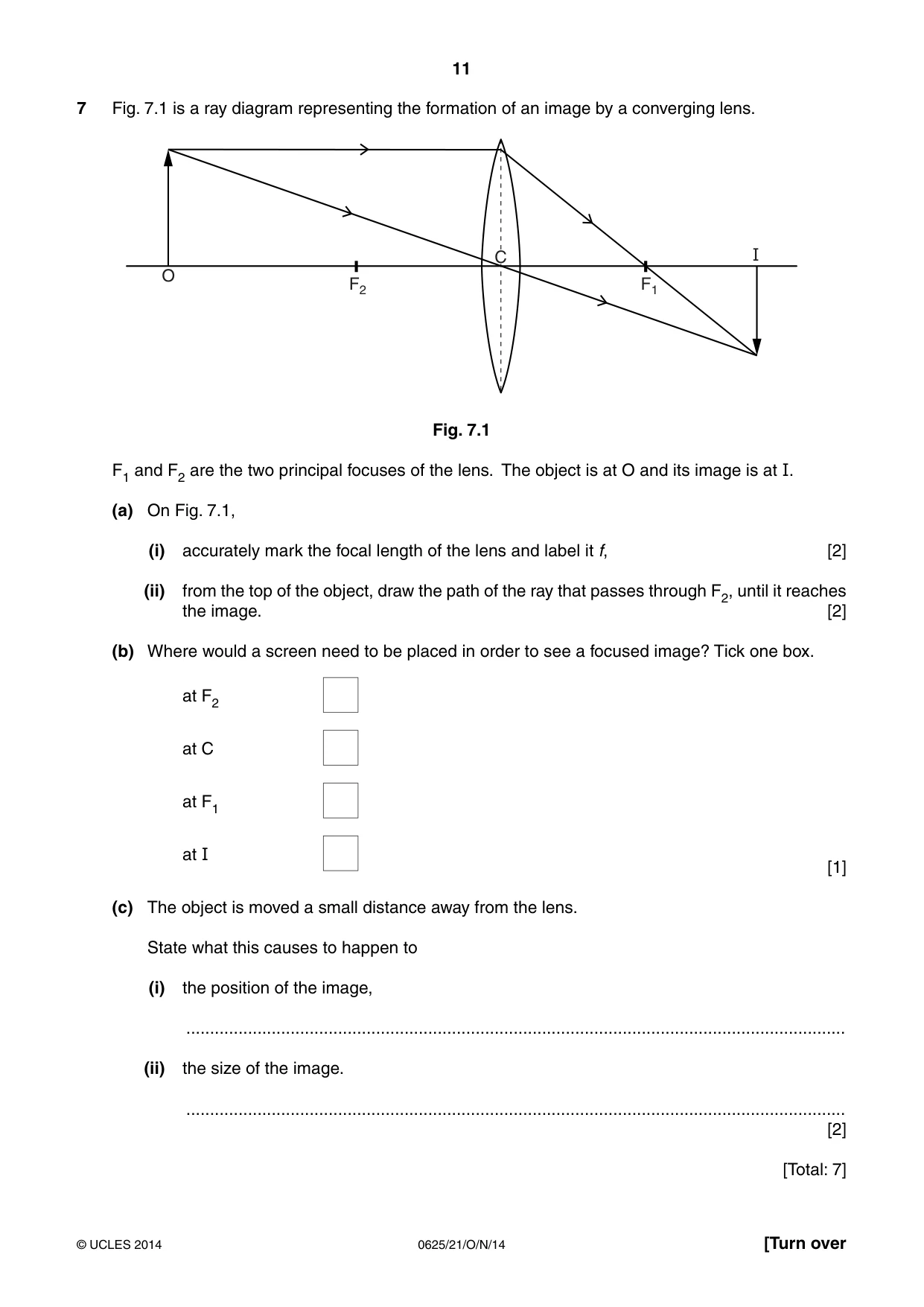
11 0625/21/O/N/14 © UCLES 2014 [Turn over 7 Fig. 7.1 is a ray diagram representing the formation of an image by a converging lens. F2 F1 O I C Fig. 7.1 F1 and F2 are the two principal focuses of the lens. The object is at O and its image is at I. (a) On Fig. 7.1, (i) accurately mark the focal length of the lens and label it f, [2] (ii) from the top of the object, draw the path of the ray that passes through F2, until it reaches the image. [2] (b) Where would a screen need to be placed in order to see a focused image? Tick one box. at F2 at C at F1 at I [1] (c) The object is moved a small distance away from the lens. State what this causes to happen to (i) the position of the image, … (ii) the size of the image. … [2] [Total: 7]
Question paper, page 12
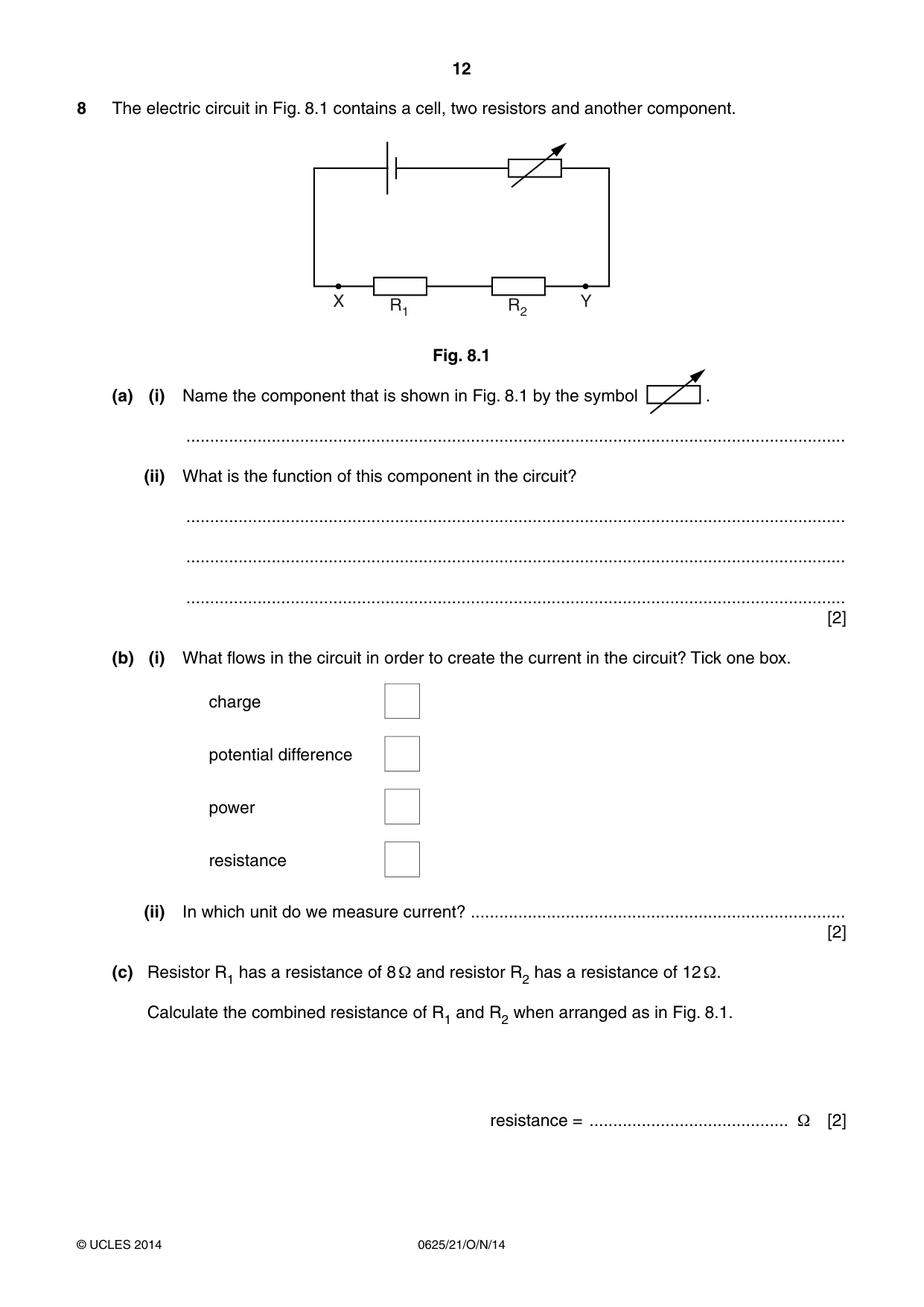
12 0625/21/O/N/14 © UCLES 2014 8 The electric circuit in Fig. 8.1 contains a cell, two resistors and another component. X Y R1 R2 Fig. 8.1 (a) (i) Name the component that is shown in Fig. 8.1 by the symbol . … (ii) What is the function of this component in the circuit? … … … [2] (b) (i) What flows in the circuit in order to create the current in the circuit? Tick one box. charge potential difference power resistance (ii) In which unit do we measure current? … [2] (c) Resistor R1 has a resistance of 8 Ω and resistor R2 has a resistance of 12 Ω. Calculate the combined resistance of R1 and R2 when arranged as in Fig. 8.1. resistance = … Ω [2]
Question paper, page 13
13 0625/21/O/N/14 © UCLES 2014 [Turn over (d) R1 and R2 are removed from the circuit and then re-connected between X and Y, so that they have a different combined resistance. (i) In the space below, draw the circuit showing R1 and R2 connected in this different way. [2] (ii) What word is used to describe this different way of connecting R1 and R2? …[1] [Total: 9]
Question paper, page 14
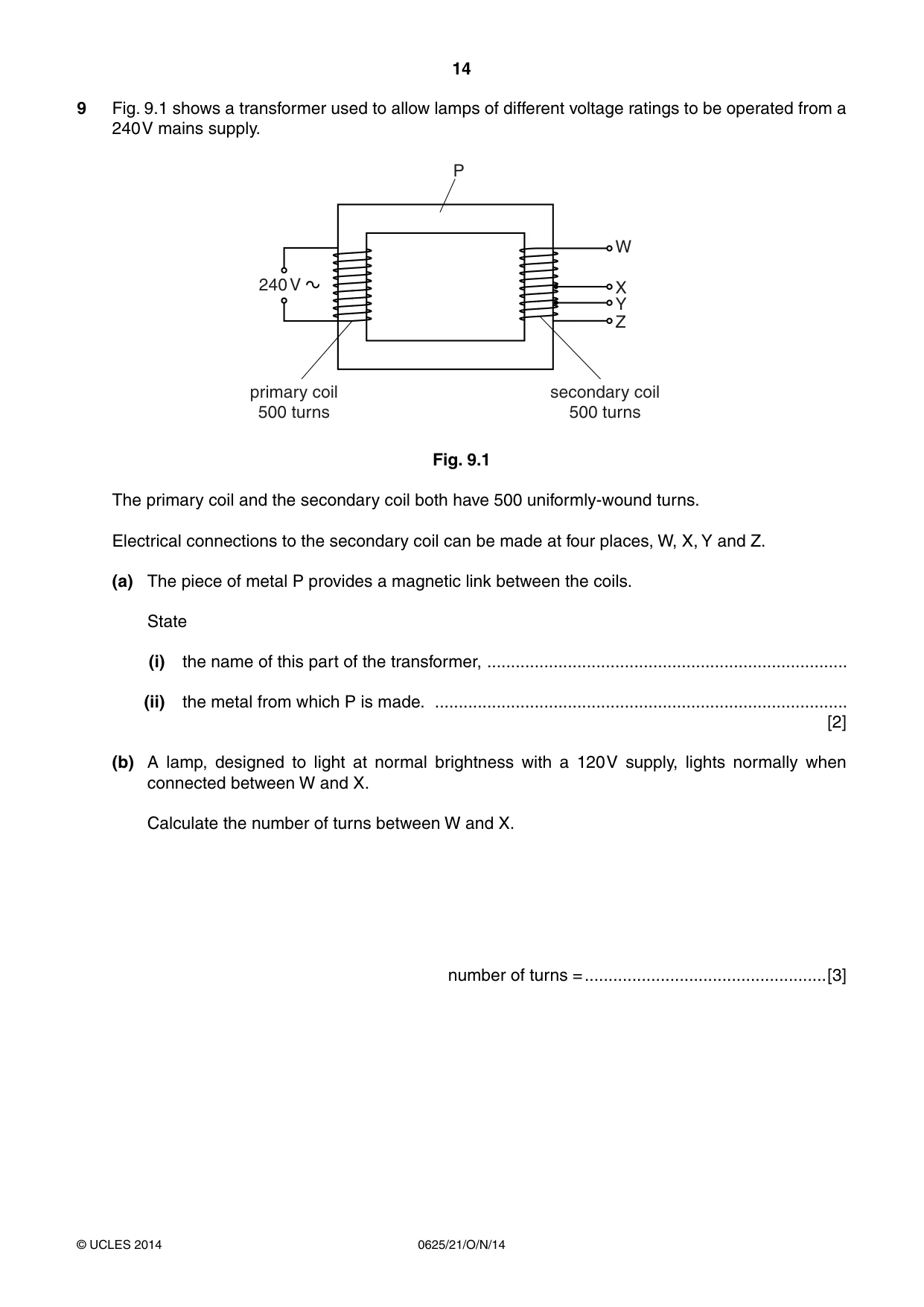
14 0625/21/O/N/14 © UCLES 2014 9 Fig. 9.1 shows a transformer used to allow lamps of different voltage ratings to be operated from a 240 V mains supply. 240 V primary coil 500 turns secondary coil 500 turns W Z P Y X Fig. 9.1 The primary coil and the secondary coil both have 500 uniformly-wound turns. Electrical connections to the secondary coil can be made at four places, W, X, Y and Z. (a) The piece of metal P provides a magnetic link between the coils. State (i) the name of this part of the transformer, … (ii) the metal from which P is made. … [2] (b) A lamp, designed to light at normal brightness with a 120 V supply, lights normally when connected between W and X. Calculate the number of turns between W and X. number of turns = …[3]
Question paper, page 15
15 0625/21/O/N/14 © UCLES 2014 [Turn over (c) The lamp in (b) is connected between X and Y. Describe and explain what happens to the lamp. … … …[3] (d) State what would happen if the 120 V lamp in (b) is connected between W and Z. … …[1] [Total: 9]
Question paper, page 16
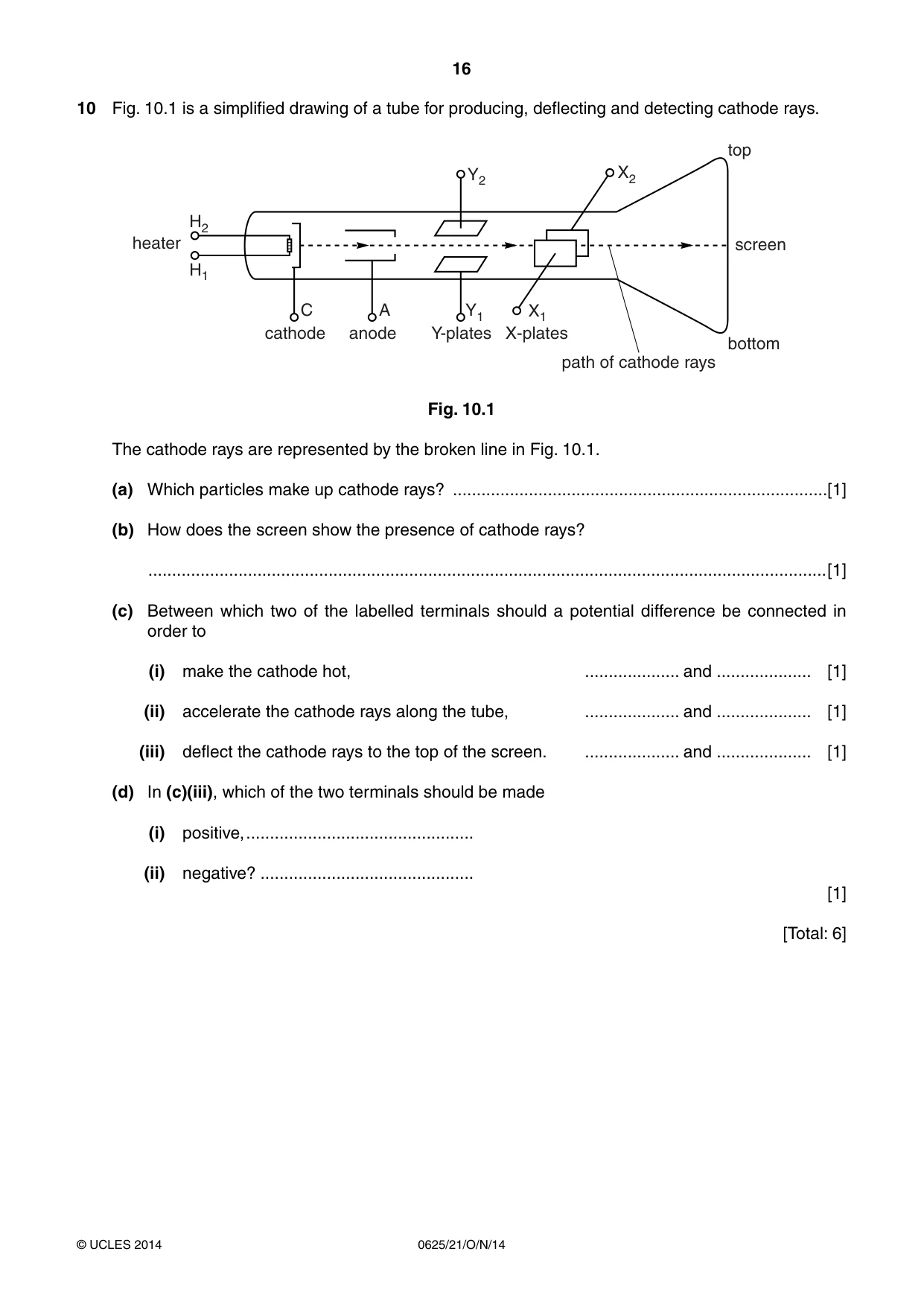
16 0625/21/O/N/14 © UCLES 2014 10 Fig. 10.1 is a simplified drawing of a tube for producing, deflecting and detecting cathode rays. H2 H1 heater cathode anode C A Y1 Y2 X1 X2 path of cathode rays bottom top screen Y-plates X-plates Fig. 10.1 The cathode rays are represented by the broken line in Fig. 10.1. (a) Which particles make up cathode rays? …[1] (b) How does the screen show the presence of cathode rays? …[1] (c) Between which two of the labelled terminals should a potential difference be connected in order to (i) make the cathode hot, … and … [1] (ii) accelerate the cathode rays along the tube, … and … [1] (iii) deflect the cathode rays to the top of the screen. … and … [1] (d) In (c)(iii), which of the two terminals should be made (i) positive, … (ii) negative? … [1] [Total: 6]
Question paper, page 17
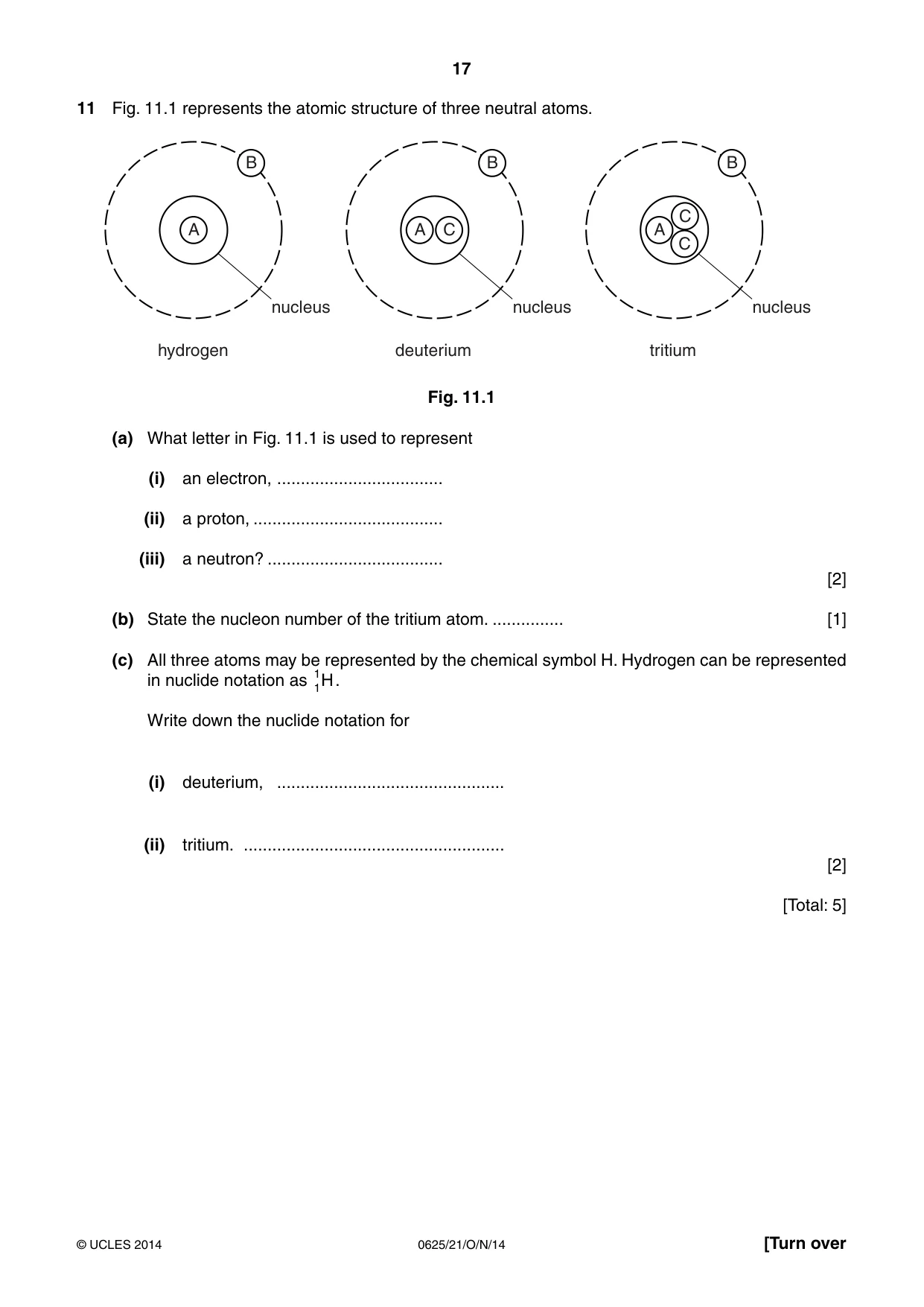
17 0625/21/O/N/14 © UCLES 2014 [Turn over 11 Fig. 11.1 represents the atomic structure of three neutral atoms. A C A B hydrogen deuterium nucleus B nucleus C C A tritium B nucleus Fig. 11.1 (a) What letter in Fig. 11.1 is used to represent (i) an electron, … (ii) a proton, … (iii) a neutron? … [2] (b) State the nucleon number of the tritium atom. … [1] (c) All three atoms may be represented by the chemical symbol H. Hydrogen can be represented in nuclide notation as H 1 1 . Write down the nuclide notation for (i) deuterium, … (ii) tritium. … [2] [Total: 5]
Question paper, page 18
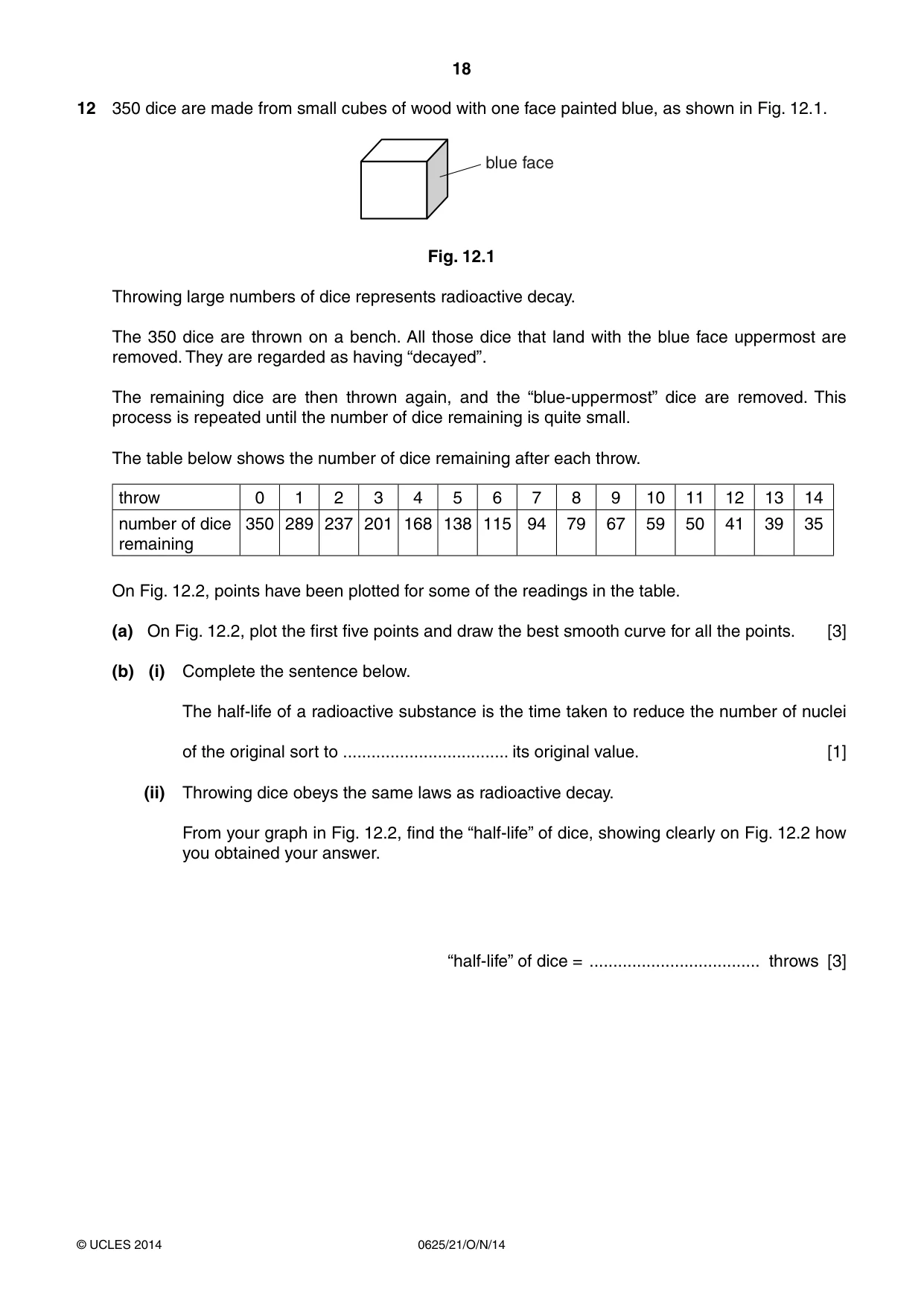
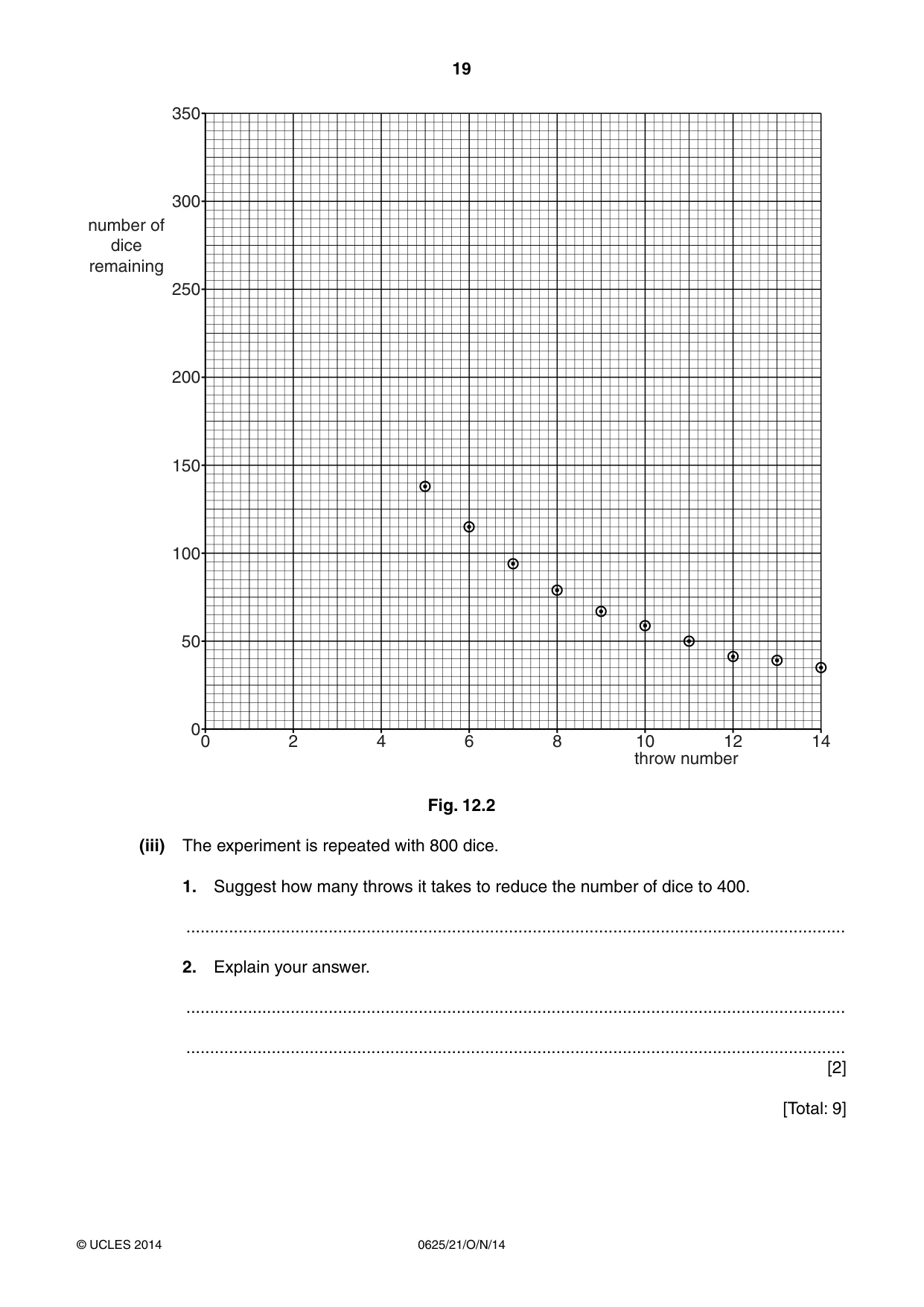
18 0625/21/O/N/14 © UCLES 2014 12 350 dice are made from small cubes of wood with one face painted blue, as shown in Fig. 12.1. blue face Fig. 12.1 Throwing large numbers of dice represents radioactive decay. The 350 dice are thrown on a bench. All those dice that land with the blue face uppermost are removed. They are regarded as having “decayed”. The remaining dice are then thrown again, and the “blue-uppermost” dice are removed. This process is repeated until the number of dice remaining is quite small. The table below shows the number of dice remaining after each throw. throw 0 1 2 3 4 5 6 7 8 9 10 11 12 13 14 number of dice remaining 350 289 237 201 168 138 115 94 79 67 59 50 41 39 35 On Fig. 12.2, points have been plotted for some of the readings in the table. (a) On Fig. 12.2, plot the first five points and draw the best smooth curve for all the points. [3] (b) (i) Complete the sentence below. The half-life of a radioactive substance is the time taken to reduce the number of nuclei of the original sort to … its original value. [1] (ii) Throwing dice obeys the same laws as radioactive decay. From your graph in Fig. 12.2, find the “half-life” of dice, showing clearly on Fig. 12.2 how you obtained your answer. “half-life” of dice = … throws [3]
Question paper, page 19
19 0625/21/O/N/14 © UCLES 2014 0 0 50 100 150 200 250 300 350 2 4 6 8 10 12 throw number number of dice remaining 14 Fig. 12.2 (iii) The experiment is repeated with 800 dice. 1. Suggest how many throws it takes to reduce the number of dice to 400. … 2. Explain your answer. … … [2] [Total: 9]
Question paper, page 20
20 0625/21/O/N/14 © UCLES 2014 Permission to reproduce items where third-party owned material protected by copyright is included has been sought and cleared where possible. Every reasonable effort has been made by the publisher (UCLES) to trace copyright holders, but if any items requiring clearance have unwittingly been included, the publisher will be pleased to make amends at the earliest possible opportunity. Cambridge International Examinations is part of the Cambridge Assessment Group. Cambridge Assessment is the brand name of University of Cambridge Local Examinations Syndicate (UCLES), which is itself a department of the University of Cambridge. BLANK PAGE
Mark scheme, page 1
® IGCSE is the registered trademark of Cambridge International Examinations. CAMBRIDGE INTERNATIONAL EXAMINATIONS Cambridge International General Certificate of Secondary Education MARK SCHEME for the October/November 2014 series 0625 PHYSICS 0625/21 Paper 2 (Core Theory), maximum raw mark 80 This mark scheme is published as an aid to teachers and candidates, to indicate the requirements of the examination. It shows the basis on which Examiners were instructed to award marks. It does not indicate the details of the discussions that took place at an Examiners’ meeting before marking began, which would have considered the acceptability of alternative answers. Mark schemes should be read in conjunction with the question paper and the Principal Examiner Report for Teachers. Cambridge will not enter into discussions about these mark schemes. Cambridge is publishing the mark schemes for the October/November 2014 series for most Cambridge IGCSE®, Cambridge International A and AS Level components and some Cambridge O Level components.
Mark scheme, page 2
Page 2 Mark Scheme Syllabus Paper Cambridge IGCSE – October/November 2014 0625 21 © Cambridge International Examinations 2014 NOTES ABOUT MARK SCHEME SYMBOLS AND OTHER MATTERS B marks B marks are independent marks, which do not depend on other marks. For a B mark to be scored, the point to which it refers must be seen specifically in the candidate’s answer. M marks M marks are method marks upon which accuracy marks (A marks) later depend. For an M mark to be scored, the point to which it refers must be seen in a candidate's answer. If a candidate fails to score a particular M mark, then none of the dependent A marks can be scored. C marks C marks are compensatory marks in general applicable to numerical questions. These can be scored even if the point to which they refer are not written down by the candidate, provided subsequent working gives evidence that they must have known it. For example, if an equation carries a C mark and the candidate does not write down the actual equation but does correct substitution or working which shows he knew the equation, then the C mark is scored. A C mark is not awarded if a candidate makes two points which contradict each other. Points which are wrong but irrelevant are ignored. A marks A marks are accuracy or answer marks which either depend on an M mark, or which are one of the ways which allow a C mark to be scored. A marks are commonly awarded for final answers to numerical questions. If a final numerical answer, eligible for A marks, is correct, with the correct unit and an acceptable number of significant figures, all the marks for that question are normally awarded. It is very occasionally possible to arrive at a correct answer by an entirely wrong approach. In these rare circumstances, do not award the A mark, but award C marks on their merits. An A mark following an M mark is a dependent mark. Brackets ( ) Brackets around words or units in the mark scheme are intended to indicate wording used to clarify the mark scheme, but the marks do not depend on seeing the words or units in brackets, e.g. 10 (J) means that the mark is scored for 10, regardless of the unit given. Underlining Underlining indicates that this must be seen in the answer offered, or something very similar. OR / or This indicates alternative answers, any one of which is satisfactory for scoring the marks. e.e.o.o. This means "each error or omission". o.w.t.t.e. This means “or words to that effect”. Ignore This indicates that something which is not correct or irrelevant is to be disregarded and does not cause a right plus wrong penalty. Spelling Be generous about spelling and use of English. If an answer can be understood to mean what we want, give credit. However, do not allow ambiguities, e.g. spelling which suggests confusion between reflection / refraction / diffraction or thermistor / transistor / transformer. Not / NOT This indicates that an incorrect answer is not to be disregarded, but cancels another otherwise correct alternative offered by the candidate, i.e. right plus wrong penalty applies.
Mark scheme, page 3
Page 3 Mark Scheme Syllabus Paper Cambridge IGCSE – October/November 2014 0625 21 © Cambridge International Examinations 2014 ecf meaning "error carried forward" is mainly applicable to numerical questions, but may in particular circumstances be applied in non-numerical questions. This indicates that if a candidate has made an earlier mistake and has carried an incorrect value forward to subsequent stages of working, marks indicated by ecf may be awarded, provided the subsequent working is correct, bearing in mind the earlier mistake. This prevents a candidate from being penalised more than once for a particular mistake, but only applies to marks annotated ecf. Sig. figs. Answers are normally acceptable to any number of significant figures ≥ 2. Any exceptions to this general rule will be specified in the mark scheme. Arithmetic errors Deduct one mark if the only error in arriving at a final answer is clearly an arithmetic one. Regard a power-of-ten error as an arithmetic error. Transcription errors Deduct one mark if the only error in arriving at a final answer is because previously calculated data has clearly been misread but used correctly. Fractions Allow fractions only where specified in the mark scheme.
Mark scheme, page 4
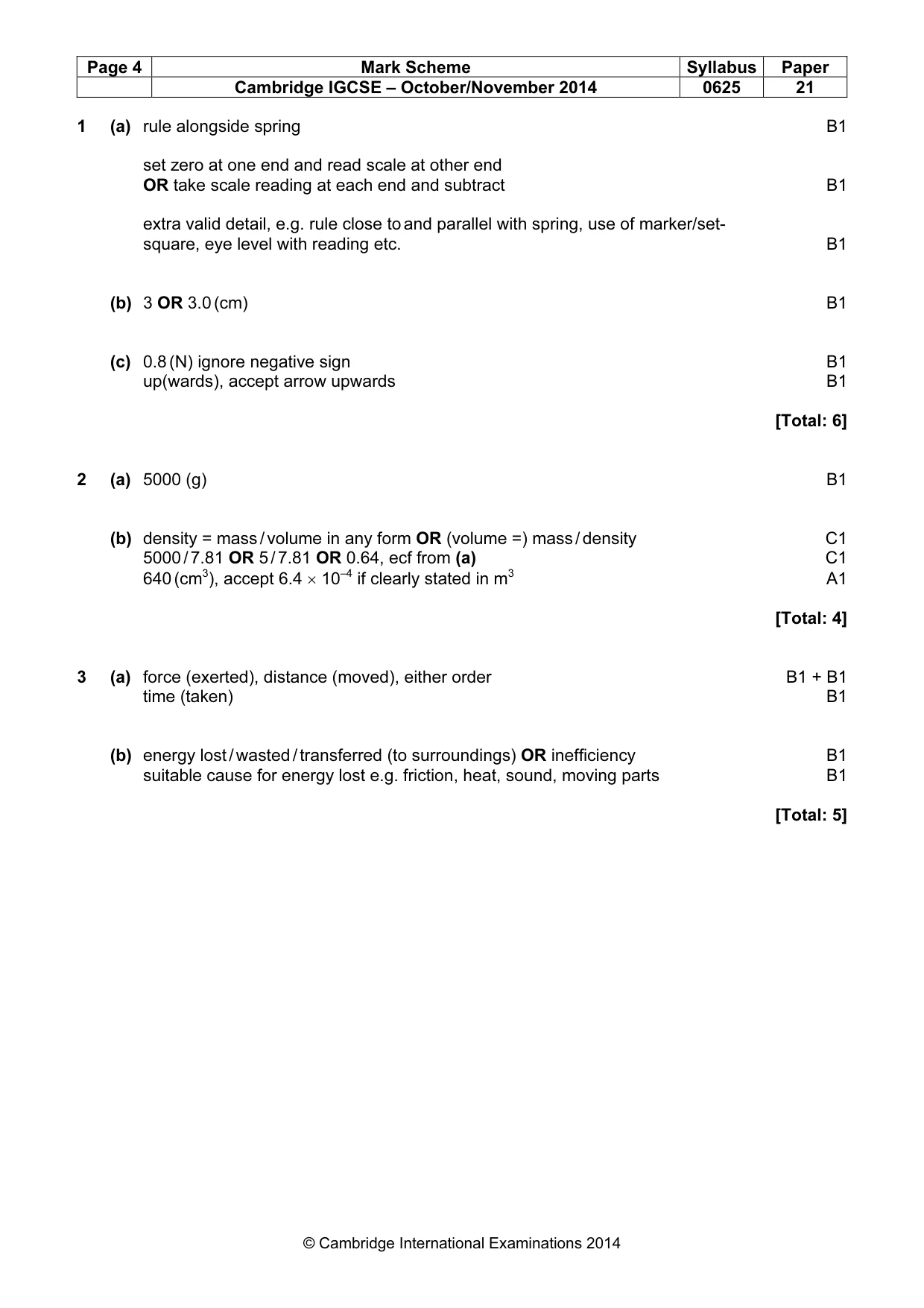
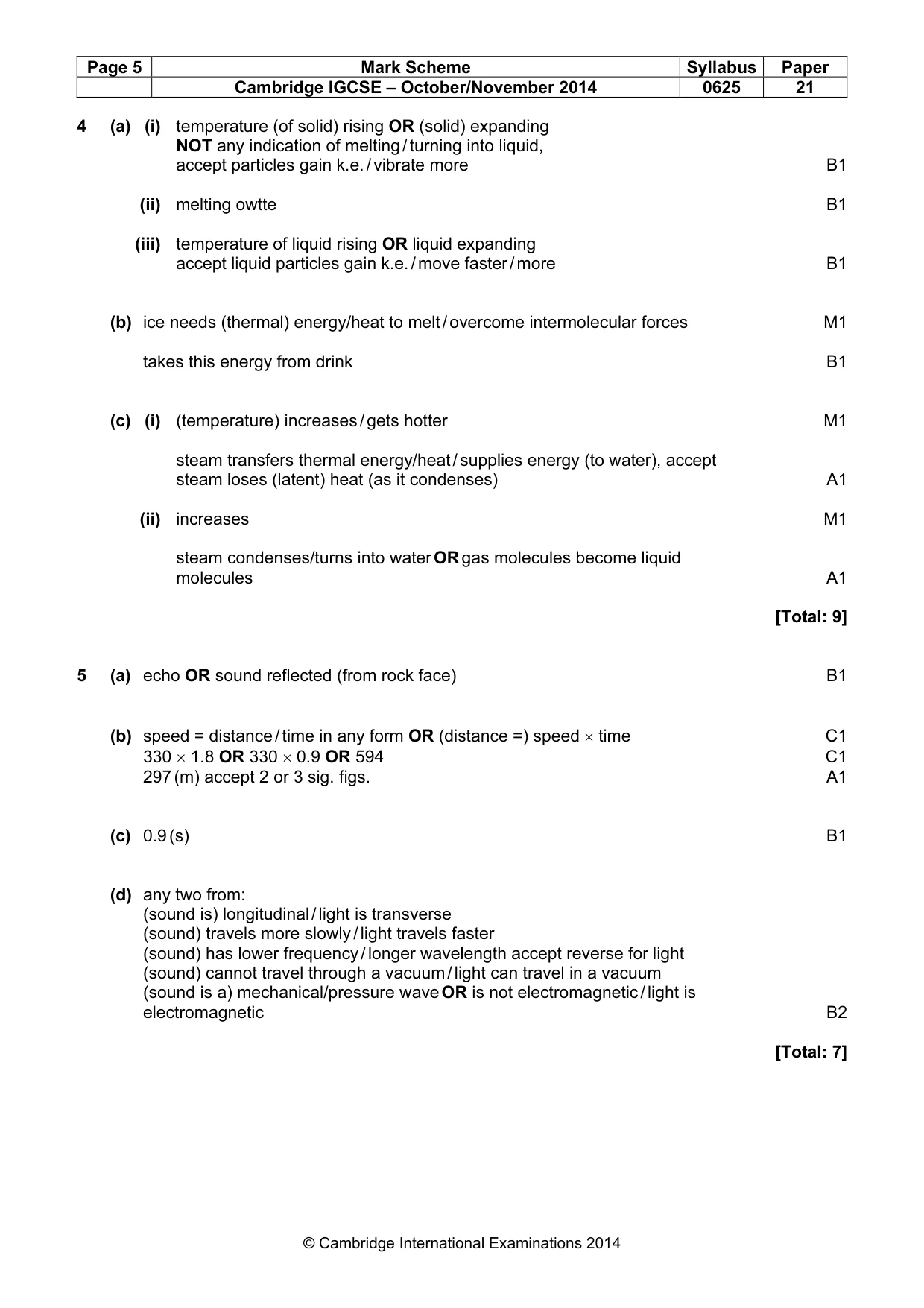
Page 4 Mark Scheme Syllabus Paper Cambridge IGCSE – October/November 2014 0625 21 © Cambridge International Examinations 2014 1 (a) rule alongside spring B1 set zero at one end and read scale at other end OR take scale reading at each end and subtract B1 extra valid detail, e.g. rule close to and parallel with spring, use of marker/set- square, eye level with reading etc. B1 (b) 3 OR 3.0 (cm) B1 (c) 0.8 (N) ignore negative sign B1 up(wards), accept arrow upwards B1 [Total: 6] 2 (a) 5000 (g) B1 (b) density = mass / volume in any form OR (volume =) mass / density C1 5000 / 7.81 OR 5 / 7.81 OR 0.64, ecf from (a) C1 640 (cm3), accept 6.4 × 10⁻⁴ if clearly stated in m3 A1 [Total: 4] 3 (a) force (exerted), distance (moved), either order B1 + B1 time (taken) B1 (b) energy lost / wasted / transferred (to surroundings) OR inefficiency B1 suitable cause for energy lost e.g. friction, heat, sound, moving parts B1 [Total: 5]
Mark scheme, page 5
Page 5 Mark Scheme Syllabus Paper Cambridge IGCSE – October/November 2014 0625 21 © Cambridge International Examinations 2014 4 (a) (i) temperature (of solid) rising OR (solid) expanding NOT any indication of melting / turning into liquid, accept particles gain k.e. / vibrate more B1 (ii) melting owtte B1 (iii) temperature of liquid rising OR liquid expanding accept liquid particles gain k.e. / move faster / more B1 (b) ice needs (thermal) energy/heat to melt / overcome intermolecular forces M1 takes this energy from drink B1 (c) (i) (temperature) increases / gets hotter M1 steam transfers thermal energy/heat / supplies energy (to water), accept steam loses (latent) heat (as it condenses) A1 (ii) increases M1 steam condenses/turns into water OR gas molecules become liquid molecules A1 [Total: 9] 5 (a) echo OR sound reflected (from rock face) B1 (b) speed = distance / time in any form OR (distance =) speed × time C1 330 × 1.8 OR 330 × 0.9 OR 594 C1 297 (m) accept 2 or 3 sig. figs. A1 (c) 0.9 (s) B1 (d) any two from: (sound is) longitudinal / light is transverse (sound) travels more slowly / light travels faster (sound) has lower frequency / longer wavelength accept reverse for light (sound) cannot travel through a vacuum / light can travel in a vacuum (sound is a) mechanical/pressure wave OR is not electromagnetic / light is electromagnetic B2 [Total: 7]
Mark scheme, page 6
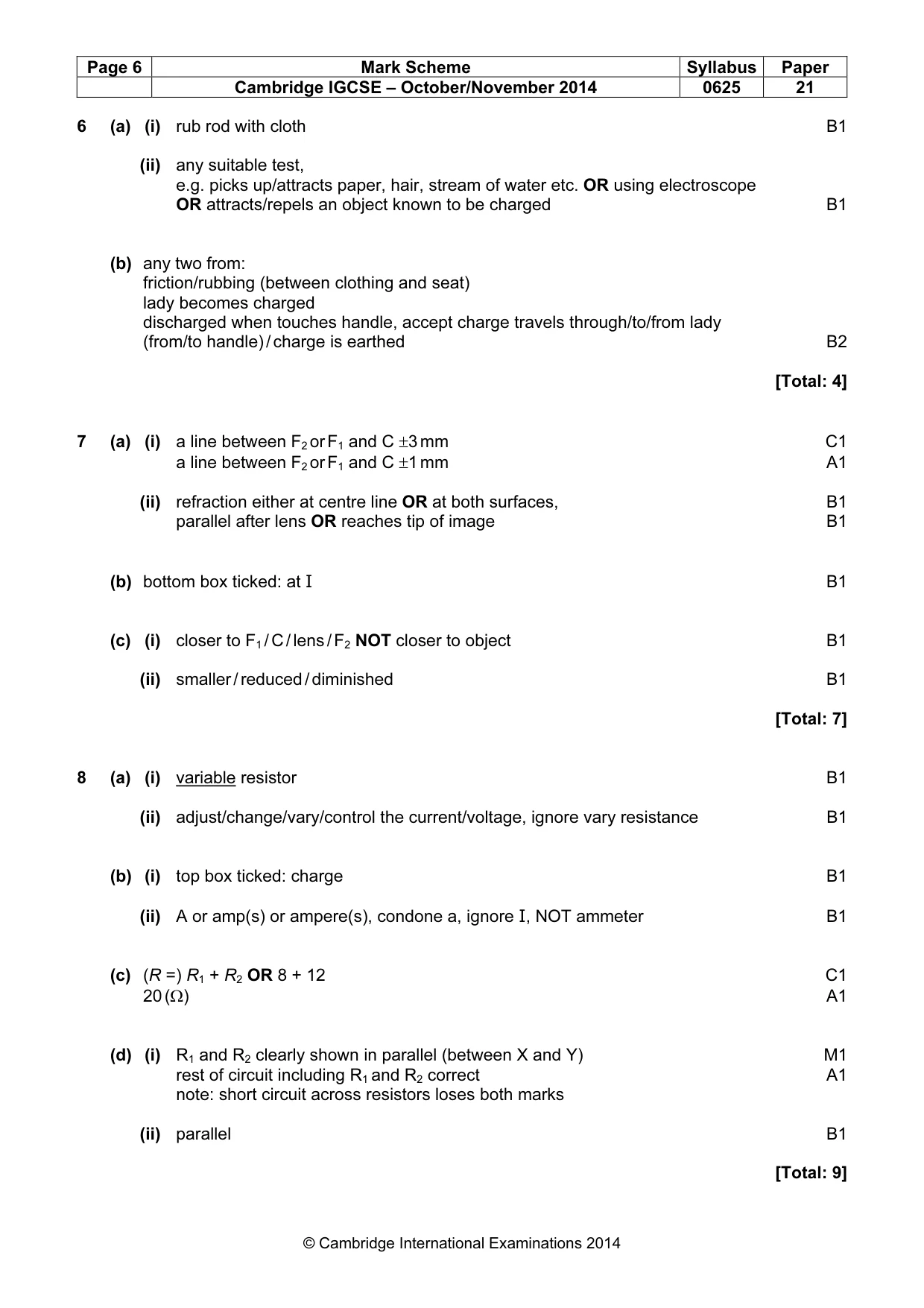
Page 6 Mark Scheme Syllabus Paper Cambridge IGCSE – October/November 2014 0625 21 © Cambridge International Examinations 2014 6 (a) (i) rub rod with cloth B1 (ii) any suitable test, e.g. picks up/attracts paper, hair, stream of water etc. OR using electroscope OR attracts/repels an object known to be charged B1 (b) any two from: friction/rubbing (between clothing and seat) lady becomes charged discharged when touches handle, accept charge travels through/to/from lady (from/to handle) / charge is earthed B2 [Total: 4] 7 (a) (i) a line between F2 or F1 and C ±3 mm C1 a line between F2 or F1 and C ±1 mm A1 (ii) refraction either at centre line OR at both surfaces, B1 parallel after lens OR reaches tip of image B1 (b) bottom box ticked: at I B1 (c) (i) closer to F1 / C / lens / F2 NOT closer to object B1 (ii) smaller / reduced / diminished B1 [Total: 7] 8 (a) (i) variable resistor B1 (ii) adjust/change/vary/control the current/voltage, ignore vary resistance B1 (b) (i) top box ticked: charge B1 (ii) A or amp(s) or ampere(s), condone a, ignore I, NOT ammeter B1 (c) (R =) R1 + R2 OR 8 + 12 C1 20 (Ω) A1 (d) (i) R1 and R2 clearly shown in parallel (between X and Y) M1 rest of circuit including R1 and R2 correct A1 note: short circuit across resistors loses both marks (ii) parallel B1 [Total: 9]
Mark scheme, page 7
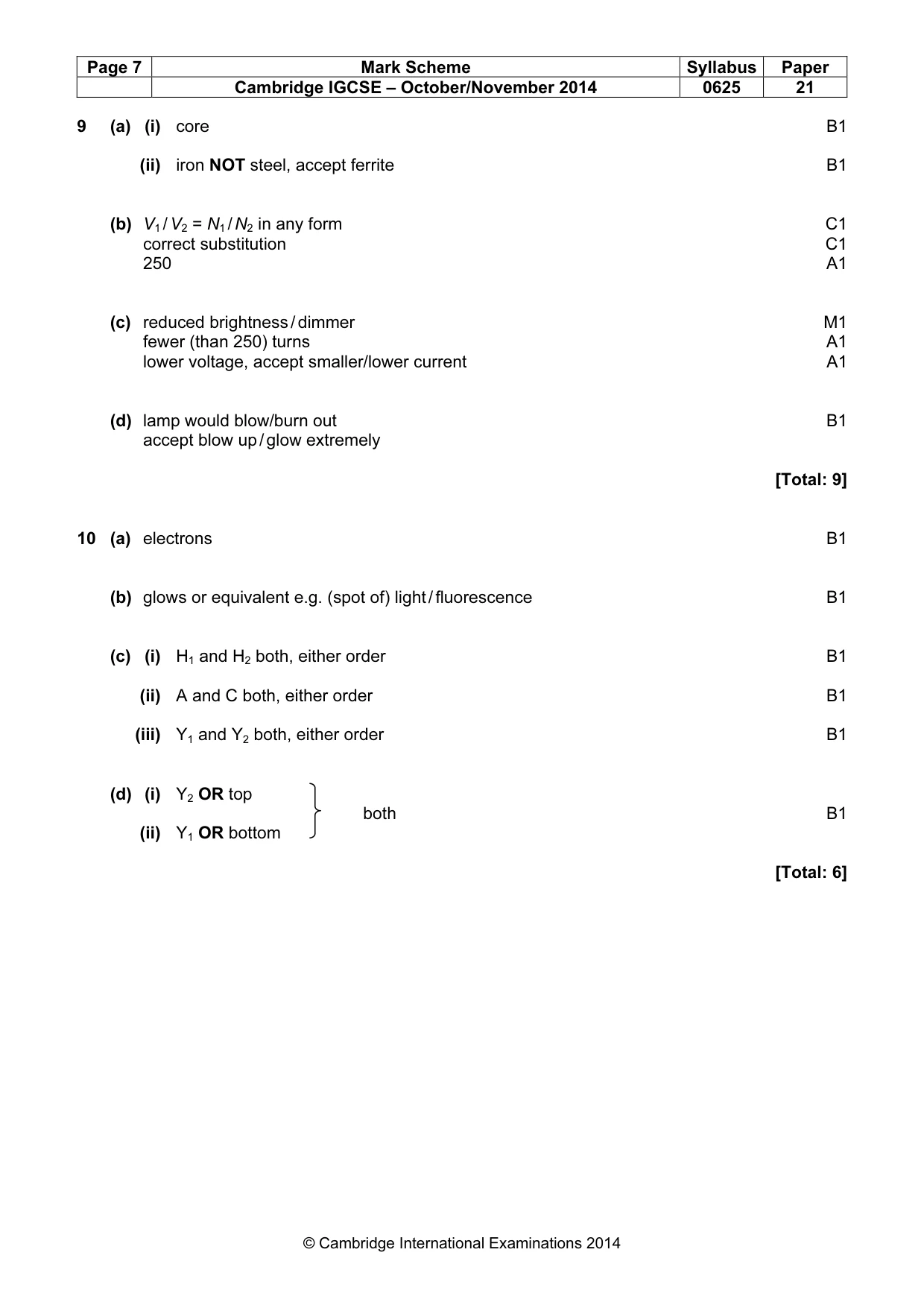
Page 7 Mark Scheme Syllabus Paper Cambridge IGCSE – October/November 2014 0625 21 © Cambridge International Examinations 2014 9 (a) (i) core B1 (ii) iron NOT steel, accept ferrite B1 (b) V1 / V2 = N1 / N2 in any form C1 correct substitution C1 250 A1 (c) reduced brightness / dimmer M1 fewer (than 250) turns A1 lower voltage, accept smaller/lower current A1 (d) lamp would blow/burn out B1 accept blow up / glow extremely [Total: 9] 10 (a) electrons B1 (b) glows or equivalent e.g. (spot of) light / fluorescence B1 (c) (i) H1 and H2 both, either order B1 (ii) A and C both, either order B1 (iii) Y1 and Y2 both, either order B1 (d) (i) Y2 OR top both B1 (ii) Y1 OR bottom [Total: 6]
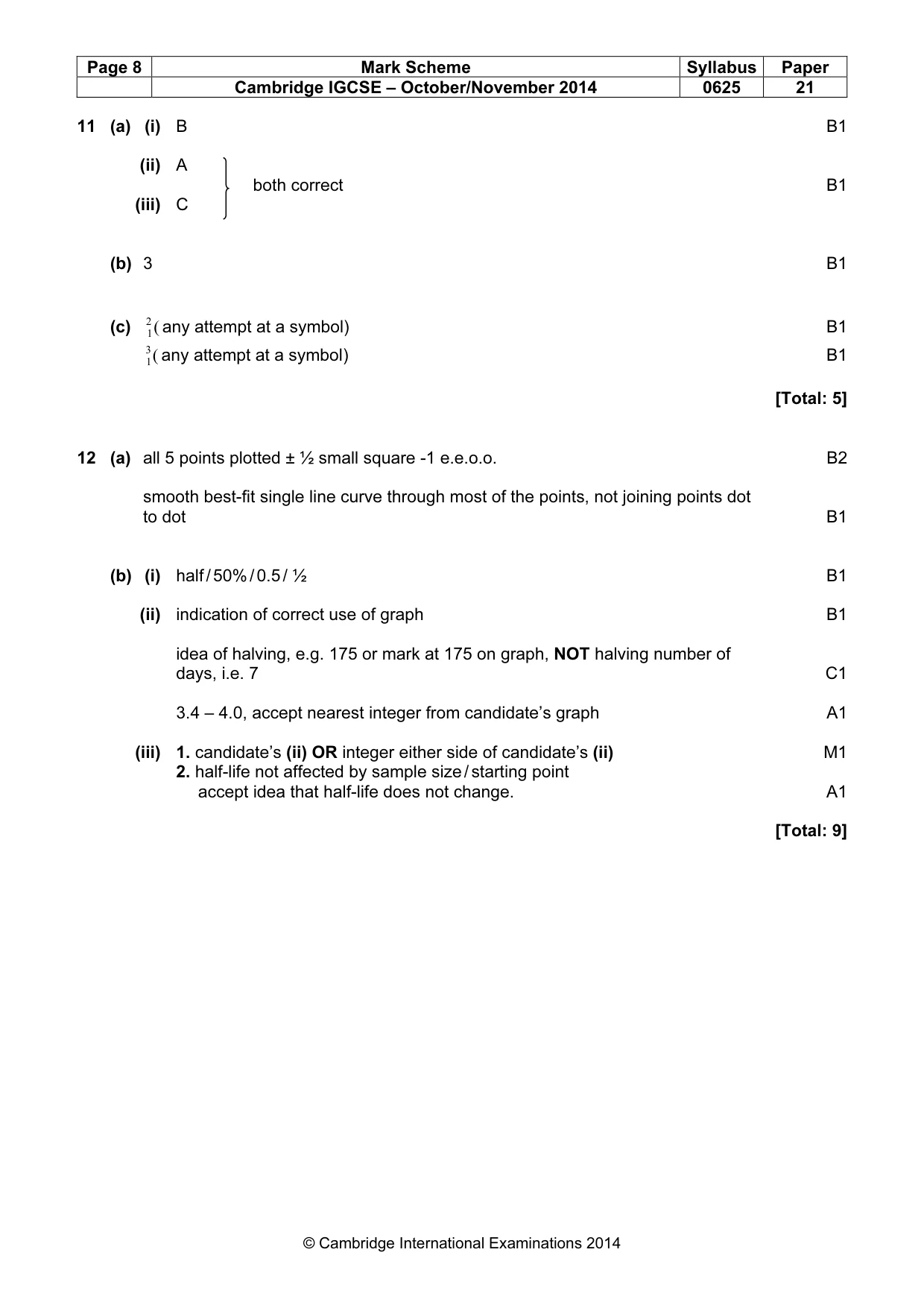
Mark scheme, page 8
Page 8 Mark Scheme Syllabus Paper Cambridge IGCSE – October/November 2014 0625 21 © Cambridge International Examinations 2014 11 (a) (i) B B1 (ii) A both correct B1 (iii) C (b) 3 B1 (c) ( 2 1 any attempt at a symbol) B1 ( 3 1 any attempt at a symbol) B1 [Total: 5] 12 (a) all 5 points plotted ± ½ small square -1 e.e.o.o. B2 smooth best-fit single line curve through most of the points, not joining points dot to dot B1 (b) (i) half / 50% / 0.5 / ½ B1 (ii) indication of correct use of graph B1 idea of halving, e.g. 175 or mark at 175 on graph, NOT halving number of days, i.e. 7 C1 3.4 – 4.0, accept nearest integer from candidate’s graph A1 (iii) 1. candidate’s (ii) OR integer either side of candidate’s (ii) M1 2. half-life not affected by sample size / starting point accept idea that half-life does not change. A1 [Total: 9]
What you needed in this session
Cambridge’s own grade thresholds for 2014 Oct/Nov, Paper 2 · Variant 1. A higher threshold means an easier paper — the bar moves with how the cohort did.