Cambridge IGCSE Physics 0625 — 2011 Oct/Nov Paper 1 · Variant 3
0625/13/O/N/11 · 40 marks · ≈45 min
The question paper and its mark scheme, free to read here and free to download. This is Cambridge’s own paper, exactly as it was sat.
Question paper24 pages

Mark scheme2 pages
Answers below. Sit the paper first if you are practising.
Paper as text
Question paper, page 1
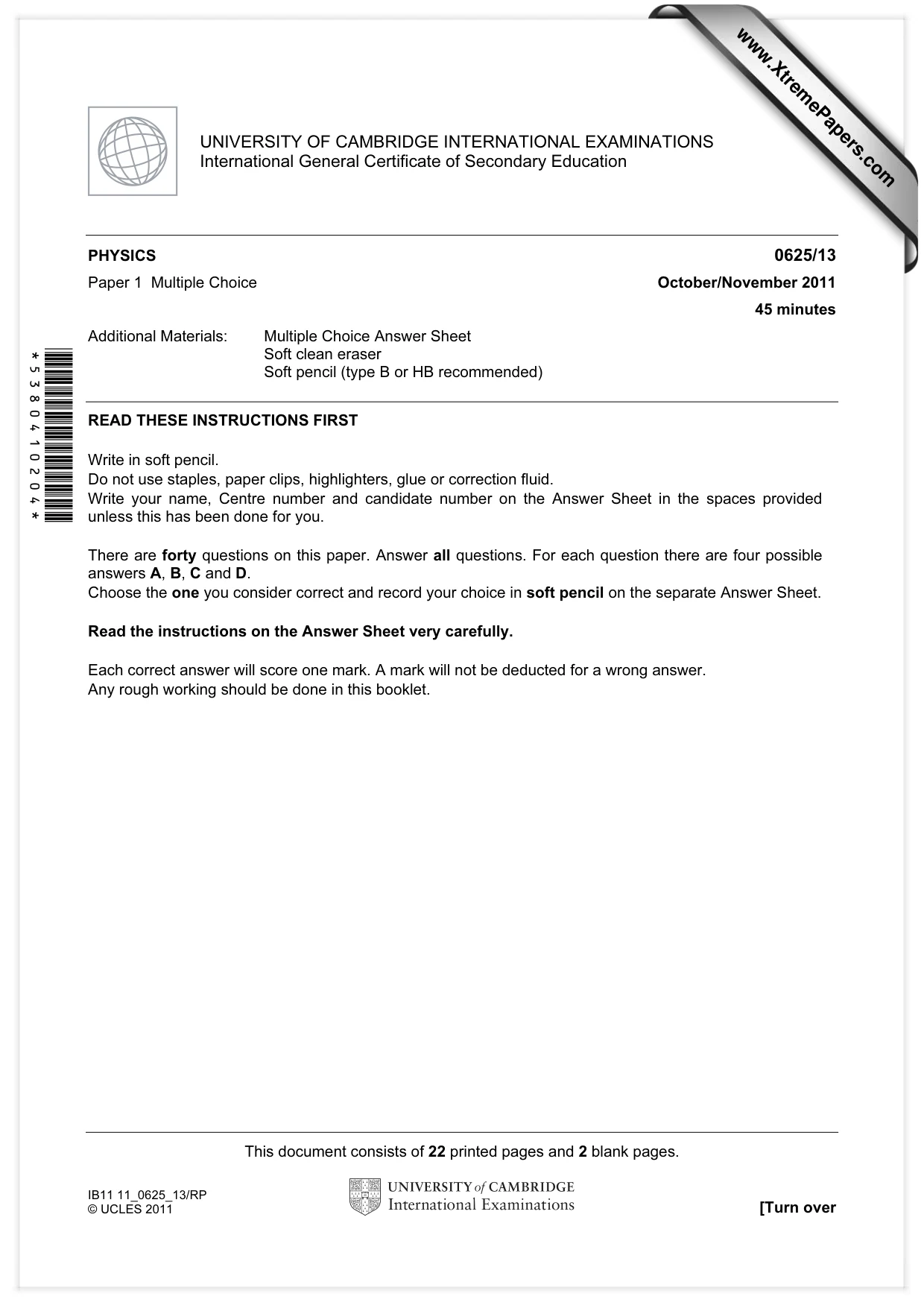
This document consists of 22 printed pages and 2 blank pages. IB11 11_0625_13/RP © UCLES 2011 [Turn over *5380410204* UNIVERSITY OF CAMBRIDGE INTERNATIONAL EXAMINATIONS International General Certificate of Secondary Education PHYSICS 0625/13 Paper 1 Multiple Choice October/November 2011 45 minutes Additional Materials: Multiple Choice Answer Sheet Soft clean eraser Soft pencil (type B or HB recommended) READ THESE INSTRUCTIONS FIRST Write in soft pencil. Do not use staples, paper clips, highlighters, glue or correction fluid. Write your name, Centre number and candidate number on the Answer Sheet in the spaces provided unless this has been done for you. There are forty questions on this paper. Answer all questions. For each question there are four possible answers A, B, C and D. Choose the one you consider correct and record your choice in soft pencil on the separate Answer Sheet. Read the instructions on the Answer Sheet very carefully. Each correct answer will score one mark. A mark will not be deducted for a wrong answer. Any rough working should be done in this booklet. www.XtremePapers.com
Question paper, page 2
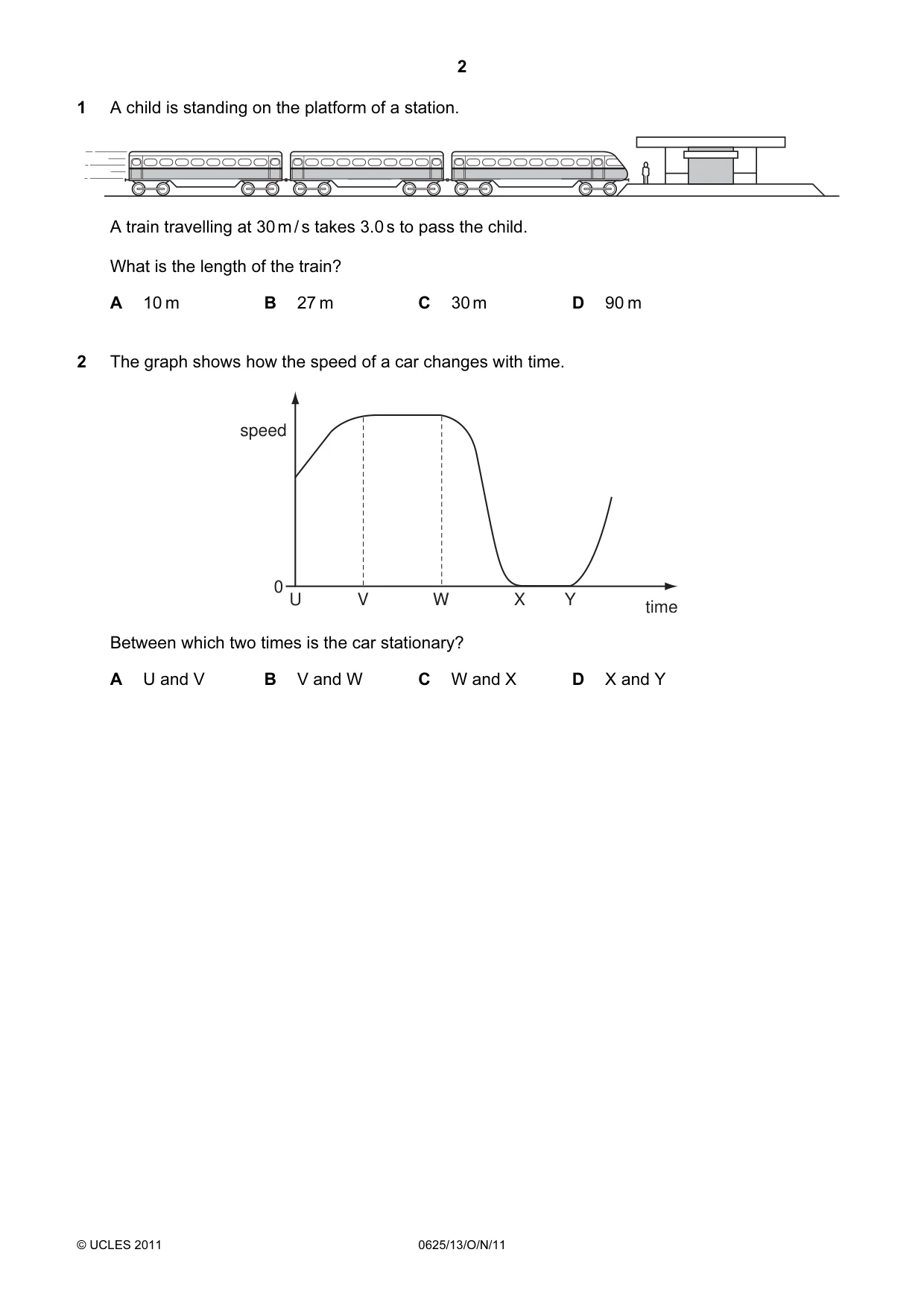
2 © UCLES 2011 0625/13/O/N/11 1 A child is standing on the platform of a station. A train travelling at 30 m / s takes 3.0 s to pass the child. What is the length of the train? A 10 m B 27 m C 30 m D 90 m 2 The graph shows how the speed of a car changes with time. speed U V W X Y time 0 Between which two times is the car stationary? A U and V B V and W C W and X D X and Y
Question paper, page 3
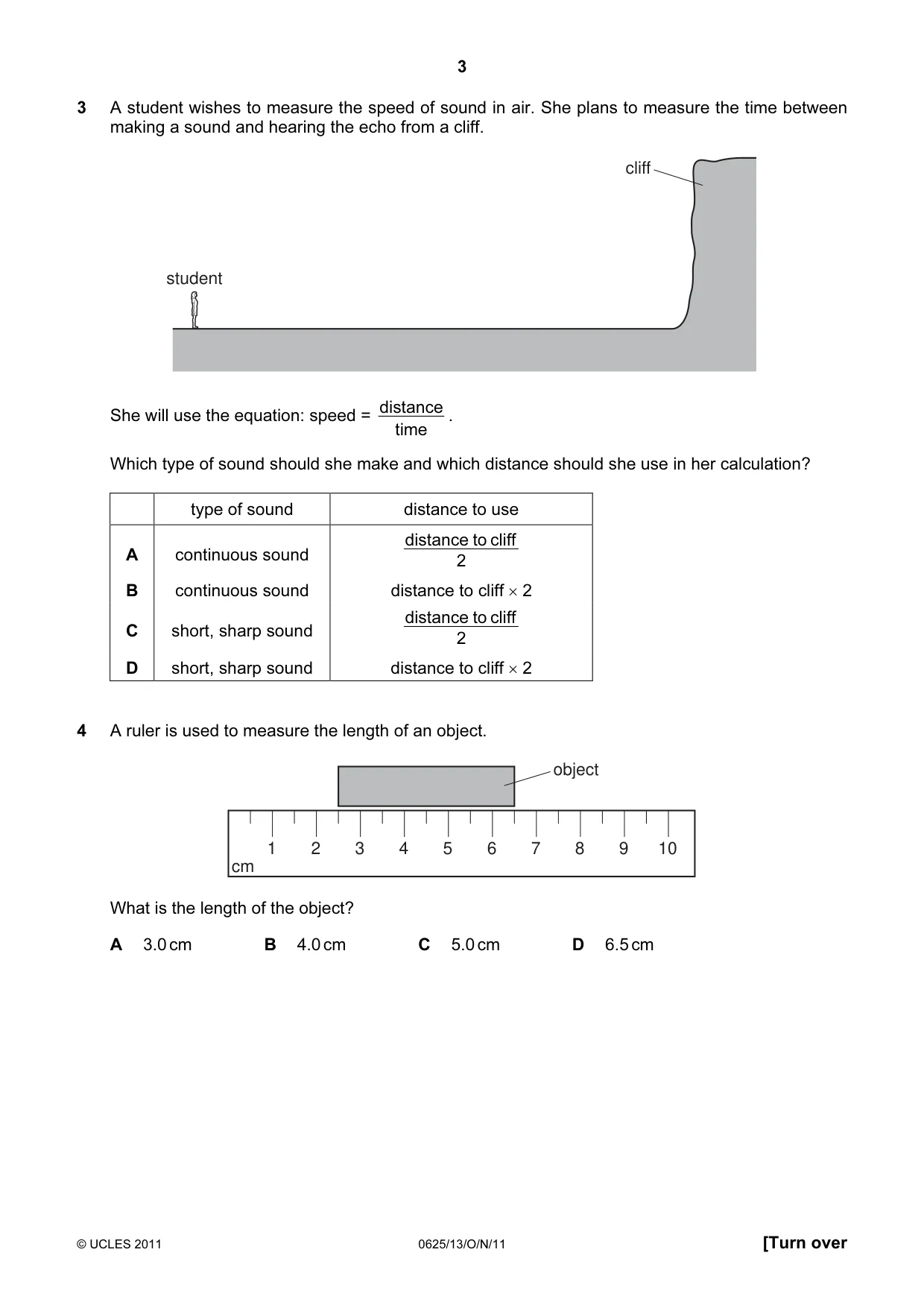
3 © UCLES 2011 0625/13/O/N/11 [Turn over 3 A student wishes to measure the speed of sound in air. She plans to measure the time between making a sound and hearing the echo from a cliff. student cliff She will use the equation: speed = time distance . Which type of sound should she make and which distance should she use in her calculation? type of sound distance to use A continuous sound 2 cliff to distance B continuous sound distance to cliff × 2 C short, sharp sound 2 cliff to distance D short, sharp sound distance to cliff × 2 4 A ruler is used to measure the length of an object. 1 2 3 4 5 6 7 8 9 10 cm object What is the length of the object? A 3.0 cm B 4.0 cm C 5.0 cm D 6.5 cm
Question paper, page 4
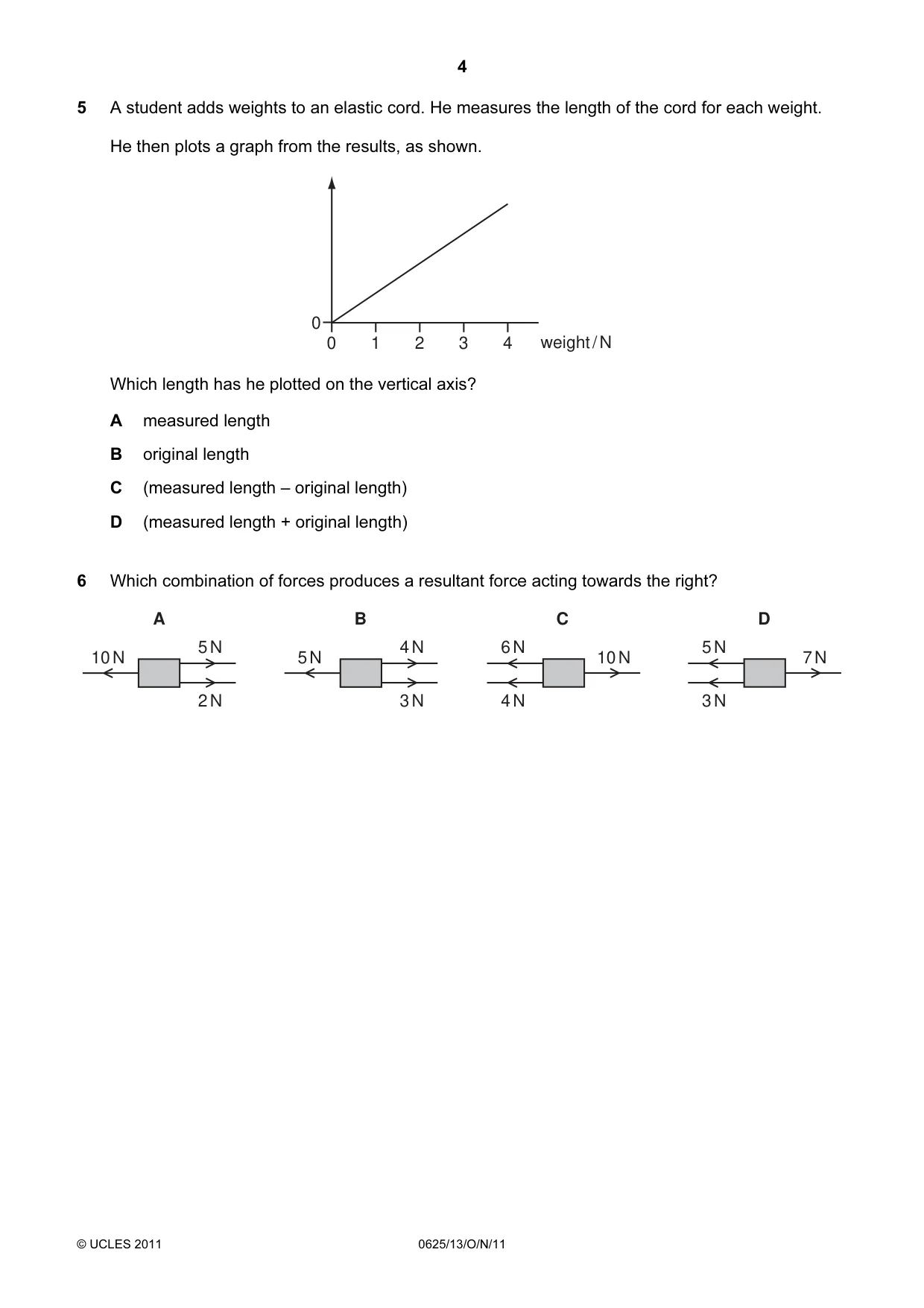
4 © UCLES 2011 0625/13/O/N/11 5 A student adds weights to an elastic cord. He measures the length of the cord for each weight. He then plots a graph from the results, as shown. 0 0 1 2 3 4 weight / N Which length has he plotted on the vertical axis? A measured length B original length C (measured length – original length) D (measured length + original length) 6 Which combination of forces produces a resultant force acting towards the right? A 10 N 5 N 2 N B 5 N 4 N 3 N C 7 N 5 N 3 N 10 N 6 N 4 N D
Question paper, page 5
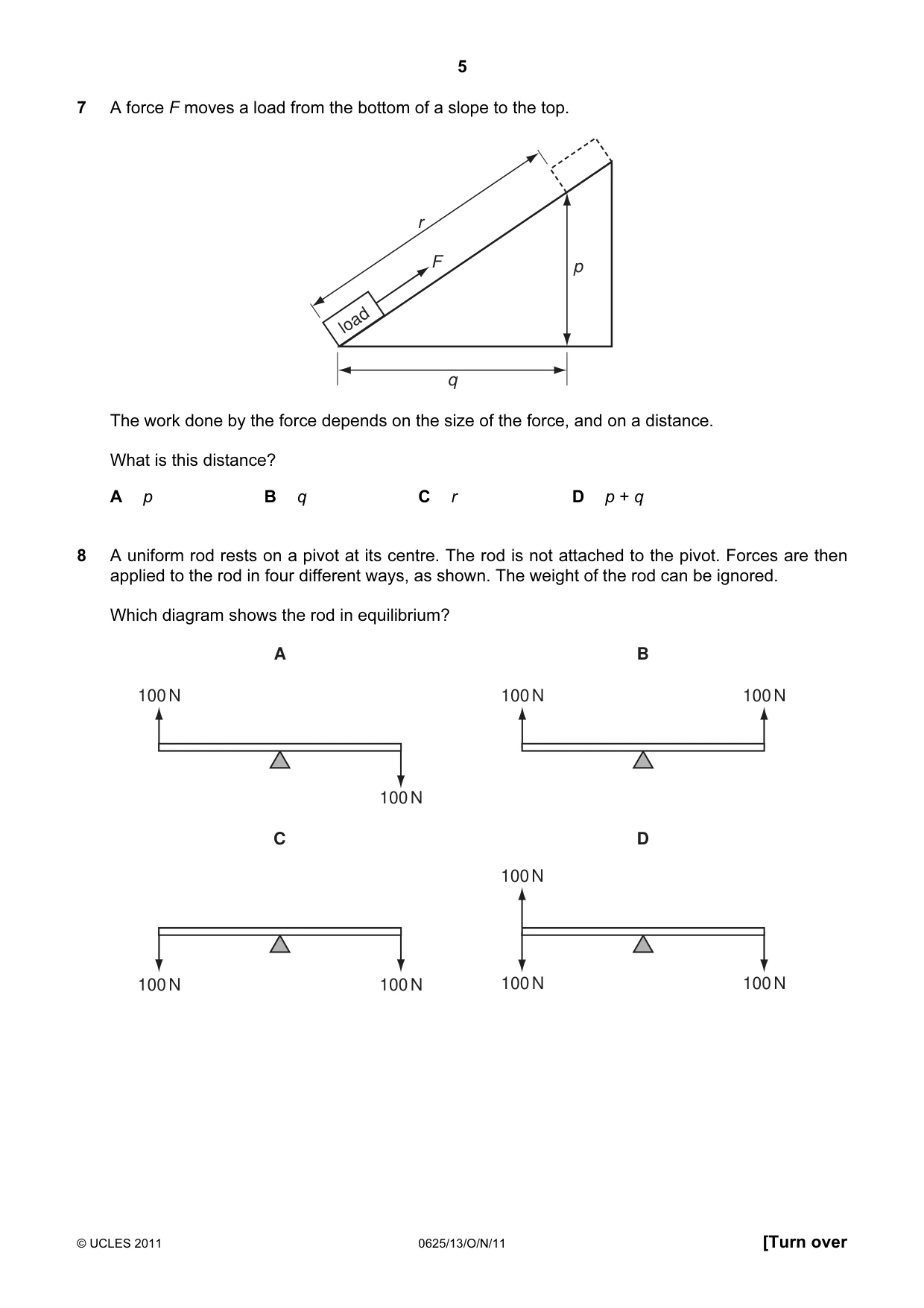
5 © UCLES 2011 0625/13/O/N/11 [Turn over 7 A force F moves a load from the bottom of a slope to the top. q r p F load The work done by the force depends on the size of the force, and on a distance. What is this distance? A p B q C r D p + q 8 A uniform rod rests on a pivot at its centre. The rod is not attached to the pivot. Forces are then applied to the rod in four different ways, as shown. The weight of the rod can be ignored. Which diagram shows the rod in equilibrium? A 100 N 100 N B 100 N 100 N C 100 N 100 N D 100 N 100 N 100 N
Question paper, page 6
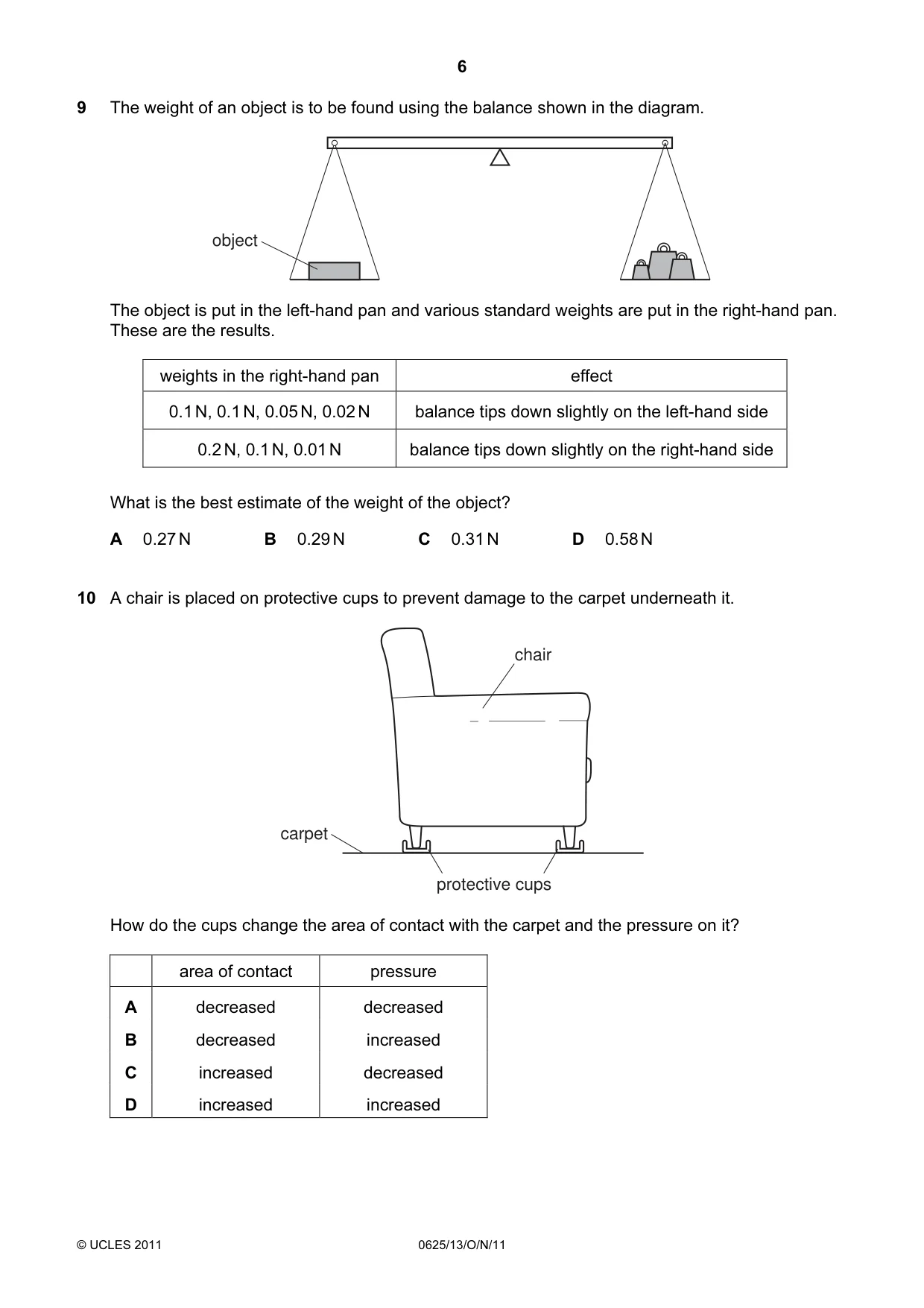
6 © UCLES 2011 0625/13/O/N/11 9 The weight of an object is to be found using the balance shown in the diagram. object The object is put in the left-hand pan and various standard weights are put in the right-hand pan. These are the results. weights in the right-hand pan effect 0.1 N, 0.1 N, 0.05 N, 0.02 N balance tips down slightly on the left-hand side 0.2 N, 0.1 N, 0.01 N balance tips down slightly on the right-hand side What is the best estimate of the weight of the object? A 0.27 N B 0.29 N C 0.31 N D 0.58 N 10 A chair is placed on protective cups to prevent damage to the carpet underneath it. chair carpet protective cups How do the cups change the area of contact with the carpet and the pressure on it? area of contact pressure A decreased decreased B decreased increased C increased decreased D increased increased
Question paper, page 7
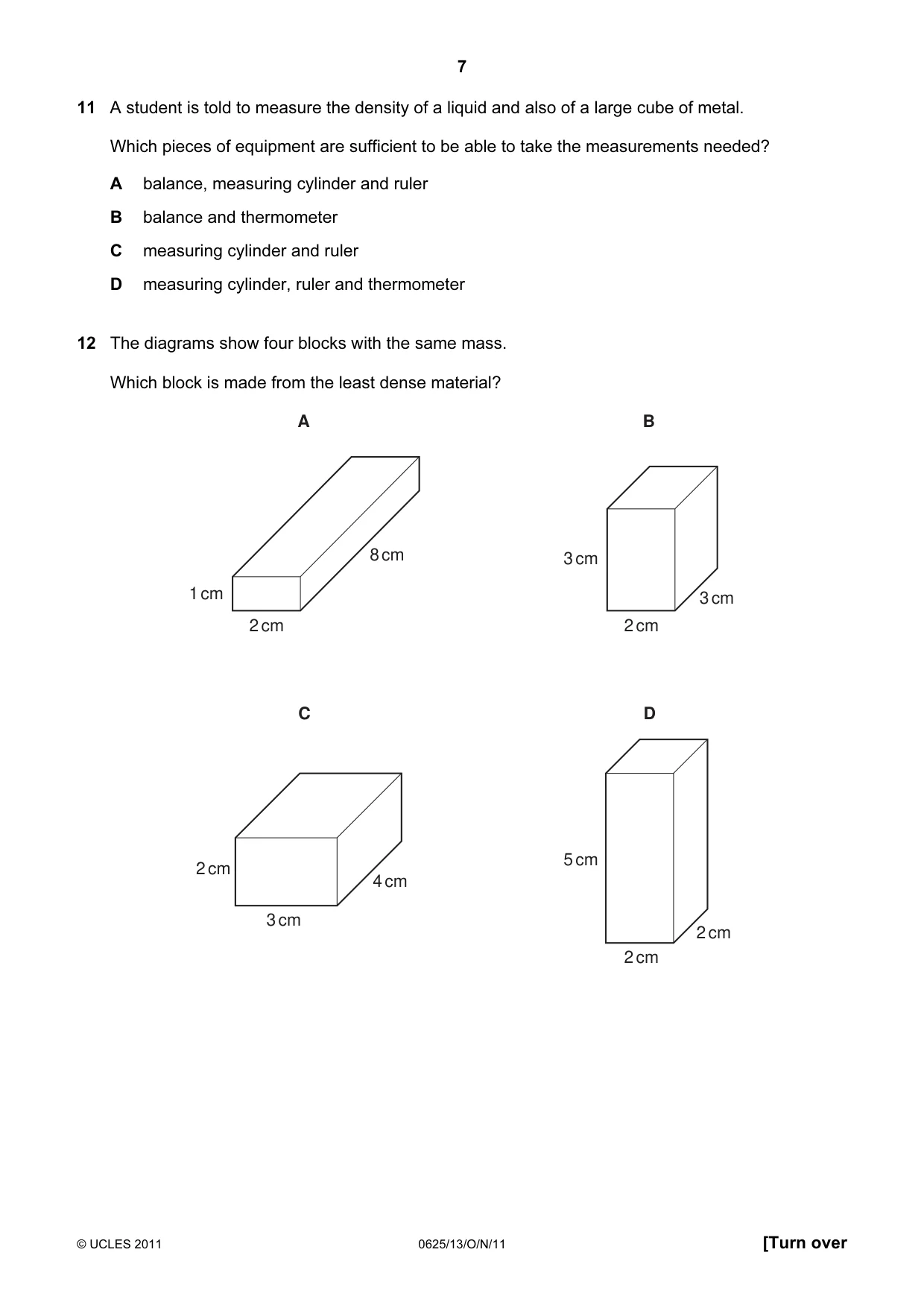
7 © UCLES 2011 0625/13/O/N/11 [Turn over 11 A student is told to measure the density of a liquid and also of a large cube of metal. Which pieces of equipment are sufficient to be able to take the measurements needed? A balance, measuring cylinder and ruler B balance and thermometer C measuring cylinder and ruler D measuring cylinder, ruler and thermometer 12 The diagrams show four blocks with the same mass. Which block is made from the least dense material? A B C D 2 cm 1 cm 8 cm 2 cm 3 cm 3 cm 3 cm 2 cm 4 cm 2 cm 5 cm 2 cm
Question paper, page 8
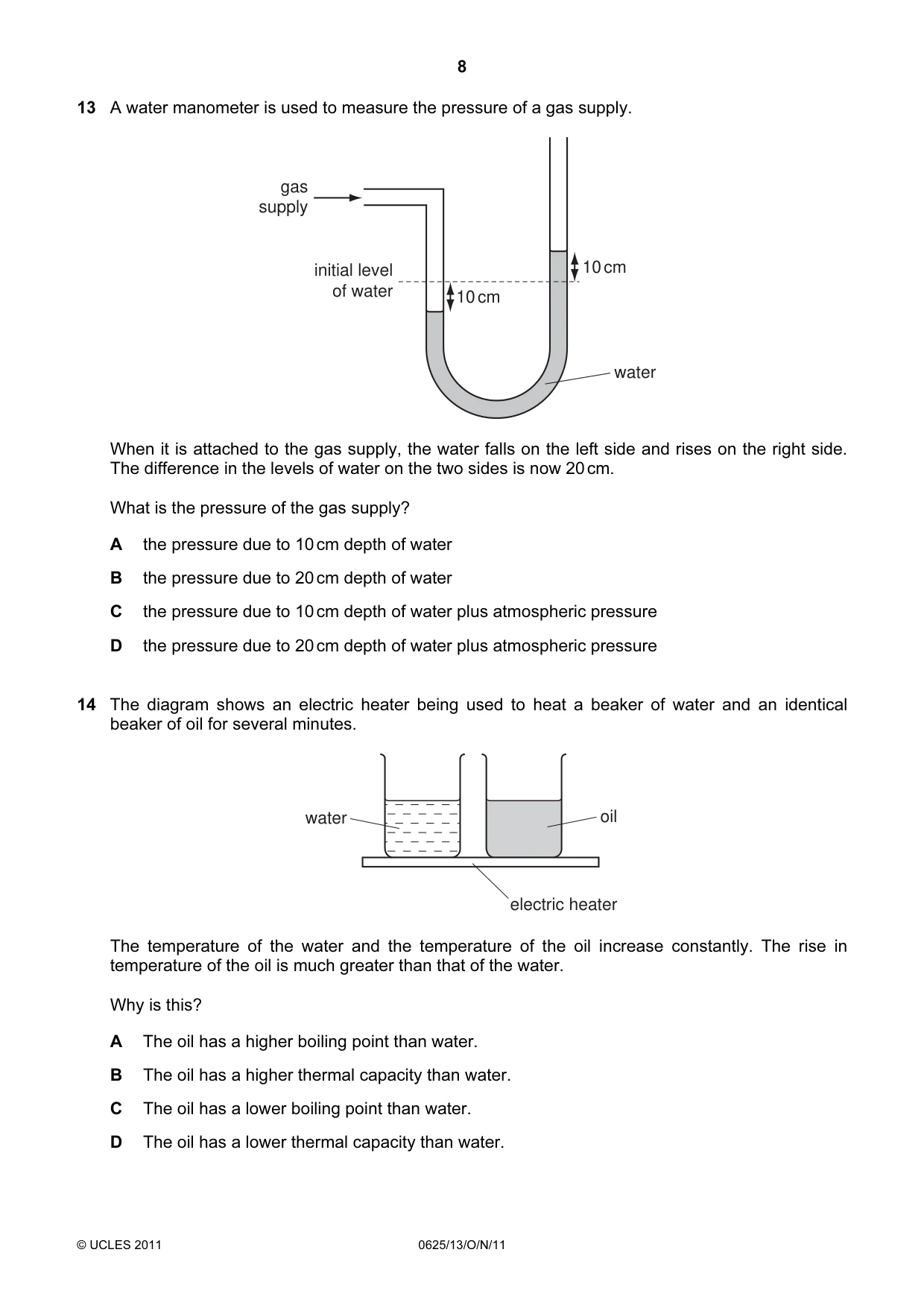
8 © UCLES 2011 0625/13/O/N/11 13 A water manometer is used to measure the pressure of a gas supply. initial level of water 10 cm 10 cm gas supply water When it is attached to the gas supply, the water falls on the left side and rises on the right side. The difference in the levels of water on the two sides is now 20 cm. What is the pressure of the gas supply? A the pressure due to 10 cm depth of water B the pressure due to 20 cm depth of water C the pressure due to 10 cm depth of water plus atmospheric pressure D the pressure due to 20 cm depth of water plus atmospheric pressure 14 The diagram shows an electric heater being used to heat a beaker of water and an identical beaker of oil for several minutes. water oil electric heater The temperature of the water and the temperature of the oil increase constantly. The rise in temperature of the oil is much greater than that of the water. Why is this? A The oil has a higher boiling point than water. B The oil has a higher thermal capacity than water. C The oil has a lower boiling point than water. D The oil has a lower thermal capacity than water.
Question paper, page 9
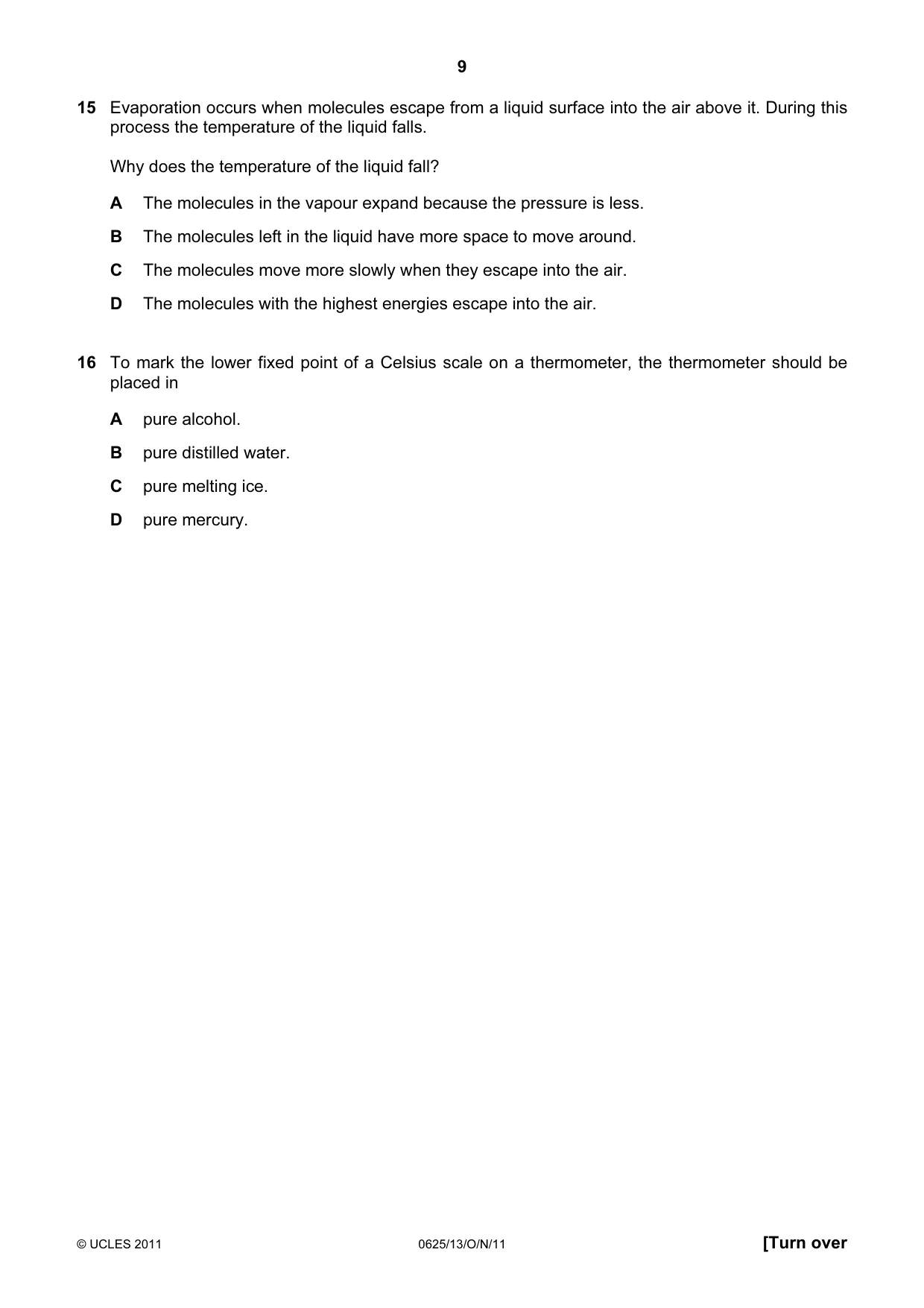
9 © UCLES 2011 0625/13/O/N/11 [Turn over 15 Evaporation occurs when molecules escape from a liquid surface into the air above it. During this process the temperature of the liquid falls. Why does the temperature of the liquid fall? A The molecules in the vapour expand because the pressure is less. B The molecules left in the liquid have more space to move around. C The molecules move more slowly when they escape into the air. D The molecules with the highest energies escape into the air. 16 To mark the lower fixed point of a Celsius scale on a thermometer, the thermometer should be placed in A pure alcohol. B pure distilled water. C pure melting ice. D pure mercury.
Question paper, page 10
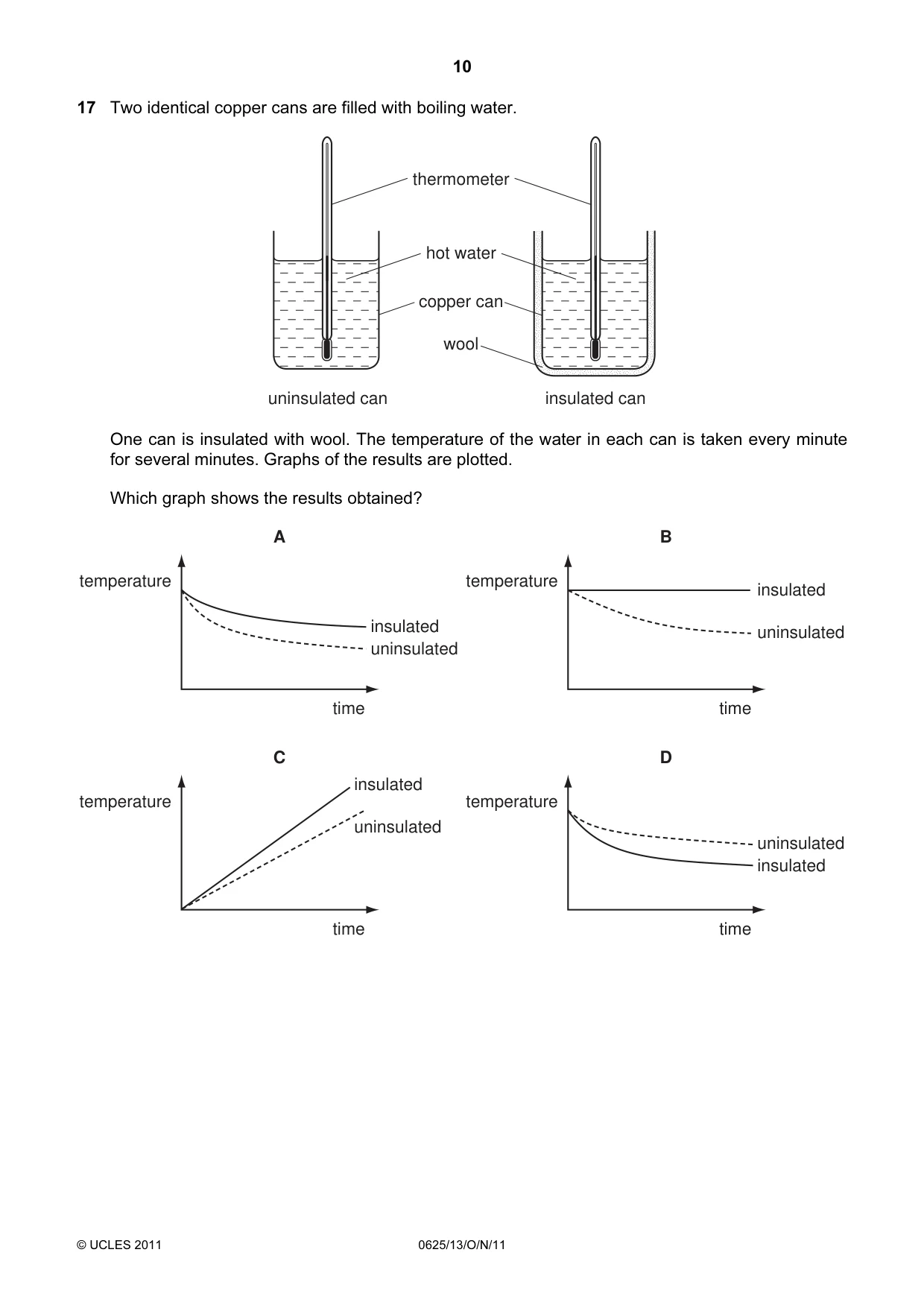
10 © UCLES 2011 0625/13/O/N/11 17 Two identical copper cans are filled with boiling water. uninsulated can insulated can copper can wool hot water thermometer One can is insulated with wool. The temperature of the water in each can is taken every minute for several minutes. Graphs of the results are plotted. Which graph shows the results obtained? A temperature time insulated uninsulated B temperature time insulated uninsulated C temperature time insulated uninsulated D temperature time uninsulated insulated
Question paper, page 11
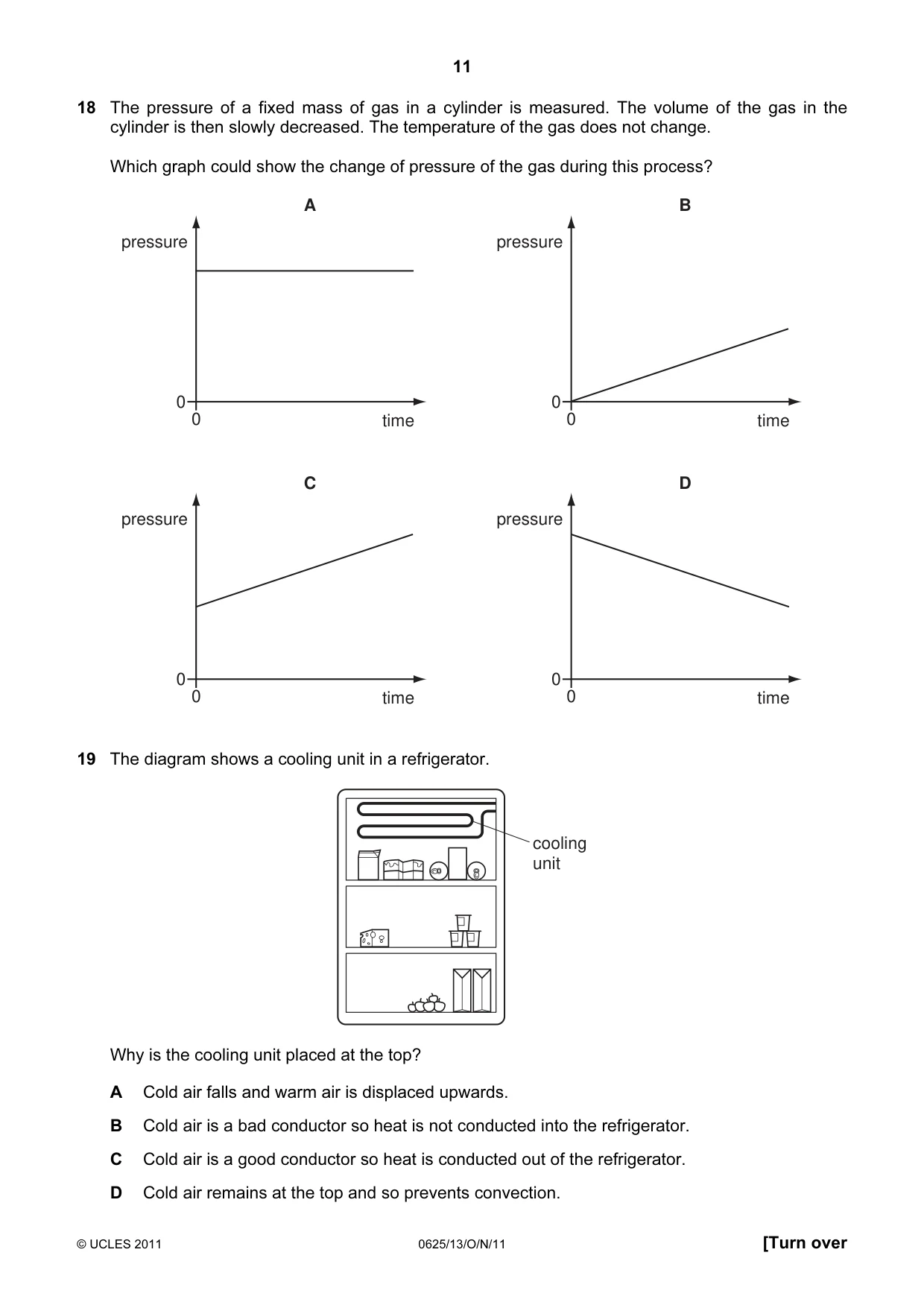
11 © UCLES 2011 0625/13/O/N/11 [Turn over 18 The pressure of a fixed mass of gas in a cylinder is measured. The volume of the gas in the cylinder is then slowly decreased. The temperature of the gas does not change. Which graph could show the change of pressure of the gas during this process? pressure time A 0 0 pressure time B pressure time C pressure time D 0 0 0 0 0 0 19 The diagram shows a cooling unit in a refrigerator. cooling unit Why is the cooling unit placed at the top? A Cold air falls and warm air is displaced upwards. B Cold air is a bad conductor so heat is not conducted into the refrigerator. C Cold air is a good conductor so heat is conducted out of the refrigerator. D Cold air remains at the top and so prevents convection.
Question paper, page 12
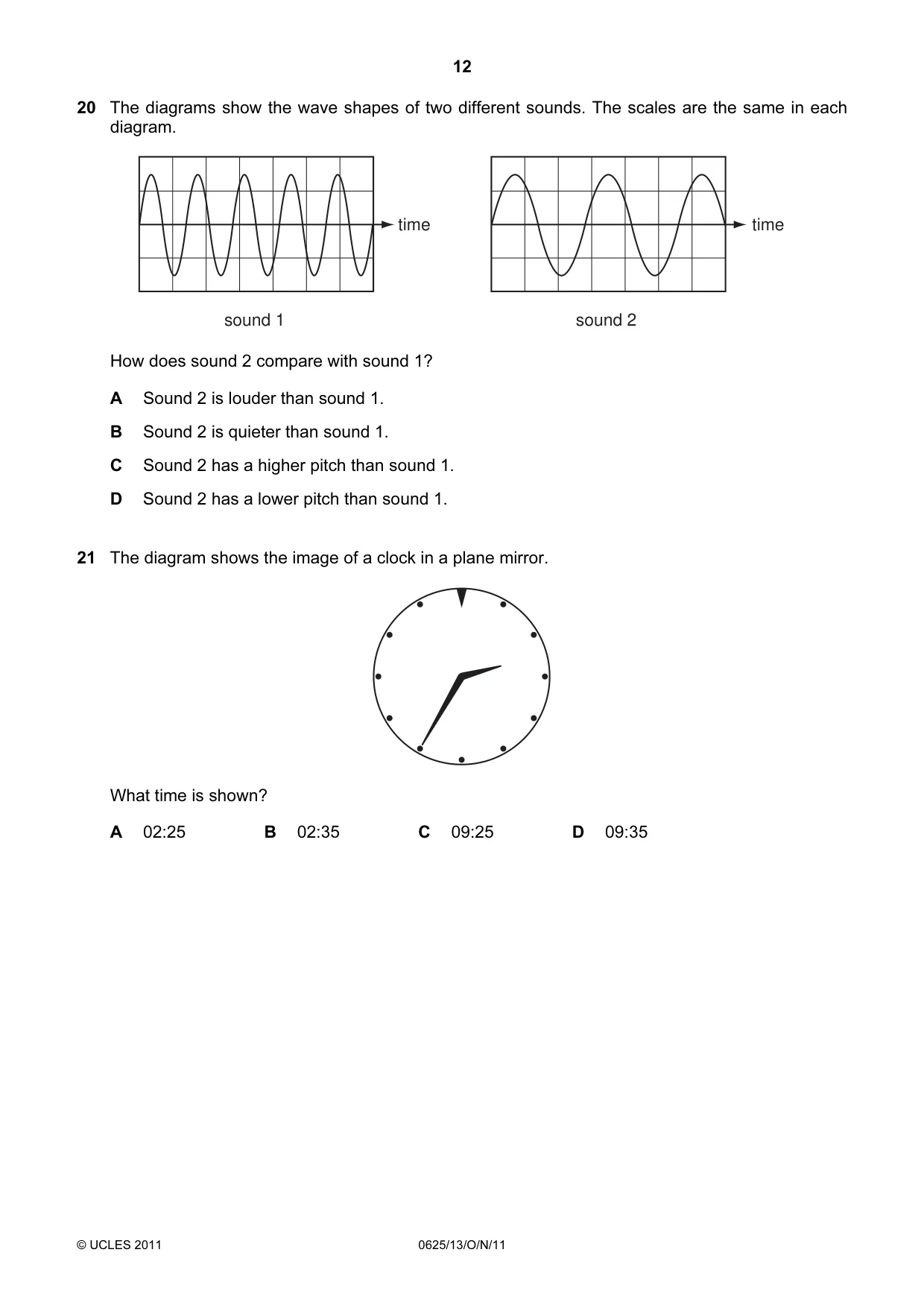
12 © UCLES 2011 0625/13/O/N/11 20 The diagrams show the wave shapes of two different sounds. The scales are the same in each diagram. sound 1 sound 2 time time How does sound 2 compare with sound 1? A Sound 2 is louder than sound 1. B Sound 2 is quieter than sound 1. C Sound 2 has a higher pitch than sound 1. D Sound 2 has a lower pitch than sound 1. 21 The diagram shows the image of a clock in a plane mirror. What time is shown? A 02:25 B 02:35 C 09:25 D 09:35
Question paper, page 13
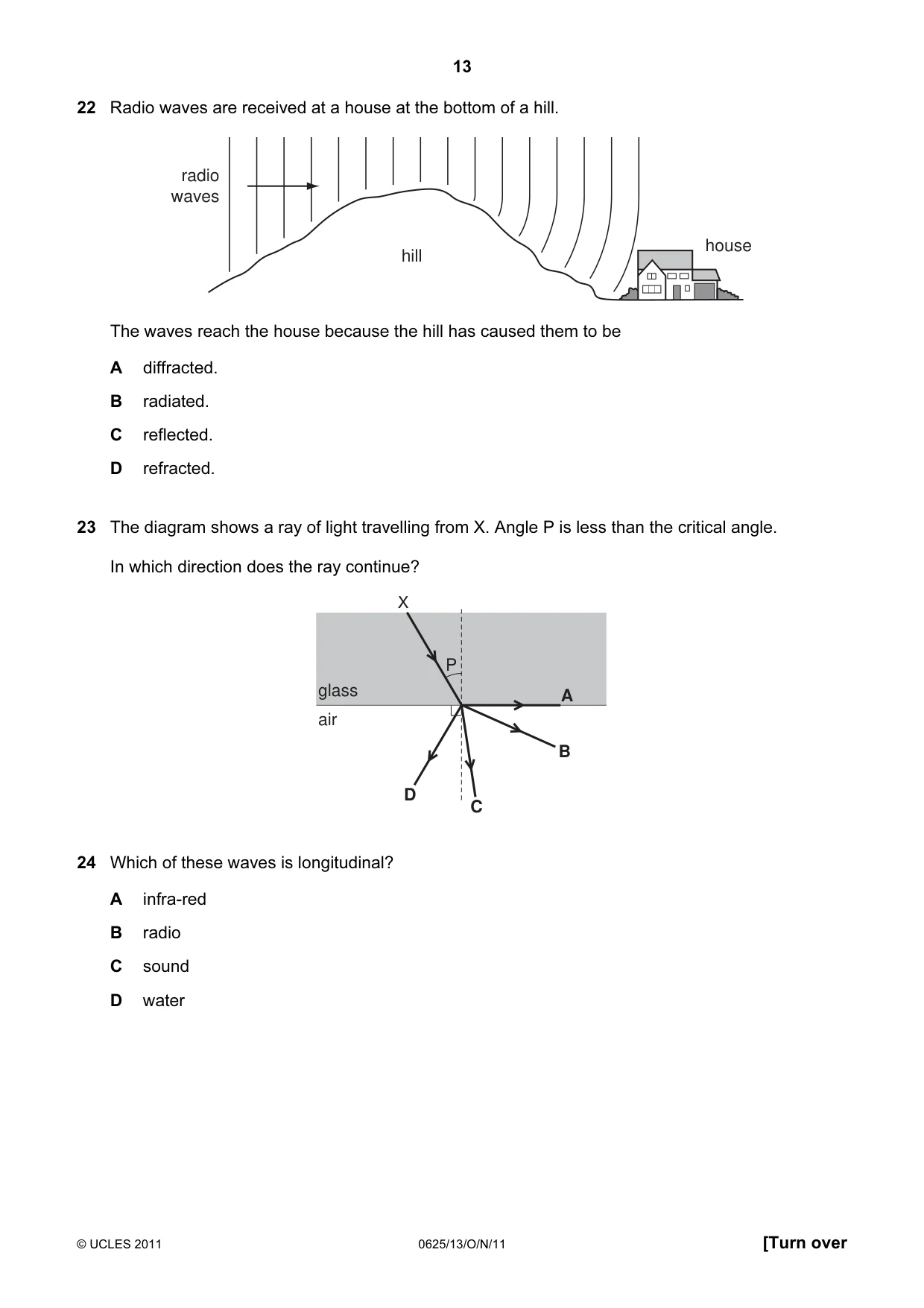
13 © UCLES 2011 0625/13/O/N/11 [Turn over 22 Radio waves are received at a house at the bottom of a hill. hill radio waves house The waves reach the house because the hill has caused them to be A diffracted. B radiated. C reflected. D refracted. 23 The diagram shows a ray of light travelling from X. Angle P is less than the critical angle. In which direction does the ray continue? A C B D air glass X P 24 Which of these waves is longitudinal? A infra-red B radio C sound D water
Question paper, page 14
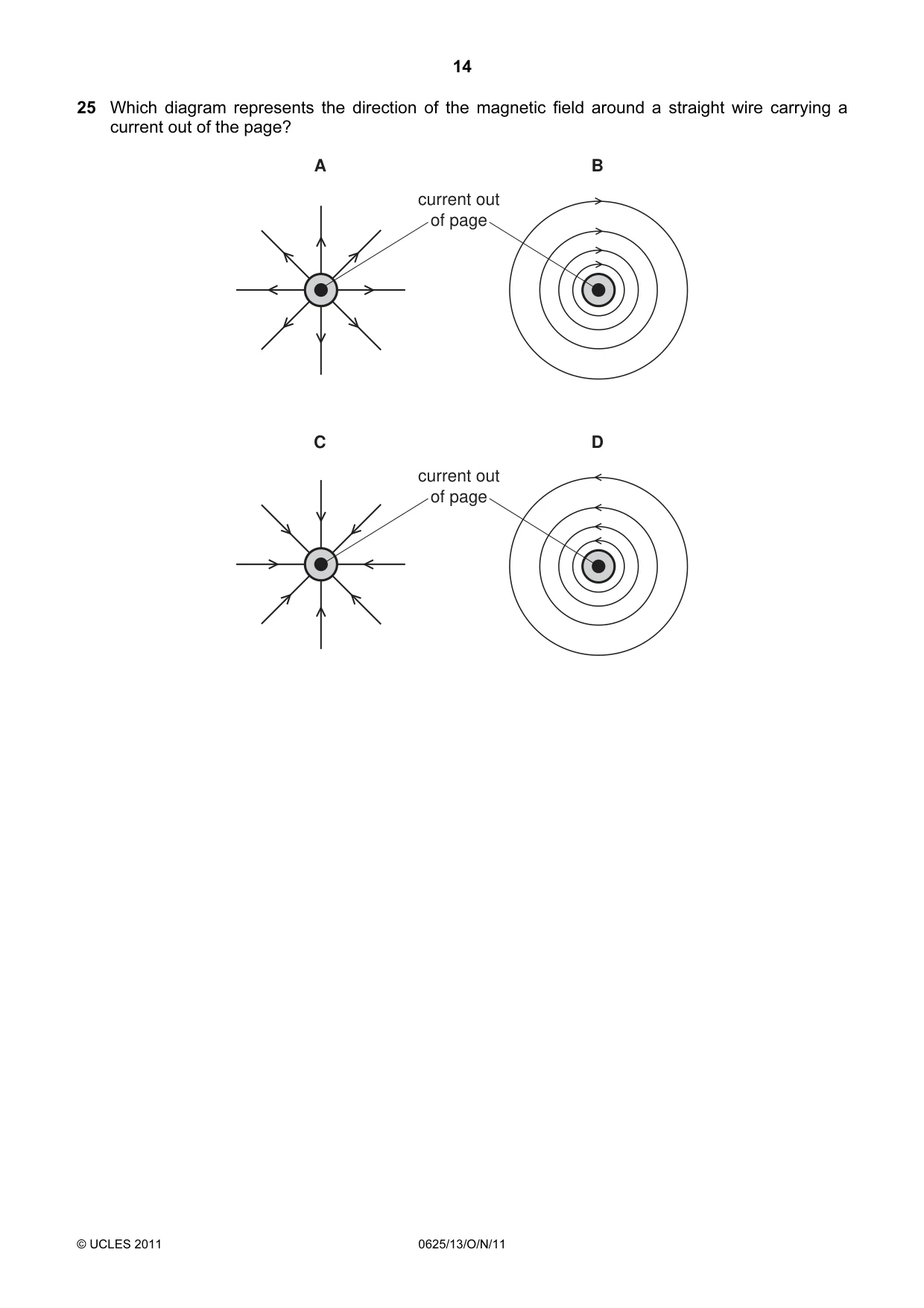
14 © UCLES 2011 0625/13/O/N/11 25 Which diagram represents the direction of the magnetic field around a straight wire carrying a current out of the page? A B current out of page C D current out of page
Question paper, page 15
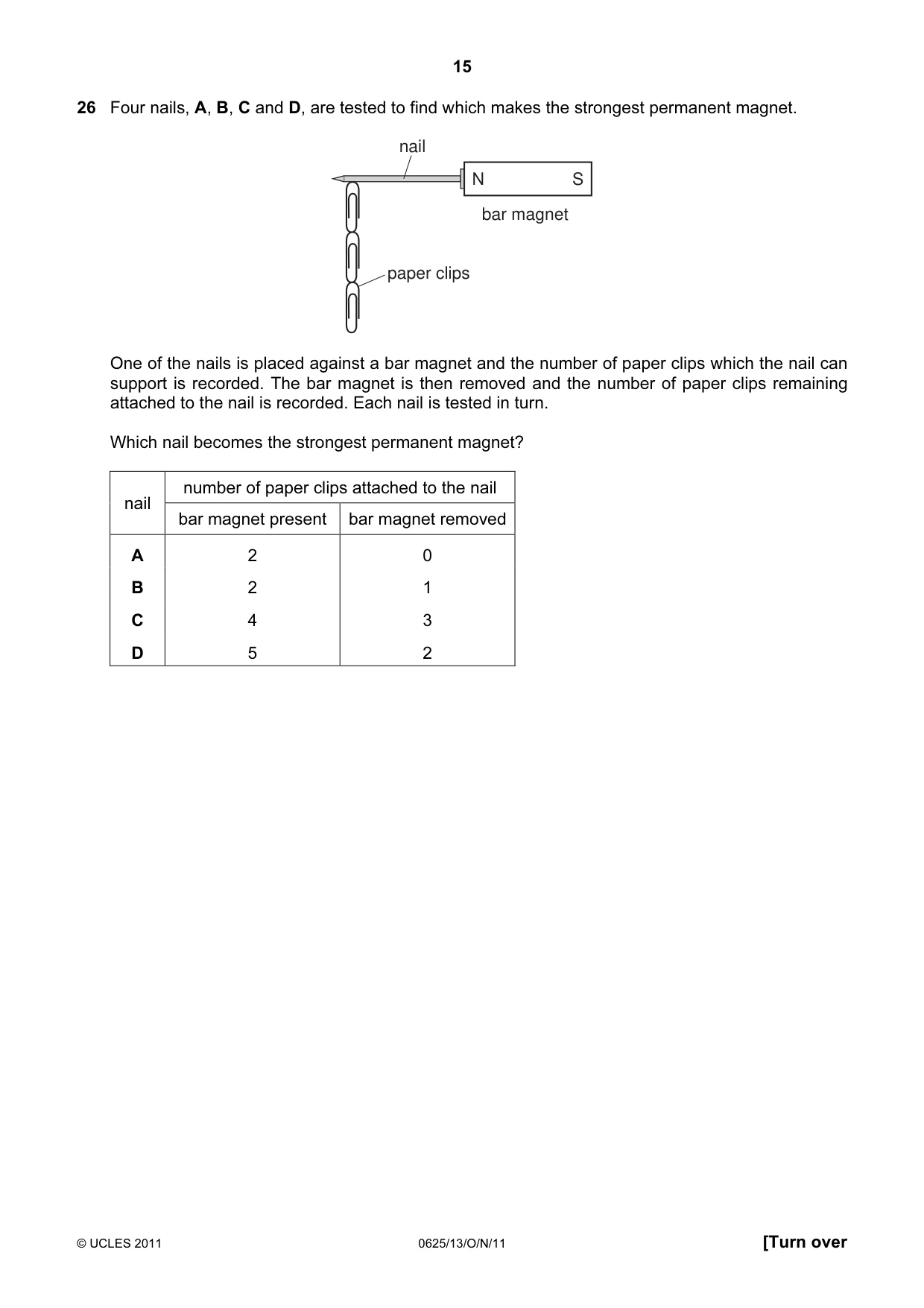
15 © UCLES 2011 0625/13/O/N/11 [Turn over 26 Four nails, A, B, C and D, are tested to find which makes the strongest permanent magnet. N S nail bar magnet paper clips One of the nails is placed against a bar magnet and the number of paper clips which the nail can support is recorded. The bar magnet is then removed and the number of paper clips remaining attached to the nail is recorded. Each nail is tested in turn. Which nail becomes the strongest permanent magnet? number of paper clips attached to the nail nail bar magnet present bar magnet removed A 2 0 B 2 1 C 4 3 D 5 2
Question paper, page 16
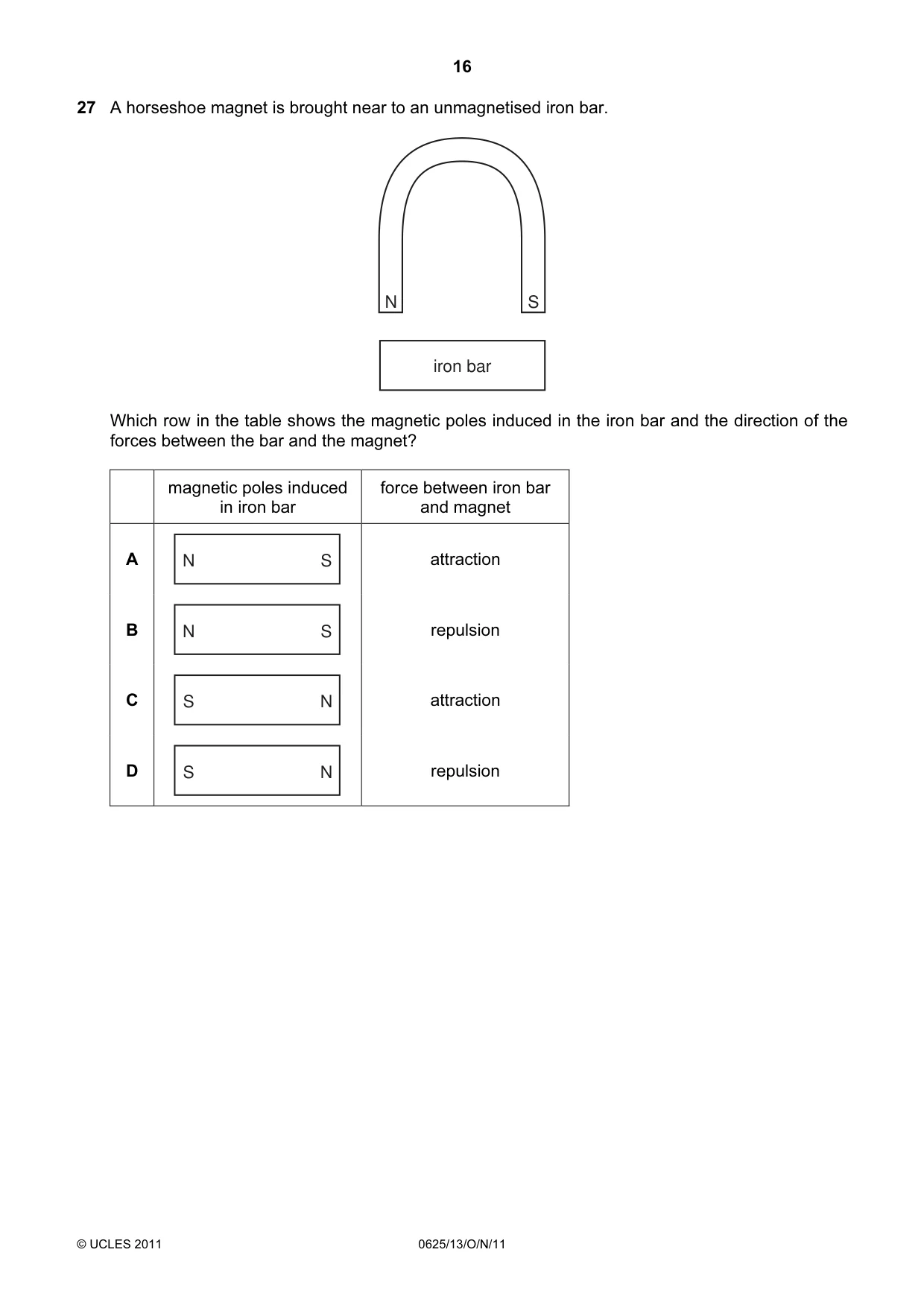
16 © UCLES 2011 0625/13/O/N/11 27 A horseshoe magnet is brought near to an unmagnetised iron bar. iron bar N S Which row in the table shows the magnetic poles induced in the iron bar and the direction of the forces between the bar and the magnet? magnetic poles induced in iron bar force between iron bar and magnet A N S attraction B N S repulsion C S N attraction D S N repulsion
Question paper, page 17
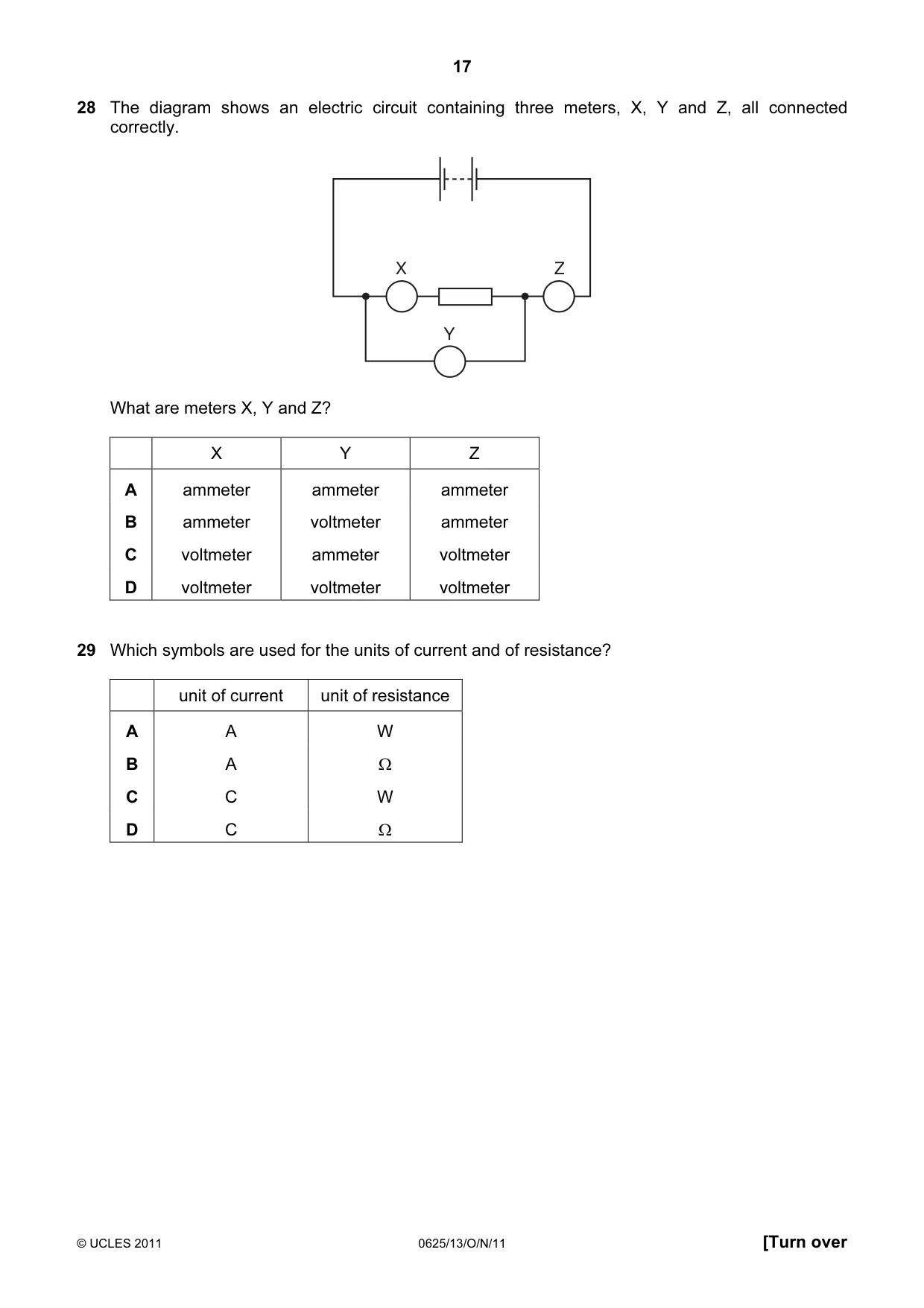
17 © UCLES 2011 0625/13/O/N/11 [Turn over 28 The diagram shows an electric circuit containing three meters, X, Y and Z, all connected correctly. X Z Y What are meters X, Y and Z? X Y Z A ammeter ammeter ammeter B ammeter voltmeter ammeter C voltmeter ammeter voltmeter D voltmeter voltmeter voltmeter 29 Which symbols are used for the units of current and of resistance? unit of current unit of resistance A A W B A Ω C C W D C Ω
Question paper, page 18
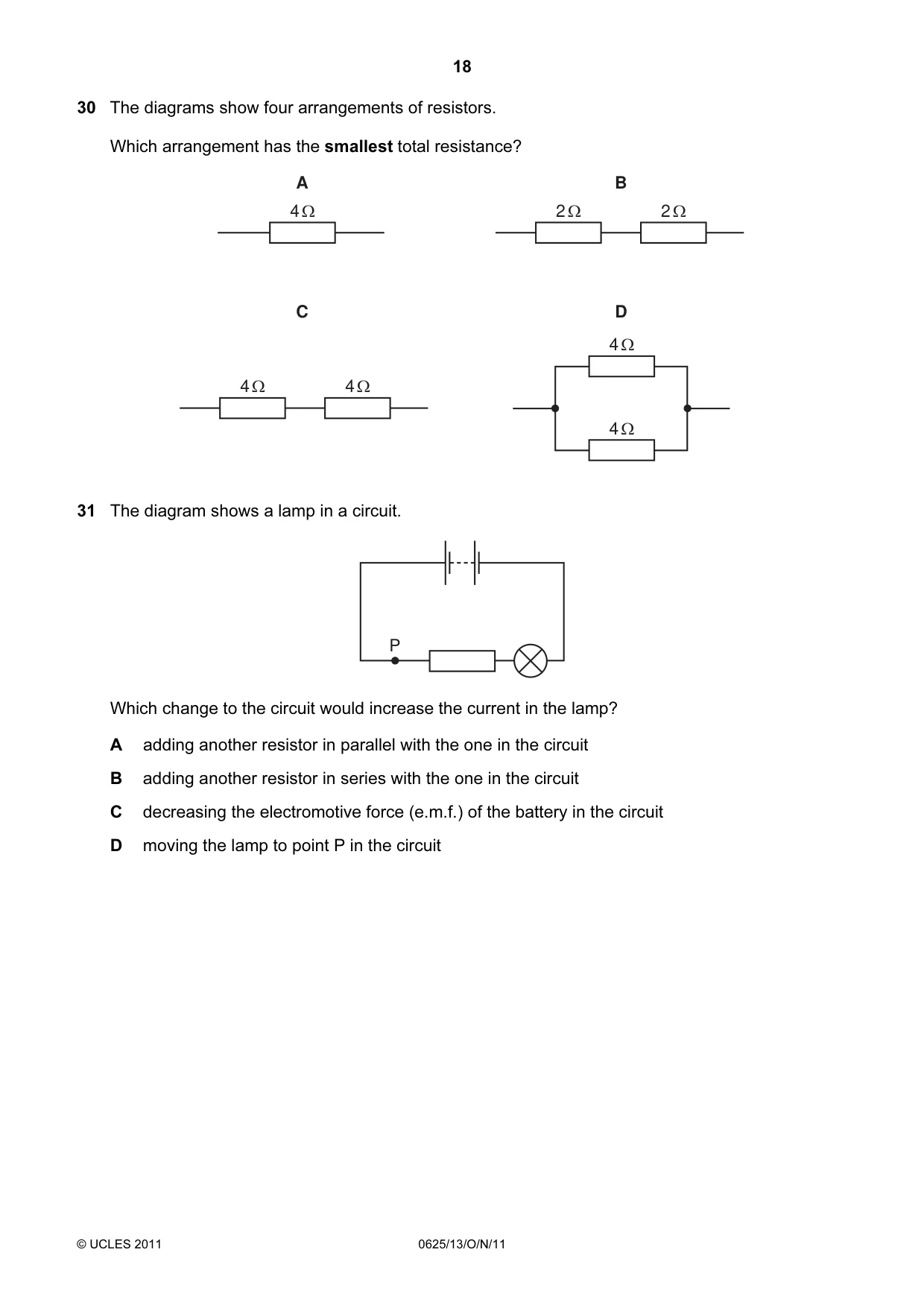
18 © UCLES 2011 0625/13/O/N/11 30 The diagrams show four arrangements of resistors. Which arrangement has the smallest total resistance? 4 Ω A C 2 Ω B 2 Ω 4 Ω 4 Ω D 4 Ω 4 Ω 31 The diagram shows a lamp in a circuit. P Which change to the circuit would increase the current in the lamp? A adding another resistor in parallel with the one in the circuit B adding another resistor in series with the one in the circuit C decreasing the electromotive force (e.m.f.) of the battery in the circuit D moving the lamp to point P in the circuit
Question paper, page 19
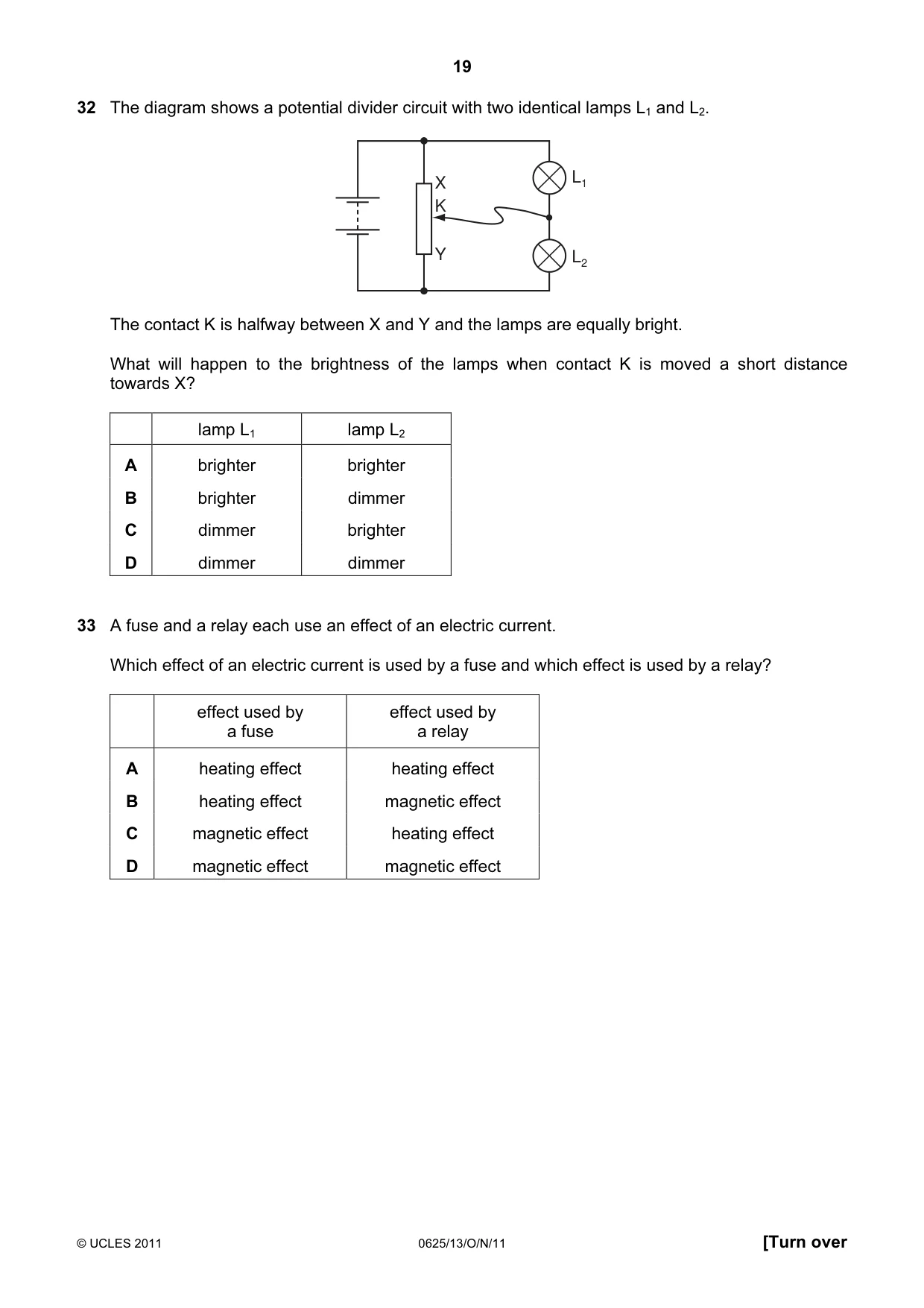
19 © UCLES 2011 0625/13/O/N/11 [Turn over 32 The diagram shows a potential divider circuit with two identical lamps L1 and L2. L1 L2 X K Y The contact K is halfway between X and Y and the lamps are equally bright. What will happen to the brightness of the lamps when contact K is moved a short distance towards X? lamp L1 lamp L2 A brighter brighter B brighter dimmer C dimmer brighter D dimmer dimmer 33 A fuse and a relay each use an effect of an electric current. Which effect of an electric current is used by a fuse and which effect is used by a relay? effect used by a fuse effect used by a relay A heating effect heating effect B heating effect magnetic effect C magnetic effect heating effect D magnetic effect magnetic effect
Question paper, page 20
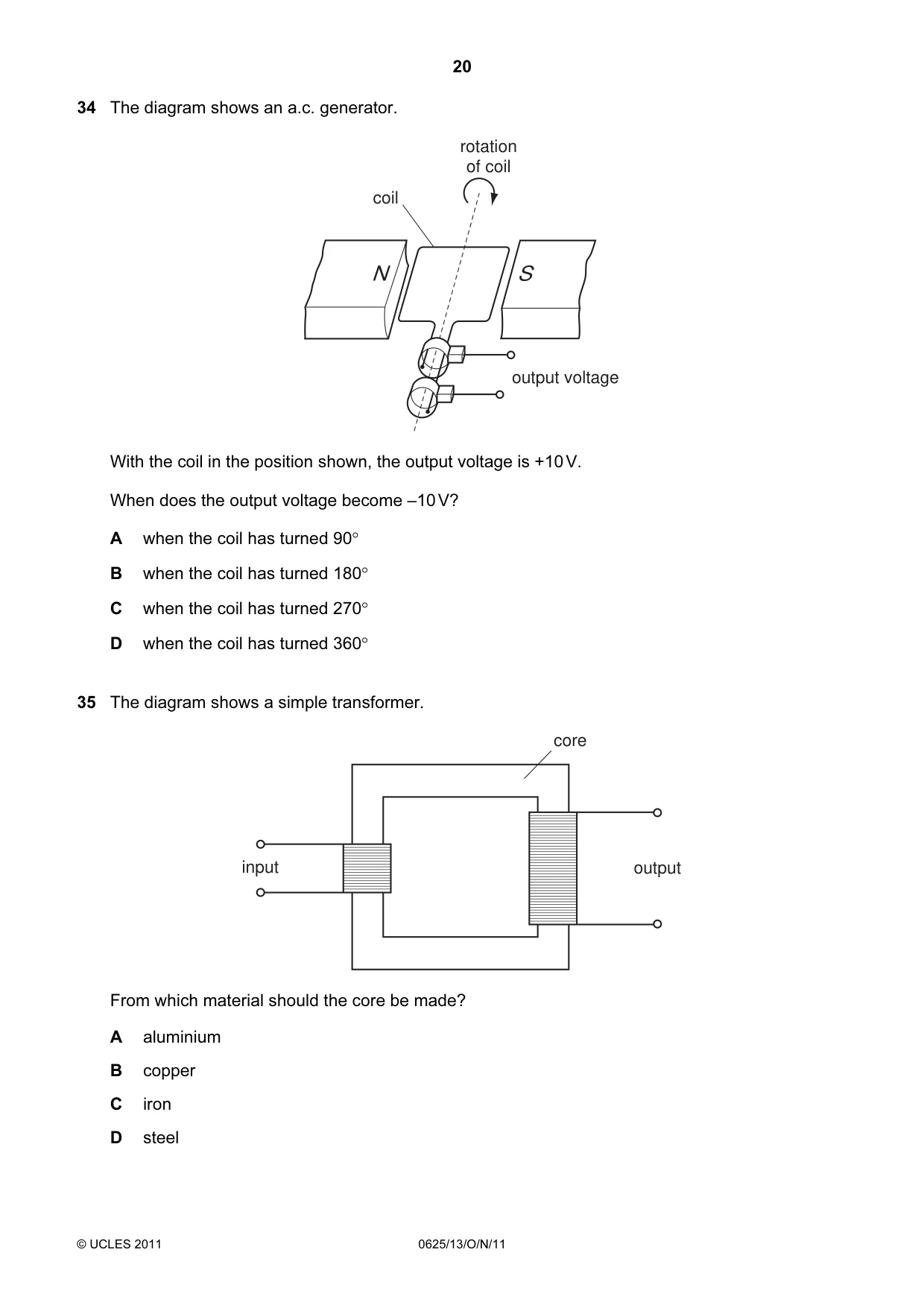
20 © UCLES 2011 0625/13/O/N/11 34 The diagram shows an a.c. generator. N S coil output voltage rotation of coil With the coil in the position shown, the output voltage is +10 V. When does the output voltage become –10 V? A when the coil has turned 90° B when the coil has turned 180° C when the coil has turned 270° D when the coil has turned 360° 35 The diagram shows a simple transformer. core output input From which material should the core be made? A aluminium B copper C iron D steel
Question paper, page 21
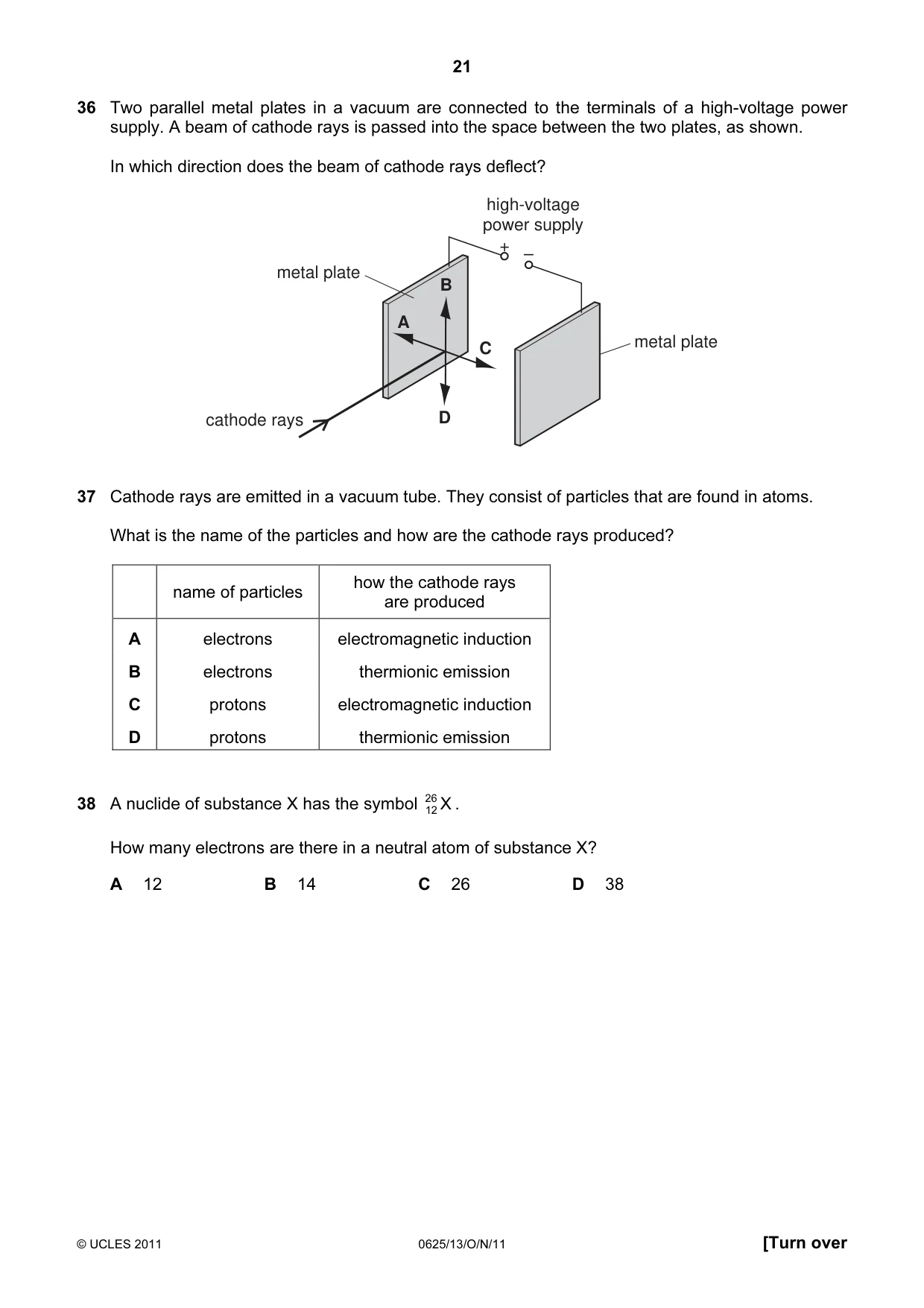
21 © UCLES 2011 0625/13/O/N/11 [Turn over 36 Two parallel metal plates in a vacuum are connected to the terminals of a high-voltage power supply. A beam of cathode rays is passed into the space between the two plates, as shown. In which direction does the beam of cathode rays deflect? + – high-voltage power supply A B C D cathode rays metal plate metal plate 37 Cathode rays are emitted in a vacuum tube. They consist of particles that are found in atoms. What is the name of the particles and how are the cathode rays produced? name of particles how the cathode rays are produced A electrons electromagnetic induction B electrons thermionic emission C protons electromagnetic induction D protons thermionic emission 38 A nuclide of substance X has the symbol X 26 12 . How many electrons are there in a neutral atom of substance X? A 12 B 14 C 26 D 38
Question paper, page 22
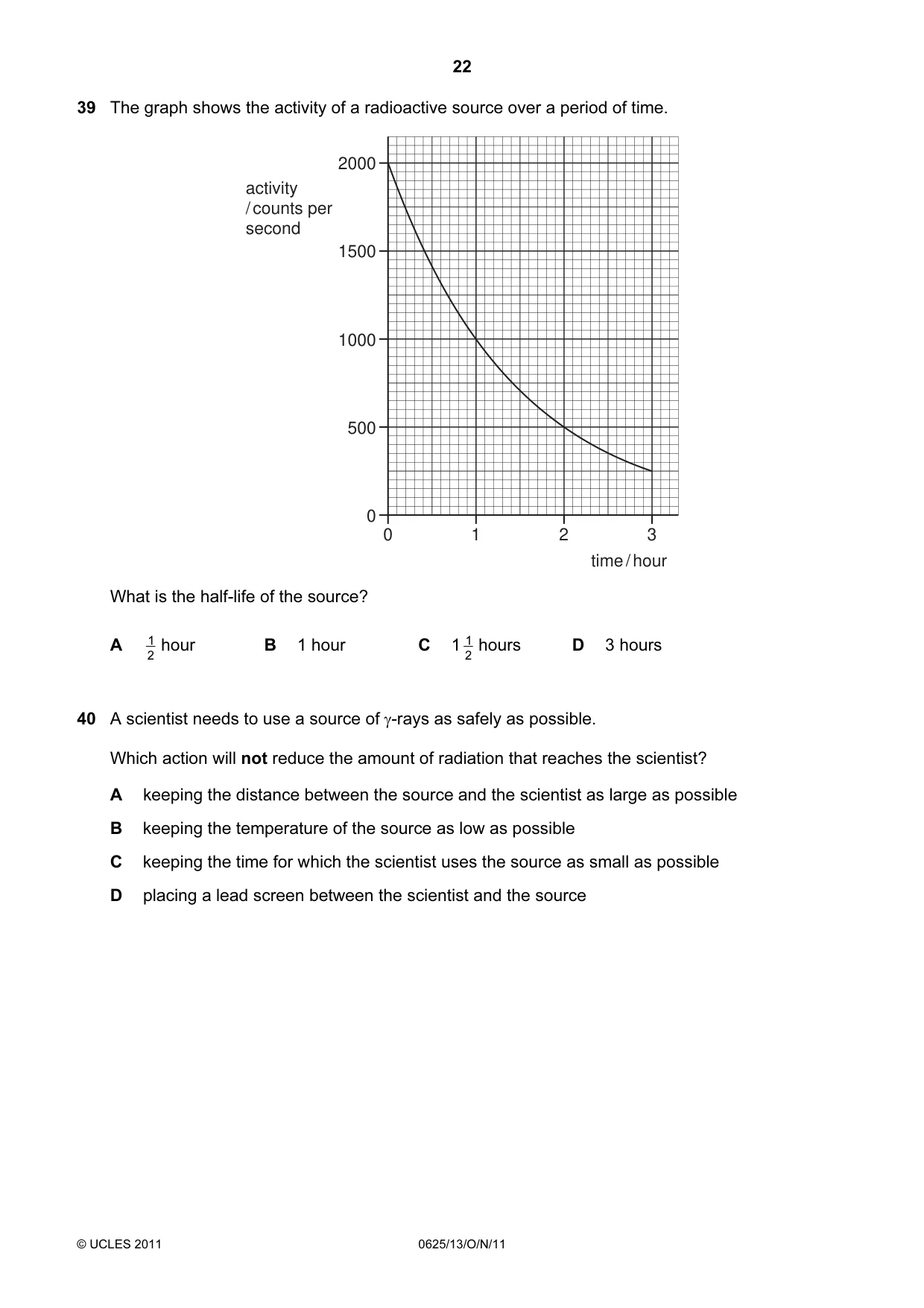
22 © UCLES 2011 0625/13/O/N/11 39 The graph shows the activity of a radioactive source over a period of time. 2000 1500 1000 500 0 0 1 2 3 time / hour activity / counts per second What is the half-life of the source? A 2 1 hour B 1 hour C 1 2 1 hours D 3 hours 40 A scientist needs to use a source of γ-rays as safely as possible. Which action will not reduce the amount of radiation that reaches the scientist? A keeping the distance between the source and the scientist as large as possible B keeping the temperature of the source as low as possible C keeping the time for which the scientist uses the source as small as possible D placing a lead screen between the scientist and the source
Question paper, page 23
23 © UCLES 2011 0625/13/O/N/11 BLANK PAGE
Question paper, page 24
24 Permission to reproduce items where third-party owned material protected by copyright is included has been sought and cleared where possible. Every reasonable effort has been made by the publisher (UCLES) to trace copyright holders, but if any items requiring clearance have unwittingly been included, the publisher will be pleased to make amends at the earliest possible opportunity. University of Cambridge International Examinations is part of the Cambridge Assessment Group. Cambridge Assessment is the brand name of University of Cambridge Local Examinations Syndicate (UCLES), which is itself a department of the University of Cambridge. © UCLES 2011 0625/13/O/N/11 BLANK PAGE
Mark scheme, page 1
UNIVERSITY OF CAMBRIDGE INTERNATIONAL EXAMINATIONS International General Certificate of Secondary Education MARK SCHEME for the October/November 2011 question paper for the guidance of teachers 0625 PHYSICS 0625/13 Paper 1 (Multiple Choice), maximum raw mark 40 Mark schemes must be read in conjunction with the question papers and the report on the examination. • Cambridge will not enter into discussions or correspondence in connection with these mark schemes. Cambridge is publishing the mark schemes for the October/November 2011 question papers for most IGCSE, GCE Advanced Level and Advanced Subsidiary Level syllabuses and some Ordinary Level syllabuses. www.XtremePapers.com
Mark scheme, page 2
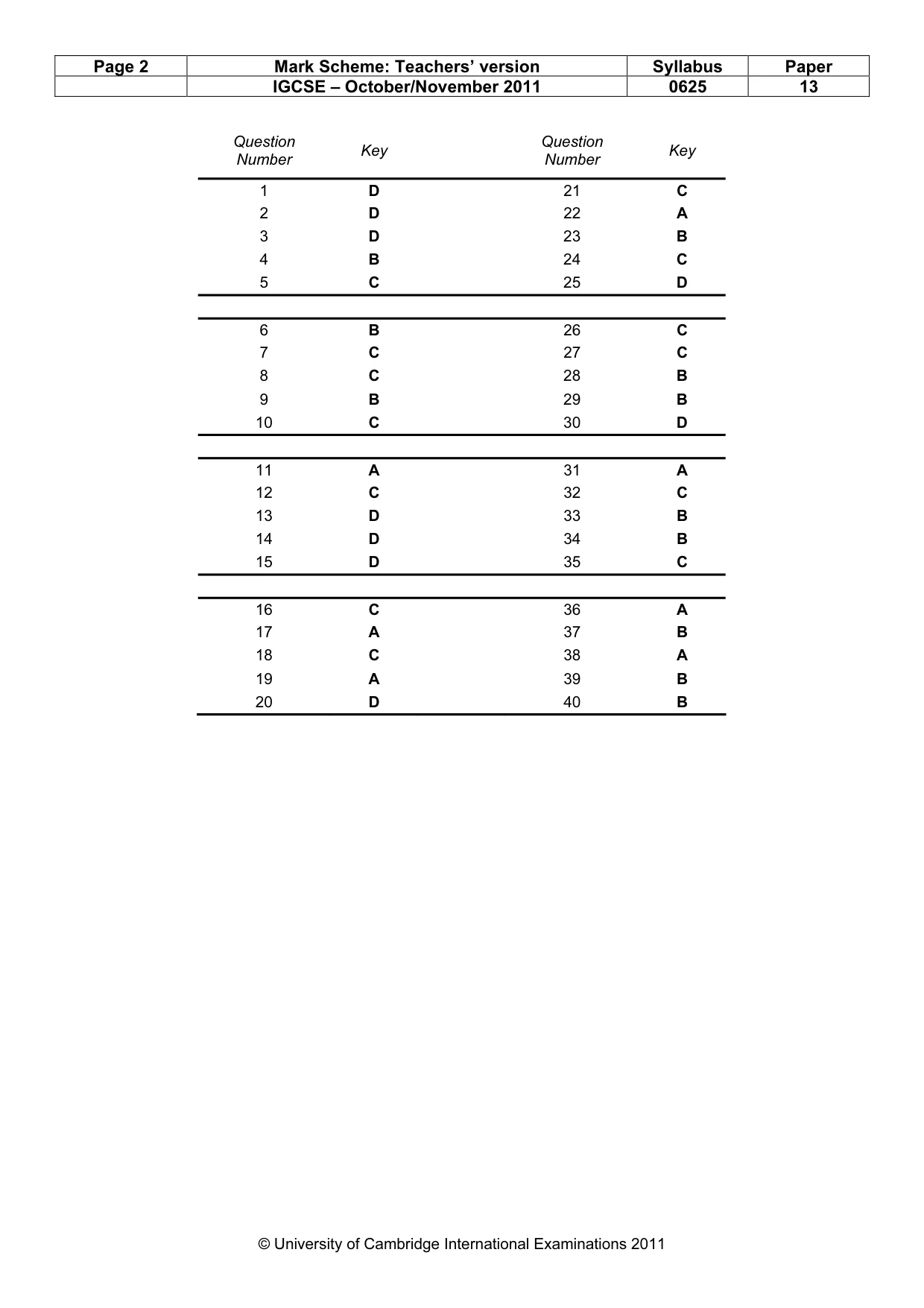
Page 2 Mark Scheme: Teachers’ version Syllabus Paper IGCSE – October/November 2011 0625 13 © University of Cambridge International Examinations 2011 Question Number Key Question Number Key 1 D 21 C 2 D 22 A 3 D 23 B 4 B 24 C 5 C 25 D 6 B 26 C 7 C 27 C 8 C 28 B 9 B 29 B 10 C 30 D 11 A 31 A 12 C 32 C 13 D 33 B 14 D 34 B 15 D 35 C 16 C 36 A 17 A 37 B 18 C 38 A 19 A 39 B 20 D 40 B
What you needed in this session
Cambridge’s own grade thresholds for 2011 Oct/Nov, Paper 1 · Variant 3. A higher threshold means an easier paper — the bar moves with how the cohort did.