Cambridge IGCSE Physics 0625 — 2011 May/June Paper 6 · Variant 3
0625/63/M/J/11 · 5 questions · 40 marks · ≈45 min
The question paper and its mark scheme, free to read here and free to download. This is Cambridge’s own paper, exactly as it was sat.
Question paper12 pages

Mark scheme3 pages
Answers below. Sit the paper first if you are practising.
Questions as text
Q1 · The IGCSE class is investigating the loading of a metre rule
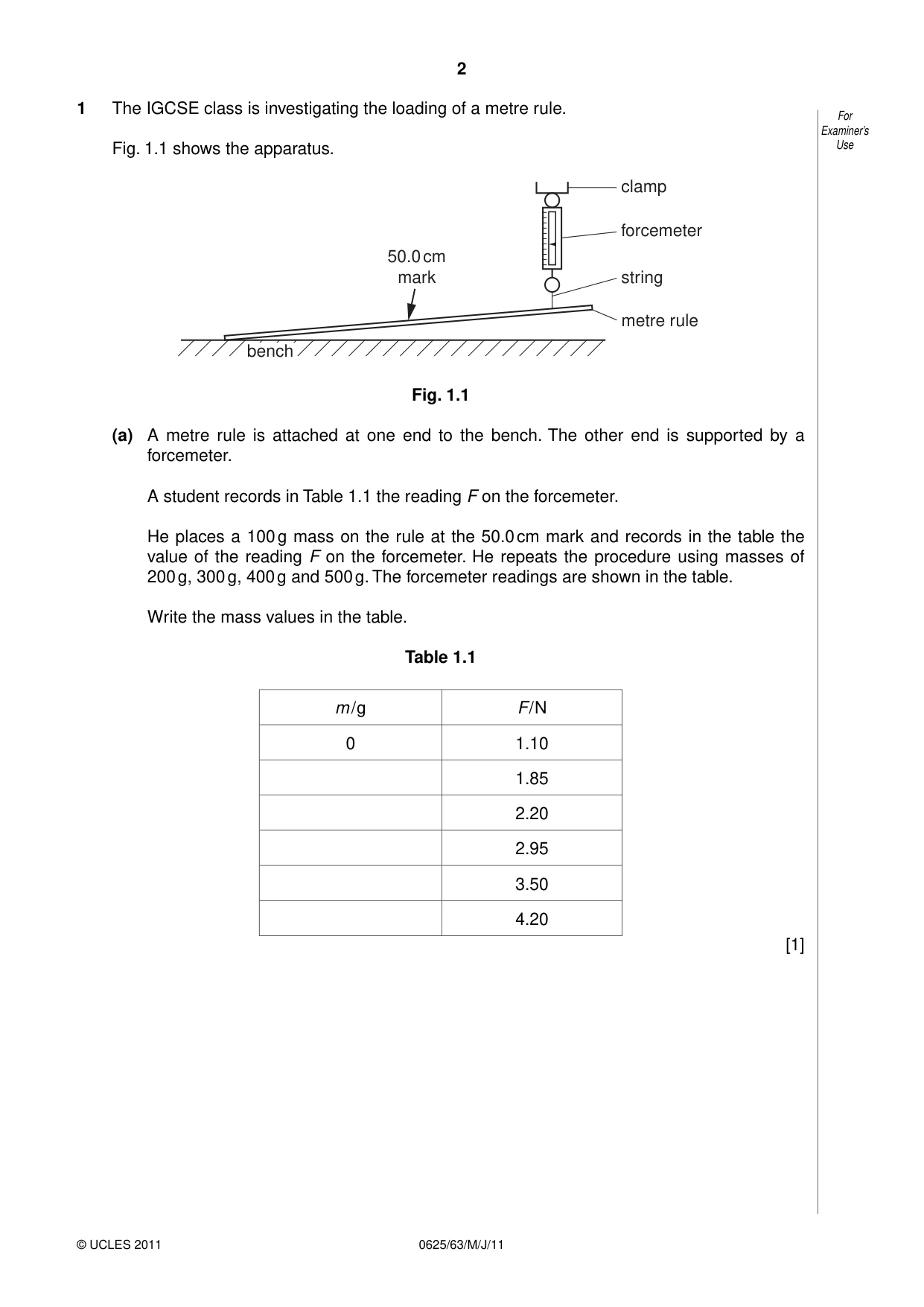
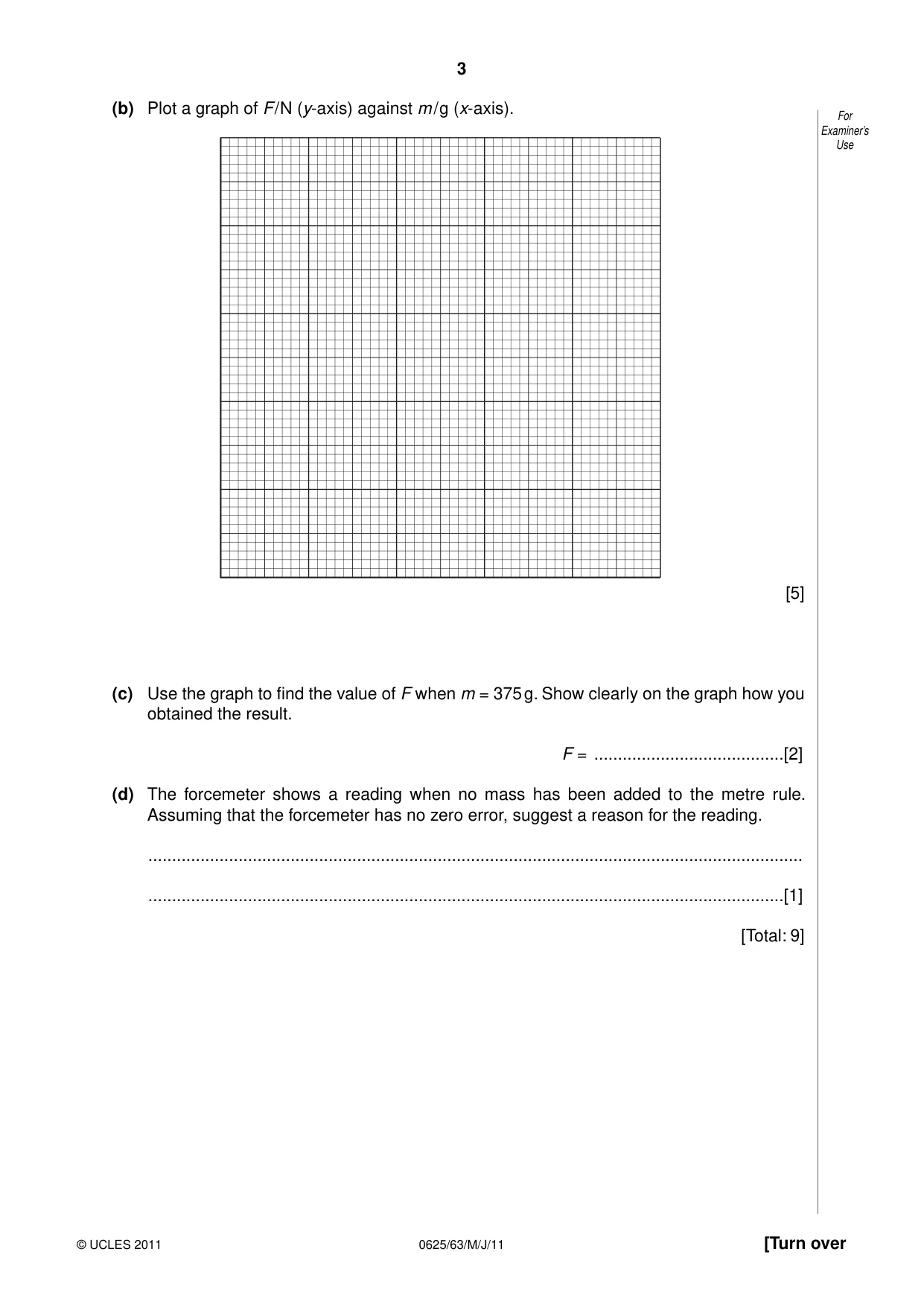
1 The IGCSE class is investigating the loading of a metre rule. For Examiner’s Fig. 1.1 shows the apparatus. Use clamp forcemeter 50.0 cm mark string metre rule bench Fig. 1.1 (a) A metre rule is attached at one end to the bench. The other end is supported by a forcemeter. A student records in Table 1.1 the reading F on the forcemeter. He places a 100 g mass on the rule at the 50.0 cm mark and records in the table the value of the reading F on the forcemeter. He repeats the procedure using masses of 200 g, 300 g, 400 g and 500 g. The forcemeter readings are shown in the table. Write the mass values in the table. Table 1.1 m / g F / N 0 1.10 1.85 2.20 2.95 3.50 4.20 [1] (b) Plot a graph of F / N (y-axis) against m / g (x-axis). For Examiner’s Use [5] (c) Use the graph to find the value of F when m = 375 g. Show clearly on the graph how you obtained the result. F = ........................................[2] (d) The forcemeter shows a reading when no mass has been added to the metre rule. Assuming that the forcemeter has no zero error, suggest a reason for the reading. .......................................................................................................................................... ......................................................................................................................................[1] [Total: 9]
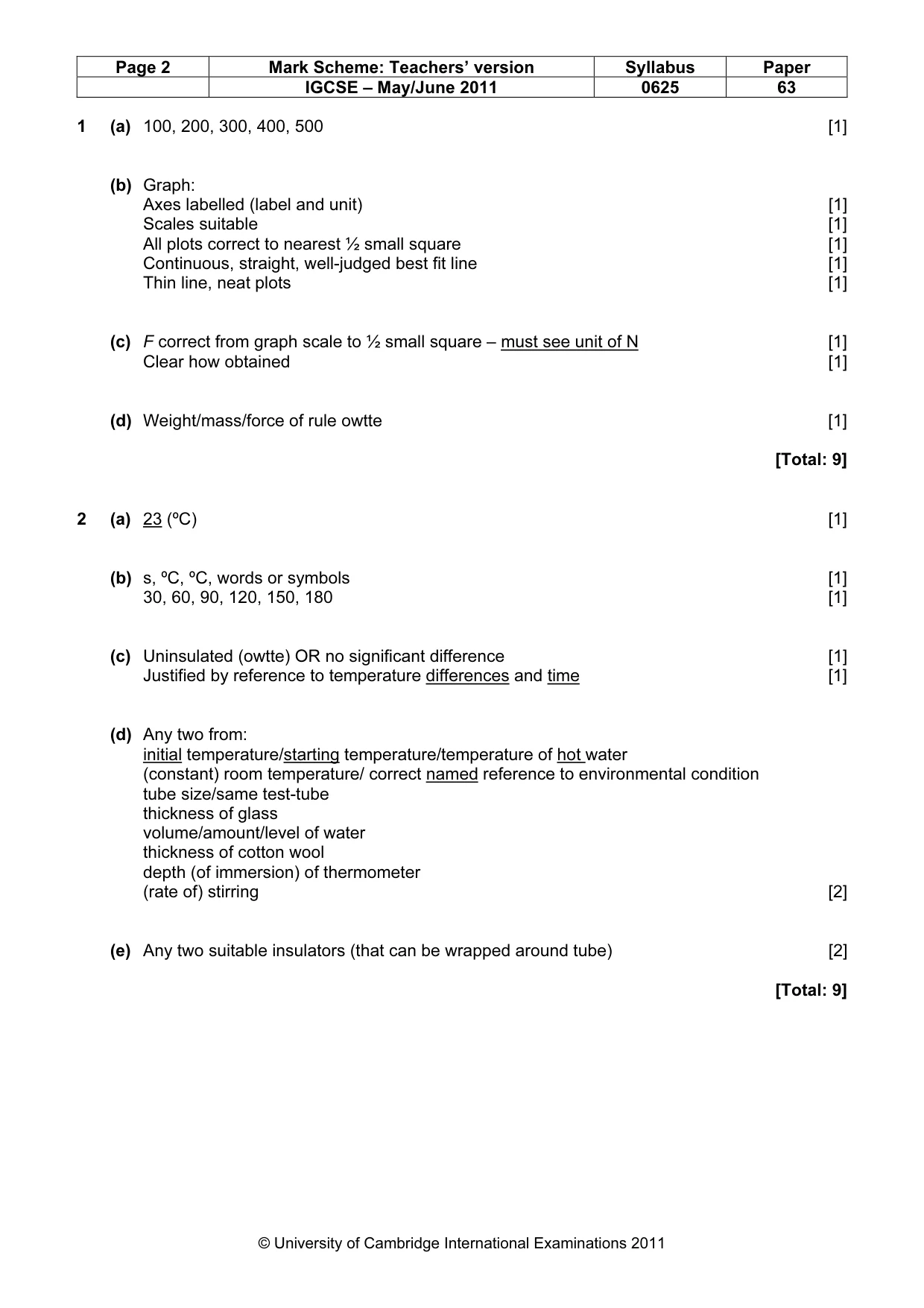
Mark scheme: 1 (a) 100, 200, 300, 400, 500 [1] (b) Graph: Axes labelled (label and unit) [1] Scales suitable [1] All plots correct to nearest ½ small square [1] Continuous, straight, well-judged best fit line [1] Thin line, neat plots [1] (c) F correct from graph scale to ½ small square – must see unit of N [1] Clear how obtained [1] (d) Weight/mass/force of rule owtte [1] [Total: 9]
Q2 · The IGCSE class is investigating the rate of cooling of water
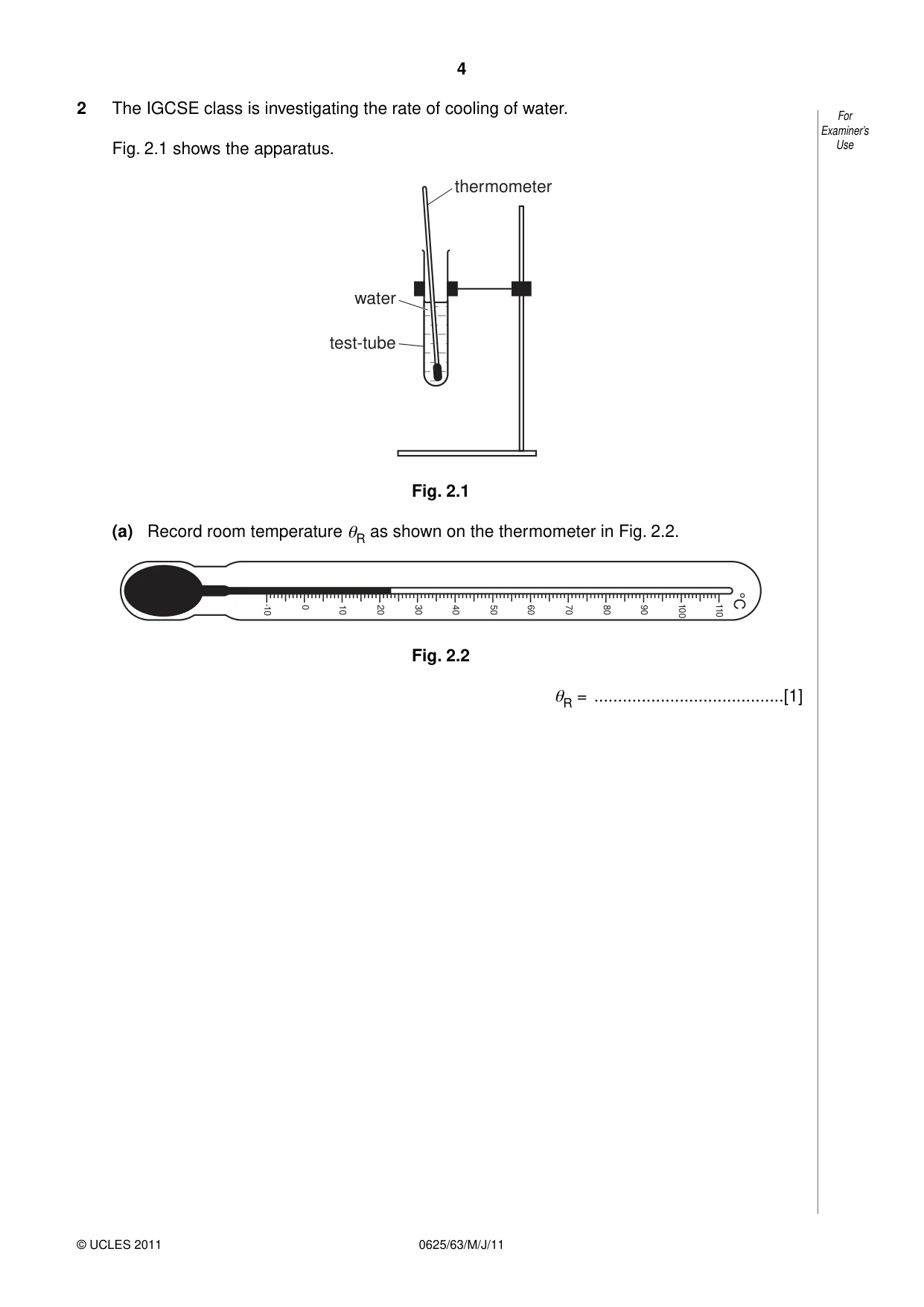
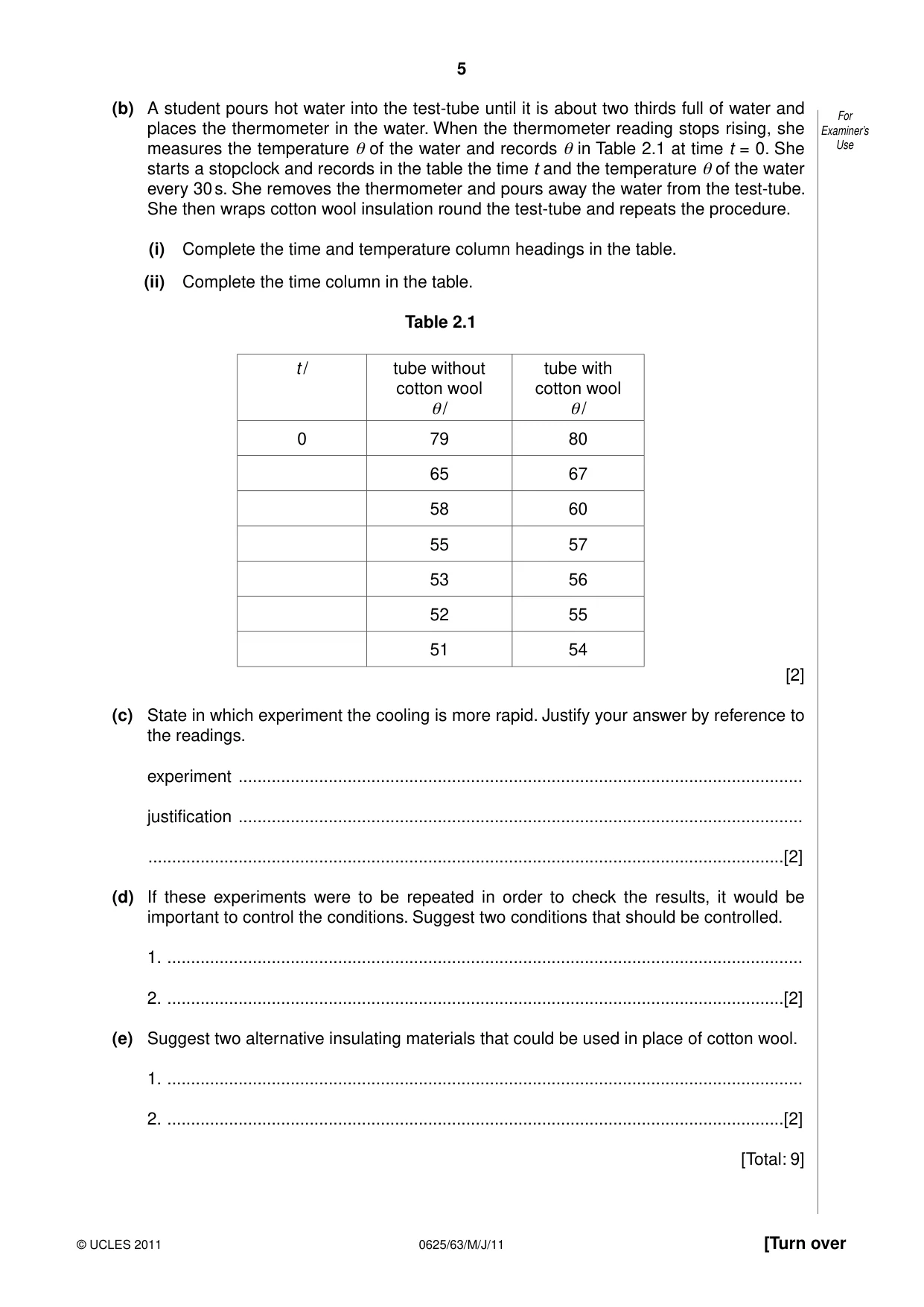
2 The IGCSE class is investigating the rate of cooling of water. For Examiner’s Fig. 2.1 shows the apparatus. Use thermometer water test-tube Fig. 2.1 (a) Record room temperature θR as shown on the thermometer in Fig. 2.2. °C -10 0 10 20 30 40 50 60 70 80 90 100 110 Fig. 2.2 θR = ........................................[1] (b) A student pours hot water into the test-tube until it is about two thirds full of water and For places the thermometer in the water. When the thermometer reading stops rising, she Examiner’s measures the temperature θ of the water and records θ in Table 2.1 at time t = 0. She Use starts a stopclock and records in the table the time t and the temperature θ of the water every 30 s. She removes the thermometer and pours away the water from the test-tube. She then wraps cotton wool insulation round the test-tube and repeats the procedure. (i) Complete the time and temperature column headings in the table. (ii) Complete the time column in the table. Table 2.1 t / tube without tube with cotton wool cotton wool θ/ θ/ 0 79 80 65 67 58 60 55 57 53 56 52 55 51 54 [2] (c) State in which experiment the cooling is more rapid. Justify your answer by reference to the readings. experiment ....................................................................................................................... justification ....................................................................................................................... ......................................................................................................................................[2] (d) If these experiments were to be repeated in order to check the results, it would be important to control the conditions. Suggest two conditions that should be controlled. 1. ...................................................................................................................................... 2. ..................................................................................................................................[2] (e) Suggest two alternative insulating materials that could be used in place of cotton wool. 1. ...................................................................................................................................... 2. ..................................................................................................................................[2] [Total: 9]
Mark scheme: 2 (a) 23 (ºC) [1] (b) s, ºC, ºC, words or symbols [1] 30, 60, 90, 120, 150, 180 [1] (c) Uninsulated (owtte) OR no significant difference [1] Justified by reference to temperature differences and time [1] (d) Any two from: initial temperature/starting temperature/temperature of hot water (constant) room temperature/ correct named reference to environmental condition tube size/same test-tube thickness of glass volume/amount/level of water thickness of cotton wool depth (of immersion) of thermometer (rate of) stirring [2] (e) Any two suitable insulators (that can be wrapped around tube) [2] [Total: 9] IGCSE – May/June 2011 0625 63
Q3 · The IGCSE class is investigating the resistance of a wire
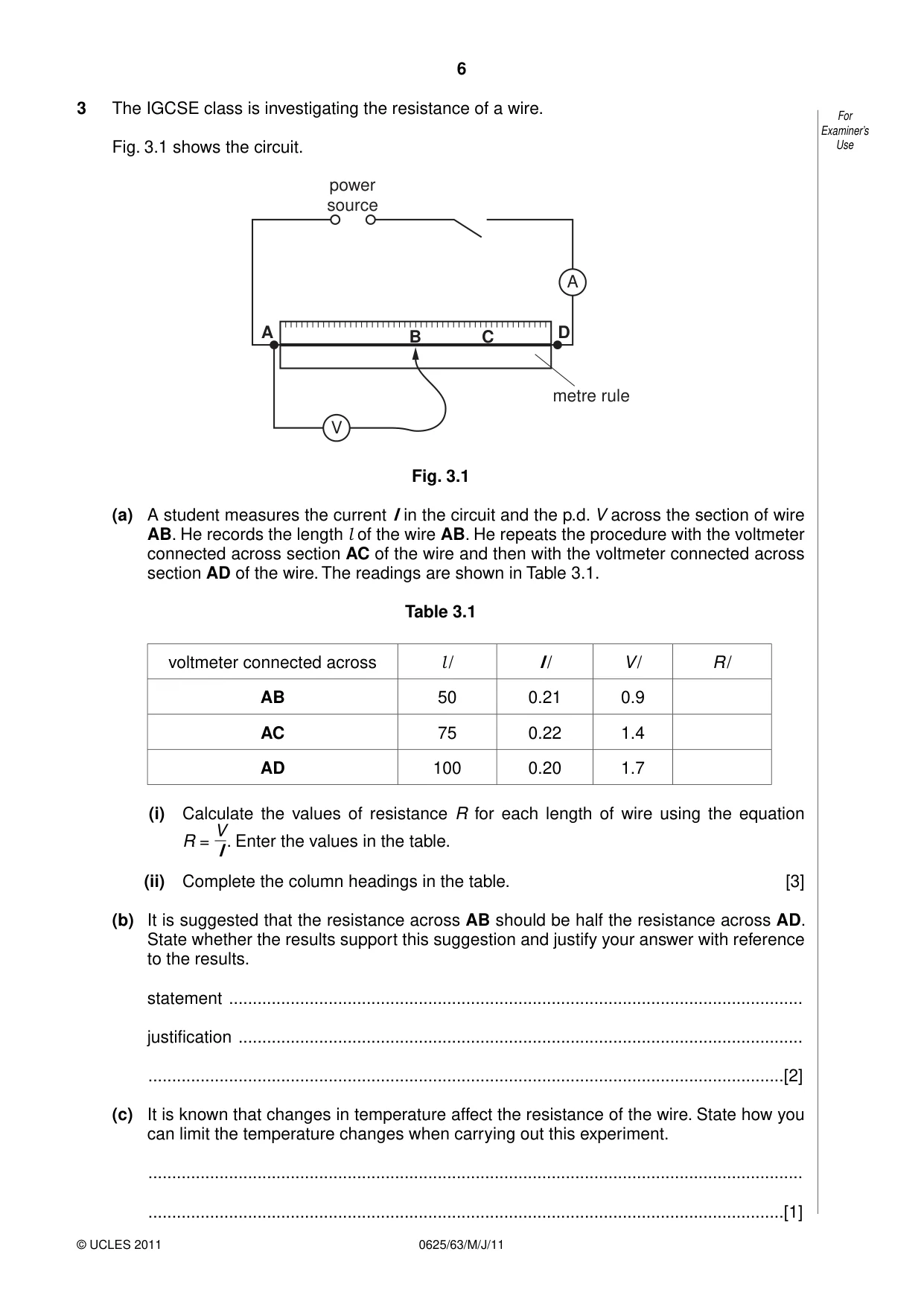
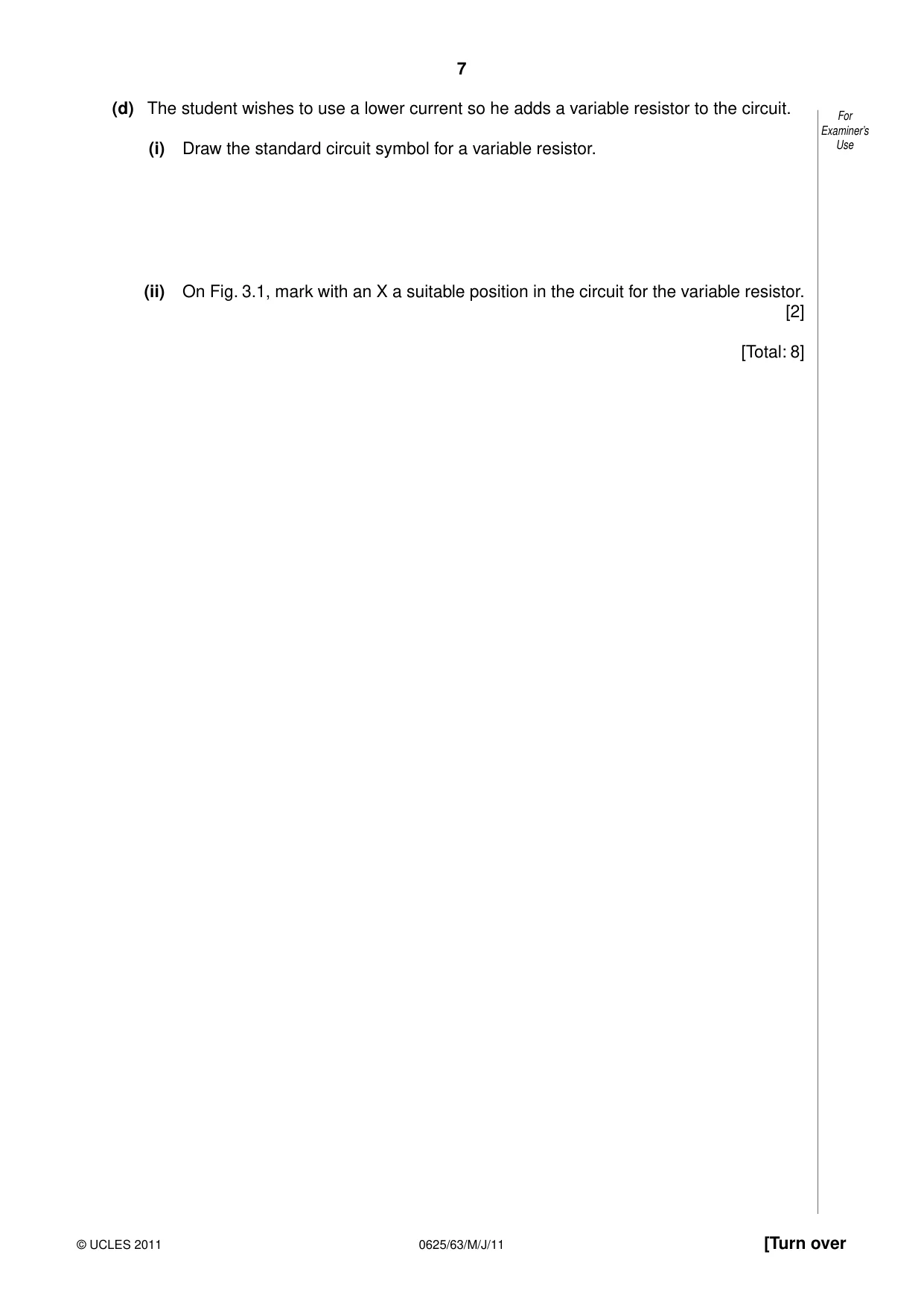
3 The IGCSE class is investigating the resistance of a wire. For Examiner’s Fig. 3.1 shows the circuit. Use power source A A B C D metre rule V Fig. 3.1 (a) A student measures the current I in the circuit and the p.d. V across the section of wire AB. He records the length l of the wire AB. He repeats the procedure with the voltmeter connected across section AC of the wire and then with the voltmeter connected across section AD of the wire. The readings are shown in Table 3.1. Table 3.1 voltmeter connected across l / I / V / R / AB 50 0.21 0.9 AC 75 0.22 1.4 AD 100 0.20 1.7 (i) Calculate the values of resistance R for each length of wire using the equation V R = . Enter the values in the table. I (ii) Complete the column headings in the table. [3] (b) It is suggested that the resistance across AB should be half the resistance across AD. State whether the results support this suggestion and justify your answer with reference to the results. statement ......................................................................................................................... justification ....................................................................................................................... ......................................................................................................................................[2] (c) It is known that changes in temperature affect the resistance of the wire. State how you can limit the temperature changes when carrying out this experiment. .......................................................................................................................................... ......................................................................................................................................[1] (d) The student wishes to use a lower current so he adds a variable resistor to the circuit. For Examiner’s (i) Draw the standard circuit symbol for a variable resistor. Use (ii) On Fig. 3.1, mark with an X a suitable position in the circuit for the variable resistor. [2] [Total: 8]
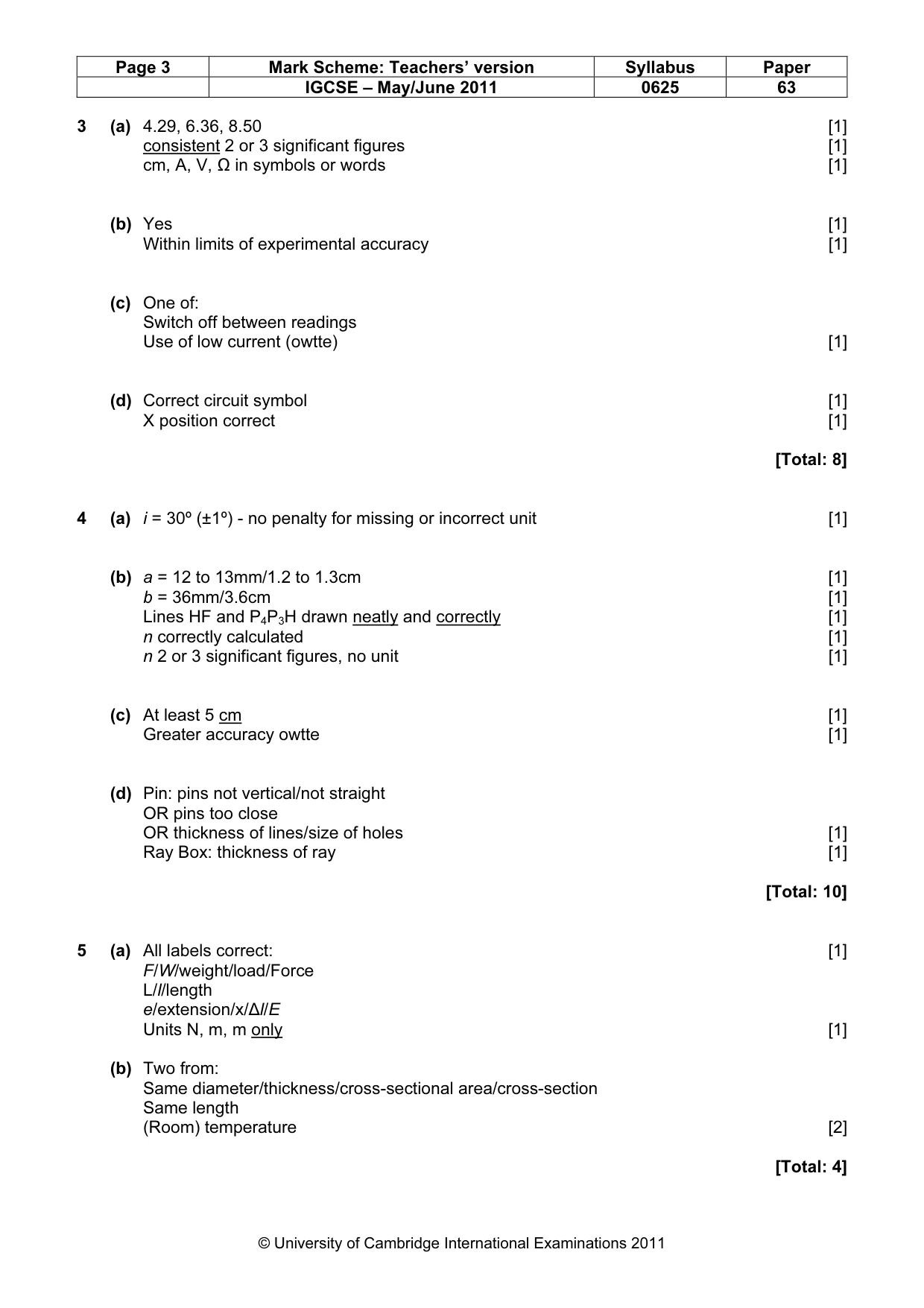
Mark scheme: 3 (a) 4.29, 6.36, 8.50 [1] consistent 2 or 3 significant figures [1] cm, A, V, Ω in symbols or words [1] (b) Yes [1] Within limits of experimental accuracy [1] (c) One of: Switch off between readings Use of low current (owtte) [1] (d) Correct circuit symbol [1] X position correct [1] [Total: 8]
Q4 · The IGCSE class is investigating the refraction of light through a transparent block
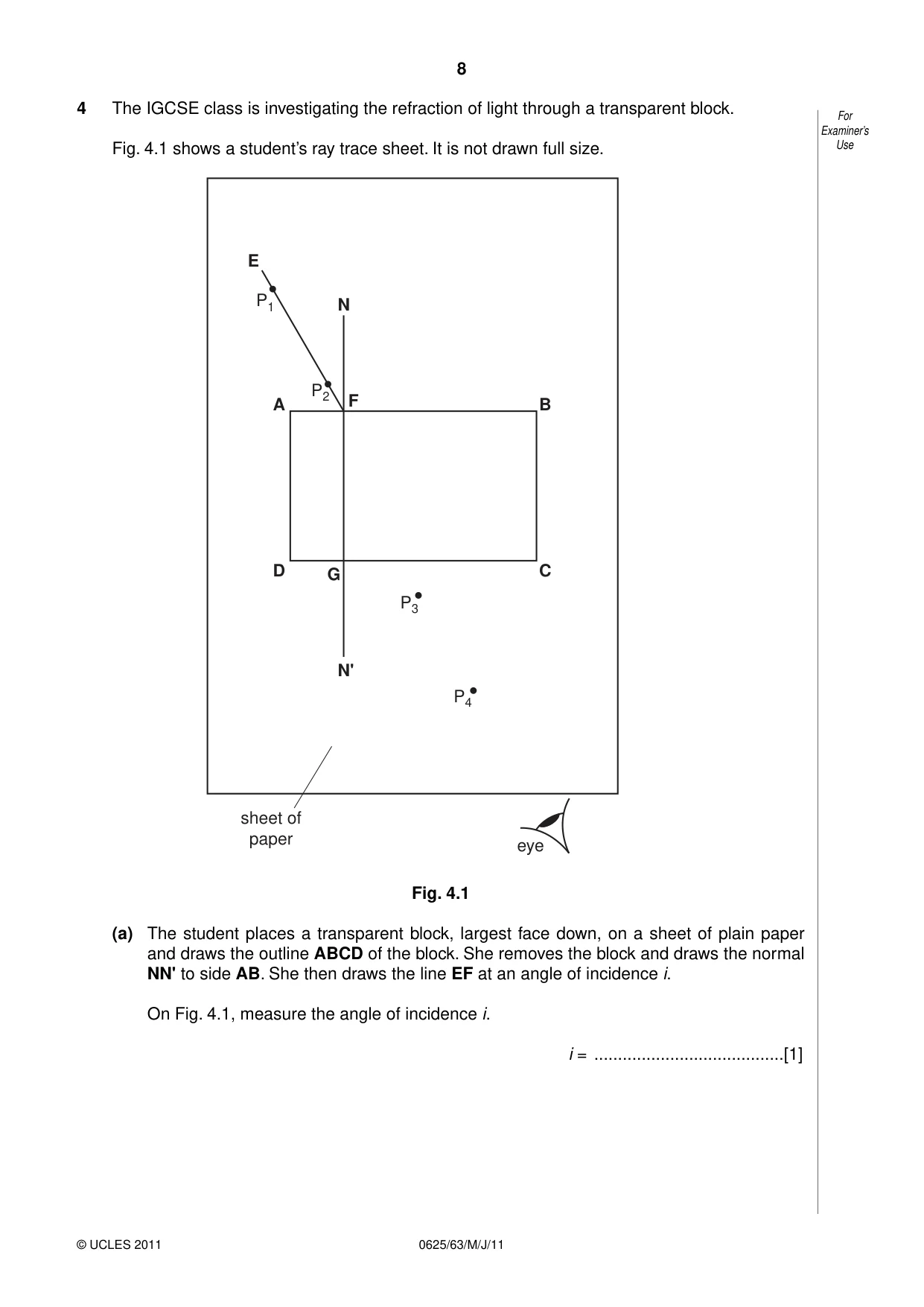
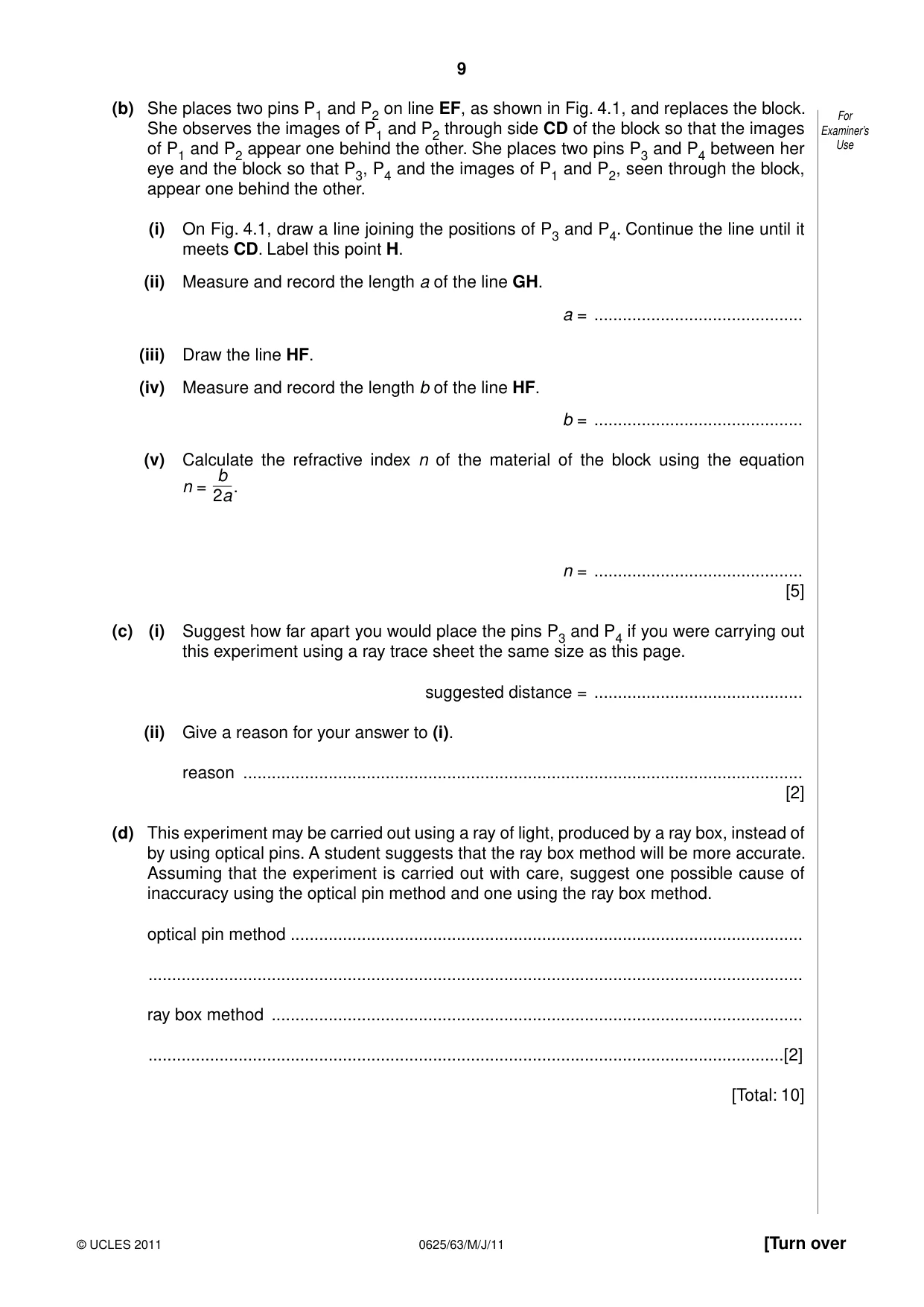
4 The IGCSE class is investigating the refraction of light through a transparent block. For Examiner’s Fig. 4.1 shows a student’s ray trace sheet. It is not drawn full size. Use E P1 N P2 A F B D G C P3 N' P4 sheet of paper eye Fig. 4.1 (a) The student places a transparent block, largest face down, on a sheet of plain paper and draws the outline ABCD of the block. She removes the block and draws the normal NN' to side AB. She then draws the line EF at an angle of incidence i. On Fig. 4.1, measure the angle of incidence i. i = ........................................[1] (b) She places two pins P1 and P2 on line EF, as shown in Fig. 4.1, and replaces the block. For Examiner’s She observes the images of P1 and P2 through side CD of the block so that the images of P1 and P2 appear one behind the other. She places two pins P3 and P4 between her Use eye and the block so that P3, P4 and the images of P1 and P2, seen through the block, appear one behind the other. (i) On Fig. 4.1, draw a line joining the positions of P3 and P4. Continue the line until it meets CD. Label this point H. (ii) Measure and record the length a of the line GH. a = ............................................ (iii) Draw the line HF. (iv) Measure and record the length b of the line HF. b = ............................................ (v) Calculate the refractive index n of the material of the block using the equation b n = 2a. n = ............................................ [5] (c) (i) Suggest how far apart you would place the pins P3 and P4 if you were carrying out this experiment using a ray trace sheet the same size as this page. suggested distance = ............................................ (ii) Give a reason for your answer to (i). reason ...................................................................................................................... [2] (d) This experiment may be carried out using a ray of light, produced by a ray box, instead of by using optical pins. A student suggests that the ray box method will be more accurate. Assuming that the experiment is carried out with care, suggest one possible cause of inaccuracy using the optical pin method and one using the ray box method. optical pin method ............................................................................................................ .......................................................................................................................................... ray box method ................................................................................................................ ......................................................................................................................................[2] [Total: 10]
Mark scheme: 4 (a) i = 30º (±1º) - no penalty for missing or incorrect unit [1] (b) a = 12 to 13mm/1.2 to 1.3cm [1] b = 36mm/3.6cm [1] Lines HF and P4P3H drawn neatly and correctly [1] n correctly calculated [1] n 2 or 3 significant figures, no unit [1] (c) At least 5 cm [1] Greater accuracy owtte [1] (d) Pin: pins not vertical/not straight OR pins too close OR thickness of lines/size of holes [1] Ray Box: thickness of ray [1] [Total: 10]
Q5 · An IGCSE student is investigating the relationship between the extension of a metal For…
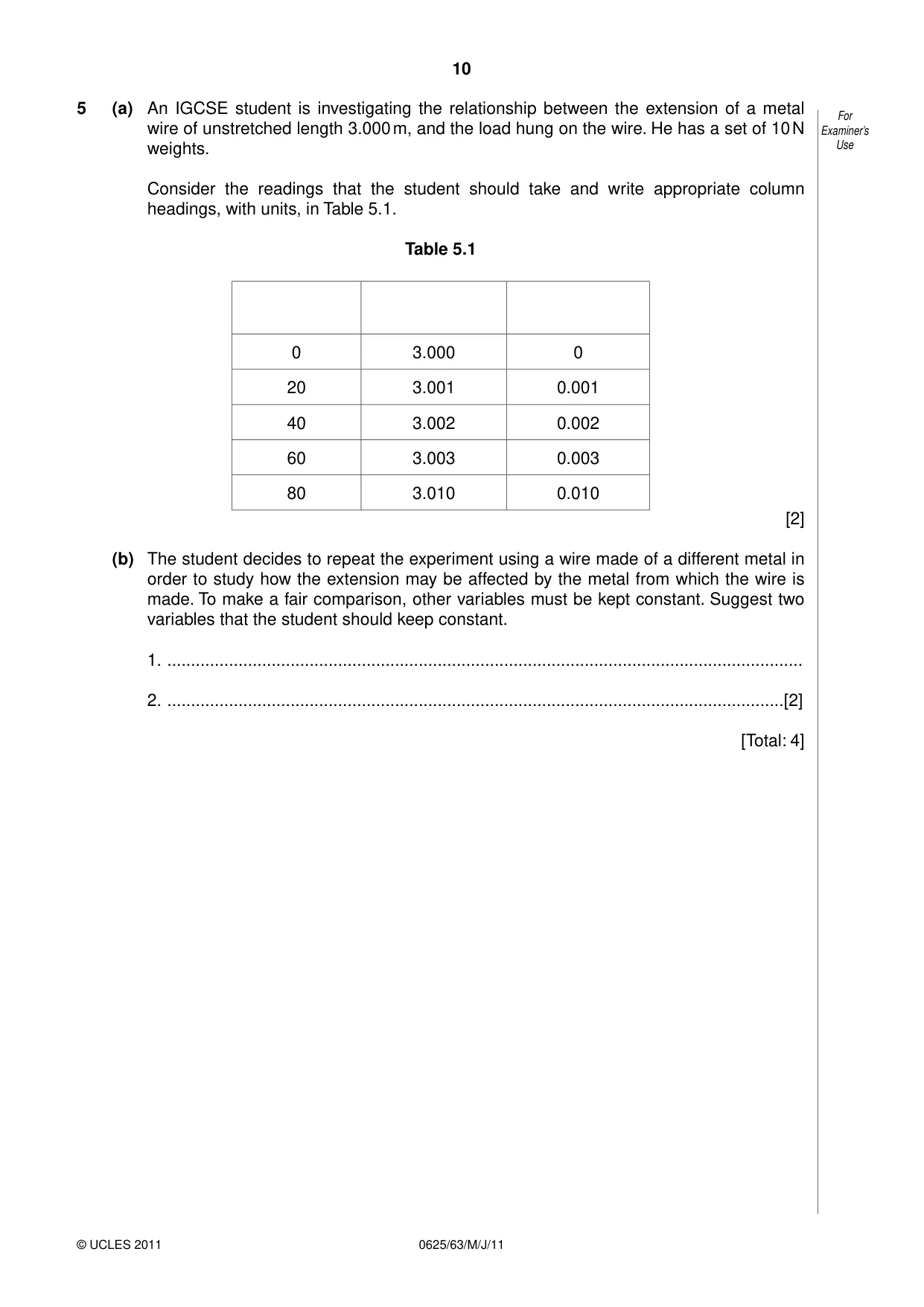
5 (a) An IGCSE student is investigating the relationship between the extension of a metal For wire of unstretched length 3.000 m, and the load hung on the wire. He has a set of 10 N Examiner’s weights. Use Consider the readings that the student should take and write appropriate column headings, with units, in Table 5.1. Table 5.1 0 3.000 0 20 3.001 0.001 40 3.002 0.002 60 3.003 0.003 80 3.010 0.010 [2] (b) The student decides to repeat the experiment using a wire made of a different metal in order to study how the extension may be affected by the metal from which the wire is made. To make a fair comparison, other variables must be kept constant. Suggest two variables that the student should keep constant. 1. ...................................................................................................................................... 2. ..................................................................................................................................[2] [Total: 4]
Mark scheme: 5 (a) All labels correct: [1] F/W/weight/load/Force L/l/length e/extension/x/∆l/E Units N, m, m only [1] (b) Two from: Same diameter/thickness/cross-sectional area/cross-section Same length (Room) temperature [2] [Total: 4]
More questions on Physical quantities and measurement techniques
What was in this paper
The subtopics covered by these 5 questions, and how many questions each got. Open one in a new tab to see every Cambridge question on it.
What you needed in this session
Cambridge’s own grade thresholds for 2011 May/June, Paper 6 · Variant 3. A higher threshold means an easier paper — the bar moves with how the cohort did.