Cambridge IGCSE Physics 0625 — 2010 Oct/Nov Paper 2 · Variant 1
0625/21/O/N/10 · 80 marks · ≈90 min
The question paper and its mark scheme, free to read here and free to download. This is Cambridge’s own paper, exactly as it was sat.
Question paper20 pages
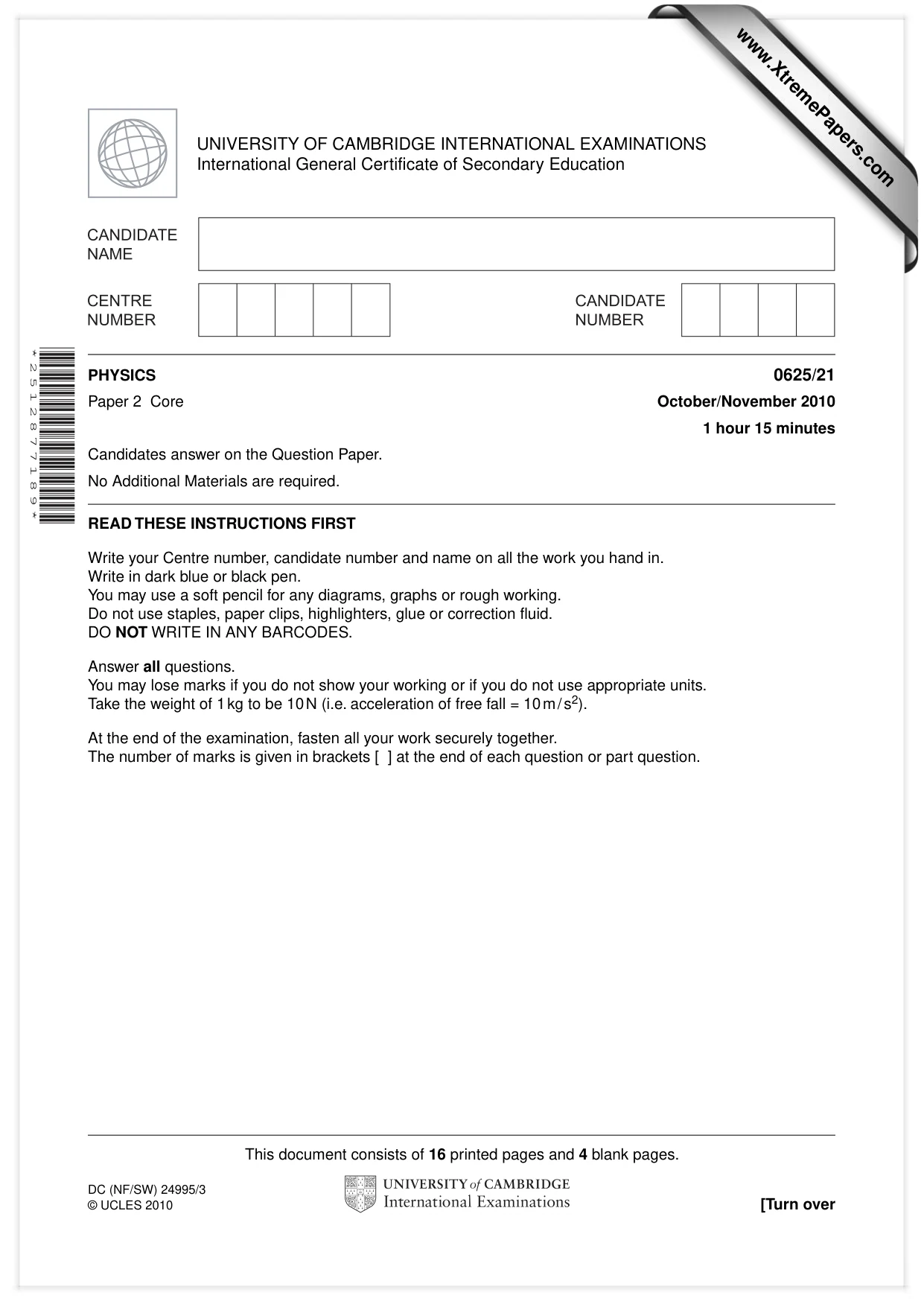



Mark scheme6 pages
Answers below. Sit the paper first if you are practising.
Paper as text
Question paper, page 1
This document consists of 16 printed pages and 4 blank pages. DC (NF/SW) 24995/3 © UCLES 2010 [Turn over UNIVERSITY OF CAMBRIDGE INTERNATIONAL EXAMINATIONS International General Certificate of Secondary Education * 2 5 1 2 8 7 7 1 8 9 * PHYSICS 0625/21 Paper 2 Core October/November 2010 1 hour 15 minutes Candidates answer on the Question Paper. No Additional Materials are required. READ THESE INSTRUCTIONS FIRST Write your Centre number, candidate number and name on all the work you hand in. Write in dark blue or black pen. You may use a soft pencil for any diagrams, graphs or rough working. Do not use staples, paper clips, highlighters, glue or correction fluid. DO NOT WRITE IN ANY BARCODES. Answer all questions. You may lose marks if you do not show your working or if you do not use appropriate units. Take the weight of 1 kg to be 10 N (i.e. acceleration of free fall = 10 m / s2). At the end of the examination, fasten all your work securely together. The number of marks is given in brackets [ ] at the end of each question or part question. www.XtremePapers.com
Question paper, page 2
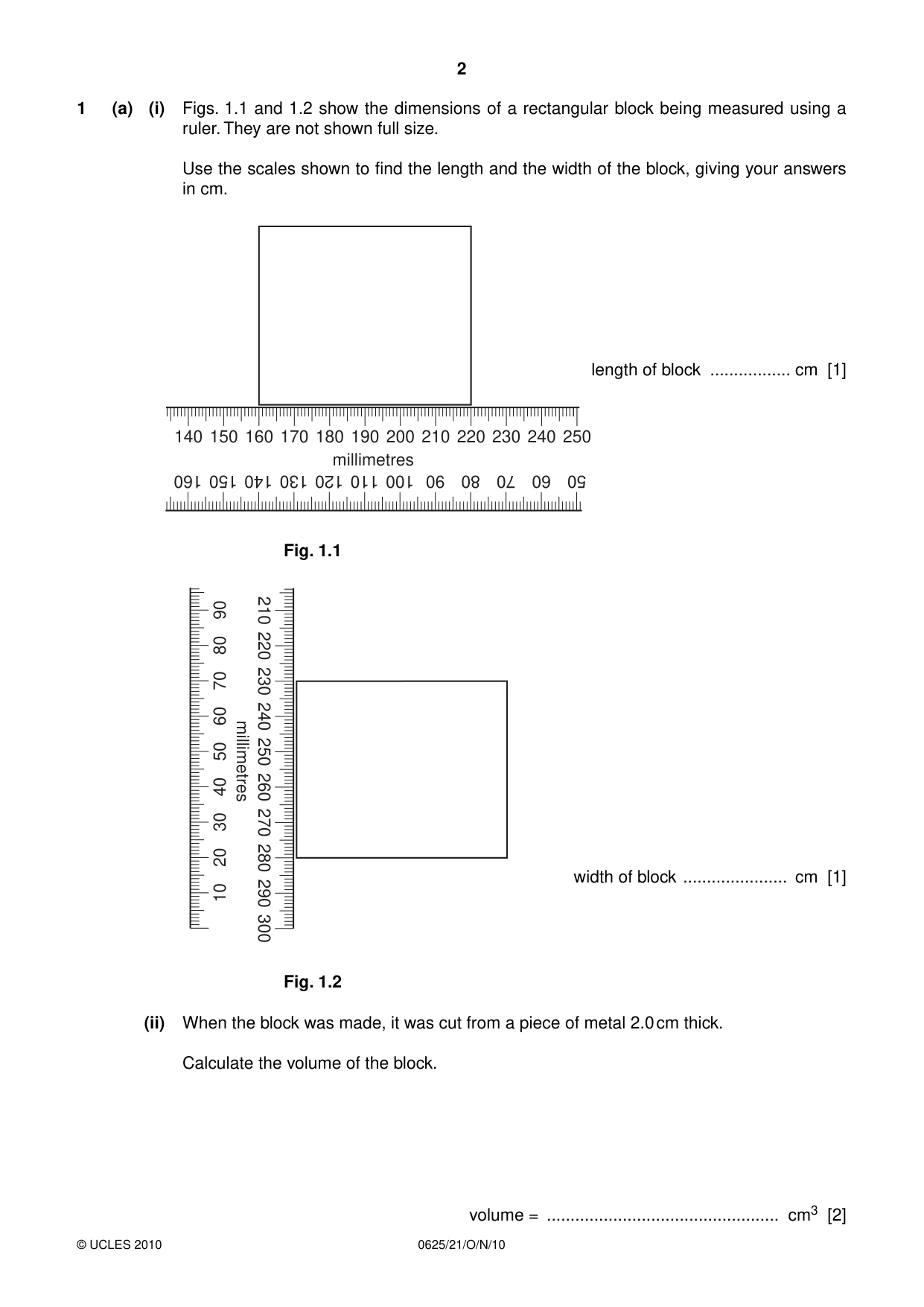
2 0625/21/O/N/10 © UCLES 2010 1 (a) (i) Figs. 1.1 and 1.2 show the dimensions of a rectangular block being measured using a ruler. They are not shown full size. Use the scales shown to find the length and the width of the block, giving your answers in cm. 140 150 160 170 180 190 millimetres 200 210 220 230 240 250 50 60 70 80 90 100 110 120 130 140 150 160 length of block … cm [1] Fig. 1.1 210 220 230 240 250 260 millimetres 270 280 290 300 10 20 30 40 50 60 70 80 90 width of block … cm [1] Fig. 1.2 (ii) When the block was made, it was cut from a piece of metal 2.0 cm thick. Calculate the volume of the block. volume = … cm3 [2]
Question paper, page 3
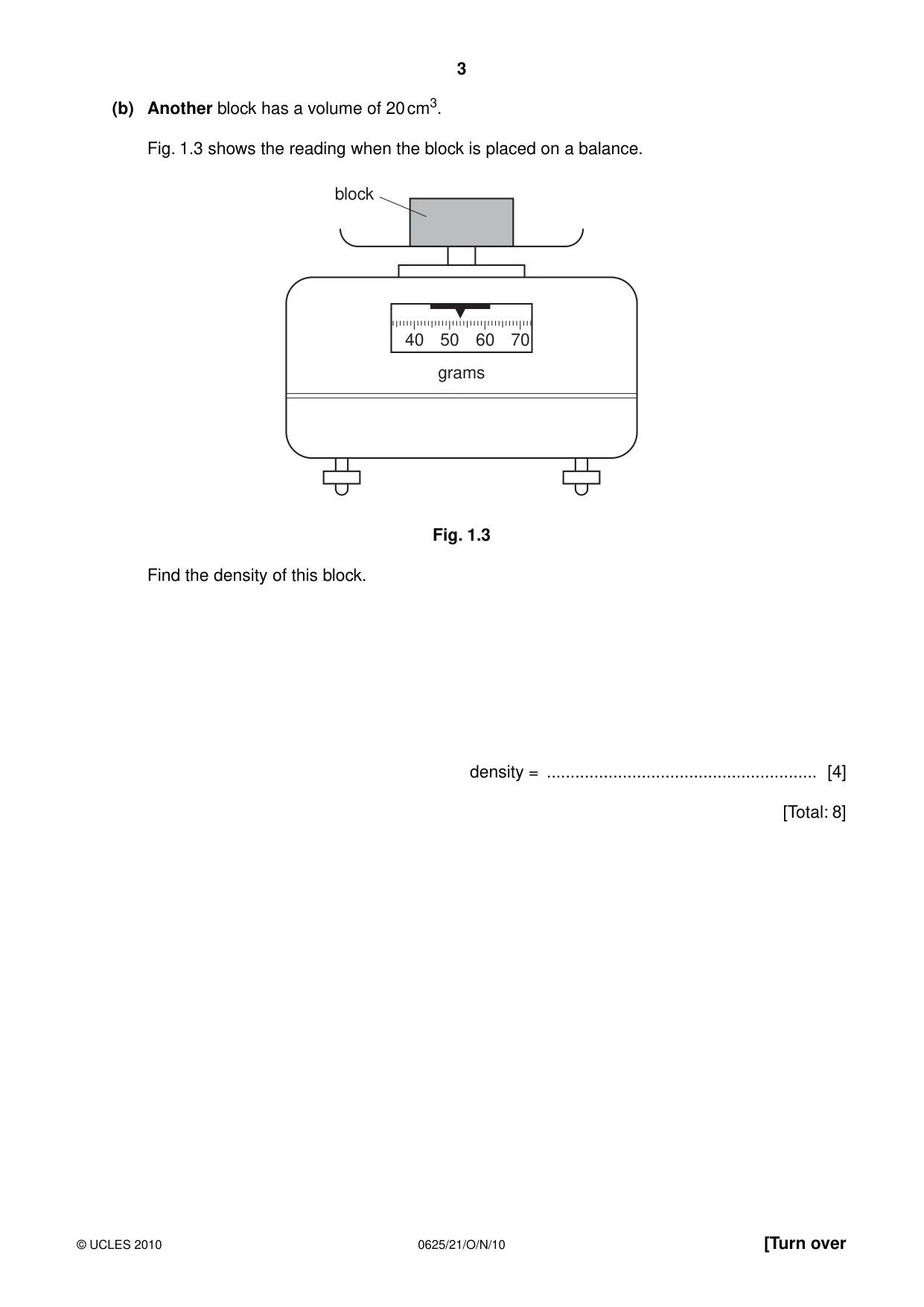
3 0625/21/O/N/10 © UCLES 2010 [Turn over (b) Another block has a volume of 20 cm3. Fig. 1.3 shows the reading when the block is placed on a balance. 40 50 grams block 60 70 Fig. 1.3 Find the density of this block. density = … [4] [Total: 8]
Question paper, page 4
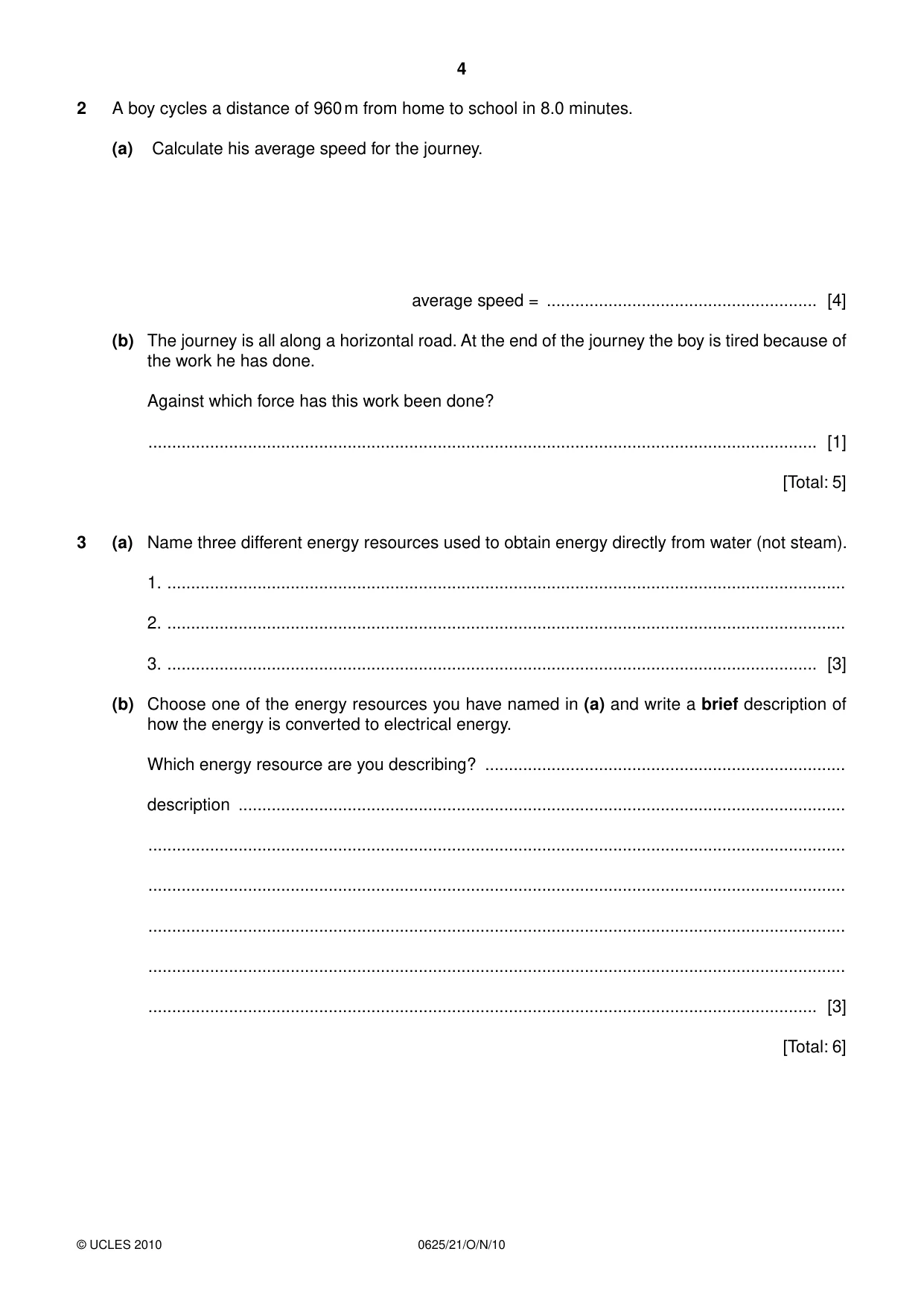
4 0625/21/O/N/10 © UCLES 2010 2 A boy cycles a distance of 960 m from home to school in 8.0 minutes. (a) Calculate his average speed for the journey. average speed = … [4] (b) The journey is all along a horizontal road. At the end of the journey the boy is tired because of the work he has done. Against which force has this work been done? … [1] [Total: 5] 3 (a) Name three different energy resources used to obtain energy directly from water (not steam). 1. … 2. … 3. … [3] (b) Choose one of the energy resources you have named in (a) and write a brief description of how the energy is converted to electrical energy. Which energy resource are you describing? … description … … … … … … [3] [Total: 6]
Question paper, page 5
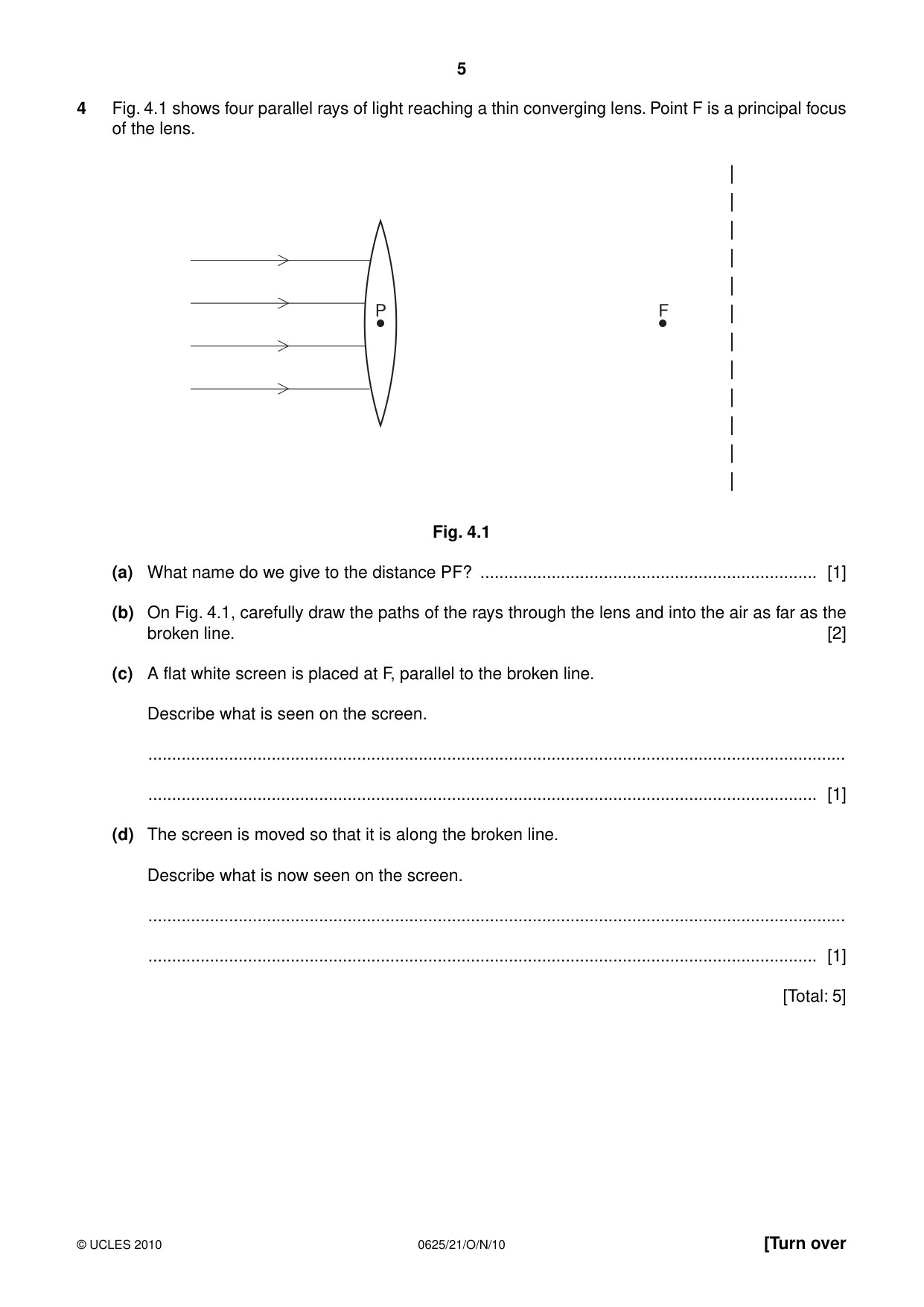
5 0625/21/O/N/10 © UCLES 2010 [Turn over 4 Fig. 4.1 shows four parallel rays of light reaching a thin converging lens. Point F is a principal focus of the lens. P F Fig. 4.1 (a) What name do we give to the distance PF? … [1] (b) On Fig. 4.1, carefully draw the paths of the rays through the lens and into the air as far as the broken line. [2] (c) A flat white screen is placed at F, parallel to the broken line. Describe what is seen on the screen. … … [1] (d) The screen is moved so that it is along the broken line. Describe what is now seen on the screen. … … [1] [Total: 5]
Question paper, page 6
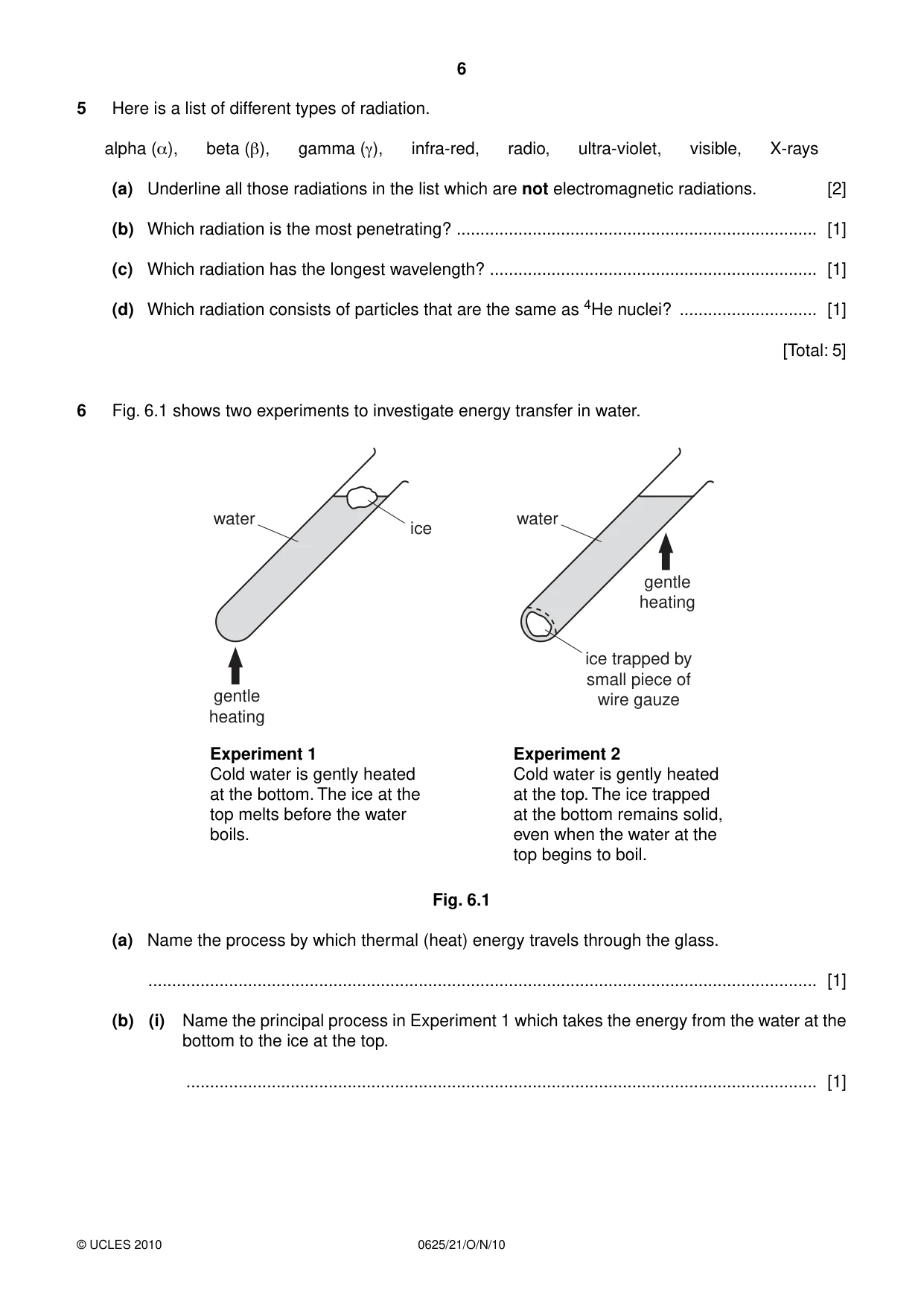
6 0625/21/O/N/10 © UCLES 2010 5 Here is a list of different types of radiation. alpha (α), beta (β), gamma (γ), infra-red, radio, ultra-violet, visible, X-rays (a) Underline all those radiations in the list which are not electromagnetic radiations. [2] (b) Which radiation is the most penetrating? … [1] (c) Which radiation has the longest wavelength? … [1] (d) Which radiation consists of particles that are the same as 4He nuclei? … [1] [Total: 5] 6 Fig. 6.1 shows two experiments to investigate energy transfer in water. water ice water ice trapped by small piece of wire gauze gentle heating gentle heating Experiment 1 Cold water is gently heated at the bottom. The ice at the top melts before the water boils. Experiment 2 Cold water is gently heated at the top. The ice trapped at the bottom remains solid, even when the water at the top begins to boil. Fig. 6.1 (a) Name the process by which thermal (heat) energy travels through the glass. … [1] (b) (i) Name the principal process in Experiment 1 which takes the energy from the water at the bottom to the ice at the top. … [1]
Question paper, page 7
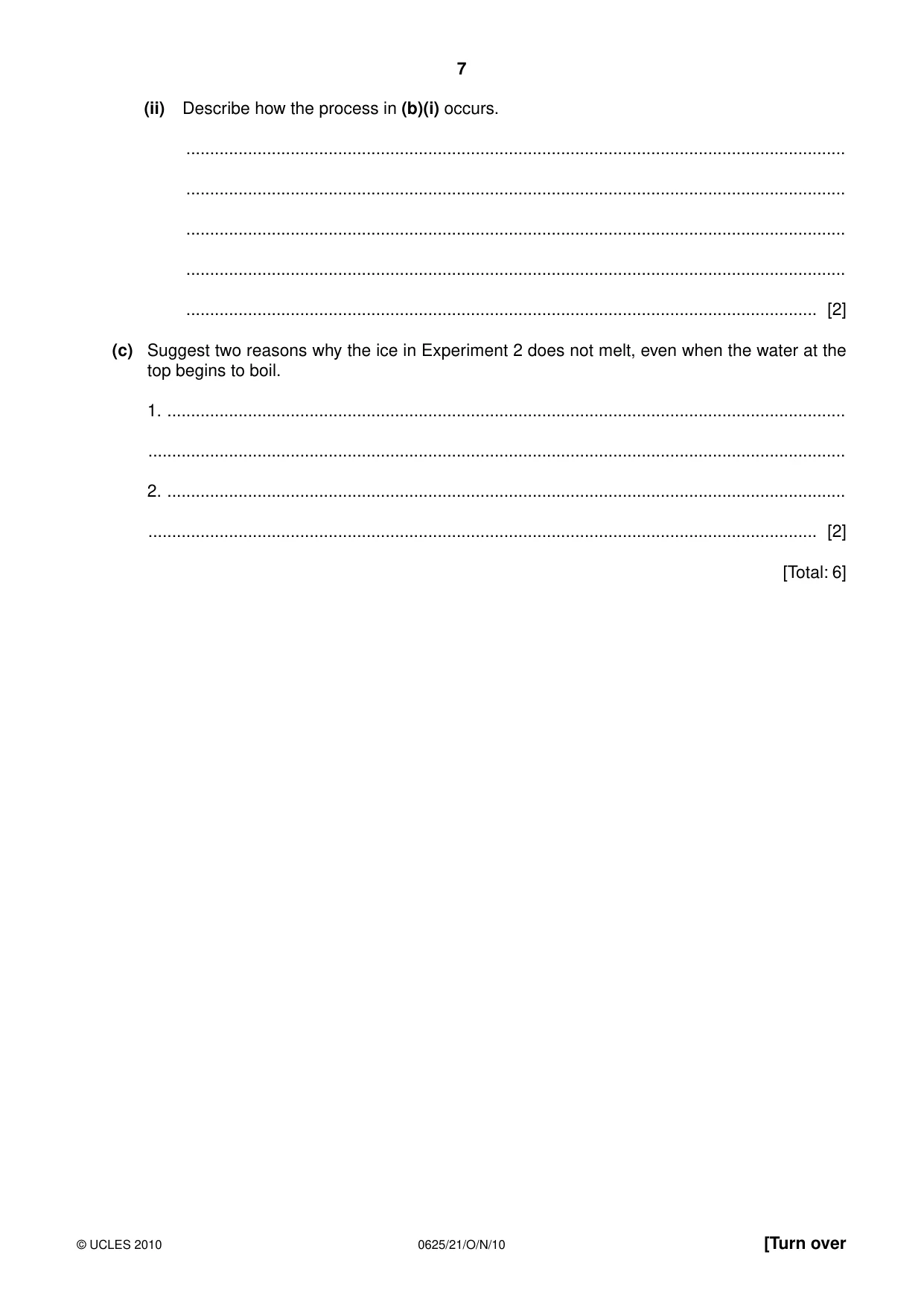
7 0625/21/O/N/10 © UCLES 2010 [Turn over (ii) Describe how the process in (b)(i) occurs. … … … … … [2] (c) Suggest two reasons why the ice in Experiment 2 does not melt, even when the water at the top begins to boil. 1. … … 2. … … [2] [Total: 6]
Question paper, page 8
8 0625/21/O/N/10 © UCLES 2010 BLANK PAGE
Question paper, page 9
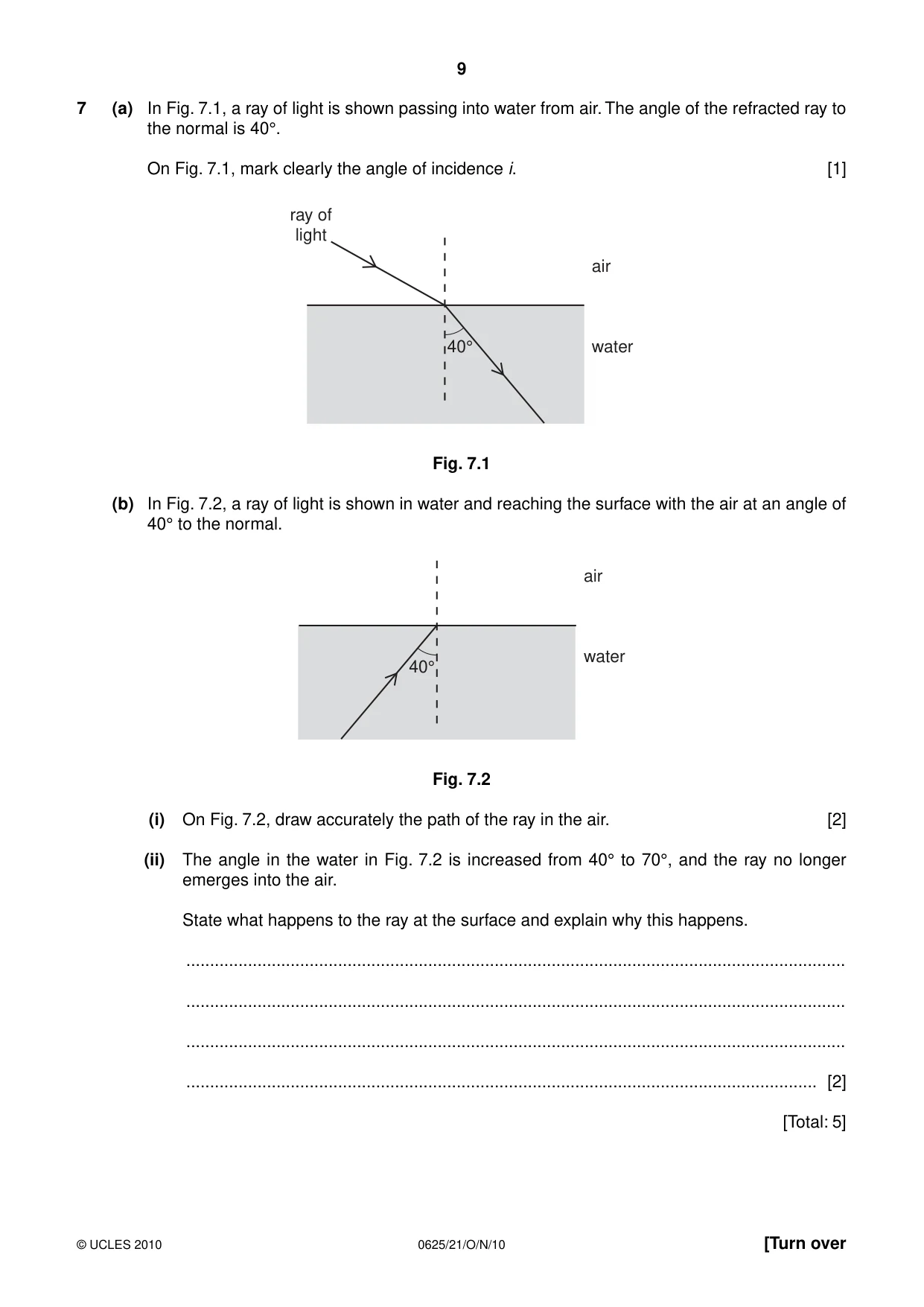
9 0625/21/O/N/10 © UCLES 2010 [Turn over 7 (a) In Fig. 7.1, a ray of light is shown passing into water from air. The angle of the refracted ray to the normal is 40°. On Fig. 7.1, mark clearly the angle of incidence i. [1] 40° air water ray of light Fig. 7.1 (b) In Fig. 7.2, a ray of light is shown in water and reaching the surface with the air at an angle of 40° to the normal. air water 40° Fig. 7.2 (i) On Fig. 7.2, draw accurately the path of the ray in the air. [2] (ii) The angle in the water in Fig. 7.2 is increased from 40° to 70°, and the ray no longer emerges into the air. State what happens to the ray at the surface and explain why this happens. … … … … [2] [Total: 5]
Question paper, page 10
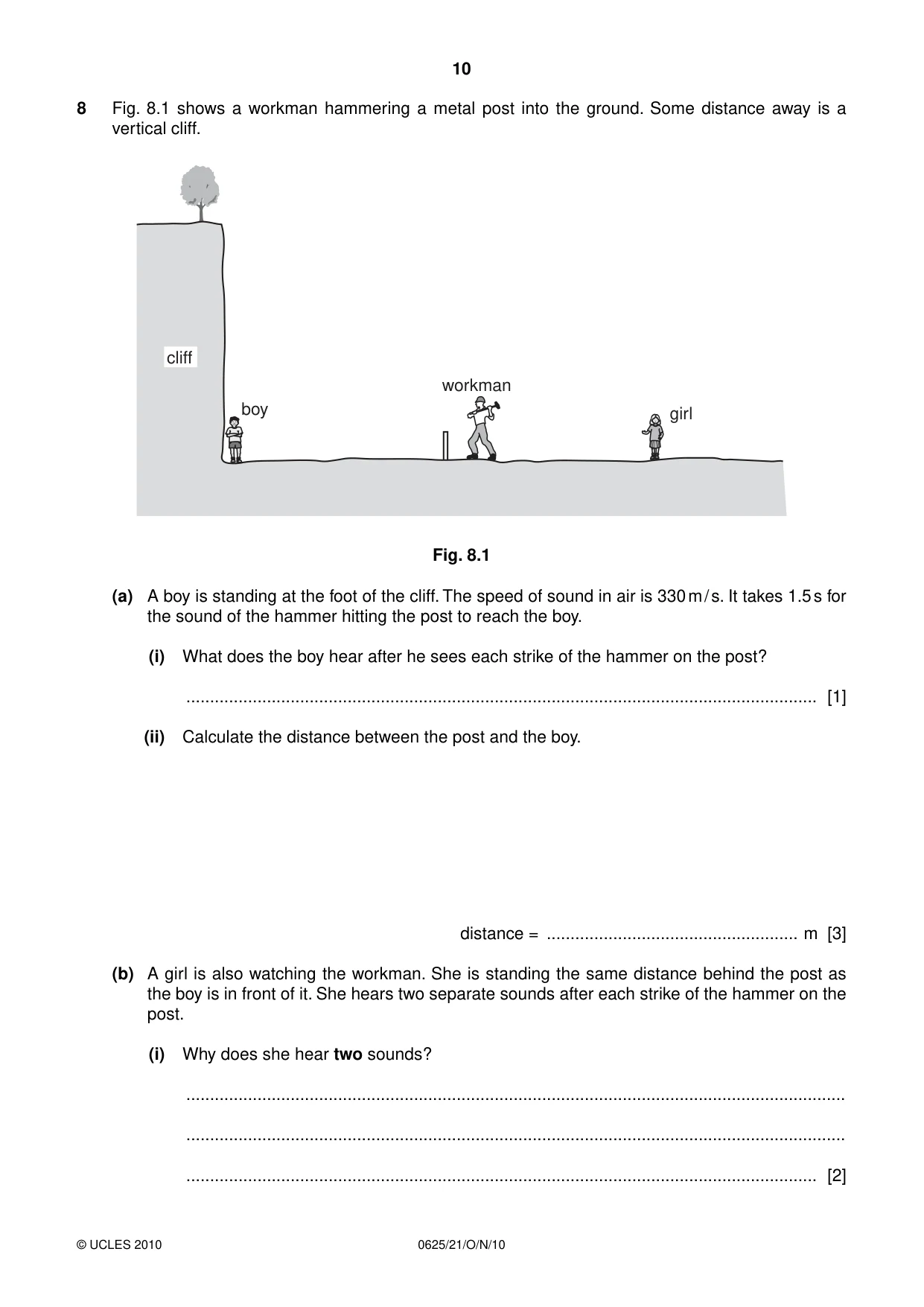
10 0625/21/O/N/10 © UCLES 2010 8 Fig. 8.1 shows a workman hammering a metal post into the ground. Some distance away is a vertical cliff. cliff boy girl workman Fig. 8.1 (a) A boy is standing at the foot of the cliff. The speed of sound in air is 330 m / s. It takes 1.5 s for the sound of the hammer hitting the post to reach the boy. (i) What does the boy hear after he sees each strike of the hammer on the post? … [1] (ii) Calculate the distance between the post and the boy. distance = … m [3] (b) A girl is also watching the workman. She is standing the same distance behind the post as the boy is in front of it. She hears two separate sounds after each strike of the hammer on the post. (i) Why does she hear two sounds? … … … [2]
Question paper, page 11
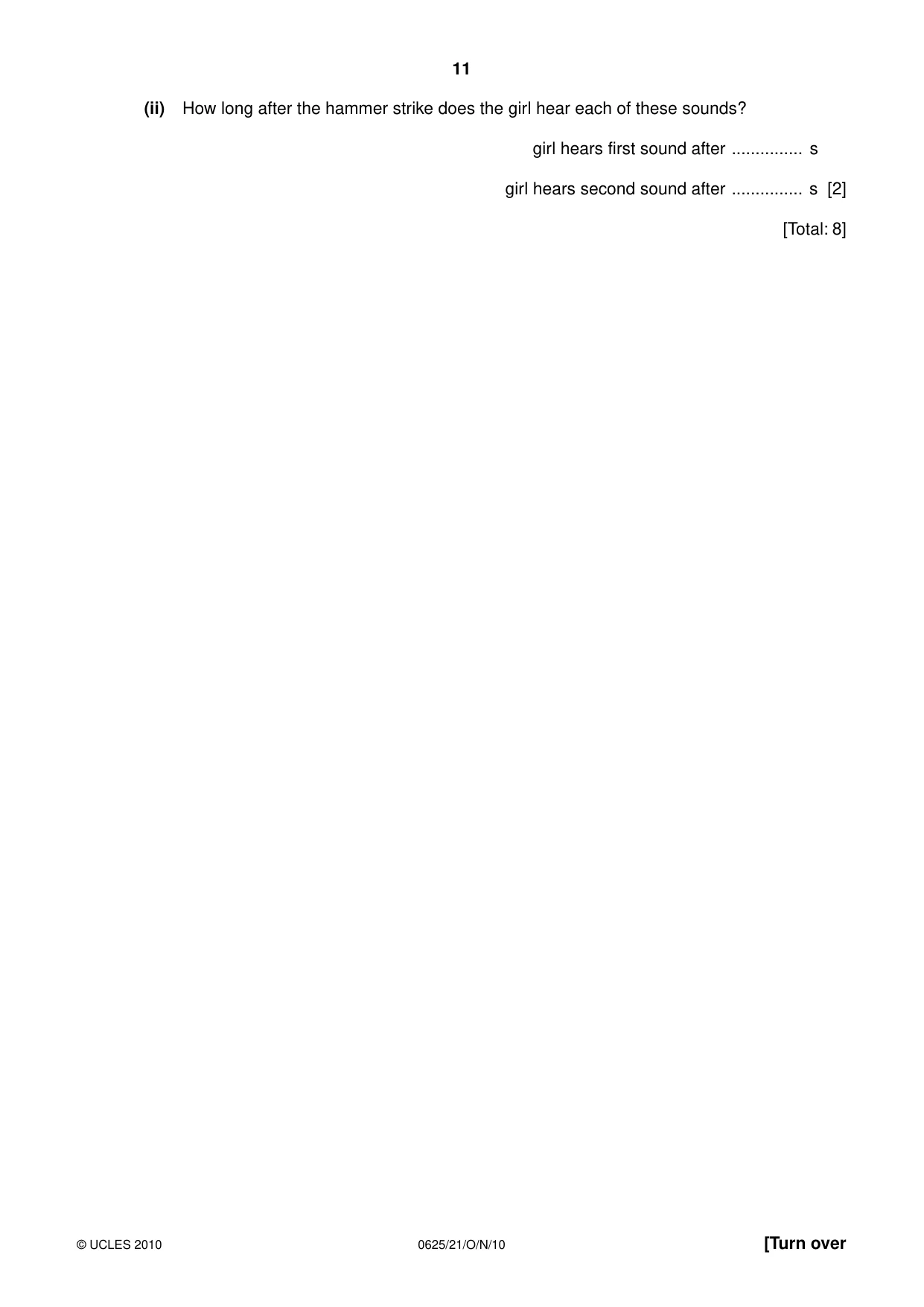
11 0625/21/O/N/10 © UCLES 2010 [Turn over (ii) How long after the hammer strike does the girl hear each of these sounds? girl hears first sound after … s girl hears second sound after … s [2] [Total: 8]
Question paper, page 12
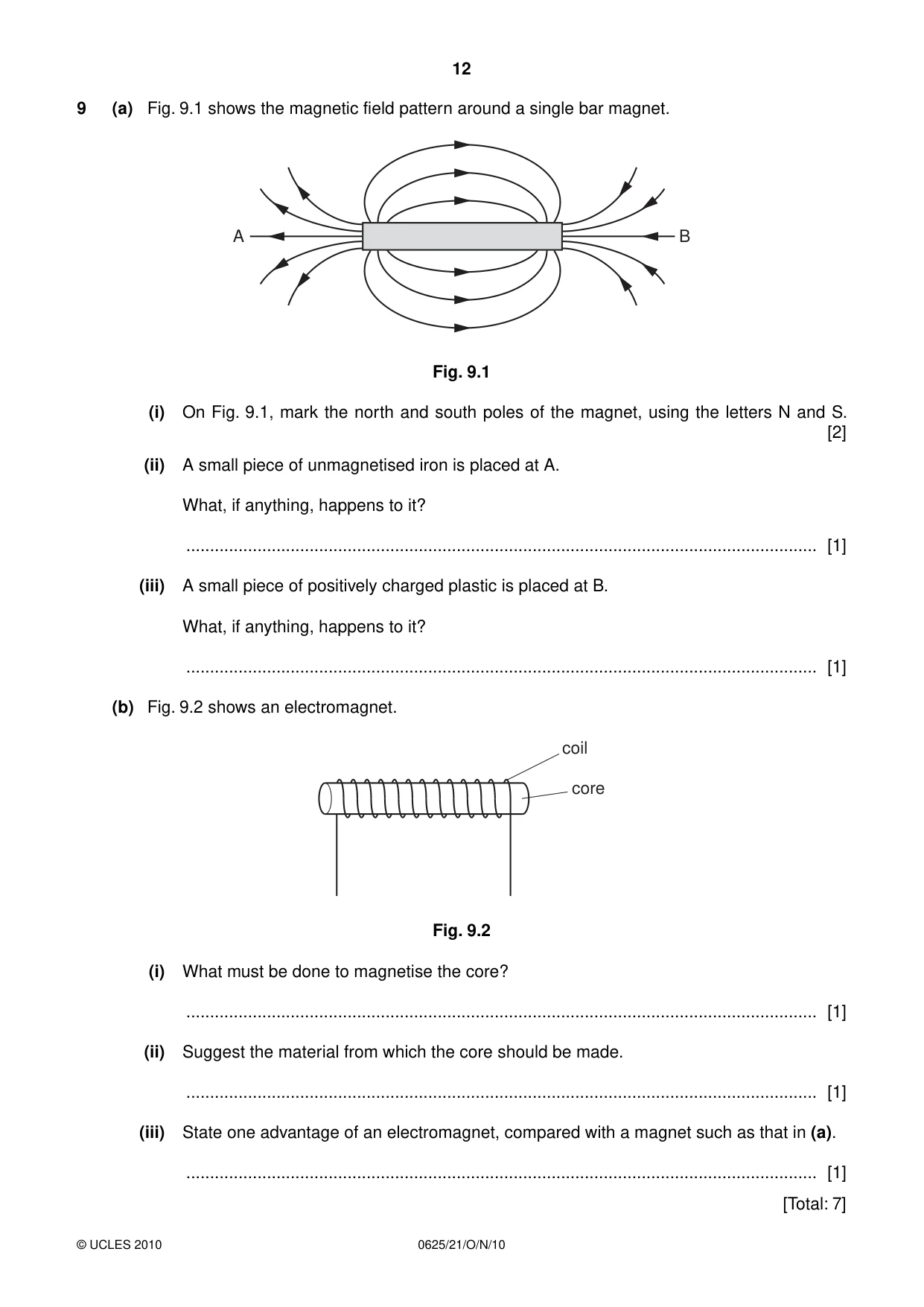
12 0625/21/O/N/10 © UCLES 2010 9 (a) Fig. 9.1 shows the magnetic field pattern around a single bar magnet. A B Fig. 9.1 (i) On Fig. 9.1, mark the north and south poles of the magnet, using the letters N and S. [2] (ii) A small piece of unmagnetised iron is placed at A. What, if anything, happens to it? … [1] (iii) A small piece of positively charged plastic is placed at B. What, if anything, happens to it? … [1] (b) Fig. 9.2 shows an electromagnet. coil core Fig. 9.2 (i) What must be done to magnetise the core? … [1] (ii) Suggest the material from which the core should be made. … [1] (iii) State one advantage of an electromagnet, compared with a magnet such as that in (a). … [1] [Total: 7]
Question paper, page 13
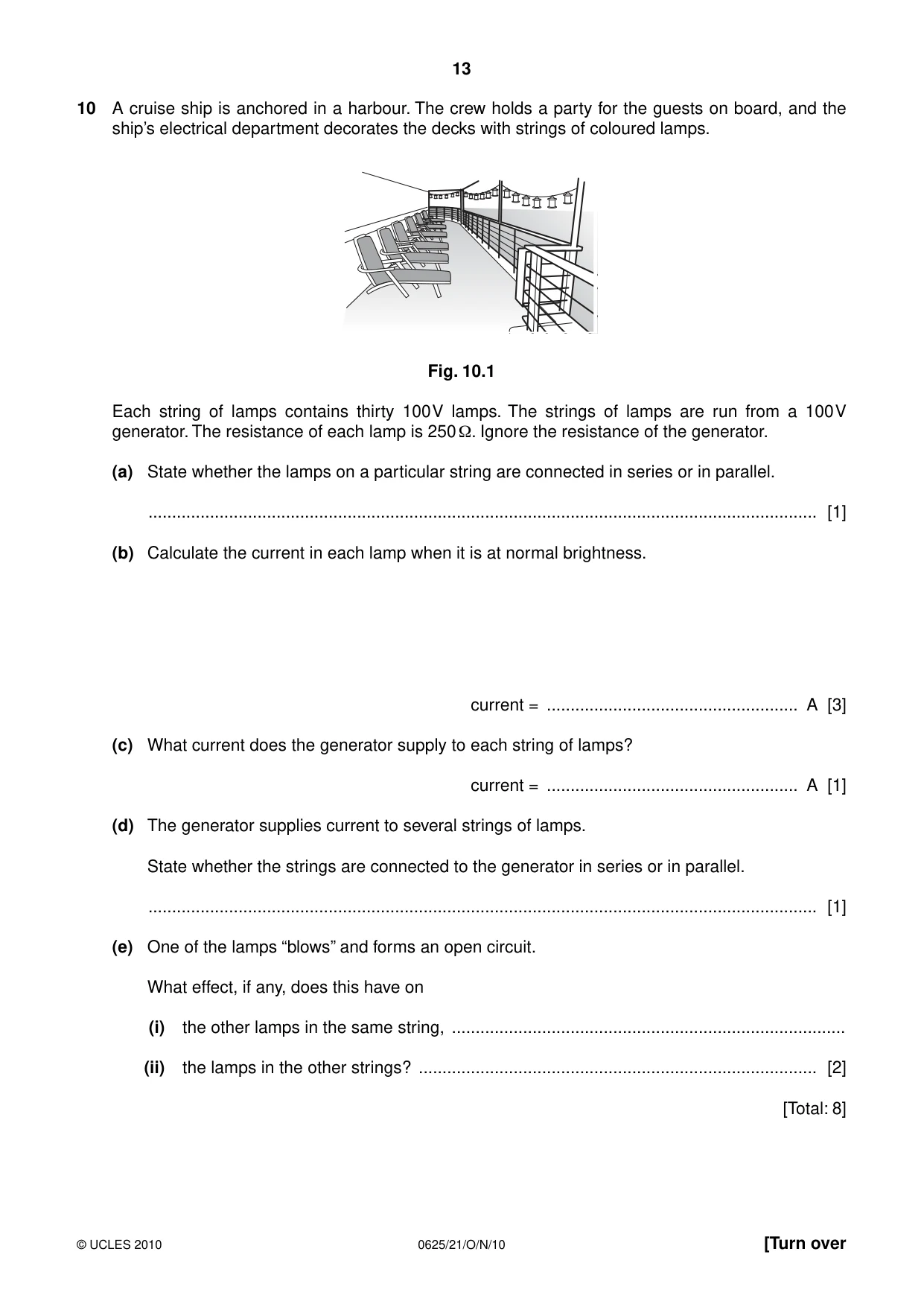
13 0625/21/O/N/10 © UCLES 2010 [Turn over 10 A cruise ship is anchored in a harbour. The crew holds a party for the guests on board, and the ship’s electrical department decorates the decks with strings of coloured lamps. Fig. 10.1 Each string of lamps contains thirty 100 V lamps. The strings of lamps are run from a 100 V generator. The resistance of each lamp is 250 Ω. Ignore the resistance of the generator. (a) State whether the lamps on a particular string are connected in series or in parallel. … [1] (b) Calculate the current in each lamp when it is at normal brightness. current = … A [3] (c) What current does the generator supply to each string of lamps? current = … A [1] (d) The generator supplies current to several strings of lamps. State whether the strings are connected to the generator in series or in parallel. … [1] (e) One of the lamps “blows” and forms an open circuit. What effect, if any, does this have on (i) the other lamps in the same string, … (ii) the lamps in the other strings? … [2] [Total: 8]
Question paper, page 14
14 0625/21/O/N/10 © UCLES 2010 BLANK PAGE
Question paper, page 15
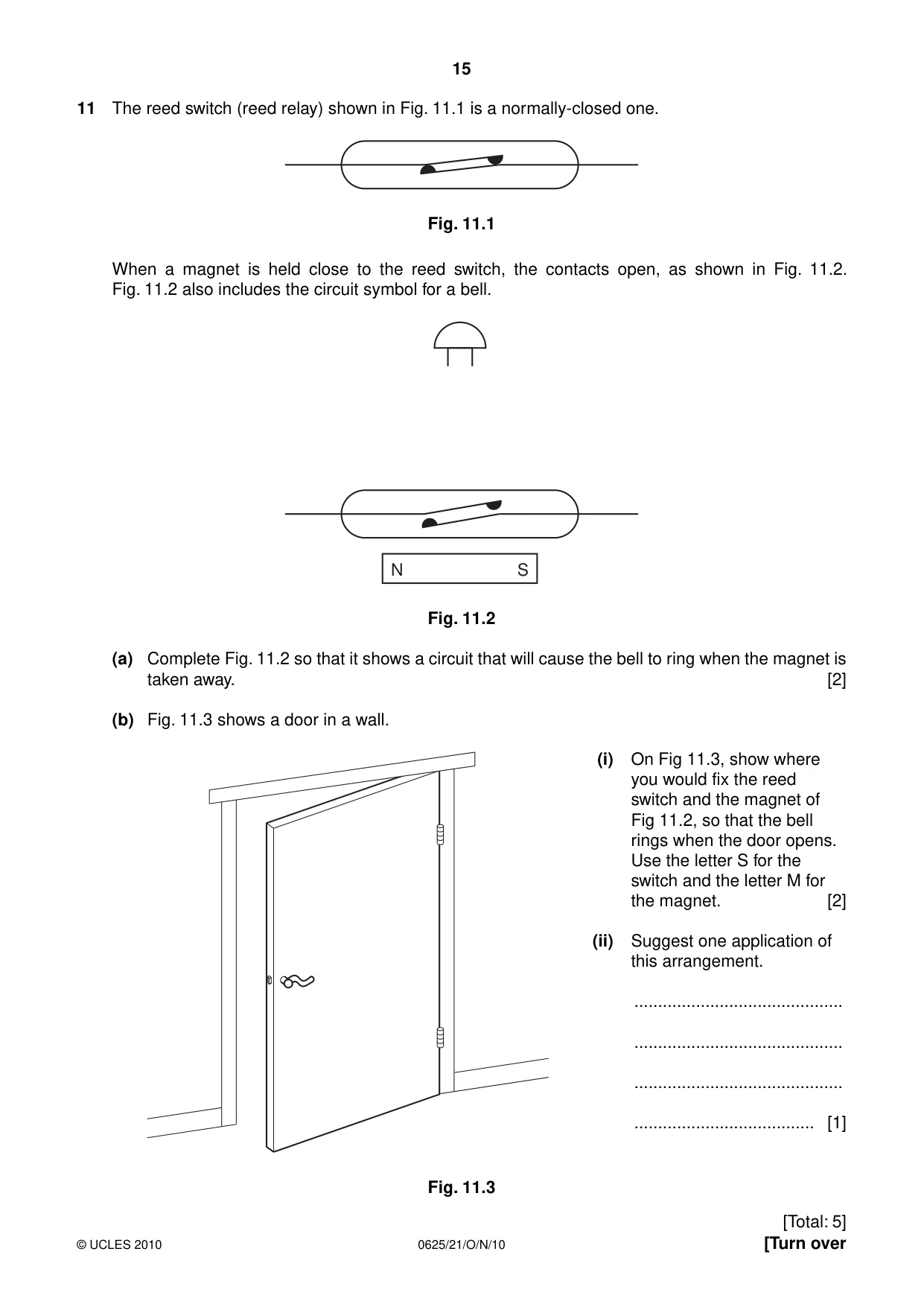
15 0625/21/O/N/10 © UCLES 2010 [Turn over 11 The reed switch (reed relay) shown in Fig. 11.1 is a normally-closed one. Fig. 11.1 When a magnet is held close to the reed switch, the contacts open, as shown in Fig. 11.2. Fig. 11.2 also includes the circuit symbol for a bell. N S Fig. 11.2 (a) Complete Fig. 11.2 so that it shows a circuit that will cause the bell to ring when the magnet is taken away. [2] (b) Fig. 11.3 shows a door in a wall. (i) On Fig 11.3, show where you would fix the reed switch and the magnet of Fig 11.2, so that the bell rings when the door opens. Use the letter S for the switch and the letter M for the magnet. [2] (ii) Suggest one application of this arrangement. … … … … [1] Fig. 11.3 [Total: 5]
Question paper, page 16
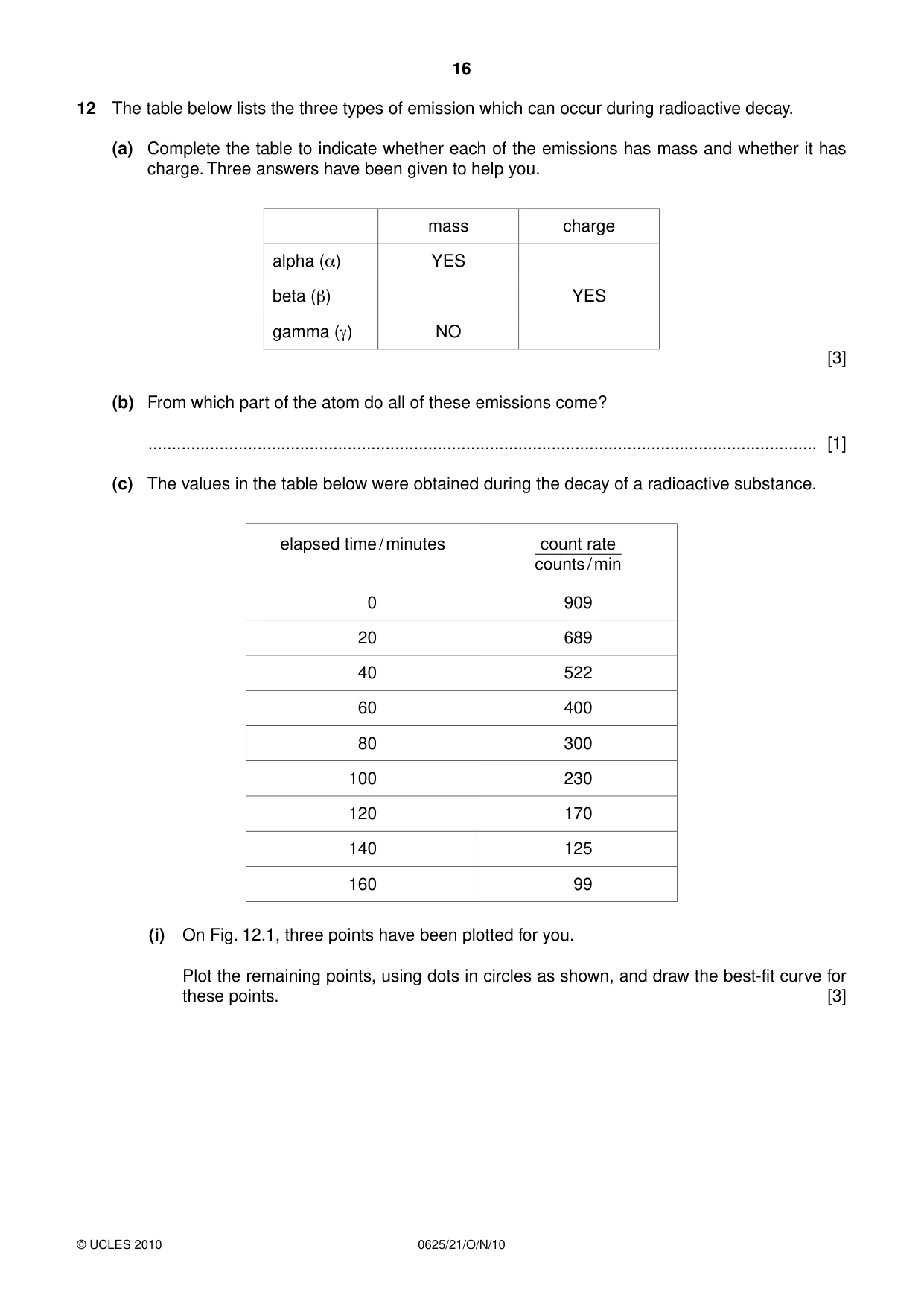
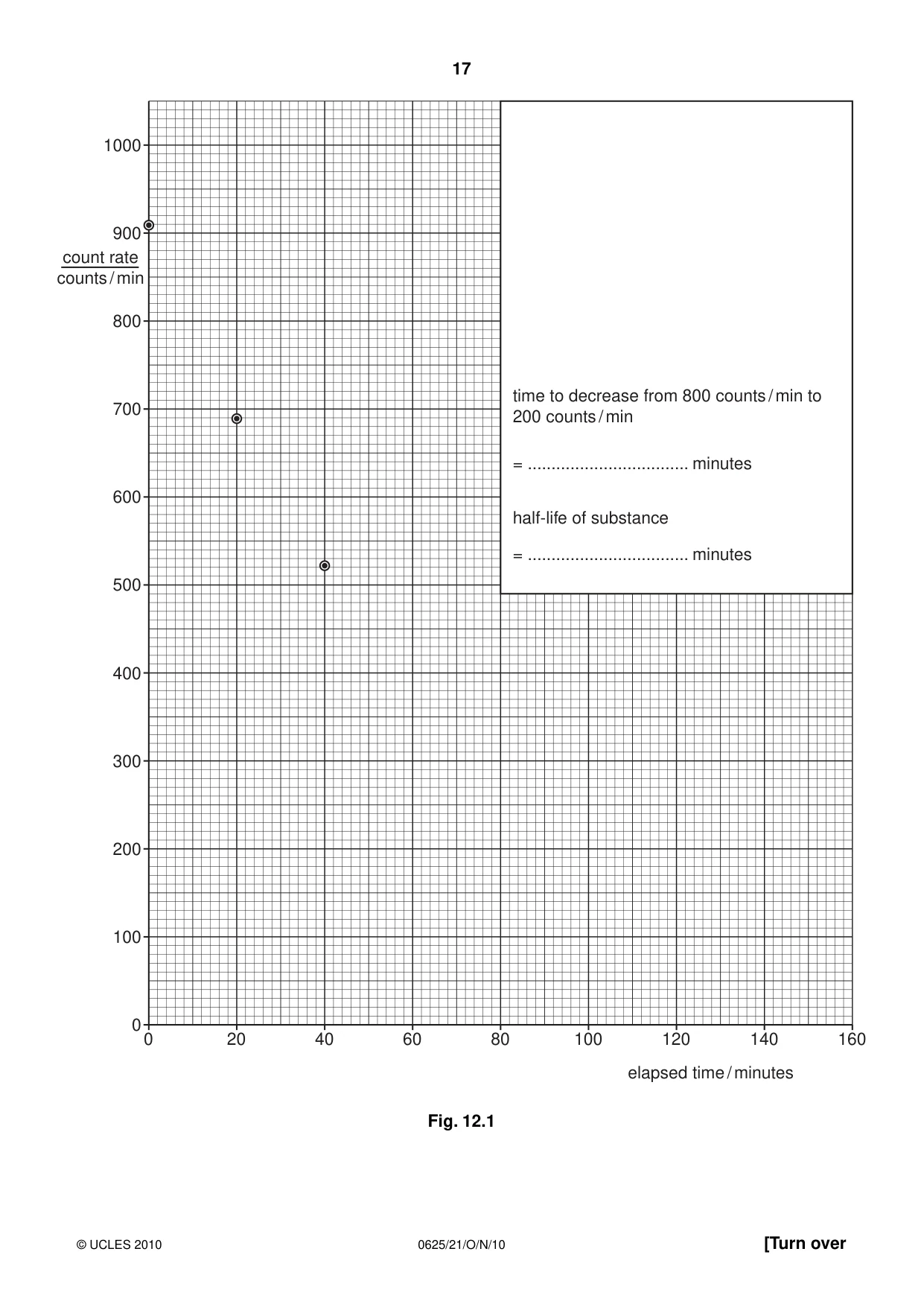
16 0625/21/O/N/10 © UCLES 2010 12 The table below lists the three types of emission which can occur during radioactive decay. (a) Complete the table to indicate whether each of the emissions has mass and whether it has charge. Three answers have been given to help you. mass charge alpha (α) YES beta (β) YES gamma (γ) NO [3] (b) From which part of the atom do all of these emissions come? … [1] (c) The values in the table below were obtained during the decay of a radioactive substance. elapsed time / minutes count rate counts / min 0 909 20 689 40 522 60 400 80 300 100 230 120 170 140 125 160 99 (i) On Fig. 12.1, three points have been plotted for you. Plot the remaining points, using dots in circles as shown, and draw the best-fit curve for these points. [3]
Question paper, page 17
17 0625/21/O/N/10 © UCLES 2010 [Turn over 0 0 100 200 300 400 500 600 700 800 900 1000 20 40 60 80 100 120 elapsed time / minutes count rate counts / min 140 160 time to decrease from 800 counts / min to 200 counts / min = … minutes = … minutes half-life of substance Fig. 12.1
Question paper, page 18
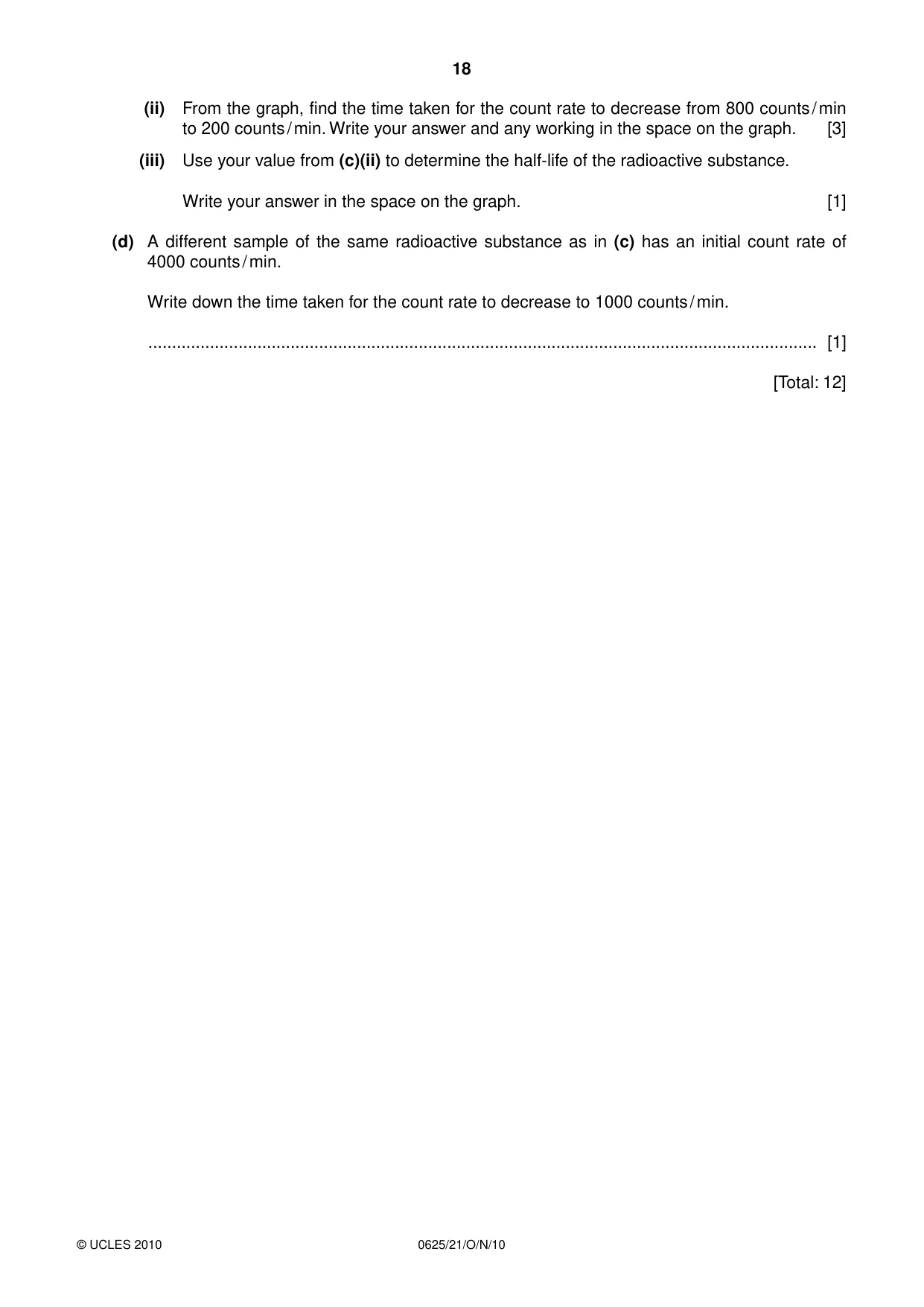
18 0625/21/O/N/10 © UCLES 2010 (ii) From the graph, find the time taken for the count rate to decrease from 800 counts / min to 200 counts / min. Write your answer and any working in the space on the graph. [3] (iii) Use your value from (c)(ii) to determine the half-life of the radioactive substance. Write your answer in the space on the graph. [1] (d) A different sample of the same radioactive substance as in (c) has an initial count rate of 4000 counts / min. Write down the time taken for the count rate to decrease to 1000 counts / min. … [1] [Total: 12]
Question paper, page 19
19 0625/21/O/N/10 © UCLES 2010 BLANK PAGE
Question paper, page 20
20 0625/21/O/N/10 © UCLES 2010 Permission to reproduce items where third-party owned material protected by copyright is included has been sought and cleared where possible. Every reasonable effort has been made by the publisher (UCLES) to trace copyright holders, but if any items requiring clearance have unwittingly been included, the publisher will be pleased to make amends at the earliest possible opportunity. University of Cambridge International Examinations is part of the Cambridge Assessment Group. Cambridge Assessment is the brand name of University of Cambridge Local Examinations Syndicate (UCLES), which is itself a department of the University of Cambridge. BLANK PAGE
Mark scheme, page 1
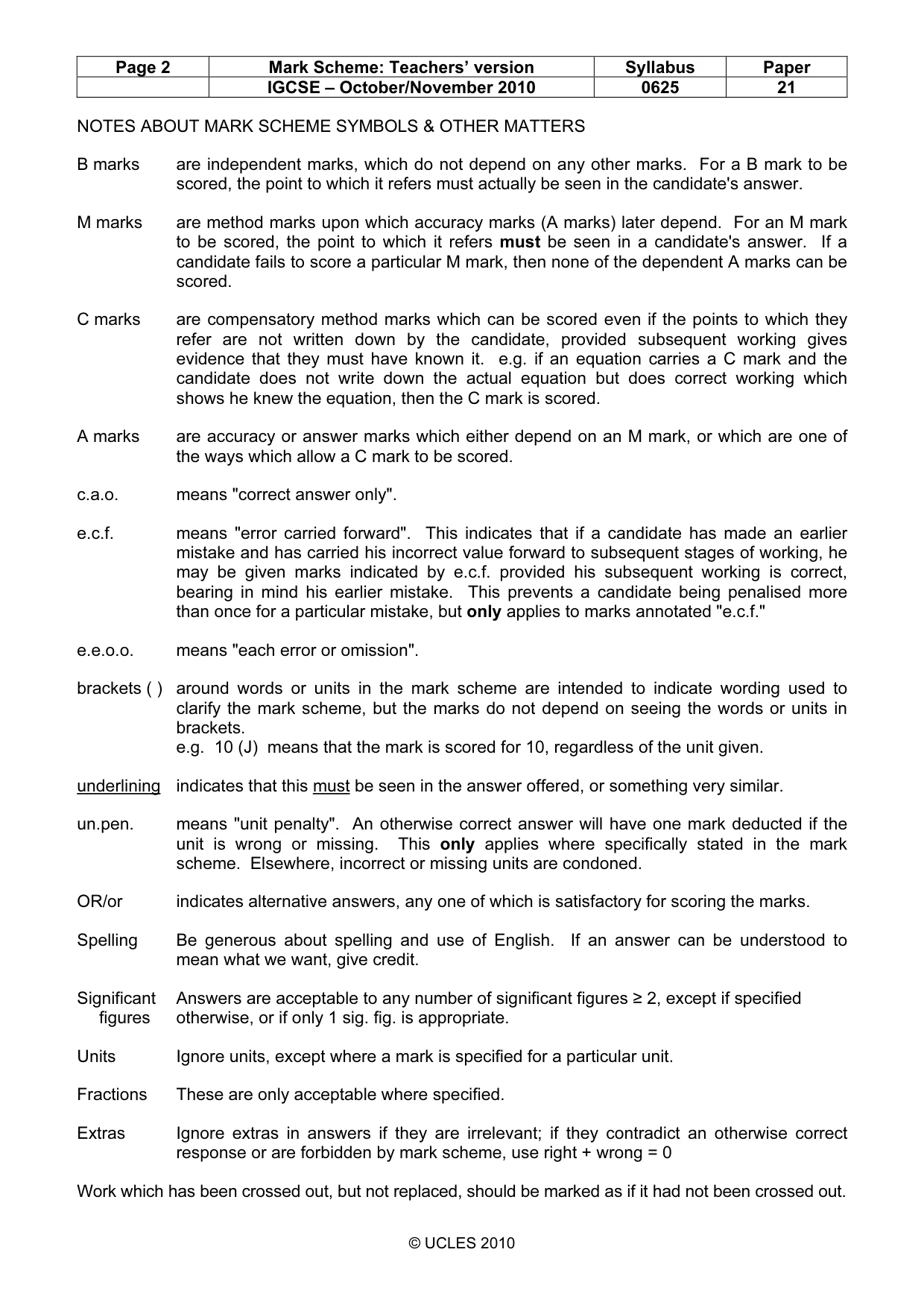
UNIVERSITY OF CAMBRIDGE INTERNATIONAL EXAMINATIONS International General Certificate of Secondary Education MARK SCHEME for the October/November 2010 question paper for the guidance of teachers 0625 PHYSICS 0625/21 Paper 2 (Core Theory), maximum raw mark 80 This mark scheme is published as an aid to teachers and candidates, to indicate the requirements of the examination. It shows the basis on which Examiners were instructed to award marks. It does not indicate the details of the discussions that took place at an Examiners’ meeting before marking began, which would have considered the acceptability of alternative answers. Mark schemes must be read in conjunction with the question papers and the report on the examination. • CIE will not enter into discussions or correspondence in connection with these mark schemes. CIE is publishing the mark schemes for the October/November 2010 question papers for most IGCSE, GCE Advanced Level and Advanced Subsidiary Level syllabuses and some Ordinary Level syllabuses. www.XtremePapers.com
Mark scheme, page 2
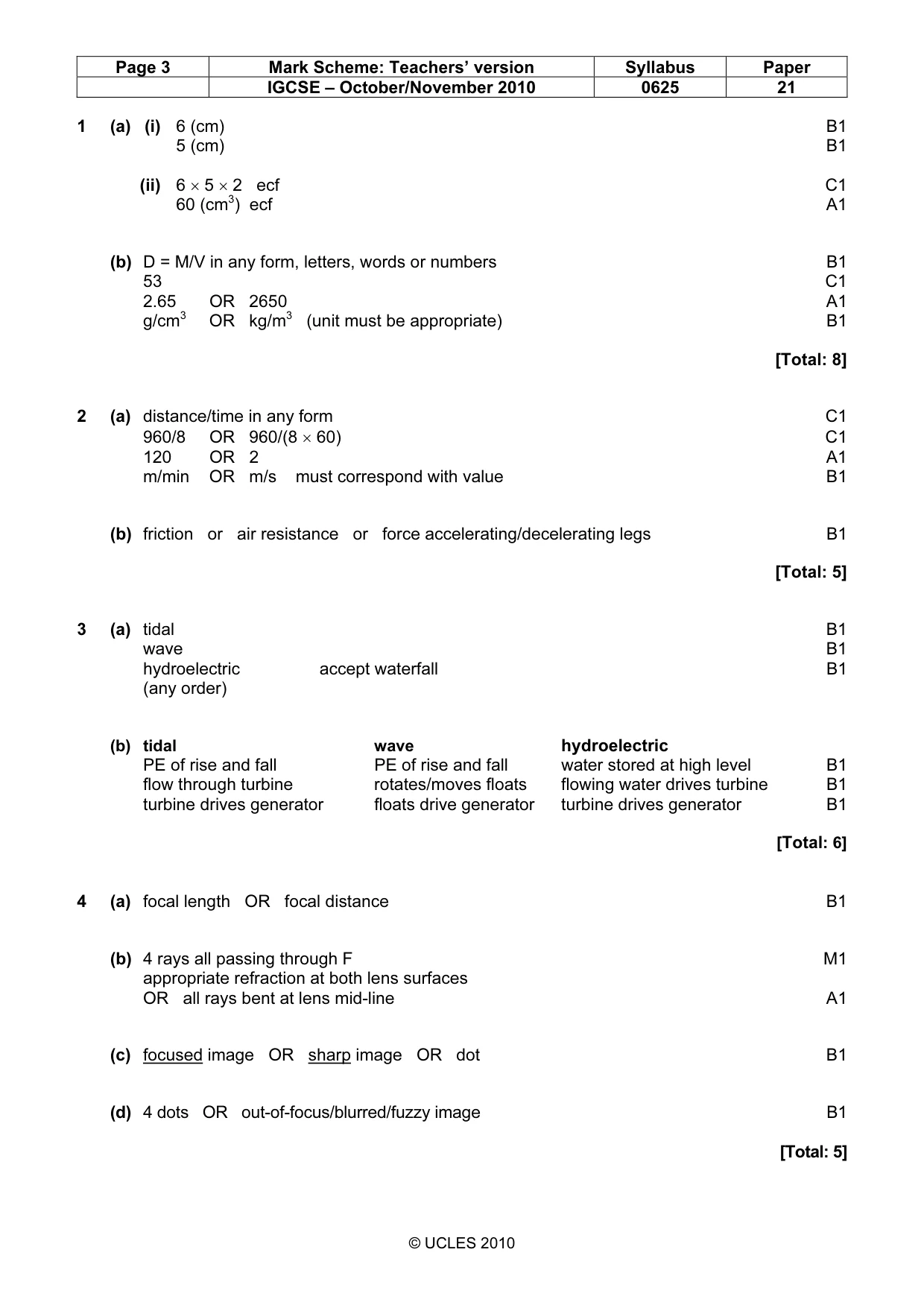
Page 2 Mark Scheme: Teachers’ version Syllabus Paper IGCSE – October/November 2010 0625 21 © UCLES 2010 NOTES ABOUT MARK SCHEME SYMBOLS & OTHER MATTERS B marks are independent marks, which do not depend on any other marks. For a B mark to be scored, the point to which it refers must actually be seen in the candidate's answer. M marks are method marks upon which accuracy marks (A marks) later depend. For an M mark to be scored, the point to which it refers must be seen in a candidate's answer. If a candidate fails to score a particular M mark, then none of the dependent A marks can be scored. C marks are compensatory method marks which can be scored even if the points to which they refer are not written down by the candidate, provided subsequent working gives evidence that they must have known it. e.g. if an equation carries a C mark and the candidate does not write down the actual equation but does correct working which shows he knew the equation, then the C mark is scored. A marks are accuracy or answer marks which either depend on an M mark, or which are one of the ways which allow a C mark to be scored. c.a.o. means "correct answer only". e.c.f. means "error carried forward". This indicates that if a candidate has made an earlier mistake and has carried his incorrect value forward to subsequent stages of working, he may be given marks indicated by e.c.f. provided his subsequent working is correct, bearing in mind his earlier mistake. This prevents a candidate being penalised more than once for a particular mistake, but only applies to marks annotated "e.c.f." e.e.o.o. means "each error or omission". brackets ( ) around words or units in the mark scheme are intended to indicate wording used to clarify the mark scheme, but the marks do not depend on seeing the words or units in brackets. e.g. 10 (J) means that the mark is scored for 10, regardless of the unit given. underlining indicates that this must be seen in the answer offered, or something very similar. un.pen. means "unit penalty". An otherwise correct answer will have one mark deducted if the unit is wrong or missing. This only applies where specifically stated in the mark scheme. Elsewhere, incorrect or missing units are condoned. OR/or indicates alternative answers, any one of which is satisfactory for scoring the marks. Spelling Be generous about spelling and use of English. If an answer can be understood to mean what we want, give credit. Significant Answers are acceptable to any number of significant figures ≥ 2, except if specified figures otherwise, or if only 1 sig. fig. is appropriate. Units Ignore units, except where a mark is specified for a particular unit. Fractions These are only acceptable where specified. Extras Ignore extras in answers if they are irrelevant; if they contradict an otherwise correct response or are forbidden by mark scheme, use right + wrong = 0 Work which has been crossed out, but not replaced, should be marked as if it had not been crossed out.
Mark scheme, page 3
Page 3 Mark Scheme: Teachers’ version Syllabus Paper IGCSE – October/November 2010 0625 21 © UCLES 2010 1 (a) (i) 6 (cm) B1 5 (cm) B1 (ii) 6 × 5 × 2 ecf C1 60 (cm3) ecf A1 (b) D = M/V in any form, letters, words or numbers B1 53 C1 2.65 OR 2650 A1 g/cm3 OR kg/m3 (unit must be appropriate) B1 [Total: 8] 2 (a) distance/time in any form C1 960/8 OR 960/(8 × 60) C1 120 OR 2 A1 m/min OR m/s must correspond with value B1 (b) friction or air resistance or force accelerating/decelerating legs B1 [Total: 5] 3 (a) tidal B1 wave B1 hydroelectric accept waterfall B1 (any order) (b) tidal wave hydroelectric PE of rise and fall PE of rise and fall water stored at high level B1 flow through turbine rotates/moves floats flowing water drives turbine B1 turbine drives generator floats drive generator turbine drives generator B1 [Total: 6] 4 (a) focal length OR focal distance B1 (b) 4 rays all passing through F M1 appropriate refraction at both lens surfaces OR all rays bent at lens mid-line A1 (c) focused image OR sharp image OR dot B1 (d) 4 dots OR out-of-focus/blurred/fuzzy image B1 [Total: 5]
Mark scheme, page 4
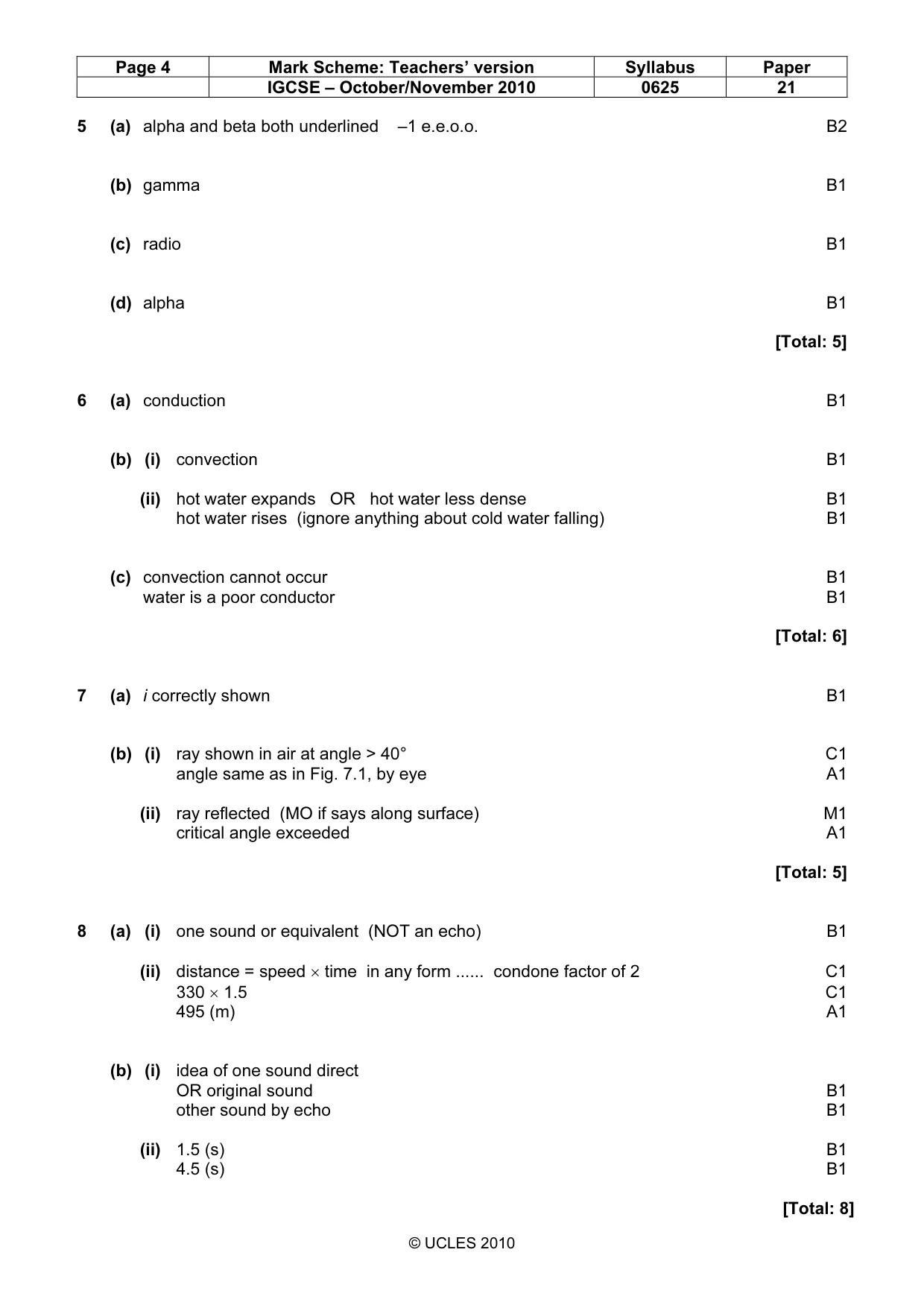
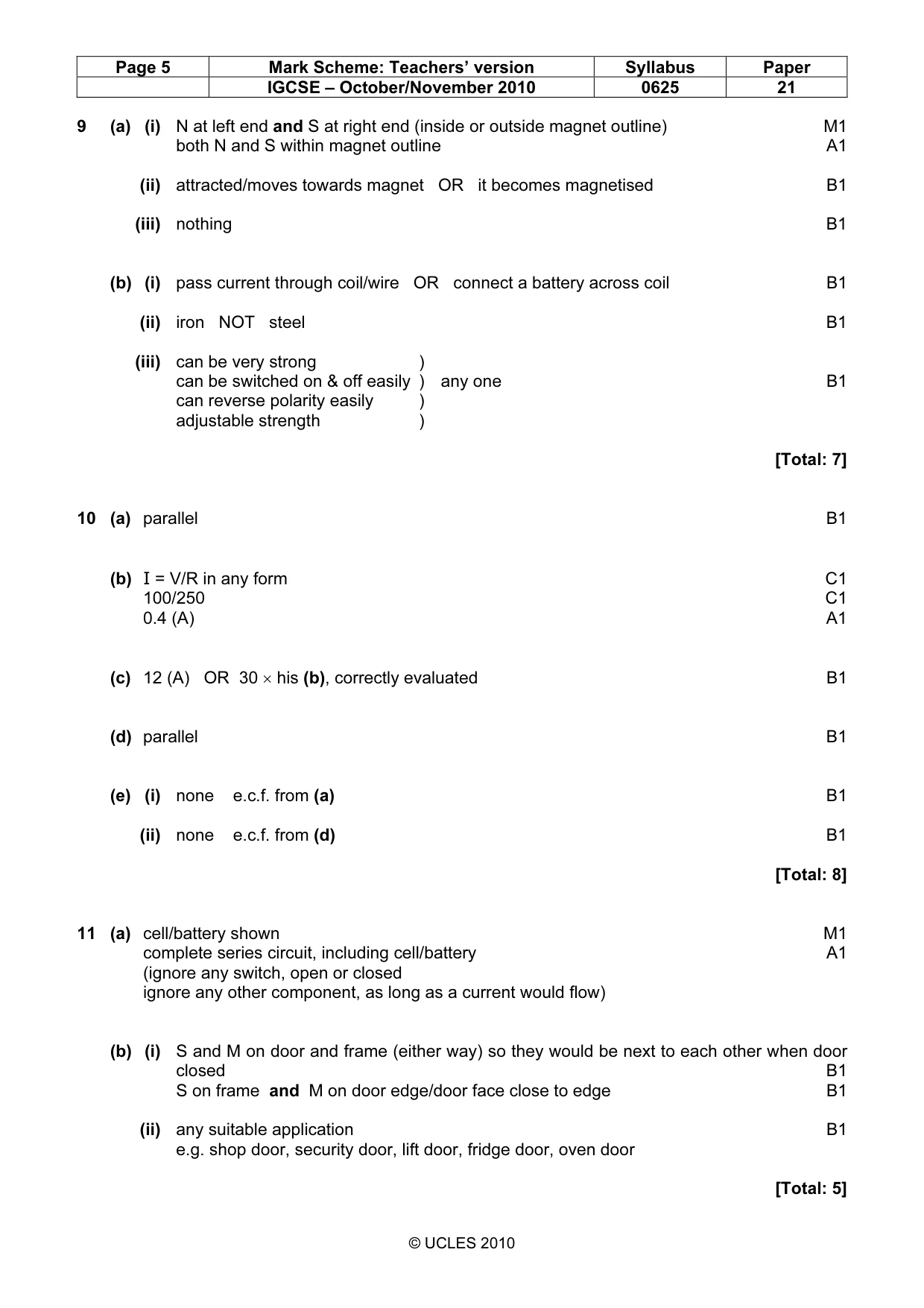
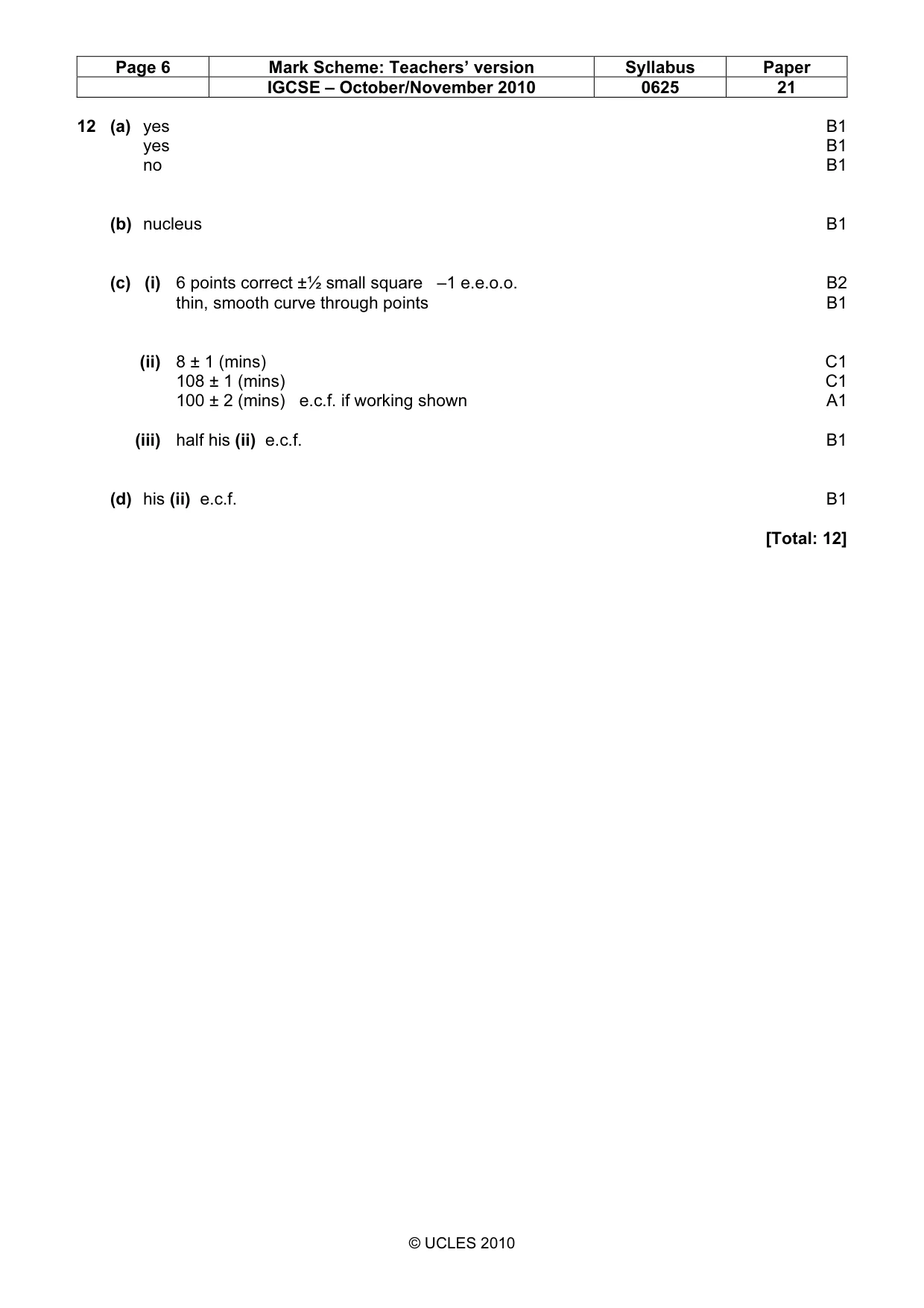
Page 4 Mark Scheme: Teachers’ version Syllabus Paper IGCSE – October/November 2010 0625 21 © UCLES 2010 5 (a) alpha and beta both underlined –1 e.e.o.o. B2 (b) gamma B1 (c) radio B1 (d) alpha B1 [Total: 5] 6 (a) conduction B1 (b) (i) convection B1 (ii) hot water expands OR hot water less dense B1 hot water rises (ignore anything about cold water falling) B1 (c) convection cannot occur B1 water is a poor conductor B1 [Total: 6] 7 (a) i correctly shown B1 (b) (i) ray shown in air at angle > 40° C1 angle same as in Fig. 7.1, by eye A1 (ii) ray reflected (MO if says along surface) M1 critical angle exceeded A1 [Total: 5] 8 (a) (i) one sound or equivalent (NOT an echo) B1 (ii) distance = speed × time in any form … condone factor of 2 C1 330 × 1.5 C1 495 (m) A1 (b) (i) idea of one sound direct OR original sound B1 other sound by echo B1 (ii) 1.5 (s) B1 4.5 (s) B1 [Total: 8]
Mark scheme, page 5
Page 5 Mark Scheme: Teachers’ version Syllabus Paper IGCSE – October/November 2010 0625 21 © UCLES 2010 9 (a) (i) N at left end and S at right end (inside or outside magnet outline) M1 both N and S within magnet outline A1 (ii) attracted/moves towards magnet OR it becomes magnetised B1 (iii) nothing B1 (b) (i) pass current through coil/wire OR connect a battery across coil B1 (ii) iron NOT steel B1 (iii) can be very strong ) can be switched on & off easily ) any one B1 can reverse polarity easily ) adjustable strength ) [Total: 7] 10 (a) parallel B1 (b) I = V/R in any form C1 100/250 C1 0.4 (A) A1 (c) 12 (A) OR 30 × his (b), correctly evaluated B1 (d) parallel B1 (e) (i) none e.c.f. from (a) B1 (ii) none e.c.f. from (d) B1 [Total: 8] 11 (a) cell/battery shown M1 complete series circuit, including cell/battery A1 (ignore any switch, open or closed ignore any other component, as long as a current would flow) (b) (i) S and M on door and frame (either way) so they would be next to each other when door closed B1 S on frame and M on door edge/door face close to edge B1 (ii) any suitable application B1 e.g. shop door, security door, lift door, fridge door, oven door [Total: 5]
Mark scheme, page 6
Page 6 Mark Scheme: Teachers’ version Syllabus Paper IGCSE – October/November 2010 0625 21 © UCLES 2010 12 (a) yes B1 yes B1 no B1 (b) nucleus B1 (c) (i) 6 points correct ±½ small square –1 e.e.o.o. B2 thin, smooth curve through points B1 (ii) 8 ± 1 (mins) C1 108 ± 1 (mins) C1 100 ± 2 (mins) e.c.f. if working shown A1 (iii) half his (ii) e.c.f. B1 (d) his (ii) e.c.f. B1 [Total: 12]
What you needed in this session
Cambridge’s own grade thresholds for 2010 Oct/Nov, Paper 2 · Variant 1. A higher threshold means an easier paper — the bar moves with how the cohort did.