Cambridge IGCSE Physics 0625 — 2008 Oct/Nov Paper 2 · Variant 1
0625/21/O/N/08 · 80 marks · ≈90 min
The question paper and its mark scheme, free to read here and free to download. This is Cambridge’s own paper, exactly as it was sat.
Question paper16 pages
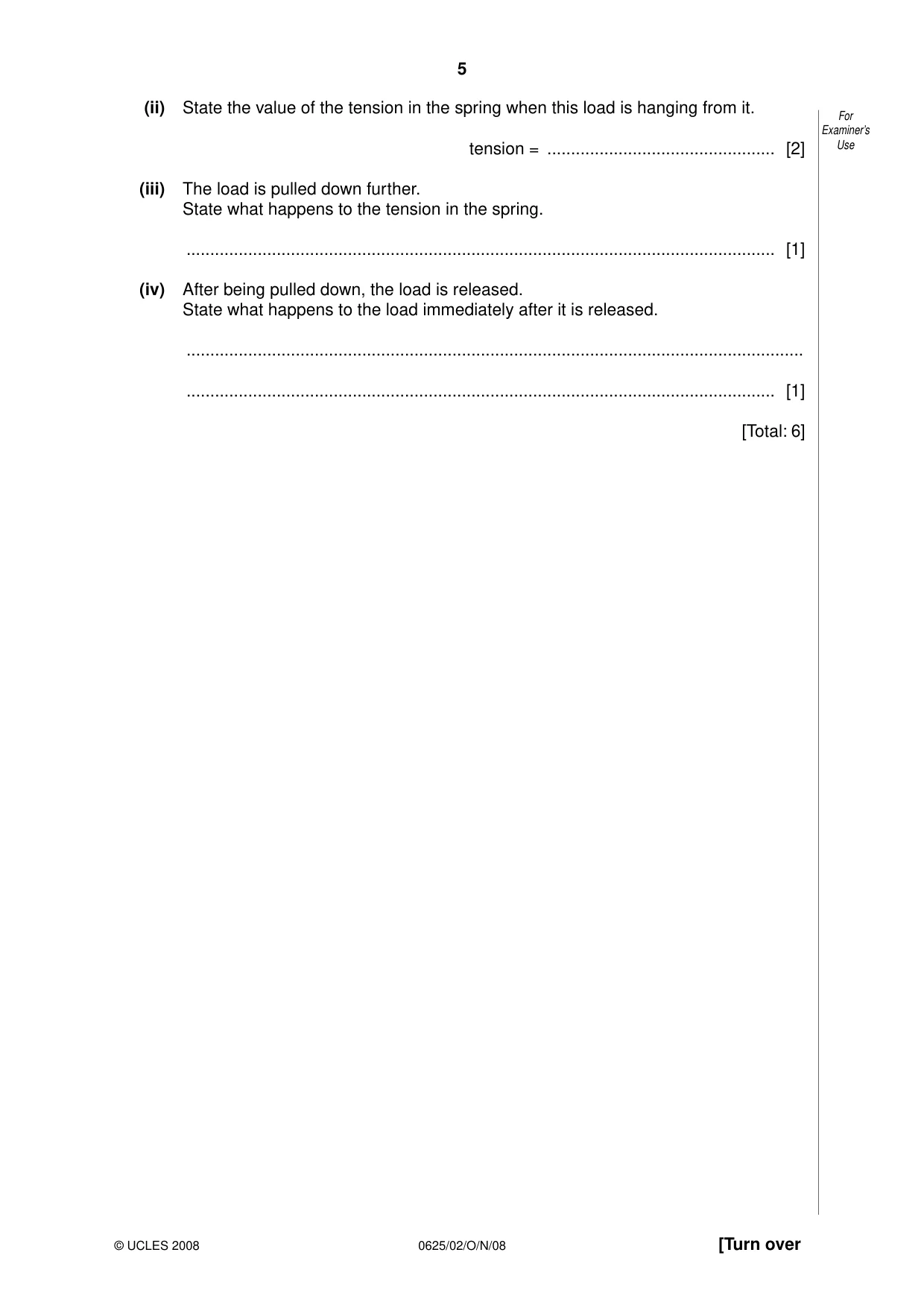
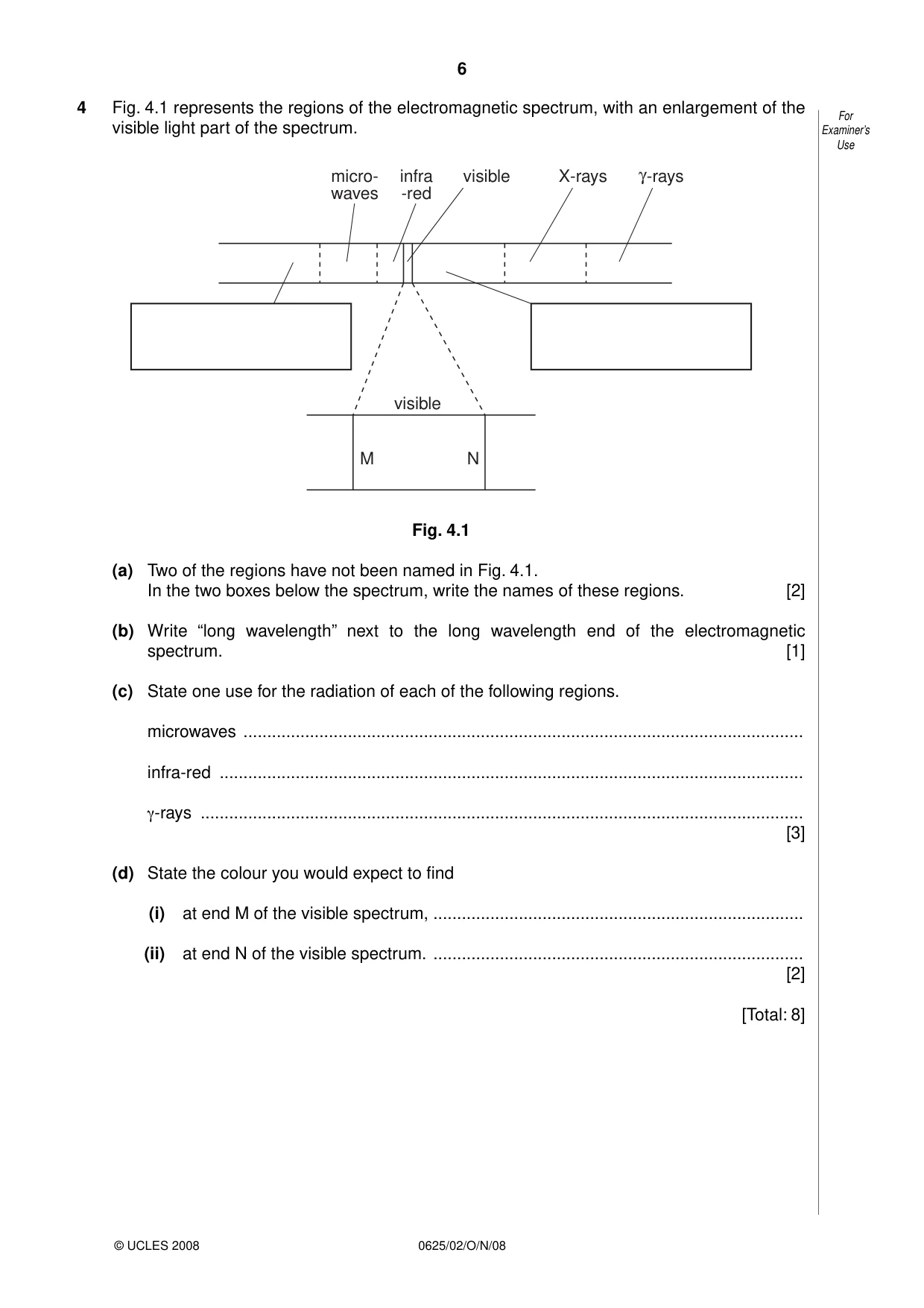
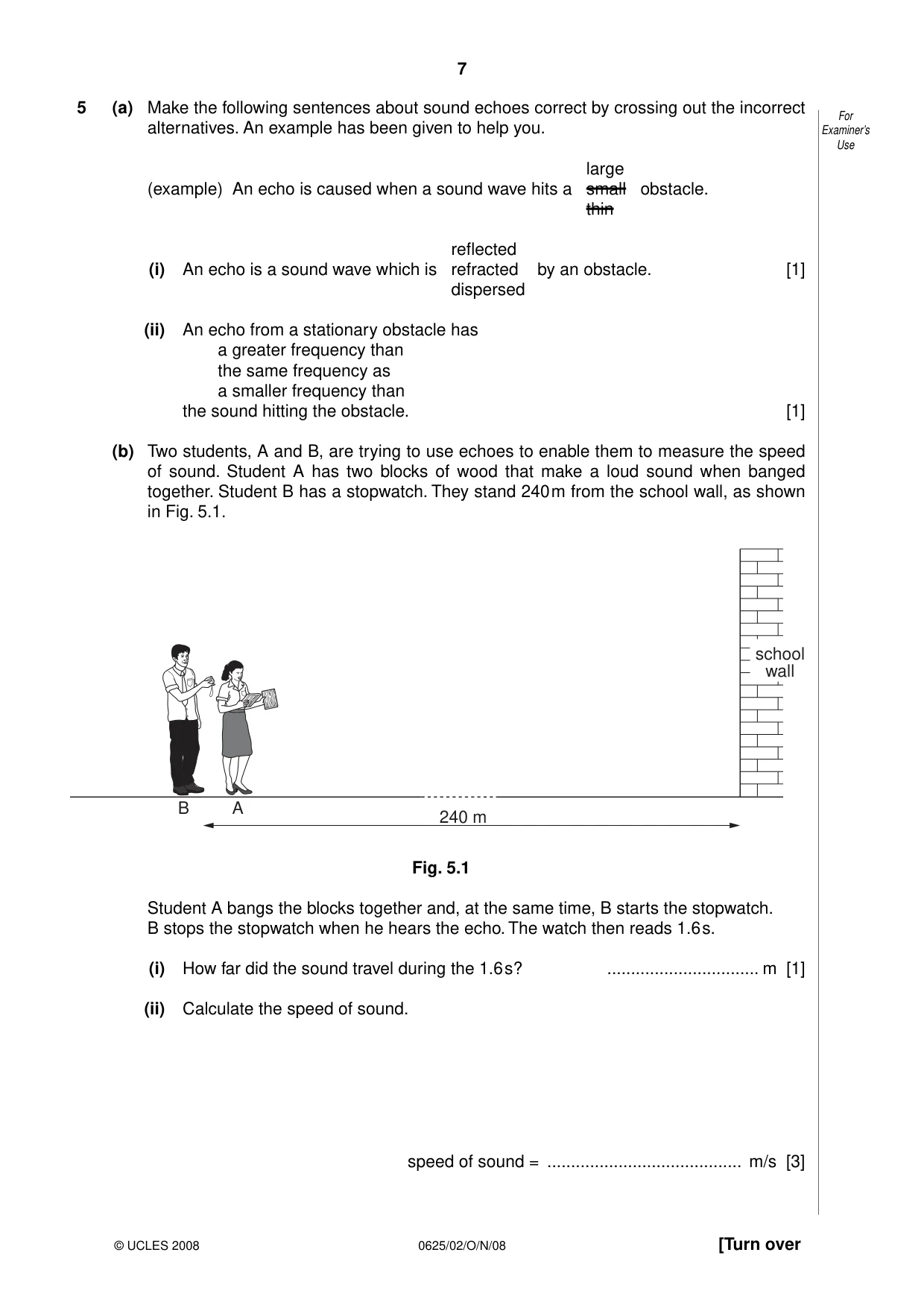
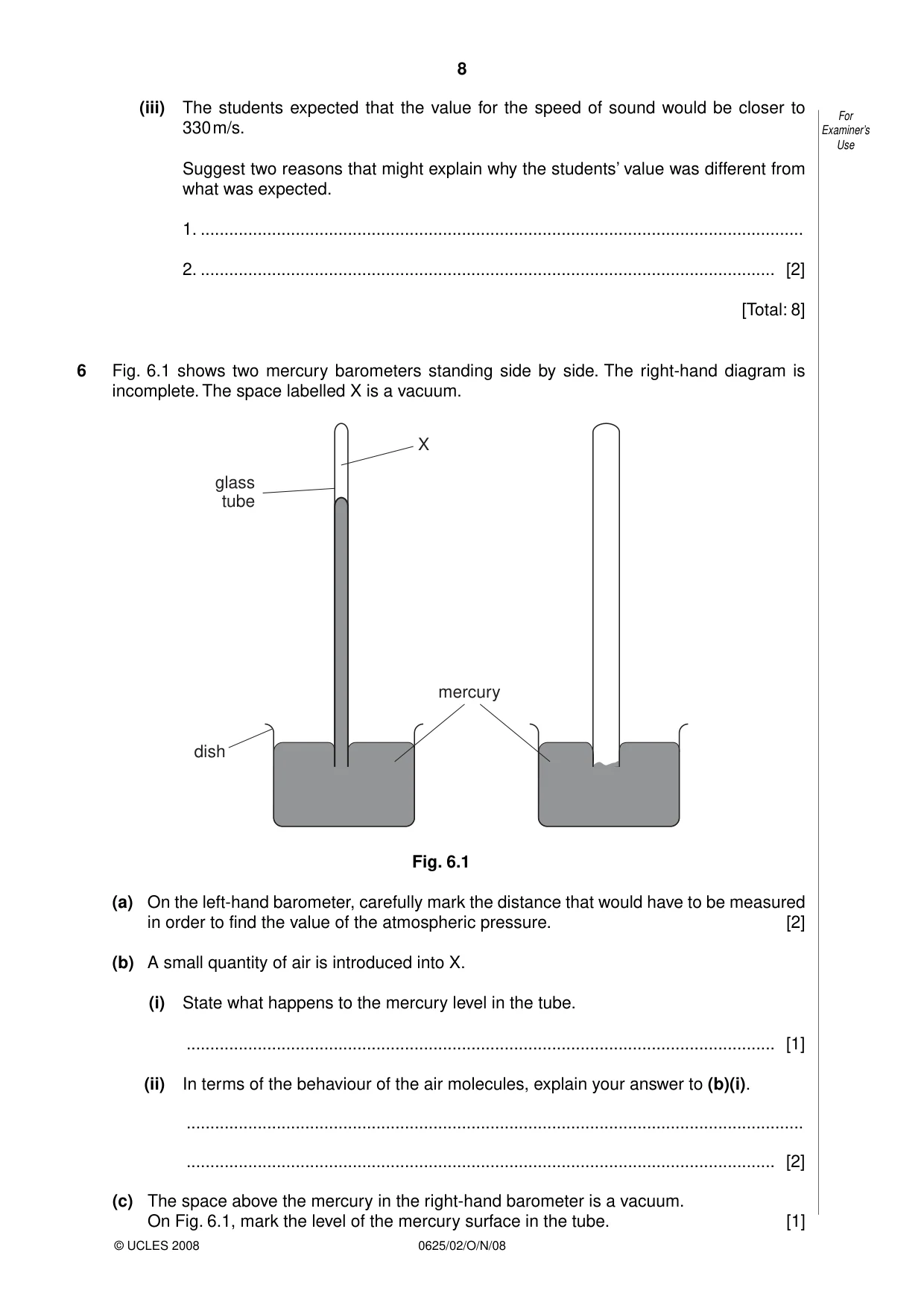
Mark scheme6 pages
Answers below. Sit the paper first if you are practising.
Paper as text
Question paper, page 1
This document consists of 16 printed pages. SP (NF/CGW) T41976/4 © UCLES 2008 [Turn over UNIVERSITY OF CAMBRIDGE INTERNATIONAL EXAMINATIONS International General Certificate of Secondary Education READ THESE INSTRUCTIONS FIRST Write your Centre number, candidate number and name on all the work you hand in. Write in dark blue or black pen. You may use a soft pencil for any diagrams, graphs or rough working. Do not use staples, paper clips, highlighters, glue or correction fluid. DO NOT WRITE IN ANY BARCODES. Answer all questions. You may lose marks if you do not show your working or if you do not use appropriate units. Take the weight of 1 kg to be 10 N (i.e. acceleration of free fall = 10 m/s2). At the end of the examination, fasten all your work securely together. The number of marks is given in brackets [ ] at the end of each question or part question. * 5 5 4 5 6 7 8 9 5 6 * PHYSICS 0625/02 Paper 2 Core October/November 2008 1 hour 15 minutes Candidates answer on the Question Paper. No Additional Materials are required. For Examiner’s Use 1 2 3 4 5 6 7 8 9 10 11 12 Total www.XtremePapers.com
Question paper, page 2
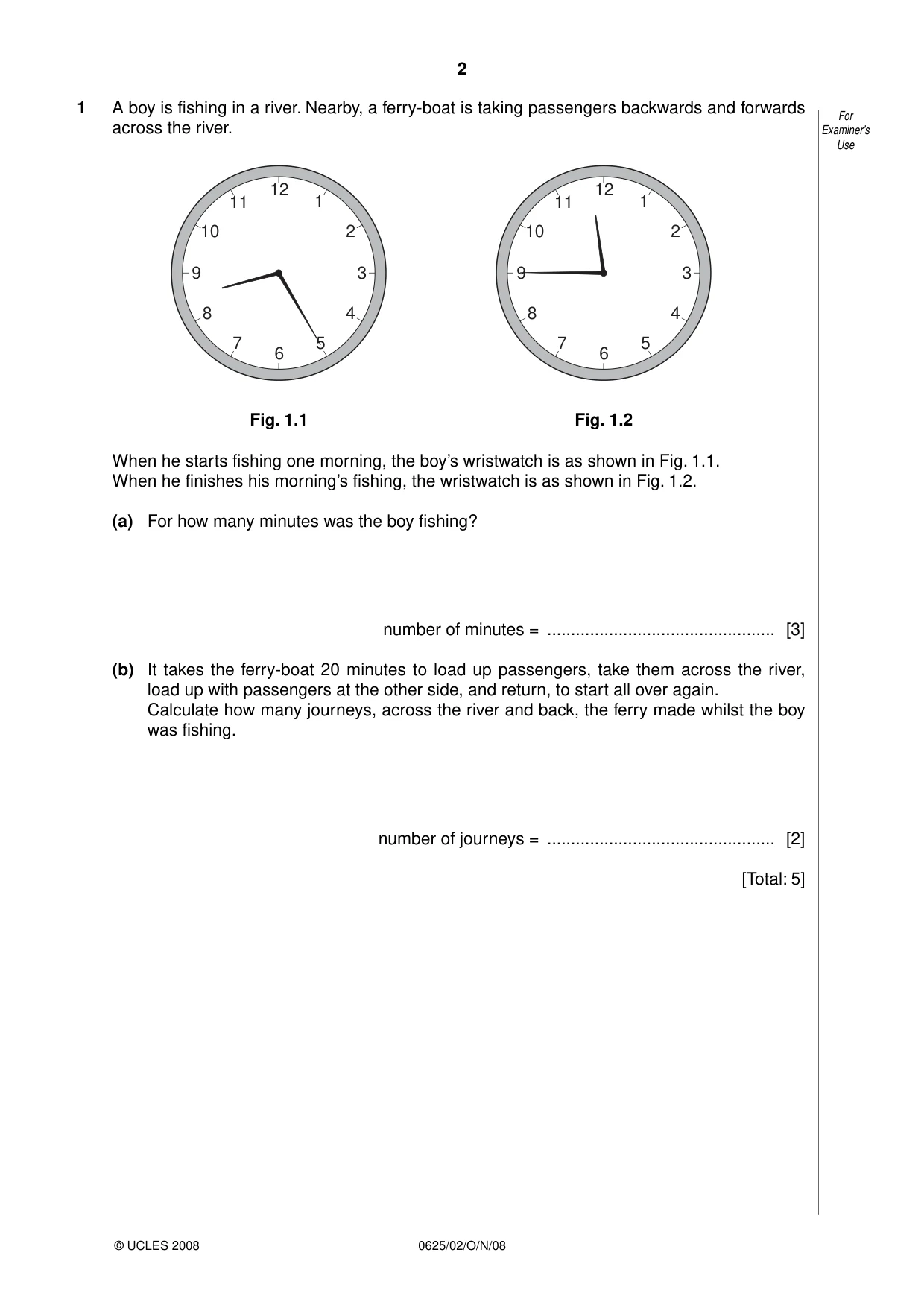
2 0625/02/O/N/08 For Examiner’s Use © UCLES 2008 1 A boy is fishing in a river. Nearby, a ferry-boat is taking passengers backwards and forwards across the river. 12 6 3 11 4 2 10 8 7 5 1 9 12 6 3 11 4 2 10 8 7 5 1 9 Fig. 1.1 Fig. 1.2 When he starts fishing one morning, the boy’s wristwatch is as shown in Fig. 1.1. When he finishes his morning’s fishing, the wristwatch is as shown in Fig. 1.2. (a) For how many minutes was the boy fishing? number of minutes = … [3] (b) It takes the ferry-boat 20 minutes to load up passengers, take them across the river, load up with passengers at the other side, and return, to start all over again. Calculate how many journeys, across the river and back, the ferry made whilst the boy was fishing. number of journeys = … [2] [Total: 5]
Question paper, page 3
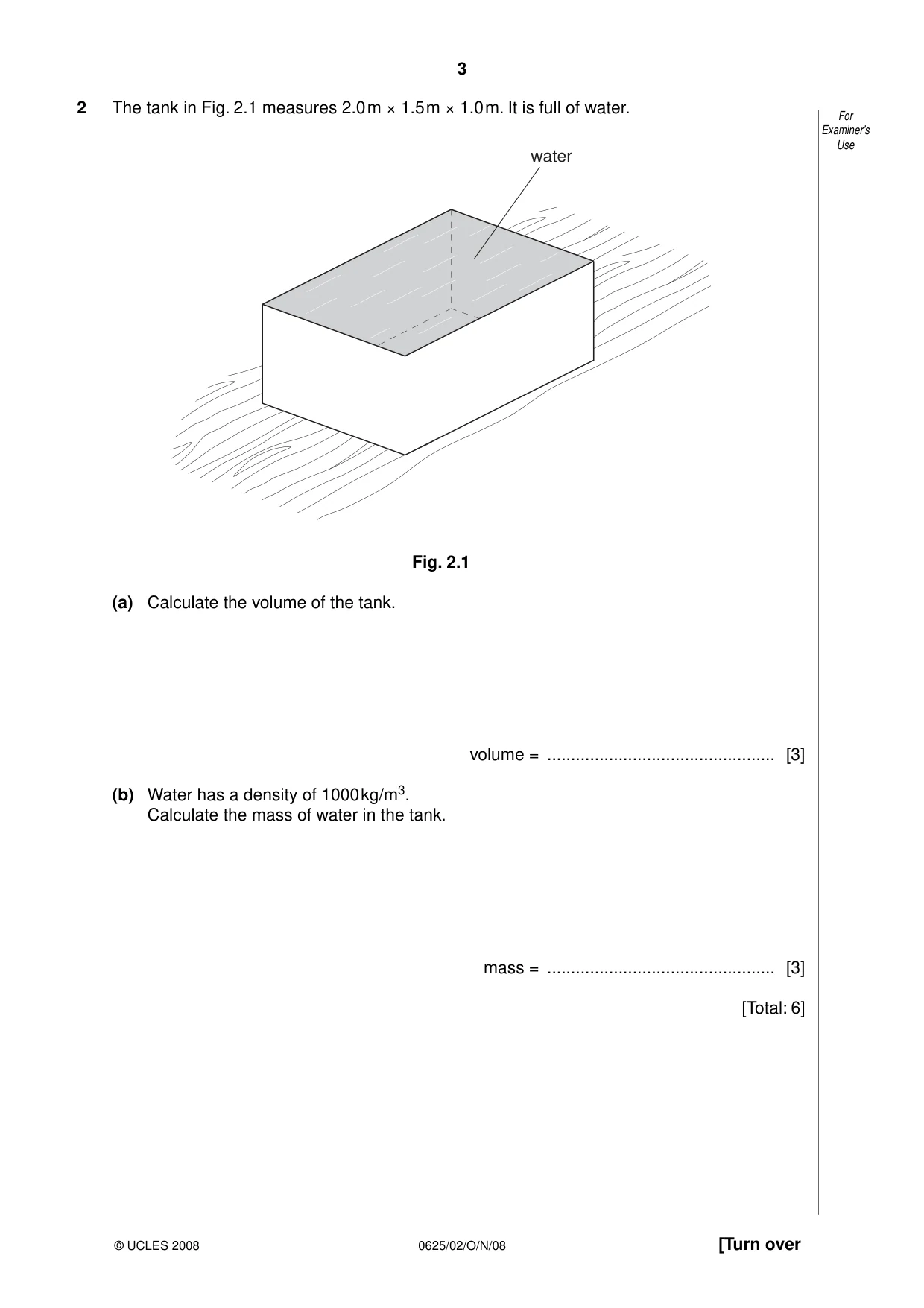
3 0625/02/O/N/08 [Turn over For Examiner’s Use © UCLES 2008 2 The tank in Fig. 2.1 measures 2.0 m × 1.5 m × 1.0 m. It is full of water. water Fig. 2.1 (a) Calculate the volume of the tank. volume = … [3] (b) Water has a density of 1000 kg/m3. Calculate the mass of water in the tank. mass = … [3] [Total: 6]
Question paper, page 4
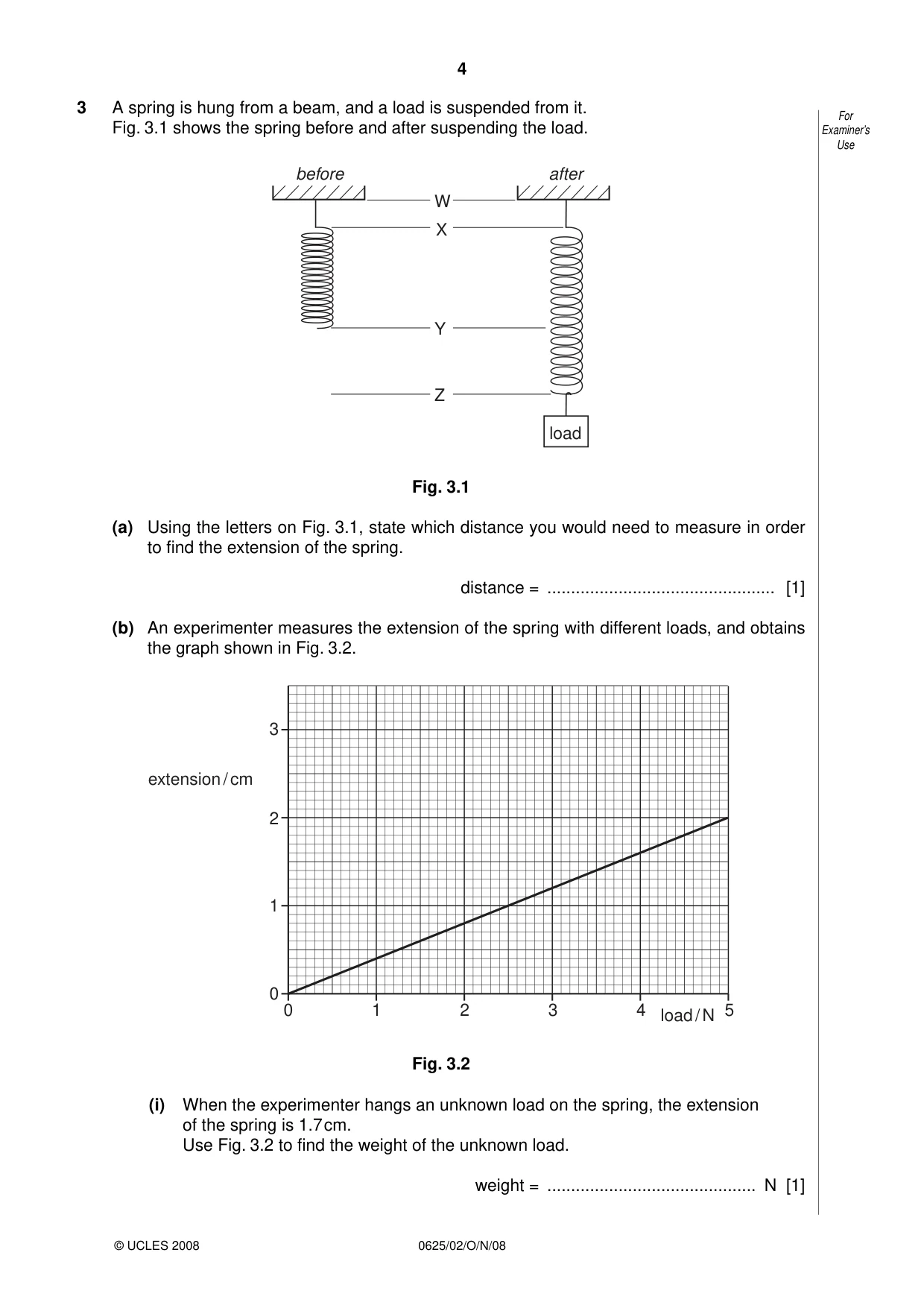
4 0625/02/O/N/08 For Examiner’s Use © UCLES 2008 3 A spring is hung from a beam, and a load is suspended from it. Fig. 3.1 shows the spring before and after suspending the load. before after W X Y Z load Fig. 3.1 (a) Using the letters on Fig. 3.1, state which distance you would need to measure in order to find the extension of the spring. distance = … [1] (b) An experimenter measures the extension of the spring with different loads, and obtains the graph shown in Fig. 3.2. 0 0 1 2 extension / cm load / N 3 1 2 3 4 5 Fig. 3.2 (i) When the experimenter hangs an unknown load on the spring, the extension of the spring is 1.7 cm. Use Fig. 3.2 to find the weight of the unknown load. weight = … N [1]
Question paper, page 5
5 0625/02/O/N/08 [Turn over For Examiner’s Use © UCLES 2008 (ii) State the value of the tension in the spring when this load is hanging from it. tension = … [2] (iii) The load is pulled down further. State what happens to the tension in the spring. … [1] (iv) After being pulled down, the load is released. State what happens to the load immediately after it is released. … … [1] [Total: 6]
Question paper, page 6
6 0625/02/O/N/08 For Examiner’s Use © UCLES 2008 4 Fig. 4.1 represents the regions of the electromagnetic spectrum, with an enlargement of the visible light part of the spectrum. micro- waves infra -red visible X-rays γ -rays visible M N Fig. 4.1 (a) Two of the regions have not been named in Fig. 4.1. In the two boxes below the spectrum, write the names of these regions. [2] (b) Write “long wavelength” next to the long wavelength end of the electromagnetic spectrum. [1] (c) State one use for the radiation of each of the following regions. microwaves … infra-red … γ-rays … [3] (d) State the colour you would expect to find (i) at end M of the visible spectrum, … (ii) at end N of the visible spectrum. … [2] [Total: 8]
Question paper, page 7
7 0625/02/O/N/08 [Turn over For Examiner’s Use © UCLES 2008 5 (a) Make the following sentences about sound echoes correct by crossing out the incorrect alternatives. An example has been given to help you. large (example) An echo is caused when a sound wave hits a small obstacle. thin reflected (i) An echo is a sound wave which is refracted by an obstacle. [1] dispersed (ii) An echo from a stationary obstacle has a greater frequency than the same frequency as a smaller frequency than the sound hitting the obstacle. [1] (b) Two students, A and B, are trying to use echoes to enable them to measure the speed of sound. Student A has two blocks of wood that make a loud sound when banged together. Student B has a stopwatch. They stand 240 m from the school wall, as shown in Fig. 5.1. school wall 240 m B A Fig. 5.1 Student A bangs the blocks together and, at the same time, B starts the stopwatch. B stops the stopwatch when he hears the echo. The watch then reads 1.6 s. (i) How far did the sound travel during the 1.6 s? … m [1] (ii) Calculate the speed of sound. speed of sound = … m/s [3]
Question paper, page 8
8 0625/02/O/N/08 For Examiner’s Use © UCLES 2008 (iii) The students expected that the value for the speed of sound would be closer to 330 m/s. Suggest two reasons that might explain why the students’ value was different from what was expected. 1. … 2. … [2] [Total: 8] 6 Fig. 6.1 shows two mercury barometers standing side by side. The right-hand diagram is incomplete. The space labelled X is a vacuum. X glass tube dish mercury Fig. 6.1 (a) On the left-hand barometer, carefully mark the distance that would have to be measured in order to find the value of the atmospheric pressure. [2] (b) A small quantity of air is introduced into X. (i) State what happens to the mercury level in the tube. … [1] (ii) In terms of the behaviour of the air molecules, explain your answer to (b)(i). … … [2] (c) The space above the mercury in the right-hand barometer is a vacuum. On Fig. 6.1, mark the level of the mercury surface in the tube. [1]
Question paper, page 9
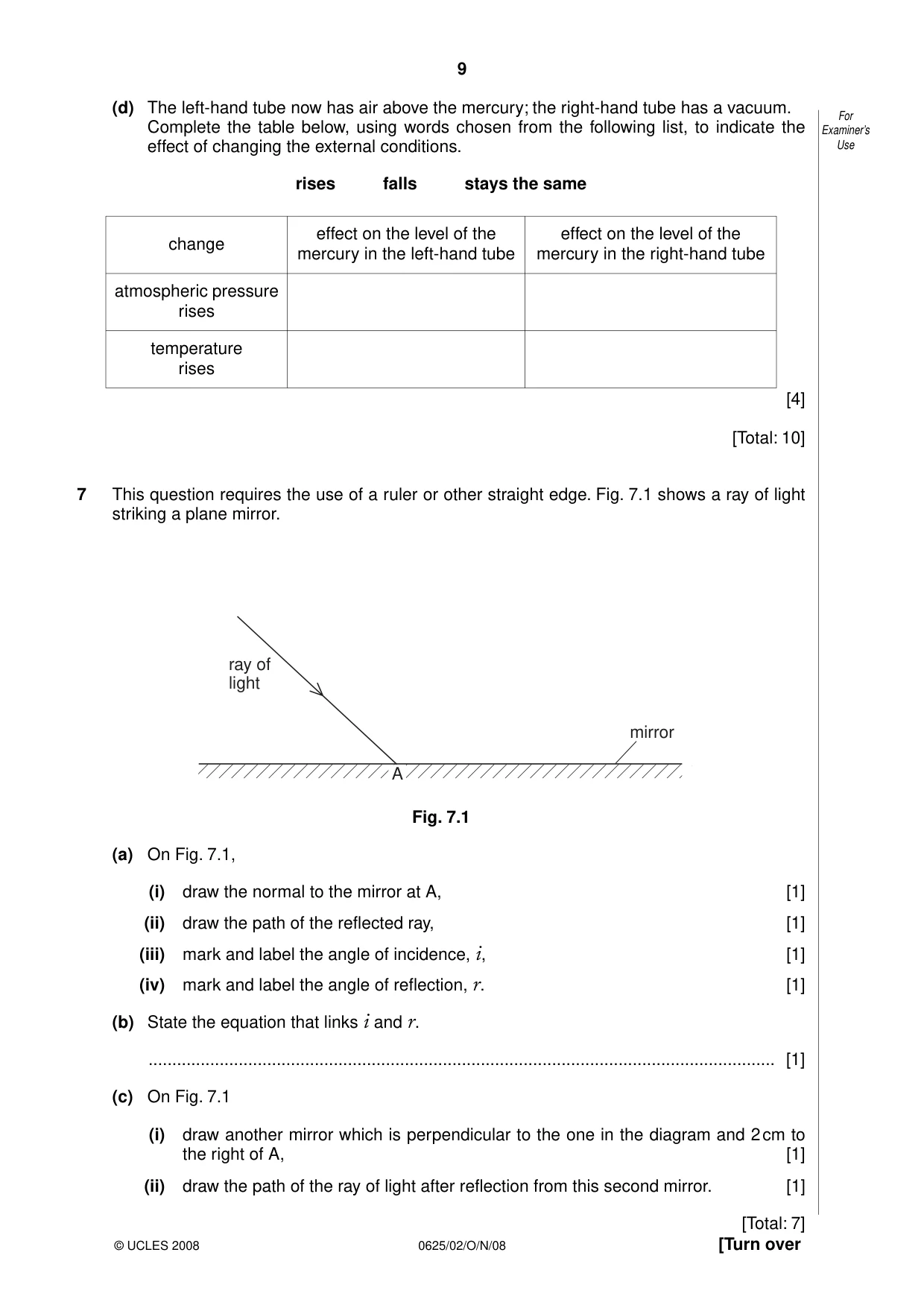
9 0625/02/O/N/08 [Turn over For Examiner’s Use © UCLES 2008 (d) The left-hand tube now has air above the mercury; the right-hand tube has a vacuum. Complete the table below, using words chosen from the following list, to indicate the effect of changing the external conditions. rises falls stays the same change effect on the level of the mercury in the left-hand tube effect on the level of the mercury in the right-hand tube atmospheric pressure rises temperature rises [4] [Total: 10] 7 This question requires the use of a ruler or other straight edge. Fig. 7.1 shows a ray of light striking a plane mirror. mirror ray of light A Fig. 7.1 (a) On Fig. 7.1, (i) draw the normal to the mirror at A, [1] (ii) draw the path of the reflected ray, [1] (iii) mark and label the angle of incidence, i, [1] (iv) mark and label the angle of reflection, r. [1] (b) State the equation that links i and r. … [1] (c) On Fig. 7.1 (i) draw another mirror which is perpendicular to the one in the diagram and 2 cm to the right of A, [1] (ii) draw the path of the ray of light after reflection from this second mirror. [1] [Total: 7]
Question paper, page 10
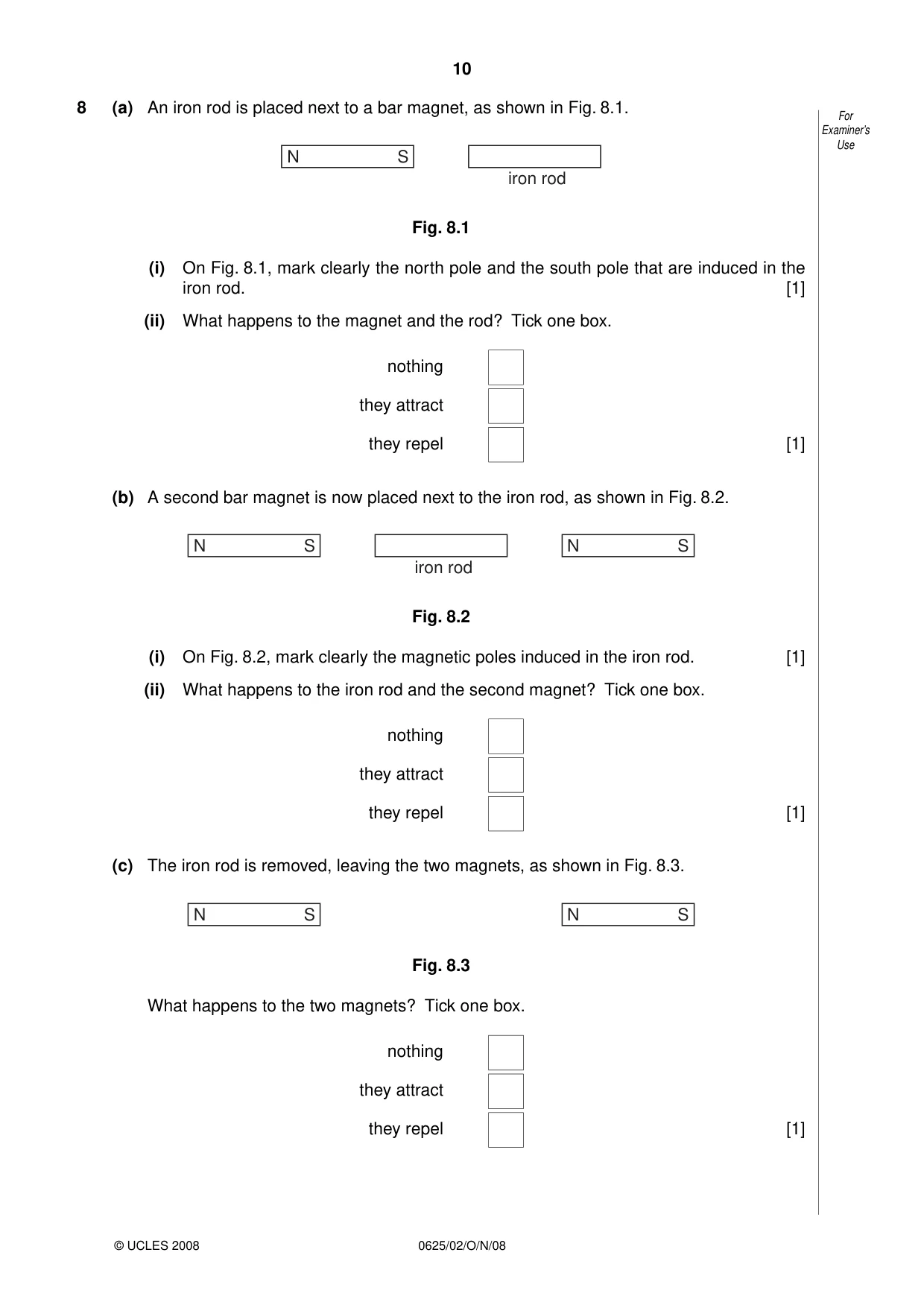
10 0625/02/O/N/08 For Examiner’s Use © UCLES 2008 8 (a) An iron rod is placed next to a bar magnet, as shown in Fig. 8.1. N S iron rod Fig. 8.1 (i) On Fig. 8.1, mark clearly the north pole and the south pole that are induced in the iron rod. [1] (ii) What happens to the magnet and the rod? Tick one box. nothing they attract they repel [1] (b) A second bar magnet is now placed next to the iron rod, as shown in Fig. 8.2. N S iron rod N S Fig. 8.2 (i) On Fig. 8.2, mark clearly the magnetic poles induced in the iron rod. [1] (ii) What happens to the iron rod and the second magnet? Tick one box. nothing they attract they repel [1] (c) The iron rod is removed, leaving the two magnets, as shown in Fig. 8.3. N S N S Fig. 8.3 What happens to the two magnets? Tick one box. nothing they attract they repel [1]
Question paper, page 11
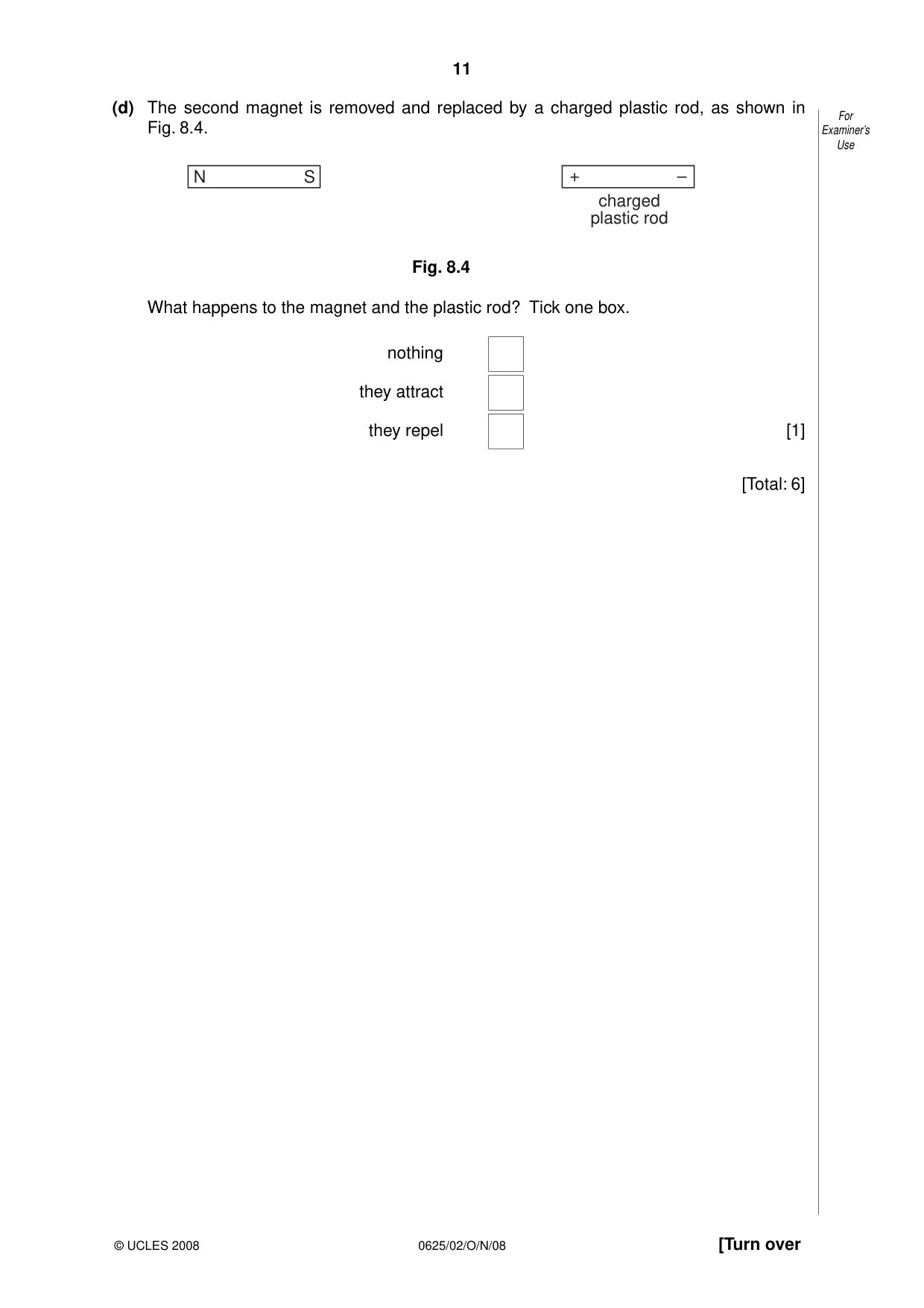
11 0625/02/O/N/08 [Turn over For Examiner’s Use © UCLES 2008 (d) The second magnet is removed and replaced by a charged plastic rod, as shown in Fig. 8.4. N S + charged plastic rod – Fig. 8.4 What happens to the magnet and the plastic rod? Tick one box. nothing they attract they repel [1] [Total: 6]
Question paper, page 12
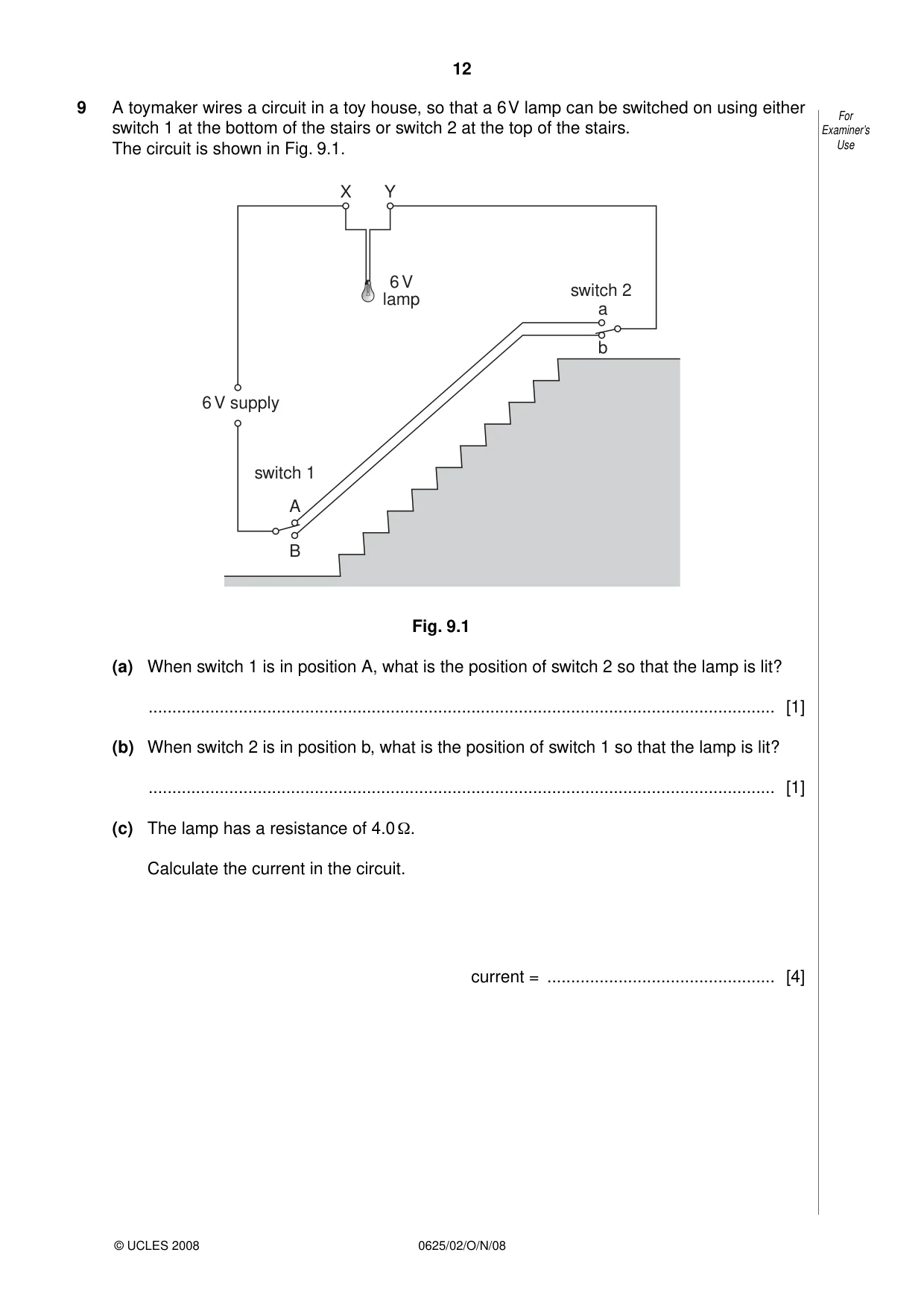
12 0625/02/O/N/08 For Examiner’s Use © UCLES 2008 9 A toymaker wires a circuit in a toy house, so that a 6 V lamp can be switched on using either switch 1 at the bottom of the stairs or switch 2 at the top of the stairs. The circuit is shown in Fig. 9.1. 6 V supply 6 V lamp switch 2 switch 1 X A B a b Y Fig. 9.1 (a) When switch 1 is in position A, what is the position of switch 2 so that the lamp is lit? … [1] (b) When switch 2 is in position b, what is the position of switch 1 so that the lamp is lit? … [1] (c) The lamp has a resistance of 4.0 Ω. Calculate the current in the circuit. current = … [4]
Question paper, page 13
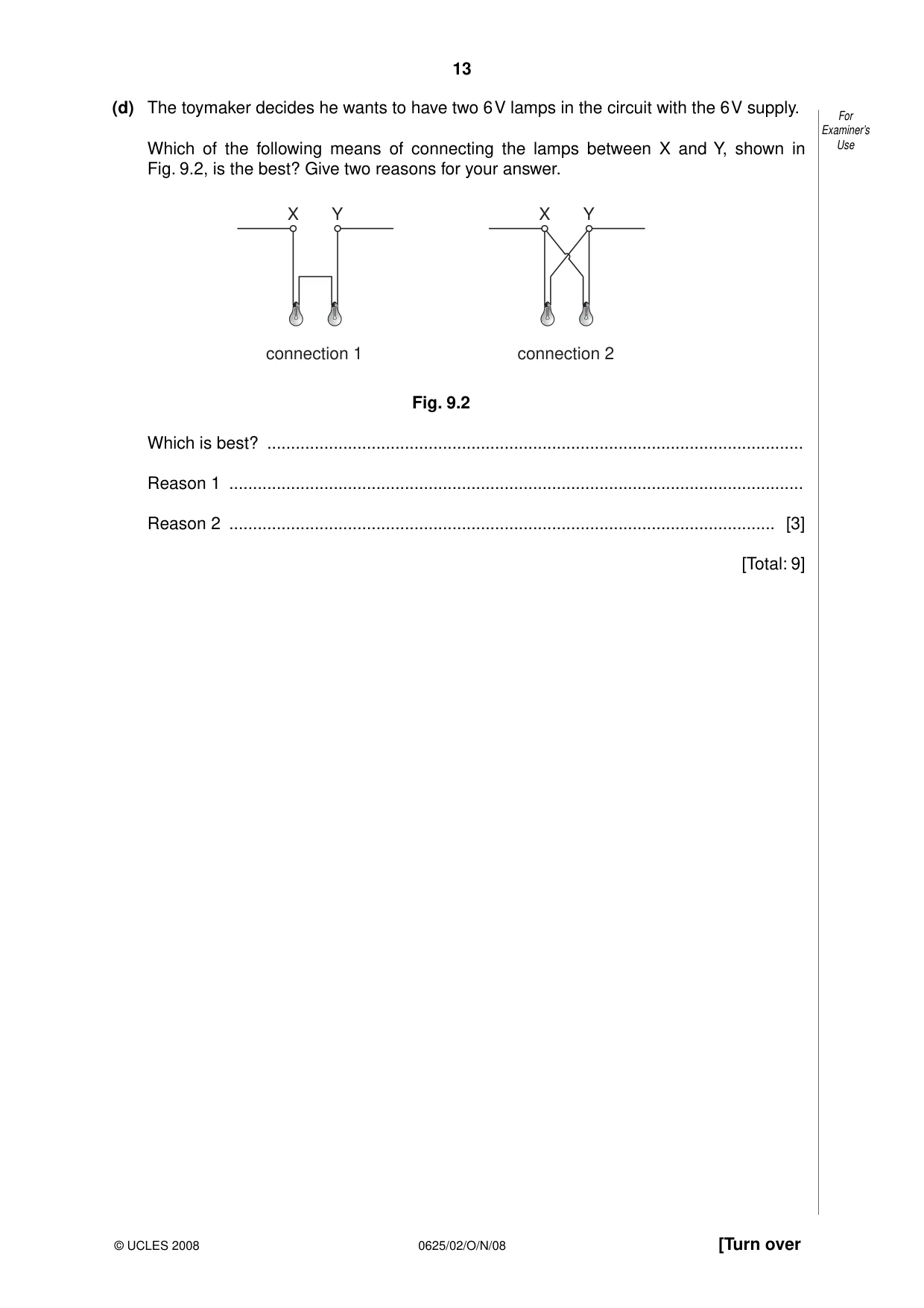
13 0625/02/O/N/08 [Turn over For Examiner’s Use © UCLES 2008 (d) The toymaker decides he wants to have two 6 V lamps in the circuit with the 6 V supply. Which of the following means of connecting the lamps between X and Y, shown in Fig. 9.2, is the best? Give two reasons for your answer. connection 1 X Y connection 2 X Y Fig. 9.2 Which is best? … Reason 1 … Reason 2 … [3] [Total: 9]
Question paper, page 14
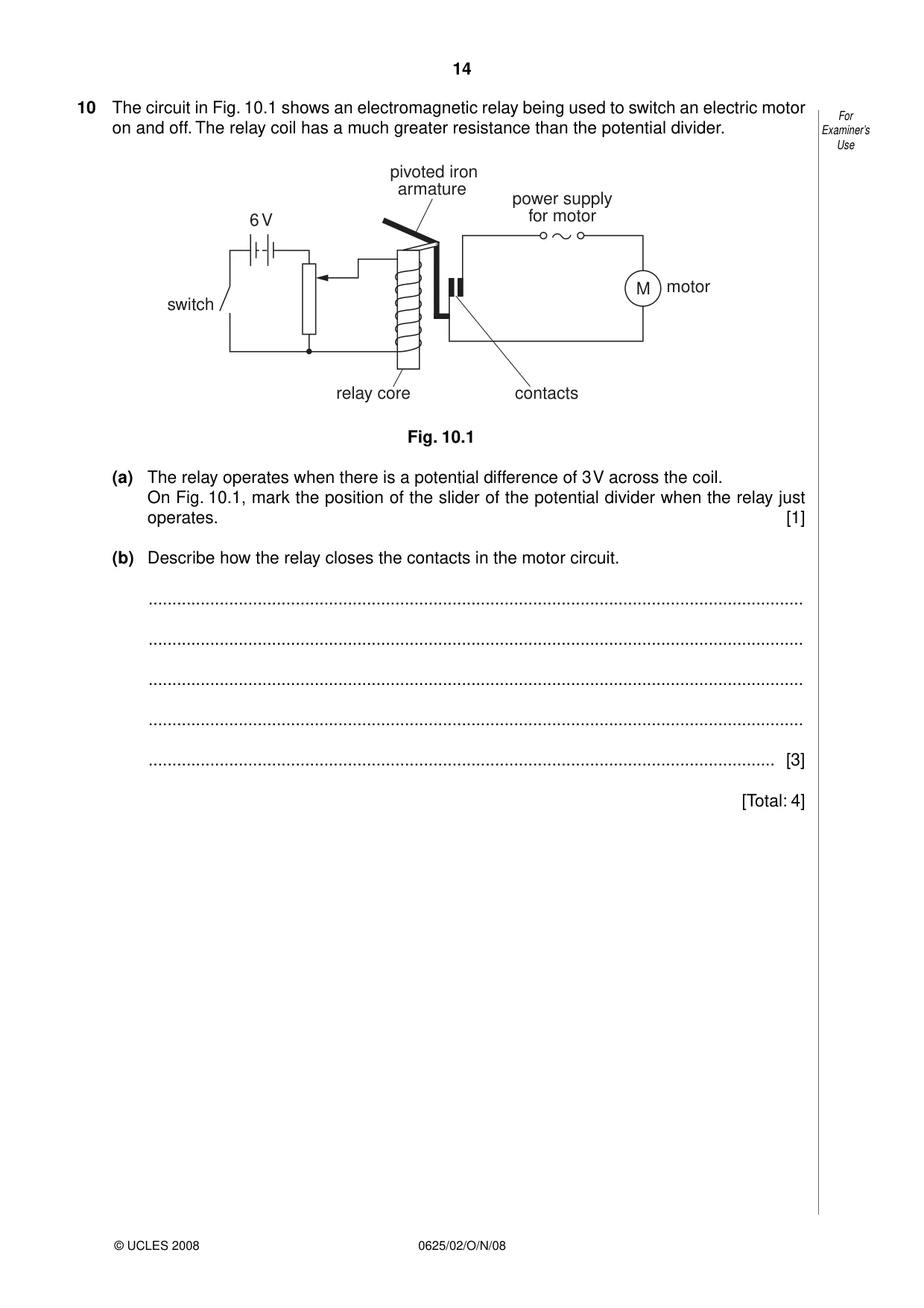
14 0625/02/O/N/08 For Examiner’s Use © UCLES 2008 10 The circuit in Fig. 10.1 shows an electromagnetic relay being used to switch an electric motor on and off. The relay coil has a much greater resistance than the potential divider. M switch 6 V motor power supply for motor contacts relay core pivoted iron armature Fig. 10.1 (a) The relay operates when there is a potential difference of 3 V across the coil. On Fig. 10.1, mark the position of the slider of the potential divider when the relay just operates. [1] (b) Describe how the relay closes the contacts in the motor circuit. … … … … … [3] [Total: 4]
Question paper, page 15
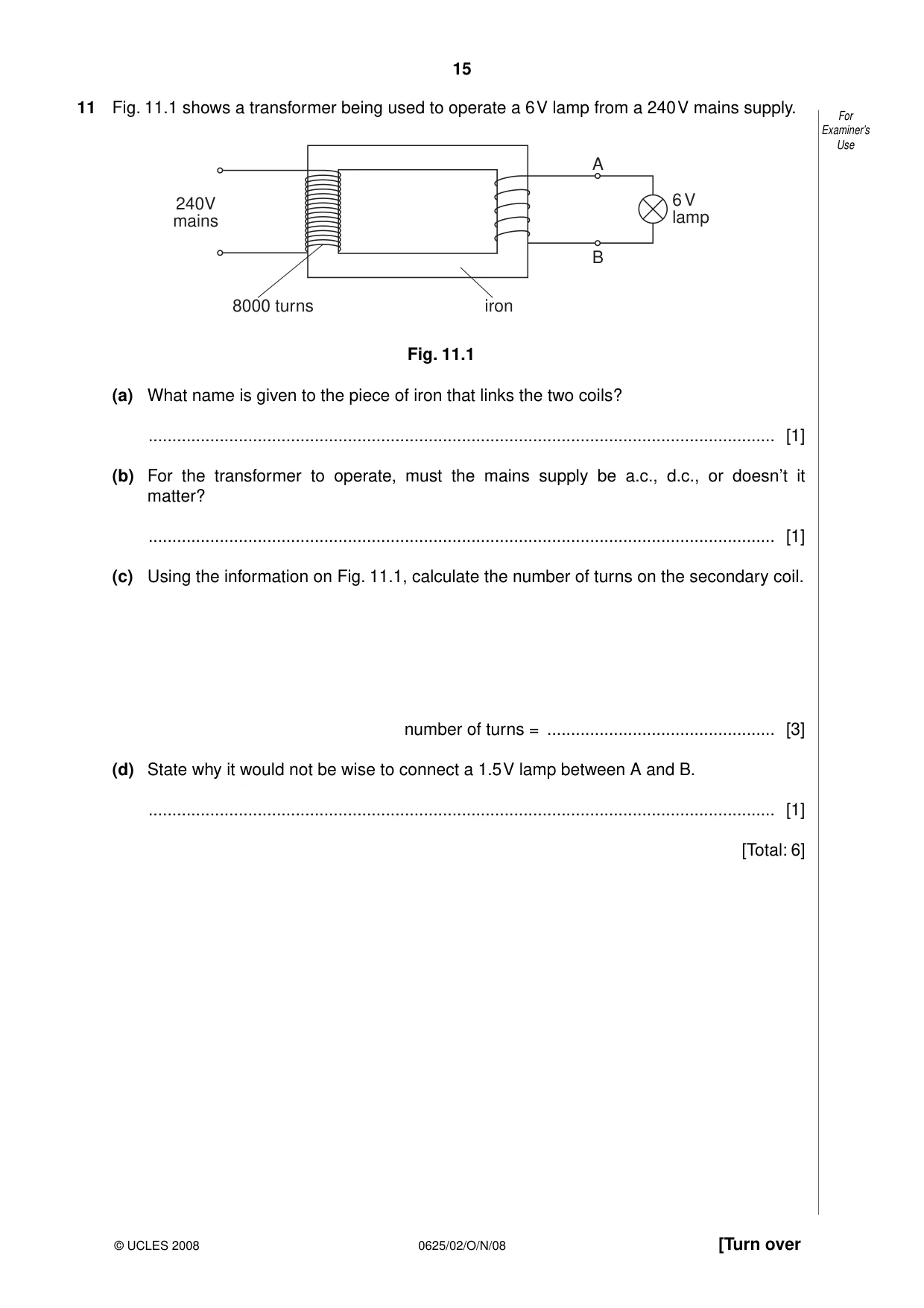
15 0625/02/O/N/08 [Turn over For Examiner’s Use © UCLES 2008 11 Fig. 11.1 shows a transformer being used to operate a 6 V lamp from a 240 V mains supply. A B iron 6 V lamp 8000 turns 240V mains Fig. 11.1 (a) What name is given to the piece of iron that links the two coils? … [1] (b) For the transformer to operate, must the mains supply be a.c., d.c., or doesn’t it matter? … [1] (c) Using the information on Fig. 11.1, calculate the number of turns on the secondary coil. number of turns = … [3] (d) State why it would not be wise to connect a 1.5 V lamp between A and B. … [1] [Total: 6]
Question paper, page 16
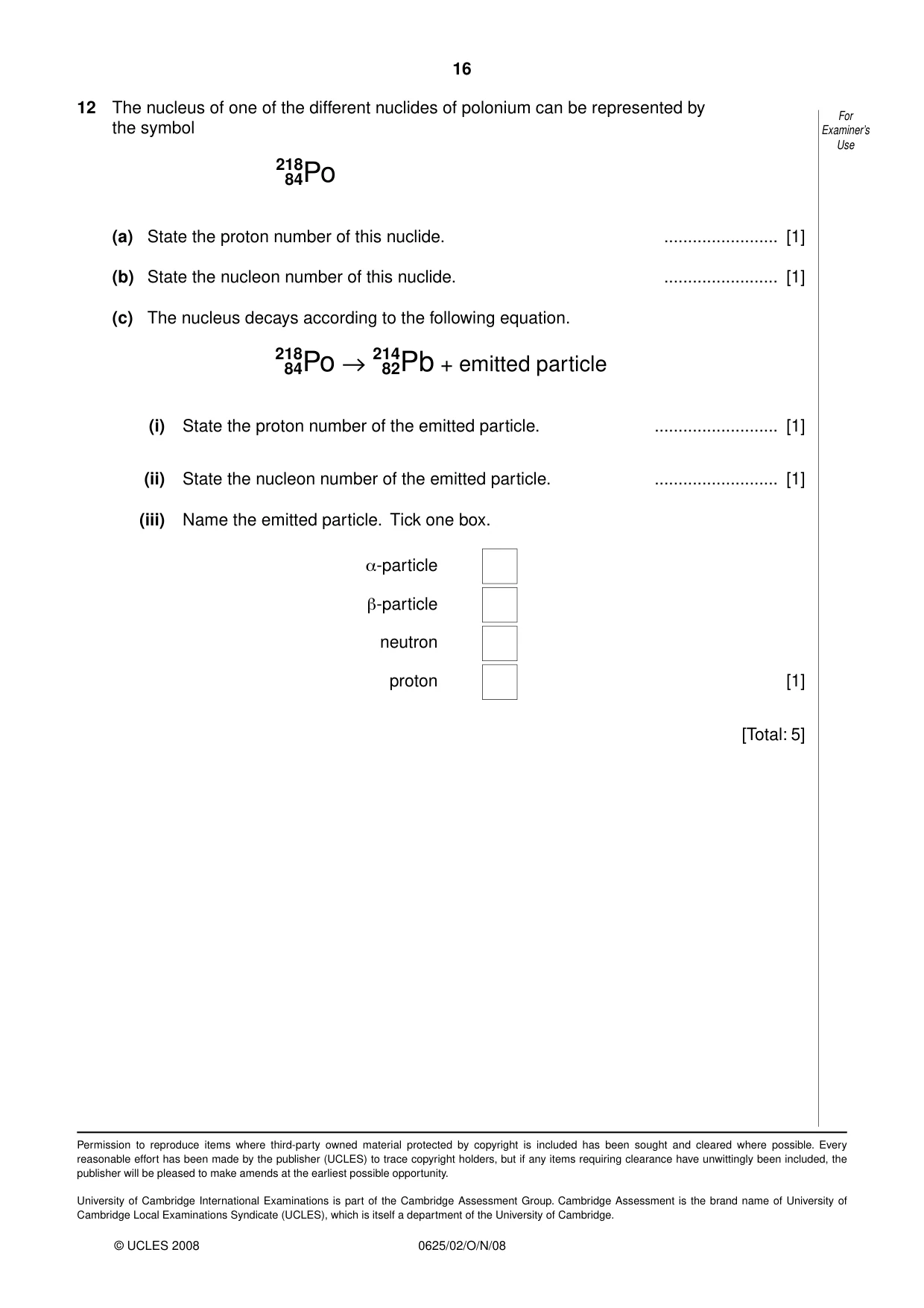
16 0625/02/O/N/08 © UCLES 2008 12 The nucleus of one of the different nuclides of polonium can be represented by the symbol 218 84Po (a) State the proton number of this nuclide. … [1] (b) State the nucleon number of this nuclide. … [1] (c) The nucleus decays according to the following equation. 218 84Po 214 82Pb + emitted particle (i) State the proton number of the emitted particle. … [1] (ii) State the nucleon number of the emitted particle. … [1] (iii) Name the emitted particle. Tick one box. α-particle β-particle neutron proton [1] [Total: 5] Permission to reproduce items where third-party owned material protected by copyright is included has been sought and cleared where possible. Every reasonable effort has been made by the publisher (UCLES) to trace copyright holders, but if any items requiring clearance have unwittingly been included, the publisher will be pleased to make amends at the earliest possible opportunity. University of Cambridge International Examinations is part of the Cambridge Assessment Group. Cambridge Assessment is the brand name of University of Cambridge Local Examinations Syndicate (UCLES), which is itself a department of the University of Cambridge. For Examiner’s Use
Mark scheme, page 1
UNIVERSITY OF CAMBRIDGE INTERNATIONAL EXAMINATIONS International General Certificate of Secondary Education MARK SCHEME for the October/November 2008 question paper 0625 PHYSICS 0625/02 Paper 2 (Core Theory), maximum raw mark 80 This mark scheme is published as an aid to teachers and candidates, to indicate the requirements of the examination. It shows the basis on which Examiners were instructed to award marks. It does not indicate the details of the discussions that took place at an Examiners’ meeting before marking began. All Examiners are instructed that alternative correct answers and unexpected approaches in candidates’ scripts must be given marks that fairly reflect the relevant knowledge and skills demonstrated. Mark schemes must be read in conjunction with the question papers and the report on the examination. • CIE will not enter into discussions or correspondence in connection with these mark schemes. CIE is publishing the mark schemes for the October/November 2008 question papers for most IGCSE, GCE Advanced Level and Advanced Subsidiary Level syllabuses and some Ordinary Level syllabuses. www.XtremePapers.com
Mark scheme, page 2
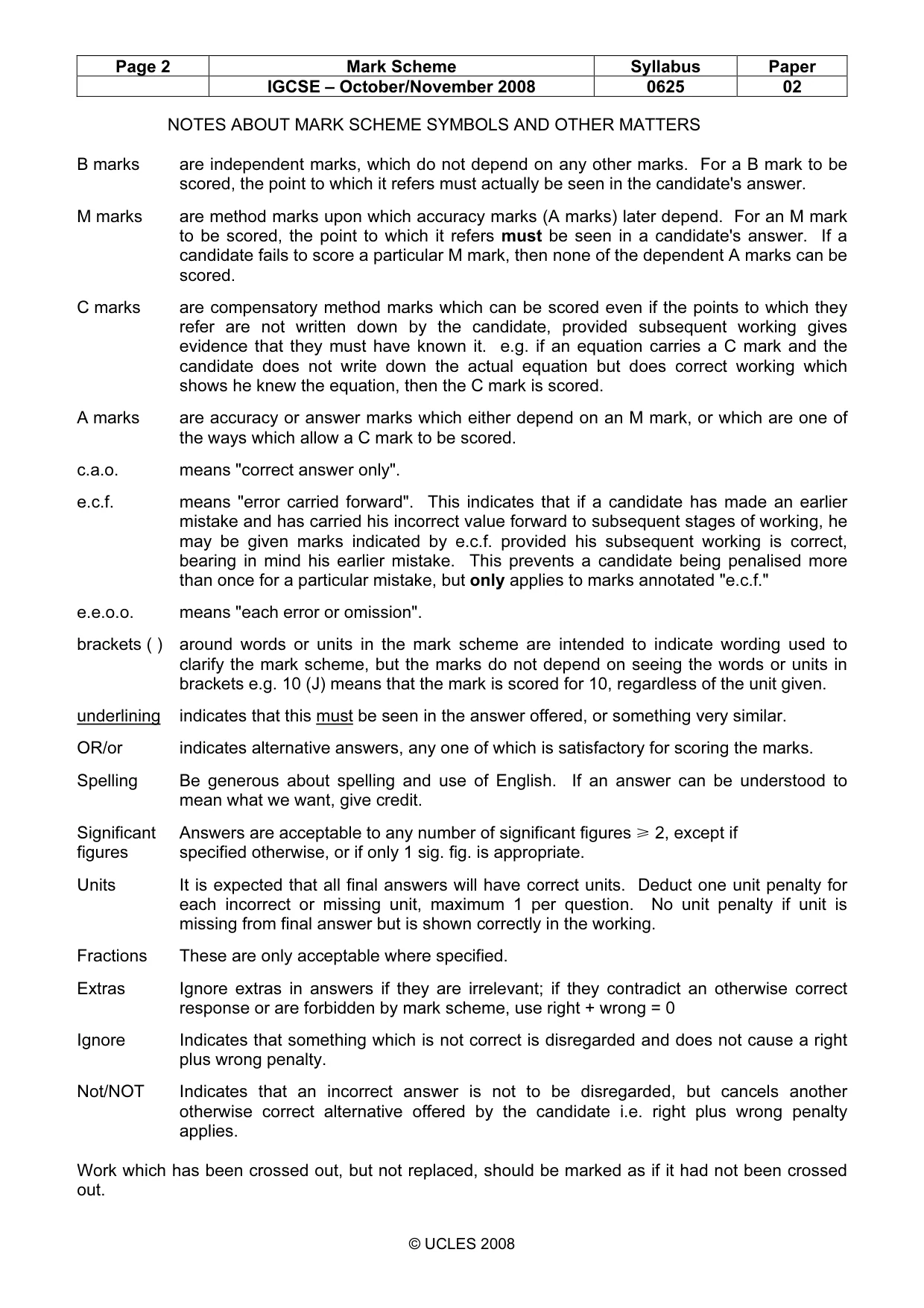
Page 2 Mark Scheme Syllabus Paper IGCSE – October/November 2008 0625 02 © UCLES 2008 NOTES ABOUT MARK SCHEME SYMBOLS AND OTHER MATTERS B marks are independent marks, which do not depend on any other marks. For a B mark to be scored, the point to which it refers must actually be seen in the candidate's answer. M marks are method marks upon which accuracy marks (A marks) later depend. For an M mark to be scored, the point to which it refers must be seen in a candidate's answer. If a candidate fails to score a particular M mark, then none of the dependent A marks can be scored. C marks are compensatory method marks which can be scored even if the points to which they refer are not written down by the candidate, provided subsequent working gives evidence that they must have known it. e.g. if an equation carries a C mark and the candidate does not write down the actual equation but does correct working which shows he knew the equation, then the C mark is scored. A marks are accuracy or answer marks which either depend on an M mark, or which are one of the ways which allow a C mark to be scored. c.a.o. means "correct answer only". e.c.f. means "error carried forward". This indicates that if a candidate has made an earlier mistake and has carried his incorrect value forward to subsequent stages of working, he may be given marks indicated by e.c.f. provided his subsequent working is correct, bearing in mind his earlier mistake. This prevents a candidate being penalised more than once for a particular mistake, but only applies to marks annotated "e.c.f." e.e.o.o. means "each error or omission". brackets ( ) around words or units in the mark scheme are intended to indicate wording used to clarify the mark scheme, but the marks do not depend on seeing the words or units in brackets e.g. 10 (J) means that the mark is scored for 10, regardless of the unit given. underlining indicates that this must be seen in the answer offered, or something very similar. OR/or indicates alternative answers, any one of which is satisfactory for scoring the marks. Spelling Be generous about spelling and use of English. If an answer can be understood to mean what we want, give credit. Significant Answers are acceptable to any number of significant figures [ 2, except if figures specified otherwise, or if only 1 sig. fig. is appropriate. Units It is expected that all final answers will have correct units. Deduct one unit penalty for each incorrect or missing unit, maximum 1 per question. No unit penalty if unit is missing from final answer but is shown correctly in the working. Fractions These are only acceptable where specified. Extras Ignore extras in answers if they are irrelevant; if they contradict an otherwise correct response or are forbidden by mark scheme, use right + wrong = 0 Ignore Indicates that something which is not correct is disregarded and does not cause a right plus wrong penalty. Not/NOT Indicates that an incorrect answer is not to be disregarded, but cancels another otherwise correct alternative offered by the candidate i.e. right plus wrong penalty applies. Work which has been crossed out, but not replaced, should be marked as if it had not been crossed out.
Mark scheme, page 3
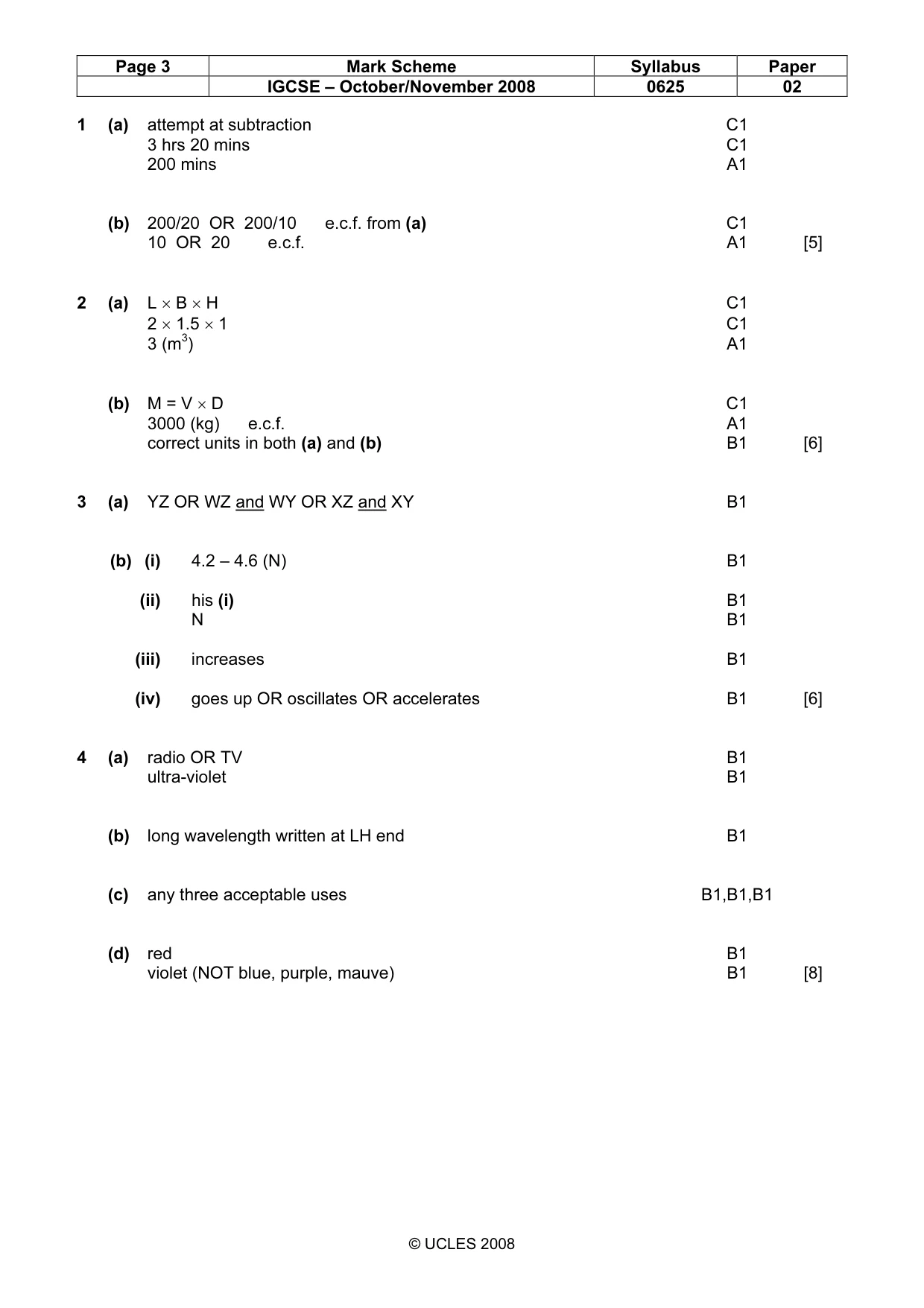
Page 3 Mark Scheme Syllabus Paper IGCSE – October/November 2008 0625 02 © UCLES 2008 1 (a) attempt at subtraction C1 3 hrs 20 mins C1 200 mins A1 (b) 200/20 OR 200/10 e.c.f. from (a) C1 10 OR 20 e.c.f. A1 [5] 2 (a) L × B × H C1 2 × 1.5 × 1 C1 3 (m3) A1 (b) M = V × D C1 3000 (kg) e.c.f. A1 correct units in both (a) and (b) B1 [6] 3 (a) YZ OR WZ and WY OR XZ and XY B1 (b) (i) 4.2 – 4.6 (N) B1 (ii) his (i) B1 N B1 (iii) increases B1 (iv) goes up OR oscillates OR accelerates B1 [6] 4 (a) radio OR TV B1 ultra-violet B1 (b) long wavelength written at LH end B1 (c) any three acceptable uses B1,B1,B1 (d) red B1 violet (NOT blue, purple, mauve) B1 [8]
Mark scheme, page 4
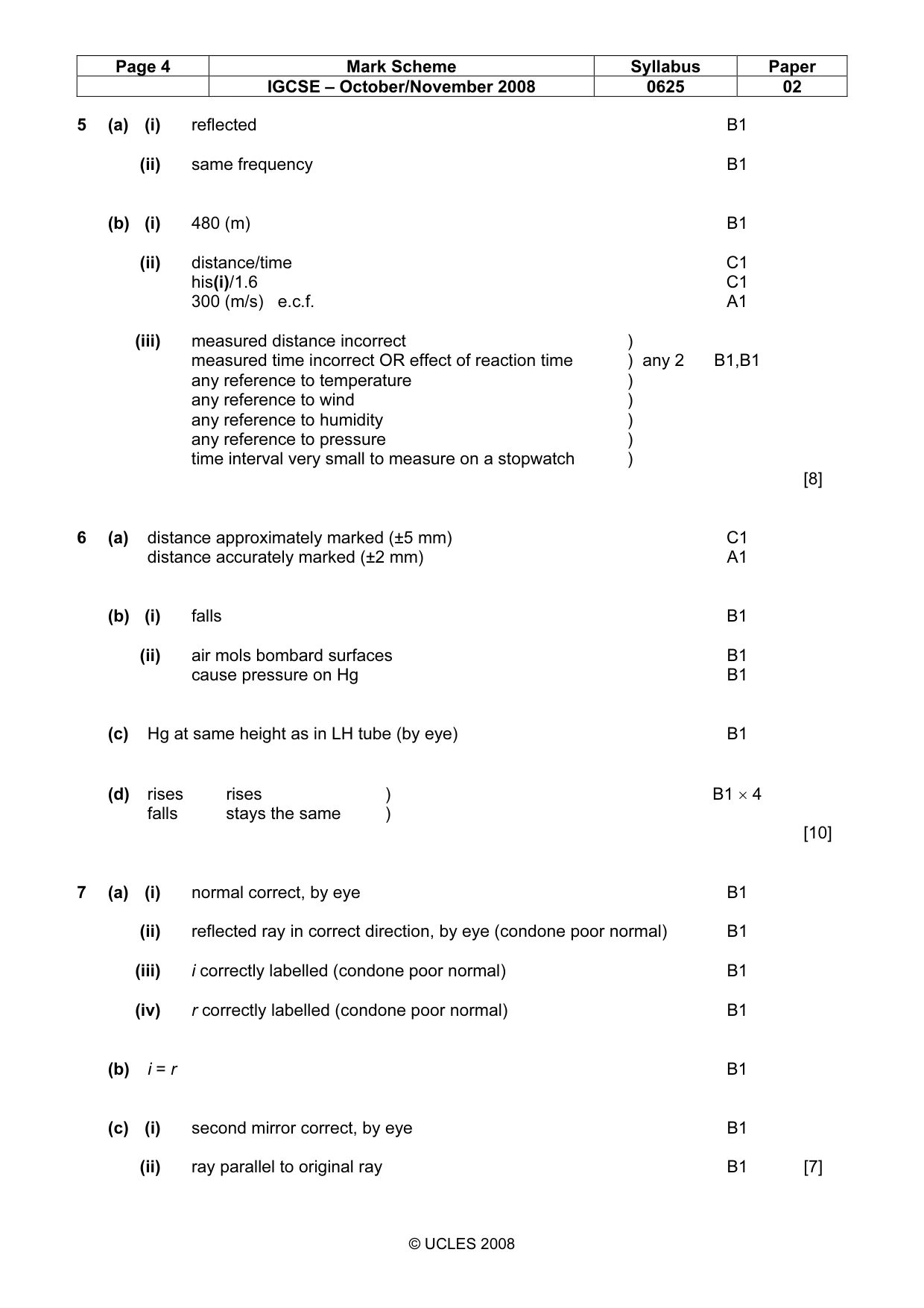
Page 4 Mark Scheme Syllabus Paper IGCSE – October/November 2008 0625 02 © UCLES 2008 5 (a) (i) reflected B1 (ii) same frequency B1 (b) (i) 480 (m) B1 (ii) distance/time C1 his(i)/1.6 C1 300 (m/s) e.c.f. A1 (iii) measured distance incorrect ) measured time incorrect OR effect of reaction time ) any 2 B1,B1 any reference to temperature ) any reference to wind ) any reference to humidity ) any reference to pressure ) time interval very small to measure on a stopwatch ) [8] 6 (a) distance approximately marked (±5 mm) C1 distance accurately marked (±2 mm) A1 (b) (i) falls B1 (ii) air mols bombard surfaces B1 cause pressure on Hg B1 (c) Hg at same height as in LH tube (by eye) B1 (d) rises rises ) B1 × 4 falls stays the same ) [10] 7 (a) (i) normal correct, by eye B1 (ii) reflected ray in correct direction, by eye (condone poor normal) B1 (iii) i correctly labelled (condone poor normal) B1 (iv) r correctly labelled (condone poor normal) B1 (b) i = r B1 (c) (i) second mirror correct, by eye B1 (ii) ray parallel to original ray B1 [7]
Mark scheme, page 5
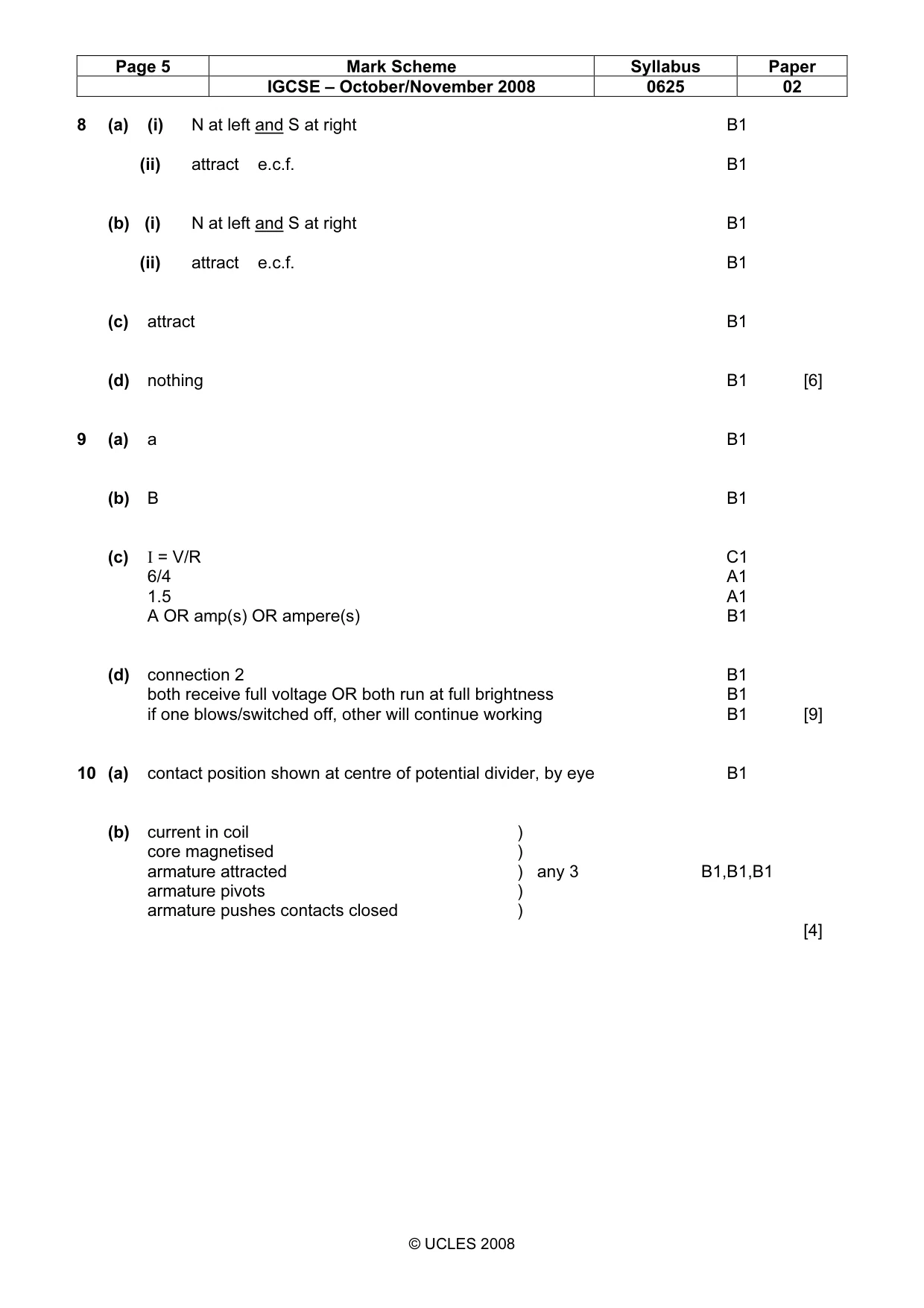
Page 5 Mark Scheme Syllabus Paper IGCSE – October/November 2008 0625 02 © UCLES 2008 8 (a) (i) N at left and S at right B1 (ii) attract e.c.f. B1 (b) (i) N at left and S at right B1 (ii) attract e.c.f. B1 (c) attract B1 (d) nothing B1 [6] 9 (a) a B1 (b) B B1 (c) I = V/R C1 6/4 A1 1.5 A1 A OR amp(s) OR ampere(s) B1 (d) connection 2 B1 both receive full voltage OR both run at full brightness B1 if one blows/switched off, other will continue working B1 [9] 10 (a) contact position shown at centre of potential divider, by eye B1 (b) current in coil ) core magnetised ) armature attracted ) any 3 B1,B1,B1 armature pivots ) armature pushes contacts closed ) [4]
Mark scheme, page 6
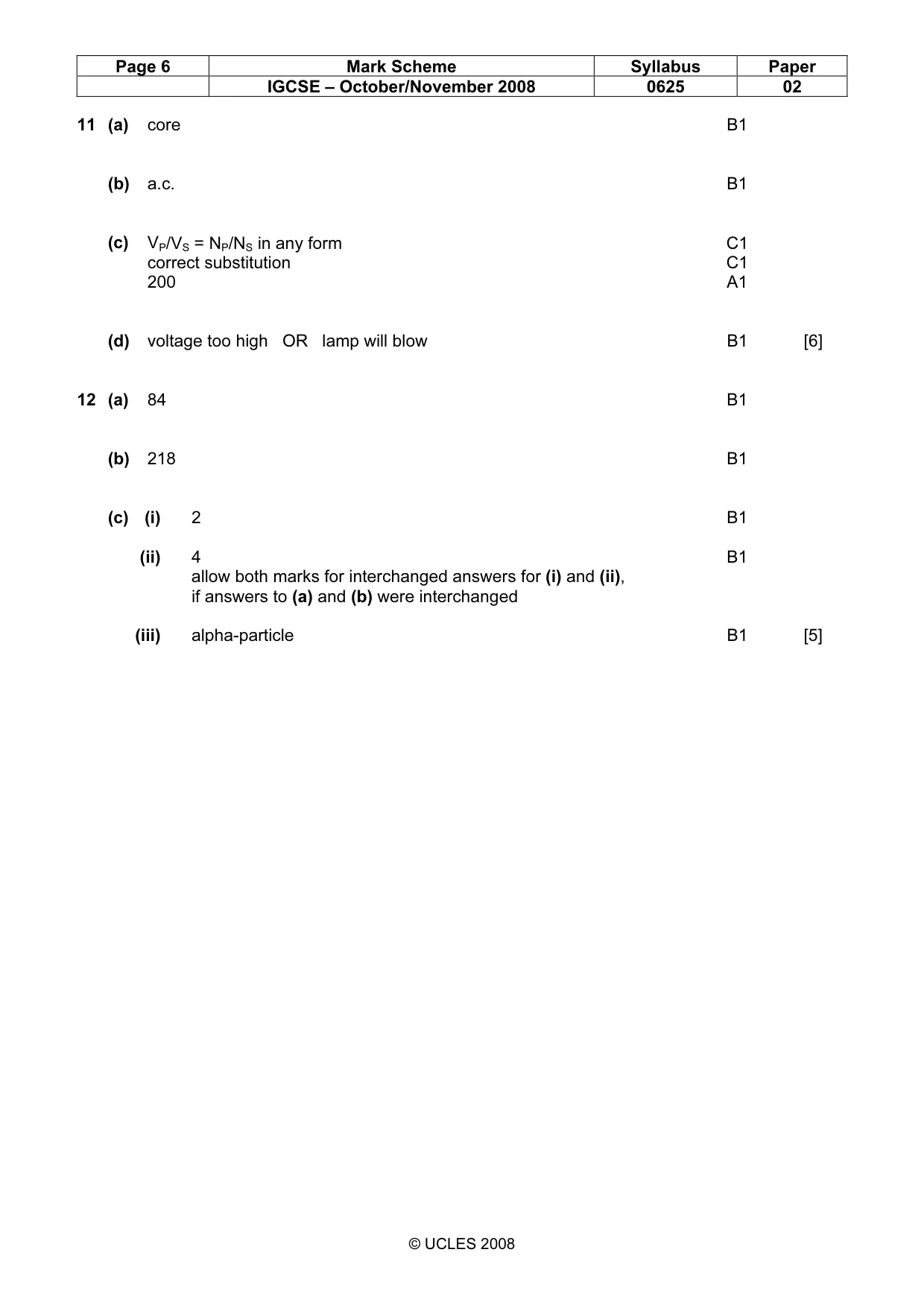
Page 6 Mark Scheme Syllabus Paper IGCSE – October/November 2008 0625 02 © UCLES 2008 11 (a) core B1 (b) a.c. B1 (c) VP/VS = NP/NS in any form C1 correct substitution C1 200 A1 (d) voltage too high OR lamp will blow B1 [6] 12 (a) 84 B1 (b) 218 B1 (c) (i) 2 B1 (ii) 4 B1 allow both marks for interchanged answers for (i) and (ii), if answers to (a) and (b) were interchanged (iii) alpha-particle B1 [5]
What you needed in this session
Cambridge’s own grade thresholds for 2008 Oct/Nov, Paper 2 · Variant 1. A higher threshold means an easier paper — the bar moves with how the cohort did.