Cambridge IGCSE Physics 0625 — 2005 Oct/Nov Paper 2 · Variant 1
0625/21/O/N/05
The question paper and its mark scheme, free to read here and free to download. This is Cambridge’s own paper, exactly as it was sat.
Question paper16 pages
Mark scheme5 pages
Answers below. Sit the paper first if you are practising.
Paper as text
Question paper, page 1
This document consists of 15 printed pages and 1 blank page. MML 8113 3/04 S80925/2 © UCLES 2005 [Turn over UNIVERSITY OF CAMBRIDGE INTERNATIONAL EXAMINATIONS International General Certificate of Secondary Education PHYSICS 0625/02 Paper 2 Core October/November 2005 1 hour 15 minutes Candidates answer on the Question Paper. No Additional Materials are required. READ THESE INSTRUCTIONS FIRST Write your Centre number, candidate number and name on all the work you hand in. Write in dark blue or black pen in the spaces provided on the Question Paper. You may use a soft pencil for any diagrams, graphs or rough working. Do not use staples, paper clips, highlighters, glue or correction fluid. Answer all questions. At the end of the examination, fasten all your work securely together. The number of marks is given in brackets [ ] at the end of each question or part question. You may lose marks if you do not show your working or if you do not use appropriate units. Take the weight of 1 kg to be 10 N (i.e. acceleration of free fall = 10 m/s2). Centre Number Candidate Number Name If you have been given a label, look at the details. If any details are incorrect or missing, please fill in your correct details in the space given at the top of this page. Stick your personal label here, if provided. For Examiner’s Use www.XtremePapers.com
Question paper, page 2
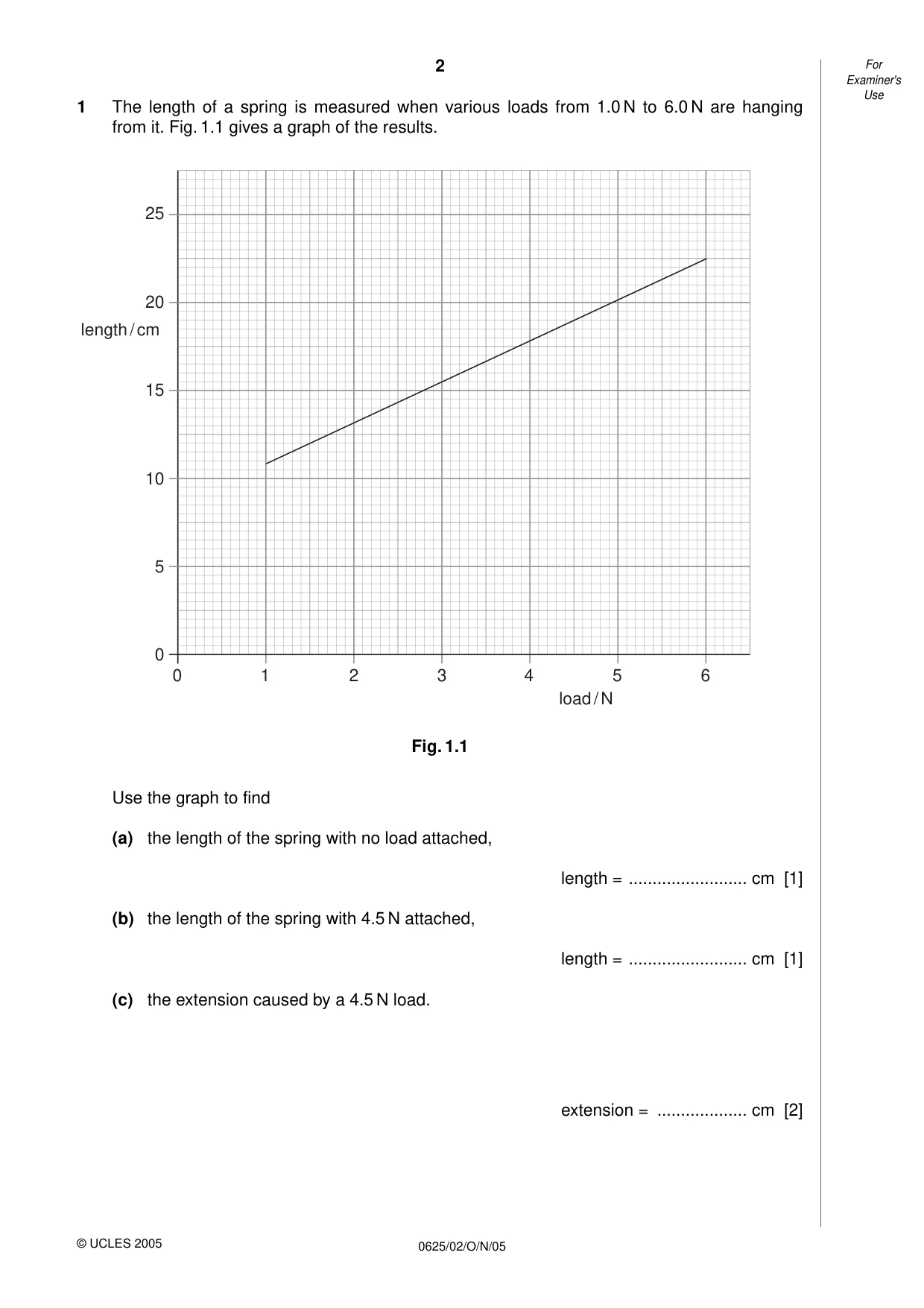
1 The length of a spring is measured when various loads from 1.0 N to 6.0 N are hanging from it. Fig. 1.1 gives a graph of the results. Fig. 1.1 Use the graph to find (a) the length of the spring with no load attached, length = … cm [1] (b) the length of the spring with 4.5 N attached, length = … cm [1] (c) the extension caused by a 4.5 N load. extension = … cm [2] 0 0 1 2 3 4 5 6 5 10 15 20 25 load / N length / cm 2 For Examiner's Use 0625/02/O/N/05 © UCLES 2005
Question paper, page 3
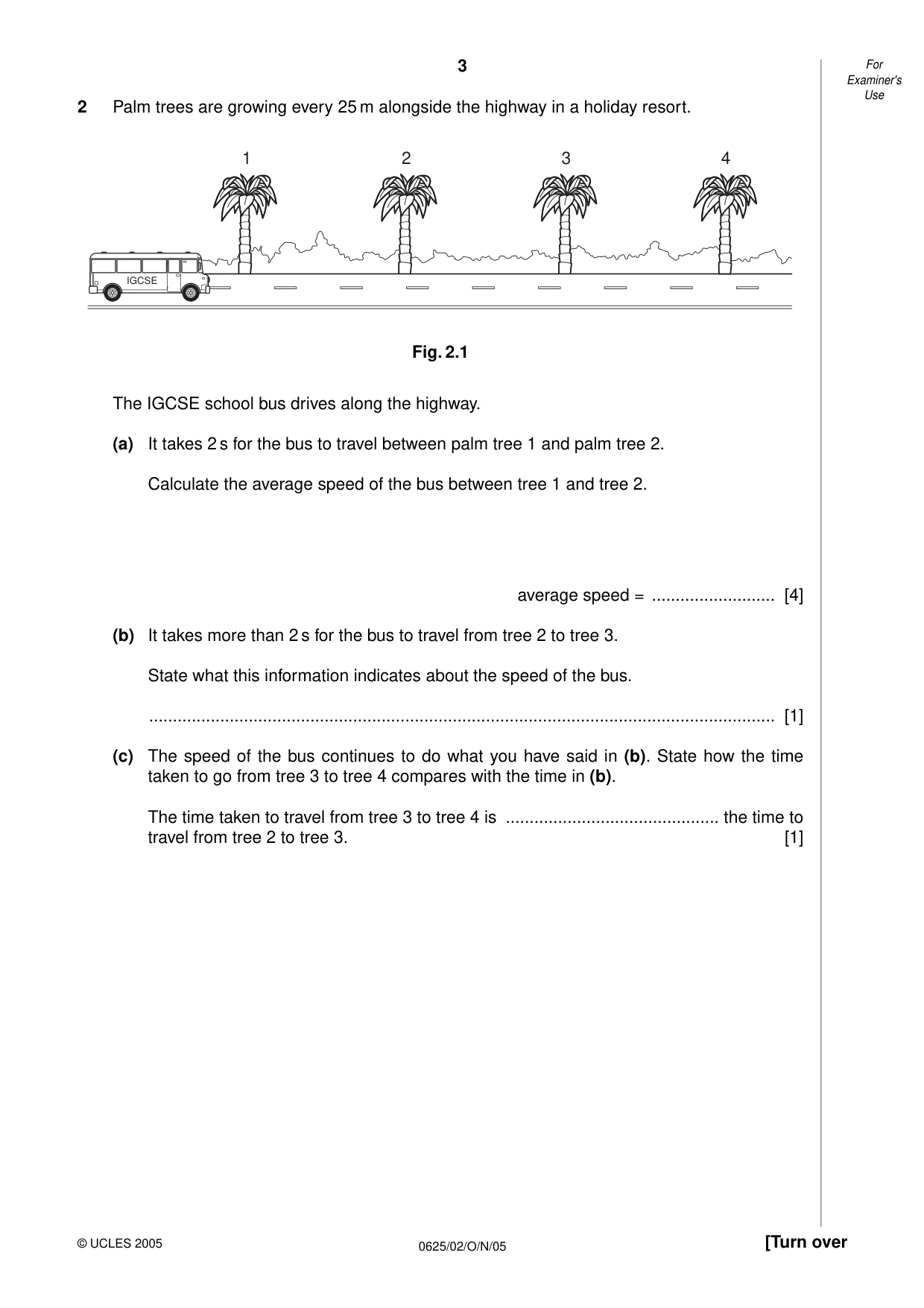
2 Palm trees are growing every 25 m alongside the highway in a holiday resort. Fig. 2.1 The IGCSE school bus drives along the highway. (a) It takes 2 s for the bus to travel between palm tree 1 and palm tree 2. Calculate the average speed of the bus between tree 1 and tree 2. average speed = … [4] (b) It takes more than 2 s for the bus to travel from tree 2 to tree 3. State what this information indicates about the speed of the bus. … [1] (c) The speed of the bus continues to do what you have said in (b). State how the time taken to go from tree 3 to tree 4 compares with the time in (b). The time taken to travel from tree 3 to tree 4 is … the time to travel from tree 2 to tree 3. [1] IGCSE 1 2 3 4 3 [Turn over For Examiner's Use 0625/02/O/N/05 © UCLES 2005
Question paper, page 4
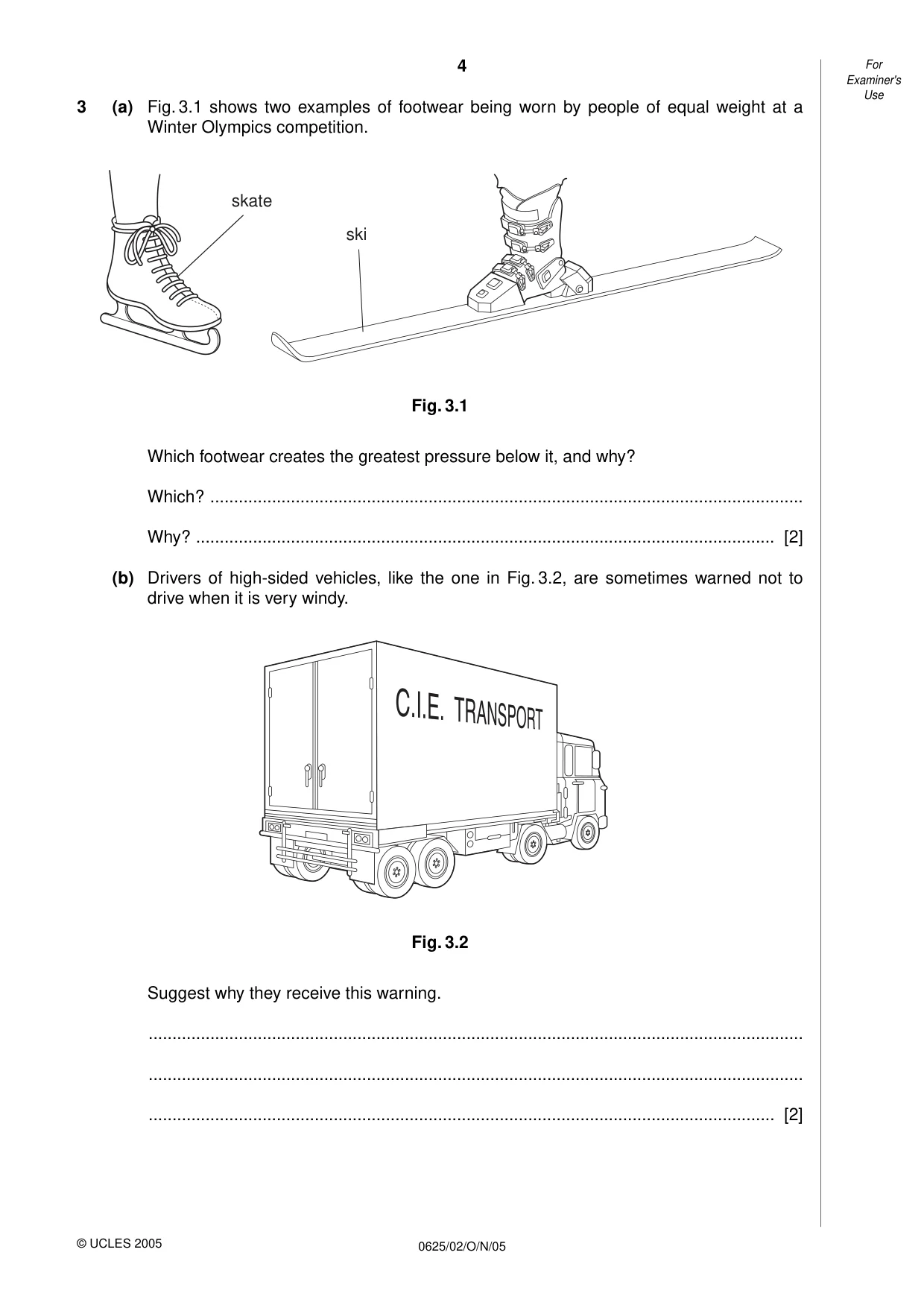
3 (a) Fig. 3.1 shows two examples of footwear being worn by people of equal weight at a Winter Olympics competition. Fig. 3.1 Which footwear creates the greatest pressure below it, and why? Which? … Why? … [2] (b) Drivers of high-sided vehicles, like the one in Fig. 3.2, are sometimes warned not to drive when it is very windy. Fig. 3.2 Suggest why they receive this warning. … … … [2] skate ski 4 For Examiner's Use 0625/02/O/N/05 © UCLES 2005
Question paper, page 5
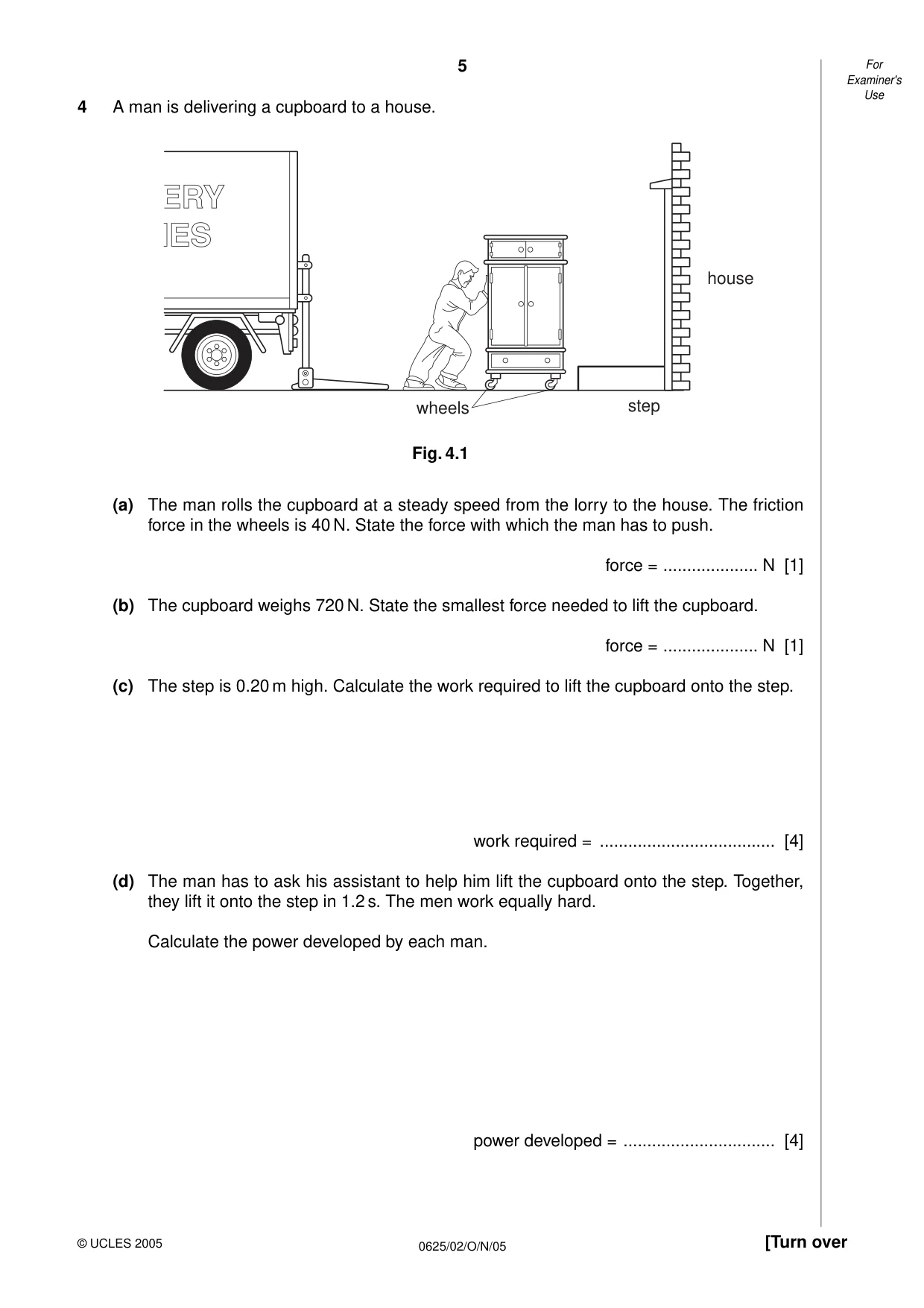
4 A man is delivering a cupboard to a house. Fig. 4.1 (a) The man rolls the cupboard at a steady speed from the lorry to the house. The friction force in the wheels is 40 N. State the force with which the man has to push. force = … N [1] (b) The cupboard weighs 720 N. State the smallest force needed to lift the cupboard. force = … N [1] (c) The step is 0.20 m high. Calculate the work required to lift the cupboard onto the step. work required = … [4] (d) The man has to ask his assistant to help him lift the cupboard onto the step. Together, they lift it onto the step in 1.2 s. The men work equally hard. Calculate the power developed by each man. power developed = … [4] step wheels house 5 [Turn over For Examiner's Use 0625/02/O/N/05 © UCLES 2005
Question paper, page 6
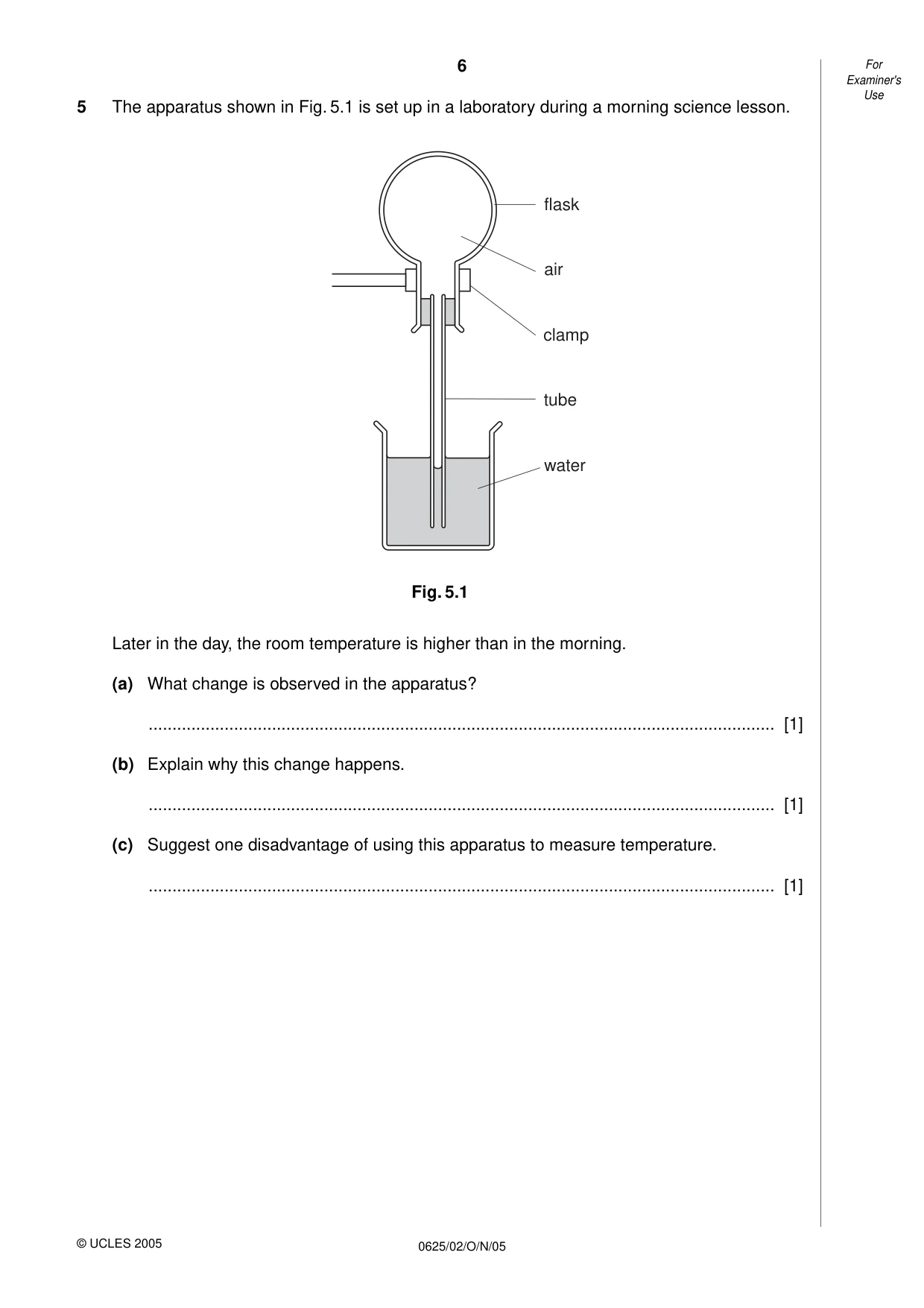
5 The apparatus shown in Fig. 5.1 is set up in a laboratory during a morning science lesson. Fig. 5.1 Later in the day, the room temperature is higher than in the morning. (a) What change is observed in the apparatus? … [1] (b) Explain why this change happens. … [1] (c) Suggest one disadvantage of using this apparatus to measure temperature. … [1] flask air tube clamp water 6 For Examiner's Use 0625/02/O/N/05 © UCLES 2005
Question paper, page 7
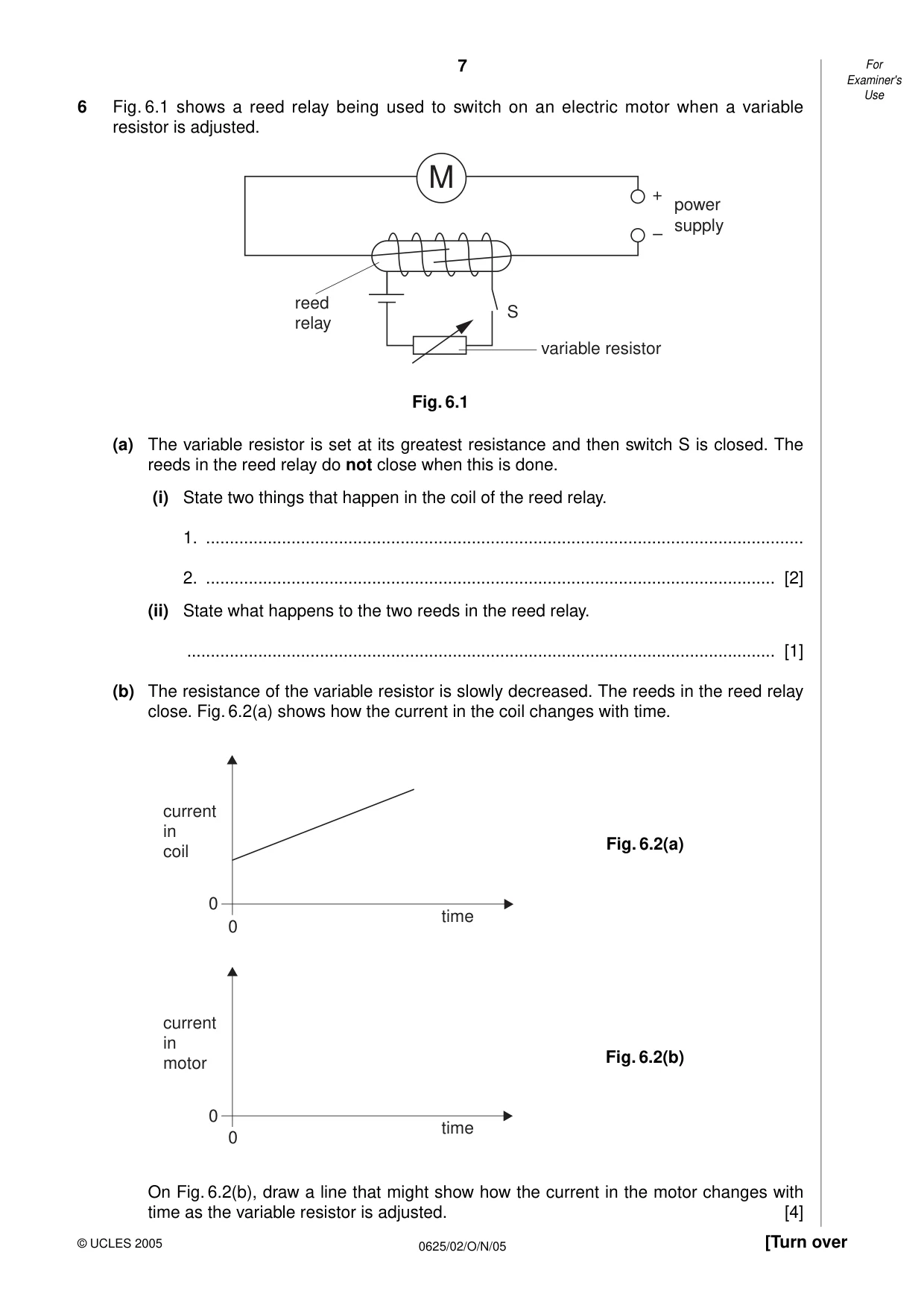
6 Fig. 6.1 shows a reed relay being used to switch on an electric motor when a variable resistor is adjusted. Fig. 6.1 (a) The variable resistor is set at its greatest resistance and then switch S is closed. The reeds in the reed relay do not close when this is done. (i) State two things that happen in the coil of the reed relay. 1. … 2. … [2] (ii) State what happens to the two reeds in the reed relay. … [1] (b) The resistance of the variable resistor is slowly decreased. The reeds in the reed relay close. Fig. 6.2(a) shows how the current in the coil changes with time. On Fig. 6.2(b), draw a line that might show how the current in the motor changes with time as the variable resistor is adjusted. [4] Fig. 6.2(b) 0 current in motor time 0 Fig. 6.2(a) current in coil time 0 0 M + S reed relay power supply variable resistor – 7 [Turn over For Examiner's Use 0625/02/O/N/05 © UCLES 2005
Question paper, page 8
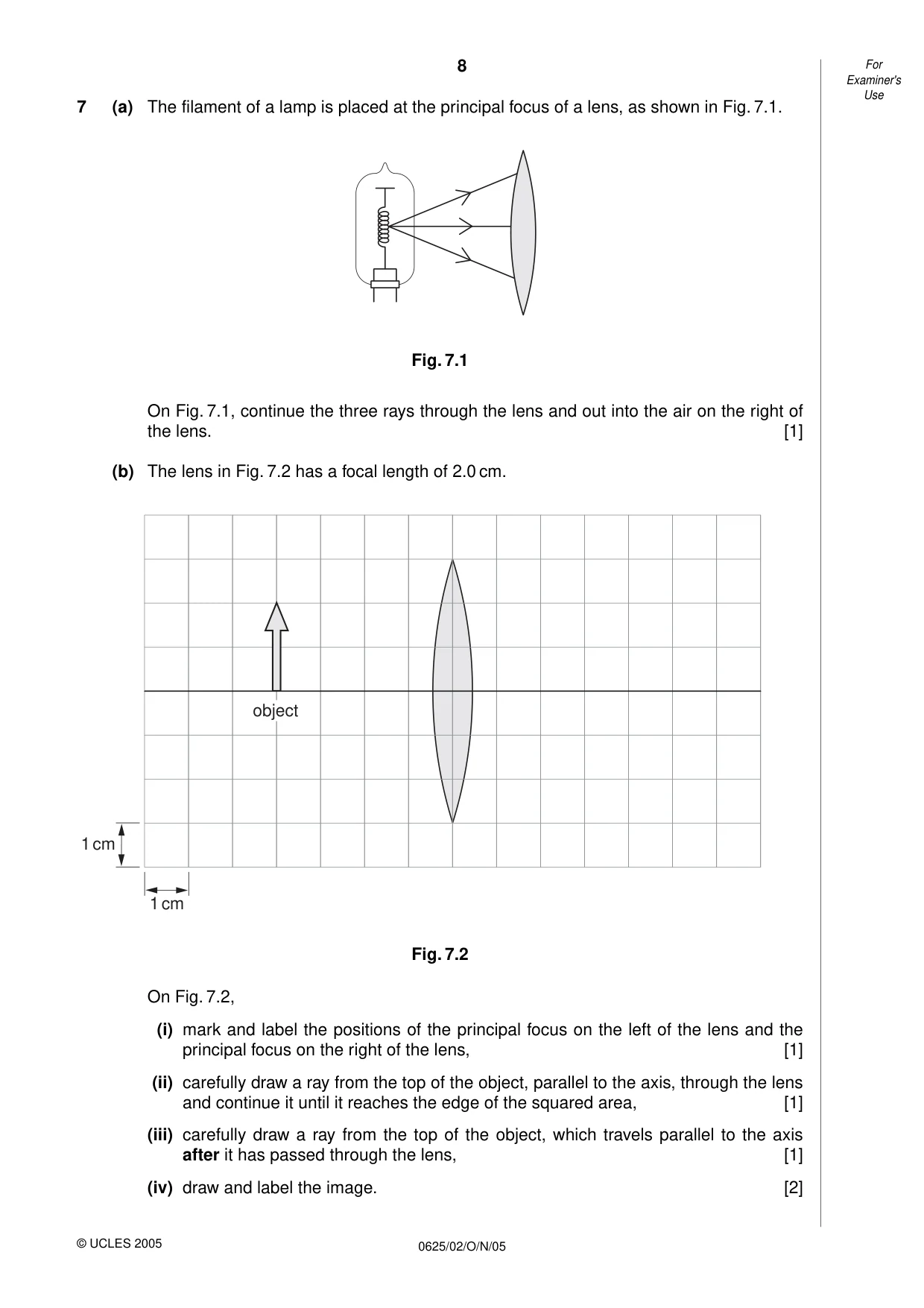
7 (a) The filament of a lamp is placed at the principal focus of a lens, as shown in Fig. 7.1. Fig. 7.1 On Fig. 7.1, continue the three rays through the lens and out into the air on the right of the lens. [1] (b) The lens in Fig. 7.2 has a focal length of 2.0 cm. Fig. 7.2 On Fig. 7.2, (i) mark and label the positions of the principal focus on the left of the lens and the principal focus on the right of the lens, [1] (ii) carefully draw a ray from the top of the object, parallel to the axis, through the lens and continue it until it reaches the edge of the squared area, [1] (iii) carefully draw a ray from the top of the object, which travels parallel to the axis after it has passed through the lens, [1] (iv) draw and label the image. [2] 1 cm 1 cm object 8 For Examiner's Use 0625/02/O/N/05 © UCLES 2005
Question paper, page 9
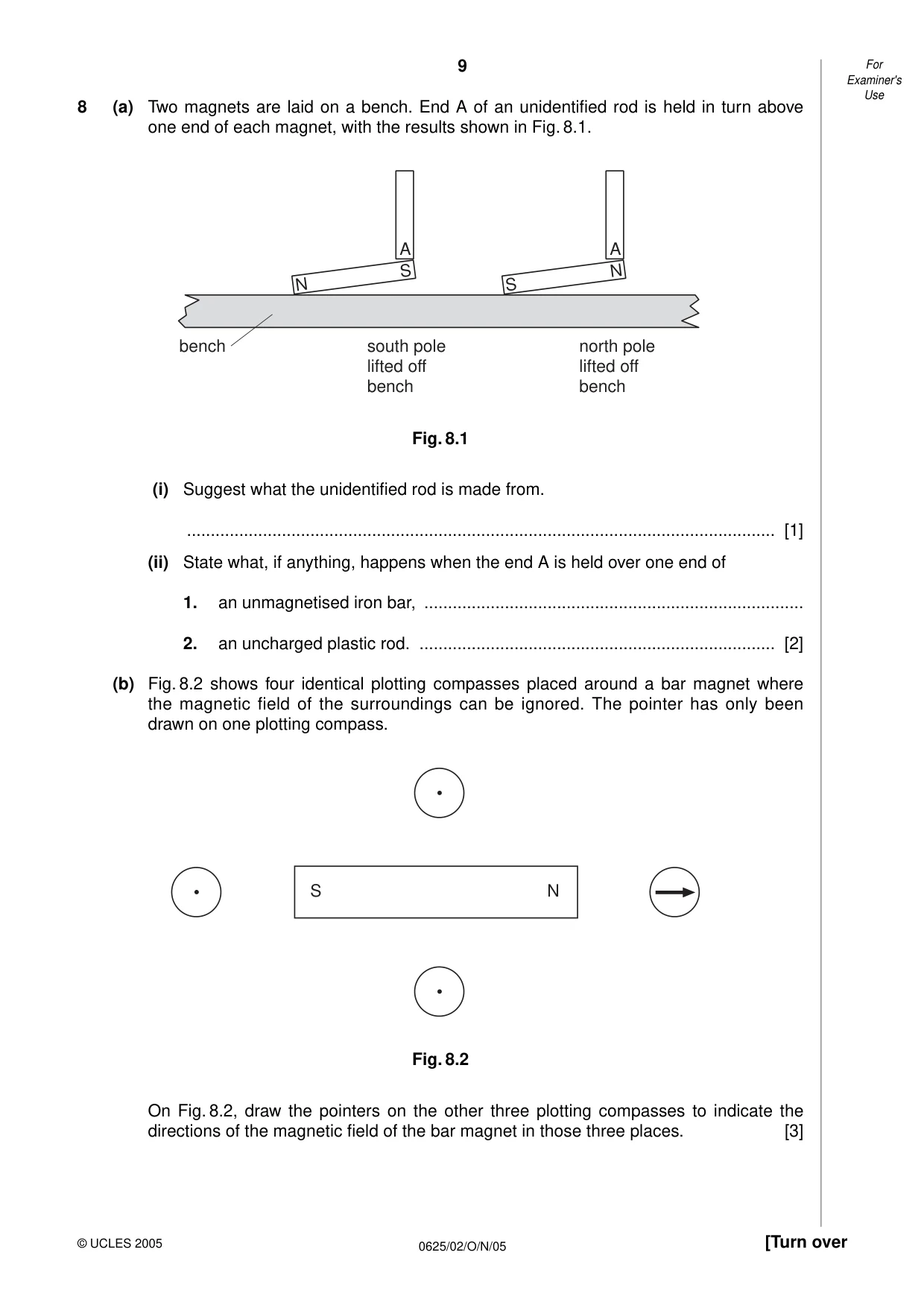
8 (a) Two magnets are laid on a bench. End A of an unidentified rod is held in turn above one end of each magnet, with the results shown in Fig. 8.1. Fig. 8.1 (i) Suggest what the unidentified rod is made from. … [1] (ii) State what, if anything, happens when the end A is held over one end of 1. an unmagnetised iron bar, … 2. an uncharged plastic rod. … [2] (b) Fig. 8.2 shows four identical plotting compasses placed around a bar magnet where the magnetic field of the surroundings can be ignored. The pointer has only been drawn on one plotting compass. Fig. 8.2 On Fig. 8.2, draw the pointers on the other three plotting compasses to indicate the directions of the magnetic field of the bar magnet in those three places. [3] S N A N S A S N south pole lifted off bench bench north pole lifted off bench 9 [Turn over For Examiner's Use 0625/02/O/N/05 © UCLES 2005
Question paper, page 10
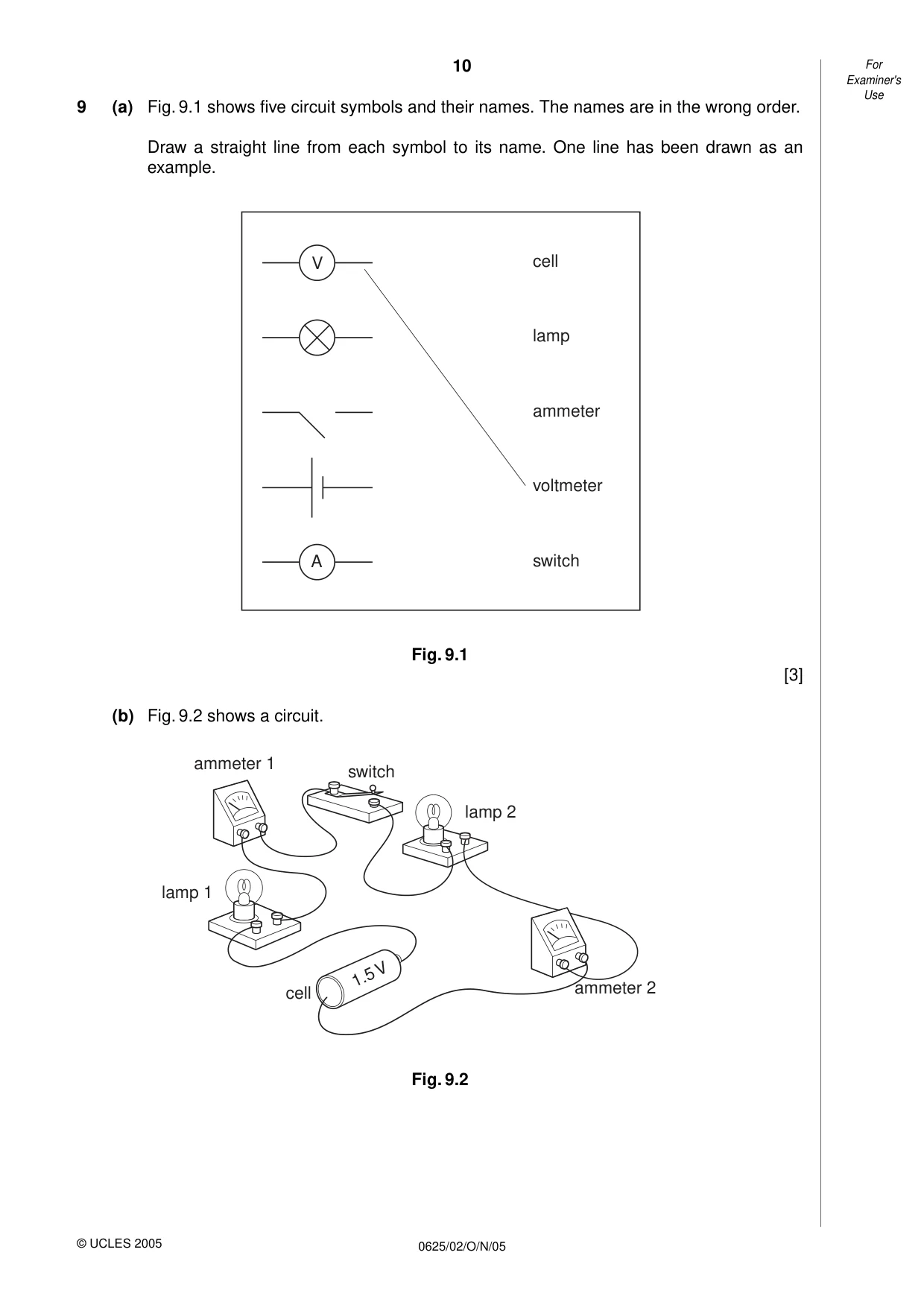
9 (a) Fig. 9.1 shows five circuit symbols and their names. The names are in the wrong order. Draw a straight line from each symbol to its name. One line has been drawn as an example. Fig. 9.1 [3] (b) Fig. 9.2 shows a circuit. Fig. 9.2 ammeter 1 switch lamp 2 ammeter 2 cell lamp 1 1.5 V V A cell lamp ammeter voltmeter switch 10 For Examiner's Use 0625/02/O/N/05 © UCLES 2005
Question paper, page 11
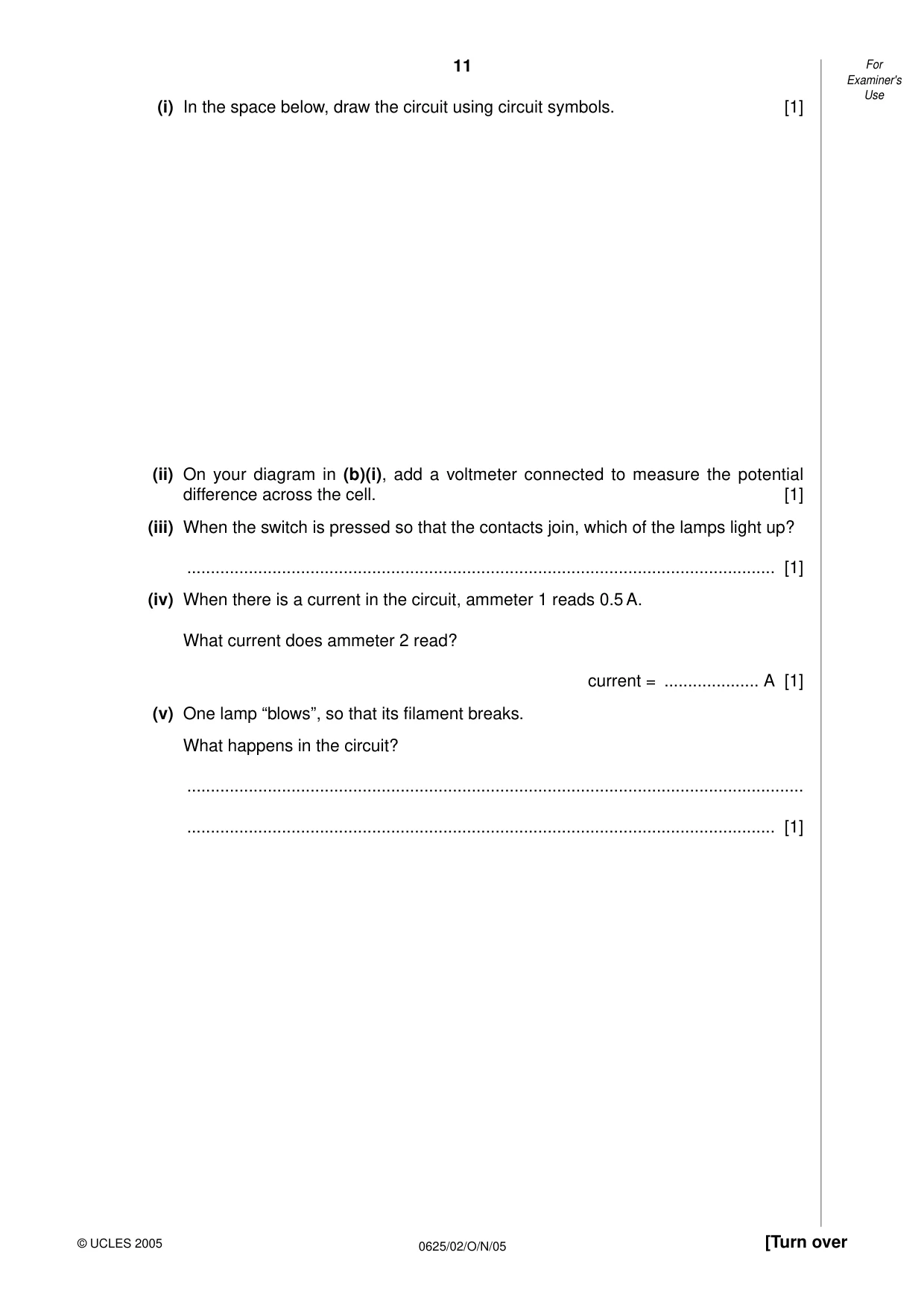
(i) In the space below, draw the circuit using circuit symbols. [1] (ii) On your diagram in (b)(i), add a voltmeter connected to measure the potential difference across the cell. [1] (iii) When the switch is pressed so that the contacts join, which of the lamps light up? … [1] (iv) When there is a current in the circuit, ammeter 1 reads 0.5 A. What current does ammeter 2 read? current = … A [1] (v) One lamp “blows”, so that its filament breaks. What happens in the circuit? … … [1] 11 [Turn over For Examiner's Use 0625/02/O/N/05 © UCLES 2005
Question paper, page 12
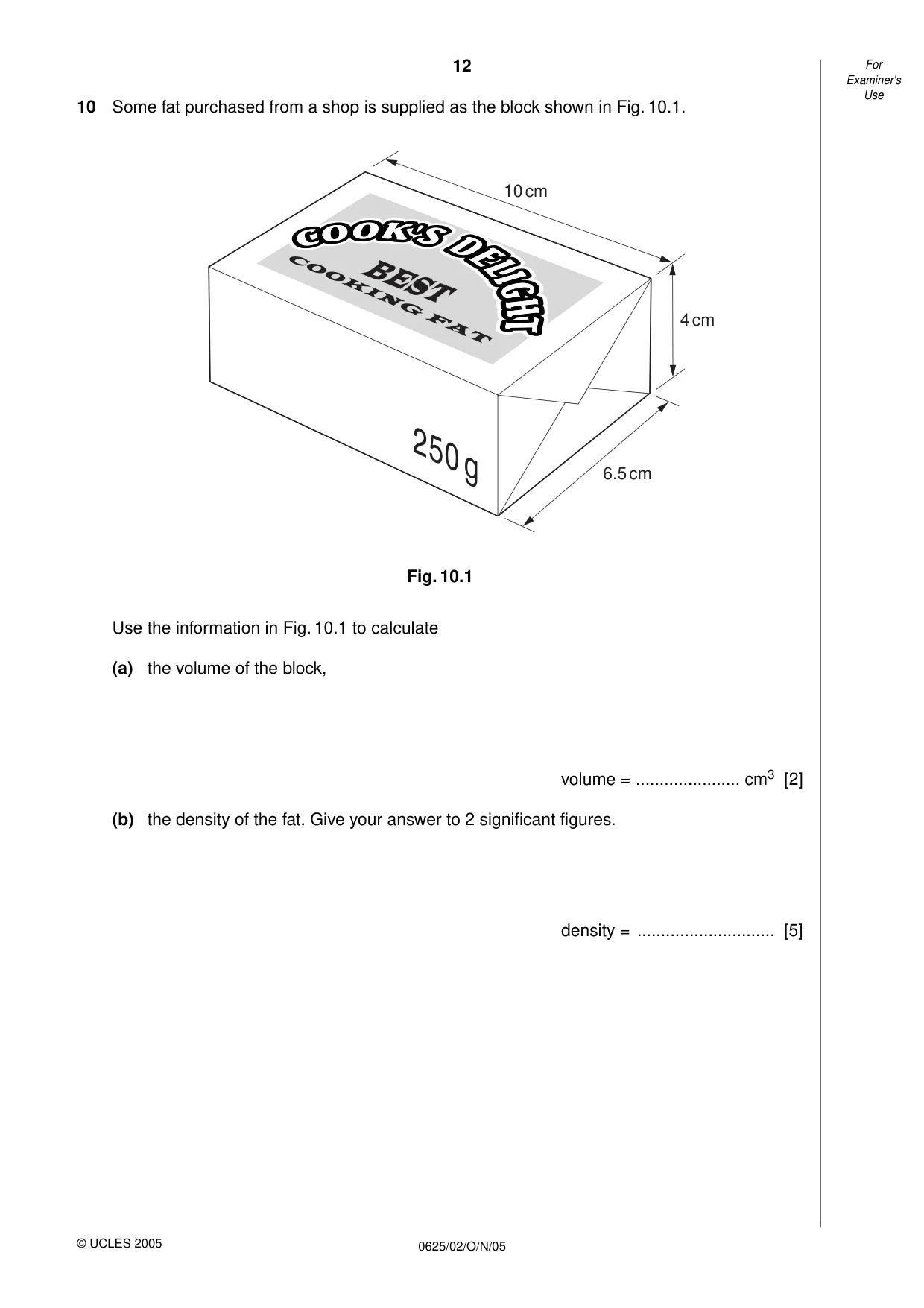
10 Some fat purchased from a shop is supplied as the block shown in Fig. 10.1. Fig. 10.1 Use the information in Fig. 10.1 to calculate (a) the volume of the block, volume = … cm3 [2] (b) the density of the fat. Give your answer to 2 significant figures. density = … [5] 10 cm 6.5 cm 4 cm 12 For Examiner's Use 0625/02/O/N/05 © UCLES 2005
Question paper, page 13
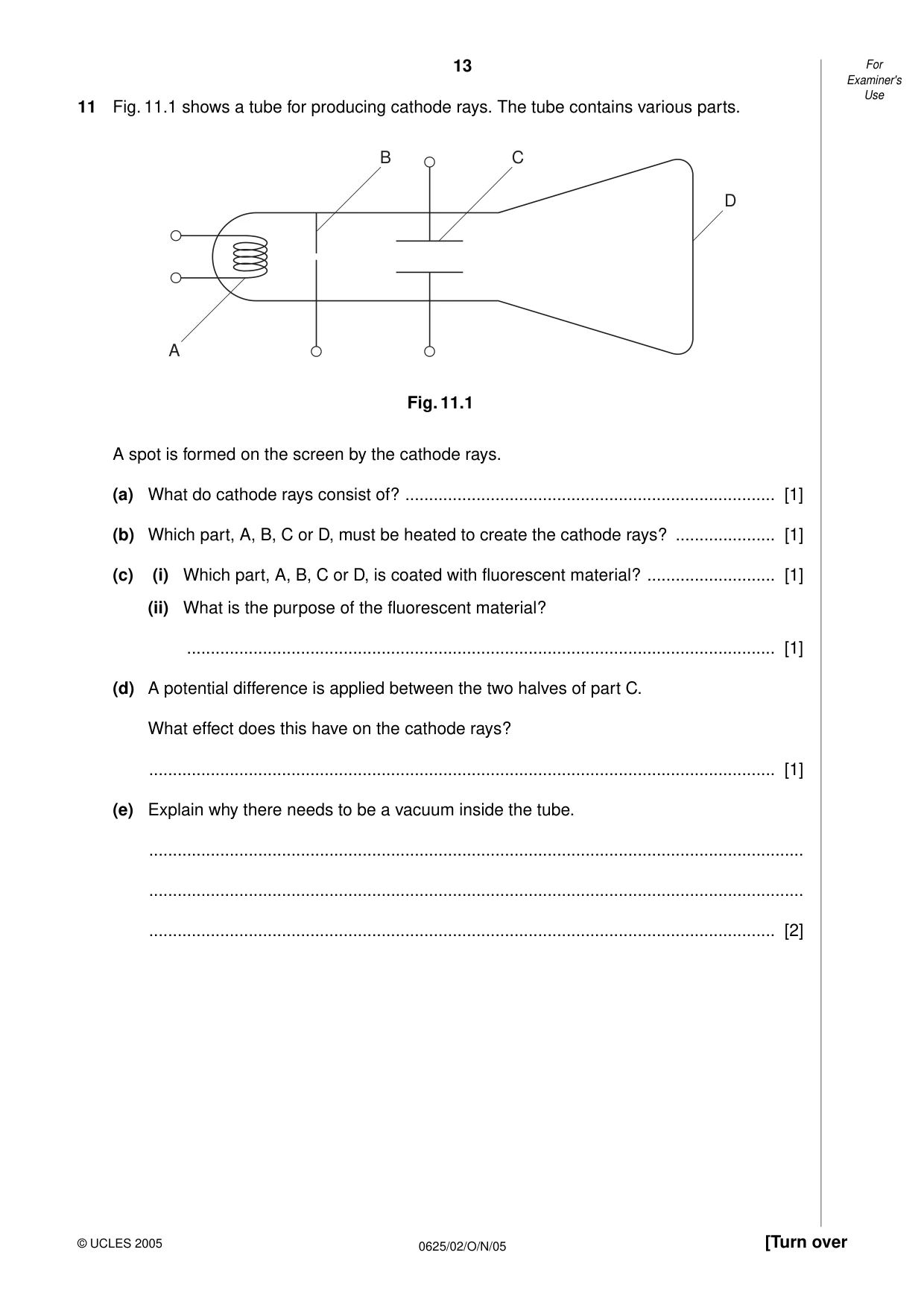
11 Fig. 11.1 shows a tube for producing cathode rays. The tube contains various parts. Fig. 11.1 A spot is formed on the screen by the cathode rays. (a) What do cathode rays consist of? … [1] (b) Which part, A, B, C or D, must be heated to create the cathode rays? … [1] (c) (i) Which part, A, B, C or D, is coated with fluorescent material? … [1] (ii) What is the purpose of the fluorescent material? … [1] (d) A potential difference is applied between the two halves of part C. What effect does this have on the cathode rays? … [1] (e) Explain why there needs to be a vacuum inside the tube. … … … [2] A B C D 13 [Turn over For Examiner's Use 0625/02/O/N/05 © UCLES 2005
Question paper, page 14
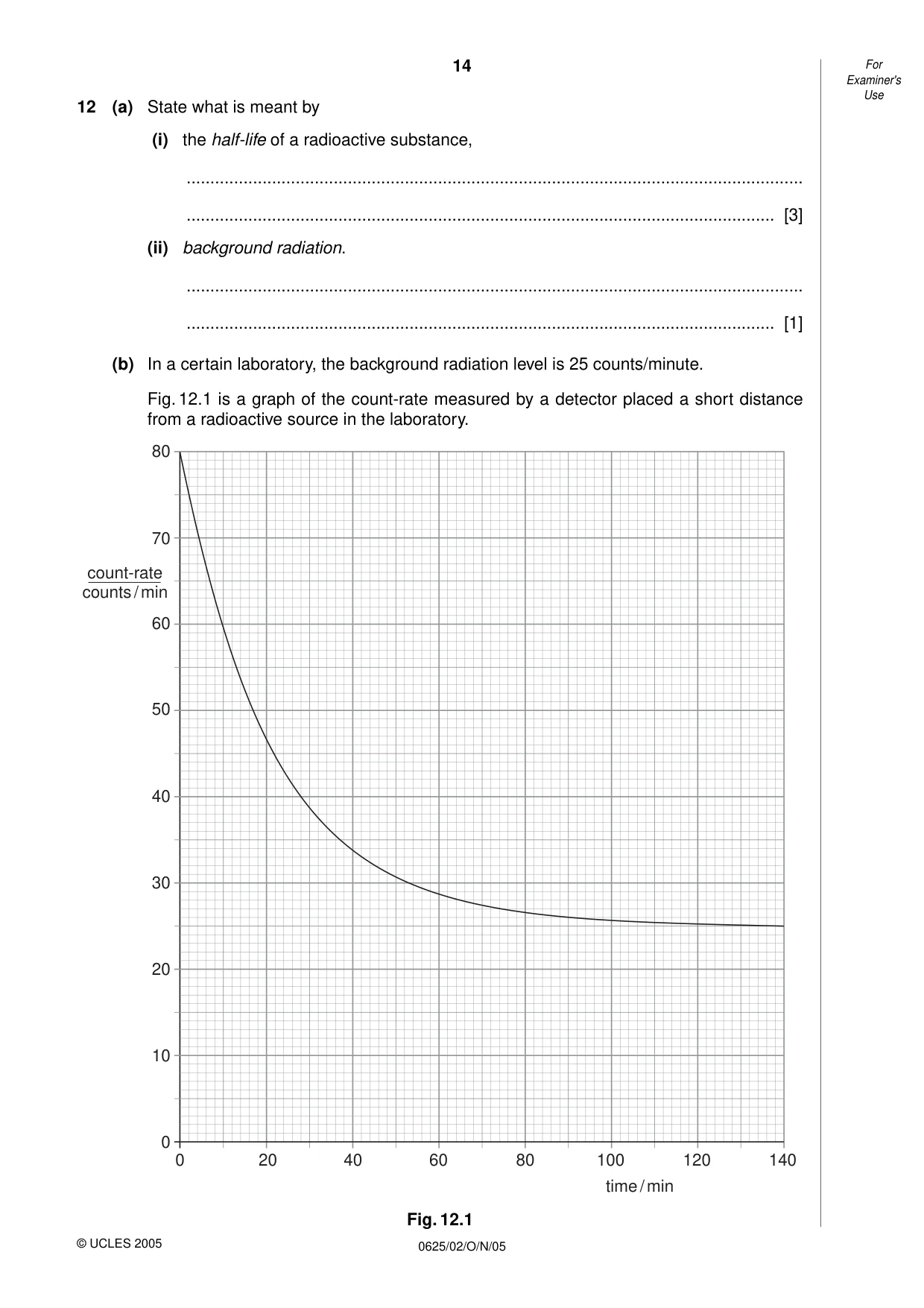
12 (a) State what is meant by (i) the half-life of a radioactive substance, … … [3] (ii) background radiation. … … [1] (b) In a certain laboratory, the background radiation level is 25 counts/minute. Fig. 12.1 is a graph of the count-rate measured by a detector placed a short distance from a radioactive source in the laboratory. Fig. 12.1 20 40 60 80 100 120 140 time / min 0 0 10 20 30 40 50 60 70 80 count-rate counts / min 14 For Examiner's Use 0625/02/O/N/05 © UCLES 2005
Question paper, page 15
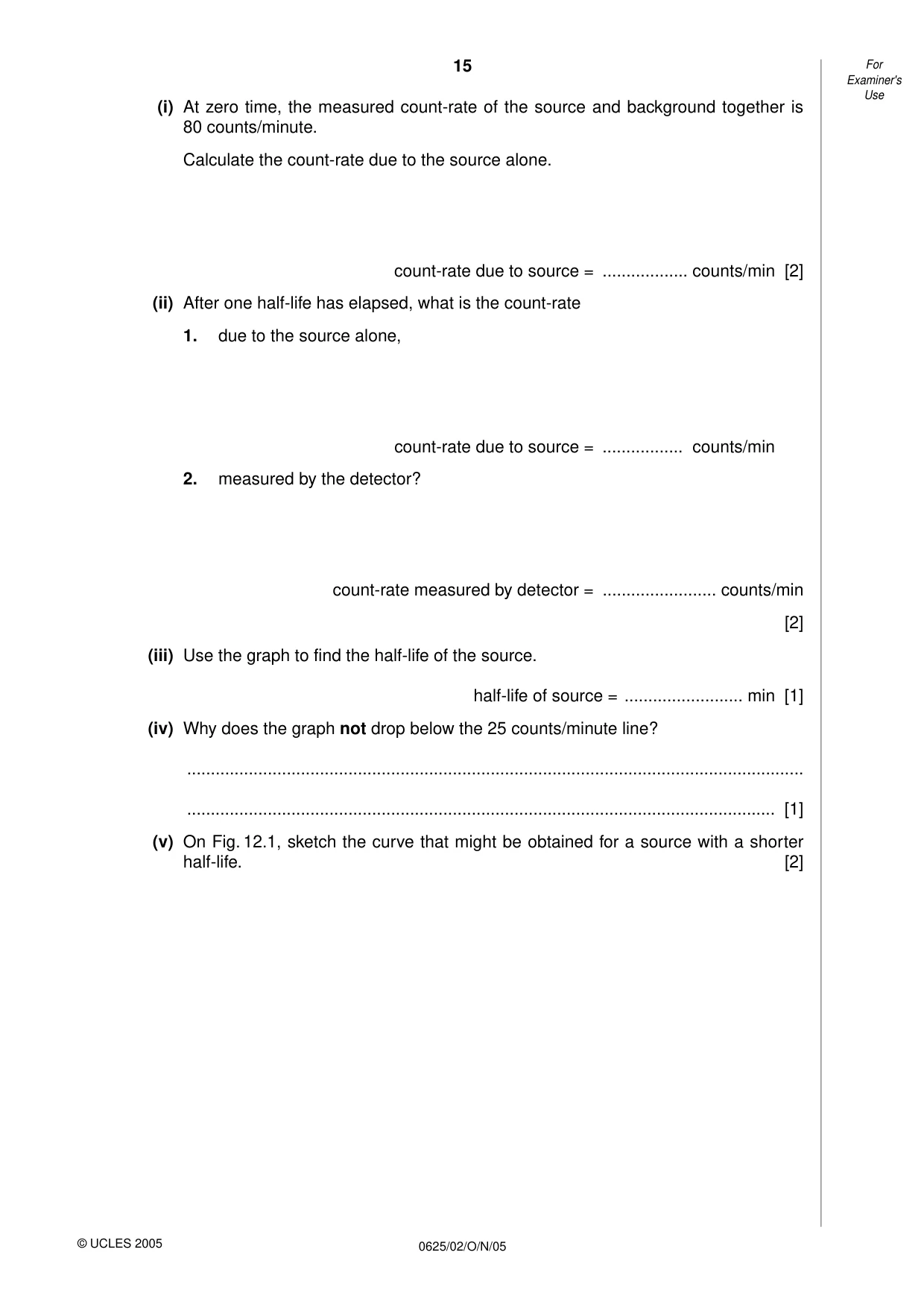
(i) At zero time, the measured count-rate of the source and background together is 80 counts/minute. Calculate the count-rate due to the source alone. count-rate due to source = … counts/min [2] (ii) After one half-life has elapsed, what is the count-rate 1. due to the source alone, count-rate due to source = … counts/min 2. measured by the detector? count-rate measured by detector = … counts/min [2] (iii) Use the graph to find the half-life of the source. half-life of source = … min [1] (iv) Why does the graph not drop below the 25 counts/minute line? … … [1] (v) On Fig. 12.1, sketch the curve that might be obtained for a source with a shorter half-life. [2] 15 For Examiner's Use 0625/02/O/N/05 © UCLES 2005
Question paper, page 16
BLANK PAGE Permission to reproduce items where third-party owned material protected by copyright is included has been sought and cleared where possible. Every reasonable effort has been made by the publisher (UCLES) to trace copyright holders, but if any items requiring clearance have unwittingly been included, the publisher will be pleased to make amends at the earliest possible opportunity. University of Cambridge International Examinations is part of the University of Cambridge Local Examinations Syndicate (UCLES), which is itself a department of the University of Cambridge. 16 0625/02/O/N/05
Mark scheme, page 1
UNIVERSITY OF CAMBRIDGE INTERNATIONAL EXAMINATIONS International General Certificate of Secondary Education MARK SCHEME for the November 2005 question paper 0625 PHYSICS 0625/02 Paper 2 (Theory) Maximum mark 80 This mark scheme is published as an aid to teachers and students, to indicate the requirements of the examination. It shows the basis on which Examiners were initially instructed to award marks. It does not indicate the details of the discussions that took place at an Examiners’ meeting before marking began. Any substantial changes to the mark scheme that arose from these discussions will be recorded in the published Report on the Examination. All Examiners are instructed that alternative correct answers and unexpected approaches in candidates’ scripts must be given marks that fairly reflect the relevant knowledge and skills demonstrated. Mark schemes must be read in conjunction with the question papers and the Report on the Examination. The minimum marks in these components needed for various grades were previously published with these mark schemes, but are now instead included in the Report on the Examination for this session. • CIE will not enter into discussion or correspondence in connection with these mark schemes. CIE is publishing the mark schemes for the November 2005 question papers for most IGCSE and GCE Advanced Level and Advanced Subsidiary Level syllabuses and some Ordinary Level syllabuses. www.XtremePapers.com
Mark scheme, page 2
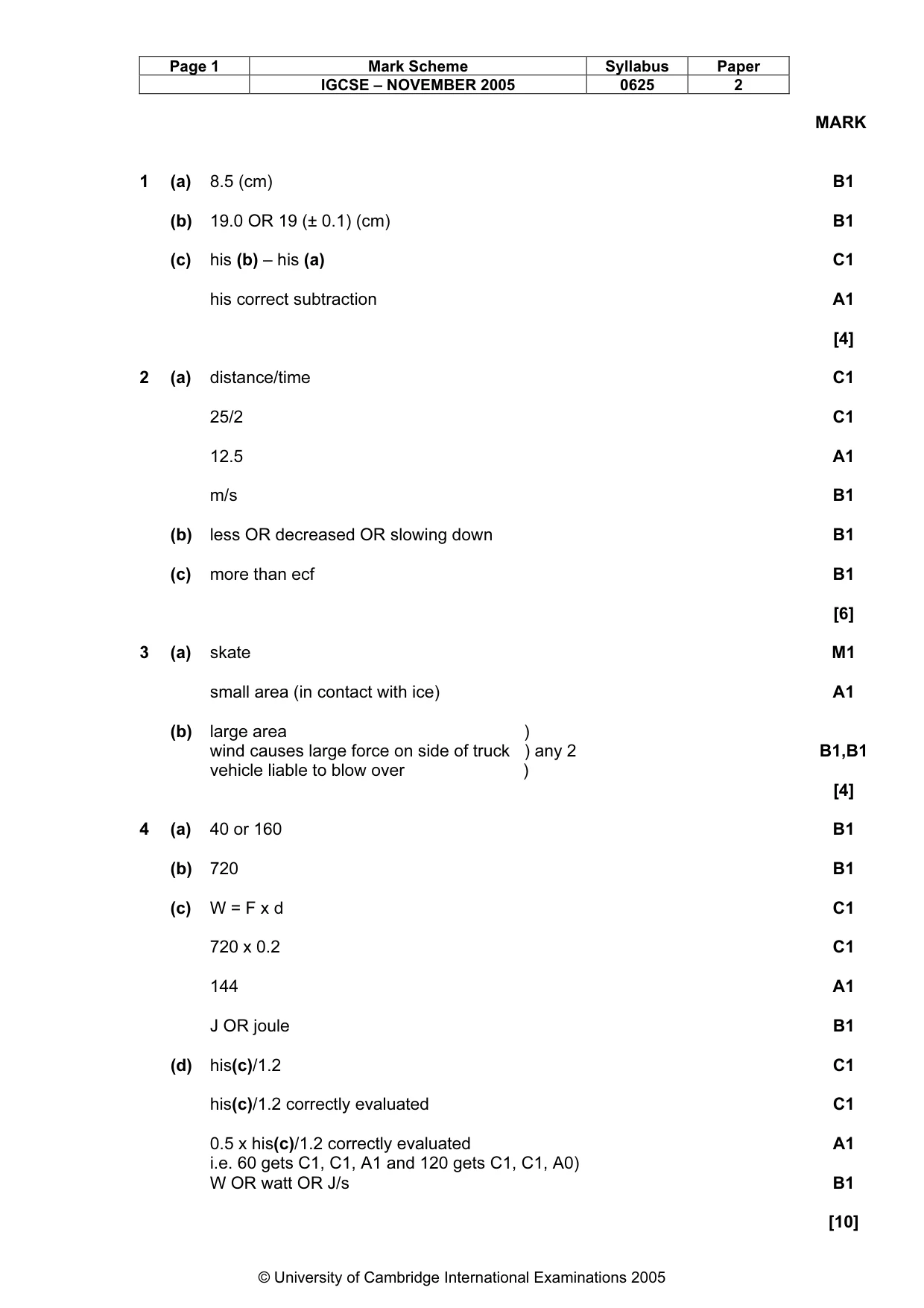
Page 1 Mark Scheme Syllabus Paper IGCSE – NOVEMBER 2005 0625 2 © University of Cambridge International Examinations 2005 MARK 1 (a) 8.5 (cm) B1 (b) 19.0 OR 19 (± 0.1) (cm) B1 (c) his (b) – his (a) C1 his correct subtraction A1 [4] 2 (a) distance/time C1 25/2 C1 12.5 A1 m/s B1 (b) less OR decreased OR slowing down B1 (c) more than ecf B1 [6] 3 (a) skate M1 small area (in contact with ice) A1 (b) large area ) wind causes large force on side of truck ) any 2 B1,B1 vehicle liable to blow over ) [4] 4 (a) 40 or 160 B1 (b) 720 B1 (c) W = F x d C1 720 x 0.2 C1 144 A1 J OR joule B1 (d) his(c)/1.2 C1 his(c)/1.2 correctly evaluated C1 0.5 x his(c)/1.2 correctly evaluated A1 i.e. 60 gets C1, C1, A1 and 120 gets C1, C1, A0) W OR watt OR J/s B1 [10]
Mark scheme, page 3
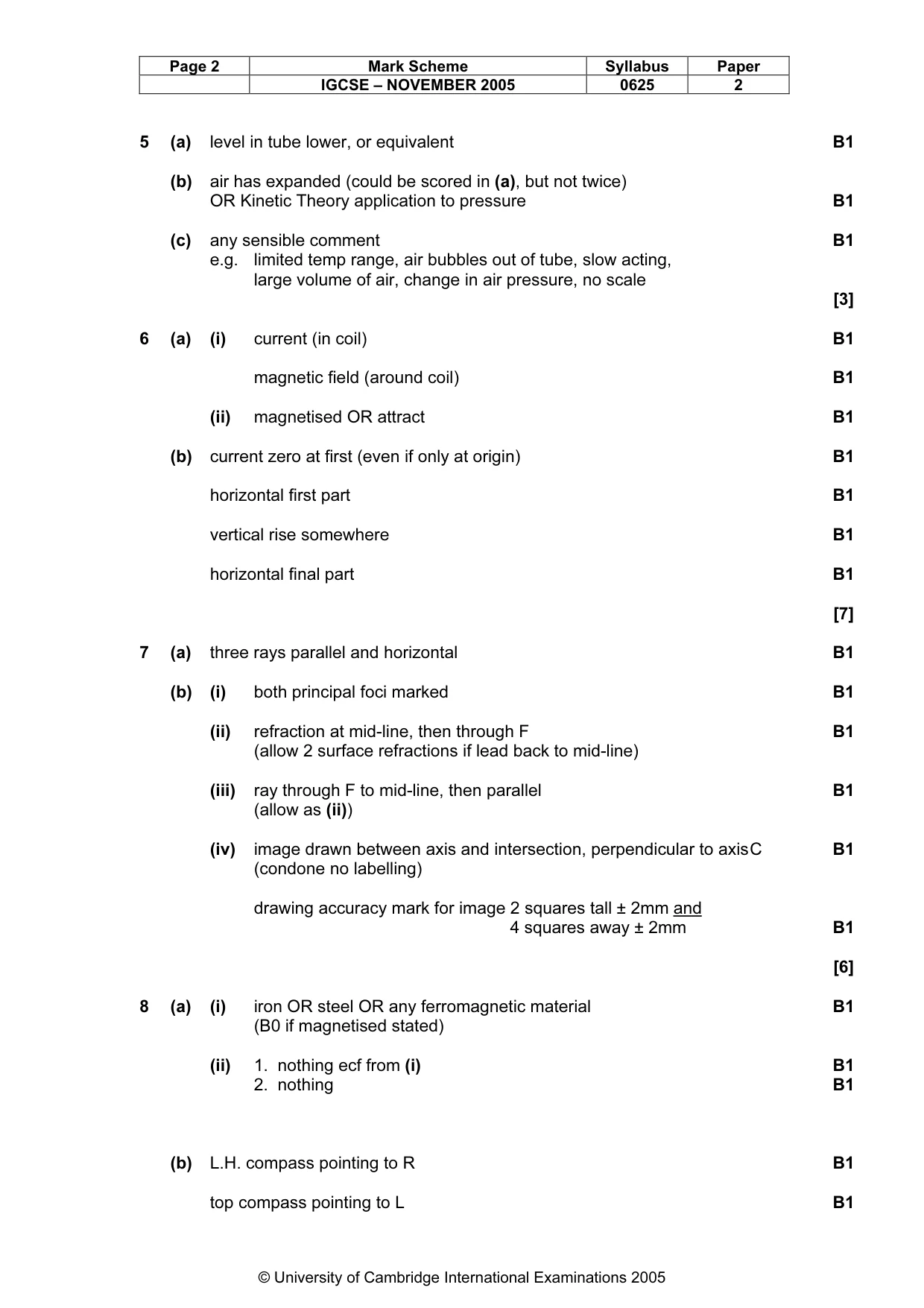
Page 2 Mark Scheme Syllabus Paper IGCSE – NOVEMBER 2005 0625 2 © University of Cambridge International Examinations 2005 5 (a) level in tube lower, or equivalent B1 (b) air has expanded (could be scored in (a), but not twice) OR Kinetic Theory application to pressure B1 (c) any sensible comment B1 e.g. limited temp range, air bubbles out of tube, slow acting, large volume of air, change in air pressure, no scale [3] 6 (a) (i) current (in coil) B1 magnetic field (around coil) B1 (ii) magnetised OR attract B1 (b) current zero at first (even if only at origin) B1 horizontal first part B1 vertical rise somewhere B1 horizontal final part B1 [7] 7 (a) three rays parallel and horizontal B1 (b) (i) both principal foci marked B1 (ii) refraction at mid-line, then through F B1 (allow 2 surface refractions if lead back to mid-line) (iii) ray through F to mid-line, then parallel B1 (allow as (ii)) (iv) image drawn between axis and intersection, perpendicular to axis C B1 (condone no labelling) drawing accuracy mark for image 2 squares tall ± 2mm and 4 squares away ± 2mm B1 [6] 8 (a) (i) iron OR steel OR any ferromagnetic material B1 (B0 if magnetised stated) (ii) 1. nothing ecf from (i) B1 2. nothing B1 (b) L.H. compass pointing to R B1 top compass pointing to L B1
Mark scheme, page 4
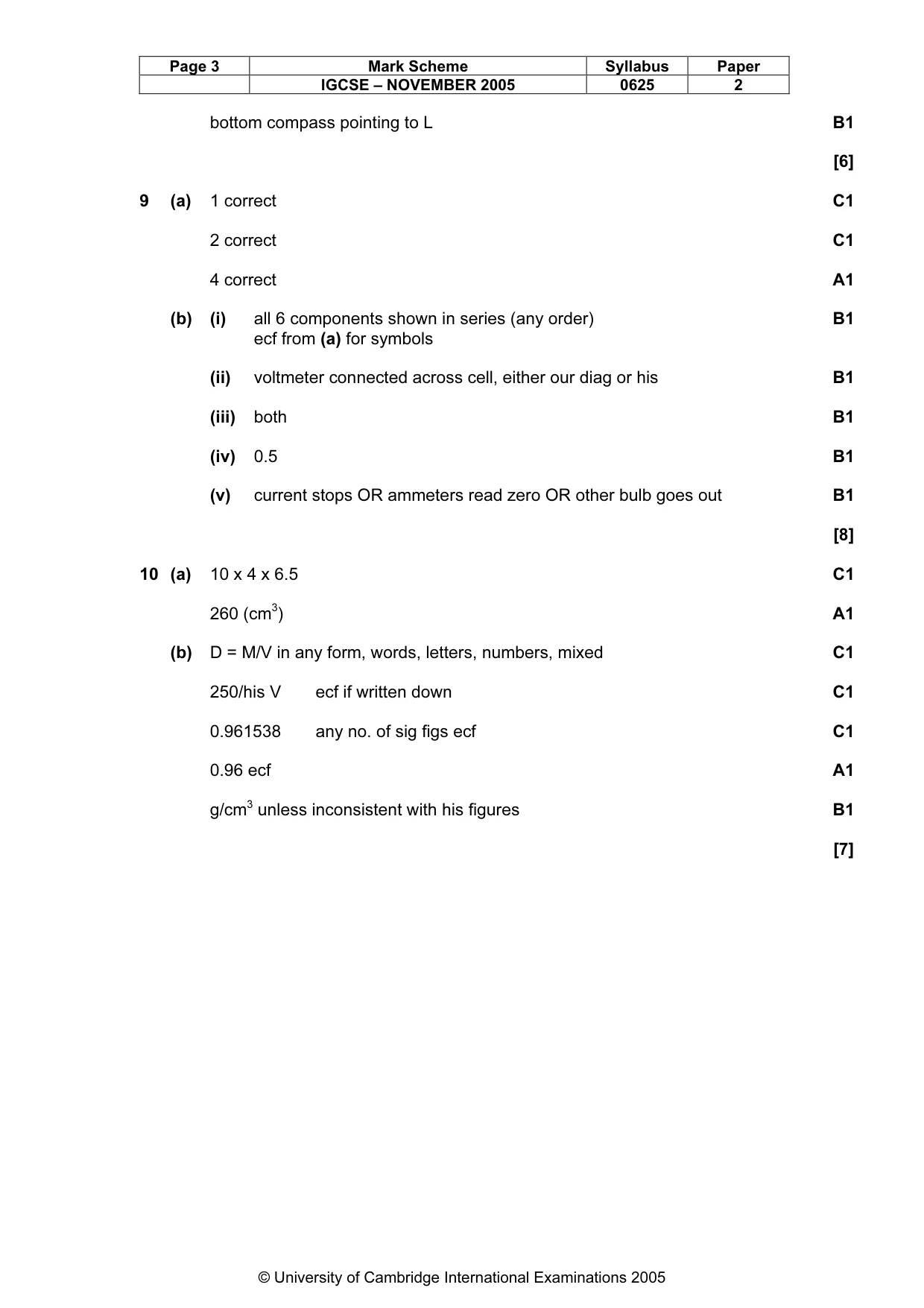
Page 3 Mark Scheme Syllabus Paper IGCSE – NOVEMBER 2005 0625 2 © University of Cambridge International Examinations 2005 bottom compass pointing to L B1 [6] 9 (a) 1 correct C1 2 correct C1 4 correct A1 (b) (i) all 6 components shown in series (any order) B1 ecf from (a) for symbols (ii) voltmeter connected across cell, either our diag or his B1 (iii) both B1 (iv) 0.5 B1 (v) current stops OR ammeters read zero OR other bulb goes out B1 [8] 10 (a) 10 x 4 x 6.5 C1 260 (cm3) A1 (b) D = M/V in any form, words, letters, numbers, mixed C1 250/his V ecf if written down C1 0.961538 any no. of sig figs ecf C1 0.96 ecf A1 g/cm3 unless inconsistent with his figures B1 [7]
Mark scheme, page 5
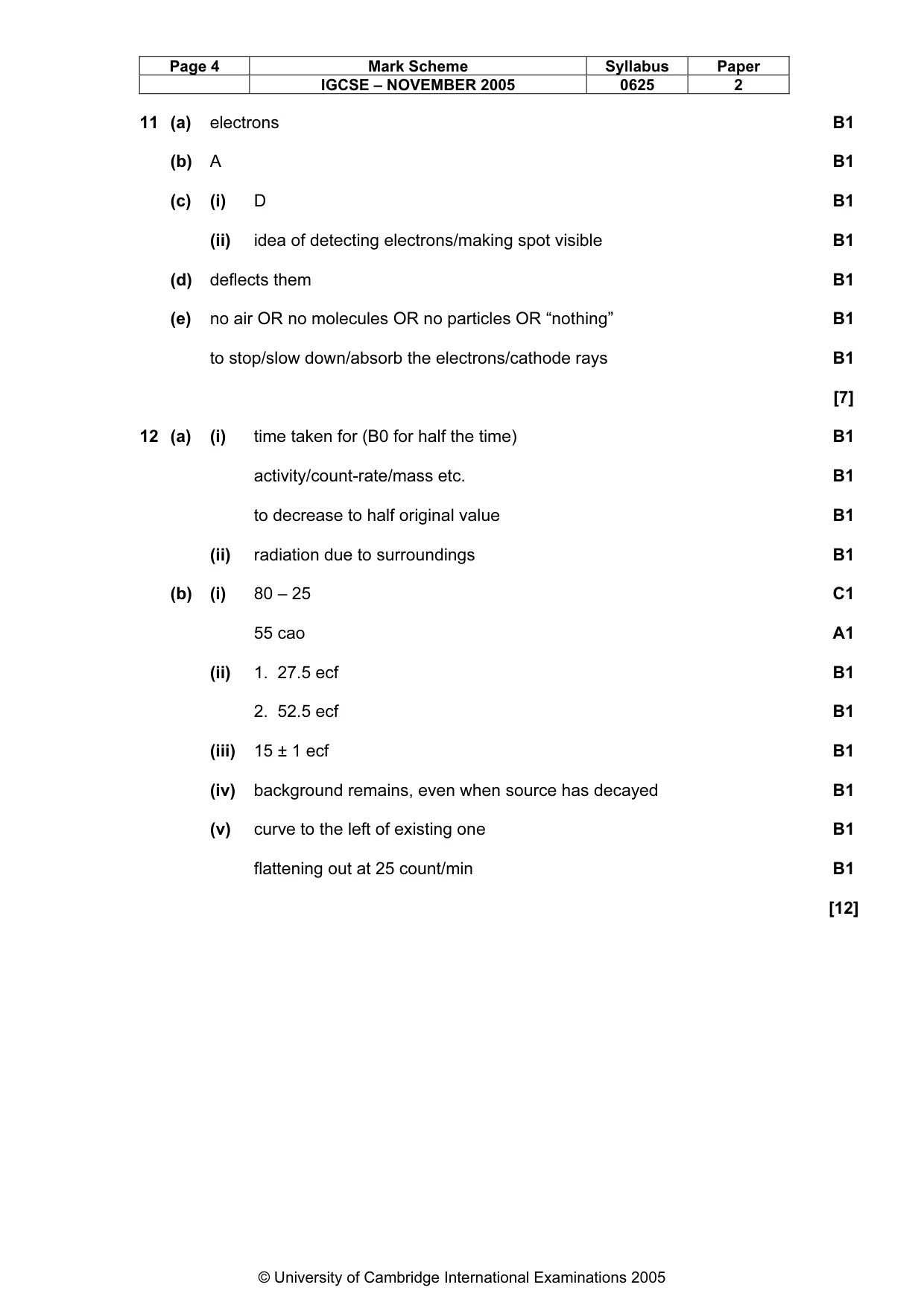
Page 4 Mark Scheme Syllabus Paper IGCSE – NOVEMBER 2005 0625 2 © University of Cambridge International Examinations 2005 11 (a) electrons B1 (b) A B1 (c) (i) D B1 (ii) idea of detecting electrons/making spot visible B1 (d) deflects them B1 (e) no air OR no molecules OR no particles OR “nothing” B1 to stop/slow down/absorb the electrons/cathode rays B1 [7] 12 (a) (i) time taken for (B0 for half the time) B1 activity/count-rate/mass etc. B1 to decrease to half original value B1 (ii) radiation due to surroundings B1 (b) (i) 80 – 25 C1 55 cao A1 (ii) 1. 27.5 ecf B1 2. 52.5 ecf B1 (iii) 15 ± 1 ecf B1 (iv) background remains, even when source has decayed B1 (v) curve to the left of existing one B1 flattening out at 25 count/min B1 [12]