Cambridge IGCSE Physics 0625 — 2004 Oct/Nov Paper 2 · Variant 1
0625/21/O/N/04
The question paper and its mark scheme, free to read here and free to download. This is Cambridge’s own paper, exactly as it was sat.
Question paper16 pages
Mark scheme8 pages
Answers below. Sit the paper first if you are practising.
Paper as text
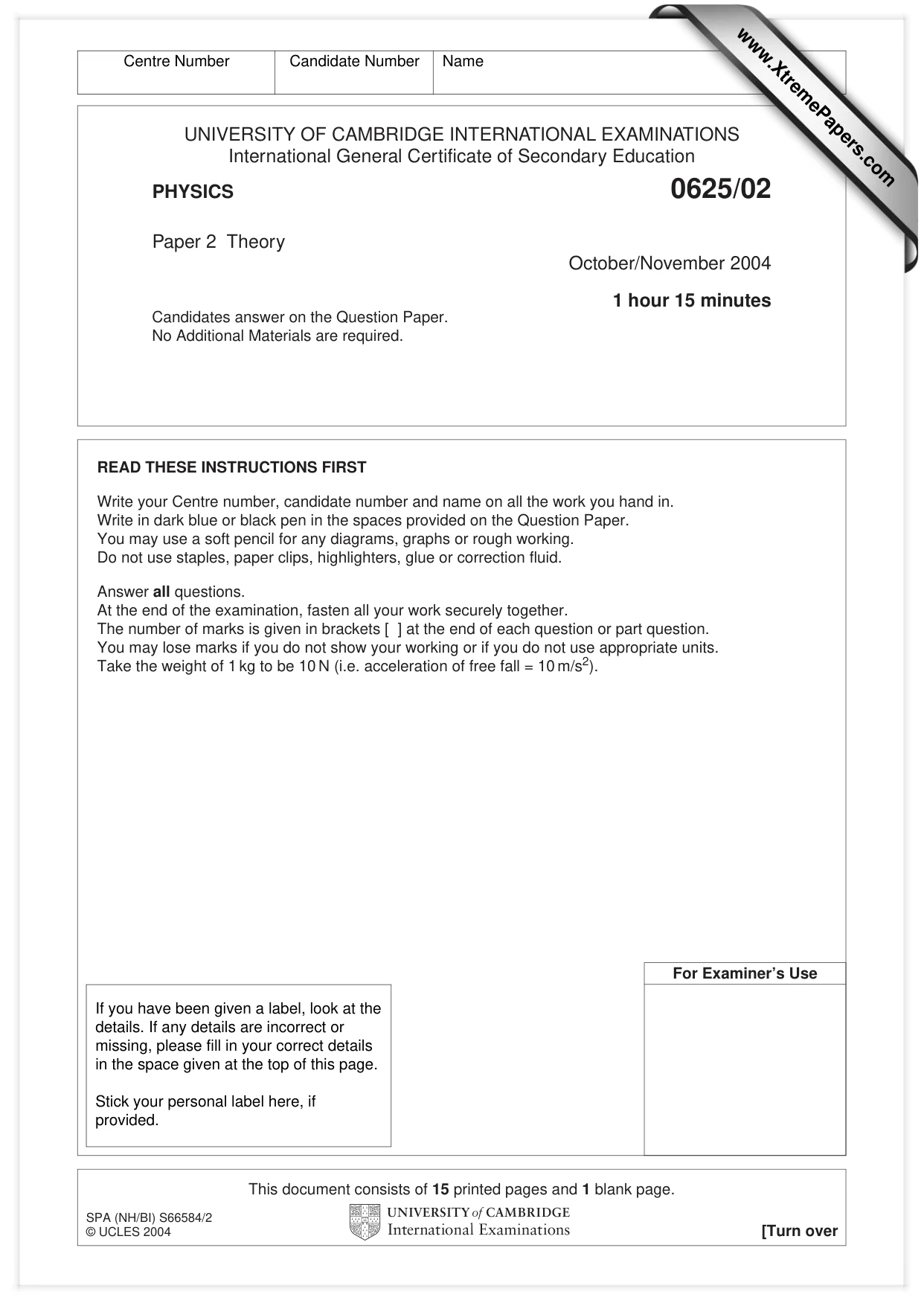
Question paper, page 1
This document consists of 15 printed pages and 1 blank page. SPA (NH/BI) S66584/2 © UCLES 2004 [Turn over UNIVERSITY OF CAMBRIDGE INTERNATIONAL EXAMINATIONS International General Certificate of Secondary Education PHYSICS 0625/02 Paper 2 Theory October/November 2004 1 hour 15 minutes Candidates answer on the Question Paper. No Additional Materials are required. READ THESE INSTRUCTIONS FIRST Write your Centre number, candidate number and name on all the work you hand in. Write in dark blue or black pen in the spaces provided on the Question Paper. You may use a soft pencil for any diagrams, graphs or rough working. Do not use staples, paper clips, highlighters, glue or correction fluid. Answer all questions. At the end of the examination, fasten all your work securely together. The number of marks is given in brackets [ ] at the end of each question or part question. You may lose marks if you do not show your working or if you do not use appropriate units. Take the weight of 1 kg to be 10 N (i.e. acceleration of free fall = 10 m/s2). Centre Number Candidate Number Name If you have been given a label, look at the details. If any details are incorrect or missing, please fill in your correct details in the space given at the top of this page. Stick your personal label here, if provided. For Examiner’s Use www.XtremePapers.com
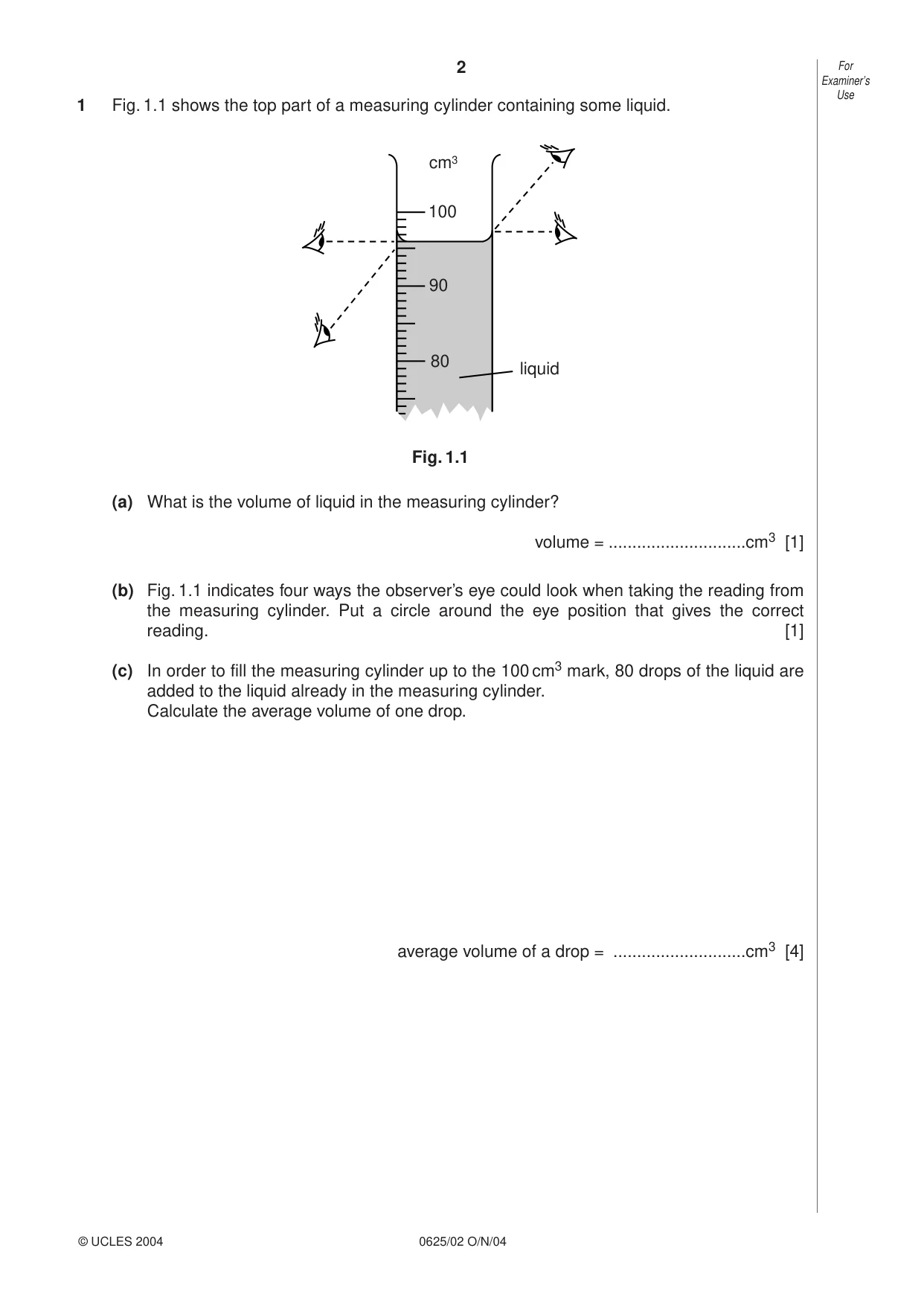
Question paper, page 2
2 © UCLES 2004 0625/02 O/N/04 1 Fig. 1.1 shows the top part of a measuring cylinder containing some liquid. Fig. 1.1 (a) What is the volume of liquid in the measuring cylinder? volume = …cm3 [1] (b) Fig. 1.1 indicates four ways the observer’s eye could look when taking the reading from the measuring cylinder. Put a circle around the eye position that gives the correct reading. [1] (c) In order to fill the measuring cylinder up to the 100 cm3 mark, 80 drops of the liquid are added to the liquid already in the measuring cylinder. Calculate the average volume of one drop. average volume of a drop = …cm3 [4] cm3 liquid 100 80 90 For Examiner’s Use
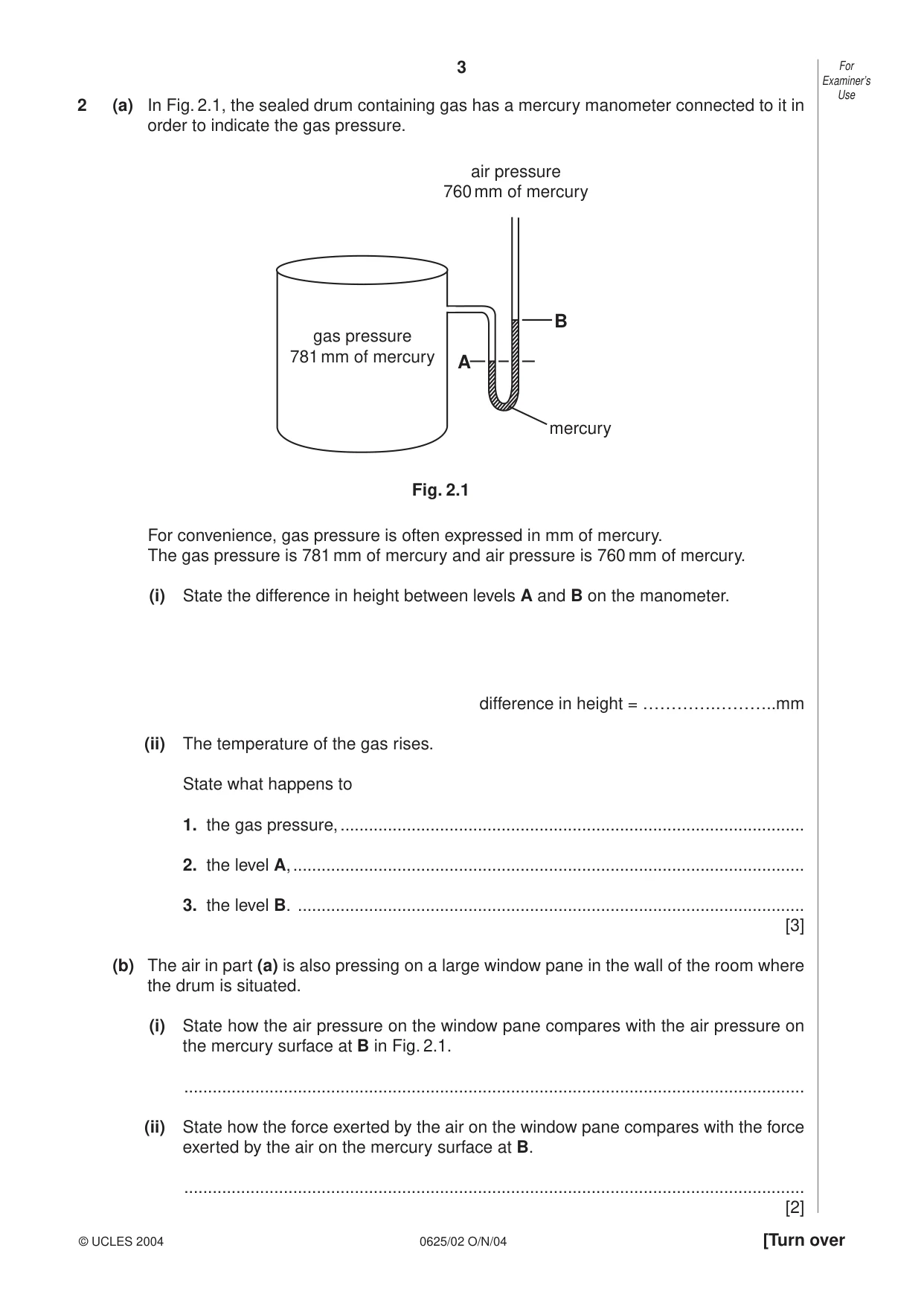
Question paper, page 3
3 © UCLES 2004 0625/02 O/N/04 [Turn over 2 (a) In Fig. 2.1, the sealed drum containing gas has a mercury manometer connected to it in order to indicate the gas pressure. Fig. 2.1 For convenience, gas pressure is often expressed in mm of mercury. The gas pressure is 781 mm of mercury and air pressure is 760 mm of mercury. (i) State the difference in height between levels A and B on the manometer. difference in height = ………….………..mm (ii) The temperature of the gas rises. State what happens to 1. the gas pressure,… 2. the level A,… 3. the level B. … [3] (b) The air in part (a) is also pressing on a large window pane in the wall of the room where the drum is situated. (i) State how the air pressure on the window pane compares with the air pressure on the mercury surface at B in Fig. 2.1. … (ii) State how the force exerted by the air on the window pane compares with the force exerted by the air on the mercury surface at B. … [2] air pressure 760 mm of mercury gas pressure 781 mm of mercury A B mercury For Examiner’s Use
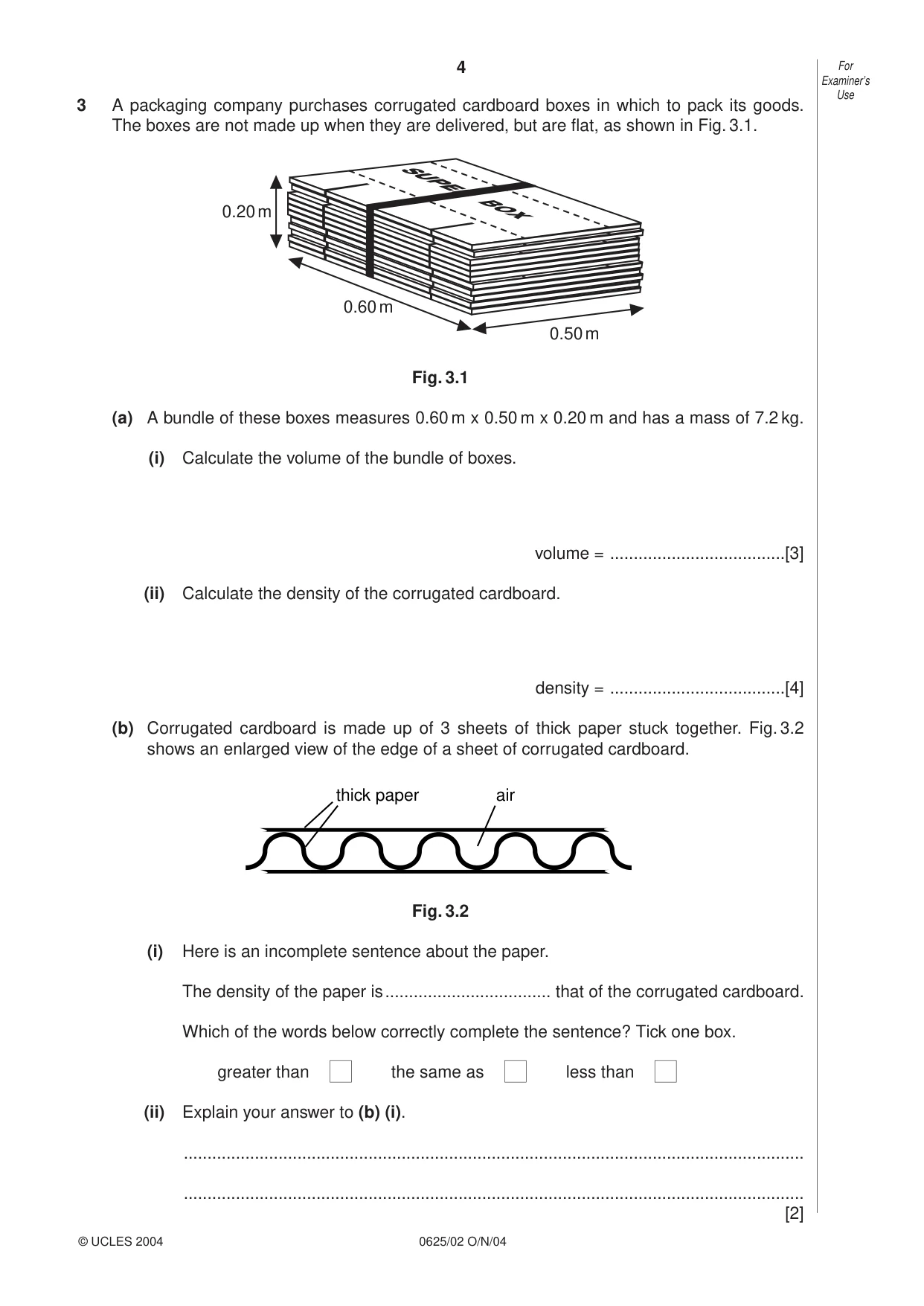
Question paper, page 4
4 © UCLES 2004 0625/02 O/N/04 3 A packaging company purchases corrugated cardboard boxes in which to pack its goods. The boxes are not made up when they are delivered, but are flat, as shown in Fig. 3.1. Fig. 3.1 (a) A bundle of these boxes measures 0.60 m x 0.50 m x 0.20 m and has a mass of 7.2 kg. (i) Calculate the volume of the bundle of boxes. volume = …[3] (ii) Calculate the density of the corrugated cardboard. density = …[4] (b) Corrugated cardboard is made up of 3 sheets of thick paper stuck together. Fig. 3.2 shows an enlarged view of the edge of a sheet of corrugated cardboard. Fig. 3.2 (i) Here is an incomplete sentence about the paper. The density of the paper is… that of the corrugated cardboard. Which of the words below correctly complete the sentence? Tick one box. greater than the same as less than (ii) Explain your answer to (b) (i). … … [2] thick paper air 0.20 m 0.60 m 0.50 m For Examiner’s Use
Question paper, page 5
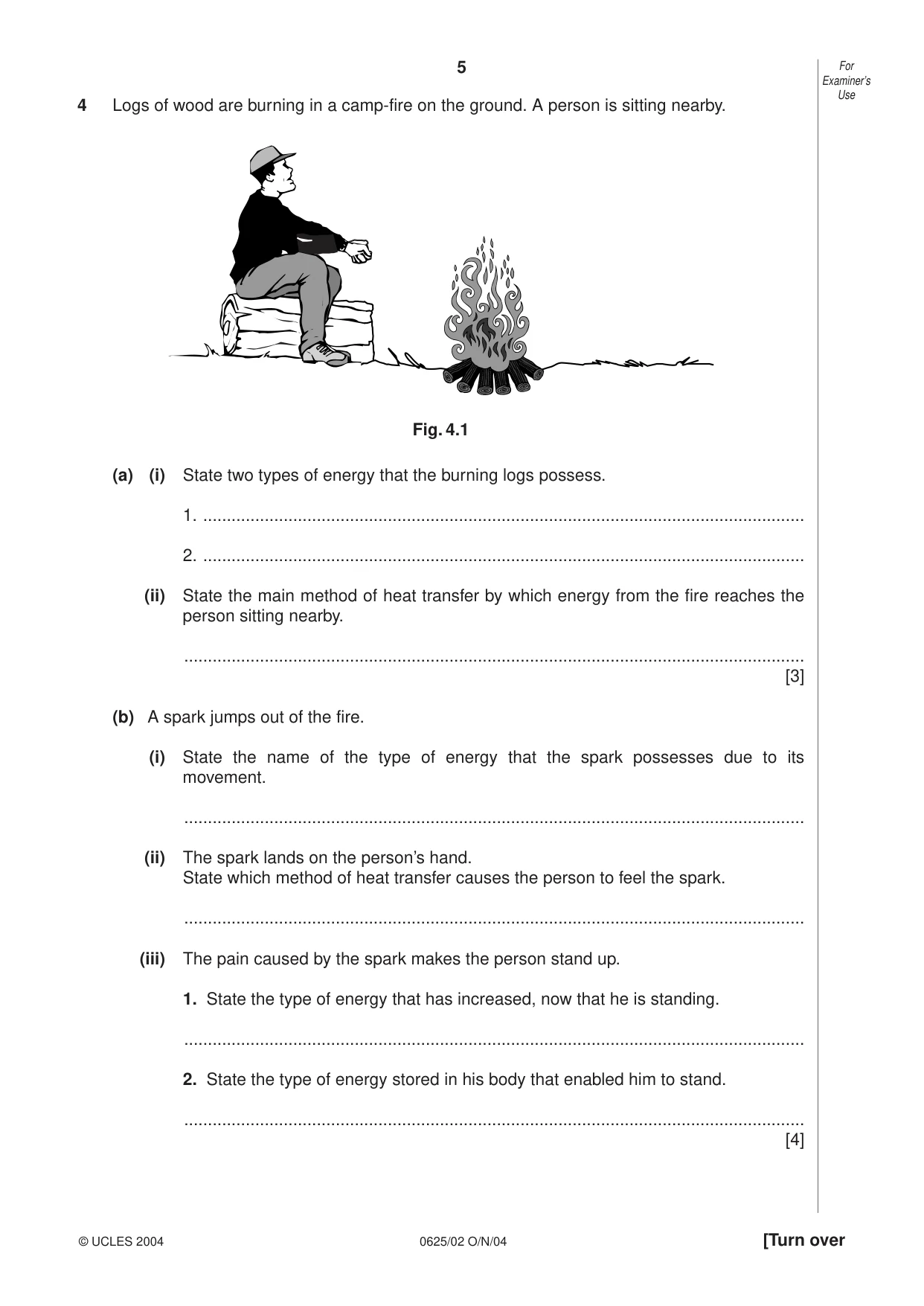
5 © UCLES 2004 0625/02 O/N/04 [Turn over 4 Logs of wood are burning in a camp-fire on the ground. A person is sitting nearby. Fig. 4.1 (a) (i) State two types of energy that the burning logs possess. 1. … 2. … (ii) State the main method of heat transfer by which energy from the fire reaches the person sitting nearby. … [3] (b) A spark jumps out of the fire. (i) State the name of the type of energy that the spark possesses due to its movement. … (ii) The spark lands on the person’s hand. State which method of heat transfer causes the person to feel the spark. … (iii) The pain caused by the spark makes the person stand up. 1. State the type of energy that has increased, now that he is standing. … 2. State the type of energy stored in his body that enabled him to stand. … [4] For Examiner’s Use
Question paper, page 6
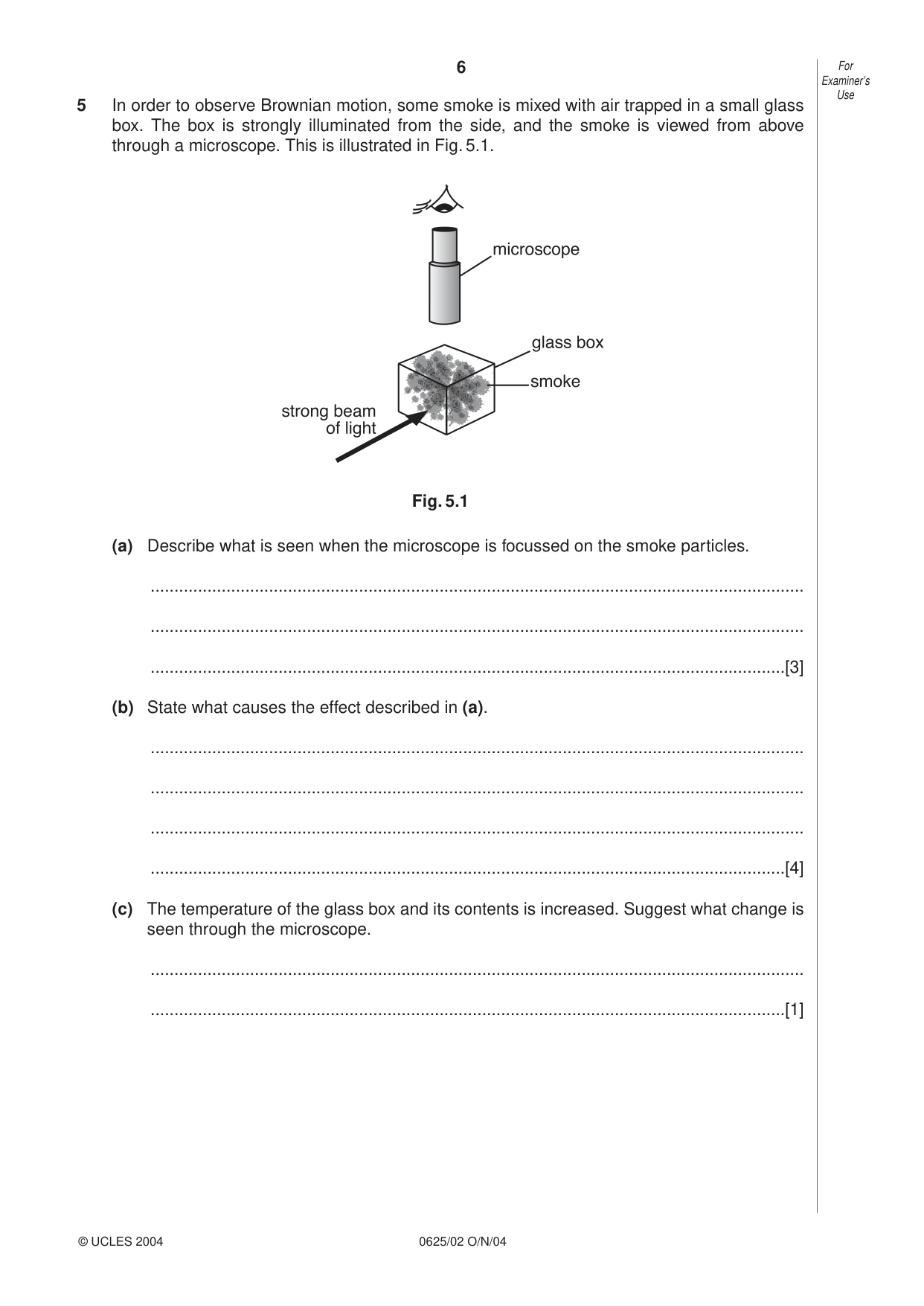
6 © UCLES 2004 0625/02 O/N/04 5 In order to observe Brownian motion, some smoke is mixed with air trapped in a small glass box. The box is strongly illuminated from the side, and the smoke is viewed from above through a microscope. This is illustrated in Fig. 5.1. Fig. 5.1 (a) Describe what is seen when the microscope is focussed on the smoke particles. … … …[3] (b) State what causes the effect described in (a). … … … …[4] (c) The temperature of the glass box and its contents is increased. Suggest what change is seen through the microscope. … …[1] For Examiner’s Use
Question paper, page 7
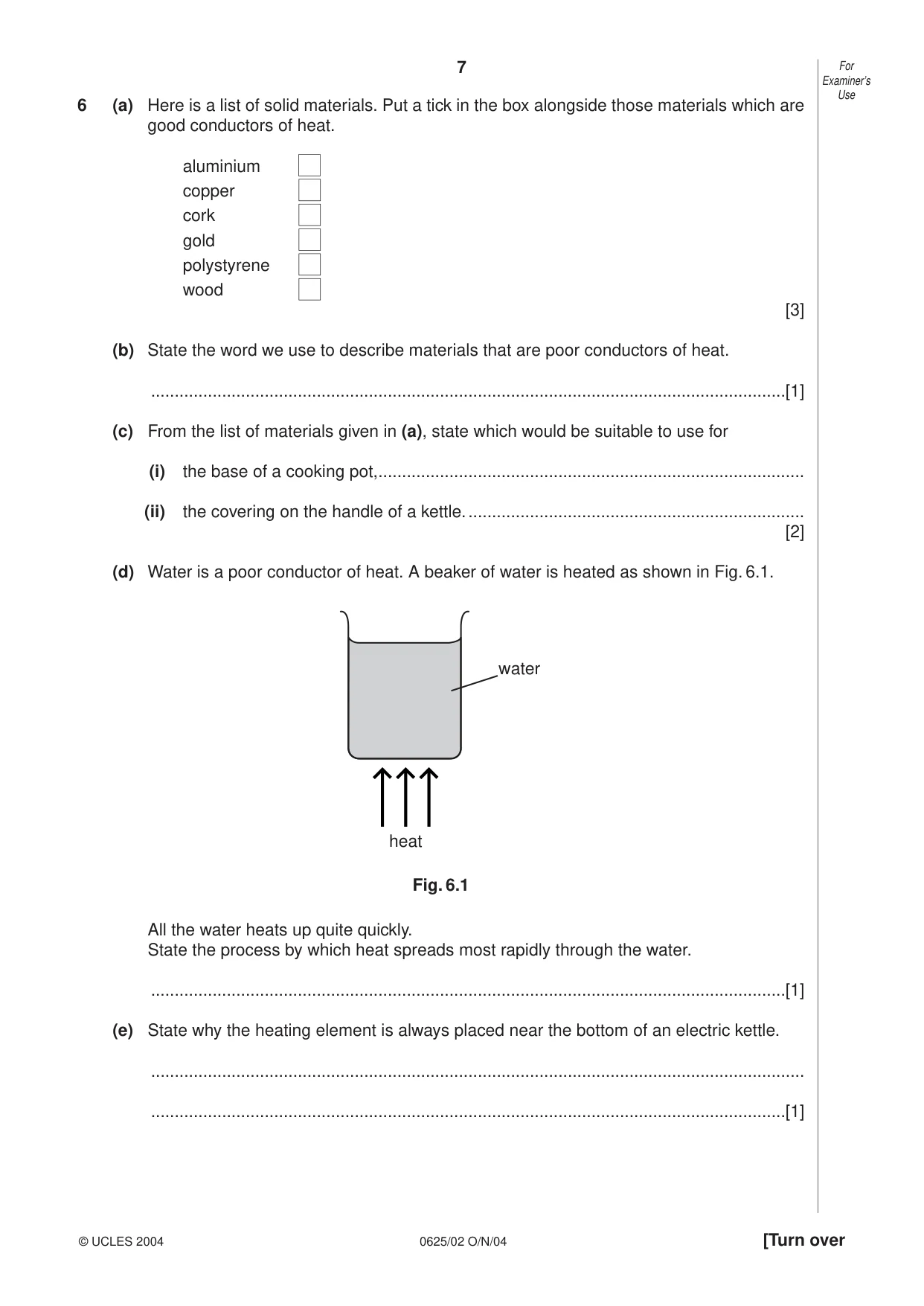
7 © UCLES 2004 0625/02 O/N/04 [Turn over 6 (a) Here is a list of solid materials. Put a tick in the box alongside those materials which are good conductors of heat. aluminium copper cork gold polystyrene wood [3] (b) State the word we use to describe materials that are poor conductors of heat. …[1] (c) From the list of materials given in (a), state which would be suitable to use for (i) the base of a cooking pot,… (ii) the covering on the handle of a kettle… [2] (d) Water is a poor conductor of heat. A beaker of water is heated as shown in Fig. 6.1. Fig. 6.1 All the water heats up quite quickly. State the process by which heat spreads most rapidly through the water. …[1] (e) State why the heating element is always placed near the bottom of an electric kettle. … …[1] water heat For Examiner’s Use
Question paper, page 8
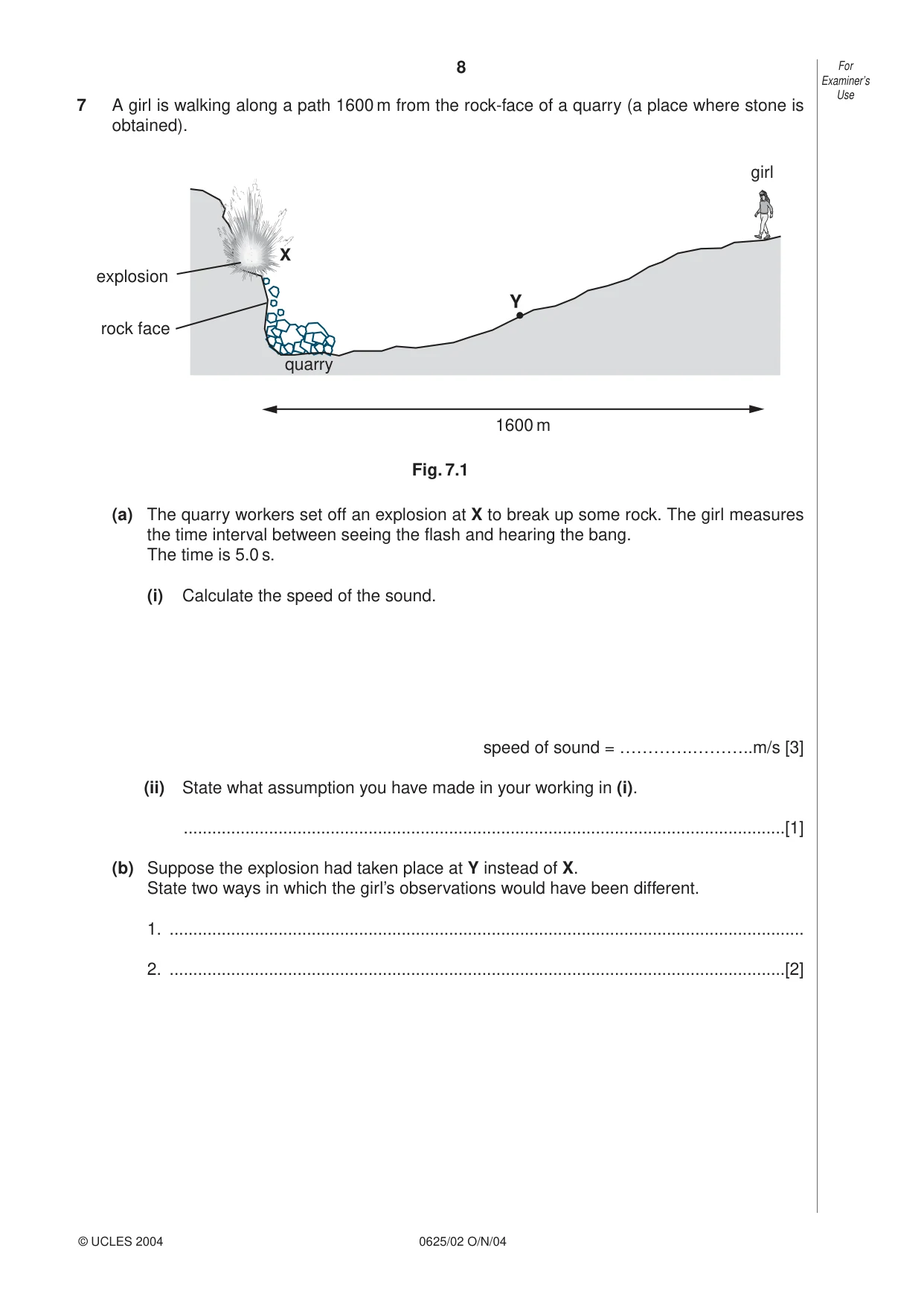
8 © UCLES 2004 0625/02 O/N/04 7 A girl is walking along a path 1600 m from the rock-face of a quarry (a place where stone is obtained). Fig. 7.1 (a) The quarry workers set off an explosion at X to break up some rock. The girl measures the time interval between seeing the flash and hearing the bang. The time is 5.0 s. (i) Calculate the speed of the sound. speed of sound = ………….………..m/s [3] (ii) State what assumption you have made in your working in (i). …[1] (b) Suppose the explosion had taken place at Y instead of X. State two ways in which the girl’s observations would have been different. 1. … 2. …[2] explosion quarry rock face girl 1600 m For Examiner’s Use
Question paper, page 9
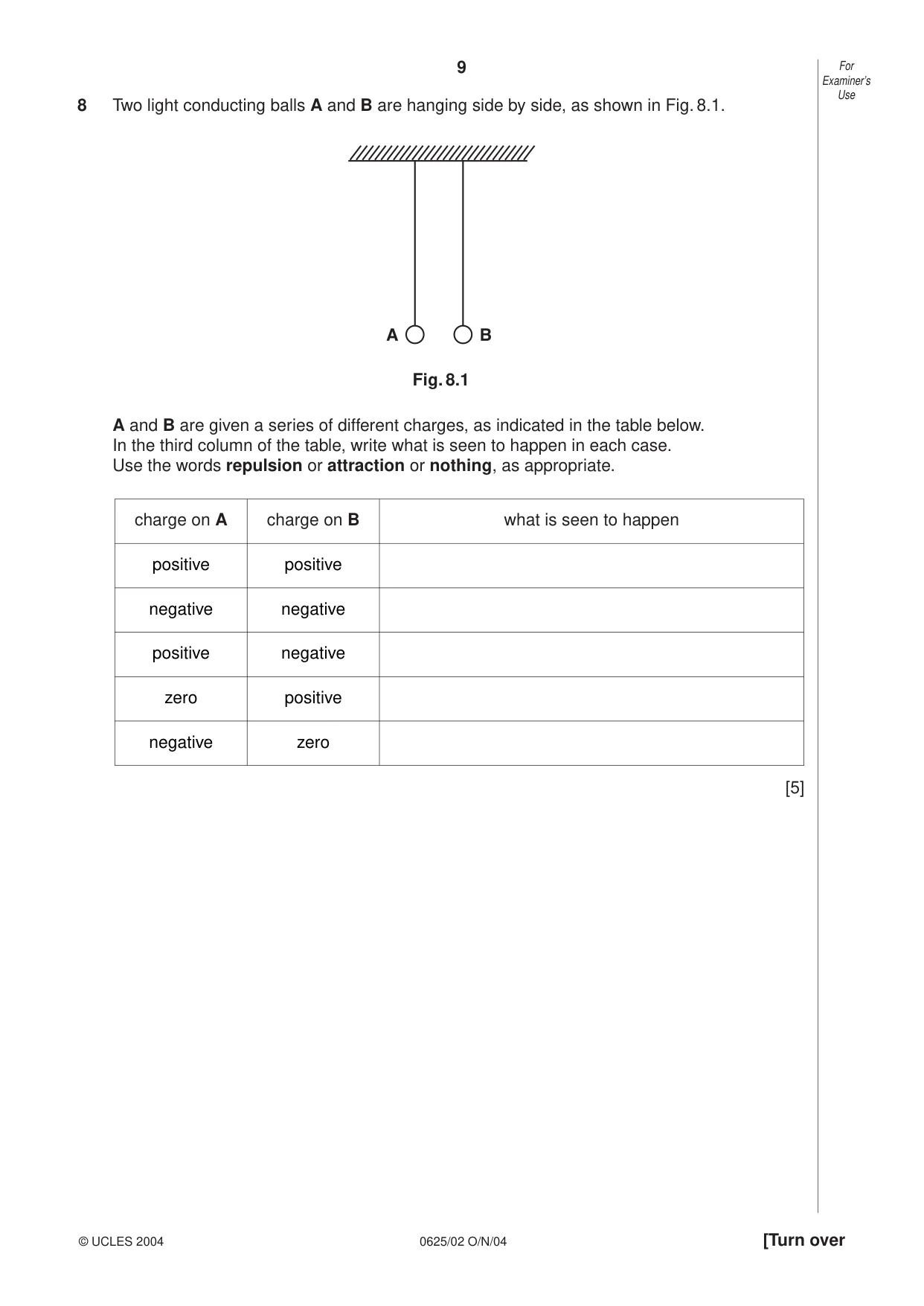
9 © UCLES 2004 0625/02 O/N/04 [Turn over 8 Two light conducting balls A and B are hanging side by side, as shown in Fig. 8.1. Fig. 8.1 A and B are given a series of different charges, as indicated in the table below. In the third column of the table, write what is seen to happen in each case. Use the words repulsion or attraction or nothing, as appropriate. [5] For Examiner’s Use charge on A charge on B what is seen to happen positive positive negative negative positive negative zero positive negative zero
Question paper, page 10
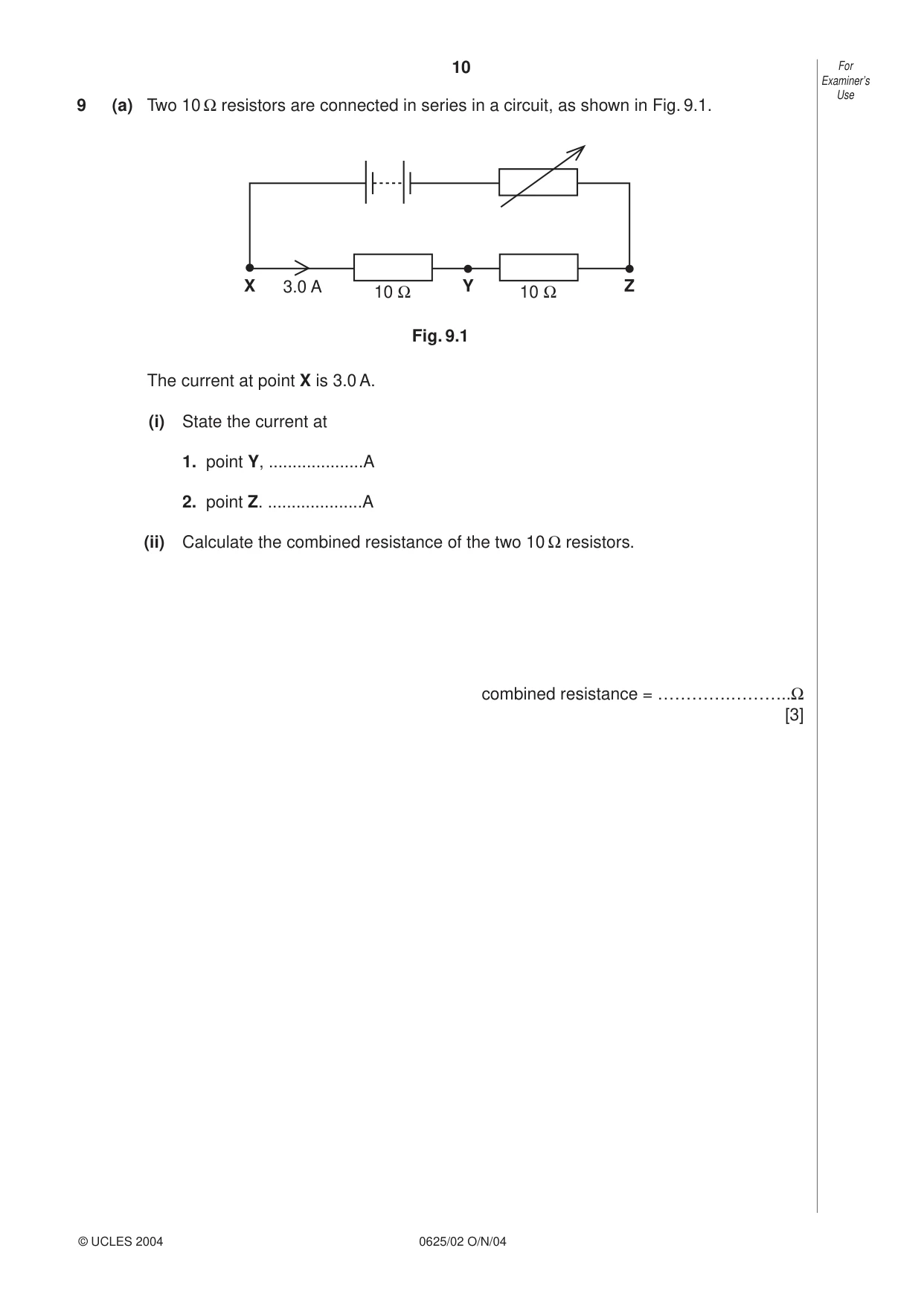
10 © UCLES 2004 0625/02 O/N/04 9 (a) Two 10 Ωresistors are connected in series in a circuit, as shown in Fig. 9.1. Fig. 9.1 The current at point X is 3.0 A. (i) State the current at 1. point Y, …A 2. point Z. …A (ii) Calculate the combined resistance of the two 10 Ωresistors. combined resistance = ………….………..Ω [3] 10 Ω 10 Ω 3.0 A For Examiner’s Use
Question paper, page 11
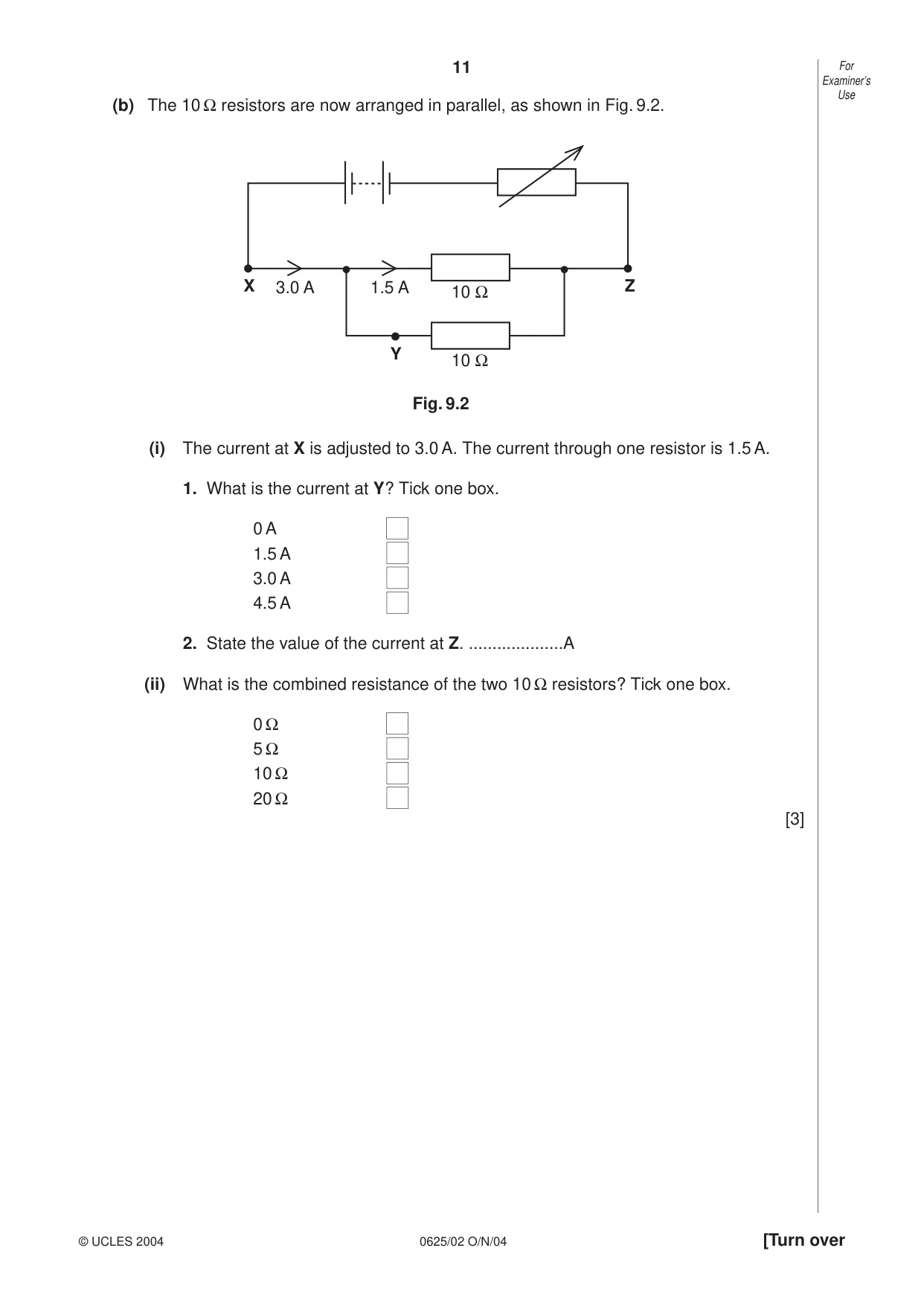
11 © UCLES 2004 0625/02 O/N/04 [Turn over (b) The 10 Ωresistors are now arranged in parallel, as shown in Fig. 9.2. Fig. 9.2 (i) The current at X is adjusted to 3.0 A. The current through one resistor is 1.5 A. 1. What is the current at Y? Tick one box. 0 A 1.5 A 3.0 A 4.5 A 2. State the value of the current at Z. …A (ii) What is the combined resistance of the two 10 Ωresistors? Tick one box. 0 Ω 5 Ω 10 Ω 20 Ω [3] 10 Ω 10 Ω 1.5 A 3.0 A For Examiner’s Use
Question paper, page 12
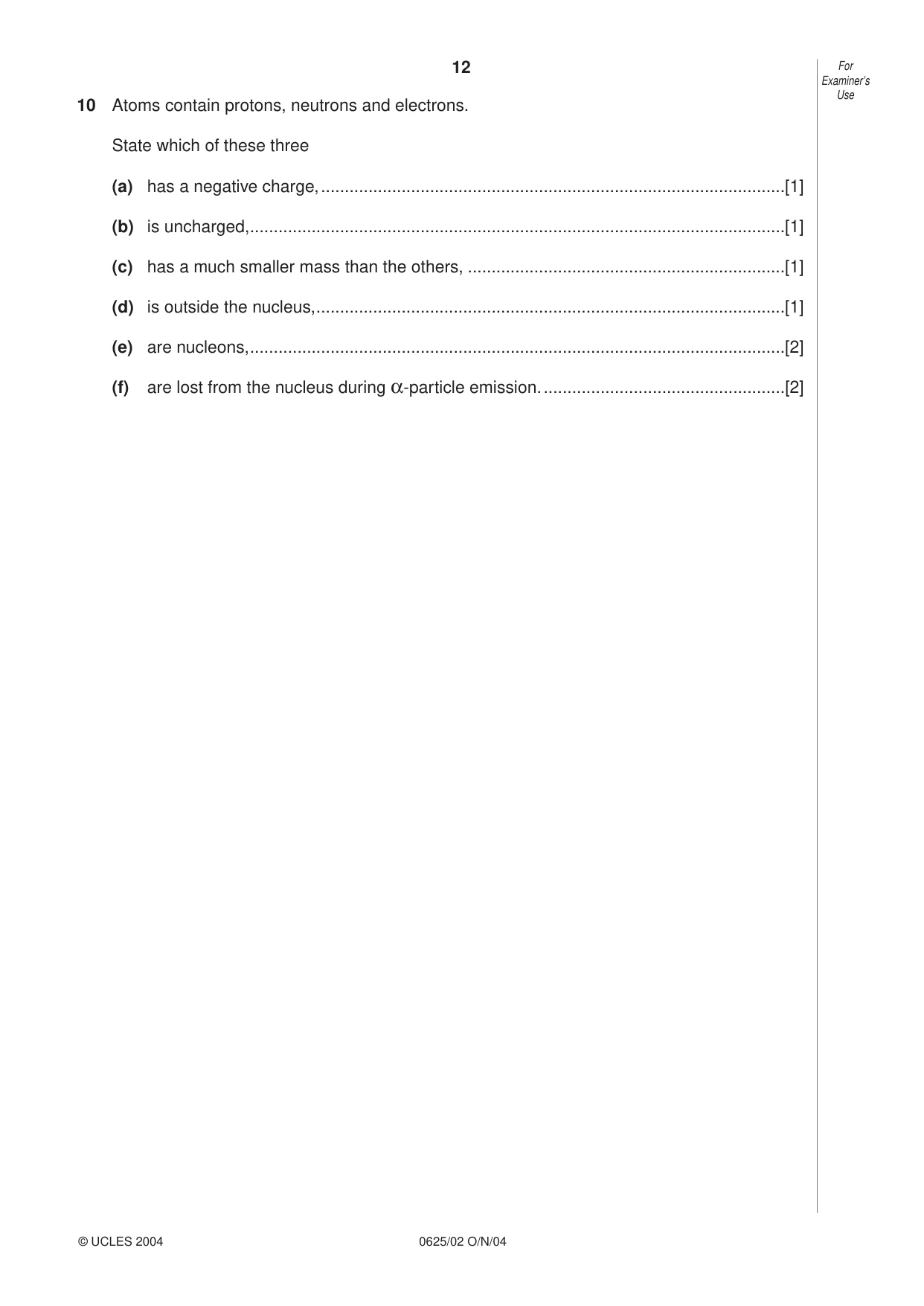
12 © UCLES 2004 0625/02 O/N/04 10 Atoms contain protons, neutrons and electrons. State which of these three (a) has a negative charge,…[1] (b) is uncharged,…[1] (c) has a much smaller mass than the others, …[1] (d) is outside the nucleus,…[1] (e) are nucleons,…[2] (f) are lost from the nucleus during α-particle emission…[2] For Examiner’s Use
Question paper, page 13
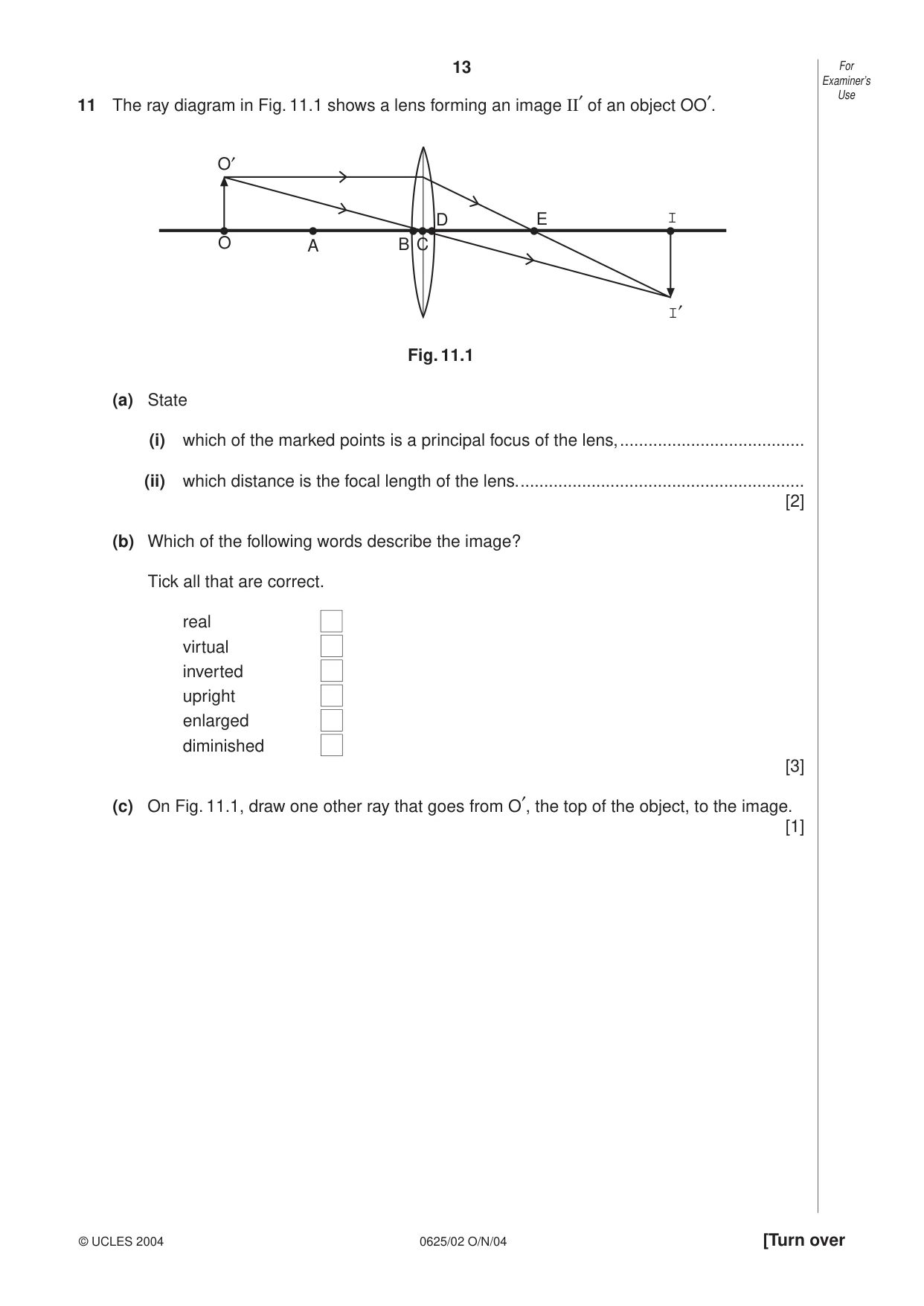
13 © UCLES 2004 0625/02 O/N/04 [Turn over 11 The ray diagram in Fig. 11.1 shows a lens forming an image II′ of an object OO′. Fig. 11.1 (a) State (i) which of the marked points is a principal focus of the lens,… (ii) which distance is the focal length of the lens… [2] (b) Which of the following words describe the image? Tick all that are correct. real virtual inverted upright enlarged diminished [3] (c) On Fig. 11.1, draw one other ray that goes from O′, the top of the object, to the image. [1] A B C D E I I′ O O′ For Examiner’s Use
Question paper, page 14
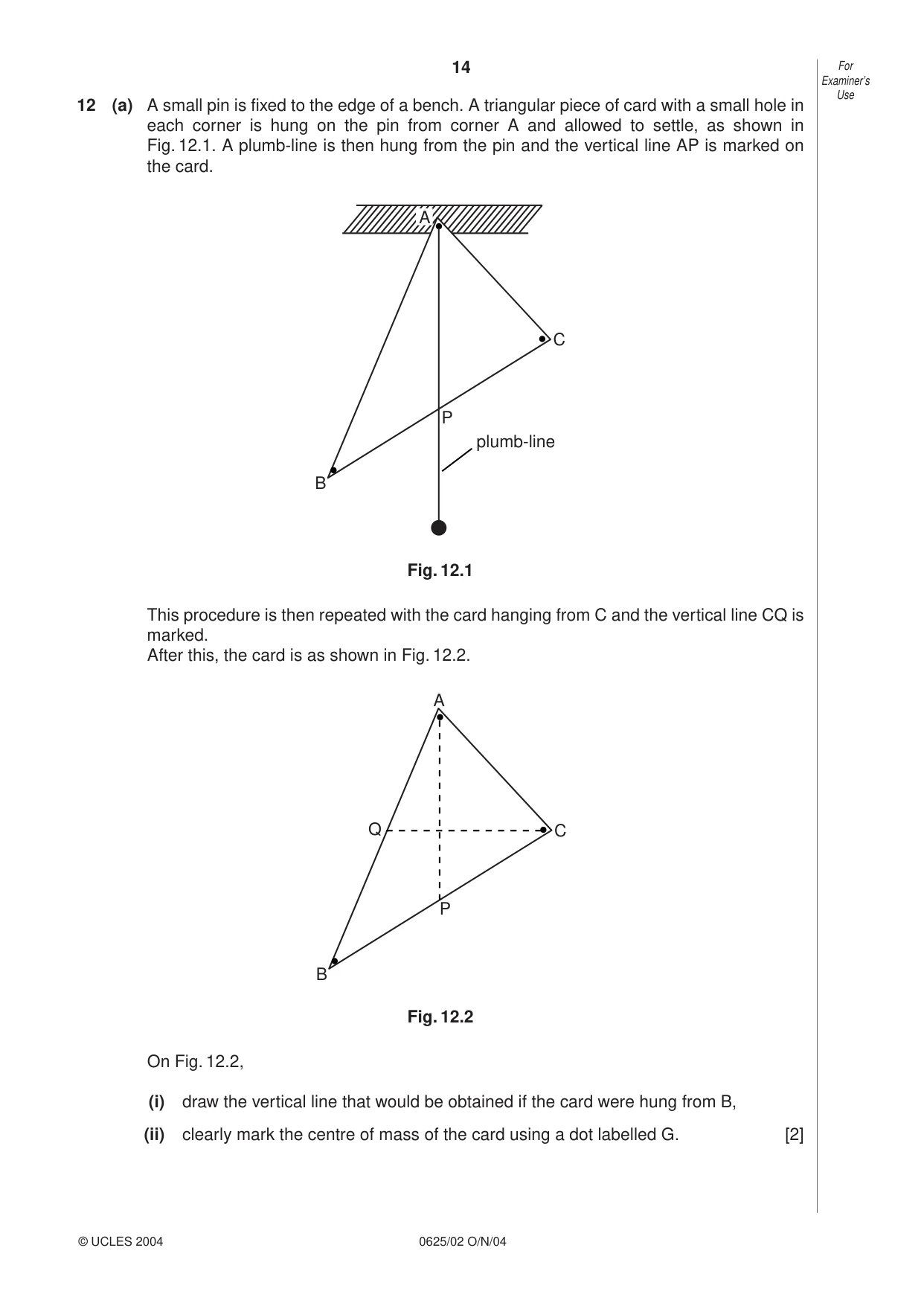
14 © UCLES 2004 0625/02 O/N/04 12 (a) A small pin is fixed to the edge of a bench. A triangular piece of card with a small hole in each corner is hung on the pin from corner A and allowed to settle, as shown in Fig. 12.1. A plumb-line is then hung from the pin and the vertical line AP is marked on the card. Fig. 12.1 This procedure is then repeated with the card hanging from C and the vertical line CQ is marked. After this, the card is as shown in Fig. 12.2. Fig. 12.2 On Fig. 12.2, (i) draw the vertical line that would be obtained if the card were hung from B, (ii) clearly mark the centre of mass of the card using a dot labelled G. [2] Fig. 12 B C P A Q Fig. B C A P plumb-line For Examiner’s Use
Question paper, page 15
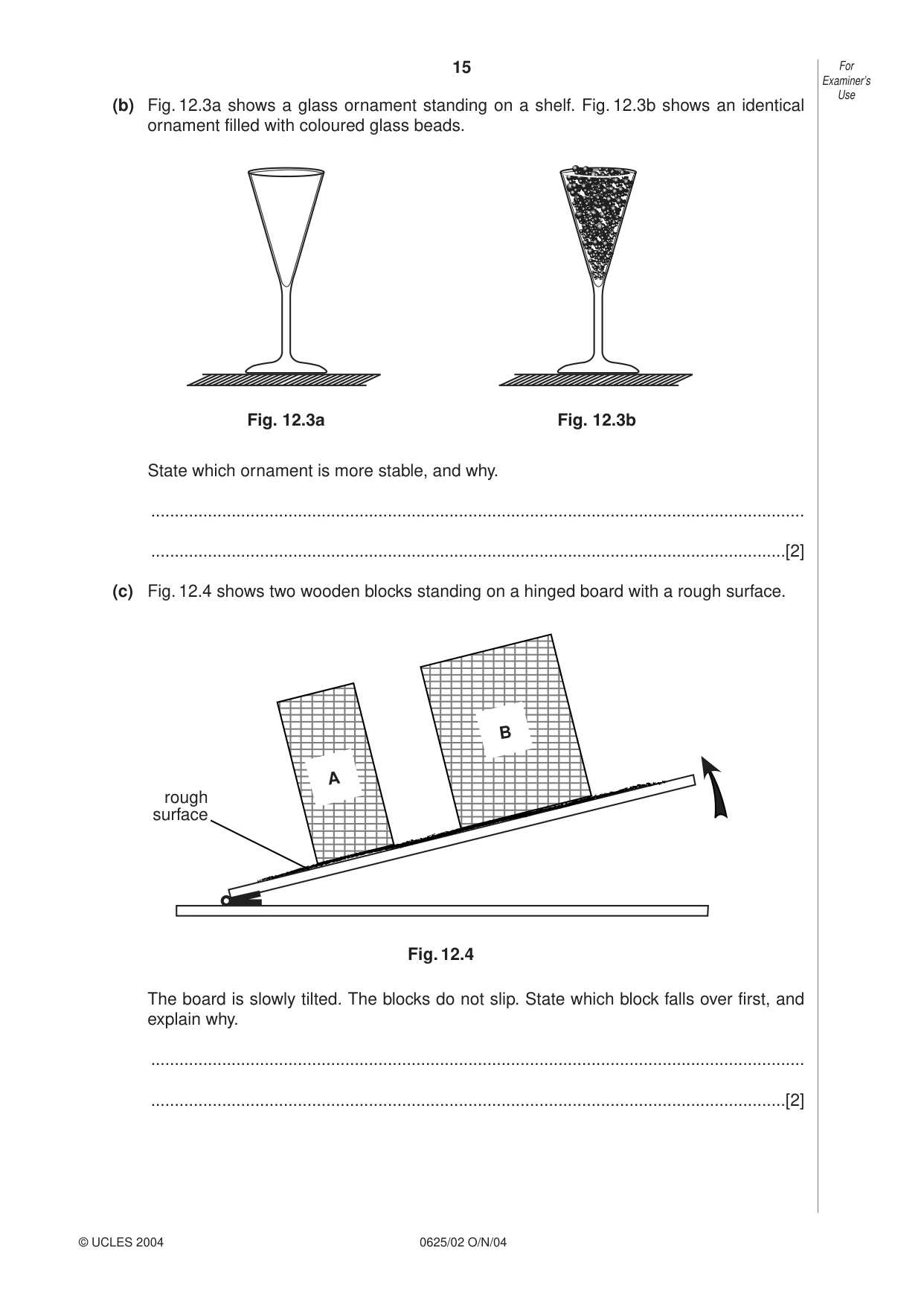
15 © UCLES 2004 0625/02 O/N/04 For Examiner’s Use (b) Fig. 12.3a shows a glass ornament standing on a shelf. Fig. 12.3b shows an identical ornament filled with coloured glass beads. State which ornament is more stable, and why. … …[2] (c) Fig. 12.4 shows two wooden blocks standing on a hinged board with a rough surface. Fig. 12.4 The board is slowly tilted. The blocks do not slip. State which block falls over first, and explain why. … …[2] A B rough surface
Question paper, page 16
16 0625/02 O/N/04 BLANK PAGE Every reasonable effort has been made to trace all copyright holders where the publishers (i.e. UCLES) are aware that third-party material has been reproduced. The publishers would be pleased to hear from anyone whose rights they have unwittingly infringed. University of Cambridge International Examinations is part of the University of Cambridge Local Examinations Syndicate (UCLES), which is itself a department of the University of Cambridge.
Mark scheme, page 1
UNIVERSITY OF CAMBRIDGE INTERNATIONAL EXAMINATIONS International General Certificate of Secondary Education MARK SCHEME for the November 2004 question paper 0625 PHYSICS 0625/02 Paper 2 (Theory), maximum mark 80 This mark scheme is published as an aid to teachers and students, to indicate the requirements of the examination. It shows the basis on which Examiners were initially instructed to award marks. It does not indicate the details of the discussions that took place at an Examiners’ meeting before marking began. Any substantial changes to the mark scheme that arose from these discussions will be recorded in the published Report on the Examination. All Examiners are instructed that alternative correct answers and unexpected approaches in candidates’ scripts must be given marks that fairly reflect the relevant knowledge and skills demonstrated. Mark schemes must be read in conjunction with the question papers and the Report on the Examination. • CIE will not enter into discussion or correspondence in connection with these mark schemes. CIE is publishing the mark schemes for the November 2004 question papers for most IGCSE and GCE Advanced Level syllabuses. www.XtremePapers.com
Mark scheme, page 2
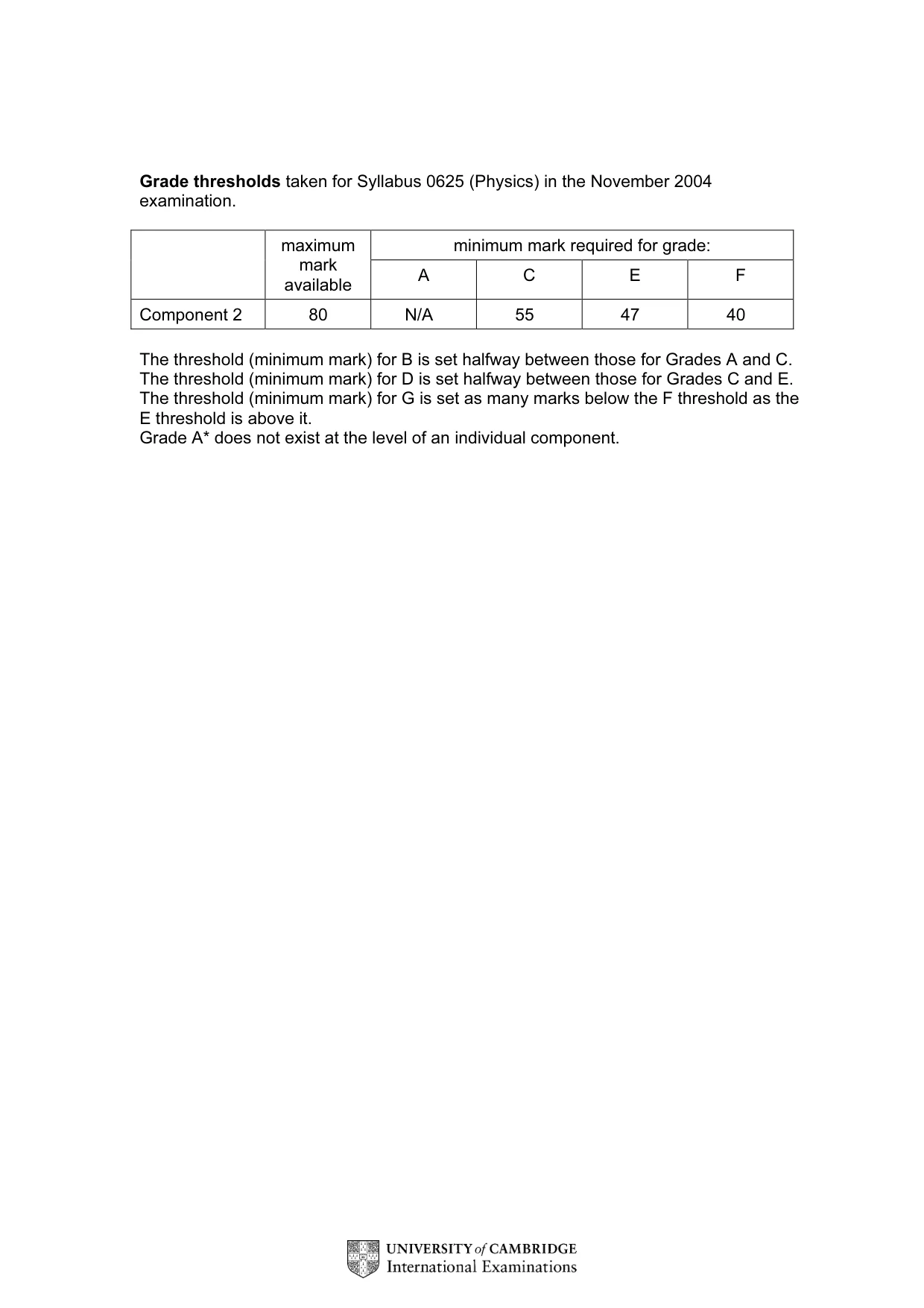
Grade thresholds taken for Syllabus 0625 (Physics) in the November 2004 examination. minimum mark required for grade: maximum mark available A C E F Component 2 80 N/A 55 47 40 The threshold (minimum mark) for B is set halfway between those for Grades A and C. The threshold (minimum mark) for D is set halfway between those for Grades C and E. The threshold (minimum mark) for G is set as many marks below the F threshold as the E threshold is above it. Grade A* does not exist at the level of an individual component.
Mark scheme, page 3
November 2004 INTERNATIONAL GCSE MARK SCHEME MAXIMUM MARK: 80 SYLLABUS/COMPONENT: 0625/02 PHYSICS Theory
Mark scheme, page 4
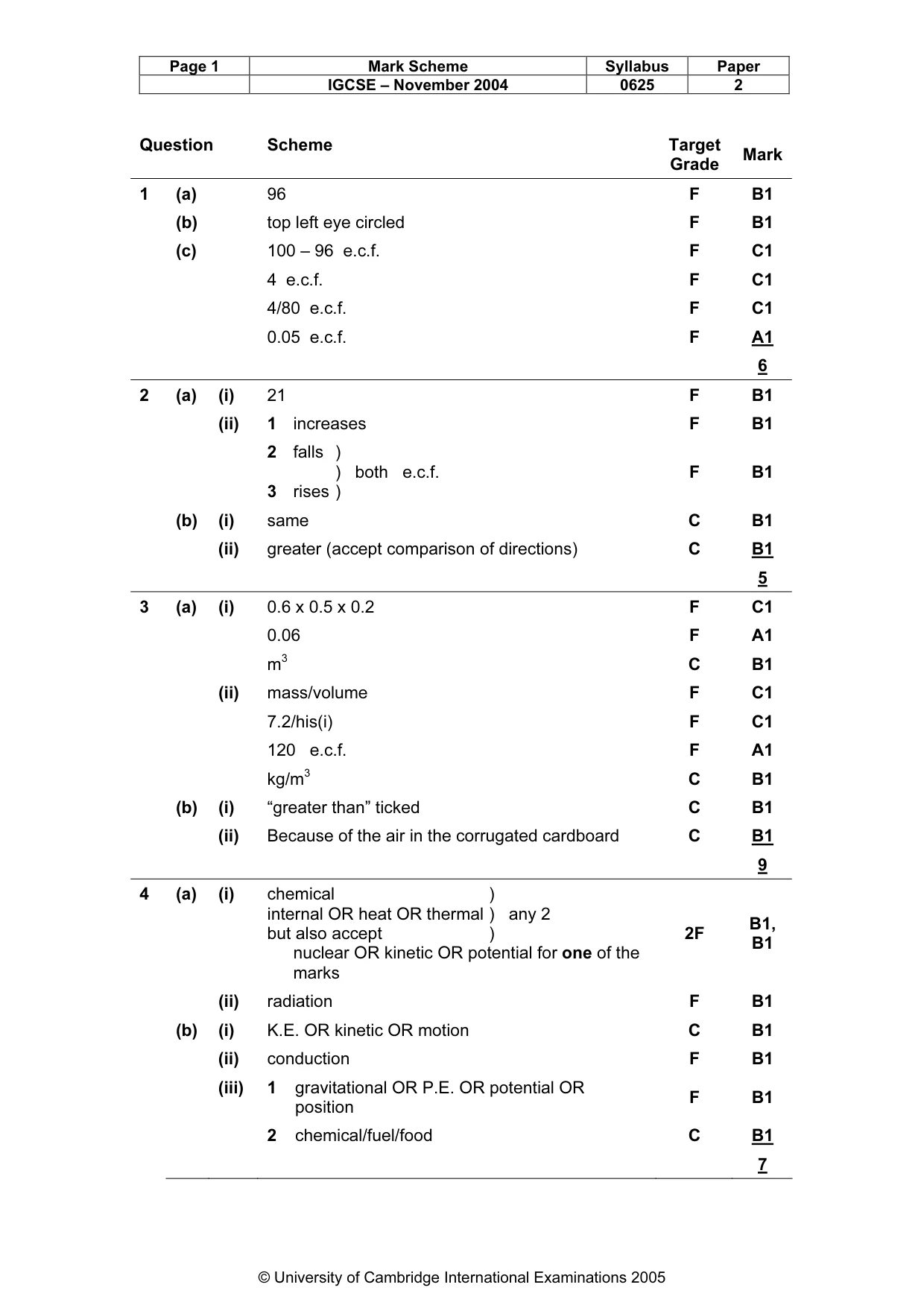
Page 1 Mark Scheme Syllabus Paper IGCSE – November 2004 0625 2 © University of Cambridge International Examinations 2005 Question Scheme Target Grade Mark 1 (a) 96 F B1 (b) top left eye circled F B1 (c) 100 – 96 e.c.f. F C1 4 e.c.f. F C1 4/80 e.c.f. F C1 0.05 e.c.f. F A1 6 2 (a) (i) 21 F B1 (ii) 1 increases F B1 2 falls ) ) both e.c.f. 3 rises ) F B1 (b) (i) same C B1 (ii) greater (accept comparison of directions) C B1 5 3 (a) (i) 0.6 x 0.5 x 0.2 F C1 0.06 F A1 m3 C B1 (ii) mass/volume F C1 7.2/his(i) F C1 120 e.c.f. F A1 kg/m3 C B1 (b) (i) “greater than” ticked C B1 (ii) Because of the air in the corrugated cardboard C B1 9 4 (a) (i) chemical ) internal OR heat OR thermal ) any 2 but also accept ) nuclear OR kinetic OR potential for one of the marks 2F B1, B1 (ii) radiation F B1 (b) (i) K.E. OR kinetic OR motion C B1 (ii) conduction F B1 (iii) 1 gravitational OR P.E. OR potential OR position F B1 2 chemical/fuel/food C B1 7
Mark scheme, page 5
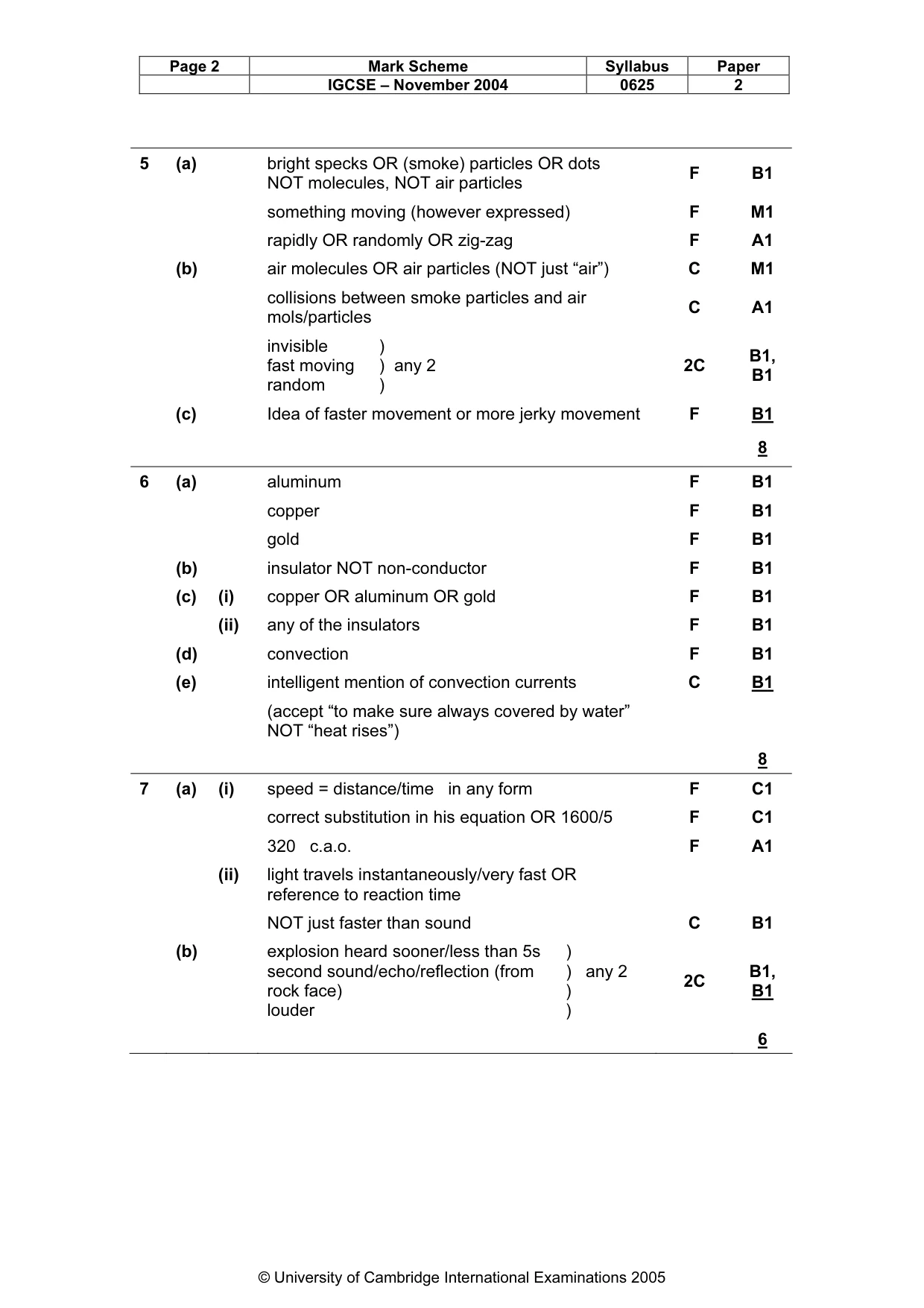
Page 2 Mark Scheme Syllabus Paper IGCSE – November 2004 0625 2 © University of Cambridge International Examinations 2005 5 (a) bright specks OR (smoke) particles OR dots NOT molecules, NOT air particles F B1 something moving (however expressed) F M1 rapidly OR randomly OR zig-zag F A1 (b) air molecules OR air particles (NOT just “air”) C M1 collisions between smoke particles and air mols/particles C A1 invisible ) fast moving ) any 2 random ) 2C B1, B1 (c) Idea of faster movement or more jerky movement F B1 8 6 (a) aluminum F B1 copper F B1 gold F B1 (b) insulator NOT non-conductor F B1 (c) (i) copper OR aluminum OR gold F B1 (ii) any of the insulators F B1 (d) convection F B1 (e) intelligent mention of convection currents C B1 (accept “to make sure always covered by water” NOT “heat rises”) 8 7 (a) (i) speed = distance/time in any form F C1 correct substitution in his equation OR 1600/5 F C1 320 c.a.o. F A1 (ii) light travels instantaneously/very fast OR reference to reaction time NOT just faster than sound C B1 (b) explosion heard sooner/less than 5s ) second sound/echo/reflection (from ) any 2 rock face) ) louder ) 2C B1, B1 6
Mark scheme, page 6
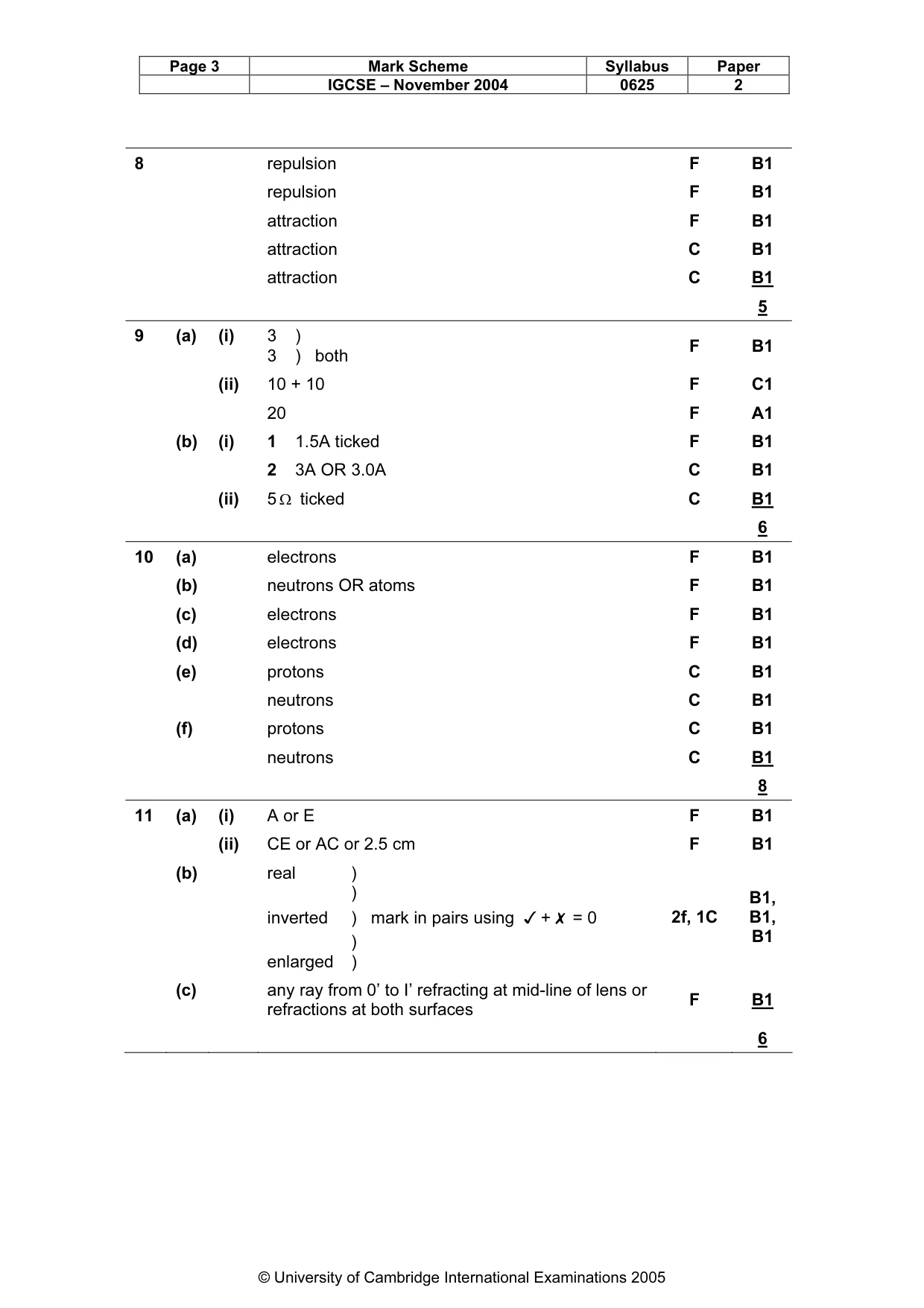
Page 3 Mark Scheme Syllabus Paper IGCSE – November 2004 0625 2 © University of Cambridge International Examinations 2005 8 repulsion F B1 repulsion F B1 attraction F B1 attraction C B1 attraction C B1 5 9 (a) (i) 3 ) 3 ) both F B1 (ii) 10 + 10 F C1 20 F A1 (b) (i) 1 1.5A ticked F B1 2 3A OR 3.0A C B1 (ii) 5 Ω ticked C B1 6 10 (a) electrons F B1 (b) neutrons OR atoms F B1 (c) electrons F B1 (d) electrons F B1 (e) protons C B1 neutrons C B1 (f) protons C B1 neutrons C B1 8 11 (a) (i) A or E F B1 (ii) CE or AC or 2.5 cm F B1 (b) real ) ) inverted ) mark in pairs using ✓+ ✗= 0 ) enlarged ) 2f, 1C B1, B1, B1 (c) any ray from 0’ to I’ refracting at mid-line of lens or refractions at both surfaces F B1 6
Mark scheme, page 7
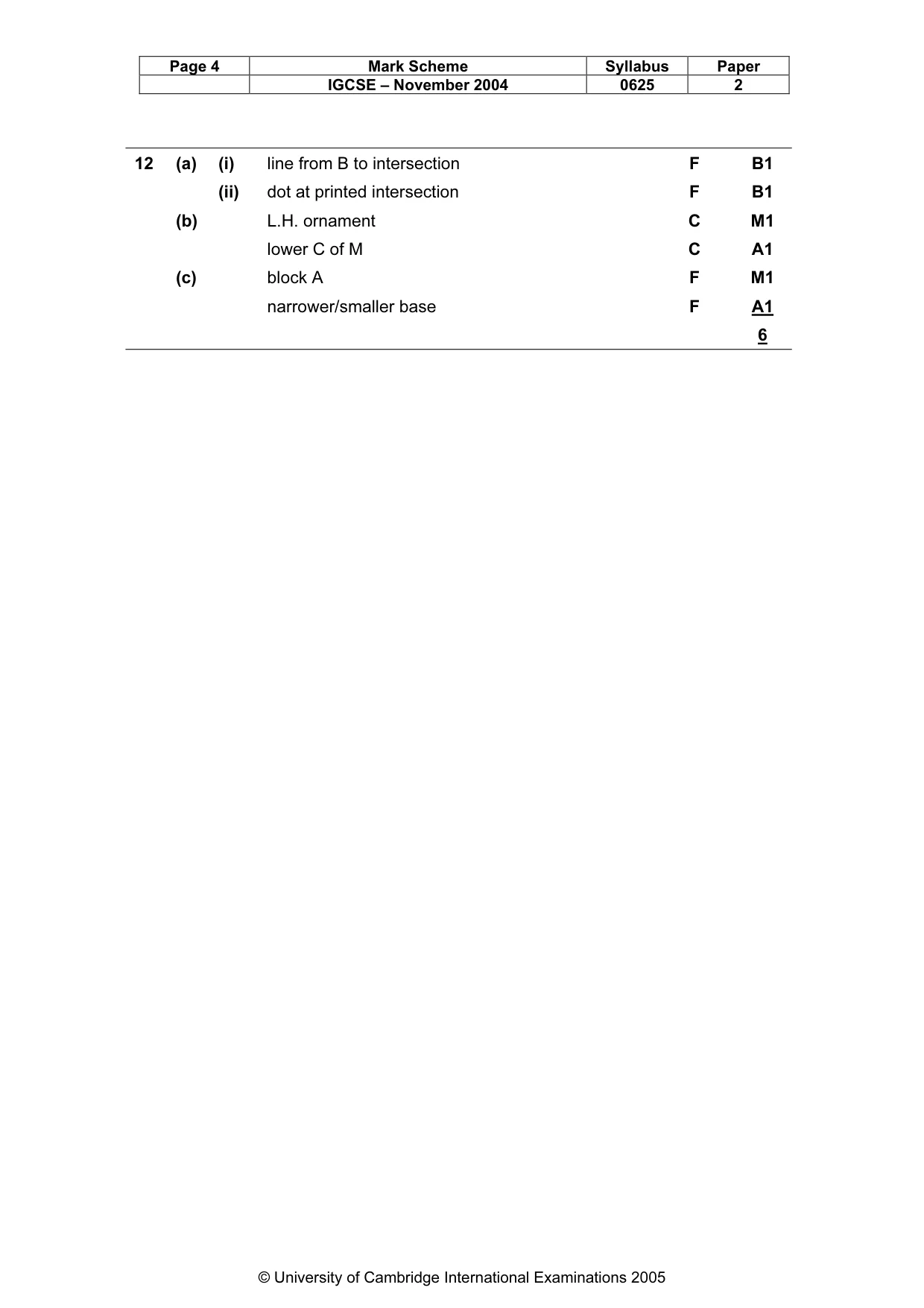
Page 4 Mark Scheme Syllabus Paper IGCSE – November 2004 0625 2 © University of Cambridge International Examinations 2005 12 (a) (i) line from B to intersection F B1 (ii) dot at printed intersection F B1 (b) L.H. ornament C M1 lower C of M C A1 (c) block A F M1 narrower/smaller base F A1 6
Mark scheme, page 8
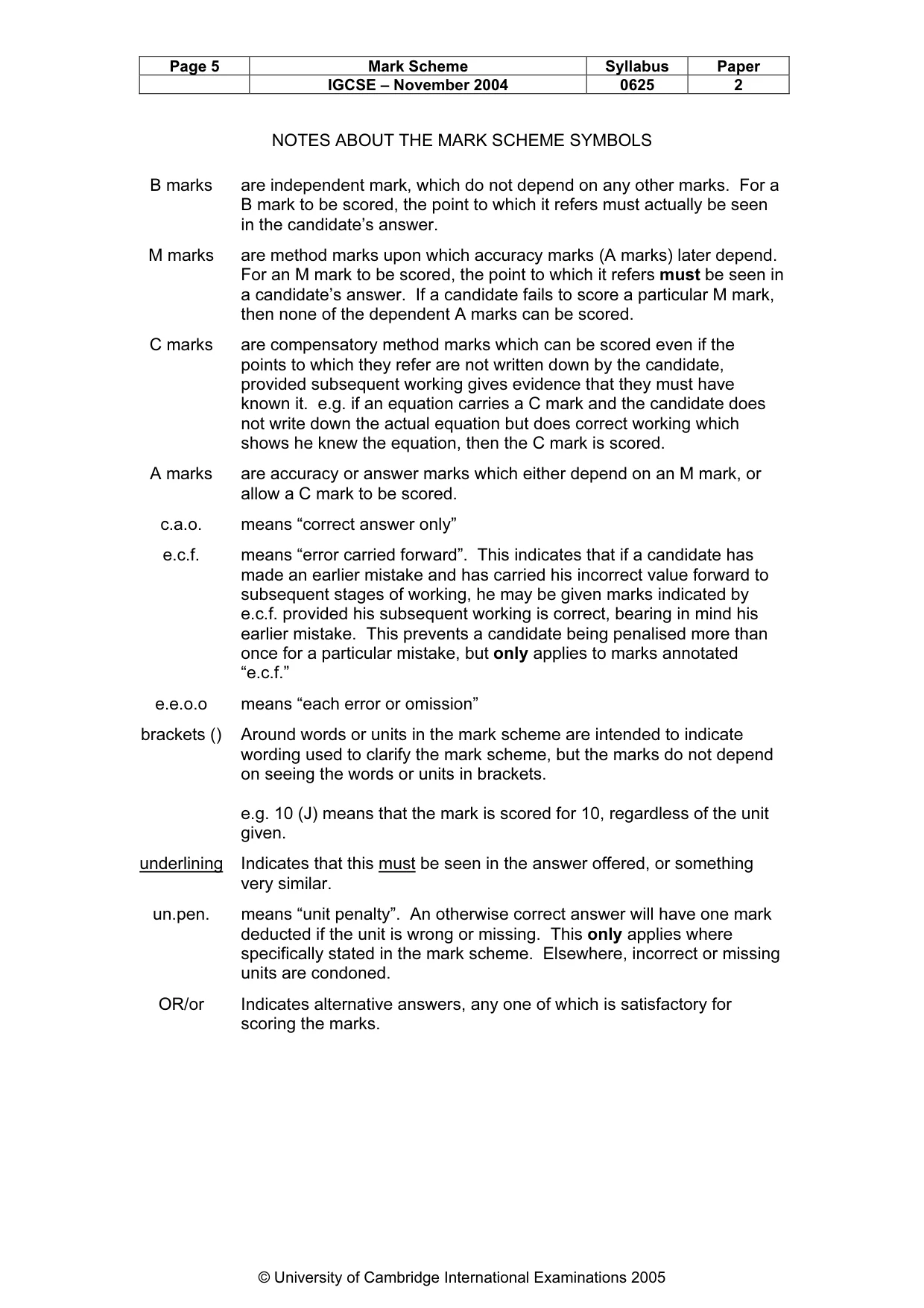
Page 5 Mark Scheme Syllabus Paper IGCSE – November 2004 0625 2 © University of Cambridge International Examinations 2005 NOTES ABOUT THE MARK SCHEME SYMBOLS B marks are independent mark, which do not depend on any other marks. For a B mark to be scored, the point to which it refers must actually be seen in the candidate’s answer. M marks are method marks upon which accuracy marks (A marks) later depend. For an M mark to be scored, the point to which it refers must be seen in a candidate’s answer. If a candidate fails to score a particular M mark, then none of the dependent A marks can be scored. C marks are compensatory method marks which can be scored even if the points to which they refer are not written down by the candidate, provided subsequent working gives evidence that they must have known it. e.g. if an equation carries a C mark and the candidate does not write down the actual equation but does correct working which shows he knew the equation, then the C mark is scored. A marks are accuracy or answer marks which either depend on an M mark, or allow a C mark to be scored. c.a.o. means “correct answer only” e.c.f. means “error carried forward”. This indicates that if a candidate has made an earlier mistake and has carried his incorrect value forward to subsequent stages of working, he may be given marks indicated by e.c.f. provided his subsequent working is correct, bearing in mind his earlier mistake. This prevents a candidate being penalised more than once for a particular mistake, but only applies to marks annotated “e.c.f.” e.e.o.o means “each error or omission” brackets () Around words or units in the mark scheme are intended to indicate wording used to clarify the mark scheme, but the marks do not depend on seeing the words or units in brackets. e.g. 10 (J) means that the mark is scored for 10, regardless of the unit given. underlining Indicates that this must be seen in the answer offered, or something very similar. un.pen. means “unit penalty”. An otherwise correct answer will have one mark deducted if the unit is wrong or missing. This only applies where specifically stated in the mark scheme. Elsewhere, incorrect or missing units are condoned. OR/or Indicates alternative answers, any one of which is satisfactory for scoring the marks.