Cambridge IGCSE Physics 0625 — 2004 May/June Paper 2 · Variant 1
0625/21/M/J/04
The question paper and its mark scheme, free to read here and free to download. This is Cambridge’s own paper, exactly as it was sat.
Question paper20 pages


Mark scheme
No mark scheme is in the library for this paper.
Paper as text
Question paper, page 1
This document consists of 17 printed pages and 3 blank pages. SPA (NH/BI) S61205/2 © UCLES 2004 [Turn over UNIVERSITY OF CAMBRIDGE INTERNATIONAL EXAMINATIONS International General Certificate of Secondary Education PHYSICS 0625/02 Paper 2 May/June 2004 1 hour 15 minutes Candidates answer on the Question Paper. No Additional Materials are required. READ THESE INSTRUCTIONS FIRST Write your Centre number, candidate number and name on all the work you hand in. Write in dark blue or black pen in the spaces provided on the Question Paper. You may use a soft pencil for any diagrams, graphs or rough working. Do not use staples, paper clips, highlighters, glue or correction fluid. Answer all questions. At the end of the examination, fasten all your work securely together. The number of marks is given in brackets [ ] at the end of each question or part question. You may lose marks if you do not show your working or if you do not use appropriate units. Take the weight of 1 kg to be 10 N (i.e. acceleration of free fall = 10 m/s2). Centre Number Candidate Number Name If you have been given a label, look at the details. If any details are incorrect or missing, please fill in your correct details in the space given at the top of this page. Stick your personal label here, if provided. For Examiner’s Use www.XtremePapers.com
Question paper, page 2
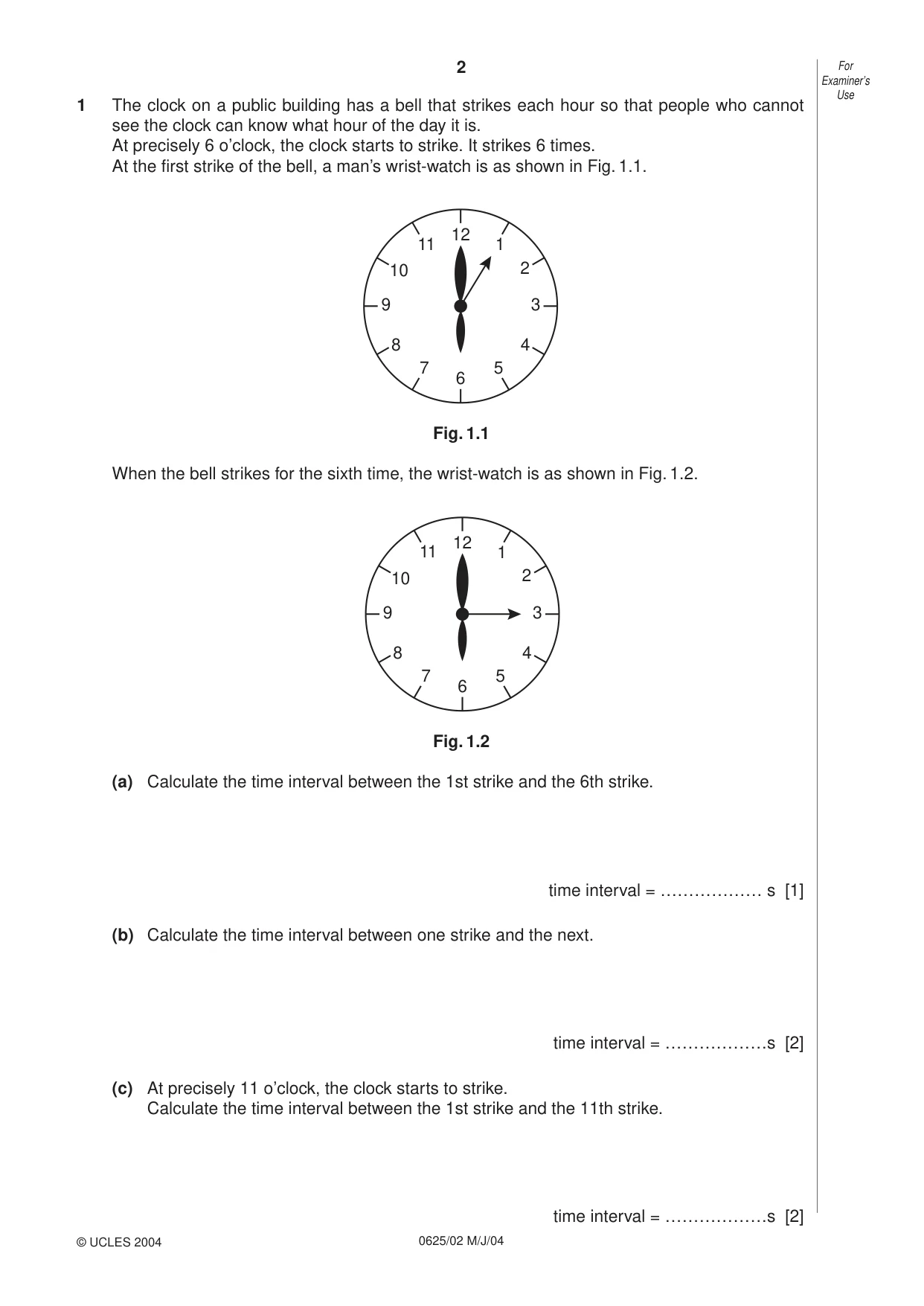
2 0625/02 M/J/04 1 The clock on a public building has a bell that strikes each hour so that people who cannot see the clock can know what hour of the day it is. At precisely 6 o’clock, the clock starts to strike. It strikes 6 times. At the first strike of the bell, a man’s wrist-watch is as shown in Fig. 1.1. Fig. 1.1 When the bell strikes for the sixth time, the wrist-watch is as shown in Fig. 1.2. Fig. 1.2 (a) Calculate the time interval between the 1st strike and the 6th strike. time interval = ……………… s [1] (b) Calculate the time interval between one strike and the next. time interval = ………………s [2] (c) At precisely 11 o’clock, the clock starts to strike. Calculate the time interval between the 1st strike and the 11th strike. time interval = ………………s [2] 12 1 11 2 10 3 9 4 8 5 7 6 12 1 11 2 10 3 9 4 8 5 7 6 For Examiner’s Use © UCLES 2004
Question paper, page 3
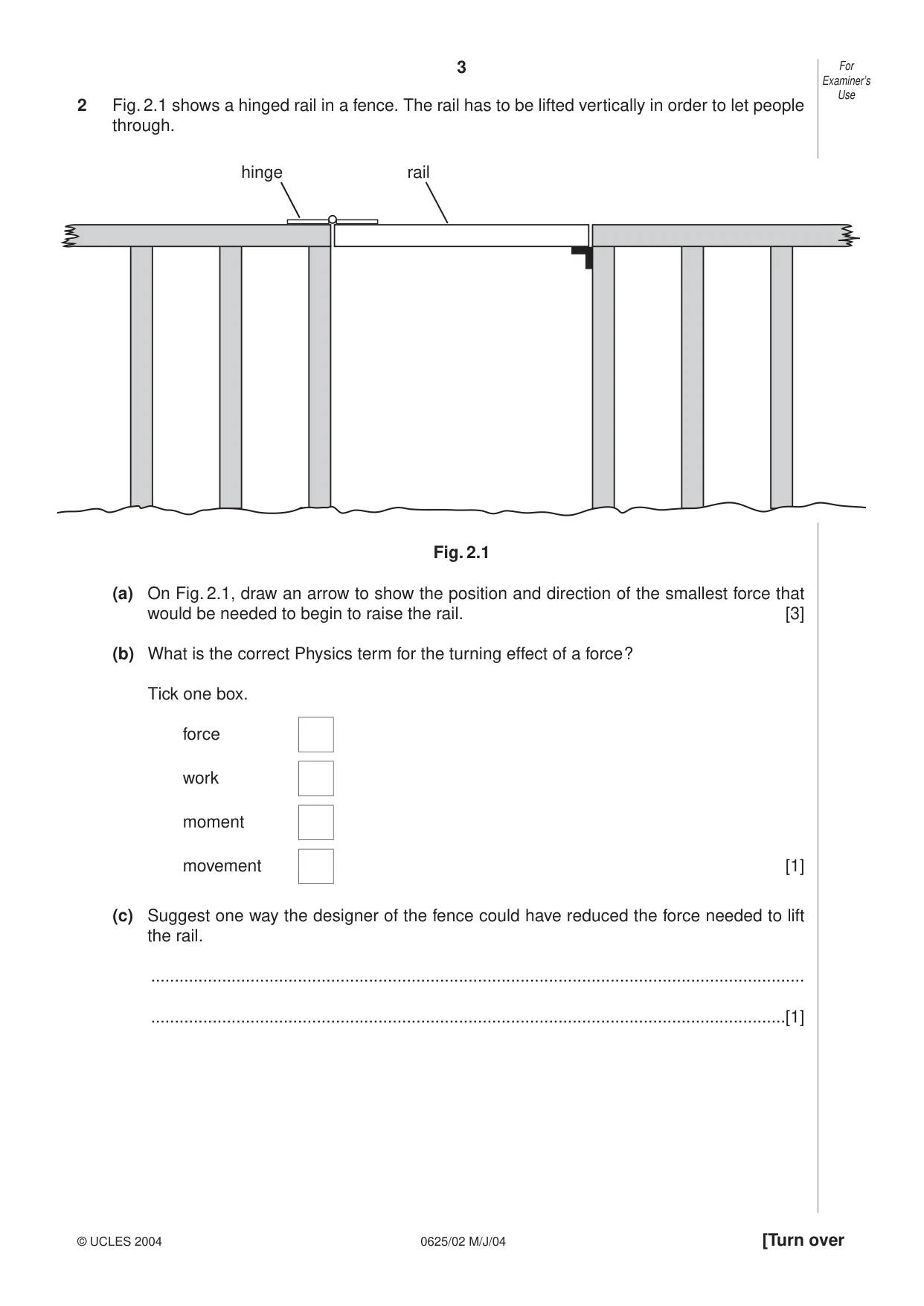
3 0625/02 M/J/04 [Turn over 2 Fig. 2.1 shows a hinged rail in a fence. The rail has to be lifted vertically in order to let people through. Fig. 2.1 (a) On Fig. 2.1, draw an arrow to show the position and direction of the smallest force that would be needed to begin to raise the rail. [3] (b) What is the correct Physics term for the turning effect of a force? Tick one box. force work moment movement [1] (c) Suggest one way the designer of the fence could have reduced the force needed to lift the rail. … …[1] For Examiner’s Use © UCLES 2004 hinge rail
Question paper, page 4
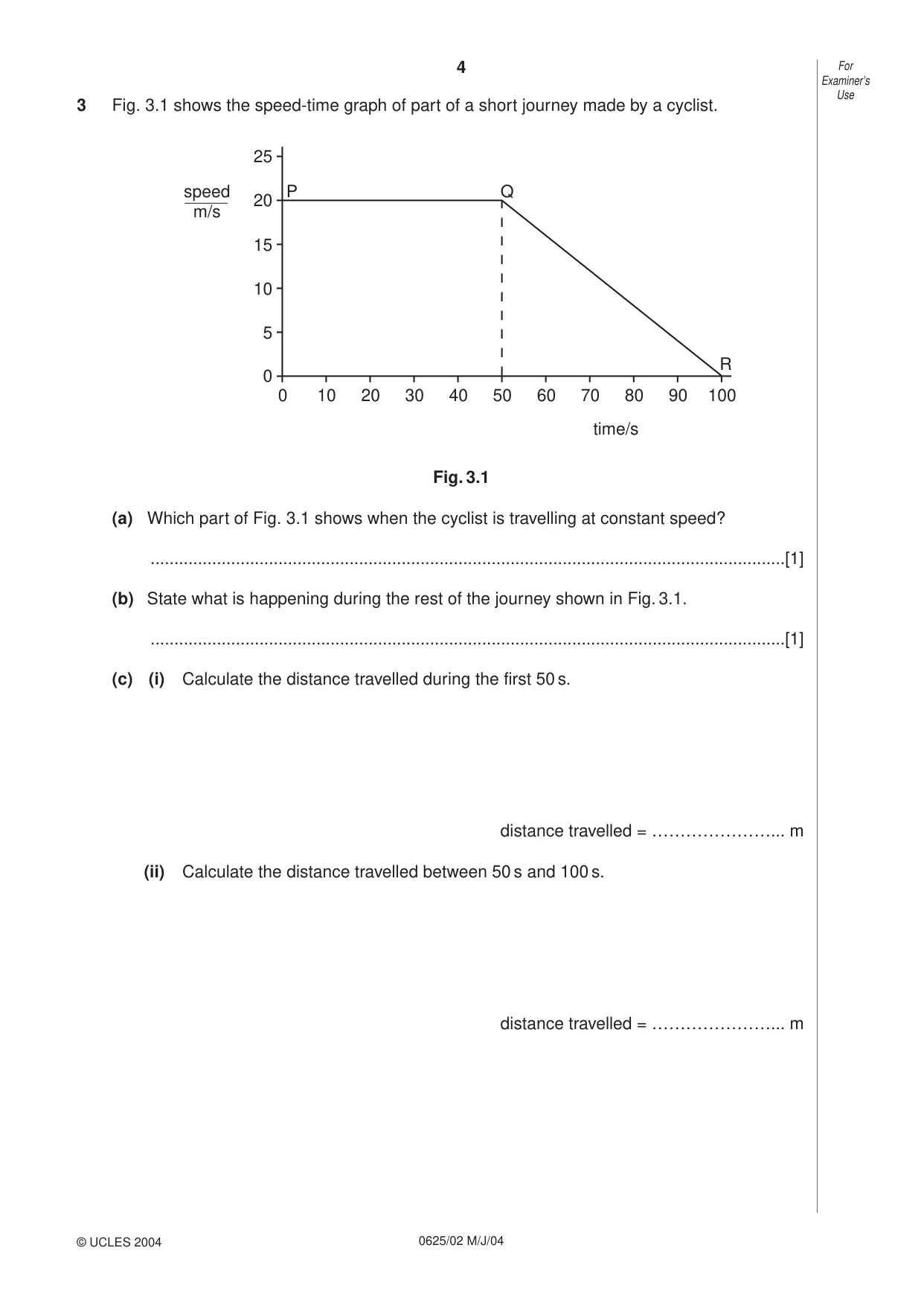
4 0625/02 M/J/04 3 Fig. 3.1 shows the speed-time graph of part of a short journey made by a cyclist. Fig. 3.1 (a) Which part of Fig. 3.1 shows when the cyclist is travelling at constant speed? …[1] (b) State what is happening during the rest of the journey shown in Fig. 3.1. …[1] (c) (i) Calculate the distance travelled during the first 50 s. distance travelled = …………………... m (ii) Calculate the distance travelled between 50 s and 100 s. distance travelled = …………………... m time/s speed m/s 0 0 5 10 15 20 P Q R 25 10 20 30 40 50 60 70 80 90 100 For Examiner’s Use © UCLES 2004
Question paper, page 5
5 0625/02 M/J/04 [Turn over (iii) Calculate the total distance travelled. total distance travelled = …………………... m (iv) Calculate the average speed during the 100 s. average speed = …………………... m/s [8] For Examiner’s Use © UCLES 2004
Question paper, page 6
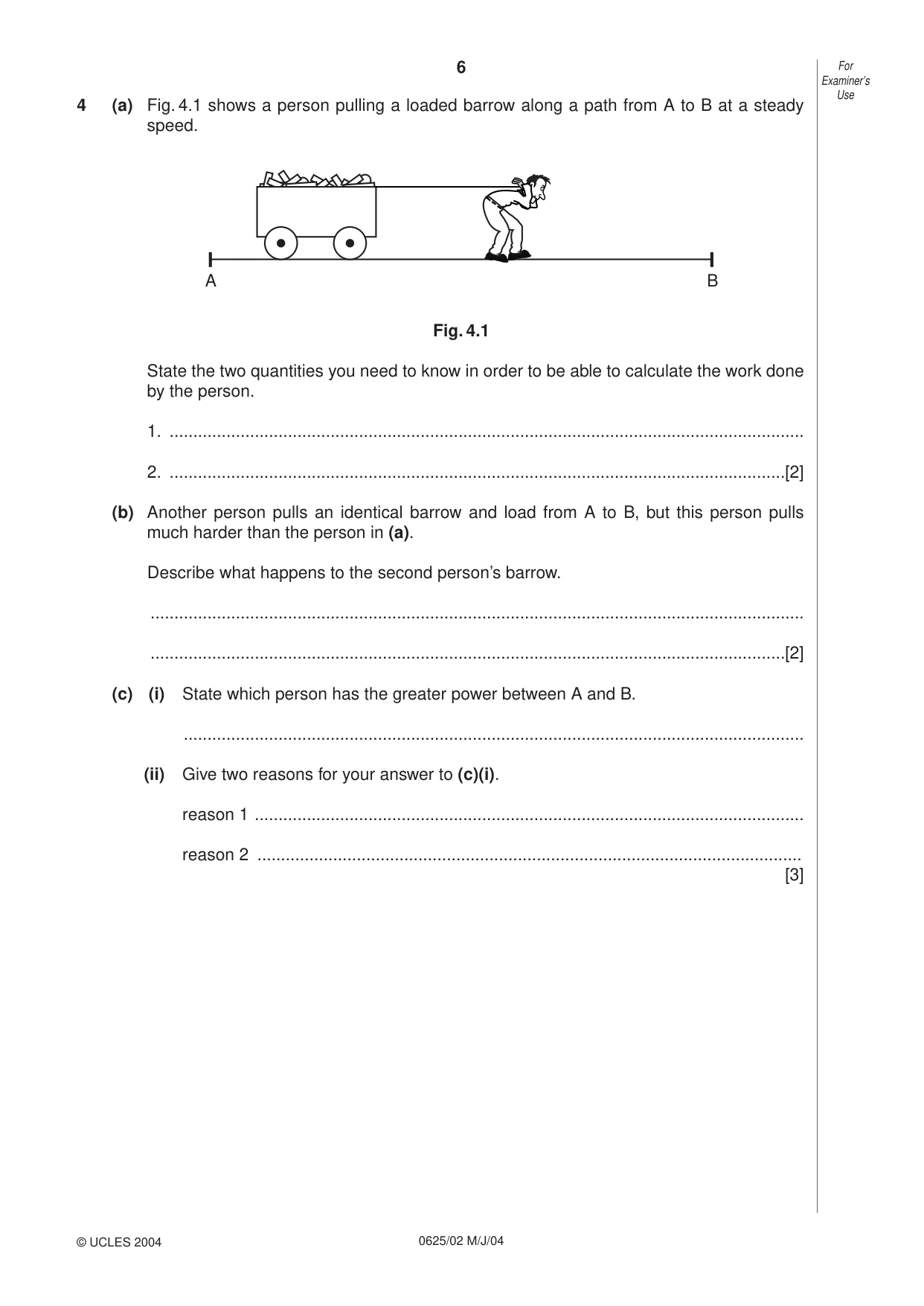
6 0625/02 M/J/04 4 (a) Fig. 4.1 shows a person pulling a loaded barrow along a path from A to B at a steady speed. Fig. 4.1 State the two quantities you need to know in order to be able to calculate the work done by the person. 1. … 2. …[2] (b) Another person pulls an identical barrow and load from A to B, but this person pulls much harder than the person in (a). Describe what happens to the second person’s barrow. … …[2] (c) (i) State which person has the greater power between A and B. … (ii) Give two reasons for your answer to (c)(i). reason 1 … reason 2 … [3] A B For Examiner’s Use © UCLES 2004
Question paper, page 7
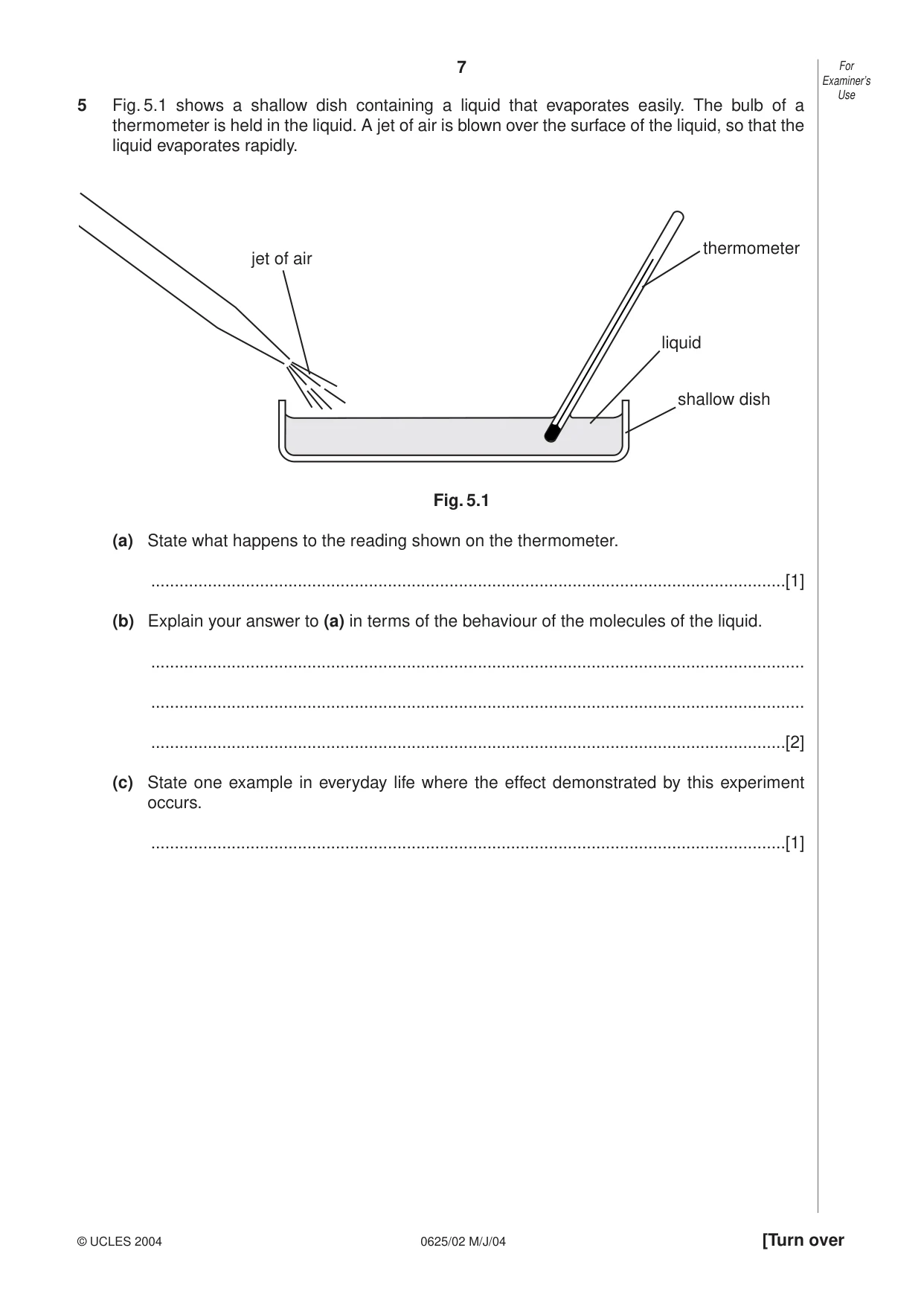
7 0625/02 M/J/04 [Turn over 5 Fig. 5.1 shows a shallow dish containing a liquid that evaporates easily. The bulb of a thermometer is held in the liquid. A jet of air is blown over the surface of the liquid, so that the liquid evaporates rapidly. Fig. 5.1 (a) State what happens to the reading shown on the thermometer. …[1] (b) Explain your answer to (a) in terms of the behaviour of the molecules of the liquid. … … …[2] (c) State one example in everyday life where the effect demonstrated by this experiment occurs. …[1] jet of air liquid shallow dish thermometer For Examiner’s Use © UCLES 2004
Question paper, page 8
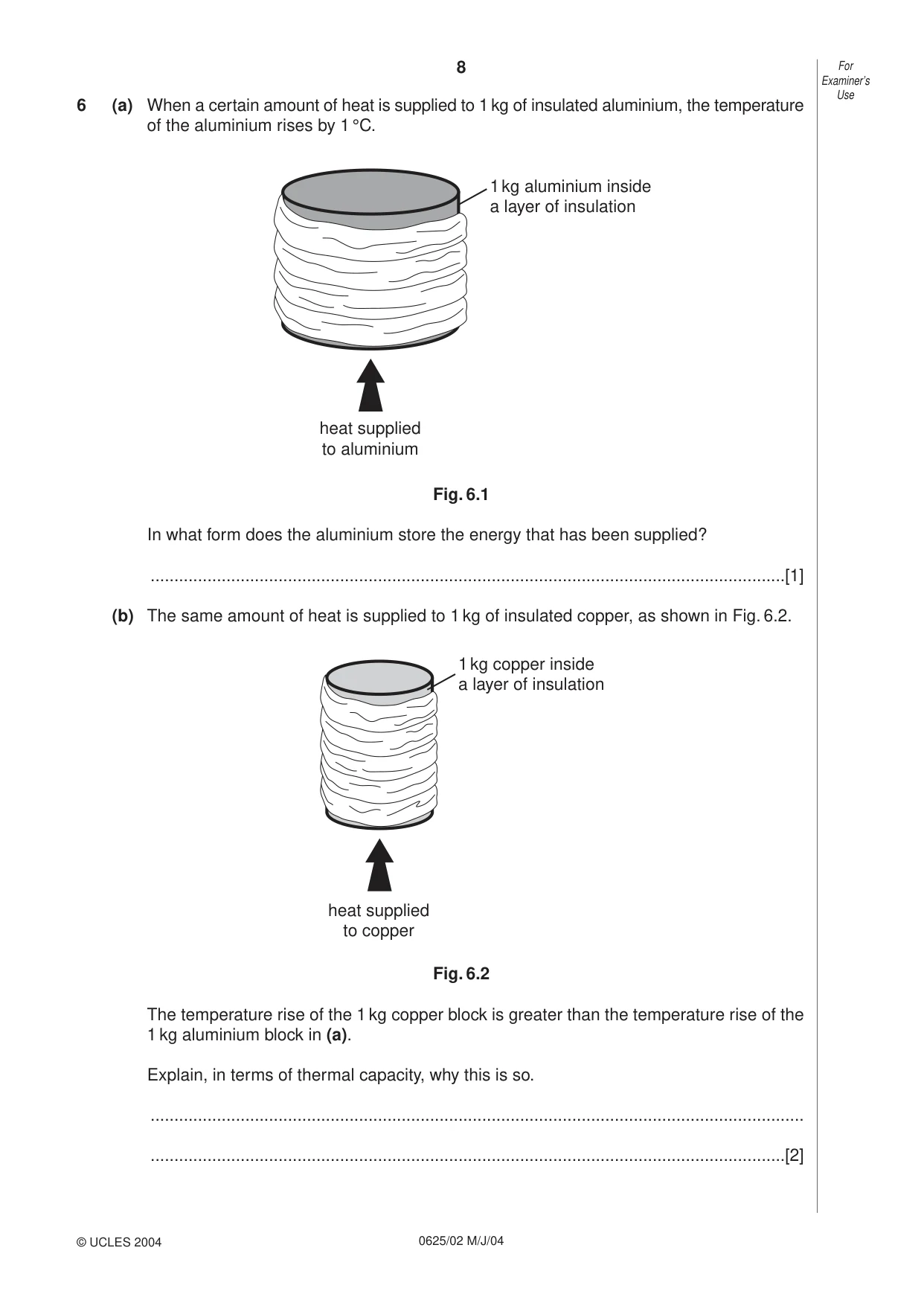
8 0625/02 M/J/04 6 (a) When a certain amount of heat is supplied to 1 kg of insulated aluminium, the temperature of the aluminium rises by 1 °C. Fig. 6.1 In what form does the aluminium store the energy that has been supplied? …[1] (b) The same amount of heat is supplied to 1 kg of insulated copper, as shown in Fig. 6.2. Fig. 6.2 The temperature rise of the 1 kg copper block is greater than the temperature rise of the 1 kg aluminium block in (a). Explain, in terms of thermal capacity, why this is so. … …[2] 1 kg copper inside a layer of insulation heat supplied to copper 1 kg aluminium inside a layer of insulation heat supplied to aluminium For Examiner’s Use © UCLES 2004
Question paper, page 9
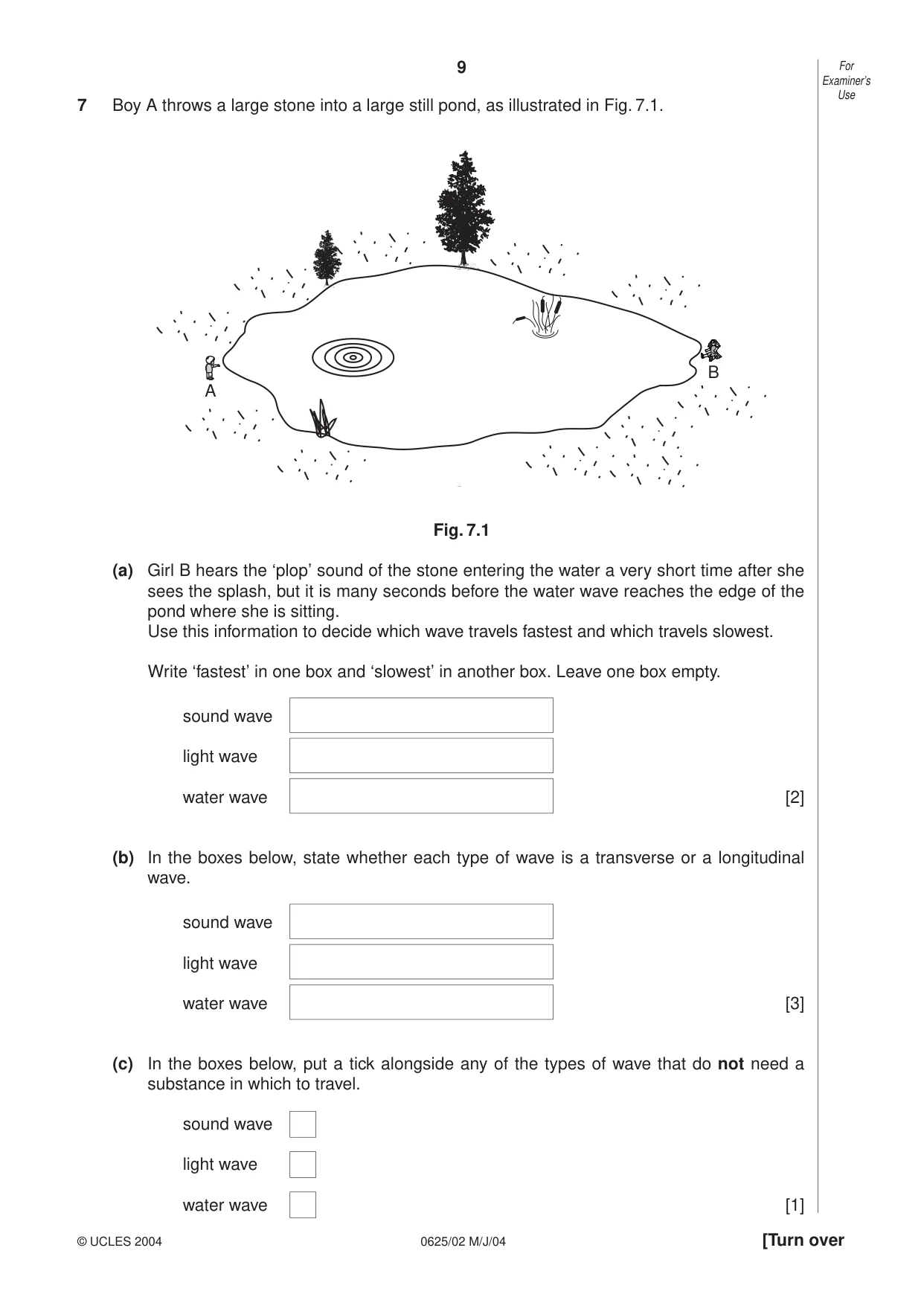
9 0625/02 M/J/04 [Turn over 7 Boy A throws a large stone into a large still pond, as illustrated in Fig. 7.1. Fig. 7.1 (a) Girl B hears the ‘plop’ sound of the stone entering the water a very short time after she sees the splash, but it is many seconds before the water wave reaches the edge of the pond where she is sitting. Use this information to decide which wave travels fastest and which travels slowest. Write ‘fastest’ in one box and ‘slowest’ in another box. Leave one box empty. sound wave light wave water wave [2] (b) In the boxes below, state whether each type of wave is a transverse or a longitudinal wave. sound wave light wave water wave [3] (c) In the boxes below, put a tick alongside any of the types of wave that do not need a substance in which to travel. sound wave light wave water wave [1] Fig. 7.1 A B For Examiner’s Use © UCLES 2004
Question paper, page 10
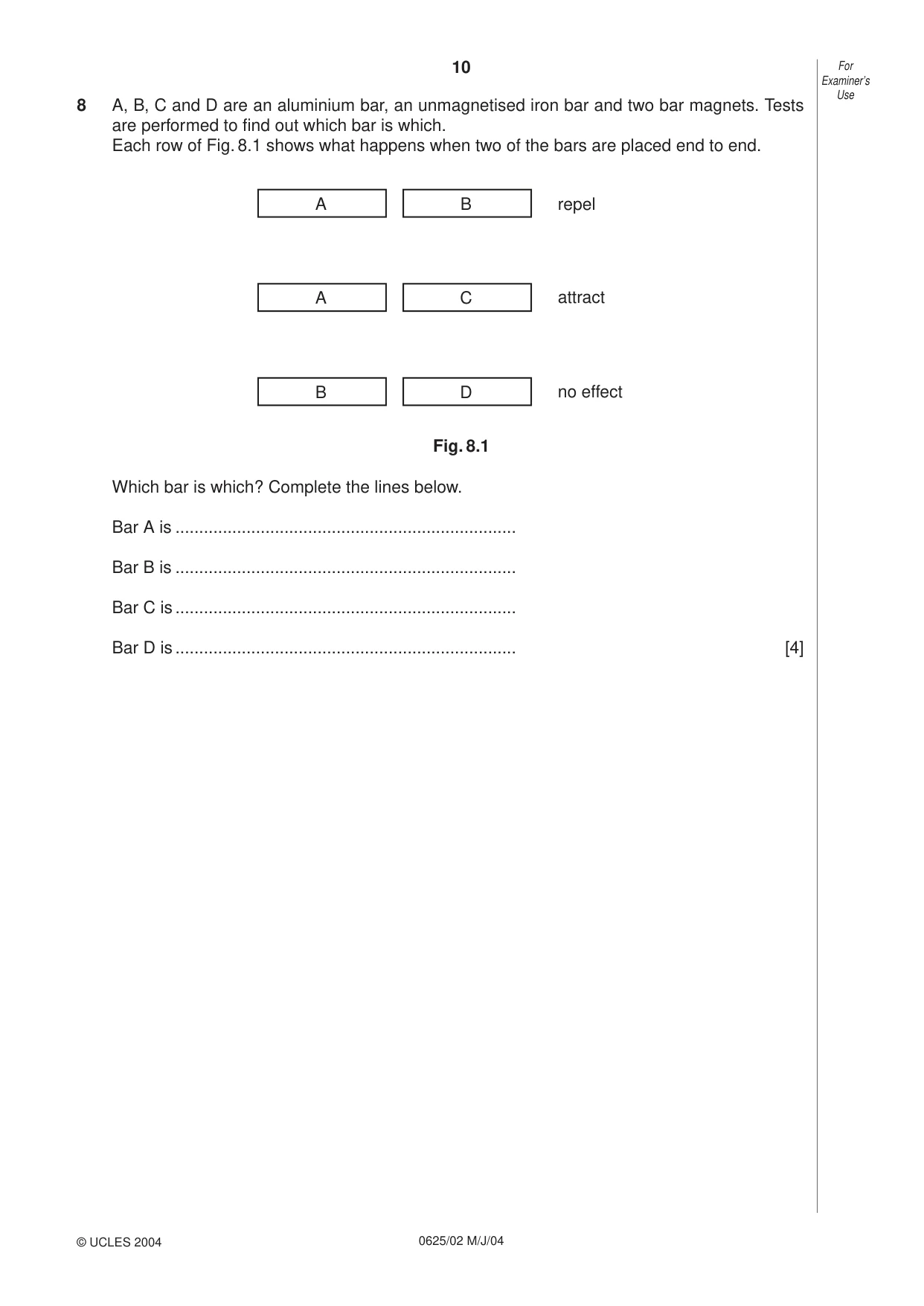
10 0625/02 M/J/04 8 A, B, C and D are an aluminium bar, an unmagnetised iron bar and two bar magnets. Tests are performed to find out which bar is which. Each row of Fig. 8.1 shows what happens when two of the bars are placed end to end. Fig. 8.1 Which bar is which? Complete the lines below. Bar A is … Bar B is … Bar C is… Bar D is… [4] repel attract no effect A B A C B D For Examiner’s Use © UCLES 2004
Question paper, page 11
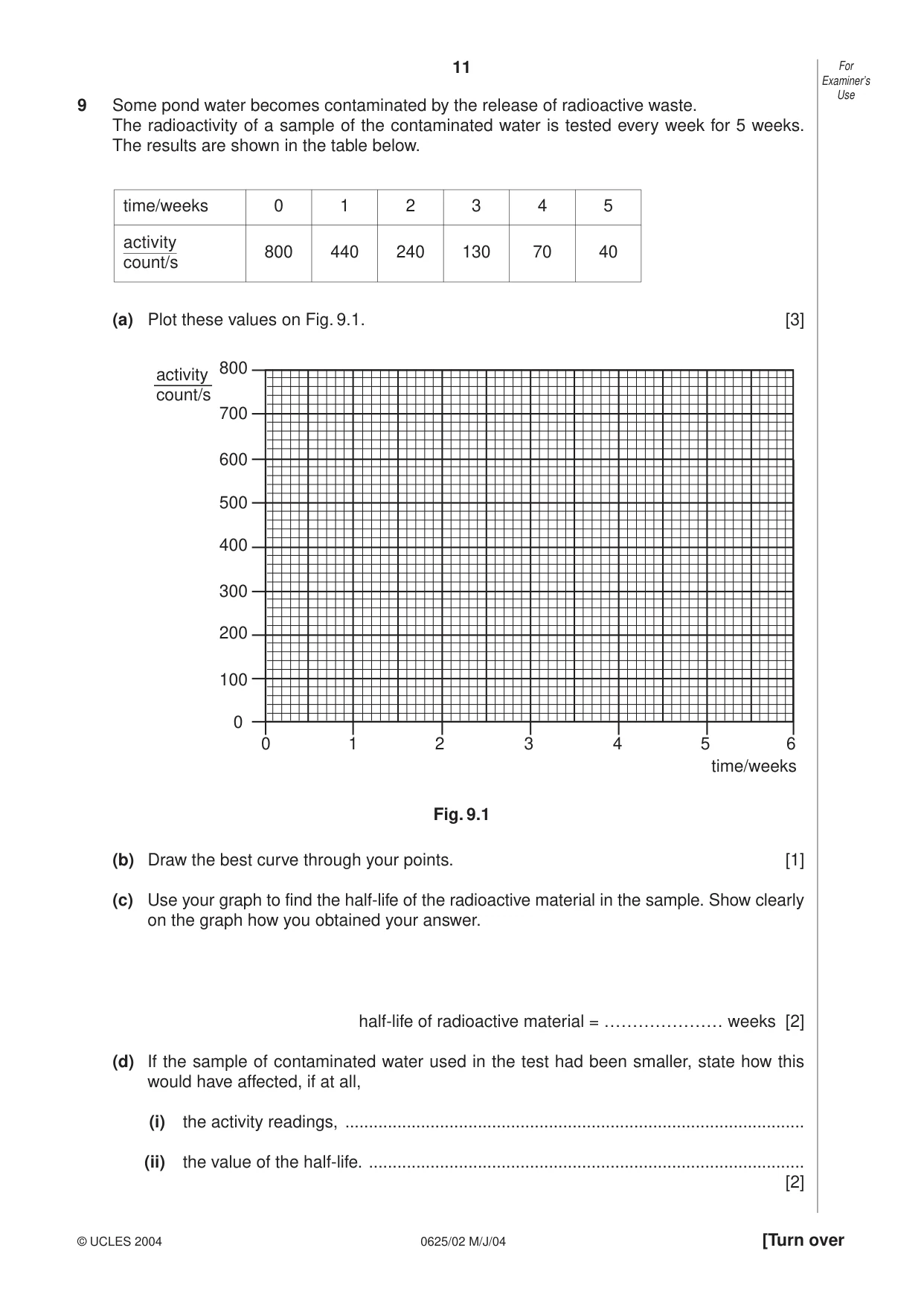
© UCLES 2004 11 0625/02 M/J/04 [Turn over 9 Some pond water becomes contaminated by the release of radioactive waste. The radioactivity of a sample of the contaminated water is tested every week for 5 weeks. The results are shown in the table below. (a) Plot these values on Fig. 9.1. [3] Fig. 9.1 (b) Draw the best curve through your points. [1] (c) Use your graph to find the half-life of the radioactive material in the sample. Show clearly on the graph how you obtained your answer. half-life of radioactive material = ………………… weeks [2] (d) If the sample of contaminated water used in the test had been smaller, state how this would have affected, if at all, (i) the activity readings, … (ii) the value of the half-life. … [2] 0 0 100 200 300 400 500 600 700 800 1 2 3 5 4 6 time/weeks activity count/s For Examiner’s Use time/weeks 0 800 440 240 130 70 40 1 2 3 4 5 activity count/s
Question paper, page 12
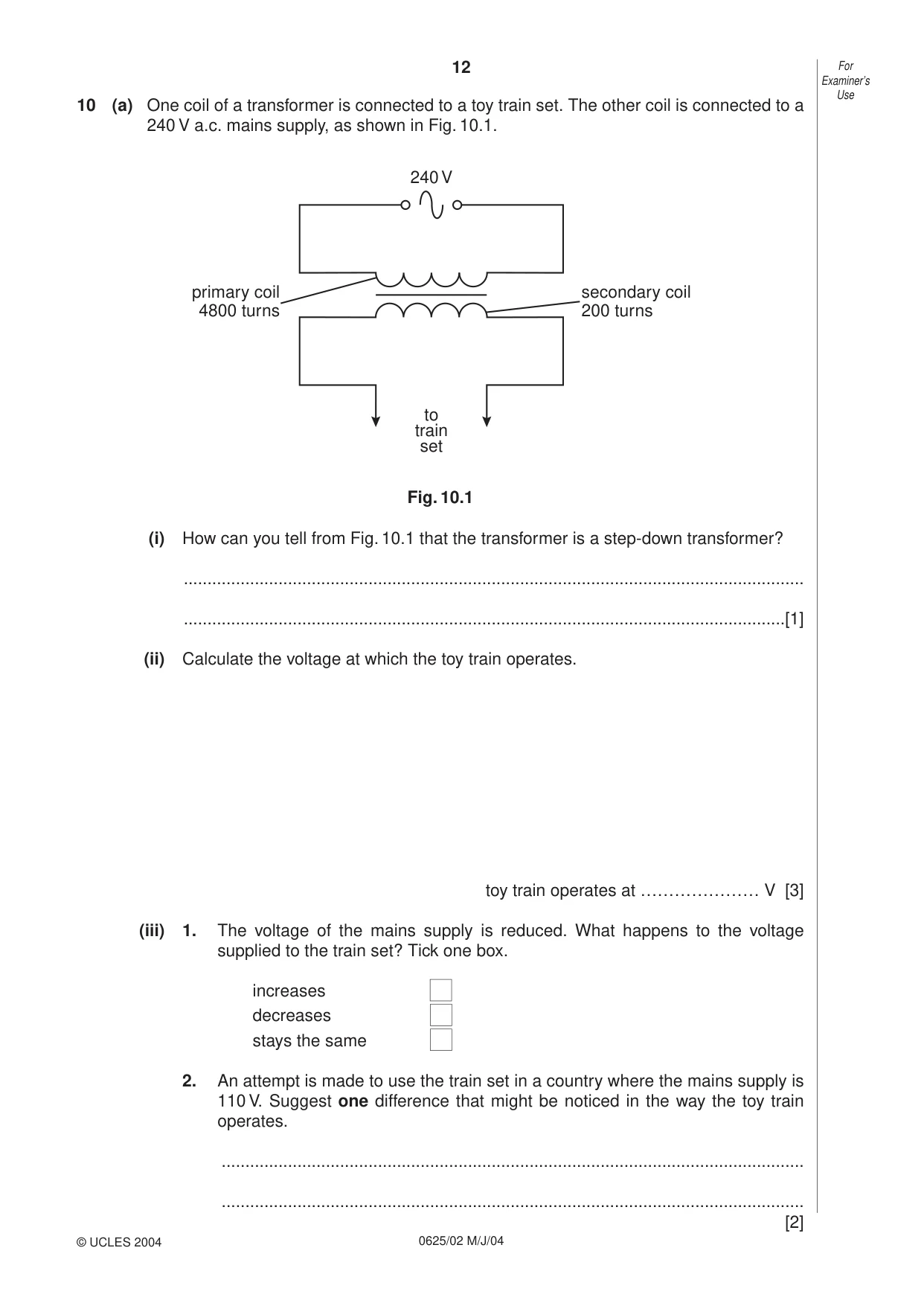
12 0625/02 M/J/04 10 (a) One coil of a transformer is connected to a toy train set. The other coil is connected to a 240 V a.c. mains supply, as shown in Fig. 10.1. Fig. 10.1 (i) How can you tell from Fig. 10.1 that the transformer is a step-down transformer? … …[1] (ii) Calculate the voltage at which the toy train operates. toy train operates at ………………… V [3] (iii) 1. The voltage of the mains supply is reduced. What happens to the voltage supplied to the train set? Tick one box. increases decreases stays the same 2. An attempt is made to use the train set in a country where the mains supply is 110 V. Suggest one difference that might be noticed in the way the toy train operates. … … [2] secondary coil 200 turns primary coil 4800 turns 240 V to train set For Examiner’s Use © UCLES 2004
Question paper, page 13
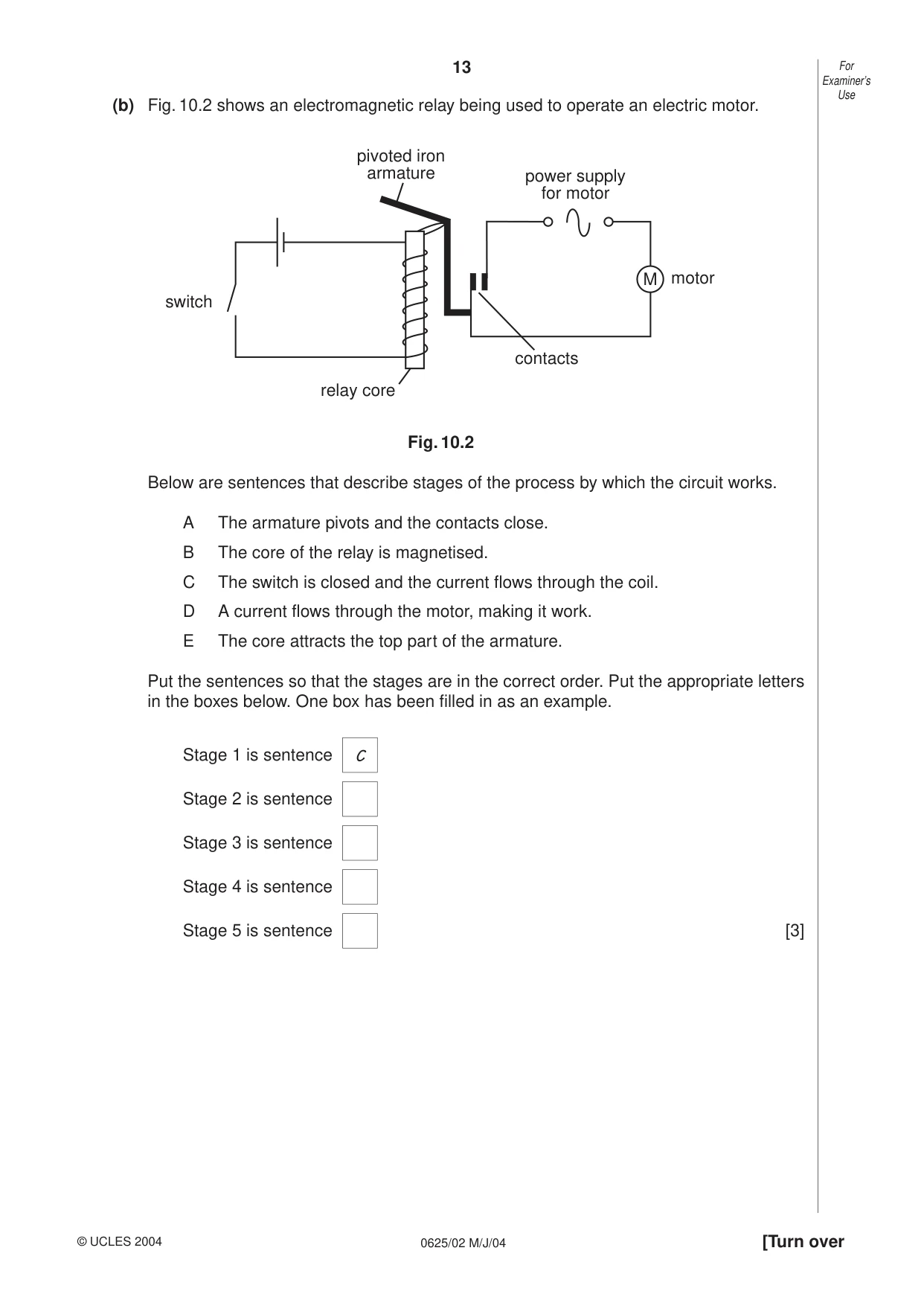
13 0625/02 M/J/04 [Turn over (b) Fig. 10.2 shows an electromagnetic relay being used to operate an electric motor. Fig. 10.2 Below are sentences that describe stages of the process by which the circuit works. A The armature pivots and the contacts close. B The core of the relay is magnetised. C The switch is closed and the current flows through the coil. D A current flows through the motor, making it work. E The core attracts the top part of the armature. Put the sentences so that the stages are in the correct order. Put the appropriate letters in the boxes below. One box has been filled in as an example. Stage 1 is sentence Stage 2 is sentence Stage 3 is sentence Stage 4 is sentence Stage 5 is sentence [3] C power supply for motor pivoted iron armature motor contacts relay core switch M For Examiner’s Use © UCLES 2004
Question paper, page 14
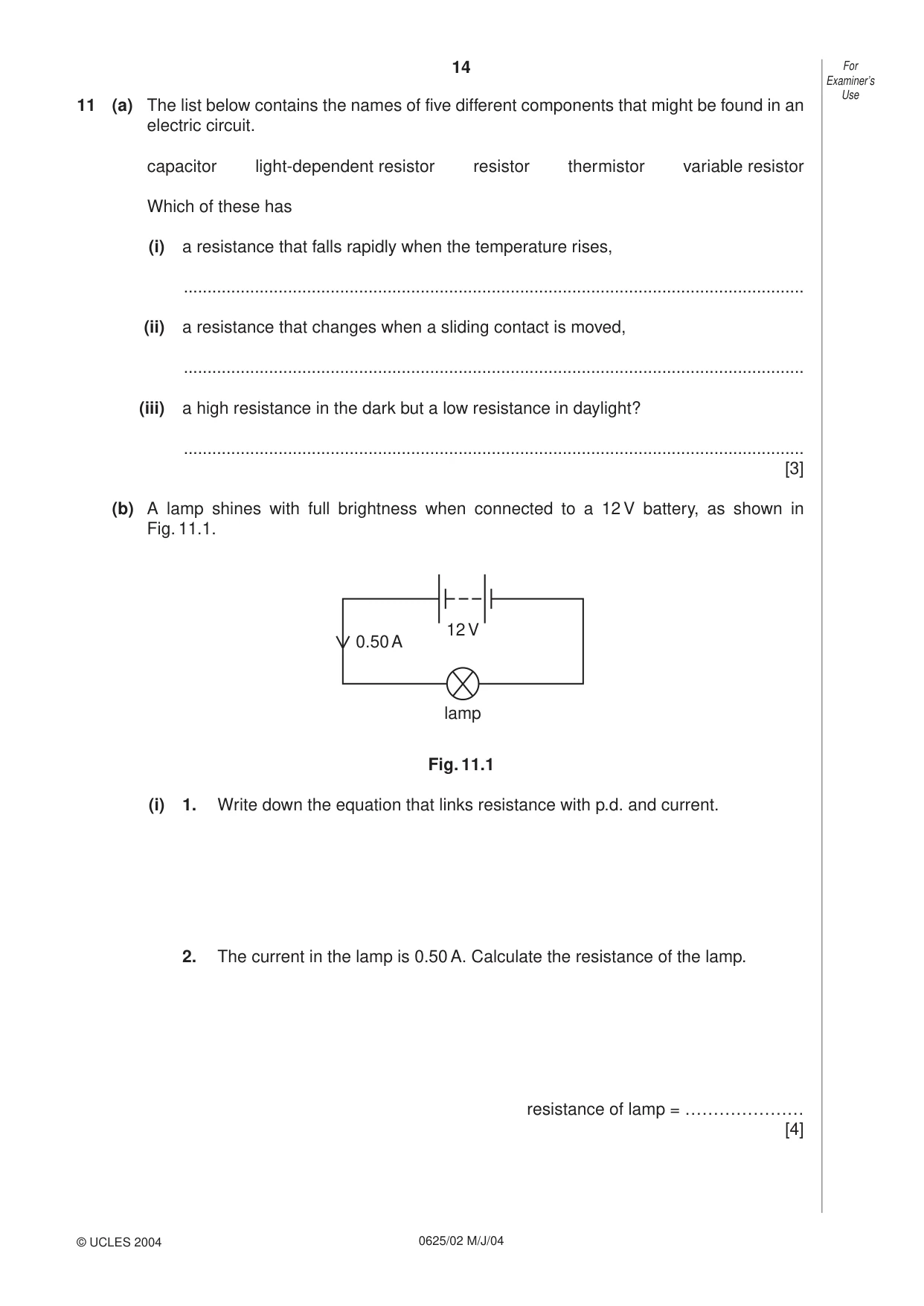
© UCLES 2004 14 0625/02 M/J/04 11 (a) The list below contains the names of five different components that might be found in an electric circuit. capacitor light-dependent resistor resistor thermistor variable resistor Which of these has (i) a resistance that falls rapidly when the temperature rises, … (ii) a resistance that changes when a sliding contact is moved, … (iii) a high resistance in the dark but a low resistance in daylight? … [3] (b) A lamp shines with full brightness when connected to a 12 V battery, as shown in Fig. 11.1. Fig. 11.1 (i) 1. Write down the equation that links resistance with p.d. and current. 2. The current in the lamp is 0.50 A. Calculate the resistance of the lamp. resistance of lamp = ………………… [4] lamp 0.50 A 12 V For Examiner’s Use
Question paper, page 15
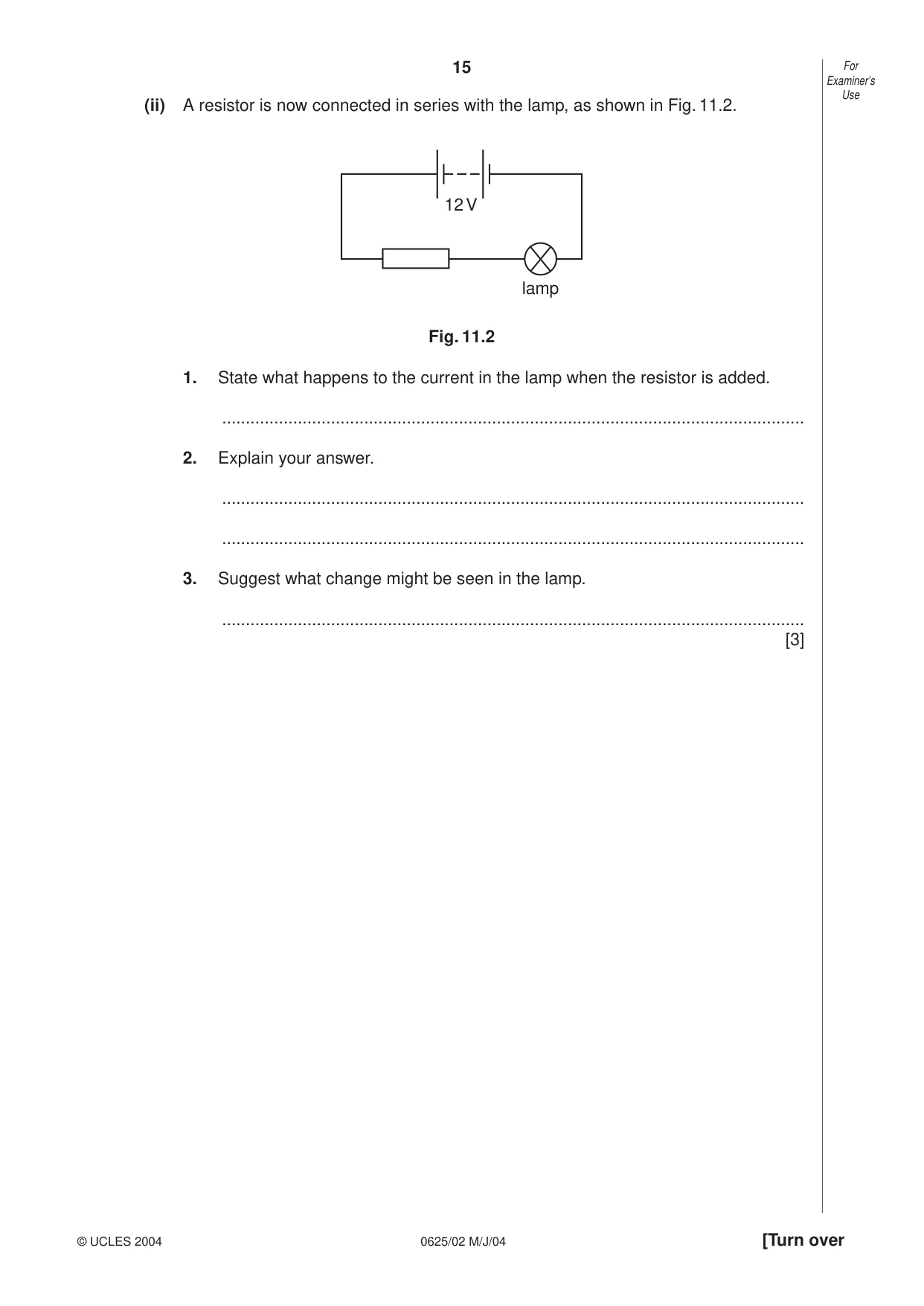
© UCLES 2004 15 0625/02 M/J/04 [Turn over (ii) A resistor is now connected in series with the lamp, as shown in Fig. 11.2. Fig. 11.2 1. State what happens to the current in the lamp when the resistor is added. … 2. Explain your answer. … … 3. Suggest what change might be seen in the lamp. … [3] lamp 12 V For Examiner’s Use
Question paper, page 16
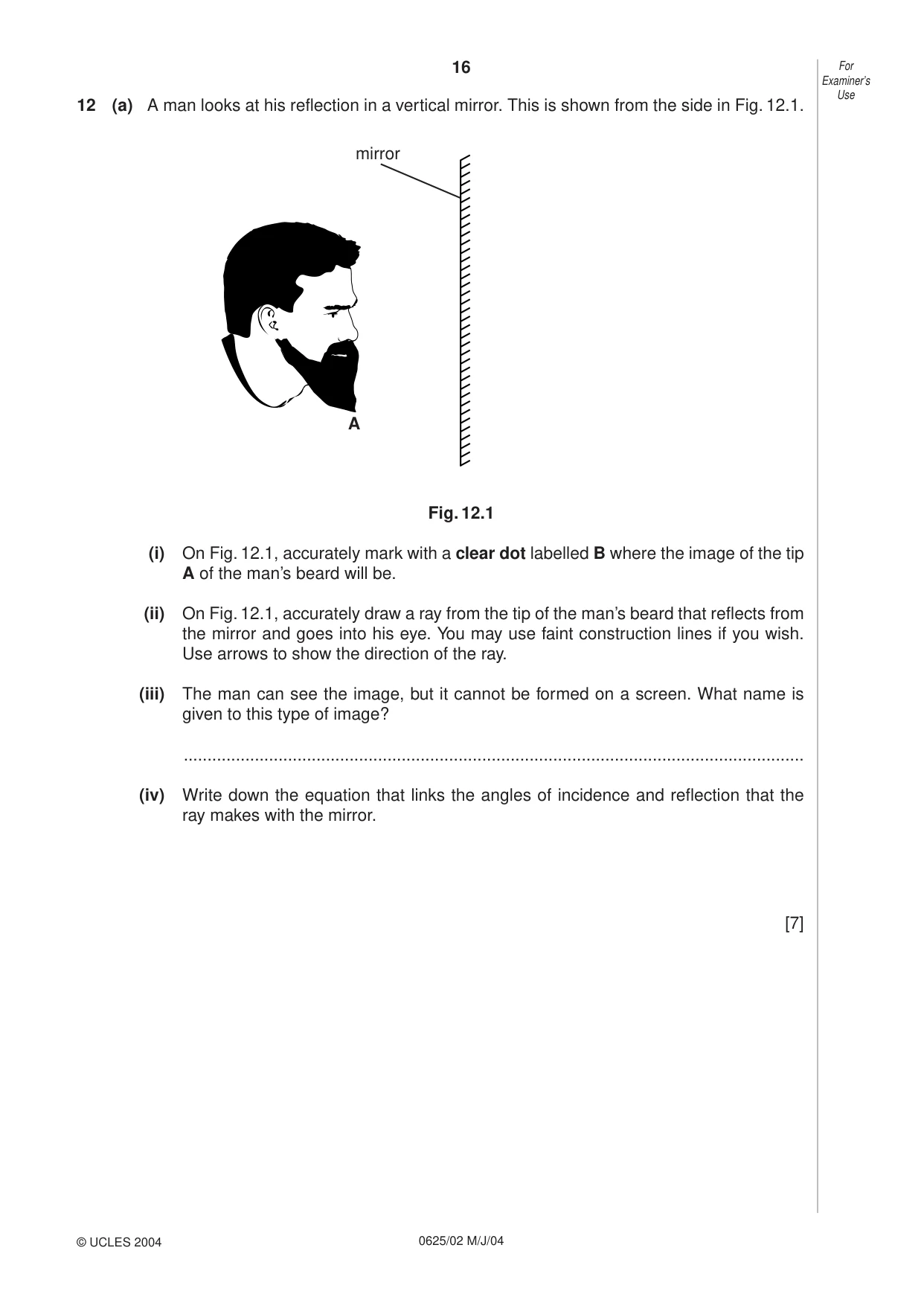
© UCLES 2004 For Examiner’s Use 16 0625/02 M/J/04 12 (a) A man looks at his reflection in a vertical mirror. This is shown from the side in Fig. 12.1. Fig. 12.1 (i) On Fig. 12.1, accurately mark with a clear dot labelled B where the image of the tip A of the man’s beard will be. (ii) On Fig. 12.1, accurately draw a ray from the tip of the man’s beard that reflects from the mirror and goes into his eye. You may use faint construction lines if you wish. Use arrows to show the direction of the ray. (iii) The man can see the image, but it cannot be formed on a screen. What name is given to this type of image? … (iv) Write down the equation that links the angles of incidence and reflection that the ray makes with the mirror. [7] mirror A
Question paper, page 17
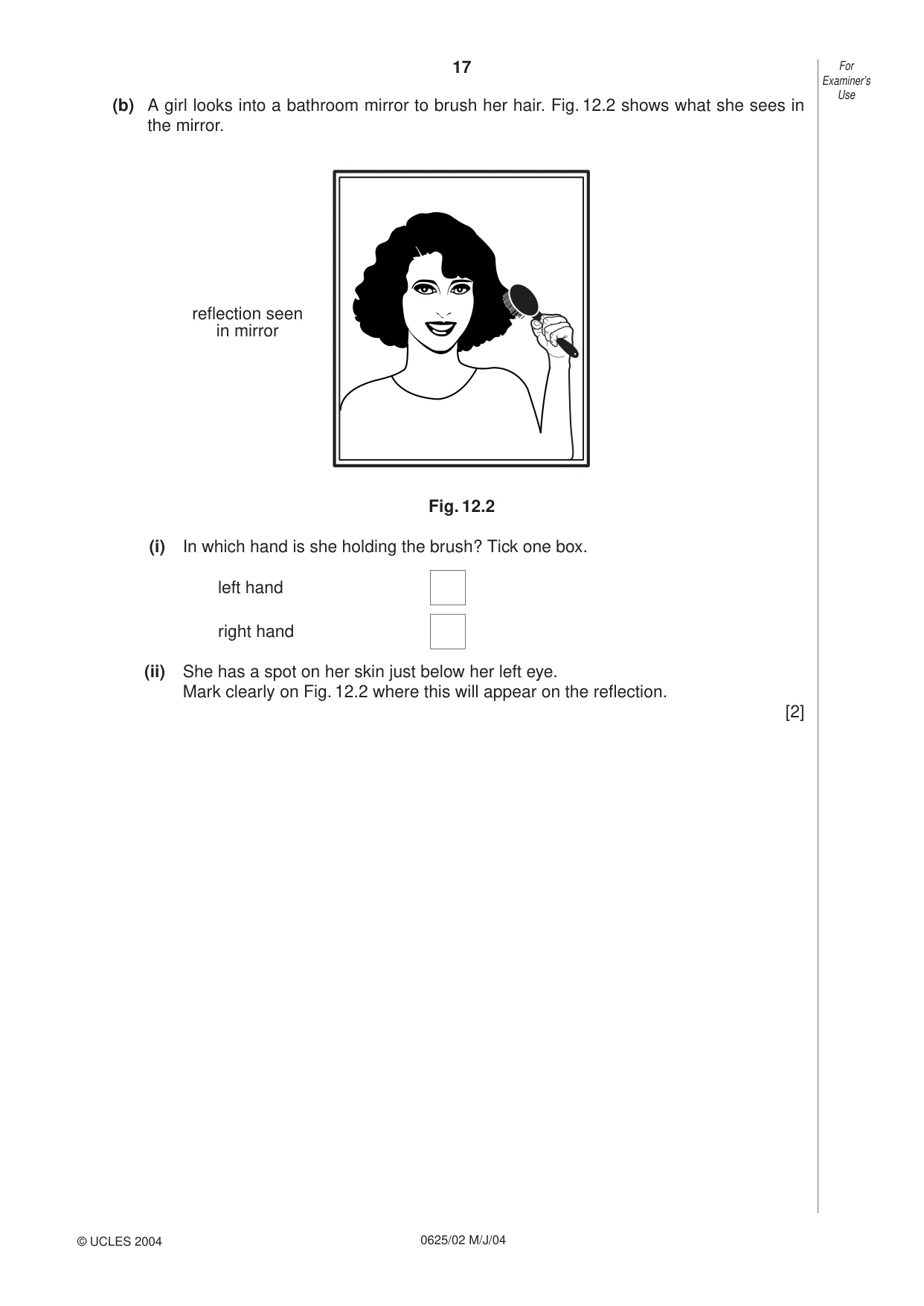
17 0625/02 M/J/04 (b) A girl looks into a bathroom mirror to brush her hair. Fig. 12.2 shows what she sees in the mirror. Fig. 12.2 (i) In which hand is she holding the brush? Tick one box. left hand right hand (ii) She has a spot on her skin just below her left eye. Mark clearly on Fig. 12.2 where this will appear on the reflection. [2] reflection seen in mirror For Examiner’s Use © UCLES 2004
Question paper, page 20
20 0625/02 M/J/04 BLANK PAGE Copyright Acknowledgements: Every reasonable effort has been made to trace all copyright holders. The publishers would be pleased to hear from anyone whose rights we have unwittingly infringed. University of Cambridge International Examinations is part of the University of Cambridge Local Examinations Syndicate (UCLES), which is itself a department of the University of Cambridge.