Cambridge IGCSE Physical Science 0652 — 2017 Oct/Nov Paper 4 · Variant 2
0652/42/O/N/17 · 11 questions · 80 marks · ≈90 min
The question paper and its mark scheme, free to read here and free to download. This is Cambridge’s own paper, exactly as it was sat.
Question paper20 pages

Mark scheme9 pages
Answers below. Sit the paper first if you are practising.
Questions as text
Q1 · A ball falls through the atmosphere of a planet
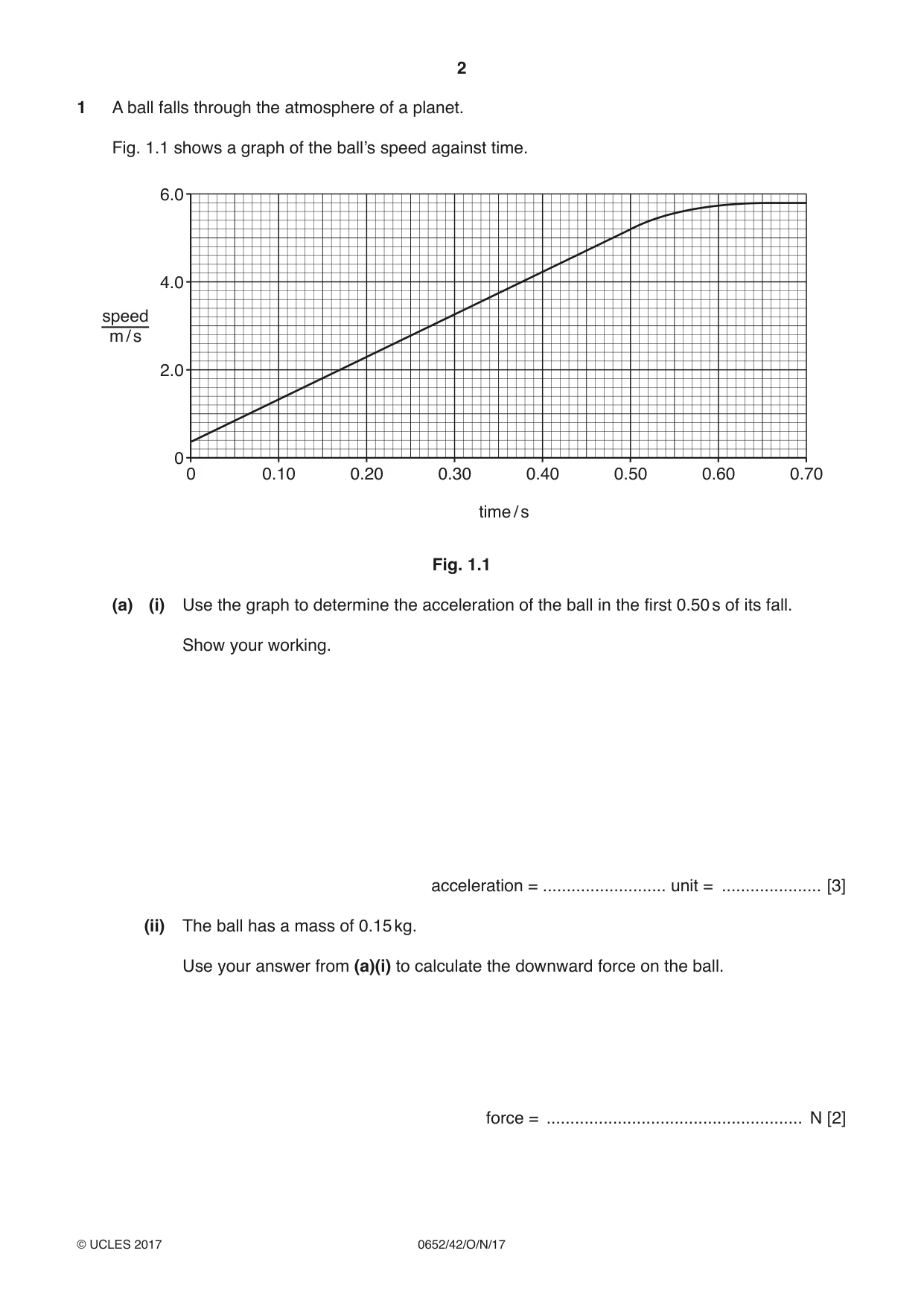
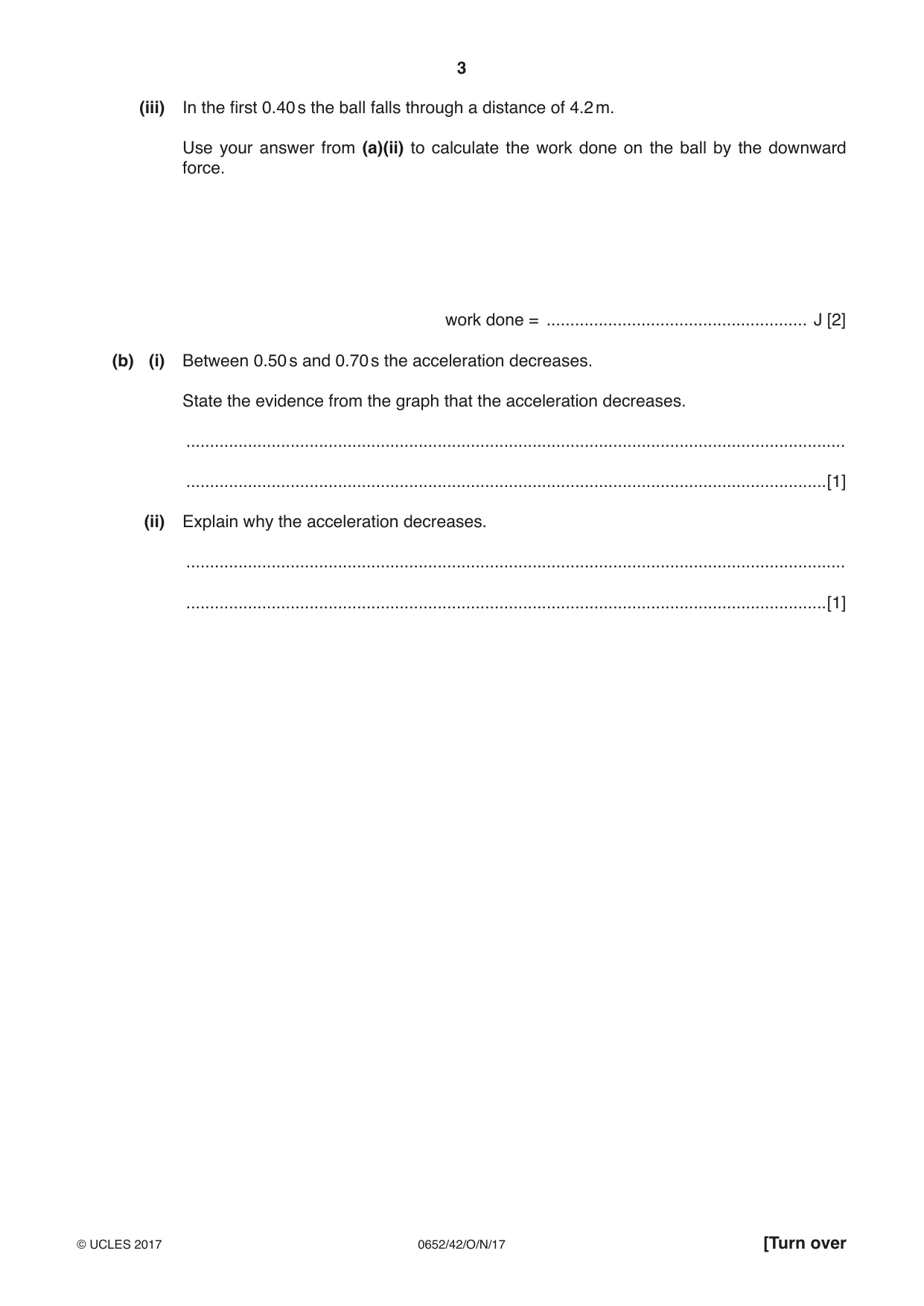
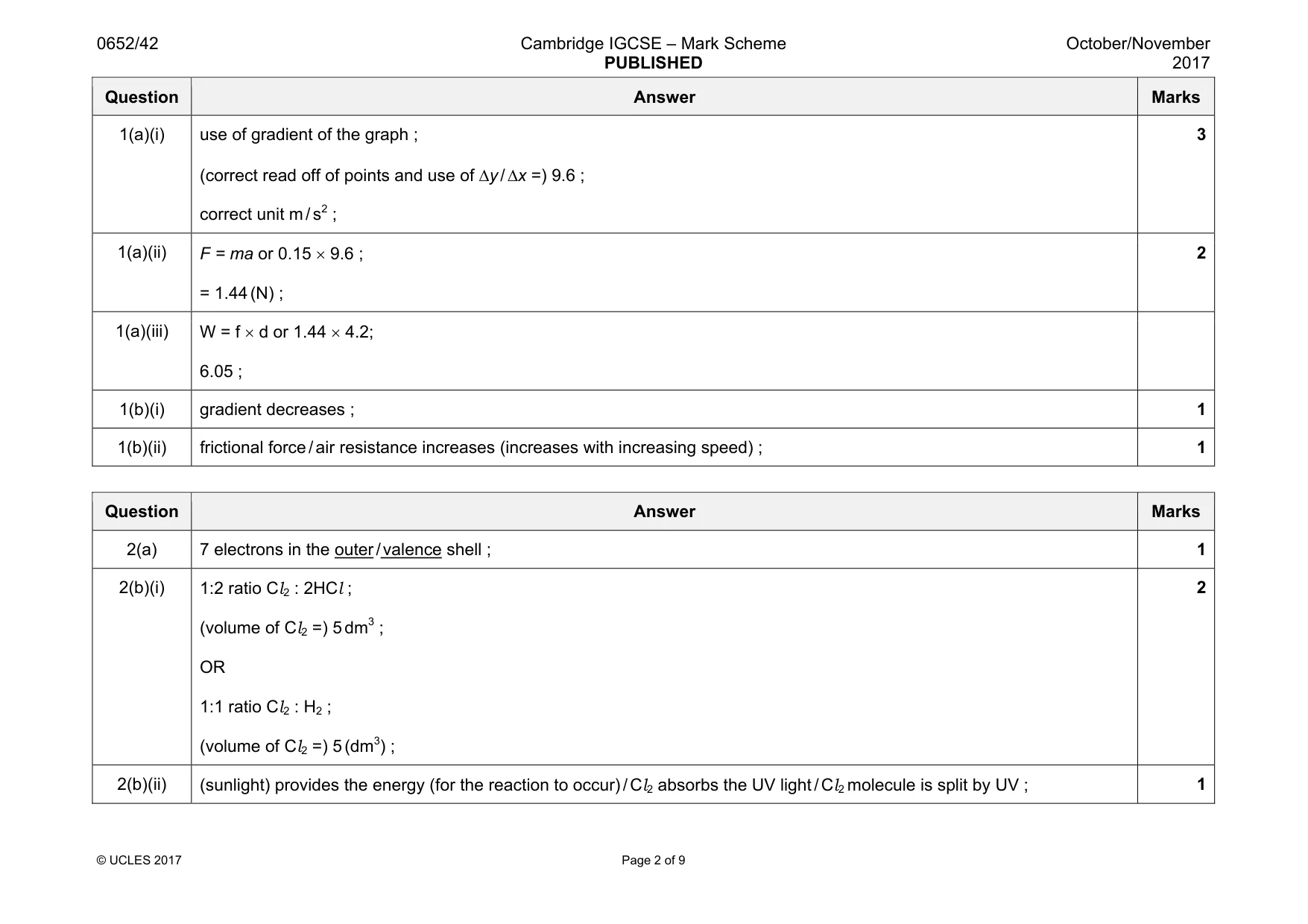
1 A ball falls through the atmosphere of a planet. Fig. 1.1 shows a graph of the ball’s speed against time. 6.0 4.0 speed m / s 2.0 0 0 0.10 0.20 0.30 0.40 0.50 0.60 0.70 time / s Fig. 1.1 (a) (i) Use the graph to determine the acceleration of the ball in the first 0.50 s of its fall. Show your working. acceleration = .......................... unit = ..................... [3] (ii) The ball has a mass of 0.15 kg. Use your answer from (a)(i) to calculate the downward force on the ball. force = ...................................................... N [2] (iii) In the first 0.40 s the ball falls through a distance of 4.2 m. Use your answer from (a)(ii) to calculate the work done on the ball by the downward force. work done = ....................................................... J [2] (b) (i) Between 0.50 s and 0.70 s the acceleration decreases. State the evidence from the graph that the acceleration decreases. ........................................................................................................................................... .......................................................................................................................................[1] (ii) Explain why the acceleration decreases. ........................................................................................................................................... .......................................................................................................................................[1]
Mark scheme: 1(a)(i) use of gradient of the graph ; (correct read off of points and use of ∆y / ∆x =) 9.6 ; correct unit m / s2 ; 3 1(a)(ii) F = ma or 0.15 × 9.6 ; = 1.44 (N) ; 2 1(a)(iii) W = f × d or 1.44 × 4.2; 6.05 ; 1(b)(i) gradient decreases ; 1 1(b)(ii) frictional force / air resistance increases (increases with increasing speed) ; 1
Q2 · Chlorine is in Group VII of the Periodic Table
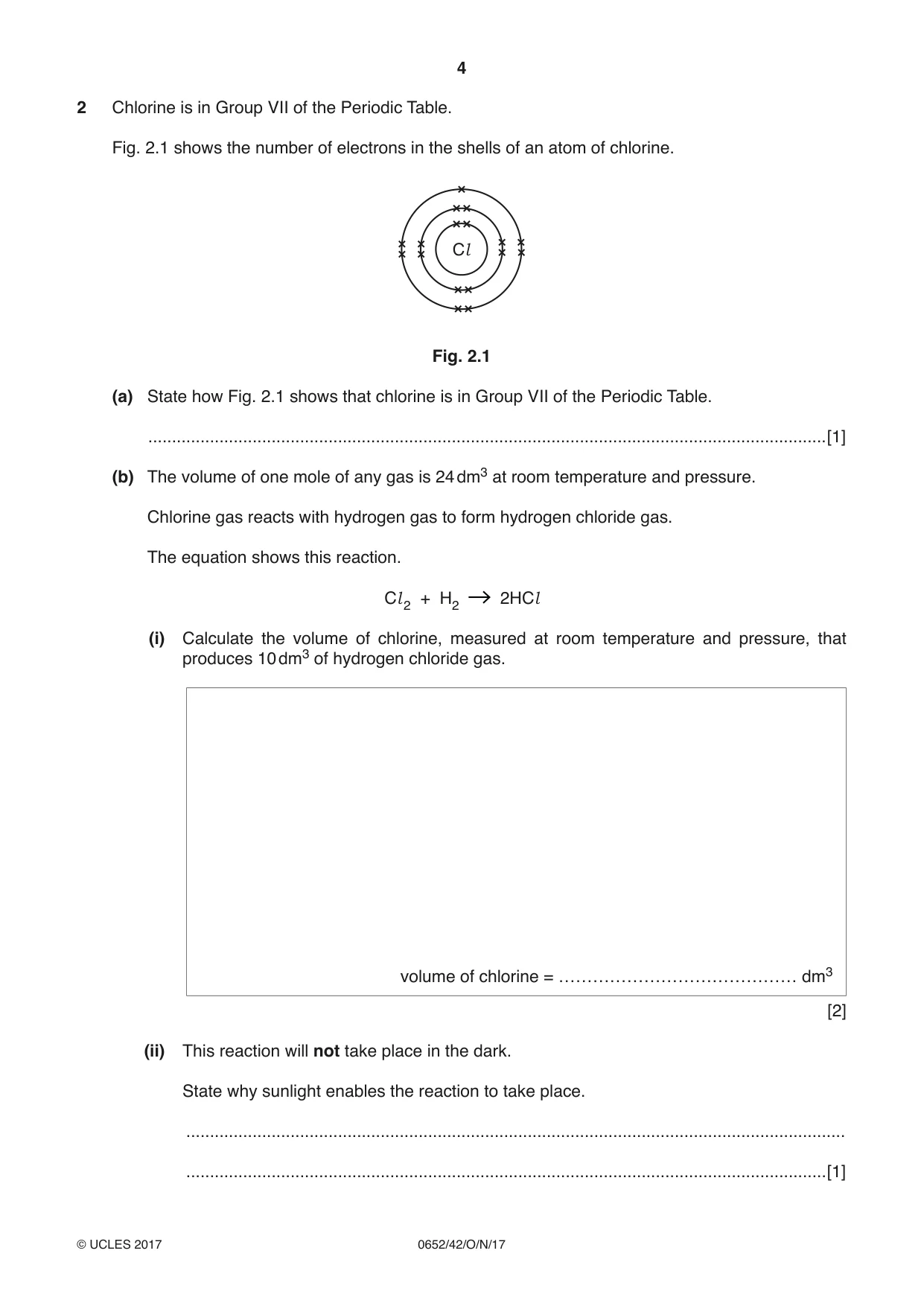
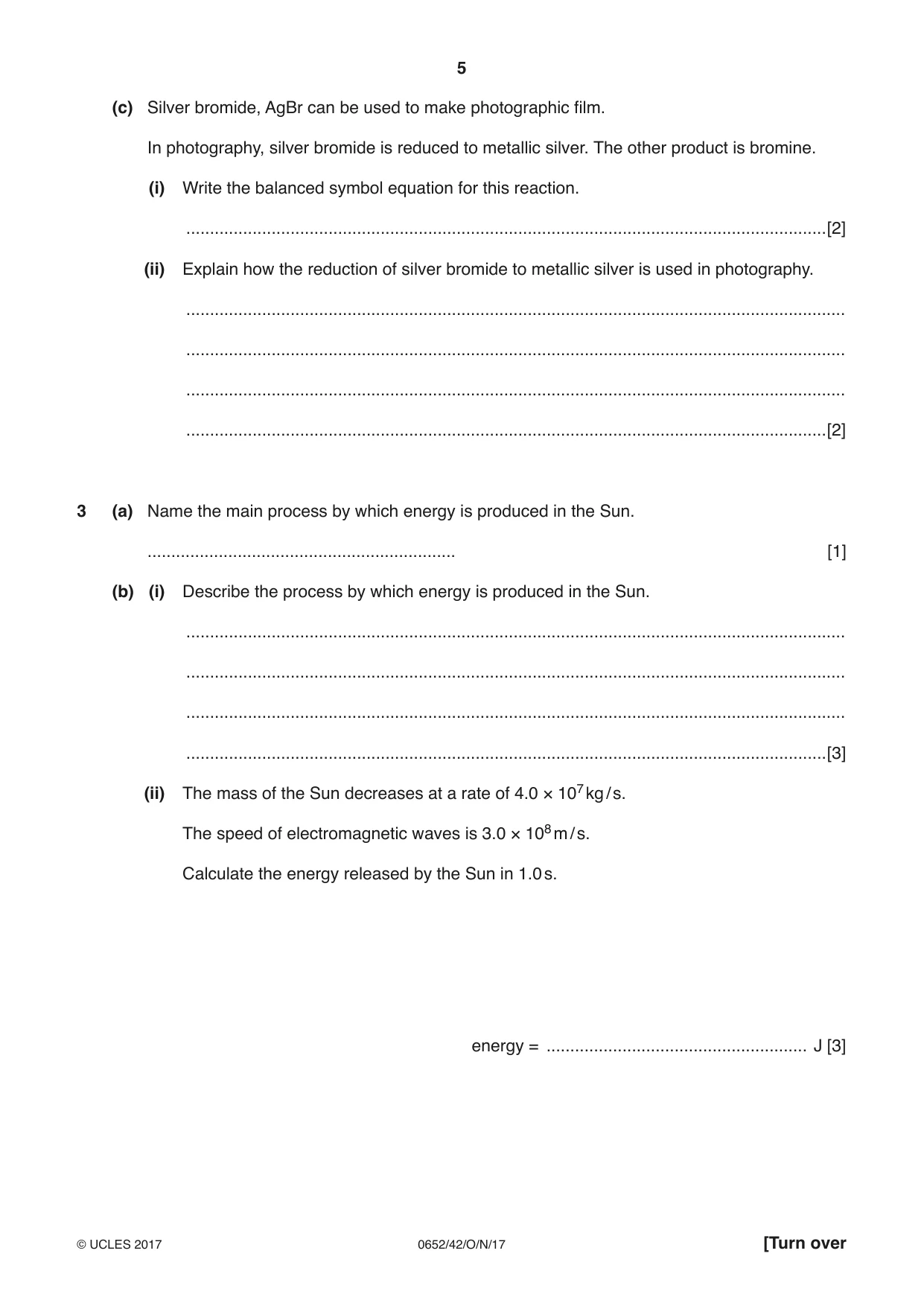
2 Chlorine is in Group VII of the Periodic Table. Fig. 2.1 shows the number of electrons in the shells of an atom of chlorine. Cl Fig. 2.1 (a) State how Fig. 2.1 shows that chlorine is in Group VII of the Periodic Table. ...............................................................................................................................................[1] (b) The volume of one mole of any gas is 24 dm3 at room temperature and pressure. Chlorine gas reacts with hydrogen gas to form hydrogen chloride gas. The equation shows this reaction. Cl 2 + H2 2HCl (i) Calculate the volume of chlorine, measured at room temperature and pressure, that produces 10 dm3 of hydrogen chloride gas. volume of chlorine = …………………………………… dm3 [2] (ii) This reaction will not take place in the dark. State why sunlight enables the reaction to take place. ........................................................................................................................................... .......................................................................................................................................[1] (c) Silver bromide, AgBr can be used to make photographic film. In photography, silver bromide is reduced to metallic silver. The other product is bromine. (i) Write the balanced symbol equation for this reaction. .......................................................................................................................................[2] (ii) Explain how the reduction of silver bromide to metallic silver is used in photography. ........................................................................................................................................... ........................................................................................................................................... ........................................................................................................................................... .......................................................................................................................................[2]
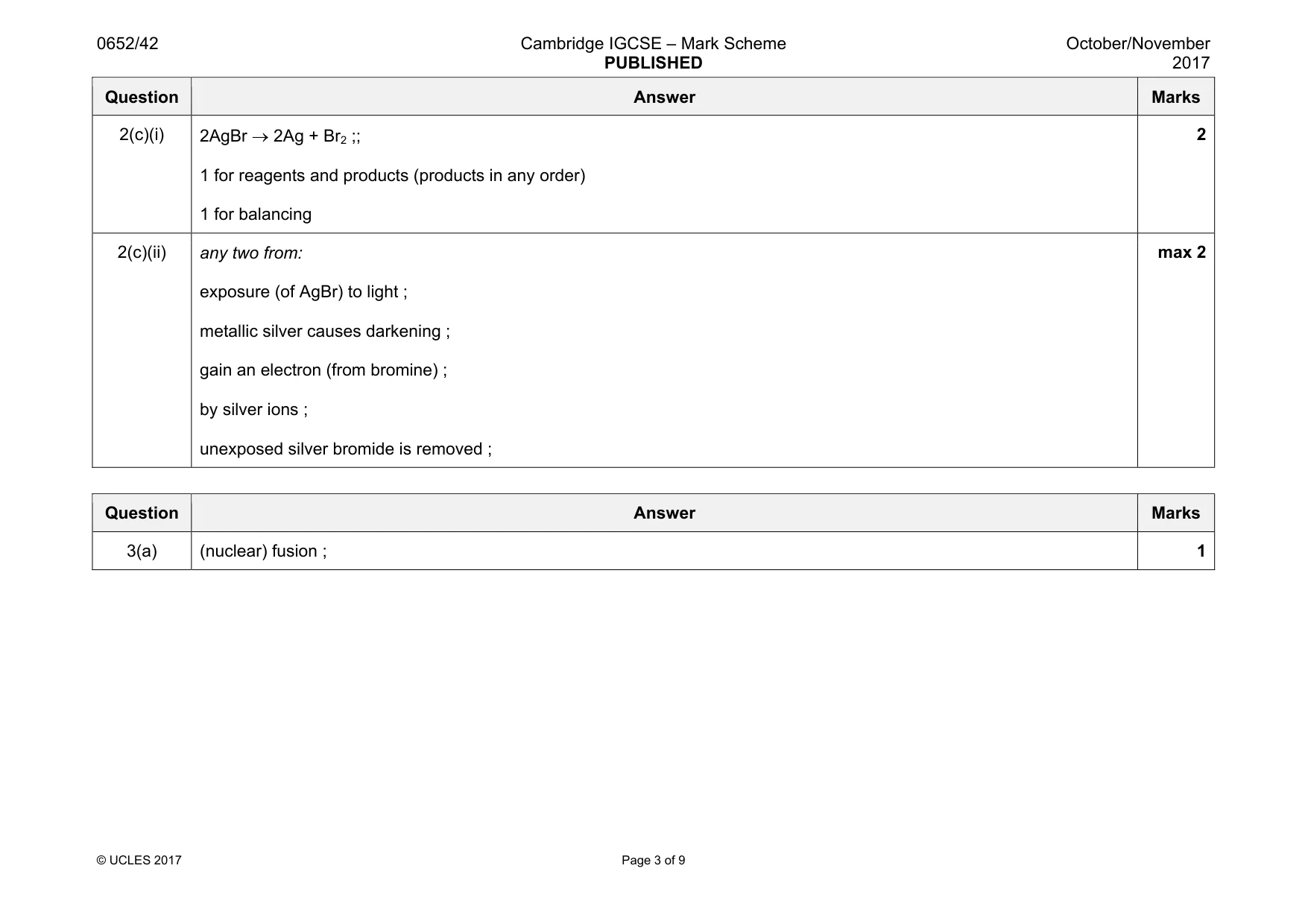
Mark scheme: 2(a) 7 electrons in the outer / valence shell ; 1 2(b)(i) 1:2 ratio Cl2 : 2HCl ; (volume of Cl2 =) 5 dm3 ; OR 1:1 ratio Cl2 : H2 ; (volume of Cl2 =) 5 (dm3) ; 2 2(b)(ii) (sunlight) provides the energy (for the reaction to occur) / Cl2 absorbs the UV light / Cl2 molecule is split by UV ; 1 Question Answer Marks 2(c)(i) 2AgBr → 2Ag + Br2 ;; 1 for reagents and products (products in any order) 1 for balancing 2 2(c)(ii) any two from: exposure (of AgBr) to light ; metallic silver causes darkening ; gain an electron (from bromine) ; by silver ions ; unexposed silver bromide is removed ; max 2
Q3 · Name the main process by which energy is produced in the Sun
3 (a) Name the main process by which energy is produced in the Sun. ................................................................. [1] (b) (i) Describe the process by which energy is produced in the Sun. ........................................................................................................................................... ........................................................................................................................................... ........................................................................................................................................... .......................................................................................................................................[3] (ii) The mass of the Sun decreases at a rate of 4.0 × 10⁷ kg / s. The speed of electromagnetic waves is 3.0 × 10⁸ m / s. Calculate the energy released by the Sun in 1.0 s. energy = ....................................................... J [3]
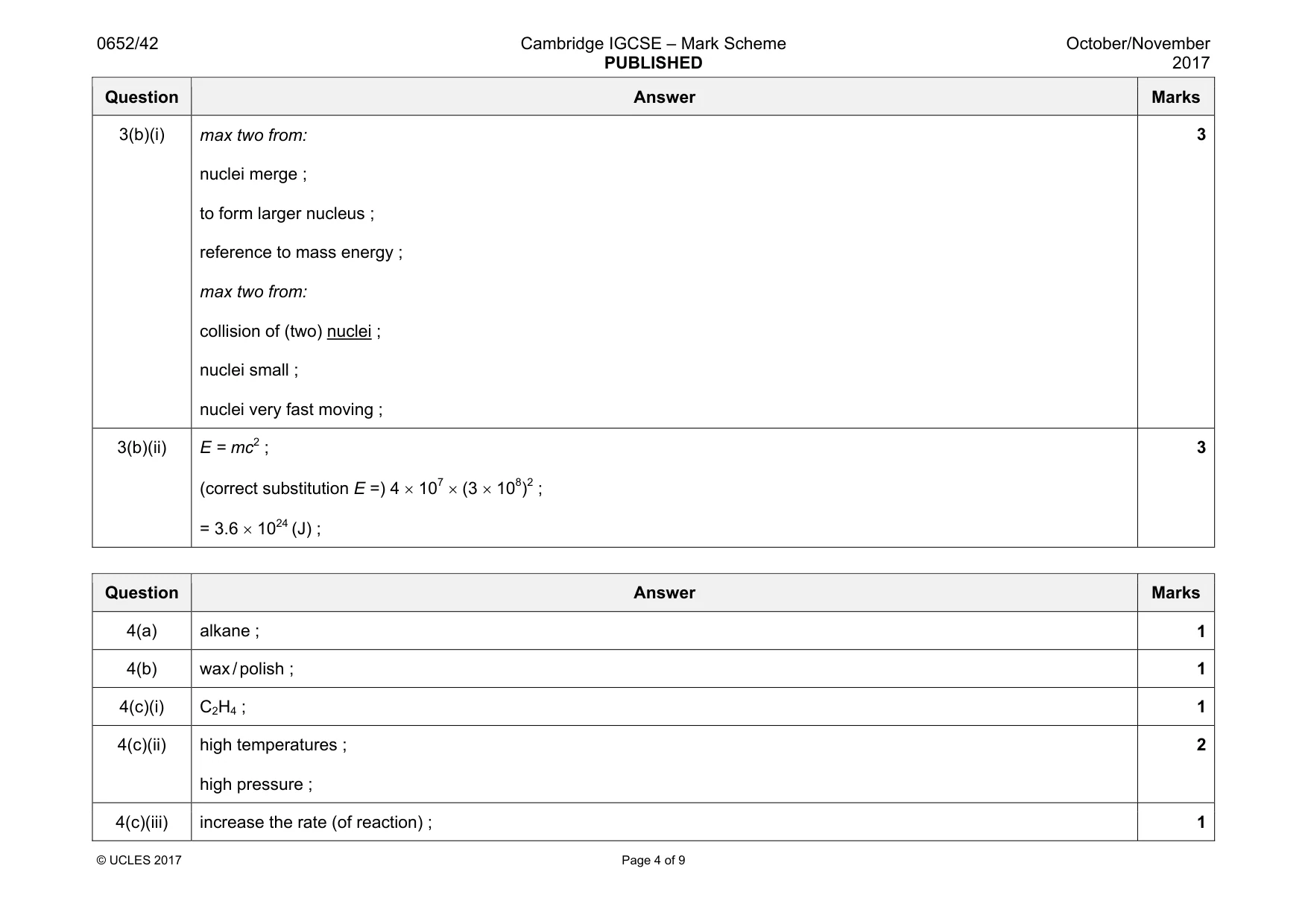
Mark scheme: 3(a) (nuclear) fusion ; 1 Question Answer Marks 3(b)(i) max two from: nuclei merge ; to form larger nucleus ; reference to mass energy ; max two from: collision of (two) nuclei ; nuclei small ; nuclei very fast moving ; 3 3(b)(ii) E = mc2 ; (correct substitution E =) 4 × 107 × (3 × 108)2 ; = 3.6 × 1024 (J) ; 3
Q4 · Nonadecane is an organic compound, with the formula C19H40
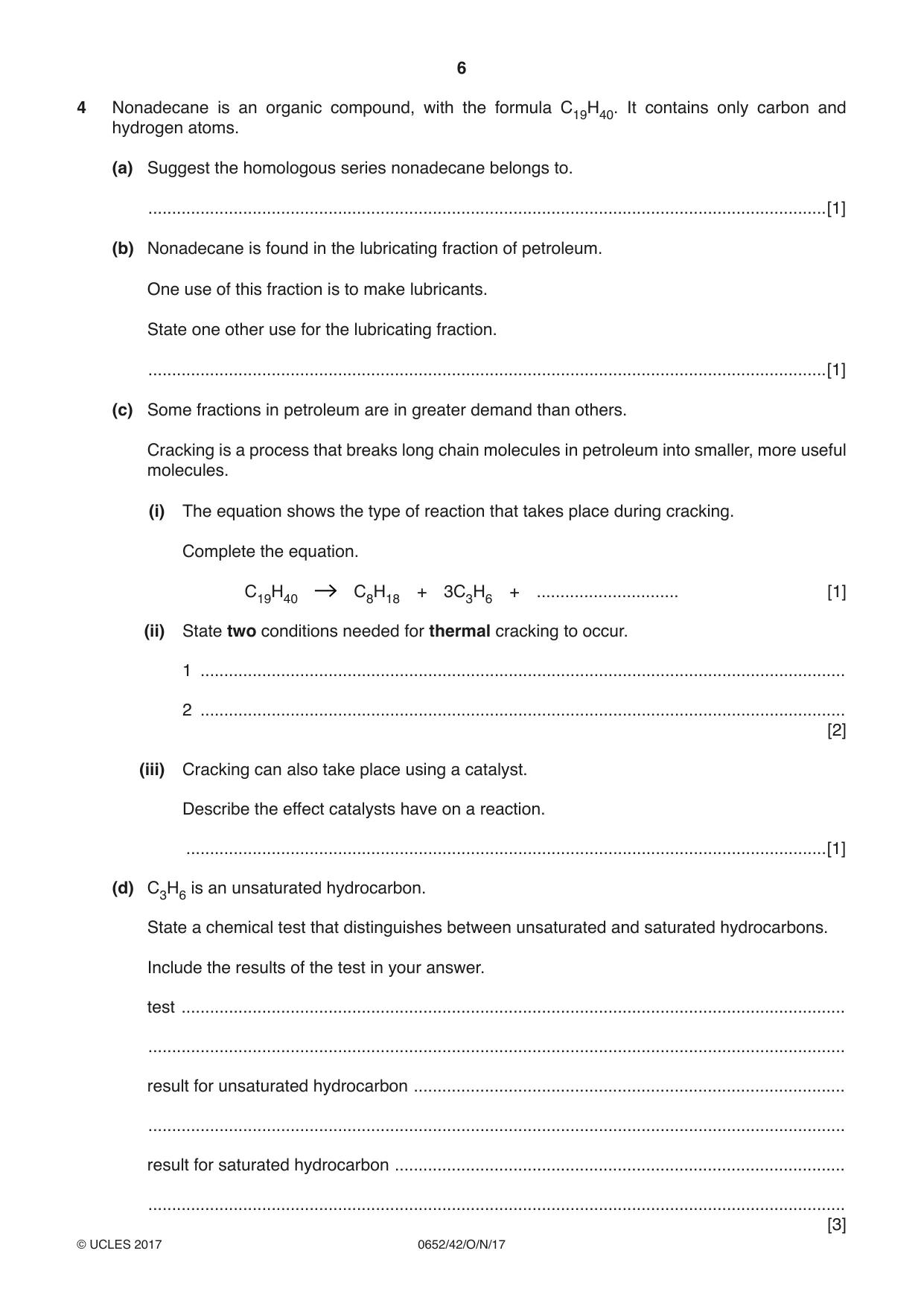
4 Nonadecane is an organic compound, with the formula C19H40. It contains only carbon and hydrogen atoms. (a) Suggest the homologous series nonadecane belongs to. ...............................................................................................................................................[1] (b) Nonadecane is found in the lubricating fraction of petroleum. One use of this fraction is to make lubricants. State one other use for the lubricating fraction. ...............................................................................................................................................[1] (c) Some fractions in petroleum are in greater demand than others. Cracking is a process that breaks long chain molecules in petroleum into smaller, more useful molecules. (i) The equation shows the type of reaction that takes place during cracking. Complete the equation. C19H40 C8H18 + 3C3H6 + .............................. [1] (ii) State two conditions needed for thermal cracking to occur. 1 ........................................................................................................................................ 2 ........................................................................................................................................ [2] (iii) Cracking can also take place using a catalyst. Describe the effect catalysts have on a reaction. .......................................................................................................................................[1] (d) C3H6 is an unsaturated hydrocarbon. State a chemical test that distinguishes between unsaturated and saturated hydrocarbons. Include the results of the test in your answer. test ............................................................................................................................................ ................................................................................................................................................... result for unsaturated hydrocarbon ........................................................................................... ................................................................................................................................................... result for saturated hydrocarbon ............................................................................................... ................................................................................................................................................... Question 5 begins over the page
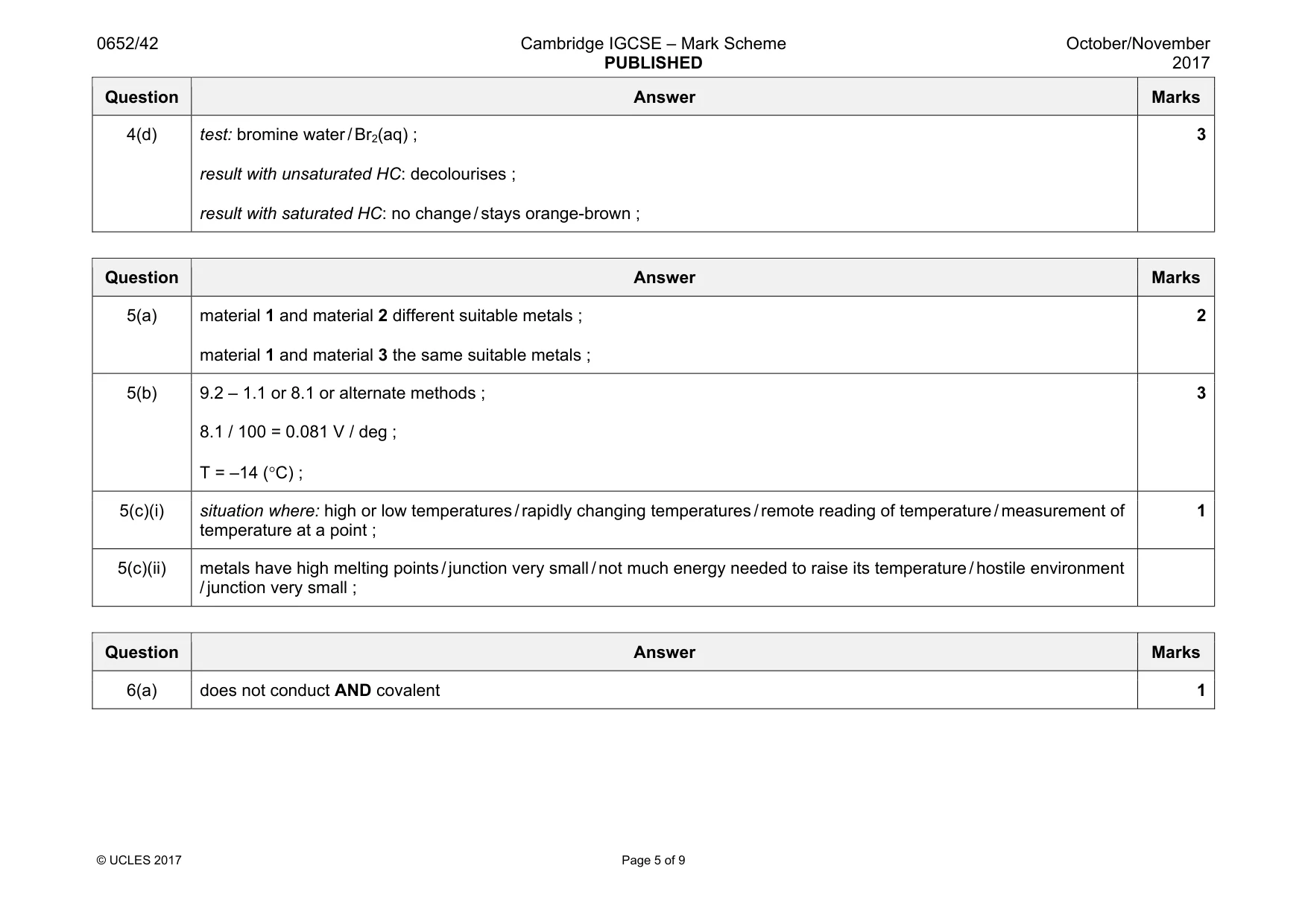
Mark scheme: 4(a) alkane ; 1 4(b) wax / polish ; 1 4(c)(i) C2H4 ; 1 4(c)(ii) high temperatures ; high pressure ; 2 4(c)(iii) increase the rate (of reaction) ; 1 Question Answer Marks 4(d) test: bromine water / Br2(aq) ; result with unsaturated HC: decolourises ; result with saturated HC: no change / stays orange-brown ; 3
Question 5
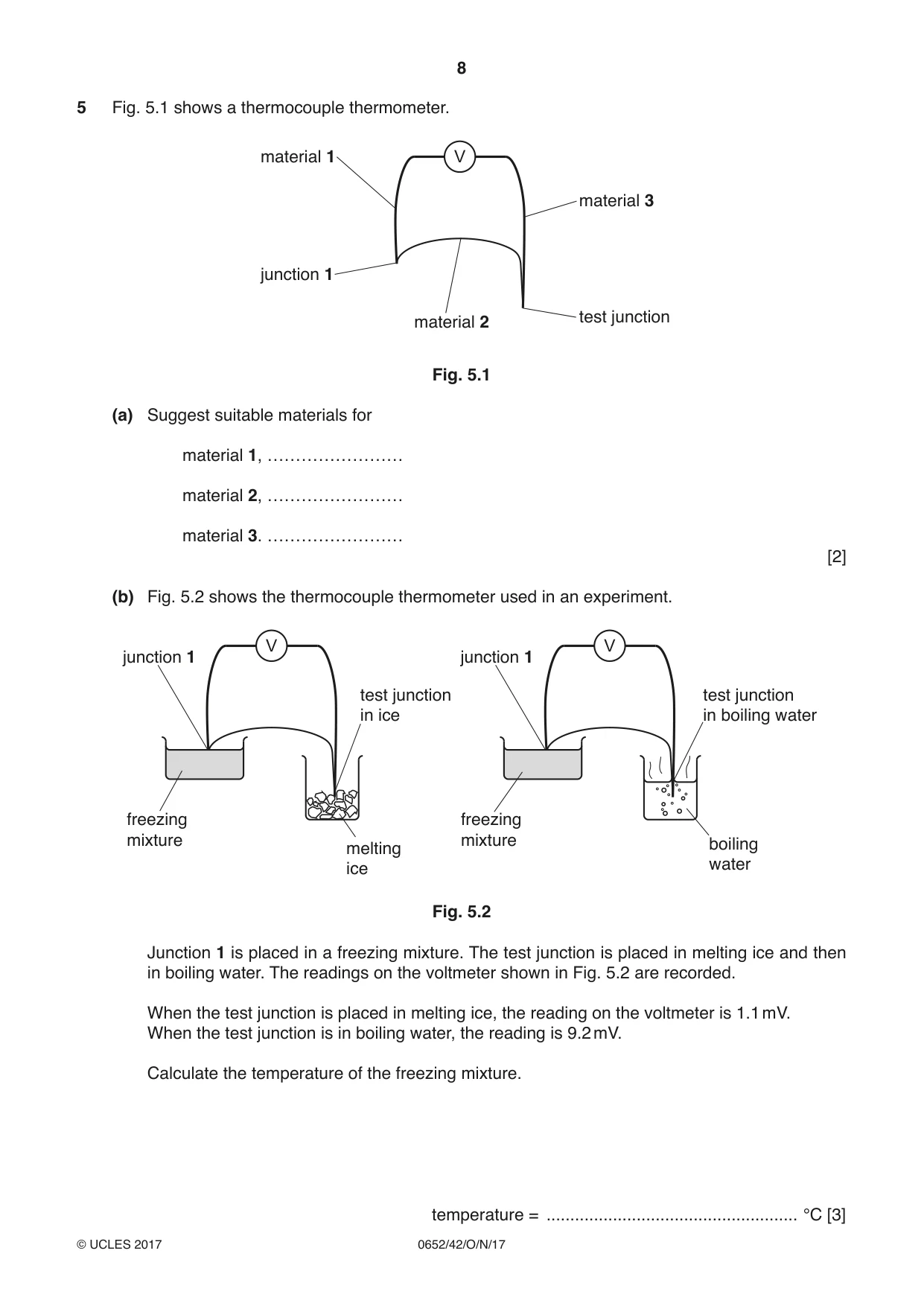
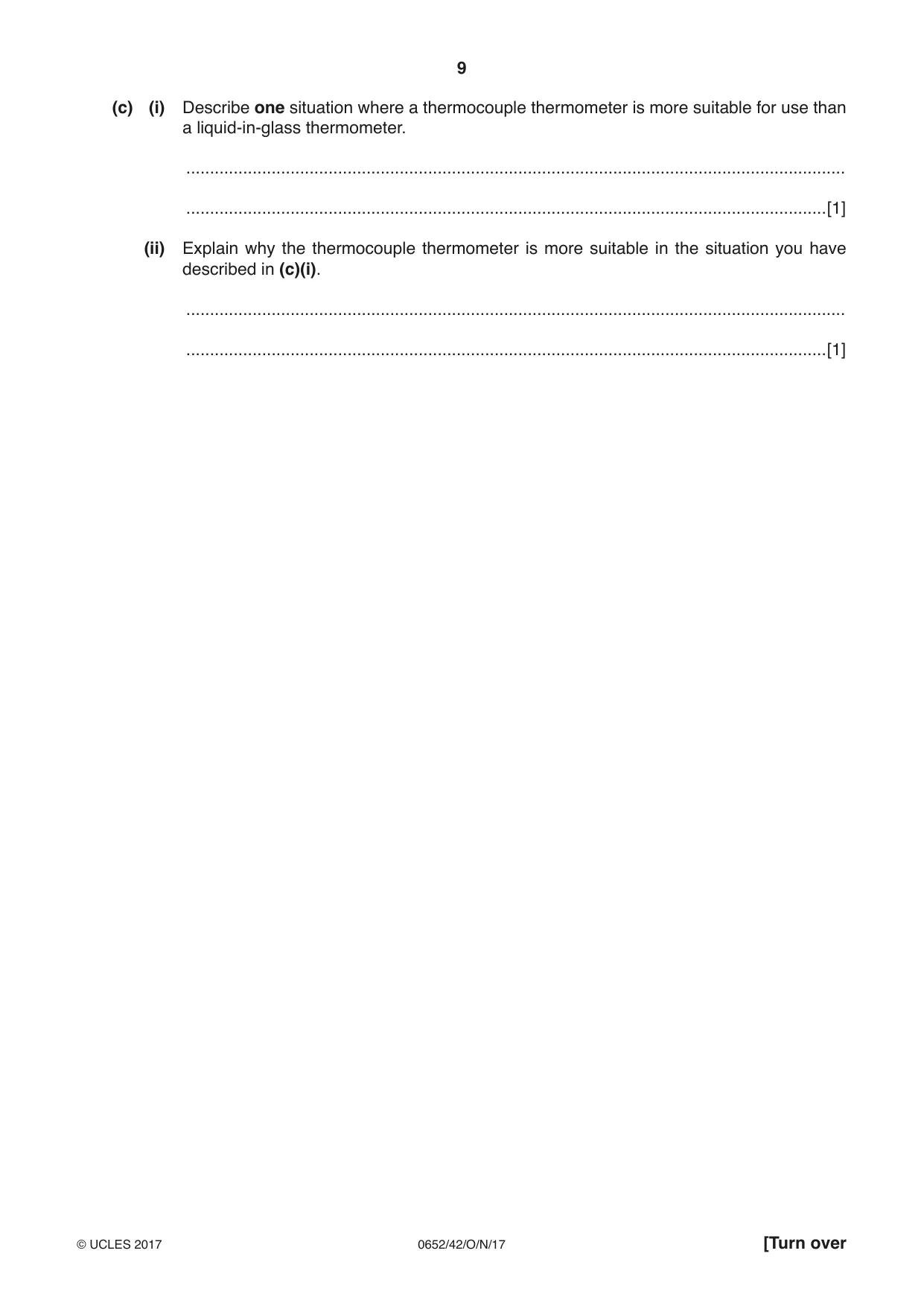
5 Fig. 5.1 shows a thermocouple thermometer. material 1 V material 3 junction 1 test junction material 2 Fig. 5.1 (a) Suggest suitable materials for material 1, …………………… material 2, …………………… material 3. …………………… [2] (b) Fig. 5.2 shows the thermocouple thermometer used in an experiment. V V junction 1 junction 1 test junction test junction in ice in boiling water freezing freezing mixture mixture boiling melting ice water Fig. 5.2 Junction 1 is placed in a freezing mixture. The test junction is placed in melting ice and then in boiling water. The readings on the voltmeter shown in Fig. 5.2 are recorded. When the test junction is placed in melting ice, the reading on the voltmeter is 1.1 mV. When the test junction is in boiling water, the reading is 9.2 mV. Calculate the temperature of the freezing mixture. temperature = ..................................................... °C [3] (c) (i) Describe one situation where a thermocouple thermometer is more suitable for use than a liquid-in-glass thermometer. ........................................................................................................................................... .......................................................................................................................................[1] (ii) Explain why the thermocouple thermometer is more suitable in the situation you have described in (c)(i). ........................................................................................................................................... .......................................................................................................................................[1]
Mark scheme: 5(a) material 1 and material 2 different suitable metals ; material 1 and material 3 the same suitable metals ; 2 5(b) 9.2 – 1.1 or 8.1 or alternate methods ; 8.1 / 100 = 0.081 V / deg ; T = –14 (°C) ; 3 5(c)(i) situation where: high or low temperatures / rapidly changing temperatures / remote reading of temperature / measurement of temperature at a point ; 1 5(c)(ii) metals have high melting points / junction very small / not much energy needed to raise its temperature / hostile environment / junction very small ;
Q6 · The properties of a compound are listed
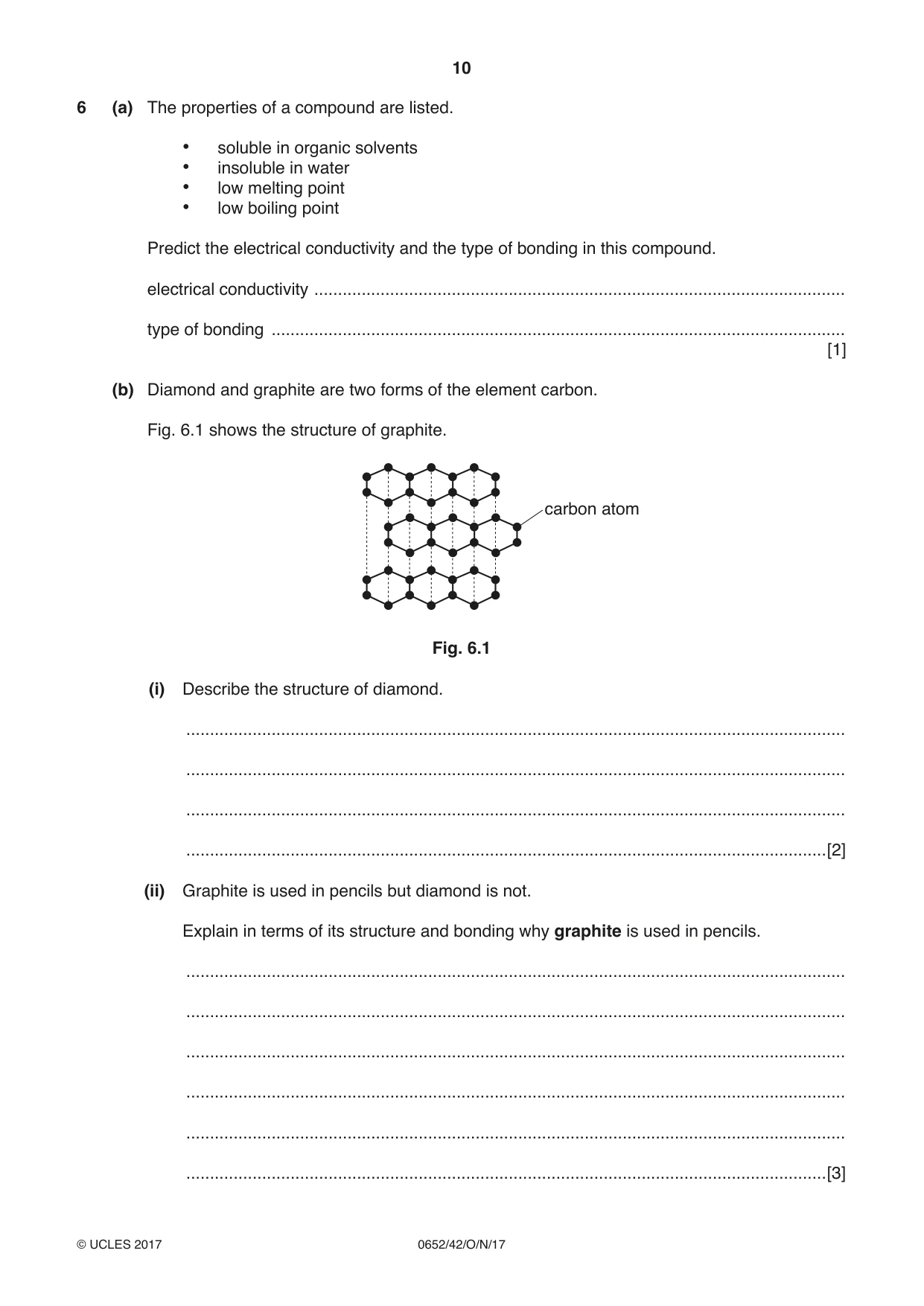
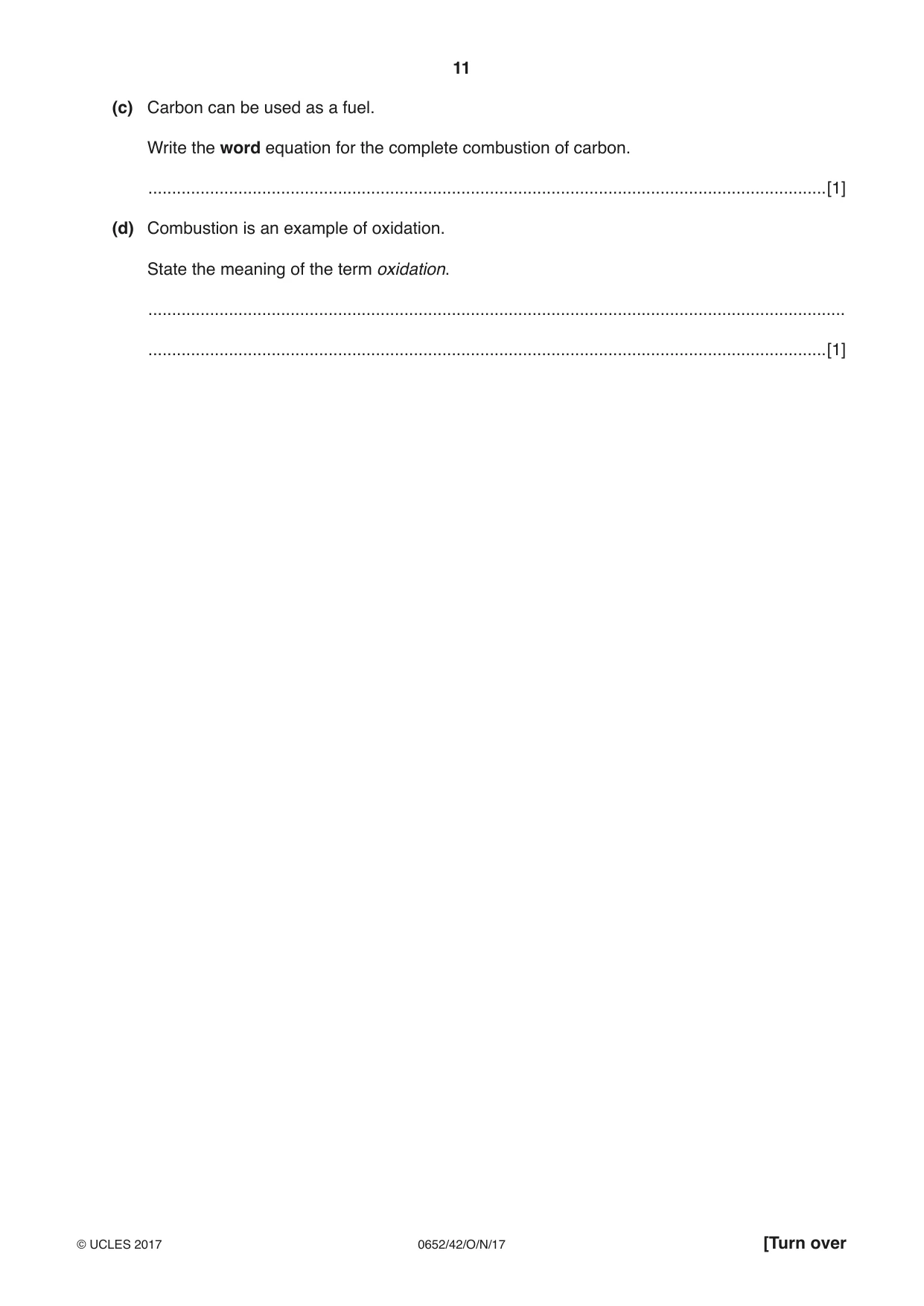
6 (a) The properties of a compound are listed. • soluble in organic solvents • insoluble in water • low melting point • low boiling point Predict the electrical conductivity and the type of bonding in this compound. electrical conductivity ................................................................................................................ type of bonding ......................................................................................................................... [1] (b) Diamond and graphite are two forms of the element carbon. Fig. 6.1 shows the structure of graphite. carbon atom Fig. 6.1 (i) Describe the structure of diamond. ........................................................................................................................................... ........................................................................................................................................... ........................................................................................................................................... .......................................................................................................................................[2] (ii) Graphite is used in pencils but diamond is not. Explain in terms of its structure and bonding why graphite is used in pencils. ........................................................................................................................................... ........................................................................................................................................... ........................................................................................................................................... ........................................................................................................................................... ........................................................................................................................................... .......................................................................................................................................[3] (c) Carbon can be used as a fuel. Write the word equation for the complete combustion of carbon. ...............................................................................................................................................[1] (d) Combustion is an example of oxidation. State the meaning of the term oxidation. ................................................................................................................................................... ...............................................................................................................................................[1]
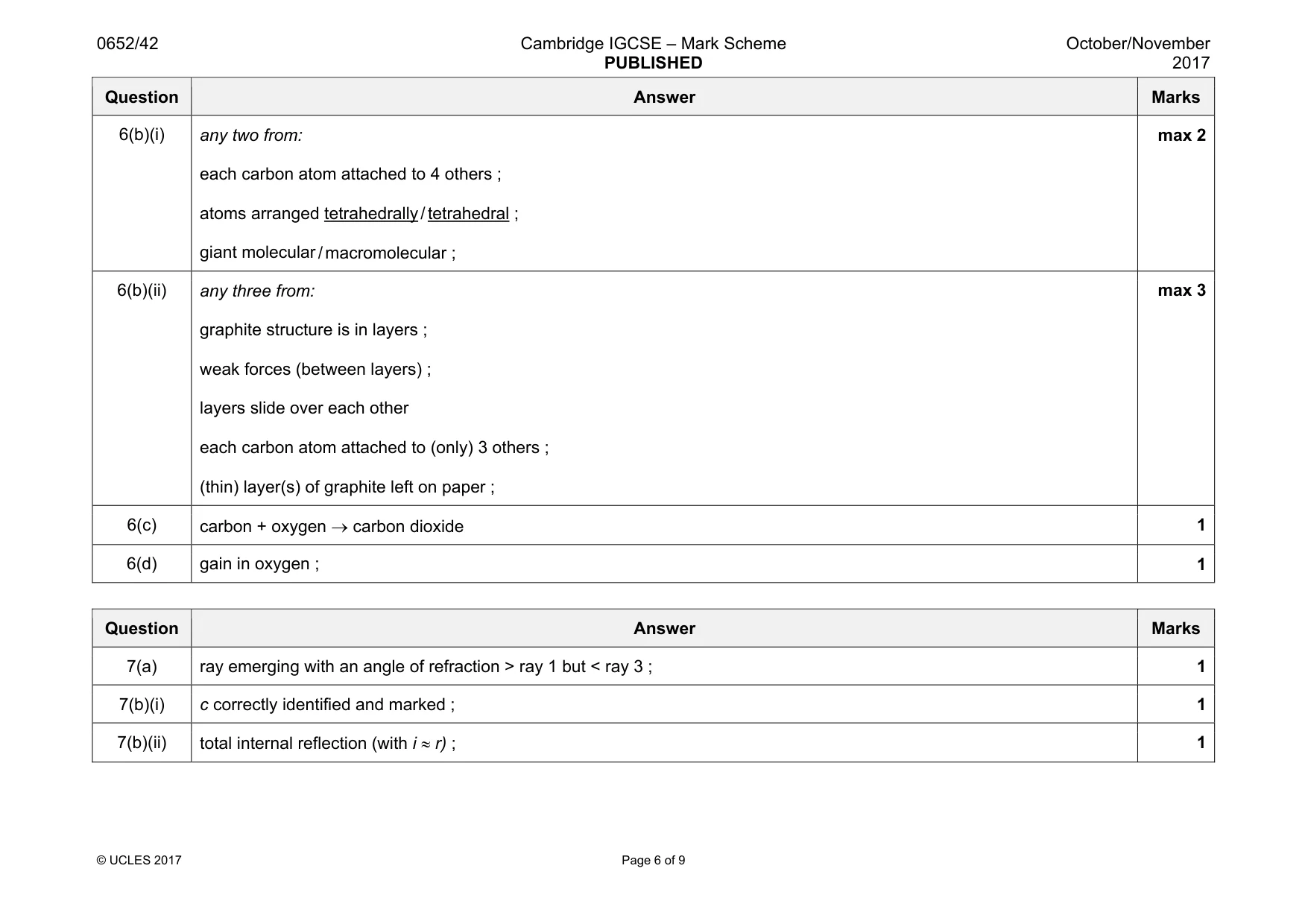
Mark scheme: 6(a) does not conduct AND covalent 1 Question Answer Marks 6(b)(i) any two from: each carbon atom attached to 4 others ; atoms arranged tetrahedrally / tetrahedral ; giant molecular / macromolecular ; max 2 6(b)(ii) any three from: graphite structure is in layers ; weak forces (between layers) ; layers slide over each other each carbon atom attached to (only) 3 others ; (thin) layer(s) of graphite left on paper ; max 3 6(c) carbon + oxygen → carbon dioxide 1 6(d) gain in oxygen ; 1
Q7 · A small lamp at the bottom of a swimming pool
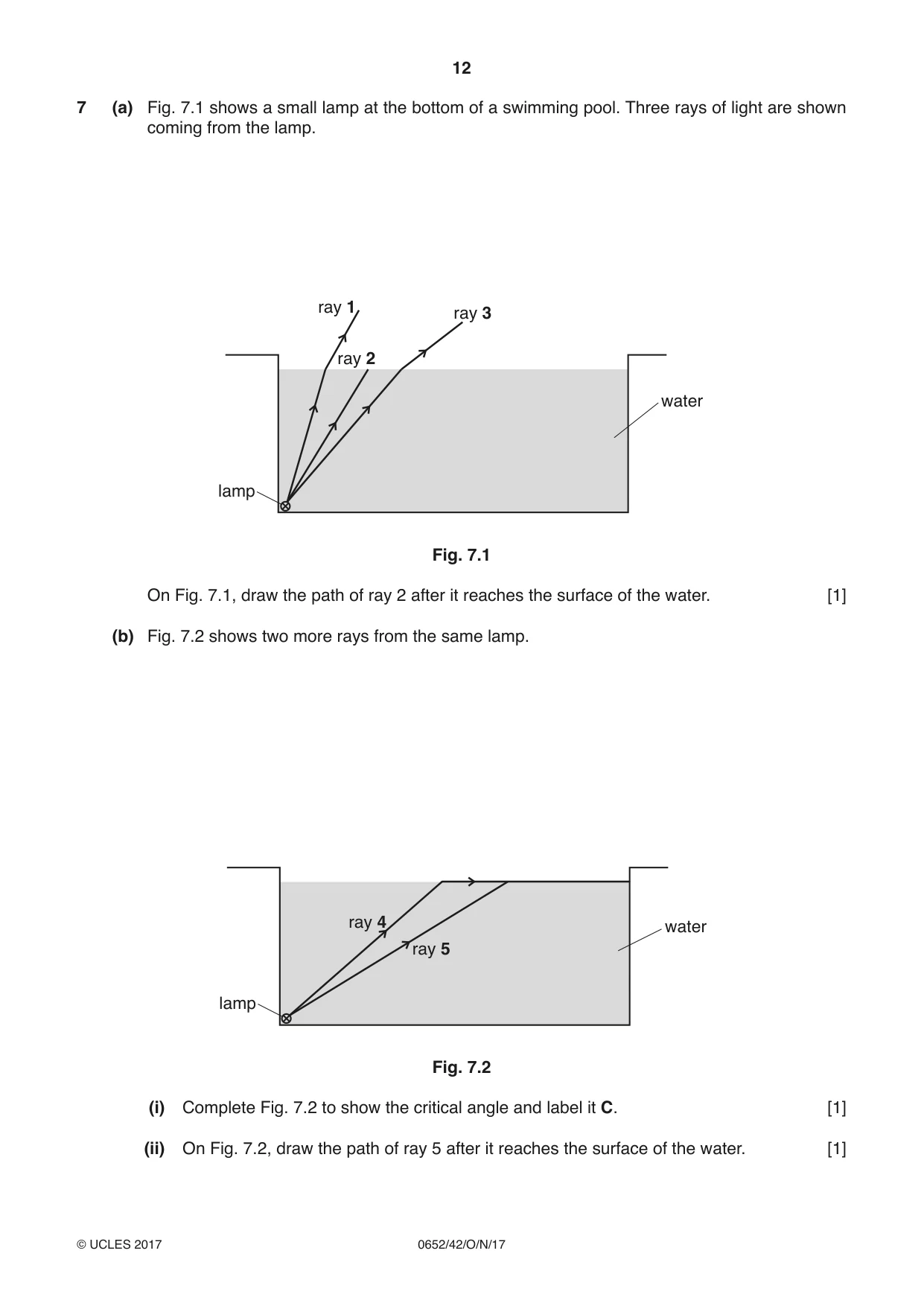
7 (a) Fig. 7.1 shows a small lamp at the bottom of a swimming pool. Three rays of light are shown coming from the lamp. ray 1 ray 3 ray 2 water lamp Fig. 7.1 On Fig. 7.1, draw the path of ray 2 after it reaches the surface of the water. [1] (b) Fig. 7.2 shows two more rays from the same lamp. ray 4 water ray 5 lamp Fig. 7.2 (i) Complete Fig. 7.2 to show the critical angle and label it C. [1] (ii) On Fig. 7.2, draw the path of ray 5 after it reaches the surface of the water. [1] (c) A boy stands by the swimming pool and shines a narrow beam of light at the water. The angle of incidence at the surface of the water is 38°. The refractive index of water n = 1.34. Calculate the angle of refraction. angle of refraction = ....................................................... ° [3]
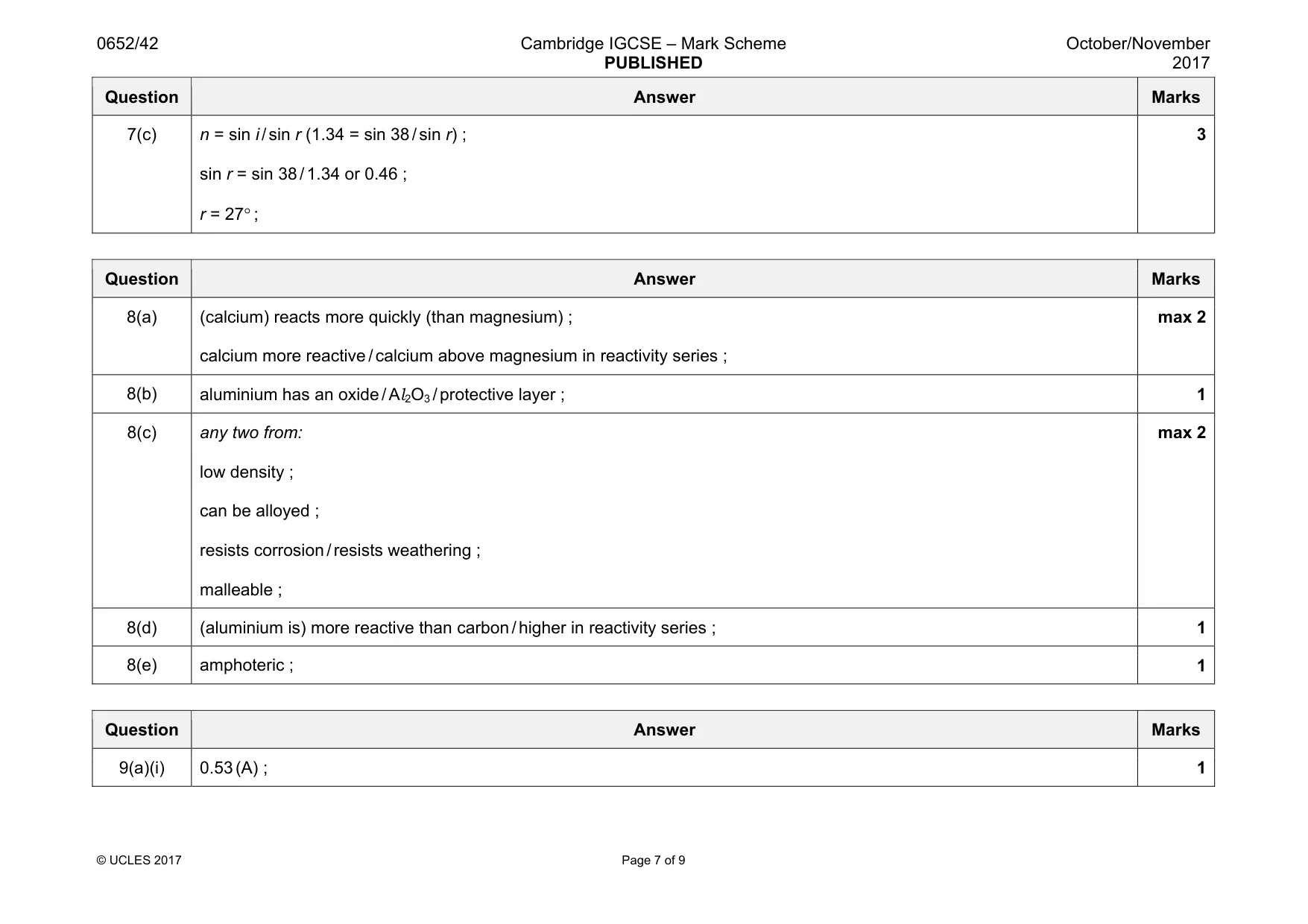
Mark scheme: 7(a) ray emerging with an angle of refraction ˃ ray 1 but ˂ ray 3 ; 1 7(b)(i) c correctly identified and marked ; 1 7(b)(ii) total internal reflection (with i ≈ r) ; 1 Question Answer Marks 7(c) n = sin i / sin r (1.34 = sin 38 / sin r) ; sin r = sin 38 / 1.34 or 0.46 ; r = 27° ; 3
Q8 · Part of the reactivity series of metals
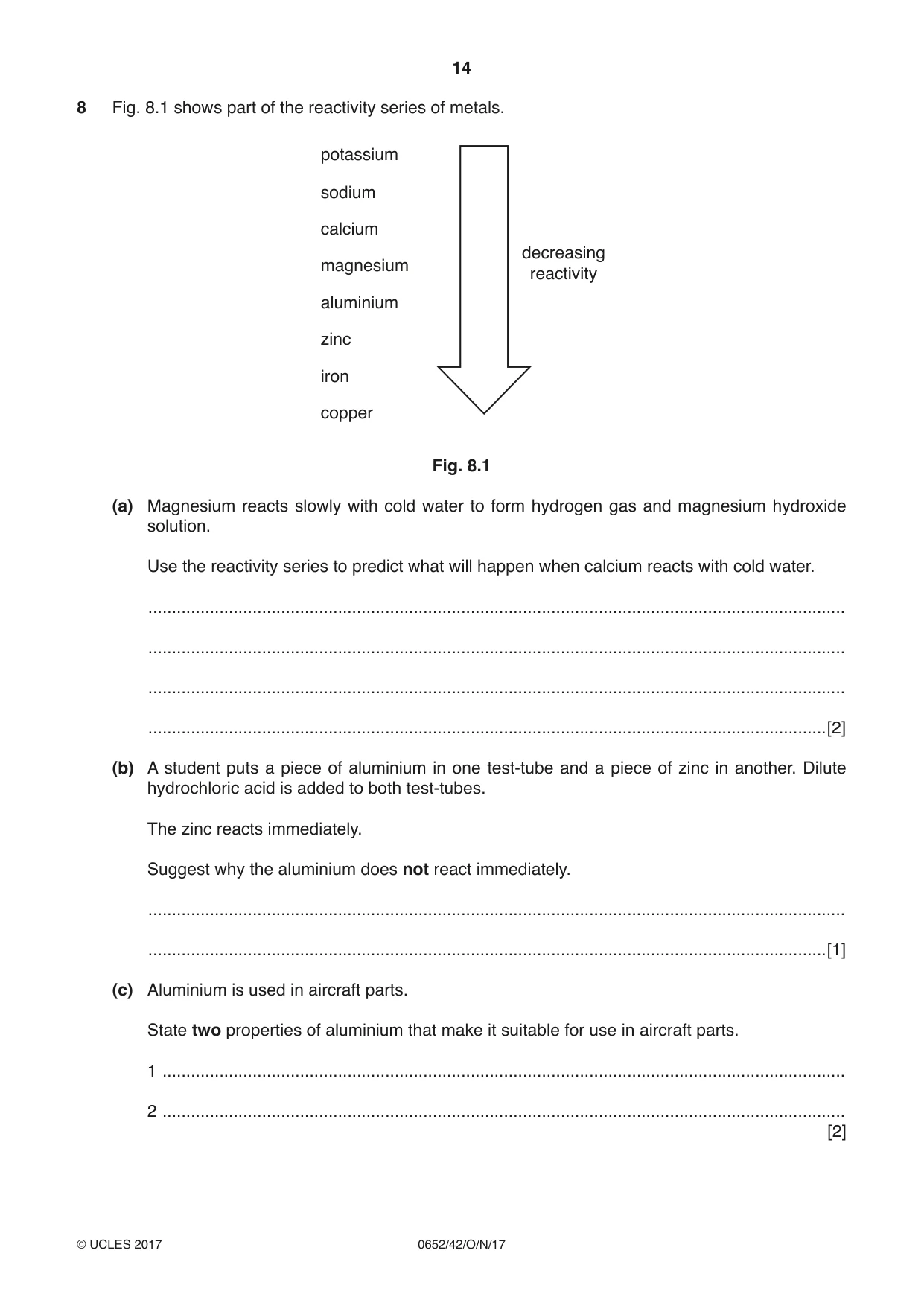
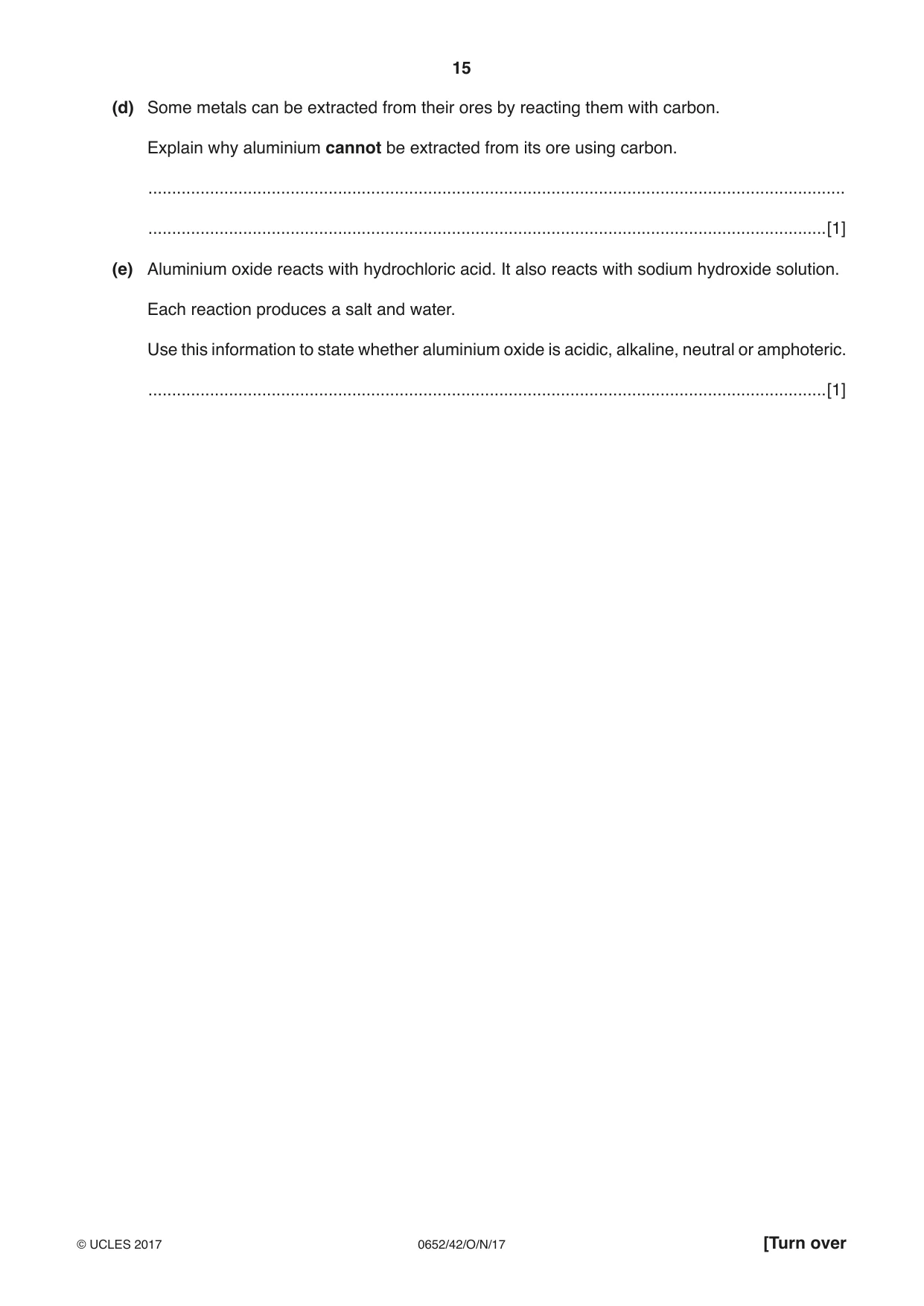
8 Fig. 8.1 shows part of the reactivity series of metals. potassium sodium calcium decreasing magnesium reactivity aluminium zinc iron copper Fig. 8.1 (a) Magnesium reacts slowly with cold water to form hydrogen gas and magnesium hydroxide solution. Use the reactivity series to predict what will happen when calcium reacts with cold water. ................................................................................................................................................... ................................................................................................................................................... ................................................................................................................................................... ...............................................................................................................................................[2] (b) A student puts a piece of aluminium in one test-tube and a piece of zinc in another. Dilute hydrochloric acid is added to both test-tubes. The zinc reacts immediately. Suggest why the aluminium does not react immediately. ................................................................................................................................................... ...............................................................................................................................................[1] (c) Aluminium is used in aircraft parts. State two properties of aluminium that make it suitable for use in aircraft parts. 1 ................................................................................................................................................ 2 ................................................................................................................................................ [2] (d) Some metals can be extracted from their ores by reacting them with carbon. Explain why aluminium cannot be extracted from its ore using carbon. ................................................................................................................................................... ...............................................................................................................................................[1] (e) Aluminium oxide reacts with hydrochloric acid. It also reacts with sodium hydroxide solution. Each reaction produces a salt and water. Use this information to state whether aluminium oxide is acidic, alkaline, neutral or amphoteric. ...............................................................................................................................................[1]
Mark scheme: 8(a) (calcium) reacts more quickly (than magnesium) ; calcium more reactive / calcium above magnesium in reactivity series ; max 2 8(b) aluminium has an oxide / Al2O3 / protective layer ; 1 8(c) any two from: low density ; can be alloyed ; resists corrosion / resists weathering ; malleable ; max 2 8(d) (aluminium is) more reactive than carbon / higher in reactivity series ; 1 8(e) amphoteric ; 1
Question 9
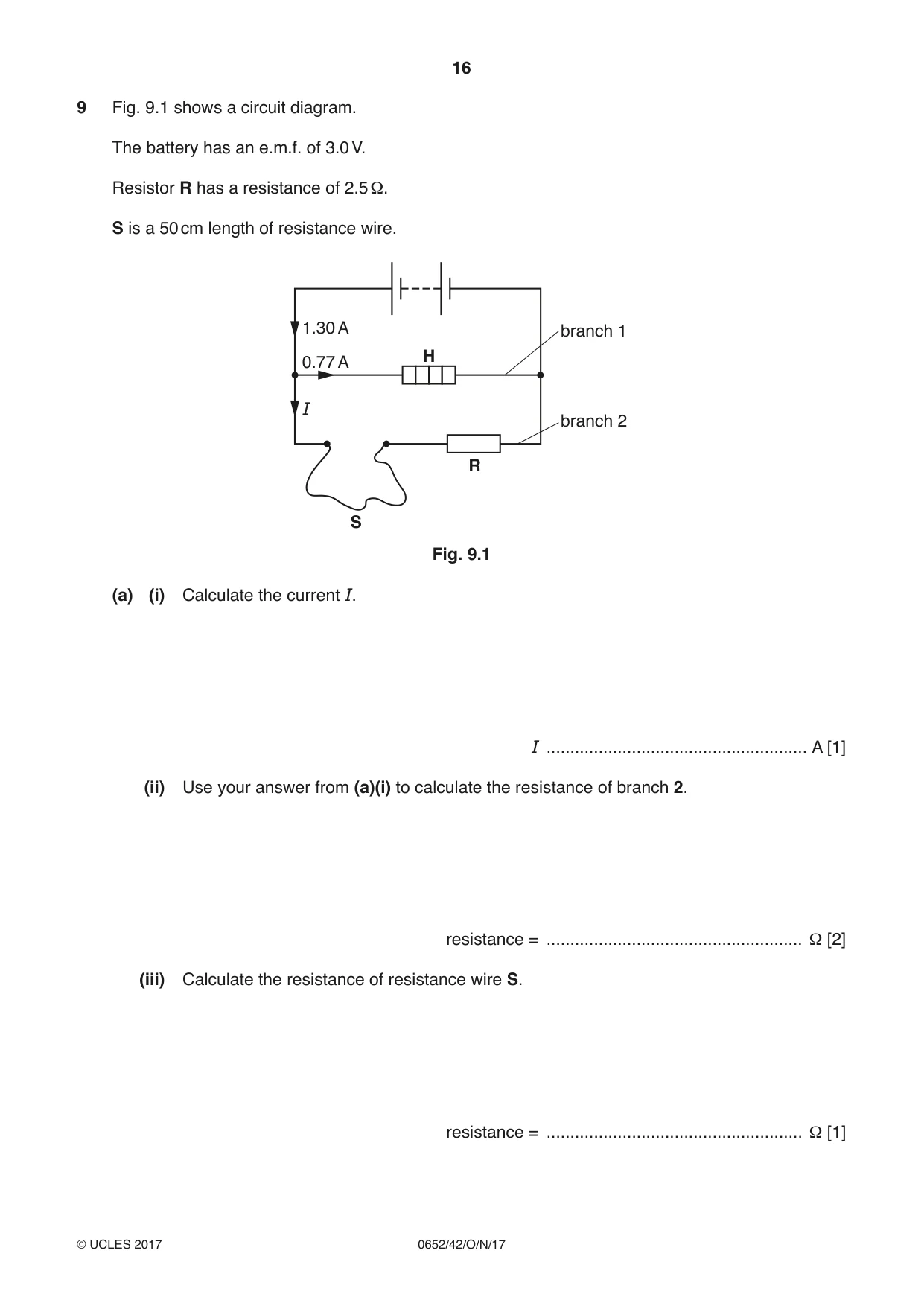
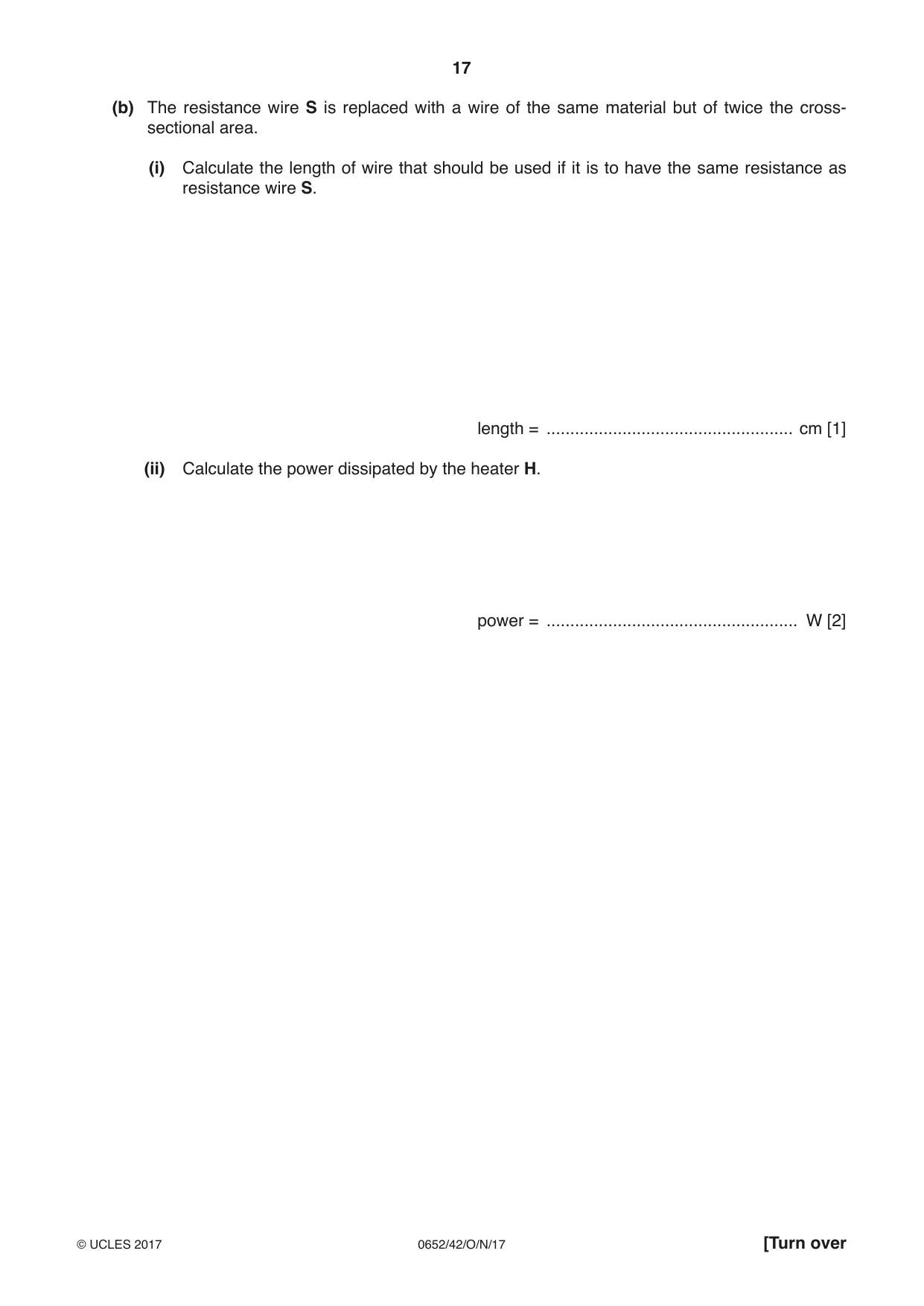
9 Fig. 9.1 shows a circuit diagram. The battery has an e.m.f. of 3.0 V. Resistor R has a resistance of 2.5 Ω. S is a 50 cm length of resistance wire. 1.30 A branch 1 H 0.77 A I branch 2 R S Fig. 9.1 (a) (i) Calculate the current I. I ....................................................... A [1] (ii) Use your answer from (a)(i) to calculate the resistance of branch 2. resistance = ...................................................... Ω [2] (iii) Calculate the resistance of resistance wire S. resistance = ...................................................... Ω [1] (b) The resistance wire S is replaced with a wire of the same material but of twice the cross- sectional area. (i) Calculate the length of wire that should be used if it is to have the same resistance as resistance wire S. length = .................................................... cm [1] (ii) Calculate the power dissipated by the heater H. power = ..................................................... W [2]
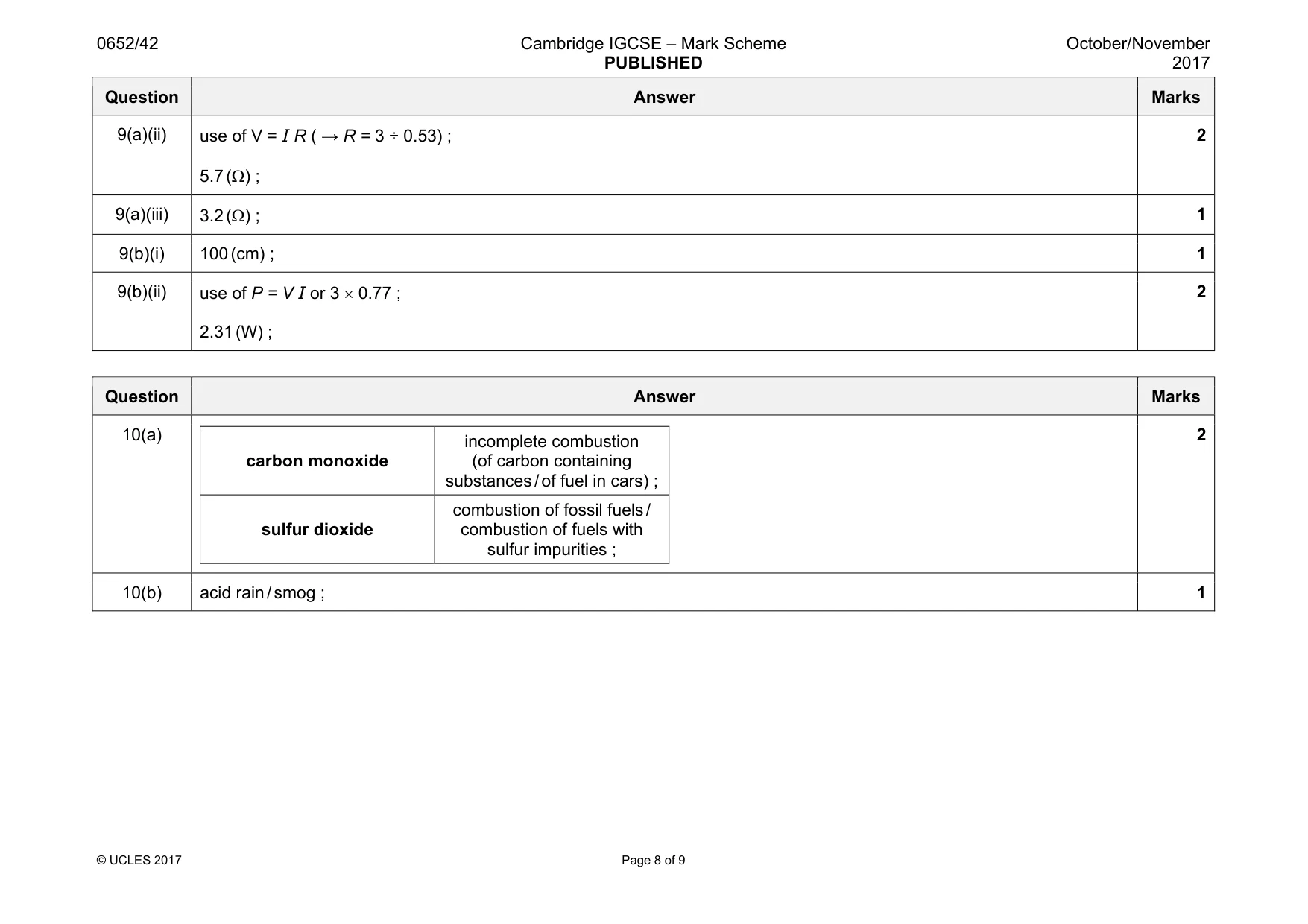
Mark scheme: 9(a)(i) 0.53 (A) ; 1 Question Answer Marks 9(a)(ii) use of V = I R ( → R = 3 ÷ 0.53) ; 5.7 (Ω) ; 2 9(a)(iii) 3.2 (Ω) ; 1 9(b)(i) 100 (cm) ; 1 9(b)(ii) use of P = V I or 3 × 0.77 ; 2.31 (W) ; 2
Q10 · Air can become polluted
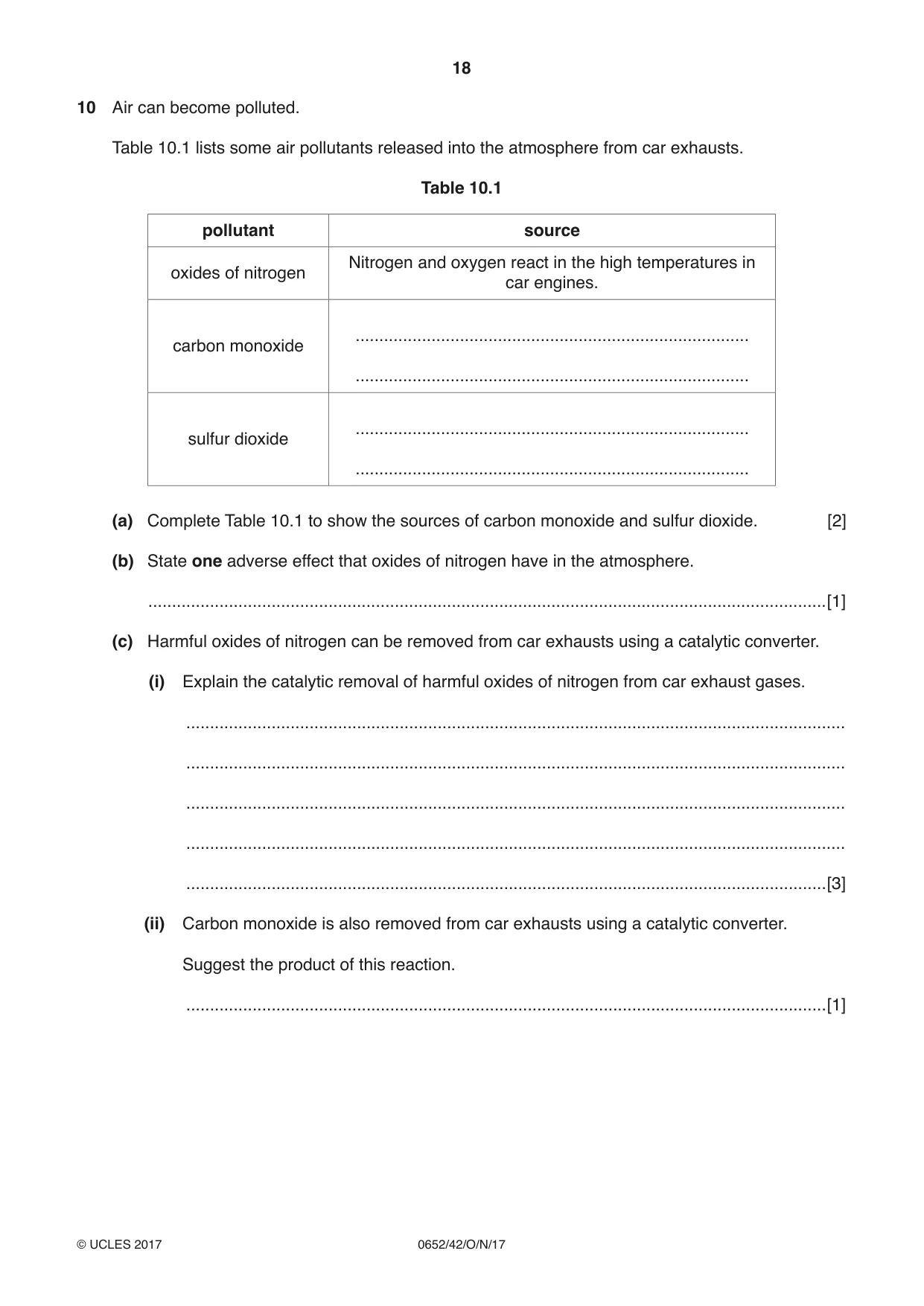
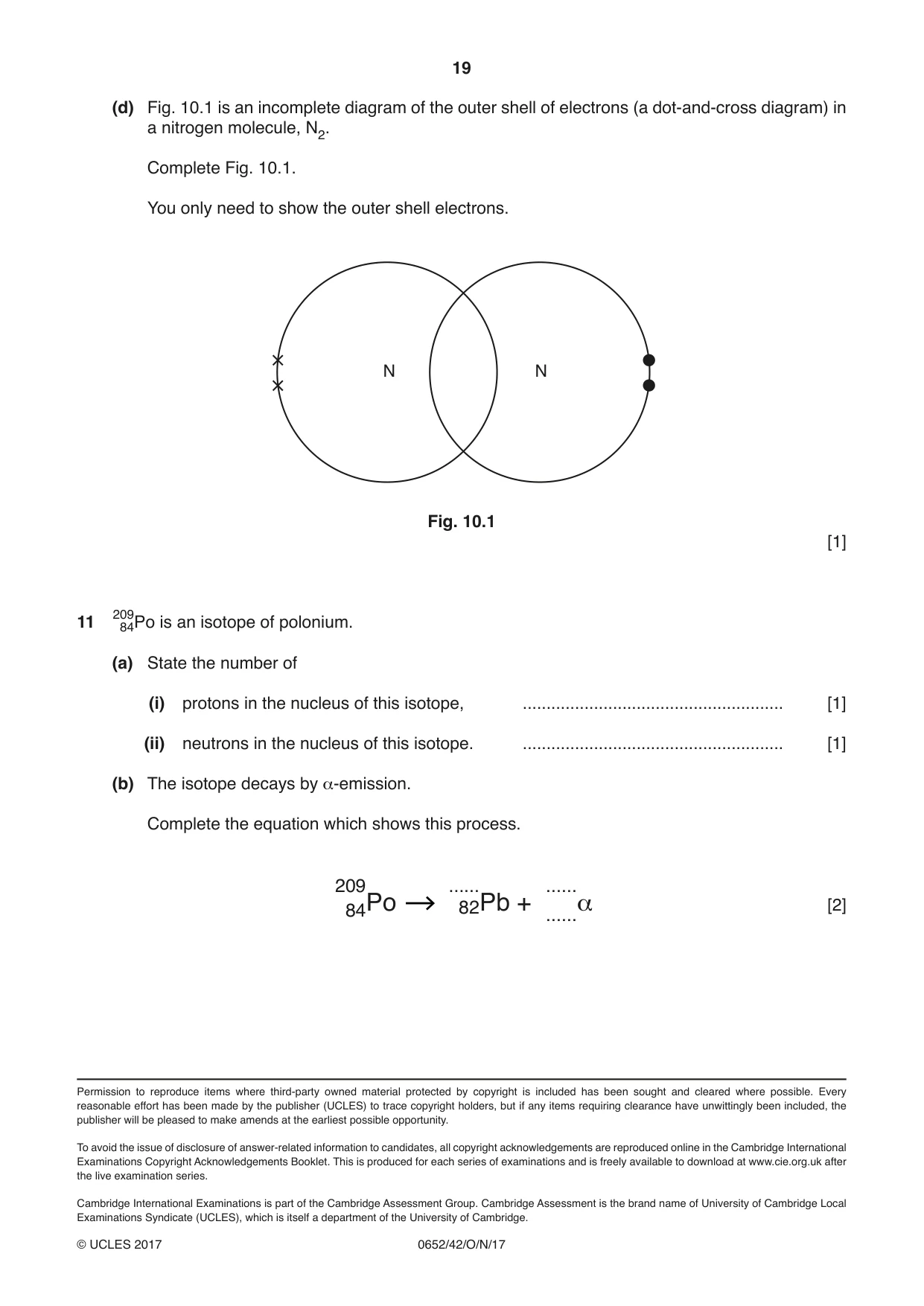
10 Air can become polluted. Table 10.1 lists some air pollutants released into the atmosphere from car exhausts. Table 10.1 pollutant source Nitrogen and oxygen react in the high temperatures in oxides of nitrogen car engines. ................................................................................... carbon monoxide ................................................................................... ................................................................................... sulfur dioxide ................................................................................... (a) Complete Table 10.1 to show the sources of carbon monoxide and sulfur dioxide. [2] (b) State one adverse effect that oxides of nitrogen have in the atmosphere. ...............................................................................................................................................[1] (c) Harmful oxides of nitrogen can be removed from car exhausts using a catalytic converter. (i) Explain the catalytic removal of harmful oxides of nitrogen from car exhaust gases. ........................................................................................................................................... ........................................................................................................................................... ........................................................................................................................................... ........................................................................................................................................... .......................................................................................................................................[3] (ii) Carbon monoxide is also removed from car exhausts using a catalytic converter. Suggest the product of this reaction. .......................................................................................................................................[1] (d) Fig. 10.1 is an incomplete diagram of the outer shell of electrons (a dot-and-cross diagram) in a nitrogen molecule, N2. Complete Fig. 10.1. You only need to show the outer shell electrons. N N Fig. 10.1 [1]
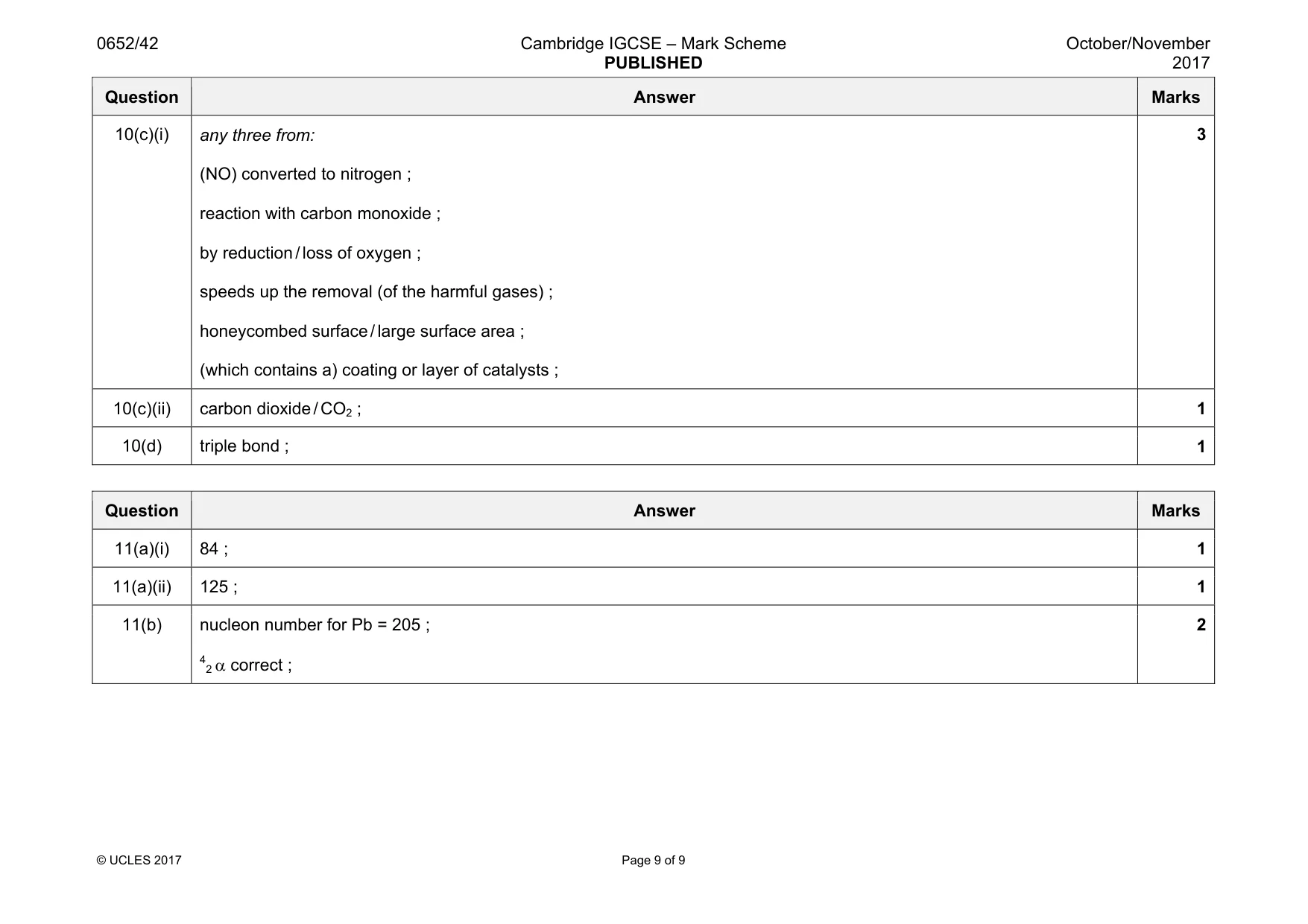
Mark scheme: 10(a) carbon monoxide incomplete combustion (of carbon containing substances / of fuel in cars) ; sulfur dioxide combustion of fossil fuels / combustion of fuels with sulfur impurities ; 2 10(b) acid rain / smog ; 1 Question Answer Marks 10(c)(i) any three from: (NO) converted to nitrogen ; reaction with carbon monoxide ; by reduction / loss of oxygen ; speeds up the removal (of the harmful gases) ; honeycombed surface / large surface area ; (which contains a) coating or layer of catalysts ; 3 10(c)(ii) carbon dioxide / CO2 ; 1 10(d) triple bond ; 1
Q11 · 20984Po is an isotope of polonium
11 20984Po is an isotope of polonium. (a) State the number of (i) protons in the nucleus of this isotope, ....................................................... [1] (ii) neutrons in the nucleus of this isotope. ....................................................... [1] (b) The isotope decays by α-emission. Complete the equation which shows this process. 209 ...... ...... [2] 84Po 82Pb + ......α
Mark scheme: 11(a)(i) 84 ; 1 11(a)(ii) 125 ; 1 11(b) nucleon number for Pb = 205 ; 4 2 α correct ; 2
What was in this paper
The subtopics covered by these 11 questions, and how many questions each got. Open one in a new tab to see every Cambridge question on it.
What you needed in this session
Cambridge’s own grade thresholds for 2017 Oct/Nov, Paper 4 · Variant 2. A higher threshold means an easier paper — the bar moves with how the cohort did.