Cambridge IGCSE Physical Science 0652 — 2004 May/June Paper 2 · Variant 1
0652/21/M/J/04
The question paper and its mark scheme, free to read here and free to download. This is Cambridge’s own paper, exactly as it was sat.
Question paper16 pages
Mark scheme
No mark scheme is in the library for this paper.
Paper as text
Question paper, page 1
This document consists of 16 printed pages. SP (CW/GR) S62051/2 © UCLES 2004 [Turn over UNIVERSITY OF CAMBRIDGE INTERNATIONAL EXAMINATIONS International General Certificate of Secondary Education PHYSICAL SCIENCE 0652/02 Paper 2 May/June 2004 1 hour 15 minutes Candidates answer on the Question Paper. No Additional Materials are required. READ THESE INSTRUCTIONS FIRST Write your Centre number, candidate number and name on all the work you hand in. Write in dark blue or black pen in the spaces provided on the Question Paper. You may use a soft pencil for any diagrams, graphs, tables or rough working. Do not use staples, paper clips, highlighters, glue or correction fluid. Answer all questions. At the end of the examination, fasten all your work securely together. The number of marks is given in brackets [ ] at the end of each question or part question. A copy of the Periodic Table is printed on page 16. Centre Number Candidate Number Name If you have been given a label, look at the details. If any details are incorrect or missing, please fill in your correct details in the space given at the top of this page. Stick your personal label here, if provided. FOR EXAMINER’S USE 1 2 3 4 5 6 7 8 9 10 11 12 13 14 Total www.XtremePapers.com
Question paper, page 2
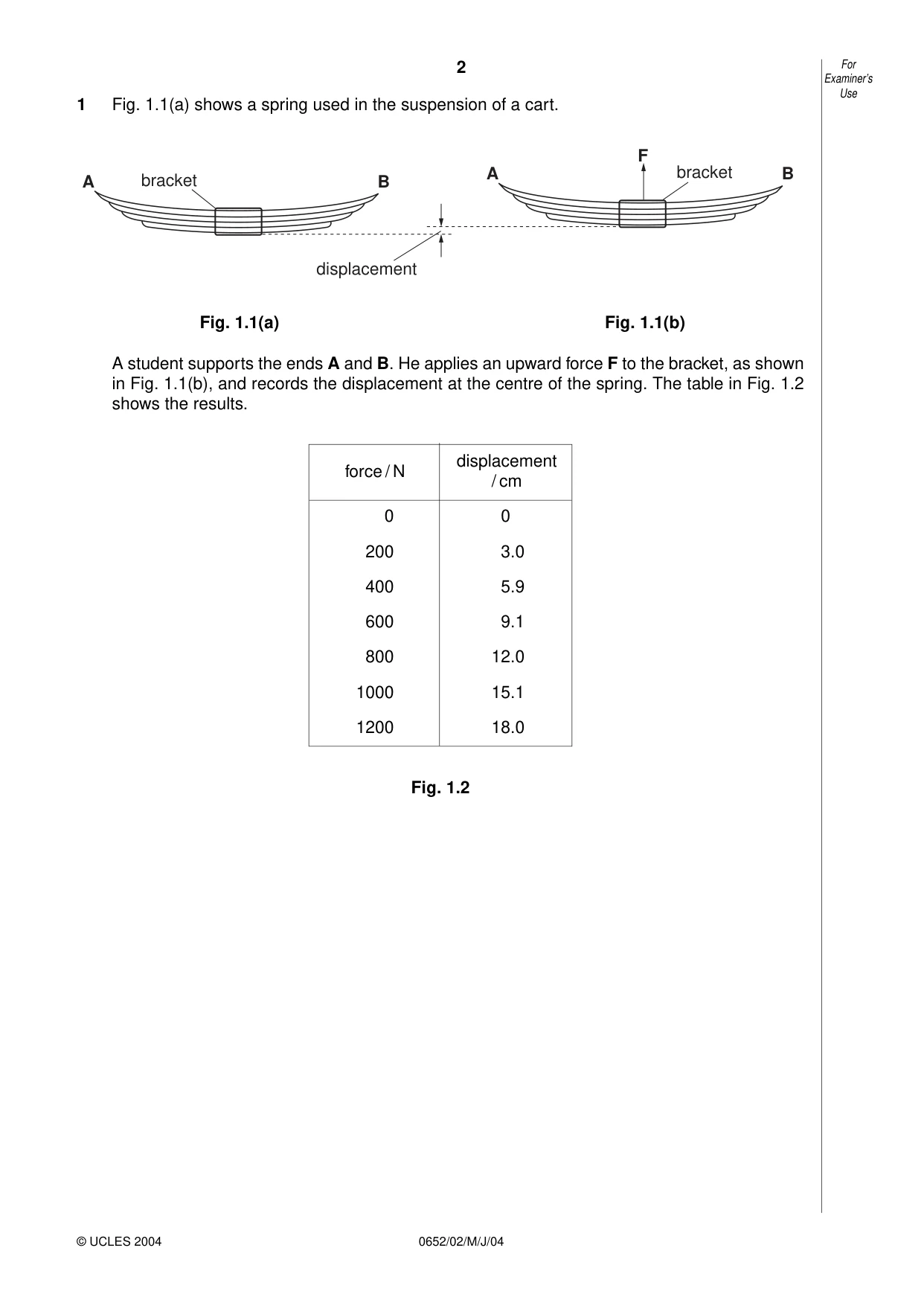
2 0652/02/M/J/04 1 Fig. 1.1(a) shows a spring used in the suspension of a cart. Fig. 1.1(a) Fig. 1.1(b) A student supports the ends A and B. He applies an upward force F to the bracket, as shown in Fig. 1.1(b), and records the displacement at the centre of the spring. The table in Fig. 1.2 shows the results. Fig. 1.2 bracket A B bracket A B displacement F For Examiner’s Use © UCLES 2004 displacement force / N / cm 0 0 200 3.0 400 5.9 600 9.1 800 12.0 1000 15.1 1200 18.0
Question paper, page 3
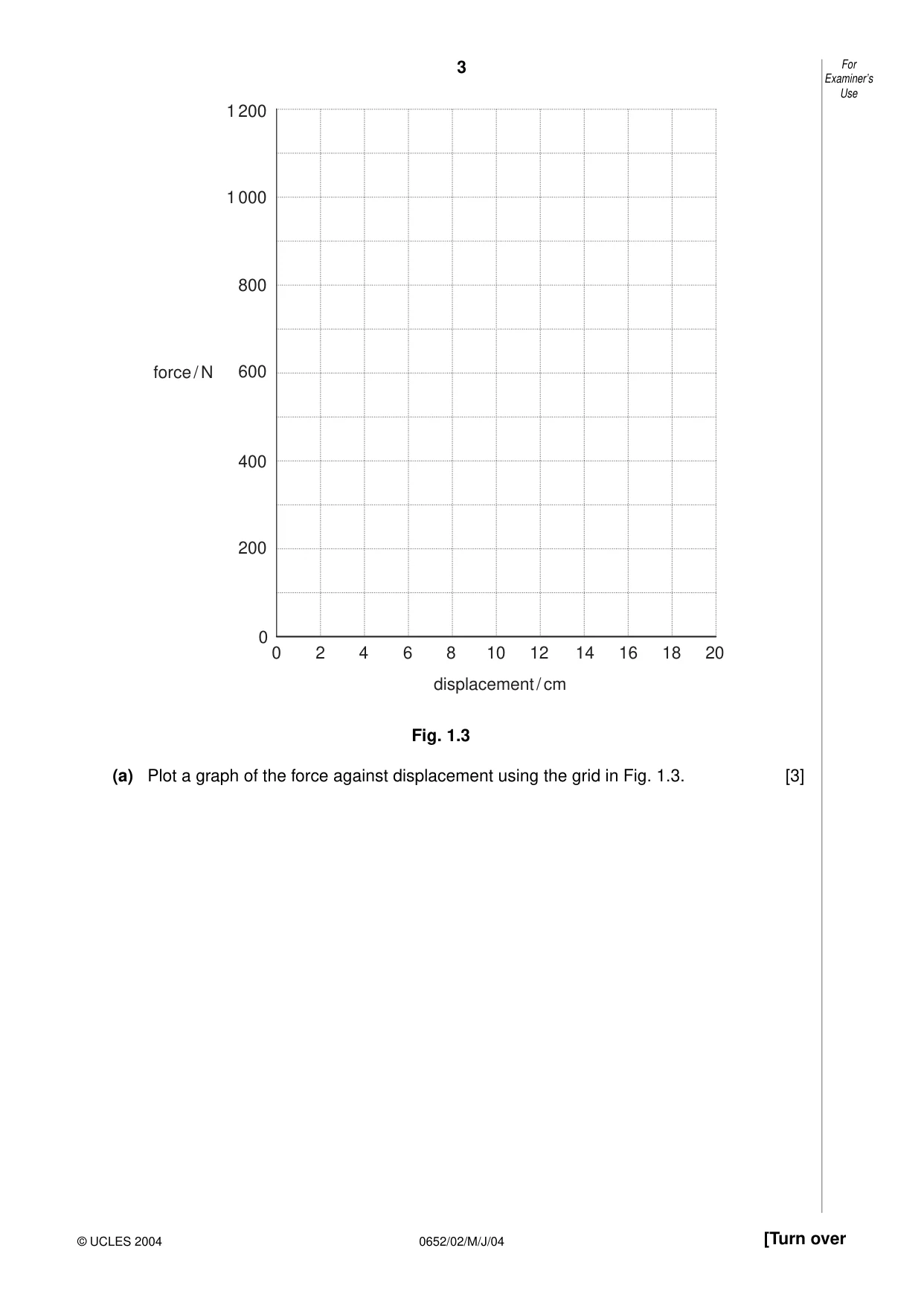
3 0652/02/M/J/04 [Turn over Fig. 1.3 (a) Plot a graph of the force against displacement using the grid in Fig. 1.3. [3] 200 2 0 0 4 6 8 10 12 14 16 18 20 400 600 800 1 000 1 200 force / N displacement / cm For Examiner’s Use © UCLES 2004
Question paper, page 4
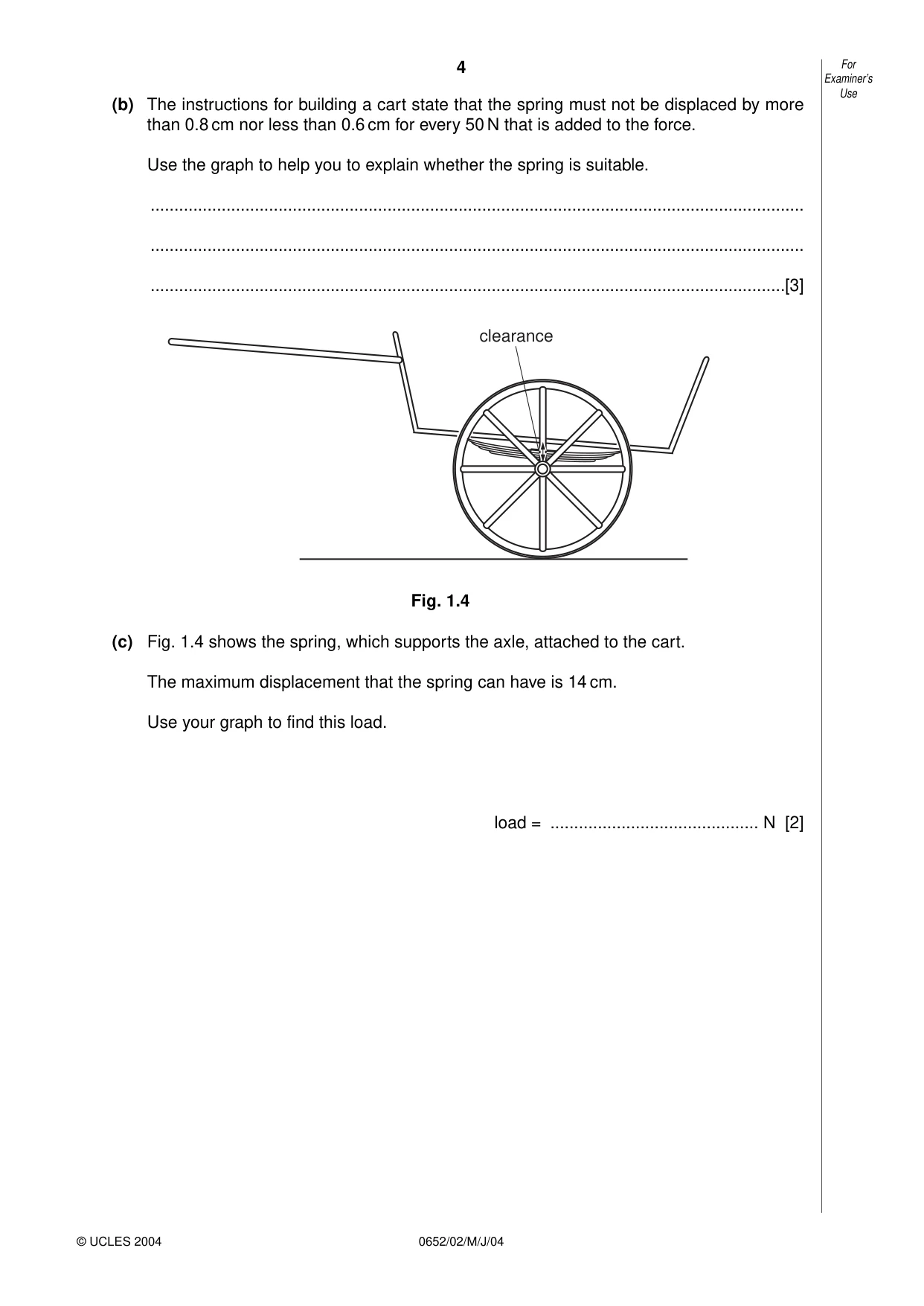
4 0652/02/M/J/04 (b) The instructions for building a cart state that the spring must not be displaced by more than 0.8 cm nor less than 0.6 cm for every 50 N that is added to the force. Use the graph to help you to explain whether the spring is suitable. … … …[3] Fig. 1.4 (c) Fig. 1.4 shows the spring, which supports the axle, attached to the cart. The maximum displacement that the spring can have is 14 cm. Use your graph to find this load. load = … N [2] clearance For Examiner’s Use © UCLES 2004
Question paper, page 5
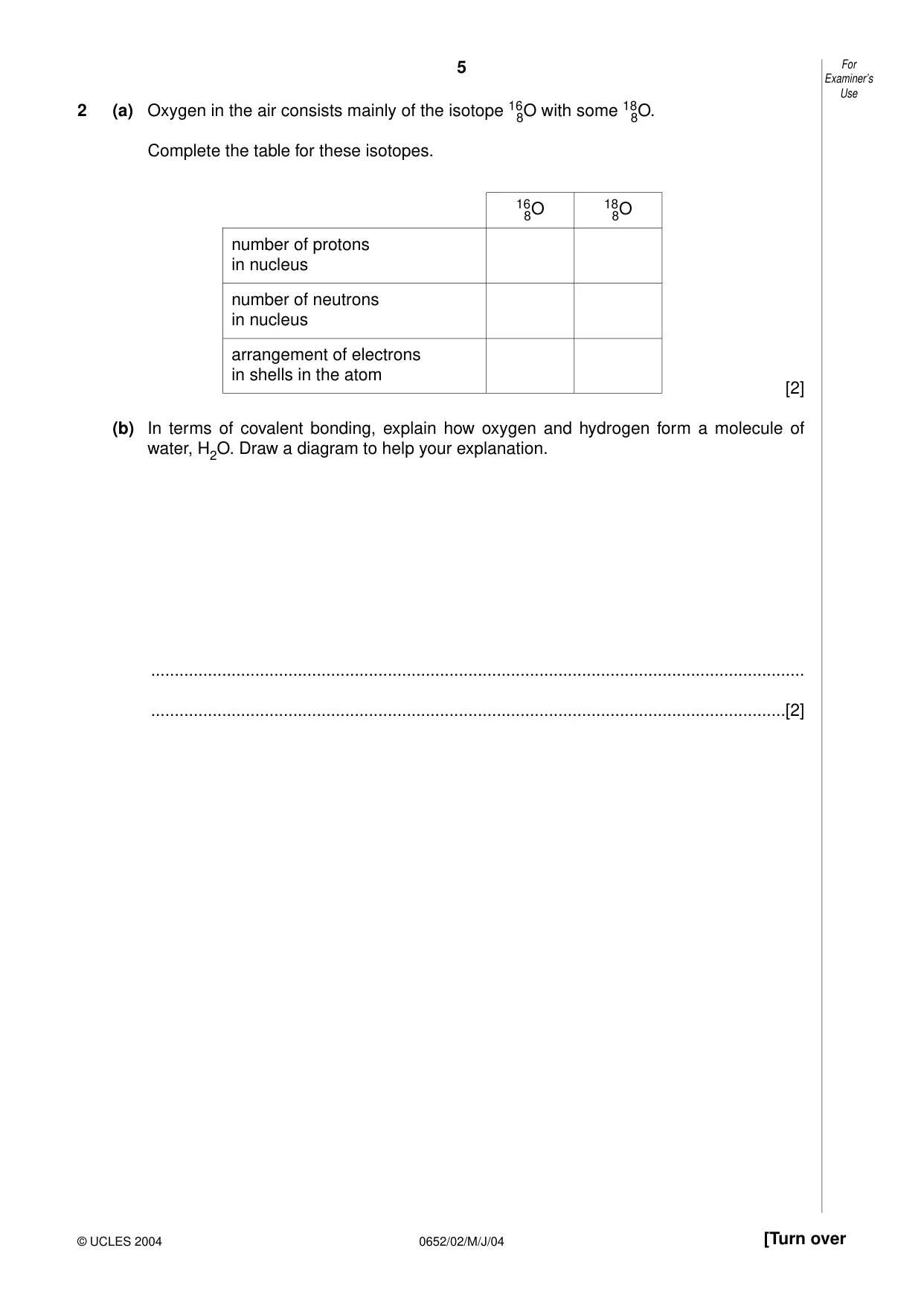
5 0652/02/M/J/04 [Turn over 2 (a) Oxygen in the air consists mainly of the isotope 16 8O with some 18 8O. Complete the table for these isotopes. [2] (b) In terms of covalent bonding, explain how oxygen and hydrogen form a molecule of water, H2O. Draw a diagram to help your explanation. … …[2] For Examiner’s Use © UCLES 2004 16 8O 18 8O number of protons in nucleus number of neutrons in nucleus arrangement of electrons in shells in the atom
Question paper, page 6
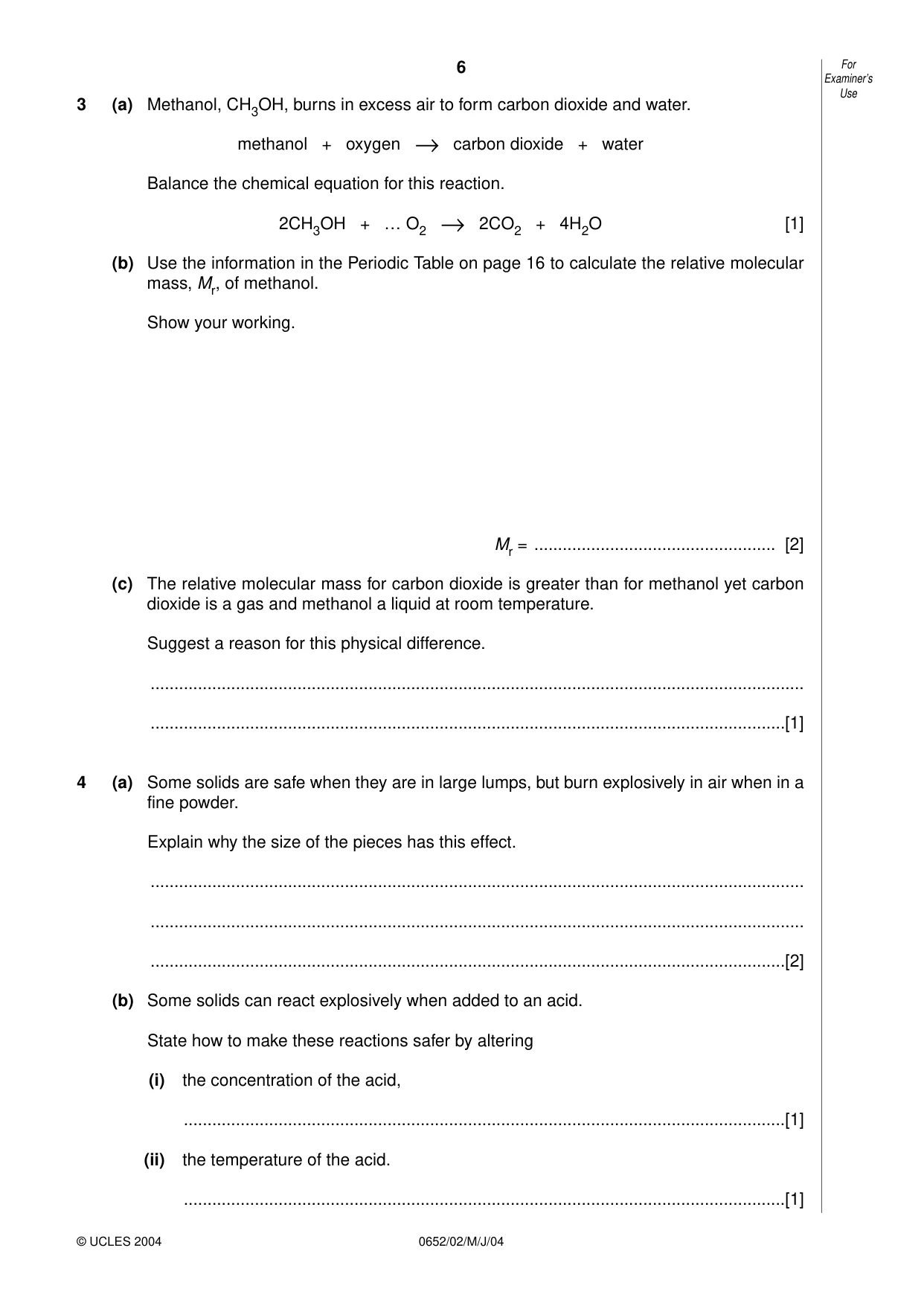
6 0652/02/M/J/04 3 (a) Methanol, CH3OH, burns in excess air to form carbon dioxide and water. methanol + oxygen → carbon dioxide + water Balance the chemical equation for this reaction. 2CH3OH + … O2 → 2CO2 + 4H2O [1] (b) Use the information in the Periodic Table on page 16 to calculate the relative molecular mass, Mr, of methanol. Show your working. Mr = … [2] (c) The relative molecular mass for carbon dioxide is greater than for methanol yet carbon dioxide is a gas and methanol a liquid at room temperature. Suggest a reason for this physical difference. … …[1] 4 (a) Some solids are safe when they are in large lumps, but burn explosively in air when in a fine powder. Explain why the size of the pieces has this effect. … … …[2] (b) Some solids can react explosively when added to an acid. State how to make these reactions safer by altering (i) the concentration of the acid, …[1] (ii) the temperature of the acid. …[1] For Examiner’s Use © UCLES 2004
Question paper, page 7
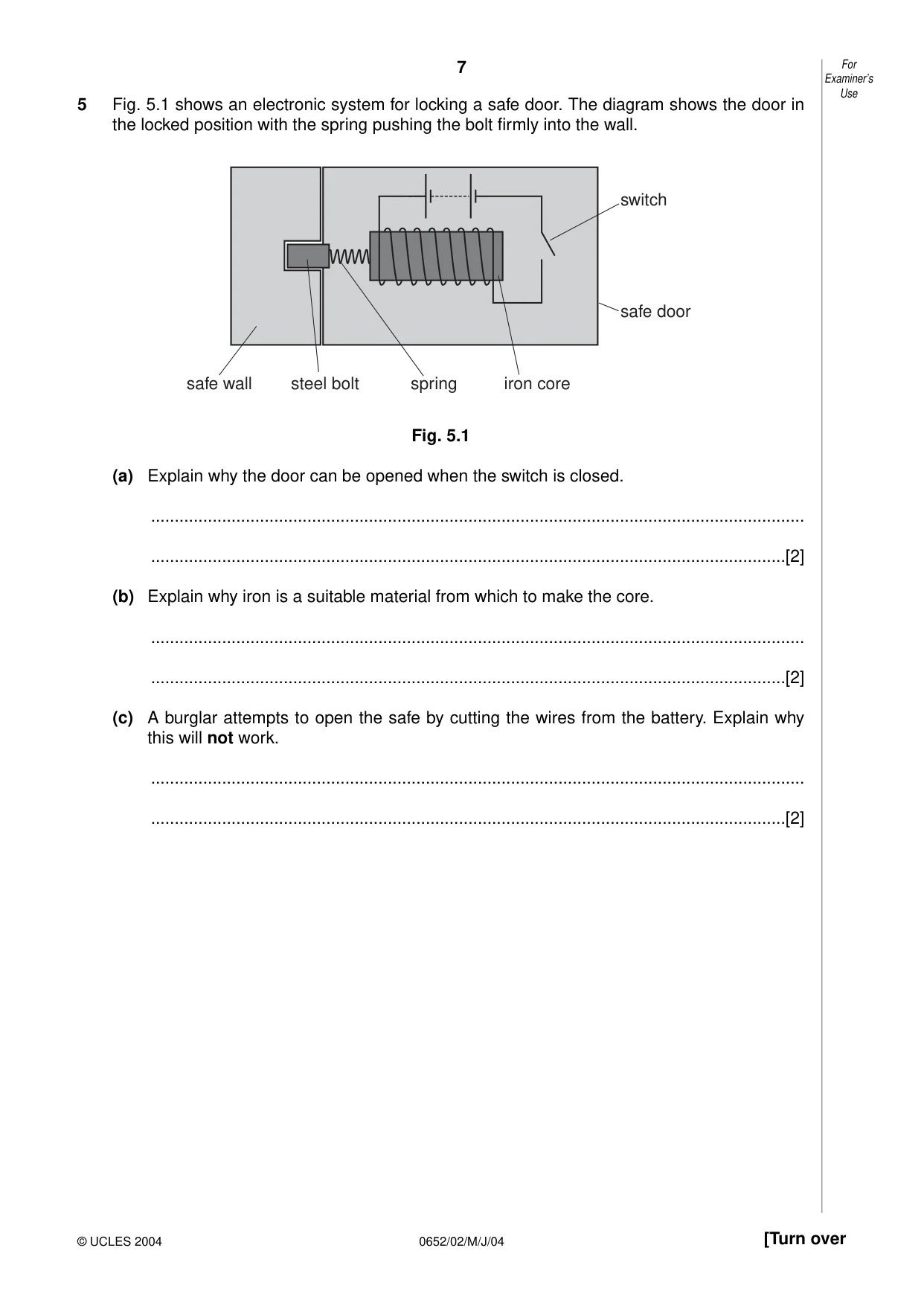
7 0652/02/M/J/04 [Turn over 5 Fig. 5.1 shows an electronic system for locking a safe door. The diagram shows the door in the locked position with the spring pushing the bolt firmly into the wall. Fig. 5.1 (a) Explain why the door can be opened when the switch is closed. … …[2] (b) Explain why iron is a suitable material from which to make the core. … …[2] (c) A burglar attempts to open the safe by cutting the wires from the battery. Explain why this will not work. … …[2] switch safe door iron core spring steel bolt safe wall For Examiner’s Use © UCLES 2004
Question paper, page 8
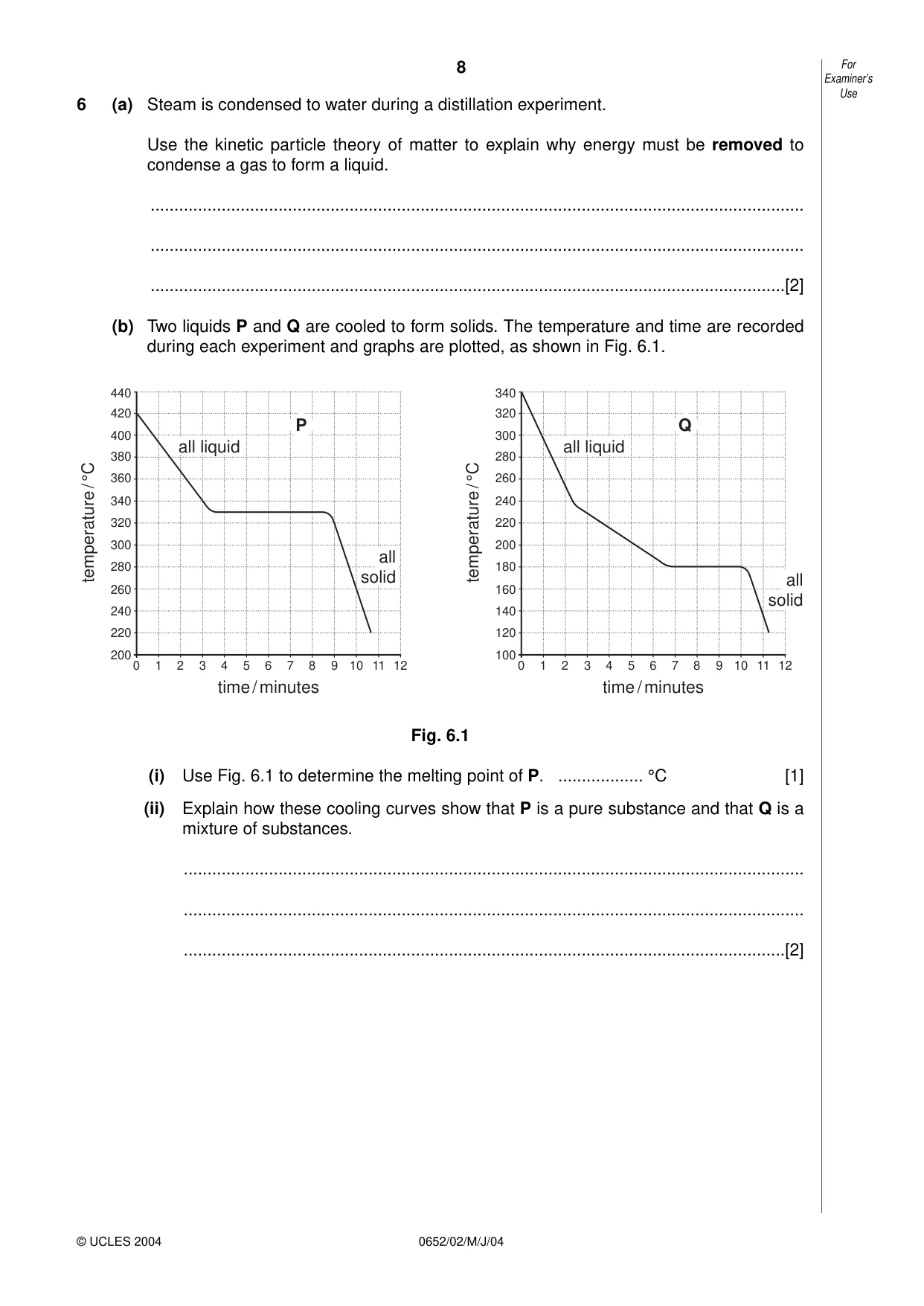
8 0652/02/M/J/04 6 (a) Steam is condensed to water during a distillation experiment. Use the kinetic particle theory of matter to explain why energy must be removed to condense a gas to form a liquid. … … …[2] (b) Two liquids P and Q are cooled to form solids. The temperature and time are recorded during each experiment and graphs are plotted, as shown in Fig. 6.1. Fig. 6.1 (i) Use Fig. 6.1 to determine the melting point of P. … °C [1] (ii) Explain how these cooling curves show that P is a pure substance and that Q is a mixture of substances. … … …[2] For Examiner’s Use © UCLES 2004 240 220 200 1 0 2 3 4 5 6 7 8 9 10 11 12 260 280 300 320 340 360 380 400 420 440 time / minutes temperature / °C all liquid all solid P 140 120 100 1 0 2 3 4 5 6 7 8 9 10 11 12 160 180 200 220 240 260 280 300 320 340 time / minutes temperature / °C all liquid all solid Q
Question paper, page 9
9 0652/02/M/J/04 [Turn over 7 Magnesium reacts slowly with water at room temperature. Potassium reacts vigorously with water at room temperature. (a) Explain this difference of reaction in terms of the reactivity series of metals. …[1] (b) The reaction between potassium and water is exothermic and produces an alkaline solution and hydrogen. (i) Explain the meaning of exothermic. …[1] (ii) Describe how to test for the alkaline solution. test … result …[2] (iii) A student collects some of the hydrogen in a test-tube. Describe how to test for the hydrogen produced. test … result …[2] For Examiner’s Use © UCLES 2004
Question paper, page 10
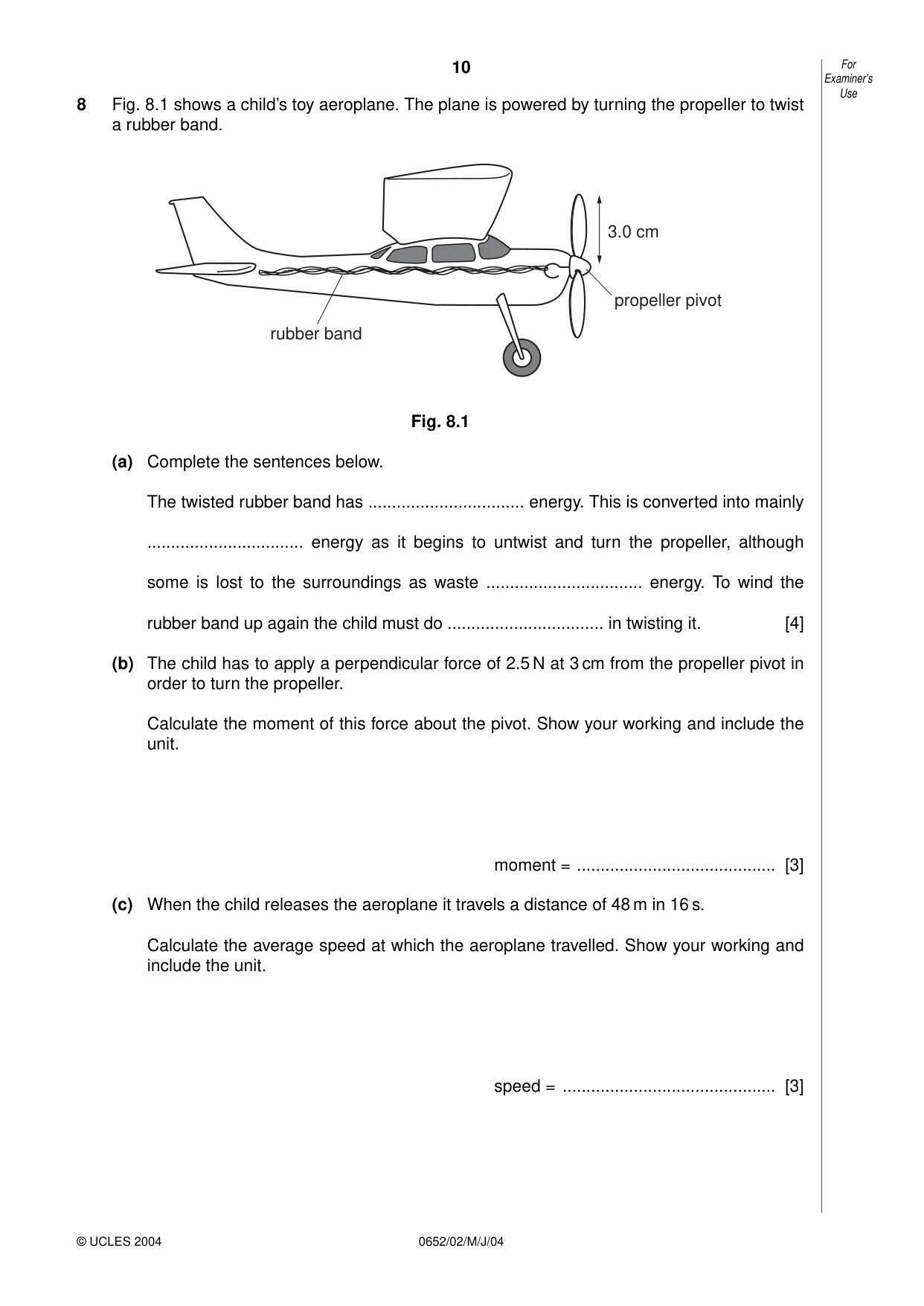
10 0652/02/M/J/04 8 Fig. 8.1 shows a child’s toy aeroplane. The plane is powered by turning the propeller to twist a rubber band. Fig. 8.1 (a) Complete the sentences below. The twisted rubber band has … energy. This is converted into mainly … energy as it begins to untwist and turn the propeller, although some is lost to the surroundings as waste … energy. To wind the rubber band up again the child must do … in twisting it. [4] (b) The child has to apply a perpendicular force of 2.5 N at 3 cm from the propeller pivot in order to turn the propeller. Calculate the moment of this force about the pivot. Show your working and include the unit. moment = … [3] (c) When the child releases the aeroplane it travels a distance of 48 m in 16 s. Calculate the average speed at which the aeroplane travelled. Show your working and include the unit. speed = … [3] 3.0 cm propeller pivot rubber band For Examiner’s Use © UCLES 2004
Question paper, page 11
11 0652/02/M/J/04 [Turn over 9 Common pollutants in the air are carbon monoxide and sulphur dioxide. (a) Explain why carbon monoxide can have an adverse effect on human health. … … …[2] (b) Explain why sulphur dioxide can have an adverse effect on buildings. … … …[2] 10 (a) Draw the structures of ethanol, C2H6O, and ethanoic acid, C2H4O2. ethanol ethanoic acid [4] (b) State two uses of ethanol. 1 … 2 …[2] For Examiner’s Use © UCLES 2004
Question paper, page 12
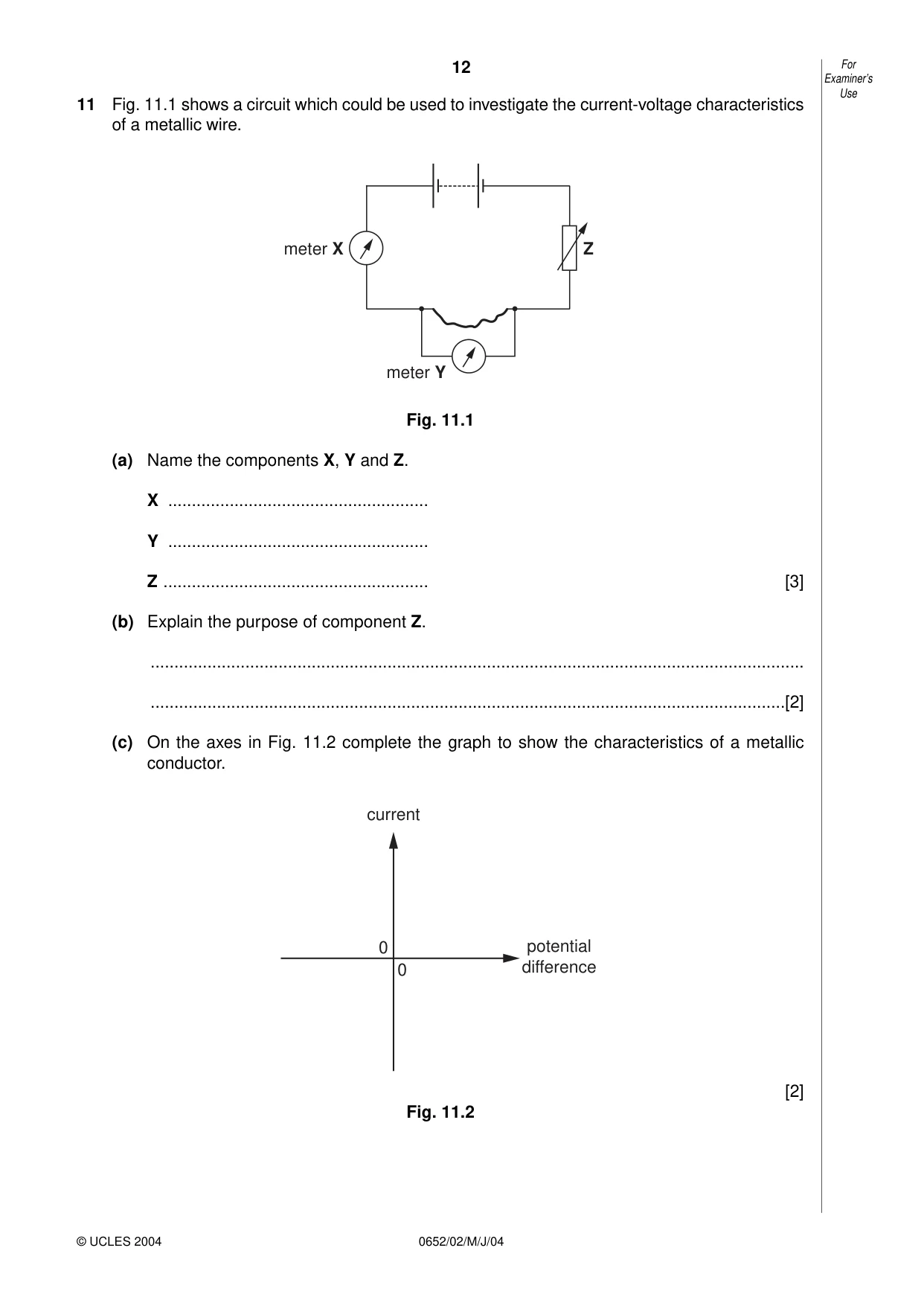
12 0652/02/M/J/04 11 Fig. 11.1 shows a circuit which could be used to investigate the current-voltage characteristics of a metallic wire. Fig. 11.1 (a) Name the components X, Y and Z. X … Y … Z … [3] (b) Explain the purpose of component Z. … …[2] (c) On the axes in Fig. 11.2 complete the graph to show the characteristics of a metallic conductor. [2] Fig. 11.2 current potential difference 0 0 meter X meter Y Z For Examiner’s Use © UCLES 2004
Question paper, page 13
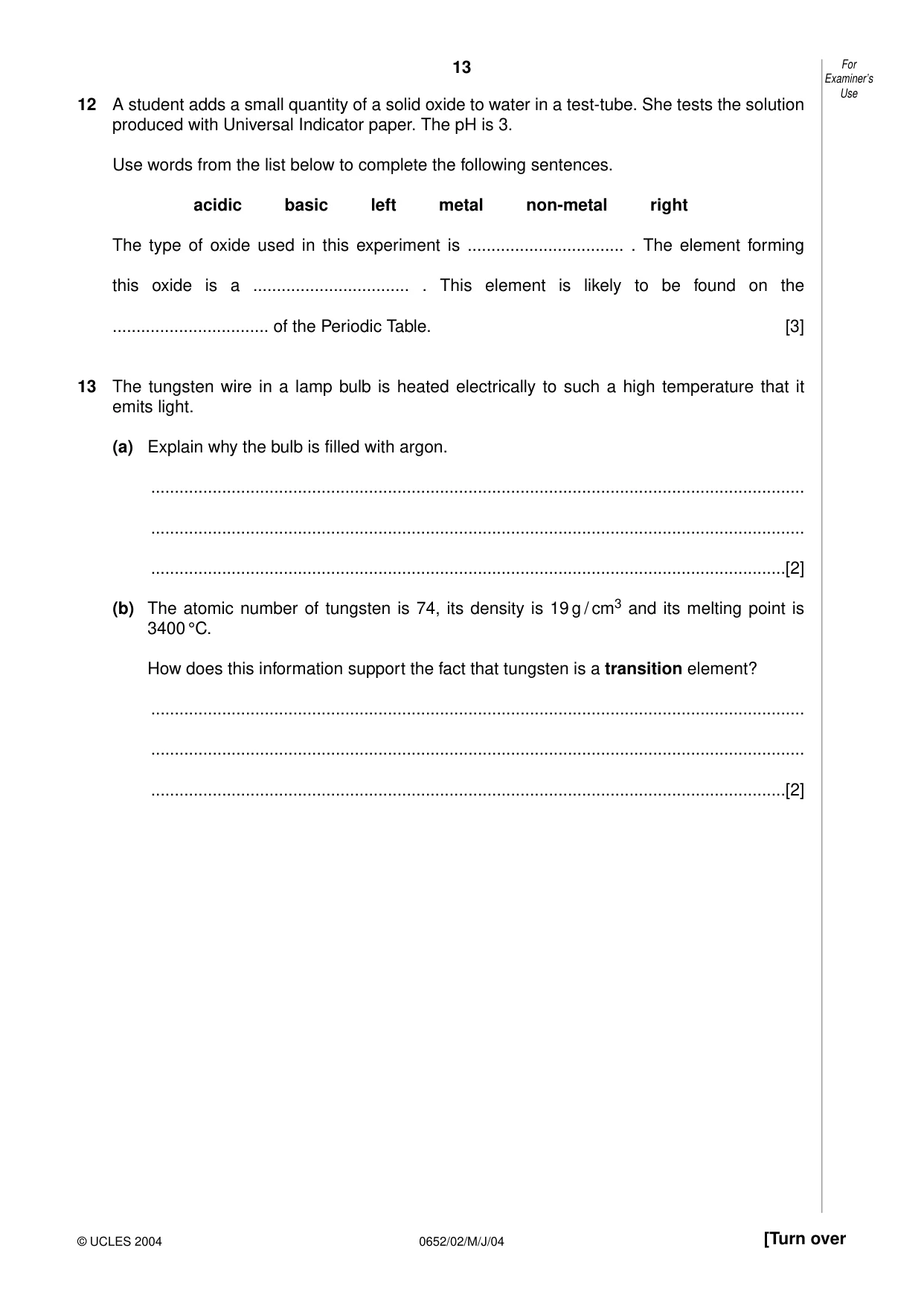
13 0652/02/M/J/04 [Turn over 12 A student adds a small quantity of a solid oxide to water in a test-tube. She tests the solution produced with Universal Indicator paper. The pH is 3. Use words from the list below to complete the following sentences. acidic basic left metal non-metal right The type of oxide used in this experiment is … . The element forming this oxide is a … . This element is likely to be found on the … of the Periodic Table. [3] 13 The tungsten wire in a lamp bulb is heated electrically to such a high temperature that it emits light. (a) Explain why the bulb is filled with argon. … … …[2] (b) The atomic number of tungsten is 74, its density is 19 g / cm3 and its melting point is 3400 °C. How does this information support the fact that tungsten is a transition element? … … …[2] For Examiner’s Use © UCLES 2004
Question paper, page 14
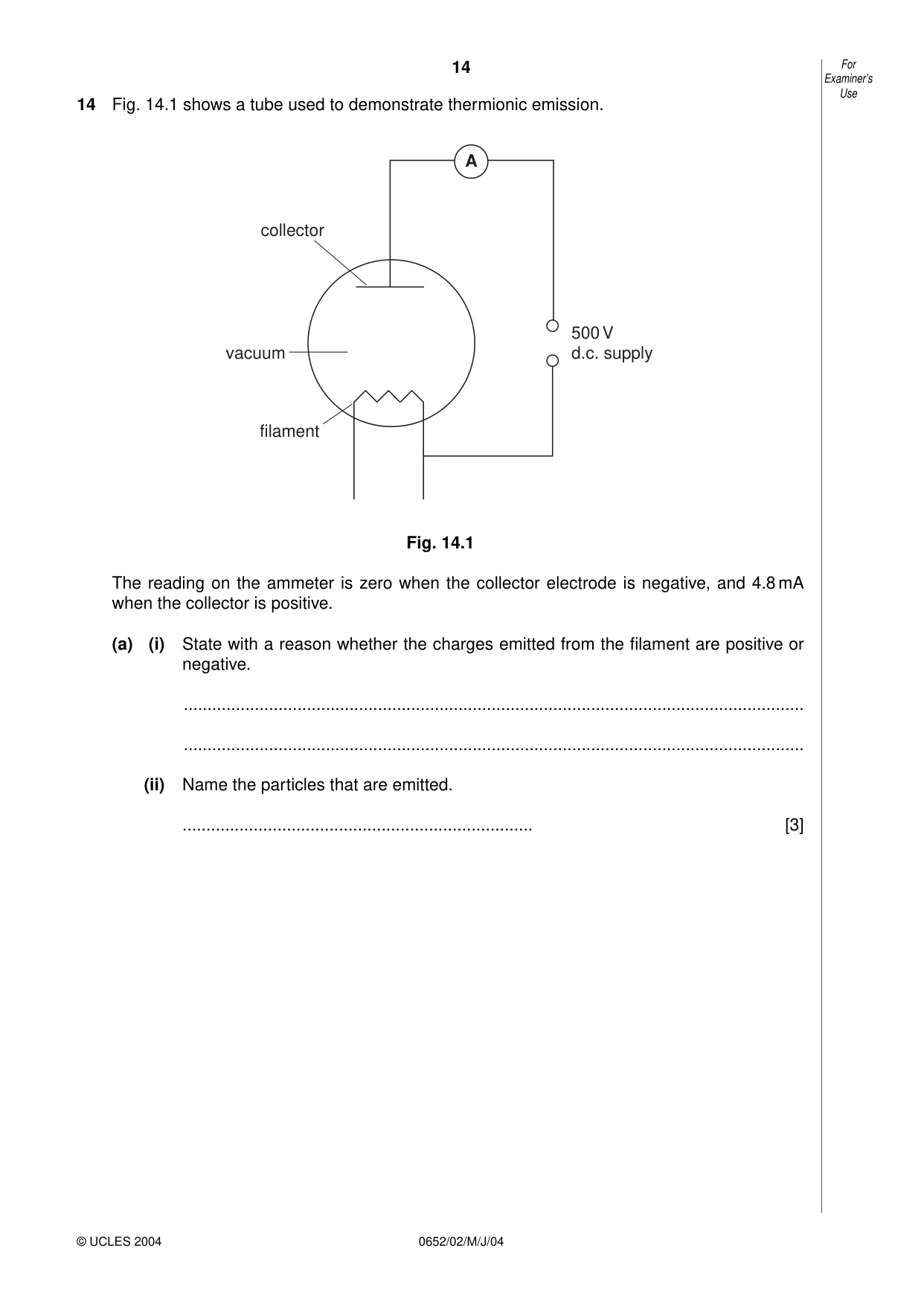
14 0652/02/M/J/04 14 Fig. 14.1 shows a tube used to demonstrate thermionic emission. Fig. 14.1 The reading on the ammeter is zero when the collector electrode is negative, and 4.8 mA when the collector is positive. (a) (i) State with a reason whether the charges emitted from the filament are positive or negative. … … (ii) Name the particles that are emitted. … [3] A 500 V d.c. supply collector vacuum filament For Examiner’s Use © UCLES 2004
Question paper, page 15
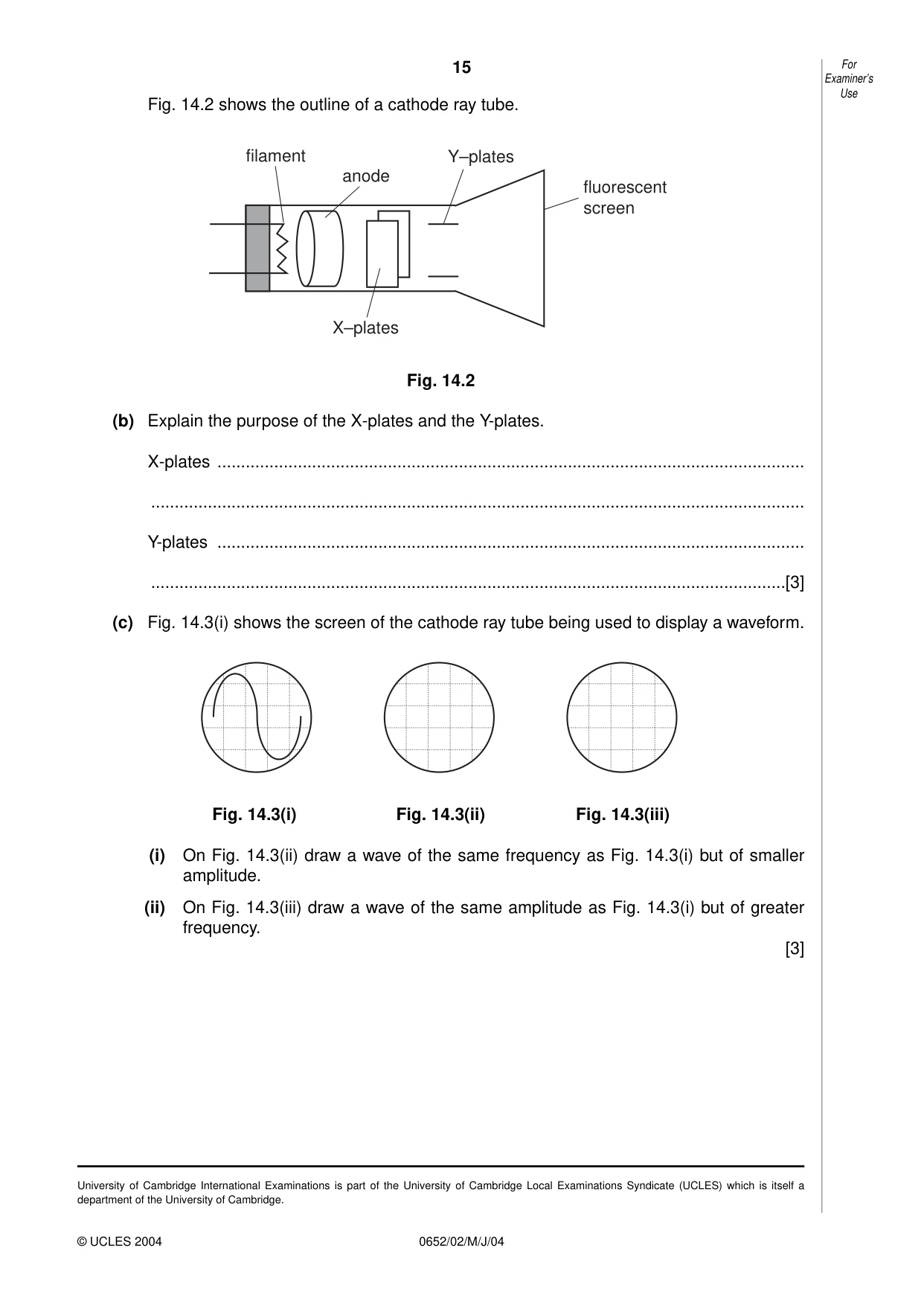
15 0652/02/M/J/04 Fig. 14.2 shows the outline of a cathode ray tube. Fig. 14.2 (b) Explain the purpose of the X-plates and the Y-plates. X-plates … … Y-plates … …[3] (c) Fig. 14.3(i) shows the screen of the cathode ray tube being used to display a waveform. Fig. 14.3(i) Fig. 14.3(ii) Fig. 14.3(iii) (i) On Fig. 14.3(ii) draw a wave of the same frequency as Fig. 14.3(i) but of smaller amplitude. (ii) On Fig. 14.3(iii) draw a wave of the same amplitude as Fig. 14.3(i) but of greater frequency. [3] University of Cambridge International Examinations is part of the University of Cambridge Local Examinations Syndicate (UCLES) which is itself a department of the University of Cambridge. Y–plates fluorescent screen X–plates anode filament For Examiner’s Use © UCLES 2004
Question paper, page 16
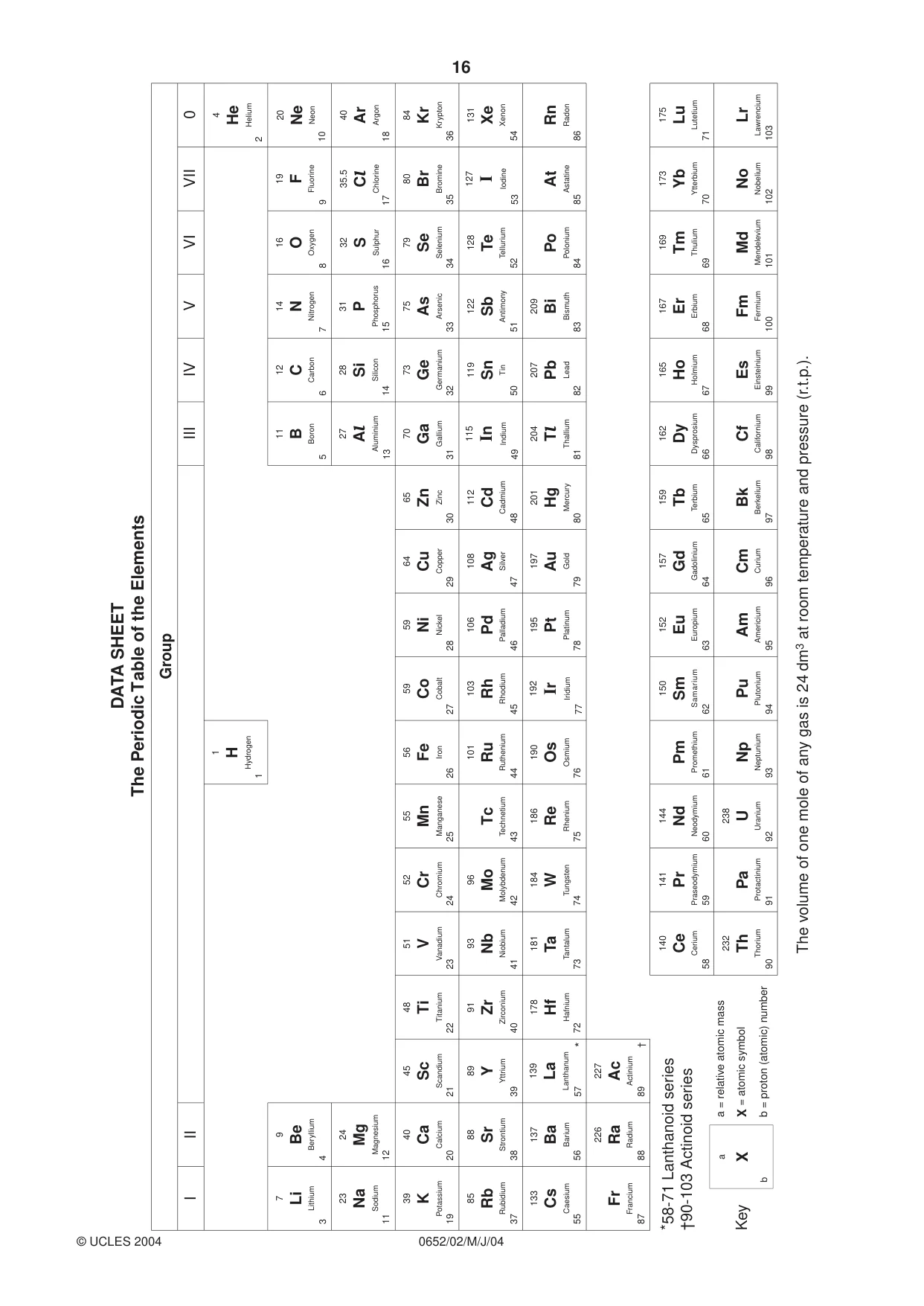
16 0652/02/M/J/04 © UCLES 2004 Group DATA SHEET The Periodic Table of the Elements 140 Ce Cerium 58 141 Pr Praseodymium 59 144 Nd Neodymium 60 Pm Promethium 61 150 Sm Samarium 62 152 Eu Europium 63 157 Gd Gadolinium 64 159 Tb Terbium 65 162 Dy Dysprosium 66 165 Ho Holmium 67 167 Er Erbium 68 169 Tm Thulium 69 173 Yb Ytterbium 70 175 Lu Lutetium 71 232 Th Thorium 90 Pa Protactinium 91 238 U Uranium 92 Np Neptunium 93 Pu Plutonium 94 Am Americium 95 Cm Curium 96 Bk Berkelium 97 Cf Californium 98 Es Einsteinium 99 Fm Fermium 100 Md Mendelevium 101 No Nobelium 102 Lr Lawrencium 103 1 H Hydrogen 1 7 Li Lithium 3 23 Na Sodium 11 24 Mg Magnesium 12 40 Ca Calcium 20 45 Sc Scandium 21 48 Ti Titanium 22 51 V Vanadium 23 52 Cr Chromium 24 55 Mn Manganese 25 56 Fe Iron 26 59 Co Cobalt 27 59 Ni Nickel 28 64 Cu Copper 29 65 Zn Zinc 30 70 Ga Gallium 31 27 Al Aluminium 13 11 B Boron 5 12 C Carbon 6 14 N Nitrogen 7 16 O Oxygen 8 19 F Fluorine 9 28 Si Silicon 14 31 P Phosphorus 15 32 S Sulphur 16 35.5 Cl Chlorine 17 40 Ar Argon 18 20 Ne Neon 10 4 He Helium 2 73 Ge Germanium 32 75 As Arsenic 33 79 Se Selenium 34 80 Br Bromine 35 84 Kr Krypton 36 39 K Potassium 19 88 Sr Strontium 38 89 Y Yttrium 39 91 Zr Zirconium 40 93 Nb Niobium 41 96 Mo Molybdenum 42 Tc Technetium 43 101 Ru Ruthenium 44 103 Rh Rhodium 45 106 Pd Palladium 46 108 Ag Silver 47 112 Cd Cadmium 48 115 In Indium 49 119 Sn Tin 50 122 Sb Antimony 51 128 Te Tellurium 52 127 I Iodine 53 131 Xe Xenon 54 137 Ba Barium 56 139 La Lanthanum 57 * 178 Hf Hafnium 72 181 Ta Tantalum 73 184 W Tungsten 74 186 Re Rhenium 75 190 Os Osmium 76 192 Ir Iridium 77 195 Pt Platinum 78 197 Au Gold 79 201 Hg Mercury 80 204 Tl Thallium 81 207 Pb Lead 82 209 Bi Bismuth 83 Po Polonium 84 At Astatine 85 Rn Radon 86 Fr Francium 87 227 Ac Actinium 89 † 9 Be Beryllium 4 I II III IV V VI VII 0 85 Rb Rubidium 37 133 Cs Caesium 55 226 Ra Radium 88 The volume of one mole of any gas is 24 dm3 at room temperature and pressure (r.t.p.). a X b a = relative atomic mass X = atomic symbol b = proton (atomic) number Key *58-71 Lanthanoid series †90-103 Actinoid series