Cambridge IGCSE Physical Science 0652 — 2002 Oct/Nov Paper 2 · Variant 1
0652/21/O/N/02
The question paper and its mark scheme, free to read here and free to download. This is Cambridge’s own paper, exactly as it was sat.
Question paper12 pages
Mark scheme4 pages
Answers below. Sit the paper first if you are practising.
Paper as text
Question paper, page 1
This question paper consists of 12 printed pages. SPA (NF/JB) S16323/4 © CIE 2002 [Turn over International General Certificate of Secondary Education CAMBRIDGE INTERNATIONAL EXAMINATIONS PHYSICAL SCIENCE 0652/2 PAPER 2 OCTOBER/NOVEMBER SESSION 2002 1 hour Candidates answer on the question paper. No additional materials are required. TIME 1 hour INSTRUCTIONS TO CANDIDATES Write your name, Centre number and candidate number in the spaces at the top of this page. Answer all questions. Write your answers in the spaces provided on the question paper. INFORMATION FOR CANDIDATES The number of marks is given in brackets [ ] at the end of each question or part question. A copy of the Periodic Table is printed on page 12. Candidate Centre Number Number Candidate Name FOR EXAMINER’S USE 3 2 1 4 8 7 TOTAL 6 5 www.XtremePapers.com
Question paper, page 2
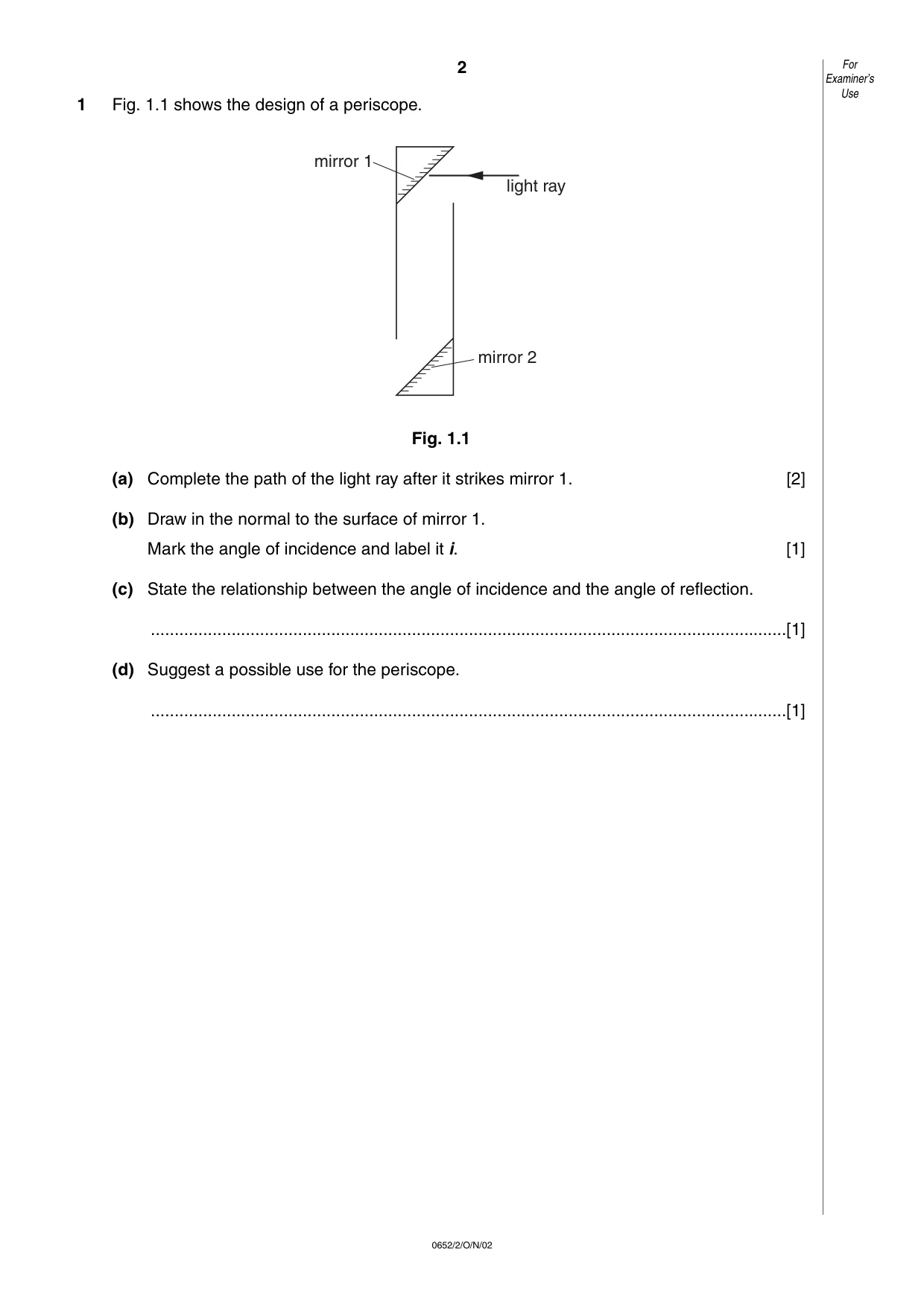
2 0652/2/O/N/02 1 Fig. 1.1 shows the design of a periscope. Fig. 1.1 (a) Complete the path of the light ray after it strikes mirror 1. [2] (b) Draw in the normal to the surface of mirror 1. Mark the angle of incidence and label it i. [1] (c) State the relationship between the angle of incidence and the angle of reflection. …[1] (d) Suggest a possible use for the periscope. …[1] mirror 1 mirror 2 light ray For Examiner’s Use
Question paper, page 3
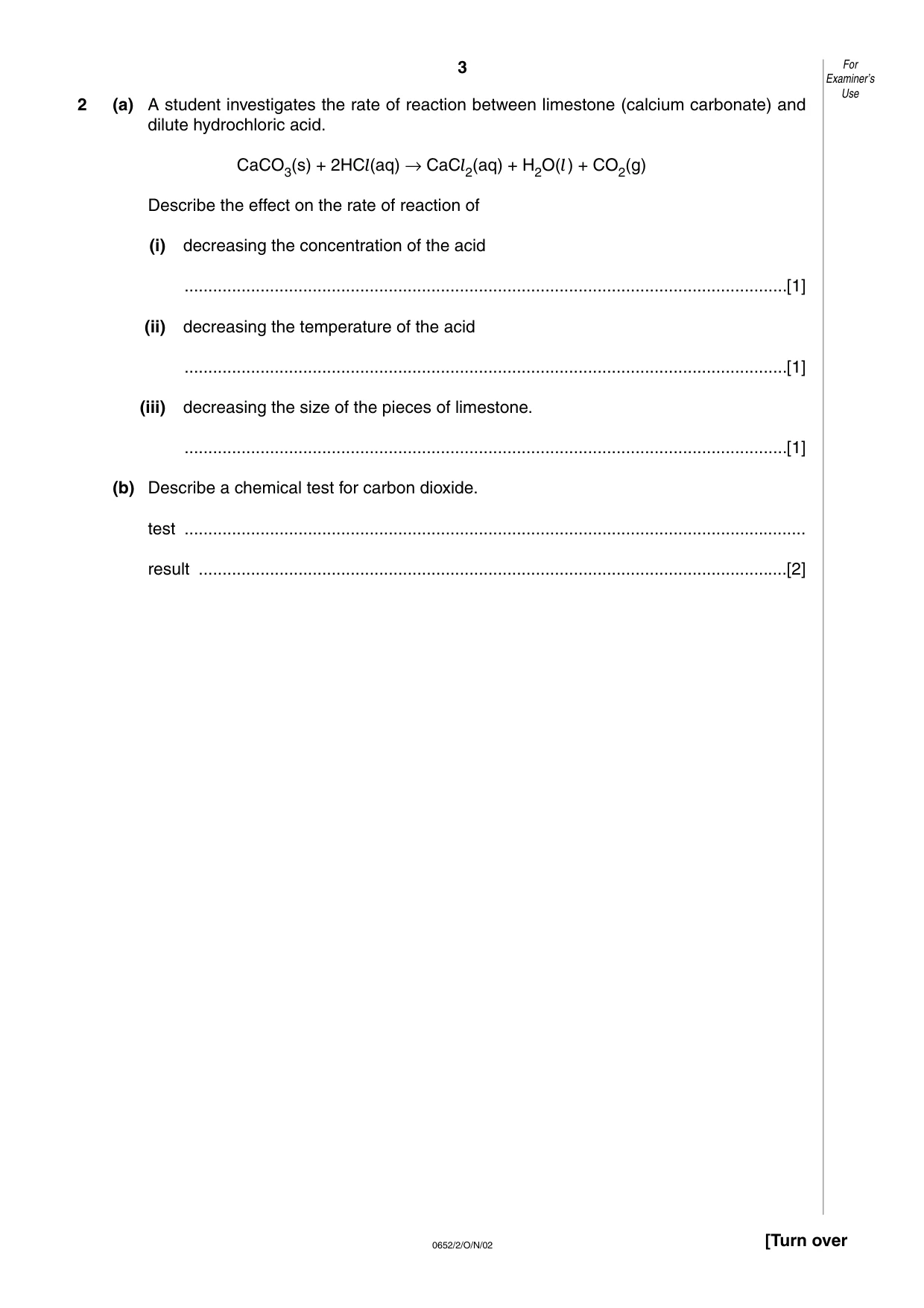
3 0652/2/O/N/02 [Turn over 2 (a) A student investigates the rate of reaction between limestone (calcium carbonate) and dilute hydrochloric acid. CaCO3(s) + 2HCl(aq) →CaCl2(aq) + H2O(l) + CO2(g) Describe the effect on the rate of reaction of (i) decreasing the concentration of the acid …[1] (ii) decreasing the temperature of the acid …[1] (iii) decreasing the size of the pieces of limestone. …[1] (b) Describe a chemical test for carbon dioxide. test … result …[2] For Examiner’s Use
Question paper, page 4
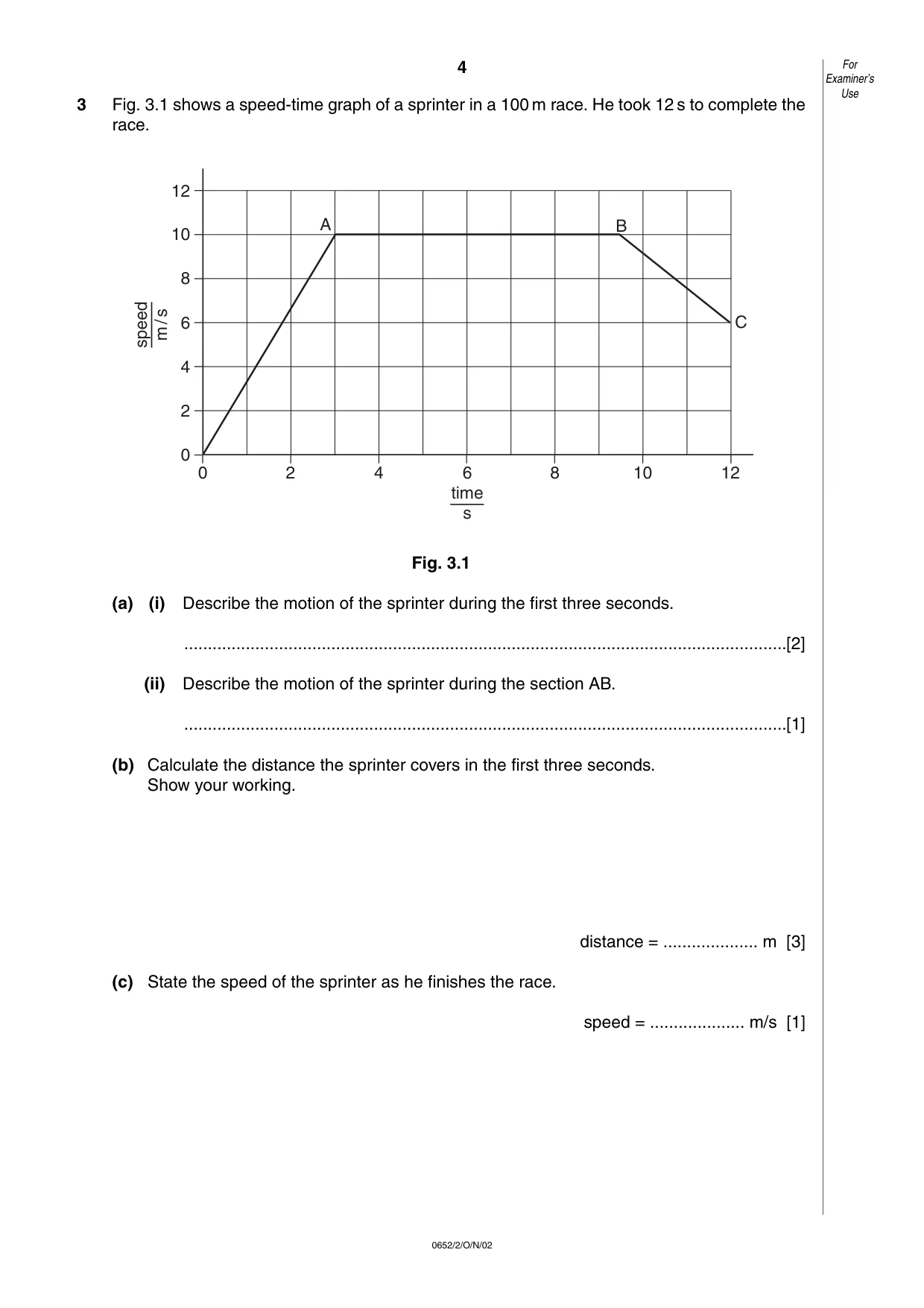
4 0652/2/O/N/02 3 Fig. 3.1 shows a speed-time graph of a sprinter in a 100 m race. He took 12 s to complete the race. Fig. 3.1 (a) (i) Describe the motion of the sprinter during the first three seconds. …[2] (ii) Describe the motion of the sprinter during the section AB. …[1] (b) Calculate the distance the sprinter covers in the first three seconds. Show your working. distance = … m [3] (c) State the speed of the sprinter as he finishes the race. speed = … m/s [1] A B C 12 10 8 6 4 2 0 0 2 4 6 8 10 12 time s speed m/s For Examiner’s Use
Question paper, page 5
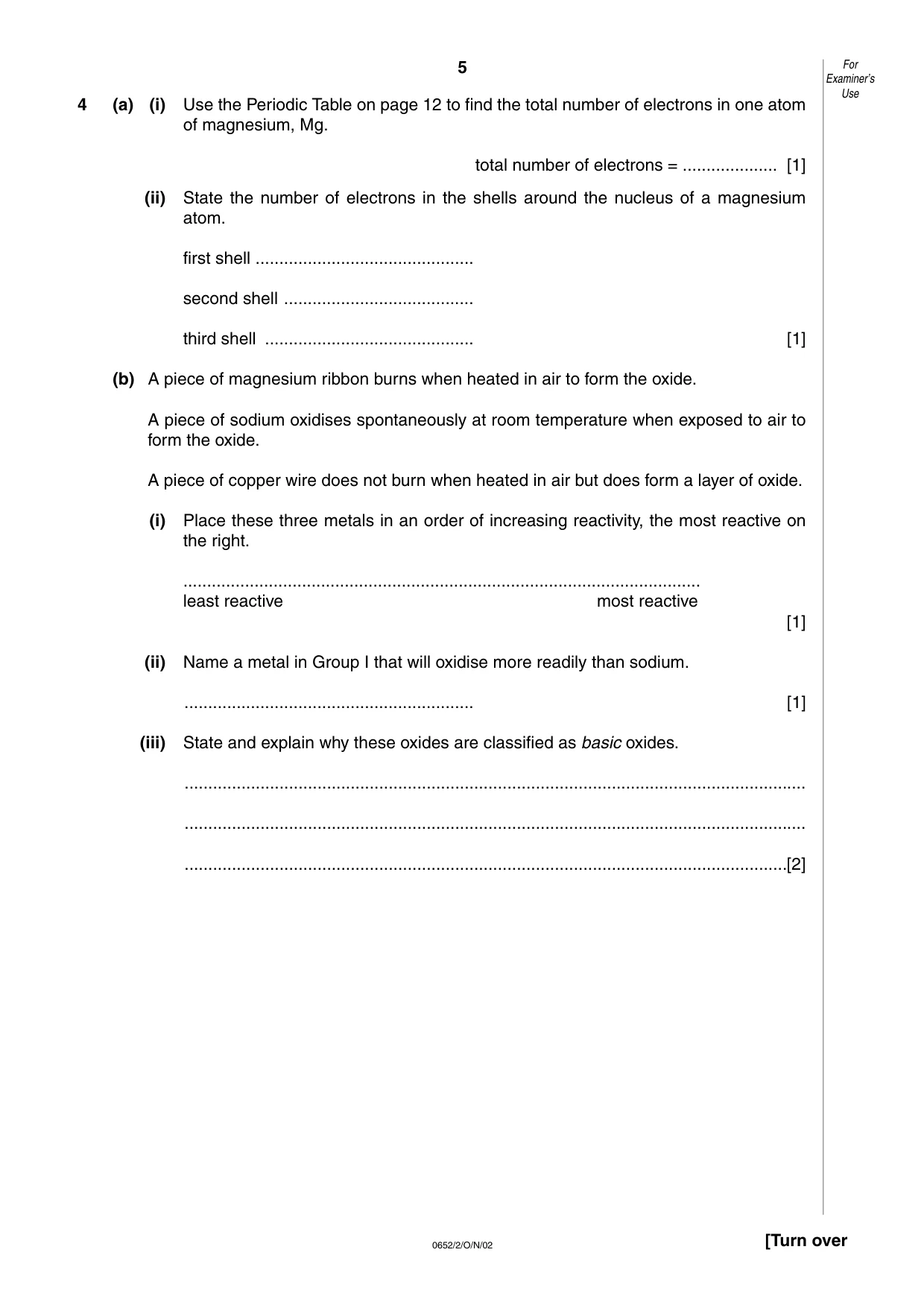
5 0652/2/O/N/02 [Turn over 4 (a) (i) Use the Periodic Table on page 12 to find the total number of electrons in one atom of magnesium, Mg. total number of electrons = … [1] (ii) State the number of electrons in the shells around the nucleus of a magnesium atom. first shell … second shell … third shell … [1] (b) A piece of magnesium ribbon burns when heated in air to form the oxide. A piece of sodium oxidises spontaneously at room temperature when exposed to air to form the oxide. A piece of copper wire does not burn when heated in air but does form a layer of oxide. (i) Place these three metals in an order of increasing reactivity, the most reactive on the right. … least reactive most reactive [1] (ii) Name a metal in Group I that will oxidise more readily than sodium. … [1] (iii) State and explain why these oxides are classified as basic oxides. … … …[2] For Examiner’s Use
Question paper, page 6
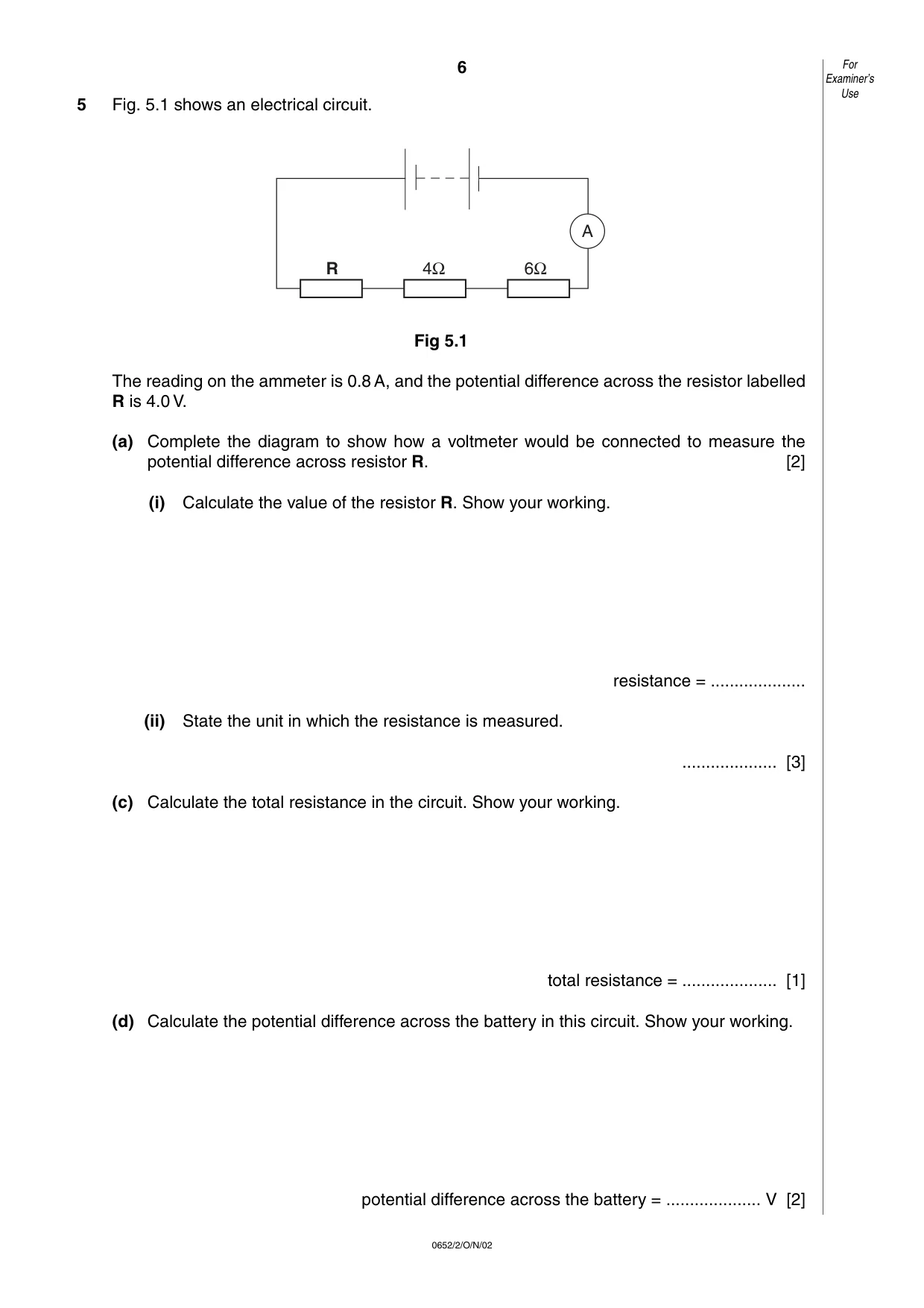
6 0652/2/O/N/02 5 Fig. 5.1 shows an electrical circuit. Fig 5.1 The reading on the ammeter is 0.8 A, and the potential difference across the resistor labelled R is 4.0 V. (a) Complete the diagram to show how a voltmeter would be connected to measure the potential difference across resistor R. [2] (i) Calculate the value of the resistor R. Show your working. resistance = … (ii) State the unit in which the resistance is measured. … [3] (c) Calculate the total resistance in the circuit. Show your working. total resistance = … [1] (d) Calculate the potential difference across the battery in this circuit. Show your working. potential difference across the battery = … V [2] R 4Ω 6Ω A For Examiner’s Use
Question paper, page 7
7 0652/2/O/N/02 [Turn over 6 (a) Sodium chloride is an ionic compound, containing the ions Na+ and Cl–. (i) Describe the formation of each of these ions in terms of electron transfer between atoms. … … …[2] (ii) In terms of forces between these ions, explain why sodium chloride has a high melting point. … … …[2] (b) Describe a chemical test for the chloride ion in solution. test … result …[2] For Examiner’s Use
Question paper, page 8
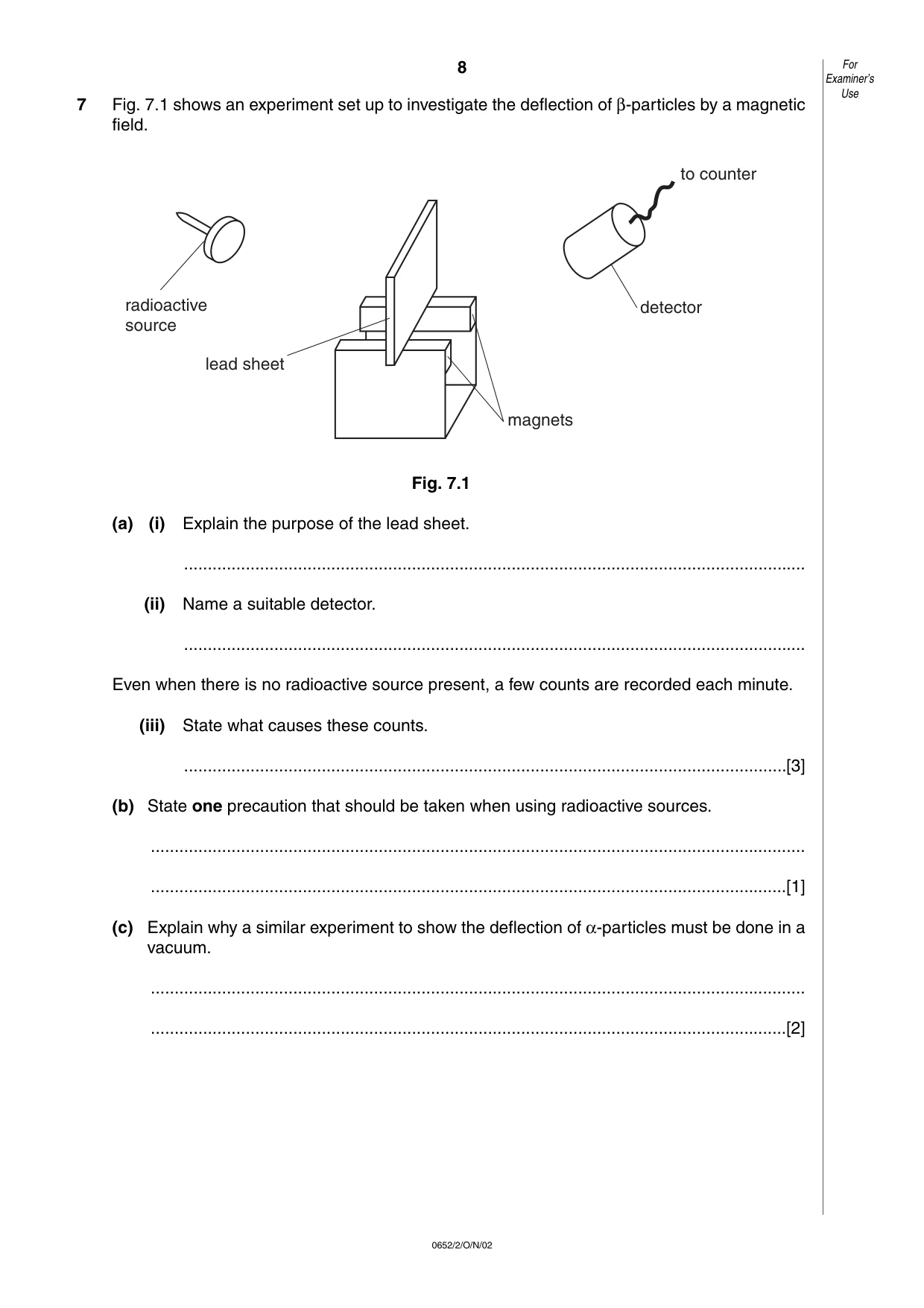
8 0652/2/O/N/02 7 Fig. 7.1 shows an experiment set up to investigate the deflection of β-particles by a magnetic field. Fig. 7.1 (a) (i) Explain the purpose of the lead sheet. … (ii) Name a suitable detector. … Even when there is no radioactive source present, a few counts are recorded each minute. (iii) State what causes these counts. …[3] (b) State one precaution that should be taken when using radioactive sources. … …[1] (c) Explain why a similar experiment to show the deflection of α-particles must be done in a vacuum. … …[2] radioactive source lead sheet magnets detector to counter For Examiner’s Use
Question paper, page 9
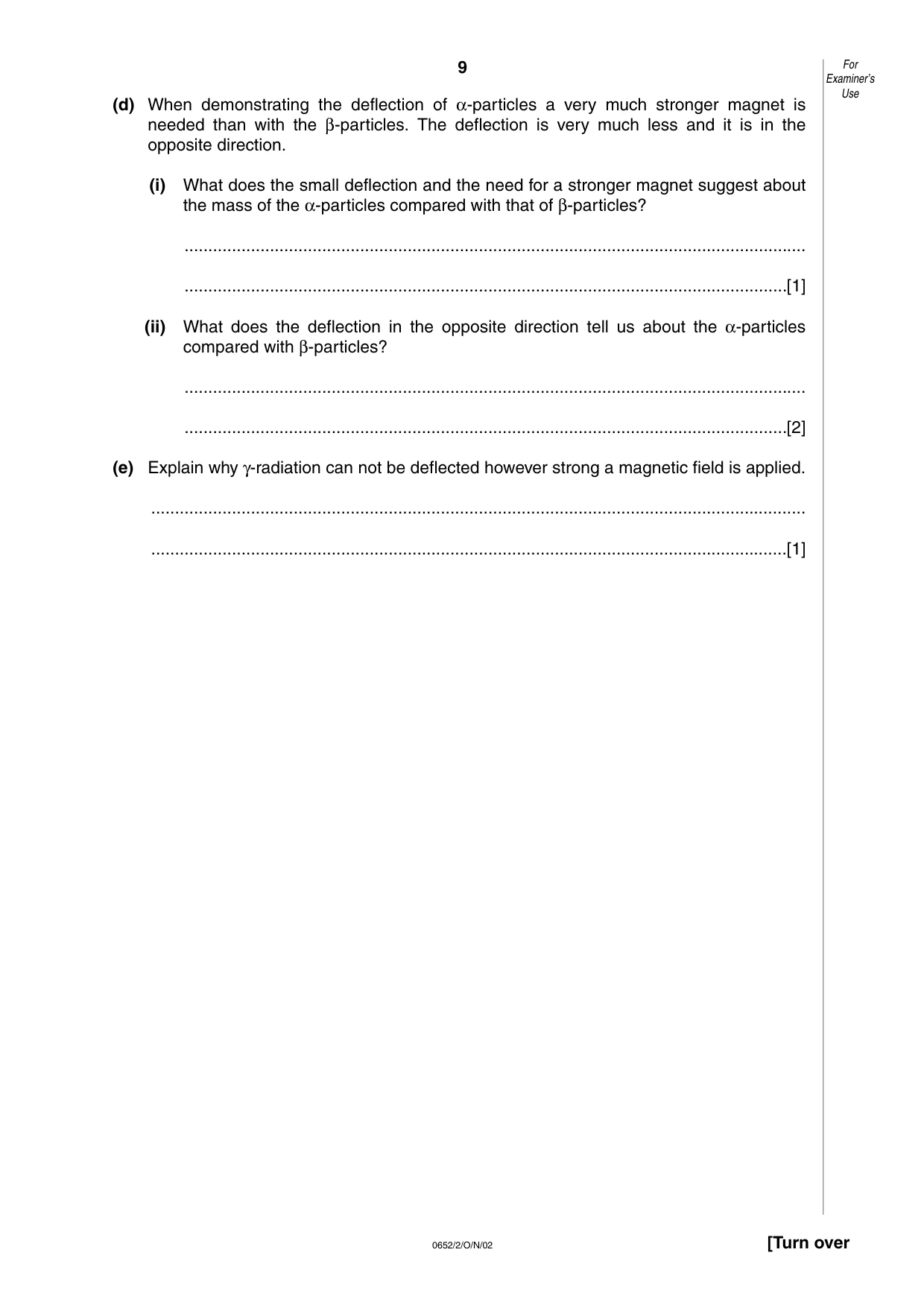
9 0652/2/O/N/02 (d) When demonstrating the deflection of α-particles a very much stronger magnet is needed than with the β-particles. The deflection is very much less and it is in the opposite direction. (i) What does the small deflection and the need for a stronger magnet suggest about the mass of the α-particles compared with that of β-particles? … …[1] (ii) What does the deflection in the opposite direction tell us about the α-particles compared with β-particles? … …[2] (e) Explain why γ-radiation can not be deflected however strong a magnetic field is applied. … …[1] For Examiner’s Use [Turn over
Question paper, page 10
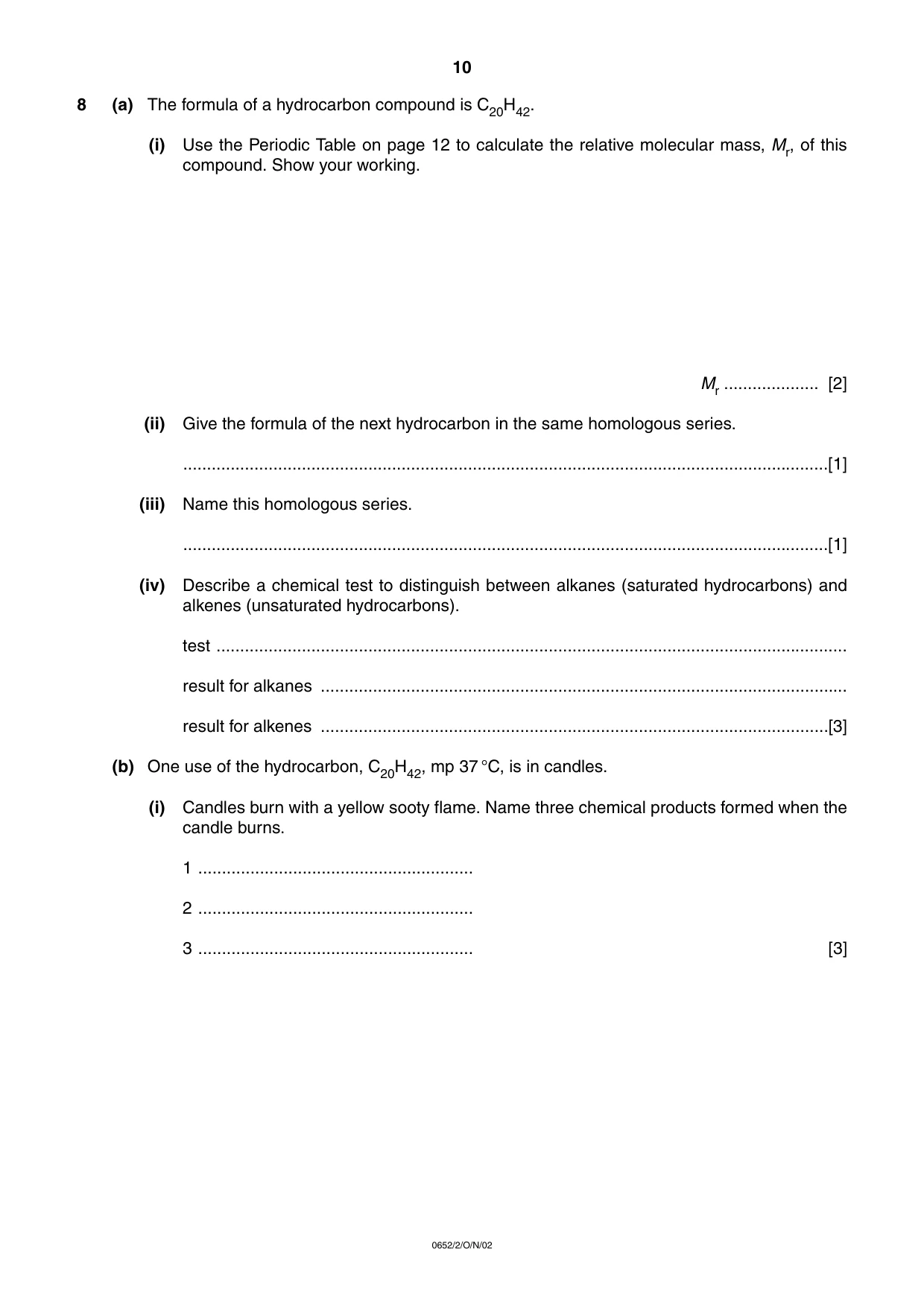
10 0652/2/O/N/02 8 (a) The formula of a hydrocarbon compound is C20H42. (i) Use the Periodic Table on page 12 to calculate the relative molecular mass, Mr, of this compound. Show your working. Mr … [2] (ii) Give the formula of the next hydrocarbon in the same homologous series. …[1] (iii) Name this homologous series. …[1] (iv) Describe a chemical test to distinguish between alkanes (saturated hydrocarbons) and alkenes (unsaturated hydrocarbons). test … result for alkanes … result for alkenes …[3] (b) One use of the hydrocarbon, C20H42, mp 37 °C, is in candles. (i) Candles burn with a yellow sooty flame. Name three chemical products formed when the candle burns. 1 … 2 … 3 … [3]
Question paper, page 11
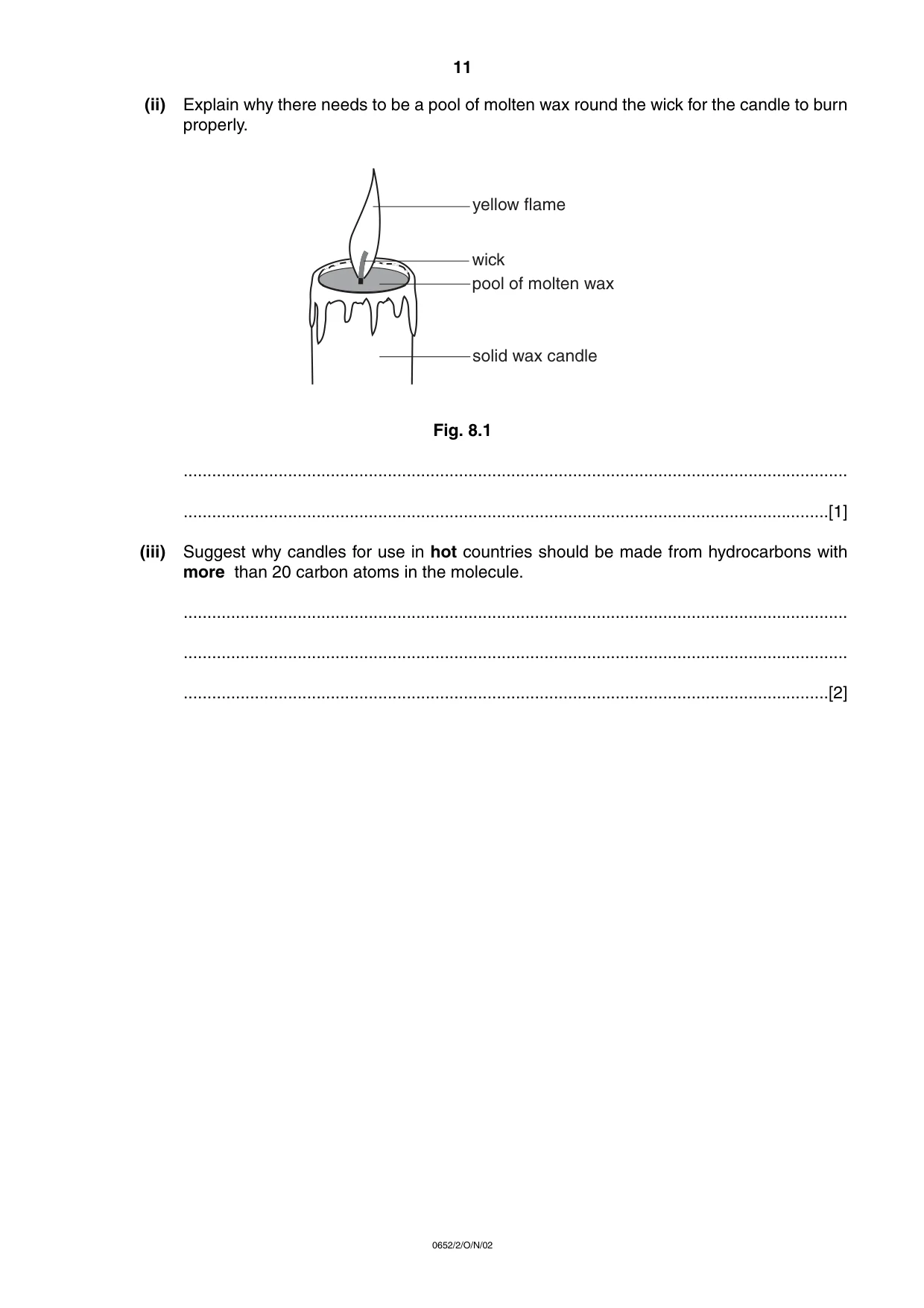
11 0652/2/O/N/02 (ii) Explain why there needs to be a pool of molten wax round the wick for the candle to burn properly. Fig. 8.1 … …[1] (iii) Suggest why candles for use in hot countries should be made from hydrocarbons with more than 20 carbon atoms in the molecule. … … …[2] yellow flame wick pool of molten wax solid wax candle
Question paper, page 12
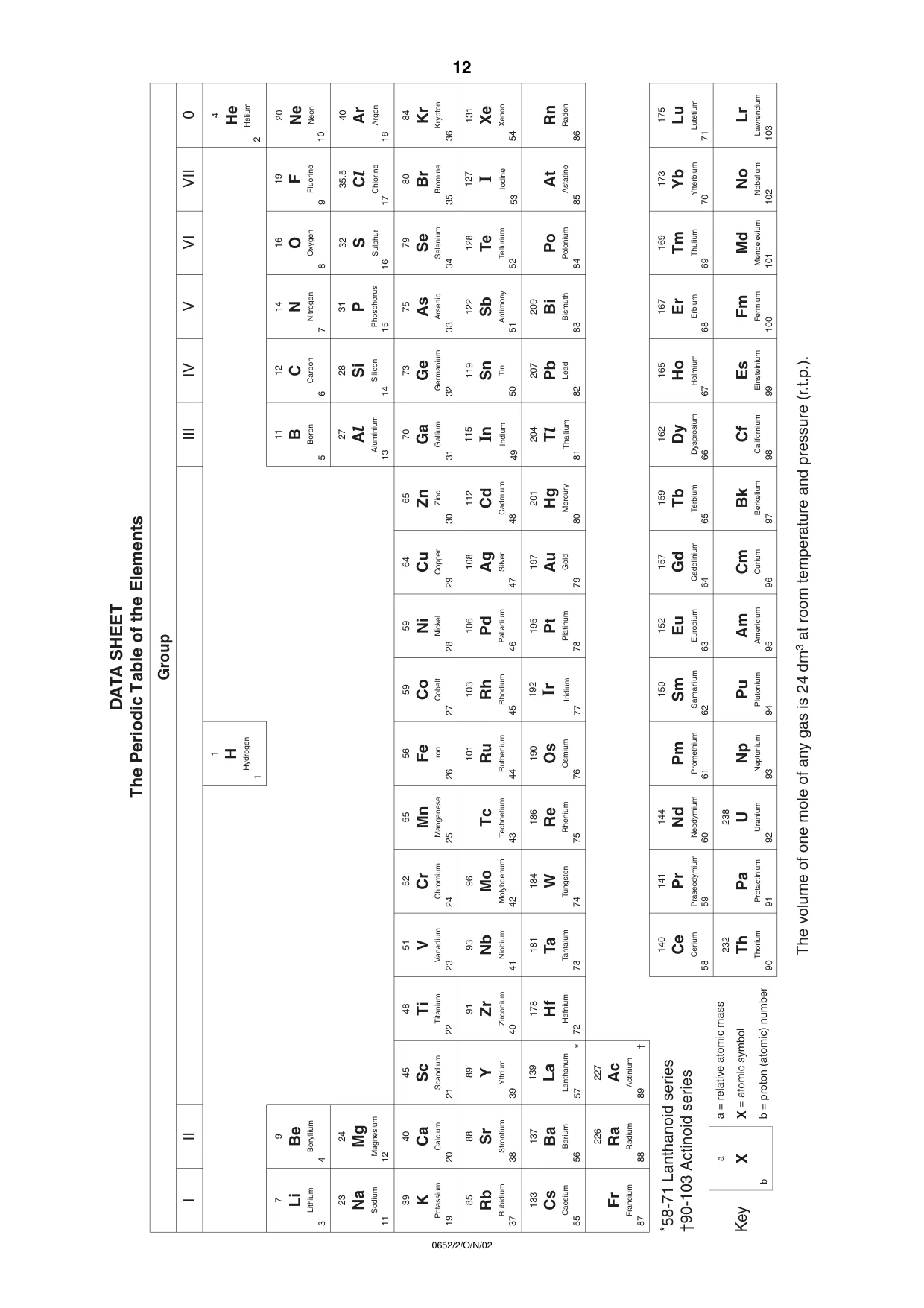
12 0652/2/O/N/02 Group DATA SHEET The Periodic Table of the Elements 140 Ce Cerium 58 141 Pr Praseodymium 59 144 Nd Neodymium 60 Pm Promethium 61 150 Sm Samarium 62 152 Eu Europium 63 157 Gd Gadolinium 64 159 Tb Terbium 65 162 Dy Dysprosium 66 165 Ho Holmium 67 167 Er Erbium 68 169 Tm Thulium 69 173 Yb Ytterbium 70 175 Lu Lutetium 71 232 Th Thorium 90 Pa Protactinium 91 238 U Uranium 92 Np Neptunium 93 Pu Plutonium 94 Am Americium 95 Cm Curium 96 Bk Berkelium 97 Cf Californium 98 Es Einsteinium 99 Fm Fermium 100 Md Mendelevium 101 No Nobelium 102 Lr Lawrencium 103 1 H Hydrogen 1 7 Li Lithium 3 23 Na Sodium 11 24 Mg Magnesium 12 40 Ca Calcium 20 45 Sc Scandium 21 48 Ti Titanium 22 51 V Vanadium 23 52 Cr Chromium 24 55 Mn Manganese 25 56 Fe Iron 26 59 Co Cobalt 27 59 Ni Nickel 28 64 Cu Copper 29 65 Zn Zinc 30 70 Ga Gallium 31 27 Al Aluminium 13 11 B Boron 5 12 C Carbon 6 14 N Nitrogen 7 16 O Oxygen 8 19 F Fluorine 9 28 Si Silicon 14 31 P Phosphorus 15 32 S Sulphur 16 35.5 Cl Chlorine 17 40 Ar Argon 18 20 Ne Neon 10 4 He Helium 2 73 Ge Germanium 32 75 As Arsenic 33 79 Se Selenium 34 80 Br Bromine 35 84 Kr Krypton 36 39 K Potassium 19 88 Sr Strontium 38 89 Y Yttrium 39 91 Zr Zirconium 40 93 Nb Niobium 41 96 Mo Molybdenum 42 Tc Technetium 43 101 Ru Ruthenium 44 103 Rh Rhodium 45 106 Pd Palladium 46 108 Ag Silver 47 112 Cd Cadmium 48 115 In Indium 49 119 Sn Tin 50 122 Sb Antimony 51 128 Te Tellurium 52 127 I Iodine 53 131 Xe Xenon 54 137 Ba Barium 56 139 La Lanthanum 57 * 178 Hf Hafnium 72 181 Ta Tantalum 73 184 W Tungsten 74 186 Re Rhenium 75 190 Os Osmium 76 192 Ir Iridium 77 195 Pt Platinum 78 197 Au Gold 79 201 Hg Mercury 80 204 Tl Thallium 81 207 Pb Lead 82 209 Bi Bismuth 83 Po Polonium 84 At Astatine 85 Rn Radon 86 Fr Francium 87 227 Ac Actinium 89 † 9 Be Beryllium 4 I II III IV V VI VII 0 85 Rb Rubidium 37 133 Cs Caesium 55 226 Ra Radium 88 The volume of one mole of any gas is 24 dm3 at room temperature and pressure (r.t.p.). a X b a = relative atomic mass X = atomic symbol b = proton (atomic) number Key *58-71 Lanthanoid series †90-103 Actinoid series
Mark scheme, page 1
CAMBRIDGE INTERNATIONAL EXAMINATIONS NOVEMBER 2002 INTERNATIONAL GCSE UNIVERSITY of CAMBRIDGE Local Examinations Syndicate
Mark scheme, page 2
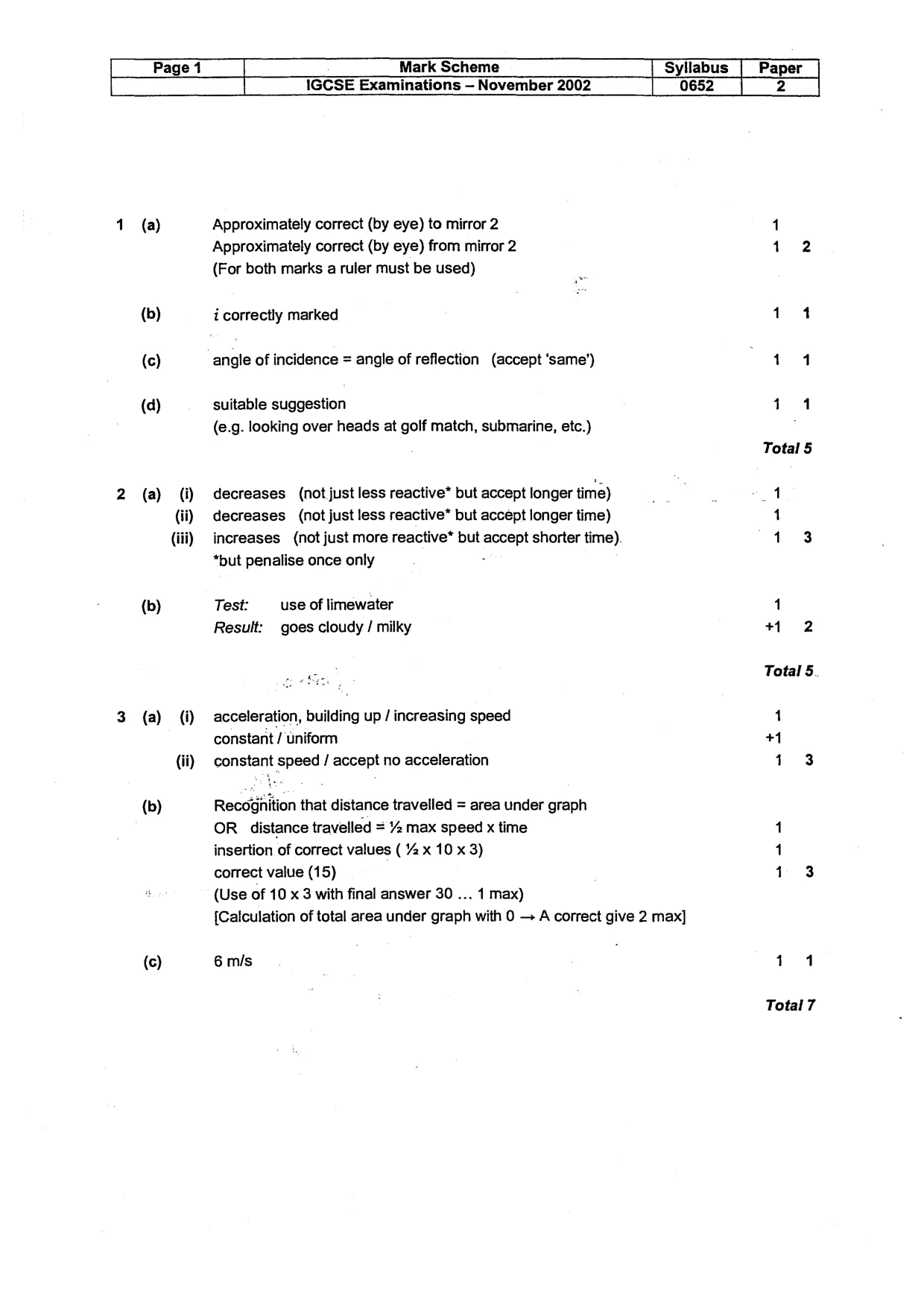
Page 1 Mark Scheme Syllabus | Paper IGCSE Examinations — November 2002 0652 | 2 | (a) Approximately correct (by eye) to mirror 2 1 Approximately correct (by eye) from mirror 2 1 2 (For both marks a ruler must be used) (b) i correctly marked 14 (c) angle of incidence = angle of reflection (accept ‘same’) 161 (d) suitable suggestion 41°61 (e.g. looking over heads at golf match, submarine, etc.) Total 5 (a) (i) decreases (not just less reactive* but accept longer time) . 1 (ii) decreases (not just less reactive* but accept longer time) 1 (iii) increases (not just more reactive* but accept shorter time). 1 3 *but penalise once only - (b) Test: use of limewater 1 Result: goes cloudy / milky +102 cares Total 5 (a) (i) acceleration, building up / increasing speed 1 constant / uniform +H (ii) constant speed / accept no acceleration 1 3 (b) Recognition that distance travelled = area under graph OR distance travelled = % max speed x time 1 insertion of correct values ( % x 10 x 3) 1 correct value (15) 1.3 (Use of 10 x 3 with final answer 30 ... 1 max) {Calculation of total area under graph with 0 — A correct give 2 max] (c) 6 mis 1614 Total7
Mark scheme, page 3
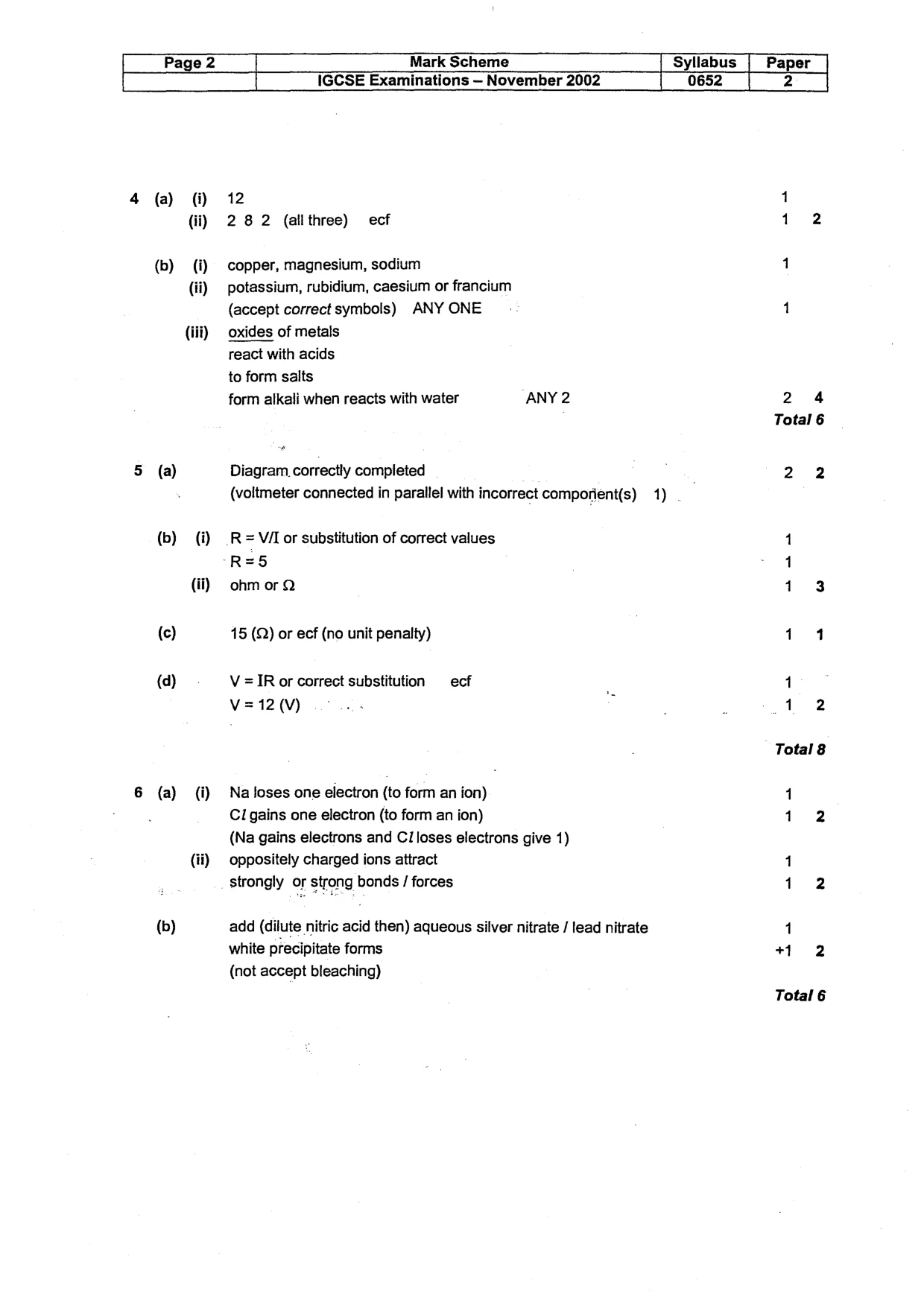
Page 2 I Mark Scheme Syllabus | Paper | ] IGCSE Examinations — November 2002 o6s2, | 2. ~«| 4 (a) (i) 12 1 (ii) 28 2 (allthree) ecf 1 2 (b) (i) copper, magnesium, sodium 1 (ii) potassium, rubidium, caesium or francium (accept correct symbols) ANY ONE 1 (iii) oxides of metals react with acids to form salts form alkali when reacts with water ANY 2 2 4 Total 6 5 (a) Diagram. correctly completed 2 2 (voltmeter connected in parallel with incorrect comporient(s) 1) (b) (i) .R=V/lor substitution of correct values 1 R=5 1 (ii) ~ohmorQ 1 3 (c) 15 (Q) or ecf (no unit penalty) 1°61 (d) V =IR or correct substitution ecf 1 V =12(V) 1 2 Total 8 6 (a) (i) Naloses one electron (to form an ion) 1 Cl gains one electron (to form an ion) 1 2 (Na gains electrons and Ci loses electrons give 1) (ii) oppositely charged ions attract 1 strongly or strong bonds / forces 1 2 (b) add (dilute nitric acid then) aqueous silver nitrate / lead nitrate 1 white precipitate forms +1062 (not accept bleaching) Total 6
Mark scheme, page 4
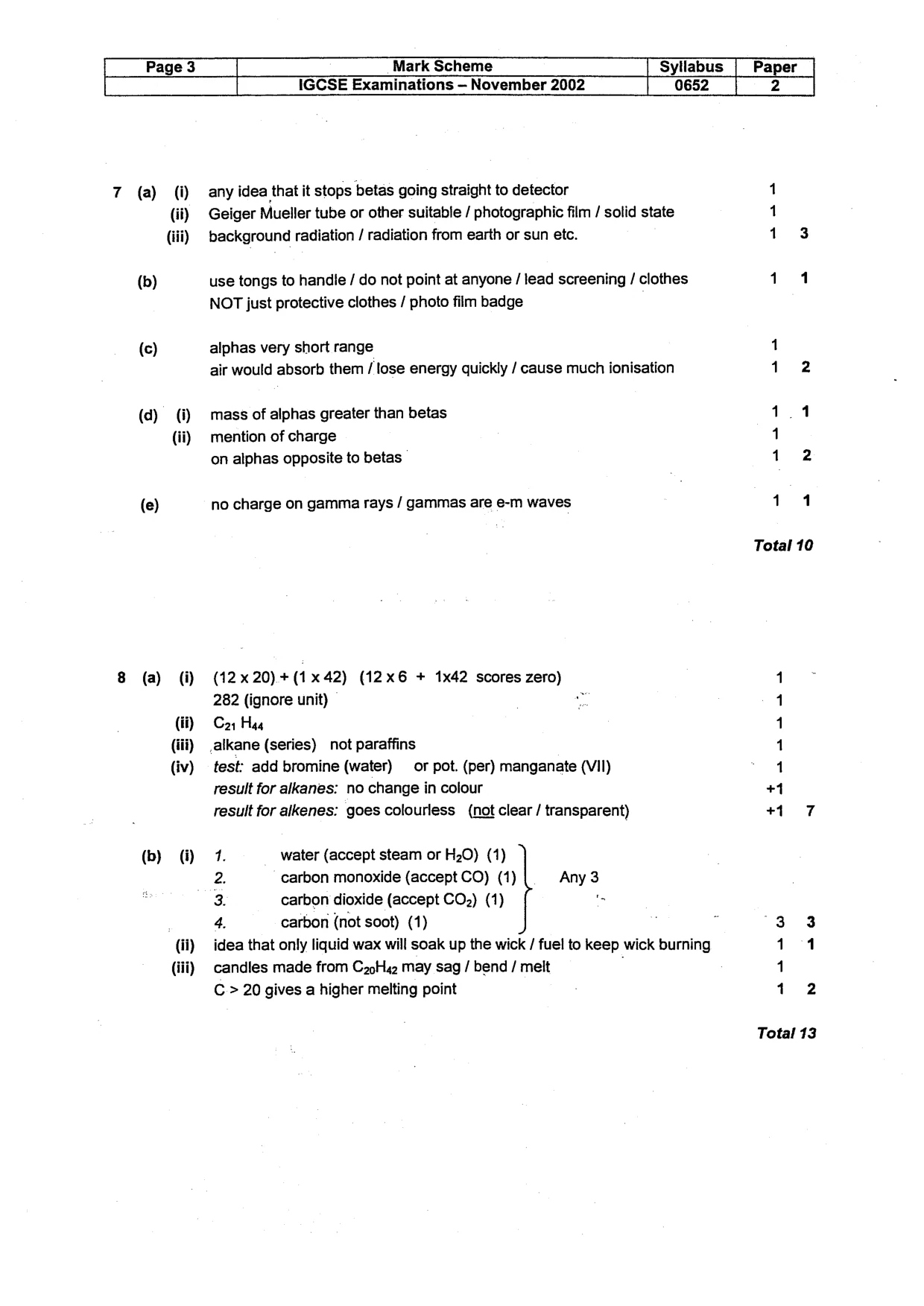
Page 3 Mark Scheme Syllabus IGCSE Examinations — November 2002 0652 7@ @ (ii) (iii) (b) (c) (@) (ii) (e) (b) (i) (il) (ii) any idea that it stops betas going straight to detector Geiger Mueller tube or other suitable / photographic film / solid state background radiation / radiation from earth or sun etc. use tongs to handle / do not point at anyone / lead screening / clothes NOT just protective clothes / photo film badge alphas very short range air would absorb them / lose energy quickly / cause much ionisation mass of alphas greater than betas mention of charge on alphas opposite to betas no charge on gamma rays / gammas are e-m waves (12 x 20). + (1x42) (12x6 + 1x42 scores zero) 282 (ignore unit) Cos Hea .alkane (series) not paraffins test: add bromine (water) _ or pot. (per) manganate (VII) result for alkanes: no change in colour result for alkenes: goes colourless (not clear / transparent) 1. water (accept steam or H2O) (1) 2 carbon monoxide (accept CO) (1) Any 3 3. carbon dioxide (accept CO2) (1) ‘s 4. carbon (not soot) (1) idea that only liquid wax will soak up the wick / fuel to keep wick burning candles made from C29H,42 may sag / bend / melt . C-> 20 gives a higher melting point 1 1 1 °3 1 $1 1 1 2 1.1 1 1 2 161 Total 10 1 1 1 1 1 +1 +1067 3 1641 1 1 2 Total 13