Cambridge IGCSE Physical Education 0413 — 2014 Oct/Nov Paper 1 · Variant 3
0413/13/O/N/14 · 80 marks · ≈90 min
The question paper and its mark scheme, free to read here and free to download. This is Cambridge’s own paper, exactly as it was sat.
Question paper12 pages

Mark scheme8 pages
Answers below. Sit the paper first if you are practising.
Paper as text
Question paper, page 1
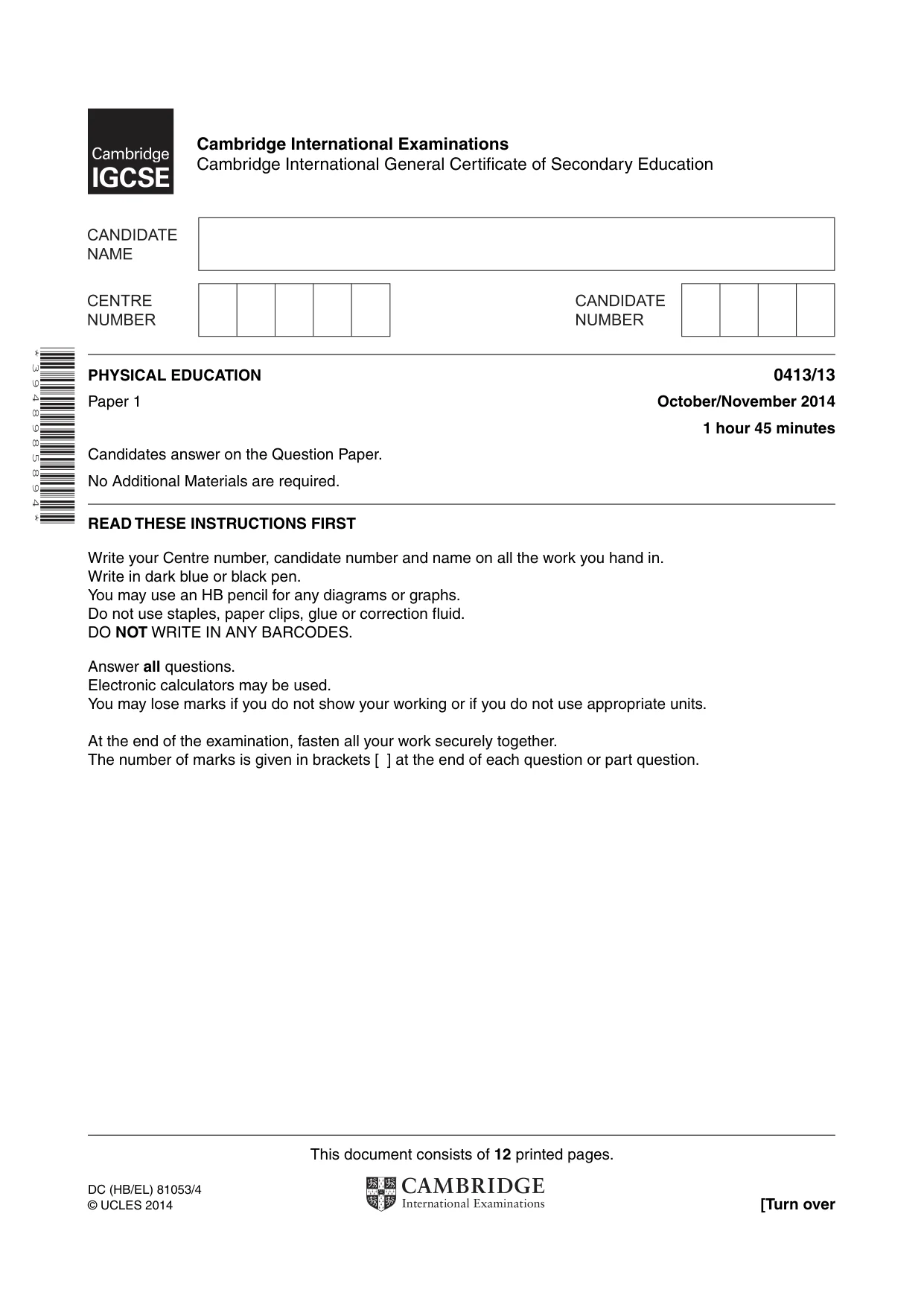
This document consists of 12 printed pages. DC (HB/EL) 81053/4 © UCLES 2014 [Turn over Cambridge International Examinations Cambridge International General Certificate of Secondary Education PHYSICAL EDUCATION 0413/13 Paper 1 October/November 2014 1 hour 45 minutes Candidates answer on the Question Paper. No Additional Materials are required. READ THESE INSTRUCTIONS FIRST Write your Centre number, candidate number and name on all the work you hand in. Write in dark blue or black pen. You may use an HB pencil for any diagrams or graphs. Do not use staples, paper clips, glue or correction fluid. DO NOT WRITE IN ANY BARCODES. Answer all questions. Electronic calculators may be used. You may lose marks if you do not show your working or if you do not use appropriate units. At the end of the examination, fasten all your work securely together. The number of marks is given in brackets [ ] at the end of each question or part question. * 3 9 4 8 9 8 5 8 9 4 *
Question paper, page 2
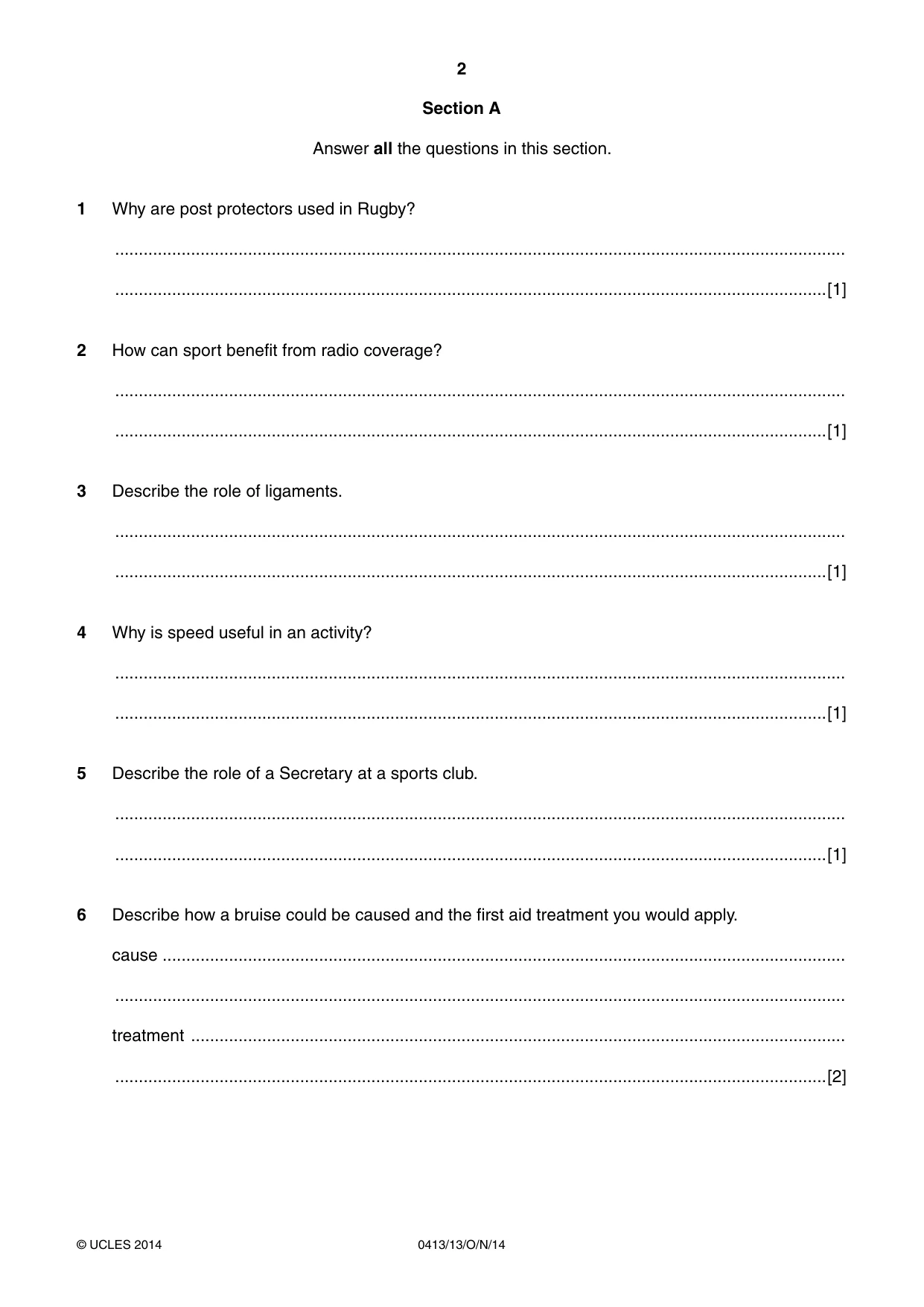
2 0413/13/O/N/14 © UCLES 2014 Section A Answer all the questions in this section. 1 Why are post protectors used in Rugby? … …[1] 2 How can sport benefit from radio coverage? … …[1] 3 Describe the role of ligaments. … …[1] 4 Why is speed useful in an activity? … …[1] 5 Describe the role of a Secretary at a sports club. … …[1] 6 Describe how a bruise could be caused and the first aid treatment you would apply. cause … … treatment … …[2]
Question paper, page 3
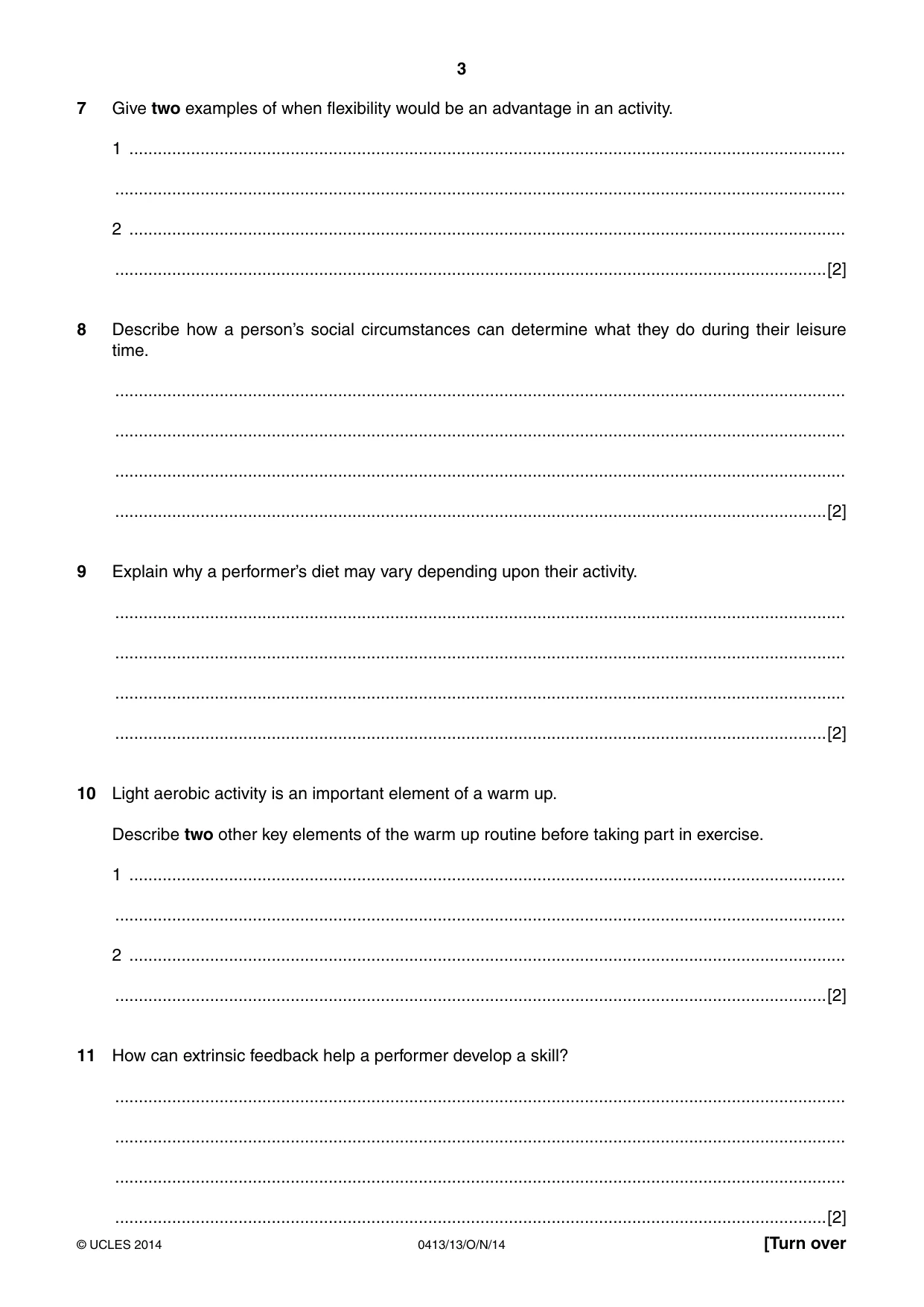
3 0413/13/O/N/14 © UCLES 2014 [Turn over 7 Give two examples of when flexibility would be an advantage in an activity. 1 … … 2 … …[2] 8 Describe how a person’s social circumstances can determine what they do during their leisure time. … … … …[2] 9 Explain why a performer’s diet may vary depending upon their activity. … … … …[2] 10 Light aerobic activity is an important element of a warm up. Describe two other key elements of the warm up routine before taking part in exercise. 1 … … 2 … …[2] 11 How can extrinsic feedback help a performer develop a skill? … … … …[2]
Question paper, page 4
4 0413/13/O/N/14 © UCLES 2014 12 Describe the effects of drinking alcohol on a performer. … … … … … …[3] [Total: 20]
Question paper, page 5
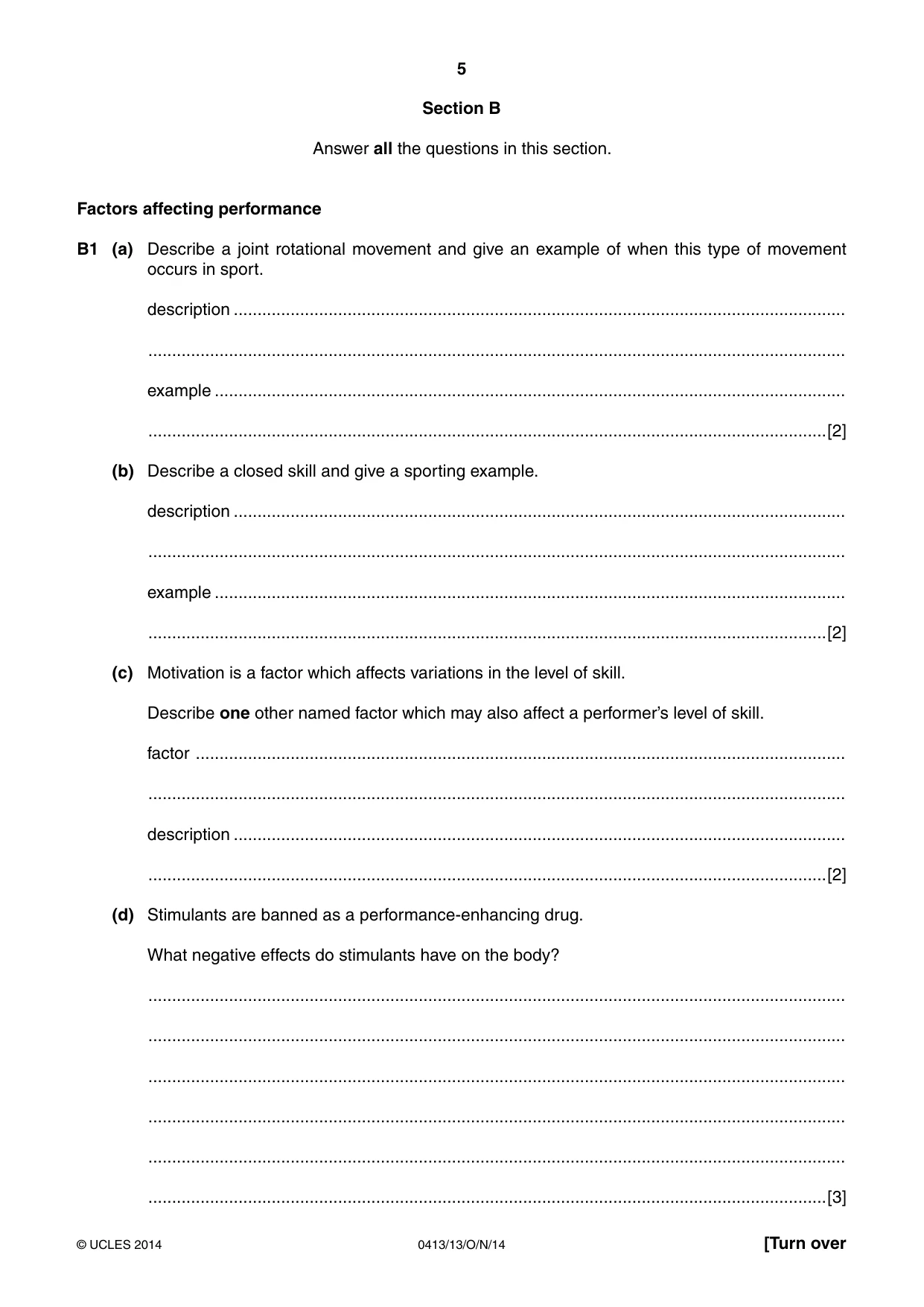
5 0413/13/O/N/14 © UCLES 2014 [Turn over Section B Answer all the questions in this section. Factors affecting performance B1 (a) Describe a joint rotational movement and give an example of when this type of movement occurs in sport. description … … example … …[2] (b) Describe a closed skill and give a sporting example. description … … example … …[2] (c) Motivation is a factor which affects variations in the level of skill. Describe one other named factor which may also affect a performer’s level of skill. factor … … description … …[2] (d) Stimulants are banned as a performance-enhancing drug. What negative effects do stimulants have on the body? … … … … … …[3]
Question paper, page 6
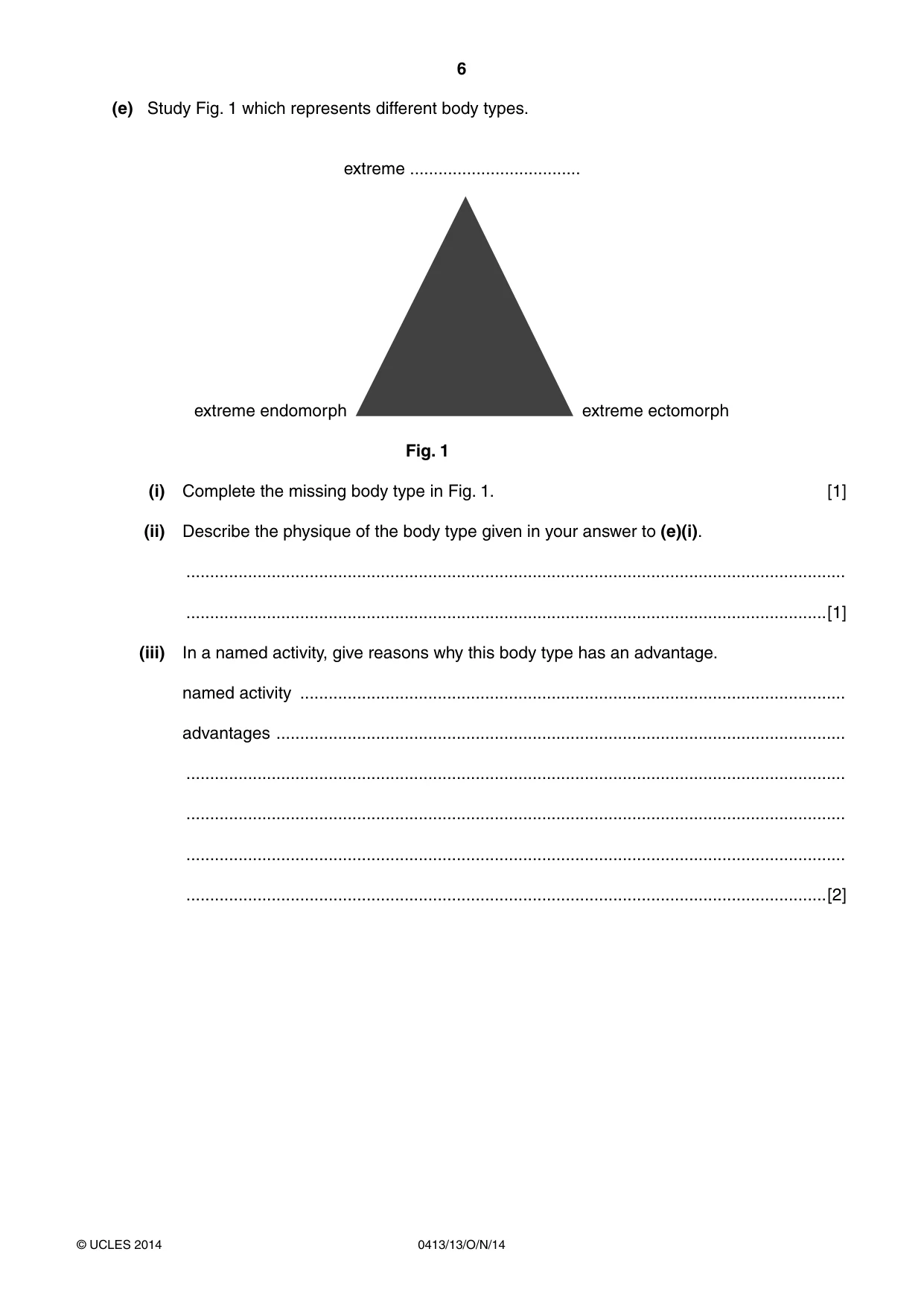
6 0413/13/O/N/14 © UCLES 2014 (e) Study Fig. 1 which represents different body types. extreme … extreme endomorph extreme ectomorph Fig. 1 (i) Complete the missing body type in Fig. 1. [1] (ii) Describe the physique of the body type given in your answer to (e)(i). … …[1] (iii) In a named activity, give reasons why this body type has an advantage. named activity … advantages … … … … …[2]
Question paper, page 7
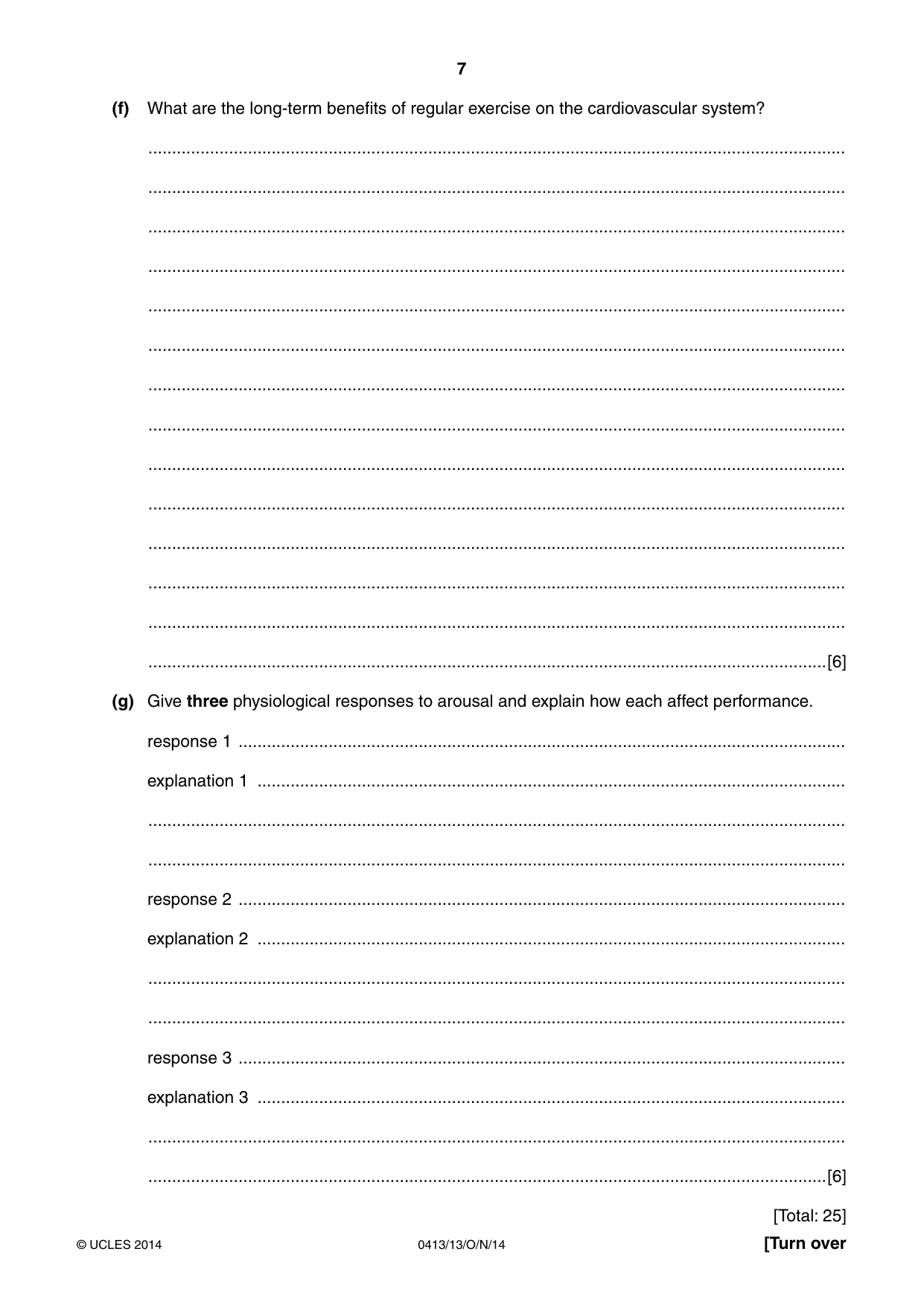
7 0413/13/O/N/14 © UCLES 2014 [Turn over (f) What are the long-term benefits of regular exercise on the cardiovascular system? … … … … … … … … … … … … … …[6] (g) Give three physiological responses to arousal and explain how each affect performance. response 1 … explanation 1 … … … response 2 … explanation 2 … … … response 3 … explanation 3 … … …[6] [Total: 25]
Question paper, page 8
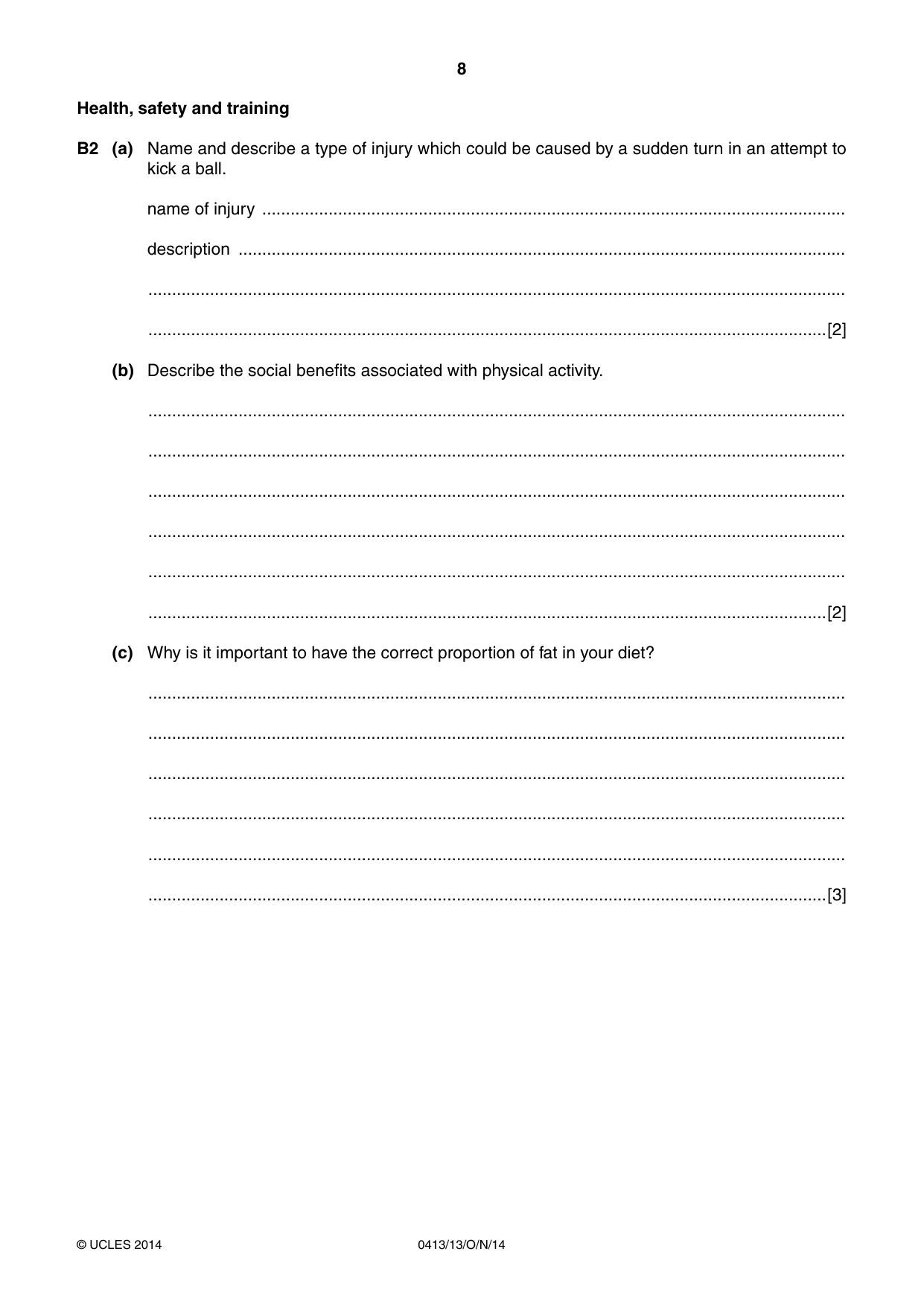
8 0413/13/O/N/14 © UCLES 2014 Health, safety and training B2 (a) Name and describe a type of injury which could be caused by a sudden turn in an attempt to kick a ball. name of injury … description … … …[2] (b) Describe the social benefits associated with physical activity. … … … … … …[2] (c) Why is it important to have the correct proportion of fat in your diet? … … … … … …[3]
Question paper, page 9
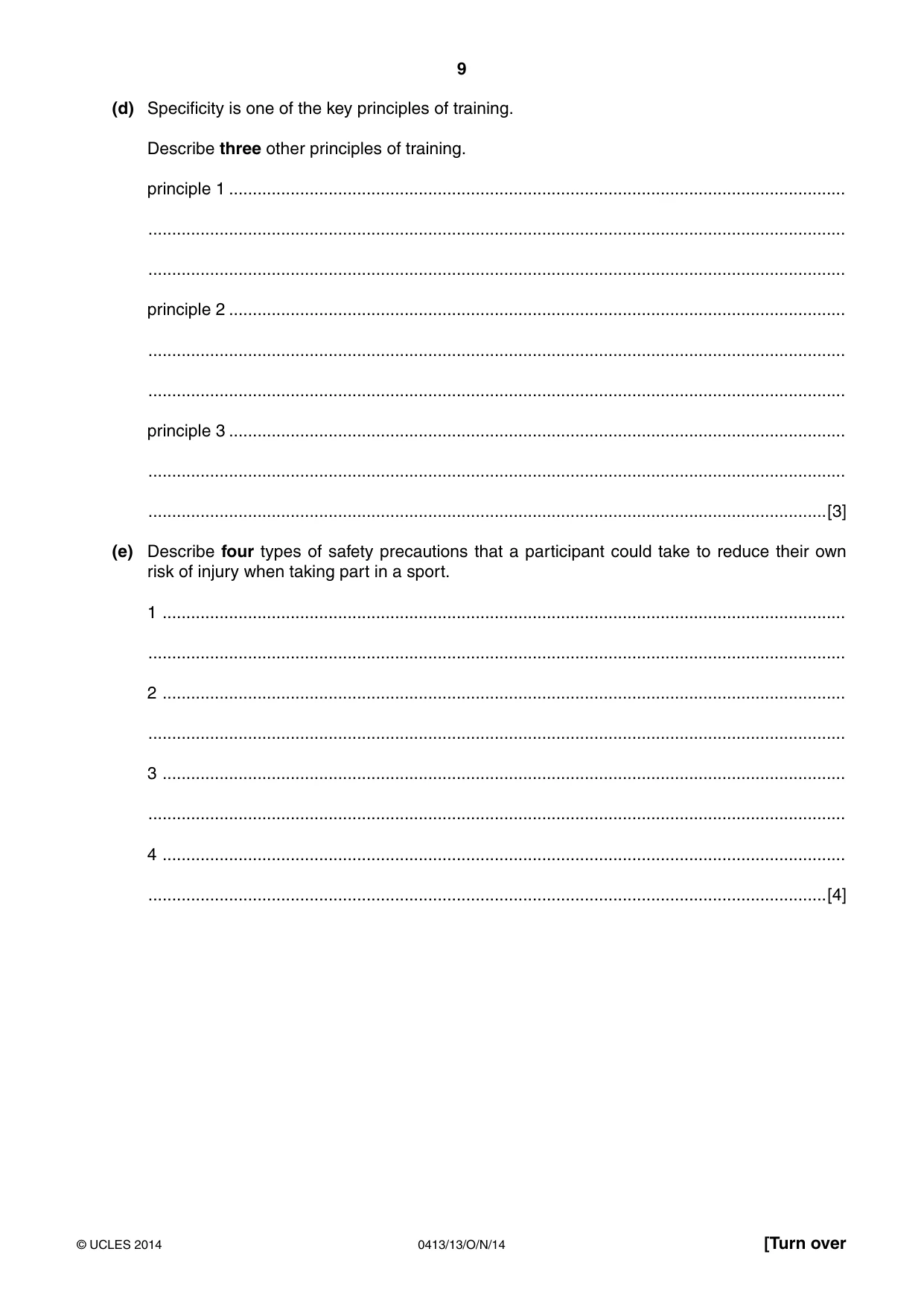
9 0413/13/O/N/14 © UCLES 2014 [Turn over (d) Specificity is one of the key principles of training. Describe three other principles of training. principle 1 … … … principle 2 … … … principle 3 … … …[3] (e) Describe four types of safety precautions that a participant could take to reduce their own risk of injury when taking part in a sport. 1 … … 2 … … 3 … … 4 … …[4]
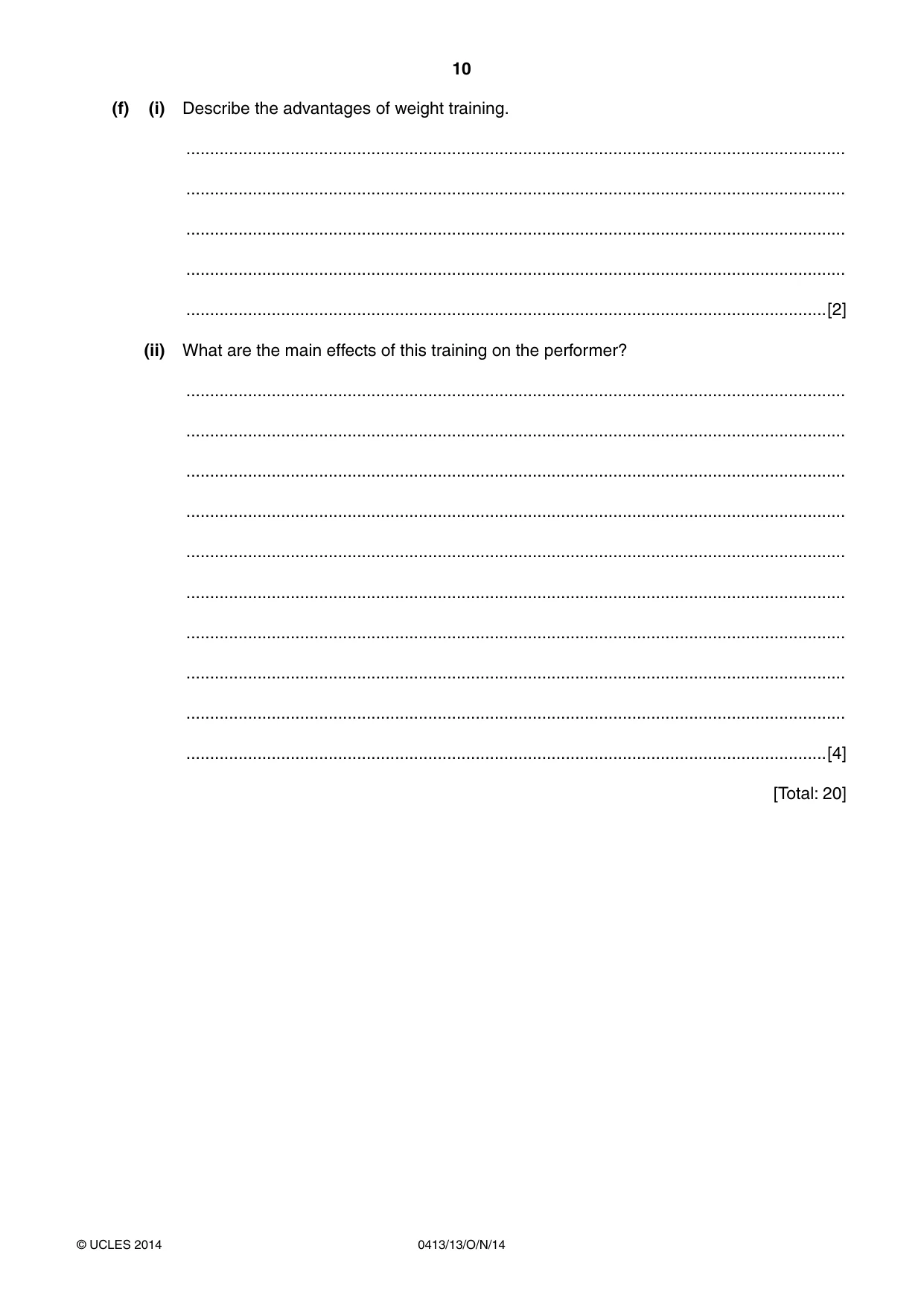
Question paper, page 10
10 0413/13/O/N/14 © UCLES 2014 (f) (i) Describe the advantages of weight training. … … … … …[2] (ii) What are the main effects of this training on the performer? … … … … … … … … … …[4] [Total: 20]
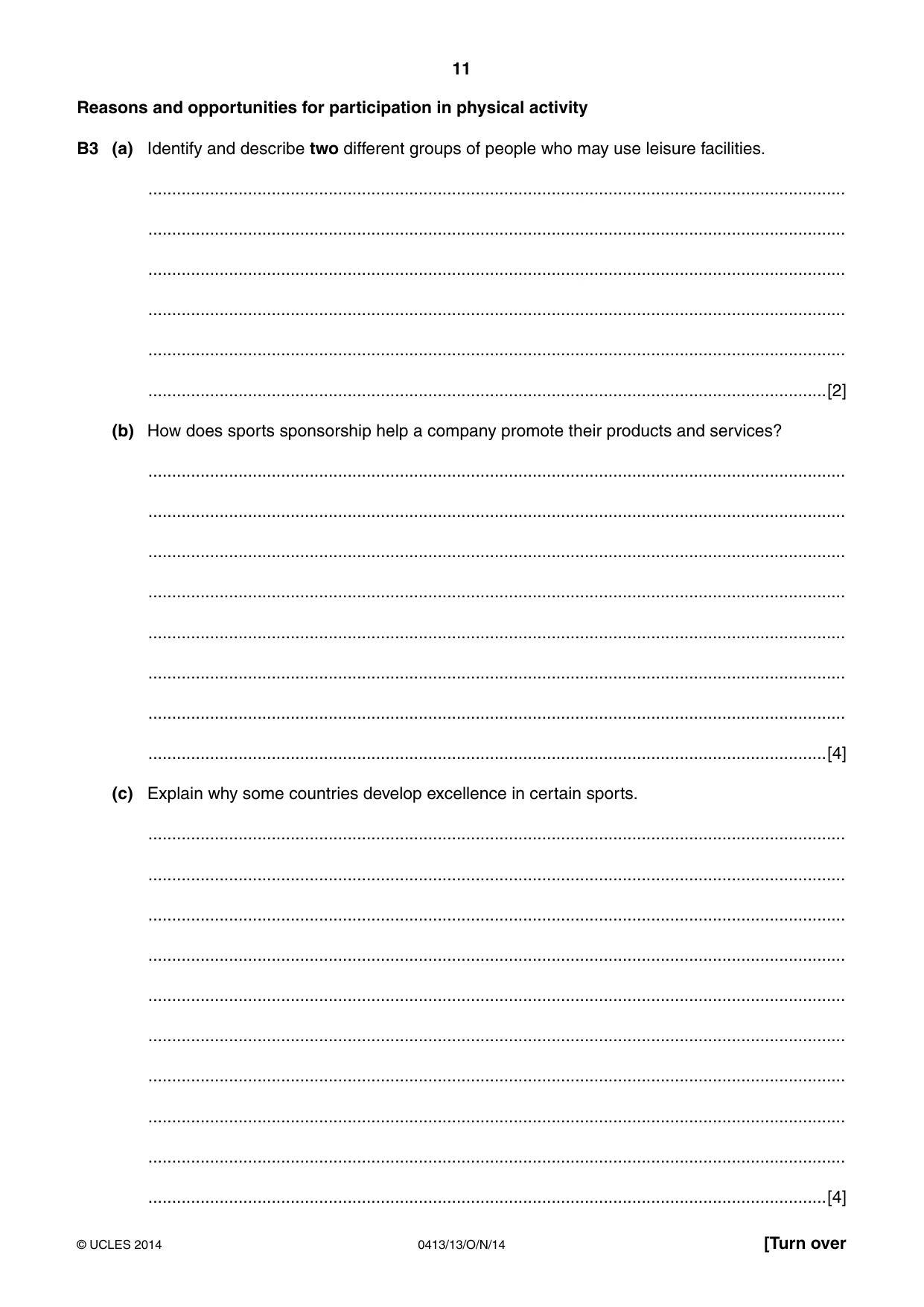
Question paper, page 11
11 0413/13/O/N/14 © UCLES 2014 [Turn over Reasons and opportunities for participation in physical activity B3 (a) Identify and describe two different groups of people who may use leisure facilities. … … … … … …[2] (b) How does sports sponsorship help a company promote their products and services? … … … … … … … …[4] (c) Explain why some countries develop excellence in certain sports. … … … … … … … … … …[4]
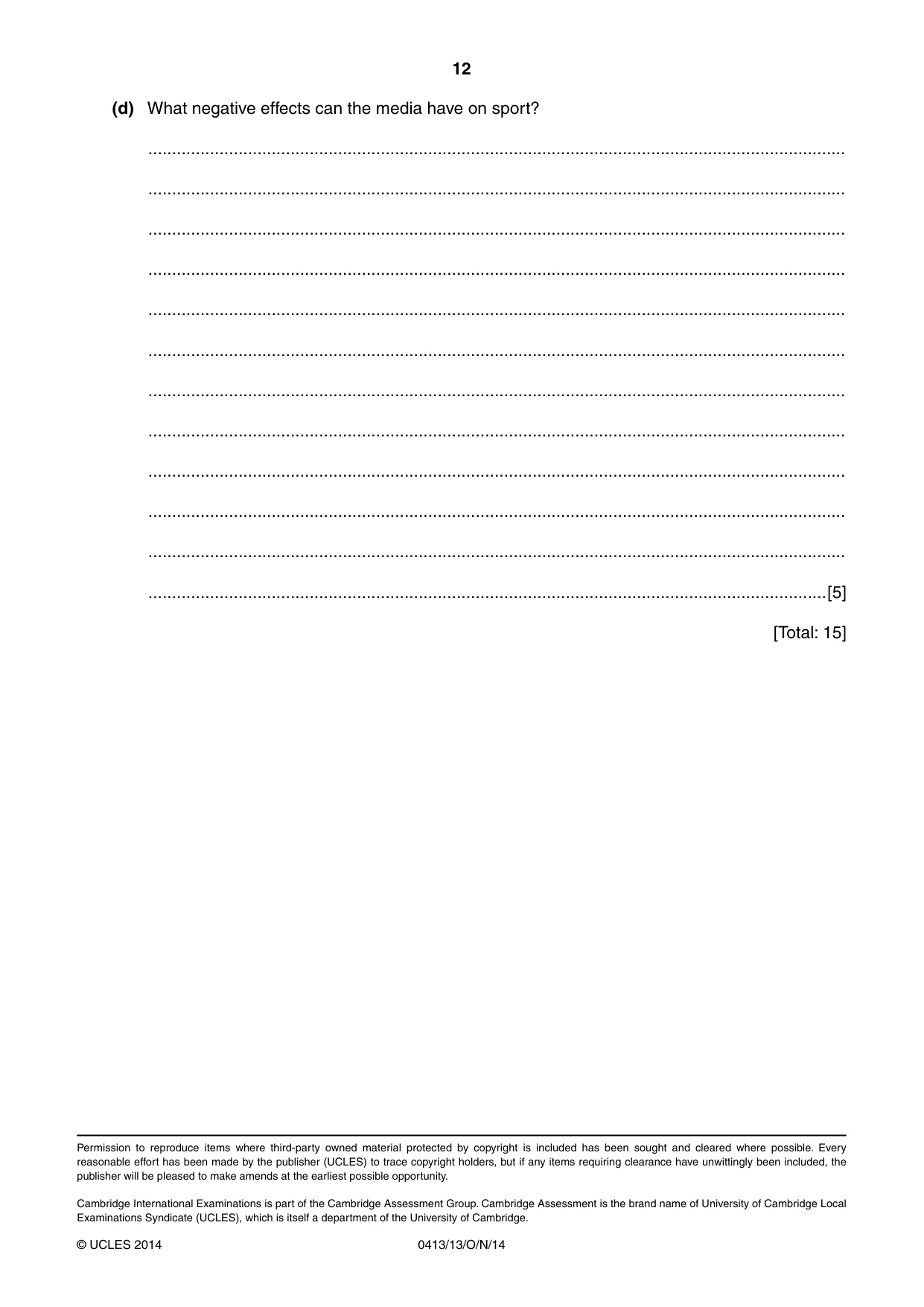
Question paper, page 12
12 0413/13/O/N/14 © UCLES 2014 Permission to reproduce items where third-party owned material protected by copyright is included has been sought and cleared where possible. Every reasonable effort has been made by the publisher (UCLES) to trace copyright holders, but if any items requiring clearance have unwittingly been included, the publisher will be pleased to make amends at the earliest possible opportunity. Cambridge International Examinations is part of the Cambridge Assessment Group. Cambridge Assessment is the brand name of University of Cambridge Local Examinations Syndicate (UCLES), which is itself a department of the University of Cambridge. (d) What negative effects can the media have on sport? … … … … … … … … … … … …[5] [Total: 15]
Mark scheme, page 1
® IGCSE is the registered trademark of Cambridge International Examinations. CAMBRIDGE INTERNATIONAL EXAMINATIONS Cambridge International General Certificate of Secondary Education MARK SCHEME for the October/November 2014 series 0413 PHYSICAL EDUCATION 0413/13 Paper 1, maximum raw mark 80 This mark scheme is published as an aid to teachers and candidates, to indicate the requirements of the examination. It shows the basis on which Examiners were instructed to award marks. It does not indicate the details of the discussions that took place at an Examiners’ meeting before marking began, which would have considered the acceptability of alternative answers. Mark schemes should be read in conjunction with the question paper and the Principal Examiner Report for Teachers. Cambridge will not enter into discussions about these mark schemes. Cambridge is publishing the mark schemes for the October/November 2014 series for most Cambridge IGCSE®, Cambridge International A and AS Level components and some Cambridge O Level components.
Mark scheme, page 2
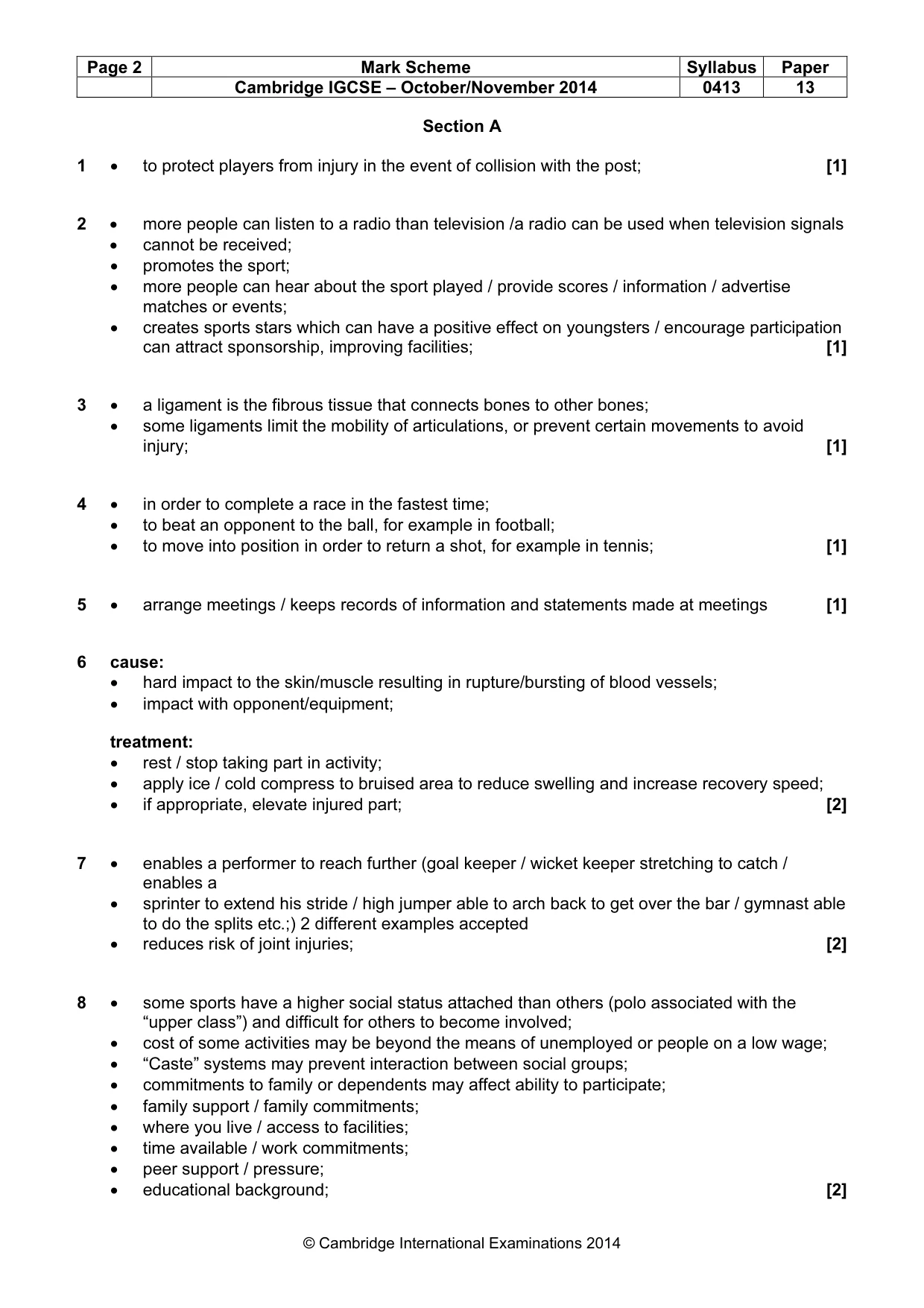
Page 2 Mark Scheme Syllabus Paper Cambridge IGCSE – October/November 2014 0413 13 © Cambridge International Examinations 2014 Section A 1 • to protect players from injury in the event of collision with the post; [1] 2 • more people can listen to a radio than television /a radio can be used when television signals • cannot be received; • promotes the sport; • more people can hear about the sport played / provide scores / information / advertise matches or events; • creates sports stars which can have a positive effect on youngsters / encourage participation can attract sponsorship, improving facilities; [1] 3 • a ligament is the fibrous tissue that connects bones to other bones; • some ligaments limit the mobility of articulations, or prevent certain movements to avoid injury; [1] 4 • in order to complete a race in the fastest time; • to beat an opponent to the ball, for example in football; • to move into position in order to return a shot, for example in tennis; [1] 5 • arrange meetings / keeps records of information and statements made at meetings [1] 6 cause: • hard impact to the skin/muscle resulting in rupture/bursting of blood vessels; • impact with opponent/equipment; treatment: • rest / stop taking part in activity; • apply ice / cold compress to bruised area to reduce swelling and increase recovery speed; • if appropriate, elevate injured part; [2] 7 • enables a performer to reach further (goal keeper / wicket keeper stretching to catch / enables a • sprinter to extend his stride / high jumper able to arch back to get over the bar / gymnast able to do the splits etc.;) 2 different examples accepted • reduces risk of joint injuries; [2] 8 • some sports have a higher social status attached than others (polo associated with the “upper class”) and difficult for others to become involved; • cost of some activities may be beyond the means of unemployed or people on a low wage; • “Caste” systems may prevent interaction between social groups; • commitments to family or dependents may affect ability to participate; • family support / family commitments; • where you live / access to facilities; • time available / work commitments; • peer support / pressure; • educational background; [2]
Mark scheme, page 3
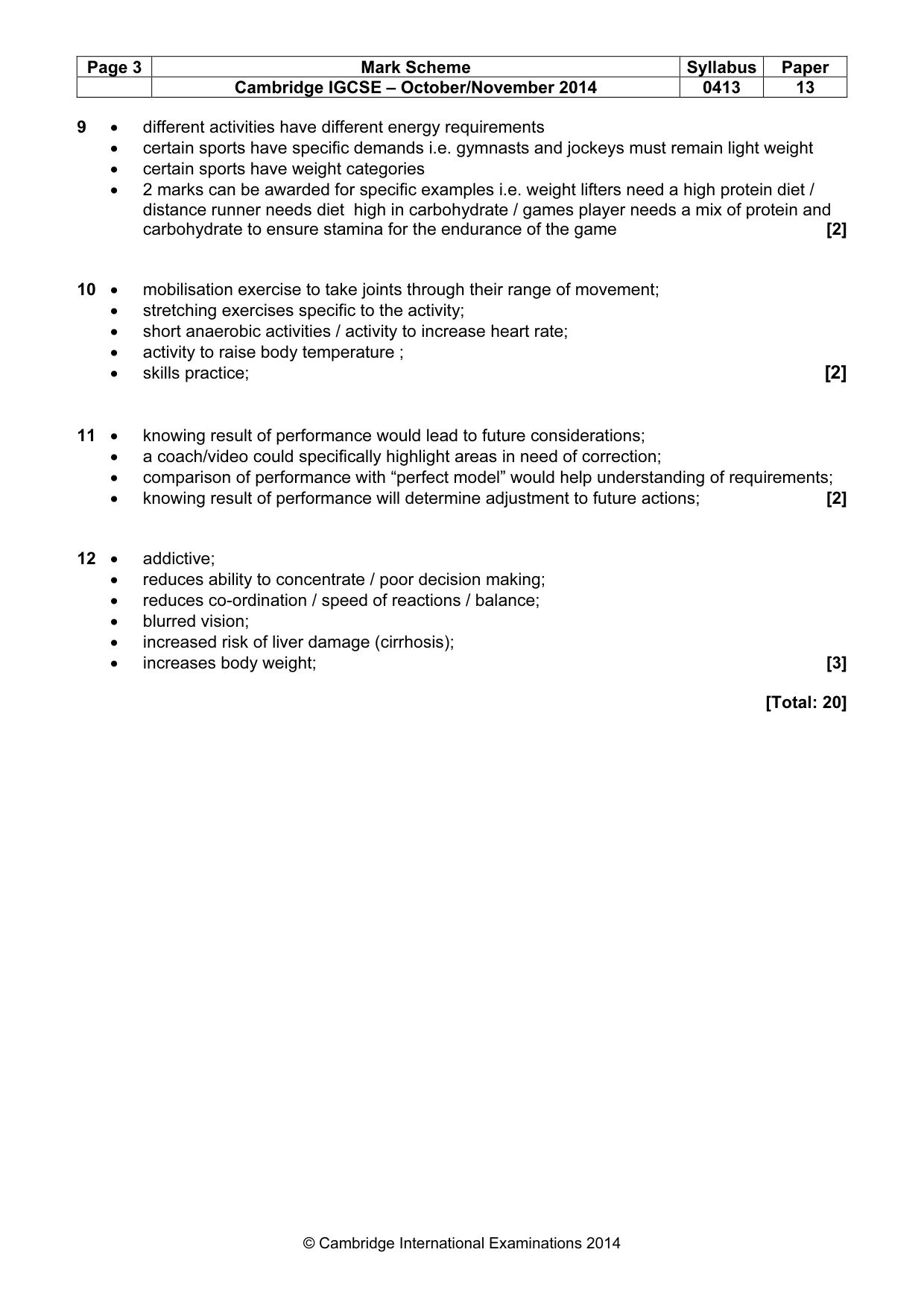
Page 3 Mark Scheme Syllabus Paper Cambridge IGCSE – October/November 2014 0413 13 © Cambridge International Examinations 2014 9 • different activities have different energy requirements • certain sports have specific demands i.e. gymnasts and jockeys must remain light weight • certain sports have weight categories • 2 marks can be awarded for specific examples i.e. weight lifters need a high protein diet / distance runner needs diet high in carbohydrate / games player needs a mix of protein and carbohydrate to ensure stamina for the endurance of the game [2] 10 • mobilisation exercise to take joints through their range of movement; • stretching exercises specific to the activity; • short anaerobic activities / activity to increase heart rate; • activity to raise body temperature ; • skills practice; [2] 11 • knowing result of performance would lead to future considerations; • a coach/video could specifically highlight areas in need of correction; • comparison of performance with “perfect model” would help understanding of requirements; • knowing result of performance will determine adjustment to future actions; [2] 12 • addictive; • reduces ability to concentrate / poor decision making; • reduces co-ordination / speed of reactions / balance; • blurred vision; • increased risk of liver damage (cirrhosis); • increases body weight; [3] [Total: 20]
Mark scheme, page 4
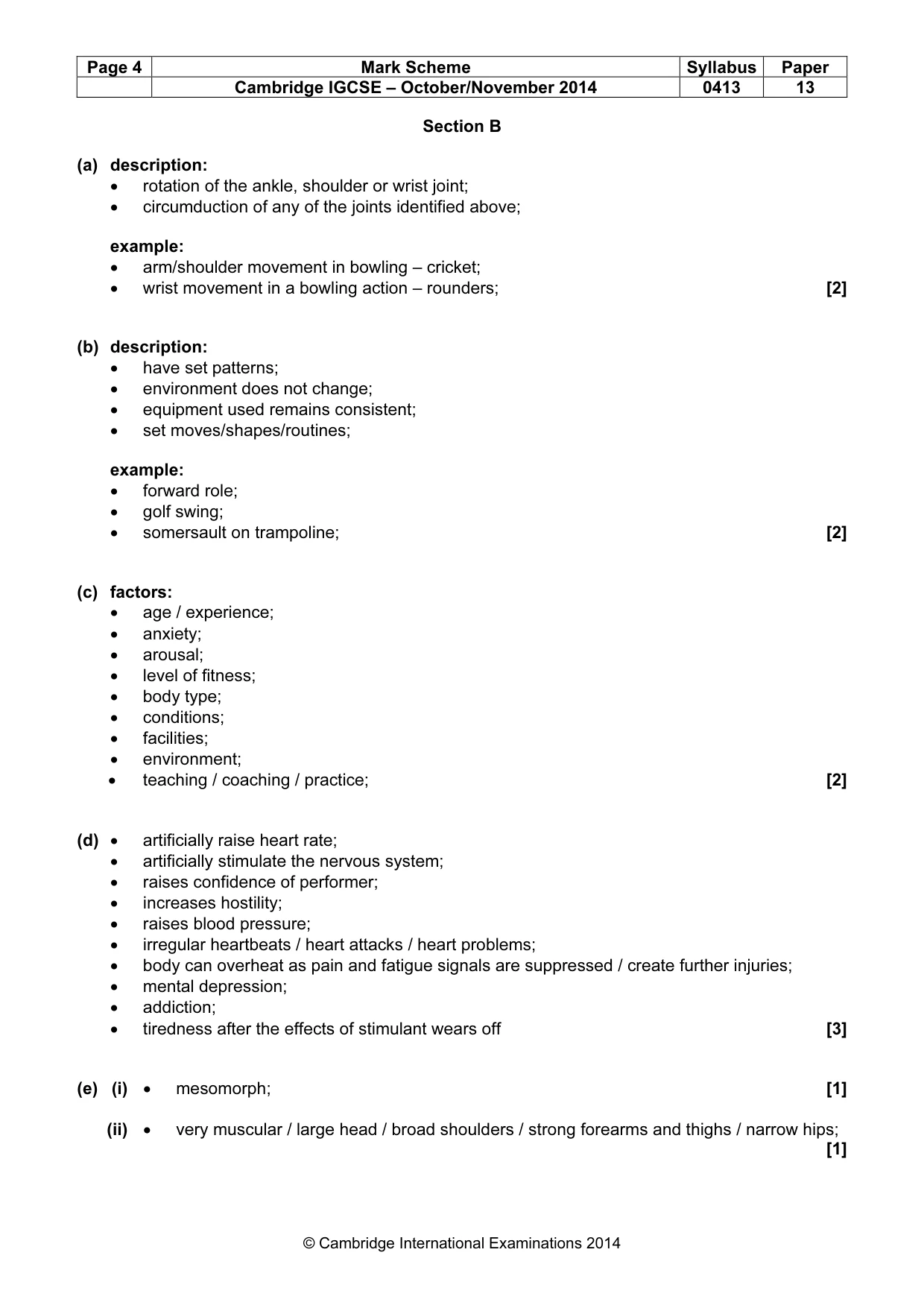
Page 4 Mark Scheme Syllabus Paper Cambridge IGCSE – October/November 2014 0413 13 © Cambridge International Examinations 2014 Section B (a) description: • rotation of the ankle, shoulder or wrist joint; • circumduction of any of the joints identified above; example: • arm/shoulder movement in bowling – cricket; • wrist movement in a bowling action – rounders; [2] (b) description: • have set patterns; • environment does not change; • equipment used remains consistent; • set moves/shapes/routines; example: • forward role; • golf swing; • somersault on trampoline; [2] (c) factors: • age / experience; • anxiety; • arousal; • level of fitness; • body type; • conditions; • facilities; • environment; • teaching / coaching / practice; [2] (d) • artificially raise heart rate; • artificially stimulate the nervous system; • raises confidence of performer; • increases hostility; • raises blood pressure; • irregular heartbeats / heart attacks / heart problems; • body can overheat as pain and fatigue signals are suppressed / create further injuries; • mental depression; • addiction; • tiredness after the effects of stimulant wears off [3] (e) (i) • mesomorph; [1] (ii) • very muscular / large head / broad shoulders / strong forearms and thighs / narrow hips; [1]
Mark scheme, page 5
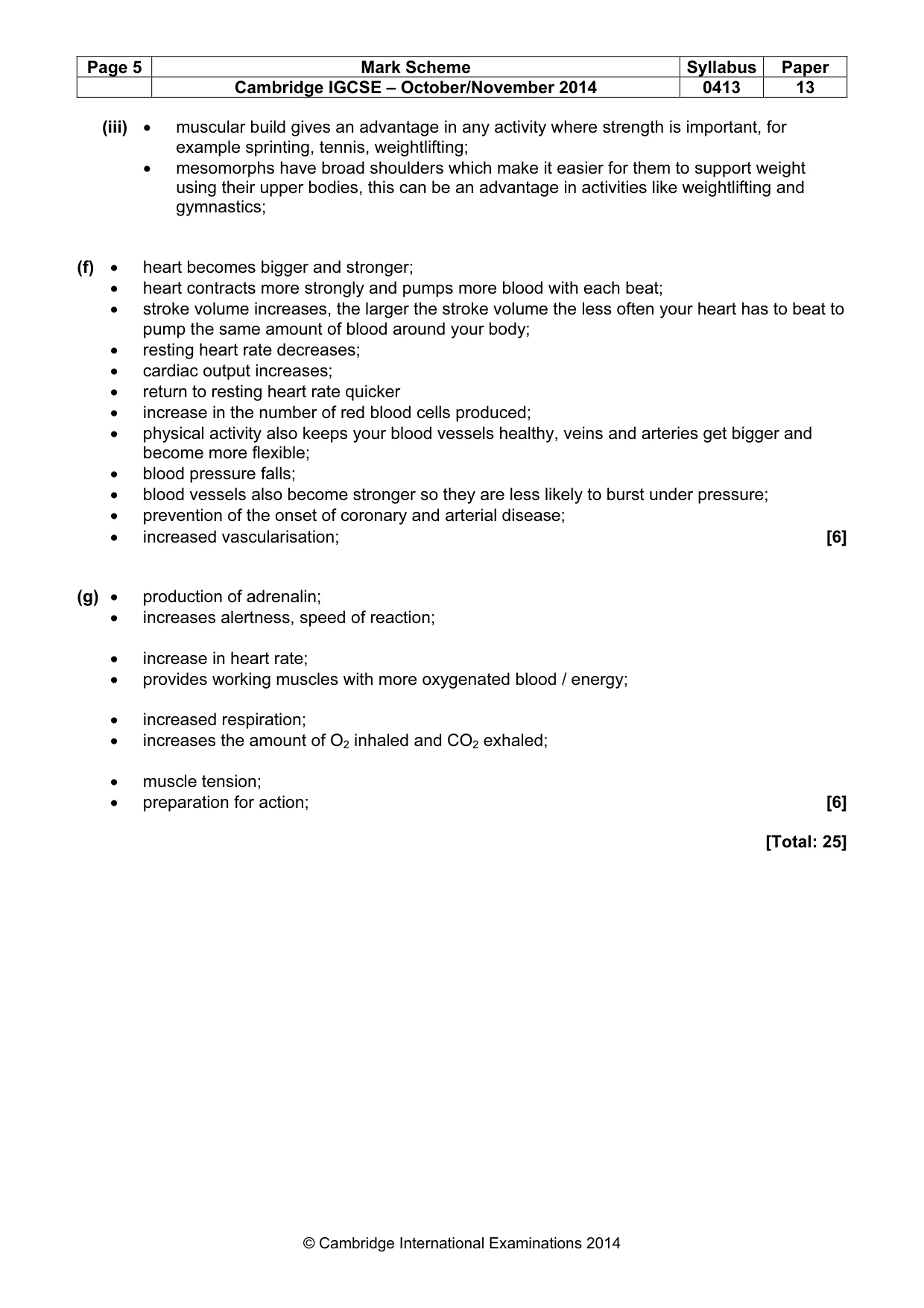
Page 5 Mark Scheme Syllabus Paper Cambridge IGCSE – October/November 2014 0413 13 © Cambridge International Examinations 2014 (iii) • muscular build gives an advantage in any activity where strength is important, for example sprinting, tennis, weightlifting; • mesomorphs have broad shoulders which make it easier for them to support weight using their upper bodies, this can be an advantage in activities like weightlifting and gymnastics; (f) • heart becomes bigger and stronger; • heart contracts more strongly and pumps more blood with each beat; • stroke volume increases, the larger the stroke volume the less often your heart has to beat to pump the same amount of blood around your body; • resting heart rate decreases; • cardiac output increases; • return to resting heart rate quicker • increase in the number of red blood cells produced; • physical activity also keeps your blood vessels healthy, veins and arteries get bigger and become more flexible; • blood pressure falls; • blood vessels also become stronger so they are less likely to burst under pressure; • prevention of the onset of coronary and arterial disease; • increased vascularisation; [6] (g) • production of adrenalin; • increases alertness, speed of reaction; • increase in heart rate; • provides working muscles with more oxygenated blood / energy; • increased respiration; • increases the amount of O2 inhaled and CO2 exhaled; • muscle tension; • preparation for action; [6] [Total: 25]
Mark scheme, page 6
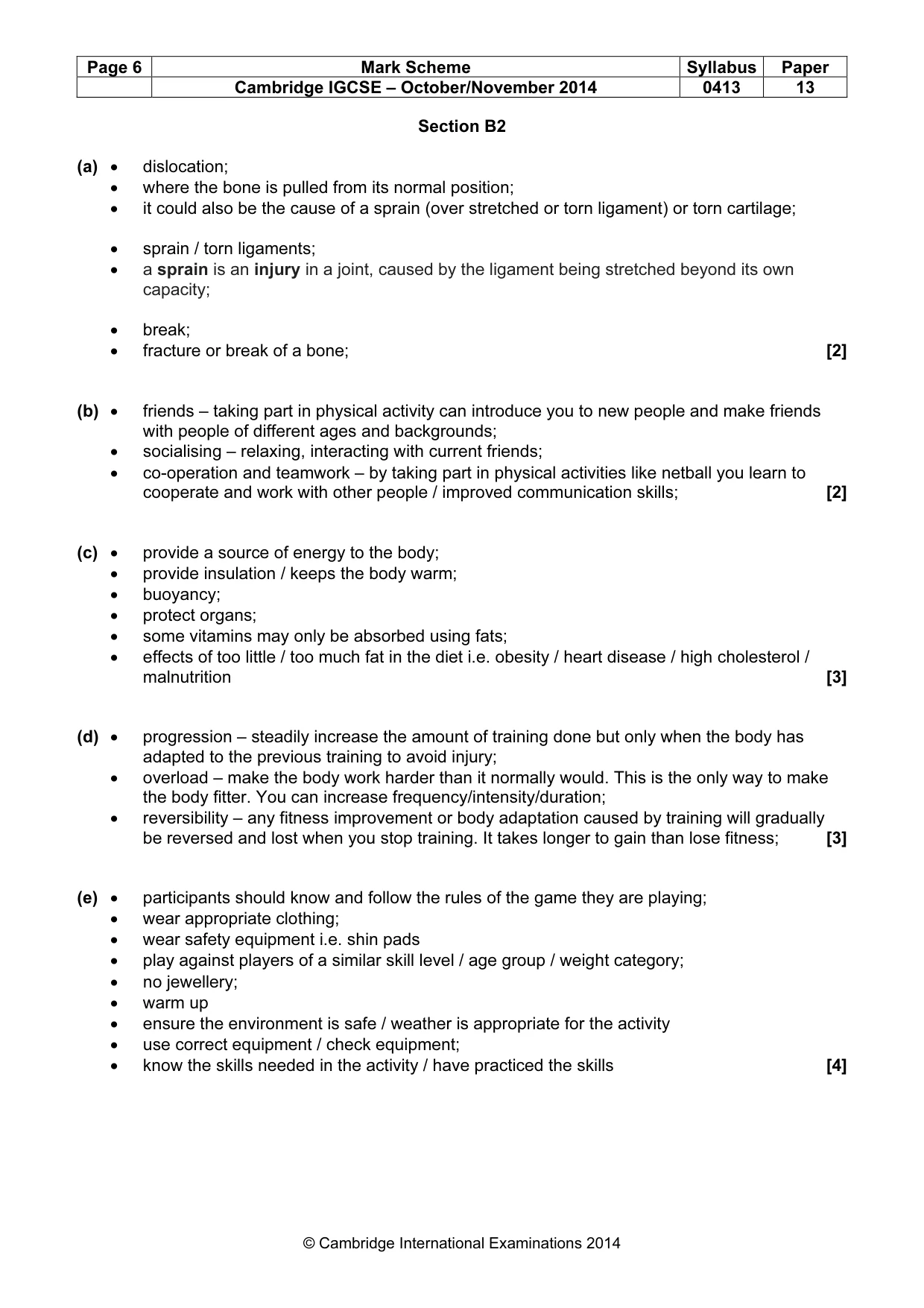
Page 6 Mark Scheme Syllabus Paper Cambridge IGCSE – October/November 2014 0413 13 © Cambridge International Examinations 2014 Section B2 (a) • dislocation; • where the bone is pulled from its normal position; • it could also be the cause of a sprain (over stretched or torn ligament) or torn cartilage; • sprain / torn ligaments; • a sprain is an injury in a joint, caused by the ligament being stretched beyond its own capacity; • break; • fracture or break of a bone; [2] (b) • friends – taking part in physical activity can introduce you to new people and make friends with people of different ages and backgrounds; • socialising – relaxing, interacting with current friends; • co-operation and teamwork – by taking part in physical activities like netball you learn to cooperate and work with other people / improved communication skills; [2] (c) • provide a source of energy to the body; • provide insulation / keeps the body warm; • buoyancy; • protect organs; • some vitamins may only be absorbed using fats; • effects of too little / too much fat in the diet i.e. obesity / heart disease / high cholesterol / malnutrition [3] (d) • progression – steadily increase the amount of training done but only when the body has adapted to the previous training to avoid injury; • overload – make the body work harder than it normally would. This is the only way to make the body fitter. You can increase frequency/intensity/duration; • reversibility – any fitness improvement or body adaptation caused by training will gradually be reversed and lost when you stop training. It takes longer to gain than lose fitness; [3] (e) • participants should know and follow the rules of the game they are playing; • wear appropriate clothing; • wear safety equipment i.e. shin pads • play against players of a similar skill level / age group / weight category; • no jewellery; • warm up • ensure the environment is safe / weather is appropriate for the activity • use correct equipment / check equipment; • know the skills needed in the activity / have practiced the skills [4]
Mark scheme, page 7
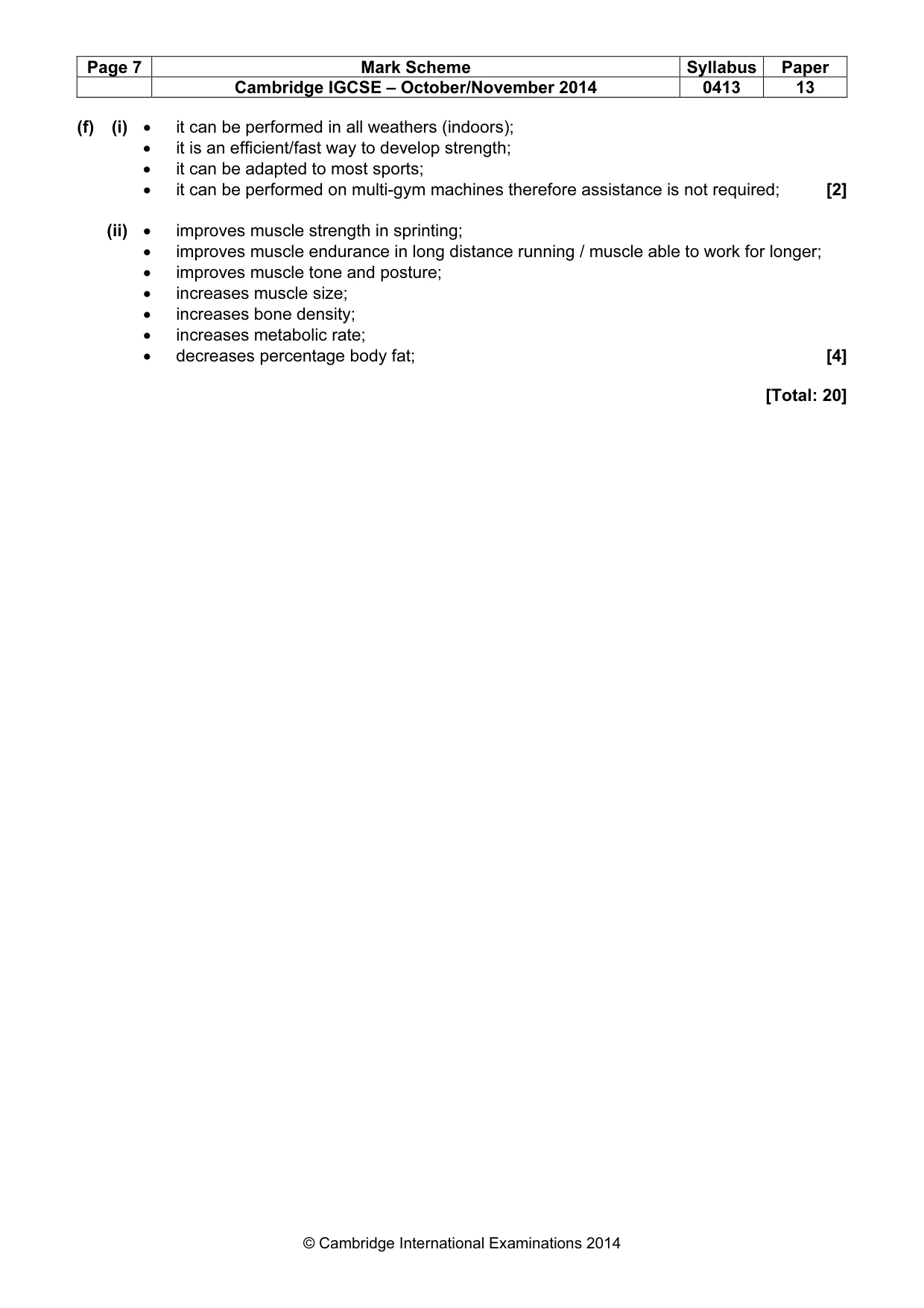
Page 7 Mark Scheme Syllabus Paper Cambridge IGCSE – October/November 2014 0413 13 © Cambridge International Examinations 2014 (f) (i) • it can be performed in all weathers (indoors); • it is an efficient/fast way to develop strength; • it can be adapted to most sports; • it can be performed on multi-gym machines therefore assistance is not required; [2] (ii) • improves muscle strength in sprinting; • improves muscle endurance in long distance running / muscle able to work for longer; • improves muscle tone and posture; • increases muscle size; • increases bone density; • increases metabolic rate; • decreases percentage body fat; [4] [Total: 20]
Mark scheme, page 8
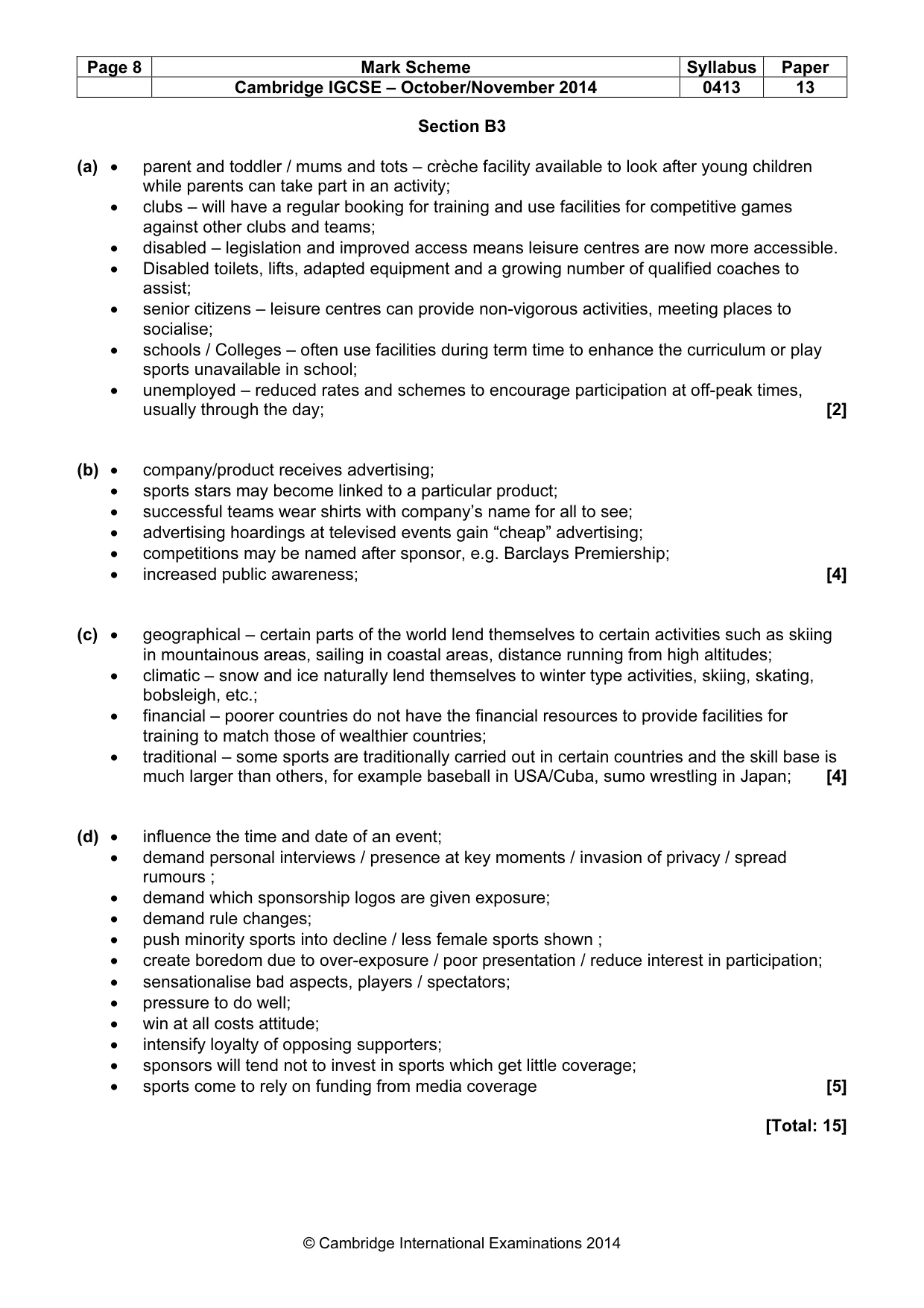
Page 8 Mark Scheme Syllabus Paper Cambridge IGCSE – October/November 2014 0413 13 © Cambridge International Examinations 2014 Section B3 (a) • parent and toddler / mums and tots – crèche facility available to look after young children while parents can take part in an activity; • clubs – will have a regular booking for training and use facilities for competitive games against other clubs and teams; • disabled – legislation and improved access means leisure centres are now more accessible. • Disabled toilets, lifts, adapted equipment and a growing number of qualified coaches to assist; • senior citizens – leisure centres can provide non-vigorous activities, meeting places to socialise; • schools / Colleges – often use facilities during term time to enhance the curriculum or play sports unavailable in school; • unemployed – reduced rates and schemes to encourage participation at off-peak times, usually through the day; [2] (b) • company/product receives advertising; • sports stars may become linked to a particular product; • successful teams wear shirts with company’s name for all to see; • advertising hoardings at televised events gain “cheap” advertising; • competitions may be named after sponsor, e.g. Barclays Premiership; • increased public awareness; [4] (c) • geographical – certain parts of the world lend themselves to certain activities such as skiing in mountainous areas, sailing in coastal areas, distance running from high altitudes; • climatic – snow and ice naturally lend themselves to winter type activities, skiing, skating, bobsleigh, etc.; • financial – poorer countries do not have the financial resources to provide facilities for training to match those of wealthier countries; • traditional – some sports are traditionally carried out in certain countries and the skill base is much larger than others, for example baseball in USA/Cuba, sumo wrestling in Japan; [4] (d) • influence the time and date of an event; • demand personal interviews / presence at key moments / invasion of privacy / spread rumours ; • demand which sponsorship logos are given exposure; • demand rule changes; • push minority sports into decline / less female sports shown ; • create boredom due to over-exposure / poor presentation / reduce interest in participation; • sensationalise bad aspects, players / spectators; • pressure to do well; • win at all costs attitude; • intensify loyalty of opposing supporters; • sponsors will tend not to invest in sports which get little coverage; • sports come to rely on funding from media coverage [5] [Total: 15]
What you needed in this session
Cambridge’s own grade thresholds for 2014 Oct/Nov, Paper 1 · Variant 3. A higher threshold means an easier paper — the bar moves with how the cohort did.