Cambridge IGCSE Mathematics (with coursework) 0581 — 2013 Oct/Nov Paper 3 · Variant 3
0581/33/O/N/13
The question paper and its mark scheme, free to read here and free to download. This is Cambridge’s own paper, exactly as it was sat.
Question paper16 pages
Mark scheme5 pages
Answers below. Sit the paper first if you are practising.
Paper as text
Question paper, page 1
READ THESE INSTRUCTIONS FIRST Write your Centre number, candidate number and name on all the work you hand in. Write in dark blue or black pen. You may use a pencil for any diagrams or graphs. Do not use staples, paper clips, highlighters, glue or correction fl uid. DO NOT WRITE IN ANY BARCODES. Answer all questions. If working is needed for any question it must be shown below that question. Electronic calculators should be used. If the degree of accuracy is not specifi ed in the question, and if the answer is not exact, give the answer to three signifi cant fi gures. Give answers in degrees to one decimal place. For π, use either your calculator value or 3.142. At the end of the examination, fasten all your work securely together. The number of marks is given in brackets [ ] at the end of each question or part question. The total of the marks for this paper is 104. MATHEMATICS 0581/33 Paper 3 (Core) October/November 2013 2 hours Candidates answer on the Question Paper. Additional Materials: Electronic calculator Geometrical instruments Tracing paper (optional) UNIVERSITY OF CAMBRIDGE INTERNATIONAL EXAMINATIONS International General Certifi cate of Secondary Education This document consists of 16 printed pages. [Turn over IB13 11_0581_33/FP © UCLES 2013 *8317846402* www.XtremePapers.com
Question paper, page 2
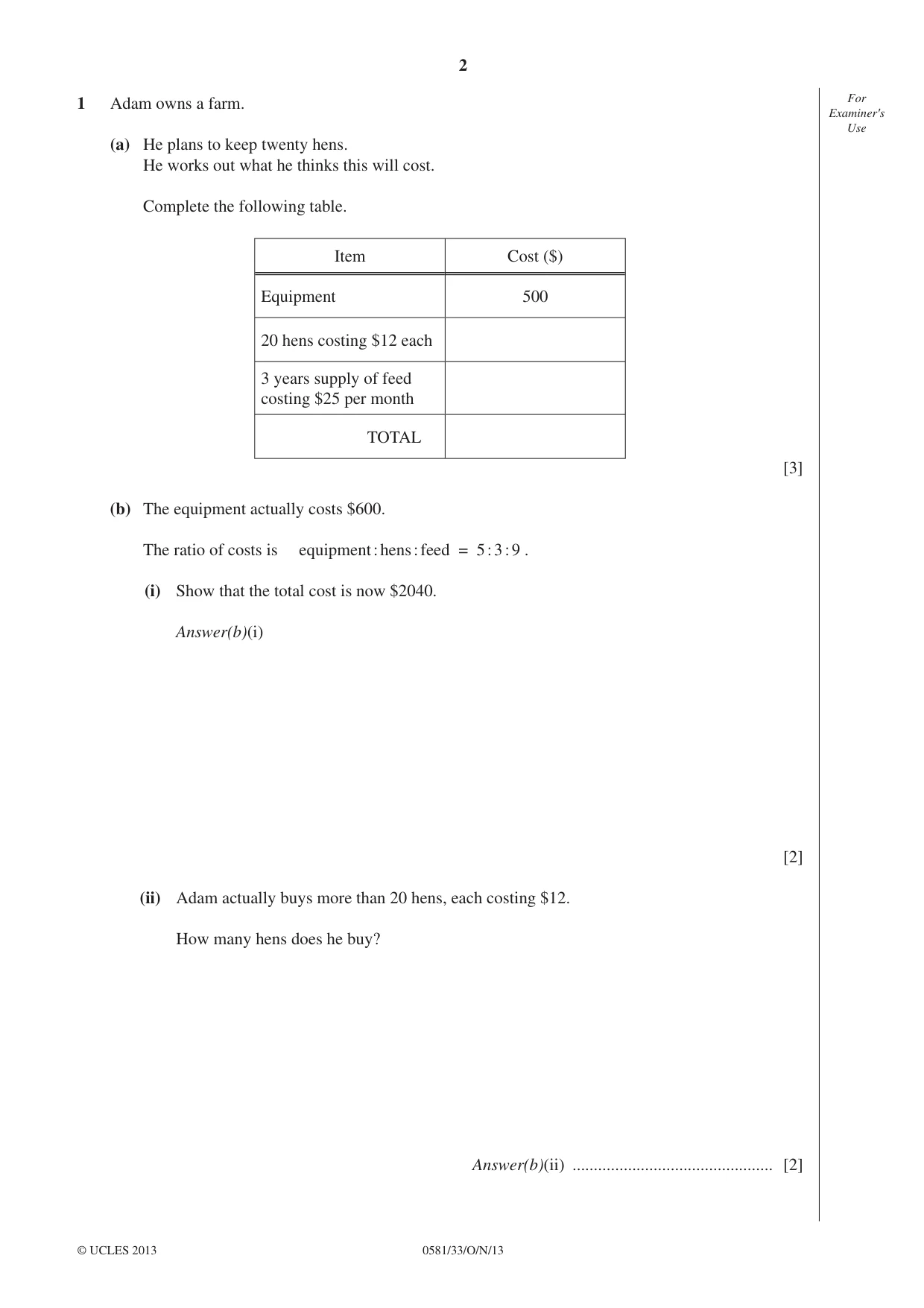
2 0581/33/O/N/13 © UCLES 2013 For Examiner′s Use 1 Adam owns a farm. (a) He plans to keep twenty hens. He works out what he thinks this will cost. Complete the following table. Item Cost ($) Equipment 500 20 hens costing $12 each 3 years supply of feed costing $25 per month TOTAL [3] (b) The equipment actually costs $600. The ratio of costs is equipment : hens : feed = 5 : 3 : 9 . (i) Show that the total cost is now $2040. Answer(b)(i) [2] (ii) Adam actually buys more than 20 hens, each costing $12. How many hens does he buy? Answer(b)(ii) … [2]
Question paper, page 3
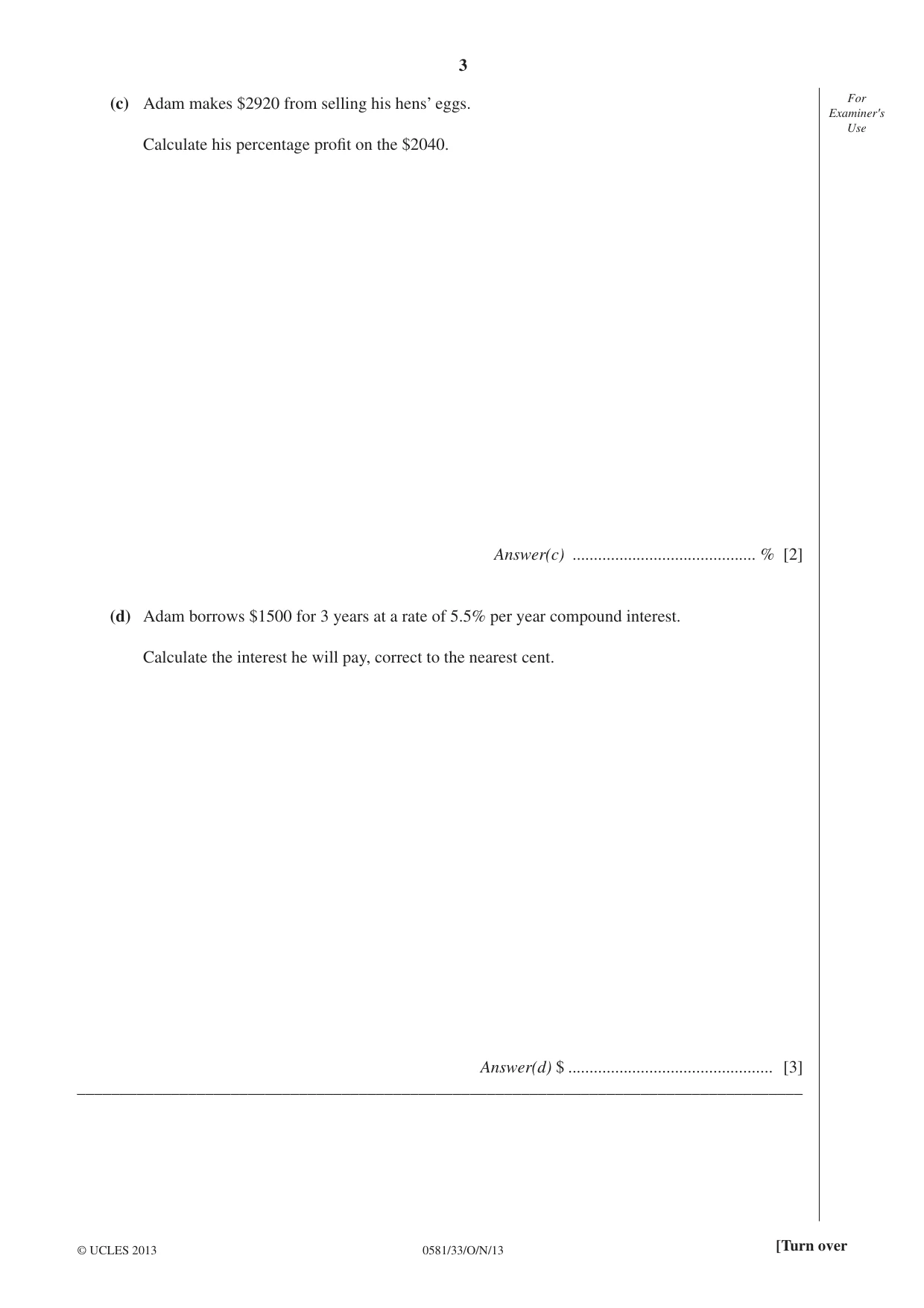
3 0581/33/O/N/13 © UCLES 2013 [Turn over For Examiner′s Use (c) Adam makes $2920 from selling his hens’ eggs. Calculate his percentage profi t on the $2040. Answer(c) … % [2] (d) Adam borrows $1500 for 3 years at a rate of 5.5% per year compound interest. Calculate the interest he will pay, correct to the nearest cent. Answer(d) $ … [3] _____________________________________________________________________________________
Question paper, page 4
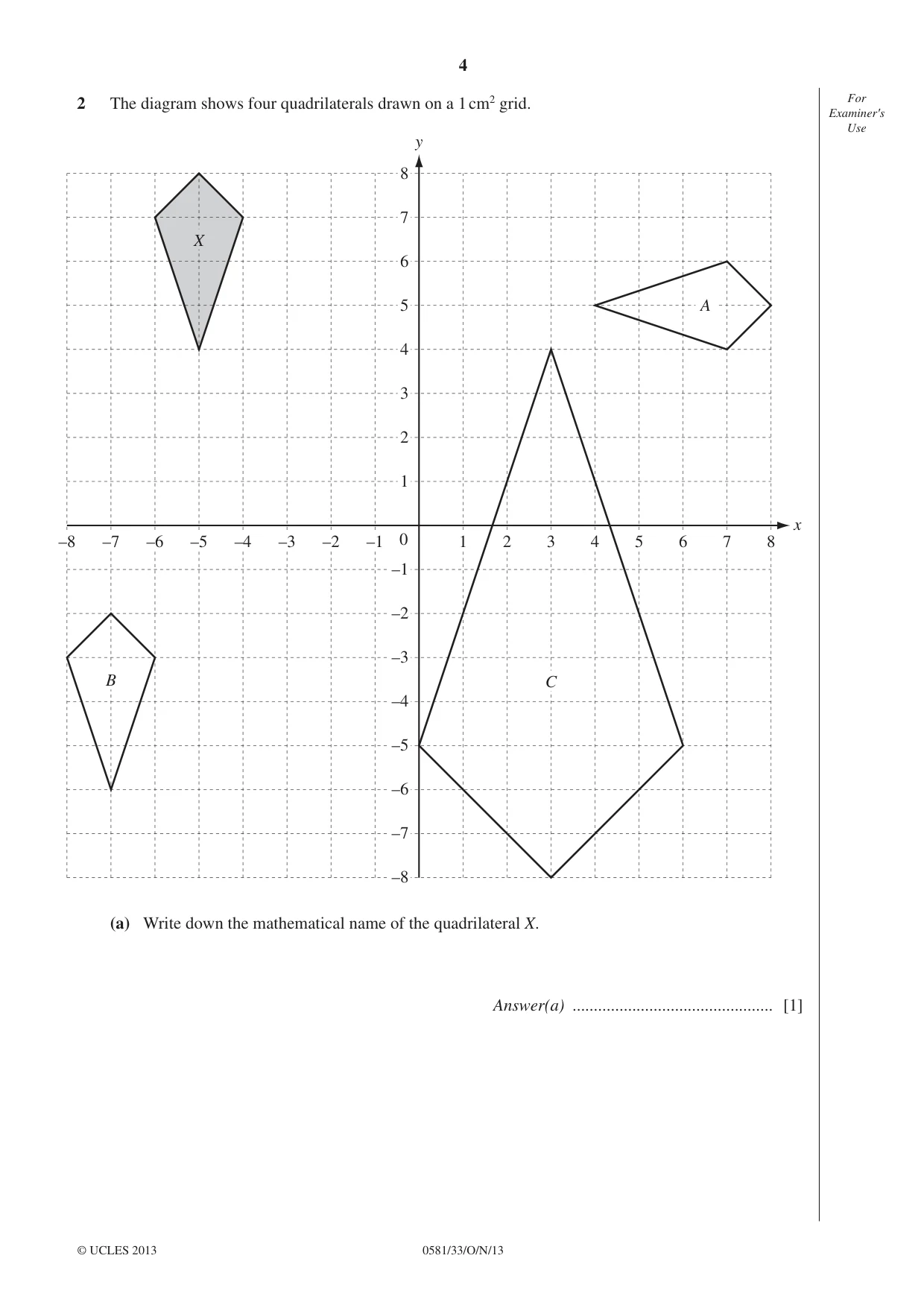
4 0581/33/O/N/13 © UCLES 2013 For Examiner′s Use 2 The diagram shows four quadrilaterals drawn on a 1 cm2 grid. y x 8 7 6 5 4 3 2 1 –1 –2 –3 –4 –5 –6 –7 –8 0 –1 1 2 3 4 5 6 7 8 –2 –3 –4 –5 –6 –7 –8 X A C B (a) Write down the mathematical name of the quadrilateral X. Answer(a) … [1]
Question paper, page 5
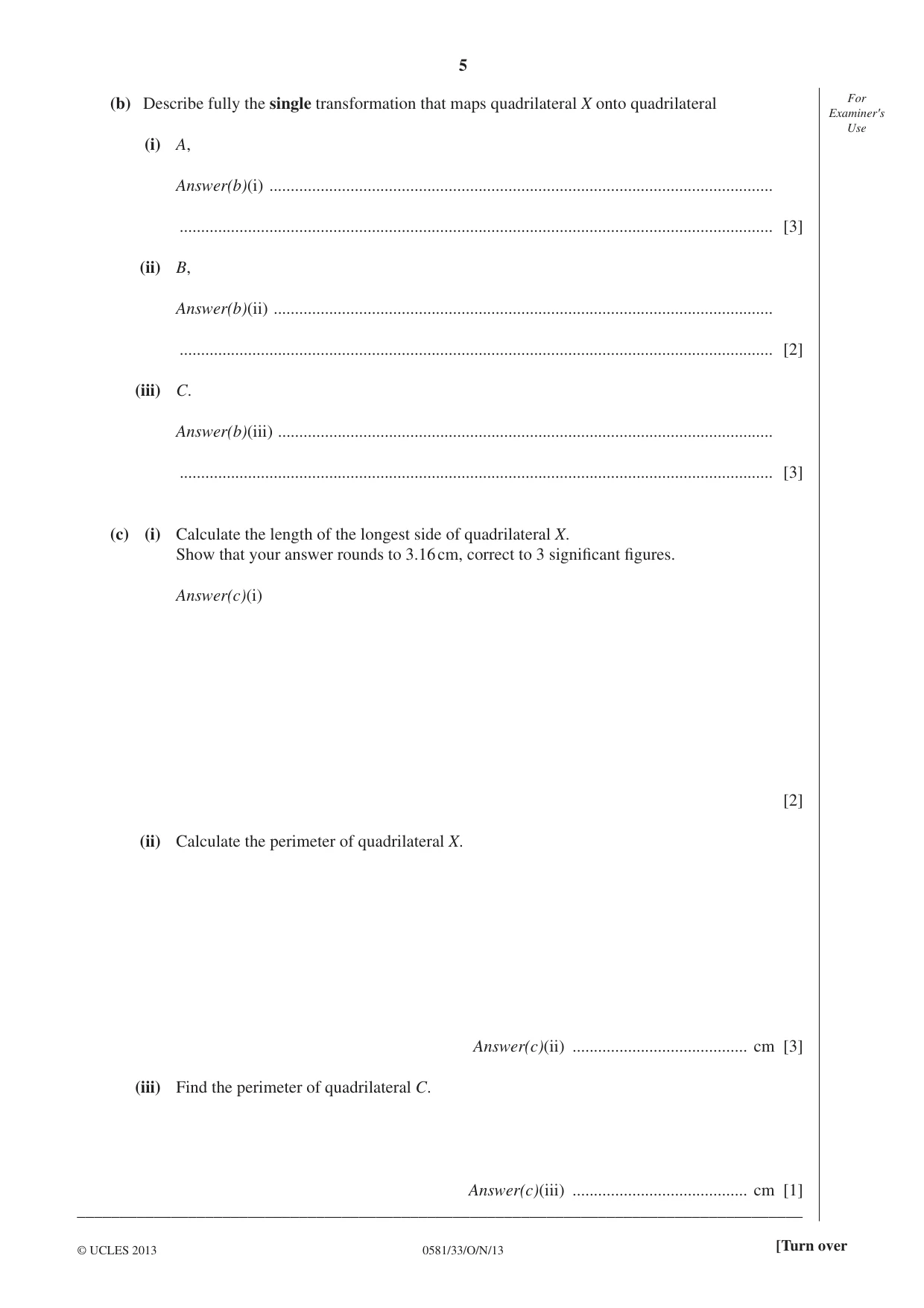
5 0581/33/O/N/13 © UCLES 2013 [Turn over For Examiner′s Use (b) Describe fully the single transformation that maps quadrilateral X onto quadrilateral (i) A, Answer(b)(i) … … [3] (ii) B, Answer(b)(ii) … … [2] (iii) C. Answer(b)(iii) … … [3] (c) (i) Calculate the length of the longest side of quadrilateral X. Show that your answer rounds to 3.16 cm, correct to 3 signifi cant fi gures. Answer(c)(i) [2] (ii) Calculate the perimeter of quadrilateral X. Answer(c)(ii) … cm [3] (iii) Find the perimeter of quadrilateral C. Answer(c)(iii) … cm [1] _____________________________________________________________________________________
Question paper, page 6
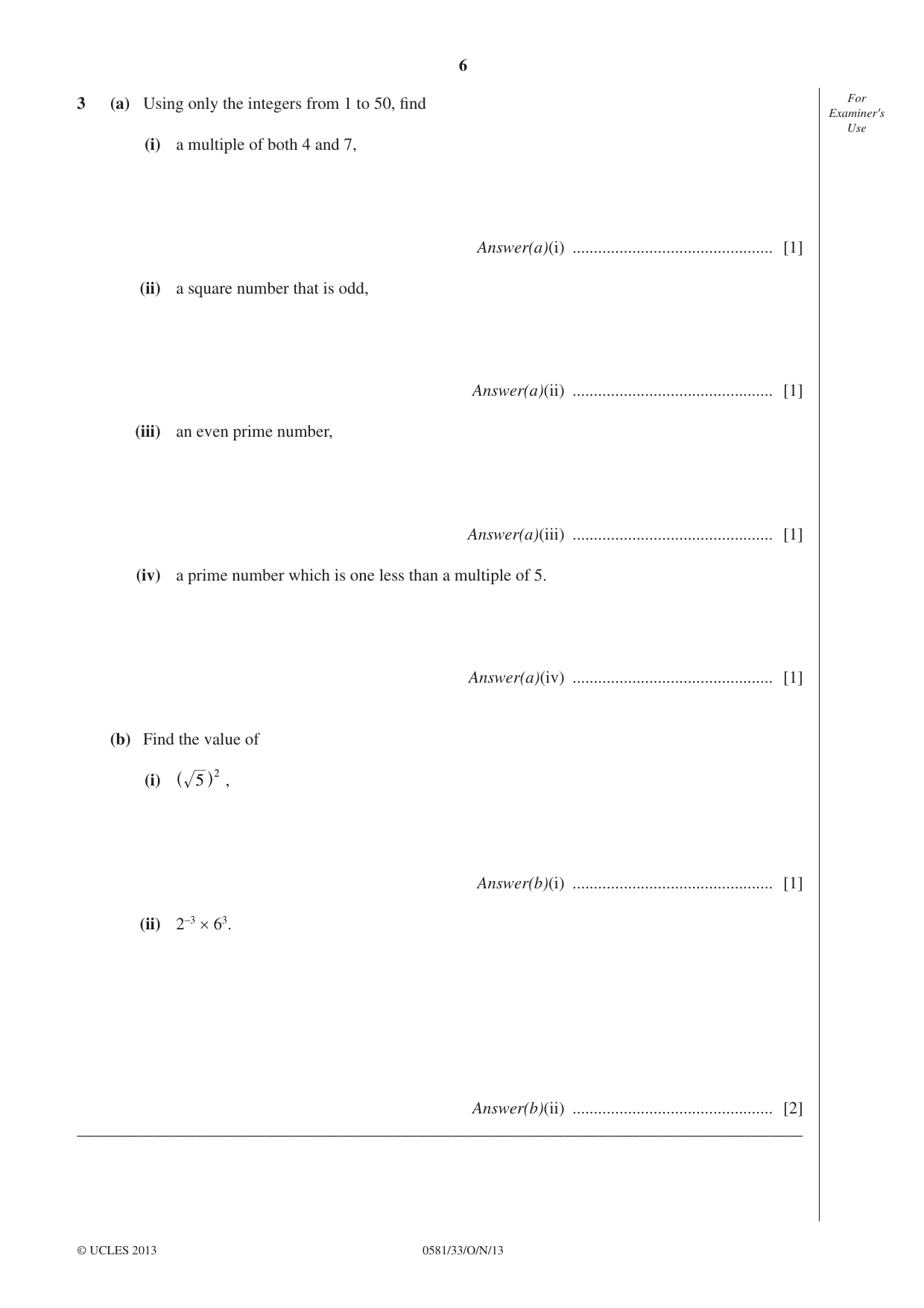
6 0581/33/O/N/13 © UCLES 2013 For Examiner′s Use 3 (a) Using only the integers from 1 to 50, fi nd (i) a multiple of both 4 and 7, Answer(a)(i) … [1] (ii) a square number that is odd, Answer(a)(ii) … [1] (iii) an even prime number, Answer(a)(iii) … [1] (iv) a prime number which is one less than a multiple of 5. Answer(a)(iv) … [1] (b) Find the value of (i) 2 5 ^ h , Answer(b)(i) … [1] (ii) 2–3 × 63. Answer(b)(ii) … [2] _____________________________________________________________________________________
Question paper, page 7
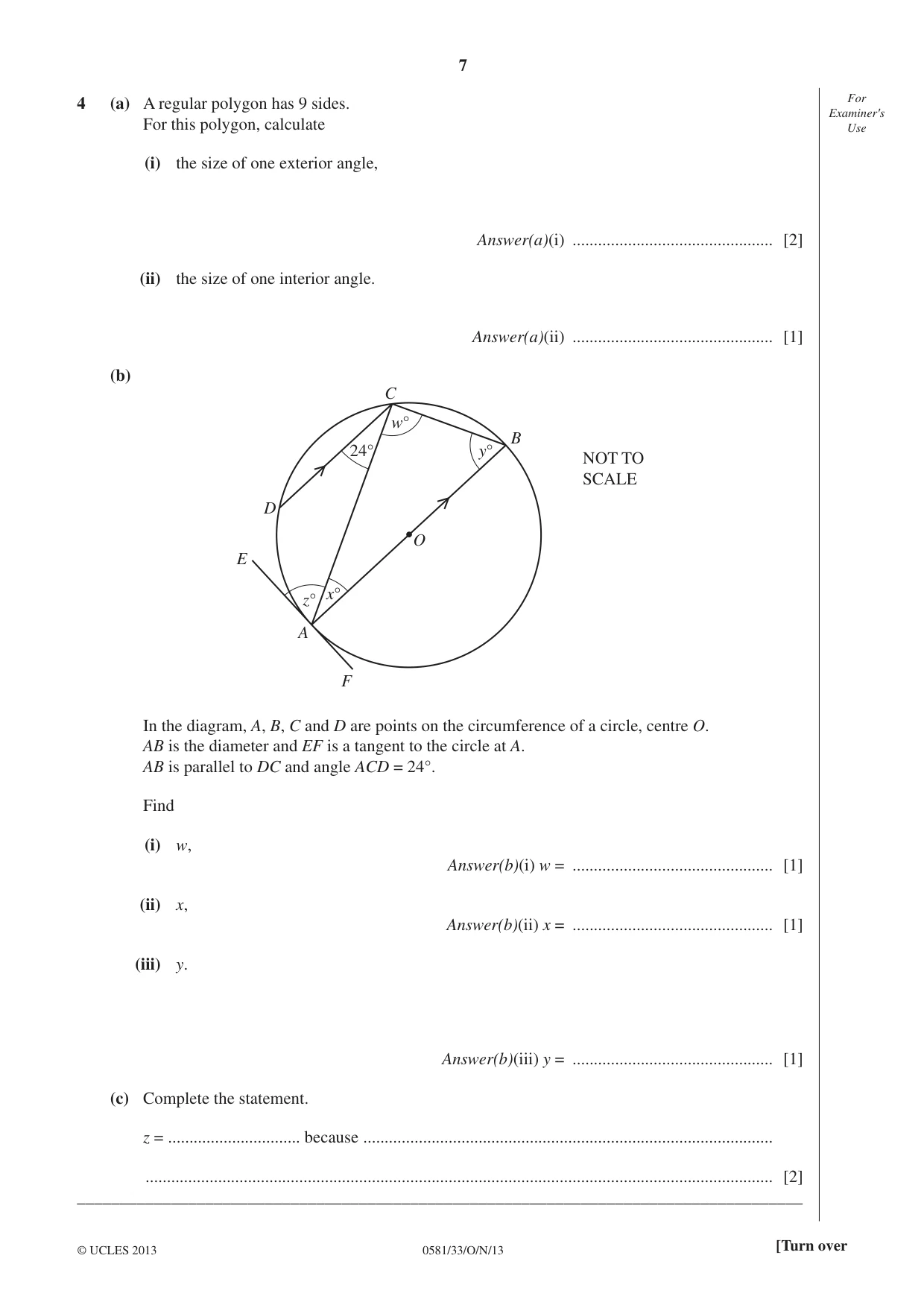
7 0581/33/O/N/13 © UCLES 2013 [Turn over For Examiner′s Use 4 (a) A regular polygon has 9 sides. For this polygon, calculate (i) the size of one exterior angle, Answer(a)(i) … [2] (ii) the size of one interior angle. Answer(a)(ii) … [1] (b) F A E D C B O w° x° 24° z° y° NOT TO SCALE In the diagram, A, B, C and D are points on the circumference of a circle, centre O. AB is the diameter and EF is a tangent to the circle at A. AB is parallel to DC and angle ACD = 24°. Find (i) w, Answer(b)(i) w = … [1] (ii) x, Answer(b)(ii) x = … [1] (iii) y. Answer(b)(iii) y = … [1] (c) Complete the statement. z = … because … … [2] _____________________________________________________________________________________
Question paper, page 8
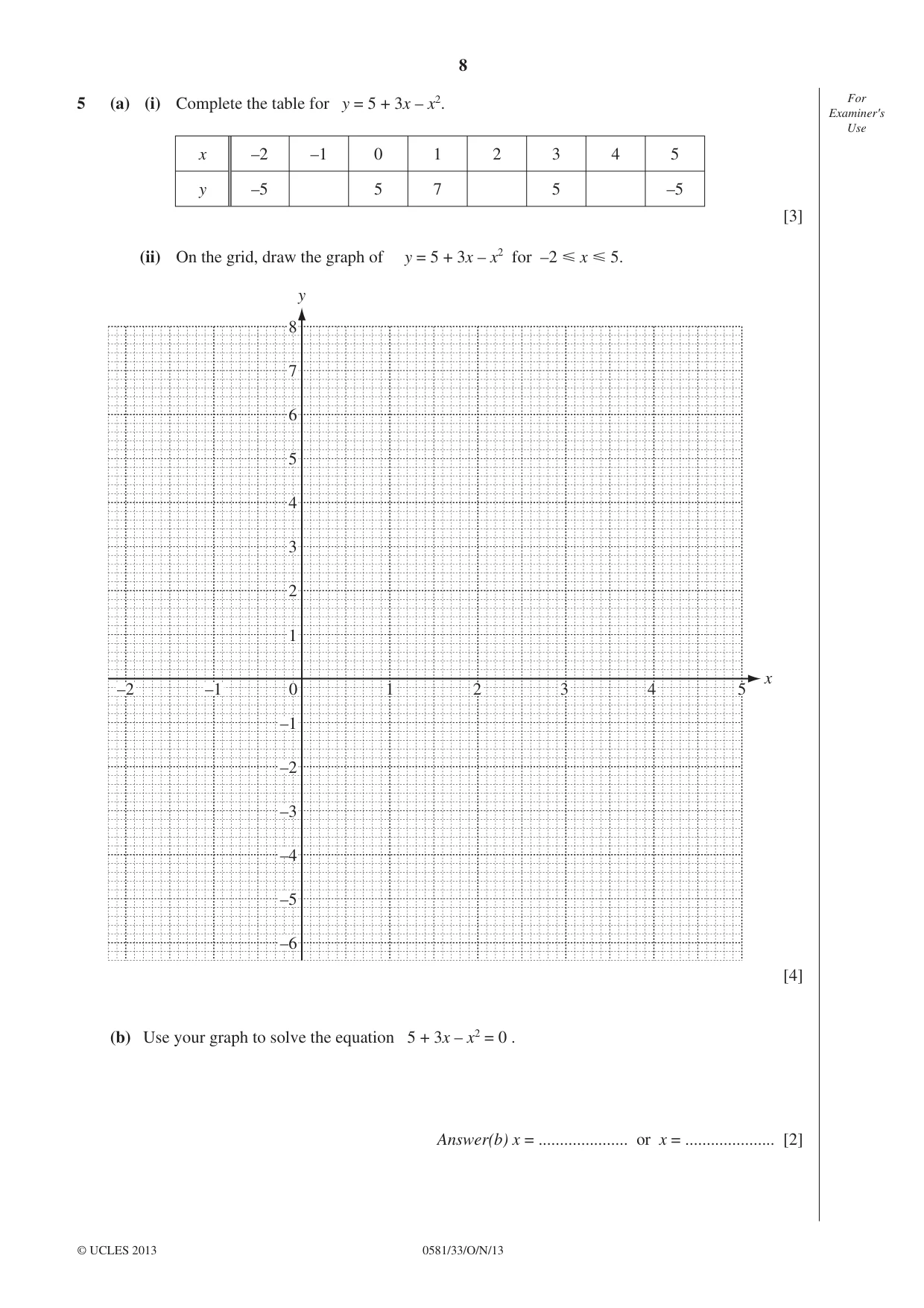
8 0581/33/O/N/13 © UCLES 2013 For Examiner′s Use 5 (a) (i) Complete the table for y = 5 + 3x – x2. x –2 –1 0 1 2 3 4 5 y –5 5 7 5 –5 [3] (ii) On the grid, draw the graph of y = 5 + 3x – x2 for –2 Y x Y 5. y x 8 7 6 5 4 3 2 1 –1 –2 –3 –4 –5 –6 0 1 2 3 4 5 –1 –2 [4] (b) Use your graph to solve the equation 5 + 3x – x2 = 0 . Answer(b) x = … or x = … [2]
Question paper, page 9
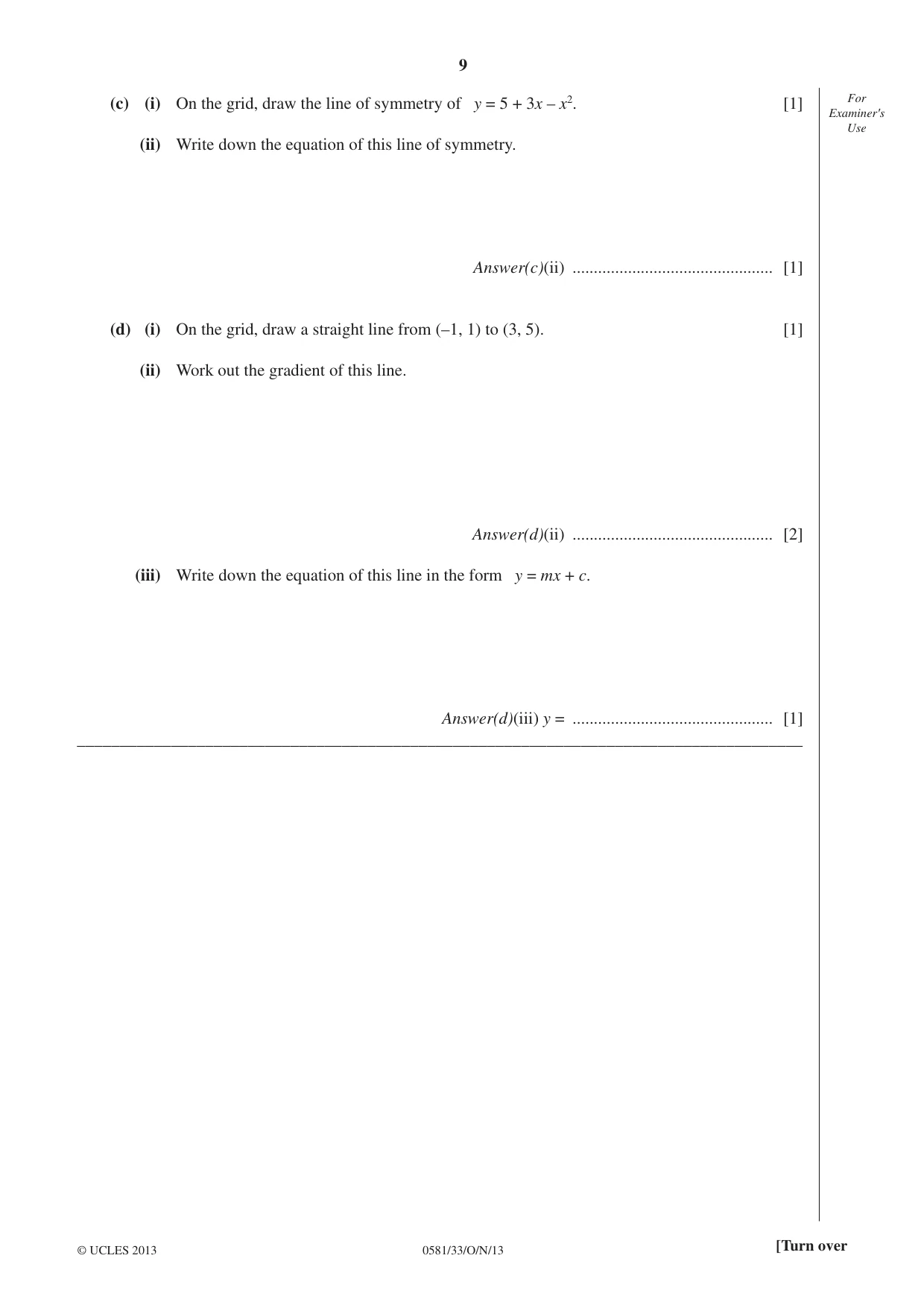
9 0581/33/O/N/13 © UCLES 2013 [Turn over For Examiner′s Use (c) (i) On the grid, draw the line of symmetry of y = 5 + 3x – x2. [1] (ii) Write down the equation of this line of symmetry. Answer(c)(ii) … [1] (d) (i) On the grid, draw a straight line from (–1, 1) to (3, 5). [1] (ii) Work out the gradient of this line. Answer(d)(ii) … [2] (iii) Write down the equation of this line in the form y = mx + c. Answer(d)(iii) y = … [1] _____________________________________________________________________________________
Question paper, page 10
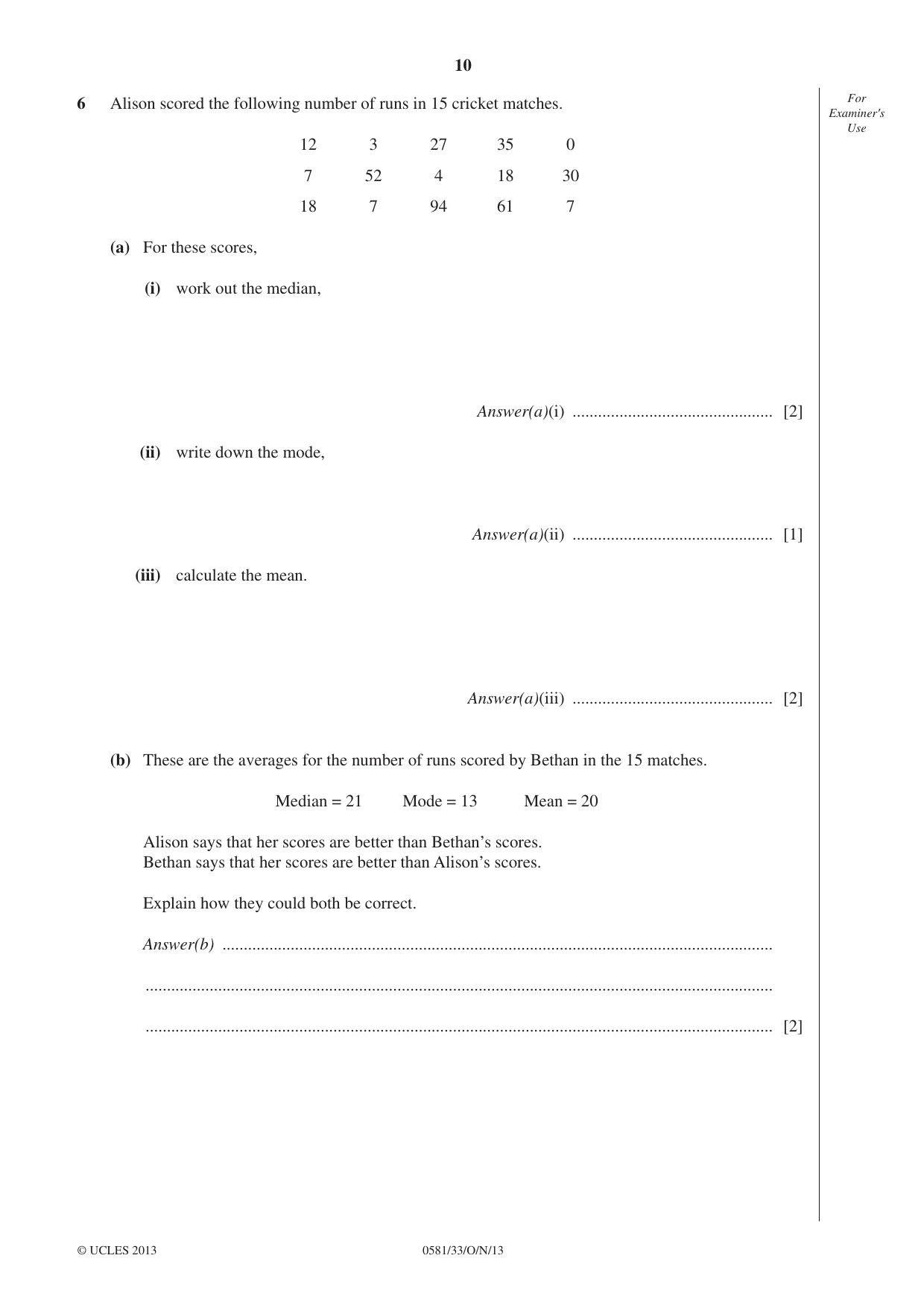
10 0581/33/O/N/13 © UCLES 2013 For Examiner′s Use 6 Alison scored the following number of runs in 15 cricket matches. 12 3 27 35 0 7 52 4 18 30 18 7 94 61 7 (a) For these scores, (i) work out the median, Answer(a)(i) … [2] (ii) write down the mode, Answer(a)(ii) … [1] (iii) calculate the mean. Answer(a)(iii) … [2] (b) These are the averages for the number of runs scored by Bethan in the 15 matches. Median = 21 Mode = 13 Mean = 20 Alison says that her scores are better than Bethan’s scores. Bethan says that her scores are better than Alison’s scores. Explain how they could both be correct. Answer(b) … … … [2]
Question paper, page 11
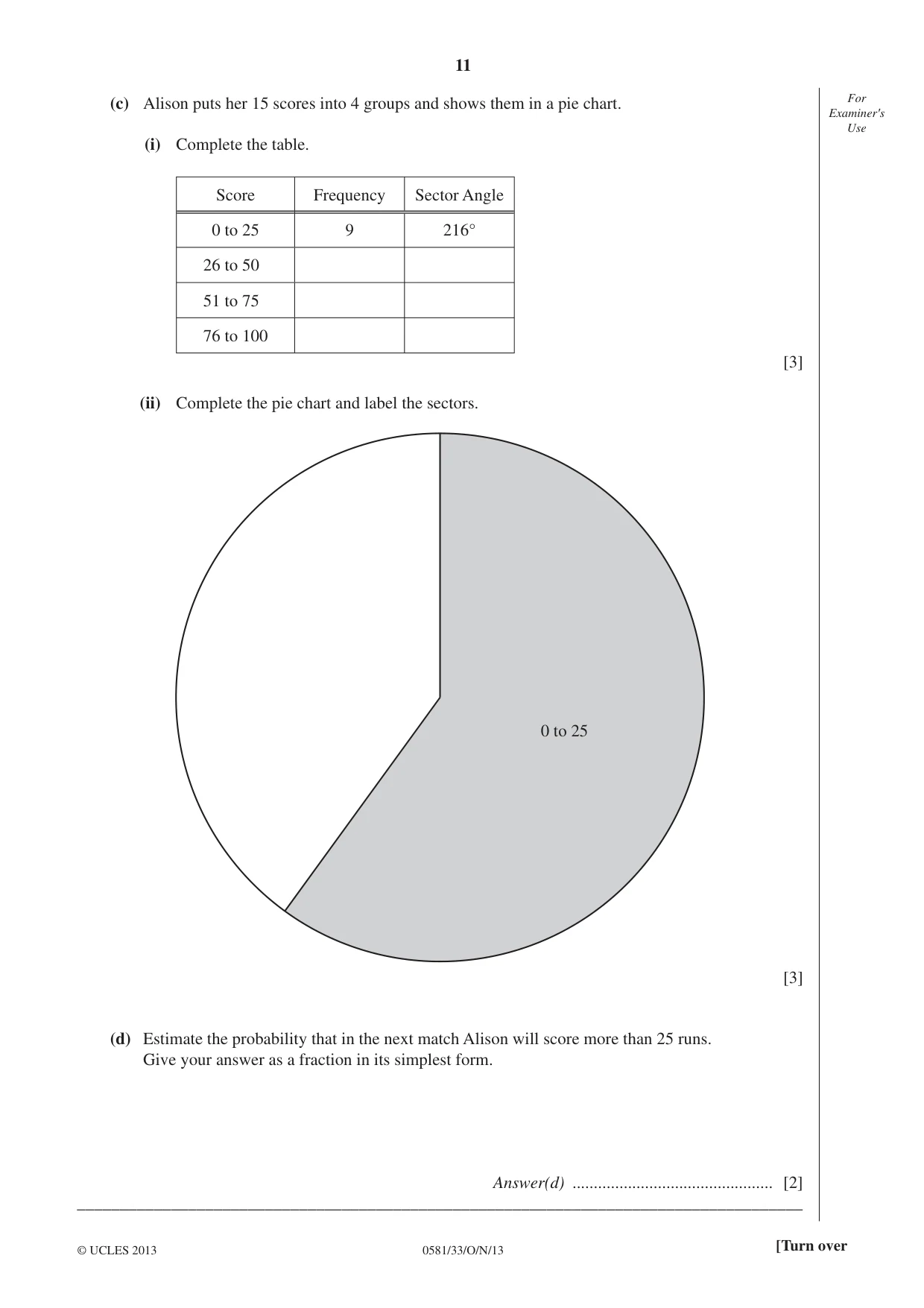
11 0581/33/O/N/13 © UCLES 2013 [Turn over For Examiner′s Use (c) Alison puts her 15 scores into 4 groups and shows them in a pie chart. (i) Complete the table. Score Frequency Sector Angle 0 to 25 9 216° 26 to 50 51 to 75 76 to 100 [3] (ii) Complete the pie chart and label the sectors. 0 to 25 [3] (d) Estimate the probability that in the next match Alison will score more than 25 runs. Give your answer as a fraction in its simplest form. Answer(d) … [2] _____________________________________________________________________________________
Question paper, page 12
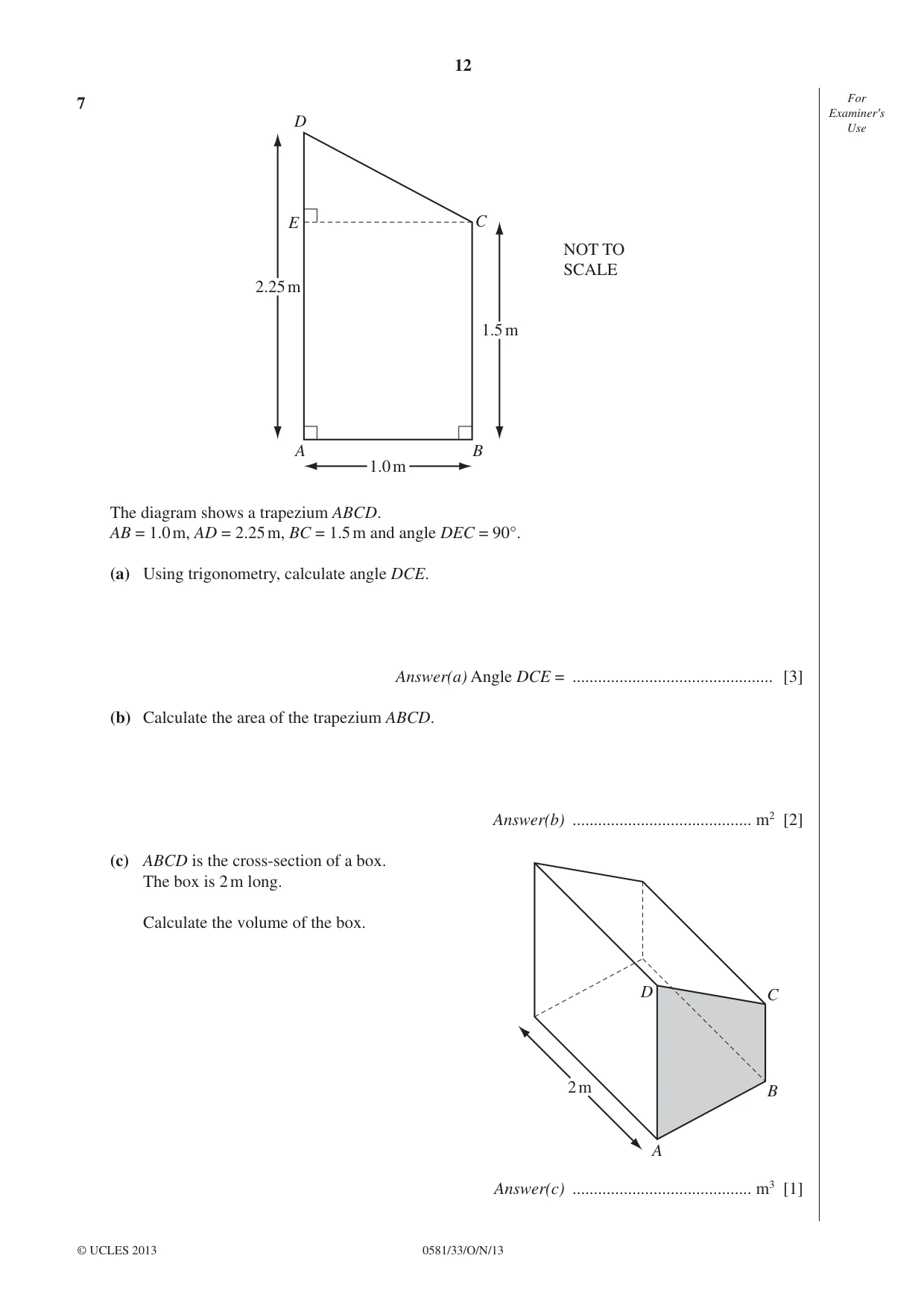
12 0581/33/O/N/13 © UCLES 2013 For Examiner′s Use 7 D A B C E 1.0 m 1.5 m 2.25 m NOT TO SCALE The diagram shows a trapezium ABCD. AB = 1.0 m, AD = 2.25 m, BC = 1.5 m and angle DEC = 90°. (a) Using trigonometry, calculate angle DCE. Answer(a) Angle DCE = … [3] (b) Calculate the area of the trapezium ABCD. Answer(b) … m2 [2] (c) ABCD is the cross-section of a box. The box is 2 m long. Calculate the volume of the box. Answer(c) … m3 [1] 2 m A B C D
Question paper, page 13
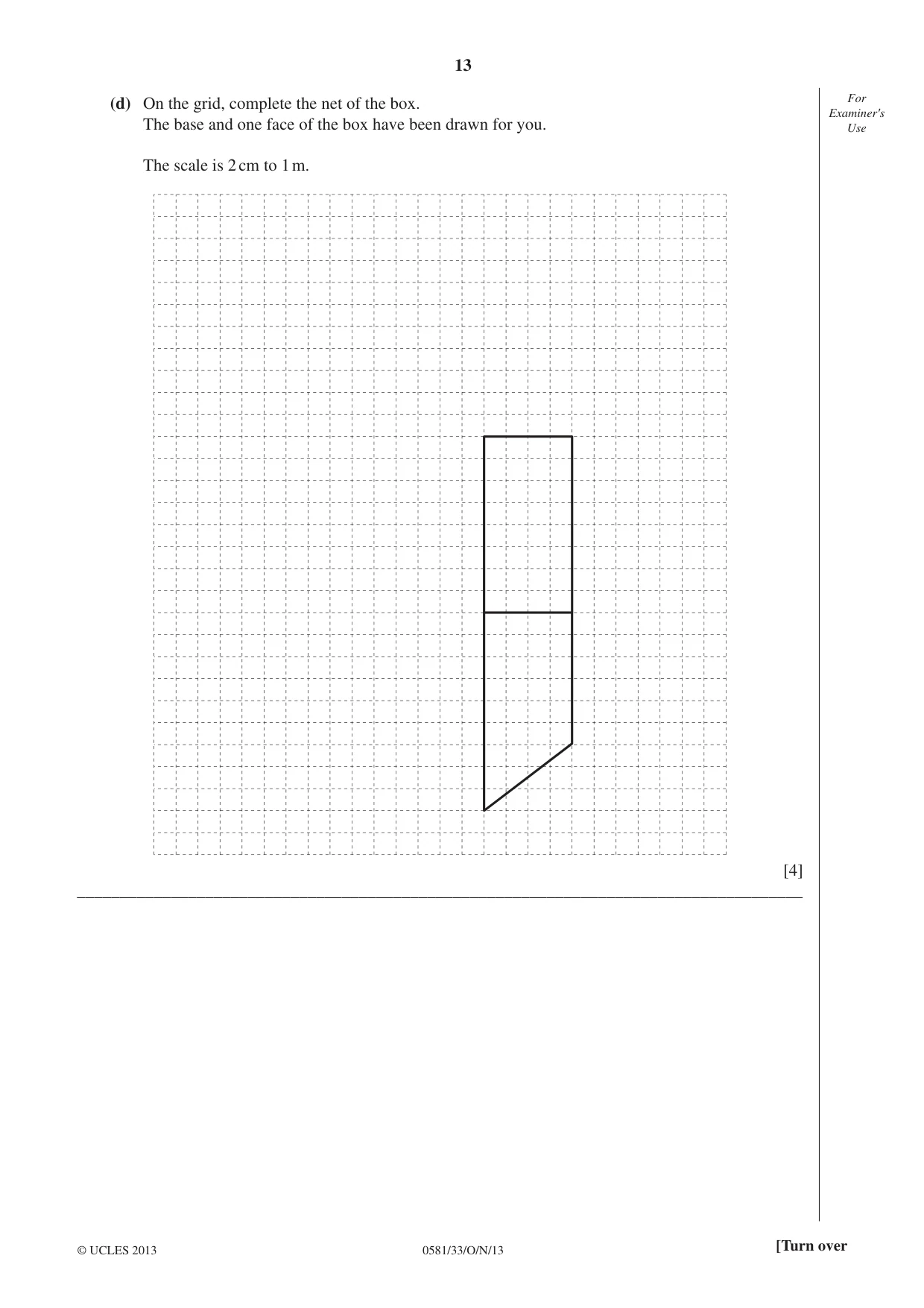
13 0581/33/O/N/13 © UCLES 2013 [Turn over For Examiner′s Use (d) On the grid, complete the net of the box. The base and one face of the box have been drawn for you. The scale is 2 cm to 1 m. [4] _____________________________________________________________________________________
Question paper, page 14
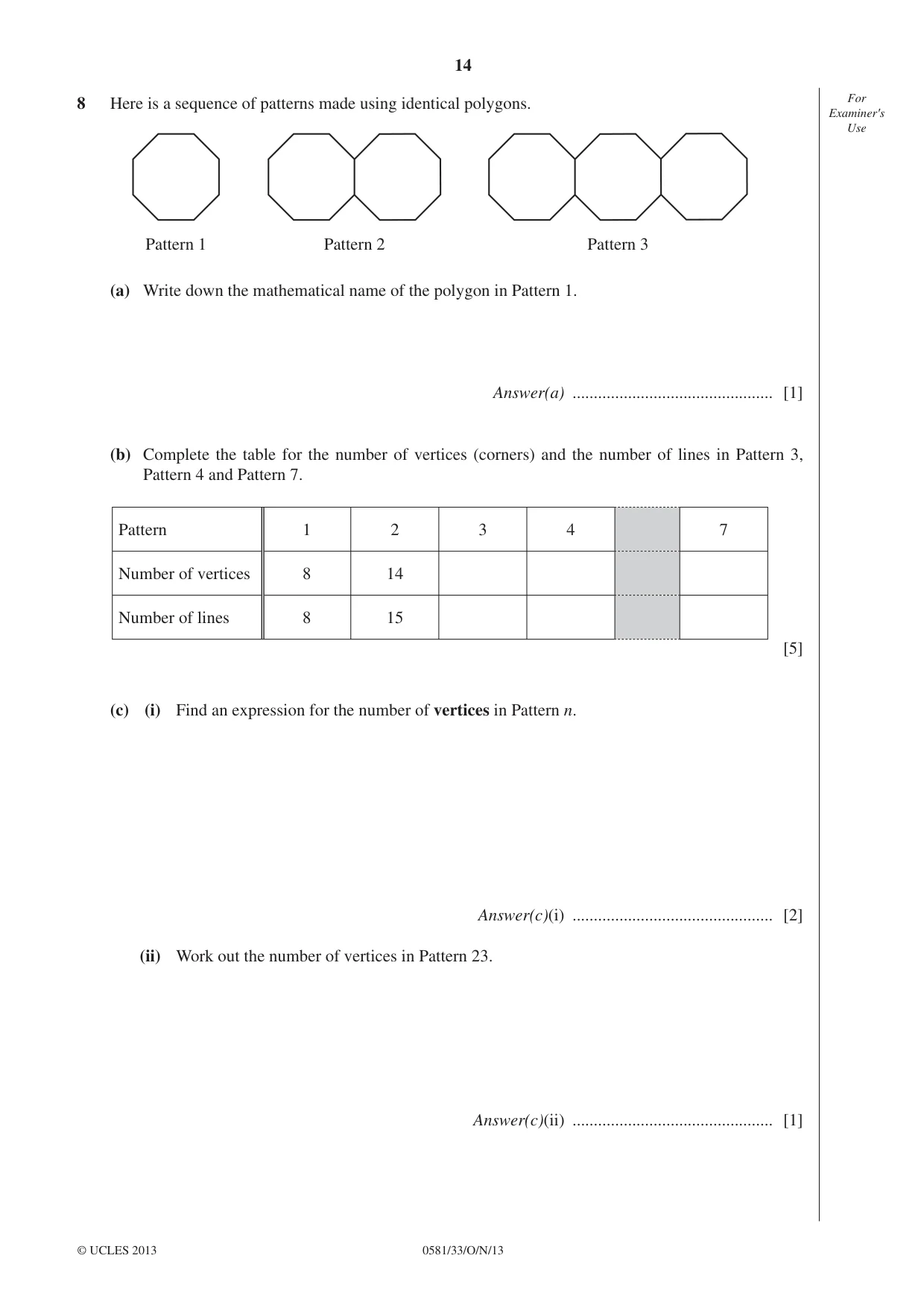
14 0581/33/O/N/13 © UCLES 2013 For Examiner′s Use 8 Here is a sequence of patterns made using identical polygons. Pattern 2 Pattern 1 Pattern 3 (a) Write down the mathematical name of the polygon in Pattern 1. Answer(a) … [1] (b) Complete the table for the number of vertices (corners) and the number of lines in Pattern 3, Pattern 4 and Pattern 7. Pattern 1 2 3 4 7 Number of vertices 8 14 Number of lines 8 15 [5] (c) (i) Find an expression for the number of vertices in Pattern n. Answer(c)(i) … [2] (ii) Work out the number of vertices in Pattern 23. Answer(c)(ii) … [1]
Question paper, page 15
15 0581/33/O/N/13 © UCLES 2013 [Turn over For Examiner′s Use (d) Find an expression for the number of lines in Pattern n. Answer(d) … [2] (e) Work out an expression, in its simplest form, for (number of lines in Pattern n) – (number of vertices in Pattern n). Answer(e) … [2] _____________________________________________________________________________________ Question 9 is printed on the next page.
Question paper, page 16
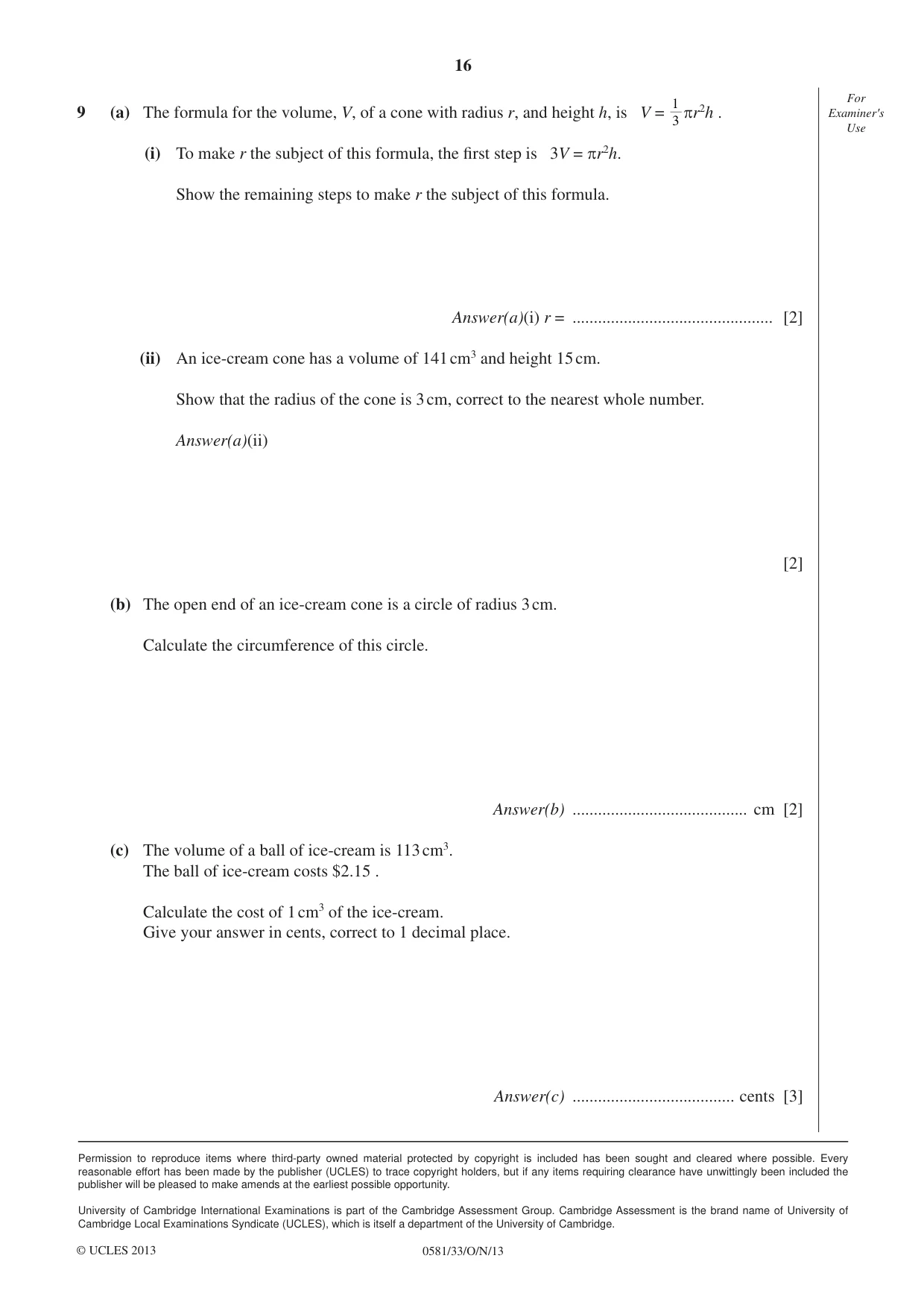
16 0581/33/O/N/13 Permission to reproduce items where third-party owned material protected by copyright is included has been sought and cleared where possible. Every reasonable effort has been made by the publisher (UCLES) to trace copyright holders, but if any items requiring clearance have unwittingly been included the publisher will be pleased to make amends at the earliest possible opportunity. University of Cambridge International Examinations is part of the Cambridge Assessment Group. Cambridge Assessment is the brand name of University of Cambridge Local Examinations Syndicate (UCLES), which is itself a department of the University of Cambridge. © UCLES 2013 For Examiner′s Use 9 (a) The formula for the volume, V, of a cone with radius r, and height h, is V = 3 1 πr2h . (i) To make r the subject of this formula, the fi rst step is 3V = πr2h. Show the remaining steps to make r the subject of this formula. Answer(a)(i) r = … [2] (ii) An ice-cream cone has a volume of 141 cm3 and height 15 cm. Show that the radius of the cone is 3 cm, correct to the nearest whole number. Answer(a)(ii) [2] (b) The open end of an ice-cream cone is a circle of radius 3 cm. Calculate the circumference of this circle. Answer(b) … cm [2] (c) The volume of a ball of ice-cream is 113 cm3. The ball of ice-cream costs $2.15 . Calculate the cost of 1 cm3 of the ice-cream. Give your answer in cents, correct to 1 decimal place. Answer(c) … cents [3]
Mark scheme, page 1
CAMBRIDGE INTERNATIONAL EXAMINATIONS International General Certificate of Secondary Education MARK SCHEME for the October/November 2013 series 0581 MATHEMATICS 0581/33 Paper 3 (Core), maximum raw mark 104 This mark scheme is published as an aid to teachers and candidates, to indicate the requirements of the examination. It shows the basis on which Examiners were instructed to award marks. It does not indicate the details of the discussions that took place at an Examiners’ meeting before marking began, which would have considered the acceptability of alternative answers. Mark schemes should be read in conjunction with the question paper and the Principal Examiner Report for Teachers. Cambridge will not enter into discussions about these mark schemes. Cambridge is publishing the mark schemes for the October/November 2013 series for most IGCSE, GCE Advanced Level and Advanced Subsidiary Level components and some Ordinary Level components. www.XtremePapers.com
Mark scheme, page 2
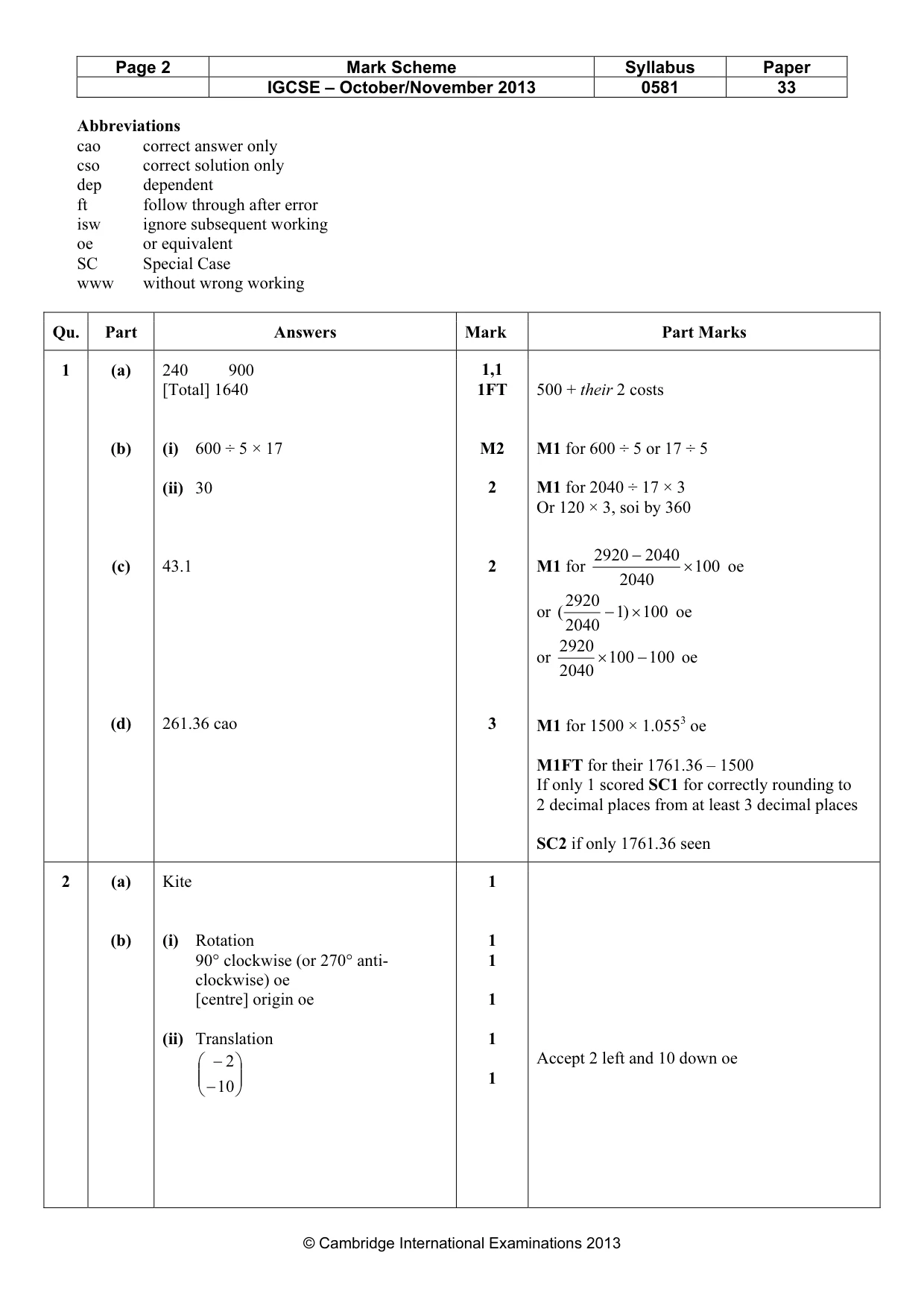
Page 2 Mark Scheme Syllabus Paper IGCSE – October/November 2013 0581 33 © Cambridge International Examinations 2013 Abbreviations cao correct answer only cso correct solution only dep dependent ft follow through after error isw ignore subsequent working oe or equivalent SC Special Case www without wrong working Qu. Part Answers Mark Part Marks 1 (a) (b) (c) (d) 240 900 [Total] 1640 (i) 600 ÷ 5 × 17 (ii) 30 43.1 261.36 cao 1,1 1FT M2 2 2 3 500 + their 2 costs M1 for 600 ÷ 5 or 17 ÷ 5 M1 for 2040 ÷ 17 × 3 Or 120 × 3, soi by 360 M1 for 100 2040 2040 2920 × − oe or 100 )1 2040 2920 ( × − oe or 100 100 2040 2920 − × oe M1 for 1500 × 1.0553 oe M1FT for their 1761.36 – 1500 If only 1 scored SC1 for correctly rounding to 2 decimal places from at least 3 decimal places SC2 if only 1761.36 seen 2 (a) (b) Kite (i) Rotation 90° clockwise (or 270° anti- clockwise) oe [centre] origin oe (ii) Translation − − 10 2 1 1 1 1 1 1 Accept 2 left and 10 down oe
Mark scheme, page 3
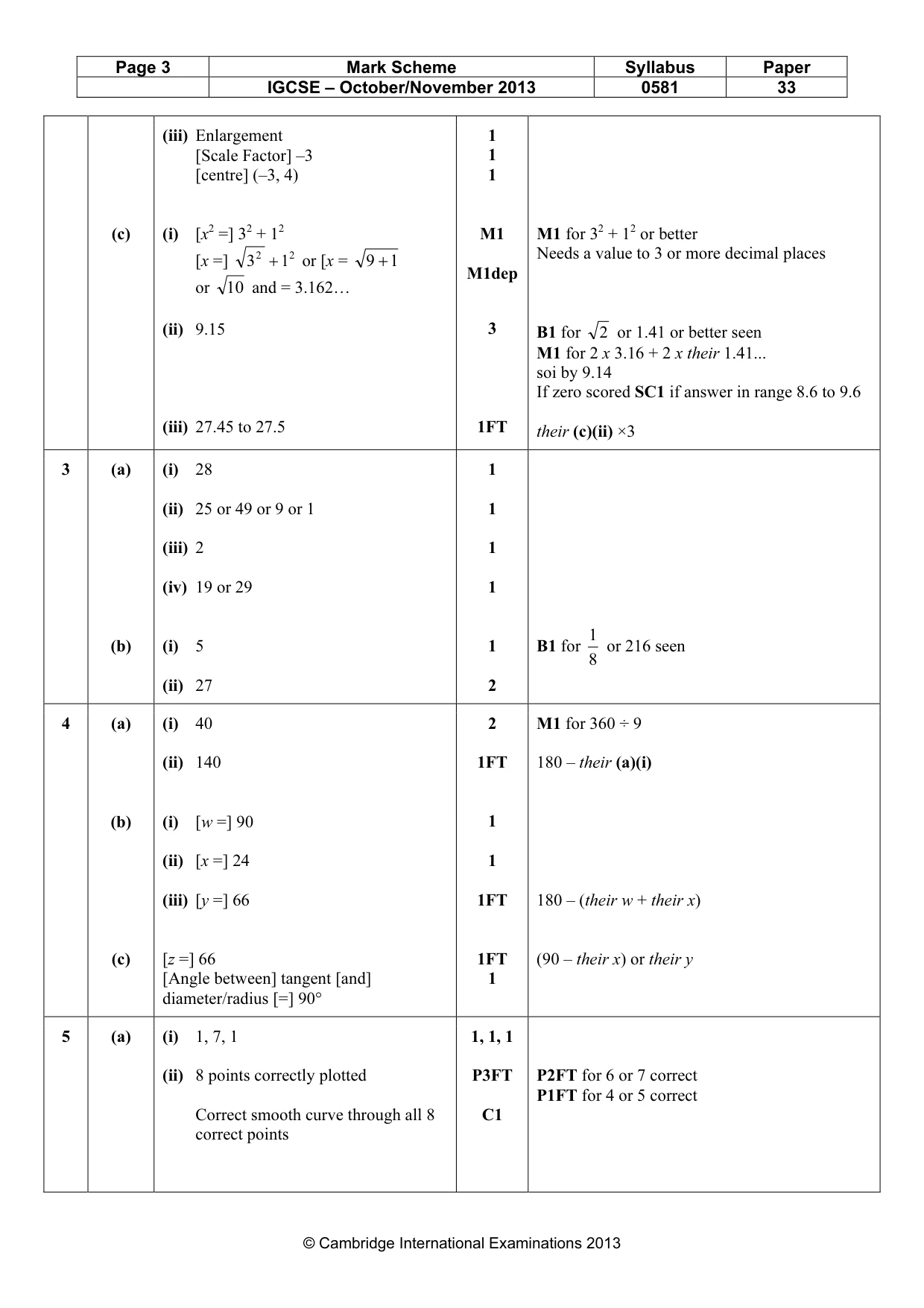
Page 3 Mark Scheme Syllabus Paper IGCSE – October/November 2013 0581 33 © Cambridge International Examinations 2013 (c) (iii) Enlargement [Scale Factor] –3 [centre] (–3, 4) (i) [x2 =] 32 + 12 [x =] 2 2 1 3 + or [x = 1 9 + or 10 and = 3.162… (ii) 9.15 (iii) 27.45 to 27.5 1 1 1 M1 M1dep 3 1FT M1 for 32 + 12 or better Needs a value to 3 or more decimal places B1 for 2 or 1.41 or better seen M1 for 2 x 3.16 + 2 x their 1.41... soi by 9.14 If zero scored SC1 if answer in range 8.6 to 9.6 their (c)(ii) ×3 3 (a) (b) (i) 28 (ii) 25 or 49 or 9 or 1 (iii) 2 (iv) 19 or 29 (i) 5 (ii) 27 1 1 1 1 1 2 B1 for 8 1 or 216 seen 4 (a) (b) (c) (i) 40 (ii) 140 (i) [w =] 90 (ii) [x =] 24 (iii) [y =] 66 [z =] 66 [Angle between] tangent [and] diameter/radius [=] 90° 2 1FT 1 1 1FT 1FT 1 M1 for 360 ÷ 9 180 – their (a)(i) 180 – (their w + their x) (90 – their x) or their y 5 (a) (i) 1, 7, 1 (ii) 8 points correctly plotted Correct smooth curve through all 8 correct points 1, 1, 1 P3FT C1 P2FT for 6 or 7 correct P1FT for 4 or 5 correct
Mark scheme, page 4
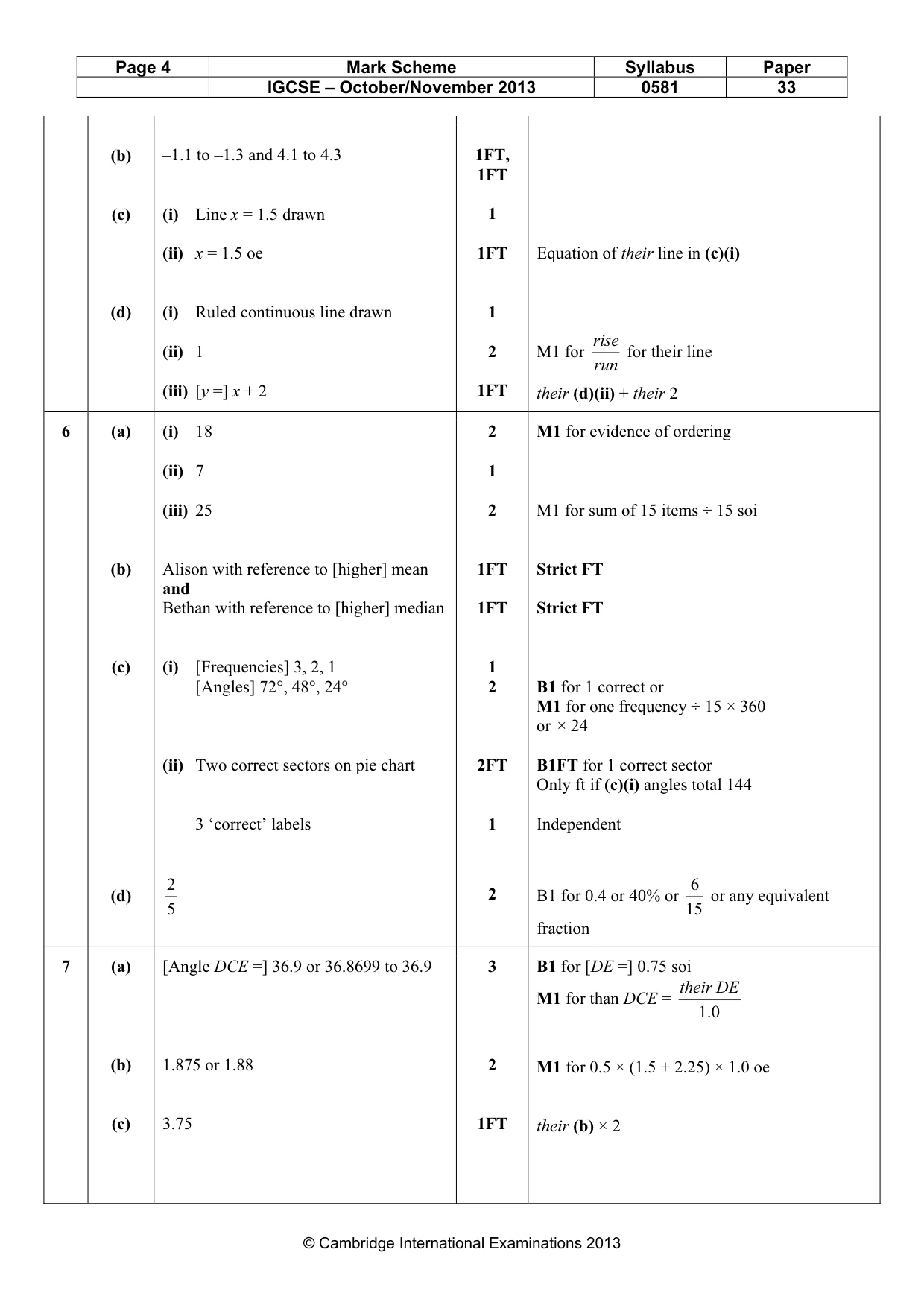
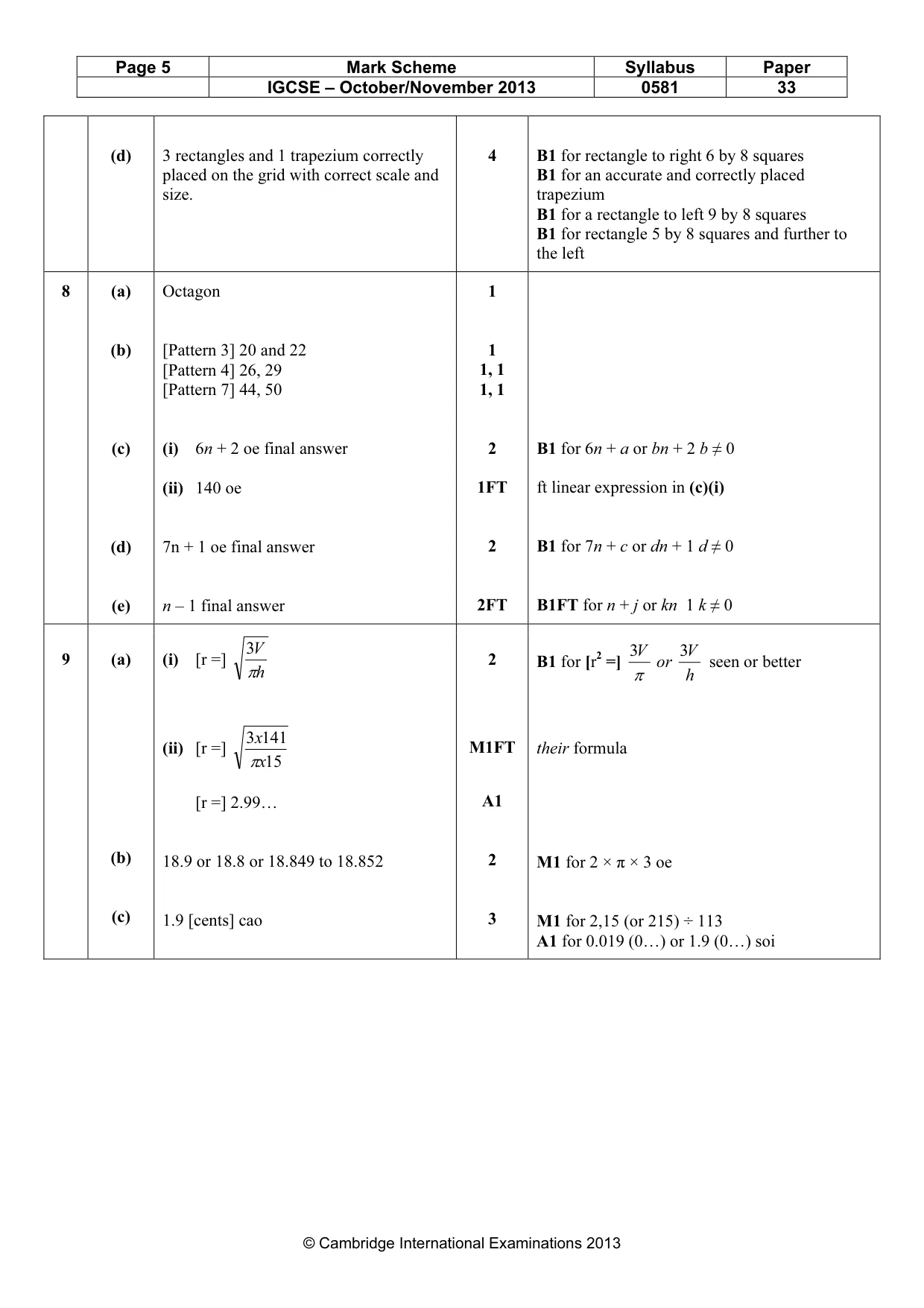
Page 4 Mark Scheme Syllabus Paper IGCSE – October/November 2013 0581 33 © Cambridge International Examinations 2013 (b) (c) (d) –1.1 to –1.3 and 4.1 to 4.3 (i) Line x = 1.5 drawn (ii) x = 1.5 oe (i) Ruled continuous line drawn (ii) 1 (iii) [y =] x + 2 1FT, 1FT 1 1FT 1 2 1FT Equation of their line in (c)(i) M1 for run rise for their line their (d)(ii) + their 2 6 (a) (b) (c) (d) (i) 18 (ii) 7 (iii) 25 Alison with reference to [higher] mean and Bethan with reference to [higher] median (i) [Frequencies] 3, 2, 1 [Angles] 72°, 48°, 24° (ii) Two correct sectors on pie chart 3 ‘correct’ labels 5 2 2 1 2 1FT 1FT 1 2 2FT 1 2 M1 for evidence of ordering M1 for sum of 15 items ÷ 15 soi Strict FT Strict FT B1 for 1 correct or M1 for one frequency ÷ 15 × 360 or × 24 B1FT for 1 correct sector Only ft if (c)(i) angles total 144 Independent B1 for 0.4 or 40% or 15 6 or any equivalent fraction 7 (a) (b) (c) [Angle DCE =] 36.9 or 36.8699 to 36.9 1.875 or 1.88 3.75 3 2 1FT B1 for [DE =] 0.75 soi M1 for than DCE = 0.1 DE their M1 for 0.5 × (1.5 + 2.25) × 1.0 oe their (b) × 2
Mark scheme, page 5
Page 5 Mark Scheme Syllabus Paper IGCSE – October/November 2013 0581 33 © Cambridge International Examinations 2013 (d) 3 rectangles and 1 trapezium correctly placed on the grid with correct scale and size. 4 B1 for rectangle to right 6 by 8 squares B1 for an accurate and correctly placed trapezium B1 for a rectangle to left 9 by 8 squares B1 for rectangle 5 by 8 squares and further to the left 8 (a) (b) (c) (d) (e) Octagon [Pattern 3] 20 and 22 [Pattern 4] 26, 29 [Pattern 7] 44, 50 (i) 6n + 2 oe final answer (ii) 140 oe 7n + 1 oe final answer n – 1 final answer 1 1 1, 1 1, 1 2 1FT 2 2FT B1 for 6n + a or bn + 2 b ≠ 0 ft linear expression in (c)(i) B1 for 7n + c or dn + 1 d ≠ 0 B1FT for n + j or kn 1 k ≠ 0 9 (a) (b) (c) (i) [r =] h V π 3 (ii) [r =] 15 141 3 x x π [r =] 2.99… 18.9 or 18.8 or 18.849 to 18.852 1.9 [cents] cao 2 M1FT A1 2 3 B1 for [r2 =] h V or V 3 3 π seen or better their formula M1 for 2 × π × 3 oe M1 for 2,15 (or 215) ÷ 113 A1 for 0.019 (0…) or 1.9 (0…) soi