Cambridge IGCSE Mathematics (with coursework) 0581 — 2013 Oct/Nov Paper 3 · Variant 1
0581/31/O/N/13
The question paper and its mark scheme, free to read here and free to download. This is Cambridge’s own paper, exactly as it was sat.
Question paper16 pages
Mark scheme6 pages
Answers below. Sit the paper first if you are practising.
Paper as text
Question paper, page 1
READ THESE INSTRUCTIONS FIRST Write your Centre number, candidate number and name on all the work you hand in. Write in dark blue or black pen. You may use a pencil for any diagrams or graphs. Do not use staples, paper clips, highlighters, glue or correction fl uid. DO NOT WRITE IN ANY BARCODES. Answer all questions. If working is needed for any question it must be shown below that question. Electronic calculators should be used. If the degree of accuracy is not specifi ed in the question, and if the answer is not exact, give the answer to three signifi cant fi gures. Give answers in degrees to one decimal place. For π, use either your calculator value or 3.142. At the end of the examination, fasten all your work securely together. The number of marks is given in brackets [ ] at the end of each question or part question. The total of the marks for this paper is 104. MATHEMATICS 0581/31 Paper 3 (Core) October/November 2013 2 hours Candidates answer on the Question Paper. Additional Materials: Electronic calculator Geometrical instruments Tracing paper (optional) UNIVERSITY OF CAMBRIDGE INTERNATIONAL EXAMINATIONS International General Certifi cate of Secondary Education This document consists of 15 printed pages and 1 blank page. [Turn over IB13 11_0581_31/FP © UCLES 2013 *1419208007* www.XtremePapers.com
Question paper, page 2
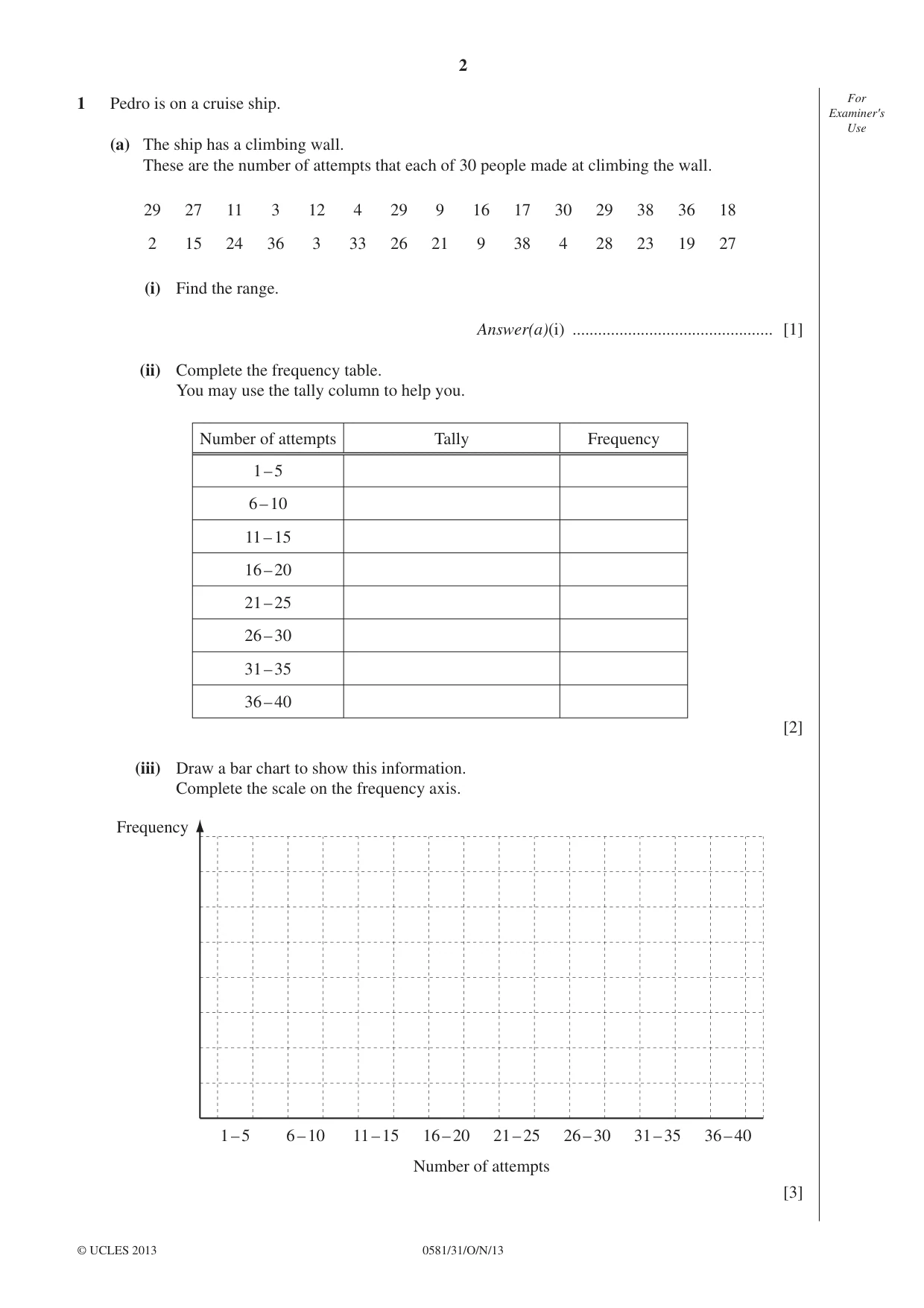
2 0581/31/O/N/13 © UCLES 2013 For Examiner′s Use 1 Pedro is on a cruise ship. (a) The ship has a climbing wall. These are the number of attempts that each of 30 people made at climbing the wall. 29 27 11 3 12 4 29 9 16 17 30 29 38 36 18 2 15 24 36 3 33 26 21 9 38 4 28 23 19 27 (i) Find the range. Answer(a)(i) … [1] (ii) Complete the frequency table. You may use the tally column to help you. Number of attempts Tally Frequency 1 – 5 6 – 10 11 – 15 16 – 20 21 – 25 26 – 30 31 – 35 36 – 40 [2] (iii) Draw a bar chart to show this information. Complete the scale on the frequency axis. 1 – 5 6 – 10 11 – 15 16 – 20 Number of attempts 21 – 25 26 – 30 31 – 35 36 – 40 Frequency [3]
Question paper, page 3
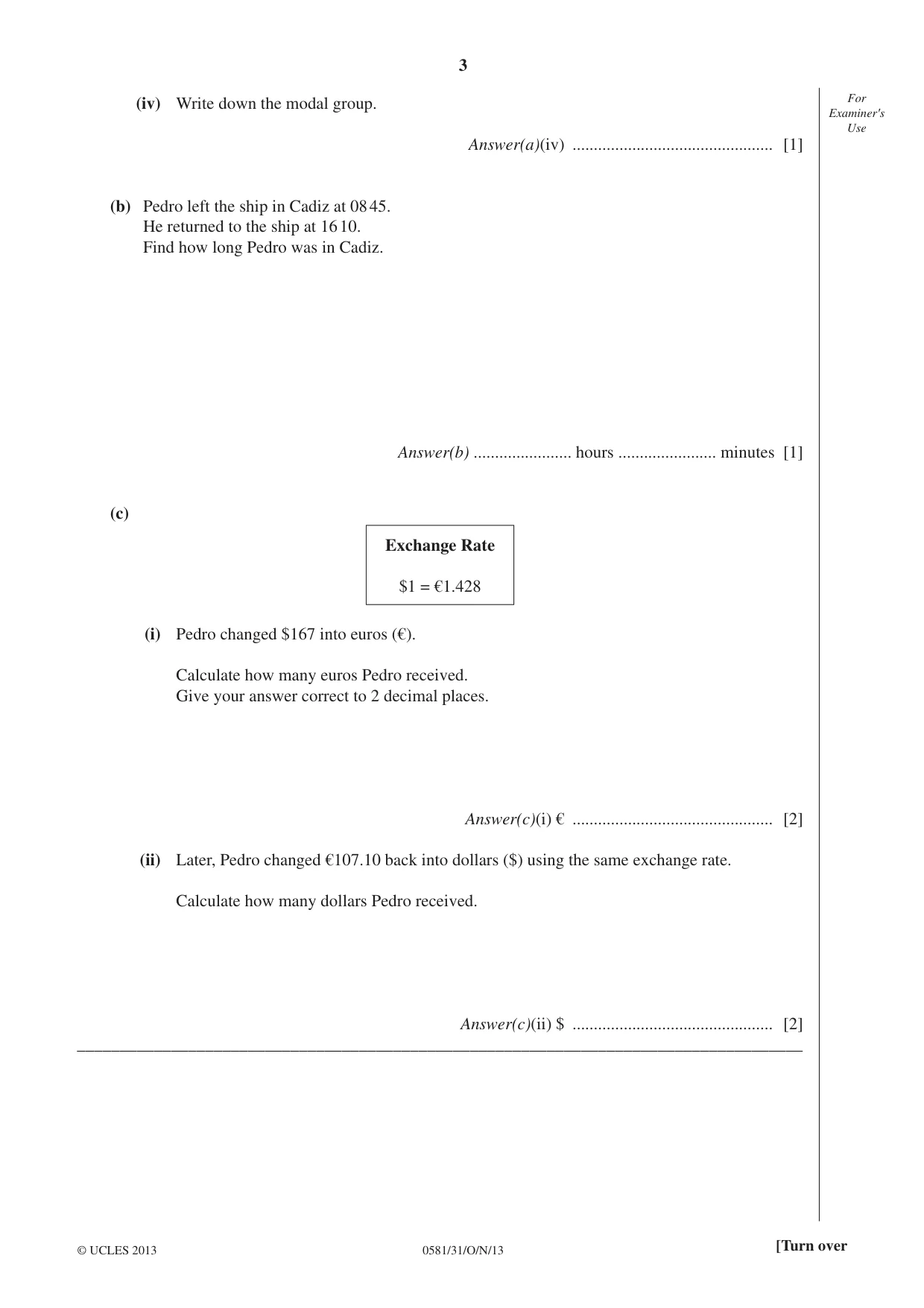
3 0581/31/O/N/13 © UCLES 2013 [Turn over For Examiner′s Use (iv) Write down the modal group. Answer(a)(iv) … [1] (b) Pedro left the ship in Cadiz at 08 45. He returned to the ship at 16 10. Find how long Pedro was in Cadiz. Answer(b) … hours … minutes [1] (c) Exchange Rate $1 = €1.428 (i) Pedro changed $167 into euros (€). Calculate how many euros Pedro received. Give your answer correct to 2 decimal places. Answer(c)(i) € … [2] (ii) Later, Pedro changed €107.10 back into dollars ($) using the same exchange rate. Calculate how many dollars Pedro received. Answer(c)(ii) $ … [2] _____________________________________________________________________________________
Question paper, page 4
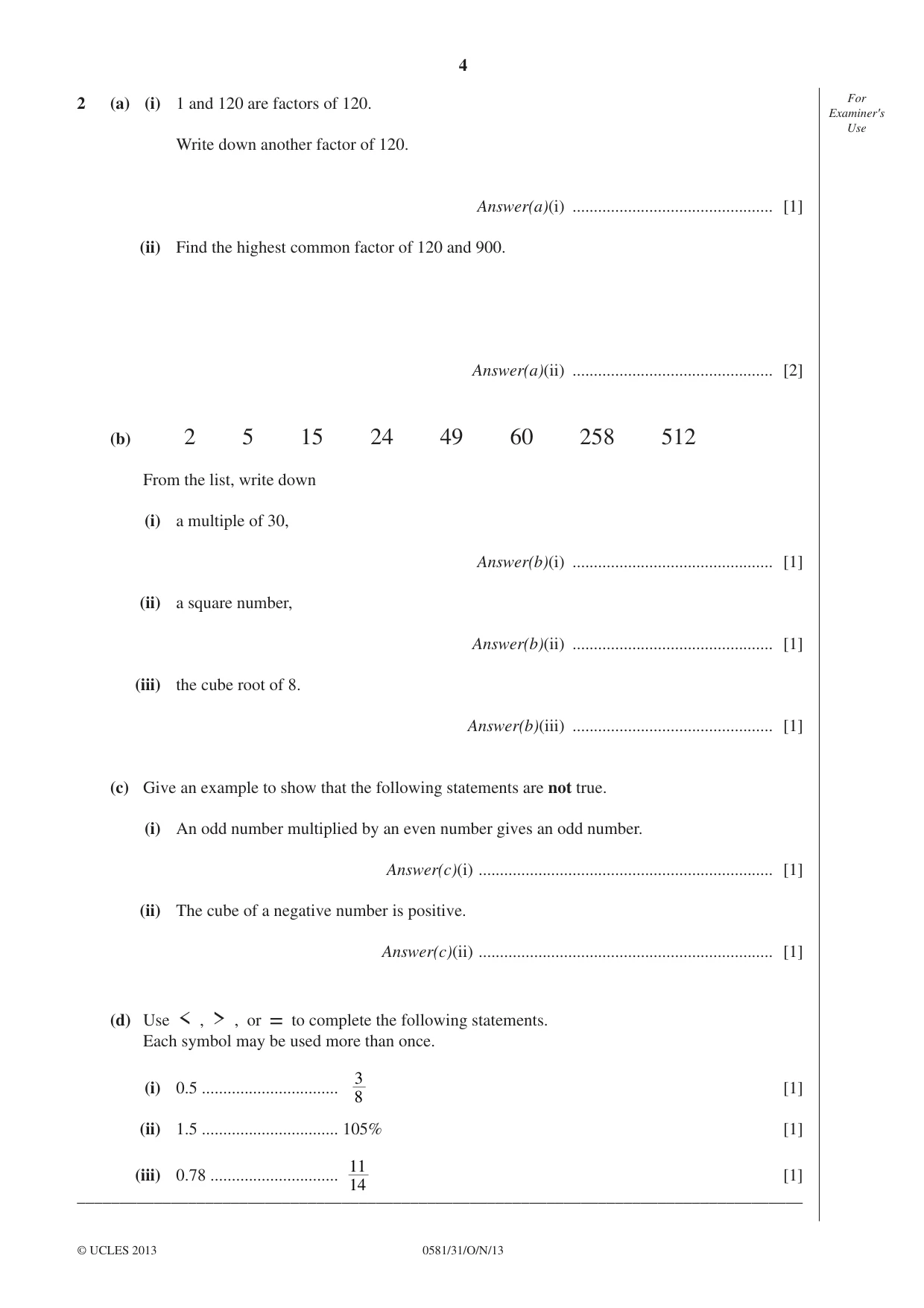
4 0581/31/O/N/13 © UCLES 2013 For Examiner′s Use 2 (a) (i) 1 and 120 are factors of 120. Write down another factor of 120. Answer(a)(i) … [1] (ii) Find the highest common factor of 120 and 900. Answer(a)(ii) … [2] (b) 2 5 15 24 49 60 258 512 From the list, write down (i) a multiple of 30, Answer(b)(i) … [1] (ii) a square number, Answer(b)(ii) … [1] (iii) the cube root of 8. Answer(b)(iii) … [1] (c) Give an example to show that the following statements are not true. (i) An odd number multiplied by an even number gives an odd number. Answer(c)(i) … [1] (ii) The cube of a negative number is positive. Answer(c)(ii) … [1] (d) Use < , > , or = to complete the following statements. Each symbol may be used more than once. (i) 0.5 … 8 3 [1] (ii) 1.5 … 105% [1] (iii) 0.78 … 14 11 [1] _____________________________________________________________________________________
Question paper, page 5
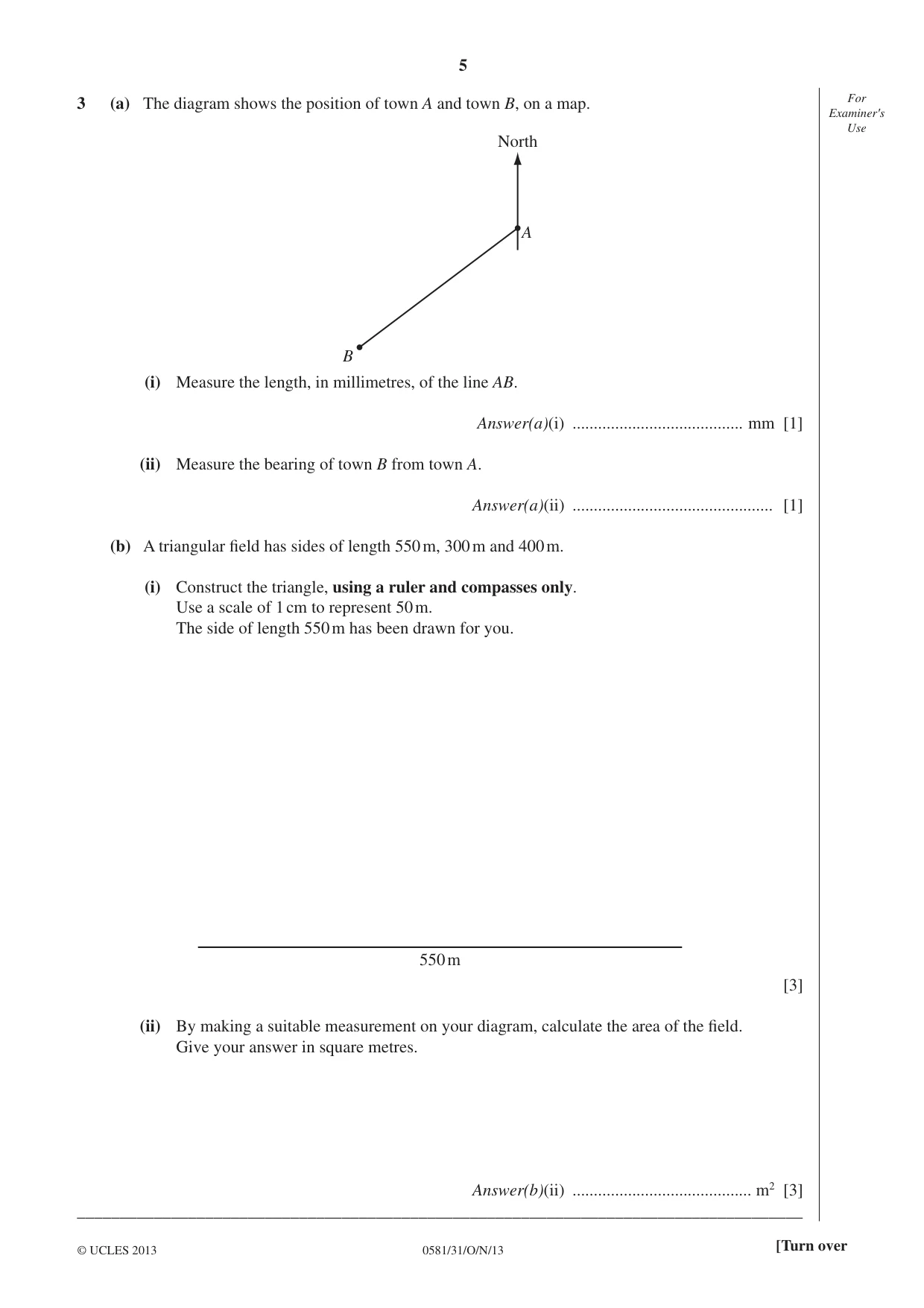
5 0581/31/O/N/13 © UCLES 2013 [Turn over For Examiner′s Use 3 (a) The diagram shows the position of town A and town B, on a map. A B North (i) Measure the length, in millimetres, of the line AB. Answer(a)(i) … mm [1] (ii) Measure the bearing of town B from town A. Answer(a)(ii) … [1] (b) A triangular fi eld has sides of length 550 m, 300 m and 400 m. (i) Construct the triangle, using a ruler and compasses only. Use a scale of 1 cm to represent 50 m. The side of length 550 m has been drawn for you. 550 m [3] (ii) By making a suitable measurement on your diagram, calculate the area of the fi eld. Give your answer in square metres. Answer(b)(ii) … m2 [3] _____________________________________________________________________________________
Question paper, page 6
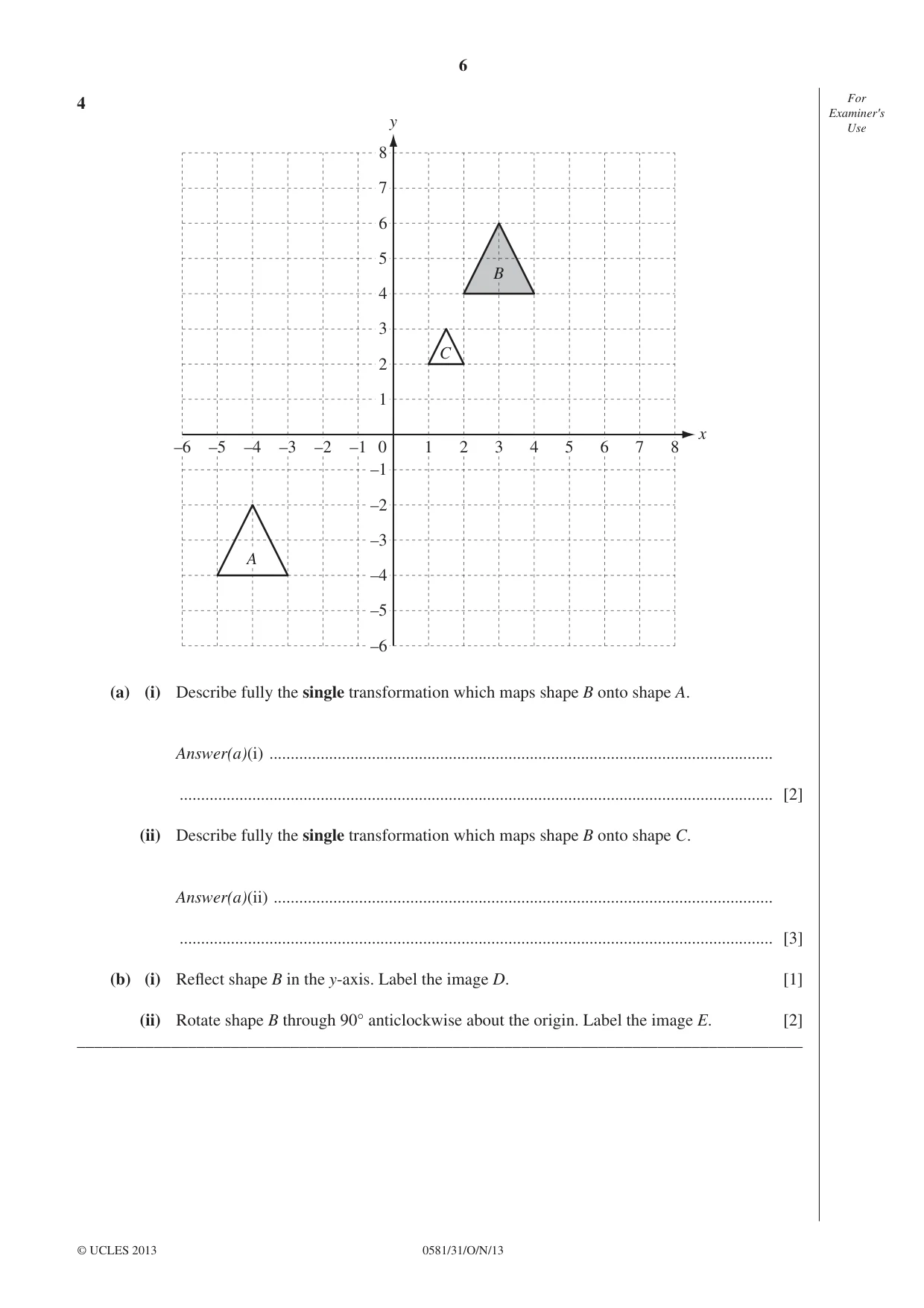
6 0581/31/O/N/13 © UCLES 2013 For Examiner′s Use 4 8 7 6 5 4 3 2 1 –1 –2 –3 –4 –5 –6 –5 –4 –6 –3 –2 –1 1 0 2 3 4 5 6 7 8 y x B A C (a) (i) Describe fully the single transformation which maps shape B onto shape A. Answer(a)(i) … … [2] (ii) Describe fully the single transformation which maps shape B onto shape C. Answer(a)(ii) … … [3] (b) (i) Refl ect shape B in the y-axis. Label the image D. [1] (ii) Rotate shape B through 90° anticlockwise about the origin. Label the image E. [2] _____________________________________________________________________________________
Question paper, page 7
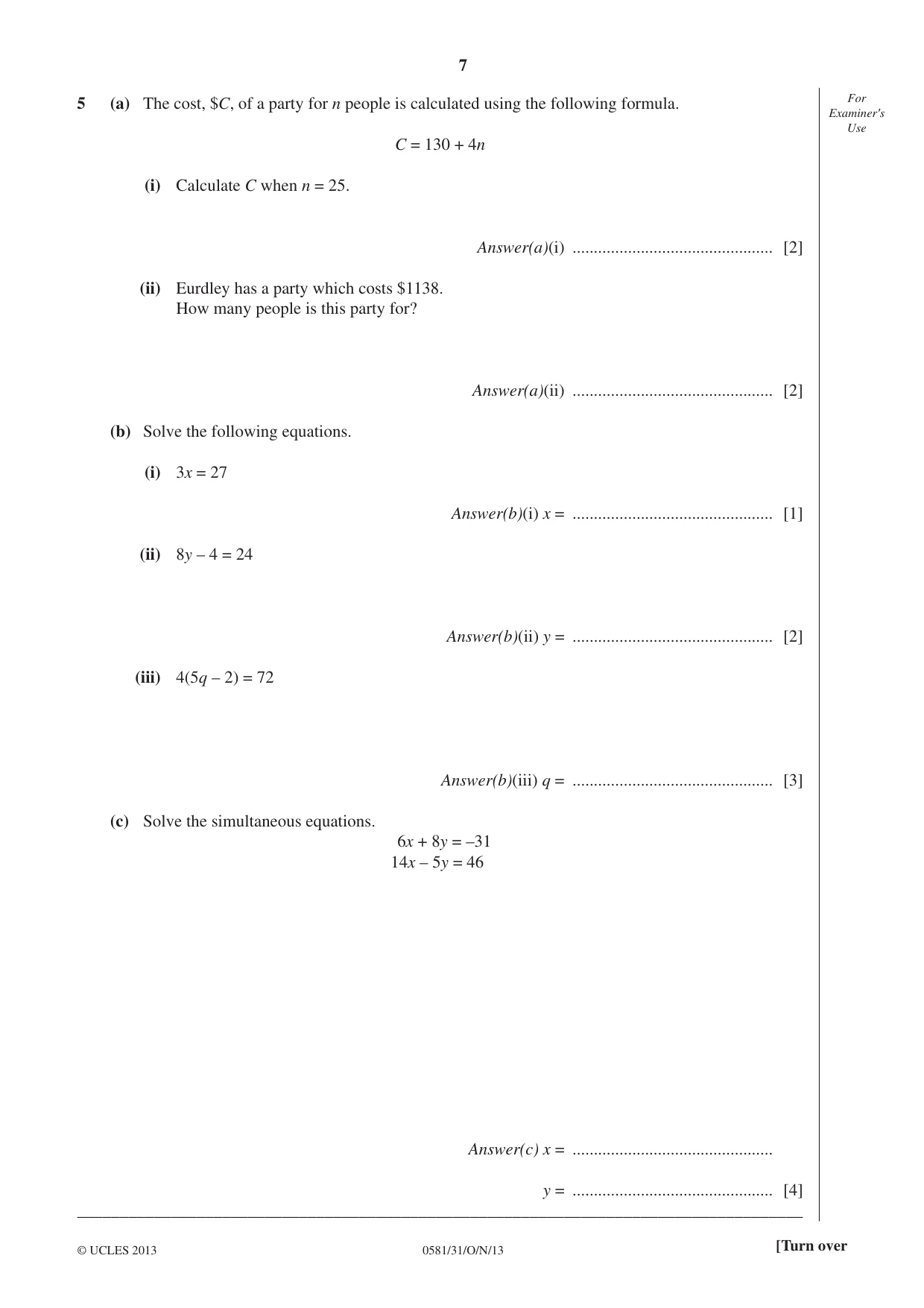
7 0581/31/O/N/13 © UCLES 2013 [Turn over For Examiner′s Use 5 (a) The cost, $C, of a party for n people is calculated using the following formula. C = 130 + 4n (i) Calculate C when n = 25. Answer(a)(i) … [2] (ii) Eurdley has a party which costs $1138. How many people is this party for? Answer(a)(ii) … [2] (b) Solve the following equations. (i) 3x = 27 Answer(b)(i) x = … [1] (ii) 8y – 4 = 24 Answer(b)(ii) y = … [2] (iii) 4(5q – 2) = 72 Answer(b)(iii) q = … [3] (c) Solve the simultaneous equations. 6x + 8y = –31 14x – 5y = 46 Answer(c) x = … y = … [4] _____________________________________________________________________________________
Question paper, page 8
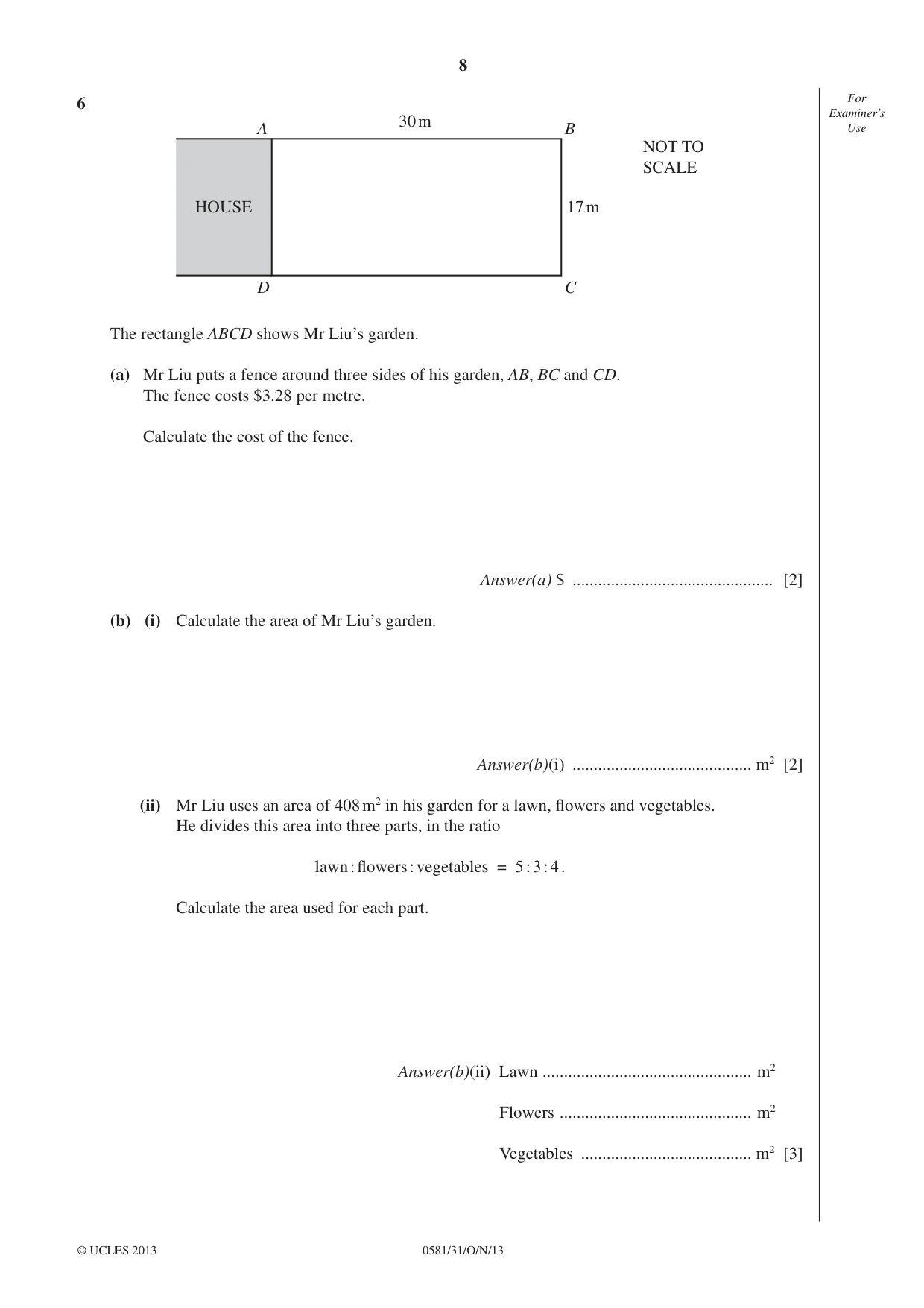
8 0581/31/O/N/13 © UCLES 2013 For Examiner′s Use 6 30 m 17 m B C A D NOT TO SCALE HOUSE The rectangle ABCD shows Mr Liu’s garden. (a) Mr Liu puts a fence around three sides of his garden, AB, BC and CD. The fence costs $3.28 per metre. Calculate the cost of the fence. Answer(a) $ … [2] (b) (i) Calculate the area of Mr Liu’s garden. Answer(b)(i) … m2 [2] (ii) Mr Liu uses an area of 408 m2 in his garden for a lawn, fl owers and vegetables. He divides this area into three parts, in the ratio lawn : fl owers : vegetables = 5 : 3 : 4 . Calculate the area used for each part. Answer(b)(ii) Lawn … m2 Flowers … m2 Vegetables … m2 [3]
Question paper, page 9
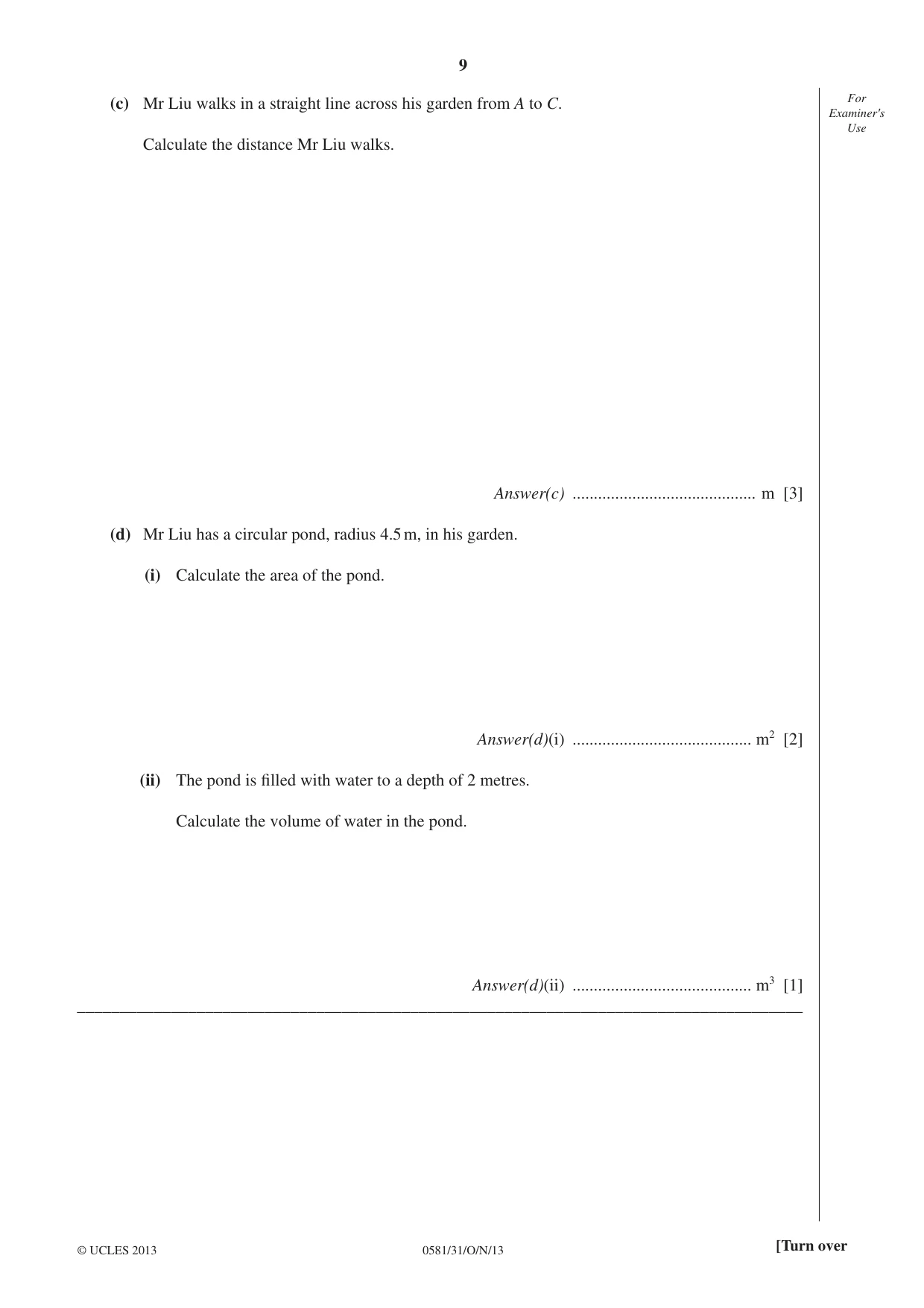
9 0581/31/O/N/13 © UCLES 2013 [Turn over For Examiner′s Use (c) Mr Liu walks in a straight line across his garden from A to C. Calculate the distance Mr Liu walks. Answer(c) … m [3] (d) Mr Liu has a circular pond, radius 4.5 m, in his garden. (i) Calculate the area of the pond. Answer(d)(i) … m2 [2] (ii) The pond is fi lled with water to a depth of 2 metres. Calculate the volume of water in the pond. Answer(d)(ii) … m3 [1] _____________________________________________________________________________________
Question paper, page 10
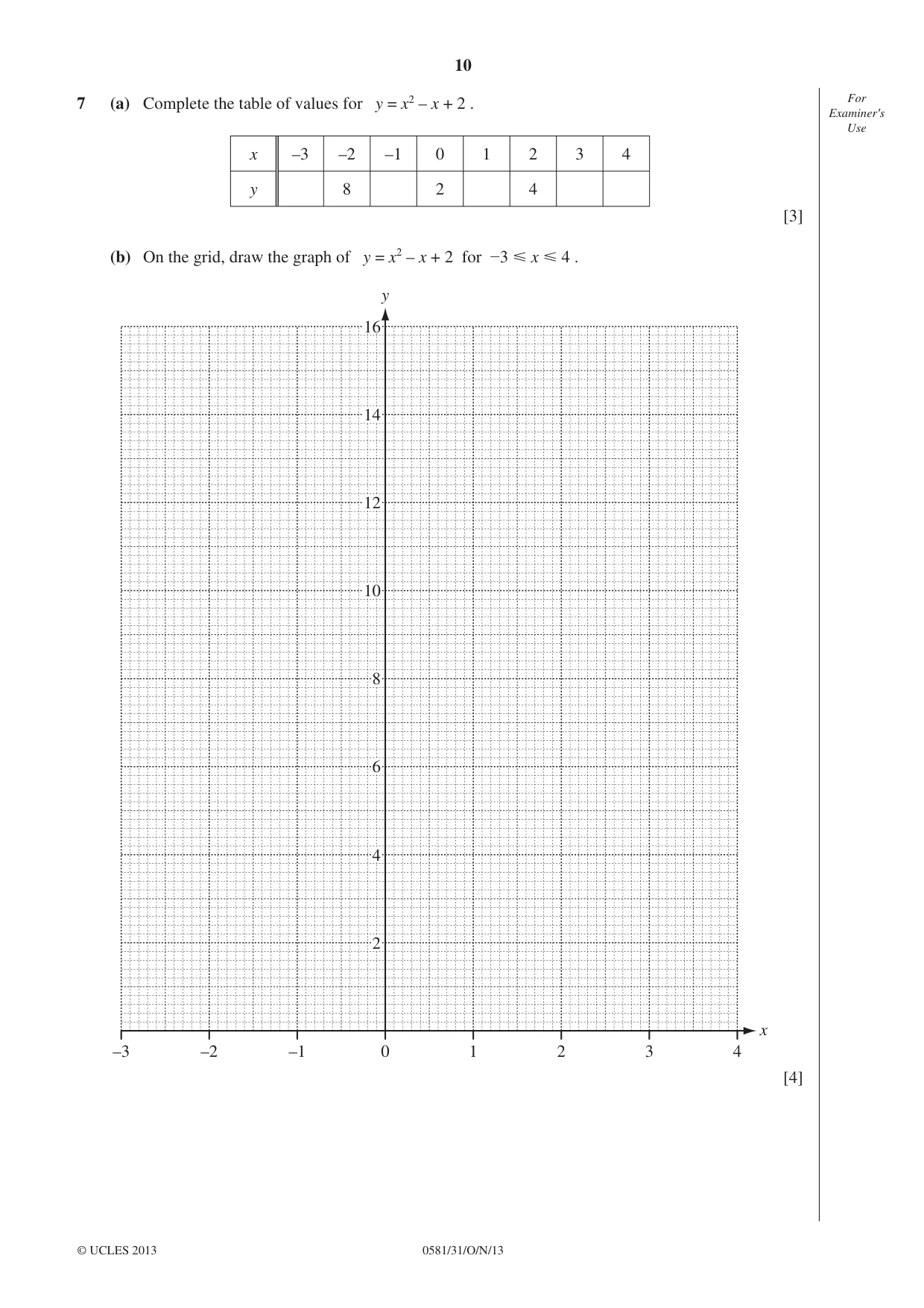
10 0581/31/O/N/13 © UCLES 2013 For Examiner′s Use 7 (a) Complete the table of values for y = x2 – x + 2 . x –3 –2 –1 0 1 2 3 4 y 8 2 4 [3] (b) On the grid, draw the graph of y = x2 – x + 2 for −3 Y x Ğ 4 . 0 –1 1 3 4 2 –2 –3 x y 16 14 12 10 8 6 4 2 [4]
Question paper, page 11
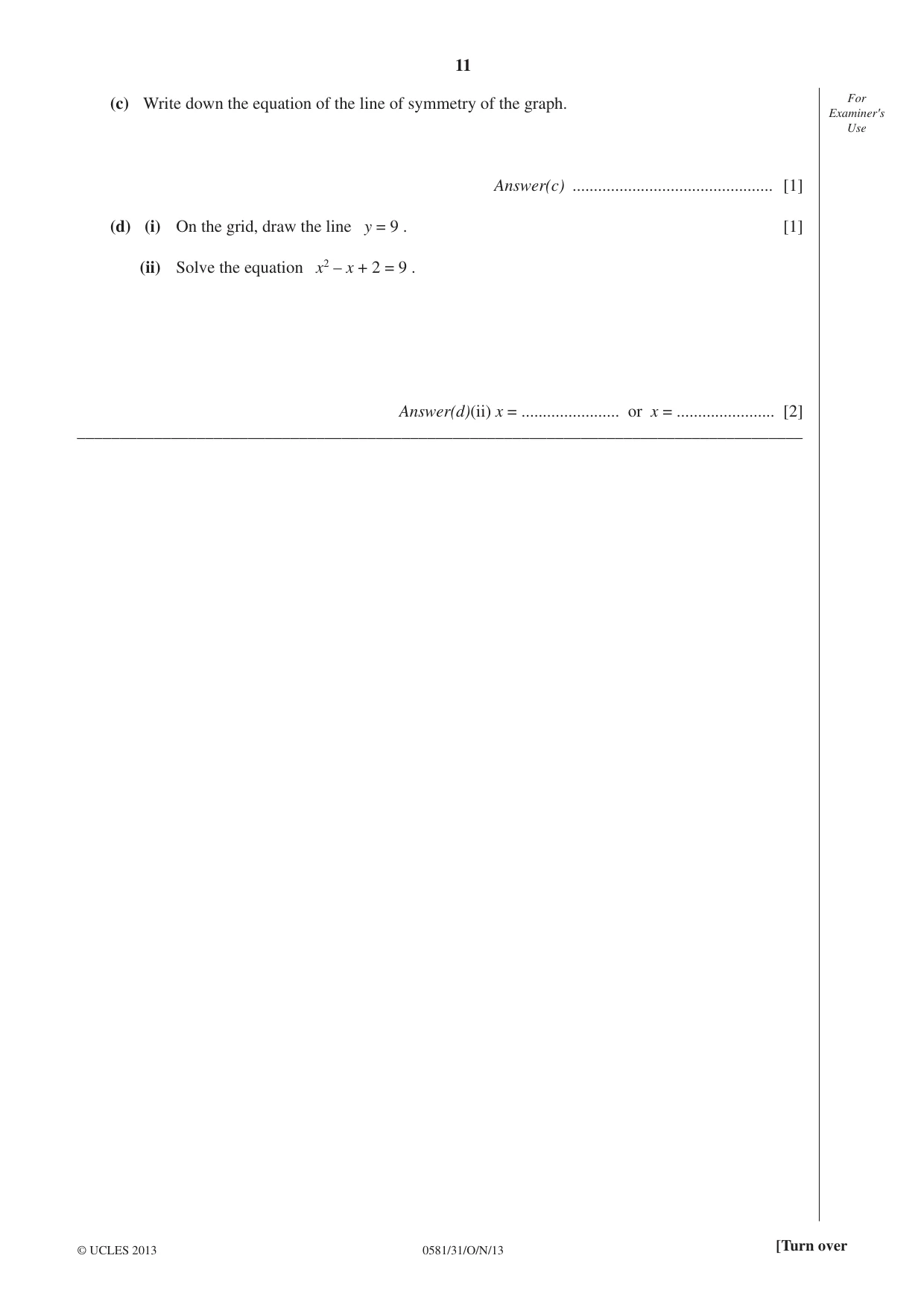
11 0581/31/O/N/13 © UCLES 2013 [Turn over For Examiner′s Use (c) Write down the equation of the line of symmetry of the graph. Answer(c) … [1] (d) (i) On the grid, draw the line y = 9 . [1] (ii) Solve the equation x2 – x + 2 = 9 . Answer(d)(ii) x = … or x = … [2] _____________________________________________________________________________________
Question paper, page 12
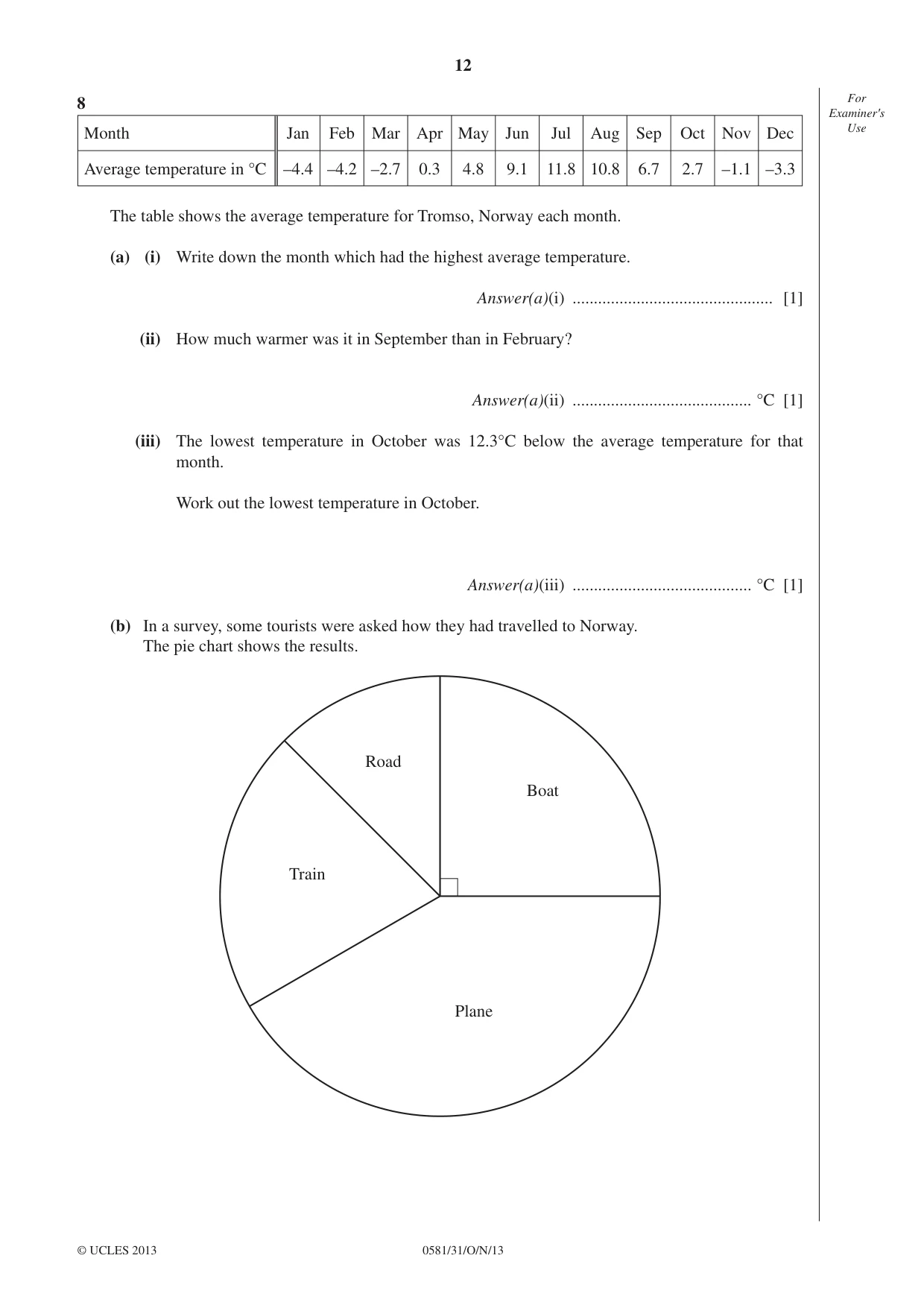
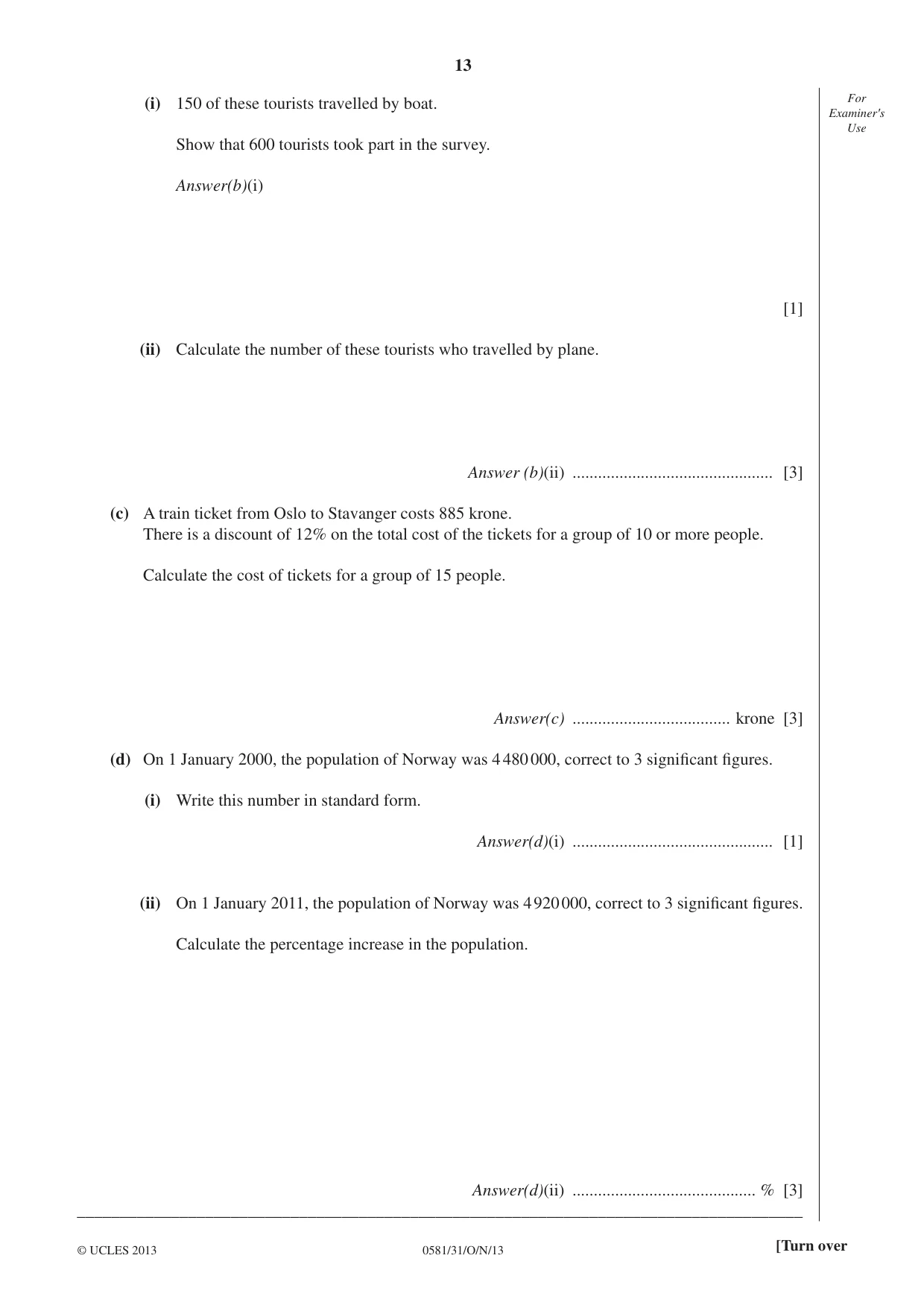
12 0581/31/O/N/13 © UCLES 2013 For Examiner′s Use 8 Month Jan Feb Mar Apr May Jun Jul Aug Sep Oct Nov Dec Average temperature in °C –4.4 –4.2 –2.7 0.3 4.8 9.1 11.8 10.8 6.7 2.7 –1.1 –3.3 The table shows the average temperature for Tromso, Norway each month. (a) (i) Write down the month which had the highest average temperature. Answer(a)(i) … [1] (ii) How much warmer was it in September than in February? Answer(a)(ii) … °C [1] (iii) The lowest temperature in October was 12.3°C below the average temperature for that month. Work out the lowest temperature in October. Answer(a)(iii) … °C [1] (b) In a survey, some tourists were asked how they had travelled to Norway. The pie chart shows the results. Boat Plane Train Road
Question paper, page 13
13 0581/31/O/N/13 © UCLES 2013 [Turn over For Examiner′s Use (i) 150 of these tourists travelled by boat. Show that 600 tourists took part in the survey. Answer(b)(i) [1] (ii) Calculate the number of these tourists who travelled by plane. Answer (b)(ii) … [3] (c) A train ticket from Oslo to Stavanger costs 885 krone. There is a discount of 12% on the total cost of the tickets for a group of 10 or more people. Calculate the cost of tickets for a group of 15 people. Answer(c) … krone [3] (d) On 1 January 2000, the population of Norway was 4 480 000, correct to 3 signifi cant fi gures. (i) Write this number in standard form. Answer(d)(i) … [1] (ii) On 1 January 2011, the population of Norway was 4 920 000, correct to 3 signifi cant fi gures. Calculate the percentage increase in the population. Answer(d)(ii) … % [3] _____________________________________________________________________________________
Question paper, page 14
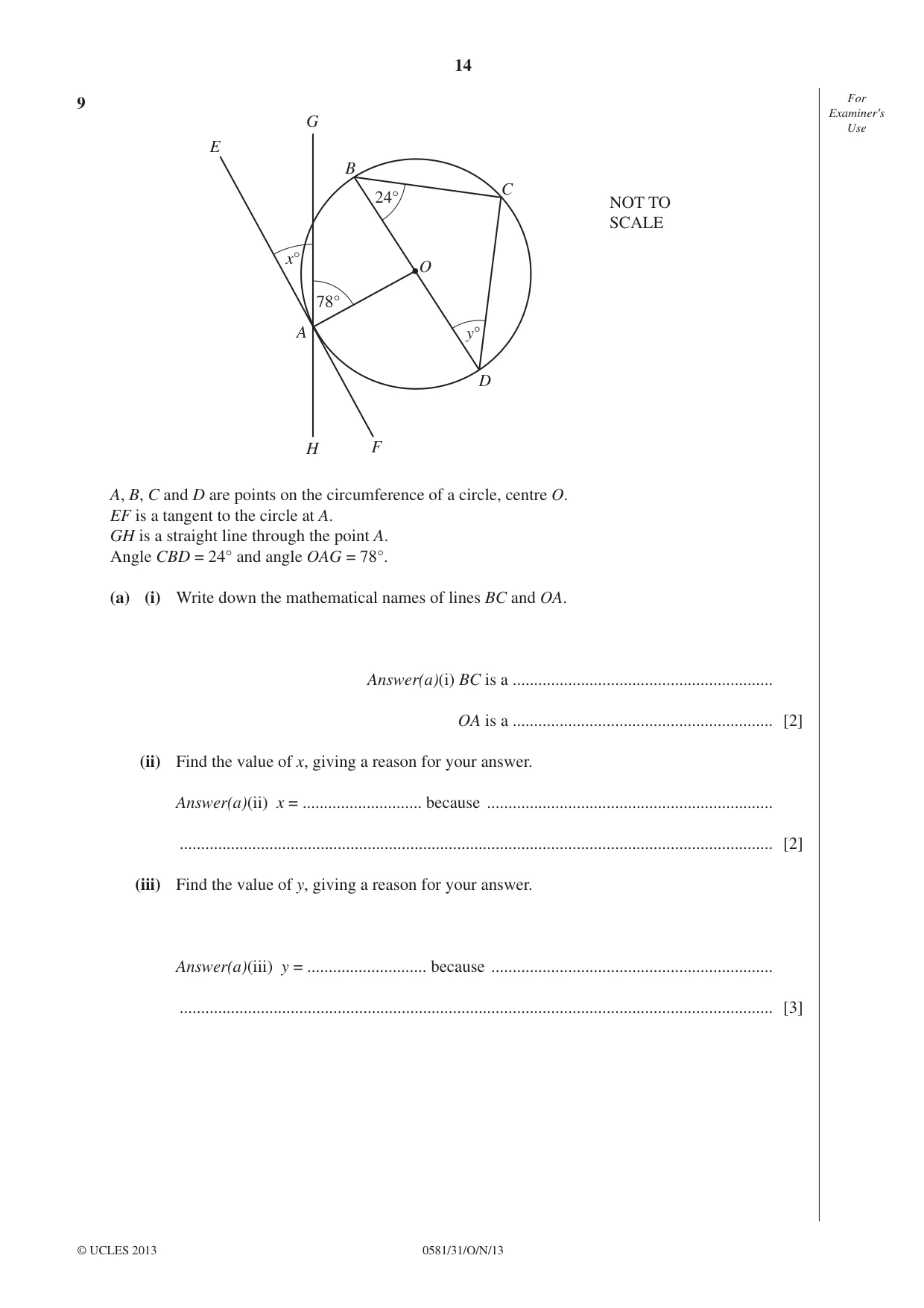
14 0581/31/O/N/13 © UCLES 2013 For Examiner′s Use 9 B G H A F E C D O x° y° 24° 78° NOT TO SCALE A, B, C and D are points on the circumference of a circle, centre O. EF is a tangent to the circle at A. GH is a straight line through the point A. Angle CBD = 24° and angle OAG = 78°. (a) (i) Write down the mathematical names of lines BC and OA. Answer(a)(i) BC is a … OA is a … [2] (ii) Find the value of x, giving a reason for your answer. Answer(a)(ii) x = … because … … [2] (iii) Find the value of y, giving a reason for your answer. Answer(a)(iii) y = … because … … [3]
Question paper, page 15
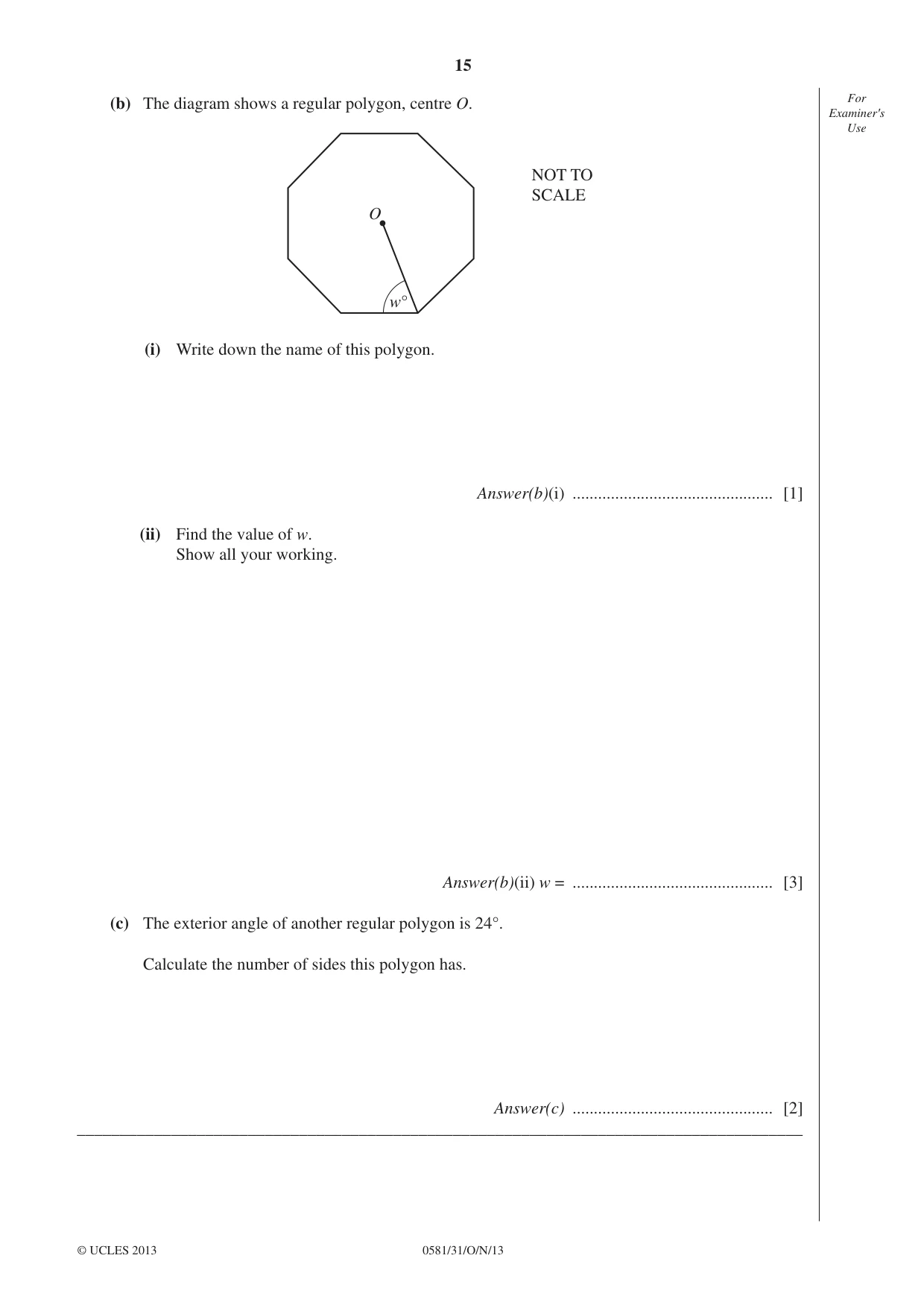
15 0581/31/O/N/13 © UCLES 2013 [Turn over For Examiner′s Use (b) The diagram shows a regular polygon, centre O. NOT TO SCALE w° O (i) Write down the name of this polygon. Answer(b)(i) … [1] (ii) Find the value of w. Show all your working. Answer(b)(ii) w = … [3] (c) The exterior angle of another regular polygon is 24°. Calculate the number of sides this polygon has. Answer(c) … [2] _____________________________________________________________________________________
Question paper, page 16
16 0581/31/O/N/13 Permission to reproduce items where third-party owned material protected by copyright is included has been sought and cleared where possible. Every reasonable effort has been made by the publisher (UCLES) to trace copyright holders, but if any items requiring clearance have unwittingly been included the publisher will be pleased to make amends at the earliest possible opportunity. University of Cambridge International Examinations is part of the Cambridge Assessment Group. Cambridge Assessment is the brand name of University of Cambridge Local Examinations Syndicate (UCLES), which is itself a department of the University of Cambridge. BLANK PAGE © UCLES 2013
Mark scheme, page 1
CAMBRIDGE INTERNATIONAL EXAMINATIONS International General Certificate of Secondary Education MARK SCHEME for the October/November 2013 series 0581 MATHEMATICS 0581/31 Paper 3 (Core), maximum raw mark 104 This mark scheme is published as an aid to teachers and candidates, to indicate the requirements of the examination. It shows the basis on which Examiners were instructed to award marks. It does not indicate the details of the discussions that took place at an Examiners’ meeting before marking began, which would have considered the acceptability of alternative answers. Mark schemes should be read in conjunction with the question paper and the Principal Examiner Report for Teachers. Cambridge will not enter into discussions about these mark schemes. Cambridge is publishing the mark schemes for the October/November 2013 series for most IGCSE, GCE Advanced Level and Advanced Subsidiary Level components and some Ordinary Level components. www.XtremePapers.com
Mark scheme, page 2
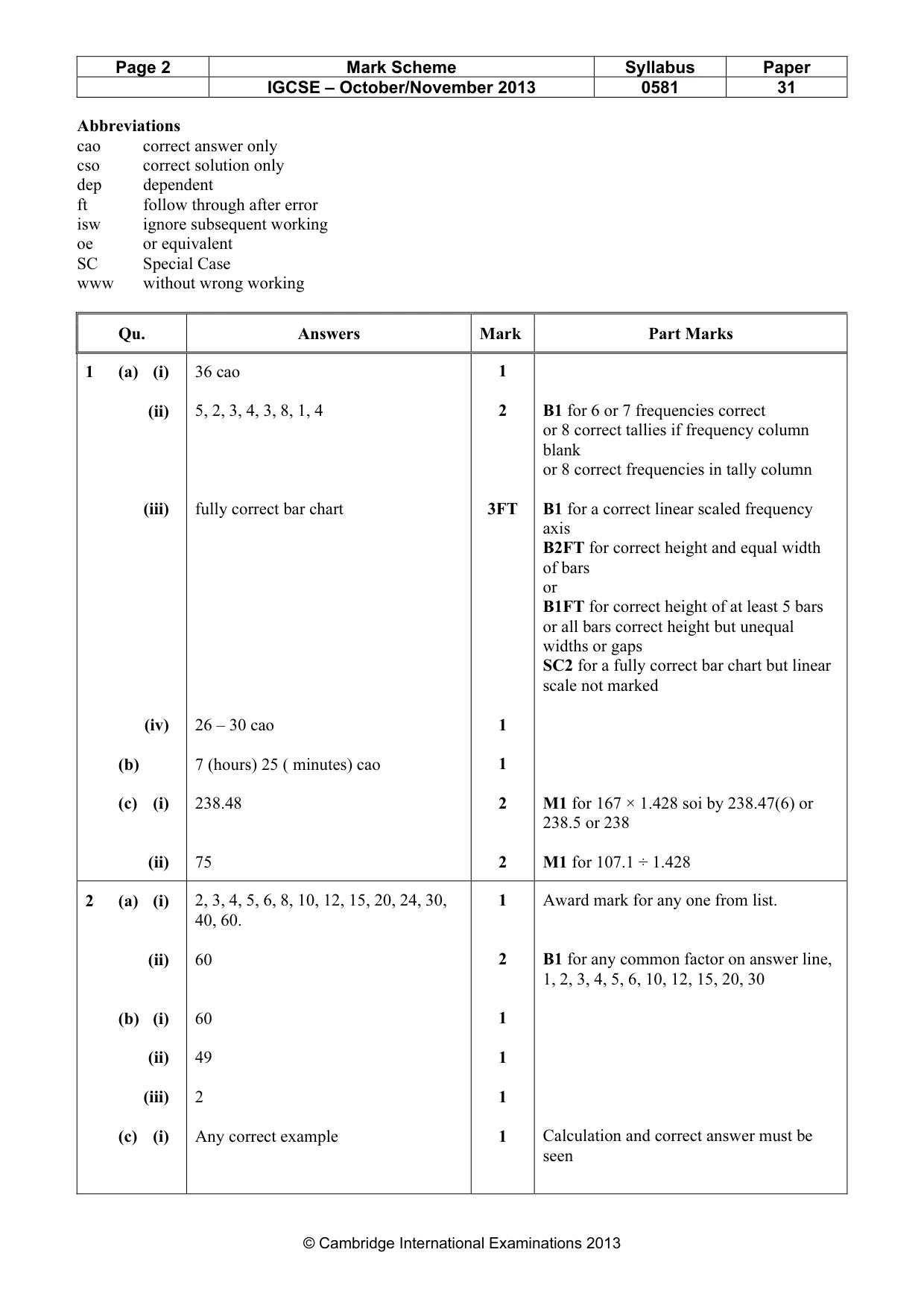
Page 2 Mark Scheme Syllabus Paper IGCSE – October/November 2013 0581 31 © Cambridge International Examinations 2013 Abbreviations cao correct answer only cso correct solution only dep dependent ft follow through after error isw ignore subsequent working oe or equivalent SC Special Case www without wrong working Qu. Answers Mark Part Marks 1 (a) (i) (ii) (iii) (iv) (b) (c) (i) (ii) 36 cao 5, 2, 3, 4, 3, 8, 1, 4 fully correct bar chart 26 – 30 cao 7 (hours) 25 ( minutes) cao 238.48 75 1 2 3FT 1 1 2 2 B1 for 6 or 7 frequencies correct or 8 correct tallies if frequency column blank or 8 correct frequencies in tally column B1 for a correct linear scaled frequency axis B2FT for correct height and equal width of bars or B1FT for correct height of at least 5 bars or all bars correct height but unequal widths or gaps SC2 for a fully correct bar chart but linear scale not marked M1 for 167 × 1.428 soi by 238.47(6) or 238.5 or 238 M1 for 107.1 ÷ 1.428 2 (a) (i) (ii) (b) (i) (ii) (iii) (c) (i) 2, 3, 4, 5, 6, 8, 10, 12, 15, 20, 24, 30, 40, 60. 60 60 49 2 Any correct example 1 2 1 1 1 1 Award mark for any one from list. B1 for any common factor on answer line, 1, 2, 3, 4, 5, 6, 10, 12, 15, 20, 30 Calculation and correct answer must be seen
Mark scheme, page 3
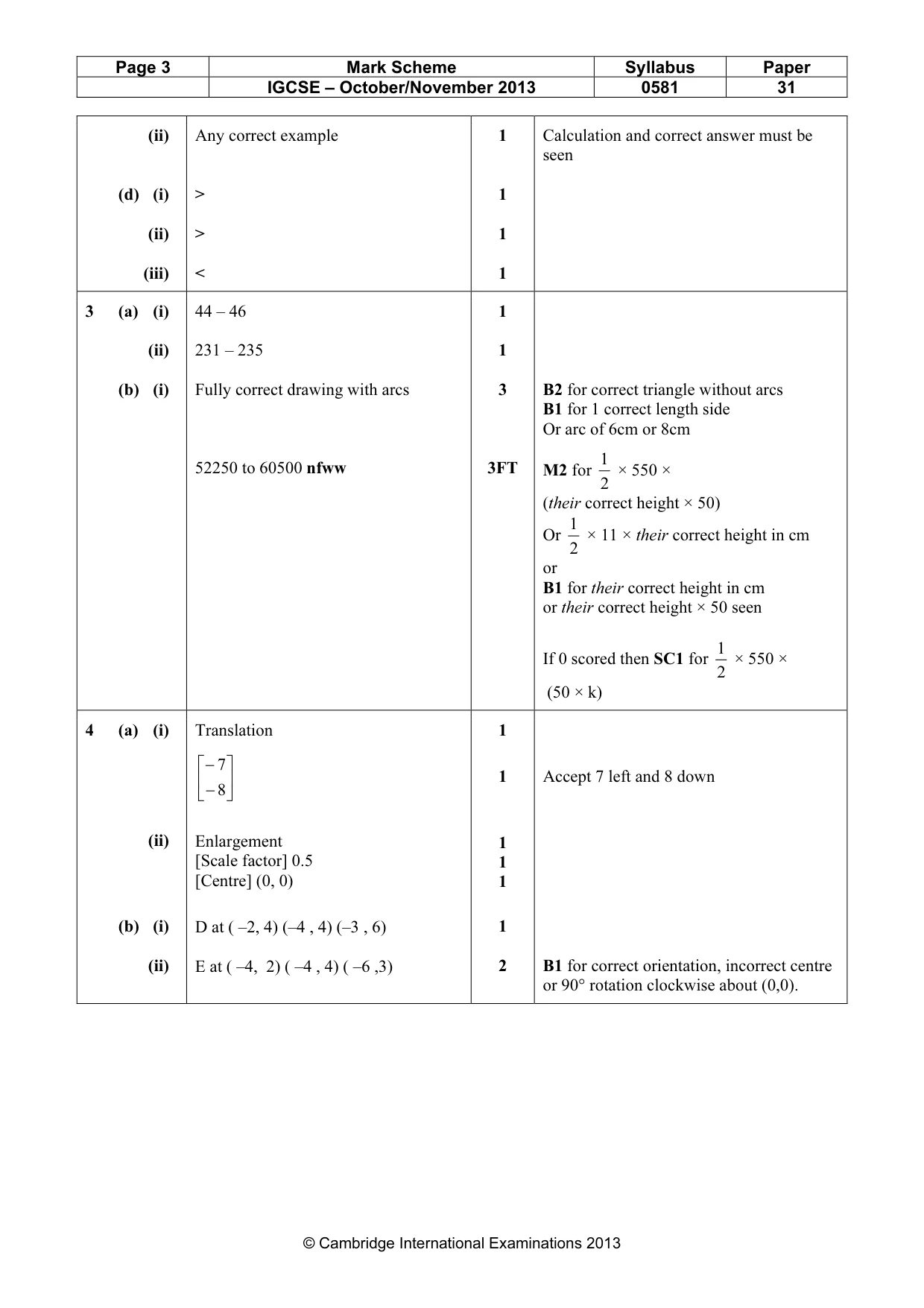
Page 3 Mark Scheme Syllabus Paper IGCSE – October/November 2013 0581 31 © Cambridge International Examinations 2013 (ii) (d) (i) (ii) (iii) Any correct example > > < 1 1 1 1 Calculation and correct answer must be seen 3 (a) (i) (ii) (b) (i) 44 – 46 231 – 235 Fully correct drawing with arcs 52250 to 60500 nfww 1 1 3 3FT B2 for correct triangle without arcs B1 for 1 correct length side Or arc of 6cm or 8cm M2 for 2 1 × 550 × (their correct height × 50) Or 2 1 × 11 × their correct height in cm or B1 for their correct height in cm or their correct height × 50 seen If 0 scored then SC1 for 2 1 × 550 × (50 × k) 4 (a) (i) (ii) (b) (i) (ii) Translation − − 8 7 Enlargement [Scale factor] 0.5 [Centre] (0, 0) D at ( –2, 4) (–4 , 4) (–3 , 6) E at ( –4, 2) ( –4 , 4) ( –6 ,3) 1 1 1 1 1 1 2 Accept 7 left and 8 down B1 for correct orientation, incorrect centre or 90° rotation clockwise about (0,0).
Mark scheme, page 4
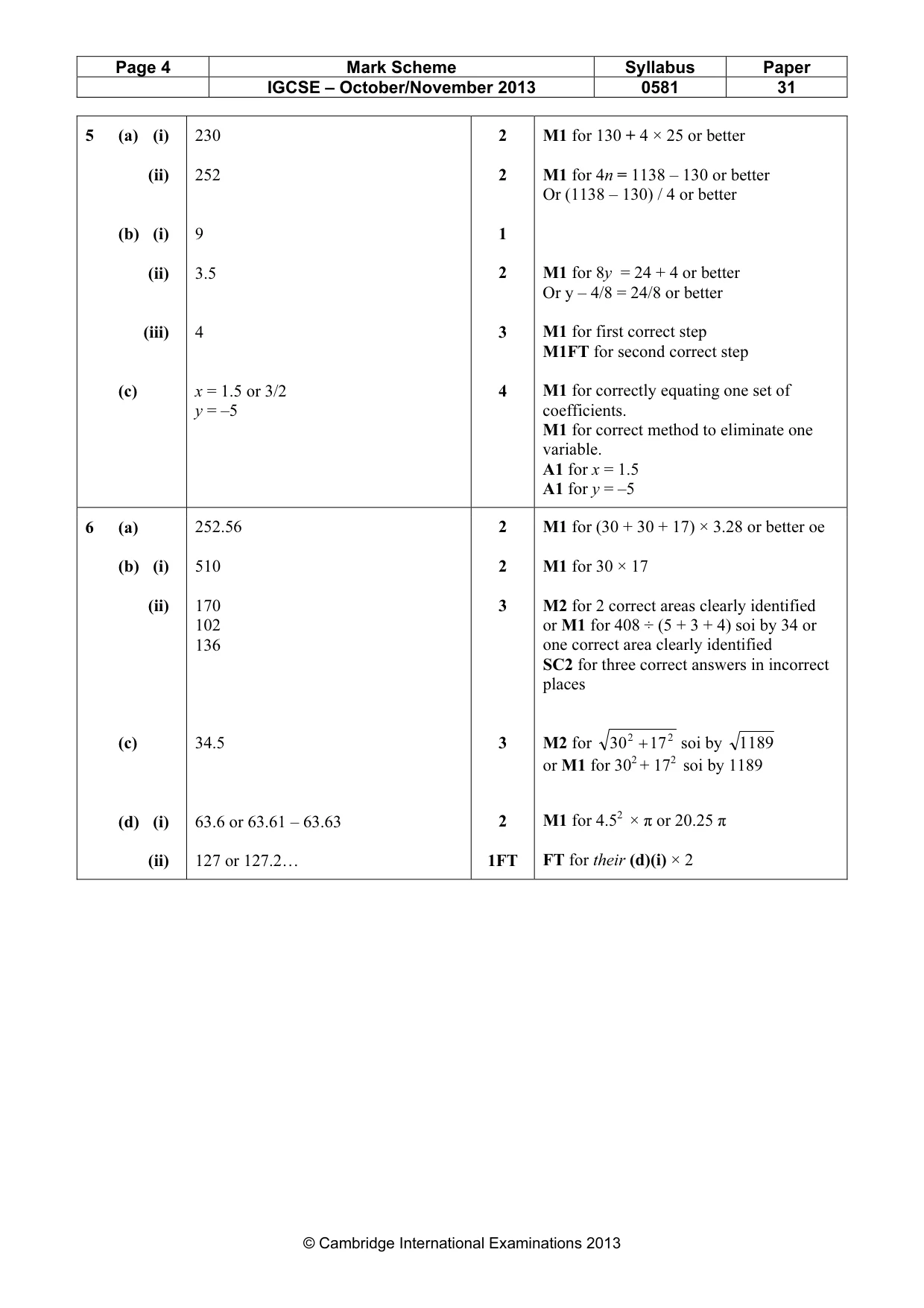
Page 4 Mark Scheme Syllabus Paper IGCSE – October/November 2013 0581 31 © Cambridge International Examinations 2013 5 (a) (i) (ii) (b) (i) (ii) (iii) (c) 230 252 9 3.5 4 x = 1.5 or 3/2 y = –5 2 2 1 2 3 4 M1 for 130 + 4 × 25 or better M1 for 4n = 1138 – 130 or better Or (1138 – 130) / 4 or better M1 for 8y = 24 + 4 or better Or y – 4/8 = 24/8 or better M1 for first correct step M1FT for second correct step M1 for correctly equating one set of coefficients. M1 for correct method to eliminate one variable. A1 for x = 1.5 A1 for y = –5 6 (a) (b) (i) (ii) (c) (d) (i) (ii) 252.56 510 170 102 136 34.5 63.6 or 63.61 – 63.63 127 or 127.2… 2 2 3 3 2 1FT M1 for (30 + 30 + 17) × 3.28 or better oe M1 for 30 × 17 M2 for 2 correct areas clearly identified or M1 for 408 ÷ (5 + 3 + 4) soi by 34 or one correct area clearly identified SC2 for three correct answers in incorrect places M2 for 2 2 17 30 + soi by 1189 or M1 for 302 + 172 soi by 1189 M1 for 4.52 × π or 20.25 π FT for their (d)(i) × 2
Mark scheme, page 5
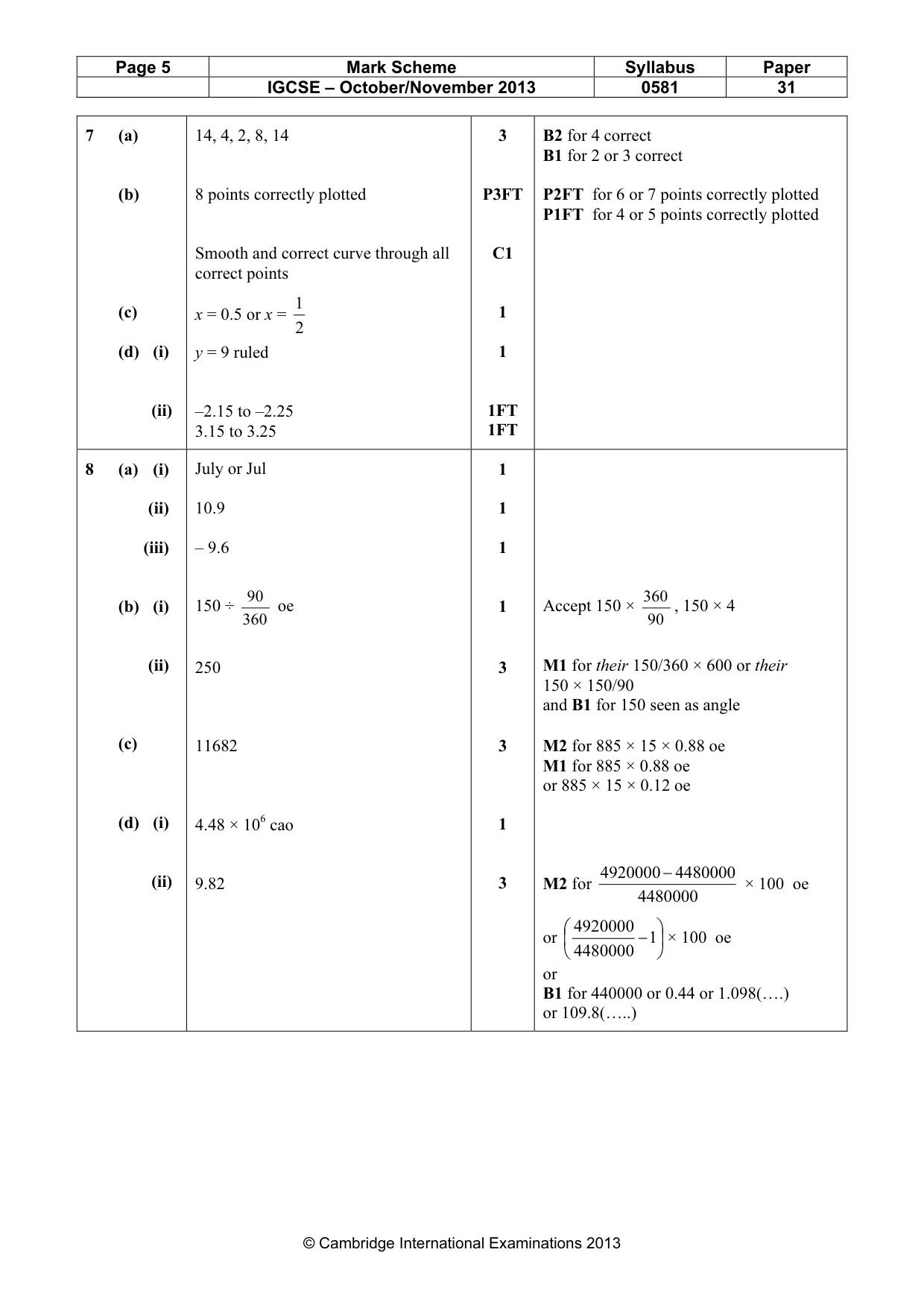
Page 5 Mark Scheme Syllabus Paper IGCSE – October/November 2013 0581 31 © Cambridge International Examinations 2013 7 (a) (b) (c) (d) (i) (ii) 14, 4, 2, 8, 14 8 points correctly plotted Smooth and correct curve through all correct points x = 0.5 or x = 2 1 y = 9 ruled –2.15 to –2.25 3.15 to 3.25 3 P3FT C1 1 1 1FT 1FT B2 for 4 correct B1 for 2 or 3 correct P2FT for 6 or 7 points correctly plotted P1FT for 4 or 5 points correctly plotted 8 (a) (i) (ii) (iii) (b) (i) (ii) (c) (d) (i) (ii) July or Jul 10.9 – 9.6 150 ÷ 360 90 oe 250 11682 4.48 × 10⁶ cao 9.82 1 1 1 1 3 3 1 3 Accept 150 × 90 360 , 150 × 4 M1 for their 150/360 × 600 or their 150 × 150/90 and B1 for 150 seen as angle M2 for 885 × 15 × 0.88 oe M1 for 885 × 0.88 oe or 885 × 15 × 0.12 oe M2 for 4480000 4480000 4920000− × 100 oe or −1 4480000 4920000 × 100 oe or B1 for 440000 or 0.44 or 1.098(….) or 109.8(…..)
Mark scheme, page 6
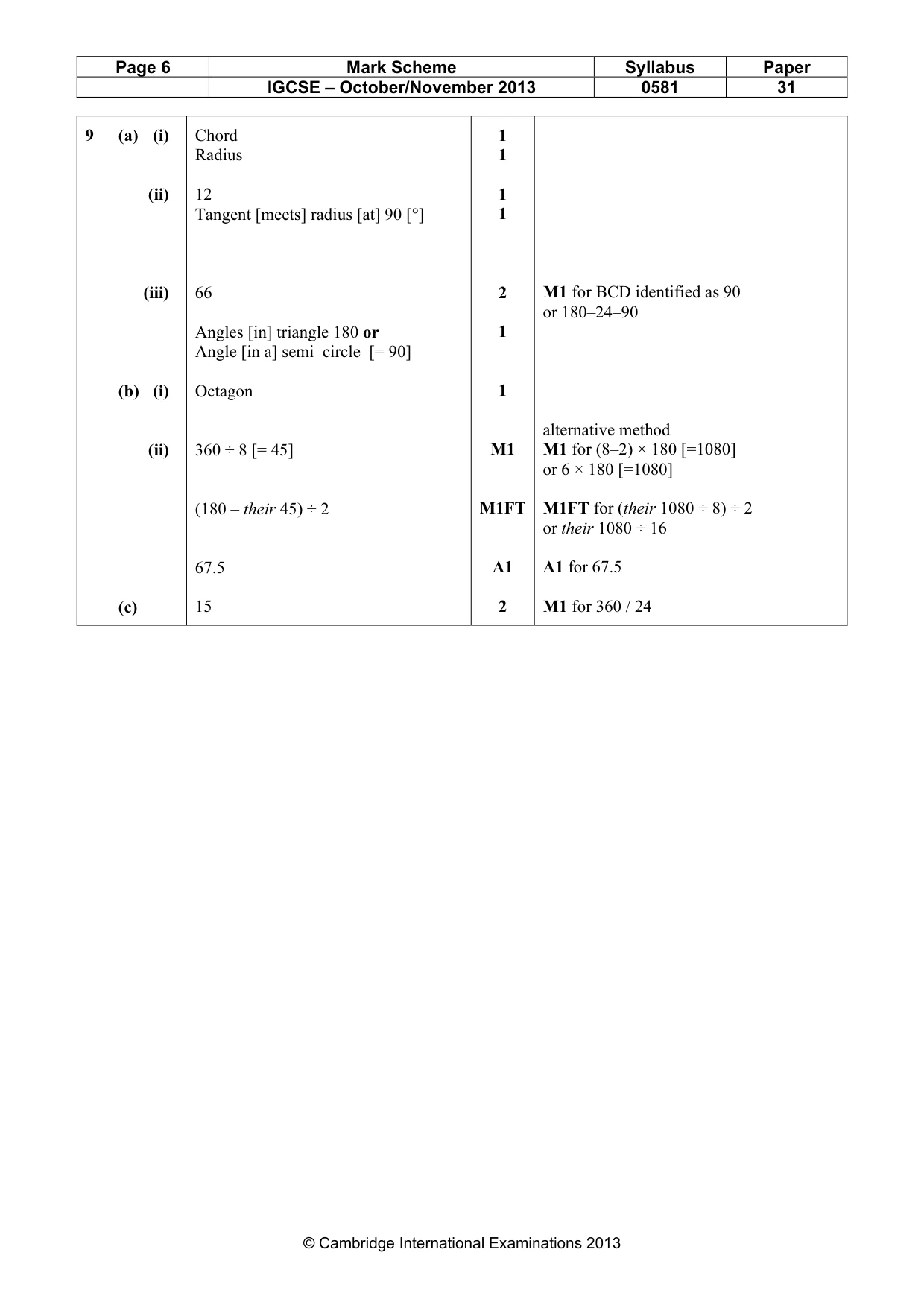
Page 6 Mark Scheme Syllabus Paper IGCSE – October/November 2013 0581 31 © Cambridge International Examinations 2013 9 (a) (i) (ii) (iii) (b) (i) (ii) (c) Chord Radius 12 Tangent [meets] radius [at] 90 [°] 66 Angles [in] triangle 180 or Angle [in a] semi–circle [= 90] Octagon 360 ÷ 8 [= 45] (180 – their 45) ÷ 2 67.5 15 1 1 1 1 2 1 1 M1 M1FT A1 2 M1 for BCD identified as 90 or 180–24–90 alternative method M1 for (8–2) × 180 [=1080] or 6 × 180 [=1080] M1FT for (their 1080 ÷ 8) ÷ 2 or their 1080 ÷ 16 A1 for 67.5 M1 for 360 / 24