Cambridge IGCSE Mathematics (with coursework) 0581 — 2010 Oct/Nov Paper 4 · Variant 2
0581/42/O/N/10 · 130 marks · ≈146 min
The question paper and its mark scheme, free to read here and free to download. This is Cambridge’s own paper, exactly as it was sat.
Question paper20 pages
Mark scheme6 pages
Answers below. Sit the paper first if you are practising.
Paper as text
Question paper, page 1
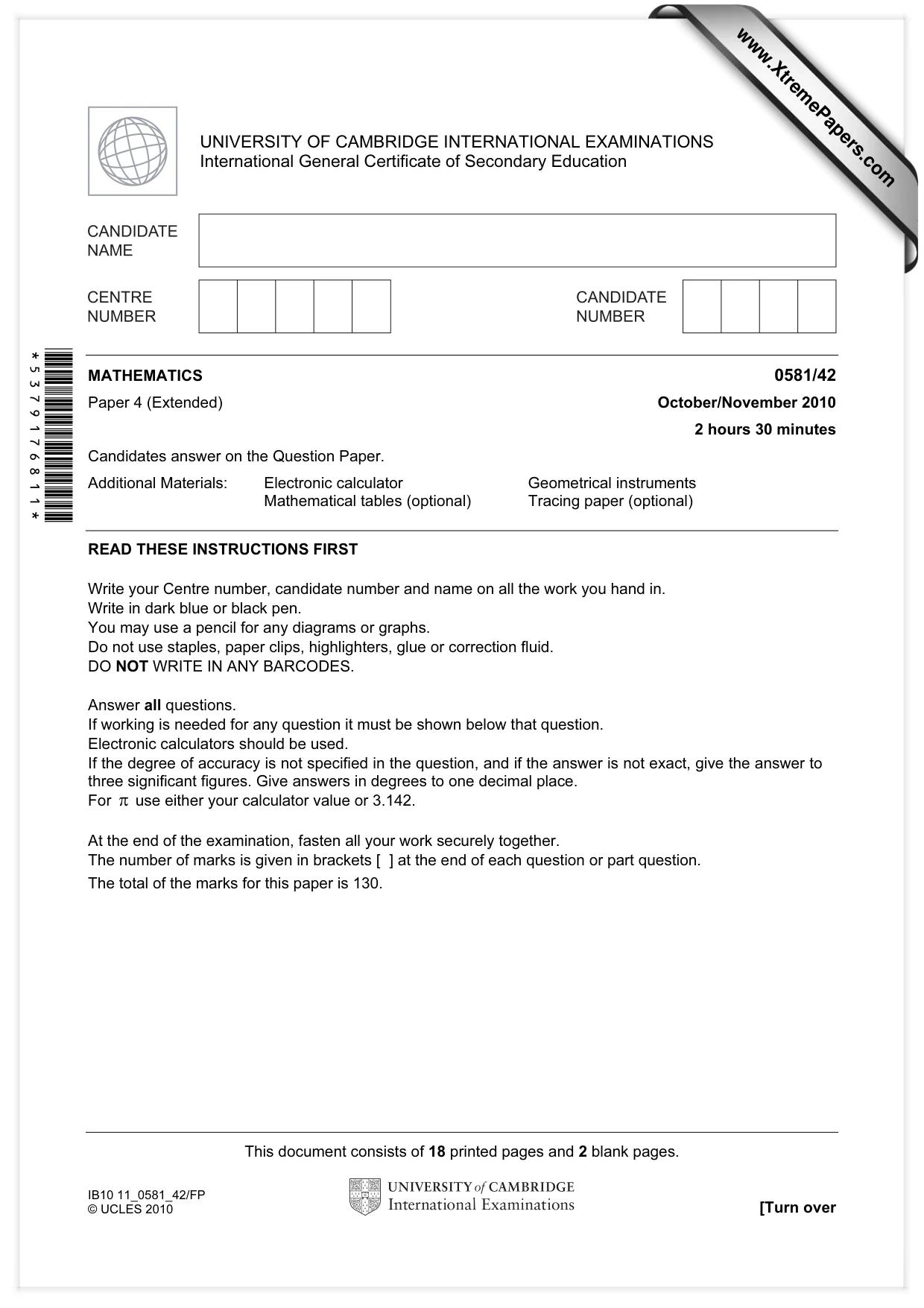
This document consists of 18 printed pages and 2 blank pages. IB10 11_0581_42/FP © UCLES 2010 [Turn over *5379176811* UNIVERSITY OF CAMBRIDGE INTERNATIONAL EXAMINATIONS International General Certificate of Secondary Education MATHEMATICS 0581/42 Paper 4 (Extended) October/November 2010 2 hours 30 minutes Candidates answer on the Question Paper. Additional Materials: Electronic calculator Geometrical instruments Mathematical tables (optional) Tracing paper (optional) READ THESE INSTRUCTIONS FIRST Write your Centre number, candidate number and name on all the work you hand in. Write in dark blue or black pen. You may use a pencil for any diagrams or graphs. Do not use staples, paper clips, highlighters, glue or correction fluid. DO NOT WRITE IN ANY BARCODES. Answer all questions. If working is needed for any question it must be shown below that question. Electronic calculators should be used. If the degree of accuracy is not specified in the question, and if the answer is not exact, give the answer to three significant figures. Give answers in degrees to one decimal place. For π use either your calculator value or 3.142. At the end of the examination, fasten all your work securely together. The number of marks is given in brackets [ ] at the end of each question or part question. The total of the marks for this paper is 130. www.XtremePapers.com
Question paper, page 2
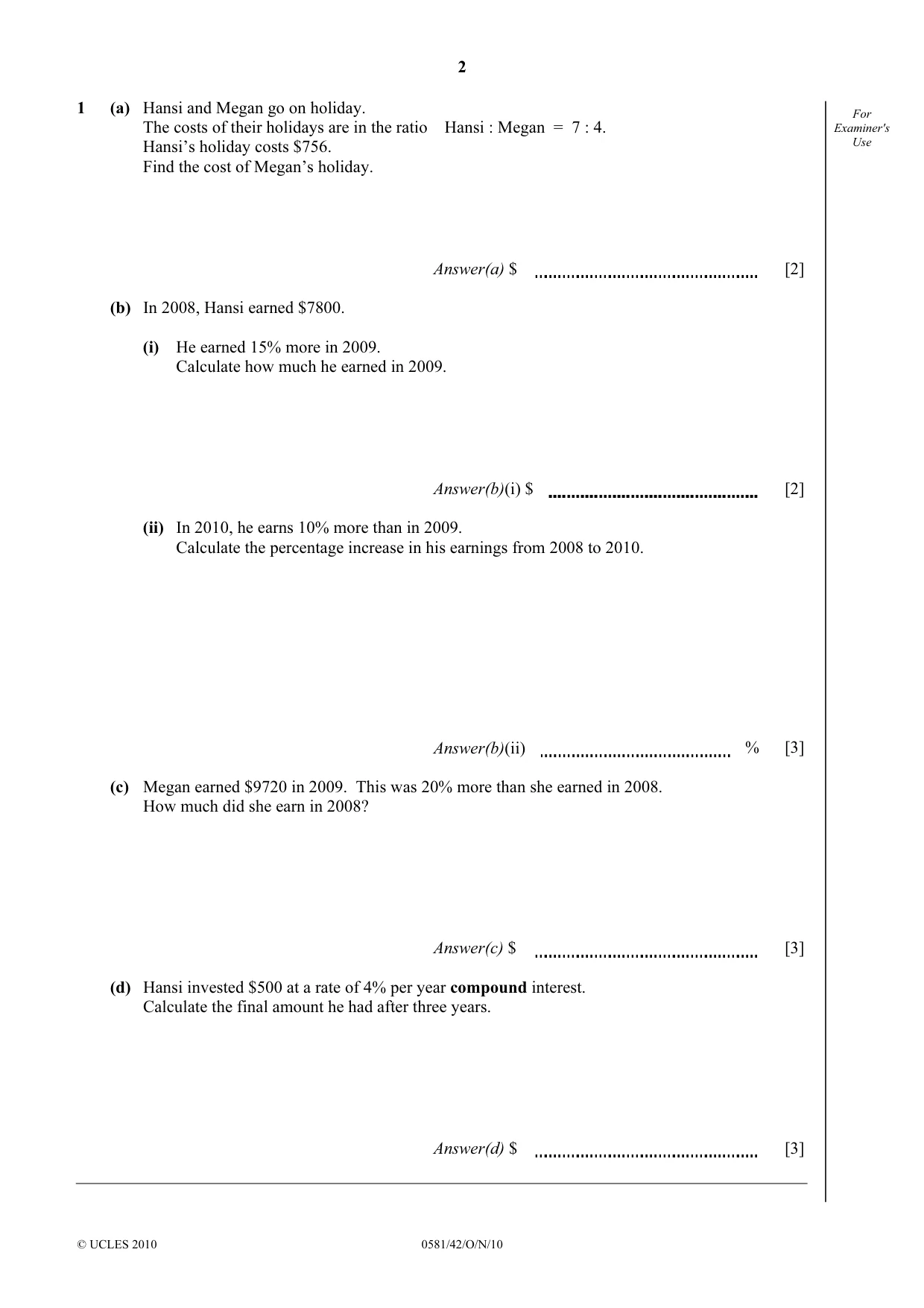
2 © UCLES 2010 0581/42/O/N/10 For Examiner's Use 1 (a) Hansi and Megan go on holiday. The costs of their holidays are in the ratio Hansi : Megan = 7 : 4. Hansi’s holiday costs $756. Find the cost of Megan’s holiday. Answer(a) $ [2] (b) In 2008, Hansi earned $7800. (i) He earned 15% more in 2009. Calculate how much he earned in 2009. Answer(b)(i) $ [2] (ii) In 2010, he earns 10% more than in 2009. Calculate the percentage increase in his earnings from 2008 to 2010. Answer(b)(ii) % [3] (c) Megan earned $9720 in 2009. This was 20% more than she earned in 2008. How much did she earn in 2008? Answer(c) $ [3] (d) Hansi invested $500 at a rate of 4% per year compound interest. Calculate the final amount he had after three years. Answer(d) $ [3]
Question paper, page 3
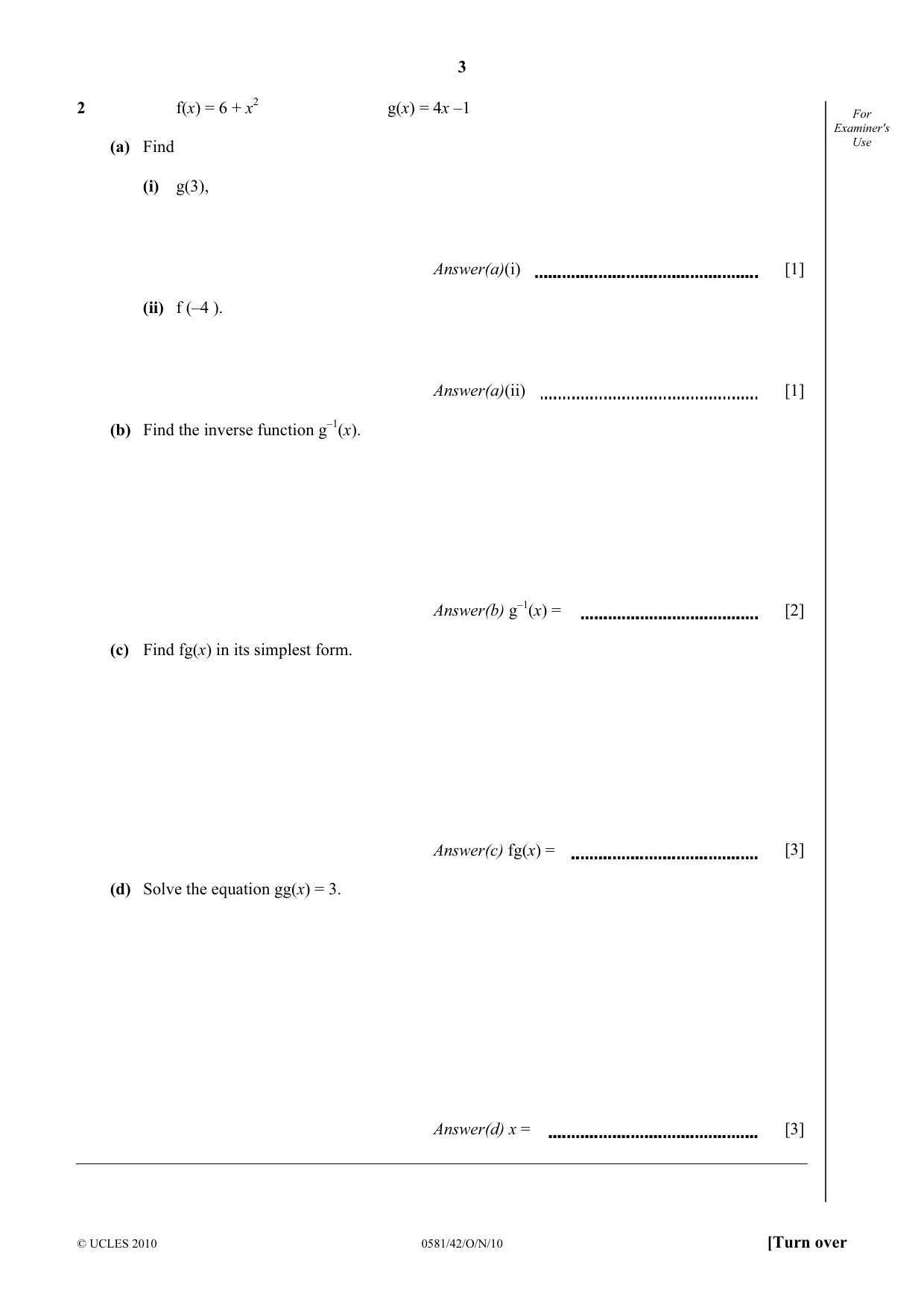
3 © UCLES 2010 0581/42/O/N/10 [Turn over For Examiner's Use 2 f(x) = 6 + x2 g(x) = 4x –1 (a) Find (i) g(3), Answer(a)(i) [1] (ii) f (–4 ). Answer(a)(ii) [1] (b) Find the inverse function g–1(x). Answer(b) g–1(x) = [2] (c) Find fg(x) in its simplest form. Answer(c) fg(x) = [3] (d) Solve the equation gg(x) = 3. Answer(d) x = [3]
Question paper, page 4
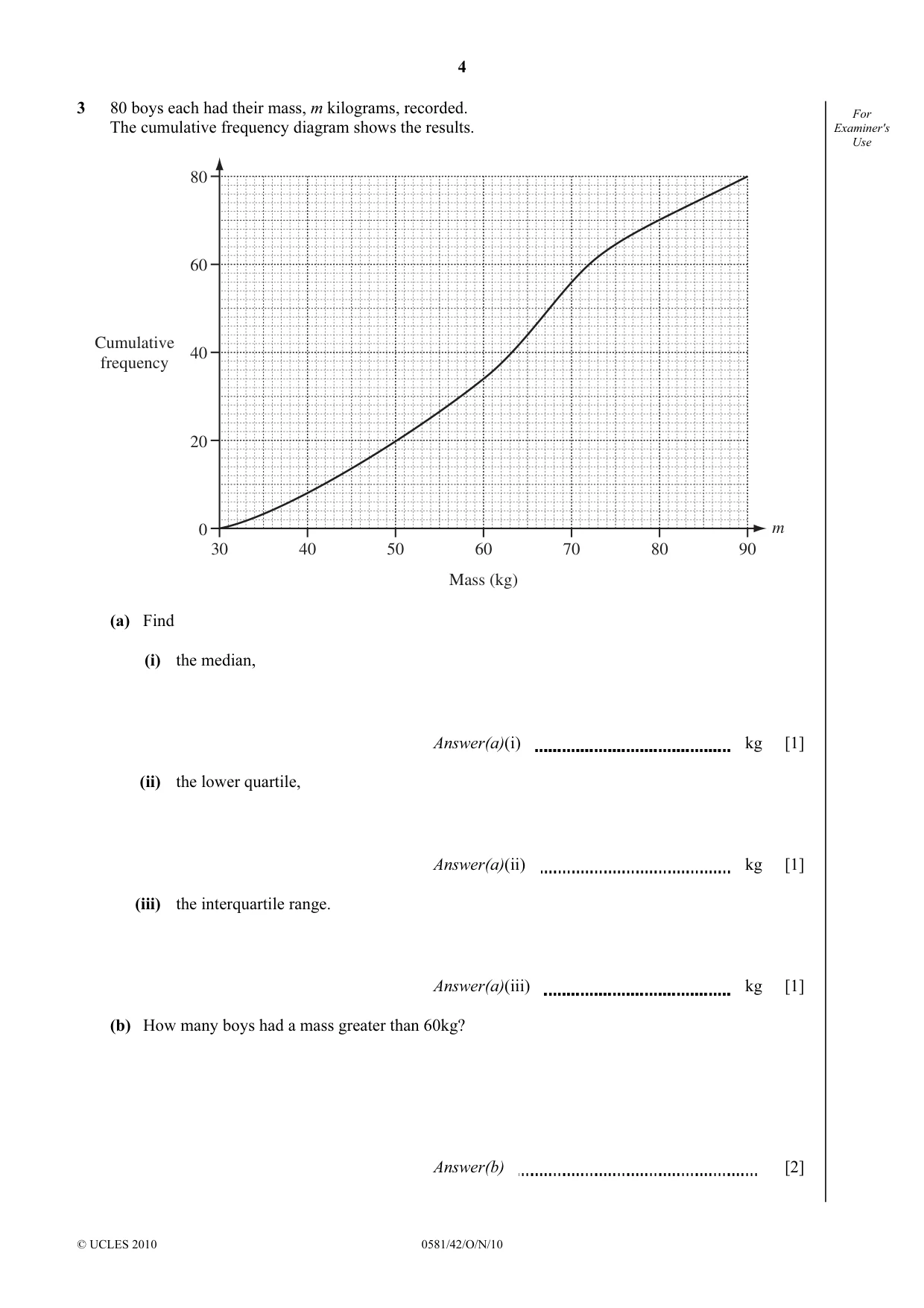
4 © UCLES 2010 0581/42/O/N/10 For Examiner's Use 3 80 boys each had their mass, m kilograms, recorded. The cumulative frequency diagram shows the results. 80 60 40 20 0 40 30 50 60 70 80 90 Mass (kg) Cumulative frequency m (a) Find (i) the median, Answer(a)(i) kg [1] (ii) the lower quartile, Answer(a)(ii) kg [1] (iii) the interquartile range. Answer(a)(iii) kg [1] (b) How many boys had a mass greater than 60kg? Answer(b) [2]
Question paper, page 5
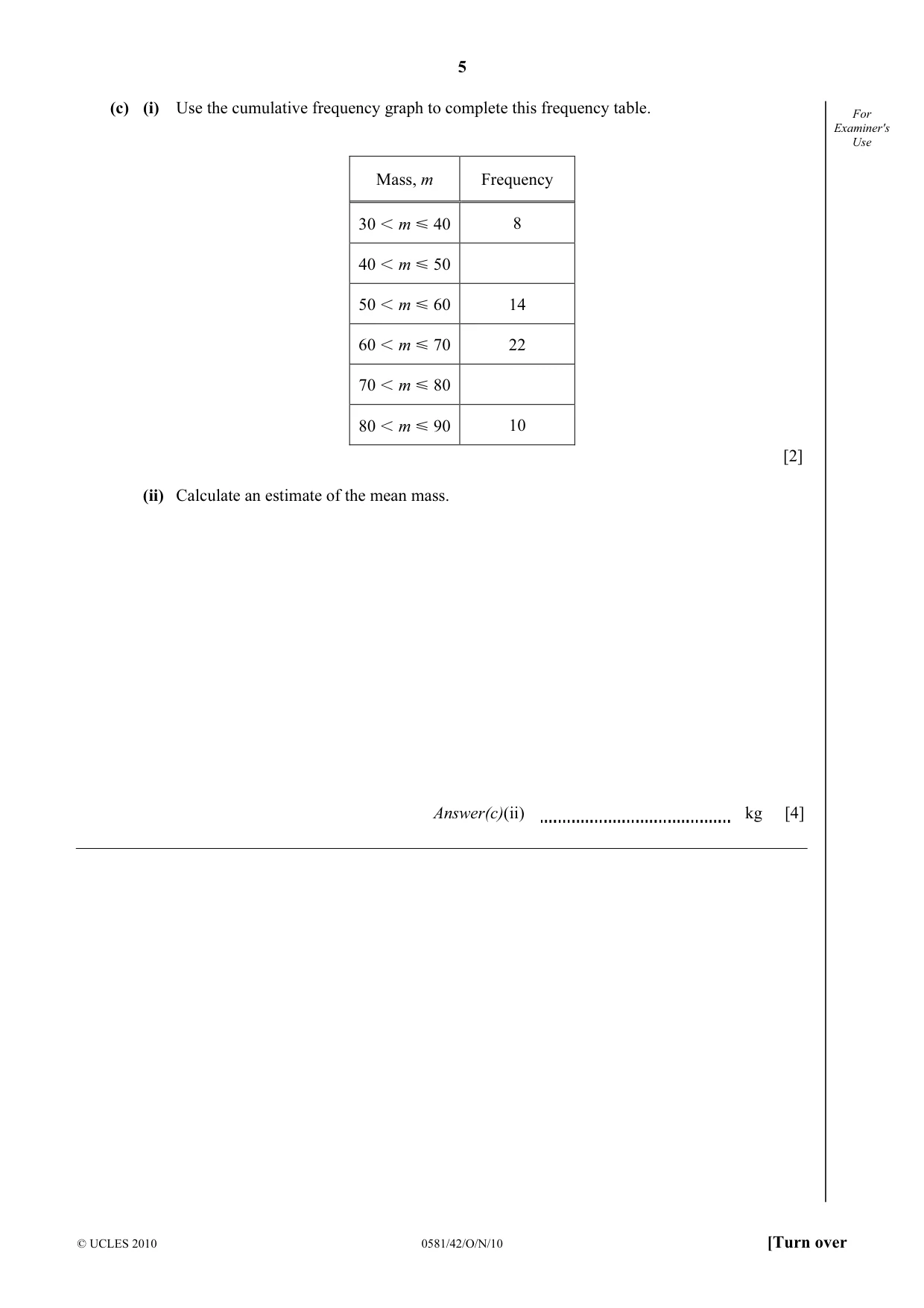
5 © UCLES 2010 0581/42/O/N/10 [Turn over For Examiner's Use (c) (i) Use the cumulative frequency graph to complete this frequency table. Mass, m Frequency 30 I m Y 40 8 40 I m Y 50 50 I m Y 60 14 60 I m Y 70 22 70 I m Y 80 80 I m Y 90 10 [2] (ii) Calculate an estimate of the mean mass. Answer(c)(ii) kg [4]
Question paper, page 6
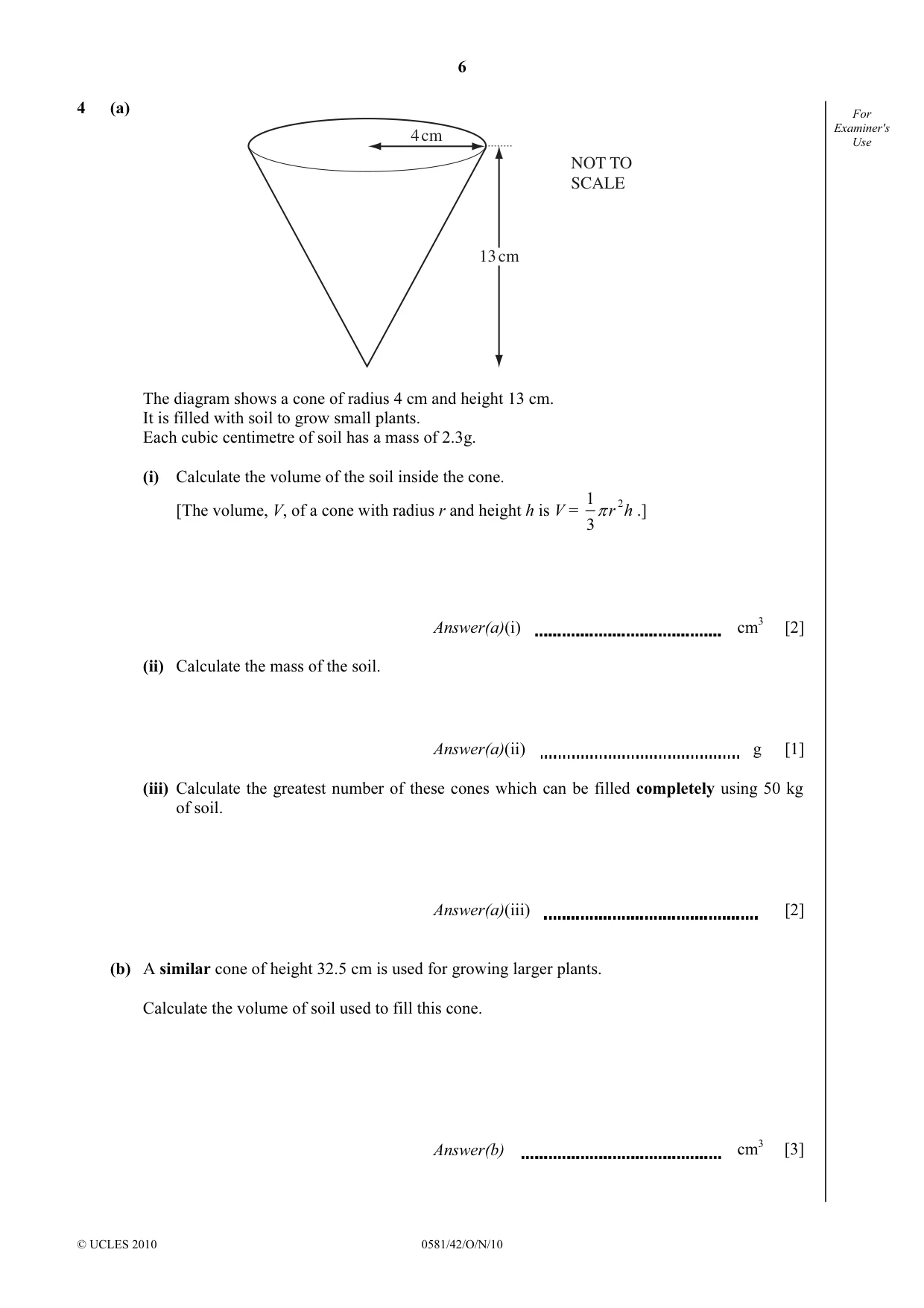
6 © UCLES 2010 0581/42/O/N/10 For Examiner's Use 4 (a) 4 cm 13 cm NOT TO SCALE The diagram shows a cone of radius 4 cm and height 13 cm. It is filled with soil to grow small plants. Each cubic centimetre of soil has a mass of 2.3g. (i) Calculate the volume of the soil inside the cone. [The volume, V, of a cone with radius r and height h is V = 2 1 3 r h π .] Answer(a)(i) cm3 [2] (ii) Calculate the mass of the soil. Answer(a)(ii) g [1] (iii) Calculate the greatest number of these cones which can be filled completely using 50 kg of soil. Answer(a)(iii) [2] (b) A similar cone of height 32.5 cm is used for growing larger plants. Calculate the volume of soil used to fill this cone. Answer(b) cm3 [3]
Question paper, page 7
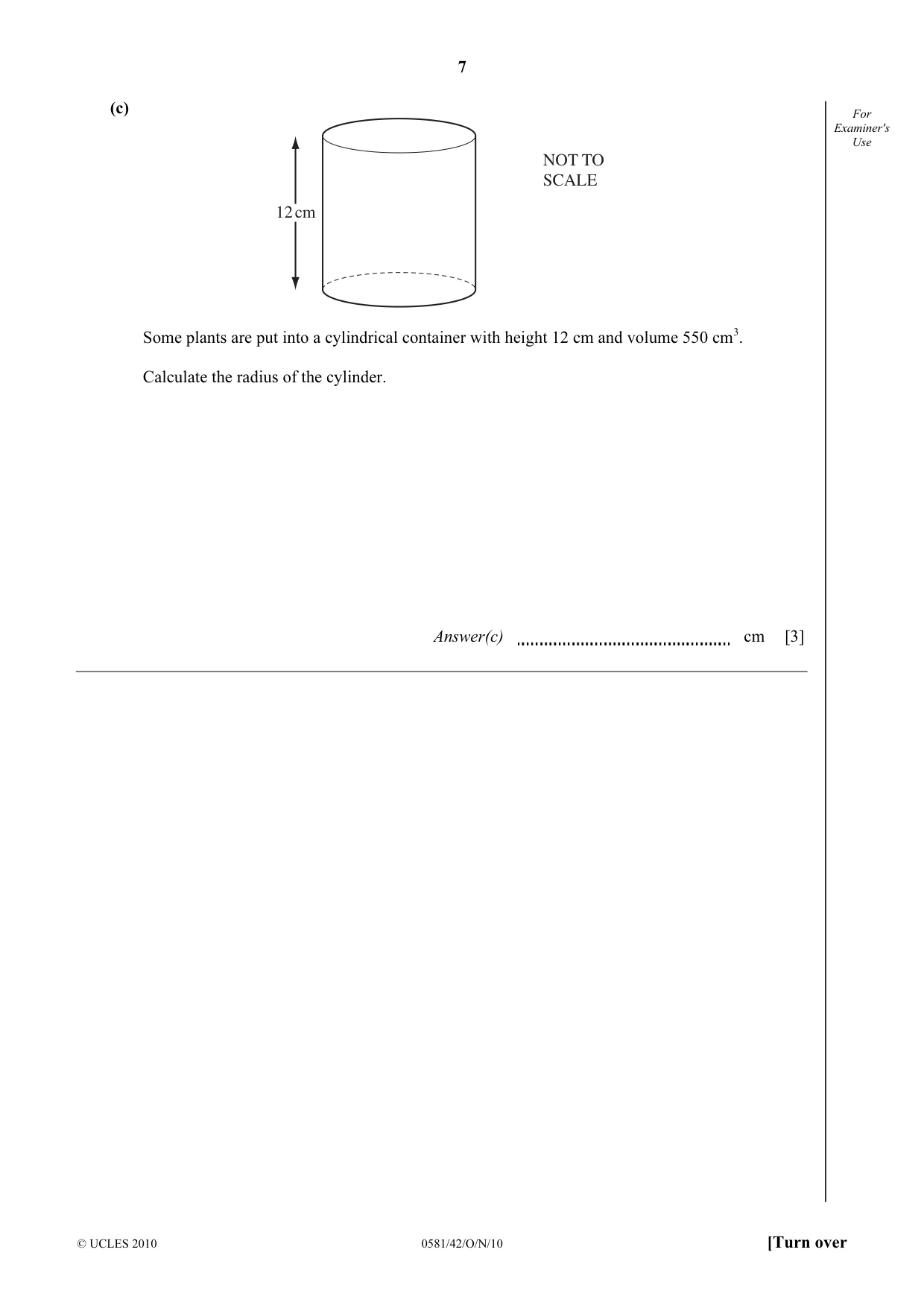
7 © UCLES 2010 0581/42/O/N/10 [Turn over For Examiner's Use (c) 12 cm NOT TO SCALE Some plants are put into a cylindrical container with height 12 cm and volume 550 cm3. Calculate the radius of the cylinder. Answer(c) cm [3]
Question paper, page 8
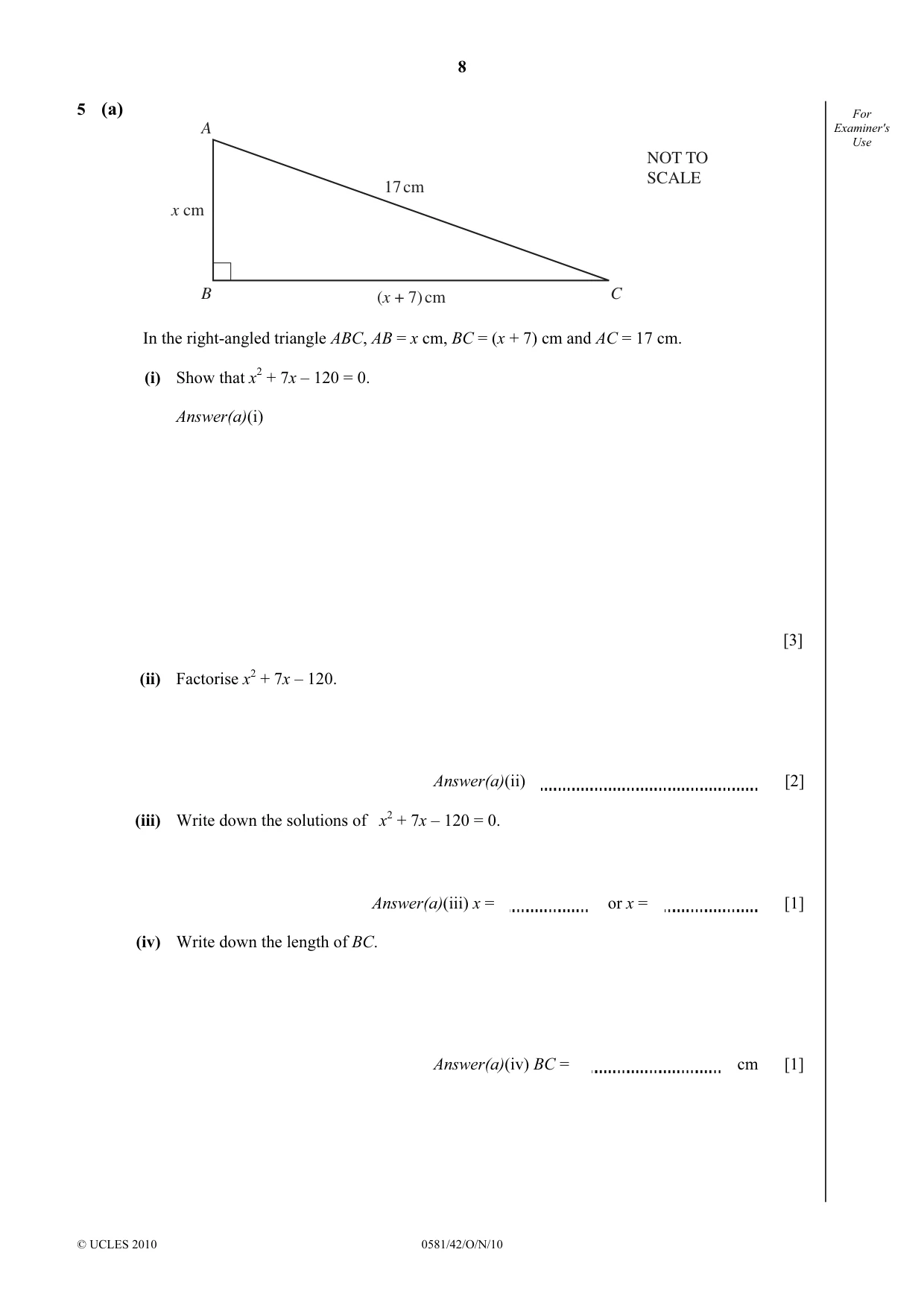
8 © UCLES 2010 0581/42/O/N/10 For Examiner's Use 5 (a) 17 cm x cm (x + 7) cm A B C NOT TO SCALE In the right-angled triangle ABC, AB = x cm, BC = (x + 7) cm and AC = 17 cm. (i) Show that x2 + 7x – 120 = 0. Answer(a)(i) [3] (ii) Factorise x2 + 7x – 120. Answer(a)(ii) [2] (iii) Write down the solutions of x2 + 7x – 120 = 0. (iv) Write down the length of BC. Answer(a)(iv) BC = cm [1] Answer(a)(iii) x = or x = [1]
Question paper, page 9
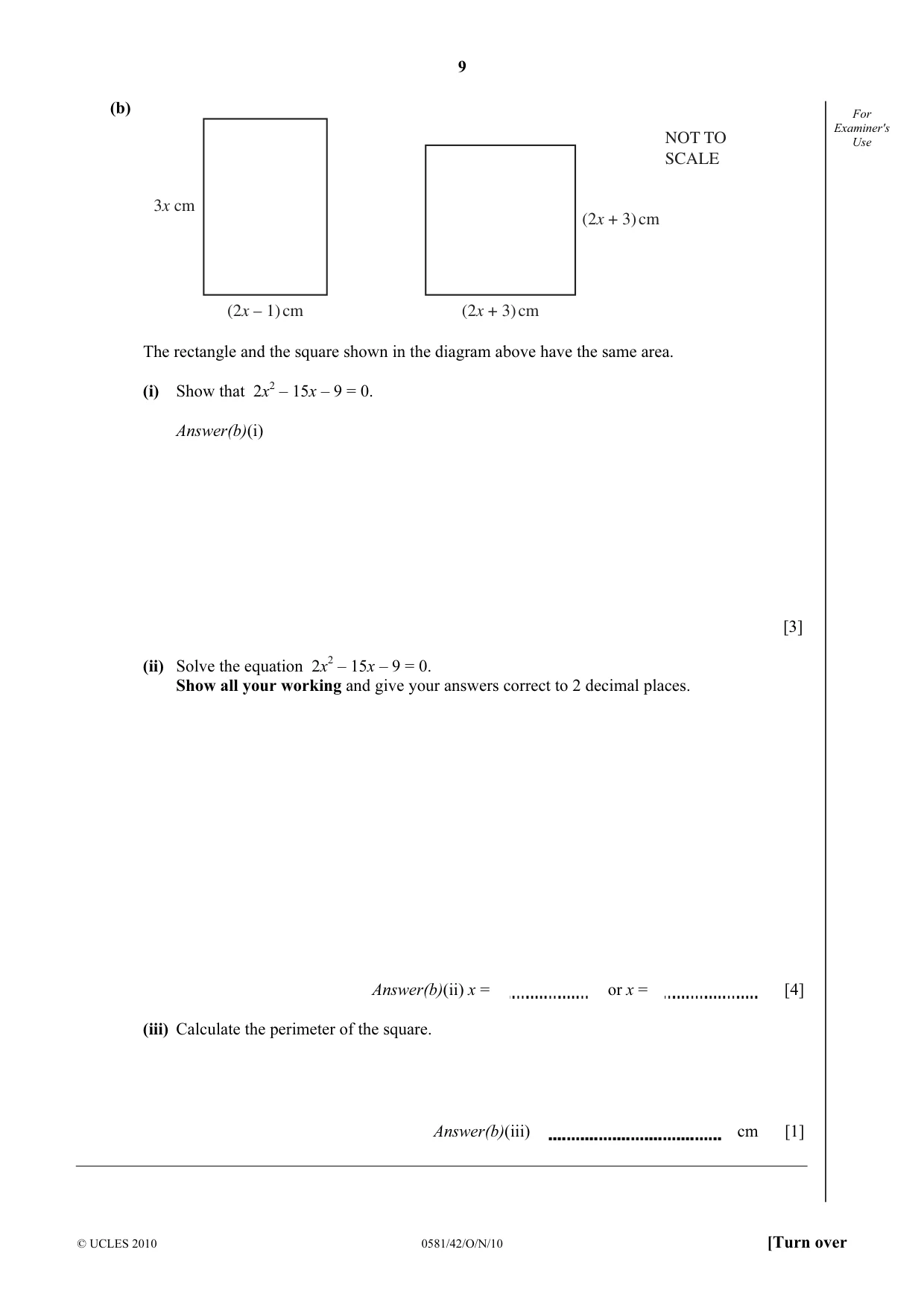
9 © UCLES 2010 0581/42/O/N/10 [Turn over For Examiner's Use (b) 3x cm (2x – 1) cm (2x + 3) cm (2x + 3) cm NOT TO SCALE The rectangle and the square shown in the diagram above have the same area. (i) Show that 2x2 – 15x – 9 = 0. Answer(b)(i) [3] (ii) Solve the equation 2x2 – 15x – 9 = 0. Show all your working and give your answers correct to 2 decimal places. (iii) Calculate the perimeter of the square. Answer(b)(iii) cm [1] Answer(b)(ii) x = or x = [4]
Question paper, page 10
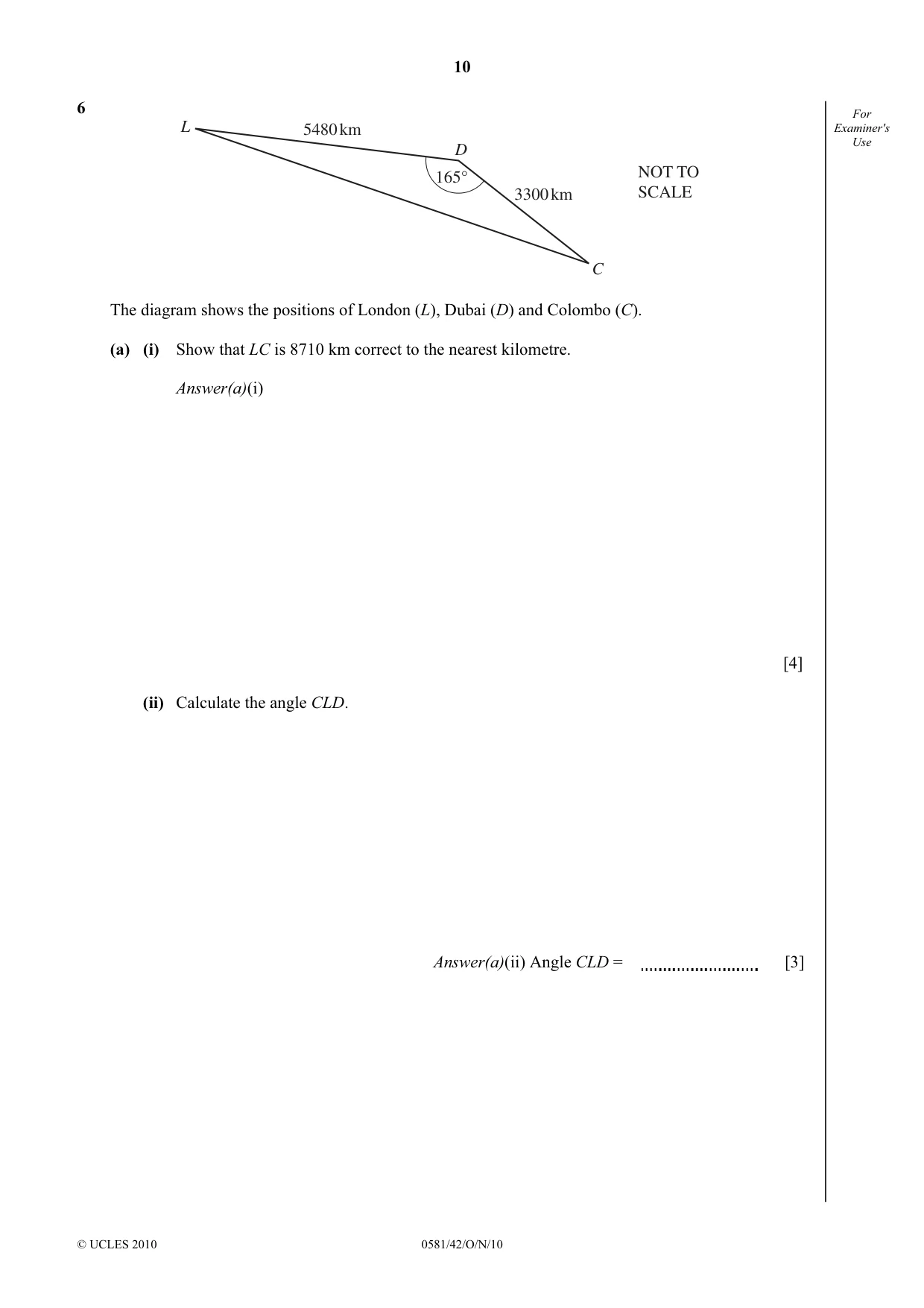
10 © UCLES 2010 0581/42/O/N/10 For Examiner's Use 6 L D C 3300 km 5480 km 165° NOT TO SCALE The diagram shows the positions of London (L), Dubai (D) and Colombo (C). (a) (i) Show that LC is 8710 km correct to the nearest kilometre. Answer(a)(i) [4] (ii) Calculate the angle CLD. Answer(a)(ii) Angle CLD = [3]
Question paper, page 11
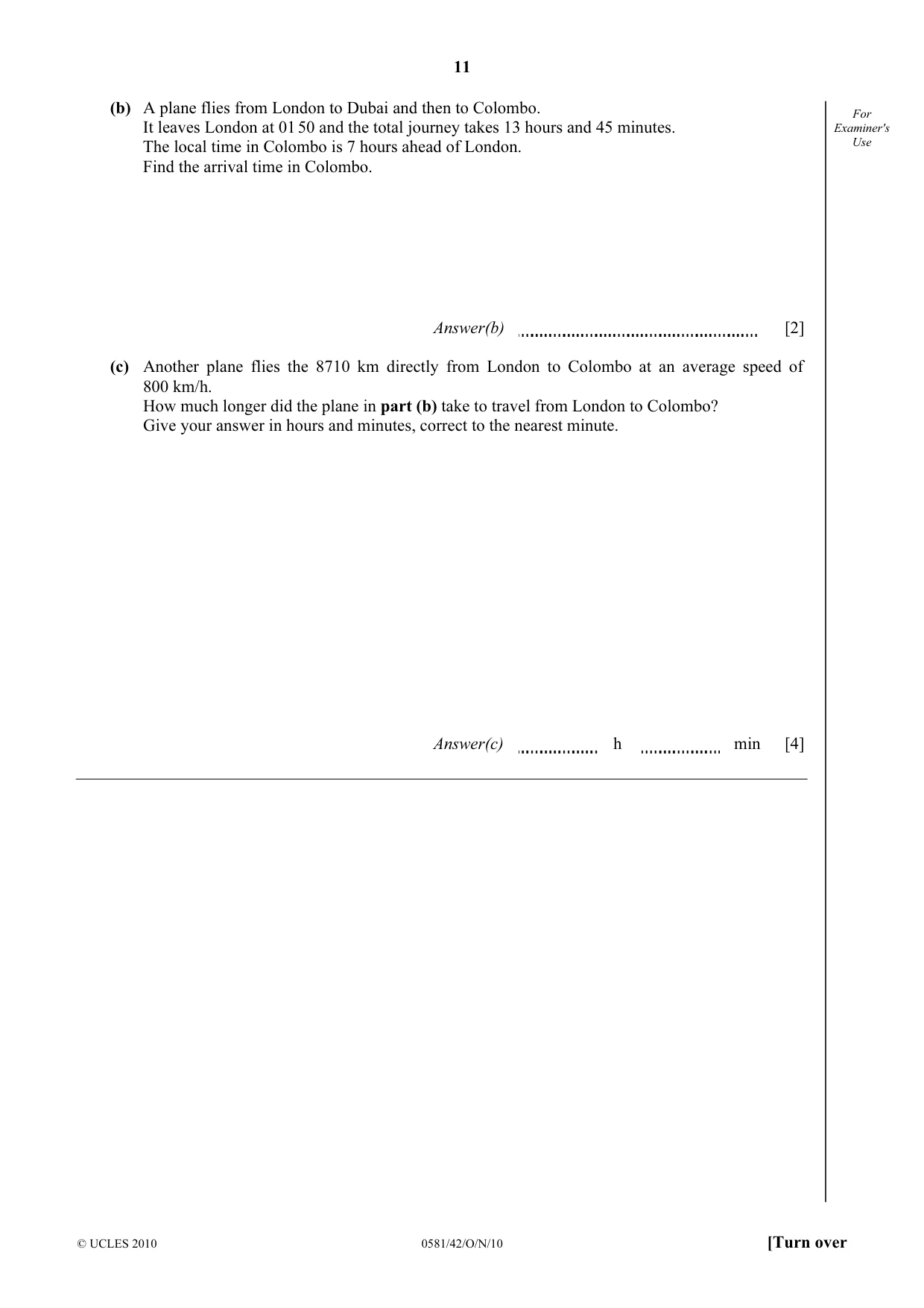
11 © UCLES 2010 0581/42/O/N/10 [Turn over For Examiner's Use (b) A plane flies from London to Dubai and then to Colombo. It leaves London at 01 50 and the total journey takes 13 hours and 45 minutes. The local time in Colombo is 7 hours ahead of London. Find the arrival time in Colombo. Answer(b) [2] (c) Another plane flies the 8710 km directly from London to Colombo at an average speed of 800 km/h. How much longer did the plane in part (b) take to travel from London to Colombo? Give your answer in hours and minutes, correct to the nearest minute. Answer(c) h min [4]
Question paper, page 12
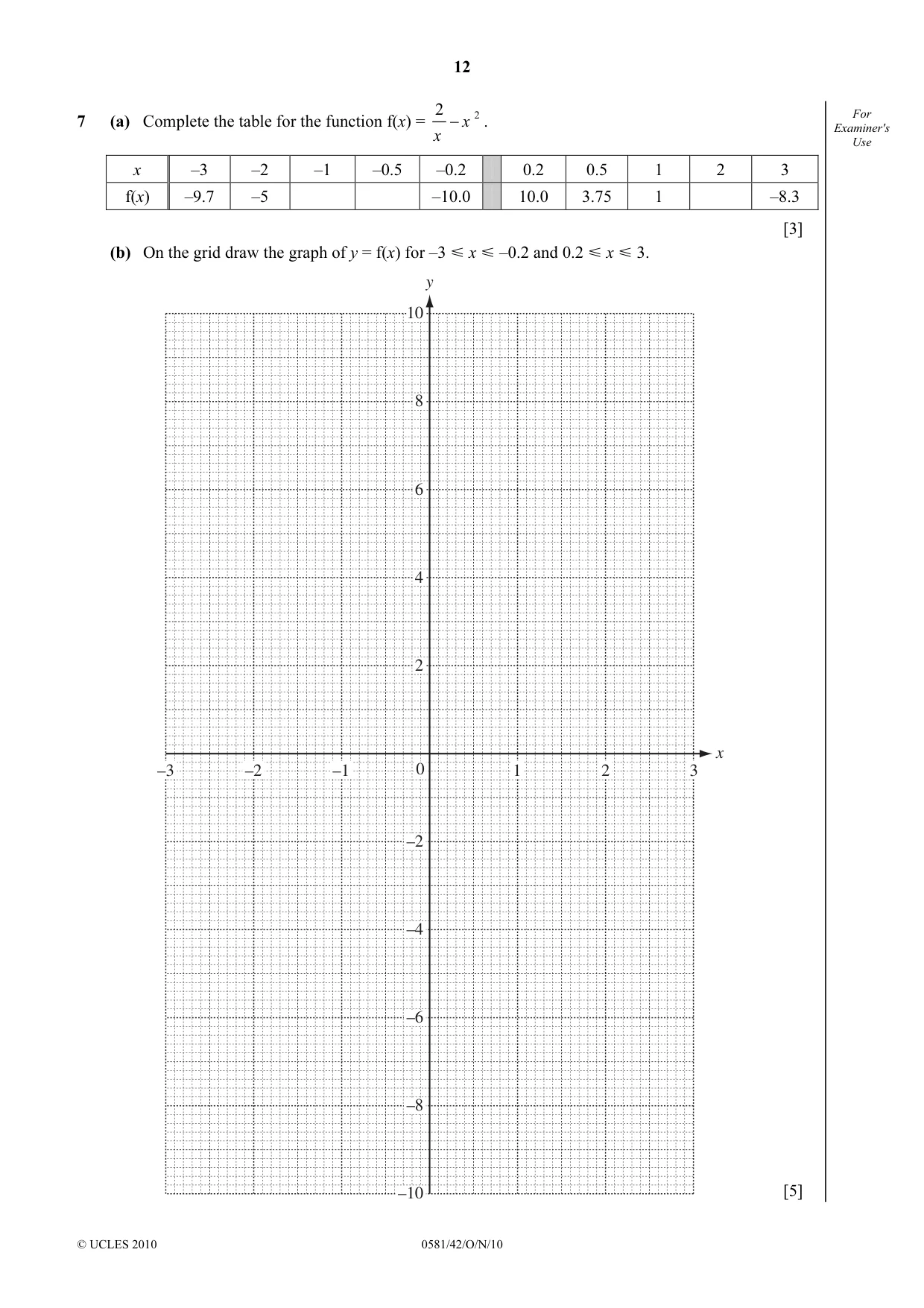
12 © UCLES 2010 0581/42/O/N/10 For Examiner's Use 7 (a) Complete the table for the function f(x) = 2 2 x x − . x –3 –2 –1 –0.5 –0.2 0.2 0.5 1 2 3 f(x) –9.7 –5 –10.0 10.0 3.75 1 –8.3 [3] (b) On the grid draw the graph of y = f(x) for –3 Y x Y –0.2 and 0.2 Y x Y 3. [5] y x –3 –2 –1 1 2 3 10 8 6 4 2 –2 –4 –6 –8 –10 0
Question paper, page 13
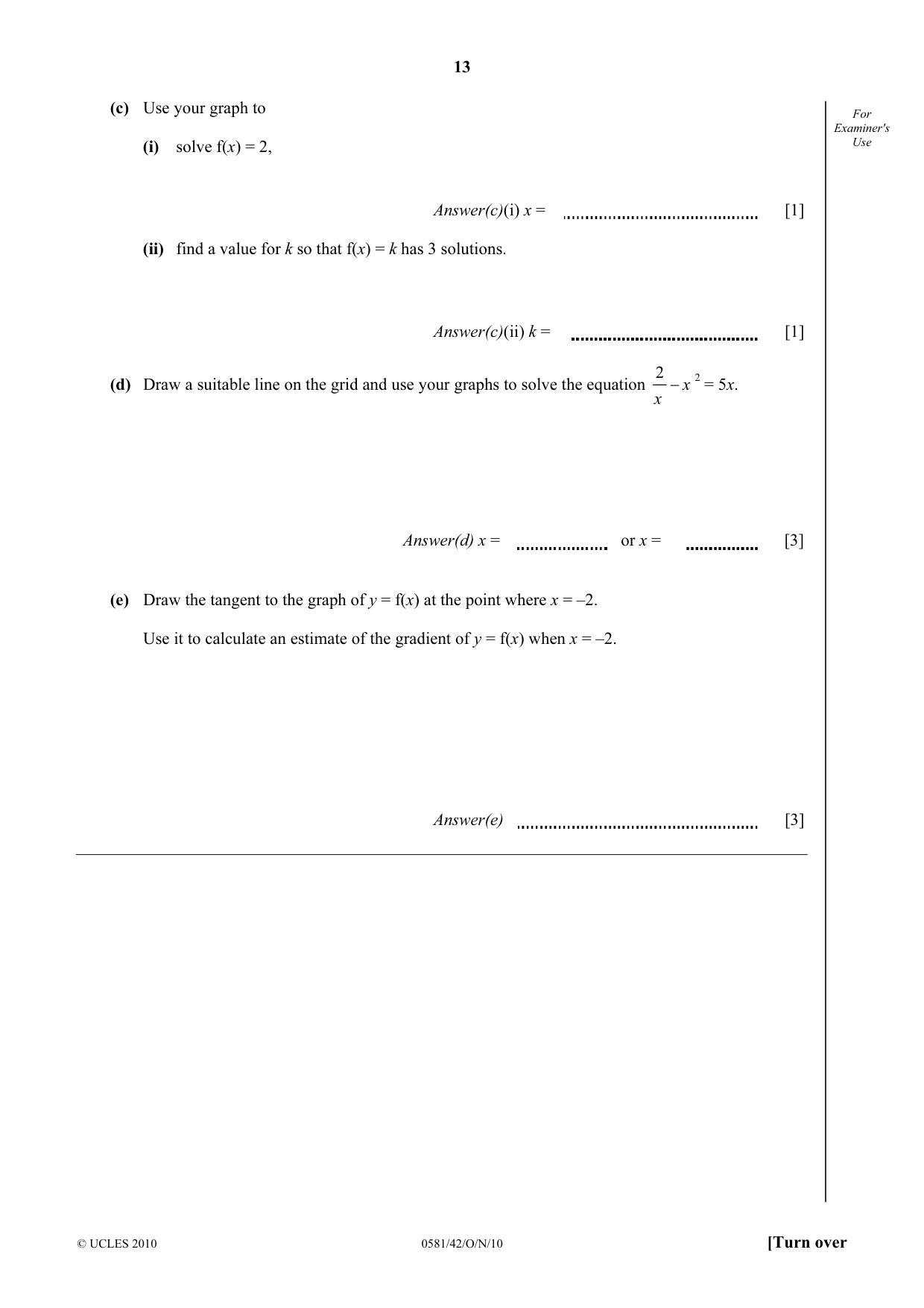
13 © UCLES 2010 0581/42/O/N/10 [Turn over For Examiner's Use (c) Use your graph to (i) solve f(x) = 2, Answer(c)(i) x = [1] (ii) find a value for k so that f(x) = k has 3 solutions. Answer(c)(ii) k = [1] (d) Draw a suitable line on the grid and use your graphs to solve the equation 2 2 x x − = 5x. Answer(d) x = or x = [3] (e) Draw the tangent to the graph of y = f(x) at the point where x = –2. Use it to calculate an estimate of the gradient of y = f(x) when x = –2. Answer(e) [3]
Question paper, page 14
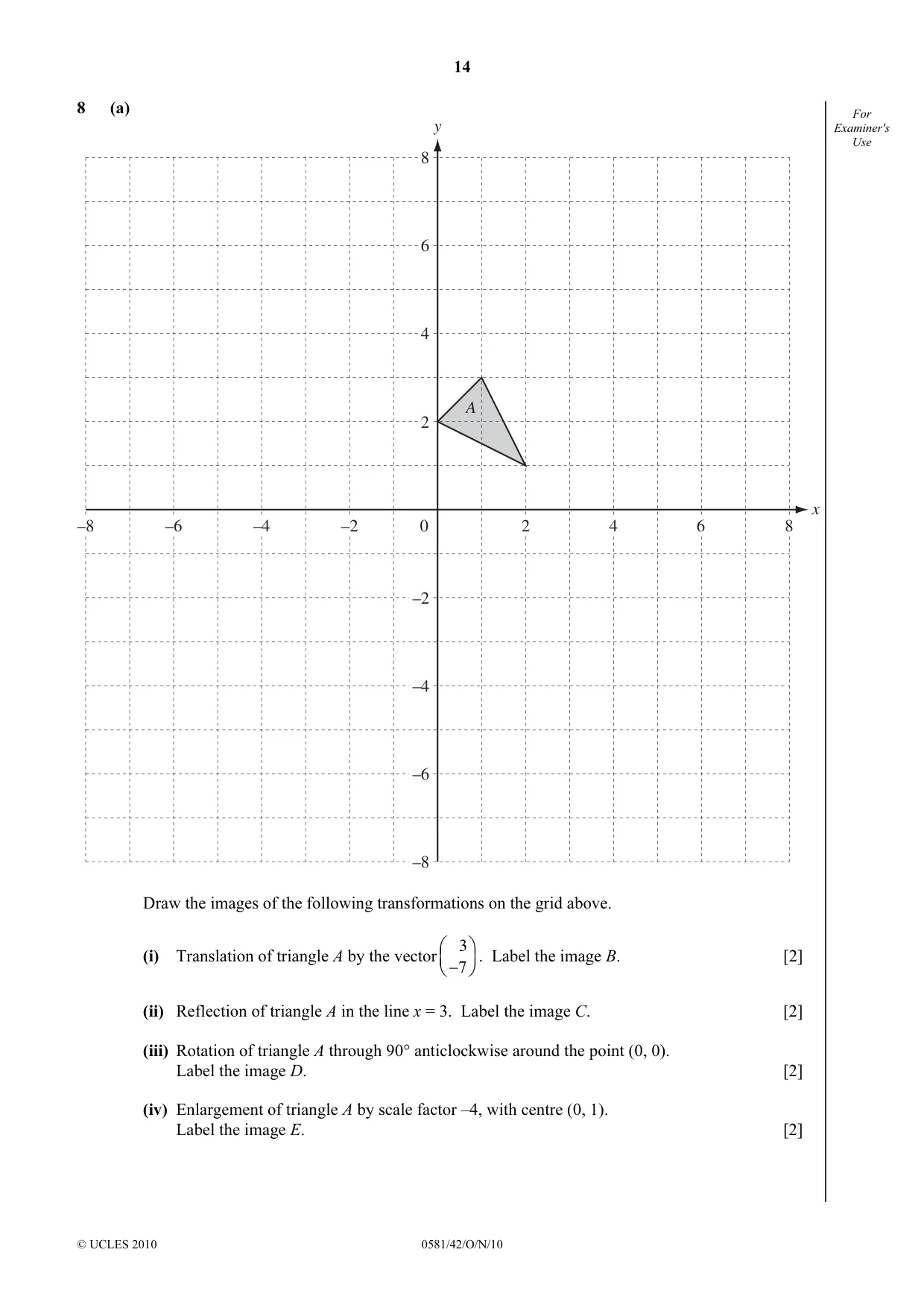
14 © UCLES 2010 0581/42/O/N/10 For Examiner's Use 8 (a) A y x 8 6 4 2 –2 –4 –6 –8 –8 –6 –4 –2 0 2 4 6 8 Draw the images of the following transformations on the grid above. (i) Translation of triangle A by the vector 3 7 − . Label the image B. [2] (ii) Reflection of triangle A in the line x = 3. Label the image C. [2] (iii) Rotation of triangle A through 90° anticlockwise around the point (0, 0). Label the image D. [2] (iv) Enlargement of triangle A by scale factor –4, with centre (0, 1). Label the image E. [2] A
Question paper, page 15
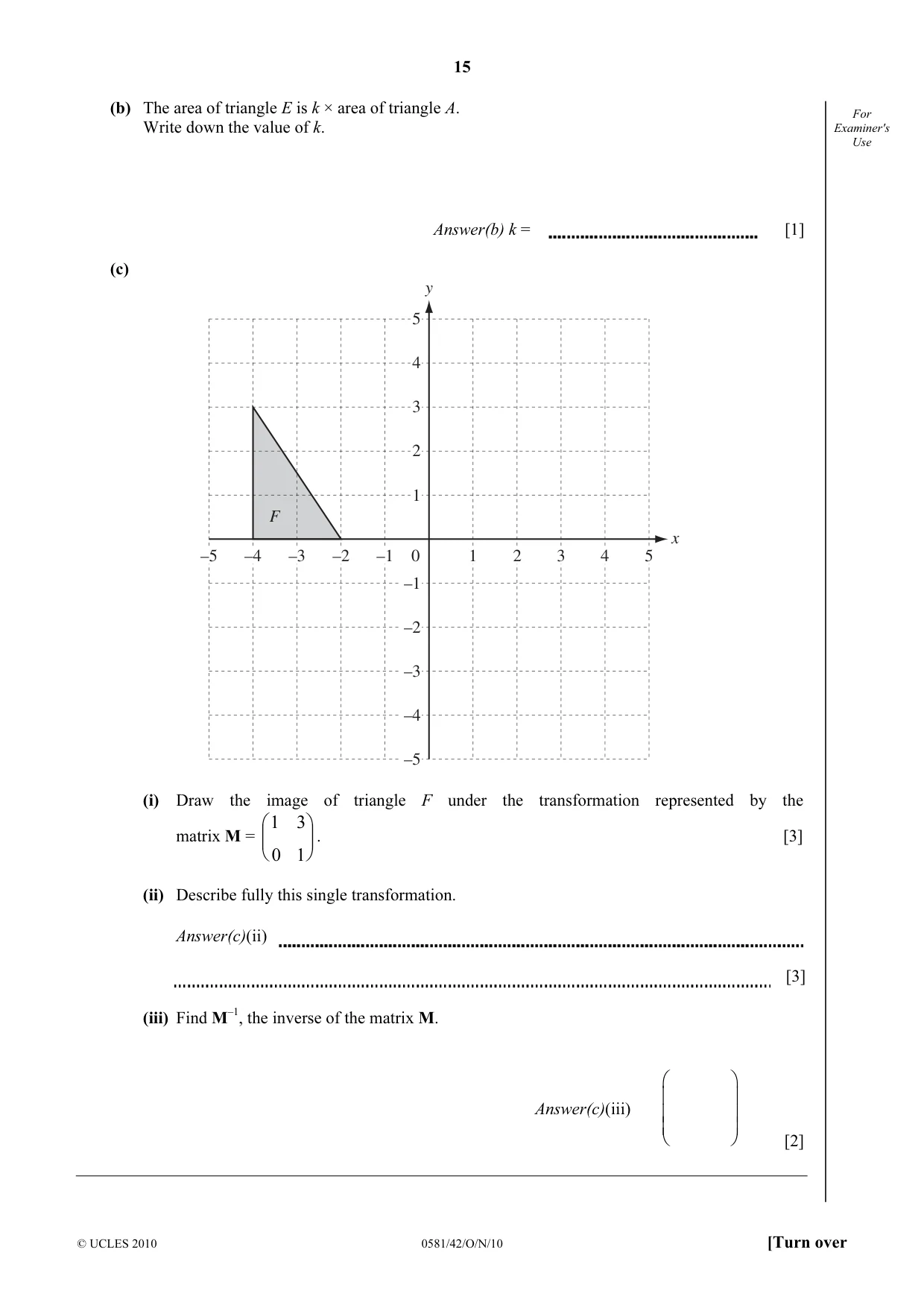
15 © UCLES 2010 0581/42/O/N/10 [Turn over For Examiner's Use (b) The area of triangle E is k × area of triangle A. Write down the value of k. Answer(b) k = [1] (c) F y x 5 4 3 2 1 –1 –2 –3 –4 –5 –4 –2 –3 –5 –1 0 2 1 3 5 4 (i) Draw the image of triangle F under the transformation represented by the matrix M = 1 0 3 1 . [3] (ii) Describe fully this single transformation. Answer(c)(ii) [3] (iii) Find M–1, the inverse of the matrix M. Answer(c)(iii) [2]
Question paper, page 16
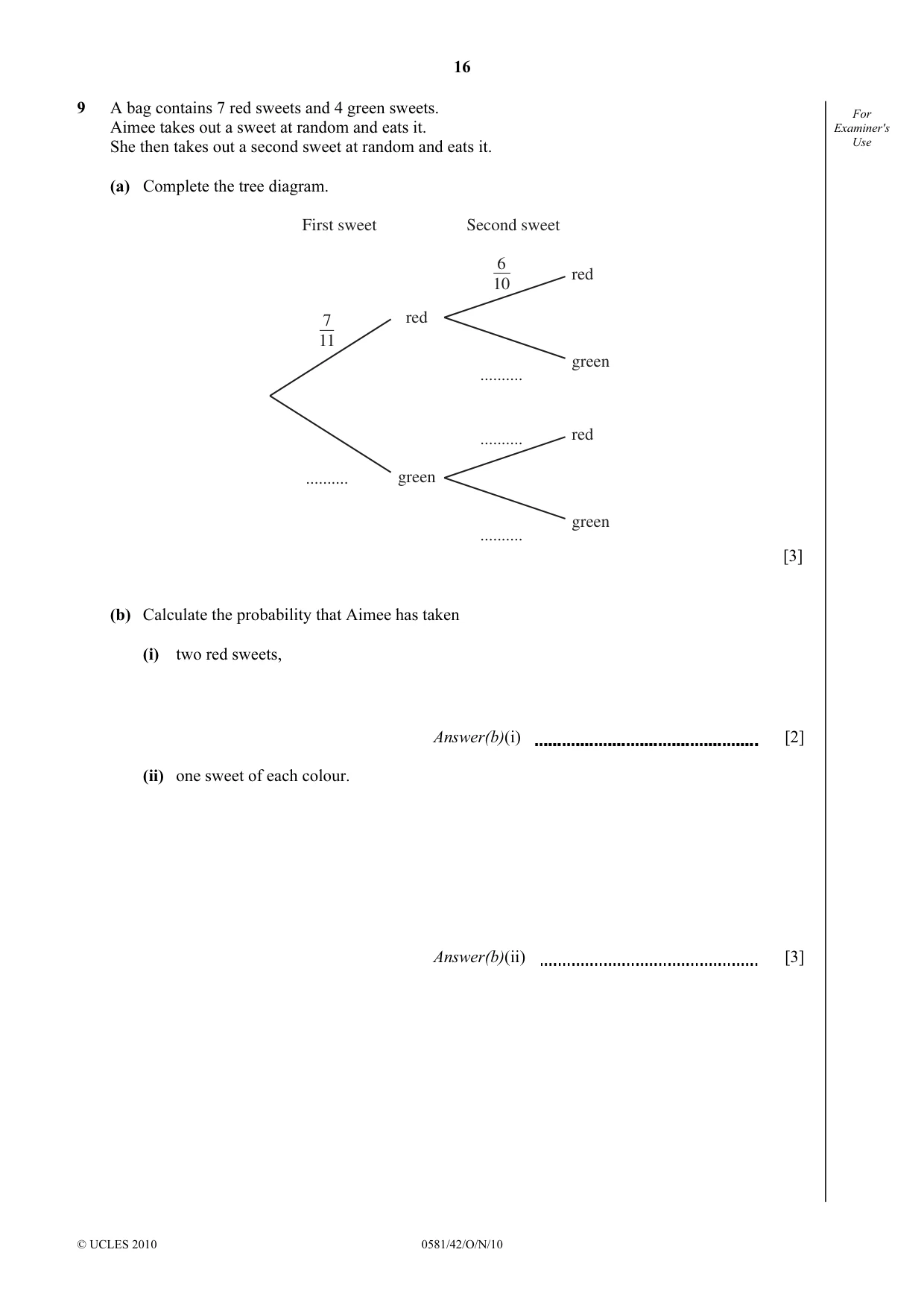
16 © UCLES 2010 0581/42/O/N/10 For Examiner's Use 9 A bag contains 7 red sweets and 4 green sweets. Aimee takes out a sweet at random and eats it. She then takes out a second sweet at random and eats it. (a) Complete the tree diagram. 7 11 First sweet Second sweet … 6 10 … red green red green … … red green [3] (b) Calculate the probability that Aimee has taken (i) two red sweets, Answer(b)(i) [2] (ii) one sweet of each colour. Answer(b)(ii) [3]
Question paper, page 17
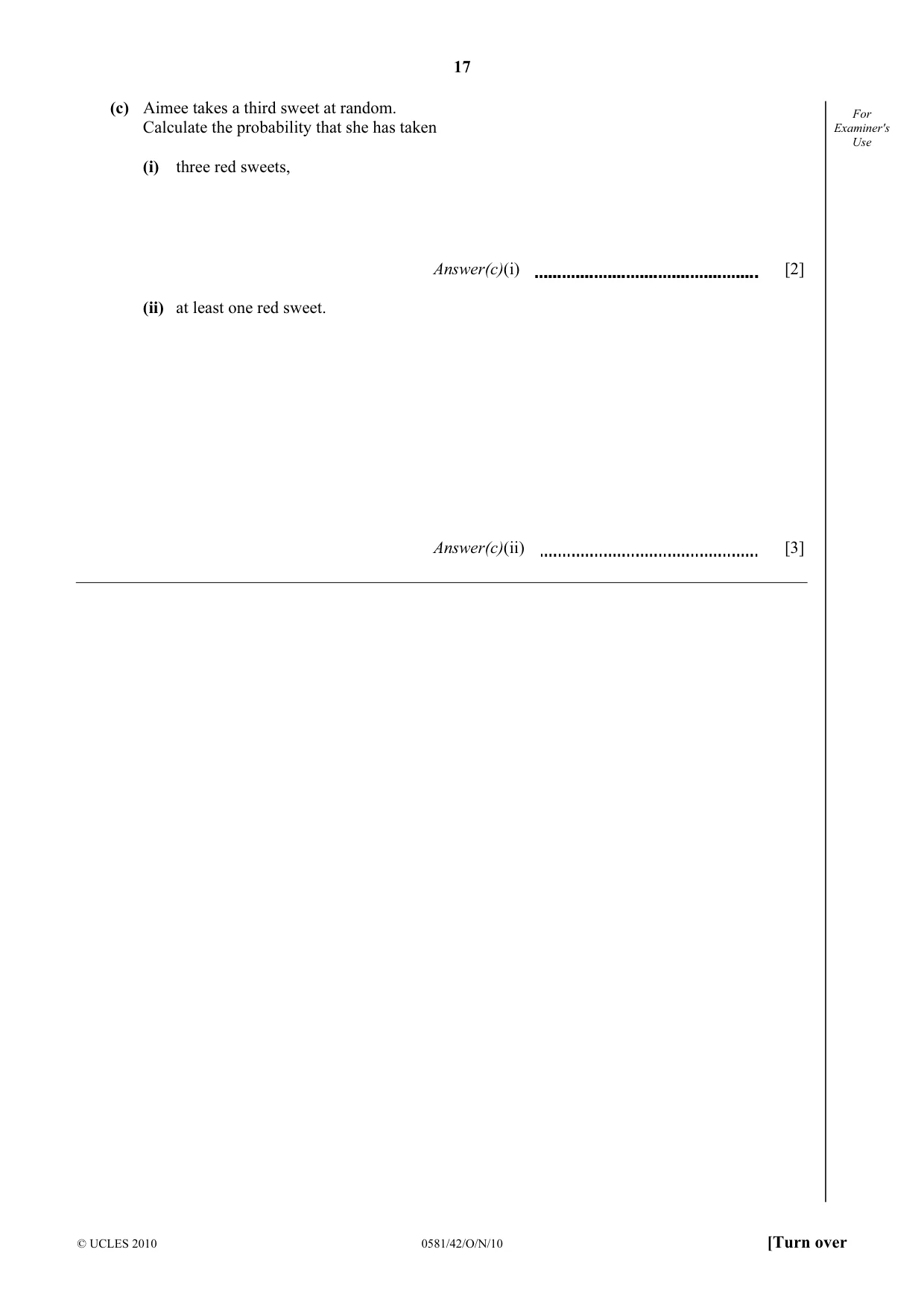
17 © UCLES 2010 0581/42/O/N/10 [Turn over For Examiner's Use (c) Aimee takes a third sweet at random. Calculate the probability that she has taken (i) three red sweets, Answer(c)(i) [2] (ii) at least one red sweet. Answer(c)(ii) [3]
Question paper, page 18
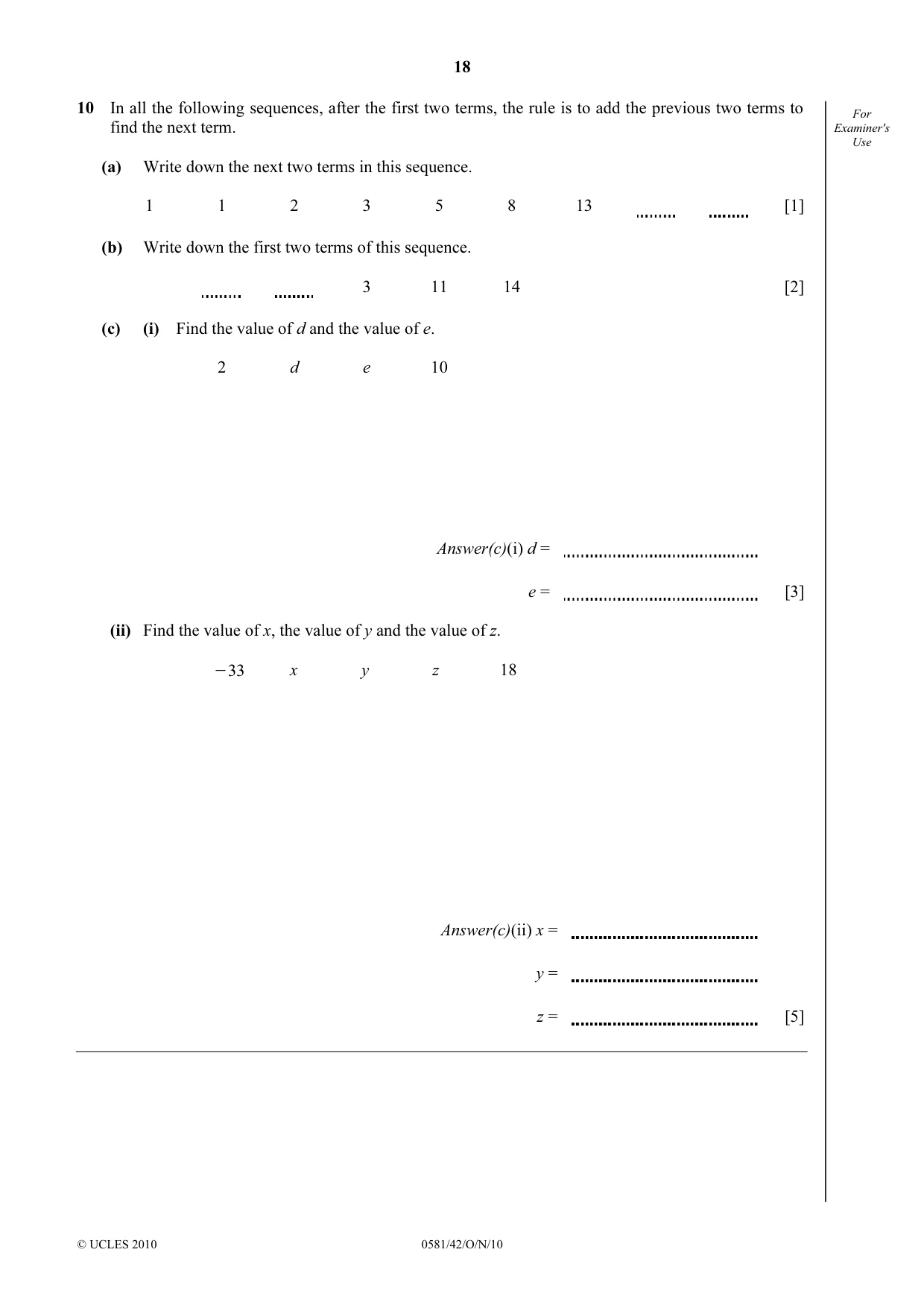
18 © UCLES 2010 0581/42/O/N/10 For Examiner's Use 10 In all the following sequences, after the first two terms, the rule is to add the previous two terms to find the next term. (a) Write down the next two terms in this sequence. 1 1 2 3 5 8 13 [1] (b) Write down the first two terms of this sequence. 3 11 14 [2] (c) (i) Find the value of d and the value of e. 2 d e 10 Answer(c)(i) d = e = [3] (ii) Find the value of x, the value of y and the value of z. O33 x y z 18 Answer(c)(ii) x = y = z = [5]
Question paper, page 19
19 © UCLES 2010 0581/42/O/N/10 BLANK PAGE
Question paper, page 20
20 Permission to reproduce items where third-party owned material protected by copyright is included has been sought and cleared where possible. Every reasonable effort has been made by the publisher (UCLES) to trace copyright holders, but if any items requiring clearance have unwittingly been included, the publisher will be pleased to make amends at the earliest possible opportunity. University of Cambridge International Examinations is part of the Cambridge Assessment Group. Cambridge Assessment is the brand name of University of Cambridge Local Examinations Syndicate (UCLES), which is itself a department of the University of Cambridge. © UCLES 2010 0581/42/O/N/10 BLANK PAGE
Mark scheme, page 1
UNIVERSITY OF CAMBRIDGE INTERNATIONAL EXAMINATIONS International General Certificate of Secondary Education MARK SCHEME for the October/November 2010 question paper for the guidance of teachers 0581 MATHEMATICS 0581/42 Paper 4 (Extended), maximum raw mark 130 This mark scheme is published as an aid to teachers and candidates, to indicate the requirements of the examination. It shows the basis on which Examiners were instructed to award marks. It does not indicate the details of the discussions that took place at an Examiners’ meeting before marking began, which would have considered the acceptability of alternative answers. Mark schemes must be read in conjunction with the question papers and the report on the examination. • CIE will not enter into discussions or correspondence in connection with these mark schemes. CIE is publishing the mark schemes for the October/November 2010 question papers for most IGCSE, GCE Advanced Level and Advanced Subsidiary Level syllabuses and some Ordinary Level syllabuses. www.XtremePapers.com
Mark scheme, page 2
Page 2 Mark Scheme: Teachers’ version Syllabus Paper IGCSE – October/November 2010 0581 42 © UCLES 2010 Abbreviations cao correct answer only cso correct solution only dep dependent ft follow through after error isw ignore subsequent working oe or equivalent SC Special Case www without wrong working art anything rounding to soi seen or implied Qu. Answers Mark Part Marks 1 (a) 432 2 M1 for 756 ÷ 7 × 4 oe (b) (i) 8970 2 M1 for 7800 × 1.15 oe After 0 scored, SC1 for 1170 as answer (ii) ) 100 ( 7800 ) 7800 ( 9867 their × − or 1.15 × 1.10 M2 Their 9867 is their (b)(i) × 1.1 Implied by 1.265 or 0.265 or 126.5 or M1 for their (b)(i) × 1.10 (9867 seen or 2067 seen) 26.5 % cao A1 www3 (c) 8100 3 M2 for 9720 ÷ 1.2 oe or M1 for 120% = 9720 oe (d) 562.43 or 562 or 562.4(0) or 562.432 3 M2 for 500 × 1.04³ or alt complete method or M1 for 1.04² or 1.04³ oe soi e.g. $540.80 or 562.(43..) seen in working 2 (a) (i) 11 (ii) 22 1 1 (b) 4 1 + x oe final answer 2 M1 for x + 1 = 4y or 4 1 ) ( g + x or 4 1 + y (c) 16x² – 8x + 7 final answer 3 M1 for 6 + (4x – 1)² and B1 for 16x² – 4x – 4x + 1 or better seen (d) 0.5 or ½ www 3 M2 for 16x – 4 – 1 = 3 or better or M1 for 4(4x – 1) – 1 (= 3) Alt method M2 allow g–1g–1(3) complete method or M1 for g(x) = g–1(3)
Mark scheme, page 3
Page 3 Mark Scheme: Teachers’ version Syllabus Paper IGCSE – October/November 2010 0581 42 © UCLES 2010 3 (a) (i) 63 to 63.5 (ii) 50 to 50.5 (iii) 21.5 to 22.5 1 1 1 (b) 46 2 B1 for 34 seen (could be on graph) (c) (i) 12, 14 (ii) {35 × 8 + 45 × their 12 + 55 × 14 + 65 × 22 + 75 × their 14 + 85 × 10} ÷ their 80 (or 80) 1, 1 M3 M1 for mid-values soi (allow 1 error/omit) and M1 for use of ∑fx with x in correct boundary including both ends (at least 4 products) (4920 seen implies M2) and M1 depend on 2nd M for dividing by their 80 (or 80) (not 54 or less) 61.5 cao A1 www4 4 (a) (i) 218 (217.7 to 218) (ii) 501 (500.7 to 501.4) (iii) 99 2 1ft 2ft M1 for 1/3π × 42 × 13 ft their (a) × 2.3 ft 50 000 ÷ their (a)(ii) and truncated to whole number M1 for 50 000 ÷ their (a)(ii) oe or answers 99.8 or 100 (b) their (a)(i) × 3 13 5. 32 oe M2 or 1/3π × 102 × 32.5 or M1 for (32.5 ÷ 13)³ (=15.625) seen or (13 ÷ 32.5)³ (= 0.064) seen 3400 or 3410 (3401 to 3407) A1 www3 (c) (r² =) 550 ÷ 12π 3.82 (3.818 to 3.821) M2 A1 (14.58 to 14.6) or M1 for 12π r² = 550 or better www3
Mark scheme, page 4
Page 4 Mark Scheme: Teachers’ version Syllabus Paper IGCSE – October/November 2010 0581 42 © UCLES 2010 5 (a) (i) x² + (x + 7)² = 17² oe x² + x² + 7x + 7x + 49 = 17² or better 2x² + 14x – 240 = 0 x² + 7x – 120 = 0 (ii) (x + 15)(x – 8) (iii) –15 and 8 (iv) 15 B1 B1 E1 2 1ft 1ft Must be seen Must be shown – correct 3 terms With no errors seen M1 for (x + a)(x + b) where a and b are integers and a × b = –120 or a + b = 7 Ignore solutions after factors given Correct or ft dep on at least M1 in (ii) Correct or ft their positive root from (ii) + 7 dep on a positive and negative root given (b) (i) 3x(2x – 1) = (2x + 3)² oe 4x² + 6x + 6x + 9 or better seen 6x² – 3x = 4x² + 12x + 9 oe 2x² – 15x – 9 = 0 M1 B1 E1 e.g. 6x² – 3x = 4x² + 12x + 9 must see equation before simplification Indep With no errors seen and both sets of brackets expanded (ii) ) 2 ( 2 ) 9 )( 2 ( 4 ) 15 ) (( 15 ) ( 2 − − − ± − − oe 1 1 In square root B1 for ((–)15)2 – 4(2)(–9) or better (297) If in form r q p + or r q p − , B1 for –(–15) and 2(2) or better 8.06 and -0.56 cao (iii) 76.5 (76.46 to 76.48) 1, 1 1ft SC1 for –0.6 or –0.558… and 8.1 or 8.058… ft 8 times a positive root to (b)(ii) add 12 6 (a) (i) 54802 + 33002 – 2 × 5480 × 3300 × cos165 8709.5.. M2 E2 (75 856 005) M1 for implicit version If E0, A1 for 75800000 to 75900000 (ii) (sinL =) 8710 165 sin × 3300 (0.09806…) M2 M1 for 8710 165 sin 3300 sin = L oe (allow 8709.5.) Could use cosine rule using 8710 or better – M2 for explicit form or M1 for implicit form (allow 5.6 to 5.63 for A mark) 5.6 (5.62 to 5.63) A1 www3 (b) 22 35 or 10 35 pm 2 Accept 22 35 pm B1 for 15 35 or 3 35 pm seen or answers 22h 35 mins or (0)8 35(am) or 10 35(am) (c) 8710 ÷ 800 10.88 to 10.9 with no conversion to h/min or 10 (hrs) 52 (mins) to 10 (hrs) 54 (mins) oe 13 hrs 45 mins – their time in hrs and mins oe or 13.75 – their decimal time and a correct conversion to hrs and mins or minutes 2 hr 52 mins cao M1 A1 M1 A1 Implied by correct final ans 2hrs 52 mins if not shown Dep on first M1 e.g. 13 hrs 45mins – 11 hrs 29 mins or 13.75 – 10.9 then 2hrs 51 mins www4 (2 hrs 51.75 mins)
Mark scheme, page 5
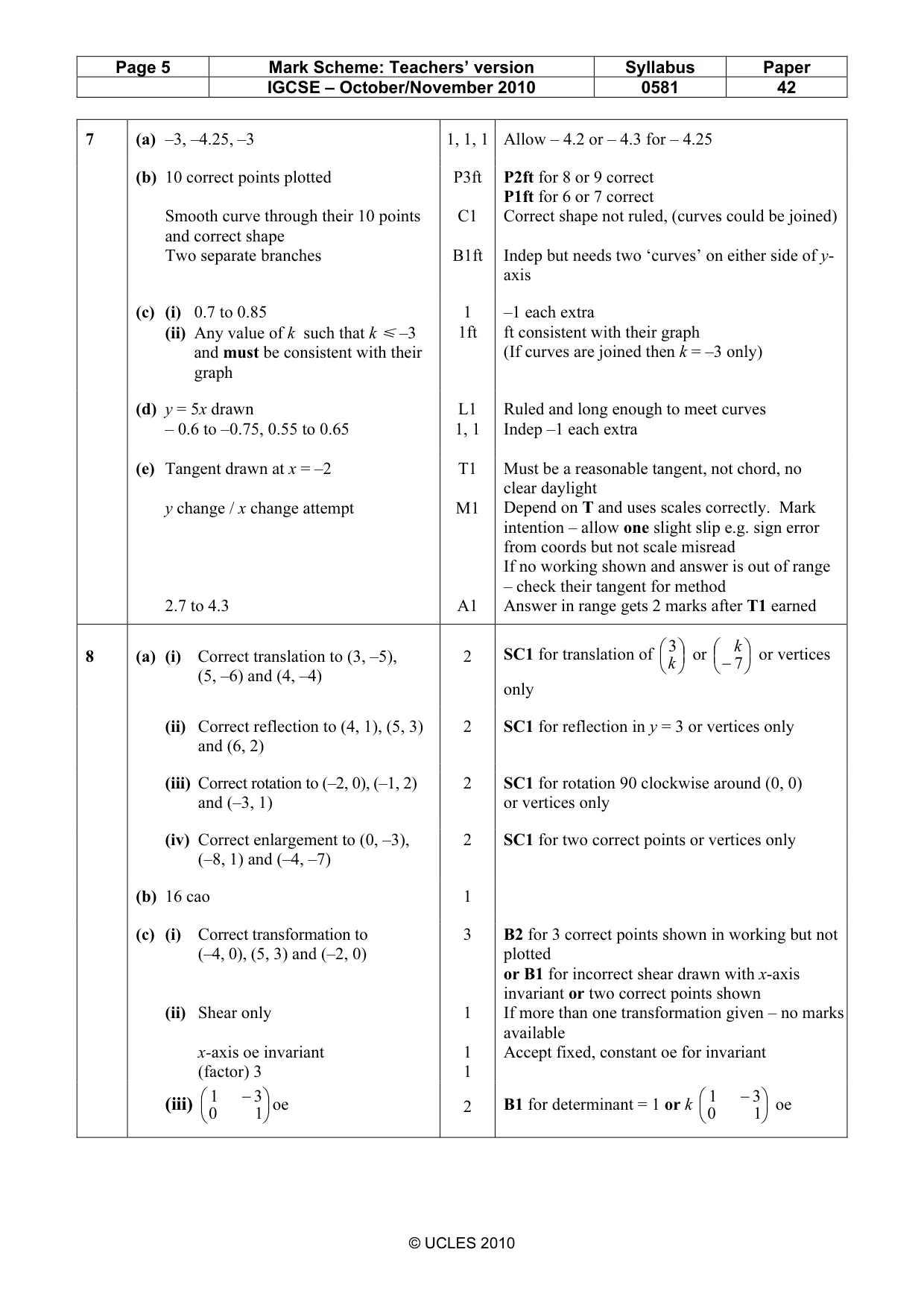
Page 5 Mark Scheme: Teachers’ version Syllabus Paper IGCSE – October/November 2010 0581 42 © UCLES 2010 7 (a) –3, –4.25, –3 1, 1, 1 Allow – 4.2 or – 4.3 for – 4.25 (b) 10 correct points plotted Smooth curve through their 10 points and correct shape Two separate branches P3ft C1 B1ft P2ft for 8 or 9 correct P1ft for 6 or 7 correct Correct shape not ruled, (curves could be joined) Indep but needs two ‘curves’ on either side of y- axis (c) (i) 0.7 to 0.85 (ii) Any value of k such that k Y –3 and must be consistent with their graph 1 1ft –1 each extra ft consistent with their graph (If curves are joined then k = –3 only) (d) y = 5x drawn – 0.6 to –0.75, 0.55 to 0.65 L1 1, 1 Ruled and long enough to meet curves Indep –1 each extra (e) Tangent drawn at x = –2 y change / x change attempt 2.7 to 4.3 T1 M1 A1 Must be a reasonable tangent, not chord, no clear daylight Depend on T and uses scales correctly. Mark intention – allow one slight slip e.g. sign error from coords but not scale misread If no working shown and answer is out of range – check their tangent for method Answer in range gets 2 marks after T1 earned 8 (a) (i) Correct translation to (3, –5), (5, –6) and (4, –4) 2 SC1 for translation of k 3 or −7 k or vertices only (ii) Correct reflection to (4, 1), (5, 3) and (6, 2) 2 SC1 for reflection in y = 3 or vertices only (iii) Correct rotation to (–2, 0), (–1, 2) and (–3, 1) 2 SC1 for rotation 90 clockwise around (0, 0) or vertices only (iv) Correct enlargement to (0, –3), (–8, 1) and (–4, –7) 2 SC1 for two correct points or vertices only (b) 16 cao 1 (c) (i) Correct transformation to (–4, 0), (5, 3) and (–2, 0) (ii) Shear only x-axis oe invariant (factor) 3 3 1 1 1 B2 for 3 correct points shown in working but not plotted or B1 for incorrect shear drawn with x-axis invariant or two correct points shown If more than one transformation given – no marks available Accept fixed, constant oe for invariant (iii) − 1 0 3 1 oe 2 B1 for determinant = 1 or k − 1 0 3 1 oe
Mark scheme, page 6
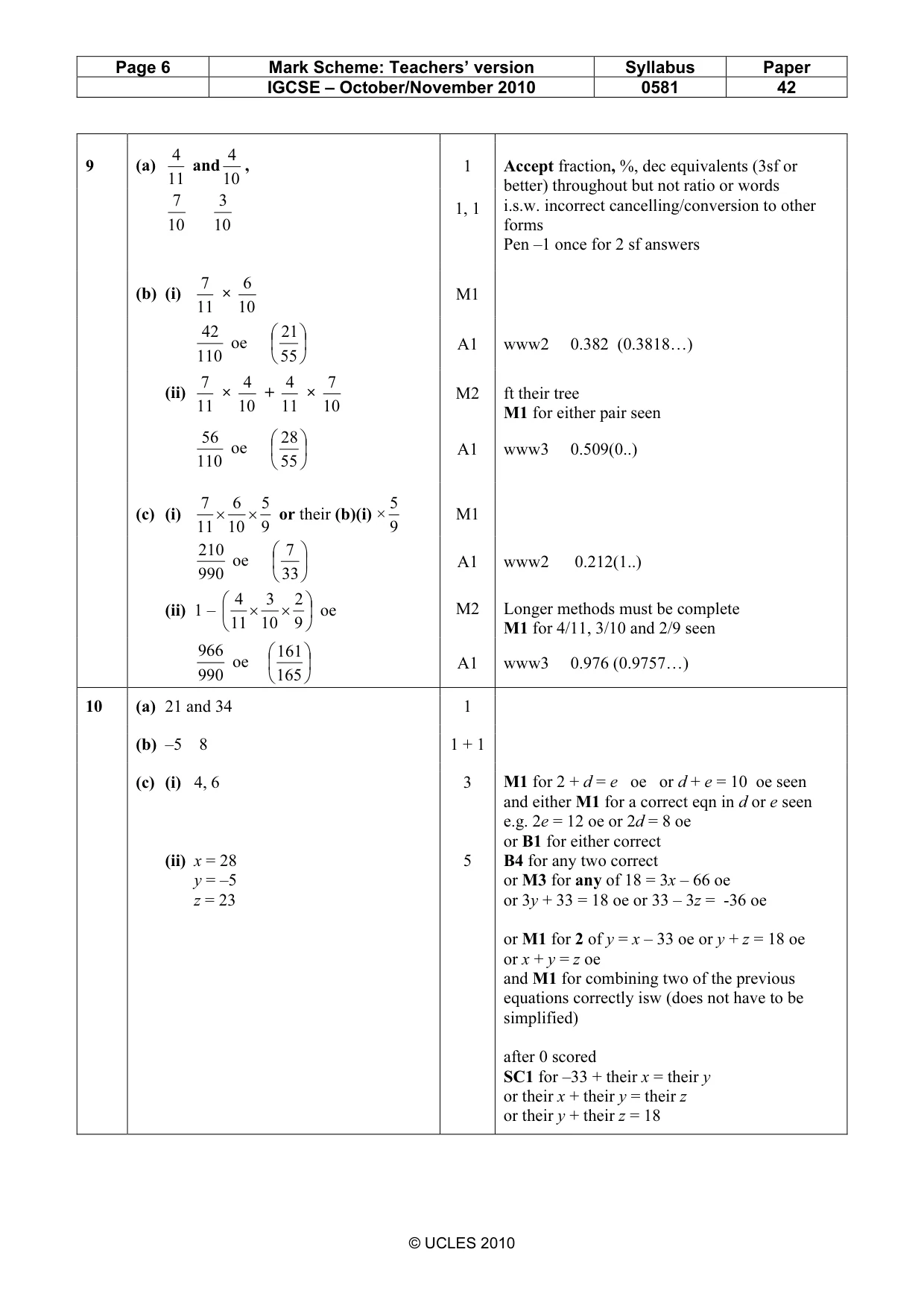
Page 6 Mark Scheme: Teachers’ version Syllabus Paper IGCSE – October/November 2010 0581 42 © UCLES 2010 9 (a) 11 4 and10 4 , 1 10 7 10 3 1, 1 Accept fraction, %, dec equivalents (3sf or better) throughout but not ratio or words i.s.w. incorrect cancelling/conversion to other forms Pen –1 once for 2 sf answers (b) (i) 11 7 × 10 6 M1 110 42 oe 55 21 A1 www2 0.382 (0.3818…) (ii) 11 7 × 10 4 + 11 4 × 10 7 M2 ft their tree M1 for either pair seen 110 56 oe 55 28 A1 www3 0.509(0..) (c) (i) 9 5 10 6 11 7 × × or their (b)(i) × 9 5 M1 990 210 oe 33 7 A1 www2 0.212(1..) (ii) 1 – × × 9 2 10 3 11 4 oe M2 Longer methods must be complete M1 for 4/11, 3/10 and 2/9 seen 990 966 oe 165 161 A1 www3 0.976 (0.9757…) 10 (a) 21 and 34 1 (b) –5 8 1 + 1 (c) (i) 4, 6 (ii) x = 28 y = –5 z = 23 3 5 M1 for 2 + d = e oe or d + e = 10 oe seen and either M1 for a correct eqn in d or e seen e.g. 2e = 12 oe or 2d = 8 oe or B1 for either correct B4 for any two correct or M3 for any of 18 = 3x – 66 oe or 3y + 33 = 18 oe or 33 – 3z = -36 oe or M1 for 2 of y = x – 33 oe or y + z = 18 oe or x + y = z oe and M1 for combining two of the previous equations correctly isw (does not have to be simplified) after 0 scored SC1 for –33 + their x = their y or their x + their y = their z or their y + their z = 18
What you needed in this session
Cambridge’s own grade thresholds for 2010 Oct/Nov, Paper 4 · Variant 2. A higher threshold means an easier paper — the bar moves with how the cohort did.