Cambridge IGCSE Mathematics (with coursework) 0581 — 2010 Oct/Nov Paper 4 · Variant 1
0581/41/O/N/10 · 130 marks · ≈146 min
The question paper and its mark scheme, free to read here and free to download. This is Cambridge’s own paper, exactly as it was sat.
Question paper16 pages
Mark scheme6 pages
Answers below. Sit the paper first if you are practising.
Paper as text
Question paper, page 1
This document consists of 16 printed pages. IB10 11_0581_41/3RP © UCLES 2010 [Turn over *9450247605* UNIVERSITY OF CAMBRIDGE INTERNATIONAL EXAMINATIONS International General Certificate of Secondary Education MATHEMATICS 0581/41 Paper 4 (Extended) October/November 2010 2 hours 30 minutes Candidates answer on the Question Paper. Additional Materials: Electronic calculator Geometrical instruments Mathematical tables (optional) Tracing paper (optional) READ THESE INSTRUCTIONS FIRST Write your Centre number, candidate number and name on all the work you hand in. Write in dark blue or black pen. You may use a pencil for any diagrams or graphs. Do not use staples, paper clips, highlighters, glue or correction fluid. DO NOT WRITE IN ANY BARCODES. Answer all questions. If working is needed for any question it must be shown below that question. Electronic calculators should be used. If the degree of accuracy is not specified in the question, and if the answer is not exact, give the answer to three significant figures. Give answers in degrees to one decimal place. For π use either your calculator value or 3.142. At the end of the examination, fasten all your work securely together. The number of marks is given in brackets [ ] at the end of each question or part question. The total of the marks for this paper is 130. www.XtremePapers.com
Question paper, page 2
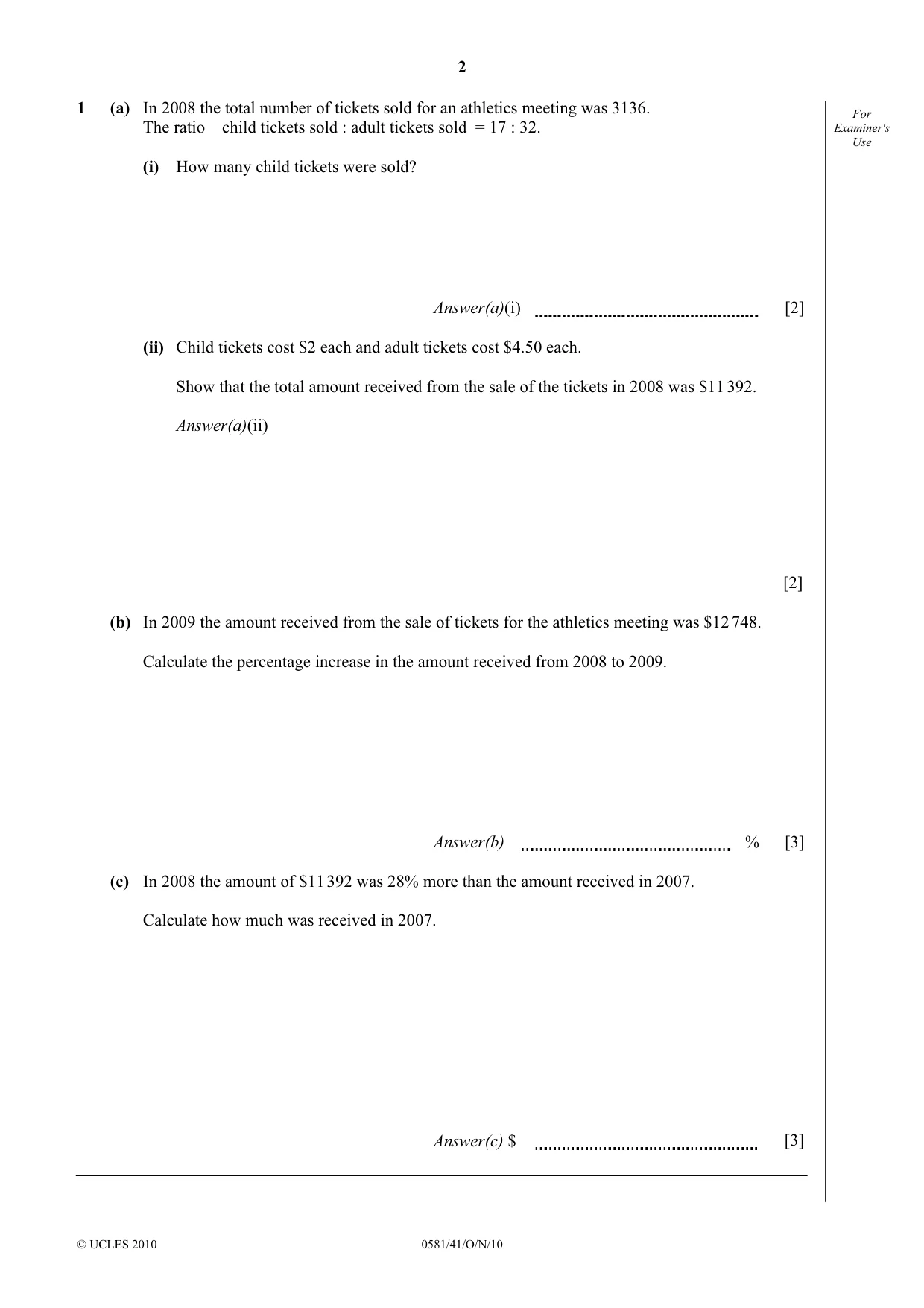
2 © UCLES 2010 0581/41/O/N/10 For Examiner's Use 1 (a) In 2008 the total number of tickets sold for an athletics meeting was 3136. The ratio child tickets sold : adult tickets sold = 17 : 32. (i) How many child tickets were sold? Answer(a)(i) [2] (ii) Child tickets cost $2 each and adult tickets cost $4.50 each. Show that the total amount received from the sale of the tickets in 2008 was $11 392. Answer(a)(ii) [2] (b) In 2009 the amount received from the sale of tickets for the athletics meeting was $12 748. Calculate the percentage increase in the amount received from 2008 to 2009. Answer(b) % [3] (c) In 2008 the amount of $11 392 was 28% more than the amount received in 2007. Calculate how much was received in 2007. Answer(c) $ [3]
Question paper, page 3
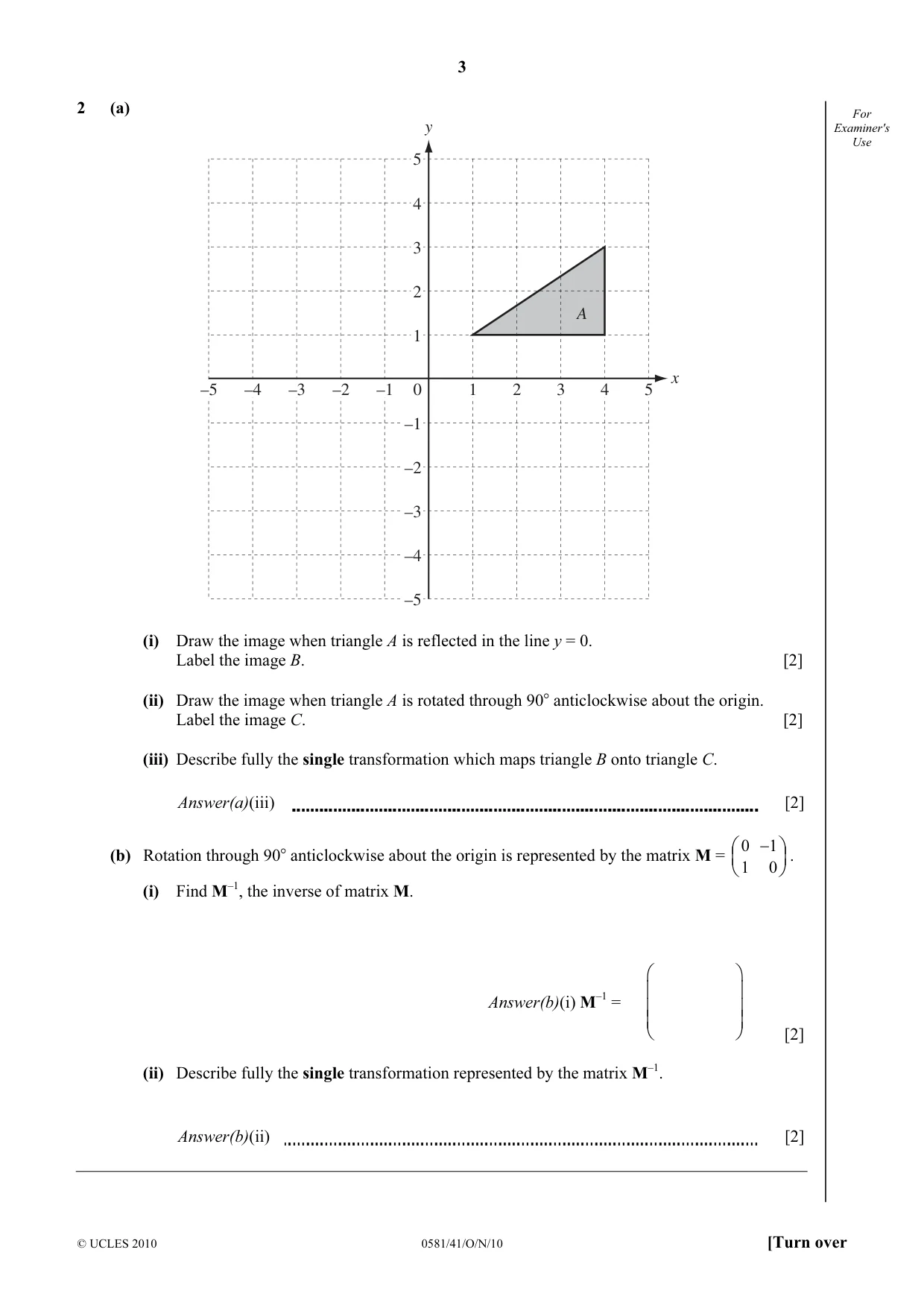
3 © UCLES 2010 0581/41/O/N/10 [Turn over For Examiner's Use 2 (a) A y x 5 4 3 2 1 –1 –2 –3 –4 –5 0 –1 –2 –3 –4 –5 5 4 3 2 1 (i) Draw the image when triangle A is reflected in the line y = 0. Label the image B. [2] (ii) Draw the image when triangle A is rotated through 90U anticlockwise about the origin. Label the image C. [2] (iii) Describe fully the single transformation which maps triangle B onto triangle C. Answer(a)(iii) [2] (b) Rotation through 90U anticlockwise about the origin is represented by the matrix M = 0 1 1 0 − . (i) Find M–1, the inverse of matrix M. Answer(b)(i) M–1 = [2] (ii) Describe fully the single transformation represented by the matrix M–1. Answer(b)(ii) [2]
Question paper, page 4
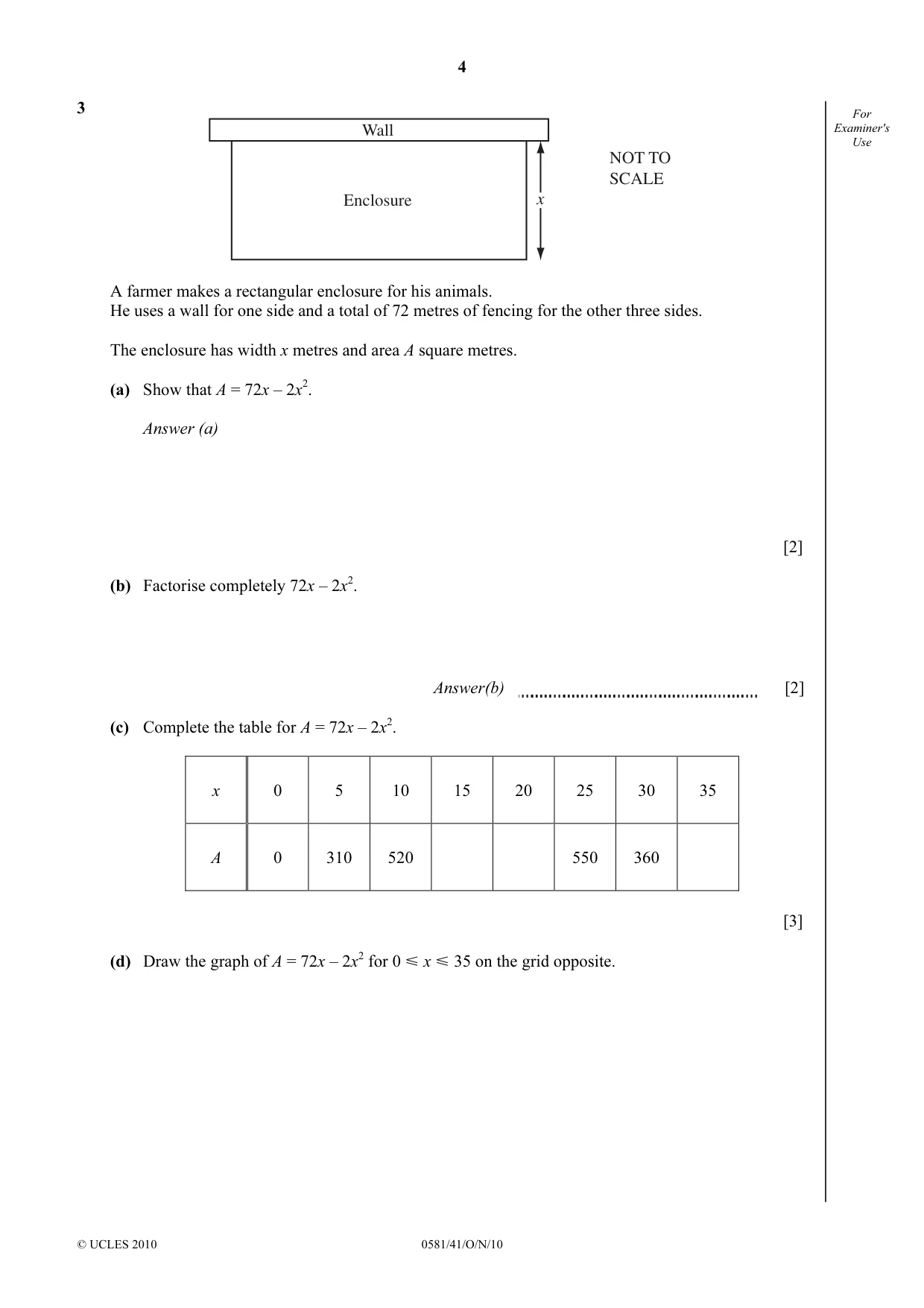
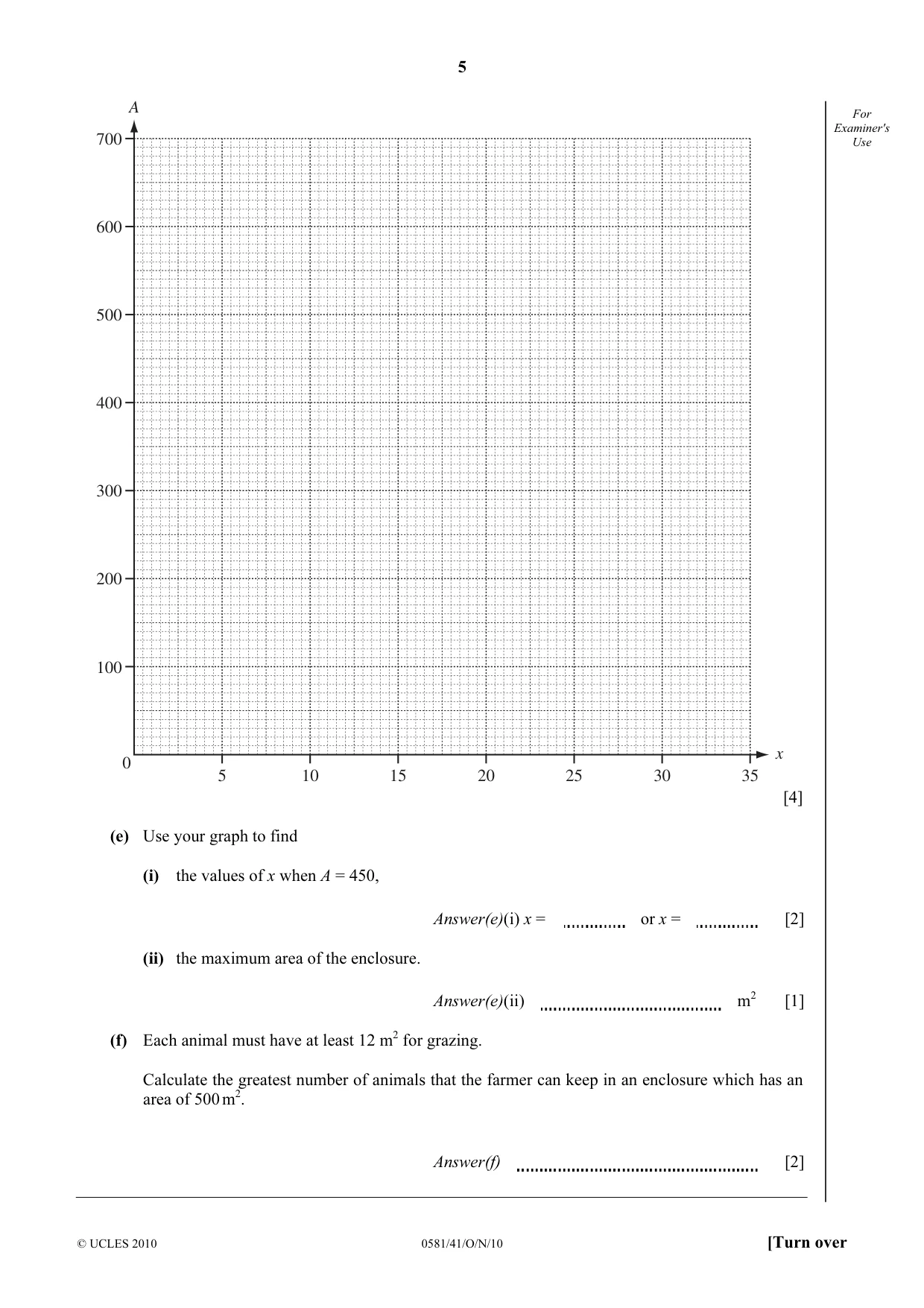
4 © UCLES 2010 0581/41/O/N/10 For Examiner's Use 3 Wall Enclosure x NOT TO SCALE A farmer makes a rectangular enclosure for his animals. He uses a wall for one side and a total of 72 metres of fencing for the other three sides. The enclosure has width x metres and area A square metres. (a) Show that A = 72x – 2x2. Answer (a) [2] (b) Factorise completely 72x – 2x2. Answer(b) [2] (c) Complete the table for A = 72x – 2x2. x 0 5 10 15 20 25 30 35 A 0 310 520 550 360 [3] (d) Draw the graph of A = 72x – 2x2 for 0 Y x Y 35 on the grid opposite.
Question paper, page 5
5 © UCLES 2010 0581/41/O/N/10 [Turn over For Examiner's Use 700 600 500 400 300 200 100 0 5 10 15 20 25 30 35 A x [4] (e) Use your graph to find (i) the values of x when A = 450, Answer(e)(i) x = or x = [2] (ii) the maximum area of the enclosure. Answer(e)(ii) m2 [1] (f) Each animal must have at least 12 m2 for grazing. Calculate the greatest number of animals that the farmer can keep in an enclosure which has an area of 500 m2. Answer(f) [2]
Question paper, page 6
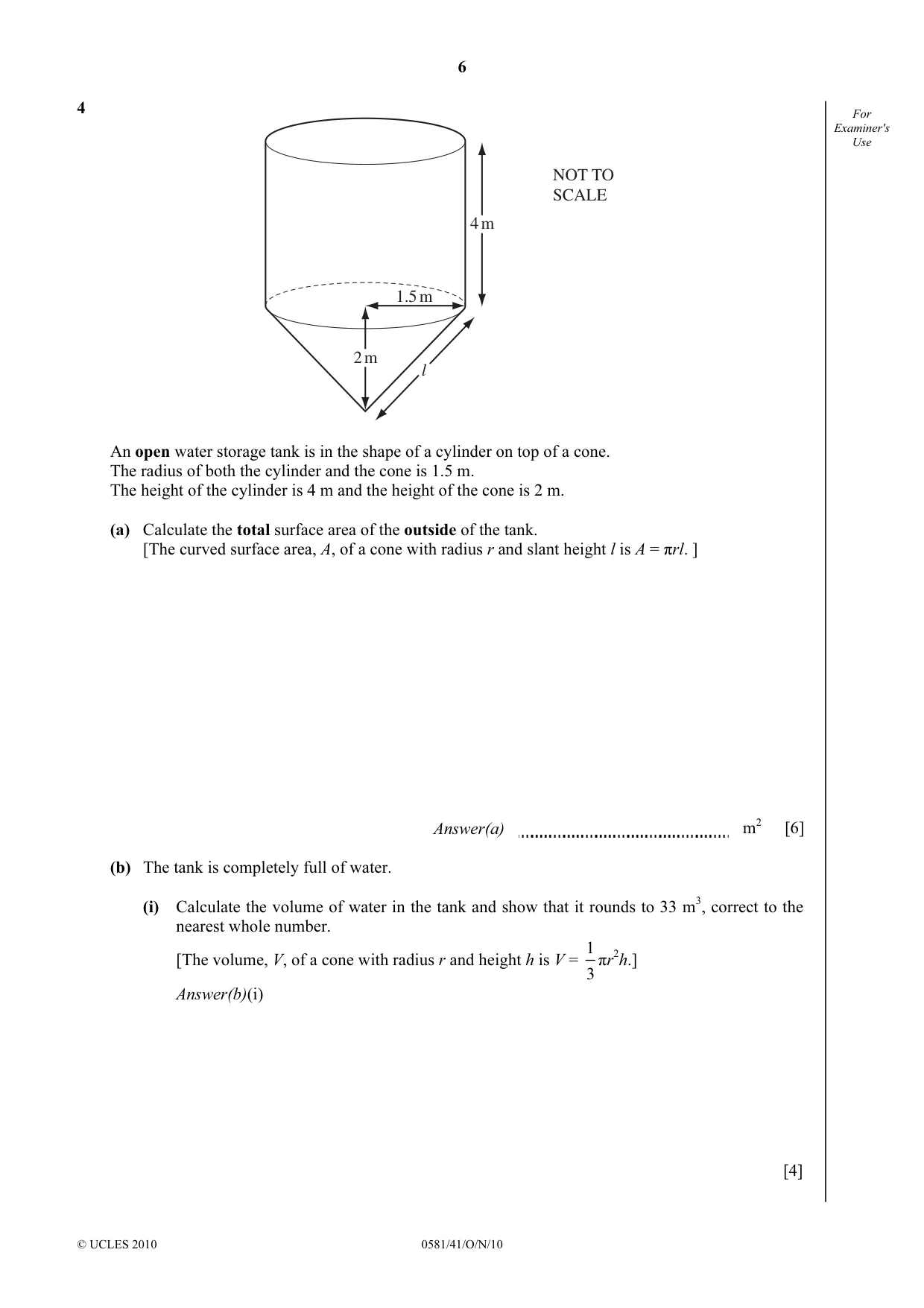
6 © UCLES 2010 0581/41/O/N/10 For Examiner's Use 4 1.5 m 2 m 4 m l NOT TO SCALE An open water storage tank is in the shape of a cylinder on top of a cone. The radius of both the cylinder and the cone is 1.5 m. The height of the cylinder is 4 m and the height of the cone is 2 m. (a) Calculate the total surface area of the outside of the tank. [The curved surface area, A, of a cone with radius r and slant height l is A = πrl. ] Answer(a) m2 [6] (b) The tank is completely full of water. (i) Calculate the volume of water in the tank and show that it rounds to 33 m3, correct to the nearest whole number. [The volume, V, of a cone with radius r and height h is V = 1 3 πr2h.] Answer(b)(i) [4]
Question paper, page 7
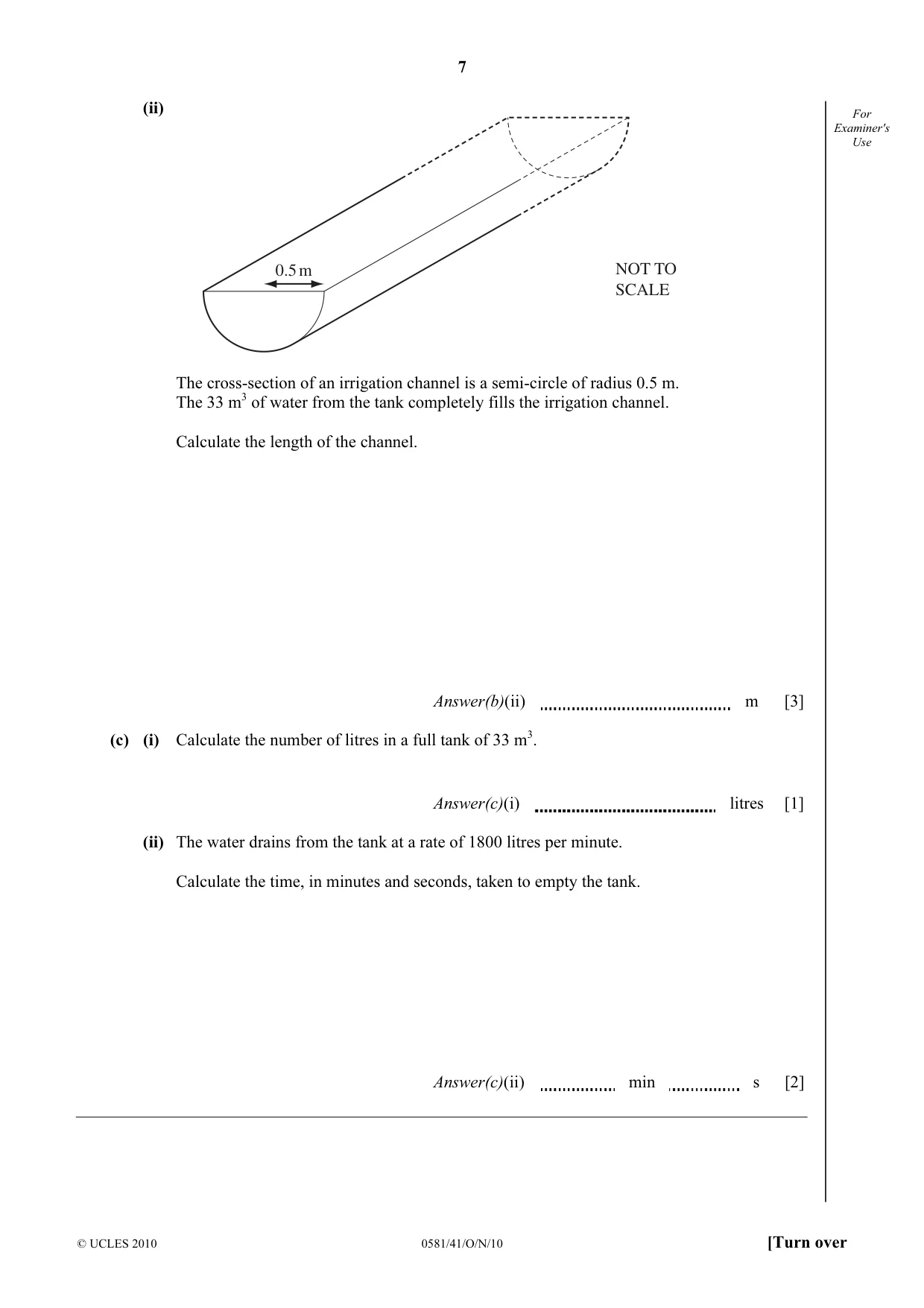
7 © UCLES 2010 0581/41/O/N/10 [Turn over For Examiner's Use (ii) 0.5 m NOT TO SCALE The cross-section of an irrigation channel is a semi-circle of radius 0.5 m. The 33 m3 of water from the tank completely fills the irrigation channel. Calculate the length of the channel. Answer(b)(ii) m [3] (c) (i) Calculate the number of litres in a full tank of 33 m3. Answer(c)(i) litres [1] (ii) The water drains from the tank at a rate of 1800 litres per minute. Calculate the time, in minutes and seconds, taken to empty the tank. Answer(c)(ii) min s [2]
Question paper, page 8
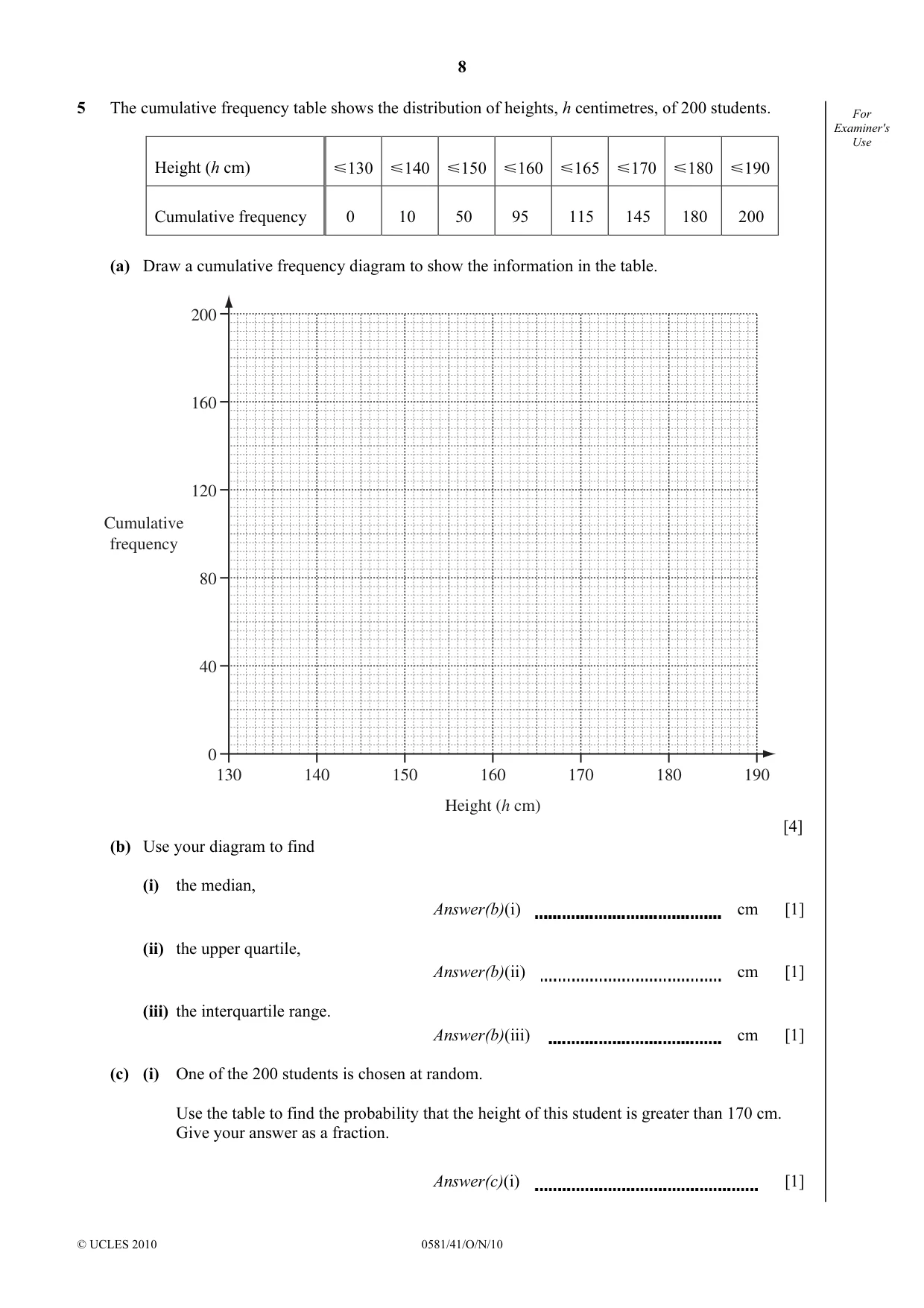
8 © UCLES 2010 0581/41/O/N/10 For Examiner's Use 5 The cumulative frequency table shows the distribution of heights, h centimetres, of 200 students. Height (h cm) Y130 Y140 Y150 Y160 Y165 Y170 Y180 Y190 Cumulative frequency 0 10 50 95 115 145 180 200 (a) Draw a cumulative frequency diagram to show the information in the table. 200 160 120 80 40 0 140 130 150 160 170 180 190 Height (h cm) Cumulative frequency [4] (b) Use your diagram to find (i) the median, Answer(b)(i) cm [1] (ii) the upper quartile, Answer(b)(ii) cm [1] (iii) the interquartile range. Answer(b)(iii) cm [1] (c) (i) One of the 200 students is chosen at random. Use the table to find the probability that the height of this student is greater than 170 cm. Give your answer as a fraction. Answer(c)(i) [1]
Question paper, page 9
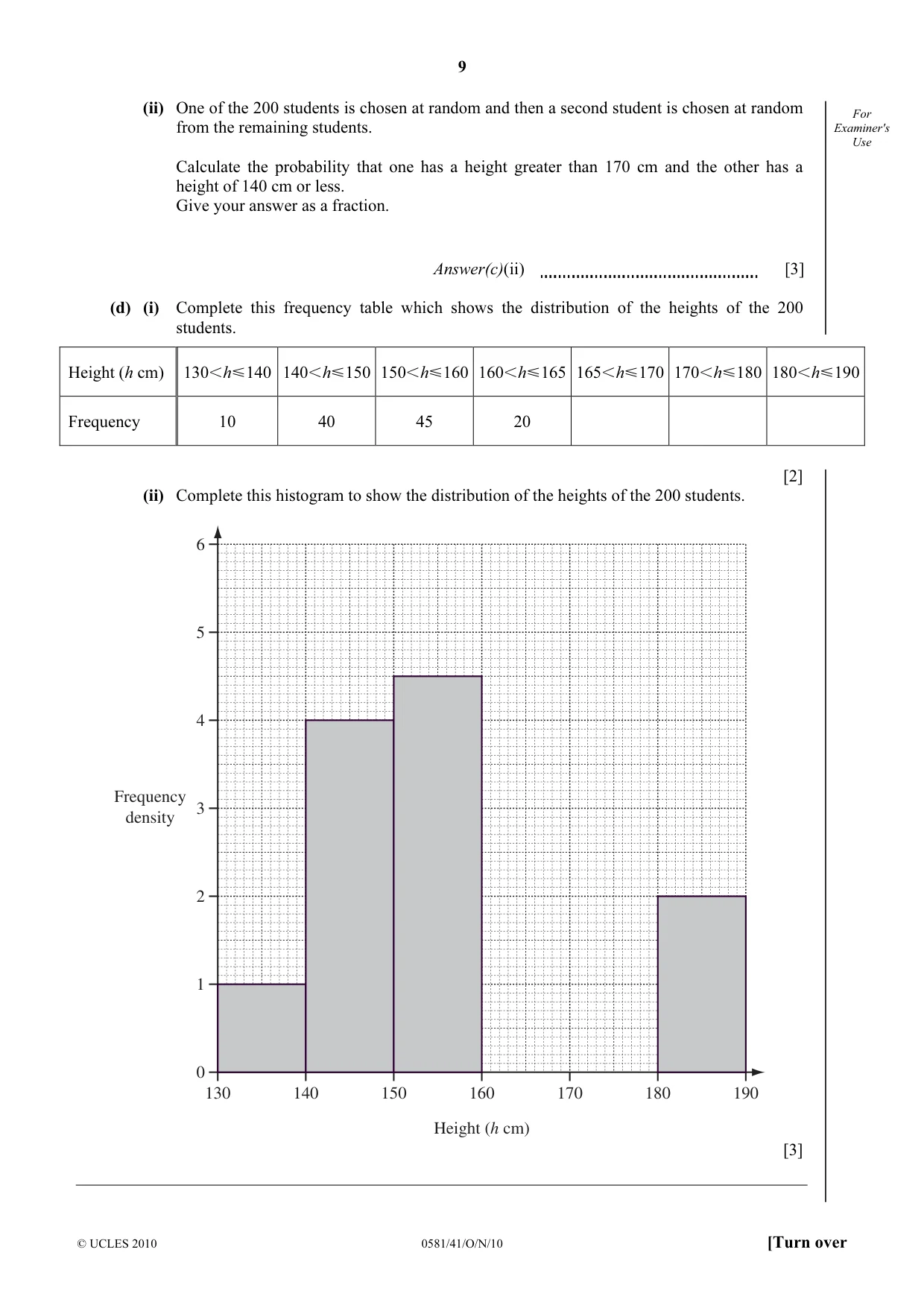
9 © UCLES 2010 0581/41/O/N/10 [Turn over For Examiner's Use (ii) One of the 200 students is chosen at random and then a second student is chosen at random from the remaining students. Calculate the probability that one has a height greater than 170 cm and the other has a height of 140 cm or less. Give your answer as a fraction. Answer(c)(ii) [3] (d) (i) Complete this frequency table which shows the distribution of the heights of the 200 students. [2] (ii) Complete this histogram to show the distribution of the heights of the 200 students. 6 5 4 3 2 1 0 130 140 150 160 Height (h cm) 170 180 190 Frequency density [3] Height (h cm) 130IhY140 140IhY150 150IhY160 160IhY165 165IhY170 170IhY180 180IhY190 Frequency 10 40 45 20
Question paper, page 10
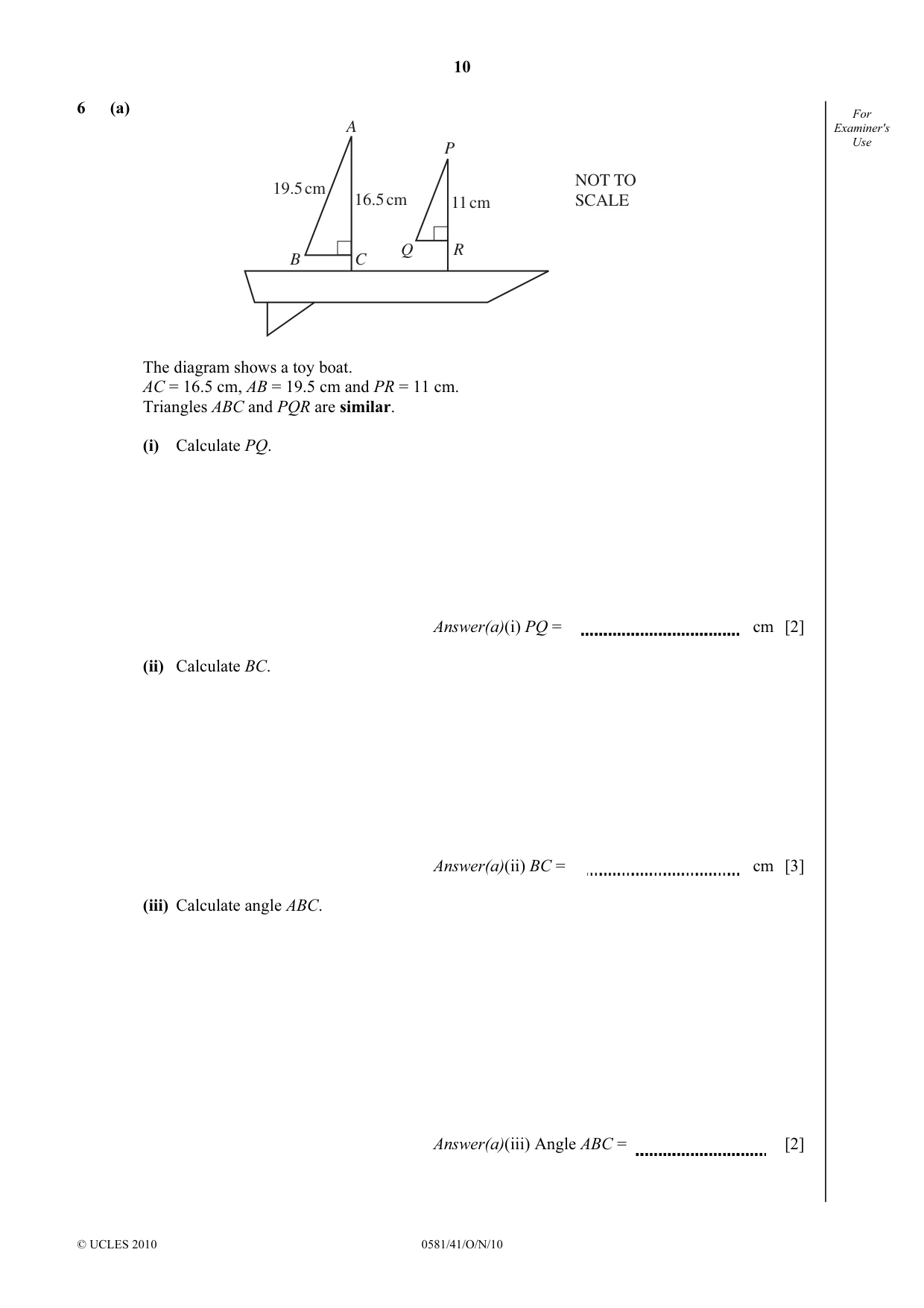
10 © UCLES 2010 0581/41/O/N/10 For Examiner's Use 6 (a) A B C Q R P 11 cm 16.5 cm 19.5 cm NOT TO SCALE The diagram shows a toy boat. AC = 16.5 cm, AB = 19.5 cm and PR = 11 cm. Triangles ABC and PQR are similar. (i) Calculate PQ. Answer(a)(i) PQ = cm [2] (ii) Calculate BC. Answer(a)(ii) BC = cm [3] (iii) Calculate angle ABC. Answer(a)(iii) Angle ABC = [2]
Question paper, page 11
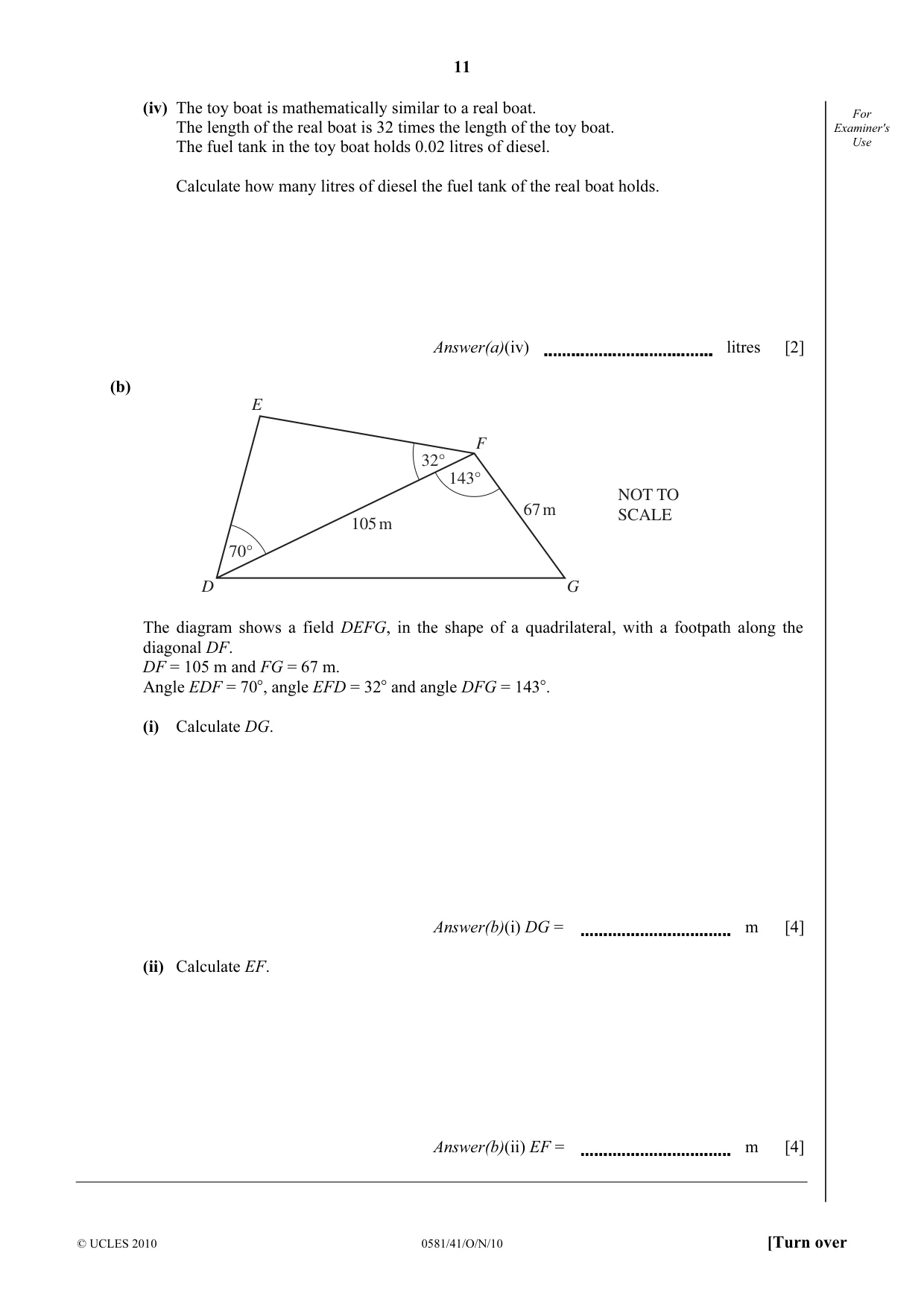
11 © UCLES 2010 0581/41/O/N/10 [Turn over For Examiner's Use (iv) The toy boat is mathematically similar to a real boat. The length of the real boat is 32 times the length of the toy boat. The fuel tank in the toy boat holds 0.02 litres of diesel. Calculate how many litres of diesel the fuel tank of the real boat holds. Answer(a)(iv) litres [2] (b) E D G F 70° 32° 143° 105 m 67 m NOT TO SCALE The diagram shows a field DEFG, in the shape of a quadrilateral, with a footpath along the diagonal DF. DF = 105 m and FG = 67 m. Angle EDF = 70U, angle EFD = 32U and angle DFG = 143U. (i) Calculate DG. Answer(b)(i) DG = m [4] (ii) Calculate EF. Answer(b)(ii) EF = m [4]
Question paper, page 12
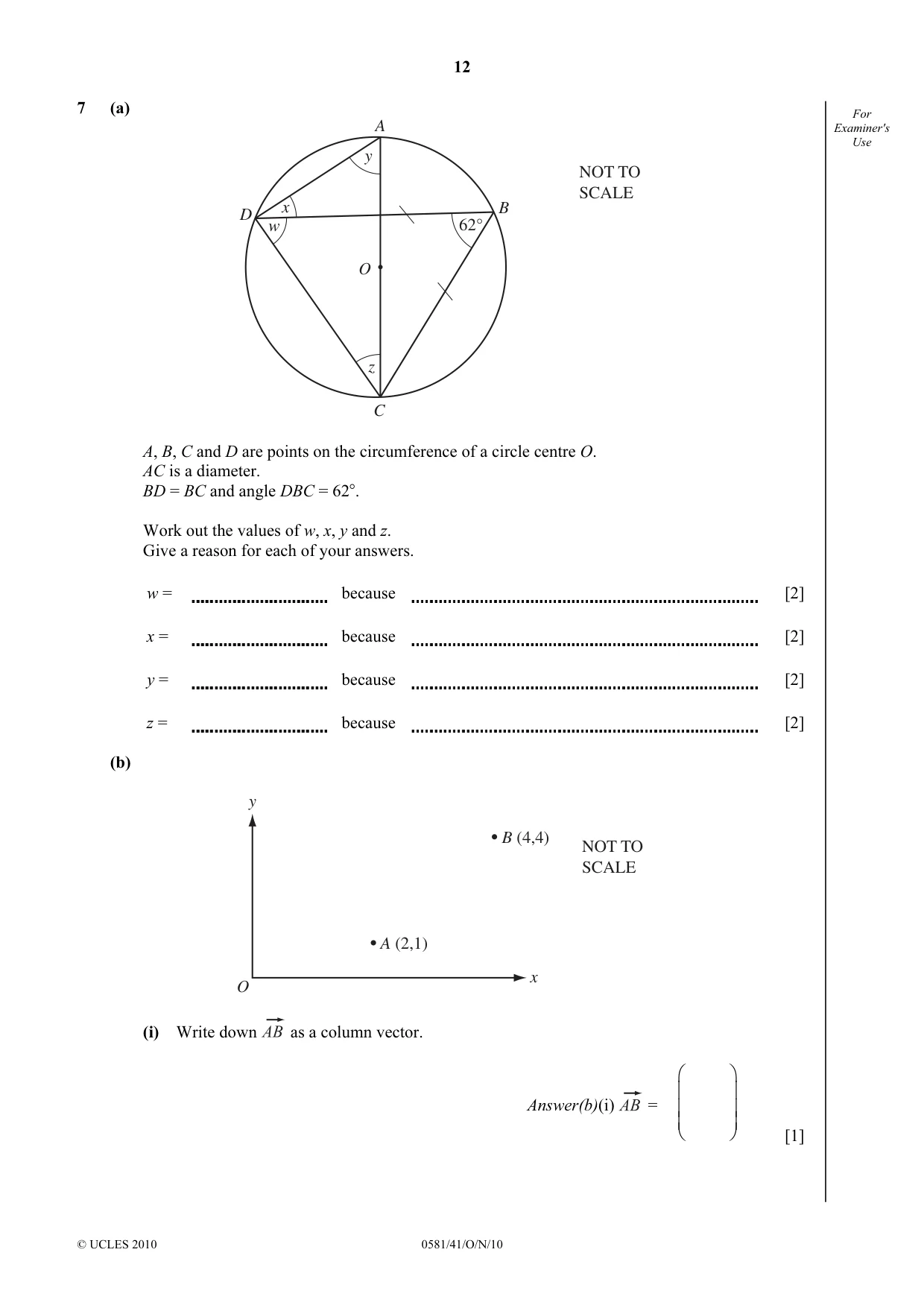
12 © UCLES 2010 0581/41/O/N/10 For Examiner's Use 7 (a) 62° w x y z O D A B C NOT TO SCALE A, B, C and D are points on the circumference of a circle centre O. AC is a diameter. BD = BC and angle DBC = 62U. Work out the values of w, x, y and z. Give a reason for each of your answers. w = because [2] x = because [2] y = because [2] z = because [2] (b) y x O A (2,1) B (4,4) NOT TO SCALE (i) Write down as a column vector. Answer(b)(i) = [1]
Question paper, page 13
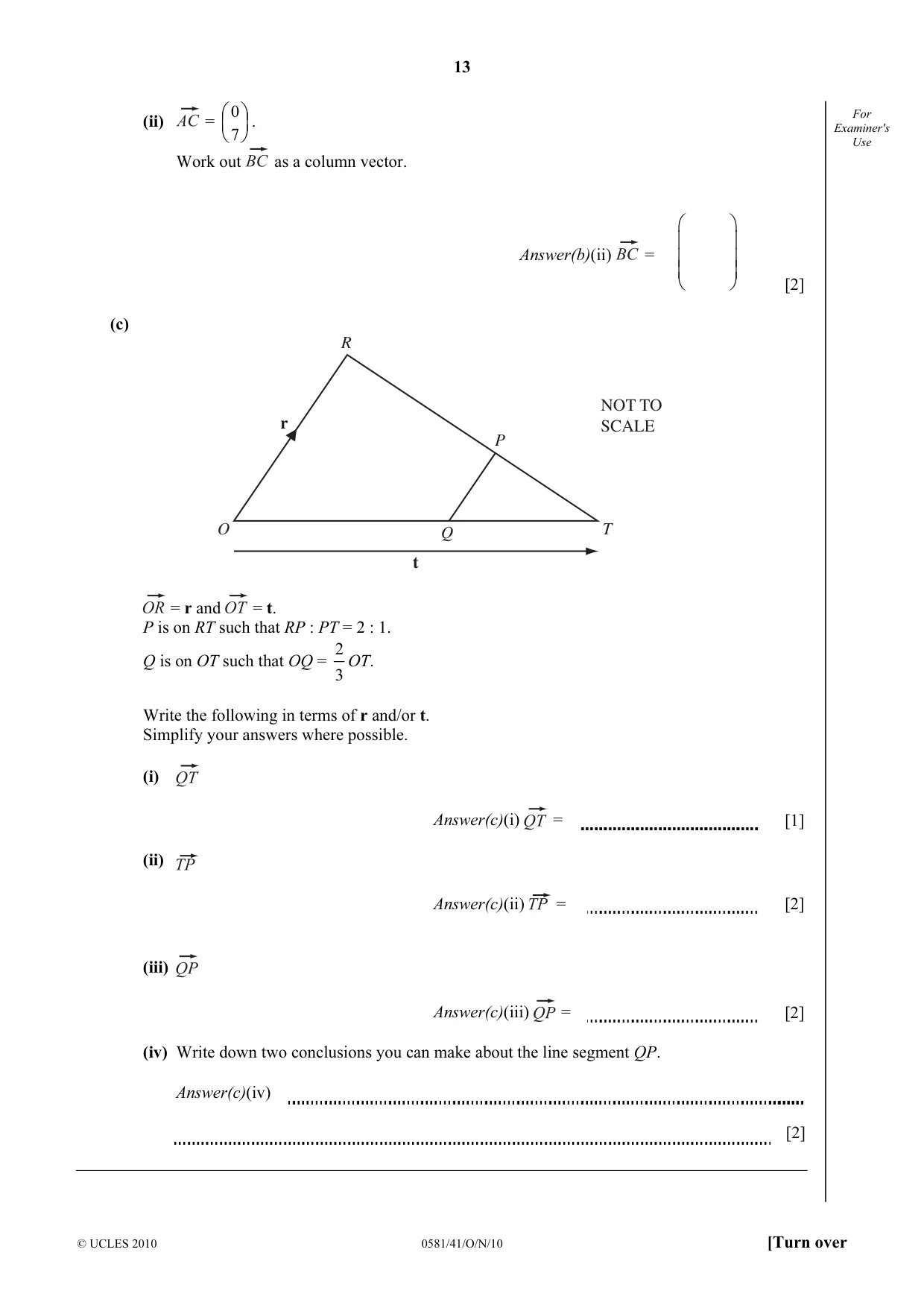
13 © UCLES 2010 0581/41/O/N/10 [Turn over For Examiner's Use (ii) = 0 7 . Work out as a column vector. Answer(b)(ii) = [2] (c) R O Q T r P NOT TO SCALE t = r and = t. P is on RT such that RP : PT = 2 : 1. Q is on OT such that OQ = 2 3 OT. Write the following in terms of r and/or t. Simplify your answers where possible. (i) Answer(c)(i) = [1] (ii) Answer(c)(ii) = [2] (iii) Answer(c)(iii) = [2] (iv) Write down two conclusions you can make about the line segment QP. Answer(c)(iv) [2]
Question paper, page 14
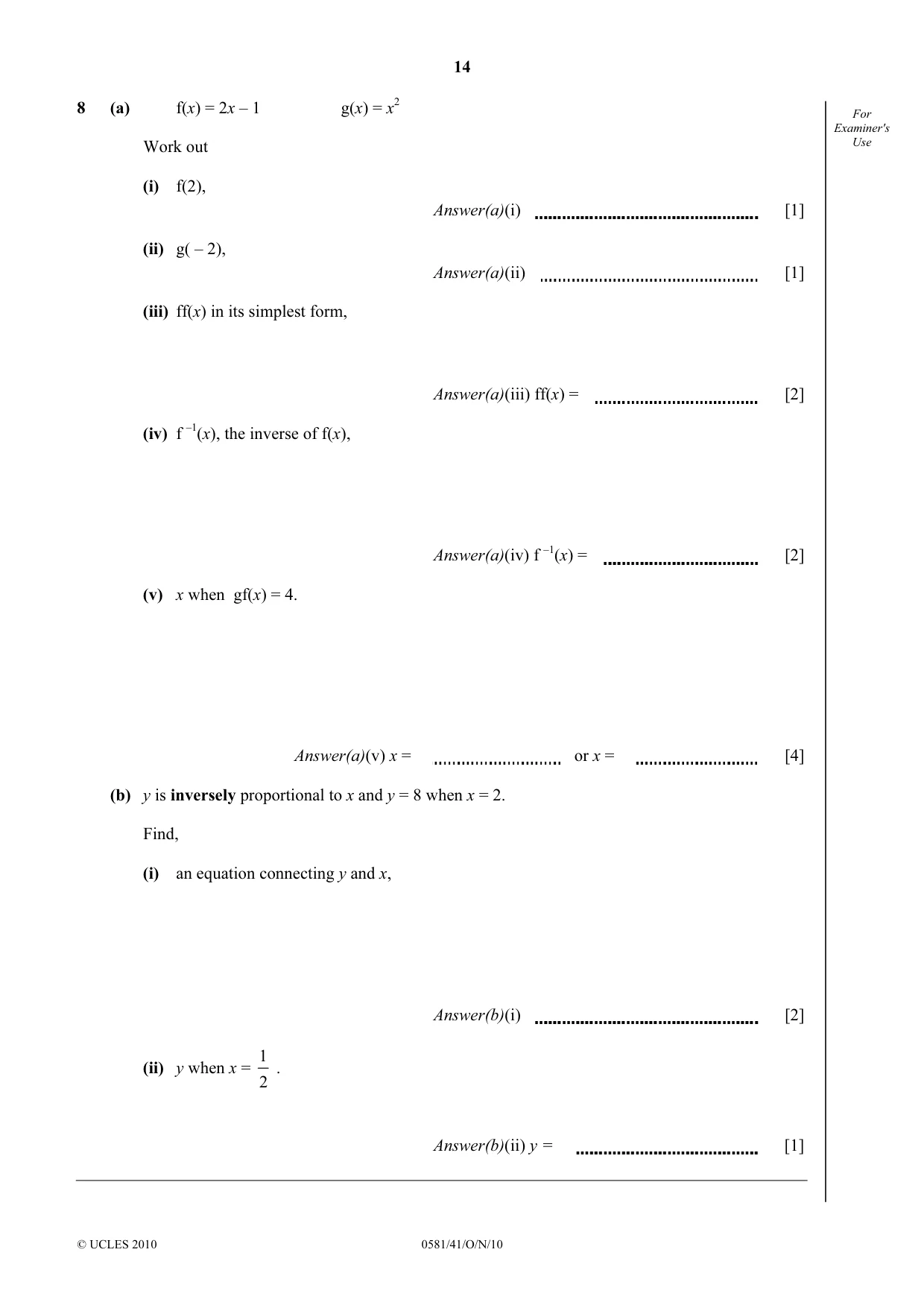
14 © UCLES 2010 0581/41/O/N/10 For Examiner's Use 8 (a) f(x) = 2x – 1 g(x) = x2 Work out (i) f(2), Answer(a)(i) [1] (ii) g( – 2), Answer(a)(ii) [1] (iii) ff(x) in its simplest form, Answer(a)(iii) ff(x) = [2] (iv) f –1(x), the inverse of f(x), Answer(a)(iv) f –1(x) = [2] (v) x when gf(x) = 4. Answer(a)(v) x = or x = [4] (b) y is inversely proportional to x and y = 8 when x = 2. Find, (i) an equation connecting y and x, Answer(b)(i) [2] (ii) y when x = 1 2 . Answer(b)(ii) y = [1]
Question paper, page 15
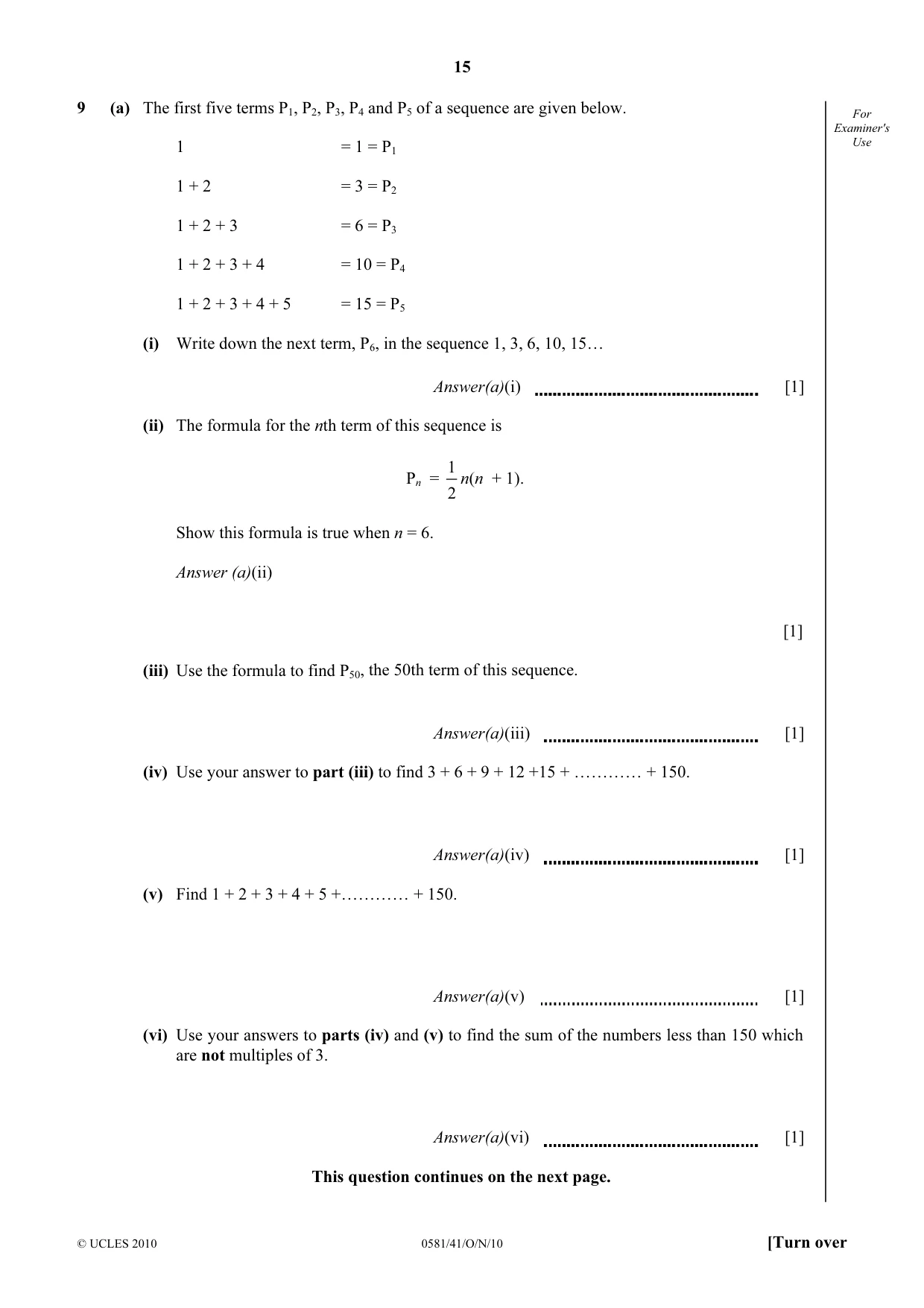
15 © UCLES 2010 0581/41/O/N/10 [Turn over For Examiner's Use 9 (a) The first five terms P1, P2, P3, P4 and P5 of a sequence are given below. 1 = 1 = P1 1 + 2 = 3 = P2 1 + 2 + 3 = 6 = P3 1 + 2 + 3 + 4 = 10 = P4 1 + 2 + 3 + 4 + 5 = 15 = P5 (i) Write down the next term, P6, in the sequence 1, 3, 6, 10, 15… Answer(a)(i) [1] (ii) The formula for the nth term of this sequence is Pn = 1 2 n(n + 1). Show this formula is true when n = 6. Answer (a)(ii) [1] (iii) Use the formula to find P50, the 50th term of this sequence. Answer(a)(iii) [1] (iv) Use your answer to part (iii) to find 3 + 6 + 9 + 12 +15 + ………… + 150. Answer(a)(iv) [1] (v) Find 1 + 2 + 3 + 4 + 5 +………… + 150. Answer(a)(v) [1] (vi) Use your answers to parts (iv) and (v) to find the sum of the numbers less than 150 which are not multiples of 3. Answer(a)(vi) [1] This question continues on the next page.
Question paper, page 16
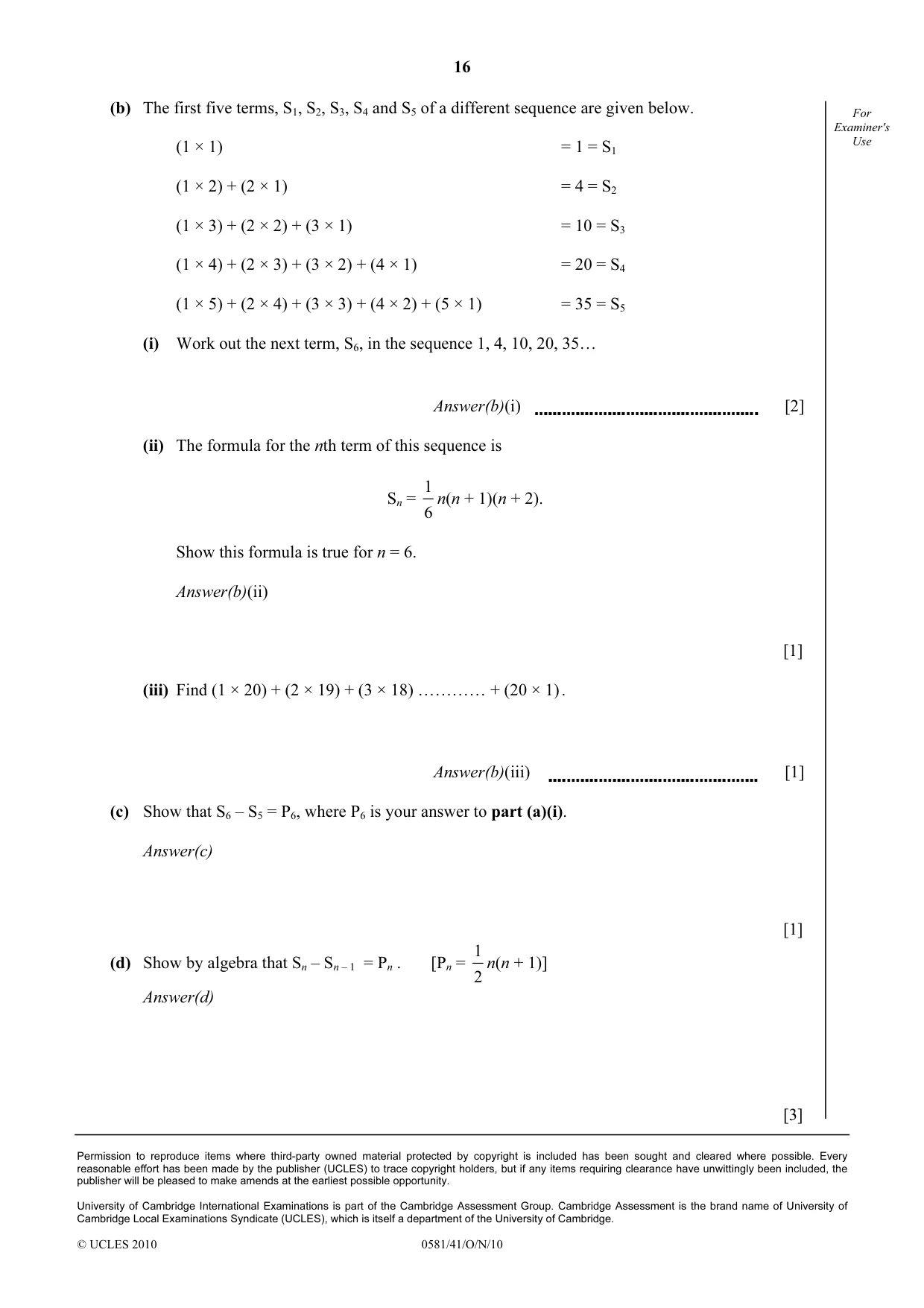
16 Permission to reproduce items where third-party owned material protected by copyright is included has been sought and cleared where possible. Every reasonable effort has been made by the publisher (UCLES) to trace copyright holders, but if any items requiring clearance have unwittingly been included, the publisher will be pleased to make amends at the earliest possible opportunity. University of Cambridge International Examinations is part of the Cambridge Assessment Group. Cambridge Assessment is the brand name of University of Cambridge Local Examinations Syndicate (UCLES), which is itself a department of the University of Cambridge. © UCLES 2010 0581/41/O/N/10 For Examiner's Use (b) The first five terms, S1, S2, S3, S4 and S5 of a different sequence are given below. (1 × 1) = 1 = S1 (1 × 2) + (2 × 1) = 4 = S2 (1 × 3) + (2 × 2) + (3 × 1) = 10 = S3 (1 × 4) + (2 × 3) + (3 × 2) + (4 × 1) = 20 = S4 (1 × 5) + (2 × 4) + (3 × 3) + (4 × 2) + (5 × 1) = 35 = S5 (i) Work out the next term, S6, in the sequence 1, 4, 10, 20, 35… Answer(b)(i) [2] (ii) The formula for the nth term of this sequence is Sn = 1 6 n(n + 1)(n + 2). Show this formula is true for n = 6. Answer(b)(ii) [1] (iii) Find (1 × 20) + (2 × 19) + (3 × 18) ………… + (20 × 1) . Answer(b)(iii) [1] (c) Show that S6 – S5 = P6, where P6 is your answer to part (a)(i). Answer(c) [1] (d) Show by algebra that Sn – Sn – 1 = Pn . [Pn = 1 2 n(n + 1)] Answer(d) [3]
Mark scheme, page 1
UNIVERSITY OF CAMBRIDGE INTERNATIONAL EXAMINATIONS International General Certificate of Secondary Education MARK SCHEME for the October/November 2010 question paper for the guidance of teachers 0581 MATHEMATICS 0581/41 Paper 4 (Extended), maximum raw mark 130 This mark scheme is published as an aid to teachers and candidates, to indicate the requirements of the examination. It shows the basis on which Examiners were instructed to award marks. It does not indicate the details of the discussions that took place at an Examiners’ meeting before marking began, which would have considered the acceptability of alternative answers. Mark schemes must be read in conjunction with the question papers and the report on the examination. • CIE will not enter into discussions or correspondence in connection with these mark schemes. CIE is publishing the mark schemes for the October/November 2010 question papers for most IGCSE, GCE Advanced Level and Advanced Subsidiary Level syllabuses and some Ordinary Level syllabuses. www.XtremePapers.com
Mark scheme, page 2
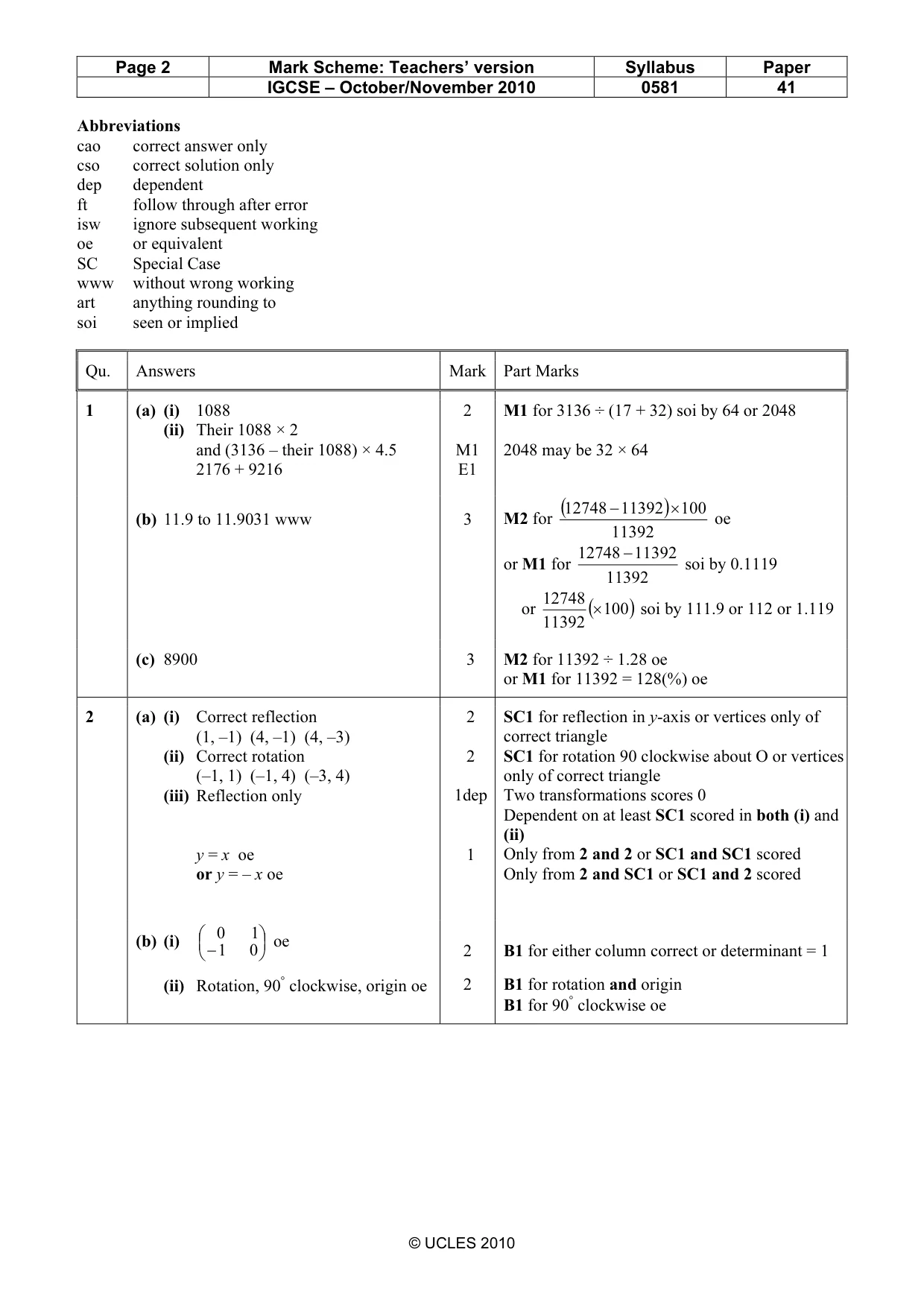
Page 2 Mark Scheme: Teachers’ version Syllabus Paper IGCSE – October/November 2010 0581 41 © UCLES 2010 Abbreviations cao correct answer only cso correct solution only dep dependent ft follow through after error isw ignore subsequent working oe or equivalent SC Special Case www without wrong working art anything rounding to soi seen or implied Qu. Answers Mark Part Marks 1 (a) (i) 1088 (ii) Their 1088 × 2 and (3136 – their 1088) × 4.5 2176 + 9216 2 M1 E1 M1 for 3136 ÷ (17 + 32) soi by 64 or 2048 2048 may be 32 × 64 (b) 11.9 to 11.9031 www 3 M2 for ( ) 11392 100 11392 12748 × − oe or M1 for 11392 11392 12748 − soi by 0.1119 or ( ) 100 11392 12748 × soi by 111.9 or 112 or 1.119 (c) 8900 3 M2 for 11392 ÷ 1.28 oe or M1 for 11392 = 128(%) oe 2 (a) (i) Correct reflection (1, –1) (4, –1) (4, –3) (ii) Correct rotation (–1, 1) (–1, 4) (–3, 4) (iii) Reflection only y = x oe or y = – x oe 2 2 1dep 1 SC1 for reflection in y-axis or vertices only of correct triangle SC1 for rotation 90 clockwise about O or vertices only of correct triangle Two transformations scores 0 Dependent on at least SC1 scored in both (i) and (ii) Only from 2 and 2 or SC1 and SC1 scored Only from 2 and SC1 or SC1 and 2 scored (b) (i) − 0 1 1 0 oe 2 B1 for either column correct or determinant = 1 (ii) Rotation, 90° clockwise, origin oe 2 B1 for rotation and origin B1 for 90° clockwise oe
Mark scheme, page 3
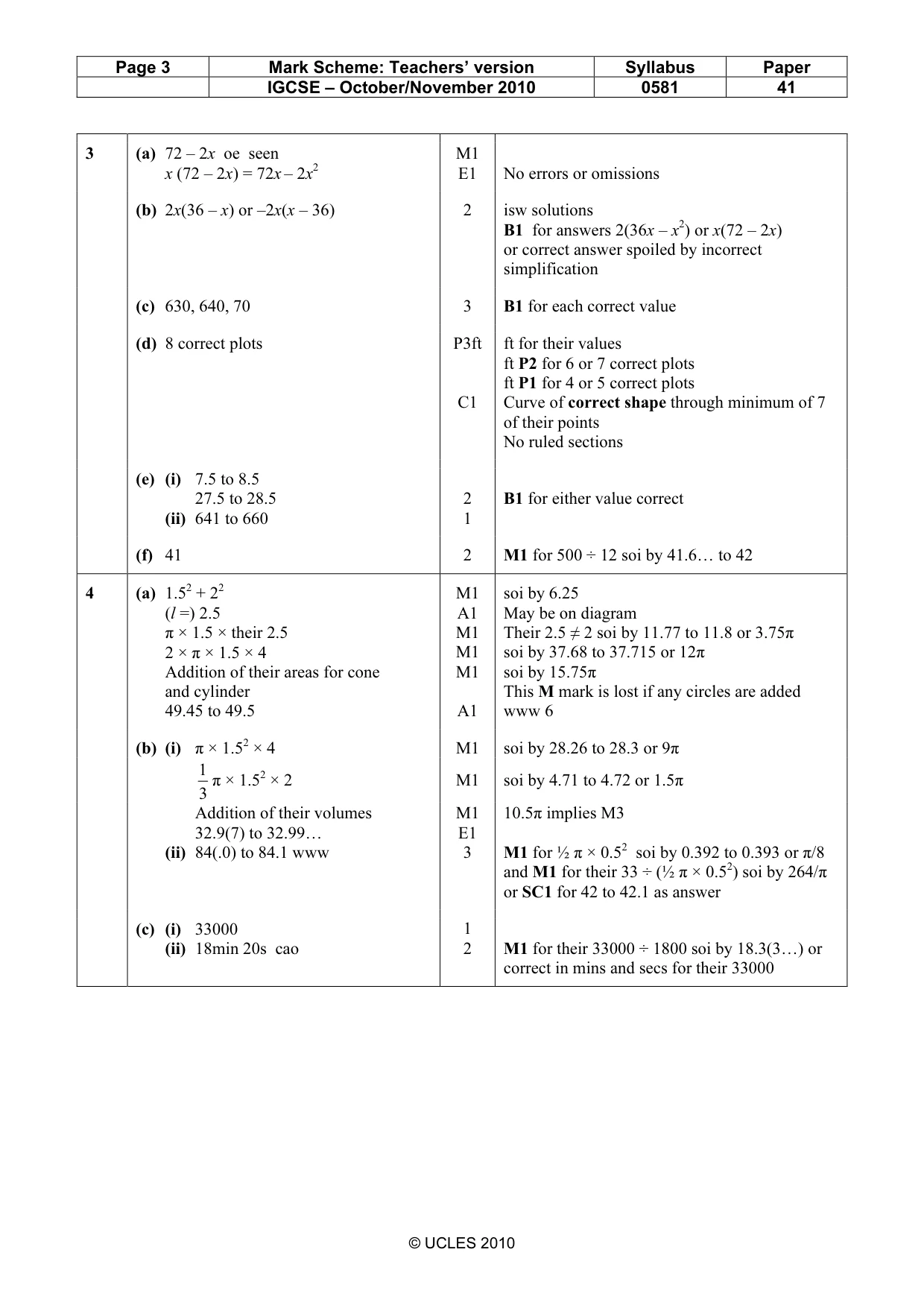
Page 3 Mark Scheme: Teachers’ version Syllabus Paper IGCSE – October/November 2010 0581 41 © UCLES 2010 3 (a) 72 – 2x oe seen x (72 – 2x) = 72x – 2x2 M1 E1 No errors or omissions (b) 2x(36 – x) or –2x(x – 36) 2 isw solutions B1 for answers 2(36x – x2) or x(72 – 2x) or correct answer spoiled by incorrect simplification (c) 630, 640, 70 3 B1 for each correct value (d) 8 correct plots P3ft C1 ft for their values ft P2 for 6 or 7 correct plots ft P1 for 4 or 5 correct plots Curve of correct shape through minimum of 7 of their points No ruled sections (e) (i) 7.5 to 8.5 27.5 to 28.5 (ii) 641 to 660 2 1 B1 for either value correct (f) 41 2 M1 for 500 ÷ 12 soi by 41.6… to 42 4 (a) 1.52 + 22 (l =) 2.5 π × 1.5 × their 2.5 2 × π × 1.5 × 4 Addition of their areas for cone and cylinder 49.45 to 49.5 M1 A1 M1 M1 M1 A1 soi by 6.25 May be on diagram Their 2.5 ≠ 2 soi by 11.77 to 11.8 or 3.75π soi by 37.68 to 37.715 or 12π soi by 15.75π This M mark is lost if any circles are added www 6 (b) (i) π × 1.52 × 4 M1 soi by 28.26 to 28.3 or 9π 3 1 π × 1.52 × 2 M1 soi by 4.71 to 4.72 or 1.5π Addition of their volumes 32.9(7) to 32.99… (ii) 84(.0) to 84.1 www M1 E1 3 10.5π implies M3 M1 for ½ π × 0.52 soi by 0.392 to 0.393 or π/8 and M1 for their 33 ÷ (½ π × 0.52) soi by 264/π or SC1 for 42 to 42.1 as answer (c) (i) 33000 (ii) 18min 20s cao 1 2 M1 for their 33000 ÷ 1800 soi by 18.3(3…) or correct in mins and secs for their 33000
Mark scheme, page 4
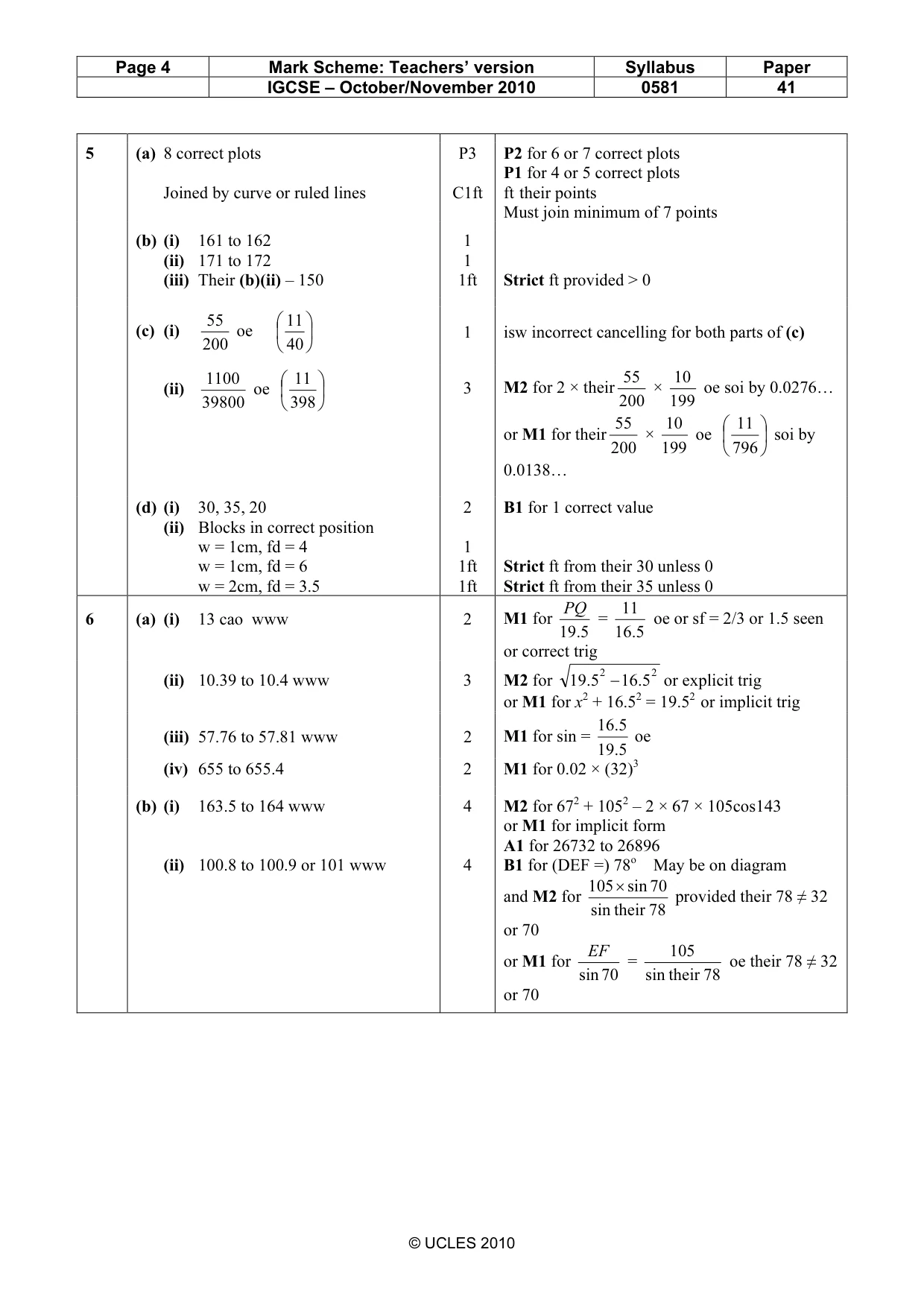
Page 4 Mark Scheme: Teachers’ version Syllabus Paper IGCSE – October/November 2010 0581 41 © UCLES 2010 5 (a) 8 correct plots Joined by curve or ruled lines P3 C1ft P2 for 6 or 7 correct plots P1 for 4 or 5 correct plots ft their points Must join minimum of 7 points (b) (i) 161 to 162 (ii) 171 to 172 (iii) Their (b)(ii) – 150 1 1 1ft Strict ft provided > 0 (c) (i) 200 55 oe 40 11 1 isw incorrect cancelling for both parts of (c) (ii) 39800 1100 oe 398 11 3 M2 for 2 × their 200 55 × 199 10 oe soi by 0.0276… or M1 for their 200 55 × 199 10 oe 796 11 soi by 0.0138… (d) (i) 30, 35, 20 (ii) Blocks in correct position w = 1cm, fd = 4 w = 1cm, fd = 6 w = 2cm, fd = 3.5 2 1 1ft 1ft B1 for 1 correct value Strict ft from their 30 unless 0 Strict ft from their 35 unless 0 6 (a) (i) 13 cao www 2 M1 for 5. 19 PQ = 5. 16 11 oe or sf = 2/3 or 1.5 seen or correct trig (ii) 10.39 to 10.4 www 3 M2 for 2 2 5. 16 5. 19 − or explicit trig or M1 for x2 + 16.52 = 19.52 or implicit trig (iii) 57.76 to 57.81 www 2 M1 for sin = 5. 19 5. 16 oe (iv) 655 to 655.4 2 M1 for 0.02 × (32)3 (b) (i) 163.5 to 164 www (ii) 100.8 to 100.9 or 101 www 4 4 M2 for 672 + 1052 – 2 × 67 × 105cos143 or M1 for implicit form A1 for 26732 to 26896 B1 for (DEF =) 78o May be on diagram and M2 for 78 their sin 70 sin 105× provided their 78 ≠ 32 or 70 or M1 for 70 sin EF = 78 their sin 105 oe their 78 ≠ 32 or 70
Mark scheme, page 5
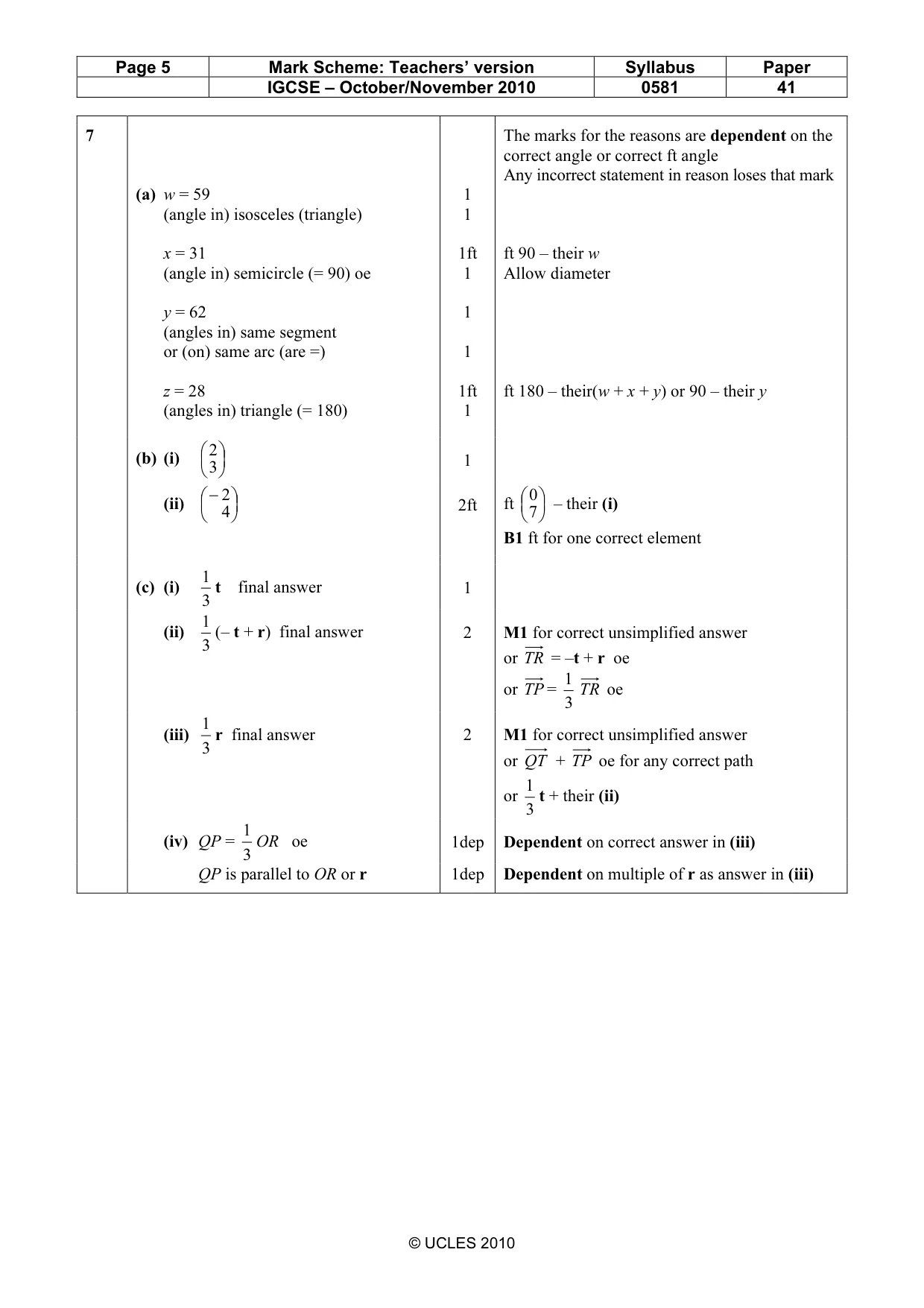
Page 5 Mark Scheme: Teachers’ version Syllabus Paper IGCSE – October/November 2010 0581 41 © UCLES 2010 7 (a) w = 59 (angle in) isosceles (triangle) x = 31 (angle in) semicircle (= 90) oe y = 62 (angles in) same segment or (on) same arc (are =) z = 28 (angles in) triangle (= 180) 1 1 1ft 1 1 1 1ft 1 The marks for the reasons are dependent on the correct angle or correct ft angle Any incorrect statement in reason loses that mark ft 90 – their w Allow diameter ft 180 – their(w + x + y) or 90 – their y (b) (i) 3 2 1 (ii) − 4 2 2ft ft 7 0 – their (i) B1 ft for one correct element (c) (i) 3 1 t final answer 1 (ii) 3 1 (– t + r) final answer 2 M1 for correct unsimplified answer or TR = –t + r oe or TP = 3 1 TR oe (iii) 3 1 r final answer 2 M1 for correct unsimplified answer or QT + TP oe for any correct path or 3 1 t + their (ii) (iv) QP = 3 1 OR oe 1dep Dependent on correct answer in (iii) QP is parallel to OR or r 1dep Dependent on multiple of r as answer in (iii)
Mark scheme, page 6
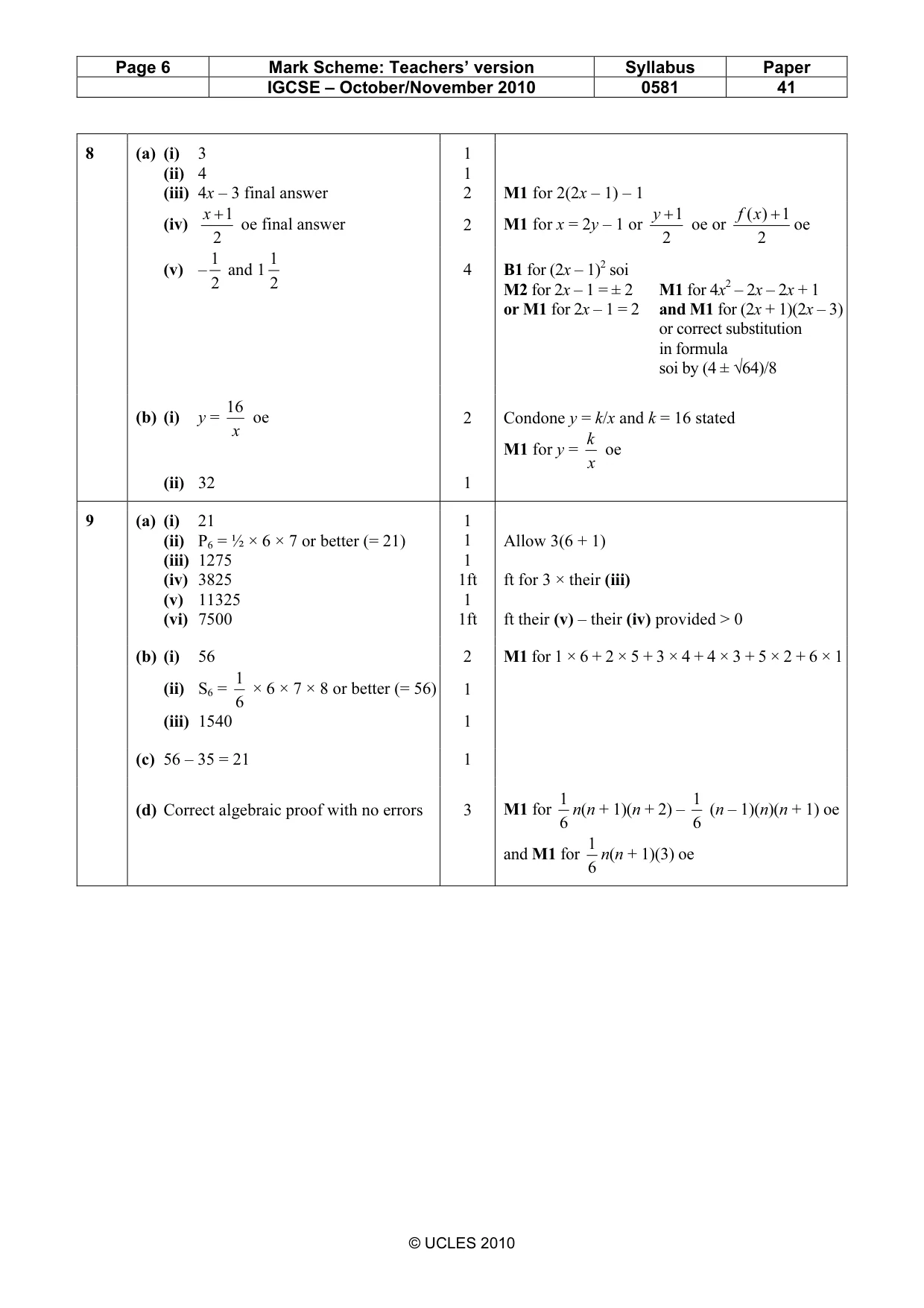
Page 6 Mark Scheme: Teachers’ version Syllabus Paper IGCSE – October/November 2010 0581 41 © UCLES 2010 8 (a) (i) 3 (ii) 4 (iii) 4x – 3 final answer 1 1 2 M1 for 2(2x – 1) – 1 (iv) 2 1 + x oe final answer 2 M1 for x = 2y – 1 or 2 1 + y oe or 2 1 ) ( + x f oe (v) – 2 1 and 1 2 1 4 B1 for (2x – 1)2 soi M2 for 2x – 1 = ± 2 M1 for 4x2 – 2x – 2x + 1 or M1 for 2x – 1 = 2 and M1 for (2x + 1)(2x – 3) or correct substitution in formula soi by (4 ± √64)/8 (b) (i) y = x 16 oe 2 Condone y = k/x and k = 16 stated M1 for y = x k oe (ii) 32 1 9 (a) (i) 21 (ii) P6 = ½ × 6 × 7 or better (= 21) (iii) 1275 (iv) 3825 (v) 11325 (vi) 7500 1 1 1 1ft 1 1ft Allow 3(6 + 1) ft for 3 × their (iii) ft their (v) – their (iv) provided > 0 (b) (i) 56 2 M1 for 1 × 6 + 2 × 5 + 3 × 4 + 4 × 3 + 5 × 2 + 6 × 1 (ii) S6 = 6 1 × 6 × 7 × 8 or better (= 56) 1 (iii) 1540 1 (c) 56 – 35 = 21 1 (d) Correct algebraic proof with no errors 3 M1 for 6 1 n(n + 1)(n + 2) – 6 1 (n – 1)(n)(n + 1) oe and M1 for 6 1 n(n + 1)(3) oe
What you needed in this session
Cambridge’s own grade thresholds for 2010 Oct/Nov, Paper 4 · Variant 1. A higher threshold means an easier paper — the bar moves with how the cohort did.