Cambridge IGCSE Mathematics (with coursework) 0581 — 2010 May/June Paper 3 · Variant 2
0581/32/M/J/10
The question paper and its mark scheme, free to read here and free to download. This is Cambridge’s own paper, exactly as it was sat.
Question paper16 pages
Mark scheme5 pages
Answers below. Sit the paper first if you are practising.
Paper as text
Question paper, page 1
This document consists of 15 printed pages and 1 blank page. IB10 06_0581_32/FP © UCLES 2010 [Turn over *4189213740* UNIVERSITY OF CAMBRIDGE INTERNATIONAL EXAMINATIONS International General Certificate of Secondary Education MATHEMATICS 0581/32 Paper 3 (Core) May/June 2010 2 hours Candidates answer on the Question Paper. Additional Materials: Electronic calculator Geometrical instruments Mathematical tables (optional) Tracing paper (optional) READ THESE INSTRUCTIONS FIRST Write your Centre number, candidate number and name on all the work you hand in. Write in dark blue or black pen. You may use a pencil for any diagrams or graphs. Do not use staples, paper clips, highlighters, glue or correction fluid. DO NOT WRITE IN ANY BARCODES. Answer all questions. If working is needed for any question it must be shown below that question. Electronic calculators should be used. If the degree of accuracy is not specified in the question, and if the answer is not exact, give the answer to three significant figures. Give answers in degrees to one decimal place. For π , use either your calculator value or 3.142. At the end of the examination, fasten all your work securely together. The number of marks is given in brackets [ ] at the end of each question or part question. The total of the marks for this paper is 104. www.XtremePapers.com
Question paper, page 2
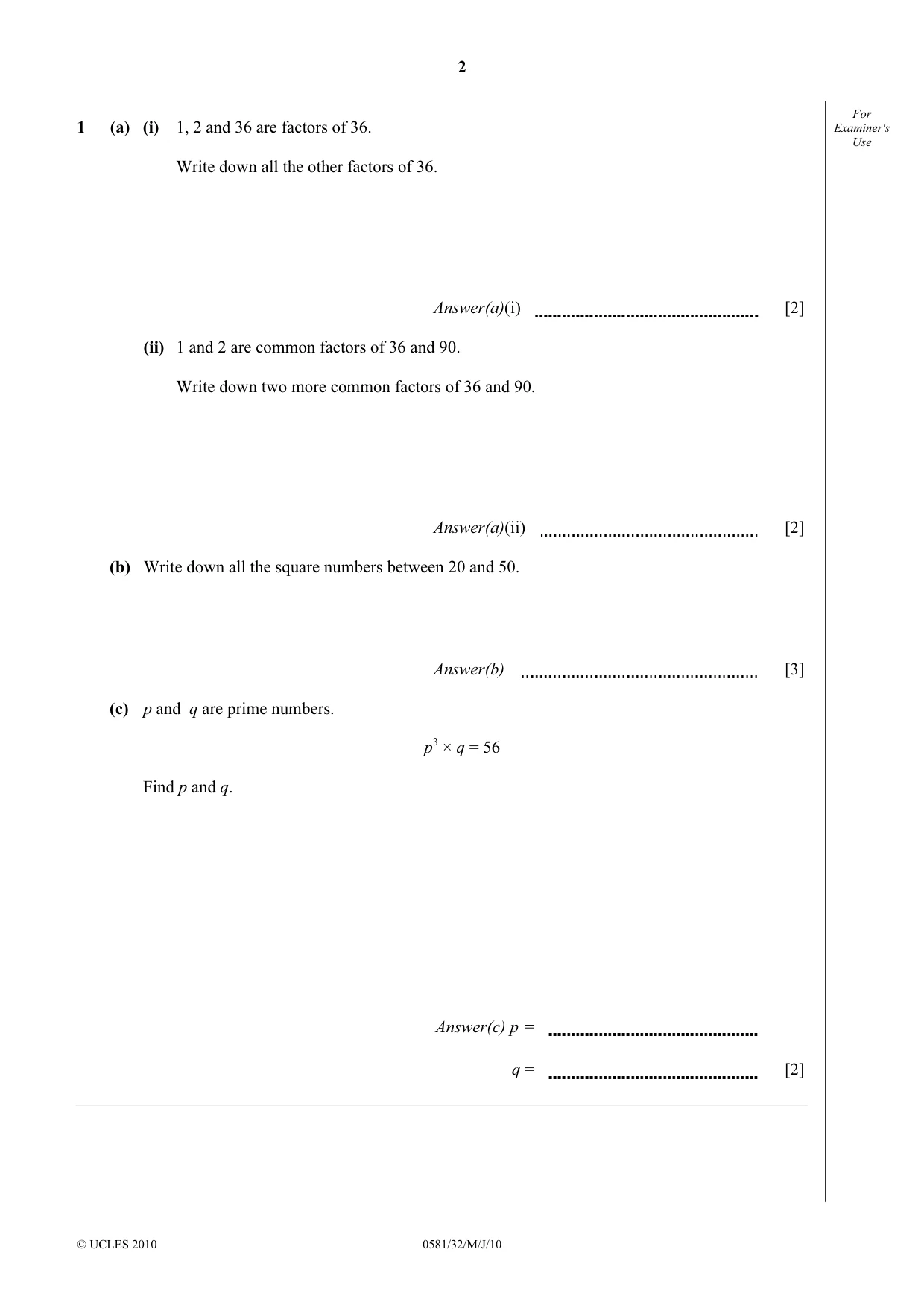
2 © UCLES 2010 0581/32/M/J/10 For Examiner's Use 1 (a) (i) 1, 2 and 36 are factors of 36. Write down all the other factors of 36. Answer(a)(i) [2] (ii) 1 and 2 are common factors of 36 and 90. Write down two more common factors of 36 and 90. Answer(a)(ii) [2] (b) Write down all the square numbers between 20 and 50. Answer(b) [3] (c) p and q are prime numbers. p3 × q = 56 Find p and q. Answer(c) p = q = [2]
Question paper, page 3
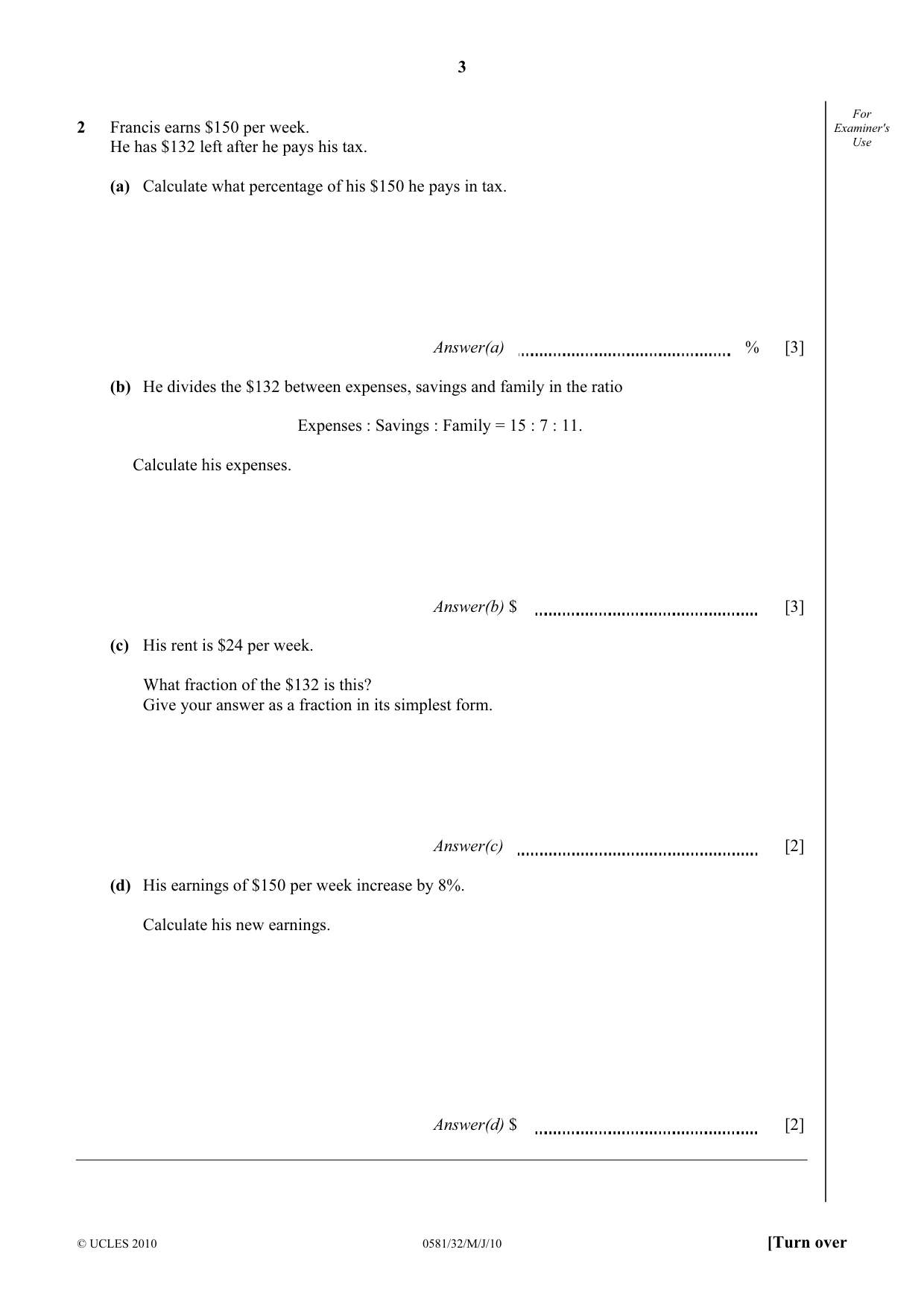
3 © UCLES 2010 0581/32/M/J/10 [Turn over For Examiner's Use 2 Francis earns $150 per week. He has $132 left after he pays his tax. (a) Calculate what percentage of his $150 he pays in tax. Answer(a) % [3] (b) He divides the $132 between expenses, savings and family in the ratio Expenses : Savings : Family = 15 : 7 : 11. Calculate his expenses. Answer(b) $ [3] (c) His rent is $24 per week. What fraction of the $132 is this? Give your answer as a fraction in its simplest form. Answer(c) [2] (d) His earnings of $150 per week increase by 8%. Calculate his new earnings. Answer(d) $ [2]
Question paper, page 4
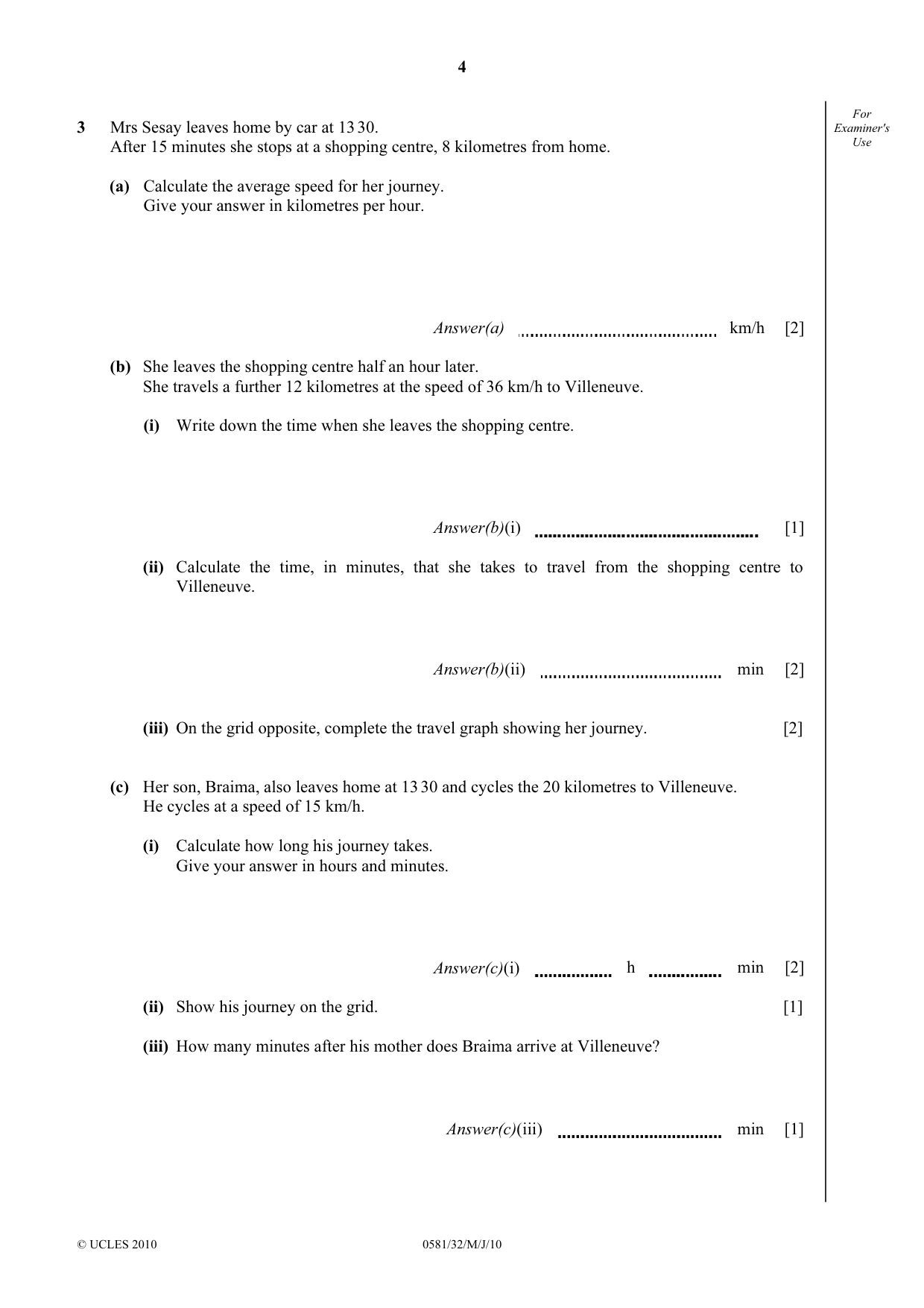
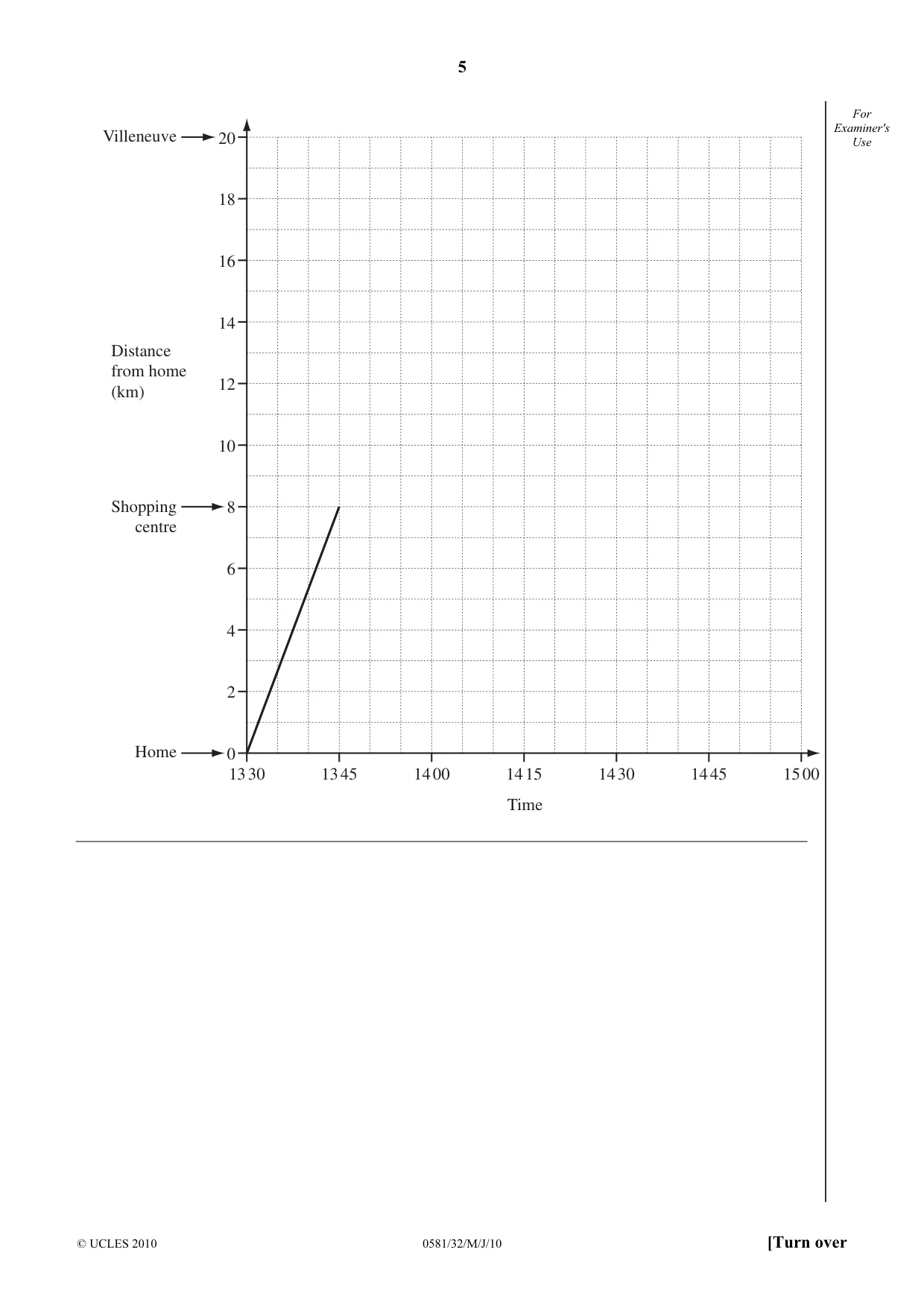
4 © UCLES 2010 0581/32/M/J/10 For Examiner's Use 3 Mrs Sesay leaves home by car at 13 30. After 15 minutes she stops at a shopping centre, 8 kilometres from home. (a) Calculate the average speed for her journey. Give your answer in kilometres per hour. Answer(a) km/h [2] (b) She leaves the shopping centre half an hour later. She travels a further 12 kilometres at the speed of 36 km/h to Villeneuve. (i) Write down the time when she leaves the shopping centre. Answer(b)(i) [1] (ii) Calculate the time, in minutes, that she takes to travel from the shopping centre to Villeneuve. Answer(b)(ii) min [2] (iii) On the grid opposite, complete the travel graph showing her journey. [2] (c) Her son, Braima, also leaves home at 13 30 and cycles the 20 kilometres to Villeneuve. He cycles at a speed of 15 km/h. (i) Calculate how long his journey takes. Give your answer in hours and minutes. Answer(c)(i) h min [2] (ii) Show his journey on the grid. [1] (iii) How many minutes after his mother does Braima arrive at Villeneuve? Answer(c)(iii) min [1]
Question paper, page 5
5 © UCLES 2010 0581/32/M/J/10 [Turn over For Examiner's Use 20 18 16 14 12 10 8 6 4 2 0 13 30 13 45 14 00 14 15 14 30 14 45 15 00 Villeneuve Shopping centre Home Distance from home (km) Time
Question paper, page 6
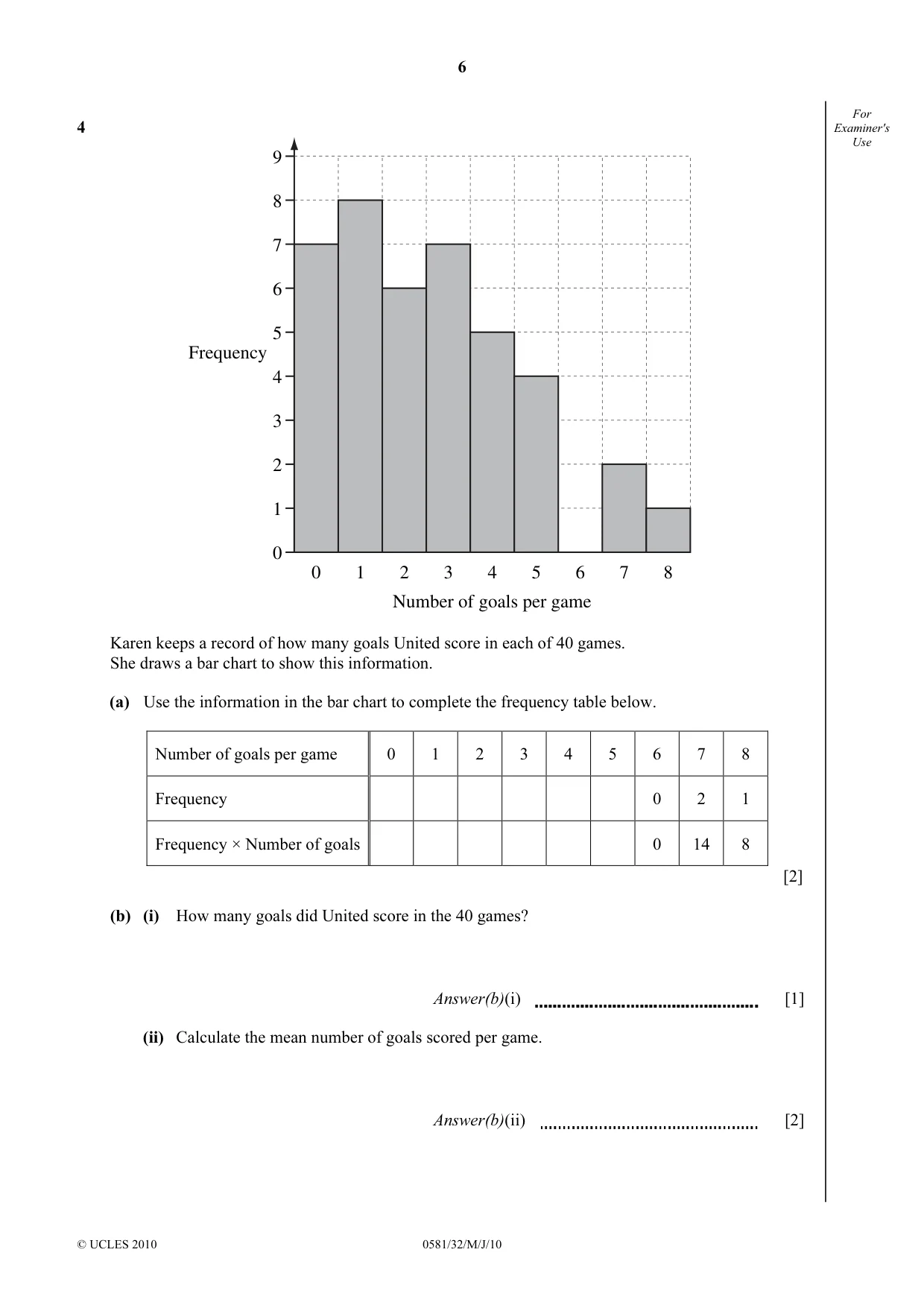
6 © UCLES 2010 0581/32/M/J/10 For Examiner's Use 4 9 8 7 6 5 4 3 2 1 0 0 1 2 3 4 5 6 7 8 Frequency Number of goals per game Karen keeps a record of how many goals United score in each of 40 games. She draws a bar chart to show this information. (a) Use the information in the bar chart to complete the frequency table below. Number of goals per game 0 1 2 3 4 5 6 7 8 Frequency 0 2 1 Frequency × Number of goals 0 14 8 [2] (b) (i) How many goals did United score in the 40 games? Answer(b)(i) [1] (ii) Calculate the mean number of goals scored per game. Answer(b)(ii) [2]
Question paper, page 7
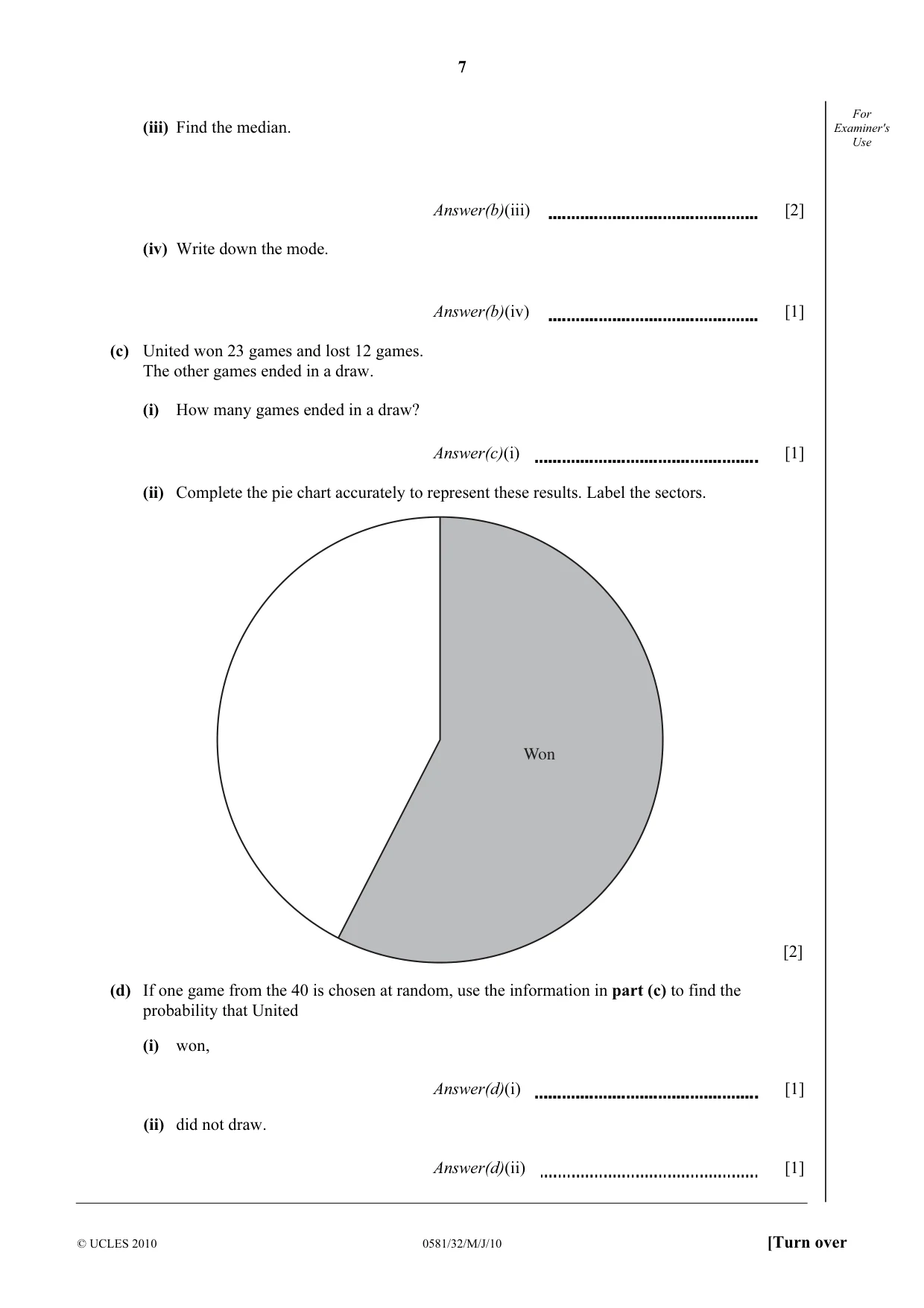
7 © UCLES 2010 0581/32/M/J/10 [Turn over For Examiner's Use (iii) Find the median. Answer(b)(iii) [2] (iv) Write down the mode. Answer(b)(iv) [1] (c) United won 23 games and lost 12 games. The other games ended in a draw. (i) How many games ended in a draw? Answer(c)(i) [1] (ii) Complete the pie chart accurately to represent these results. Label the sectors. [2] (d) If one game from the 40 is chosen at random, use the information in part (c) to find the probability that United (i) won, Answer(d)(i) [1] (ii) did not draw. Answer(d)(ii) [1] Won
Question paper, page 8
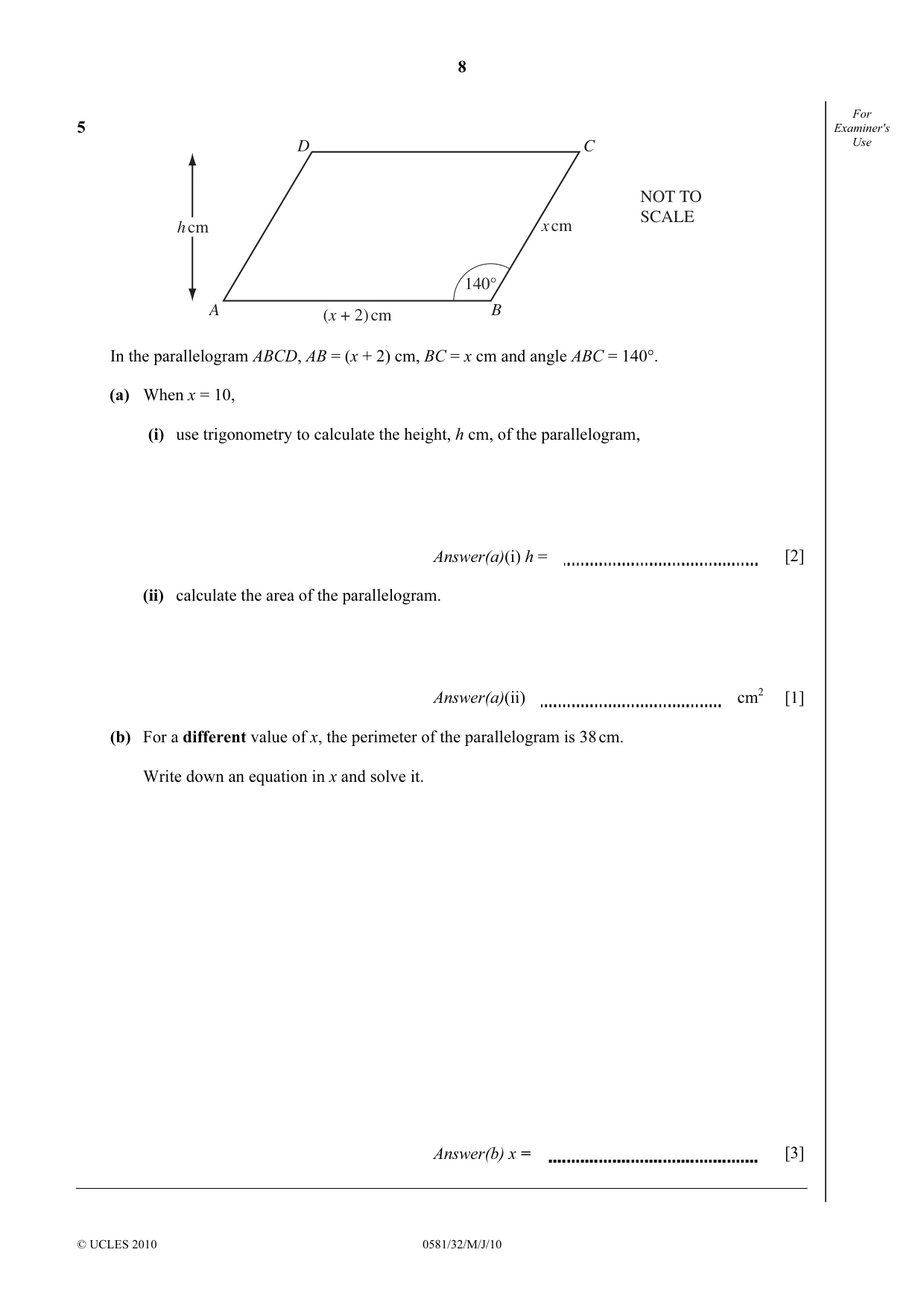
8 © UCLES 2010 0581/32/M/J/10 For Examiner's Use 5 D C A B 140° (x + 2) cm x cm NOT TO SCALE h cm In the parallelogram ABCD, AB = (x + 2) cm, BC = x cm and angle ABC = 140°. (a) When x = 10, (i) use trigonometry to calculate the height, h cm, of the parallelogram, Answer(a)(i) h = [2] (ii) calculate the area of the parallelogram. Answer(a)(ii) cm2 [1] (b) For a different value of x, the perimeter of the parallelogram is 38 cm. Write down an equation in x and solve it. Answer(b) x = [3]
Question paper, page 9
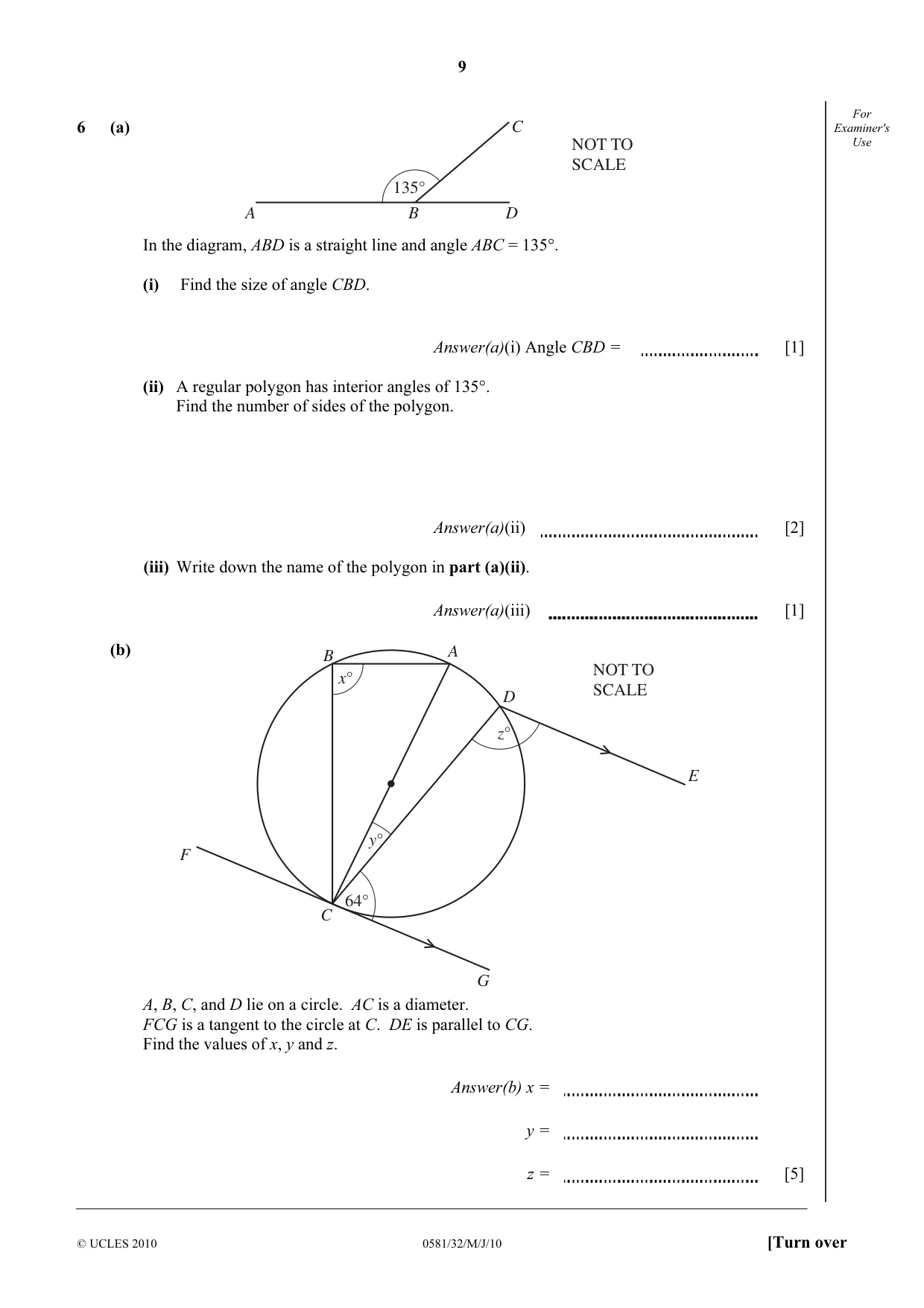
9 © UCLES 2010 0581/32/M/J/10 [Turn over For Examiner's Use 6 (a) In the diagram, ABD is a straight line and angle ABC = 135°. (i) Find the size of angle CBD. Answer(a)(i) Angle CBD = [1] (ii) A regular polygon has interior angles of 135°. Find the number of sides of the polygon. Answer(a)(ii) [2] (iii) Write down the name of the polygon in part (a)(ii). Answer(a)(iii) [1] (b) A, B, C, and D lie on a circle. AC is a diameter. FCG is a tangent to the circle at C. DE is parallel to CG. Find the values of x, y and z. Answer(b) x = y = z = [5] 64° y° x° z° F C G B A D E NOT TO SCALE 135° A B D C NOT TO SCALE
Question paper, page 10
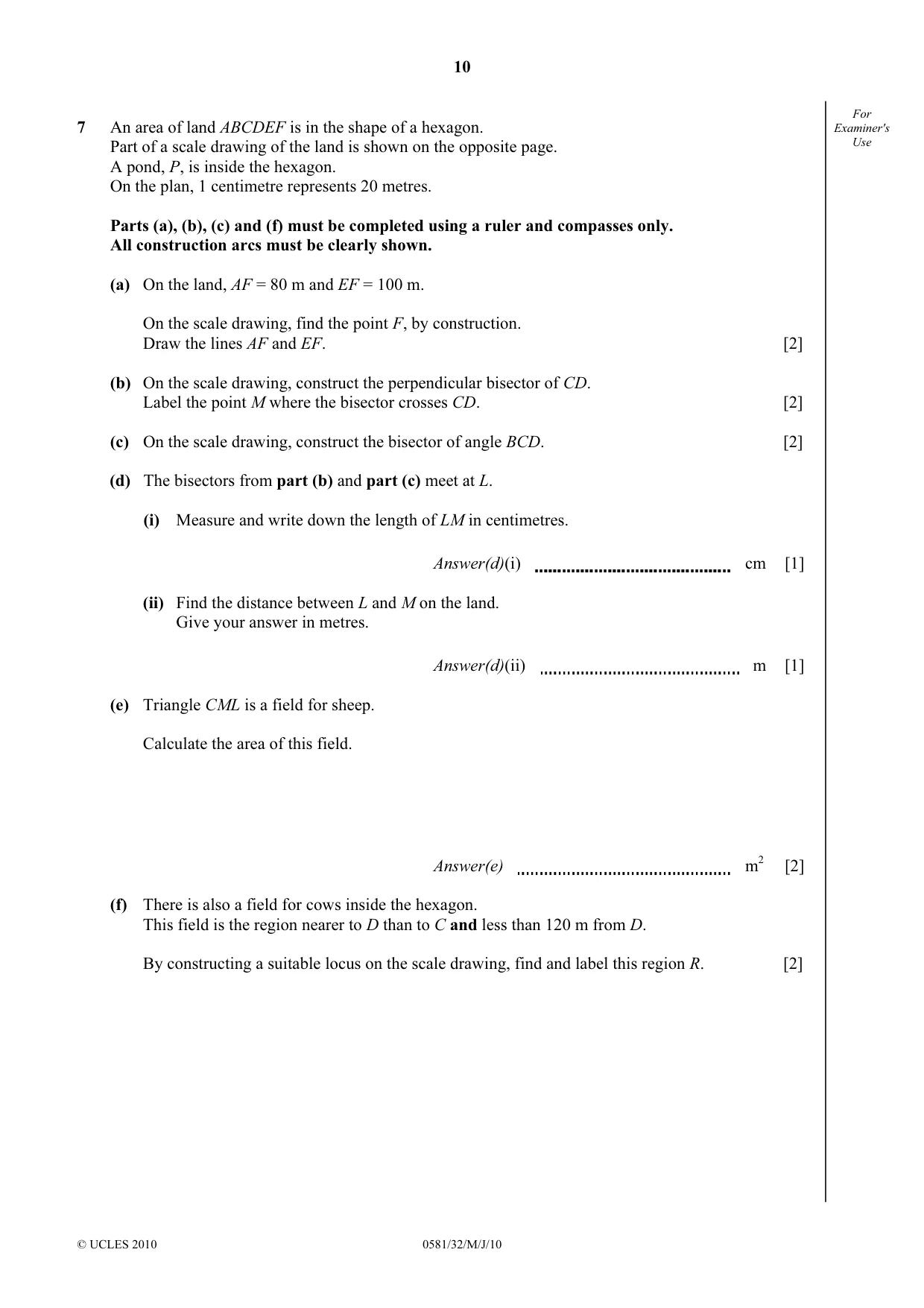
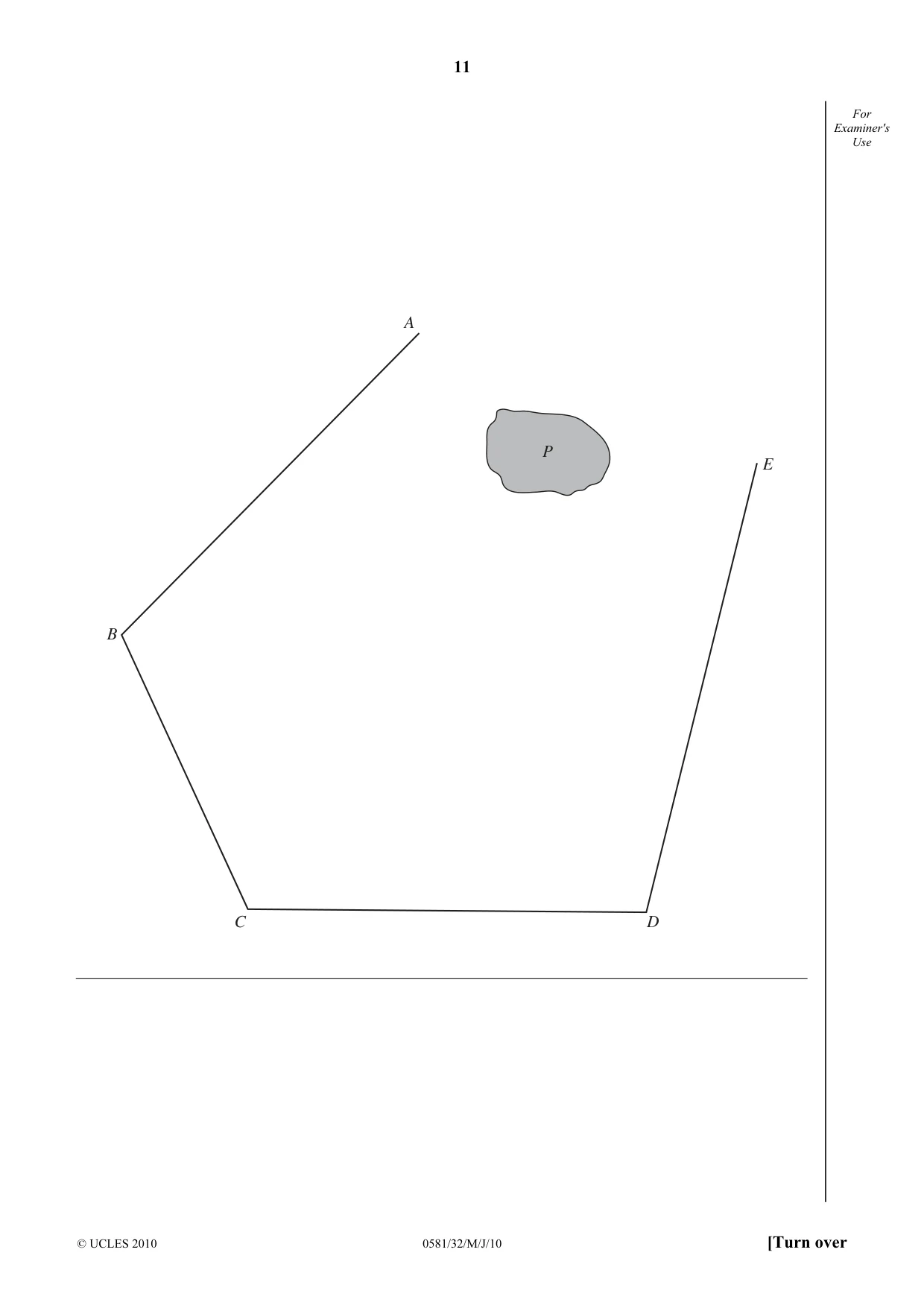
10 © UCLES 2010 0581/32/M/J/10 For Examiner's Use 7 An area of land ABCDEF is in the shape of a hexagon. Part of a scale drawing of the land is shown on the opposite page. A pond, P, is inside the hexagon. On the plan, 1 centimetre represents 20 metres. Parts (a), (b), (c) and (f) must be completed using a ruler and compasses only. All construction arcs must be clearly shown. (a) On the land, AF = 80 m and EF = 100 m. On the scale drawing, find the point F, by construction. Draw the lines AF and EF. [2] (b) On the scale drawing, construct the perpendicular bisector of CD. Label the point M where the bisector crosses CD. [2] (c) On the scale drawing, construct the bisector of angle BCD. [2] (d) The bisectors from part (b) and part (c) meet at L. (i) Measure and write down the length of LM in centimetres. Answer(d)(i) cm [1] (ii) Find the distance between L and M on the land. Give your answer in metres. Answer(d)(ii) m [1] (e) Triangle CML is a field for sheep. Calculate the area of this field. Answer(e) m2 [2] (f) There is also a field for cows inside the hexagon. This field is the region nearer to D than to C and less than 120 m from D. By constructing a suitable locus on the scale drawing, find and label this region R. [2]
Question paper, page 11
11 © UCLES 2010 0581/32/M/J/10 [Turn over For Examiner's Use A B C D E P
Question paper, page 12
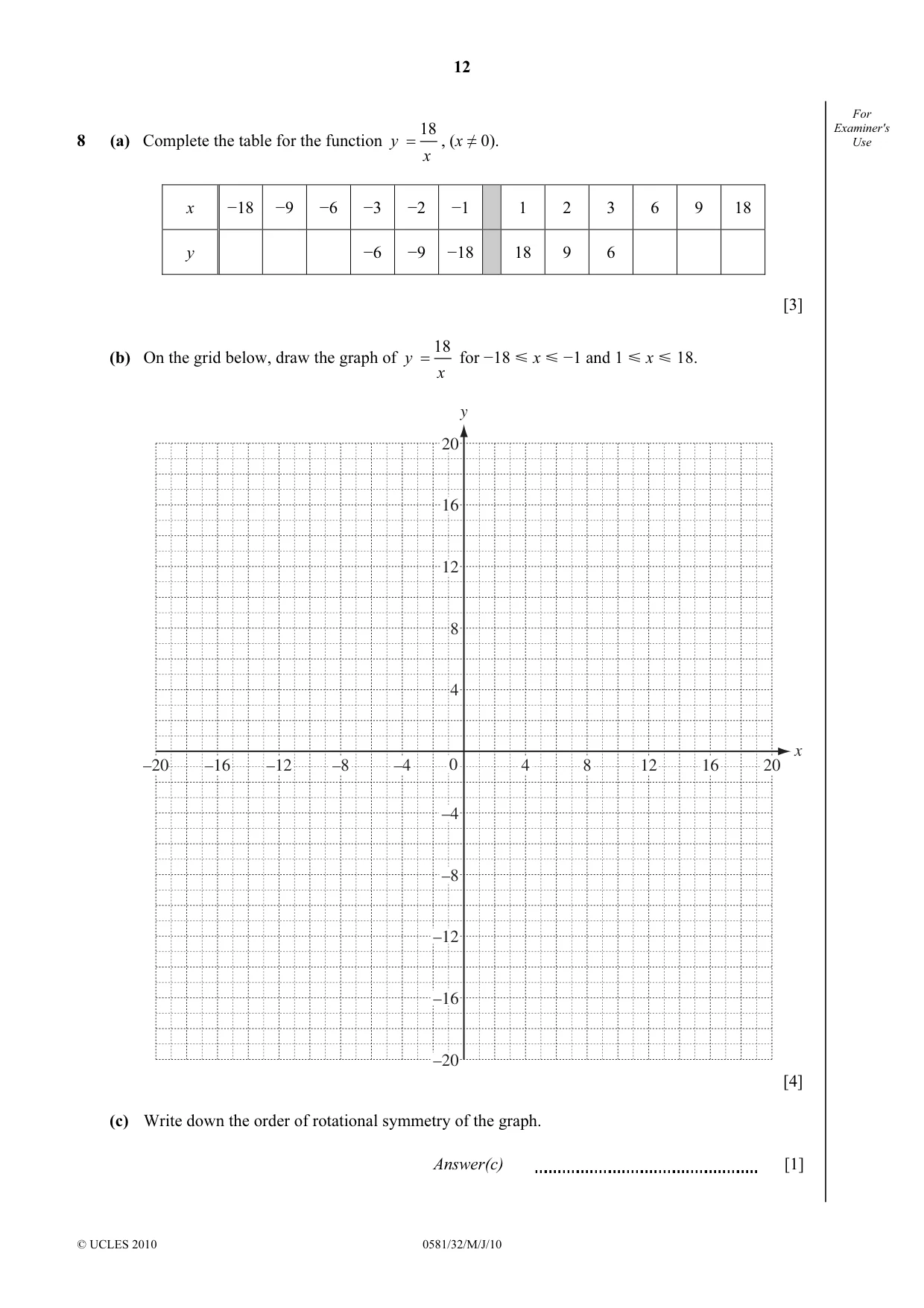
12 © UCLES 2010 0581/32/M/J/10 For Examiner's Use 8 (a) Complete the table for the function 18 y x = , (x ≠ 0). x −18 −9 −6 −3 −2 −1 1 2 3 6 9 18 y −6 −9 −18 18 9 6 [3] (b) On the grid below, draw the graph of 18 y x = for −18 Y x Y −1 and 1 Y x Y 18. y x 20 16 12 8 4 –4 –8 –12 –16 –20 4 8 12 16 20 –20 –16 –12 –8 –4 0 [4] (c) Write down the order of rotational symmetry of the graph. Answer(c) [1]
Question paper, page 13
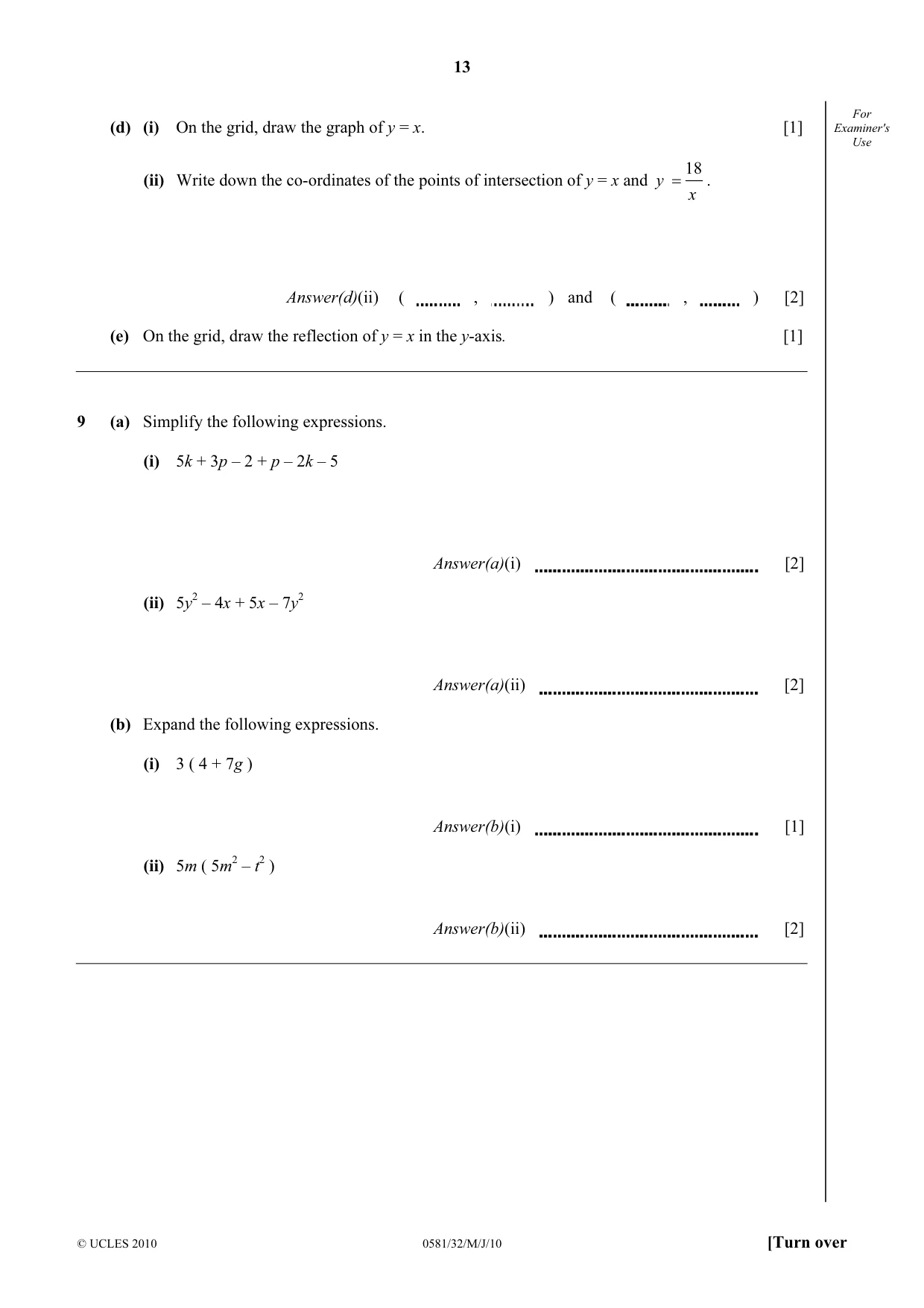
13 © UCLES 2010 0581/32/M/J/10 [Turn over For Examiner's Use (d) (i) On the grid, draw the graph of y = x. [1] (ii) Write down the co-ordinates of the points of intersection of y = x and 18 y x = . Answer(d)(ii) ( , ) and ( , ) [2] (e) On the grid, draw the reflection of y = x in the y-axis. [1] 9 (a) Simplify the following expressions. (i) 5k + 3p – 2 + p – 2k – 5 Answer(a)(i) [2] (ii) 5y2 – 4x + 5x – 7y2 Answer(a)(ii) [2] (b) Expand the following expressions. (i) 3 ( 4 + 7g ) Answer(b)(i) [1] (ii) 5m ( 5m2 – t2 ) Answer(b)(ii) [2]
Question paper, page 14
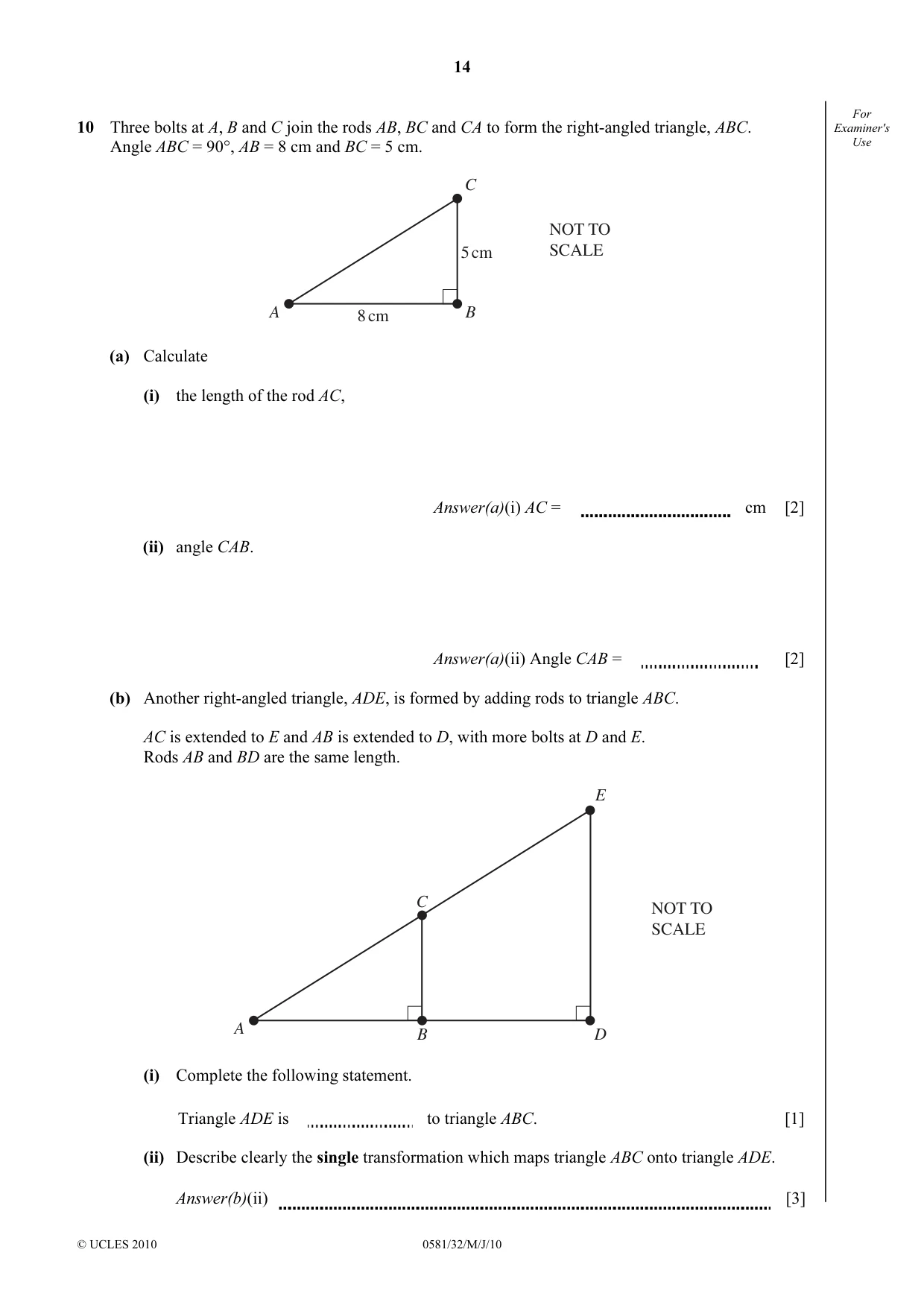
14 © UCLES 2010 0581/32/M/J/10 For Examiner's Use 10 Three bolts at A, B and C join the rods AB, BC and CA to form the right-angled triangle, ABC. Angle ABC = 90°, AB = 8 cm and BC = 5 cm. A B C 8 cm 5 cm NOT TO SCALE (a) Calculate (i) the length of the rod AC, Answer(a)(i) AC = cm [2] (ii) angle CAB. Answer(a)(ii) Angle CAB = [2] (b) Another right-angled triangle, ADE, is formed by adding rods to triangle ABC. AC is extended to E and AB is extended to D, with more bolts at D and E. Rods AB and BD are the same length. A B D E C NOT TO SCALE (i) Complete the following statement. Triangle ADE is to triangle ABC. [1] (ii) Describe clearly the single transformation which maps triangle ABC onto triangle ADE. Answer(b)(ii) [3]
Question paper, page 15
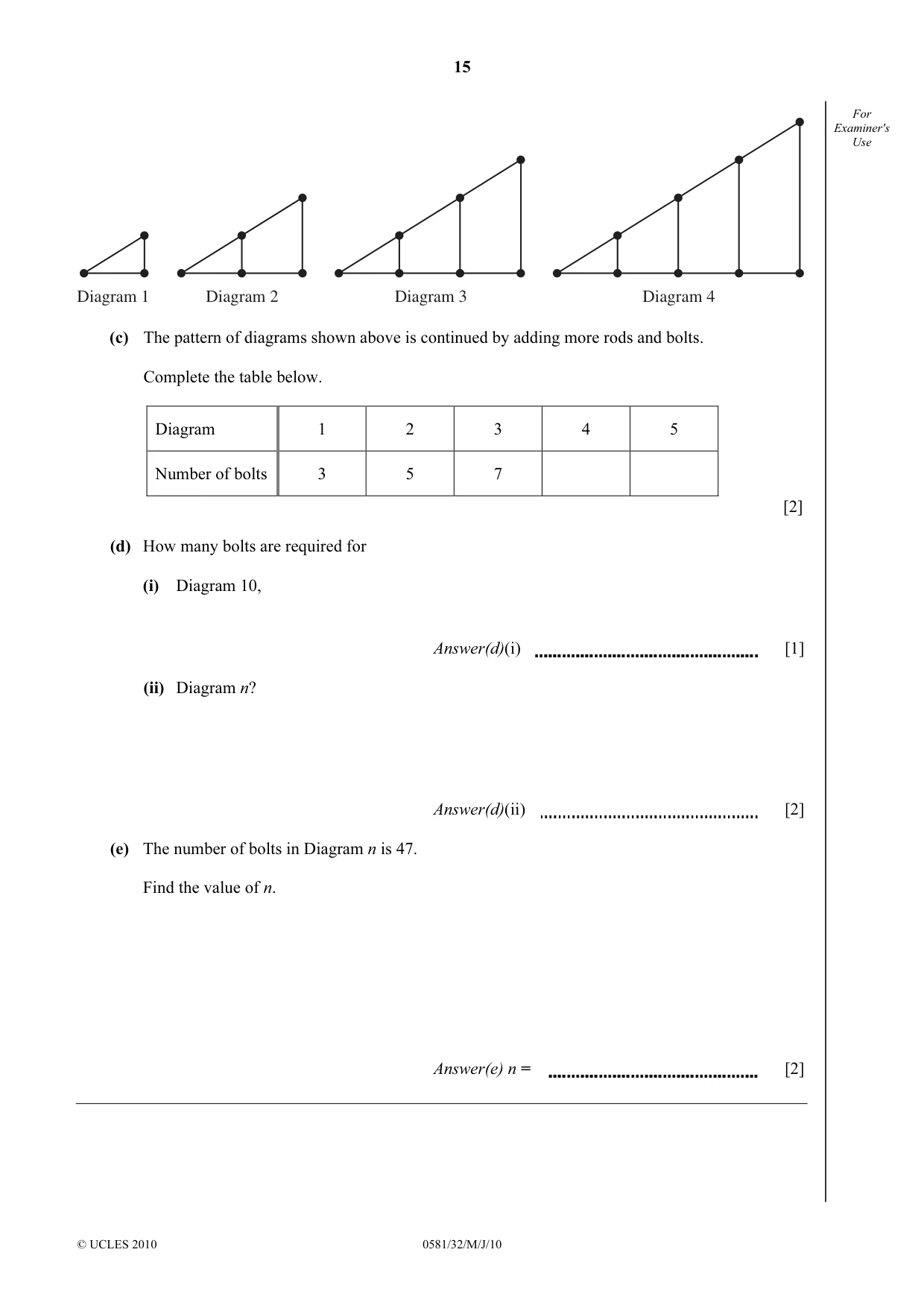
15 © UCLES 2010 0581/32/M/J/10 For Examiner's Use Diagram 1 Diagram 2 Diagram 3 Diagram 4 (c) The pattern of diagrams shown above is continued by adding more rods and bolts. Complete the table below. Diagram 1 2 3 4 5 Number of bolts 3 5 7 [2] (d) How many bolts are required for (i) Diagram 10, Answer(d)(i) [1] (ii) Diagram n? Answer(d)(ii) [2] (e) The number of bolts in Diagram n is 47. Find the value of n. Answer(e) n = [2]
Question paper, page 16
16 Permission to reproduce items where third-party owned material protected by copyright is included has been sought and cleared where possible. Every reasonable effort has been made by the publisher (UCLES) to trace copyright holders, but if any items requiring clearance have unwittingly been included, the publisher will be pleased to make amends at the earliest possible opportunity. University of Cambridge International Examinations is part of the Cambridge Assessment Group. Cambridge Assessment is the brand name of University of Cambridge Local Examinations Syndicate (UCLES), which is itself a department of the University of Cambridge. 0581/32/M/J/10 BLANK PAGE
Mark scheme, page 1
UNIVERSITY OF CAMBRIDGE INTERNATIONAL EXAMINATIONS International General Certificate of Secondary Education MARK SCHEME for the May/June 2010 question paper for the guidance of teachers 0581 MATHEMATICS 0581/32 Paper 32 (Core), maximum raw mark 104 This mark scheme is published as an aid to teachers and candidates, to indicate the requirements of the examination. It shows the basis on which Examiners were instructed to award marks. It does not indicate the details of the discussions that took place at an Examiners’ meeting before marking began, which would have considered the acceptability of alternative answers. Mark schemes must be read in conjunction with the question papers and the report on the examination. • CIE will not enter into discussions or correspondence in connection with these mark schemes. CIE is publishing the mark schemes for the May/June 2010 question papers for most IGCSE, GCE Advanced Level and Advanced Subsidiary Level syllabuses and some Ordinary Level syllabuses. www.XtremePapers.com
Mark scheme, page 2
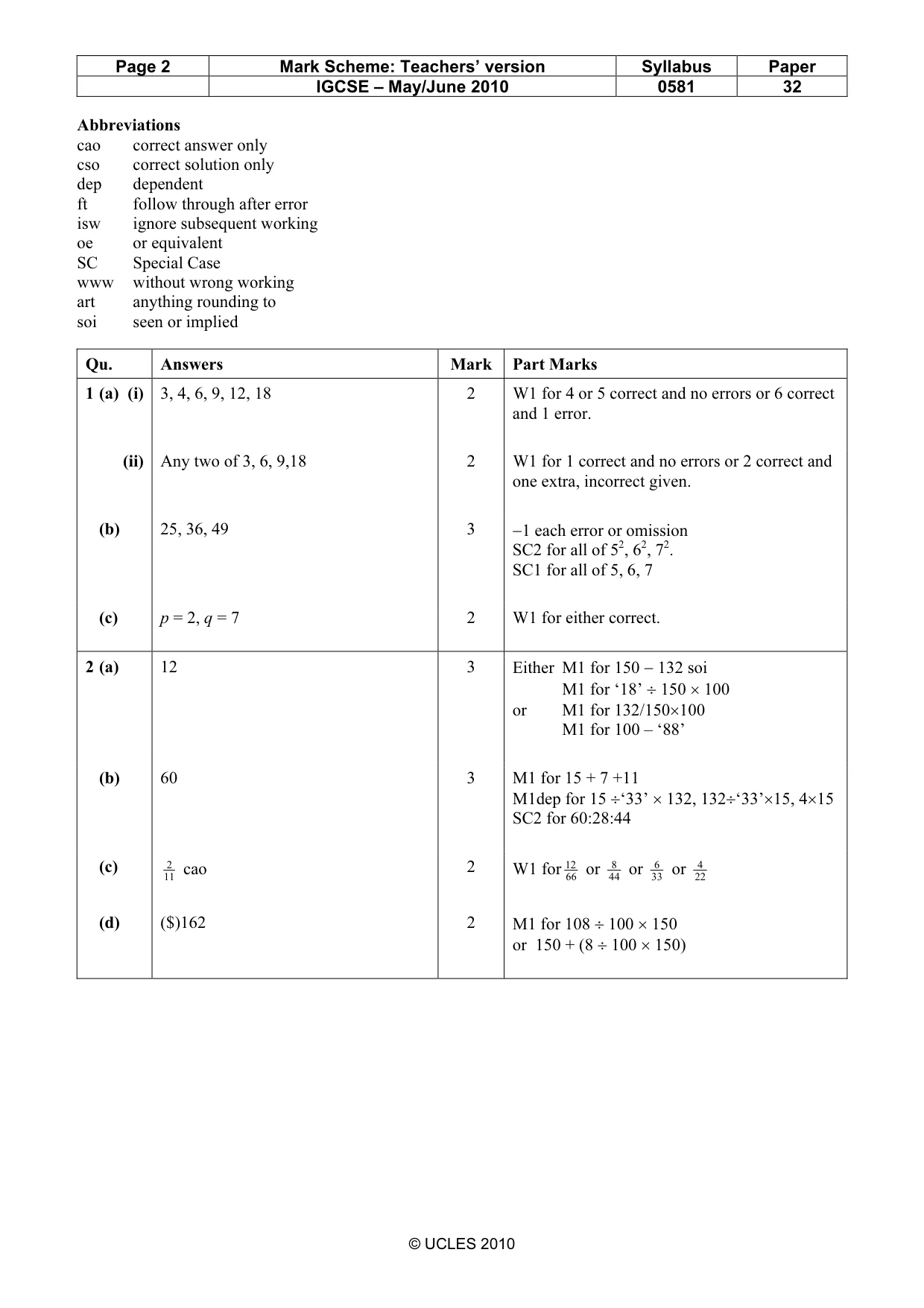
Page 2 Mark Scheme: Teachers’ version Syllabus Paper IGCSE – May/June 2010 0581 32 © UCLES 2010 Abbreviations cao correct answer only cso correct solution only dep dependent ft follow through after error isw ignore subsequent working oe or equivalent SC Special Case www without wrong working art anything rounding to soi seen or implied Qu. Answers Mark Part Marks 1 (a) (i) 3, 4, 6, 9, 12, 18 2 W1 for 4 or 5 correct and no errors or 6 correct and 1 error. (ii) Any two of 3, 6, 9,18 2 W1 for 1 correct and no errors or 2 correct and one extra, incorrect given. (b) 25, 36, 49 3 −1 each error or omission SC2 for all of 52, 62, 72. SC1 for all of 5, 6, 7 (c) p = 2, q = 7 2 W1 for either correct. 2 (a) 12 3 Either M1 for 150 − 132 soi M1 for ‘18’ ÷ 150 × 100 or M1 for 132/150×100 M1 for 100 – ‘88’ (b) 60 3 M1 for 15 + 7 +11 M1dep for 15 ÷‘33’ × 132, 132÷‘33’×15, 4×15 SC2 for 60:28:44 (c) 11 2 cao 2 W1 for 66 12 or 44 8 or 33 6 or 22 4 (d) ($)162 2 M1 for 108 ÷ 100 × 150 or 150 + (8 ÷ 100 × 150)
Mark scheme, page 3
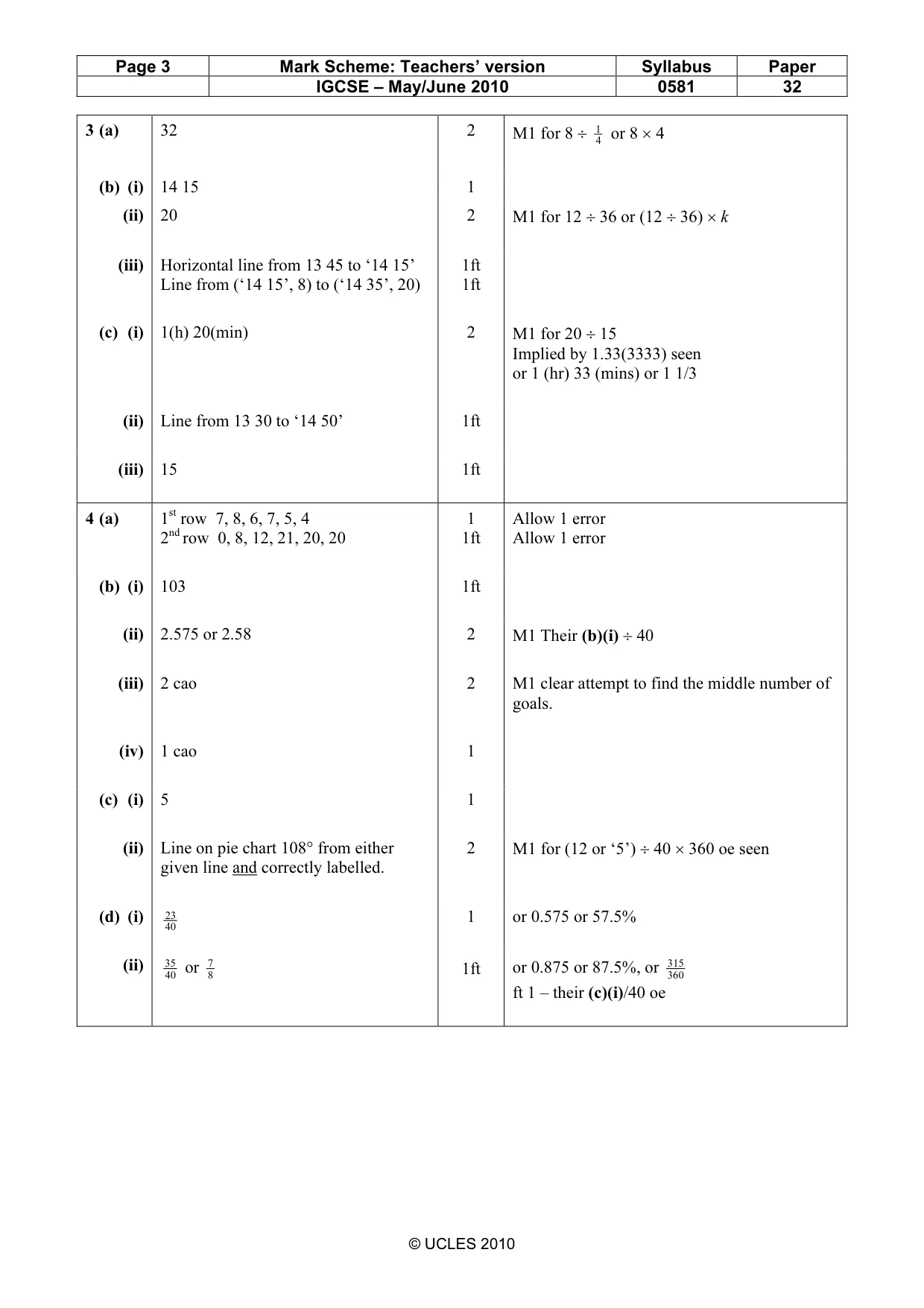
Page 3 Mark Scheme: Teachers’ version Syllabus Paper IGCSE – May/June 2010 0581 32 © UCLES 2010 3 (a) 32 2 M1 for 8 ÷ 4 1 or 8 × 4 (b) (i) 14 15 1 (ii) 20 2 M1 for 12 ÷ 36 or (12 ÷ 36) × k (iii) Horizontal line from 13 45 to ‘14 15’ Line from (‘14 15’, 8) to (‘14 35’, 20) 1ft 1ft (c) (i) 1(h) 20(min) 2 M1 for 20 ÷ 15 Implied by 1.33(3333) seen or 1 (hr) 33 (mins) or 1 1/3 (ii) Line from 13 30 to ‘14 50’ 1ft (iii) 15 1ft 4 (a) 1st row 7, 8, 6, 7, 5, 4 2nd row 0, 8, 12, 21, 20, 20 1 1ft Allow 1 error Allow 1 error (b) (i) 103 1ft (ii) 2.575 or 2.58 2 M1 Their (b)(i) ÷ 40 (iii) 2 cao 2 M1 clear attempt to find the middle number of goals. (iv) 1 cao 1 (c) (i) 5 1 (ii) Line on pie chart 108° from either given line and correctly labelled. 2 M1 for (12 or ‘5’) ÷ 40 × 360 oe seen (d) (i) 40 23 1 or 0.575 or 57.5% (ii) 40 35 or 8 7 1ft or 0.875 or 87.5%, or 360 315 ft 1 – their (c)(i)/40 oe
Mark scheme, page 4
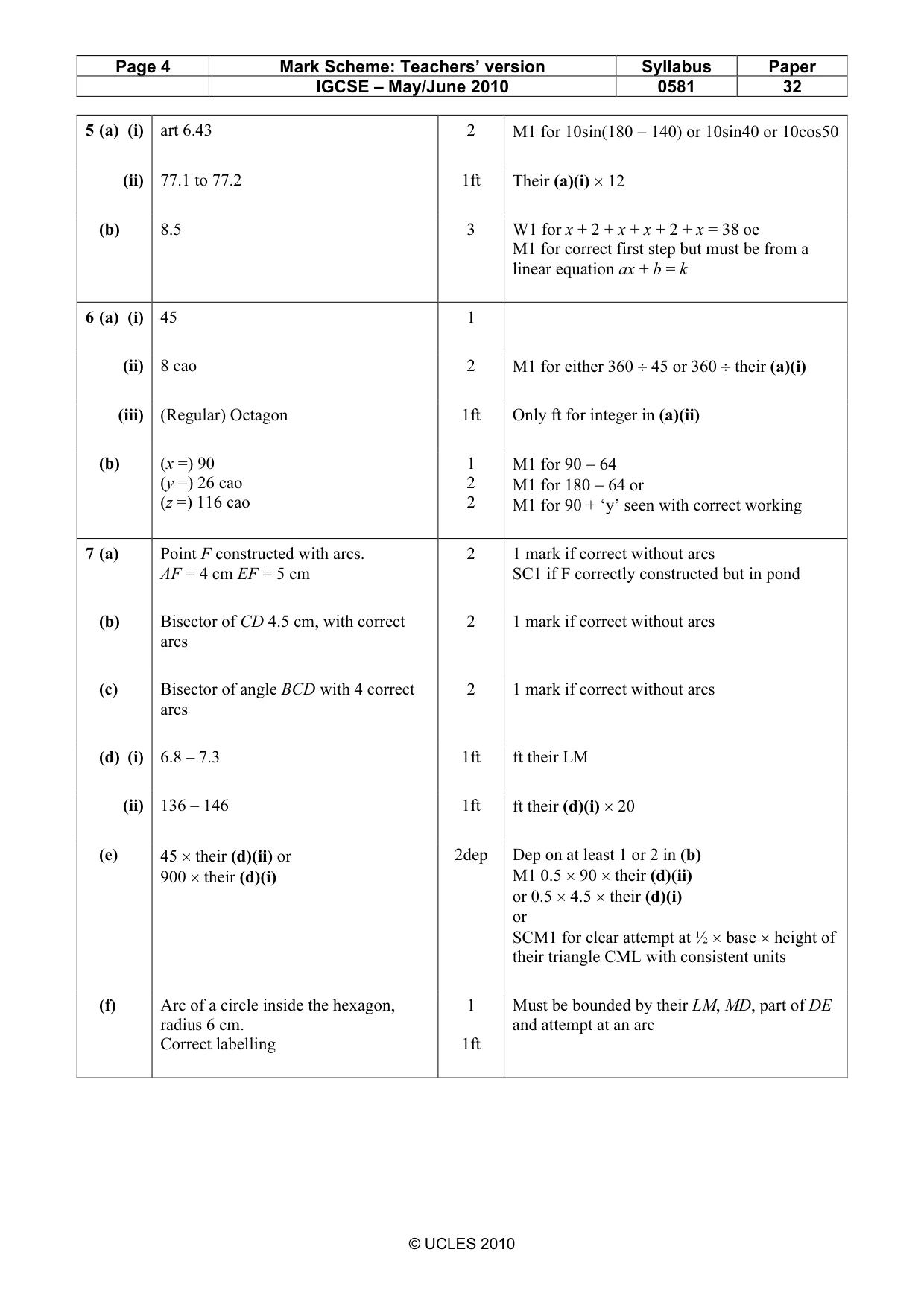
Page 4 Mark Scheme: Teachers’ version Syllabus Paper IGCSE – May/June 2010 0581 32 © UCLES 2010 5 (a) (i) art 6.43 2 M1 for 10sin(180 − 140) or 10sin40 or 10cos50 (ii) 77.1 to 77.2 1ft Their (a)(i) × 12 (b) 8.5 3 W1 for x + 2 + x + x + 2 + x = 38 oe M1 for correct first step but must be from a linear equation ax + b = k 6 (a) (i) 45 1 (ii) 8 cao 2 M1 for either 360 ÷ 45 or 360 ÷ their (a)(i) (iii) (Regular) Octagon 1ft Only ft for integer in (a)(ii) (b) (x =) 90 (y =) 26 cao (z =) 116 cao 1 2 2 M1 for 90 − 64 M1 for 180 − 64 or M1 for 90 + ‘y’ seen with correct working 7 (a) Point F constructed with arcs. AF = 4 cm EF = 5 cm 2 1 mark if correct without arcs SC1 if F correctly constructed but in pond (b) Bisector of CD 4.5 cm, with correct arcs 2 1 mark if correct without arcs (c) Bisector of angle BCD with 4 correct arcs 2 1 mark if correct without arcs (d) (i) 6.8 – 7.3 1ft ft their LM (ii) 136 – 146 1ft ft their (d)(i) × 20 (e) 45 × their (d)(ii) or 900 × their (d)(i) 2dep Dep on at least 1 or 2 in (b) M1 0.5 × 90 × their (d)(ii) or 0.5 × 4.5 × their (d)(i) or SCM1 for clear attempt at ½ × base × height of their triangle CML with consistent units (f) Arc of a circle inside the hexagon, radius 6 cm. Correct labelling 1 1ft Must be bounded by their LM, MD, part of DE and attempt at an arc
Mark scheme, page 5
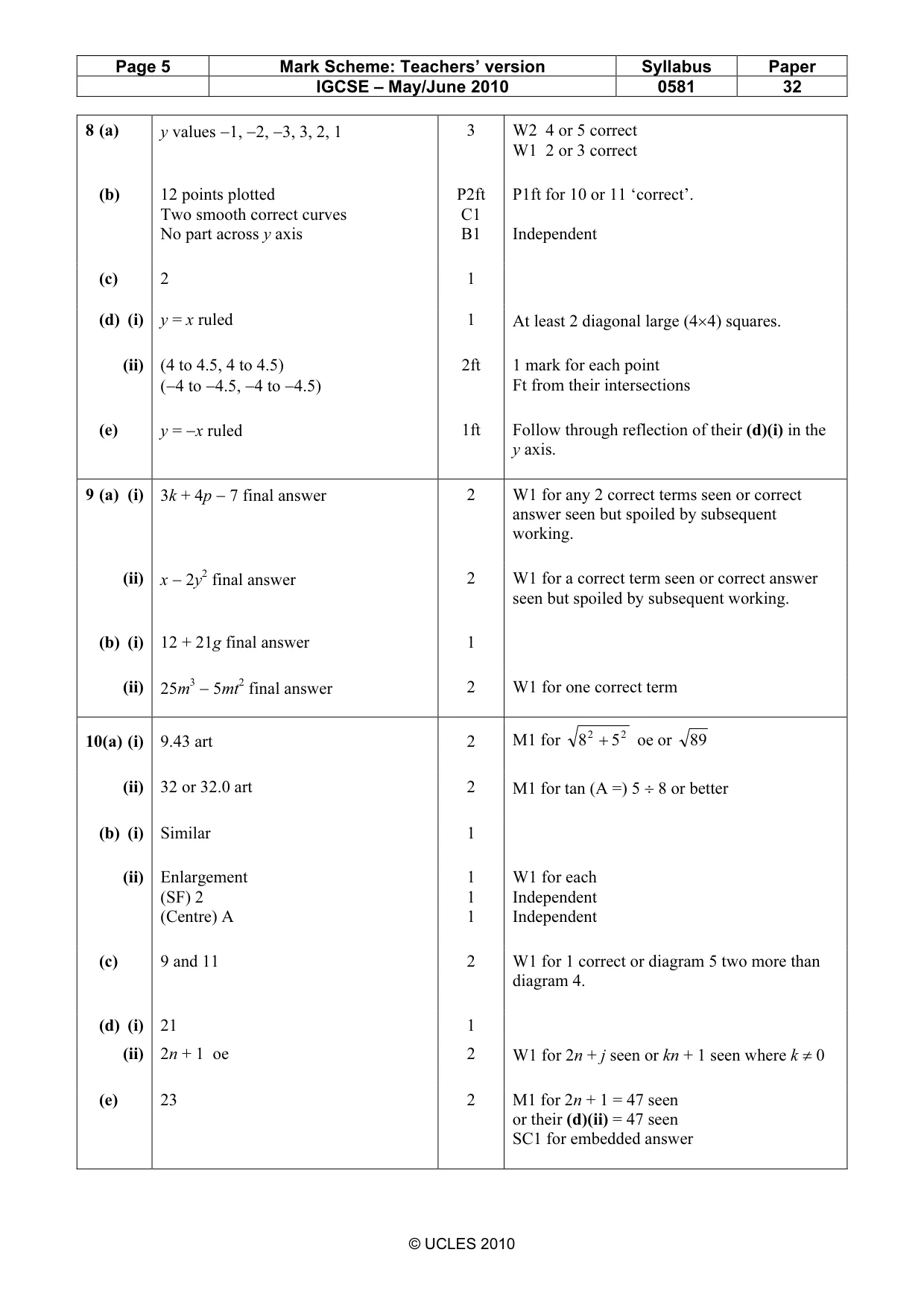
Page 5 Mark Scheme: Teachers’ version Syllabus Paper IGCSE – May/June 2010 0581 32 © UCLES 2010 8 (a) y values −1, −2, −3, 3, 2, 1 3 W2 4 or 5 correct W1 2 or 3 correct (b) 12 points plotted Two smooth correct curves No part across y axis P2ft C1 B1 P1ft for 10 or 11 ‘correct’. Independent (c) 2 1 (d) (i) y = x ruled 1 At least 2 diagonal large (4×4) squares. (ii) (4 to 4.5, 4 to 4.5) (−4 to −4.5, −4 to −4.5) 2ft 1 mark for each point Ft from their intersections (e) y = −x ruled 1ft Follow through reflection of their (d)(i) in the y axis. 9 (a) (i) 3k + 4p − 7 final answer 2 W1 for any 2 correct terms seen or correct answer seen but spoiled by subsequent working. (ii) x − 2y2 final answer 2 W1 for a correct term seen or correct answer seen but spoiled by subsequent working. (b) (i) 12 + 21g final answer 1 (ii) 25m3 − 5mt2 final answer 2 W1 for one correct term 10(a) (i) 9.43 art 2 M1 for 2 2 5 8 + oe or 89 (ii) 32 or 32.0 art 2 M1 for tan (A =) 5 ÷ 8 or better (b) (i) Similar 1 (ii) Enlargement (SF) 2 (Centre) A 1 1 1 W1 for each Independent Independent (c) 9 and 11 2 W1 for 1 correct or diagram 5 two more than diagram 4. (d) (i) 21 1 (ii) 2n + 1 oe 2 W1 for 2n + j seen or kn + 1 seen where k ≠ 0 (e) 23 2 M1 for 2n + 1 = 47 seen or their (d)(ii) = 47 seen SC1 for embedded answer