Cambridge IGCSE Mathematics (US) 0444 — 2024 May/June Paper 4 · Variant 1
0444/41/M/J/24 · 9 questions · 130 marks · ≈146 min
The question paper and its mark scheme, free to read here and free to download. This is Cambridge’s own paper, exactly as it was sat.
Question paper20 pages
Mark scheme10 pages
Answers below. Sit the paper first if you are practising.
Questions as text
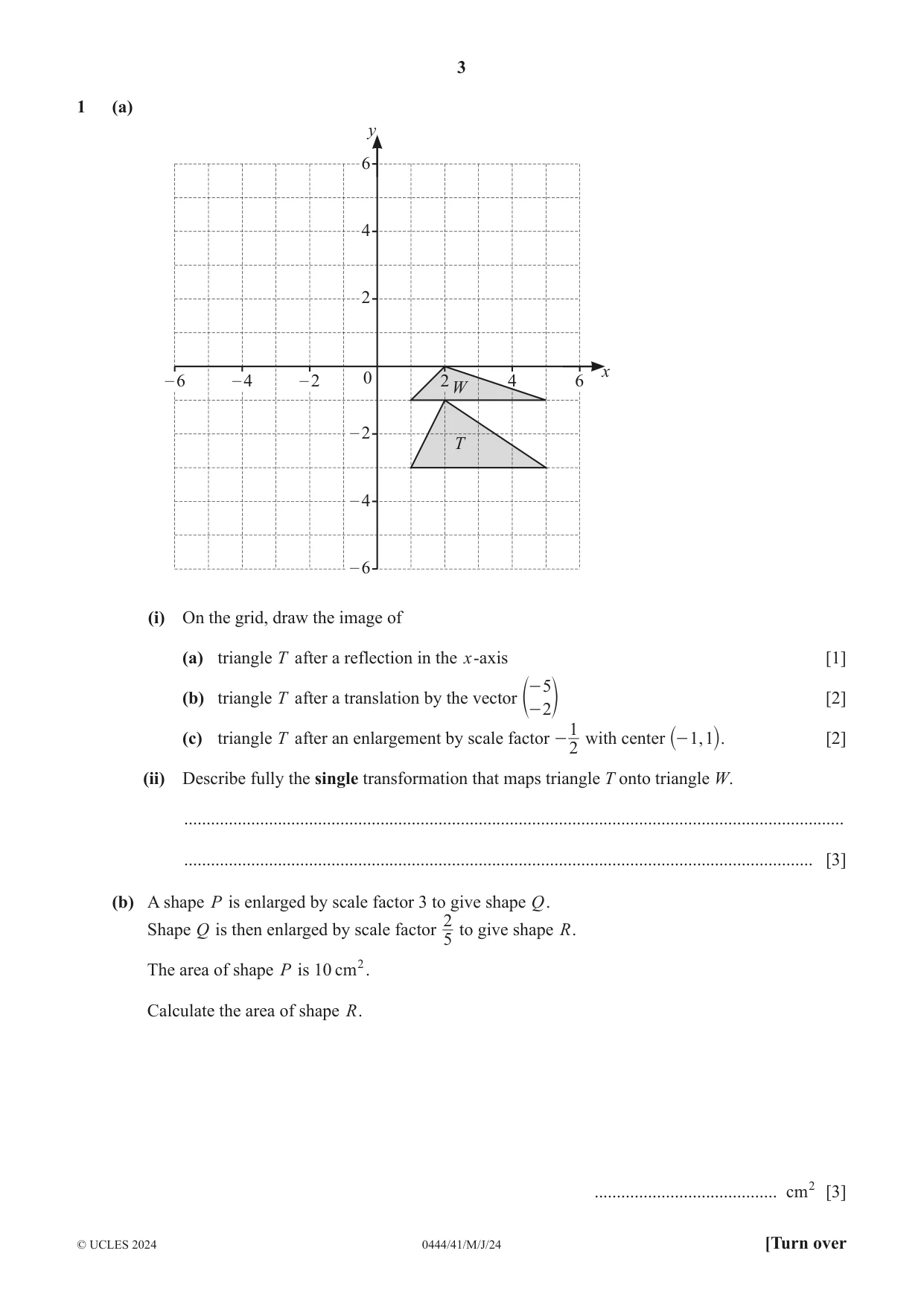
Q1 · Y 6 4 2 x – 6 – 4 – 2 0 2 4 6 W – 2 T – 4 – 6 (i) On the grid, draw the image of (a)…
1 (a) y 6 4 2 x – 6 – 4 – 2 0 2 4 6 W – 2 T – 4 – 6 (i) On the grid, draw the image of (a) triangle T after a reflection in the x-axis [1] - 5 (b) triangle T after a translation by the vector [2] e- 2o 1 (c) triangle T after an enlargement by scale factor - with center - ,1 1 [2] 2 ` j. (ii) Describe fully the single transformation that maps triangle T onto triangle W. .................................................................................................................................................... ............................................................................................................................................. [3] (b) A shape P is enlarged by scale factor 3 to give shape Q. 2 Shape Q is then enlarged by scale factor to give shape R. 5 The area of shape P is 10 cm2. Calculate the area of shape R. ......................................... cm 2 [3]
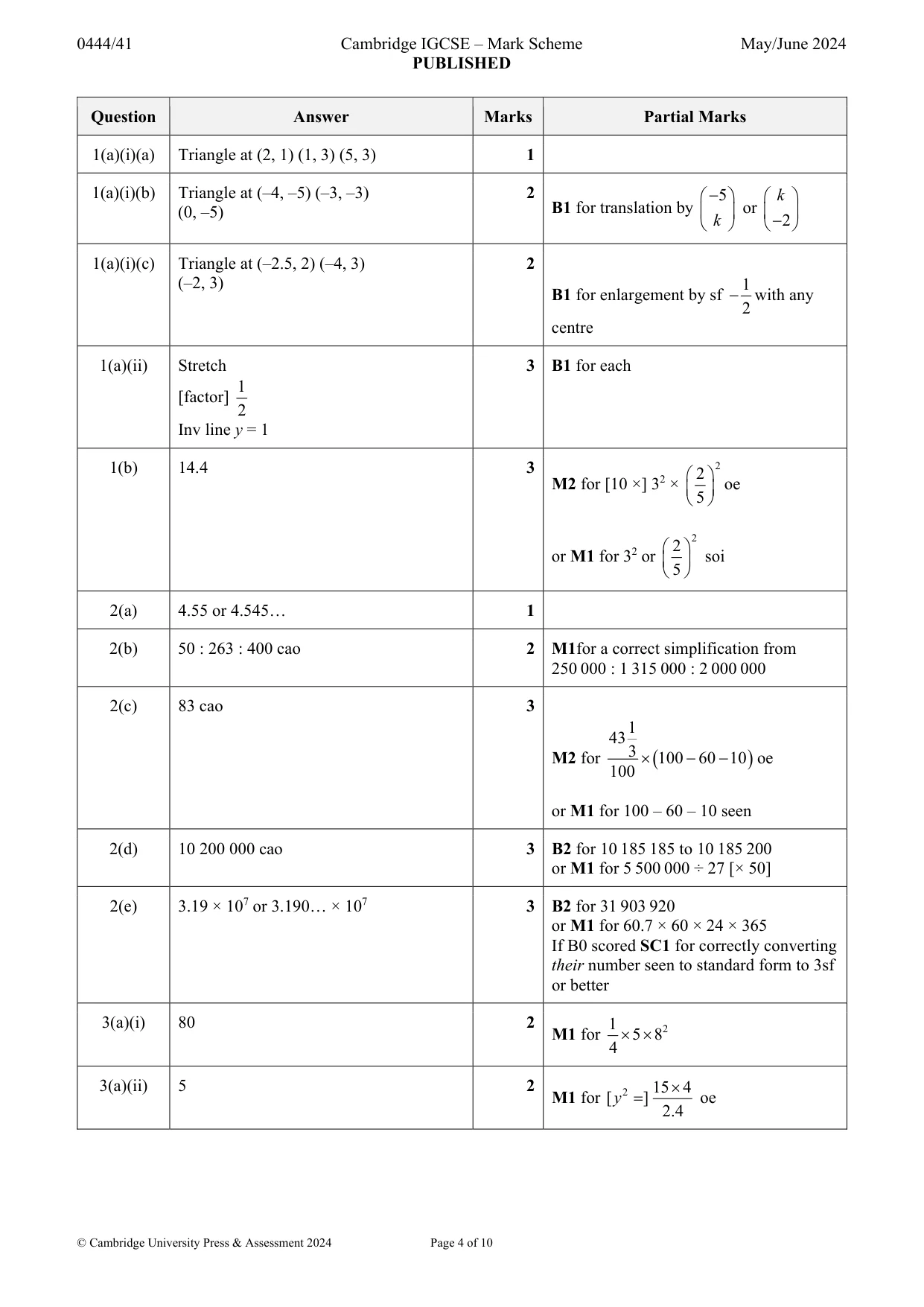
Mark scheme: Question Answer Marks Partial Marks 1(a)(i)(a) Triangle at (2, 1) (1, 3) (5, 3) 1 1(a)(i)(b) Triangle at (–4, –5) (–3, –3) 2 5 k B1 for translation by or (0, –5) k 2 1(a)(i)(c) Triangle at (–2.5, 2) (–4, 3) 2 (–2, 3) 1 B1 for enlargement by sf with any 2 centre 1(a)(ii) Stretch 3 B1 for each 1 [factor] 2 Inv line y = 1 1(b) 14.4 3 2 2 M2 for [10 ×] 32 × oe 5 2 2 or M1 for 32 or soi 5
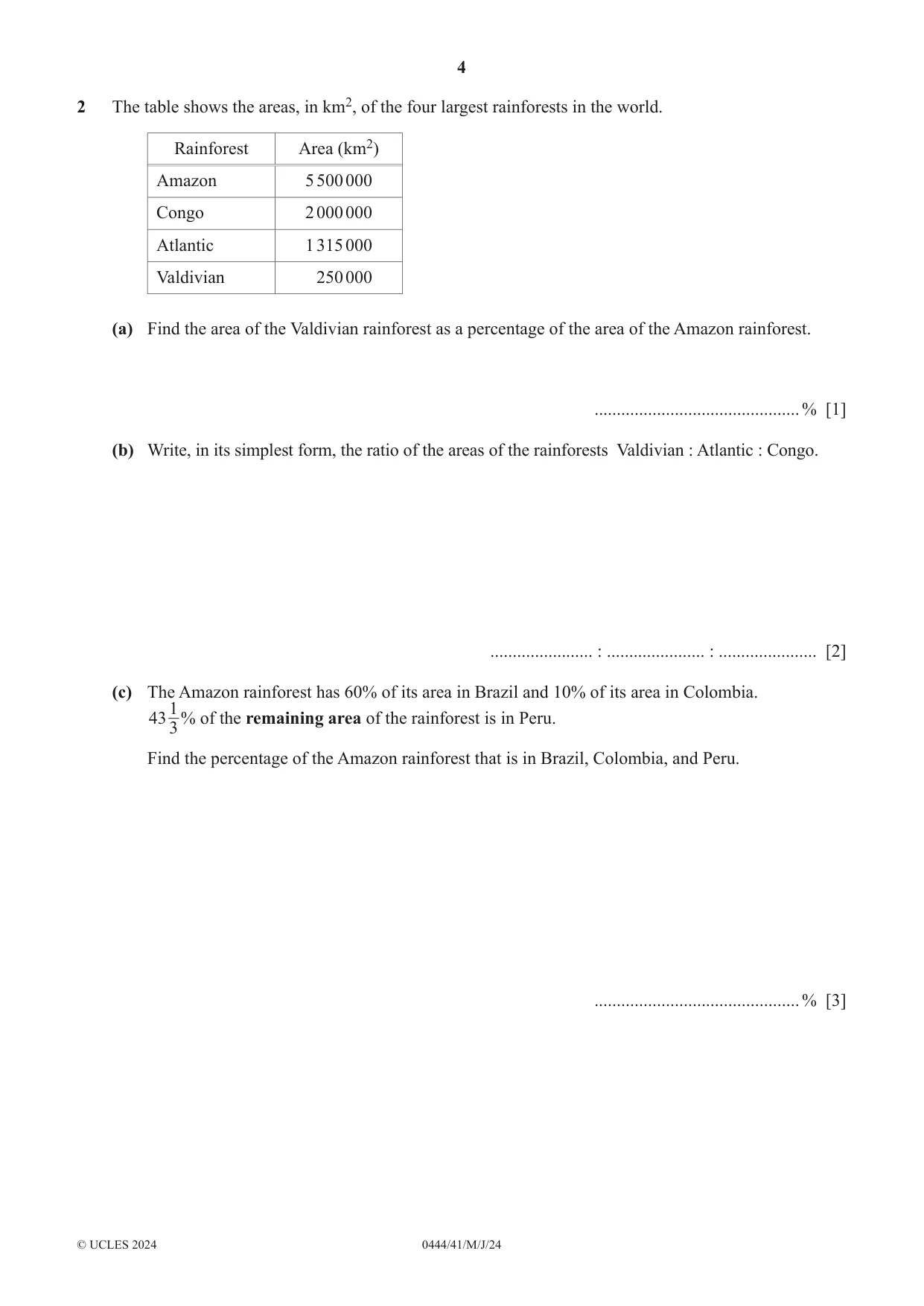
Q2 · The table shows the areas, in km2, of the four largest rainforests in the world
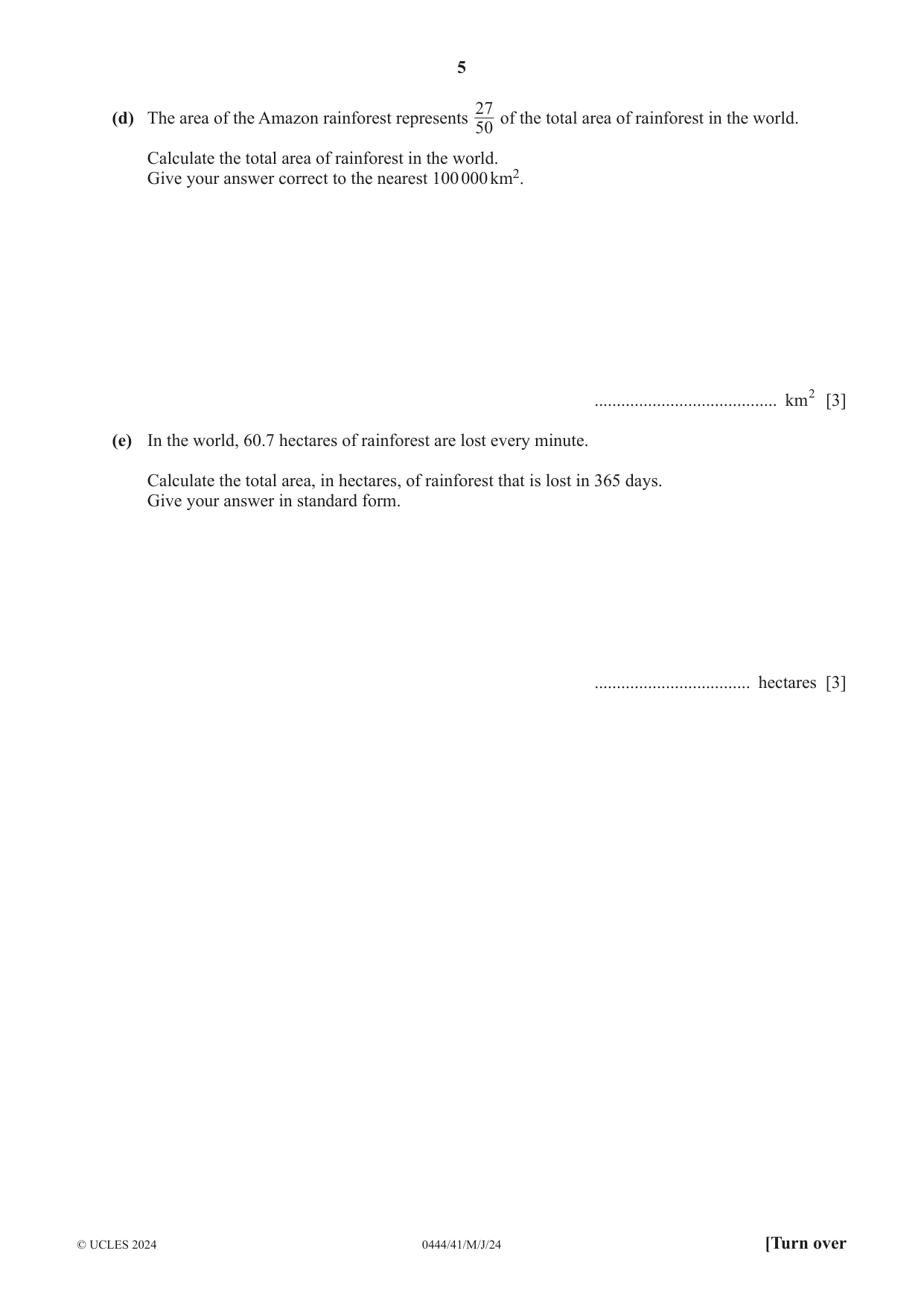
2 The table shows the areas, in km2, of the four largest rainforests in the world. Rainforest Area (km2) Amazon 5 500 000 Congo 2 000 000 Atlantic 1 315 000 Valdivian 250 000 (a) Find the area of the Valdivian rainforest as a percentage of the area of the Amazon rainforest. ..............................................% [1] (b) Write, in its simplest form, the ratio of the areas of the rainforests Valdivian : Atlantic : Congo. ....................... : ...................... : ...................... [2] (c) The Amazon rainforest has 60% of its area in Brazil and 10% of its area in Colombia. 43 1% of the remaining area of the rainforest is in Peru. 3 Find the percentage of the Amazon rainforest that is in Brazil, Colombia, and Peru. ..............................................% [3] 27(d) The area of the Amazon rainforest represents of the total area of rainforest in the world. 50 Calculate the total area of rainforest in the world. Give your answer correct to the nearest 100 000 km2. ......................................... km 2 [3] (e) In the world, 60.7 hectares of rainforest are lost every minute. Calculate the total area, in hectares, of rainforest that is lost in 365 days. Give your answer in standard form. ................................... hectares [3]
Mark scheme: 2(a) 4.55 or 4.545… 1 2(b) 50 : 263 : 400 cao 2 M1for a correct simplification from 250 000 : 1 315 000 : 2 000 000 2(c) 83 cao 3 1 433 M2 for 100 60 10 oe 100 or M1 for 100 – 60 – 10 seen 2(d) 10 200 000 cao 3 B2 for 10 185 185 to 10 185 200 or M1 for 5 500 000 ÷ 27 [× 50] 2(e) 3.19 × 10⁷ or 3.190… × 107 3 B2 for 31 903 920 or M1 for 60.7 × 60 × 24 × 365 If B0 scored SC1 for correctly converting their number seen to standard form to 3sf or better
Q3 · C = xy 2 4 (i) Find C when x = 5 and y = 8
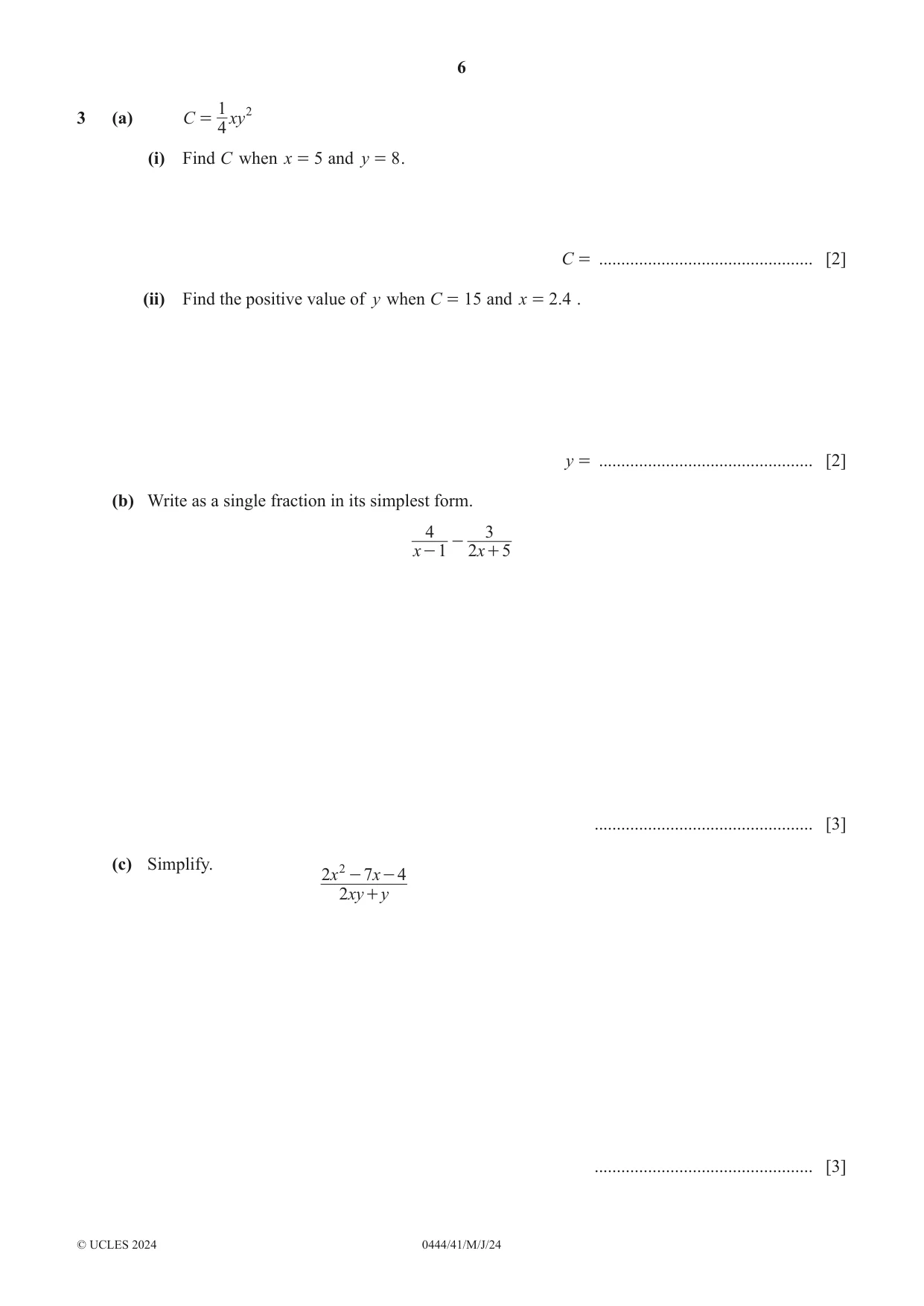
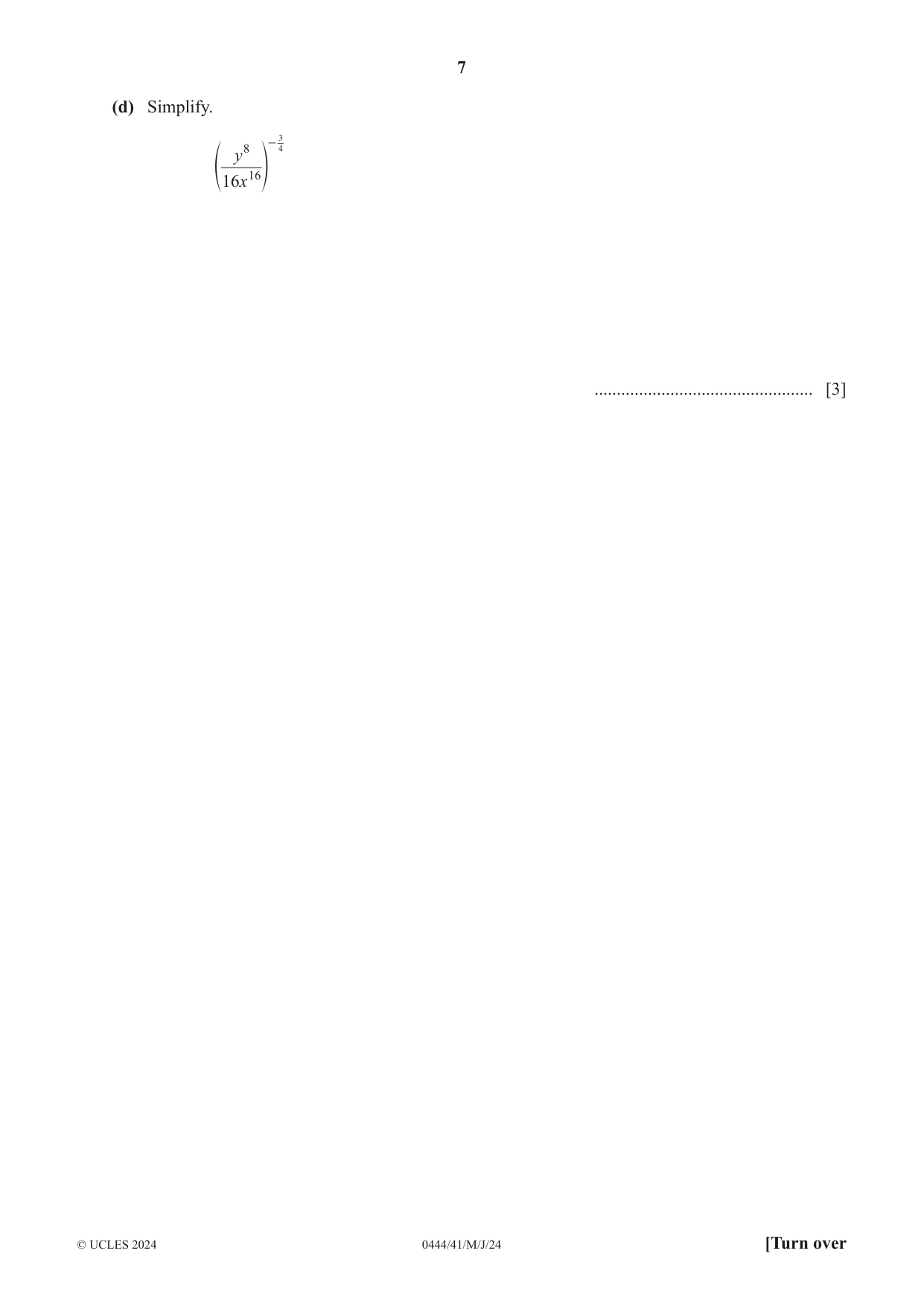
3 (a) C = xy 2 4 (i) Find C when x = 5 and y = 8 . C = ................................................ [2] (ii) Find the positive value of y when C = 15 and x = 2.4 . y = ................................................ [2] (b) Write as a single fraction in its simplest form. 4 3 - x - 1 2x + 5 ................................................. [3] (c) Simplify. 2 2x - 7x - 4 2xy + y ................................................. [3] (d) Simplify. 8 - 43 y 16 f 16x p ................................................. [3]
Mark scheme: 3(a)(i) 80 2 1 2 M1 for 5 8 4 3(a)(ii) 5 2 2 15 4 M1 for [ y ] oe 2.4 3(b) 5 x 23 5 x 23 3 or final ( x 1)(2 x 5) 2 x 2 3 x 5 B1 for 4(2x + 5) –3(x – 1) oe isw answer B1 for common denominator = (x – 1) (2x + 5) oe isw 3(c) x 4 3 B2 for (2x + 1)(x – 4) final answer or B1 for (2x + a)(x + b) y where ab = –4 or a + 2b = –7 or 2x(x – 4) + (x – 4) or x(2x + 1) – 4(2x + 1) or y(2x + 1) 3(d) 8x12 12 6 3 B2 for two elements correct in final or 8 x y final answer 6 answer y or for correct answer seen then spoiled or for correct expression where all parts of the power have been dealt with 3 1 2 x 4 or for or 2 y or B1 for 8 or y6 or y 6 or x12 correct in final answer 3 3 16 x16 4 y 2 or for 8 or 4 y 2 x
Q4 · Jianyu records the time, in seconds, that some cars take to travel 195 m
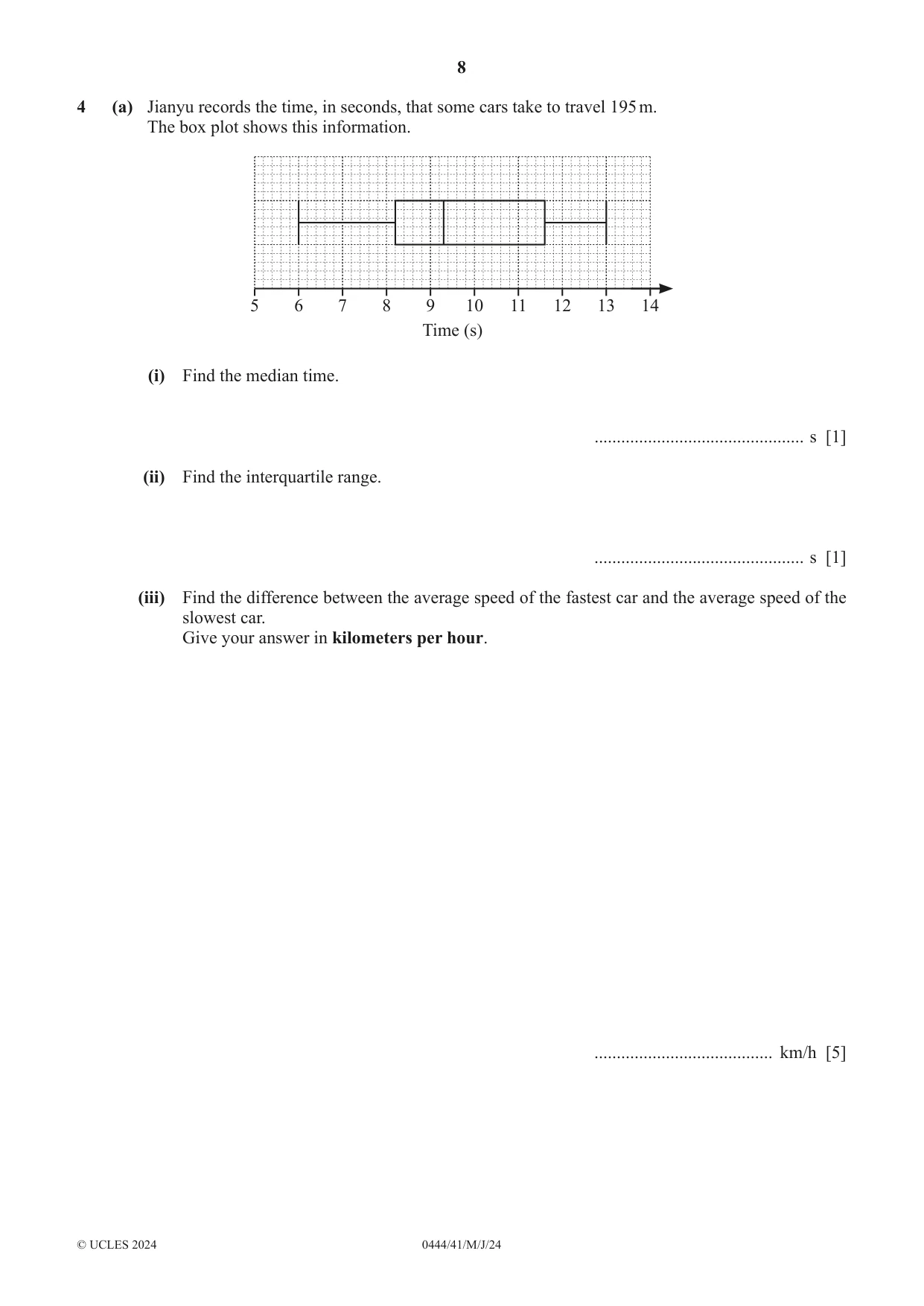
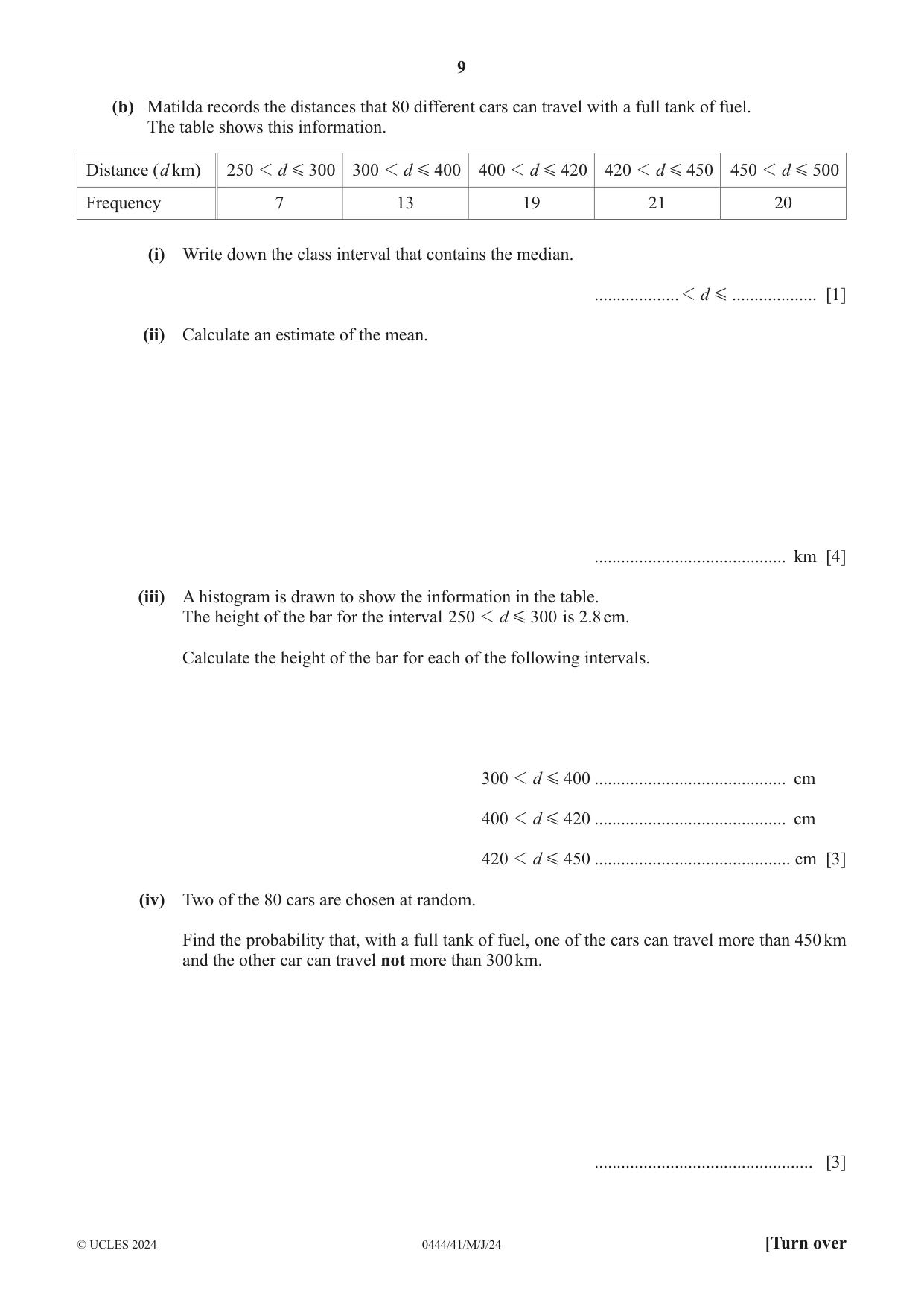
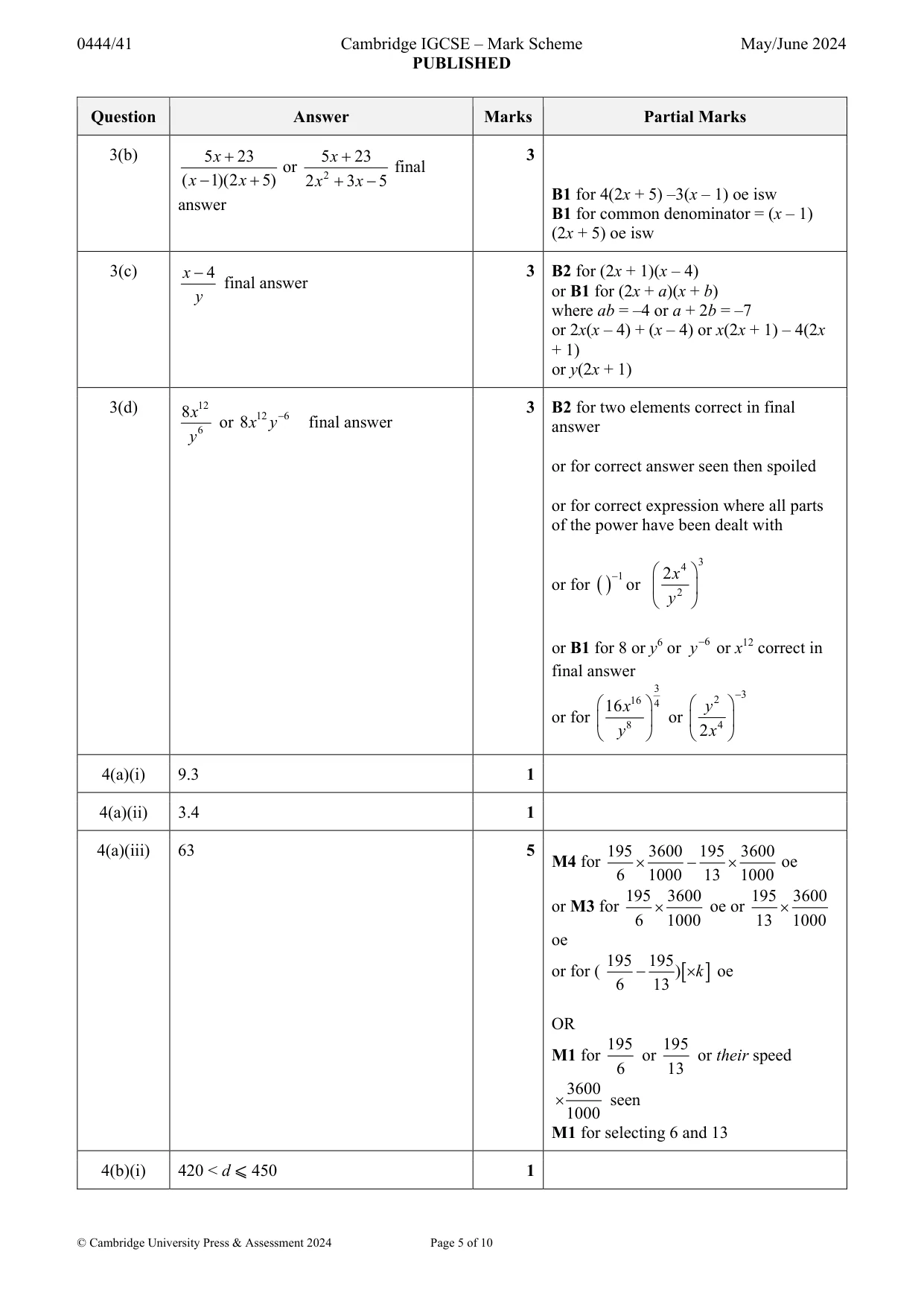
4 (a) Jianyu records the time, in seconds, that some cars take to travel 195 m. The box plot shows this information. 5 6 7 8 9 10 11 12 13 14 Time (s) (i) Find the median time. ............................................... s [1] (ii) Find the interquartile range. ............................................... s [1] (iii) Find the difference between the average speed of the fastest car and the average speed of the slowest car. Give your answer in kilometers per hour. ........................................ km/h [5] (b) Matilda records the distances that 80 different cars can travel with a full tank of fuel. The table shows this information. Distance (d km) 250 1 d G 300 300 1 d G 400 400 1 d G 420 420 1 d G 450 450 1 d G 500 Frequency 7 13 19 21 20 (i) Write down the class interval that contains the median. ................... 1 d G ................... [1] (ii) Calculate an estimate of the mean. ........................................... km [4] (iii) A histogram is drawn to show the information in the table. The height of the bar for the interval 250 1 d G 300 is 2.8 cm. Calculate the height of the bar for each of the following intervals. 300 1 d G 400 ........................................... cm 400 1 d G 420 ........................................... cm 420 1 d G 450 ............................................ cm [3] (iv) Two of the 80 cars are chosen at random. Find the probability that, with a full tank of fuel, one of the cars can travel more than 450 km and the other car can travel not more than 300 km. ................................................. [3]
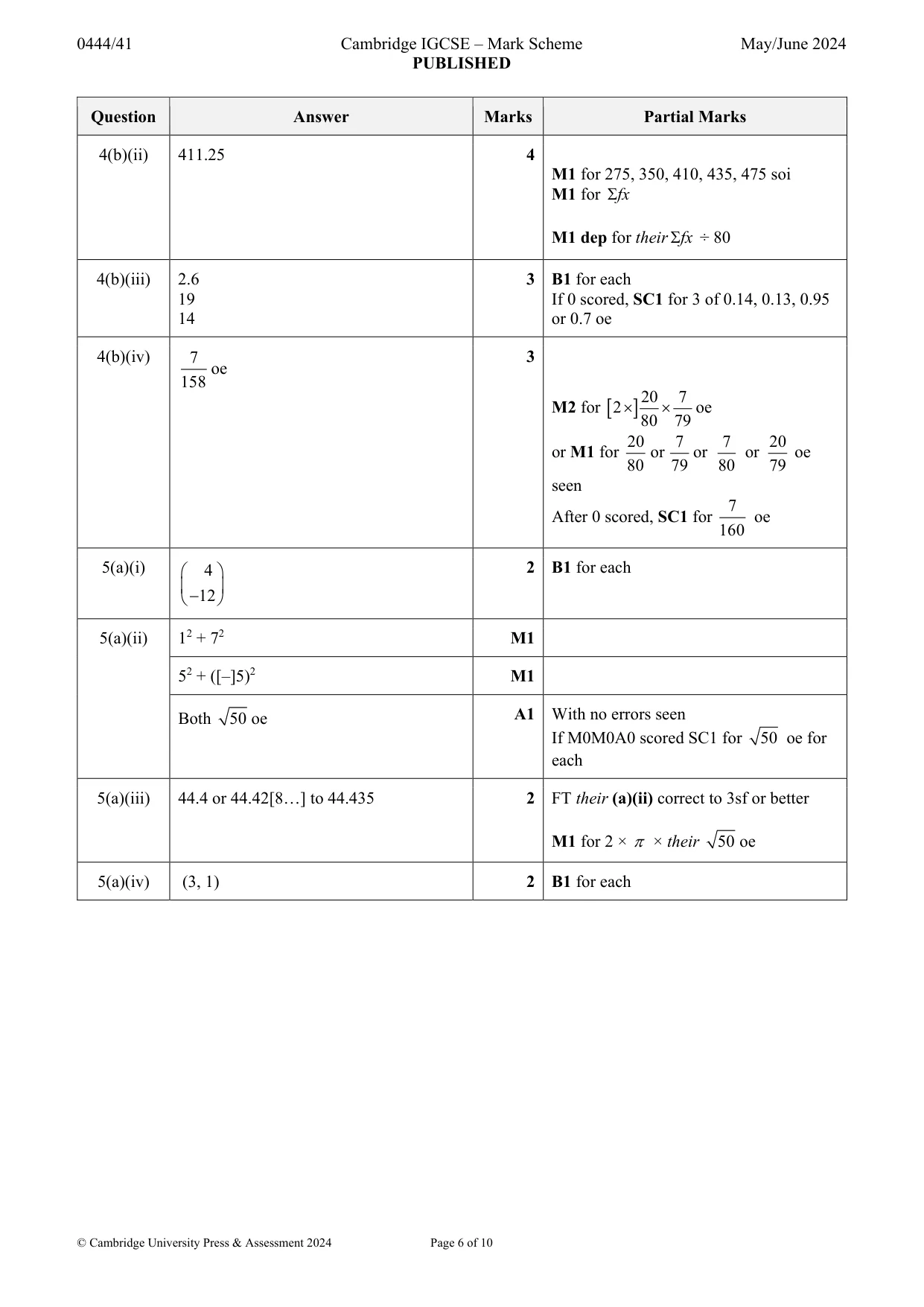
Mark scheme: 4(a)(i) 9.3 1 4(a)(ii) 3.4 1 4(a)(iii) 63 5 195 3600 195 3600 M4 for oe 6 1000 13 1000 195 3600 195 3600 or M3 for oe or 6 1000 13 1000 oe 195 or for ( 195) k oe 6 13 OR 195 195 M1 for or or their speed 6 13 3600 seen 1000 M1 for selecting 6 and 13 4(b)(i) 420 < d ⩽ 450 1 4(b)(ii) 411.25 4 M1 for 275, 350, 410, 435, 475 soi M1 for fx M1 dep for their fx ÷ 80 4(b)(iii) 2.6 3 B1 for each 19 If 0 scored, SC1 for 3 of 0.14, 0.13, 0.95 14 or 0.7 oe 4(b)(iv) 7 3 oe 158 7 M2 for 2 20 oe 80 79 20 7 7 20 or M1 for or or or oe 80 79 80 79 seen 7 After 0 scored, SC1 for oe 160
Q5 · P is the point (1, 7)
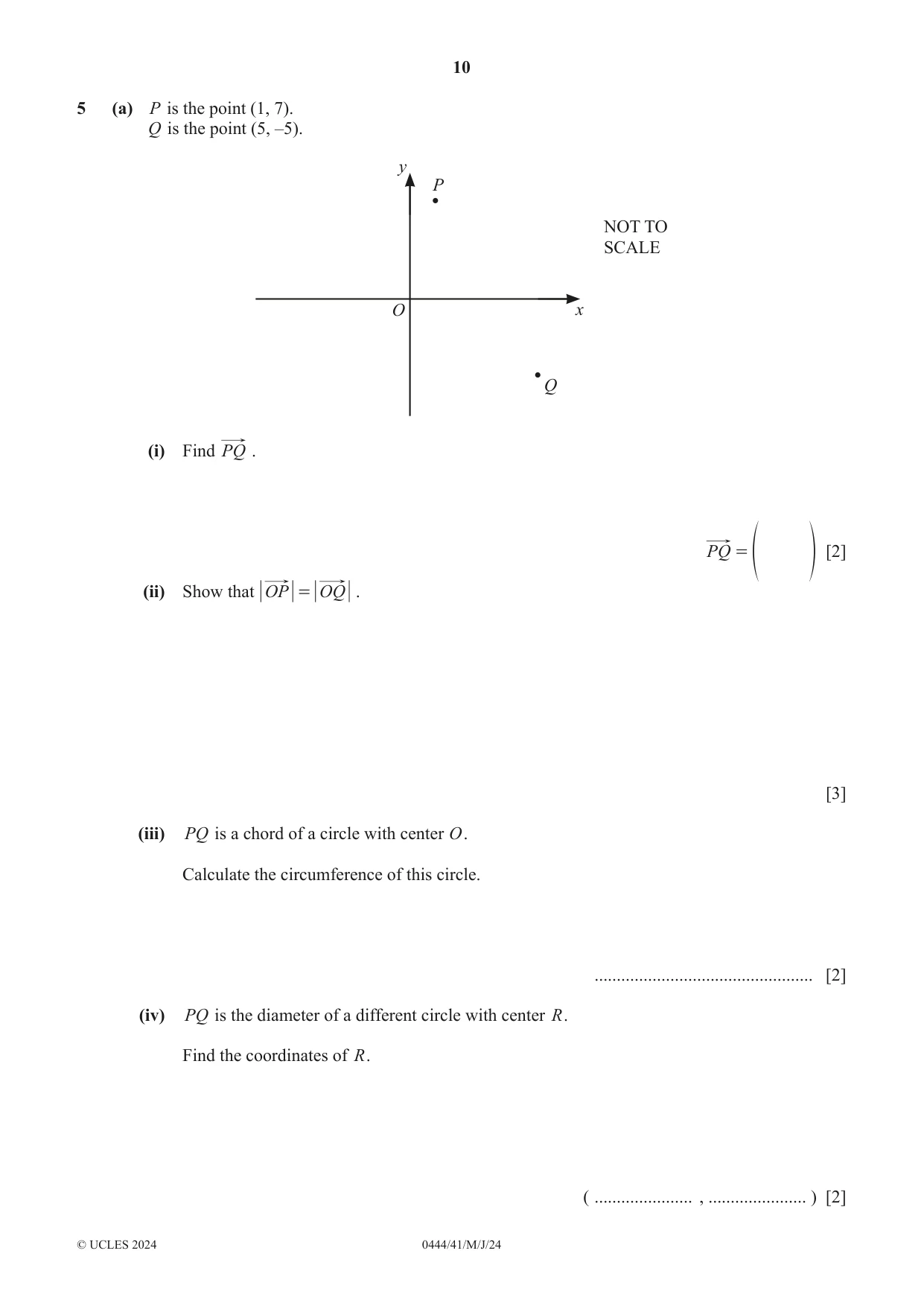
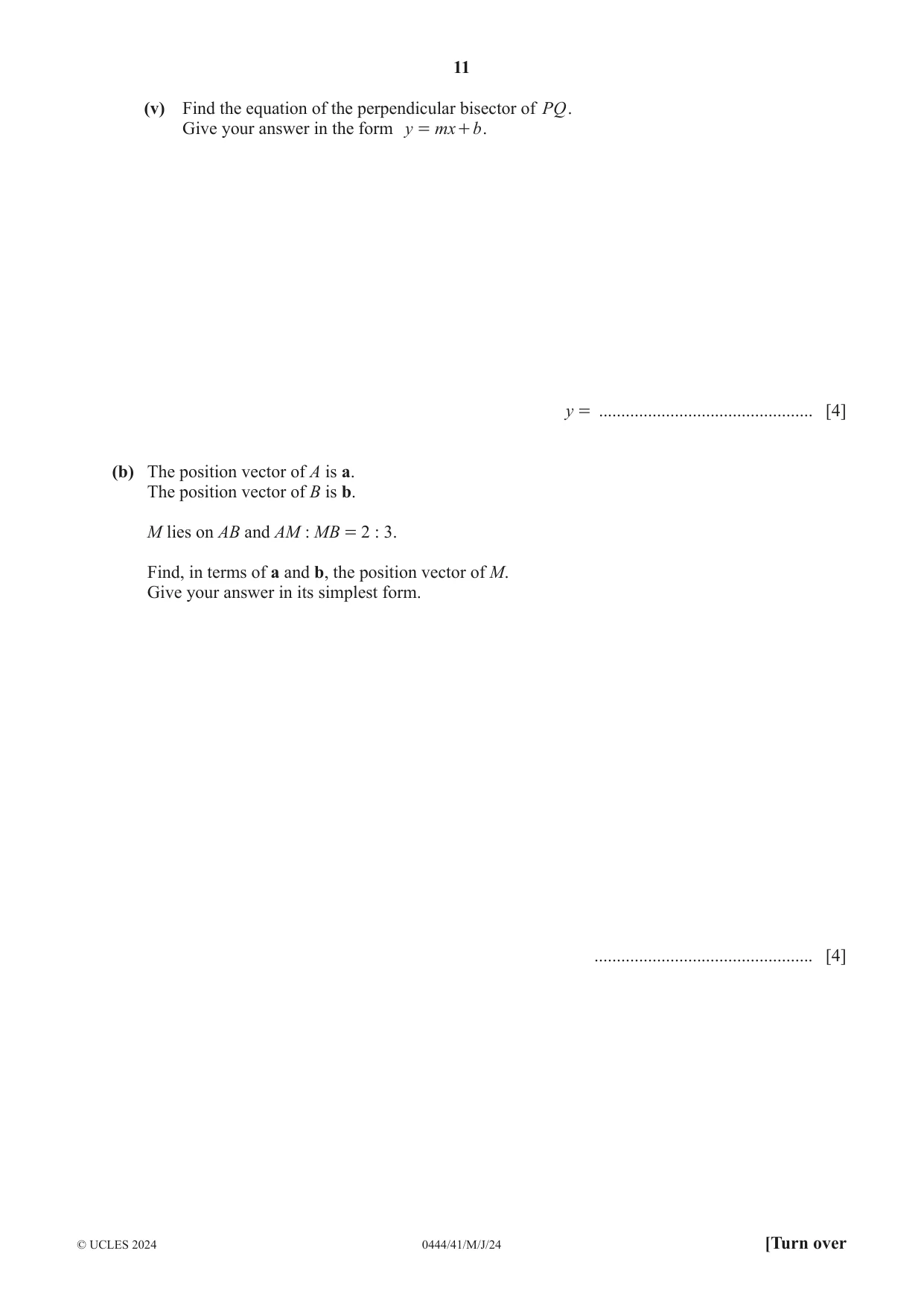
5 (a) P is the point (1, 7). Q is the point (5, –5). y P NOT TO SCALE O x Q (i) Find PQ . PQ = [2] f p (ii) Show that OP = OQ . [3] (iii) PQ is a chord of a circle with center O. Calculate the circumference of this circle. ................................................. [2] (iv) PQ is the diameter of a different circle with center R. Find the coordinates of R. ( ...................... , ...................... ) [2] (v) Find the equation of the perpendicular bisector of PQ. Give your answer in the form y = mx + b . y = ................................................ [4] (b) The position vector of A is a. The position vector of B is b. M lies on AB and AM : MB = 2 : 3. Find, in terms of a and b, the position vector of M. Give your answer in its simplest form. ................................................. [4]
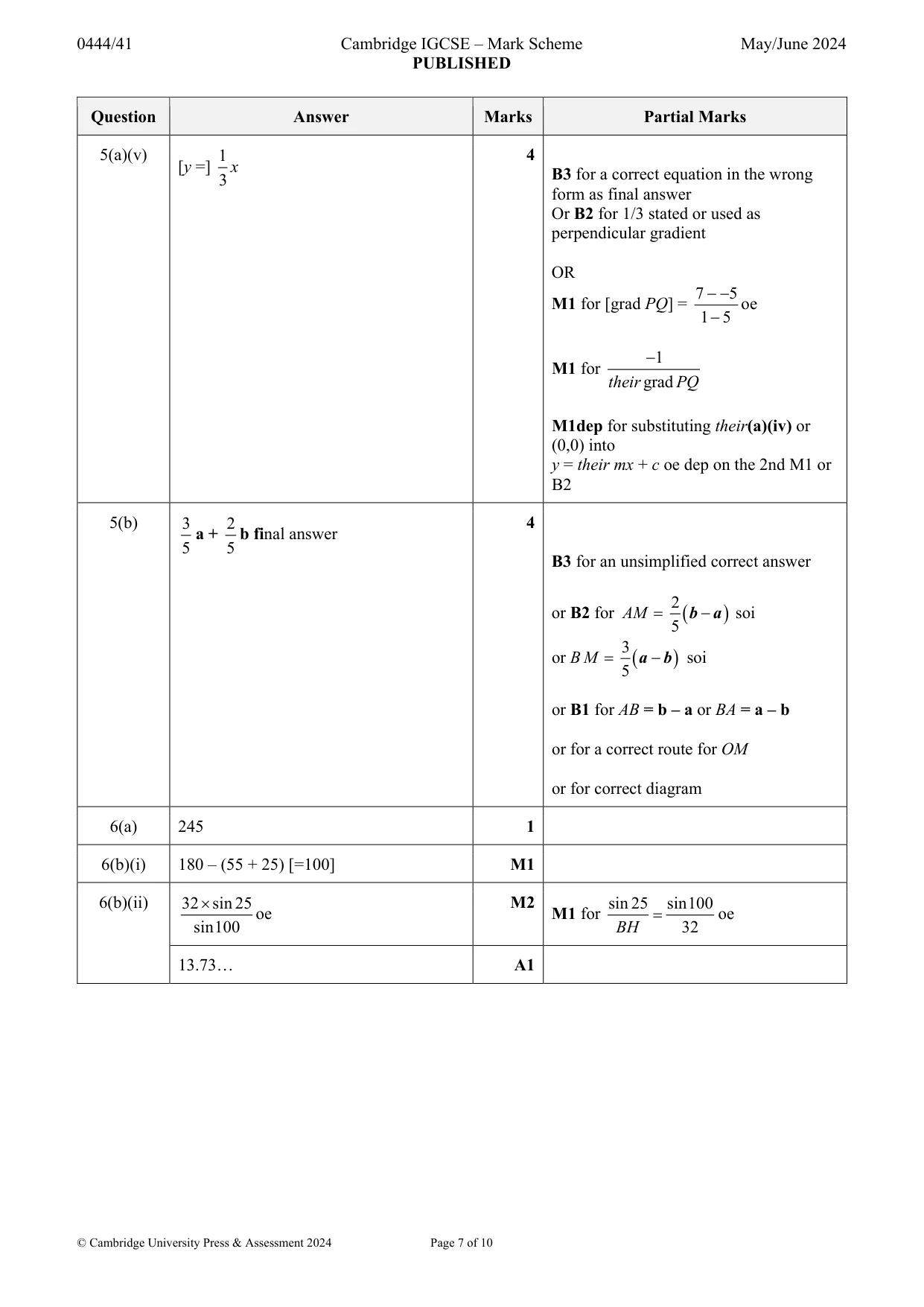
Mark scheme: 5(a)(i) 4 2 B1 for each 12 5(a)(ii) 12 + 72 M1 52 + ([–]5)2 M1 Both 50 oe A1 With no errors seen If M0M0A0 scored SC1 for 50 oe for each 5(a)(iii) 44.4 or 44.42[8…] to 44.435 2 FT their (a)(ii) correct to 3sf or better M1 for 2 × × their 50 oe 5(a)(iv) (3, 1) 2 B1 for each 5(a)(v) 1 4 [y =] x B3 for a correct equation in the wrong 3 form as final answer Or B2 for 1/3 stated or used as perpendicular gradient OR 7 5 M1 for [grad PQ] = oe 1 5 1 M1 for their grad PQ M1dep for substituting their(a)(iv) or (0,0) into y = their mx + c oe dep on the 2nd M1 or B2 5(b) 3 2 4 a + b final answer 5 5 B3 for an unsimplified correct answer 2 or B2 for AM b a soi 5 3 or B M a b soi 5 or B1 for AB = b – a or BA = a – b or for a correct route for OM or for correct diagram
Q6 · North B C 11 km 25° NOT TO A SCALE 32 km 14 km 55° H The diagram shows the positions of…
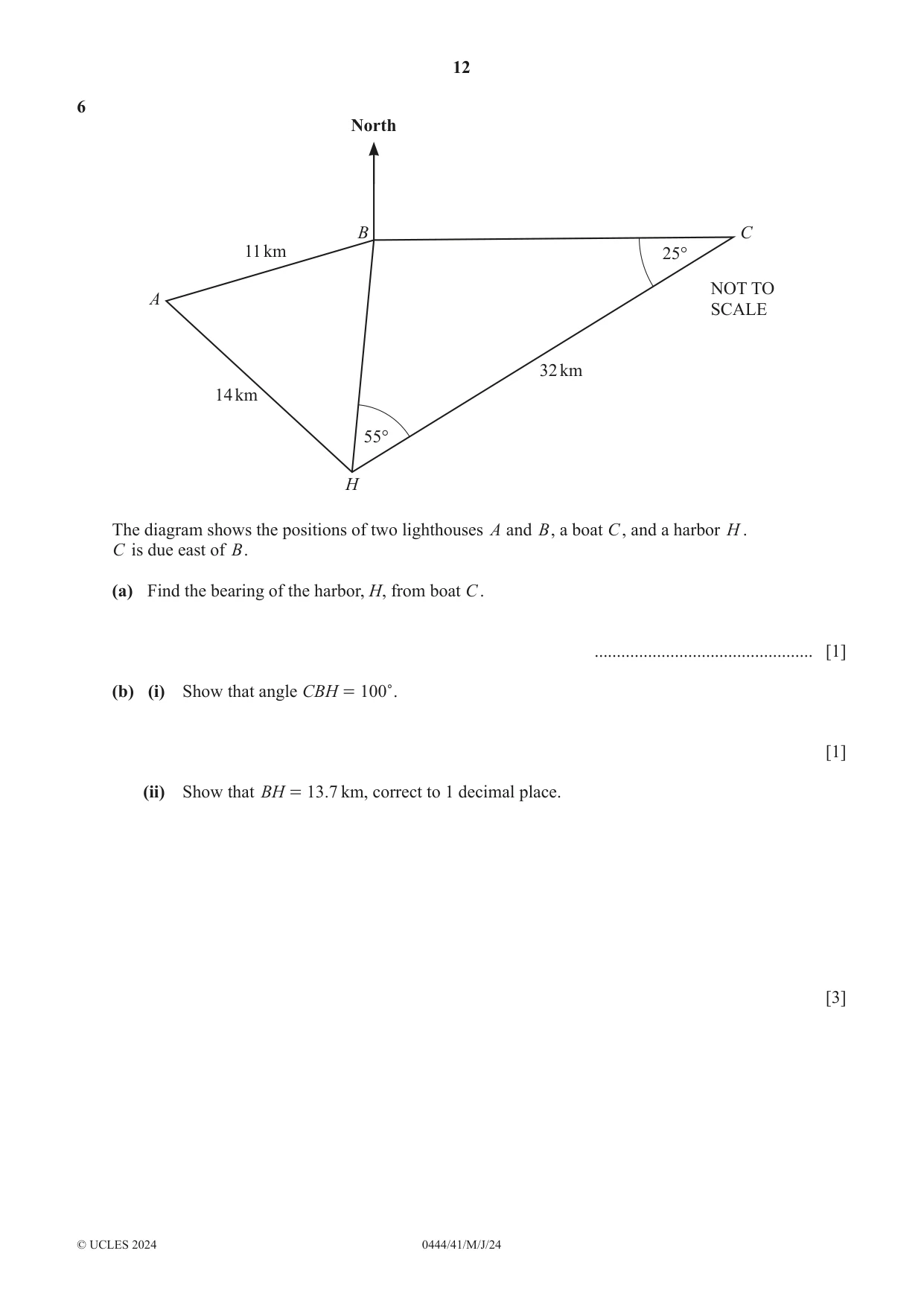
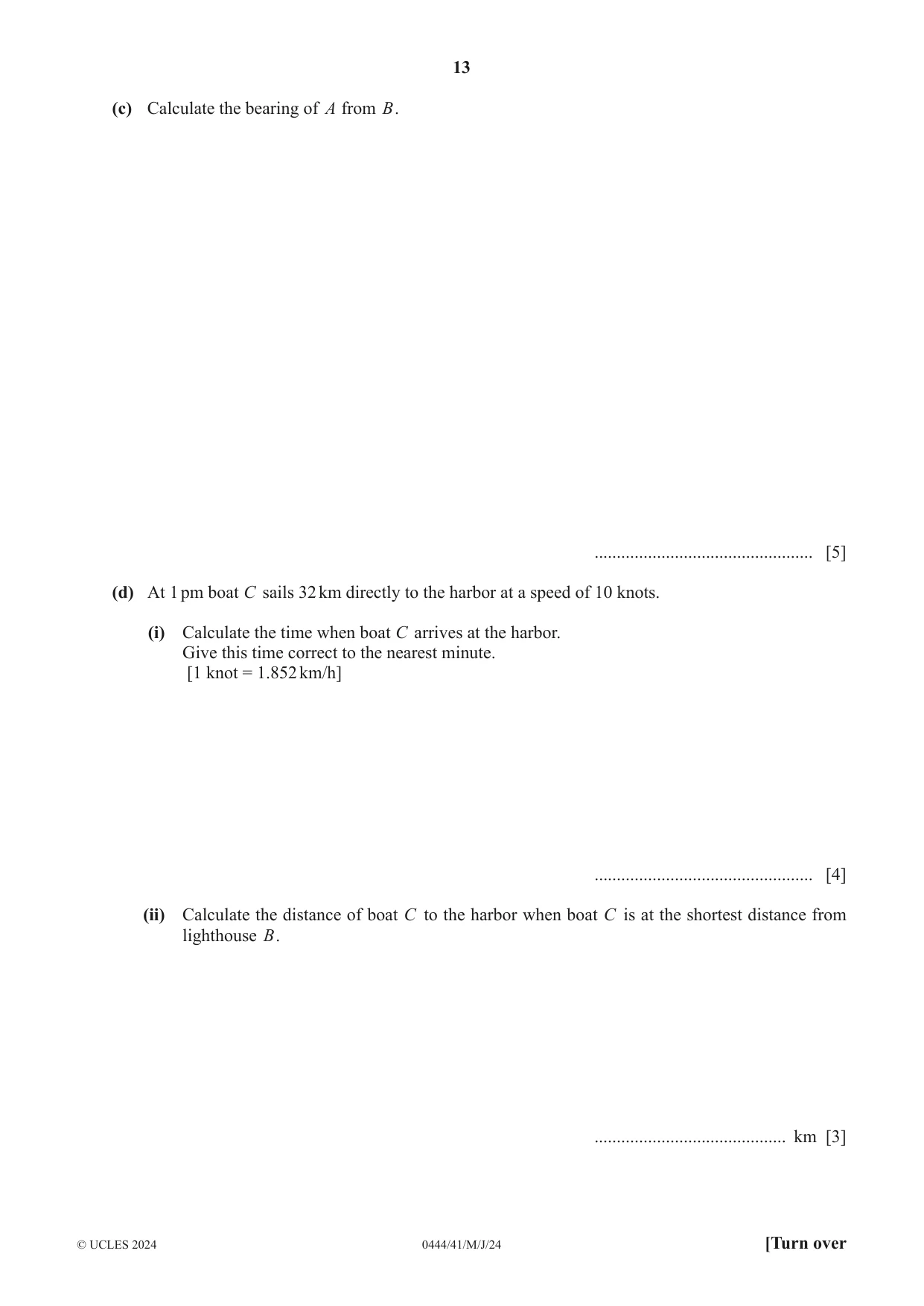
6 North B C 11 km 25° NOT TO A SCALE 32 km 14 km 55° H The diagram shows the positions of two lighthouses A and B, a boat C, and a harbor H . C is due east of B. (a) Find the bearing of the harbor, H, from boat C. ................................................. [1] (b) (i) Show that angle CBH = 100c . [1] (ii) Show that BH = 13.7 km, correct to 1 decimal place. [3] (c) Calculate the bearing of A from B. ................................................. [5] (d) At 1 pm boat C sails 32 km directly to the harbor at a speed of 10 knots. (i) Calculate the time when boat C arrives at the harbor. Give this time correct to the nearest minute. [1 knot = 1.852 km/h] ................................................. [4] (ii) Calculate the distance of boat C to the harbor when boat C is at the shortest distance from lighthouse B. ........................................... km [3]
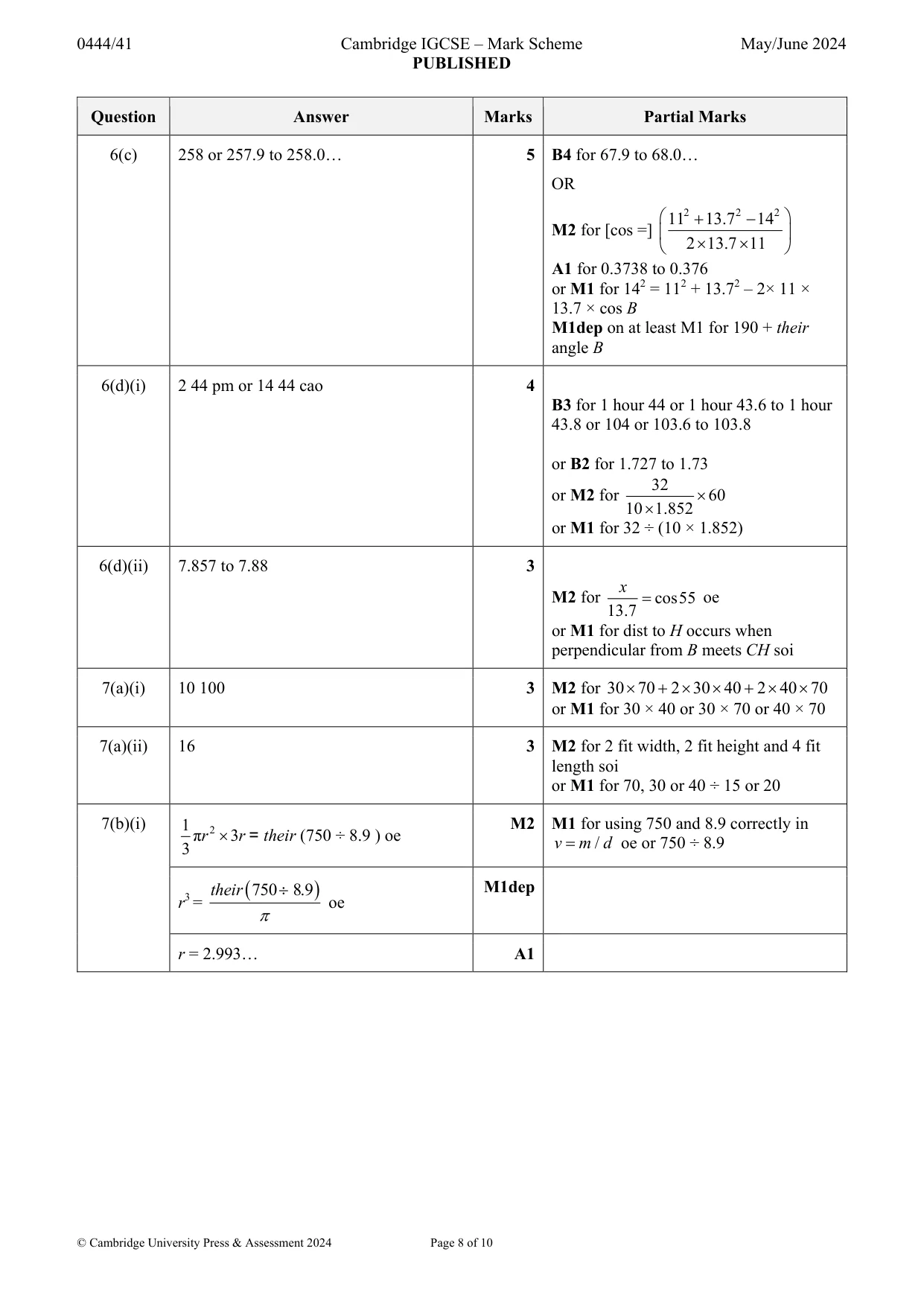
Mark scheme: 6(a) 245 1 6(b)(i) 180 – (55 + 25) [=100] M1 6(b)(ii) 32 sin 25 M2 sin 25 sin100 oe M1 for oe sin100 BH 32 13.73… A1 6(c) 258 or 257.9 to 258.0… 5 B4 for 67.9 to 68.0… OR 112 13.7 2 14 2 M2 for [cos =] 2 13.7 11 A1 for 0.3738 to 0.376 or M1 for 142 = 112 + 13.72 – 2× 11 × 13.7 × cos B M1dep on at least M1 for 190 + their angle B 6(d)(i) 2 44 pm or 14 44 cao 4 B3 for 1 hour 44 or 1 hour 43.6 to 1 hour 43.8 or 104 or 103.6 to 103.8 or B2 for 1.727 to 1.73 32 or M2 for 60 10 1.852 or M1 for 32 ÷ (10 × 1.852) 6(d)(ii) 7.857 to 7.88 3 x M2 for cos55 oe 13.7 or M1 for dist to H occurs when perpendicular from B meets CH soi
Q7 · NOT TO SCALE 40 cm 30 cm 70 cm The diagram shows a box in the shape of a cuboid
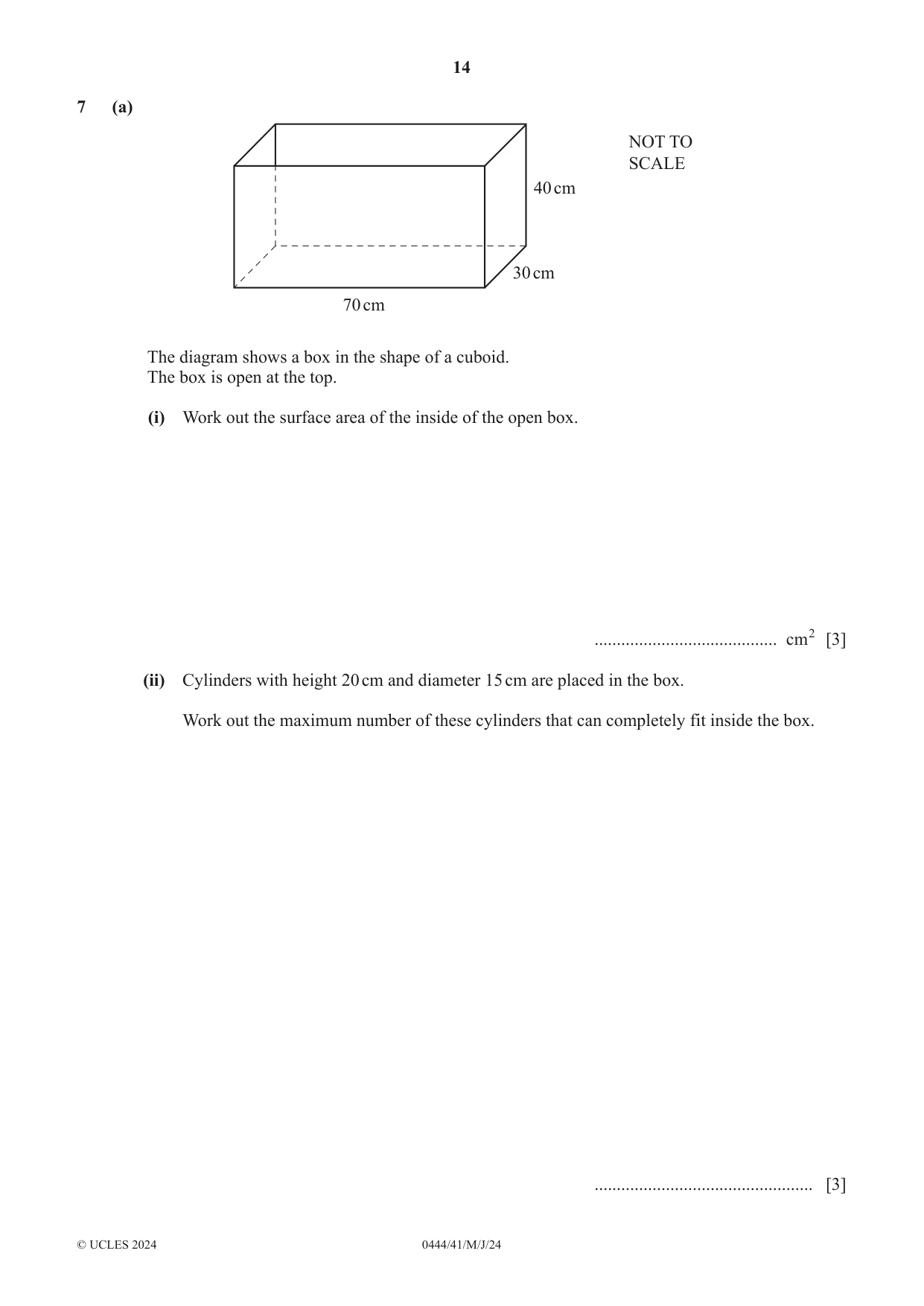
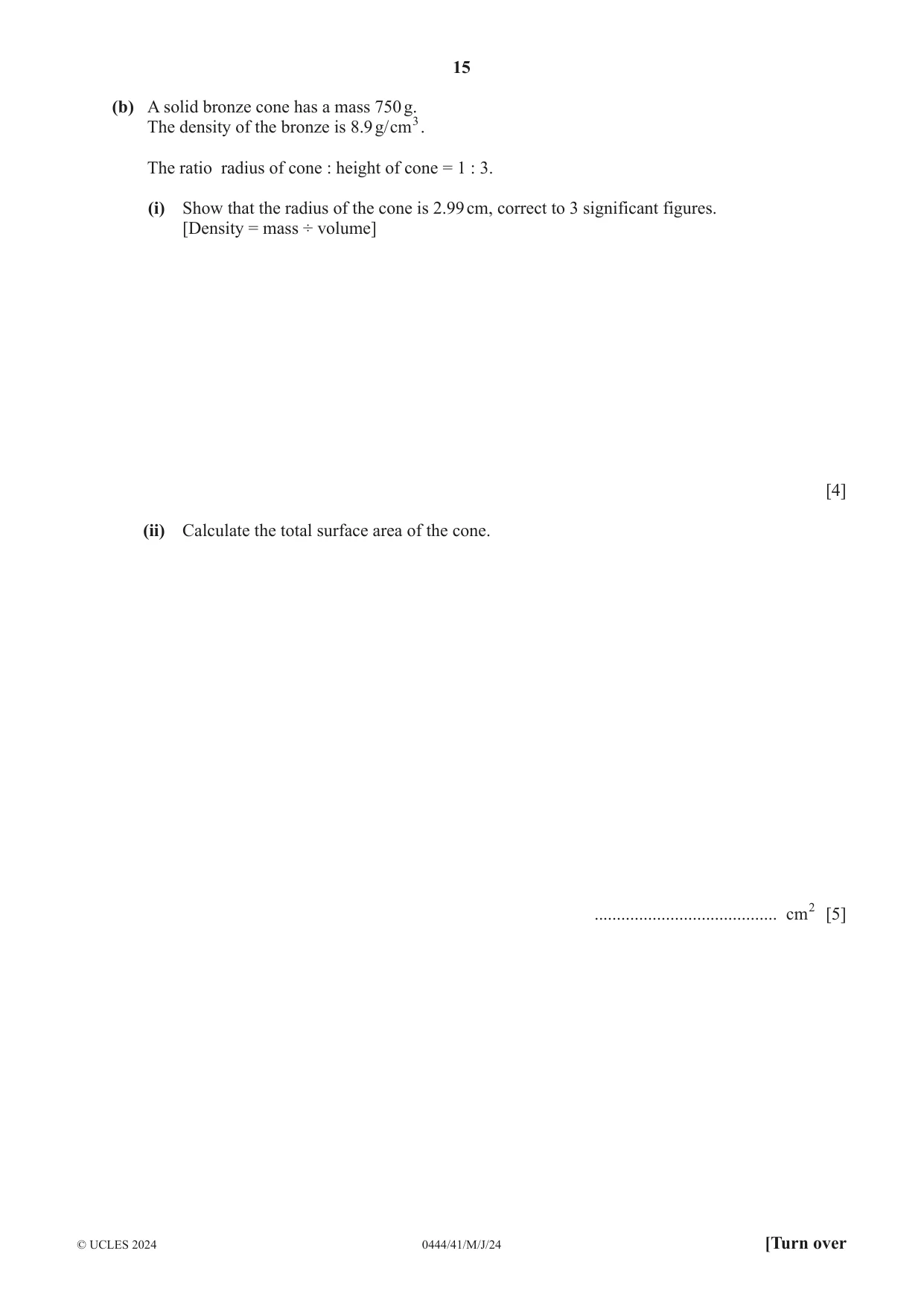
7 (a) NOT TO SCALE 40 cm 30 cm 70 cm The diagram shows a box in the shape of a cuboid. The box is open at the top. (i) Work out the surface area of the inside of the open box. ......................................... cm 2 [3] (ii) Cylinders with height 20 cm and diameter 15 cm are placed in the box. Work out the maximum number of these cylinders that can completely fit inside the box. ................................................. [3] (b) A solid bronze cone has a mass 750 g. The density of the bronze is 8.9 g/cm3. The ratio radius of cone : height of cone = 1 : 3. (i) Show that the radius of the cone is 2.99 cm, correct to 3 significant figures. [Density = mass ÷ volume] [4] (ii) Calculate the total surface area of the cone. ......................................... cm 2 [5]
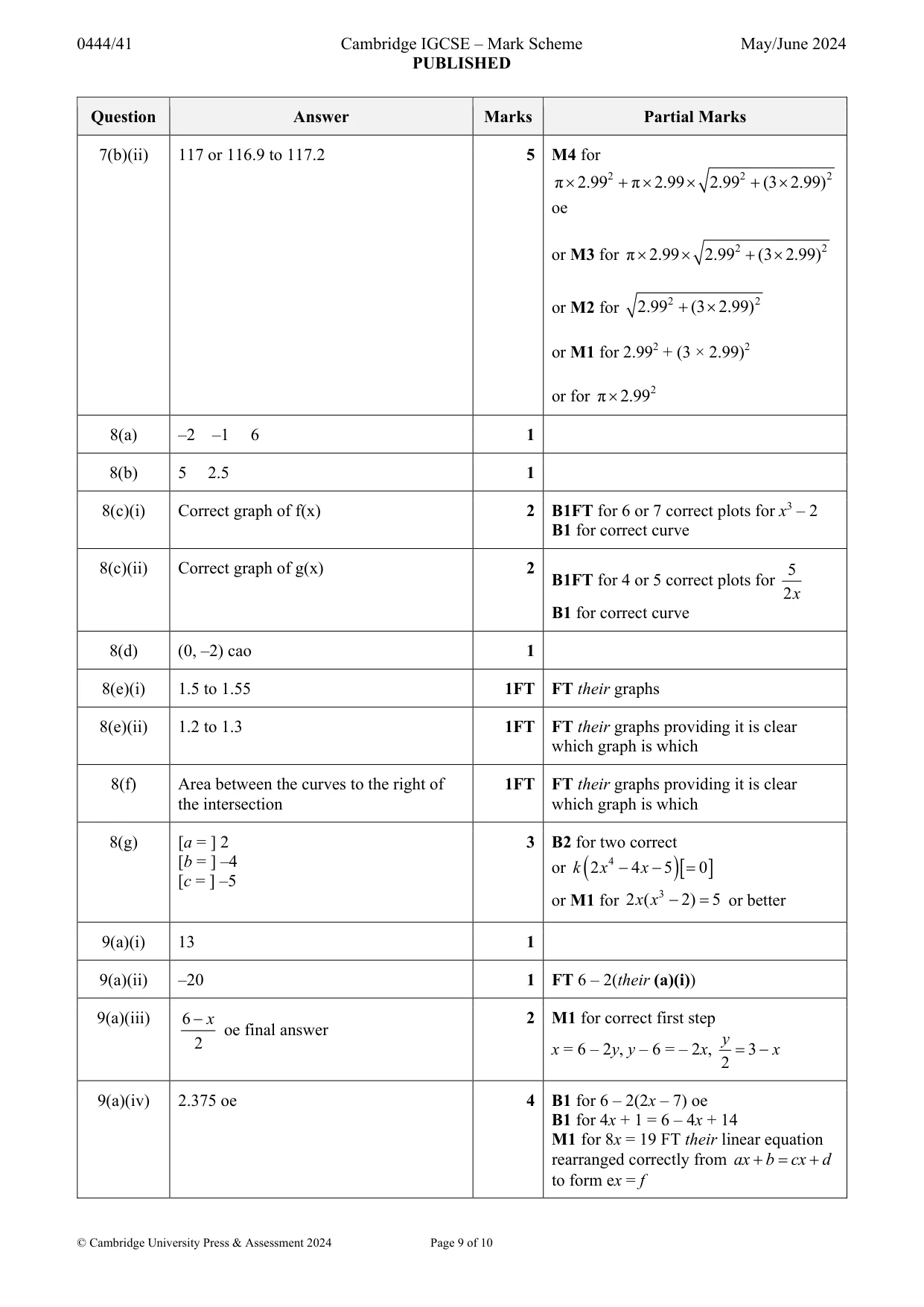
Mark scheme: 7(a)(i) 10 100 3 M2 for 30 70 2 30 40 2 40 70 or M1 for 30 × 40 or 30 × 70 or 40 × 70 7(a)(ii) 16 3 M2 for 2 fit width, 2 fit height and 4 fit length soi or M1 for 70, 30 or 40 ÷ 15 or 20 7(b)(i) 1 2 M2 M1 for using 750 and 8.9 correctly in πr 3r = their (750 ÷ 8.9 ) oe v m / d oe or 750 ÷ 8.9 3 their 750 8.9 M1dep r3 = oe r = 2.993… A1 7(b)(ii) 117 or 116.9 to 117.2 5 M4 for π 2.99 2 π 2.99 2.99 2 (3 2.99) 2 oe or M3 for π 2.99 2.99 2 (3 2.99) 2 or M2 for 2.99 2 (3 2.99) 2 or M1 for 2.992 + (3 × 2.99)2 or for π 2.99 2
Q8 · F ( x) = x 3 - 2, -1 G x G 2 Complete the table
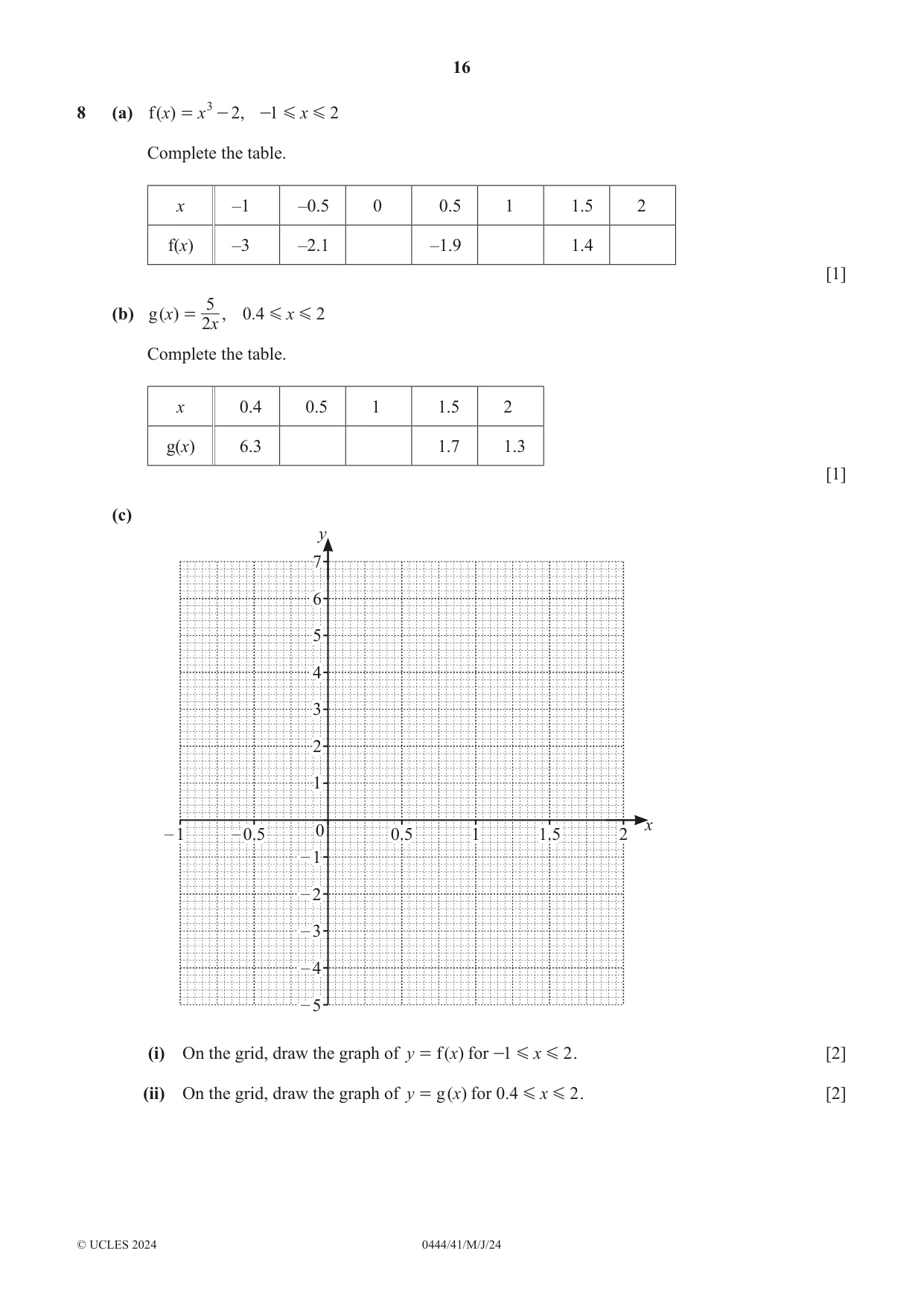
8 (a) f ( x) = x 3 - 2, -1 G x G 2 Complete the table. x –1 –0.5 0 0.5 1 1.5 2 f(x) –3 –2.1 –1.9 1.4 [1] 5 (b) g ( x) = , 0 .4 G x G 2 2x Complete the table. x 0.4 0.5 1 1.5 2 g(x) 6.3 1.7 1.3 [1] (c) y 7 6 5 4 3 2 1 x – 1 – 0.5 0 0.5 1 1.5 2 – 1 – 2 – 3 – 4 – 5 (i) On the grid, draw the graph of y = f ( x) for -1 G x G 2 . [2] (ii) On the grid, draw the graph of y = g ( x) for 0.4 G x G 2 . [2] (d) Find the coordinates of the point on the graph of y = f ( x) where the slope is zero. ( ...................... , ...................... ) [1] (e) Use your graphs to find the value of x when (i) f ( x) = g ( x) x = ................................................ [1] (ii) g ( x) - f ( x) = 2 . x = ................................................ [1] (f) On the grid, shade the region where y G f ( x) and y H g ( x) . Label this region R. [1] (g) The equation f ( x) = g ( x) can be written as ax 4 + bx + c = 0 . Find the values of a, b, and c. a = ................................................ b = ................................................ c = ................................................ [3]
Mark scheme: 8(a) –2 –1 6 1 8(b) 5 2.5 1 8(c)(i) Correct graph of f(x) 2 B1FT for 6 or 7 correct plots for x3 – 2 B1 for correct curve 8(c)(ii) Correct graph of g(x) 2 5 B1FT for 4 or 5 correct plots for 2x B1 for correct curve 8(d) (0, –2) cao 1 8(e)(i) 1.5 to 1.55 1FT FT their graphs 8(e)(ii) 1.2 to 1.3 1FT FT their graphs providing it is clear which graph is which 8(f) Area between the curves to the right of 1FT FT their graphs providing it is clear the intersection which graph is which 8(g) [a = ] 2 3 B2 for two correct [b = ] –4 4 or k 2 x 4 x 5 0 [c = ] –5 or M1 for 2 x ( x 3 2) 5 or better
Q9 · F ( )x = 4 x + 1 g ( )x = 6 - 2 x Find (i) f ( 3)…
9 (a) f ( )x = 4 x + 1 g ( )x = 6 - 2 x Find (i) f ( 3) ................................................. [1] (ii) g ( f ( 3)) . ................................................. [1] (iii) Find g -1 ( )x . g -1 x = ................................................. [2] ` j (iv) Find x when f ( x) = g ( 2x - 7) . x = ................................................. [4] (b) h ( )x = 3 x - 2 (i) Find the value of h(h(2)). ................................................. [2] (ii) Find x when h -1 ( )x = 10 . x = ................................................. [2] (c) j ( x) = 5 cos ( 5x) Find the amplitude and the period of j(x). Amplitude = ................................................ Period = ................................................ [2]
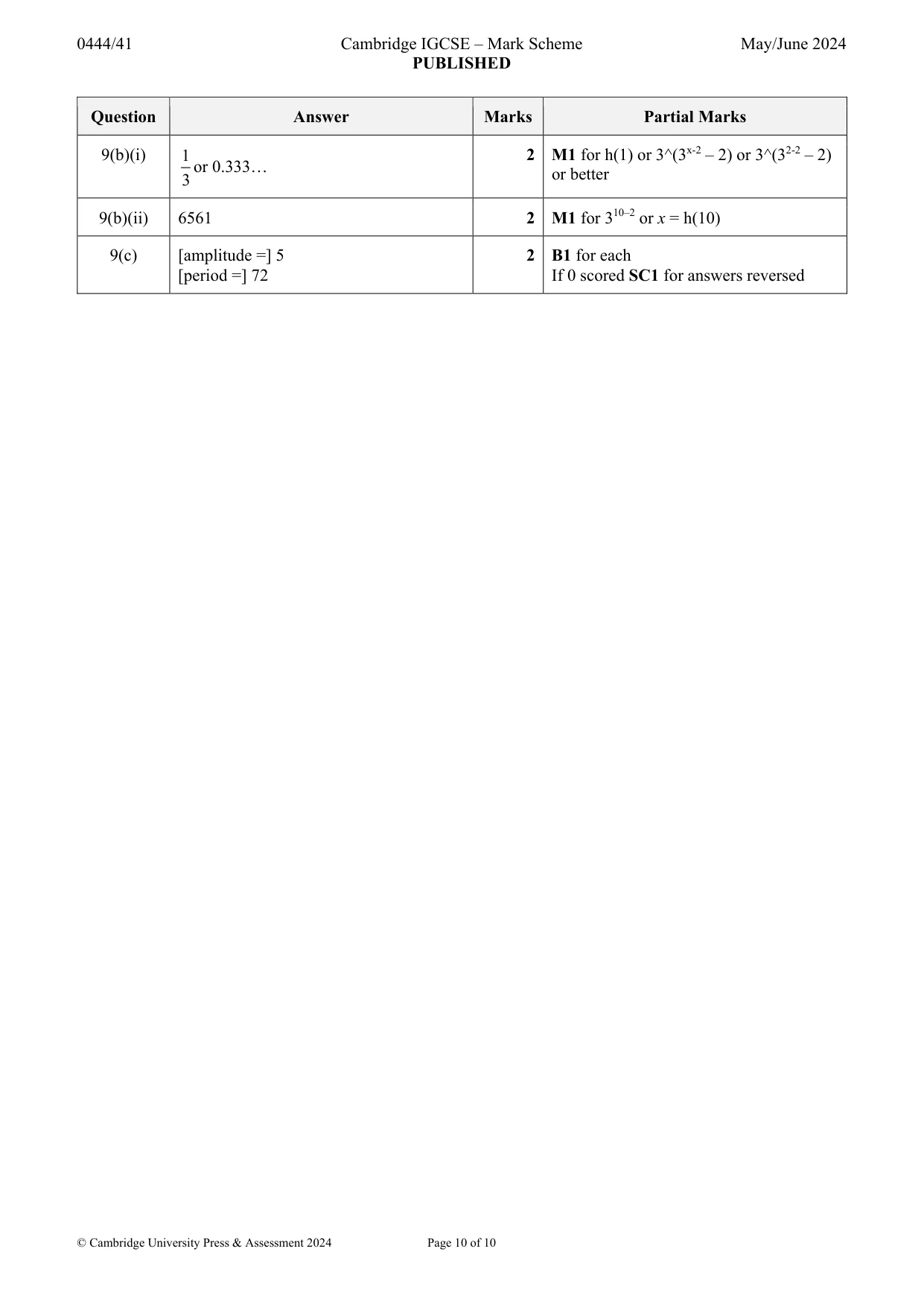
Mark scheme: 9(a)(i) 13 1 9(a)(ii) –20 1 FT 6 – 2(their (a)(i)) 9(a)(iii) 6 x 2 M1 for correct first step oe final answer 2 y x = 6 – 2y, y – 6 = – 2x, 3 x 2 9(a)(iv) 2.375 oe 4 B1 for 6 – 2(2x – 7) oe B1 for 4x + 1 = 6 – 4x + 14 M1 for 8x = 19 FT their linear equation rearranged correctly from ax b cx d to form ex = f 9(b)(i) 1 2 M1 for h(1) or 3^(3x-2 – 2) or 3^(32-2 – 2) or 0.333… or better 3 9(b)(ii) 6561 2 M1 for 310–2 or x = h(10) 9(c) [amplitude =] 5 2 B1 for each [period =] 72 If 0 scored SC1 for answers reversed
What you needed in this session
Cambridge’s own grade thresholds for 2024 May/June, Paper 4 · Variant 1. A higher threshold means an easier paper — the bar moves with how the cohort did.