Cambridge IGCSE Mathematics (US) 0444 — 2023 May/June Paper 4 · Variant 1
0444/41/M/J/23 · 11 questions · 130 marks · ≈146 min
The question paper and its mark scheme, free to read here and free to download. This is Cambridge’s own paper, exactly as it was sat.
Question paper20 pages
Mark scheme9 pages
Answers below. Sit the paper first if you are practising.
Questions as text
Q1 · 30 students take a test
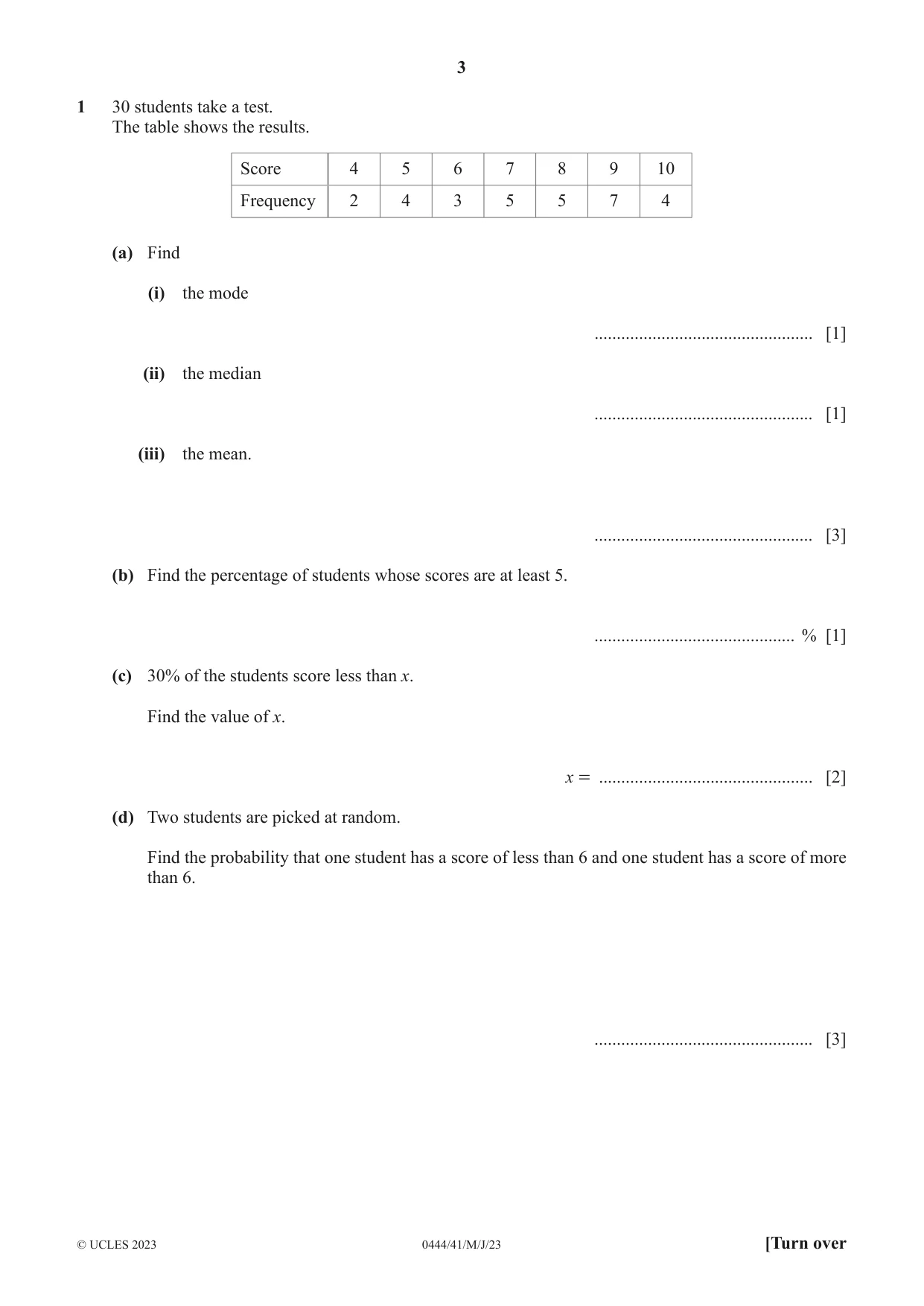
1 30 students take a test. The table shows the results. Score 4 5 6 7 8 9 10 Frequency 2 4 3 5 5 7 4 (a) Find (i) the mode ................................................. [1] (ii) the median ................................................. [1] (iii) the mean. ................................................. [3] (b) Find the percentage of students whose scores are at least 5. ............................................. % [1] (c) 30% of the students score less than x. Find the value of x. x = ................................................ [2] (d) Two students are picked at random. Find the probability that one student has a score of less than 6 and one student has a score of more than 6. ................................................. [3]
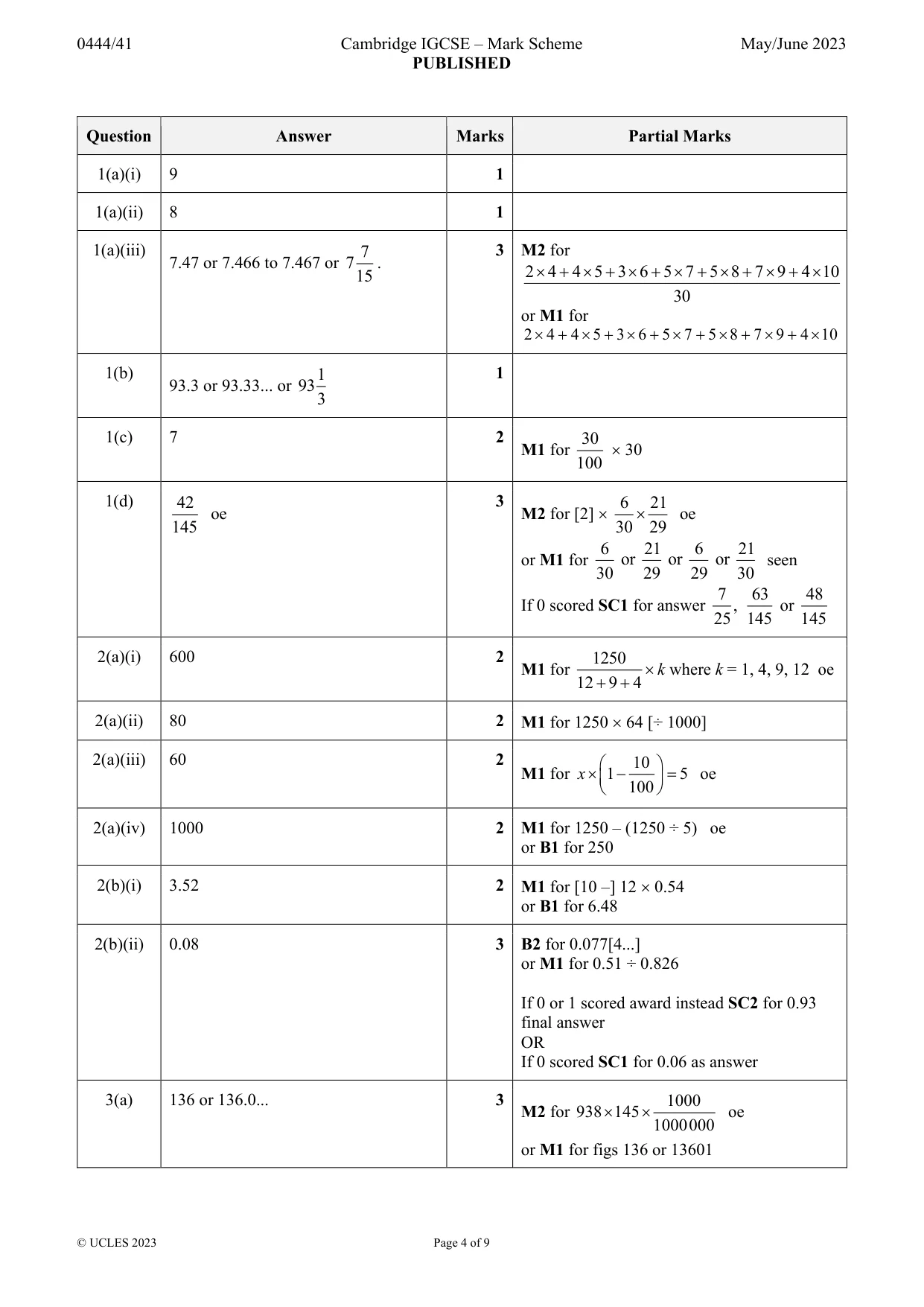
Mark scheme: Question Answer Marks Partial Marks 1(a)(i) 9 1 1(a)(ii) 8 1 1(a)(iii) 7 3 M2 for 7.47 or 7.466 to 7.467 or . 2 4 4 5 3 6 5 7 5 8 7 9 4 10 715 30 or M1 for 2 4 4 5 3 6 5 7 5 8 7 9 4 10 1(b) 1 1 93.3 or 93.33... or 933 1(c) 7 2 30 M1 for 30 100 1(d) 42 3 6 21 oe M2 for [2] oe 145 30 29 6 21 6 21 or M1 for or or or seen 30 29 29 30 7 63 48 If 0 scored SC1 for answer , or 25 145 145
Q2 · An orchard has 1250 trees
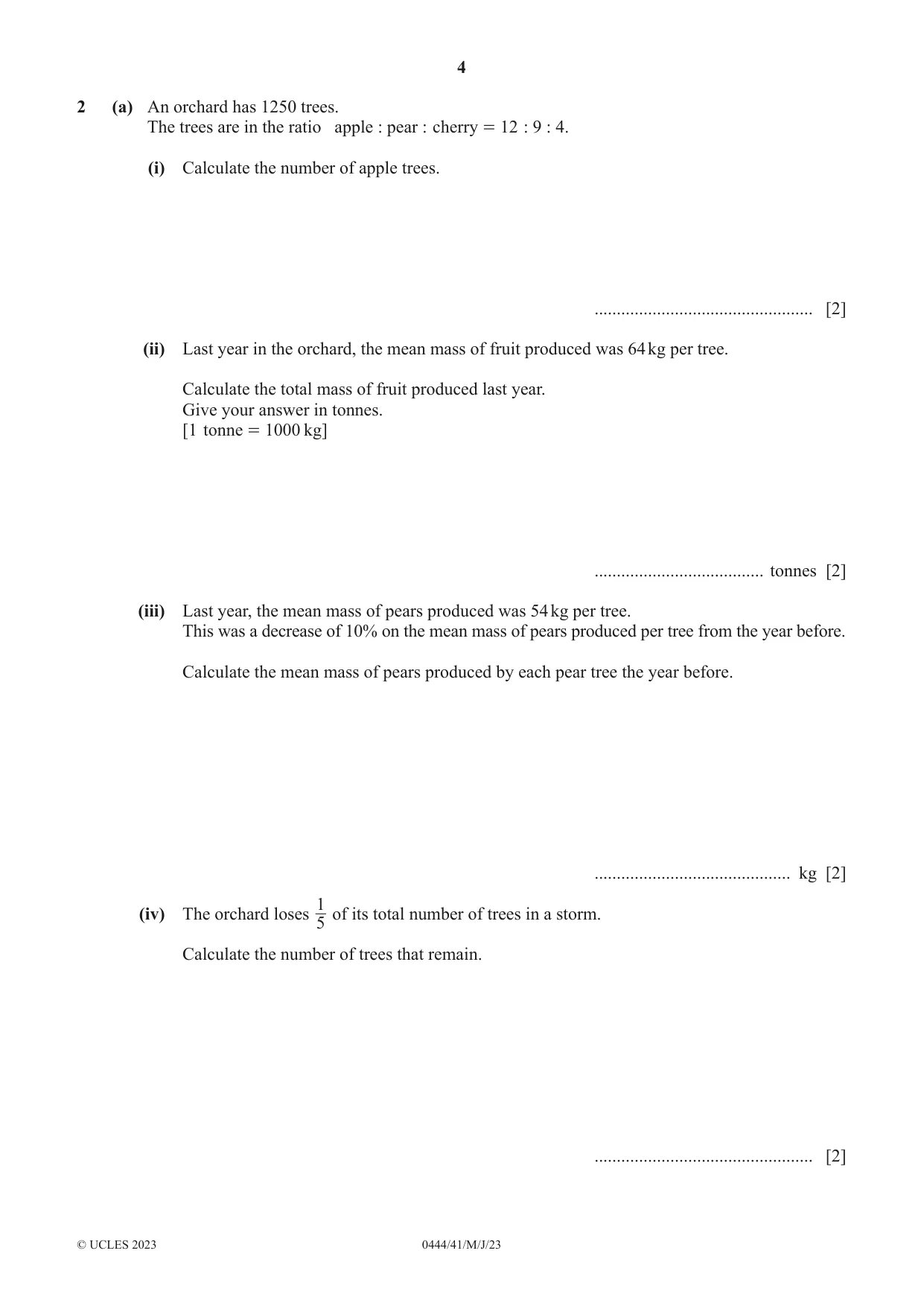
2 (a) An orchard has 1250 trees. The trees are in the ratio apple : pear : cherry = 12 : 9 : 4. (i) Calculate the number of apple trees. ................................................. [2] (ii) Last year in the orchard, the mean mass of fruit produced was 64 kg per tree. Calculate the total mass of fruit produced last year. Give your answer in tonnes. [1 tonne = 1000 kg] ...................................... tonnes [2] (iii) Last year, the mean mass of pears produced was 54 kg per tree. This was a decrease of 10% on the mean mass of pears produced per tree from the year before. Calculate the mean mass of pears produced by each pear tree the year before. ............................................ kg [2] 1 (iv) The orchard loses of its total number of trees in a storm. 5 Calculate the number of trees that remain. ................................................. [2] (b) Paulo buys some pears from a market. Pears cost $0.54 each or 0.51 euros each. (i) Paulo pays in dollars for 12 pears. Calculate the change he receives from $10. $ ................................................ [2] (ii) The exchange rate is $1 = 0.826 euros. Calculate how much more Paulo pays for each pear when he pays in euros. Give your answer in dollars, correct to the nearest cent. $ ................................................ [3]
Mark scheme: 2(a)(i) 600 2 1250 M1 for k where k = 1, 4, 9, 12 oe 12 9 4 2(a)(ii) 80 2 M1 for 1250 64 [÷ 1000] 2(a)(iii) 60 2 10 M1 for x 1 5 oe 100 2(a)(iv) 1000 2 M1 for 1250 – (1250 ÷ 5) oe or B1 for 250 2(b)(i) 3.52 2 M1 for [10 –] 12 0.54 or B1 for 6.48 2(b)(ii) 0.08 3 B2 for 0.077[4...] or M1 for 0.51 ÷ 0.826 If 0 or 1 scored award instead SC2 for 0.93 final answer OR If 0 scored SC1 for 0.06 as answer
Q3 · F NOT TO SCALE D C E A B The diagram shows a solid triangular prism ABCDEF of length 15 cm
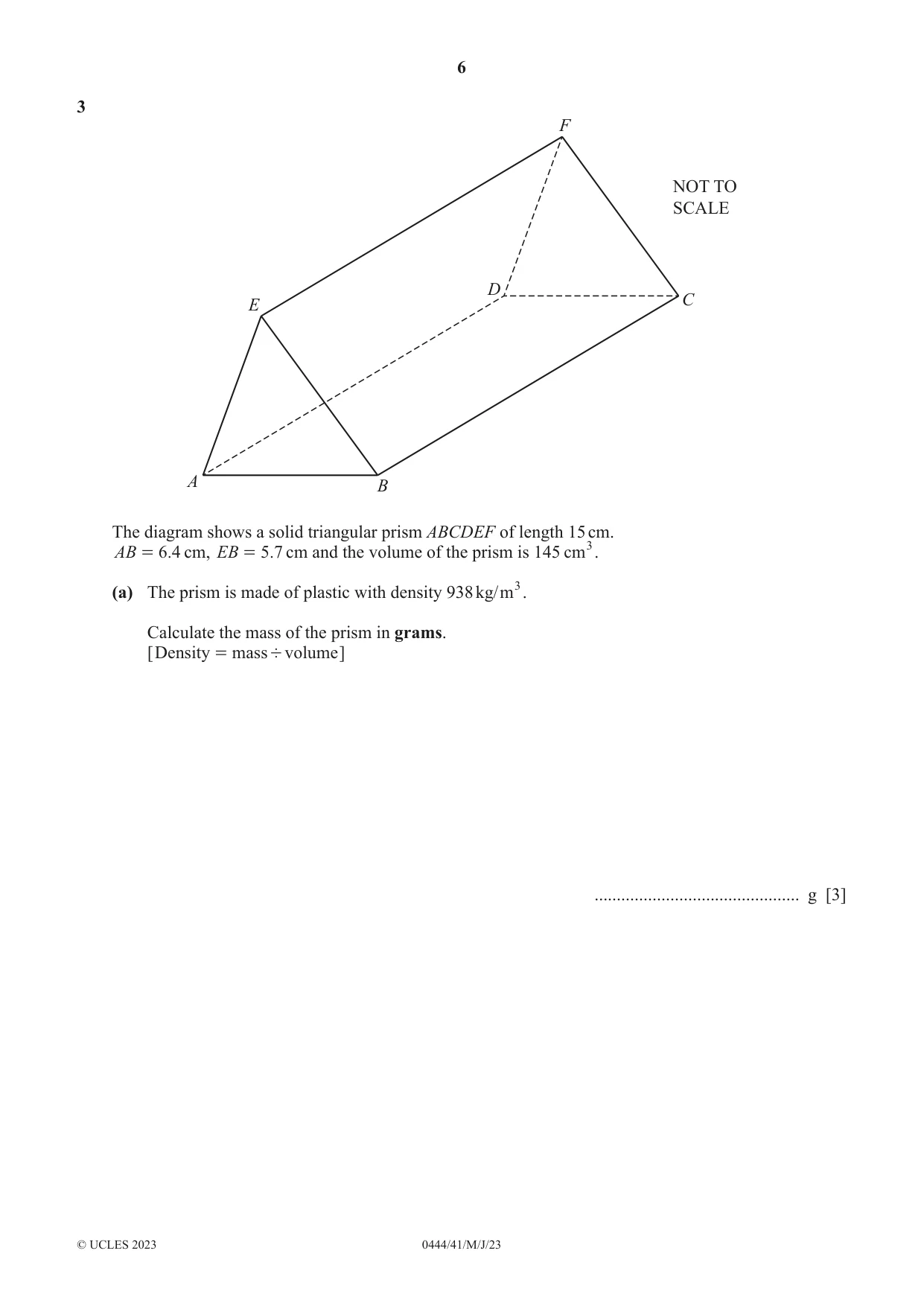
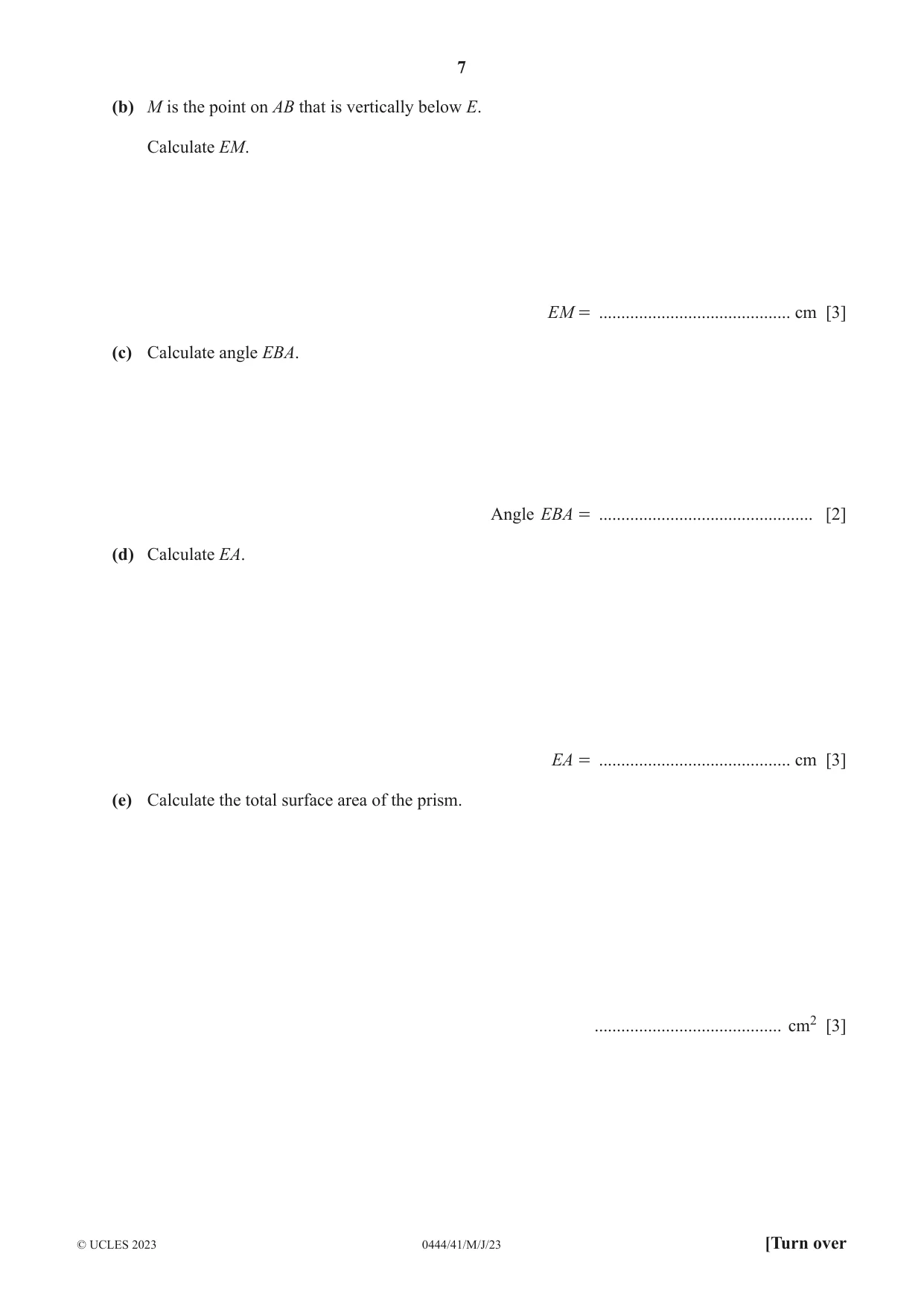
3 F NOT TO SCALE D C E A B The diagram shows a solid triangular prism ABCDEF of length 15 cm. AB = 6.4 cm, EB = 5.7 cm and the volume of the prism is 145 cm3. (a) The prism is made of plastic with density 938 kg/m3. Calculate the mass of the prism in grams. [Density = mass ' volume ] .............................................. g [3] (b) M is the point on AB that is vertically below E. Calculate EM. EM = ........................................... cm [3] (c) Calculate angle EBA. Angle EBA = ................................................ [2] (d) Calculate EA. EA = ........................................... cm [3] (e) Calculate the total surface area of the prism. .......................................... cm2 [3]
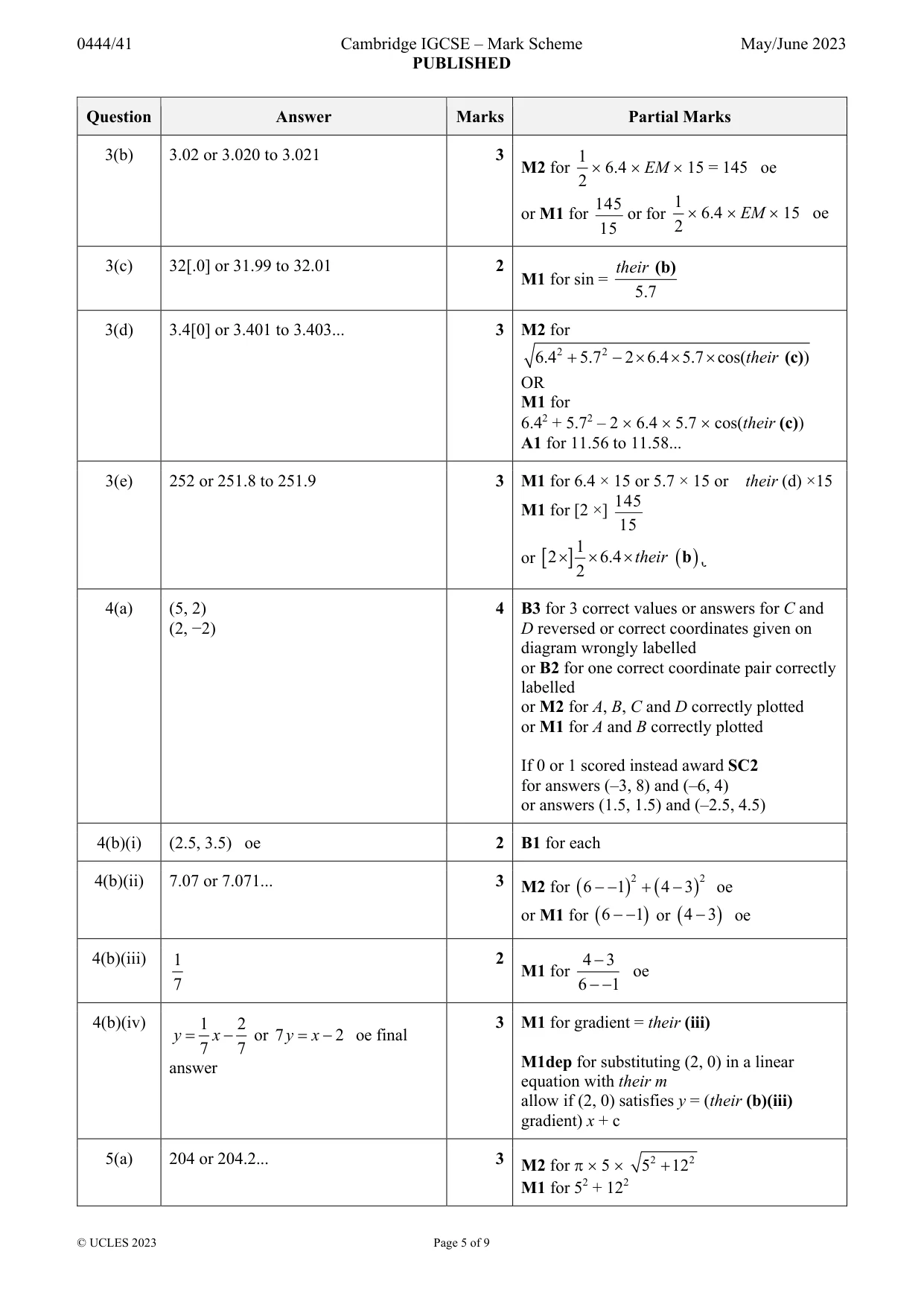
Mark scheme: 3(a) 136 or 136.0... 3 1000 M2 for 938 145 oe 1000000 or M1 for figs 136 or 13601 3(b) 3.02 or 3.020 to 3.021 3 1 M2 for 6.4 EM 15 = 145 oe 2 145 1 or M1 for or for 6.4 EM 15 oe 15 2 3(c) 32[.0] or 31.99 to 32.01 2 their (b) M1 for sin = 5.7 3(d) 3.4[0] or 3.401 to 3.403... 3 M2 for 6.4 2 5.7 2 2 6.4 5.7 cos(their (c)) OR M1 for 6.42 + 5.72 – 2 6.4 5.7 cos(their (c)) A1 for 11.56 to 11.58... 3(e) 252 or 251.8 to 251.9 3 M1 for 6.4 × 15 or 5.7 × 15 or their (d) ×15 145 M1 for [2 ×] 15 1 or 2 6.4 their b 2
Q4 · In the square ABCD, A has coordinates ( - 2 , 1) and B has coordinates (1, 5)
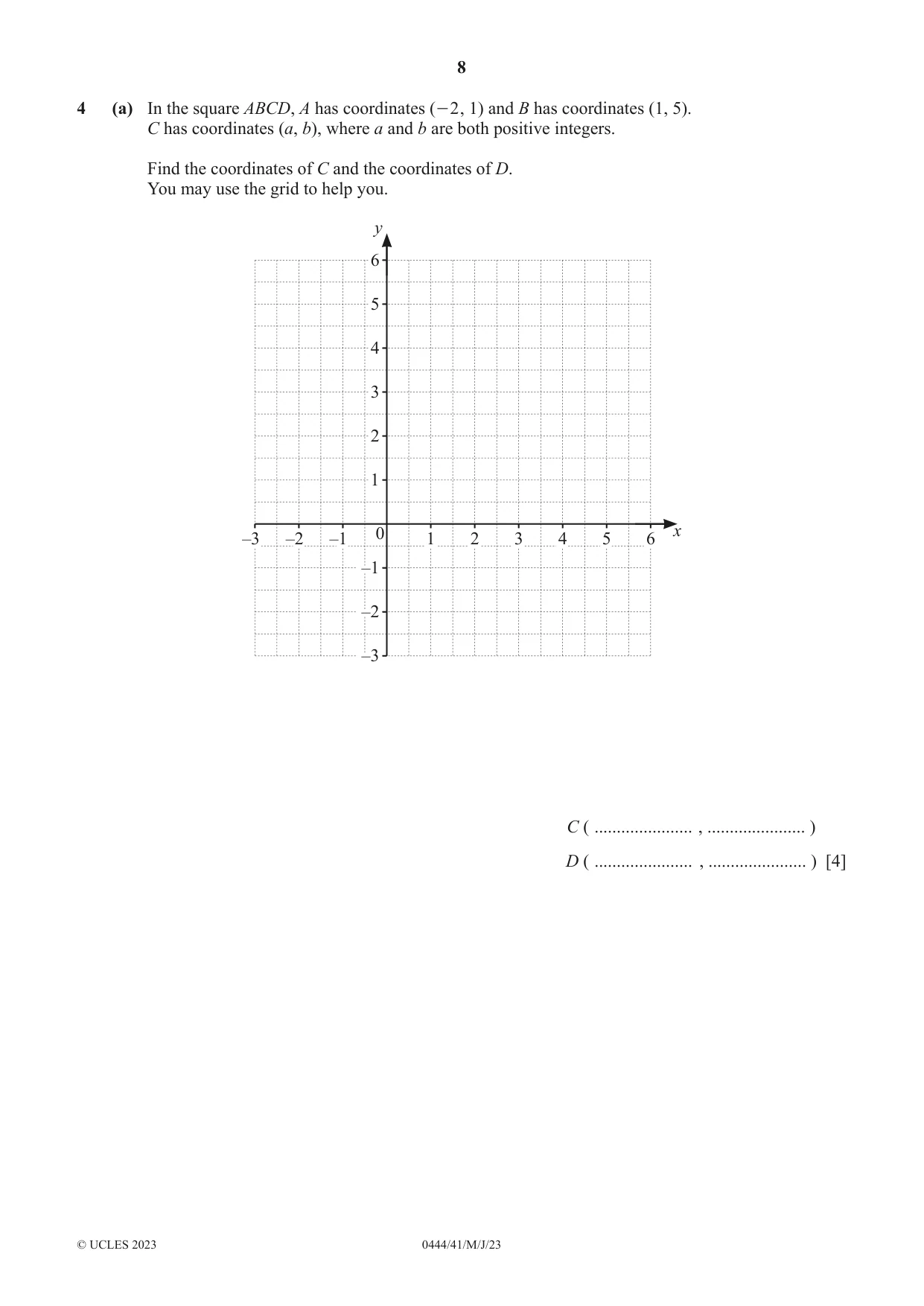
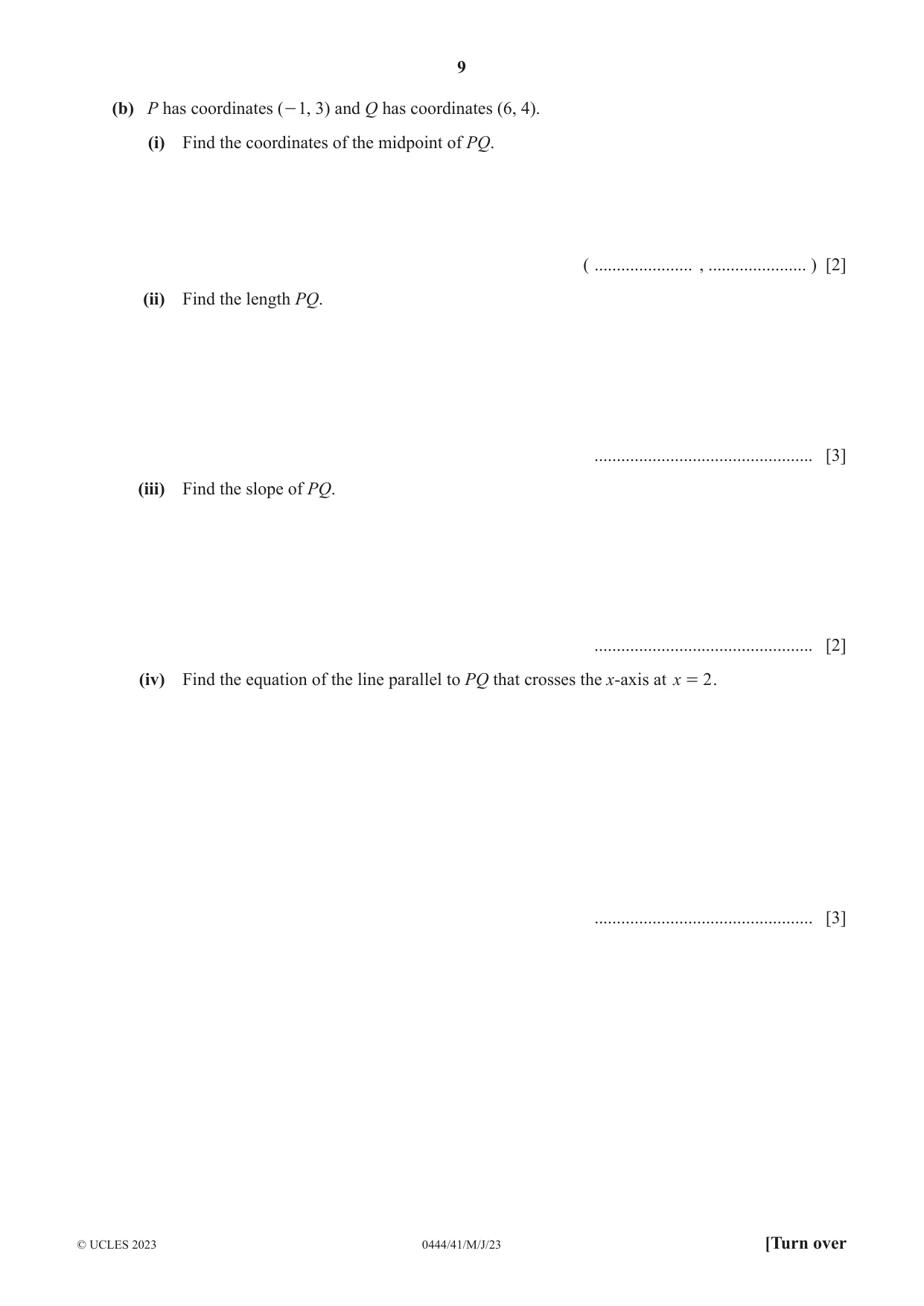
4 (a) In the square ABCD, A has coordinates ( - 2 , 1) and B has coordinates (1, 5). C has coordinates (a, b), where a and b are both positive integers. Find the coordinates of C and the coordinates of D. You may use the grid to help you. y 6 5 4 3 2 1 0 x –3 –2 –1 1 2 3 4 5 6 –1 –2 –3 C ( ...................... , ...................... ) D ( ...................... , ...................... ) [4] (b) P has coordinates ( - 1, 3) and Q has coordinates (6, 4). (i) Find the coordinates of the midpoint of PQ. ( ...................... , ...................... ) [2] (ii) Find the length PQ. ................................................. [3] (iii) Find the slope of PQ. ................................................. [2] (iv) Find the equation of the line parallel to PQ that crosses the x-axis at x = 2 . ................................................. [3]
Mark scheme: 4(a) (5, 2) 4 B3 for 3 correct values or answers for C and (2, −2) D reversed or correct coordinates given on diagram wrongly labelled or B2 for one correct coordinate pair correctly labelled or M2 for A, B, C and D correctly plotted or M1 for A and B correctly plotted If 0 or 1 scored instead award SC2 for answers (–3, 8) and (–6, 4) or answers (1.5, 1.5) and (–2.5, 4.5) 4(b)(i) (2.5, 3.5) oe 2 B1 for each 4(b)(ii) 7.07 or 7.071... 3 2 2 M2 for 6 1 4 3 oe or M1 for 6 1 or 4 3 oe 4(b)(iii) 1 2 4 3 M1 for oe 7 6 1 4(b)(iv) 1 2 3 M1 for gradient = their (iii) y x or 7 y x 2 oe final 7 7 M1dep for substituting (2, 0) in a linear answer equation with their m allow if (2, 0) satisfies y = (their (b)(iii) gradient) x + c
Q5 · A cone has a base radius of 5 cm and a perpendicular height of 12 cm
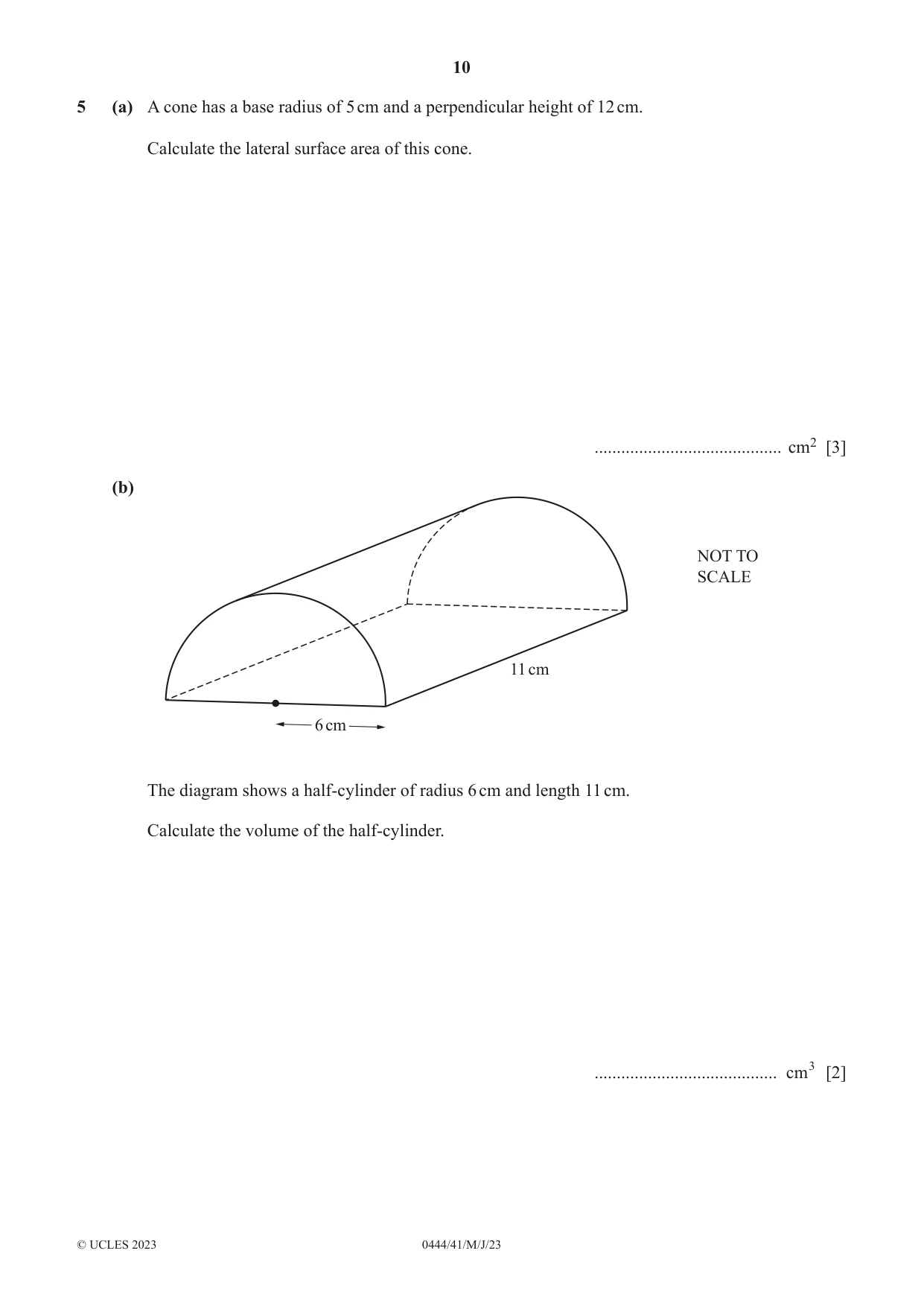
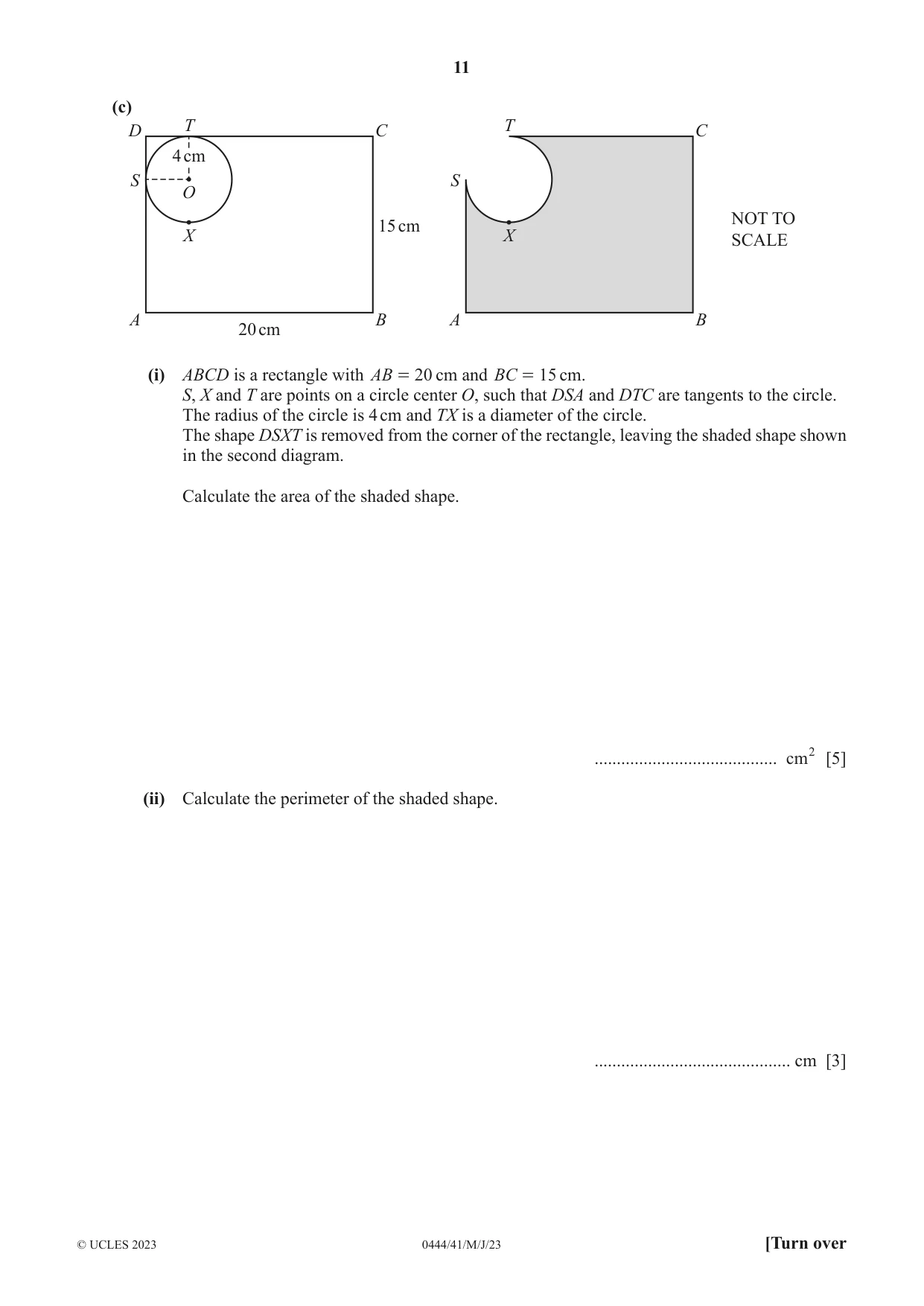
5 (a) A cone has a base radius of 5 cm and a perpendicular height of 12 cm. Calculate the lateral surface area of this cone. .......................................... cm2 [3] (b) NOT TO SCALE 11 cm 6 cm The diagram shows a half-cylinder of radius 6 cm and length 11 cm. Calculate the volume of the half-cylinder. ......................................... cm3 [2] (c) T T D C C 4 cm S S O NOT TO 15 cm X X SCALE A B A B 20 cm (i) ABCD is a rectangle with AB = 20 cm and BC = 15 cm. S, X and T are points on a circle center O, such that DSA and DTC are tangents to the circle. The radius of the circle is 4 cm and TX is a diameter of the circle. The shape DSXT is removed from the corner of the rectangle, leaving the shaded shape shown in the second diagram. Calculate the area of the shaded shape. ......................................... cm2 [5] (ii) Calculate the perimeter of the shaded shape. ............................................ cm [3]
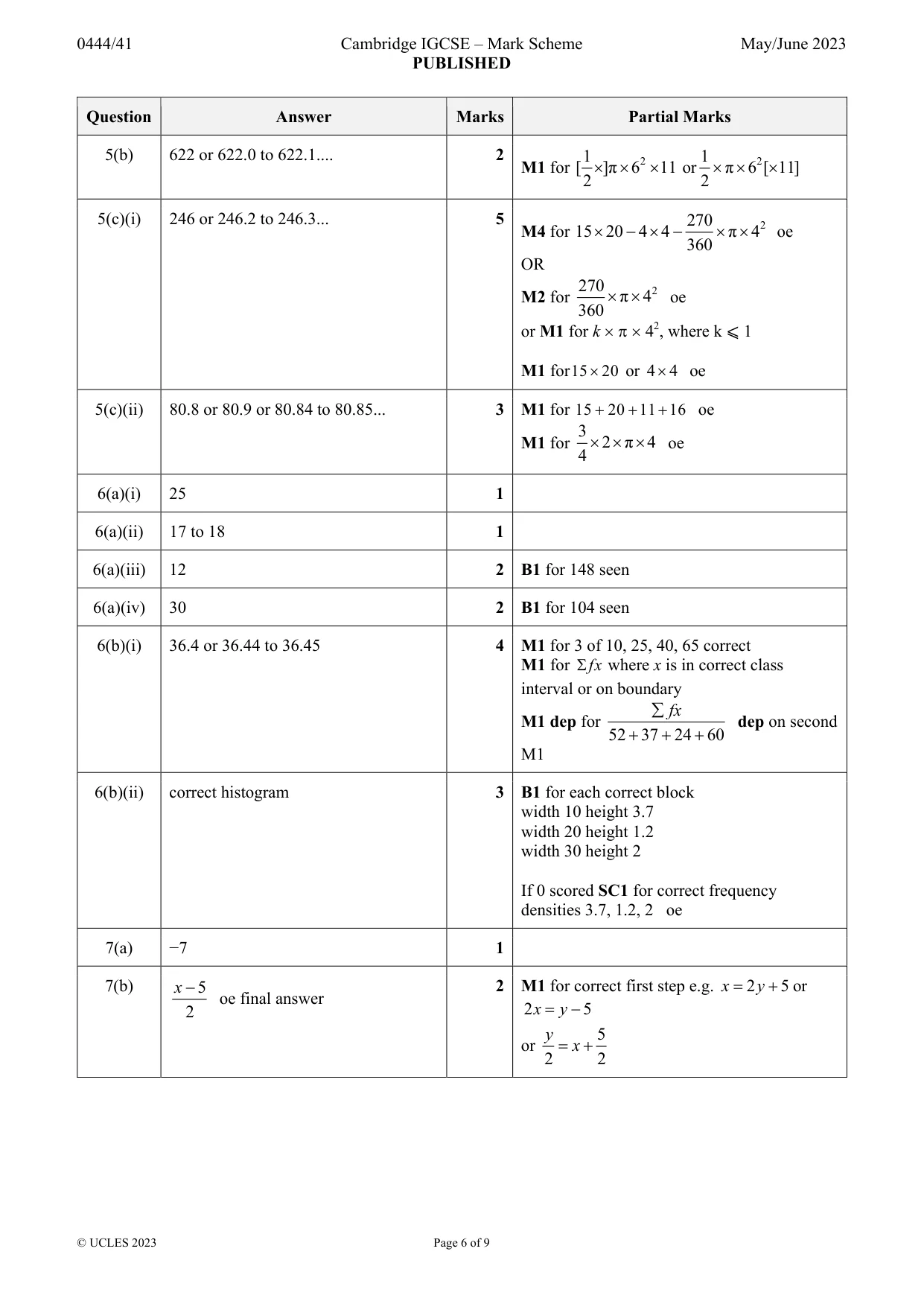
Mark scheme: 5(a) 204 or 204.2... 3 2 2 M2 for 5 5 12 M1 for 52 + 122 5(b) 622 or 622.0 to 622.1.... 2 1 2 1 2 M1 for [ 2]π 6 11 or 2 π 6 [ 11] 5(c)(i) 246 or 246.2 to 246.3... 5 270 2 M4 for 15 20 4 4 π 4 oe 360 OR 270 2 M2 for π 4 oe 360 or M1 for k 42, where k ⩽ 1 M1 for15 20 or 4 4 oe 5(c)(ii) 80.8 or 80.9 or 80.84 to 80.85... 3 M1 for 15 20 11 16 oe 3 M1 for 2 π 4 oe 4
Q6 · There are 160 people in a village
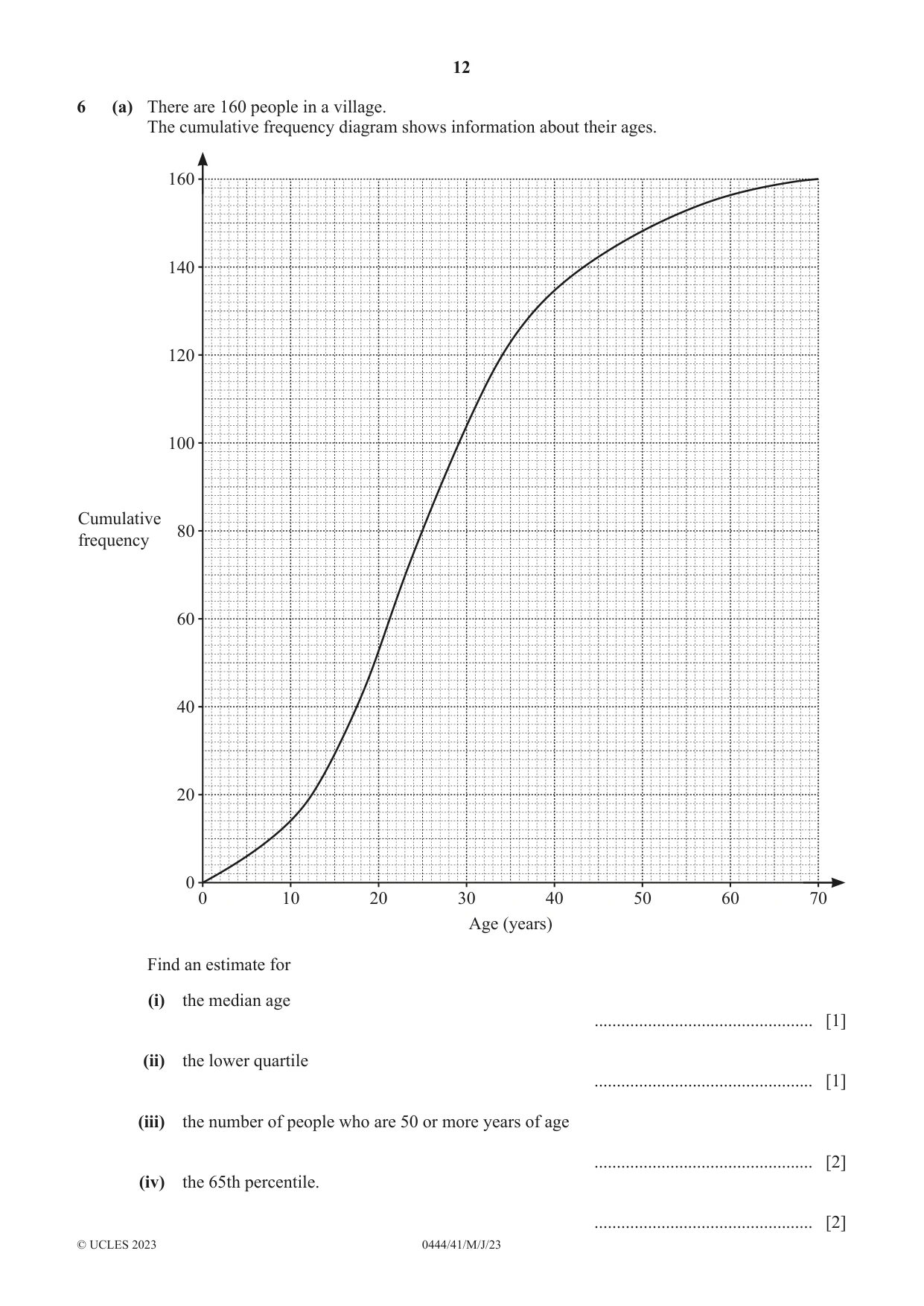
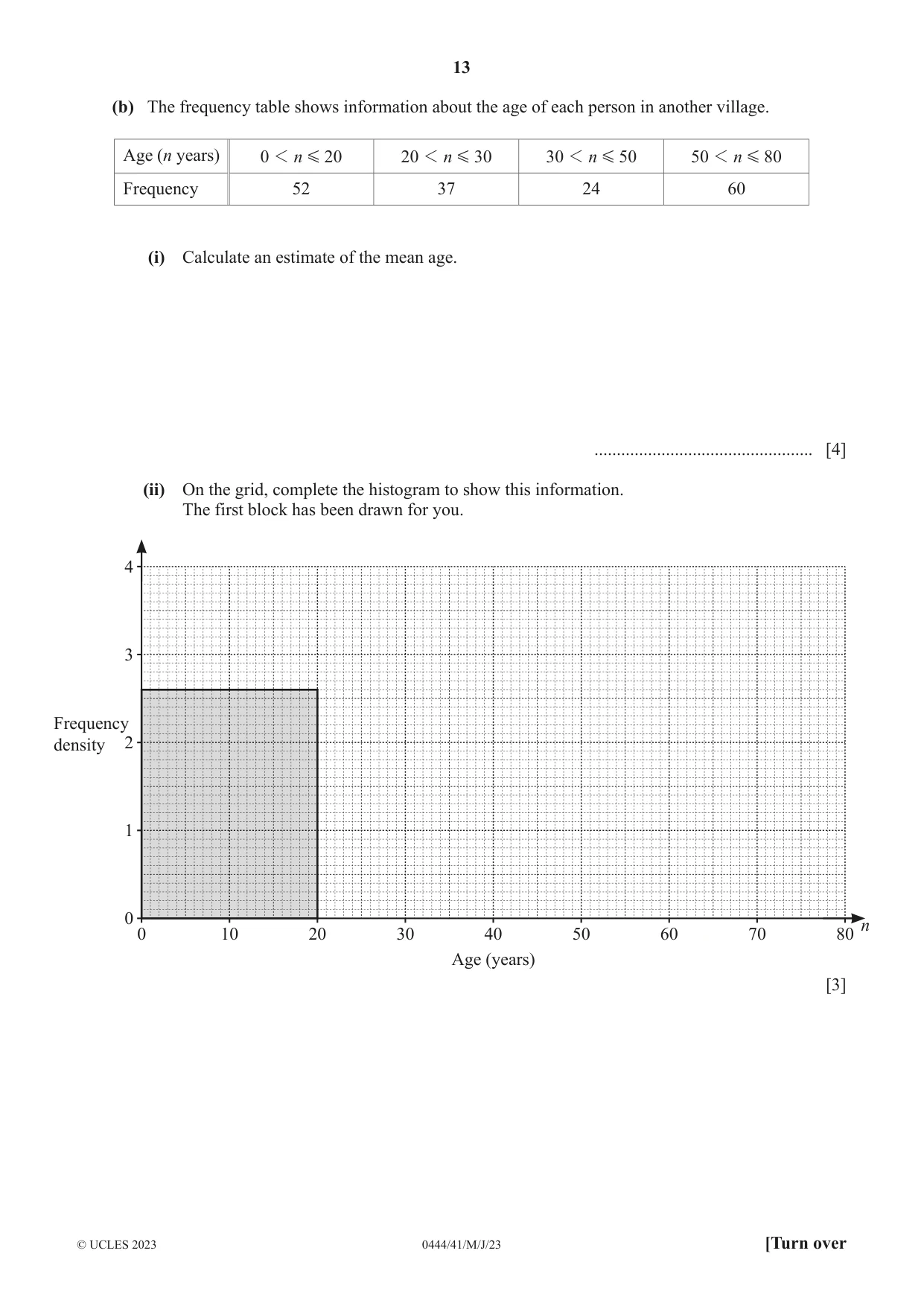
6 (a) There are 160 people in a village. The cumulative frequency diagram shows information about their ages. 160 140 120 100 Cumulative 80frequency 60 40 20 0 0 10 20 30 40 50 60 70 Age (years) Find an estimate for (i) the median age ................................................. [1] (ii) the lower quartile ................................................. [1] (iii) the number of people who are 50 or more years of age ................................................. [2] (iv) the 65th percentile. ................................................. [2] (b) The frequency table shows information about the age of each person in another village. Age (n years) 0 1 n G 20 20 1 n G 30 30 1 n G 50 50 1 n G 80 Frequency 52 37 24 60 (i) Calculate an estimate of the mean age. ................................................. [4] (ii) On the grid, complete the histogram to show this information. The first block has been drawn for you. 4 3 Frequency density 2 1 0 n 0 10 20 30 40 50 60 70 80 Age (years) [3]
Mark scheme: 6(a)(i) 25 1 6(a)(ii) 17 to 18 1 6(a)(iii) 12 2 B1 for 148 seen 6(a)(iv) 30 2 B1 for 104 seen 6(b)(i) 36.4 or 36.44 to 36.45 4 M1 for 3 of 10, 25, 40, 65 correct M1 for fx where x is in correct class interval or on boundary fx M1 dep for dep on second 52 37 24 60 M1 6(b)(ii) correct histogram 3 B1 for each correct block width 10 height 3.7 width 20 height 1.2 width 30 height 2 If 0 scored SC1 for correct frequency densities 3.7, 1.2, 2 oe
Q7 · F ( )x = x - 4 g ( )x = 2 x + 5 h ( )x = 3 x (a) Find f ( - 3)
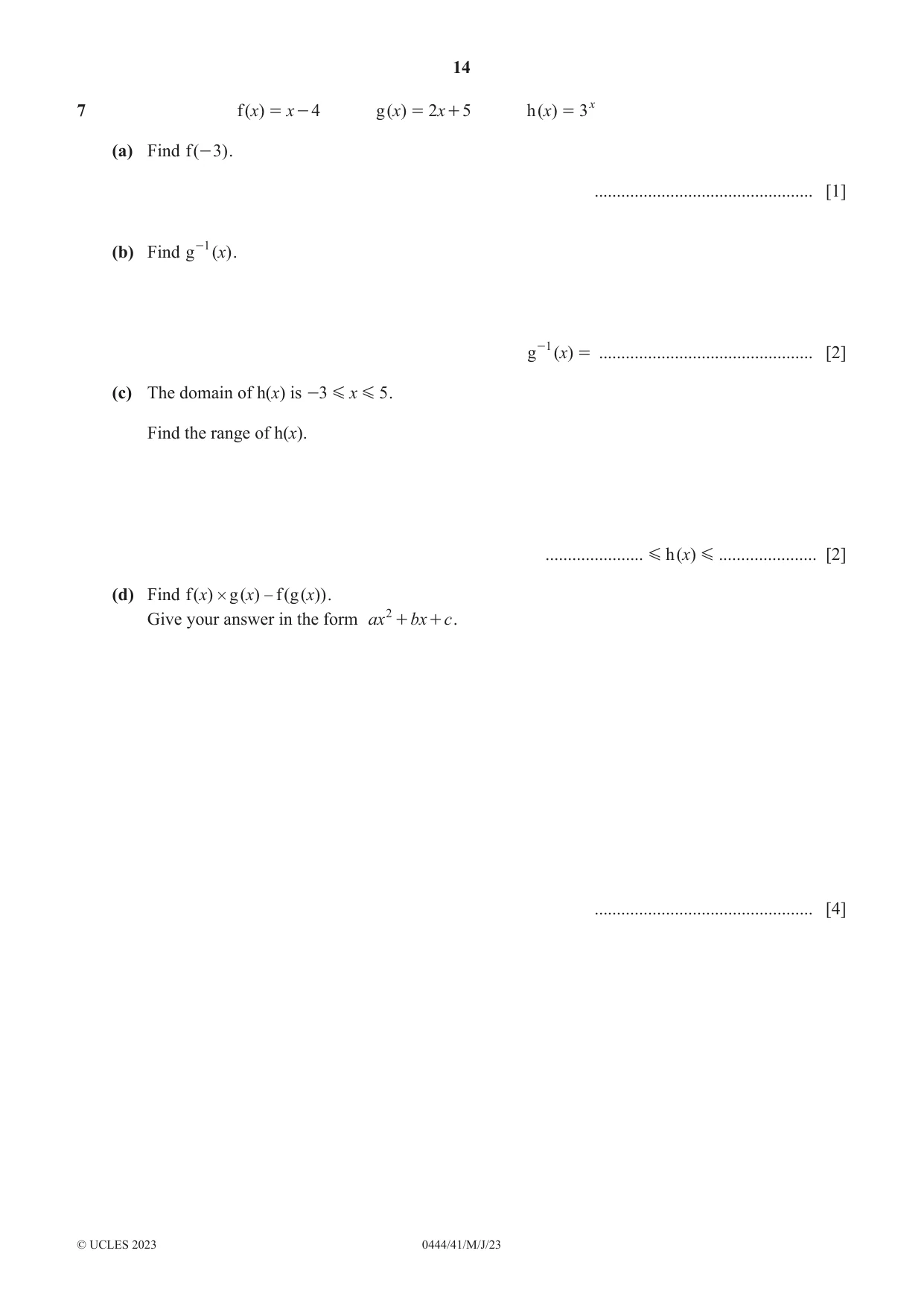
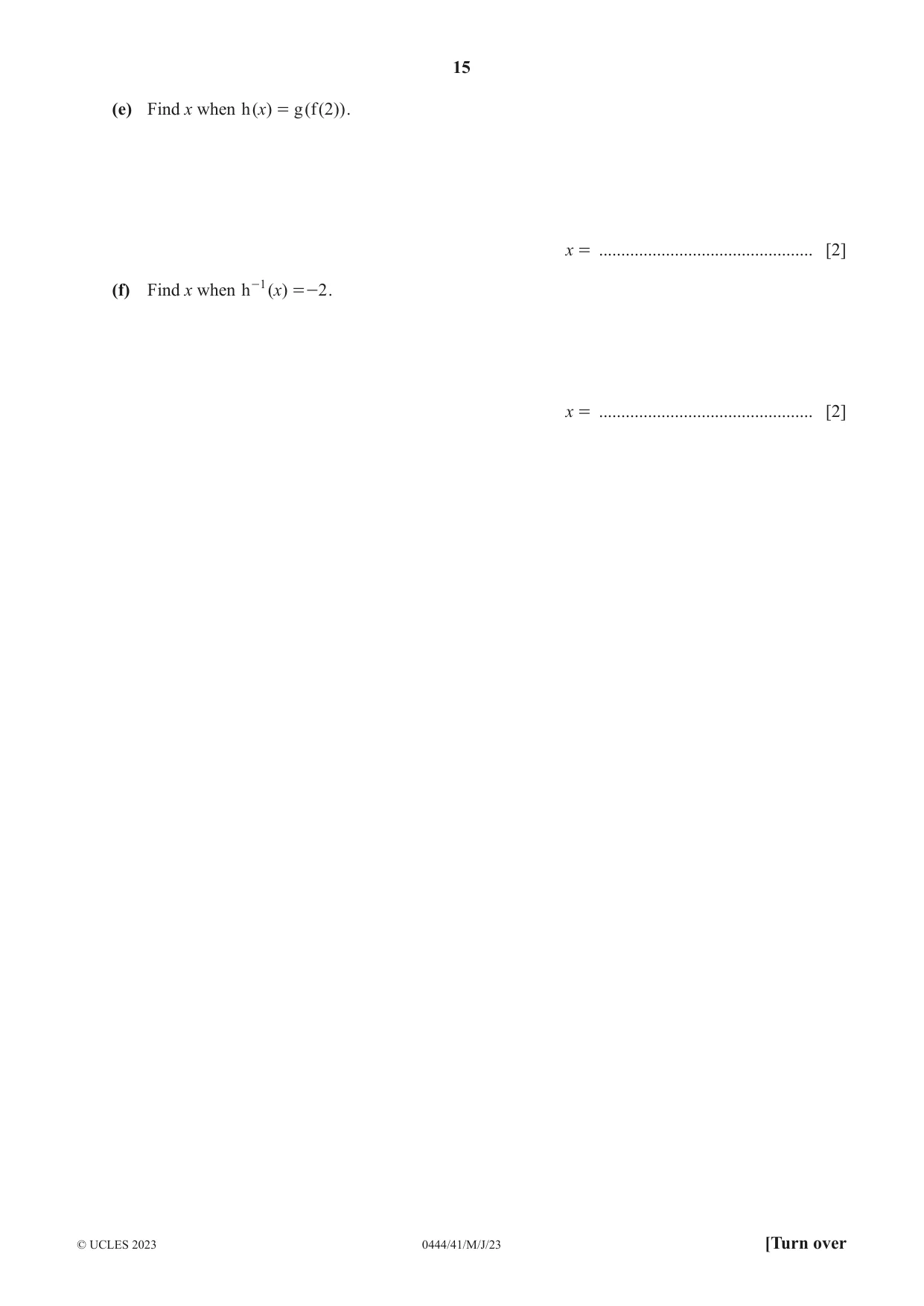
7 f ( )x = x - 4 g ( )x = 2 x + 5 h ( )x = 3 x (a) Find f ( - 3) . ................................................. [1] (b) Find g -1 ( )x . g -1 ( )x = ................................................ [2] (c) The domain of h(x) is -3 G x G 5 . Find the range of h(x). ...................... G h ( x) G ...................... [2] (d) Find f ( x) # g ( x) - f ( g ( x) ) . Give your answer in the form ax 2 + bx + c . ................................................. [4] (e) Find x when h ( x) = g ( f ( 2) ) . x = ................................................ [2] (f) Find x when h -1 ( )x =-2 . x = ................................................ [2]
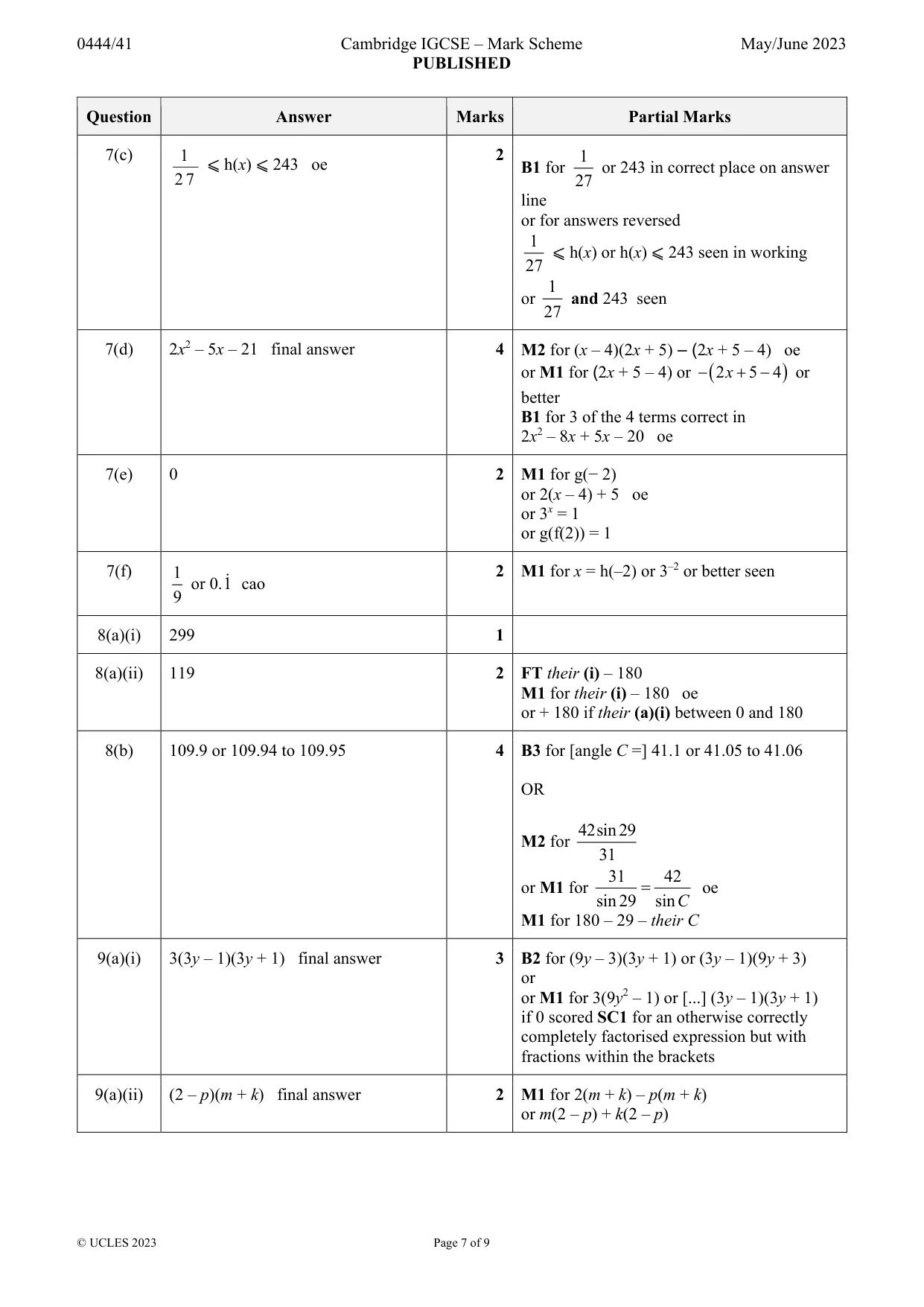
Mark scheme: 7(a) −7 1 7(b) x 5 2 M1 for correct first step e.g. x 2 y 5 or oe final answer 2 2 x y 5 y 5 or x 2 2 7(c) 1 2 1 ⩽ h(x) ⩽ 243 oe B1 for or 243 in correct place on answer 2 7 27 line or for answers reversed 1 ⩽ h(x) or h(x) ⩽ 243 seen in working 27 1 or and 243 seen 27 7(d) 2x2 – 5x – 21 final answer 4 M2 for (x – 4)(2x + 5) – (2x + 5 – 4) oe or M1 for (2x + 5 – 4) or 2 x 5 4 or better B1 for 3 of the 4 terms correct in 2x2 – 8x + 5x – 20 oe 7(e) 0 2 M1 for g(− 2) or 2(x – 4) + 5 oe or 3x = 1 or g(f(2)) = 1 7(f) 1 2 M1 for x = h(–2) or 3–2 or better seen or 0.1 cao 9
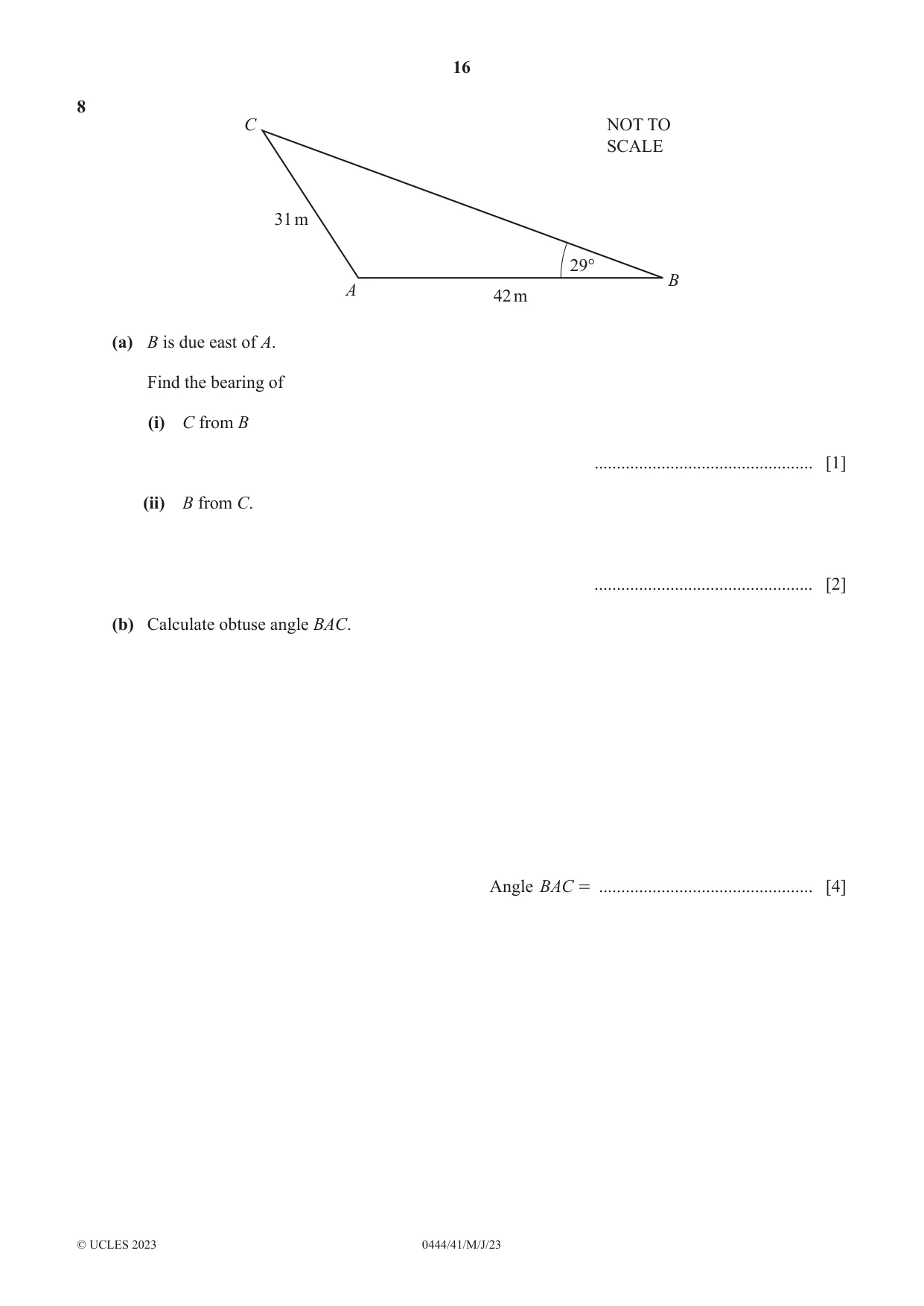
Q8 · C NOT TO SCALE 31 m 29° B A 42 m (a) B is due east of A
8 C NOT TO SCALE 31 m 29° B A 42 m (a) B is due east of A. Find the bearing of (i) C from B ................................................. [1] (ii) B from C. ................................................. [2] (b) Calculate obtuse angle BAC. Angle BAC = ................................................ [4]
Mark scheme: 8(a)(i) 299 1 8(a)(ii) 119 2 FT their (i) – 180 M1 for their (i) – 180 oe or + 180 if their (a)(i) between 0 and 180 8(b) 109.9 or 109.94 to 109.95 4 B3 for [angle C =] 41.1 or 41.05 to 41.06 OR 42sin29 M2 for 31 31 42 or M1 for oe sin29 sin C M1 for 180 – 29 – their C
Question 9
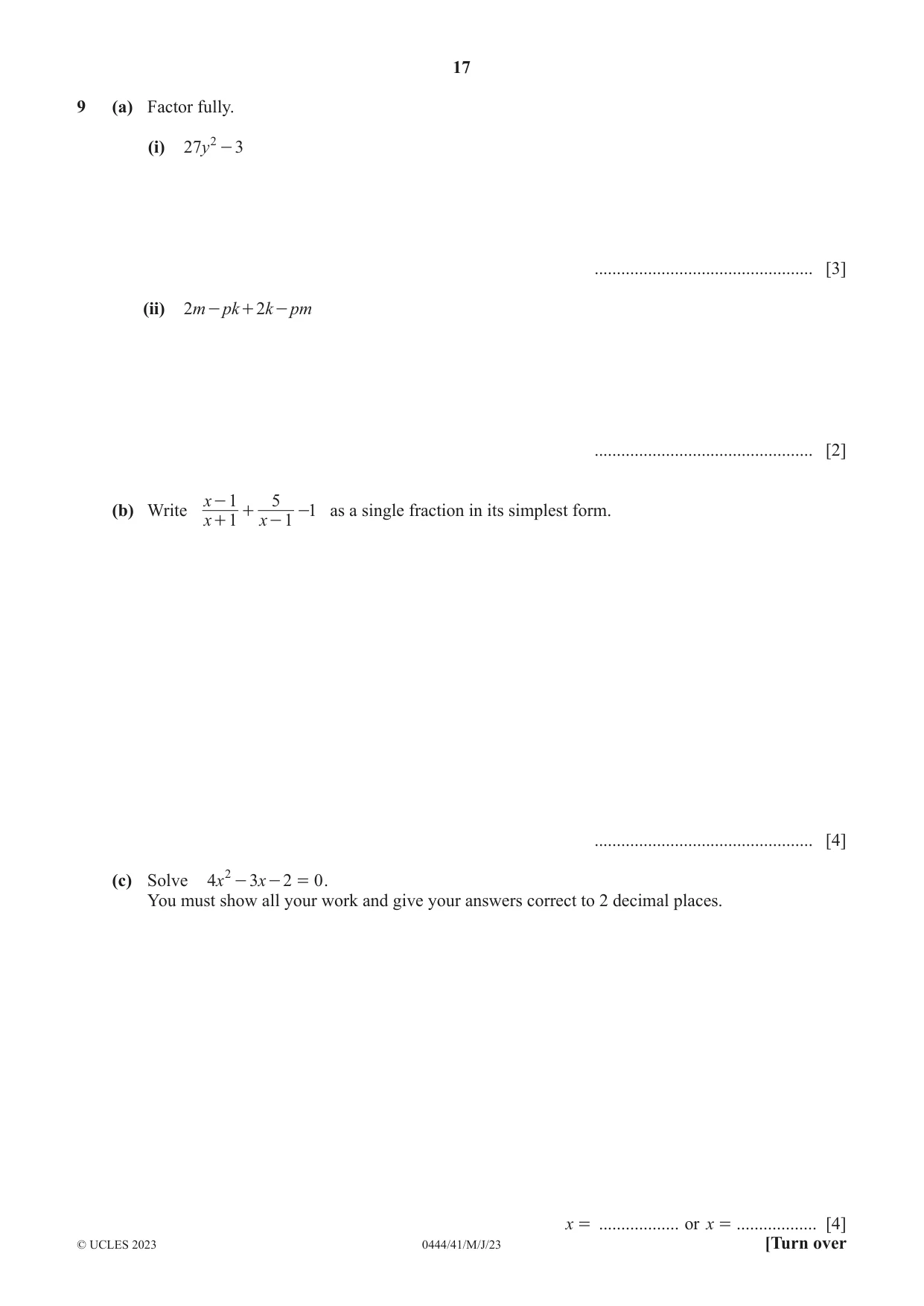
9 (a) Factor fully. (i) 27y 2 - 3 ................................................. [3] (ii) 2m - pk + 2 k - pm ................................................. [2] x - 1 5 (b) Write + -1 as a single fraction in its simplest form. x + 1 x - 1 ................................................. [4] (c) Solve 4x 2 - 3x - 2 = 0 . You must show all your work and give your answers correct to 2 decimal places.
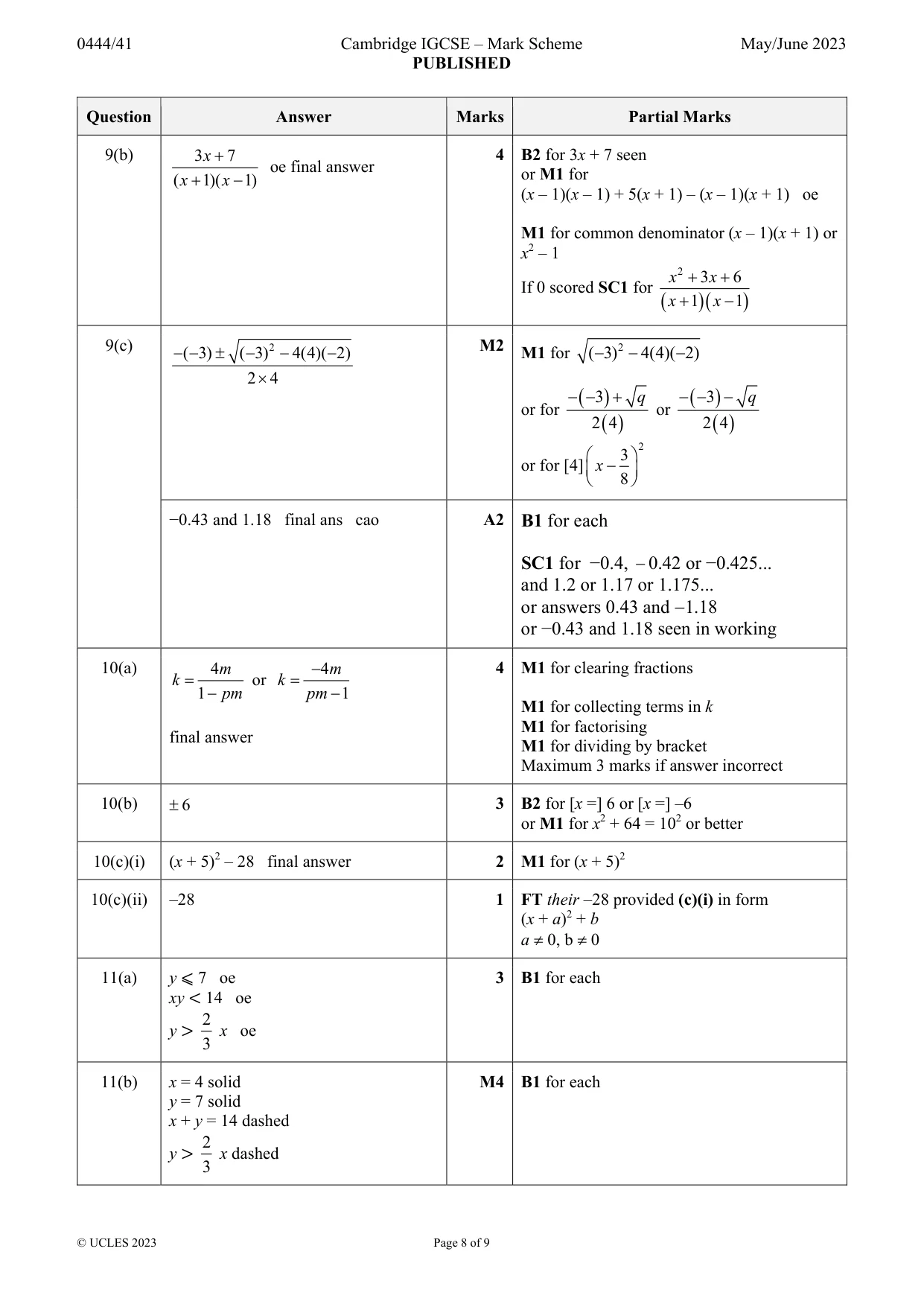
Mark scheme: 9(a)(i) 3(3y – 1)(3y + 1) final answer 3 B2 for (9y – 3)(3y + 1) or (3y – 1)(9y + 3) or or M1 for 3(9y2 – 1) or [...] (3y – 1)(3y + 1) if 0 scored SC1 for an otherwise correctly completely factorised expression but with fractions within the brackets 9(a)(ii) (2 – p)(m + k) final answer 2 M1 for 2(m + k) – p(m + k) or m(2 – p) + k(2 – p) 9(b) 3 x 7 4 B2 for 3x + 7 seen oe final answer or M1 for ( x 1)( x 1) (x – 1)(x – 1) + 5(x + 1) – (x – 1)(x + 1) oe M1 for common denominator (x – 1)(x + 1) or x2 – 1 x 2 3 x 6 If 0 scored SC1 for x 1 x 1 9(c) 2 M2 2 ( 3) ( 3) 4(4)( 2) M1 for ( 3) 4(4)( 2) 2 4 3 q 3 q or for or 2 4 2 4 3 2 or for [4] x 8 −0.43 and 1.18 final ans cao A2 B1 for each SC1 for −0.4, 0.42 or −0.425... and 1.2 or 1.17 or 1.175... or answers 0.43 and 1.18 or −0.43 and 1.18 seen in working
Question 10
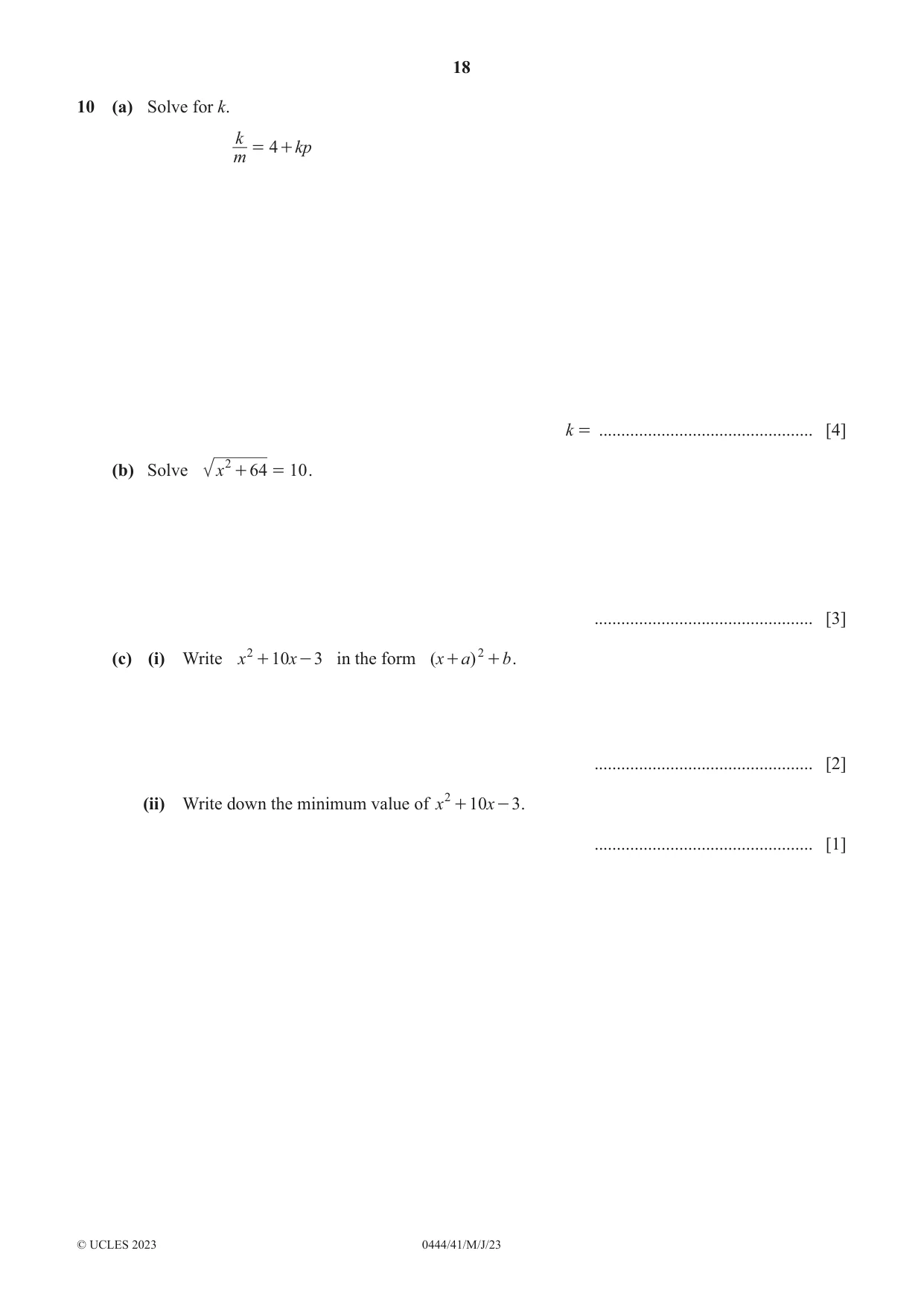
10 (a) Solve for k. k = 4 + kp m k = ................................................ [4] (b) Solve x 2 + 64 = 10 . ................................................. [3] (c) (i) Write x 2 + 10x - 3 in the form ( x + a) 2 + b . ................................................. [2] (ii) Write down the minimum value of x 2 + 10x - 3 . ................................................. [1]
Mark scheme: 10(a) 4 m 4 m 4 M1 for clearing fractions k 1 pm or k pm 1 M1 for collecting terms in k M1 for factorising final answer M1 for dividing by bracket Maximum 3 marks if answer incorrect 10(b) 6 3 B2 for [x =] 6 or [x =] –6 or M1 for x2 + 64 = 102 or better 10(c)(i) (x + 5)2 – 28 final answer 2 M1 for (x + 5)2 10(c)(ii) –28 1 FT their –28 provided (c)(i) in form (x + a)2 + b a 0, b 0
Q11 · A tailor makes x dresses and y shirts in one week
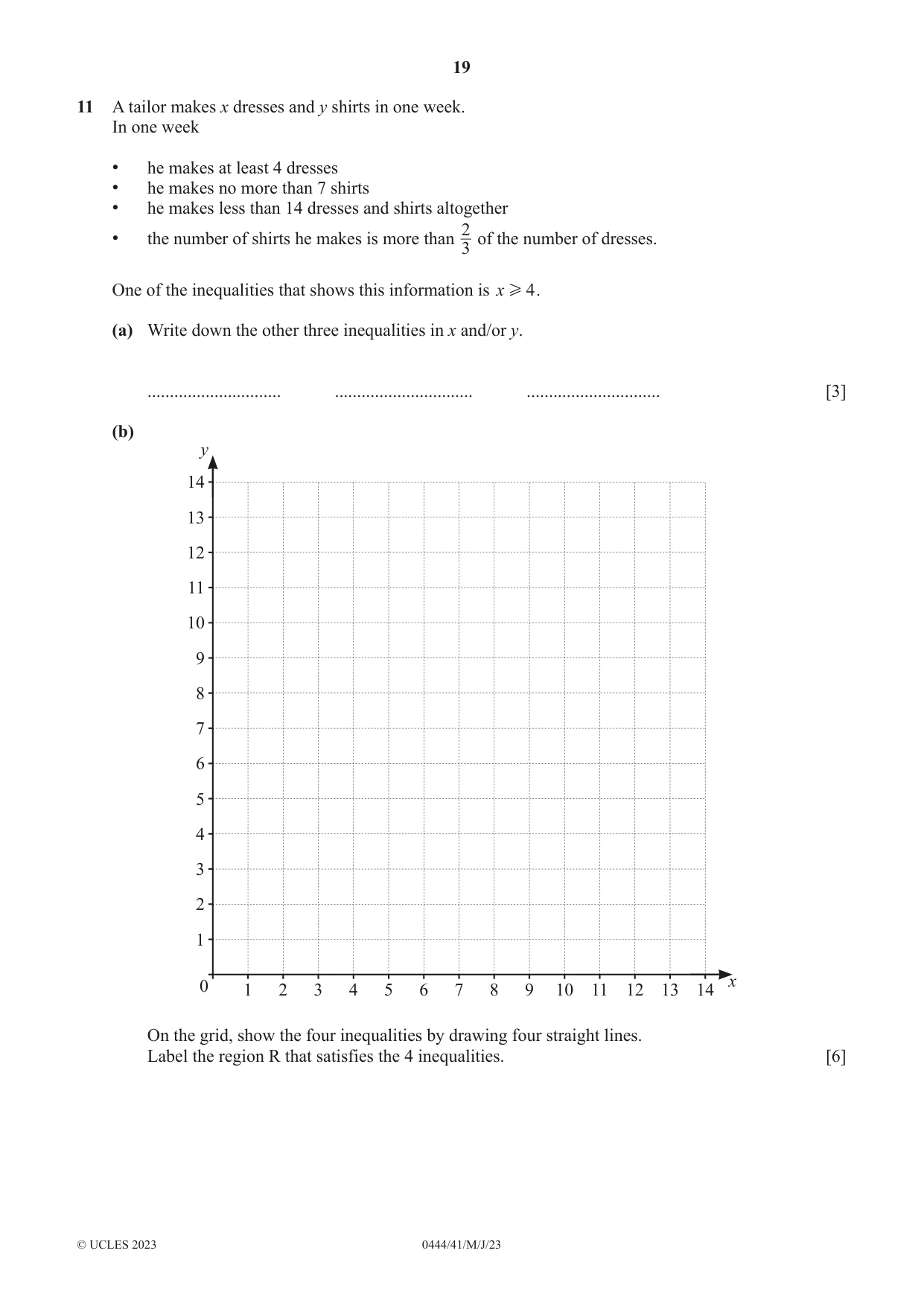
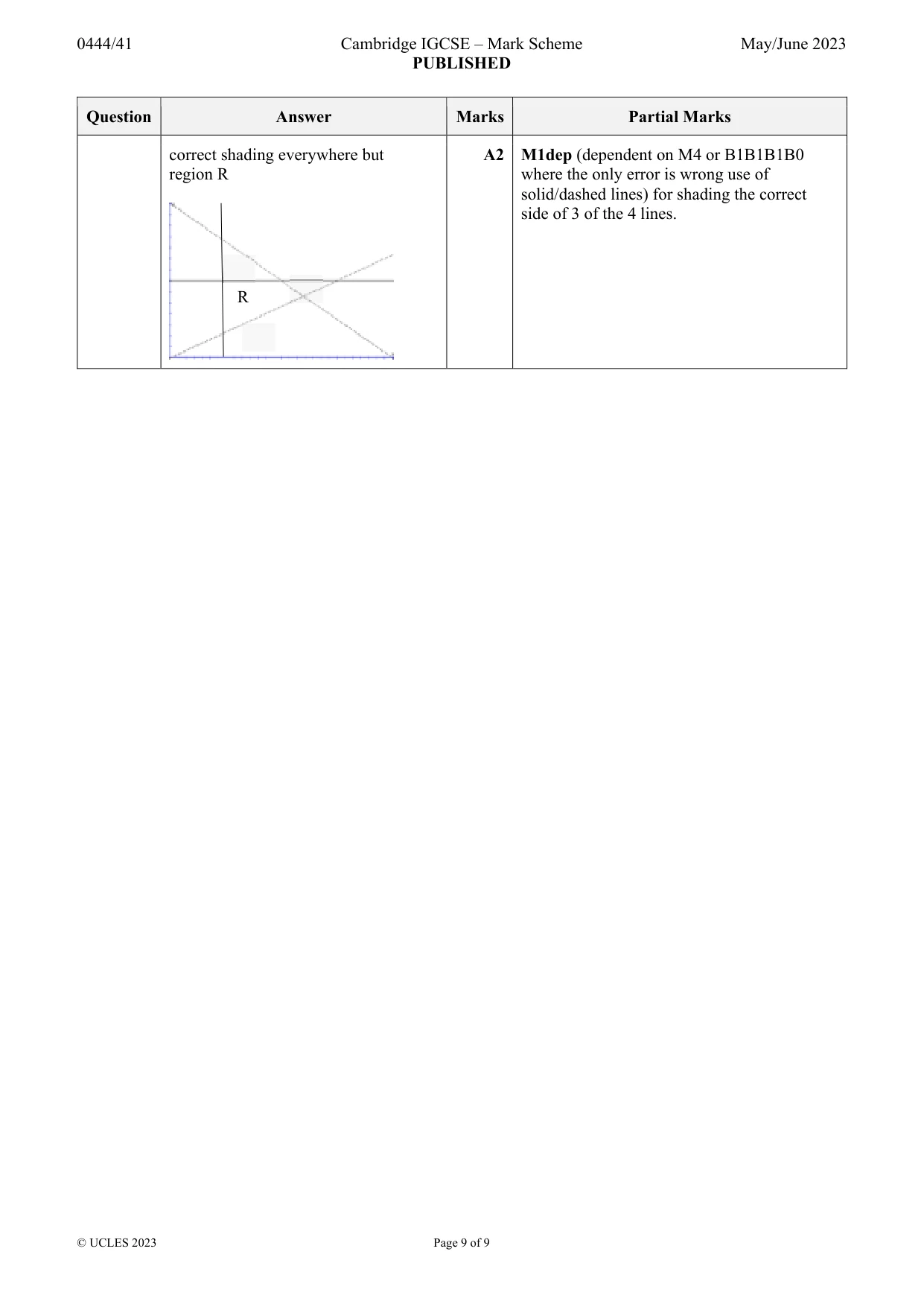
11 A tailor makes x dresses and y shirts in one week. In one week • he makes at least 4 dresses • he makes no more than 7 shirts • he makes less than 14 dresses and shirts altogether 2 • the number of shirts he makes is more than of the number of dresses. 3 One of the inequalities that shows this information is x H 4 . (a) Write down the other three inequalities in x and/or y. .............................. ............................... .............................. [3] (b) y 14 13 12 11 10 9 8 7 6 5 4 3 2 1 x 0 1 2 3 4 5 6 7 8 9 10 11 12 13 14 On the grid, show the four inequalities by drawing four straight lines. Label the region R that satisfies the 4 inequalities. [6]
Mark scheme: 11(a) y ⩽ 7 oe 3 B1 for each xy < 14 oe 2 y > x oe 3 11(b) x = 4 solid M4 B1 for each y = 7 solid x + y = 14 dashed 2 y > x dashed 3 correct shading everywhere but A2 M1dep (dependent on M4 or B1B1B1B0 region R where the only error is wrong use of solid/dashed lines) for shading the correct side of 3 of the 4 lines. R
What you needed in this session
Cambridge’s own grade thresholds for 2023 May/June, Paper 4 · Variant 1. A higher threshold means an easier paper — the bar moves with how the cohort did.