Cambridge IGCSE Mathematics (US) 0444 — 2022 May/June Paper 4 · Variant 1
0444/41/M/J/22 · 10 questions · 130 marks · ≈146 min
The question paper and its mark scheme, free to read here and free to download. This is Cambridge’s own paper, exactly as it was sat.
Question paper20 pages
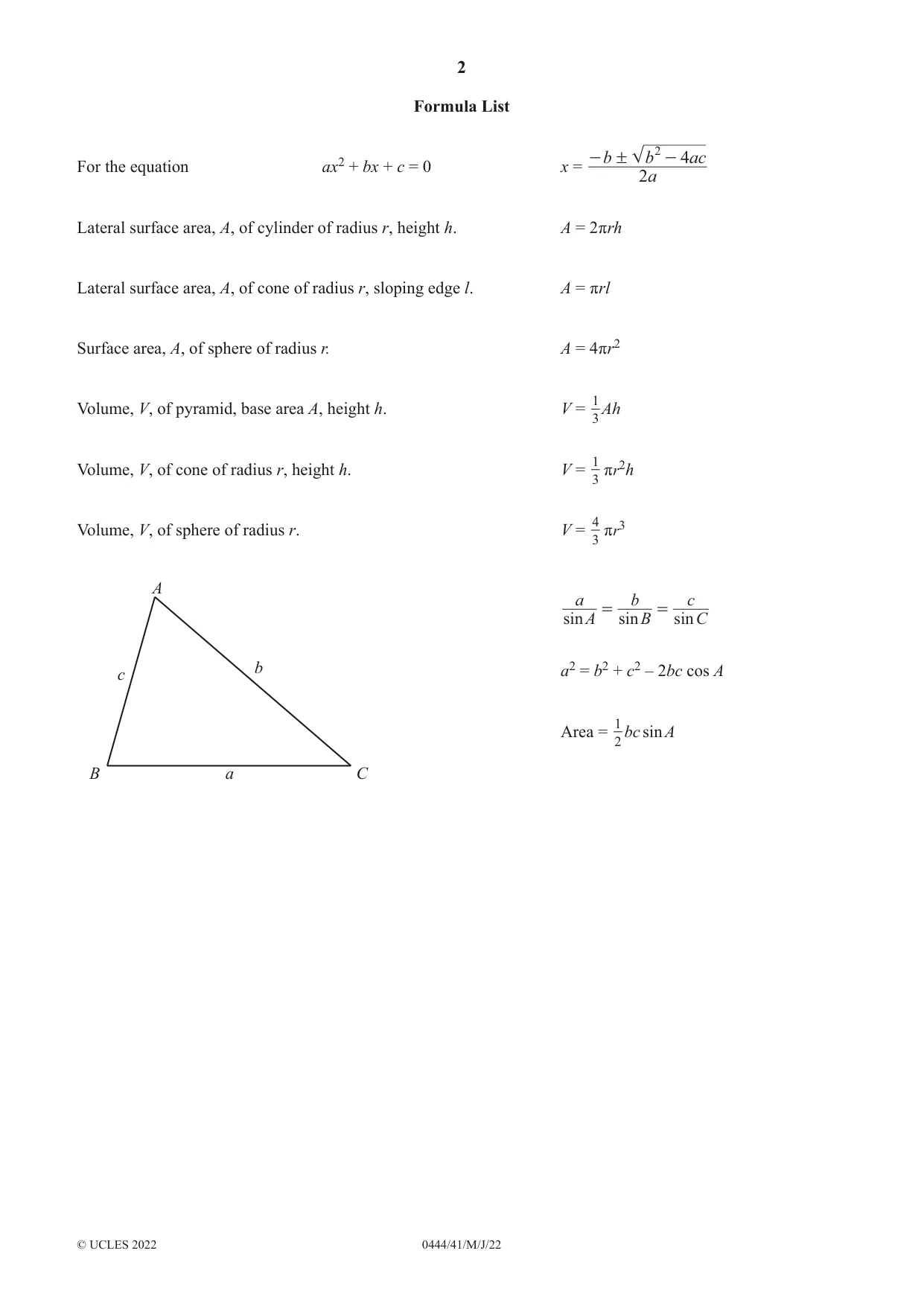
Mark scheme10 pages
Answers below. Sit the paper first if you are practising.
Questions as text
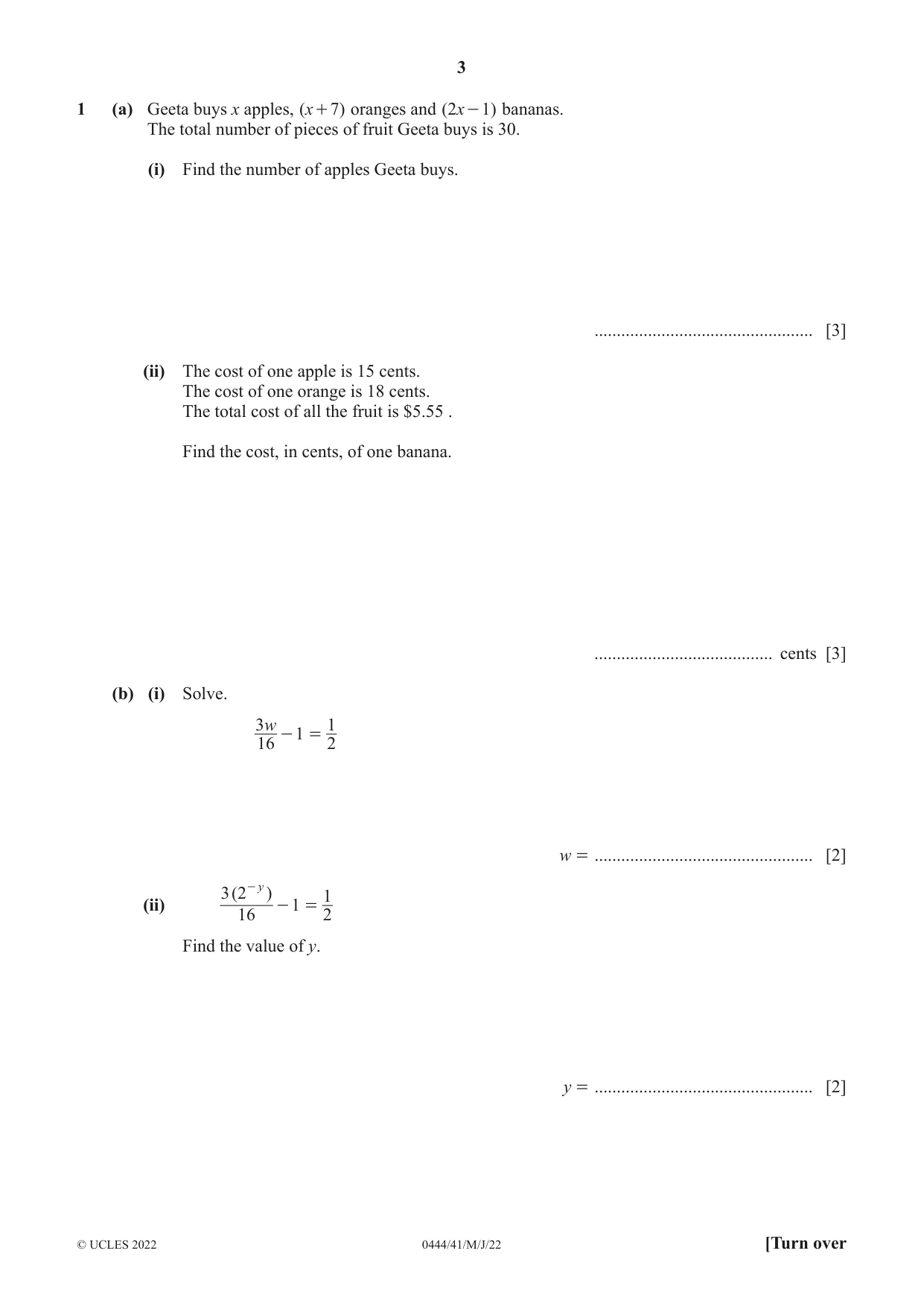
Q1 · Geeta buys x apples, ( x + 7) oranges and ( 2x - 1) bananas
1 (a) Geeta buys x apples, ( x + 7) oranges and ( 2x - 1) bananas. The total number of pieces of fruit Geeta buys is 30. (i) Find the number of apples Geeta buys. ................................................. [3] (ii) The cost of one apple is 15 cents. The cost of one orange is 18 cents. The total cost of all the fruit is $5.55 . Find the cost, in cents, of one banana. ........................................ cents [3] (b) (i) Solve. 3w 1 - 1 = 16 2 w = ................................................. [2] 3 ( 2 - y ) 1 (ii) - 1 = 16 2 Find the value of y. y = ................................................. [2]
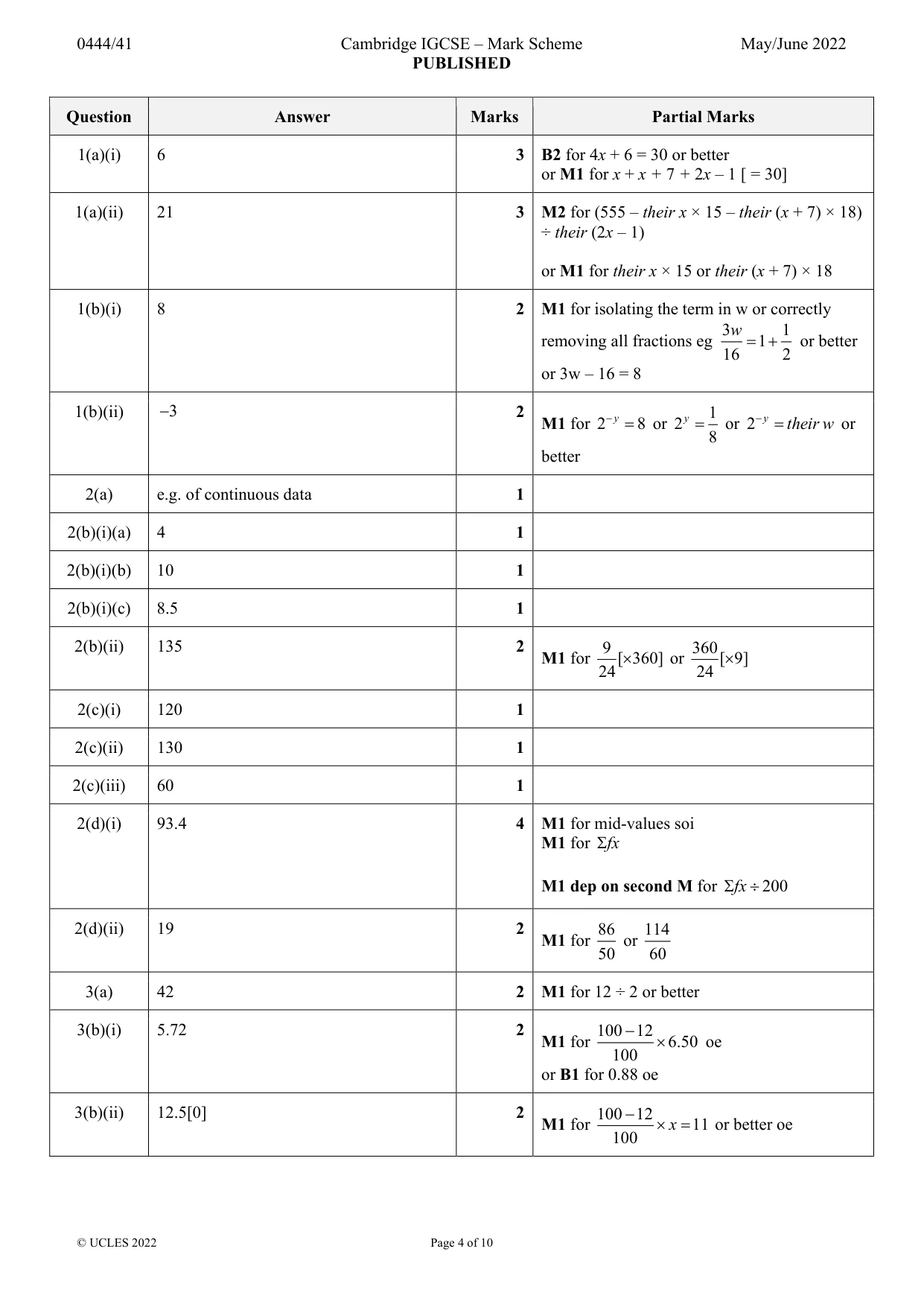
Mark scheme: Question Answer Marks Partial Marks 1(a)(i) 6 3 B2 for 4x + 6 = 30 or better or M1 for x + x + 7 + 2x – 1 [ = 30] 1(a)(ii) 21 3 M2 for (555 – their x × 15 – their (x + 7) × 18) ÷ their (2x – 1) or M1 for their x × 15 or their (x + 7) × 18 1(b)(i) 8 2 M1 for isolating the term in w or correctly 3w 1 removing all fractions eg 1 or better 16 2 or 3w – 16 = 8 1(b)(ii) 3 2 y y 1 y M1 for 2 8 or 2 or 2 their w or 8 better
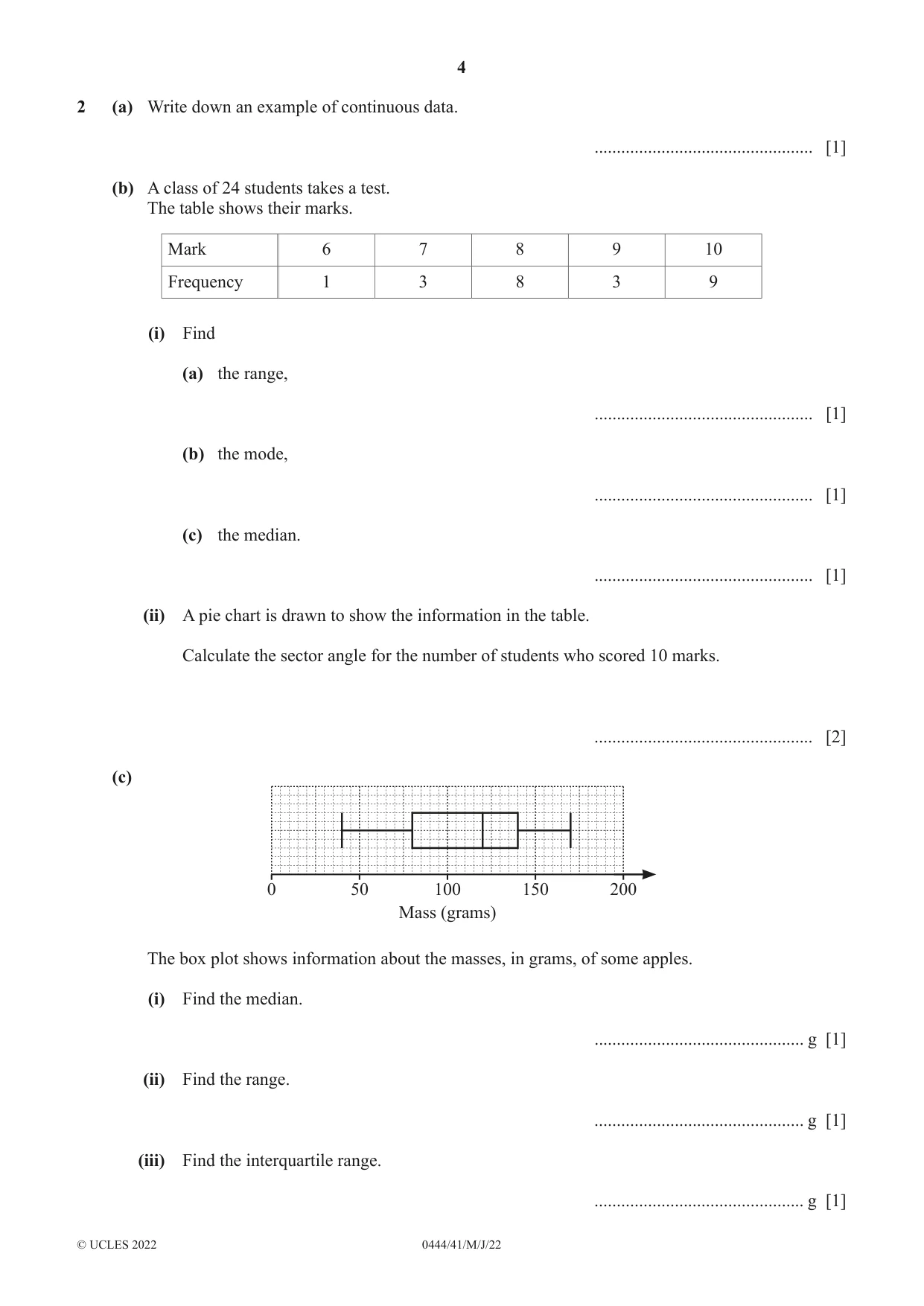
Q2 · Write down an example of continuous data
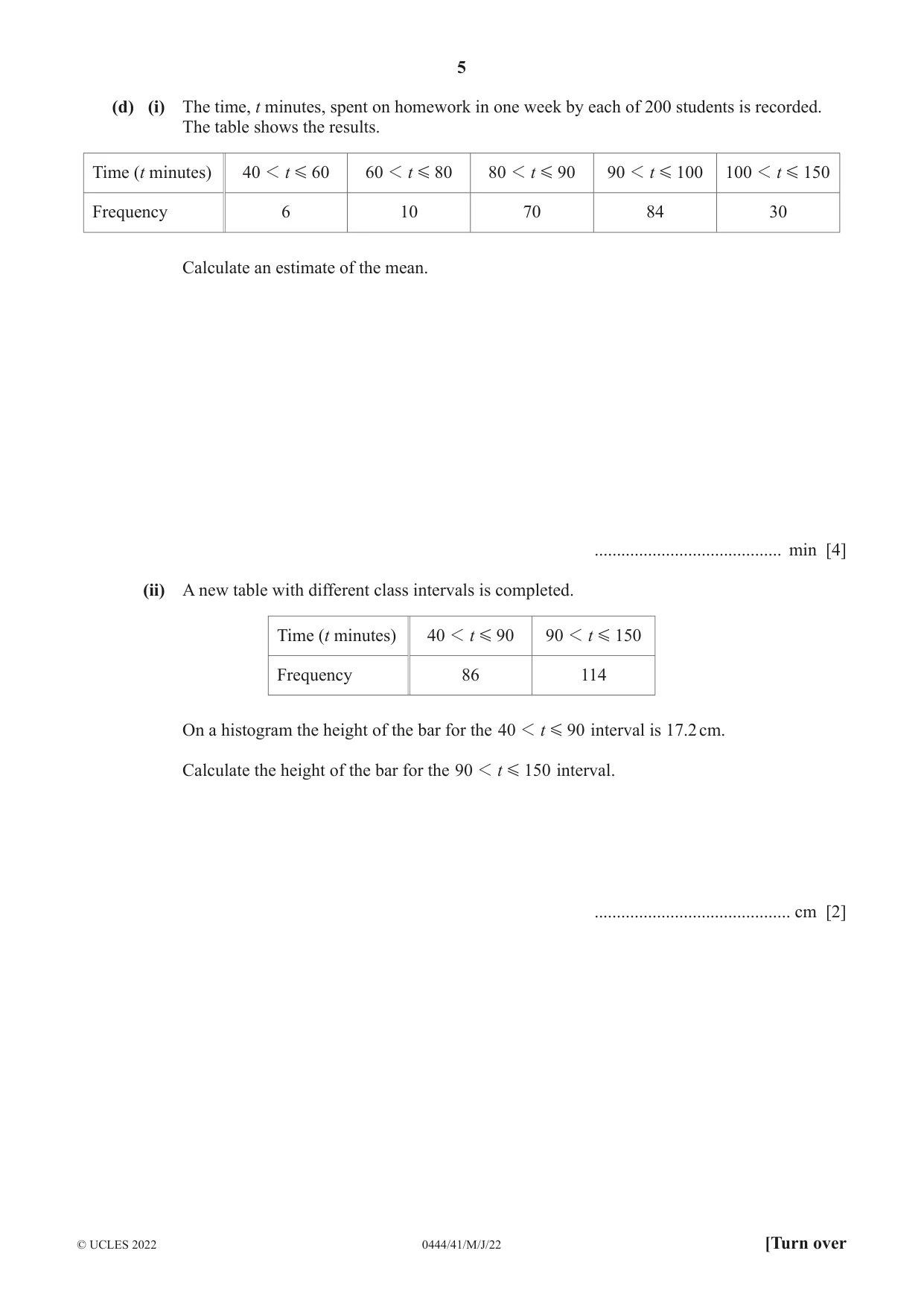
2 (a) Write down an example of continuous data. ................................................. [1] (b) A class of 24 students takes a test. The table shows their marks. Mark 6 7 8 9 10 Frequency 1 3 8 3 9 (i) Find (a) the range, ................................................. [1] (b) the mode, ................................................. [1] (c) the median. ................................................. [1] (ii) A pie chart is drawn to show the information in the table. Calculate the sector angle for the number of students who scored 10 marks. ................................................. [2] (c) 0 50 100 150 200 Mass (grams) The box plot shows information about the masses, in grams, of some apples. (i) Find the median. ............................................... g [1] (ii) Find the range. ............................................... g [1] (iii) Find the interquartile range. ............................................... g [1] (d) (i) The time, t minutes, spent on homework in one week by each of 200 students is recorded. The table shows the results. Time (t minutes) 40 1 t G 60 60 1 t G 80 80 1 t G 90 90 1 t G 100 100 1 t G 150 Frequency 6 10 70 84 30 Calculate an estimate of the mean. .......................................... min [4] (ii) A new table with different class intervals is completed. Time (t minutes) 40 1 t G 90 90 1 t G 150 Frequency 86 114 On a histogram the height of the bar for the 40 1 t G 90 interval is 17.2 cm. Calculate the height of the bar for the 90 1 t G 150 interval. ............................................ cm [2]
Mark scheme: 2(a) e.g. of continuous data 1 2(b)(i)(a) 4 1 2(b)(i)(b) 10 1 2(b)(i)(c) 8.5 1 2(b)(ii) 135 2 9 M1 for [ 360] or 360[ 9] 24 24 2(c)(i) 120 1 2(c)(ii) 130 1 2(c)(iii) 60 1 2(d)(i) 93.4 4 M1 for mid-values soi M1 for fx M1 dep on second M for fx 200 2(d)(ii) 19 2 86 114 M1 for or 50 60
Q3 · Alex, Bobbie and Chris share strawberries in the ratio Alex : Bobbie : Chris = 3 : 2 : 2
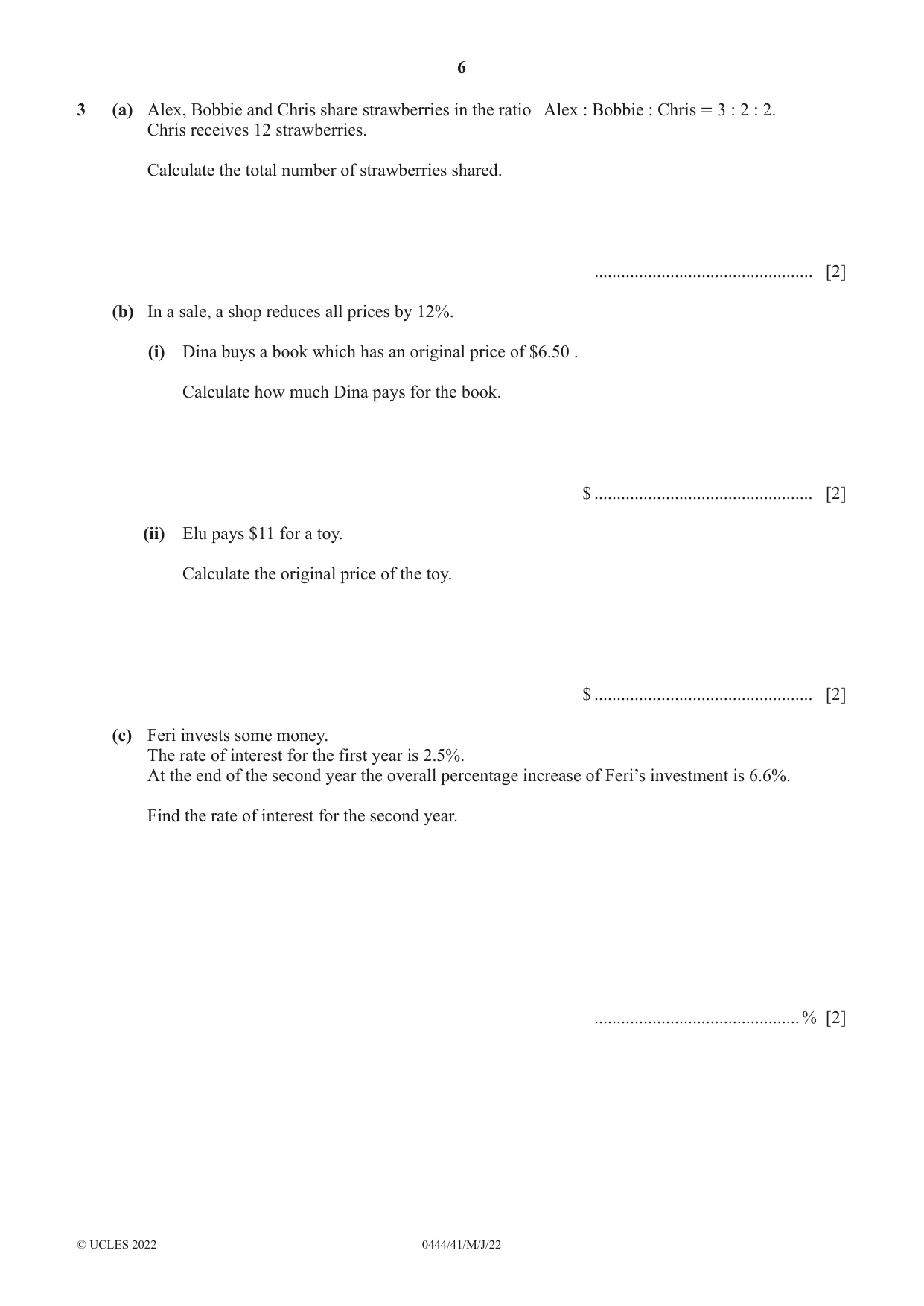
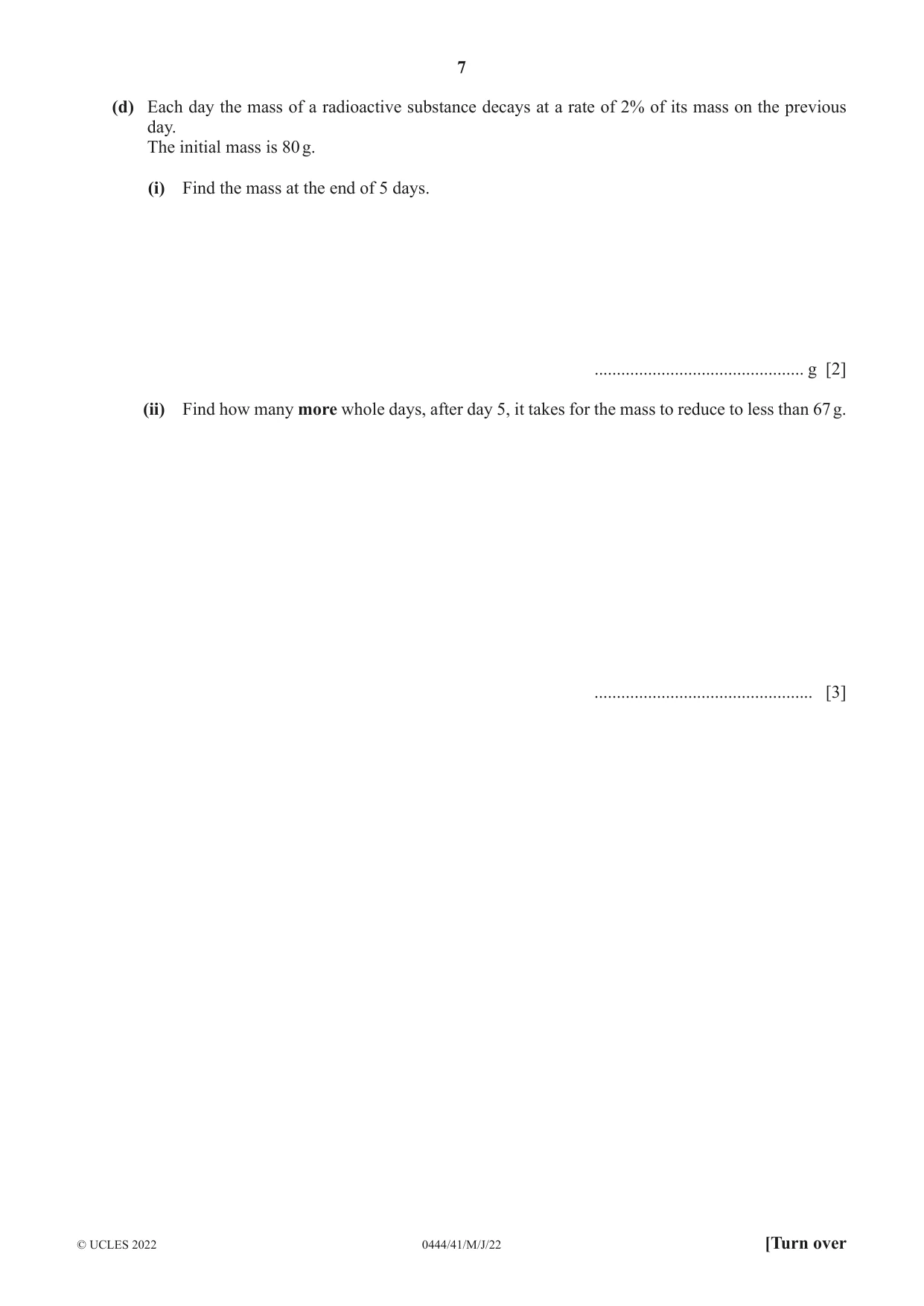
3 (a) Alex, Bobbie and Chris share strawberries in the ratio Alex : Bobbie : Chris = 3 : 2 : 2. Chris receives 12 strawberries. Calculate the total number of strawberries shared. ................................................. [2] (b) In a sale, a shop reduces all prices by 12%. (i) Dina buys a book which has an original price of $6.50 . Calculate how much Dina pays for the book. $ ................................................. [2] (ii) Elu pays $11 for a toy. Calculate the original price of the toy. $ ................................................. [2] (c) Feri invests some money. The rate of interest for the first year is 2.5%. At the end of the second year the overall percentage increase of Feri’s investment is 6.6%. Find the rate of interest for the second year. ..............................................% [2] (d) Each day the mass of a radioactive substance decays at a rate of 2% of its mass on the previous day. The initial mass is 80 g. (i) Find the mass at the end of 5 days. ............................................... g [2] (ii) Find how many more whole days, after day 5, it takes for the mass to reduce to less than 67 g. ................................................. [3]
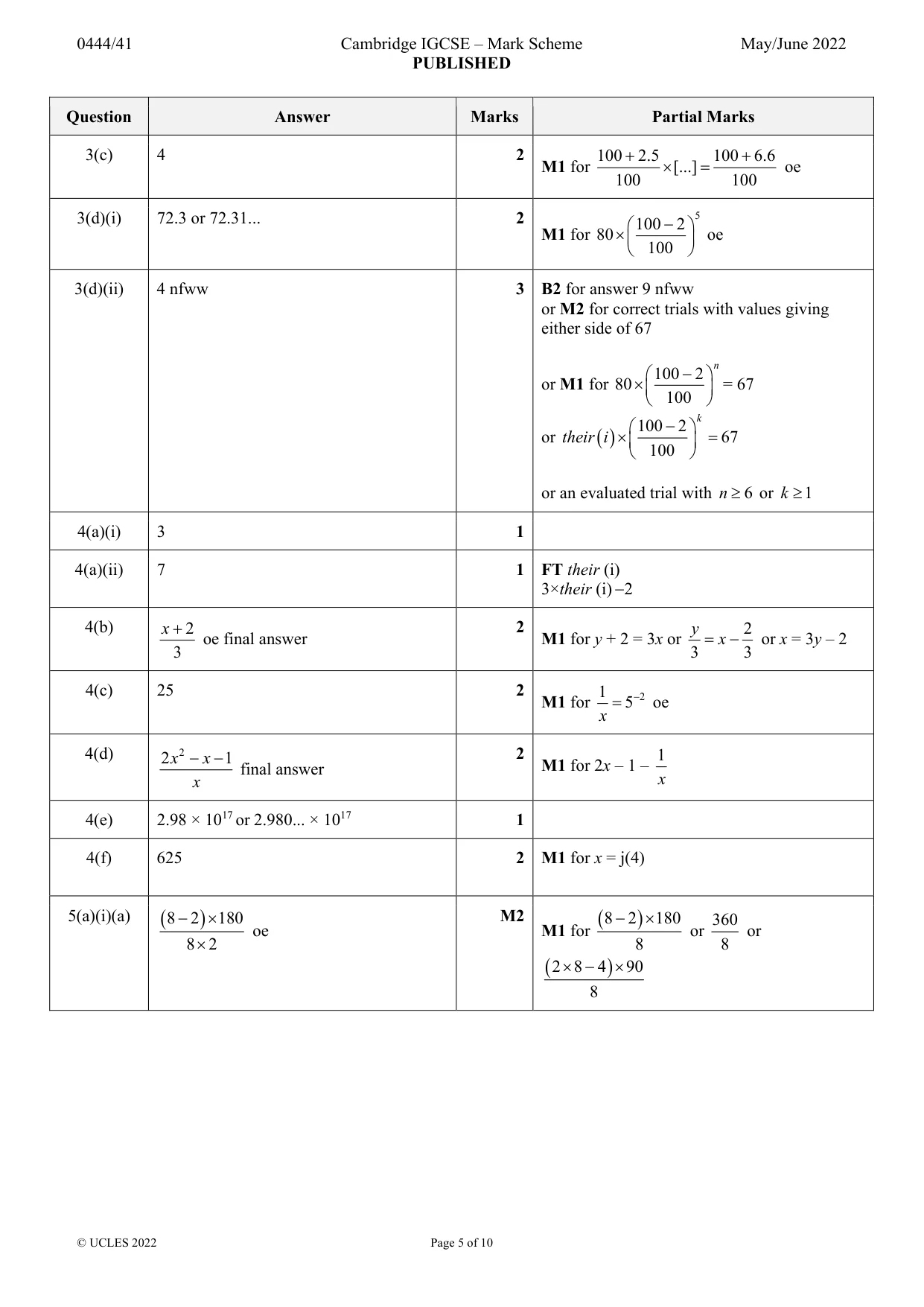
Mark scheme: 3(a) 42 2 M1 for 12 ÷ 2 or better 3(b)(i) 5.72 2 100 12 M1 for 6.50 oe 100 or B1 for 0.88 oe 3(b)(ii) 12.5[0] 2 100 12 M1 for x 11 or better oe 100 3(c) 4 2 100 2.5 100 6.6 M1 for [...] oe 100 100 3(d)(i) 72.3 or 72.31... 2 5 100 2 M1 for 80 oe 100 3(d)(ii) 4 nfww 3 B2 for answer 9 nfww or M2 for correct trials with values giving either side of 67 100 2 n or M1 for 80 = 67 100 100 2 k 67 or their i 100 or an evaluated trial with n 6 or k 1
Q4 · F ( x) = 2 x - 1 g ( x) = 3 x - 2 h ( x) = , x !
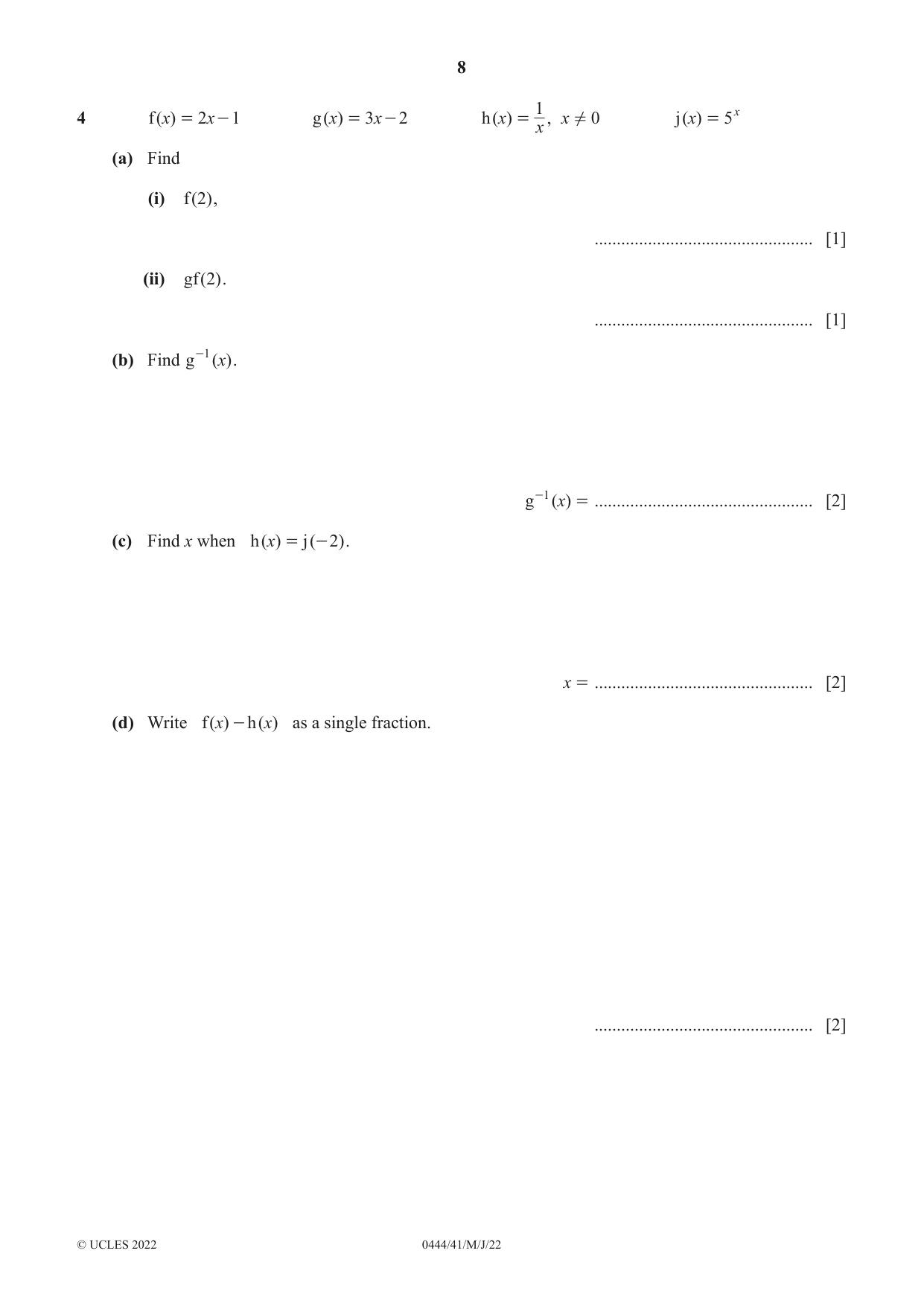
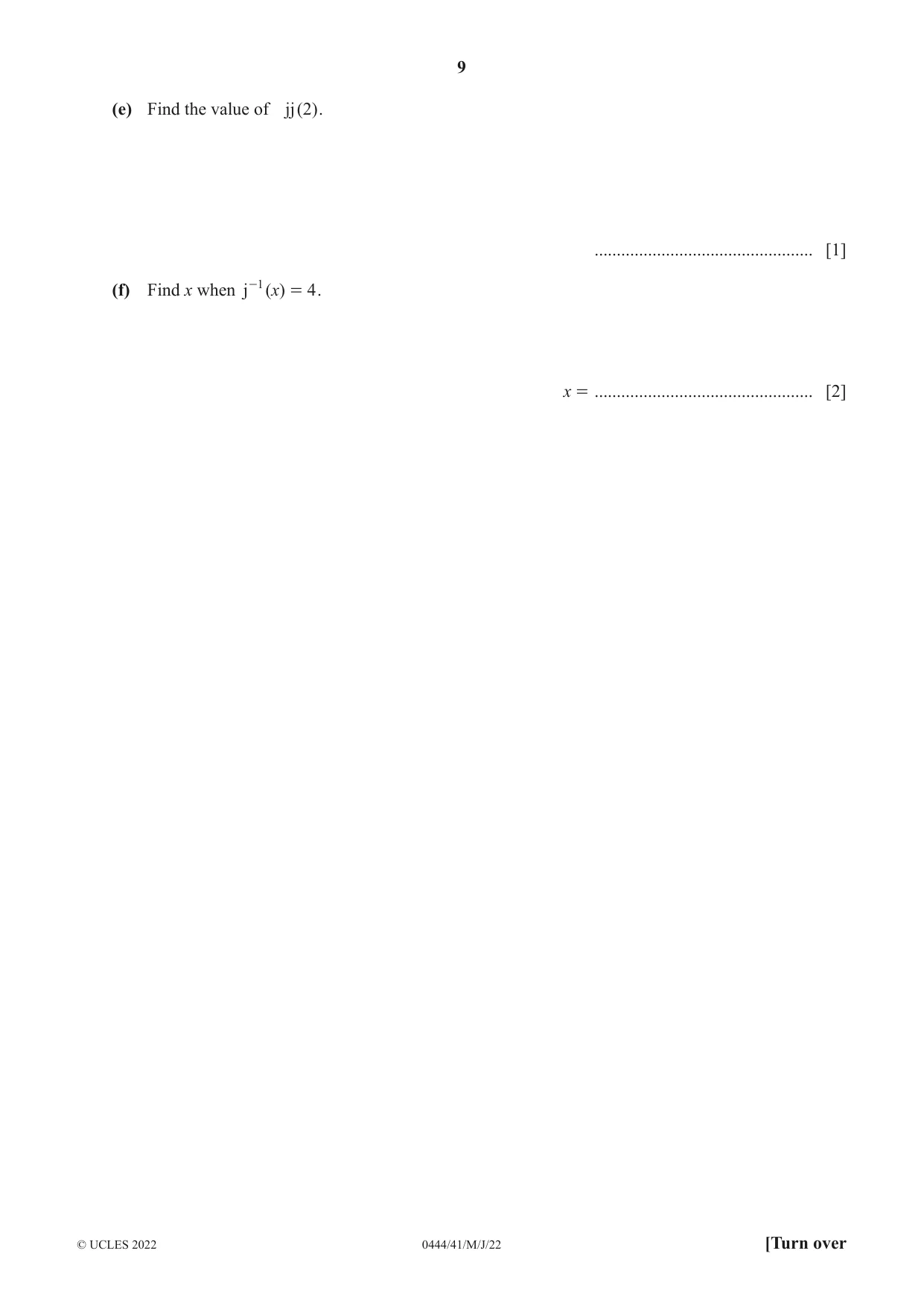
4 f ( x) = 2 x - 1 g ( x) = 3 x - 2 h ( x) = , x ! 0 j ( x) = 5x x (a) Find (i) f ( 2) , ................................................. [1] (ii) gf ( 2) . ................................................. [1] (b) Find g -1 ( x) . g -1 ( x) = ................................................. [2] (c) Find x when h ( x) = j (- 2) . x = ................................................. [2] (d) Write f ( x) - h ( x) as a single fraction. ................................................. [2] (e) Find the value of jj ( 2 ) . ................................................. [1] (f) Find x when j -1 ( x) = 4 . x = ................................................. [2]
Mark scheme: 4(a)(i) 3 1 4(a)(ii) 7 1 FT their (i) 3×their (i) 2 4(b) x 2 2 y 2 oe final answer M1 for y + 2 = 3x or x or x = 3y – 2 3 3 3 4(c) 25 2 1 2 M1 for 5 oe x 4(d) 2 x 2 x 1 2 1 final answer M1 for 2x – 1 – x x 4(e) 2.98 × 10¹⁷ or 2.980... × 1017 1 4(f) 625 2 M1 for x = j(4)
Q5 · ABCDEFGH is a regular octagon with sides of length 6 cm
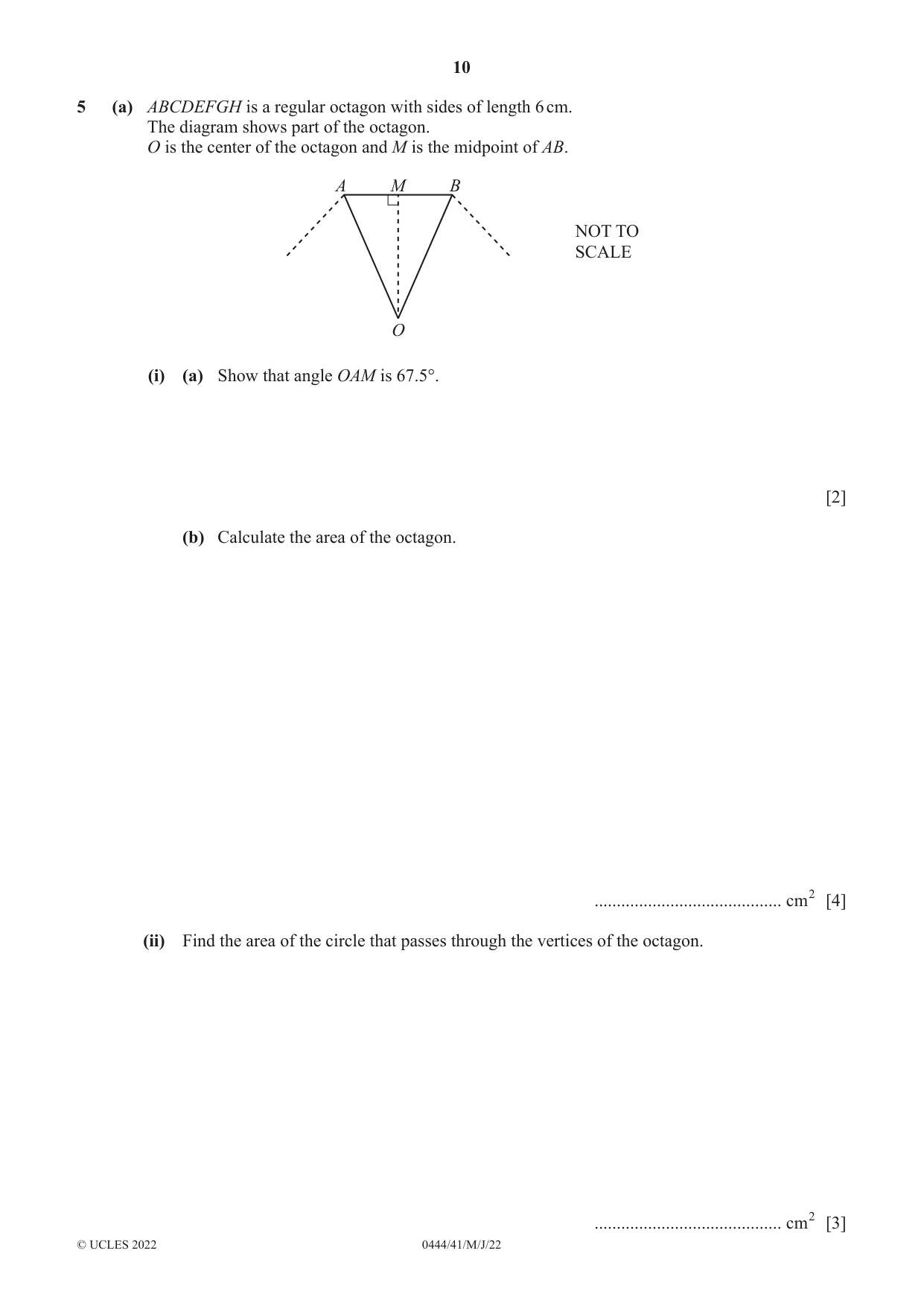
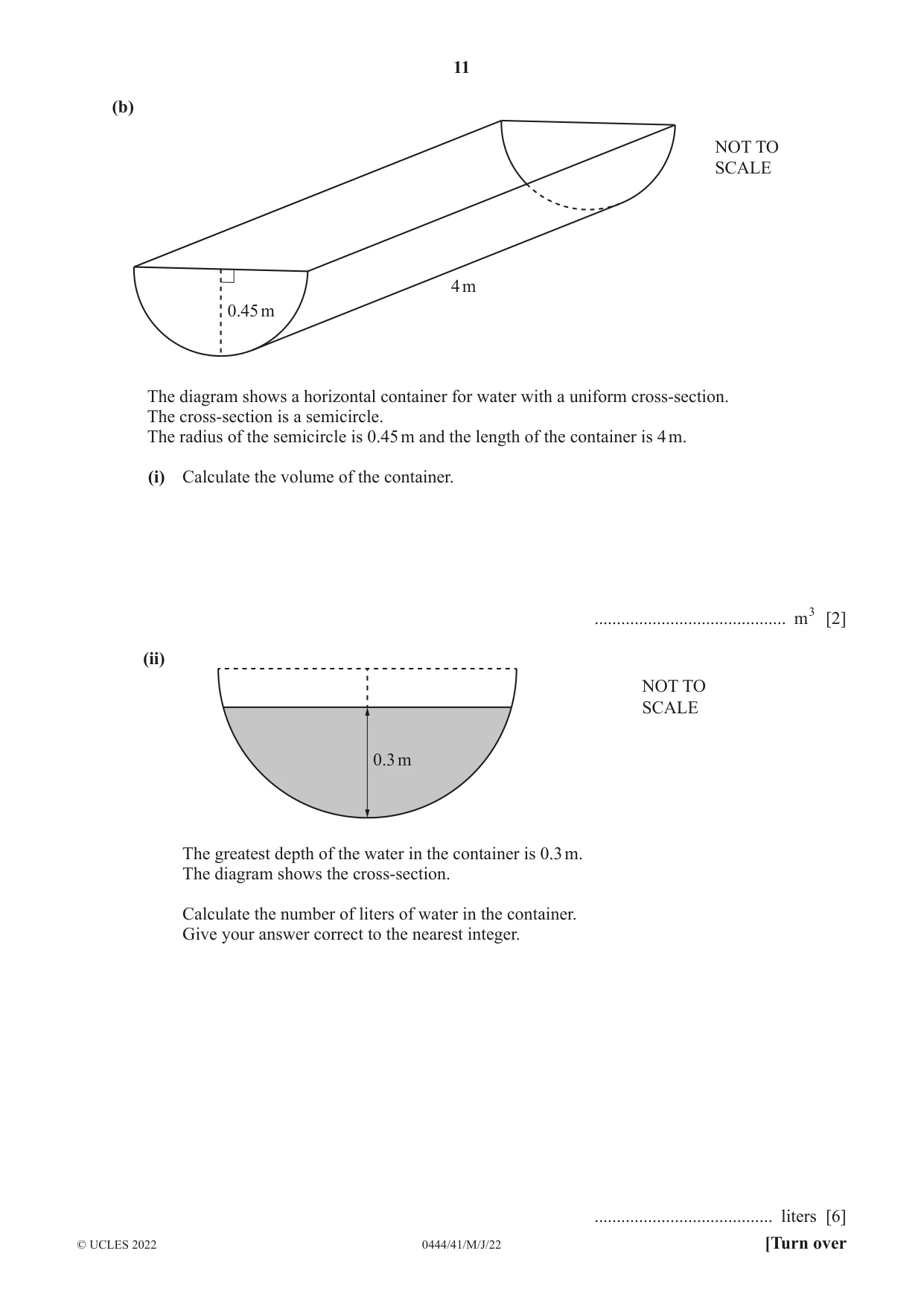
5 (a) ABCDEFGH is a regular octagon with sides of length 6 cm. The diagram shows part of the octagon. O is the center of the octagon and M is the midpoint of AB. A M B NOT TO SCALE O (i) (a) Show that angle OAM is 67.5°. [2] (b) Calculate the area of the octagon. .......................................... cm2 [4] (ii) Find the area of the circle that passes through the vertices of the octagon. .......................................... cm2 [3] (b) NOT TO SCALE 4 m 0.45 m The diagram shows a horizontal container for water with a uniform cross-section. The cross-section is a semicircle. The radius of the semicircle is 0.45 m and the length of the container is 4 m. (i) Calculate the volume of the container. ........................................... m3 [2] (ii) NOT TO SCALE 0.3 m The greatest depth of the water in the container is 0.3 m. The diagram shows the cross-section. Calculate the number of liters of water in the container. Give your answer correct to the nearest integer. ........................................ liters [6]
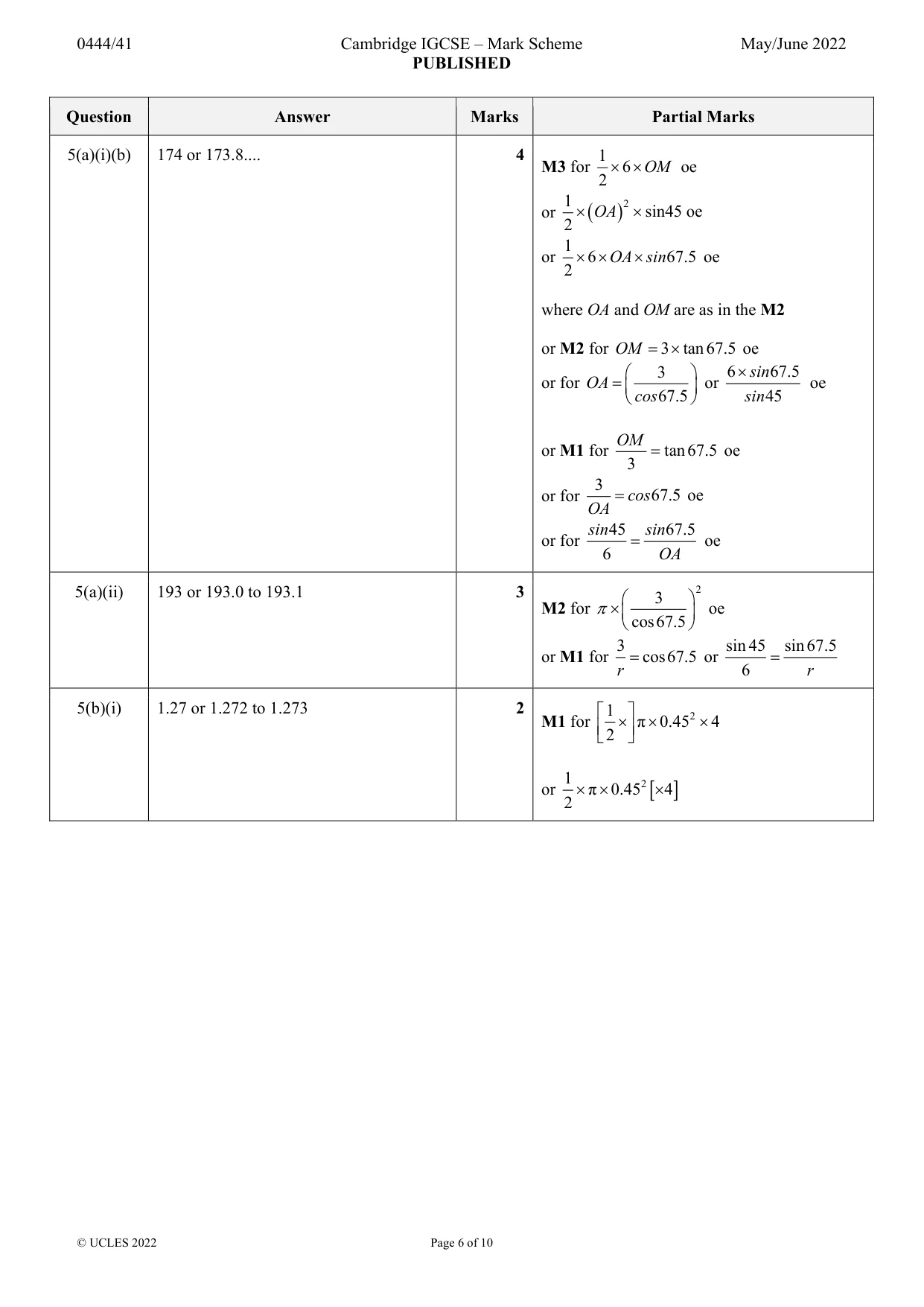
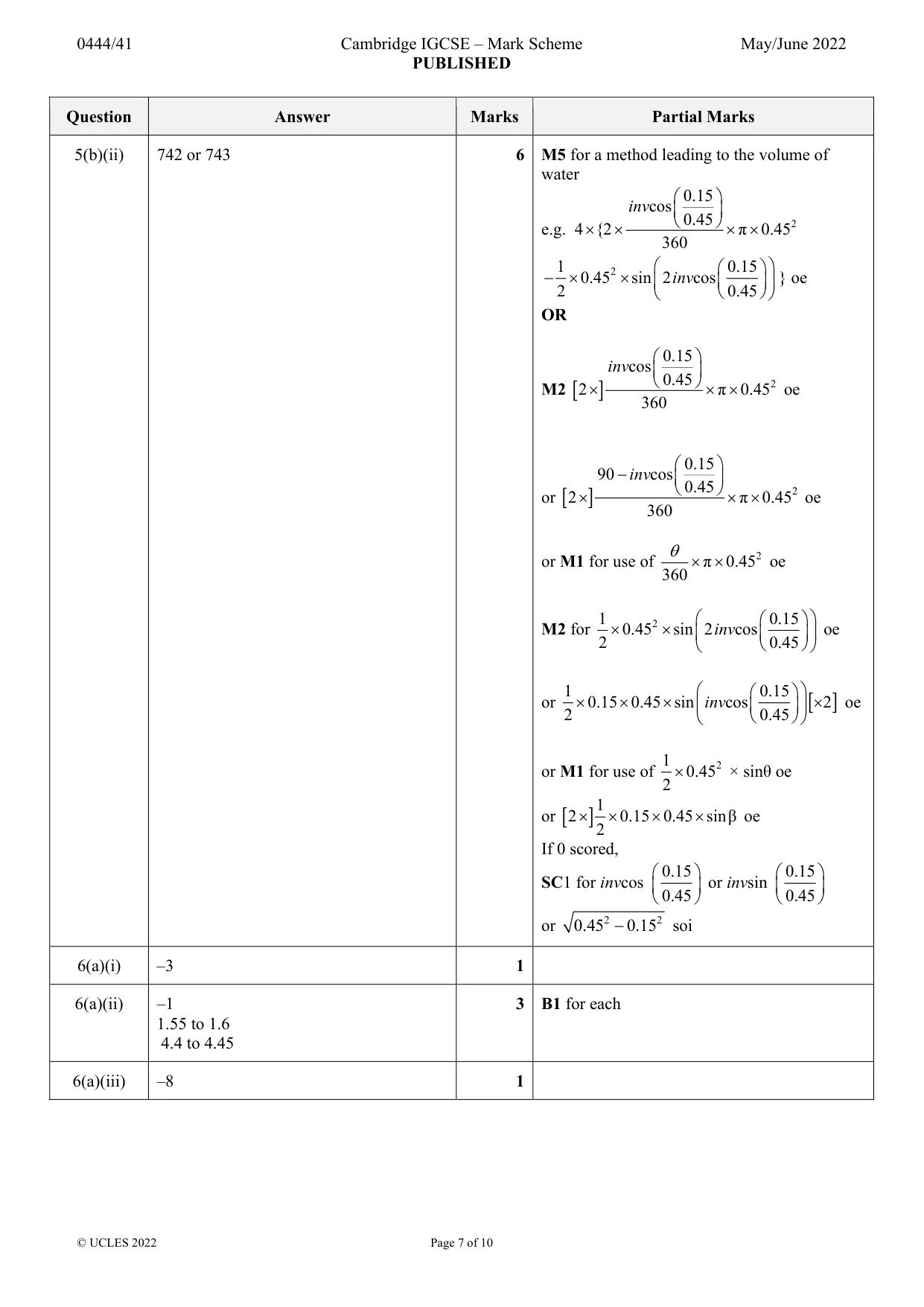
Mark scheme: 5(a)(i)(a) 8 2 180 M2 8 2 180 360 oe M1 for or or 8 2 8 8 2 8 4 90 8 5(a)(i)(b) 174 or 173.8.... 4 1 M3 for 6 OM oe 2 1 2 or OA sin45 oe 2 1 or 6 OA sin 67.5 oe 2 where OA and OM are as in the M2 or M2 for OM 3 tan67.5 oe 3 6 sin 67.5 or for OA or oe cos 67.5 sin 45 OM or M1 for tan67.5 oe 3 3 or for cos 67.5 oe OA sin 45 sin 67.5 or for oe 6 OA 5(a)(ii) 193 or 193.0 to 193.1 3 2 3 M2 for oe cos67.5 3 sin 45 sin67.5 or M1 for cos67.5 or r 6 r 5(b)(i) 1.27 or 1.272 to 1.273 2 1 2 M1 for π 0.45 4 2 1 2 or π 0.45 4 2 5(b)(ii) 742 or 743 6 M5 for a method leading to the volume of water 0.15 invcos 0.45 2 e.g. 4 {2 π 0.45 360 1 2 0.15 0.45 sin 2 invcos } oe 2 0.45 OR 0.15 invcos 0.45 2 M2 2 π 0.45 oe 360 0.15 90 invcos 0.45 2 or 2 π 0.45 oe 360 2 oe or M1 for use of π 0.45 360 1 2 0.15 M2 for 0.45 sin 2 invcos oe 2 0.45 1 0.15 2 oe or 0.15 0.45 sin invcos 2 0.45 1 2 or M1 for use of 0.45 × sinθ oe 2 or 2 1 0.15 0.45 sinβ oe 2 If 0 scored, 0.15 0.15 SC1 for invcos or invsin 0.45 0.45 or 0.45 2 0.15 2 soi
Q6 · The diagram shows the graph of y = f ( x) for - 1.5 G x G 5
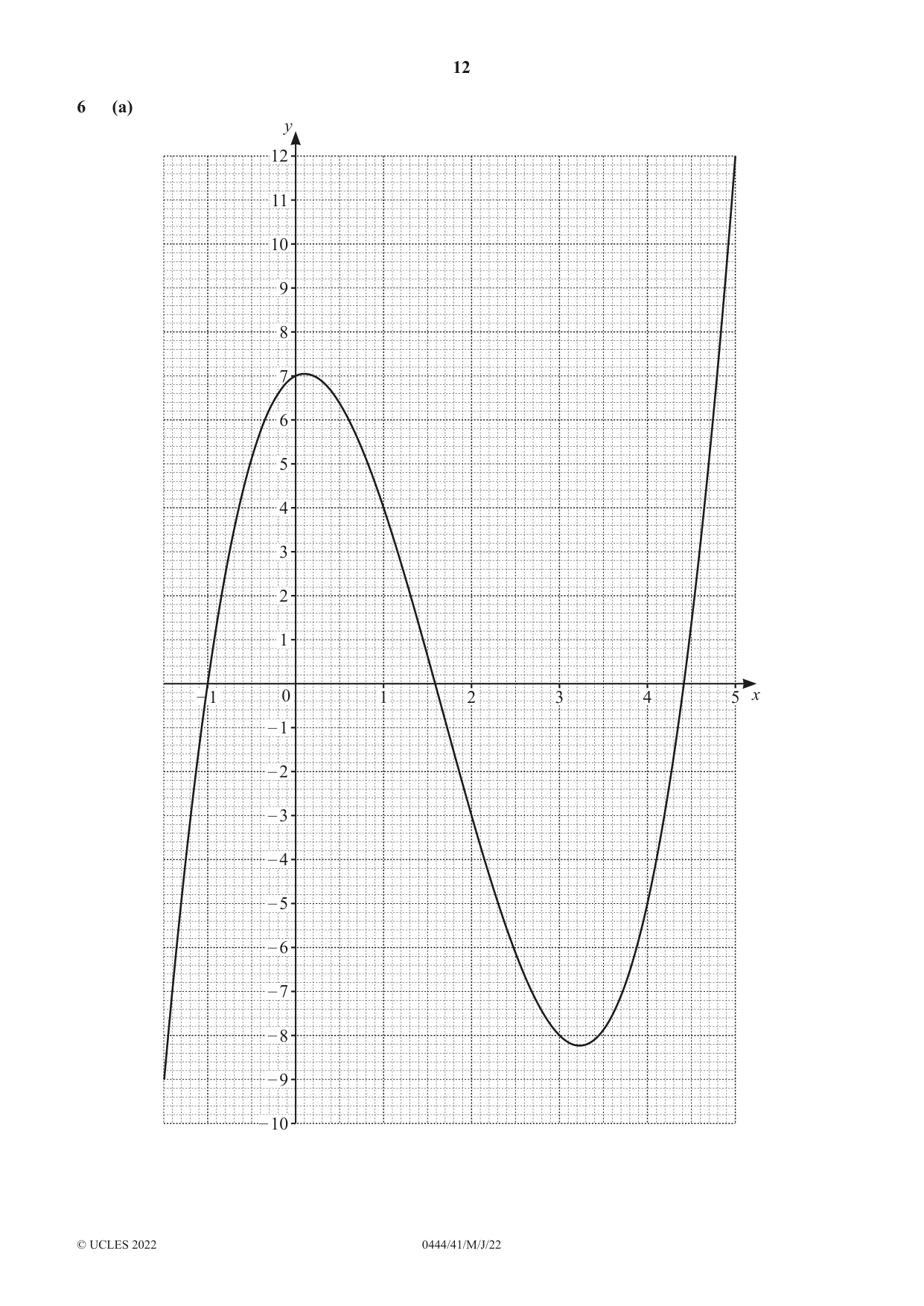
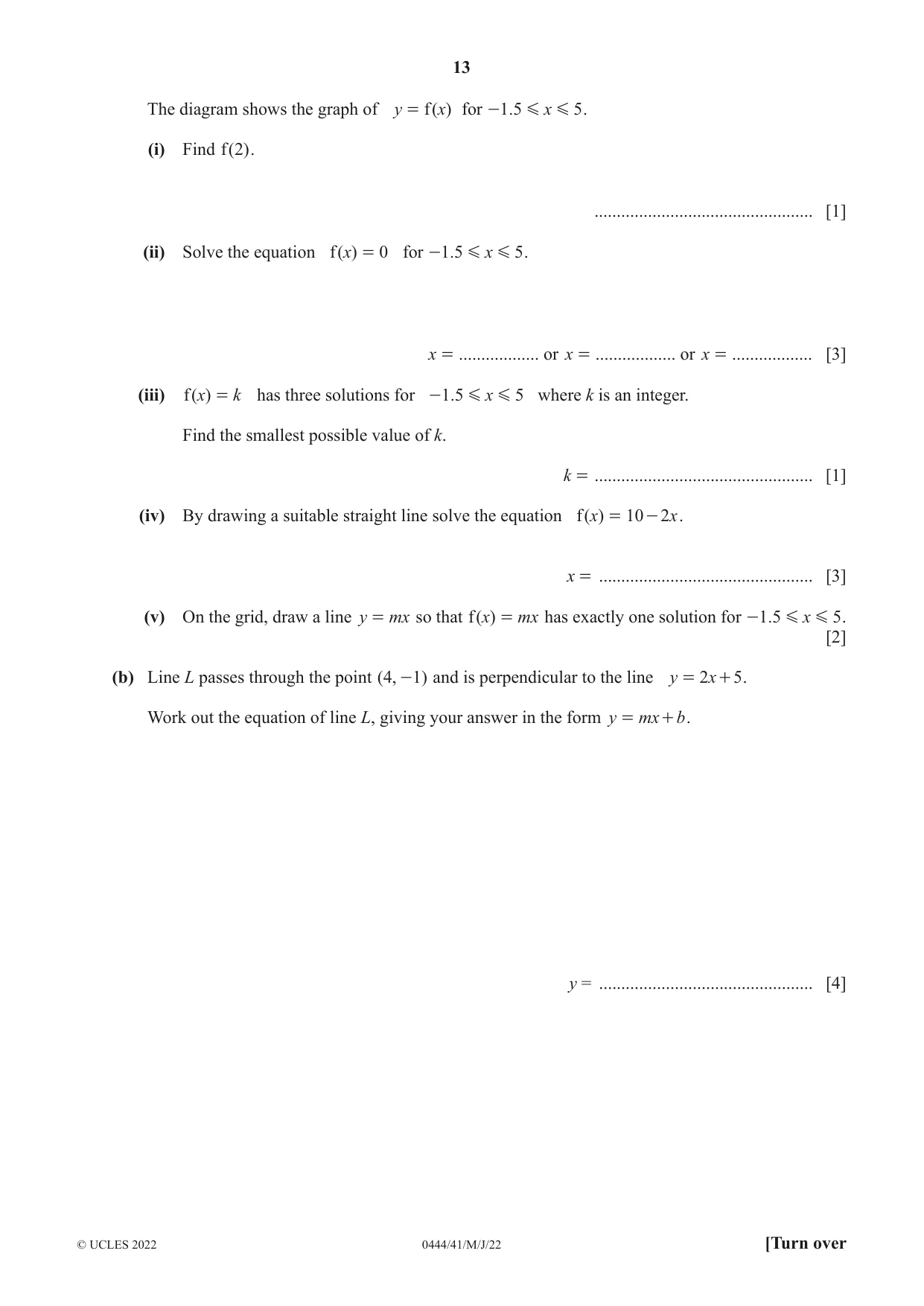
The diagram shows the graph of y = f ( x) for - 1.5 G x G 5 . (i) Find f ( 2) . ................................................. [1] (ii) Solve the equation f ( x) = 0 for - 1.5 G x G 5 . x = .................. or x = .................. or x = .................. [3] (iii) f ( x) = k has three solutions for - 1.5 G x G 5 where k is an integer. Find the smallest possible value of k. k = ................................................. [1] (iv) By drawing a suitable straight line solve the equation f ( )x = 10 - 2 x . x = ................................................ [3] (v) On the grid, draw a line y = mx so that f ( x) = mx has exactly one solution for - 1.5 G x G 5 . [2] (b) Line L passes through the point ( 4, - 1) and is perpendicular to the line y = 2x + 5 . Work out the equation of line L, giving your answer in the form y = mx + b . y = ................................................ [4]
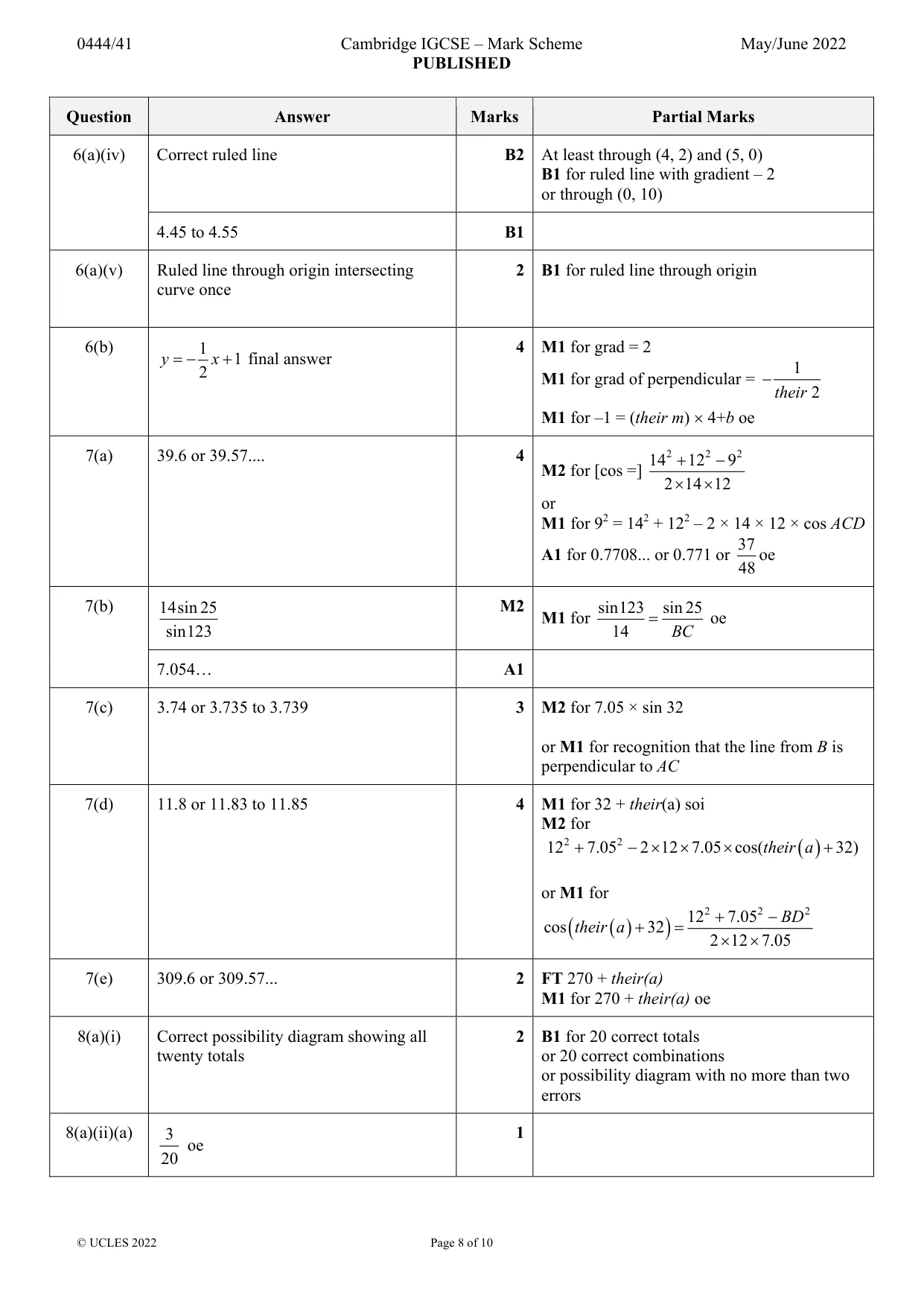
Mark scheme: 6(a)(i) –3 1 6(a)(ii) –1 3 B1 for each 1.55 to 1.6 4.4 to 4.45 6(a)(iii) –8 1 6(a)(iv) Correct ruled line B2 At least through (4, 2) and (5, 0) B1 for ruled line with gradient – 2 or through (0, 10) 4.45 to 4.55 B1 6(a)(v) Ruled line through origin intersecting 2 B1 for ruled line through origin curve once 6(b) 1 4 M1 for grad = 2 y x 1 final answer 2 1 M1 for grad of perpendicular = their 2 M1 for –1 = (their m) 4+b oe
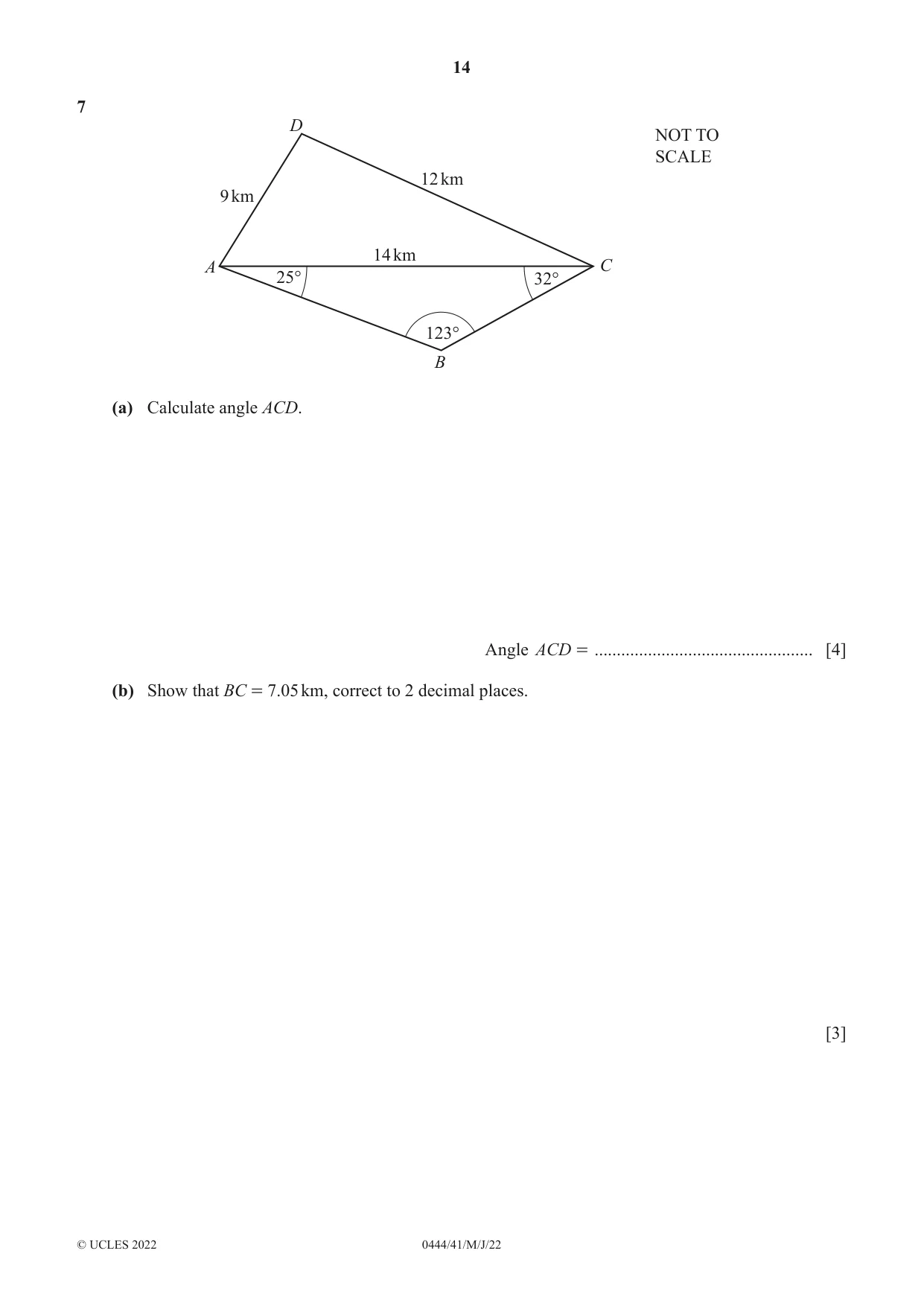
Q7 · D NOT TO SCALE 12 km 9 km 14 km A C 25° 32° 123° B (a) Calculate angle ACD
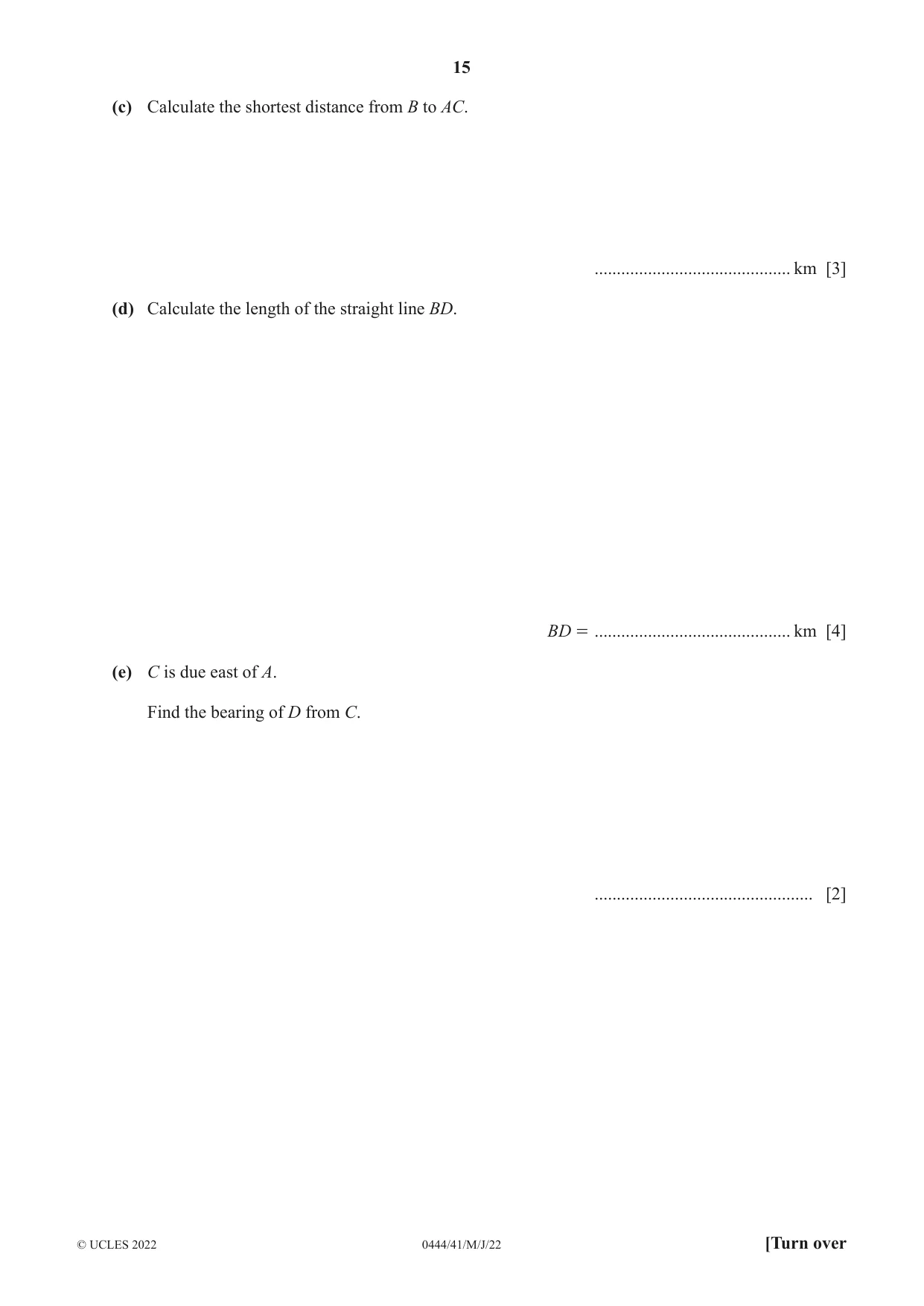
7 D NOT TO SCALE 12 km 9 km 14 km A C 25° 32° 123° B (a) Calculate angle ACD. Angle ACD = ................................................. [4] (b) Show that BC = 7.05 km, correct to 2 decimal places. [3] (c) Calculate the shortest distance from B to AC. ............................................ km [3] (d) Calculate the length of the straight line BD. BD = ............................................ km [4] (e) C is due east of A. Find the bearing of D from C. ................................................. [2]
Mark scheme: 7(a) 39.6 or 39.57.... 4 14 2 12 2 9 2 M2 for [cos =] 2 14 12 or M1 for 92 = 142 + 122 – 2 × 14 × 12 × cos ACD 37 A1 for 0.7708... or 0.771 or oe 48 7(b) 14sin 25 M2 sin123 sin 25 M1 for oe sin123 14 BC 7.054… A1 7(c) 3.74 or 3.735 to 3.739 3 M2 for 7.05 × sin 32 or M1 for recognition that the line from B is perpendicular to AC 7(d) 11.8 or 11.83 to 11.85 4 M1 for 32 + their(a) soi M2 for 12 2 7.05 2 2 12 7.05 cos(their a 32) or M1 for 12 2 7.05 2 BD 2 cos their a 32 2 12 7.05 7(e) 309.6 or 309.57... 2 FT 270 + their(a) M1 for 270 + their(a) oe
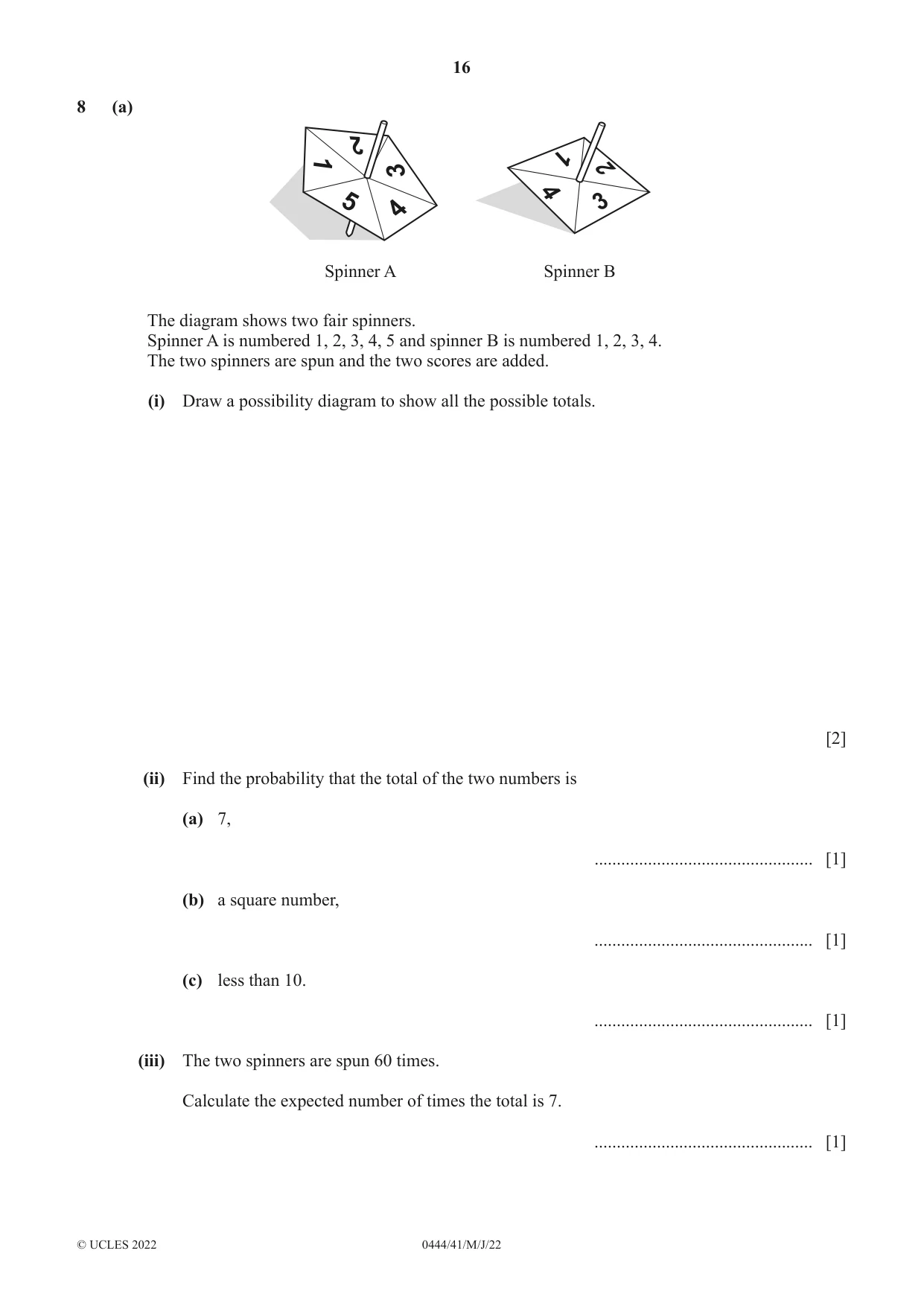
Q8 · Spinner A Spinner B The diagram shows two fair spinners
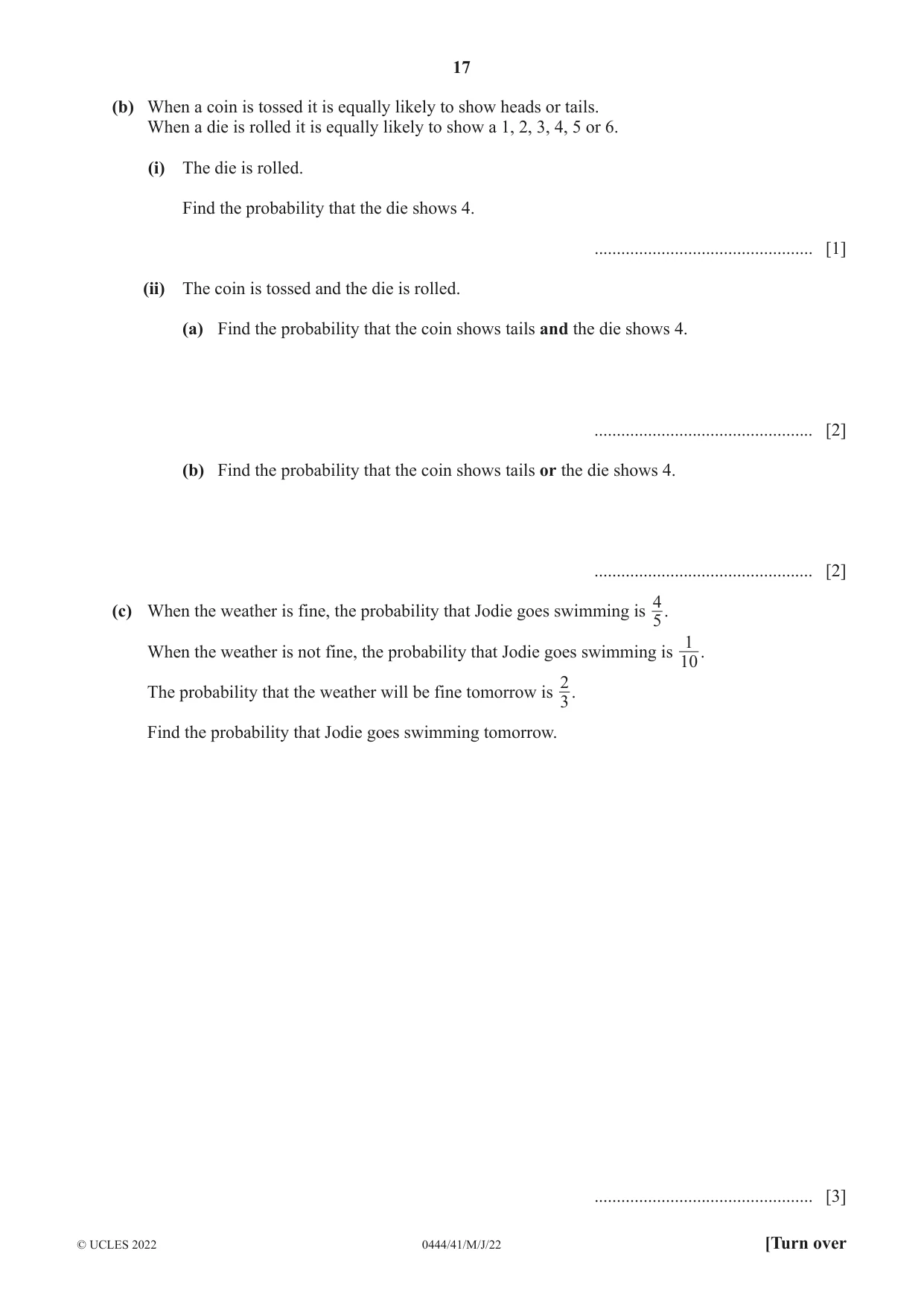
8 (a) Spinner A Spinner B The diagram shows two fair spinners. Spinner A is numbered 1, 2, 3, 4, 5 and spinner B is numbered 1, 2, 3, 4. The two spinners are spun and the two scores are added. (i) Draw a possibility diagram to show all the possible totals. [2] (ii) Find the probability that the total of the two numbers is (a) 7, ................................................. [1] (b) a square number, ................................................. [1] (c) less than 10. ................................................. [1] (iii) The two spinners are spun 60 times. Calculate the expected number of times the total is 7. ................................................. [1] (b) When a coin is tossed it is equally likely to show heads or tails. When a die is rolled it is equally likely to show a 1, 2, 3, 4, 5 or 6. (i) The die is rolled. Find the probability that the die shows 4. ................................................. [1] (ii) The coin is tossed and the die is rolled. (a) Find the probability that the coin shows tails and the die shows 4. ................................................. [2] (b) Find the probability that the coin shows tails or the die shows 4. ................................................. [2] (c) When the weather is fine, the probability that Jodie goes swimming is 4. 5 1 When the weather is not fine, the probability that Jodie goes swimming is . 10 The probability that the weather will be fine tomorrow is 2. 3 Find the probability that Jodie goes swimming tomorrow. ................................................. [3]
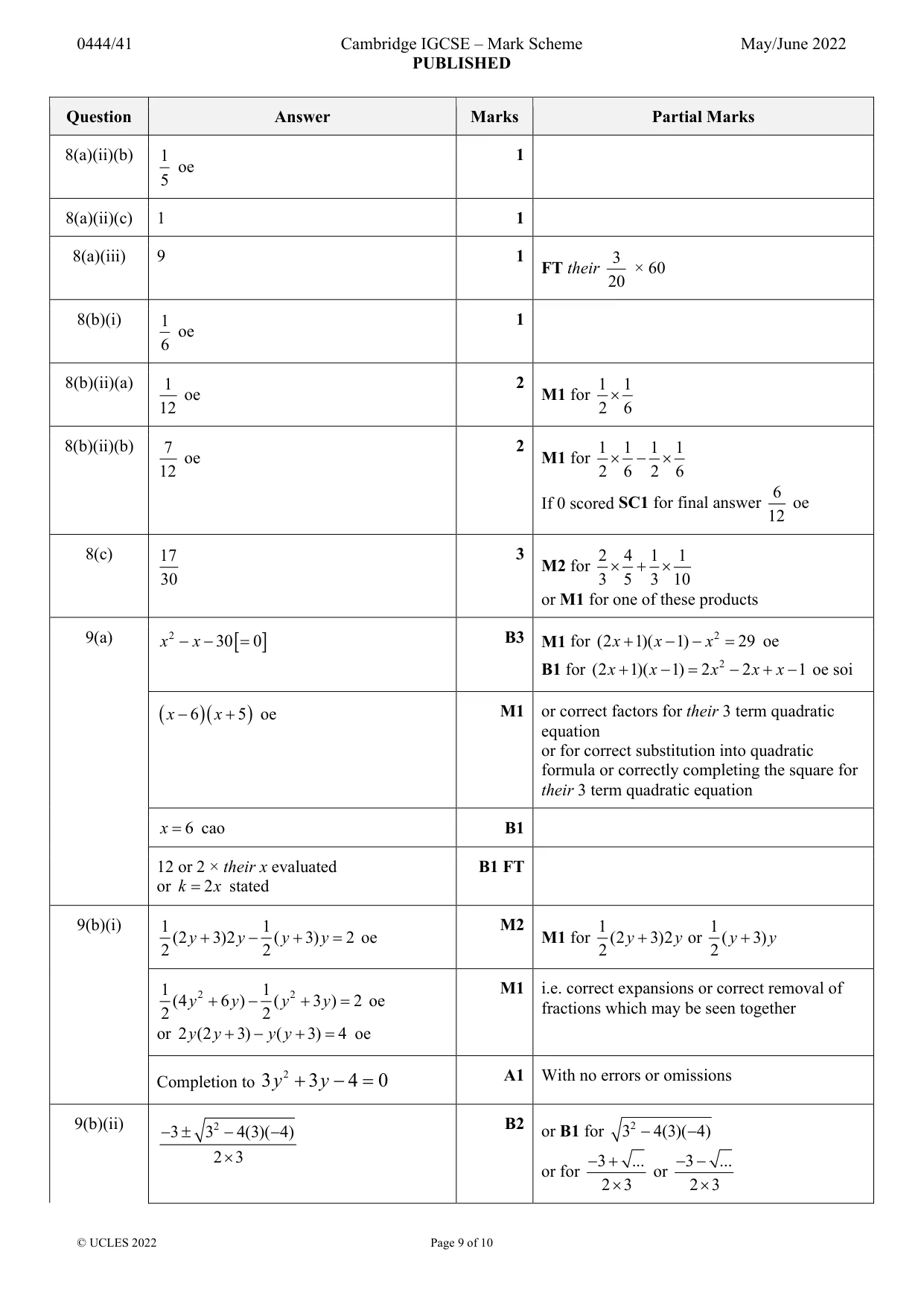
Mark scheme: 8(a)(i) Correct possibility diagram showing all 2 B1 for 20 correct totals twenty totals or 20 correct combinations or possibility diagram with no more than two errors 8(a)(ii)(a) 3 1 oe 20 8(a)(ii)(b) 1 1 oe 5 8(a)(ii)(c) 1 1 8(a)(iii) 9 1 3 FT their × 60 20 8(b)(i) 1 1 oe 6 8(b)(ii)(a) 1 2 1 1 oe M1 for 12 2 6 8(b)(ii)(b) 7 2 1 1 1 1 oe M1 for 12 2 6 2 6 6 If 0 scored SC1 for final answer oe 12 8(c) 17 3 2 4 1 1 M2 for 30 3 5 3 10 or M1 for one of these products
Q9 · (x – 1) cm NOT TO x cm SCALE (2x + 1) cm x cm The area of the rectangle is 29cm2 greater…
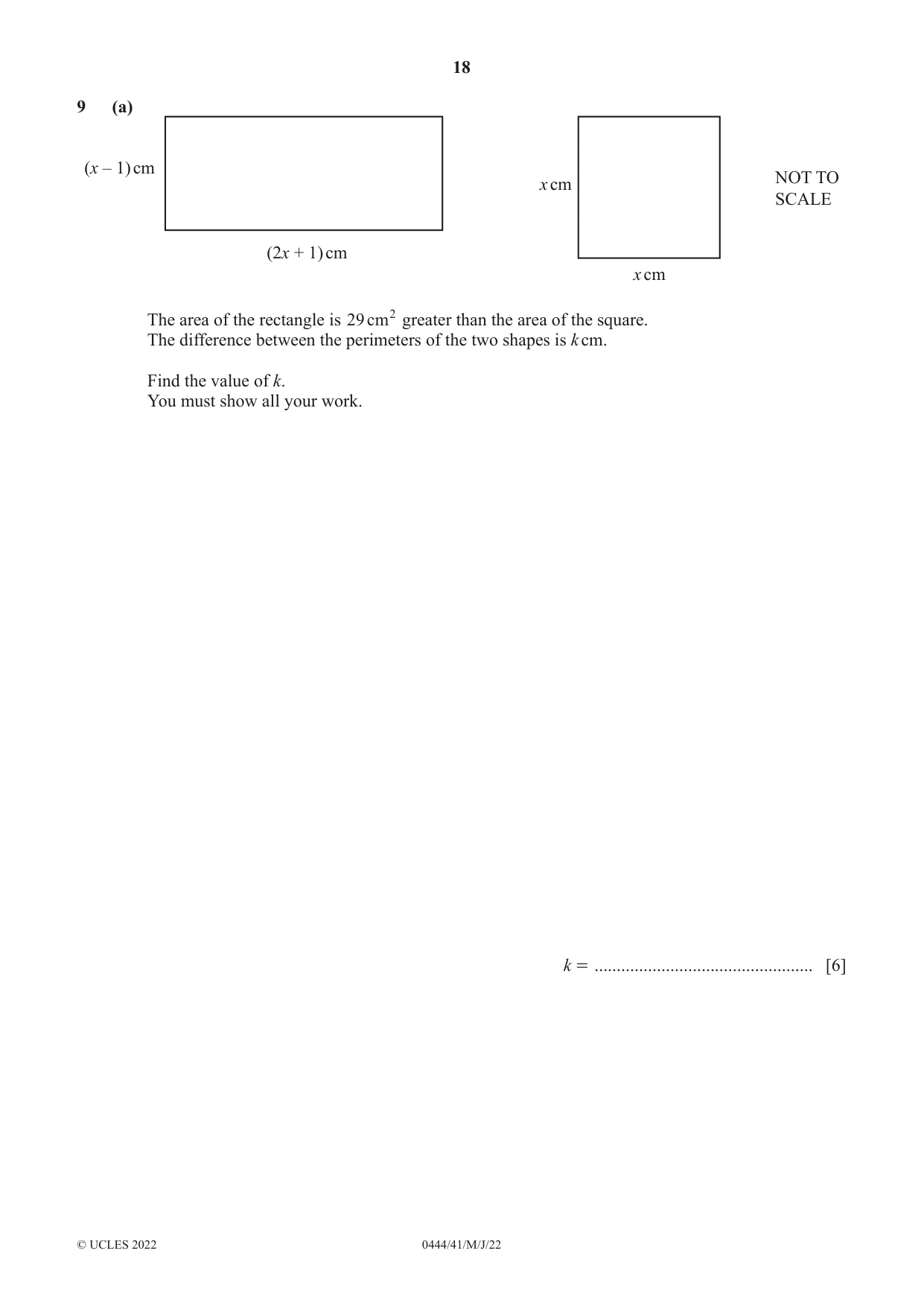
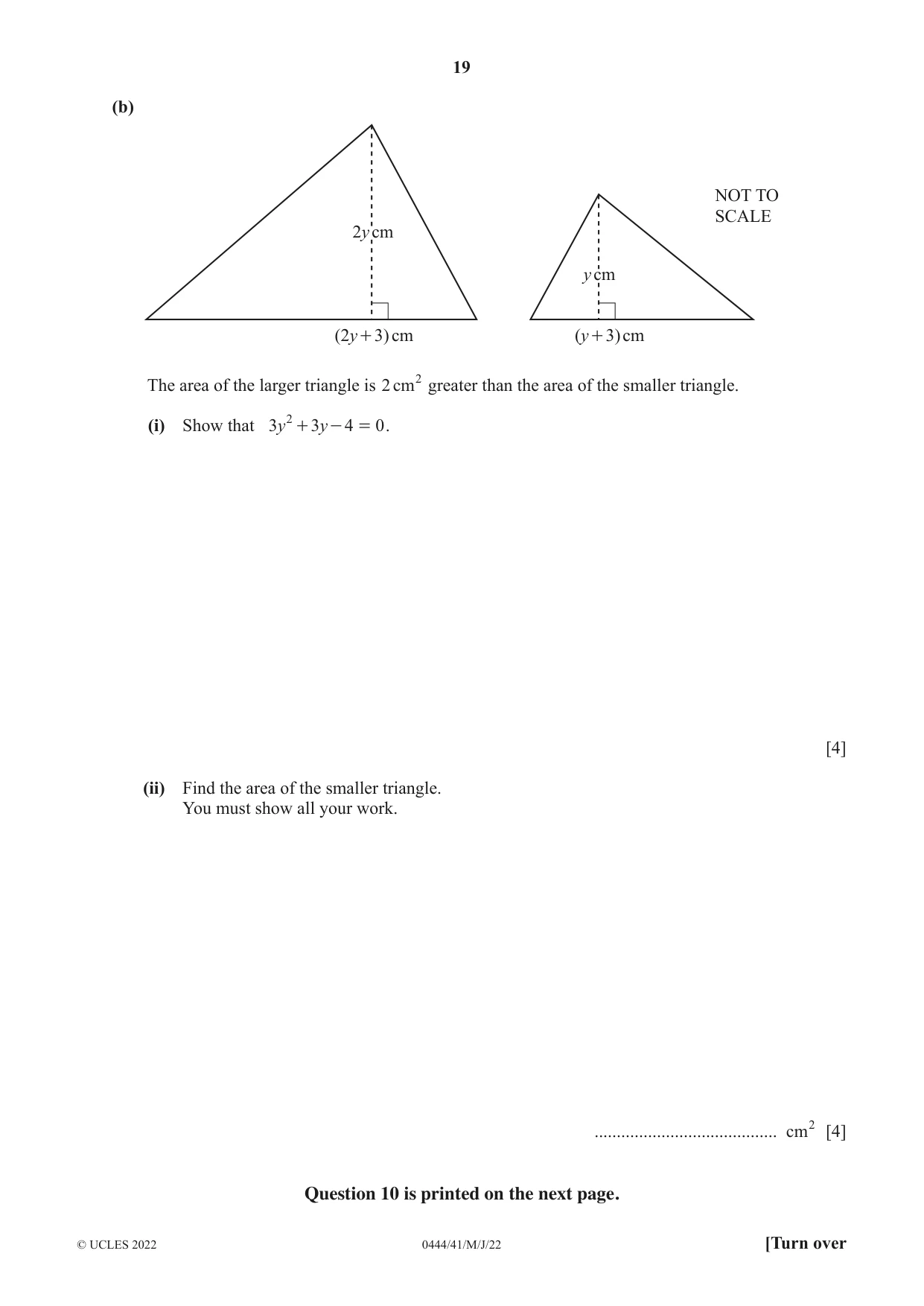
9 (a) (x – 1) cm NOT TO x cm SCALE (2x + 1) cm x cm The area of the rectangle is 29cm2 greater than the area of the square. The difference between the perimeters of the two shapes is k cm. Find the value of k. You must show all your work. k = ................................................. [6] (b) NOT TO SCALE 2y cm y cm ( 2y+ 3) cm ( y + 3)cm The area of the larger triangle is 2 cm 2 greater than the area of the smaller triangle. (i) Show that 3y 2 + 3y - 4 = 0 . [4] (ii) Find the area of the smaller triangle. You must show all your work. ......................................... cm2 [4] Question 10 is printed on the next page.
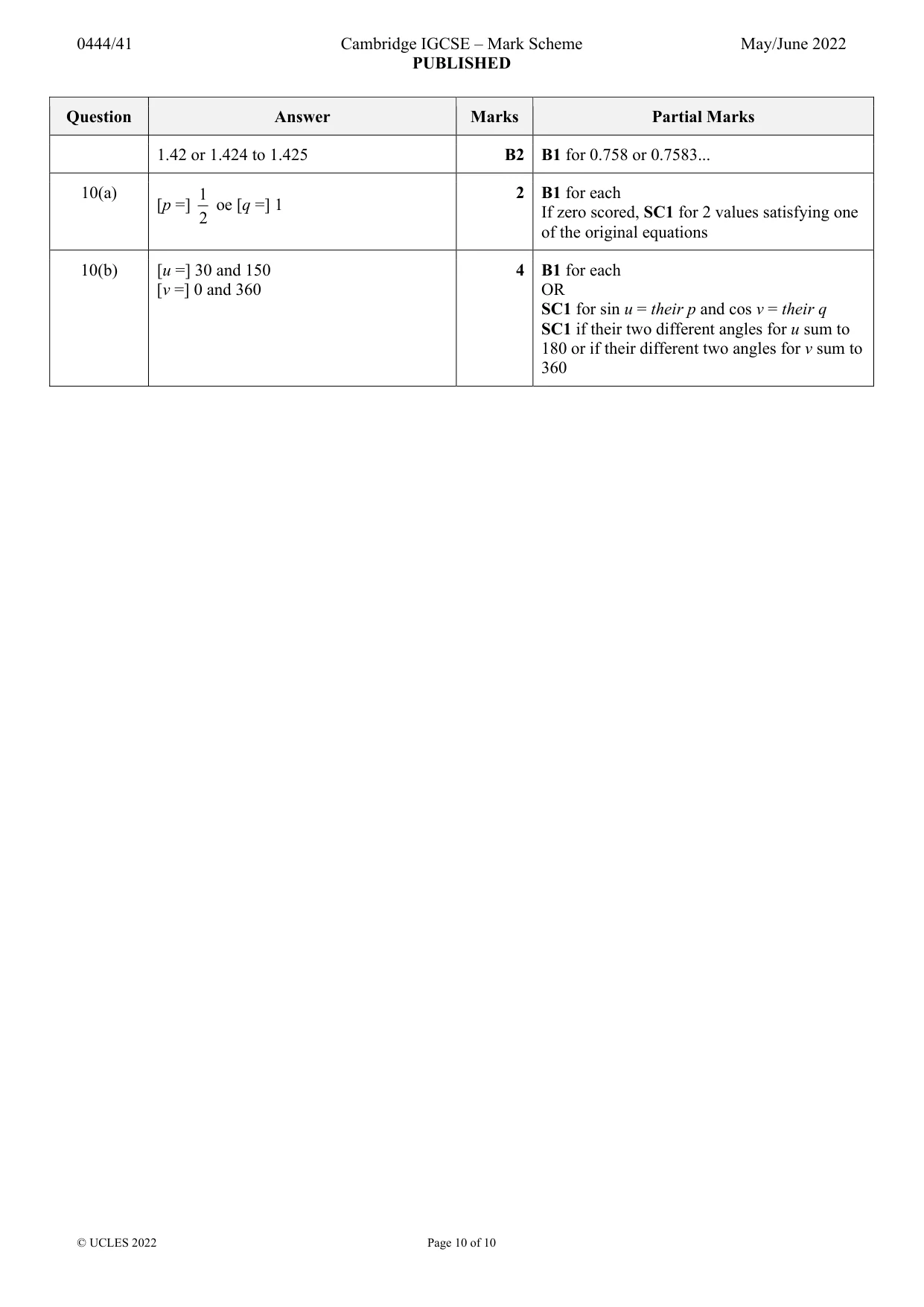
Mark scheme: 9(a) x 2 x 30 0 B3 M1 for (2 x 1)( x 1) x 2 29 oe B1 for (2 x 1)( x 1) 2 x 2 2 x x 1 oe soi x 6 x 5 oe M1 or correct factors for their 3 term quadratic equation or for correct substitution into quadratic formula or correctly completing the square for their 3 term quadratic equation x 6 cao B1 12 or 2 × their x evaluated B1 FT or k 2 x stated 9(b)(i) 1 1 M2 1 1 (2 y 3)2 y ( y 3) y 2 oe M1 for (2 y 3)2 y or ( y 3) y 2 2 2 2 1 2 1 2 M1 i.e. correct expansions or correct removal of (4 y 6 y ) ( y 3 y ) 2 oe fractions which may be seen together 2 2 or 2 y (2 y 3) y ( y 3) 4 oe Completion to 3 y 2 3 y 4 0 A1 With no errors or omissions 9(b)(ii) 2 B2 2 3 3 4(3)( 4) or B1 for 3 4(3)( 4) 2 3 3 ... 3 ... or for or 2 3 2 3
Q10 · Solve the system of linear equations
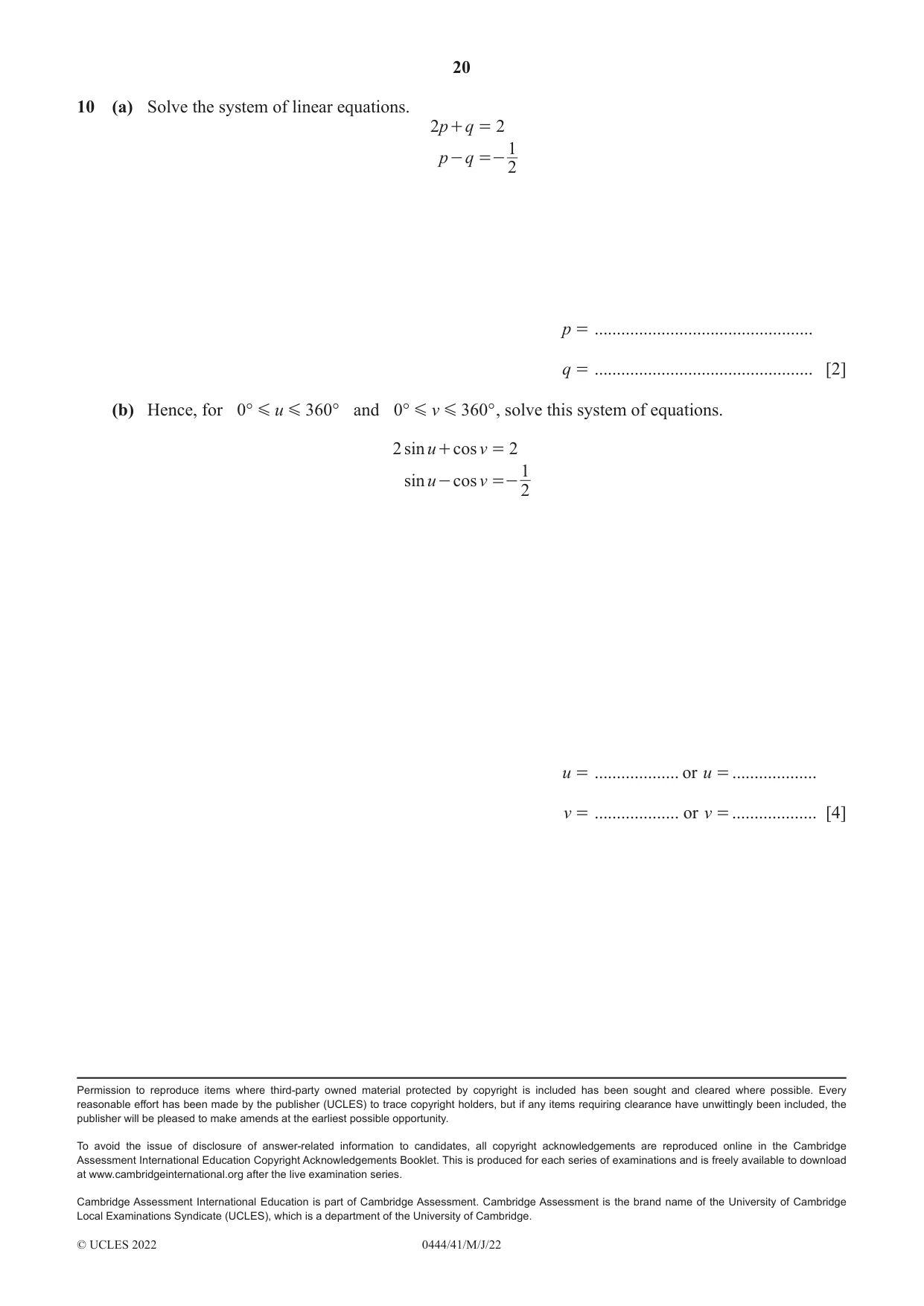
10 (a) Solve the system of linear equations. 2p + q = 2 1 p - q =- 2 p = ................................................. q = ................................................. [2] (b) Hence, for 0° G u G 360° and 0° G v G 360 ° , solve this system of equations. 2 sin u + cos v = 2 1 sin u - cos v =- 2 u = ................... or u = ................... v = ................... or v = ................... [4]
Mark scheme: 10(a) 1 2 B1 for each [p =] oe [q =] 1 If zero scored, SC1 for 2 values satisfying one 2 of the original equations 10(b) [u =] 30 and 150 4 B1 for each [v =] 0 and 360 OR SC1 for sin u = their p and cos v = their q SC1 if their two different angles for u sum to 180 or if their different two angles for v sum to 360
What you needed in this session
Cambridge’s own grade thresholds for 2022 May/June, Paper 4 · Variant 1. A higher threshold means an easier paper — the bar moves with how the cohort did.