Cambridge IGCSE Mathematics (US) 0444 — 2018 May/June Paper 4 · Variant 1
0444/41/M/J/18 · 12 questions · 130 marks · ≈146 min
The question paper and its mark scheme, free to read here and free to download. This is Cambridge’s own paper, exactly as it was sat.
Question paper20 pages
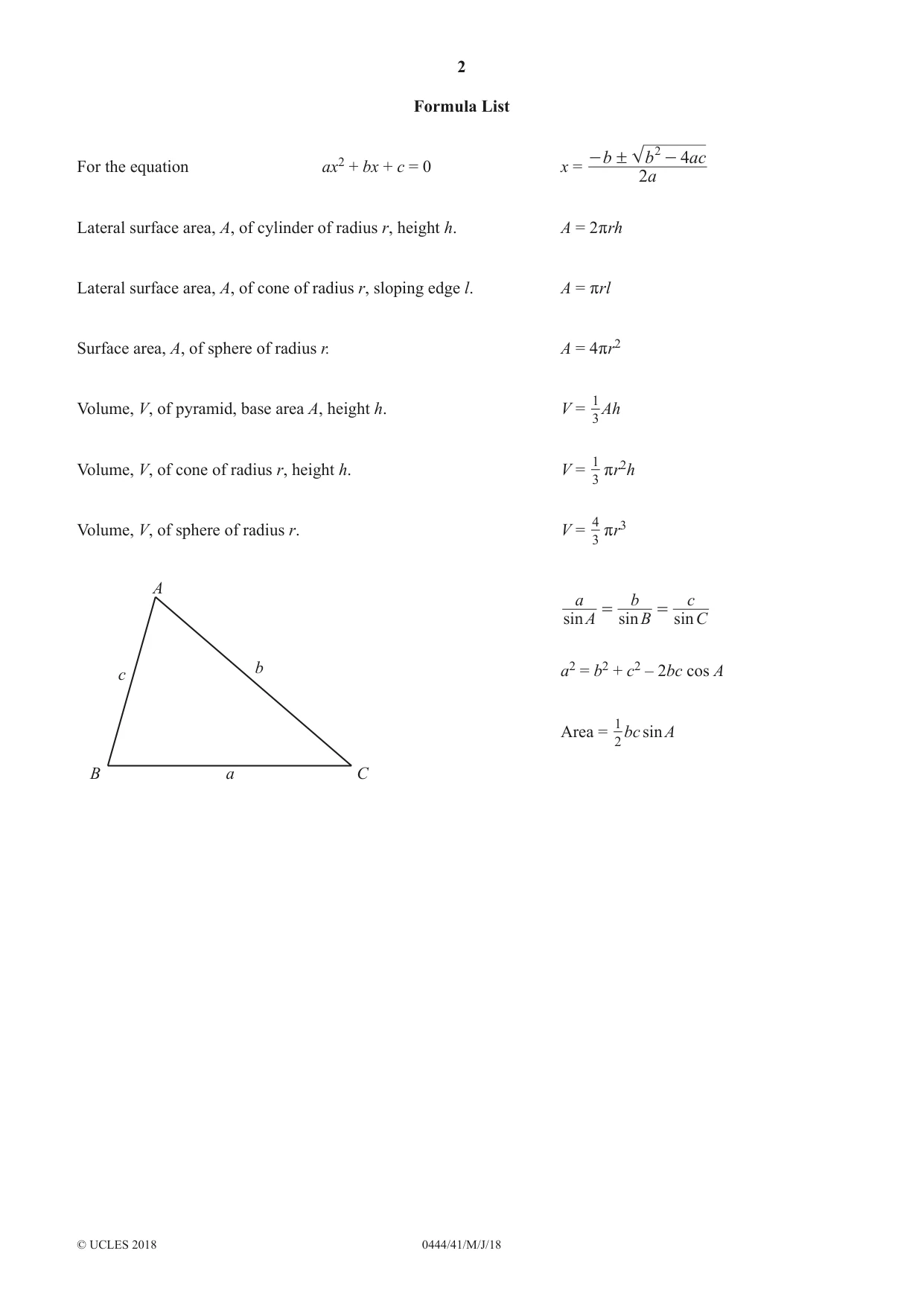
Mark scheme8 pages
Answers below. Sit the paper first if you are practising.
Questions as text
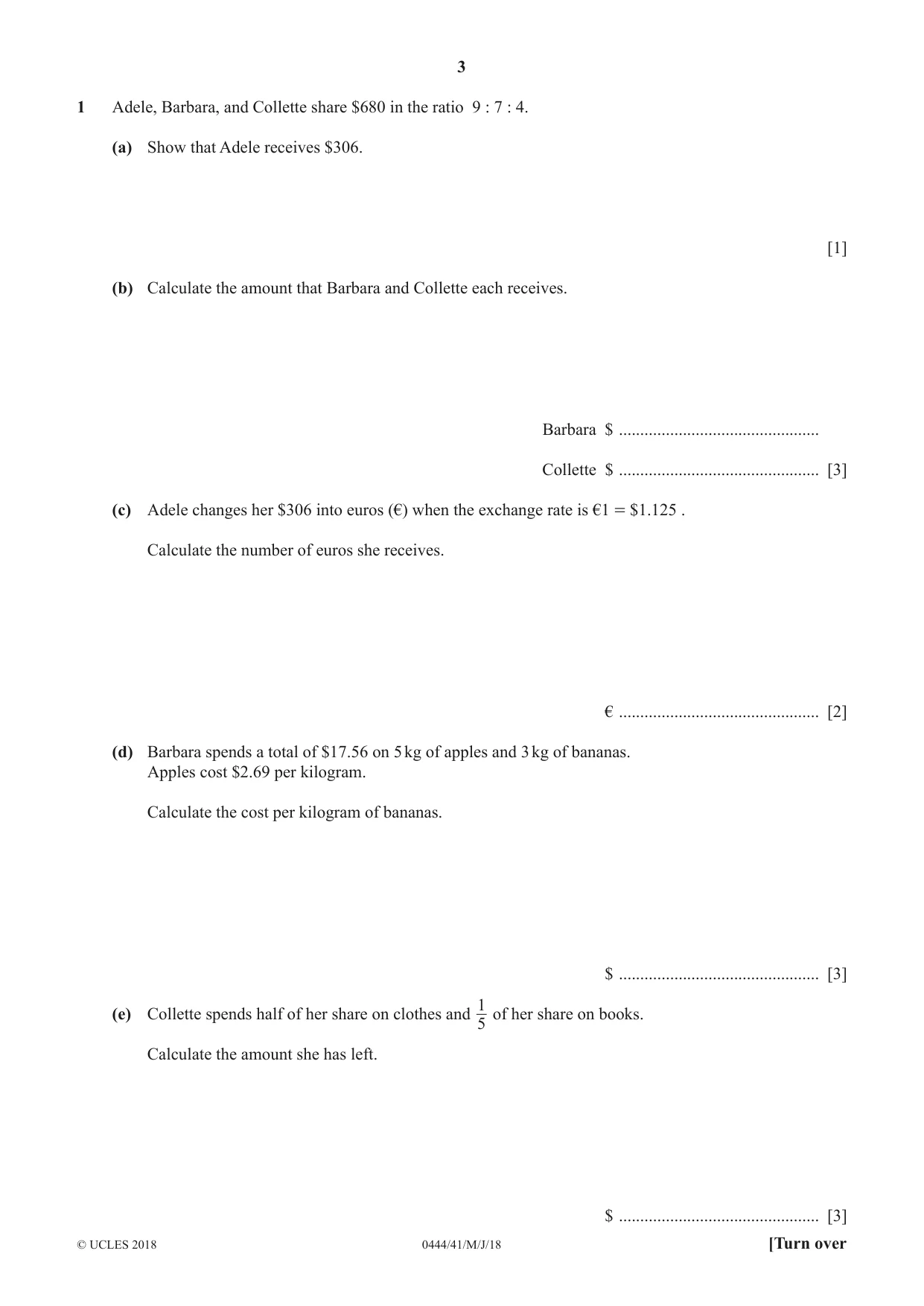
Q1 · Adele, Barbara, and Collette share $680 in the ratio 9 : 7 : 4
1 Adele, Barbara, and Collette share $680 in the ratio 9 : 7 : 4. (a) Show that Adele receives $306. [1] (b) Calculate the amount that Barbara and Collette each receives. Barbara $ ............................................... Collette $ ............................................... [3] (c) Adele changes her $306 into euros (€) when the exchange rate is €1 = $1.125 . Calculate the number of euros she receives. € ............................................... [2] (d) Barbara spends a total of $17.56 on 5 kg of apples and 3 kg of bananas. Apples cost $2.69 per kilogram. Calculate the cost per kilogram of bananas. $ ............................................... [3] 1 (e) Collette spends half of her share on clothes and of her share on books. 5 Calculate the amount she has left. $ ............................................... [3]
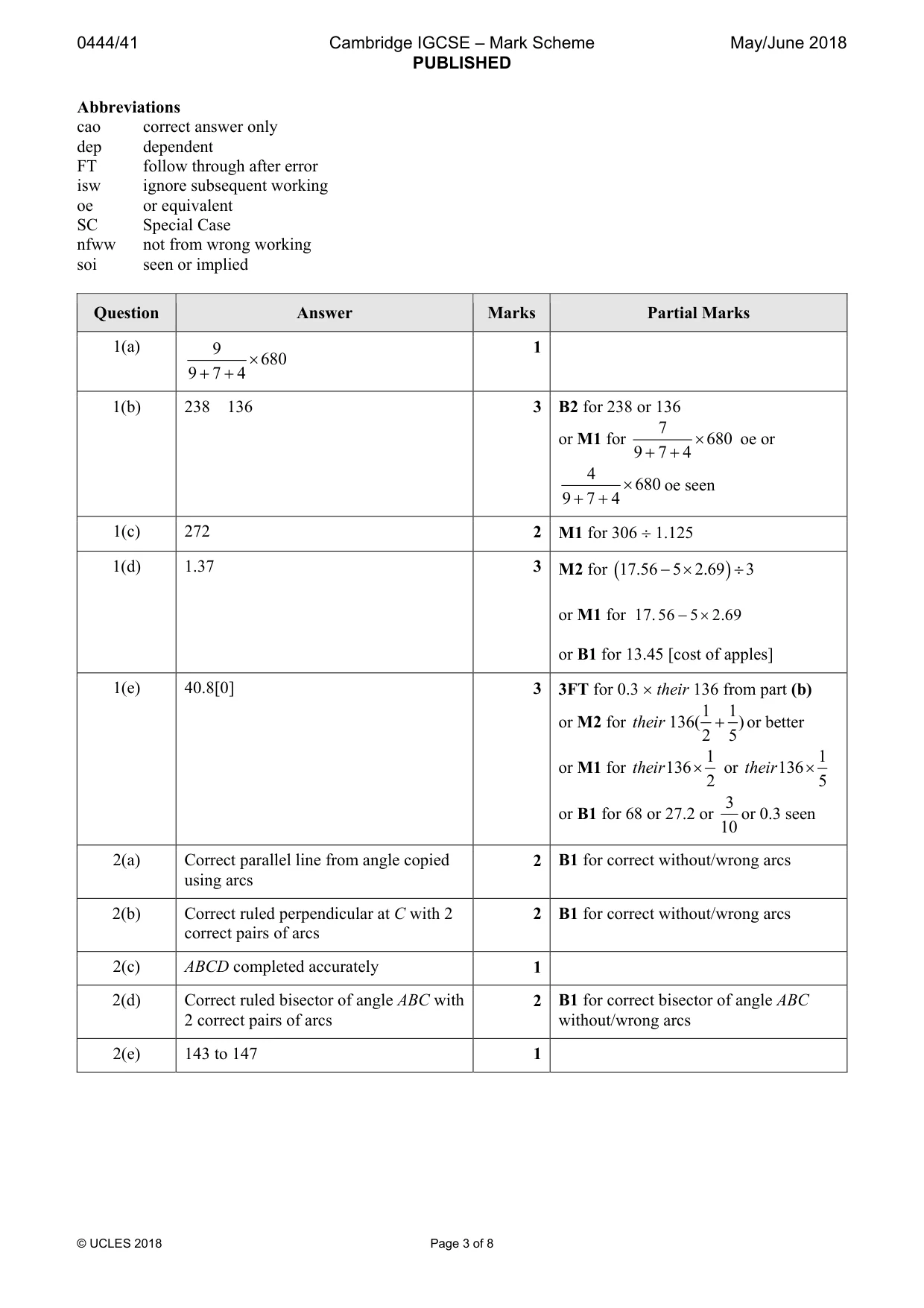
Mark scheme: Question Answer Marks Partial Marks 1(a) 9 1 × 680 9 + 7 + 4 1(b) 238 136 3 B2 for 238 or 136 7 or M1 for × 680 oe or 9 + 7 + 4 4 × 680 oe seen 9 + 7 + 4 1(c) 272 2 M1 for 306 ÷ 1.125 1(d) 1.37 3 M2 for (17.56 −×5 2.69 ) ÷ 3 or M1 for 17.56 − 5 × 2.69 or B1 for 13.45 [cost of apples] 1(e) 40.8[0] 3 3FT for 0.3 × their 136 from part (b) 1 1 or M2 for their 136( + ) or better 2 5 1 1 or M1 for their 136 × or their 136 × 2 5 3 or B1 for 68 or 27.2 or or 0.3 seen 10
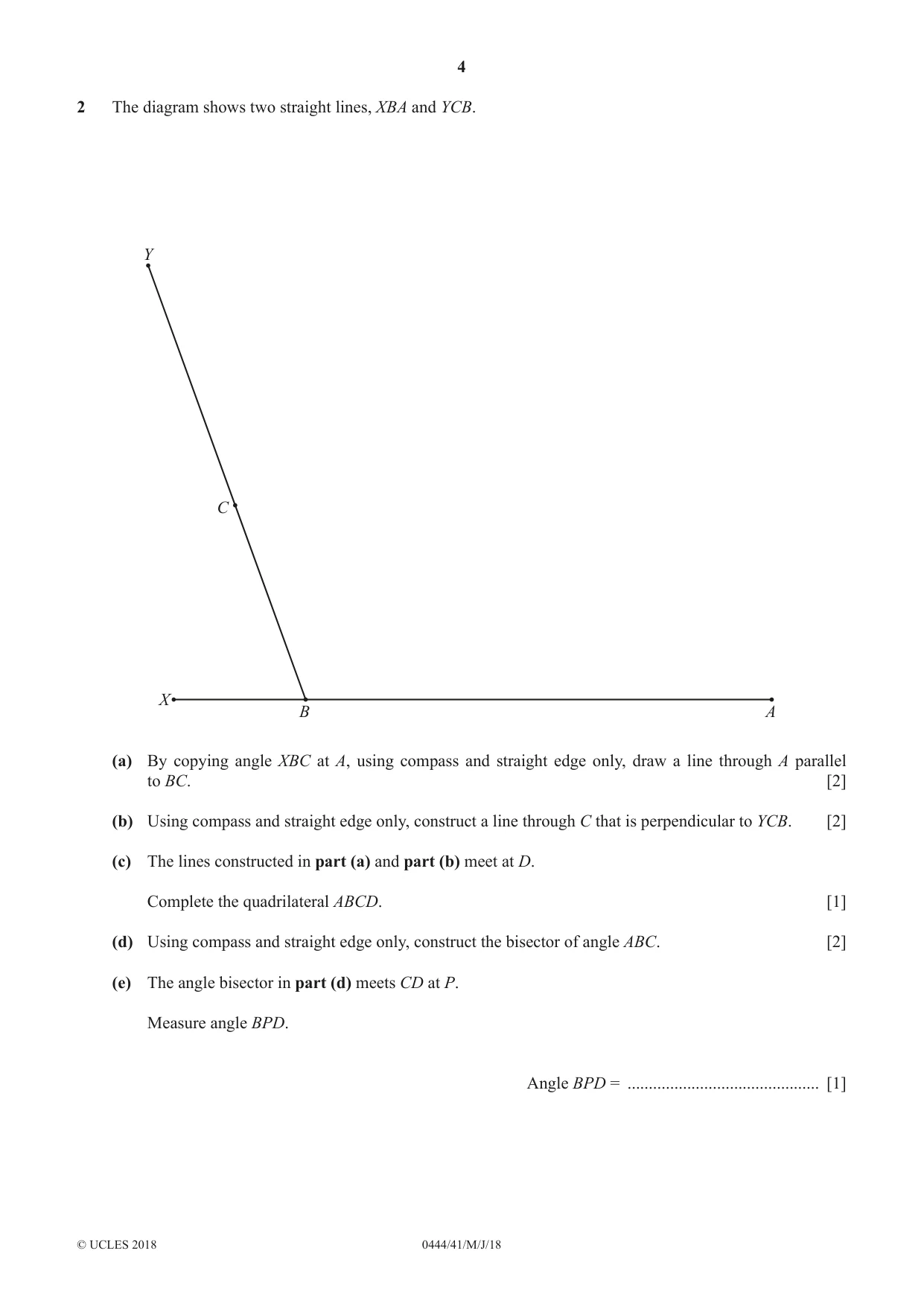
Q2 · The diagram shows two straight lines, XBA and YCB
2 The diagram shows two straight lines, XBA and YCB. Y C X B A (a) By copying angle XBC at A, using compass and straight edge only, draw a line through A parallel to BC. [2] (b) Using compass and straight edge only, construct a line through C that is perpendicular to YCB. [2] (c) The lines constructed in part (a) and part (b) meet at D. Complete the quadrilateral ABCD. [1] (d) Using compass and straight edge only, construct the bisector of angle ABC. [2] (e) The angle bisector in part (d) meets CD at P. Measure angle BPD. Angle BPD = ............................................. [1]
Mark scheme: 2(a) Correct parallel line from angle copied 2 B1 for correct without/wrong arcs using arcs 2(b) Correct ruled perpendicular at C with 2 2 B1 for correct without/wrong arcs correct pairs of arcs 2(c) ABCD completed accurately 1 2(d) Correct ruled bisector of angle ABC with 2 B1 for correct bisector of angle ABC 2 correct pairs of arcs without/wrong arcs 2(e) 143 to 147 1
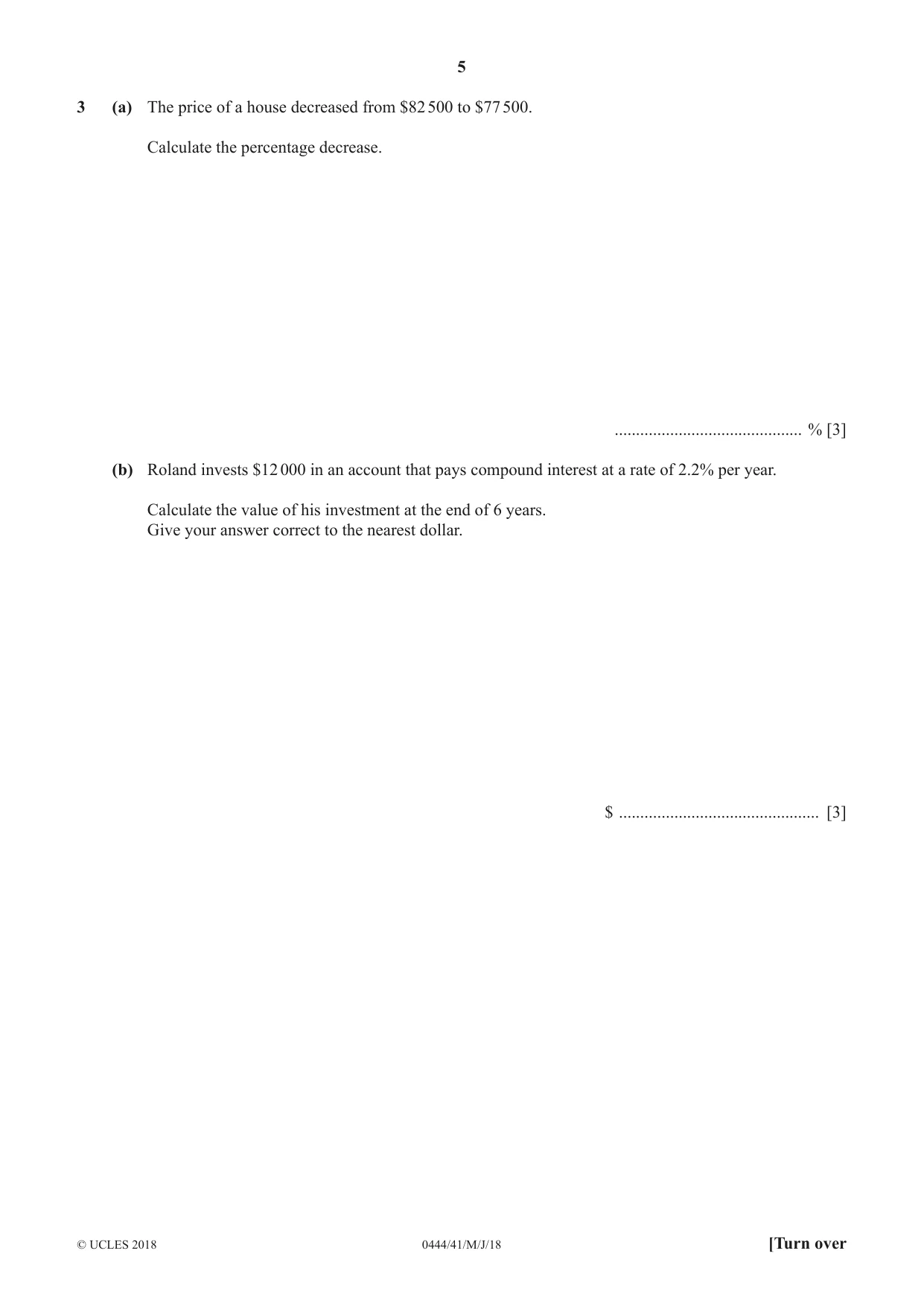
Q3 · The price of a house decreased from $82 500 to $77 500
3 (a) The price of a house decreased from $82 500 to $77 500. Calculate the percentage decrease. ............................................ % [3] (b) Roland invests $12 000 in an account that pays compound interest at a rate of 2.2% per year. Calculate the value of his investment at the end of 6 years. Give your answer correct to the nearest dollar. $ ............................................... [3]
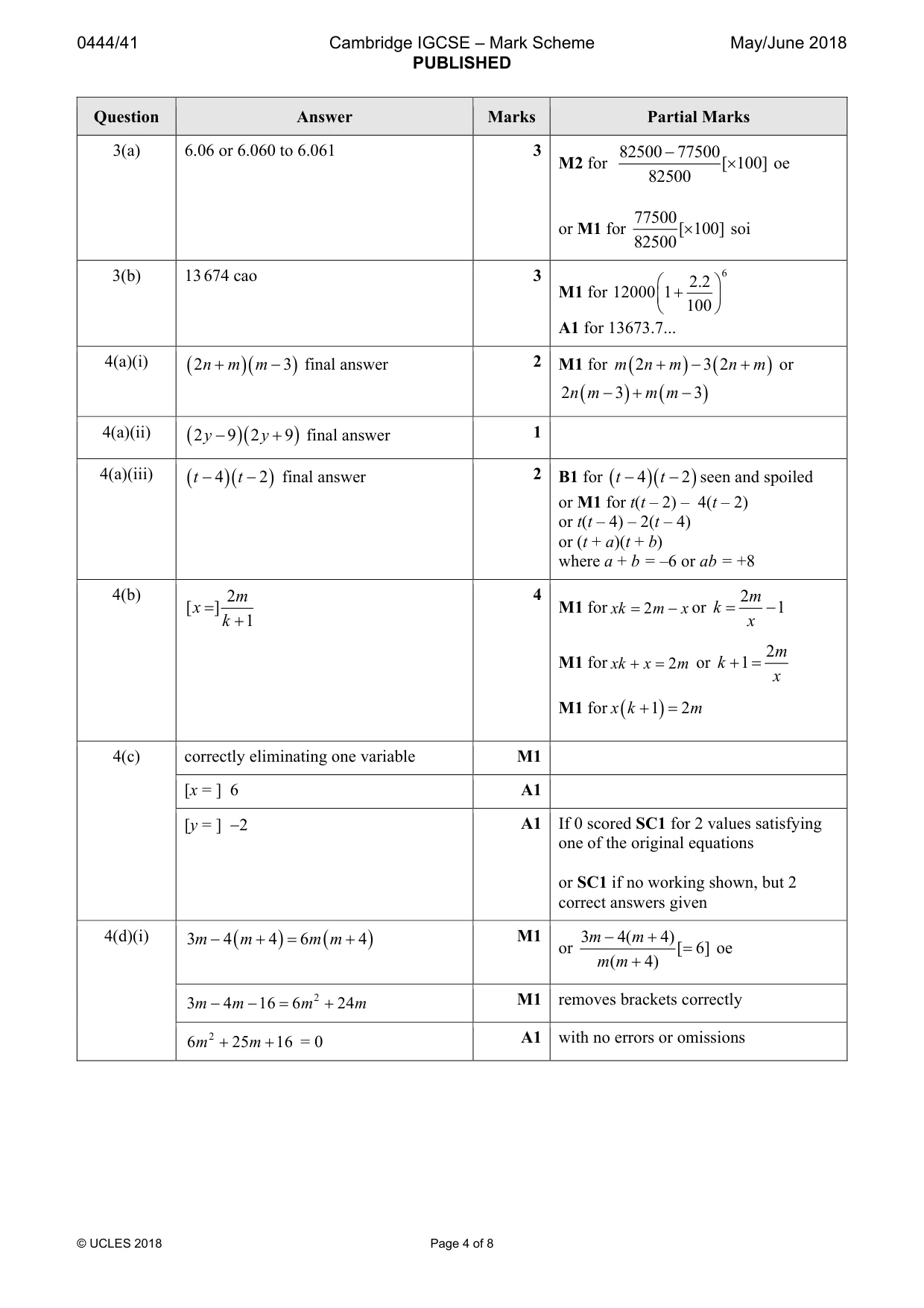
Mark scheme: 3(a) 6.06 or 6.060 to 6.061 3 82500 − 77500[× 100] oe M2 for 82500 or M1 for 77500[× 100] soi 82500 3(b) 13 674 cao 3 6 2.2 M1 for 12000 1 + 100 A1 for 13673.7...
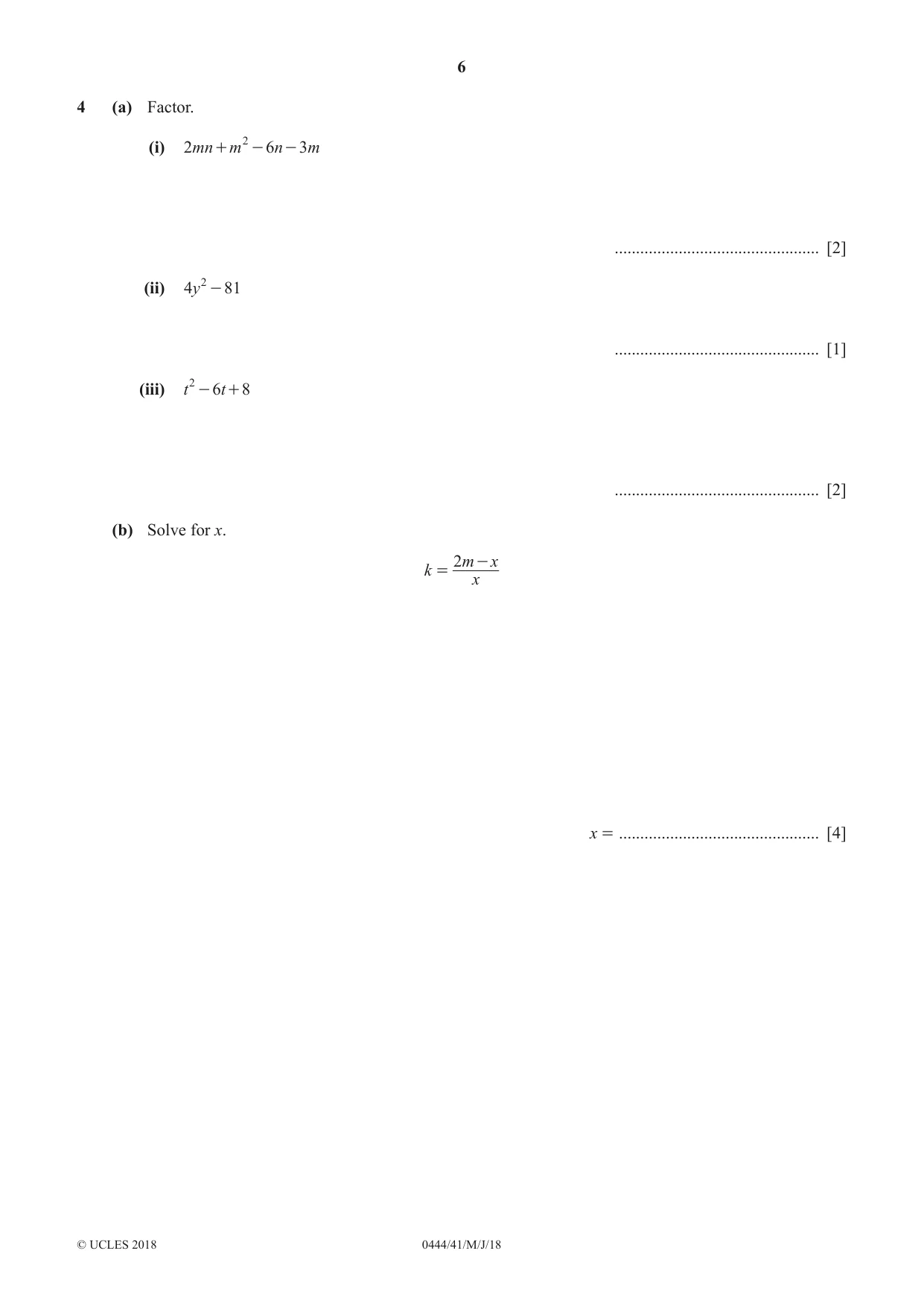
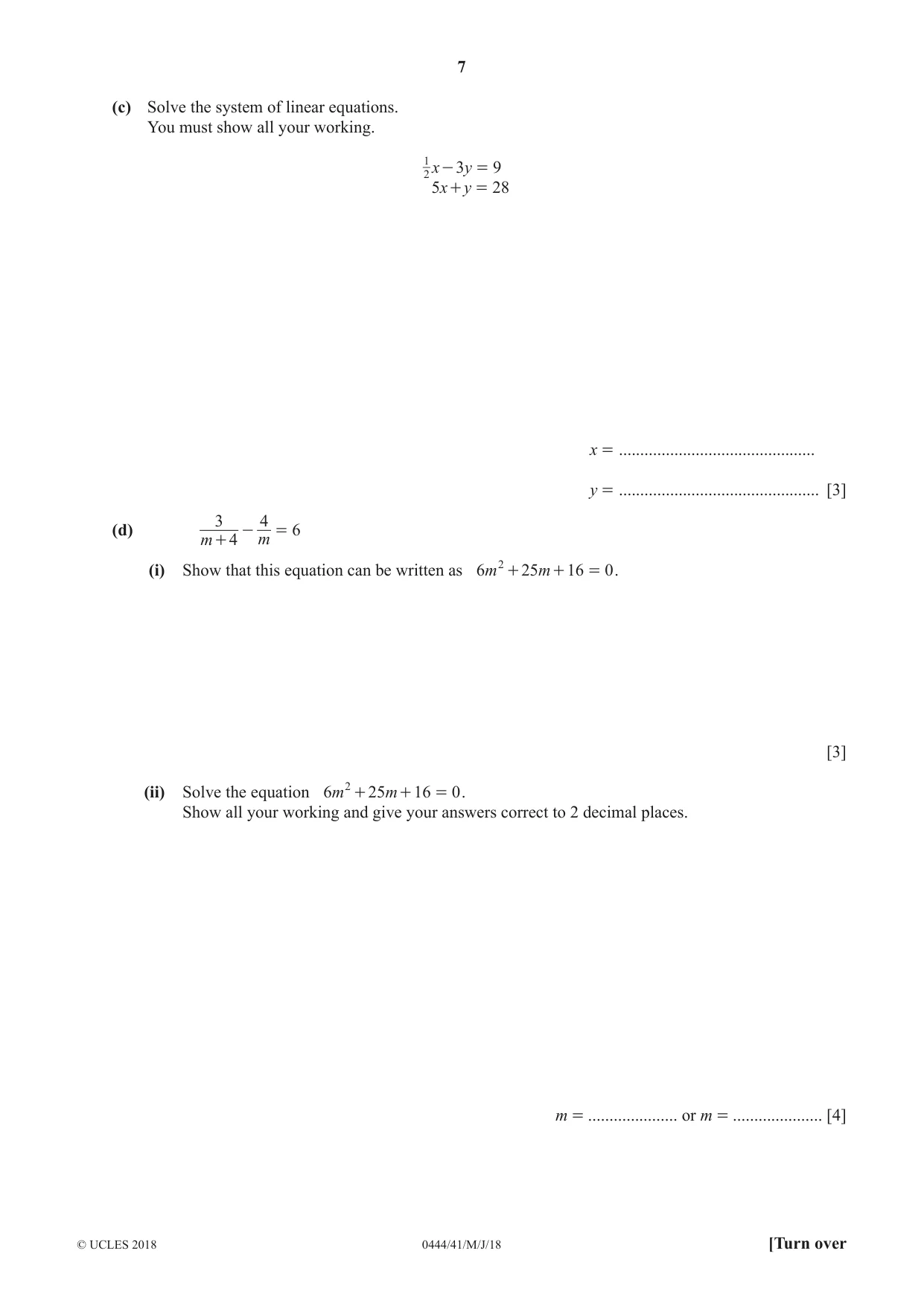
Question 4
4 (a) Factor. (i) 2 mn + m 2 - 6 n - 3m ................................................ [2] (ii) 4y 2 - 81 ................................................ [1] (iii) t 2 - t6 + 8 ................................................ [2] (b) Solve for x. 2m - x k = x x = ............................................... [4] (c) Solve the system of linear equations. You must show all your working. 1 2 x - 3y = 9 5x + y = 28 x = .............................................. y = ............................................... [3] 3 4(d) - = 6 m + 4 m (i) Show that this equation can be written as 6m 2 + 25m + 16 = 0 . [3] (ii) Solve the equation 6m 2 + 25m + 16 = 0 . Show all your working and give your answers correct to 2 decimal places. m = ..................... or m = ..................... [4]
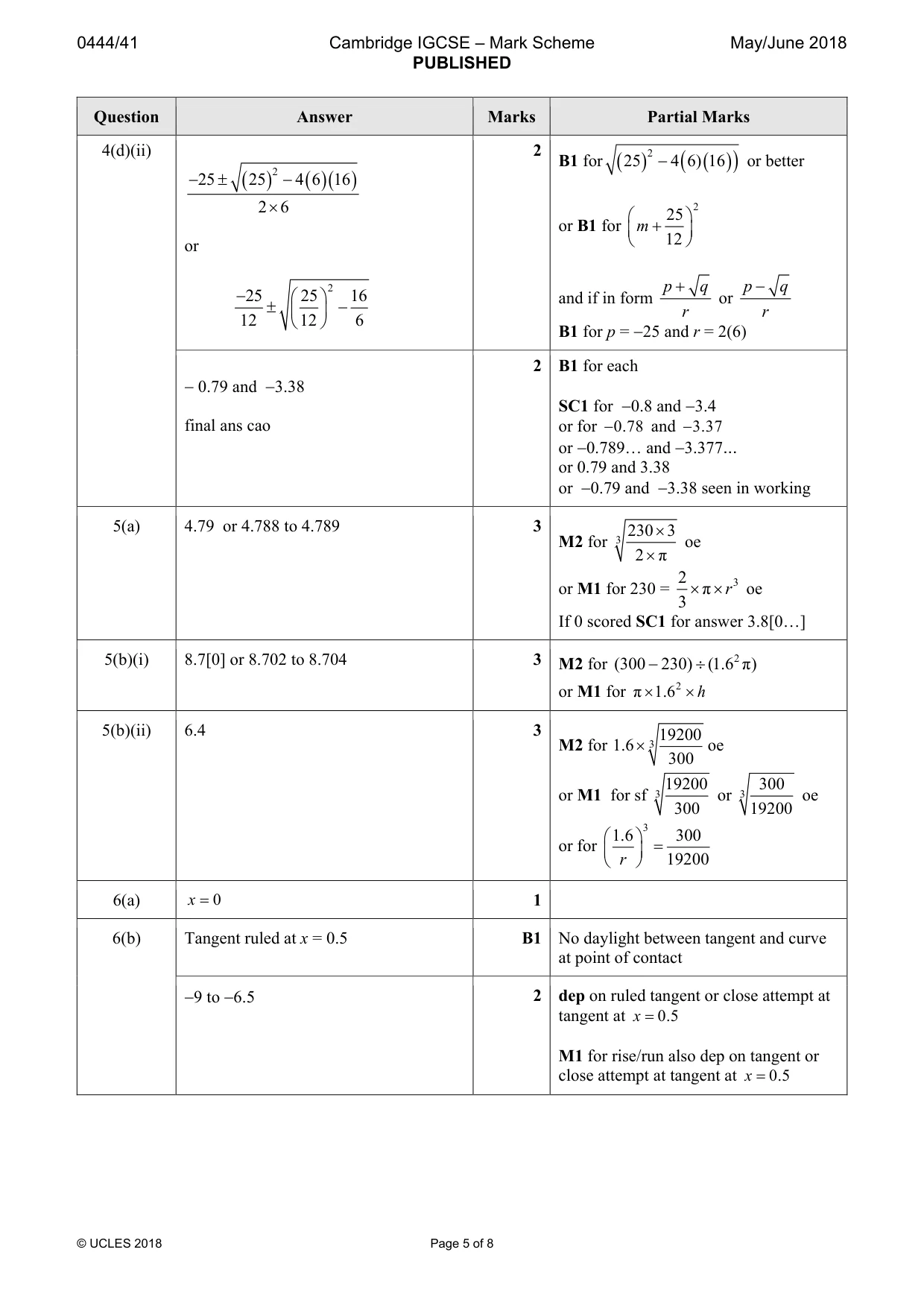
Mark scheme: 4(a)(i) ( 2 n + m )( m − 3 ) final answer 2 M1 for m ( 2 n + m ) − 3 ( 2 n + m ) or 2 n ( m − 3 ) + m ( m − 3 ) 4(a)(ii) ( 2 y − 9 )( 2 y + 9 ) final answer 1 4(a)(iii) ( t − 4 )( t − 2 ) final answer 2 B1 for ( t − 4 )( t − 2 ) seen and spoiled or M1 for t(t – 2) – 4(t – 2) or t(t – 4) – 2(t – 4) or (t + a)(t + b) where a + b = –6 or ab = +8 4(b) 2 m 4 2 m [ x = ] M1 for xk = 2 m − x or k = − 1 k + 1 x 2 m M1 for xk + x = 2 m or k + 1 = x M1 for x ( k + )1 = 2 m 4(c) correctly eliminating one variable M1 [x = ] 6 A1 [y = ] −2 A1 If 0 scored SC1 for 2 values satisfying one of the original equations or SC1 if no working shown, but 2 correct answers given 4(d)(i) 3m − 4 ( m + 4 ) = 6 m ( m + 4 ) M1 3m − 4( m + or 4)[ = 6] oe m ( m + 4) 3m − 4 m − 16 = 6 m 2 + 24 m M1 removes brackets correctly 6 m 2 + 25 m + 16 = 0 A1 with no errors or omissions 4(d)(ii) 2 2 B1 for ( 25 ) − 4 ( 6) (16 ) ) or better 2 −25 ± ( 25 ) − 4 ( 6 )(16 ) 2 × 6 2 25 or B1 for m + 12 or 2 p + q p − q −25 25 16 and if in form or ± − r r 12 12 6 B1 for p = −25 and r = 2(6) 2 B1 for each − 0.79 and −3.38 SC1 for −0.8 and −3.4 final ans cao or for − 0.78 and − 3.37 or −0.789… and −3.377... or 0.79 and 3.38 or −0.79 and −3.38 seen in working
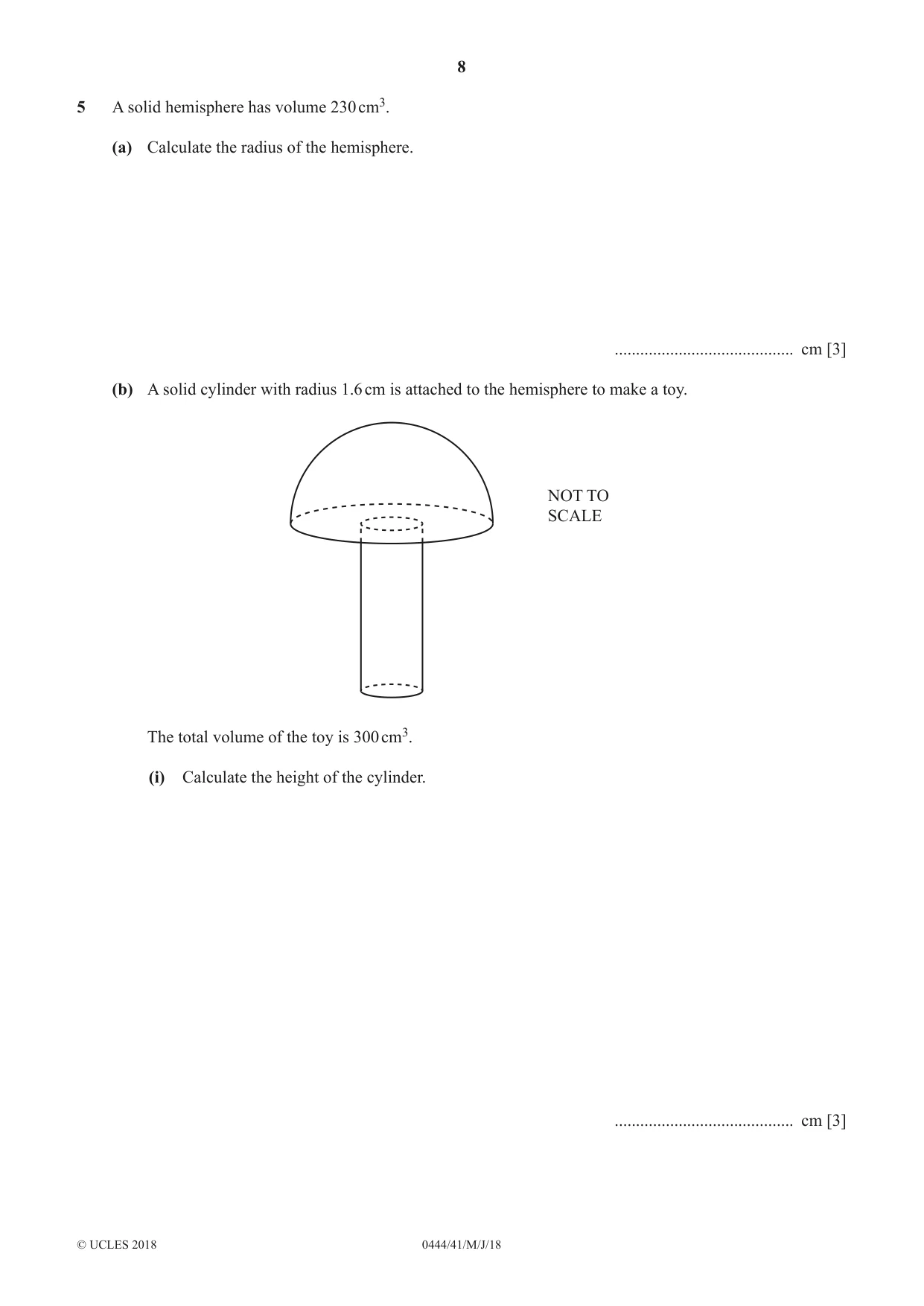
Q5 · A solid hemisphere has volume 230 cm3
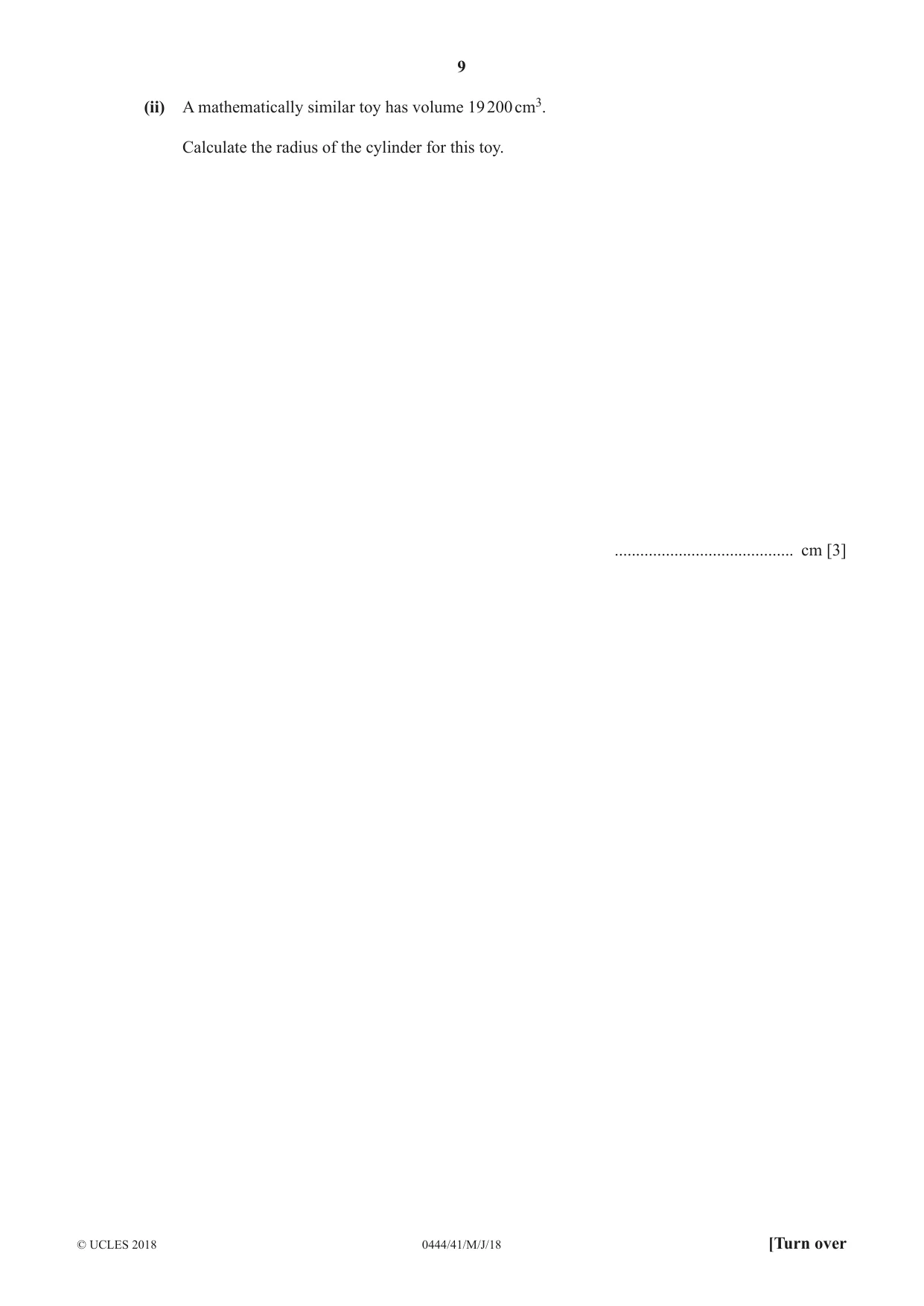
5 A solid hemisphere has volume 230 cm3. (a) Calculate the radius of the hemisphere. .......................................... cm [3] (b) A solid cylinder with radius 1.6 cm is attached to the hemisphere to make a toy. NOT TO SCALE The total volume of the toy is 300 cm3. (i) Calculate the height of the cylinder. .......................................... cm [3] (ii) A mathematically similar toy has volume 19 200 cm3. Calculate the radius of the cylinder for this toy. .......................................... cm [3]
Mark scheme: 5(a) 4.79 or 4.788 to 4.789 3 230 × 3 M2 for 3 oe 2 × π 2 3 or M1 for 230 = × π ×r oe 3 If 0 scored SC1 for answer 3.8[0…] 5(b)(i) 8.7[0] or 8.702 to 8.704 3 M2 for (300 − 230) ÷ (1.6 2 π) or M1 for π × 1.6 2 × h 5(b)(ii) 6.4 3 19200 M2 for 1.6 × 3 oe 300 19200 300 or M1 for sf 3 or 3 oe 300 19200 1.6 3 300 or for = r 19200
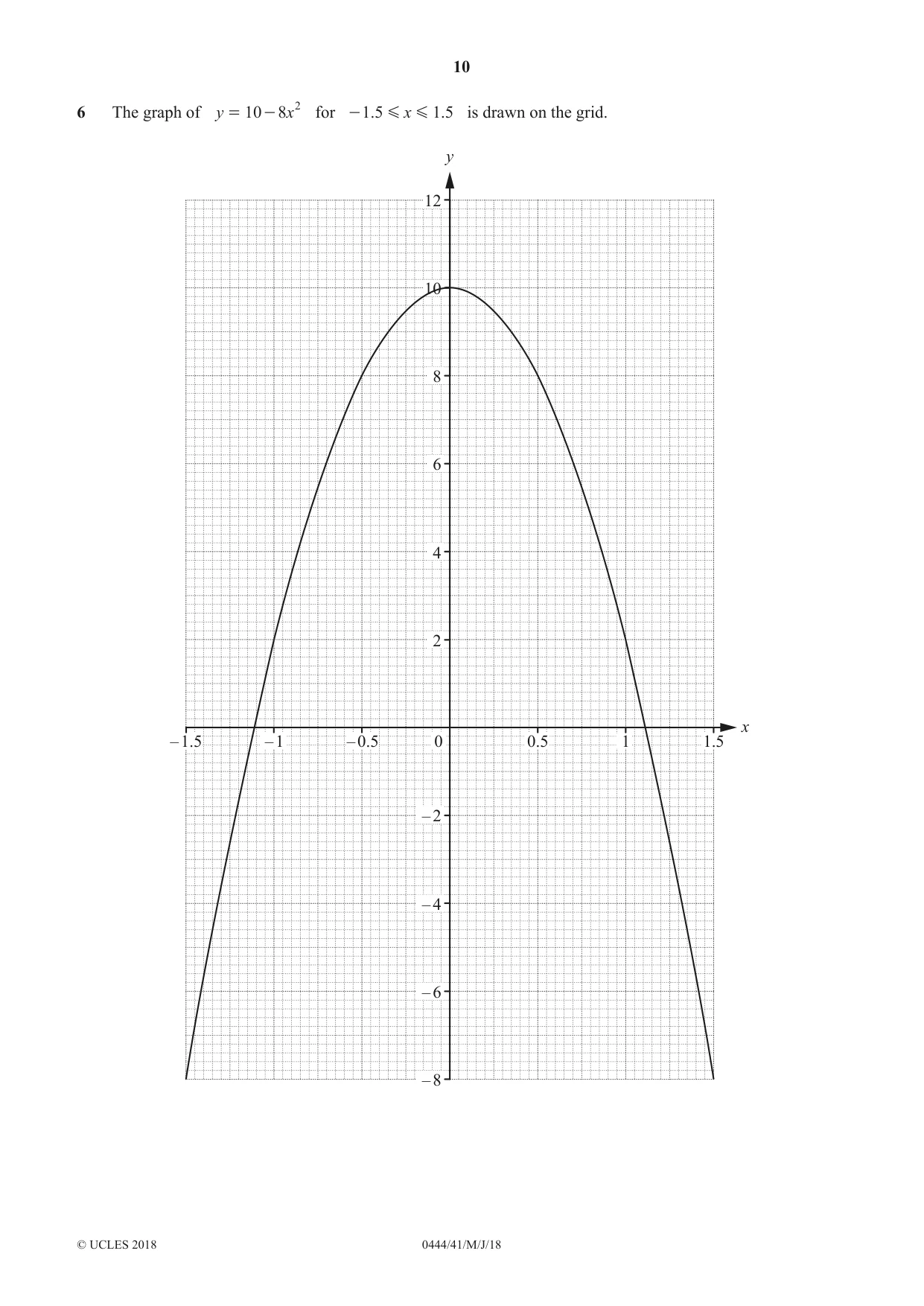
Q6 · Write down the equation of the line of symmetry of the graph
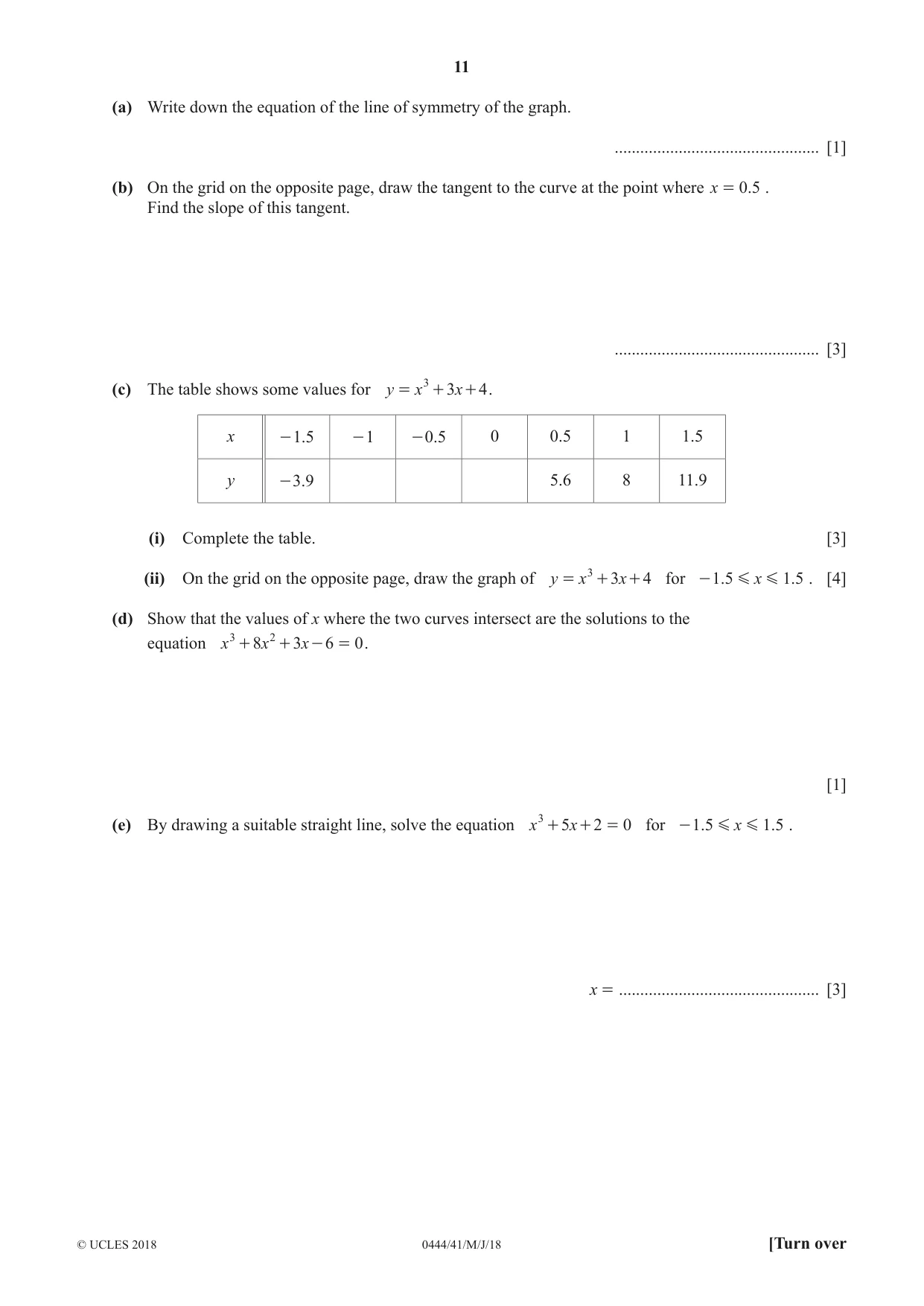
(a) Write down the equation of the line of symmetry of the graph. ................................................ [1] (b) On the grid on the opposite page, draw the tangent to the curve at the point where x = 0.5 . Find the slope of this tangent. ................................................ [3] (c) The table shows some values for y = x 3 + 3x + 4 . x - .15 - 1 - .05 0 0.5 1 1.5 y - .39 5.6 8 11.9 (i) Complete the table. [3] (ii) On the grid on the opposite page, draw the graph of y = x 3 + 3x + 4 for - 1.5 G x G 1.5 . [4] (d) Show that the values of x where the two curves intersect are the solutions to the equation x 3 + 8x 2 + 3x - 6 = 0 . [1] (e) By drawing a suitable straight line, solve the equation x 3 + 5x + 2 = 0 for - 1.5 G x G 1.5 . x = ............................................... [3]
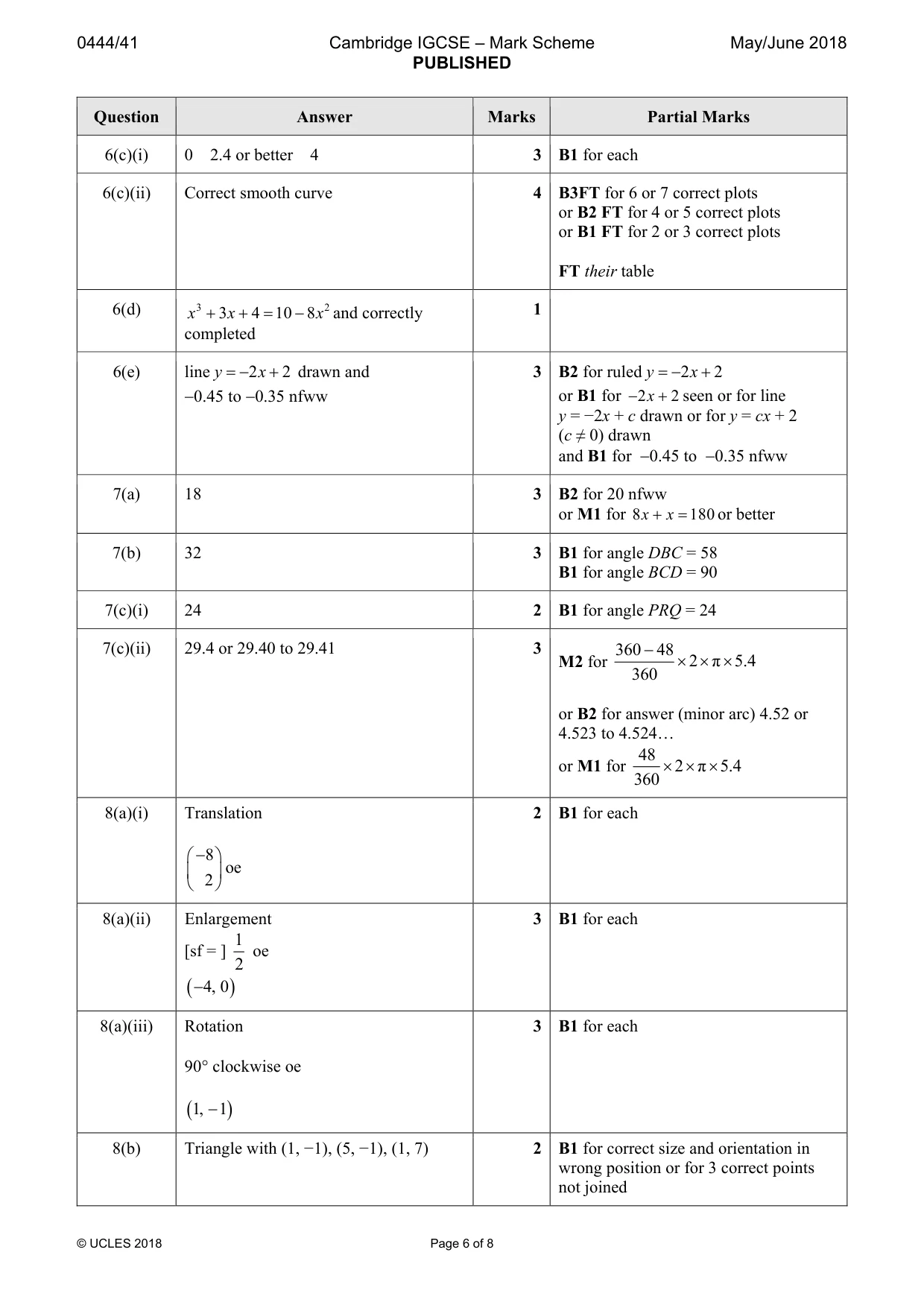
Mark scheme: 6(a) x = 0 1 6(b) Tangent ruled at x = 0.5 B1 No daylight between tangent and curve at point of contact −9 to −6.5 2 dep on ruled tangent or close attempt at tangent at x = 0.5 M1 for rise/run also dep on tangent or close attempt at tangent at x = 0.5 6(c)(i) 0 2.4 or better 4 3 B1 for each 6(c)(ii) Correct smooth curve 4 B3FT for 6 or 7 correct plots or B2 FT for 4 or 5 correct plots or B1 FT for 2 or 3 correct plots FT their table 6(d) x 3 + 3 x + 4 = 10 − 8 x 2 and correctly 1 completed 6(e) line y = −2 x + 2 drawn and 3 B2 for ruled y = −2 x + 2 −0.45 to −0.35 nfww or B1 for − 2 x + 2 seen or for line y = −2x + c drawn or for y = cx + 2 (c ≠ 0) drawn and B1 for −0.45 to −0.35 nfww
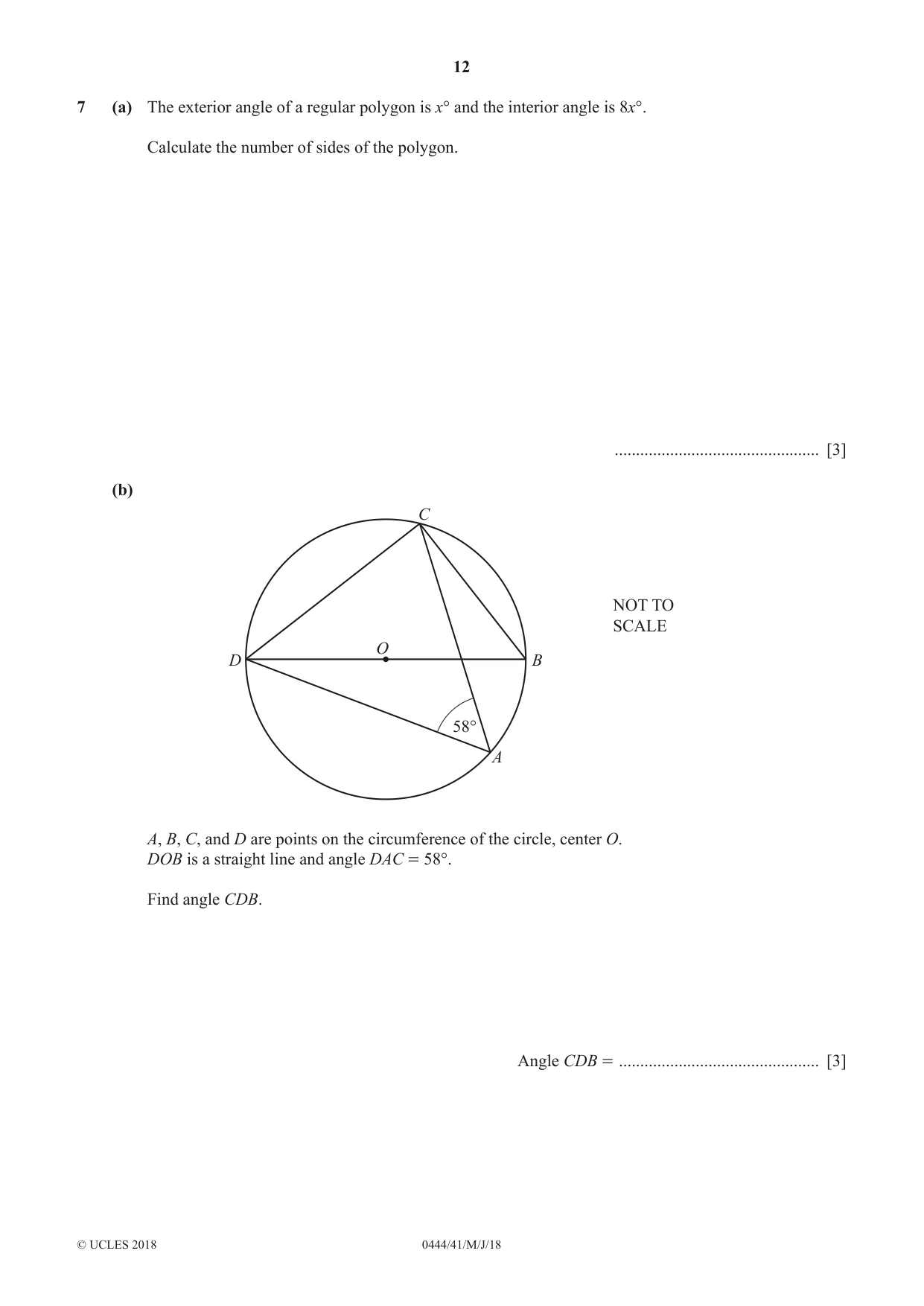
Q7 · The exterior angle of a regular polygon is x° and the interior angle is 8x°
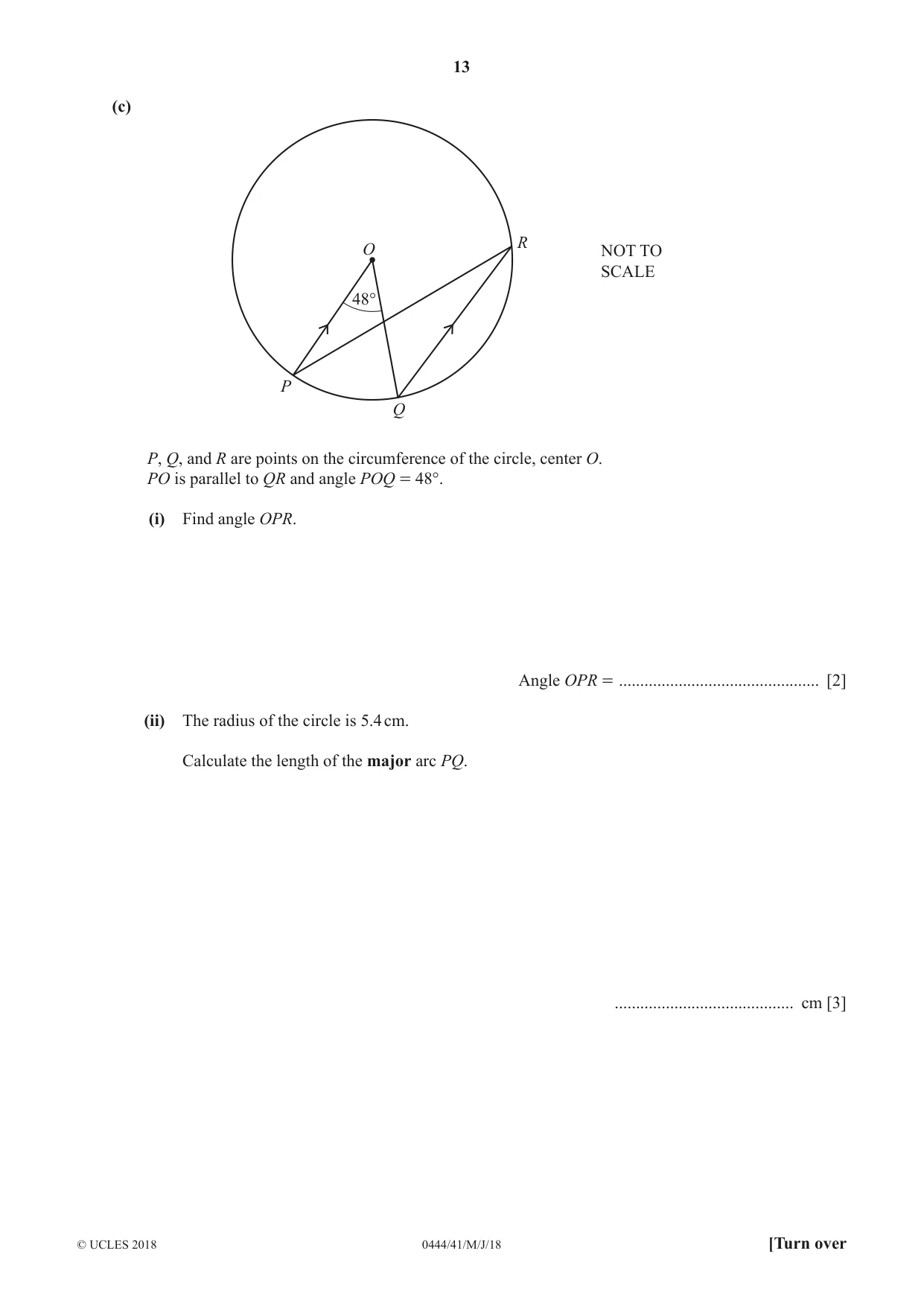
7 (a) The exterior angle of a regular polygon is x° and the interior angle is 8x°. Calculate the number of sides of the polygon. ................................................ [3] (b) C NOT TO SCALE O D B 58° A A, B, C, and D are points on the circumference of the circle, center O. DOB is a straight line and angle DAC = 58°. Find angle CDB. Angle CDB = ............................................... [3] (c) R O NOT TO SCALE 48° P Q P, Q, and R are points on the circumference of the circle, center O. PO is parallel to QR and angle POQ = 48°. (i) Find angle OPR. Angle OPR = ............................................... [2] (ii) The radius of the circle is 5.4 cm. Calculate the length of the major arc PQ. .......................................... cm [3]
Mark scheme: 7(a) 18 3 B2 for 20 nfww or M1 for 8 x + x = 180 or better 7(b) 32 3 B1 for angle DBC = 58 B1 for angle BCD = 90 7(c)(i) 24 2 B1 for angle PRQ = 24 7(c)(ii) 29.4 or 29.40 to 29.41 3 360 − 48 M2 for × 2 × π × 5.4 360 or B2 for answer (minor arc) 4.52 or 4.523 to 4.524… 48 or M1 for × 2 × π × 5.4 360
Q8 · Y 8 7 6 5 B 4 3 A 2 C 1 x –6 –5 –4 –3 –2 –1 0 1 2 3 4 5 6 7 8 –1 –2 –3 –4 D –5 –6 (a)…
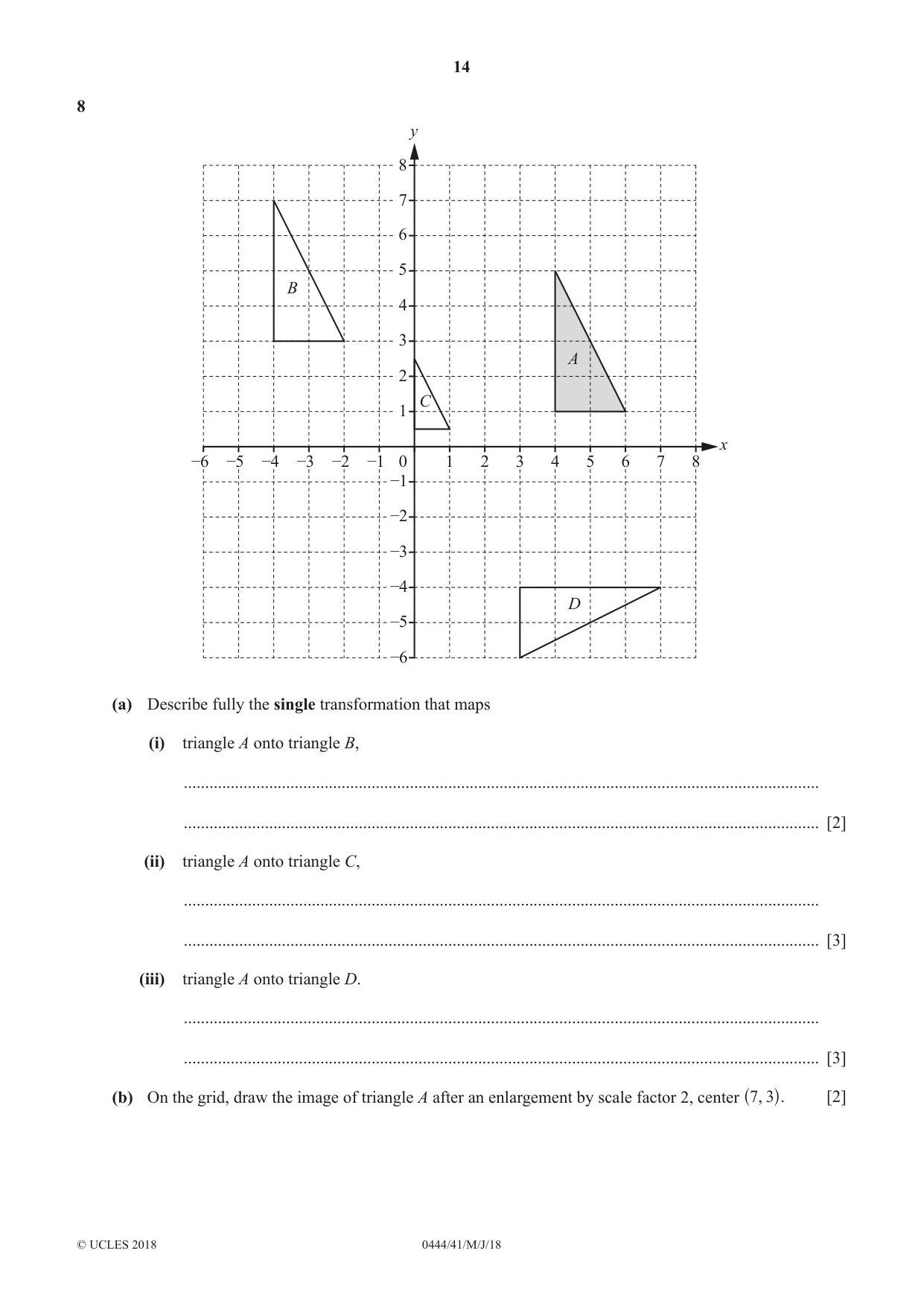
8 y 8 7 6 5 B 4 3 A 2 C 1 x –6 –5 –4 –3 –2 –1 0 1 2 3 4 5 6 7 8 –1 –2 –3 –4 D –5 –6 (a) Describe fully the single transformation that maps (i) triangle A onto triangle B, ..................................................................................................................................................... ..................................................................................................................................................... [2] (ii) triangle A onto triangle C, ..................................................................................................................................................... ..................................................................................................................................................... [3] (iii) triangle A onto triangle D. ..................................................................................................................................................... ..................................................................................................................................................... [3] (b) On the grid, draw the image of triangle A after an enlargement by scale factor 2, center ,7 3 [2] ^ h.
Mark scheme: 8(a)(i) Translation 2 B1 for each − 8 oe 2 8(a)(ii) Enlargement 3 B1 for each 1 [sf = ] oe 2 ( −4, 0 ) 8(a)(iii) Rotation 3 B1 for each 90° clockwise oe (1, − 1) 8(b) Triangle with (1, −1), (5, −1), (1, 7) 2 B1 for correct size and orientation in wrong position or for 3 correct points not joined
Q9 · The probability that it will rain tomorrow is
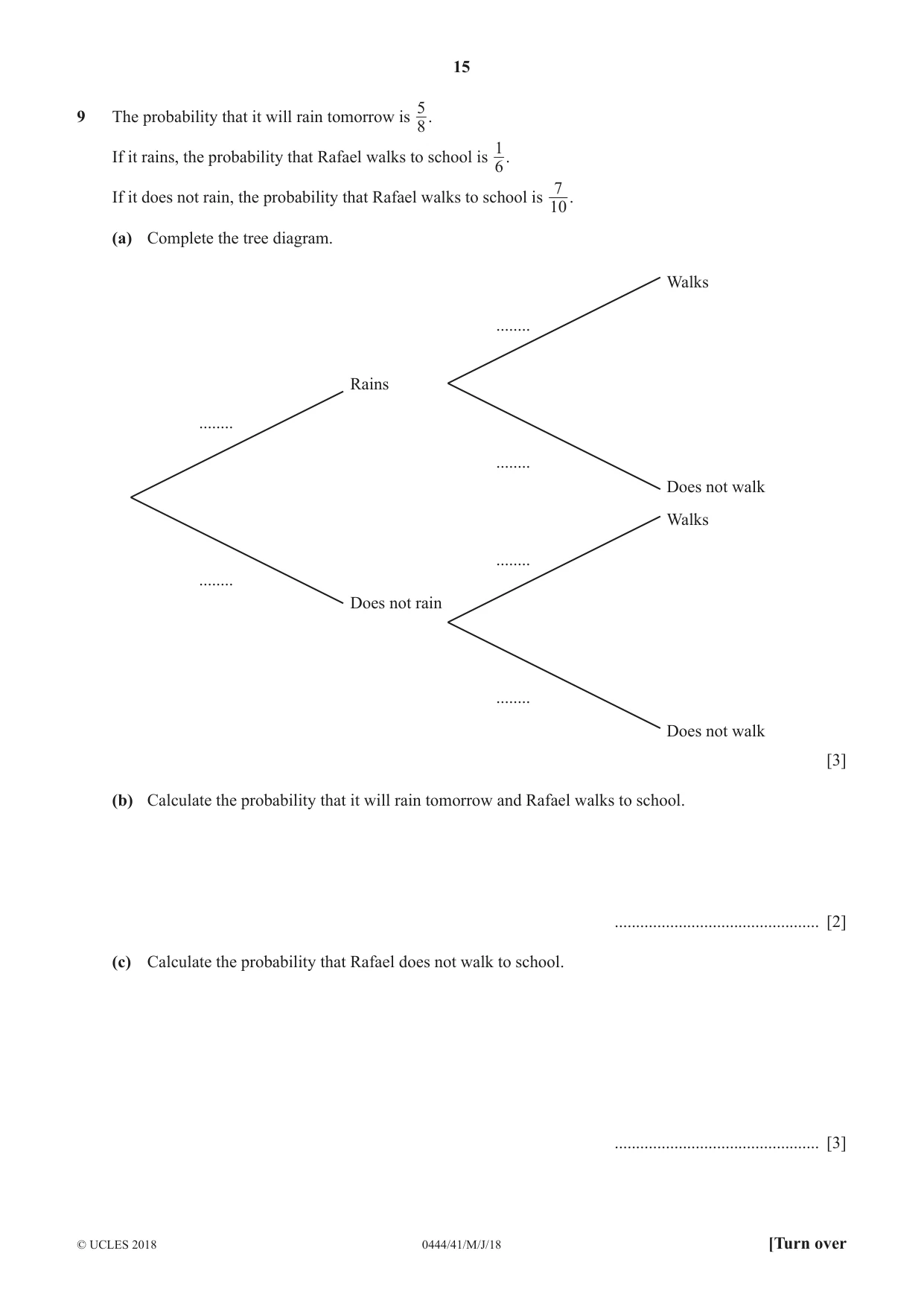
9 The probability that it will rain tomorrow is . 8 1 If it rains, the probability that Rafael walks to school is . 6 7 If it does not rain, the probability that Rafael walks to school is . 10 (a) Complete the tree diagram. Walks ........ Rains ........ ........ Does not walk Walks ........ ........ Does not rain ........ Does not walk [3] (b) Calculate the probability that it will rain tomorrow and Rafael walks to school. ................................................ [2] (c) Calculate the probability that Rafael does not walk to school. ................................................ [3]
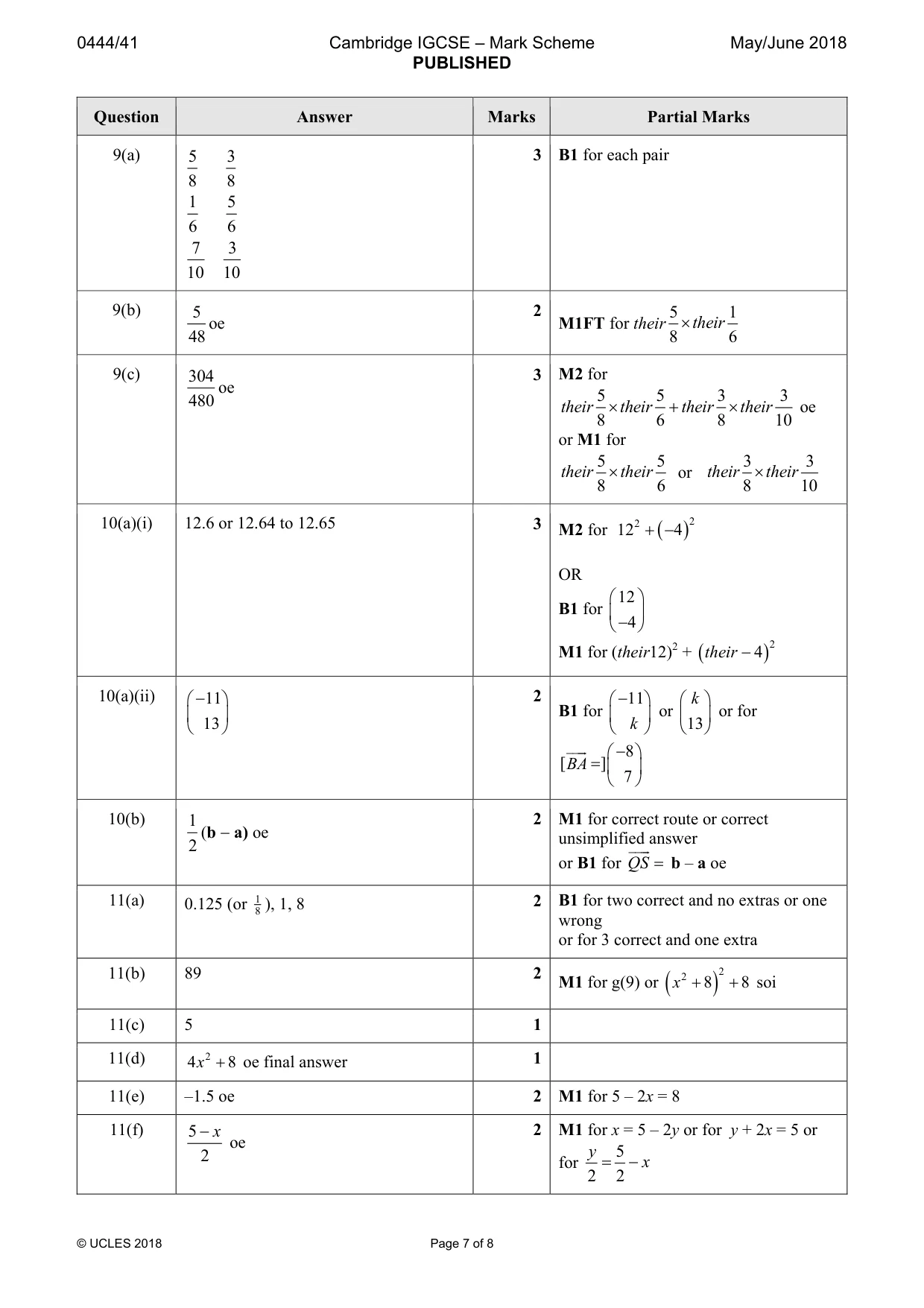
Mark scheme: 9(a) 5 3 3 B1 for each pair 8 8 1 5 6 6 7 3 10 10 9(b) 5 2 5 1 oe M1FT for their × their 48 8 6 9(c) 304 3 M2 for oe 5 5 3 3 480 their × their + their × their oe 8 6 8 10 or M1 for 5 5 3 3 their × their or their × their 8 6 8 10
Q10 · OA = AB = AC = 3 - 7 6 Find (i) OB , OB = ..............................................
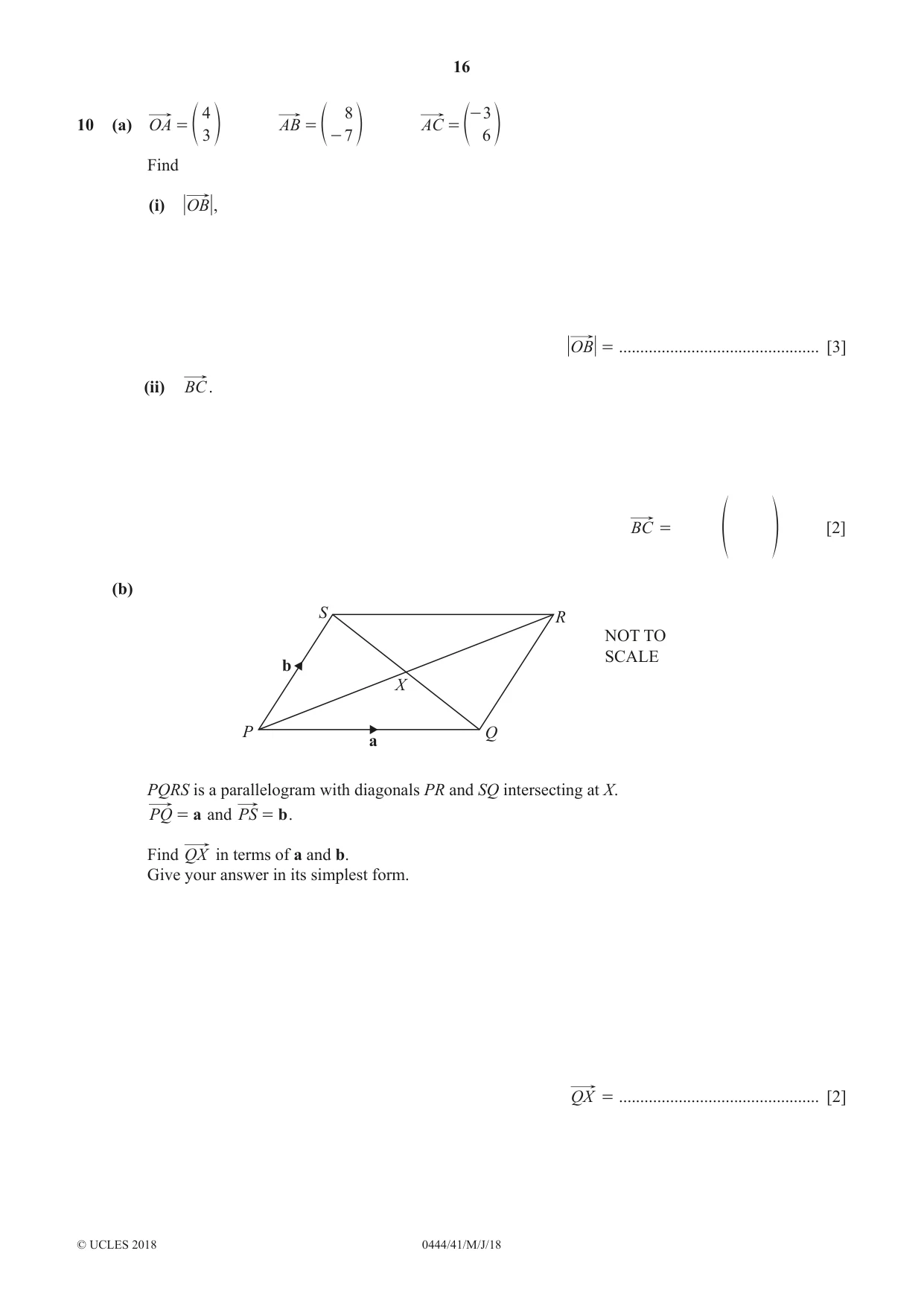
10 (a) OA = AB = AC = 3 - 7 6 Find (i) OB , OB = ............................................... [3] (ii) BC. BC = [2] f p (b) S R NOT TO SCALE b X P Q a PQRS is a parallelogram with diagonals PR and SQ intersecting at X. PQ = a and PS = b . Find QX in terms of a and b. Give your answer in its simplest form. QX = ............................................... [2]
Mark scheme: 10(a)(i) 12.6 or 12.64 to 12.65 3 2 2 M2 for 12 + ( − 4 ) OR 12 B1 for − 4 M1 for (their12)2 + ( their − 4 ) 2 10(a)(ii) −11 2 −11 k B1 for or or for 13 k 13 JJJG − 8 [ BA = ] 7 10(b) 1 2 M1 for correct route or correct (b − a) oe unsimplified answer 2 JJJG or B1 for QS = b – a oe
Q11 · F(x) = 5 − 2x g(x) = x2 + 8 h(x) = 2x (a) For the domain { −3, 0, 3}, find the range of…
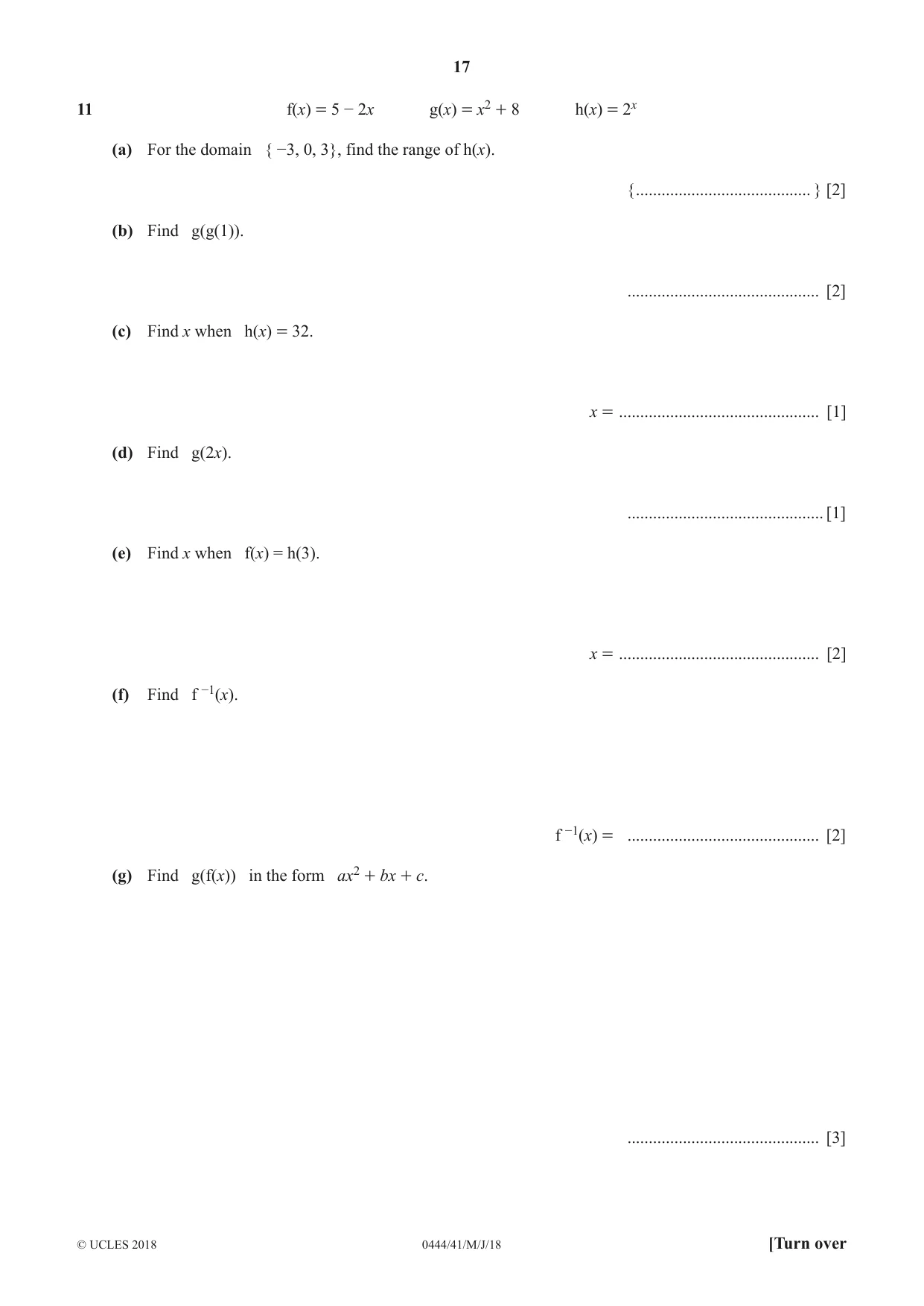
11 f(x) = 5 − 2x g(x) = x2 + 8 h(x) = 2x (a) For the domain { −3, 0, 3}, find the range of h(x). { ......................................... } [2] (b) Find g(g(1)). ............................................. [2] (c) Find x when h(x) = 32. x = ............................................... [1] (d) Find g(2x). .............................................. [1] (e) Find x when f(x) = h(3). x = ............................................... [2] (f) Find f −1(x). f −1(x) = ............................................. [2] (g) Find g(f(x)) in the form ax2 + bx + c. ............................................. [3]
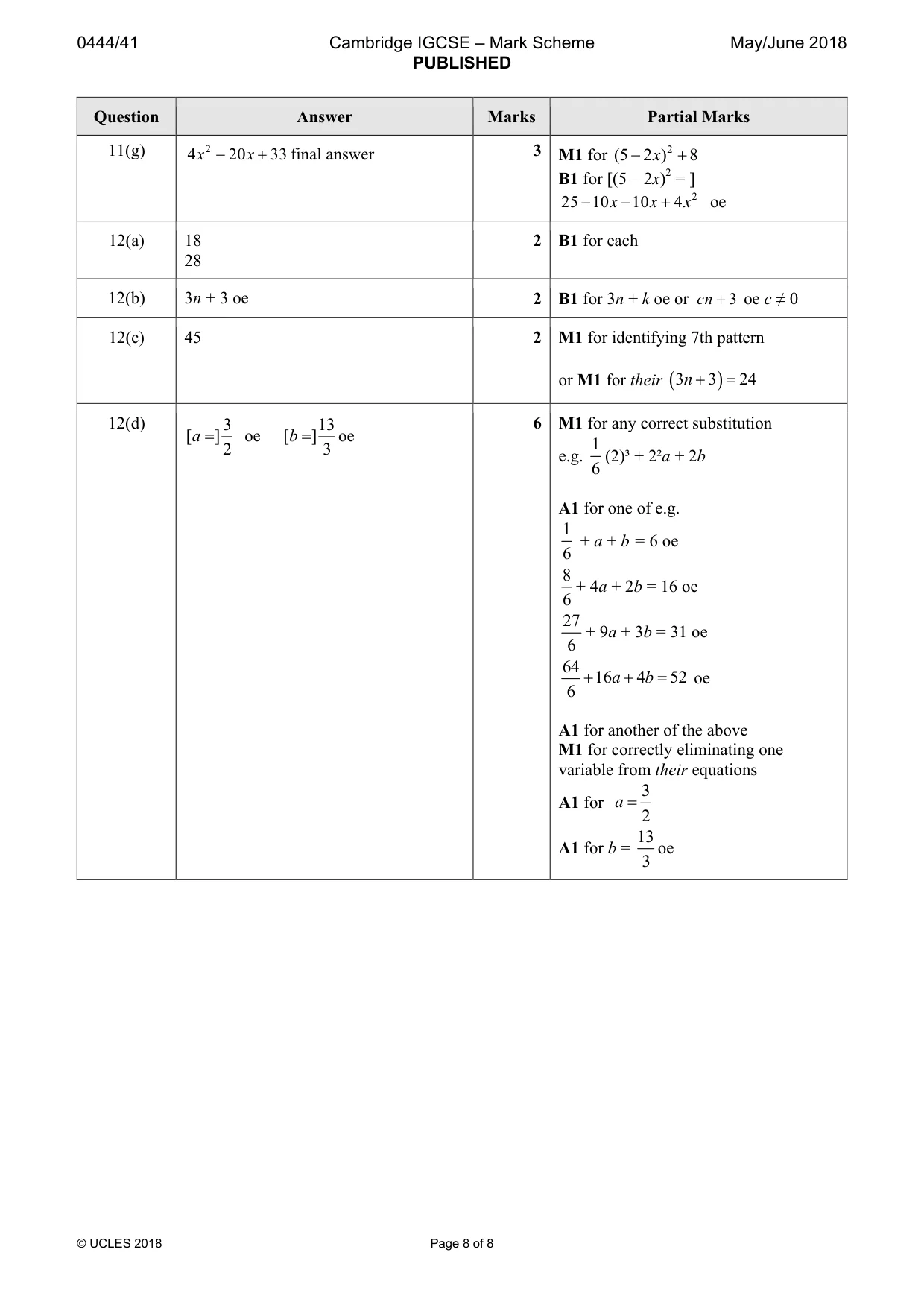
Mark scheme: 11(a) 0.125 (or 18 ), 1, 8 2 B1 for two correct and no extras or one wrong or for 3 correct and one extra 11(b) 89 2 2 2 M1 for g(9) or x + 8 + 8 soi ( ) 11(c) 5 1 11(d) 4 x 2 + 8 oe final answer 1 11(e) –1.5 oe 2 M1 for 5 – 2x = 8 11(f) 5 − x 2 M1 for x = 5 – 2y or for y + 2x = 5 or oe y 5 2 for = − x 2 2 11(g) 4 x 2 − 20 x + 33 final answer 3 M1 for (5 − 2 x ) 2 + 8 B1 for [(5 – 2x)2 = ] 25 − 10 x − 10 x + 4 x 2 oe
Q12 · Marco is making patterns with gray and white circular mats
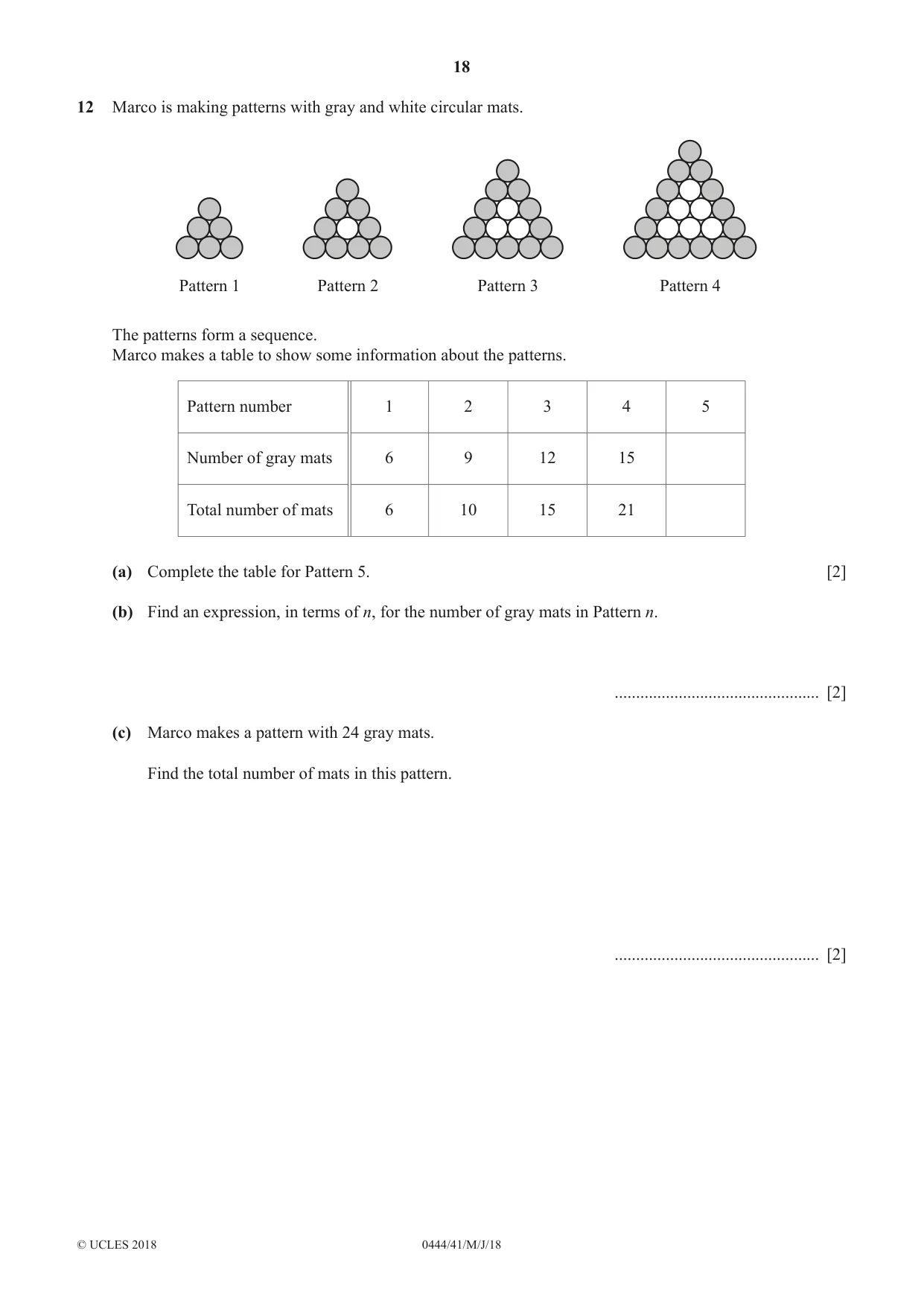
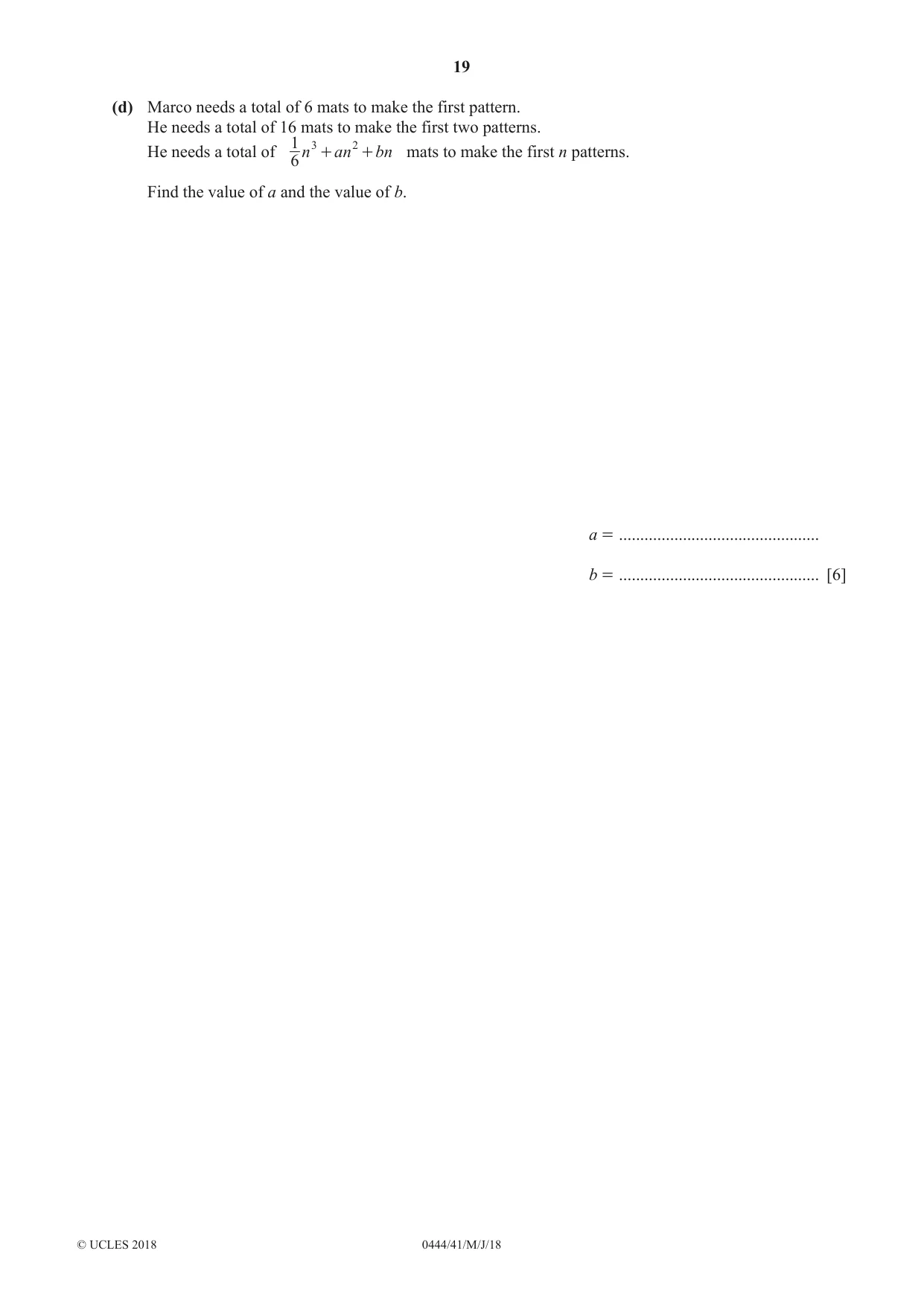
12 Marco is making patterns with gray and white circular mats. Pattern 1 Pattern 2 Pattern 3 Pattern 4 The patterns form a sequence. Marco makes a table to show some information about the patterns. Pattern number 1 2 3 4 5 Number of gray mats 6 9 12 15 Total number of mats 6 10 15 21 (a) Complete the table for Pattern 5. [2] (b) Find an expression, in terms of n, for the number of gray mats in Pattern n. ................................................ [2] (c) Marco makes a pattern with 24 gray mats. Find the total number of mats in this pattern. ................................................ [2] (d) Marco needs a total of 6 mats to make the first pattern. He needs a total of 16 mats to make the first two patterns. 1 3 2 He needs a total of n + an + bn mats to make the first n patterns. 6 Find the value of a and the value of b. a = ............................................... b = ............................................... [6]
Mark scheme: 12(a) 18 2 B1 for each 28 12(b) 3n + 3 oe 2 B1 for 3n + k oe or cn + 3 oe c ≠ 0 12(c) 45 2 M1 for identifying 7th pattern or M1 for their ( 3n + 3 ) = 24 12(d) 3 13 6 M1 for any correct substitution [ a = ] oe [b = ] oe 1 2 3 e.g. (2)³ + 2²a + 2b 6 A1 for one of e.g. 1 + a + b = 6 oe 6 8 + 4a + 2b = 16 oe 6 27 + 9a + 3b = 31 oe 6 64 + 16 a + 4b = 52 oe 6 A1 for another of the above M1 for correctly eliminating one variable from their equations 3 A1 for a = 2 13 A1 for b = oe 3
What you needed in this session
Cambridge’s own grade thresholds for 2018 May/June, Paper 4 · Variant 1. A higher threshold means an easier paper — the bar moves with how the cohort did.