Cambridge IGCSE Mathematics (US) 0444 — 2017 May/June Paper 4 · Variant 1
0444/41/M/J/17 · 10 questions · 130 marks · ≈146 min
The question paper and its mark scheme, free to read here and free to download. This is Cambridge’s own paper, exactly as it was sat.
Question paper16 pages
Mark scheme7 pages
Answers below. Sit the paper first if you are practising.
Questions as text
Q1 · Y 8 7 B 6 5 4 3 2 A C 1 x 0 –5 –4 –3 –2 –1 1 2 3 4 5 6 7 8 9 10 –1 –2 –3 –4 –5 –6 (a) (i)…
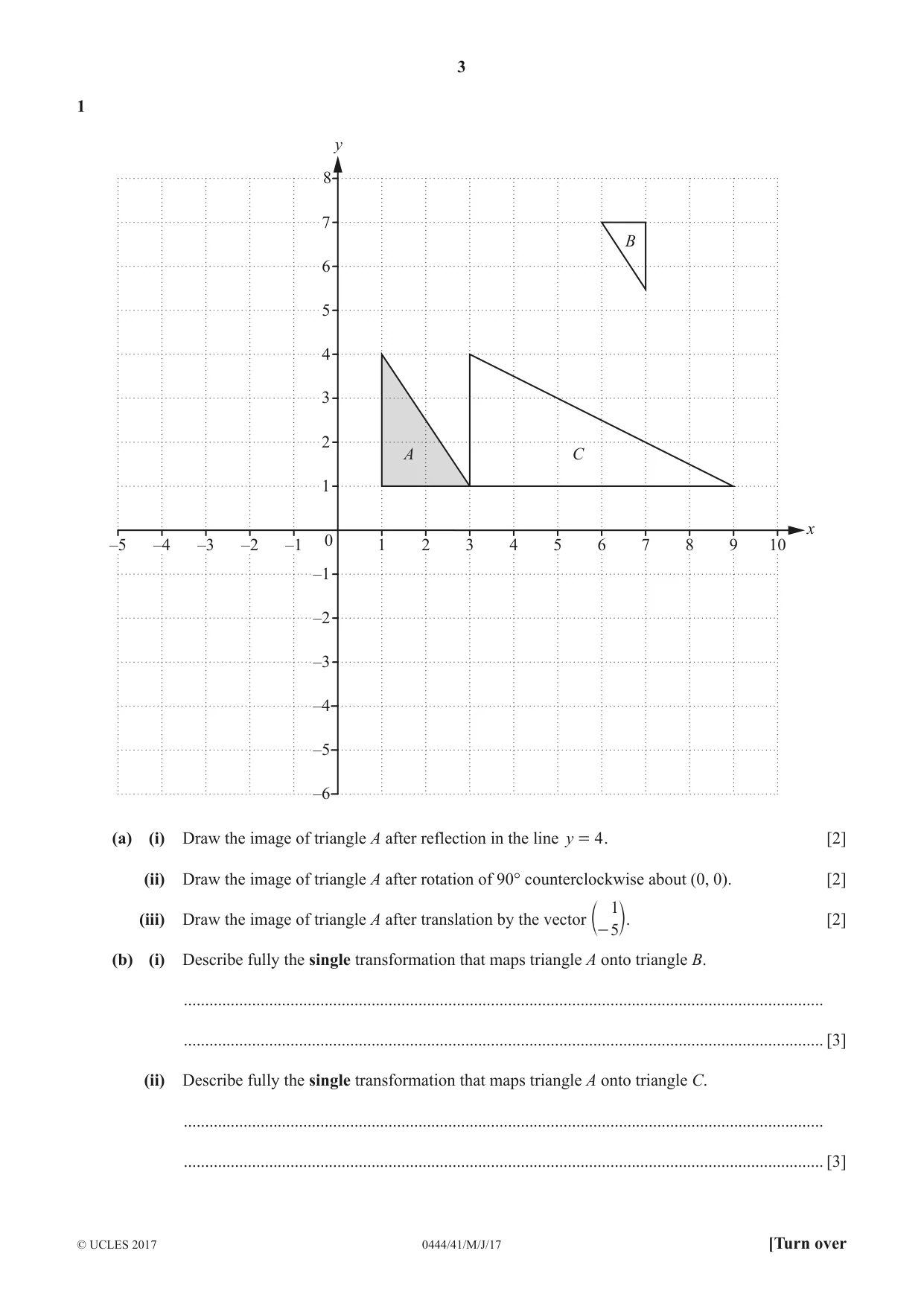
1 y 8 7 B 6 5 4 3 2 A C 1 x 0 –5 –4 –3 –2 –1 1 2 3 4 5 6 7 8 9 10 –1 –2 –3 –4 –5 –6 (a) (i) Draw the image of triangle A after reflection in the line y = 4 . [2] (ii) Draw the image of triangle A after rotation of 90° counterclockwise about (0, 0). [2] 1 (iii) Draw the image of triangle A after translation by the vector [2] c- 5m. (b) (i) Describe fully the single transformation that maps triangle A onto triangle B. ...................................................................................................................................................... ...................................................................................................................................................... [3] (ii) Describe fully the single transformation that maps triangle A onto triangle C. ...................................................................................................................................................... ...................................................................................................................................................... [3]
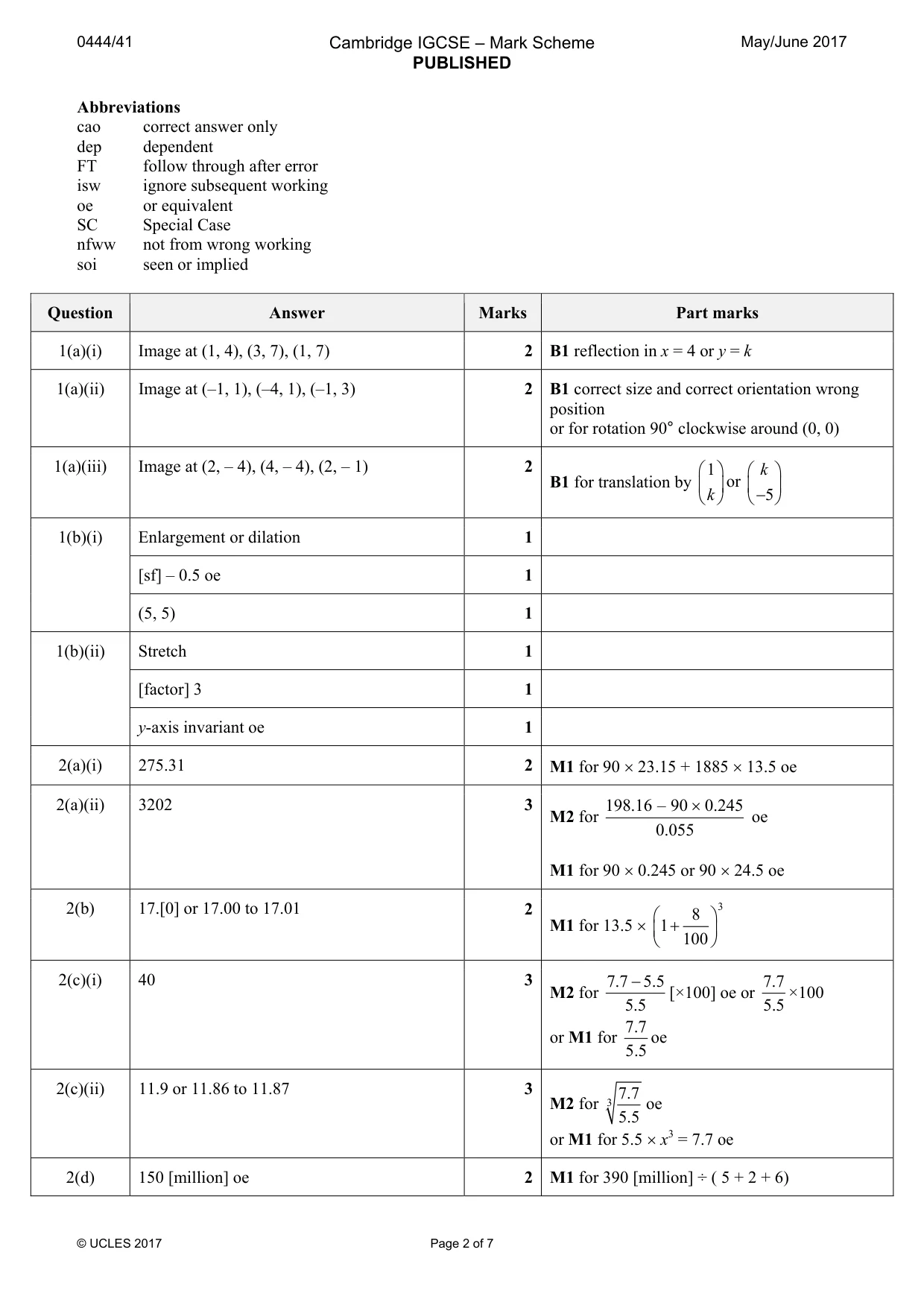
Mark scheme: Question Answer Marks Part marks 1(a)(i) Image at (1, 4), (3, 7), (1, 7) 2 B1 reflection in x = 4 or y = k 1(a)(ii) Image at (–1, 1), (–4, 1), (–1, 3) 2 B1 correct size and correct orientation wrong position or for rotation 90° clockwise around (0, 0) 1(a)(iii) Image at (2, – 4), (4, – 4), (2, – 1) 2 1 k B1 for translation by or k −5 1(b)(i) Enlargement or dilation 1 [sf] – 0.5 oe 1 (5, 5) 1 1(b)(ii) Stretch 1 [factor] 3 1 y-axis invariant oe 1
Q2 · An energy company charged these prices in 2013
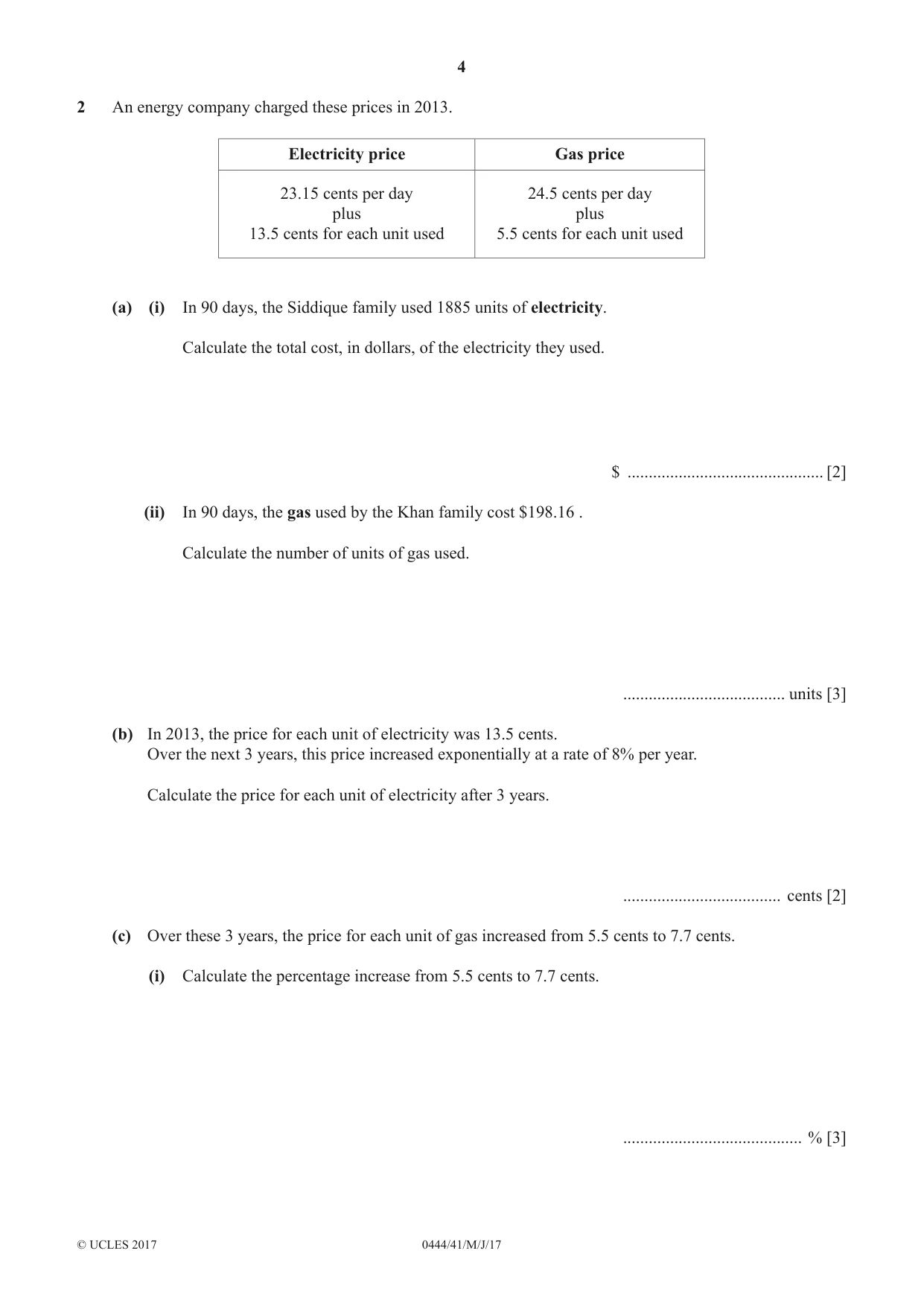
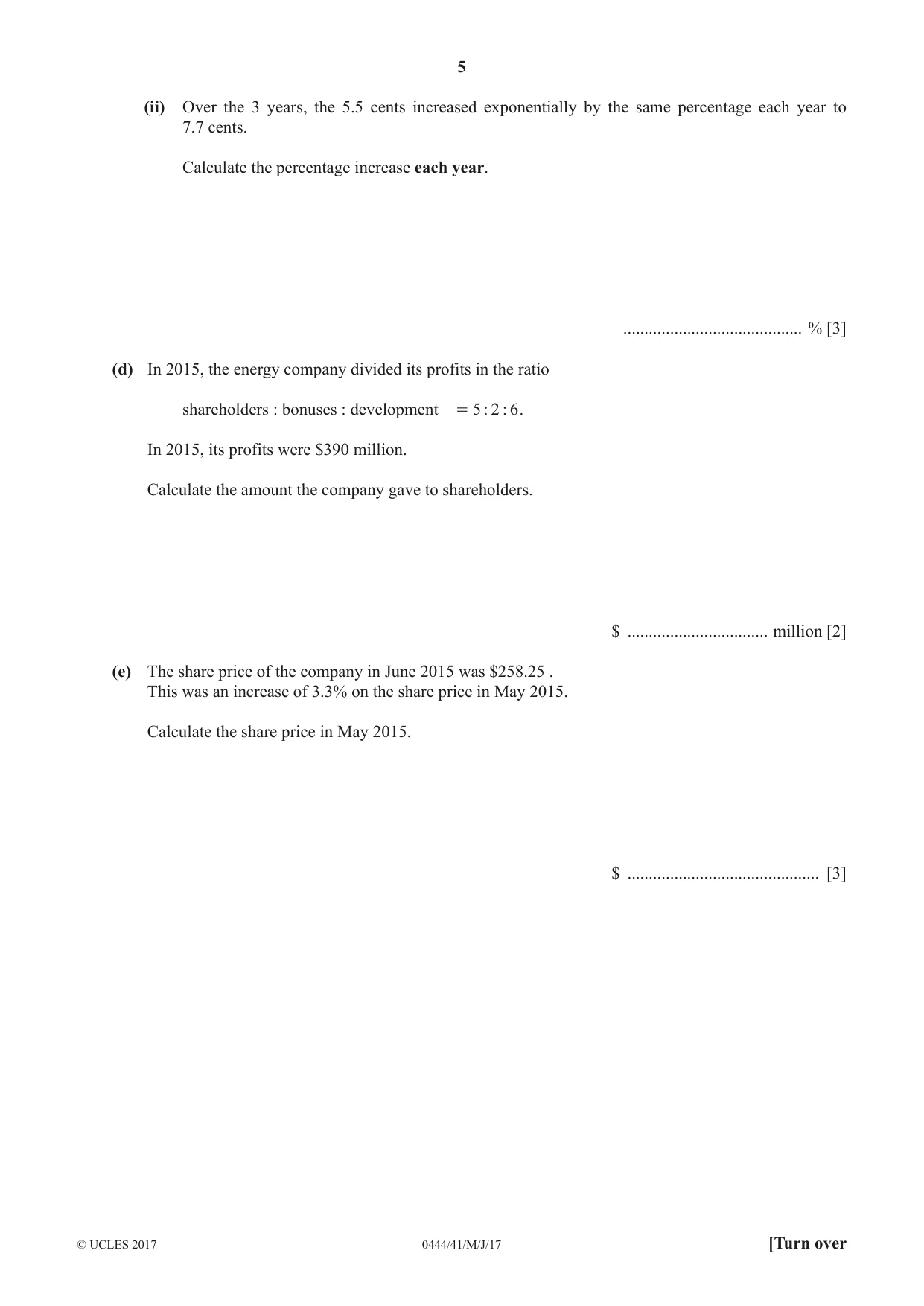
2 An energy company charged these prices in 2013. Electricity price Gas price 23.15 cents per day 24.5 cents per day plus plus 13.5 cents for each unit used 5.5 cents for each unit used (a) (i) In 90 days, the Siddique family used 1885 units of electricity. Calculate the total cost, in dollars, of the electricity they used. $ .............................................. [2] (ii) In 90 days, the gas used by the Khan family cost $198.16 . Calculate the number of units of gas used. ...................................... units [3] (b) In 2013, the price for each unit of electricity was 13.5 cents. Over the next 3 years, this price increased exponentially at a rate of 8% per year. Calculate the price for each unit of electricity after 3 years. ..................................... cents [2] (c) Over these 3 years, the price for each unit of gas increased from 5.5 cents to 7.7 cents. (i) Calculate the percentage increase from 5.5 cents to 7.7 cents. .......................................... % [3] (ii) Over the 3 years, the 5.5 cents increased exponentially by the same percentage each year to 7.7 cents. Calculate the percentage increase each year. .......................................... % [3] (d) In 2015, the energy company divided its profits in the ratio shareholders : bonuses : development = 5 : 2 : 6 . In 2015, its profits were $390 million. Calculate the amount the company gave to shareholders. $ ................................. million [2] (e) The share price of the company in June 2015 was $258.25 . This was an increase of 3.3% on the share price in May 2015. Calculate the share price in May 2015. $ ............................................. [3]
Mark scheme: 2(a)(i) 275.31 2 M1 for 90 × 23.15 + 1885 × 13.5 oe 2(a)(ii) 3202 3 198.16 – 90 × 0.245 M2 for oe 0.055 M1 for 90 × 0.245 or 90 × 24.5 oe 2(b) 17.[0] or 17.00 to 17.01 2 3 8 M1 for 13.5 × 1 + 100 2(c)(i) 40 3 7.7 − 5.5 7.7 M2 for [×100] oe or ×100 5.5 5.5 7.7 or M1 for oe 5.5 2(c)(ii) 11.9 or 11.86 to 11.87 3 7.7 M2 for 3 oe 5.5 or M1 for 5.5 × x3 = 7.7 oe 2(d) 150 [million] oe 2 M1 for 390 [million] ÷ ( 5 + 2 + 6) 2(e) 250 nfww 3 M2 for 258.25 ÷ ((100 + 3.3) ÷ 100) or M1 for 258.25 associated with 103.3[%]
Q3 · The time taken for each of 90 cars to complete one lap of a race track is shown in the…
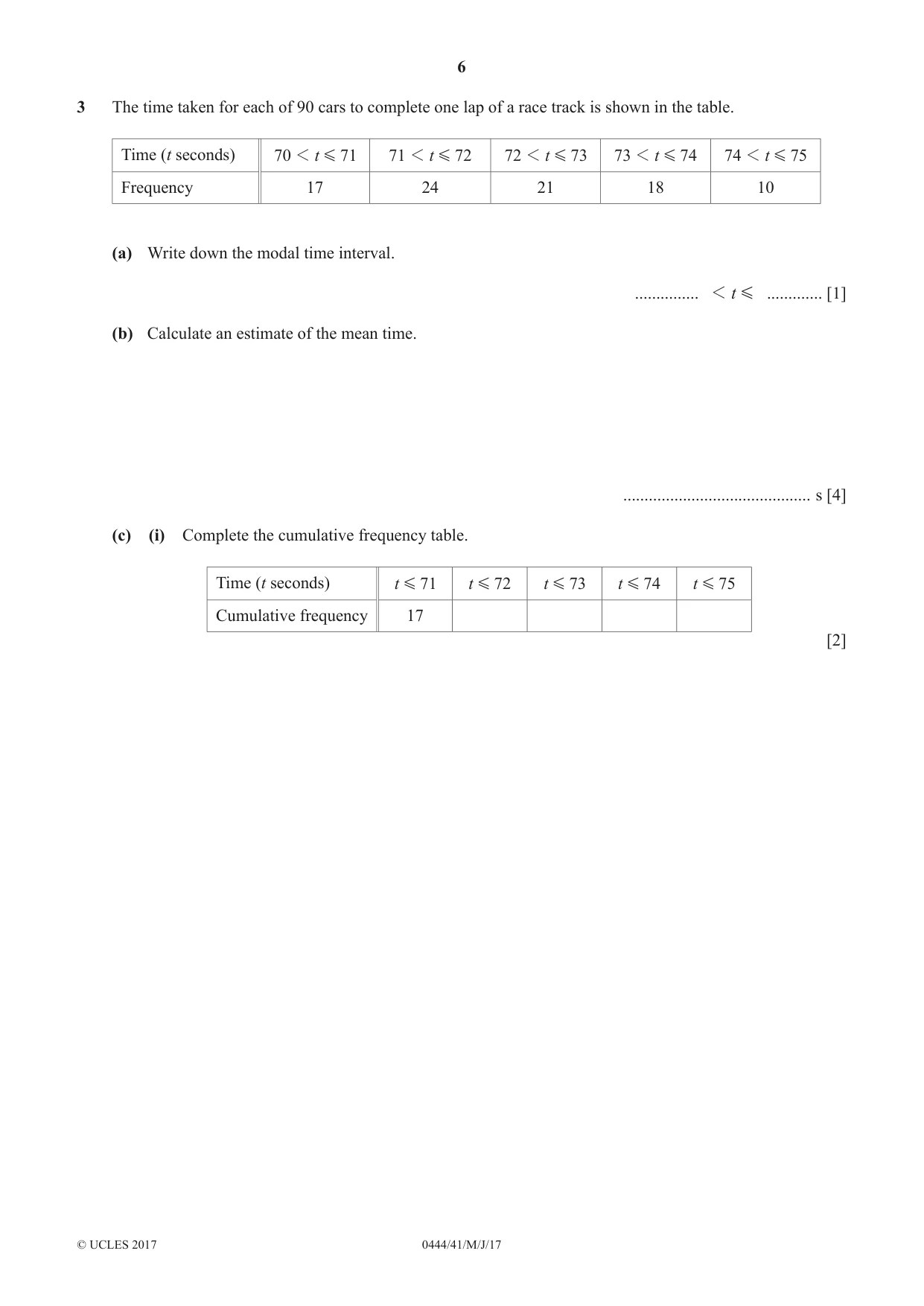
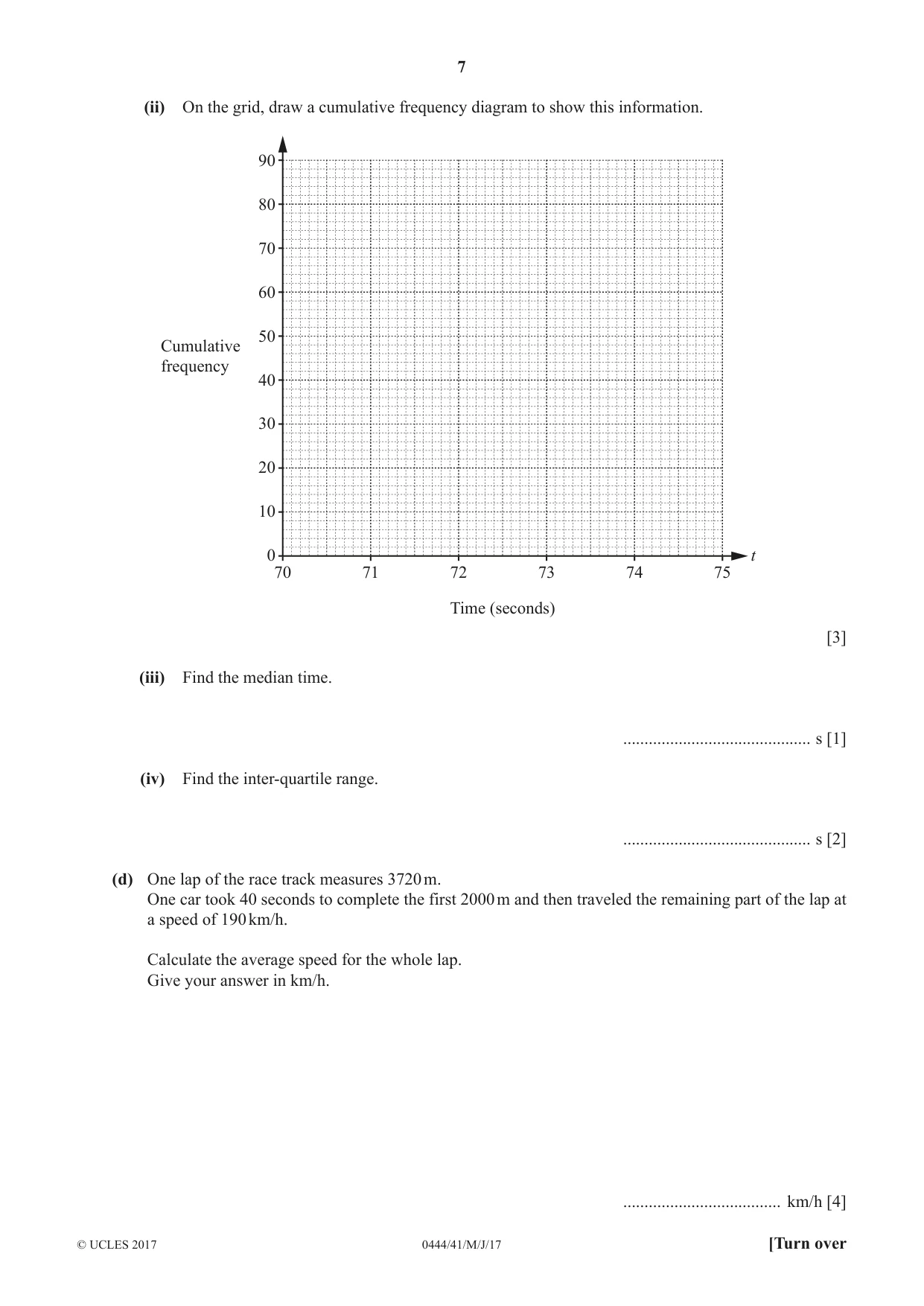
3 The time taken for each of 90 cars to complete one lap of a race track is shown in the table. Time (t seconds) 70 1 t G 71 71 1 t G 72 72 1 t G 73 73 1 t G 74 74 1 t G 75 Frequency 17 24 21 18 10 (a) Write down the modal time interval. ............... 1 t G ............. [1] (b) Calculate an estimate of the mean time. ............................................ s [4] (c) (i) Complete the cumulative frequency table. Time (t seconds) t G 71 t G 72 t G 73 t G 74 t G 75 Cumulative frequency 17 [2] (ii) On the grid, draw a cumulative frequency diagram to show this information. 90 80 70 60 50 Cumulative frequency 40 30 20 10 0 t 70 71 72 73 74 75 Time (seconds) [3] (iii) Find the median time. ............................................ s [1] (iv) Find the inter-quartile range. ............................................ s [2] (d) One lap of the race track measures 3720 m. One car took 40 seconds to complete the first 2000 m and then traveled the remaining part of the lap at a speed of 190 km/h. Calculate the average speed for the whole lap. Give your answer in km/h. ..................................... km/h [4]
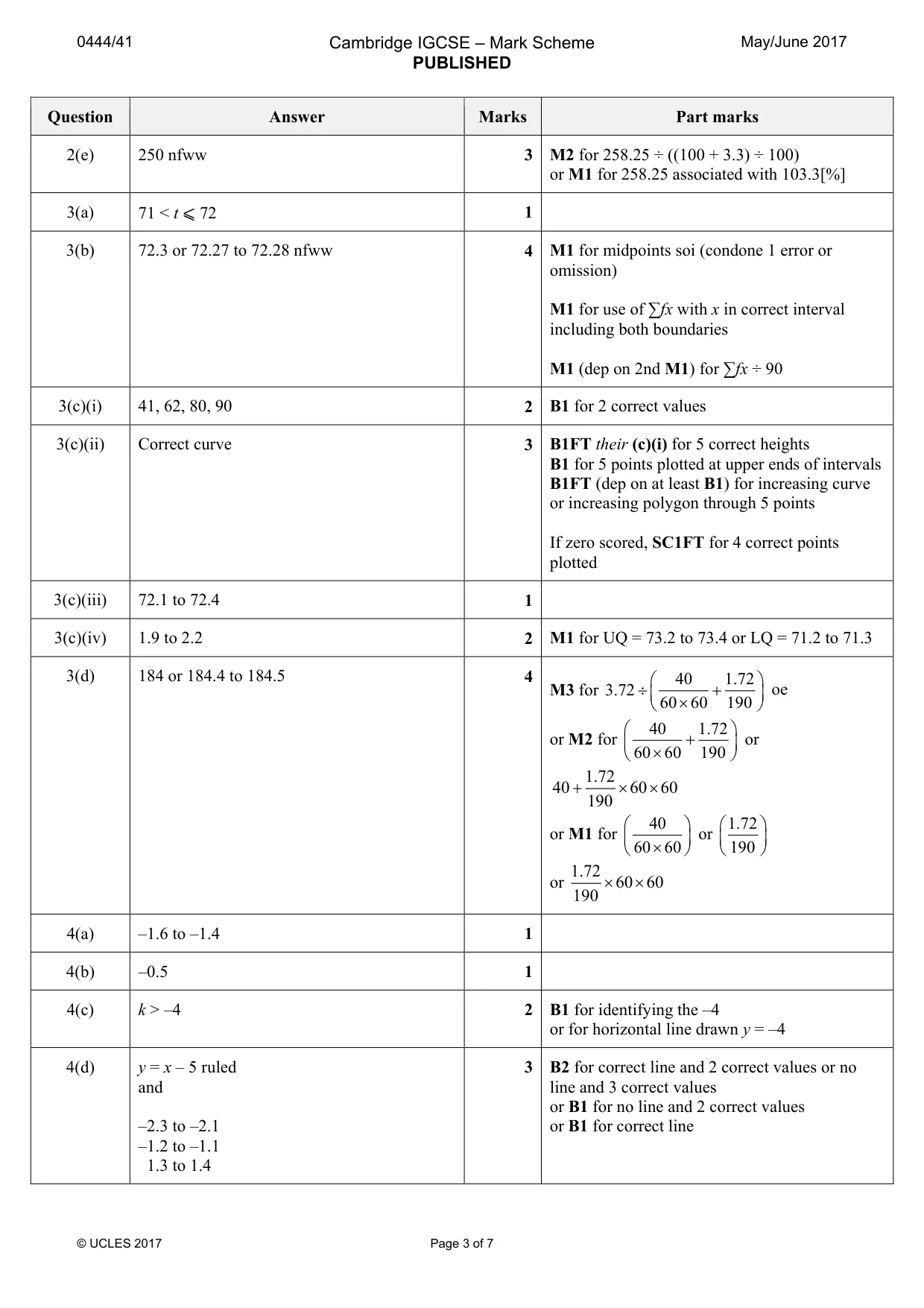
Mark scheme: 3(a) 71 < t ⩽ 72 1 3(b) 72.3 or 72.27 to 72.28 nfww 4 M1 for midpoints soi (condone 1 error or omission) M1 for use of ∑fx with x in correct interval including both boundaries M1 (dep on 2nd M1) for ∑fx ÷ 90 3(c)(i) 41, 62, 80, 90 2 B1 for 2 correct values 3(c)(ii) Correct curve 3 B1FT their (c)(i) for 5 correct heights B1 for 5 points plotted at upper ends of intervals B1FT (dep on at least B1) for increasing curve or increasing polygon through 5 points If zero scored, SC1FT for 4 correct points plotted 3(c)(iii) 72.1 to 72.4 1 3(c)(iv) 1.9 to 2.2 2 M1 for UQ = 73.2 to 73.4 or LQ = 71.2 to 71.3 3(d) 184 or 184.4 to 184.5 4 40 1.72 M3 for 3.72 ÷ + oe 60 × 60 190 40 1.72 or M2 for + or 60 × 60 190 1.72 40 + × 60 × 60 190 40 1.72 or M1 for or 60 × 60 190 1.72 or × 60 × 60 190
Q4 · By drawing a suitable straight line, solve the equation f(x) = x – 5
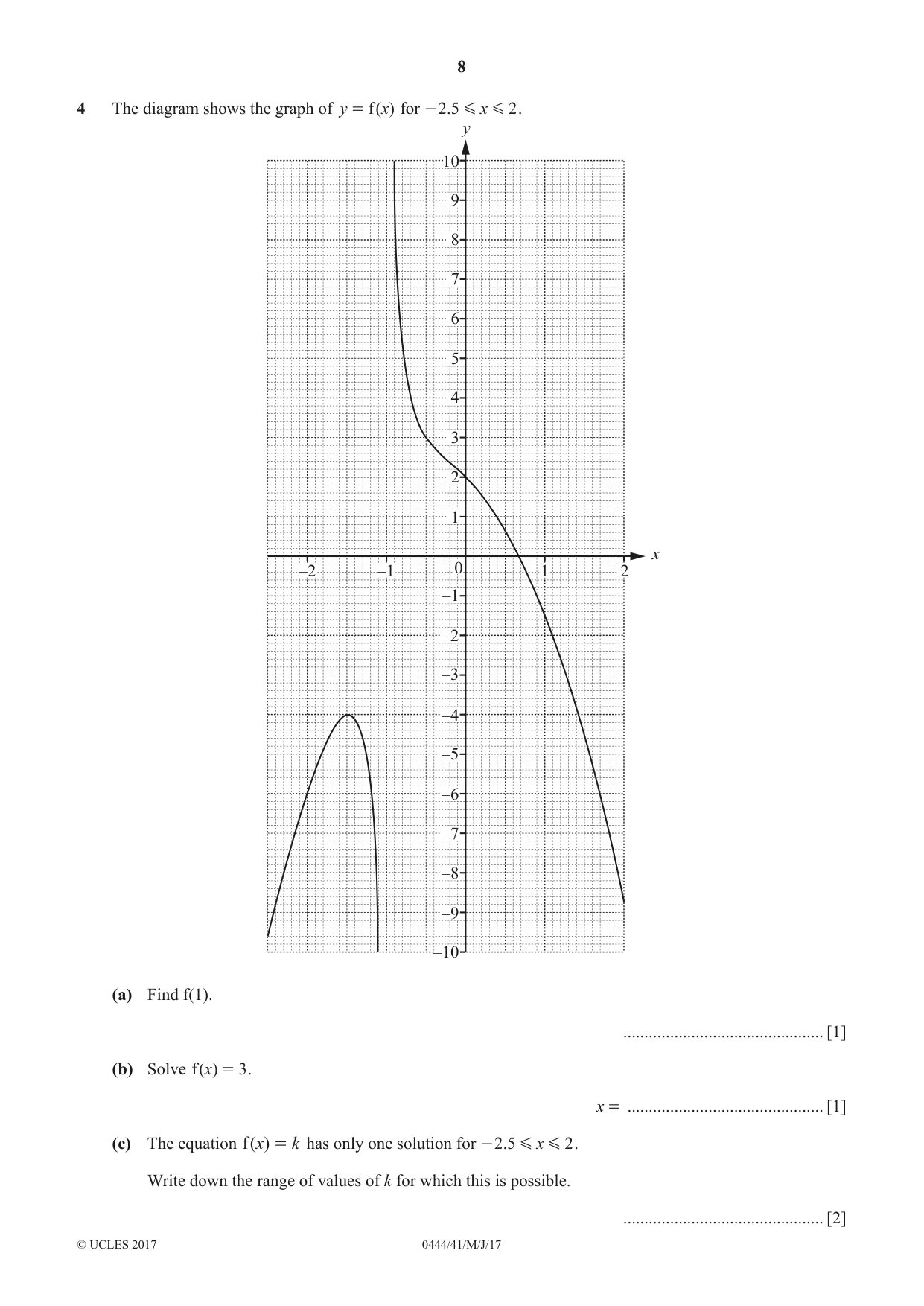
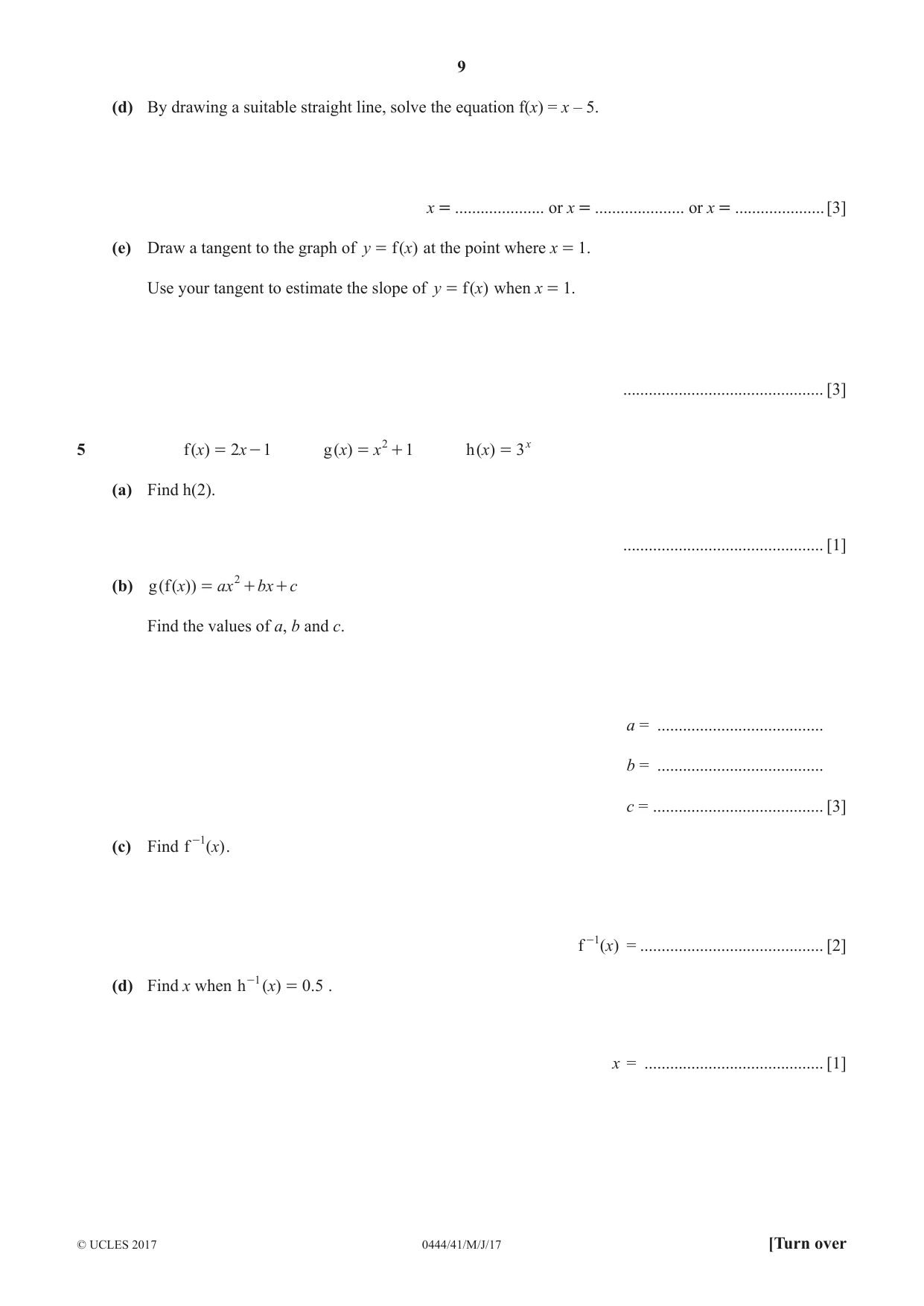
(d) By drawing a suitable straight line, solve the equation f(x) = x – 5. x = ..................... or x = ..................... or x = ..................... [3] (e) Draw a tangent to the graph of y = f (x ) at the point where x = 1. Use your tangent to estimate the slope of y = f (x) when x = 1. ............................................... [3]
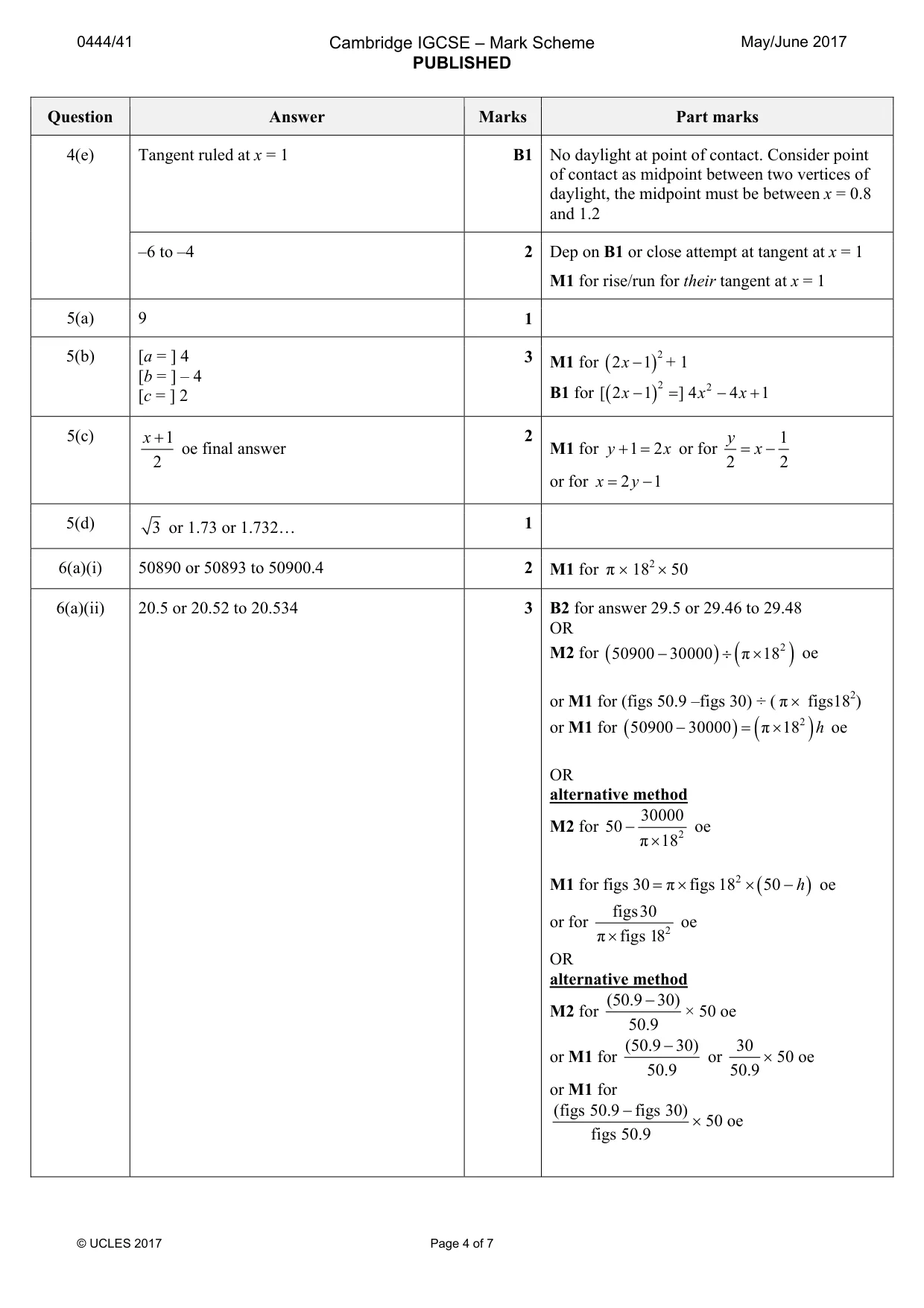
Mark scheme: 4(a) –1.6 to –1.4 1 4(b) –0.5 1 4(c) k > –4 2 B1 for identifying the –4 or for horizontal line drawn y = –4 4(d) y = x – 5 ruled 3 B2 for correct line and 2 correct values or no and line and 3 correct values or B1 for no line and 2 correct values –2.3 to –2.1 or B1 for correct line –1.2 to –1.1 1.3 to 1.4 4(e) Tangent ruled at x = 1 B1 No daylight at point of contact. Consider point of contact as midpoint between two vertices of daylight, the midpoint must be between x = 0.8 and 1.2 –6 to –4 2 Dep on B1 or close attempt at tangent at x = 1 M1 for rise/run for their tangent at x = 1
Q5 · F (x) = 2 x - 1 g ( x) = x 2 + 1 h (x) = 3x (a) Find h(2)
5 f (x) = 2 x - 1 g ( x) = x 2 + 1 h (x) = 3x (a) Find h(2). ............................................... [1] (b) g (f (x)) = ax 2 + bx + c Find the values of a, b and c. a = ....................................... b = ....................................... c = ........................................ [3] (c) Find f -1 (x) . f -1 (x) = ........................................... [2] (d) Find x when h -1 (x) = 0.5 . x = .......................................... [1]
Mark scheme: 5(a) 9 1 5(b) [a = ] 4 3 2 M1 for ( 2 x − 1) + 1 [b = ] – 4 [c = ] 2 B1 for [ ( 2 x − 1) 2 = ] 4 x 2 − 4 x + 1 5(c) x + 1 2 y 1 oe final answer M1 for y + 1 = 2 x or for = x − 2 2 2 or for x = 2 y − 1 5(d) 3 or 1.73 or 1.732… 1
Q6 · The diagram shows a cylindrical container used to serve coffee in a hotel
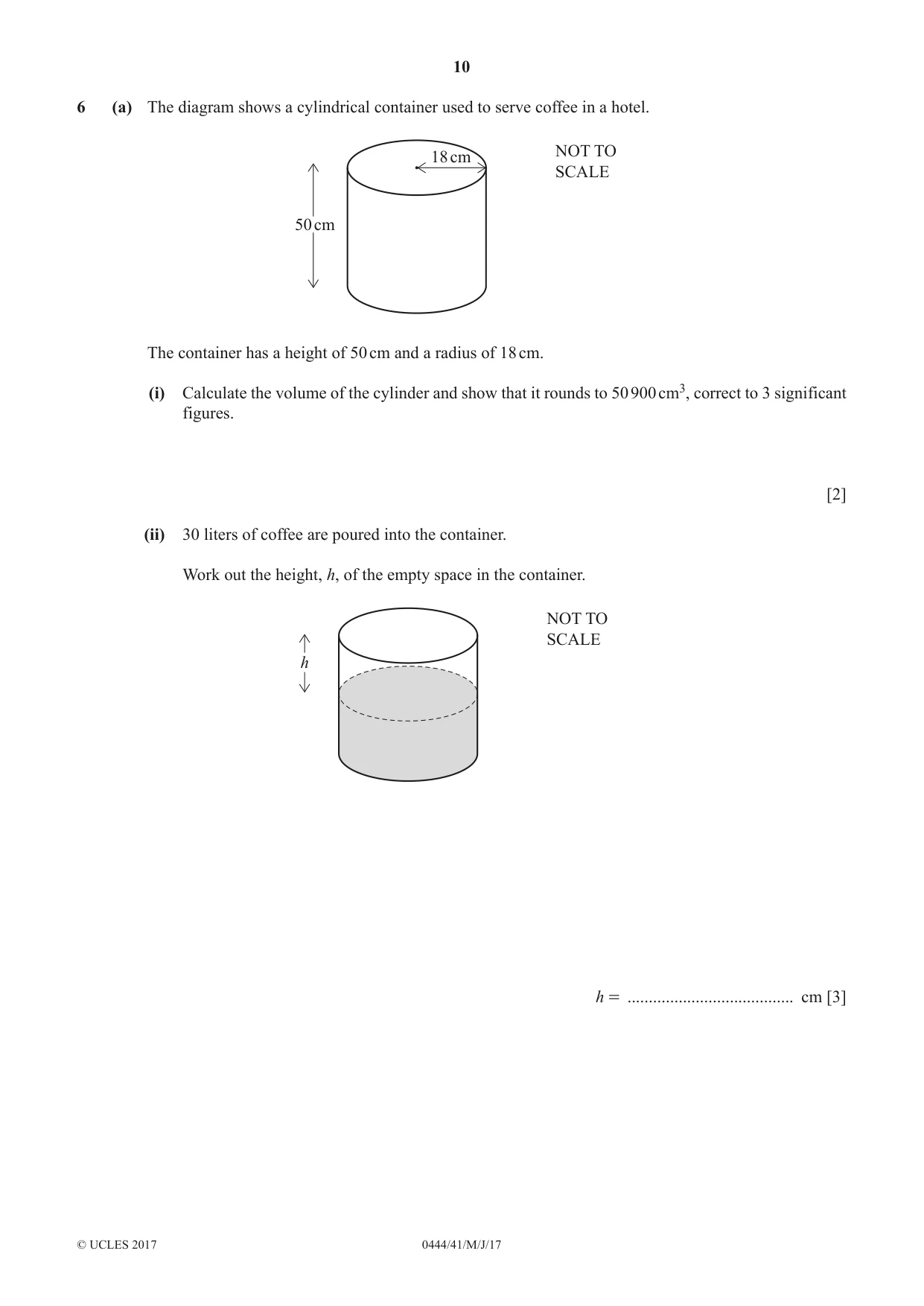
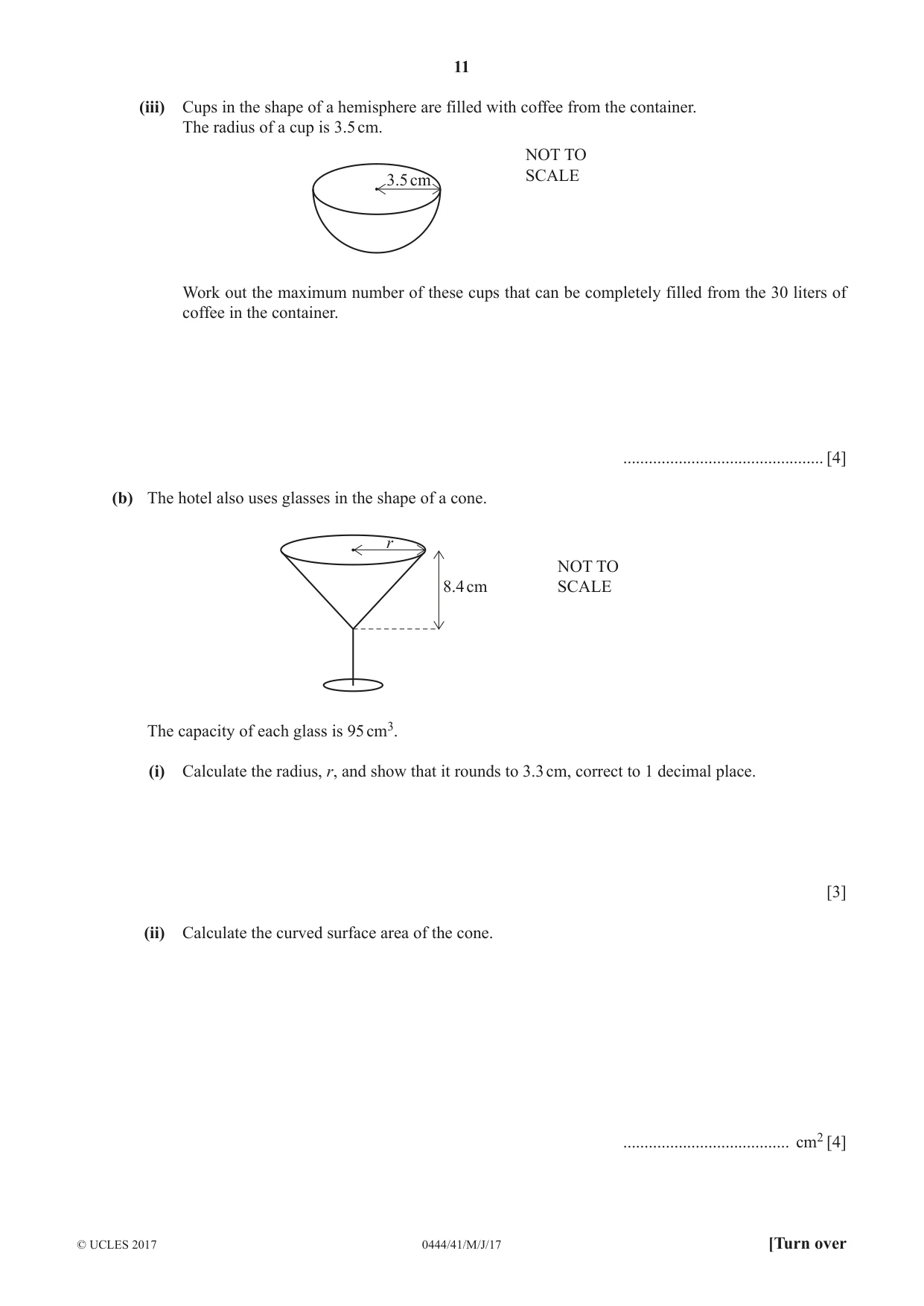
6 (a) The diagram shows a cylindrical container used to serve coffee in a hotel. NOT TO 18 cm SCALE 50 cm The container has a height of 50 cm and a radius of 18 cm. (i) Calculate the volume of the cylinder and show that it rounds to 50 900 cm3, correct to 3 significant figures. [2] (ii) 30 liters of coffee are poured into the container. Work out the height, h, of the empty space in the container. NOT TO SCALE h h = ....................................... cm [3] (iii) Cups in the shape of a hemisphere are filled with coffee from the container. The radius of a cup is 3.5 cm. NOT TO SCALE 3.5 cm Work out the maximum number of these cups that can be completely filled from the 30 liters of coffee in the container. ............................................... [4] (b) The hotel also uses glasses in the shape of a cone. r NOT TO 8.4 cm SCALE The capacity of each glass is 95 cm3. (i) Calculate the radius, r, and show that it rounds to 3.3 cm, correct to 1 decimal place. [3] (ii) Calculate the curved surface area of the cone. ....................................... cm2 [4]
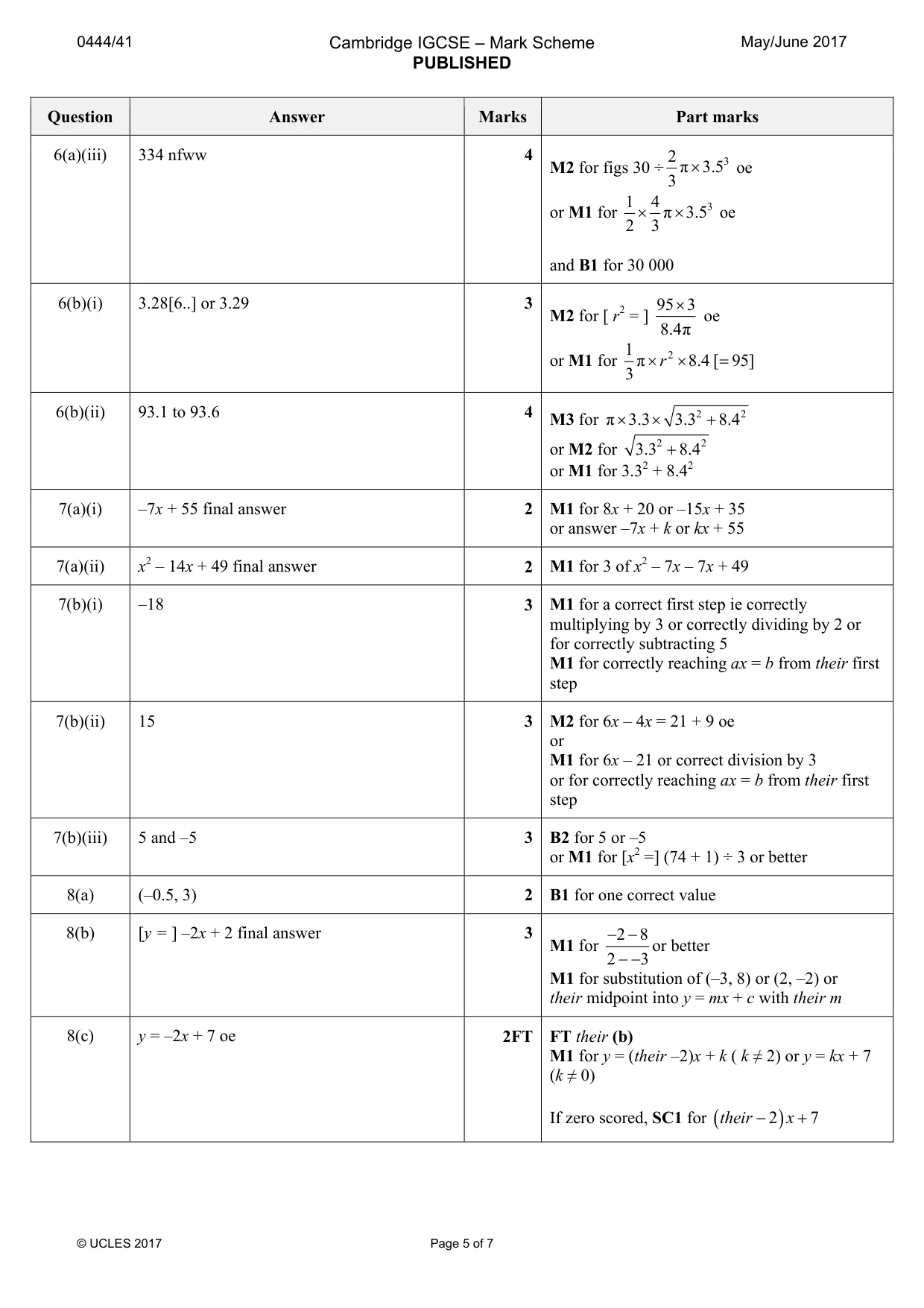
Mark scheme: 6(a)(i) 50890 or 50893 to 50900.4 2 M1 for π × 182 × 50 6(a)(ii) 20.5 or 20.52 to 20.534 3 B2 for answer 29.5 or 29.46 to 29.48 OR oe π × 18 2 M2 for ( 50900 − 30000 ) ÷ ( ) or M1 for (figs 50.9 –figs 30) ÷ ( π × figs182) h oe π × 18 2 or M1 for ( 50900 − 30000 ) = ( ) OR alternative method 30000 M2 for 50 − oe π × 18 2 M1 for figs 30 = π × figs 18 2 × ( 50 −h ) oe figs 30 or for oe π × figs 18 2 OR alternative method (50.9 − 30) M2 for × 50 oe 50.9 (50.9 − 30) 30 or M1 for or × 50 oe 50.9 50.9 or M1 for (figs 50.9 − figs 30) × 50 oe figs 50.9 6(a)(iii) 334 nfww 4 2 3 M2 for figs 30 ÷ π × 3.5 oe 3 1 4 3 or M1 for × π × 3.5 oe 2 3 and B1 for 30 000 6(b)(i) 3.28[6..] or 3.29 3 95 × 3 M2 for [ r2 = ] oe 8.4π 1 2 or M1 for π × r × 8.4 [ = 95] 3 6(b)(ii) 93.1 to 93.6 4 2 2 M3 for π × 3.3 × 3.3 + 8.4 or M2 for 3.32 + 8.4 2 or M1 for 3.32 + 8.42
Question 7
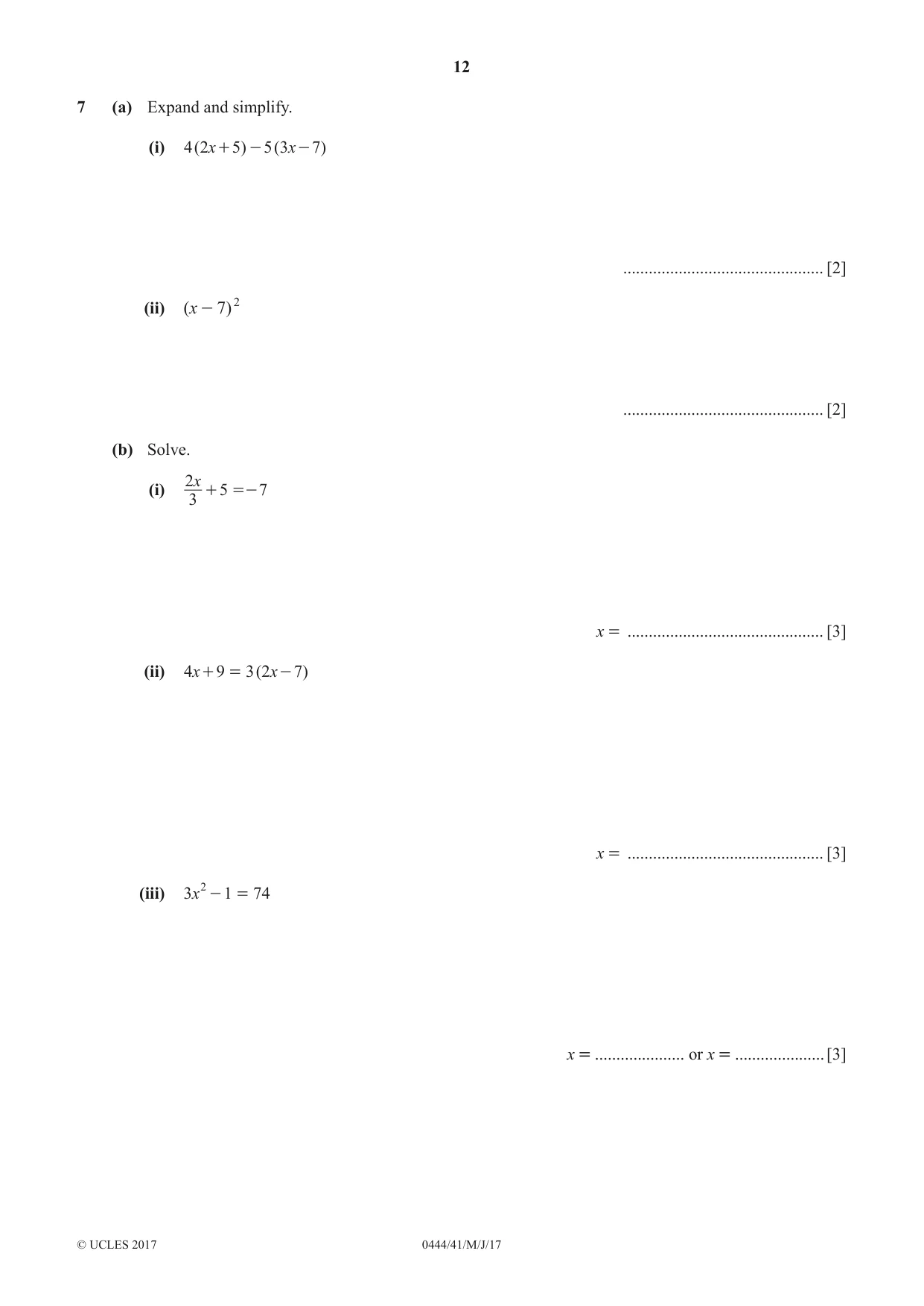
7 (a) Expand and simplify. (i) 4 (2x + 5) - 5 (3x - 7) ............................................... [2] (ii) ( x - 7 ) 2 ............................................... [2] (b) Solve. 2x (i) + 5 =- 7 3 x = .............................................. [3] (ii) 4x + 9 = 3 (2x - 7) x = .............................................. [3] (iii) 3x 2 - 1 = 74 x = ..................... or x = ..................... [3]
Mark scheme: 7(a)(i) –7x + 55 final answer 2 M1 for 8x + 20 or –15x + 35 or answer –7x + k or kx + 55 7(a)(ii) x2 – 14x + 49 final answer 2 M1 for 3 of x2 – 7x – 7x + 49 7(b)(i) –18 3 M1 for a correct first step ie correctly multiplying by 3 or correctly dividing by 2 or for correctly subtracting 5 M1 for correctly reaching ax = b from their first step 7(b)(ii) 15 3 M2 for 6x – 4x = 21 + 9 oe or M1 for 6x – 21 or correct division by 3 or for correctly reaching ax = b from their first step 7(b)(iii) 5 and –5 3 B2 for 5 or –5 or M1 for [x2 =] (74 + 1) ÷ 3 or better
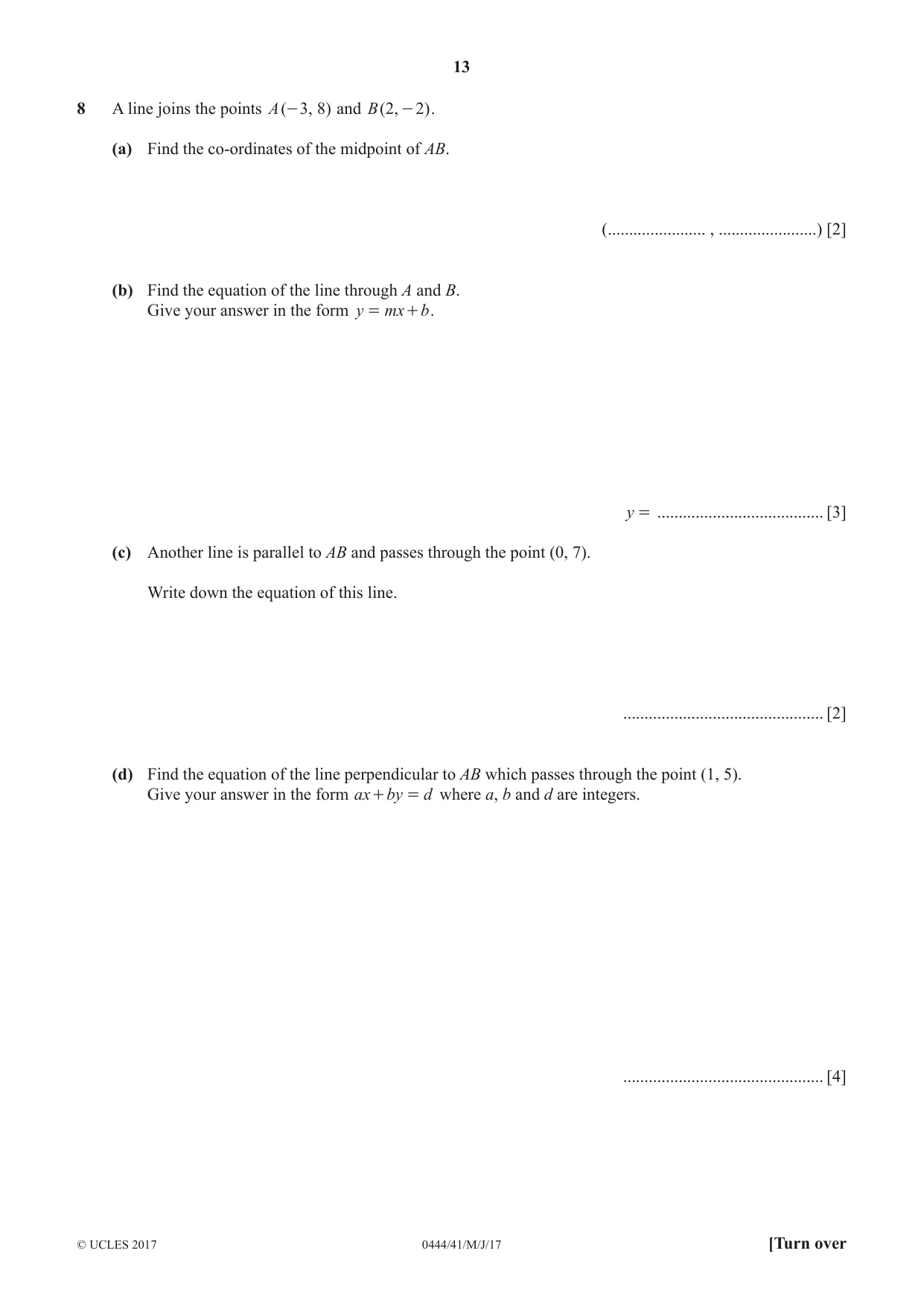
Q8 · A line joins the points A (- 3, 8) and B (2, - 2)
8 A line joins the points A (- 3, 8) and B (2, - 2) . (a) Find the co-ordinates of the midpoint of AB. (....................... , .......................) [2] (b) Find the equation of the line through A and B. Give your answer in the form y = mx + b . y = ....................................... [3] (c) Another line is parallel to AB and passes through the point (0, 7). Write down the equation of this line. ............................................... [2] (d) Find the equation of the line perpendicular to AB which passes through the point (1, 5). Give your answer in the form ax + by = d where a, b and d are integers. ............................................... [4]
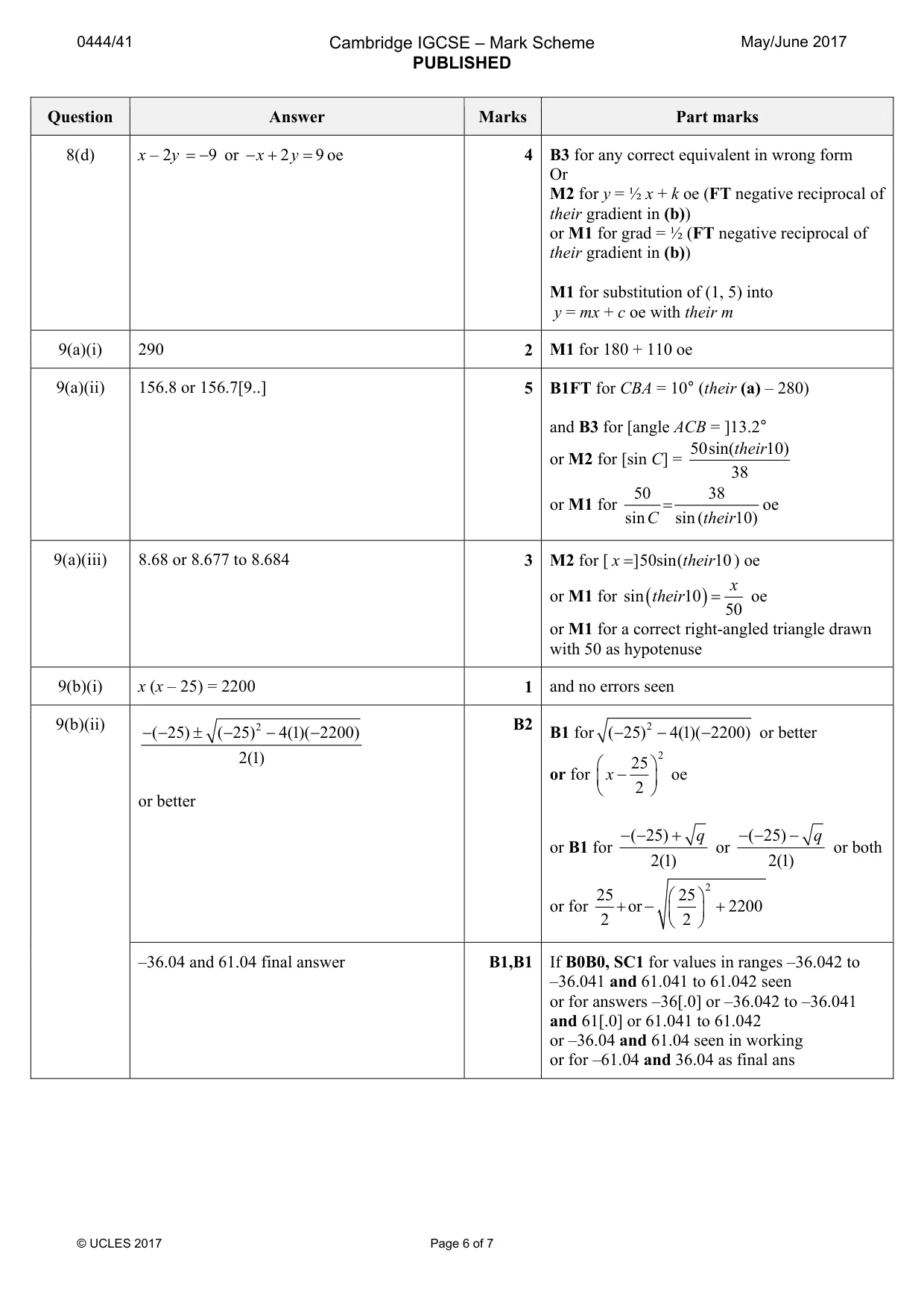
Mark scheme: 8(a) (–0.5, 3) 2 B1 for one correct value 8(b) [y = ] –2x + 2 final answer 3 −−2 8 M1 for better 2 −−or3 M1 for substitution of (–3, 8) or (2, –2) or their midpoint into y = mx + c with their m 8(c) y = –2x + 7 oe 2FT FT their (b) M1 for y = (their –2)x + k ( k ≠ 2) or y = kx + 7 (k ≠ 0) If zero scored, SC1 for ( their − 2 ) x + 7 8(d) x – 2y = −9 or −+x 2 y = 9 oe 4 B3 for any correct equivalent in wrong form Or M2 for y = ½ x + k oe (FT negative reciprocal of their gradient in (b)) or M1 for grad = ½ (FT negative reciprocal of their gradient in (b)) M1 for substitution of (1, 5) into y = mx + c oe with their m
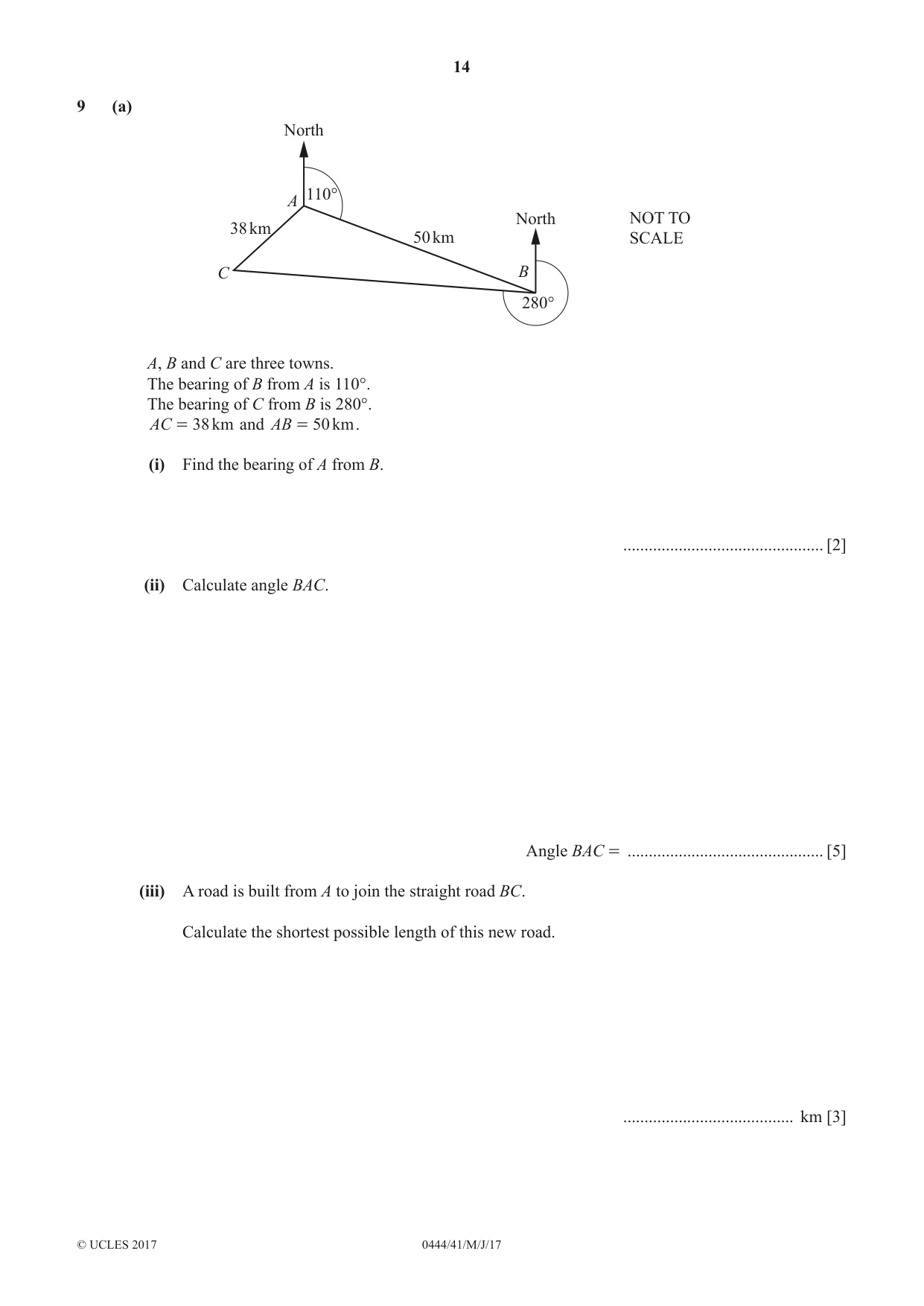
Q9 · North 110° A North NOT TO 38 km 50 km SCALE C B 280° A, B and C are three towns
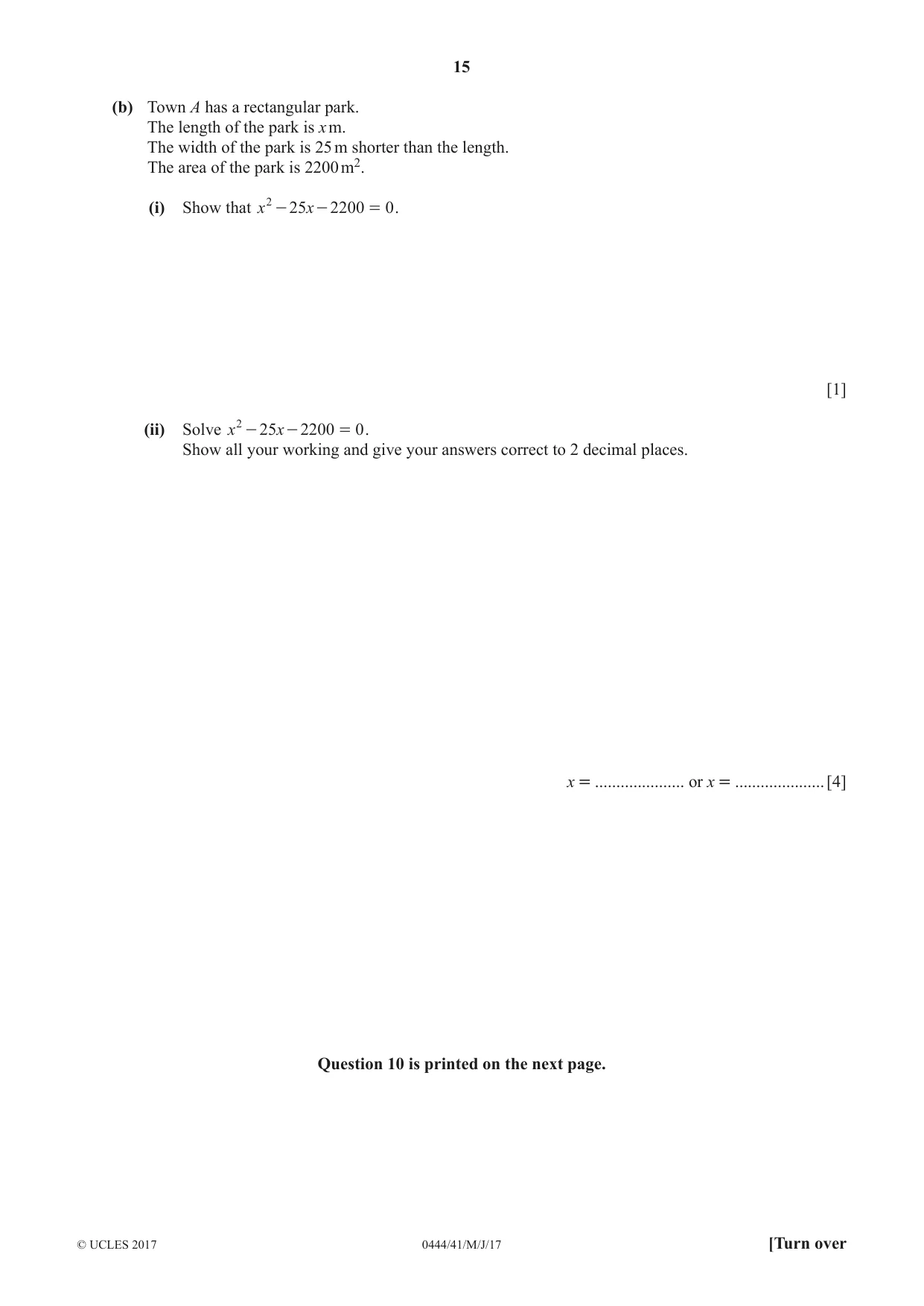
9 (a) North 110° A North NOT TO 38 km 50 km SCALE C B 280° A, B and C are three towns. The bearing of B from A is 110°. The bearing of C from B is 280°. AC = 38 km and AB = 50 km . (i) Find the bearing of A from B. ............................................... [2] (ii) Calculate angle BAC. Angle BAC = .............................................. [5] (iii) A road is built from A to join the straight road BC. Calculate the shortest possible length of this new road. ........................................ km [3] (b) Town A has a rectangular park. The length of the park is x m. The width of the park is 25 m shorter than the length. The area of the park is 2200 m2. (i) Show that x 2 - 25x - 2200 = 0 . [1] (ii) Solve x 2 - 25x - 2200 = 0 . Show all your working and give your answers correct to 2 decimal places. x = ..................... or x = ..................... [4] Question 10 is printed on the next page.
Mark scheme: 9(a)(i) 290 2 M1 for 180 + 110 oe 9(a)(ii) 156.8 or 156.7[9..] 5 B1FT for CBA = 10° (their (a) – 280) and B3 for [angle ACB = ]13.2° 50sin(their10) or M2 for [sin C] = 38 50 38 or M1 for = oe sin C sin(their10) 9(a)(iii) 8.68 or 8.677 to 8.684 3 M2 for [ x = ] 50sin(their10 ) oe x or M1 for sin ( their10 ) = oe 50 or M1 for a correct right-angled triangle drawn with 50 as hypotenuse 9(b)(i) x (x – 25) = 2200 1 and no errors seen 9(b)(ii) 2 B2 2 −−( 25) ± ( − 25) − 4(1)( − 2200) B1 for ( −25) − 4(1)( −2200) or better 2(1) 2 25 or for x − oe 2 or better −−( 25) + q −−( 25) − q or B1 for or or both 2(1) 2(1) 25 25 2 or for + or − + 2200 2 2 –36.04 and 61.04 final answer B1,B1 If B0B0, SC1 for values in ranges –36.042 to –36.041 and 61.041 to 61.042 seen or for answers –36[.0] or –36.042 to –36.041 and 61[.0] or 61.041 to 61.042 or –36.04 and 61.04 seen in working or for –61.04 and 36.04 as final ans
Q10 · The nth term of a sequence is 8n - 3
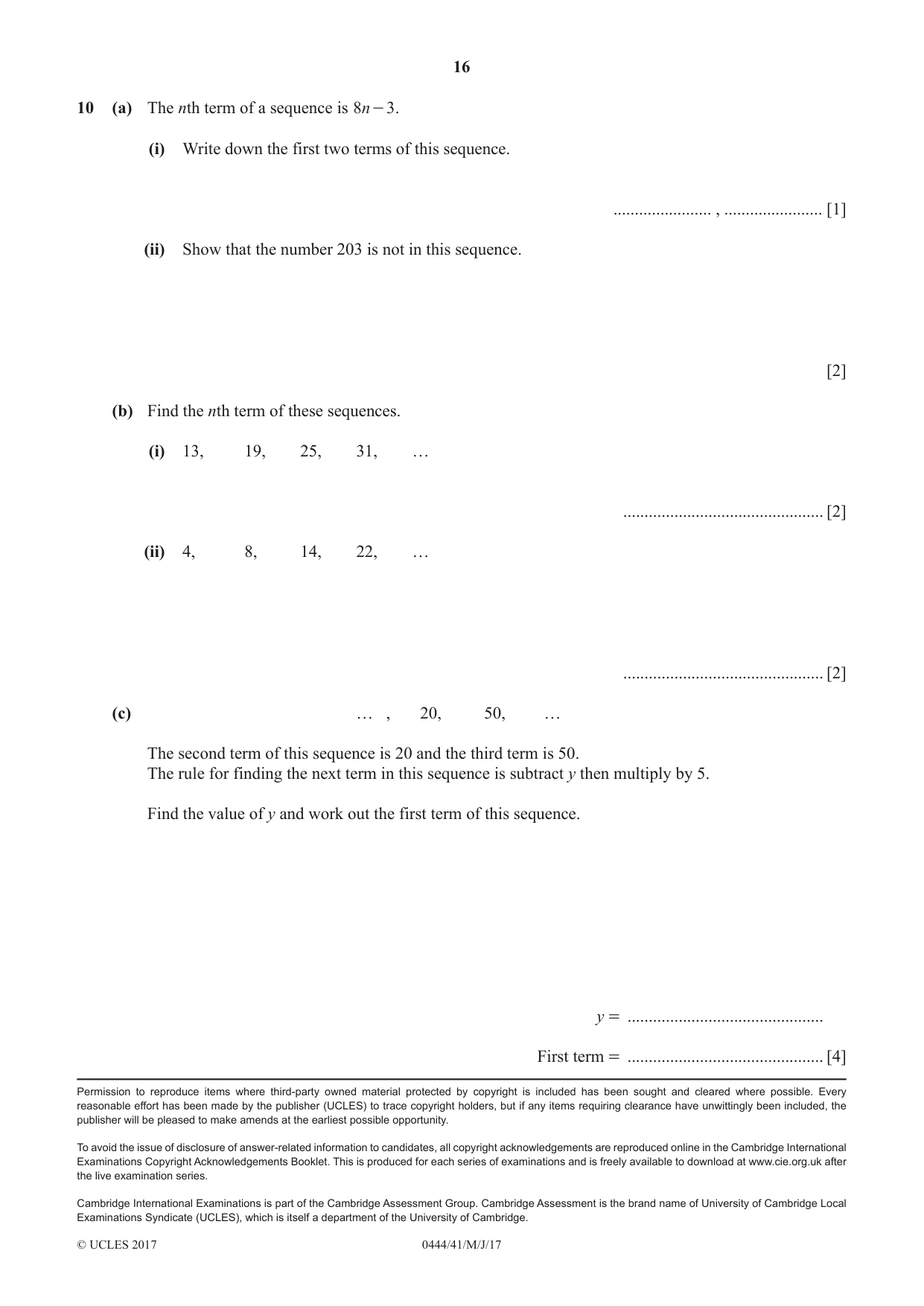
10 (a) The nth term of a sequence is 8n - 3 . (i) Write down the first two terms of this sequence. ....................... , ....................... [1] (ii) Show that the number 203 is not in this sequence. [2] (b) Find the nth term of these sequences. (i) 13, 19, 25, 31, … ............................................... [2] (ii) 4, 8, 14, 22, … ............................................... [2] (c) … , 20, 50, … The second term of this sequence is 20 and the third term is 50. The rule for finding the next term in this sequence is subtract y then multiply by 5. Find the value of y and work out the first term of this sequence. y = .............................................. First term = .............................................. [4]
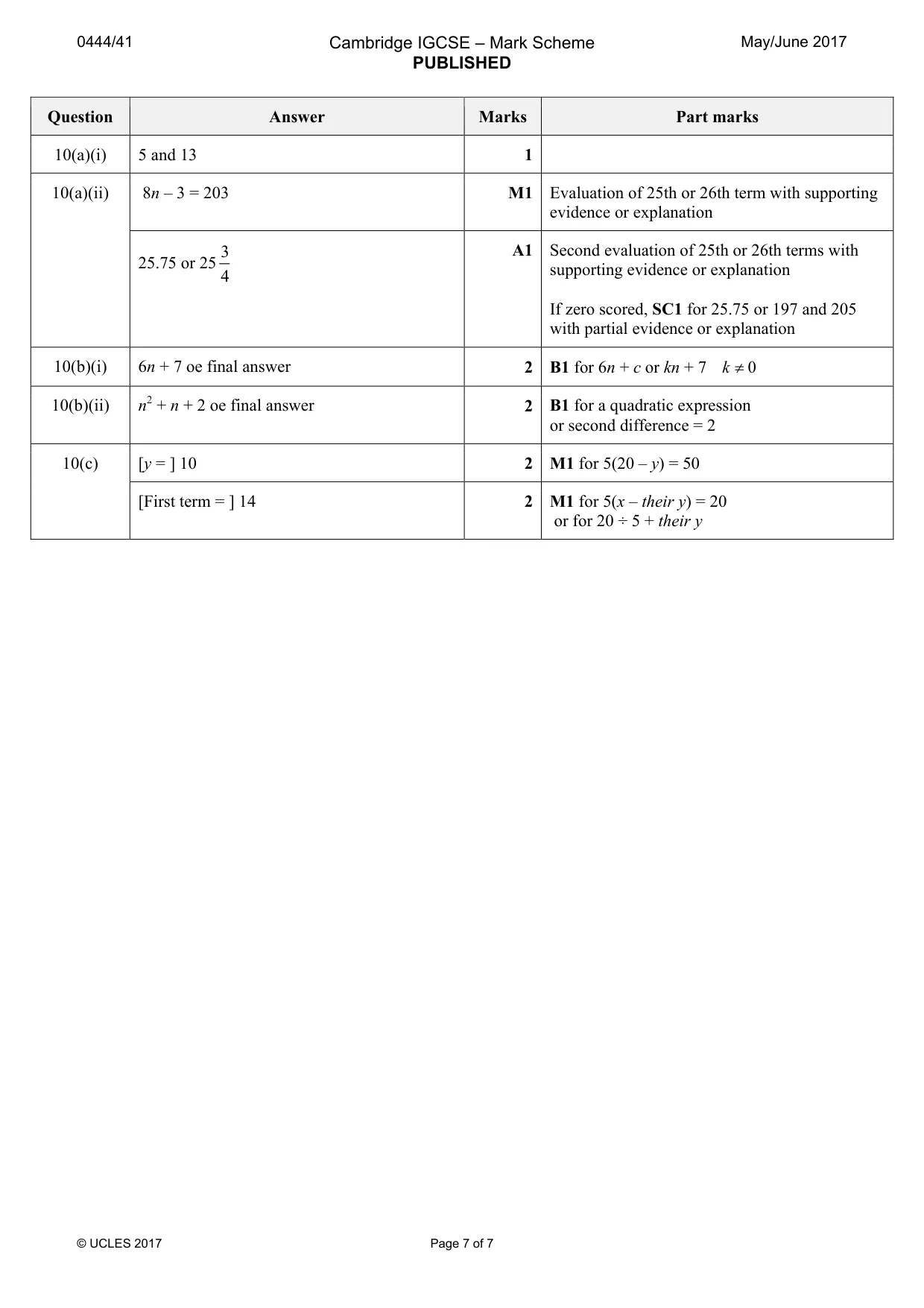
Mark scheme: 10(a)(i) 5 and 13 1 10(a)(ii) 8n – 3 = 203 M1 Evaluation of 25th or 26th term with supporting evidence or explanation 3 A1 Second evaluation of 25th or 26th terms with 25.75 or 25 supporting evidence or explanation 4 If zero scored, SC1 for 25.75 or 197 and 205 with partial evidence or explanation 10(b)(i) 6n + 7 oe final answer 2 B1 for 6n + c or kn + 7 k ≠ 0 10(b)(ii) n2 + n + 2 oe final answer 2 B1 for a quadratic expression or second difference = 2 10(c) [y = ] 10 2 M1 for 5(20 – y) = 50 [First term = ] 14 2 M1 for 5(x – their y) = 20 or for 20 ÷ 5 + their y
What you needed in this session
Cambridge’s own grade thresholds for 2017 May/June, Paper 4 · Variant 1. A higher threshold means an easier paper — the bar moves with how the cohort did.