Cambridge IGCSE Mathematics - Additional 0606 — 2021 Oct/Nov Paper 2 · Variant 1
0606/21/O/N/21 · 10 questions · 80 marks · ≈90 min
The question paper and its mark scheme, free to read here and free to download. This is Cambridge’s own paper, exactly as it was sat.
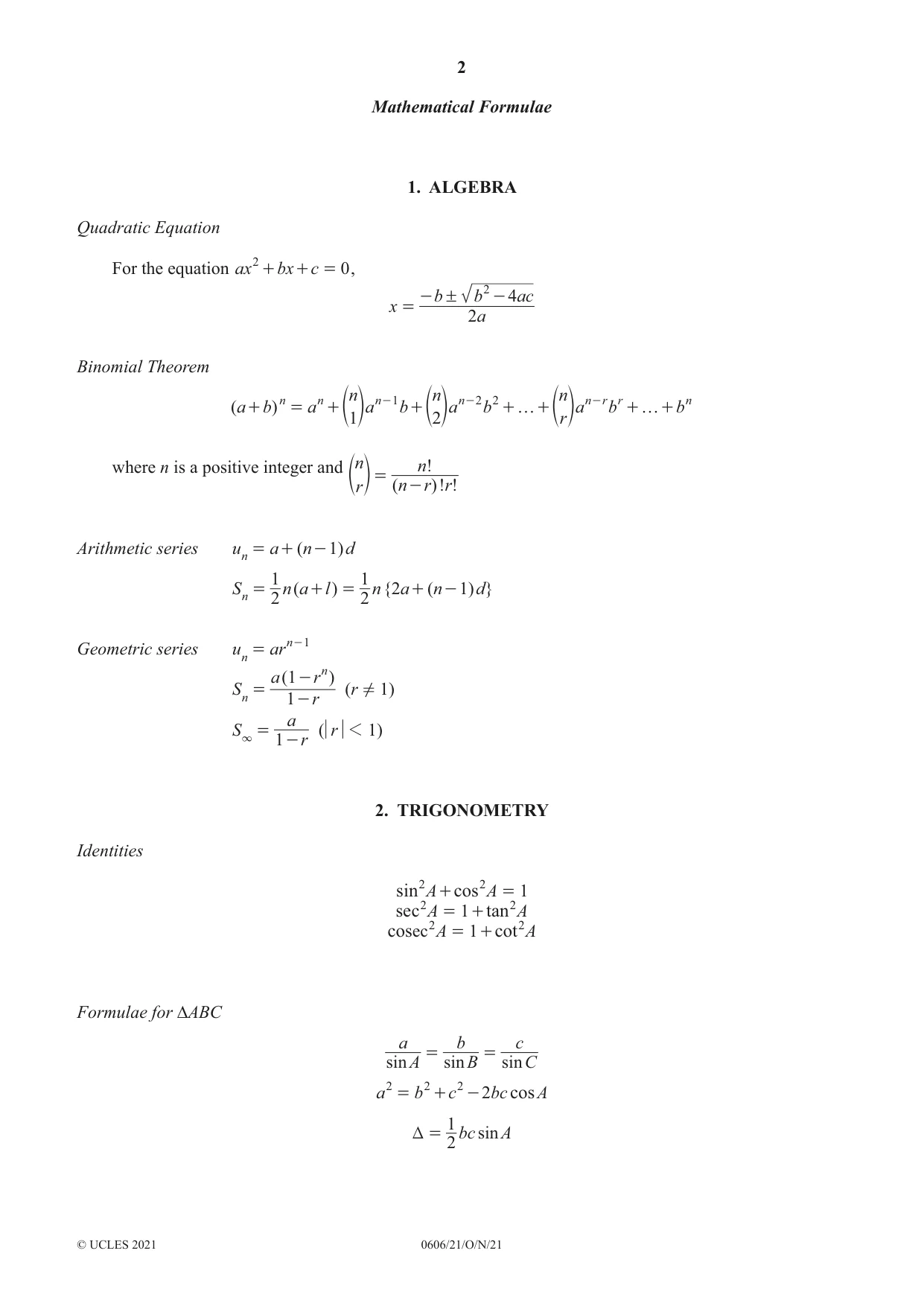
Question paper16 pages
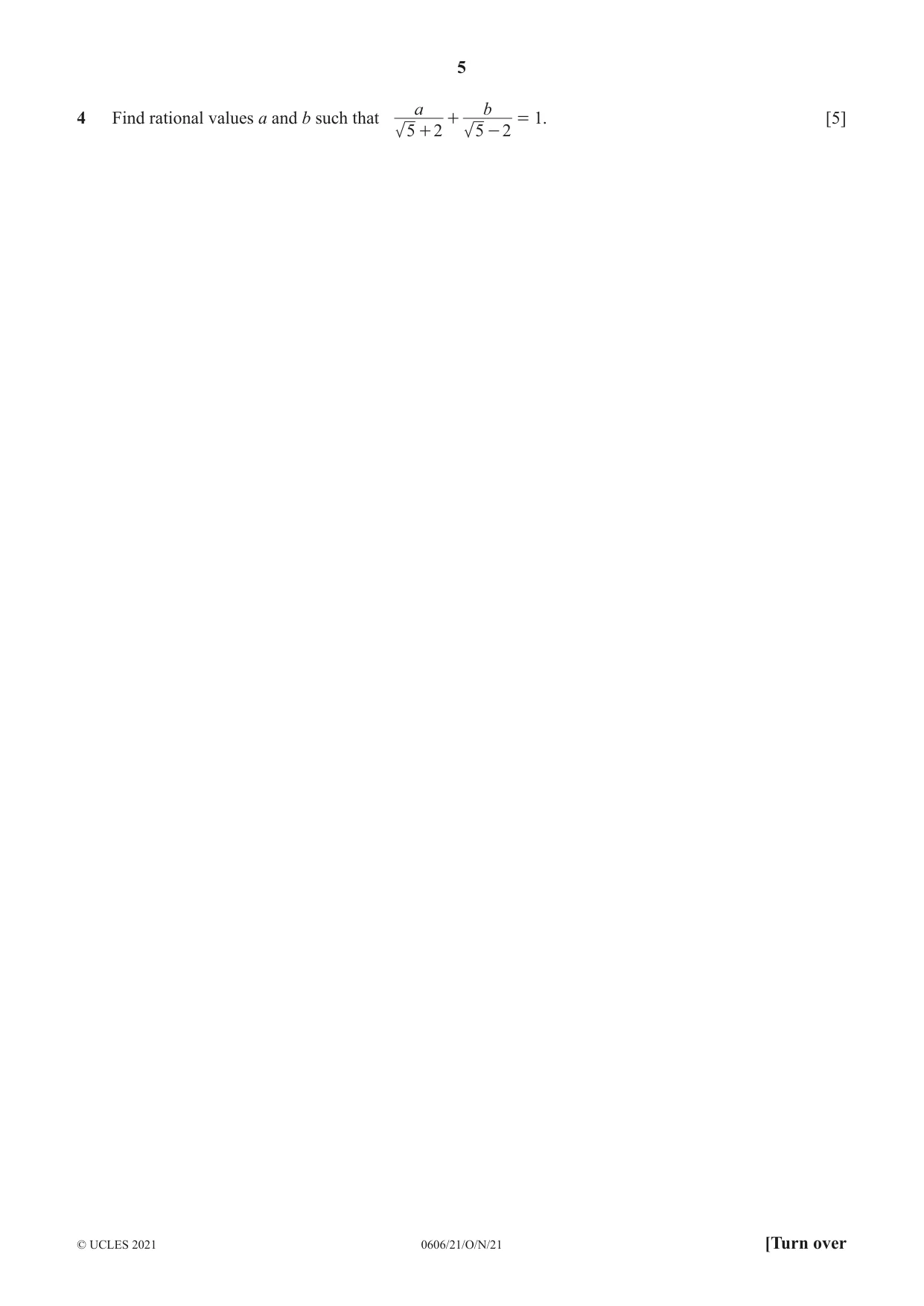



Mark scheme10 pages
Answers below. Sit the paper first if you are practising.
Questions as text
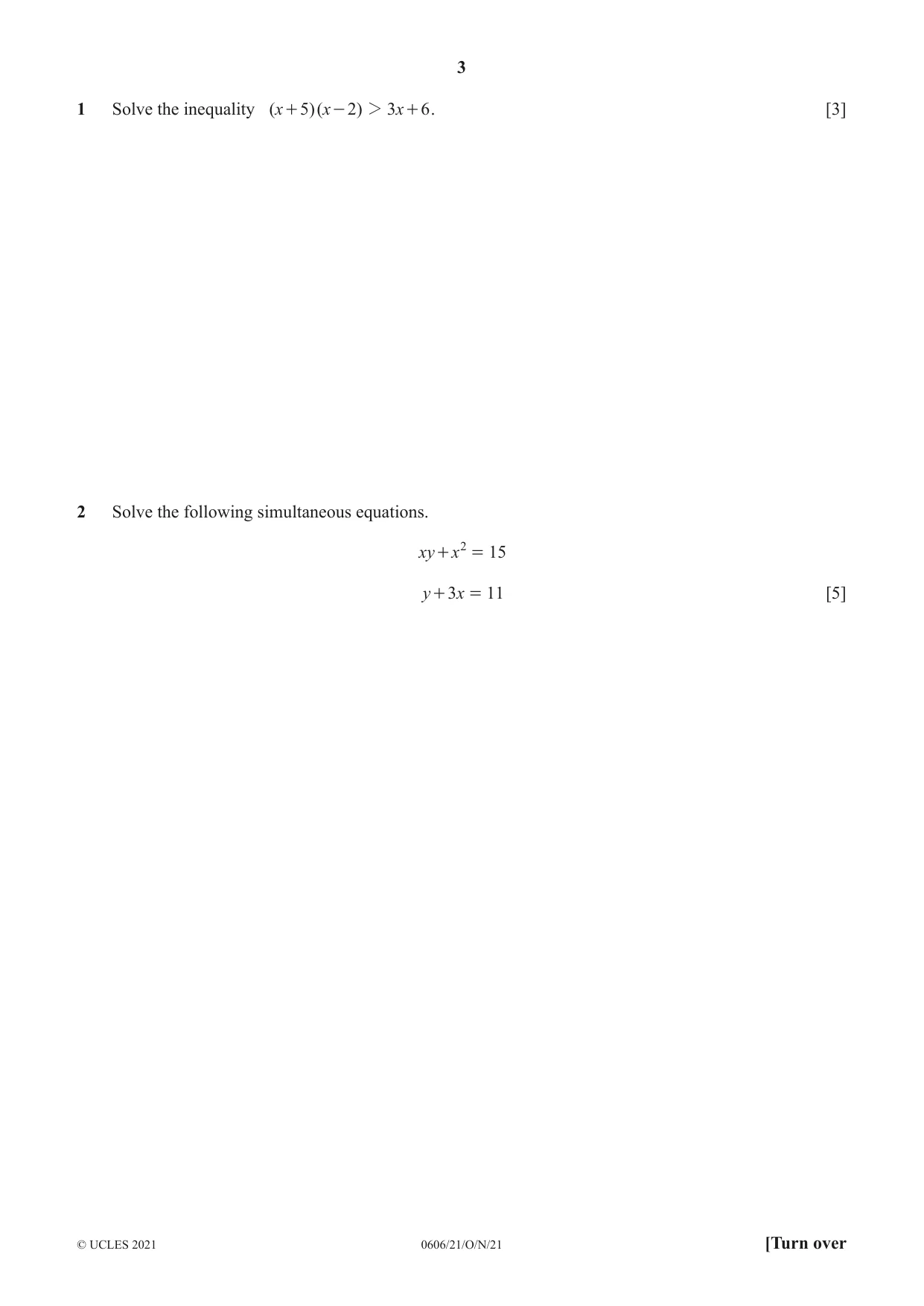
Q1 · Solve the inequality ( x + 5)( x - 2) 2 3x + 6
1 Solve the inequality ( x + 5)( x - 2) 2 3x + 6 . [3]
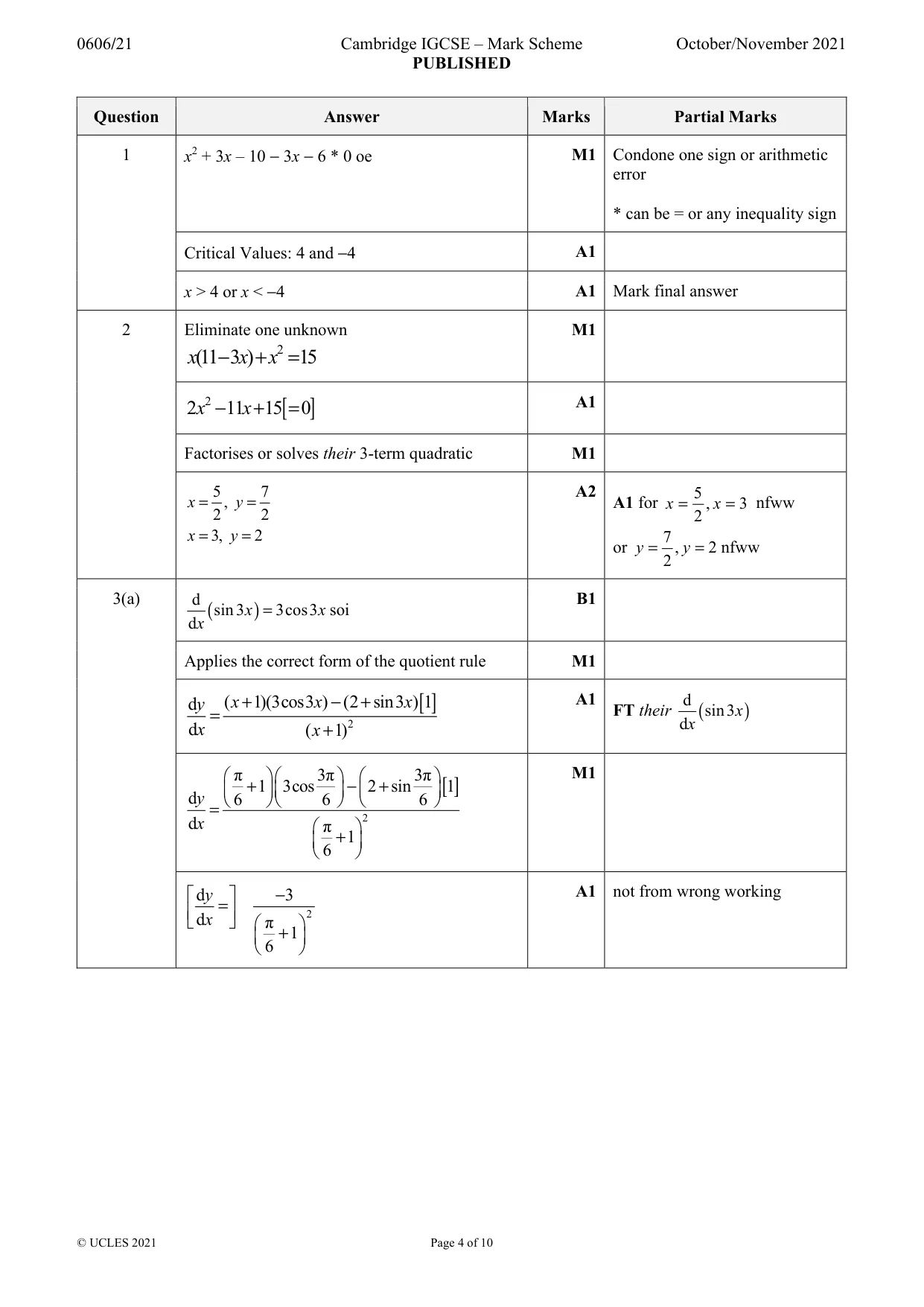
Mark scheme: Question Answer Marks Partial Marks 1 x2 + 3x – 10 − 3x − 6 * 0 oe M1 Condone one sign or arithmetic error * can be = or any inequality sign Critical Values: 4 and −4 A1 x > 4 or x < −4 A1 Mark final answer
More questions on Find the solution set for quadratic inequalities
Q2 · Solve the following simultaneous equations
2 Solve the following simultaneous equations. xy + x 2 = 15 y + 3 x = 11 [5]
Mark scheme: 2 Eliminate one unknown M1 x(11− 3x) + x2 =15 2 A1 2x −11x + 15[ = 0] Factorises or solves their 3-term quadratic M1 5 7 A2 5 x = , y = A1 for x = , x = 3 nfww 2 2 2 x = 3, y = 2 7 or y = , y = 2 nfww 2
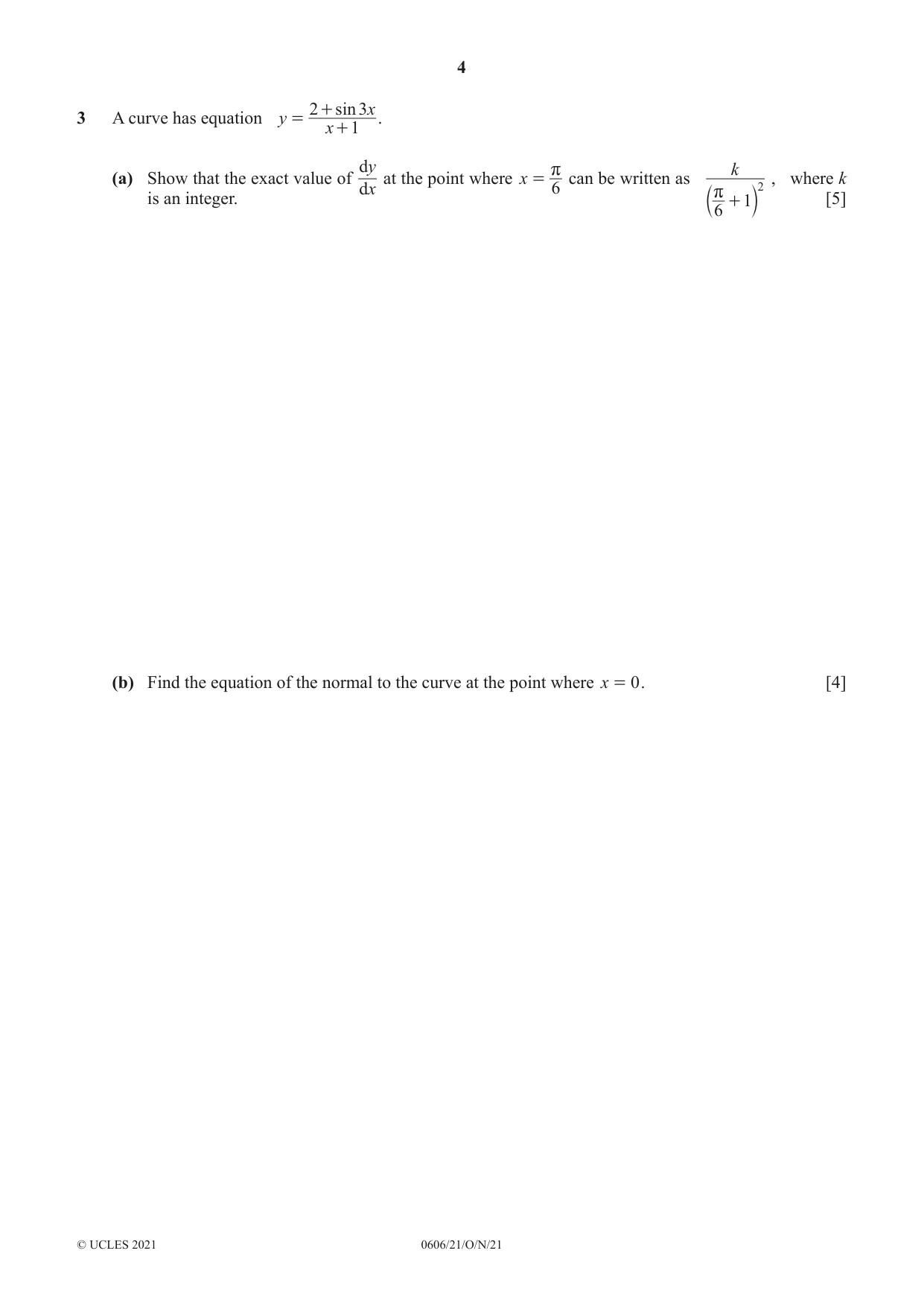
Q3 · A curve has equation y =
3 A curve has equation y = . x + 1 dy r k (a) Show that the exact value of at the point where x = can be written as 2 , where k dx 6 r is an integer. + 1 [5] b 6 l (b) Find the equation of the normal to the curve at the point where x = 0 . [4]
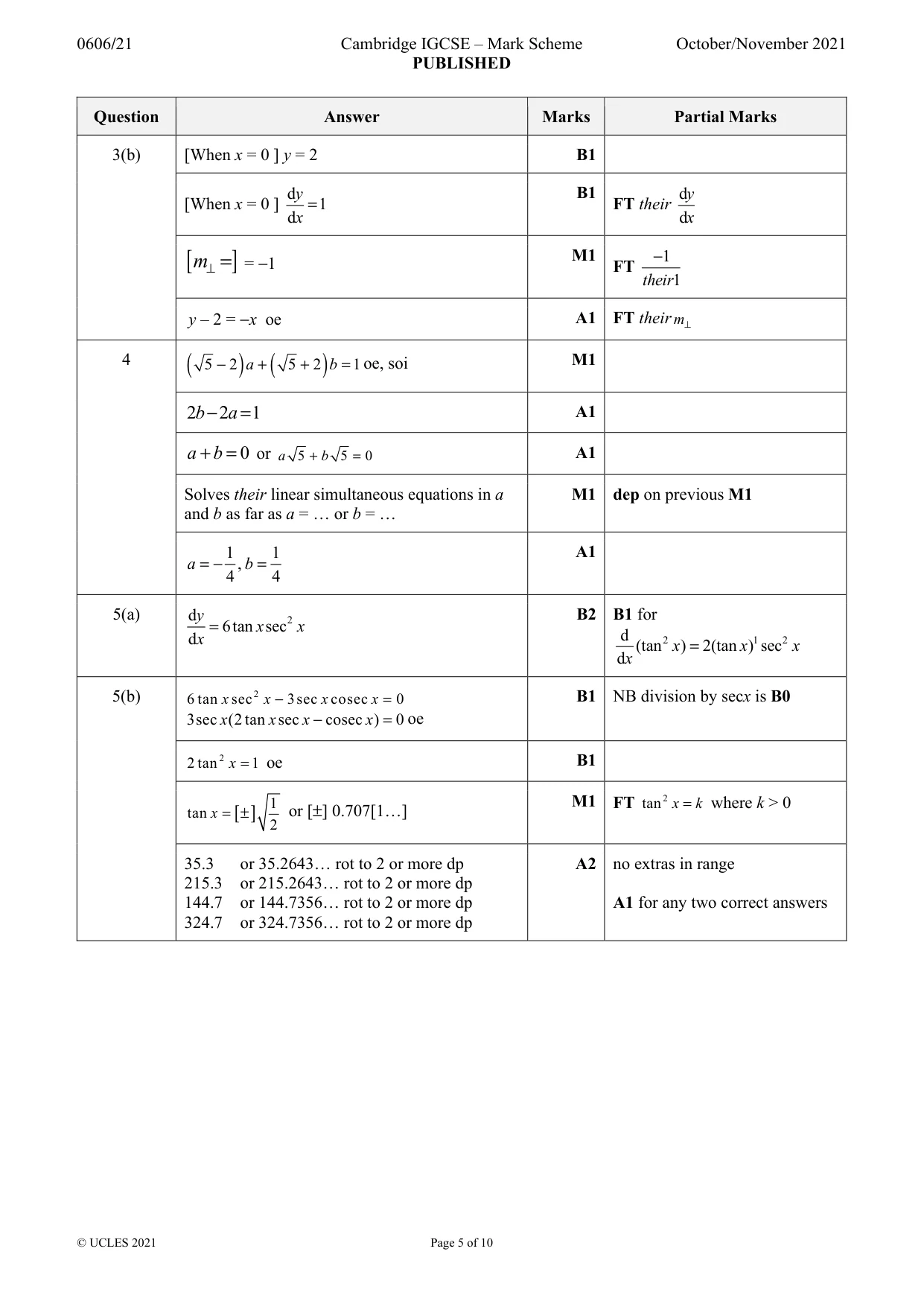
Mark scheme: 3(a) d B1 ( sin3 x ) = 3cos3 x soi d x Applies the correct form of the quotient rule M1 dy ( x + 1)(3cos3 x) − (2 + sin3 x) [1] A1 d FT their ( sin3 x ) = 2 dx dx ( x + 1) π 3π 3π M1 + 1 3cos − 2 + sin [1] dy 6 6 6 = dx π 2 + 1 6 dy −3 A1 not from wrong working = 2 d x π + 1 6 3(b) [When x = 0 ] y = 2 B1 dy B1 dy [When x = 0 ] = 1 FT their dx dx [ m⊥=] = −1 M1 FT −1 their1 y – 2 = −x oe A1 FT their m⊥
Q5 · It is given that y = 3 tan 2 x for 0° 1 x 1 360°
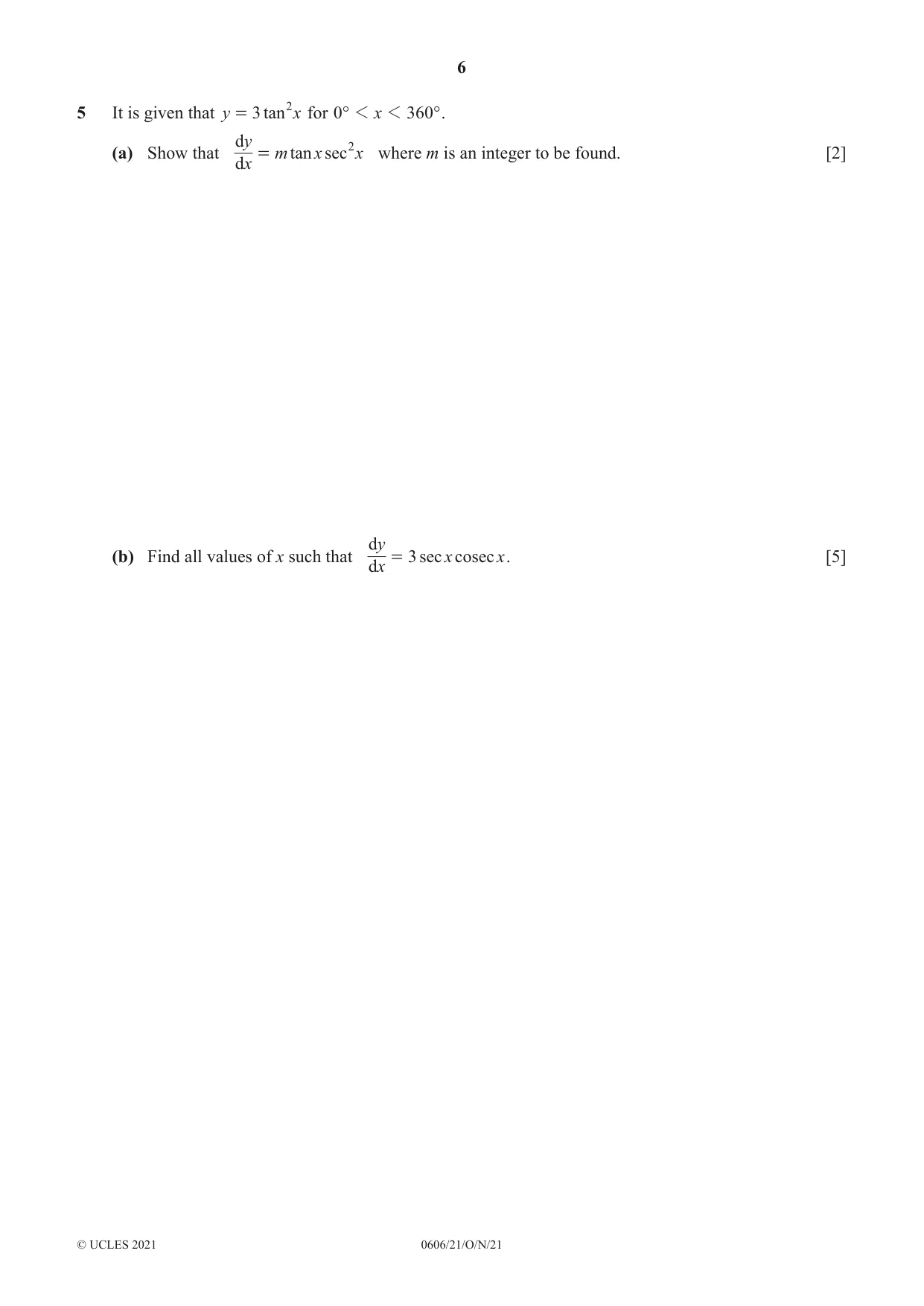
5 It is given that y = 3 tan 2 x for 0° 1 x 1 360° . dy 2 (a) Show that = m tan x sec x where m is an integer to be found. [2] dx dy (b) Find all values of x such that = 3 sec x cosec x . [5] dx
Mark scheme: 5(a) dy 2 B2 B1 for = 6tan x sec x dx d 2 1 2 (tan x ) = 2(tan x ) sec x dx 5(b) 6 tan x sec 2 x − 3sec x cosec x = 0 B1 NB division by secx is B0 3sec x (2 tan x sec x − cosec x ) = 0 oe 2 tan 2 x = 1 oe B1 1 M1 FT tan 2 x = k where k > 0 tan x = [ ± ] or [±] 0.707[1…] 2 35.3 or 35.2643… rot to 2 or more dp A2 no extras in range 215.3 or 215.2643… rot to 2 or more dp 144.7 or 144.7356… rot to 2 or more dp A1 for any two correct answers 324.7 or 324.7356… rot to 2 or more dp
Q6 · Find the values of m for which the line y = m x - 2 does not touch or cut the curve y = (…
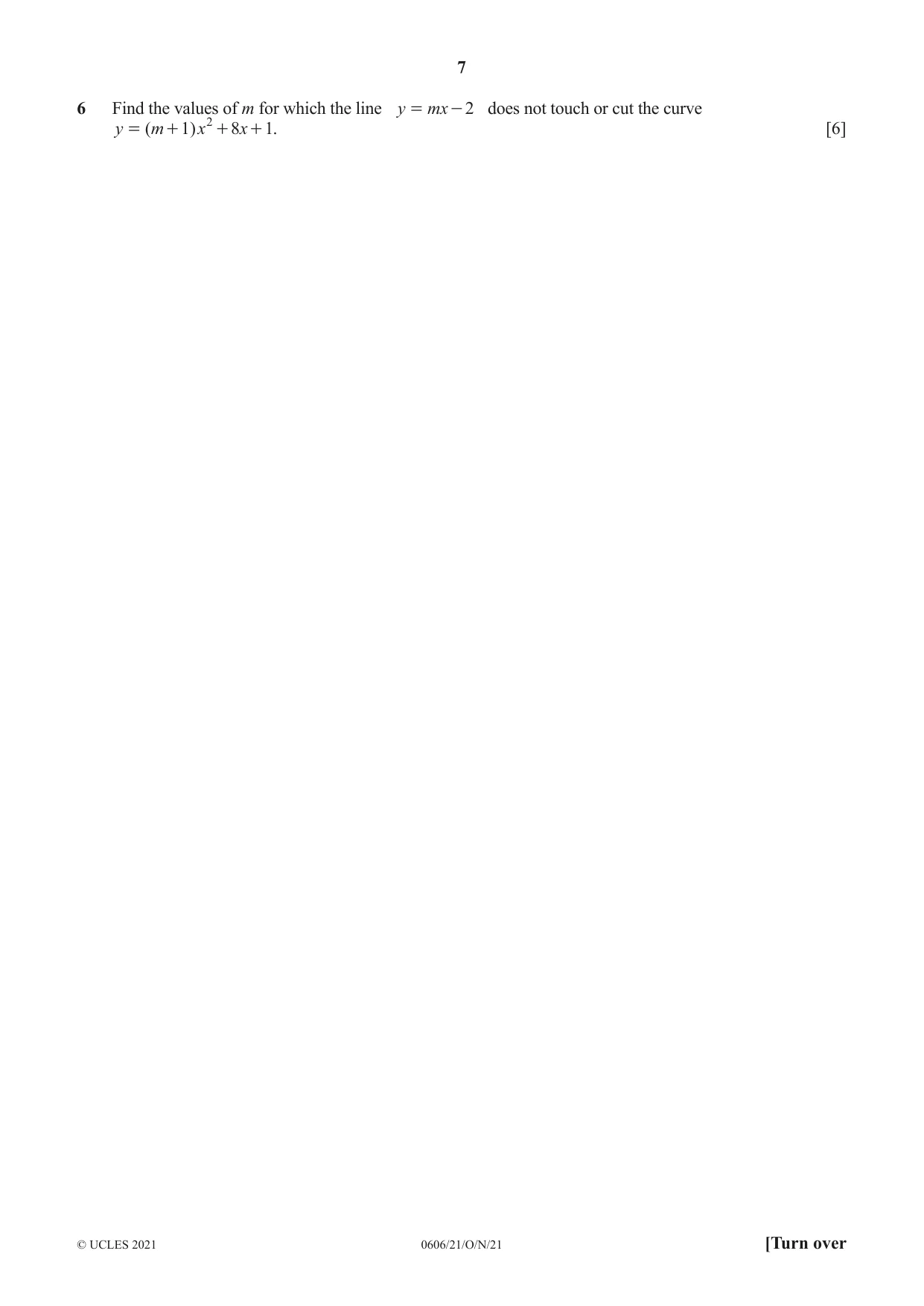
6 Find the values of m for which the line y = m x - 2 does not touch or cut the curve y = ( m + 1) x 2 + 8x + 1. [6]
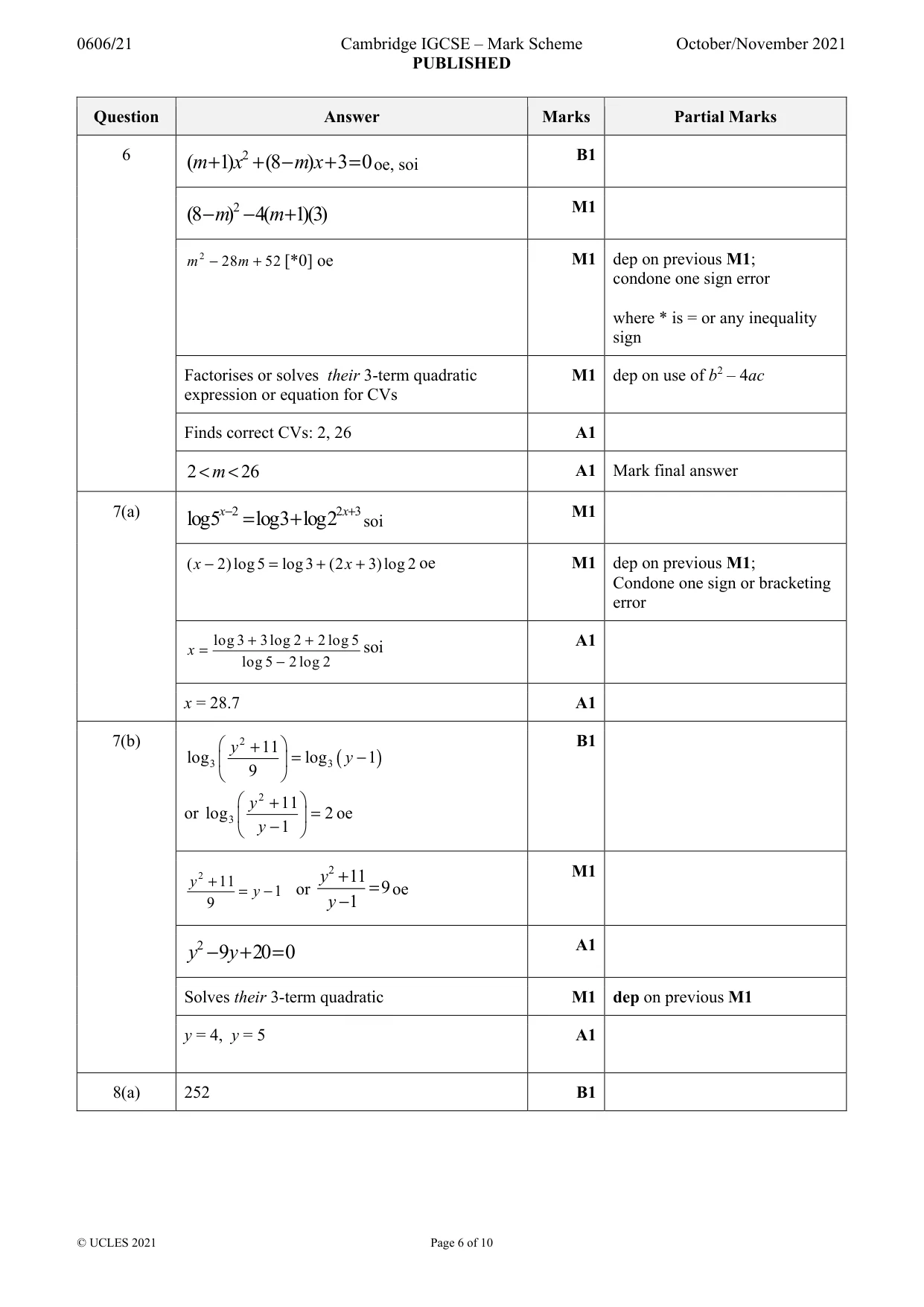
Mark scheme: 6 2 B1 (m +1) x + (8 − m) x + 3 = 0 oe, soi 2 M1 (8 − m) − 4(m +1)(3) m 2 − 28 m + 52 [*0] oe M1 dep on previous M1; condone one sign error where * is = or any inequality sign Factorises or solves their 3-term quadratic M1 dep on use of b2 – 4ac expression or equation for CVs Finds correct CVs: 2, 26 A1 2 < m < 26 A1 Mark final answer
Q7 · Use logarithms to solve the following equation, giving your answer correct to 1 decimal…
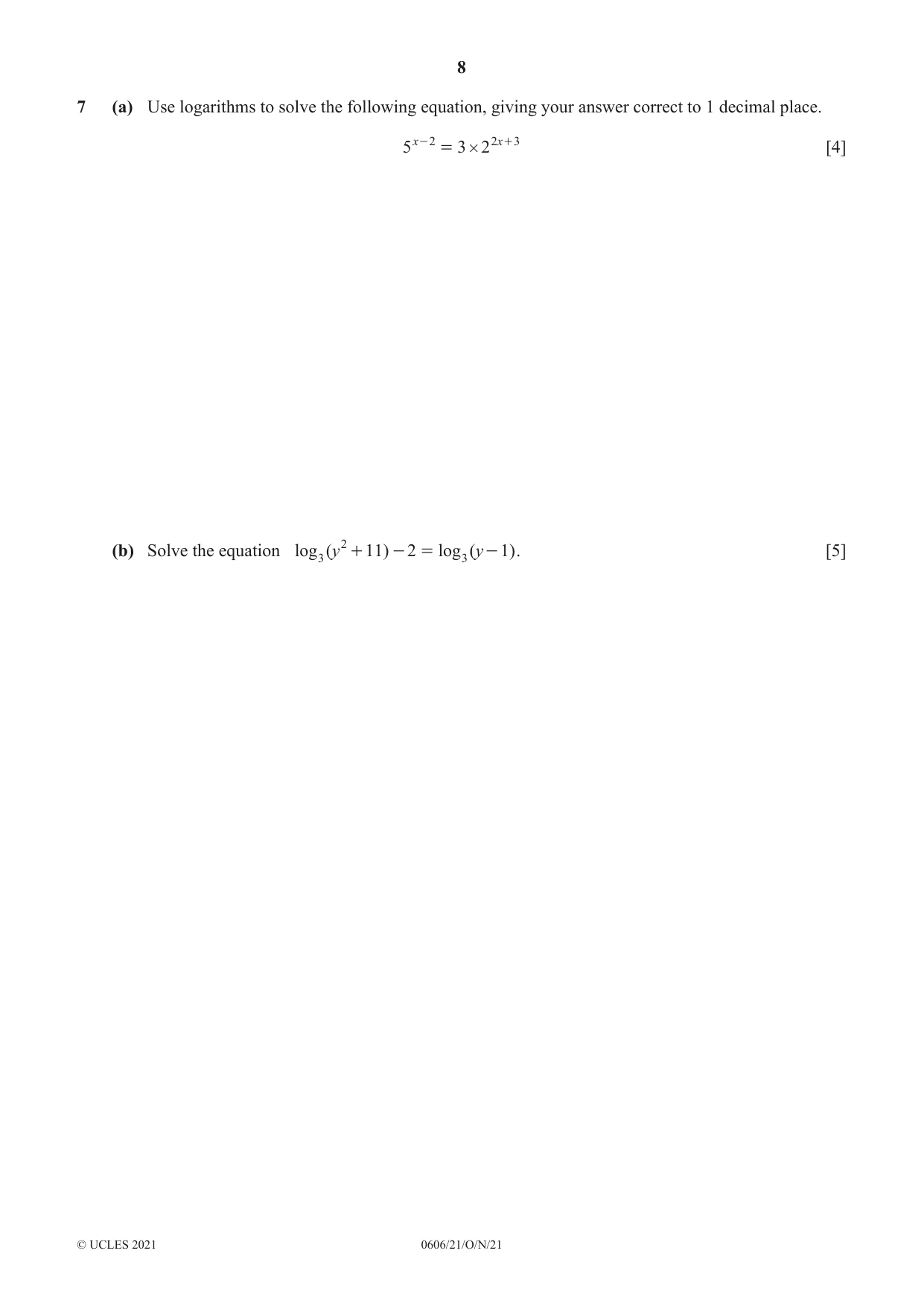
7 (a) Use logarithms to solve the following equation, giving your answer correct to 1 decimal place. 5 x - 2 = 3 # 2 2 x + 3 [4] (b) Solve the equation log 3 (y 2 + 11 ) - 2 = log 3 ( y - 1 ) . [5]
Mark scheme: 7(a) x−2 2 x+3 M1 log5 = log3 + log2 soi ( x − 2)log5 = log3 + (2 x + 3)log 2 oe M1 dep on previous M1; Condone one sign or bracketing error log 3 + 3log 2 + 2 log 5 A1 x = soi log 5 − 2 log 2 x = 28.7 A1 7(b) y 2 + 11 B1 log 3 = log 3 ( y − 1) 9 y 2 + 11 or log 3 = 2 oe y − 1 y 2 + 11 y 2 + 11 M1 = y − 1 or = 9 oe 9 y − 1 2 A1 y − 9y + 20 = 0 Solves their 3-term quadratic M1 dep on previous M1 y = 4, y = 5 A1
Q8 · Marc chooses 5 people from 4 men, 4 women and 2 children
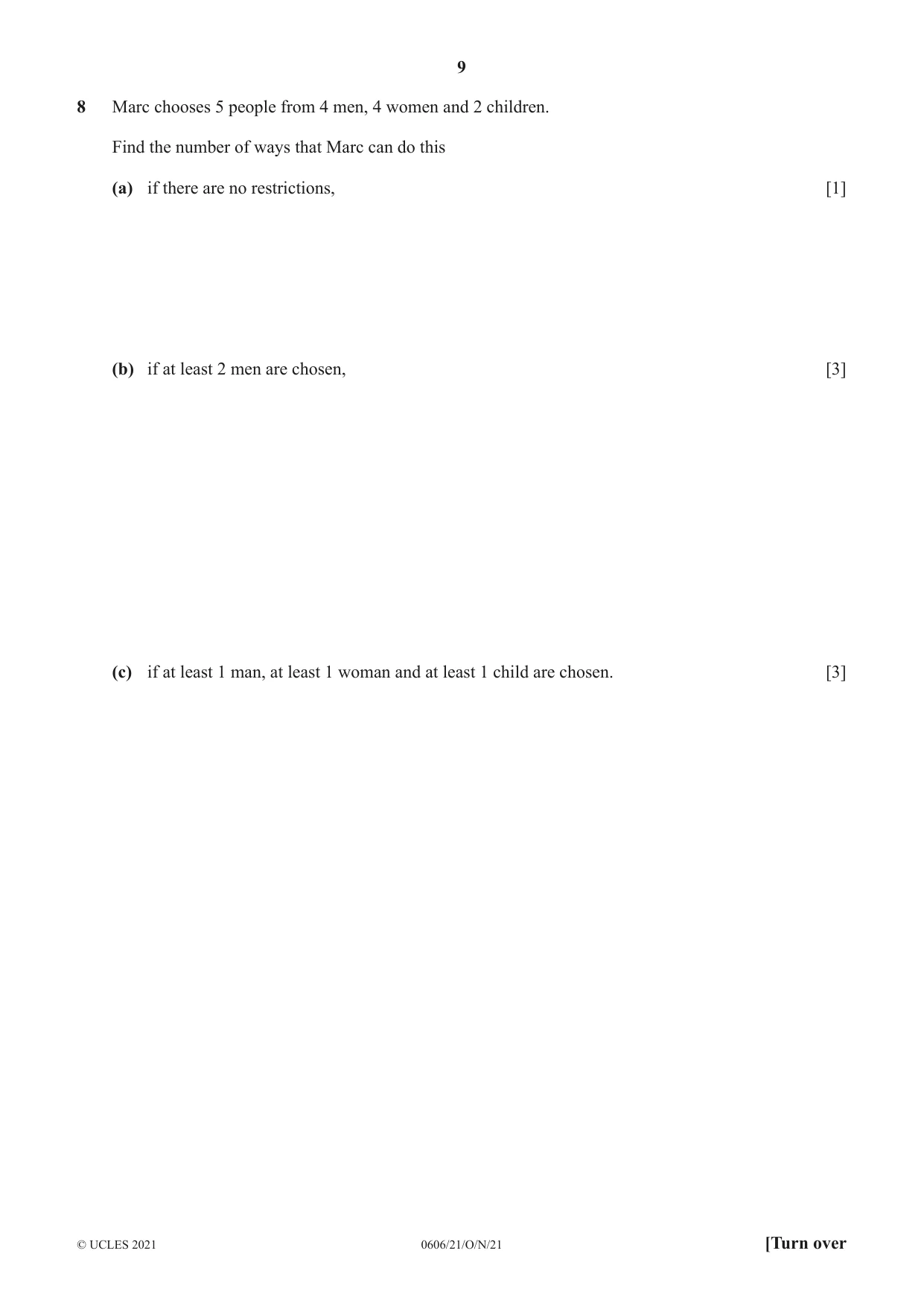
8 Marc chooses 5 people from 4 men, 4 women and 2 children. Find the number of ways that Marc can do this (a) if there are no restrictions, [1] (b) if at least 2 men are chosen, [3] (c) if at least 1 man, at least 1 woman and at least 1 child are chosen. [3]
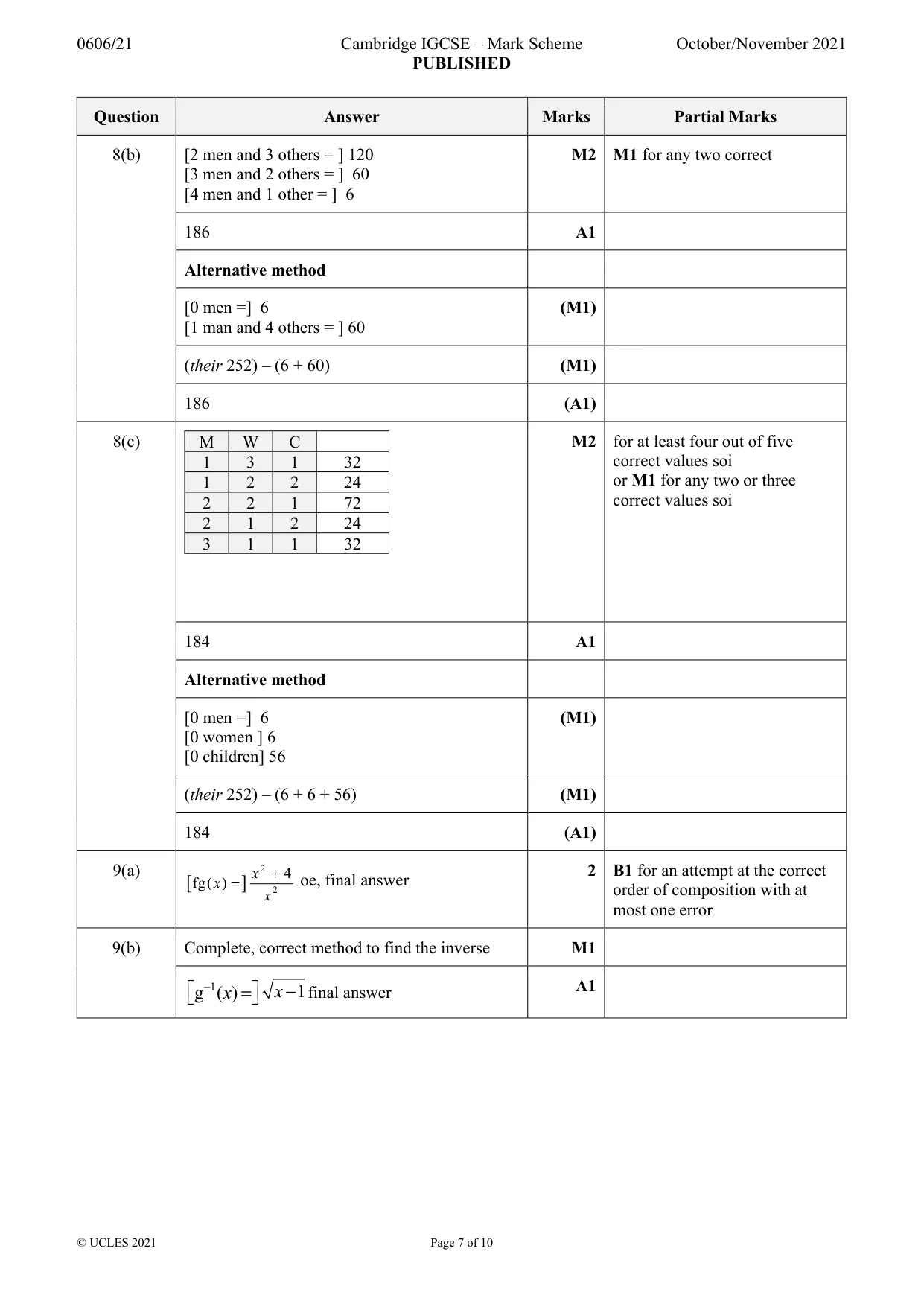
Mark scheme: 8(a) 252 B1 8(b) [2 men and 3 others = ] 120 M2 M1 for any two correct [3 men and 2 others = ] 60 [4 men and 1 other = ] 6 186 A1 Alternative method [0 men =] 6 (M1) [1 man and 4 others = ] 60 (their 252) – (6 + 60) (M1) 186 (A1) 8(c) M W C M2 for at least four out of five 1 3 1 32 correct values soi 1 2 2 24 or M1 for any two or three 2 2 1 72 correct values soi 2 1 2 24 3 1 1 32 184 A1 Alternative method [0 men =] 6 (M1) [0 women ] 6 [0 children] 56 (their 252) – (6 + 6 + 56) (M1) 184 (A1)
More questions on Solve problems on arrangement and selection
Q9 · The following functions are defined for x 2 1
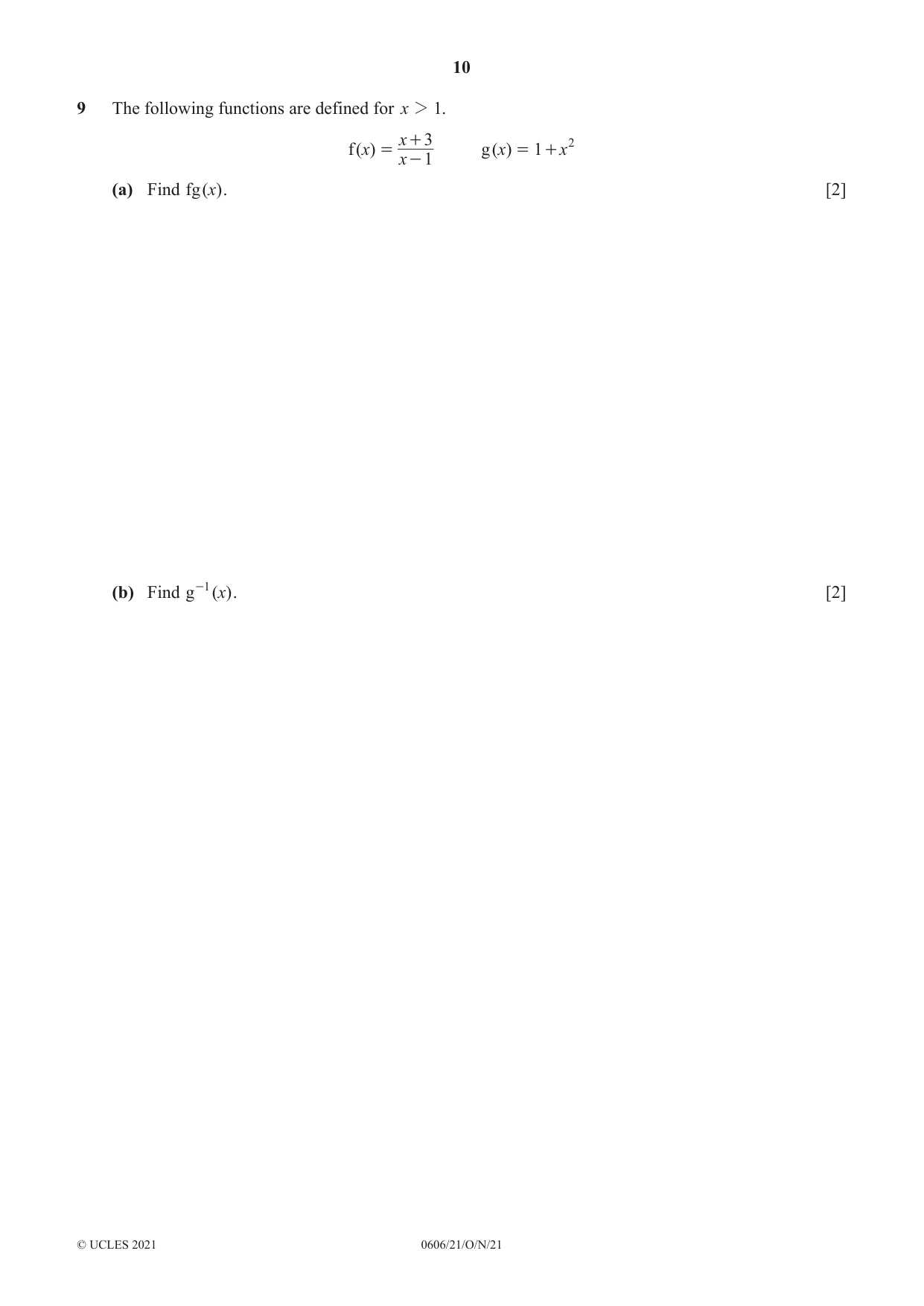
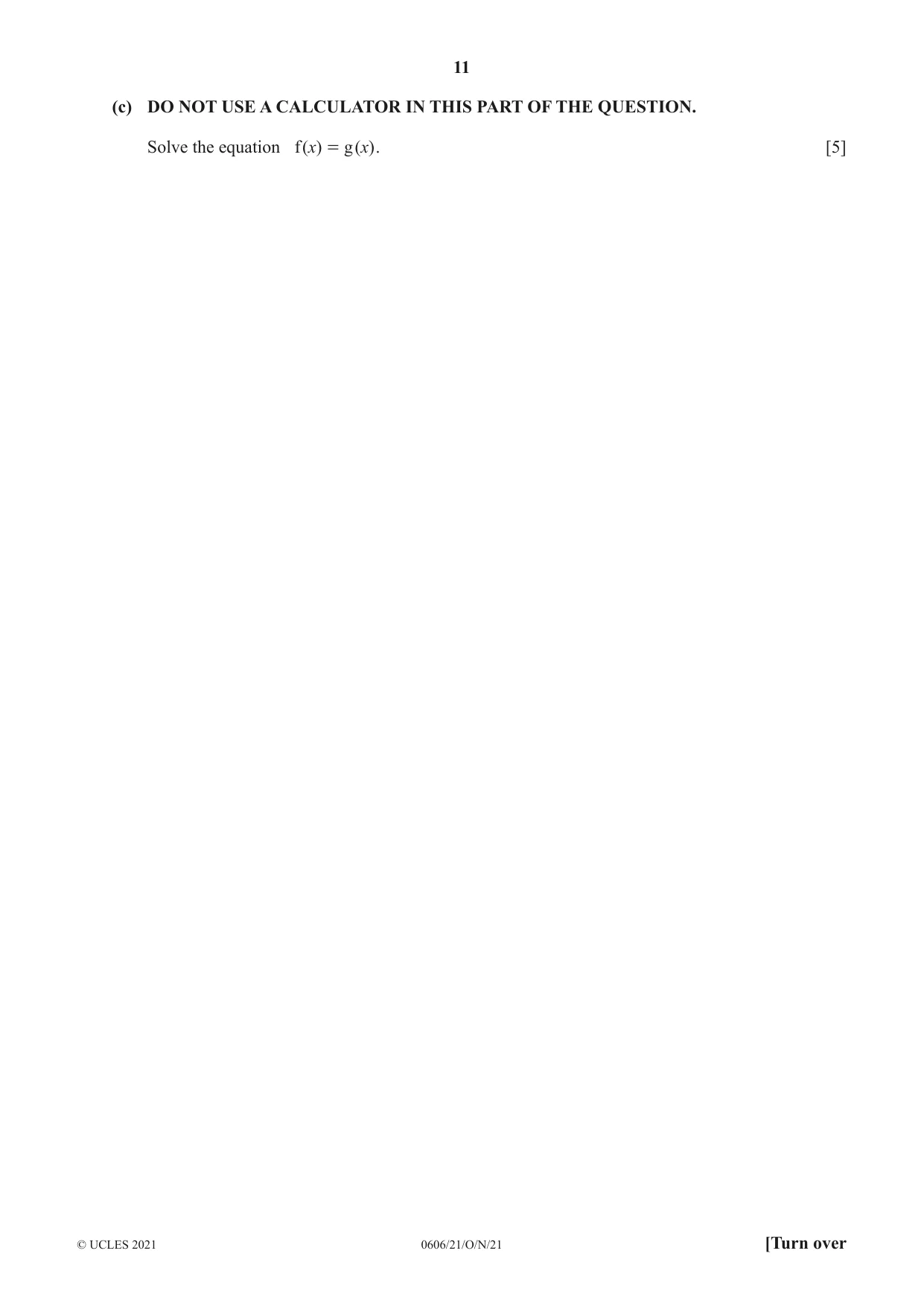
9 The following functions are defined for x 2 1. x + 3 2 f( )x = g( )x = 1 + x x - 1 (a) Find f g ( )x . [2] (b) Find g -1 ( )x . [2] (c) DO NOT USE A CALCULATOR IN THIS PART OF THE QUESTION. Solve the equation f( x) = g( x) . [5]
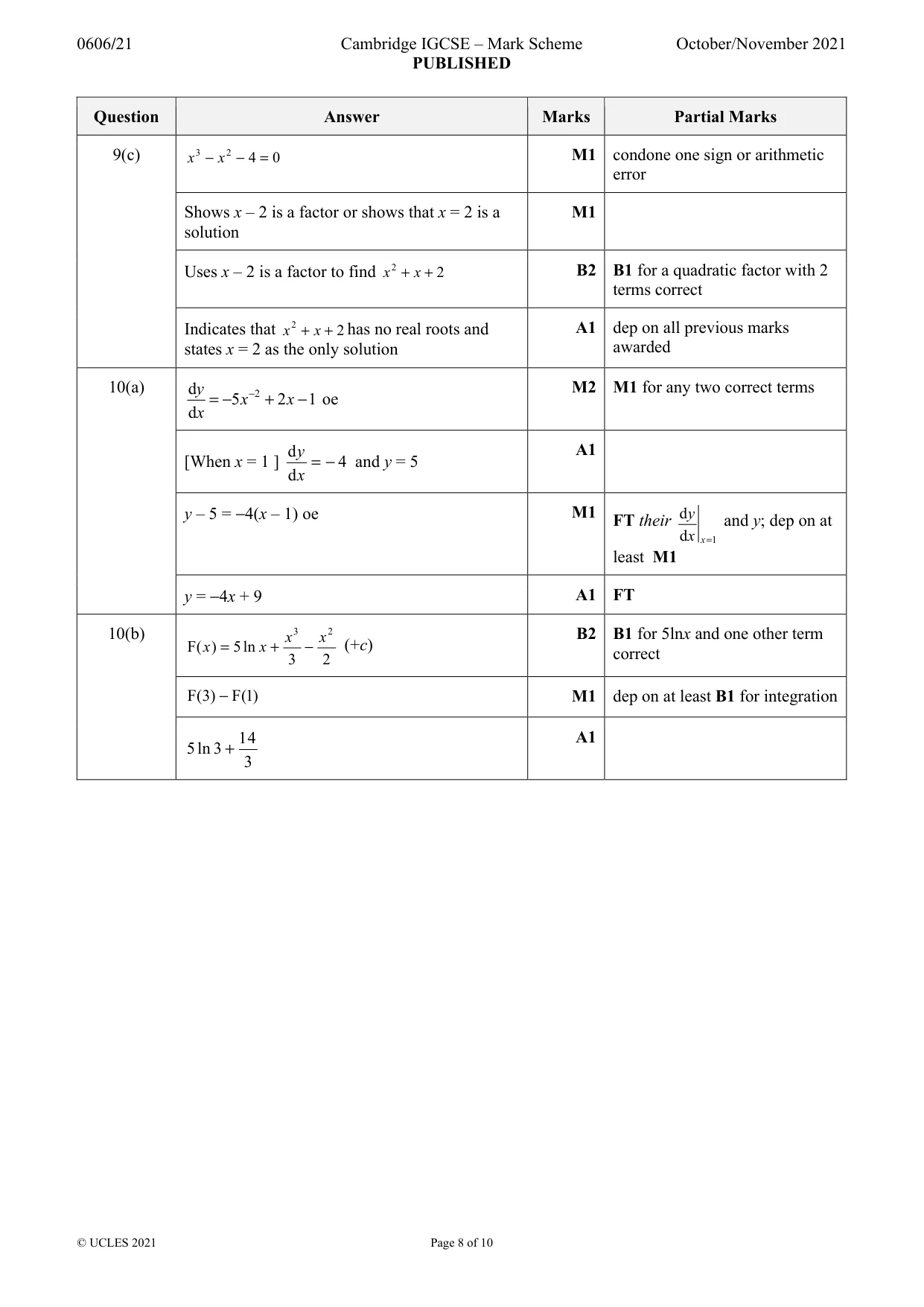
Mark scheme: 9(a) x 2 + 4 2 B1 for an attempt at the correct oe, final answer [ fg( x ) = ] order of composition with at x 2 most one error 9(b) Complete, correct method to find the inverse M1 −1 A1 g ( x) = x − 1 final answer 9(c) x 3 − x 2 − 4 = 0 M1 condone one sign or arithmetic error Shows x – 2 is a factor or shows that x = 2 is a M1 solution Uses x – 2 is a factor to find x 2 + x + 2 B2 B1 for a quadratic factor with 2 terms correct Indicates that x 2 + x + 2 has no real roots and A1 dep on all previous marks states x = 2 as the only solution awarded
More questions on Use substitution to form and solve a quadratic
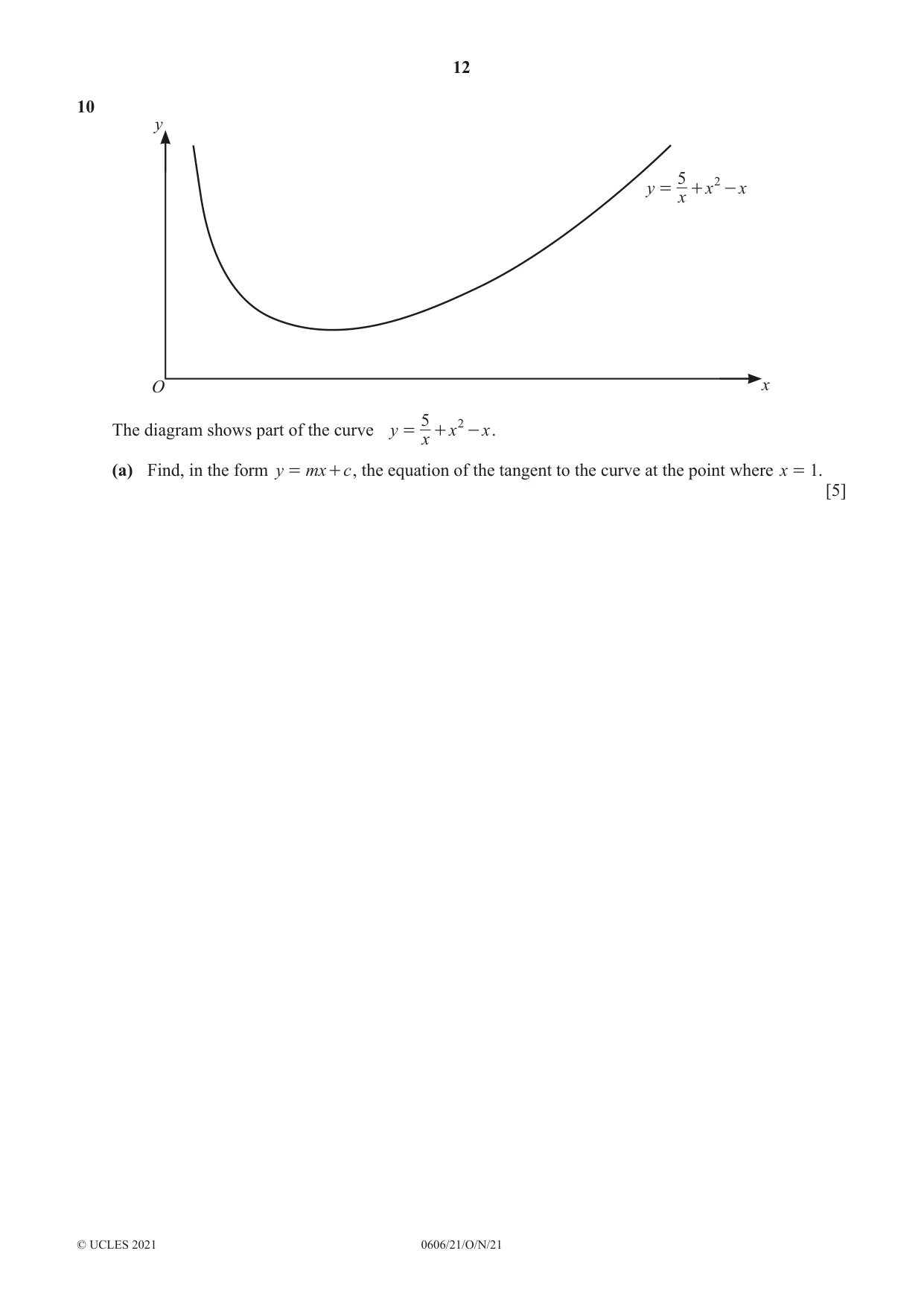
Q10 · Y 5 2 y = + x - x x O x 5 2 The diagram shows part of the curve y = + x - x
10 y 5 2 y = + x - x x O x 5 2 The diagram shows part of the curve y = + x - x . x (a) Find, in the form y = mx + c , the equation of the tangent to the curve at the point where x = 1. [5]
Mark scheme: 10(a) dy −2 M2 M1 for any two correct terms = −5 x + 2 x − 1 oe dx d y A1 [When x = 1 ] = − 4 and y = 5 d x y – 5 = −4(x – 1) oe M1 d y FT their and y; dep on at d x x =1 least M1 y = −4x + 9 A1 FT 10(b) x 3 x 2 B2 B1 for 5lnx and one other term F( x ) = 5ln x + − (+c) correct 3 2 F(3) − F(1) M1 dep on at least B1 for integration 14 A1 5ln 3 + 3
More questions on Use differentiation to find gradients, tangents
Q11 · The volume, V, of a cone with base radius r and vertical height h is given by rr 2 h
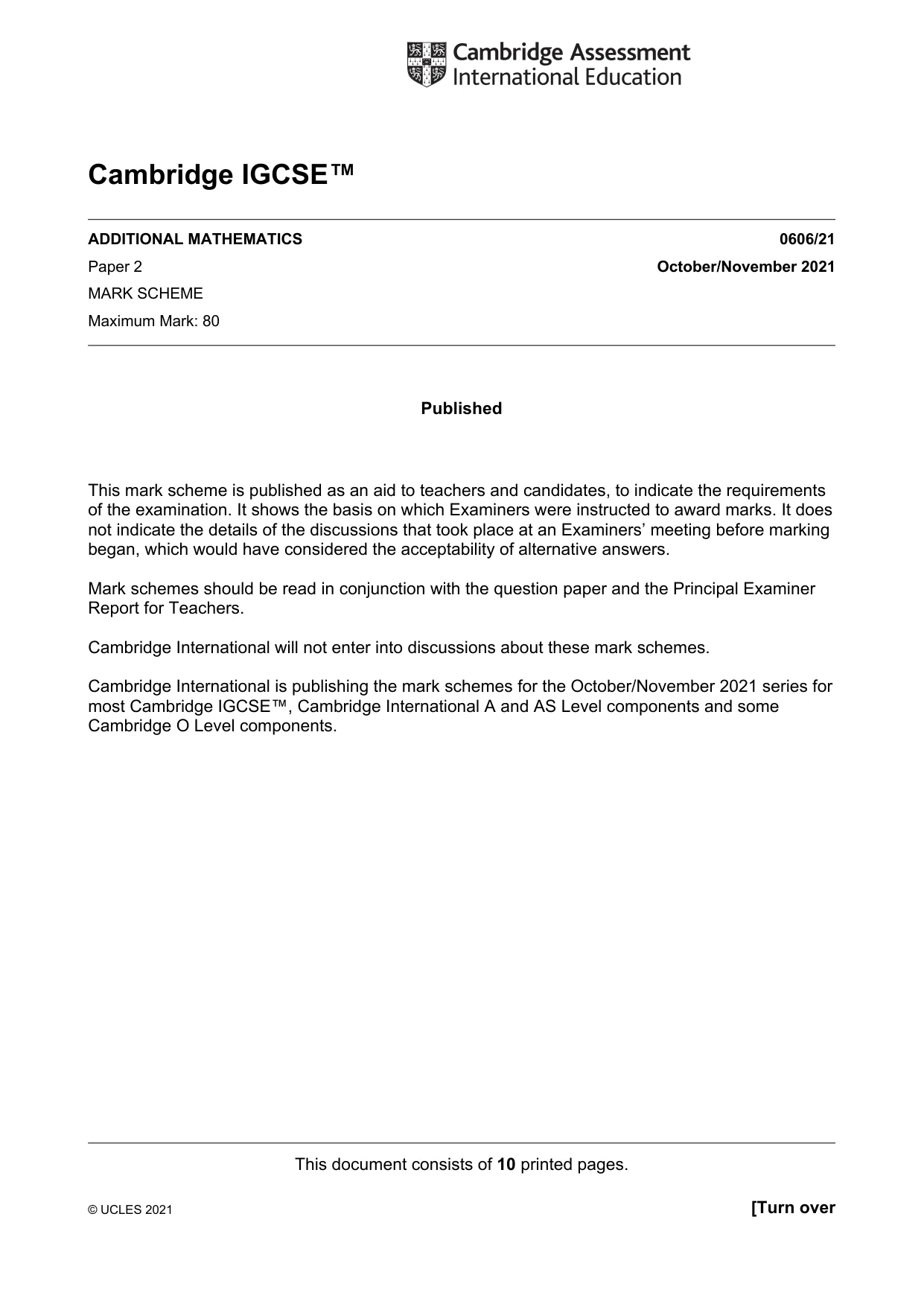
11 The volume, V, of a cone with base radius r and vertical height h is given by rr 2 h . 3 The curved surface area of a cone with base radius r and slant height l is given by rrl . A cone has base radius r cm, vertical height h cm and volume V cm3. The curved surface area of the cone is 4r cm2. 2 16 2 (a) Show that h = 2 - r . [4] r (b) Show that V = r 16r 2 - r 6 . [2] 3 (c) Given that r can vary and that V has a maximum value, find the value of r that gives the maximum volume. [5]
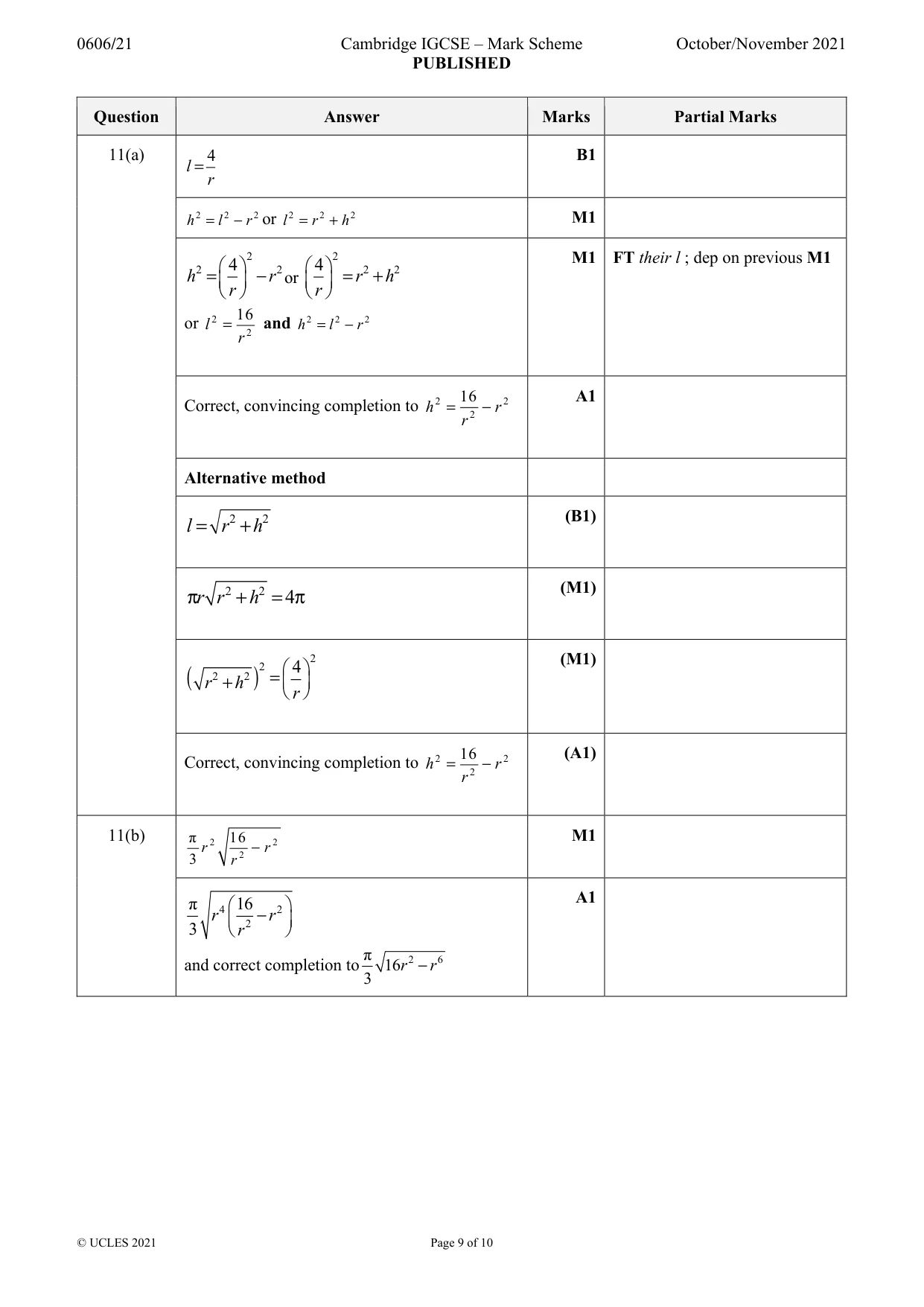
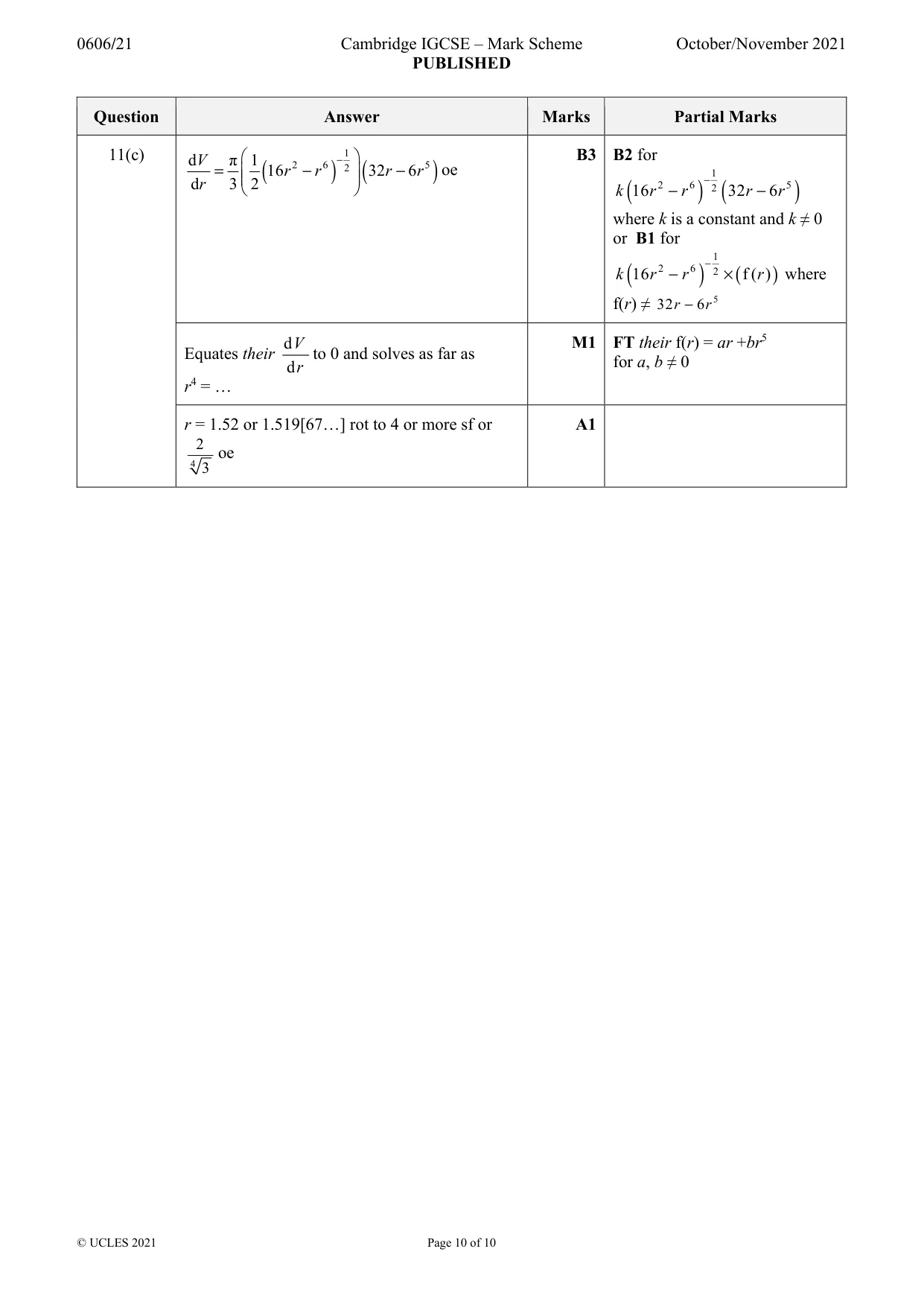
Mark scheme: 11(a) 4 B1 l = r h 2 = l 2 − r 2 or l 2 = r 2 + h 2 M1 2 2 M1 FT their l ; dep on previous M1 2 4 2 4 2 2 = h = − r or r + h r r 2 16 2 2 2 or l = and h = l − r r 2 2 16 2 A1 Correct, convincing completion to h = − r r 2 Alternative method 2 2 (B1) l = r + h 2 2 (M1) πr r + h = 4π 2 (M1) 2 4 2 2 ( r + h ) = r 2 16 2 (A1) Correct, convincing completion to h = − r r 2 11(b) π 2 16 2 M1 r 2 − r 3 r A1 π 4 16 2 r 2 − r 3 r π 2 6 and correct completion to 16r − r 3 111(c) − d V π 1 2 6 5 B3 B2 for 2 1 = (16 r 32 r − 6 r ) oe − r ) ( 2 6 − d r 3 2 16 r − r 32 r − 6 r k ( 2 5 ) ( ) where k is a constant and k ≠ 0 or B1 for 1 2 6 − 2 k 16 r − r × ( f ( r ) ) where ( ) f(r) ≠ 32 r − 6 r 5 d V M1 FT their f(r) = ar +br5 Equates their to 0 and solves as far as for a, b ≠ 0 d r r4 = … r = 1.52 or 1.519[67…] rot to 4 or more sf or A1 2 oe 4 3
More questions on Apply differentiation to practical problems
What was in this paper
The subtopics covered by these 10 questions, and how many questions each got. Open one in a new tab to see every Cambridge question on it.
1Differentiate products and quotients of1Find the solution set for quadratic inequalities1Know and use the laws of logarithms1Know the conditions for f(x) = 0 to have1Solve problems on arrangement and selection1Solve simultaneous equations in two1Solve, for a given domain, trigonometric1Use differentiation to find gradients, tangents1Use substitution to form and solve a quadratic1What you needed in this session
Cambridge’s own grade thresholds for 2021 Oct/Nov, Paper 2 · Variant 1. A higher threshold means an easier paper — the bar moves with how the cohort did.