Cambridge IGCSE Mathematics - Additional 0606 — 2021 Oct/Nov Paper 2 · Variant 2
0606/22/O/N/21 · 10 questions · 80 marks · ≈90 min
The question paper and its mark scheme, free to read here and free to download. This is Cambridge’s own paper, exactly as it was sat.
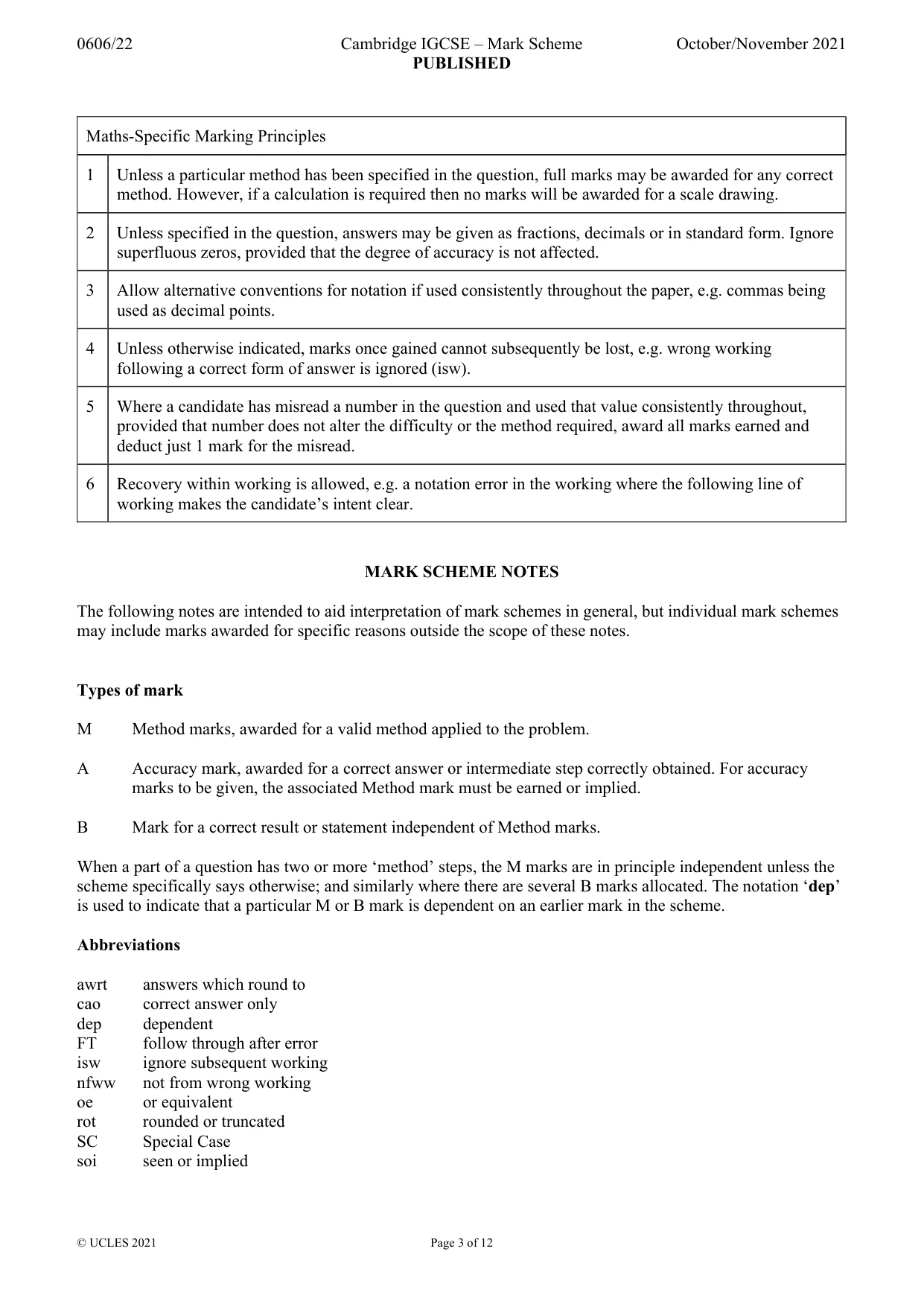
Question paper16 pages


Mark scheme12 pages
Answers below. Sit the paper first if you are practising.
Questions as text
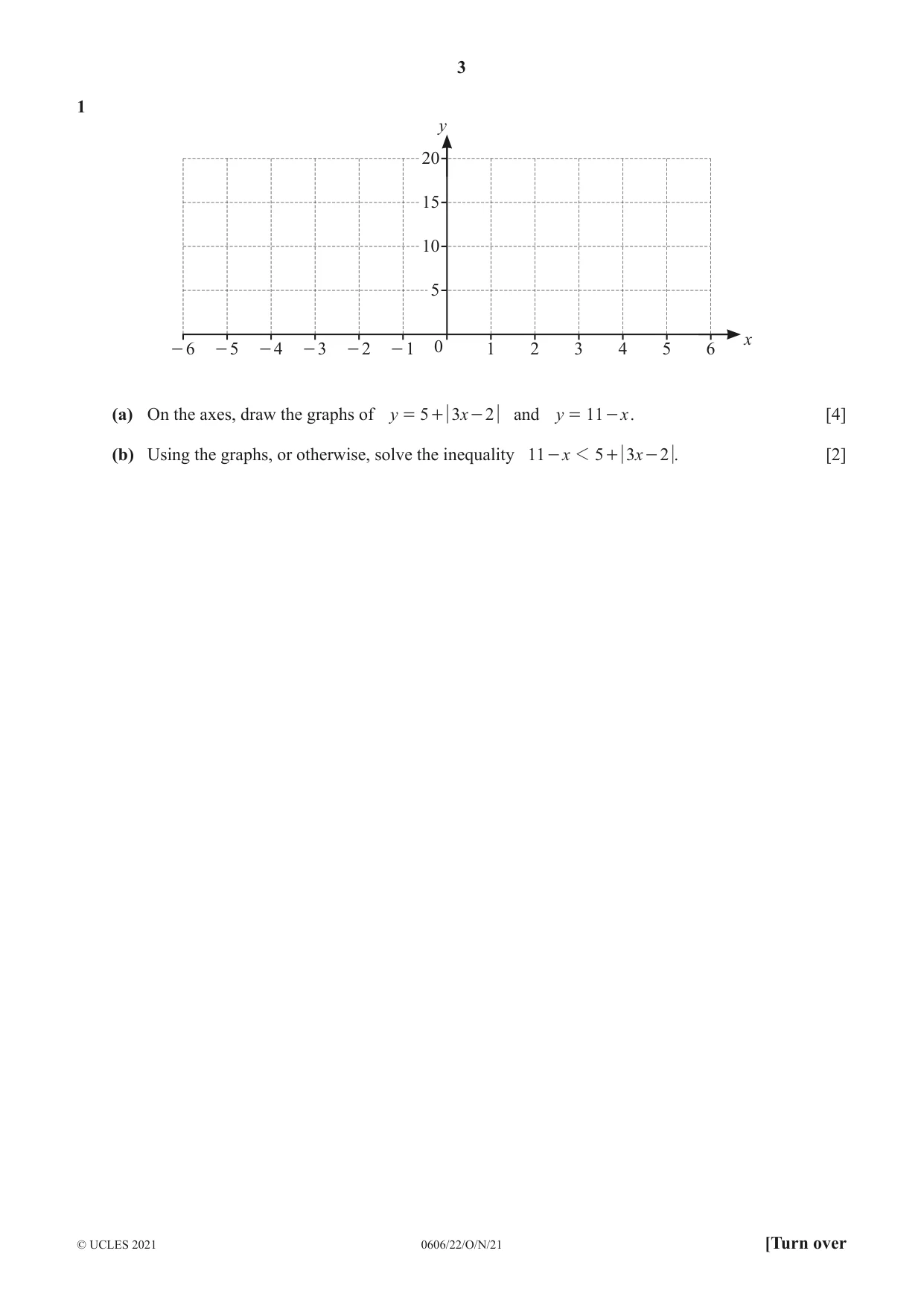
Q1 · Y 20 15 10 5 x - 6 - 5 - 4 - 3 - 2 - 1 0 1 2 3 4 5 6 (a) On the axes, draw the graphs of…
1 y 20 15 10 5 x - 6 - 5 - 4 - 3 - 2 - 1 0 1 2 3 4 5 6 (a) On the axes, draw the graphs of y = 5 + 3 x - 2 and y = 11 - x . [4] (b) Using the graphs, or otherwise, solve the inequality 11 - x 1 5 + 3x - 2 . [2]
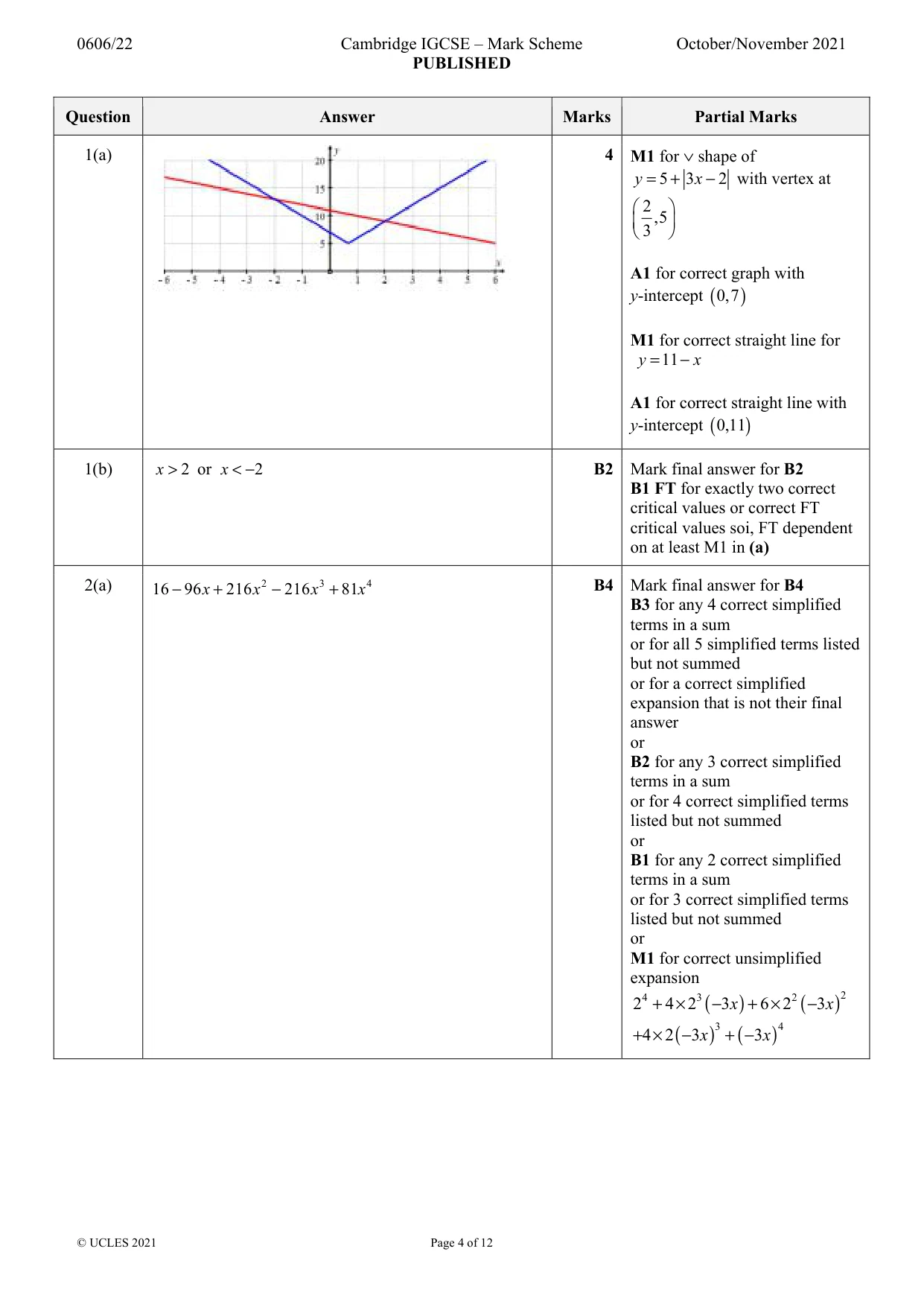
Mark scheme: Question Answer Marks Partial Marks 1(a) 4 M1 for ∨ shape of y = 5 + 3 x − 2 with vertex at 2 , 5 3 A1 for correct graph with y-intercept ( 0, 7 ) M1 for correct straight line for y = 11 − x A1 for correct straight line with y-intercept ( 0,1 1) 1(b) x > 2 or x < − 2 B2 Mark final answer for B2 B1 FT for exactly two correct critical values or correct FT critical values soi, FT dependent on at least M1 in (a)
More questions on Sketch the graphs of cubic polynomials and
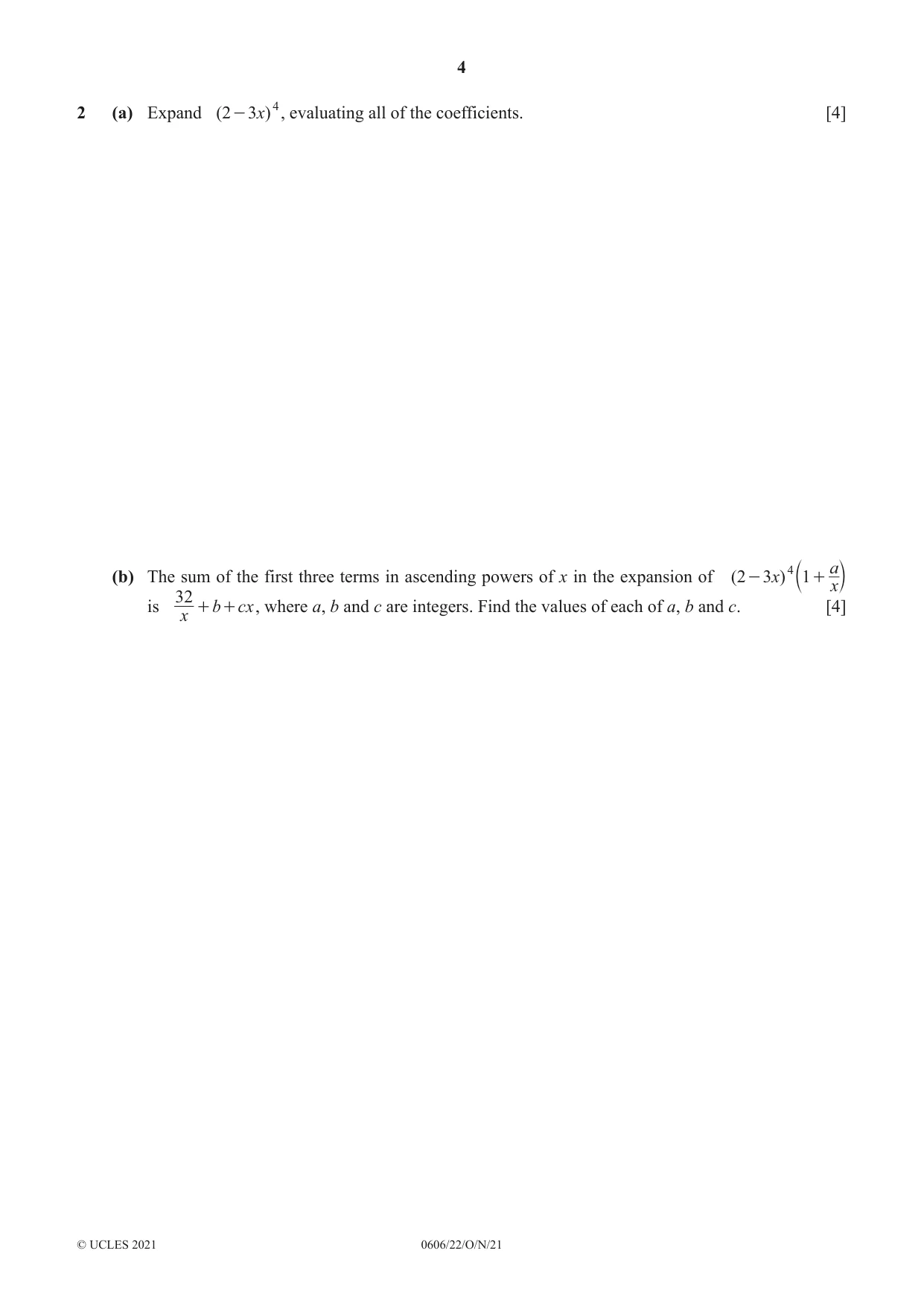
Q2 · Expand ( 2 - 3)x 4 , evaluating all of the coefficients
2 (a) Expand ( 2 - 3)x 4 , evaluating all of the coefficients. [4] 4 a (b) The sum of the first three terms in ascending powers of x in the expansion of ( 2 - 3)x 1 + b x l 32 is + b + cx , where a, b and c are integers. Find the values of each of a, b and c. [4] x
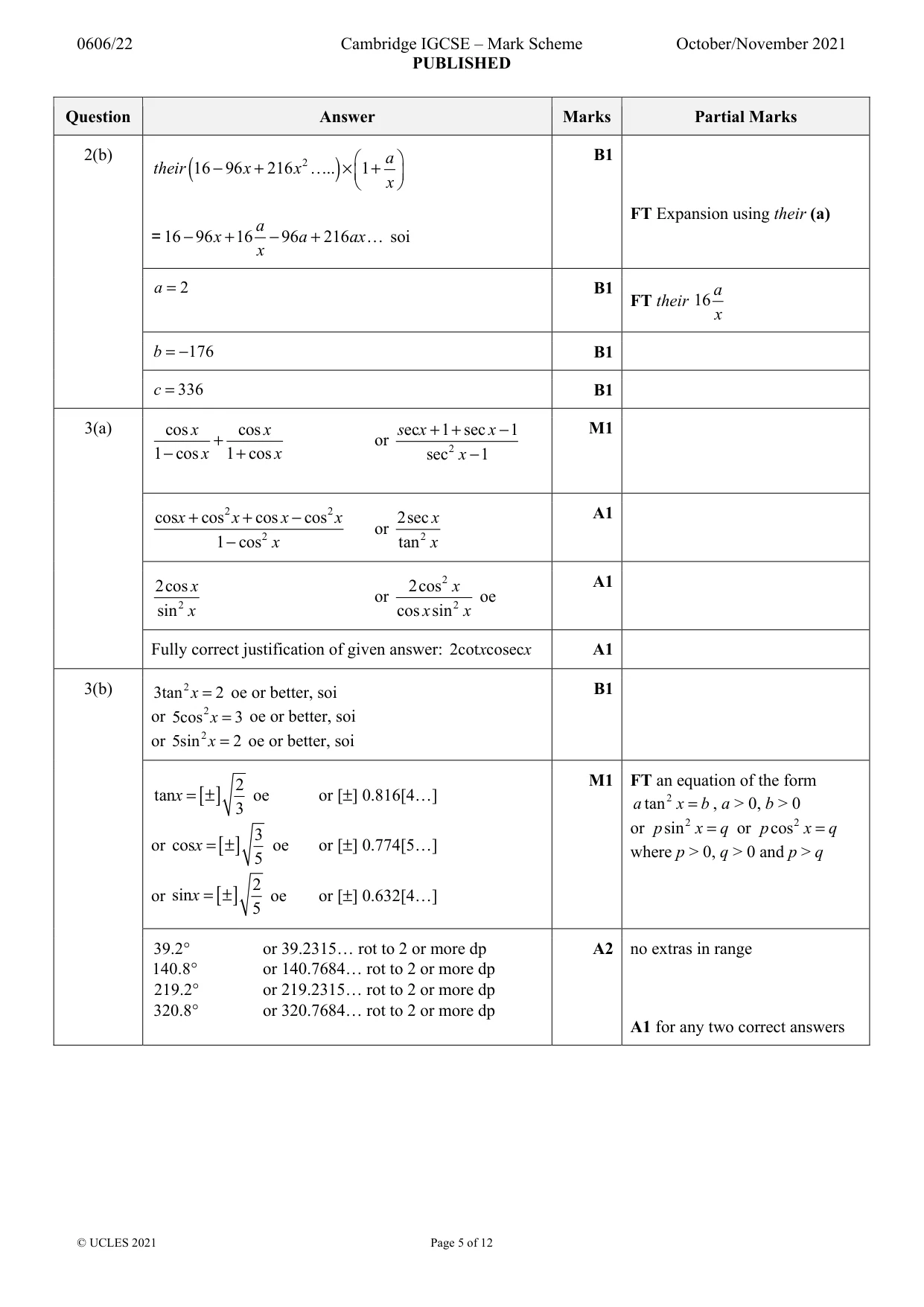
Mark scheme: 2(a) 16 − 96 x + 216 x 2 − 216 x 3 + 81x 4 B4 Mark final answer for B4 B3 for any 4 correct simplified terms in a sum or for all 5 simplified terms listed but not summed or for a correct simplified expansion that is not their final answer or B2 for any 3 correct simplified terms in a sum or for 4 correct simplified terms listed but not summed or B1 for any 2 correct simplified terms in a sum or for 3 correct simplified terms listed but not summed or M1 for correct unsimplified expansion 2 4 + 4 × 23 ( −3 x ) + 6 × 2 2 ( −3 x ) 2 3 4 +4 × 2 ( −3 x ) + ( −3 x ) 2(b) 2 a B1 their 16 − 96 x + 216 x ….. × 1 + ( ) x FT Expansion using their (a) a = 16 − 96 x + 16 − 96 a + 216 ax … soi x a = 2 B1 a FT their 16 x b = − 176 B1 c = 336 B1
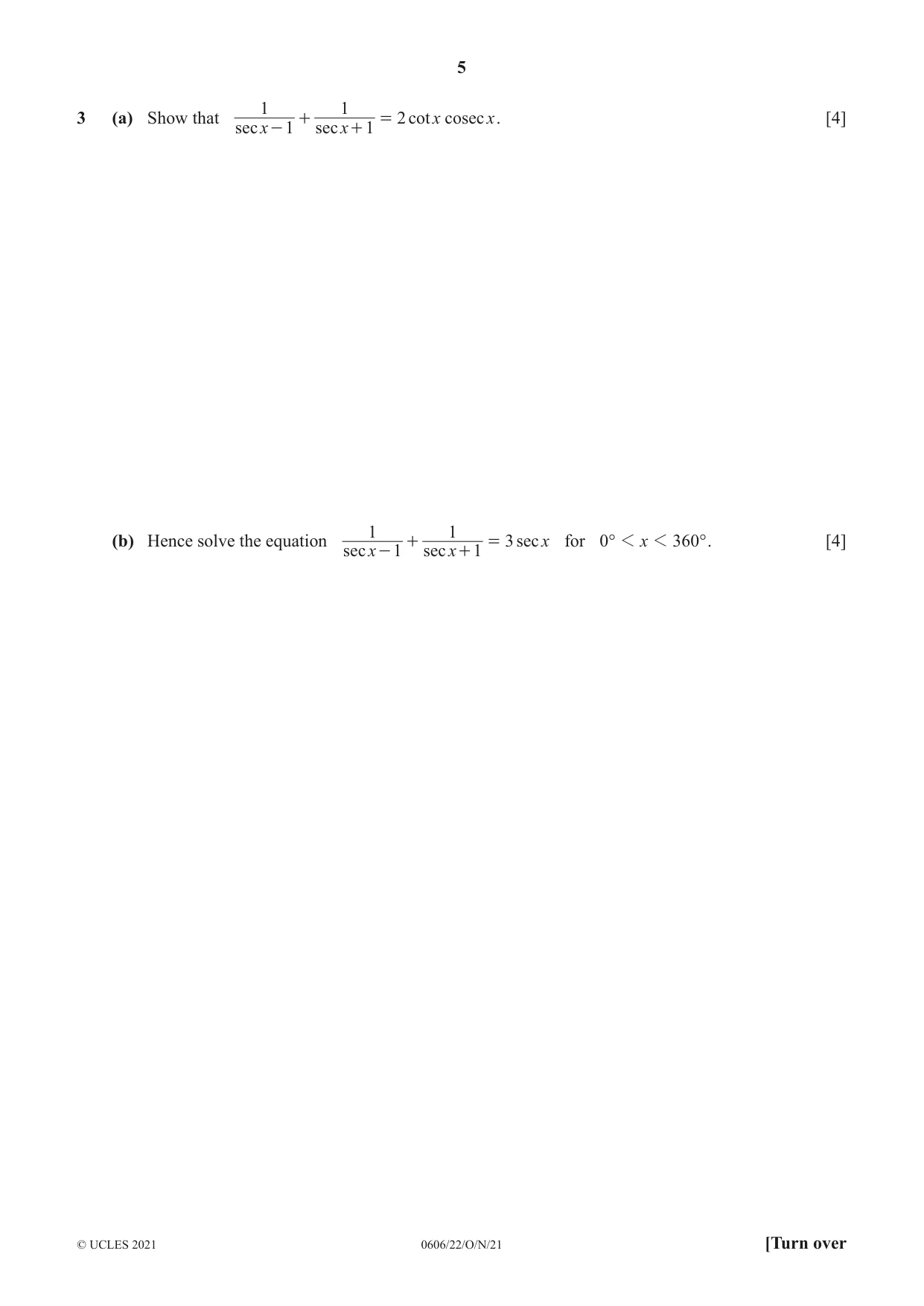
Q3 · Show that + = 2 cot x cosec x
3 (a) Show that + = 2 cot x cosec x . [4] sec x - 1 sec x + 1 1 1 (b) Hence solve the equation + = 3 sec x for 0° 1 x 1 360° . [4] sec x - 1 sec x + 1
Mark scheme: 3(a) cos x cos x s ecx + 1 + sec x − 1 M1 + or 1 − cos x 1 + cos x sec 2 x − 1 cosx + cos 2 x + cos x − cos 2 x 2sec x A1 or 1 − cos 2 x tan 2 x 2cos x 2cos 2 x A1 or oe sin 2 x cos x sin 2 x Fully correct justification of given answer: 2cot xcosec x A1 3(b) 3tan 2 x = 2 oe or better, soi B1 or 5cos 2 x = 3 oe or better, soi or 5sin 2 x = 2 oe or better, soi 2 M1 FT an equation of the form tanx = [ ± ] oe or [±] 0.816[4…] 2 a tan x = b , a > 0, b > 0 3 or p sin 2 x = q or p cos 2 x = q 3 or cosx = [ ± ] oe or [±] 0.774[5…] where p > 0, q > 0 and p > q 5 2 or sinx = [ ± ] oe or [±] 0.632[4…] 5 39.2° or 39.2315… rot to 2 or more dp A2 no extras in range 140.8° or 140.7684… rot to 2 or more dp 219.2° or 219.2315… rot to 2 or more dp 320.8° or 320.7684… rot to 2 or more dp A1 for any two correct answers
More questions on Prove trigonometric relationships involving the
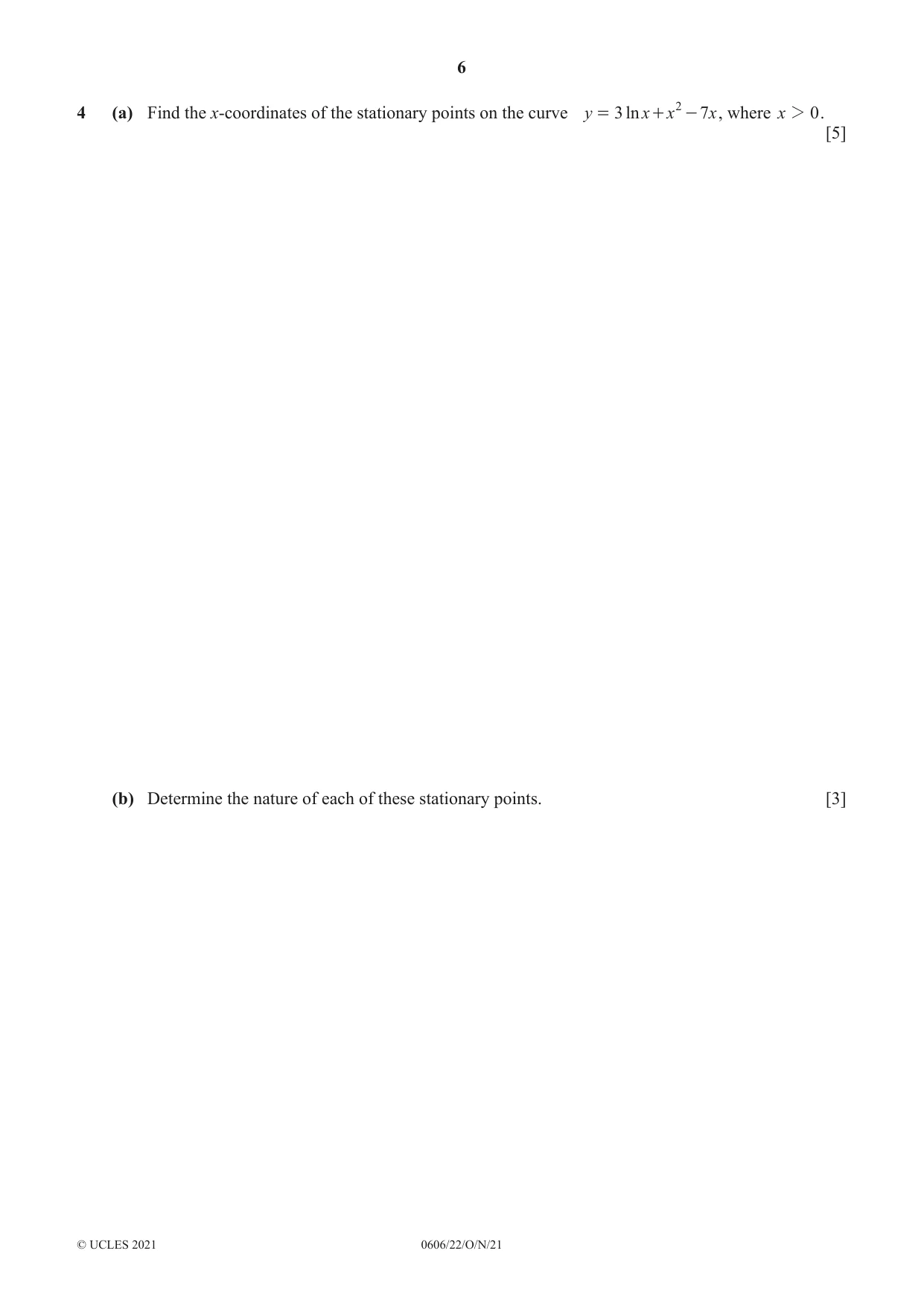
Q4 · Find the x-coordinates of the stationary points on the curve y = 3 ln x + x 2 - 7 x…
4 (a) Find the x-coordinates of the stationary points on the curve y = 3 ln x + x 2 - 7 x , where x 2 0 . [5] (b) Determine the nature of each of these stationary points. [3]
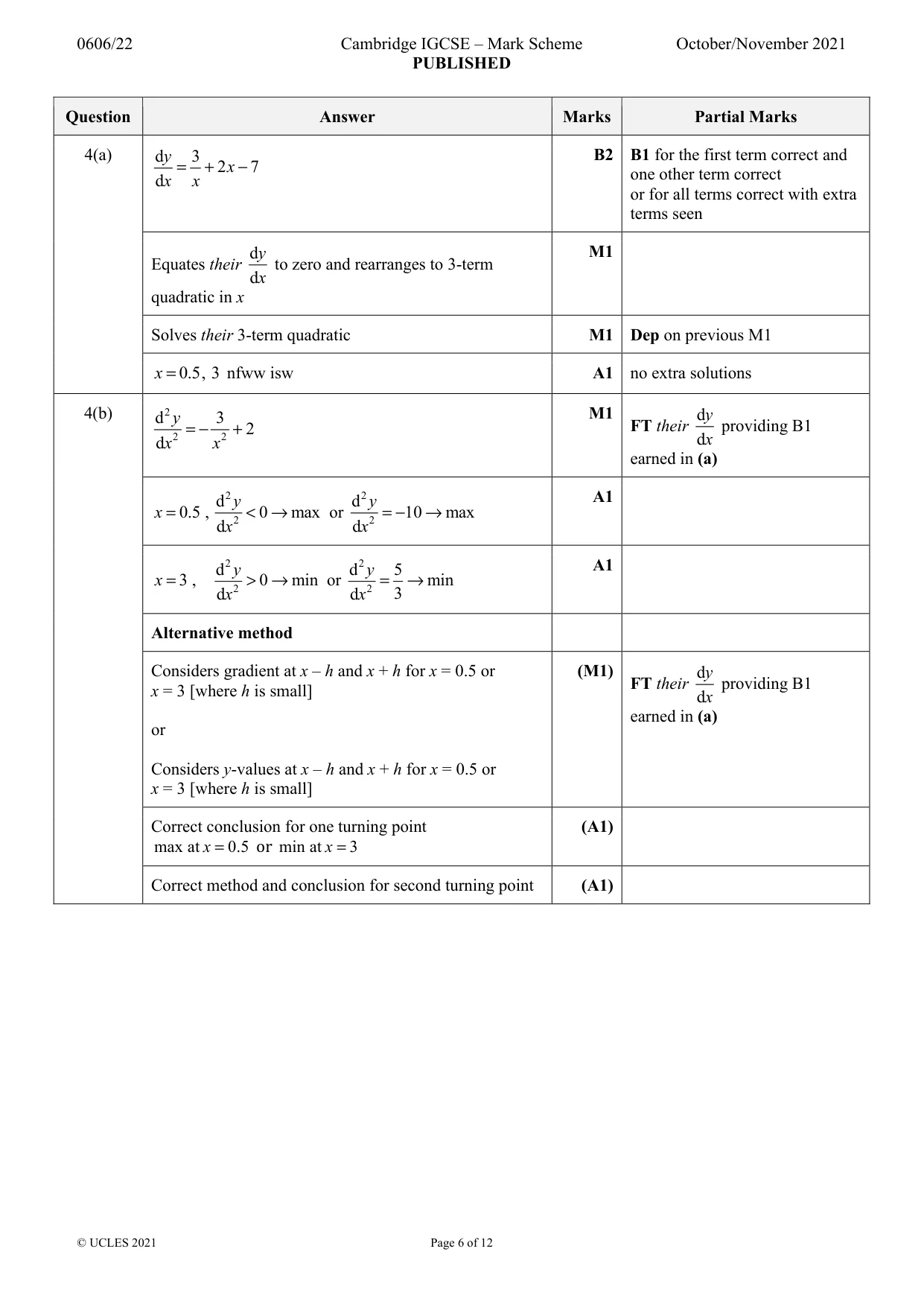
Mark scheme: 4(a) dy 3 B2 B1 for the first term correct and = + 2 x − 7 one other term correct dx x or for all terms correct with extra terms seen dy M1 Equates their to zero and rearranges to 3-term dx quadratic in x Solves their 3-term quadratic M1 Dep on previous M1 x = 0.5 , 3 nfww isw A1 no extra solutions 4(b) d 2 y 3 M1 dy = − + 2 FT their providing B1 dx 2 x 2 dx earned in (a) d 2 y d 2 y A1 x = 0.5 , < 0 → max or = −10 → max dx 2 dx 2 d 2 y d 2 y 5 A1 x = 3 , > 0 → min or = → min dx 2 dx 2 3 Alternative method Considers gradient at x ‒ h and x + h for x = 0.5 or (M1) dy FT their providing B1 x = 3 [where h is small] dx earned in (a) or Considers y-values at x ‒ h and x + h for x = 0.5 or x = 3 [where h is small] Correct conclusion for one turning point (A1) max at x = 0.5 or min at x = 3 Correct method and conclusion for second turning point (A1)
More questions on Use differentiation to find stationary points
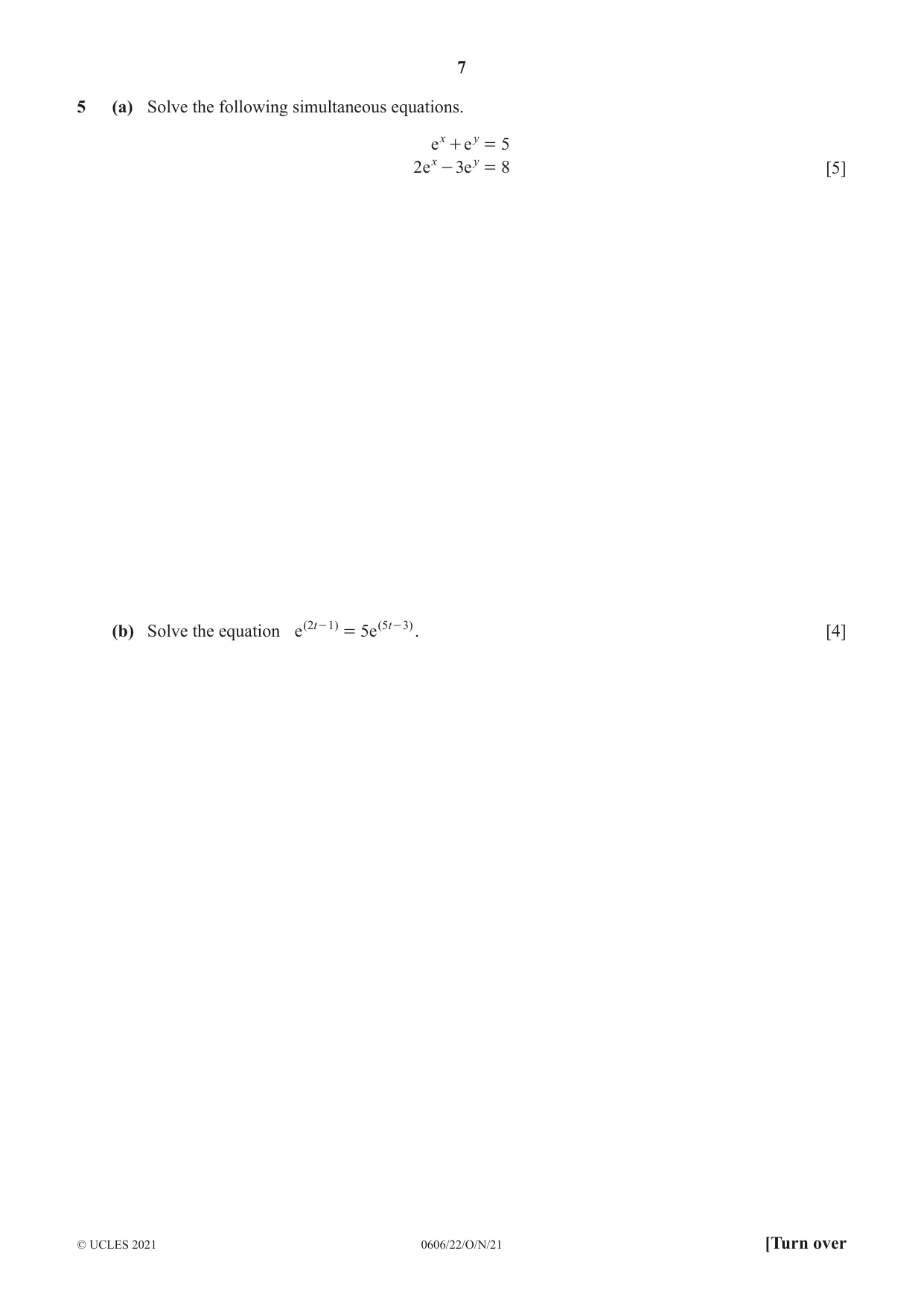
Q5 · Solve the following simultaneous equations
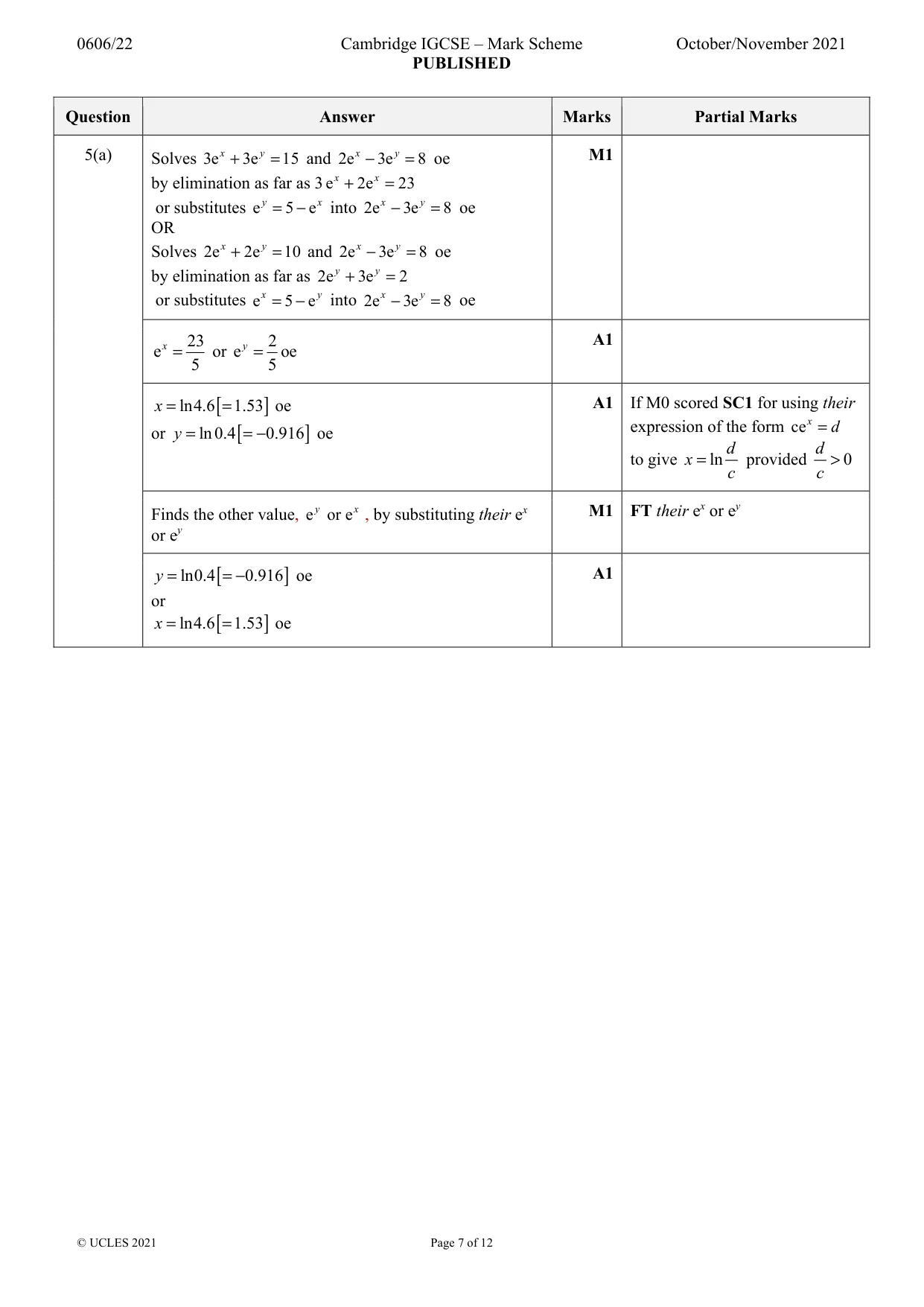
5 (a) Solve the following simultaneous equations. e x + e y = 5 2 e x - 3e y = 8 [5] (b) Solve the equation e ( 2 t - 1 ) = 5e ( 5 t - 3 ) . [4]
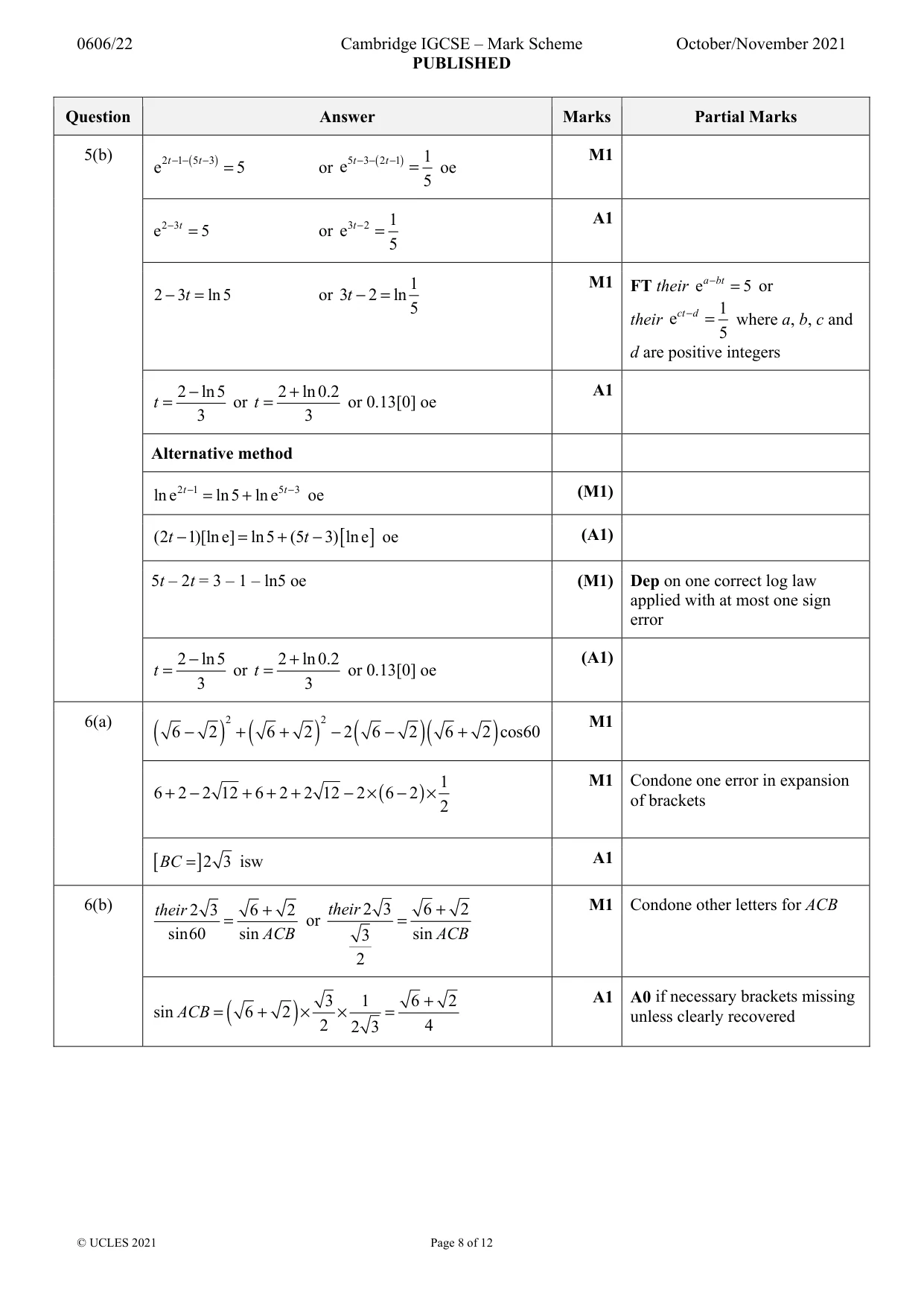
Mark scheme: 5(a) Solves 3e x + 3e y = 15 and 2e x − 3e y = 8 oe M1 by elimination as far as 3 e x + 2e x = 23 or substitutes e y = 5 − e x into 2e x − 3e y = 8 oe OR Solves 2e x + 2e y = 10 and 2e x − 3e y = 8 oe by elimination as far as 2e y + 3e y = 2 or substitutes e x = 5 − e y into 2e x − 3e y = 8 oe x 23 y 2 A1 e = or e = oe 5 5 x = ln4.6 [ = 1.53] oe A1 If M0 scored SC1 for using their expression of the form cex = d or y = ln0.4 [ = −0.916 ] oe d d to give x = ln provided > 0 c c Finds the other value, e y or e x , by substituting their ex M1 FT their ex or ey or ey y = ln0.4 [ = −0.916 ] oe A1 or x = ln4.6 [ = 1.53] oe 5(b) 2 t −−1 ( 5 t − 3 ) 5 t −−3 ( 2 t 1) 1 M1 e = 5 or e −= oe 5 2 − 3 t 3 2 1 A1 e = 5 or e t−= 5 1 M1 FT their e a − bt = 5 or 2 − 3t = ln5 or 3t − 2 = ln 5 ct d 1 their e −= where a, b, c and 5 d are positive integers 2 − ln5 2 + ln0.2 A1 t = or t = or 0.13[0] oe 3 3 Alternative method ln e 2 t −1 = ln5 + lne 5 t − 3 oe (M1) (2t − 1)[lne] = ln5 + (5t − 3) [ lne ] oe (A1) 5t – 2t = 3 – 1 – ln5 oe (M1) Dep on one correct log law applied with at most one sign error 2 − ln5 2 + ln0.2 (A1) t = or t = or 0.13[0] oe 3 3
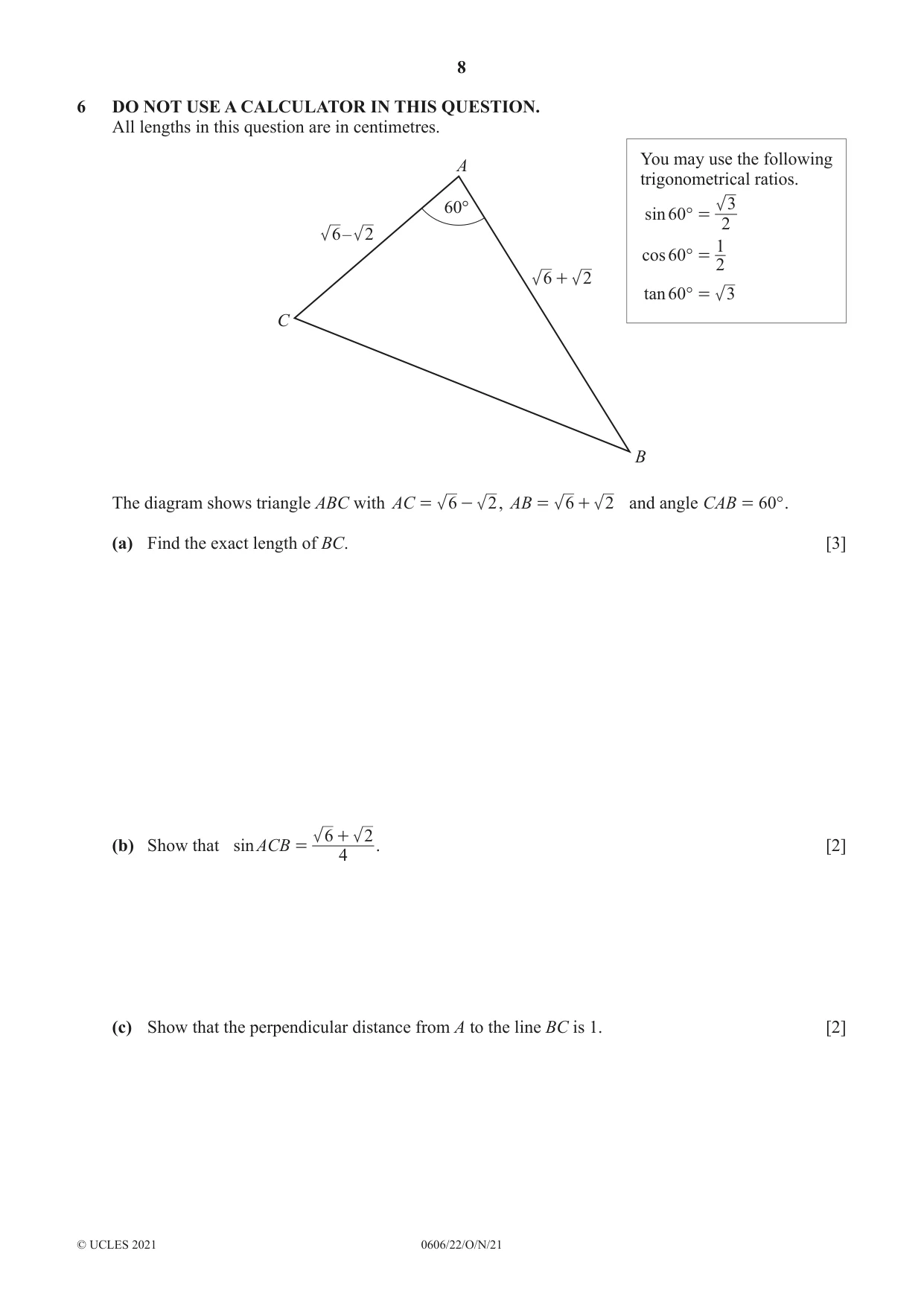
Q6 · DO NOT USE A CALCULATOR IN THIS QUESTION
6 DO NOT USE A CALCULATOR IN THIS QUESTION. All lengths in this question are in centimetres. You may use the following A trigonometrical ratios. 3 60° sin 60° = 2 6 – 2 1 cos 60° = 2 6 + 2 tan60° = 3 C B The diagram shows triangle ABC with AC = 6 - 2 , AB = 6 + 2 and angle CAB = 60° . (a) Find the exact length of BC. [3] 6 + 2 (b) Show that sinACB = . [2] 4 (c) Show that the perpendicular distance from A to the line BC is 1. [2]
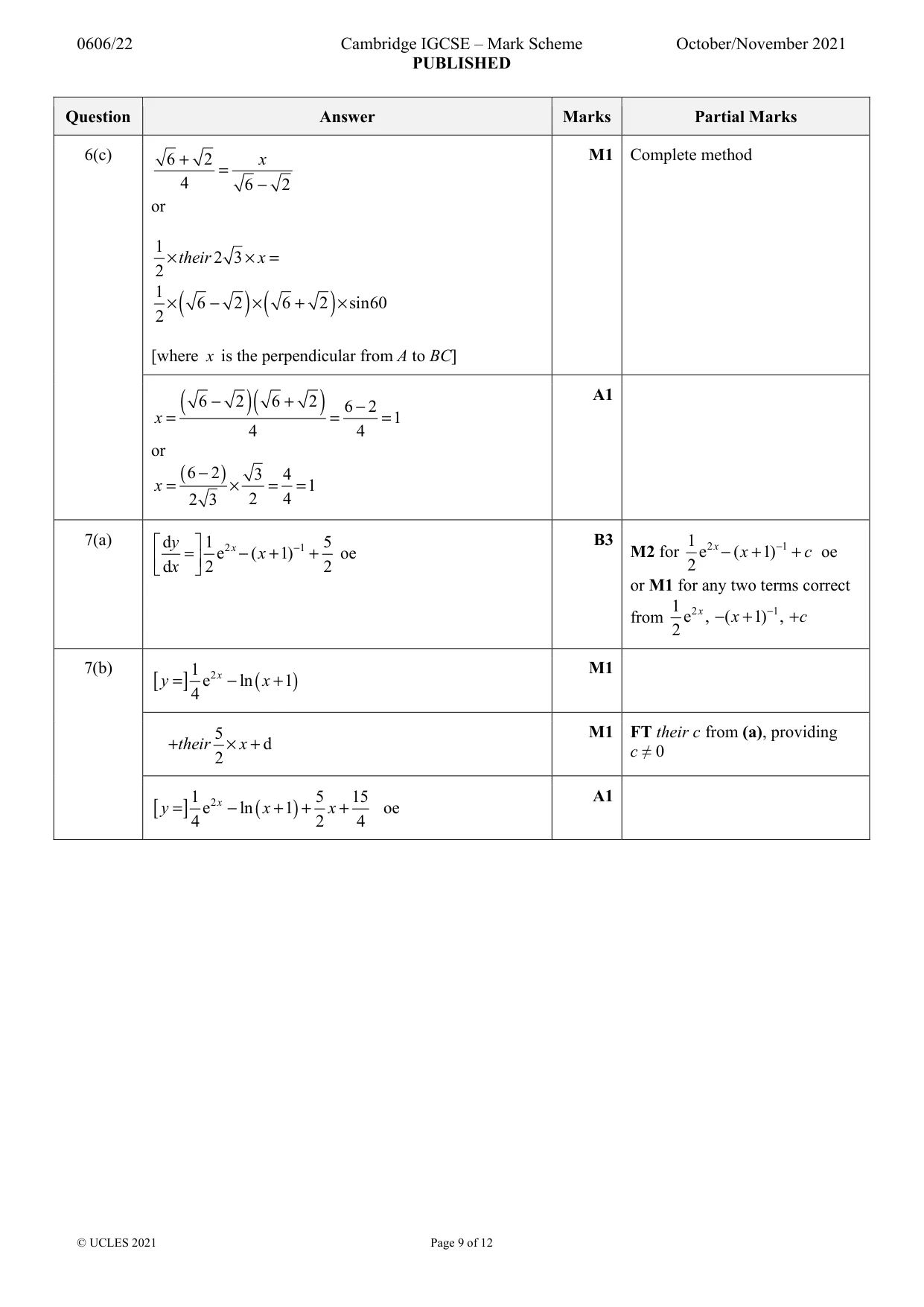
Mark scheme: 6(a) 2 2 M1 6 − 2 + 6 + 2 − 2 6 − 2 6 + 2 cos60 ( ) ( ) ( )( ) 1 M1 Condone one error in expansion 6 + 2 − 2 12 + 6 + 2 + 2 12 −×2 ( 6 − 2 ) × of brackets 2 [ BC = ] 2 3 isw A1 6(b) their 2 3 6 + 2 their 2 3 6 + 2 M1 Condone other letters for ACB = or = sin60 sin ACB 3 sin ACB 2 3 1 6 + 2 A1 A0 if necessary brackets missing 6 + 2 sin ACB = × × = unless clearly recovered ( ) 2 2 3 4 6(c) 6 + 2 x M1 Complete method = 4 6 − 2 or 1 × their 2 3 × x = 2 1 × 6 − 2 × 6 + 2 × sin60 ( ) ( ) 2 [where x is the perpendicular from A to BC] A1 6 − 2 6 + 2 ( )( ) 6 − 2 x = = = 1 4 4 or ( 6 − 2 ) 3 4 x = × = = 1 2 3 2 4
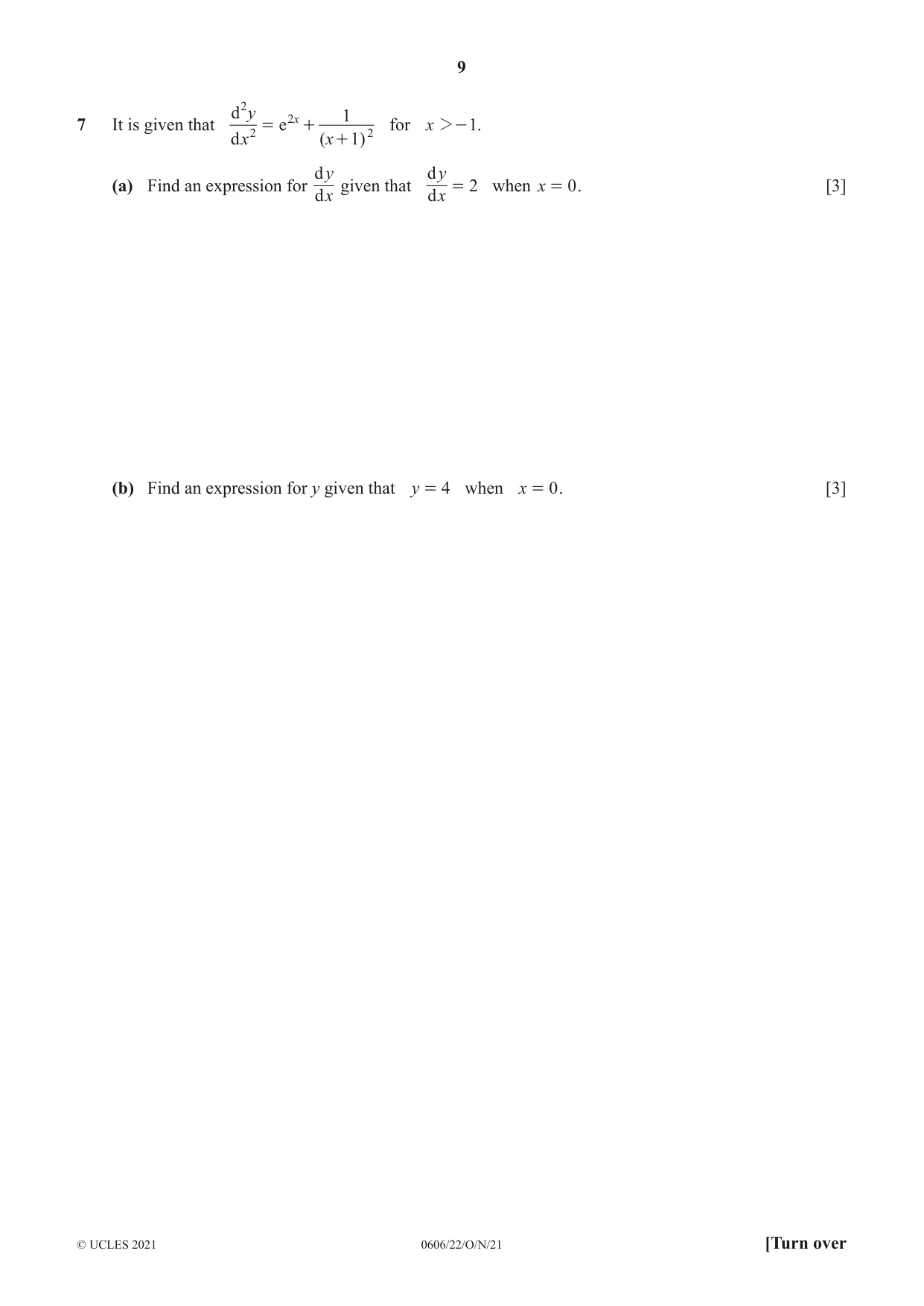
Q7 · It is given that 2 2 x = e + 2 for x 2- 1
7 It is given that 2 2 x = e + 2 for x 2- 1. d x ( x + 1 ) d y d y (a) Find an expression for given that = 2 when x = 0 . [3] d x d x (b) Find an expression for y given that y = 4 when x = 0 . [3]
Mark scheme: 7(a) dy 1 2 x −1 5 B3 1 2 x −1 = e − ( x + 1) + oe M2 for e − ( x + 1) + c oe dx 2 2 2 or M1 for any two terms correct 1 2 x −1 from e , − ( x + 1) , + c 2 7(b) 1 2 x M1 [ y = ] e − ln ( x + 1) 4 5 M1 FT their c from (a), providing + their × x + d c ≠ 0 2 1 2 x 5 15 A1 [ y = ] e − ln ( x + 1) + x + oe 4 2 4
More questions on Understand integration as the reverse process
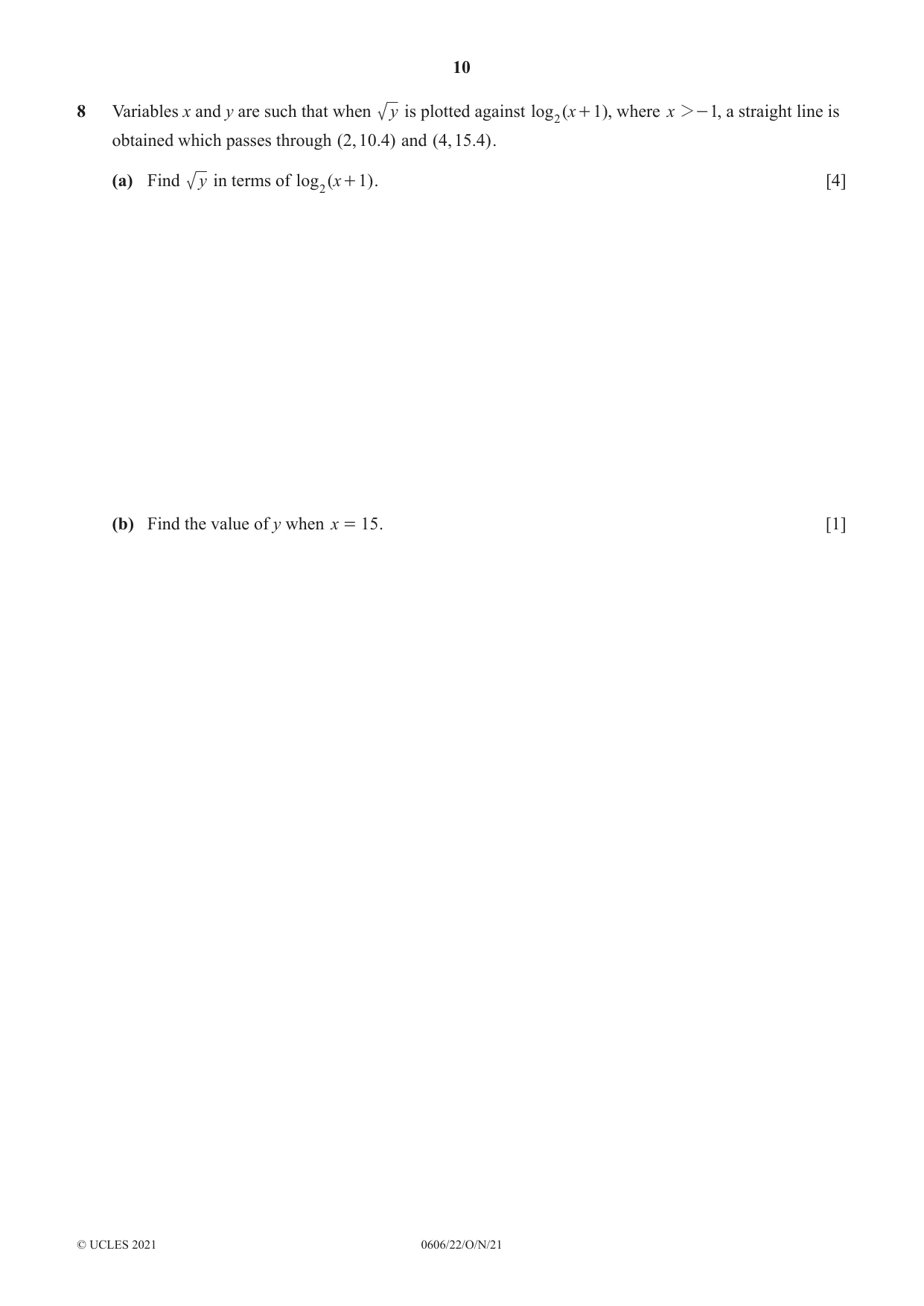
Q8 · Variables x and y are such that when y is plotted against log 2 ( x + 1), where x 2- 1, a…
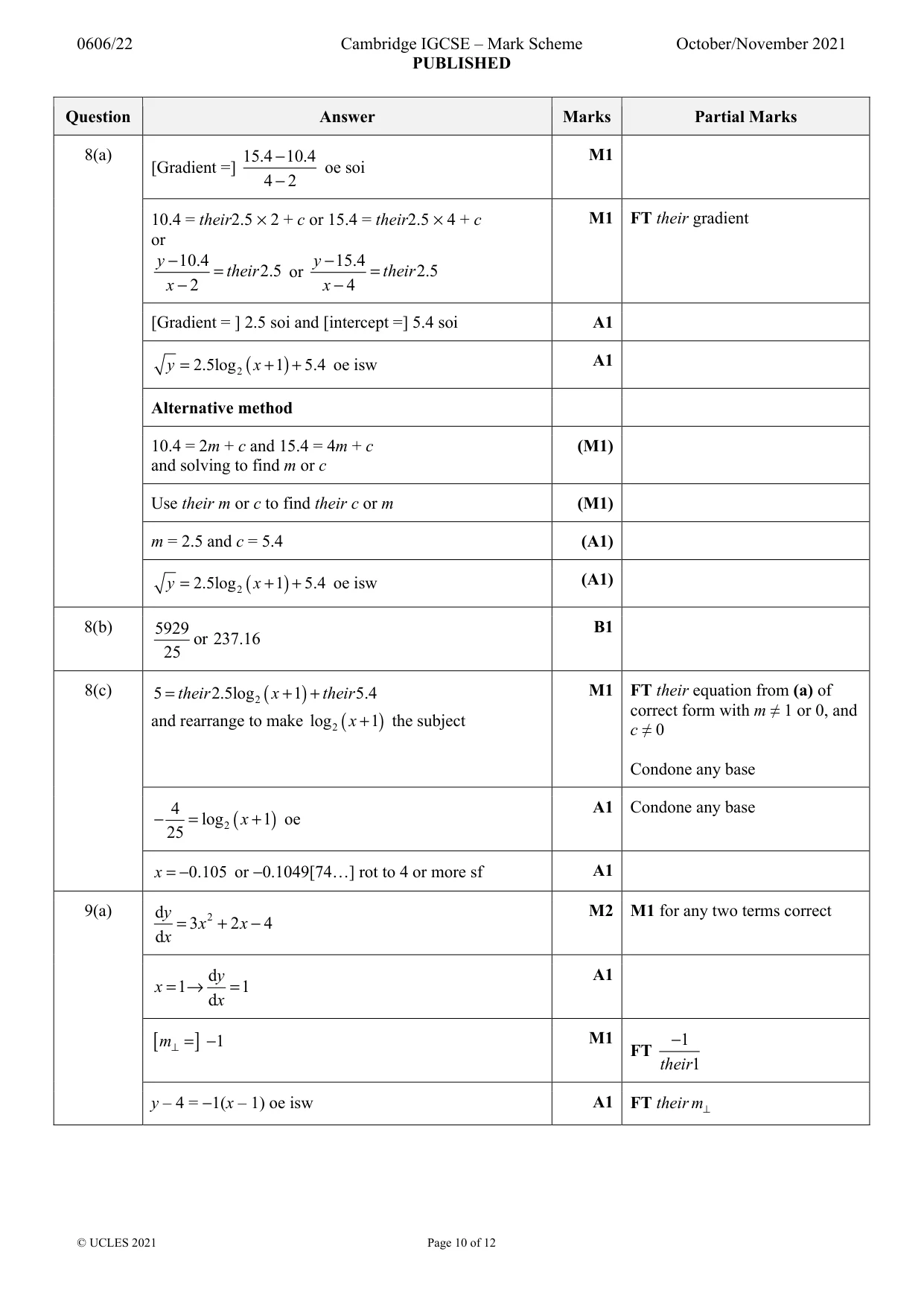
8 Variables x and y are such that when y is plotted against log 2 ( x + 1), where x 2- 1, a straight line is obtained which passes through ( 2, 10.4) and ( 4 , 15.4) . (a) Find y in terms of log 2 ( x + 1) . [4] (b) Find the value of y when x = 15 . [1]
Mark scheme: 8(a) 15.4 − 10.4 M1 [Gradient =] oe soi 4 − 2 10.4 = their2.5 × 2 + c or 15.4 = their2.5 × 4 + c M1 FT their gradient or y − 10.4 y − 15.4 = their 2.5 or = their 2.5 x − 2 x − 4 [Gradient = ] 2.5 soi and [intercept =] 5.4 soi A1 y = 2.5log 2 ( x + 1) + 5.4 oe isw A1 Alternative method 10.4 = 2m + c and 15.4 = 4m + c (M1) and solving to find m or c Use their m or c to find their c or m (M1) m = 2.5 and c = 5.4 (A1) y = 2.5log 2 ( x + 1) + 5.4 oe isw (A1) 8(b) 5929 B1 or 237.16 25 8(c) 5 = their 2.5log 2 ( x + 1) + their 5.4 M1 FT their equation from (a) of correct form with m ≠ 1 or 0, and and rearrange to make log 2 ( x + 1) the subject c ≠ 0 Condone any base 4 A1 Condone any base − = log 2 ( x + 1) oe 25 x = − 0.105 or −0.1049[74…] rot to 4 or more sf A1
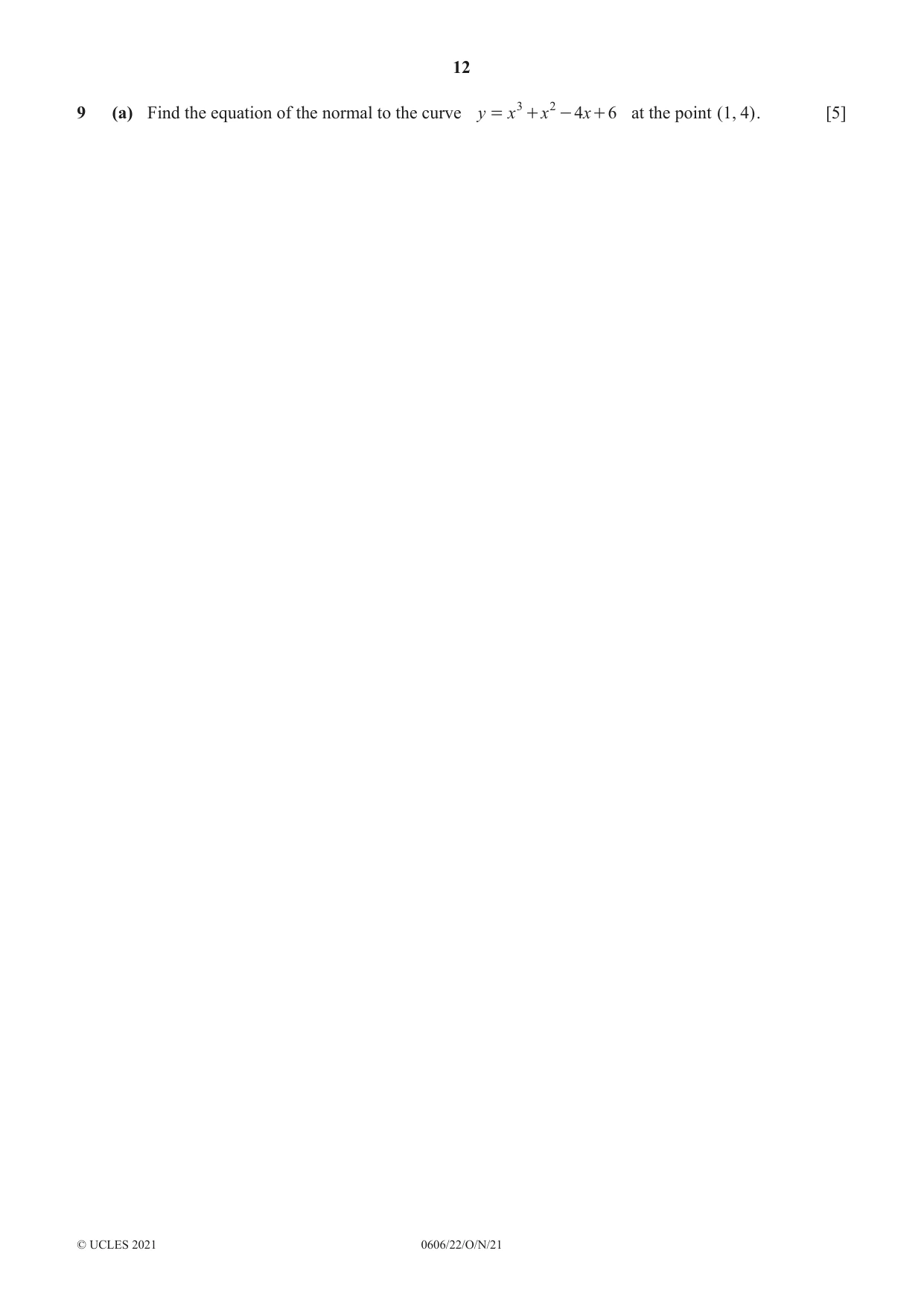
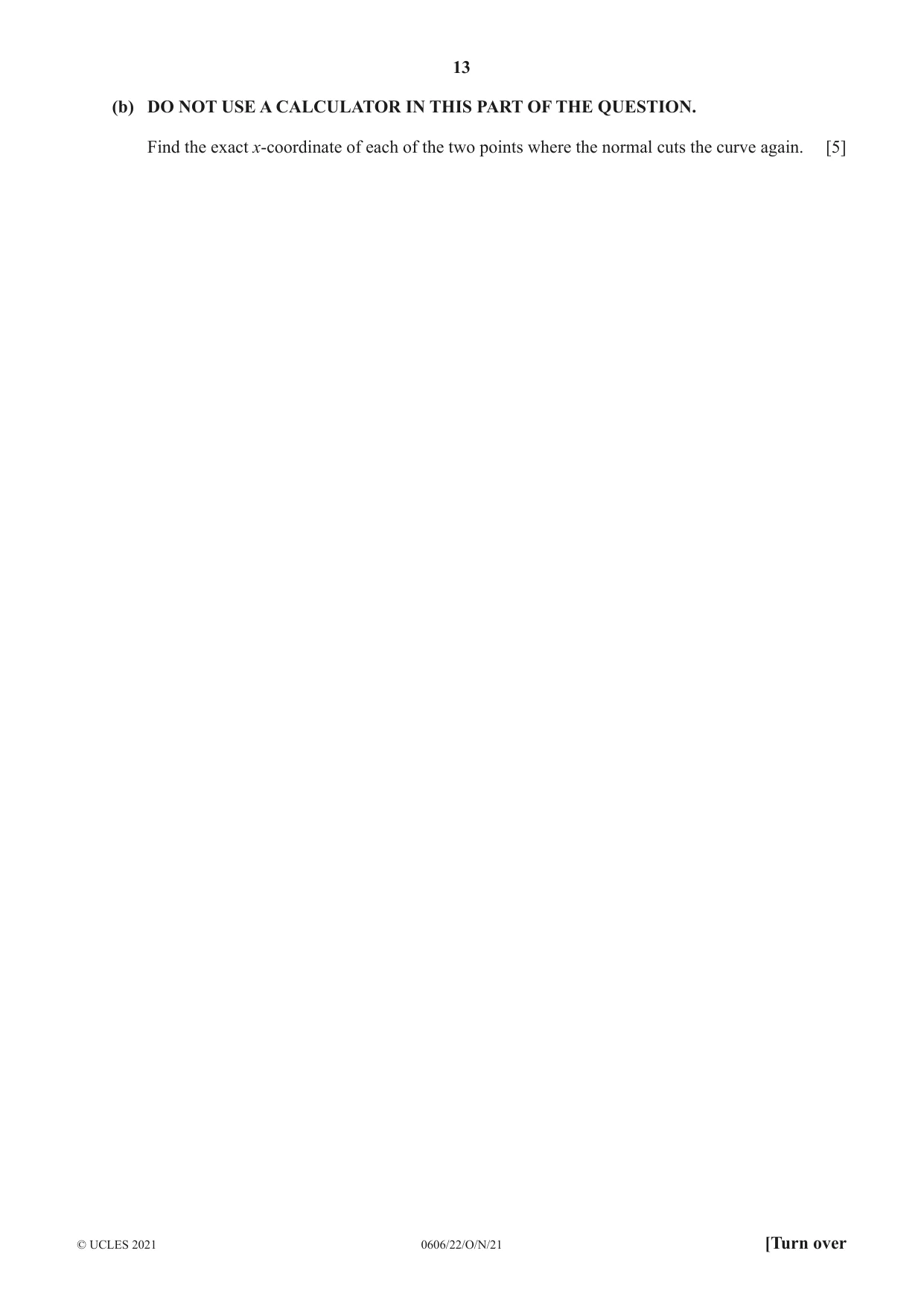
Q9 · DO NOT USE A CALCULATOR IN THIS PART OF THE QUESTION
(b) DO NOT USE A CALCULATOR IN THIS PART OF THE QUESTION. Find the exact x-coordinate of each of the two points where the normal cuts the curve again. [5]
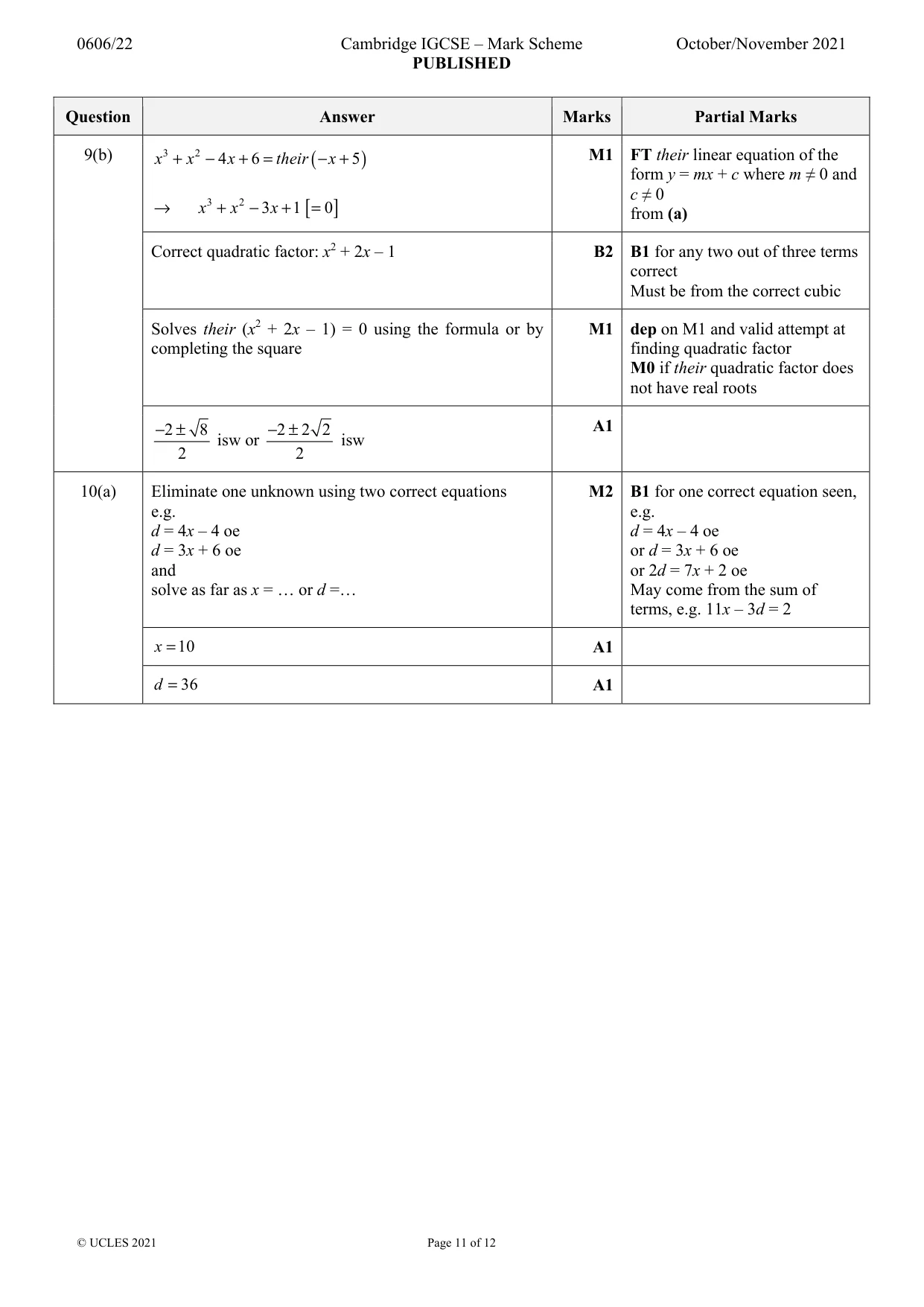
Mark scheme: 9(a) dy 2 M2 M1 for any two terms correct = 3 x + 2 x − 4 dx dy A1 x = 1 → = 1 dx [ m⊥= ] −1 M1 −1 FT their1 y – 4 = −1(x – 1) oe isw A1 FT their m⊥ 9(b) x 3 + x 2 − 4 x + 6 = their ( −+x 5 ) M1 FT their linear equation of the form y = mx + c where m ≠ 0 and 3 2 c ≠ 0 → x + x − 3 x + 1 [ = 0 ] from (a) Correct quadratic factor: x2 + 2x – 1 B2 B1 for any two out of three terms correct Must be from the correct cubic Solves their (x2 + 2x – 1) = 0 using the formula or by M1 dep on M1 and valid attempt at completing the square finding quadratic factor M0 if their quadratic factor does not have real roots −±2 8 −±2 2 2 A1 isw or isw 2 2
More questions on Use differentiation to find gradients, tangents
Q10 · The first three terms of an arithmetic progression are x, 5x - 4 and 8x + 2
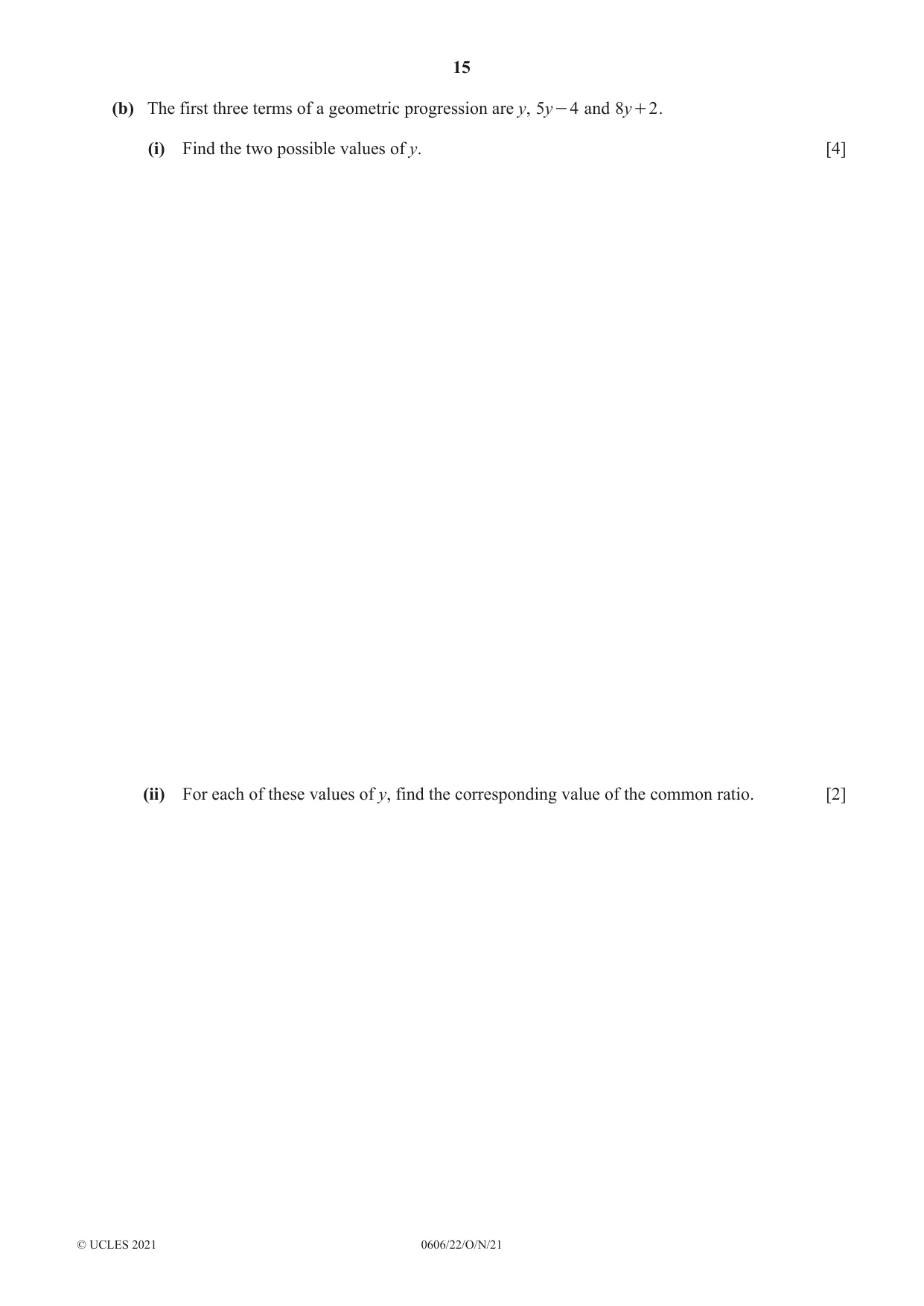
10 (a) The first three terms of an arithmetic progression are x, 5x - 4 and 8x + 2 . Find x and the common difference. [4] (b) The first three terms of a geometric progression are y, 5y - 4 and 8y + 2 . (i) Find the two possible values of y. [4] (ii) For each of these values of y, find the corresponding value of the common ratio. [2]
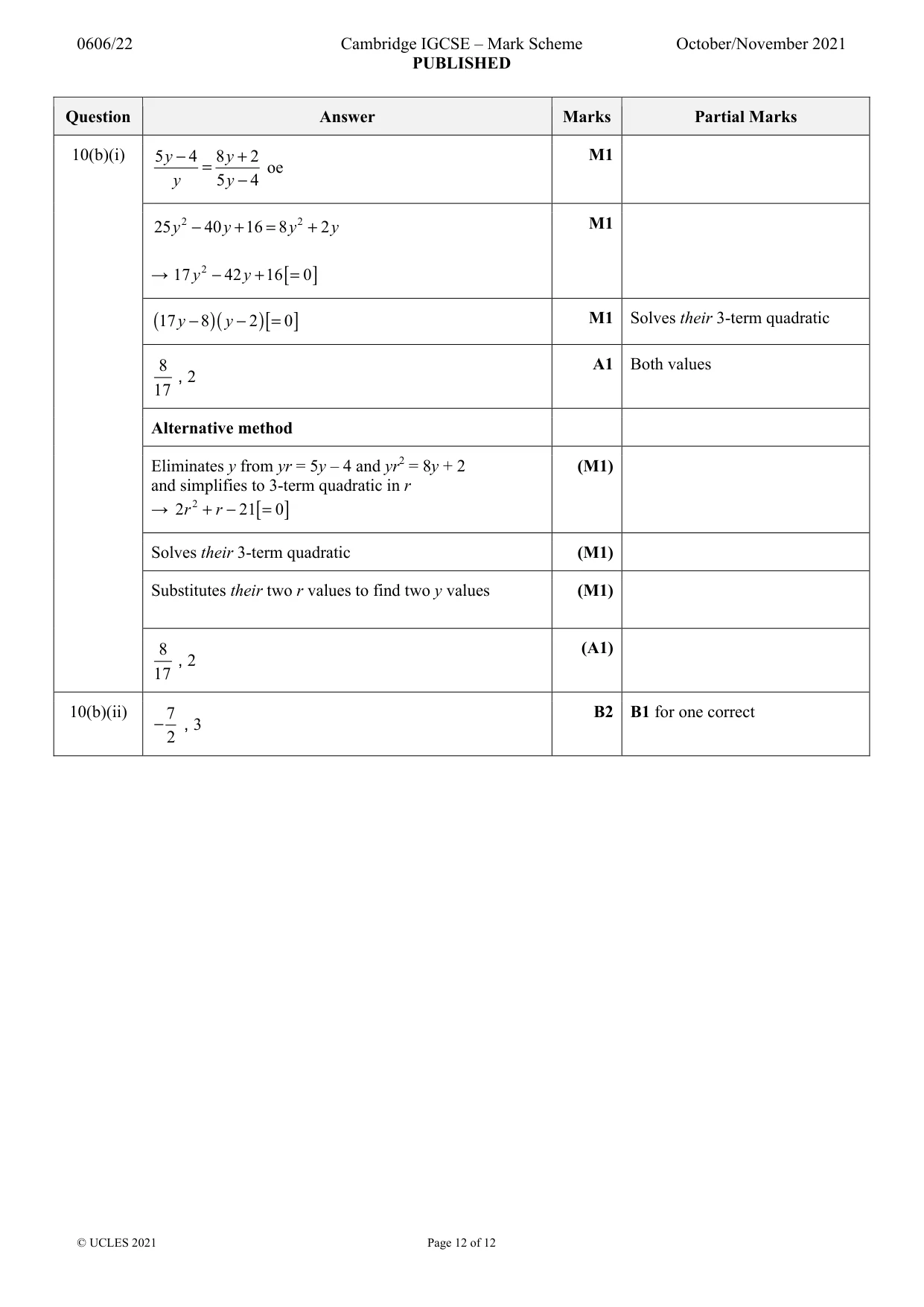
Mark scheme: 10(a) Eliminate one unknown using two correct equations M2 B1 for one correct equation seen, e.g. e.g. d = 4x – 4 oe d = 4x – 4 oe d = 3x + 6 oe or d = 3x + 6 oe and or 2d = 7x + 2 oe solve as far as x = … or d =… May come from the sum of terms, e.g. 11x – 3d = 2 x = 10 A1 d = 36 A1 10(b)(i) 5 y − 4 8 y + 2 M1 = oe y 5 y − 4 25 y 2 − 40 y + 16 = 8 y 2 + 2 y M1 → 17 y 2 − 42 y + 16 [ = 0 ] (17 y − 8 )( y − 2 )[ = 0 ] M1 Solves their 3-term quadratic 8 A1 Both values , 2 17 Alternative method Eliminates y from yr = 5y – 4 and yr2 = 8y + 2 (M1) and simplifies to 3-term quadratic in r → 2 r 2 + r − 21[ = 0 ] Solves their 3-term quadratic (M1) Substitutes their two r values to find two y values (M1) 8 (A1) , 2 17 10(b)(ii) 7 B2 B1 for one correct − , 3 2
What was in this paper
The subtopics covered by these 10 questions, and how many questions each got. Open one in a new tab to see every Cambridge question on it.
1Recognise arithmetic and geometric1Sketch the graphs of cubic polynomials and1Solve simultaneous equations in two1Understand integration as the reverse process1Use differentiation to find gradients, tangents1Use differentiation to find stationary points1Use the binomial theorem for expansion of1Use the equation of a straight line1Use the relationships1What you needed in this session
Cambridge’s own grade thresholds for 2021 Oct/Nov, Paper 2 · Variant 2. A higher threshold means an easier paper — the bar moves with how the cohort did.