Cambridge IGCSE Mathematics (9-1) 0980 — 2025 May/June Paper 4 · Variant 2
0980/42/M/J/25 · 27 questions · 100 marks · 120 min
The question paper and its mark scheme, free to read here and free to download. This is Cambridge’s own paper, exactly as it was sat.
Question paper20 pages
Mark scheme11 pages
Answers below. Sit the paper first if you are practising.
Questions as text
Q1 · A quadrilateral has these properties • the diagonals are the only lines of symmetry • it…
1 A quadrilateral has these properties • the diagonals are the only lines of symmetry • it has rotational symmetry of order 2. Write down the mathematical name of this quadrilateral. ................................................. [1]
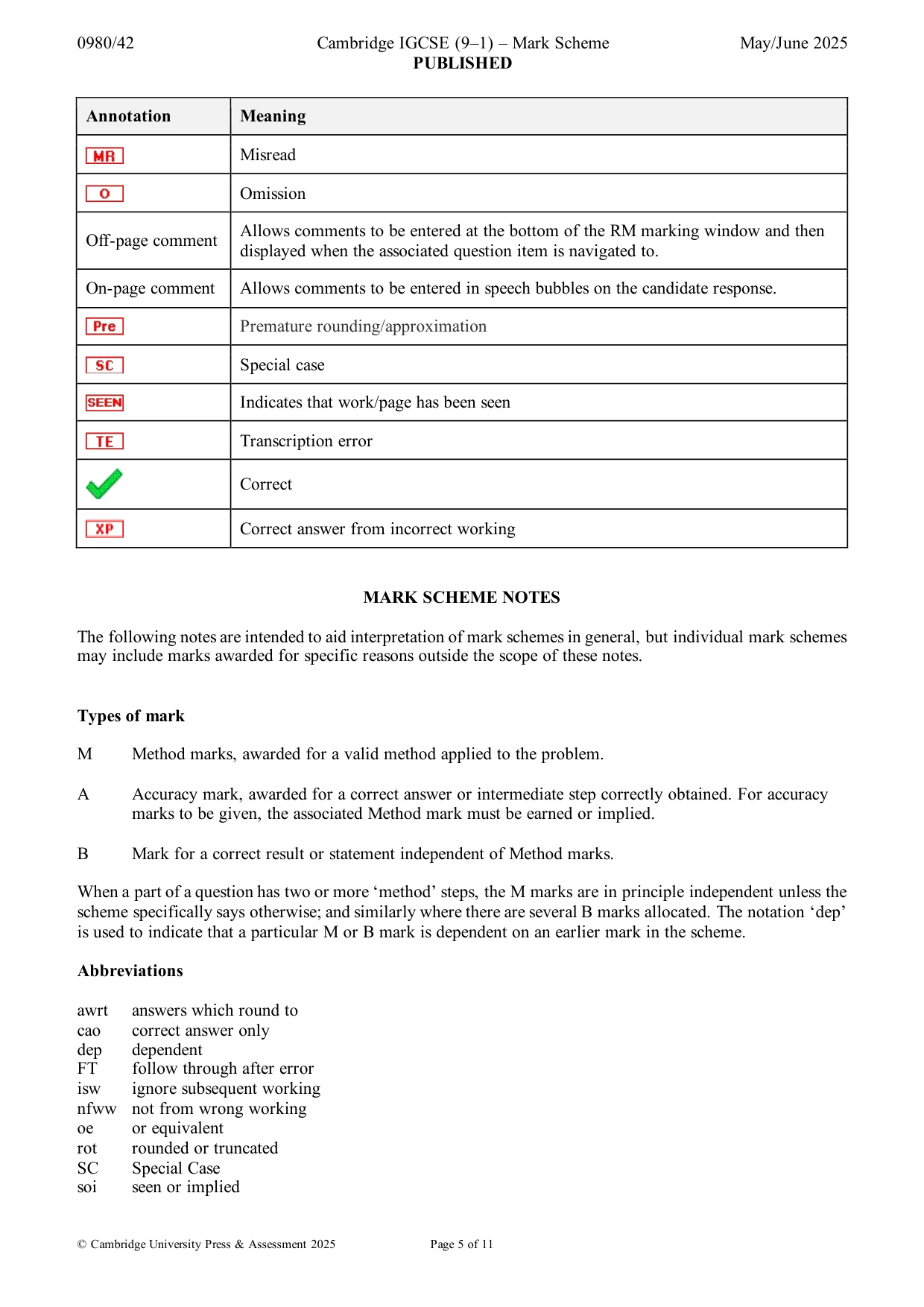
Mark scheme: Question Answer Marks Partial Marks 1 rhombus 1
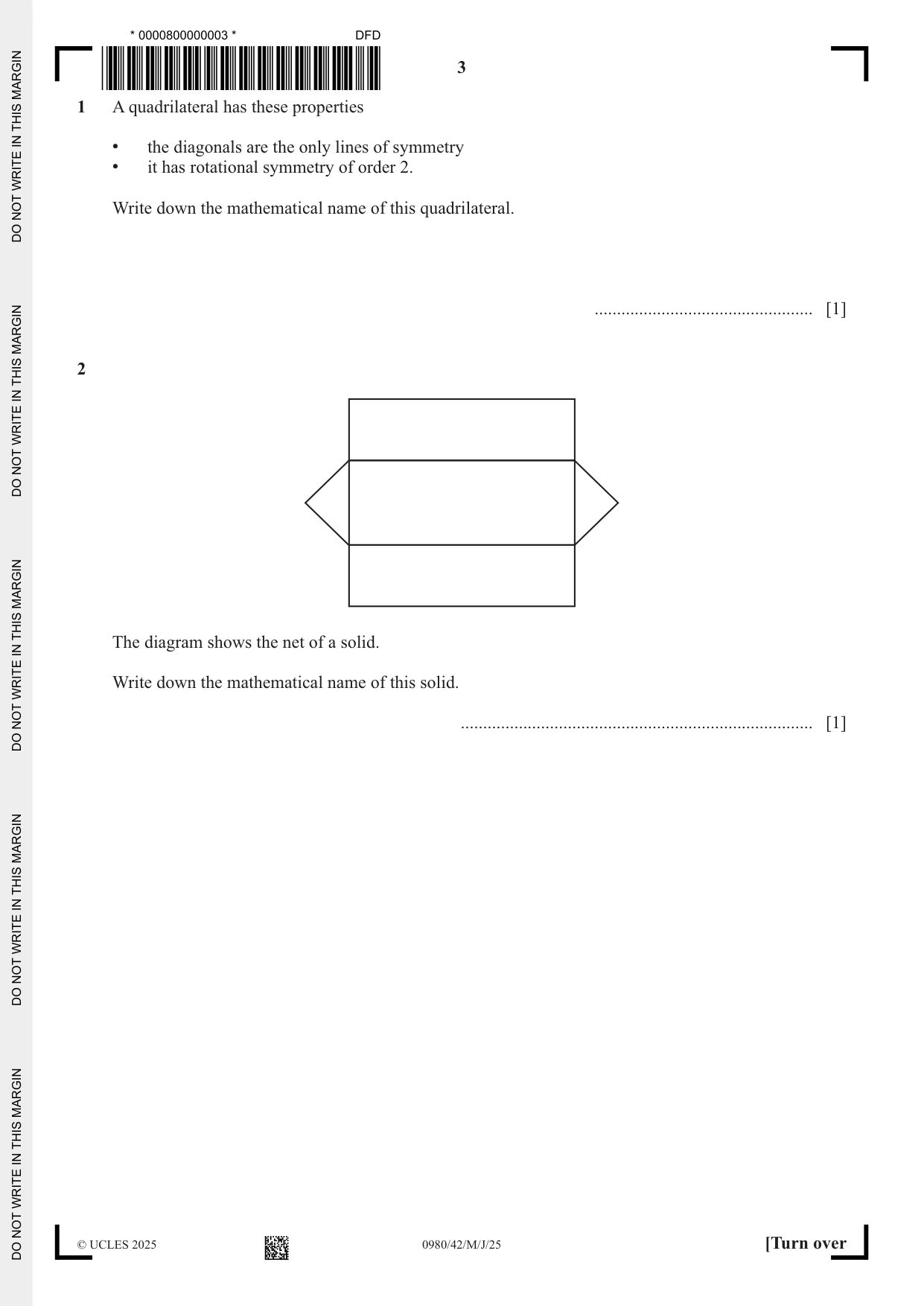
Q2 · The diagram shows the net of a solid
2 The diagram shows the net of a solid. Write down the mathematical name of this solid. ............................................................................... [1]
Mark scheme: 2 triangular prism 1
Q3 · Mass of box A : Mass of box B = 4 : 7 The mass of box B is 2.4 kg more than the mass of…
3 Mass of box A : Mass of box B = 4 : 7 The mass of box B is 2.4 kg more than the mass of box A. Calculate the mass of box A and the mass of box B. box A ........................................... kg box B ........................................... kg [3]
Mark scheme: 3 [A =] 3.2 3 B2 for one correct or for both correct but [B =] 5.6 reversed 2.4 or M1 for k where k = 1, 4, 7 or 11 oe 7 − 4 x 4 or for = oe x + 2.4 7
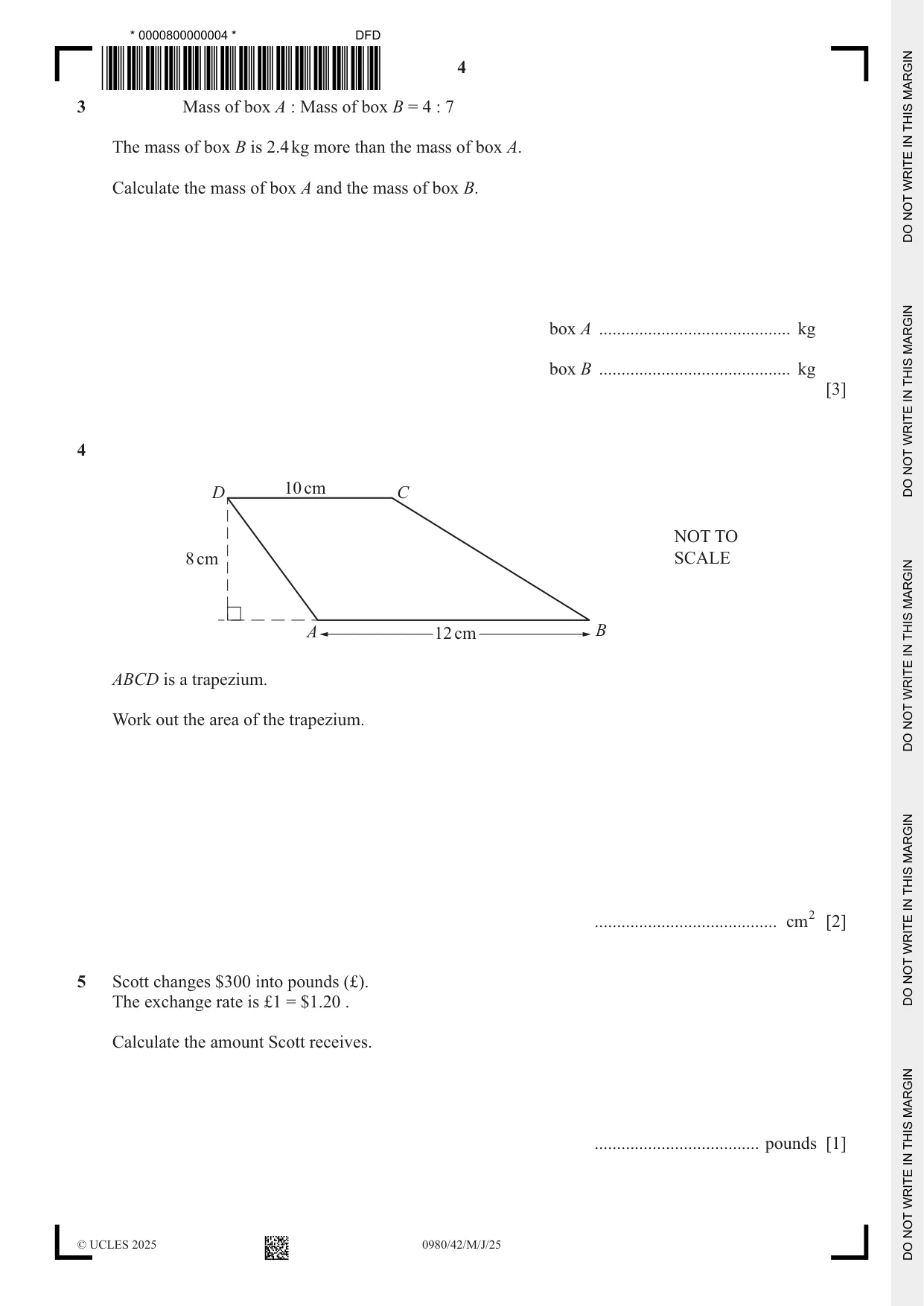
Q4 · D 10 cm C NOT TO 8 cm SCALE A 12 cm B ABCD is a trapezium
4 D 10 cm C NOT TO 8 cm SCALE A 12 cm B ABCD is a trapezium. Work out the area of the trapezium. ......................................... cm2 [2]
Mark scheme: 4 88 2 1 M1 for (10 + 12) 8 oe 2
Q5 · Scott changes $300 into pounds (£)
5 Scott changes $300 into pounds (£). The exchange rate is £1 = $1.20 . Calculate the amount Scott receives. ..................................... pounds [1]
Mark scheme: 5 250 1
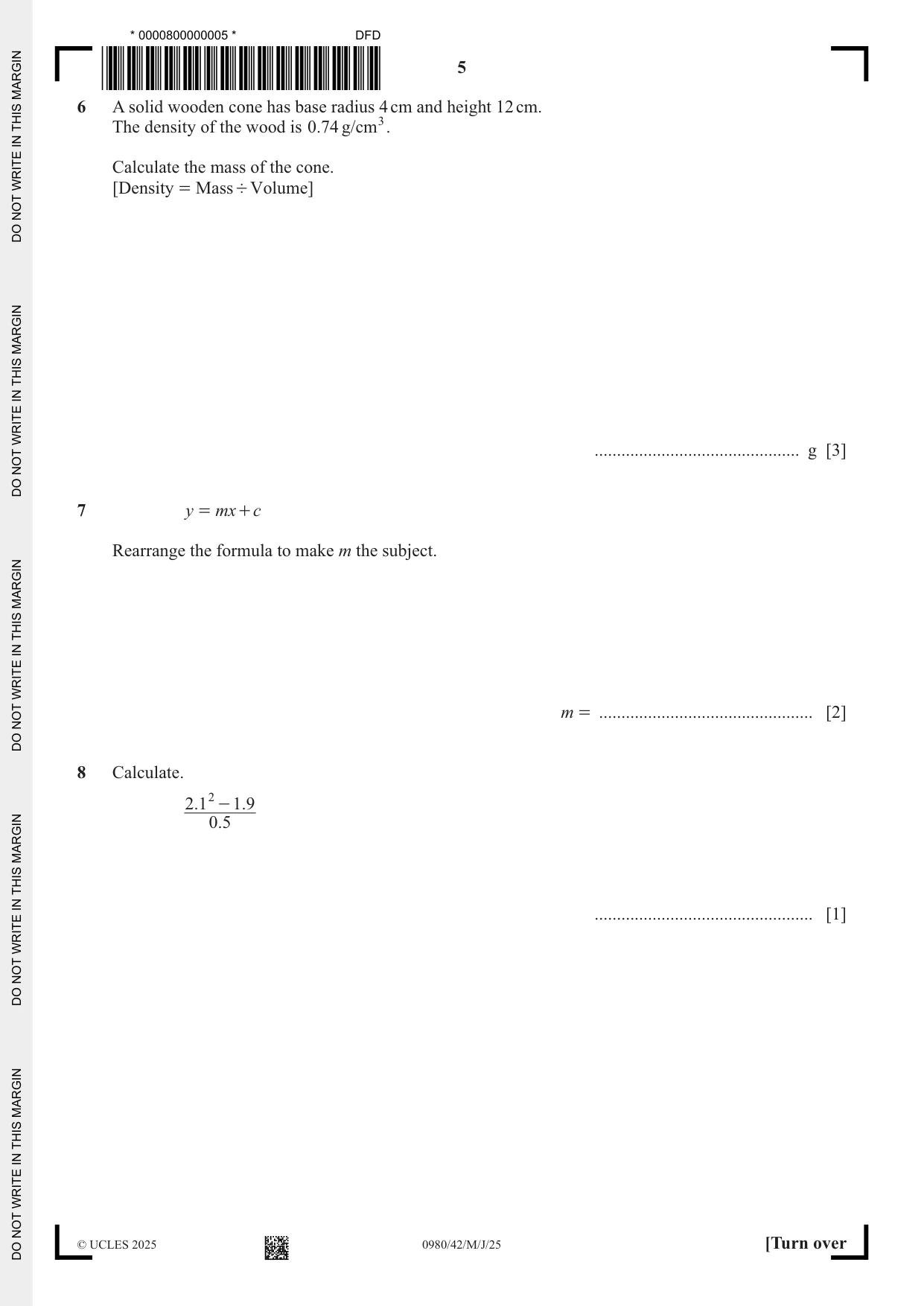
Q6 · A solid wooden cone has base radius 4 cm and height 12 cm
6 A solid wooden cone has base radius 4 cm and height 12 cm. The density of the wood is 0.74 g/cm 3. Calculate the mass of the cone. [ Density = Mass ' Volume] .............................................. g [3]
Mark scheme: 6 149 or 148.7 to 148.8… 3 1 2 M1 for 3π 4 12 oe M1 for 0.74 × their volume
Q7 · Y = mx + c Rearrange the formula to make m the subject
7 y = mx + c Rearrange the formula to make m the subject. m = ................................................ [2]
Mark scheme: 7 y − c y c 2 y c m = or − M1 for y – c = mx or c – y= –mx or = m + x x x x x final answer
Question 8
8 Calculate. 2 .1 2 - 1 .9 0.5 ................................................. [1]
Mark scheme: 8 5.02 cao 1
Q9 · Solve the simultaneous equations
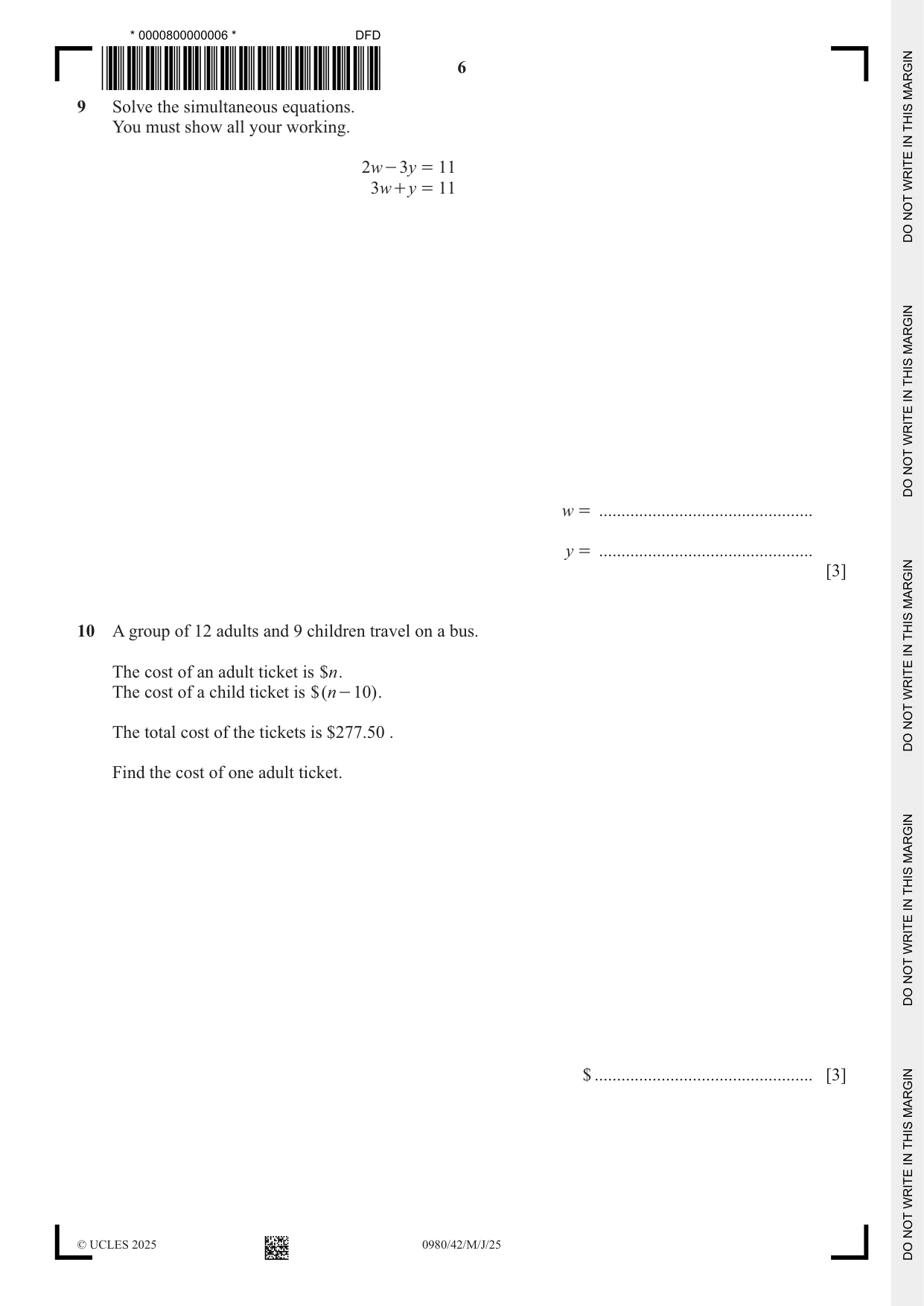
9 Solve the simultaneous equations. You must show all your working. 2w - 3y = 11 3w + y = 11 w = ................................................ y = ................................................ [3]
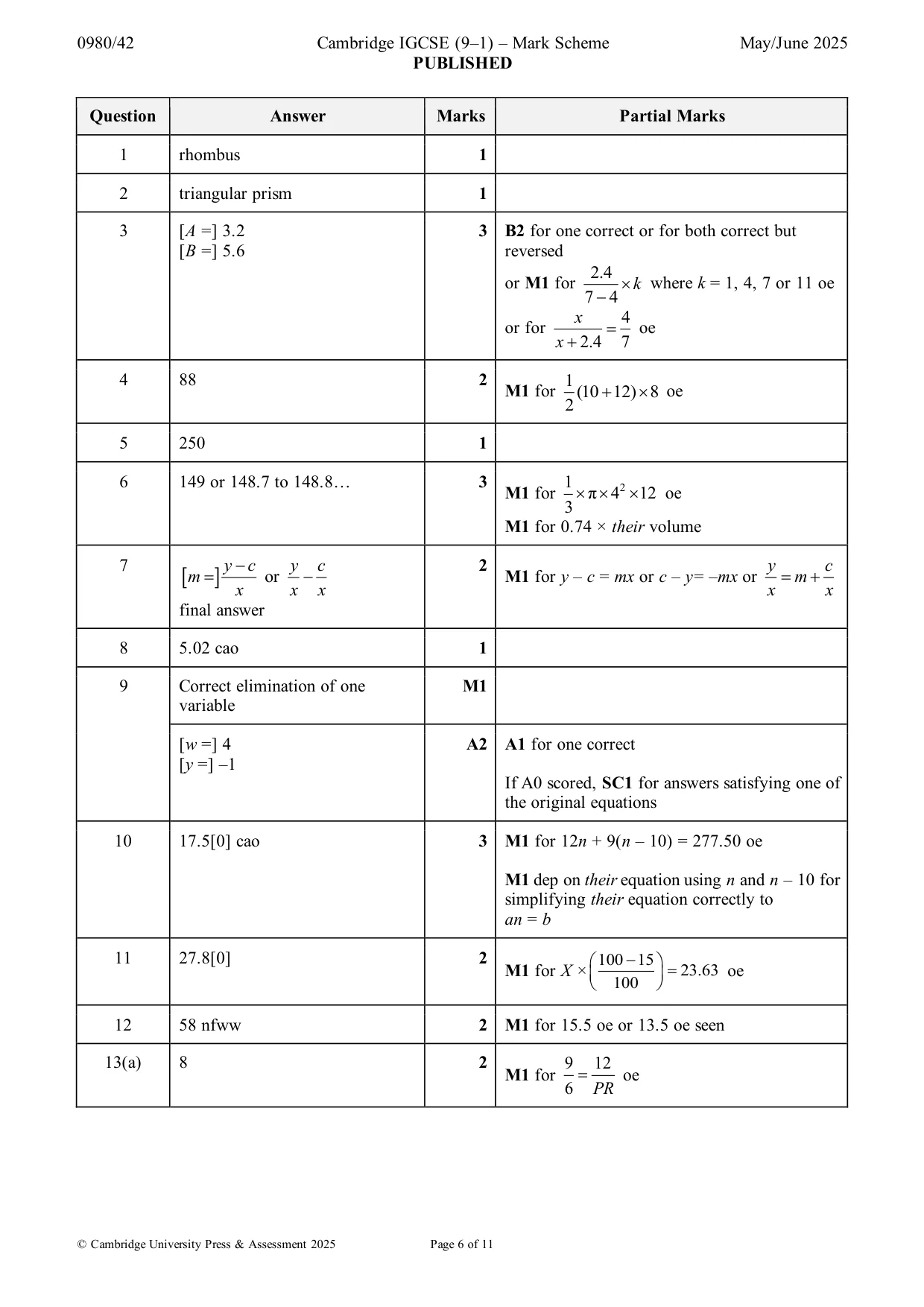
Mark scheme: 9 Correct elimination of one M1 variable [w =] 4 A2 A1 for one correct [y =] –1 If A0 scored, SC1 for answers satisfying one of the original equations
Q10 · A group of 12 adults and 9 children travel on a bus
10 A group of 12 adults and 9 children travel on a bus. The cost of an adult ticket is $n. The cost of a child ticket is $( n - 10 ) . The total cost of the tickets is $277.50 . Find the cost of one adult ticket. $ ................................................. [3]
Mark scheme: 10 17.5[0] cao 3 M1 for 12n + 9(n – 10) = 277.50 oe M1 dep on their equation using n and n – 10 for simplifying their equation correctly to an = b
Q11 · In a sale, the original price of a shirt is reduced by 15%
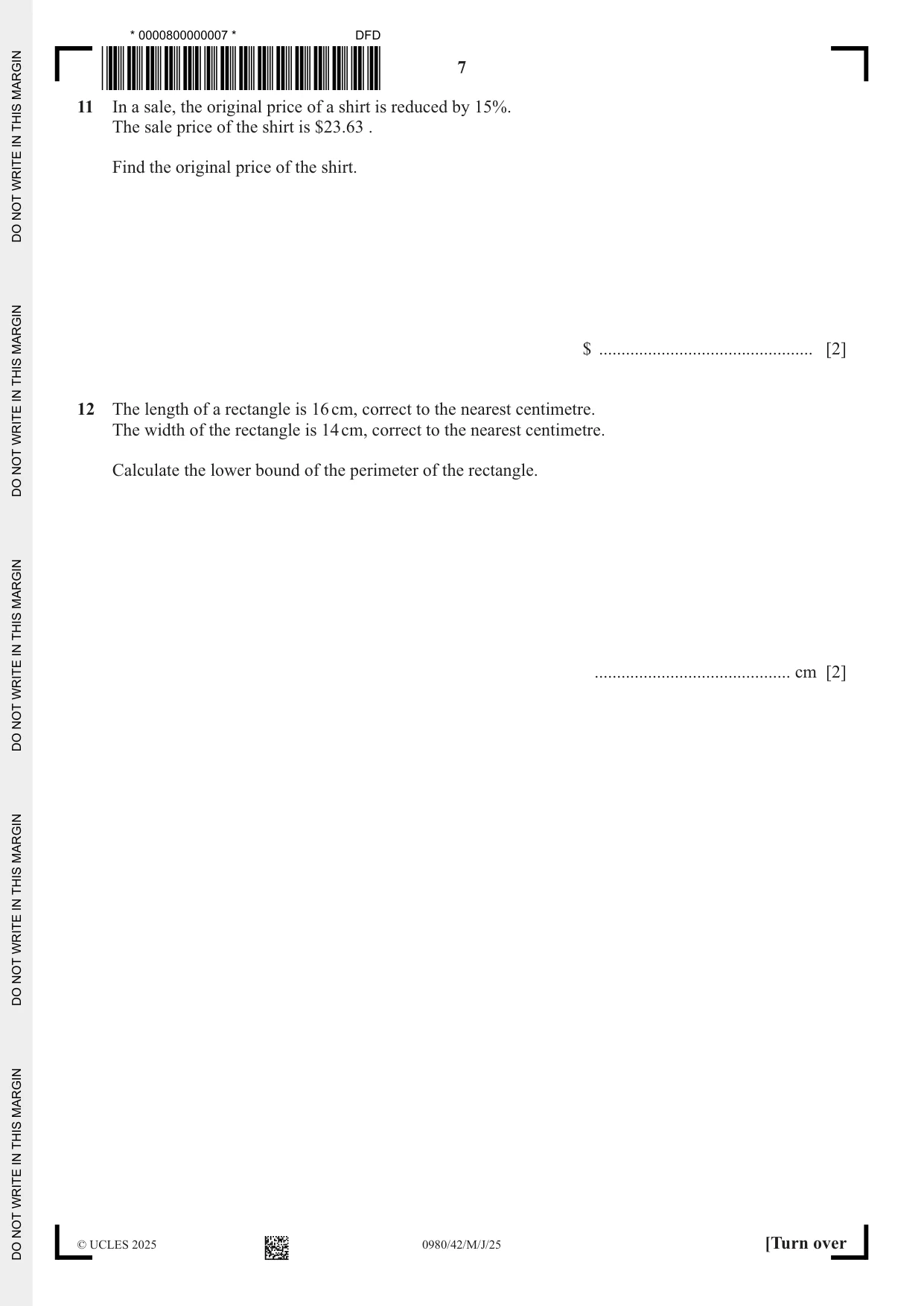
11 In a sale, the original price of a shirt is reduced by 15%. The sale price of the shirt is $23.63 . Find the original price of the shirt. $ ................................................ [2]
Mark scheme: 11 27.8[0] 2 M1 for X × 100 − 15 = 23.63 oe 100
Q12 · The length of a rectangle is 16 cm, correct to the nearest centimetre
12 The length of a rectangle is 16 cm, correct to the nearest centimetre. The width of the rectangle is 14 cm, correct to the nearest centimetre. Calculate the lower bound of the perimeter of the rectangle. ............................................ cm [2]
Mark scheme: 12 58 nfww 2 M1 for 15.5 oe or 13.5 oe seen
Q13 · A P NOT TO 12 cm 9 cm SCALE 6 cm B 16 cm C Q R Triangle ABC and triangle PQR are…
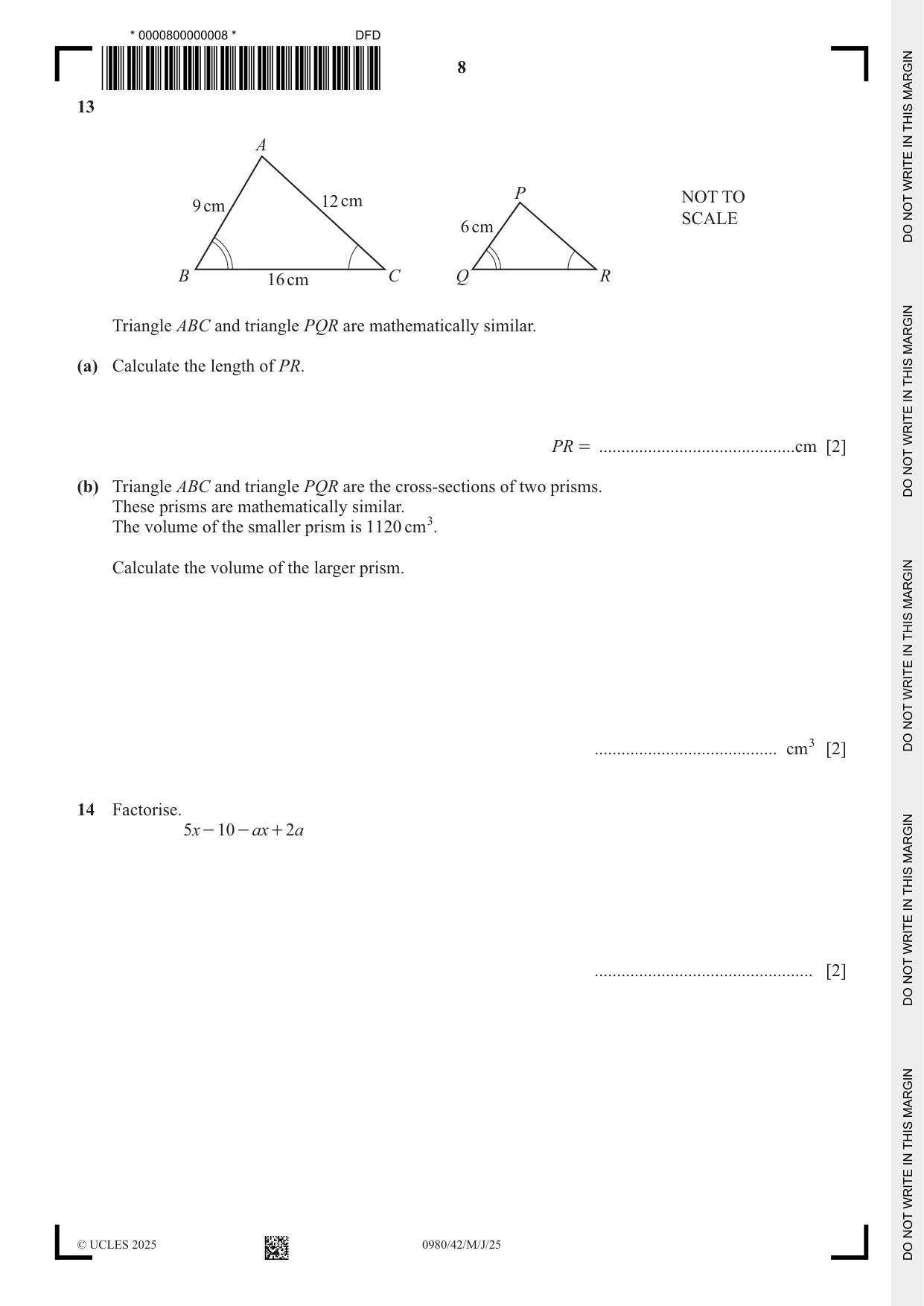
13 A P NOT TO 12 cm 9 cm SCALE 6 cm B 16 cm C Q R Triangle ABC and triangle PQR are mathematically similar. (a) Calculate the length of PR. PR = ............................................cm [2] (b) Triangle ABC and triangle PQR are the cross-sections of two prisms. These prisms are mathematically similar. The volume of the smaller prism is 1120 cm 3. Calculate the volume of the larger prism. ......................................... cm3 [2]
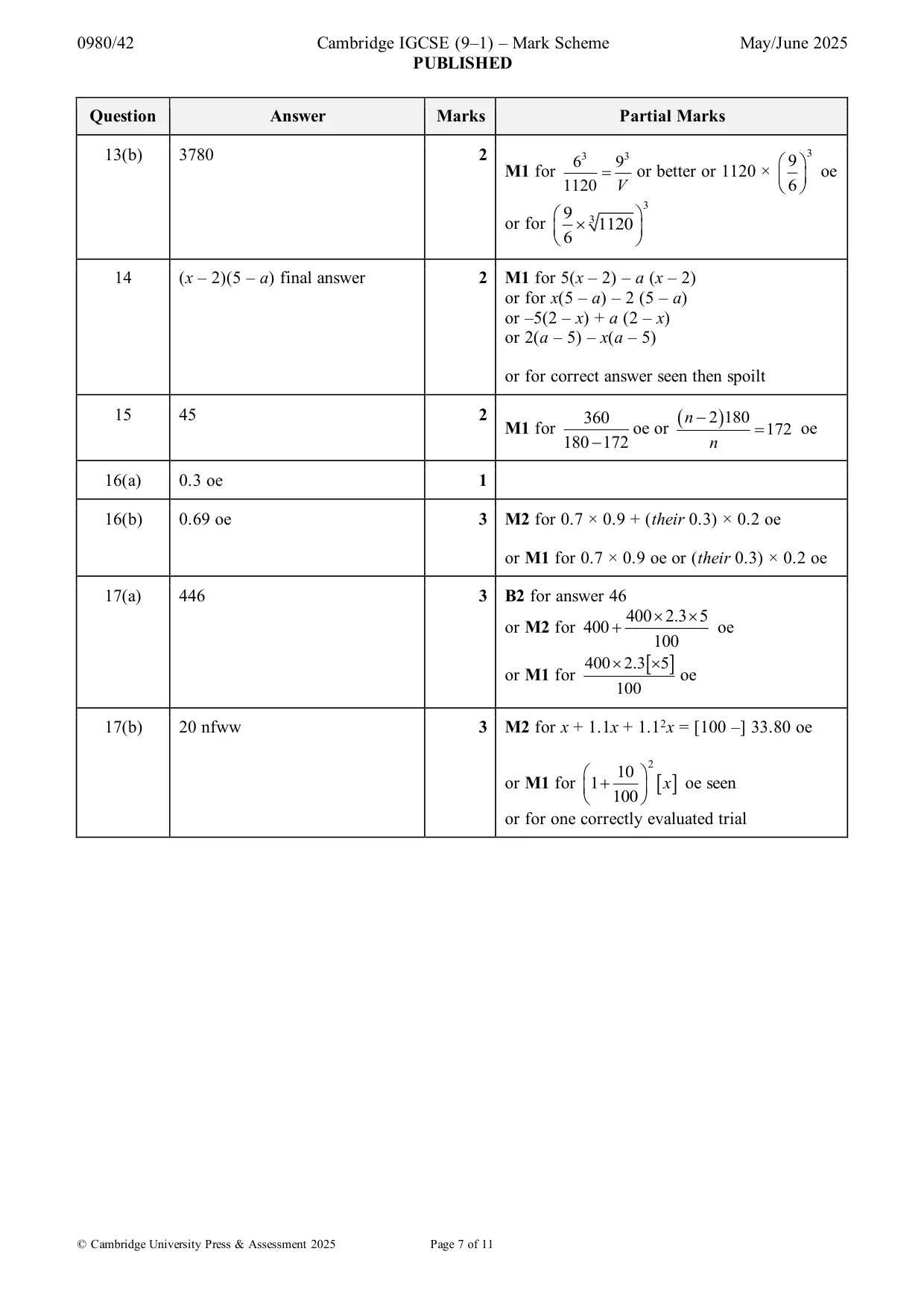
Mark scheme: 13(a) 8 2 9 12 M1 for = oe 6 PR 13(b) 3780 2 3 3 3 6 9 9 M1 for = or better or 1120 × oe 1120 V 6 9 3 3 or for 1120 6
Question 14
14 Factorise. 5x - 10 - ax + 2a ................................................. [2]
Mark scheme: 14 (x – 2)(5 – a) final answer 2 M1 for 5(x – 2) – a (x – 2) or for x(5 – a) – 2 (5 – a) or –5(2 – x) + a (2 – x) or 2(a – 5) – x(a – 5) or for correct answer seen then spoilt
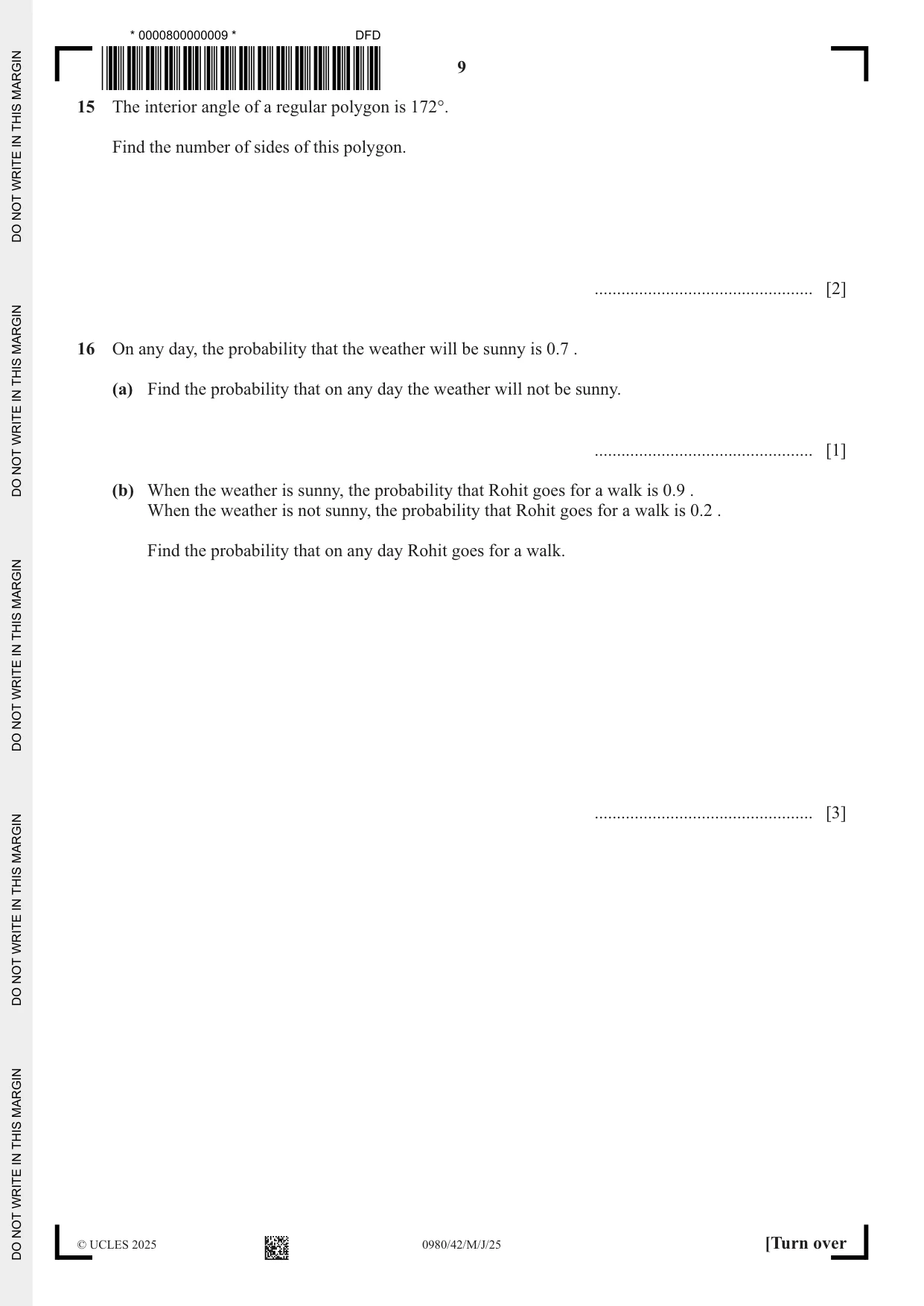
Q15 · The interior angle of a regular polygon is 172°
15 The interior angle of a regular polygon is 172°. Find the number of sides of this polygon. ................................................. [2]
Mark scheme: 15 45 2 360 ( n − 2 )180 M1 for oe or = 172 oe 180 − 172 n
Q16 · On any day, the probability that the weather will be sunny is 0.7
16 On any day, the probability that the weather will be sunny is 0.7 . (a) Find the probability that on any day the weather will not be sunny. ................................................. [1] (b) When the weather is sunny, the probability that Rohit goes for a walk is 0.9 . When the weather is not sunny, the probability that Rohit goes for a walk is 0.2 . Find the probability that on any day Rohit goes for a walk. ................................................. [3]
Mark scheme: 16(a) 0.3 oe 1 16(b) 0.69 oe 3 M2 for 0.7 × 0.9 + (their 0.3) × 0.2 oe or M1 for 0.7 × 0.9 oe or (their 0.3) × 0.2 oe
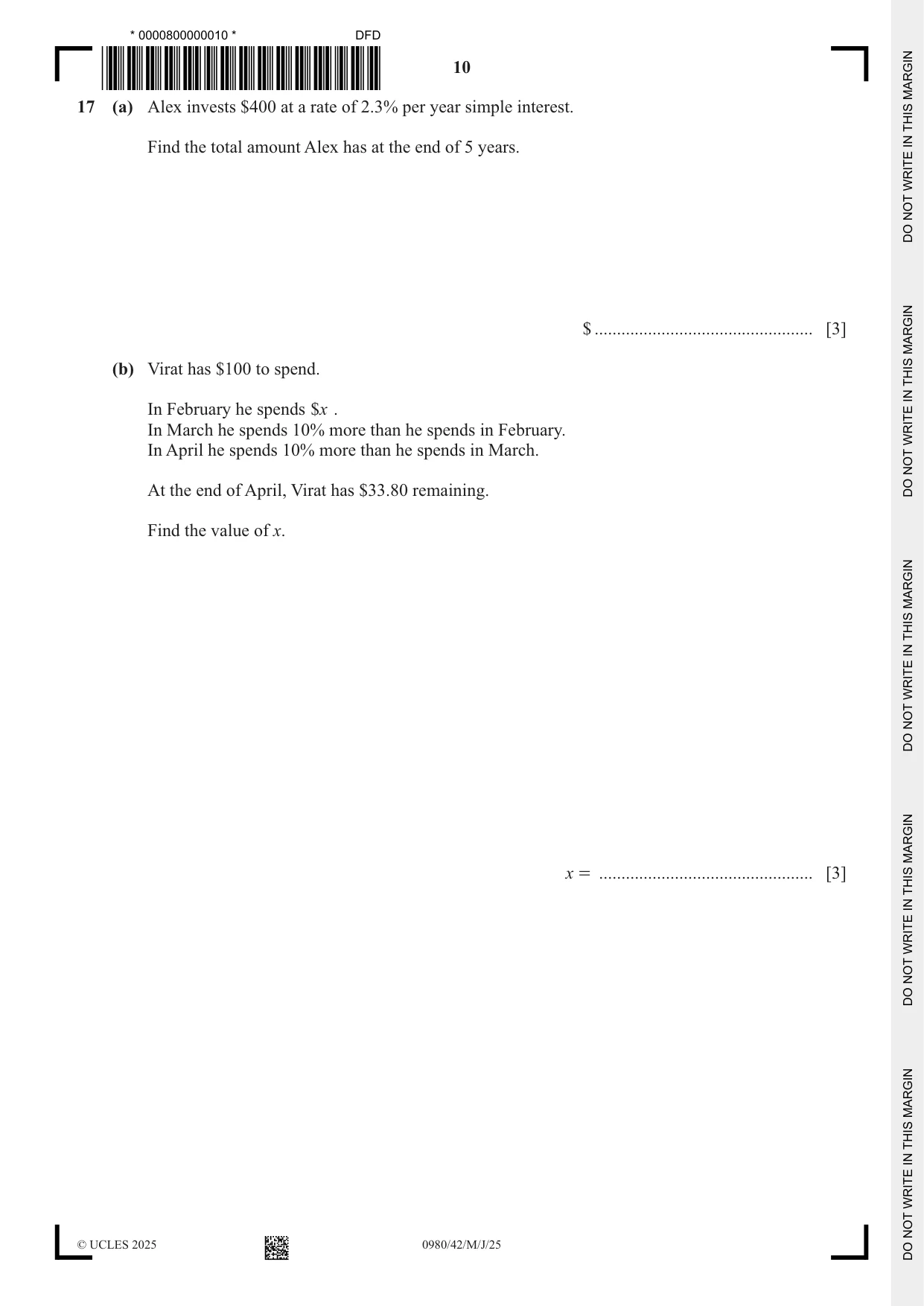
Q17 · Alex invests $400 at a rate of 2.3% per year simple interest
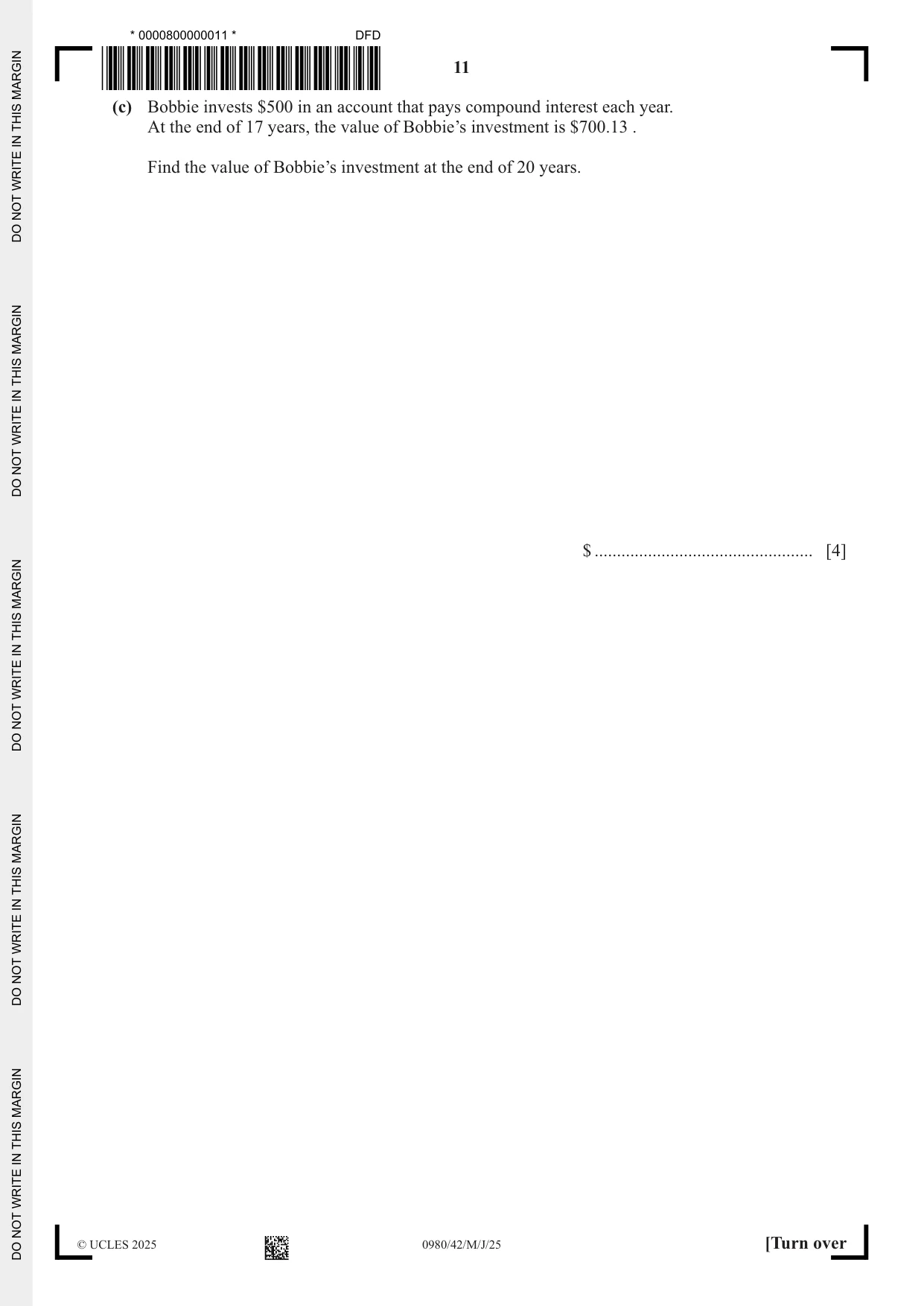
17 (a) Alex invests $400 at a rate of 2.3% per year simple interest. Find the total amount Alex has at the end of 5 years. $ ................................................. [3] (b) Virat has $100 to spend. In February he spends $x . In March he spends 10% more than he spends in February. In April he spends 10% more than he spends in March. At the end of April, Virat has $33.80 remaining. Find the value of x. x = ................................................ [3] (c) Bobbie invests $500 in an account that pays compound interest each year. At the end of 17 years, the value of Bobbie’s investment is $700.13 . Find the value of Bobbie’s investment at the end of 20 years. $ ................................................. [4]
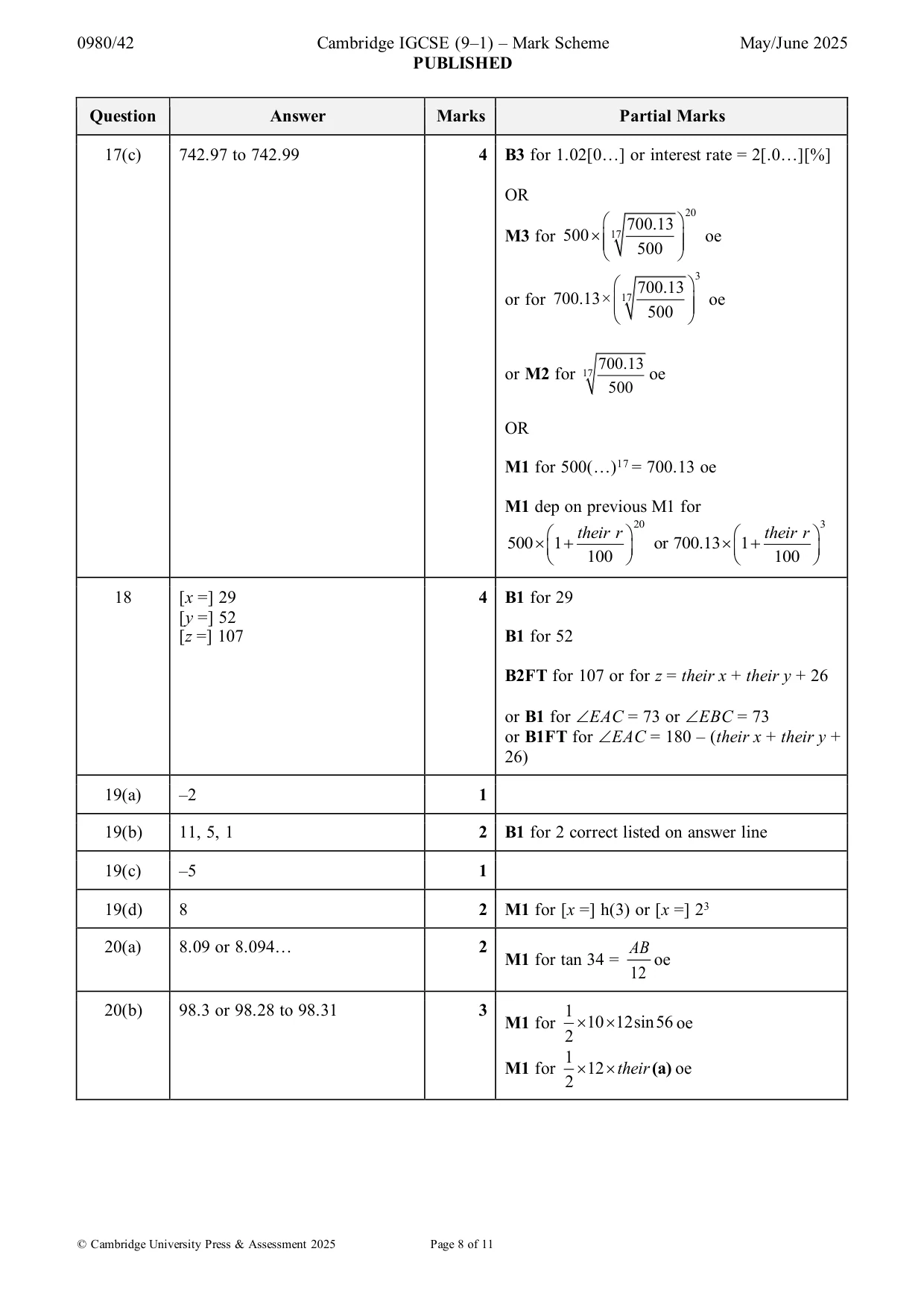
Mark scheme: 17(a) 446 3 B2 for answer 46 400 2.3 5 or M2 for 400 + oe 100 400 2.3 5 or M1 for oe 100 17(b) 20 nfww 3 M2 for x + 1.1x + 1.12x = [100 –] 33.80 oe 10 2 oe seen or M1 for 1 + x 100 or for one correctly evaluated trial 17(c) 742.97 to 742.99 4 B3 for 1.02[0…] or interest rate = 2[.0…][%] OR 700.13 20 M3 for 500 17 oe 500 700.13 3 or for 700.13× 17 oe 500 700.13 or M2 for 17 oe 500 OR M1 for 500(…)17 = 700.13 oe M1 dep on previous M1 for their r 20 their r 3 500 1 + or 700.13 1 + 100 100
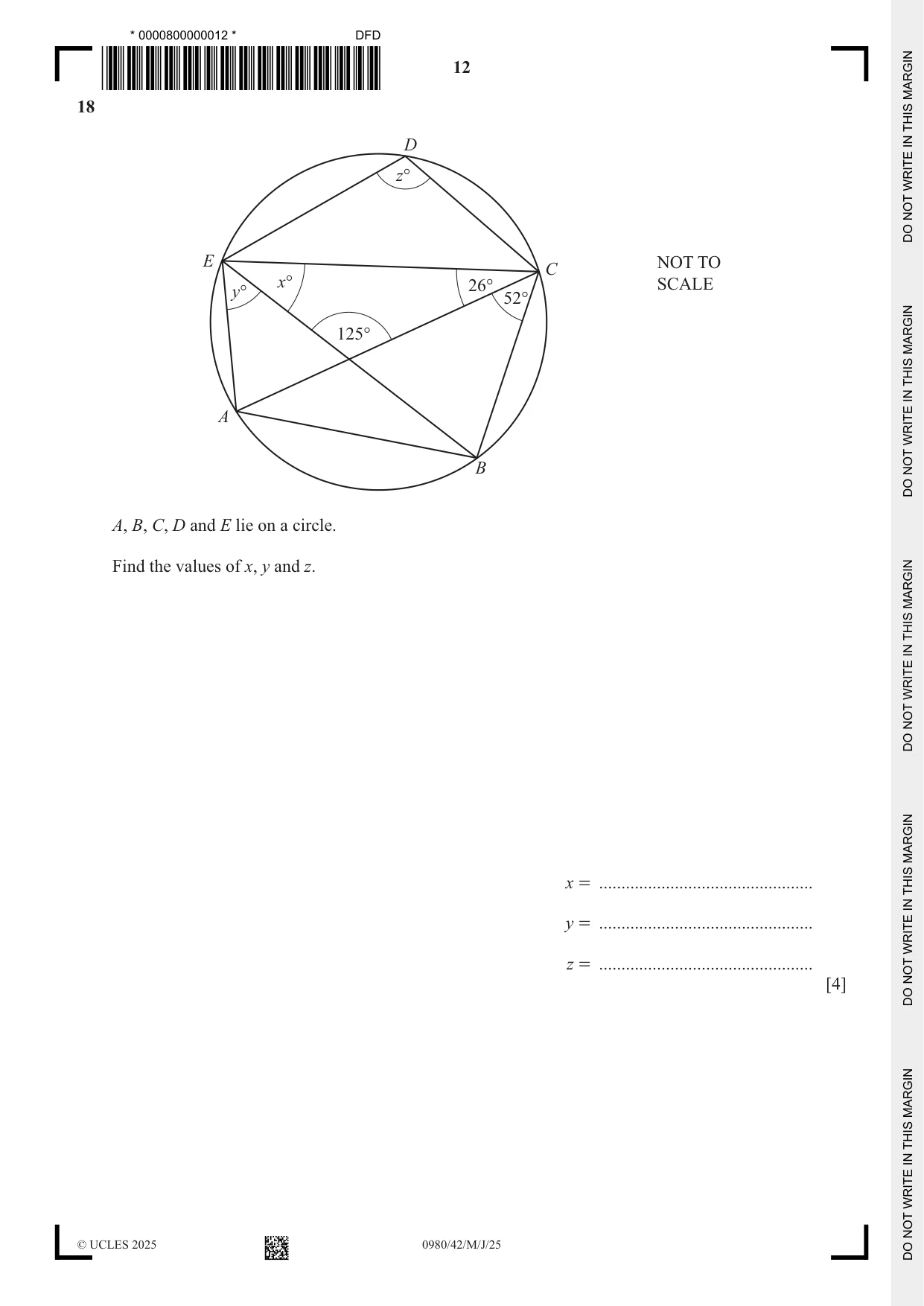
Q18 · D z° E NOT TO C x° 26° SCALE y° 52° 125° A B A, B, C, D and E lie on a circle
18 D z° E NOT TO C x° 26° SCALE y° 52° 125° A B A, B, C, D and E lie on a circle. Find the values of x, y and z. x = ................................................ y = ................................................ z = ................................................ [4]
Mark scheme: 18 [x =] 29 4 B1 for 29 [y =] 52 [z =] 107 B1 for 52 B2FT for 107 or for z = their x + their y + 26 or B1 for EAC = 73 or EBC = 73 or B1FT for EAC = 180 – (their x + their y + 26)
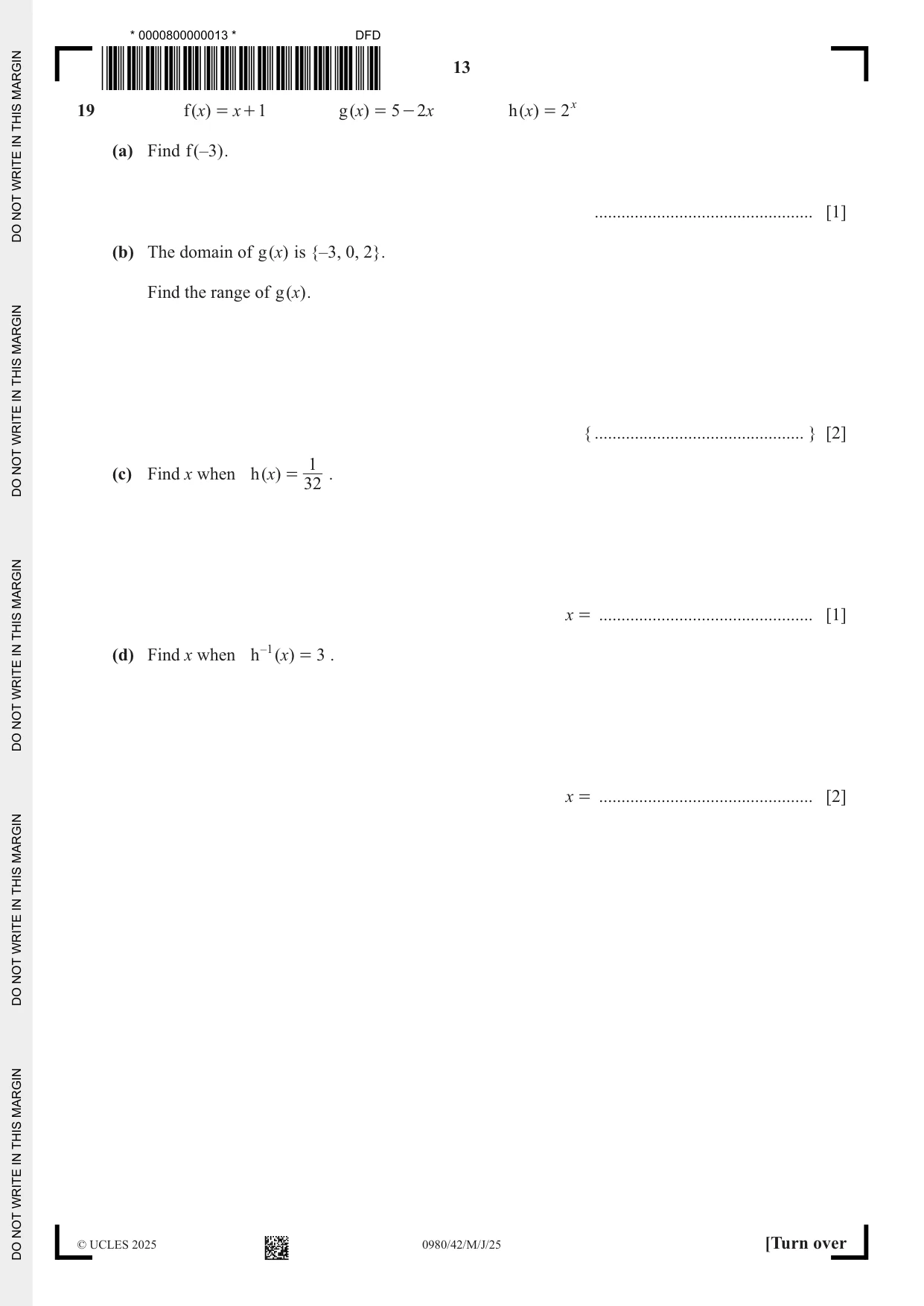
Q19 · F ( x) = x + 1 g ( x) = 5 - 2 x h ( x) = 2x (a) Find f ( –3)
19 f ( x) = x + 1 g ( x) = 5 - 2 x h ( x) = 2x (a) Find f ( –3) . ................................................. [1] (b) The domain of g ( x) is {–3, 0, 2}. Find the range of g ( x) . { ............................................... } [2] 1 (c) Find x when h ( x) = . 32 x = ................................................ [1] (d) Find x when h – 1 ( )x = 3 . x = ................................................ [2]
Mark scheme: 19(a) –2 1 19(b) 11, 5, 1 2 B1 for 2 correct listed on answer line 19(c) –5 1 19(d) 8 2 M1 for [x =] h(3) or [x =] 23
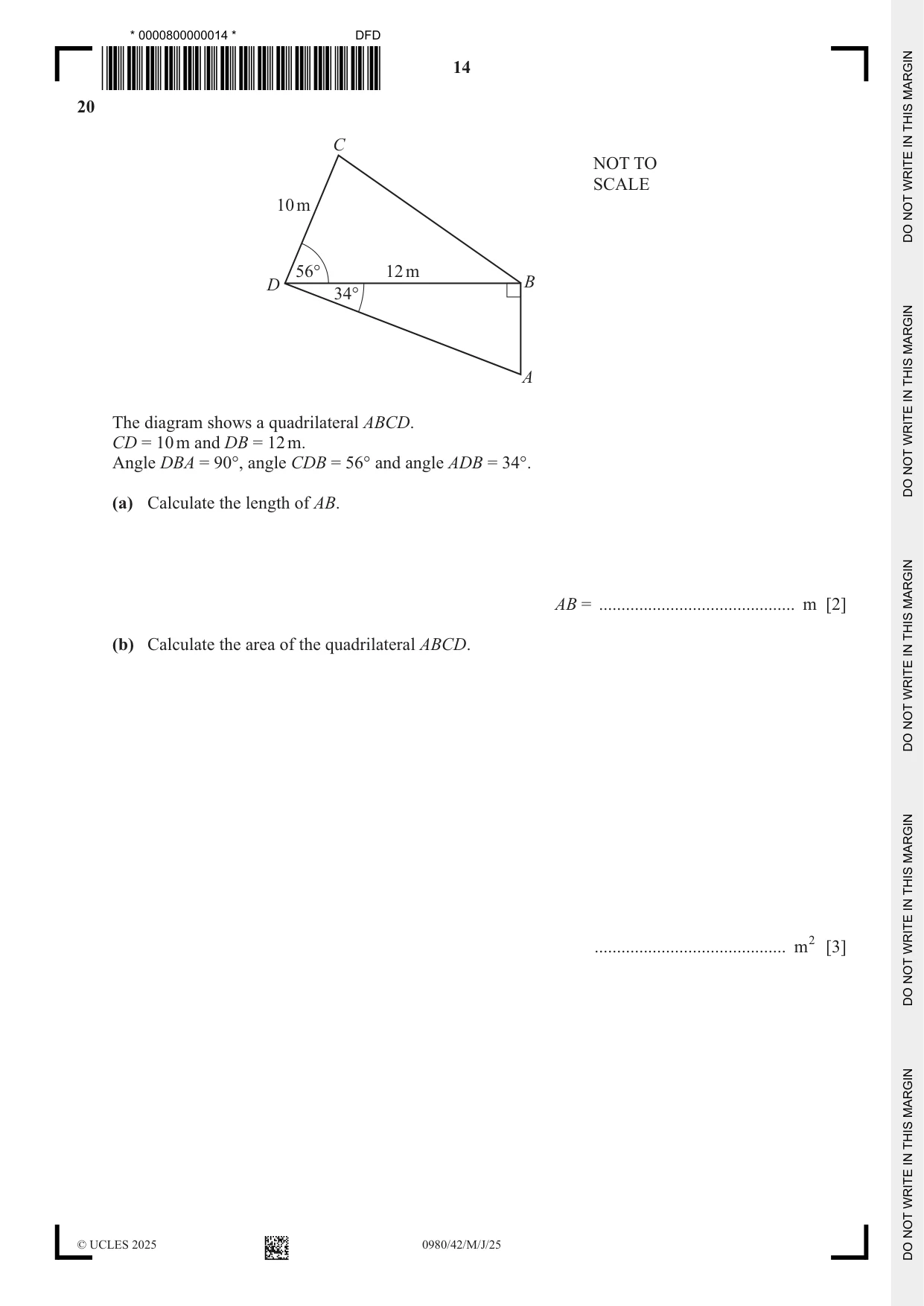
Q20 · C NOT TO SCALE 10 m 56° 12 m D B 34° A The diagram shows a quadrilateral ABCD
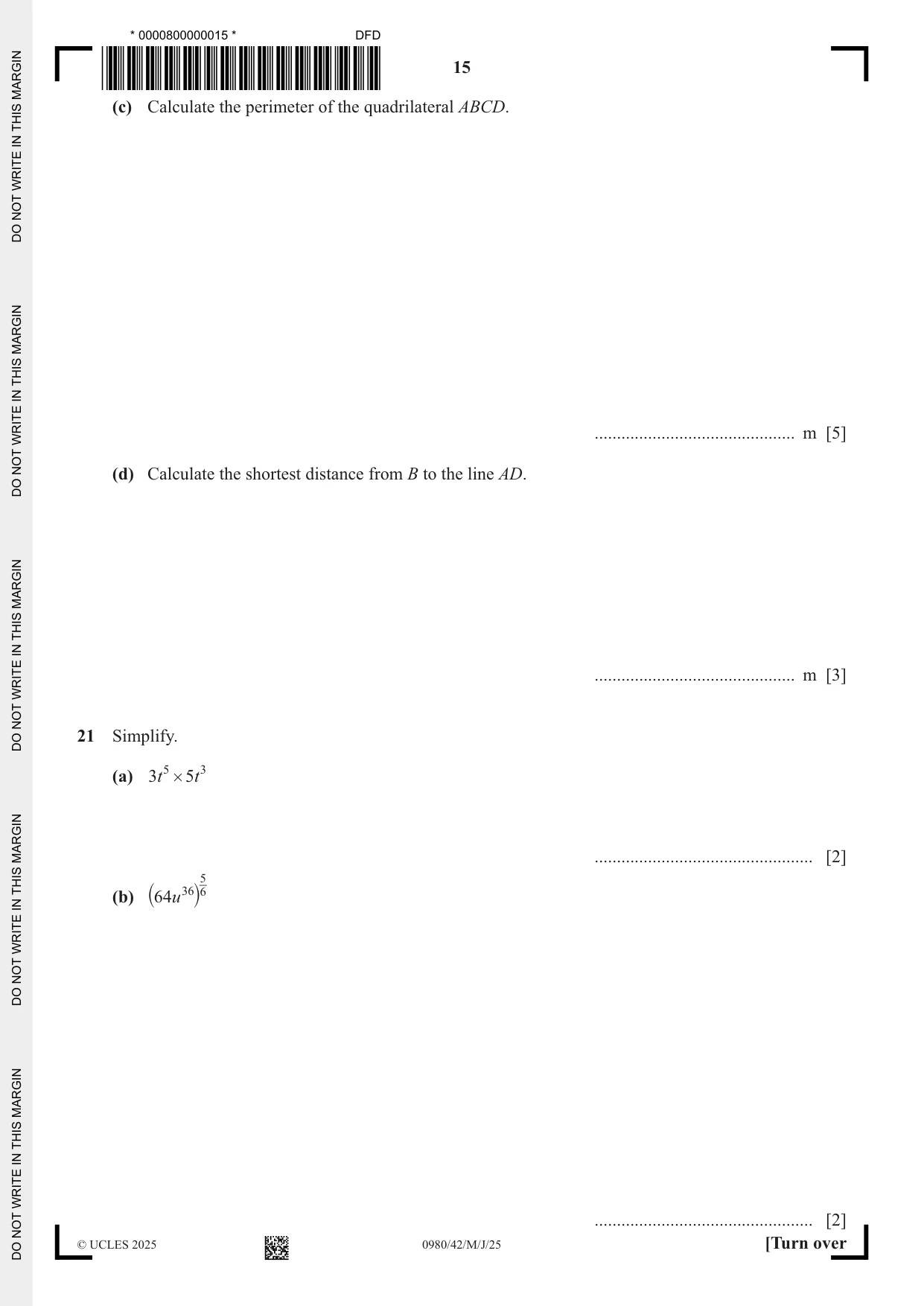
20 C NOT TO SCALE 10 m 56° 12 m D B 34° A The diagram shows a quadrilateral ABCD. CD = 10 m and DB = 12 m. Angle DBA = 90°, angle CDB = 56° and angle ADB = 34°. (a) Calculate the length of AB. AB = ............................................ m [2] (b) Calculate the area of the quadrilateral ABCD. ........................................... m2 [3] (c) Calculate the perimeter of the quadrilateral ABCD. ............................................. m [5] (d) Calculate the shortest distance from B to the line AD. ............................................. m [3]
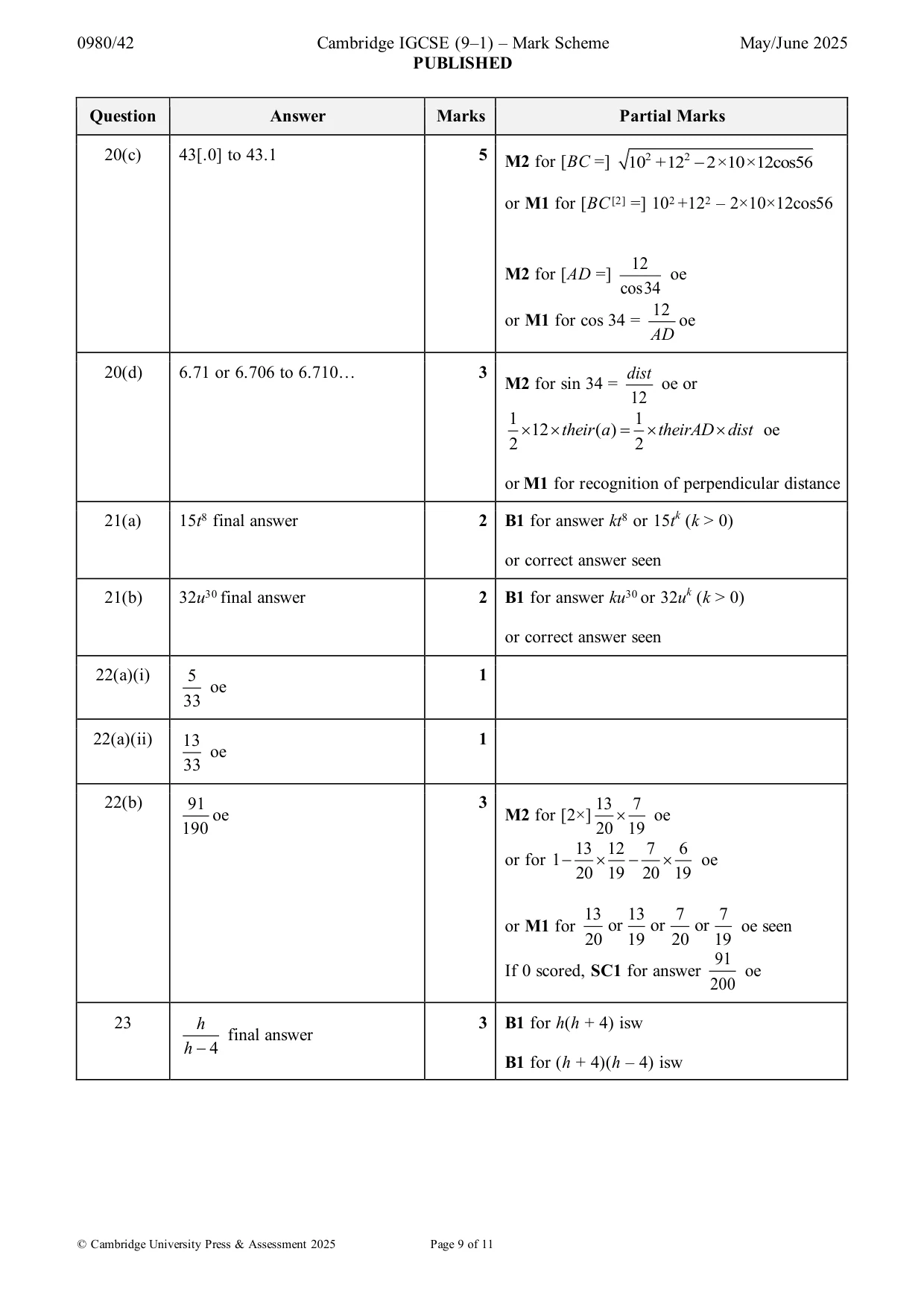
Mark scheme: 20(a) 8.09 or 8.094… 2 AB M1 for tan 34 = oe 12 20(b) 98.3 or 98.28 to 98.31 3 1 M1 for 10 12sin56 oe 2 1 M1 for 12 their (a) oe 2 20(c) 43[.0] to 43.1 5 2 2 M2 for [BC =] 10 +12 − 2×10×12cos56 or M1 for [BC [2] =] 102 +122 – 2×10×12cos56 12 M2 for [AD =] oe cos34 12 or M1 for cos 34 = oe AD 20(d) 6.71 or 6.706 to 6.710… 3 dist M2 for sin 34 = oe or 12 1 1 12 their ( a ) = theirAD dist oe 2 2 or M1 for recognition of perpendicular distance
Question 21
21 Simplify. (a) 3t 5 # 5t 3 ................................................. [2] 5 (b) `64u 36j6 ................................................. [2]
Mark scheme: 21(a) 15t8 final answer 2 B1 for answer kt8 or 15tk (k > 0) or correct answer seen 21(b) 32u30 final answer 2 B1 for answer ku30 or 32uk (k > 0) or correct answer seen
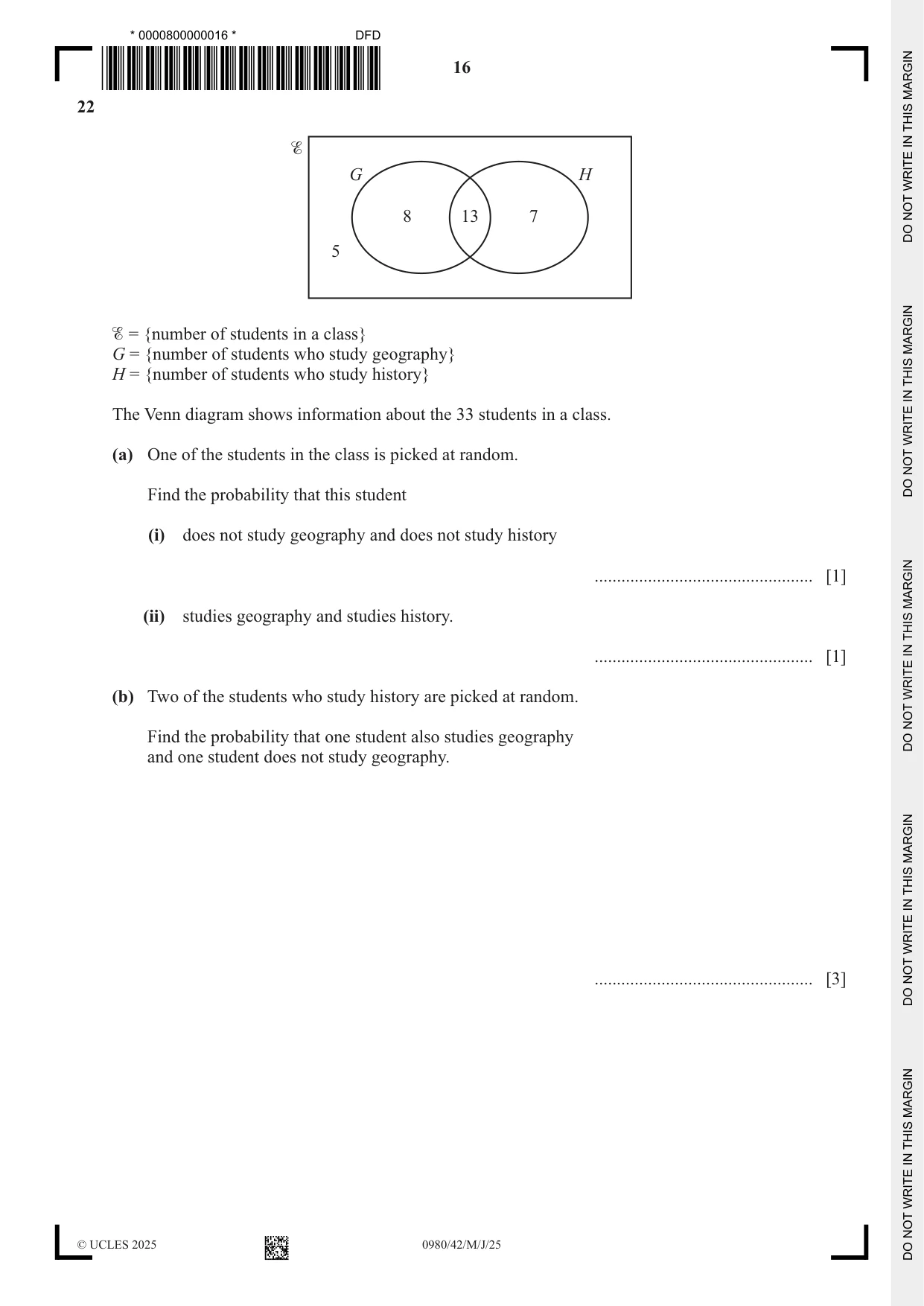
Q22 · % G H 8 13 7 5 % = {number of students in a class} G = {number of students who study…
22 % G H 8 13 7 5 % = {number of students in a class} G = {number of students who study geography} H = {number of students who study history} The Venn diagram shows information about the 33 students in a class. (a) One of the students in the class is picked at random. Find the probability that this student (i) does not study geography and does not study history ................................................. [1] (ii) studies geography and studies history. ................................................. [1] (b) Two of the students who study history are picked at random. Find the probability that one student also studies geography and one student does not study geography. ................................................. [3]
Mark scheme: 22(a)(i) 5 1 oe 33 22(a)(ii) 13 1 oe 33 22(b) 91 3 13 7 oe M2 for [2×] oe 190 20 19 13 12 7 6 or for 1 − − oe 20 19 20 19 13 13 7 7 or M1 for or or or oe seen 20 19 20 19 91 If 0 scored, SC1 for answer oe 200
Question 23
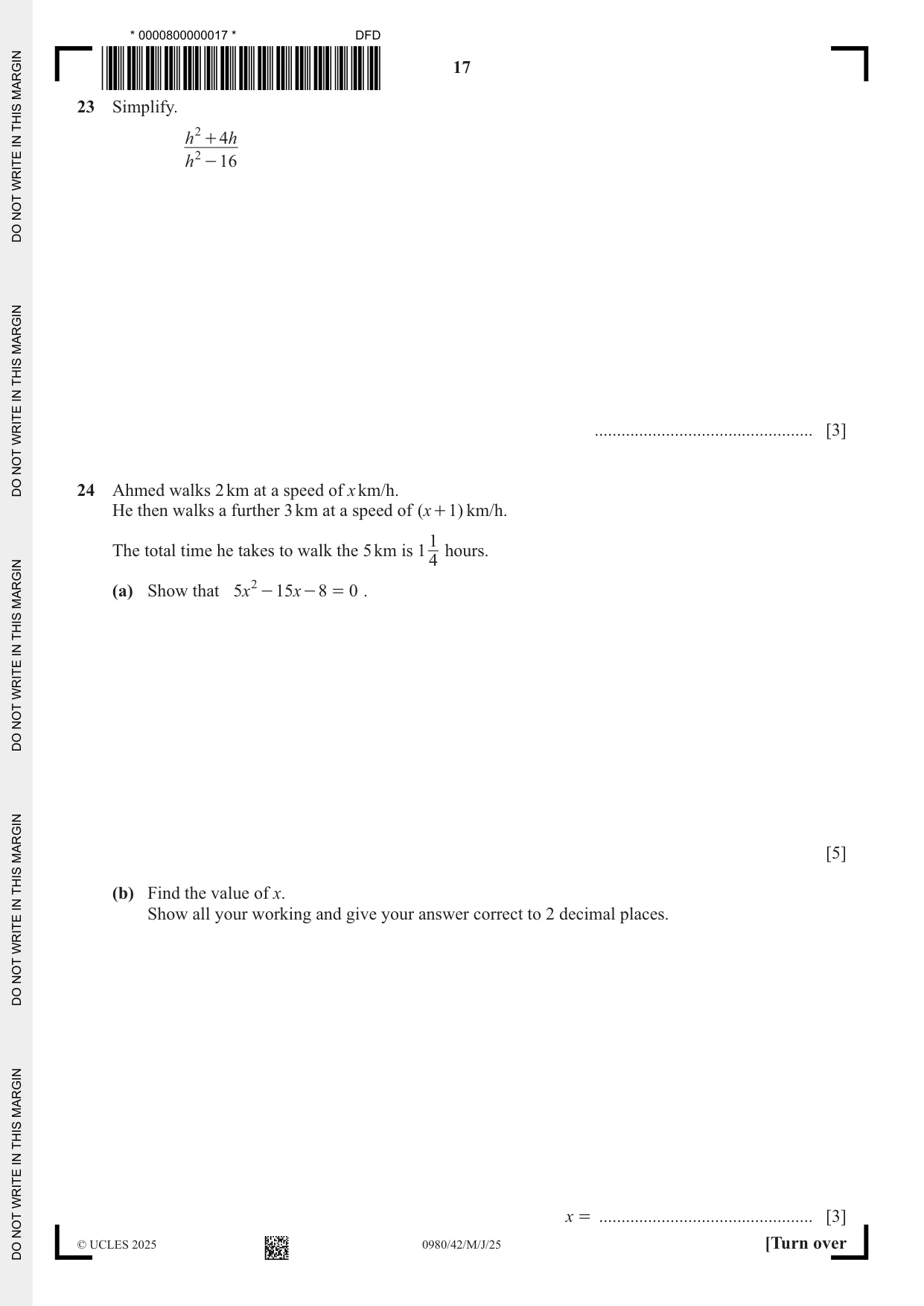
23 Simplify. h 2 + 4 h h 2 - 16 ................................................. [3]
Mark scheme: 23 h 3 B1 for h(h + 4) isw final answer h − 4 B1 for (h + 4)(h – 4) isw
Q24 · Ahmed walks 2 km at a speed of x km/h
24 Ahmed walks 2 km at a speed of x km/h. He then walks a further 3 km at a speed of ( x + 1 ) km/h. 1 The total time he takes to walk the 5 km is 1 hours. 4 (a) Show that 5x 2 - 15 x - 8 = 0 . [5] (b) Find the value of x. Show all your working and give your answer correct to 2 decimal places. x = ................................................ [3]
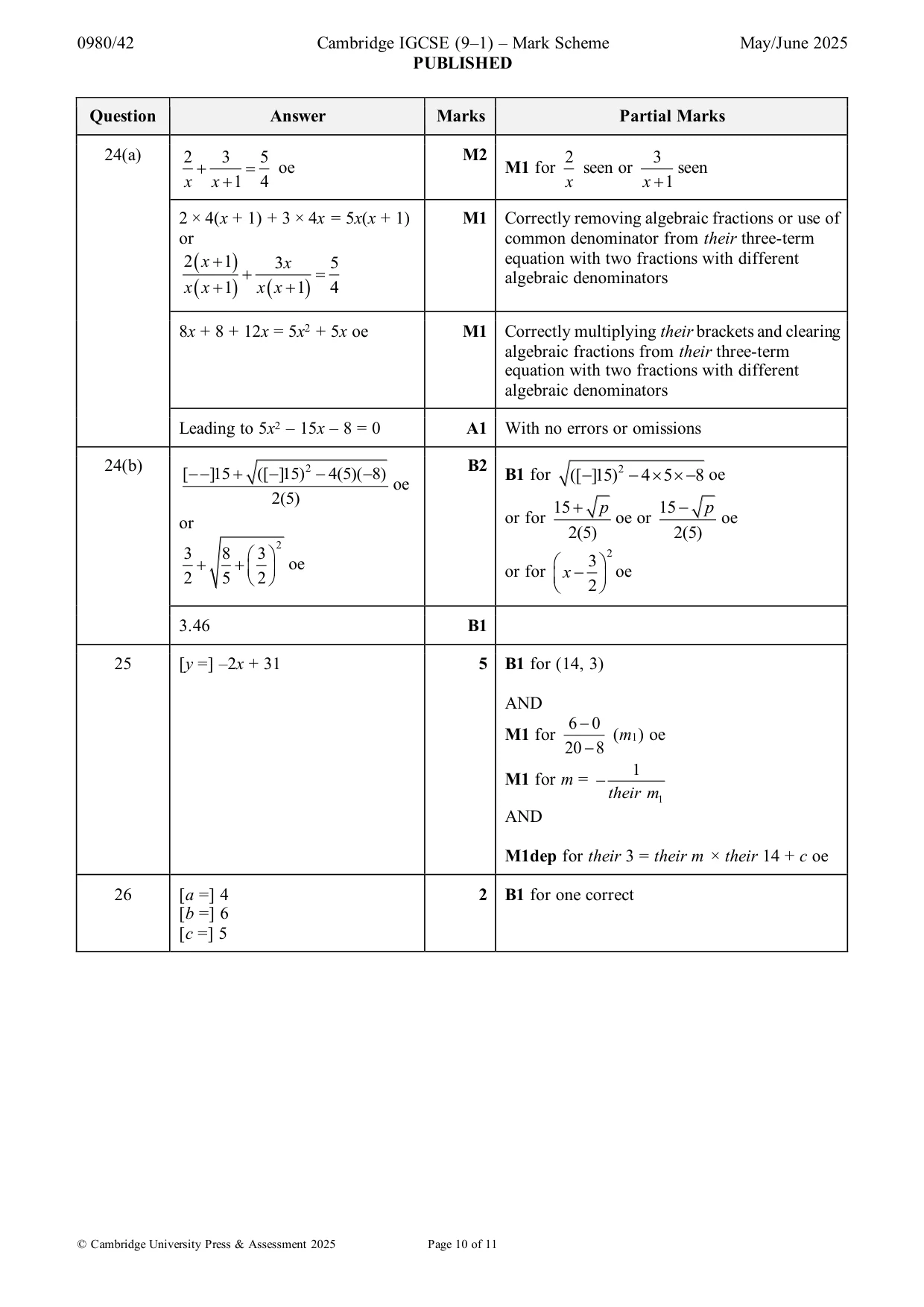
Mark scheme: 24(a) 2 3 5 M2 2 3 + = oe M1 for seen or seen x x + 1 4 x x + 1 2 × 4(x + 1) + 3 × 4x = 5x(x + 1) M1 Correctly removing algebraic fractions or use of or common denominator from their three-term 2 ( x + 1) 3 x 5 equation with two fractions with different + = algebraic denominators x ( x + 1) x ( x + 1) 4 8x + 8 + 12x = 5x2 + 5x oe M1 Correctly multiplying their brackets and clearing algebraic fractions from their three-term equation with two fractions with different algebraic denominators Leading to 5x2 – 15x – 8 = 0 A1 With no errors or omissions 24(b) 2 B2 2 [ −−]15 + ([ − ]15) − 4(5)( −8) B1 for ([ −]15) −−oe4 5 8 oe 2(5) 15 + p 15 − p or for oe or oe or 2(5) 2(5) 2 3 8 3 2 + + oe 3 or for x − oe 2 5 2 2 3.46 B1
Q25 · P is the point (8, 0) and Q is the point (20, 6)
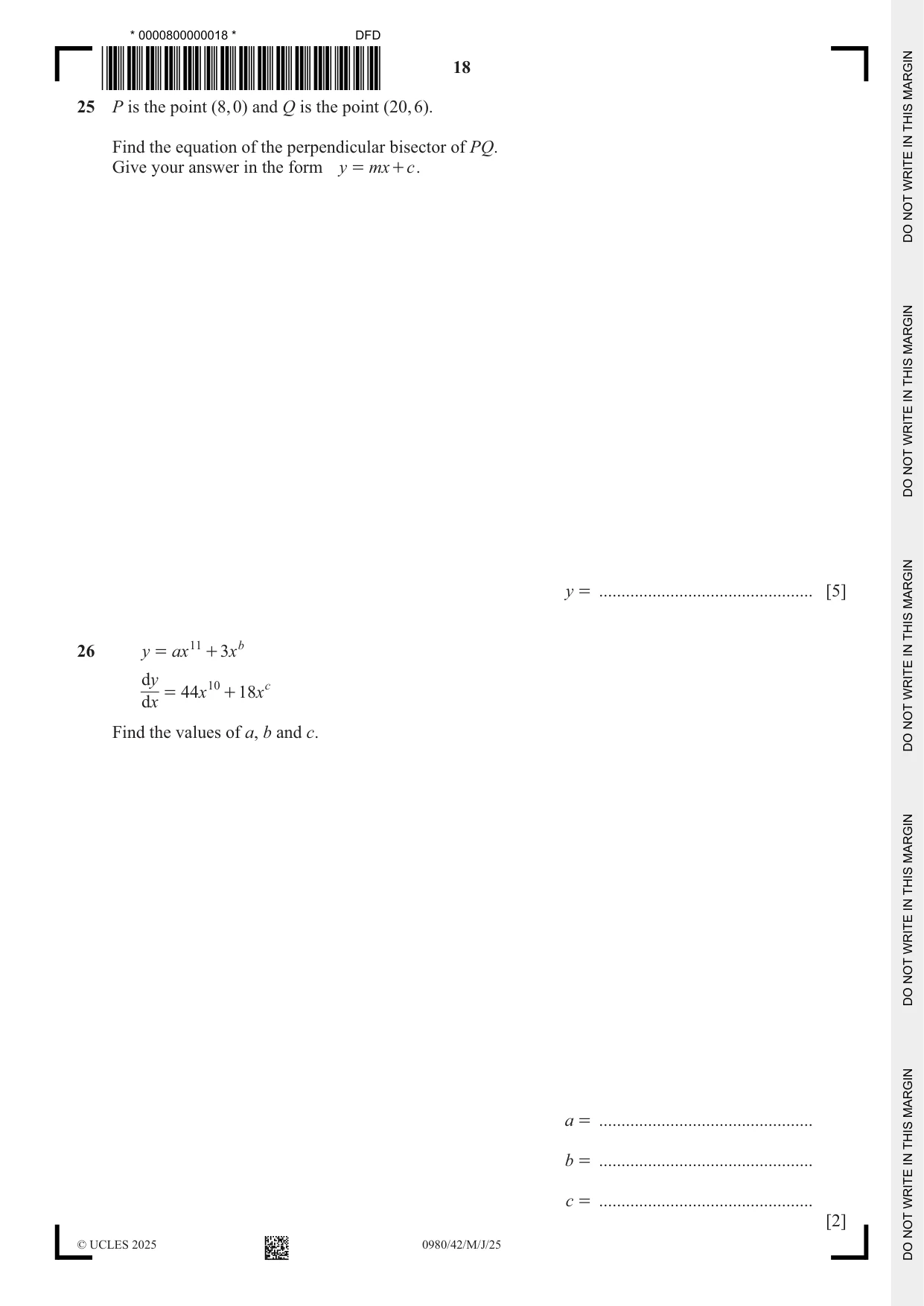
25 P is the point (8, 0) and Q is the point (20, 6). Find the equation of the perpendicular bisector of PQ. Give your answer in the form y = mx + c . y = ................................................ [5]
Mark scheme: 25 [y =] –2x + 31 5 B1 for (14, 3) AND 6 − 0 M1 for (m1) oe 20 − 8 1 M1 for m = − their m1 AND M1dep for their 3 = their m × their 14 + c oe
Q26 · Y = ax 11 + 3 x b d y 10 c = 44 x + 18 x d x Find the values of a, b and c
26 y = ax 11 + 3 x b d y 10 c = 44 x + 18 x d x Find the values of a, b and c. a = ................................................ b = ................................................ c = ................................................ [2]
Mark scheme: 26 [a =] 4 2 B1 for one correct [b =] 6 [c =] 5
Q27 · P NOT TO SCALE D C A B The diagram shows a cube
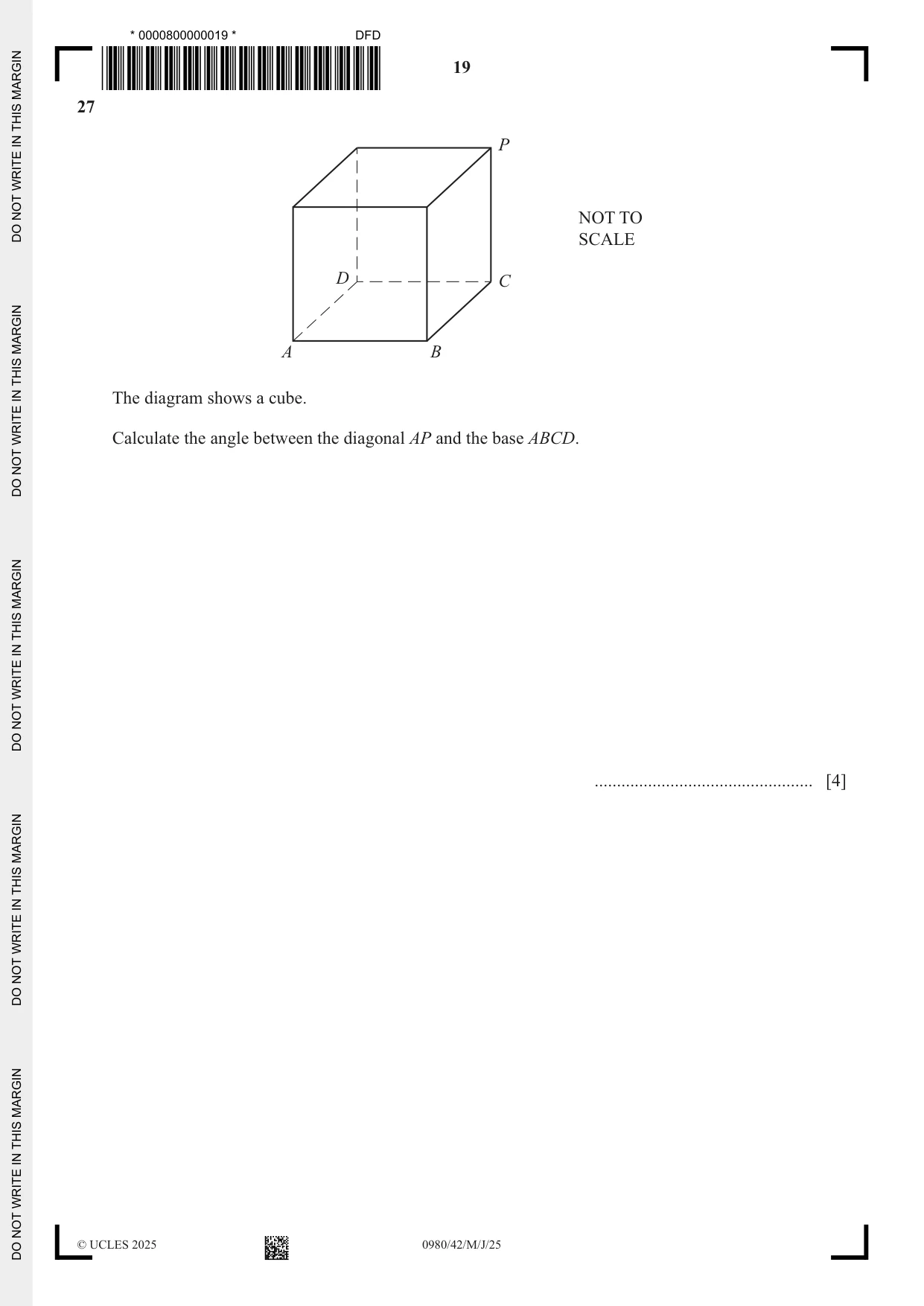
27 P NOT TO SCALE D C A B The diagram shows a cube. Calculate the angle between the diagonal AP and the base ABCD. ................................................. [4]
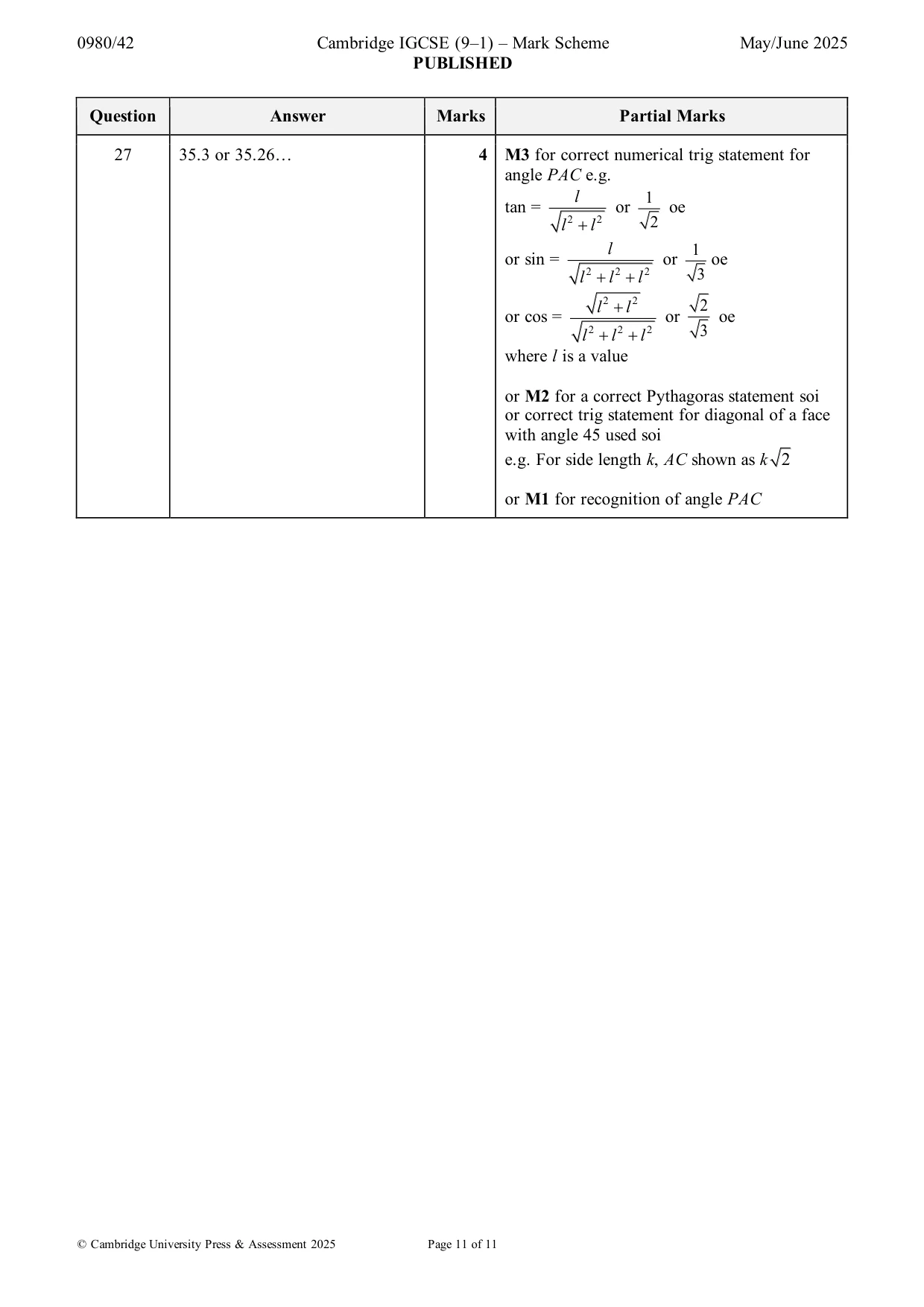
Mark scheme: 27 35.3 or 35.26… 4 M3 for correct numerical trig statement for angle PAC e.g. l 1 tan = or oe l 2 + l 2 2 l 1 or sin = or oe l 2 + l 2 + l 2 3 l 2 + l 2 2 or cos = or oe l 2 + l 2 + l 2 3 where l is a value or M2 for a correct Pythagoras statement soi or correct trig statement for diagonal of a face with angle 45 used soi e.g. For side length k, AC shown as k 2 or M1 for recognition of angle PAC
What was in this paper
The subtopics covered by these 27 questions, and how many questions each got. Open one in a new tab to see every Cambridge question on it.
3Geometrical terms2Algebraic fractions1Algebraic manipulation1Algebraic manipulation1Area and perimeter1Circle theorems I1Differentiation1Exponential growth and decay1Functions1Indices II1Limits of accuracy1Money1Non-right-angled triangles1Percentages1Perpendicular lines1Probability of combined events1Pythagoras’ theorem and trigonometry1Ratio and proportion1Sets1Similarity1Surface area and volume1Symmetry1The four operations1What you needed in this session
Cambridge’s own grade thresholds for 2025 May/June, Paper 4 · Variant 2. A higher threshold means an easier paper — the bar moves with how the cohort did.