Cambridge IGCSE Mathematics (9-1) 0980 — 2022 May/June Paper 4 · Variant 2
0980/42/M/J/22 · 12 questions · 130 marks · ≈146 min
The question paper and its mark scheme, free to read here and free to download. This is Cambridge’s own paper, exactly as it was sat.
Question paper20 pages
Mark scheme9 pages
Answers below. Sit the paper first if you are practising.
Questions as text
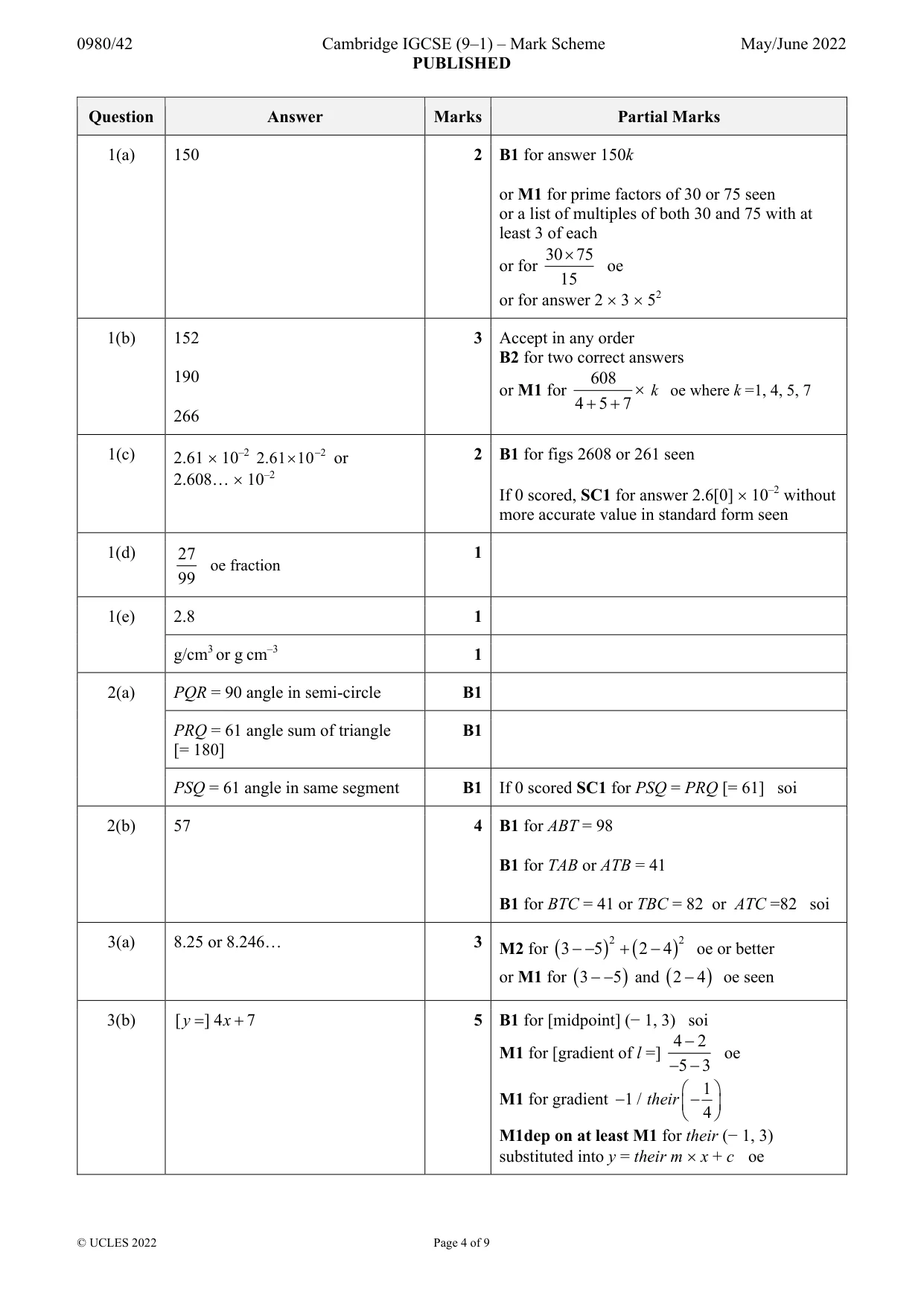
Q1 · Find the lowest common multiple (LCM) of 30 and 75
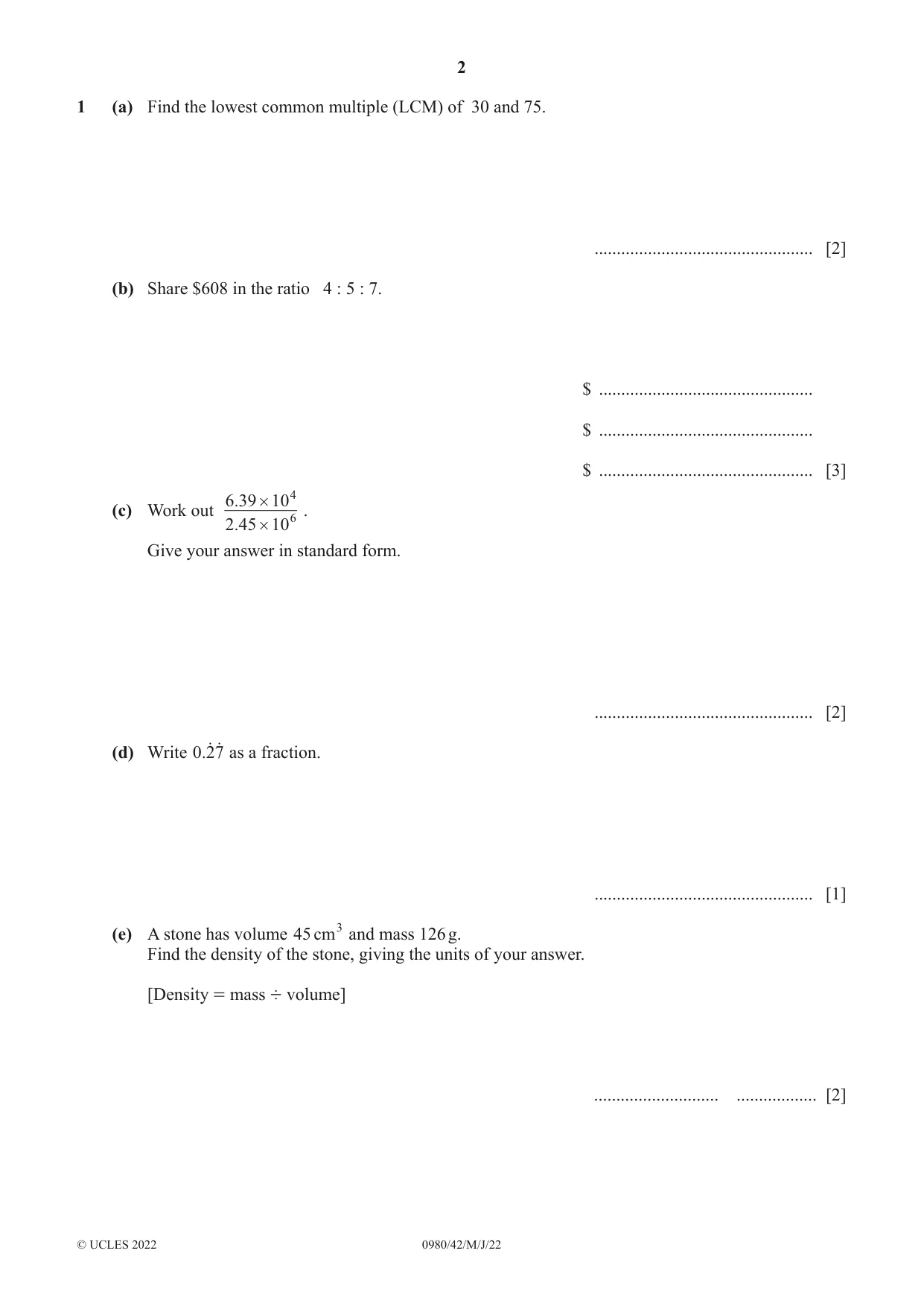
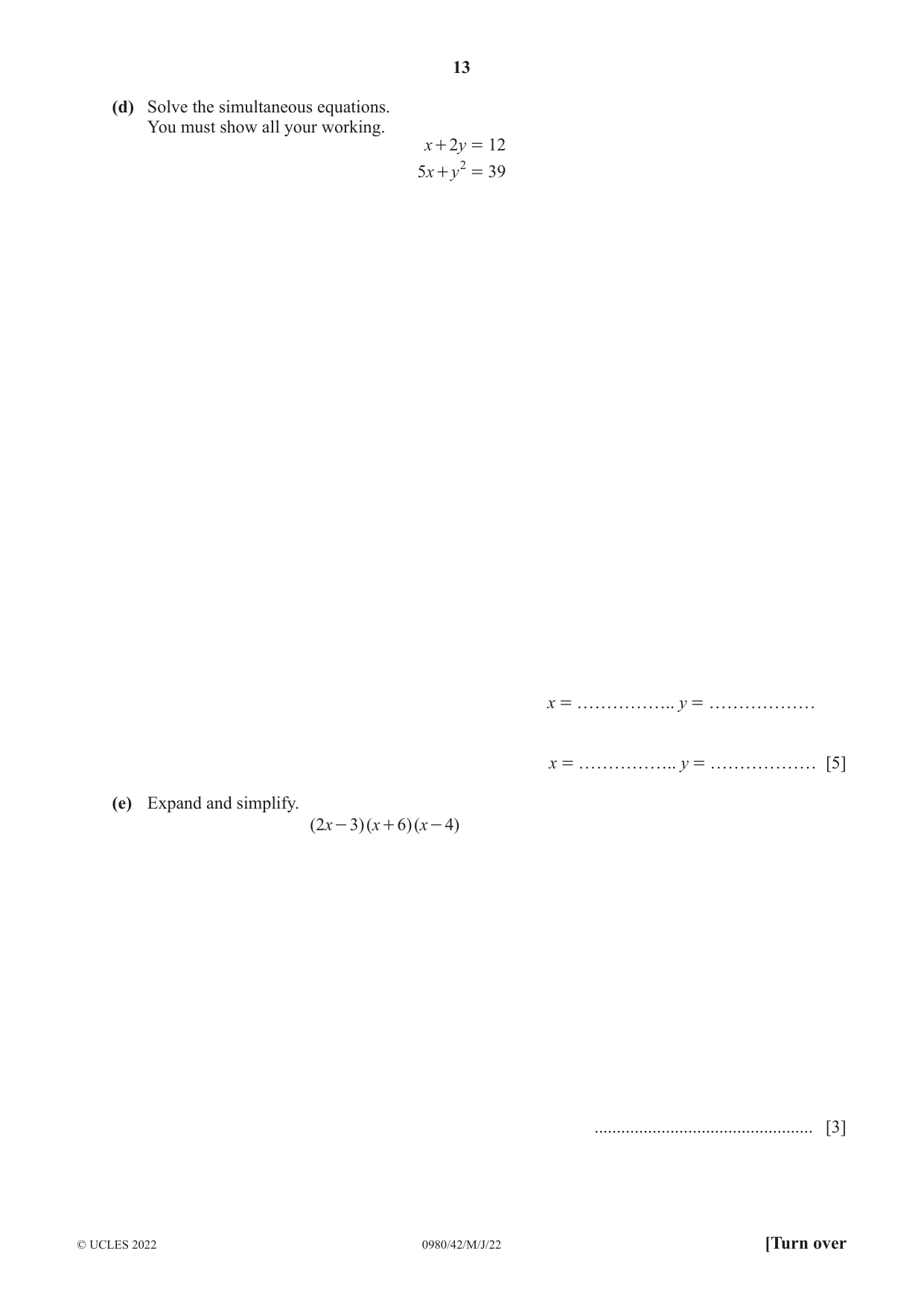
1 (a) Find the lowest common multiple (LCM) of 30 and 75. ................................................. [2] (b) Share $608 in the ratio 4 : 5 : 7. $ ................................................ $ ................................................ $ ................................................ [3] 6 .39 # 10 4 (c) Work out 6 . 2 .45 # 10 Give your answer in standard form. ................................................. [2] (d) Write .027o o as a fraction. ................................................. [1] (e) A stone has volume 45 cm 3 and mass 126 g. Find the density of the stone, giving the units of your answer. [Density = mass ' volume] ............................ .................. [2]
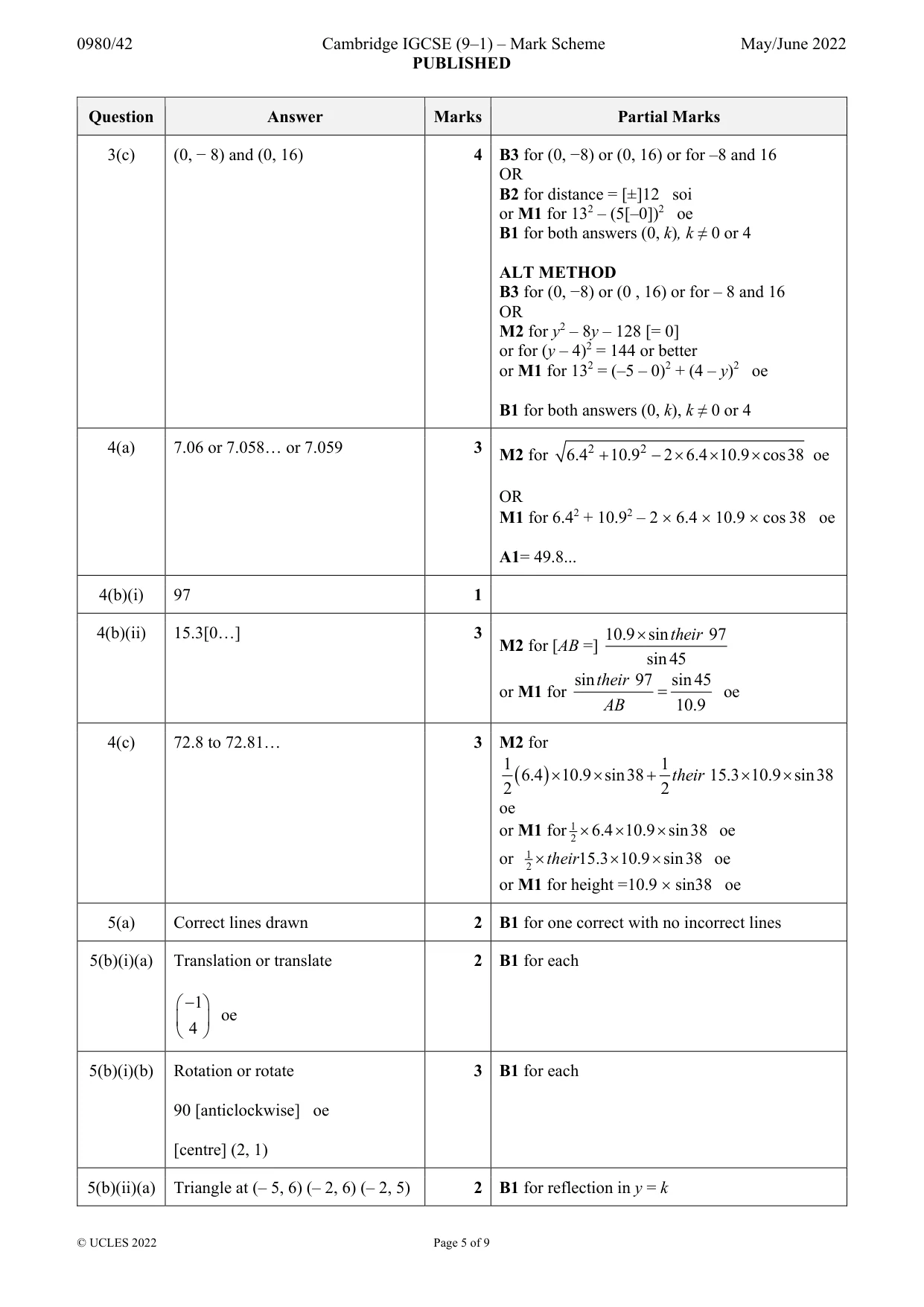
Mark scheme: Question Answer Marks Partial Marks 1(a) 150 2 B1 for answer 150k or M1 for prime factors of 30 or 75 seen or a list of multiples of both 30 and 75 with at least 3 of each 30 75 or for oe 15 or for answer 2 3 52 1(b) 152 3 Accept in any order B2 for two correct answers 190 608 or M1 for k oe where k =1, 4, 5, 7 4 5 7 266 1(c) 2.61 10–2 2.61 10 2 or 2 B1 for figs 2608 or 261 seen 2.608… 10–2 If 0 scored, SC1 for answer 2.6[0] 10–2 without more accurate value in standard form seen 1(d) 27 1 oe fraction 99 1(e) 2.8 1 g/cm3 or g cm–3 1
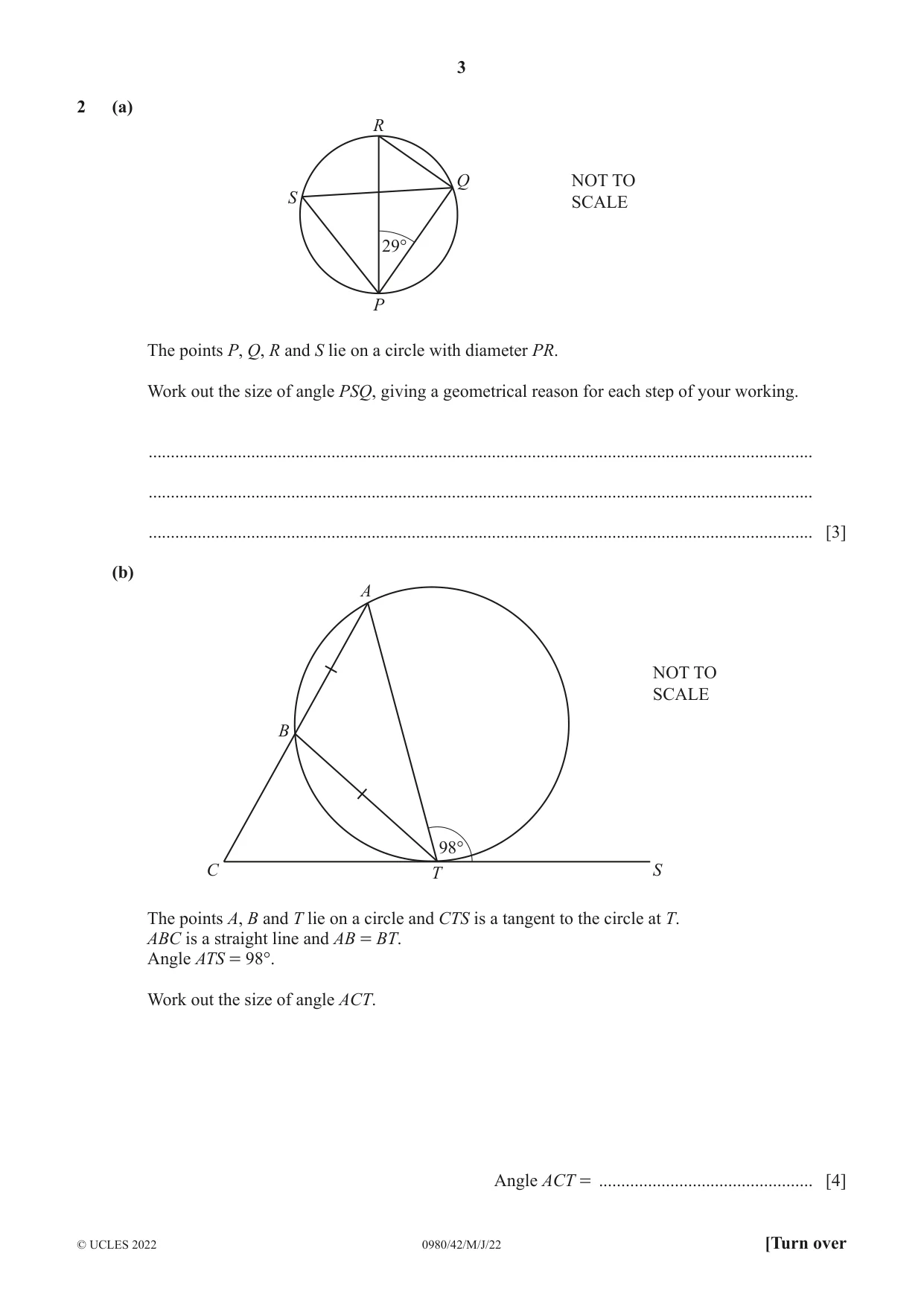
Q2 · R Q NOT TO S SCALE 29° P The points P, Q, R and S lie on a circle with diameter PR
2 (a) R Q NOT TO S SCALE 29° P The points P, Q, R and S lie on a circle with diameter PR. Work out the size of angle PSQ, giving a geometrical reason for each step of your working. ..................................................................................................................................................... ..................................................................................................................................................... ..................................................................................................................................................... [3] (b) A NOT TO SCALE B 98° C T S The points A, B and T lie on a circle and CTS is a tangent to the circle at T. ABC is a straight line and AB = BT. Angle ATS = 98°. Work out the size of angle ACT. Angle ACT = ................................................ [4]
Mark scheme: 2(a) PQR = 90 angle in semi-circle B1 PRQ = 61 angle sum of triangle B1 [= 180] PSQ = 61 angle in same segment B1 If 0 scored SC1 for PSQ = PRQ [= 61] soi 2(b) 57 4 B1 for ABT = 98 B1 for TAB or ATB = 41 B1 for BTC = 41 or TBC = 82 or ATC =82 soi
Q3 · A line, l, joins point F (3, 2) and point G (- 5, 4)
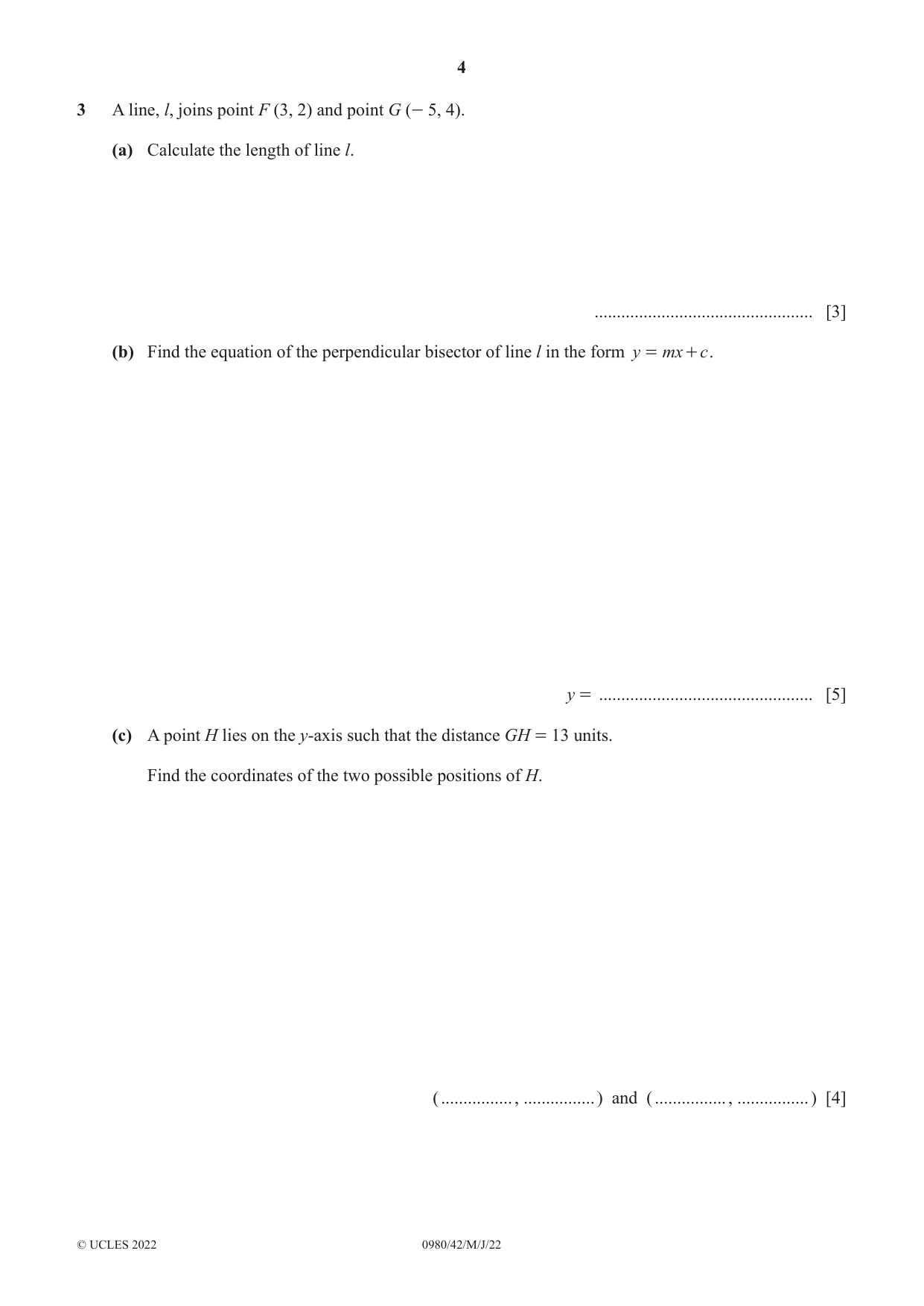
3 A line, l, joins point F (3, 2) and point G (- 5, 4). (a) Calculate the length of line l. ................................................. [3] (b) Find the equation of the perpendicular bisector of line l in the form y = mx + c . y = ................................................ [5] (c) A point H lies on the y-axis such that the distance GH = 13 units. Find the coordinates of the two possible positions of H. ( ................ , ................ ) and ( ................ , ................ ) [4]
Mark scheme: 3(a) 8.25 or 8.246… 3 2 2 M2 for 3 5 2 4 oe or better or M1 for 3 5 and 2 4 oe seen 3(b) [ y ] 4 x 7 5 B1 for [midpoint] (− 1, 3) soi 4 2 M1 for [gradient of l =] oe 5 3 1 M1 for gradient 1 / their 4 M1dep on at least M1 for their (− 1, 3) substituted into y = their m x + c oe 3(c) (0, − 8) and (0, 16) 4 B3 for (0, −8) or (0, 16) or for –8 and 16 OR B2 for distance = [±]12 soi or M1 for 132 – (5[–0])2 oe B1 for both answers (0, k), k ≠ 0 or 4 ALT METHOD B3 for (0, −8) or (0 , 16) or for – 8 and 16 OR M2 for y2 – 8y – 128 [= 0] or for (y – 4)2 = 144 or better or M1 for 132 = (–5 – 0)2 + (4 – y)2 oe B1 for both answers (0, k), k ≠ 0 or 4
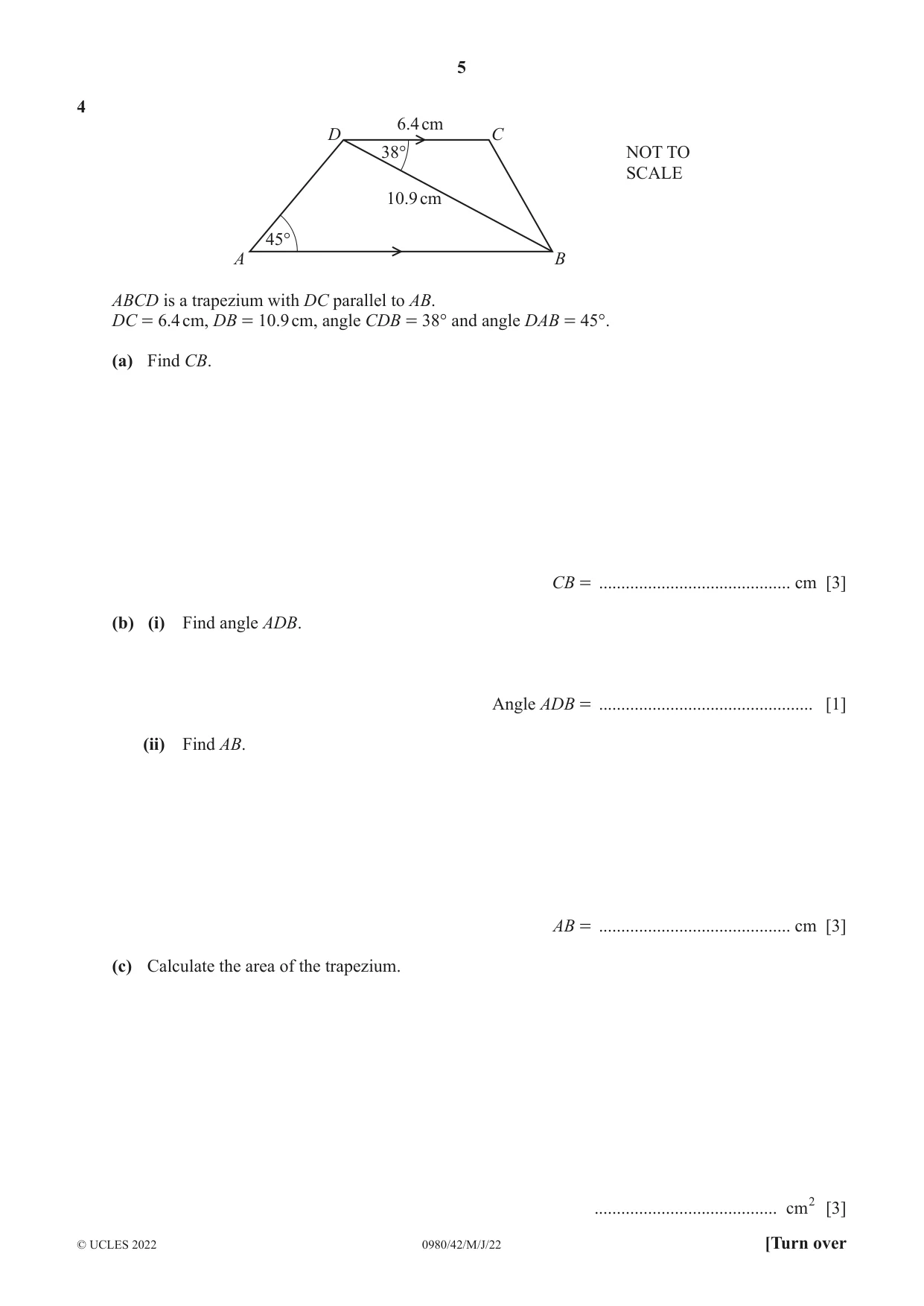
Q4 · 6.4 cm D C 38° NOT TO SCALE 10.9 cm 45° A B ABCD is a trapezium with DC parallel to AB
4 6.4 cm D C 38° NOT TO SCALE 10.9 cm 45° A B ABCD is a trapezium with DC parallel to AB. DC = 6.4 cm, DB = 10.9 cm, angle CDB = 38° and angle DAB = 45°. (a) Find CB. CB = ........................................... cm [3] (b) (i) Find angle ADB. Angle ADB = ................................................ [1] (ii) Find AB. AB = ........................................... cm [3] (c) Calculate the area of the trapezium. ......................................... cm2 [3]
Mark scheme: 4(a) 7.06 or 7.058… or 7.059 3 2 2 M2 for 6.4 10.9 2 6.4 10.9 cos38 oe OR M1 for 6.42 + 10.92 – 2 6.4 10.9 cos 38 oe A1= 49.8... 4(b)(i) 97 1 4(b)(ii) 15.3[0…] 3 10.9 sin their 97 M2 for [AB =] sin45 sin their 97 sin45 or M1 for oe AB 10.9 4(c) 72.8 to 72.81… 3 M2 for 1 1 6.4 10.9 sin38 their 15.3 10.9 sin38 2 2 oe or M1 for 12 6.4 10.9 sin38 oe or 12 their15.3 10.9 sin38 oe or M1 for height =10.9 sin38 oe
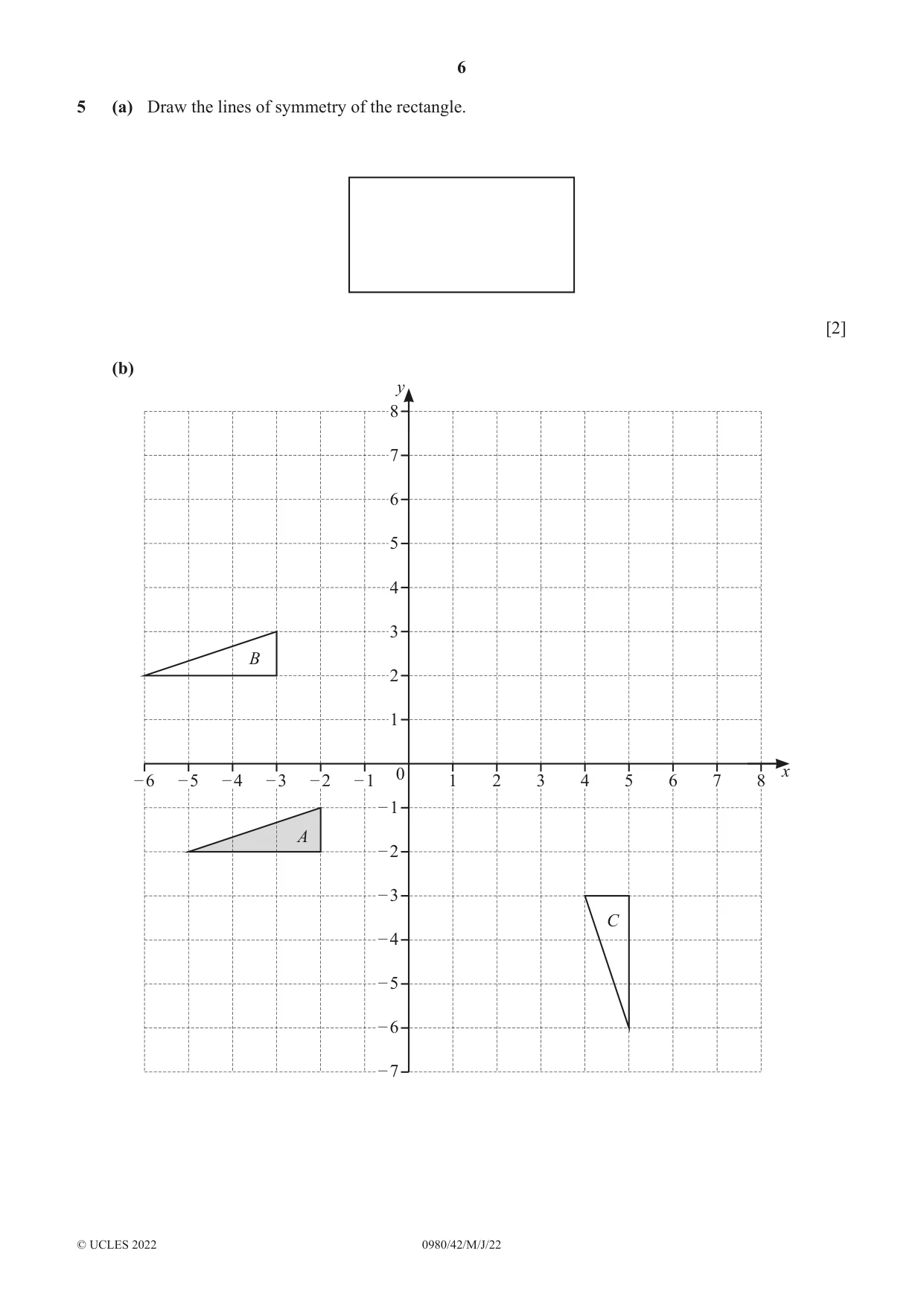
Q5 · Draw the lines of symmetry of the rectangle
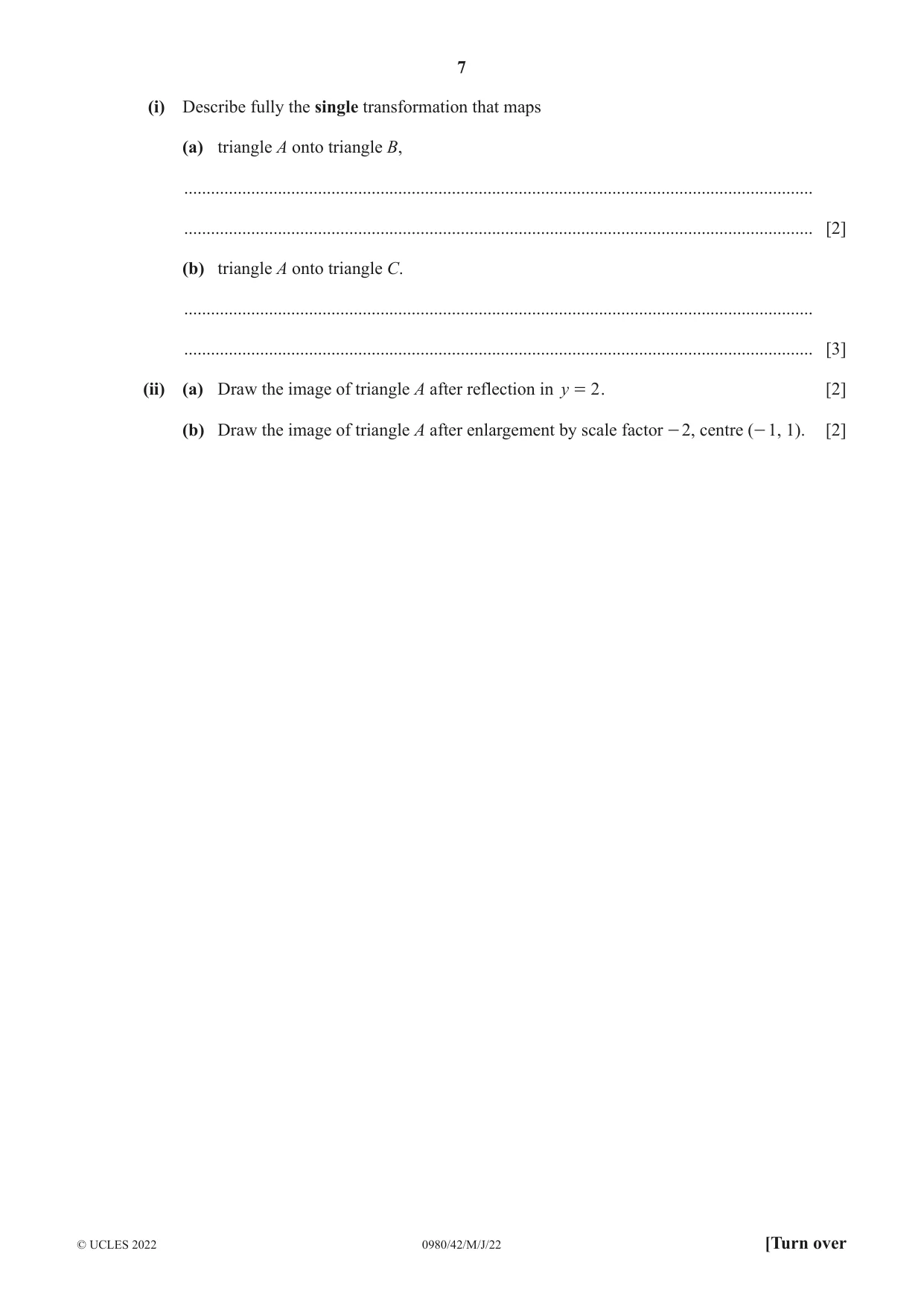
5 (a) Draw the lines of symmetry of the rectangle. [2] (b) y 8 7 6 5 4 3 B 2 1 0 x – 6 – 5 – 4 – 3 – 2 – 1 1 2 3 4 5 6 7 8 – 1 A – 2 – 3 C – 4 – 5 – 6 – 7 (i) Describe fully the single transformation that maps (a) triangle A onto triangle B, ............................................................................................................................................. ............................................................................................................................................. [2] (b) triangle A onto triangle C. ............................................................................................................................................. ............................................................................................................................................. [3] (ii) (a) Draw the image of triangle A after reflection in y = 2 . [2] (b) Draw the image of triangle A after enlargement by scale factor - 2, centre (- 1, 1). [2]
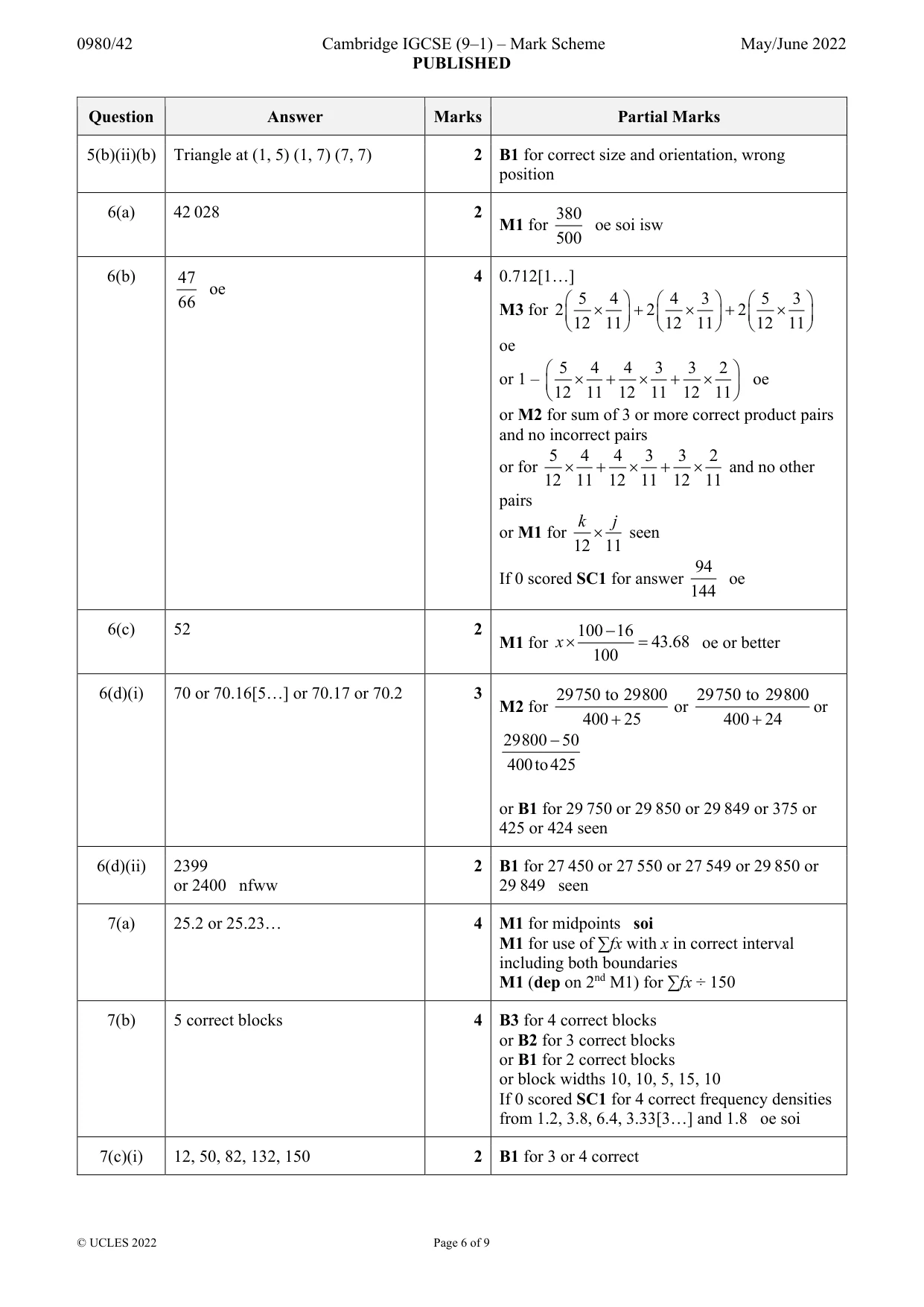
Mark scheme: 5(a) Correct lines drawn 2 B1 for one correct with no incorrect lines 5(b)(i)(a) Translation or translate 2 B1 for each 1 oe 4 5(b)(i)(b) Rotation or rotate 3 B1 for each 90 [anticlockwise] oe [centre] (2, 1) 5(b)(ii)(a) Triangle at (– 5, 6) (– 2, 6) (– 2, 5) 2 B1 for reflection in y = k 5(b)(ii)(b) Triangle at (1, 5) (1, 7) (7, 7) 2 B1 for correct size and orientation, wrong position
Q6 · At a festival, 380 people out of 500 people questioned say that they are camping
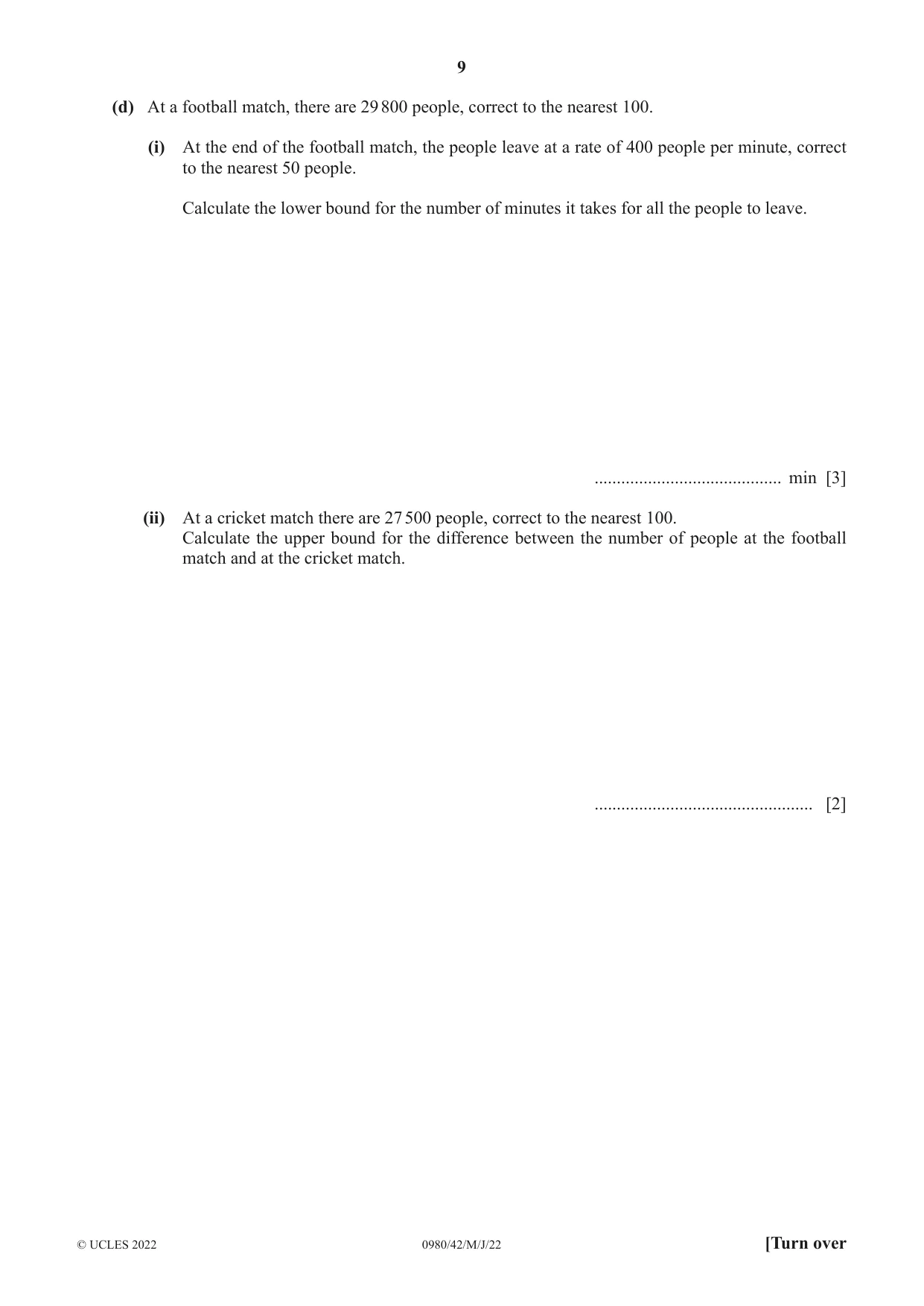
6 (a) At a festival, 380 people out of 500 people questioned say that they are camping. There are 55 300 people at the festival. Calculate an estimate of the total number of people camping at the festival. ................................................. [2] (b) 12 friends travel to the festival. 5 travel by car, 4 travel by bus and 3 travel by train. Two people are chosen at random from the 12 friends. Calculate the probability that they travel by different types of transport. ................................................. [4] (c) Arno buys a student ticket for $43.68 . This is a saving of 16% on the full price of a ticket. Calculate the full price of a ticket. $ ................................................ [2] (d) At a football match, there are 29 800 people, correct to the nearest 100. (i) At the end of the football match, the people leave at a rate of 400 people per minute, correct to the nearest 50 people. Calculate the lower bound for the number of minutes it takes for all the people to leave. .......................................... min [3] (ii) At a cricket match there are 27 500 people, correct to the nearest 100. Calculate the upper bound for the difference between the number of people at the football match and at the cricket match. ................................................. [2]
Mark scheme: 6(a) 42 028 2 380 M1 for oe soi isw 500 6(b) 47 4 0.712[1…] oe 66 5 4 4 3 5 3 M3 for 2 2 2 12 11 12 11 12 11 oe 5 4 4 3 3 2 or 1 – oe 12 11 12 11 12 11 or M2 for sum of 3 or more correct product pairs and no incorrect pairs 5 4 4 3 3 2 or for and no other 12 11 12 11 12 11 pairs k j or M1 for seen 12 11 94 If 0 scored SC1 for answer oe 144 6(c) 52 2 100 16 M1 for x 43.68 oe or better 100 6(d)(i) 70 or 70.16[5…] or 70.17 or 70.2 3 29750 to 29800 29750 to 29800 M2 for or or 400 25 400 24 29800 50 400to425 or B1 for 29 750 or 29 850 or 29 849 or 375 or 425 or 424 seen 6(d)(ii) 2399 2 B1 for 27 450 or 27 550 or 27 549 or 29 850 or or 2400 nfww 29 849 seen
Q7 · Information about the mass, m kg, of each of 150 children is recorded in the frequency…
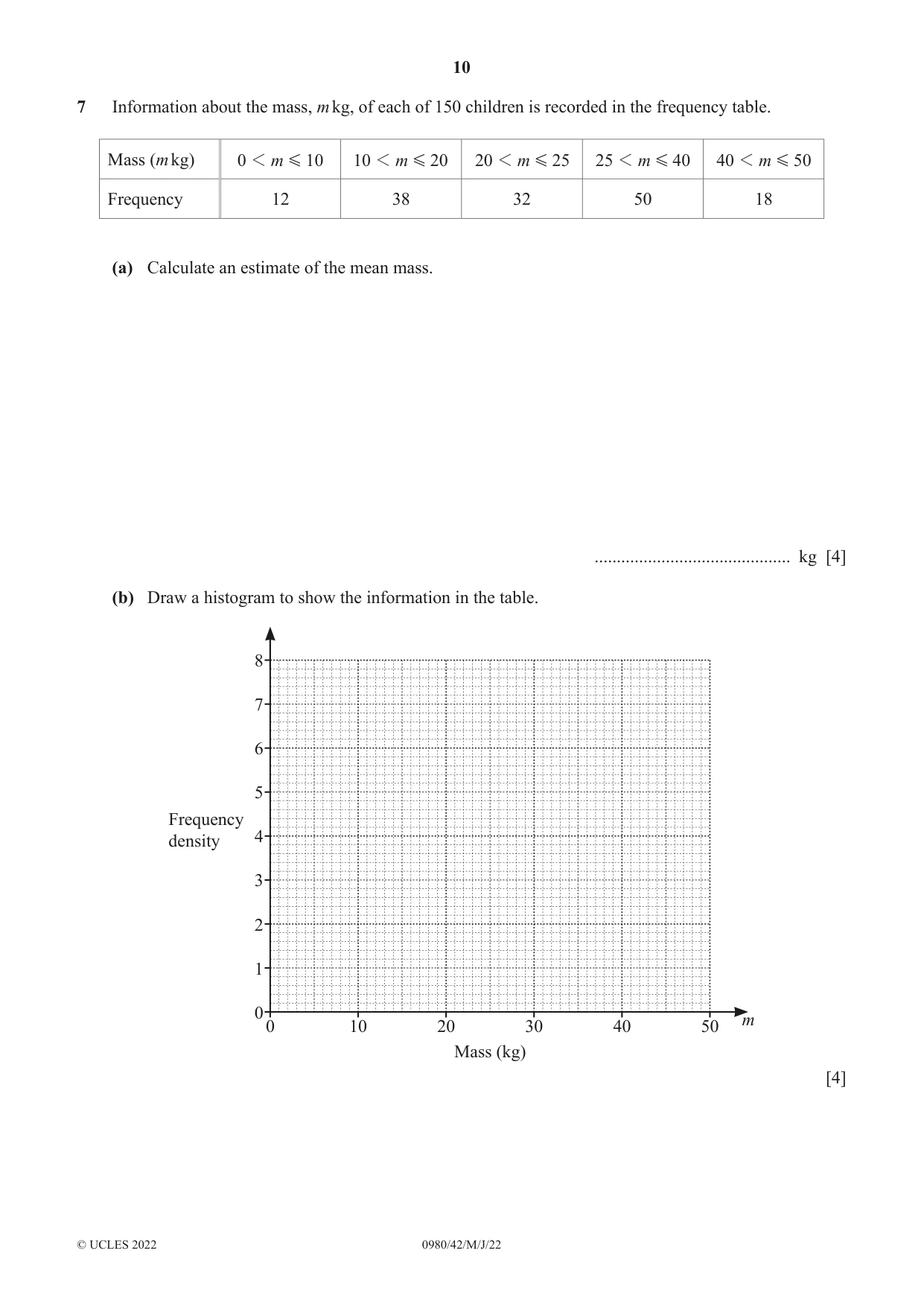
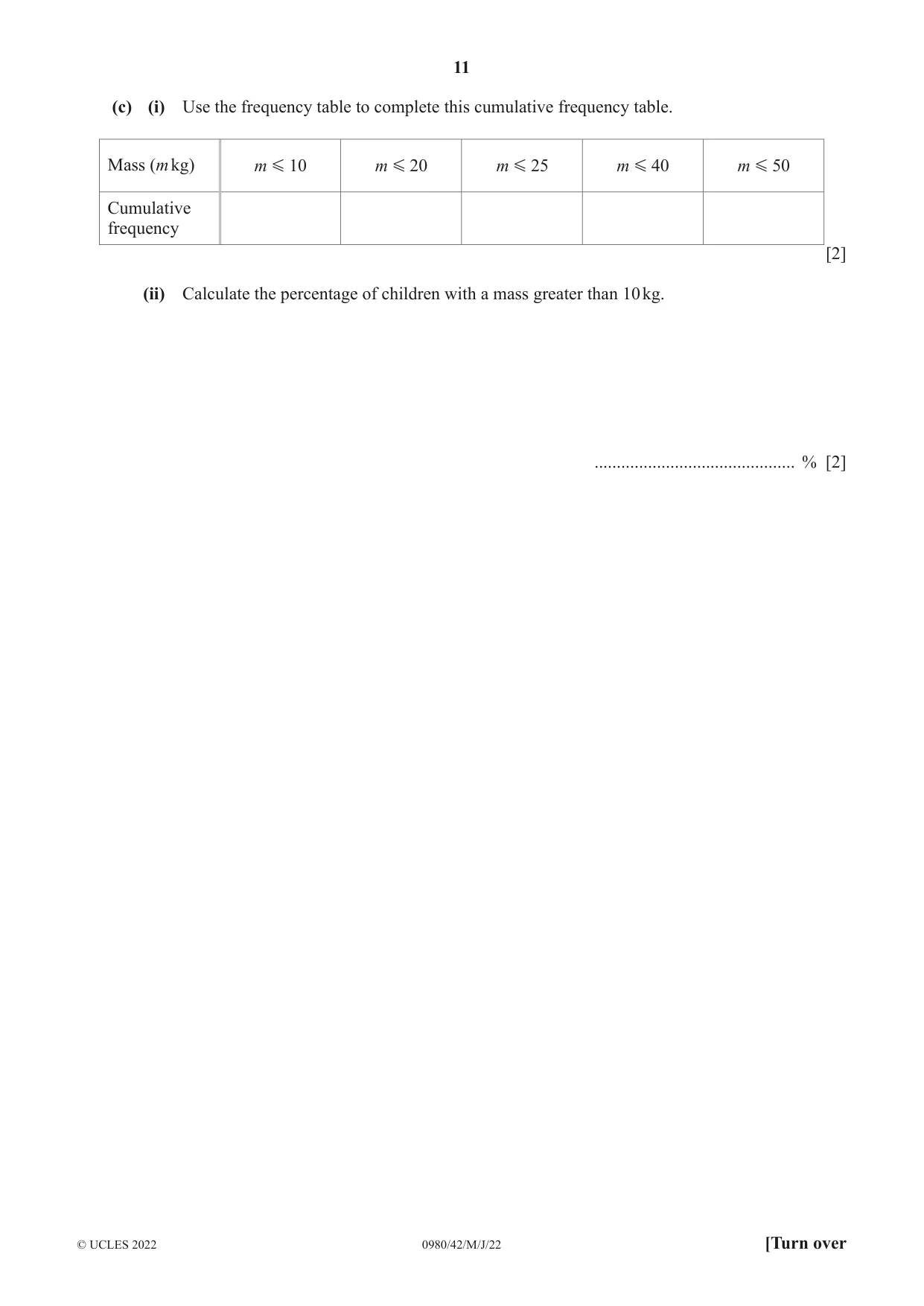
7 Information about the mass, m kg, of each of 150 children is recorded in the frequency table. Mass (m kg) 0 1 m G 10 10 1 m G 20 20 1 m G 25 25 1 m G 40 40 1 m G 50 Frequency 12 38 32 50 18 (a) Calculate an estimate of the mean mass. ............................................ kg [4] (b) Draw a histogram to show the information in the table. 8 7 6 5 Frequency density 4 3 2 1 0 m 0 10 20 30 40 50 Mass (kg) [4] (c) (i) Use the frequency table to complete this cumulative frequency table. Mass (m kg) m G 10 m G 20 m G 25 m G 40 m G 50 Cumulative frequency [2] (ii) Calculate the percentage of children with a mass greater than 10 kg. ............................................. % [2]
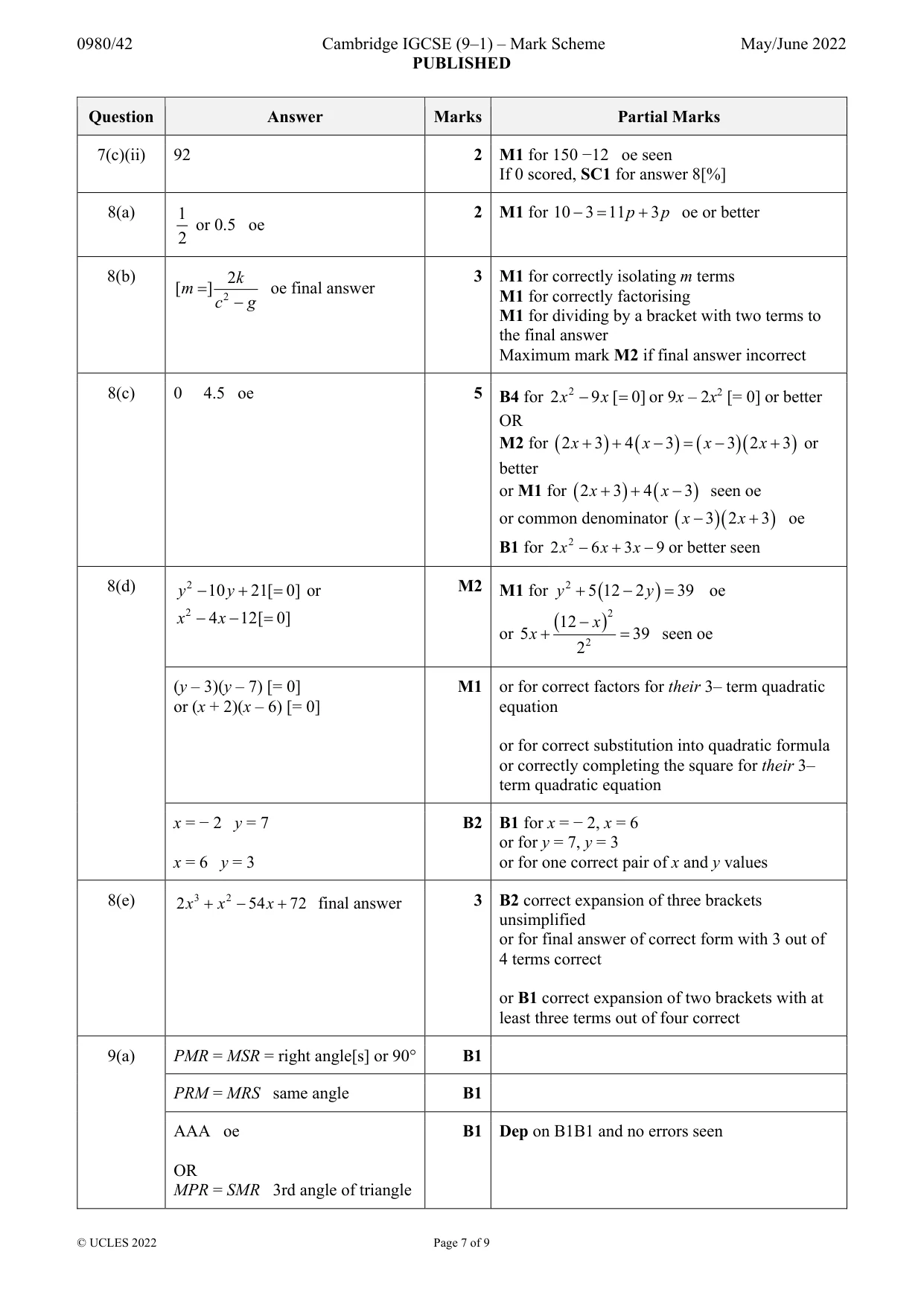
Mark scheme: 7(a) 25.2 or 25.23… 4 M1 for midpoints soi M1 for use of ∑fx with x in correct interval including both boundaries M1 (dep on 2nd M1) for ∑fx ÷ 150 7(b) 5 correct blocks 4 B3 for 4 correct blocks or B2 for 3 correct blocks or B1 for 2 correct blocks or block widths 10, 10, 5, 15, 10 If 0 scored SC1 for 4 correct frequency densities from 1.2, 3.8, 6.4, 3.33[3…] and 1.8 oe soi 7(c)(i) 12, 50, 82, 132, 150 2 B1 for 3 or 4 correct 7(c)(ii) 92 2 M1 for 150 −12 oe seen If 0 scored, SC1 for answer 8[%]
Question 8
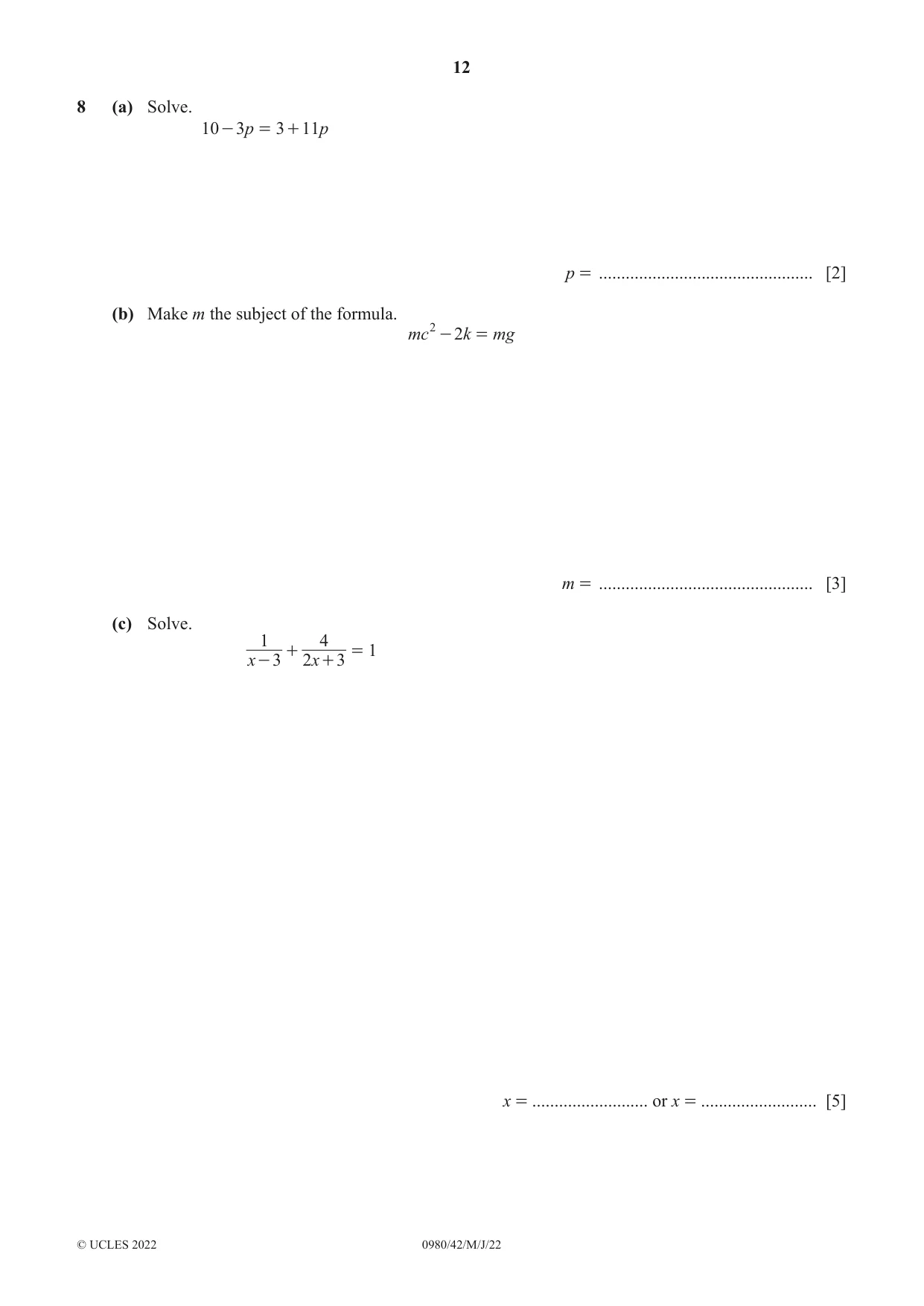
8 (a) Solve. 10 - 3p = 3 + 11p p = ................................................ [2] (b) Make m the subject of the formula. mc 2 - 2k = mg m = ................................................ [3] (c) Solve. 1 4 + = 1 x - 3 2x + 3 x = .......................... or x = .......................... [5] (d) Solve the simultaneous equations. You must show all your working. x + 2y = 12 5 x + y 2 = 39 x = …………….. y = ……………… x = …………….. y = ……………… [5] (e) Expand and simplify. ( 2x - 3)( x + 6)( x - 4) ................................................. [3]
Mark scheme: 8(a) 1 2 M1 for 10 3 11 p 3 p oe or better or 0.5 oe 2 8(b) 2 k 3 M1 for correctly isolating m terms [ m ] oe final answer 2 M1 for correctly factorising c g M1 for dividing by a bracket with two terms to the final answer Maximum mark M2 if final answer incorrect 8(c) 0 4.5 oe 5 B4 for 2 x 2 9 x [ 0] or 9x – 2x2 [= 0] or better OR M2 for 2 x 3 4 x 3 x 3 2 x 3 or better or M1 for 2 x 3 4 x 3 seen oe or common denominator x 3 2 x 3 oe B1 for 2 x 2 6 x 3 x 9 or better seen 8(d) y 2 10 y 21[ 0] or M2 M1 for y 2 5 12 2 y 39 oe x 2 4 x 12[ 0] 12 x 2 or 5 x 39 seen oe 2 2 (y – 3)(y – 7) [= 0] M1 or for correct factors for their 3– term quadratic or (x + 2)(x – 6) [= 0] equation or for correct substitution into quadratic formula or correctly completing the square for their 3– term quadratic equation x = − 2 y = 7 B2 B1 for x = − 2, x = 6 or for y = 7, y = 3 x = 6 y = 3 or for one correct pair of x and y values 8(e) 2 x 3 x 2 54 x 72 final answer 3 B2 correct expansion of three brackets unsimplified or for final answer of correct form with 3 out of 4 terms correct or B1 correct expansion of two brackets with at least three terms out of four correct
Q9 · P NOT TO S SCALE Q M R In triangle PQR, M lies on QR and S lies on PR
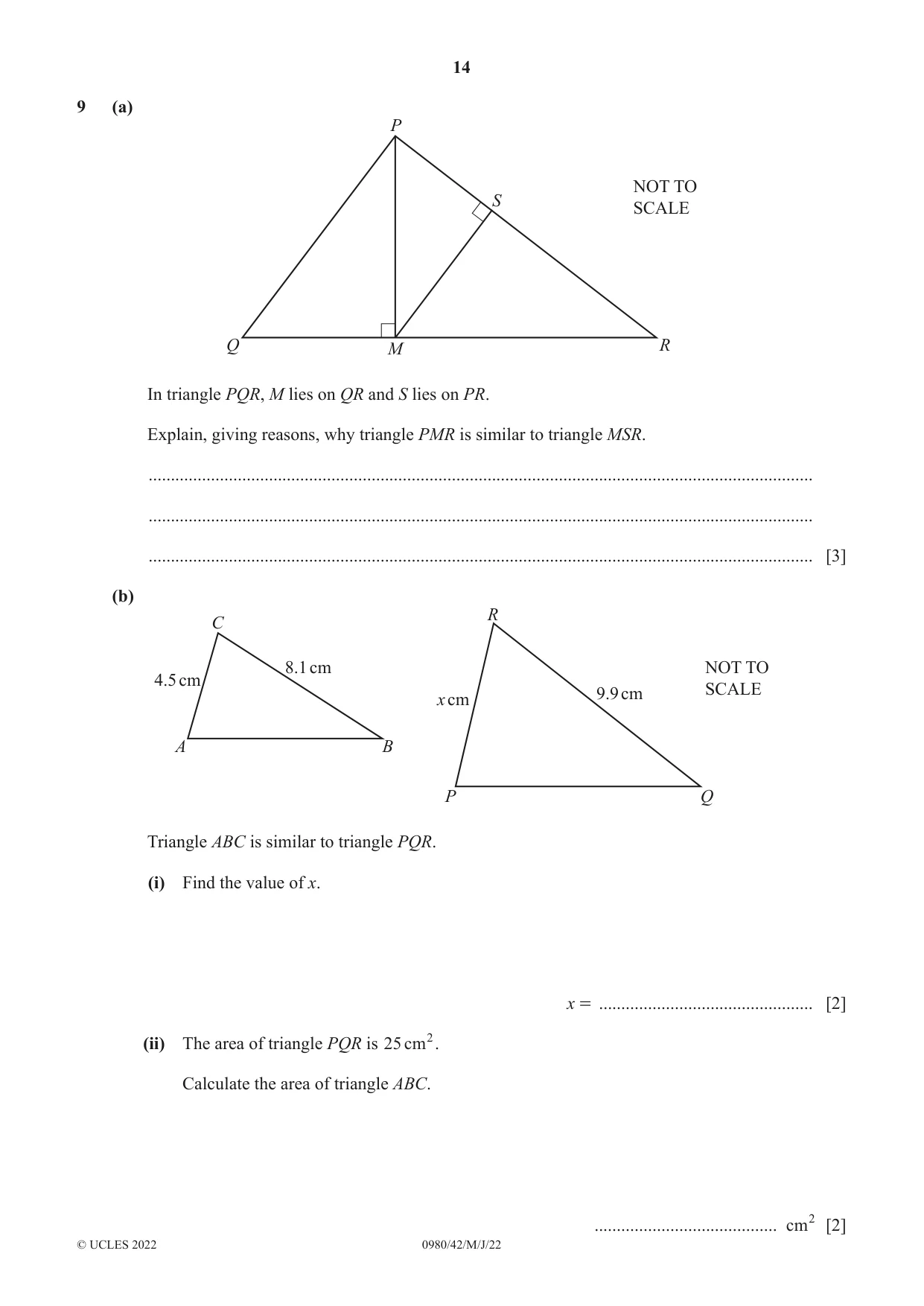
9 (a) P NOT TO S SCALE Q M R In triangle PQR, M lies on QR and S lies on PR. Explain, giving reasons, why triangle PMR is similar to triangle MSR. ..................................................................................................................................................... ..................................................................................................................................................... ..................................................................................................................................................... [3] (b) R C 8.1 cm NOT TO 4.5 cm SCALE 9.9 cm x cm A B P Q Triangle ABC is similar to triangle PQR. (i) Find the value of x. x = ................................................ [2] (ii) The area of triangle PQR is 25 cm 2. Calculate the area of triangle ABC. ......................................... cm2 [2]
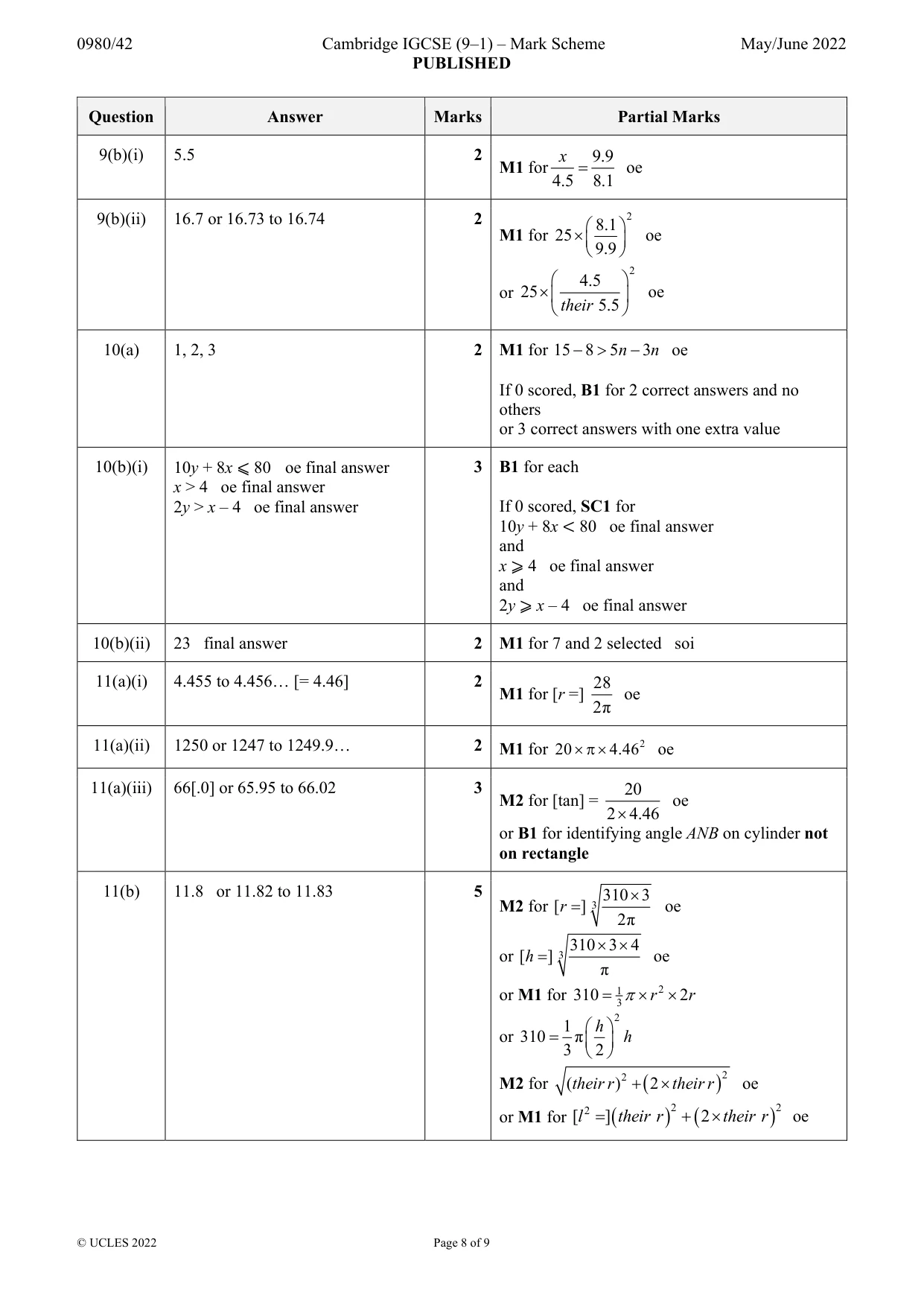
Mark scheme: 9(a) PMR = MSR = right angle[s] or 90° B1 PRM = MRS same angle B1 AAA oe B1 Dep on B1B1 and no errors seen OR MPR = SMR 3rd angle of triangle 9(b)(i) 5.5 2 x 9.9 M1 for oe 4.5 8.1 9(b)(ii) 16.7 or 16.73 to 16.74 2 2 8.1 M1 for 25 oe 9.9 4.5 2 or 25 oe their 5.5
Q10 · Find all the positive integers which satisfy the inequality
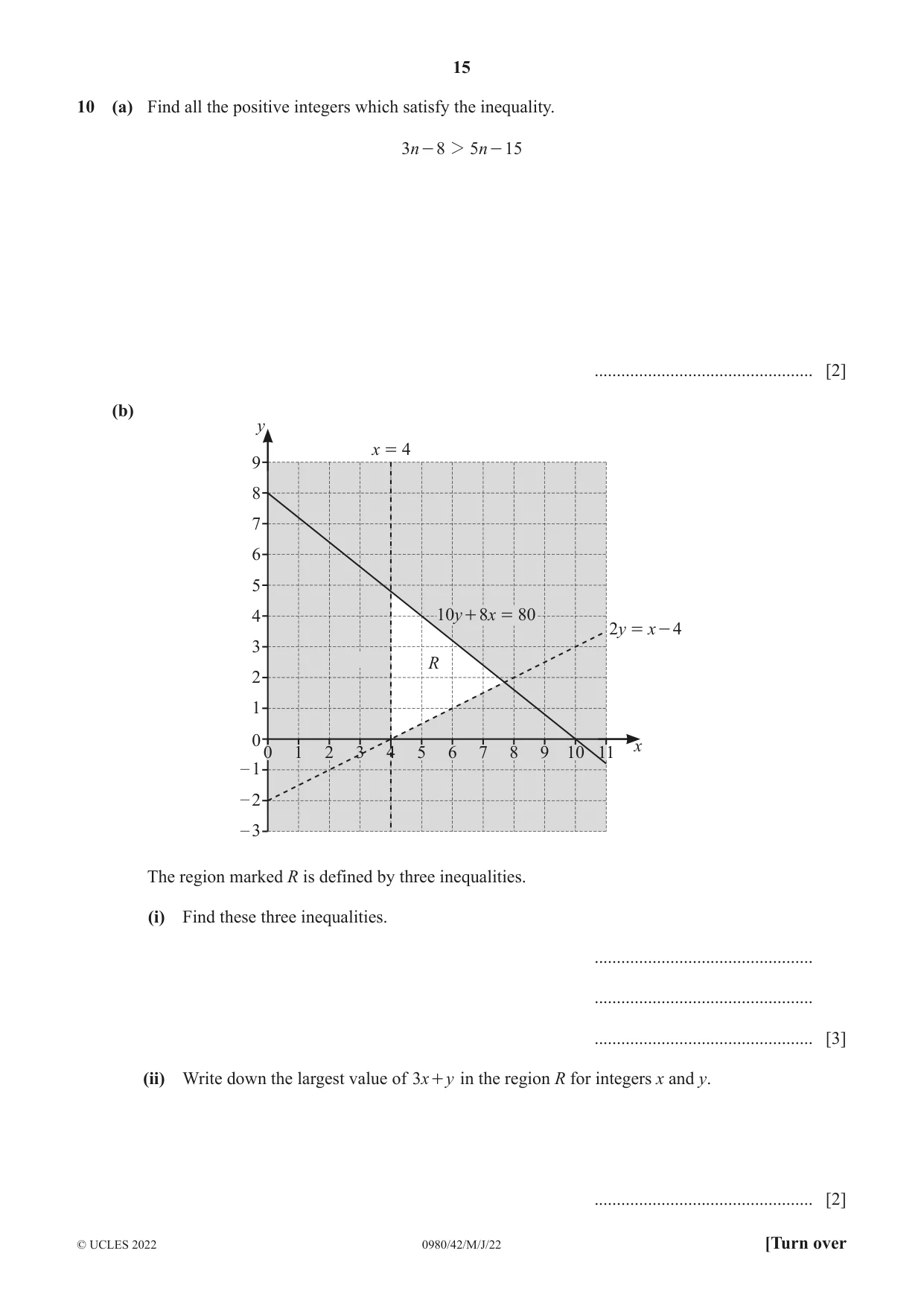
10 (a) Find all the positive integers which satisfy the inequality. 3n - 8 2 5n - 15 ................................................. [2] (b) y x = 4 9 8 7 6 5 4 10y + 8 x = 80 2y = x - 4 3 R 2 1 0 x 0 1 2 3 4 5 6 7 8 9 10 11 – 1 – 2 – 3 The region marked R is defined by three inequalities. (i) Find these three inequalities. ................................................. ................................................. ................................................. [3] (ii) Write down the largest value of 3x + y in the region R for integers x and y. ................................................. [2]
Mark scheme: 10(a) 1, 2, 3 2 M1 for 15 8 5 n 3n oe If 0 scored, B1 for 2 correct answers and no others or 3 correct answers with one extra value 10(b)(i) 10y + 8x ⩽ 80 oe final answer 3 B1 for each x > 4 oe final answer 2y > x – 4 oe final answer If 0 scored, SC1 for 10y + 8x < 80 oe final answer and x ⩾ 4 oe final answer and 2y ⩾ x – 4 oe final answer 10(b)(ii) 23 final answer 2 M1 for 7 and 2 selected soi
Q11 · 28 cm A D AD NOT TO SCALE 20 cm N BC B C A rectangular sheet of paper ABCD is made into…
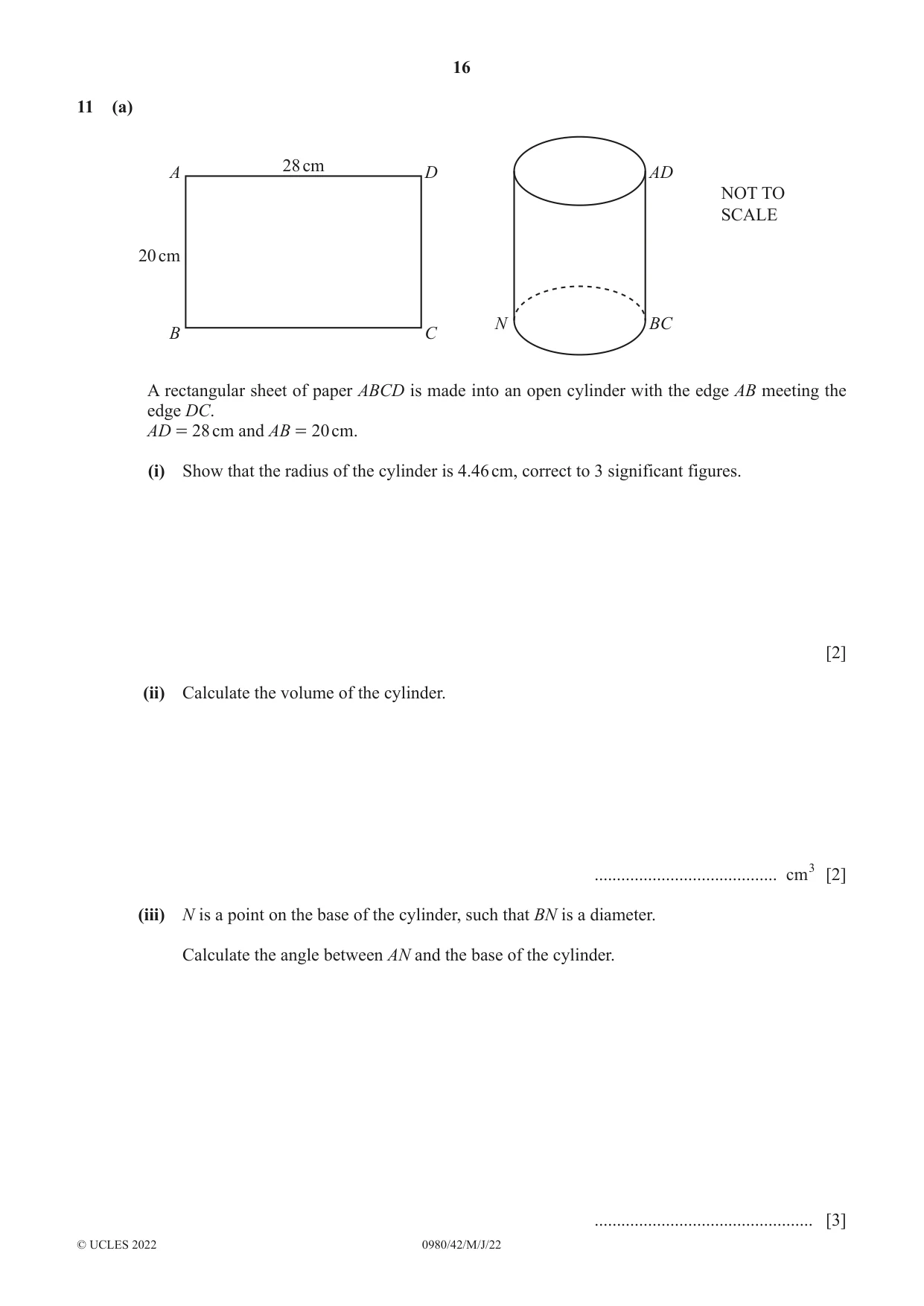
11 (a) 28 cm A D AD NOT TO SCALE 20 cm N BC B C A rectangular sheet of paper ABCD is made into an open cylinder with the edge AB meeting the edge DC. AD = 28 cm and AB = 20 cm. (i) Show that the radius of the cylinder is 4.46 cm, correct to 3 significant figures. [2] (ii) Calculate the volume of the cylinder. ......................................... cm3 [2] (iii) N is a point on the base of the cylinder, such that BN is a diameter. Calculate the angle between AN and the base of the cylinder. ................................................. [3] (b) The volume of a solid cone is 310 cm 3. The height of the cone is twice the radius of its base. Calculate the slant height of the cone. 1 2 [The volume, V, of a cone with radius r and height h is V = rr h .] 3 ............................................ cm [5]
Mark scheme: 11(a)(i) 4.455 to 4.456… [= 4.46] 2 28 M1 for [r =] oe 2π 11(a)(ii) 1250 or 1247 to 1249.9… 2 M1 for 20 4.46 2 oe 11(a)(iii) 66[.0] or 65.95 to 66.02 3 20 M2 for [tan] = oe 2 4.46 or B1 for identifying angle ANB on cylinder not on rectangle 11(b) 11.8 or 11.82 to 11.83 5 310 3 M2 for [ r ] 3 oe 2π 310 3 4 or [ h ] 3 oe π or M1 for 310 13 r 2 2 r 1 h 2 or 310 π h 3 2 M2 for (their r ) 2 2 their r 2 oe or M1 for [l 2 ] their r 2 2 their r 2 oe
Q12 · A curve has equation y = x 3 - kx 2 + 1
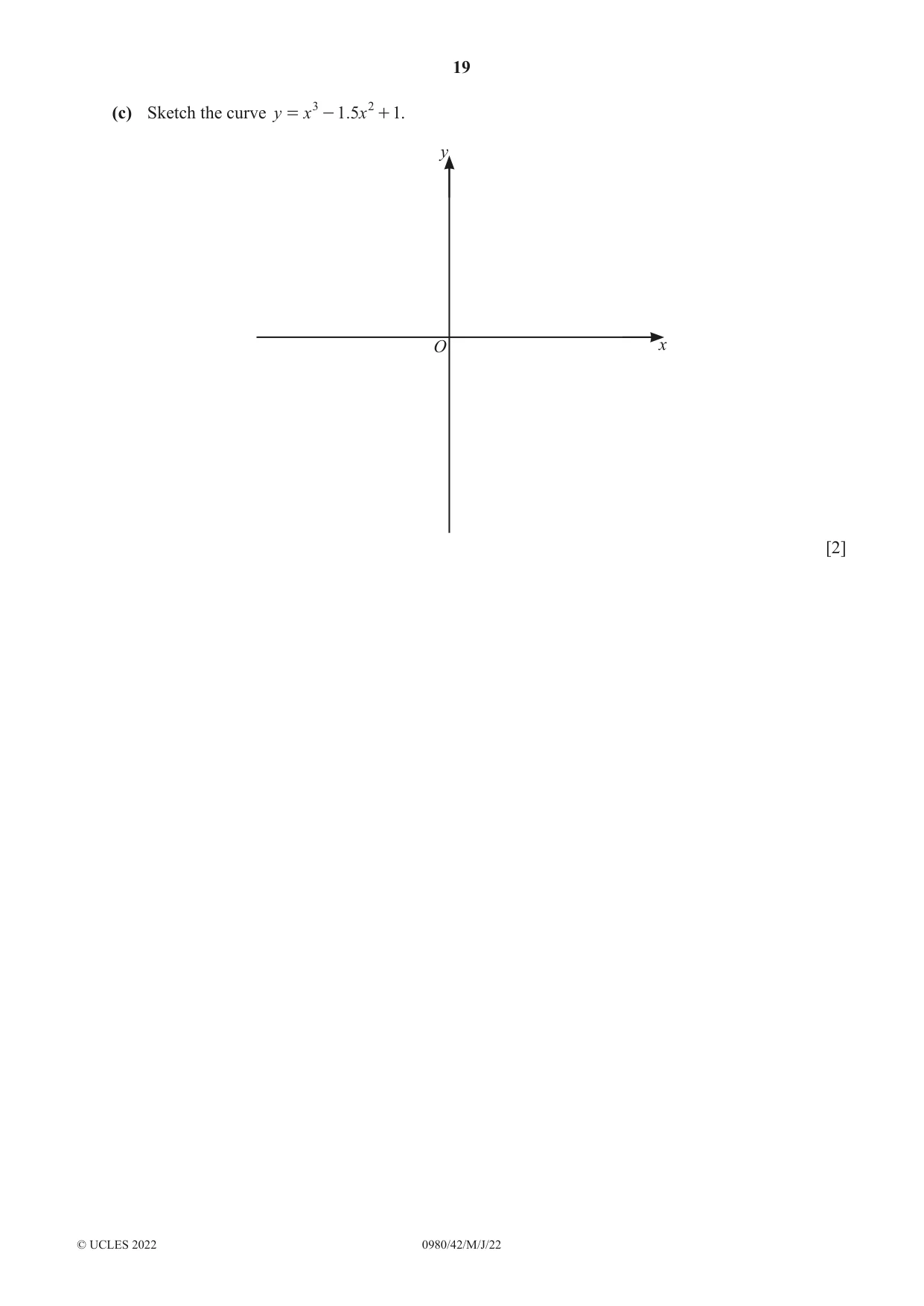
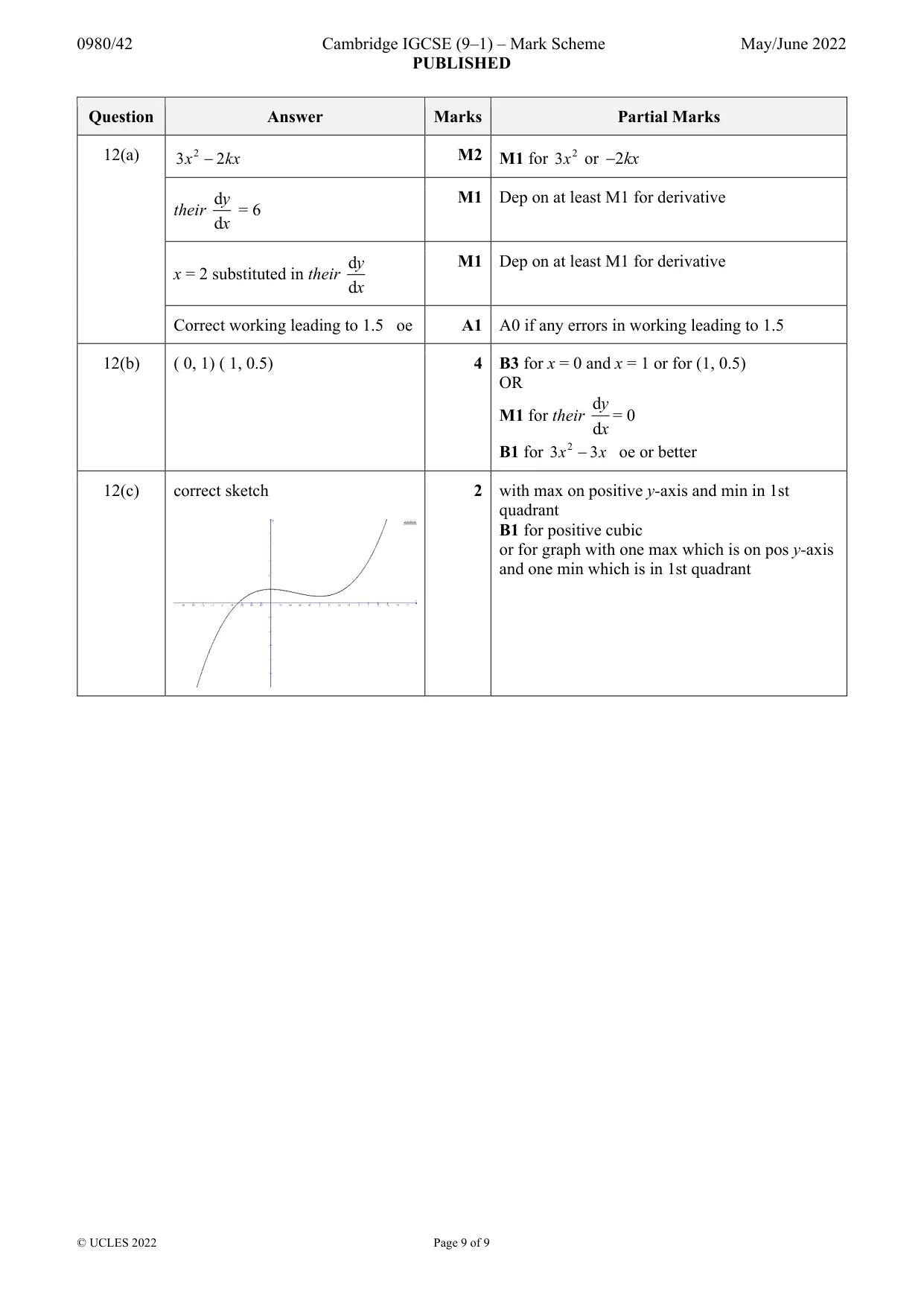
12 A curve has equation y = x 3 - kx 2 + 1. When x = 2 , the gradient of the curve is 6. (a) Show that k = 1.5 . [5] (b) Find the coordinates of the two stationary points of y = x 3 - 1.5x 2 + 1. You must show all your working. ( ................ , ................ ) and ( ................ , ................ ) [4] (c) Sketch the curve y = x 3 - 1.5x 2 + 1. y O x [2]
Mark scheme: 12(a) 3 x 2 2 kx M2 M1 for 3x 2 or kx2 dy M1 Dep on at least M1 for derivative their = 6 dx dy M1 Dep on at least M1 for derivative x = 2 substituted in their dx Correct working leading to 1.5 oe A1 A0 if any errors in working leading to 1.5 12(b) ( 0, 1) ( 1, 0.5) 4 B3 for x = 0 and x = 1 or for (1, 0.5) OR dy M1 for their = 0 dx B1 for 3 x 2 3 x oe or better 12(c) correct sketch 2 with max on positive y-axis and min in 1st quadrant B1 for positive cubic or for graph with one max which is on pos y-axis and one min which is in 1st quadrant
What was in this paper
The subtopics covered by these 12 questions, and how many questions each got. Open one in a new tab to see every Cambridge question on it.
What you needed in this session
Cambridge’s own grade thresholds for 2022 May/June, Paper 4 · Variant 2. A higher threshold means an easier paper — the bar moves with how the cohort did.