Cambridge IGCSE Mathematics (9-1) 0980 — 2023 May/June Paper 4 · Variant 2
0980/42/M/J/23 · 10 questions · 130 marks · ≈146 min
The question paper and its mark scheme, free to read here and free to download. This is Cambridge’s own paper, exactly as it was sat.
Question paper20 pages
Mark scheme11 pages
Answers below. Sit the paper first if you are practising.
Questions as text
Q1 · 42° NOT TO SCALE x° The diagram shows an isosceles triangle with the base extended
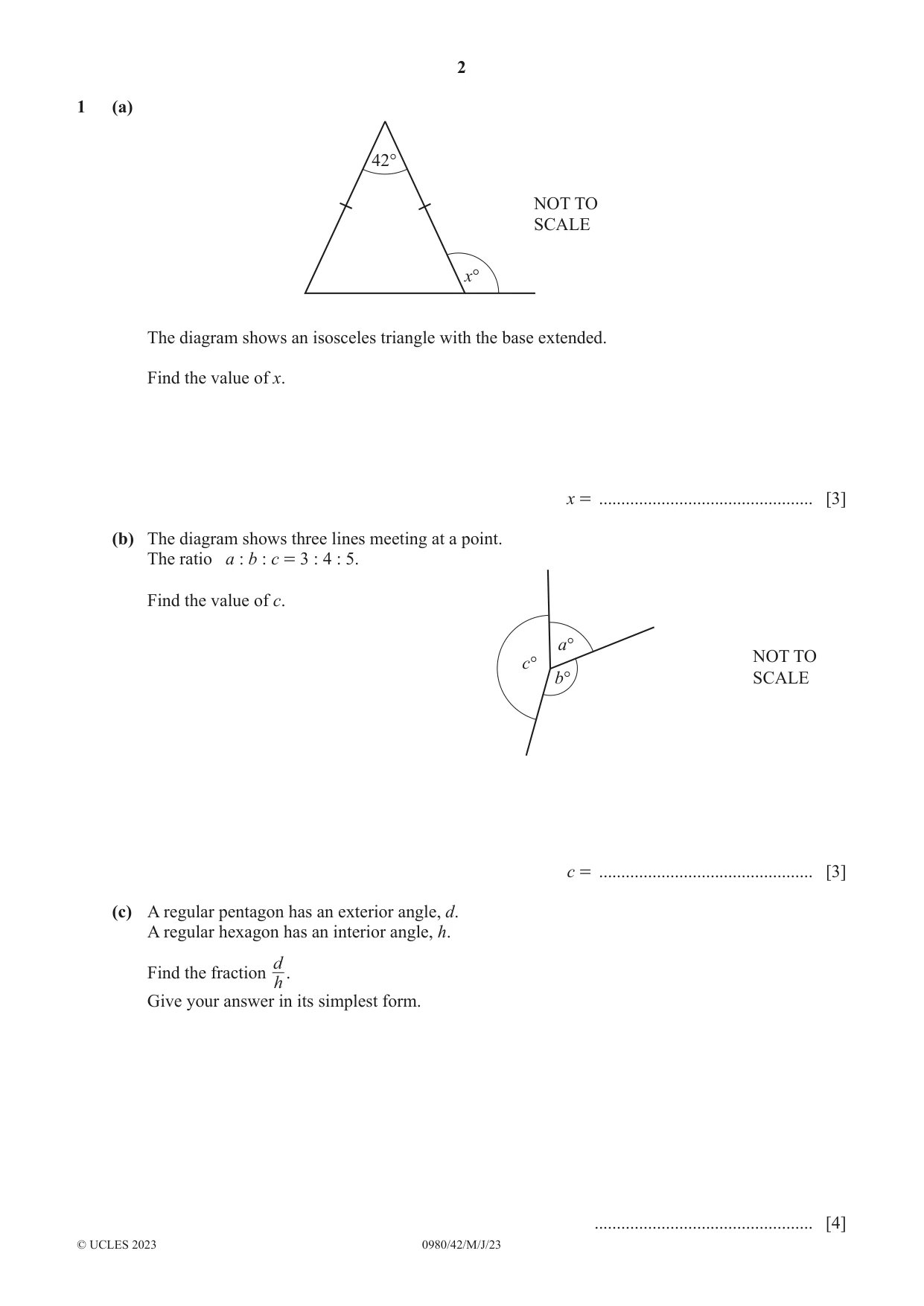
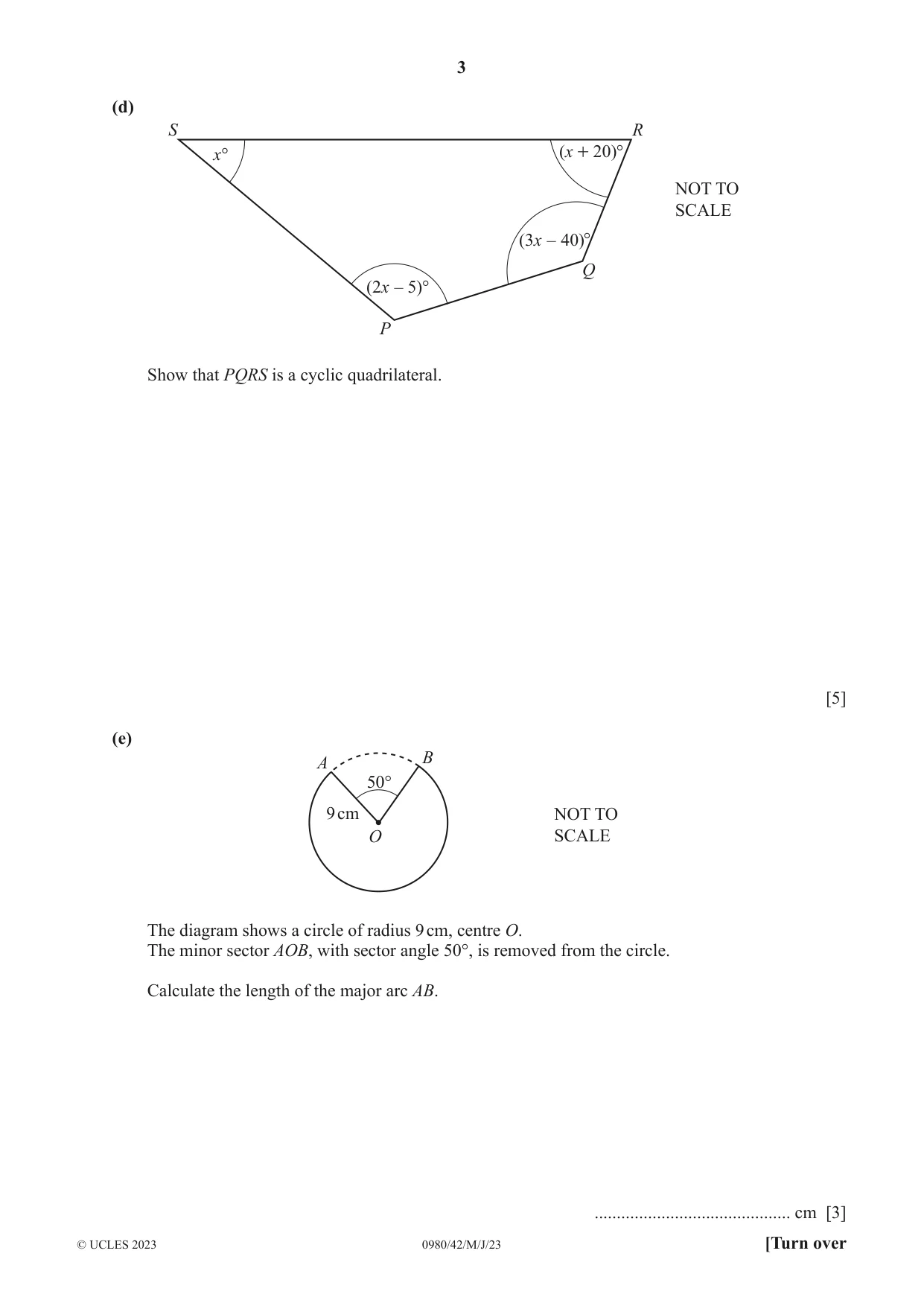
1 (a) 42° NOT TO SCALE x° The diagram shows an isosceles triangle with the base extended. Find the value of x. x = ................................................ [3] (b) The diagram shows three lines meeting at a point. The ratio a : b : c = 3 : 4 : 5. Find the value of c. a° NOT TO c° b° SCALE c = ................................................ [3] (c) A regular pentagon has an exterior angle, d. A regular hexagon has an interior angle, h. d Find the fraction . h Give your answer in its simplest form. ................................................. [4] (d) S R x° ( x + 20)° NOT TO SCALE ( 3x – 40)° Q ( 2x – 5)° P Show that PQRS is a cyclic quadrilateral. [5] (e) B A 50° 9 cm NOT TO O SCALE The diagram shows a circle of radius 9 cm, centre O. The minor sector AOB, with sector angle 50°, is removed from the circle. Calculate the length of the major arc AB. ............................................ cm [3]
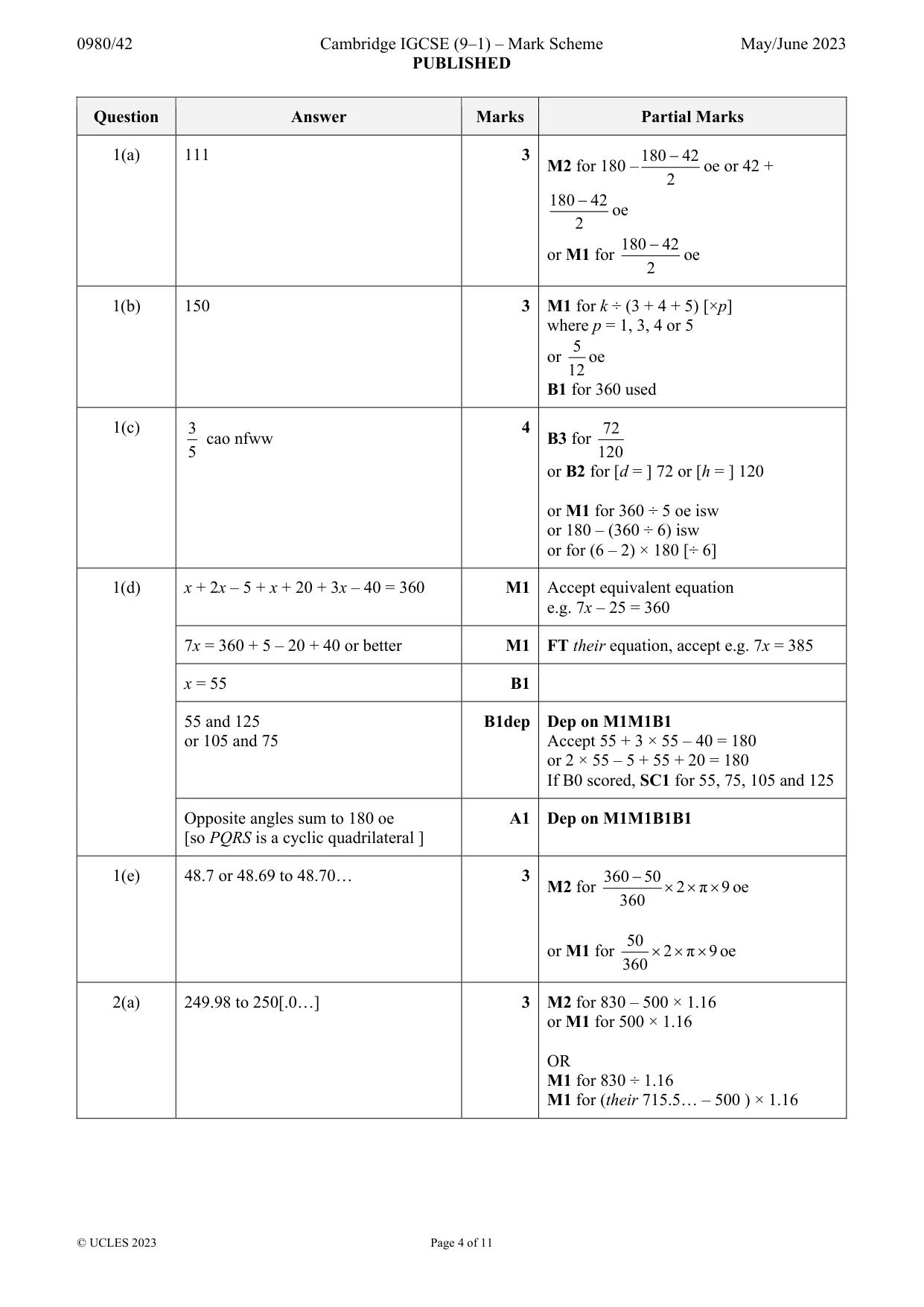
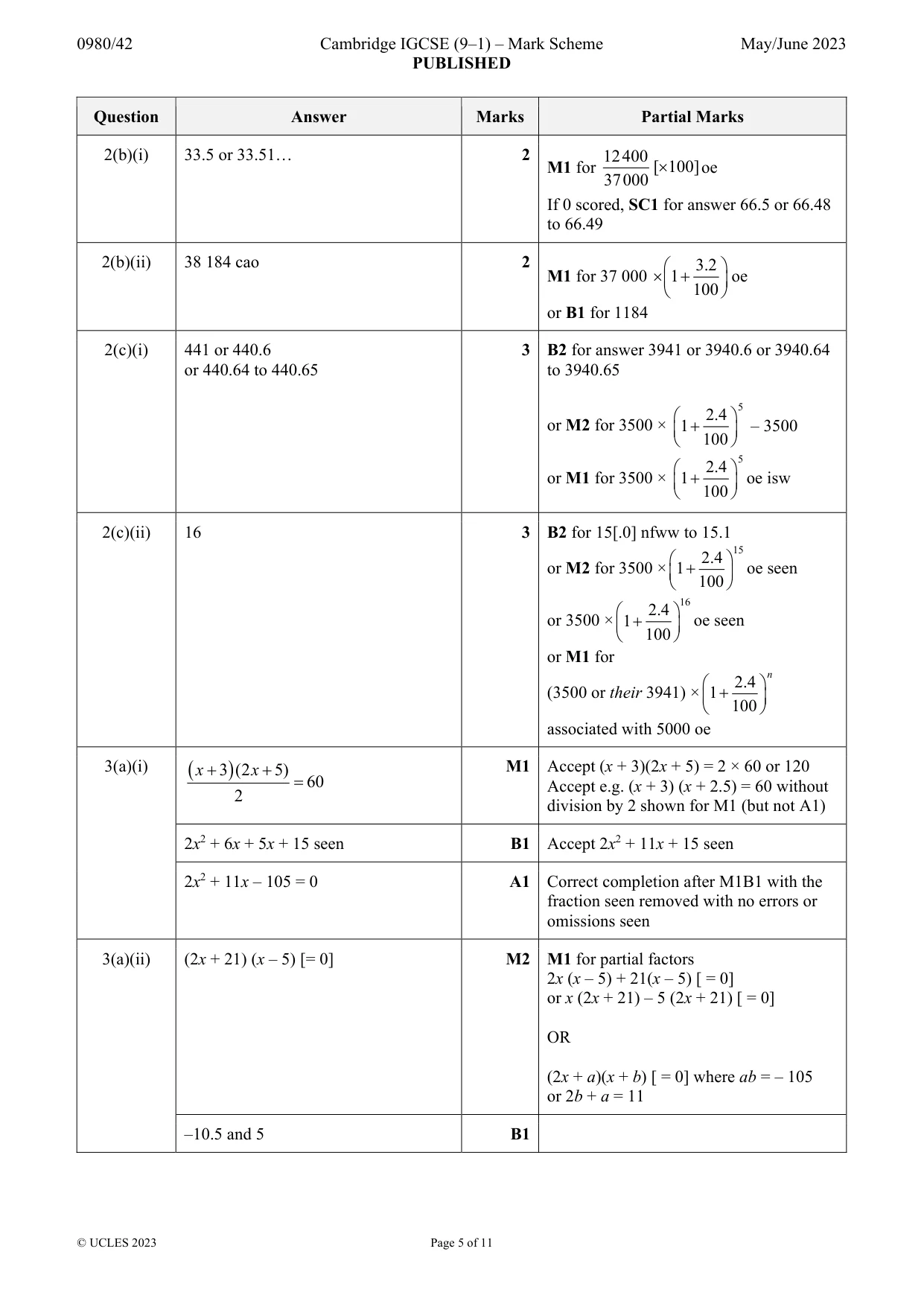
Mark scheme: Question Answer Marks Partial Marks 1(a) 111 3 42 M2 for 180 –180 oe or 42 + 2 180 42 oe 2 180 42 or M1 for oe 2 1(b) 150 3 M1 for k ÷ (3 + 4 + 5) [×p] where p = 1, 3, 4 or 5 5 or oe 12 B1 for 360 used 1(c) 3 4 72 cao nfww B3 for 5 120 or B2 for [d = ] 72 or [h = ] 120 or M1 for 360 ÷ 5 oe isw or 180 – (360 ÷ 6) isw or for (6 – 2) × 180 [÷ 6] 1(d) x + 2x – 5 + x + 20 + 3x – 40 = 360 M1 Accept equivalent equation e.g. 7x – 25 = 360 7x = 360 + 5 – 20 + 40 or better M1 FT their equation, accept e.g. 7x = 385 x = 55 B1 55 and 125 B1dep Dep on M1M1B1 or 105 and 75 Accept 55 + 3 × 55 – 40 = 180 or 2 × 55 – 5 + 55 + 20 = 180 If B0 scored, SC1 for 55, 75, 105 and 125 Opposite angles sum to 180 oe A1 Dep on M1M1B1B1 [so PQRS is a cyclic quadrilateral ] 1(e) 48.7 or 48.69 to 48.70… 3 360 50 M2 for 2 π oe9 360 50 or M1 for 2 π oe9 360
Q2 · Anil changes $830 into euros when the exchange rate is 1 euro = $1.16
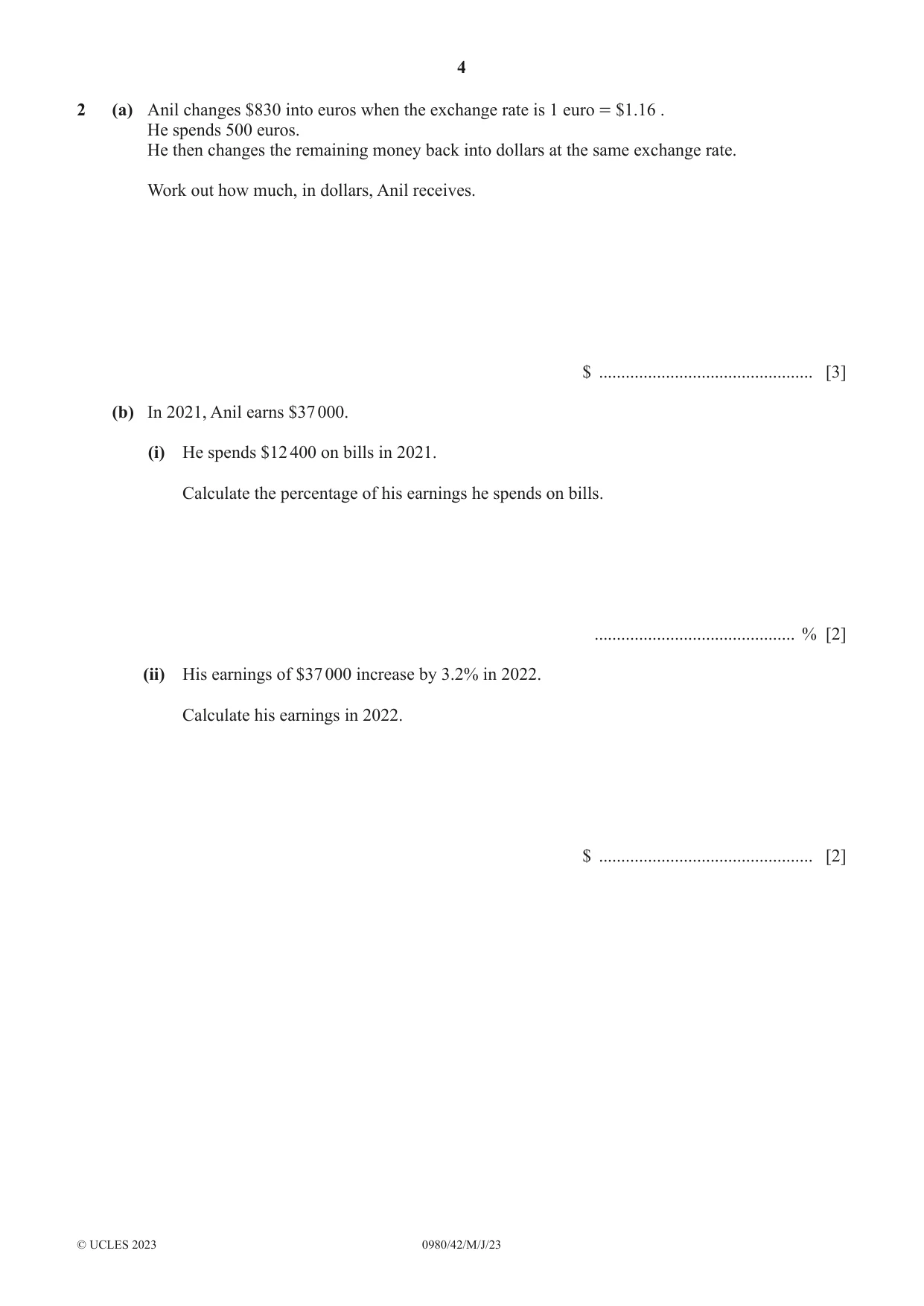
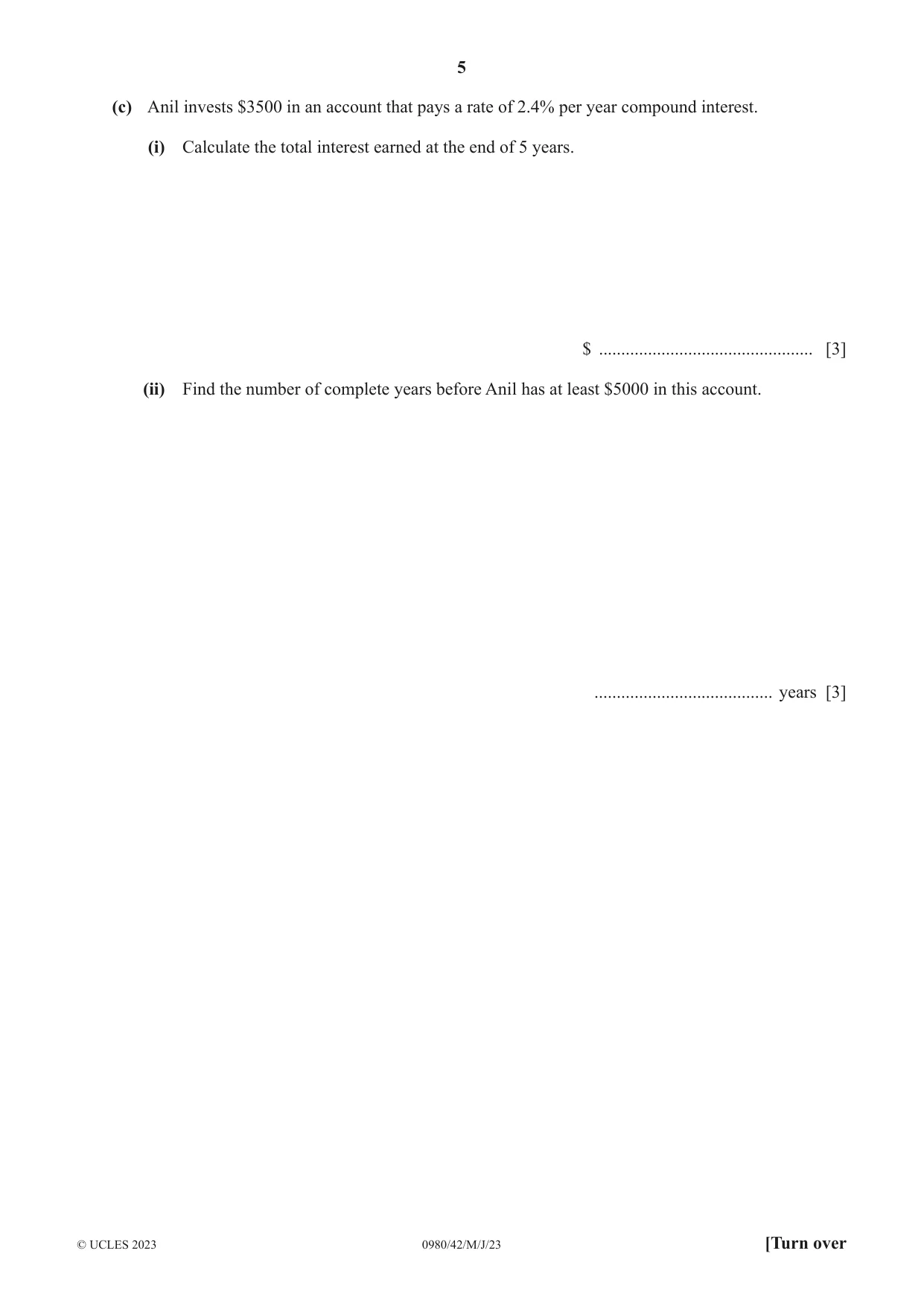
2 (a) Anil changes $830 into euros when the exchange rate is 1 euro = $1.16 . He spends 500 euros. He then changes the remaining money back into dollars at the same exchange rate. Work out how much, in dollars, Anil receives. $ ................................................ [3] (b) In 2021, Anil earns $37 000. (i) He spends $12 400 on bills in 2021. Calculate the percentage of his earnings he spends on bills. ............................................. % [2] (ii) His earnings of $37 000 increase by 3.2% in 2022. Calculate his earnings in 2022. $ ................................................ [2] (c) Anil invests $3500 in an account that pays a rate of 2.4% per year compound interest. (i) Calculate the total interest earned at the end of 5 years. $ ................................................ [3] (ii) Find the number of complete years before Anil has at least $5000 in this account. ........................................ years [3]
Mark scheme: 2(a) 249.98 to 250[.0…] 3 M2 for 830 – 500 × 1.16 or M1 for 500 × 1.16 OR M1 for 830 ÷ 1.16 M1 for (their 715.5… – 500 ) × 1.16 2(b)(i) 33.5 or 33.51… 2 12400 M1 for [ 100] oe 37000 If 0 scored, SC1 for answer 66.5 or 66.48 to 66.49 2(b)(ii) 38 184 cao 2 3.2 M1 for 37 000 1 oe 100 or B1 for 1184 2(c)(i) 441 or 440.6 3 B2 for answer 3941 or 3940.6 or 3940.64 or 440.64 to 440.65 to 3940.65 2.4 5 or M2 for 3500 × 1 – 3500 100 2.4 5 or M1 for 3500 × 1 oe isw 100 2(c)(ii) 16 3 B2 for 15[.0] nfww to 15.1 2.4 15 or M2 for 3500 × 1 oe seen 100 2.4 16 or 3500 × 1 oe seen 100 or M1 for 2.4 n (3500 or their 3941) × 1 100 associated with 5000 oe
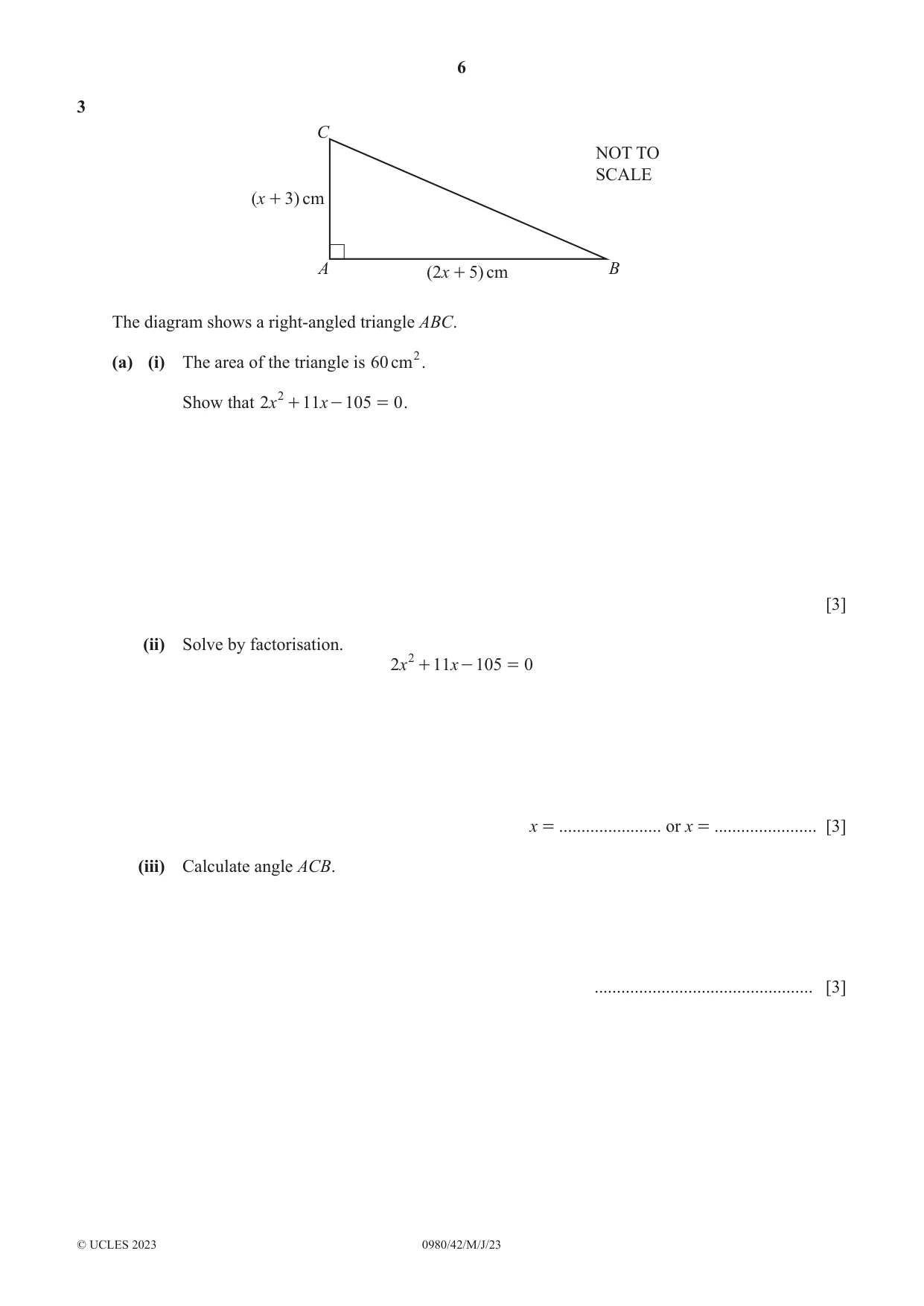
Q3 · C NOT TO SCALE ( x + 3) cm A ( 2x + 5) cm B The diagram shows a right-angled triangle ABC
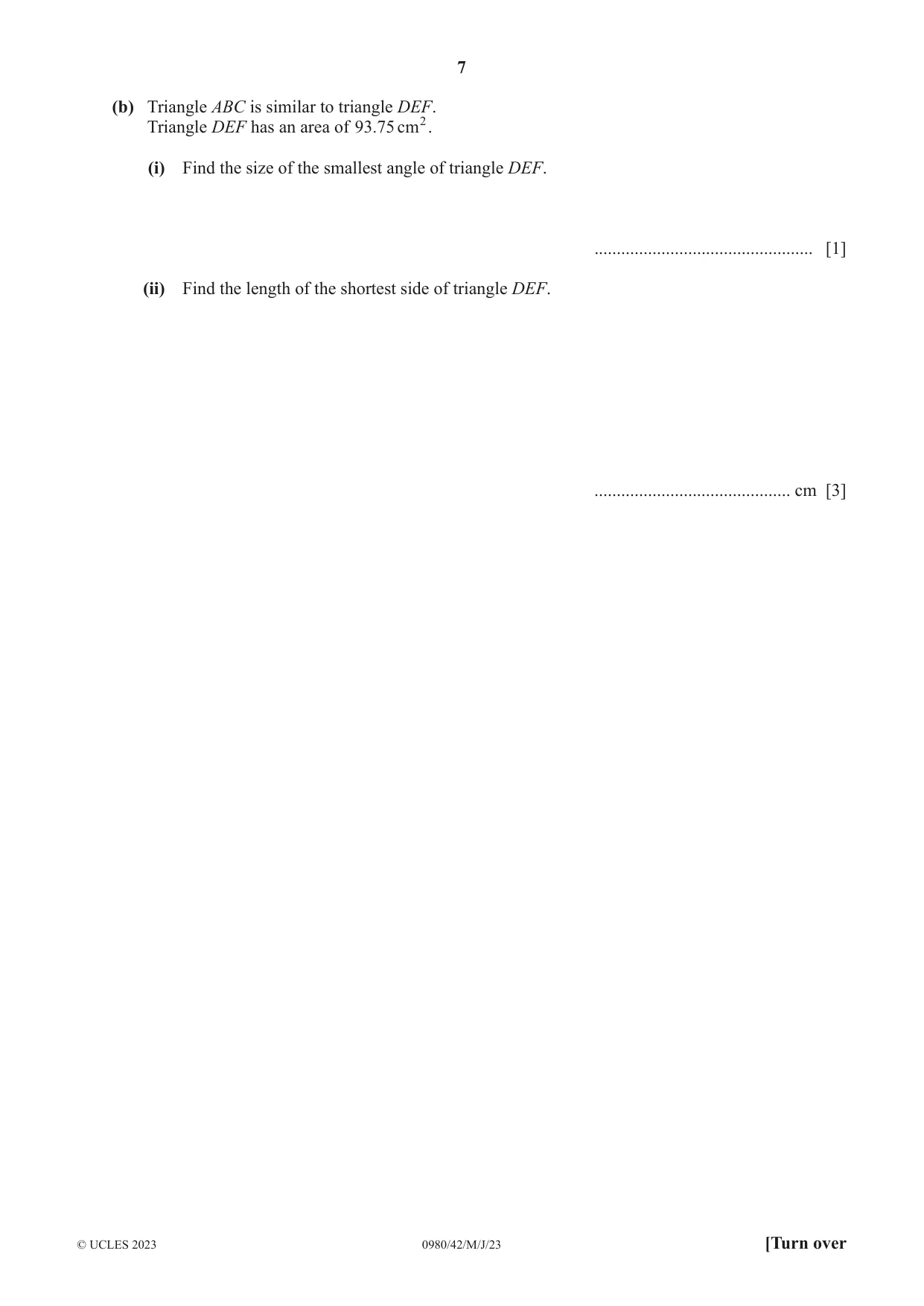
3 C NOT TO SCALE ( x + 3) cm A ( 2x + 5) cm B The diagram shows a right-angled triangle ABC. (a) (i) The area of the triangle is 60 cm 2. Show that 2x 2 + 11 x - 105 = 0 . [3] (ii) Solve by factorisation. 2x 2 + 11x - 105 = 0 x = ....................... or x = ....................... [3] (iii) Calculate angle ACB. ................................................. [3] (b) Triangle ABC is similar to triangle DEF. Triangle DEF has an area of 93.75 cm 2. (i) Find the size of the smallest angle of triangle DEF. ................................................. [1] (ii) Find the length of the shortest side of triangle DEF. ............................................ cm [3]
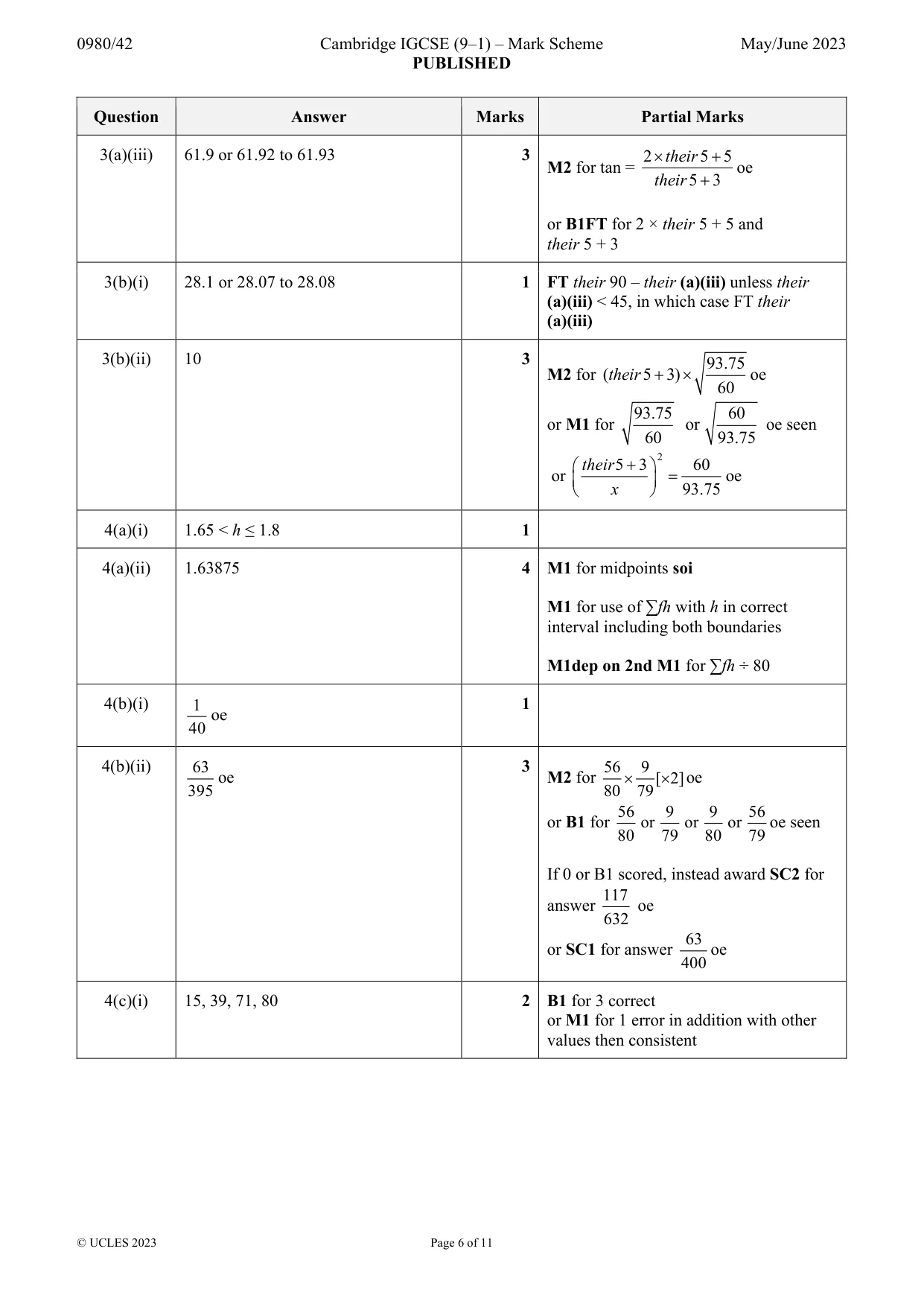
Mark scheme: 3(a)(i) x 3 (2 x 5) M1 Accept (x + 3)(2x + 5) = 2 × 60 or 120 60 Accept e.g. (x + 3) (x + 2.5) = 60 without 2 division by 2 shown for M1 (but not A1) 2x2 + 6x + 5x + 15 seen B1 Accept 2x2 + 11x + 15 seen 2x2 + 11x – 105 = 0 A1 Correct completion after M1B1 with the fraction seen removed with no errors or omissions seen 3(a)(ii) (2x + 21) (x – 5) [= 0] M2 M1 for partial factors 2x (x – 5) + 21(x – 5) [ = 0] or x (2x + 21) – 5 (2x + 21) [ = 0] OR (2x + a)(x + b) [ = 0] where ab = – 105 or 2b + a = 11 –10.5 and 5 B1 3(a)(iii) 61.9 or 61.92 to 61.93 3 2 their 5 5 M2 for tan = oe their 5 3 or B1FT for 2 × their 5 + 5 and their 5 + 3 3(b)(i) 28.1 or 28.07 to 28.08 1 FT their 90 – their (a)(iii) unless their (a)(iii) < 45, in which case FT their (a)(iii) 3(b)(ii) 10 3 93.75 M2 for (their 5 3) oe 60 93.75 60 or M1 for or oe seen 60 93.75 their 5 3 2 60 oe or x 93.75
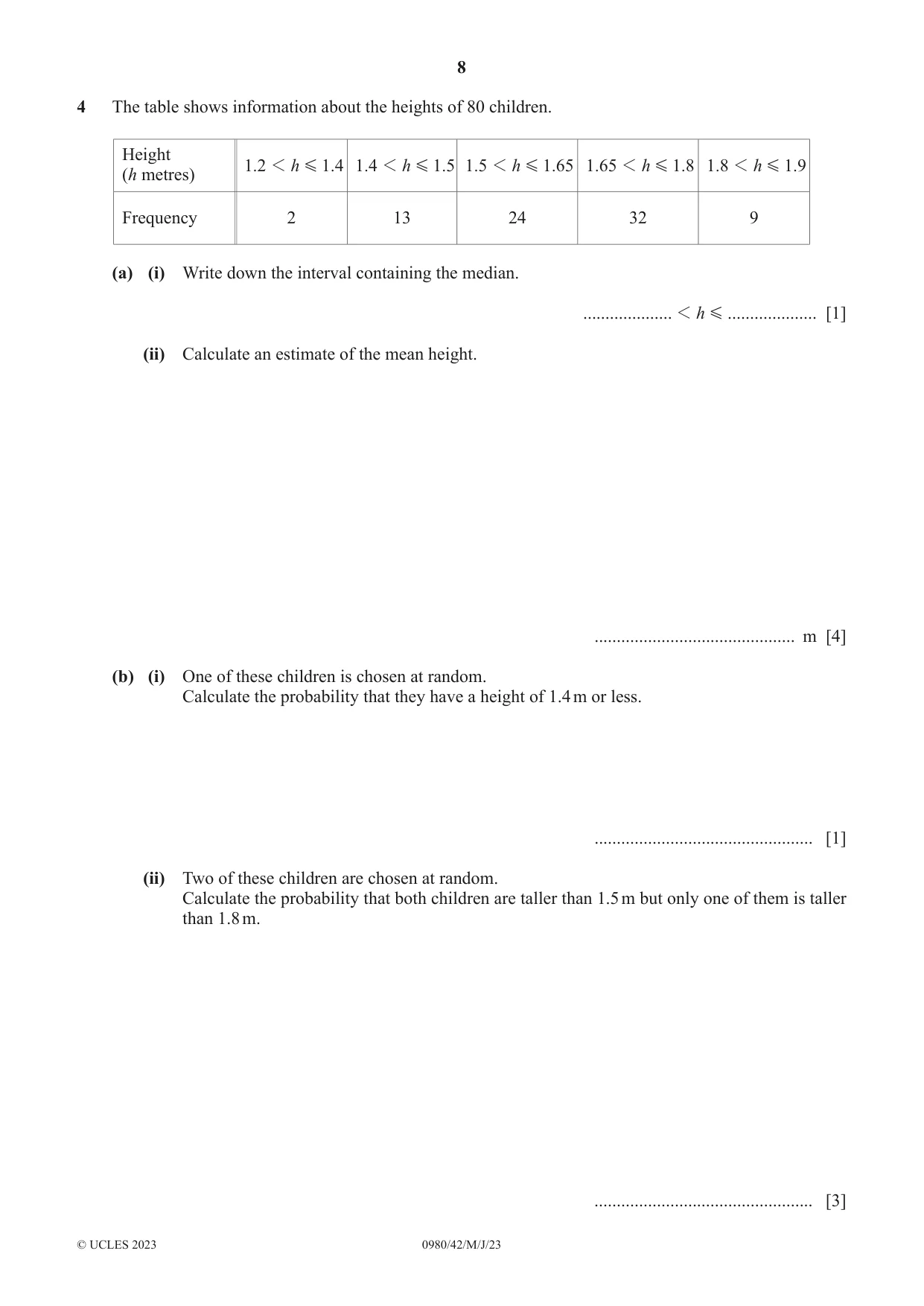
Q4 · The table shows information about the heights of 80 children
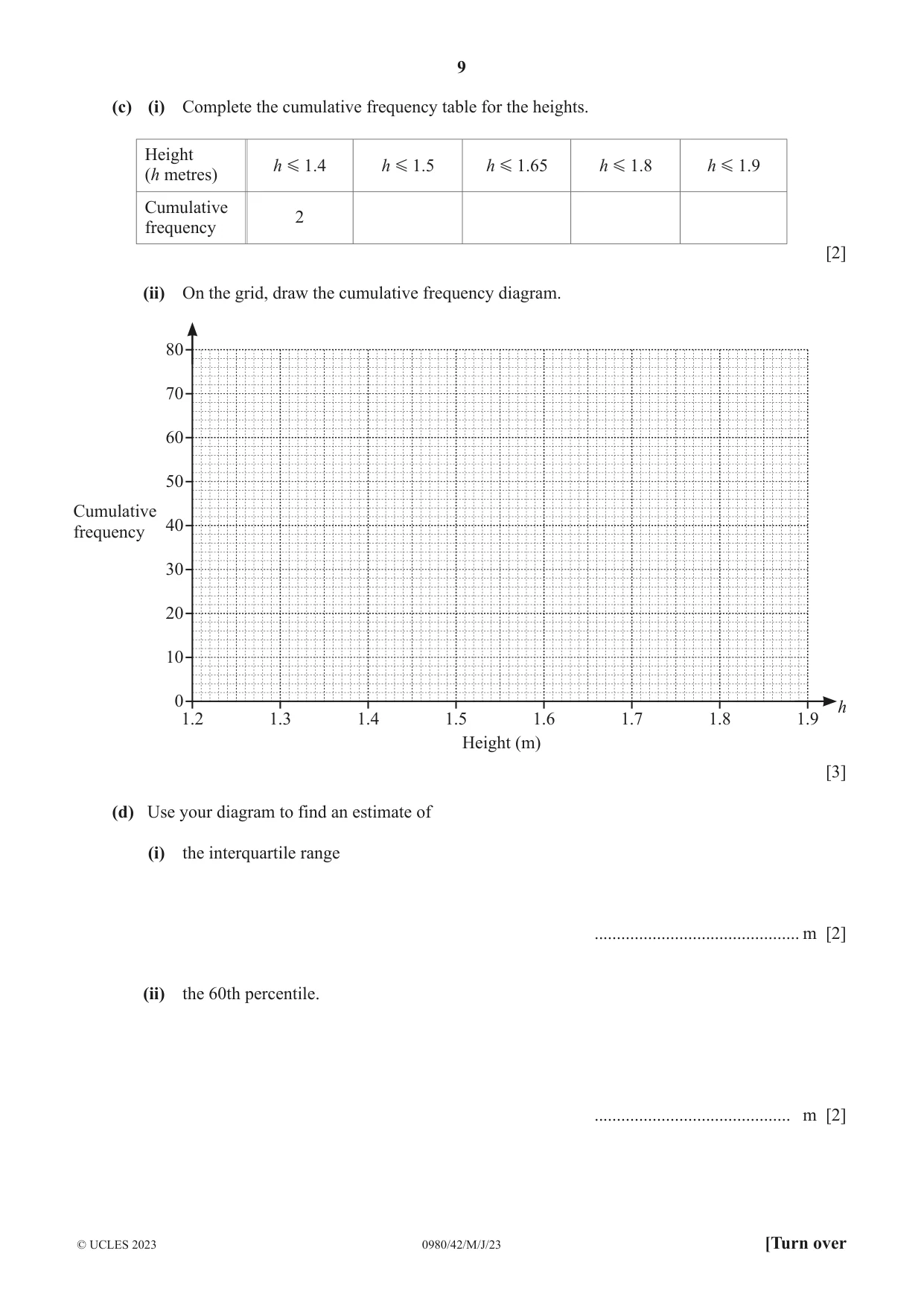
4 The table shows information about the heights of 80 children. Height 1.2 1 h G 1.4 1.4 1 h G 1.5 1.5 1 h G 1.65 1.65 1 h G 1. 8 1.8 1 h G 1.9 (h metres) Frequency 2 13 24 32 9 (a) (i) Write down the interval containing the median. .................... 1 h G .................... [1] (ii) Calculate an estimate of the mean height. ............................................. m [4] (b) (i) One of these children is chosen at random. Calculate the probability that they have a height of 1.4 m or less. ................................................. [1] (ii) Two of these children are chosen at random. Calculate the probability that both children are taller than 1.5 m but only one of them is taller than 1.8 m. ................................................. [3] (c) (i) Complete the cumulative frequency table for the heights. Height h G 1.4 h G 1.5 h G 1.65 h G 1.8 h G 1.9 (h metres) Cumulative 2 frequency [2] (ii) On the grid, draw the cumulative frequency diagram. 80 70 60 50 Cumulative 40frequency 30 20 10 0 h 1.2 1.3 1.4 1.5 1.6 1.7 1.8 1.9 Height (m) [3] (d) Use your diagram to find an estimate of (i) the interquartile range .............................................. m [2] (ii) the 60th percentile. ............................................ m [2]
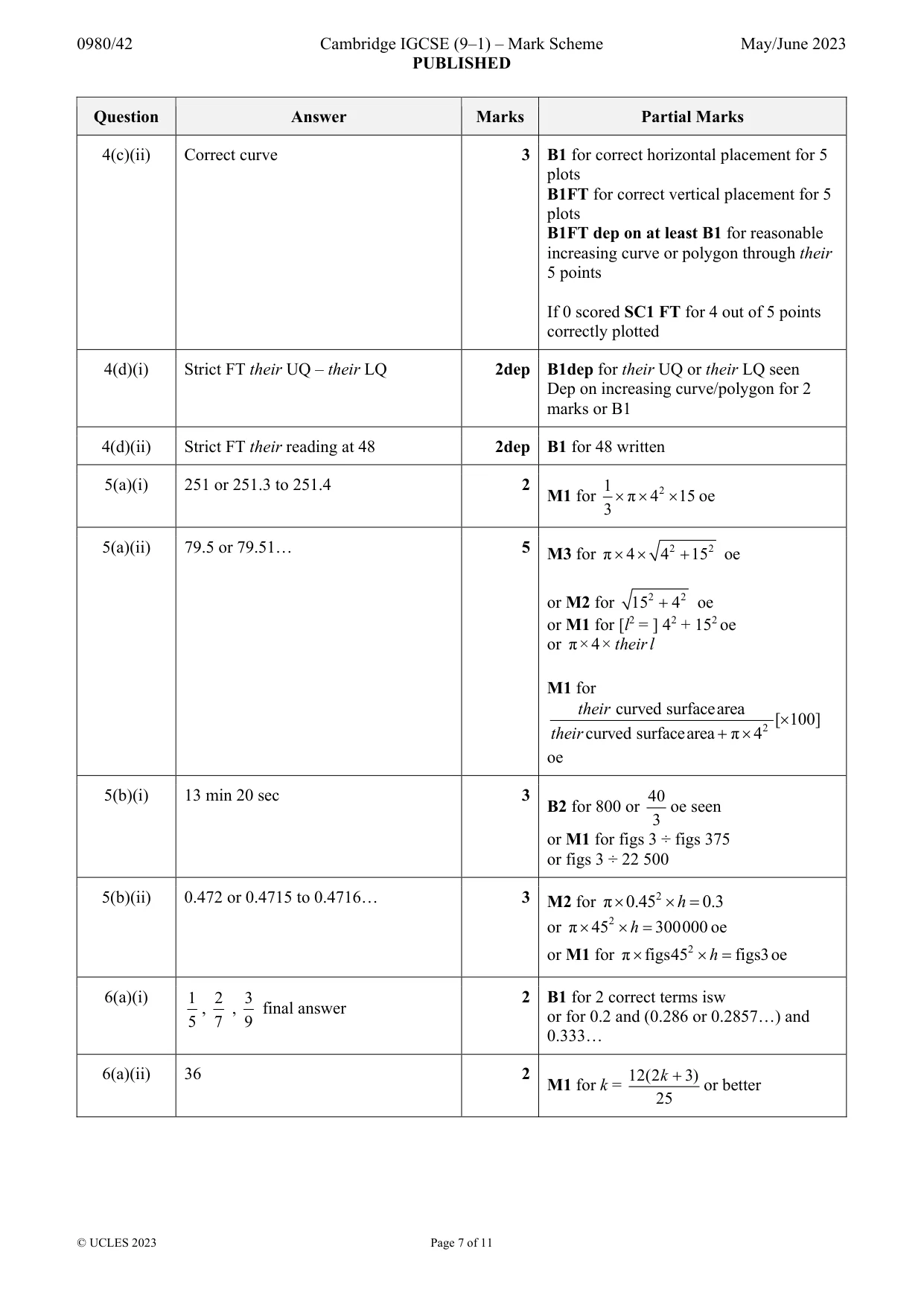
Mark scheme: 4(a)(i) 1.65 < h ≤ 1.8 1 4(a)(ii) 1.63875 4 M1 for midpoints soi M1 for use of ∑fh with h in correct interval including both boundaries M1dep on 2nd M1 for ∑fh ÷ 80 4(b)(i) 1 1 oe 40 4(b)(ii) 63 3 56 9 oe M2 for [ 2] oe 395 80 79 56 9 9 56 or B1 for or or or oe seen 80 79 80 79 If 0 or B1 scored, instead award SC2 for 117 answer oe 632 63 or SC1 for answer oe 400 4(c)(i) 15, 39, 71, 80 2 B1 for 3 correct or M1 for 1 error in addition with other values then consistent 4(c)(ii) Correct curve 3 B1 for correct horizontal placement for 5 plots B1FT for correct vertical placement for 5 plots B1FT dep on at least B1 for reasonable increasing curve or polygon through their 5 points If 0 scored SC1 FT for 4 out of 5 points correctly plotted 4(d)(i) Strict FT their UQ – their LQ 2dep B1dep for their UQ or their LQ seen Dep on increasing curve/polygon for 2 marks or B1 4(d)(ii) Strict FT their reading at 48 2dep B1 for 48 written
Q5 · NOT TO 15 cm SCALE 8 cm A cone has base diameter 8 cm and perpendicular height 15 cm
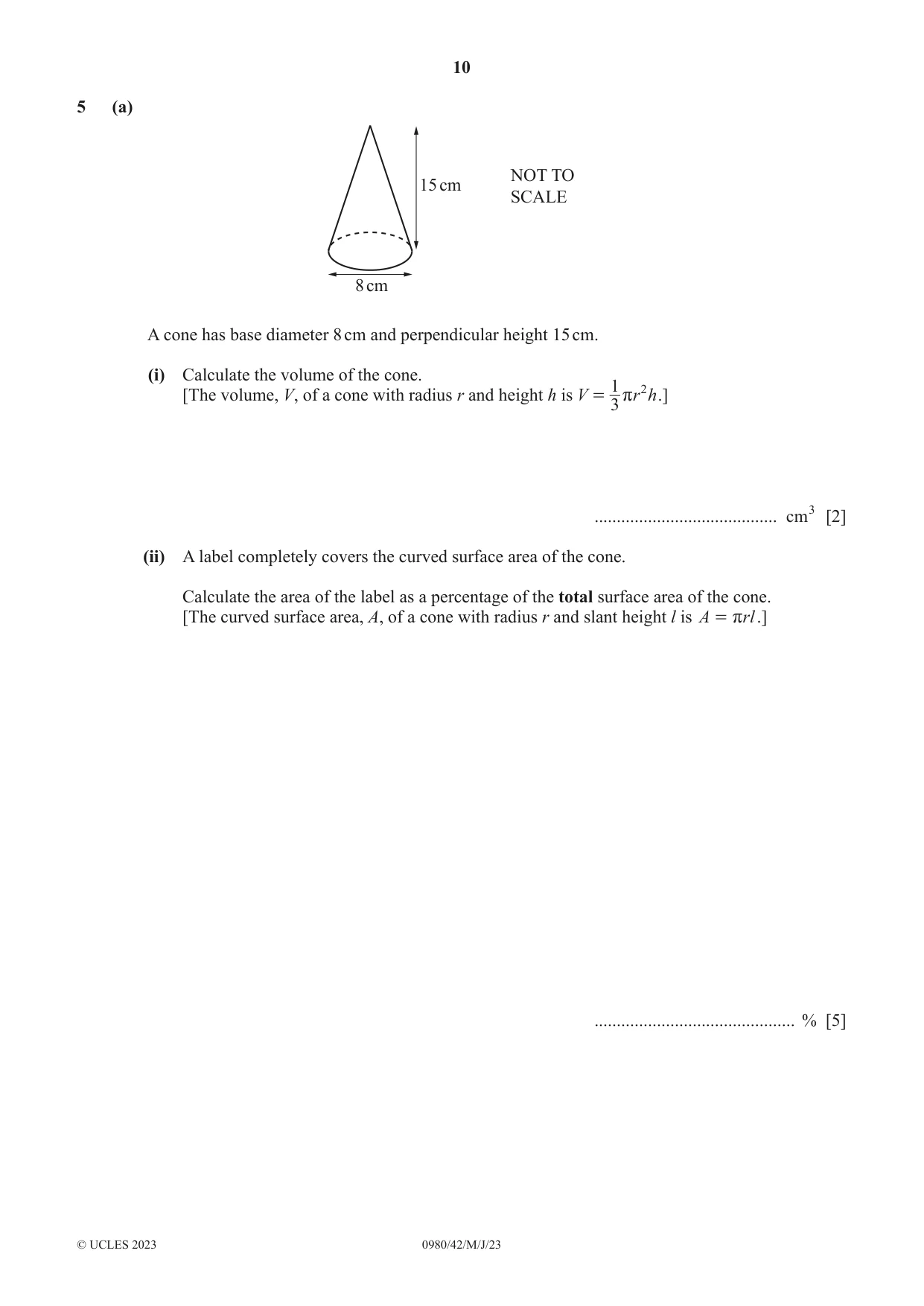
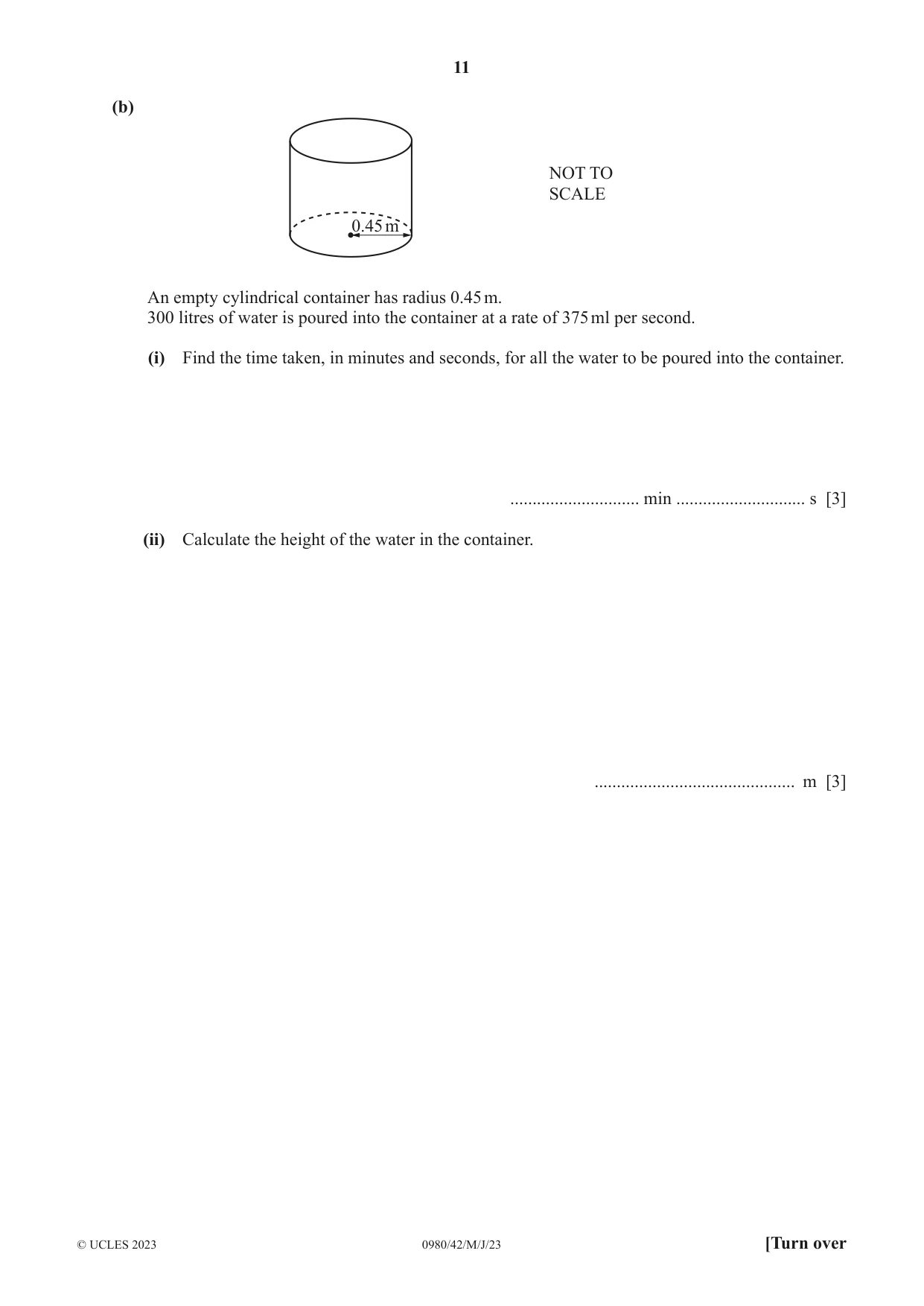
5 (a) NOT TO 15 cm SCALE 8 cm A cone has base diameter 8 cm and perpendicular height 15 cm. (i) Calculate the volume of the cone. 1 2 [The volume, V, of a cone with radius r and height h is V = rr h .] 3 ......................................... cm3 [2] (ii) A label completely covers the curved surface area of the cone. Calculate the area of the label as a percentage of the total surface area of the cone. [The curved surface area, A, of a cone with radius r and slant height l is A = rrl .] ............................................. % [5] (b) NOT TO SCALE 0.45 m An empty cylindrical container has radius 0.45 m. 300 litres of water is poured into the container at a rate of 375 ml per second. (i) Find the time taken, in minutes and seconds, for all the water to be poured into the container. ............................. min ............................. s [3] (ii) Calculate the height of the water in the container. ............................................. m [3]
Mark scheme: 5(a)(i) 251 or 251.3 to 251.4 2 1 2 M1 for π 4 15 oe 3 5(a)(ii) 79.5 or 79.51… 5 2 2 M3 for π 4 4 15 oe or M2 for 15 2 4 2 oe or M1 for [l2 = ] 42 + 152 oe or π×4× theirl M1 for their curved surfacearea [ 100] their curved surfacearea π 4 2 oe 5(b)(i) 13 min 20 sec 3 40 B2 for 800 or oe seen 3 or M1 for figs 3 ÷ figs 375 or figs 3 ÷ 22 500 5(b)(ii) 0.472 or 0.4715 to 0.4716… 3 M2 for π 0.452 h 0.3 or π 45 2 h 300000 oe or M1 for π figs45 2 h figs3 oe
Q6 · A sequence has nth term
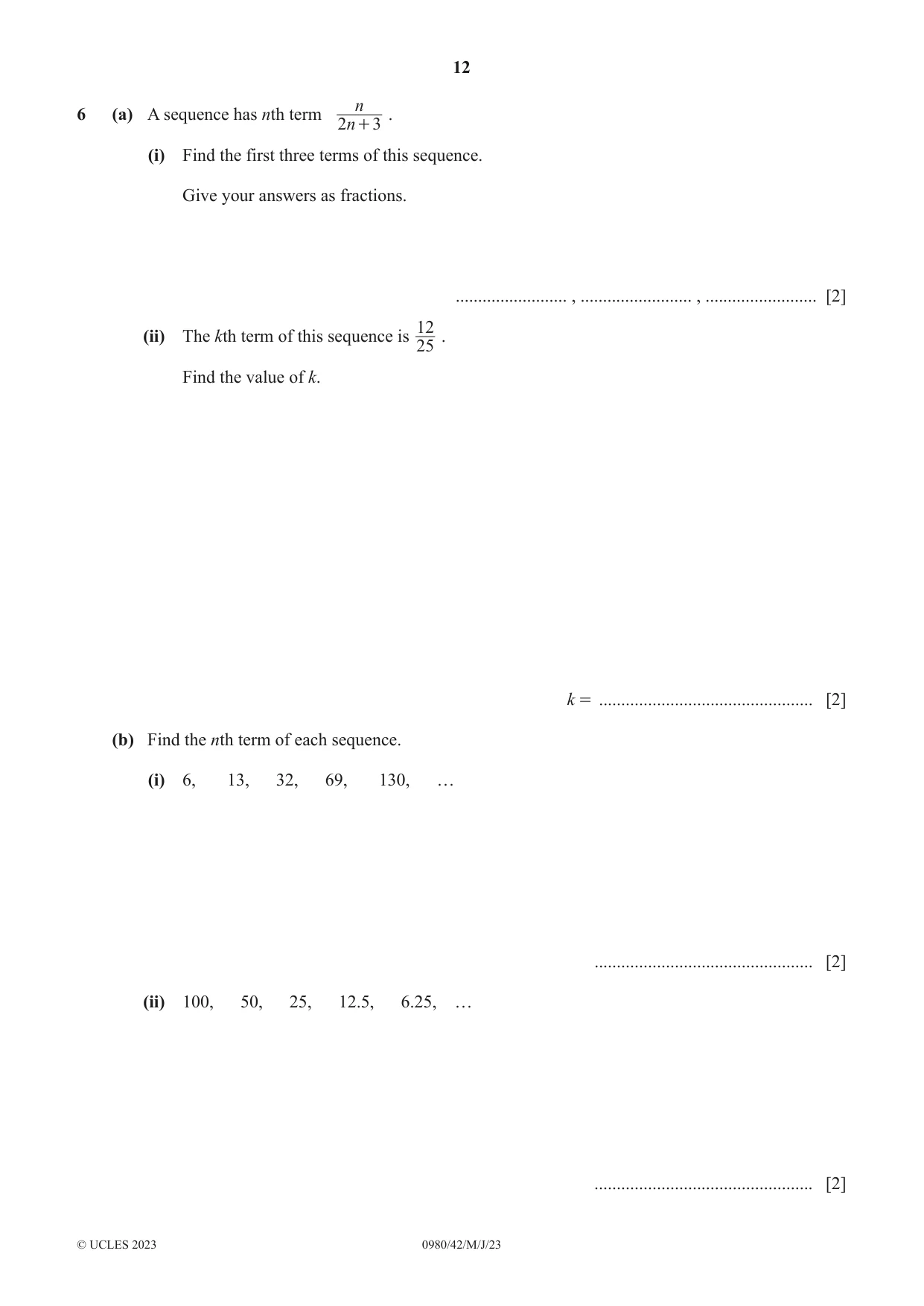
6 (a) A sequence has nth term . 2n + 3 (i) Find the first three terms of this sequence. Give your answers as fractions. ......................... , ......................... , ......................... [2] 12 (ii) The kth term of this sequence is . 25 Find the value of k. k = ................................................ [2] (b) Find the nth term of each sequence. (i) 6, 13, 32, 69, 130, … ................................................. [2] (ii) 100, 50, 25, 12.5, 6.25, … ................................................. [2]
Mark scheme: 6(a)(i) 1 2 3 2 B1 for 2 correct terms isw , , final answer or for 0.2 and (0.286 or 0.2857…) and 5 7 9 0.333… 6(a)(ii) 36 2 12(2 k 3) M1 for k = or better 25 6(b)(i) n3 + 5 oe final answer 2 B1 for any cubic or common third differences of 6 (at least 2) or for correct answer seen and spoilt 6(b)(ii) 100 × 21–n oe final answer 2 n k [+k] 1 B1 for 2–n oe or oe in answer 2 or for correct answer seen and spoilt
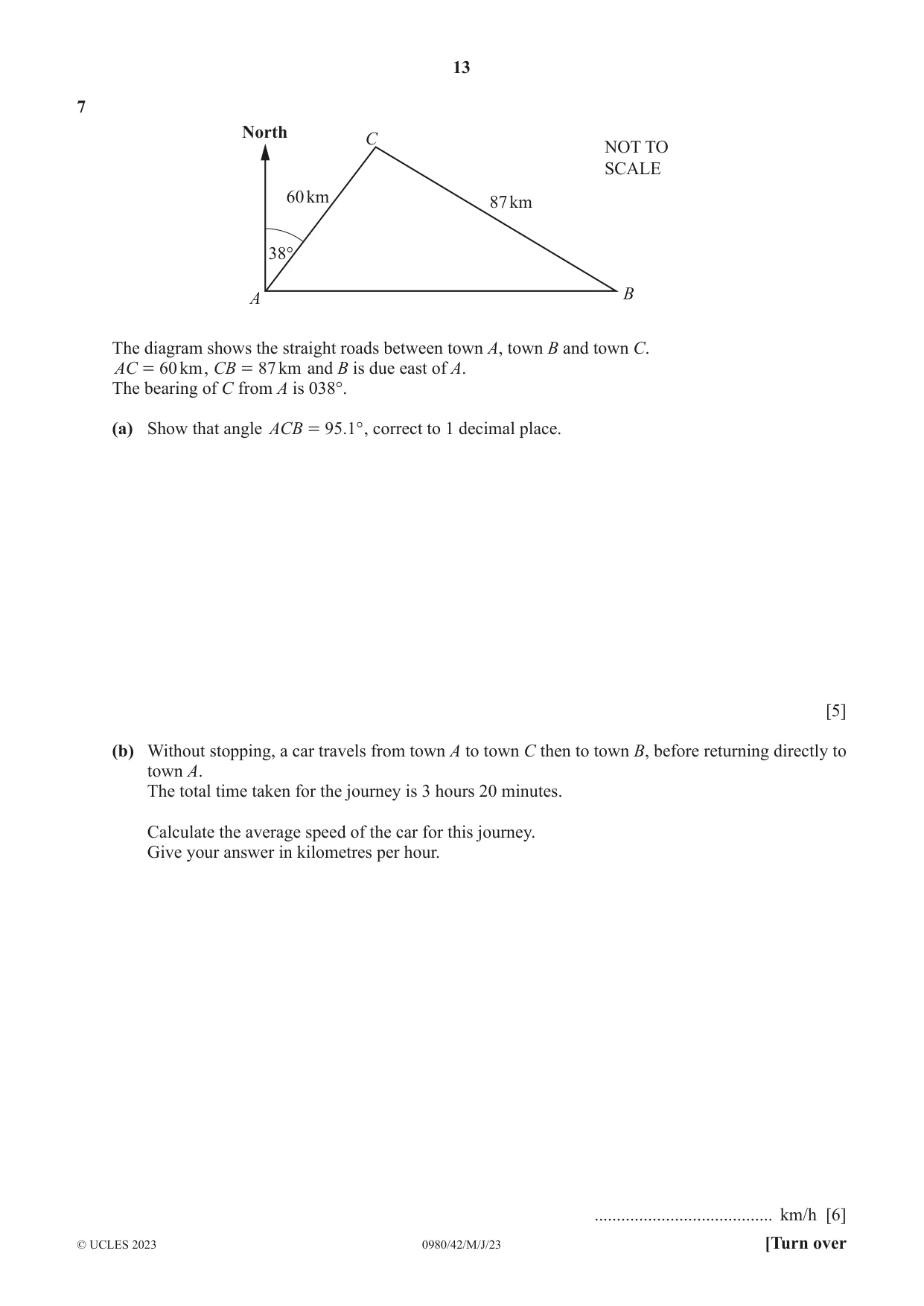
Q7 · North C NOT TO SCALE 60 km 87 km 38° B A The diagram shows the straight roads between…
7 North C NOT TO SCALE 60 km 87 km 38° B A The diagram shows the straight roads between town A, town B and town C. AC = 60 km , CB = 87 km and B is due east of A. The bearing of C from A is 038°. (a) Show that angle ACB = 95.1° , correct to 1 decimal place. [5] (b) Without stopping, a car travels from town A to town C then to town B, before returning directly to town A. The total time taken for the journey is 3 hours 20 minutes. Calculate the average speed of the car for this journey. Give your answer in kilometres per hour. ........................................ km/h [6]
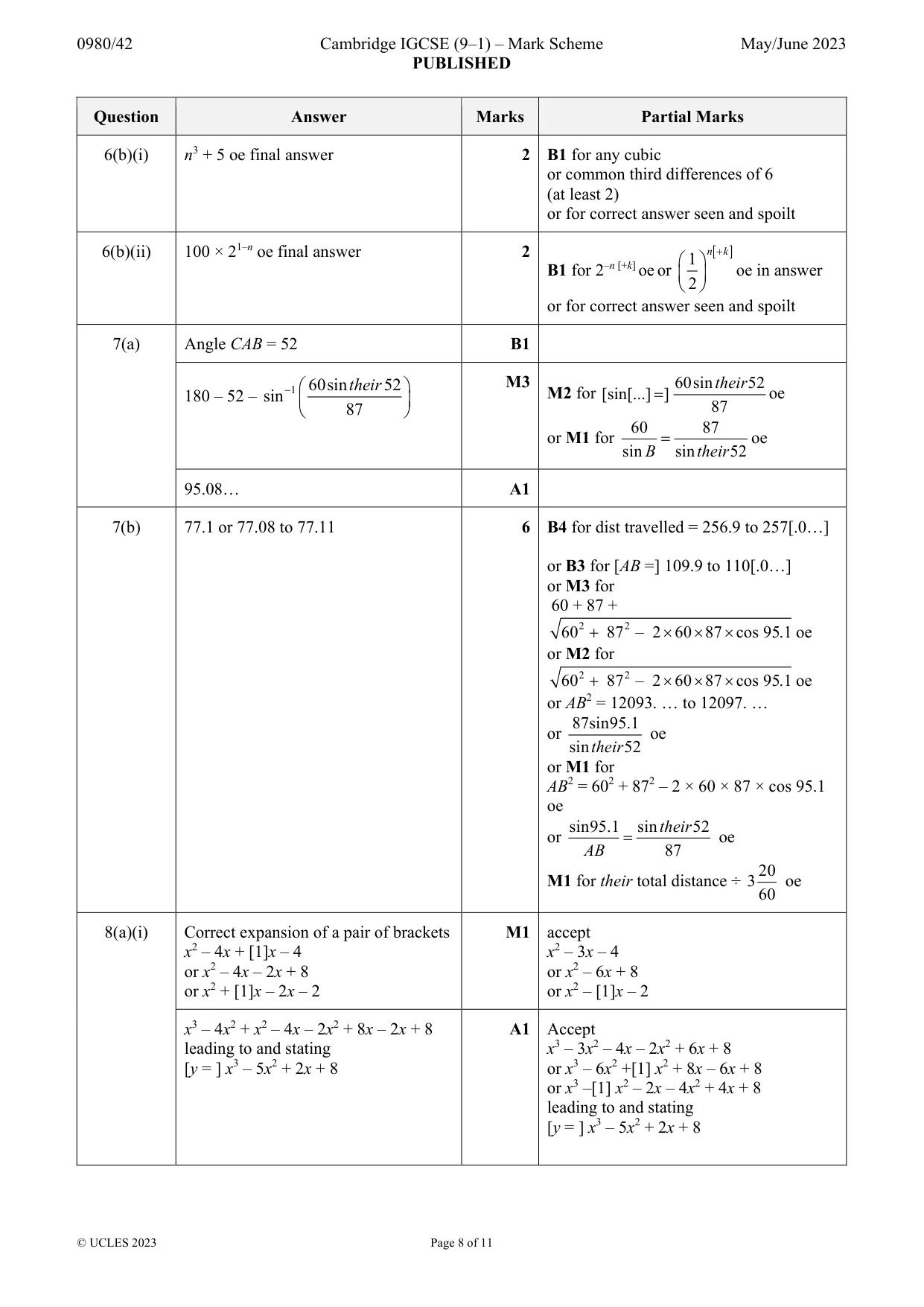
Mark scheme: 7(a) Angle CAB = 52 B1 1 60sin their 52 M3 60sin their 52 180 – 52 – sin M2 for [sin[...] ] oe 87 87 60 87 or M1 for oe sin B sin their 52 95.08… A1 7(b) 77.1 or 77.08 to 77.11 6 B4 for dist travelled = 256.9 to 257[.0…] or B3 for [AB =] 109.9 to 110[.0…] or M3 for 60 + 87 + 60 2 87 2 – 2 60 87 cos 95.1 oe or M2 for 60 2 87 2 – 2 60 87 cos 95.1 oe or AB2 = 12093. … to 12097. … 87sin95.1 or oe sin their 52 or M1 for AB2 = 602 + 872 – 2 × 60 × 87 × cos 95.1 oe sin95.1 sin their 52 or oe AB 87 20 M1 for their total distance ÷ 3 oe 60
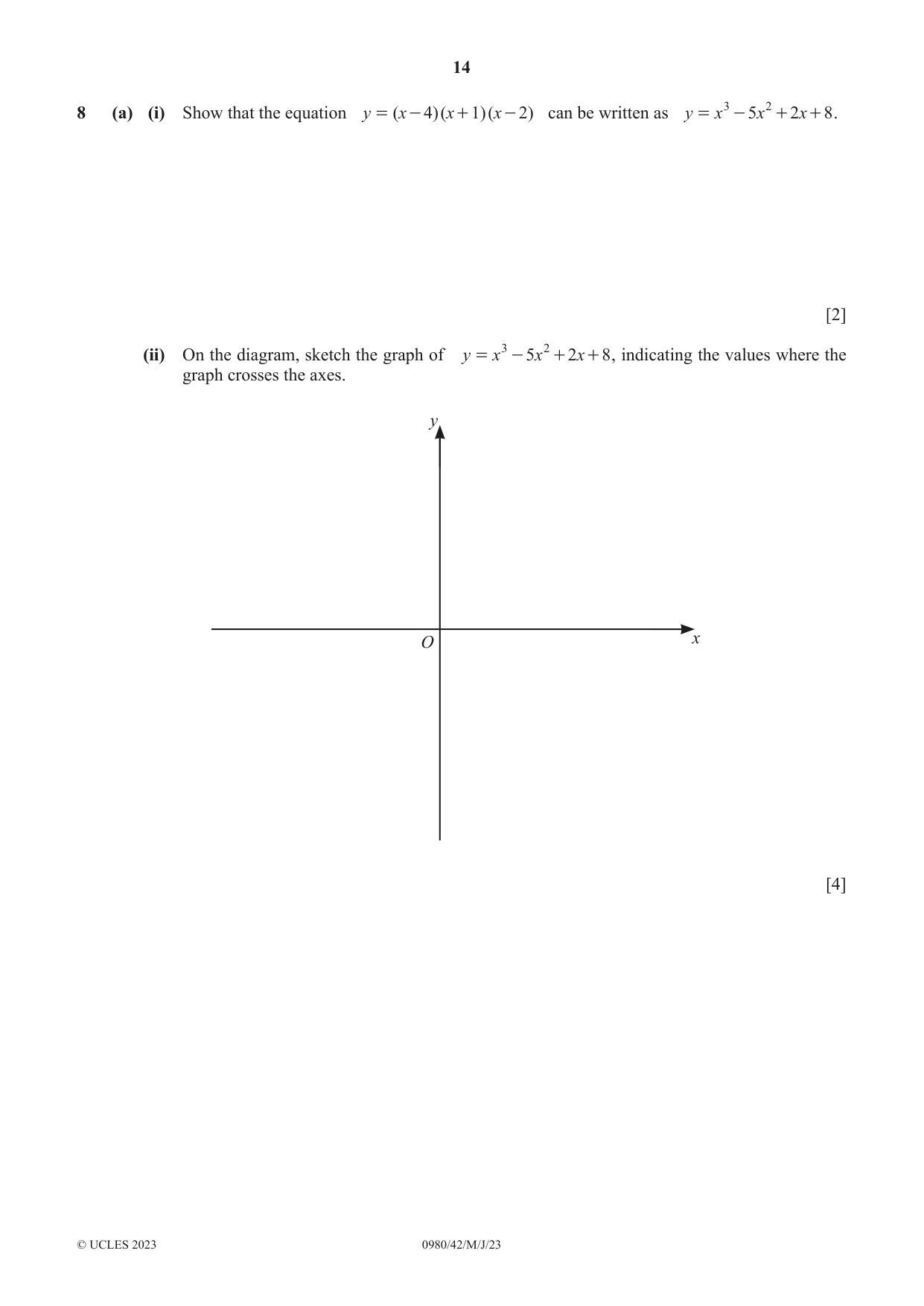
Q8 · Show that the equation y = ( x - 4)( x + 1)( x - 2) can be written as y = x 3 - 5x 2 + 2x…
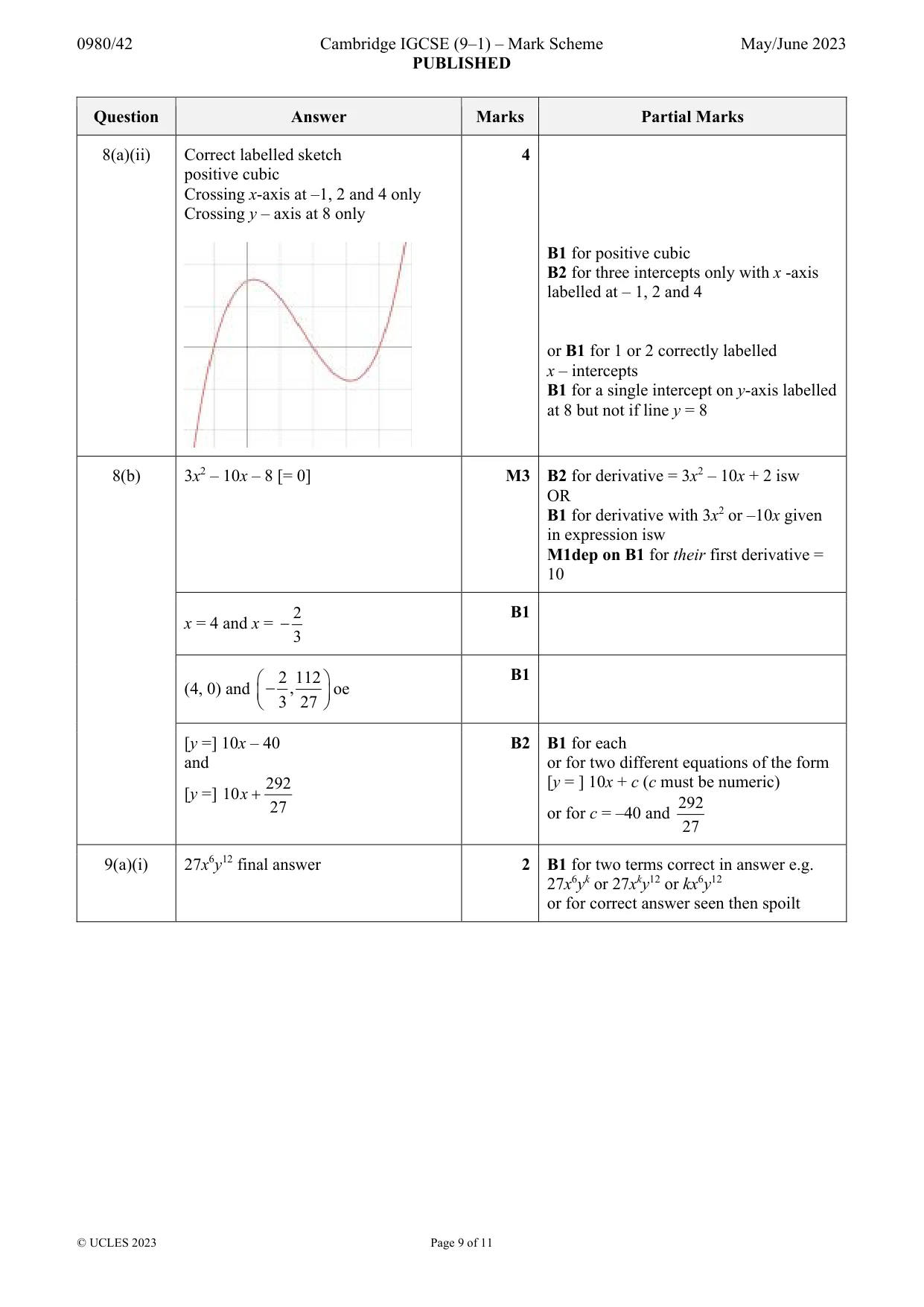
8 (a) (i) Show that the equation y = ( x - 4)( x + 1)( x - 2) can be written as y = x 3 - 5x 2 + 2x + 8 . [2] (ii) On the diagram, sketch the graph of y = x 3 - 5x 2 + 2x + 8 , indicating the values where the graph crosses the axes. y O x [4] (b) The graph of y = x 3 - 5x 2 + 2x + 8 has two tangents with a gradient of 10. Find the equations of these two tangents. You must show all your working and give your answers in the form y = mx + c . y = ................................................ y = ................................................ [7]
Mark scheme: 8(a)(i) Correct expansion of a pair of brackets M1 accept x2 – 4x + [1]x – 4 x2 – 3x – 4 or x2 – 4x – 2x + 8 or x2 – 6x + 8 or x2 + [1]x – 2x – 2 or x2 – [1]x – 2 x3 – 4x2 + x2 – 4x – 2x2 + 8x – 2x + 8 A1 Accept leading to and stating x3 – 3x2 – 4x – 2x2 + 6x + 8 [y = ] x3 – 5x2 + 2x + 8 or x3 – 6x2 +[1] x2 + 8x – 6x + 8 or x3 –[1] x2 – 2x – 4x2 + 4x + 8 leading to and stating [y = ] x3 – 5x2 + 2x + 8 8(a)(ii) Correct labelled sketch 4 positive cubic Crossing x-axis at –1, 2 and 4 only Crossing y – axis at 8 only B1 for positive cubic B2 for three intercepts only with x -axis labelled at – 1, 2 and 4 or B1 for 1 or 2 correctly labelled x – intercepts B1 for a single intercept on y-axis labelled at 8 but not if line y = 8 8(b) 3x2 – 10x – 8 [= 0] M3 B2 for derivative = 3x2 – 10x + 2 isw OR B1 for derivative with 3x2 or –10x given in expression isw M1dep on B1 for their first derivative = 10 2 B1 x = 4 and x = 3 2 112 B1 (4, 0) and , oe 3 27 [y =] 10x – 40 B2 B1 for each and or for two different equations of the form 292 [y = ] 10x + c (c must be numeric) [y =] 10 x 27 292 or for c = –40 and 27
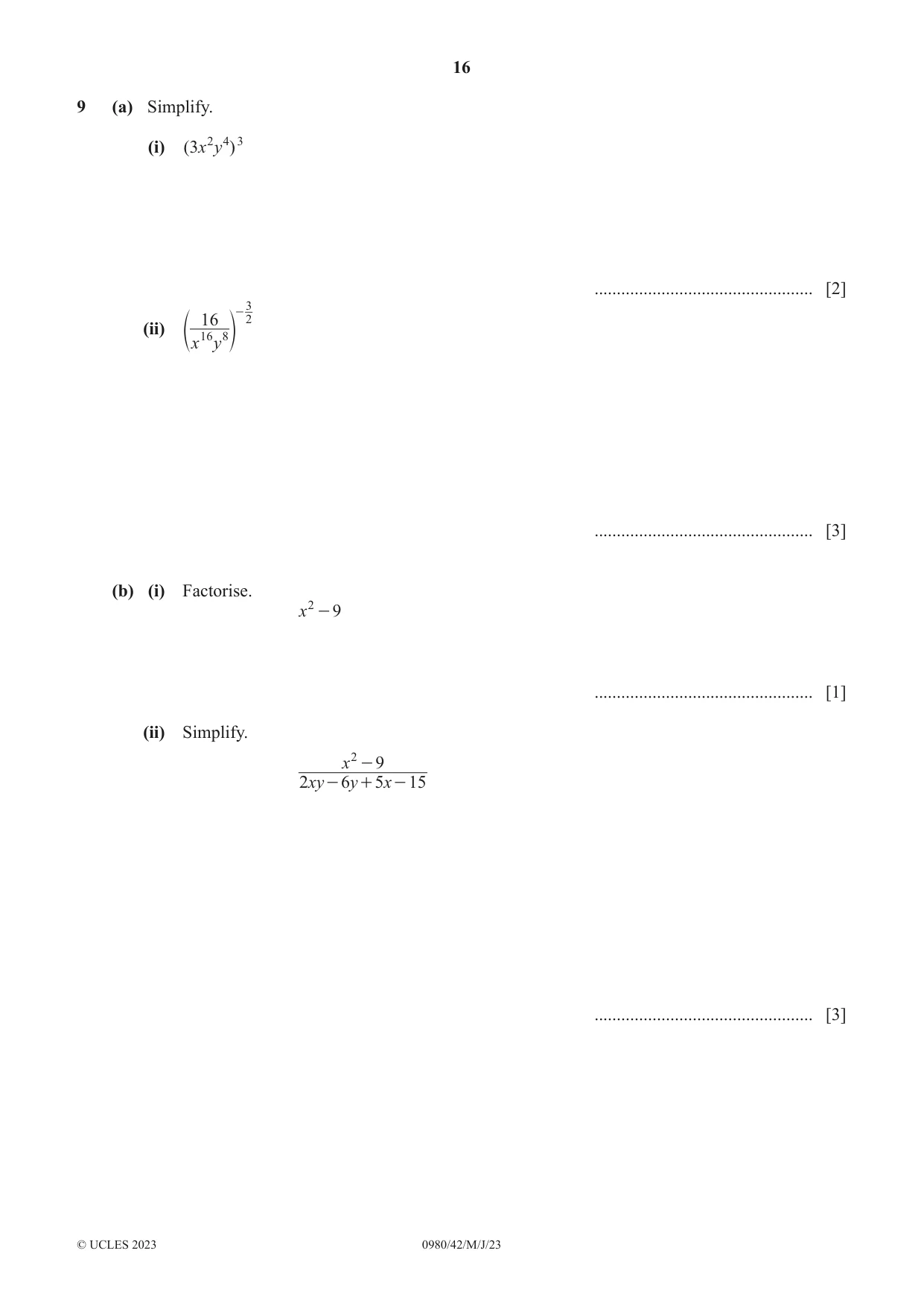
Question 9
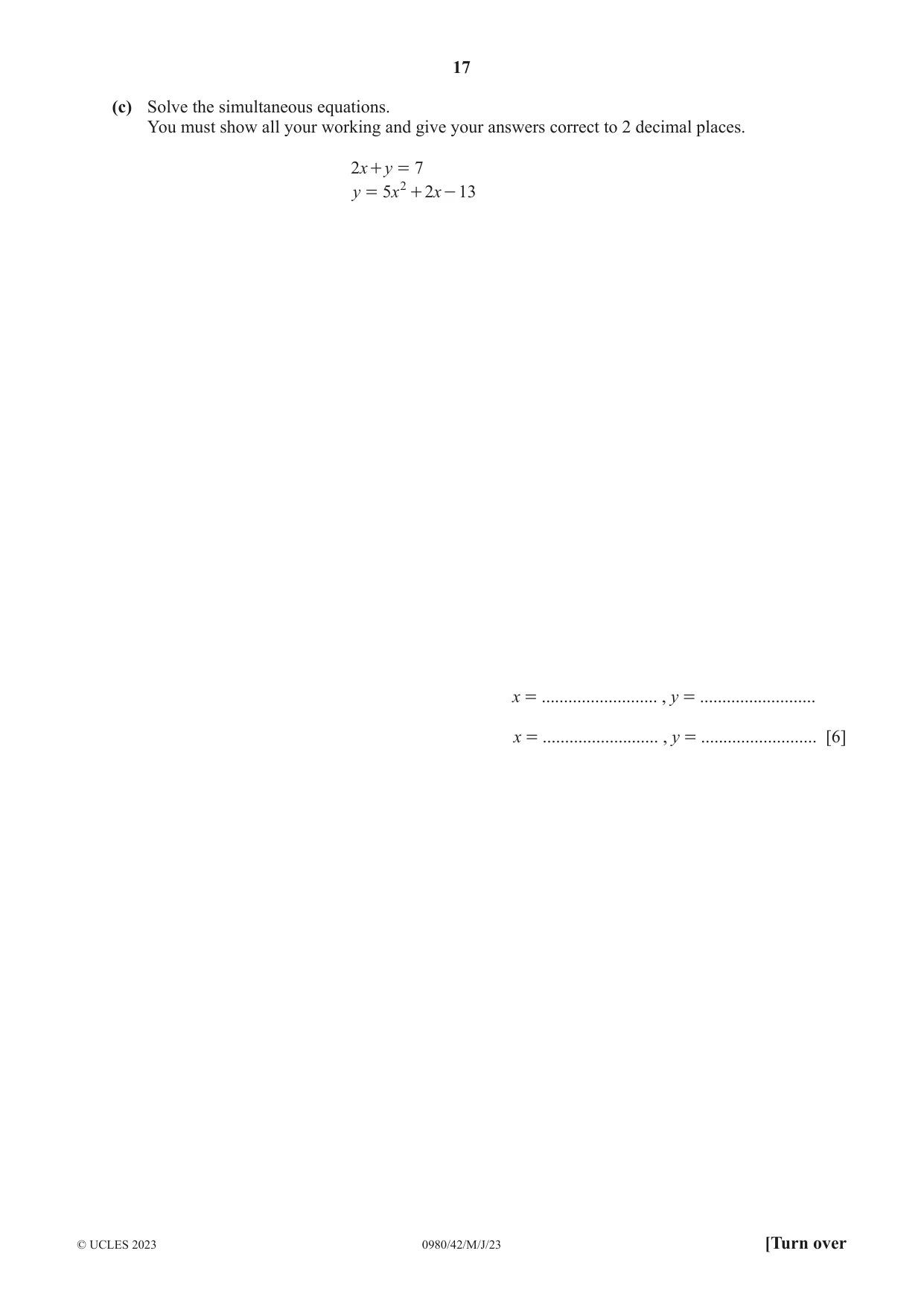
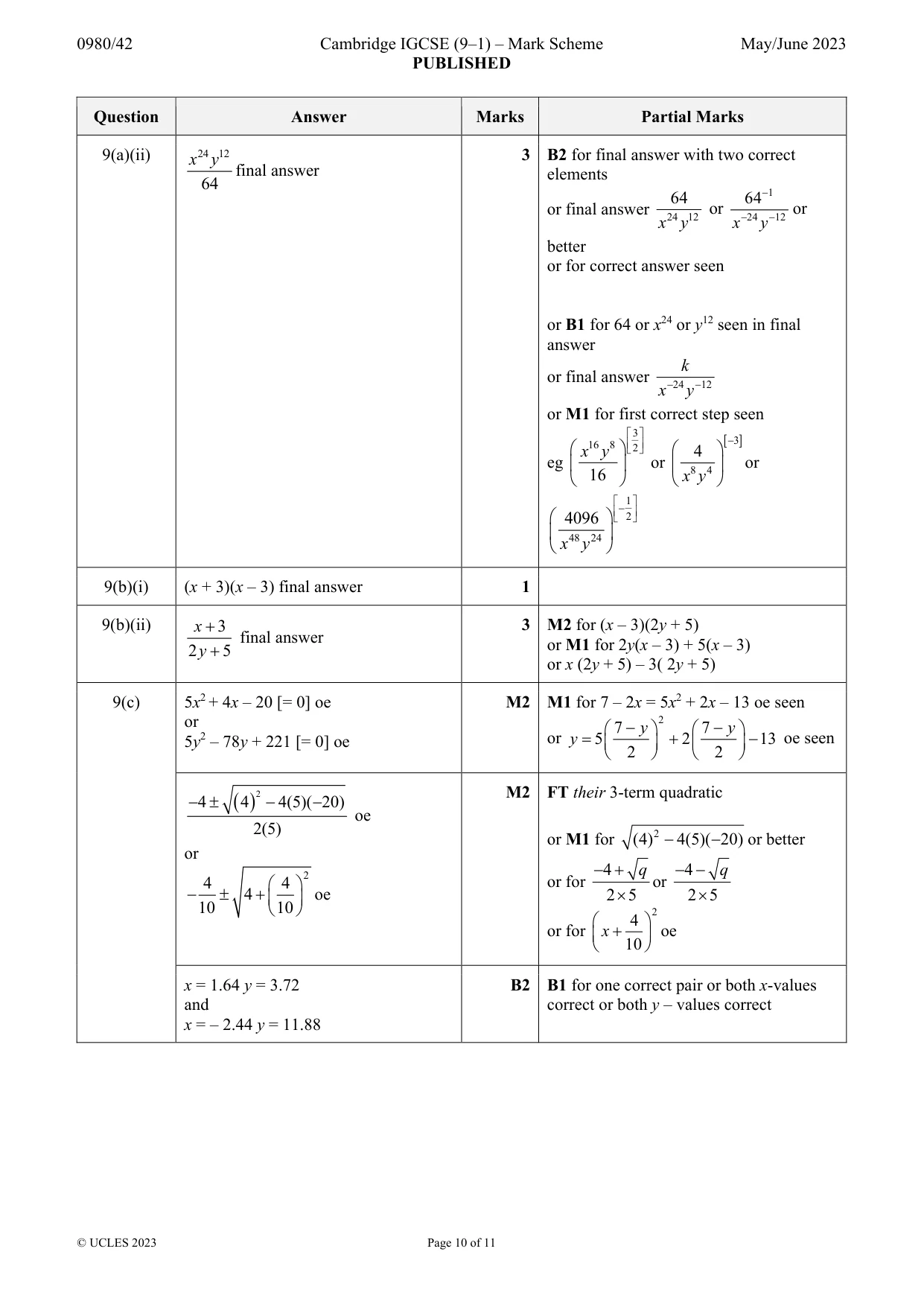
9 (a) Simplify. (i) ( 3x 2 y 4 ) 3 ................................................. [2] 3 16 - 2 (ii) 16 8 e x y o ................................................. [3] (b) (i) Factorise. x 2 - 9 ................................................. [1] (ii) Simplify. x 2 - 9 2 xy - 6 y + 5 x - 15 ................................................. [3] (c) Solve the simultaneous equations. You must show all your working and give your answers correct to 2 decimal places. 2x + y = 7 y = 5x 2 + 2x - 13 x = .......................... , y = .......................... x = .......................... , y = .......................... [6]
Mark scheme: 9(a)(i) 27x6y12 final answer 2 B1 for two terms correct in answer e.g. 27x6yk or 27xky12 or kx6y12 or for correct answer seen then spoilt 9(a)(ii) x 24 y12 3 B2 for final answer with two correct final answer elements 64 64 641 or final answer or or x 24 y12 x 24 y 12 better or for correct answer seen or B1 for 64 or x24 or y12 seen in final answer k or final answer x 24 y 12 or M1 for first correct step seen 3 3 x16 y 8 2 4 eg or 8 4 or 16 x y 1 2 4096 48 24 x y 9(b)(i) (x + 3)(x – 3) final answer 1 9(b)(ii) x 3 3 M2 for (x – 3)(2y + 5) final answer or M1 for 2y(x – 3) + 5(x – 3) 2 y 5 or x (2y + 5) – 3( 2y + 5) 9(c) 5x2 + 4x – 20 [= 0] oe M2 M1 for 7 – 2x = 5x2 + 2x – 13 oe seen or 2 7 y 7 y 5y2 – 78y + 221 [= 0] oe or y 5 2 13 oe seen 2 2 2 M2 FT their 3-term quadratic 4 4 4(5)( 20) oe 2(5) 2 or M1 for (4) 4(5)( 20) or better or 2 4 q 4 q 4 4 or for or 4 oe 2 5 2 5 10 10 2 4 or for x oe 10 x = 1.64 y = 3.72 B2 B1 for one correct pair or both x-values and correct or both y – values correct x = – 2.44 y = 11.88
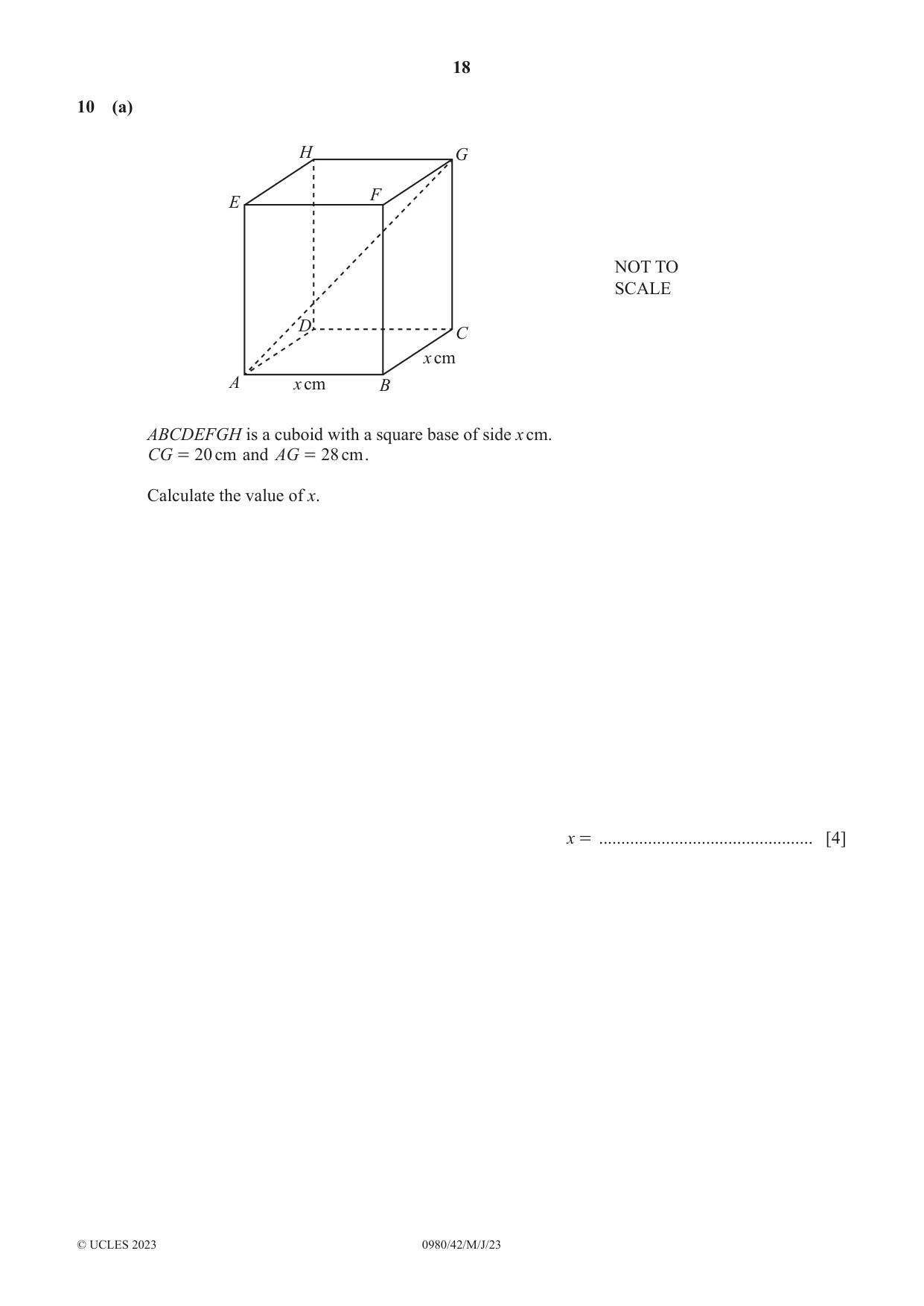
Q10 · H G F E NOT TO SCALE D C x cm A x cm B ABCDEFGH is a cuboid with a square base of side x…
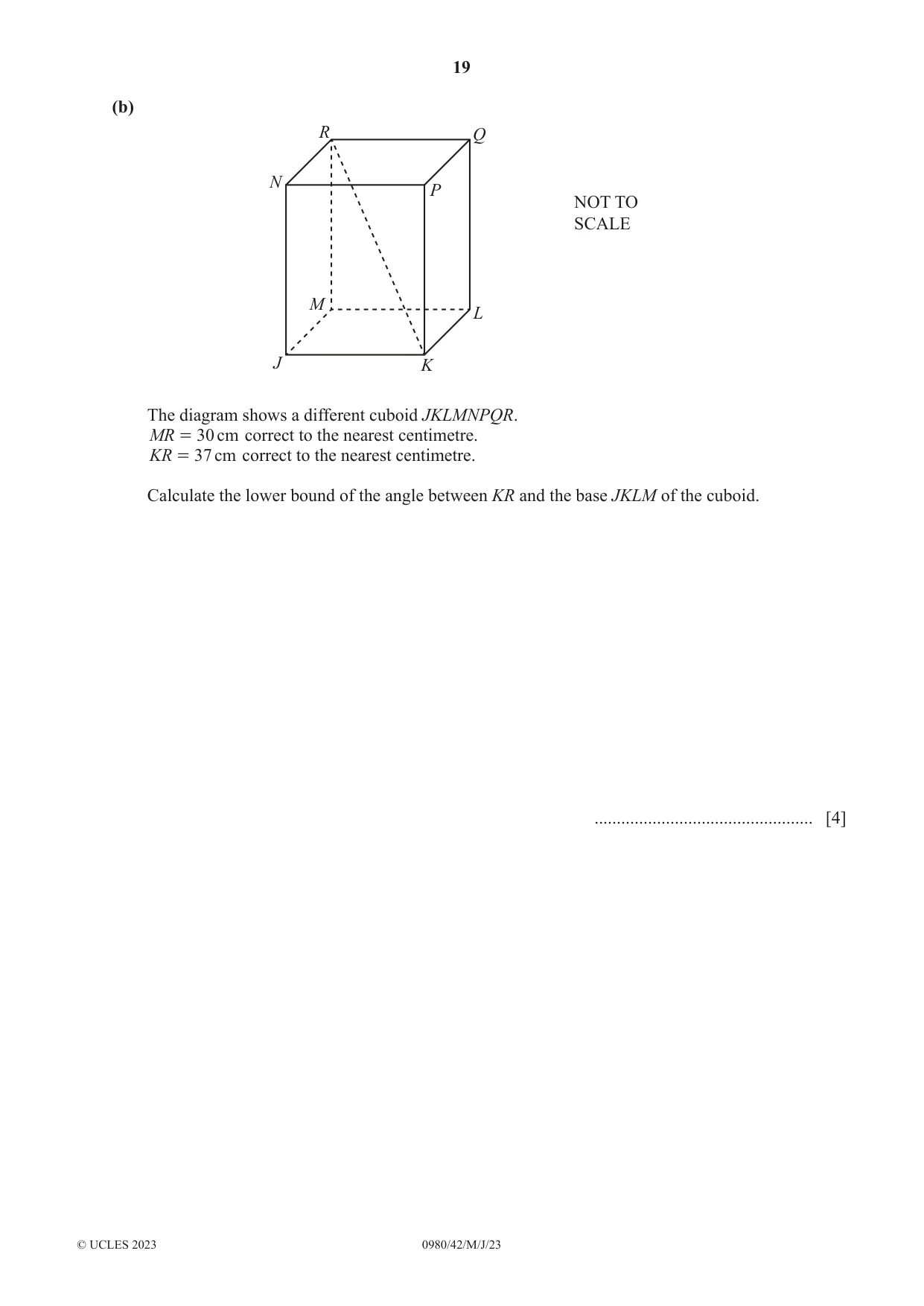
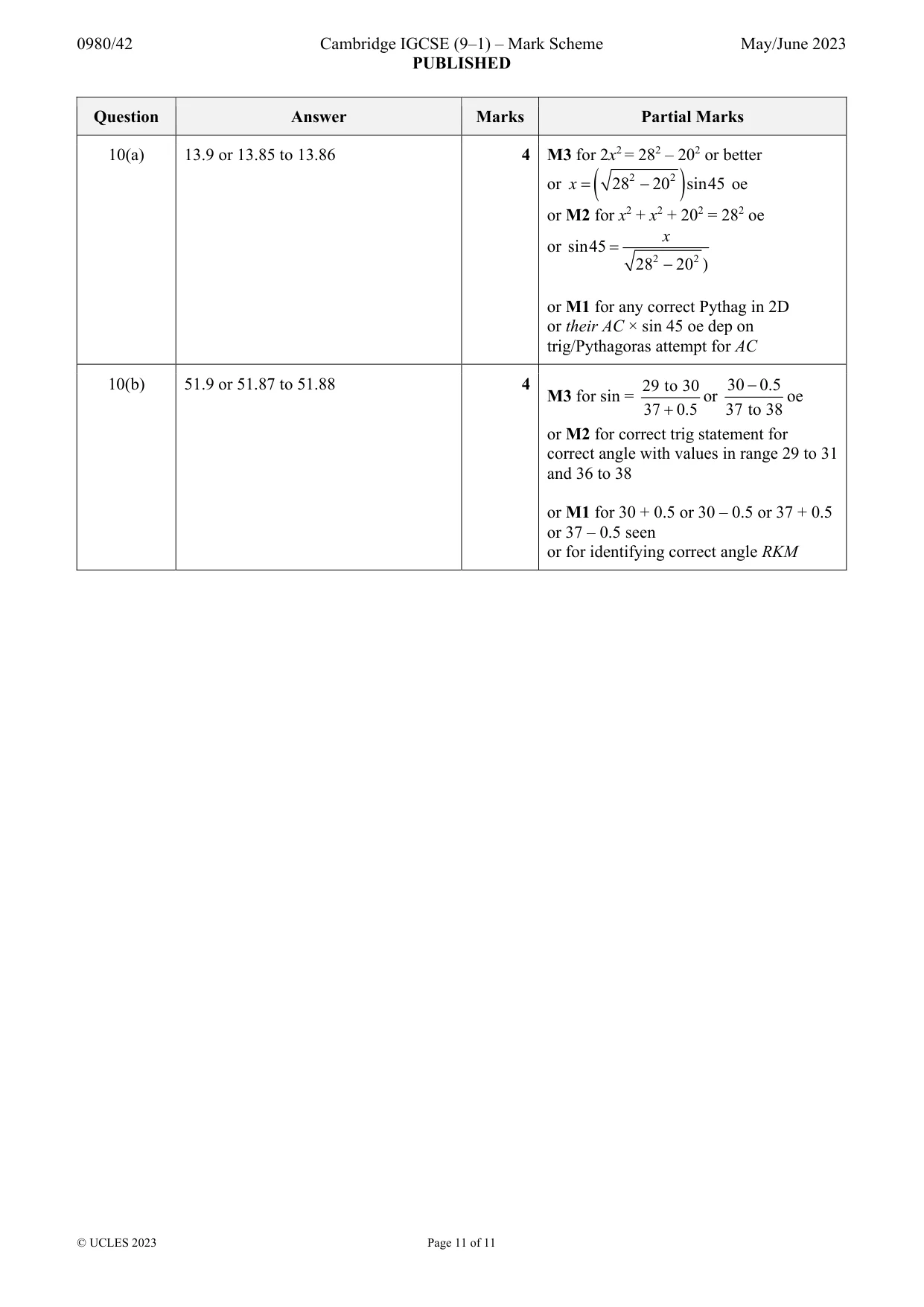
10 (a) H G F E NOT TO SCALE D C x cm A x cm B ABCDEFGH is a cuboid with a square base of side x cm. CG = 20 cm and AG = 28 cm . Calculate the value of x. x = ................................................ [4] (b) R Q N P NOT TO SCALE M L J K The diagram shows a different cuboid JKLMNPQR. MR = 30 cm correct to the nearest centimetre. KR = 37 cm correct to the nearest centimetre. Calculate the lower bound of the angle between KR and the base JKLM of the cuboid. ................................................. [4]
Mark scheme: 10(a) 13.9 or 13.85 to 13.86 4 M3 for 2x2 = 282 – 202 or better or x 28 2 20 2 sin45 oe or M2 for x2 + x2 + 202 = 282 oe x or sin45 28 2 20 2 ) or M1 for any correct Pythag in 2D or their AC × sin 45 oe dep on trig/Pythagoras attempt for AC 10(b) 51.9 or 51.87 to 51.88 4 29 to 30 30 0.5 M3 for sin = or oe 37 0.5 37 to 38 or M2 for correct trig statement for correct angle with values in range 29 to 31 and 36 to 38 or M1 for 30 + 0.5 or 30 – 0.5 or 37 + 0.5 or 37 – 0.5 seen or for identifying correct angle RKM
What was in this paper
The subtopics covered by these 10 questions, and how many questions each got. Open one in a new tab to see every Cambridge question on it.
What you needed in this session
Cambridge’s own grade thresholds for 2023 May/June, Paper 4 · Variant 2. A higher threshold means an easier paper — the bar moves with how the cohort did.