Cambridge IGCSE Mathematics (9-1) 0980 — 2021 May/June Paper 4 · Variant 2
0980/42/M/J/21 · 10 questions · 130 marks · ≈146 min
The question paper and its mark scheme, free to read here and free to download. This is Cambridge’s own paper, exactly as it was sat.
Question paper16 pages
Mark scheme8 pages
Answers below. Sit the paper first if you are practising.
Questions as text
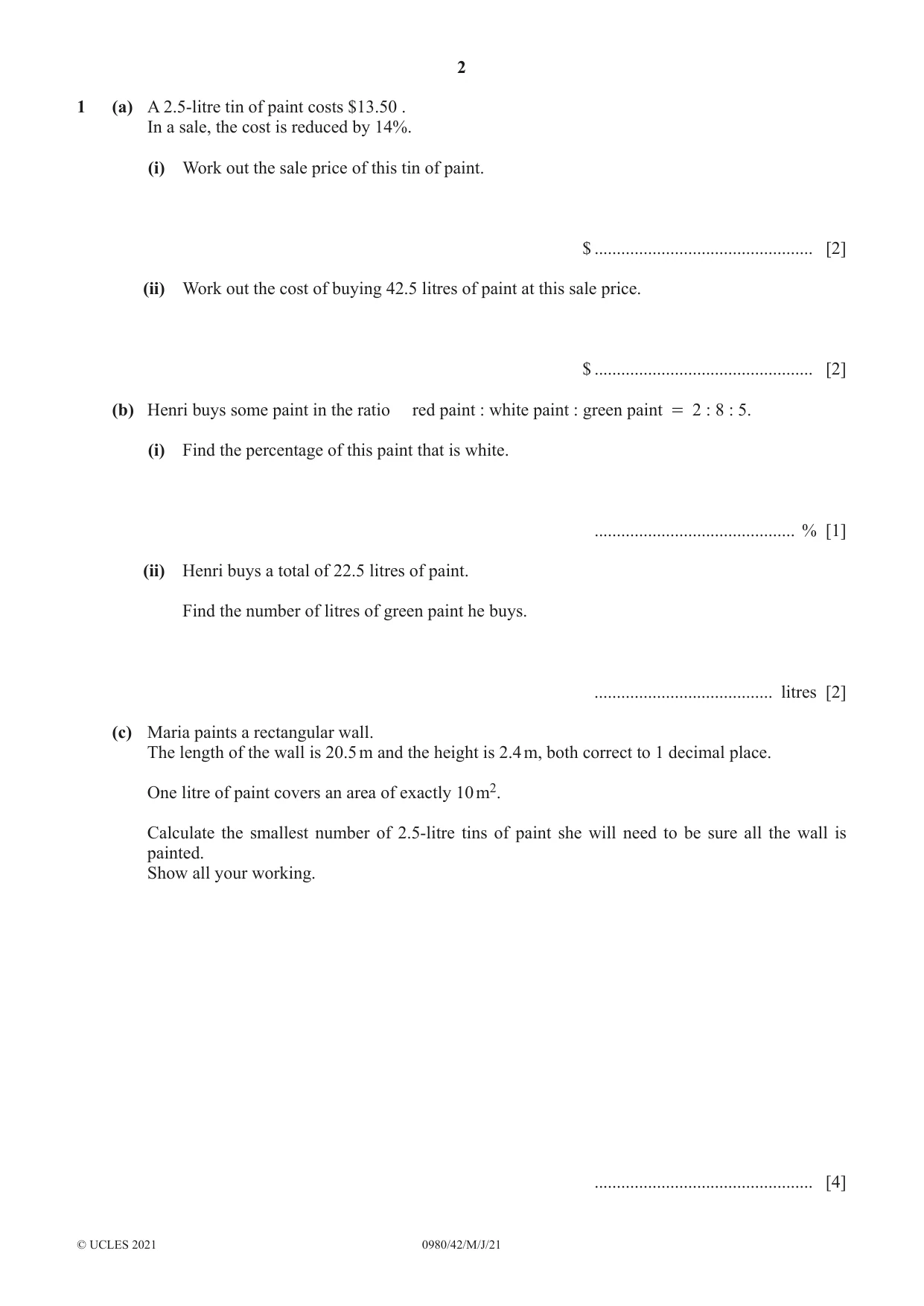
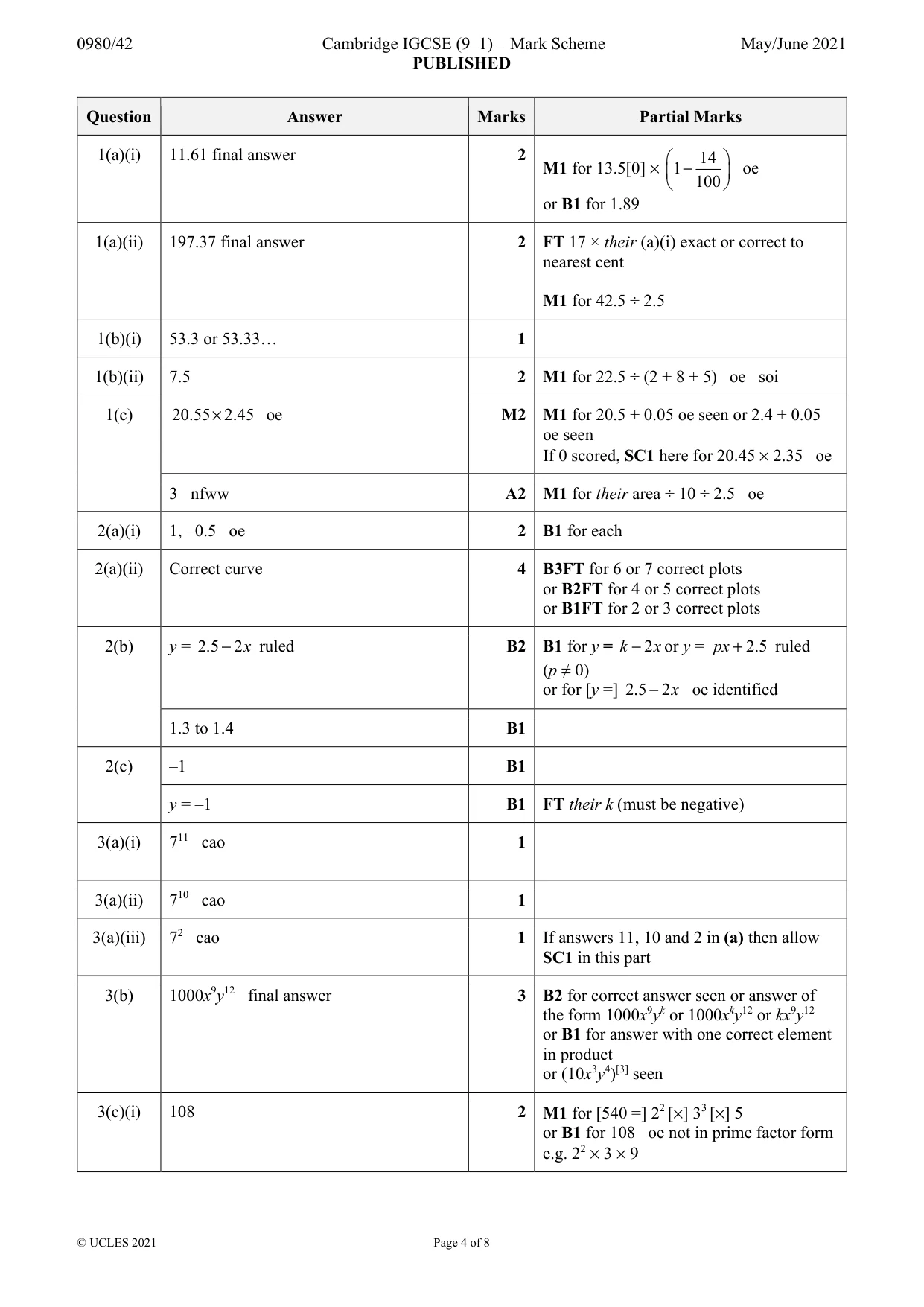
Q1 · A 2.5-litre tin of paint costs $13.50
1 (a) A 2.5-litre tin of paint costs $13.50 . In a sale, the cost is reduced by 14%. (i) Work out the sale price of this tin of paint. $ ................................................. [2] (ii) Work out the cost of buying 42.5 litres of paint at this sale price. $ ................................................. [2] (b) Henri buys some paint in the ratio red paint : white paint : green paint = 2 : 8 : 5. (i) Find the percentage of this paint that is white. ............................................. % [1] (ii) Henri buys a total of 22.5 litres of paint. Find the number of litres of green paint he buys. ........................................ litres [2] (c) Maria paints a rectangular wall. The length of the wall is 20.5 m and the height is 2.4 m, both correct to 1 decimal place. One litre of paint covers an area of exactly 10 m2. Calculate the smallest number of 2.5-litre tins of paint she will need to be sure all the wall is painted. Show all your working. ................................................. [4]
Mark scheme: Question Answer Marks Partial Marks 1(a)(i) 11.61 final answer 2 14 M1 for 13.5[0] × 1 − oe 100 or B1 for 1.89 1(a)(ii) 197.37 final answer 2 FT 17 × their (a)(i) exact or correct to nearest cent M1 for 42.5 ÷ 2.5 1(b)(i) 53.3 or 53.33… 1 1(b)(ii) 7.5 2 M1 for 22.5 ÷ (2 + 8 + 5) oe soi 1(c) 20.55 × 2.45 oe M2 M1 for 20.5 + 0.05 oe seen or 2.4 + 0.05 oe seen If 0 scored, SC1 here for 20.45 × 2.35 oe 3 nfww A2 M1 for their area ÷ 10 ÷ 2.5 oe
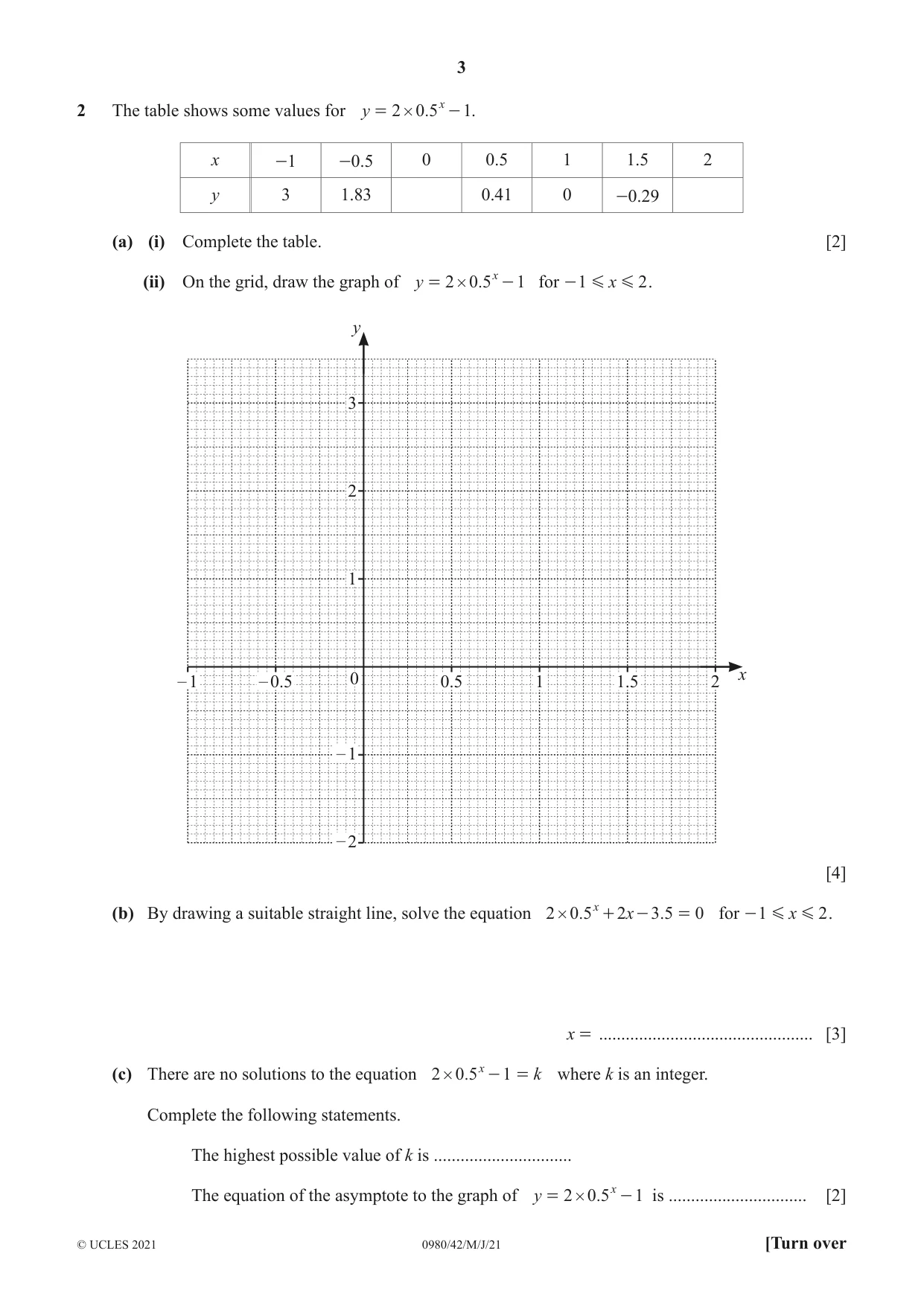
Q2 · The table shows some values for y = 2 # 0.5 x - 1
2 The table shows some values for y = 2 # 0.5 x - 1. x -1 -0.5 0 0.5 1 1.5 2 y 3 1.83 0.41 0 -0.29 (a) (i) Complete the table. [2] (ii) On the grid, draw the graph of y = 2 # 0.5 x - 1 for - 1 G x G 2 . y 3 2 1 x – 1 – 0.5 0 0.5 1 1.5 2 – 1 – 2 [4] (b) By drawing a suitable straight line, solve the equation 2 # 0.5 x + 2x - 3.5 = 0 for - 1 G x G 2 . x = ................................................ [3] (c) There are no solutions to the equation 2 # 0.5 x - 1 = k where k is an integer. Complete the following statements. The highest possible value of k is ............................... The equation of the asymptote to the graph of y = 2 # 0.5 x - 1 is ............................... [2]
Mark scheme: 2(a)(i) 1, –0.5 oe 2 B1 for each 2(a)(ii) Correct curve 4 B3FT for 6 or 7 correct plots or B2FT for 4 or 5 correct plots or B1FT for 2 or 3 correct plots 2(b) y = 2.5 − 2x ruled B2 B1 for y = k − 2 x or y = px + 2.5 ruled (p ≠ 0) or for [y =] 2.5 − 2x oe identified 1.3 to 1.4 B1 2(c) –1 B1 y = –1 B1 FT their k (must be negative)
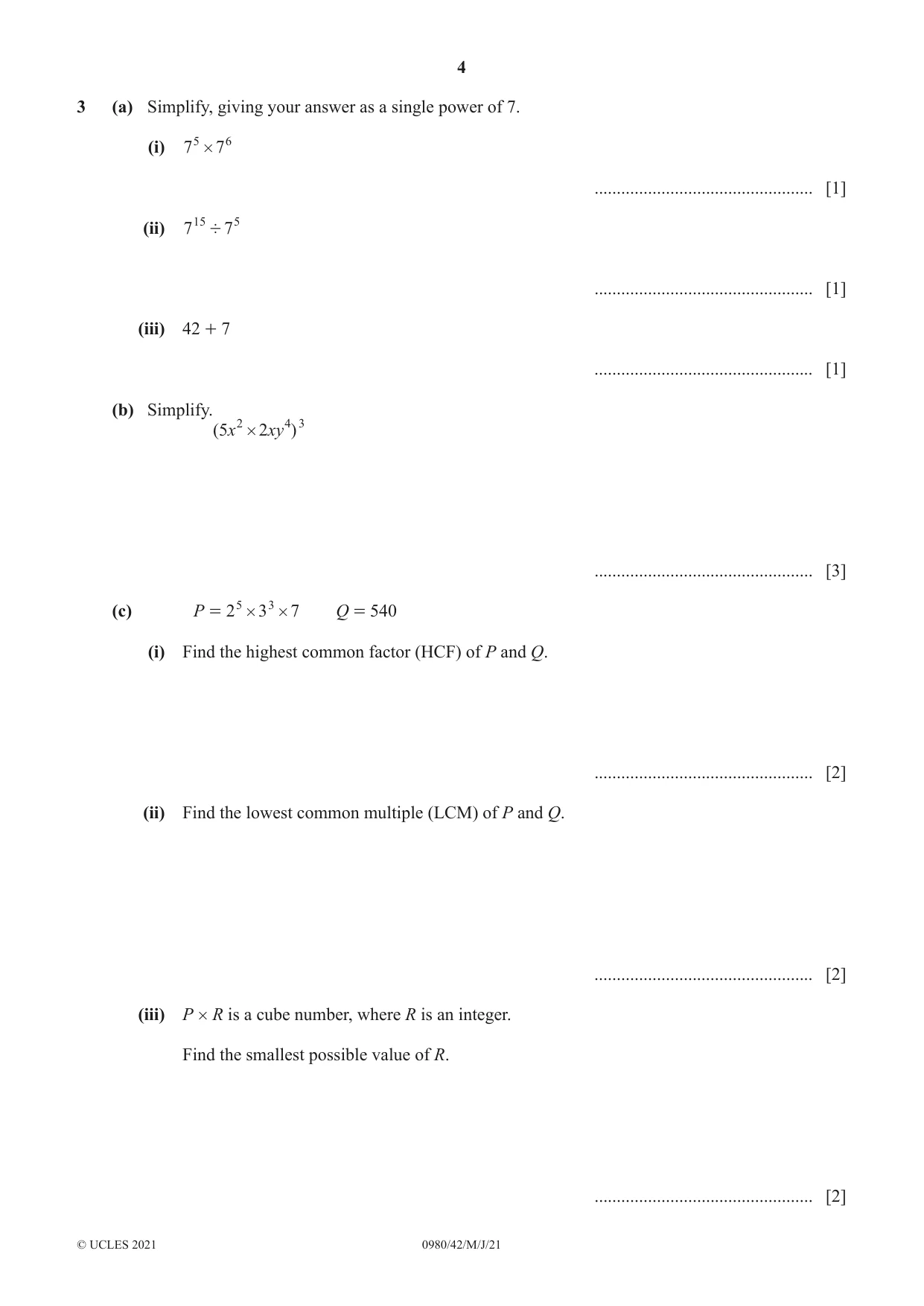
Q3 · Simplify, giving your answer as a single power of 7
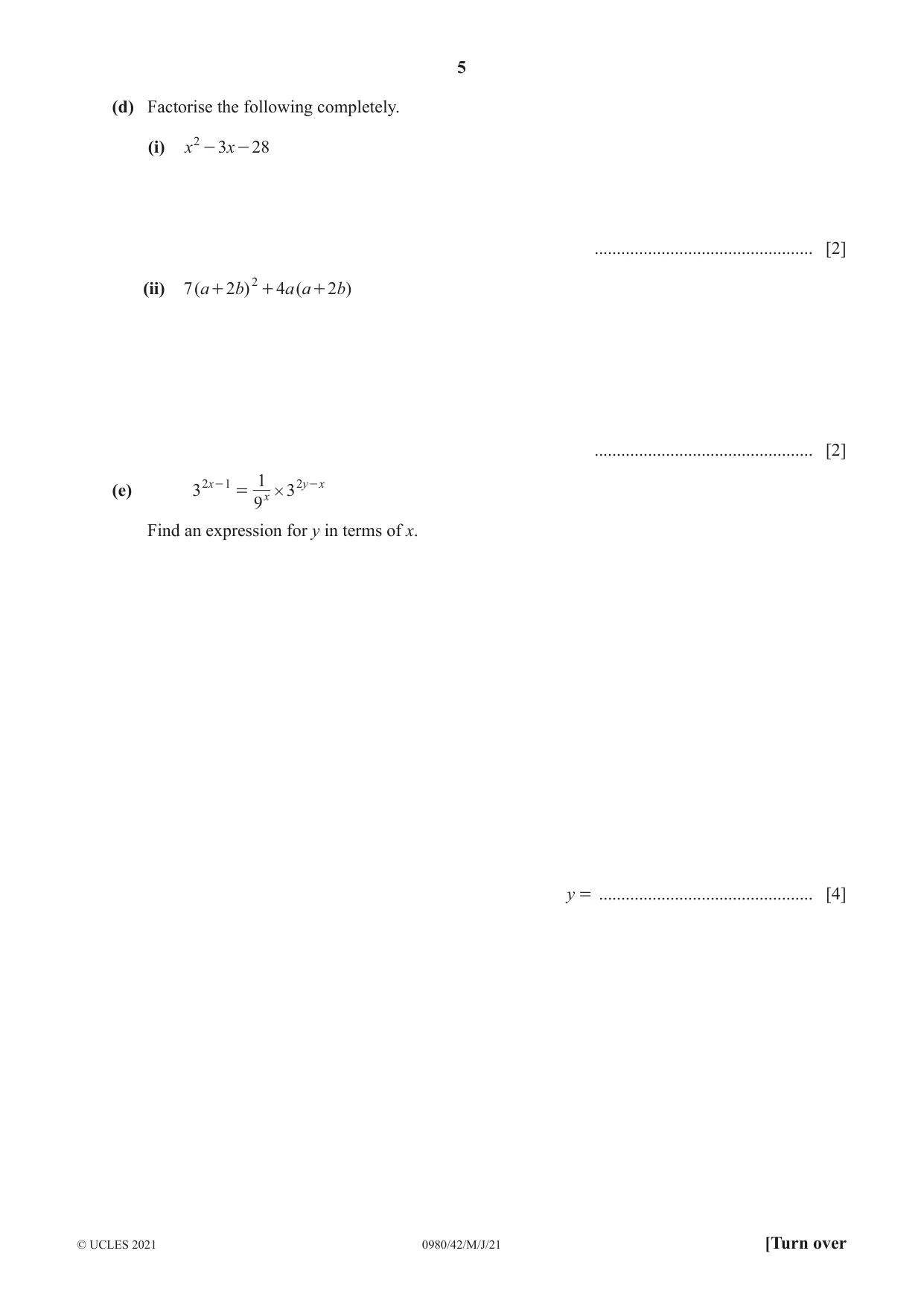
3 (a) Simplify, giving your answer as a single power of 7. (i) 7 5 # 7 6 ................................................. [1] (ii) 7 15 ' 7 5 ................................................. [1] (iii) 42 + 7 ................................................. [1] (b) Simplify. ( 5x 2 # 2xy 4 ) 3 ................................................. [3] (c) P = 2 5 # 3 3 # 7 Q = 540 (i) Find the highest common factor (HCF) of P and Q. ................................................. [2] (ii) Find the lowest common multiple (LCM) of P and Q. ................................................. [2] (iii) P # R is a cube number, where R is an integer. Find the smallest possible value of R. ................................................. [2] (d) Factorise the following completely. (i) x 2 - 3x - 28 ................................................. [2] (ii) 7 ( a + 2b) 2 + 4a ( a + 2b) ................................................. [2] 2 x - 1 1 2 y - x # 3(e) 3 = x 9 Find an expression for y in terms of x. y = ................................................ [4]
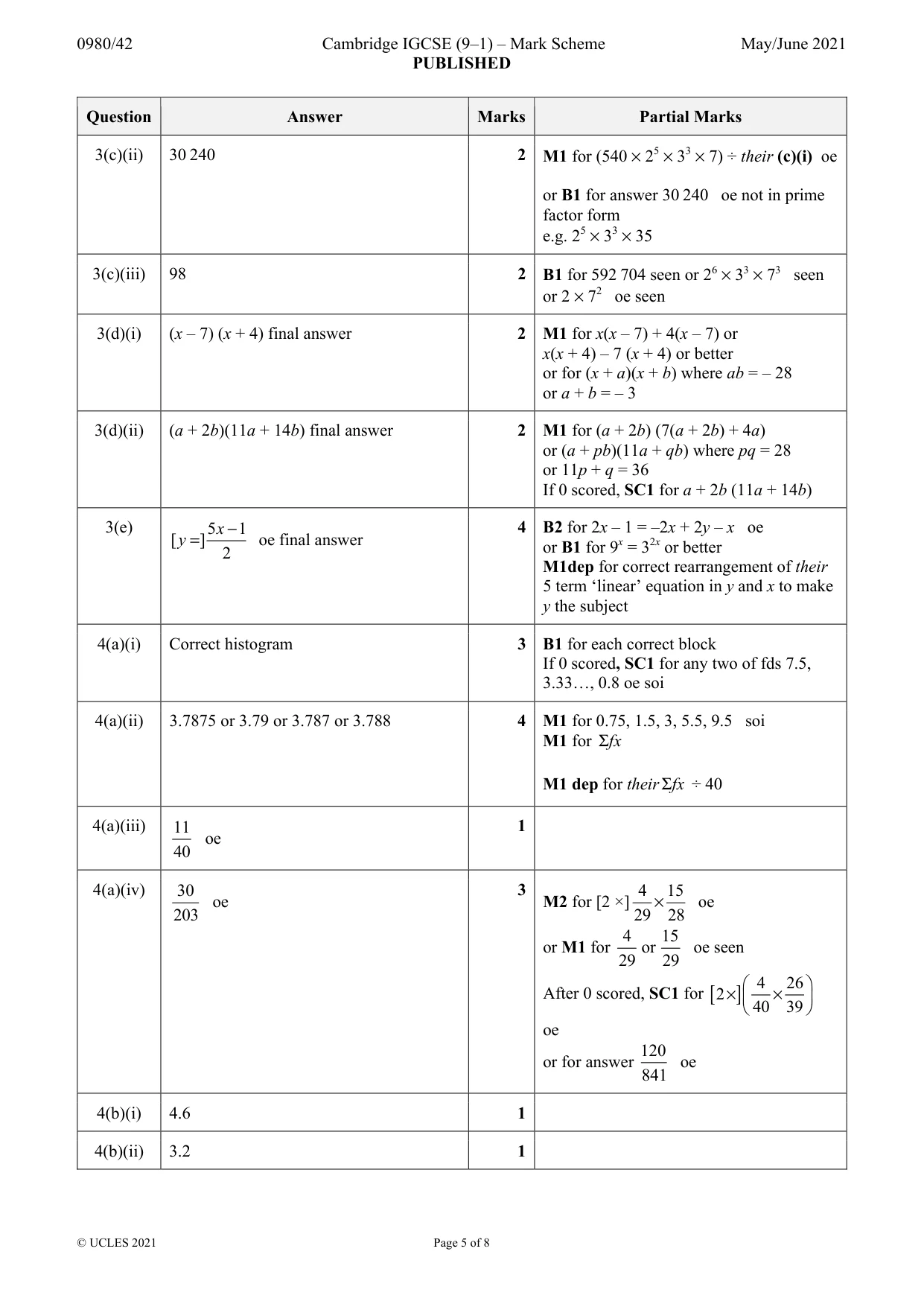
Mark scheme: 3(a)(i) 711 cao 1 3(a)(ii) 710 cao 1 3(a)(iii) 72 cao 1 If answers 11, 10 and 2 in (a) then allow SC1 in this part 3(b) 1000x9y12 final answer 3 B2 for correct answer seen or answer of the form 1000x9yk or 1000xky12 or kx9y12 or B1 for answer with one correct element in product or (10x3y4)[3] seen 3(c)(i) 108 2 M1 for [540 =] 22 [×] 33 [×] 5 or B1 for 108 oe not in prime factor form e.g. 22 × 3 × 9 3(c)(ii) 30 240 2 M1 for (540 × 25 × 33 × 7) ÷ their (c)(i) oe or B1 for answer 30 240 oe not in prime factor form e.g. 25 × 33 × 35 3(c)(iii) 98 2 B1 for 592 704 seen or 26 × 33 × 73 seen or 2 × 72 oe seen 3(d)(i) (x – 7) (x + 4) final answer 2 M1 for x(x – 7) + 4(x – 7) or x(x + 4) – 7 (x + 4) or better or for (x + a)(x + b) where ab = – 28 or a + b = – 3 3(d)(ii) (a + 2b)(11a + 14b) final answer 2 M1 for (a + 2b) (7(a + 2b) + 4a) or (a + pb)(11a + qb) where pq = 28 or 11p + q = 36 If 0 scored, SC1 for a + 2b (11a + 14b) 3(e) 5 x − 1 4 B2 for 2x – 1 = –2x + 2y – x oe [ y = ] oe final answer or B1 for 9x = 32x or better 2 M1dep for correct rearrangement of their 5 term ‘linear’ equation in y and x to make y the subject
Q4 · The mass, m kg, of each of 40 parcels in a warehouse is recorded
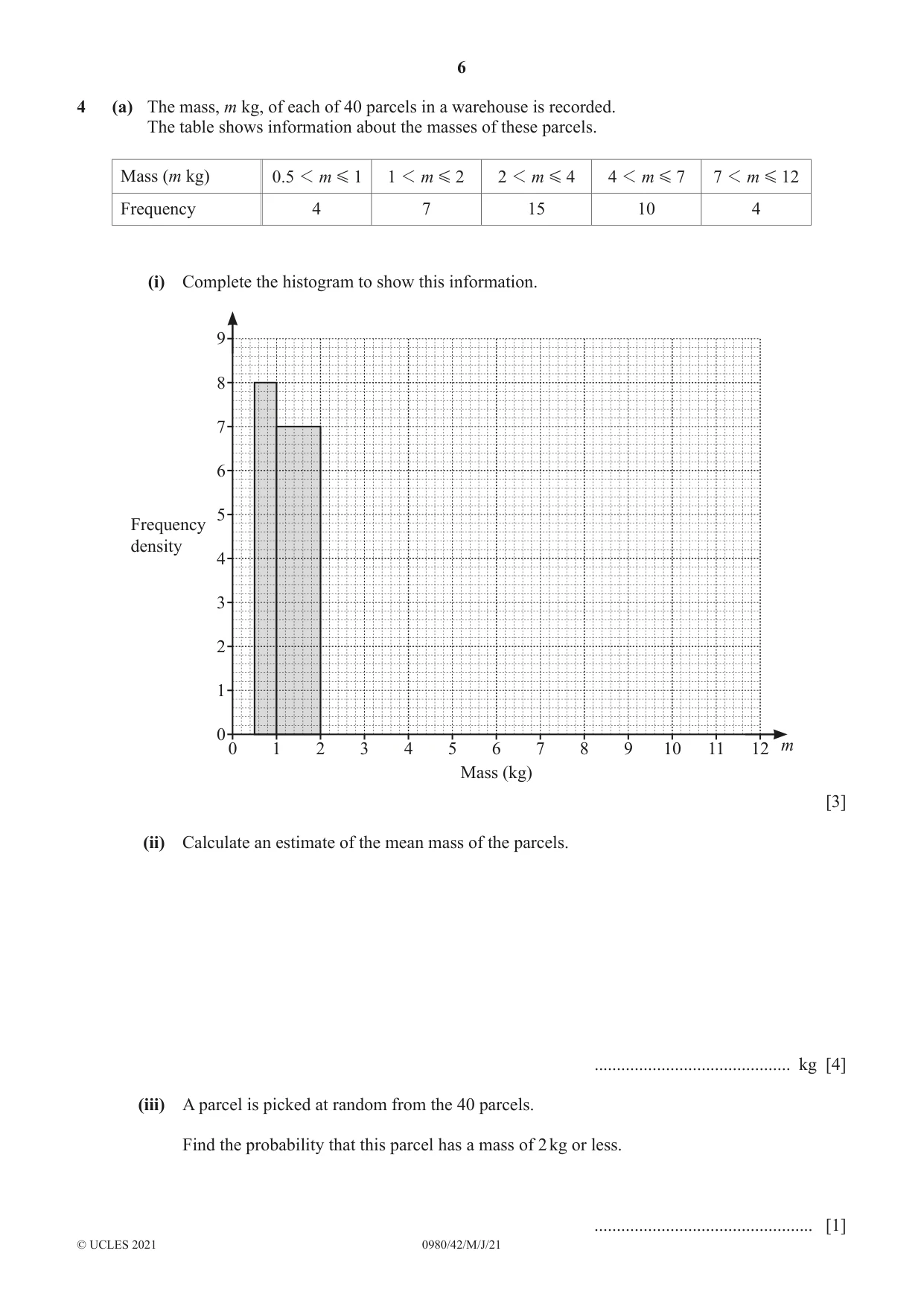
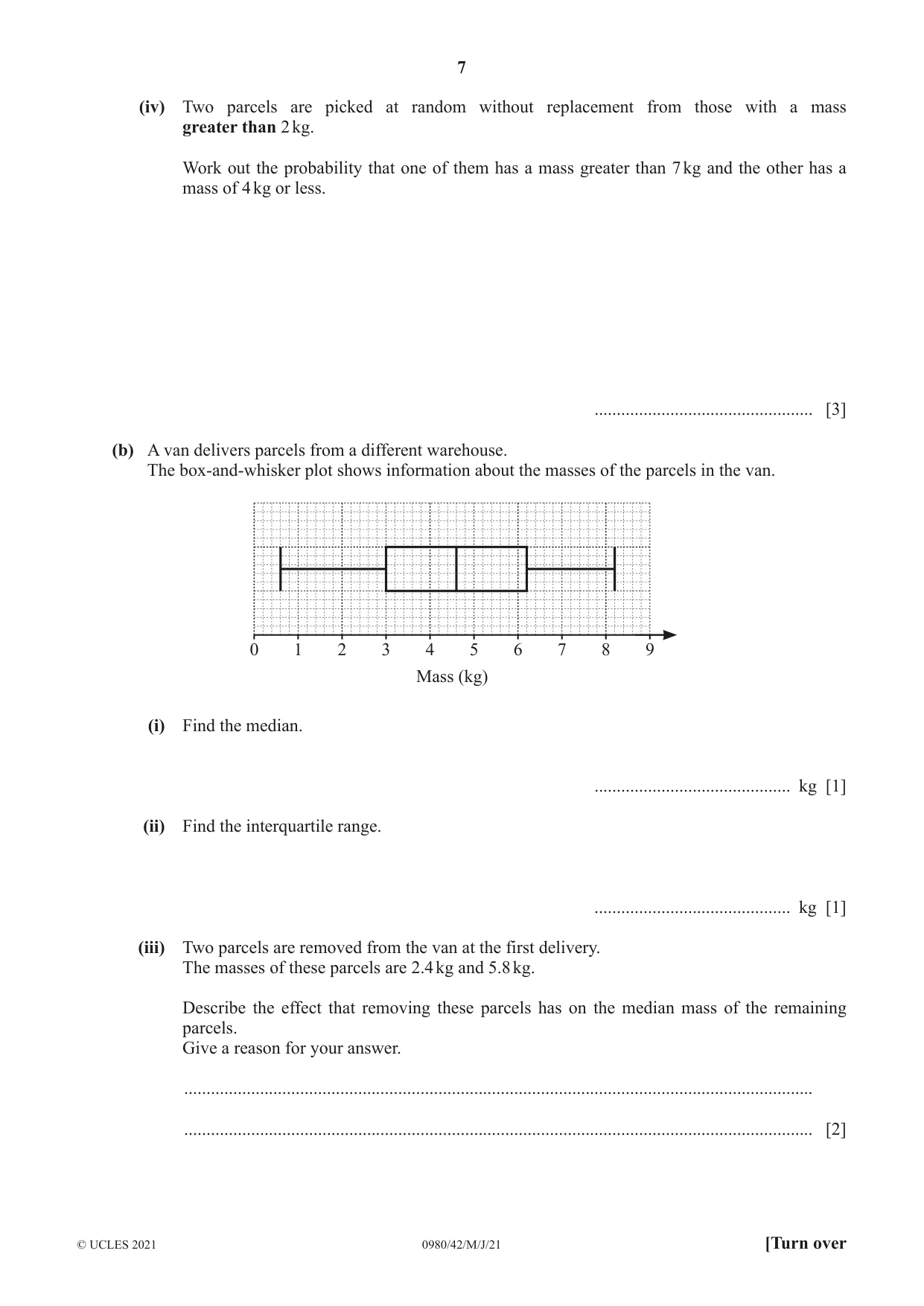
4 (a) The mass, m kg, of each of 40 parcels in a warehouse is recorded. The table shows information about the masses of these parcels. Mass (m kg) 0.5 1 m G 1 1 1 m G 2 2 1 m G 4 4 1 m G 7 7 1 m G 12 Frequency 4 7 15 10 4 (i) Complete the histogram to show this information. 9 8 7 6 5 Frequency density 4 3 2 1 0 0 1 2 3 4 5 6 7 8 9 10 11 12 m Mass (kg) [3] (ii) Calculate an estimate of the mean mass of the parcels. ............................................ kg [4] (iii) A parcel is picked at random from the 40 parcels. Find the probability that this parcel has a mass of 2 kg or less. ................................................. [1] (iv) Two parcels are picked at random without replacement from those with a mass greater than 2 kg. Work out the probability that one of them has a mass greater than 7 kg and the other has a mass of 4 kg or less. ................................................. [3] (b) A van delivers parcels from a different warehouse. The box-and-whisker plot shows information about the masses of the parcels in the van. 0 1 2 3 4 5 6 7 8 9 Mass (kg) (i) Find the median. ............................................ kg [1] (ii) Find the interquartile range. ............................................ kg [1] (iii) Two parcels are removed from the van at the first delivery. The masses of these parcels are 2.4 kg and 5.8 kg. Describe the effect that removing these parcels has on the median mass of the remaining parcels. Give a reason for your answer. ............................................................................................................................................. ............................................................................................................................................. [2]
Mark scheme: 4(a)(i) Correct histogram 3 B1 for each correct block If 0 scored, SC1 for any two of fds 7.5, 3.33…, 0.8 oe soi 4(a)(ii) 3.7875 or 3.79 or 3.787 or 3.788 4 M1 for 0.75, 1.5, 3, 5.5, 9.5 soi M1 for Σ fx M1 dep for their Σ fx ÷ 40 4(a)(iii) 11 1 oe 40 4(a)(iv) 30 3 4 15 oe M2 for [2 ×] × oe 203 29 28 4 15 or M1 for or oe seen 29 29 4 26 After 0 scored, SC1 for [ 2 × ] × 40 39 oe 120 or for answer oe 841 4(b)(i) 4.6 1 4(b)(ii) 3.2 1 4(b)(iii) [median] remains the same oe 2 B1 for each statement and one is below [the median/middle] and one is above oe
Q5 · A = b = 8 - 5 (i) Find (a) b - a , [1] f p (b) 2a + b , [2] f p (c) b
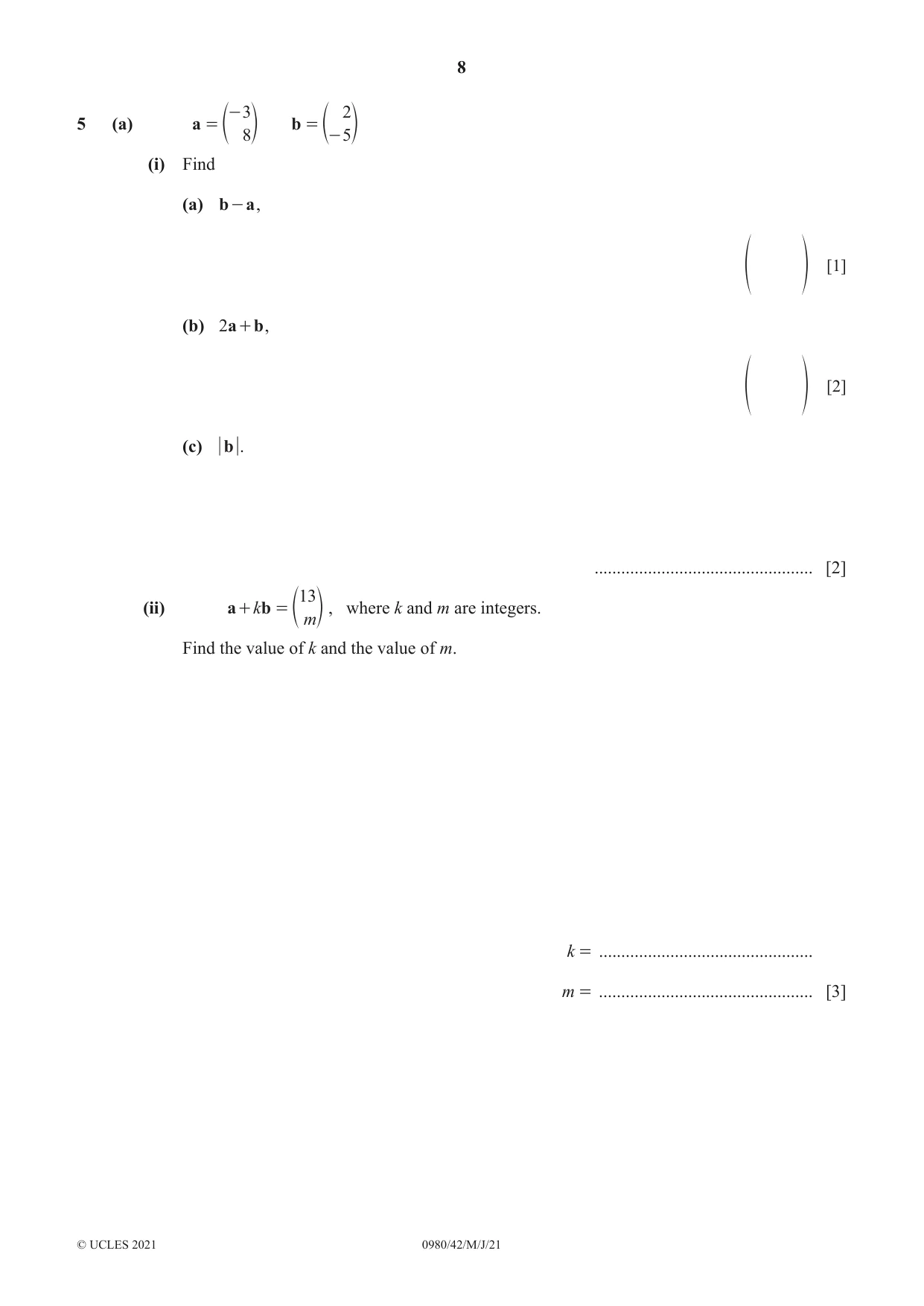
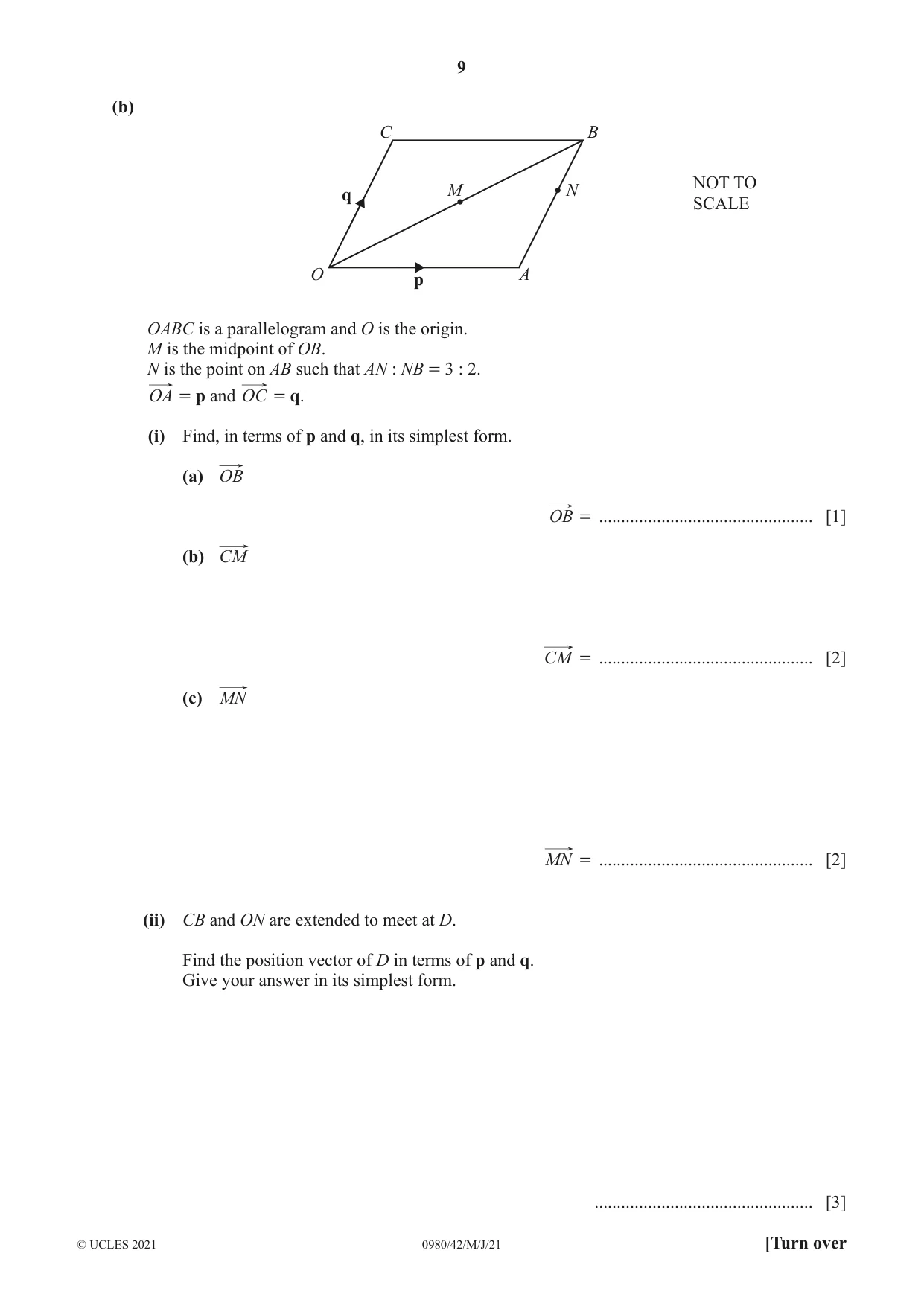
5 (a) a = b = 8 - 5 (i) Find (a) b - a , [1] f p (b) 2a + b , [2] f p (c) b . ................................................. [2] 13 (ii) a + kb = , where k and m are integers. e mo Find the value of k and the value of m. k = ................................................ m = ................................................ [3] (b) C B NOT TO q M N SCALE O A p OABC is a parallelogram and O is the origin. M is the midpoint of OB. N is the point on AB such that AN : NB = 3 : 2. OA = p and OC = q. (i) Find, in terms of p and q, in its simplest form. (a) OB OB = ................................................ [1] (b) CM CM = ................................................ [2] (c) MN MN = ................................................ [2] (ii) CB and ON are extended to meet at D. Find the position vector of D in terms of p and q. Give your answer in its simplest form. ................................................. [3]
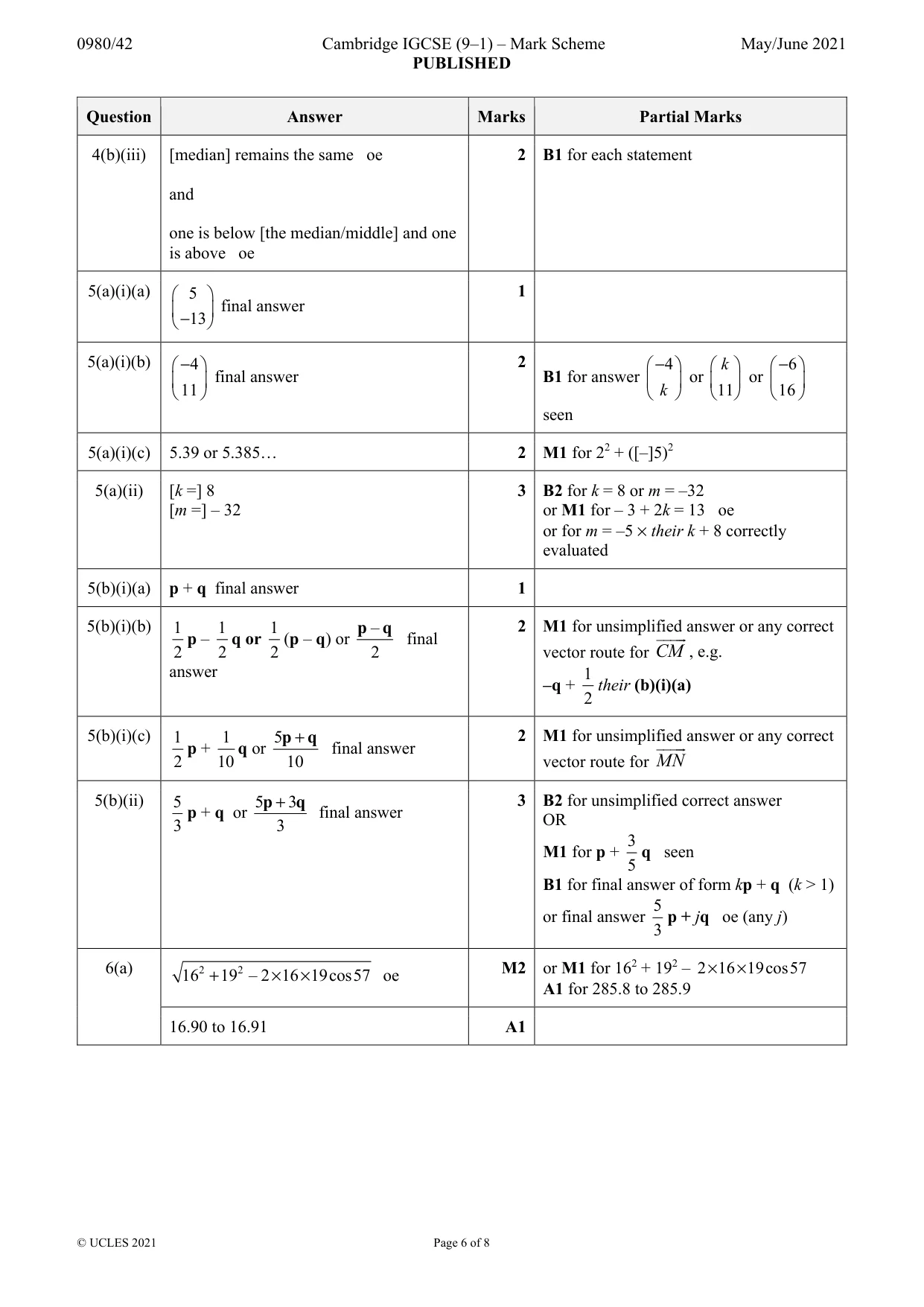
Mark scheme: 5(a)(i)(a) 5 1 final answer −13 5(a)(i)(b) − 4 2 − 4 k − 6 final answer B1 for answer or or 11 k 11 16 seen 5(a)(i)(c) 5.39 or 5.385… 2 M1 for 22 + ([–]5)2 5(a)(ii) [k =] 8 3 B2 for k = 8 or m = –32 [m =] – 32 or M1 for – 3 + 2k = 13 oe or for m = –5 × their k + 8 correctly evaluated 5(b)(i)(a) p + q final answer 1 5(b)(i)(b) 1 1 1 p – q 2 M1 for unsimplified answer or any correct p – q or (p – q) or final 2 2 2 2 vector route for CM , e.g. answer 1 – q + their (b)(i)(a) 2 5(b)(i)(c) 1 1 5p + q 2 M1 for unsimplified answer or any correct p + q or final answer 2 10 10 vector route for MN 5(b)(ii) 5 5p + 3q 3 B2 for unsimplified correct answer p + q or final answer OR 3 3 3 M1 for p + q seen 5 B1 for final answer of form kp + q (k > 1) 5 or final answer p + jq oe (any j) 3
Q6 · B 16 m NOT TO A 57° 32 m SCALE 19 m C 75° D The diagram shows a quadrilateral ABCD made…
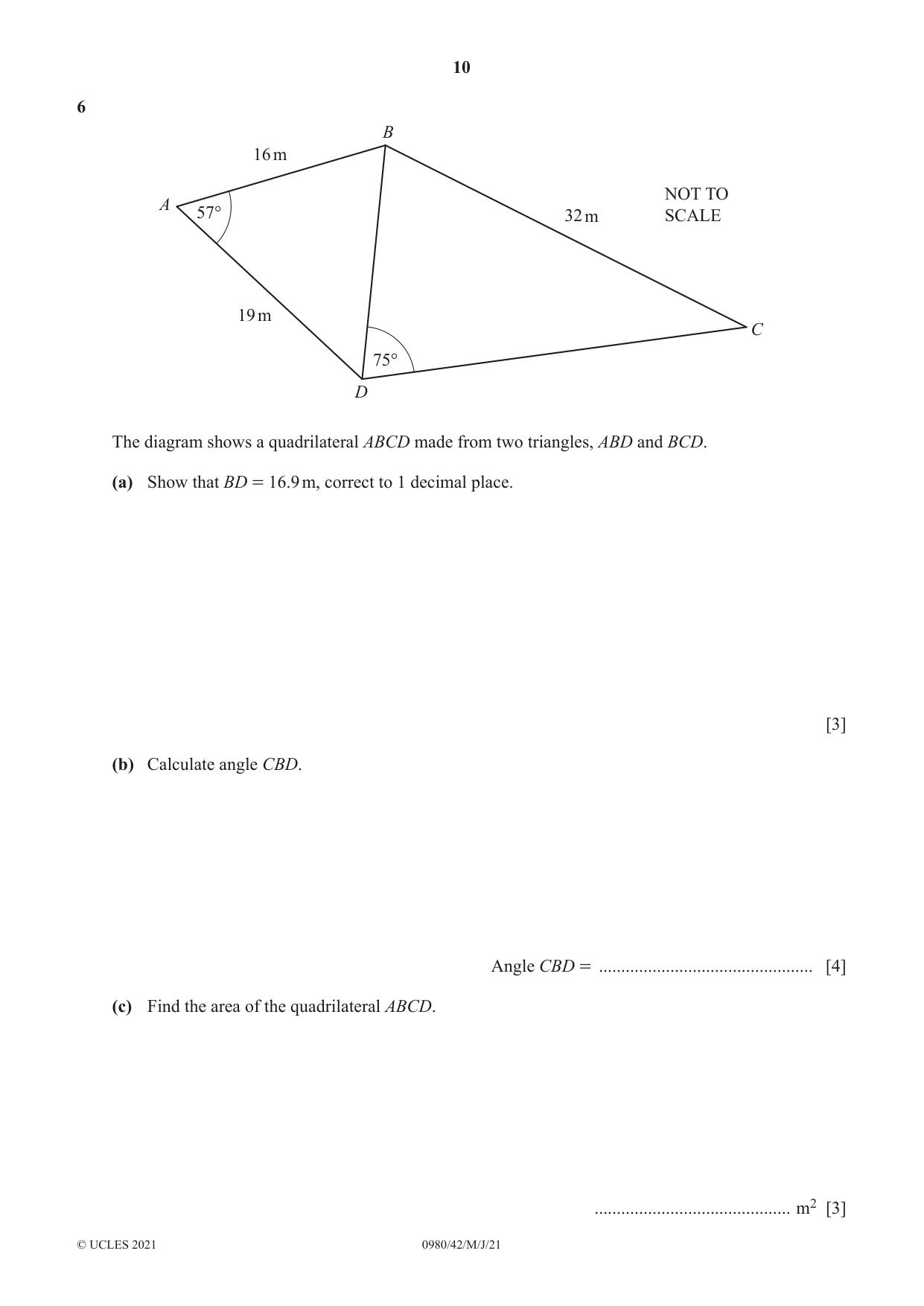
6 B 16 m NOT TO A 57° 32 m SCALE 19 m C 75° D The diagram shows a quadrilateral ABCD made from two triangles, ABD and BCD. (a) Show that BD = 16.9 m, correct to 1 decimal place. [3] (b) Calculate angle CBD. Angle CBD = ................................................ [4] (c) Find the area of the quadrilateral ABCD. ............................................ m2 [3] (d) Find the shortest distance from B to AD. ............................................. m [3]
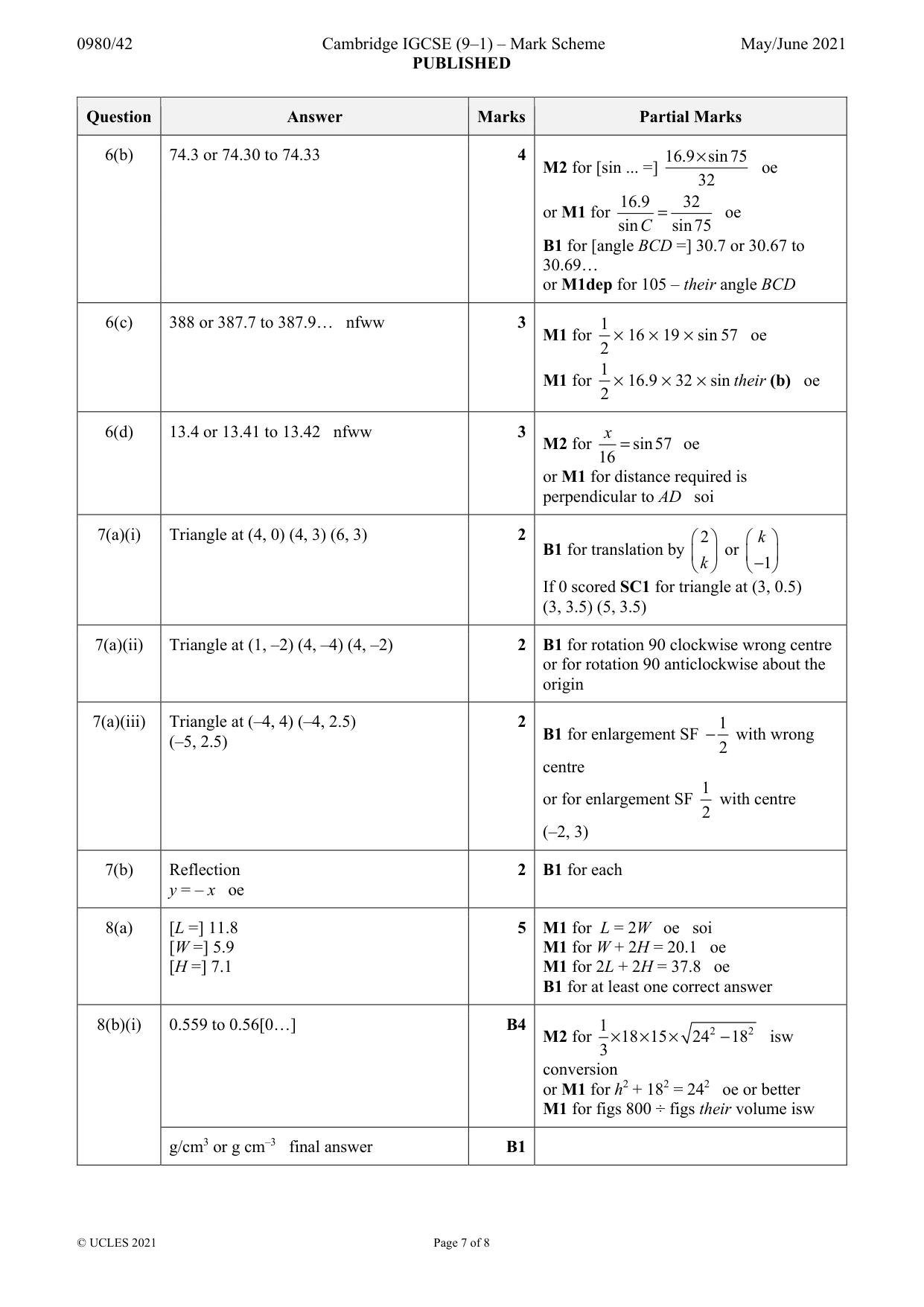
Mark scheme: 6(a) 2 2 M2 or M1 for 162 + 192 – 2 × 16 × 19cos57 16 + 19 – 2 × 16 × 19cos57 oe A1 for 285.8 to 285.9 16.90 to 16.91 A1 6(b) 74.3 or 74.30 to 74.33 4 16.9 × sin75 M2 for [sin ... =] oe 32 16.9 32 or M1 for = oe sin C sin75 B1 for [angle BCD =] 30.7 or 30.67 to 30.69… or M1dep for 105 – their angle BCD 6(c) 388 or 387.7 to 387.9… nfww 3 1 M1 for × 16 × 19 × sin 57 oe 2 1 M1 for × 16.9 × 32 × sin their (b) oe 2 6(d) 13.4 or 13.41 to 13.42 nfww 3 x M2 for = sin57 oe 16 or M1 for distance required is perpendicular to AD soi
Q7 · Y 6 5 4 T 3 2 1 –– 66 –– 55 –– 44 –– 33 –– 22 –– 11 0 1 2 3 4 5 6 7 x –– 11 –– 22 A –– 33…
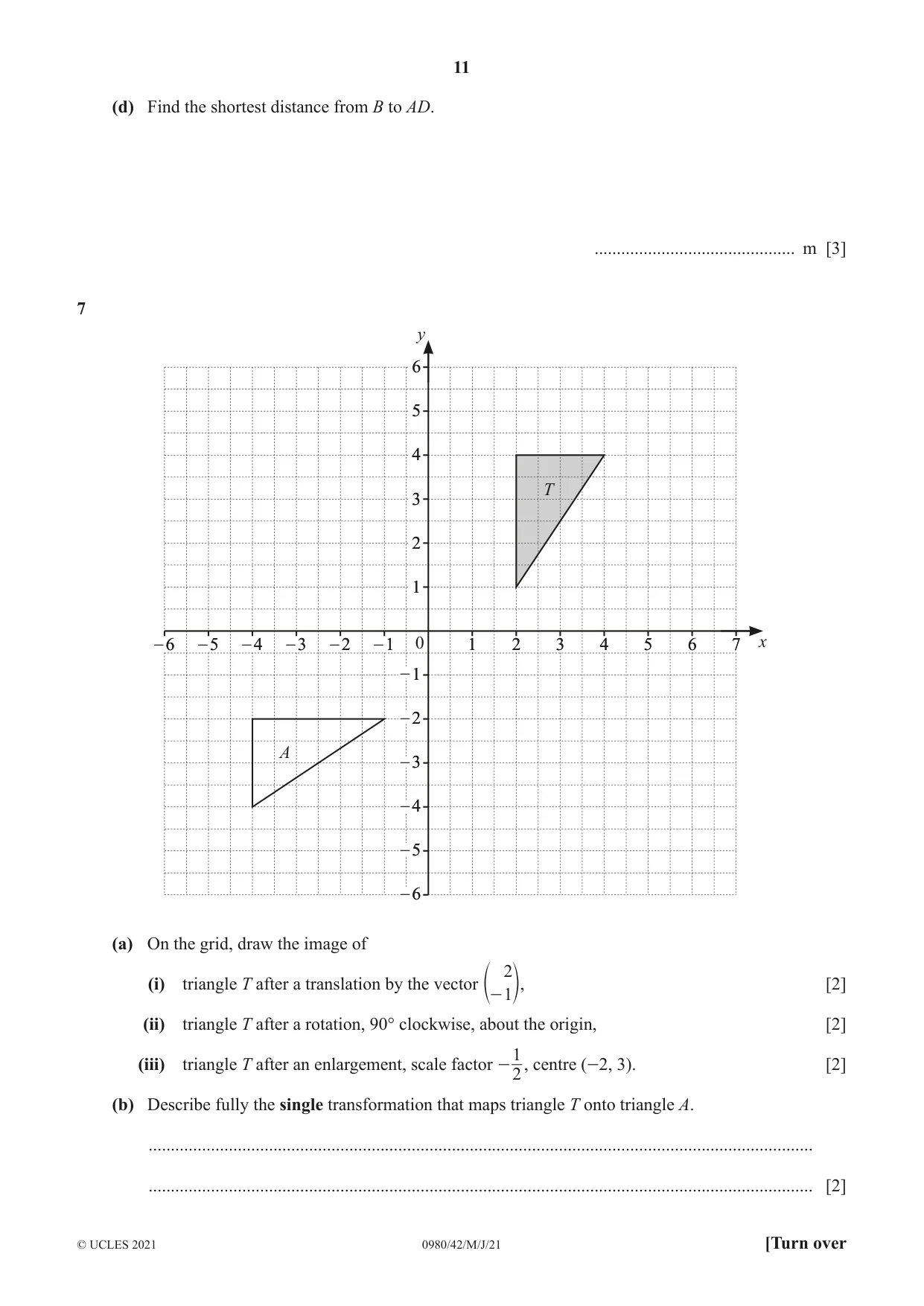
7 y 6 5 4 T 3 2 1 –– 66 –– 55 –– 44 –– 33 –– 22 –– 11 0 1 2 3 4 5 6 7 x –– 11 –– 22 A –– 33 –– 44 –– 55 –– 66 (a) On the grid, draw the image of 2 (i) triangle T after a translation by the vector [2] e- 1o, (ii) triangle T after a rotation, 90° clockwise, about the origin, [2] 1 (iii) triangle T after an enlargement, scale factor - , centre (-2, 3). [2] 2 (b) Describe fully the single transformation that maps triangle T onto triangle A. ..................................................................................................................................................... ..................................................................................................................................................... [2]
Mark scheme: 7(a)(i) Triangle at (4, 0) (4, 3) (6, 3) 2 2 k B1 for translation by or k −1 If 0 scored SC1 for triangle at (3, 0.5) (3, 3.5) (5, 3.5) 7(a)(ii) Triangle at (1, –2) (4, –4) (4, –2) 2 B1 for rotation 90 clockwise wrong centre or for rotation 90 anticlockwise about the origin 7(a)(iii) Triangle at (–4, 4) (–4, 2.5) 2 1 B1 for enlargement SF − with wrong (–5, 2.5) 2 centre 1 or for enlargement SF with centre 2 (–2, 3) 7(b) Reflection 2 B1 for each y = – x oe
Q8 · A cuboid has length L cm, width W cm and height H cm
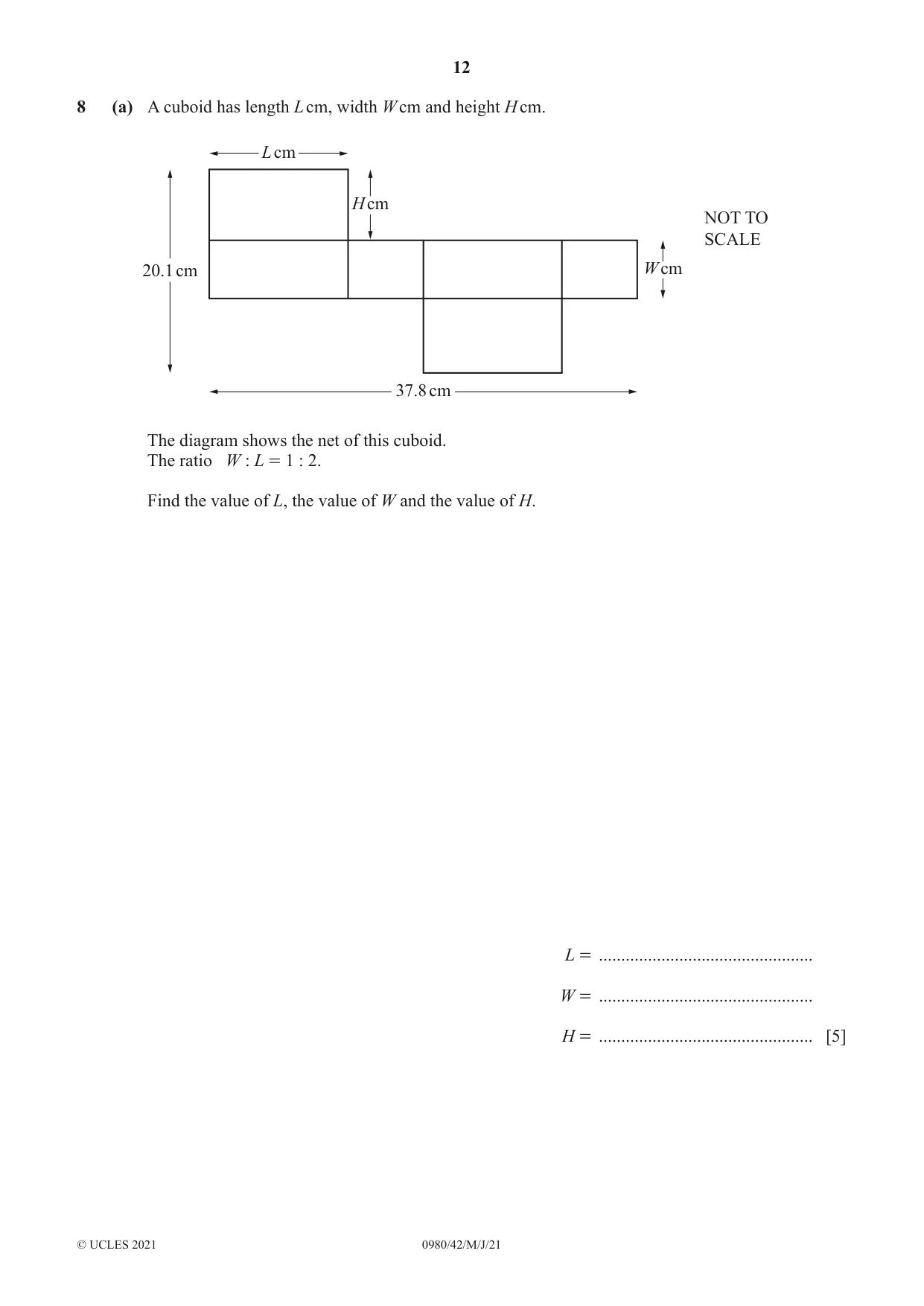
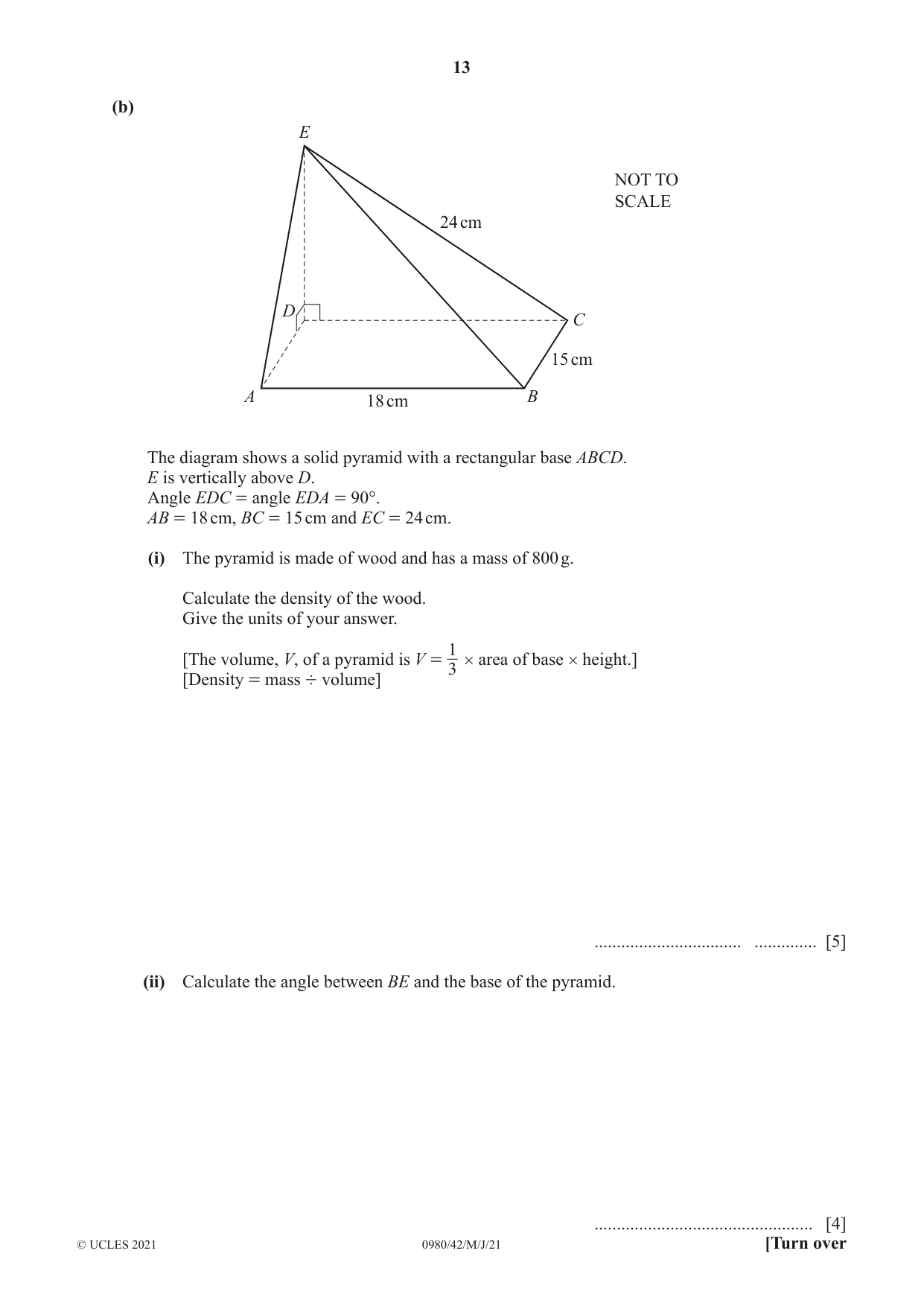
8 (a) A cuboid has length L cm, width W cm and height H cm. L cm H cm NOT TO SCALE 20.1 cm W cm 37.8 cm The diagram shows the net of this cuboid. The ratio W : L = 1 : 2. Find the value of L, the value of W and the value of H. L = ................................................ W = ................................................ H = ................................................ [5] (b) E NOT TO SCALE 24 cm D C 15 cm A 18 cm B The diagram shows a solid pyramid with a rectangular base ABCD. E is vertically above D. Angle EDC = angle EDA = 90°. AB = 18 cm, BC = 15 cm and EC = 24 cm. (i) The pyramid is made of wood and has a mass of 800 g. Calculate the density of the wood. Give the units of your answer. 1 [The volume, V, of a pyramid is V = # area of base # height.] 3 [Density = mass ' volume] ................................. .............. [5] (ii) Calculate the angle between BE and the base of the pyramid.
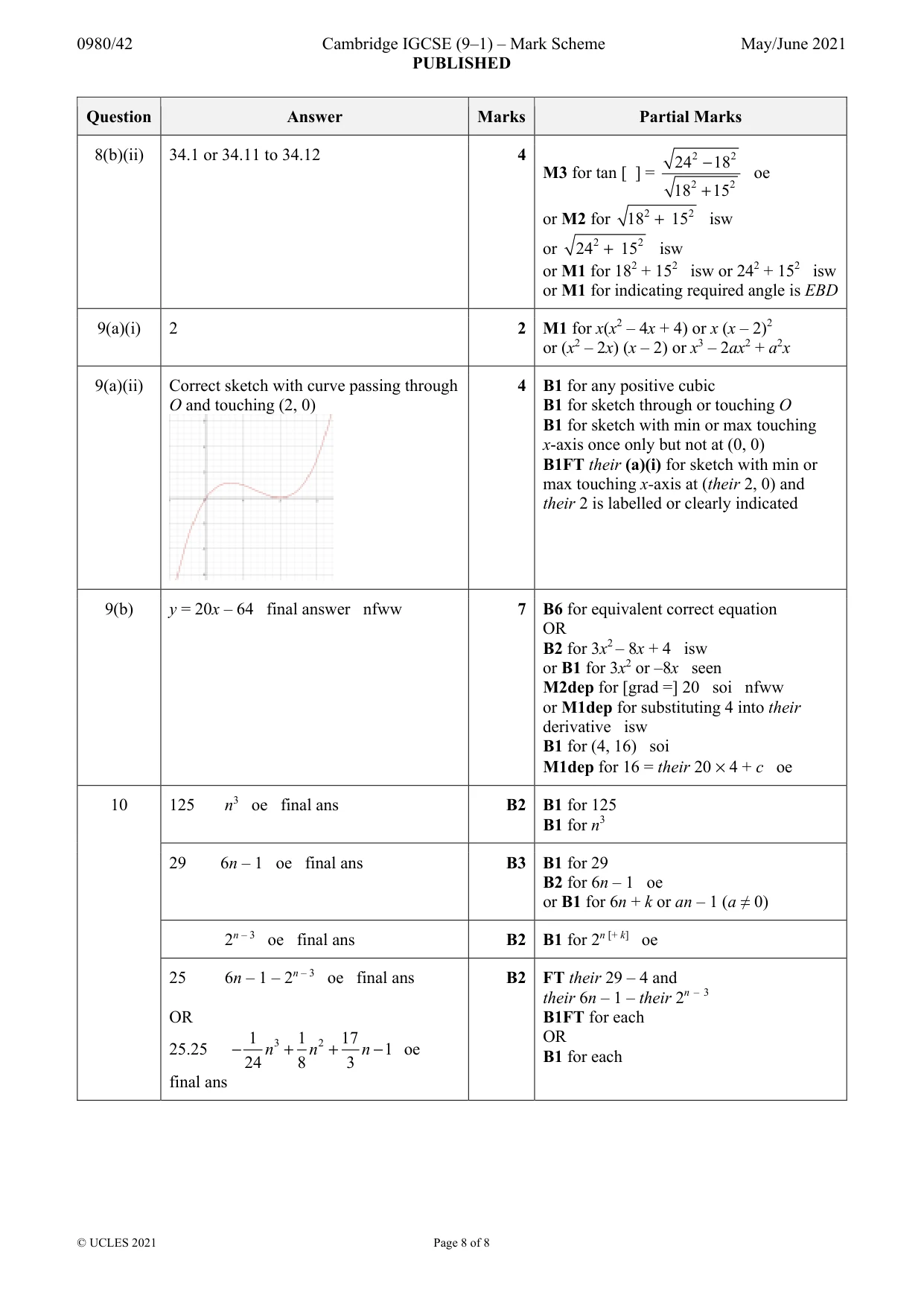
Mark scheme: 8(a) [L =] 11.8 5 M1 for L = 2W oe soi [W =] 5.9 M1 for W + 2H = 20.1 oe [H =] 7.1 M1 for 2L + 2H = 37.8 oe B1 for at least one correct answer 8(b)(i) 0.559 to 0.56[0…] B4 1 2 2 M2 for × 18 × 15 × 24 − 18 isw 3 conversion or M1 for h2 + 182 = 242 oe or better M1 for figs 800 ÷ figs their volume isw g/cm3 or g cm–3 final answer B1 8(b)(ii) 34.1 or 34.11 to 34.12 4 2 2 24 − 18 M3 for tan [ ] = oe 18 2 + 15 2 or M2 for 18 2 + 15 2 isw or 24 2 + 15 2 isw or M1 for 182 + 152 isw or 242 + 152 isw or M1 for indicating required angle is EBD
Q9 · The equation y = x 3 - 4x 2 + 4x can be written as y = x ( x - a) 2
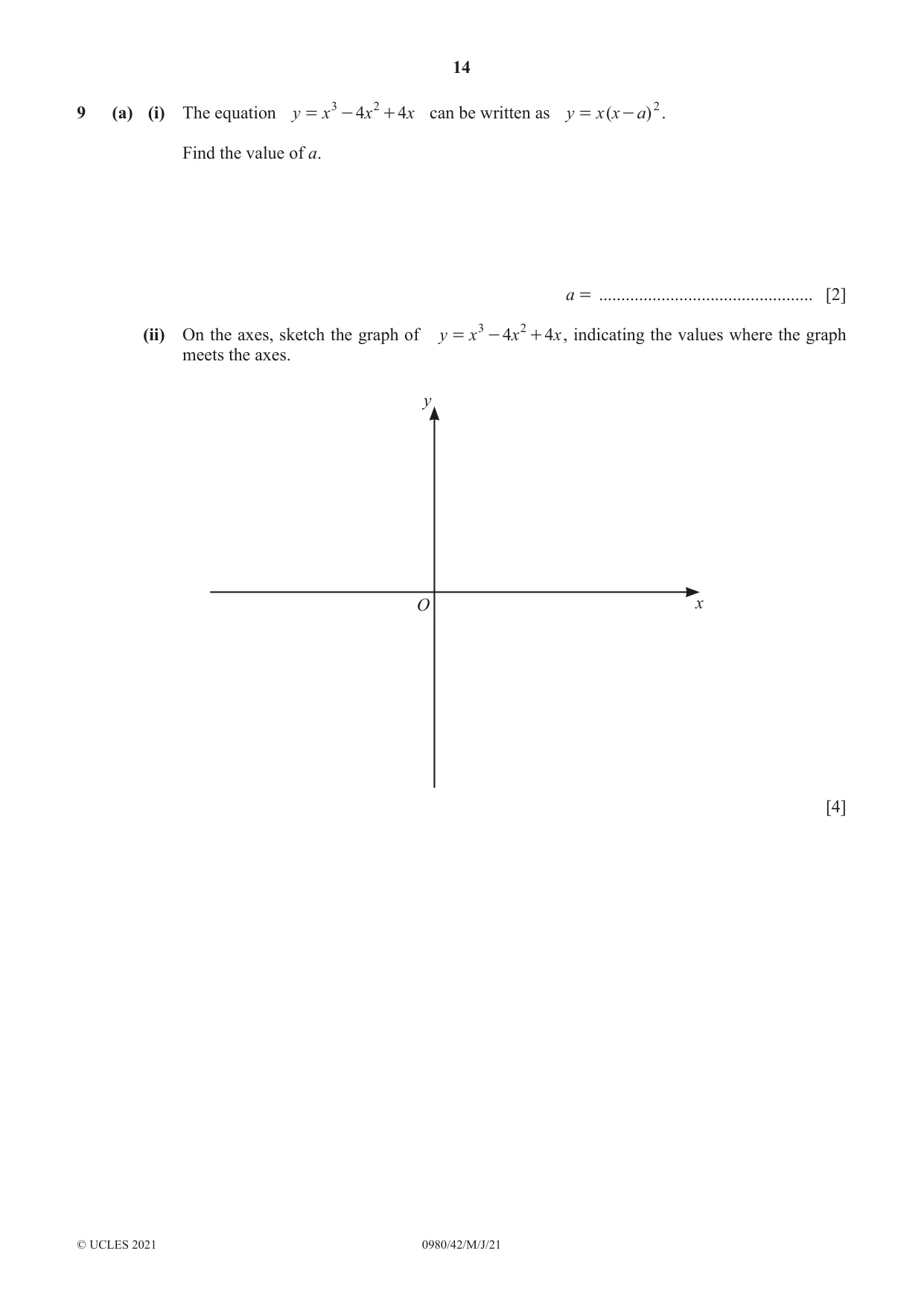
9 (a) (i) The equation y = x 3 - 4x 2 + 4x can be written as y = x ( x - a) 2 . Find the value of a. a = ................................................ [2] (ii) On the axes, sketch the graph of y = x 3 - 4x 2 + 4x , indicating the values where the graph meets the axes. y O x [4] (b) Find the equation of the tangent to the graph of y = x 3 - 4x 2 + 4x at x = 4. Give your answer in the form y = mx + c . y = ................................................ [7] Question 10 is printed on the next page.
Mark scheme: 9(a)(i) 2 2 M1 for x(x2 – 4x + 4) or x (x – 2)2 or (x2 – 2x) (x – 2) or x3 – 2ax2 + a2x 9(a)(ii) Correct sketch with curve passing through 4 B1 for any positive cubic O and touching (2, 0) B1 for sketch through or touching O B1 for sketch with min or max touching x-axis once only but not at (0, 0) B1FT their (a)(i) for sketch with min or max touching x-axis at (their 2, 0) and their 2 is labelled or clearly indicated 9(b) y = 20x – 64 final answer nfww 7 B6 for equivalent correct equation OR B2 for 3x2 – 8x + 4 isw or B1 for 3x2 or –8x seen M2dep for [grad =] 20 soi nfww or M1dep for substituting 4 into their derivative isw B1 for (4, 16) soi M1dep for 16 = their 20 × 4 + c oe
Q10 · The table shows four sequences A, B, C and D
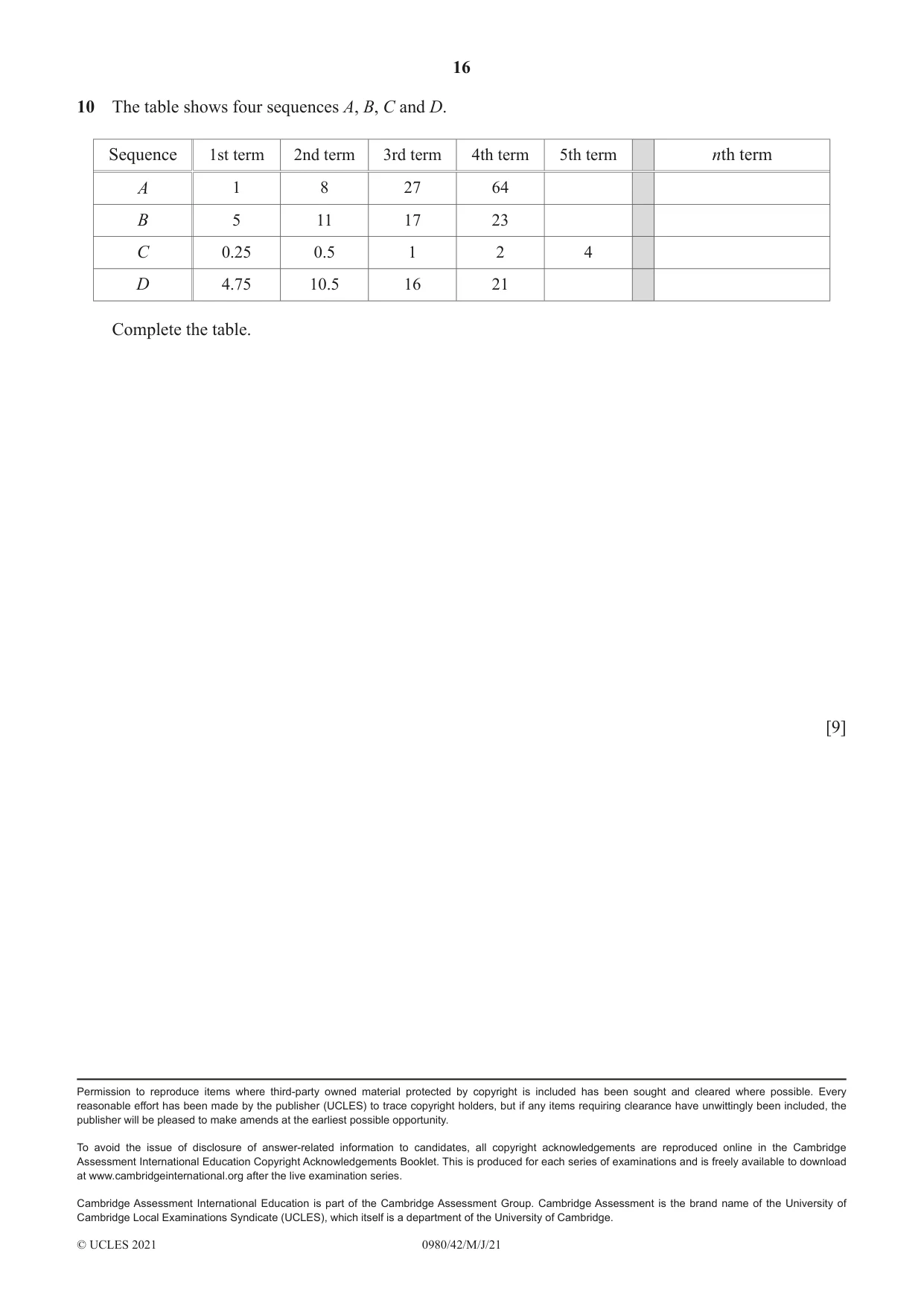
10 The table shows four sequences A, B, C and D. Sequence 1st term 2nd term 3rd term 4th term 5th term nth term A 1 8 27 64 B 5 11 17 23 C 0.25 0.5 1 2 4 D 4.75 10.5 16 21 Complete the table. [9]
Mark scheme: 10 125 n3 oe final ans B2 B1 for 125 B1 for n3 29 6n – 1 oe final ans B3 B1 for 29 B2 for 6n – 1 oe or B1 for 6n + k or an – 1 (a ≠ 0) 2n – 3 oe final ans B2 B1 for 2n [+ k] oe 25 6n – 1 – 2n – 3 oe final ans B2 FT their 29 – 4 and their 6n – 1 – their 2n – 3 OR B1FT for each 1 3 1 2 17 OR 25.25 − n + n + n − 1 oe B1 for each 24 8 3 final ans
What was in this paper
The subtopics covered by these 10 questions, and how many questions each got. Open one in a new tab to see every Cambridge question on it.
What you needed in this session
Cambridge’s own grade thresholds for 2021 May/June, Paper 4 · Variant 2. A higher threshold means an easier paper — the bar moves with how the cohort did.