Cambridge IGCSE Mathematics 0580 — 2021 Feb/March Paper 3 · Variant 2
0580/32/F/M/21 · 9 questions · 104 marks · ≈117 min
The question paper and its mark scheme, free to read here and free to download. This is Cambridge’s own paper, exactly as it was sat.
Question paper20 pages
Mark scheme8 pages
Answers below. Sit the paper first if you are practising.
Questions as text
Q1 · 20 students choose their favourite science subject
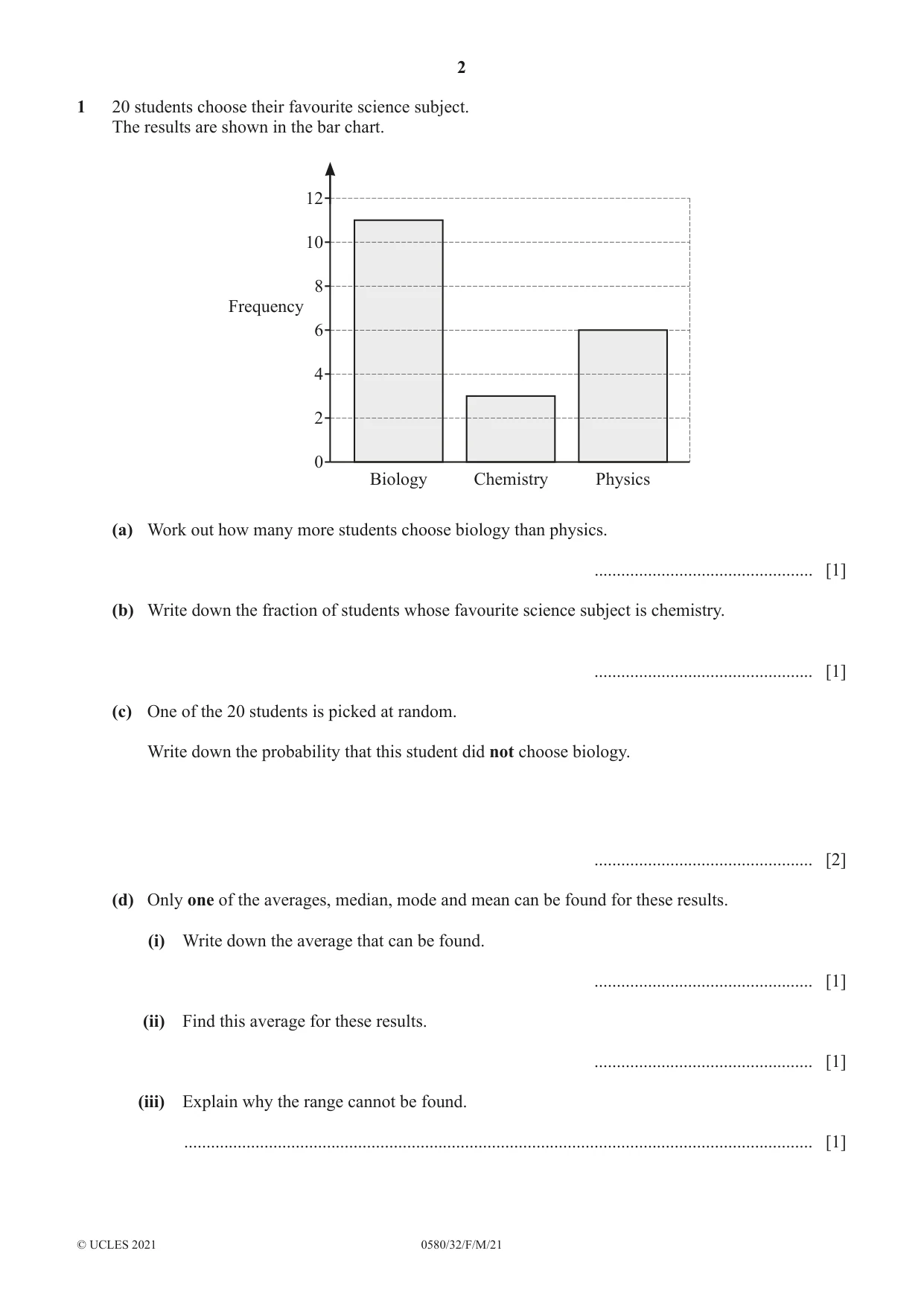
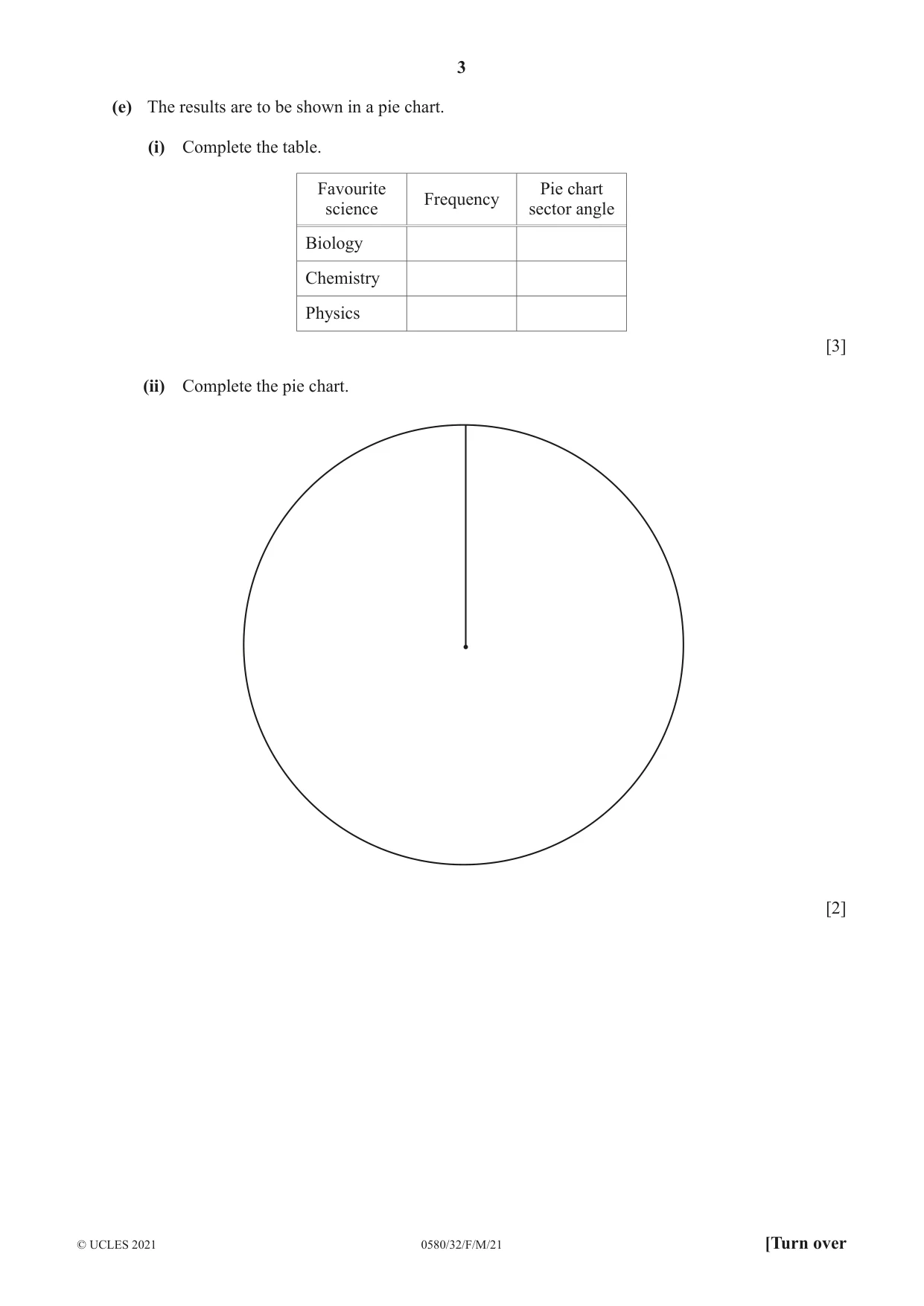
1 20 students choose their favourite science subject. The results are shown in the bar chart. 12 10 8 Frequency 6 4 2 0 Biology Chemistry Physics (a) Work out how many more students choose biology than physics. ................................................. [1] (b) Write down the fraction of students whose favourite science subject is chemistry. ................................................. [1] (c) One of the 20 students is picked at random. Write down the probability that this student did not choose biology. ................................................. [2] (d) Only one of the averages, median, mode and mean can be found for these results. (i) Write down the average that can be found. ................................................. [1] (ii) Find this average for these results. ................................................. [1] (iii) Explain why the range cannot be found. ............................................................................................................................................. [1] (e) The results are to be shown in a pie chart. (i) Complete the table. Favourite Pie chart Frequency science sector angle Biology Chemistry Physics [3] (ii) Complete the pie chart. [2]
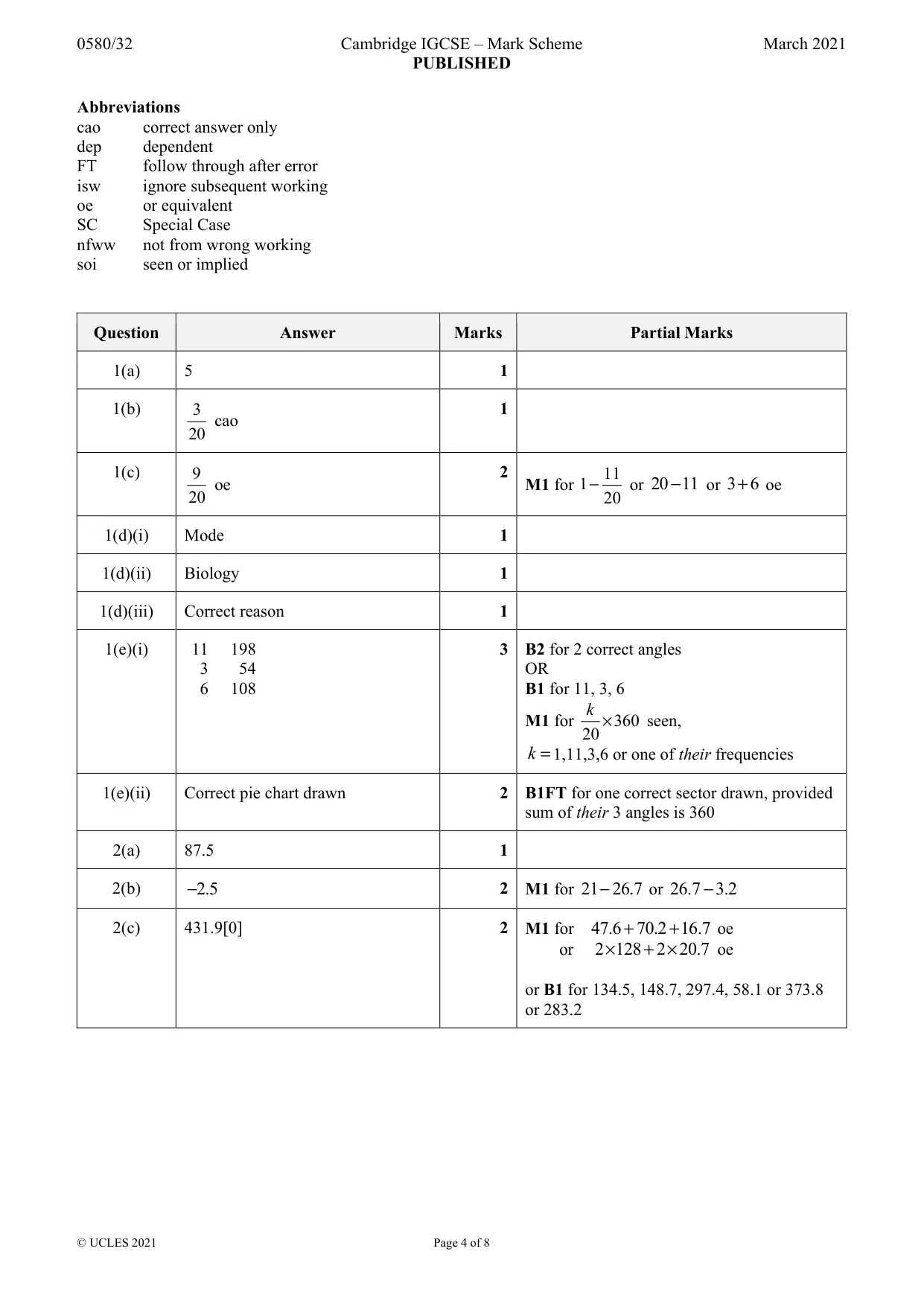
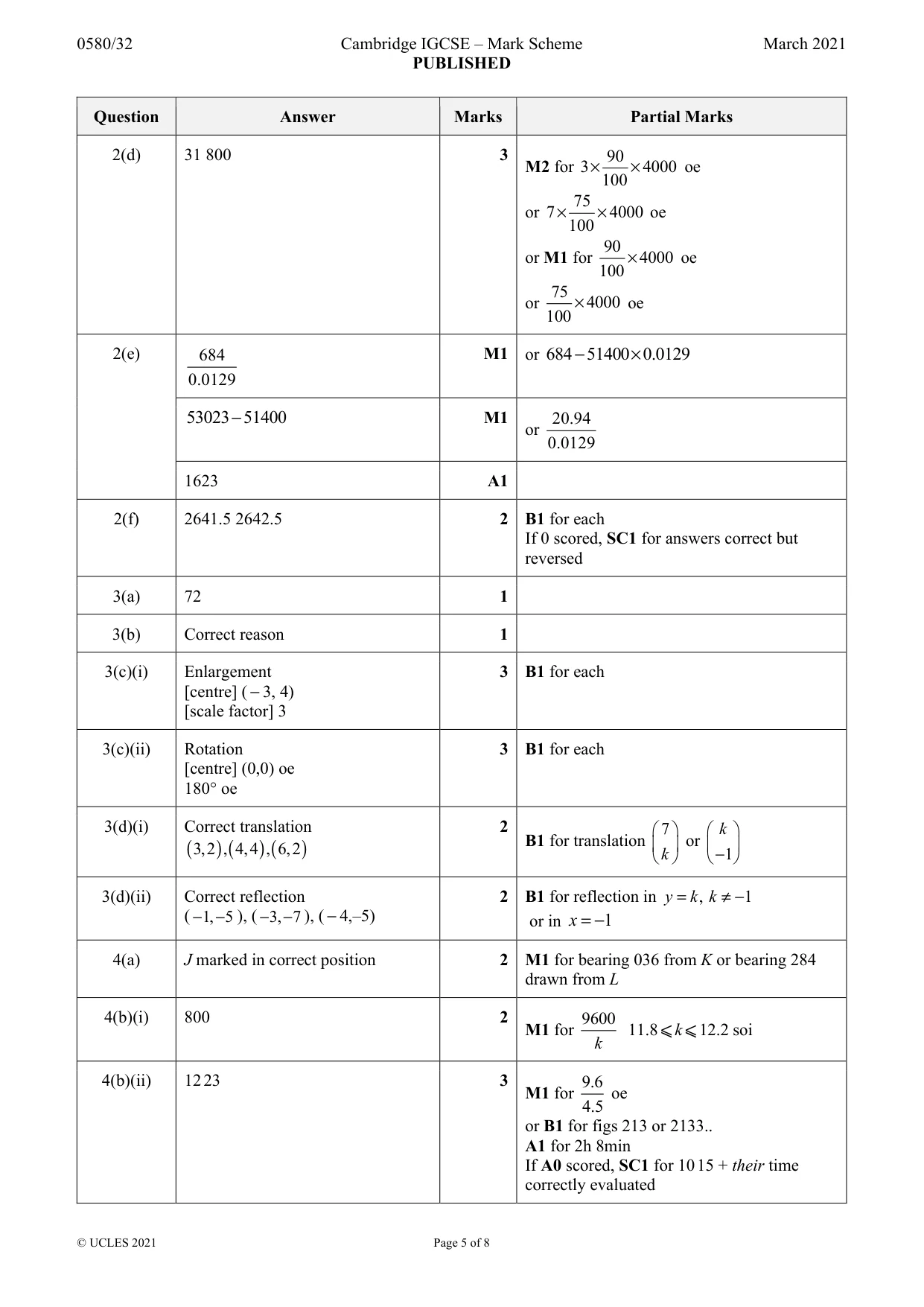
Mark scheme: Question Answer Marks Partial Marks 1(a) 5 1 1(b) 3 1 cao 20 1(c) 9 2 11 oe M1 for 1 − or 20 − 11 or 3 + 6 oe 20 20 1(d)(i) Mode 1 1(d)(ii) Biology 1 1(d)(iii) Correct reason 1 1(e)(i) 11 198 3 B2 for 2 correct angles 3 54 OR 6 108 B1 for 11, 3, 6 k M1 for × 360 seen, 20 k =1,11,3,6 or one of their frequencies 1(e)(ii) Correct pie chart drawn 2 B1FT for one correct sector drawn, provided sum of their 3 angles is 360
Q2 · A family go on a skiing holiday to America
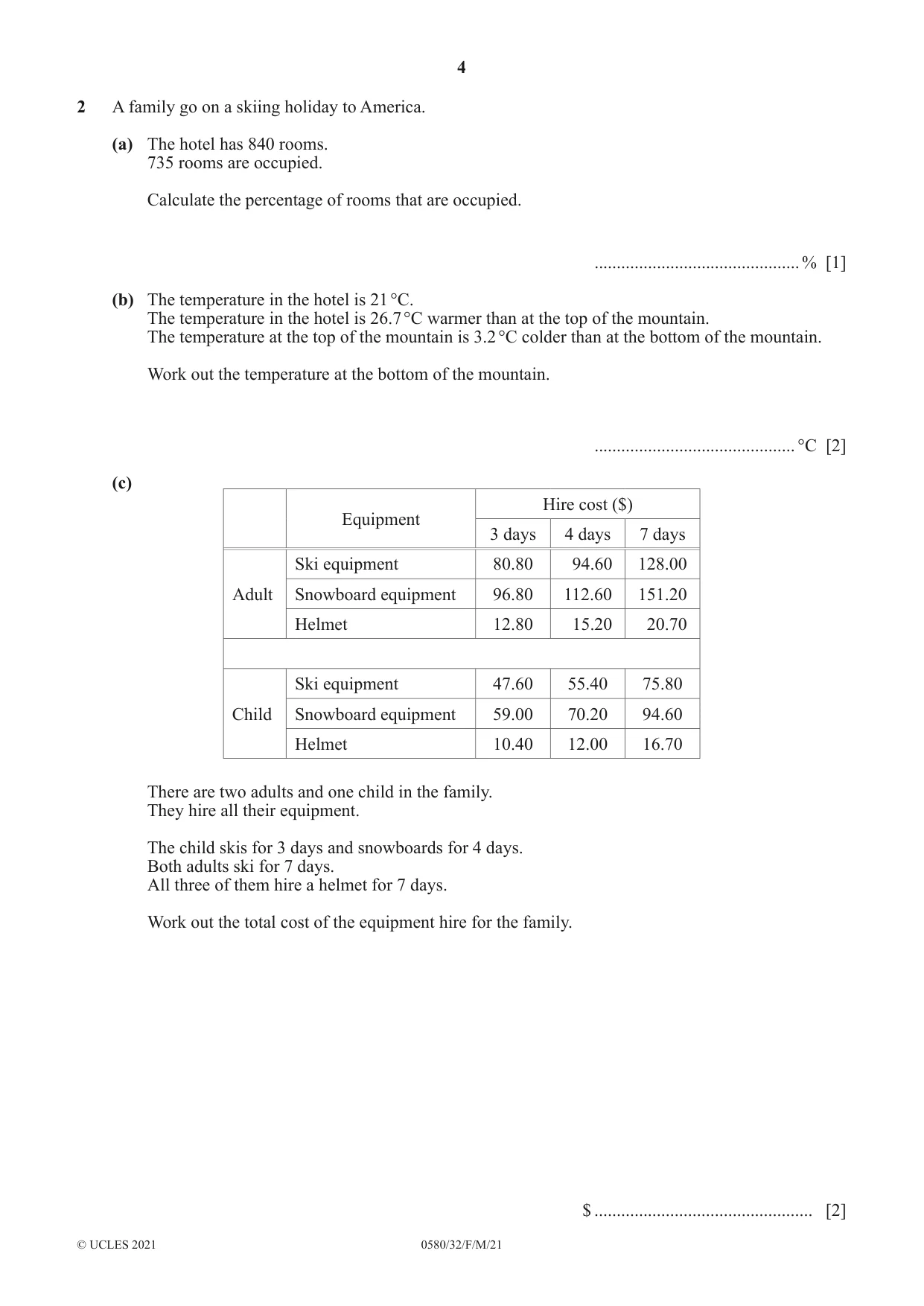
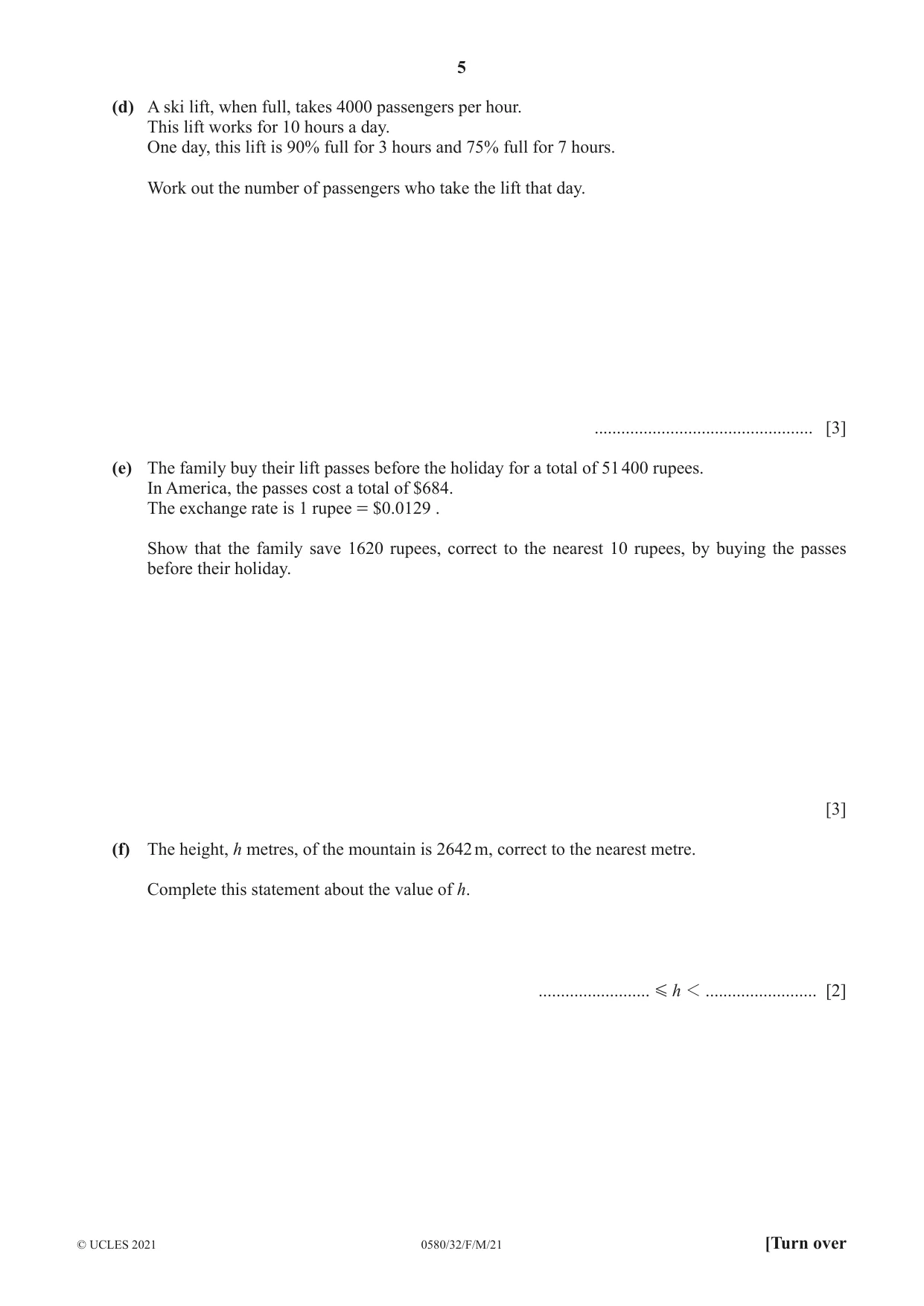
2 A family go on a skiing holiday to America. (a) The hotel has 840 rooms. 735 rooms are occupied. Calculate the percentage of rooms that are occupied. ..............................................% [1] (b) The temperature in the hotel is 21 °C. The temperature in the hotel is 26.7 °C warmer than at the top of the mountain. The temperature at the top of the mountain is 3.2 °C colder than at the bottom of the mountain. Work out the temperature at the bottom of the mountain. ............................................. °C [2] (c) Hire cost ($) Equipment 3 days 4 days 7 days Ski equipment 80.80 94.60 128.00 Adult Snowboard equipment 96.80 112.60 151.20 Helmet 12.80 15.20 20.70 Ski equipment 47.60 55.40 75.80 Child Snowboard equipment 59.00 70.20 94.60 Helmet 10.40 12.00 16.70 There are two adults and one child in the family. They hire all their equipment. The child skis for 3 days and snowboards for 4 days. Both adults ski for 7 days. All three of them hire a helmet for 7 days. Work out the total cost of the equipment hire for the family. $ ................................................. [2] (d) A ski lift, when full, takes 4000 passengers per hour. This lift works for 10 hours a day. One day, this lift is 90% full for 3 hours and 75% full for 7 hours. Work out the number of passengers who take the lift that day. ................................................. [3] (e) The family buy their lift passes before the holiday for a total of 51 400 rupees. In America, the passes cost a total of $684. The exchange rate is 1 rupee = $0.0129 . Show that the family save 1620 rupees, correct to the nearest 10 rupees, by buying the passes before their holiday. [3] (f) The height, h metres, of the mountain is 2642 m, correct to the nearest metre. Complete this statement about the value of h. ......................... G h 1 ......................... [2]
Mark scheme: 2(a) 87.5 1 2(b) −2.5 2 M1 for 21 − 26.7 or 26.7 − 3.2 2(c) 431.9[0] 2 M1 for 47.6 + 70.2 + 16.7 oe or 2 × 128 + 2 × 20.7 oe or B1 for 134.5, 148.7, 297.4, 58.1 or 373.8 or 283.2 2(d) 31 800 3 90 M2 for 3 × × 4000 oe 100 75 or 7 × × 4000 oe 100 90 or M1 for × 4000 oe 100 75 or × 4000 oe 100 2(e) 684 M1 or 684 − 51400 × 0.0129 0.0129 53023 − 51400 M1 20.94 or 0.0129 1623 A1 2(f) 2641.5 2642.5 2 B1 for each If 0 scored, SC1 for answers correct but reversed
Q3 · The diagram shows three triangles A, B and C on a grid
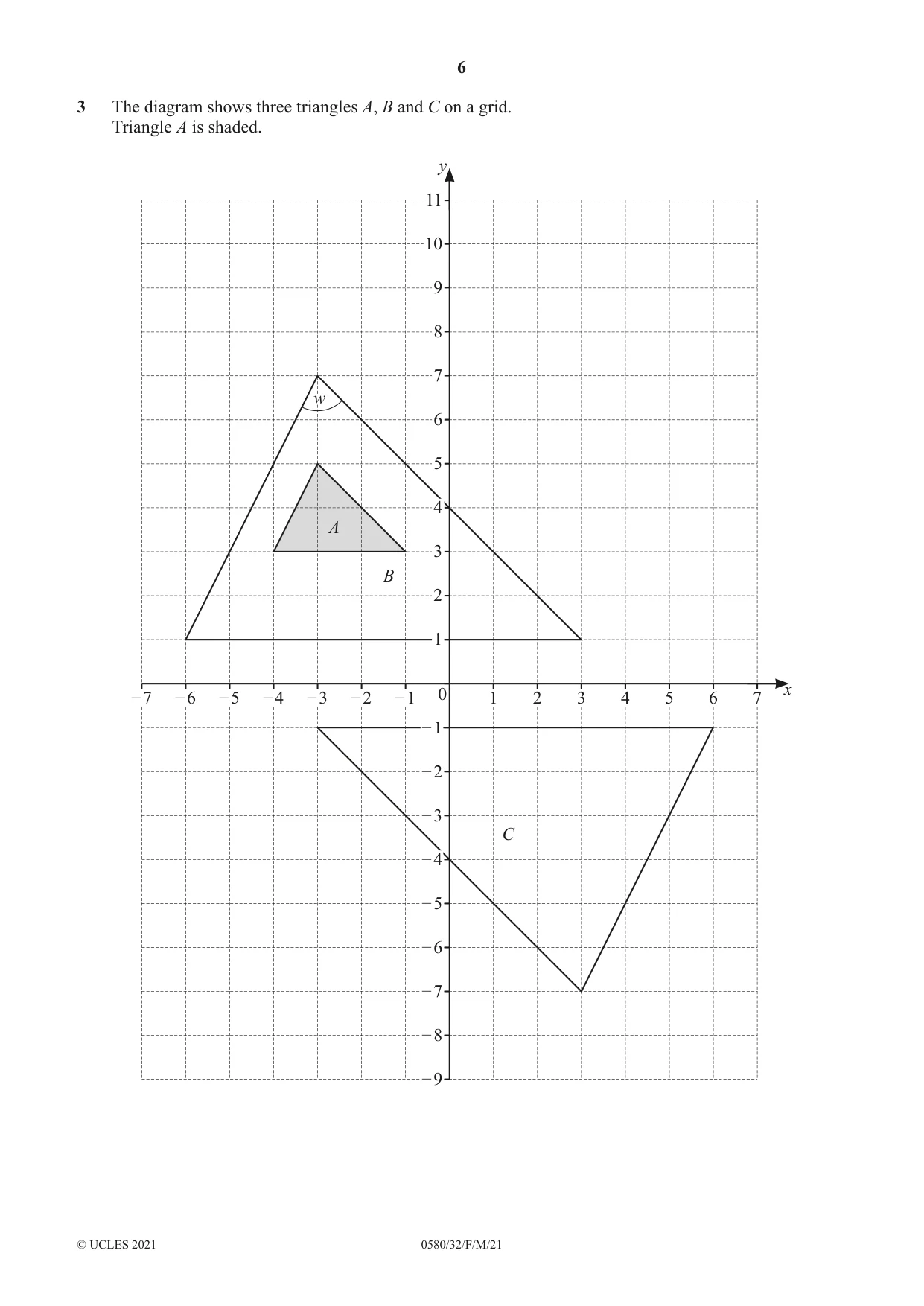
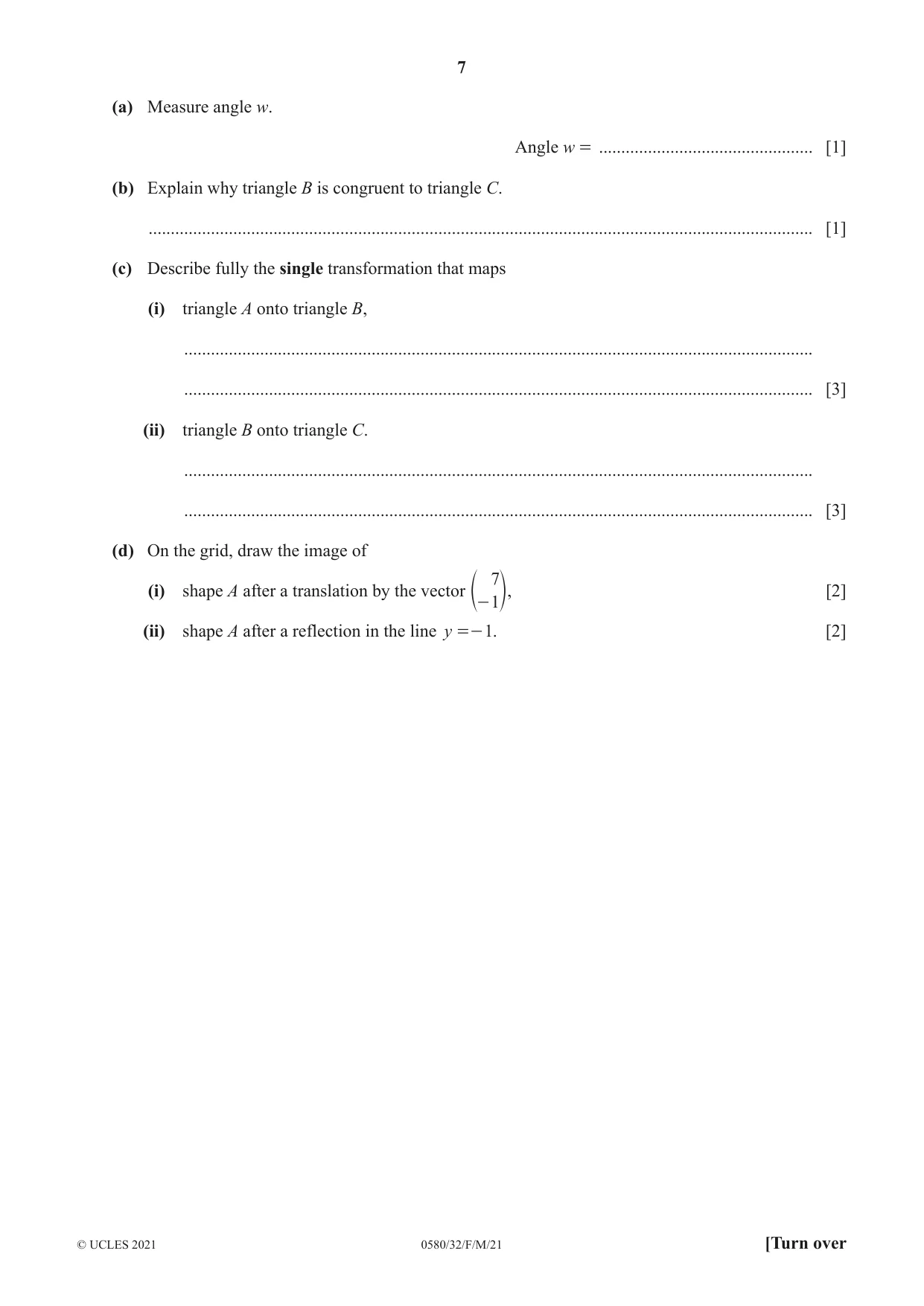
3 The diagram shows three triangles A, B and C on a grid. Triangle A is shaded. y 11 10 9 8 7 w 6 5 4 A 3 B 2 1 x – 7 – 6 – 5 – 4 – 3 – 2 – 1 0 1 2 3 4 5 6 7 – 1 – 2 – 3 C – 4 – 5 – 6 – 7 – 8 – 9 (a) Measure angle w. Angle w = ................................................ [1] (b) Explain why triangle B is congruent to triangle C. ..................................................................................................................................................... [1] (c) Describe fully the single transformation that maps (i) triangle A onto triangle B, ............................................................................................................................................. ............................................................................................................................................. [3] (ii) triangle B onto triangle C. ............................................................................................................................................. ............................................................................................................................................. [3] (d) On the grid, draw the image of 7 (i) shape A after a translation by the vector [2] e- 1o, (ii) shape A after a reflection in the line y =- 1. [2]
Mark scheme: 3(a) 72 1 3(b) Correct reason 1 3(c)(i) Enlargement 3 B1 for each [centre] ( −3, 4) [scale factor] 3 3(c)(ii) Rotation 3 B1 for each [centre] (0,0) oe 180° oe 3(d)(i) Correct translation 2 7 k B1 for translation or ( 3,2 ) , ( 4,4 ) , ( 6,2 ) k −1 3(d)(ii) Correct reflection 2 B1 for reflection in y = k , k ≠− 1 ( − 1, −),5 ( − 3, −),7 ( −4,–5) or in x = −1
Q4 · The scale drawing shows the positions of Kendra’s house, K, and Latika’s house, L, on a…
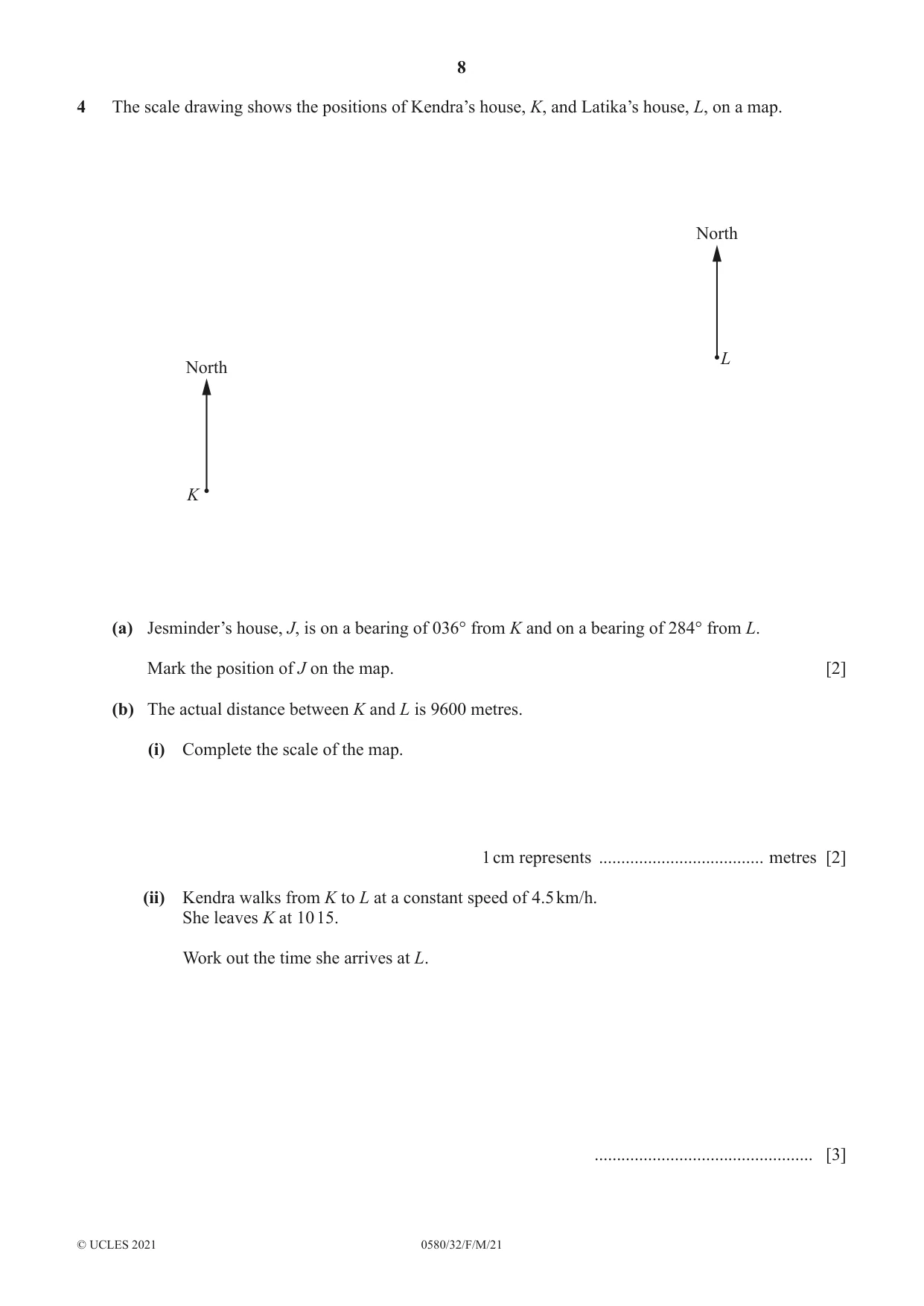
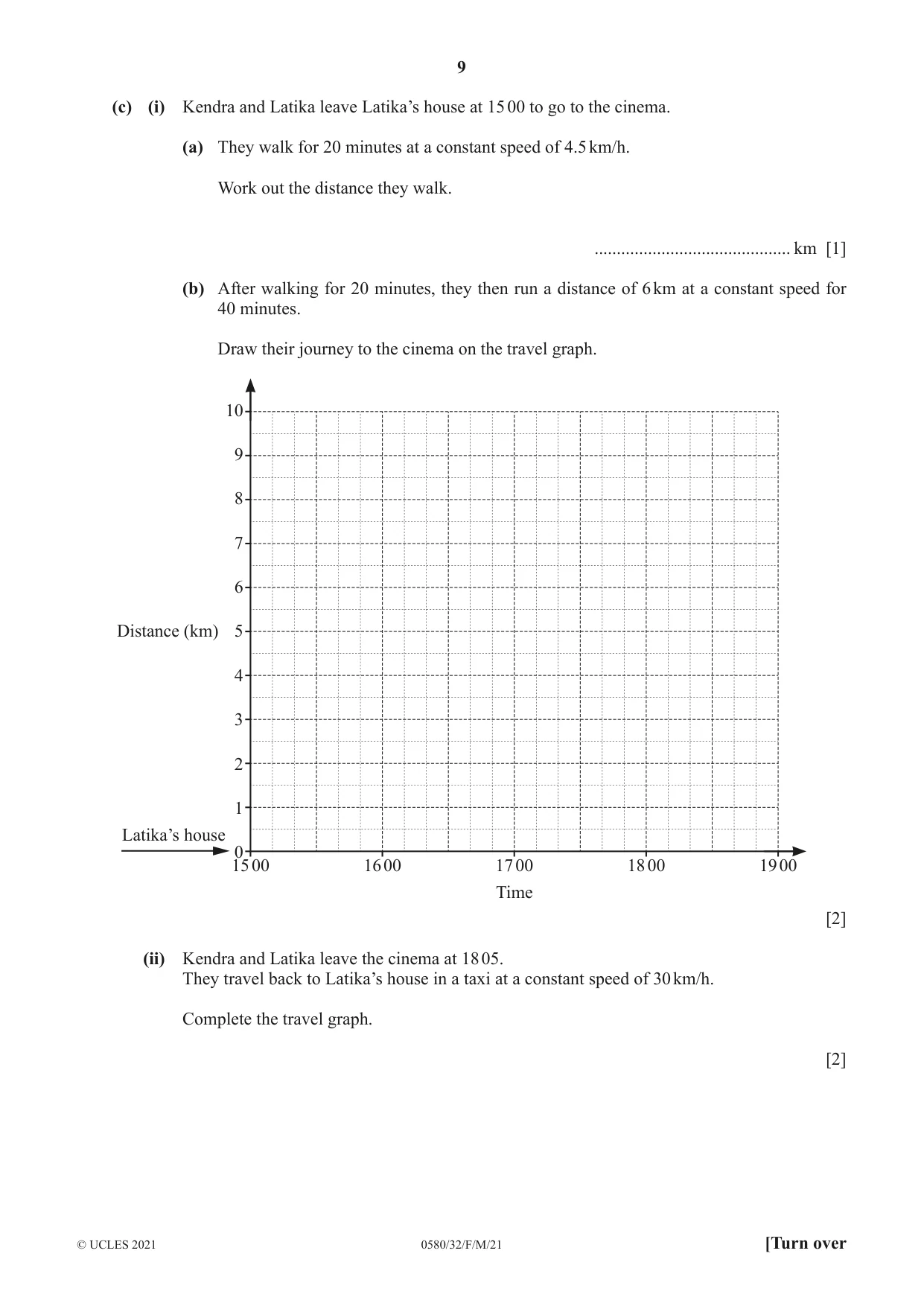
4 The scale drawing shows the positions of Kendra’s house, K, and Latika’s house, L, on a map. North L North K (a) Jesminder’s house, J, is on a bearing of 036° from K and on a bearing of 284° from L. Mark the position of J on the map. [2] (b) The actual distance between K and L is 9600 metres. (i) Complete the scale of the map. 1 cm represents ..................................... metres [2] (ii) Kendra walks from K to L at a constant speed of 4.5 km/h. She leaves K at 10 15. Work out the time she arrives at L. ................................................. [3] (c) (i) Kendra and Latika leave Latika’s house at 15 00 to go to the cinema. (a) They walk for 20 minutes at a constant speed of 4.5 km/h. Work out the distance they walk. ............................................ km [1] (b) After walking for 20 minutes, they then run a distance of 6 km at a constant speed for 40 minutes. Draw their journey to the cinema on the travel graph. 10 9 8 7 6 Distance (km) 5 4 3 2 1 Latika’s house 015 00 16 00 17 00 18 00 19 00 Time [2] (ii) Kendra and Latika leave the cinema at 18 05. They travel back to Latika’s house in a taxi at a constant speed of 30 km/h. Complete the travel graph. [2]
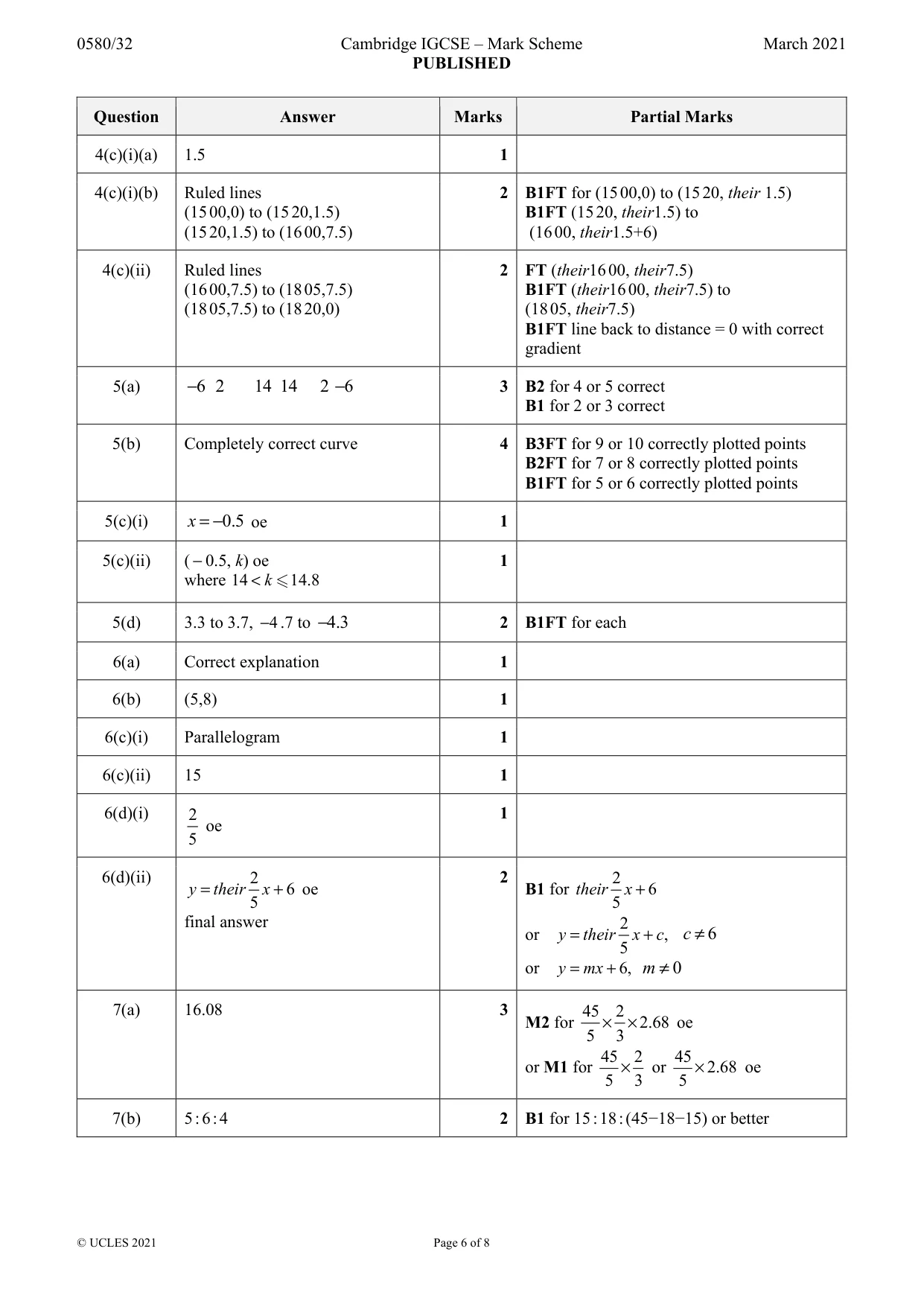
Mark scheme: 4(a) J marked in correct position 2 M1 for bearing 036 from K or bearing 284 drawn from L 4(b)(i) 800 2 9600 M1 for 11.8 ⩽ k ⩽ 12.2 soi k 4(b)(ii) 12 23 3 9.6 M1 for oe 4.5 or B1 for figs 213 or 2133.. A1 for 2h 8min If A0 scored, SC1 for 10 15 + their time correctly evaluated 4(c)(i)(a) 1.5 1 4(c)(i)(b) Ruled lines 2 B1FT for (15 00,0) to (15 20, their 1.5) (15 00,0) to (15 20,1.5) B1FT (15 20, their1.5) to (15 20,1.5) to (16 00,7.5) (16 00, their1.5+6) 4(c)(ii) Ruled lines 2 FT (their16 00, their7.5) (16 00,7.5) to (18 05,7.5) B1FT (their16 00, their7.5) to (18 05,7.5) to (18 20,0) (18 05, their7.5) B1FT line back to distance = 0 with correct gradient
Q5 · Complete the table of values for y =- x 2 - x + 14
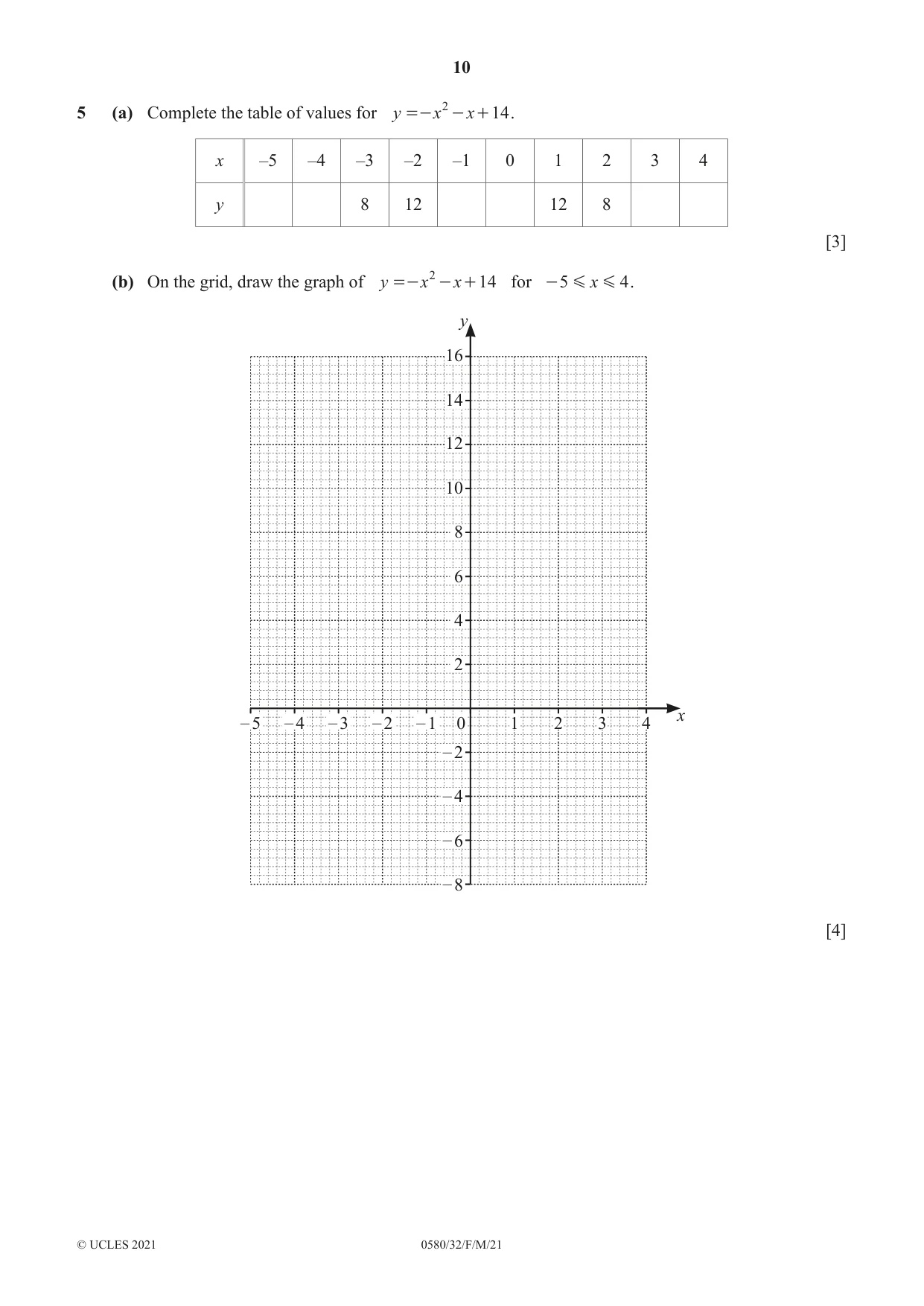
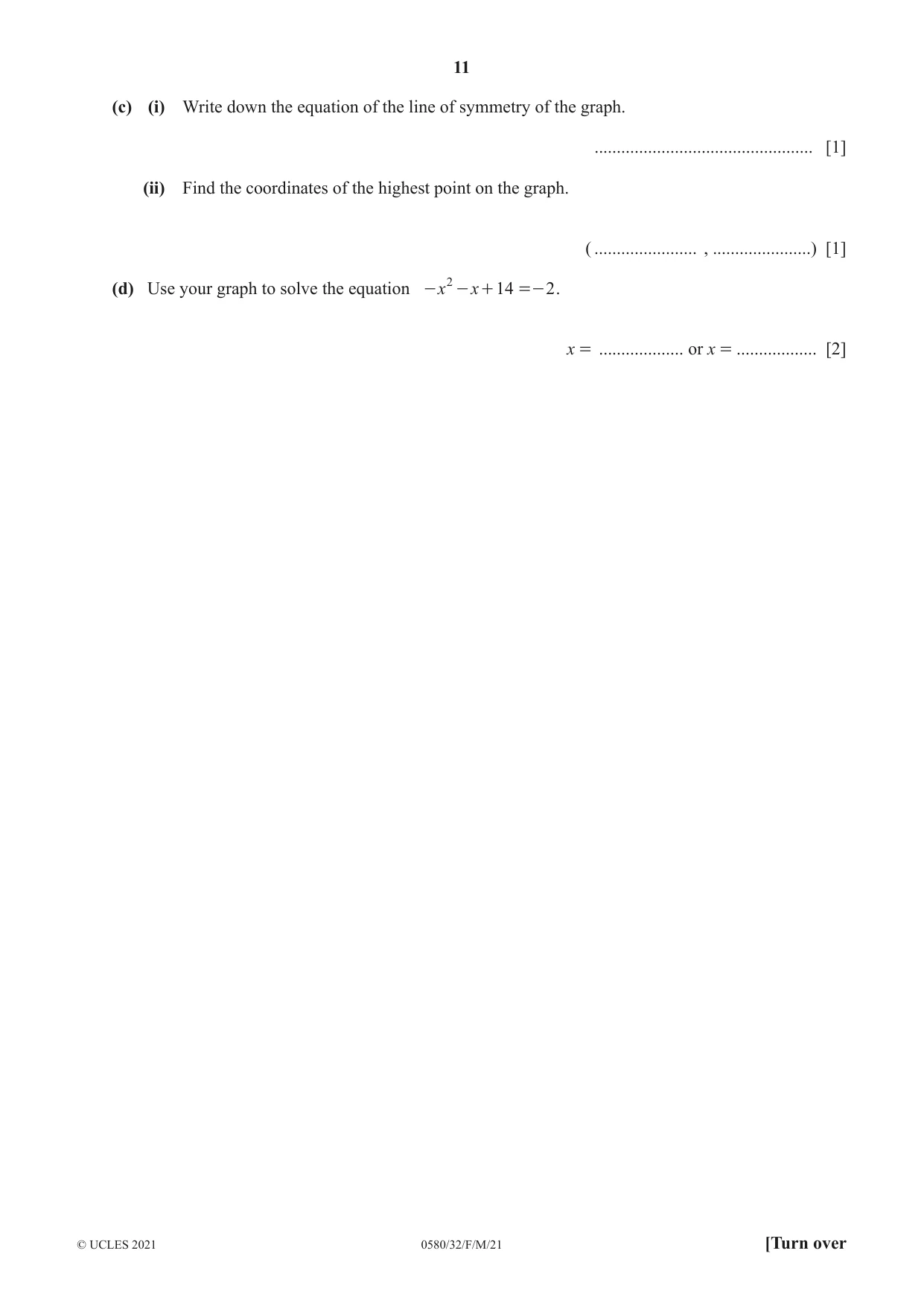
5 (a) Complete the table of values for y =- x 2 - x + 14 . x –5 –4 –3 –2 –1 0 1 2 3 4 y 8 12 12 8 [3] (b) On the grid, draw the graph of y =- x 2 - x + 14 for - 5 G x G 4 . y 16 14 12 10 8 6 4 2 x – 5 – 4 – 3 – 2 – 1 0 1 2 3 4 – 2 – 4 – 6 – 8 [4] (c) (i) Write down the equation of the line of symmetry of the graph. ................................................. [1] (ii) Find the coordinates of the highest point on the graph. ( ....................... , ......................) [1] (d) Use your graph to solve the equation - x 2 - x + 14 =- 2 . x = ................... or x = .................. [2]
Mark scheme: 5(a) −6 2 14 14 2 −6 3 B2 for 4 or 5 correct B1 for 2 or 3 correct 5(b) Completely correct curve 4 B3FT for 9 or 10 correctly plotted points B2FT for 7 or 8 correctly plotted points B1FT for 5 or 6 correctly plotted points 5(c)(i) x = −0.5 oe 1 5(c)(ii) ( −0.5, k) oe 1 where 14 < k 14.8 5(d) 3.3 to 3.7, −.74 to −4.3 2 B1FT for each
Q6 · The diagram shows a point P, a shape S and lines A and B on a 1cm2 grid
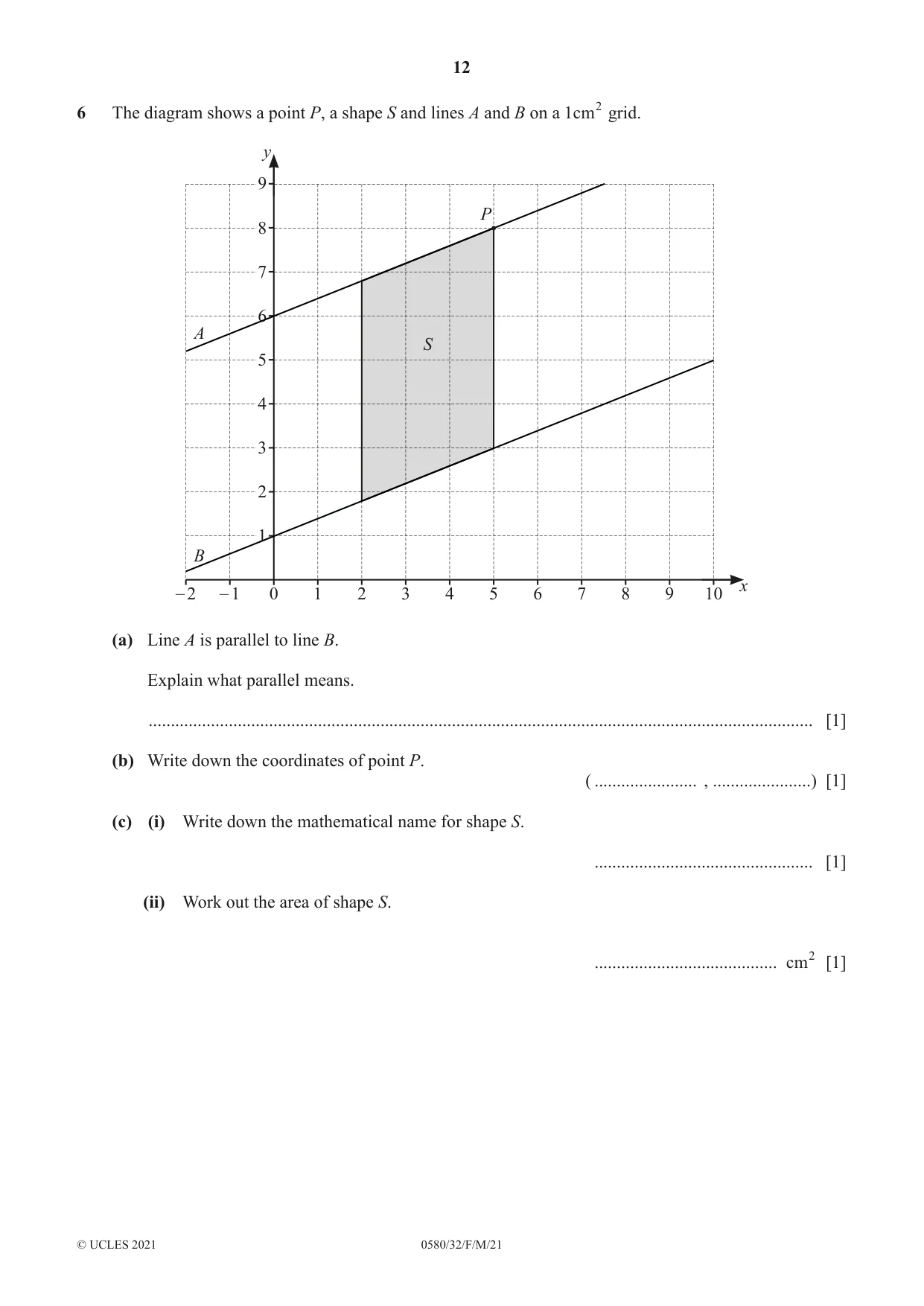
6 The diagram shows a point P, a shape S and lines A and B on a 1cm2 grid. y 9 P 8 7 6 A S 5 4 3 2 1 B x – 2 – 1 0 1 2 3 4 5 6 7 8 9 10 (a) Line A is parallel to line B. Explain what parallel means. ..................................................................................................................................................... [1] (b) Write down the coordinates of point P. ( ....................... , ......................) [1] (c) (i) Write down the mathematical name for shape S. ................................................. [1] (ii) Work out the area of shape S. ......................................... cm2 [1] (d) (i) Find the gradient of line A. ................................................. [1] (ii) Write down the equation of line A. ................................................. [2]
Mark scheme: 6(a) Correct explanation 1 6(b) (5,8) 1 6(c)(i) Parallelogram 1 6(c)(ii) 15 1 6(d)(i) 2 1 oe 5 6(d)(ii) 2 2 2 y = their x + 6 oe B1 for their x + 6 5 5 final answer 2 or y = their x + c , c ≠ 6 5 or y = mx + 6, m ≠ 0
Q7 · Prakash buys 45 flowers from a shop
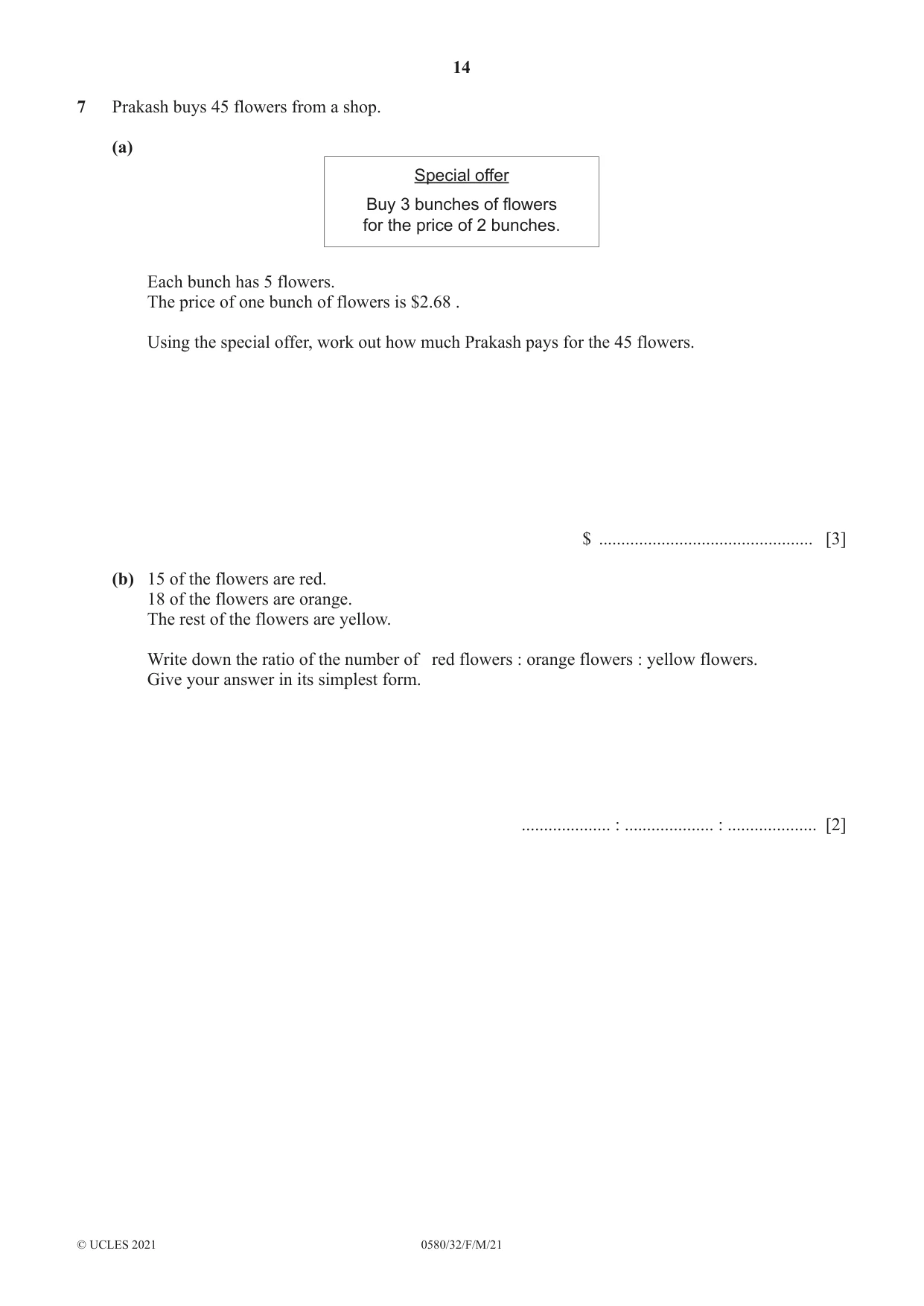
7 Prakash buys 45 flowers from a shop. (a) Special offer Buy 3 bunches of flowers for the price of 2 bunches. Each bunch has 5 flowers. The price of one bunch of flowers is $2.68 . Using the special offer, work out how much Prakash pays for the 45 flowers. $ ................................................ [3] (b) 15 of the flowers are red. 18 of the flowers are orange. The rest of the flowers are yellow. Write down the ratio of the number of red flowers : orange flowers : yellow flowers. Give your answer in its simplest form. .................... : .................... : .................... [2] (c) Prakash gives the 45 flowers to his family. He gives his grandmother x flowers. He gives his mother 8 more flowers than his grandmother. He gives his cousin 6 fewer flowers than his grandmother. He gives his sister twice as many flowers as he gives his cousin. (i) Use this information to show that 5x - 10 = 45 . [3] (ii) Solve the equation 5x - 10 = 45 . x = ................................................ [2] (iii) Find the number of flowers that Prakash gives to his cousin. ................................................. [1]
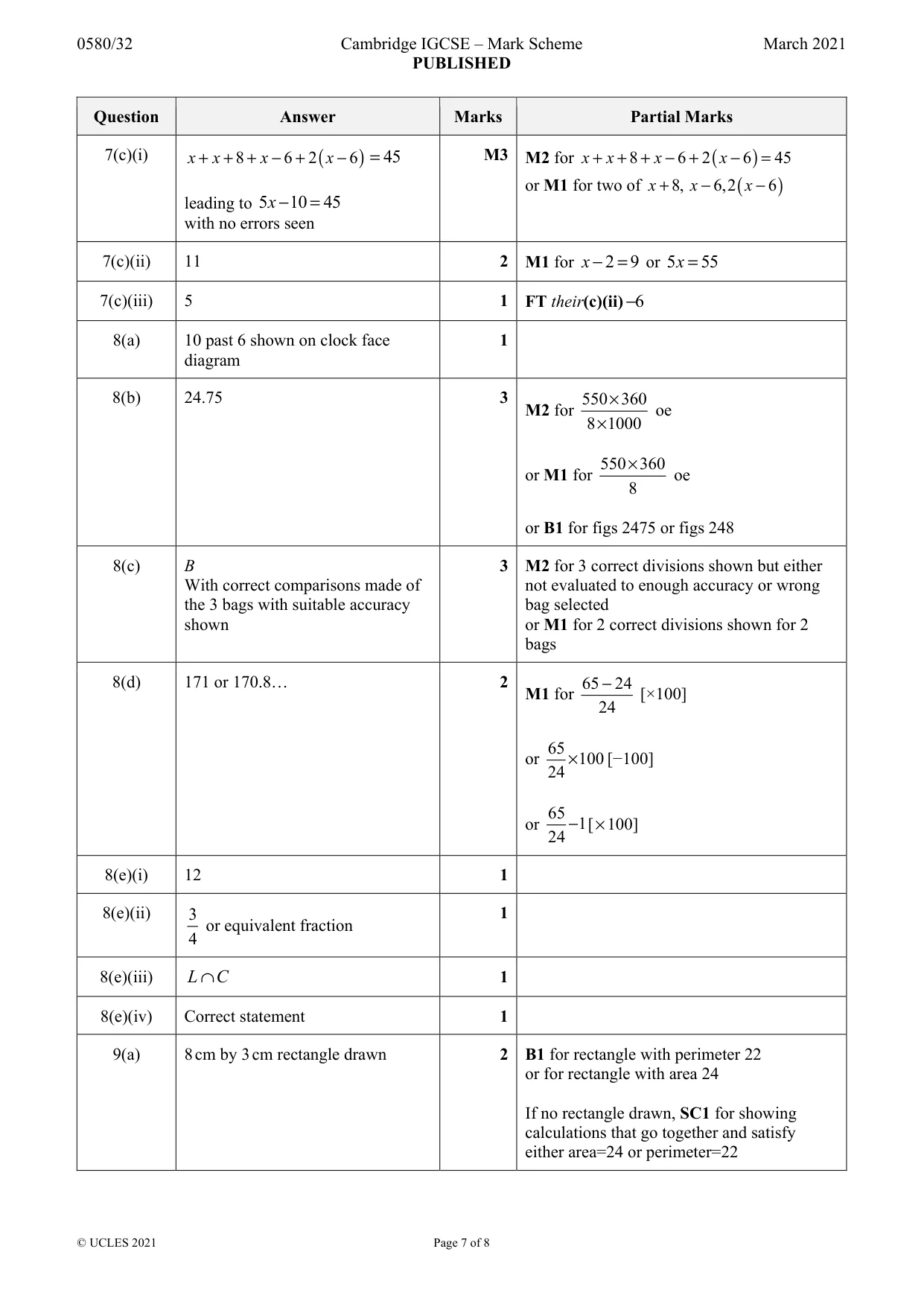
Mark scheme: 7(a) 16.08 3 45 2 M2 for × × 2.68 oe 5 3 45 2 45 or M1 for × or × 2.68 oe 5 3 5 7(b) 5 : 6 : 4 2 B1 for 15 : 18 : (45−18−15) or better 7(c)(i) x + x + 8 + x − 6 + 2 ( x − 6 ) = 45 M3 M2 for x + x + 8 + x − 6 + 2 ( x − 6 ) = 45 or M1 for two of x + 8, x − 6, 2 ( x − 6 ) leading to 5 x − 10 = 45 with no errors seen 7(c)(ii) 11 2 M1 for x − 2 = 9 or 5 x = 55 7(c)(iii) 5 1 FT their(c)(ii) −6
Q8 · A baker puts some cakes in the oven at 5.50 pm
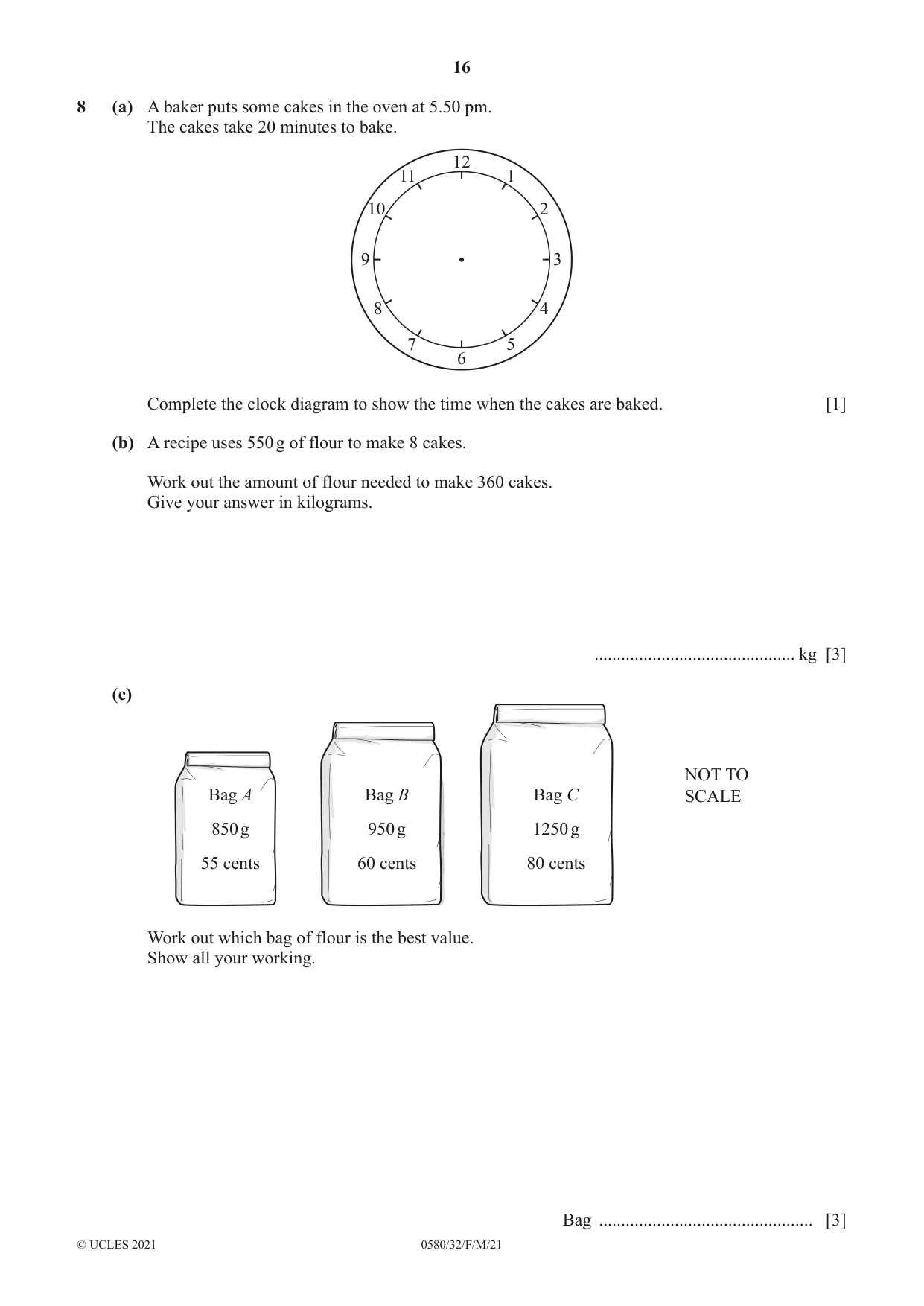
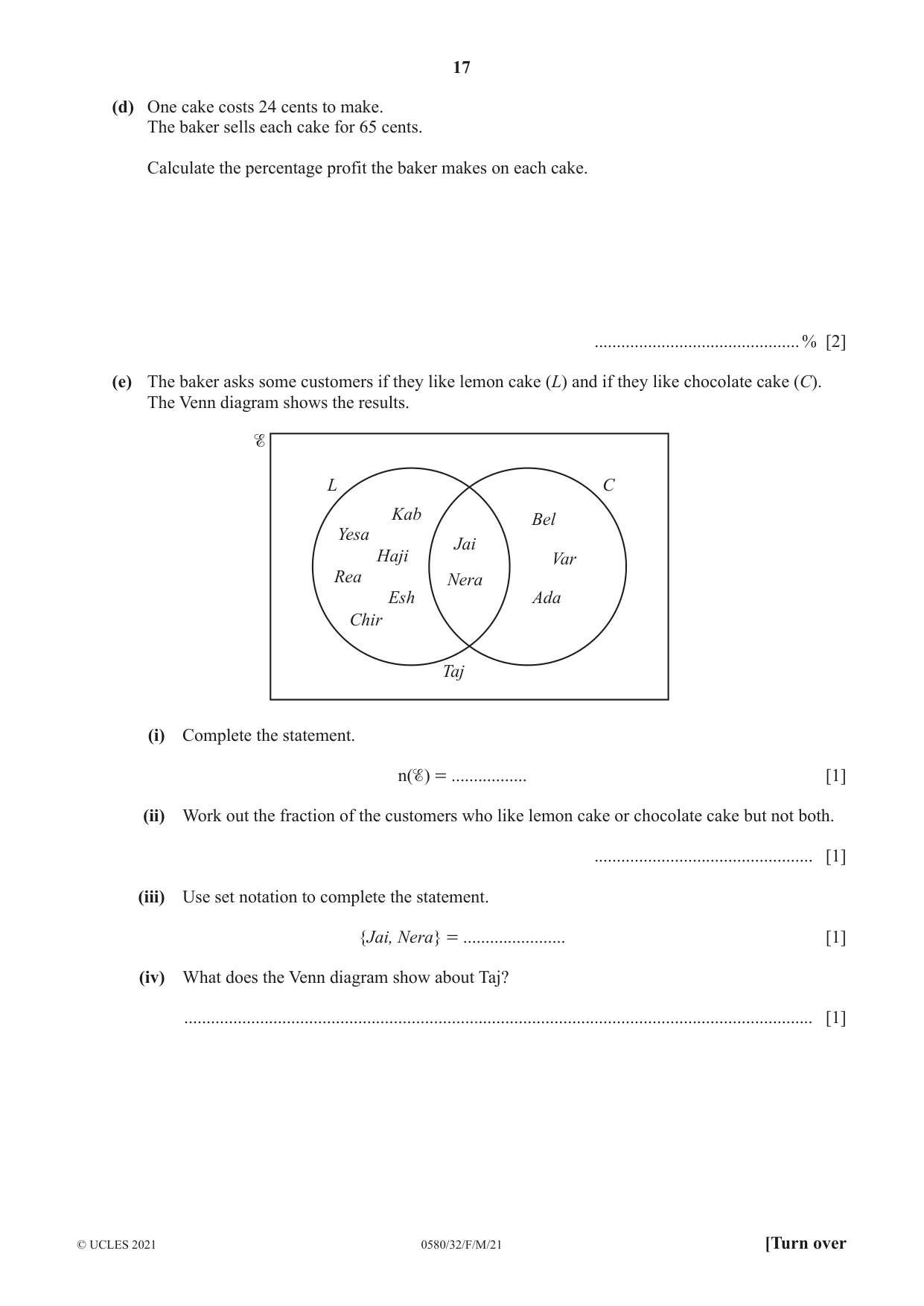
8 (a) A baker puts some cakes in the oven at 5.50 pm. The cakes take 20 minutes to bake. 12 11 1 10 2 9 3 8 4 7 5 6 Complete the clock diagram to show the time when the cakes are baked. [1] (b) A recipe uses 550 g of flour to make 8 cakes. Work out the amount of flour needed to make 360 cakes. Give your answer in kilograms. ............................................. kg [3] (c) NOT TO Bag A Bag B Bag C SCALE 850 g 950 g 1250 g 55 cents 60 cents 80 cents Work out which bag of flour is the best value. Show all your working. Bag ................................................ [3] (d) One cake costs 24 cents to make. The baker sells each cake for 65 cents. Calculate the percentage profit the baker makes on each cake. ..............................................% [2] (e) The baker asks some customers if they like lemon cake (L) and if they like chocolate cake (C). The Venn diagram shows the results. L C Kab Bel Yesa Jai Haji Var Rea Nera Esh Ada Chir Taj (i) Complete the statement. n() = ................. [1] (ii) Work out the fraction of the customers who like lemon cake or chocolate cake but not both. ................................................. [1] (iii) Use set notation to complete the statement. {Jai, Nera} = ....................... [1] (iv) What does the Venn diagram show about Taj? ............................................................................................................................................. [1]
Mark scheme: 8(a) 10 past 6 shown on clock face 1 diagram 8(b) 24.75 3 550 × 360 M2 for oe 8 × 1000 550 × 360 or M1 for oe 8 or B1 for figs 2475 or figs 248 8(c) B 3 M2 for 3 correct divisions shown but either With correct comparisons made of not evaluated to enough accuracy or wrong the 3 bags with suitable accuracy bag selected shown or M1 for 2 correct divisions shown for 2 bags 8(d) 171 or 170.8… 2 65 − 24 M1 for [×100] 24 65 or × 100 [−100] 24 65 or −[×100]1 24 8(e)(i) 12 1 8(e)(ii) 3 1 or equivalent fraction 4 8(e)(iii) L ∩ C 1 8(e)(iv) Correct statement 1
Q9 · On the 1cm2 grid, draw one rectangle that has • a perimeter of 22 cm and • an area of…
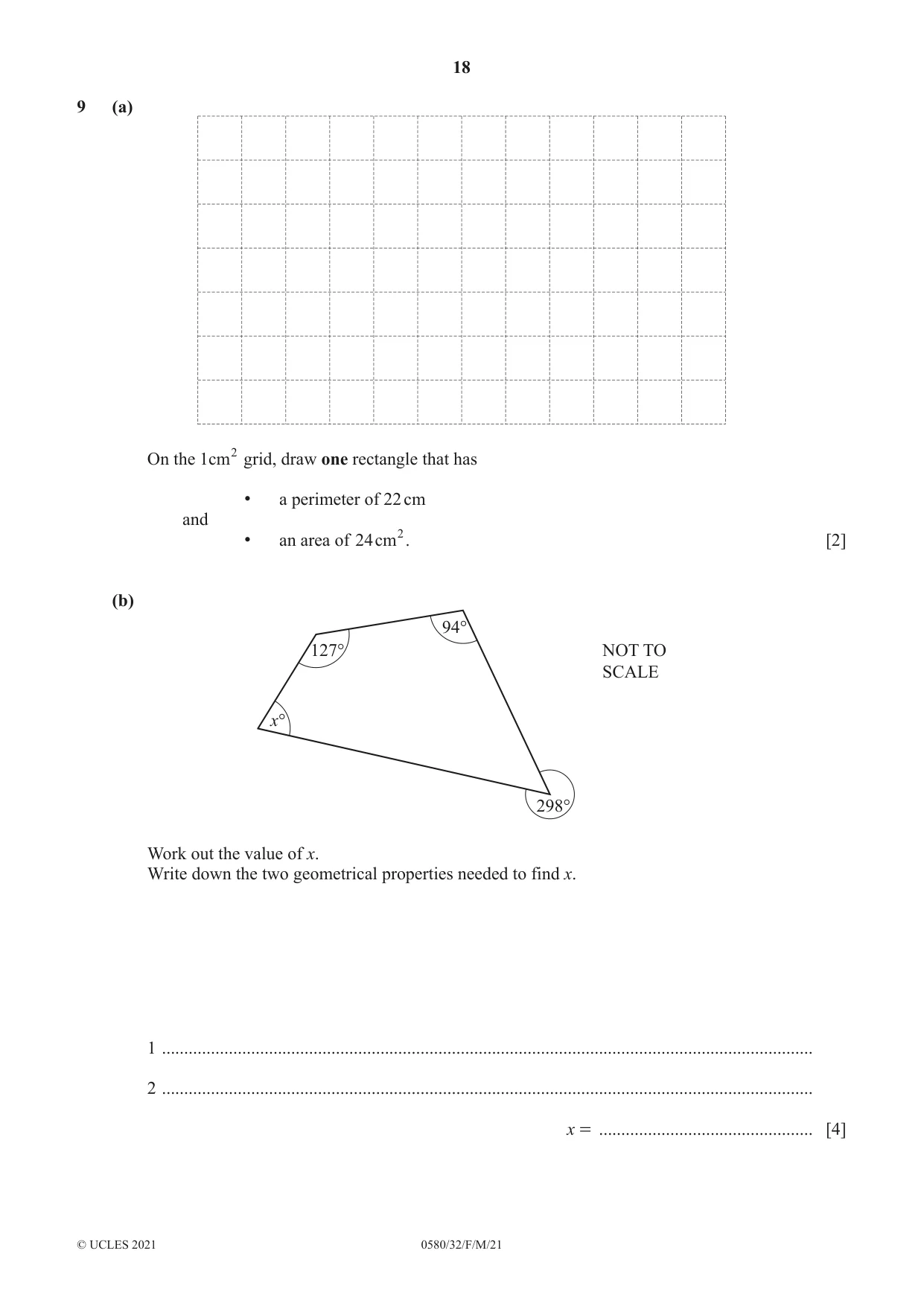
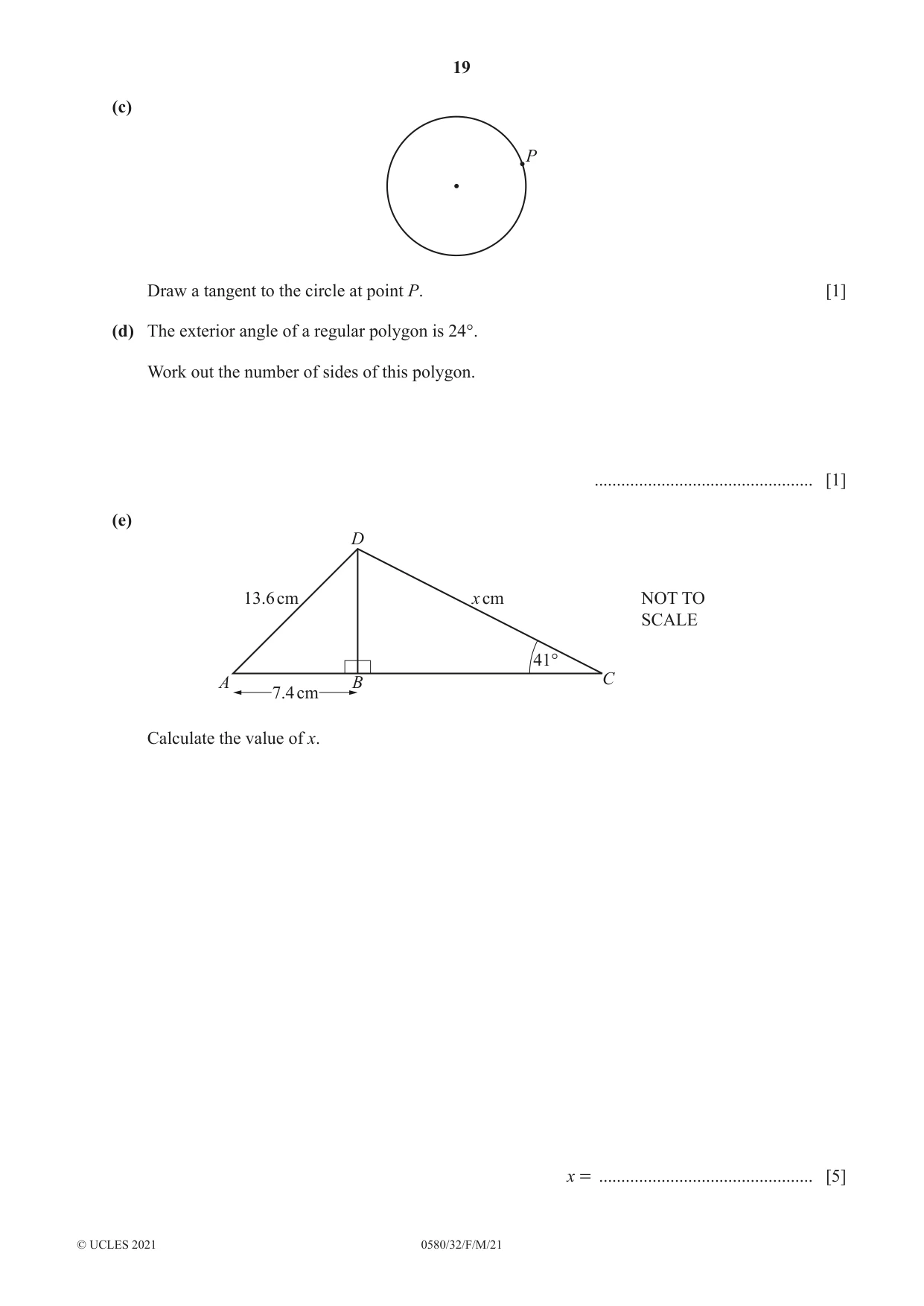
9 (a) On the 1cm2 grid, draw one rectangle that has • a perimeter of 22 cm and • an area of 24cm2. [2] (b) 94° 127° NOT TO SCALE x° 298° Work out the value of x. Write down the two geometrical properties needed to find x. 1 .................................................................................................................................................. 2 .................................................................................................................................................. x = ................................................ [4] (c) P Draw a tangent to the circle at point P. [1] (d) The exterior angle of a regular polygon is 24°. Work out the number of sides of this polygon. ................................................. [1] (e) D 13.6 cm x cm NOT TO SCALE 41° A B C 7.4 cm Calculate the value of x. x = ................................................ [5]
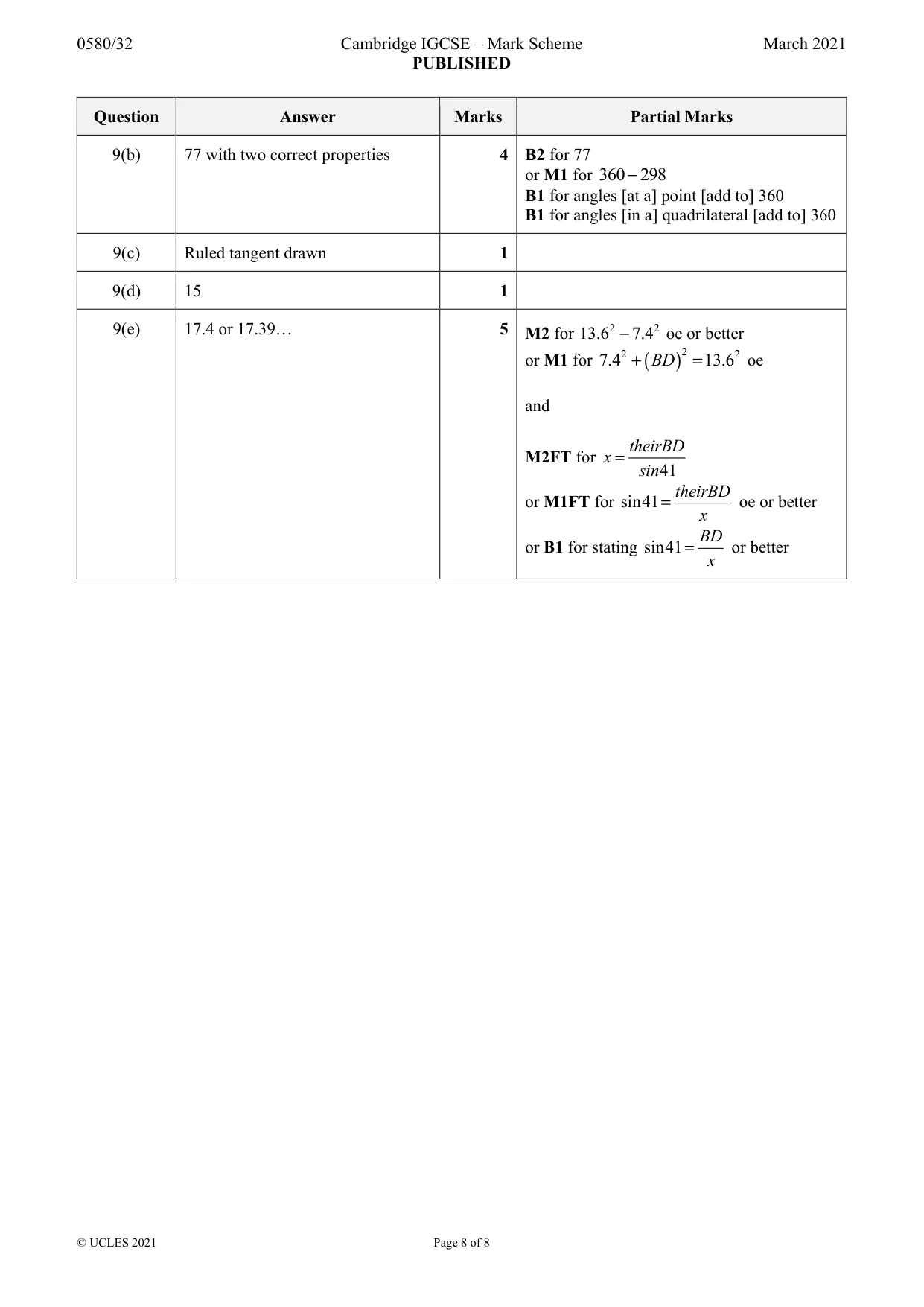
Mark scheme: 9(a) 8 cm by 3 cm rectangle drawn 2 B1 for rectangle with perimeter 22 or for rectangle with area 24 If no rectangle drawn, SC1 for showing calculations that go together and satisfy either area=24 or perimeter=22 9(b) 77 with two correct properties 4 B2 for 77 or M1 for 360 − 298 B1 for angles [at a] point [add to] 360 B1 for angles [in a] quadrilateral [add to] 360 9(c) Ruled tangent drawn 1 9(d) 15 1 9(e) 17.4 or 17.39… 5 M2 for 13.6 2 − 7.4 2 oe or better 2 2 2 or M1 for 7.4 + ( BD ) = 13.6 oe and theirBD M2FT for x = sin 41 theirBD or M1FT for sin41 = oe or better x BD or B1 for stating sin41 = or better x
What was in this paper
The subtopics covered by these 9 questions, and how many questions each got. Open one in a new tab to see every Cambridge question on it.
What you needed in this session
Cambridge’s own grade thresholds for 2021 Feb/March, Paper 3 · Variant 2. A higher threshold means an easier paper — the bar moves with how the cohort did.