Cambridge IGCSE Mathematics 0580 — 2020 Feb/March Paper 3 · Variant 2
0580/32/F/M/20 · 9 questions · 104 marks · ≈117 min
The question paper and its mark scheme, free to read here and free to download. This is Cambridge’s own paper, exactly as it was sat.
Question paper20 pages
Mark scheme7 pages
Answers below. Sit the paper first if you are practising.
Questions as text
Q1 · Navja works in a post office
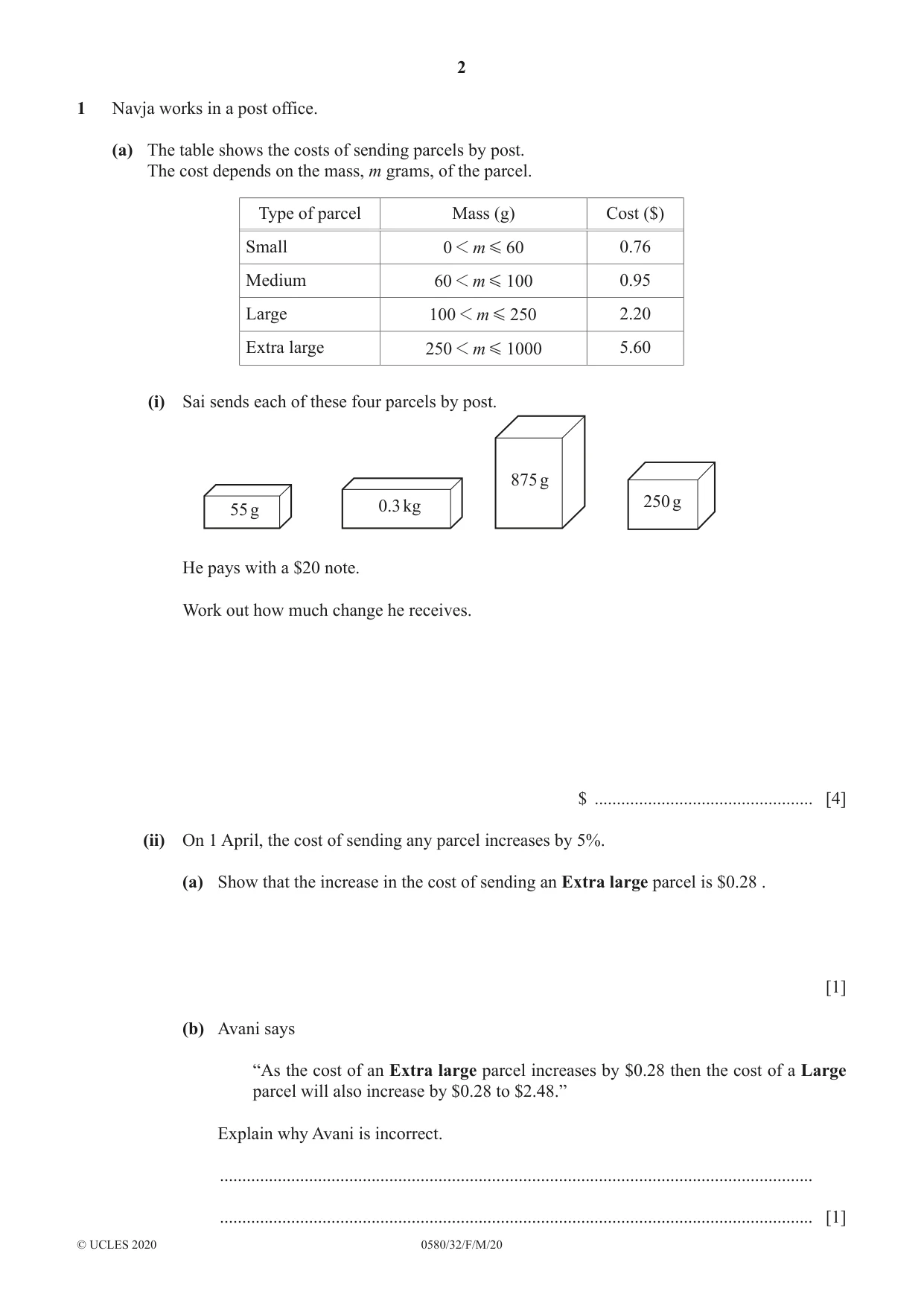
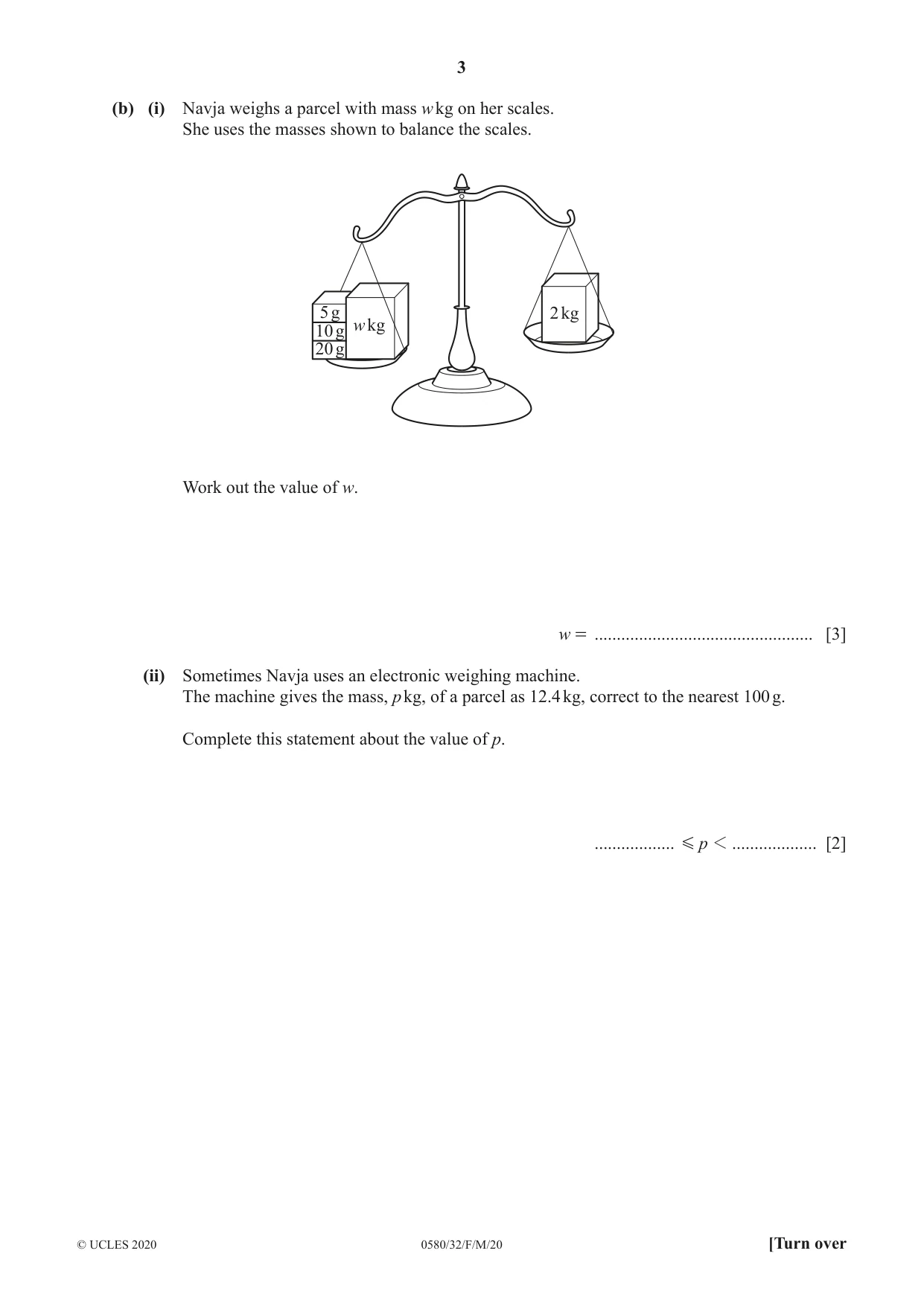
1 Navja works in a post office. (a) The table shows the costs of sending parcels by post. The cost depends on the mass, m grams, of the parcel. Type of parcel Mass (g) Cost ($) Small 0 1 m G 60 0.76 Medium 60 1 m G 100 0.95 Large 100 1 m G 250 2.20 Extra large 250 1 m G 1000 5.60 (i) Sai sends each of these four parcels by post. 875 g 250 g 55 g 0.3 kg He pays with a $20 note. Work out how much change he receives. $ ................................................. [4] (ii) On 1 April, the cost of sending any parcel increases by 5%. (a) Show that the increase in the cost of sending an Extra large parcel is $0.28 . [1] (b) Avani says “As the cost of an Extra large parcel increases by $0.28 then the cost of a Large parcel will also increase by $0.28 to $2.48.” Explain why Avani is incorrect. ..................................................................................................................................... ..................................................................................................................................... [1] (b) (i) Navja weighs a parcel with mass w kg on her scales. She uses the masses shown to balance the scales. 5 g 2 kg w kg 10 g 20 g Work out the value of w. w = ................................................. [3] (ii) Sometimes Navja uses an electronic weighing machine. The machine gives the mass, p kg, of a parcel as 12.4 kg, correct to the nearest 100 g. Complete this statement about the value of p. .................. G p 1 ................... [2]
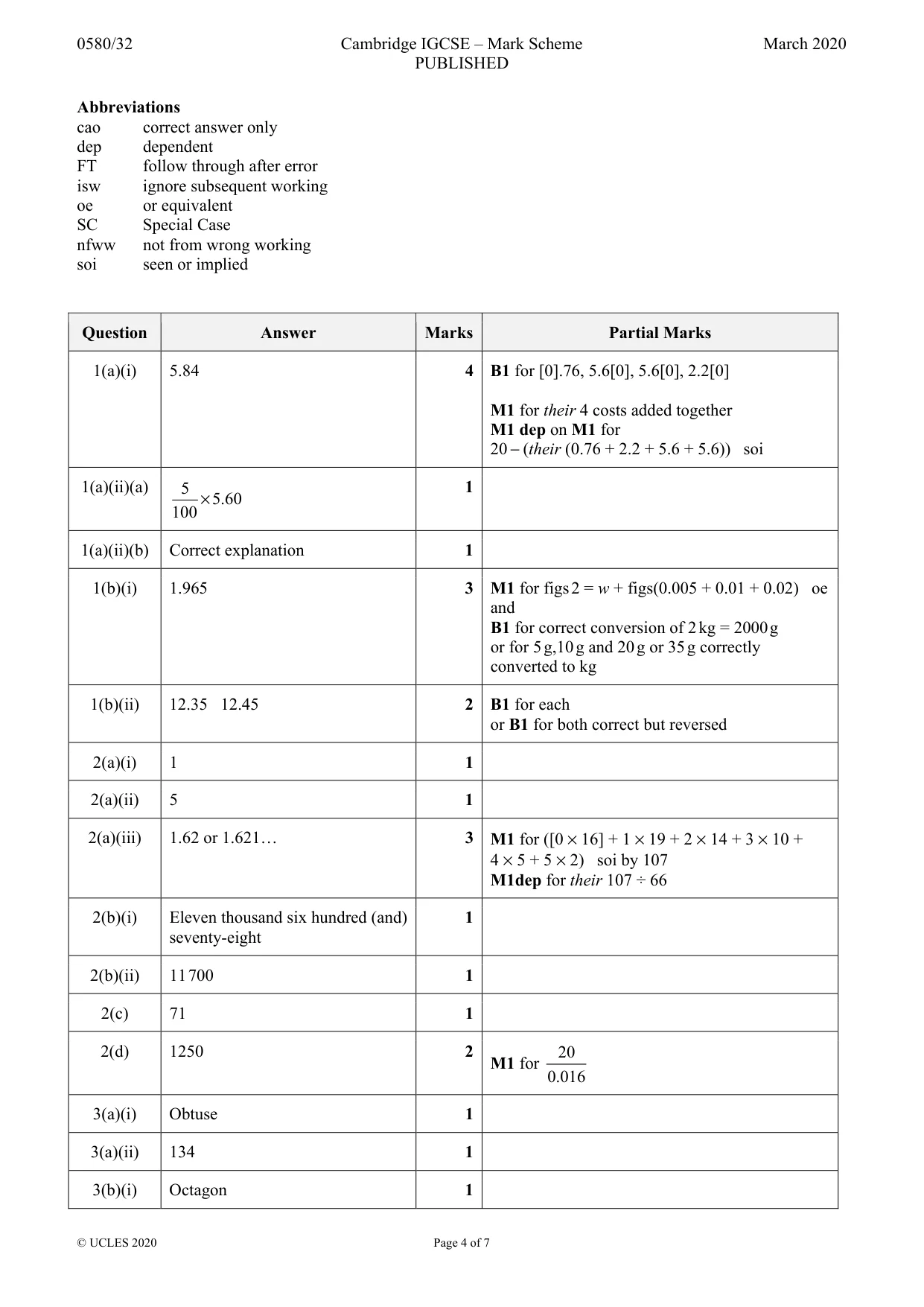
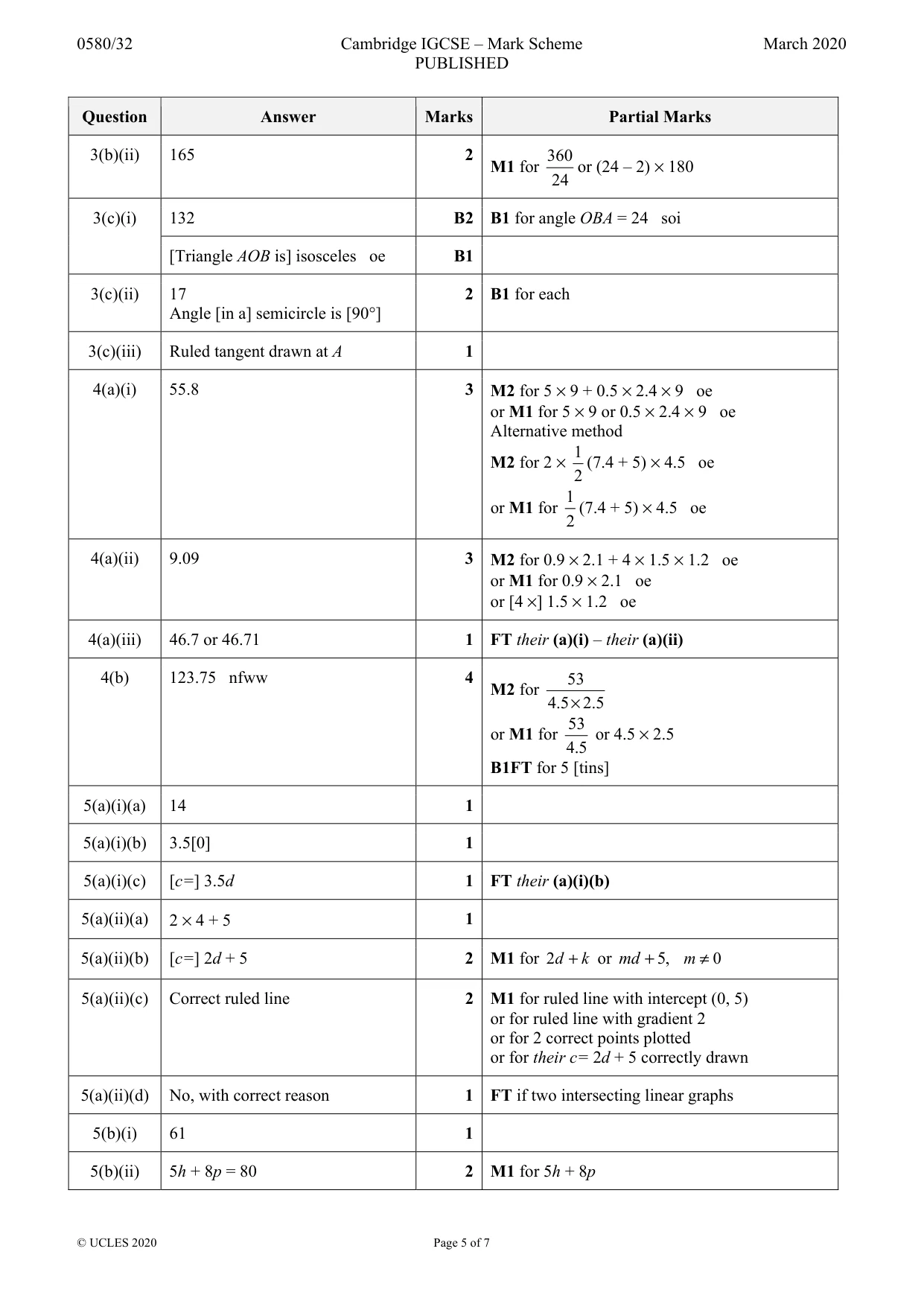
Mark scheme: Question Answer Marks Partial Marks 1(a)(i) 5.84 4 B1 for [0].76, 5.6[0], 5.6[0], 2.2[0] M1 for their 4 costs added together M1 dep on M1 for 20 −(their (0.76 + 2.2 + 5.6 + 5.6)) soi 1(a)(ii)(a) 5 1 × 5.60 100 1(a)(ii)(b) Correct explanation 1 1(b)(i) 1.965 3 M1 for figs 2 = w + figs(0.005 + 0.01 + 0.02) oe and B1 for correct conversion of 2 kg = 2000 g or for 5 g,10 g and 20 g or 35 g correctly converted to kg 1(b)(ii) 12.35 12.45 2 B1 for each or B1 for both correct but reversed
Q2 · 66 football players each take five penalties
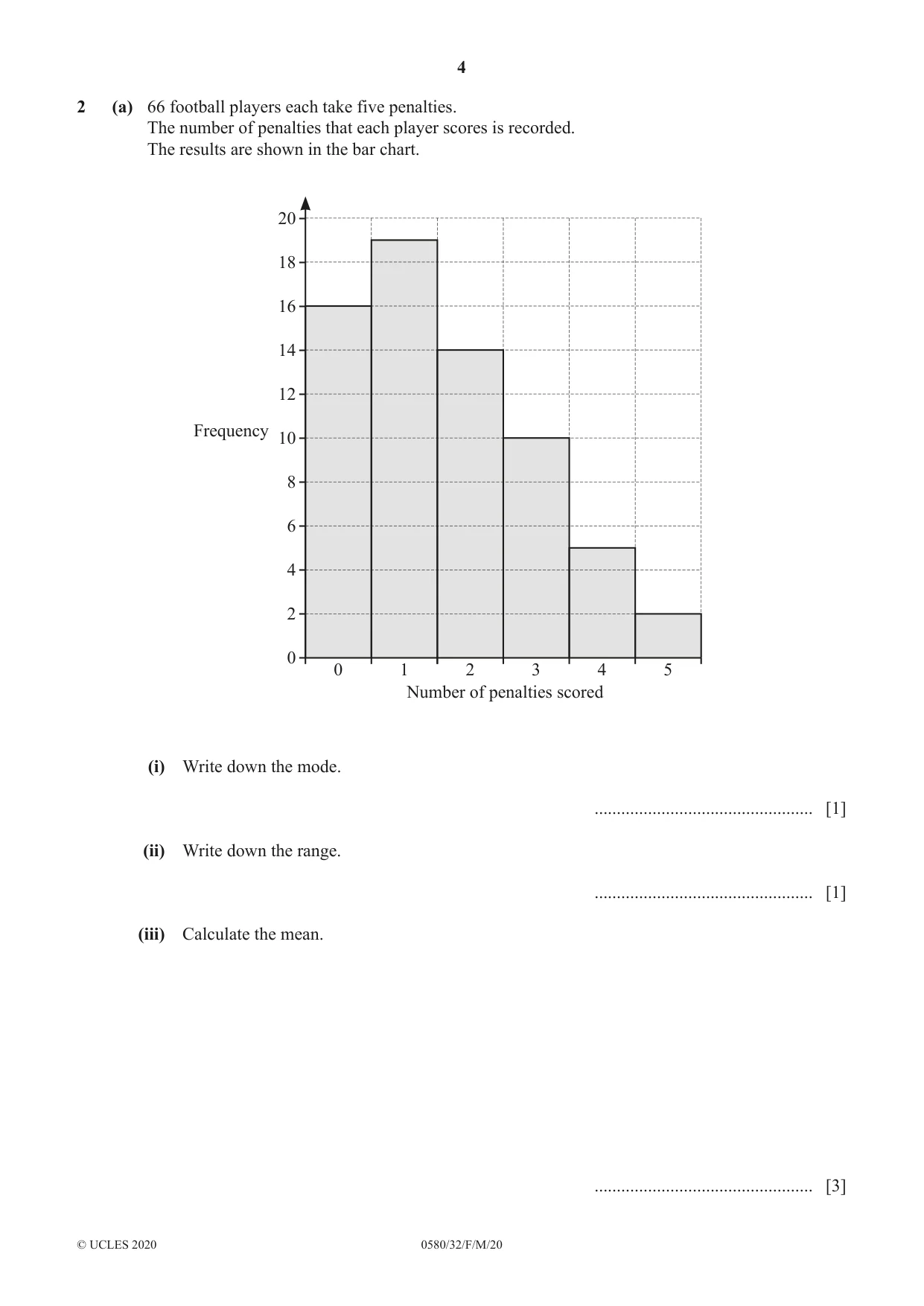
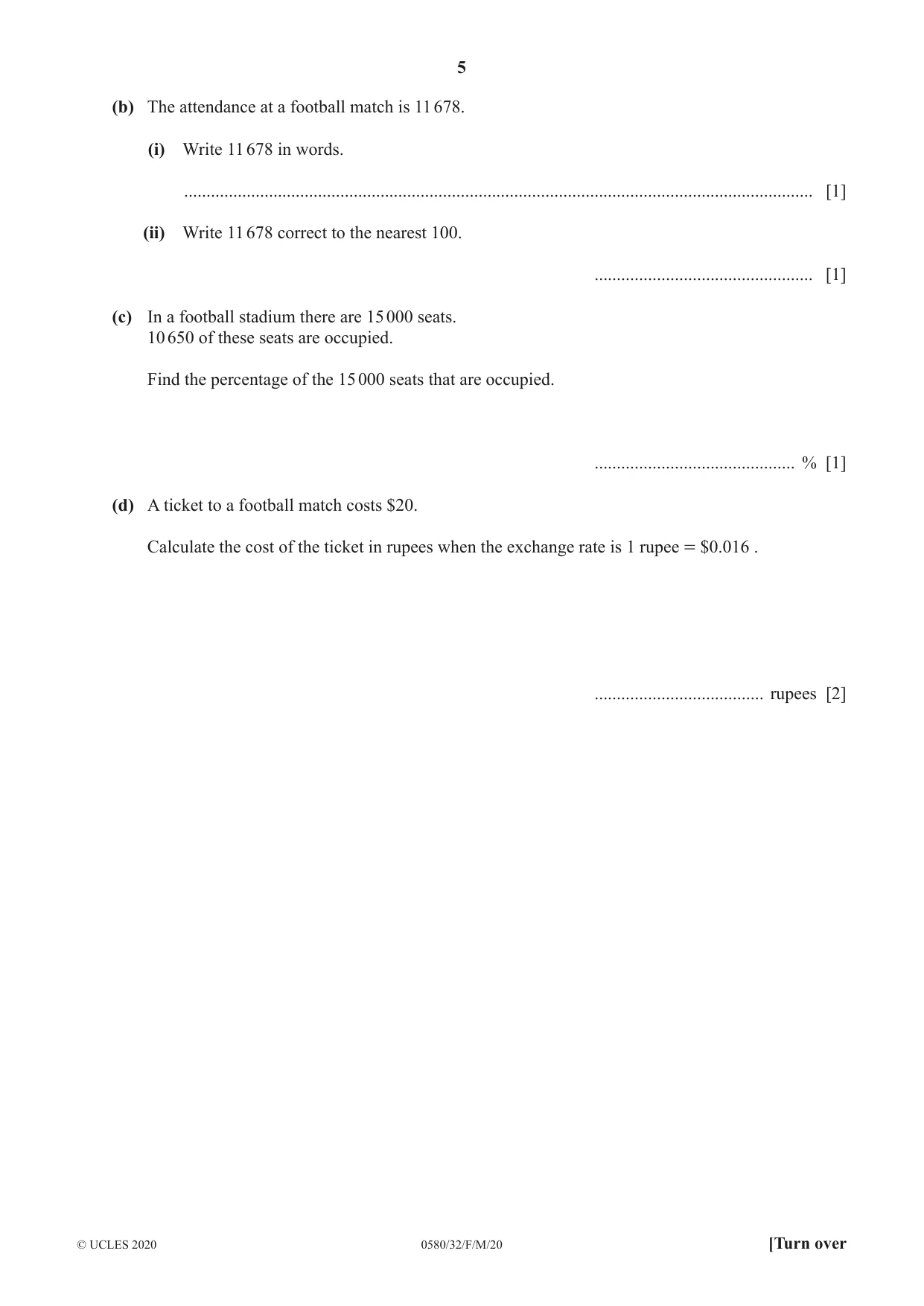
2 (a) 66 football players each take five penalties. The number of penalties that each player scores is recorded. The results are shown in the bar chart. 20 18 16 14 12 Frequency 10 8 6 4 2 0 0 1 2 3 4 5 Number of penalties scored (i) Write down the mode. ................................................. [1] (ii) Write down the range. ................................................. [1] (iii) Calculate the mean. ................................................. [3] (b) The attendance at a football match is 11 678. (i) Write 11 678 in words. ............................................................................................................................................. [1] (ii) Write 11 678 correct to the nearest 100. ................................................. [1] (c) In a football stadium there are 15 000 seats. 10 650 of these seats are occupied. Find the percentage of the 15 000 seats that are occupied. ............................................. % [1] (d) A ticket to a football match costs $20. Calculate the cost of the ticket in rupees when the exchange rate is 1 rupee = $0.016 . ...................................... rupees [2]
Mark scheme: 2(a)(i) 1 1 2(a)(ii) 5 1 2(a)(iii) 1.62 or 1.621… 3 M1 for ([0 × 16] + 1 × 19 + 2 × 14 + 3 × 10 + 4 × 5 + 5 × 2) soi by 107 M1dep for their 107 ÷ 66 2(b)(i) Eleven thousand six hundred (and) 1 seventy-eight 2(b)(ii) 11 700 1 2(c) 71 1 2(d) 1250 2 20 M1 for 0.016
Q3 · Write down the mathematical name for this type of angle
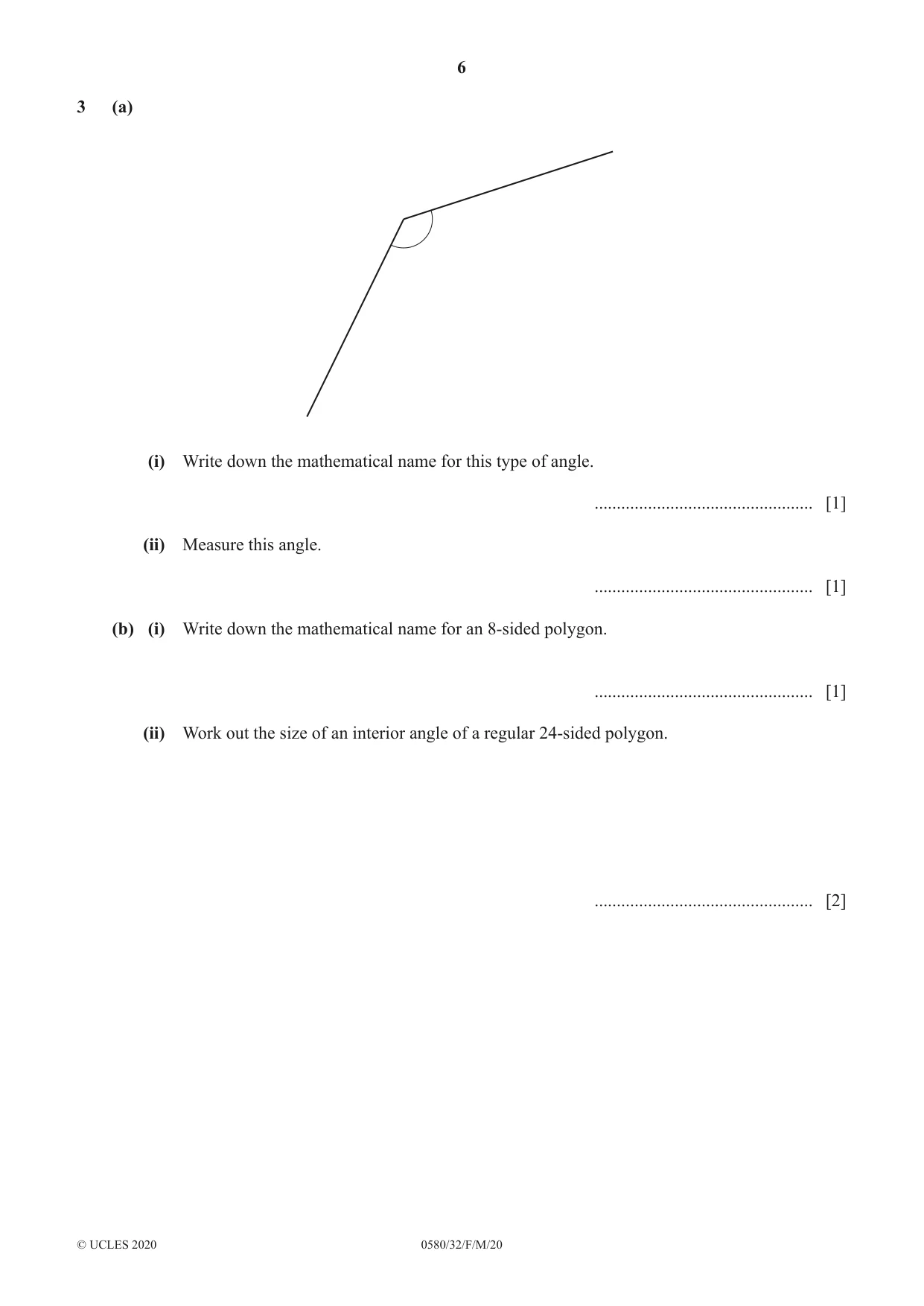
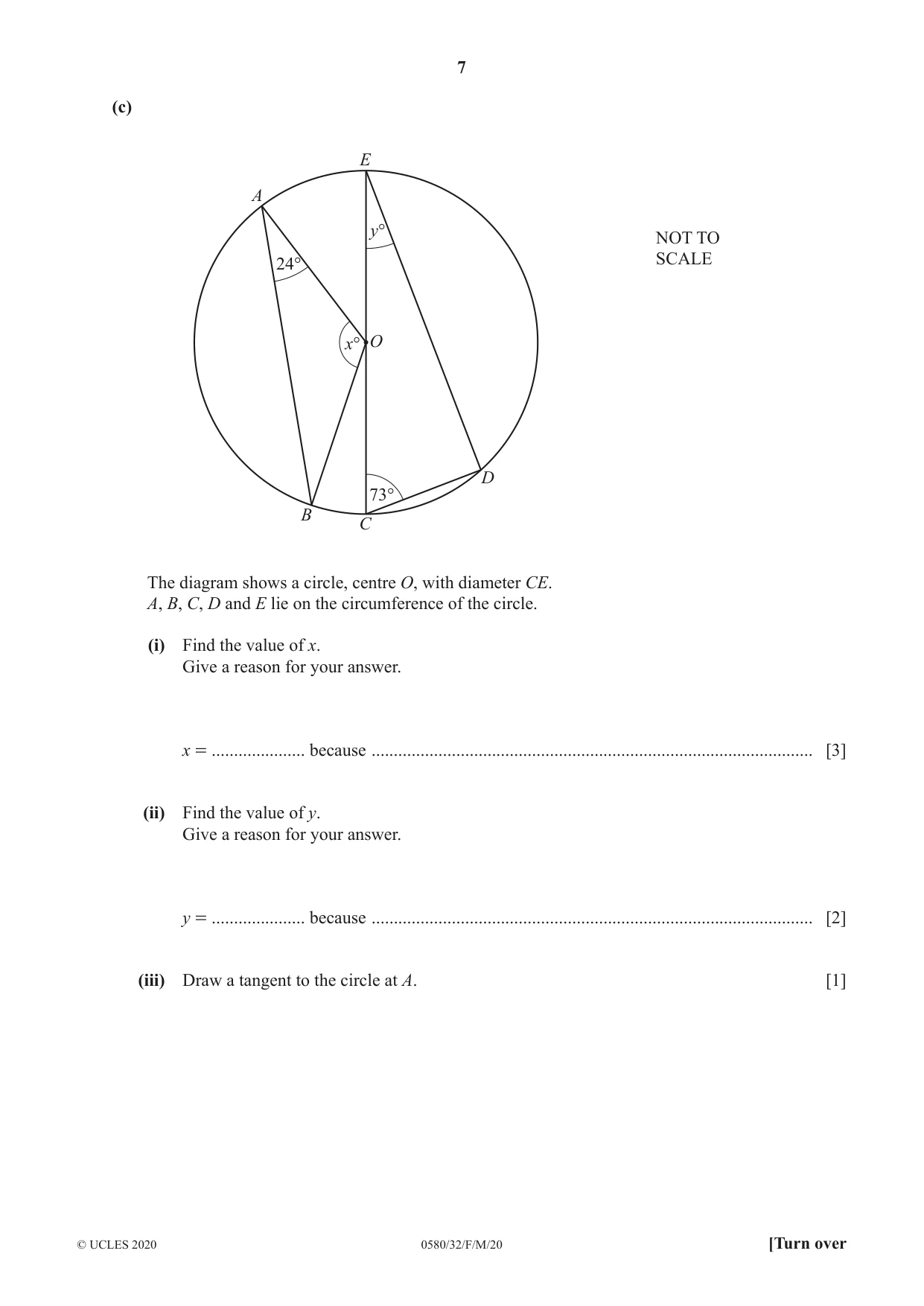
3 (a) (i) Write down the mathematical name for this type of angle. ................................................. [1] (ii) Measure this angle. ................................................. [1] (b) (i) Write down the mathematical name for an 8-sided polygon. ................................................. [1] (ii) Work out the size of an interior angle of a regular 24-sided polygon. ................................................. [2] (c) E A y° NOT TO 24° SCALE x° O D 73° B C The diagram shows a circle, centre O, with diameter CE. A, B, C, D and E lie on the circumference of the circle. (i) Find the value of x. Give a reason for your answer. x = ..................... because ................................................................................................... [3] (ii) Find the value of y. Give a reason for your answer. y = ..................... because ................................................................................................... [2] (iii) Draw a tangent to the circle at A. [1]
Mark scheme: 3(a)(i) Obtuse 1 3(a)(ii) 134 1 3(b)(i) Octagon 1 3(b)(ii) 165 2 360 M1 for or (24 – 2) × 180 24 3(c)(i) 132 B2 B1 for angle OBA = 24 soi [Triangle AOB is] isosceles oe B1 3(c)(ii) 17 2 B1 for each Angle [in a] semicircle is [90°] 3(c)(iii) Ruled tangent drawn at A 1
Q4 · 2.4 m NOT TO SCALE 5 m 9 m The diagram shows the front of Pranav’s house
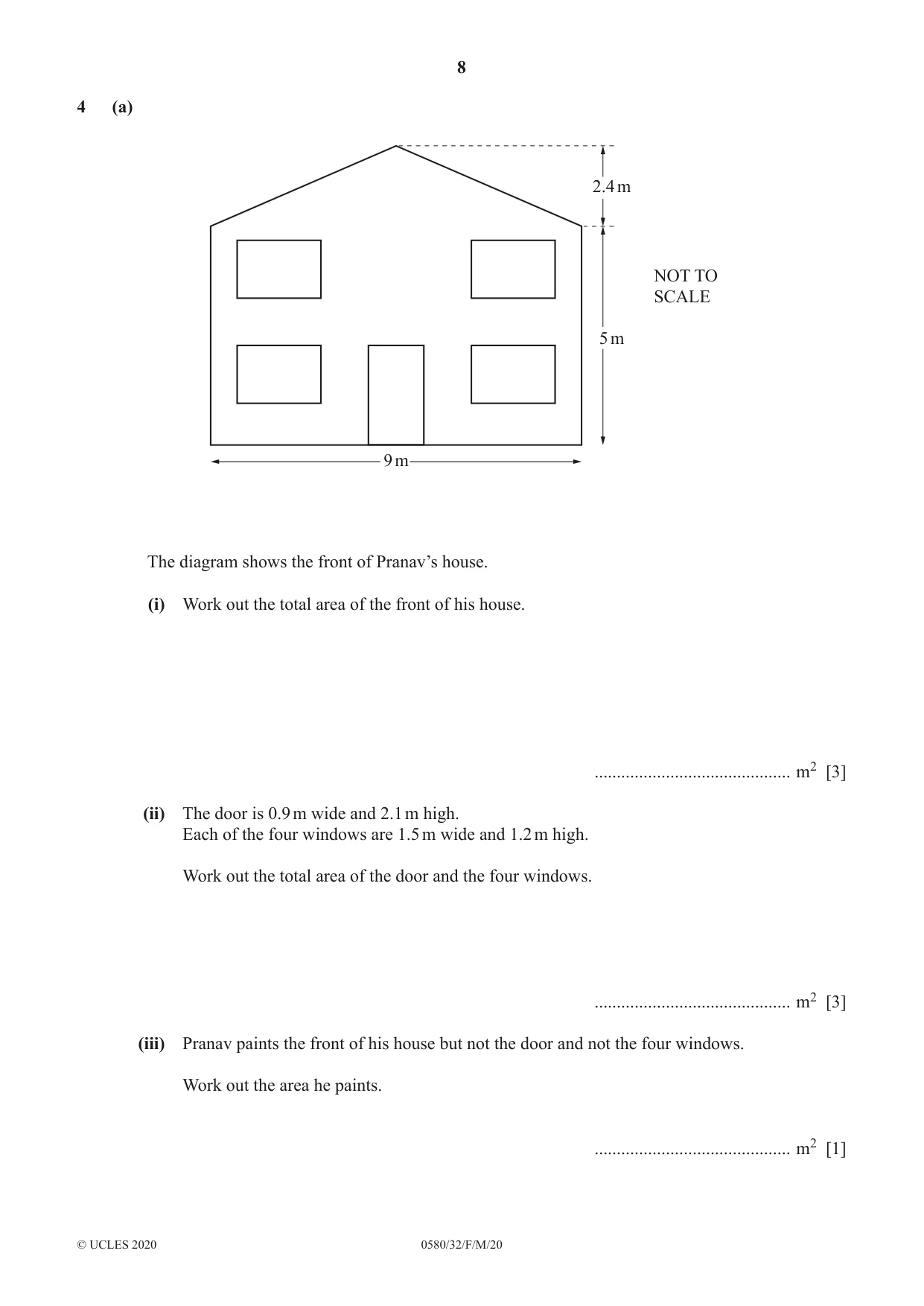
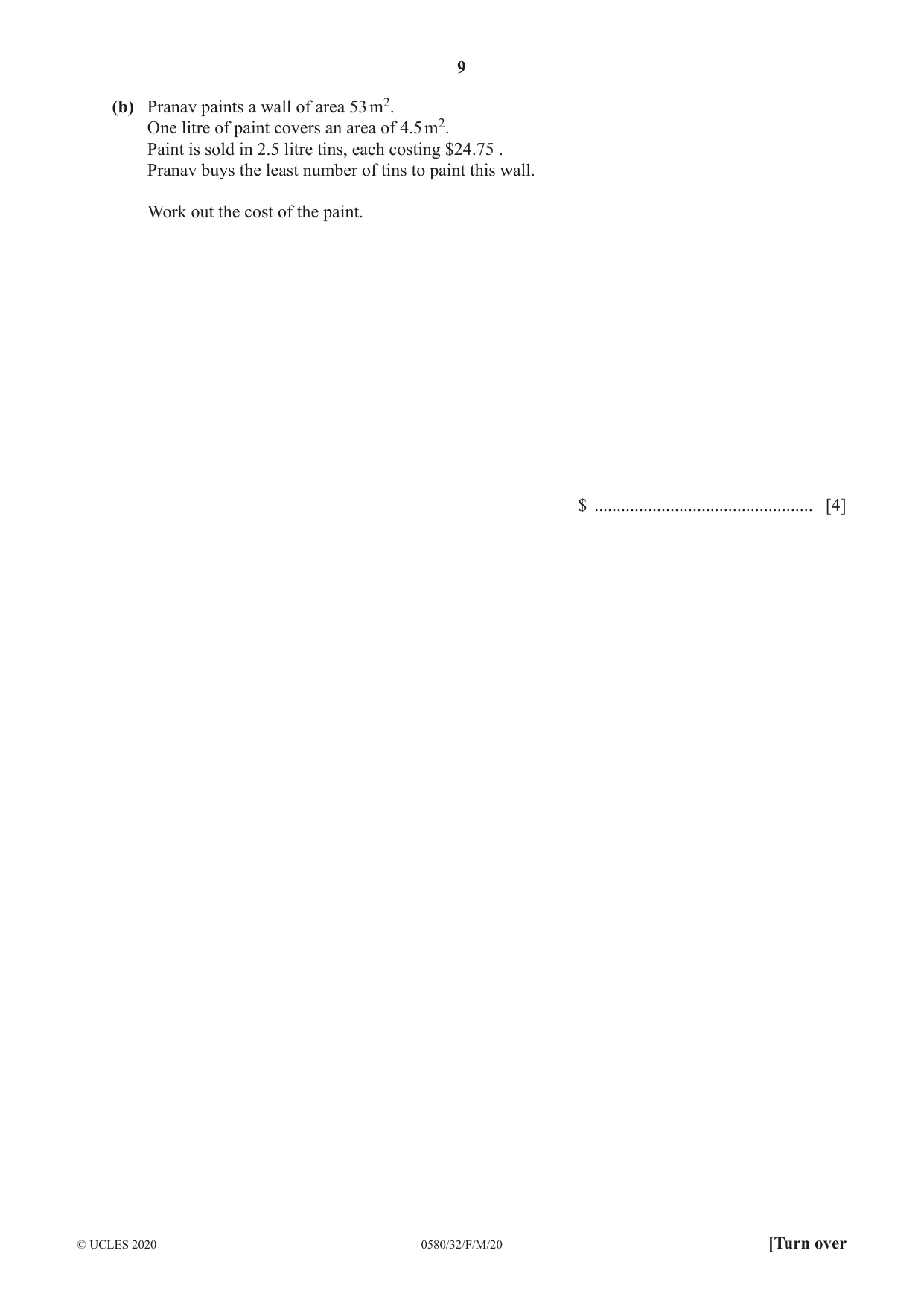
4 (a) 2.4 m NOT TO SCALE 5 m 9 m The diagram shows the front of Pranav’s house. (i) Work out the total area of the front of his house. ............................................ m2 [3] (ii) The door is 0.9 m wide and 2.1 m high. Each of the four windows are 1.5 m wide and 1.2 m high. Work out the total area of the door and the four windows. ............................................ m2 [3] (iii) Pranav paints the front of his house but not the door and not the four windows. Work out the area he paints. ............................................ m2 [1] (b) Pranav paints a wall of area 53 m2. One litre of paint covers an area of 4.5 m2. Paint is sold in 2.5 litre tins, each costing $24.75 . Pranav buys the least number of tins to paint this wall. Work out the cost of the paint. $ ................................................. [4]
Mark scheme: 4(a)(i) 55.8 3 M2 for 5 × 9 + 0.5 × 2.4 × 9 oe or M1 for 5 × 9 or 0.5 × 2.4 × 9 oe Alternative method 1 M2 for 2 × (7.4 + 5) × 4.5 oe 2 1 or M1 for (7.4 + 5) × 4.5 oe 2 4(a)(ii) 9.09 3 M2 for 0.9 × 2.1 + 4 × 1.5 × 1.2 oe or M1 for 0.9 × 2.1 oe or [4 ×] 1.5 × 1.2 oe 4(a)(iii) 46.7 or 46.71 1 FT their (a)(i) – their (a)(ii) 4(b) 123.75 nfww 4 53 M2 for 4.5 × 2.5 53 or M1 for or 4.5 × 2.5 4.5 B1FT for 5 [tins]
Q5 · C 40 30 Cost ($) 20 10 0 0 1 2 3 4 5 6 7 8 9 10 d Distance travelled (km) (i) The graph…
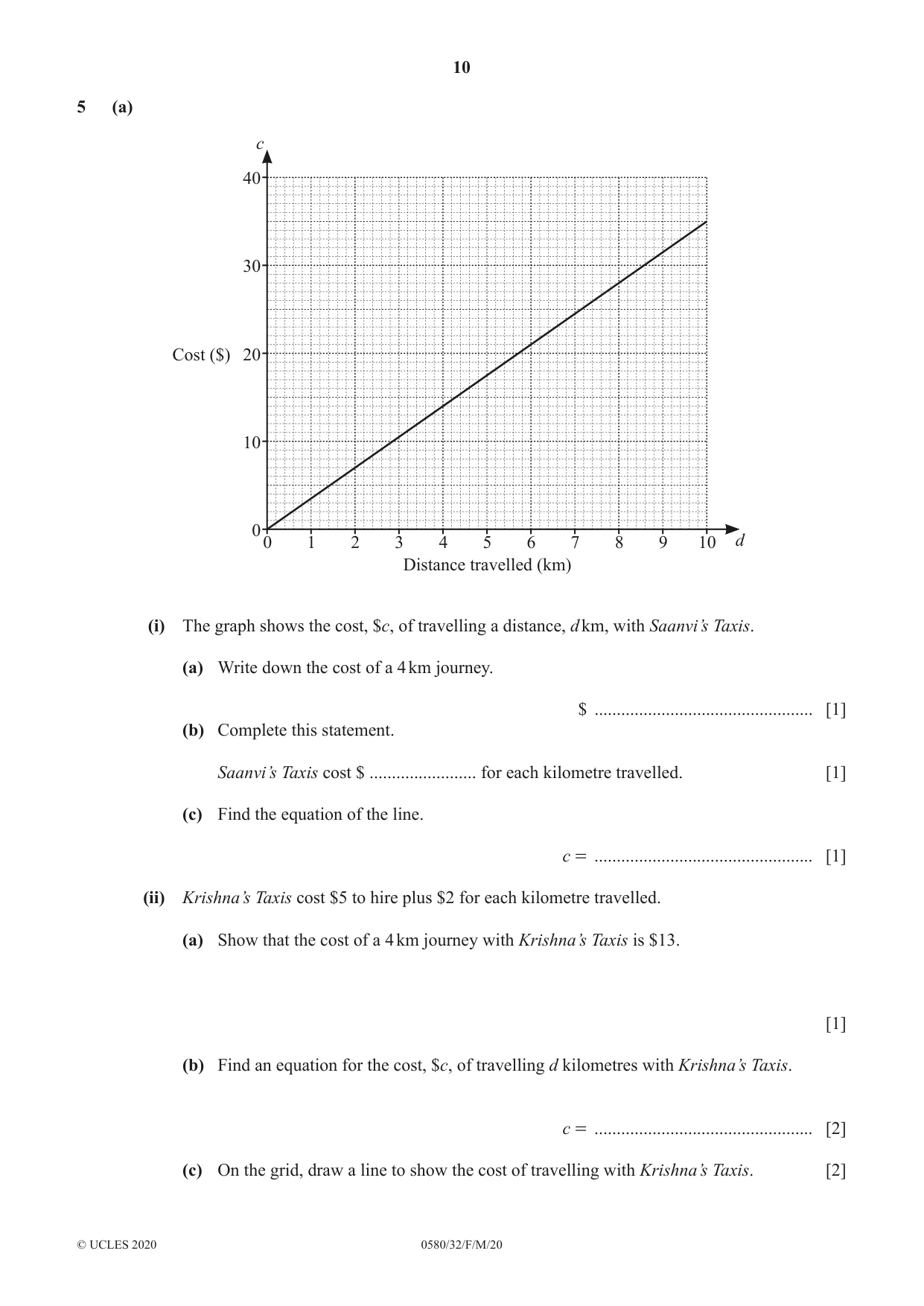
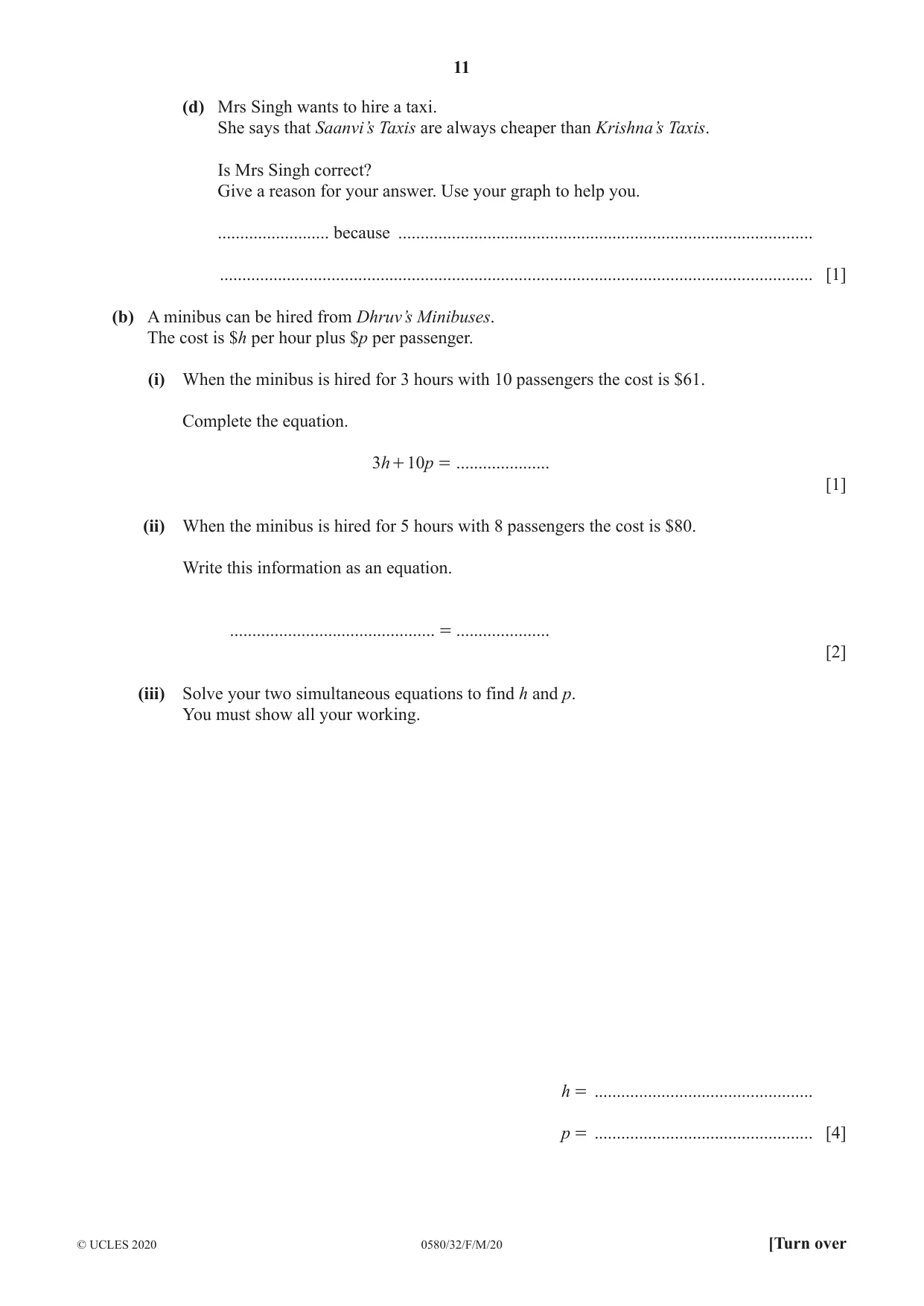
5 (a) c 40 30 Cost ($) 20 10 0 0 1 2 3 4 5 6 7 8 9 10 d Distance travelled (km) (i) The graph shows the cost, $c, of travelling a distance, d km, with Saanvi’s Taxis. (a) Write down the cost of a 4 km journey. $ ................................................. [1] (b) Complete this statement. Saanvi’s Taxis cost $ ........................ for each kilometre travelled. [1] (c) Find the equation of the line. c = ................................................. [1] (ii) Krishna’s Taxis cost $5 to hire plus $2 for each kilometre travelled. (a) Show that the cost of a 4 km journey with Krishna’s Taxis is $13. [1] (b) Find an equation for the cost, $c, of travelling d kilometres with Krishna’s Taxis. c = ................................................. [2] (c) On the grid, draw a line to show the cost of travelling with Krishna’s Taxis. [2] (d) Mrs Singh wants to hire a taxi. She says that Saanvi’s Taxis are always cheaper than Krishna’s Taxis. Is Mrs Singh correct? Give a reason for your answer. Use your graph to help you. ......................... because ............................................................................................. ..................................................................................................................................... [1] (b) A minibus can be hired from Dhruv’s Minibuses. The cost is $h per hour plus $p per passenger. (i) When the minibus is hired for 3 hours with 10 passengers the cost is $61. Complete the equation. 3h + 10p = ..................... [1] (ii) When the minibus is hired for 5 hours with 8 passengers the cost is $80. Write this information as an equation. .............................................. = ..................... [2] (iii) Solve your two simultaneous equations to find h and p. You must show all your working. h = ................................................. p = ................................................. [4]
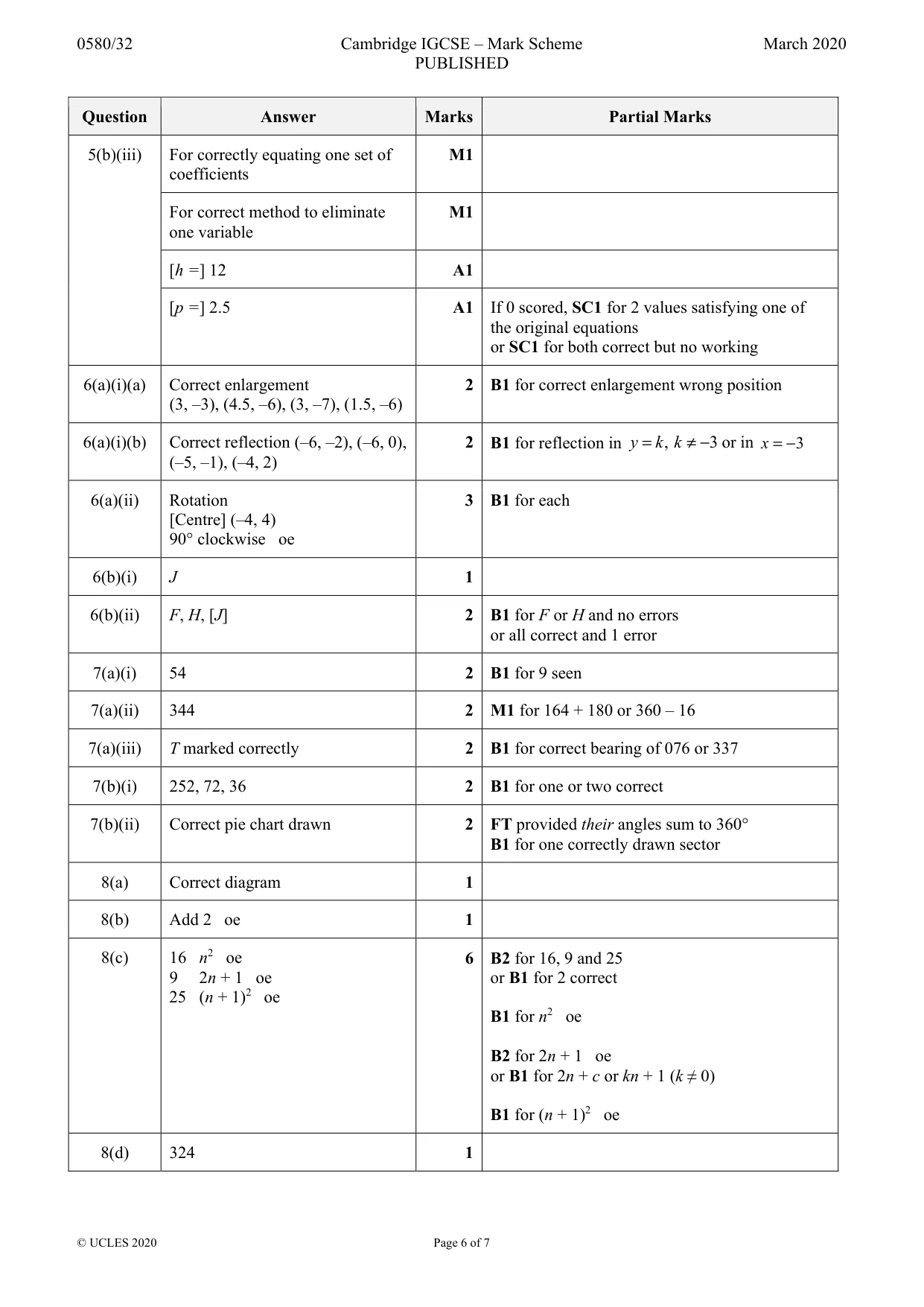
Mark scheme: 5(a)(i)(a) 14 1 5(a)(i)(b) 3.5[0] 1 5(a)(i)(c) [c=] 3.5d 1 FT their (a)(i)(b) 5(a)(ii)(a) 2 × 4 + 5 1 5(a)(ii)(b) [c=] 2d + 5 2 M1 for 2 d + k or md + 5, m ≠ 0 5(a)(ii)(c) Correct ruled line 2 M1 for ruled line with intercept (0, 5) or for ruled line with gradient 2 or for 2 correct points plotted or for their c= 2d + 5 correctly drawn 5(a)(ii)(d) No, with correct reason 1 FT if two intersecting linear graphs 5(b)(i) 61 1 5(b)(ii) 5h + 8p = 80 2 M1 for 5h + 8p 5(b)(iii) For correctly equating one set of M1 coefficients For correct method to eliminate M1 one variable [h =] 12 A1 [p =] 2.5 A1 If 0 scored, SC1 for 2 values satisfying one of the original equations or SC1 for both correct but no working
Q6 · Y 8 7 6 D 5 C 4 3 2 1 0 x –7 –6 –5 –4 –3 –2 –1 1 2 3 4 5 6 7 –1 –2 –3 –4 –5 A B –6 –7 –8…
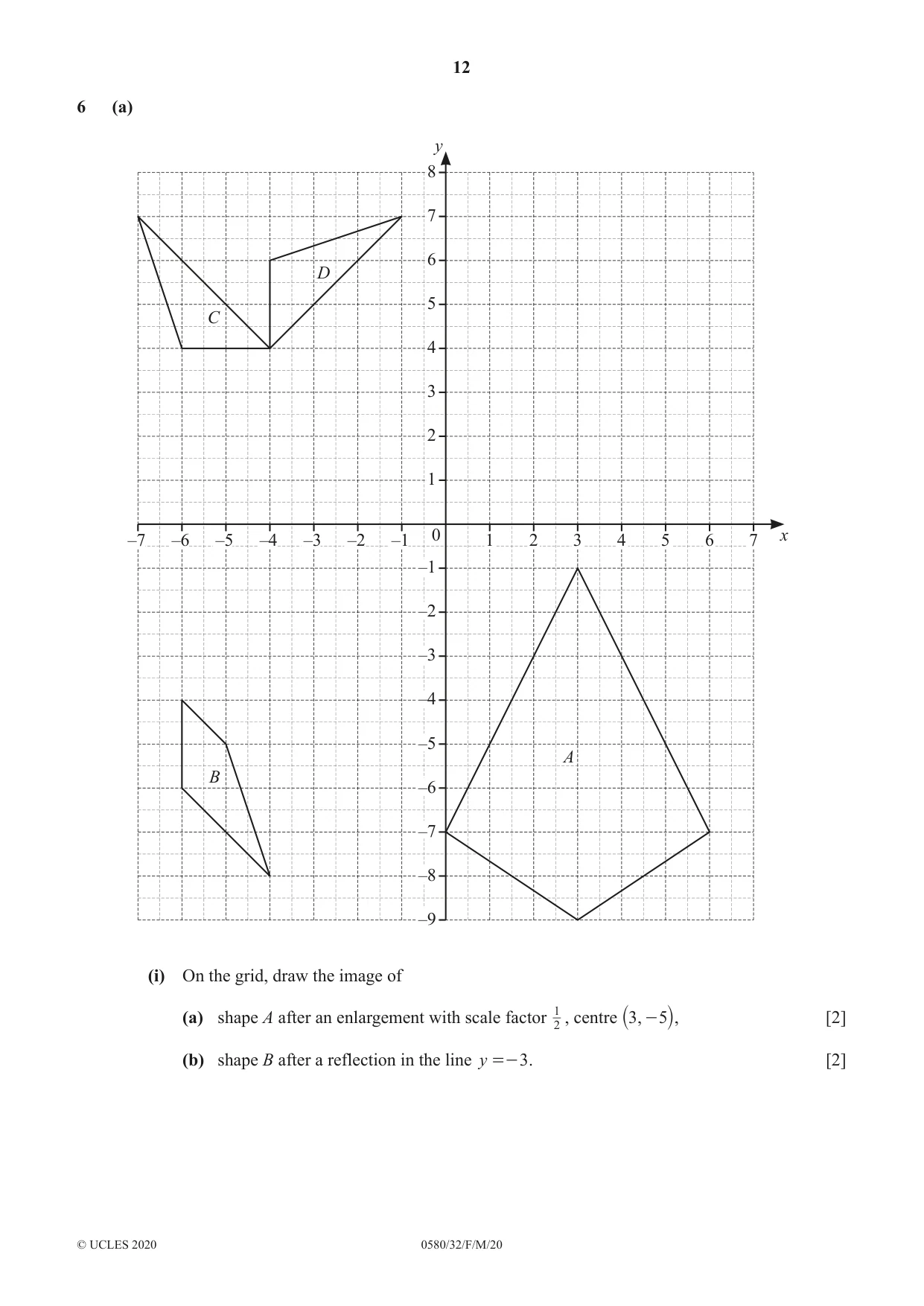
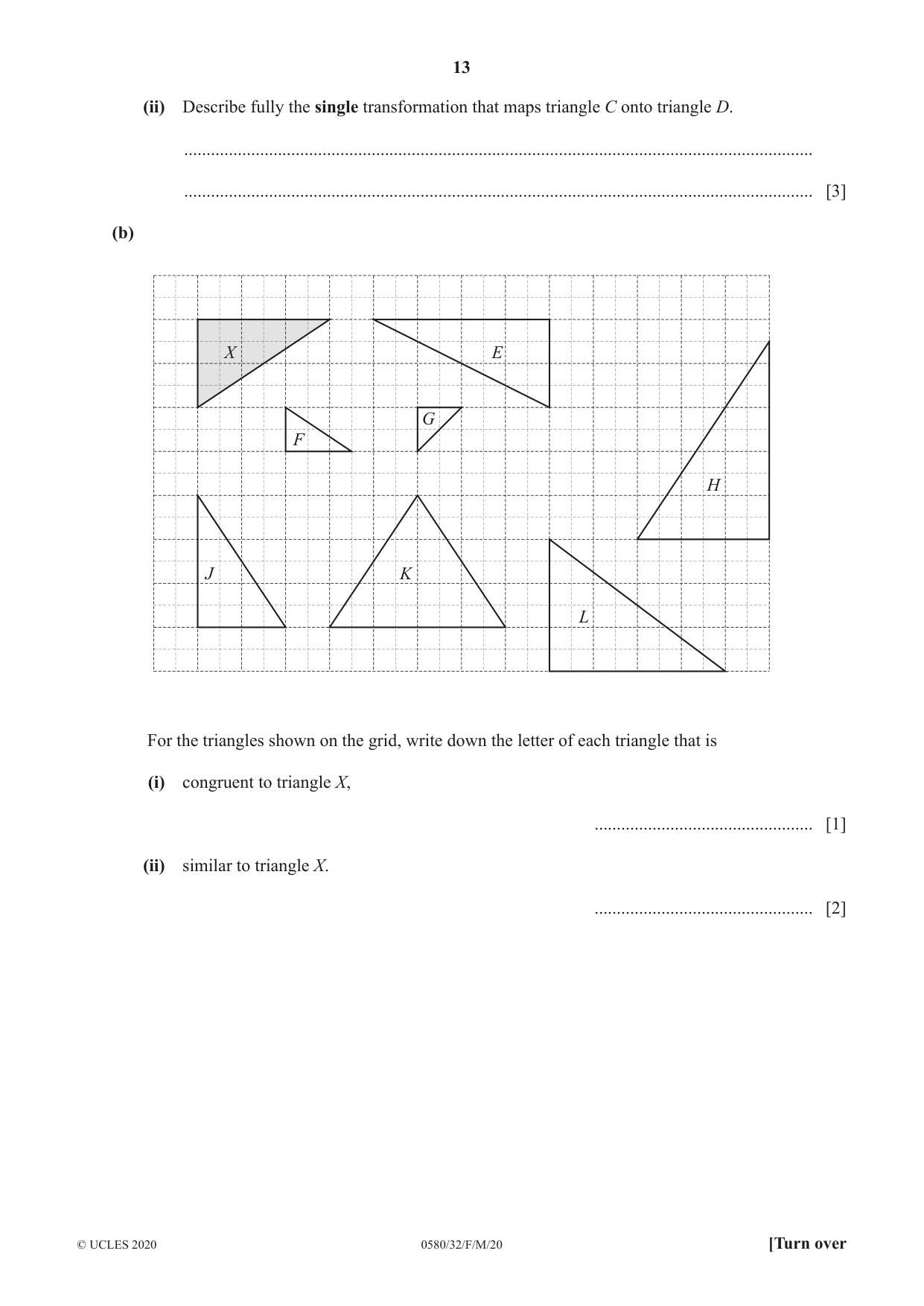
6 (a) y 8 7 6 D 5 C 4 3 2 1 0 x –7 –6 –5 –4 –3 –2 –1 1 2 3 4 5 6 7 –1 –2 –3 –4 –5 A B –6 –7 –8 –9 (i) On the grid, draw the image of - 5 [2] (a) shape A after an enlargement with scale factor 12 , centre ,3 ` j, (b) shape B after a reflection in the line y =- 3 . [2] (ii) Describe fully the single transformation that maps triangle C onto triangle D. ............................................................................................................................................. ............................................................................................................................................. [3] (b) X E G F H J K L For the triangles shown on the grid, write down the letter of each triangle that is (i) congruent to triangle X, ................................................. [1] (ii) similar to triangle X. ................................................. [2]
Mark scheme: 6(a)(i)(a) Correct enlargement 2 B1 for correct enlargement wrong position (3, –3), (4.5, –6), (3, –7), (1.5, –6) 6(a)(i)(b) Correct reflection (–6, –2), (–6, 0), 2 B1 for reflection in y = k , k ≠−3 or in x = − 3 (–5, –1), (–4, 2) 6(a)(ii) Rotation 3 B1 for each [Centre] (–4, 4) 90° clockwise oe 6(b)(i) J 1 6(b)(ii) F, H, [J] 2 B1 for F or H and no errors or all correct and 1 error
Q7 · The scale drawing shows the positions of a rock, R, and a statue, S, on a map
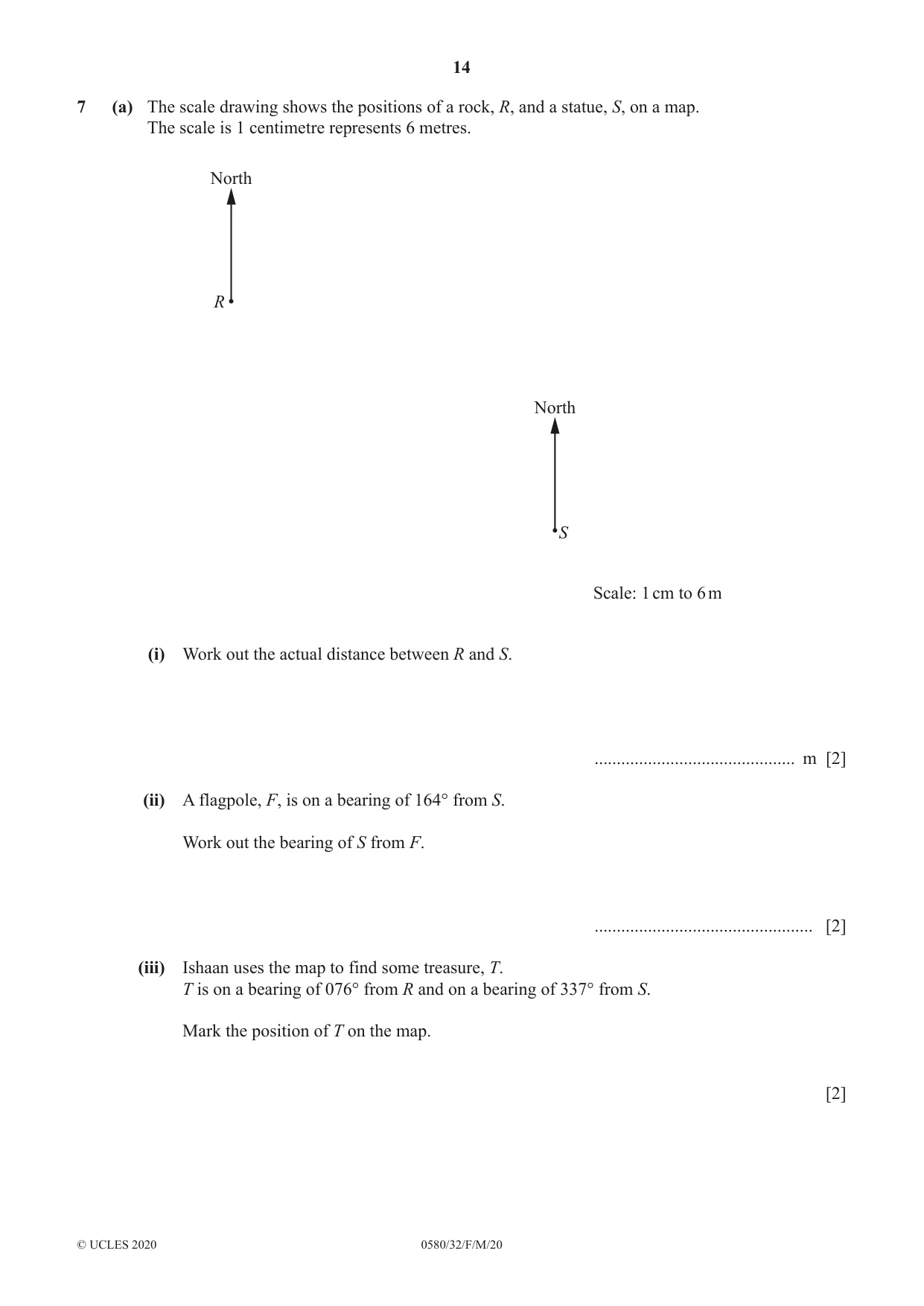
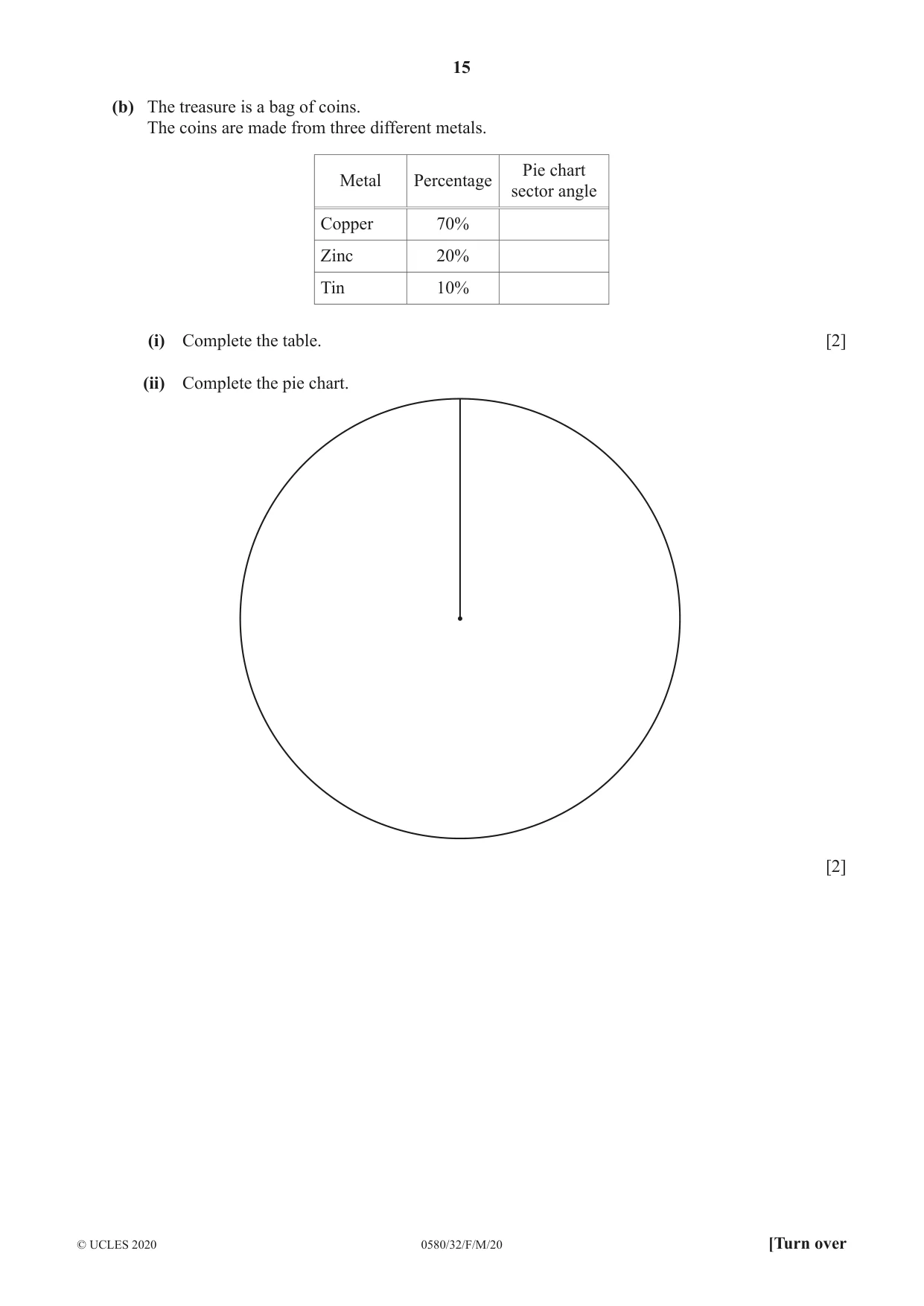
7 (a) The scale drawing shows the positions of a rock, R, and a statue, S, on a map. The scale is 1 centimetre represents 6 metres. North R North S Scale: 1 cm to 6 m (i) Work out the actual distance between R and S. ............................................. m [2] (ii) A flagpole, F, is on a bearing of 164° from S. Work out the bearing of S from F. ................................................. [2] (iii) Ishaan uses the map to find some treasure, T. T is on a bearing of 076° from R and on a bearing of 337° from S. Mark the position of T on the map. [2] (b) The treasure is a bag of coins. The coins are made from three different metals. Pie chart Metal Percentage sector angle Copper 70% Zinc 20% Tin 10% (i) Complete the table. [2] (ii) Complete the pie chart. [2]
Mark scheme: 7(a)(i) 54 2 B1 for 9 seen 7(a)(ii) 344 2 M1 for 164 + 180 or 360 – 16 7(a)(iii) T marked correctly 2 B1 for correct bearing of 076 or 337 7(b)(i) 252, 72, 36 2 B1 for one or two correct 7(b)(ii) Correct pie chart drawn 2 FT provided their angles sum to 360° B1 for one correctly drawn sector
Q8 · The grid shows the first three diagrams in a sequence
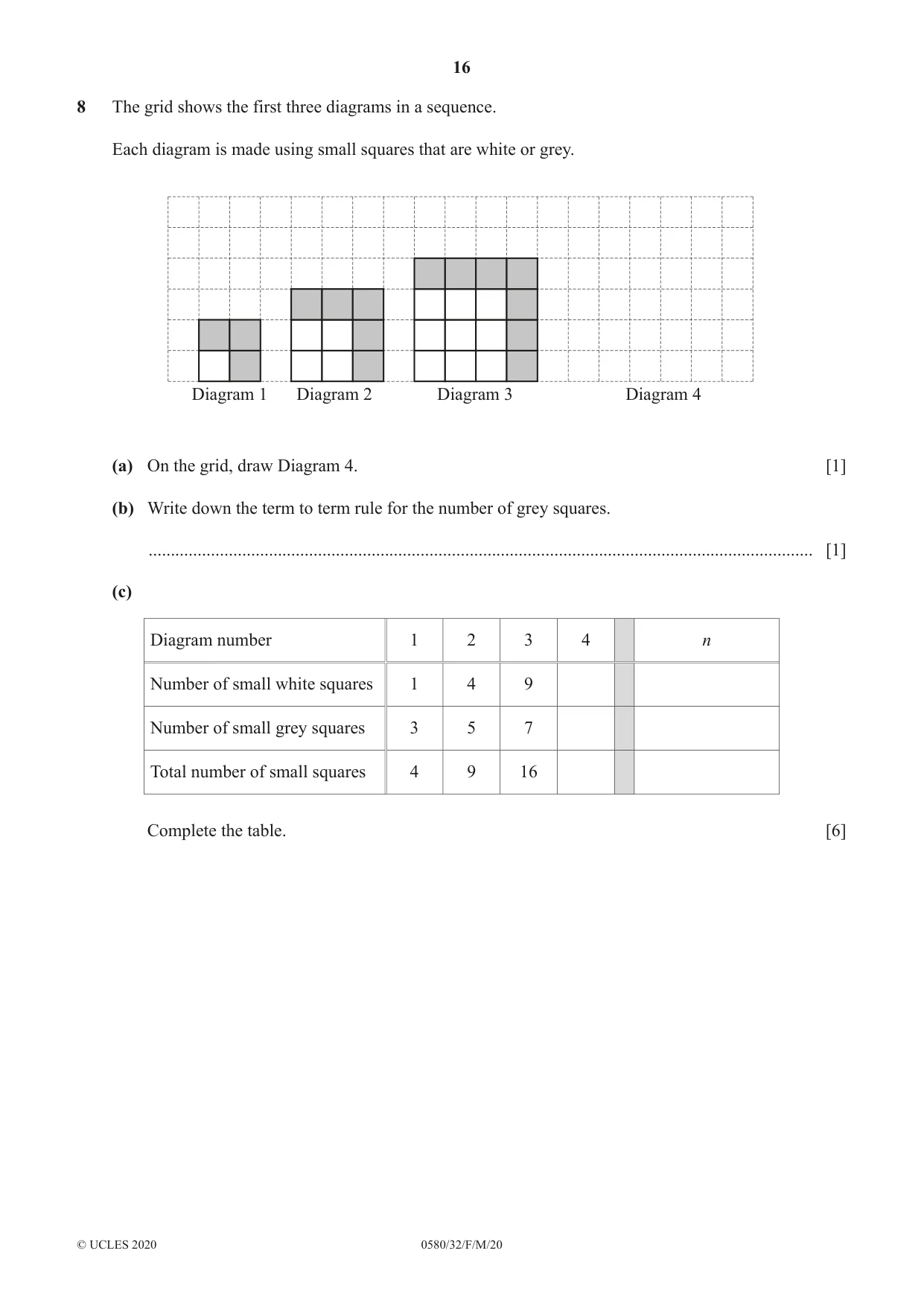
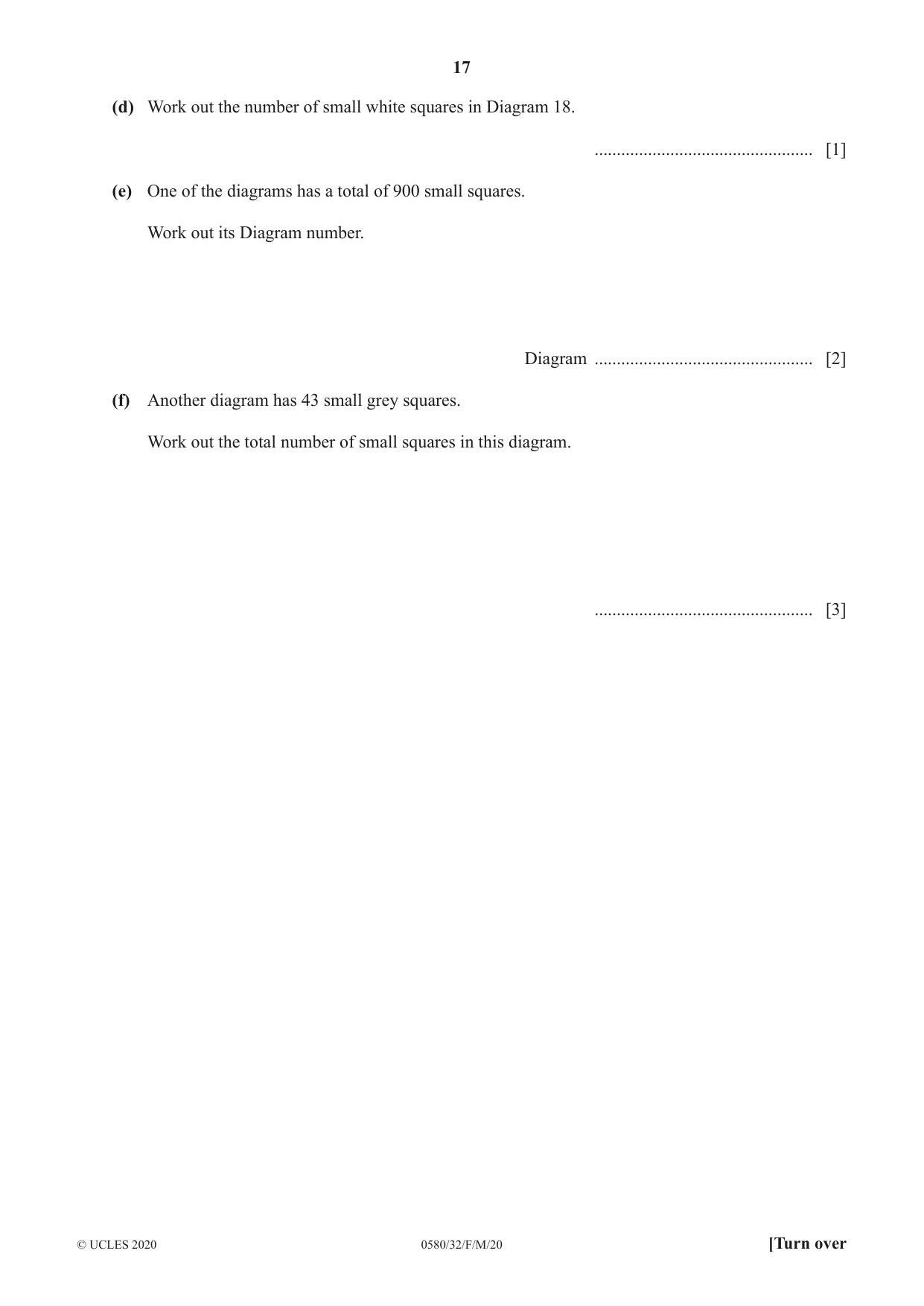
8 The grid shows the first three diagrams in a sequence. Each diagram is made using small squares that are white or grey. Diagram 1 Diagram 2 Diagram 3 Diagram 4 (a) On the grid, draw Diagram 4. [1] (b) Write down the term to term rule for the number of grey squares. ..................................................................................................................................................... [1] (c) Diagram number 1 2 3 4 n Number of small white squares 1 4 9 Number of small grey squares 3 5 7 Total number of small squares 4 9 16 Complete the table. [6] (d) Work out the number of small white squares in Diagram 18. ................................................. [1] (e) One of the diagrams has a total of 900 small squares. Work out its Diagram number. Diagram ................................................. [2] (f) Another diagram has 43 small grey squares. Work out the total number of small squares in this diagram. ................................................. [3]
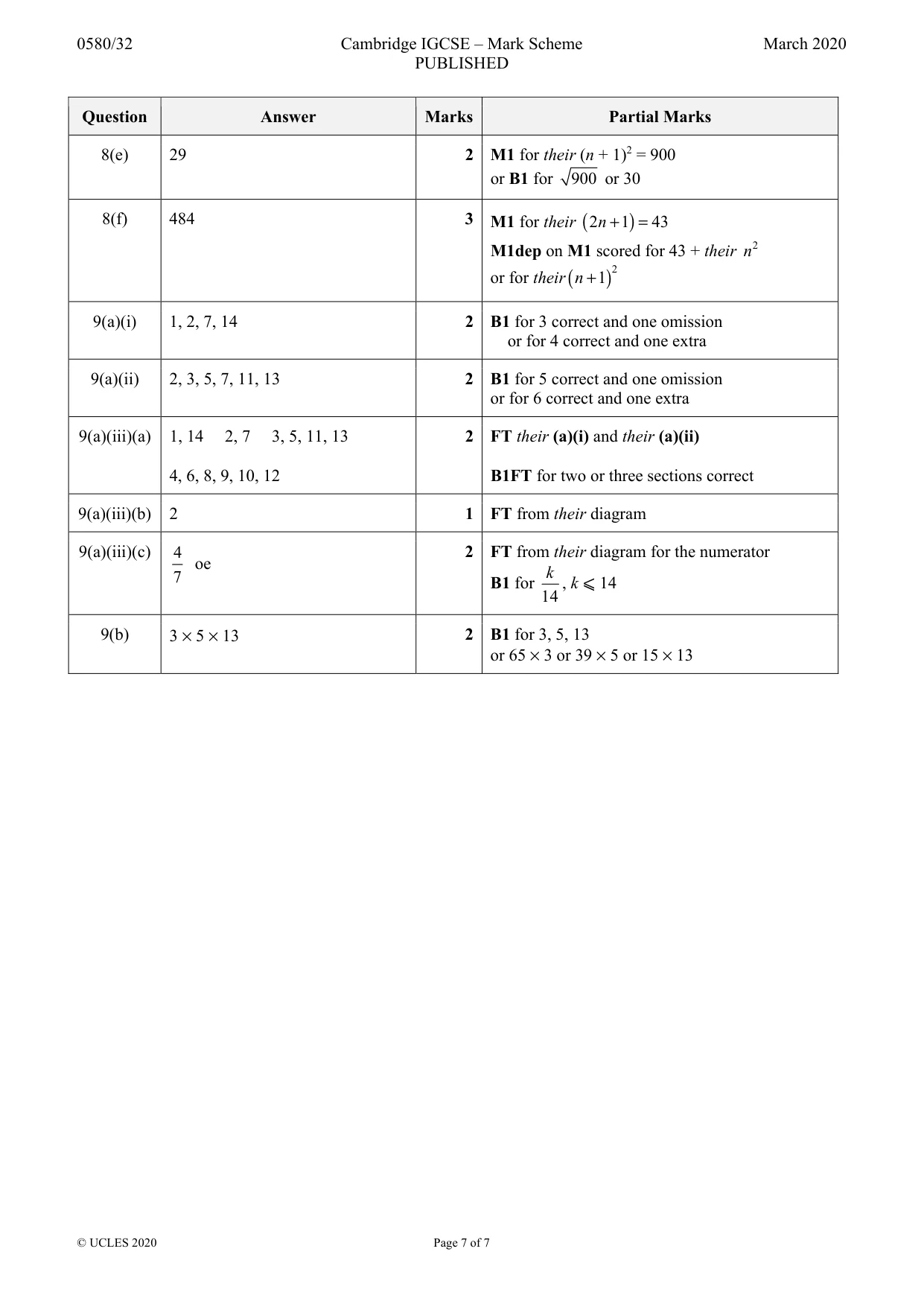
Mark scheme: 8(a) Correct diagram 1 8(b) Add 2 oe 1 8(c) 16 n2 oe 6 B2 for 16, 9 and 25 9 2n + 1 oe or B1 for 2 correct 25 (n + 1)2 oe B1 for n2 oe B2 for 2n + 1 oe or B1 for 2n + c or kn + 1 (k ≠ 0) B1 for (n + 1)2 oe 8(d) 324 1 8(e) 29 2 M1 for their (n + 1)2 = 900 or B1 for 900 or 30 8(f) 484 3 M1 for their ( 2 n + 1) = 43 M1dep on M1 scored for 43 + their n 2 2 or for their( n + 1)
Q9 · = {1, 2, 3, 4, 5, 6, 7, 8, 9, 10, 11, 12, 13, 14} F = {x: x is a factor of 14} P = {x…
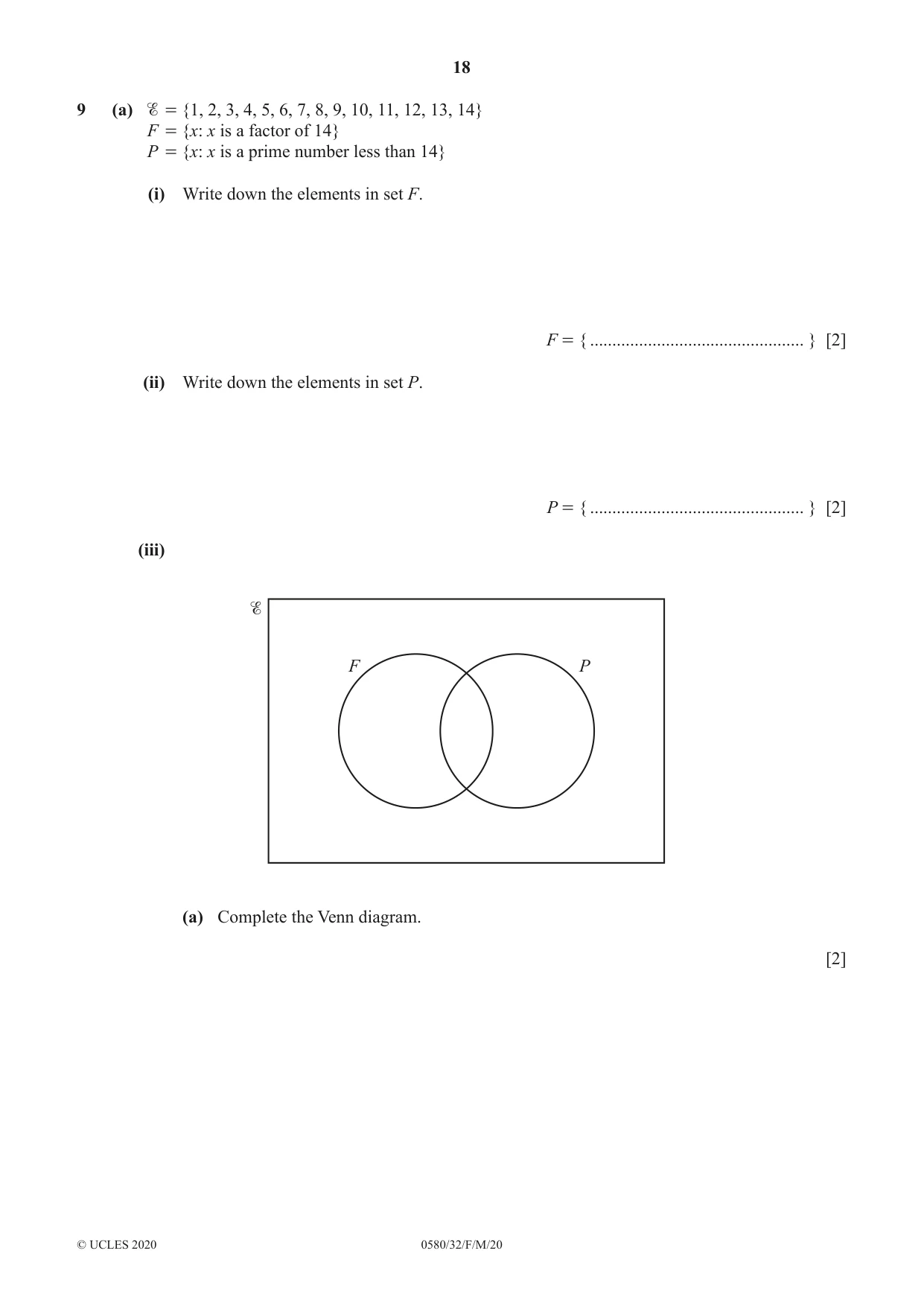
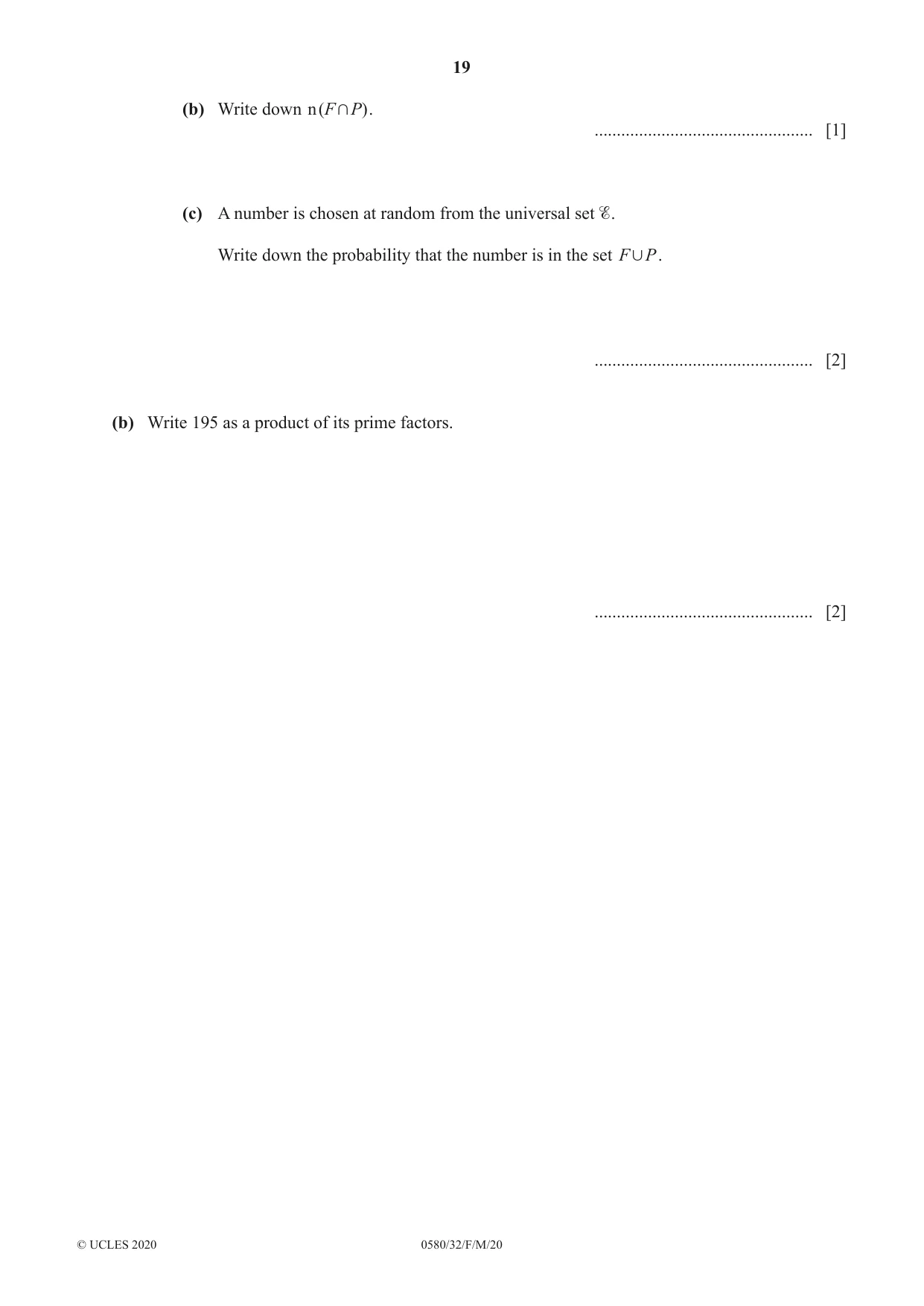
9 (a) = {1, 2, 3, 4, 5, 6, 7, 8, 9, 10, 11, 12, 13, 14} F = {x: x is a factor of 14} P = {x: x is a prime number less than 14} (i) Write down the elements in set F. F = { ................................................ } [2] (ii) Write down the elements in set P. P = { ................................................ } [2] (iii) F P (a) Complete the Venn diagram. [2] (b) Write down n ( F + P ) . ................................................. [1] (c) A number is chosen at random from the universal set . Write down the probability that the number is in the set F , P . ................................................. [2] (b) Write 195 as a product of its prime factors. ................................................. [2]
Mark scheme: 9(a)(i) 1, 2, 7, 14 2 B1 for 3 correct and one omission or for 4 correct and one extra 9(a)(ii) 2, 3, 5, 7, 11, 13 2 B1 for 5 correct and one omission or for 6 correct and one extra 9(a)(iii)(a) 1, 14 2, 7 3, 5, 11, 13 2 FT their (a)(i) and their (a)(ii) 4, 6, 8, 9, 10, 12 B1FT for two or three sections correct 9(a)(iii)(b) 2 1 FT from their diagram 9(a)(iii)(c) 4 2 FT from their diagram for the numerator oe 7 k B1 for , k ⩽ 14 14 9(b) 3 × 5 × 13 2 B1 for 3, 5, 13 or 65 × 3 or 39 × 5 or 15 × 13
What was in this paper
The subtopics covered by these 9 questions, and how many questions each got. Open one in a new tab to see every Cambridge question on it.
What you needed in this session
Cambridge’s own grade thresholds for 2020 Feb/March, Paper 3 · Variant 2. A higher threshold means an easier paper — the bar moves with how the cohort did.