Cambridge IGCSE Mathematics 0580 — 2019 Feb/March Paper 3 · Variant 2
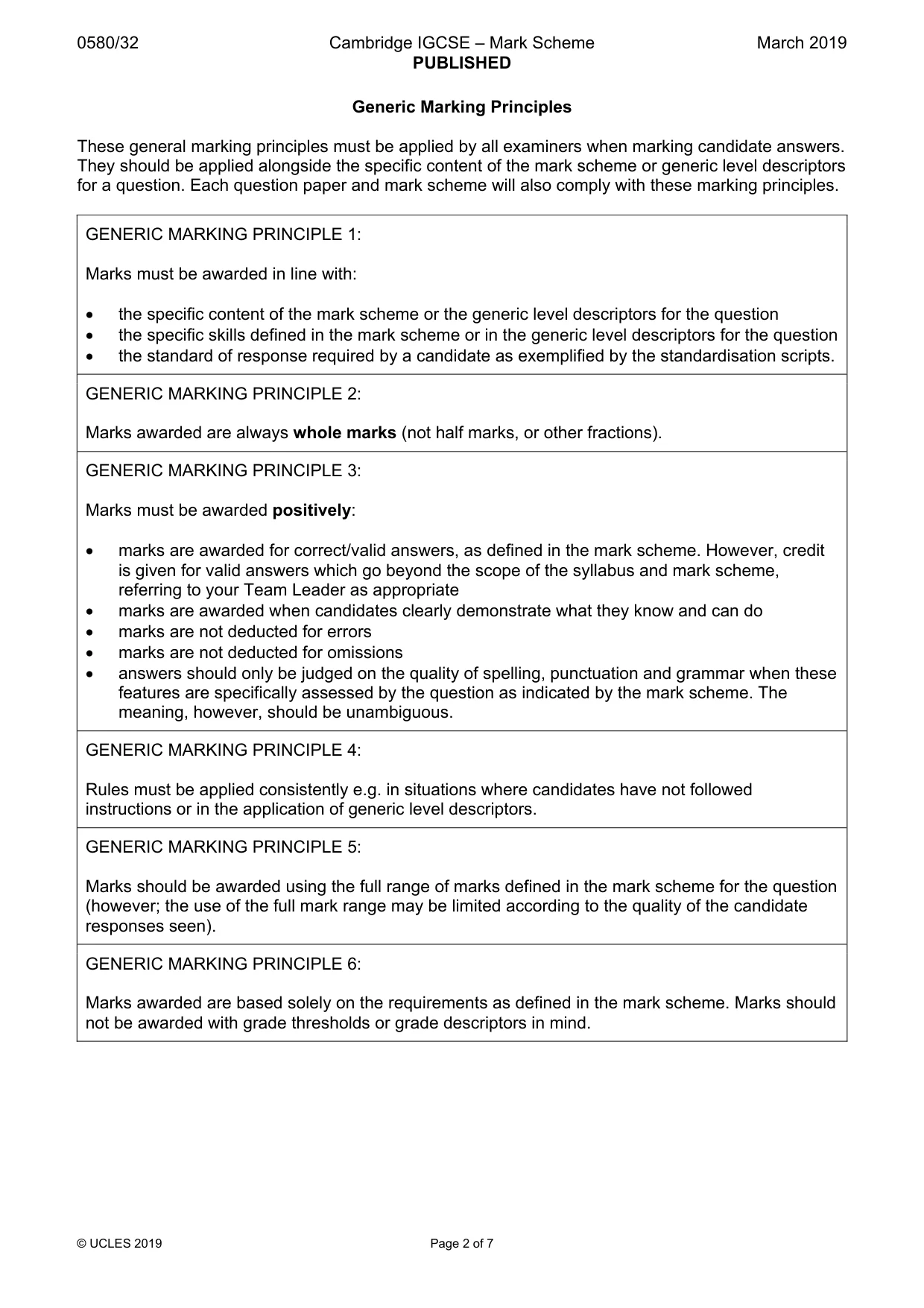
0580/32/F/M/19 · 10 questions · 104 marks · ≈117 min
The question paper and its mark scheme, free to read here and free to download. This is Cambridge’s own paper, exactly as it was sat.
Question paper20 pages

Mark scheme7 pages
Answers below. Sit the paper first if you are practising.
Questions as text
Q1 · 60 boys are asked to name their favourite sport
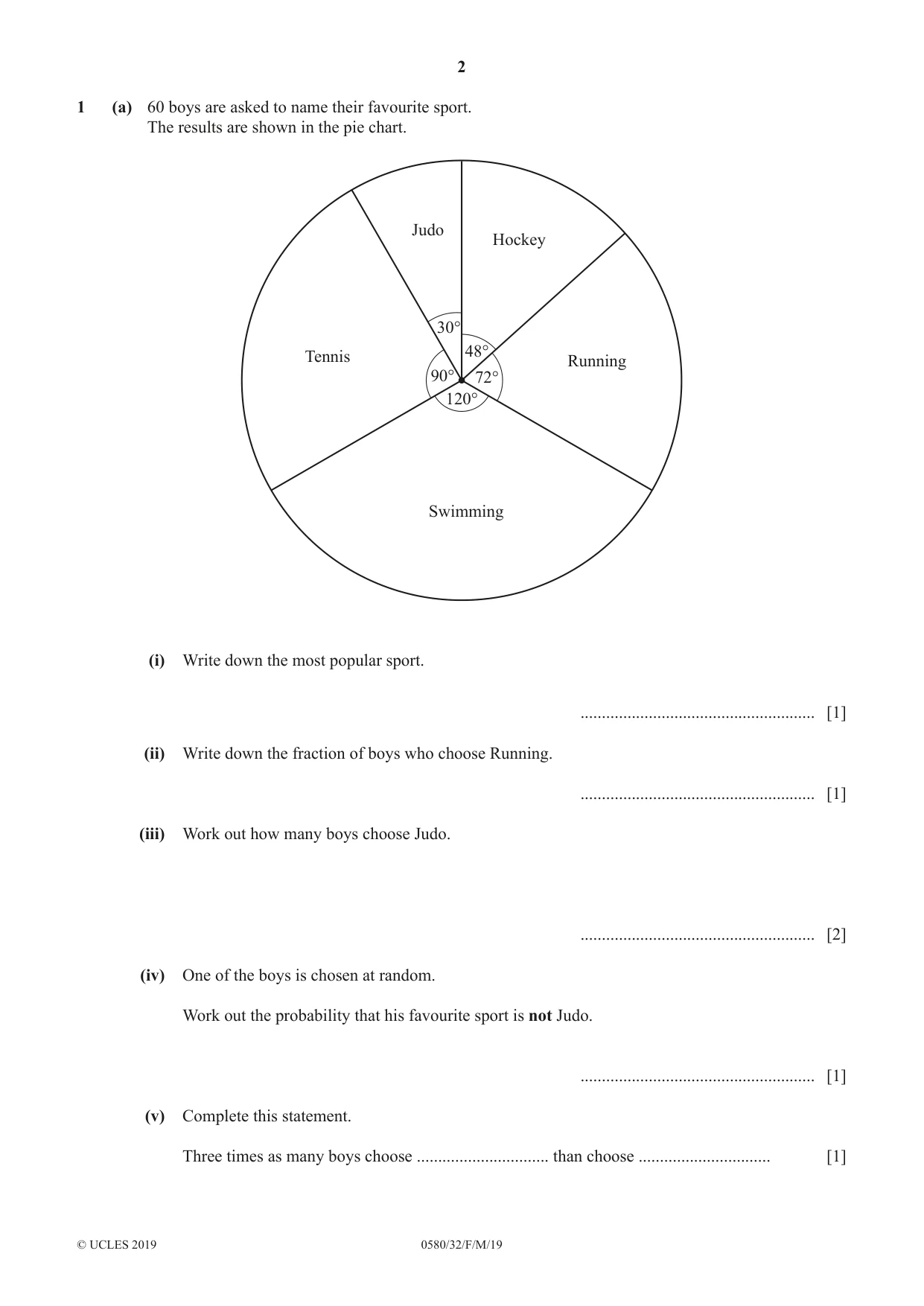
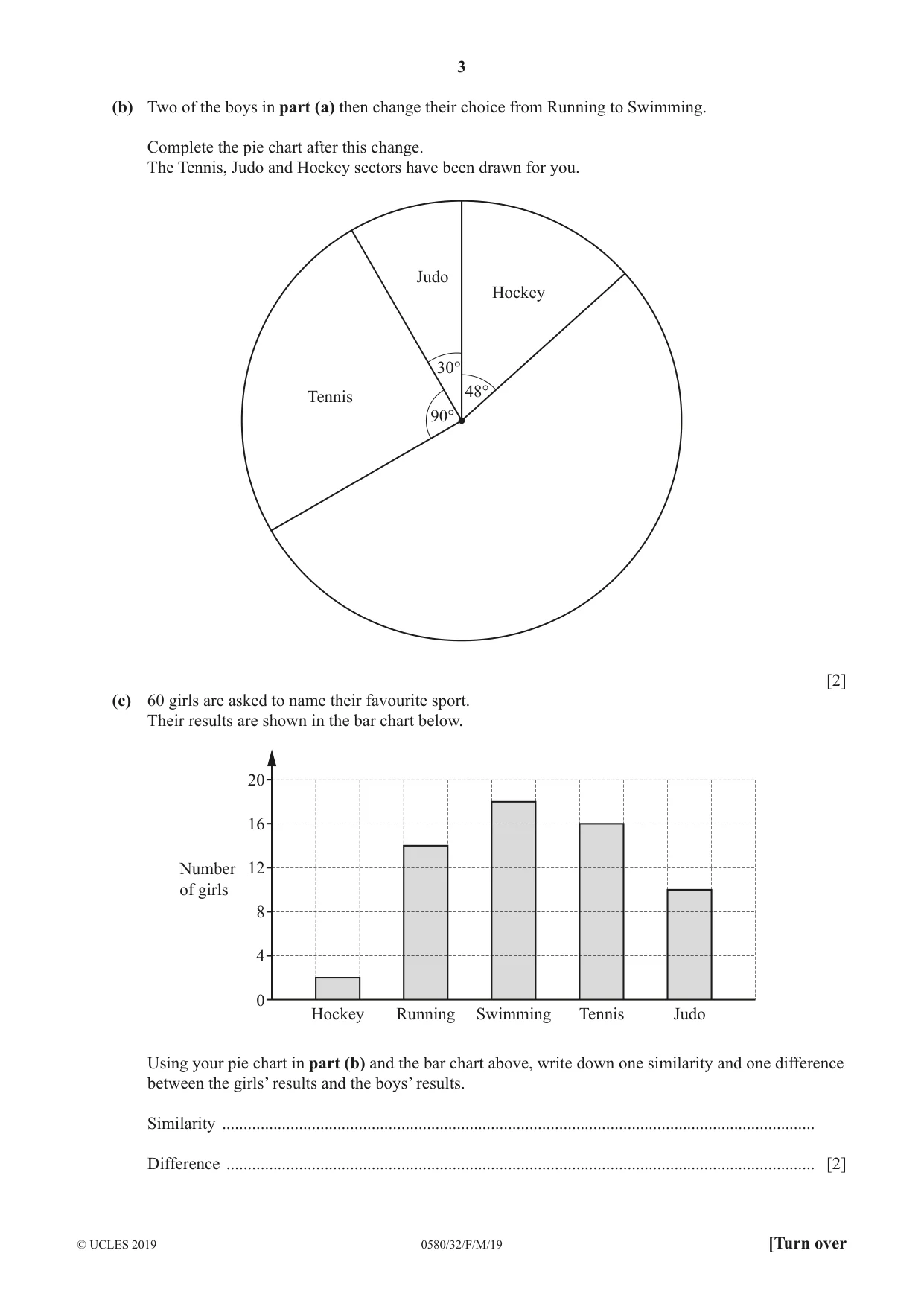
1 (a) 60 boys are asked to name their favourite sport. The results are shown in the pie chart. Judo Hockey 30° 48° Tennis Running 90° 72° 120° Swimming (i) Write down the most popular sport. ....................................................... [1] (ii) Write down the fraction of boys who choose Running. ....................................................... [1] (iii) Work out how many boys choose Judo. ....................................................... [2] (iv) One of the boys is chosen at random. Work out the probability that his favourite sport is not Judo. ....................................................... [1] (v) Complete this statement. Three times as many boys choose ............................... than choose ............................... [1] (b) Two of the boys in part (a) then change their choice from Running to Swimming. Complete the pie chart after this change. The Tennis, Judo and Hockey sectors have been drawn for you. Judo Hockey 30° 48° Tennis 90° [2] (c) 60 girls are asked to name their favourite sport. Their results are shown in the bar chart below. 20 16 Number 12 of girls 8 4 0 Hockey Running Swimming Tennis Judo Using your pie chart in part (b) and the bar chart above, write down one similarity and one difference between the girls’ results and the boys’ results. Similarity ........................................................................................................................................... Difference .......................................................................................................................................... [2]
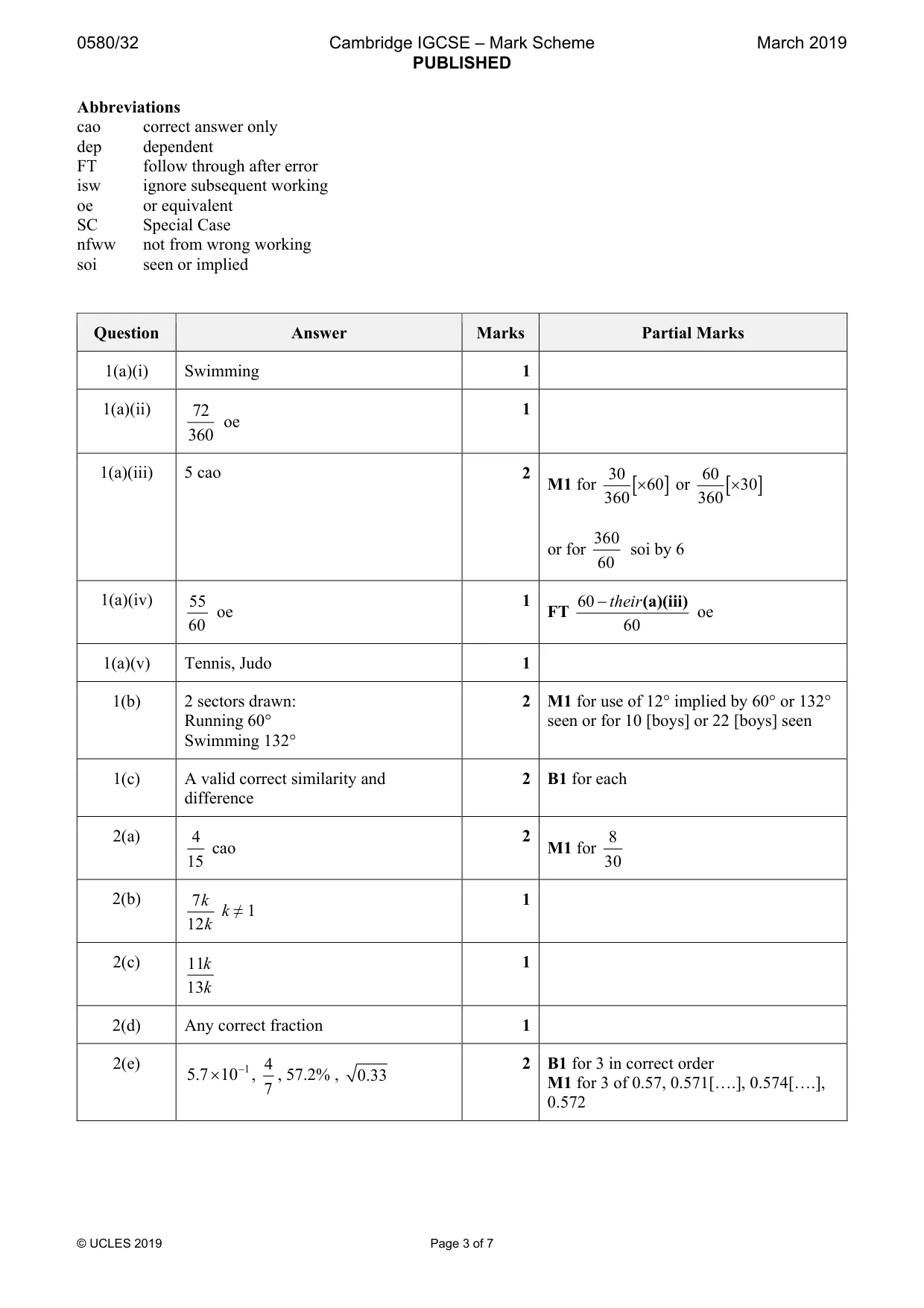
Mark scheme: Question Answer Marks Partial Marks 1(a)(i) Swimming 1 1(a)(ii) 72 1 oe 360 1(a)(iii) 5 cao 2 30 60 M1 for [× 60 ] or [× 30 ] 360 360 360 or for soi by 6 60 1(a)(iv) 55 1 60 − their (a)(iii) oe FT oe 60 60 1(a)(v) Tennis, Judo 1 1(b) 2 sectors drawn: 2 M1 for use of 12° implied by 60° or 132° Running 60° seen or for 10 [boys] or 22 [boys] seen Swimming 132° 1(c) A valid correct similarity and 2 B1 for each difference
Q2 · Write down the fraction of the rectangle that is shaded
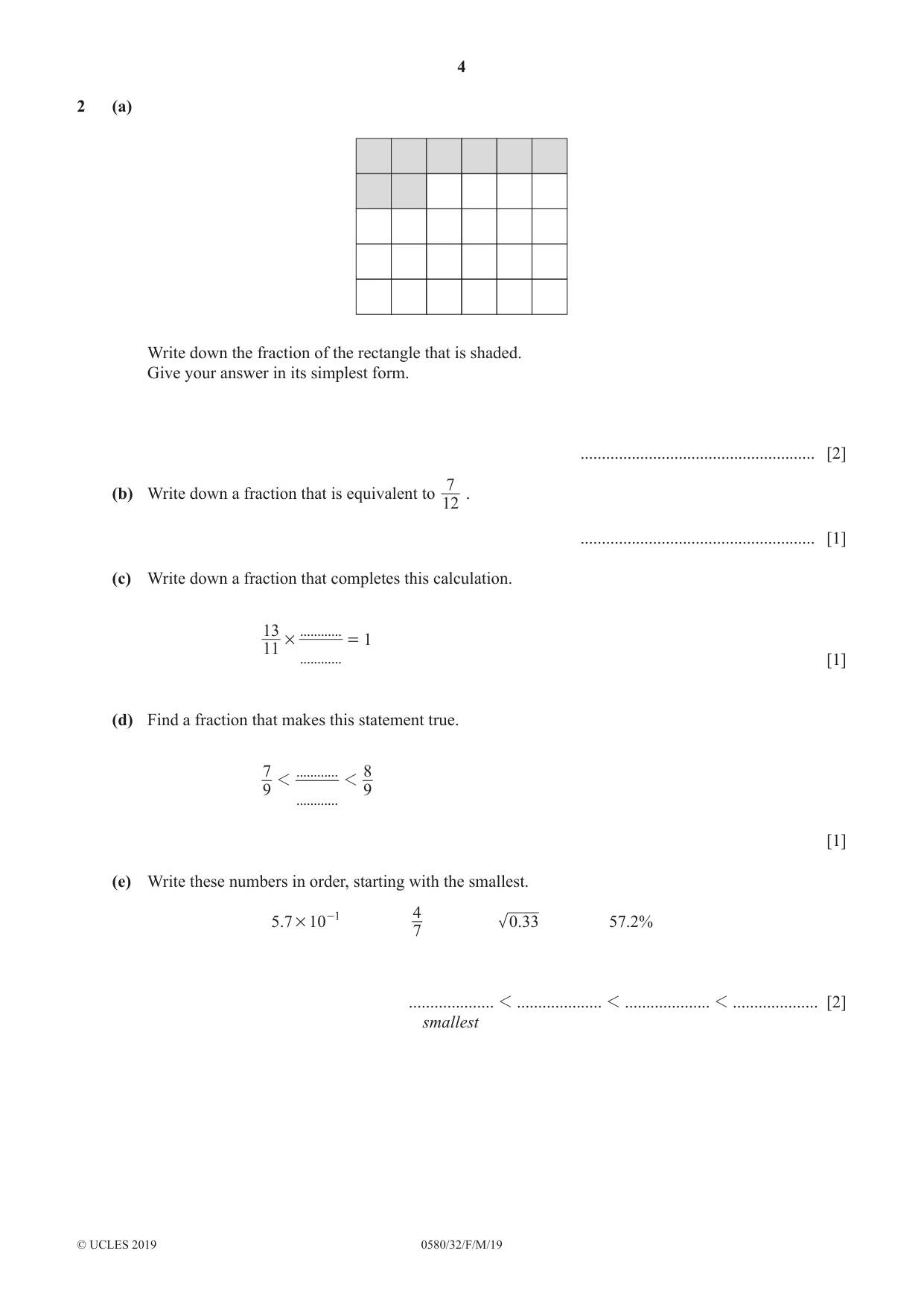
2 (a) Write down the fraction of the rectangle that is shaded. Give your answer in its simplest form. ....................................................... [2] 7 (b) Write down a fraction that is equivalent to . 12 ....................................................... [1] (c) Write down a fraction that completes this calculation. 13 ............ # = 1 11 ............ [1] (d) Find a fraction that makes this statement true. 7 ............ 8 1 1 9 9 ............ [1] (e) Write these numbers in order, starting with the smallest. -1 4 .57 # 10 .033 57.2% 7 .................... 1 .................... 1 .................... 1 .................... [2] smallest
Mark scheme: 2(a) 4 2 8 cao M1 for 15 30 2(b) 7 k 1 k ≠ 1 12 k 2(c) 11k 1 13k 2(d) Any correct fraction 1 2(e) 1 4 2 B1 for 3 in correct order 5.7 × 10− , , 57.2% , 0.33 M1 for 3 of 0.57, 0.571[….], 0.574[….], 7 0.572
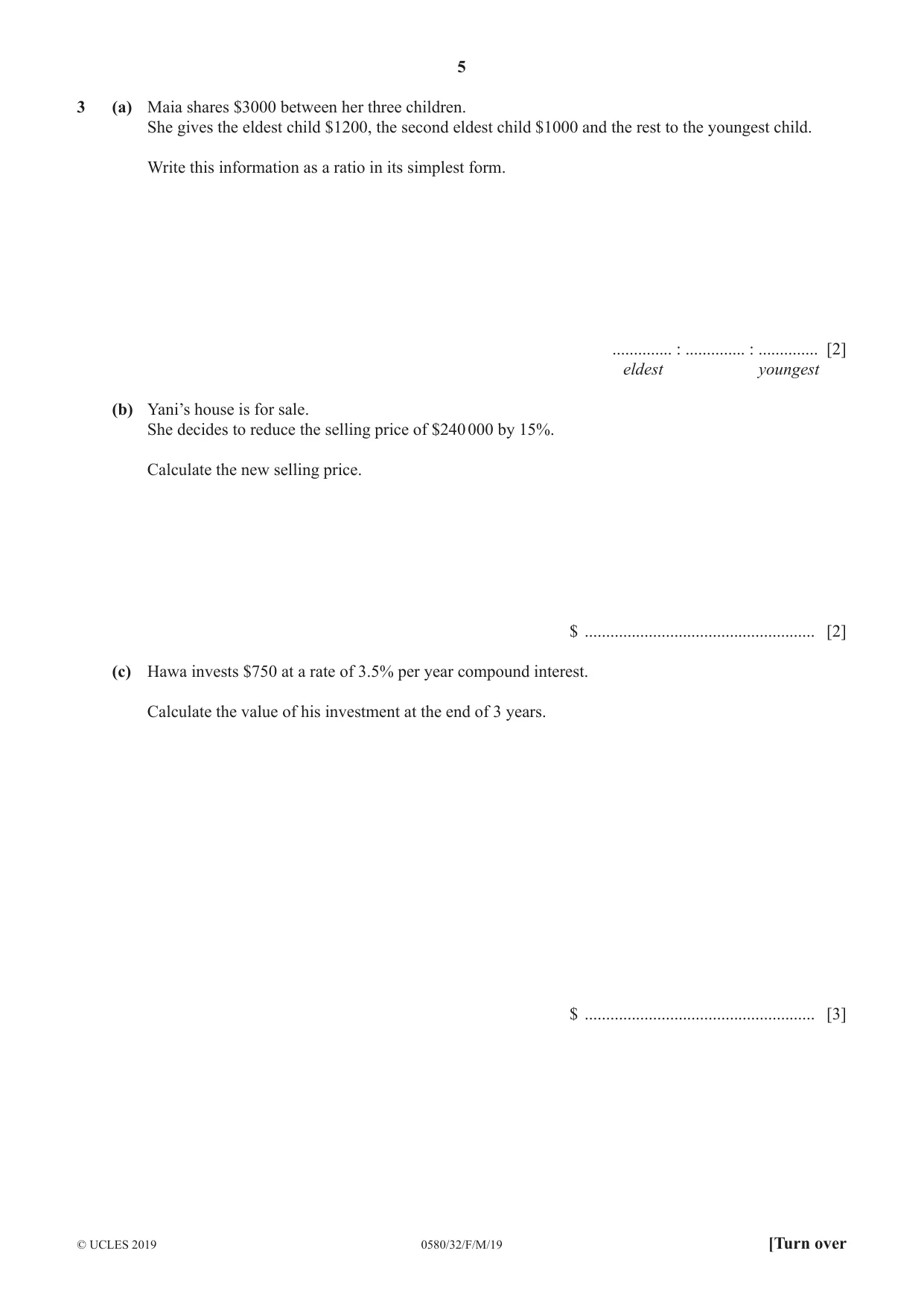
Q3 · Maia shares $3000 between her three children
3 (a) Maia shares $3000 between her three children. She gives the eldest child $1200, the second eldest child $1000 and the rest to the youngest child. Write this information as a ratio in its simplest form. .............. : .............. : .............. [2] eldest youngest (b) Yani’s house is for sale. She decides to reduce the selling price of $240 000 by 15%. Calculate the new selling price. $ ...................................................... [2] (c) Hawa invests $750 at a rate of 3.5% per year compound interest. Calculate the value of his investment at the end of 3 years. $ ...................................................... [3]
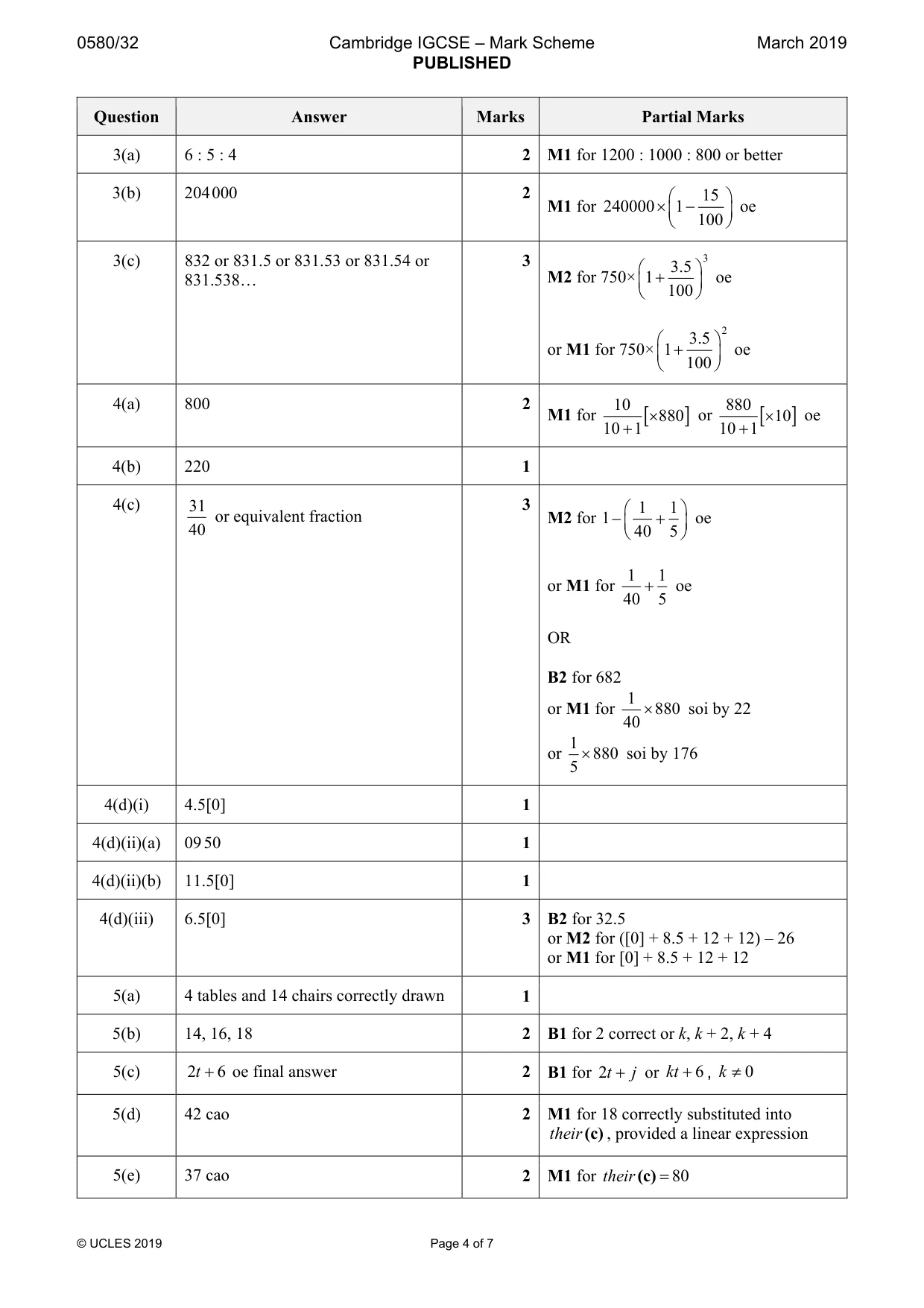
Mark scheme: 3(a) 6 : 5 : 4 2 M1 for 1200 : 1000 : 800 or better 3(b) 204 000 2 15 M1 for 240000 × 1 − oe 100 3(c) 832 or 831.5 or 831.53 or 831.54 or 3 3 3.5 831.538… M2 for 750× 1 + oe 100 3.5 2 or M1 for 750× 1 + oe 100
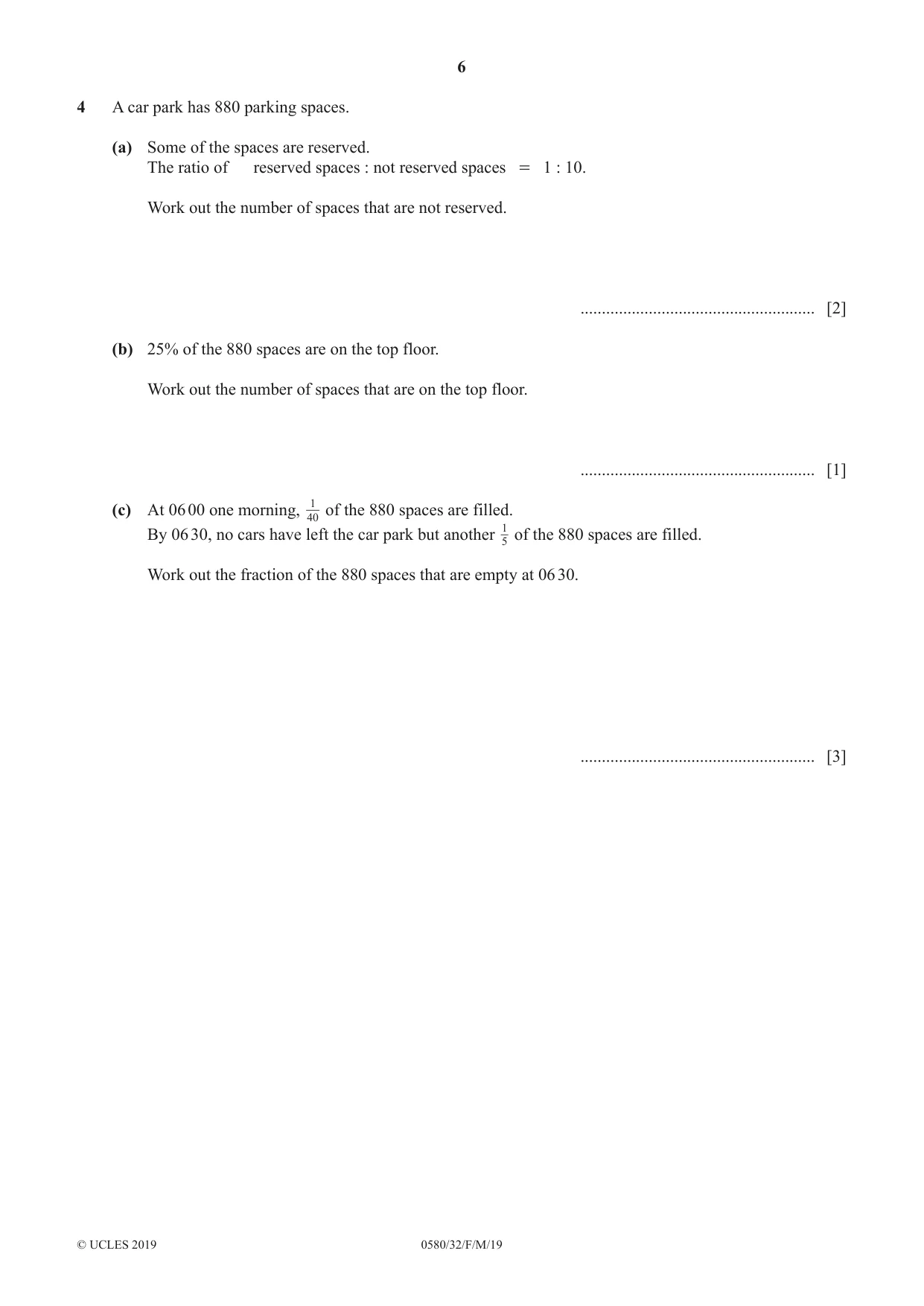
Q4 · A car park has 880 parking spaces
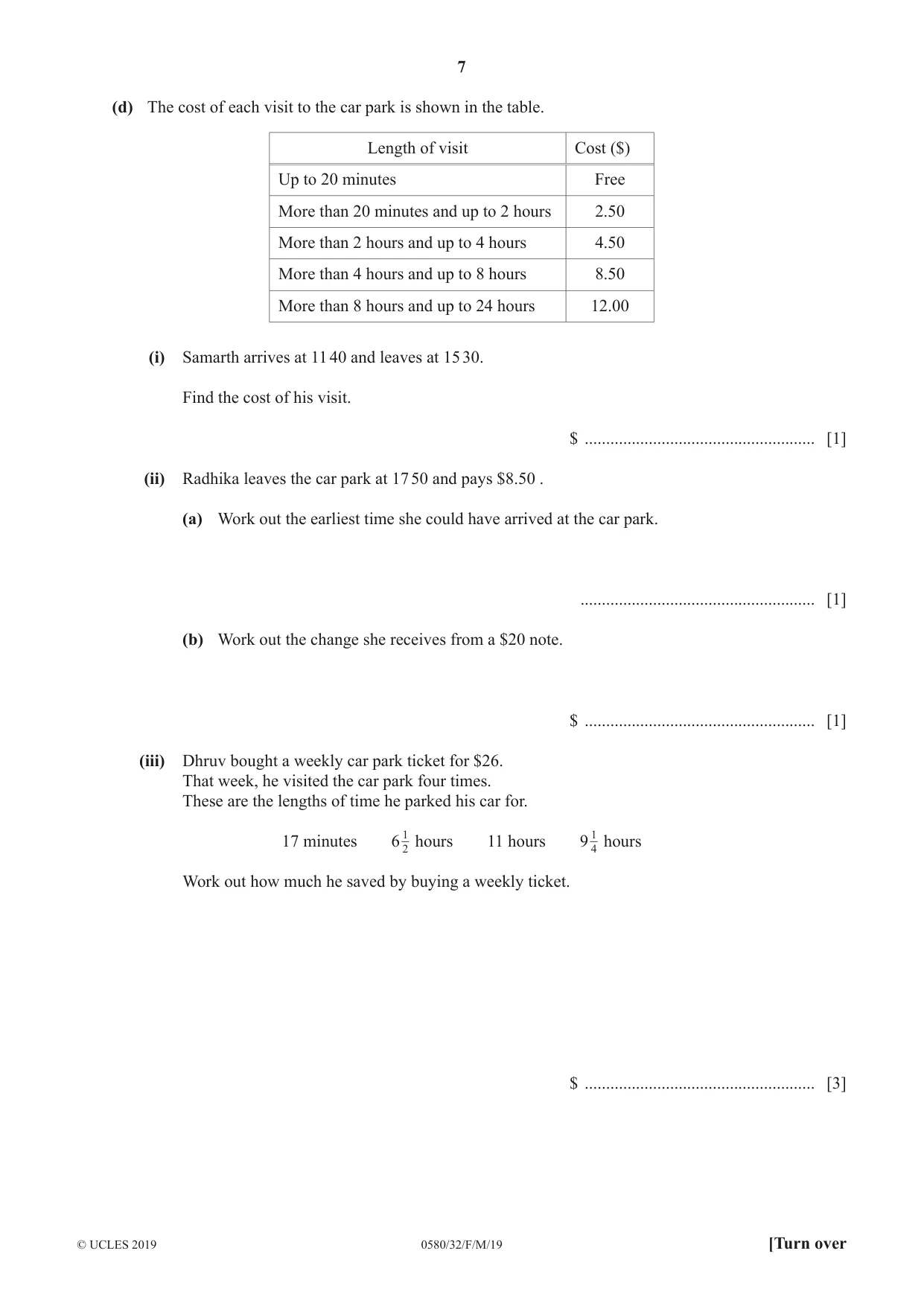
4 A car park has 880 parking spaces. (a) Some of the spaces are reserved. The ratio of reserved spaces : not reserved spaces = 1 : 10. Work out the number of spaces that are not reserved. ....................................................... [2] (b) 25% of the 880 spaces are on the top floor. Work out the number of spaces that are on the top floor. ....................................................... [1] (c) At 06 00 one morning, 401 of the 880 spaces are filled. By 06 30, no cars have left the car park but another 15 of the 880 spaces are filled. Work out the fraction of the 880 spaces that are empty at 06 30. ....................................................... [3] (d) The cost of each visit to the car park is shown in the table. Length of visit Cost ($) Up to 20 minutes Free More than 20 minutes and up to 2 hours 2.50 More than 2 hours and up to 4 hours 4.50 More than 4 hours and up to 8 hours 8.50 More than 8 hours and up to 24 hours 12.00 (i) Samarth arrives at 11 40 and leaves at 15 30. Find the cost of his visit. $ ...................................................... [1] (ii) Radhika leaves the car park at 17 50 and pays $8.50 . (a) Work out the earliest time she could have arrived at the car park. ....................................................... [1] (b) Work out the change she receives from a $20 note. $ ...................................................... [1] (iii) Dhruv bought a weekly car park ticket for $26. That week, he visited the car park four times. These are the lengths of time he parked his car for. 17 minutes 6 12 hours 11 hours 9 14 hours Work out how much he saved by buying a weekly ticket. $ ...................................................... [3]
Mark scheme: 4(a) 800 2 10 880 M1 for [× 880 ] or [× 10 ] oe 10 + 1 10 + 1 4(b) 220 1 4(c) 31 3 1 1 or equivalent fraction M2 for 1 − + oe 40 40 5 1 1 or M1 for + oe 40 5 OR B2 for 682 1 or M1 for × 880 soi by 22 40 1 or × 880 soi by 176 5 4(d)(i) 4.5[0] 1 4(d)(ii)(a) 09 50 1 4(d)(ii)(b) 11.5[0] 1 4(d)(iii) 6.5[0] 3 B2 for 32.5 or M2 for ([0] + 8.5 + 12 + 12) – 26 or M1 for [0] + 8.5 + 12 + 12
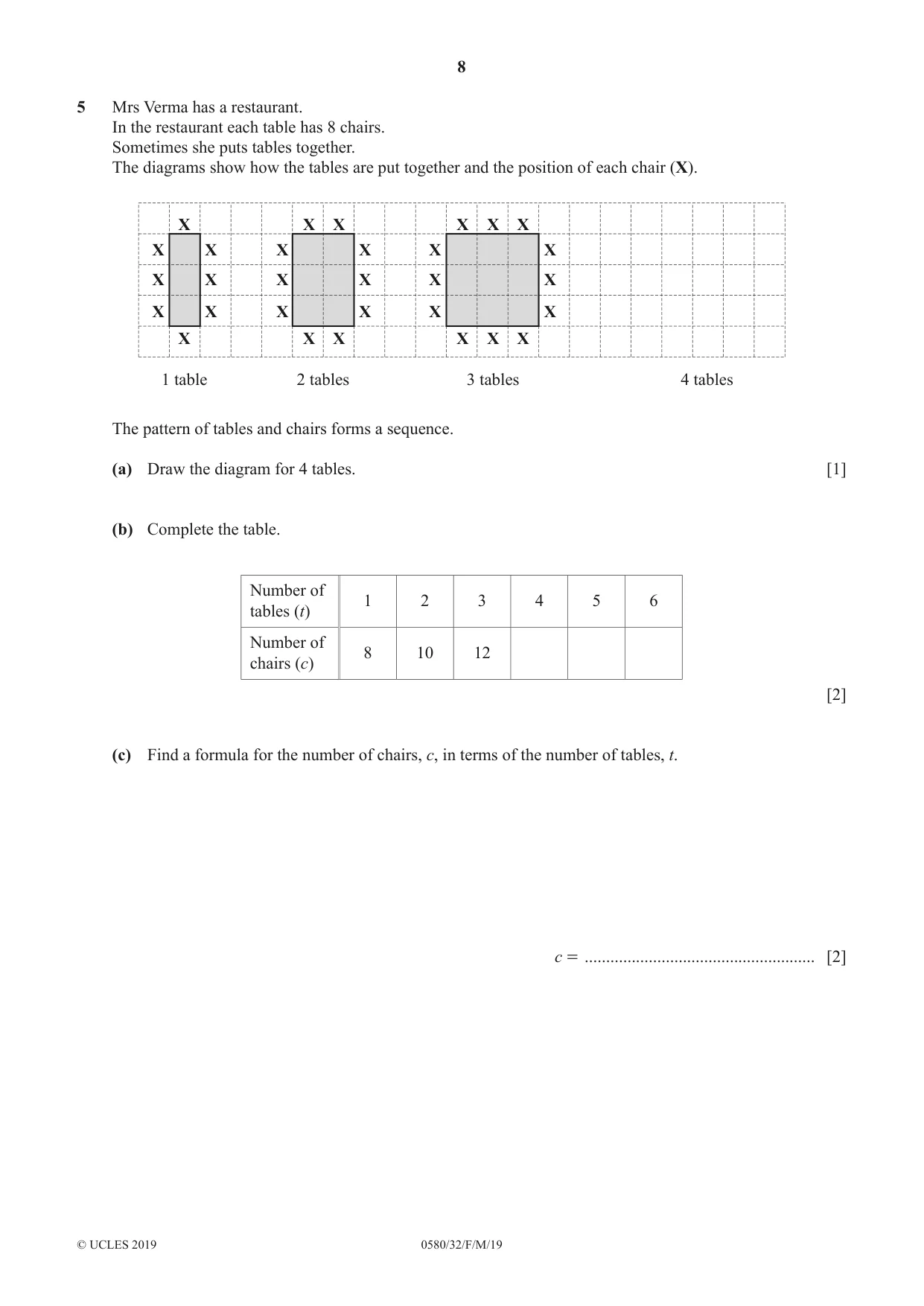
Q5 · Mrs Verma has a restaurant
5 Mrs Verma has a restaurant. In the restaurant each table has 8 chairs. Sometimes she puts tables together. The diagrams show how the tables are put together and the position of each chair (X). X X X X X X X X X X X X X X X X X X X X X X X X X X X X X X 1 table 2 tables 3 tables 4 tables The pattern of tables and chairs forms a sequence. (a) Draw the diagram for 4 tables. [1] (b) Complete the table. Number of 1 2 3 4 5 6 tables (t) Number of 8 10 12 chairs (c) [2] (c) Find a formula for the number of chairs, c, in terms of the number of tables, t. c = ...................................................... [2] (d) 18 tables are put together in this way. Work out the number of chairs needed. ....................................................... [2] (e) Work out the number of tables, put together in this way, when 80 chairs are needed. ....................................................... [2]
Mark scheme: 5(a) 4 tables and 14 chairs correctly drawn 1 5(b) 14, 16, 18 2 B1 for 2 correct or k, k + 2, k + 4 5(c) 2t + 6 oe final answer 2 B1 for 2t + j or kt + 6 , k ≠ 0 5(d) 42 cao 2 M1 for 18 correctly substituted into their (c) , provided a linear expression 5(e) 37 cao 2 M1 for their (c) = 80
Q6 · Mr Patel is travelling by train to the city
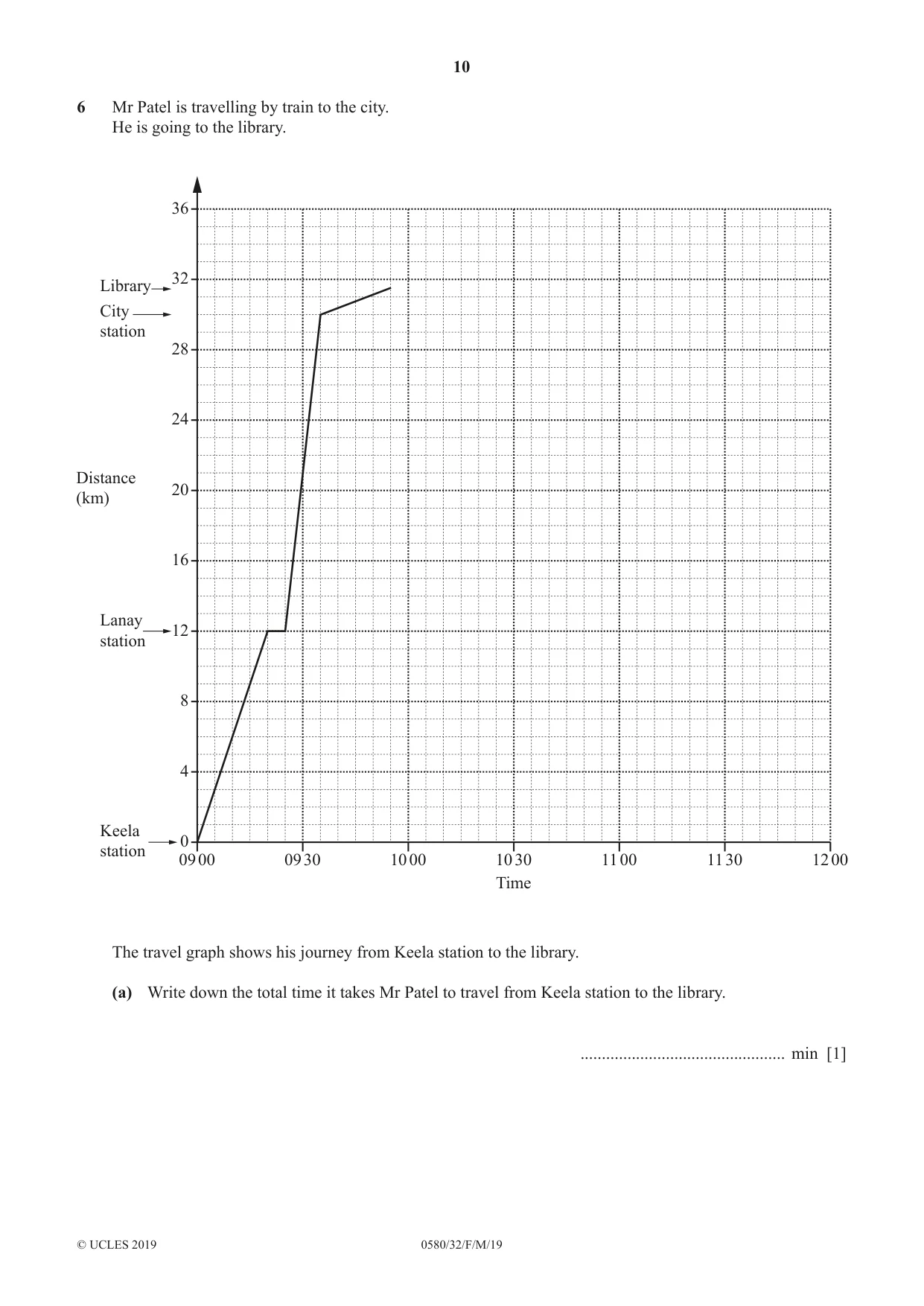
6 Mr Patel is travelling by train to the city. He is going to the library. 36 32 Library City station 28 24 Distance 20(km) 16 Lanay 12 station 8 4 Keela 0 station 09 00 09 30 10 00 10 30 11 00 11 30 12 00 Time The travel graph shows his journey from Keela station to the library. (a) Write down the total time it takes Mr Patel to travel from Keela station to the library. ................................................ min [1] (b) Work out the speed of the train between Lanay station and City station in km/h. .............................................. km/h [2] (c) Use the following information to complete the travel graph for Mr Patel. • He spends 35 minutes at the library. • He walks back to City station at the same constant speed he walked to the library. • The train takes 20 minutes to travel from City station to Lanay station. • The train stops for 10 minutes at Lanay station. • The train travels at a constant speed of 48 km/h from Lanay station to Keela station. [4]
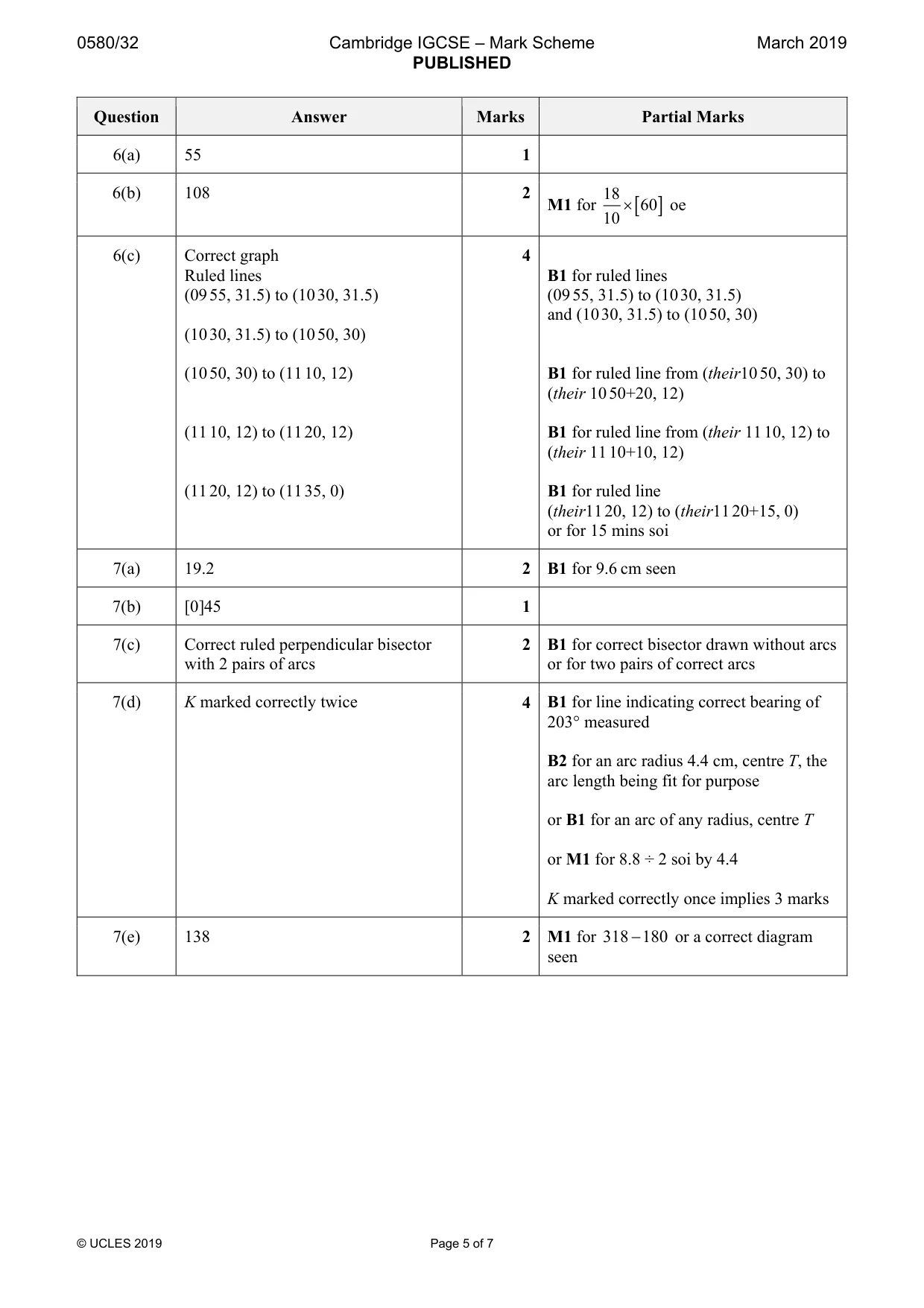
Mark scheme: 6(a) 55 1 6(b) 108 2 18 M1 for × [ 60 ] oe 10 6(c) Correct graph 4 Ruled lines B1 for ruled lines (09 55, 31.5) to (10 30, 31.5) (09 55, 31.5) to (10 30, 31.5) and (10 30, 31.5) to (10 50, 30) (10 30, 31.5) to (10 50, 30) (10 50, 30) to (11 10, 12) B1 for ruled line from (their10 50, 30) to (their 10 50+20, 12) (11 10, 12) to (11 20, 12) B1 for ruled line from (their 11 10, 12) to (their 11 10+10, 12) (11 20, 12) to (11 35, 0) B1 for ruled line (their11 20, 12) to (their11 20+15, 0) or for 15 mins soi
Q7 · The scale drawing shows the positions of an airport (A) and a train station (T) on a map
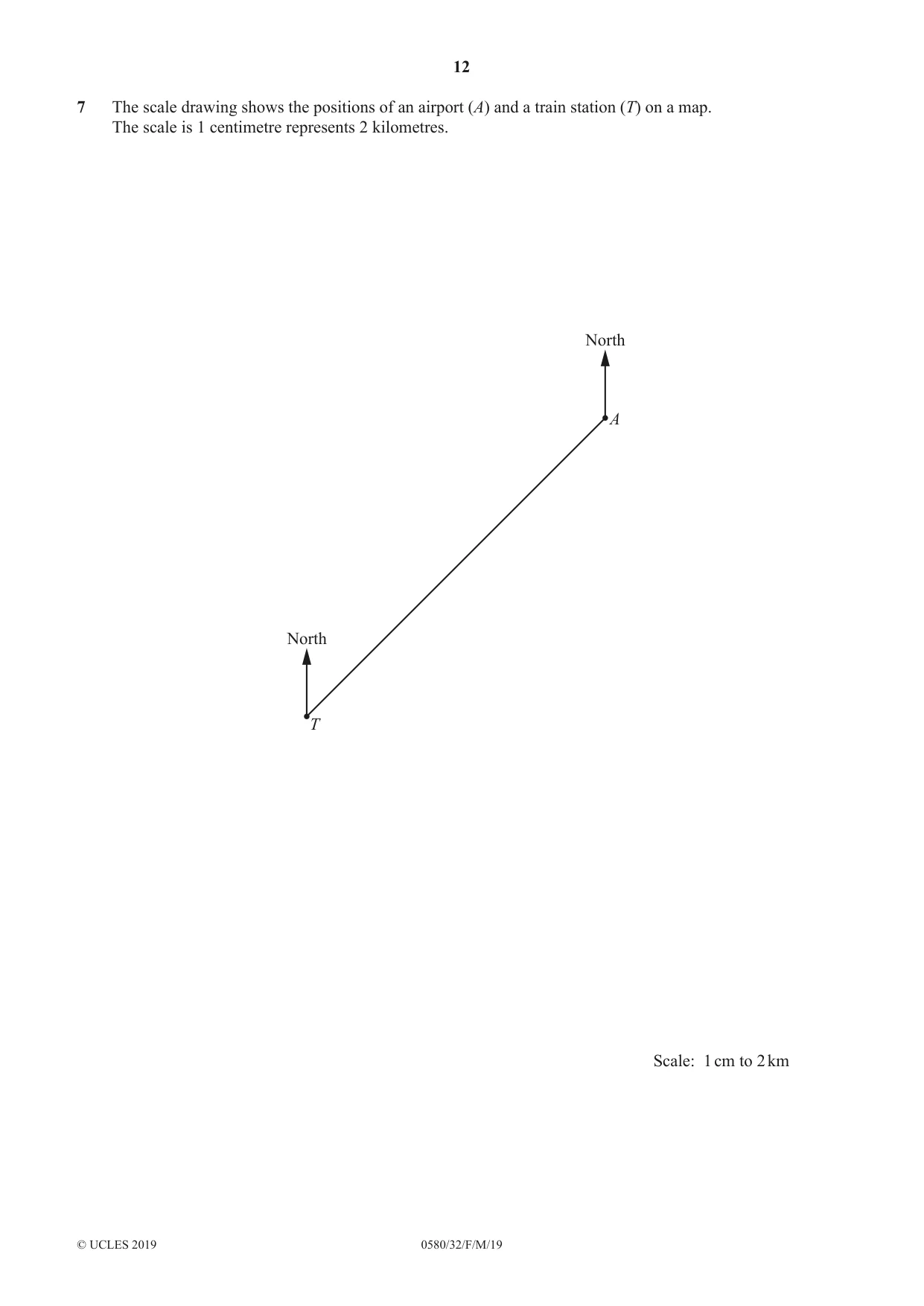
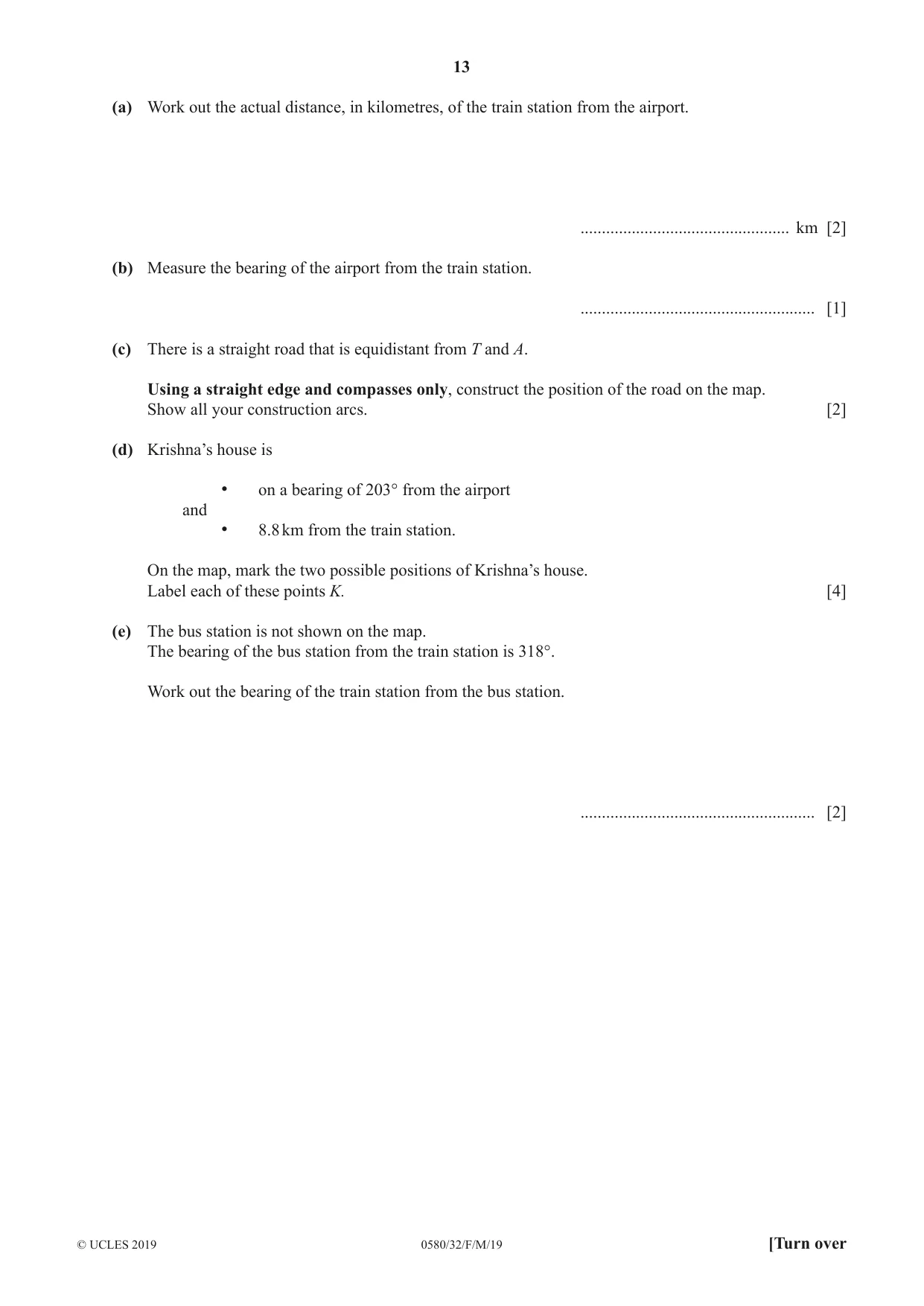
7 The scale drawing shows the positions of an airport (A) and a train station (T) on a map. The scale is 1 centimetre represents 2 kilometres. North A North T Scale: 1 cm to 2 km (a) Work out the actual distance, in kilometres, of the train station from the airport. ................................................. km [2] (b) Measure the bearing of the airport from the train station. ....................................................... [1] (c) There is a straight road that is equidistant from T and A. Using a straight edge and compasses only, construct the position of the road on the map. Show all your construction arcs. [2] (d) Krishna’s house is • on a bearing of 203° from the airport and • 8.8 km from the train station. On the map, mark the two possible positions of Krishna’s house. Label each of these points K. [4] (e) The bus station is not shown on the map. The bearing of the bus station from the train station is 318°. Work out the bearing of the train station from the bus station. ....................................................... [2]
Mark scheme: 7(a) 19.2 2 B1 for 9.6 cm seen 7(b) [0]45 1 7(c) Correct ruled perpendicular bisector 2 B1 for correct bisector drawn without arcs with 2 pairs of arcs or for two pairs of correct arcs 7(d) K marked correctly twice 4 B1 for line indicating correct bearing of 203° measured B2 for an arc radius 4.4 cm, centre T, the arc length being fit for purpose or B1 for an arc of any radius, centre T or M1 for 8.8 ÷ 2 soi by 4.4 K marked correctly once implies 3 marks 7(e) 138 2 M1 for 318 − 180 or a correct diagram seen
Q8 · Y 4 L 3 2 1 –2 –1 0 1 2 3 4 5 6 7 8 x –1 Line L is drawn on the grid
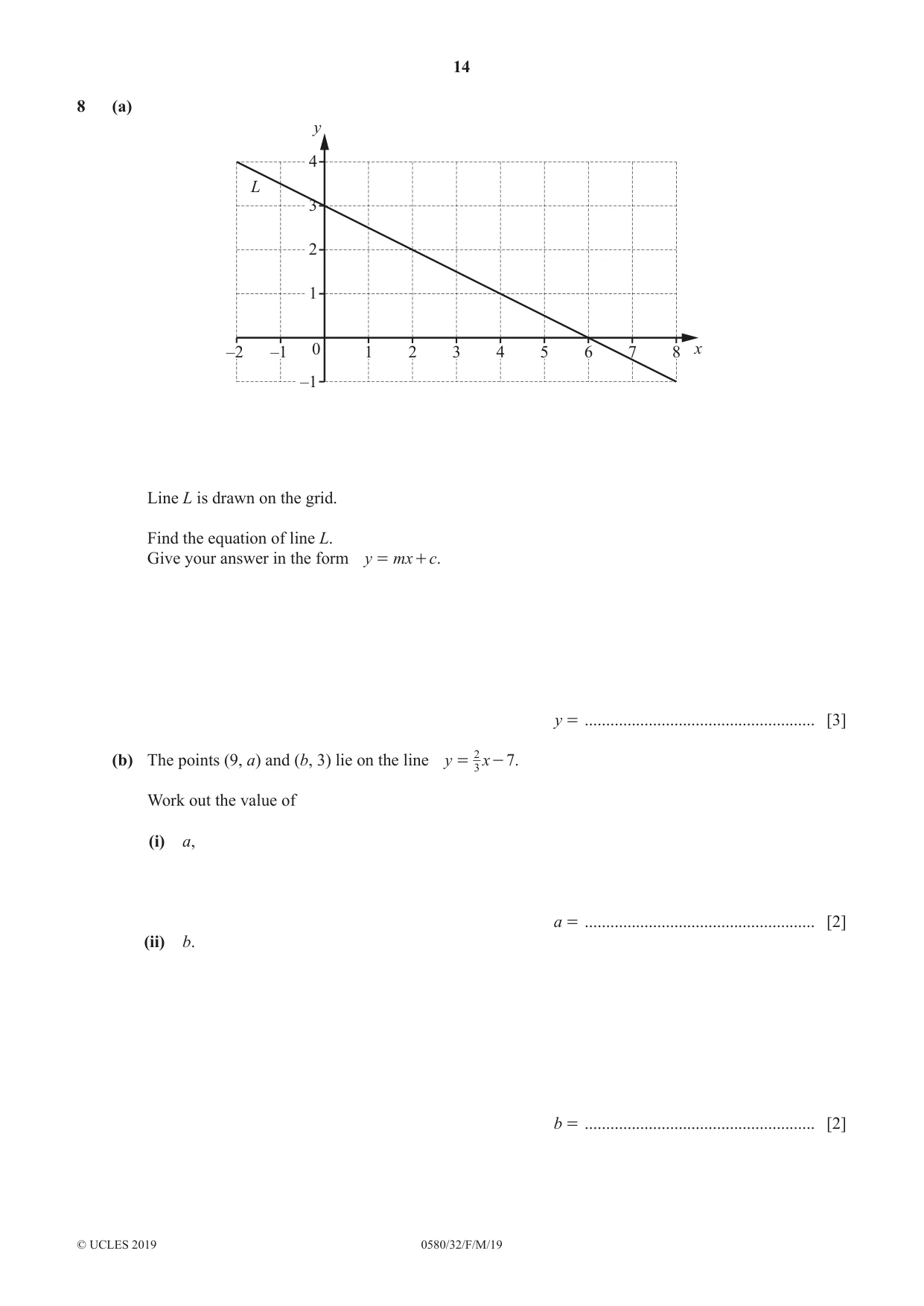
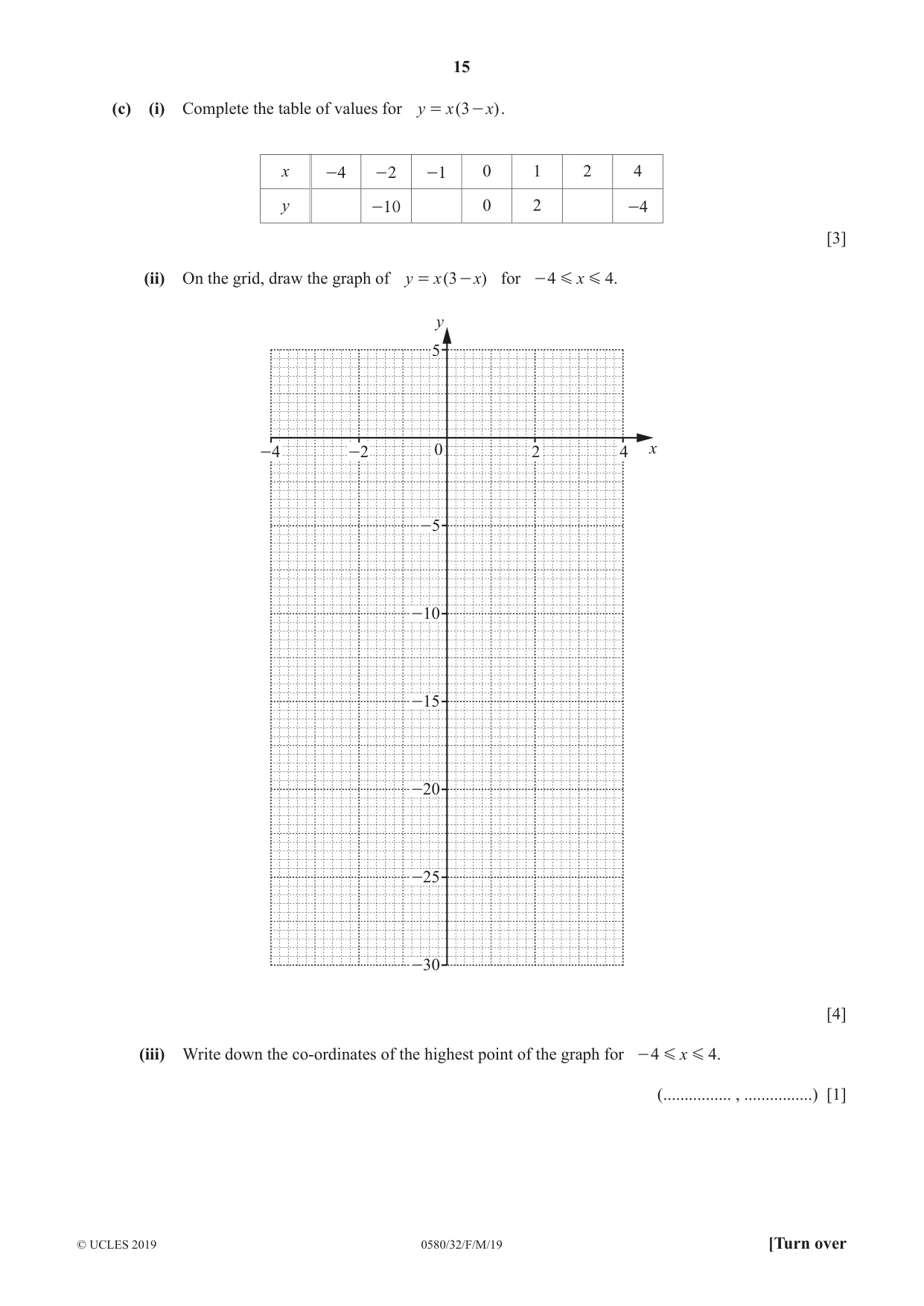
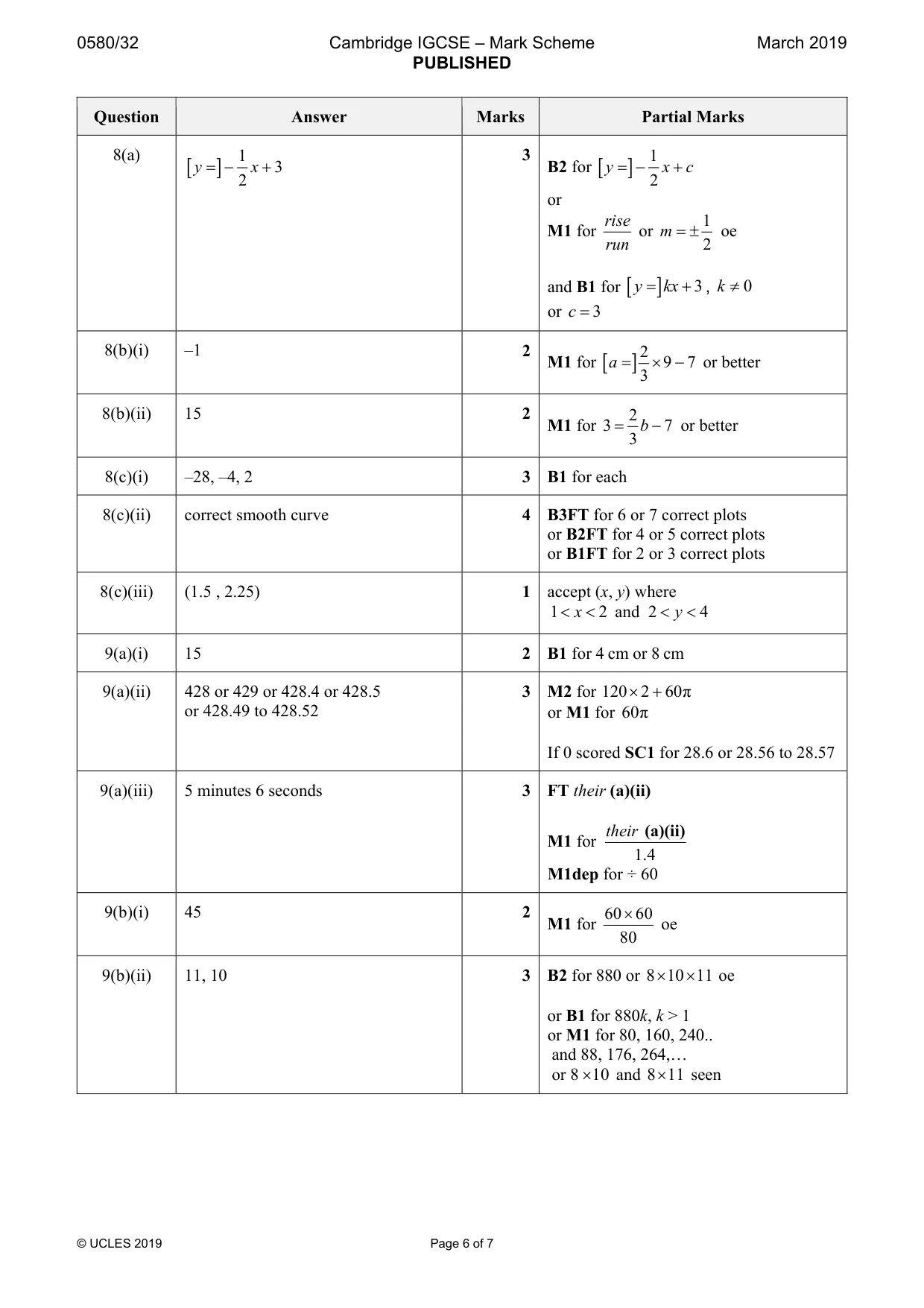
8 (a) y 4 L 3 2 1 –2 –1 0 1 2 3 4 5 6 7 8 x –1 Line L is drawn on the grid. Find the equation of line L. Give your answer in the form y = mx + c. y = ...................................................... [3] - 7. (b) The points (9, a) and (b, 3) lie on the line y = 23 x Work out the value of (i) a, a = ...................................................... [2] (ii) b. b = ...................................................... [2] (c) (i) Complete the table of values for y = x (3 - x). x -4 -2 -1 0 1 2 4 y -10 0 2 -4 [3] (ii) On the grid, draw the graph of y = x (3 - x) for - 4 G x G 4. y 5 -4 -2 0 2 4 x -5 -10 -15 -20 -25 -30 [4] (iii) Write down the co-ordinates of the highest point of the graph for - 4 G x G 4. (................ , ................) [1]
Mark scheme: 8(a) 1 3 1 [ y = ] − x + 3 B2 for [ y = ] − x + c 2 2 or rise 1 M1 for or m = ± oe run 2 and B1 for [ y = ] kx + 3 , k ≠ 0 or c = 3 8(b)(i) –1 2 2 M1 for [ a = ] × 9 − 7 or better 3 8(b)(ii) 15 2 2 M1 for 3 = b − 7 or better 3 8(c)(i) –28, –4, 2 3 B1 for each 8(c)(ii) correct smooth curve 4 B3FT for 6 or 7 correct plots or B2FT for 4 or 5 correct plots or B1FT for 2 or 3 correct plots 8(c)(iii) (1.5 , 2.25) 1 accept (x, y) where 1 < x < 2 and 2 < y < 4
Q9 · The diagram shows a rectangle and two semicircles with diameters AC and BD
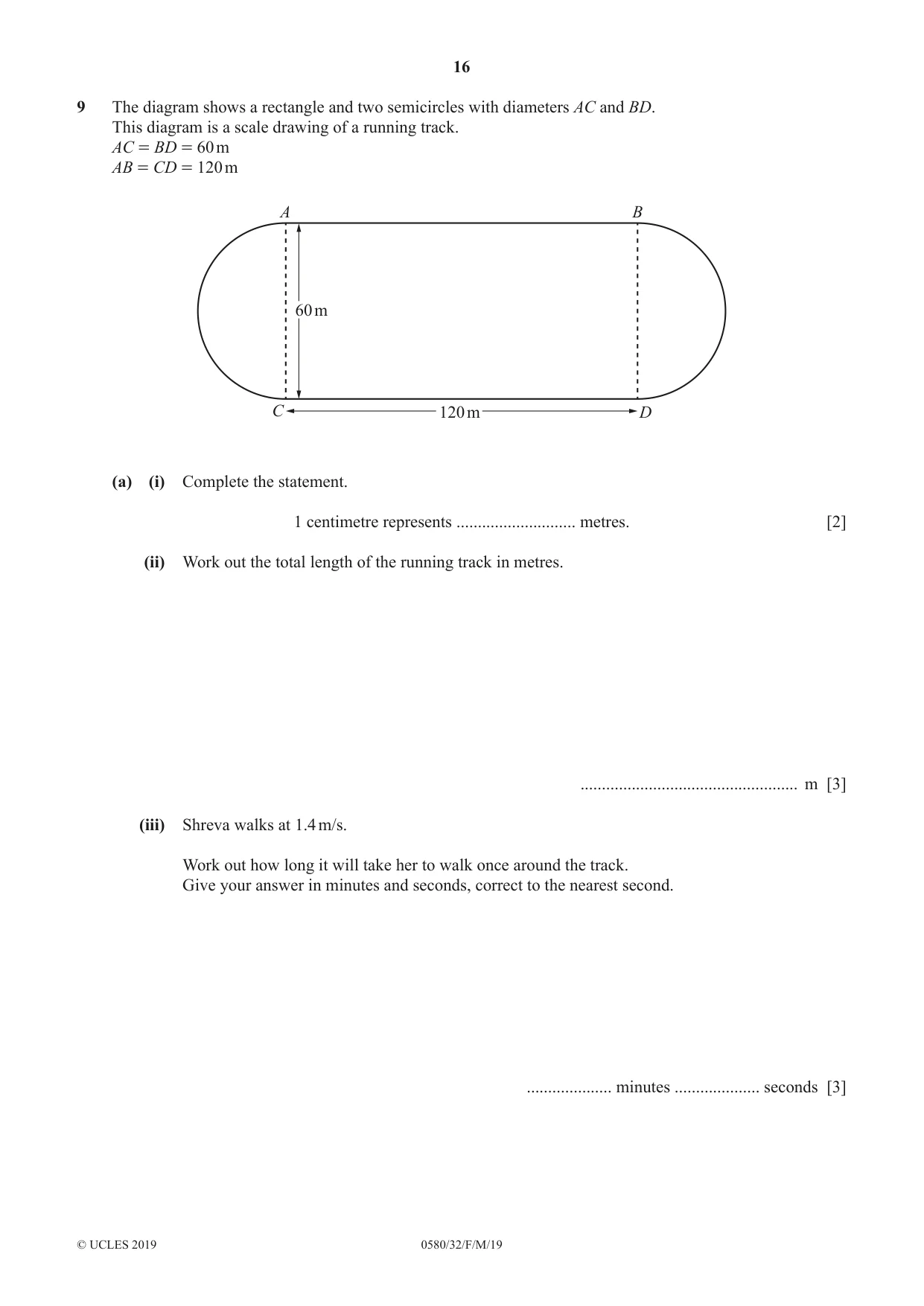
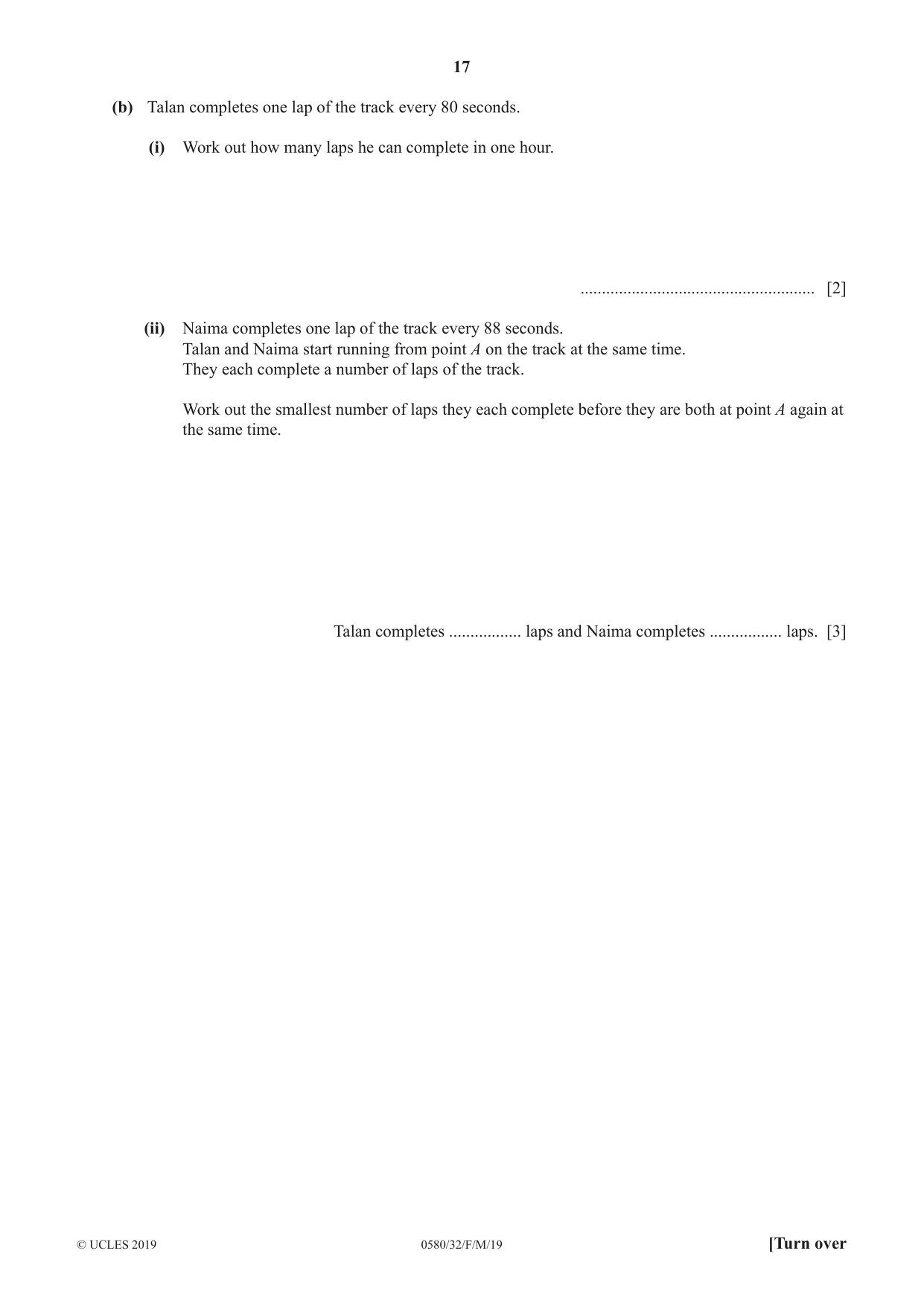
9 The diagram shows a rectangle and two semicircles with diameters AC and BD. This diagram is a scale drawing of a running track. AC = BD = 60 m AB = CD = 120 m A B 60 m C 120 m D (a) (i) Complete the statement. 1 centimetre represents ............................ metres. [2] (ii) Work out the total length of the running track in metres. ................................................... m [3] (iii) Shreva walks at 1.4 m/s. Work out how long it will take her to walk once around the track. Give your answer in minutes and seconds, correct to the nearest second. .................... minutes .................... seconds [3] (b) Talan completes one lap of the track every 80 seconds. (i) Work out how many laps he can complete in one hour. ....................................................... [2] (ii) Naima completes one lap of the track every 88 seconds. Talan and Naima start running from point A on the track at the same time. They each complete a number of laps of the track. Work out the smallest number of laps they each complete before they are both at point A again at the same time. Talan completes ................. laps and Naima completes ................. laps. [3]
Mark scheme: 9(a)(i) 15 2 B1 for 4 cm or 8 cm 9(a)(ii) 428 or 429 or 428.4 or 428.5 3 M2 for 120 × 2 + 60π or 428.49 to 428.52 or M1 for 60π If 0 scored SC1 for 28.6 or 28.56 to 28.57 9(a)(iii) 5 minutes 6 seconds 3 FT their (a)(ii) their (a)(ii) M1 for 1.4 M1dep for ÷ 60 9(b)(i) 45 2 60 × 60 M1 for oe 80 9(b)(ii) 11, 10 3 B2 for 880 or 8 × 10 × 11 oe or B1 for 880k, k > 1 or M1 for 80, 160, 240.. and 88, 176, 264,… or 8 × 10 and 8 × 11 seen
Q10 · Using a straight edge and compasses only, construct the equilateral triangle ABC
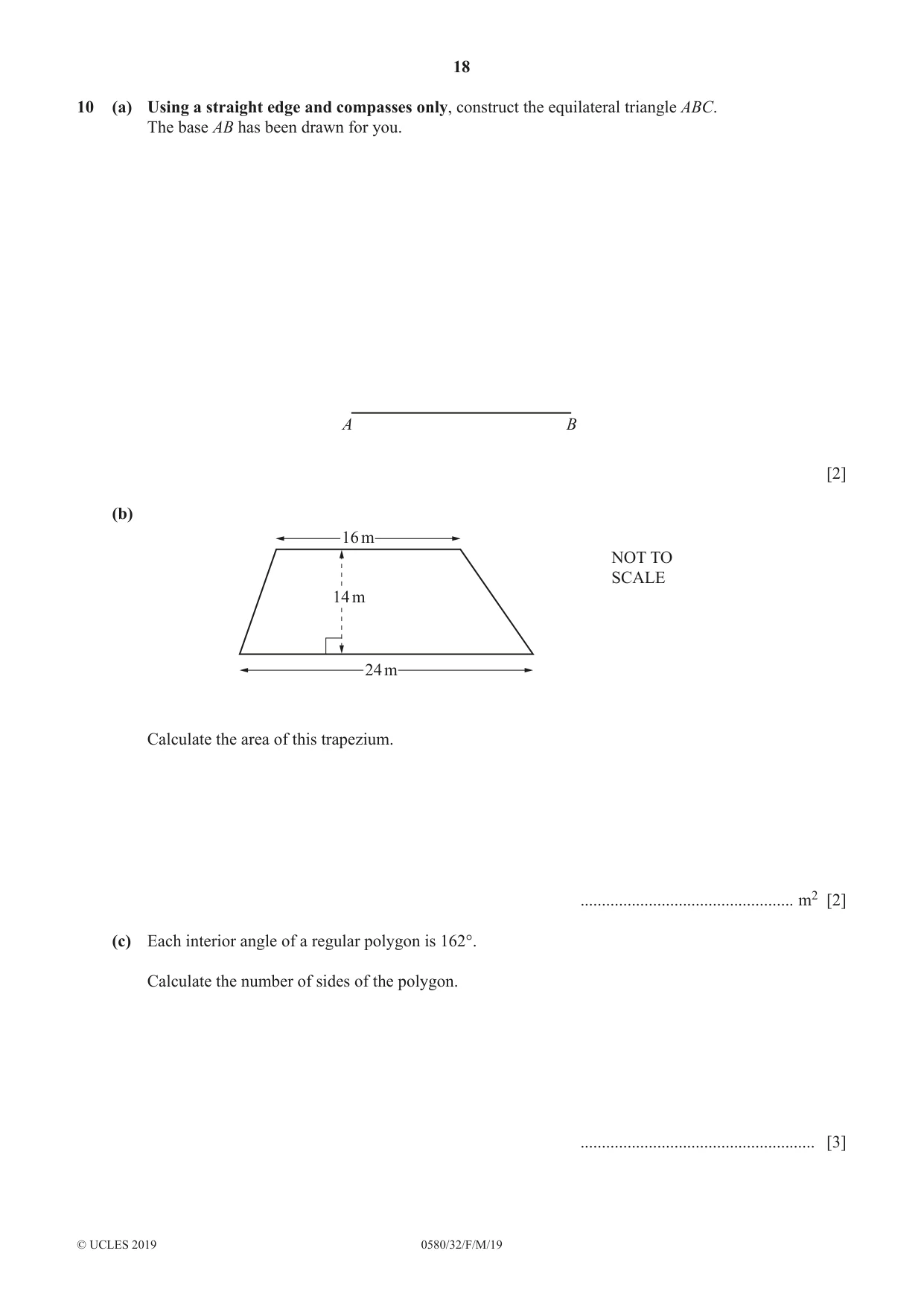
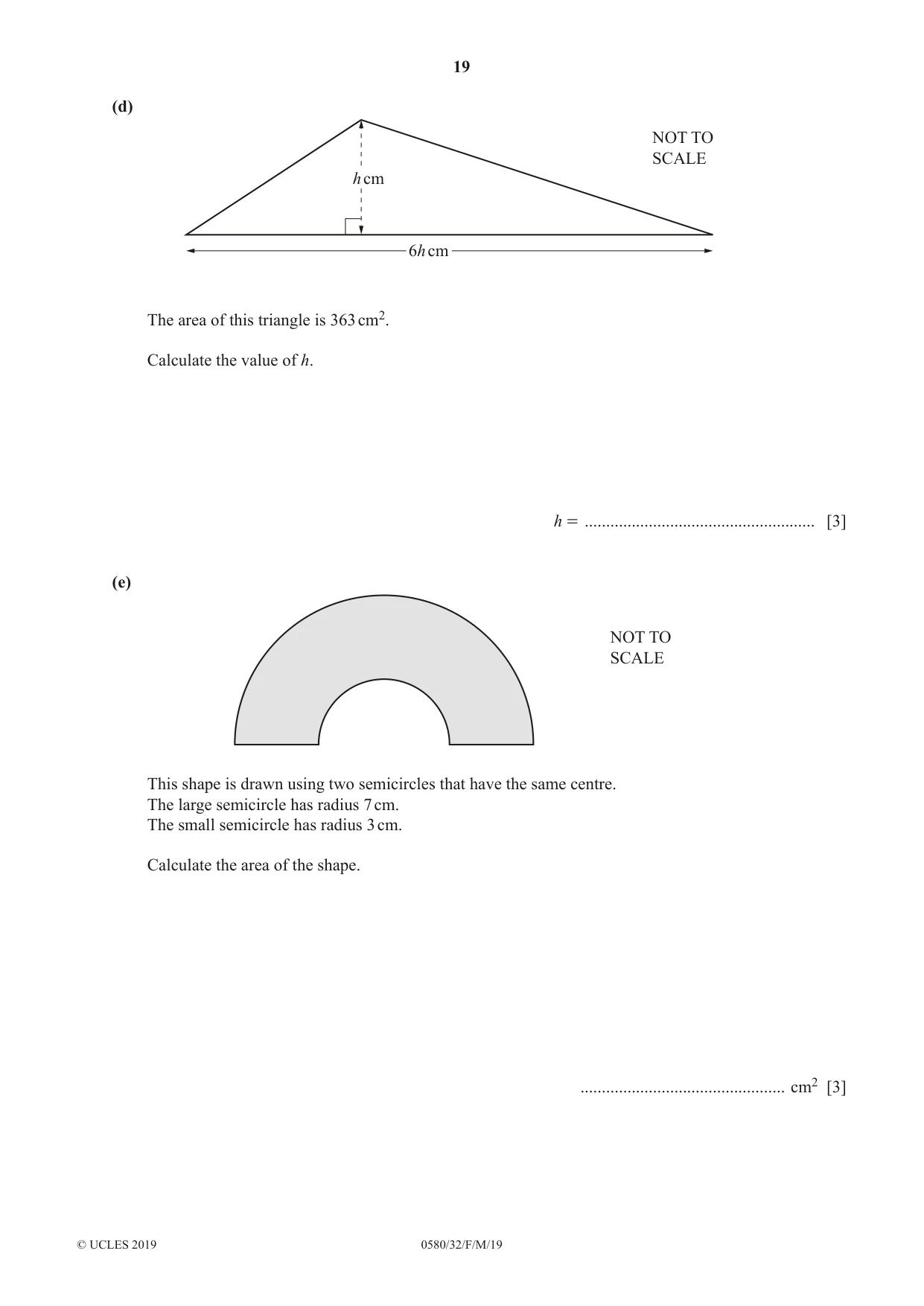
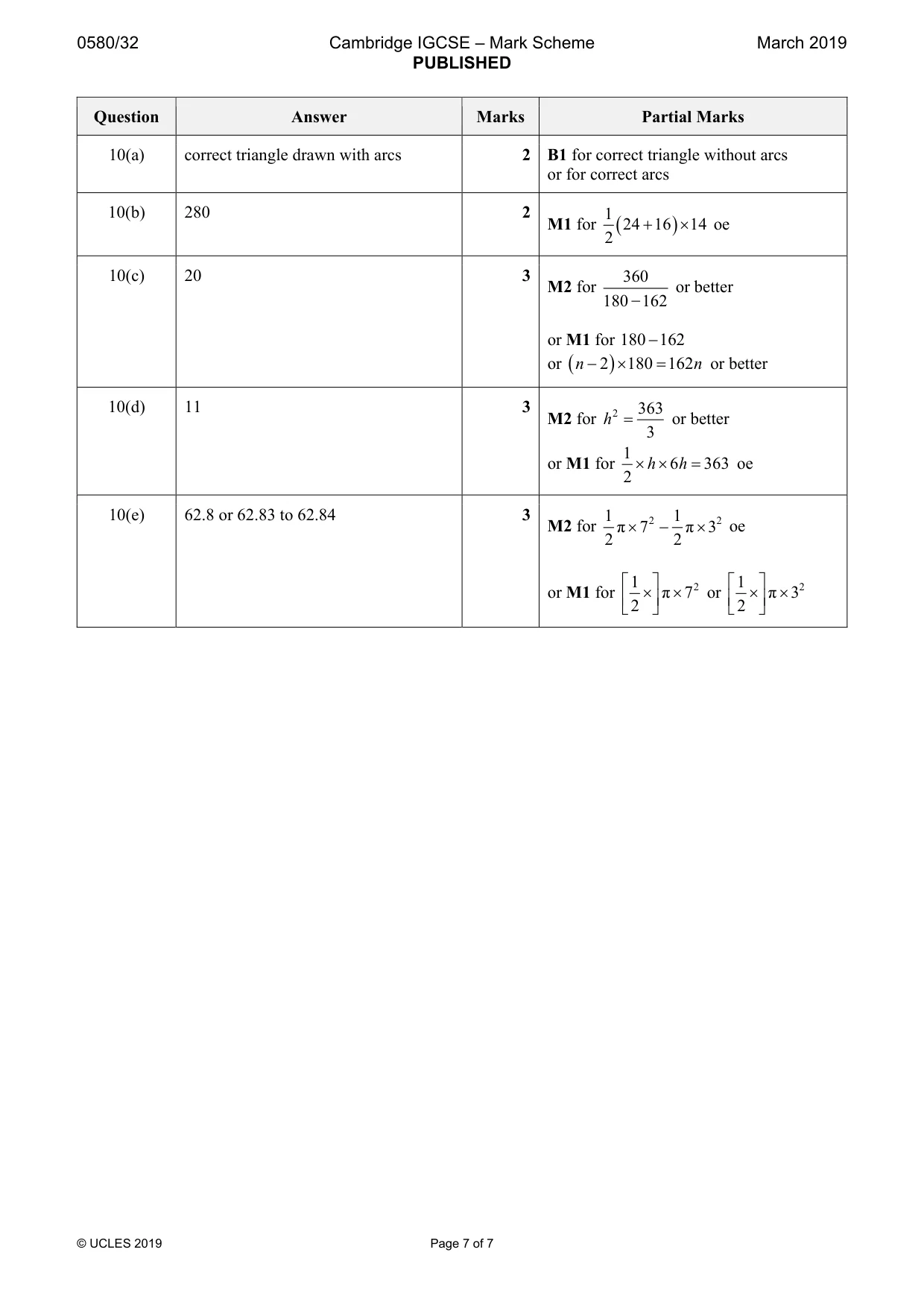
10 (a) Using a straight edge and compasses only, construct the equilateral triangle ABC. The base AB has been drawn for you. A B [2] (b) 16 m NOT TO SCALE 14 m 24 m Calculate the area of this trapezium. .................................................. m2 [2] (c) Each interior angle of a regular polygon is 162°. Calculate the number of sides of the polygon. ....................................................... [3] (d) NOT TO SCALE h cm 6h cm The area of this triangle is 363 cm2. Calculate the value of h. h = ...................................................... [3] (e) NOT TO SCALE This shape is drawn using two semicircles that have the same centre. The large semicircle has radius 7 cm. The small semicircle has radius 3 cm. Calculate the area of the shape. ................................................ cm2 [3]
Mark scheme: 10(a) correct triangle drawn with arcs 2 B1 for correct triangle without arcs or for correct arcs 10(b) 280 2 1 M1 for ( 24 + 16 ) × 14 oe 2 10(c) 20 3 360 M2 for or better 180 − 162 or M1 for 180 − 162 or ( n − 2 ) × 180 = 162 n or better 10(d) 11 3 2 363 M2 for h = or better 3 1 or M1 for × h × 6 h = 363 oe 2 10(e) 62.8 or 62.83 to 62.84 3 1 2 1 2 M2 for π × 7 − π × 3 oe 2 2 1 2 1 2 or M1 for × π × 7 or × π × 3 2 2
What was in this paper
The subtopics covered by these 10 questions, and how many questions each got. Open one in a new tab to see every Cambridge question on it.
What you needed in this session
Cambridge’s own grade thresholds for 2019 Feb/March, Paper 3 · Variant 2. A higher threshold means an easier paper — the bar moves with how the cohort did.